Article

Synthesis and Luminescent Properties of Eu3+-Doped Complex Borosilicate Glasses

by
Aneliya Yordanova
1,2,
Margarita Milanova
1,*,
Lyubomir Aleksandrov
1,2,
Reni Iordanova
1 and
Petia Petrova
3
1
Institute of General and Inorganic Chemistry, Bulgarian Academy of Sciences, G. Bonchev Str., Bld. 11, 1113 Sofia, Bulgaria
2
National Centre of Excellence Mechatronics and Clean Technologies, 8 bul., Kl. Ohridski, 1756 Sofia, Bulgaria
3
Institute of Optical Materials and Technologies “Acad. Jordan Malinowski”, Bulgarian Academy of Sciences, Blvd. Akad. G. Bonchev Str., Bld. 109, 1113 Sofia, Bulgaria
*
Author to whom correspondence should be addressed.
Molecules 2026, 31(6), 1000; https://doi.org/10.3390/molecules31061000
Submission received: 30 December 2025 / Revised: 27 February 2026 / Accepted: 12 March 2026 / Published: 16 March 2026

Abstract

Glasses with compositions (52.5 − x/2)B2O3:(12.5 − x/2)SiO2:25La2O3:5ZnO:5CaO:0.5Eu2O3:xWO3, x = 0, 2.5, 5, 7.5, 10, 20 (mol%) were prepared by conventional melt-quenching method and investigated by X-ray diffraction analysis, DSC analysis, DR-UV-Vis spectroscopy and photoluminescence spectroscopy. Physical parameters like density, molar volume, oxygen molar volume and oxygen packing density were also determined. Their values, as well as DR-UV-Vis spectroscopy results, indicate that the tungstate ions incorporate into the base borosilicate glass as tetrahedral WO4 and octahedral WO6 groups. With increasing WO3 content over 5 mol%, WO6 units are progressively linked to each other by W-O-W bonds, leading to the formation of a more connected and homogeneous glass network. Glasses are characterized by a high glass transition temperature (over 650 °C) and good thermal stability. The emission intensity of the Eu3+ ion increases with the introduction of WO3 due to the occurrence of non-radiative energy transfer from the tungstate groups to the active ion. The most intense luminescence peak observed at 612 nm suggests that the glasses are potential materials for red emission.

1. Introduction

Over recent decades, the development and analysis of fluorescent materials doped with rare earth ions have garnered significant interest within the field of optoelectronics research. This growing attention stems from their wide array of applications in the creation and advancement of novel optical materials. Glasses, in particular, stand out as some of the most thoroughly studied engineering materials due to their versatility and adaptability achieved through composition modification. Additionally, they hold immense potential in innovations for optical communication and solid-state laser technologies [1]. Among the various types of glasses, borosilicate glasses have captured researchers’ attention because of their remarkable properties. These include high chemical resistance, a high crystallization ability, lower thermal expansion, elevated softening temperature, and excellent mechanical strength. They are cost-effective and readily accessible. Such properties pave the way for extensive industrial applications in areas such as display technologies, solar energy systems, and MEMs technology.
In advanced technologies, trivalent rare earth ions play a pivotal role as active constituents in numerous optical materials. Their importance is owed to the presence of multiple absorption and emission bands that result from transitions between distinct energy levels. Notably, trivalent europium (Eu3+) ions stand out as effective spectroscopic probes due to their simple energy-level structure, which features a non-degenerate 7F0 ground state and 5D0 excited state. This makes Eu3+ ions instrumental in studying the structure and chemical bonding nature within host matrices. Moreover, the strong 5D07F2 electronic transition exhibited by these ions establishes them as efficient activators for generating intense red emission, particularly suited for display devices [1].
Borosilicate glasses doped with Eu2O3 oxide have been extensively studied. For example, Bi-containing borosilicate glasses doped with different amounts of Eu3O2 (1–4 mol%) were synthesized. The influence of the concentration of Eu2O3 on the physical, optical and luminescent properties of the glasses was studied. It was found that the glasses show the strongest emission at a wavelength of 613 nm and when excited by 465 nm. The color of the emission is reddish-orange. The optimal concentration of Eu2O3 in these glasses, at which the highest emission intensity is achieved, is 4.0 mol% [2]. Eu3+-doped glasses with the composition 74.5B2O3 + 10SiO2 + 5MgO + R + 0.5Eu2O3 [R = 10 (Li2O/Na2O/K2O)] are considered to be potential candidates for red lasers, as well as for red color centers in displays [1]. Zinc–borosilicate glasses (with high ZnO content) doped with different amounts of Eu2O3 (0.2, 0.5, 1, 1.5, 2 mol%) were obtained. The glasses are characterized by intense red emission upon excitation with a wavelength of 395 nm. “Quenching” of the luminescence is observed at a concentration of Eu2O3 above 1 mol% [3,4]. Thermally stable borosilicate glasses doped with Eu2O3 with the composition 35B2O3.20SiO2.(15 − x)Al2O3.15ZnO.15Na2CO3.xEu2O3 (x = 0.5 ÷ 2.5 mol%) were synthesized. These glasses showed red emission, the intensity of which increased with increasing concentration of Eu3+ ions up to 2.5 mol% [5]. The effect of changing the concentration of B2O3 and Al2O3 in the composition of the glass Na2O-Gd2O3-B2O3-SiO2-Al2O3-Eu2O3 on the luminescent properties of the incorporated Eu3+ ions was studied. It was shown that with the addition of Al2O3, a [BO4] → [BO3] transformation occurs. The amorphous network becomes ‘‘loose’’, resulting in an increase in the space around the rare earth ions embedded in the glass matrix, an increase in their quenching concentration, and an improvement in the emission intensity of Eu3+ [6]. Physical, optical, and luminescent properties of Eu3+-doped potassium borosilicate glasses (KBSi:Eu3+) have been studied. The density and molar volume of the glasses increase with increasing Eu2O3 oxide content. After excitation with 394 nm, KBSi:Eu3+ glasses emit highly intense reddish-orange light and could be applied in various photonic devices such as solid-state lasers and light-emitting diodes [7]. The optical and luminescent properties of Eu3+-doped glasses with the composition (55 − x)B2O3:10SiO2:25Y2O3:10CaO:xEu2O3, x = 0 ÷ 2.5 mol%, were studied [8]. The color coordinates of the glasses were found to be in the red region. The resulting glass was a potential candidate for red laser emission at 613 nm. Sm3+/Eu3+ co-doped thermally stable zinc–alumino-borosilicate glasses and alkaline-earth–alumino-borosilicate glasses were investigated. They were shown to be suitable candidates for application as red components of white-light-emitting diodes [9,10]. Dy3+/Eu3+-co-doped luminescent glasses SiO2-B2O3-ZnO-La2O3-BaO (SBZLBA) were synthesized. When excited at 386 nm, the glasses exhibit three distinct emission regions: blue, yellow, and red, allowing for color-tunable luminescence ranging from cool white to neutral white and ultimately warm white by varying the excitation wavelength and Eu3+ doping concentration. Results indicate that Dy3+/Eu3+-co-doped SBZLBa glasses are promising materials for white-light-emitting devices [11]. Dy3+/Eu3+-co-doped white-light-emitting CaO-B2O3-SiO2 glasses have been obtained. The glasses exhibit good thermal stability, and the luminescence color can be tuned by controlling the relative concentrations of Dy3+ and Eu3+ ions and the excitation wavelength. White light was achieved upon excitation at 387 nm when the concentrations of Dy3+ and Eu3+ were 4% and 2%, respectively [12].
It should be noted that in many cases the emission intensity of Eu3+ ions is higher when they are embedded in matrices containing tungsten oxide, compared to their intensity in other matrices. The significance of tungstates is determined by the occurrence of non-radiative charge transfer from WOn groups to the active Re3+ (Nd, Sm, Eu, Tb, Dy) ion, which leads to an increase in the intensity and efficiency of the emission. There are very few studies in the literature on borosilicate glasses containing tungsten oxide, for example, compositions B2O3-SiO2-ZnO-Na2O-WO3 [13] and 20B2O3–10SiO2–10CaO-(60 − x)Bi2O3/xWO3, x = 0 to 20 wt% [14], and the research on these composites is mainly devoted to structural properties. Although the properties of borosilicate glasses doped with Eu3+ are widely investigated [2,3,4,5,6,7,8,9,10,11,12], their complex interaction with different WO3 doping levels has not yet been studied.
This work aims to investigate the influence of WO3 on the physical parameters and luminescent characteristics of Eu3+-doped (52.5 − x/2)B2O3:(12.5 − x/2)SiO2:25La2O3:5ZnO:5CaO:0.5Eu2O3:xWO3, x = 0, 2.5, 5, 7.5, 10 and 20 mol% glasses.

2. Results and Discussion

2.1. XRD Data and Thermal Analysis

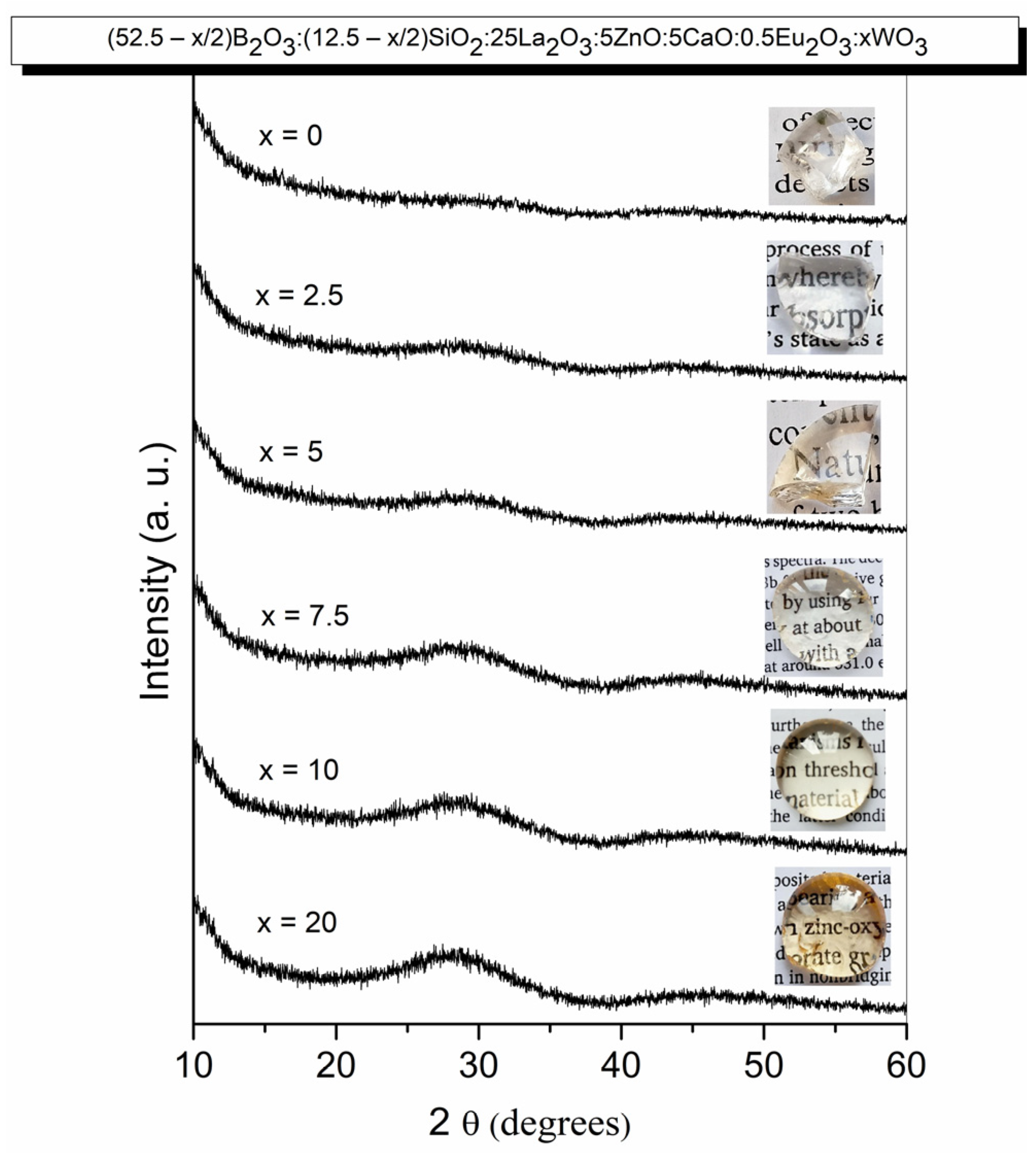
The amorphous nature of the prepared materials was confirmed by X-ray diffraction analysis. Typical diffraction patterns of the glasses obtained are shown in Figure 1. The photographic images (insets, Figure 1) show that transparent bulk glass specimens were obtained.
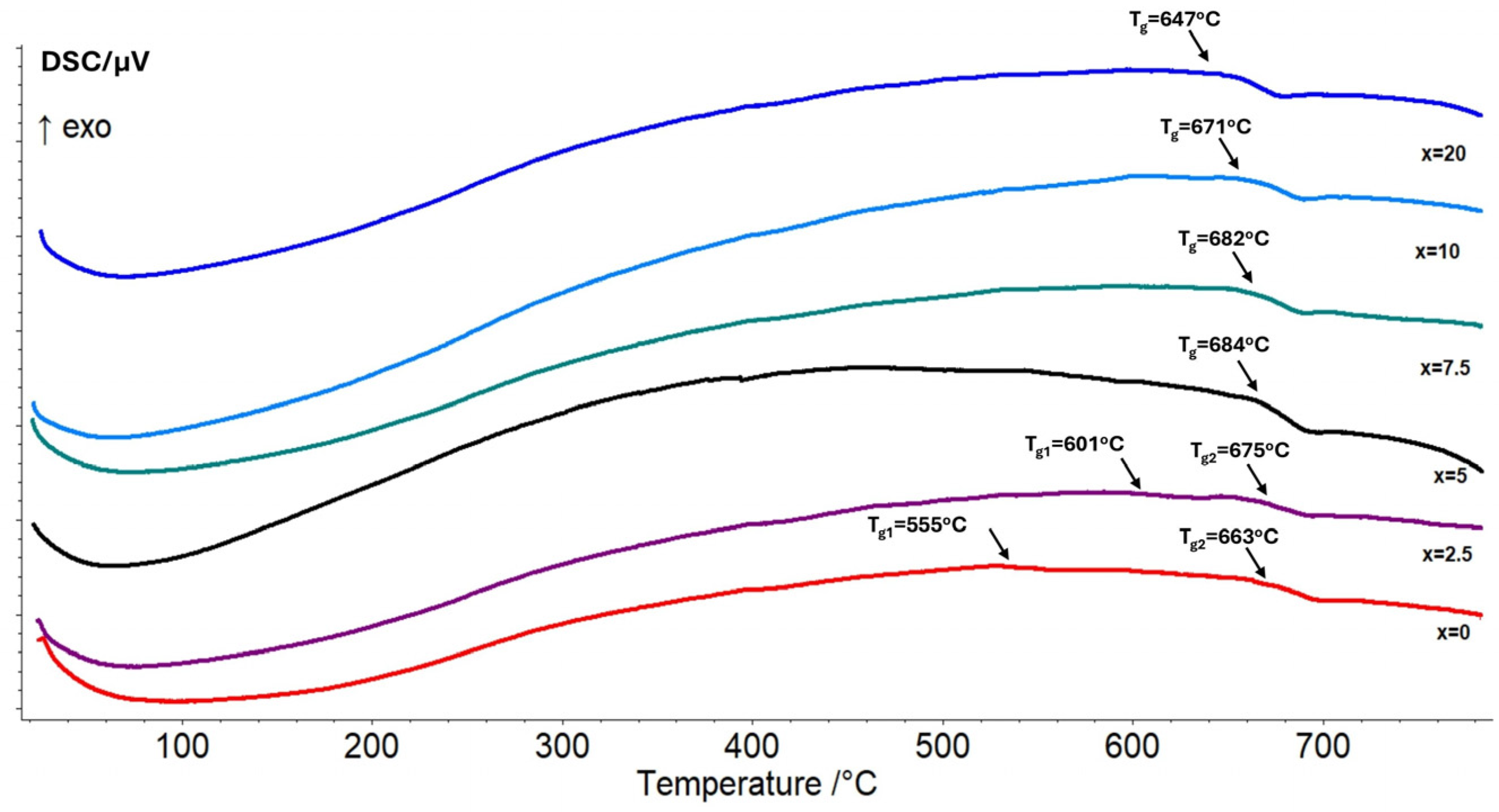
The obtained glasses were also investigated using DSC analysis in order to obtain information on their thermal parameters and on some structural changes that take place due to compositional changes. Figure 2 compares the DSC curves of the glasses investigated in this work. The glass transition temperature, Tg, has been determined (Table 1), since it is connected with both the strength of inter-atomic bonds and glass network connectivity. A higher Tg corresponds to a more rigid structure, whereas the glasses with a loose-packed structure have a lower Tg [15]. For glasses x = 0 and x = 2.5, two glass transition temperatures are obtained due to the formation of two amorphous phases because of liquid phase separation during the melting process. With further increase in WO3 content, one Tg is observed, indicating that liquid phase separation has been overcome. Hence, the addition of more than 2.5 mol% tungsten oxide into the base glass leads to the formation of a homogeneous amorphous network. It is seen that Tg values decrease for glasses containing more than 5 mol%WO3 (from 684 to 647 °C). The observed reduction in Tg is a result of the replacement of strong Si-O and B-O bonds with weaker W-O bonds [16].

2.2. DR-UV–Vis Spectra

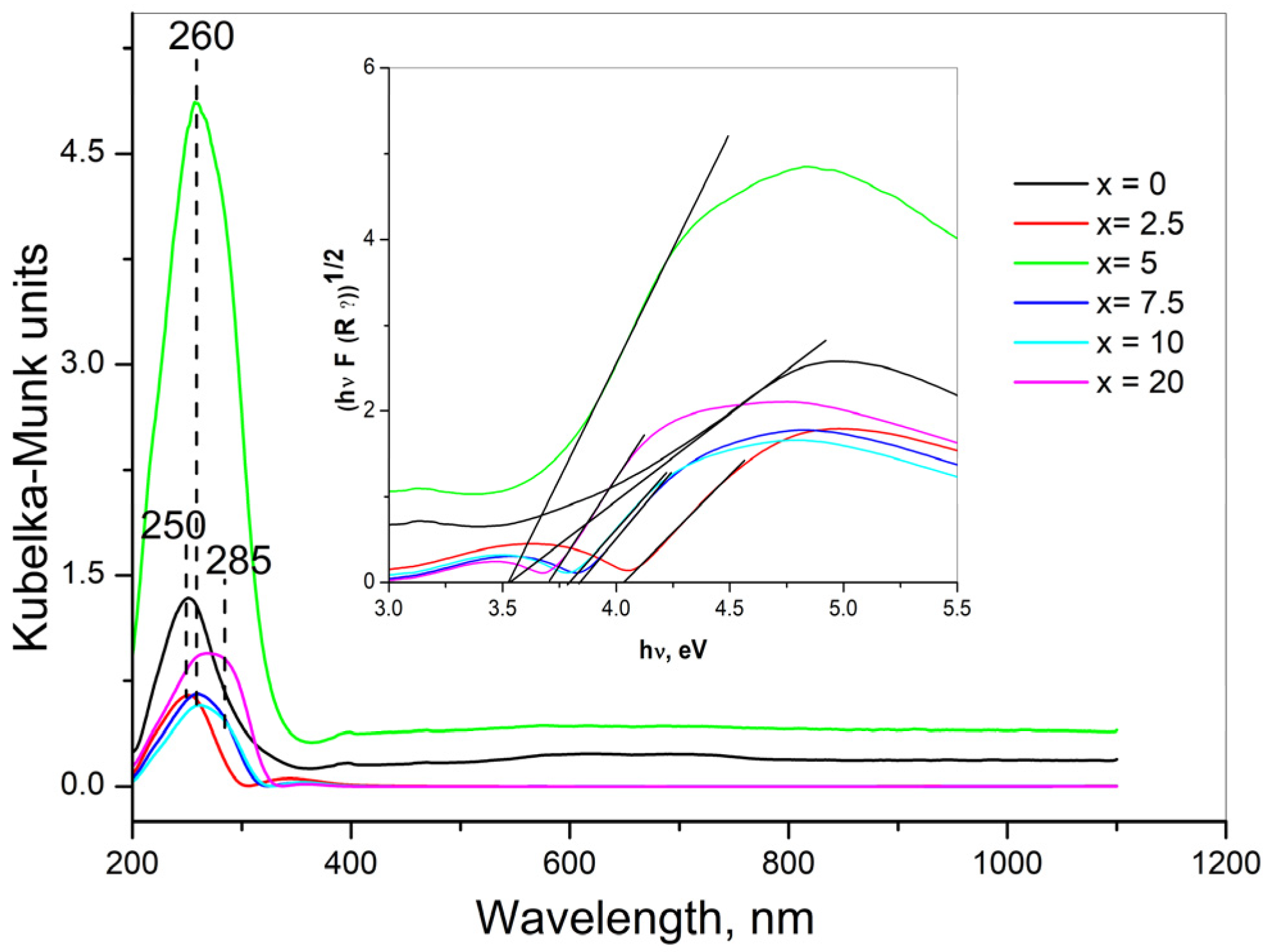
Diffuse Reflectance UV-Vis Spectroscopy (DRS) was also applied for the characterization of the prepared materials. Figure 3 shows the diffuse reflectance spectra of the glasses obtained.
In the spectrum of WO3-free glass, one symmetrical band at 250 nm is observed, which is due to the presence of unavoidable trace iron impurities in the raw materials for glass preparation [17]. The optical absorption spectra of glasses containing 2.5 and 5 mol% WO3 display one symmetrical band at 250–260 nm that can be assigned to the ligand–metal charge transfer (LMCT) from oxygen ligands to W6+ of distorted and isolated WO4 tetrahedra. It is well-known that DRS spectra for the isolated WO4 reference compounds only possess a single ligand-to-metal charge transfer (LMCT) band in the general region of 218–274 nm [18]. The exact location of this band maximum depends on the extent of distortion of the isolated WO4 structure. For example, K2WO4 has a relatively undistorted isolated WO4 unit and possesses a LMCT band at 223 nm, whereas Zr(WO4)2 consists of a distorted isolated WO4 unit and exhibits an LMCT band at 274 nm. DRS spectra of glasses x = 7.5, x = 10 and x = 20 are broad, and can be regarded as composed of at least two bands—at about 260 nm and at about 285 nm. The UV–Vis diffuse reflectance spectra of various tungstate reference compounds containing octahedrally coordinated W atoms against oxygen show two absorption bands between 250 and 360 nm that can be attributed to octahedral WO6 units [18]. Following the above, the bands at 260 nm and at 285 nm in the DRS spectra of glasses containing from 7.5 to 20 mol% WO3 can be linked to the presence of WO6 octahedra. The absence of any absorption in the visible range indicates that W5+ species do not present in the investigated glasses [19]. Optical band gap values (Eg) evaluated from the UV–Vis spectra can give information about the structural arrangement of the glasses under investigation (inset of Figure 3). The plot of transformed Kubelka–Munk function versus the energy of light (Tauc plot) provides band gap energies, Eg, listed in Table 1. Eg values established for glasses x = 2.5 and x = 5 are typical for band gap energies for tungstates containing WO4 tetrahedra [20,21]. The band gap energy values of glasses x = 7.5, x = 10 and x = 20 are compatible with the values of other tungstate glasses possessing octahedrally coordinated W6+ (WO6) [22]. The decreasing Eg with increasing WO3 observed suggests that progressive polymerization of WO6 groups, i.e., increasing number of bridging W–O–W bonds, takes place upon WO3 loading [18]. From DRS results it is seen that there is a strong overlapping of the LMCT band regions, as well as of the band gap energy values for WO4 and WO6 groups. That is why it is reasonable to suggest that both WO4 and WO6 polyhedra participate in the structure of glasses having higher WO3 concentration (7.5, 10 and 20 mol%).

2.3. Density, Molar Volume, Oxygen Packing Density and Oxygen Molar Volume

The influence of WO3 on several physical parameters of the investigated glasses such as density (ρ), molar volume (Vm), oxygen molar volume (Vo), and oxygen packing density (OPD) has been studied and the data obtained are listed in Table 1. Determination of these physical parameters is the simplest way of detecting structural changes in glass networks with compositional variation. As can be seen from the table for the investigated glasses, both density and oxygen molar values increase with increasing WO3 concentration from 2.5 to 20 mol% (Table 1). The density enhancement can be attributed to the increase in the average molecular mass of glasses as a result of the substitution of lighter B2O3 (molecular weight 69.62 g/mol) and SiO2 (molecular weight 60.08 g/mol) with the heavier WO3 (molecular weight 231.84 g/mol) [23]. As the molar volume (volume occupied by a mass of the glass equal to 1 mole) is strongly affected by the ionic radii of the incorporated ionic species in the glass, the increasing trend of Vm is due to the insertion of W6+ ions, which are known to have a higher ionic radius (0.60 Å) compared with the ionic radii of B3+ (0.23 Å) and Si4+ (0.26 Å), resulting in the formation of an excess free volume, which increases the overall molar volume of glasses [24,25,26].
Oxygen molar volume (Vo) and OPD provide insight into how oxygen ions are packed within the glass structure [27]. Lower Vo and higher OPD values typically indicate a more tightly connected network. Vo increases and OPD decreases for glasses with up to 5 mol% WO3 (samples x = 2.5 and x = 5) compared to WO3-free glass, implying that WO3 addition from 2.5 to 5 mol% increases the concentration of non-bridging oxygens (NBOs), resulting in the formation of less packed and more disordered glass network. Glasses with higher WO3 concentration (7.5; 10 and 20 mol%) show a decreasing Vo and increasing OPD upon WO3 loading. Considering the present DRS data, we explain the lowering Vo and enhancing OPD values of x = 7.5, x = 10 and x = 20 glasses with the increase in the bridging W–O–W bonds concentration as a result of the accumulation of WO6 units and their gradual polymerization [18].

2.4. Photoluminescent Properties

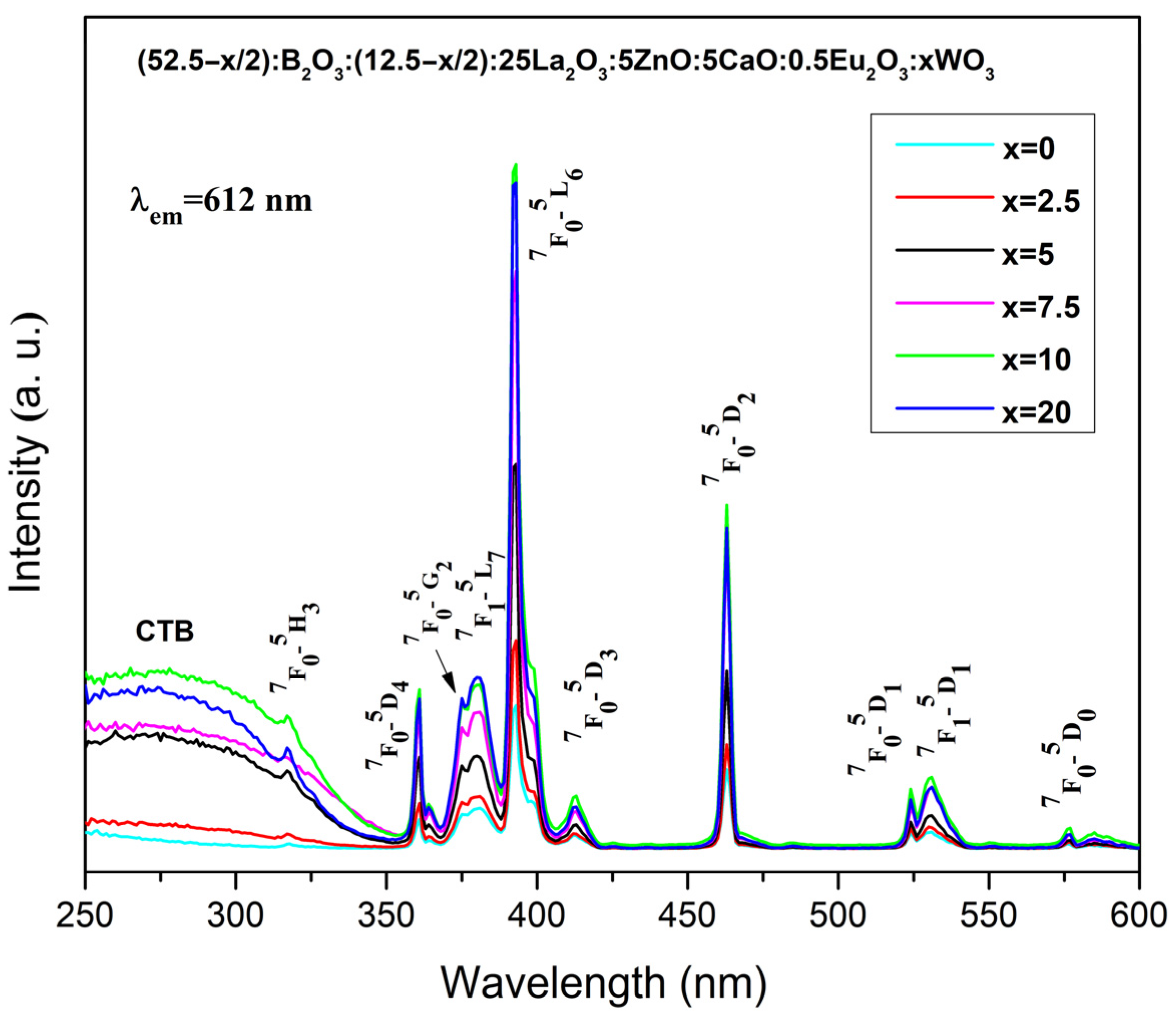
The excitation spectra of the prepared Eu3+-doped glasses are shown in Figure 4. All data were obtained at room temperature by monitoring the most intensive characteristic emission of Eu3+ ions at 612 nm wavelength, corresponding to 5D07F2 transition. As can be seen from the figure, a broad, continuous band below 350 nm is observed, along with several narrow peaks distributed across the 350–600 nm wavelength range. Generally, the broadband is due to ligand to metal charge transfer transitions (LMCT) from oxygen 2p orbital to the empty 4f orbital of europium (O2− → Eu3+) and from near band-edge (NBE) transition inside the ZnOn (ZnOn = ZnO4) host absorbing groups [28,29,30,31,32]. Additionally, in the glasses containing tungsten oxide ((52.5 − x/2)B2O3:(12.5 − x/2)SiO2:25La2O3:5ZnO:5CaO:0.5Eu2O3:xWO3, x = 2.5, 5, 7.5, 10 and 20 mol%) this band is also due to the transition from O2− → W6+ inside the WOn (WOn = WO4 and WO6) groups [33].
The presence of the excitation band of WOn recorded at the emission wavelength of Eu3+ at 612 nm suggests that the energy absorbed by the tungstate groups is subsequently non-radiatively transferred to Eu3+ ions [33,34]. As can be observed from Figure 4, with the increase in WO3 content the intensity of charge transfer absorption band is rising and the glass containing 10 mol% WO3 exhibits highest intensity. Thus, it can be assumed that the more energy is absorbed by WOn groups, the more energy is expected to be transferred to the Eu3+, leading to stronger emission. This mechanism is commonly referred to as host-sensitized luminescence. Structural changes are most likely the cause of the slight decrease in the excitation intensity of glass composition with 20 mol% WO3.
The distinct sharp peaks observed in the region above 350 nm are attributed to 4f–4f electron transitions from the ground state to excited energy levels, specifically, 7F05H3 (~318 nm), 7F05D4 (~360 nm), 7F05G2 (~376 nm), 7F15L7 (~381 nm), 7F05L6 (~393 nm), 7F05D3 (~413 nm), 7F05D2 (~463 nm), 7F05D1 (~523 nm) and 7F15D1 (~531 nm), and 7F05D0 (~576 nm). The highest excitation was observed at 7F05L6 (393 nm). Therefore, the emission spectra measurements were conducted under excitation at 393 nm. The comparison between the LMCT band and the 4f–4f transitions reveals that the narrow Eu3+ peaks exhibit higher intensity. This means that the efficient excitation by near-UV and blue LED chips can be obtained, since Eu3+ 4f–4f transitions are typically weak because they are partially forbidden by Laporte’s selection rule [35].
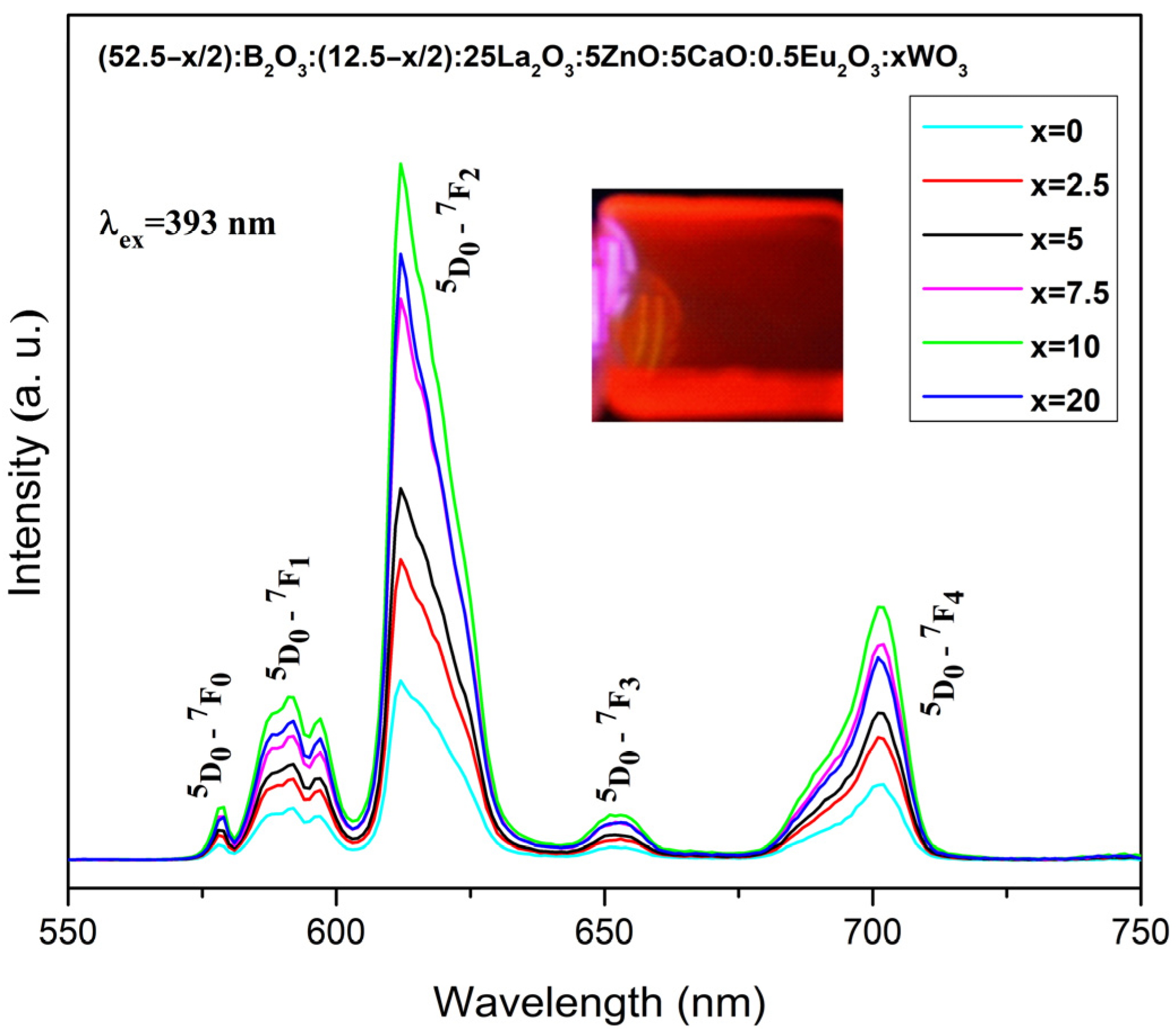
The emission spectra of Eu3+-doped borosilicate glasses (Figure 5) were recorded at room temperature using a 393 nm excitation wavelength. The five narrow characteristic emission peaks, originating from the radiative transitions of Eu3+ ions from the 5D0 excited state to the lower-lying 7F0, 7F1, 7F2, 7F3, 7F4 ground states, are observed at 578 nm, 591 nm, 612 nm, 652 nm and 701 nm [36]. Among these bands, the strongest one at 612 nm is due to the 5D07F2 transition, which is responsible for the red emission of the studied dopant. As shown in Figure 5, the emission intensity exhibits a strong dependence on the composition and increases with the incorporation and rising of tungsten content in the host matrix. This behavior can be related to non-radiative energy transfer between the glass host and the luminescent Eu3+ ions. The glass with 10 mol% WO3 is characterized with the highest emission, which is in accordance with the already established highest excitation intensity of the same composition shown in Figure 4. The glass containing 20 mol% WO3 transfers less energy to the active ion due to their less intense excitation.
Additional evidence for this energy-transfer mechanism is provided by the absence of the typical broad WO3 emission band in the 400–600 nm [37,38] spectral region, indicating that the excitation energy absorbed by tungstate groups is efficiently transferred to the Eu3+ ions.
Among all the observed emission bands, the most intense one, centered at 612 nm, originates from the forced electric-dipole (ED) 5D07F2 transition, which is highly sensitive of the local crystal-field environment surrounding the Eu3+ ions, followed by the magnetic-dipole (MD) 5D07F1 at 591 nm transition, which is insensitive to the surrounding ligands [28,36]. The dominance of the ED transition over the MD transition indicates that Eu3+ ions occupy non-centrosymmetric sites within the glass host. Moreover, the ratio of these emission intensities, commonly referred to the asymmetry ratio R = (5D07F2)/(5D07F1), provides insight into the degree of local asymmetry surrounding around the Eu3+ ions, as well as the strength of Eu–O covalence in various Eu3+-doped materials [39,40]. Lower values of the asymmetry parameter correspond to higher local site symmetry around the active ion and lower Eu–O covalency and emission intensity. The increase in R value is due to the increase in asymmetry and covalency between the Eu3+ ion and the ligands and leads to a higher emission intensity [41]. The R values of the synthesized glasses are listed in Table 2, along with other data reported in the literature for Eu3+-doped glasses and the commercial phosphor material used.
Compared to our previously synthesized glasses containing boron and tungsten oxides, the values of the asymmetric ratio R are similar [16,42,43,44], but compared to other borate or silicate oxide glass compositions [45,46,47,48,49,50,51] the values are higher. The relatively higher R values observed in the present glasses indicate that Eu3+ ions occupy low-symmetry sites and provide evidence of the high Eu3+-O2− covalency. The highest asymmetry ratio is obtained for glass compositions with 10 and 20 mo % WO3 that show the highest emission intensity. In addition, the 5D07F1 transition of Eu3+ exhibits splitting into three emission peaks. This behavior is attributed to crystal-field-induced splitting, where a single electronic transition gives rise to multiple emission components [52]. Moreover, the presence of the 5D07F0 transition, which is highly sensitive to the local crystal field and normally forbidden under standard Judd–Ofelt theory, further confirms that Eu3+ ions reside at non-centrosymmetric sites with C2v, Cn, or Cs symmetry within the glass matrix [53].
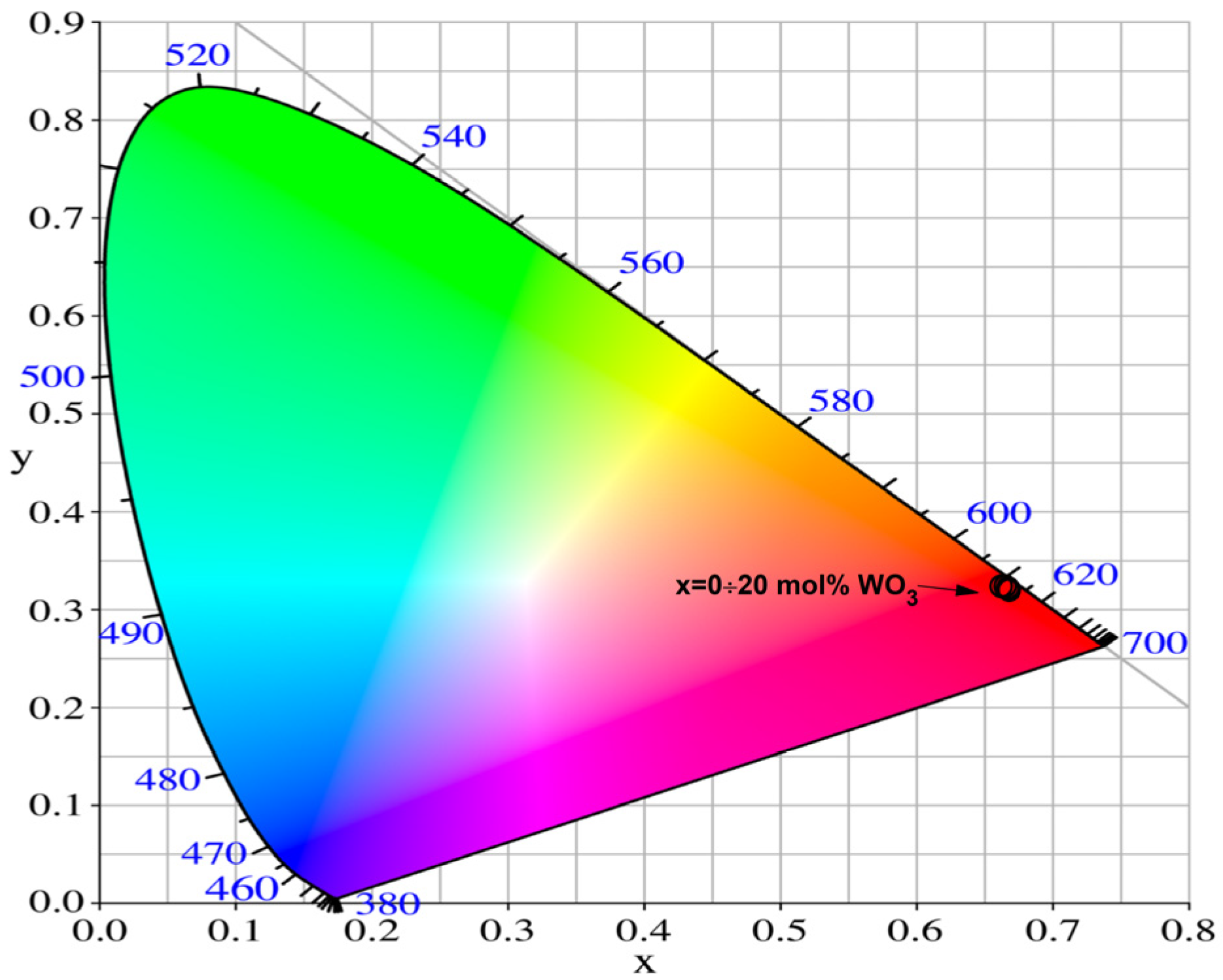
Furthermore, to evaluate the luminescent properties and the perceived emission color, the Commission Internationale de l’Éclairage (CIE) 1931 chromaticity diagram was used [54]. The chromaticity coordinates of the synthesized borosilicate glasses were calculated from the photoluminescence spectra (Figure 5) using SpectraChroma software (Version 1.0.1, CIE coordinate calculator) [55]. The obtained values (Table 3) are almost identical and cannot be individually separated on the CIE diagram. They are located in the red region in Figure 6. The calculated coordinates are very close to the NTSC standard for red light (0.670, 0.330), as well as to the chromaticity coordinates of the commercial red phosphor Y2O2S:Eu3+ (0.658, 0.340) [56].
Based on the performed analyses, it was found that various factors influence the emission intensity of Eu3+ ions. On the one hand, we established the influence of tungsten oxide, i.e., increasing the emission by implementing a non-radiative energy transition from tungsten to the luminescent active ion. On the other hand, WO3 affects the structure of the host matrix. More asymmetric site positions are created in the presence of WO3 in which Eu3+ ions can be incorporated. The asymmetric positions of Eu3+ ions are beneficial for its luminescent properties. In the glass network, WO4 and WO6 units participate simultaneously. At low tungsten content, mainly WO4 units are present, while WO4 tetrahedra and WO6 octahedra co-exist with increasing WO3 content. The optimal concentration at which the highest emission intensity is observed is 10 mol% WO3, due to the suitable ratio of WO4/WO6 ensuring the highest excitation intensity and Eu3+ sites with the highest asymmetry. The lower excitation and emission intensity is observed in the glass containing 20 mol% WO3 with a higher content of WO6 units.

3. Materials and Methods

Several glass samples of (52.5 − x/2)B2O3:(12.5 − x/2)SiO2:25La2O3:5ZnO:5CaO:0.5Eu2O3:xWO3, (x = 0, 2.5, 5, 7.5, 10 and 20 mol%) compositions were obtained by applying the melt quenching method, using reagent-grade La2O3, H3BO3, SiO2, CaO, ZnO, Eu2O3 and WO3 as raw materials. The homogenized batches (5 g) were melted at 1400 °C for 2 h in corundum crucibles in air. The melts were cast into a preheated graphite mold to get bulk glass samples. Then, the glasses were transferred into a laboratory electric furnace, annealed at 500 °C for 1 h, and cooled down to room temperature at a very slow cooling rate of about 0.5 °C/min. The phase formation of the samples was established by X-ray phase analysis with a Bruker (Karlsruhe, Germany) D8 Advance diffractometer, using Cu Kα radiation in the 10 < 2θ < 60 range. The glass transition (Tg) temperatures of the glasses were determined by differential scanning calorimetry (DSC) using a Netzsch (Selb, Germany) 404 Pegasus instrument, 2021 Selb, Germany, at a heating rate of 10 K/min in an Ar flow of 10 mL/s, using corundum crucibles with lids. The density of the obtained glasses at room temperature was measured by the Archimedes principle using toluene (ρ = 0.867 g/cm3) as an immersion liquid on a Mettler Toledo electronic balance of sensitivity 10−4 g. From the experimentally evaluated density values, the molar volume (Vm), the molar volume of oxygen (Vo) (volume of glass in which 1 mol of oxygen is contained) and the oxygen packing density (OPD) of the glasses obtained were estimated, using the following relations respectively:
V m = x i M i ρ g
V o = V m   ×   1 x i n i
O P D = 1000   ×   C   ×   ρ g M
where xi is the molar fraction of each component i, Mi is the molecular weight, ρg is the glass density and ni the number of oxygen atoms in each oxide, C is the number of oxygen per formula units, and M is the total molecular weight of the glass compositions. The optical spectra of the powder samples at room temperature were recorded with a spectrometer (Evolution 300 UV–vis Spectrophotometer, London, UK) employing the integration sphere diffuse reflectance attachment. The samples were measured in the wavelength (λ) range of 200–1100 nm with a magnesium oxide reflectance standard used as the baseline. The uncertainty in the observed wavelength is about ±1 nm. The Kubelka–Munk function (F(R∞)) was calculated from the UV–Vis diffuse reflectance spectra. The band gap energy (Eg) was determined by plot (F(R∞) hν)1/n, n = 2 versus hν (incident photon energy). Photoluminescence (PL) excitation and emission spectra at room temperature for all glasses were measured with a Spectrofluorometer FluoroLog3-22, 2014 (Horiba JobinYvon, Longjumeau, France).

4. Conclusions

In this study, the influence of WO3 on the physical parameters and luminescent characteristics of Eu3+-doped complex borosilicate glasses (52.5 − x/2)B2O3:(12.5 − x/2)SiO2:25La2O3:5ZnO:5CaO:0.5Eu2O3:xWO3, x = 0, 2.5, 5, 7.5, 10, 20 (mol%) was established. The XRD results confirmed the amorphous nature of the glasses. The optical absorption spectra contained major bands corresponding to W6 + ions in tetrahedral and octahedral positions (WO4 and WO6). W-O-W bonds were also formed in the WO3-containing glasses with between 7.5 and 20 mol% WO3. The densities were in the range of 3.792–4.607 g/cm3. The positive effect of WO3 on the luminescence intensity of the Eu3+-doped complex borosilicate glass was established. It was found that the introduction of WO3 in the borosilicate glass network ensures a more asymmetrical local structure around Eu3+ sites, accordingly yielding a higher luminescence of the incorporated Eu3+ ions. On the other hand, tungsten oxide has a synthesizer effect by transferring the emission energy non-radiatively to the activator Eu3+, which additionally improves its luminesce properties. It was established that the optimum WO3 concentration to obtain the most intensive red luminescence is 10 mol%, making this glass sample a suitable candidate for visible red emission applications.

Author Contributions

Conceptualization, M.M. and A.Y.; methodology, M.M., A.Y., L.A. and R.I.; investigation, M.M., A.Y., L.A. and P.P.; writing—original draft preparation, M.M., A.Y.; writing—review and editing, R.I. All authors have read and agreed to the published version of the manuscript.

Funding

This research received no external funding.

Institutional Review Board Statement

Not applicable.

Informed Consent Statement

Not applicable.

Data Availability Statement

Data are contained within the article. Further inquiries can be directed to the corresponding author.

Acknowledgments

This work is supported by the European Regional Development Fund under the “Research Innovation and Digitization for Smart Transformation” program 2021–2027 under the Project BG16RFPR002-1.014-0006 at the National Centre of Excellence for Mechatronics and Clean Technologies and by a joint research project within the framework of an international scientific cooperation between BAS and MTA IC-HU/01/2026-2027.

Conflicts of Interest

The authors declare no conflicts of interest.

References

  1. Reddy, B.N.K.; Raju, B.D.; Thyagarajan, K.; Ramanaiah, R.; Jho, Y.D.B.; Reddy, S. Optical characterization of Eu3+ ion doped alkali oxide modified borosilicate glasses for red laser and display device applications. Ceram. Int. 2017, 43, 8886–8892. [Google Scholar] [CrossRef]
  2. Rakpanicha, S.; Wantana, N.; Kaewkhao, J. Development of bismuth borosilicate glass doped with Eu3+ for reddish orange emission materials application. Mater. Today Proc. 2017, 4, 6389–6396. [Google Scholar]
  3. Hussain, N.S.; Reddy, Y.P.; Buddhudu, S. Luminescence properties of Eu3+ doped ZnO–B2O3–SiO2 glasses. Spectrosc. Lett. 2002, 35, 275–283. [Google Scholar] [CrossRef]
  4. Cheong, W.M.; Zaid, M.H.M.; Matori, K.A.; Fen, Y.W.; Tee, T.S.; Loh, Z.W.; Mayzan, M.Z.H. Promising reddish-orange light as Eu3+ incorporated in zinc-borosilicate glass derived from the waste glass bottle. J. Taibah Univ. Sci. 2023, 17, 2260080. [Google Scholar] [CrossRef]
  5. Bajaj, R.; Rao, A.S.; Prakash, G.V. Photoluminescence down-shifting studies of thermally stable Eu3+ ions doped borosilicate glasses for visible red photonic device applications. J. Non-Cryst. Solids 2022, 575, 121184. [Google Scholar] [CrossRef]
  6. Hu, G.; Zhou, Y.; Liu, R.; Li, C.; Liu, L.; Lin, H.; Zeng, F.; Su, Z. Regulation of luminescence properties of SBGNA:Eu3+ glass by the content of B2O3 and Al2O3. Opt. Mater. 2020, 106, 110025. [Google Scholar] [CrossRef]
  7. Rakpanich, S.; Wantana, N.; Ruangtaweep, Y.; Kaewkhao, J. Eu3+ doped borosilicate glass for solid-state luminescence material. J. Met. Mater. Miner. 2017, 27, 35–38. [Google Scholar]
  8. Aryal, P.; Kesavulu, C.R.; Kim, H.J.; Lee, S.W.; Kang, S.J.; Kaewkhao, J.; Chanthima, N.; Damdee, B. Optical and luminescence characteristics of Eu3+-doped B2O3:SiO2:Y2O3:CaO glasses for visible red laser and scintillation material applications. J. Rare Earths 2018, 36, 482–491. [Google Scholar] [CrossRef]
  9. Ravita, A.; Rao, S. Effective sensitization of Eu3+ visible red emission by Sm3+ in thermally stable potassium zinc alumino borosilicate glasses for photonic device applications. J. Lumin. 2022, 244, 118689. [Google Scholar] [CrossRef]
  10. Sharma, S.; Rao, A.S.; Kishore, K. Energy transfer dynamics in thermally stable Sm3+/Eu3+ co-doped AEAlBS glasses for near UV triggered photonic device applications. J. Non-Cryst. Solids 2022, 580, 121392. [Google Scholar] [CrossRef]
  11. Jin, Z.; Zhu, Z. Luminescence and spectroscopic studies on Dy3+–Eu3+ doped SiO2–B2O3–ZnO–La2O3–BaO glass for WLED. J. Non-Cryst. Solids 2024, 641, 123153. [Google Scholar] [CrossRef]
  12. Zhou, W.; Wang, G.; Zheng, X.; Yu, L.; Zhang, J.; Qiu, Z.; Lian, S. Tunable colors and applications of Dy3+/Eu3+ co-doped CaO–B2O3–SiO2 glasses. J. Am. Ceram. Soc. 2019, 102, 5890–5898. [Google Scholar] [CrossRef]
  13. Alsafi, K.; Ismail, Y.A.; Aloraini, D.A.; Almutairi, H.M.; Al-Saleh, W.M.; Shaaban, K.S. Exploring the radiation shielding properties of B2O3–SiO2–ZnO–Na2O–WO3 glasses: A comprehensive study on mechanical, gamma, and neutron attenuation characteristics. Prog. Nucl. Energy 2024, 170, 105151. [Google Scholar] [CrossRef]
  14. Ali, A.S.; Alrowaily, A.W.; Issa, S.A.; Rashad, M.; Elsaman, R.; Zakaly, H.M. Unveiling the structural, optical, and electromagnetic attenuation characteristics of B2O3–SiO2–CaO–Bi2O3 glasses with varied WO3 content. Radiat. Phys. Chem. 2023, 212, 111089. [Google Scholar] [CrossRef]
  15. Ray, N.H. Composition-properties relationship in Inorganic Oxide Glasses. J. Non-Cryst. Solids 1974, 15, 423–434. [Google Scholar] [CrossRef]
  16. Cottrell, T.L. The Strength of Chemical Bonds, 2nd ed.; Butterworth: London, UK, 1958. [Google Scholar]
  17. ElBatal, F.H.; Selim, M.S.; Marzouk, S.Y.; Azooz, M.A. UV-vis absorption of the transition metal-doped SiO2-B2O3-Na2O3 glasses. Phys. B 2007, 398, 126–134. [Google Scholar] [CrossRef]
  18. Ross-Medgaarden, E.I.; Wachs, I.E. Structural Determination of Bulk and Surface Tungsten Oxides with UV-vis Diffuse Reflectance Spectroscopy and Raman Spectroscopy. J. Phys. Chem. C 2007, 111, 15089–15099. [Google Scholar] [CrossRef]
  19. Ouis, M.A.; El-Batal, H.A.; Azoz, M.A.; Abdelghany, A.M. Characterization of WO3-doped borophosphate glasses by optical, IR and ESR spectroscopic techniques before and after subjecting to gamma irradiation. Indian J. Pure Appl. Phys. 2013, 51, 11–17. [Google Scholar]
  20. Tyagi, M.; Singh, S.G.; Prasad, R.; Auluck, S.; Singh, D.J. A study of electronic and optical properties of NaBi(WO4)2: A disordered double tungstate crystal. Physica B 2010, 405, 3267–3271. [Google Scholar] [CrossRef]
  21. Errandonea, D.; Rodriguez, F.; Vilaplana, R.; Vie, D.; Garg, S.; Nayak, B.; Garg, N.; Singh, J.; Kanchana, V.; Vaitheeswaran, G. Band-Gap Energy and Electronic d−d Transitions of NiWO4 Studied under High-Pressure Conditions. J. Phys. Chem. C 2023, 127, 15630−15640. [Google Scholar] [CrossRef]
  22. Iordanova, R.; Ataalla, M.; Milanova, M.; Aleksandrov, L.; Staneva, A.; Dimitriev, Y. Glass formation and structure of glasses in the WO3–ZnO–Nd2O3–Al2O3 system. J. Non-Cryst. Solids 2015, 414, 42–50. [Google Scholar] [CrossRef]
  23. Bajaj, A.; Khanna, A.; Kulkarni, N.K.; Aggarwal, S.K. Effects of Doping Trivalent Ions in Bismuth Borate Glasses. J. Am. Ceram. Soc. 2009, 92, 1036–1041. [Google Scholar] [CrossRef]
  24. Saranya, S.; Balakrishnan, L.; Sangeetha, D.; Lakshmi Priya, S. Investigating the effects of Hg doping on WO3 nanoflakes: A hydrothermal route to tailored properties. Dig. J. Nanomater. Biostruct. 2025, 20, 669–679. [Google Scholar] [CrossRef]
  25. Zhao, D.; Yu, Y.; Cao, C.; Wang, J.; Wang, E.; Cao, Y. The existing states of doped B3+ions on the B doped TiO2. Appl. Surf. Sci. 2015, 345, 67–71. [Google Scholar] [CrossRef]
  26. Stevenson, A.J.; Li, X.; Martinez, M.A.; Anderson, J.M.; Suchy, D.L.; Kupp, E.R.; Dickey, E.C.; Mueller, K.T.; Messing, G.L. Effect of SiO2 on Densification and Microstructure Development in Nd:YAG Transparent Ceramics. J. Am. Ceram. Soc. 2011, 94, 1380–1387. [Google Scholar] [CrossRef]
  27. Villegas, M.A.; Navarro, J.M.F. Physical and structural properties of glasses in the TeO2–TiO2–Nb2O5 system. J. Eur. Ceram. Soc. 2007, 27, 2715–2723. [Google Scholar] [CrossRef]
  28. Blasse, G.; Grabmaier, B.C. Luminescent Materials, 1st ed.; Springer: Berlin/Heidelberg, Germany, 1994; p. 18. [Google Scholar]
  29. Hoefdraad, H.E. The charge-transfer absorption band of Eu3+ in oxides. J. Solid State Chem. 1975, 15, 175–177. [Google Scholar] [CrossRef]
  30. Parchur, A.K.; Ningthoujam, R.S. Behaviour of electric and magnetic dipole transitions of Eu3+, 5D07F0 and Eu-O charge transfer band in Li+ co-doped YPO4:Eu3+. RSC Adv. 2012, 2, 10859–10868. [Google Scholar] [CrossRef]
  31. Mariselvam, K.; Liu, J. Synthesis and luminescence properties of Eu3+ doped potassium titano telluroborate (KTTB) glasses for red laser applications. J. Lumin. 2021, 230, 117735. [Google Scholar] [CrossRef]
  32. Nimpoeno, W.A.; Lintang, H.O.; Yuliati, L. Zinc oxide with visible light photocatalytic activity originated from oxygen vacancy defects. IOP Conf. Ser. Mater. Sci. Eng. 2020, 833, 012080. [Google Scholar] [CrossRef]
  33. Dutta, P.S.; Khanna, A. Eu3+ activated molybdate and tungstate based red phosphors with charge transfer band in blue region. ECS J. Solid State Sci. Technol. 2013, 2, R3153–R3167. [Google Scholar] [CrossRef]
  34. Thieme, C.; Herrmann, A.; Kracker, M.; Patzig, C.; Hoche, T.; Russel, C. Microstructure investigation and fluorescence properties of Europium-doped scheelite crystals in glass-ceramics made under different synthesis conditions. J. Lumin. 2021, 238, 118244. [Google Scholar] [CrossRef]
  35. Bunzli, J.C.G. Lanthanide luminescence: From a mystery to rationalization, understanding, and applications. In Handbook on the Physics and Chemistry of Rare Earths; Elsevier: Amsterdam, The Netherlands, 2016; Volume 50, pp. 141–176. [Google Scholar]
  36. Binnemans, K. Interpretation of europium (III) spectra. Coord. Chem. Rev. 2015, 295, 1–45. [Google Scholar] [CrossRef]
  37. Sungpanich, J.; Thongtem, T.; Thongtem, S. Large-scale synthesis of WO3 nanoplates by a microwave-hydrothermal method. Ceram. Int. 2012, 38, 1051–1055. [Google Scholar] [CrossRef]
  38. Jia, Q.; Ji, H.; Bai, X. Selective sensing property of triclinic WO3 nanosheets towards ultra-low concentration of acetone. J. Mater. Sci. Mater. Electron. 2019, 30, 7824–7833. [Google Scholar] [CrossRef]
  39. Devi, C.H.B.; Mahamuda, S.; Swapna, K.; Venkateswarlu, M.; Rao, A.S.; Prakash, G.V. Compositional dependence of red luminescence from Eu3+ ions doped single and mixed alkali fluoro tungsten tellurite glasses. Opt. Mater. 2017, 73, 260–267. [Google Scholar] [CrossRef]
  40. Nogami, M.; Umehara, N.; Hayakawa, T. Effect of hydroxyl bonds on persistent spectral hole burning in Eu3+ doped BaO-P2O5 glasses. Phys. Rev. B 1998, 58, 6166–6171. [Google Scholar] [CrossRef]
  41. Dejneka, M.; Snitzer, E.; Riman, R.E. Blue, green and red fluorescence and energy transfer of Eu3+ in fluoride glasses. J. Lumin. 1995, 65, 227–245. [Google Scholar] [CrossRef]
  42. Yordanova, A.; Milanova, M.; Iordanova, R.; Fabian, M.; Aleksandrov, L.; Petrova, P. Network Structure and Luminescent Properties of ZnO–B2O3–Bi2O3–WO3: Eu3+ Glasses. Materials 2023, 16, 6779. [Google Scholar] [CrossRef]
  43. Milanova, M.; Aleksandrov, L.; Yordanova, A.; Iordanova, R.; Tagiara, N.S.; Herrmann, A.; Gao, G.; Wondraczek, L.; Kamitsos, E.I. Structural and luminescence behavior of Eu3+ ions in ZnO-B2O3-WO3 glasses. J. Non-Cryst. Solids 2023, 600, 122006. [Google Scholar] [CrossRef]
  44. Iordanova, R.; Milanova, M.; Yordanova, A.; Aleksandrov, L.; Nedyalkov, N.; Kukeva, R.; Petrova, P. Structure and Luminescent Properties of Niobium-Modified ZnO-B2O3:Eu3+ Glass. Materials 2024, 17, 1415. [Google Scholar] [CrossRef]
  45. Oomen, E.W.J.L.; Dongen, A.M.A. Europium (III) in oxide glasses: Dependence of the emission spectrum upon glass composition. J. Non-Cryst. Solids 1989, 111, 205–213. [Google Scholar] [CrossRef]
  46. Bettinelli, M.; Speghini, A.; Ferrari, M.; Montagna, M. Spectroscopic investigation of zinc borate glasses doped with trivalent europium ions. J. Non-Cryst. Solids 1996, 201, 211–221. [Google Scholar] [CrossRef]
  47. Annapurna, K.; Das, M.; Kundu, M.; Dwivedhi, R.N.; Buddhudu, S. Spectral properties of Eu3+: ZnO–B2O3–SiO2 glasses. J. Mol. Struct. 2005, 741, 53–60. [Google Scholar] [CrossRef]
  48. Azeem, P.A.; Kalidasan, M.; Gopal, K.R.; Reddy, R.R. Spectral analysis of Eu3+: B2O3–Al2O3–MF2 (M = Zn, Ca, Pb) glasses. J. Alloys Compd. 2009, 474, 536–540. [Google Scholar] [CrossRef]
  49. Nandyala, S.H.; Hungerford, G.; Santos, J.D.; Walsh, B.M.; Di Silvio, L.; Stamboulis, A. Time-resolved and excitation-emission matrix luminescence behaviour of boro-silicate glasses doped with Eu3+ ions for red luminescent application. Mater. Res. Bull. 2021, 140, 111340. [Google Scholar] [CrossRef]
  50. Song, H.; Chen, B.; Sun, B.; Zhang, J.; Lu, S. Ultraviolet light-induced spectral change in cubic nanocrystalline Y2O3:Eu3+. Chem. Phys. Lett. 2003, 372, 368–372. [Google Scholar] [CrossRef]
  51. Kabir, M.; Ghahari, M.; Afarani, M.S. Co-precipitation synthesis of nano Y2O3:Eu3+ with different morphologies and its photoluminescence properties. Ceram. Int. 2014, 40, 10877–10885. [Google Scholar] [CrossRef]
  52. Wu, L.; Zhang, F.; Wu, L.; Yi, H.; Wang, H.; Zhang, Y.; Xu, J. Structure refinement and one-center luminescence of Eu3+ activated ZnBi2B2O7 under UV excitation. J. Alloys Compd. 2015, 648, 500–506. [Google Scholar] [CrossRef]
  53. Binnemans, K.; Gorller-Walrand, C. Application of the Eu3+ ion for site symmetry determination. J. Rare Earths 1996, 14, 173–180. [Google Scholar]
  54. Smith, T.; Guild, J. The CIE colorimetric standards and their use. Trans. Opt. Soc. 1931, 33, 73. [Google Scholar] [CrossRef]
  55. Paolini, T.B. SpectraChroma (Version 1.0.1) [Computer Software]. 2021. Available online: https://zenodo.org/records/4906590 (accessed on 7 June 2021).
  56. Trond, S.S.; Martin, J.S.; Stanavage, J.P.; Smith, A.L. Properties of Some Selected Europium—Activated Red. J. Electrochem. Soc. 1969, 116, 1047–1050. [Google Scholar] [CrossRef]
Figure 1. XRD patterns and photographs (insets) of investigated glasses.
Molecules 31 01000 g001
Figure 2. DSC curves of (52.5 − x/2)B2O3:(12.5 − x/2)SiO2:25La2O3:5ZnO:5CaO:0.5Eu2O3:xWO3, x = 0, 2.5, 5, 7.5, 10 and 20 mol% glasses.
Molecules 31 01000 g002
Figure 3. UV–Vis optical spectra and Tauk plots (the insets) of (52.5 − x/2)B2O3:(12.5 − x/2)SiO2:25La2O3:5ZnO:5CaO:0.5Eu2O3:xWO3, x = 0, 2.5, 5, 7.5, 10 and 20 mol% glasses.
Molecules 31 01000 g003
Figure 4. Excitation spectra of investigated Eu3+-doped borosilicate glasses.
Molecules 31 01000 g004
Figure 5. Emission spectra of the investigated Eu3+-doped borosilicate glasses and photograph (inset) of the red glow glass under UV exposure.
Molecules 31 01000 g005
Figure 6. CIE chromaticity diagram of investigated Eu3+-doped borosilicate glasses.
Molecules 31 01000 g006
Table 1. Values of physical parameters of glasses (52.5 − x/2)B2O3:(12.5 − x/2)SiO2:25La2O3:5ZnO:5CaO:0.5Eu2O3:xWO3, x = 0, 2.5, 5, 7.5, 10 and 20 mol%: density (ρg), molar volume (Vm), oxygen molar volume (Vo), oxygen packing density (OPD), glass transition temperature (Tg) and optical band gap (Eg).
Sample
ID
ρg
(g/cm3)
Vm
(cm3/mol)
Vo
(cm3/mol)
OPD
(g atom/L)
Tg
(°C)
Eg
(eV)
x = 03.792 ± 0.00235.3813.1576.03555; 6633.54
x = 2.53.892 ± 0.00235.5413.1675.97601; 6754.04
x = 53.973 ± 0.00435.8713.2175.696843.52
x = 7.54.088 ± 0.00235.8813.1476.096823.84
x = 104.177 ± 0.00136.1113.1376.166713.79
x = 204.607 ± 0.00136.3413.0376.776473.70
Table 2. Comparison of intensity ratio R of Eu3+-doped borosilicate glasses with different host matrices.
Glass CompositionRelative Intensity Ratio, RReference
52.5B2O3:25La2O3:12.5SiO2:5CaO:5ZnO:0.5Eu2O34.12Current work
51.25B2O3:11.25SiO2:25La2O3:5CaO:5ZnO:2.5WO3:0.5Eu2O34.33Current work
50B2O3:25La2O3:10SiO2:5CaO:5ZnO:5WO3:0.5Eu2O34.42Current work
48.75B2O3:8.75SiO2:25La2O3:5CaO:5ZnO:7.5WO3:0.5Eu2O34.61Current work
47.5B2O3:7.5SiO2:25La2O3:5CaO:5ZnO:10WO3: 0.5Eu2O34.86Current work
42.5B2O3:2.5SiO2:25La2O3:5CaO:5ZnO:20WO3: 0.5Eu2O34.92Current work
50ZnO:(49 − x)B2O3:1Bi2O3:xWO3: 0.5Eu2O3 x = 1, 5, 10,4.61–5.7342
50ZnO:40B2O3:10WO3:xEu2O3 (0 ≤ x ≤ 10)4.54–5.7743
50ZnO:(50 − x)B2O3:xNb2O5:0.5Eu2O3:, x = 0, 1, 3 and 5 mol%4.31–5.1644
50ZnO:(50 − x)B2O3:0.5Eu2O3:xWO3, x = 0, 1, 3, 5.4.34–5.5716
89.5B2O3–10Li2O–0.5Eu2O32.4145
64SiO2-16K2O-16BaO-4Eu2O33.42
0.5GeO2-63.5SiO2-16K2O-16BaO-4Eu2O33.46
4ZnO:3B2O3 0.5–2.5 mol% Eu2O32.74–3.9446
60ZnO:20B2O3:(20 − x)SiO2 − xEu2O3 (x = 0 and 1) 3.16647
74.5B2O3 + 10SiO2 + 5 MgO + 5x + 0.5 Eu2O3, x = Li2O + Na2O; Li2O + K2O and K2O + Na2O2.102–2.2661
20 MF2·69 B2O3·10 Al2O3·1Eu2O3, M = Ca, Pb and Zn3.77–5.8948
35B2O3–20SiO2-(15 − x) Al2O3 − 15ZnO-15Na2CO3-xEu2O3 (x = 0.0, 0.5, 1.0, 1.5, 2.0, 2.5 mol%)3.62–3.926
50B2O3-19SiO2-20Na2O-10CaO-1Eu2O33.15149
50B2O3-14SiO2-20Na2O-10CaO-5ZnO-1Eu2O33.352
50B2O3-14SiO2-20Na2O-10CaO-5TeO2-1Eu2O34.269
Eu3+:Y2O33.8–5.250, 51
Table 3. CIE chromaticity coordinates of the borosilicate glasses.
Glass CompositionChromaticity Coordinates (x, y)
52.5B2O3:25La2O3:12.5SiO2:5CaO:5ZnO:0.5Eu2O30.649, 0.348
51.25B2O3:11.25SiO2:25La2O3:5CaO:5ZnO:2.5WO3:0.5Eu2O30.652; 0.348
50B2O3:25La2O3:10SiO2:5CaO:5ZnO:5WO3:0.5Eu2O30.652, 0.348
48.75B2O3:8.75SiO2:25La2O3:5CaO:5ZnO:7.5WO3:0.5Eu2O30.655; 0.344
47.5B2O3:7.5SiO2:25La2O3:5CaO:5ZnO:10WO3: 0.5Eu2O30.654; 0.346
42.5B2O3:2.5SiO2:25La2O3:5CaO:5ZnO:20WO3: 0.5Eu2O30.654; 0.346
NTSC standard for red light0.670, 0.330
Y2O2S:Eu3+0.658, 0.340
Disclaimer/Publisher’s Note: The statements, opinions and data contained in all publications are solely those of the individual author(s) and contributor(s) and not of MDPI and/or the editor(s). MDPI and/or the editor(s) disclaim responsibility for any injury to people or property resulting from any ideas, methods, instructions or products referred to in the content.