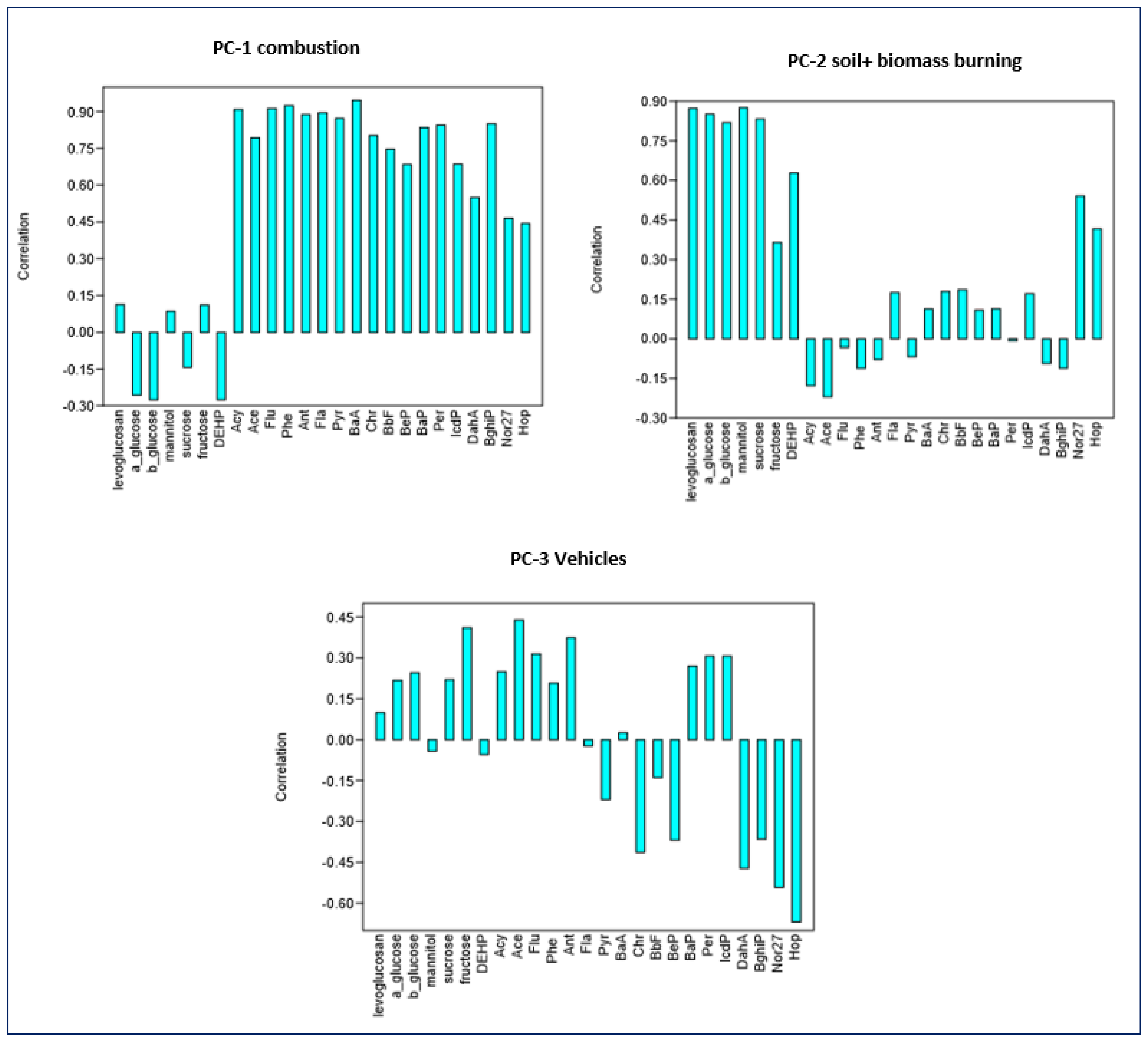
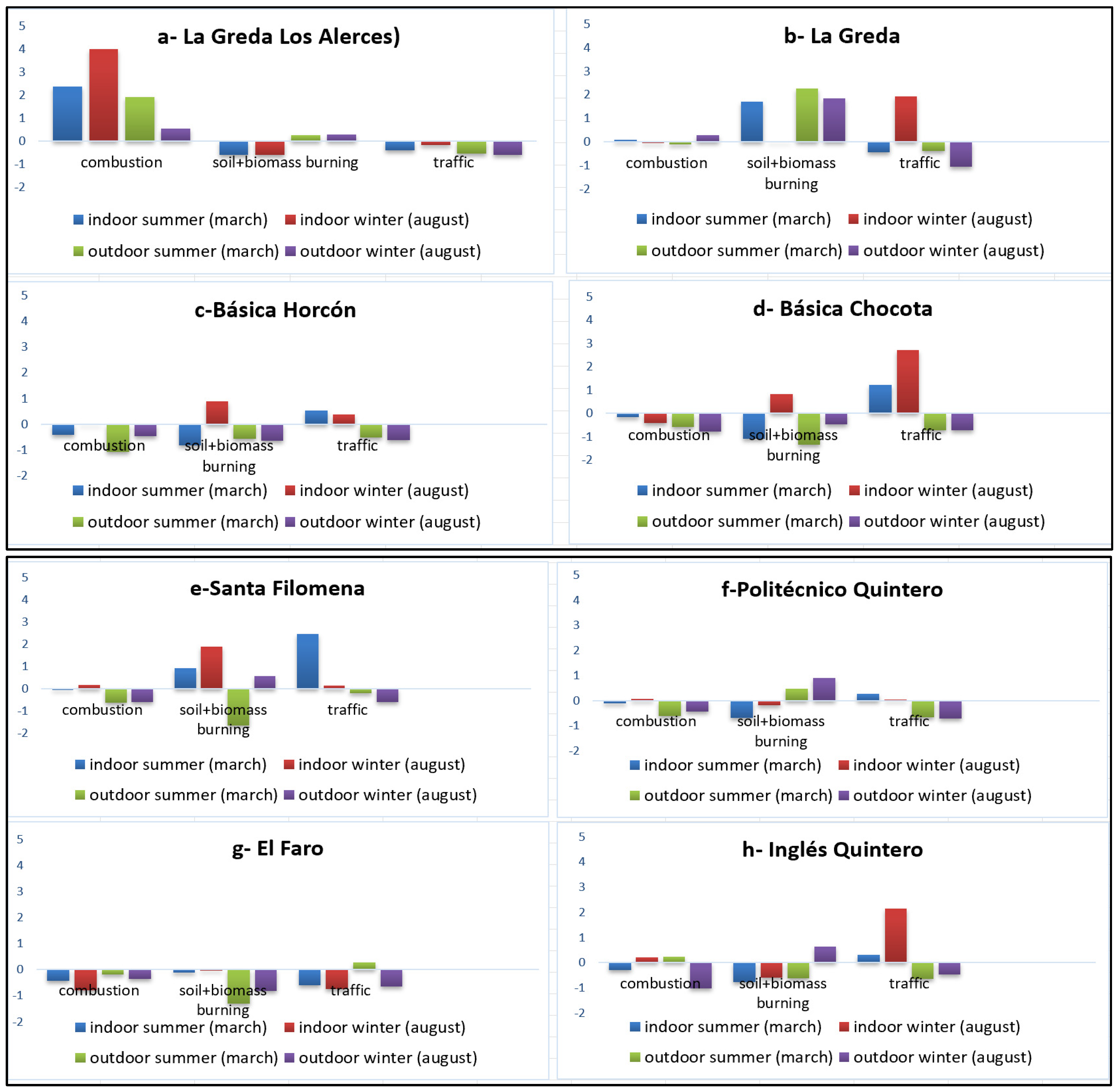
Determination of Polycyclic Aromatic Hydrocarbons and Organic Molecular Tracer Compounds in Dusts Samples from Schools in Puchuncaví and Quintero (Chile)


Abstract
1. Introduction
2. Materials and Methods
2.1. Dust Sampling in the Studied Area
2.2. Study Area
2.3. Sample Collections
2.4. Chemical Analysis
2.5. Statistical Analysis
2.6. Health Risk Assessments
2.6.1. BaPE as TEQ
2.6.2. Incremental Lifetime Cancer Risk (ILCR)
3. Results and Discussion
3.1. Organic Tracer Compound Concentrations
3.2. Benzo(a)pyrene Toxicity Equivalence (BaPE as TEQ)
3.3. Incremental Lifetime Cancer Risk (ILCR)
3.4. Source Identification
4. Conclusions
Supplementary Materials
Author Contributions
Funding
Data Availability Statement
Acknowledgments
Conflicts of Interest
References
- Xiao, R.; Bai, J.; Wang, J.; Lu, Q.; Zhao, Q.; Cui, B.; Liu, X. Polycyclic aromatic hydrocarbons (PAHs) in wetland soils under different land uses in a coastal estuary: Toxic levels, sources and relationships with soil organic matter and water-stable aggregates. Chemosphere 2014, 110, 8–16. [Google Scholar] [CrossRef]
- Yu, B.; Xie, X.; Ma, L.; Kan, H.; Zhou, Q. Source, distribution, and health risk assessment of polycyclic aromatic hydrocarbons in urban street dust from Tianjin, China. Environ. Sci. Pollut. Res. 2014, 21, 2817–2825. [Google Scholar] [CrossRef]
- Cave, M.; Wragg, J.; Beriro, J. An overview of research and development themes in the measurement and occurrences of polyaromatic hydrocarbons in dusts and particulates. J. Hazard. Mater. 2018, 360, 373–390. [Google Scholar] [CrossRef]
- Chen, Y.; Song, Y.; Chen, Y.; Zhang, Y.; Li, R.; Wang, Y.; Qi, Z.; Chen, Z.; Cai, Z. Contamination profiles and potential health risks of organophosphate flame retardants in PM 2.5 from Guangzhou and Taiyuan, China. Environ. Int. 2019, 134, 105343. [Google Scholar] [CrossRef] [PubMed]
- Wu, Z.; Lyu, H.; Guo, Y.; Man, Q.; Niu, H.; Li, J.; Jing, X.; Ren, G.; Ma, X. Polycyclic aromatic hydrocarbons and polybrominated diphenyl ethers inside university campus: Indoor dust-bound pollution characteristics and health risks to university students. Build. Environ. 2022, 221, 109312. [Google Scholar] [CrossRef]
- Zivancev, J.; Antic, I.; Buljovcic, M.A. Case study on the occurrence of polycyclic aromatic hydrocarbons in indoor dust of Serbian households: Distribution, source apportionment and health risk assessment. Chemosphere 2022, 295, 133856. [Google Scholar] [CrossRef]
- Skrbi, B.V.; Marinkovic, V.; Antic, I.; Petrovic, A. Seasonal variation and health risk assessment of organochlorine compounds in urban soils of Novi Sad, Serbia. Chemosphere 2017, 181, 101–110. [Google Scholar] [CrossRef]
- Tong, R.; Yang, X.; Su, H.; Pan, Y.; Zhang, Q.; Wang, J.; Long, M. Levels, sources and probabilistic health risks of polycyclic aromatic hydrocarbons in the agricultural soils from sites neighboring suburban industries in Shanghai. Sci. Total Environ. 2018, 616, 1365–1373. [Google Scholar] [CrossRef]
- Škrbić, B.; Antic, I.; Zivancev, J.; Vagvolgyi, C. Comprehensive characterization of PAHs profile in Serbian soils for conventional and organic production: Potential sources and risk assessment. Environ. Geochem. Health 2021, 43, 4201–4218. [Google Scholar] [CrossRef] [PubMed]
- Harbi, M.; Alhajri, I.; Whalen, J. Health risks associated with the polycyclic aromatic hydrocarbons in indoor dust collected from houses in Kuwait. Environ. Pollut. 2020, 266, 115054. [Google Scholar] [CrossRef]
- Škrbić, B.; Mladenović, D.; Živančev, J. Seasonal occurrence and cancer risk assessment of polycyclic aromatic hydrocarbons in street dust from the Novi Sad city, Serbia. Sci. Total Environ. 2019, 647, 191–203. [Google Scholar] [CrossRef]
- Jaén, C.; Villasclaras, P.; Fernández, P.; Grimalt, J.O.; Udina, M.; Bedia, C.; Van Drooge, B.L. Source Apportionment and Toxicity of PM in Urban, Sub-Urban, and Rural Air Quality Network Stations in Catalonia. Atmosphere 2021, 12, 744. [Google Scholar] [CrossRef]
- Han, B.; Liu, A.; Gong, J.; Li, O.; He, X.; Zhao, J.; Zheng, L. Spatial distribution, source analysis, and ecological risk assessment of polycyclic aromatic hydrocarbons (PAHs) in the sediments from rivers emptying into Jiaozhou Bay, China. Mar. Pollut. Bull. 2021, 168, 112394. [Google Scholar] [CrossRef]
- Iwegbue, C.; Irerhievwie, G.; Tesi, G.; Olisah, C. Polycyclic aromatic hydrocarbons (PAHs) in surficial sediments from selected rivers in the western Niger Delta of Nigeria: Spatial distribution, sources, and ecological and human health risks. Mar. Pollut. Bull. 2021, 167, 112351. [Google Scholar] [CrossRef]
- Liu, C.; Huang, Z.; Qadeer, A.; Liu, Y.; Qiao, X.; Zheng, B.; Zhao, G.; Zhao, X. The sediment-water diffusion and risk assessment of PAHs in different types of drinking water sources in the Yangtze River Delta, China. J. Clean. Prod. 2021, 309, 127456. [Google Scholar] [CrossRef]
- Lee, J.; Jeong, H.; Park, S.; Lee, K. Monitoring and risk assessment of polycyclic aromatic hydrocarbons (PAHs) in processed foods and their raw materials. Food Control 2018, 92, 286–292. [Google Scholar] [CrossRef]
- Van Drooge, B.L.; Rivas, I.; Querol, X.; Sunyer, J. Organic Air Quality Markers of Indoor and Outdoor PM 2.5 Aerosols in Primary Schools from Barcelona. Int. J. Environ. Res. Public Health 2020, 17, 3685. [Google Scholar] [CrossRef] [PubMed]
- Lee, J.; Gigliotti, C.; Offenberg, H.; Eisenreich, S.; Turpin, B. Sources of polycyclic aromatic hydrocarbons to the Hudson River Airshed. Atmos. Environ. 2001, 38, 5971–5981. [Google Scholar] [CrossRef]
- Cao, Z.; Shi, Y.; Feng, J.; Wang, S.; Zhao, L.; Zhang, Y.; Yan, G.; Zhang, X.; Wang, X.; Shen, M.; et al. PAH contamination in road dust from a moderate city in North China: The significant role of traffic emission. Hum. Ecol. Risk Assess. 2017, 23, 1072–1085. [Google Scholar] [CrossRef]
- Hye, K.; Sung, D. Polycyclic aromatic hydrocarbons (PAHs) in soils from a multi-industrial city, South Korea. Sci. Total Environ. 2014, 470, 1494–1501. [Google Scholar]
- Romagnoli, P.; Balducci, C.; Perilli, M.; Gherardi, M.; Gordiani, A.; Gariazzo, C.; Gatto, M.P.; Cecinato, A. Indoor PAHs at schools, homes and offices in Rome, Italy. Atmos. Environ. 2014, 92, 51–59. [Google Scholar] [CrossRef]
- Sanderson, G.; Farant, J. Indoor and Outdoor Polycyclic Aromatic Hydrocarbons in Residences Surrounding a Soderberg Aluminum Smelter in Canada. Environ. Sci. Technol. 2004, 38, 5350–5356. [Google Scholar] [CrossRef]
- Ferreira, B.; De Miguel, E. Geochemistry and risk assessment of street dust in Luanda, Angola: A tropical urban environment. Atmos. Environ. 2005, 39, 4501–4512. [Google Scholar] [CrossRef]
- Mortamais, M.; Pujol, J.; Van Drooge, B.; Dida, M.; Martínez-Vilavella, G.; Reynes, C.; Sabatier, R.; Rivas, I.; Grimalt, J.; Forns, J.; et al. Effect of exposure to polycyclic aromatic hydrocarbons on basal ganglia and attention-deficit hyperactivity disorder symptoms in primary school children. Environ. Int. 2017, 105, 12–19. [Google Scholar] [CrossRef]
- Lelieveld, J.; Evans, J.M.; Fnais, M.; Giannadaki, D.; Pozzer, A. The contribution of outdoor air pollution sources to premature mortality on a global scale. Nature 2015, 525, 367–371. [Google Scholar] [CrossRef]
- Wang, W.; Huang, M.; Kang, Y.; Wang, H.; Leung, A.; Cheung, K.C.; Wong, M.H. Polycyclic aromatic hydrocarbons (PAHs) in urban surface dust of Guangzhou, China: Status, sources and human health risk assessment. Sci. Total Environ. 2011, 21, 4519–4527. [Google Scholar] [CrossRef]
- Zhang, Y.; Guo, C.; Xu, J.; Tian, Y.; Shi, G.; Feng, Y.-C. Potential source contributions and risk assessment of PAHs in sediments from Taihu Lake, China: Comparison of three receptor models. Water Res. 2012, 46, 3065–3073. [Google Scholar] [CrossRef]
- Besis, A.; Avgenikou, A.; Pantelaki, I.; Serafeim, E.; Georgiadou, E.; Voutsa, D.; Samara, C. Hazardous organic pollutants in indoor dust from elementary schools and kindergartens in Greece: Implications for children’s health. Chemosphere 2023, 310, 136750. [Google Scholar] [CrossRef]
- Sujeong, H.; Kim, D.; Kwoun, Y.; Lee, T.; Jo, Y.M. Characterization and source identification of fine dust in Seoul elementary school classrooms. J. Hazard. Mater. 2021, 414, 125531. [Google Scholar] [CrossRef] [PubMed]
- Blanchard, O.; Glorennec, P.; Mercier, F.; Bonvallot, N.; Chevrier, C.; Ramalho, O.; Mandin, C.; Le Bot, B. Semivolatile Organic Compounds in Indoor Air and Settled Dust in 30 French Dwellings. Environ. Sci. Technol. 2014, 48, 3959–3969. [Google Scholar] [CrossRef] [PubMed]
- Bornehag, C.; Lundgren, B.; Weschler, C.; Sigsgaard, T.; Hagerhed-Engman, L.; Sundell, J. Phthalates in indoor dust and their association with building characteristics. Environ. Health Perspect. 2005, 113, 1399–1404. [Google Scholar] [CrossRef]
- Kim, K.; Kim, T.; Choi, J.; Joo, Y.; Park, H.; Lee, H.; Lee, C.; Jang, S.; Vasseghian, Y.; Joo, S.-W.; et al. Analysis of semi-volatile organic compounds in indoor dust and organic thin films by house type in South Korea. Environ. Res. 2022, 214, 113782. [Google Scholar] [CrossRef] [PubMed]
- Raffy, G.; Mercier, F.; Glorennec, P.; Mandin, C.; Le Bot, B. Oral bio accessibility of semi-volatile organic compounds (SVOCs) in settled dust: A review of measurement methods, data and influencing factors. J. Hazard. Mater. 2018, 352, 215–227. [Google Scholar] [CrossRef] [PubMed]
- Parra, S.; De la Fuente, H.; González, A.; Bravo, M. Exposure to environmental pollution in school of Puchuncaví, Chile: Characterization of Heavy metals, health risk assessment, and effects on children s academic performance. Sustainability 2024, 16, 2518. [Google Scholar] [CrossRef]
- Van Drooge, B.; Prats, R.; Reche, C.; Minguillon, M.; Querol, X.; Grimalt, J.O.; Moreno, T. Origin of polycyclic aromatic hydrocarbons and other organic pollutants in the air particles of subway stations in Barcelona. Sci. Total Environ. 2018, 642, 148–154. [Google Scholar] [CrossRef]
- Qi, H.; Li, W.; Zhu, N.; Ma, W.; Liu, L.; Zhang, F.; Li, Y. Concentrations and sources of polycyclic aromatic hydrocarbons in indoor dust in China. Sci. Total Environ. 2014, 491–492, 100–107. [Google Scholar] [CrossRef]
- Courage, C.; Kanay, J. Appraisal of polycyclic aromatic hydrocarbons (PAHs) in indoor dust of Eastern Nigeria and its implications in the COVID-19 years. J. Hazard. Mater. Adv. 2004, 14, 100424. [Google Scholar]
- Hu, Y.; Bai, Z.; Zhang, L.; Wang, X.; Zhang, L.; Yu, Q.; Zhu, T. Health risk assessment for traffic policemen exposed to polycyclic aromatic hydrocarbons (PAHs) in Tianjin, China. Sci. Total Environ. 2007, 382, 240–250. [Google Scholar] [CrossRef]
- Nadeem, A.; Iqbal, M.I.; Mamdouh, K.; Magdy, S.; Mansour, A.; Abdulrahman, A.; Max, C. Polycyclic aromatic hydrocarbons (PAHs) in the settled dust of automobile workshops, health and carcinogenic risk evaluation. Sci. Total Environ. 2017, 601–602, 478–484. [Google Scholar]
- Yang, Q.; Chen, H.; Li, B. Polycyclic Aromatic Hydrocarbons (PAHs) in Indoor Dusts of Guizhou, Southwest of China: Status, Sources and Potential Human Health risk. PLoS ONE 2015, 10, e0118141. [Google Scholar] [CrossRef]
- US EPA. Supplemental Guidance for Developing Soil Screening Levels for Superfund Sites; Office of Emergency and Remedial Response: Washington, DC, USA, 2001.
- Wei, Y.; Han, I.K.; Hu, M.; Shao, M.; Zhang, J.J.; Tang, X. Personal exposure to particulate PAHs and anthraquinone and oxidative DNA damage in humans. Chemosphere 2010, 81, 1280–1285. [Google Scholar] [CrossRef]
- Medeiros, M.; Fernández, M.; Dick, R.; Simoneit, B. Seasonal variations in sugar contents and microbial community in ryegrass soil. Chemosphere 2006, 65, 832–839. [Google Scholar] [CrossRef]
- Wan, E.; Zhen, J. Analysis of Sugars and Sugar Polyols in Atmospheric Aerosols by Chloride Attachment in Liquid Chromatography/Negative Ion Electrospray Mass Spectrometry. Environ. Sci. Technol. 2007, 41, 2459–2466. [Google Scholar] [CrossRef]
- Pacini, E. From anther and pollen ripening to pollen presentation. Plant Syst. Evol. 2000, 222, 19–43. [Google Scholar] [CrossRef]
- Puxbaum, H.; Tenze, M. Size distribution and seasonal variation of atmospheric cellulose. Atmos. Environ. 2003, 37, 3693–3699. [Google Scholar] [CrossRef]
- Bauer, H.; Claeys, M.; Vermeylen, R.; Schueller, E.; Weinke, G.; Berger, A.; Puxbaum, H. Arabitol and mannitol as tracers for the quantification of airborne fungal spores. Atmos. Environ. 2008, 42, 588–593. [Google Scholar] [CrossRef]
- Samaké, A.; Jaffrezo, J.; Favez, O. Polyols and glucose particulate species as tracers of primary biogenic organic aerosols at 28 French sites. Atmos. Chem. Phys. 2019, 19, 3357–3374. [Google Scholar] [CrossRef]
- Kumer, S.; Kawamural, K.; Chen, J.; Fu, P. Thirteen years of observations on primary sugars and sugar alcohols over remote Chichijima Island in the western North Pacific. Atmos. Chem. Phys. 2018, 18, 81. [Google Scholar]
- Jeon, S.; Kim, T.; Choi, K. Migration of DEHP and DINP into dust from PVC flooring products at different surface temperature. Sci. Total Environ. 2016, 547, 441–446. [Google Scholar] [CrossRef]
- Van Drooge, B.L.; Van Ballesta, P.P. Seasonal and daily source apportionment of polycyclic aromatic hydrocarbon concentrations in PM10 in a semirural european area. Environ. Sci. Technol. 2009, 43, 7310–7316. [Google Scholar] [CrossRef]
- Van Drooge, B.L.; Garatachea, R.; Reche, C.; Titos, G.; Alastuey, A.; Lyamani, H.; Alados-Arboledas, L.; Querol, X.; Grimalt, J.O. Primary and secondary organic winter aerosols in Mediterranean cities under different mixing layer conditions (Barcelona and Granada). Environ. Sci. Pollut. Res. 2021, 29, 36255–36272. [Google Scholar] [CrossRef] [PubMed]
- Tian, Y.; Liu, X.; Huo, R.; Shi, Z.; Sun, Y.; Feng, Y.; Harrison, R.M. Organic compound source profiles of PM 2.5 from traffic emissions, coal combustion, industrial processes and dust. Chemosphere 2021, 278, 130429. [Google Scholar] [CrossRef]
- Yan, C.; Zheng, M.; Sullivan, A.P.; Shen, G.; Chen, Y.; Wang, S.; Zhao, B.; Cai, S.; Desyaterik, Y.; Li, X.; et al. Residential coal combustion as a source of levoglucosan in China. Environ. Sci. Technol. 2018, 52, 1665–1674. [Google Scholar] [CrossRef]
- Deshmukh, D.; Kawamura, K.; Gupta, T.; Haque, M.; Zhang, Y.-L.; Singh, D.K.; Tsai, Y.I. High Loadings of Water-soluble Oxalic Acid and Related Compounds in PM 2.5 Aerosols in Eastern Central India: Influence of Biomass Burning and Photochemical Processing. Aerosol Atmos. Chem. 2019, 19, 2625–2644. [Google Scholar]
- Simoneit, B. Biomass burning a review of organic tracers for smoke from incomplete combustion. Appl. Geochem. 2002, 17, 129–162. [Google Scholar] [CrossRef]
- Barbaro, E.; Kirchgeorg, T.; Zangrado, R.; Vecchiato, M.; Piazza, R.; Barbante, C.; Gambaro, A. Sugars in Antarctic aerosol. Atmos. Environ. 2015, 118, 135–144. [Google Scholar] [CrossRef]
- Zangrando, R.; Barbaro, E.; Kirchgeorg, T.; Vecchiato, M.; Scalabrin, E.; Radaelli, M.; Đorđević, D.; Barbante, C.; Gambaro, A. Five primary sources of organic aerosols in the urban atmosphere of Belgrade (Serbia). Sci. Total Environ. 2016, 571, 441–1453. [Google Scholar] [CrossRef]
- Otto, A.; Gondokusumo, R.; Simpson, J. Characterization and quantification of biomarkers from biomass burning at a recent wildfire site in Northern Alberta, Canada. Appl. Geochem. 2006, 21, 166–183. [Google Scholar] [CrossRef]
- Ali, N. Polycyclic aromatic hydrocarbons (PAHs) in indoor air and dust samples of different Saudi microenvironments; health and carcinogenic risk assessment for the general population. Sci. Total Environ. 2019, 696, 133995. [Google Scholar] [CrossRef] [PubMed]
- Dong, T.; Lee, B.-K. Characteristics, toxicity, and source apportionment of polycyclic aromatic hydrocarbons (PAHs) in road dust of Ulsan, Korea. Chemosphere 2009, 74, 1245–1253. [Google Scholar] [CrossRef] [PubMed]
- Jiang, Y.F.; Wang, X.T.; Wang, F.; Jia, Y.; Wu, M.H.; Sheng, G.Y. Levels, composition profiles and sources of polycyclic aromatic hydrocarbons in urban soil of Shanghai, China. Chemosphere 2009, 75, 2259–2267. [Google Scholar] [CrossRef] [PubMed]
- Maragkidou, A.; Sharif, A.; Afnan, A.; Ma, Y.; Harrad, S.; Jaghbeir, O.; Faouri, D.; Hämeri, K.; Hussein, T. Occupational health risk assessment and exposure to floor dust PAHs inside an educational building. Sci. Total Environ. 2017, 579, 1050–1056. [Google Scholar] [CrossRef]
- Hsu, H.; Chen, H.; Huang, C.; Tseng, L. Health risk assessment of polycyclic aromatic hydrocarbons in at industrial city in Taiwan. Aerosol Air Qual. Res. 2014, 14, 181–192. [Google Scholar]
- Comrey, A.; Lee, H. A First Course in Factor Analysis. Technometrics 1992, 35, 453. [Google Scholar]
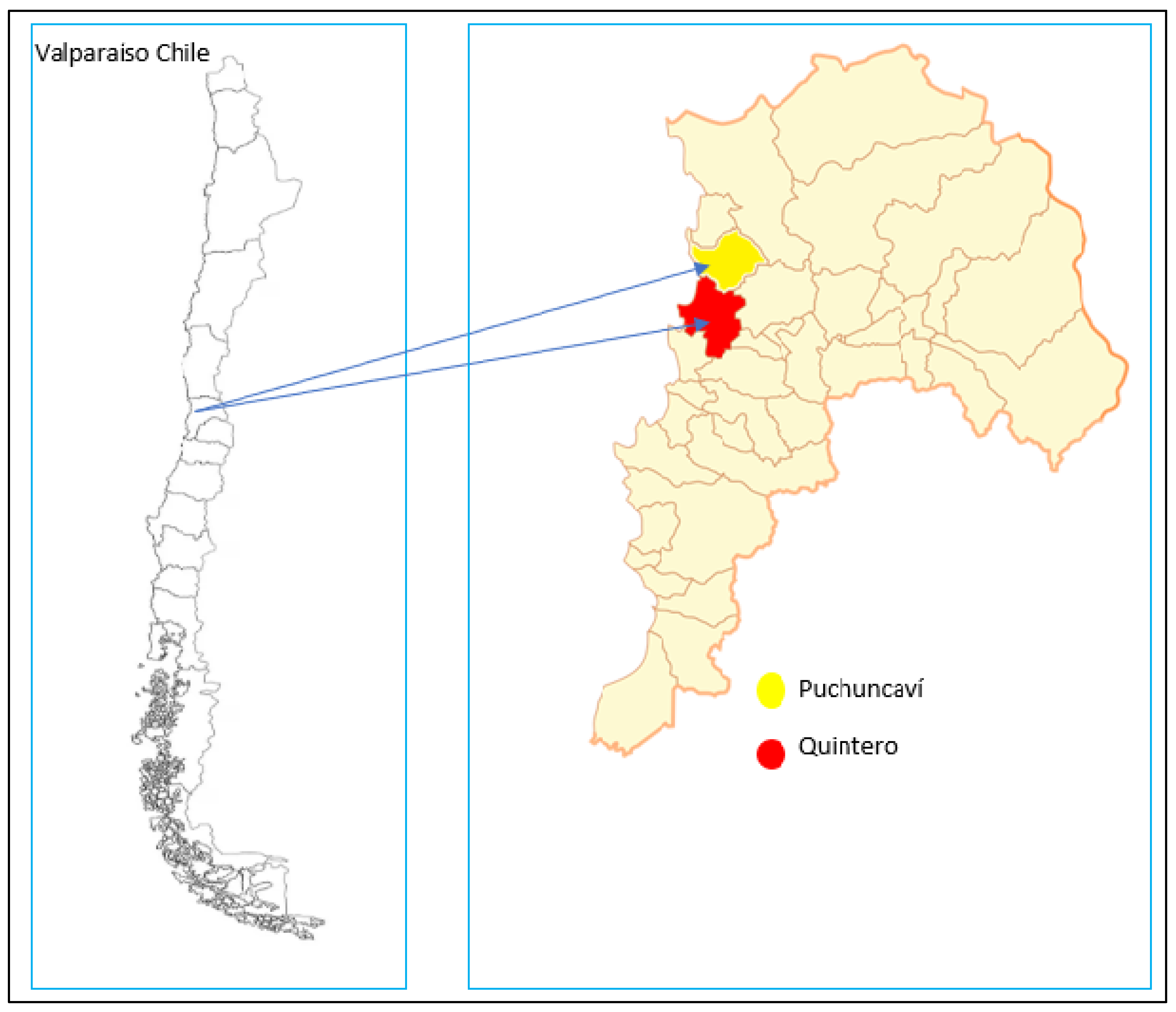



| School | Place | Latitude S | Longitude W |
|---|---|---|---|
| Greda los Alerces | Puchuncaví | 32.736.903 | 71.460.276 |
| La Greda | Puchuncaví | 32.747.420 | 71.475.076 |
| Básica Chocota | Puchuncaví | 32.730.091 | 71.487.255 |
| Básica Horcón | Puchuncaví | 32.712.978 | 71.488.007 |
| El Faro | Quintero | 32.776.909 | 71.530.828 |
| Santa Filomena | Quintero | 32.786.760 | 71.528.709 |
| Inglés Quintero | Quintero | 32.783.022 | 71.531.031 |
| Politécnico Quintero | Quintero | 32.789.093 | 71.526.921 |
| Reference | Curauma | 33.146451 | 71.569935 |
| School | Levoglucosan | α Glucose | β Glucose | Mannitol | Sucrose | Fructose | DEHP | Norhopane | Hopane | |
|---|---|---|---|---|---|---|---|---|---|---|
| Seasons | Reference | 79 | 3899 | 3957 | 338 | 9513 | 95,973 | 1854 | 81.64 | 113.98 |
| summer (indoor) | La Greda (Los Alerces) | 295 | 12,405 | 12,920 | 228 | 52,641 | 76,725 | 8920 | 143.38 | 156.79 |
| Santa Filomena | 636 | 484,220 | 512,210 | 21,451 | 831,759 | 147,975 | 372,622 | 303.39 | 298.02 | |
| Básica Horcón | 215 | 145,801 | 158,781 | 1742 | 1,123,390 | 73,658 | 122,626 | 168.55 | 166.93 | |
| El Faro | 40 | 9996 | 10,551 | 80 | 472,064 | 12,971 | 42,484 | 86.82 | 123.60 | |
| La Greda | 298 | 43,157 | 46,015 | 517 | 80,356 | 52,106 | 27,445 | 225.28 | 305.55 | |
| Politécnico Quintero | 407 | 95,135 | 107,595 | 4097 | 627,116 | 142,797 | 208,993 | 75.84 | 96.23 | |
| Inglés Quintero | 337 | 147,298 | 155,576 | 2448 | 826,024 | 165,156 | 129,893 | 106.00 | 132.41 | |
| Básica La Chocota | 346 | 340,428 | 422,897 | 788 | 879,381 | 253,726 | 96,784 | 153.69 | 168.50 | |
| Winter (Indoor) | La Greda (Los Alerces) | 224 | 10,795 | 12,761 | 1059 | 360,082 | 202,037 | 8826 | 170.80 | 179.45 |
| Santa Filomena | 766 | 19,317 | 22,034 | 12,398 | 532,435 | 250,024 | 117,675 | 315.26 | 352.24 | |
| Básica Horcón | 453 | 132,909 | 133,253 | 11,408 | 453,330 | 99,088 | 97,817 | 188.89 | 211.81 | |
| El Faro | 198 | 13,159 | 14,898 | 701 | 211,087 | 313,518 | 117,184 | 202.43 | 235.49 | |
| La Greda | 1207 | 353,310 | 390,340 | 7963 | 1,145,896 | 204,170 | 286,715 | 146.75 | 162.83 | |
| Politécnico Quintero | 371 | 51,960 | 58,975 | 2931 | 574,085 | 152,543 | 127,480 | 136.89 | 181.62 | |
| Inglés Quintero | 619 | 386,743 | 407,202 | 7358 | 1,570,939 | 150,194 | 245,621 | 157.42 | 185.24 | |
| Básica La Chocota | 898 | 470,643 | 429,536 | 12,902 | 1,584,915 | 235,542 | 315,352 | 390.54 | 456.57 | |
| Summer (outdoor) | La Greda (Los Alerces) | 171 | 19,809 | 23,771 | 304 | 24,437 | 161,546 | 10,266 | 224.25 | 263.02 |
| Santa Filomena | 74 | 175,624 | 211,877 | 216 | 10,557 | 17,148 | 5953 | 35.58 | 39.17 | |
| Básica Horcón | 92 | 2022 | 2253 | 176 | 4853 | 124,763 | 364,474 | 120.30 | 155.45 | |
| El Faro | 213 | 302,945 | 339,534 | 1241 | 94,665 | 99,247 | 20,174 | 48.06 | 69.02 | |
| La Greda | 197 | 22,731 | 24,318 | 349 | 35,169 | 27,362 | 17,195 | 346.63 | 470.68 | |
| Politécnico Quintero | 117 | 27,182 | 29,502 | 173 | 75,316 | 44,238 | 64,024 | 195.94 | 252.78 | |
| Inglés Quintero | 296 | 23,636 | 27,156 | 955 | 44,337 | 478,322 | 83,299 | 103.28 | 113.88 | |
| Básica La Chocota | 72 | 12,451 | 13,527 | 125 | 102,611 | 156,108 | 14,568 | 56.74 | 69.55 | |
| winter (outdoor) | La Greda (Los Alerces) | 264 | 25,647 | 31,232 | 488 | 210,752 | 131,198 | 13,829 | 174.30 | 210.29 |
| Santa Filomena | 179 | 1124 | 4599 | 82 | 119,649 | 7062 | 1473 | 221.02 | 300.10 | |
| Básica Horcón | 117 | 16,317 | 17,223 | 1014 | 127,409 | 101,170 | 107,967 | 97.25 | 126.63 | |
| El Faro | 315 | 1650 | 5191 | 140 | 25,108 | 45,435 | 1944 | 78.28 | 107.30 | |
| La Greda | 179 | 2988 | 3187 | 430 | 98,899 | 73,534 | 28,230 | 224.90 | 278.92 | |
| Politécnico Quintero | 75 | 5422 | 5488 | 81 | 43,113 | 26,555 | 28,071 | 153.03 | 242.78 | |
| Inglés Quintero | 110 | 9479 | 10,349 | 328 | 73,072 | 68,810 | 472,374 | 221.35 | 257.44 | |
| Básica La Chocota | 85 | 5474 | 5638 | 49 | 30,389 | 23,273 | 61,461 | 130.19 | 166.35 |
| Indoor | Outdoor | |||||
|---|---|---|---|---|---|---|
| PAHs | Average | Min | Max | Average | Min | Max |
| Acy | 0.79 | 0.04 | 2.60 | 0.66 | 0.09 | 1.87 |
| Ace | 1.93 | 0.34 | 9.40 | 1.55 | 0.69 | 5.82 |
| Flu | 1.95 | 0.76 | 7.61 | 1.44 | 0.31 | 5.15 |
| Phe | 43.80 | 10.28 | 204.37 | 33.81 | 5.05 | 106.52 |
| Ant | 4.64 | 1.23 | 17.93 | 3.82 | 0.53 | 12.81 |
| Flt | 36.50 | 7.15 | 84.92 | 24.01 | 4.31 | 55.12 |
| Pyr | 49.13 | 7.37 | 99.16 | 41.55 | 7.50 | 97.31 |
| BaA | 14.63 | 2.55 | 40.20 | 11.06 | 1.16 | 29.02 |
| Chr | 37.15 | 8.54 | 72.95 | 34.74 | 6.11 | 105.79 |
| BbF | 33.95 | 7.31 | 65.60 | 23.48 | 4.64 | 52.47 |
| Bep | 23.38 | 4.90 | 43.36 | 21.22 | 3.75 | 42.75 |
| BaP | 13.57 | 2.94 | 31.64 | 9.17 | 1.40 | 21.94 |
| PE | 4.49 | 1.14 | 19.55 | 3.33 | 0.68 | 11.71 |
| IcdP | 11.80 | 3.50 | 24.35 | 8.20 | 1.99 | 20.96 |
| dBahA | 3.66 | 0.52 | 8.80 | 3.94 | 0.41 | 13.97 |
| Bghip | 22.77 | 6.93 | 50.27 | 25.24 | 3.60 | 57.08 |
| ƩPAHs | 304.2 | 247.21 | ||||
| Analytes | Toxic Equivalent Factors (TEF) [64] | BaPE as TQE Exposure Profile (ng/g) | ||||||||
|---|---|---|---|---|---|---|---|---|---|---|
| Puchuncaví | Quintero | |||||||||
| Reference | La Greda (Alerces) | La Greda | Básica La Chocota | Básica Horcón | El Faro | Santa Filomena | Inglés Quintero | Politécnico Quintero | ||
| Phe | 0.001 | 0.02 | 0.2 | 0.1 | 0.02 | 0.02 | 0.01 | 0.1 | 0.02 | 0.02 |
| Ant | 0.01 | 0.02 | 0.2 | 0.1 | 0.03 | 0.02 | 0.02 | 0.1 | 0.03 | 0.03 |
| FLT | 0.001 | 0.02 | 0.1 | 0.0 | 0.01 | 0.03 | 0.03 | 0.1 | 0.02 | 0.03 |
| Pyr | 0.001 | 0.1 | 0.1 | 0.1 | 0.01 | 0.03 | 0.1 | 0.1 | 0.02 | 0.03 |
| BaA | 0.1 | 0.4 | 3.6 | 1.7 | 0.9 | 1.4 | 0.5 | 2.0 | 0.7 | 1.5 |
| Chr | 0.01 | 0.2 | 0.6 | 0.6 | 0.3 | 0.3 | 0.2 | 0.6 | 0.2 | 0.3 |
| BbjkF | 0.1 | 1.3 | 5.9 | 6.2 | 3.3 | 4.1 | 2.8 | 5.7 | 2.2 | 3.9 |
| BaP | 1 | 7.5 | 28.8 | 13.5 | 6.7 | 10.5 | 5.6 | 14.7 | 16.3 | 15.6 |
| Icdp | 0.1 | 0.3 | 2.3 | 1.1 | 0.6 | 2.0 | 0.4 | 1.6 | 0.9 | 1.0 |
| DahA | 1 | 2.1 | 3.7 | 5.5 | 2.4 | 4.1 | 5.5 | 5.2 | 1.7 | 1.9 |
| Bghip | 0.01 | 0.3 | 0.4 | 0.4 | 0.1 | 0.2 | 0.1 | 0.3 | 0.1 | 0.2 |
| Study Schools | Sampling Location | Season | Children | ||
|---|---|---|---|---|---|
| Inhalation | Dermal | Ingestion | |||
| La Greda (Los Alerces) | Indoor | summer | 2.02 × 10⁻⁸ | 9.48 × 10⁻⁶ | 1.37 × 10⁻³ |
| winter | 2.71 × 10⁻⁸ | 1.27 × 10⁻⁵ | 1.84 × 10⁻³ | ||
| Outdoor | summer | 1.95 × 10⁻⁸ | 9.16 × 10⁻⁶ | 1.32 × 10⁻³ | |
| winter | 1.36 × 10⁻⁸ | 6.37 × 10⁻⁶ | 9.20 × 10⁻⁴ | ||
| La Greda | Indoor | summer | 1.68 × 10⁻⁸ | 7.92 × 10⁻⁶ | 1.14 × 10⁻³ |
| winter | 1.06 × 10⁻⁸ | 5.00 × 10⁻⁶ | 7.23 × 10⁻⁴ | ||
| Outdoor | summer | 1.78 × 10⁻⁸ | 8.38 × 10⁻⁶ | 1.21 × 10⁻³ | |
| winter | 1.80 × 10⁻⁸ | 8.47 × 10⁻⁶ | 1.22 × 10⁻³ | ||
| Básica La Chocota | Indoor | summer | 4.40 × 10⁻⁹ | 2.07 × 10⁻⁶ | 2.99 × 10⁻⁴ |
| winter | 7.44 × 10⁻⁹ | 3.50 × 10⁻⁶ | 5.05 × 10⁻⁴ | ||
| Outdoor | summer | 2.76 × 10⁻⁹ | 1.30 × 10⁻⁶ | 1.87 × 10⁻⁴ | |
| winter | 4.54 × 10⁻⁹ | 2.13 × 10⁻⁶ | 3.08 × 10⁻⁴ | ||
| Básica Horcón | Indoor | summer | 4.29 × 10⁻⁹ | 2.02 × 10⁻⁶ | 2.91 × 10⁻⁴ |
| winter | 1.31 × 10⁻⁸ | 6.15 × 10⁻⁶ | 8.88 × 10⁻⁴ | ||
| Outdoor | summer | 3.17 × 10⁻⁹ | 1.49 × 10⁻⁶ | 2.15 × 10⁻⁴ | |
| winter | 6.04 × 10⁻⁹ | 2.84 × 10⁻⁶ | 4.10 × 10⁻⁴ | ||
| El Faro | Indoor | summer | 8.46 × 10⁻⁹ | 3.98 × 10⁻⁶ | 5.74 × 10⁻⁴ |
| winter | 6.80 × 10⁻⁹ | 3.20 × 10⁻⁶ | 4.62 × 10⁻⁴ | ||
| Outdoor | summer | 4.63 × 10⁻⁹ | 2.18 × 10⁻⁶ | 3.15 × 10⁻⁴ | |
| winter | 5.43 × 10⁻⁹ | 2.55 × 10⁻⁶ | 3.69 × 10⁻⁴ | ||
| Santa Filomena | Indoor | summer | 1.28 × 10⁻⁸ | 5.99 × 10⁻⁶ | 8.65 × 10⁻⁴ |
| winter | 1.84 × 10⁻⁸ | 8.65 × 10⁻⁶ | 1.25 × 10⁻³ | ||
| Outdoor | summer | 1.55 × 10⁻⁹ | 7.26 × 10⁻⁷ | 1.05 × 10⁻⁴ | |
| winter | 8.70 × 10⁻⁹ | 4.09 × 10⁻⁶ | 5.91 × 10⁻⁴ | ||
| Inglés Quintero | Indoor | summer | 5.93 × 10⁻⁹ | 2.79 × 10⁻⁶ | 4.02 × 10⁻⁴ |
| winter | 7.31 × 10⁻⁹ | 3.43 × 10⁻⁶ | 4.96 × 10⁻⁴ | ||
| Outdoor | summer | 9.99 × 10⁻⁹ | 4.70 × 10⁻⁶ | 6.78 × 10⁻⁴ | |
| winter | 7.03 × 10⁻⁹ | 3.30 × 10⁻⁶ | 4.77 × 10⁻⁴ | ||
| Politécnico Quintero | Indoor | summer | 7.63 × 10⁻⁹ | 3.59 × 10⁻⁶ | 5.18 × 10⁻⁴ |
| winter | 9.43 × 10⁻⁹ | 4.43 × 10⁻⁶ | 6.40 × 10⁻⁴ | ||
| Outdoor | summer | 8.54 × 10⁻⁹ | 4.02 × 10⁻⁶ | 5.80 × 10⁻⁴ | |
| winter | 1.22 × 10⁻⁸ | 5.75 × 10⁻⁶ | 8.30 × 10⁻⁴ | ||
Disclaimer/Publisher’s Note: The statements, opinions and data contained in all publications are solely those of the individual author(s) and contributor(s) and not of MDPI and/or the editor(s). MDPI and/or the editor(s) disclaim responsibility for any injury to people or property resulting from any ideas, methods, instructions or products referred to in the content. |
© 2026 by the authors. Licensee MDPI, Basel, Switzerland. This article is an open access article distributed under the terms and conditions of the Creative Commons Attribution (CC BY) license.
Share and Cite
Parra, S.; Bravo, M.A.; Van Drooge, B.L. Determination of Polycyclic Aromatic Hydrocarbons and Organic Molecular Tracer Compounds in Dusts Samples from Schools in Puchuncaví and Quintero (Chile). Molecules 2026, 31, 818. https://doi.org/10.3390/molecules31050818
Parra S, Bravo MA, Van Drooge BL. Determination of Polycyclic Aromatic Hydrocarbons and Organic Molecular Tracer Compounds in Dusts Samples from Schools in Puchuncaví and Quintero (Chile). Molecules. 2026; 31(5):818. https://doi.org/10.3390/molecules31050818
Chicago/Turabian StyleParra, Sonnia, Manuel A. Bravo, and Barend L. Van Drooge. 2026. "Determination of Polycyclic Aromatic Hydrocarbons and Organic Molecular Tracer Compounds in Dusts Samples from Schools in Puchuncaví and Quintero (Chile)" Molecules 31, no. 5: 818. https://doi.org/10.3390/molecules31050818
APA StyleParra, S., Bravo, M. A., & Van Drooge, B. L. (2026). Determination of Polycyclic Aromatic Hydrocarbons and Organic Molecular Tracer Compounds in Dusts Samples from Schools in Puchuncaví and Quintero (Chile). Molecules, 31(5), 818. https://doi.org/10.3390/molecules31050818