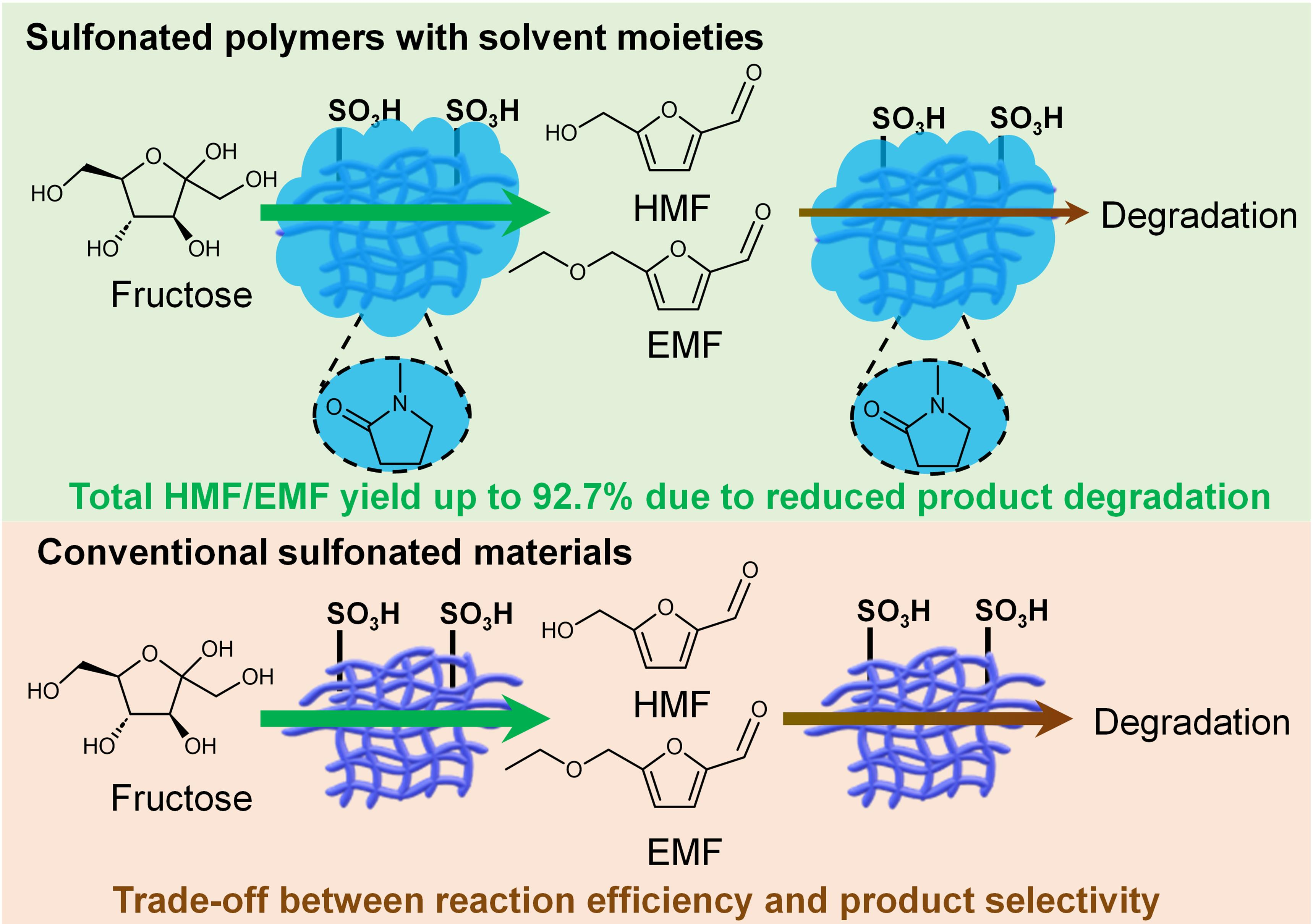
Highly Efficient Conversion of Fructose to Furan Compounds in Ethanol Using Sulfonated Polymers with Solvent Moieties to Inhibit Product Degradation


 ,
,  ,
, 
Abstract
Share and Cite
Tang, Y.; Zhang, C.; Bai, X.; Qian, H.; Xie, C.; Xia, T.; Yu, G.; Qu, F.; Hao, Z.; Wang, J.; et al. Highly Efficient Conversion of Fructose to Furan Compounds in Ethanol Using Sulfonated Polymers with Solvent Moieties to Inhibit Product Degradation. Molecules 2026, 31, 729. https://doi.org/10.3390/molecules31040729
Tang Y, Zhang C, Bai X, Qian H, Xie C, Xia T, Yu G, Qu F, Hao Z, Wang J, et al. Highly Efficient Conversion of Fructose to Furan Compounds in Ethanol Using Sulfonated Polymers with Solvent Moieties to Inhibit Product Degradation. Molecules. 2026; 31(4):729. https://doi.org/10.3390/molecules31040729
Chicago/Turabian StyleTang, Yao, Chaojie Zhang, Xinyu Bai, Hengli Qian, Chao Xie, Tianliang Xia, Guanjie Yu, Fei Qu, Ziteng Hao, Jingrong Wang, and et al. 2026. "Highly Efficient Conversion of Fructose to Furan Compounds in Ethanol Using Sulfonated Polymers with Solvent Moieties to Inhibit Product Degradation" Molecules 31, no. 4: 729. https://doi.org/10.3390/molecules31040729
APA StyleTang, Y., Zhang, C., Bai, X., Qian, H., Xie, C., Xia, T., Yu, G., Qu, F., Hao, Z., Wang, J., Rui, A., Guo, H., Ju, M., & Hou, Q. (2026). Highly Efficient Conversion of Fructose to Furan Compounds in Ethanol Using Sulfonated Polymers with Solvent Moieties to Inhibit Product Degradation. Molecules, 31(4), 729. https://doi.org/10.3390/molecules31040729