Article

One-Pot Amination of 5-Hydroxymethylfurfural to 2,5-Bis(aminomethyl)furan over NiZnAl Catalysts

State Key Laboratory of Petroleum Molecular & Process Engineering, SINOPEC Research Institute of Petroleum Processing, Beijing 100083, China
*
Authors to whom correspondence should be addressed.
Molecules 2026, 31(10), 1600; https://doi.org/10.3390/molecules31101600
Submission received: 27 March 2026 / Revised: 1 May 2026 / Accepted: 7 May 2026 / Published: 10 May 2026
(This article belongs to the Special Issue Advances in Catalytic Conversion of Biomass-Derived Molecules)

Abstract

This study developed a highly efficient one-step catalytic reductive amination method, achieving the highly selective conversion of 5-hydroxymethylfurfural (HMF) to 2,5-bis(aminomethyl)furan (BAMF). A series of NiZnAl catalysts were prepared via the coprecipitation method and demonstrated excellent catalytic performance in HMF conversion. The Ni4Zn4Al8Ox catalyst achieved up to 100% substrate conversion with 83.71% BAMF selectivity. Their structure–activity relationship was elucidated through a comprehensive characterization using XRD, H2-TPR, NH3-TPD, XPS, and TEM techniques. The study reveals that the unique synergistic interactions between the metal and acidic sites on the ZnAl2O4 spinel structure is crucial for catalytic performance: on the one hand, Zn introduction forms the spinel structure and promotes electron enrichment at Ni active sites, significantly enhancing the activation capability of HMF hydroxyl groups; on the other hand, the moderately acidic sites in the catalyst form “metal-acid” dual-functional synergistic centers with the metal sites, simultaneously promoting substrate activation and effectively regulating the transformation pathways of reaction intermediates. This precise matching between the metal active sites and acidic sites enables the efficient sequential progression of all steps in the reaction, offering a novel and more selective solution for the efficient reductive amination of HMF.

1. Introduction

5-Hydroxymethylfurfural (HMF) is a versatile C6 platform compound derived from renewable biomass feedstocks, including glucose, fructose, and cellulose [1,2]. As an important biobased platform compound, HMF exhibits broad application prospects and can be used to synthesize a variety of high-value-added monomers and fine chemicals [3]. Among its derivatives, 2,5-bis(aminomethyl)furan (BAMF) possesses a structurally stable furan ring skeleton. It is expected that it will replace traditional petroleum-based diamine monomers and be applied in polymer synthesis systems, serving as a promising monomer for the preparation of high-performance polymer materials. Meanwhile, it is further broadening the application scope of HMF in the field of biomass-derived materials. This work mainly summarizes and discusses the reaction pathway of the heterogeneous catalytic amination of HMF to BAMF (Table 1).
Diverse synthetic routes have been developed for the conversion of HMF to BAMF, among which the typical strategy involves the initial oxidation of HMF to 2,5-furandicarboxaldehyde (DFF), which is subsequently employed as the key precursor for BAMF synthesis. For instance, Le [4] utilized acetic acid-treated Raney Ni as the catalyst to facilitate the reductive amination of DFF, resulting in BAMF with a moderate yield of 42.6%. Indeed, the pronounced reactivity of DFF together with the intrinsic polymerization tendency of diamine products constitutes a major hurdle for the highly selective synthesis of BAMF. To address these issues, Qi [5] proposed a modified protocol by reacting DFF with a stoichiometric excess of n-butylamine, which enabled the formation of a sterically hindered imine intermediate that is less prone to condensation. By precisely modulating the hydrogenation activity of the Co/ZrO2 catalyst toward this intermediate, they successfully realized the highly selective transformation to BAMF, achieving an impressive yield of 95%. The selective hydrogenation of HMF produces 2,5-dihydroxymethylfuran (DHMF), upon which Kita [6] accomplished direct amination with ammonia over the heterogeneous catalyst Ru-20MgO/TiO2 at 110 °C, achieving a BAMF yield of 86%. Alternatively, replacing the hydroxyl groups in HMF with chlorine yields 5-chloromethylfurfural (5-CMF), which undergoes reductive amination with Raney Ni as the catalyst in THF at 90 °C, giving BAMF with a 62% yield [7,8]. In another synthetic strategy, Wang [9] first subjected HMF to a Ritter reaction to aminate the hydroxyl group, resulting in N-(hydroxymethylfurfuryl)acetamide (NAMF) with a yield of 89.1%, followed by the subsequent amination of NAMF over a Raney Ni catalyst to produce BAMF with a yield of 60.8%. Wei [10] developed a stepwise reduction amination protocol, wherein HMF was initially reacted with Raney Co at 120 °C for 2 h to preferentially aminate the C=O groups and generate the intermediate HMFA; the resultant HMFA was further treated with Raney Ni at 160 °C for 10 h to achieve the amination of the C-OH groups, ultimately yielding 88.3% BAMF. Although these multi-step strategies have enabled considerable progress and satisfactory product yields in the synthesis of target chemicals, the development of more efficient and convenient one-pot catalytic routes is still highly desirable for advancing practical applications.
Researchers have shifted from traditional multi-step procedures to an advanced one-pot catalytic system, which avoids intermediate separation and purification, greatly simplifies operation, and improves the atomic economy through in situ conversion. This transformation involves the simultaneous amination of both hydroxyl and aldehyde groups, which imposes stringent requirements on catalyst design and selection [11]. Zhou [12] systematically investigated the catalytic performance of Raney Ni, Raney Co, Pd/C, Ru/C, and Pt/C catalysts in the amination of HMF, and the results indicated that Raney Ni exhibited the highest catalytic efficiency. The DFT calculations further revealed that Ni possesses the minimal adsorption energy difference between NH3 and H2, which mitigates the competitive adsorption of NH3 on the metal active sites, thereby reserving more active centers for alcohol dehydrogenation and imine hydrogenation, and consequently enhancing the overall efficiency of the HMF amination reaction. Under the reaction conditions of 120 °C, 1 MPa H2 and 0.2 MPa NH3 for 2 h followed by elevating the temperature to 160 °C for an additional 10 h, a BAMF yield of 86.5% was attained. Additionally, Wei [13] prepared 10wt% Ni catalysts using γ-Al2O3, ZnO, TiO2, SiO2, activated carbon (AC) and hydrotalcite (HT) as supports via the incipient wetness impregnation method, and evaluated their catalytic behavior in the one-pot reductive amination of HMF. Among these supports, γ-Al2O3 demonstrated distinct advantages with a BAMF yield of 21.5%, whereas the other supports only enabled the amination of the C=O groups, leading exclusively to the formation of the intermediate HMFA. Although these pioneering studies have achieved encouraging progress in catalyst screening and performance optimization, the intrinsic reaction mechanism of HMF reductive amination remains ambiguous and requires further in-depth investigation.
Recent studies have further illustrated that the electronic state of Ni active sites is pivotal in regulating gas activation [14], intermediate transformation [15], and reaction pathway selection [16,17,18]. Meanwhile, Sels [3,19] has highlighted that the synergy between metal active sites and acidic sites plays a crucial role in controlling the functional group conversion and product selectivity during HMF catalytic transformation. A delicate balance between hydrogenation activity and acid-catalyzed side reactions is therefore essential for the rational design of efficient catalysts. Guided by these understandings, NiAl catalysts were initially prepared by a coprecipitation method. However, the excessively high hydrogenation activity of Ni led to side reactions, such as aldehyde group hydrogenation and furan ring hydrogenation. Meanwhile, the surface acidic sites induced side reactions, such as intramolecular cyclization, which not only decreased the yield of BAMF but also increased the difficulty of its subsequent separation and purification. To solve this problem, this work innovatively introduces Zn into NiAl catalysts to form a ZnAl2O4 spinel structure. The spinel structure eliminates the strong acid sites responsible for the cyclization side reaction and establishes strong metal–support interactions, thereby modulating the electronic structure of Ni and optimizing its hydrogenation activity. By adjusting the Ni/Zn/Al molar ratio, this study demonstrates how this dual regulation realizes the reductive amination of HMF to BAMF. This design strategy, which combines the electronic structure regulation of Ni active sites and the acid–base property optimization of the support, provides a new approach for the design of bifunctional catalysts in biomass conversion.
Table 1. Summary and comparison of heterogeneous catalysts for the synthesis of BAMF from HMF and its derivatives.
Reaction PathwayCatalystReaction ConditionsBAMF Yield
(%)
Ref.
DFF-BAMFRaney Ni120 °C, 6 h, 1 MPa42.6[4]
DFF-BAMFCo/ZrO2100 °C, 10 h, 2 MPa95.0[5]
DHMF-BAMFRu-20MgO/TiO2110 °C, 20 h, 0.7 MPa86.0[6]
CMF-BAMFRenay Ni90 °C, 1 h, 4 MPa62.0[8]
NAMF-BAMFRenay Ni120 °C, 3 h, 1.5 MPa60.8[9]
HMFA-BAMFRaney Ni160 °C, 48 h, 1 MPa71.1[10]
HMF-BAMFRaney Ni120 °C, 2 h and then 160 °C, 10 h, 1 MPa86.5[12]
HMF-BAMF10Ni/γ-Al2O3160 °C, 36 h, 1 MPa86.3[13]
This work Ni4Zn4Al8Ox90 °C for 6 h and then 210 °C, 18 h, 4.5 MPa83.7-

2. Results and Discussion

2.1. Catalyst Characterization

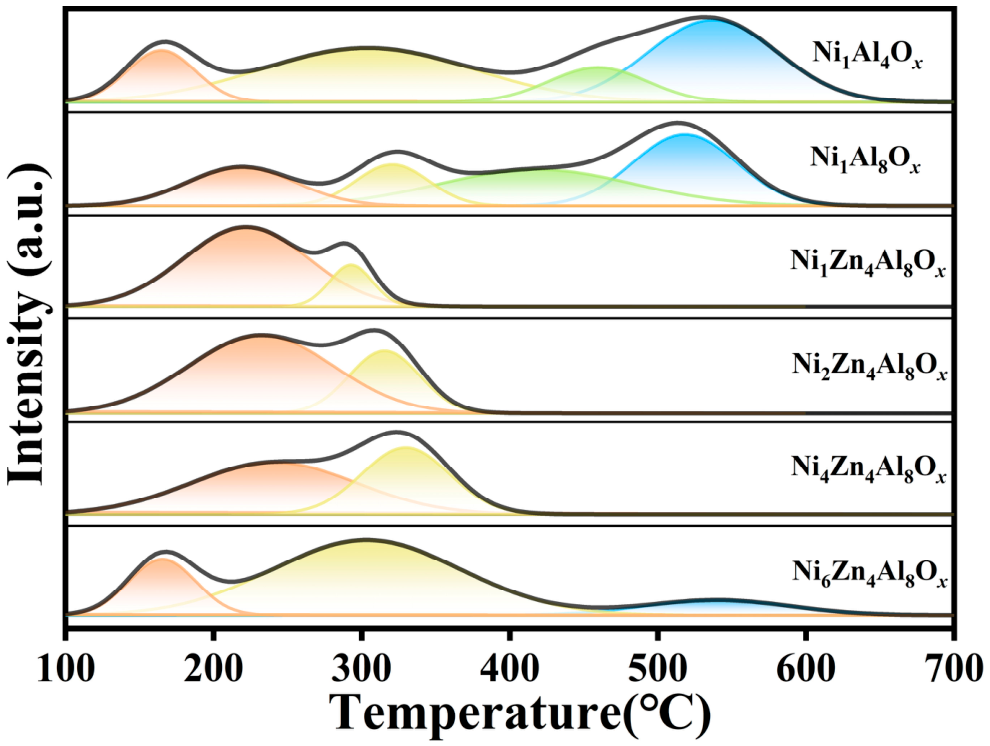
The NH3-TPD characterization and acid amount quantification revealed distinct differences in the number, strength, and distribution of acidic sites across the catalysts (Figure 1). The total acid amounts of Ni1Al4Ox and Ni1Al8Ox were 0.067 μmol/g and 0.061 μmol/g, respectively, which were significantly higher than those of the NiZnAl catalysts. Notably, the strong acid sites (400–600 °C) account for about 40–45% of the total acid amount in the NiAl catalysts, and these excessively strong acidic centers are prone to triggering acid-catalyzed cyclization side reactions, leading to the formation of OABCO byproducts and severely compromising the selectivity toward BAMF [20].
Upon Zn incorporation, the high-temperature desorption peaks associated with the strong acid sites vanished completely in the NiZnAl catalysts. The acidic sites were predominantly confined to the medium-to-low temperature region (150–400 °C), with the total acid amount drastically reduced to 0.032–0.045 μmol/g. Specifically, the moderate acid sites (250–400 °C) became the dominant species, accounting for about 30–70% of the total acid amount. This result confirms that Zn effectively suppresses the formation of strong acid sites and neutralizes part of the acidic centers, thus constructing a moderate acid site system on NiZnAl catalysts and tailoring the acid strength distribution to match the metal active sites. Notably, the reduced total acid amount and suppressed strong acid sites effectively inhibited acid-catalyzed side reactions. The cleavage product FA was eliminated completely, and the cyclization byproduct OABCO was drastically reduced, which contributed significantly to the improved selectivity toward BAMF.
The textural properties of various catalyst series were systematically characterized using N2 adsorption–desorption isotherms (Figure S1), pore size distribution analysis, and mesostructural parameters (Table 2). All samples displayed Type IV isotherms, which are typical of mesoporous materials, as evidenced by the sharp adsorption uptakes at high relative pressures, where the P/P0 was greater than 0.8. Notably, the Ni1Al4Ox and Ni1Al8Ox catalysts exhibited high specific surface areas of approximately 200 m2/g with narrow pore size distributions ranging from 6.91 to 7.73 nm, as confirmed by the pronounced peaks in their pore size distribution curves. In stark contrast, the NiZn catalysts demonstrated markedly reduced BET surface areas of 10 to 12 m2/g alongside enlarged pore sizes and diminished pore volumes, indicative of a poorly developed, loose pore architecture. The NiZnAl catalysts exhibited intermediate textural properties, bridging the two extremes. Their pore size distribution curves showed attenuated peak intensities relative to the Ni1Al8Ox catalyst, accompanied by broader pore size ranges. As the pore size increased, the dV/dlogD profiles progressively flattened, suggesting greater pore heterogeneity and a higher fraction of larger mesopores.
Interestingly, the NiZnAl catalysts displayed composition-dependent adsorption behavior: the SBET initially rose with an increasing Ni content before plateauing, while the average pore diameters slightly contracted. These findings demonstrate that precise control over the Ni/Zn/Al molar ratio enables rational modulation of pore structure development, including the total pore volume and pore size distribution characteristics.
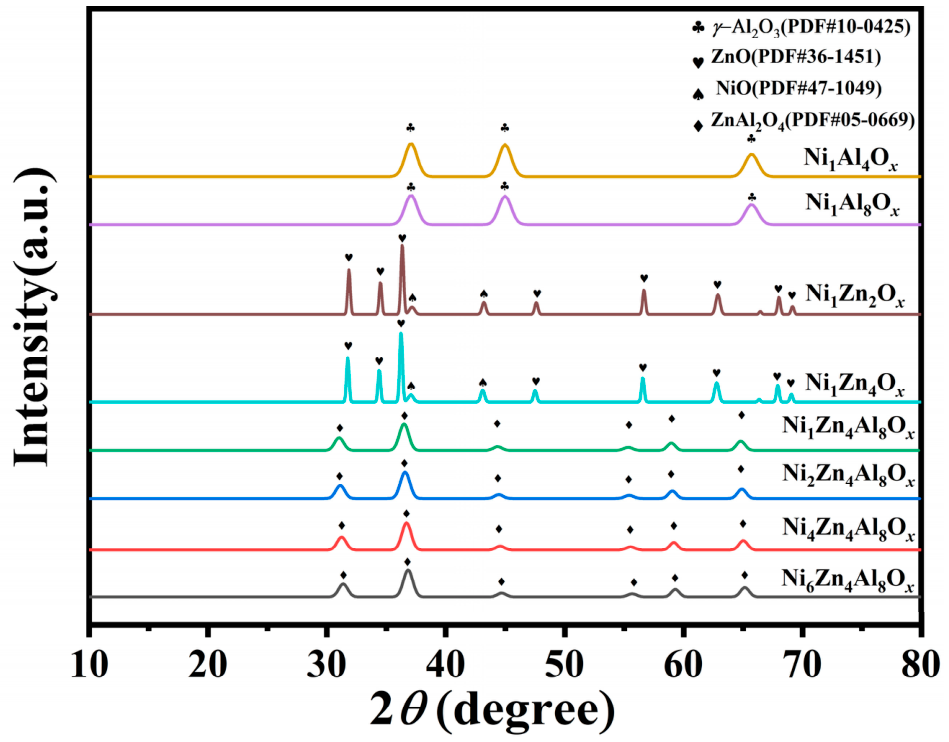
The XRD diffraction patterns are shown in Figure 2. For the NiAl catalysts, the characteristic diffraction peaks assigned to γ-Al2O3 (PDF#10-0425) were only observed at 2θ values of approximately 37.5°, 45.8°, and 66.8°, corresponding to the (311), (400), and (440) crystal planes, respectively. No distinct peaks related to NiO were detected in the patterns, revealing that the Ni species were highly dispersed within the γ-Al2O3 support or dissolved into the γ-Al2O3 lattice to form a solid solution. For the NiZn catalysts, several sharp and well-defined diffraction peaks, ascribed to ZnO (PDF#36-1451) and NiO (PDF#47-1049), were present. Concretely, the diffraction peaks at 31.8°, 34.4°, 36.3°, 47.5°, 56.6°, 62.9°, and 67.9° correspond to the typical crystal planes of ZnO, while the peaks located at 37.2° and 43.3° are attributed to the (111) and (200) planes of NiO, respectively. This result confirms the coexistence of crystalline ZnO and NiO phases in the NiZn catalysts, and that no spinel phase was formed in the absence of Al. New characteristic diffraction peaks ascribed to the ZnAl2O4 spinel phase (PDF#05-0669) were detected in the NiZnAl catalysts. These peaks were located at 2θ values of about 31.3°, 36.7°, 44.7°, 55.5°, 59.2° and 65.0°, which were well indexed to the (220), (311), (400), (422) and (440) crystal planes of ZnAl2O4 spinel phase. This result proves that the ZnAl2O4 spinel structure was successfully synthesized. Notably, compared with the NiZn catalysts, the characteristic diffraction peaks of NiO vanished completely in all the NiZnAl catalysts. This phenomenon suggests that the Ni2+ ions were incorporated into the ZnAl2O4 spinel lattice to form a NiZnAl spinel solid solution, or were highly dispersed on the spinel surface via strong metal–support interactions [21,22].
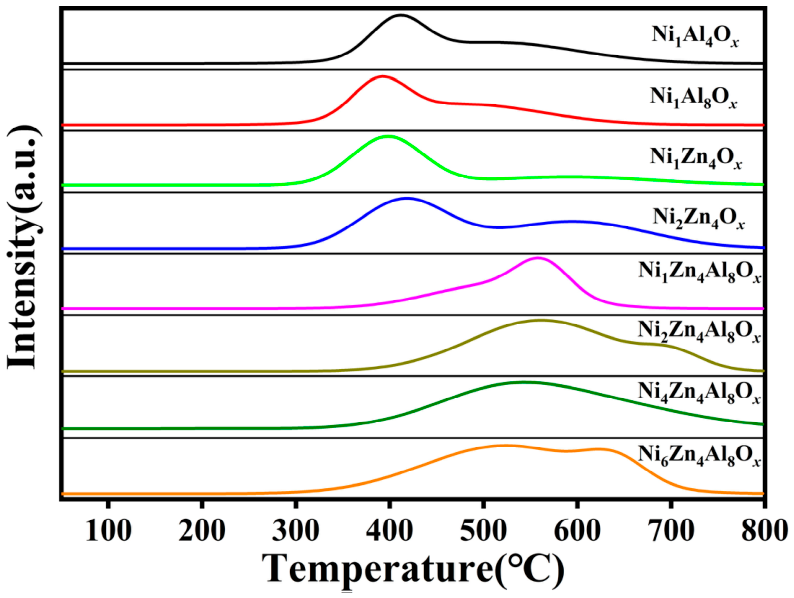
Hydrogen temperature-programmed reduction (H2-TPR) tests were conducted on the calcined catalysts to evaluate their reductive properties (Figure 3). The reduction peaks of the Ni1Al4Ox, Ni1Al8Ox, Ni1Zn4Ox and Ni2Zn4Ox catalysts were concentrated in the temperature range of 350–450 °C, with relatively low peak temperatures, implying that the Ni species in these catalysts possessed facile reducibility. In sharp contrast, the reduction peak temperatures of the NiZnAl catalysts were markedly higher than those of the aforementioned two catalyst categories. This phenomenon can be ascribed to the strong interfacial interactions formed between the Ni species and the ZnAl2O4 spinel structure introduced into the NiZnAl catalysts, which increased the reduction difficulty of Ni2+ species in the system, and thus led to a distinct shift of the reduction peaks toward the high-temperature region [23]. Notably, this observation not only further confirms the formation of the ZnAl2O4 spinel structure but also demonstrates that the influence of such interfacial interactions becomes increasingly pronounced with an increase in the Ni content.
The H2-TPD (Table S2) reveals distinct hydrogen adsorption–desorption behaviors among the catalysts. The Ni1Al4Ox and Ni1Al8Ox catalysts exhibited prominent H2 desorption peaks in the medium–high temperature range (400–600 °C), with corresponding hydrogen adsorption capacities of 8.2 mmol/g and 7.8 mmol/g, respectively, which were significantly higher values than those observed for the NiZnAl catalysts. This demonstrates the presence of strong hydrogen adsorption sites on the NiAl catalysts, which enhanced hydrogen dissociation and resulted in high hydrogenation activity. Notably, these characteristics correlate with the higher yield of furan ring hydrogenation byproducts observed with the NiAl catalysts. Among the NiZnAl catalysts, Ni1Zn4Al8Ox exhibited the lowest H2 adsorption capacity at 4.3 mmol/g, followed by Ni2Zn4Al8Ox at 5.1 mmol/g, Ni4Zn4Al8Ox at 5.6 mmol/g, and Ni6Zn4Al8Ox at 6.5 mmol/g. Among these, the Ni4Zn4Al8Ox catalyst demonstrated a moderate H2 adsorption capacity, a key feature of Ni active sites on the ZnAl2O4 spinel support for matching the moderate acid sites. This balanced H2 adsorption capacity provided the Ni with appropriate hydrogenation activity. This allowed it to form a highly efficient metal–acid synergistic system with the moderate acid sites on the ZnAl2O4 spinel support. This synergy not only facilitated the selective conversion of HMFA to BAMF, but also prevented both excessive hydrogenation of the furan ring and the subsequent intramolecular cyclization side reactions. In contrast, the lower H2 adsorption capacity of the Ni1Zn4Al8Ox and Ni2Zn4Al8Ox catalysts, ranging from 4.3 to 5.1 mmol/g, resulted in insufficient hydrogenation activity, limiting HMFA conversion and leading to low BAMF selectivity. The Ni6Zn4Al8Ox catalyst exhibited an excessive H2 adsorption capacity, with the Ni demonstrating overly high hydrogenation activity. This disrupted the balanced synergy between the metal–acid sites on the ZnAl2O4 spinel support, leading to the uncontrolled hydrogenation of the furan ring.
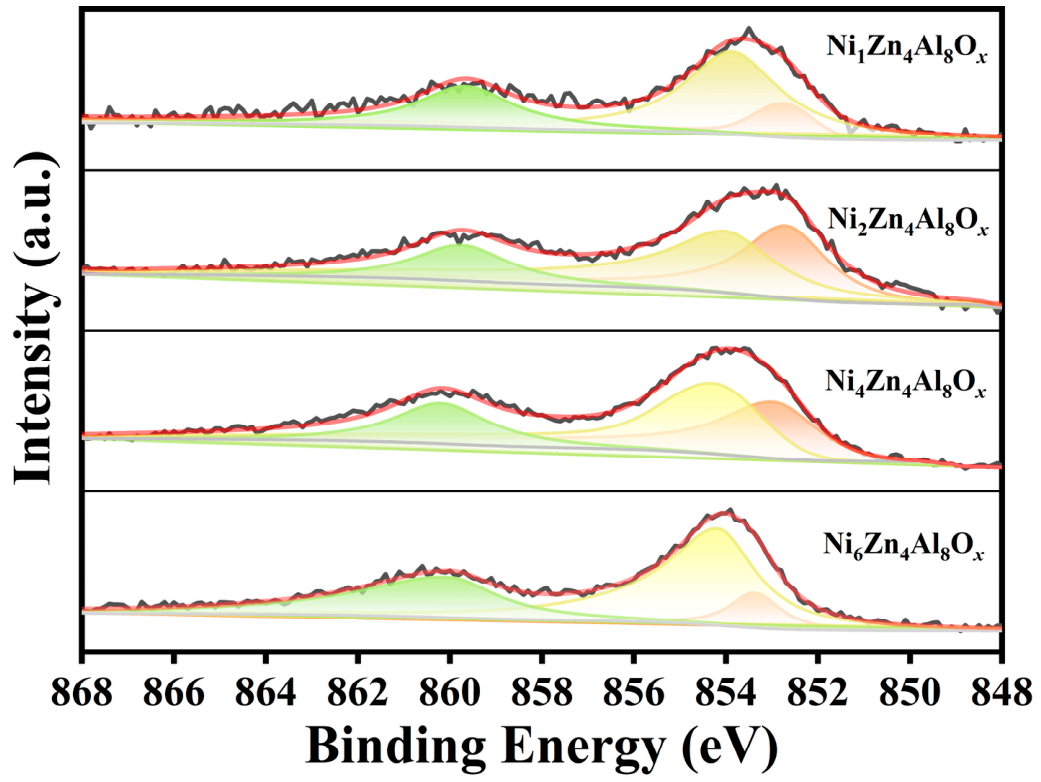
X-ray photoelectron spectroscopy (XPS) was employed to investigate the chemical states of elements on the catalyst surfaces. The high-resolution Ni 2p3/2 spectrum of the calcined catalyst is shown in Figure 4 and Table S2. The Ni 2p3/2 binding energy of NiZnAl catalysts gradually increased from 852.70 eV (Ni1Zn4Al8Ox), to 852.75 eV (Ni2Zn4Al8Ox), to 852.98 eV (Ni4Zn4Al8Ox), and ultimately to 853.36 eV (Ni6Zn4Al8Ox) with a rising Ni content. This result indicates that increasing the Ni loading progressively strengthened the metal–support electronic interactions between the Ni species and the ZnAl2O4 spinel structure, thereby modifying the electronic structure of Ni active sites. At low Ni loadings (Ni1Zn4Al8Ox Ni2Zn4Al8Ox), the relatively low Ni 2p3/2 binding energy (852.70–852.75 eV) indicates weak electronic modulation from the spinel structure [24]. Correspondingly, the H2-TPD reveals a low H2 adsorption capacity, which in turn limited the efficiency of H2 adsorption capacity and dissociation on the catalyst, hindering the rate-limiting HMFA dehydrogenation step, thus resulting in low BAMF selectivity. For the Ni4Zn4Al8Ox catalyst (Ni 2p3/2 = 852.98 eV), the moderate binding energy further confirms a balanced metal–support interaction on the ZnAl2O4 spinel support, which realized the precise matching of electronic structure of Ni active sites and the acidity of surface acid sites. This electronic tuning weakened the excessive H2 adsorption capacity, matching the intermediate H2 adsorption capacity observed in the H2-TPD. The resulting equilibrium of H2 adsorption–dissociation favored imine double-bond reduction over furan ring saturation, enabling efficient HMFA amination to BAMF. In contrast, the Ni6Zn4Al8Ox catalyst exhibited the highest Ni 2p3/2 binding energy among all the NiZnAl samples, reaching 853.36 eV. This indicates a disruption of the favorable electronic regulation of the ZnAl2O4 spinel structure on the Ni active sites. The corresponding H2-TPD results reveal a higher H2 adsorption capacity, yet the Ni sites displayed an uncontrolled H2 adsorption capacity and dissociation. This broke the synergistic balance between the Ni metal and acidic sites. As a result, excessive hydrogenation of the furan ring occurred, thus forming HMTHFA and DHMTHF.
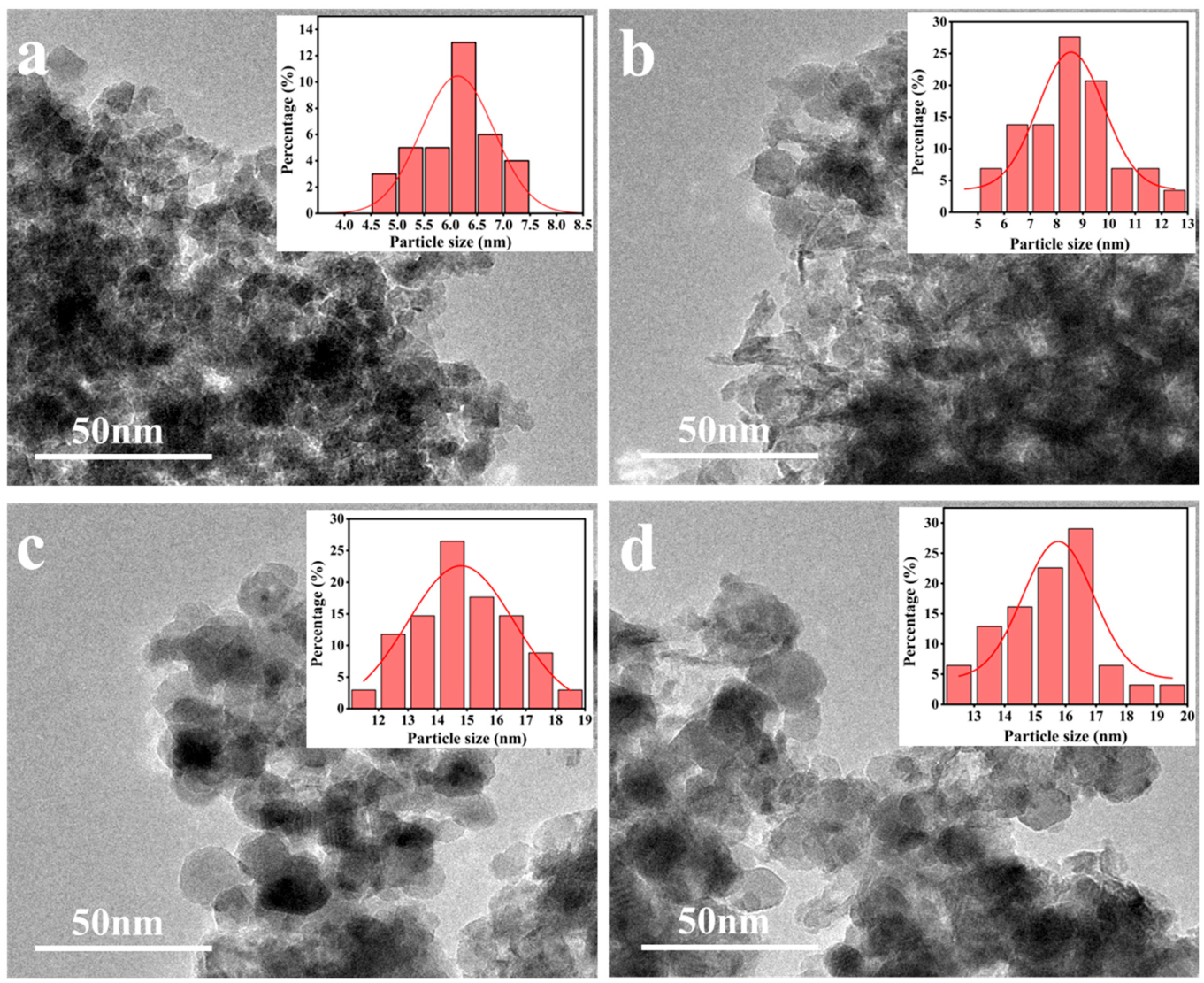
The TEM analysis coupled with the particle size distribution measurements of the NiZnAl catalysts provides compelling evidence regarding the Ni loading-dependent evolution of metallic Ni nanoparticles (Figure 5). At lower Ni contents (Ni1Zn4Al8Ox, Ni2Zn4Al8Ox, and Ni4Zn4Al8Ox catalysts), highly dispersed Ni nanoparticles with narrow size distributions were observed: the average particle sizes derived from the TEM were 6.5 nm, 8.8 nm, and 14.6 nm, respectively. However, increasing the Ni contents induced morphological alterations. For the Ni6Zn4Al8Ox catalyst, the Ni particles were significantly enlarged, with an average particle size of 16.2 nm, accompanied by conspicuous agglomeration phenomena as verified by the broader particle size histograms. This deteriorated dispersion exposed residual strong acidic sites, which accounts for the observed enhancement in cyclization side reactions and the consequent decline in BAMF selectivity. A possible reason for the inferior catalytic performance is that excessive Ni loading may compromise dispersion and undesirably expose catalytically detrimental acidic sites. Nevertheless, it should be emphasized that the Ni particle size itself may also exert an independent intrinsic effect on catalytic activity, which still warrants further in-depth investigation in future research.

2.2. Catalyst Performance Results

This study finds that during the preparation of BAMF from HMF, the aldehyde group in the HMF molecules exhibits high chemical reactivity and readily undergoes multiple competing reactions. Therefore, it is essential to prioritize the reaction between the aldehyde group and ammonia, followed by hydrogenation to obtain the target intermediate HMFA. Two primary reaction pathways exist: one involves HMF dehydrating with NH3 to form an imine intermediate, which is then hydrogenated to yield HMFA and subsequently converted to BAMF; the other involves HMF condensing with the generated HMFA to form a Schiff base intermediate through dehydration, which is then hydrogenated to produce BAMF. The imine intermediate pathway is more sensitive to temperature changes, remaining stable at 90 °C but rapidly converting when the temperature rises to 120 °C.
Table S1 indicates that without a catalyst, at 90 °C, the imine and Schiff base intermediates initially increased and then decreased over time. HMFA started to form at 6 h, with only a small amount of BAMF appearing at 10 h. At 120 °C, the imine intermediate completely disappeared, the Schiff base intermediate rapidly decreased, and HMFA reached a 92.52% yield at 10 h, with no BAMF formation. Over the Ni4Zn4Al8Ox catalyst at 90 °C, the complete conversion of imine and Schiff base intermediates occurred within 6 h, yielding 92.89% HMFA with a small amount of BAMF (3.84%); at 120 °C, the catalyst accelerated the conversion of HMFA to BAMF, resulting in a reduced HMFA yield and increased formation of byproducts. This comprehensive analysis indicates that to ensure the active aldehyde group in HMF molecules is preferentially converted to an amine group, the reaction condition of 90 °C for 6 h is necessary to maximize the conversion of intermediates to HMFA.
The Ni1Al4Ox catalyst exhibited undesired product distribution characteristics, yielding merely 41.72% selectivity for BAMF (Table 3, entry 1). Instead, significant formation of byproducts was observed, including furfurylamine (FAM 2.05%), 5-methyl-2-furanamine (MFAM 2.08%), 2,5-dihydroxymethylfuran (DHMF 5.47%), 2,5-dihydroxymethyltetrahydrofuran (DHMTHF 9.50%), and the cyclization product 8-oxa-3-azabicyclo [3.2.1]octane (OABCO 4.26%). It is worth noting that with a further increase in the Al content of the Ni1Al8Ox catalyst (Table 3, entry 2), the selectivity for BAMF further decreased to 28.56%, accompanied by significant HMFA accumulation. Meanwhile, the types of byproducts were similar to those of the Ni1Al4Ox catalyst (including FAM, MFAM, DHMF, DHMTHF, OABCO, etc.), with only slight variations in their proportions. These results indicate that the catalytic system suffered from excessive hydrogenation activity, promoting undesirable side reactions, such as over-hydrogenation, intramolecular cyclization, and C-C bond scission. In contrast, although the Ni1Zn2Ox and Ni1Zn4Ox catalysts demonstrated low BAMF selectivity, they exhibited superior selectivity toward total amines (BAMF + HMFA) with minimal side-product formation (Table 3, entries 3 and 4). This suggests that NiZn catalysts suppress competitive side reactions but lack the ability to efficiently promote the critical secondary amination step for converting HMFA to BAMF.
For the Ni1Zn4Al8Ox catalyst, a significant improvement was observed compared to the pure NiZn catalysts, demonstrating enhanced conversion of HMFA to BAMF, with the total amines (BAMF + HMFA) selectivity reaching 94.68% (Table 3, entry 5). When the Ni/Zn/Al molar ratio was increased from 1:4:8 to 2:4:8 and 4:4:8, the conversion of HMFA to BAMF was significantly improved. The Ni4Zn4Al8Ox catalyst demonstrated the best performance, achieving a BAMF selectivity of 83.71% while maintaining a total amines selectivity consistently above 90% (Table 3, entry 7). After being reused five times, the catalyst showed no significant loss in activity, and its spinel structure was well maintained without obvious structural alteration (Figure S2). Notably, its byproduct formation was substantially lower than that with the NiAl catalysts, highlighting the NiZnAl catalysts’ dual advantages of maintaining high main product selectivity while effectively suppressing various side reactions, thus realizing a concentrated product distribution. However, further increasing the Ni content to Ni/Zn/Al = 6:4:8 resulted in a decline in the amination performance of the Ni6Zn4Al8Ox catalyst, with the BAMF selectivity decreasing to 73.68% and the total amines selectivity dropping to 78.96% (Table 3, entry 8).

2.3. Study of the Reaction Mechanism

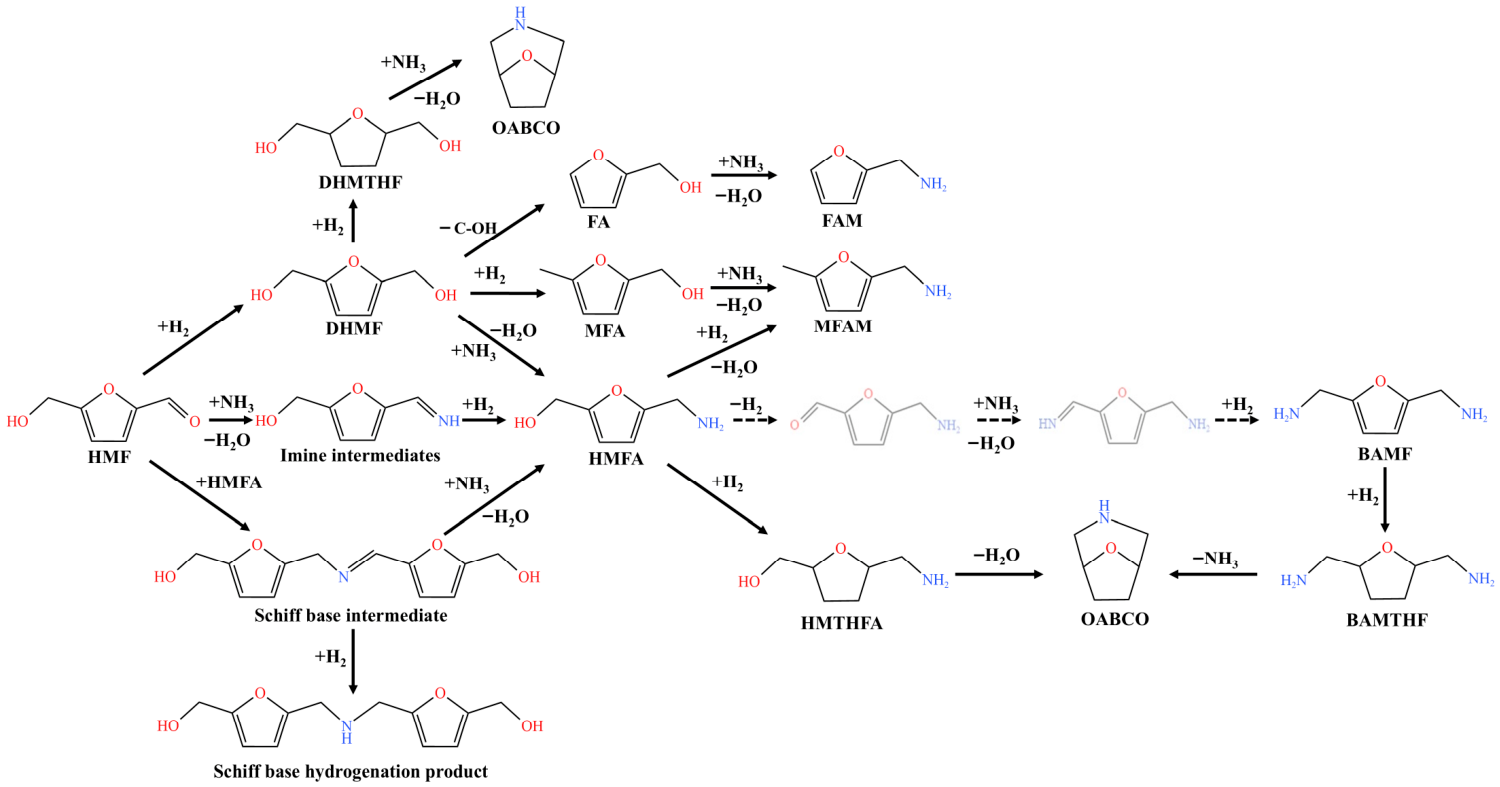
For the HMF reduction amination reaction, the various products were identified by GC-MS (Figures S3–S16). Based on the distribution of the products, possible reaction pathways were proposed. The one-step reductive amination reaction mechanism of HMF and the byproduct formation pathway are illustrated in Figure 6. The reaction mechanism for HMF conversion to BAMF comprises two core steps: (1) Nucleophilic addition of NH3 to the C=O double bond in HMF molecules generates an imine intermediate. The Ni metal sites dissociate H2 into reactive hydrogen species (H*) [12], reduce the C=N double bond of the imine intermediate to a saturated -NH2 group, and generate HMFA. Alternatively, HMF can also form HMFA via a Schiff base process [25,26,27]. (2) The Ni metal sites catalyze the dehydrogenation of the hydroxymethyl group in HMFA, generating an aldehyde-containing intermediate [28,29]; the reactivated aldehyde intermediate reacts with NH3 to form a new imine intermediate, and the Ni sites catalyze the hydrogenation of the C=N double bond to a saturated C-N bond, ultimately yielding the target product BAMF [20].
The byproduct formation mechanisms in this system can be described as follows. In the NiAl catalysts, the highly active Ni sites catalyze the hydrogenation of aldehyde group within the HMF to form DHMF. The DHMF then undergoes chain cleavage and hydrogenation–deoxygenation to yield FA and MFA, respectively. These two products further undergo amination to form FAM and MFAM, respectively. The highly active Ni sites are also capable of catalyzing the hydrogenation of C=C double bond in the furan ring of HMFA/BAMF/DHMF molecules, thereby forming HMTHFA/BAMTHF/DHMTHF [30]. Under the synergy of acidic sites, these intermediates undergo intramolecular cyclization, releasing one molecule of H2O or one molecule of NH3 to form OABCO [31,32]. The ZnAl2O4 spinel structure suppresses both of the above pathways simultaneously. Specifically, the strong metal–support interaction induces a downshift of the d-band center of Ni, which weakens the π interaction between the Ni sites and the furan ring. This not only ensures the dehydrogenation of hydroxymethyl groups in HMFA, but also suppresses excessive hydrogenation side reactions. Furthermore, the cyclization reactions are inhibited by eliminating the strong acidic sites.

3. Experiment

3.1. Chemicals

HMF (97%), HMFA (99%), BAMF (98%), FA (99%), FAM (99%), MFA (99%), MFAM (99%), DHMF (99%), BATHMF (97%), OABCO (98%), 1,4-Dioxane (AR), Ni(NO3)2·6H2O (AR), Al(NO3)3·9H2O (AR), Zn(NO3)2·6H2O (AR), Na2CO3 (AR), and NaOH (AR) were used.
All chemical reagents were purchased from Beijing InnoChem Science & Technology Co., Ltd. (Beijing, China) and used directly without any further purification.

3.2. Preparation of the Catalysts

The NiZnAl catalyst was synthesized using the coprecipitation method. Appropriate amounts of Ni(NO3)2·6H2O, Zn(NO3)2·6H2O, and Al(NO3)3·9H2O were weighed and dissolved in deionized water to obtain a mixed solution. A mixed aqueous solution of 1.0 mol/L Na2CO3 and 1.0 mol/L NaOH was used as the precipitating agent. The mixed solution and precipitating agent were added dropwise in a co-current manner into a beaker, with their flow rates adjusted to maintain the pH between 9 and 10 during precipitation. After completion of the addition, the mixture was stirred at 50 °C for 3 h. The catalyst precursor was then aged at ambient temperature for 12 h. Following aging, the sample was washed repeatedly with deionized water until the filtrate pH reached 7. The washed catalyst was dried at 120 °C for 20 h, followed by calcination at 600 °C in a muffle furnace for 3 h. The prepared catalyst was ground after calcination and placed in a tube furnace for reduction. Controlling the hydrogen flow rate at 100 mL/min, the reduction was conducted at 550 °C for 3 h. After cooling to room temperature, it was passivated with 2% O2 concentration inert gas for 0.5 h. The resulting catalyst was designated as the NiaZnbAlcOx catalyst. The NiAl and NiZn catalysts were also synthesized via the same coprecipitation procedure. The NiAl catalyst was prepared without the addition of Zn(NO3)2·6H2O, while the NiZn catalyst was synthesized in the absence of Al(NO3)3·9H2O. The subsequent steps, including co-current precipitation, aging, washing, drying, calcination, reduction, and passivation, were identical to those described above for the NiZnAl catalysts. The obtained catalysts were denoted as NiaAlcOx and NiaZnbOx, (a, b, and c represent the molar ratios of Ni, Zn, and Al, respectively).

3.3. Methods for Catalyst Characterization

XRD patterns of the samples were collected on an Empyrean X-ray diffractometer equipped with filtered Cu Kα radiation; the measurements were conducted at a tube current of 40 mA and a tube voltage of 40 kV, with a scanning rate of 10°/min over a 2θ range of 10°–80°.
XPS analysis of the prepared catalysts was performed using an ESCA Lab 250 X-ray photoelectron spectrometer with Al Kα radiation as the excitation source in dual-anode mode. First, a survey spectrum was recorded over the binding energy range of 0–1200 eV with an energy step of 0.5 eV. Subsequently, the individual elemental spectra were recorded with an energy step of 0.05 eV, including C (275–305 eV), O (520–540 eV), and Ni (835–900 eV). The peak shifts in all spectra were corrected using the intrinsic carbon peak at 284.8 eV.
The XRF analysis was carried out on a ZSX-2 X-ray fluorescence spectrometer. The instrument was operated at an excitation voltage of 50 kV and an excitation current of 50 mA using an Rh target. The elemental composition of the catalyst sample was determined based on the characteristic X-ray intensities of the detected elements, combined with standard calibration and theoretical calculation.
The TEM was conducted on a Philips (Amsterdam, The Netherlands) Tecnai F30 microscope operated at an accelerating voltage of 300 kV. The sample was ground into fine powder, dispersed in anhydrous ethanol, and ultrasonicated for 0.5 h to achieve uniform dispersion. The supernatant was dropped onto a carbon-coated copper grid and dried naturally under ambient conditions before TEM observation.
The H2 temperature-programmed reduction (H2-TPR) experiments were conducted on a Micromeritics (Norcross, GA, USA) AutoChem II 2920 chemisorption analyzer. Specifically, the catalyst samples were first pretreated at 150 °C for 1 h under a flowing argon atmosphere with a flow rate of 40 mL/min. After cooling the pretreated samples to ambient temperature, the TPR test was initiated by heating the samples to 800 °C at a ramp rate of 10 °C/min under a 10% H2/Ar mixed gas flow (30 mL/min), with the reduction signals recorded using a thermal conductivity detector (TCD).
The NH3 temperature-programmed desorption (NH3-TPD) experiments were performed as follows: After loading the catalyst sample into the reactor, the sample was first reduced at 400 °C for 10 h under a hydrogen atmosphere. Subsequently, the gas was switched to helium for a 10 min purge to remove the residual hydrogen. The sample was then cooled down to 100 °C, followed by purging with a 10%NH3/90%He mixed gas for 30 min until the NH3 adsorption on the sample surface reached saturation. After that, the gas was switched back to helium and purged continuously until the detector baseline stabilized. Finally, the sample was heated to 700 °C at a ramp rate of 10 °C/min under a continuous helium flow and maintained at this temperature; the desorption signals were recorded simultaneously by both the TPD detector and the mass spectrometer for the tail gas.
The GC-MS analyses were performed on a Thermo Scientific (Waltham, MA, USA) system consisting of a TRACE (Sydney, Australia) 1300 GC instrument with an ISQ 7000 mass spectrometer (Waltham, MA, USA) and a flame ionization detector (FID). Separation was achieved using a DB-17 capillary column (60 m × 0.25 mm × 0.25 μm). Helium was used as the carrier gas. The samples were injected in split mode at an inlet temperature of 250 °C, with a split ratio of 25:1 and a split flow rate of 50.0 mL/min. The oven temperature program was as follows: an initial temperature of 80 °C held for 15 min, then ramped at 10 °C/min to 300 °C and held for 5 min, resulting in a total run time of 42 min. For MS detection, the transfer line and ion source temperatures were maintained at 300 °C, and the electron ionization (EI) mode was employed. The FID detector was operated at 300 °C, with the gas flows set to 350 mL/min for air, 35 mL/min for hydrogen, and 40 mL/min for the makeup gas.

3.4. Catalytic Experiments

The reductive amination of HMF was carried out in a 100 mL stainless-steel high-pressure batch reactor under a stirring rate of 1000 rpm. Specifically, the reactor was sequentially charged with 5 g of HMF, 0.4575 g of Na2CO3, 25 mL of dioxane, and 1 g of the prepared catalyst. Prior to the reaction initiation, the air inside the reactor was purged five times with nitrogen gas, followed by three additional purges with high-purity hydrogen to ensure the complete elimination of residual oxygen and air. Subsequently, 11.5 g of ammonia gas was introduced into the reactor, and hydrogen gas was further supplemented to adjust the total initial pressure of the reaction system to 4.5 MPa. The reaction was conducted in a stepwise temperature-programmed manner: first incubated at 90 °C for 6 h, and then the temperature was elevated to 210 °C for 18 h. Upon the completion of the reaction, the reactor was naturally cooled to ambient temperature; the liquid product mixture was collected, subjected to vacuum filtration to remove the solid catalyst, and finally analyzed by gas chromatography–mass spectrometry (GC-MS, Thermo-ISQ 7000, Thermo Scientific, Waltham, MA, USA). Calculation of product composition: The conversion of HMF and product selectivity were calculated using the area normalization method.

4. Conclusions

This work addresses a core dilemma encountered in the reductive amination of HMF to BAMF, which involves balancing the sufficient hydrogenation activity required for HMF conversion with the suppression of side reactions, such as excessive hydrogenation and acid-catalyzed cyclization. NiZnAl catalysts were fabricated via the coprecipitation method by introducing Zn into a NiAl system to form a ZnAl2O4 spinel structure, achieving the synergistic optimization of Ni active sites and surface acidic sites. The ZnAl2O4 spinel structure not only removed the strong acidic sites and reduced the total acid content on the catalyst surface, but also generated a strong metal–support interaction, thereby modifying the electronic structure of Ni and tuning its hydrogenation activity to an appropriate level. The optimized Ni4Zn4Al8Ox catalyst exhibited a BAMF selectivity reaching 83.71%. This study preliminarily clarifies the structure–activity relationship of the NiZnAl catalysts and proposes a possible reaction mechanism for the reductive amination of HMF, providing a vital theoretical basis for the design of high-performance catalysts for BAMF production.

Supplementary Materials

The following supporting information can be downloaded at: https://www.mdpi.com/article/10.3390/molecules31101600/s1. Table S1: Reductive amination of HMF over Ni4Zn4Al8Ox catalyst; Figure S1: (a) N2 adsorption–desorption isotherms and (b) Pore size distribution diagram of the prepared catalysts; Table S2: Chemical property of the NiZnAl catalysts; Figure S2: (a) Effect of recycling times on the catalytic performance of the Ni4Zn4Al8Ox catalyst; (b) XRD patterns of fresh and 5 times recycled Ni4Zn4Al8Ox catalyst; (c) Ni 2p3/2 XPS spectra of fresh and 5 times recycled Ni4Zn4Al8Ox catalyst; (d) Zn 2p3/2 XPS spectra of fresh and 5 times recycled Ni4Zn4Al8Ox catalyst; Figure S3: Mass spectrum of HMFA; Figure S4: Mass spectrum of BAMF; Figure S5: Mass spectrum of DHMF; Figure S6: Mass spectrum of FA; Figure S7: Mass spectrum of MFA; Figure S8: Mass spectrum of FAM; Figure S9: Mass spectrum of MFAM; Figure S10: Mass spectrum of imine intermediates; Figure S11: Mass spectrum of HMTHFA; Figure S12: Mass spectrum of BATHMF; Figure S13: Mass spectrum of DHTHMF; Figure S14: Mass spectrum of OABCO; Figure S15: Mass spectrum of Schiff base intermediate; Figure S16: Mass spectrum of Schiff base hydrogenation product; Figure S17: Gas chromatogram of the HMF catalytic reaction over the Ni1Zn4Al8Ox catalyst. Reaction conditions: 1 g catalyst, 5 g HMF, 25 mL 1,4-Diox, 11.5 g NH3, 4.5 MPa H2, 90 °C for 6 h and then 210 °C for 18 h; Figure S18: Gas chromatogram of the HMF catalytic reaction over the Ni4Zn4Al8Ox catalyst. Reaction conditions: 5 g HMF, 25 mL 1,4-Diox, 11.5 g NH3, 4.5 MPa H2, 90 °C for 2 h; Figure S19: Gas chromatogram of the HMF catalytic reaction over the Ni4Zn4Al8Ox catalyst. Reaction conditions: 5 g HMF, 25 mL 1,4-Diox, 11.5 g NH3, 4.5 MPa H2, 90 °C for 4 h.

Author Contributions

Conceptualization, X.L. and J.Z.; methodology, C.W., X.L. and J.Z.; software, C.W. and X.L.; validation, C.W. and X.L.; formal analysis, C.W. and X.L.; investigation, C.W. and X.L.; resources, J.Z., X.M. and X.Z.; data curation, C.W. and X.L.; writing—original draft preparation, C.W. and X.L.; writing—review and editing, C.W., X.L. and J.Z.; visualization, C.W. and X.L.; supervision, J.Z., X.Z., B.S. and X.M.; project administration, X.Z.; funding acquisition, J.Z. All authors have read and agreed to the published version of the manuscript.

Funding

We appreciate the financial support from the SINOPEC project (O22095).

Institutional Review Board Statement

Not applicable.

Informed Consent Statement

Not applicable.

Data Availability Statement

The original contributions presented in this study are included in the article/Supplementary Materials. Further inquiries can be directed to the corresponding authors.

Acknowledgments

We acknowledge Shi Feng of the Lanzhou Institute of Chemical Physics (LICP) for his assistance with the process.

Conflicts of Interest

The authors declare no conflicts of interest.

Abbreviations

HMF5-hydroxymethylfurfural
FAMfurfurylamine
FAfuroic acid
BAMF2,5-bis(aminomethyl) furan
HMFA5-hydroxymethylfurfurylamine
DHMF2,5-dihydroxymethylfuran
MFA5-methylfurfuryl alcohol
MFAM5-methyl-2-furanamine
OABCO8-oxa-3-azabicyclo [3.2.1]octane
BAMTHF2,5-bis(aminomethyl)tetrahydrofuran
HMTHFA5-hydroxymethyltetrahydrofurfurylamine
DHMTHF2,5-dihydroxymethyl tetrahydrofuran

References

  1. Motagamwala, A.H.; Huang, K.; Maravelias, C.T.; Dumesic, J.A. Solvent System for Effective Near-Term Production of Hydroxymethylfurfural (HMF) with Potential for Long-Term Process Improvement. Energy Environ. Sci. 2019, 12, 2212–2222. [Google Scholar] [CrossRef] [Scilit]
  2. Rezayan, A.; Nie, R.; Wang, J.; Lu, T.; Xu, C.C.; Zhang, Y. Efficient One-Pot Synthesis of 5-Hydroxymethylfurfural from Functionalized Microcrystalline Cellulose: An Alternative Approach to Strong Acidic/Basic Catalysis. Chem. Eng. J. 2023, 462, 142219. [Google Scholar] [CrossRef] [Scilit]
  3. Turkin, A.A.; Makshina, E.V.; Sels, B.F. Catalytic Hydroconversion of 5-HMF to Value-added Chemicals: Insights into the Role of Catalyst Properties and Feedstock Purity. ChemSusChem 2022, 15, e202200412. [Google Scholar] [CrossRef] [Scilit] [PubMed]
  4. Le, N.-T.; Byun, A.; Han, Y.; Lee, K.-I.; Kim, H. Preparation of 2,5-Bis(aminomethyl)furan by Direct Reductive Amination of 2,5-Diformylfuran over Nickel-Raney Catalysts. Green Sustain. Chem. 2015, 5, 115–127. [Google Scholar] [CrossRef]
  5. Qi, H.; Liu, F.; Zhang, L.; Li, L.; Su, Y.; Yang, J.; Hao, R.; Wang, A.; Zhang, T. Modulating Trans-Imination and Hydrogenation towards the Highly Selective Production of Primary Diamines from Dialdehydes. Green Chem. 2020, 22, 6897–6901. [Google Scholar] [CrossRef] [Scilit]
  6. Kita, Y.; Kuwabara, M.; Yamadera, S.; Kamata, K.; Hara, M. Effects of Ruthenium Hydride Species on Primary Amine Synthesis by Direct Amination of Alcohols over A Heterogeneous Ru Catalyst. Chem. Sci. 2020, 11, 9884–9890. [Google Scholar] [CrossRef] [Scilit]
  7. Mascal, M. 5-(Chloromethyl)furfural (CMF): A Platform for Transforming Cellulose into Commercial Products. ACS Sustain. Chem. Eng. 2019, 7, 5588–5601. [Google Scholar] [CrossRef] [Scilit]
  8. Ryo, A.; Kirino, T. Method for Producing 2,5-Bis(aminomethyl)furan. U.S. Patent 2020181105 A1, 4 January 2022. [Google Scholar]
  9. Wang, X.; Chen, W.; Li, Z.; Zeng, X.; Tang, X.; Sun, Y.; Lei, T.; Lin, L. Synthesis of Bis(amino)furans from Biomass Based 5-Hydroxymethyl Furfural. J. Energy Chem. 2018, 27, 209–214. [Google Scholar] [CrossRef] [Scilit]
  10. Wei, Z.; Cheng, Y.; Zhou, K.; Zeng, Y.; Yao, E.; Li, Q.; Liu, Y.; Sun, Y. One-Step Reductive Amination of 5-Hydroxymethylfurfural into 2,5-Bis(aminomethyl)furan over Raney Ni. ChemSusChem 2021, 14, 2308–2312. [Google Scholar] [CrossRef] [Scilit]
  11. Imm, S.; Bähn, S.; Zhang, M.; Neubert, L.; Neumann, H.; Klasovsky, F.; Pfeffer, J.; Haas, T.; Beller, M. Improved Ruthenium-catalyzed Amination of Alcohols with Ammonia: Synthesis of Diamines and Amino Esters. Angew. Chem. Int. Ed. 2011, 50, 7599–7603. [Google Scholar] [CrossRef] [Scilit]
  12. Zhou, K.; Liu, H.; Shu, H.; Xiao, S.; Guo, D.; Liu, Y.; Wei, Z.; Li, X. A Comprehensive Study on the Reductive Amination of 5-hydroxymethylfurfural into 2,5-bisaminomethylfuran over Raney Ni through DFT Calculations. ChemCatChem 2019, 11, 2649–2656. [Google Scholar] [CrossRef] [Scilit]
  13. Wei, Z.; Cheng, Y.; Huang, H.; Ma, Z.; Zhou, K.; Liu, Y. Reductive Amination of 5-Hydroxymethylfurfural to 2,5-Bis(aminomethyl)furan over Alumina-Supported Ni-Based Catalytic Systems. ChemSusChem 2022, 15, e202200233. [Google Scholar] [CrossRef] [Scilit] [PubMed]
  14. Dumon, A.S.; Wang, T.; Ibañez, J.; Tomer, A.; Yan, Z.; Wischert, R.; Sautet, P.; Pera-Titus, M.; Michel, C. Direct N-Octanol Amination by Ammonia on Supported Ni and Pd Catalysts: Activity Is Enhanced by “Spectator” Ammonia Adsorbates. Catal. Sci. Technol. 2018, 8, 611–621. [Google Scholar] [CrossRef] [Scilit]
  15. Tomer, A.; Kusema, B.T.; Paul, J.-F.; Przybylski, C.; Monflier, E.; Pera-Titus, M.; Ponchel, A. Cyclodextrin-Assisted Low-Metal Ni-Pd/Al2O3 Bimetallic Catalysts for the Direct Amination of Aliphatic Alcohols. J. Catal. 2018, 368, 172–189. [Google Scholar] [CrossRef] [Scilit]
  16. Shimizu, K.; Kon, K.; Onodera, W.; Yamazaki, H.; Kondo, J.N. Heterogeneous Ni Catalyst for Direct Synthesis of Primary Amines from Alcohols and Ammonia. ACS Catal. 2013, 3, 112–117. [Google Scholar] [CrossRef] [Scilit]
  17. Shimizu, K.; Imaiida, N.; Kon, K.; Hakim Siddiki, S.M.A.; Satsuma, A. Heterogeneous Ni Catalysts for N-Alkylation of Amines with Alcohols. ACS Catal. 2013, 3, 998–1005. [Google Scholar] [CrossRef] [Scilit]
  18. Tomer, A.; Wyrwalski, F.; Przybylski, C.; Paul, J.-F.; Monflier, E.; Pera-Titus, M.; Ponchel, A. Facile Preparation of Ni/Al2O3 Catalytic Formulations with the Aid of Cyclodextrin Complexes: Towards Highly Active and Robust Catalysts for the Direct Amination of Alcohols. J. Catal. 2017, 356, 111–124. [Google Scholar] [CrossRef] [Scilit]
  19. Vermeeren, B.; Van Praet, S.; De Ridder, A.; Sels, B.F. Selective multifunctional aliphatic amine synthesis: Unraveling universal control strategies in catalytic reductive amination of biobased α-hydroxy carbonyl oxygenates. ACS Sustain. Chem. Eng. 2024, 12, 10209–10220. [Google Scholar] [CrossRef] [Scilit]
  20. Zhang, L.; Su, X.; Zhou, L.; Li, J.; Xiao, T.; Li, J.; Zhao, F.; Cheng, H. Reversal Effect of Phosphorus on Catalytic Performances of Supported Nickel Catalysts in Reductive Amination of 1,6-hexanediol. ChemSusChem 2024, 17, e202400211. [Google Scholar] [CrossRef] [Scilit] [PubMed]
  21. Lin, X.; Zhu, H.; Huang, M.; Wan, C.; Li, D.; Jiang, L. Controlled Preparation of Ni–Cu Alloy Catalyst via Hydrotalcite-Like Precursor and Its Enhanced Catalytic Performance for Methane Decomposition. Fuel Process. Technol. 2022, 233, 107271. [Google Scholar] [CrossRef] [Scilit]
  22. Cao, M.; Li, S.; Wang, S.; Xu, W.; Zhou, X.; Ma, G.; Chen, Y. Zn Modulating the Metal Support Interaction to Promote the Sintering Resistance of Hydrotalcite-Derived NiZnAl Catalyst for Methane Cracking. J. Catal. 2025, 447, 116103. [Google Scholar] [CrossRef] [Scilit]
  23. Karaminejad, M.; Golhosseini, R.; Meshkani, F.; Da Costa, P. Insight into the Moderate Interaction between the Metal and Support and Reinforcing of Ni/SiO2-Based Catalysts Efficiency with the Manganese Integration in Thermal Catalytic Methane Decomposition. Energy Convers. Manag. 2025, 323, 119229. [Google Scholar] [CrossRef] [Scilit]
  24. Kong, X.; Zhu, Y.; Zheng, H.; Zhu, Y.; Fang, Z. Inclusion of Zn into Metallic Ni Enables Selective and Effective Synthesis of 2,5-Dimethylfuran from Bioderived 5-Hydroxymethylfurfural. ACS Sustain. Chem. Eng. 2017, 5, 11280–11289. [Google Scholar] [CrossRef] [Scilit]
  25. Hu, Q.; Jiang, S.; Wu, Y.; Xu, H.; Li, G.; Zhou, Y.; Wang, J. Ambient-Temperature Reductive Amination of 5-Hydroxymethylfurfural over Al2O3-Supported Carbon-Doped Nickel Catalyst. ChemSusChem 2022, 15, e202200192. [Google Scholar] [CrossRef] [Scilit]
  26. Liu, W.; Zhou, X.; Min, Y.; Huang, J.; Chen, J.; Wu, Y.; Yu, H. Engineering of Local Coordination Microenvironment in Single-Atom Catalysts Enabling Sustainable Conversion of Biomass into a Broad Range of Amines. Adv. Mater. 2024, 36, 2305924. [Google Scholar] [CrossRef] [Scilit]
  27. Chen, W.; Sun, Y.; Du, J.; Si, Z.; Tang, X.; Zeng, X.; Lin, L.; Liu, S.; Lei, T. Preparation of 5-(Aminomethyl)-2-Furanmethanol by Direct Reductive Amination of 5-Hydroxymethylfurfural with Aqueous Ammonia over the Ni/SBA-15 Catalyst. J. Chem. Technol. Biotechnol. 2018, 93, 3028–3034. [Google Scholar] [CrossRef] [Scilit]
  28. Shi, R.; Wang, F.; Tana; Li, Y.; Huang, X.; Shen, W. A Highly Efficient Cu/La2O3 Catalyst for Transfer Dehydrogenation of Primary Aliphatic Alcohols. Green Chem. 2010, 12, 108–113. [Google Scholar] [CrossRef] [Scilit]
  29. Yang, J.; Yao, C.; Luo, J.; Shan, J.; Liu, J.; Lu, C.; Feng, F.; Zhang, Q.; Wang, Q.; Li, X. Selective Primary Amination of Alcohols, Aldehydes and Ketones with Ammonia. Mol. Catal. 2024, 563, 114254. [Google Scholar] [CrossRef] [Scilit]
  30. Li, X.; Zhao, J.; Sun, B.; Wang, C.; Zhang, X.; Mu, X. Preparation of Furanyl Primary Amines from Biobased Furanyl Derivatives over Heterogeneous Catalysts. ACS Sustain. Chem. Eng. 2023, 11, 17951–17978. [Google Scholar] [CrossRef] [Scilit]
  31. Zhang, S.; Ding, X.; Wang, Y. A New Method for Green Production of 2-Aminomethylpiperidine from Bio-Renewable 2,5-Bis(aminomethyl)furan. Green Chem. 2024, 26, 2067–2077. [Google Scholar] [CrossRef] [Scilit]
  32. Cui, X.; Yuan, H.; Li, J.-P.; De Campo, F.; Pera-Titus, M.; Deng, Y.; Shi, F. Novel Route for the Synthesis of 8-Oxa-3-Azabicyclo [3.2.1]Octane: One-Pot Aminocyclization of 2,5-Tetrahydrofurandimethanol Catalyzed by Pt/NiCuAlOx. Catal. Commun. 2015, 58, 195–199. [Google Scholar] [CrossRef] [Scilit]
Figure 1. NH3-TPD of the prepared catalysts.
Molecules 31 01600 g001
Figure 2. XRD of the NiZnAl catalysts.
Molecules 31 01600 g002
Figure 3. H2-TPR of the NiZnAl catalysts.
Molecules 31 01600 g003
Figure 4. XPS spectra of Ni 2p3/2 core level for the NiZnAl catalysts.
Molecules 31 01600 g004
Figure 5. TEM images of the (a) Ni1Zn4Al8Ox, (b) Ni2Zn4Al8Ox, (c) Ni4Zn4Al8Ox, and (d) Ni6Zn4Al8Ox catalysts.
Molecules 31 01600 g005
Figure 6. The pathways for the formation of BAMF and byproducts in the reductive amination of HMF.
Molecules 31 01600 g006
Table 2. Physical properties of the prepared catalysts.
CatalystNi
(wt.%)
Zn
(wt.%)
Al
(wt.%)
SBET
(m2/g)
Pore Size (nm)Pore Volume
(cm3/g)
Ni1Al4Ox12.144.7199.797.730.41
Ni1Al8Ox20.537.8204.946.910.39
Ni1Zn4Ox14.765.410.6913.610.04
Ni2Zn4Ox24.755.111.5923.870.07
Ni1Zn4Al8Ox7.332.326.7110.029.030.25
Ni2Zn4Al8Ox13.329.624.4131.1713.140.38
Ni4Zn4Al8Ox23.524.319.6167.60 8.040.35
Ni6Zn4Al8Ox29.822.118.3165.478.230.32
Table 3. Reductive amination of HMF over different catalysts.
CatalystConversion of HMF/%Selectivity/%Mass Balance/%
BAMFHMFABAMF + HMFAFAMFAMFAMMFAOABCODHMFBATHMFHMTHFADHTHMFOthers
Ni1Al4Ox10041.7228.9070.622.050.792.08-4.265.470.532.239.502.4797.06
Ni1Al8Ox10028.5648.2476.800.800.440.60-2.205.560.382.646.793.7996.00
Ni1Zn2Ox10028.4068.6397.030.26-0.600.220.37-0.060.110.620.7399.23
Ni1Zn4Ox10041.5850.0691.640.67-0.990.190.78-0.120.351.913.3596.54
Ni1Zn4Al8Ox10049.9244.7694.680.26-0.81-0.89-0.251.521.270.3299.64
Ni2Zn4Al8Ox10076.5213.4990.010.92---0.65-0.371.611.415.0394.82
Ni4Zn4Al8Ox10083.718.3392.04------0.411.321.374.8695.14
Ni6Zn4Al8Ox10073.685.2878.96--0.74-2.471.240.482.679.424.0295.98
Reaction conditions: 1 g catalyst; 5 g HMF; 25 mL 1,4-Diox; 11.5 g NH3; 4.5 MPa H2; 90 °C for 6 h and then 210 °C for 18 h.
Disclaimer/Publisher’s Note: The statements, opinions and data contained in all publications are solely those of the individual author(s) and contributor(s) and not of MDPI and/or the editor(s). MDPI and/or the editor(s) disclaim responsibility for any injury to people or property resulting from any ideas, methods, instructions or products referred to in the content.