A Review on Farnesoid X Receptor (FXR) Modulators Focusing on Benzimidazole Scaffold


Abstract
1. Introduction
2. Benzimidazole as Structural Motif in Medicinal Chemistry
3. FXR Agonists
3.1. FXR Full Agonists with an Isoxazole Moiety and No Benzimidazole
3.2. FXR Partial Agonists
4. Dual Modulators Focusing on Benzimidazole Scaffold for FXR and Other Target Molecules
5. FXR Antagonists Focusing on Benzimidazole Scaffold
6. Perspective: Toward Intestine-Specific FXR Modulators
7. Conclusions
Supplementary Materials
Author Contributions
Funding
Institutional Review Board Statement
Informed Consent Statement
Data Availability Statement
Acknowledgments
Conflicts of Interest
Abbreviations
| FXR | Farnesoid X receptor |
| NR | Nuclear receptor |
| BA | Bile acid |
| CDCA | Chenodeoxycholic acid |
| CYP7A1 | Cholesterol 7α-hydroxylase |
| SHP | Small heterodimer partner |
| FGF | Fibroblast growth factor |
| TGR5 | Transmembrane G protein-coupled receptor 5 |
| PBC | Primary biliary cholangitis |
| MASH | Metabolic-dysfunction-associated steatohepatitis |
| MASLD | Metabolic-dysfunction-associated steatotic liver disease |
| LDL | Low-density lipoprotein |
| UDCA | Ursodeoxycholic acid |
| T2DM | Type 2 diabetes mellitus |
| PPAR | Peroxisome proliferator-activated receptor |
| PXR | Pregnane X receptor |
| RXR | Retinoid X receptor |
| AR | Androgen receptor |
| AF2 | Activation function 2 |
| RP | Relative potency |
| HDL | High-density lipoprotein |
| TR-FRET | Time-resolved fluorescence resonance energy transfer |
| Luc | Luciferase reporter gene assay |
| HTS | High-throughput screening |
| SAR | Structure–activity relationship |
| VDR | Vitamin D receptor |
| MSC | Mesenchymal stem cell |
| LBD | Ligand-binding domain |
| SPA | Scintillation proximity assay |
| GPBAR1 | G protein-coupled bile acid receptor 1 |
| LXR | Liver X receptor |
| LTA4H | Leukotriene A4 hydrolase |
| FABP1 | Intestinal fatty acid binding protein 1 |
| URAT1 | Urate transporter 1 |
| sEH | Soluble epoxide hydrolase |
| HSD17B13 | 17-β-hydroxysteroid dehydrogenase 13 |
| LIFR | Leukemia inhibitory factor receptor |
| CDK | Cyclin-dependent kinase |
| Gly-MCA | Glycine-β-muricholic acid |
| HFD | High-fat diet |
| Asbt | Apical sodium-dependent bile acid transporter |
| RLM | Rat liver microsome |
| MLM | Mouse liver microsome |
| SMRT | Silencing mediator of retinoic acid and thyroid hormone receptor |
| NcoR1 | Nuclear receptor corepressor 1 |
| MW | Molecular weight |
| Fex | Fexaramine |
References
- Makishima, M.; Okamoto, A.Y.; Repa, J.J.; Tu, H.; Learned, R.M.; Luk, A.; Hull, M.V.; Lustig, K.D.; Mangelsdorf, D.J.; Shan, B. Identification of a nuclear receptor for bile acids. Science 1999, 284, 1362–1365. [Google Scholar] [CrossRef]
- Parks, D.J.; Blanchard, S.G.; Bledsoe, R.K.; Chandra, G.; Consler, T.G.; Kliewer, S.A.; Stimmel, J.B.; Willson, T.M.; Zavacki, A.M.; Moore, D.D.; et al. Bile acids: Natural ligands for an orphan nuclear receptor. Science 1999, 284, 1365–1368. [Google Scholar] [CrossRef]
- Lu, T.T.; Repa, J.J.; Mangelsdorf, D.J. Orphan nuclear receptors as eLiXiRs and FiXeRs of sterol metabolism. J. Biol. Chem. 2001, 276, 37735–37738. [Google Scholar] [CrossRef]
- Kliewer, S.A.; Mangelsdorf, D.J. Bile acids as hormones: The FXR-FGF15/19 pathway. Dig. Dis. 2015, 33, 327–331. [Google Scholar] [CrossRef] [PubMed]
- Song, L.; Hou, Y.; Xu, D.; Dai, X.; Luo, J.; Liu, Y.; Huang, Z.; Yang, M.; Chen, J.; Hu, Y.; et al. Hepatic FXR-FGF4 is required for bile acid homeostasis via an FGFR4-LRH-1 signal node under cholestatic stress. Cell Metab. 2025, 37, 104–120. [Google Scholar] [CrossRef] [PubMed]
- Han, C.Y. Update on FXR biology: Promising therapeutic target? Int. J. Mol. Sci. 2018, 19, 2069. [Google Scholar] [CrossRef]
- Pathak, P.; Cen, X.; Nichols, R.G.; Ferrell, J.M.; Boehme, S.; Krausz, K.W.; Patterson, A.D.; Gonzalez, F.J.; Chiang, J.Y.L. Intestine farnesoid X receptor agonist and the gut microbiota activate G-protein bile acid receptor-1 signaling to improve metabolism. Hepatology 2018, 68, 1574–1588. [Google Scholar] [CrossRef]
- Li, Q.; Zhao, Q.; Zhang, C.; Zhang, P.; Hu, A.; Zhang, L.; Schroder, P.M.; Ma, Y.; Guo, Z.; Zhu, X.; et al. The ileal FGF15/19 to hepatic FGFR4 axis regulates liver regeneration after partial hepatectomy in mice. J. Physiol. Biochem. 2018, 4, 247–260. [Google Scholar] [CrossRef]
- Katafuchi, T.; Makishima, M. Molecular basis of bile acid-FXR-FGF15/19 signaling axis. Int. J. Mol. Sci. 2022, 23, 6046. [Google Scholar] [CrossRef] [PubMed]
- Masaoutis, C.; Theocharis, S. The farnesoid X receptor: A potential target for expanding the therapeutic arsenal against kidney disease. Expert Opin. Ther. Targets 2019, 23, 107–116. [Google Scholar] [CrossRef]
- Maloney, P.R.; Parks, D.J.; Haffner, C.D.; Fivush, A.M.; Chandra, G.; Plunket, K.D.; Creech, K.L.; Moore, L.B.; Wilson, J.G.; Lewis, M.C.; et al. Identification of a chemical tool for the orphan nuclear receptor FXR. J. Med. Chem. 2000, 43, 2971–2974. [Google Scholar] [CrossRef]
- Genin, M.J.; Bueno, A.B.; Francisco, J.A.; Manninen, P.R.; Bocchinfuso, W.P.; Montrose-Rafizadeh, C.; Cannady, E.A.; Jones, T.M.; Stille, J.R.; Raddad, E.; et al. Discovery of 6-(4-{[5-cyclopropyl-3-(2,6-dichlorophenyl)isoxazol-4-yl]methoxy}piperidin-1-yl)-1-methyl-1H-indole-3-carboxylic acid: A novel FXR agonist for the treatment of dyslipidemia. J. Med. Chem. 2015, 58, 9768–9772. [Google Scholar] [CrossRef] [PubMed]
- Baghdasaryan, A.; Claudel, T.; Gumhold, J.; Silbert, D.; Adorini, L.; Roda, A.; Vecchiotti, S.; Gonzalez, F.J.; Schoonjans, K.; Strazzabosco, M.; et al. Dual farnesoid X receptor/TGR5 agonist INT-767 reduces liver injury in the Mdr2−/− (Abcb4−/−) mouse cholangiopathy model by promoting biliary HCO3− output. Hepatology 2011, 54, 1303–1312. [Google Scholar] [CrossRef]
- Amano, Y.; Shimada, M.; Miura, S.; Adachi, R.; Tozawa, R. Effects of a farnesoid X receptor antagonist on hepatic lipid metabolism in primates. Eur. J. Pharmacol. 2014, 723, 108–115. [Google Scholar] [CrossRef]
- Urizar, N.L.; Liverman, A.B.; Dodds, D.T.; Silva, F.V.; Ordentlich, P.; Yan, Y.; Gonzalez, F.J.; Heyman, R.A.; Mangelsdorf, D.J.; Moore, D.D. A natural product that lowers cholesterol as an antagonist ligand for FXR. Science 2002, 296, 1703–1706. [Google Scholar] [CrossRef] [PubMed]
- Chianelli, D.; Rucker, P.V.; Roland, J.; Tully, D.C.; Nelson, J.; Liu, X.; Bursulaya, B.; Hernandez, E.D.; Wu, J.; Prashad, M.; et al. Nidufexor (LMB763), a novel FXR modulator for the treatment of nonalcoholic steatohepatitis. J. Med. Chem. 2020, 63, 3868–3880. [Google Scholar] [CrossRef]
- Sanyal, A.J.; Huang, J.-F.; Lopez, P.; Lawitz, E.J.; Lucas, K.J.; Loeffler, J.; Serra, C.; Andreone, P.; Kim, W.; Goh, G.B.B.; et al. Tropifexor for nonalcoholic steatohepatitis: An adaptive, randomized, placebo-controlled phase 2a/b trial. Nat. Med. 2023, 29, 392–400. [Google Scholar] [CrossRef]
- Tully, D.C.; Rucker, P.V.; Chianelli, D.; Williams, J.; Vidal, A.; Alper, P.B.; Mutnick, D.; Bursulaya, B.; Schmeits, J.; Wu, X.; et al. Discovery of tropifexor (LJN452), a highly potent non-bile acid FXR agonist for the treatment of cholestatic liver diseases and nonalcoholic steatohepatitis (NASH). J. Med. Chem. 2017, 60, 9960–9973. [Google Scholar] [CrossRef]
- Kinzel, O.; Steeneck, C.; Kremoser, C. Novel FXR (NR1H4) Binding and Activity Modulating Compounds. WO2013007387, 17 January 2013. [Google Scholar]
- Kinzel, O.; Steeneck, C.; Schlüter, T.; Schulz, A.; Gege, C.; Hahn, U.; Hambruch, E.; Hornberger, M.; Spalwisz, A.; Frick, K.; et al. Novel substituted isoxazole FXR agonists with cyclopropyl, hydroxycyclobutyl and hydroxyazetidinyl linkers: Understanding and improving key determinants of pharmacological properties. Bioorg. Med. Chem. Lett. 2016, 26, 3746–3753. [Google Scholar] [CrossRef]
- Patel, K.; Harrison, S.A.; Elkhashab, M.; Trotter, J.F.; Herring, R.; Rojter, S.E.; Kayali, Z.; Wong, V.W.-S.; Greenbloom, S.; Jayakumar, S.; et al. Cilofexor, a nonsteroidal FXR agonist, in patients with noncirrhotic NASH: A phase 2 randomized controlled trial. Hepatology 2020, 72, 58–71. [Google Scholar] [CrossRef] [PubMed]
- Wang, Y.; Crittenden, D.B.; Eng, C.; Zhang, Q.; Guo, P.; Chung, D.; Fenaux, M.; Klucher, K.; Jones, C.; Jin, F.; et al. Safety, pharmacokinetics, pharmacodynamics, and formulation of liver-distributed farnesoid X-receptor agonist TERN-101 in healthy volunteers. Clin. Pharmacol. Drug Dev. 2021, 10, 1198–1208. [Google Scholar] [CrossRef]
- Markert, C.; Thoma, G.; Srinivas, H.; Bollbuck, B.; Lüönd, R.M.; Miltz, W.; Wälchli, R.; Wolf, R.; Hinrichs, J.; Bergsdorf, C.; et al. Discovery of LYS006, a potent and highly selective inhibitor of leukotriene A4 hydrolase. J. Med. Chem. 2021, 64, 1889–1903. [Google Scholar] [CrossRef]
- Frias, J.; Schmouder, R.; Lawitz, E.; Zhang, Y.; Zhou, H.; Badman, M.K.; Ukomadu, C.; Weiss, H.M.; Zack, J.; Yadav, B.; et al. Clinical trial: A phase 2 randomised platform study to assess monotherapy and cmbination treatment regimens in metabolic dysfunction–associated steatohepatitis. Aliment. Pharmacol. Ther. 2025. Online ahead of print. [CrossRef]
- Chui, Z.S.W.; Xue, Y.; Xu, A. Hormone-based pharmacotherapy for metabolic dysfunction-associated fatty liver disease. Med. Rev. 2024, 4, 158–168. [Google Scholar] [CrossRef] [PubMed]
- Noureddin, M.; Schlegel, A.; Alkhouri, N.; Lawitz, E.J.; Kowdley, K.V.; Loomba, R.; Lee, L.; Jones, C.; Marmon, T.; Anderson, K.; et al. TERN-501 monotherapy and combination therapy with TERN-101 in metabolic dysfunction-associated steatohepatitis: The randomized phase 2a DUET trial. Nat. Med. 2025, 31, 2297–2305. [Google Scholar] [CrossRef]
- Szapary, P.O.; Wolfe, M.L.; Bloedon, L.T.; Cucchiara, A.J.; Der Marderosian, A.H.; Cirigliano, M.D.; Rader, D.J. Guggulipid for the treatment of hypercholesterolemia: A randomized controlled trial. JAMA 2003, 290, 765–772. [Google Scholar] [CrossRef]
- Lew, J.-L.; Zhao, A.; Yu, J.; Huang, L.; de Pedro, N.; Peláez, F.; Wright, S.D.; Cui, J. The farnesoid X receptor controls gene expression in a ligand- and promoter-selective fashion. J. Biol. Chem. 2004, 279, 8856–8861. [Google Scholar] [CrossRef] [PubMed]
- Lindor, K.D.; Kowdley, K.V.; Heathcote, E.J.; Harrison, M.E.; Jorgensen, R.; Angulo, P.; Lymp, J.F.; Burgart, L.; Colin, P. Ursodeoxycholic acid for treatment of nonalcoholic steatohepatitis: Results of a randomized trial. Hepatology 2004, 39, 770–778. [Google Scholar] [CrossRef] [PubMed]
- Fang, Y.; Hegazy, L.; Finck, B.N.; Elgendy, B. Recent advances in the medicinal chemistry of farnesoid X receptor. J. Med. Chem. 2021, 64, 17545–17571. [Google Scholar] [CrossRef]
- Tahlan, S.; Kumar, S.; Narasimhan, B. Pharmacological significance of heterocyclic 1H-benzimidazole scaffolds: A review. BMC Chem. 2019, 13, 101. [Google Scholar] [CrossRef]
- Keri, R.S.; Hiremathad, A.; Budagumpi, A.; Nagaraja, B.M. Comprehensive review in current developments of benzimidazole-based medicinal chemistry. Chem. Biol. Drug Des. 2015, 86, 19–65. [Google Scholar] [CrossRef]
- Sloop, J. Synthesis of heteroaromatic compounds. Molecules 2023, 28, 3563. [Google Scholar] [CrossRef]
- Woolley, D.W. Some biological effects produced by benzimidazole and their reversal by purines. J. Biol. Chem. 1944, 152, 225–232. [Google Scholar] [CrossRef]
- Wright, J.B. The chemistry of the benzimidazoles. Chem. Rev. 1951, 48, 397–541. [Google Scholar] [CrossRef] [PubMed]
- Townsend, L.; Revankar, G. Benzimidazole nucleosides, nucleotides, and related derivatives. Chem. Rev. 1970, 70, 389–438. [Google Scholar] [CrossRef] [PubMed]
- Cuckler, A.C. Thiabendazole, a new broad spectrum anthelmintic. J. Parasitol. 1961, 47, 36–37. [Google Scholar]
- Maton, P.N. Omeprazole. N. Engl. J. Med. 1991, 324, 965–975. [Google Scholar] [PubMed]
- McClellan, K.J.; Markham, A. Telmisartan. Drugs 1998, 56, 1039–1044. [Google Scholar] [CrossRef]
- Teicher, B.A. Antiangiogenic agents and targets: A perspective. Biochem. Pharmacol. 2011, 81, 6–12. [Google Scholar] [CrossRef]
- Horton, J. Albendazole: A review of anthelmintic efficacy and safety in humans. Parasitology 2000, 121, S113–S132. [Google Scholar] [CrossRef]
- Garuti, L.; Roberti, M.; Bottegoni, G. Benzimidazole derivatives as kinase inhibitors. Curr. Med. Chem. 2014, 21, 2284–2298. [Google Scholar] [CrossRef]
- Zhang, J.; Zhang, L.; Wang, J.; Ouyang, J.; Wang, Y. Polo-like kinase 1 inhibitors in human cancer therapy: Development and therapeutic potential. J. Med. Chem. 2022, 65, 10133–10160. [Google Scholar] [CrossRef] [PubMed]
- Olmos, D.; Barker, D.; Sharma, R.; Brunetto, A.T.; Yap, T.A.; Taegtmeyer, A.B.; Barriuso, J.; Medani, H.; Degenhardt, Y.Y.; Allred, A.J.; et al. Phase I study of GSK461364, a specific and competitive polo-like kinase 1 inhibitor, in patients with advanced solid malignancies. Clin. Cancer Res. 2011, 17, 3420–3430. [Google Scholar] [CrossRef] [PubMed]
- Saxena, A.R.; Gorman, D.N.; Esquejo, R.M.; Bergman, A.; Chidsey, K.; Buckeridge, C.; Griffith, D.A.; Kim, A.M. Danuglipron (PF-06882961) in type 2 diabetes: A randomized, placebo-controlled, multiple ascending-dose phase 1 trial. Nat. Med. 2021, 27, 1079–1087. [Google Scholar] [CrossRef]
- Mizuno, C.S.; Chittiboyina, A.G.; Shah, F.H.; Patny, A.; Kurtz, T.W.; Pershadsingh, H.A.; Speth, R.C.; Karamyan, V.T.; Carvalho, P.B.; Avery, M.A. Design, synthesis, and docking studies of novel benzimidazoles for the treatment of metabolic syndrome. J. Med. Chem. 2010, 53, 1076–1085. [Google Scholar] [CrossRef]
- Benod, C.; Subra, G.; Nahoum, V.; Mallavialle, A.; Guichou, J.-F.; Milhau, J.; Roble’s, S.; Bourguet, W.; Pascussi, J.-M.; Balaguerc, P.; et al. N-1H-Benzimidazol-5-ylbenzenesulfonamide derivatives as potent hPXR agonists. Bioorg. Med. Chem. 2008, 16, 3537–3549. [Google Scholar] [CrossRef]
- Njar, V.C.O.; Brodie, A.M.H. Discovery and development of galeterone (TOK-001 or VN/124-1) for the treatment of all stages of prostate cancer. J. Med. Chem. 2015, 58, 2077–2087. [Google Scholar] [CrossRef]
- Ohsawa, F.; Yamada, S.; Yakushiji, N.; Shinozaki, R.; Nakayama, M.; Kawata, K.; Hagaya, M.; Kobayashi, T.; Kohara, K.; Furusawa, Y.; et al. Mechanism of retinoid X receptor partial agonistic action of 1-(3,5,5,8,8-pentamethyl-5,6,7,8-tetrahydro-2-naphthyl)1H-benzotriazole-5-carboxylic acid and structural development to increase potency. J. Med. Chem. 2013, 56, 1865–1877. [Google Scholar] [CrossRef]
- Akwabi-Ameyaw, A.; Bass, J.Y.; Caldwell, R.D.; Caravella, J.A.; Chen, L.; Creech, K.L.; Deaton, D.N.; Madauss, K.P.; Marr, H.B.; McFadyen, R.B.; et al. FXR agonist activity of conformationally constrained analogs of GW 4064. Bioorg. Med. Chem. Lett. 2009, 19, 4733–4739. [Google Scholar] [CrossRef]
- Akwabi-Ameyaw, A.; Caravella, J.A.; Chen, L.; Creech, K.L.; Deaton, D.N.; Madauss, K.P.; Marr, H.B.; Miller, A.B.; Navas, F., III; Parks, D.J.; et al. Conformationally constrained farnesoid X receptor (FXR) agonists: Alternative replacements of the stilbene. Bioorg. Med. Chem. Lett. 2011, 21, 6154–6160. [Google Scholar] [CrossRef]
- Adorini, L.; Trauner, M. FXR agonists in NASH treatment. J. Hepatol. 2023, 79, 1317–1331. [Google Scholar] [CrossRef] [PubMed]
- Fujimori, K.; Iguchi, Y.; Yamashita, Y.; Gohda, K.; Teno, N. Synthesis of novel farnesoid X receptor agonists and validation of their efficacy in activating differentiation of mouse bone marrow-derived mesenchymal stem cells into osteoblasts. Molecules 2019, 24, 4155. [Google Scholar] [CrossRef] [PubMed]
- Gohda, K.; Iguchi, Y.; Masuda, A.; Fujimori, K.; Yamashita, Y.; Teno, N. Design and identification of a new farnesoid X receptor (FXR) partial agonist by computational structure–activity relationship analysis: Ligand-induced H8 helix fluctuation in the ligand-binding domain of FXR may lead to partial agonism. Bioorg. Med. Chem. Lett. 2021, 41, 128026. [Google Scholar] [CrossRef]
- Masuda, A.; Gohda, K.; Iguchi, Y.; Fujimori, K.; Yamashita, Y.; Oda, Y.; Une, M.; Teno, N. N1-Substituted benzimidazole scaffold for farnesoid X receptor (FXR) agonists accompanying prominent selectivity against vitamin D receptor (VDR). Bioorg. Med. Chem. 2020, 28, 115512. [Google Scholar] [CrossRef] [PubMed]
- Richter, H.G.F.; Benson, G.M.; Blum, D.; Chaput, E.; Feng, S.; Gardes, C.; Grether, U.; Hartman, P.; Kuhn, B.; Martin, R.E.; et al. Discovery of novel and orally active FXR agonists for the potential treatment of dyslipidemia & diabetes. Bioorg. Med. Chem. Lett. 2011, 21, 191–194. [Google Scholar] [PubMed]
- Richter, H.G.F.; Benson, G.M.; Bleicher, K.H.; Blum, D.; Chaput, E.; Clemann, N.; Feng, S.; Gardes, C.; Grether, U.; Hartman, P.; et al. Optimization of a novel class of benzimidazole-based farnesoid X receptor (FXR) agonists to improve physicochemical and ADME properties. Bioorg. Med. Chem. Lett. 2011, 21, 1134–1140. [Google Scholar] [CrossRef]
- Benson, G.M.; Bleicher, K.; Grether, U.; Martin, R.E.; Plancher, J.-M.; Richter, H.; Taylor, S.; Yang, M. Benzimidazole Derivatives and Their Use as FXR Agonists. WO2009/062874-A2, 9 July 2009. [Google Scholar]
- Benson, G.M.; Bleicher, K.; Feng, S.; Grether, U.; Kuhn, B.; Martin, R.E.; Plancher, J.-M.; Richter, H.; Taylor, S. New Benzimidazole Derivatives. WO2010/043513-A1, 22 April 2010. [Google Scholar]
- Fujimori, K.; Iguchi, Y.; Yamashita, Y.; Gohda, K.; Teno, N. FXR activation accelerates early phase of osteoblast differentiation through COX-2-PGE2-EP4 axis in BMP-2-induced mouse mesenchymal stem cells. Molecules 2025, 30, 58. [Google Scholar] [CrossRef]
- Merk, D.; Lamers, C.; Ahmad, K.; Gomez, R.C.; Schneider, G.; Steinhilber, D.; Schubert-Zsilavecz, M. Extending the structure−activity relationship of anthranilic acid derivatives as farnesoid X receptor modulators: Development of a highly potent partial farnesoid X receptor agonist. J. Med. Chem. 2014, 57, 8035–8055. [Google Scholar] [CrossRef]
- Merk, D.; Sreeramulu, S.; Kudlinzki, D.; Saxena, K.; Linhard, V.; Gande, S.L.; Hiller, F.; Lamers, C.; Nilsson, E.; Aagaard, A.; et al. Molecular tuning of farnesoid X receptor partial agonism. Nat. Commun. 2019, 10, 2915. [Google Scholar] [CrossRef]
- Heering, J.; Jores, N.; Kilu, W.; Schallmayer, E.; Peelen, E.; Muehler, A.; Kohlhof, H.; Vitt, D.; Linhard, V.; Gande, S.L.; et al. Mechanistic impact of different ligand scaffolds on FXR modulation suggests avenues to selective modulators. ACS Chem. Biol. 2022, 17, 3159–3168. [Google Scholar] [CrossRef]
- Kumari, A.; Mittal, L.; Srivastava, M.; Pathak, D.P.; Asthana, S. Deciphering the structural determinants critical in attaining the FXR patrial agonism. J. Phys. Chem. B 2023, 127, 465–485. [Google Scholar] [CrossRef]
- Milic, S.; Mikolasevic, I.; Krznaric-Zrnic, I.; Stanic, M.; Poropat, G.; Stimac, D.; Vlahovic-Palcevski, V.; Orlic, L. Nonalcoholic steatohepatitis: Emerging targeted therapies to optimize treatment options. Drug Des. Dev. Ther. 2015, 9, 4835–4845. [Google Scholar] [CrossRef]
- Peters, J.-U. Polypharmacology—Foe or Friend? J. Med. Chem. 2013, 56, 8955–8971. [Google Scholar] [CrossRef]
- Carino, A.; Cipriani, S.; Marchianò, S.; Biagioli, M.; Santorelli, C.; Donini, A.; Zampella, A.; Monti, M.C.; Fiorucci, S. BAR502, a dual FXR and GPBAR1 agonist, promotes browning of white adipose tissue and reverses. Sci. Rep. 2017, 7, 42801. [Google Scholar] [CrossRef]
- Miyata, S.; Kawashima, Y.; Sakai, M.; Matsubayashi, M.; Motoki, K.; Miyajima, Y.; Watanabe, Y.; Chikamatsu, M.; Taniguchi, T.; Tokuyama, R. Discovery, optimization, and evaluation of non-bile acid FXR/TGR5 dual agonists. Sci. Rep. 2021, 11, 9196. [Google Scholar] [CrossRef] [PubMed]
- Schierle, S.; Neumann, S.; Heitel, P.; Willems, S.; Kaiser, A.; Pollinger, J.; Merk, D. Design and structural optimization of dual FXR/PPARδ activators. J. Med. Chem. 2020, 63, 8369–8379. [Google Scholar] [CrossRef] [PubMed]
- Houck, K.A.; Borchert, K.M.; Hepler, C.D.; Thomas, J.S.; Bramlett, K.S.; Michael, L.F.; Burris, T.P. T0901317 is a dual LXR/FXR agonist. Mol. Genet. Metab. 2004, 83, 184–187. [Google Scholar] [CrossRef]
- Schierle, S.; Brunst, S.; Helmstädter, M.; Ebert, R.; Kramer, J.S.; Steinhilber, D.; Proschak, E.; Merk, D. Development and in vitro profiling of dual FXR/LTA4H modulators. ChemMedChem 2021, 16, 2366–2374. [Google Scholar] [CrossRef] [PubMed]
- Ren, Q.; Chen, Y.; Zhou, Z.; Cai, Z.; Jiao, S.; Huang, W.; Wang, B.; Chen, S.; Wang, W.; Cao, Z.; et al. Discovery of the first-in-class intestinal restricted FXR and FABP1 dual modulator ZLY28 for the treatment of nonalcoholic fatty liver disease. J. Med. Chem. 2023, 66, 6082–6104. [Google Scholar] [CrossRef]
- Huang, W.; Jiao, S.; Chen, S.; Chen, Y.; Yang, Z.; Wang, W.; Cao, Z.; Li, Z.; Zhang, L. Design, synthesis, and biological studies of dual URAT1 inhibitor and FXR agonist based on benzbromarone. Bioorg. Med. Chem. 2022, 75, 117073. [Google Scholar] [CrossRef]
- Schmidt, J.; Rotter, M.; Weiser, T.; Wittmann, S.; Weizel, L.; Kaiser, A.; Heering, J.; Goebel, T.; Angioni, C.; Wurglics, M.; et al. A dual modulator of farnesoid X receptor and soluble epoxide hydrolase to counter nonalcoholic steatohepatitis. J. Med. Chem. 2017, 60, 7703–7724. [Google Scholar] [CrossRef]
- Yamashita, Y.; Gohda, K.; Iguchi, Y.; Fujimori, K.; Oda, K.; Masuda, A.; Une, M.; Teno, N. Discovery of FXR/PPARγ dual partial agonist. Bioorg. Med. Chem. 2023, 85, 117238. [Google Scholar] [CrossRef]
- Finamore, C.; Festa, C.; Fiorillo, B.; Di Leva, F.S.; Roselli, R.; Marchianò, S.; Biagioli, M.; Spinelli, L.; Fiorucci, S.; Limongelli, V.; et al. Expanding the library of 1,2,4-oxadiazole derivatives: Discovery of new farnesoid X receptor (FXR) antagonists/pregnane X receptor (PXR) agonists. Molecules 2023, 28, 2840. [Google Scholar] [CrossRef] [PubMed]
- Jiao, S.; Ren, Q.; Chen, L.; Zhou, Z.; Cai, Z.; Huang, W.; Wang, B.; Chen, S.; Wang, W.; Cao, Z.; et al. Discovery of first-in-class FXR and HSD17B13 dual modulator for the treatment of metabolic dysfunction-associated fatty liver disease. J. Med. Chem. 2025, 68, 6127–6148. [Google Scholar] [CrossRef] [PubMed]
- Rapacciuolo, P.; Finamore, C.; Di Giorgio, C.; Fiorillo, B.; Massa, C.; Urbani, G.; Marchianò, S.; Bordoni, M.; Cassiano, C.; Morretta, E.; et al. Design, synthesis, and pharmacological evaluation of dual FXR-LIFR modulators for the treatment of liver fibrosis. J. Med. Chem. 2024, 67, 18334–18355. [Google Scholar] [CrossRef]
- Helmstädter, M.; Schmidt, J.; Kaiser, A.; Weizel, L.; Proschak, E.; Merk, D. Differential therapeutic effects of FXR activation, sEH inhibition, and dual FXR/sEH modulation in NASH in diet-induced obese mice. ACS Pharmacol. Transl. Sci. 2021, 4, 966–979. [Google Scholar] [CrossRef] [PubMed]
- Shen, H.C.; Hammock, B.D. Discovery of inhibitors of soluble epoxide hydrolase: A target with multiple potential therapeutic indications. J. Med. Chem. 2012, 55, 1789–1808. [Google Scholar] [CrossRef]
- Kompa, A.R.; Wang, B.H.; Xu, G.; Zhang, Y.; Ho, P.-Y.; Eisennagel, S.; Thalji, R.K.; Marino, J.P.; Kelly, D.J.; Behm, D.J.; et al. Soluble epoxide hydrolase inhibition exerts beneficial anti-remodeling actions post-myocardial infarction. Int. J. Cardiol. 2013, 167, 210–219. [Google Scholar] [CrossRef]
- Schierle, S.; Helmstädter, M.; Schmidt, J.; Hartmann, M.; Horz, M.; Kaiser, A.; Weizel, L.; Heitel, P.; Proschak, A.; Hernandez-Olmos, V.; et al. Dual farnesoid X receptor/soluble epoxide hydrolase modulators derived from zafirlukast. ChemMedChem 2020, 15, 50–67. [Google Scholar] [CrossRef]
- Vázquez, M.; Silvestrel, J.S.; Prous, J.R. Experimental approaches to study PPARγ agonists as antidiabetic drugs. Methods Find Exp. Clin. Pharmacol. 2002, 24, 515–523. [Google Scholar] [CrossRef]
- Bruning, J.B.; Chalmers, M.J.; Prasad, S.; Busby, S.A.; Kamenecka, T.M.; He, Y.; Nettles, K.W.; Griffin, P.R. Partial agonists activate PPARg using a helix 12 independent mechanism. Structure 2007, 15, 1258–1271. [Google Scholar] [CrossRef]
- Younossi, Z.M.; Stepanova, M.; Younossi, Y.; Golabi, P.; Mishra, A.; Rafiq, N.; Henry, L. Epidemiology of chronic liver diseases in the USA in the past three decades. Gut 2020, 69, 564–568. [Google Scholar] [CrossRef]
- Henke, B.R.; Blanchard, S.G.; Brackeen, M.F.; Brown, K.K.; Cobb, J.E.; Collins, J.L.; Harrington, W.W.; Hashim, M.A.; Hull-Ryde, E.A.; Kaldor, I.; et al. N-(2-Benzoylphenyl)-L-tyrosine PPARg agonists. 1. Discovery of a novel series of potent antihyperglycemic and antihyperlipidemic agents. J. Med. Chem. 1998, 41, 5020–5036. [Google Scholar] [CrossRef]
- Trott, O.; Olson, A.J. AutoDock Vina improving the speed and accuracy of docking with a new scoring function, efficient optimization and multithreading. J. Comput. Chem. 2010, 31, 455–461. [Google Scholar] [CrossRef]
- Choi, J.H.; Banks, A.S.; Estall, J.L.; Kajimura, S.; Bostrom, P.; Laznik, D.; Ruas, J.L.; Chalmers, M.J.; Kamenecka, T.M.; Bluher, M.; et al. Obesity-linked phosphorylation of PPARγ by Cdk5 is a direct target of the anti-diabetic PPARγ ligands. Nature 2010, 466, 451–456. [Google Scholar] [CrossRef]
- Goebel, M.; Staels, B.; Unger, T.; Kintscher, U.; Gust, R. Characterization of new PPARγ agonists: Benzimidazole derivatives—The importance of position 2. ChemMedChem 2009, 4, 1136–1142. [Google Scholar] [CrossRef] [PubMed]
- Chen, C.; Zhang, B.; Tu, J.; Peng, Y.; Yihuan Zhou, Y.; Yang, X.; Yu, Q.; Tan, X. Discovery of 4-aminophenylacetamide derivatives as intestine-specific farnesoid X receptor antagonists for the potential treatment of nonalcoholic steatohepatitis. Eur. J. Med. Chem. 2024, 264, 115992. [Google Scholar] [CrossRef] [PubMed]
- Huang, H.; Yu, Y.; Gao, Z.; Zhang, Y.; Li, C.; Xu, X.; Jin, H.; Yan, W.; Ma, R.; Zhu, J.; et al. Discovery and optimization of 1,3,4-trisubstituted-pyrazolone derivatives as novel, potent, and nonsteroidal farnesoid X receptor (FXR) selective antagonists. J. Med. Chem. 2012, 55, 7037–7053. [Google Scholar] [CrossRef]
- Jiang, C.; Xie, C.; Lv, Y.; Li, J.; Krausz, K.W.; Shi, J.; Brocker, C.N.; Desai, D.; Amin, S.G.; Bisson, W.H.; et al. Intestine-selective farnesoid X receptor inhibition improves obesity-related metabolic dysfunction. Nat. Commun. 2015, 6, 10166. [Google Scholar] [CrossRef]
- Schmidt, J.; Schierle, S.; Gellrich, L.; Kaiser, A.; Merk, D. Structural optimization and in vitro profiling of N-phenylbenzamide based farnesoid X receptor antagonists. Bioorg. Med. Chem. 2018, 26, 4240–4253. [Google Scholar] [CrossRef]
- Shinozawa, E.; Amano, Y.; Yamakawa, H.; Haba, M.; Shimada, M.; Tozawa, R. Antidyslipidemic potential of a novel farnesoid X receptor antagonist in a hamster model of dyslipidemia: Comparative studies of other nonstatin agents. Pharmacol. Res. Perspect. 2018, 6, e00390. [Google Scholar] [CrossRef] [PubMed]
- Teno, N.; Iguchi, Y.; Oda, K.; Yamashita, Y.; Masuda, A.; Fujimori, K.; Une, M.; Gohda, K. Discovery of orally active and nonsteroidal farnesoid X receptor (FXR) antagonist with propensity for accumulation and responsiveness in ileum. ACS Med. Chem. Lett. 2021, 12, 420–425. [Google Scholar] [CrossRef] [PubMed]
- Yu, D.D.; Lin, W.; Forman, B.M.; Chen, T. Identification of trisubstituted-pyrazol carboxamide analogs as novel and potent antagonists of farnesoid X receptor. Bioorg. Med. Chem. 2014, 22, 2919–2938. [Google Scholar] [CrossRef]
- Zhang, C.; Liu, Y.; Wang, Y.; Ge, X.; Jiao, T.; Yin, J.; Wang, K.; Li, C.; Guo, S.; Xie, X.; et al. Discovery of betulinic acid derivatives as potent intestinal farnesoid X receptor antagonists to ameliorate nonalcoholic steatohepatitis. J. Med. Chem. 2022, 65, 13452–13472. [Google Scholar] [CrossRef]
- Zhou, J.-X.; Li, C.-N.; Liu, Y.-M.; Lin, S.-Q.; Wang, Y.; Xie, C.; Nan, F.-J. Discovery of 9,11-seco-cholesterol derivatives as novel FXR antagonists. ACS Omega 2022, 7, 17401–17405. [Google Scholar] [CrossRef]
- Jiang, C.; Xie, C.; Li, F.; Zhang, L.; Nichols, R.G.; Krausz, K.W.; Cai, J.; Qi, Y.; Fang, Z.Z.; Takahashi, S.; et al. Intestinal farnesoid X receptor signaling promotes nonalcoholic fatty liver disease. J. Clin. Investig. 2015, 125, 386–402. [Google Scholar] [CrossRef]
- Teno, N.; Iguchi, Y.; Yamashita, Y.; Mori, N.; Une, M.; Nishimaki-Mogami, T.; Gohda, K. Discovery and optimization of benzimidazole derivatives as a novel chemotype of farnesoid X receptor (FXR) antagonists. Bioorg. Med. Chem. 2017, 25, 1787–1794. [Google Scholar] [CrossRef]
- Teno, N.; Yamashita, Y.; Iguchi, Y.; Fujimori, K.; Une, M.; Nishimaki-Mogami, T.; Hiramoto, T.; Gohda, K. Nonacidic chemotype possessing N-acylated piperidine moiety as potent farnesoid X receptor (FXR) antagonists. ACS Med. Chem. Lett. 2018, 9, 78–83. [Google Scholar] [CrossRef] [PubMed]
- Durant, G.J.; Emmett, J.C.; Ganellin, C.R.; Roe, A.M.; Slater, R.A. Potential histamine H2-receptor antagonists. 3. methylhistamines. J. Med. Chem. 1976, 19, 923–928. [Google Scholar] [CrossRef]
- Durant, G.J.; Emmett, J.C.; Ganellin, C.R.; Miles, P.D.; Parsons, M.E.; Prain, H.D.; White, G.R. Cyanoguanidine-thiourea equivalence in the development of the histamine H2-receptor antagonist, cimetidine. J. Med. Chem. 1977, 20, 901–906. [Google Scholar] [CrossRef]
- Teno, N.; Yamashita, Y.; Masuda, A.; Iguchi, Y.; Oda, K.; Fujimori, K.; Hiramoto, T.; Nishimaki-Mogami, T.; Une, M.; Gohda, K. Identification of potent farnesoid X receptor (FXR) antagonist showing favorable PK profile and distribution toward target tissues: Comprehensive understanding of structure-activity relationship of FXR antagonists. Bioorg. Med. Chem. 2019, 27, 2220–2227. [Google Scholar] [CrossRef] [PubMed]
- Shah, P.; Westwell, A.D. The role of fluorine in medicinal chemistry. J. Enzym. Inhib. Med. Chem. 2007, 22, 527–540. [Google Scholar] [CrossRef]
- Gillis, E.P.; Eastman, K.J.; Hill, M.D.; Donnelly, D.J.; Meanwell, N.A. Applications of fluorine in medicinal chemistry. J. Med. Chem. 2015, 58, 8315–8359. [Google Scholar] [CrossRef]
- Talele, T.T. The “Cyclopropyl fragment” is a versatile player that frequently appears in preclinical/clinical drug molecules. J. Med. Chem. 2016, 59, 8712–8756. [Google Scholar] [CrossRef]
- Teno, N.; Gohda, K.; Kobata, R.; Tsuji, K.; Fujitani, K.; Igichi, Y.; Yamashita, Y.; Fujimori, K. Structure-activity relationship of FLG249, farnesoid X receptor (FXR) antagonist. HIU J. Health Sci. 2025, 4, 63–71. [Google Scholar]
- Iguchi, Y.; Yamashita, Y.; Gohda, K.; Oda, K.; Fujimori, K.; Sera, Y.; Imanaka, T.; Yamaguchi, M.; Une, M.; Teno, N. FXR antagonist FLG249 lowers hepatic triacylglycerol and serum cholesterol level in high-fat diet-induced obese mice. Biol. Pharm. Bull. 2024, 47, 1429–1436. [Google Scholar] [CrossRef]
- Iguchi, Y.; Yamashita, Y.; Gohda, K.; Fujimori, K.; Sera, Y.; Imanaka, T.; Yamaguchi, M.; Une, M.; Teno, N. FLG249 exhibits FXR antagonist activity through dissociation of corepressor as well as coactivator with FXR. Biol. Pharm. Bull. 2025, 48, 1016–1021. [Google Scholar] [CrossRef] [PubMed]
- Dorel, R.; Wong, A.R.; Crawford, J.J. Trust your gut: Strategies and tactics for intestinally restricted drugs. ACS Med. Chem. Lett. 2023, 14, 233–243. [Google Scholar] [CrossRef]
- Morrison, A.; Elgendy, B. Tailoring FXR modulators for intestinal specificity: Recent progress and insights. Molecules 2024, 29, 2022. [Google Scholar] [CrossRef]
- Fang, S.; Suh, J.M.; Reilly, S.M.; Yu, E.; Osborn, O.; Lackey, D.; Yoshihara, E.; Perino, A.; Jacinto, S.; Lukasheva, Y.; et al. Intestinal FXR agonism promotes adipose tissue browning and reduces obesity and insulin resistance. Nat. Med. 2015, 21, 159–165. [Google Scholar] [CrossRef] [PubMed]
- Downes, M.; Verdecia, M.A.; Roecker, A.J.; Hughes, R.; Hogenesch, J.B.; Kast-Woelbern, H.R.; Bowman, M.E.; Ferrer, J.-L.; Anisfeld, A.M.; Edwards, P.A.; et al. A chemical, genetic, and structural analysis of the nuclear bile acid receptor FXR. Mol. Cell 2003, 11, 1079–1092. [Google Scholar] [CrossRef]
- Smith, N.D.; Govek, S.P.; Nagasawa, J.Y. Farnesoid X Receptor Agonists and Uses Thereof. Available online: https://patentscope.wipo.int/search/en/detail.jsf?docId=WO2018170166 (accessed on 11 February 2024).
- Harrison, S.A.; Bashir, M.R.; Lee, K.-J.; Shim-Lopez, J.; Lee, J.; Wagner, B.; Smith, N.D.; Chen, H.C.; Lawitz, E.J. A structurally optimized FXR agonist, MET409, reduced liver fat content over 12 weeks in patients with non-alcoholic steatohepatitis. J. Hepatol. 2021, 75, 25–33. [Google Scholar] [CrossRef] [PubMed]
- Burkey, J.; Kansra, S.; Macchiarulo, A.; Brouwer, K.; Adorini, L.; Erickson, M.; Pellicciari, R. Farnesoid X receptor agonist INT-787 exhibits high intestinal localization. In Proceedings of the European Association for the Study of the Liver, Poster #THU-316, Milan, Italy, 5–8 June 2024. [Google Scholar]
- Massafra, V.; Pellicciari, R.; Gioiello, A.; van Mil, S.W.C. Progress and challenges of selective farnesoid X receptor modulation. Pharmacol. Ther. 2018, 191, 162–177. [Google Scholar] [CrossRef] [PubMed]
- Faheem, M.; Rathaur, A.; Pandey, A.; Singh, V.K.; Tiwari, A.K. A review on the modern synthetic approach of benzimidazole candidate. ChemistrySelect 2020, 5, 3981–3994. [Google Scholar] [CrossRef]









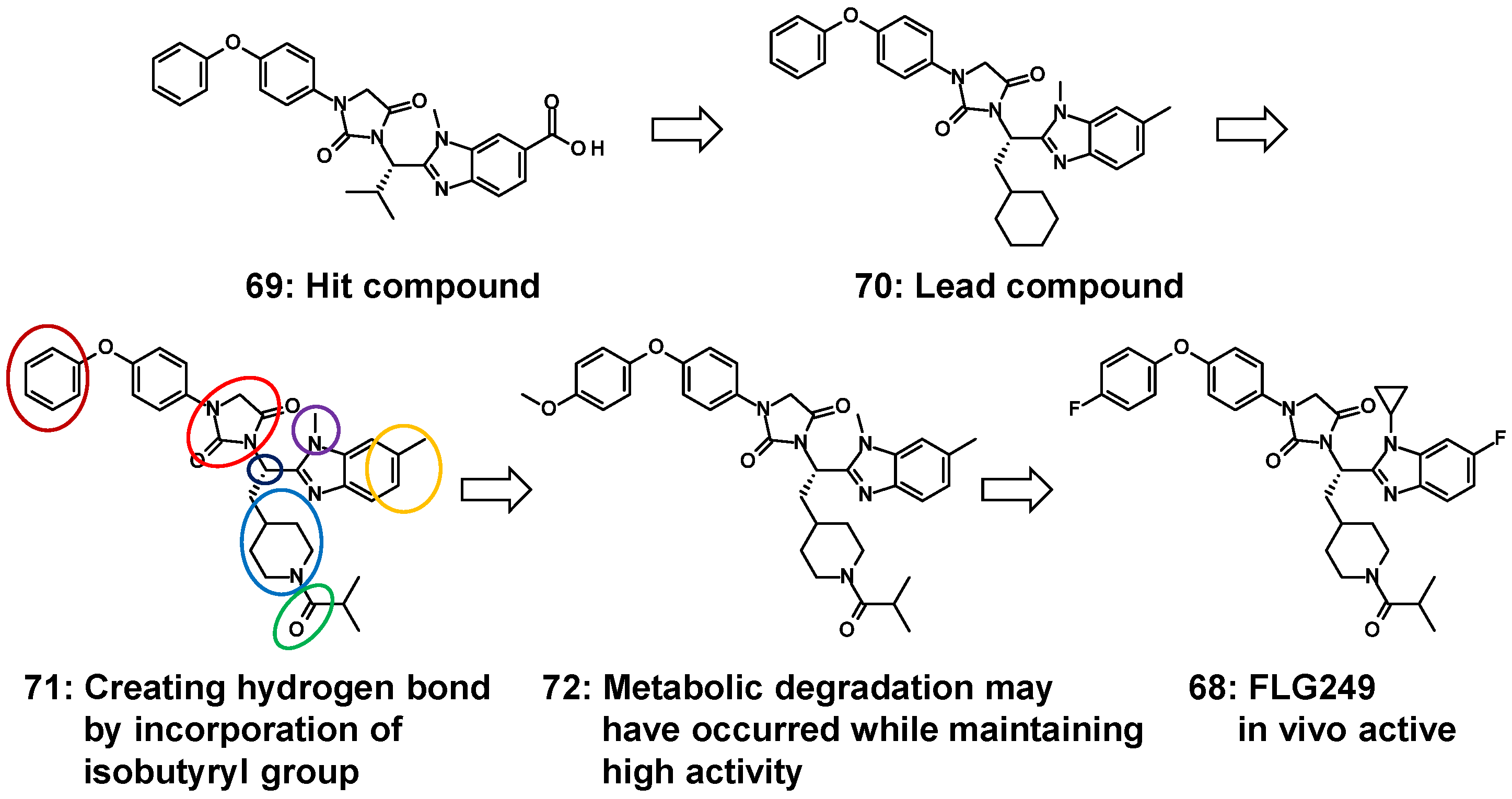
| Cpd. | TR-FRET IC50 (μM) Luciferase IC50 (nM) | Cytotoxicity IC50 (μM) 2 | Selectivity | Expression Level of FXR Target Genes | Remarks |
|---|---|---|---|---|---|
| 69 | 174.5 ± 14.5 10,100 ± 800 | ND 1 | ND 1 | ND 1 | Hit compound |
| 70 | 126.1 ± 36.9 1.2 ± 0.1 | ND 1 | Selective 3 | SHP ↑, CYP7A1 ↓ | Lead compound |
| 71 | 0.035 ± 0.002 <0.001 | >100 | Selective 4 | SHP ↓, BSEP ↓, OSTα ↓ | Reducing intracellular TG content in 3T3-L1 adipocytes |
| 72 | 0.007 ± 0.002 <0.001 | >100 | Selective 5 | SHP ↓, BSEP ↓, OSTα ↓ |
|
| 68 | 0.033 ± 0.012 0.05 ± 0.06 | >100 | Selective 5 | Ileum: Fgf15 ↓, Shp ↓, Asbt ↑ Liver: No effects on Bsep, Shp and Cyp7A1 |
|
Disclaimer/Publisher’s Note: The statements, opinions and data contained in all publications are solely those of the individual author(s) and contributor(s) and not of MDPI and/or the editor(s). MDPI and/or the editor(s) disclaim responsibility for any injury to people or property resulting from any ideas, methods, instructions or products referred to in the content. |
© 2026 by the authors. Licensee MDPI, Basel, Switzerland. This article is an open access article distributed under the terms and conditions of the Creative Commons Attribution (CC BY) license.
Share and Cite
Teno, N.; Gohda, K.; Fujimori, K. A Review on Farnesoid X Receptor (FXR) Modulators Focusing on Benzimidazole Scaffold. Molecules 2026, 31, 450. https://doi.org/10.3390/molecules31030450
Teno N, Gohda K, Fujimori K. A Review on Farnesoid X Receptor (FXR) Modulators Focusing on Benzimidazole Scaffold. Molecules. 2026; 31(3):450. https://doi.org/10.3390/molecules31030450
Chicago/Turabian StyleTeno, Naoki, Keigo Gohda, and Ko Fujimori. 2026. "A Review on Farnesoid X Receptor (FXR) Modulators Focusing on Benzimidazole Scaffold" Molecules 31, no. 3: 450. https://doi.org/10.3390/molecules31030450
APA StyleTeno, N., Gohda, K., & Fujimori, K. (2026). A Review on Farnesoid X Receptor (FXR) Modulators Focusing on Benzimidazole Scaffold. Molecules, 31(3), 450. https://doi.org/10.3390/molecules31030450