


Abstract
Herein, we disclose a highly efficient pathway toward 3-selenylated chromone derivatives via electrosynthesis domino C(sp2)-H bond selenylation/cyclization/deamination of 2-hydroxyaryl enaminones with diselenides. This method showed mild conditions, easy operation, a wide substrate scope, and good functional group tolerance. Furthermore, this electrosynthesis strategy was amenable to scaling up the reaction. Additionally, the preliminary experiments revealed that this reaction probably proceeded via a cation pathway instead of a radical pathway.
1. Introduction
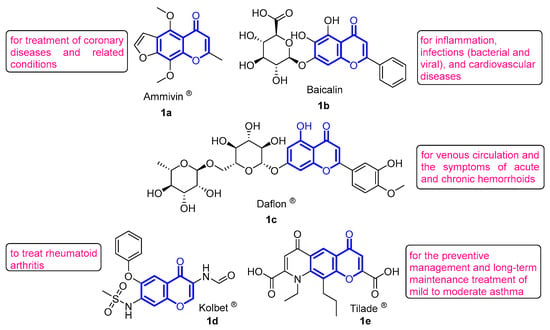
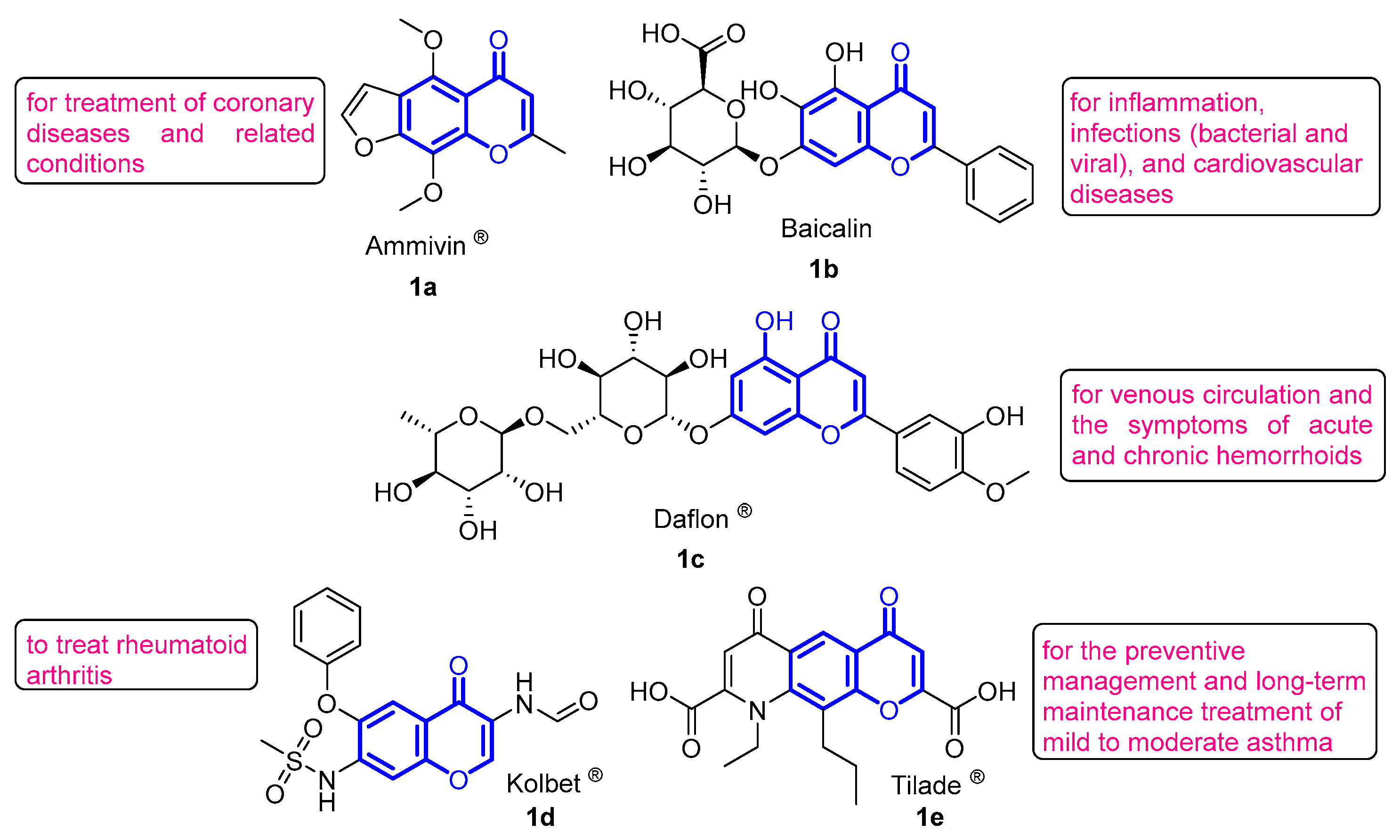
Chromones are commonly found in natural sources [1,2,3]. Their nucleus is found in the vast majority of natural compounds [4,5] and displays a wide range of pharmacological activities, like antiallergic [6], anti-Alzheimer [7], anti-bacterial [8], anti-cancer [9], antidiabetic [10], anti-HIV [11,12], immune-stimulatory [13], immunostimulators [14], anti-inflammatory [15], anti-oxidant [16], anti-ulcer [17], antiviral [18], biocidal [19], and wound healing [20] properties. A number of commercially available pharmaceuticals have the chromone nucleus in their core structure [21,22,23,24] (Figure 1), for example, Ammivin 1a, Baicalin 1b, Daflon 1c, Kolbet 1d, and Tilade 1e [21,22,23,24]. Besides medicinal properties, chromone derivatives serve as versatile building blocks in materials science [25,26,27]. Consequently, due to their structural diversity, biological activity, and synthetic utility, these compounds have attracted significant interest among the synthetic science community [28,29,30,31,32,33,34,35].
Figure 1.
Commercially available pharmaceuticals with chromone nucleus in core structure.
Similarly, research in the field of organoselenium chemistry has garnered substantial scientific interest over recent decades [36,37,38,39,40,41]. Organoselenium compounds exhibit a remarkably broad and potent pharmacological profile, demonstrating efficacy in diverse areas [42,43,44,45,46,47,48,49,50,51]. This wide-ranging bioactivity is largely attributable to the distinctive reactivity of the C–Se bond, coupled with the relative ease with which these molecules can be accessed through a multitude of well-developed synthetic methodologies [52]. Besides their biological roles, they serve as versatile synthetic intermediates [52], as ligands [53], as catalysts in organic transformations [54,55], and for use in enantioselective synthesis [56,57]. The applicability of organoselenium compounds further transcends the domains of biology and synthesis, finding significant utility in materials science [58,59,60].
Furthermore, the integration of electrochemistry into modern organic synthesis represents a paradigm shift toward more sustainable and precise chemical bond formation/cleavage. Electrochemistry contributes uniquely to green chemistry goals by enhancing atom economy, reducing toxic waste, and enabling the use of renewable electricity as a primary energy source [61,62,63,64,65,66,67]. In this regard, electrochemistry is revolutionizing the formation of C–Se bonds, a critical motif in organoselenium chemistry, by providing a sustainable and selective synthetic platform [68,69,70].
Considering the therapeutic properties of chromones and the biological importance of organoselenium compounds, several routes have been developed to combine these structures into a single hybrid molecule. In the last decade, significant progress has been made in the one-pot selenylation and chromone annulation of 2-hydroxyaryl enaminones, using a domino process that involves deamination and (sp2)–H bond functionalization with various selenium sources [22,24,71,72,73,74,75,76,77,78]. Nevertheless, some of the current synthetic approaches are accompanied by a few drawbacks concerning their applicability and environmental profile. Common issues involve the need for pre-functionalized coupling partners, hazardous solvents, expensive reagents, limited range of compatible substrates, harsh conditions (elevated temperatures and long durations), low atom economy, metal catalysts, malodorous reagents, multi-step operations, etc.
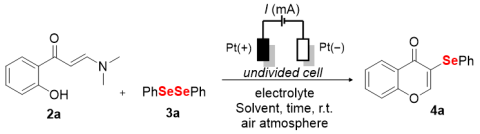
Given the importance of these hybrid compounds, the scientific community is actively pursuing new, sustainable synthetic routes that offer high efficiency. Herein, we report an eco-friendly electrochemical method for synthesizing bioactive 3-selenylchromones. This strategy employs a domino C(sp2)-H selenylation/cyclization/deamination of 2-hydroxyaryl enaminones with diselenides. The process uses inexpensive, bench-stable potassium iodide (KI) as the electrolyte in acetonitrile under an open-air atmosphere and concludes within 60 min. This study extends our research program, which is dedicated to developing environmentally benign synthetic processes and introducing chalcogen groups into biologically relevant heterocycles [79,80,81,82,83,84].
This new and alternative electrochemical approach proved to be robust, scalable, and effective for the rapid coupling of various 2-hydroxyaryl enaminones and structurally diverse diorganyl diselenides using potassium iodide under ambient conditions and open-air atmosphere.
2. Results and Discussion
To establish the optimal reaction conditions, substrates enaminone 2a and diphenyl diselenide 3a were subjected to screening of various parameters (Table 1). Based on our previous experience of electrochemical reactions [82], initial trials were conducted using platinum electrodes in acetonitrile (MeCN) with a stoichiometric amount of electrolyte for 60 min (Table 1, entries 1–7). Potassium iodide (KI) proved to be the most effective electrolyte, providing selenylated chromone 4a in 92% isolated yield (Entry 5).
Table 1.
Optimization of reaction conditions [a].
In the next step, the stoichiometric amount of electrolyte was analyzed, ranging from 1.5 equiv. to 0.5 equiv. (entry 8 and 9). A lower amount of electrolyte resulted in a poor yield of 4a (entry 9 vs. 5), while a higher amount led to a lower yield of the desired product (entry 8 vs. 5).
After establishing the KI as an appropriate electrolyte, in the next step, a solvent screen was performed for this transformation (entries 10–14). While MeCN remained optimal, MeOH afforded 4a in 69% yield (entry 11). Other solvents tested were unsatisfactory. This aligns with the prevalent use of MeCN in electrosynthesis, as its high dielectric constant and stability under thermal and electrochemical conditions are ideal for such reactions [61,62,63,64,65,66,67,68,69,70].
Finally, solvent volume was examined. Reducing the volume to 3 mL impaired the reaction (entry 15 vs. 5), whereas increasing it to 10 mL had no significant effect on the yield (entry 16 vs. 5).
The performance was negatively impacted by altering the electrical current. An increase to 25 mA reduced the yield (entry 17), while a decrease to 15 mA caused a significant decline in efficiency (entry 18). Evaluation of reaction time confirmed 60 min as the optimum, with both 30 and 90 min trials producing inferior results (entry 5 vs. 19–20). Under the conditions for entries 13 and 14, the reaction stalled entirely, allowing for complete recovery of the starting material. Lastly, substituting graphite electrodes rendered the transformation inefficient, yielding poor results or no observable conversion (entries 21–23).
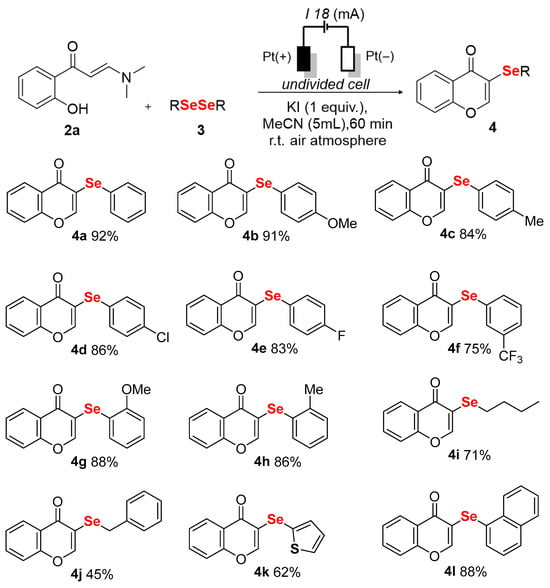
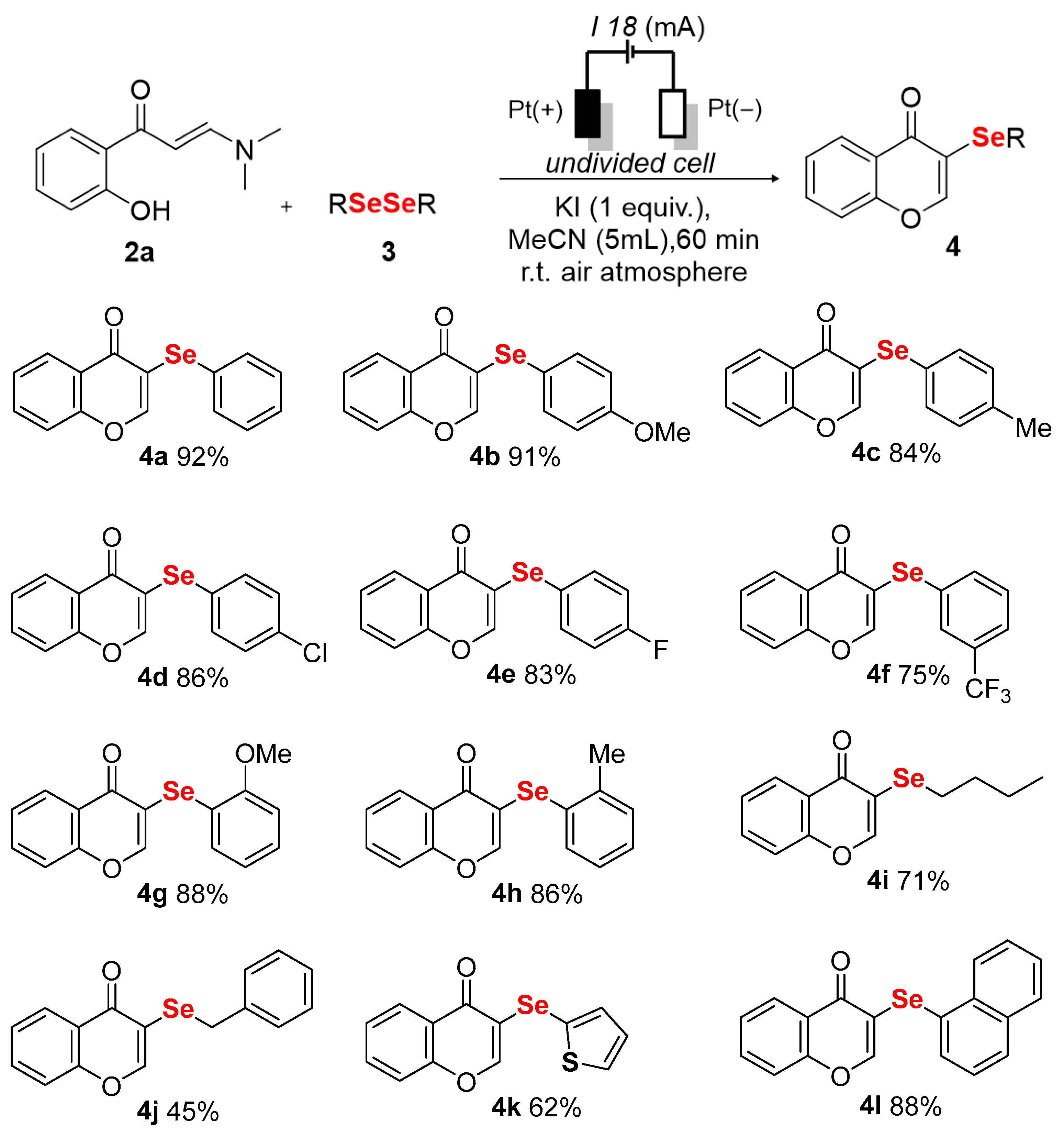
With the best result in hand (Table 1, entry 5), the generality and scope of this electrochemical domino C(sp2)–H bond selenylation and chromone annulation of the enaminones (2) with various diorganyl diselenides (3) were explored (Scheme 1 and Scheme 2).
Scheme 1.
Scope of diorganyl diselenide 3 [a],[b]. Legend: [a] General reaction conditions: Pt plate electrodes (10 mm × 10 mm × 0.05 mm); (1a) (0.25 mmol), (2a) (0.25 mmol), KI (0.25 mmol), MeCN (5 mL), 60 min, r.t.; [b] isolated yields. The red color is the Selenium atom. It highlight that diselenide get added and form the product.
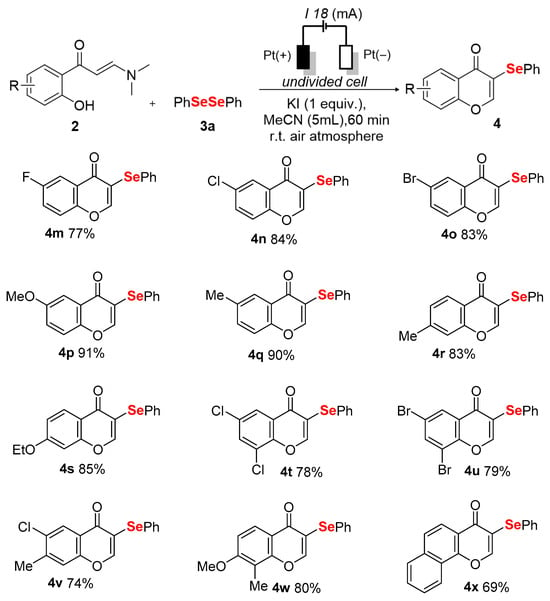
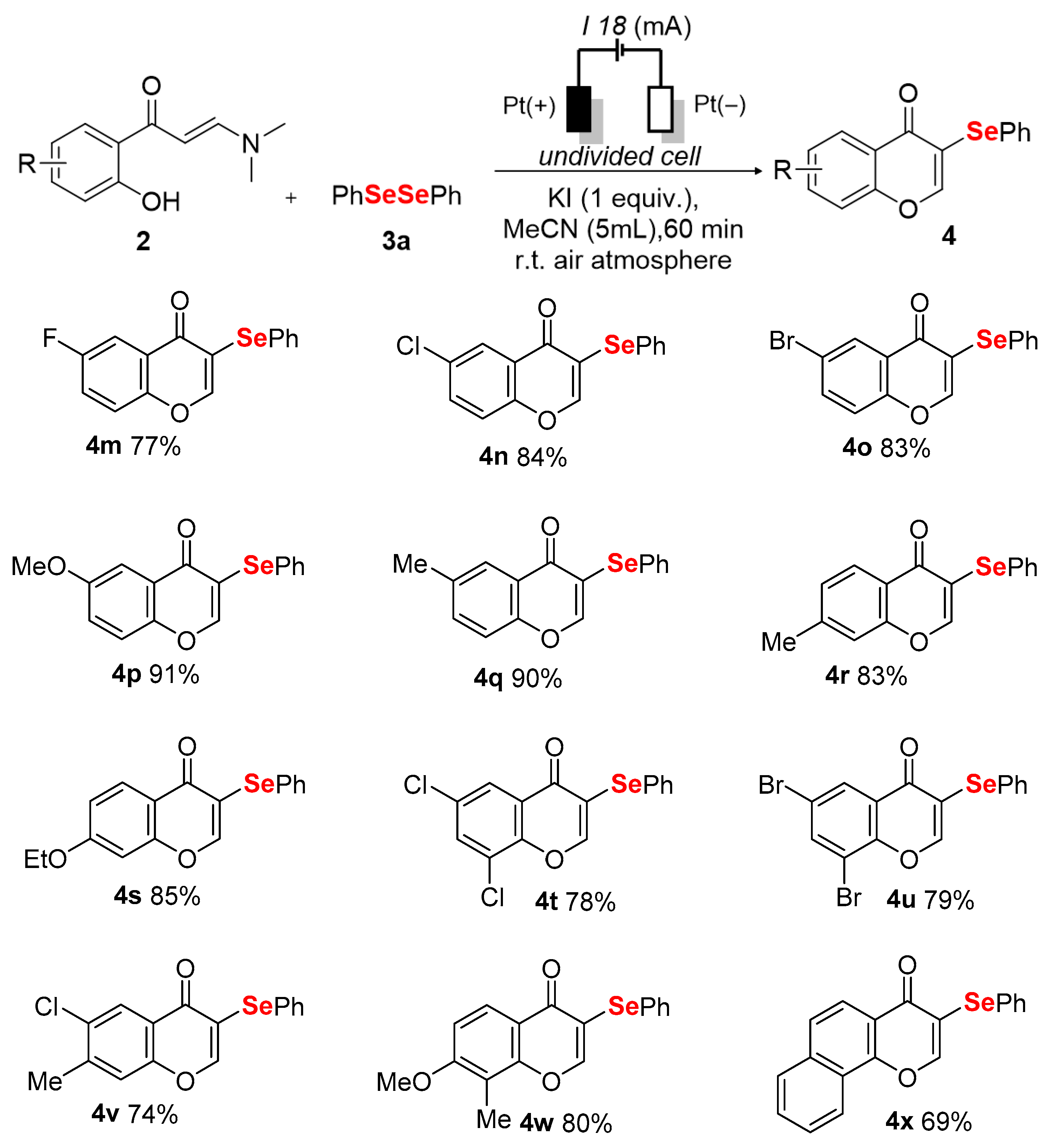
Scheme 2.
Scope of enaminones 1 [a],[b]. Legend: [a] General reaction conditions: Pt plate electrodes (10 mm × 10 mm × 0.05 mm); (1a) (0.25 mmol), (2a) (0.25 mmol), KI (0.25 mmol), MeCN (5 mL), 60 min, r.t.; [b] isolated yields.
Our initial evaluation of the method’s scope and efficiency tested a range of diorganyl diselenides (3) with a fixed enaminone substrate, 2a (Scheme 1). The reaction proved effective for structurally diverse diselenides. Both electron-donating (e.g., -Me, -OMe) and electron-withdrawing (e.g., -F, -Cl, -CF3) aryl substituents yielded the target selenylated products 4a–f in good to excellent yields (75–91%).
The reaction pathway displayed a notable electronic effect, with substrates bearing electron-donating groups generally providing higher yields (e.g., 4b,c) than those with electron-withdrawing groups (4d–f). Steric hindrance from ortho-substituted aryl groups had a comparatively weaker impact, yielding results similar to their para-substituted analogs (4b–c vs. 4g–h).
While aliphatic diselenides 3i–j furnished products 4i–j (71% and 45%, respectively), a benzylic substrate led to the formation of 4j. A C-2 heteroaryl diselenide 3k successfully generated the desired product 4k in 62% yield. Finally, the method also accommodated a bulky-naphthyl group, affording product 4l in 70% yield.
To further broaden the scope in relation to the substrate, we next investigated the influence of the enaminone 2, using diphenyl diselenide 3a as the constant reactant (Scheme 2). Enaminones bearing various aryl substituents, including halogens, ethers, and methyl groups, were evaluated.
The reaction tolerated a range of electronic effects on the enaminone’s aryl ring. Both electron-withdrawing and electron-donating groups served as viable substrates, delivering the corresponding selenylated products 4m–w in good to excellent yields (74–91%). Notably, electron-donating groups at the C-5 position (4p–q) generally provided higher yields than electron-withdrawing groups at the same position (4m–o).
The methodology was also compatible with di-substituted enaminones, yielding selenylated chromones 4t–w in good yields (74–80%). Finally, the system extended to a fused aromatic system, affording the naphthyl-derived product 4x in 68% yield.
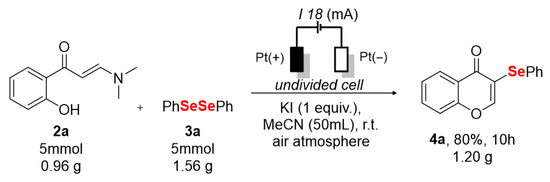
To demonstrate the potential of this synthetic protocol, a gram-scale (5 mmol) electrochemical domino (sp2)–H bond selenylation and chromone annulation was performed using enaminone 2a with diphenyl diselenide 3a. This process afforded the selenylated product 4a in 80% yield (Scheme 3). Thus, the method offers a practical route for synthesizing biologically relevant hybrid compounds.
Scheme 3.
Gram-scale synthesis [a],[b]. Legend: [a] General reaction conditions: Pt plate electrodes (10 mm × 10 mm × 0.05 mm); (1a) (5 mmol), (2a) (5 mmol), KI (5 mmol), MeCN (50 mL), 10 h, r.t.; [b] isolated yield.
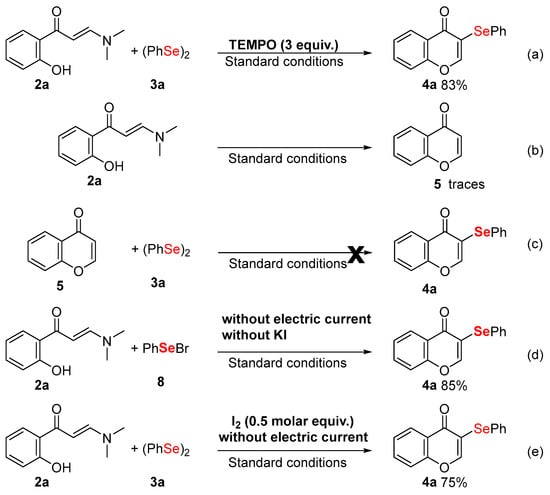
For a better understanding of the reaction mechanism, a series of control experiments were performed; see Scheme 4. Under standard conditions, the addition of a stoichiometric amount of the radical scavenger TEMPO did not inhibit the transformation, yielding the selenylated chromone 4a in 83% yield (Scheme 4, entry a). This outcome suggests that a radical pathway is unlikely. Omission of the diselenide 3a resulted in only trace formation of chromone 5 (Scheme 4, entry b), indicating that this compound is probably not an intermediate in the process. Furthermore, subjecting chromone 5 to the optimized conditions did not yield the desired product 4a (Scheme 4, entry c), which rules out the possibility of a mechanism involving initial chromone formation followed by selenylation. Finally, treatment of 2a with PhSeBr 9 instead of diphenyl diselenide 3a afforded product 4a in 85% yield (Scheme 4, entry d). This finding supports the involvement of a phenylselenium cation species in the reaction pathway. Lastly, when a control experiment was performed using molecular iodine (0.5 molar equiv.) in place of KI and without applied electricity, the target selenylated product 4a was furnished in 75% yield (Scheme 4, entry e). This result suggests that the active iodine species in the standard reaction likely originates from the anodic oxidation of iodide.
Scheme 4.
Control experiments.
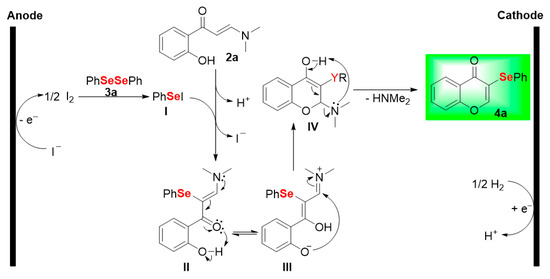
On the basis of the control experiments and previously reported studies [85,86,87,88,89,90,91], a plausible mechanism for this electrochemical domino reaction is outlined in Scheme 5. The reaction is initiated at the anode where possible anodic oxidation of (I−) to molecular iodine (I2) occurs. Subsequently, I2 reacts with diphenyl diselenide 3a to generate the electrophilic selenium species PhSeI I, which acts as the key selenylating agent [92,93,94]. The electrophilic selenium species I then reacts with enaminone 2a, leading to the formation of intermediate II via electrophilic selenylation. Intermediate II undergoes tautomerization to generate intermediate III, which facilitates intramolecular cyclization to afford the cyclic intermediate IV. Finally, intermediate IV undergoes elimination of dimethylamine (HNMe2), delivering the desired selenylated chromone 4a. Concurrently, at the cathode, protons are reduced to molecular hydrogen, completing the electrochemical cycle.
Scheme 5.
Proposed mechanism for the reaction.
3. Materials and Methods
The reagents were acquired from commercial suppliers and utilized as received, without further purification. All solvents were of analytical (PA) grade and were also used without purification.
Proton nuclear magnetic resonance (1H NMR) spectra were acquired at 300 MHz using a Bruker DPX 300 NMR spectrometer (Bruker, Rheinstetten, Germany). Samples were prepared in CDCl3, and chemical shifts (δ) are reported in parts per million (ppm), referenced to the residual solvent peak of CDCl3 or to tetramethylsilane (TMS) as an external standard. Spectral data are presented as chemical shift, multiplicity, coupling constant (J) in Hz, and integrated intensity. Carbon-13 nuclear magnetic resonance (13C NMR) spectra were recorded at 50 MHz on the same instrument, using CDCl3 solutions. Chemical shifts are reported in ppm relative to the central solvent peak of CDCl3. The following abbreviations indicate signal multiplicity: s (singlet), d (doublet), t (triplet), q (quartet), quint (quintet), sext (sextet), and m (multiplet). All the NMR spectra were analyzed and processed with the MestReNova v12.0 software (Mestrelab Research S.L).
Melting points were measured using an SPLABOR SP-PFIII analog melting point apparatus with a heating plate (SPLABOR, Sao Paulo, Brazil). Purification by column chromatography was carried out with silica gel (230–400 mesh). Thin-layer chromatography (TLC) was performed using Merck silica gel GF254 of 0.25 mm thickness (Merck, Darmstadt, Germany). TLC visualization was achieved by examination under ultraviolet light or by staining with iodine vapor or an acidic vanillin solution.
3.1. General Procedure for Synthesis of 3-Selenyl-Chromones from the Cyclization of Enaminones Using Diorganyl Chalcogenides
An undivided three-necked flask (10 mL) equipped with a stirring bar was charged with appropriate enaminone 2 (0.25 mmol), diorganyl dichalcogenide 2 (0.25 mmol), diselenides (0.2 mmol), KI (1 equiv.) and MeCN (5 mL). The cell was equipped with platinum electrodes (1.0 × 1.0 × 0.05 mm) as the anode and cathode. The reaction mixture was stirred and electrolyzed at a constant current of 18 mA at ambient temperature and monitored by TLC. Upon completion, the solvent was removed under reduced pressure to afford the crude product, which was purified by flash column chromatography utilizing silica gel as stationary phase and eluate with a mixture of hexane/ethyl acetate to afford the desired product. Images of electrosynthetic setup are available in the Supplementary Materials (Figures SA and SB). Spectra of all the synthesized compounds are available in the Supplementary Materials (Figures S1–S48).
Spectral Data of Synthesized Products (4a–x)
- 3-(Phenylselanyl)-4H-chromen-4-one 4a: Yield: 92% (69 mg); beige crystalline solid (crystallized from hexane/ethyl acetate); mp: 59–60 °C (59 °C) [22]; 1H NMR (300 MHz, Chloroform-d) δ 8.21 (d, J = 8.2 Hz, 1H), 7.87 (s, 1H), 7.71–7.53 (m, 3H), 7.45–7.33 (m, 2H), 7.32–7.21 (m, 3H). 13C NMR (75 MHz, Chloroform-d) δ 175.20, 156.34, 155.77, 133.83, 129.55, 128.12, 126.35, 125.56, 123.15, 118.06, 117.85; 77Se NMR (76.39 MHz, Chloroform-d) δ = 303.11.
- 3-((4-Methoxyphenyl)selanyl)-4H-chromen-4-one 4b: Yield: 91% (75 mg); white crystalline solid (crystallized from hexane/ethyl acetate); mp: 91–92 °C (92–94 °C) [22]; 1H NMR (300 MHz, Chloroform-d) δ 8.18 (dd, J = 8.2, 1.7 Hz, 1H), 7.65–7.53 (m, 4H), 7.35 (ddd, J = 7.1, 3.5, 2.3 Hz, 2H), 6.88–6.77 (m, 2H), 3.76 (s, 3H). 13C NMR (75 MHz, Chloroform-d) δ 175.29, 160.22, 156.28, 153.85, 137.10, 133.69, 126.14, 125.38, 122.85, 119.35, 118.01, 117.02, 115.36, 55.31.
- 3-(p-Tolylselanyl)-4H-chromen-4-one 4c: Yield: 84% (66 mg); beige solid (purified using hexane/ethyl acetate); mp: 90–91 °C (88–89 °C) [22]; 1H NMR (300 MHz, Chloroform-d) δ 8.19 (dd, J = 8.3, 1.8 Hz, 1H), 7.74 (s, 1H), 7.62 (ddd, J = 8.8, 7.2, 1.7 Hz, 1H), 7.54–7.46 (m, 2H), 7.43–7.32 (m, 2H), 7.09 (d, J = 7.8 Hz, 2H), 2.30 (s, 3H). 13C NMR (75 MHz, Chloroform-d) δ 175.23, 156.31, 154.80, 138.50, 134.63, 133.74, 130.43, 126.25, 125.44, 123.87, 123.01, 118.57, 118.03, 21.19.
- 3-((4-Chlorophenyl)selanyl)-4H-chromen-4-one 4d: Yield: 86% (72 mg); beige crystalline solid (crystallized from hexane/ethyl acetate); mp: 116–118 °C (118–119 °C) [22]; 1H NMR (300 MHz, Chloroform-d) δ 8.20 (dd, J = 8.1, 1.4 Hz, 1H), 7.98 (s, 1H), 7.65 (ddd, J = 8.6, 7.0, 1.7 Hz, 1H), 7.54–7.44 (m, 2H), 7.46–7.34 (m, 2H), 7.27–7.16 (m, 2H). 13C NMR (75 MHz, Chloroform-d) δ 175.06, 156.50, 156.35, 134.81, 134.33, 133.99, 129.63, 126.68, 126.37, 125.72, 123.24, 118.11, 117.19.
- 3-((4-Fluorophenyl)selanyl)-4H-chromen-4-one 4e: Yield: 83% (66 mg); yellow crystalline solid (crystallized from hexane/ethyl acetate); mp: 83–85 °C (84–85 °C) [22]; 1H NMR (300 MHz, Chloroform-d) δ 8.17 (dd, J = 8.3, 1.7 Hz, 1H), 7.84 (s, 1H), 7.66–7.53 (m, 3H), 7.36 (t, J = 7.3 Hz, 2H), 7.01–6.90 (m, 2H). 13C NMR (75 MHz, Chloroform-d) δ 175.11, 161.28, 156.29, 155.55, 136.45, 136.34, 133.91, 126.24, 125.61, 123.08, 122.55, 118.08, 117.98, 116.88, 116.59.
- 3-((3-(Trifluoromethyl)phenyl)selanyl)-4H-chromen-4-one 4f: Yield: 75% (69 mg); beige crystalline sold (crystallized from hexane/ethyl acetate); mp: 109–112 °C (110–111 °C) [22]; 1H NMR (300 MHz, Chloroform-d) δ 8.17 (dd, J = 8.0, 1.7 Hz, 1H), 8.10 (s, 1H), 7.77 (s, 1H), 7.72–7.59 (m, 2H), 7.48–7.31 (m, 4H). 13C NMR (75 MHz, Chloroform-d) δ 174.90, 157.55, 156.34, 136.00, 134.11, 131.75 (q, JC–F = 32.5 Hz), 130.18, 129.71, 129.26 (q, JC–F = 3.3 Hz), 129.21, 129.16, 129.11, 126.36 (q, JC–F = 271 Hz), 125.83, 124.58 (q, JC–F = 3.5 Hz), 124.53, 124.48, 123.31, 118.16, 116.20.
- 3-((2-Methoxyphenyl)selanyl)-4H-chromen-4-one 4g: Yield: 88% (73 mg); white solid (purified using hexane/ethyl acetate); mp: 110–111 °C (110–111 °C) [22]; 1H NMR (300 MHz, Chloroform-d) δ 8.21 (dd, J = 8.0, 1.7 Hz, 1H), 8.02 (s, 1H), 7.64 (ddd, J = 8.6, 7.1, 1.7 Hz, 1H), 7.46–7.34 (m, 2H), 7.23–7.11 (m, 2H), 6.80 (qd, J = 7.9, 7.5, 1.2 Hz, 2H), 3.84 (s, 3H). 13C NMR (75 MHz, Chloroform-d) δ 175.38, 157.72, 157.42, 156.42, 133.88, 131.70, 128.62, 126.40, 125.63, 123.30, 121.74, 118.40, 118.13, 114.79, 110.76, 55.93.
- 3-(o-Tolylselanyl)-4H-chromen-4-one 4h: Yield: 86% (68 mg); red crystalline solid (crystallized from hexane/ethyl acetate); mp: 117–118 °C (118 °C) [22]; 1H NMR (300 MHz, Chloroform-d) δ 8.22 (dd, J = 8.2, 1.8 Hz, 1H), 7.64 (q, J = 7.2, 6.3 Hz, 2H), 7.42 (dt, J = 14.6, 7.3 Hz, 3H), 7.28–7.12 (m, 2H), 7.07 (t, J = 6.5 Hz, 1H), 2.47 (s, 3H). 13C NMR (75 MHz, Chloroform-d) δ 175.33, 156.37, 154.76, 140.57, 134.43, 133.82, 130.50, 128.56, 128.47, 127.05, 126.26, 125.53, 122.95, 118.07, 117.26, 22.34.
- 3-(Butylselanyl)-4H-chromen-4-one 4i: Yield: 71% (50 mg); yellow solid (purified using hexane/ethyl acetate); mp: 55–56 °C (54–55 °C) [22]; 1H NMR (300 MHz, Chloroform-d) δ 8.24–8.17 (m, 1H), 8.14 (s, 1H), 7.64 (ddd, J = 8.6, 5.6, 1.6 Hz, 1H), 7.52–7.33 (m, 2H), 2.95–2.77 (m, 2H), 1.60 (q, J = 7.6 Hz, 2H), 1.47–1.29 (m, 2H), 0.86 (t, J = 7.3 Hz, 3H). 13C NMR (75 MHz, Chloroform-d) δ 175.89, 156.35, 156.24, 133.69, 126.29, 125.47, 123.19, 118.03, 114.74, 32.13, 25.97, 22.77, 13.54.
- 3-(Benzylselanyl)-4H-chromen-4-one 4j: Yield: 45% (36 mg); white solid (purified using hexane/ethyl acetate); mp: 94–96 °C (95–96 °C) [22]; 1H NMR (300 MHz, Chloroform-d) δ 8.27–8.17 (m, 1H), 7.85 (s, 1H), 7.64 (ddd, J = 8.6, 7.2, 1.7 Hz, 1H), 7.46–7.33 (m, 3H), 7.16 (q, J = 4.6 Hz, 4H), 4.08 (s, 2H). 13C NMR (75 MHz, Chloroform-d) δ 175.83, 157.59, 156.30, 138.46, 134.12, 133.80, 128.98, 128.42, 126.89, 126.32, 125.61, 123.31, 118.09, 29.77.
- 3-(Thiophen-2-ylselanyl)-4H-chromen-4-one 4k: Yield: 62% (48 mg); yellow solid (purified using hexane/ethyl acetate); mp: 113–115 °C (114–116 °C) [22]; 1H NMR (300 MHz, Chloroform-d) δ 8.15 (dd, J = 8.2, 1.7 Hz, 1H), 7.65–7.57 (m, 1H), 7.52 (s, 1H), 7.49–7.42 (m, 1H), 7.34 (dt, J = 8.0, 2.9 Hz, 3H), 7.01 (dd, J = 5.4, 3.5 Hz, 1H). 13C NMR (75 MHz, Chloroform-d) δ 175.01, 156.25, 153.25, 137.99, 133.84, 132.82, 128.63, 125.99, 125.48, 122.66, 119.90, 119.86, 118.06.
- 3-(Naphthalen-1-ylselanyl)-4H-chromen-4-one 4l: Yield: 88% (77 mg); yellow solid (purified using hexane/ethyl acetate); mp: 68–70 °C (67–68 °C) [22]; 1H NMR (300 MHz, Chloroform-d) δ 8.21 (dd, J = 8.2, 1.7 Hz, 1H), 8.09 (s, 1H), 7.85 (s, 1H), 7.74 (dd, J = 9.7, 6.0 Hz, 3H), 7.66–7.57 (m, 2H), 7.44 (dd, J = 6.2, 3.3 Hz, 2H), 7.41–7.29 (m, 2H). 13C NMR (75 MHz, Chloroform-d) δ 175.23, 156.32, 155.70, 133.98, 133.86, 133.31, 132.73, 130.75, 129.11, 127.80, 127.53, 126.63, 126.60, 126.30, 125.58, 125.39, 123.10, 118.09, 117.93.
- 6-Fluoro-3-(phenylselanyl)-4H-chromen-4-one 4m: Yield: 77% (62 mg); white solid (purified using hexane/ethyl acetate); mp: 118–120 °C (120–121 °C) [24]; 1H NMR (300 MHz, Chloroform-d) δ 7.86–7.76 (m, 2H), 7.56 (dd, J = 6.6, 3.0 Hz, 2H), 7.38 (ddt, J = 10.3, 7.3, 3.6 Hz, 2H), 7.27 (hept, J = 4.4, 3.8 Hz, 3H). 13C NMR (75 MHz, Chloroform-d) δ 174.49 (d, JC–F = 2.4 Hz), 159.62 (d, JC–F = 247.7 Hz), 155.68, 152.57 (d, JC–F = 1.7 Hz), 134.01, 129.61, 128.31, 127.74, 124.14 (d, JC–F = 7.3 Hz), 122.16 (d, JC–F = 25.7 Hz), 120.31 (d, JC–Fk = 8.1 Hz), 117.35, 111.00 (d, JC–F = 23.9 Hz).
- 6-Chloro-3-(phenylselanyl)-4H-chromen-4-one 4n: Yield: 84% (71 mg); yellow crystalline solid (crystallized from hexane/ethyl acetate); mp:104–106 °C (105–106 °C) [22]; 1H NMR (300 MHz, Chloroform-d) δ 8.10 (d, J = 2.6 Hz, 1H), 7.78 (s, 1H), 7.59–7.48 (m, 3H), 7.37–7.23 (m, 4H). 13C NMR (75 MHz, Chloroform-d) δ 174.02, 155.43, 154.59, 134.12, 134.05, 131.39, 129.64, 128.39, 127.57, 125.51, 123.82, 119.90, 118.14.
- 6-Bromo-3-(phenylselanyl)-4H-chromen-4-one 4o: Yield: 83% (79 mg); beige crystalline solid (crystallized from hexane/ethyl acetate); mp: 105 °C (104–105 °C) [22]; 1H NMR (300 MHz, Chloroform-d) δ 8.25 (d, J = 2.5 Hz, 1H), 7.77 (s, 1H), 7.65 (dd, J = 8.9, 2.6 Hz, 1H), 7.55 (dd, J = 6.8, 3.0 Hz, 2H), 7.31–7.21 (m, 4H). 13C NMR (75 MHz, Chloroform-d) δ 173.86, 155.41, 155.01, 136.79, 134.14, 129.64, 128.71, 128.40, 127.56, 124.17, 120.12, 118.88, 118.23.
- 6-Methoxy-3-(phenylselanyl)-4H-chromen-4-one 4p: Yield: 91% (75 mg); white crystalline solid (crystallized from hexane/ethyl acetate); mp: 97–99 °C (99–101 °C) [22]; 1H NMR (300 MHz, Chloroform-d) δ 7.86 (s, 1H), 7.54 (ddd, J = 9.2, 4.1, 2.4 Hz, 3H), 7.36–7.17 (m, 5H), 3.82 (s, 3H). 13C NMR (75 MHz, Chloroform-d) δ 175.00, 157.15, 155.78, 151.18, 133.63, 129.49, 128.39, 128.00, 123.94, 123.76, 119.50, 116.73, 105.24, 55.91.
- 6-Methyl-3-(phenylselanyl)-4H-chromen-4-one 4q: Yield: 90% (71 mg); beige crystalline solid (crystallized from hexane/ethyl acetate); mp: 99–101 °C (100–101 °C) [22]; 1H NMR (300 MHz, Chloroform-d) δ 7.91 (s, 1H), 7.79 (d, J = 1.2 Hz, 1H), 7.58–7.46 (m, 2H), 7.37 (dd, J = 8.6, 2.2 Hz, 1H), 7.21 (dt, J = 5.6, 3.8 Hz, 4H), 2.35 (s, 3H). 13C NMR (75 MHz, Chloroform-d) δ 175.13, 155.85, 154.54, 135.55, 135.08, 133.61, 129.49, 128.35, 127.99, 125.46, 122.75, 117.83, 117.35, 20.95.
- 7-Methyl-3-(phenylselanyl)-4H-chromen-4-one 4r: Yield: 83% (66 mg); white solid (purified using hexane/ethyl acetate); mp: 109–110 °C (110–112 °C) [22]; 1H NMR (300 MHz, Chloroform-d) δ 8.04 (d, J = 8.1 Hz, 1H), 7.79 (s, 1H), 7.61–7.48 (m, 2H), 7.31–7.20 (m, 3H), 7.15 (d, J = 8.0 Hz, 2H), 2.40 (s, 3H). 13C NMR (75 MHz, Chloroform-d) δ 174.98, 156.41, 155.58, 145.27, 133.69, 129.50, 128.30, 128.02, 127.06, 125.99, 120.88, 117.74, 117.59, 21.83.
- 7-Ethoxy-3-(phenylselanyl)-4H-chromen-4-one 4s: Yield: 85% (73 mg); yellow solid (purified using hexane/ethyl acetate); mp: 92–93 °C (90–92 °C) [22]; 1H NMR (300 MHz, Chloroform-d) δ 8.03 (d, J = 8.9 Hz, 1H), 7.72 (s, 1H), 7.59–7.42 (m, 2H), 7.22 (q, J = 3.8 Hz, 3H), 6.87 (dd, J = 9.0, 2.4 Hz, 1H), 6.68 (s, 1H), 4.01 (q, J = 6.9 Hz, 2H), 1.39 (t, J = 7.1 Hz, 3H). 13C NMR (75 MHz, Chloroform-d) δ 174.42, 163.51, 158.07, 155.30, 133.64, 129.48, 128.34, 127.98, 127.53, 117.61, 116.81, 115.21, 100.57, 64.32, 14.53.
- 6,8-Dichloro-3-(phenylselanyl)-4H-chromen-4-one 4t: Yield: 78% (72 mg); white crystalline solid (crystallized from hexane/ethyl acetate); mp: 112–113 °C (113–115 °C) [22]; 1H NMR (300 MHz, Chloroform-d) δ 8.03 (d, J = 2.5 Hz, 1H), 7.73 (s, 1H), 7.68–7.55 (m, 3H), 7.30 (dd, J = 5.2, 2.0 Hz, 3H). 13C NMR (75 MHz, Chloroform-d) δ 173.44, 154.20, 150.64, 134.81, 133.89, 131.08, 129.80, 128.78, 126.67, 124.41, 124.28, 119.34.
- 6,8-Dibromo-3-(phenylselanyl)-4H-chromen-4-one 4u: Yield: 79% (91 mg); beige crystalline solid (crystallized from hexane/ethyl acetate); mp: 114–116 °C (116–118 °C) [22]; 1H NMR (300 MHz, Chloroform-d) δ 8.24 (d, J = 2.3 Hz, 1H), 7.94 (d, J = 2.3 Hz, 1H), 7.73 (s, 1H), 7.64–7.54 (m, 2H), 7.31 (dd, J = 5.2, 2.1 Hz, 3H). 13C NMR (75 MHz, Chloroform-d) δ 173.37, 154.27, 151.95, 139.46, 134.85, 129.81, 128.80, 128.20, 126.64, 124.66, 119.34, 118.70, 112.81.
- 6-Chloro-7-methyl-3-(phenylselanyl)-4H-chromen 4v: Yield: 74% (62 mg); white crystalline solid (crystallized from hexane/ethyl acetate); mp: 137–138 °C (138–140 °C) [22]; 1H NMR (300 MHz, Chloroform-d) δ 8.09 (s, 1H), 7.76 (s, 1H), 7.55 (dd, J = 6.6, 3.0 Hz, 2H), 7.33–7.21 (m, 4H), 2.42 (s, 3H). 13C NMR (75 MHz, Chloroform-d) δ 174.00, 155.42, 154.55, 143.21, 133.97, 132.17, 129.58, 128.26, 127.83, 125.75, 122.01, 119.86, 117.81, 20.81.
- 7-Methoxy-8-methyl-3-(phenylselanyl)-4H-chromen-4-one 4w: Yield: 80% (69 mg); yellow crystalline solid (crystallized from hexane/ethyl acetate); mp: 130–131 °C (128–130 °C) [22]; 1H NMR (300 MHz, Chloroform-d) δ 8.09 (s, 1H), 7.76 (s, 1H), 61–7.49 (m, 2H), 7.32–7.18 (m, 4H), 2.42 (s, 3H). 13C NMR (75 MHz, Chloroform-d) δ 175.11, 161.39, 155.78, 155.46, 133.57, 129.46, 128.53, 127.91, 124.81, 117.06, 116.84, 113.96, 108.93, 56.10, 8.05.
- 3-(Phenylselanyl)-4H-benzo[h]chromen-4-one 4x: Yield: 69% (61 mg); brown solid (purified using hexane/ethyl acetate); mp: 110–111 °C (111–113 °C) [22]; 1H NMR (300 MHz, Chloroform-d) δ 8.38 (d, J = 7.6 Hz, 1H), 8.21–8.07 (m, 2H), 7.94–7.84 (m, 1H), 7.77–7.58 (m, 3H), 7.49–7.39 (m, 2H), 7.34–7.17 (m, 3H). 13C NMR (75 MHz, Chloroform-d) δ 174.80, 155.51, 153.79, 135.82, 133.43, 130.54, 129.56, 129.32, 128.13, 127.44, 127.36, 125.84, 123.78, 122.16, 121.04, 119.78.
4. Conclusions
In conclusion, we have developed an efficient and alternative sustainable electrochemical protocol for the domino (sp2)–H bond selenylation and chromone annulation of 2-hydroxyaryl enaminones via deamination using diorganyl diselenides. This transformation proceeds under mild and greener conditions, employing KI as a low-cost electrolyte in acetonitrile under open-air atmosphere, and is completed within 60 min. Under the optimized conditions, a wide range of selenylated chromones were obtained in good to excellent yields with high regioselectivity. The methodology exhibits broad substrate scope and excellent functional-group tolerance, being effective for both enaminones and structurally diverse diselenides. Notably, the successful gram-scale synthesis highlights the practicality and potential industrial applicability of this electrosynthetic strategy.
Overall, the key advantages of this benign and robust protocol include (i) compatibility with a wide range of 2-hydroxyaryl enaminones and diselenides; (ii) use of an inexpensive, readily available and bench-stable electrolyte; (iii) operation under ambient air without external oxidants or catalysts; (iv) short reaction time at room temperature; (v) scalability; and (vi) the use of non-toxic, easy-to-handle reagents. These features collectively position this method as a valuable contribution to green electrosynthesis and the sustainable construction of selenium-containing chromone hybrid molecules.
Supplementary Materials
The following supporting information can be downloaded at https://www.mdpi.com/article/10.3390/molecules31020391/s1, Electrosynthetic setup (Figures SA and SB) NMR Spectra (Figures S1–S48).
Author Contributions
Conceptualization: J.R. and S.S.; methodology: J.M.B., I.M.e.O., C.A.O.M. and A.R.S.; validation: J.M.B., C.A.O.M., T.E.A.F., G.V.B., V.P.S., G.A.C. (Gleison A. Casagrande), G.A.C. (Giuseppe A. Camara), A.L.S. and A.L.B.; formal analysis: J.M.B., C.A.O.M., G.A.C. (Gleison A. Casagrande), G.A.C. (Giuseppe A. Camara); resources: S.S., and J.R.; data curation: J.M.B., I.M.e.O., C.A.O.M., T.E.A.F., G.V.B., V.P.S., G.A.C. (Giuseppe A. Camara), A.L.S. and A.L.B.; writing—original draft: J.R. and S.S.; writing—review and editing: J.R. and S.S.; visualization: J.R. and S.S.; supervision: J.R. and S.S.; project administration: J.R. and S.S.; funding acquisition: J.R. and S.S. All authors have read and agreed to the published version of the manuscript.
Funding
We gratefully acknowledge the Conselho Nacional de Desenvolvimento Científico e Tecnológico (CNPq), and the Coordenação de Aperfeiçoamento de Pessoal de Nível Superior (CAPES, Finance Code 001), for financial support. This study was financed in part by the Universidade Federal de Mato Grosso do Sul-Brasil (UFMS)-Finance Code 001. S.S. and J.R. would like to acknowledge CNPq (308875/2026-5, 401355/2025-0, 316687/2023-5, 309975/2022-0, 404172/2023-7, and 405655/2023-1). S.S. and J.R. also acknowledge the following FAPEG public calls: Chamada Pública FAPEG/SES No. 18/2025 (ARB2025191000003), Chamada Pública FAPEG No. 05/2025 (PVE2025041000055), and Chamada Pública FAPEG No. 21/2025 (PEE2025331000083 and PEE2025331000108).
Institutional Review Board Statement
Not applicable.
Informed Consent Statement
Not applicable.
Data Availability Statement
The data that support the findings of this study are available in the Supplementary Material of this article.
Acknowledgments
The authors thank the Conselho Nacional de Desenvolvimento Científico e Tecnológico (CNPq), Coordenação de Aperfeiçoamento de Pessoal de Nível Superior (CAPES), Fundação Universidade Federal de Mato Grosso do Sul (UFMS), Universidade Federal de Mato Grosso (UFMT), and Universidade Federal de Goiás (UFG) for the support offered in this research. S.S. would like to acknowledge Programa futuras Cientistas - Imersão Científica (Edital No. 04/2025) and its interns, Laila Vitória Oliveira da Silva and Lisiane Cruz Menezes.
Conflicts of Interest
The authors declare no conflicts of interest.
References
- Madhav, H.; Jameel, E.; Rehan, M.; Hoda, N. Recent Advancements in Chromone as a Privileged Scaffold towards the Development of Small Molecules for Neurodegenerative Therapeutics. RSC Med. Chem. 2022, 13, 258–279. [Google Scholar] [CrossRef] [Scilit]
- St-Gelais, A.; Alsarraf, J.; Legault, J.; Plourde, J.; Pichette, A. Effect of the Chromone Core Substitution of Dirchromone on the Resultant Biological Activities. J. Nat. Prod. 2021, 84, 2786–2794. [Google Scholar] [CrossRef] [Scilit] [PubMed]
- Ipe, R.S.; Kumar, S.; Benny, F.; Jayan, J.; Manoharan, A.; Sudevan, S.T.; George, G.; Gahtori, P.; Kim, H.; Mathew, B. A Concise Review of the Recent Structural Explorations of Chromones as MAO-B Inhibitors: Update from 2017 to 2023. Pharmaceuticals 2023, 16, 1310. [Google Scholar] [CrossRef] [Scilit] [PubMed]
- Keri, R.S.; Budagumpi, S.; Pai, R.K.; Balakrishna, R.G. Chromones as a Privileged Scaffold in Drug Discovery: A Review. Eur. J. Med. Chem. 2014, 78, 340–374. [Google Scholar] [CrossRef] [Scilit] [PubMed]
- Gaspar, A.; Garrido, E.M.; Borges, F.; Garrido, J.M.P.J. Biological and Medicinal Properties of Natural Chromones and Chromanones. ACS Omega 2024, 9, 21706–21726. [Google Scholar] [CrossRef] [Scilit]
- Yang, B.; Tao, H.; Lin, X.; Wang, J.; Liao, S.; Dong, J.; Zhou, X.; Liu, Y. Prenylated Indole Alkaloids and Chromone Derivatives from the Fungus Penicillium sp. SCSIO041218. Tetrahedron 2018, 74, 77–82. [Google Scholar] [CrossRef] [Scilit]
- Kumar, N.; Jangid, K.; Kumar, V.; Devi, B.; Arora, T.; Mishra, J.; Kumar, V.; Dwivedi, A.R.; Parkash, J.; Bhatti, J.S.; et al. Investigations of 3-Hydroxy Chromone Derivatives as Multipotent Therapeutics for the Treatment of Alzheimer’s Disease: In Silico and In Vitro Interventions and Fluorescence Studies. ACS Chem. Neurosci. 2025, 16, 4751–4768. [Google Scholar] [CrossRef] [Scilit]
- Hiruy, M.; Bisrat, D.; Mazumder, A.; Asres, K. Two chromones with antimicrobial activity from the leaf latex of Aloe monticola Reynolds. Nat. Prod. Res. 2019, 35, 1052–1056. [Google Scholar] [CrossRef] [Scilit]
- Duan, Y.-D.; Jiang, Y.-Y.; Guo, F.-X.; Chen, L.-X.; Xu, L.-L.; Zhang, W.; Liu, B. The antitumor activity of naturally occurring chromones: A review. Fitoterapia 2019, 135, 114–129. [Google Scholar] [CrossRef] [Scilit]
- Ceylan-Ünlüsoy, M.; Verspohl, E.J.; Ertan, R. Synthesis and antidiabetic activity of some new chromonyl-2,4-thiazolidinediones. J. Enzyme Inhib. Med. Chem. 2010, 25, 784–789. [Google Scholar] [CrossRef] [Scilit]
- Beutler, J.A.; Cardellina, J.H.; McMahon, J.B.; Boyd, M.R. Anti-HIV and cytotoxic alkaloids from Buchenavia capitata. J. Nat. Prod. 1992, 55, 207–213. [Google Scholar] [CrossRef] [Scilit]
- Fu, Y.H.; Guo, J.M.; Xie, Y.T.; Yu, X.M.; Su, Q.T.; Lei, Q.T.; Kong, L.Y.; Liu, Y.P. Prenylated chromones from the fruits of Artocarpus heterophyllus and their potential Anti-HIV-1 activities. J. Agric. Food Chem. 2020, 68, 2024–2030. [Google Scholar] [CrossRef] [Scilit] [PubMed]
- Djemgou, P.C.; Gatsing, D.; Tchuendem, M.; Ngadjui, B.T.; Tane, P.; Ahmed, A.A.; Gamal-Eldeen, A.M.; Adoga, G.I.; Hirata, T.; Mabry, T.J. Antitumor and immunostimulatory activity of two chromones and other constituents from Cassia petersiana. Nat. Prod. Commun. 2006, 1, 1934578X0600101109. [Google Scholar] [CrossRef] [Scilit]
- Song, X.; Zhang, X.; Han, Q.; Li, X.; Li, G.; Li, R.; Jiao, Y.; Zhou, J.; Lou, H. Xanthone derivatives from Aspergillus sydowii, an endophytic fungus from the liverwort Scapania ciliata S. Lac and their immunosuppressive activities. Phytochem. Lett. 2013, 6, 318–321. [Google Scholar] [CrossRef] [Scilit]
- Xing, T.; Yu, S.; Qin, M.; Zhang, M.; Ma, Y.; Xiao, Z. Synthesis, anti-inflammatory activity, and conformational relationship studies of chromone derivatives incorporating amide groups. Bioorg. Med. Chem. Lett. 2023, 96, 129539. [Google Scholar] [CrossRef] [Scilit]
- Kuroda, M.; Uchida, S.; Watanabe, K.; Mimaki, Y. Chromones from the tubers of Eranthis cilicica and their antioxidant activity. Phytochemistry 2009, 70, 288–293. [Google Scholar] [CrossRef] [Scilit]
- Wang, C.; Wu, Y.; Gong, B.; Mou, J.; Cheng, X.; Zhang, L.; Wei, J. Agarwood Chromone Alleviates Gastric Ulcers by Inhibiting the NF-κB and Caspase Pathways Based on Network Pharmacology and Molecular Docking. Pharmaceuticals 2025, 18, 514. [Google Scholar] [CrossRef] [Scilit]
- Gu, G.; Zhang, T.; Zhao, J.; Tang, Y.; Wang, Y.; Cen, S.; Yu, L.; Zhang, D. New dimeric chromanone derivatives from the mutant strains of Penicillium oxalicum and their bioactivities. RSC Adv. 2022, 12, 22377–22384. [Google Scholar] [CrossRef] [Scilit]
- Binbuga, N.; Ruhs, C.; Hasty, J.K.; Henry, W.P.; Schultz, T.P. Developing environmentally benign and effective organic wood preservatives by understanding the biocidal and non-biocidal properties of extractives in naturally durable heartwood. Holzforschung 2008, 62, 264–269. [Google Scholar] [CrossRef] [Scilit]
- Sumiyoshi, M.; Kimura, Y. Enhancing effects of a chromone glycoside, eucryphin, isolated from Astilbe rhizomes on burn wound repair and its mechanism. Phytomedicine 2010, 17, 820–829. [Google Scholar] [CrossRef] [Scilit]
- Silva, C.F.; Batista, V.F.; Pinto, D.C.; Silva, A.M. Challenges with chromone as a privileged scaffold in drug discovery. Expert Opin. Drug Discov. 2018, 13, 795–798. [Google Scholar] [CrossRef] [Scilit]
- Rafique, J.; Saba, S.; Schneider, A.R.; Franco, M.S.; Silva, S.M.; Braga, A.L. Metal- and solvent-free approach to access 3-Se/S-chromones from the cyclization of enaminones in the presence of dichalcogenides catalyzed by KIO3. ACS Omega 2017, 2, 2280–2290. [Google Scholar] [CrossRef] [Scilit]
- Benny, A.T.; Arikkatt, S.D.; Vazhappilly, C.G.; Kannadasan, S.; Thomas, R.; Leelabaiamma, M.S.N.; Radhakrishnan, E.K.; Shanmugam, P. Chromone, a privileged scaffold in drug discovery: Developments in the synthesis and bioactivity. Mini-Rev. Med. Chem. 2022, 22, 1030–1063. [Google Scholar]
- Doerner, C.V.; Neto, J.; Cabreira, C.; Saba, S.; Sandjo, L.P.; Rafique, J.; Braga, A.L.; de Assis, F.F. Synthesis of 3-selanyl-isoflavones from 2-hydroxyphenyl enaminones using trichloroisocyanuric acid (TCCA): A sustainable approach. New J. Chem. 2023, 47, 5598–5602. [Google Scholar] [CrossRef] [Scilit]
- Kumar, S.; Arora, A.; Maikhuri, V.K.; Chaudhary, A.; Kumar, R.; Parmar, V.S.; Singh, B.K.; Mathur, D. Advances in Chromone-Based Copper(II) Schiff Base Complexes: Synthesis, Characterization, and Versatile Applications in Pharmacology and Biomimetic Catalysis. RSC Adv. 2024, 14, 17102–17139. [Google Scholar] [CrossRef] [Scilit] [PubMed]
- Gul, G.S.; Acik, G.; Demir, F.H.; Salan, A.S. Development and evaluation of novel chromone-functionalized benzo crown ether-based poly (vinyl chloride) nanofibers by electrospinning. Eur. Polym. J. 2025, 225, 113719. [Google Scholar] [CrossRef] [Scilit]
- Seth, S.K.; Sarkar, D.; Kar, T. Use of π–π forces to steer the assembly of chromone derivatives into hydrogen bonded supramolecular layers: Crystal structures and Hirshfeld surface analyses. CrystEngComm 2011, 13, 4528–4535. [Google Scholar] [CrossRef] [Scilit]
- Zhang, M.; Gong, Y.; Zhou, W.; Zhou, Y.; Liu, X.-L. Recent advances of chromone-based reactants in the catalytic asymmetric domino annulation reaction. Org. Chem. Front. 2021, 8, 3968–3989. [Google Scholar] [CrossRef] [Scilit]
- Sosnovskikh, V.Y. Synthesis and Reactivity of 3-(1-Alkynyl)chromones. Russ. Chem. Rev. 2021, 90, 511–527. [Google Scholar] [CrossRef] [Scilit]
- Badran, A.-S.; Hussain, Z.; Abdelshafi, N.S.; Ibrahim, S.S.; Ahamd, A.; Abdel-Megid, M.; Ibrahim, M.A. Ring opening and recyclization reactions with 3-functionalized chromones: Recent synthetic approaches for five, six and seven membered heterocycles. Synth. Commun. 2025, 55, 693–716. [Google Scholar] [CrossRef] [Scilit]
- Albuquerque, H.M.T.; Pinto, D.C.G.A.; Silva, A.M.S. Microwave Irradiation: Alternative Heating Process for the Synthesis of Biologically Applicable Chromones, Quinolones, and Their Precursors. Molecules 2021, 26, 6293. [Google Scholar] [CrossRef] [Scilit] [PubMed]
- Kaishisap, P.P.; Laskar, B.; Dutta, D.; Gagoi, N.; Dey, T. Harnessing Chromone as a Versatile Scaffold for Emerging Biological Applications: Recent Advances and Medicinal Insights. Chem. Rec. 2025, 25, e202500073. [Google Scholar] [CrossRef] [Scilit] [PubMed]
- Benny, A.T.; Radhakrishnan, E.K. Advances in the site-selective C-5, C-3 and C-2 functionalization of chromones via sp2 C–H activation. RSC Adv. 2022, 12, 3343–3358. [Google Scholar] [CrossRef] [Scilit] [PubMed]
- Kang, D.; Ahn, K.; Hong, S. Site-Selective C−H Bond Functionalization of Chromones and Coumarins. Asian J. Org. Chem. 2018, 7, 1136–1150. [Google Scholar] [CrossRef] [Scilit]
- Jung, J.-W.; Kim, N.-J.; Yun, H.; Han, Y.T. Recent Advances in Synthesis of 4-Arylcoumarins. Molecules 2018, 23, 2417. [Google Scholar] [CrossRef] [Scilit]
- Madabeni, A.; Bortoli, M.; Nogara, P.A.; Ribaudo, G.; Dalla Tiezza, M.; Flohé, L.; Rocha, J.B.T.; Orian, L. 50 years of organoselenium chemistry, biochemistry and reactivity: Mechanistic understanding, successful and controversial stories. Chem. A Eur. J. 2024, 30, e202403003. [Google Scholar] [CrossRef] [Scilit]
- Ma, Y.T.; Liu, M.C.; Zhou, Y.B.; Wu, H.Y. Synthesis of Organoselenium Compounds with Elemental Selenium. Adv. Synth. Catal. 2021, 363, 5386–5406. [Google Scholar] [CrossRef] [Scilit]
- Musalov, M.V.; Potapov, V.A.; Musalova, M.V.; Amosova, S.V.; Krivdin, L.B. Recent Developments in the Synthesis of Organoselenium Compounds Based on the Reactions of Organic Diselenides with Acetylenes. Catalysts 2023, 13, 1369. [Google Scholar] [CrossRef] [Scilit]
- Barchielli, G.; Capperucci, A.; Tanini, D. The Role of Selenium in Pathologies: An Updated Review. Antioxidants 2022, 11, 251. [Google Scholar] [CrossRef] [Scilit]
- Wang, J.; Chen, M.; Zhang, Z.; Ma, L.; Chen, T. Selenium: From fluorescent probes to biomedical application. Coord. Chem. Rev. 2023, 493, 215278. [Google Scholar] [CrossRef] [Scilit]
- Morán-Serradilla, C.; Plano, D.; Sanmartín, C.; Sharma, A.K. Selenization of Small Molecule Drugs: A New Player on the Board. J. Med. Chem. 2024, 67, 7759–7787. [Google Scholar] [CrossRef] [Scilit] [PubMed]
- da Costa, G.P.; Blödorn, G.B.; Barcellos, A.M.; Alves, D. Recent Advances in the Use of Diorganyl Diselenides as Versatile Catalysts. Molecules 2023, 28, 6614. [Google Scholar] [CrossRef] [Scilit] [PubMed]
- Friberg, L.I.M.; Blanchfield, J.T.; Blaskvoich, M.A.T. Organoselenium Compounds As a Promising Source of Novel Antimicrobial Agents. J. Med. Chem. 2025, 68, 25729–25753. [Google Scholar] [CrossRef] [Scilit] [PubMed]
- Dos Santos, D.C.; Rafique, J.; Saba, S.; Grinevicius, V.M.; Zamoner, A.; Braga, A.L.; Ourique, F. IP-Se-06, a Selenylated Imidazo [1,2-a] pyridine, Modulates Intracellular Redox State and Causes Akt/mTOR/HIF-1α and MAPK Signaling Inhibition, Promoting Antiproliferative Effect and Apoptosis in Glioblastoma Cells. Oxid. Med. Cell. Longev. 2022, 2022, 3710449. [Google Scholar] [CrossRef] [Scilit] [PubMed]
- Nogueira, C.W.; Barbosa, N.V.; Rocha, J.B.T. Toxicology and pharmacology of synthetic organoselenium compounds: An update. Arch. Toxicol. 2021, 95, 1179–1226. [Google Scholar] [CrossRef] [Scilit]
- Dos Santos, D.C.; Rafique, J.; Saba, S.; Almeida, G.M.; Siminski, T.; Pádua, C.; Ourique, F. Apoptosis oxidative damage-mediated and antiproliferative effect of selenylated imidazo [1,2-a]pyridines on hepatocellular carcinoma HepG2 cells and in vivo. J. Biochem. Mol. Toxicol. 2021, 35, e22663. [Google Scholar] [CrossRef] [Scilit]
- Gallo-Rodriguez, C.; Rodriguez, J.B. Organoselenium Compounds in Medicinal Chemistry. ChemMedChem 2024, 19, e202400063. [Google Scholar] [CrossRef] [Scilit]
- Frizon, T.E.A.; Cararo, J.H.; Saba, S.; Dal-Pont, G.C.; Michels, M.; Braga, H.; Pimentel, T.; Dal-Pizzol, F.; Valvassori, S.S.; Rafique, J. Synthesis of Novel Selenocyanates and Evaluation of Their Effect in Cultured Mouse Neurons Submitted to Oxidative Stress. Oxidative Med. Cell. Longev. 2020, 2020, 5417024. [Google Scholar] [CrossRef] [Scilit]
- Anghinoni, J.M.; Birmann, P.T.; da Rocha, M.J.; Gomes, C.S.; Davies, M.J.; Brüning, C.A.; Savegnago, L.; Lenardão, E.J. Recent Advances in the Synthesis and Antioxidant Activity of Low Molecular Mass Organoselenium Molecules. Molecules 2023, 28, 7349. [Google Scholar] [CrossRef] [Scilit]
- Burkner, G.T.; Dias, D.A.; Souza, K.F.S.d.; Araújo, A.J.P.d.; Basilio, D.C.L.S.; Jacobsen, F.T.; Moraes, A.C.R.d.; Silva-Filho, S.E.; Cavalcante, M.F.d.O.; Moraes, C.A.d.O.; et al. Selenylated Imidazo [1,2-a]pyridine Induces Cell Senescence and Oxidative Stress in Chronic Myeloid Leukemia Cells. Molecules 2023, 28, 893. [Google Scholar] [CrossRef] [Scilit]
- Santi, C.; Scimmi, C.; Sancineto, L. Ebselen and Analogues: Pharmacological Properties and Synthetic Strategies for Their Preparation. Molecules 2021, 26, 4230. [Google Scholar] [CrossRef] [Scilit] [PubMed]
- Sonego, J.M.; De Diego, S.I.; Szajnman, S.H.; Gallo-Rodriguez, C.; Rodriguez, J.B. Organoselenium Compounds: Chemistry and Applications in Organic Synthesis. Chem. Eur. J. 2023, 29, e202300030. [Google Scholar] [CrossRef] [Scilit] [PubMed]
- Arora, A.; Oswal, P.; Kumar Rao, G.; Kumar, S.; Kumar, A. Organoselenium ligands for heterogeneous and nanocatalytic systems: Development and applications. Dalton Trans. 2021, 50, 8628–8656. [Google Scholar] [CrossRef] [Scilit] [PubMed]
- Xiao, X.; Guan, C.; Xu, J.; Fu, W.; Yu, L. Selenium-catalyzed selective reactions of carbonyl derivatives: State-of-the-art and future challenges. Green Chem. 2021, 23, 4647–4655. [Google Scholar] [CrossRef] [Scilit]
- Rathore, V.; Jose, C.; Kumar, S. Organoselenium small molecules as catalysts for the oxidative functionalization of organic molecules. New J. Chem. 2019, 43, 8852–8864. [Google Scholar] [CrossRef] [Scilit]
- Stadel, J.T.; Back, T.G. Asymmetric synthesis with organoselenium compounds—The past twelve years. Chem. Eur. J. 2024, 30, e202304074. [Google Scholar] [CrossRef] [Scilit]
- Lai, S.; Liang, X.; Zeng, Q. Recent Progress in Synthesis and Application of Chiral Organoselenium Compounds. Chem. Eur. J. 2024, 30, e202304067. [Google Scholar] [CrossRef] [Scilit]
- Brutchey, R.L. Diorganyl dichalcogenides as useful synthons for colloidal semiconductor nanocrystals. Acc. Chem. Res. 2015, 48, 2918–2926. [Google Scholar] [CrossRef] [Scilit]
- Li, Q.; Zhang, Y.; Chen, Z.; Pan, X.; Zhan, Z.; Zhu, J.; Zhu, X. Organoselenium chemistry-based polymer synthesis. Org. Chem. Front. 2020, 7, 2815–2841. [Google Scholar] [CrossRef] [Scilit]
- Fan, B.; Lin, F.; Wu, X.; Zhu, Z.; Jen, A.K.Y. Selenium-containing organic photovoltaic materials. Acc. Chem. Res. 2021, 54, 3906–3916. [Google Scholar] [CrossRef] [Scilit]
- Verschueren, R.H.; De Borggraeve, W.M. Electrochemistry and Photoredox Catalysis: A Comparative Evaluation in Organic Synthesis. Molecules 2019, 24, 2122. [Google Scholar] [CrossRef] [Scilit] [PubMed]
- Li, S. Recent Advances in the Electrochemical Functionalization of Imidazoheterocycles. Adv. Synth. Catal. 2024, 366, 4908–4938. [Google Scholar] [CrossRef] [Scilit]
- Hilt, G. Basic Strategies and Types of Applications in Organic Electrochemistry. ChemElectroChem 2020, 7, 395–405. [Google Scholar] [CrossRef] [Scilit]
- Shatskiy, A.; Lundberg, H.; Kärkäs, M.D. Organic electrosynthesis: Applications in complex molecule synthesis. ChemElectroChem 2019, 6, 4067. [Google Scholar] [CrossRef] [Scilit]
- Jiang, Y.; Xu, K.; Zeng, C. Use of Electrochemistry in the Synthesis of Heterocyclic Structures. Chem. Rev. 2018, 118, 4485–4540. [Google Scholar]
- Francke, R. Recent Advances in the Electrochemical Construction of Heterocycles. Beilstein J. Org. Chem. 2014, 10, 2858–2873. [Google Scholar] [CrossRef] [Scilit]
- Wen, J.; Yin, Y.; Yan, K.; Li, B.; Zhang, M.-M.; Yang, J. Electrosynthesis of N/S-heterocycles. Green Chem. 2024, 26, 7532–7551. [Google Scholar] [CrossRef] [Scilit]
- Qu, P.; Jiang, Y.-Q.; Wang, Y.-H.; Liu, G.-Q. Recent progress in the electrochemical selenofunctionalization of alkenes and alkynes. Green Chem. 2023, 25, 7485–7507. [Google Scholar] [CrossRef] [Scilit]
- You, X.; Gao, X.; Wang, Y.; Jiao, K.-J. Recent advances in electrochemical C–H chalcogenation (O/S/Se) of heteroaromatics. Org. Biomol. Chem. 2025, 23, 9537–9553. [Google Scholar] [CrossRef] [Scilit]
- Karmarkar, I.; Brachmachari, G.; Lee, C.-F. Electrochemistry-Driven Seleno-Functionalization of Diverse Organic Scaffolds: A Recent Update. Asian J. Org. Chem. 2025, 20, e00817. [Google Scholar]
- Suffert, J.; Blond, G.; Joussot, J.; Schoenfelder, A.; Larquetoux, L.; Nicolas, M. Synthesis of 3-substituted chromones and quinolones from enaminones. Synthesis 2016, 48, 3364–3372. [Google Scholar] [CrossRef] [Scilit]
- Liu, H.Y.; Zhang, J.-R.; Huang, G.-B.; Zhou, Y.-H.; Chen, Y.-Y.; Xu, Y.-L. Visible Light-Promoted Selenylation/Cyclization of Enaminones toward the Formation of 3-Selanyl-4H-Chromen-4-Ones. Adv. Synth. Catal. 2021, 363, 1656–1661. [Google Scholar] [CrossRef] [Scilit]
- Xia, J.-H.; Chen, Q.; Yuan, J.-W.; Shi, W.-S.; Yang, L.-R.; Xiao, Y.-M. Selectfluor-mediated tandem cyclization of enaminones with diselenides toward the synthesis of 3-selenylated chromones. RSC Adv. 2023, 13, 26948–26959. [Google Scholar] [CrossRef] [Scilit] [PubMed]
- Yang, Z.; Hu, L.; Cao, T.; An, L.; Li, L.; Yang, T.; Zhou, C. PIDA-mediated α-C–H functionalization of enaminones: The synthesis of thiocyano enaminones and chromones in water. New J. Chem. 2019, 43, 16441–16444. [Google Scholar] [CrossRef] [Scilit]
- Cen, K.; Liu, Y.; Yu, J.; Zeng, Z.; Hou, Q.; He, G.; Ouyang, M.; Wang, Q.; Wang, D.; Zhao, F.; et al. Electrocatalytic Cascade Selenylation/Cyclization/Deamination of 2-Hydroxyaryl Enaminones: Synthesis of 3-Selenylated Chromones under Mild Conditions. J. Org. Chem. 2024, 89, 8632–8640. [Google Scholar]
- Xu, P.; Zhong, Z.; Huang, H.; Zhou, A. Selenation of 2-Hydroxyphenyl Enaminones with Se Powder to Generate ArSe-subsituted Chromone Derivatives. ChemistrySelect 2022, 7, e202202854. [Google Scholar]
- Kan, W.; Piao, Y.; Song, W.; Chen, X.; Wang, C.; Wang, Z.; Wang, L. A Green Synthesis of 3-Selanyl-Isoflavones via Lipase Mediated Selenylation/Cyclization of Enaminones. Catalysts 2024, 14, 413. [Google Scholar] [CrossRef] [Scilit]
- Fu, F.; Wan, J.-P. C3-Functionalized Chromones Synthesis by Tandem C−H Elaboration and Chromone Annulation of Enaminones. Asian J. Org. Chem. 2019, 8, 767–776. [Google Scholar]
- Moraes, C.A.O.; Santos, R.B.C.; Cavalcante, M.F.O.; Guilhermi, J.S.; Ali, M.A.; Botteselle, G.V.; Frizon, T.E.A.; Shah, M.I.A.; Liao, L.M.; Beatriz, A.; et al. Urea Hydrogen Peroxide and Ethyl Lactate, an Eco-Friendly Combo System in the Direct C(sp2)–H Bond Selenylation of Imidazo [2,1-b]thiazole and Related Structures. ACS Omega 2023, 8, 39535–39545. [Google Scholar] [CrossRef] [Scilit]
- Botteselle, G.V.; Elias, W.C.; Bettanin, L.; Canto, R.F.S.; Salin, D.N.O.; Barbosa, F.A.R.; Saba, S.; Gallardo, H.; Ciancaleoni, G.; Domingo, J.B.; et al. Catalytic Antioxidant Activity of Bis-Aniline-Derived Diselenides as GPx Mimics. Molecules 2021, 26, 4446. [Google Scholar]
- Rocha, M.S.T.; Rafique, J.; Saba, S.; Azerdo, J.B.; Back, D.; Godoi, M.; Braga, A.L. Regioselective hydrothiolation of terminal acetylene catalyzed by magnetite (Fe3O4) nanoparticles. Synth. Commun. 2017, 47, 291–298. [Google Scholar] [CrossRef] [Scilit]
- Tornquist, B.L.; Bueno, G.P.; Willing, J.C.M.; Oliveira, I.M.; Stefani, H.A.; Rafique, J.; Saba, S.; Iglesis, B.I.; Botteselle, G.V.; Manrin, F. Ytterbium (III) triflate/Sodium Dodecyl Sulfate: A Versatile Recyclable and Water-Tolerant Catalyst for the Synthesis of Bis(indolyl)methanes (BIMs). ChemistrySelect 2018, 3, 6358–6363. [Google Scholar] [CrossRef] [Scilit]
- Godoi, M.; Botteselle, G.V.; Rafique, J.; Rocha, M.S.T.; Pena, J.P.; Braga, A.L. Solvent-Free Fmoc Protection of Amines Under Microwave Irradiation. Asian J. Org. Chem. 2013, 2, 746–749. [Google Scholar] [CrossRef] [Scilit]
- Doerner, C.V.; Scheide, M.R.; Nicoleti, C.R.; Durigon, D.C.; Idiarte, V.D.; Sousa, M.J.A.; Mendes, S.R.; Saba, S.; Neto, J.S.S.; Martins, G.M.; et al. Versatile Electrochemical Synthesis of Selenylbenzo[b]Furan Derivatives Through the Cyclization of 2-Alkynylphenols. Front. Chem. 2022, 10, 880099. [Google Scholar] [CrossRef] [Scilit] [PubMed]
- Chen, X.Y.; Zhang, X.; Wan, J.-P. Recent advances in transition metal-free annulation toward heterocycle diversity based on the C–N bond cleavage of enaminone platform. Org. Biomol. Chem. 2022, 20, 2356–2369. [Google Scholar] [CrossRef] [Scilit]
- Wang, Z.; Zhao, B.; Liu, Y.; Wan, J.-P. Recent Advances in Reactions Using Enaminone in Water or Aqueous Medium. Adv. Synth. Catal. 2022, 364, 1508–1521. [Google Scholar] [CrossRef] [Scilit]
- Santos, C.M.M.; Silva, A.M.S. Chapter Three-Recent advances in the synthesis of 4H-chromen-4-ones (2012–2021). In Advances in Heterocyclic Chemistry; Scriven, E.F.V., Ramsden, C.A., Eds.; Elsevier: Amsterdam, The Netherlands, 2022; Volume 138, pp. 159–241. [Google Scholar]
- Huang, J.; Yu, F. Recent Advances in Organic Synthesis Based on N,N-Dimethyl Enaminones. Synthesis 2021, 53, 587–610. [Google Scholar]
- Greenhill, J.V. Enaminones. Chem. Soc. Rev. 1977, 6, 277–294. [Google Scholar] [CrossRef] [Scilit]
- Roy, P.; Mahato, K.; Shrestha, D.; Mohandoss, S.; Lee, S.W.; Lee, Y.R. Recent advances in site-selective transformations of β-enaminones via transition-metal-catalyzed C–H functionalization/annulation. Org. Biomol. Chem. 2025, 23, 36–58. [Google Scholar] [CrossRef] [Scilit]
- Mao, L.-L.; Liu, Y.; Wan, J.-P. An update on the advances in chromone and the derivatives synthesis based on the key chromone annulation of o-hydroxyaryl enaminones. Chin. Chem. Lett. 2025, 36, 110784. [Google Scholar] [CrossRef] [Scilit]
- Rafique, J.; Saba, S.; Rosário, A.R.; Braga, A.L. Regioselective, solvent- and metal-free chalcogenation of imidazo [1,2-a]pyridines by employing I2/DMSO as the catalytic oxidation system. Chem. Eur. J. 2016, 22, 11854–11862. [Google Scholar]
- Saba, S.; Rafique, J.; Braga, A.L. DMSO/iodine-catalyzed oxidative C–Se/C–S bond formation: A regioselective synthesis of unsymmetrical chalcogenides with nitrogen- or oxygen-containing arenes. Catal. Sci. Technol. 2016, 6, 3087–3098. [Google Scholar]
- Saba, S.; Rafique, J.; Braga, A.L. Synthesis of unsymmetrical diorganyl chalcogenides under greener conditions: Use of an iodine/DMSO system, solvent- and metal-free approach. Adv. Synth. Catal. 2015, 357, 1446–1452. [Google Scholar]

Disclaimer/Publisher’s Note: The statements, opinions and data contained in all publications are solely those of the individual author(s) and contributor(s) and not of MDPI and/or the editor(s). MDPI and/or the editor(s) disclaim responsibility for any injury to people or property resulting from any ideas, methods, instructions or products referred to in the content. |
© 2026 by the authors. Licensee MDPI, Basel, Switzerland. This article is an open access article distributed under the terms and conditions of the Creative Commons Attribution (CC BY) license.