Article

Design and Characterization of a New Phenoxypyridine–Bipyridine-Based Tetradentate Pt(II) Complex Toward Stable Blue Phosphorescent Emitters

1
Division of Science Education, Kangwon National University, Chuncheon 24341, Gangwon, Republic of Korea
2
Department of Chemistry, Institute for Molecular Science and Fusion Technology, Kangwon National University, Chuncheon 24341, Gangwon, Republic of Korea
*
Authors to whom correspondence should be addressed.
These authors contributed equally to this work.
Molecules 2026, 31(2), 373; https://doi.org/10.3390/molecules31020373
Submission received: 27 November 2025 / Revised: 12 January 2026 / Accepted: 13 January 2026 / Published: 20 January 2026
(This article belongs to the Special Issue Metal Complexes for Optical and Electronics Applications)

Abstract

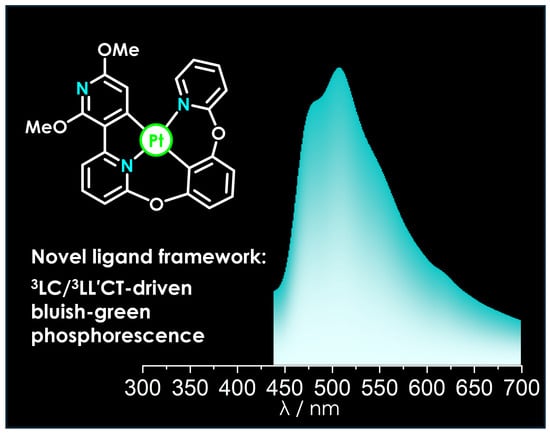
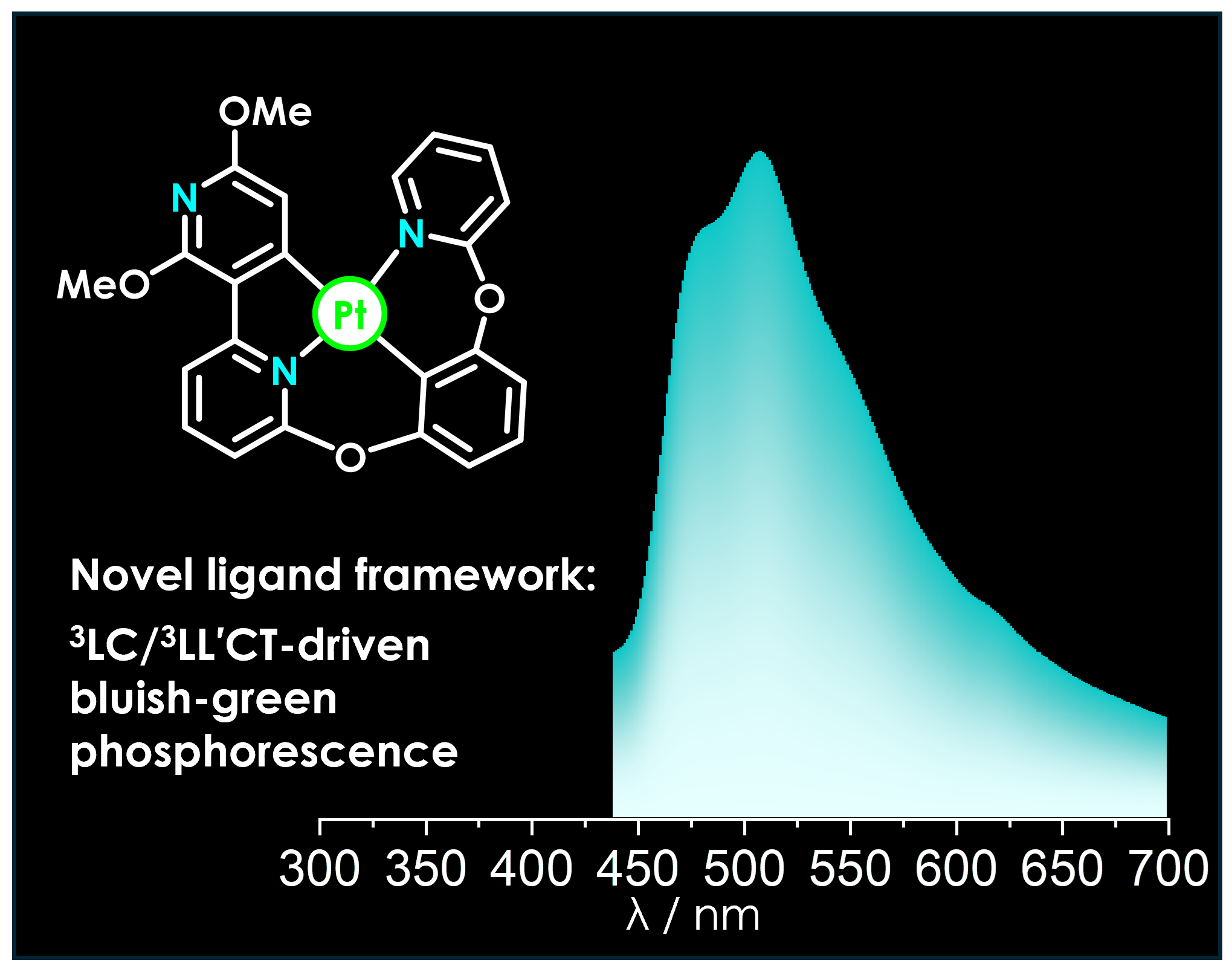
Although various phosphorescent organic light-emitting diodes (PhOLEDs) have been developed, their lifetimes remain shorter than those of fluorescent OLEDs. In this study, a novel Pt(II) complex featuring a tetradentate ligand composed of bipyridine and phenoxypyridine, referred to as LL-O, was synthesized and fully characterized to evaluate its potential as a dopant for PhOLEDs. Geometry-optimized calculations indicate that LL-O adopts a distorted square–planar structure around the Pt(II) center. The complex displays bluish-green emission with maxima at 490 and 518 nm. However, it exhibits a low photoluminescence quantum yield (4%), primarily due to a dominant non-radiative decay rate that surpasses the radiative decay rate. Natural transition orbital analysis reveals that the emission of LL-O originates from a combination of triplet ligand-centered (3LC), triplet ligand-to-ligand charge-transfer (3LL′CT), and triplet metal-to-ligand charge-transfer (3MLCT) transitions. This compound also demonstrates high thermal stability (decomposition temperature > 340 °C) and an appropriate HOMO energy level (−5.58 eV), making it suitable for use as a dopant in versatile PhOLEDs.

Graphical Abstract

1. Introduction

To fabricate organic light-emitting diodes (OLEDs) with low power consumption and high efficiency, it is essential to develop blue phosphorescent materials [1,2,3,4,5]. Numerous studies have investigated ways to improve the efficiency of OLEDs. These efforts have resulted in the development of phosphorescent materials with superior performance to that of their fluorescent counterparts [6,7,8,9,10,11]. However, fluorescent materials are still preferred over phosphorescent materials for blue emission in commercial applications due to the relatively short lifetimes of the latter [12,13,14,15]. Phosphorescence relies on intersystem crossing (ISC), wherein singlet excitons are converted into triplet excitons. To enhance the efficiency of ISC, the heavy atom effect is utilized by incorporating heavy atoms into the molecular structure. Ir and Pt are widely employed as heavy metals in emissive materials [16,17,18]. While Ir(III) complexes show excellent efficiency, they typically possess broad emission spectra [19,20]. In contrast, Pt(II) complexes not only exhibit high efficiency but also have narrow emission bandwidths, resulting in improved color purity for blue phosphorescent dopants. Therefore, Pt(II) complexes are considered more suitable for application in organic display devices [21,22].
Selection of ligands is critical for the development of blue phosphorescent Pt materials. This is because electronic transitions in Pt-based phosphorescent complexes are known to primarily arise from the local excitation (LE) of the ligand along with metal-to-ligand charge transfer (MLCT) transitions [21]. Therefore, while designing ligands, careful consideration must be given to selecting ligands that either possess high triplet energy levels or are capable of generating a strong ligand field upon coordination with Pt. Tetradentate ligand architectures are particularly attractive for blue phosphorescent Pt(II) complexes, as they provide enhanced kinetic and thermal stability by suppressing ligand dissociation and structural rearrangement. The rigid coordination framework also restricts large-amplitude excited-state structural relaxation, which is a key factor in mitigating non-radiative decay processes in high-energy blue emitters. Moreover, tetradentate chelation enables more precise control over the balance between ligand-centered and charge-transfer excited states, allowing for fine tuning of emission energy and photophysical properties. With these considerations in mind, many studies have reported novel tetradentate ligands based on various combinations of high-triplet-energy moieties such as pyrazole [23,24,25,26], carbazole [27,28,29], triazole [30,31,32,33], carbene [34,35,36,37,38], and bipyridine [39,40]. The ligand that particularly drew our attention was phenoxypyridine. This ligand demonstrates near-unity quantum efficiency when coordinated with Pt and exhibits phosphorescence in the blue region [41]. However, despite these promising properties, it has not yet been extensively studied [42].
Our research group has been continuously studying bipyridine-based ligands, which show high triplet energy and high quantum efficiency when coordinated with Pt [43] or Ir [44]. Hence, we hypothesize that the development of a tetradentate ligand combining bipyridine and phenoxypyridine would afford promising Pt complexes as potential candidates for blue phosphorescent emitters. In this study, structural characteristics were analyzed by 1H and 13C NMR spectroscopy, photophysical properties by UV-Vis absorption and photoluminescence (PL) spectroscopy, electrochemical behavior by cyclic voltammetry (CV), and thermal stability by thermogravimetric analysis (TGA) in order to evaluate the potential of a new compound as an OLED triplet emitter.

2. Results and Discussion

2.1. Synthesis and Characterization of the Pt(II) Complex

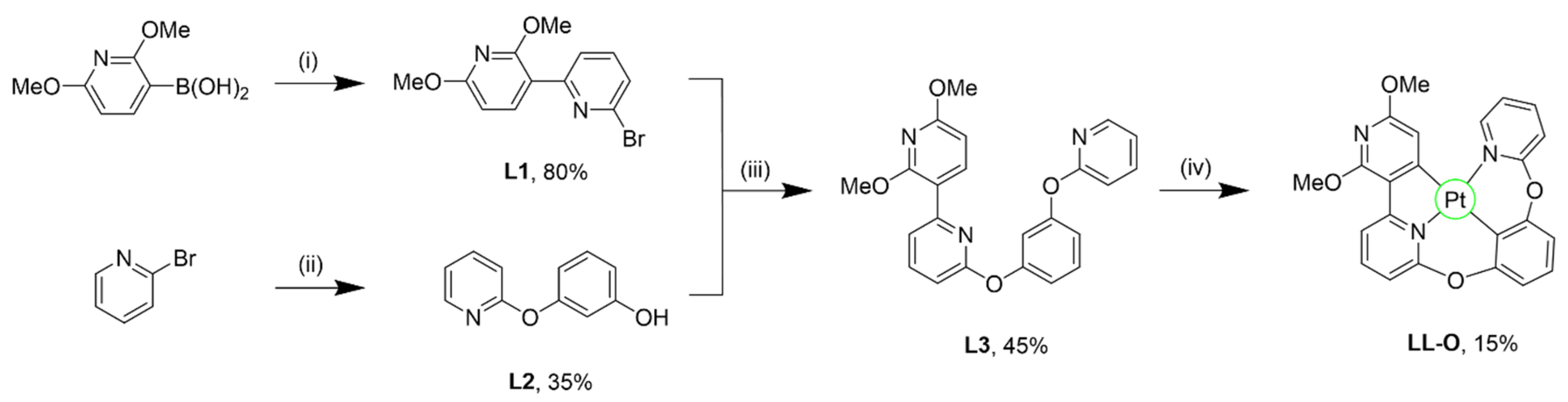
To synthesize complex LL-O (Scheme 1), the bipyridine derivative L1 was first prepared using a Suzuki coupling reaction. Subsequently, the phenoxypyridine derivative L2 was synthesized via an Ullmann coupling process. The coupling of L1 and L2 under similar Ullmann conditions afforded the tetradentate ligand L3 (45% yield), thereby completing the ligand framework. Finally, L3 was treated with 1 equiv. of bis(benzonitrile)dichloroplatinum(II) to produce a square–planar Pt(II) complex LL-O, featuring a tetradentate coordination environment, in 15% yield. Overall, this synthetic route demonstrates the successful construction of a robust tetradentate coordination system through sequential cross-coupling reactions, followed by complexation with a Pt(II) precursor. The moderate ligand yield and relatively lower metalation yield suggest steric and electronic influences arising from the phenoxy and bipyridyl moieties, which may affect the coordination efficiency during complex formation.
The Pt(II) complex was thoroughly characterized using 1H and 13C NMR spectroscopy (Figures S1–S3). In the 1H NMR spectrum, a distinct singlet was observed at 3.9–4.1 ppm, corresponding to the methoxy protons. Although partially overlapped with the dichloromethane-d2 solvent peak, the 13C NMR spectrum exhibits a characteristic resonance near 53 ppm, further confirming the presence of two methoxy groups in the complex (Figure S3).
In addition, high-resolution mass spectrometry (HRMS) analysis shows a molecular ion peak that is in excellent agreement with the calculated molecular mass of LL-O (Figure S4), providing further confirmation of the successful formation of the target Pt(II) complex. Elemental analysis (C, H, N) also closely matches the theoretical values, supporting the high purity and correct molecular composition of the synthesized compound.
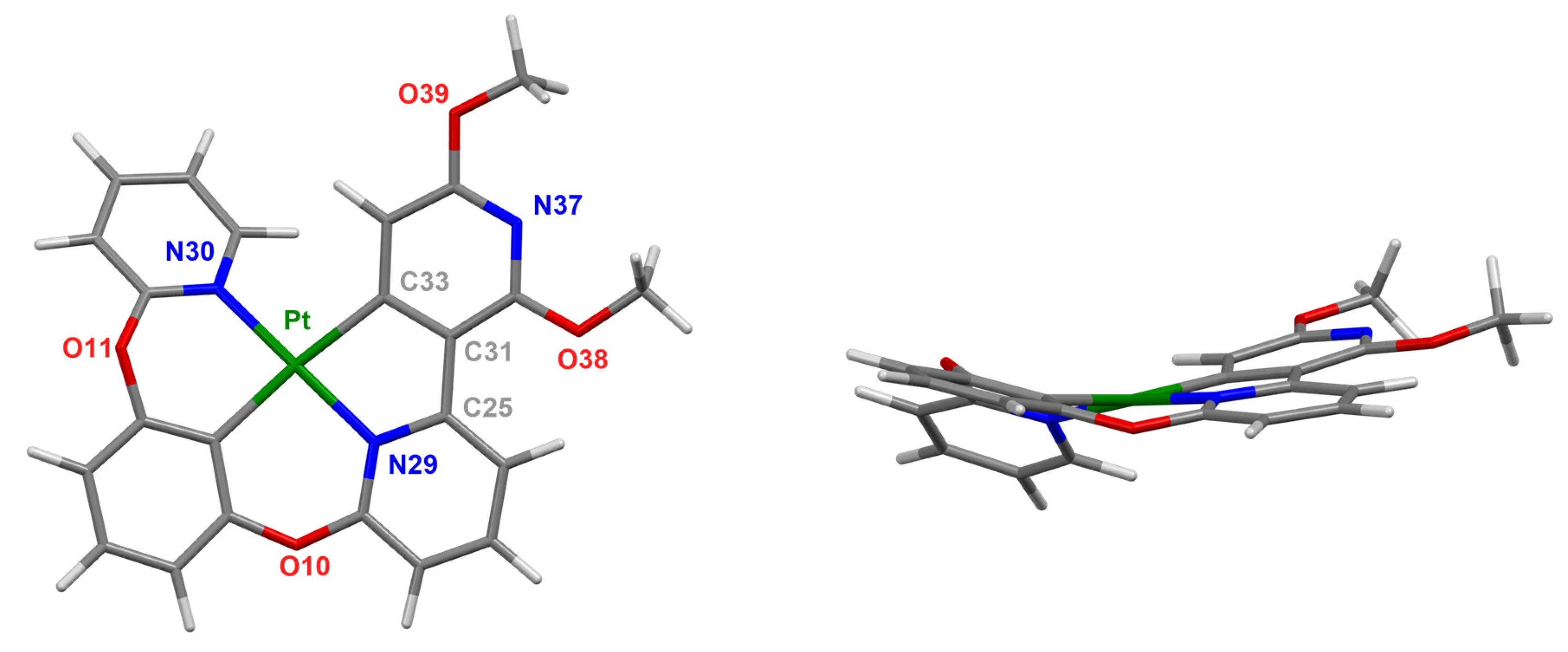
Furthermore, the ground-state (S0) geometry of the LL-O complex was optimized using density functional theory (DFT) calculations (Figure 1). The optimized structure revealed a pronounced distortion of the terminal pyridine ring in the coordinated ligand around the central Pt(II) atom (Figure 1, side view). This distortion is attributed to torsional strain and an asymmetric coordination environment within the ligand framework, which perturb the ideal square–planar geometry of the complex. The sum of the bond angles around the Pt(II) center was calculated to be 361.39°, which is close to an ideal square–planar geometry. While this value alone does not quantitatively describe out-of-plane distortion, the side-view molecular structure reveals a subtle but distinct nonplanarity of the ligand framework. In particular, the C33–C31–C25–N29 torsional angle was calculated to be approximately 5°, indicating a slight twisting of the pyridine-based ligand coordinating the Pt(II) center. These findings suggest that the rigid tetradentate coordination framework restricts intramolecular degrees of freedom, thereby suppressing structural fluctuation and vibrational motion of the Pt(II) core. At the same time, the nonplanar molecular geometry hinders efficient intermolecular packing, which in turn weakens intermolecular interactions and suppresses excimer emission in the solid state.

2.2. Photophysical Properties of the LL-O Complex

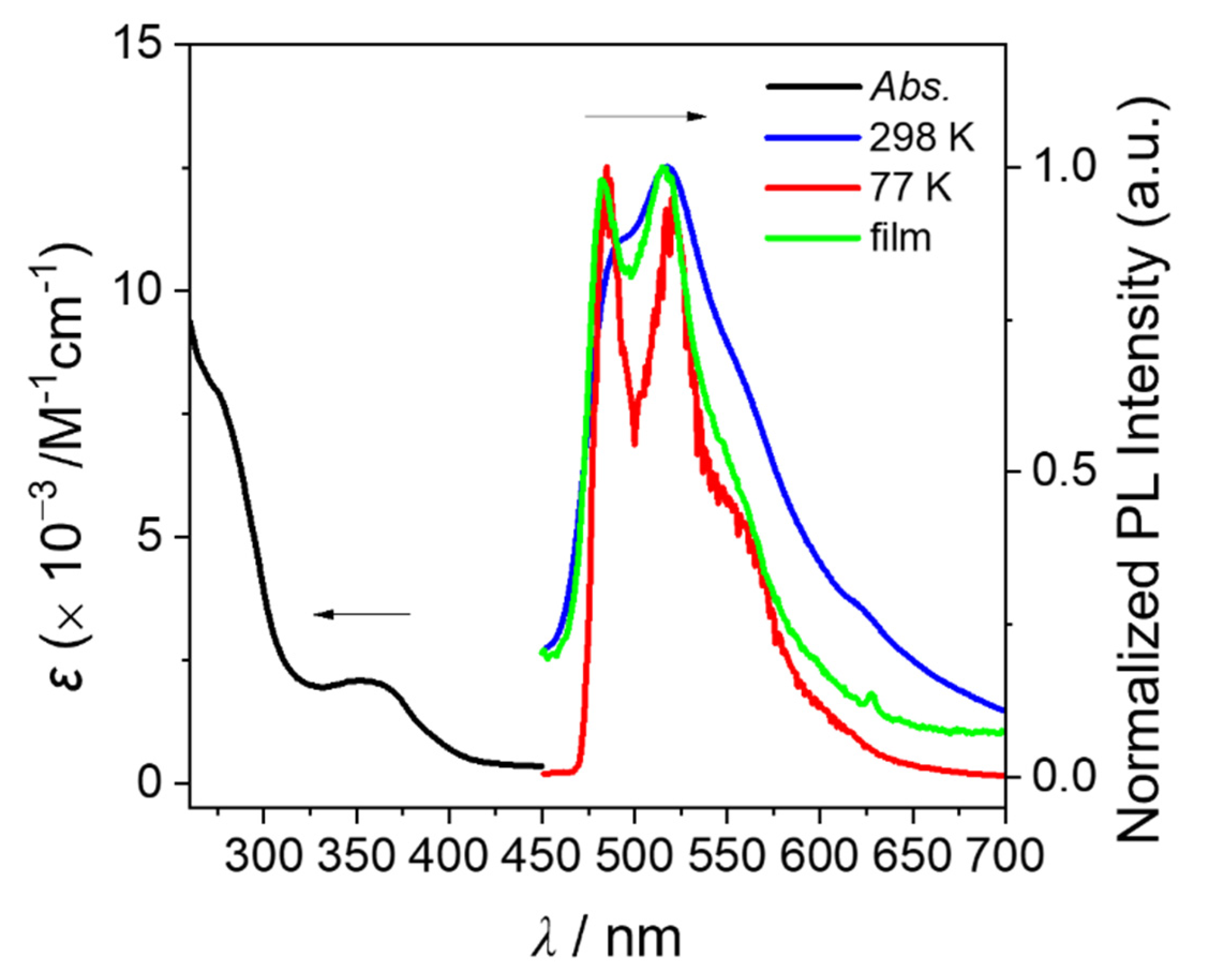
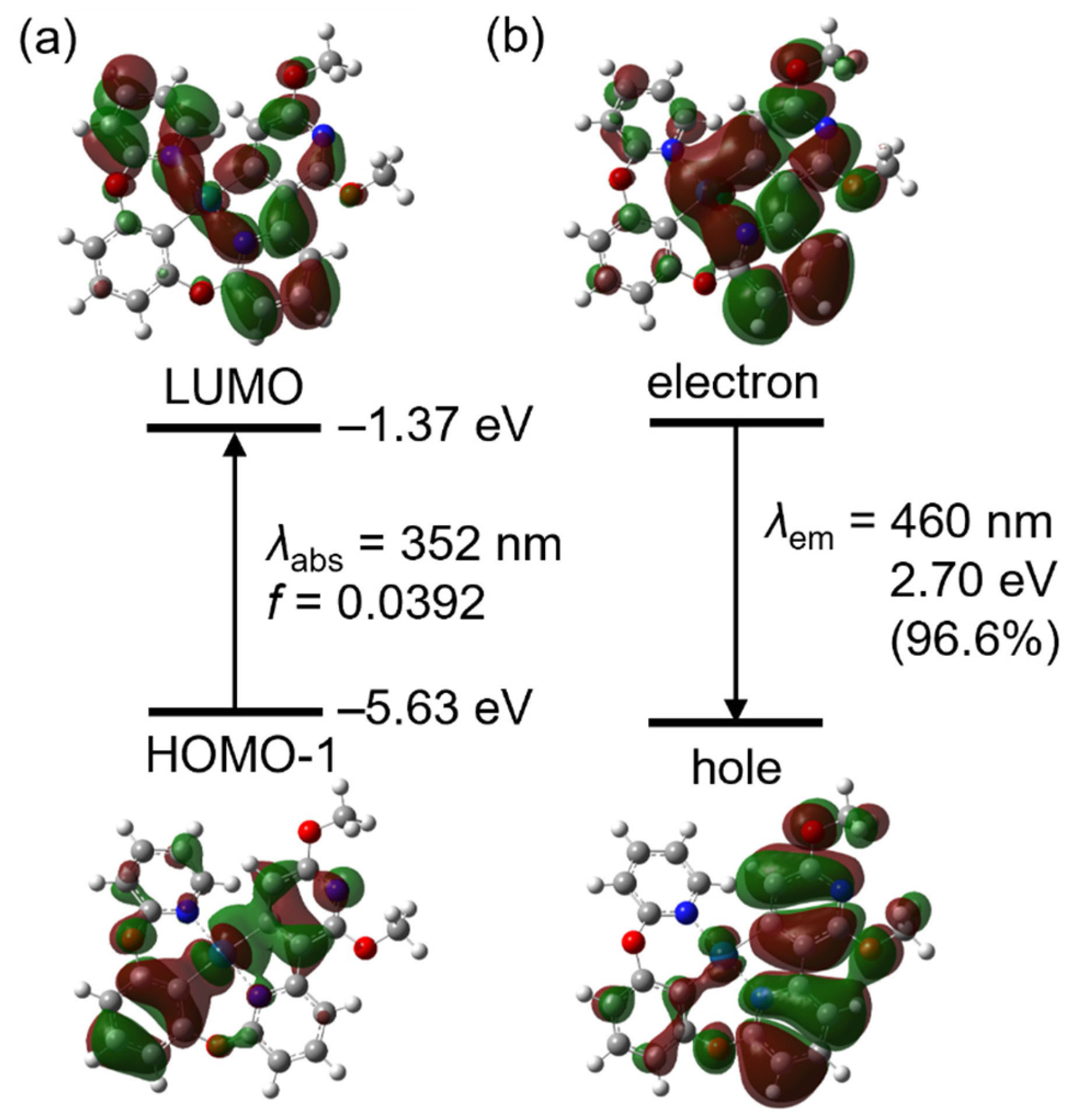
The optical properties of LL-O were examined by ultraviolet–visible (UV–vis) absorption and PL measurements in degassed dichloromethane solution (Figure 2 and Table 1). A strong low-energy absorption band was observed around 350 nm (ε ≈ 21,000 M−1·cm−1), which is primarily attributed to 1MLCT (metal-to-ligand charge transfer) and 1LL′CT (ligand-to-ligand charge transfer) transitions. To gain deeper insights into the origin of these absorptive transitions, time-dependent density functional theory (TD-DFT) calculations were performed based on the S0-optimized geometry of the complex (Figure 3). The computational analysis revealed that the main electronic excitations arise from transitions between the highest occupied molecular orbitals (HOMO) and HOMO-1 and the lowest unoccupied molecular orbital (LUMO), confirming that the observed absorption band predominantly originates from the charge-transfer (CT) character within the complex.
Notably, the electron density distributions of the HOMO and HOMO-1 orbitals were mainly localized over the methoxy–pyridine and phenyl segments (64% and 37%, respectively), with an additional contribution from the Pt(II) center (~34%). In contrast, the LUMO was predominantly confined to the terminal pyridine moiety (~69%), while the contribution from the metal center was minimal (~4%). These results suggest that low-energy electronic transitions of the Pt(II) complex primarily originate from 1MLCT (metal-to-ligand charge transfer) and 1LL′CT (ligand-to-ligand charge transfer) characteristics. These results are consistent with those reported previously for the Pt[N^C-O-popy] compound [41].
The LL-O complex exhibited bluish-green phosphorescence in degassed dichloromethane solution at 298 K, with well-defined emission maxima at 490 and 518 nm (Figure 2). The emission spectrum displayed a well-structured profile, characteristic of CT-dominated phosphorescence. This complex exhibited emission behavior similar to that of PtpypyOczpy, previously reported by our group [45], which can be ascribed to the comparable T1 energy levels of the pyridyl–carbazole and phenoxypyridine frameworks. The structural resemblance between these two ligand systems results in analogous photophysical characteristics, reflecting their similar triplet-state energetics.
To gain further insights into the emissive transitions of the complex, natural transition orbital (NTO) calculations were performed for the lowest-energy triplet state (T1) based on the ground-state (S0) optimized geometry. As shown in Figure 3b, both electron and hole densities were primarily localized on the methoxy–pyridine moiety and the adjacent pyridine unit, with partial delocalization of the electron density extending toward the terminal pyridine fragment and the Pt(II) center. These results suggest that the emission of LL-O originates from a combination of 3LC, 3LL′CT, and 3MLCT, among which the 3LC and 3LL′CT components make the maximum contribution to the overall phosphorescent process.
The PL spectra of LL-O were measured in degassed dichloromethane solution at 77 K and in a PMMA matrix (5 wt.%) to investigate its emission behavior under rigid conditions (Table 1). Compared with the spectrum obtained in the room-temperature solution, it exhibited a distinctly blue-shifted emission under both the aforementioned rigid environments. This shift toward shorter wavelengths can be attributed to the suppression of molecular motions in the solid or frozen states, which limits structural relaxation in the triplet excited state and consequently hinders the stabilization of the low-energy emissive state, leading to higher-energy emission.
In the PMMA matrix (5 wt.%), the absolute PL quantum yield (Φem) of LL-O was measured to be 4%, indicating a relatively low emissive efficiency (Table 1). The observed emission lifetime (τobs) was 9.06 μs (Table 1 and Figure S6), which confirmed the presence of slow phosphorescent radiative decay. Based on the Φem and τobs values, the radiative (kr) and non-radiative (knr) decay rate constants were calculated to be 4.42 × 10³ s−1 and 1.06 × 10⁵ s−1, respectively, indicating that the non-radiative decay rate overwhelmingly dominates over the radiative process. The relatively long observed phosphorescence lifetime of LL-O therefore reflects a small radiative decay rate in the presence of a highly efficient non-radiative deactivation pathway, which accounts for its low photoluminescence efficiency.
The electrochemical properties of LL-O were investigated by CV to determine the energy levels of the complex. The HOMO and LUMO energy levels, estimated from the onset oxidation and reduction potentials, were calculated to be −5.58 and −2.54 eV, respectively (Table 1 and Figure S5). Thermal stability was further examined by TGA (Table 1 and Figure S7). The temperature corresponding to a 5% weight loss (Td5) was recorded as 340 °C, which confirmed that LL-O exhibits excellent thermal stability consistent with the inherent robustness of tetradentate Pt(II) complexes.

3. Materials and Methods

3.1. General Considerations

All operations were performed under an inert nitrogen atmosphere using standard Schlenk and glove box techniques. Anhydrous grade solvents (tetrahydrofuran (THF), toluene, dimethyl sulfoxide (DMSO), and p-xylene) were dried by passing them through an activated alumina column and storing over activated molecular sieves (5 Å). Spectrophotometric-grade solvent (dichloromethane) was used as received from Alfa Aesar (Haverhill, MA, USA). All commercial reagents were purchased from Sigma-Aldrich (St. Louis, MO, USA) or Alfa Aesar and used as received. Deuterated solvents (chloroform-d (CDCl3) and methylene chloride-d2 (CD2Cl2)) were obtained from Cambridge Isotope Laboratories and used after drying over activated molecular sieves (5 Å). NMR spectra were recorded on a JEOL 400 MHz spectrometer (JEOL Ltd., Tokyo, Japan) (400.13 MHz for 1H and 100.62 MHz for 13C). Chemical shifts were indicated in ppm. High-resolution mass spectrometry (HRMS) measurements were performed using a JMS-T2000GC mass spectrometer (JEOL Ltd., Tokyo, Japan). Elemental analyses (C, H, N) were carried out using an EA3000 elemental analyzer (Eurovector S.p.A., Pavia, Italy). TGA was performed under a N2 atmosphere using TA Instrument Thermogravimetric Analyzer Q500 (TA Instruments, New Castle, DE, USA) at a heating rate of 10 °C·min−1 from 25 to 800 °C. CV measurements were performed on a PGSTAT12 system (Metrohm Autolab B.V., Utrecht, Netherlands) using a three-electrode cell, with Pt working and counter electrodes and a reference electrode comprising 0.1 M Ag/AgNO3 in acetonitrile at 25 °C (supporting electrolyte: 0.1 M solution of tetrabutylammonium hexafluorophosphate in dichloromethane). The oxidation and reduction potentials of LL-O were recorded at a scan rate of 100 mV s−1 and were reported with reference to the ferrocene/ferrocenium (Fc/Fc+) redox couple.

3.2. Synthesis of 6-Bromo-2′,6′-dimethoxy-2,3′-bipyridine, L1

Compound L1 was prepared according to a literature reported procedure [45].

3.3. Synthesis of 3-(Pyridin-2-yloxy)phenol, L2

To prepare L2, a dry pressure vessel was first charged with 2-bromopyridine (3.17 mL, 33.30 mmol), resorcinol (5.50 g, 49.96 mmol), 1-methylimidazole (1.33 mL, 16.69 mmol), K2CO3 (9.21 g, 66.64 mmol), pyridine (20 mL), and toluene (20 mL). The mixture was degassed for 10 min, after which CuI (0.63 g, 3.31 mmol) was added, followed by an additional 10 min of degassing. The vessel was then sealed and heated at 120 °C for more than 2 days. After cooling to room temperature, the reaction mixture was filtered through a glass frit, and the filtrate was collected using toluene as the transfer solvent. (If solid residues remained, they were rinsed sequentially with toluene, 3% aqueous acetic acid, and EtOH, and combined with the filtrate.) The combined organic layers were dried over anhydrous MgSO4, filtered, and concentrated under reduced pressure. The crude material was recrystallized from toluene to afford the product as a dark gray solid in 35% yield. 1H NMR (400 MHz, chloroform-d) δ 8.21 (dd, J = 5.0, 2.0 Hz, 1H), 7.72–7.67 (m, 1H), 7.23 (d, J = 8.1 Hz, 1H), 7.01 (dd, J = 7.3, 4.9 Hz, 1H), 6.94–6.90 (m, 1H), 6.72–6.63 (m, 2H), 6.61 (t, J = 2.4 Hz, 1H), 5.58 (s, 1H).

3.4. Synthesis of 2′,6′-Dimethoxy-6-(3-(pyridin-2-yloxy)phenoxy)-2,3′-bipyridine, L3

To obtain L3, a Schlenk flask was first charged with L1 (1.434 g, 4.61 mmol), L2 (0.718 g, 3.84 mmol), CuI (0.073 g, 0.384 mmol), picolinic acid (0.094 g, 0.768 mmol), and K3PO4 (1.63 g, 7.68 mmol), and then evacuated under vacuum. Next, DMSO (15 mL) was added to the flask, and the mixture was heated and stirred at 95–105 °C for 3 days under a nitrogen atmosphere. After cooling to room temperature, the reaction mixture was diluted with ethyl acetate (EA) and filtered through Celite on a glass frit. The filtrate was extracted with EA and distilled water. The combined organic layers were dried over anhydrous Na2SO4, filtered, and concentrated under reduced pressure. The crude material was purified by silica gel column chromatography using EA and hexane in a ratio of 1:5 as the eluent. The product was obtained as a white solid in 45% yield. 1H NMR (400 MHz, chloroform-d) δ 8.26–8.18 (m, 2H), 7.81 (d, J = 7.8 Hz, 1H), 7.71–7.62 (m, 2H), 7.39 (t, J = 8.1 Hz, 1H), 7.05–6.96 (m, 4H), 6.93–6.87 (m, 1H), 6.76 (dd, J = 8.0, 0.9 Hz, 1H), 6.35 (d, J = 8.3 Hz, 1H), 4.04 (s, 3H), 3.95 (s, 3H).

3.5. Synthesis of LL-O

A Schlenk flask was charged with L3 (0.50 g, 0.841 mmol), bis(benzonitrile)dichloroplatinum(II) (0.40 g, 0.847 mmol), and p-xylene (5 mL). The reaction mixture was heated and stirred at 110 °C for 1 day under a nitrogen atmosphere. After cooling to room temperature, the mixture was washed with dichloromethane and concentrated under reduced pressure. The crude product was purified by silica gel column chromatography using dichloromethane as the eluent, affording the product as a yellow solid in 15% yield. 1H NMR (400 MHz, methylene chloride-d2) δ 9.09 (dd, J = 6.1, 1.8 Hz, 1H), 8.30 (dd, J = 8.0, 1.3 Hz, 1H), 7.96 (ddd, J = 8.6, 7.1, 1.8 Hz, 1H), 7.88 (td, J = 8.0, 1.2 Hz, 1H), 7.34 (dd, J = 8.4, 1.5 Hz, 1H), 7.17–7.13 (m, 2H), 7.10–7.01 (m, 3H), 6.45 (d, J = 1.2 Hz, 1H), 4.09 (s, 3H), 3.93 (s, 3H). 13C NMR (101 MHz, methylene chloride-d2) δ 188.16, 166.34, 162.94, 159.95, 159.55, 156.90, 155.03, 154.46, 153.08, 140.81, 140.19, 126.00, 122.94, 120.53, 116.50, 116.21, 111.97, 110.88, 110.34, 106.53, 54.32, 53.49. Anal. calcd for C23H17N3O4Pt: C 46.47, H 2.88, N 7.07; found C 46.43, H 2.85, N 7.10.

3.6. UV/Vis Absorption and PL Measurements

Agilent VARIAN Cary 100 Conc UV–vis spectrophotometer (Agilent Technologies, Santa Clara, CA, USA) and HORIBA Fluoromax-4P luminescence spectrophotometer (HORIBA Scientific, Kyoto, Japan) were used to obtain UV-vis absorption and PL spectra, respectively. The UV-vis absorption data of the solution were measured using degassed dichloromethane in a 1 cm quartz cuvette (1.0 × 10⁻⁴ M). PL measurements were collected using degassed dichloromethane (1.0 × 10⁻⁴ M) at ambient conditions and 77 K. PL data in the film state (5 wt.% doped in PMMA) was also collected on a 10 × 10 mm quartz plate (thickness = 1 mm). The absolute PLQYs of the film were measured at 298 K using a Quantaurus-QY Absolute PL Quantum Yield Spectrometer (C11347, Hamamatsu Photonics K.K., Hamamatsu, Japan). Phosphorescence decay lifetimes in the film were measured at 298 K using an FS5 spectrometer (Edinburgh Instruments Ltd., Livingston, UK) equipped with an EPLED picosecond pulsed LED source (375 nm) coupled with multi-channel scaling (MCS). Lifetimes were analyzed by double-exponential tail-fitting.

3.7. Theoretical Calculations

The geometries of the Pt(II) complex in their S0 state were fully optimized at the PBE0 level. TD-DFT [46] was used to investigate electronic transition energies. Solvent effects were evaluated using a self-consistent reaction field method based on the integral equation formalism of the polarizable continuum model with dichloromethane as the solvent [47]. The LANL2DZ and 6-31G(d,p) basis sets were used for the Pt atom and nonmetal atoms, respectively. The origin of excited singlet and triplet states, including the vertical excitation orbitals and NTOs, were calculated using TD-DFT at the same level. All calculations were conducted using GAUSSIAN 16 software [48]. The percentage contribution of a group in a molecule to each molecular orbital was calculated using the GaussSum 3.0 program [49], and visualizations were performed using GaussView 6 [50].

4. Conclusions

In summary, a new tetradentate Pt(II) complex, LL-O, integrating bipyridine and phenoxy–pyridine moieties, was successfully synthesized and fully characterized. The complex exhibits bluish-green phosphorescence with well-structured emission bands at 490 and 518 nm in solution. Electronic-structure and natural transition orbital analyses revealed that the emission originates from mixed 3LC, 3LL′CT, and 3MLCT transitions, with the 3LC component being the most dominant contributor to the emissive state. The relatively long phosphorescence lifetime (τobs = 9.06 μs) and low photoluminescence quantum yield (Φem = 4%) indicate that non-radiative decay pathways are more prevalent than radiative ones. Electrochemical and thermal studies further demonstrated that LL-O possesses appropriate frontier orbital energy levels (HOMO: −5.58 eV, LUMO: −2.54 eV) and excellent thermal stability (Td5 = 340 °C), consistent with the inherent robustness of tetradentate Pt(II) frameworks. Overall, this study highlights that combining bipyridine and phenoxy–pyridine units provide a chemically stable coordination environment capable of sustaining mixed charge-transfer and ligand-centered transitions. Future work will focus on tuning the ligand field and modifying substituents to suppress non-radiative deactivation and enhance the photophysical efficiency of Pt(II) complexes.

Supplementary Materials

The following supporting information can be downloaded at: https://www.mdpi.com/article/10.3390/molecules31020373/s1, Figure S1: 1H NMR spectra of L2 in CDCl3 (* from residual CHCl3 in CDCl3); Figure S2: 1H NMR spectra of L3 in CDCl3 (* from residual CHCl3 in CDCl3); Figure S3: 1H (top) and 13C (bottom) NMR spectra of LL-O in CD2Cl2 (* from residual CH2Cl2 in CD2Cl2); Figure S4: High-resolution mass spectrum (HRMS) of LL-O; Figure S5: Consecutive cyclic voltammogram (CV) curves for LL-O showing (a) reduction and (b) oxidation (5 cycles, 0.5 mM in dichloromethane, scan rate = 100 mV/s); Figure S6: Emission decay curve obtained at each emission maximum for LL-O in the PMMA film states. The red-line corresponds to the double-exponential fitting curve for the experimental curve; Figure S7: Thermogravimetric analysis curves of LL-O; Figure S8: The selected frontier orbitals of LL-O from PBE0 calculations (Isovalue = 0.02 a.u.) at the ground state (S0) optimized geometries in dichloromethane; Table S1: Computed absorption wavelengths (λcalc) and oscillator strengths (fcalc.) for LL-O in its ground state (S0) optimized geometry in dichloromethane. The calculations were performed using the TD-PBE0 /GENCP method; Table S2: Molecular orbital energies (E, eV) and molecular orbital distributions (%) of LL-O for the ground-state (S0) optimized geometry in dichloromethane; Table S3: Cartesian coordinates of the ground state (S0) fully optimized geometry of LL-O from PBE0 calculations in dichloromethane (in Å).

Author Contributions

Conceptualization, D.-G.L. and Y.K.; methodology, J.-H.L. and Y.K.; software, C.H.R.; formal analysis, D.-G.L., J.-H.L. and C.H.R.; data curation, C.H.R.; writing—original draft preparation, C.H.R. and Y.K.; writing—review and editing, K.M.L. and Y.K.; supervision, K.M.L. and Y.K.; project administration, Y.K.; funding acquisition, C.H.R., K.M.L. and Y.K. All authors have read and agreed to the published version of the manuscript.

Funding

This research was supported by the National Research Foundation of Korea (NRF) grant funded by the Korea government (MSIT) (2022R1F1A1063758); the Technology Innovation Program (20018956, Development of a phosphorescent OLED with high efficiency and long lifetime) funded by the Ministry of Trade, Industry and Energy (MOTIE, Republic of Korea); and the Basic Science Research Program through the National Research Foundation of Korea (NRF) grant (RS-2024-00452815 and RS-2024-00460144) funded by Ministry of Education.

Institutional Review Board Statement

Not applicable.

Informed Consent Statement

Not applicable.

Data Availability Statement

Data generated or analyzed during this study are provided in full within the published article and its Supplementary Materials.

Conflicts of Interest

The authors declare no conflicts of interest.

References

  1. Yersin, H. Triplet Emitters for OLED Applications: Mechanisms of Exciton Trapping and Control of Emission Properties. Top. Curr. Chem. 2004, 241, 1–26. [Google Scholar] [CrossRef]
  2. Reineke, S.; Lindner, F.; Schwartz, G.; Seidler, N.; Walzer, K.; Lüssem, B.; Leo, K. White Organic Light-Emitting Diodes with Fluorescent Tube Efficiency. Nature 2009, 459, 234–238. [Google Scholar] [CrossRef] [PubMed]
  3. Chi, Y.; Chou, P.T. Transition-Metal Phosphors with Cyclometalating Ligands: Fundamentals and Applications. Chem. Soc. Rev. 2010, 39, 638–655. [Google Scholar] [CrossRef] [PubMed]
  4. Zhang, Q.; Li, B.; Huang, S.; Nomura, H.; Tanaka, H.; Adachi, C. Efficient Blue Organic Light-Emitting Diodes Employing Thermally Activated Delayed Fluorescence. Nat. Photonics 2014, 8, 326–332. [Google Scholar] [CrossRef]
  5. Baldo, M.A.; O’Brien, D.F.; You, Y.; Shoustikov, A.; Sibley, S.; Thompson, M.E.; Forrest, S.R. Highly Efficient Phosphorescent Emission from Organic Electroluminescent Devices. Nature 1998, 395, 151–154. [Google Scholar] [CrossRef]
  6. Baldo, M.A.; Thompson, M.E.; Forrest, S.R. High-Efficiency Fluorescent Organic Light-Emitting Devices Using a Phosphorescent Sensitizer. Nature 2000, 403, 750–753. [Google Scholar] [CrossRef]
  7. Forrest, S.R. The Path to Ubiquitous and Low-Cost Organic Electronic Appliances on Plastic. Nature 2004, 428, 911–918. [Google Scholar] [CrossRef]
  8. Yersin, H. Highly Efficient OLEDs with Phosphorescent Materials; John Wiley & Sons: Hoboken, NJ, USA, 2008. [Google Scholar] [CrossRef]
  9. Kawamura, Y.; Goushi, K.; Brooks, J.; Brown, J.J.; Sasabe, H.; Adachi, C. 100% Phosphorescence Quantum Efficiency of Ir(III) Complexes in Organic Semiconductor Films. Appl. Phys. Lett. 2005, 86, 071104. [Google Scholar] [CrossRef]
  10. Reineke, S.; Baldo, M.A. Recent Progress in the Understanding of Exciton Dynamics within Phosphorescent OLEDs. Phys. Status Solidi A 2012, 209, 2341–2353. [Google Scholar] [CrossRef]
  11. Tankelevičiūtė, E.; Samuel, I.D.W.; Zysman-Colman, E. The Blue Problem: OLED Stability and Degradation Mechanisms. J. Phys. Chem. Lett. 2024, 15, 1034–1047. [Google Scholar] [CrossRef]
  12. Gather, M.C.; Köhnen, A.; Meerholz, K. White Organic Light-Emitting Diodes. Adv. Mater. 2011, 23, 233–248. [Google Scholar] [CrossRef] [PubMed]
  13. Adachi, C. Third-Generation Organic Electroluminescence Materials. Jpn. J. Appl. Phys. 2014, 53, 060101. [Google Scholar] [CrossRef]
  14. Kondakov, D.Y. Characterization of Triplet–Triplet Annihilation in Organic Light-Emitting Diodes Based on Anthracene Derivatives. J. Appl. Phys. 2007, 102, 114504. [Google Scholar] [CrossRef]
  15. Endo, A.; Sato, K.; Yoshimura, K.; Kai, T.; Kawada, A.; Miyazaki, H.; Adachi, C. Efficient Up-Conversion of Triplet Excitons into a Singlet State and Its Application for Organic Light-Emitting Diodes. Appl. Phys. Lett. 2011, 98, 083302. [Google Scholar] [CrossRef]
  16. Phan, S.N.T.; Nguyen, N.B.; Teets, T.S. Recent advances in using strong-field ancillary ligands to support blue-emitting iridium(III) and platinum(II) complexes. Chem. Commun. 2025, 61, 17544–17558. [Google Scholar] [CrossRef]
  17. Kawamura, Y.; Brooks, J.; Brown, J.J.; Sasabe, H.; Adachi, C. Intermolecular Interaction and a Concentration Quenching Mechanism of Phosphorescent Ir(III) Complexes in a Solid Film. Phys. Rev. Lett. 2006, 96, 017404. [Google Scholar] [CrossRef]
  18. Turro, N.J.; Ramamurthy, V.; Scaiano, J.C. Principles of Molecular Photochemistry: An Introduction; University Science Books: Sausalito, CA, USA, 2009. [Google Scholar]
  19. Yan, Z.-P.; Mao, M.-X.; Liu, Q.-M.; Yuan, L.; Luo, X.-F.; Liao, X.-J.; Cai, W.; Zheng, Y.-X. Rigidity-Enhanced Narrowband Iridium(III) Complexes with Finely Optimized Emission Spectra for Efficient Pure-Red Electroluminescence. Adv. Funct. Mater. 2024, 34, 2402906. [Google Scholar] [CrossRef]
  20. Brulatti, P.; Gildea, R.J.; Howard, J.A.K.; Fattori, V.; Cocchi, M.; Williams, J.A.G. Luminescent Iridium (III) Complexes with NCN-Coordinated Terdentate Ligands: Dual Tuning of the Emission Energy and Application to Organic Light-Emitting Devices. Inorg. Chem. 2012, 51, 3813–3826. [Google Scholar] [CrossRef]
  21. You, Y. Pt(II) Complexes with Tetradentate Ligands: Toward Commercially Applicable Blue Organic Electroluminescence Devices. Coord. Chem. Rev. 2025, 526, 216374. [Google Scholar] [CrossRef]
  22. Li, G.; Ameri, L.; Dorame, B.; Zhu, Z.-Q.; Li, J. Improved Operational Stability of Blue Phosphorescent OLEDs by Functionalizing Phenyl-Carbene Groups of Tetradentate Pt (II) Complexes. Adv. Funct. Mater. 2024, 34, 2405066. [Google Scholar] [CrossRef]
  23. Hang, X.-C.; Fleetham, T.; Turner, E.; Brooks, J.; Li, J. Highly Efficient Blue-Emitting Cyclometalated Platinum(II) Complexes by Judicious Molecular Design. Angew. Chem. Int. Ed. 2013, 52, 6753–6756. [Google Scholar] [CrossRef]
  24. Wu, J.; Ameri, L.; Cao, L.; Li, J. Efficient Excimer-Based White OLEDs with Reduced Efficiency Roll-Off. Appl. Phys. Lett. 2021, 118, 073301. [Google Scholar] [CrossRef]
  25. Fleetham, T.; Li, G.; Wen, L.; Li, J. Efficient “Pure” Blue OLEDs Employing Tetradentate Pt Complexes with a Narrow Spectral Bandwidth. Adv. Mater. 2014, 26, 7116–7121. [Google Scholar] [CrossRef]
  26. Li, G.; Ameri, L.; Fleetham, T.; Zhu, Z.-Q.; Li, J. Stable and Efficient Blue and Green Organic Light-Emitting Diodes Employing Tetradentate Pt(II) Complexes. Appl. Phys. Lett. 2020, 117, 253301. [Google Scholar] [CrossRef]
  27. Fleetham, T.B.; Huang, L.; Klimes, K.; Brooks, J.; Li, J. Tetradentate Pt(II) Complexes with Six-Membered Chelate Rings: A New Route for Stable and Efficient Blue Organic Light-Emitting Diodes. Chem. Mater. 2016, 28, 3276–3282. [Google Scholar] [CrossRef]
  28. Fleetham, T.; Golden, J.H.; Idris, M.; Hau, H.-M.; Ravinson, D.S.M.; Djurovich, P.I.; Thompson, M.E. Tuning State Energies for Narrow Blue Emission in Tetradentate Pyridyl–Carbazole Platinum Complexes. Inorg. Chem. 2019, 58, 12348–12357. [Google Scholar] [CrossRef] [PubMed]
  29. Kim, J.-M.; Cheong, K.; Jiang, J.; Jeon, S.O.; Hong, W.P.; Lee, J.Y. Tetradentate Pt Complexes for Organic Light-Emitting Diodes. Trends Chem. 2023, 5, 267–278. [Google Scholar] [CrossRef]
  30. Wang, X.; Wang, S. Phosphorescent Pt(II) Emitters for OLEDs: From Triarylboron-Functionalized Bidentate Complexes to Compounds with Macrocyclic Chelating Ligands. Chem. Rec. 2019, 19, 1693–1709. [Google Scholar] [CrossRef]
  31. Ryu, C.H.; Kim, S.C.; Kim, M.; Yi, S.; Lee, J.Y.; Lee, K.M. Novel Tetradentate Platinum(II) Complexes and Their Use in Blue Phosphorescent Organic Light-Emitting Diodes. Adv. Opt. Mater. 2022, 10, 2201799. [Google Scholar] [CrossRef]
  32. Wang, X.; Peng, T.; Nguyen, C.; Lu, Z.-H.; Wang, N.; Wu, W.; Li, Q.; Wang, S. Highly Efficient Deep-Blue Electrophosphorescent Pt(II) Compounds with Non-Distorted Flat Geometry: Tetradentate versus Macrocyclic Chelate Ligands. Adv. Funct. Mater. 2017, 27, 1604318. [Google Scholar] [CrossRef]
  33. Li, G.; Fleetham, T.; Li, J. Tetradentate Platinum(II) Complexes for Highly Efficient Phosphorescent Emitters and Sky-Blue OLEDs. Chem. Mater. 2019, 32, 537–548. [Google Scholar] [CrossRef]
  34. Li, G.; Fleetham, T.; Li, J. Efficient and Stable White Organic Light-Emitting Diodes Employing a Single Emitter. Adv. Mater. 2014, 26, 2931–2936. [Google Scholar] [CrossRef]
  35. Huh, J.-S.; Sung, M.J.; Kwon, S.-K.; Kim, Y.-H.; Kim, J.-J. Highly Efficient Deep-Blue Phosphorescent OLEDs Based on Tetradentate Pt(II) Complexes Containing Adamantyl Spacer Groups. Adv. Funct. Mater. 2021, 31, 2100967. [Google Scholar] [CrossRef]
  36. Park, H.J.; Jang, J.-H.; Lee, J.-H.; Hwang, D.-H. Highly Efficient Deep-Blue Phosphorescent OLEDs Based on a Trimethylsilyl-Substituted Tetradentate Pt(II) Complex. ACS Appl. Mater. Interfaces 2022, 14, 34901–34908. [Google Scholar] [CrossRef]
  37. Huh, J.-S.; Lee, D.Y.; Park, K.H.; Kwon, S.-K.; Kim, Y.-H.; Kim, J.-J. Control of the Horizontal Dipole Ratio and Emission Color of Deep-Blue Tetradentate Pt(II) Complexes Using Aliphatic Spacer Groups. Chem. Eng. J. 2023, 450, 137836. [Google Scholar] [CrossRef]
  38. Sun, J.; Ahn, H.; Kang, S.; Ko, S.-B.; Song, D.; Um, H.A.; Kim, S.; Lee, Y.; Jeon, P.; Hwang, S.-H.; et al. Exceptionally Stable Blue Phosphorescent Organic Light-Emitting Diodes. Nat. Photonics 2022, 16, 212–218. [Google Scholar] [CrossRef]
  39. Wilde, S.; Ma, D.; Koch, T.; Bakker, A.; Gonzalez-Abradelo, D.; Stegemann, L.; Daniliuc, C.G.; Fuchs, H.; Gao, H.; Doltsinis, N.L.; et al. Toward Tunable Electroluminescent Devices by Correlating Function and Submolecular Structure in 3D Crystals, 2D-Confined Monolayers, and Dimers. ACS Appl. Mater. Interfaces 2018, 10, 22460–22473. [Google Scholar] [CrossRef] [PubMed]
  40. Lee, C.; Zaen, R.; Park, K.-M.; Lee, K.H.; Lee, J.Y.; Kang, Y. Blue Phosphorescent Platinum Complexes Based on Tetradentate Bipyridine Ligands and Their Application to Organic Light-Emitting Diodes (OLEDs). Organometallics 2018, 37, 4639–4647. [Google Scholar] [CrossRef]
  41. Turner, E.; Bakken, N.; Li, J. Cyclometalated Platinum Complexes with Luminescent Quantum Yields Approaching 100%. Inorg. Chem. 2013, 52, 7344–7351. [Google Scholar] [CrossRef]
  42. Zhang, H.-H.; Jing, J.; Xu, G.; Song, Y.-X.; Wu, S.-X.; Chen, X.-H.; Zhang, D.-S.; Zhang, X.-P.; Shi, Z.-F. Circularly polarized luminescence of pinene-modified tetradentate platinum (II) enantiomers containing fused 5/6/6 metallocycles. Heliyon 2022, 8, e11358. [Google Scholar] [CrossRef]
  43. Kang, J.; Zaen, R.; Park, K.-M.; Lee, K.H.; Lee, J.Y.; Kang, Y. Cyclometalated Platinum(II) β-Diketonate Complexes with Extremely High External Quantum Efficiency for White Organic Light-Emitting Diodes. Adv. Opt. Mater. 2021, 9, 2101233. [Google Scholar] [CrossRef]
  44. Kang, J.; Zaen, R.; Lee, J.H.; Hwang, H.; Park, K.-M.; Kim, S.C.; Lee, J.Y.; Kang, Y. Effect of Ancillary Ligand on the Photoluminescent and Electroluminescent Properties of Blue Ir(III) Complexes Bearing a Main Bipyridine Ligand. Chem. Eng. J. 2022, 431, 134249. [Google Scholar] [CrossRef]
  45. Kim, H.; Ryu, C.H.; Hong, M.; Lee, K.M.; Jo, U.; Kang, Y. Blue Phosphorescent Pt(II) Compound Based on Tetradentate Carbazole/2,3′-Bipyridine Ligand and Its Application in Organic Light-Emitting Diodes. Molecules 2024, 29, 2929. [Google Scholar] [CrossRef]
  46. Bauernschmitt, R.; Ahlrichs, R. Treatment of electronic excitations within the adiabatic approximation of time dependent density functional theory. Chem. Phys. Lett. 1996, 256, 454. [Google Scholar] [CrossRef]
  47. Mennucci, B.; Cancès, E.; Tomasi, J. Evaluation of Solvent Effects in Isotropic and Anisotropic Dielectrics and in Ionic Solutions with a Unified Integral Equation Method: Theoretical Bases, Computational Implementation, and Numerical Applications. J. Phys. Chem. B 1997, 101, 10506. [Google Scholar] [CrossRef]
  48. Frisch, M.J.; Trucks, G.W.; Schlegel, H.B.; Scuseria, G.E.; Robb, M.A.; Cheeseman, J.R.; Scalmani, G.; Barone, V.; Petersson, G.A.; Nakatsuji, H.; et al. Gaussian 16 Revision B.01; Gaussian. Inc.: Wallingford, CT, USA, 2016. [Google Scholar]
  49. O’Boyle, N.M.; Tenderholt, A.L.; Langner, K.M. cclib: A library for package-independent computational chemistry algorithms. J. Comput. Chem. 2008, 29, 839. [Google Scholar] [CrossRef]
  50. Dennington, R.; Keith, T.A.; Millam, J.M. GaussView 6; Semichem Inc.: Shawnee, OK, USA, 2016. [Google Scholar]
Scheme 1. Synthesis procedure for the tetradentate-ligand-based Pt(II) complex LL-O. Reagent and conditions: (i) 2,6-dibromopyridine, Pd(PPh3)4, K2CO3, THF/H2O (3/2, v/v), 80 °C, 18 h. (ii) 1,3-benzenediol, 1-methylimidazole, CuI, K2CO3, toluene/pyridine (1/1, v/v), 120 °C, 48 h. (iii) CuI, picolinic acid, K3PO4, DMSO, 110 °C, 72 h. (iv) Bis(benzonitrile)dichloroplatinum(II), p-xylene, 110 °C, 24 h.
Molecules 31 00373 sch001
Figure 1. (left) Top view and (right) side view of ground-state (S0)-optimized structures of LL-O derived through density functional theory calculations.
Molecules 31 00373 g001
Figure 2. (left) UV−Vis absorption and (right) PL spectra of LL-O (λex = 382 nm). Black line: absorption spectra in dichloromethane (1.0 × 10⁻⁴ M); blue and red lines: PL spectra in dichloromethane (1.0 × 10⁻⁴ M) at 298 and 77 K, respectively; green line: PL spectra of PMMA film doped with 5 wt.% LL-O at 298 K.
Molecules 31 00373 g002
Figure 3. (a) Frontier molecular orbitals for LL-O at their ground state (S0) with their relative energies from DFT calculation (isovalue 0.02). The transition energy (in nm) was calculated using the TD-PBE0/GENCP method with 6-31G(d,p) basis sets. (b) The natural transition orbitals (NTOs) of the low-lying excited states for LL-O: hole and electron distributions for the T1 state based on the optimized S0-geometry.
Molecules 31 00373 g003
Table 1. Optical and thermal properties of the tetradentate Pt(II) complex LL-O.
Compoundλabs 1/nm
(ε × 10−3 M−1 cm−1)
λex 1
/nm
λem 1/nmλem 2/nmFWHM 3
/nm
298 K77 KFilm
LL-O358 (2.1), 275 (8.0)382490, 518485, 517483, 515103
Φem 2,4HOMO 5
/eV
LUMO 6
/eV
τobs 2
/μs
kr 7/
×103 s−1
knr 8/
×105 s−1
Td5 9/°C
0.04−5.58−2.549.064.421.06340
1 Concentration = 1.0 × 10⁻⁴ M in dichloromethane. 2 Measured using spin-coated PMMA film doped with each Pt(II) compound (5 wt.%). 3 Full-width at half-maximum of the PL spectrum obtained in dichloromethane at 298 K. 4 Absolute PL quantum yield. Calculated from the 5 oxidation or 6 reduction onset potential vs. ferrocene/ferrocenium+ in CV. 7 Radiative decay constant kr = Φem/τobs. 8 Non-radiative decay constant knr = kr(1/Φem − 1). 9 5 wt.% decomposition temperature (5% loss).
Disclaimer/Publisher’s Note: The statements, opinions and data contained in all publications are solely those of the individual author(s) and contributor(s) and not of MDPI and/or the editor(s). MDPI and/or the editor(s) disclaim responsibility for any injury to people or property resulting from any ideas, methods, instructions or products referred to in the content.