Article

New Strategy Based on Click Reaction for Preparation of 3-Acyl-4-hydroxycoumarin-Modified Silica as a Perspective Material for the Separation of Rare Earth Elements

by
Dzhamilya N. Konshina
1,
Ekaterina S. Spesivaya
1,
Ida A. Lupanova
1,
Anton S. Mazur
2 and
Valery V. Konshin
1,*
1
Department of Chemistry and High Technologies, Kuban State University, 149 Stavropolskaya Str., 350040 Krasnodar, Russia
2
Center for Magnetic Resonance, Saint Petersburg State University, 198504 St. Petersburg, Russia
*
Author to whom correspondence should be addressed.
Molecules 2026, 31(2), 369; https://doi.org/10.3390/molecules31020369
Submission received: 7 December 2025 / Revised: 30 December 2025 / Accepted: 15 January 2026 / Published: 20 January 2026
(This article belongs to the Section Materials Chemistry)

Abstract

The separation of rare earth elements (REEs) with similar chemical properties remains a relevant challenge today, most often addressed using liquid–liquid and solid-phase extraction with various chelating agents. Excellent complexing agents for REEs are 1,3-diketones and their analogs. We have for the first time proposed a method for preparing a material consisting of a covalently immobilized 3-acyl-4-hydroxycoumarin ligand on silica. For its synthesis, we employed a strategy based on the “click” reaction of 3-azidopropyl silica with a propargyl-containing coumarin–chalcone conjugate—this approach is the most tolerant and does not affect the coordinationally active fragment of the ligand. The material was characterized by thermal analysis, IR spectroscopy, and 13C NMR. The potential of the synthesized material for REE preconcentration was demonstrated at pH 5–5.5: high extraction efficiency for Gd(III), Dy(III), Er(III), Eu(III), Sm(III), and Yb(III) was observed, with fast adsorption kinetics (30 min) and extraction degrees of ~98%. Under unified conditions of static and dynamic extraction for Gd(III), Dy(III), Er(III), Eu(III), Sm(III), and Yb(III), affinity series toward the surface were obtained as a function of the distribution coefficient. It was shown that 10-fold molar excesses of Fe(III), Al(III), Cu(II), Ni(II), and Co(II) allow retention of more than 95% extraction for Dy(III) and Er(III). After adsorption of Dy(III) and Er(III), shifts in the carbonyl group absorption bands are visible in the IR spectra of the material, indicating a chelating mechanism of sorption. Additional studies are required for implementation in analytical and preparative REE separation schemes; however, preliminary data show that the material is a highly active adsorbent.

1. Introduction

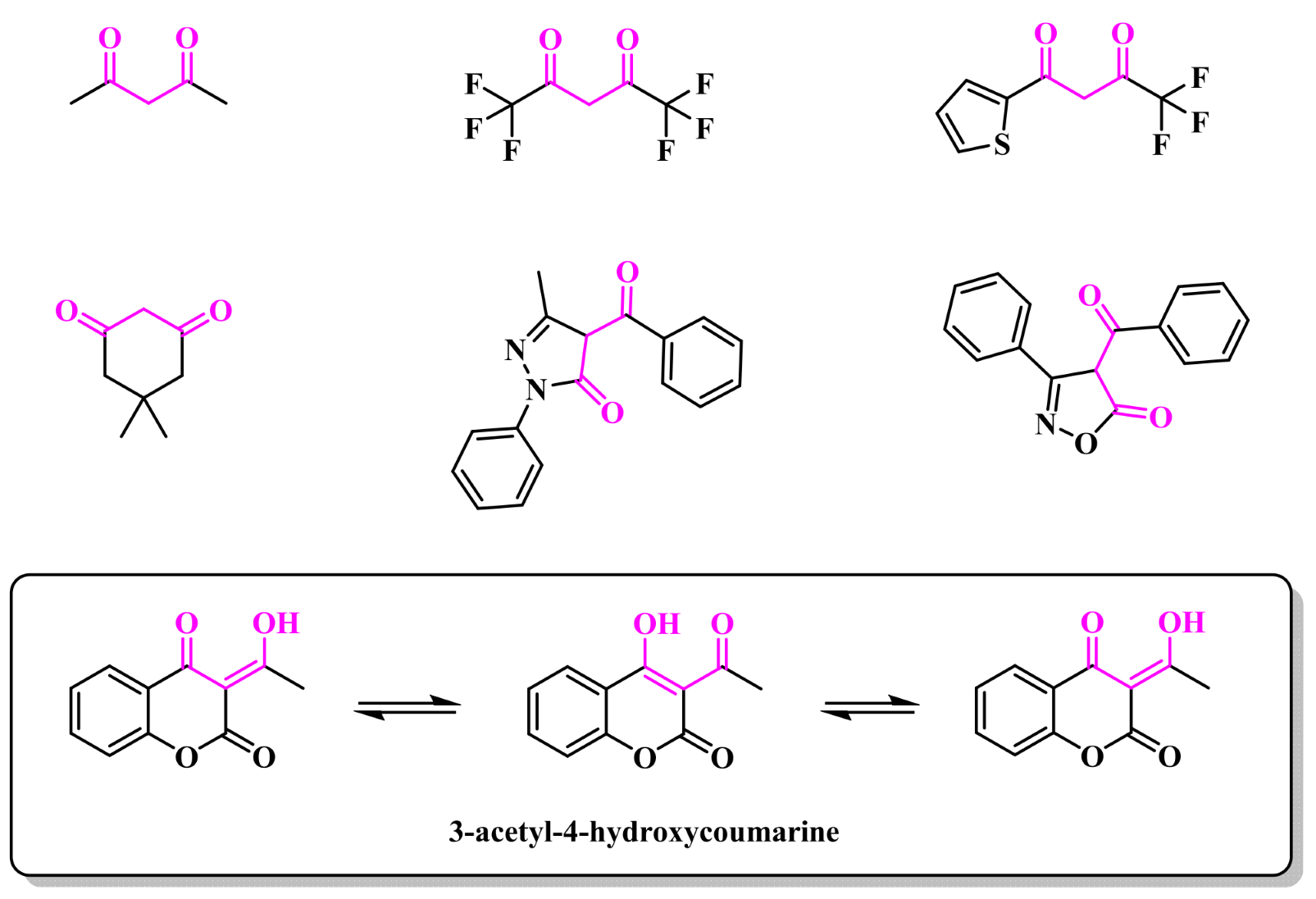
Rare earth elements are the cornerstone of many modern technologies; without their unique properties, it is difficult to imagine such fields as electronics, energy, medical diagnostics, and others [1]. Over the past 50 years, virtually the entire spectrum of some of the “youngest” non-radioactive elements has transformed from exotic representatives of the periodic table into a sought-after commodity. The isolation of rare earth elements from natural and secondary raw materials, as well as their separation, is one of the interesting problems of the present time, with a huge amount of research devoted to this topic [2,3,4,5,6]. Significant advances have been achieved using liquid–liquid extraction [7,8,9] and various sorption methods [10,11,12,13,14,15]. Both approaches aim to develop effective ligands or materials containing covalently immobilized chelating fragments. Among the most promising ligand types are various compounds containing a 1,3-dioxo motif in their structure: classical aliphatic 1,3-diketones [16,17], their fluorinated analogs [17,18,19,20], and heterocyclic compounds in which an oxo group is linked to the ring, such as 4-acylpyrazolones [21,22,23] and 4-acylisoxazolones [24,25] (Figure 1). Methods for synthesizing such compounds are well-developed [26,27], and their coordination properties have been studied in detail [28]. Among this diversity of ligands, the least studied are the structurally related 3-acyl-4-hydroxycoumarins, which exhibit rich tautomerism [29] that determines their strong coordination ability [30], including toward rare earth elements [31,32,33].
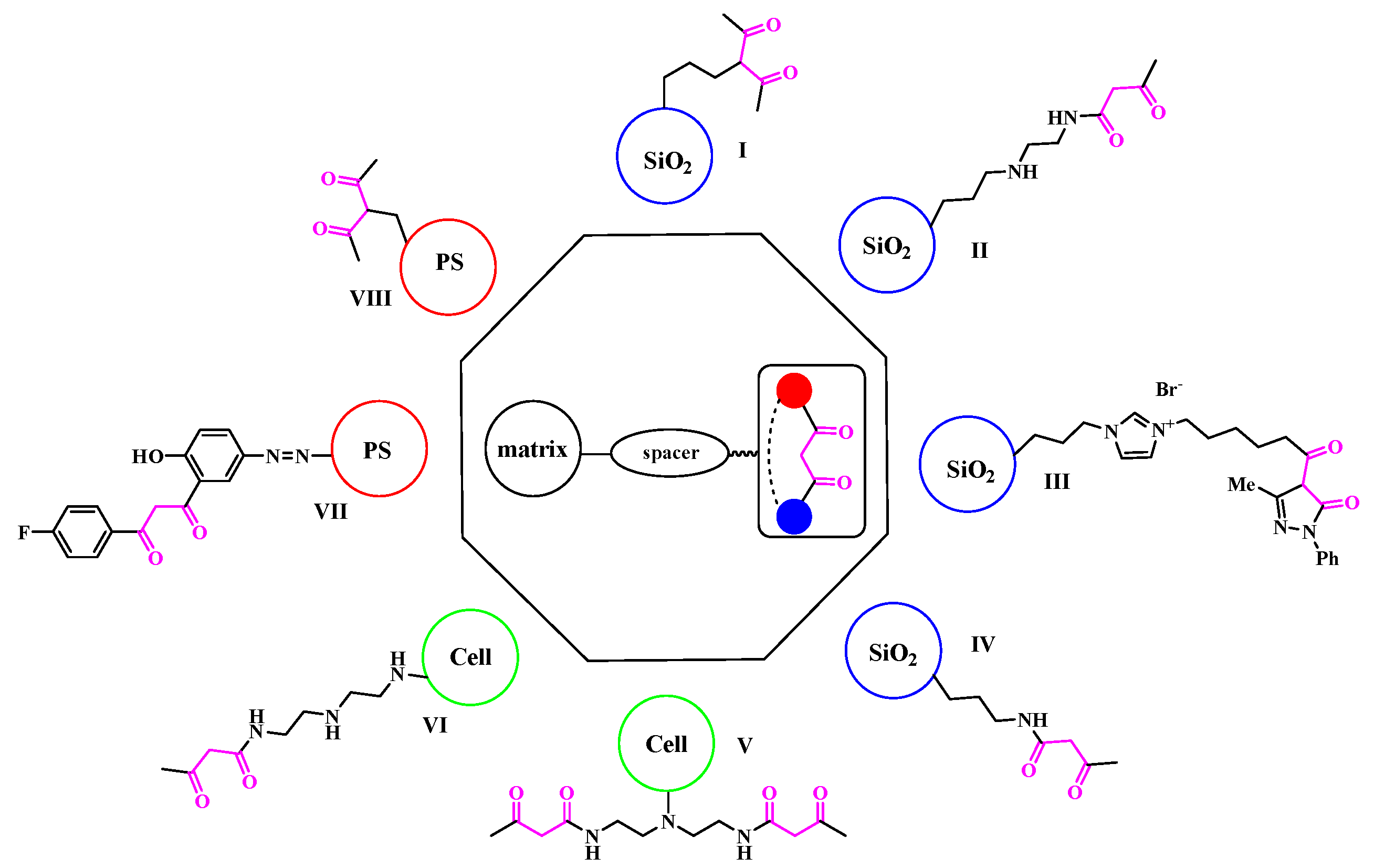
Sorption materials containing a covalently immobilized structural motif of 1,3-dicarbonyl compounds are known in quantities several orders of magnitude smaller than the corresponding molecular ligands. Materials based on silica (IIV), cellulose (V, VI), and polystyrene (VII, VIII) are described (Figure 2). Alkylation [34,35,36,37], azo coupling [38], and acylation with diketene [39,40,41] reactions are used for their synthesis. The review [42] examines the preparation of materials with 1,3-diketone fragments using sol–gel technology.
It is well-known that the covalent immobilization of a ligand on the surface of a solid matrix rigidifies the chemical structure of the complexing agent, thereby restricting its steric and conformational flexibility and its ability to adapt to the electronic structure of the metal ion. This results in altered selectivity for the extraction of rare earth ions with similar properties. Immobilization of ligands on silica surfaces is accompanied by the formation of strong siloxane bonds between the linker and the matrix, which imparts significantly higher chemical stability to the resulting materials and enhances their potential for regeneration and reuse. The objective of this work is to develop a procedure for covalently attaching the 3-acyl-4-hydroxycoumarin moiety to the silica surface, verify the success of the immobilization, and assess the sorption properties of the synthesized material to Gd(III), Dy(III), Er(III), Eu(III), Sm(III), and Yb(III).

2. Results and Discussion

2.1. Synthesis of Material

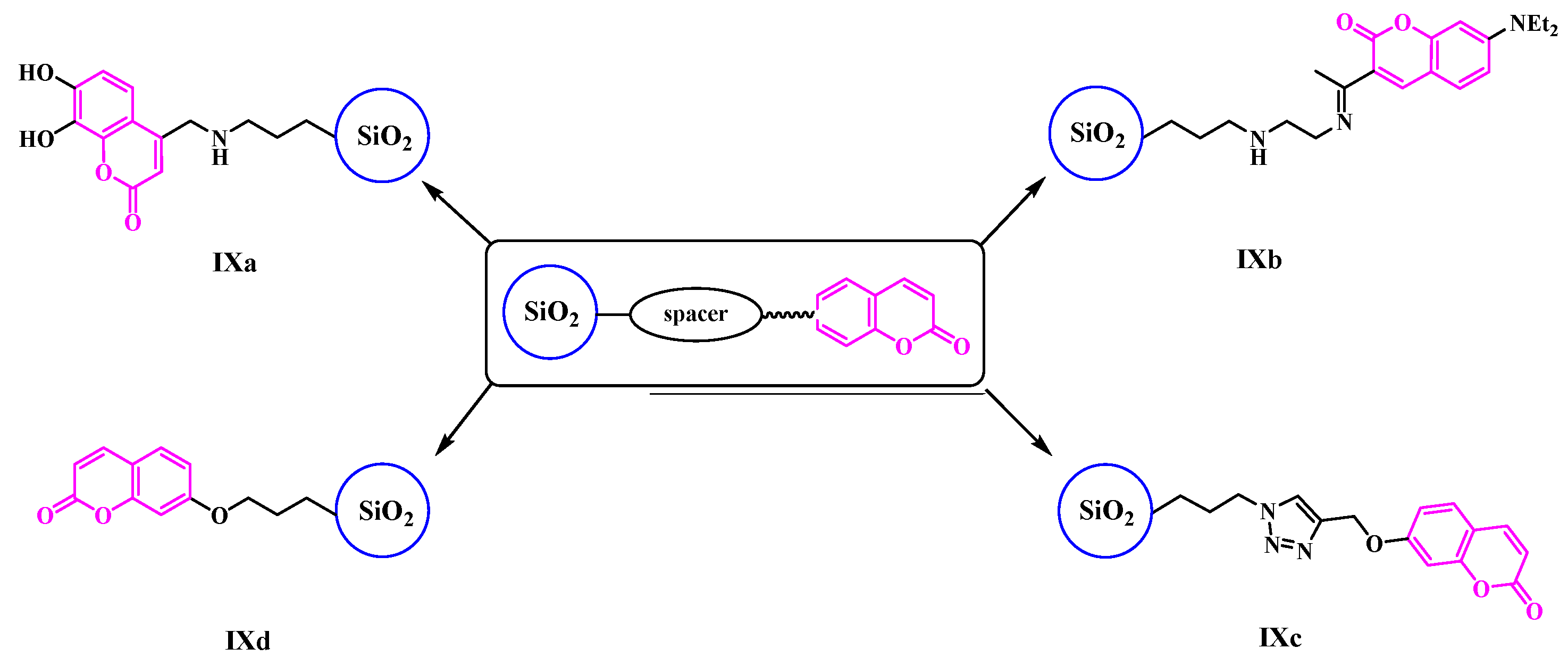
By the beginning of our research, a number of materials containing a covalently immobilized coumarin skeleton IXa [43], IXb [44], IXc [45,46,47,48,49,50], IXd [51] had been described (Figure 3).
However, materials based on immobilized 3-acyl-4-hydroxycoumarin ligands were unknown.
The rational design of the target material involves positioning the anchoring group in the ligand molecule as far as possible from the coordinating moiety to minimize steric hindrance during complexation. The presence of reactive hydroxyl and oxo groups in 3-acyl-4-hydroxycoumarin restricts the range of selective reactions available for covalent attachment, such as alkylation reactions (as in the cases of IXa and IXd) or condensation reactions (as in the case of IXb). We considered that a click-assembly strategy for synthesizing the target material via a [3 + 2] azide–alkyne cycloaddition reaction would be optimal [52,53,54].
When selecting a strategy for synthesizing a clickable acylcoumarin derivative, we primarily considered the availability of starting materials, the ease of the reactions, and their reproducibility. Accordingly, we chose to employ a coumarin chalcone derivative 3 [55], which can be readily synthesized in two steps from commercially available 4-hydroxycoumarin using a known acylation protocol [56], followed by coupling with 4-(prop-2-yn-1-yloxy)benzaldehyde [55,57,58] (Scheme 1).
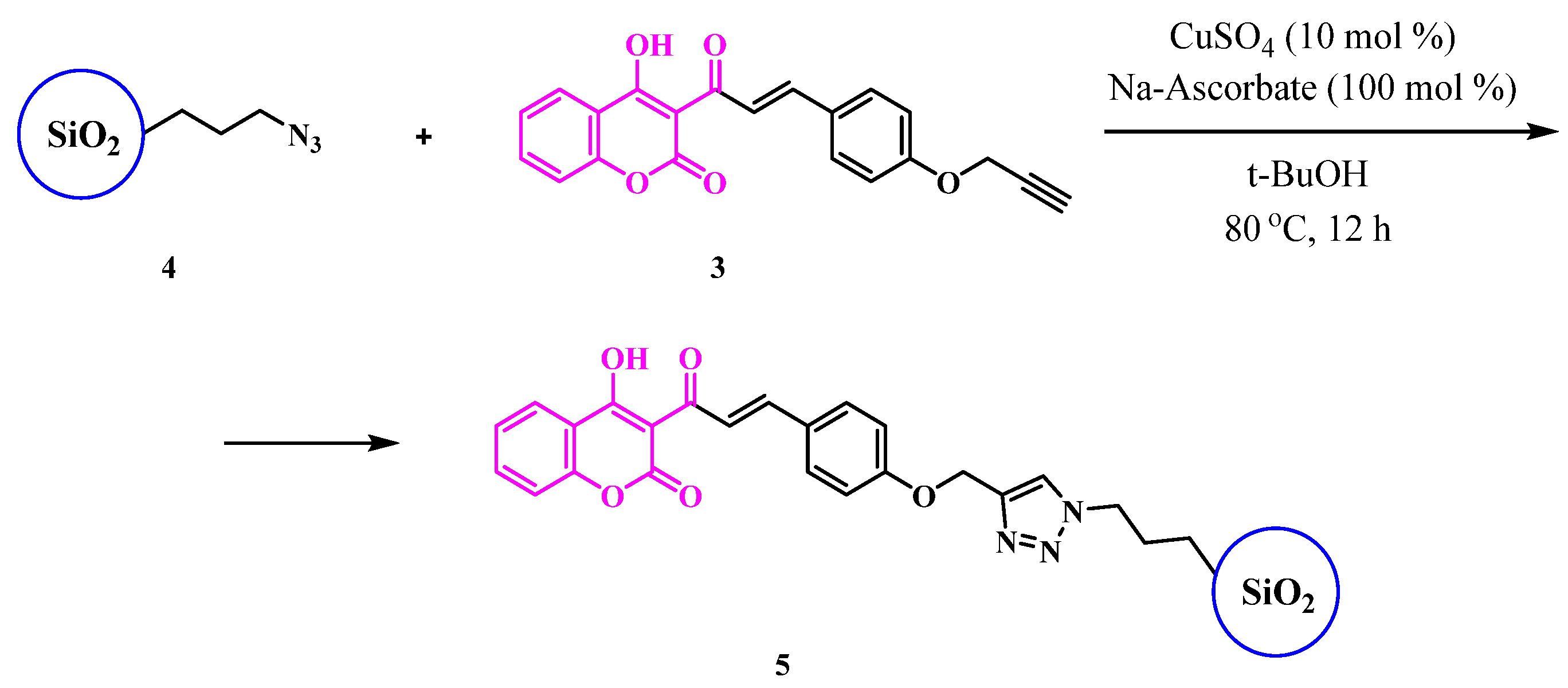
The grafting of coumarin chalcone 3 by reaction with 3-azidopropyl silica 4 [59] was carried out in tert-butanol at 80 °C for 12 h in the presence of 10 mol.% copper (II) sulfate and 100 mol.% sodium ascorbate (Scheme 2).

2.2. Characterization of Material

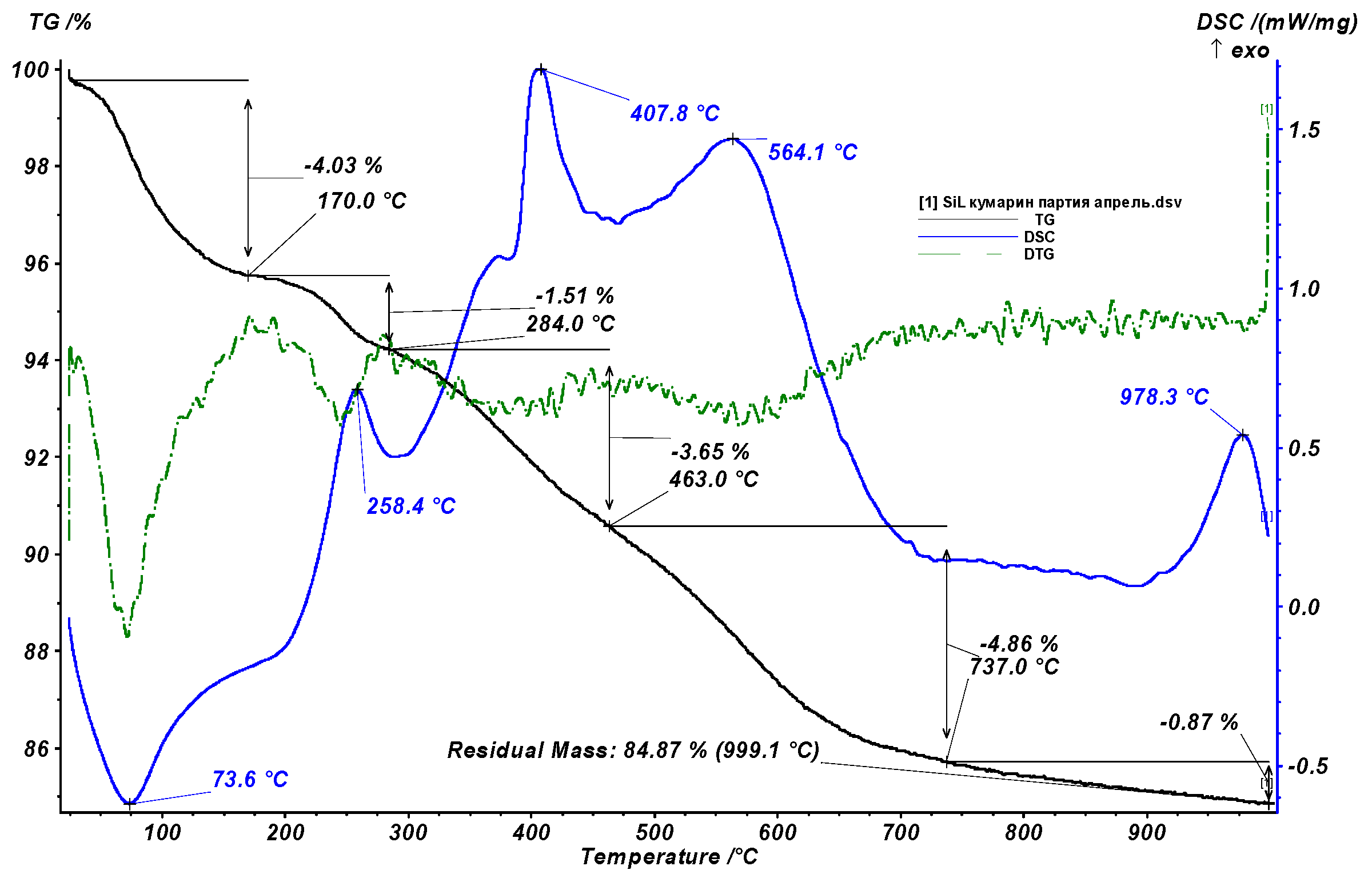
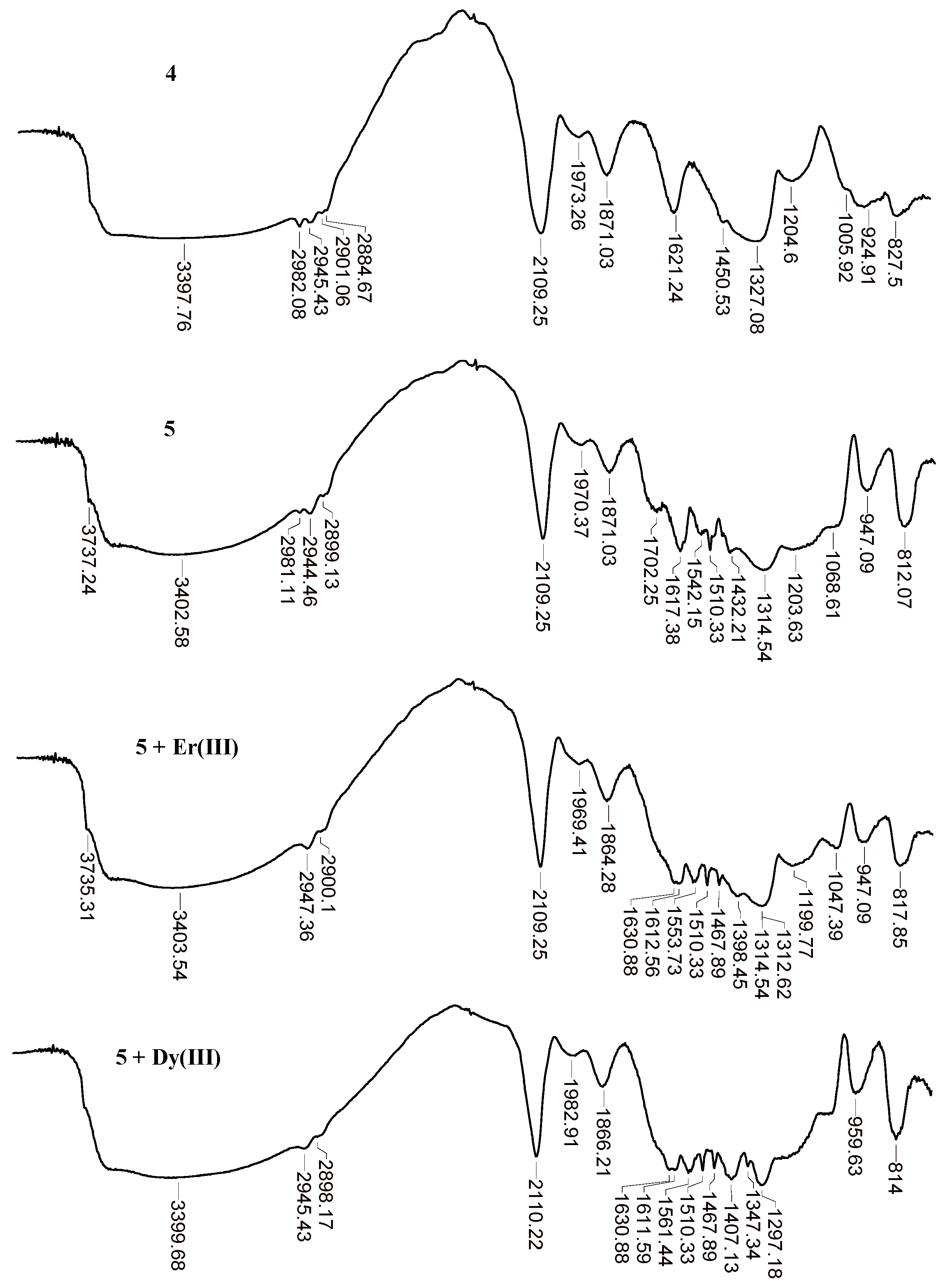
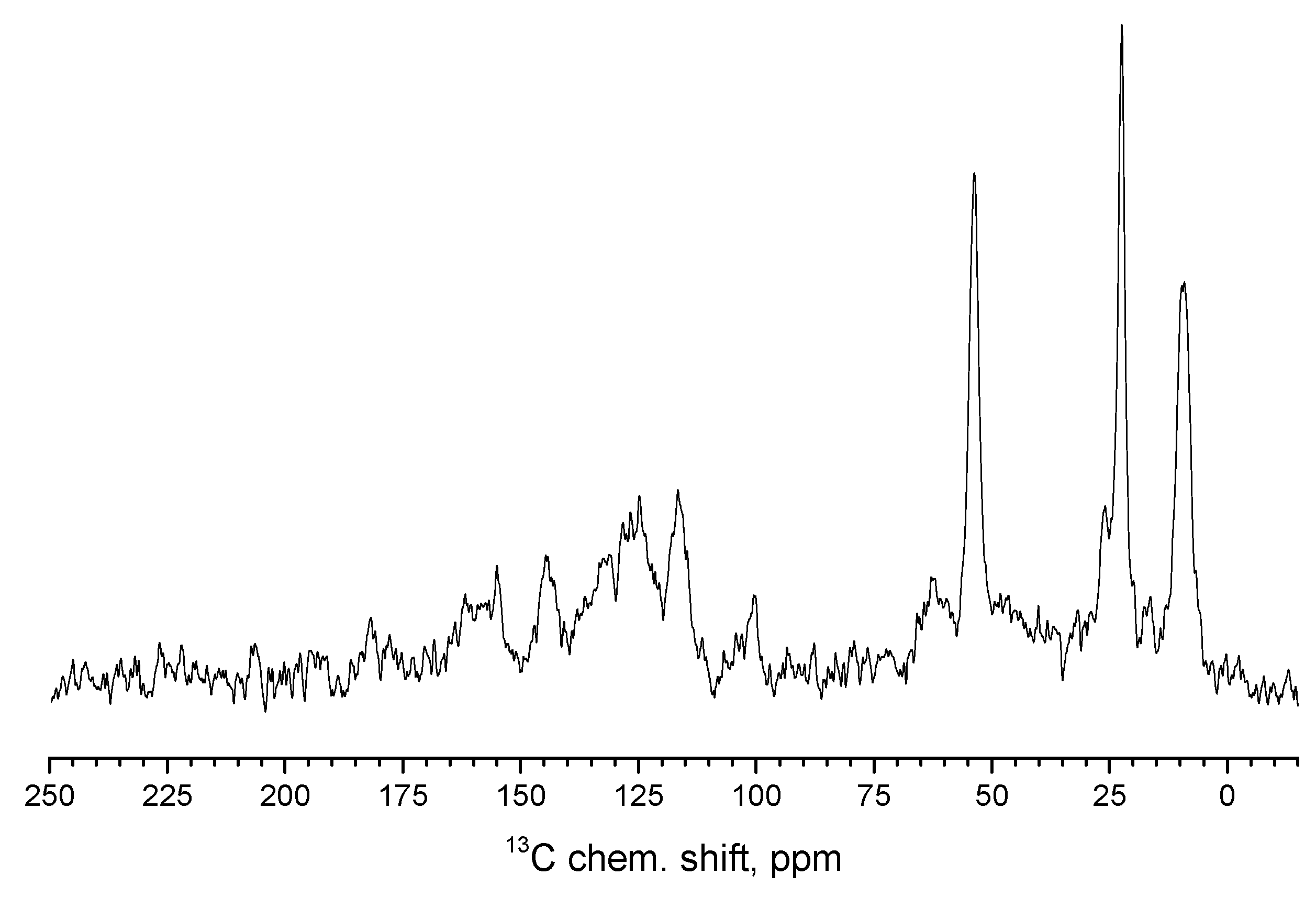
The synthesized organomineral material 5 was characterized by thermogravimetric analysis (TGA) (Figure 4), IR spectroscopy (Figure 5), and solid-state 13C NMR spectroscopy (Figure 6). The thermogram reveals four main stages of mass loss. Upon heating from 20 to 170 °C, physically adsorbed water and residual solvent are removed, resulting in an endothermic effect observed in the DSC curve and a relative mass loss of 4.03%. The subsequent stages of mass loss in the temperature range of 200–750 °C are accompanied by exothermic peaks in the DSC curve, indicating thermal degradation of the grafted organic layer. Over the entire range from 130 to 1000 °C, a total mass loss of 10.8% is observed, attributable to the destruction and combustion of the organic functional layer. The exothermic peak in the DSC curve at 978 °C corresponds to the formation of the crystalline SiO2 phase (cristobalite).
The diffuse reflectance IR spectrum of the modified silica 5 exhibits a broad absorption band in the range of 3000–3700 cm−1, attributable to the superposition of stretching vibrations of Si–OH groups and H–O–H vibrations of adsorbed water molecules involved in both intra- and intermolecular hydrogen bonding. A strong band at 1970 cm−1 corresponds to overtones of the fundamental Si–O–Si vibrations. Characteristic bands at 1702 cm−1 arise from the stretching vibrations of the C=O group, while those at 1617 cm−1 are assigned to the stretching vibrations of the C=N group. Additionally, intense absorption bands at 1545 and 1510 cm−1 correspond to the stretching vibrations of C(sp2)–C(sp2) bonds in the aromatic rings of the grafted moieties
As seen from the IR spectroscopy data (ν N3 = 2109 cm−1), complete conversion of the azide groups does not occur. This can likely be attributed to the high steric bulk of the coumarin–chalcone ligand, which hinders the quantitative progress of the reaction.
In the diffuse reflectance IR spectra of the silica sample after reaction with an Er(III) and Dy(III), a shift in the absorption band corresponding to the C=O group to the low-frequency region at 1630 cm−1 is observed, which is associated with the delocalization of the electron density due to its participation in the coordination of the Er(III) and Dy(III) ions.
Comparing the IR spectra of silica 5 before and after sorption of Ln(III), a decrease in the ν (C=O) values can be observed, which confirms extraction via a coordination mechanism accompanied by the formation of a covalent C–O–Ln(III) bond (Supplementary Materials, Figures S1–S4).
The 13C NMR spectrum (Figure 6) of the synthesized organomineral material 5 contains two groups of signals are observed: those of the aliphatic carbon atoms of the propyl fragment of the linker and the methylene group in the 5–60 ppm range, as well as signals of the Csp2 aromatic ring, vinyl, and carbonyl groups in the 100–170 ppm range.

2.3. Adsorption Properties of Material

2.3.1. Effect of pH

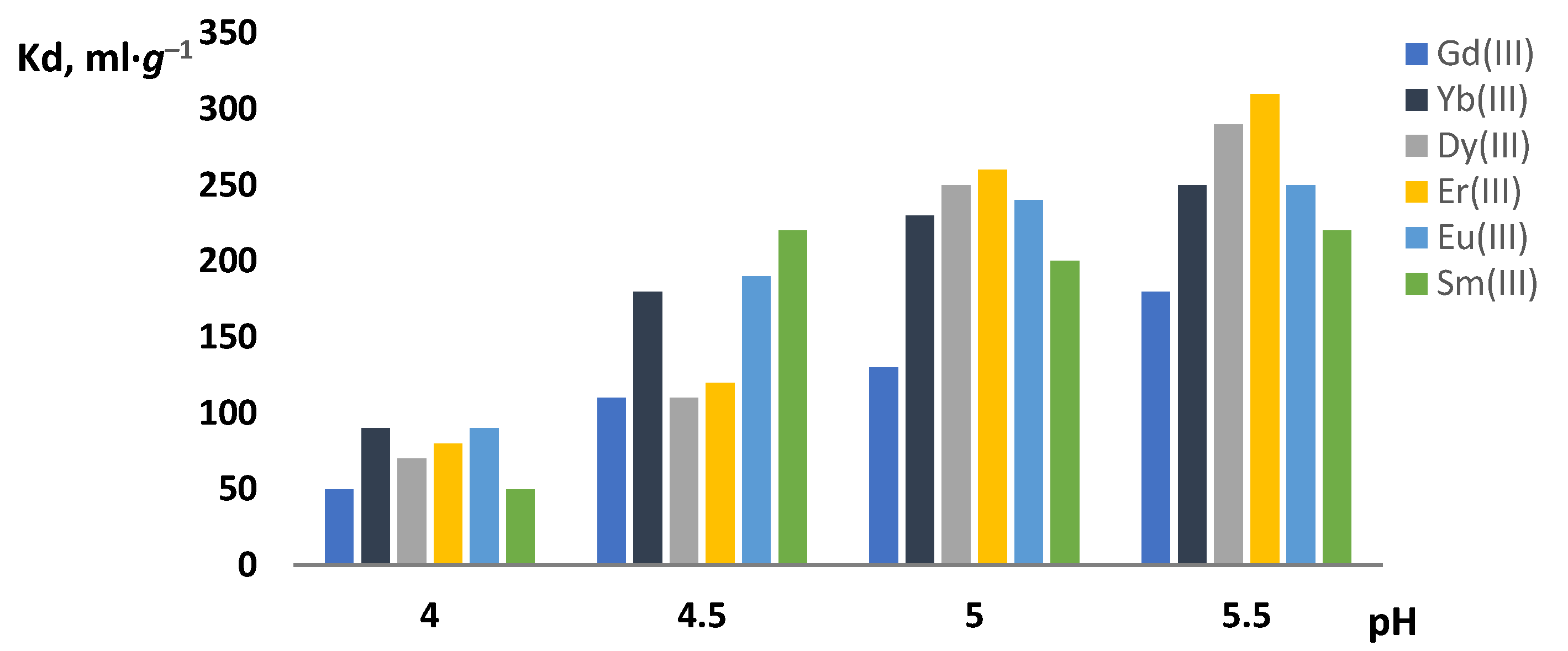
The tendency of lanthanide ions to undergo hydrolysis increases with increasing atomic number and decreasing ionic radius. For example, at pH 6, the proportion of free aquated cations is approximately 75% for Ce3+ and Pr3+, 60% for Nd3+ and Eu3+, and only 50% for Sm3+ [60]. Accordingly, pH 5.5 was selected as the upper limit for the aqueous phase. The extraction of Sm(III), Eu(III), Dy(III), Er(III), Yb(III), and Gd(III) ions, expressed in terms of the distribution coefficient, increased with increasing pH in the range of 3.5–5.5, reaching a maximum at pH 5.5 (maintained using an acetate buffer solution); the solid–liquid contact time was 2 h (Figure 7). For surface-modified silica, it should be noted that the grafted ligands may not form an ideal monolayer but rather create “islands” on the surface. Furthermore, residual silanol groups located between the ligand moieties can mediate Lnn+–HO–Si interactions through Van der Waals forces, electrostatic interactions, or coordination bonds, which may play a significant role in solid-phase extraction. The contribution of nonspecific sorption on the unmodified silica surface under the selected conditions did not exceed 10%, as confirmed experimentally. To accurately determine this value, the initial Ln(III) concentration was kept at the same level as in the experiments with the modified silica.
The tendency of lanthanide ions to undergo hydrolysis increases with increasing atomic radius and decreasing ionic radius. For example, at pH 6, the proportion of free cations is 75% for Ce3+ and Pr3+, 60% for Nd3+ and Eu3+, and only 50% for Sm3+ [60]. Therefore, 5.5 was chosen as the upper limit of the aqueous phase pH. The extraction of Sm(III), Eu(III), Dy(III), Er(III), Yb(III), and Gd(III), as a function of the partition coefficient, increased with changing solution pH in the range 3.5–5.5, reaching a maximum at 5.5, maintained with an acetate buffer solution; the phase contact time was 2 h (Figure 7). In the case of surface-modified silica, it is necessary to consider that the grafted ligands may not form an ideal monolayer on the surface, but rather create “islands.” Moreover, residual silanol groups are located between the ligand fragments, mediating Men+–HO-Si interactions via van der Waals, ionic, or coordination interactions, which may play an important role in the solid-phase extraction. The contribution of nonspecific sorption by the surface of unmodified silica under the chosen conditions did not exceed 10%, which we confirmed experimentally. To accurately estimate this relative value, the initial Ln(III) concentration was maintained at the same level as in the experiments with modified silica.

2.3.2. Effect of Contact Time on Metal Adsorption

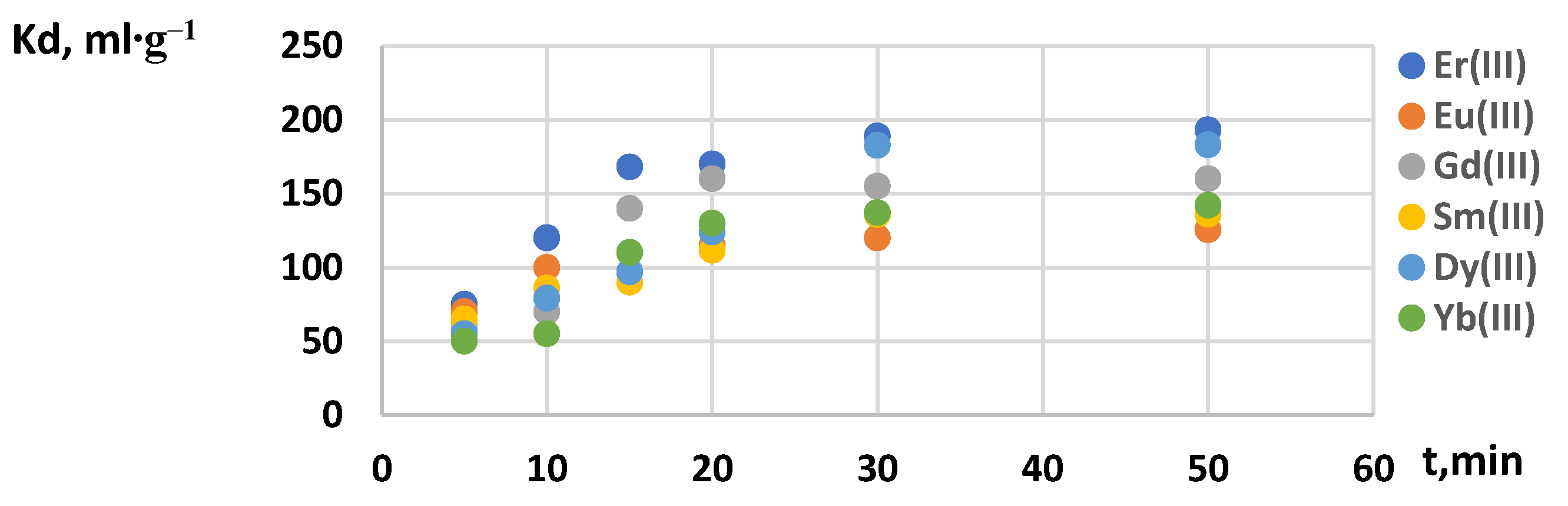
To investigate the effect of phase contact time on the adsorption process, experiments were conducted with contact times varying from 5 to 50 min. The dependence of the Ln(III) distribution coefficient and adsorption capacity on contact time was plotted (Figure 8). Equilibrium time is a relatively straightforward parameter to determine. Since the sorption process involves a heterogeneous reaction between the grafted functional groups and Ln(III) ions, its rate (and thus the required time) depends on the initial concentrations, the liquid-to-solid ratio, and the molar ratio of the interacting components. Accordingly, the initial Ln(III) concentration was selected to achieve an approximately 1:1 molar ratio between the functional groups on the sorbent and the Ln(III) ions in the solution. The number of functional groups was calculated from thermogravimetric analysis data, assuming that the total mass loss in the temperature range of 130–700 °C corresponds to the combustion of the organic functional layer. As shown in Figure 8, both the distribution coefficient and the adsorption capacity increase with contact time, reaching a plateau after 30 min. This indicates that equilibrium has been attained in the sorbent–sorbate system and that the available binding sites on the silica surface are fully occupied.

2.3.3. Adsorption Isotherms

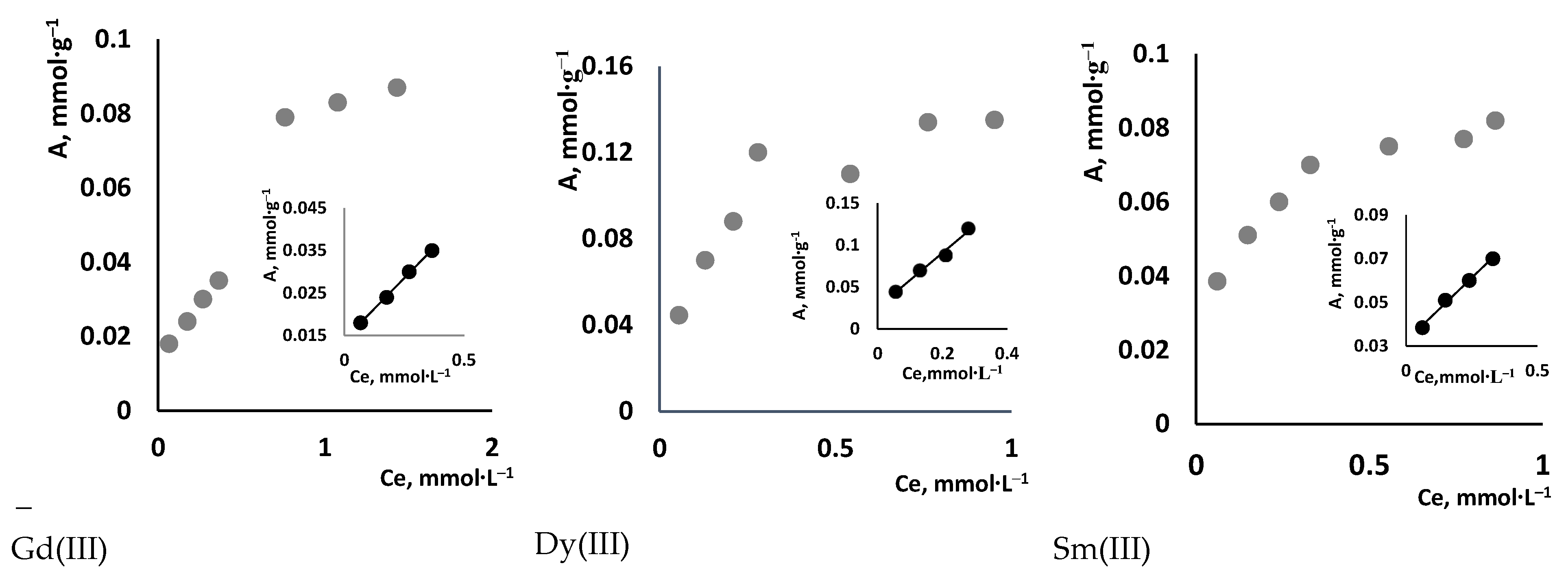
When describing the sorption capacity of silica modified with grafted complexing groups, it is important to recognize that the interaction of metal ions with chelating sorbents is highly complex. Local concentrations of reactants in the near-surface layer of the sorbent are abnormally high, their distribution across the surface and within the material is nonuniform, and key phenomena include lateral interactions between grafted ligands, distortion of the coordination sphere of immobilized metal complexes, the influence of the surface electrostatic potential, the chemical nature and concentration of electrolytes in the liquid phase on surface reactions, and the formation of multiple types of surface complexes rather than a single one. In complexation with grafted ligands, the most stable complexes are those whose stoichiometry provides the optimal balance between the chelate effect and steric hindrance arising from ligand immobilization. The influence of the initial concentrations of Sm(III), Eu(III), Dy(III), Er(III), Yb(III), and Gd(III) on the sorption activity of the grafted chelating groups was described by type I sorption isotherms (convex upward, according to the Giles classification) [61] (T = 298 K) (Figure 9). The isotherms were constructed by plotting sorption capacity against the equilibrium concentration of Ln(III) in solution, with the Henry region (linear portion at low concentrations) separately identified for calculation of the distribution coefficient Kd (Table 1). The maximum sorption capacity Amax, representing the static sorption capacity of the sorbent toward the extracted metal ion, was determined from the plateau (horizontal section) of the isotherm.
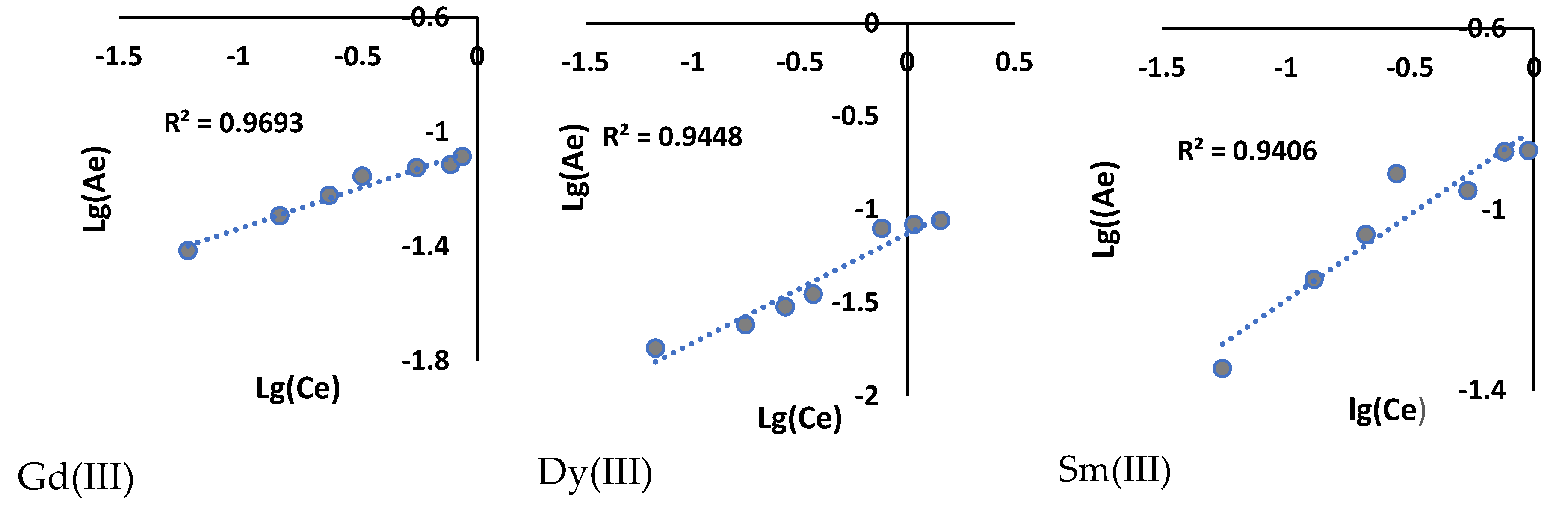
Considering the heterogeneity of the silica surface resulting from the “island-like” grafting of functional groups and the incomplete nature of the immobilization reactions, the Freundlich model—which is commonly employed to describe the sorption of metal ions on various ion-exchange materials and chelating sorbents—was found to provide the best fit for the adsorption equilibrium data [61]. Linearized plots (anamorphoses) derived from the integral equilibrium isotherms in the coordinates of the Freundlich equation exhibited high coefficients of determination (R2 > 0.99) (Figure 10). In contrast, when the sorption isotherms were processed using the coordinates of the Langmuir and Temkin models, the coefficients of determination did not exceed 0.87.
The ligand affinities for rare earth element (REE) ions and the chemical properties of the lanthanoids themselves are very similar due to the close values of their ionic radii (for example, Sm3+ 0.96 Å, Eu3+ 0.95 Å, Gd3+ 0.94 Å, Dy3+ 0.91 Å, Er3+ 0.89 Å, Yb3+ 0.89 Å [62]). Ln(III) ions are considered strong Lewis acids; they readily coordinate, in both neutral and acidic media, with hard electron donors such as oxygen-containing (O,O-) ligands [63].
One approach that allows differentiation of the coordination—and correspondingly the extraction—behavior of Ln(III) ions is the covalent immobilization of an effective O,O-ligand on a solid surface. This makes the chemical structure of the complexing agent more rigid, thereby restricting its steric and geometric freedom and its ability to adapt to the electronic structure of the ion, ultimately altering the selectivity for extracting ions with similar properties.
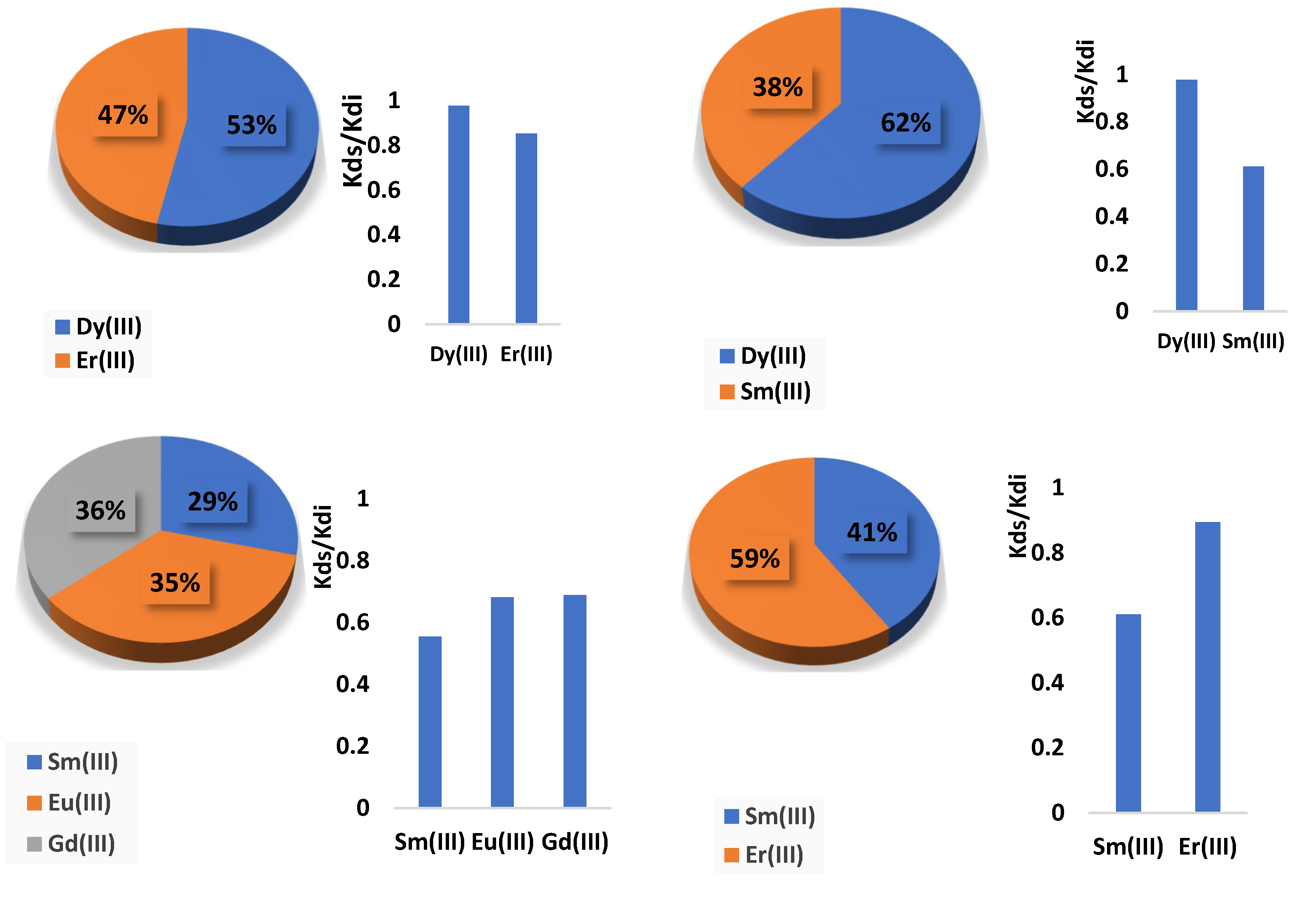
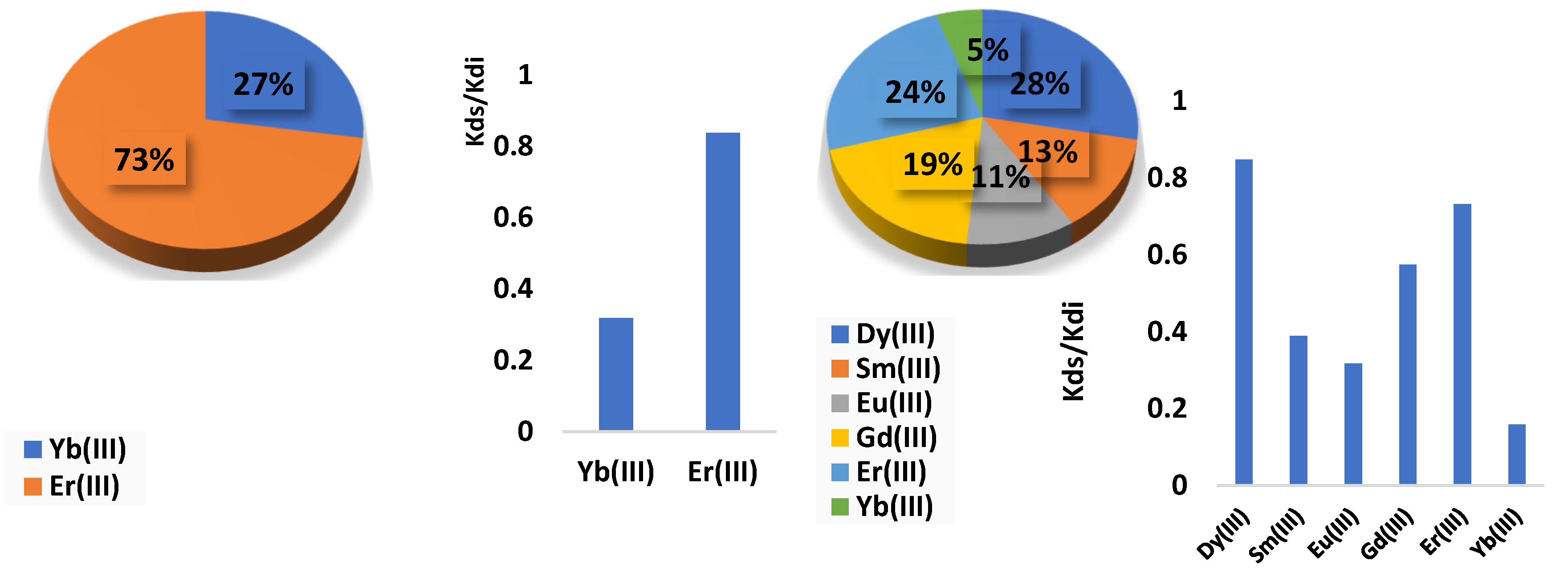
The calculated distribution coefficients (Table 1) demonstrate the selectivity of the modified surface toward the selected rare earth ions, which can be expressed as a surface affinity series. The distribution coefficient values increase with increasing ionic radius of the rare earth ions (i.e., with increasing basicity of the aquated cations), although deviations are observed for Gd(III) and Yb(III). For subsequent modeling of binary, ternary, quaternary, and senary systems and for assessing mutual competitive effects, the initial Ln(III) concentrations were selected from the Henry region to enable reliable comparison of changes in surface affinity during the transition from single-component to multicomponent systems. We have previously described this algorithm for studying competitive sorption [64]. Based on these data, the following systems were modeled: Er(III)–Dy(III), Dy(III)–Sm(III), Sm(III)–Eu(III)–Gd(III), Er(III)–Yb(III), Er(III)–Sm(III), Dy(III)–Yb(III)–Er(III), Sm(III)–Eu(III)–Dy(III), and Dy(III)–Yb(III)–Er(III)–Sm(III)–Eu(III)–Gd(III). For the Er(III)–Dy(III) pair, where the individual distribution coefficients are similar, no significant competition or decrease in extraction efficiency is observed, as evidenced by the comparable Kd values obtained in the multicomponent system and in the individual adsorption equilibria within the Henry region. The calculated distribution coefficients are presented as diagrams that allow evaluation of changes in this parameter in multicomponent systems relative to single-component solutions (Kds/Kdi) and assessment of the contribution to sorption capacity under competitive conditions (Figure 11).
For the Dy(III) –Sm(III), suppression of Sm(III) extraction and a decrease in the Kd value are observed compared to individual extraction. In the Sm(III)–Eu(III)–Gd(III) system, a more than 1.5-fold decrease in Kd for Eu(III) and Gd(III) is observed. In the case of an equimolar six-component mixture, a more than ten-fold decrease in Kd for Yb(III) is observed.
The values of maximum capacities and distribution coefficients obtained on model solutions under static and dynamic conditions are comparable to those achieved even on mesoporous silica grafted with O,O-ligands (Kd = 950 mL·g−1) and extraction capacity (1 mg·g−1) [65].

2.3.4. Dynamic Preconsentration

Dynamic sorption enables the separation and preconcentration of substances in a flow-through mode, which is of particular interest because it eliminates the need for phase separation after preconcentration and facilitates process automation. The results of dynamic sorption experiments with the modified silica are presented as breakthrough curves, which show the dependence of the relative sorbate concentration (C/C0) in the effluent on the volume of solution passed through the column at a constant flow rate. The distribution coefficients (Kd) of Ln(III) ions were calculated for Gd(III), Dy(III), Er(III), Eu(III), Sm(III), and Yb(III) from individual solutions (C0 = 3 × 10⁻⁶ M for each ion, V = 50 mL, solution flow rate = 1.25 mL/min). The calculated Kd values (Table 2) allow construction of an affinity series for the ions toward the modified surface, which is not reversed and exhibits a similar trend to that observed in static mode: Er(III) > Dy(III) > Sm(III) ≈ Eu(III) ≈ Gd(III) > Yb(III).
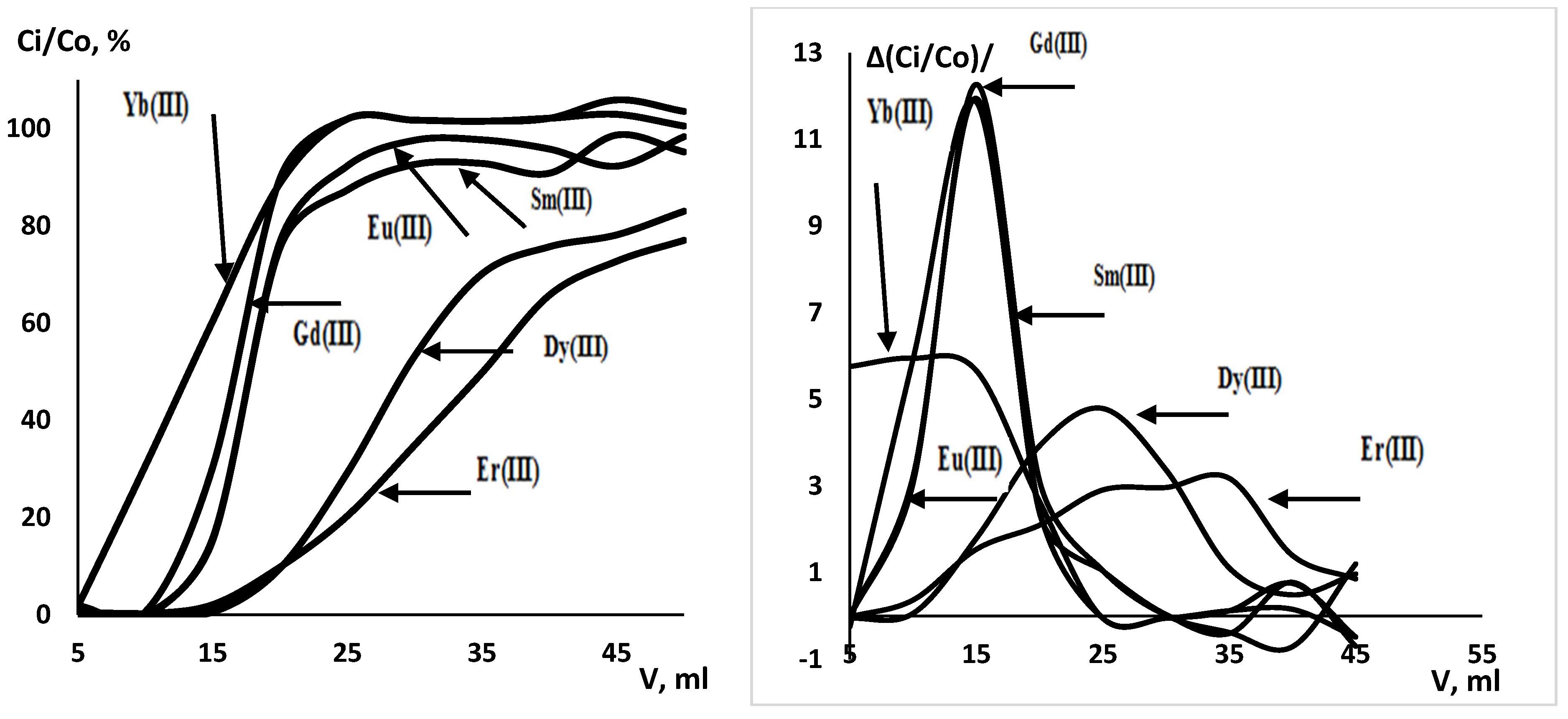
Taking into account the changes in the distribution coefficient for individual systems, a six-component system containing Gd(III), Dy(III), Er(III), Eu(III), Sm(III), and Yb(III) in equimolar amounts was simulated and frontal dynamic breakthrough curve were constructed (Figure 12). The calculated distribution coefficient (Table 3) indicates the mutual competitive influence of Ln(III) and the suppression of the extraction of Yb(III), Gd(III), Eu(III), and Sm(III), but the possibility of separation by REE ion groups Er(III) + Dy(III) > ~Eu(III) ~ Gd(III) Sm(III) Yb(III) remains.
At 10-fold molar excesses of Fe(III), Al(III), Cu(II), Ni(II), Co(II) in a six-component system, an even more significant suppression of the sorption of Yb(III), Sm(III), Gd(III), Eu(III) can be observed than in the case of a six-component system without interfering cations. It is interesting to note that in the case of sorption from six-component systems under conditions of the addition of 10-fold molar excesses of Fe(III), Al(III), Cu(II), Ni(II), Co(II) in a static mode, an even greater decrease in the values of the distribution coefficients of Yb(III), Sm(III), Eu(III) can be observed.

3. Materials and Methods

MN Kiesegel 60 silica (Macherey-Nagel)(GmbH and Co.KG, Duren, Germany) (40–60 μm fraction, Ssp = 327.8 m2/g (after removing traces of water) and total pore volume (Vpore = 0.095 cm2/g, dominant pore diameter 1.77 nm) was used as the matrix for functionalization. Standard solutions of Ln(III) [Gd(III), Dy(III), Er(III), Eu(III), Yb(III), Sm(III)] with a concentration of 5·10−2 M were prepared by dissolving accurately weighed portions of the corresponding oxides in 10% HCl. Working solutions were prepared by dissolving standard solutions. The solution-to-solid ratio was set at 1000 (V/m). Samples (50 mg) were mixed on an orbital shaker, then the supernatant was collected and analyzed. All experiments were performed in triplicate; only average values are presented. IR spectra were recorded on a Shimadzu Prestige-21 IR spectrometer (Shimadzu, Tokyo, Japan) in the wavelength range of 4000–400 cm−1 with a DRS-8000 diffuse reflectance attachment.
Solid-state 13C NMR spectra of the modified silica 5 were recorded at the Magnetic Resonance Center of St. Petersburg State University on a Bruker Avance III 400 WB spectrometer (frequency 100.64 MHz for 13C) (Bruker, Karlsruhe, Germany) at room temperature using a Bruker CP/MAS probe with a 4 mm rotor diameter. Spectra were recorded at a rotor speed of 10 kHz using the CP TOSS (polarization transfer with rotational sideband suppression) sequence. Thermal analysis of the silica sample was performed on an STA 409 Luxx instrument (Netzsch) (Netzsch-Gerätebau GmbH, Selb, Germany) in platinum–rhodium microcrucibles over a temperature range of 30–1000 °C in air (50 mL/min) at a heating rate of 10 °C/min.
The pH of all working buffer solutions was monitored with an Expert-001 ion meter (Ekoniks-ekspert, Moscow, Russia) using a calibrated ESC-10608 combined glass (Ekoniks-ekspert, Moscow, Russia) electrode.
The residual concentration of individual metals in solution after sorption experiments was monitored photometrically with an SS2107UV spectrophotometer (LEKI Instruments, Finland) at a 10 mm optical path length, using a spectrophotometric method based on the reaction of rare earth elements with arsenazo(III) [63]. The residual concentration of metals in the combined state in the solution after the sorption experiments was monitored using an iCAP 6000 (Thermo Fisher Scientific, Waltham, MA, USA) inductively coupled plasma optic emission spectrometer. The analytical lines of the elements used for the determination were as follows: Gd(III)—335.047 nm; Dy(III)—353.170 nm; Er(III)—323.058 nm; Eu(III)—381.963 nm; Sm(III)—330.639 nm; Yb(III)—328.937 nm.

3.1. Synthesis 3-Acyl-4-hydroxycoumarin-Modified Silica 5

Prepare 0.1 g (0.288 mmol) of hydroxy-3-(3-(4-(prop-2-yn-1-yloxy)phenyl)acryloyl)-2H-chromen-2-one in a thick-walled test tube equipped with a magnetic stirrer and a fluoroplastic screw cap. Add 12 mL of tert-butanol and 2 g of 3-azidopropyl-silica (azido group capacity 0.5 mmol/g). Then, with stirring, add 288 μL of 0.1 M CuSO4 solution (0.0288 mmol, 10 mol%) and a solution of 57 mg (0.288 mmol, 100 mol%) sodium ascorbate in 500 μL of distilled water. The reaction mixture was maintained at 80 °C with vigorous stirring for 12 h. Then the silica was filtered, washed with hot ethanol, acetone, and Soxhlet ethanol extraction, and dried in vacuum at a residual pressure of 1 mmHg to constant weight. A canary-yellow powder was synthesized.

3.2. Adsorption Experiments

The distribution coefficient in static conditions (Kd), distribution factor (SF), and recovery (R) were calculated.
K d = ( C a i   C a e   ) × V C a e × m
S F = K d M 1 K d M 2
R = C s e C a i
The following equations were adhered to:
where
Cae—equilibrium concentration of metal ions in the aqueous phase;
Cai—initial concentration of metal ions in the aqueous phase;
Cse—equilibrium concentration in the sorbent phase.
V—volume of the solution, L; m—the mass of the sorbent, g.
The distribution coefficient under dynamic conditions was calculated (4):
K d = w × t 0.5 C o t k m
w—volumetric flow rate of the solution, cm3/min;
t0.5 Co—time corresponding to the half-concentration yield of the extracted REE ion, min;
tk—time it takes to fill the column’s free volume, min;
m—mass of the sorbent, g.
The effect of the pH: A solution containing 20 μg of Ln(III) and 50 mg of sorbent was added to 50 mL of a solution with a given pH value and shaken for 120 min. The sorbent was then filtered, and the residual concentration of Ln(III) in the solution was determined using the Arsenazo III photometric method.
A sorption isotherm: A series of solutions with a pH of 5.5 were prepared. A total of 50 mL of acetate buffer was added to a 100 mL flask; an aliquot of Ln(III) solution with an initial concentration of 1 × 10⁻⁴–1.2 × 10⁻³ M and 50 mg of sorbent was added, and the mixture was stirred for 24 h. Ln(III) was determined photometrically with Arsenazo III [66].
The sorption capacity of the materials was calculated (5) as follows:
A = ( C a i C a e ) × V C a e
where
Cae—the equilibrium concentration of metal ions in the aqueous phase;
Cai—initial concentration of metal ions in the aqueous phase, mmol/L;
V—volume of the solution, L;
m—mass of the sorbent, g.
Distribution coefficients (Kd) and separation factors (SF) of Sm(III), Eu(III), Dy(III), Er(III), Yb(III), and Gd(III): A series of solutions with pH 5.5 was prepared. A total of 50 mL of acetate buffer was added to a 100 mL l flask; an initial concentration of Ln(III) of 1 × 10⁻⁴ to 5 × 10⁻⁴ M, and 50 mg of the sorbent was added; it was stirred for 24 h. The Ln(III) content in the supernatant after equilibrium was established and was determined by OES-MS.
Column Study: The column (diameter = 0.5 cm) bottom was filled with glass wool to support the adsorbent, then 0.2 g of modified silica was placed in the column, with the layer height being 0.7 cm. Solutions of Sm(III), Eu(III), Dy(III), Er(III), Yb(III), and Gd(III) were passed through the column at a constant flow rate of 1.25 mL/min. Aliquots were collected in 5 mL, and Ln(III) was determined by OES-MS.

4. Conclusions

In this study, we describe the synthesis and comprehensive characterization of a novel organosilica material, featuring covalently grafted 3-acyl-4-hydroxycoumarin moieties on the silica surface. At pH 5.0–5.5, the material exhibits high extraction efficiency toward Gd(III), Dy(III), Er(III), Eu(III), Sm(III), and Yb(III) ions, with rapid adsorption kinetics (equilibrium reached within 30 min). Due to steric hindrance of the immobilized ligand, complete conversion of surface azide groups does not occur, resulting in the formation of “islands” containing both 3-acyl-4-hydroxycoumarin and residual N3 fragments. In contrast to residual silanol groups, which can ionize and coordinate metal ions, these islands show negligible nonspecific sorption toward the studied lanthanide ions. The heterogeneity of the grafted surface is indirectly confirmed by sorption isotherm analysis: linearized plots (anamorphoses) in the coordinates of the Freundlich equation display high coefficients of determination. The pronounced differences in distribution coefficients among rare earth ions with similar chemical properties—Kd (mL·g−1): Sm(III) 187 ± 19, Eu(III) 225 ± 18, Gd(III) 87 ± 9, Er(III) 1230 ± 98, Dy(III) 460 ± 37, Yb(III) 63 ± 11—highlight the selectivity of the material. This selectivity is apparently governed by variations in the stability of the surface complex compounds formed. Comparison of the IR spectra of material 5 before and after Ln(III) sorption reveals a decrease in the ν(C=O) frequency, confirming that extraction proceeds via a coordination mechanism involving formation of a covalent C–O–Ln bond. The relatively low functional group loading, as estimated from TGA data, further contributes to enhanced selectivity by limiting the number of available binding sites. Despite the similar chemical properties of Er(III) and Dy(III), the material demonstrates clear selectivity in their extraction under both static and dynamic conditions. Analysis of the dynamic breakthrough curves indicates the potential for separating Eu(III), Gd(III), Sm(III), and Yb(III) from Er(III) and Dy(III).

5. Patents

Patent RU 2842657. Konshina, D.N.; Spesivaia E.S.; Konshin V.V.; Lupanova, I.A. Method of producing silica with covalently immobilized 3-acyl-4-hydroxycoumarin. Effective date for property rights: 13 December 2024. Date of publication: 1 July 2025.

Supplementary Materials

The following supporting information can be downloaded at: https://www.mdpi.com/article/10.3390/molecules31020369/s1, Figure S1: IR-spectrum 3-azidopropyl-silica; Figure S2: IR-spectrum 3-acyl-4-hydroxycoumarin-modified silica; Figure S3: IR-spectrum 3-acyl-4-hydroxycoumarin-modified silica + Er(III); Figure S4: IR-spectrum 3-acyl-4-hydroxycoumarin-modified silica + Dy(III).

Author Contributions

Conceptualization, D.N.K. and V.V.K.; methodology, D.N.K. and V.V.K.; software, D.N.K. and V.V.K.; validation, D.N.K., I.A.L., E.S.S. and V.V.K.; formal analysis, D.N.K., I.A.L., E.S.S. and V.V.K.; investigation, D.N.K., I.A.L., E.S.S., A.S.M. and V.V.K.; resources, D.N.K., I.A.L., A.S.M. and V.V.K.; data curation, D.N.K., I.A.L. and V.V.K.; writing—original draft preparation, D.N.K. and V.V.K.; writing—review and editing, D.N.K. and V.V.K.; visualization, D.N.K. and V.V.K. All authors have read and agreed to the published version of the manuscript.

Funding

This research was funded by the Ministry of Science and Higher Education of the Russian Federation, project no. FZEN-2023-0006. The NMR spectra were recorded at the resource center “Magnetic Resonance Research Methods” of the St. Petersburg State University Science Park as part of project 125021702335-5.

Institutional Review Board Statement

Not applicable.

Informed Consent Statement

Not applicable.

Data Availability Statement

The original contributions presented in this study are included in the article and Supplementary Materials. Further inquiries can be directed to the corresponding author.

Acknowledgments

This research was performed using the equipment of the Center for Joint Use “Ecological and Analytical Center” (KubSU), resource center “Magnetic Resonance Research Methods” of the St. Petersburg State University Science Park.

Conflicts of Interest

The authors declare no conflicts of interest.

References

  1. Zhao, T.-Y.; Li, W.-L.; Kelebek, S.; Choi, Y.; Wu, C.-Q.; Zhang, W.-J.; Wang, C.-Y.; Zhao, Z.-W.; Zhao, F.S. A comprehensive review on rare earth elements: Resources, technologies, applications, and prospects. Rare Met. 2025, 44, 7011–7040. [Google Scholar] [CrossRef]
  2. Pereao, O.; Bode-Aluko, C.; Fatoba, O.; Laatikainen, K.; Petrik, L. Rare earth elements removal techniques from water/wastewater: A review. Desalin. Water Treat. 2018, 130, 71–86. [Google Scholar] [CrossRef]
  3. Opare, E.O.; Struhs, E.; Mirkouei, A. A comparative state-of-technology review and future directions for rare earth element separation. Renew. Sustain. Energy Rev. 2021, 143, 110917. [Google Scholar] [CrossRef]
  4. Soukeur, A.; Szymczyk, A.; Berbar, Y.; Amara, M. Extraction of rare earth elements from waste products of phosphate industry. Sep. Purif. Technol. 2021, 256, 117857. [Google Scholar] [CrossRef]
  5. Mwewa, B.; Tadie, M.; Ndlovu, S.; Simate, G.S.; Matinde, E. Recovery of rare earth elements from acid mine drainage: A review of the extraction methods. J. Environ. Chem. Eng. 2022, 10, 107704. [Google Scholar] [CrossRef]
  6. El Ouardi, Y.; Virolainen, S.; Mouele, E.S.M.; Laatikainen, M.; Repo, E.; Laatikainen, K. The recent progress of ion exchange for the separation of rare earths from secondary resources—A review. Hydrometallurgy 2023, 218, 106047. [Google Scholar] [CrossRef]
  7. Pramanik, S.; Kaur, S.; Popovs, I.; Ivanov, A.S.; Jansone-Popova, S. Emerging Rare Earth Element Separation Technologies. Eur. J. Inorg. Chem. 2024, 27, e202400064. [Google Scholar] [CrossRef]
  8. Yu, L.; Gao, Y.; Zhang, H.; Tian, Z.; Li, T.; Zhang, H.; Sun, X. Efficient separation of thorium and rare earth elements with bifunctional ionic liquid [DOC4mim][TTA] based extraction. Sep. Purif. Technol. 2026, 384, 136254. [Google Scholar] [CrossRef]
  9. Zinov’eva, I.V.; Chikineva, T.Y.; Salomatin, A.M.; Zakhodyaeva, Y.A.; Voshkin, A.A. Extraction of Rare Earth Elements from Nitrate Solutions by Hydrophobic Eutectic Solvents Based on Phosphorus-Containing Compounds. Ind. Eng. Chem. Res. 2024, 63, 21587–21602. [Google Scholar] [CrossRef]
  10. Wilfong, W.C.; Ji, T.; Duan, Y.; Shi, F.; Wang, Q.; Gray, M.M. Critical review of functionalized silica sorbent strategies for selective extraction of rare earth elements from acid mine drainage. J. Hazard. Mater. 2022, 424, 127625. [Google Scholar] [CrossRef]
  11. Ehrlich, G.V.; Lisichkin, G.V. Sorption in the Chemistry of Rare Earth Elements. Russ. J. Gen. Chem. 2017, 87, 1220–1245. [Google Scholar] [CrossRef]
  12. Saravanan, P.; Kannan, R.R.; Saravanan, V.; Venkatkumar, S.; Rajasimman, M.; Sagadevan, S.; Baskar, G. Current status and future directions: Separation of rare earth elements by sorption processes. J. Mol. Liq. 2025, 419, 126751. [Google Scholar] [CrossRef]
  13. Archer, W.R.; Iftekhar, N.; Fiorito, A.; Winn, S.A.; Schulz, M.D. Synthesis of Phosphonated Polymer Resins for the Extraction of Rare-Earth Elements. ACS Appl. Polym. Mater. 2022, 4, 2506–2512. [Google Scholar] [CrossRef]
  14. Peng, Y.; Zhu, P.; Zou, Y.; Gao, Q.; Xiong, S.; Liang, B.; Xiao, B. Overview of Functionalized Porous Materials for Rare-Earth Element Separation and Recovery. Molecules 2024, 29, 2824. [Google Scholar] [CrossRef]
  15. Ogata, T.; Narita, H. Separation of Adjacent Light Rare Earth Elements Using Silica Gel Modified with Diglycolamic Acid. Materials 2024, 17, 2648. [Google Scholar] [CrossRef]
  16. Moshchenkov, A.D.; Ryzhako, A.S.; Otlyotov, A.A.; Minenkov, Y. Ab Initio Thermochemistry of the First-Row Transition Metal Tris(Acetylacetonates): Refined, Revisited, and Recommended. Inorg. Chem. 2025, 64, 21405–21418. [Google Scholar] [CrossRef]
  17. Turmasova, A.A.; Konshin, V.V.; Konshina, D.N. Synthesis of (1,3-adamantylene)bis-1,3-dicarbonyl compounds. Russ. J. Gen. Chem. 2014, 84, 1273–1276. [Google Scholar] [CrossRef]
  18. Saloutin, V.I.; Edilova, Y.O.; Kudyakova, Y.S.; Burgart, Y.V.; Bazhin, D.N. Heterometallic Molecular Architectures Based on Fluorinated β-Diketone Ligands. Molecules 2022, 27, 7894. [Google Scholar] [CrossRef]
  19. Zanizdra, S.R.; Korshunov, V.M.; Metlin, M.T.; Metlina, D.A.; Gontcharenko, V.E.; Taydakov, I.V. Exploring the effect of fluorine radicals as substituents in β-diketones on the luminescence properties of Eu3+ complexes. Opt. Mater. 2025, 160, 116780. [Google Scholar] [CrossRef]
  20. Clegg, J.K.; Li, F.; Lindoy, L.F. Oligo-β-diketones as versatile ligands for use in metallo-supramolecular chemistry: Recent progress and perspectives. Coord. Chem. Rev. 2022, 455, 214355. [Google Scholar] [CrossRef]
  21. Marchetti, F.; Pettinari, C.; Pettinari, R. Recent advances in acylpyrazolone metal com-plexes and their potential applications. Coord. Chem. Rev. 2015, 303, 1–31. [Google Scholar] [CrossRef]
  22. Mies, T.; White, A.J.P.; Rzepa, H.S.; Barluzzi, L.; Devgan, M.; Layfield, R.A.; Barrett, A.G.M. Syntheses and Characterization of Main Group, Transition Metal, Lanthanide, and Actinide Complexes of Bidentate Acylpyrazolone Ligands. Inorg. Chem. 2023, 62, 13253–13276. [Google Scholar] [CrossRef]
  23. Atanassova, M.; Kukeva, R. Improvement of Gd(III) Solvent Extraction by 4-Benzoyl-3-methyl-1-phenyl-2-pyrazolin-5-one: Non-Aqueous Systems. Separations 2023, 10, 286. [Google Scholar] [CrossRef]
  24. Atanassova, M.; Lachkova, V.; Vassilev, N.; Varbanov, S.; Dukov, I. Complexation of trivalent lanthanoid ions with 4-benzoyl-3-phenyl-5-isoxazolone and p-tert-butylcalix[4]arene fitted with phosphinoyl pendant arms in solution during synergistic solvent extraction and structural study of solid complexes by IR and NMR. Polyhedron 2010, 29, 655–663. [Google Scholar] [CrossRef]
  25. Atanassova, M.; Okamura, H.; Eguchi, A.; Ueda, Y.; Sugita, T.; Shimojo, K. Extraction Ability of 4-Benzoyl-3-phenyl-5-isoxazolone towards 4f-Ions into Ionic and Molecular Media. Anal. Sci. 2018, 34, 973–978. [Google Scholar] [CrossRef] [PubMed]
  26. de Gonzalo, G.; Alcántara, A.R. Recent Developments in the Synthesis of β-Diketones. Pharmaceuticals 2021, 14, 1043. [Google Scholar] [CrossRef] [PubMed]
  27. Shokova, E.A.; Kim, J.K.; Kovalev, V.V. 1,3-Diketones. Synthesis and properties. Russ. J. Org. Chem. 2015, 51, 755–830. [Google Scholar] [CrossRef]
  28. Crossman, A.S.; Marshak, M.P. β-Diketones: Coordination and Application. In Comprehensive Coordination Chemistry III; Constable, E.C., Parkin, G., Que, L., Jr., Eds.; Elsevier: Amsterdam, The Netherlands, 2021; pp. 331–365. [Google Scholar] [CrossRef]
  29. Traven’, V.F.; Safronova, O.B.; Vorob’eva, L.I.; Chibisova, T.A.; Senchenya, I.N. Electronic structure of π systems: XVII. Electronic absorption spectra and tautomerism of 3-acetyl-4-hydroxycoumarin. Russ. J. Gen. Chem. 2000, 70, 793–797. [Google Scholar]
  30. Blanco-Acuña, E.F.; Texon-García, I.A.; Vázquez-López, L.A.; Pérez-Gamboa, A.; García-Ortega, H. Tuning the photophysical and NLO properties of β-diketonates derived from coumarin-triphenylamine-chalcones: Effect of the BF2 group. Tetrahedron 2024, 168, 134338. [Google Scholar] [CrossRef]
  31. Tenorio, C.; Bernès, S.; Solís-Ibarra, D.; González-Monfil, E.; Carmona-Monroy, P.; Gasque, L. Luminescent samarium complexes with a coumarin derived ligand and their deuterated analogues. J. Lumin. 2023, 263, 119985. [Google Scholar] [CrossRef]
  32. Guo, Y.; Miao, Z.; Li, D.; Feng, H.; Feng, X.; He, Z.; Liu, J. Novel luminescent tetrakis-Eu3+/Tb3+ complexes based on coumarin-derived ligands and a triethylamine counterion. J. Alloys Compd. 2025, 1044, 184414. [Google Scholar] [CrossRef]
  33. Arauzo, A.; Gasque, L.; Fuertes, S.; Tenorio, C.; Bernès, S.; Bartolomé, E. Coumarin-lanthanide based compounds with SMM behavior and high quantum yield luminescence. Dalton Trans. 2020, 49, 13671–13684. [Google Scholar] [CrossRef] [PubMed]
  34. Urbaniak, W.; Schubert, U. An efficient synthesis of R3Si(CH2)n-substituted acetylacetone derivatives. Liebigs Ann. Chem. 1991, 1991, 1221–1223. [Google Scholar] [CrossRef]
  35. Rykowska, I.; Urbaniak, W. Complexes of transition metals bonded to silica via β-diketonate groups—Synthesis, structure, and catalytic activity. Chem. Pap. 2008, 62, 268–274. [Google Scholar] [CrossRef]
  36. Konshina, D.N.; Lupanova, I.A.; Konshin, V.V. Novel Organomineral Material Containing an Acylpyrazolone Functionalized Ionic Liquid for the Extraction and Separation of Rare Earth Elements. Chemistry 2024, 6, 1133–1145. [Google Scholar] [CrossRef]
  37. Fei, C.-P.; Chan, T.H. Preparation and application of acetylacetonyl resins for metal ion chelation. Acta Chim. Sin. (Engl. Ed.) 1983, 41, 188–196. [Google Scholar] [CrossRef]
  38. Waqar, F.; Jan, S.; Mohammad, B.; Hakim, M.; Alam, S.; Yawar, W. Preconcentration of Rare Earth Elements in Seawater with Chelating Resin Having Fluorinated β-Diketone Immobilized on Styrene Divinyl Benzene for their Determination by ICP-OES. J. Chin. Chem. Soc. 2009, 56, 335–340. [Google Scholar] [CrossRef]
  39. Dietz, G.; Seshadri, T.; Haupt, H.J.; Kettrup, A. Preparation, characterization and application of an cellulose ion-exchanger with acetoacetamide functional groups. Z. Anal. Chem. 1985, 322, 491–494. [Google Scholar] [CrossRef]
  40. Seshadri, T.; Kampschulze, U.; Kettrup, A. Preparation and application of β-diketone bonded phases in high-pressure liquid chromatography. Z. Anal. Chem. 1980, 300, 124–127. [Google Scholar] [CrossRef]
  41. Seshadri, T.; Kettrup, A. Preparation, Properties and Application of Immobilized Chelates having β-Diketone Functional Groups. Fresenius J. Anal. Chem. 1979, 296, 247–252. [Google Scholar] [CrossRef]
  42. Zolotareva, N.V.; Semenov, V.V. β-Diketones and their derivatives in sol–gel processes. Russ. Chem. Rev. 2013, 82, 964–987. [Google Scholar] [CrossRef]
  43. Kazmaz, E.S.; Karatas, M.O.; Koytepe, S.; Ates, B.; Erdogan, A.; Alici, B.; Seckin, T. Synthesis of the Coumarin-Containing Porous Silica as Column Packing Material. J. Inorg. Organomet. Polym. Mater. 2015, 26, 154–164. [Google Scholar] [CrossRef]
  44. Mousavi, Z.; Ghasemi, J.B.; Mohammadi Ziarani, G.; Rahimi, S.; Badiei, A. Coumarin derivative-functionalized nanoporous silica as an on–off fluorescent sensor for detecting Fe3+ and Hg2+ ions: A circuit logic gate. Discov. Nano 2024, 19, 70. [Google Scholar] [CrossRef] [PubMed]
  45. Mal, N.; Fujiwara, M.; Tanaka, Y. Photocontrolled reversible release of guest molecules from coumarin-modified mesoporous silica. Nature 2003, 421, 350–353. [Google Scholar] [CrossRef] [PubMed]
  46. Mal, N.K.; Fujiwara, M.; Tanaka, Y.; Taguchi, T.; Matsukata, M. Photo-Switched Storage and Release of Guest Molecules in the Pore Void of Coumarin-Modified MCM-41. Chem. Mater. 2003, 15, 3385–3394. [Google Scholar] [CrossRef]
  47. Kehrloesser, D.; Baumann, R.-P.; Kim, H.-C.; Hampp, N. Photochemistry of Coumarin-Functionalized SiO2 Nanoparticles. Langmuir 2011, 27, 4149–4155. [Google Scholar] [CrossRef]
  48. Ha, S.-W.; Camalier, C.E.; Beck, G.R., Jr.; Lee, J.-K. New method to prepare very stable and biocompatible fluorescent silica nanoparticles. Chem. Commun. 2009, 20, 2881–2883. [Google Scholar] [CrossRef]
  49. Zeleňák, V.; Beňová, E.; Almáši, M.; Halamová, D.; Hornebecq, V.; Hronský, V. Photo-switchable nanoporous silica supports for controlled drug delivery. New J. Chem. 2018, 42, 13263–13271. [Google Scholar] [CrossRef]
  50. Frederick, K.M.; Boday, D.J.; Unangst, J.; Stover, R.J.; Li, Z.; Budy, S.; Loy, D.A. Photochemical strengthening of silica aerogels modified with coumarin groups. J. Non-Cryst. Solids 2016, 432, 189–195. [Google Scholar] [CrossRef]
  51. Li, H.; Mu, Y.; Qian, S.; Lu, J.; Wan, Y.; Fu, G.; Liu, S. Synthesis of fluorescent dye-doped silica nanoparticles for target-cell-specific delivery and intracellular MicroRNA imaging. Analyst 2015, 140, 567–573. [Google Scholar] [CrossRef]
  52. Ziarani, G.M.; Hassanzadeh, Z.; Gholamzadeh, P.; Asadia, S.; Badiei, A. Advances in click chemistry for silica-based material construction. RSC Adv. 2016, 6, 21979. [Google Scholar] [CrossRef]
  53. Belyakova, Y.Y.; Yaremenko, I.A.; Terent’ev, A.O.; Nenajdenko, V.G.; Shambalov, V.E.; Aldoshin, A.S.; Krasnovskaya, O.O.; Beloglazkina, E.K.; Spektor, D.V.; Machulkin, A.E.; et al. Organic chemistry in the creation of molecules with practically useful properties. Russ. J. Gen. Chem. 2026. [Google Scholar]
  54. Konshina, D.N.; Lupanova, I.A.; Konshin, V.V. Imidazolium-Modified Silica Gel for Highly Selective Preconcentration of Ag(I) from the Nitric Acid Medium. Chemistry 2022, 4, 1702–1713. [Google Scholar] [CrossRef]
  55. Konshina, D.N.; Spesivaia, E.S.; Konshin, V.V.; Lupanova, I.A. Method of Producing Silica Gel with Covalently Immobilized 3-acyl-4-hydroxycoumarin. Patent RU 2842657, 13 December 2024. [Google Scholar]
  56. Guzmán-Méndez, Ó.; González, F.; Bernès, S.; Flores-Álamo, M.; Ordóñez-Hernández, J.; García-Ortega, H.; Guerrero, J.; Qian, W.; Aliaga-Alcalde, N.; Gasque, L. Coumarin Derivative Directly Coordinated to Lanthanides Acts as an Excellent Antenna for UV–Vis and Near-IR Emission. Inorg. Chem. 2018, 57, 908–911. [Google Scholar] [CrossRef]
  57. Abdelhafez, O.M.; Amin, K.M.; Batran, R.Z.; Maher, T.J.; Nada, S.A.; Sethumadhavan, S. Synthesis, anticoagulant and PIVKA-II induced by new 4-hydroxycoumarin derivatives. Bioorg. Med. Chem. 2010, 18, 3371–3378. [Google Scholar] [CrossRef]
  58. Dulog, L.; Breitenbucher, J. Darstellung eines (Diphenylverdazylylphenyl) propargylethers. Liebigs Ann. Chem. 1993, 1993, 201–202. [Google Scholar] [CrossRef]
  59. Schlossbauer, A.; Schaffert, D.; Kecht, J.; Wagner, E.; Bein, T. Click Chemistry for High-Density Biofunctionalization of Mesoporous Silica. J. Am. Chem. Soc. 2008, 130, 12558–12559. [Google Scholar] [CrossRef]
  60. Bentouhami, E.; Bouet, G.M.; Meullemeestre, J.; Vierling, F.; Khan, M.A. Physicochemical study of the hydrolysis of Rare-Earth elements (III) and thorium (IV). Comptes Rendus Chim. 2004, 7, 537–545. [Google Scholar] [CrossRef]
  61. Al-Ghouti, M.A.; Da’ana, D.A. Guidelines for the use and interpretation of adsorption isotherm models: A Review. J. Hazard. Mat. 2020, 393, 122383. [Google Scholar] [CrossRef]
  62. Buz’ko, V.Y.; Sukhno, I.; Panyushkin, V.T. Physical and thermodynamic characteristics of aqueous solutions of rare-earth salts. Russ. J. Inorg. Chem. 2004, 10, 1613–1616. [Google Scholar]
  63. Hovey, J.L.; Dittrich, T.M.; Allen, M.J. Coordination chemistry of surface-associated ligands for solid-liquid adsorption of rare-earth elements. J. Rare Earths 2023, 41, 1–18. [Google Scholar] [CrossRef]
  64. Konshina, D.N.; Temerdashev, Z.A.; Konshin, V.V. Some aspects of estimation of extraction selectivity under the conditions of competitive sorption on modified silica gels. J. Sol-Gel Sci. Technol. 2018, 86, 34–41. [Google Scholar] [CrossRef]
  65. Hu, Y.; Florek, J.; Larivière, D.; Fontaine, F.G.; Kleitz, F. Recent Advances in the Separation of Rare Earth Elements Using Mesoporous Hybrid Materials. Chem. Rec. 2018, 18, 1261–1276. [Google Scholar] [CrossRef]
  66. Savvin, S.B. Analytical use of arsenazo III: Determination of thorium, zirconium, uranium and rare earth elements. Talanta 1961, 8, 673–685. [Google Scholar] [CrossRef]
Figure 1. Structures of various β-diketone ligands.
Molecules 31 00369 g001
Figure 2. Materials with grafted 1,3-dioxo fragment.
Molecules 31 00369 g002
Figure 3. Materials with grafted coumarin skeleton.
Molecules 31 00369 g003
Scheme 1. Synthesis of clickable coumarin chalcone.
Molecules 31 00369 sch001
Scheme 2. Grafting of coumarin chalcone.
Molecules 31 00369 sch002
Figure 4. Thermogravimetric curves for the modified silica 5.
Molecules 31 00369 g004
Figure 5. Evolution of IR spectra during the synthesis of silica 5 and its reaction with Er(III) and Dy(III).
Molecules 31 00369 g005
Figure 6. 13C NMR spectrum for the organomineral material 5.
Molecules 31 00369 g006
Figure 7. Distribution coefficients of Gd(III), Dy(III), Er(III) (Eu(III), Sm(III), Yb(III) (C = 3.5 × 10⁻⁴ mol·L–1) as a function of pH (m (silica) = 50 mg, t = 2 h).
Molecules 31 00369 g007
Figure 8. Distribution coefficients of Gd(III), Dy(III), Er(III) (Eu(III), Sm(III), Yb(III) (C = 3.5 × 10⁻⁴ mol·L–1) as a function of the phase contact time (m (silica) = 50 mg, pH 5.5).
Molecules 31 00369 g008
Figure 9. Sorption capacity of the silica 5 as a function the Gd(III), Dy(III), Sm(III) concentration in solution.
Molecules 31 00369 g009
Figure 10. Equilibrium isotherm data (Freundlich isotherm model) for the adsorption of Gd(III), Dy(III), Sm(III) on modified silica.
Molecules 31 00369 g010
Figure 11. Ratio of distribution coefficients and sorption capacity of Gd(III), Dy(III), Er(III) (Eu(III), Sm(III), Yb(III) (C = 3 × 10⁻⁴ mol/L) in multicomponent system relative to individual solutions (Kds/Kdi), (As/Amax, %).
Molecules 31 00369 g011aMolecules 31 00369 g011b
Figure 12. Dynamic breakthrough curve of Gd(III), Dy(III), Er(III) (Eu(III), Sm(III), Yb(III) (pH = 5.5, V = 1.25 mL/min, and m(sorbent) = 50 mg).
Molecules 31 00369 g012
Table 1. Sorption capacity and distribution coefficients of Gd(III), Dy(III), Er(III) (Eu(III), Sm(III), Yb(III).
Me(III)Amax, mmol·g−1, x ± ts/ n Kd, mL·g−1, x ± ts/ n
Sm(III)0.09 ± 0.02187 ± 19
Eu(III)0.12 ± 0.03225 ± 18
Gd(III)0.10 ± 0.0287 ± 9
Er(III)0.11 ± 0.021230 ± 98
Dy(III)0.13 ± 0.03460 ± 37
Yb(III)0.10 ± 0.0263 ± 11
Table 2. Dynamic distribution coefficient Gd(III), Dy(III), Er(III) Eu(III), Sm(III), Yb(III) in during individual preconcentration (p = 0.95; n = 3).
Kd, mL·g−1, x ± ts/ n
DySmEuGdErYb
602 ± 65392 ± 56377 ± 48317 ± 51741 ± 51180 ± 44
Table 3. Dynamic distribution coefficient Gd(III), Dy(III), Er(III) Eu(III), Sm(III), Yb(III) in during preconcentration from six-component systems (p = 0.95; n = 3).
Kd, mL·g−1, x ± ts/ n
DySmEuGdErYb
560 ± 42292 ± 41247 ± 42237 ± 38707 ± 57157 ± 34
Disclaimer/Publisher’s Note: The statements, opinions and data contained in all publications are solely those of the individual author(s) and contributor(s) and not of MDPI and/or the editor(s). MDPI and/or the editor(s) disclaim responsibility for any injury to people or property resulting from any ideas, methods, instructions or products referred to in the content.