Review

Mulberry Leaf-Derived Bioactive Constituents on Diabetes: Structure, Extraction, Quality Analysis, and Hypoglycemic Mechanisms

1
Tianjin Key Laboratory for Modern Drug Delivery & High-Efficiency, School of Pharmaceutical Science and Technology, Faculty of Medicine, Tianjin University, Tianjin 300072, China
2
Nutritious and Healthy Food Sino-Thailand Joint Research Center, College of Food Science and Biological Engineering, Tianjin Agricultural University, Tianjin 300384, China
3
State Key Laboratory of Nutrition and Safety, Tianjin University of Science & Technology, Tianjin 300457, China
4
Faculty of Science, University of Malta, MSD 2080 Msida, Malta
*
Authors to whom correspondence should be addressed.
Molecules 2026, 31(2), 367; https://doi.org/10.3390/molecules31020367
Submission received: 9 November 2025 / Revised: 6 January 2026 / Accepted: 8 January 2026 / Published: 20 January 2026
(This article belongs to the Special Issue Extraction and Analysis of Natural Products in Food—3rd Edition)

Abstract

(1) Background: Diabetes mellitus is a chronic metabolic disease with a rising global prevalence. Mulberry leaf (ML), a traditional medicinal and edible plant, possesses notable hypoglycemic effects and has a long history of usage. This review aims to systematically consolidate the research progress on the hypoglycemic constituents derived from ML, including their chemical structure, extraction methods, quality analysis techniques, and hypoglycemic mechanisms. (2) Methods: Adhering to the Preferred Reporting Items for Systematic Reviews (PRISMA 2020) guidelines, a comprehensive literature search was conducted using Web of Science and PubMed databases to find relevant studies published between 2015 and 2025. (3) Results: This review evaluates both conventional and modern techniques such as water extraction, ultrasound-assisted extraction (UAE), microwave-assisted extraction (MAE), and enzyme-assisted extraction (EAE), highlighting their advantages and limitations when applied on ML. Additionally, this review examines the analytical techniques applied in the quality control of ML and its constituents. This is complemented by a summary of hypoglycemic mechanisms, focusing on the inhibition of oxidative stress, amelioration of insulin resistance, regulation of related enzyme activity, and modulation of gut microbiota. (4) Conclusions: ML demonstrates considerable potential for treating diabetes. However, further studies are needed for new drug discovery based on new ML-derived bioactive constituents, highly efficient extraction methods, quality analysis techniques, and underlying mechanisms.

1. Introduction

Diabetes mellitus is a chronic metabolic disorder that has become a global public health concern due to its increasing prevalence, caused by socio-economic development and changes in lifestyle [1]. According to data from the 11th edition of the International Diabetes Federation (IDF) Diabetes Atlas, the global population of individuals with diabetes has reached 643 million, and the number is projected to increase to 853 million by the year 2050, representing approximately one-eighth of the world’s population. About 90% of diabetes are classified as type 2 diabetes mellitus (T2DM), which is characterized by insufficient insulin secretion and is closely associated with β-cell dysfunction and insulin resistance [2]. At present, active lifestyle interventions and pharmacological treatments are recognized as effective approaches for treating T2DM. Although most clinically used drugs effectively lower blood glucose levels, they also have side effects, including the risk of hypoglycemia, weight gain, drug resistance, and increased burden on the liver and kidneys [3]. Therefore, there is an urgent need to develop novel therapies for T2DM that are safe and effective. In recent years, natural products have become a research focus due to their high efficacy and low side effects. For instance, Sangzhi Total Alkaloids Tablets were officially approved as a new anti-diabetic drug in 2020, underscoring the significant research value of natural products in the field of diabetes treatment [4].
Morus alba L., a rapidly growing deciduous plant, is widely distributed across temperate, subtropical, tropical, and arid regions [5]. Each part of Morus alba L., including the leaf, fruit, twig, and root bark, has various medicinal properties [6]. Among them, the leaf of Morus alba L. is a well-known medicinal and edible homologous traditional Chinese medicine, valued for its abundant resources and high utilization potential. In traditional Chinese medicine, ML was first recorded in Shennong’s Herbal, the earliest Chinese pharmacopeia, and has been used to treat diabetes for a long time [7]. In modern research, ML extract has demonstrated properties that reduce inflammation and oxidative stress, protect pancreatic β-cells, and regulate glucose and lipid metabolism, suggesting its potential as a promising therapeutic option for diabetes [8]. Moreover, numerous studies have shown that flavonoids, alkaloids, polysaccharides, and phenolic acids are the primary molecular basis of ML’s capacity to lower blood sugar [9]. For instance, 1-deoxynojirimycin (1-DNJ) is a representative alkaloid found in ML and is a famous naturally occurring hypoglycemic compound. 1-DNJ was initially derived from nojirimycin in 1966 and subsequently isolated and characterized from the root bark of Morus alba ten years later. Further investigations revealed the presence of 1-DNJ in additional parts of the mulberry plant [10]. The hypoglycemic properties of ML are closely related to the distinctive structure of its active constituents, the selection of extraction methods, and the development of quality analysis techniques. Research on the hypoglycemic mechanisms of ML provides a basis for further investigation and the development of natural antidiabetic medications and medicinal ML resources. Although a lot of the existing literature explores the effects of ML in treating diabetes and its complications, few articles have systematically reviewed the extraction methods, quality analysis, and hypoglycemic mechanisms of the active components in ML.
This review summarizes research progress on the anti-diabetic effects of ML from 2015 to 2025, covering the extraction of hypoglycemic constituents, quality analysis, and hypoglycemic mechanisms. This review will provide inspiration for researchers in the development of new hypoglycemic drugs and functional foods derived from ML.

2. Results

2.1. Database Search Results

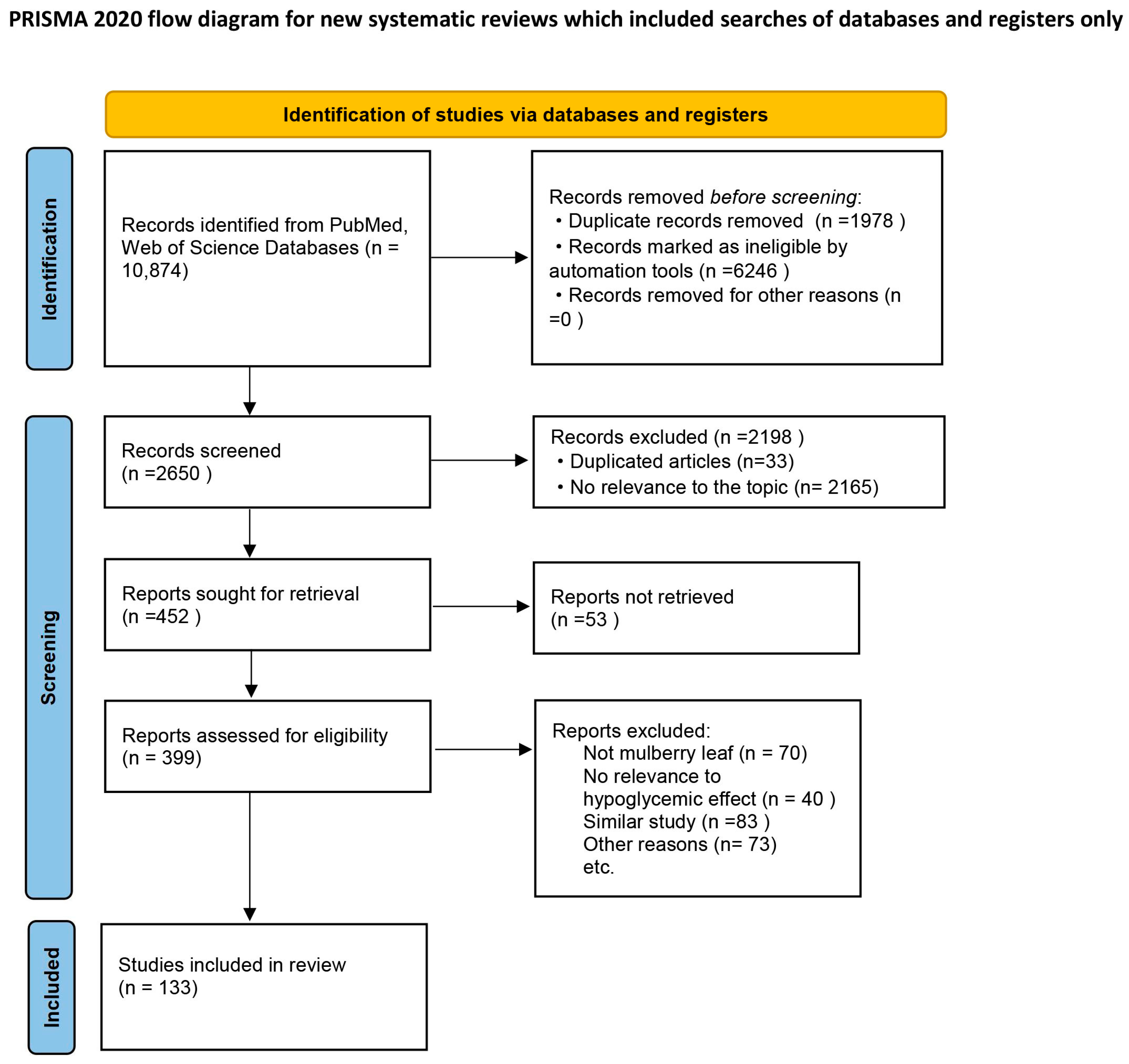
The literature for this review was searched from two different databases: PubMed and Web of Science. The search and selection processes are illustrated in the PRISMA flow diagram (Figure 1). From the initial database search, a total of 10,874 records were identified: 1144 records from PubMed and 9730 records from Web of Science. Of these, 6246 ineligible records, such as patents, letters, meetings, news, reports, etc., were excluded using an automated tool. After removing duplicates, 2650 studies were ultimately retained. Further screening based on the title and abstract of articles resulted in 452 articles being deemed highly relevant to the scope of this review. However, 53 of these were excluded because their full texts could not be obtained. To determine whether the remaining 399 articles were compliant with the inclusion criteria, their full texts were thoroughly reviewed and evaluated. Articles were removed after full-text screening if they did not pertain to ML, were not relevant to the hypoglycemic effect, or were similar studies. At the end of the screening flow, a total of 133 articles were included.

2.2. Hypoglycemic Constituents of ML

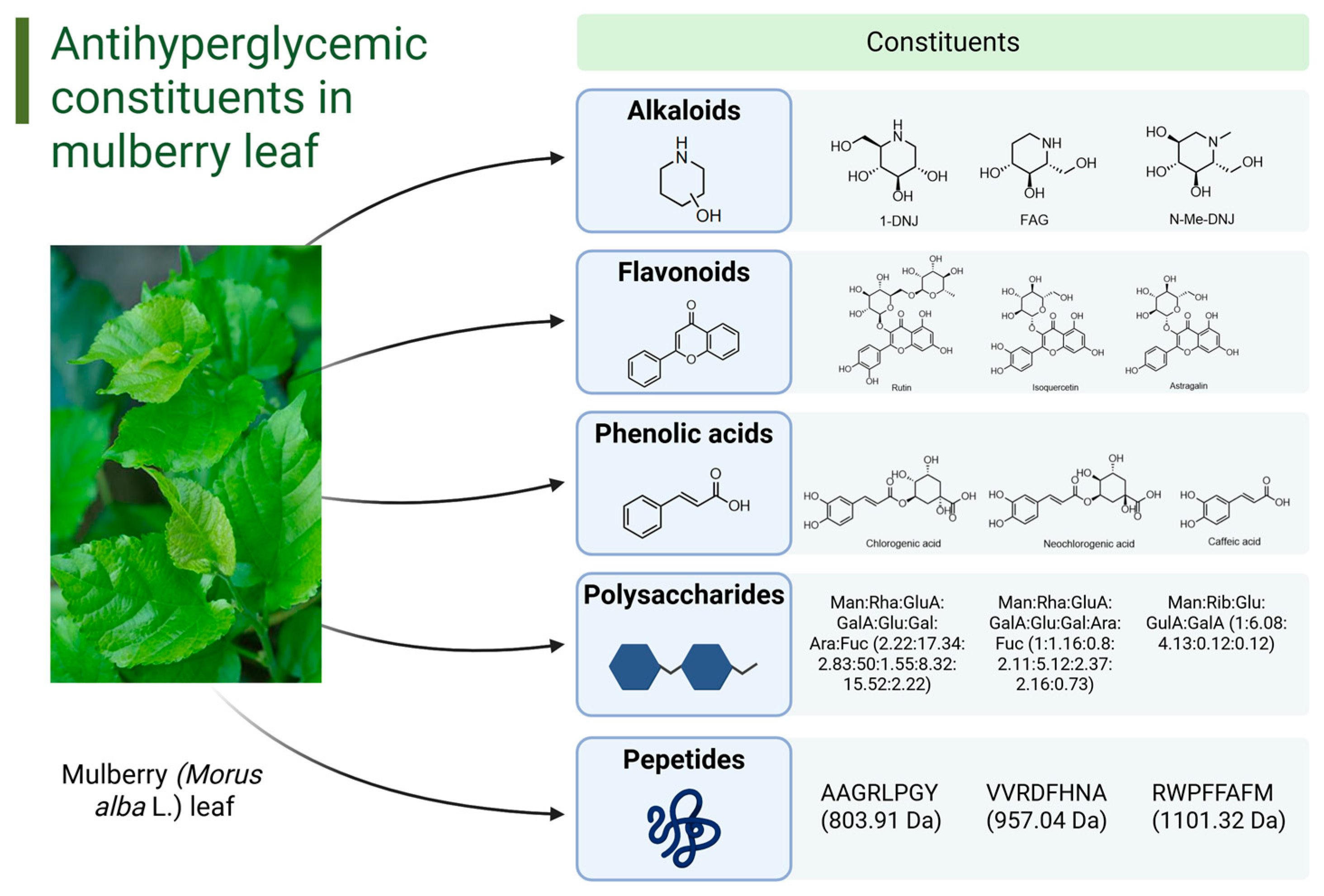
ML contains a variety of phytochemicals with hypoglycemic activity, such as alkaloids, flavonoids, phenolic acids, polysaccharides, and peptides. Figure 2 illustrates the main categories of antihyperglycemic constituents in ML along with the structures of their representative compounds. The hypoglycemic compounds identified in ML, as supported by the existing literature, are listed in Table 1.

2.2.1. Mulberry Leaf Alkaloids (MLA)

Alkaloids are widely recognized as one of the most important hypoglycemic constituents in ML. In 1994, the presence of seven alkaloids in ML, including 1-DNJ, D-fagomine (FAG), 2-O-α-D-galactopyranosyl deoxynojirimycin (GAL-DNJ), N-Methyl-1-Deoxynojirimycin (N-Me-DNJ), 1,4-dideoxy-1,4-imino-(2-O-beta-D-glucopyranosyl)-D-arabinitol, 1,4-dideoxy-1,4-imino-D-arabinitol (DAB), and nortropanoline, was reported for the first time [37]. In later studies, more alkaloids, such as aurantiamide acetate, Isofagomine, and 4-O-β-D-glucopyranosyl-fagomine (Glu-FAG), were isolated and identified from ML [16,38]. 1-DNJ, FAG, and GAL-DNJ are the major alkaloids, accounting for over 80% of the total alkaloid content in ML. Interestingly, the MLA content varies seasonally. The maximum content of 1-DNJ occurs in summer, the highest FAG level is found in spring, and GAL-DNJ and Glu-FAG contents reach their peak in autumn [39]. Therefore, the collection of medicinal ML ought to be carried out during the appropriate season.
1-DNJ, a type of iminosugar, is the most representative and characteristic MLA and has been extensively investigated. Iminosugars are sugar analogs in which the oxygen atom in the pyranose ring is replaced by a nitrogen atom [40]. Structurally similar to monosaccharides, iminosugars exhibit a unique mechanism of action by modulating the glucose metabolism through the competitive inhibition of various enzymes essential for carbohydrate digestion [4]. To date, numerous studies have confirmed the hypoglycemic effects of 1-DNJ, and its safety and non-toxicity have been validated in clinical trials [13]. For instance, a study based on next-generation sequencing and intestinal microbiota analysis revealed that 1-DNJ decreased the blood glucose level and improved insulin sensitivity in pre-2-diabetic mice, as well as significantly reducing the relative risk of T2DM in prediabetic mice by approximately 83.7% [41]. In vivo and in vitro experiments have indicated that the main anti-diabetic mechanisms of 1-DNJ include the inhibition of carbohydrate-digesting enzymes, improvement in insulin resistance, protection of pancreatic β-cells, regulation of lipid metabolism, alleviation of oxidative stress, and regulation of gut microbiota [10]. 1-DNJ can be extracted from plants, insects, and microbial strains, and it can be synthesized using chemical methods [42]. Among these methods, plant extraction using ML as the raw material is currently the most widely applied and technologically mature approach for 1-DNJ production [40]. Analogous to 1-DNJ, FAG, GAL-DNJ, N-Me-DNJ, and DAB are natural iminosugars that are believed to be intensely effective α-glycosidase inhibitors and may help to reduce the blood glucose levels [43].

2.2.2. Mulberry Leaf Flavonoids (MLF)

Flavonoids are a class of compounds with a unique C6-C3-C6 skeleton structure, consisting of two aromatic rings connected by a three-carbon bridge [4]. It is widely known that flavonoids are the main constituents responsible for the anti-diabetic properties of ML, where they are abundant, accounting for up to 1–3% of the dried ML [44]. The hypoglycemic activity of MLF is primarily attributed to the inhibition of α-glucosidase [19]. Owing to the significant blood glucose-lowering effects of MLF, scholars worldwide are increasingly focusing on their isolation, identification, and mechanistic studies. To date, a series of flavonoids with potent hypoglycemic potential have been isolated and identified from ML, containing rutin, quercetin, isoquercitrin, kaempferol, and astragalin [45]. A recent study revealed that a novel geranylated flavonoid compound from ML, along with its structural analogs, can inhibit the PTP1B protein and enhance glucose uptake in insulin-resistant cells [25].

2.2.3. Mulberry Leaf Polysaccharides (MLP)

Polysaccharides are polymer carbohydrate molecules composed of long chains of monosaccharide units linked by glycosidic bonds, which provide constituent monosaccharides or oligosaccharides during hydrolysis [46]. The monosaccharide composition and structural features of MLP are very complex, but the majority of them are acidic heteropolysaccharides with α, β-glycosidic linkages. They are primarily located within epidermal cells and have molecular weights ranging from 103 to 106 Da [47]. Although the monosaccharide composition of MLP varies across studies, they predominantly consist of galactose (Gal), galacturonic acid (GalA), arabinose (Ara), rhamnose (Rha), glucose (Glc), glucuronic acid (GlcA), mannose (Man), and xylose (Xyl) [48,49]. In addition, monosaccharides such as fucose (Fuc), ribose (Rib), and sorbose (Sor) have also been found in some MLP [33]. The mulberry variety, geographical origins, drying methods, extraction methods, and purification processes may have effects on the average molecular weight, composition, and molar ratio of monosaccharides in MLP, which are related to their bioactivity [50,51]. Consequently, research on the extraction methods and quality control of MLP has obtained increasing attention from scholars worldwide. Published studies demonstrate that MLP are key bioactive constituents in ML, exhibiting notable anti-diabetic effects and significant advantages, such as mild adverse drug reactions [52]. MLP exert anti-diabetic effects through multiple mechanisms and pathways. Among these, numerous studies focus on the role of MLP in regulating gut microbiota to alleviate diabetes [34,53].

2.2.4. Mulberry Leaf Phenolic Acids (MLPA)

Phenolic acids represent one type of the relatively abundant components found in ML. At present, approximately 20 phenolic acids have been isolated from ML, including neochlorogenic acid, cryptochlorogenic acid, chlorogenic acid, caffeic acid, and gallic acid [4,54]. MLPA with chlorogenic acid as the principal constituent can prevent T2DM by inhibiting disaccharidases (sucrase, maltase) and glucose transport [55]. Neochlorogenic acid, an isomer of chlorogenic acid, was not found to directly reduce blood glucose levels. However, neochlorogenic acid has been proved to have an effect on ameliorating diabetic nephropathy based on a db/db mice model, because it effectively inhibits the accumulation of glycation product [56]. Therefore, based on existing preclinical studies, the hypoglycemic activity of MLPA is primarily attributed to chlorogenic acid and its isomers [57].

2.2.5. Mulberry Leaf Proteins (MLPR) and Peptides (MLPP)

The total protein content accounts for 14.40% of the dry weight of ML, mainly including albumin, globulin, gliadin, glutelin, and insoluble protein, which is regarded as an important source of plant protein [44]. Although macromolecular MLPR does not exhibit significant hypoglycemic activity, some of its hydrolysis products (bioactive peptides) can alleviate T2DM by regulating glucose and lipid metabolism and suppressing oxidative stress [35]. The bioactivity of MLPP is influenced by the fermentation methods and the specific proteases used during the hydrolysis process. For example, the neutral proteolytic hydrolysates of MLPR exhibit superior α-glucosidase inhibitory activity compared to hydrolysates produced using complex protease, flavor protease, alkaline protease, trypsin, and papain [1].

2.2.6. The Synergistic Effects of the Constituents

Growing evidence suggests that bioactive components in ML, particularly flavonoids and alkaloids, possess synergistic effects in lowering blood glucose [58,59]. For instance, Ji et al. discovered that the combination of MLA and MLF significantly alleviated diabetic nephropathy in SD rats by modulating the Wnt/β-catenin and TGF-β/Smads signaling pathways. The therapeutic effects of this combination were significantly superior to the use of MLA or MLF only, but their synergistic mechanisms remain unclear [60]. Vitexin, a known flavonoid in ML, has also been proved to possess a synergistic effect in inhibiting α-glucosidase activity when combined with 1-DNJ [20]. In another interesting study, the combination of 1-DNJ and 5,6,7-trihydroxyflavone aglycone was shown to synergistically inhibit α-glucosidase and its MGAM subunit in vitro. Further mechanistic investigations have revealed that the flavonoid aglycone acts as a positive allosteric inhibitor, binding to a non-competitive site on MGAM. This binding induces a conformational change in the MGAM-N active site, enhances the enzyme’s affinity for 1-DNJ, and consequently potentiates the inhibitory effect of 1-DNJ against α-glucosidase [61]. Furthermore, MLF and MLP also demonstrate notable synergy, with their mixture exhibiting superior inhibitory effects on both α-glucosidase and α-amylase compared to the individual components [58]. These studies indicate that the hypoglycemic activity of ML results from the synergistic interactions of various bioactive constituents, including flavonoids, polysaccharides, and alkaloids, which involve multiple targets and pathways [20]. However, the detailed synergistic mechanisms require further investigation.

2.3. Extraction Methods Applied in the Bioactive Constituents of ML

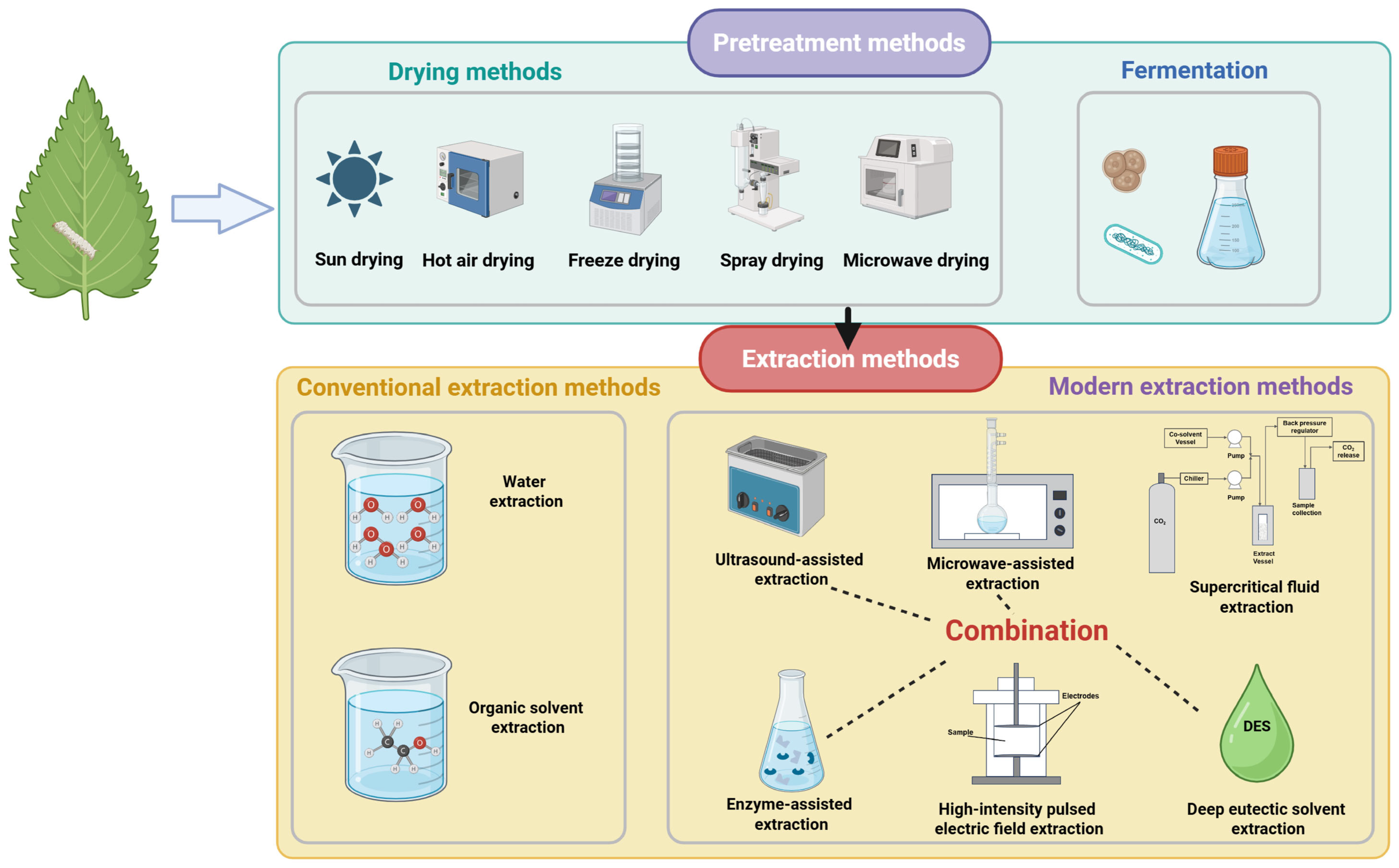
ML has abundant bioactive compounds, such as alkaloids, flavonoids, polysaccharides, phenolic acids, and peptides. The appropriate selection of extraction methods is crucial for efficiently extracting and separating hypoglycemic compounds from ML. At present, numerous techniques are employed to prepare ML extracts. Researchers not only choose extraction methods based on the type of target compounds but also focus on optimizing methodologies to enhance extraction efficiency, reduce resource consumption, and minimize environmental impact. Furthermore, response surface methodology (RSM) and machine learning techniques such as artificial neural networks (ANNs) have been employed to investigate the optimal extraction parameters [62]. In the following section, we will provide a detailed introduction to a series of conventional and modern extraction technologies. Each extraction technology has distinct advantages and limitations, as well as varying applicability under different conditions. Additionally, we will discuss how factors such as drying methods and fermentation influence extraction products (Figure 3).

2.3.1. Conventional Technologies

Water extraction and organic solvent extraction are two conventional technologies employed for isolating bioactive compounds from ML. Traditional extraction techniques, primarily maceration and reflux extraction, present certain limitations, including high energy consumption, low extraction yield, and prolonged extraction time. Aqueous extraction is a frequently used technique for separating polysaccharides, alkaloids, and proteins from ML. For MLP, hot water extraction is the most commonly used method due to its operational simplicity and cost-effectiveness. The optimization of extraction parameters primarily focuses on factors such as extraction time, temperature, liquid/solid ratio, and number of extraction cycles. However, there are few studies considering the influence of pH. Additionally, relevant research has indicated that extraction temperature has the greatest impact on polysaccharide yield, followed by the liquid/solid ratio [63]. MLA, which are highly water-soluble, can also be effectively extracted using aqueous solutions [64]. In order to improve the extraction yield of MLA, hydrochloric acid is often added to the aqueous solution to maintain an acidic pH, thereby converting the alkaloids into more soluble salt forms [65]. The extraction of MLPR primarily contain the salting-out method and the alkali–acid precipitation method. Among these methods, the alkali–acid precipitation technique separates proteins by exploiting proteins’ denaturation and aggregation, leading to precipitation at isoelectric points or in strongly acidic or alkaline environments. This method is simple and cost-effective, but the obtained proteins are prone to denaturation, often resulting in relatively low recovery rates and purity. The salting-out method extracts proteins by utilizing varying precipitation thresholds of different substances in a salt solution. Nevertheless, its application in MLPR extraction typically yields low amounts [51]. Organic solvent extraction is frequently utilized to isolate flavonoids from ML, with the choice of solvent being the main factor influencing the extraction efficiency. Ethanol is the most widely used organic solvent, whereas methanol and other solvents are used in few studies [66]. Detailed information regarding conventional technologies, including extraction methods, solvents, conditions, and yields, is summarized in Table 2.

2.3.2. Modern Extraction Technologies

Given the advantages in terms of environmental friendliness, low energy consumption, high extraction yield, and short extraction time, modern extraction methods are garnering increasing attention. At present, the modern methods applied in extracting hypoglycemic components from ML mainly include UAE, MAE, EAE, supercritical fluid extraction (SFE), high-intensity pulsed electric field extraction (PFE), deep eutectic solvent extraction (DEE), and combined extraction methods. Table 3 summarizes the modern extraction techniques, conditions, extraction yields, and advantages and disadvantages for ML.
UAE
UAE is a technique that utilizes the cavitation effect induced by ultrasonic waves in a liquid medium to efficiently extract bioactive compounds from plant materials. Ultrasound generates microscopic bubbles by compressing and expanding the liquid. when these bubbles collapse, they produce localized high temperatures and pressures, which break down plant cell structures and improve solvent penetration and the release of compounds [79]. Compared to conventional extraction methods, UAE is a safe, efficient and environmentally friendly extraction technique, which has become a popular choice for extracting polysaccharides, flavonoids, and alkaloids from ML [75]. The efficiency of UAE is determined by a combination of factors, including ultrasonic power, temperature, duration, liquid/solid ratio, solvent, and the physicochemical properties of the target compounds. The influence of ultrasonic power on extraction yield occurs as higher power intensities lead to more pronounced cavitation and mechanical forces, accelerating the transfer of bioactive components from the raw material into the solvent. However, excessively high power can cause the degradation of thermosensitive compounds. Temperature influences extraction efficiency in two opposing ways. Increasing the temperature enhances the diffusion rate and the solubility of active compounds. However, a high temperature also diminishes sonochemical effects and reduces the cavitation of bubble collapse. Prolonging the ultrasonic time can improve extraction yield, but an excessive duration may cause excessive cavitation, cell disruption, and elevated temperature. These factors may increase the degradation of the secondary metabolite [82]. Considering the impact of various factors, research focused on optimizing UAE parameters for extracting bioactive compounds from ML is of significant importance. For 1-DNJ, an ultrasonic-vaccum-assisted extraction technique was demonstrated to produce higher yield compared to standard UAE. When the optimal conditions were applied, the extraction yield of 1-DNJ reached 1.10 ± 0.02 mg/g [81]. For phenolic compounds, the dominant factors affecting yield in UAE are liquid/solid ratio, extraction time and solvent. The optimal extraction conditions are using 40% ethanol as the solvent, an ultrasonic duration of 35 min, and a liquid/solid ratio of 400 mL/g. Under these conditions, the yield of phenolic compounds reaches 36.00 ± 2.00 mg/g [75]. Regarding MLP, extraction temperature is identified as the most significant factor influencing yield, followed by the liquid-to-solid ratio and ultrasonic power. The recommended extraction conditions of MLP are a liquid/solid ratio of 16 mL/g, extraction time of 58 min, extraction temperature of 65 °C, and ultrasonic power of 500 W. These settings result in an MLP yield of up to 14.47% [80].
MAE
MAE is an extraction technique that utilizes microwave energy to accelerate the mass transfer process between the sample and the solvent. The principle is that microwave radiation can penetrate materials and accelerate molecular vibrations, thereby generating heat. Instead of traditional heating techniques that rely on convection and thermal conduction, microwave heating operates at the molecular level, leading to a more uniform heating process without temperature gradients [89]. In comparison with traditional hot water extraction, MAE does exhibit numerous advantages, including better reproducibility, shorter extraction time, lower solvent use, and protection of heat-sensitive compounds. For ML, MAE is mainly used to extract polysaccharides, reducing the extraction time from several hours to about 10 min [84]. The optimization of extracting MLP by MAE focuses on parameters, including microwave power, liquid/solid ratio, extraction time, and extraction temperature [63]. For instance, K. Thirugnanasambandham et al. investigated the influence of sample weight, microwave power, and extraction time on polysaccharide yield. They found that the optimal conditions for extraction were an ML sample weight of 20 g, a microwave power of 170 W, and an extraction duration of 10 min. Under these parameters, the MLP yield was 9.41% [83].
SFE
SFE is a novel and innovative technique utilized to extract bioactive compounds from various materials. It employs supercritical fluids, which possess unique physicochemical properties, including high diffusivity, low viscosity, and low surface tension. These properties grant supercritical fluids superior permeability into matrix pores, making them an ideal choice for extracting active constituents from plants [90]. Supercritical CO2 is the most commonly used supercritical fluid, owing to its relatively low critical temperature (31.1 °C) and other advantageous properties. To date, supercritical CO2 has predominantly been applied for the extraction of non-polar triterpenoids from ML, such as β-sitosterol. β-Sitosterol, a major phytosterol found in ML, exhibits notable pharmacological effects, including anti-diabetic, antioxidant, anti-inflammatory, antimicrobial, and immunomodulatory properties. K.A. Santos et al. reported that SFE significantly reduced the extraction time of β-sitosterol to 2 h, compared to the 6 h required by conventional Soxhlet extraction. Nevertheless, due to the pressure limitations of their lab (maximum 200 bar), the yield of β-sitosterol obtained via supercritical CO2 extraction reached only 69% of that achieved through Soxhlet extraction. Consequently, further optimization of the extraction parameters for supercritical CO2 is necessary to enhance the yield of β-sitosterol [71]. However, for polar compounds present in ML, such as phenolic acids and flavonoids, the extraction effect of supercritical CO2 is poor, and the yield is much lower than that of the 70% ethanol extraction method. This might be due to the low polarity of CO2 [90]. Future investigations could consider incorporating small amounts of cosolvents, such as ethanol or methanol, to adjust the polarity of CO2. This adjustment suggests a possible role in improving extraction efficiency and broadening the applicability of SFE for isolating bioactive constituents from ML.
EAE
EAE is extensively acknowledged as a safe and environmentally sustainable extraction technique, characterized by advantages such as high efficiency, a short extraction time, simple procedures, and low energy consumption [85]. Commonly employed enzymes in EAE include proteases, cellulases, amylases, and pectinases, as well as various commercial enzyme mixtures [62]. The efficiency of EAE is influenced by various factors, including the enzyme type, the degree of hydrolysis, the pH, the extraction time, temperature, and the enzyme–substrate ratio. Firstly, the selection of enzyme type is essential for optimizing the extraction process. For example, owing to the specificity of peptide bond cleavage, ML treated by different enzymes demonstrates notable differences in extraction yield, molecular weight, and the bioactivity of MLPR. EAE plays a dual function in protein extraction by both disrupting biological barriers to improve the extraction yield of protein and hydrolyzing proteins into peptides with higher bioactive properties [91]. For MLP, the combined application of pectinase, cellulase, and protease has been proved to increase extraction efficiency. Specifically, the functions of pectinase and cellulase are to promote the solubilization of polysaccharides into the extraction solvent by facilitating the degradation of the plant cell wall, while protease can decompose proteins bound to polysaccharides into amino acids and peptides, which contributes to an increase in polysaccharide purity [85]. Secondly, optimizing the pH value is of importance and the optimizing process should consider enzyme type, as each enzyme exhibits a distinct optimal pH range. Additionally, the structural characteristics and physicochemical properties of the target bioactive compound must be taken into account. For instance, the optimal pH for the cellulase-mediated extraction of 1-DNJ from ML is 3.5–4.5. This range is suitable because 1-DNJ is a piperidine alkaloid, which has higher solubility under acidic conditions. Excessively low pH values can inhibit cellulase activity, causing a decrease in extraction efficiency [65]. It is important to highlight that the improvement in 1-DNJ extraction yield achieved through EAE is not only due to the hydrolysis of the cell wall, which facilitates the release of bioactive constituents, but may also be related to the enzymatic transformation of other alkaloids, such as GAL-DNJ, into 1-DNJ [92]. As the degradation product of GAL-DNJ, 1-DNJ shows comparatively greater oral bioavailability and bioactivity than GAL-DNJ [93]. Furthermore, the release of active compounds can be enhanced by suitably prolonging the digestion duration, elevating the extraction temperature, and optimizing the enzyme–substrate ratio.
PFE
PEF is a new method for the extraction of bioactive compounds from plant materials. The principle of PEF is mainly based on the influence of electric fields on cell membranes. When cells are exposed to high-intensity electric fields for a short period of time, the cell membranes will form micropores. This technique can destroy the cell structure at comparatively low temperatures to promote the release of intracellular constituents. Consequently, PEF improves extraction efficiency while maintaining the structural integrity of bioactive compounds. Additionally, PEF is recognized as a cost-effective method due to its relatively low energy requirements and has been extensively employed for the extraction of diverse natural products. However, currently, there are few studies on the extraction of hypoglycemic active components from ML using PEF. Chaiyana W et al. first emphasized that PEF can significantly increase the phenolic content and the radical scavenging activity of ML extracts compared to conventional maceration methods. However, the overall extraction yield of PEF was significantly lower than that obtained through traditional maceration, likely due to the shorter extraction time and fewer extraction cycles [86]. Therefore, further research is essential to optimize the parameters of PEF for the efficient extraction of active constituents from ML.
DEE
Deep eutectic solvents (DESs) are a category of green solvents formed through interactions between hydrogen bond donors (HBDs) and hydrogen bond acceptors (HBAs). These solvents exhibit enhanced ability to penetrate plant cellular structures via hydrogen bonding, facilitating the rapid dissolution of bioactive compounds. DESs possess several advantageous properties, including environmental compatibility, widespread availability, straightforward synthesis, biodegradability, low toxicity, high extraction efficiency, and cost-effectiveness. These characteristics make them a promising alternative to conventional toxic organic solvents for the extraction of active constituents [87]. At present, DESs are used to extract polysaccharides, phenols, and alkaloids from ML. The optimal extraction parameters for MLP using DES are a choline chloride/malic acid molar ratio of 1:4, a liquid/solid ratio of 40:1 mL/g, a DES water content of 44%, an enzyme concentration of 3%, an ultrasonic time of 40 min, and an ultrasonic power of 350 W. Under these conditions, the yield of MLP reached 10.20 ± 0.05% [94]. Contributed to the strong multi-interaction between DESs and target components, DESs have obvious advantages in the extraction of phenols from ML compared with conventional solvents such as ethanol and methanol [65]. In conventional extraction technologies, various classes of bioactive components typically coexist in the extract, and subsequent separation and purification steps are necessary. DESs address this issue by synthesizing specific DESs using different HBDs and HBAs, enabling the efficient and selective separation of target components. For instance, R. Ma et al. developed a pH-responsive DES aqueous system capable of simultaneously extracting alkaloids and flavonoids from ML, followed by in situ phase separation to isolate MLF and MLA. Upon mixing the hydrophobic DES with water to form a biphasic system, flavonoids were preferentially enriched in the DES phase, while alkaloids concentrated in the aqueous phase, consistent with the “like dissolves like” principle. This study synthesized five new hydrophobic DESs utilizing long-chain fatty acids (valeric acid, nonanoic acid, hexanoic acid, heptanoic acid, and octanoic acid) as HBDs and 2-methyl-2,4-pentanediol (MPD) as the HBA. Among them, the optimal DES was identified as [HexA][MPD] [88]. Compared to traditional solvents, this DES aqueous system exhibits high extraction efficiency, enhances the purity of the extracts, and demonstrates favorable reusability.

2.3.3. Combined Extraction Techniques

In recent years, a variety of combined extraction techniques have been developed. The combination of different extraction methods is beneficial for overcoming the inherent limitations of each individual approach, thereby promoting the extraction yield and selectivity. Nonetheless, these combined extraction techniques face challenges related to cost-effectiveness, energy consumption, and scalability, which may limit their range of applications. Specifically, the combined extraction of ML often involves EAE coupled with UAE and MAE. Enzyme-ultrasound-assisted coupling extraction (EUCE), an innovative technique, has been employed to extract proteins from ML. The study indicates that the protein content obtained via EUCE is significantly high than that achieved through EAE or conventional alkali–acid precipitation methods, reaching a yield of 62.69%. Compared to conventional extraction methods, the protein extracted by EUCE showed enhanced enzymolysis properties and increased solubility due to alterations in its secondary structure and a reduction in average particle size. The optimal conditions for EUCE were determined to be a pH of 7.20, ultrasonic temperature of 35 °C, cellulase dosage of 4.20%, and ultrasonic time of 10 min [95]. In another study, enzyme-microwave-assisted coupling extraction (EMCE) technique was utilized to promote the extraction efficiency of MLP. This method combines the advantages of EAE and MEA, resulting in a shorter extraction time, a higher extraction yield, and lower costs. The optimal parameters have been identified as a liquid/solid ratio of 15 mL/g, an extraction temperature of 76 °C, and an extraction time of 13 min, resulting in a 15.23% extraction yield of MLP [96]. DEE is also frequently combined with UAE and MAE. For instance, P. Zhou et al. developed a simple, eco-friendly, and efficient method for extracting phenolic compounds from ML using deep eutectic solvent-ultrasound-assisted coupling extraction (DUCE) [97]. A summary of the combined extraction techniques is presented in Table 4.

2.3.4. Influence of Pre-Treatment Methods

In addition to extraction methods, the efficiency of extraction and the activity of hypoglycemic components in ML are influenced by pre-treatment processes such as drying and fermentation.
Influence of Drying Methods
Fresh ML has a high moisture content, which accelerates the enzymatic degradation of heat-sensitive compounds and hinders the long-term preservation of ML. Drying is an effective pre-treatment method to reduce moisture content, delay spoilage, and improve the storability of ML. Nevertheless, the choice of drying method can significantly influence the bioactive constituents of ML. Traditional drying methods, such as sun-drying, air-drying and hot air-drying are characterized by simple operation and low energy consumption. However, they require the prolonged heat exposure, which may increase the risk of the degradation of active ingredients. In contrast, emerging drying technologies, including freeze-drying (FD), spray-drying (SD), and microwave-drying (MD), have attracted considerable interest due to their advantages in reducing drying time, improving efficiency, and decreasing the degradation of heat-sensitive compounds. The stability of MLF is particularly susceptible to high temperatures and oxygen exposure. Therefore, FD has been regarded as a good choice for drying ML in order to preserve MLF. For instance, C. Zhao et al. systematically compared the effects of five drying methods (SD, FD, MD, air-drying, and oven-drying) on bioactive compounds in ML, suggesting that rutin content of ML extract dried by FD was significantly higher than that obtained using other drying methods [99]. In another study, the total flavonoid content of ML extract dried by FD was also found to be significantly higher than that of the samples dried by HD. This phenomenon may be attributed to the vacuum conditions during DF, which effectively inhibit the oxidation of flavonoid [72]. Furthermore, compared to air-drying and hot air-drying, FD significantly increases the polysaccharide content of ML extract, changes the composition and molar ratios of monosaccharides, and promotes the antioxidant activity of MLP [50]. Drying methods also influence the alkaloid content of ML extract. Given the high concentration of the representative alkaloid 1-DNJ and the short drying time, MD may be a preferable drying method for alkaloid extraction. However, the optimization of microwave power is essential, as insufficient power prolongs drying time, whereas excessive power can degrade 1-DNJ and diminish its extraction yield [100].
Influence of Fermentation
Microbial fermentation, an effective biotechnology for extracting active ingredients from natural sources, is extensively utilized in medicinal development and the food industry. This method uses microbial enzymes to hydrolyze raw materials, which can significantly reduce production costs. Both fungi (e.g., saccharomycetes and molds) and bacteria (e.g., lactic acid bacteria and Bacillus) are common microorganisms employed in fermentation processes. Fungal fermentation serves a dual function in the extraction of flavonoids. Firstly, the hydrolytic enzymes secreted during fermentation break the covalent bonds linking the cell wall to insoluble flavonoids, facilitating the release of MLF from the substrate matrix. Secondly, the fungal secondary metabolism may lead to the biosynthesis of novel flavonoid compounds. Accordingly, several studies have explored the use of fungal fermentation to improve both the extraction efficiency and bioactivity of MLF, focusing on the identification of the optimal fungal strain. For example, solid-state fermentation technology has been demonstrated to facilitate the release and transformation of flavonoids in ML, and the optimal fungal combination for co-fermentation has been determined as Eurotium cristatum 5, Aspergillus cristatus 6, and Aspergillus cristatus 9. However, fermentation with some other fungi may result in a decreased total flavonoid content, because these fungi inhibit and reuse transformed flavonoids, or re-convert them into other colored substances [101]. Notably, fungal fermentation not only plays a pivotal role in disrupting the cell wall of ML but also promotes the dissociation of phenolic compounds and the deglycosylation of flavonoids. For instance, although quercetin and kaempferol are present in minimal amounts in unfermented ML, solid-state fermentation with fungi such as Monascus anka, Monascus purpureus, and Aspergillus niger significantly increases the content of these flavonoid aglycones. Concurrently, the levels of flavonoid glycosides, including astragalin, isoquercitrin, and rutin, decrease, and the fermented ML exhibits higher antioxidant capacity, α-glucosidase inhibitory activity, and antimicrobial properties [102,103]. Moreover, given the low extraction yield of 1-DNJ via conventional methods, microbial fermentation has been employed to augment extraction efficiency. Co-fermentation with L. fermentum and S. cerevisiae has been recognized as the most effective fermentation method for increasing the content of 1-DNJ in ML [67,104]. Based on the premise that proteases secreted during bacterial fermentation degrade proteins, bacterial fermentation can increase the abundance of bioactive peptides in ML. For example, Zaheer et al. used bacterial strains with high protease activity, such as Bacillus amyloliquefaciens LFB112 and Bacillus subtilis H4, obtaining and identifying three novel antioxidant peptides (FRFDP, RFGG, and GPPLAFGGGP) [105].

2.4. Quality Analysis Studies of ML Constituents

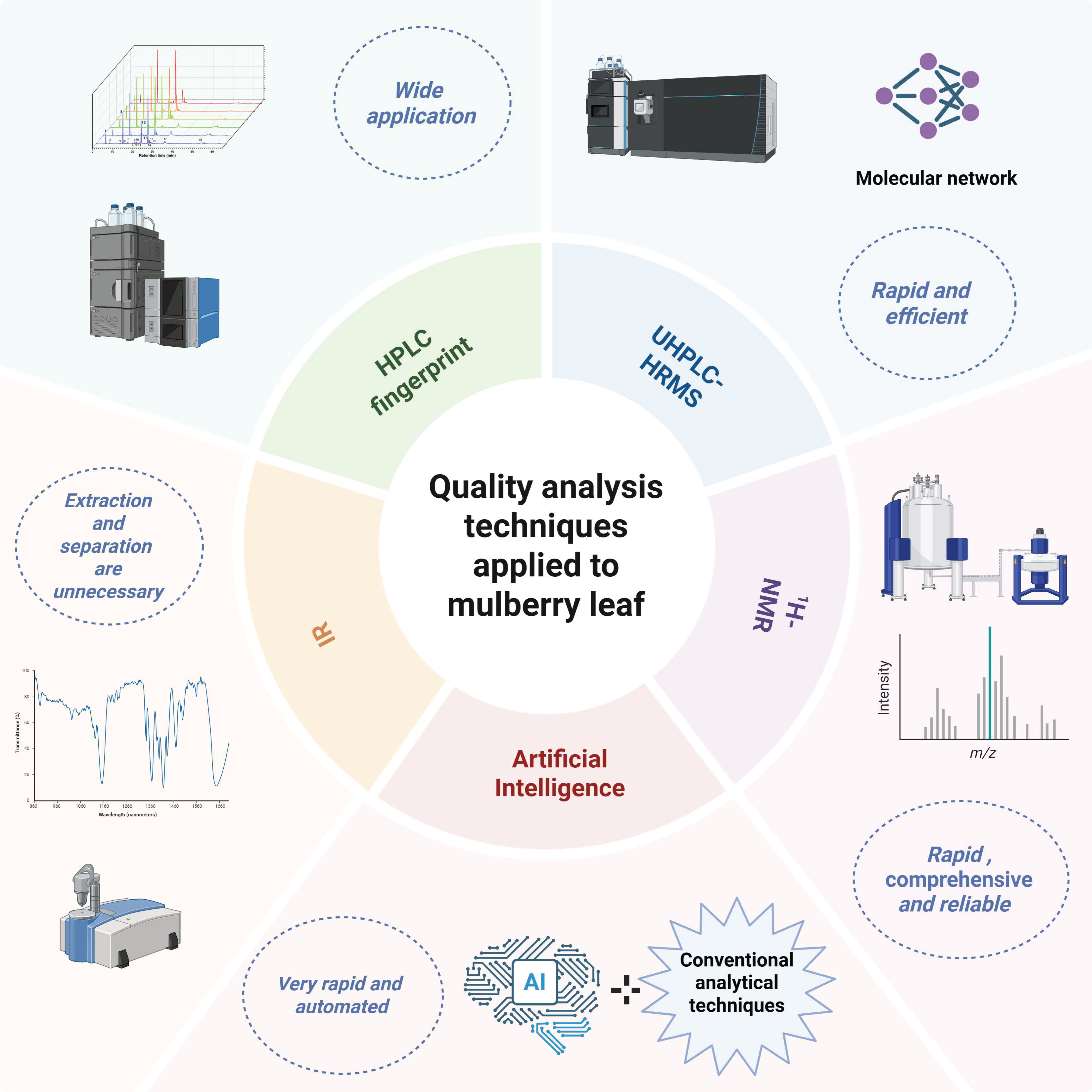
The quality of ML is a critical determinant of its hypoglycemic activity and safety. The quality of ML is affected by several factors, including the variety of mulberry tree, the harvest season, the maturity of the leaf, and the techniques employed during processing. Therefore, the establishment of robust quality control standards is crucial for the development and application of ML [66,106,107]. The 2020 edition of the Chinese Pharmacopoeia outlines primary identification techniques for ML, containing macroscopic examination, microscopic identification, TLC, and HPLC. According to the Chinese Pharmacopoeia, the moisture content of ML should not exceed 15%, and the alcohol-soluble extract must be at least 5%. Additionally, the determination of rutin content by HPLC is regarded as a quality marker (Q-Marker). To date, numerous studies have addressed the quality control of ML. Our investigation into quality analysis methods for ML beyond those stipulated in pharmacopeias reveals that these techniques primarily focus on HPLC fingerprint, ultra-high-performance liquid chromatography–high-resolution mass spectrometry (UHPLC-HRMS), infrared spectroscopy (IR), proton nuclear magnetic resonance (1H-NMR), and artificial intelligence (Figure 4).

2.4.1. HPLC Fingerprint

Chromatographic techniques employed in the quality assessment of ML predominantly encompass TLC, liquid chromatography (LC), and gas chromatography (GC). As a simple, cost-effective, versatile, and highly specific method, TLC has been used for the authentication of ML according to the Chinese Pharmacopoeia. GC is a well-established method for the analysis of volatile constituents in herbal medicines, and GC-MS has been utilized to construct the fingerprint of ML volatile oil [108]. HPLC is an analytical method characterized by simple operation, broad applicability, and high precision, making it one of the most commonly used techniques in herbal medicine analysis. The HPLC fingerprint can characterize the overall variations in the intrinsic quality of herbs, and Q-Markers are closely associated with their bioactivity. Rutin, a widely recognized Q-Marker for ML, is noted in the current edition of the Chinese Pharmacopoeia and is extensively applied in quality-control practices. The rutin content of qualified ML cannot be lower than 0.1%. However, rutin can be found in numerous plants and herbs, rendering it non-specific as a marker for ML. Additionally, as an individual compound, rutin alone does not adequately reflect the comprehensive quality of ML. Consequently, in order to conduct a more comprehensive evaluation of ML quality, researchers have identified multiple components as Q-Markers and developed detection techniques [109]. For example, X. Ling et al. established an HPLC fingerprint for ML using chlorogenic acid, rutin, and astragalin as Q-Markers, and analyzed the quality of ML samples from different geographic regions and harvest periods [66]. The traditional HPLC fingerprint generally uses a single wavelength for detection. This method is simple to operate but may lead to inaccuracies in identifying chemical constituents. To enhance the analytical accuracy of complex ingredients, multi-wavelength fusion technology has been employed in the quality analysis of ML. For instance, D. Yan et al. developed a multi-wavelength fusion HPLC fingerprint for ML. This method enables the simultaneous quantification of protocatechuic acid, chlorogenic acid, neochlorogenic acid, cryptochlorogenic acid, astragalin, and rutin, providing a more comprehensive assessment of ML quality. They classified the quality grades of ML based on macro-qualitative similarity (Sm), macro-quantitative similarity (Pm), and fingerprint homogeneity (α) under the fused wavelength, with lower ML grades indicating better quality [108]. Moreover, in response to the lack of consensus on analytical techniques and Q-Markers of bioconverted ML, Kim et al. integrated the HPLC fingerprint with bioactivity data to select syringaldehyde, trans-caffeic acid, morin 3-O-β-D-glucopyranoside, astragalin, and moracin M 3′-O-β-glucopyranoside as Q-Markers. The criteria used to determine the commercial suitability of bioconverted MF for treating diabetes was suggested to be a syringaldehyde concentration of 0.58 µg/g and trans-caffeic acid concentration of 0.46 µg/g [27]. 1-DNJ is one of the most important hypoglycemic compounds in ML, but the lack of ultraviolet absorption makes it difficult to analyze. Although derivatized 1-DNJ can be detected by GC-MS, the previously used trimethylsilyl derivatives have poor thermal stability. To enable the rapid and precise quantification of 1-DNJ in ML, Eruygur et al. developed and validated an HPLC method involving the derivatization of 1-DNJ with 9-fluorenylmethyl chloroformate, followed by quantification using HPLC with fluorescence detection. The limit of detection and limit of quantification of 1-DNJ were 1.07 and 3.27 ng/mL, showing the high sensitivity of this method [110].

2.4.2. UHPLC-HRMS

HPLC and HPLC-MS are commonly employed analytical methods for the quality analysis of ML. However, these techniques are limited by their relatively low resolution and insufficient capacity to provide comprehensive compound information. In contrast, UHPLC-HRMS is a more advanced analytical technique, which possesses high resolution and allows for the precise mass determination of compounds. Common HRMS instruments include Q-Exactive Orbitrap mass spectrometry (Q-Orbitrap-MS) and quadrupole time-of-flight mass spectrometry (Q-TOF-MS). Compared to conventional HPLC-MS, UHPLC-HRM is able to substantially reduce the time required for the qualitative identification of complex mixtures of components in ML through data analysis methods such as mass spectral database-matching and molecular networks [111]. For instance, Sánchez-Salcedo et al. reported that the (poly)phenolic fingerprints of white ML and black ML were constructed using ultra-high-performance liquid chromatography coupled with linear ion trap high-resolution mass spectrometry (UHPLC-LTQ MS), and 31 compounds were identified [112].

2.4.3. IR

FTIR is one of the most frequently used spectroscopic techniques, with each sample producing a distinctive infrared spectrum that serves as a molecular fingerprint. Accordingly, IR has been widely utilized in the identification and quality analysis of herbal medicines, where its quality assessment principle is commonly based on the overall composition rather than specific Q-Markers. For example, Azlah et al. utilized advanced two-dimensional infrared spectroscopy (2D-IR) to identify and classify thirteen varieties of herbal leaves, including ML. In comparison to conventional FTIR, 2D-IR enables the detection of subtle spectral differences and the resolution of overlapping peaks. Their study indicated that the spectral region between 1800 and 900 cm−1 is particularly critical for the identification and differentiation of herbal leaves using IR. A notable advantage of IR over alternative quality analysis techniques is that it can analyze both solid and liquid samples without necessitating the complex extraction or separation processes [53]. However, FTIR combined with chemometrics can also be used for a quick screening evaluation of the quality of ML by detecting the 1-DNJ content [113].

2.4.4. 1H-NMR

With the development of instrument technology, 1H-NMR spectroscopy has been increasingly utilized for the analysis of complex natural samples. Owing to its ability to simultaneously provide both qualitative and quantitative data, 1H-NMR is employed to conduct an unbiased assessment of the constituent components within mixtures. In ML, 1H-NMR spectroscopy is predominantly applied to the characterization compounds without UV chromophores such as amino acids, organic acids, alkaloids, and carbohydrate. For example, Liang et al. developed a rapid, reliable, and straightforward 1H-NMR-based method for the qualitative and quantitative analysis of eleven principal metabolites in aqueous extracts of ML. This approach presents a viable alternative for the quality control and evaluation of ML. In comparison to traditional HPLC-UV, this 1H-NMR methodology reliably and non-destructively determines metabolites that lack UV absorption, without the need for any derivatization or separation procedures [114].

2.4.5. Application of Artificial Intelligence in Quality Analysis

In recent years, artificial intelligence has developed rapidly and has been applied across diverse fields. Deep learning techniques have exhibited considerable efficacy in analyzing and extracting valuable information from large data of natural products to solve complex issues. An increasing number of studies emphasize the potential of artificial intelligence combined with traditional analytical methods in herbal medicine quality analysis, and ML is no exception. For instance, Lin et al. developed a comprehensive and bioactivity correlated quality assessment framework for ML based on the HPLC fingerprint and ANN mode. Specifically, their methodology involved generating an HPLC fingerprint, utilizing chemometric techniques and biological assays to identify Q-Markers, and subsequently constructing an ANN model according to the characteristic peaks of Q-Markers [115]. Additionally, another notable investigation demonstrated that near-infrared (NIR) spectroscopy combined with AI algorithms can rapidly evaluate the tenderness of ML. Although this approach is currently applied only in agriculture, it clearly holds significant potential for the quality analysis of medicinal ML [116].

2.5. Hypoglycemic Mechanism of ML Constituents

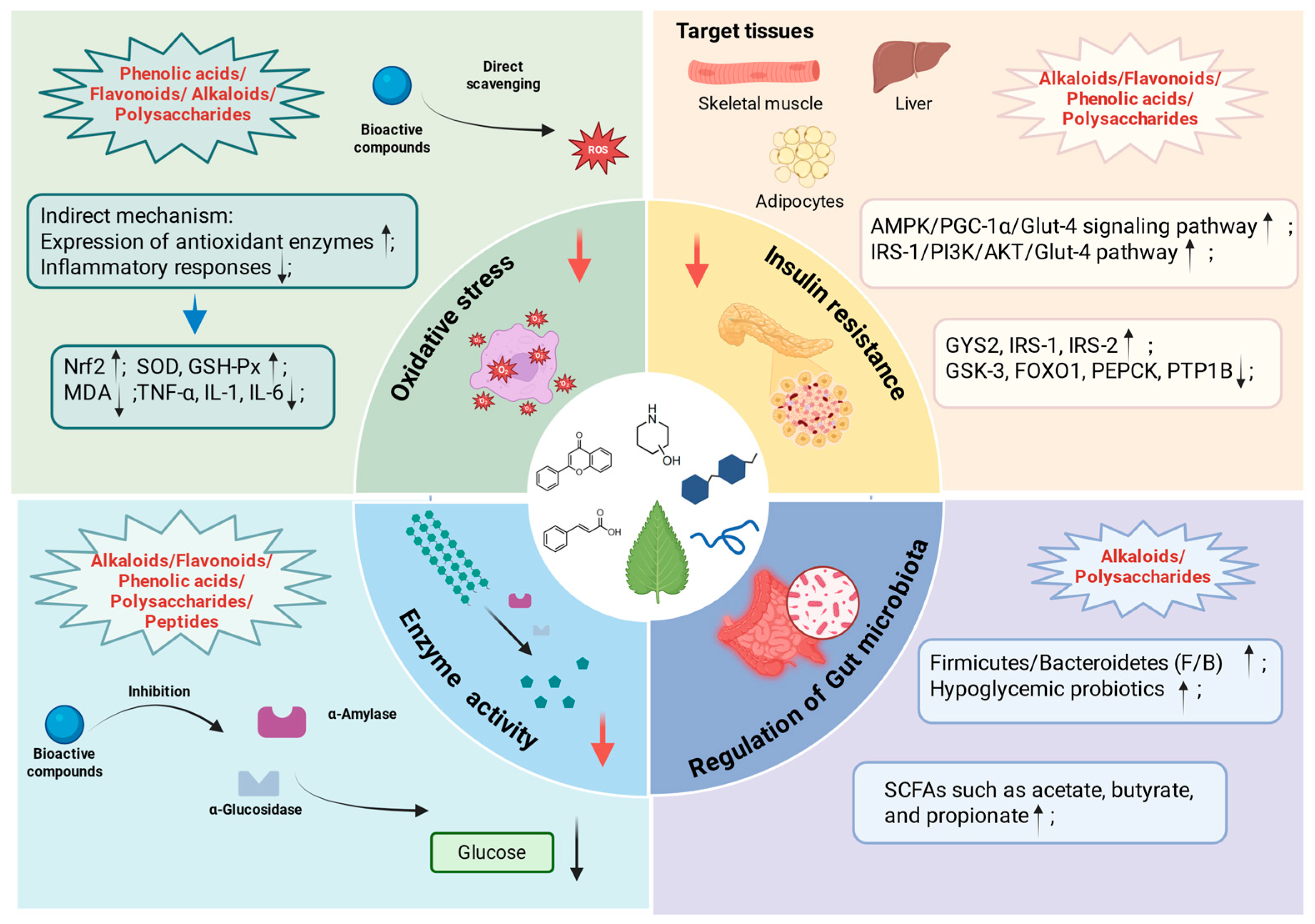
ML is a traditional Chinese medicine with a long history of utilization and are effective in reducing blood glucose levels. ML contains a variety of bioactive ingredients that contribute to the regulation of glycemic balance. These constituents operate through multiple mechanisms to sustain glucose homeostasis (Figure 5). The primary mechanisms underlying the hypoglycemic effects of ML are described in detail below and summarized in Table 5.

2.5.1. Inhibition of Oxidative Stress

Oxidative stress is one of the most important factors in the pathogenesis of diabetes and its complications. In diabetes, persistent hyperglycemia and mitochondrial dysfunction facilitates the production and accumulation of reactive oxygen species (ROS). The oxidative stress, mediated by ROS, further aggravates dysregulated blood glucose levels by impairing pancreatic β-cell function and diminishing insulin sensitivity. Recent studies have demonstrated that the abundant natural antioxidants present in ML exert hypoglycemic effects by reducing oxidative stress through both direct and indirect mechanisms. The direct mechanism is defined as the effective scavenging of free radicals, whereas the indirect mechanisms involve modulating antioxidant signaling pathways to increase the expression of antioxidant enzymes, reduce inflammatory responses, and alleviate inflammation-related oxidative damage. Polyphenols are the representative constituents in ML that inhibit oxidative stress. Their phenolic hydroxyl groups endow them with a powerful antioxidant capacity. For example, MLPA such as neochlorogenic acid exhibited a strong free radical scavenging activity and can ameliorate oxidative stress through modulation of the NF-κB signaling pathway [56,126]. Further research indicated that phenolic acids can scavenge ROS in HepG2 under high-sugar culture conditions [117]. 1-DNJ found in ML is not a direct antioxidant, but it can lower postprandial blood glucose by inhibiting α-glucosidase, indirectly reducing high-glucose-induced oxidative stress. Additionally, 1-DNJ can activate Nrf2 in diabetic animals, regulate the production of antioxidant proteins, and prevent inflammation-mediated oxidative stress [10]. Although the antioxidant capacity of MLP alone is relatively modest, they can significantly potentiate the antioxidant effects of flavonoids [79]. Beyond these components, bioactive peptides derived from ML, through fermentation or enzymatic hydrolysis, also exhibit antioxidant properties. Their activities are related to the scavenging of free radical scavenging, their capacity to reduce oxidative stress markers such as MDA and SOD, and their potential to enhance cellular antioxidant defenses via activation of the Keap1-Nrf2 signaling pathway [1,105].

2.5.2. Amelioration of the Insulin Resistance

Insulin resistance represents a common metabolic condition that precedes the development of T2DM, defined as a reduced responsiveness of target tissues (skeletal muscle, liver, and adipocytes) to insulin [8]. Current evidence indicates that extracts derived from ML, along with their bioactive constituents, can enhance insulin secretion, reduce insulin resistance, and improve insulin sensitivity [127,128]. 1-DNJ and flavonoids are the main active ingredients in ML that ameliorate insulin resistance. In animal studies, 1-DNJ significantly alleviated insulin resistance via the activation of the insulin signaling PI3K/AKT pathway in skeletal muscle [120]. In skeletal muscle cells, both 1-DNJ and MLE have been proved to ameliorate insulin resistance effectively by activating the IRS-1/PI3K/AKT signaling pathway. A further mechanistic investigation revealed that 1-DNJ can upregulate p-GSK3β activity through activation of the aforementioned signaling pathway, and p-GSK3β can inhibit p-GS levels to promote glycogen storage in skeletal muscle [121]. Additionally, ML polyphenol-enriched extracts can promote glucose uptake and transport by activating the IRS-1/PI3K/Glut-4 signaling pathway [122]. MLF can also reverse insulin resistance in skeletal muscle by increasing glucose uptake and mitochondrial function through the regulation of the AMPK/PGC-1α/Glut-4 signaling pathway [8]. Given that skeletal muscle is the primary insulin-responsive tissue, responsible for approximately 80% of insulin-mediated glucose uptake, it plays a pivotal role in maintaining systemic glucose homeostasis. Consequently, the majority of research has concentrated on elucidating the effects of ML extracts and their active constituents on skeletal muscle insulin sensitivity. Nonetheless, some studies pay attention to insulin resistance in other target tissues, such as liver and adipose tissue. For instance, Sangtong alkaloids composed of the total MLF and MLA, were able to significantly upregulate the IRS-1/PI3K/AKT/Glut-4 signaling pathway in the hepatic tissue of diabetic mice, reduce insulin resistance, and ameliorate pathological alterations in pancreatic tissue [123]. In a Caco-2/insulin-resistant HepG2 model, ML polyphenols, including luteoforol and p-coumaric acid, alleviated hepatic insulin resistance by modulating the expression of genes associated with insulin signaling (IRS1 and AKT), glycogen synthesis (GYS2 and GSK-3β), and gluconeogenesis (FOXO1 and PEPCK) [5]. Furthermore, MLP have emerged as potential agents for ameliorating insulin resistance. A study demonstrated that MLP can ameliorate hepatic insulin resistance by regulating the expression of two antagonistic regulators within the insulin signaling pathway: protein tyrosine phosphatase 1B (PTP1B) and insulin receptor substrate 2 (IRS-2). Specifically, the downregulation of PTP1B coupled with the upregulation of IRS-2 contributed to the positive modulation of insulin signaling in liver tissue [2].

2.5.3. Regulation of Related Enzymes Activity

α-Glucosidase and α-amylase are enzymes involved in carbohydrate digestion that can rapidly increase postprandial blood glucose levels. Inhibiting the activities of these carbohydrate-digesting enzymes and delaying the release of glucose from carbohydrates constitute an important hypoglycemic mechanism of ML, which contains various active components, such as alkaloids, flavonoids, polysaccharides, and bioactive peptides [129]. 1-DNJ is the most important MLA, with the inhibition activities of α-glucosidase and α-amylase. It is well known that 1-DNJ has a similar chemical structure to glucose and binds more readily to glucosidases than glucose itself. Its mechanism of inhibiting intestinal α-glucosidase activity is considered to involve competition with glucose for the enzyme’s active site [130]. 1-DNJ is a potent α-glucosidase inhibitor, with an enzyme-inhibitory activity comparable to clinically used α-glucosidase inhibitors such as acarbose, voglibose, and miglitol [9]. Other MLA, such as FAG and GAL-DNJ, also exhibit inhibitory activity against carbohydrate-digesting enzymes, but their effects are significantly weaker than those of 1-DNJ [14]. Flavonoids are also major components in ML, responsible for inhibiting α-glucosidase and α-amylase. For MLF, astragalin has attracted researchers’ attention as an effective α-glucosidase inhibitor, with the lowest IC50 (154.5 μM) among the main polyphenols in ML. Its inhibition mechanism has been shown to involve binding to α-glucosidase at a single inhibitory site, which alters the enzyme’s microenvironment and conformation, reduces the α-helix content, and consequently decreases enzyme activity [19]. Furthermore, several prenylated flavonoids isolated from ML have demonstrated great α-glucosidase inhibitory activity in vitro. Among them, Sanggenon W exhibited an even lower IC50 than that of acarbose and showed significant postprandial blood glucose-lowering ability in vivo, highlighting its research value [23]. Bioactive peptides obtained through the enzymatic hydrolysis of MLPR may also serve as potential α-glucosidase inhibitors, with an inhibitory activity closely related to the type of hydrolases, the molecular weight of the peptide, and the amino acid sequence of the peptide [35]. Notably, hydrolysates produced by neutral protease showed the strongest inhibition against α-glucosidase, likely due to their high content of hydrophobic and aromatic amino acids such as leucine, proline, and alanine [1]. Depending on the extraction and purification methods used, MLP exhibit significant variations in monosaccharide composition and biological activity. Some MLP demonstrate inhibitory effects on α-glucosidase and α-amylase activities, while others do not [131].

2.5.4. Regulation of Gut Microbiota

An increasing amount of evidence suggests that the gut microbiota plays a crucial role in regulating the development of diabetes. When the gut microbiota is in a state of dysbiosis, abnormal metabolites and immunomodulatory functions may contribute to metabolic syndrome-like diseases such as T2DM [132]. Current research indicates that modulating the gut microbiota is the main hypoglycemic mechanism of ML and its active components. Animal studies have demonstrated that ML extract ameliorates gut microbiota composition and glucose homeostasis in T2DM mice, primarily through normalization of the quantity, abundance, and distribution of gut microbiota [124,133]. Among the gut microbiota-modulating components in ML, 1-DNJ is the most representative active substance, mainly functioning in two ways. Firstly, 1-DNJ effectively alleviates diabetes-induced gut microbiota dysbiosis. In prediabetic mice modal, high-fat diet treatment increased the abundance of Enterobacteriaceae, Enterococcaceae and decreased the abundance of Bifido-bacterium, Bacteroides, Lactobacillus, and Akkermansia, which was ameliorated by intervention with 1-DNJ. An increased abundance of Enterobacteriaceae and Enterococcacea may exacerbate the destruction of the intestinal barrier, while the increased abundance of Bifidobacterium, Bacteroides, Lactobacillus, and Akkermansia protected the intestine from pathogenic bacteria, and maintained the epithelial cell tight junction. Secondly, 1-DNJ can increase the levels of short-chain fatty acids (SCFAs) such as acetate, butyrate, and propionate, suggesting a potential role in improving glucose homeostasis, reducing intestinal permeability, and mitigating inflammatory reaction [125]. MLP exhibit similar regulatory effects on diabetic gut microbiota. They enhanced gut microbiota diversity and impacted the Firmicutes to Bacteroidetes (F/B) ratio in an HFD-induced mice model [32]. Furthermore, given the interactive relationship between bile acids and gut microbiota, where they mutually regulate each other’s dynamics, MLP can improve glucose and lipid disorders through the gut microbiota–bile acid metabolism pathway [33]. Oligosaccharides derived from the enzymatic hydrolysis of MLP may also possess gut microbiota-modulating properties. MLO 2-1, an oligosaccharide purified from enzymatically hydrolyzed MLP, has been reported to alleviate T2DM because it could selectively promote the proliferation of the hypoglycemic probiotic bacterium Ligilactobacillus murinu [34].

2.6. Limitations and a Future Research Agenda

Based on the integration and results of previous studies, the hypoglycemic effects of ML and its bioactive constituents are strongly supported. However, some limitations still need to be addressed. Firstly, the optimization of extraction parameters mainly use RSM, which may not be suitable for complex systems and multi-objective optimization. Secondly, the evaluation of extraction methods is not comprehensive enough, and few studies focus on the impact of different extraction methods on the structure and biological activity of ML’s ingredients. Thirdly, there is lack of quality-control studies and standards for active macromolecules, including polysaccharides and peptides. Fourthly, clinical studies on the bioactive constituents of ML are still extremely scarce. Finally, current research on the gut microbiota predominantly analyzes at the phylum and genus levels; however, investigations at the strain level remain limited.
These limitations highlight the significance of future research in these emerging fields to address existing gaps. Artificial intelligence algorithms such as ANN and Particle Swarm Optimization (PSO) have the advantage of handling highly nonlinear problems and may be widely applied in the optimization of extraction methods in the future to quickly find theoretically optimal parameters. In order to reach a more comprehensive and reliable conclusion, the evaluation of extraction methods should consider their impact on the structure and activity of the extracted components. Future investigations should prioritize the establishment of chemical fingerprint profiles and quality control standards for priority compounds and standardized extracts to ensure the consistency and reproducibility of the research materials. In addition, some polysaccharides and peptides from ML have been identified as bioactive ingredients and hold potential for use as new quality control markers. Future investigations also need to systematically examine the dose–response relationship during both the preclinical and clinical phases to identify the minimum effective dose, 50% effective dose, and maximal effect. This research will facilitate the provision of accurate recommendations for clinical practice. Employing advanced high-resolution methodologies, such as metagenomics, to perform comprehensive analyses of gut microbiota alterations at the strain level both pre- and post-intervention holds promise for elucidating the precise mechanisms underlying the effects of ML extract and its bioactive constituents.

3. Methods

3.1. Eligibility Criteria

This review summarized the studies on the constituents of ML for treating diabetes. Articles and review articles published in English and other languages between 2015 and 2025 were considered for inclusion. Studies were eligible for inclusion when a full text was available and targeted the research question. Patents, meetings, case reports, and gray literature were excluded. Studies were categorized according to the specific classes of hypoglycemic compounds, including alkaloids, flavonoids, polysaccharides, phenolic acids, and peptides.

3.2. Information Sources and Search Strategy

An advanced literature search was performed utilizing the Web of Science and PubMed databases to find relevant articles on the constituents of ML that are involved in regulating blood glucose levels. This systematic review followed the PRISMA 2020 guidelines. In brief, the search strategy incorporated specific keywords related to ML, diabetes, and glucose regulation. Since this review focused on extraction methods, quality control, and mechanisms of action, a supplementary search was carried out using relevant terms. The final literature search was conducted on 3 August 2025. The full search strategy and terms used are presented in Table 6.

3.3. Selection and Data Collection Process

After the literature search in the Web of Science and PubMed databases, all collected data were critically analyzed for eligibility following the PRISMA 2020 guidelines. Firstly, the general information of each study, including the title, abstract, journal name, publication year, and DOI, was exported to a Microsoft Excel spreadsheet, and duplicate entries were removed. Subsequently, the articles were screened according to predefined inclusion and exclusion criteria. The systematic evaluation and screening of the literature were performed by two independent reviewers. In cases of discrepancies between the reviewers, consensus was reached through discussion.

4. Conclusions and Perspectives

As a traditional Chinese medicinal herb, ML possesses significant hypoglycemic effects and contains various active components, including alkaloids, flavonoids, polysaccharides, and phenolic acids. The glucose-lowering properties of ML and its bioactive compounds are predominantly supported by preclinical studies. However, the hypoglycemic activity of MLE and 1-DNJ has been substantiated by results from clinical trials. The implementation of standardized extraction and analytical methods is essential for the precise assessment of hyperglycemic potential of ML, as well as for ensuring the rigor, reliability, and reproducibility of clinical investigations. Contemporary research increasingly focuses on green and efficient extraction technologies that align with global sustainability objectives. To date, several advanced extraction techniques have been developed and applied to ML, such as EAE, UAE, MAE, DEE, PFE, SFE, and combined extraction methods. Each of these techniques exhibits unique advantages and limitations, and appropriate methods can be selected based on the properties of different components and the purpose of extraction. Additionally, ML extraction is influenced by pretreatment methods, such as drying and fermentation. Methods such as FD, MD, and SD significantly reduce the time required to obtain stable, storable dried ML. Fermentation is an ideal choice for generating novel bioactive peptides from ML. In terms of quality analysis, UHPLC-HRMS demonstrates exceptional sensitivity, making it suitable for the rapid analysis of numerous compounds in ML. Furthermore, some studies combine conventional chromatographic and spectroscopic analytical methods with artificial intelligence, revealing new research directions in ML quality control.
However, the intricate composition of bioactive constituents in ML presents significant challenges for their extraction methods, quality control, and action mechanism investigations. To address these challenges, future investigations should utilize advanced methodologies, including multi-omics analyses and metagenomic techniques, to comprehensively and systematically explore the underlying mechanisms of the diverse compounds present in ML. Moreover, artificial intelligence technology has high application value in optimizing extraction parameters and establishing quality control standards. Furthermore, the majority of existing research on ML is based on cellular and animal models, more clinical validation is necessary in the future.

Author Contributions

Conceptualization, S.Z., H.C. and M.Z.; investigation, S.Z. and Y.X.; writing—original draft preparation, S.Z. and Y.X.; writing—review and editing, S.Z., Y.L. and J.L.; figure visualization, S.Z. and M.Z.; visualization, S.Z. and H.C.; supervision, J.B. and H.C.; project administration, M.Z. and H.C. All authors have read and agreed to the published version of the manuscript.

Funding

This work was supported by a grant from the National Natural Science Foundation of China (Grant No. 32372245, 32172169), the grant from Tianjin Municipal Science and Technology Foundation (Grant No. 22JCYBJC00160), and the grant from National Key Research and Development Program of China (Grant No. 2021YFE0110000).

Institutional Review Board Statement

Not applicable.

Informed Consent Statement

Not applicable.

Data Availability Statement

No new data were created or analyzed in this study. Data sharing is not applicable to this article.

Conflicts of Interest

The authors declare that they do not have any conflicts of financial interests or personal relationships that could have appeared to influence the work reported in this paper.

Abbreviations

The following abbreviations are used in this manuscript:
IDFInternational Diabetes Federation
T2DMType 2 diabetes mellitus
MLMulberry leaf
MLAMulberry leaf alkaloids
1-DNJ1-deoxynojirimycin
FAGD-fagomine
GAL-DNJ2-O-α-D-galactopyranosyl deoxynojirimycin
N-Me-DNJN-Methyl-1-Deoxynojirimycin
DAB1,4-dideoxy-1,4-imino-D-arabinitol
Glu-FAG4-O-β-D-glucopyranosyl-fagomine
MLFMulberry leaf flavonoids
MLPMulberry leaf polysaccharides
GalGalactose
GalAGalacturonic acid
AraArabinose
RhaRhamnose
GlcGlucose
GluAGlucuronic acid
ManMannose
XylXylose
FucFucose
RibRibose
SorSorbose
MLPAMulberry leaf phenolic acids
MLPRMulberry leaf proteins
RSMResponse surface methodology
ANNArtificial neural network
UAEUltrasound-assisted extraction
MAEMicrowave-assisted extraction
SFESupercritical fluid extraction
EAEEnzyme-assisted extraction
PFEHigh-intensity pulsed electric field extraction
DEEDeep eutectic solvent extraction
EUCEEnzyme-ultrasound-assisted coupling extraction
EMCEEnzyme-microwave-assisted coupling extraction
DUCEDeep eutectic solvent-ultrasound-assisted coupling extraction
FDFreeze drying
SDSpray drying
MDMicrowave drying
HBDsHydrogen bond donors
HBAsHydrogen bond acceptors
MPD2-methyl-2,4-pentanediol
UHPLC-HRMSUltra-high-performance liquid chromatography–high-resolution mass spectrometry
IRInfrared spectroscopy
1H-NMRProton nuclear magnetic resonance
GCGas chromatography
LCLiquid chromatography
Q-MarkerQuality marker
Q-TOF-MSQuadrupole time-of-flight mass spectrometry
Q-Orbitrap-MSQ-Exactive orbitrap mass spectrometry
UHPLC-LTQ MSUltra-high-performance liquid chromatography coupled with linear ion trap high-resolution mass spectrometry
2D-IRTwo-dimensional infrared spectroscopy
NIRNear-infrared
ROSReactive oxygen species
MADMalondialdehyde
SODSuperoxide dismutas
GSH-PxGlutathione peroxidase
PTP1BProtein tyrosine phosphatase 1B
IRS-2Insulin receptor substrate 2
SCFAsShort-chain fatty acids
USBEUltrasonic-semi-bionic method
PSOParticle Swarm Optimization
PRISMA 2020Preferred Reporting Items for Systematic Reviews
TPCTotal polyphenol content
TFCTotal flavonoid content
mg GAE/g DWMilligram of gallic acid equivalent per gram of dry weight
MLEMulberry leaf extract
NDNo data

References

  1. Li, P.; Cao, T.; Li, Z.; Li, W. Identification and antidiabetic activity of peptides in protein Morus alba leaf proteolytic hydrolysates: A novel functional food ingredient for ameliorating type 2 diabetes mellitus. Food Biosci. 2025, 66, 106139. [Google Scholar] [CrossRef]
  2. Ren, C.; Zhang, Y.; Cui, W.; Lu, G.; Wang, Y.; Gao, H.; Huang, L.; Mu, Z. A polysaccharide extract of mulberry leaf ameliorates hepatic glucose metabolism and insulin signaling in rats with type 2 diabetes induced by high fat-diet and streptozotocin. Int. J. Biol. Macromol. 2015, 72, 951–959. [Google Scholar] [CrossRef] [PubMed]
  3. Tang, C.; Bao, T.; Zhang, Q.; Qi, H.; Huang, Y.; Zhang, B.; Zhao, L.; Tong, X. Clinical potential and mechanistic insights of mulberry (Morus alba L.) leaves in managing type 2 diabetes mellitus: Focusing on gut microbiota, inflammation, and metabolism. J. Ethnopharmacol. 2023, 306, 116143. [Google Scholar] [CrossRef]
  4. Li, R.; Wang, J.; Liu, J.; Li, M.; Lu, J.; Zhou, J.; Zhang, M.; Ferri, N.; Chen, H. Mulberry leaf and its effects against obesity: A systematic review of phytochemistry, molecular mechanisms and applications. Phytomedicine 2024, 128, 155528. [Google Scholar] [CrossRef]
  5. Zhao, Q.; Yang, J.; Li, J.; Zhang, L.; Yan, X.; Yue, T.; Yuan, Y. Hypoglycemic effect and intestinal transport of phenolics-rich extract from digested mulberry leaves in Caco-2/insulin-resistant HepG2 co-culture model. Food Res. Int. 2024, 175, 113689. [Google Scholar] [CrossRef] [PubMed]
  6. Liu, C.-H.; Liu, F.; Xiong, L. Medicinal parts of mulberry (leaf, twig, root bark, and fruit) and compounds thereof are excellent traditional Chinese medicines and foods for diabetes mellitus. J. Funct. Foods 2023, 106, 105619. [Google Scholar] [CrossRef]
  7. Zhang, Y.; Jiang, H.; Peng, X.-h.; Zhao, Y.-l.; Huang, X.-j.; Yuan, K.; Yang, Y.-f.; Du, Y.; Ji, S.; Tang, D.-q. Mulberry leaf improves type 2 diabetes in mice via gut microbiota-SCFAs-GPRs axis and AMPK signaling pathway. Phytomedicine 2025, 145, 156970. [Google Scholar] [CrossRef] [PubMed]
  8. Meng, Q.; Qi, X.; Fu, Y.; Chen, Q.; Cheng, P.; Yu, X.; Sun, X.; Wu, J.; Li, W.; Zhang, Q.; et al. Flavonoids extracted from mulberry (Morus alba L.) leaf improve skeletal muscle mitochondrial function by activating AMPK in type 2 diabetes. J. Ethnopharmacol. 2020, 248, 112326. [Google Scholar] [CrossRef]
  9. Chen, S.; Xi, M.; Gao, F.; Li, M.; Dong, T.; Geng, Z.; Liu, C.; Huang, F.; Wang, J.; Li, X.; et al. Evaluation of mulberry leaves’ hypoglycemic properties and hypoglycemic mechanisms. Front. Pharmacol. 2023, 14, 1045309. [Google Scholar] [CrossRef]
  10. Mehmood, A.; Battino, M.; Chen, X. 1-Deoxynojirimycin: A comprehensive review of sources, biosynthesis pathways, strategies to enhance its production, and anti-diabetic activities. Food Funct. 2025, 16, 4673–4701. [Google Scholar] [CrossRef]
  11. Zhong, X.; Yang, H.; Ke, X.-X.; Cui, H.-J. Research progress on chemical constituents and pharmacological activities of Morus alba. Zhongguo Zhong Yao Za Zhi = Zhongguo Zhongyao Zazhi = China J. Chin. Mater. Medica 2022, 47, 2373–2391. [Google Scholar]
  12. Li, J.-s.; Ji, T.; Su, S.-l.; Zhu, Y.; Chen, X.-l.; Shang, E.-x.; Guo, S.; Qian, D.-w.; Duan, J.-a. Mulberry leaves ameliorate diabetes via regulating metabolic profiling and AGEs/RAGE and p38 MAPK/NF-κB pathway. J. Ethnopharmacol. 2022, 283, 114713. [Google Scholar] [CrossRef]
  13. Qu, L.; Liang, X.; Tian, G.; Zhang, G.; Wu, Q.; Huang, X.; Cui, Y.; Liu, Y.; Shen, Z.; Xiao, C.; et al. Efficacy and Safety of Mulberry Twig Alkaloids Tablet for the Treatment of Type 2 Diabetes: A Multicenter, Randomized, Double-Blind, Double-Dummy, and Parallel Controlled Clinical Trial. Diabetes Care 2021, 44, 1324–1333. [Google Scholar] [CrossRef] [PubMed]
  14. Qiao, Y.; Ito, M.; Kimura, T.; Ikeuchi, T.; Takita, T.; Yasukawa, K. Inhibitory effect of Morus australis leaf extract and its component iminosugars on intestinal carbohydrate-digesting enzymes. J. Biosci. Bioeng. 2021, 132, 226–233. [Google Scholar] [CrossRef]
  15. Wei, H.; Liu, S.; Liao, Y.; Ma, C.; Wang, D.; Tong, J.; Feng, J.; Yi, T.; Zhu, L. A Systematic Review of the Medicinal Potential of Mulberry in Treating Diabetes Mellitus. Am. J. Chin. Med. 2019, 46, 1743–1770. [Google Scholar] [CrossRef] [PubMed]
  16. Ji, T.; Li, J.; Su, S.-L.; Zhu, Z.-H.; Guo, S.; Qian, D.-W.; Duan, J.-A. Identification and Determination of the Polyhydroxylated Alkaloids Compounds with α-Glucosidase Inhibitor Activity in Mulberry Leaves of Different Origins. Molecules 2016, 21, 206. [Google Scholar] [CrossRef] [PubMed]
  17. Gan, L.; Inamura, Y.; Shimizu, Y.; Yokoi, Y.; Ohnishi, Y.; Song, Z.; Kumaki, Y.; Kikukawa, T.; Demura, M.; Ito, M.; et al. A Basic Study of the Effects of Mulberry Leaf Administration to Healthy C57BL/6 Mice on Gut Microbiota and Metabolites. Metabolites 2023, 13, 1003. [Google Scholar] [CrossRef]
  18. Du, Y.; Chen, Y.-l.; Zhang, Y.; Zhao, Y.-l.; Huang, Z.; Jin, P.; Ji, S.; Tang, D.-Q. Bio-affinity ultrafiltration combined with UPLC Q-Exactive Plus Orbitrap HRMS to screen potential COX-2 and 5-LOX inhibitors in mulberry (Morus alba L.) leaf. J. Ethnopharmacol. 2025, 341, 119325. [Google Scholar] [CrossRef]
  19. Li, Q.; Yang, Z.; Lu, H.; Liu, F.; Zhou, D.; Zou, Y. Astragalin Exerted Hypoglycemic Effect by Both Inhibiting α-Glucosidase and Modulating AMPK Signaling Pathway. Nutrients 2025, 17, 406. [Google Scholar] [CrossRef]
  20. Wang, Z.; Zhang, L.; Wang, M.; Ding, Z.; Ren, D.; Duan, S. Discovery of vitexin as a novel α-glucosidase inhibitors in mulberry (Morus alba L.) by untargeted metabolomics combined with molecular docking: A comprehensive study from mechanism to synergy effects. eFood 2024, 5, e144. [Google Scholar] [CrossRef]
  21. Guo, S.; Lin, X.; Wang, Y.; Gong, X. Fabrication of paper-based enzyme immobilized microarray by 3D-printing technique for screening α-glucosidase inhibitors in mulberry leaves and lotus leaves. Chin. Med. 2019, 14, 13. [Google Scholar] [CrossRef]
  22. Cui, H.; Lu, T.; Wang, M.; Zou, X.; Zhang, Y.; Yang, X.; Dong, Y.; Zhou, H. Flavonoids from Morus alba L. Leaves: Optimization of Extraction by Response Surface Methodology and Comprehensive Evaluation of Their Antioxidant, Antimicrobial, and Inhibition of α-Amylase Activities through Analytical Hierarchy Process. Molecules 2019, 24, 2398. [Google Scholar] [CrossRef]
  23. Tian, J.-L.; Zhao, M.; Xu, J.-Y.; Lv, T.-M.; Liu, X.-C.; Sun, S.; Guan, Q.; Zhou, Z.-C.; Wu, J.; Zhao, M.-Y.; et al. Inhibitory Mechanism of Prenylated Flavonoids Isolated from Mulberry Leaves on α-Glucosidase by Multi-Spectroscopy and Molecular Dynamics Simulation. J. Agric. Food Chem. 2023, 71, 9135–9147. [Google Scholar] [CrossRef]
  24. Lv, Q.; Lin, J.; Wu, X.; Pu, H.; Guan, Y.; Xiao, P.; He, C.; Jiang, B. Novel active compounds and the anti-diabetic mechanism of mulberry leaves. Front. Pharmacol. 2022, 13, 986931. [Google Scholar] [CrossRef]
  25. Niu, S.-L.; Tong, Z.-F.; Zhang, Y.; Liu, T.-L.; Tian, C.-L.; Zhang, D.-X.; Liu, M.-C.; Li, B.; Tian, J.-L. Novel Protein Tyrosine Phosphatase 1B Inhibitor-Geranylated Flavonoid from Mulberry Leaves Ameliorates Insulin Resistance. J. Agric. Food Chem. 2020, 68, 8223–8231. [Google Scholar] [CrossRef]
  26. Rajput, S.A.; Wang, X.-q.; Yan, H.-C. Morin hydrate: A comprehensive review on novel natural dietary bioactive compound with versatile biological and pharmacological potential. Biomed. Pharmacother. 2021, 138, 111511. [Google Scholar] [CrossRef] [PubMed]
  27. Kim, J.H.; Kim, T.J.; Kim, H.J.; Cho, C.W.; Kim, S.J.; Cho, H.S.; Kim, K.T.; Kang, J.S. A new high-performance liquid chromatographic method for the quality control of bioconverted Mori Folium extracts with appropriate marker compounds related to antidiabetes. J. Anal. Sci. Technol. 2021, 12, 2. [Google Scholar] [CrossRef]
  28. Mulchandani, K.; Muley, A.B.; Singhal, R.S. Assessment of eight Morus indica cultivars for 1-deoxynojirmycin content, antioxidant and anti-diabetic potential: Optimization of ultrasound assisted process for bioactive enriched leaf extract. J. Food Meas. Charact. 2022, 16, 3263–3277. [Google Scholar] [CrossRef]
  29. Zhang, R.; Zhang, Q.; Zhu, S.; Liu, B.; Liu, F.; Xu, Y. Mulberry leaf (Morus alba L.): A review of its potential influences in mechanisms of action on metabolic diseases. Pharmacol. Res. 2022, 175, 106029. [Google Scholar] [CrossRef]
  30. Zhang, H.; Chen, G.; Zhang, Y.; Muema, F.W.; Ding, J.; Guo, M. Screening for Bioactive Compounds from Mulberry Leaves Combining Bio-Affinity Ultrafiltration with α-Glucosidase and Pancreatic Lipase. J. Anal. Test. 2024, 8, 315–326. [Google Scholar] [CrossRef]
  31. Zhang, L.; Zhu, T.; Wang, Y.; Zhang, B.; Zhang, H.; Han, L.; Liu, E.; Fu, Z. Effects of in vitro simulated digestion and fecal fermentation on the structure and regulating the glucose and lipid activity of a polysaccharide from Mori Folium. Int. J. Biol. Macromol. 2024, 280, 135595. [Google Scholar] [CrossRef]
  32. Zhao, X.; Fu, Z.; Yao, M.; Cao, Y.; Zhu, T.; Mao, R.; Huang, M.; Pang, Y.; Meng, X.; Li, L.; et al. Mulberry (Morus alba L.) leaf polysaccharide ameliorates insulin resistance- and adipose deposition-associated gut microbiota and lipid metabolites in high-fat diet-induced obese mice. Food Sci. Nutr. 2021, 10, 617–630. [Google Scholar] [CrossRef]
  33. Dai, H.; Shan, Z.; Shi, L.; Duan, Y.; An, Y.; He, C.; Lyu, Y.; Zhao, Y.; Wang, M.; Du, Y.; et al. Mulberry leaf polysaccharides ameliorate glucose and lipid metabolism disorders via the gut microbiota-bile acids metabolic pathway. Int. J. Biol. Macromol. 2024, 282, 136876. [Google Scholar] [CrossRef]
  34. Hu, T.; Yu, Y.; Wu, J.; Xu, Y.; Xiao, G.; An, K.; Li, E.; Liao, S.; Zou, Y. Structural elucidation of mulberry leaf oligosaccharide and its selective promotion of gut microbiota to alleviate type 2 diabetes mellitus. Food Sci. Hum. Wellness 2024, 13, 2161–2173. [Google Scholar] [CrossRef]
  35. Deng, F.; Liang, Y.; Lei, Y.; Xiong, S.; Rong, J.; Hu, Y. Development and Identification of Novel α-Glucosidase Inhibitory Peptides from Mulberry Leaves. Foods 2023, 12, 3917. [Google Scholar] [CrossRef]
  36. Liu, Y.; Zhou, X.; Zhou, D.; Jian, Y.; Jia, J.; Ge, F. Isolation of Chalcomoracin as a Potential α-Glycosidase Inhibitor from Mulberry Leaves and Its Binding Mechanism. Molecules 2022, 27, 5742. [Google Scholar] [CrossRef] [PubMed]
  37. Liu, Q.; Li, X.; Li, C.; Zheng, Y.; Wang, F.; Li, H.; Peng, G. 1-Deoxynojirimycin Alleviates Liver Injury and Improves Hepatic Glucose Metabolism in db/db Mice. Molecules 2016, 21, 279. [Google Scholar] [CrossRef]
  38. Ma, G.; Chai, X.; Hou, G.; Zhao, F.; Meng, Q. Phytochemistry, bioactivities and future prospects of mulberry leaves: A review. Food Chem. 2022, 372, 131335. [Google Scholar] [CrossRef]
  39. Han, W.; Chen, X.; Yu, H.; Chen, L.; Shen, M. Seasonal variations of iminosugars in mulberry leaves detected by hydrophilic interaction chromatography coupled with tandem mass spectrometry. Food Chem. 2018, 251, 110–114. [Google Scholar] [CrossRef] [PubMed]
  40. Wang, H.; Shen, Y.; Zhao, L.; Ye, Y. 1-Deoxynojirimycin and its Derivatives: A Mini Review of the Literature. Curr. Med. Chem. 2021, 28, 628–643. [Google Scholar] [CrossRef] [PubMed]
  41. Hu, X.-Q.; Thakur, K.; Chen, G.-H.; Hu, F.; Zhang, J.-G.; Zhang, H.-B.; Wei, Z.-J. Metabolic Effect of 1-Deoxynojirimycin from Mulberry Leaves on db/db Diabetic Mice Using Liquid Chromatography–Mass Spectrometry Based Metabolomics. J. Agric. Food Chem. 2017, 65, 4658–4667. [Google Scholar] [CrossRef]
  42. Lee, H.; Seo, M.-J.; Jang, S. 1-Deoxynojirimycin-producing bacteria: Production, optimization, biosynthesis, biological activities. Biotechnol. Bioprocess Eng. 2024, 29, 981–992. [Google Scholar] [CrossRef]
  43. Liu, S.Y.; Zhang, S.; Ren, L.-Y.; Yang, J.-J.; Kou, X.-D. Advance in Studies on Polyhydroxylated Alkaloids Isolated from Mulberries. Chin. J. Exp. Tradit. 2015, 21, 221–225. [Google Scholar]
  44. Wang, Y.; Duan, X.; Cheng, X.; Zhang, M.; Li, L.; Zhao, D. The regulatory effects of mulberry leaf and its extract on intestinal function. J. Chin. Pharm. Sci. 2020, 29, 780–792. [Google Scholar] [CrossRef]
  45. Cheng, L.; Shi, L.; He, C.; Wang, C.; Lv, Y.; Li, H.; An, Y.; Duan, Y.; Dai, H.; Zhang, H.; et al. Mulberry leaf flavonoids activate BAT and induce browning of WAT to improve type 2 diabetes via regulating the AMPK/SIRT1/PGC-1α signaling pathway. Chin. J. Nat. Med. 2023, 21, 812–829. [Google Scholar] [CrossRef]
  46. Wang, H.; Huang, G. Extraction, purification, structural modification, activities and application of polysaccharides from different parts of mulberry. Food Funct. 2024, 15, 3939–3958. [Google Scholar] [CrossRef] [PubMed]
  47. Hu, Y.; Zhang, Y.; Cui, X.; Wang, D.; Hu, Y.; Wang, C. Structure-function relationship and biological activity of polysaccharides from mulberry leaves: A review. Int. J. Biol. Macromol. 2024, 268, 131701. [Google Scholar] [CrossRef]
  48. Yuan, Q.; Xie, Y.; Wang, W.; Yan, Y.; Ye, H.; Jabbar, S.; Zeng, X. Extraction optimization, characterization and antioxidant activity in vitro of polysaccharides from mulberry (Morus alba L.) leaves. Carbohydr. Polym. 2015, 128, 52–62. [Google Scholar] [CrossRef]
  49. Li, R.; Zhou, J.; Zhang, X.; Zhang, T.; Wang, J.; Zhang, M.; He, C.; Chen, H. Isolation, structural characterization and cholesterol-lowering effects of a novel polysaccharide from mulberry (Morus alba L.) leaf. Ind. Crops Prod. 2023, 202, 117010. [Google Scholar] [CrossRef]
  50. Ma, Q.; Santhanam, R.K.; Xue, Z.; Guo, Q.; Gao, X.; Chen, H. Effect of different drying methods on the physicochemical properties and antioxidant activities of mulberry leaves polysaccharides. Int. J. Biol. Macromol. 2018, 119, 1137–1143. [Google Scholar] [CrossRef]
  51. Xue, R.; Chen, L.; Sun, C.; Muhammad, A.; Shao, Y. Mulberry Leaf Protein: Extraction Technologies, Functional Attributes and Food Applications. Foods 2025, 14, 2602. [Google Scholar] [CrossRef]
  52. Zheng, Y.; Bai, L.; Zhou, Y.; Tong, R.; Zeng, M.; Li, X.; Shi, J. Polysaccharides from Chinese herbal medicine for anti-diabetes recent advances. Int. J. Biol. Macromol. 2019, 121, 1240–1253. [Google Scholar] [CrossRef]
  53. Azlah, M.A.F.; Chua, L.S.; Abdullah, F.I.; Yam, M.F. A fast and reliable 2D-IR spectroscopic technique for herbal leaves classification. Vib. Spectrosc. 2020, 106, 103014. [Google Scholar] [CrossRef]
  54. Zhuo, J.; Xuan, J.; Chen, Y.; Tu, J.; Mu, H.; Wang, J.; Liu, G. Increase of γ-aminobutyric acid content and improvement of physicochemical characteristics of mulberry leaf powder by fermentation with a selected lactic acid bacteria strain. LWT 2023, 187, 115250. [Google Scholar] [CrossRef]
  55. Li, Q.; Wang, C.; Liu, F.; Hu, T.; Shen, W.; Li, E.; Liao, S.; Zou, Y. Mulberry leaf polyphenols attenuated postprandial glucose absorptionviainhibition of disaccharidases activity and glucose transport in Caco-2 cells. Food Funct. 2020, 11, 1835–1844. [Google Scholar] [CrossRef]
  56. Hung, T.-W.; Yang, M.-Y.; Yu, M.-H.; Tsai, I.N.; Tsai, Y.-C.; Chan, K.-C.; Wang, C.-J. Mulberry leaf extract and neochlorogenic acid ameliorate glucolipotoxicity-induced diabetic nephropathy in high-fat diet-fed db/db mice. Food Funct. 2023, 14, 8975–8986. [Google Scholar] [CrossRef]
  57. Yang, T.-Y.; Yu, M.-H.; Wu, Y.-L.; Hong, C.-C.; Chen, C.-S.; Chan, K.-C.; Wang, C.-J. Mulberry Leaf (Morus alba L.) Extracts and Its Chlorogenic Acid Isomer Component Improve Glucolipotoxicity-Induced Hepatic Lipid Accumulation via Downregulating miR-34a and Decreased Inflammation. Nutrients 2022, 14, 4808. [Google Scholar] [CrossRef]
  58. Ganyi, F.; Yingying, L.; Yinghui, L.I.; Ling, Z.J.C.J.O.A.N. Hypoglycemic and Hypolipidemic Effects and Mechanisms of Flavonoids from Mulberry Leaves and Its Application in Animal Production. Chin. J. Anim. Nutr. 2020, 32, 48–53. [Google Scholar]
  59. Kuai, M.; Li, Y.; Sun, X.; Ma, Z.; Lin, C.; Jing, Y.; Lu, Y.; Chen, Q.; Wu, X.; Kong, X.; et al. A novel formula Sang-Tong-Jian improves glycometabolism and ameliorates insulin resistance by activating PI3K/AKT pathway in type 2 diabetic KKAy mice. Biomed. Pharmacother. 2016, 84, 1585–1594. [Google Scholar] [CrossRef]
  60. Ji, T.; Wang, J.; Xu, Z.; Cai, H.-D.; Su, S.-l.; Peng, X.; Ruan, H.-S. Combination of mulberry leaf active components possessed synergetic effect on SD rats with diabetic nephropathy by mediating metabolism, Wnt/β-catenin and TGF-β/Smads signaling pathway. J. Ethnopharmacol. 2022, 292, 115026. [Google Scholar] [CrossRef] [PubMed]
  61. Dong, Y.-s.; Yu, N.; Li, X.; Zhang, B.; Xing, Y.; Zhuang, C.; Xiu, Z.-l. Dietary 5,6,7-Trihydroxy-flavonoid Aglycones and 1-Deoxynojirimycin Synergistically Inhibit the Recombinant Maltase–Glucoamylase Subunit of α-Glucosidase and Lower Postprandial Blood Glucose. J. Agric. Food Chem. 2020, 68, 8774–8787. [Google Scholar] [CrossRef]
  62. Qadir, R.; Anwar, F.; Gilani, M.A.; Zahoor, S.; ur Rehman, M.M.; Mustaqeem, M. RSM/ANN based optimized recovery of phenolics from mulberry leaves by enzyme-assisted extraction. Czech J. Food Sci. 2019, 37, 99–105. [Google Scholar] [CrossRef]
  63. Chen, R.; Zhou, X.; Deng, Q.; Yang, M.; Li, S.; Zhang, Q.; Sun, Y.; Chen, H. Extraction, structural characterization and biological activities of polysaccharides from mulberry leaves: A review. Int. J. Biol. Macromol. 2024, 257, 128669. [Google Scholar] [CrossRef]
  64. YANG, Z.; WANG, Z.; HUANG, X.; DING, X. Effect and Underlying Mechanism of Mulberry Leaf Alkaloid on Improving D-Galactose-Induced Oxidative Damage in Mice. Shipin Kexue Food Sci. 2020, 41, 135–142. [Google Scholar]
  65. Zhao, X.; Ji, G.; Li, Q.; Cao, X.; Zhang, D.; Min, W.; Zhang, W. Process Optimization for Enzyme-assisted Extraction of 1-Deoxynojirimycin from Mulberry Leaves Using Response Surface Methodology. Acta Sericologica Sin. 2017, 43, 311–317. [Google Scholar]
  66. Ling, X.; Hu, Y.; Hu, Y.; Meng, J. Analysis of chlorogenic acid and two flavonoids in mulberry leaves of different harvest periods and origins and HPLC fingerprint study for quality control. J. Food Compos. Anal. 2024, 132, 106284. [Google Scholar] [CrossRef]
  67. Han, Y.; Chai, H.; Ma, Z.; Wang, Z.; Li, W. Effect of different drying temperatures and extraction methods on the amount of 1-deoxynojirimycin extracted from Morus alba. Pratacult. Sci. 2018, 35, 2270–2276. [Google Scholar]
  68. Liao, C.-H.; Fu, H.-X.; Tu, K.-H.; Zheng, J.-H.; Shih, C.-H.; Lin, Y.-S. Impacts of extraction solvents and processing techniques on phytochemical composition and antioxidant property of mulberry (Morus spp.) leaves. Cogent Food Agric. 2025, 11, 2451731. [Google Scholar] [CrossRef]
  69. Mahmoud, A.M.; Abd El-Twab, S.M.; Abdel-Reheim, E.S. Consumption of polyphenol-rich Morus alba leaves extract attenuates early diabetic retinopathy: The underlying mechanism. Eur. J. Nutr. 2017, 56, 1671–1684. [Google Scholar] [CrossRef]
  70. Wang, Z.; Tang, C.; Xiao, G.; Dai, F.; Lin, S.; Li, Z.; Luo, G. Comparison of free and bound phenolic compositions and antioxidant activities of leaves from different mulberry varieties. BMC Chem. 2021, 15, 21. [Google Scholar] [CrossRef]
  71. Santos, K.A.; Klein, E.J.; Fiorese, M.L.; Palú, F.; da Silva, C.; da Silva, E.A. Extraction of Morus alba leaves using supercritical CO2 and ultrasound-assisted solvent: Evaluation of β-sitosterol content. J. Supercrit. Fluids 2020, 159, 104752. [Google Scholar] [CrossRef]
  72. Li, H.; Liu, G.; Liu, Y.; Yuan, P.; Liu, S.; Yan, M.; Zou, Y.; Wang, H.; Zhang, T.; Duan, S.; et al. Effects of Different Drying Processes on Bioactive Components, Volatile Compounds, and In Vitro Inhibition of Starch Digestion in Mulberry Leaf Extracts. Foods 2025, 14, 998. [Google Scholar] [CrossRef] [PubMed]
  73. Zhou, R.; Chang, M.; Li, M.; Ding, P.; Liu, Y.; Hu, R. Process optimization for extracting polysaccharides from mulberry leaves by response surface methodology. New Chem. Mater. 2015, 43, 191–193. [Google Scholar]
  74. Sánchez-Salcedo, E.M.; Mena, P.; García-Viguera, C.; Hernández, F.; Martínez, J.J. (Poly)phenolic compounds and antioxidant activity of white (Morus alba) and black (Morus nigra) mulberry leaves: Their potential for new products rich in phytochemicals. J. Funct. Foods 2015, 18, 1039–1046. [Google Scholar] [CrossRef]
  75. Martín-García, B.; Aznar-Ramos, M.J.; Verardo, V.; Gómez-Caravaca, A.M. The Establishment of Ultrasonic-Assisted Extraction for the Recovery of Phenolic Compounds and Evaluation of Their Antioxidant Activity from Morus alba Leaves. Foods 2022, 11, 314. [Google Scholar] [CrossRef]
  76. Dai, Y.; Shen, W.; Liao, S.; Liu, F.; Wang, S.; Hu, G.; Zou, Y. Optimization of Ultrasonic-assisted Extraction Process of Mulberry Polyphenols Using Response Surface Methodology. Chin. J. Trop. Crops 2016, 37, 1588–1594. [Google Scholar]
  77. Zhao, J.G.; Zhang, Y.Q. A novel estimation method of total flavonoids in edible medicinal mulberry leaves by ultrasound-assisted hydroalcohol-acid extraction and HPLC-DAD. J. Appl. Bot. Food Qual. 2018, 91, 114–119. [Google Scholar]
  78. Algan Cavuldak, Ö.; Vural, N.; Akay, M.A.; Anlı, R.E. Optimization of ultrasound-assisted water extraction conditions for the extraction of phenolic compounds from black mulberry leaves (Morus nigra L.). J. Food Process Eng. 2019, 42, e13132. [Google Scholar] [CrossRef]
  79. Zhang, D.-Y.; Wan, Y.; Xu, J.-Y.; Wu, G.-H.; Li, L.; Yao, X.-H. Ultrasound extraction of polysaccharides from mulberry leaves and their effect on enhancing antioxidant activity. Carbohydr. Polym. 2016, 137, 473–479. [Google Scholar] [CrossRef]
  80. Wang, T.; Zou, X.; Zhang, H.; Li, J.; Peng, X.; Ju, R.; Jia, Z.; Wen, Z.; Li, C. Ultrasound-Assisted Extraction of Polysaccharides from Mulberry Leaves Using Response Surface Methodology: Purification and Component Identification of Extract. Molecules 2025, 30, 1747. [Google Scholar] [CrossRef] [PubMed]
  81. Liu, R.; Li, X.; Bi, W. Effect of ultrasonic-vaccum assisted extraction of deoxynojirimycin from mulberry leaf and its hypoglycemic activity. J. Cent. South Univ. For. Technol. 2021, 41, 168–179. [Google Scholar]
  82. Mehmood, A.; Ma, H.; Chen, X. Unraveling molecular mechanisms of 1-deoxynojirimycin and polyphenol biosynthesis in mulberry leaves in response to ultrasound elicitation: An integrated metabolomics and transcriptomics approach. Food Res. Int. 2025, 206, 116072. [Google Scholar] [CrossRef]
  83. Thirugnanasambandham, K.; Sivakumar, V.; Maran, J.P. Microwave-assisted extraction of polysaccharides from mulberry leaves. Int. J. Biol. Macromol. 2015, 72, 1–5. [Google Scholar] [CrossRef]
  84. Ai, J.; Bao, B.; Battino, M.; Giampieri, F.; Chen, C.; You, L.; Cespedes-Acuña, C.L.; Ognyanov, M.; Tian, L.; Bai, W. Recent advances on bioactive polysaccharides from mulberry. Food Funct. 2021, 12, 5219–5235. [Google Scholar] [CrossRef] [PubMed]
  85. Yang, S.; Li, Y.; Jia, D.; Yao, K.; Liu, W. The synergy of Box-Behnken designs on the optimization of polysaccharide extraction from mulberry leaves. Ind. Crops Prod. 2017, 99, 70–78. [Google Scholar] [CrossRef]
  86. Chaiyana, W.; Sirithunyalug, J.; Somwongin, S.; Punyoyai, C.; Laothaweerungsawat, N.; Marsup, P.; Neimkhum, W.; Yawootti, A. Enhancement of the Antioxidant, Anti-Tyrosinase, and Anti-Hyaluronidase Activity of Morus alba L. Leaf Extract by Pulsed Electric Field Extraction. Molecules 2020, 25, 2212. [Google Scholar] [CrossRef]
  87. Gao, M.-Z.; Cui, Q.; Wang, L.-T.; Meng, Y.; Yu, L.; Li, Y.-Y.; Fu, Y.-J. A green and integrated strategy for enhanced phenolic compounds extraction from mulberry (Morus alba L.) leaves by deep eutectic solvent. Microchem. J. 2020, 154, 104598. [Google Scholar] [CrossRef]
  88. Ma, R.; Wu, W.; Shu, Y.; Gao, R.; Wang, Z.; Tang, D.; Du, Y.; Ji, S. Simultaneous extraction and in situ separation of flavonoids and alkaloids from mulberry leaves using a pH-responsive deep eutectic solvent/water system. Food Chem. 2025, 473, 143008. [Google Scholar] [CrossRef]
  89. Wang, P.-Y.; Shuang, F.-F.; Yang, J.-X.; Jv, Y.-X.; Hu, R.-Z.; Chen, T.; Yao, X.-H.; Zhao, W.-G.; Liu, L.; Zhang, D.-Y. A rapid and efficient method of microwave-assisted extraction and hydrolysis and automatic amino acid analyzer determination of 17 amino acids from mulberry leaves. Ind. Crops Prod. 2022, 186, 115271. [Google Scholar] [CrossRef]
  90. Radojković, M.; Zeković, Z.; Mašković, P.; Vidović, S.; Mandić, A.; Mišan, A.; Đurović, S. Biological activities and chemical composition of Morus leaves extracts obtained by maceration and supercritical fluid extraction. J. Supercrit. Fluids 2016, 117, 50–58. [Google Scholar] [CrossRef]
  91. Sun, C.; Shan, Y.; Tang, X.; Han, D.; Wu, X.; Wu, H.; Hosseininezhad, M. Effects of enzymatic hydrolysis on physicochemical property and antioxidant activity of mulberry (Morus atropurpurea Roxb.) leaf protein. Food Sci. Nutr. 2021, 9, 5379–5390. [Google Scholar] [CrossRef]
  92. Takasu, S.; Parida, I.S.; Kojima, Y.; Kimura, T.; Nakagawa, K. Evaluation and development of a novel pre-treatment method for mulberry leaves to enhance their bioactivity via enzymatic degradation of GAL-DNJ to DNJ. Food Funct. 2021, 12, 12250–12255. [Google Scholar] [CrossRef]
  93. Chen, H.; He, X.; Liu, Y.; Li, J.; He, Q.; Zhang, C.; Wei, B.; Zhang, Y.; Wang, J. Extraction, purification and anti-fatigue activity of γ-aminobutyric acid from mulberry (Morus alba L.) leaves. Sci. Rep. 2016, 6, 18933. [Google Scholar] [CrossRef]
  94. Wu, J.; Yang, B.; Zhao, P.; Ma, J.; Wang, X.; Huang, Y. Optimization of extraction process of polysaccharides from mulberry leaves and determination of the antioxidant activity in vitro. Food Mach. 2024, 40, 170–177. [Google Scholar]
  95. Fan, W.; Duan, H.; Ren, X.; Guo, X.; Zhang, Y.; Li, J.; Zhang, F.; Chen, J.; Yang, X. Optimization of ultrasound-assisted cellulase degradation method on the extraction of mulberry leaf protein and its effect on the functional characteristics. Ultrason. Sonochemistry 2023, 99, 106561. [Google Scholar] [CrossRef]
  96. Zhu, Y.; Wang, L.; An, J.; Lu, M.; Sun, J.; Guo, N.; Fu, Y. Response Surface Optimized Enzymatic Hydrolysis-microwave Assisted Extraction Process of Mulberry Leaf Polysaccharide. Bull. Bot. Res. 2020, 40, 635–640. [Google Scholar]
  97. Zhou, P.; Wang, X.; Liu, P.; Huang, J.; Wang, C.; Pan, M.; Kuang, Z. Enhanced phenolic compounds extraction from Morus alba L. leaves by deep eutectic solvents combined with ultrasonic-assisted extraction. Ind. Crops Prod. 2018, 120, 147–154. [Google Scholar] [CrossRef]
  98. Zhang, X.; Huang, Y.; Shi, T.; Zhao, H.; Qiu, J.; Fu, Q. Extraction and activity of flavonoids from Morus alba leaves by ultrasonic-semi-bionic method. J. Beijing For. Univ. 2023, 45, 147–156. [Google Scholar]
  99. Zhao, C.; Li, T.; Zhang, C.; Li, H.; Wang, Y.; Li, C.; Wang, Z.; Zhao, M.; Shen, M.; Zhao, W. Drying methods affect nutritional value, amino acids, bioactive compounds, and in vitro function of extract in mulberry leaves. Food Chem. 2025, 481, 144018. [Google Scholar] [CrossRef]
  100. Qin, Y.; Zeng, Y.; Yang, J.; Ding, X.; Huang, X. Effects of Drying Methods on the Contents of Hypoglycemic Components in Mulberry Leaves (Morus alba L.). Food Sci. 2015, 36, 71–76. [Google Scholar]
  101. Zhao, Q.; Yan, X.; Yue, Y.; Yue, T.; Yuan, Y. Improved flavonoid content in mulberry leaves by solid-state fermentation: Metabolic profile, activity, and mechanism. Innov. Food Sci. Emerg. Technol. 2023, 84, 103308. [Google Scholar] [CrossRef]
  102. Guo, N.; Zhu, Y.-W.; Jiang, Y.-W.; Li, H.-K.; Liu, Z.-M.; Wang, W.; Shan, C.-H.; Fu, Y.-J. Improvement of flavonoid aglycone and biological activity of mulberry leaves by solid-state fermentation. Ind. Crops Prod. 2020, 148, 112287. [Google Scholar] [CrossRef]
  103. Wang, B.; Wang, C.; Duan, Y.; Liu, C.; Zhang, X.; Jia, J.; Wu, Q. The effects of Monascus purpureus fermentation on metabolic profile, α-glucosidase inhibitory action, and in vitro digestion of mulberry leaves flavonoids. LWT 2023, 188, 115449. [Google Scholar] [CrossRef]
  104. Hu, T.-G.; Wen, P.; Shen, W.-Z.; Liu, F.; Li, Q.; Li, E.-N.; Liao, S.-T.; Wu, H.; Zou, Y.-X. Effect of 1-Deoxynojirimycin Isolated from Mulberry Leaves on Glucose Metabolism and Gut Microbiota in a Streptozotocin-Induced Diabetic Mouse Model. J. Nat. Prod. 2019, 82, 2189–2200. [Google Scholar] [CrossRef] [PubMed]
  105. Abbas, Z.; Zhang, J.; Tong, Y.; Ahmad, B.; Wang, J.; Zhang, H.; Li, Z.; Wei, X.; Zhang, R.; Si, D. Production and characterization of novel antioxidant peptides from mulberry leaf ferment using B. subtilis H4 and B. amyloliquefaciens LFB112. Food Chem. 2025, 482, 144022. [Google Scholar] [CrossRef]
  106. Chen, C.; Mokhtar, R.A.M.; Sani, M.S.A.; Noor, N.Q.I.M. The Effect of Maturity and Extraction Solvents on Bioactive Compounds and Antioxidant Activity of Mulberry (Morus alba) Fruits and Leaves. Molecules 2022, 27, 2406. [Google Scholar] [CrossRef] [PubMed]
  107. Lightfoot, D.A.; Hao, J.-Y.; Wan, Y.; Yao, X.-H.; Zhao, W.-G.; Hu, R.-Z.; Chen, C.; Li, L.; Zhang, D.-Y.; Wu, G.-H. Effect of different planting areas on the chemical compositions and hypoglycemic and antioxidant activities of mulberry leaf extracts in Southern China. PLoS ONE 2018, 13, e0198072. [Google Scholar]
  108. Du, Y.; Zhong, Q.; Lu, D.; Li, D.; Zhao, Y.; Zhang, R.; Zhao, L.; Tang, D. Study on the quality control of mulberry leaves based on multi-wavelengths fusion HPLC fingerprint combined with multi-components quantification. J. Shenyang Pharm. Univ. 2023, 40, 1312. [Google Scholar]
  109. Zhai, K.F.; Duan, H.; Shi, S.X.; Liu, L.L.; Cao, W.G.; Gao, G.Z.; Shan, L.L. Synchronised determination of chlorogenic acid and five flavonoids in mulberry leaves using HPLC with photodiode array detection. Qual. Assur. Saf. Crops Foods 2018, 10, 175–182. [Google Scholar] [CrossRef]
  110. Eruygur, N.; Dural, E. Determination of 1-Deoxynojirimycin by a developed and validated HPLC-FLD method and assessment of In-vitro antioxidant, α-Amylase and α-Glucosidase inhibitory activity in mulberry varieties from Turkey. Phytomedicine 2019, 53, 234–242. [Google Scholar] [CrossRef]
  111. Ma, J.; Li, K.; Shi, S.; Li, J.; Tang, S.; Liu, L. The Application of UHPLC-HRMS for Quality Control of Traditional Chinese Medicine. Front. Pharmacol. 2022, 13, 922488. [Google Scholar] [CrossRef]
  112. Sánchez-Salcedo, E.M.; Tassotti, M.; Del Rio, D.; Hernández, F.; Martínez, J.J.; Mena, P. (Poly)phenolic fingerprint and chemometric analysis of white (Morus alba L.) and black (Morus nigra L.) mulberry leaves by using a non-targeted UHPLC–MS approach. Food Chem. 2016, 212, 250–255. [Google Scholar] [CrossRef]
  113. Walkowiak-Bródka, A.; Piekuś-Słomka, N.; Wnuk, K.; Kupcewicz, B. Analysis of White Mulberry Leaves and Dietary Supplements, ATR-FTIR Combined with Chemometrics for the Rapid Determination of 1-Deoxynojirimycin. Nutrients 2022, 14, 5276. [Google Scholar] [CrossRef] [PubMed]
  114. Liang, Q.; Wang, Q.; Wang, Y.; Wang, Y.-n.; Hao, J.; Jiang, M. Quantitative 1H-NMR Spectroscopy for Profiling Primary Metabolites in Mulberry Leaves. Molecules 2018, 23, 554. [Google Scholar] [CrossRef]
  115. Lin, C.C.; Wang, S.Y.; Chong, K.Y.; Le, V.T.T.; Lin, Y.Y.; Chen, L.G.; Lee, C.J.; Wang, C.C. Establishing identifiable characteristic fingerprints of mulberry leaves: Integrating chemical composition and bioactivity through machine learning. J. Ethnopharmacol. 2025, 352, 120186. [Google Scholar] [CrossRef]
  116. Zhao, Z.; Liu, Y.; Yang, S.; Li, Y.; Zhang, Y.; Yan, H. Fast detection of the tenderness of mulberry leaves by a portable near-infrared spectrometer with variable selection. Infrared Phys. Technol. 2023, 133, 104818. [Google Scholar] [CrossRef]
  117. Zhan, P.; Chen, T.; Zhao, H.; Dong, X.; Feng, J.; Liu, Q.; Zhong, S.; Sun, Y. Study on the Mechanism of Hypoglycemic Effect of Mulberry Leaf Polyphenols. Acta Sericologica Sin. 2024, 50, 242–251. [Google Scholar]
  118. Liu, C.G.; Ma, Y.P.; Zhang, X.J. Effects of mulberry leaf polysaccharide on oxidative stress in pancreatic β-cells of type 2 diabetic rats. Eur. Rev. Med. Pharmacol. Sci. 2017, 21, 2482–2488. [Google Scholar] [PubMed]
  119. He, X.; Sun, Z.; Ma, K.; Mei, Y. 1-deoxynojirimycin alleviates liver fibrosis induced by type 2 diabetes in mice. Nan Fang. Yi Ke Da Xue Xue Bao = J. South. Med. Univ. 2021, 41, 1342–1349. [Google Scholar]
  120. Liu, Q.; Li, X.; Li, C.; Zheng, Y.; Peng, G. 1-Deoxynojirimycin Alleviates Insulin Resistance via Activation of Insulin Signaling PI3K/AKT Pathway in Skeletal Muscle of db/db Mice. Molecules 2015, 20, 21700–21714. [Google Scholar] [CrossRef]
  121. Kang, C.-W.; Park, M.; Lee, H.-J. Mulberry (Morus alba L.) Leaf Extract and 1-Deoxynojirimycin Improve Skeletal Muscle Insulin Resistance via the Activation of IRS-1/PI3K/Akt Pathway in db/db Mice. Life 2022, 12, 1630. [Google Scholar] [CrossRef] [PubMed]
  122. Cai, S.; Sun, W.; Fan, Y.; Guo, X.; Xu, G.; Xu, T.; Hou, Y.; Zhao, B.; Feng, X.; Liu, T. Effect of mulberry leaf (Folium mori) on insulin resistance via IRS-1/PI3K/Glut-4 signalling pathway in type 2 diabetes mellitus rats. Pharm. Biol. 2016, 54, 2685–2691. [Google Scholar] [CrossRef]
  123. Sun, X.; Ma, Z.; Meng, Q.; Kuai, M.; Lu, Y.; Jing, Y.; Lin, C.; Li, Y.; Bian, H. Effects of Sangtong alkaloids on blood glucose and hepatic insulin resistance in db/db mice with type 2 diabetes mellitus. Chin. Tradit. Pat. Med. 2017, 39, 885–890. [Google Scholar]
  124. Li, D.-x.; Xu, S.-q.; Jiang, H.; Li, Y.-T.; Zhao, Y.-l.; Jin, P.; Ji, S.; Du, Y.; Tang, D.-Q. Gut microbiota and intestinal FXR siganlling involved in the alleviation of mulberry (Morus alba L.) leaf ethanol extract on type 2 diabetes mellitus in db/db mice. J. Funct. Foods 2024, 123, 106600. [Google Scholar] [CrossRef]
  125. Ren, X.; Xing, Y.; He, L.; Xiu, Z.; Yang, L.; Han, A.; Jia, Q.; Dong, Y. Effect of 1-Deoxynojirimycin on insulin resistance in prediabetic mice based on next-generation sequencing and intestinal microbiota study. J. Ethnopharmacol. 2022, 289, 115029. [Google Scholar] [CrossRef]
  126. Ganzon, J.G.; Chen, L.-G.; Wang, C.-C. 4- O -Caffeoylquinic acid as an antioxidant marker for mulberry leaves rich in phenolic compounds. J. Food Drug Anal. 2018, 26, 985–993. [Google Scholar] [CrossRef]
  127. Kan, J.; Velliquette, R.A.; Grann, K.; Burns, C.R.; Scholten, J.; Tian, F.; Zhang, Q.; Gui, M. A novel botanical formula prevents diabetes by improving insulin resistance. BMC Complement. Altern. Med. 2017, 17, 352. [Google Scholar] [CrossRef]
  128. Tian, S.; Wang, M.; Liu, C.; Zhao, H.; Zhao, B. Mulberry leaf reduces inflammation and insulin resistance in type 2 diabetic mice by TLRs and insulin Signalling pathway. BMC Complement. Altern. Med. 2019, 19, 326. [Google Scholar] [CrossRef]
  129. Dirir, A.M.; Daou, M.; Yousef, A.F.; Yousef, L.F. A review of alpha-glucosidase inhibitors from plants as potential candidates for the treatment of type-2 diabetes. Phytochem. Rev. 2021, 21, 1049–1079. [Google Scholar] [CrossRef]
  130. Li, A.-N.; Chen, J.-J.; Li, Q.-Q.; Zeng, G.-Y.; Chen, Q.-Y.; Chen, J.-L.; Liao, Z.-M.; Jin, P.; Wang, K.-S.; Yang, Z.-C. Alpha-glucosidase inhibitor 1-Deoxynojirimycin promotes beige remodeling of 3T3-L1 preadipocytes via activating AMPK. Biochem. Biophys. Res. Commun. 2019, 509, 1001–1007. [Google Scholar] [CrossRef]
  131. Hu, R.; Li, J.; Li, P.; Zhou, J.; Li, X. Study on the structure of mulberry leaf polysaccharide and its inhibitory activity of alpha-glucosidase. J. For. Eng. 2022, 7, 100–106. [Google Scholar]
  132. Liu, C.; Zeng, H.; Jiang, R.; Wang, K.; Ouyang, J.; Wen, S.; Peng, L.; Xu, H.; Huang, J.; Liu, Z. Effects of Mulberry Leaf Fu Tea on the Intestines and Intestinal Flora of Goto-Kakizaki Type 2 Diabetic Rats. Foods 2023, 12, 4006. [Google Scholar] [CrossRef] [PubMed]
  133. Wu, J.; Wu, Q.; Zhao, G.; Liang, J.; Sun, L.; Jia, M.; Sun, R.; Yang, M. Effects of Frost Mulberry Leaf Superfine Powder on the Hypoglycemic and Gut Microbiota of High-Fat Diet/Streptozotocin-Induced Type 2 Diabetes Mellitus Mice. Appl. Sci. 2025, 15, 3766. [Google Scholar] [CrossRef]
Figure 1. The flowchart of the selection of literature and reports based on PRISMA.
Molecules 31 00367 g001
Figure 2. The main categories of antihyperglycemic constituents in ML along with the structures of their representative compounds (created in https://BioRender.com).
Molecules 31 00367 g002
Figure 3. The conventional and modern extraction technologies used to extract hypoglycemic components from ML (created in https://BioRender.com).
Molecules 31 00367 g003
Figure 4. The techniques applied in the quality analysis of ML (created in https://BioRender.com).
Molecules 31 00367 g004
Figure 5. The hypoglycemic mechanisms of ML (created in https://BioRender.com).
Molecules 31 00367 g005
Table 1. Classes and names of hypoglycemic compounds identified from ML.
ClassNo.CompoundsHypoglycemic MechanismsTypes of ExperimentsRef.
Alkaloids11-DNJInhibits the activities of α-glucosidase, α-amylase, maltase, sucrase, and iso-maltase; decreases the intestinal absorption of glucose; suppresses insulin resistance; preserves islet β-cells and releases insulin from β-cells; Regulates lipid metabolism; anti-inflammatory and antioxidant properties; regulates gut microbiota; increases PPARγ, C/EBPα, and SREBP-l expression in 3T3-L1 cells; regulates AGEs/RAGE and p38 MAPK/NF-κB pathwaysIn vitro, in vivo, and clinical experiments[10,11,12,13,14]
2FAGInhibits the activities of α-glucosidase; potentiates insulin secretion; suppresses insulin resistance; prevents basal and glucagon-stimulated glycogen degradation;In vitro and in vivo experiments [14,15]
3GAL-DNJInhibits the activities of maltase, sucrase, and iso-maltaseIn vitro experiment[14]
4N-Me-DNJInhibits the activity of α-glucosidaseIn vitro experiment[15]
5DABInhibits the activities of α-glucosidase and isomaltaseIn vitro experiment[15]
6IsofagomineInhibits the activity of α-glucosidaseIn vitro experiment[16]
74-O-β-D-Glc-fagomineInhibits the activity of α-glucosidaseIn vitro experiment[16]
Flavonoids1RutinInhibits the activity of α-glucosidase; inhibits the expression of COX-2 and 5-LOX; regulates arachidonic acid (ARA) metabolism disorderIn vitro and in vivo experiments[17,18]
2IsoquercitrinInhibits the activity of α-glucosidase; inhibits the expressions of COX-2 and 5-LOX, regulates arachidonic acid (ARA) metabolism disorder; increases PPARγ, C/EBPα, and SREBP-l expression in 3T3-L1 cells; regulates AGEs/RAGE and p38 MAPK/NF-κB pathwaysIn vitro experiment[12,17,18]
3Kaempferol-3-O-rutinosideInhibits the activity of α-glucosidaseIn vitro experiment[17]
4AstragalosideInhibits the activity of α-glucosidase;In vitro experiment[17]
5EpicatechinInhibits the activity of α-glucosidaseIn vitro experiment[19]
6CatechinInhibits the activity of α-glucosidaseIn vitro experiment[19]
7VitexinInhibits the activity of α-glucosidaseIn vitro experiment[20]
8Quercetin-3-O-glucuronideInhibits the activity of α-glucosidaseIn vitro experiment[21]
9QuercetinInhibits the activities of α-glucosidase and α-amylaseIn vitro experiment[21]
10Quercetin 3-(6-malonylglucoside)Inhibits the activity of α-glucosidaseIn vitro experiment[22]
11KaempferolInhibits the activity of α-glucosidaseIn vitro experiment[5]
12Mortatarin FInhibits the activity of α-glucosidaseIn vitro experiment[23]
13Sanggenon WInhibits the activity of α-glucosidaseIn vitro experiment[23]
14Mortatarin GInhibits the activity of α-glucosidaseIn vitro experiment[23]
15MorusinolInhibits the activity of α-glucosidaseIn vitro experiment[23]
16MorusinInhibits the activity of α-glucosidase; facilitates glucose consumption and represses the gene expression of ADORA1 and PPARG in L02 cellsIn vitro and in vivo experiments[23,24]
17Kuwanon CInhibits the activity of α-glucosidase; represses the gene expression of ADORA1 and PPARGIn vitro and in vivo experiments[23,24]
185,7,2′,4′-tetrahydroxy-3-geranylflavoneInhibits the activity of α-glucosidaseIn vitro experiment[23]
193′-geranyl-3-prenyl-2′,4′,5,7-tetrahydroxyflavoneInhibits the activity of α-glucosidase; inhibits tyrosine phosphatase 1B and ameliorate insulin resistanceIn vitro experiments[23,25]
205′-geranyl 5,7,2′,4′-tetrahy-droxyl-flavoneInhibits the activity of α-glucosidaseIn vitro experiment[23]
21Sanggenone KInhibits the activity of α-glucosidaseIn vitro experiment[23]
22Cyanidin-3-glucosideIncreases glucose consumptionIn vitro experiment[6]
23Cyanidin-3-rutinosideInhibits the activity of α-glucosidaseIn vitro experiment[6]
24MorinImproves glycogen synthesis, inhibits gluconeogenesis, and augments the Akt and insulin receptors’ phosphorylation; induces oxidative stressIn vitro and in vivo experiments[26]
25AstragalinInhibits the activity of α-glucosidaseIn vitro experiment[25]
263′-(2E)-7-hydroxy-3,7-dimethyl-2-octen-1-yl-3-prenyl-2′,4′,5,7-tetrahydroxyflavoneInhibits tyrosine phosphatase 1B and ameliorates insulin resistanceIn vitro experiment[25]
27LuteoforolAmeliorates insulin resistance; inhibits glucose uptake and transportIn vitro experiments[5]
28LuteolinReduces glucose uptake by inhibiting GLUT2In vitro experiments[5]
Phenolic acids1Caffeic acidPromotes insulin release from β cells; suppresses insulin resistance; regulates insulin signal pathwayIn vitro experiments[27]
2Chlorogenic acidInhibits the activities of α-amylase and α-glucosidase; lowers oxidative stressIn vitro experiments[28,29]
3Neochlorogenic acidInhibits the expressions of COX-2 and 5-LOX; regulate arachidonic acid (ARA) metabolism disorder; inhibits the activity of α-glucosidaseIn vitro experiments[5,18]
4Mulberroside AInhibits the activity of α-glucosidase; lowers oxidative stressIn vitro experiments[28]
5SyringaldehydeInhibits the activity of α-amylase; increases glucose utilization and insulin sensitivityIn vitro experiments[27]
67-hydroxycoumarinInhibits the activity of α-glucosidase; lowers oxidative stressIn vitro experiments[28]
7Benzoic acidInhibits the activity of α-glucosidaseIn vitro experiment[19]
8Vanillic acidInhibits the activity of α-glucosidaseIn vitro experiment[19]
9P-coumaric acidInduces oxidative stress and protects pancreatic β cells, ameliorates insulin resistance; inhibits glucose uptake and transportIn vitro experiments[3,5]
10Gallic acidInhibits the activities of α-amylase and α-glucosidase; increases glucose uptake and enhanceIn vitro experiments[29]
11Cryptochlorogenic acidInhibits the activity of α-glucosidaseIn vitro experiment[30]
Polysaccharides1MP4Inhibits the activity of α-glucosidase; regulates gut microbiota disorderIn vitro experiment[31]
2MPImproves metabolic disturbance; suppresses insulin resistance; regulates gut microbiota compositionIn vivo experiments[32]
3MLPAmeliorates glucose and lipid metabolism disorders via the gut microbiota–bile acids metabolic pathwayIn vivo experiments[33]
4MPRegulates glucose, amino acid, and lipid metabolismIn vitro and in vivo experiments[12]
5MLO 2-2Selectively promotes the growth of gut microbiotaIn vitro and in vivo experiments[34]
6MLPIIAmeliorates hepatic glucose metabolism and insulin signalingIn vivo experiment[2]
Pepetides1MLPHRegulates glycolipid metabolism; ameliorate oxidative stressIn vitro and in vivo experiments[1]
2AAGRLPGYInhibits the activity of α-glucosidaseIn vitro experiment[35]
3VVRDFHNA Inhibits the activity of α-glucosidaseIn vitro experiment[35]
4RWPFFAFMInhibits the activity of α-glucosidaseIn vitro experiment[35]
Others1(−)-syringaresinol-4-O-glucosideInhibits the expressions of COX-2 and 5-LOX; regulates arachidonic acid (ARA) metabolism disorderIn vitro experiment[18]
2ChalcomoracinInhibits the activity of α-glucosidaseIn vitro experiment[36]
3ResveratrolRegulates glycolipid metabolism; suppresses insulin resistanceIn vitro experiment[29]
4OxyresveratrolInhibits the activity of α-glucosidase; reduces oxidative stressIn vitro experiment[19]
Table 2. Conventional technologies used to extract hypoglycemic components from ML *.
ComponentsExtraction MethodExtraction ConditionsYield/ProductsRef.
SolventTemperature (°C)Liquid/Solid Ratio (mL/g)Extraction Time (min)Other Conditions
AlkaloidsVortex extraction0.05M HCl ND15:1302 times cycle1-DNJ was 3.38 mg/g[67]
AlkaloidsMaceration extractionH2O80ND1202 times cycle1-DNJ was 1.91 mg/g[67]
AlkaloidsReflux extraction70% ethanolNDND1202 times cycle1-DNJ was 3.77 mg/g[67]
(Poly)phenolsMaceration extraction70% ethanol60 10060NDTPC was 60.10 mg GAE/g DW[68]
(Poly)phenolsMaceration extraction71.75% ethanol67.123.2150NDFlavonoids yield was 2.37%[22]
(Poly)phenolsMaceration extraction90% ethanolRoon temperatureND4320NDTPC was 67.66 mg GAE equivalent/g dry extract, TFC was 39.24 mg rutin equivalent/g dry extract[69]
(Poly)phenolsMaceration extraction75% methanol8010120NDContent of rutin was 0.32 mg/mL[8]
(Poly)phenolsMaceration extraction100% methanol6010060NDTPC was 45.50 mg GAE/g DW[68]
(Poly)phenolsMaceration extraction80% acetoneND2510Two cyclesFree phenolic compounds[70]
(Poly)phenolsMaceration extractionEthyl acetateRoom temperature1290Hydrolysis in 2M NaOH (10 mL/g) before extractionBound phenolic compounds[70]
PolysaccharidesHot water extractionH2O804060ND11.30%[46]
PolysaccharidesHot water extractionH2O9234210ND10.00 ± 0.50%[48]
PolysaccharidesHot water extractionH2O10015180ND7.20%[46]
PhytosterolSoxhlet extractionn-hexane68ND6 (h)NDβ-sitosterol was 2.27 mg/g[71]
MLA and MLFND60% ethanol603060pH 6, two cycles1-DNJ was 0.14 mg/g, TFC was 19.32 mg rutin equivalent/g DW[72]
Combined extraction of MLP, MLF and MLAMaceration extractionStep 1: H2O
Step 2: Ethanol–HCl
Step 1: 81
Step 2: ND
Step 1: 20
Step 2: 25
Step 1: 93
Step 2: 142
Step 1: four cycles;
Step 2: three cycles
Step 1: MLP yield was 15.57%, MLF yield was 2.69%;
Step 2: MLA yield was 0.40%
[73]
* TPC: Total polyphenol content; TFC: total flavonoid content; mg GAE/g DW: milligram of gallic acid equivalent per gram of dry weight; ND: No data.
Table 3. Modern extraction technologies used to extract hypoglycemic components from ML *.
Extraction TechniqueComponentsExtraction ConditionsYield/ProductsAdvantages
and Limitations
Ref.
SolventTemperature (°C)Liquid/Solid Ratio (mL/g)Extraction Time (min)Other Conditions
UAE(Poly)phenols80% methanol (1% formic acid)ND525Three cyclesTPC was 16.13 mg GAE/g DWShort extraction time, efficient, friendly to heat-sensitive compounds, wide applicability[74]
(Poly)phenols59% methanolND4877Ultrasonic power 240 WThe extraction yields of chlorogenic acid, rutin and astragalin were 0.33%, 0.57%, and 0.89%, respectively[66]
(Poly)phenols40% ethanolND40035Ultrasonic frequency 35 kHzSum of phenolic compounds was 37.30 ± 0.70 mg/g DW[75]
(Poly)phenols70% ethanolND100:360Ultrasonic power 400 WTPC was 8.33 mg GAE/g DW [76]
(Poly)phenolsEthanol–HCl–water (7:2:1)754060Ultrasonic frequency 40 kHzQuercetin and kaempferol were 6.91 mg/mL and 2.06 mg/mL, respectively.[77]
(Poly)phenolsH2O55855Ultrasonic power 49 W/cm2TPC was 21.78 ± 0.50 mg GAE/g DW, TFC was 11.70 ± 0.26 mg Catechin/g DW[78]
PolysaccharidesH2O575380Ultrasonic power 100 W6.92 ± 0.29%[79]
PolysaccharidesH2O651658Ultrasonic power 500 W14.47%[80]
Alkaloids69% ethanol654025Ultrasonic power 480 W1-DNJ was 1.10 ± 0.02 mg/g[81]
AlkaloidsH2O29205Ultrasonic power 60 W, pH 5.981-DNJ was 4.10 mg/g [82]
Protein5 g/L NaOH40ND10Ultrasonic wave 40 HZND[35]
MAEPolysaccharidesH2ONDND10Microwave power 170 W9.41%Short extraction time, low solvent consumption, expensive equipment[83]
PolysaccharidesH2O602511Microwave power 263 W9.50%[84]
SFEPhytosterolsupercritical CO260ND120Pressure 200 barβ-sitosterol yield was 1.56 mg/gShort extraction time, eco-friendly, low solvent consumption, efficient in extraction of nonpolar compounds, expensive equipment[71]
EAE(Poly)phenols80% methanolND10NDEnzyme: zympex-014, enzyme content 5%, enzymolysis pH 8.5, enzymolysis temperature 70 °C, enzymolysis time 40 minThe yield of crude extract was 3.00 mg/g DWEfficient, friendly to heat-sensitive compounds, eco-friendly, high selectivity, high cost, long reaction time[62]
AlkaloidsCellulase solution (3.40 mg/mL)601000:1760pH 3.8Extraction yield of 1-DNJ was 0.10%[65]
PolysaccharidesH2O853060Enzyme: pectinase and protease, enzymolysis temperature 45 °C, enzymolysis time 50 min24.04 ± 0.98%[85]
PFE(Poly)phenols95% ethanolND520PEF frequency 5 Hz, pulse width 1 usTPC was 71.50 ± 0.90 mg GAE equivalent/g dry extractShort extraction time, low solvent consumption, efficient, high bioactivity, eco-friendly, expensive equipment, limited applicability[86]
DEE(Poly)phenolsCholine chloride/glycerol (1:2 molar ratio)66203520% water contentThe extraction yield of (Poly)phenols was lower than DES-MAEEco-friendly, sustainable, high selectivity, difficult operation[87]
Flavonoids and alkaloids[HexA][MPD] (1:1 molar ratio)ND108050% water content, pH 6.50A product achieved in situ separation of flavonoids and alkaloids[88]
* TPC: Total polyphenol content; TFC: total flavonoid content; mg GAE/g DW: milligram of gallic acid equivalent per gram of dry weight; ND: No data.
Table 4. Combined extraction technologies used to extract hypoglycemic components from ML.
Extraction TechniqueComponentsExtraction ConditionsYield/ProductsRef.
SolventTemperature (°C)Liquid/Solid Ratio (mL/g)Extraction Time (min)Other Conditions
DES-MAE(Poly)phenolsCholine chloride/glycerol (1:2 molar ratio)662018Microwave power 660 W, 20% water contentThe extraction yield of (poly)phenols was higher than DEE[87]
(Poly)phenolsCholine chloride/citric acid (2:1 molar ratio)40503025% water contentThe extraction yield of (poly)phenols was 22.66 mg/g[97]
DES-UAE(Poly)phenolsCholine chloride/glycerol (1:2 molar ratio)662035Microwave power 250 W, 20% water contentThe extraction yield of (poly)phenols was lower than DES-MAE and DEE[87]
DES-EAE-UAEPolysaccharidesCholine chloride/malic acid (1:4 molar ratio)ND4040Microwave power 350 W, 44% water content, 3% complex enzyme10.20 ± 0.05%[94]
USBE(Poly)phenolsNa2HPO4–citric acid buffer solution493097Sequentially add buffer solutions with pH values of 2.2, 7.6, and 8.4 as the extraction solution, ultrasonic power 400 WTFC was 38.23 rutin equivalent mg/g DW[98]
EUCEPeptidesNaOH 0.125 M403740Ultrasonic power 480 W, neutral protease treated at temperature 45 °C for 2 h after UAEEnzymatic hydrolysis elevated total amino acid content from 558.53 mg/g to 622.42 mg/g[1]
ProteinH2O35ND10pH 7.2, cellulase, enzyme dosage 4.20%Extraction yield of MLPR was 13.87 mg/mL[95]
EMCEPolysaccharidesH2O761513Enzyme: cellulase, enzyme content 2%, enzymolysis pH 6, enzymolysis temperature 50 °C, enzymolysis time 20 min15.23%[96]
Table 5. Mechanistic mapping of ML constituents: models, assays, and effects.
MechanismsExtract/Bioactive
Constituents
ModelsAssaysEffectsRef.
Inhibition of oxidative stressEthanol extract of M. alba leavesSTZ-induced adult male Wistar ratsMDA, GSH, CAT, SOD and GPxIn the retina of diabetic rats, is decreases MDA, and increases GSH, GPx, SOD, and CAT[69]
PhenolicsHePG2 cellROSReduces the level of ROS in HepG2 under high-sugar culture conditions[117]
Neochlorogenic acidMale db/db miceWestern blot Modulates NF-κB signaling pathway by reducing p-NF-κB and p-IκB levels[56]
PolysaccharidesSTZ-induced SD ratsMDA, SOD, and structure of the pancreatic β-cells (SEM)Decreases MDA, increases SOD, and improves the morphological structure of the pancreatic β-cells [118]
PeptidesLPS-induced RAW264.7 cellsROS, qRT-PCRReduces the level of ROS; upregulates the mRNA expression of Nrf2, HO-1, and NQO1[105]
PeptidesSPF-grade male C57BL/6 miceMDA and SODDecreases MDA and increases SOD[1]
1-DNJL929 cells, STZ-induced Kunming miceROS, SODIncreases the serum SOD level in diabetic mice and reduces ROS production in glucose-induced L929 cells[119]
Amelioration of the insulin resistance1-DNJdb/db miceIntraperitoneal Glucose Tolerance Test and Intraperitoneal Insulin Tolerance Test; Western blot Improves glucose tolerance and insulin tolerance; increases GLUT4 translocation and phosphorylation of Ser473-AKT, p85-PI3K, Tyr1361-IR-β, and Tyr612-IRS1[120]
1-DNJ/water extract of MLmale db/db miceOral Glucose Tolerance Test, and Insulin Tolerance Test; Western blot; histological analysisAmeliorates glucose and insulin tolerance; increases IRS-1, p-PI3K, and p-Akt protein expression levels; ameliorates muscle deformation and increases muscle fiber size[121]
ExtractSTZ-induced male Sprague-Dawley ratsWestern blot; qRT-PCR; immunohistochemical stainingIncreases the gene and protein expression of IRS-1, PI3K and Glut-4 in skeletal muscles[122]
FlavonoidsL6 skeletal muscle cells, male db/db mice, and db/m miceWestern blot; immunohistochemical stainingUpregulates the expression levels of m-GLUT4 and t-GLUT4; upregulates the expression of p-AMPK and PGC-1α[8]
Sangtong alkaloidsdb/db miceSerum insulin level, insulin resistance index, and insulin sensitivity index; HE staining; Western blotDecreases serum insulin level; increases insulin resistance index and insulin sensitivity index; ameliorates histopathological damage to the pancreas; upregulates the protein expressions of P-IRS1, P-PI3K, P-AKT, and GLUT2 in liver[123]
PhenolicsCaco-2/insulin-resistant HepG2qRT-PCRDecreases mRNA expression of glucose transporters SGLT1 (0.64 ± 0.18), GLUT2 (0.14 ± 0.02), and the sucrase–isomaltas; upregulates the mRNA expressions of IRS1 (9.32-fold), Akt (17.07-fold) and GYS2 (1.5-fold); downregulates the GSK-3β (0.22-fold), PEPCK (0.49-fold) and FOXO1 (0.10-fold), and mRNA levels[5]
PolysaccharideSTZ-induced adult male Wistar ratsImmunofluorescence staining; qRT-PCR; Western blotIncreases the expression of IRS2, PI3Kand PKB/AKT; reduces the expression of PTP1B[2]
Regulation of Gut microbiotaML ethanol extractdb/db mice16S rDNA sequencing Alters the abundances of gut microbiota related to BAs metabolism such as Colidextribacter, Muribaculum, Muribaculaceae, and Eubacterium_siraeum_group[124]
1-DNJHigh-fat and STZ-induced prediabetes mice16S rDNA sequencing; GC analysis of SCFAs Reduces the F/B ratio to 4.71 ± 1.88; augments the abundance of S24-7, Desulfovibrionaceae, and
Lactobacillaceae, and restrains the abundance of Clostridiales and Lachnospiraceae; restores total SCFA levels, but not significantly
[125]
1-DNJSTZ-induced diabetic mice16S rDNA sequencingPromotes the growth of Lactobacillus, Lachnospiraceae NK4A136 group, Oscillibacter, norank Lachnospiraceae, Alistipes, and Bifidobacterium; suppresses the growth of Ruminococcaceae UCG-014, Weissella, Ruminococcus, Prevotellaceae Ga6A1 group, Anaerostipes, Klebsiella, Prevotellaceae UCG-001, and Bacteroidales S24-7 group[104]
PolysaccharidesHFD-induced male C57BL/6N mice16S rDNA sequencing Enhances gut microbiota diversity and reduces (F/B) ratio[32]
PolysaccharidesHFD-induced SD male rats16S rDNA sequencing; biochemical analysis; qRT-PCR; Western blot Enhances the abundance of Prevotella, Ruminococcus, and Lactobacillus; modulates bile acid
metabolism, as evidenced by reduced serum cholesterol levels; enhances mRNA expression of
Cyp7a1 and Cyp8b1, and Tgr5, while suppressing Fxr mRNA expression; upregulates the protein expression of hepatic CYP7A1 and CYP8B1, and ileal TGR5, while inhibiting FXR protein levels
[33]
OligosaccharideHFD-induced C57BL/6J mice16S rDNA sequencingSelectively promotes the growth of Ligilactobacillus murinus, a commensal bacterium that presented a reduced level in T2DM mice; selectively accelerates the proliferation of L. murinus[34]
Table 6. Terms used in the search strategy.
DatabaseSearch and Terms
Web of Science
PubMed
#1. (“mulberry leaf” or “Morus alba*” or “mulberry leaves”) AND (“diabetes” or “diabetes mellitus” or “antidiabetic” or “hypoglycemi*” or “glucose regulation” or “blood glucose lowering” or “antihyperglycemic”)
Web of Science
PubMed
#2. (“mulberry leaf” or “Morus alba*” or “mulberry leaves”) AND (“extract*” or “quality analysis” or “quality control” or “quality assessment” or “mechanism*”)
“*” represents any number of characters.
Disclaimer/Publisher’s Note: The statements, opinions and data contained in all publications are solely those of the individual author(s) and contributor(s) and not of MDPI and/or the editor(s). MDPI and/or the editor(s) disclaim responsibility for any injury to people or property resulting from any ideas, methods, instructions or products referred to in the content.