

Synthesis and Study of Substituted Chalcones Combined with Fluoroazobenzenes—New Photoswitches for Application in Biological Systems

 ,
,
Abstract
1. Introduction
2. Results and Discussion
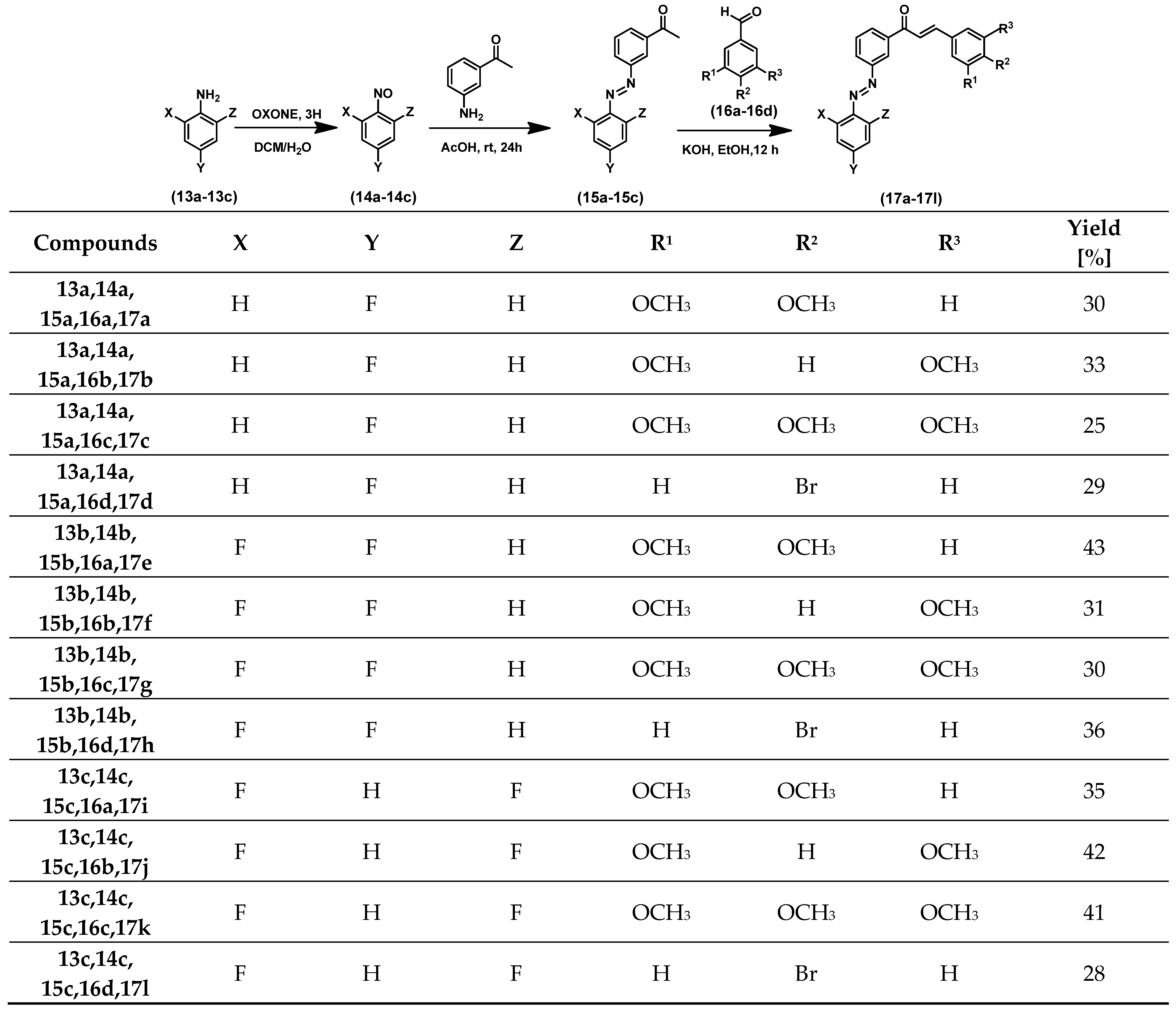
2.1. Synthesis
2.2. Molecular Docking Simulation
- −8.9 kcal/mol for 17bE;
- −8.9 kcal/mol for 17bZ;
- −9.4 kcal/mol for 17dE;
- −9.8 kcal/mol for 17dZ;
- −9.4 kcal/mol for 17fE;
- −9.0 kcal/mol for 17fZ;
- −9.4 kcal/mol for 17hE;
- −10.0 kcal/mol for 17hZ;
- −9.2 kcal/mol for 17jE;
- −9.1 kcal/mol for 17jZ;
- −9.5 kcal/mol for 17lE;
- −10.0 kcal/mol for 17lZ.
- (17bE): Leuβ255, Leuβ248, Ileβ378, Alaβ250;
- (17bZ): Alaβ316, Leuβ255, Leuβ248, Lysβ352, Lysβ254, Ser178;
- (17dE): Lysβ254, Alaβ250, Leuβ255, Leuβ248;
- (17dZ): Ileβ378, Lysβ352, Lysβ254, Leuβ255, Leuβ248, Leuβ242, Alaβ317, Alaβ250;
- (17fE): Leuβ248, Lysβ254, Alaβ250;
- (17fZ): Lysβ352, Alaβ316, Leuβ255, Leuβ248, Lysβ254, Alaβ250, Ser178;
- (17hE): Leuβ255, Leuβ248, Lysβ254, Alaβ250;
- (17hZ): Ileβ378, Lysβ352, Lysβ254, Alaβ317, Leuβ255, Leuβ248, Leuβ242, Alaβ250;
- (17jE): Lysβ352, Lysβ254;
- (17jZ): Ileβ378, Alaβ316, Leuβ255, Leuβ248, Lysβ254, Alaβ250, Asn258;
- (17lE): Lysβ254, Leuβ255, Leuβ248, Alaβ250;
- (17lZ): Ileβ378, Alaβ317, Alaβ316, Lysβ352, Leuβ255, Leuβ248, Leuβ242, Lysβ254, Alaβ250.
2.3. NMR and UV–VIS Spectra
2.4. Cell Proliferation Analysis
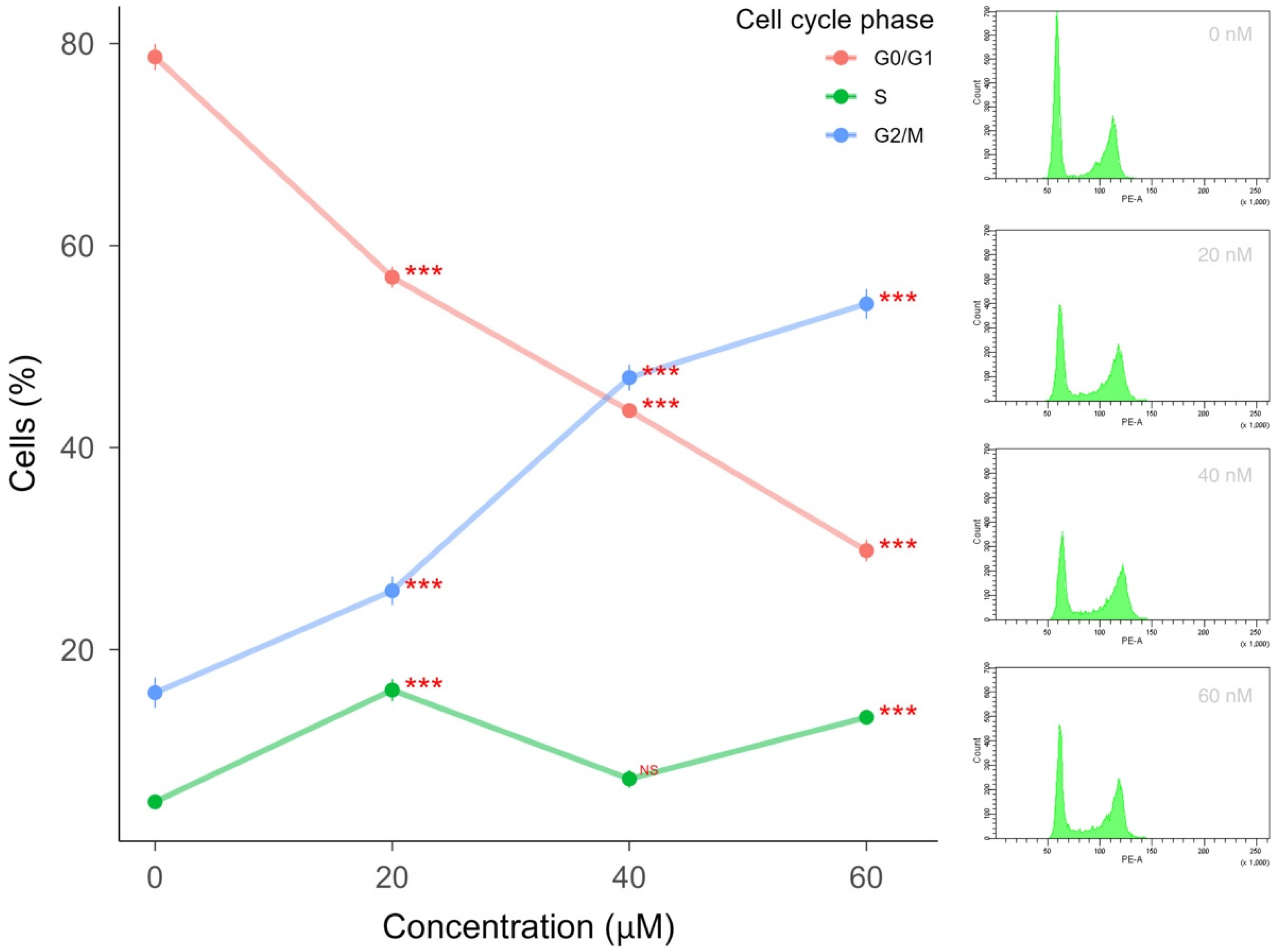
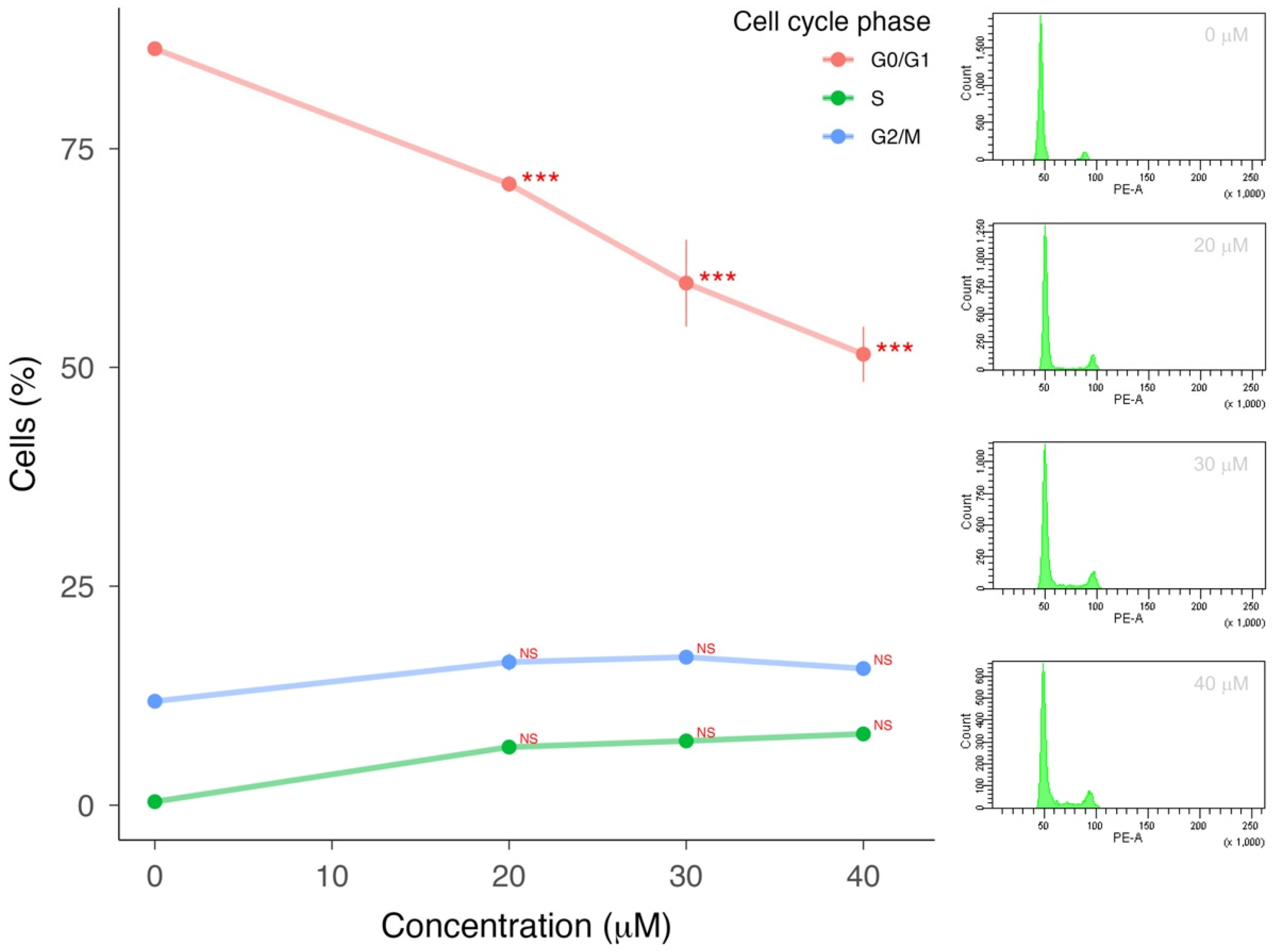
2.5. Cell Cycle Analysis
3. Materials and Methods
3.1. Synthesis
3.2. Molecular Docking Simulation
3.3. Cell Proliferation Analysis
3.4. Cell Cycle Analysis
3.5. Statistical Analysis
4. Conclusions
Supplementary Materials
Author Contributions
Funding
Institutional Review Board Statement
Informed Consent Statement
Data Availability Statement
Conflicts of Interest
References
- Zhuang, C.; Zhang, W.; Sheng, C.; Zhang, W.; Xing, C.; Miao, Z. Chalcone: A Privileged Structure in Medicinal Chemistry. Chem. Rev. 2017, 117, 7762–7810. [Google Scholar] [CrossRef]
- Kim, Y.H.; Kim, J.; Park, H.; Kim, H.P. Anti-inflammatory activity of the synthetic chalcone derivatives: Inhibition of inducible nitric oxide synthase-catalyzed nitric oxide production from lipopolysaccharide-treated RAW 264.7 cells. Biol. Pharm. Bull. 2007, 30, 1450–1455. [Google Scholar] [CrossRef]
- Nowakowska, Z. A review of anti-infective and anti-inflammatory chalcones. Eur. J. Med. Chem. 2007, 42, 125–137. [Google Scholar] [CrossRef]
- Constantinescu, T.; Lungu, C.N. Anticancer Activity of Natural and Synthetic Chalcones. Int. J. Mol. Sci. 2021, 22, 11306. [Google Scholar] [CrossRef] [PubMed]
- Boumendjel, A.; Ronot, X.; Boutonnat, J. Chalcones derivatives acting as cell cycle blockers: Potential anti cancer drugs? Curr. Drug Targets 2009, 10, 363–371. [Google Scholar] [CrossRef]
- Chowrasia, D.; Sharma, N.; Chaurasia, A.; Bharti, A.; Pratap, A. Chalcones as a Principle Pharmacophore for Design & Development of Novel Anticancer Agents. Pharmacophore 2016, 7, 269–275. [Google Scholar] [CrossRef]
- Mendanha, D.; Vieira de Castro, J.; Moreira, J.; Costa, B.M.; Cidade, H.; Pinto, M.; Ferreira, H.; Neves, N.M. A New Chalcone Derivative with Promising Antiproliferative and Anti-Invasion Activities in Glioblastoma Cells. Molecules 2021, 26, 3383. [Google Scholar] [CrossRef]
- Qin, H.L.; Zhang, Z.W.; Lekkala, R.; Alsulami, H.; Rakesh, K.P. Chalcone hybrids as privileged scaffolds in antimalarial drug. discovery: A key review. Eur. J. Med. Chem. 2020, 193, 112215. [Google Scholar] [CrossRef]
- Popoola, O.K.; Marnevick, J.L.; Rautenbach, F.; Ameer, F.; Iwuoha, E.I.; Hussein, A.A. Inhibition of Oxidative Stress and Skin Aging-Related Enzymes by Prenylated Chalcones and Other Flavonoids from Helichrysum teretifolium. Molecules 2015, 20, 7143–7155. [Google Scholar] [CrossRef]
- Mittal, A.; Vashistha, V.K.; Das, D.K. Recent advances in the antioxidant activity and mechanisms of chalcone derivatives: A computational review. Free Radic. Res. 2022, 56, 378–397. [Google Scholar] [CrossRef]
- Liu, Z.; Yang, Z.; Ablise, M. Design and synthesis of novel imidazole-chalcone derivatives as microtubule protein polymerization inhibitors to treat cervical cancer and reverse cisplatin resistance. Bioorg Chem. 2024, 147, 107310. [Google Scholar] [CrossRef]
- Huang, X.; Rizhen, H.; Zhimei, W.; Lingxue, L.; Shaohua, G.; Zhixin, L.; Hengshan, W. Pt(IV) complexes conjugating with chalcone analogue as inhibitors of microtubule polymerization exhibited selective inhibition in human cancer cells. Eur. J. Med. Chem. 2018, 146, 435–450. [Google Scholar] [CrossRef]
- Canela, M.-D.; Noppen, S.; Bueno, O.; Prota, A.E.; Bargsten, K.; Sáez-Calvo, G.; Jimeno, M.-L.; Benkheil, M.; Ribatti, D.; Velázquez, S.; et al. Antivascular and antitumor properties of the tubulin-binding chalcone TUB091. Oncotarget 2017, 8, 14325–14342. [Google Scholar] [CrossRef] [PubMed]
- Cole, A.L.; Hossain, S.; Cole, A.M.; Phanstiel, O., IV. Synthesis and bioevaluation of substituted chalcones, coumaranones and other flavonoids as anti-HIV agents. Bioorg. Med. Chem. 2016, 24, 2768–2776. [Google Scholar] [CrossRef]
- Rocha, S.; Ribeiro, D.; Fernandes, E.; Freitas, M. A Systematic Review on Anti-diabetic Properties of Chalcones. Curr. Med. Chem. 2020, 27, 2257–2321. [Google Scholar] [CrossRef] [PubMed]
- de Mello, M.V.P.; Abrahim-Vieira, B.d.A.; Domingos, T.F.S.; de Jesus, J.B.; de Sousa, A.C.C.; Rodrigues, C.R.; de Souza, A.M.T. A comprehensive review of chalcone derivatives as antileishmanial agents. Eur. J. Med. Chem. 2018, 150, 920–929. [Google Scholar] [CrossRef]
- Trein, M.R.; e Oliveira, L.R.; Rigo, G.V.; Garcia, M.A.R.; Petro-Silveira, B.; Trentin, D.d.S.; Macedo, A.J.; Regasini, L.O.; Tasca, T. Anti-Trichomonas vaginalis activity of chalcone and amino-analogues. Parasitol. Res. 2019, 118, 607–615. [Google Scholar] [CrossRef] [PubMed]
- Lin, Y.M.; Zhou, Y.; Flavin, M.T.; Zhou, L.M.; Nie, W.; Chen, F.C. Chalcones and flavonoids as anti-tuberculosis agents. Bioorg. Med. Chem. 2002, 10, 2795–2802. [Google Scholar] [CrossRef]
- Thapa, P.; Upadhyay, S.P.; Suo, W.Z.; Singh, V.; Gurung, P.; Lee, E.S.; Sharma, R.; Sharma, M. Chalcone and its Analogs: Therapeutic and Diagnostic Applications in Alzheimer’s Disease. Bioorg Chem. 2021, 108, 104681. [Google Scholar] [CrossRef]
- Li, L.; Jiang, S.; Li, X.; Liu, Y.; Su, J.; Chen, J. Recent advances in trimethoxyphenyl (TMP) based tubulin inhibitors targeting the colchicine binding site. Eur. J. Med. Chem. 2018, 151, 482–494. [Google Scholar] [CrossRef]
- Sahin, I.D.; Christodoulou, M.S.; Guzelcan, E.A.; Koyas, A.; Karaca, C.; Passarella, D.; Cetin Atalay, R. A small library of chalcones induce liver cancer cell death through Akt phosphorylation inhibition. Sci. Rep. 2020, 10, 11814. [Google Scholar] [CrossRef] [PubMed]
- Huang, C.; Xia, X.; He, J.; Liu, Y.; Shao, Z.; Hu, T.; Yu, C.; Liu, X.; Xu, Q.; Liu, B.; et al. Erα is a target for butein-induced growth suppression in breast cancer. Am. J. Cancer Res. 2020, 10, 3721–3736. [Google Scholar] [PubMed Central]
- Wang, J.; Wu, M.; Zheng, D.; Zhang, H.; Lv, Y.; Zhang, L.; Tan, H.S.; Zhou, H.; Lao, Y.Z.; Xu, H.X. Garcinol inhibits esophageal cancer metastasis by suppressing the p300 and TGF-β1 signaling pathways. Acta Pharmacol. Sin. 2020, 41, 82–92. [Google Scholar] [CrossRef]
- Ma, L.; Wang, R.; Nan, Y.; Li, W.; Wang, Q.; Jin, F. Phloretin exhibits an anticancer effect and enhances the anticancer ability of cisplatin on non-small cell lung cancer cell lines by regulating expression of apoptotic pathways and matrix metalloproteinases. Int. J. Oncol. 2016, 48, 843–853. [Google Scholar] [CrossRef]
- Mahapatra, D.K.; Bharti, S.K.; Asati, V. Anti-cancer chalcones: Structural and molecular target perspectives. Eur. J. Med. Chem. 2015, 98, 69–114. [Google Scholar] [CrossRef] [PubMed]
- Jandial, D.D.; Blair, C.A.; Zhang, S.; Krill, L.S.; Zhang, Y.B.; Zi, X. Molecular targeted approaches to cancer therapy and prevention using chalcones. Curr. Cancer Drug Targets 2014, 14, 181–200. [Google Scholar] [CrossRef]
- Zhou, B.; Xing, C. Diverse Molecular Targets for Chalcones with Varied Bioactivities. Med. Chem. 2015, 5, 388–404. [Google Scholar] [CrossRef]
- Sahu, N.K.; Balbhadra, S.S.; Choudhary, J.; Kohli, D.V. Exploring pharmacological significance of chalcone scaffold: A review. Curr. Med. Chem. 2012, 19, 209−225. [Google Scholar] [CrossRef]
- Gomes, M.N.; Muratov, E.N.; Pereira, M.; Peixoto, J.C.; Rosseto, L.P.; Cravo, P.V.L.; Andrade, C.H.; Neves, B.J. Chalcone Derivatives: Promising Starting Points for Drug Design. Molecules 2017, 22, 1210. [Google Scholar] [CrossRef]
- Rahimzadeh Oskuei, S.; Mirzaei, S.; Jafari-Nik, M.R.; Hadizadeh, F.; Eisvand, F.; Mosaffa, F.; Ghodsi, R. Design, synthesis and biological evaluation of novel imidazole-chalcone derivatives as potential anticancer agents and tubulin polymerization inhibitors. Bioorg. Chem. 2021, 112, 104904. [Google Scholar] [CrossRef] [PubMed]
- Ahmed, A.H.; Mohamed, M.F.; Allam, R.M.; Nafady, A.; Mohamed, S.K.; Gouda, A.E.; Beshr, E.A. Design, synthesis, and molecular docking of novel pyrazole-chalcone analogs of lonazolac as 5-LOX, iNOS and tubulin polymerization inhibitors with potential anticancer and anti-inflammatory activities. Bioorg. Chem. 2022, 129, 106171. [Google Scholar] [CrossRef]
- Yan, W.; Xiangyu, C.; Ya, L.; Yu, W.; Feng, X. An orally antitumor chalcone hybrid inhibited HepG2 cells growth and migration as the tubulin binding agent. Investig. New Drugs 2019, 37, 784–790. [Google Scholar] [CrossRef]
- Tyagi, R.; Yadav, K.; Khanna, A.; Mishra, S.K.; Sagar, R. Efficient synthesis of indole chalcones based glycohybrids and their anticancer activity. Bioorg. Med. Chem. 2024, 109, 117778. [Google Scholar] [CrossRef]
- Steinmetz, M.O.; Prota, A.E. Microtubule-Targeting Agents: Strategies To Hijack the Cytoskeleton. Trends Cell Biol. 2018, 28, 776–792. [Google Scholar] [CrossRef] [PubMed]
- Di Pietro, A.; Rangel, P.; Winter, E.; Gauthier, C.; Terreux, R.; Delatorre, C.; Mascarello, A.; Nunes, R.J.; Yunes, R.A.; Pasa, C.; et al. New structure–activity relationships of chalcone inhibitors of breast cancer resistance protein: Polyspecificity toward inhibition and critical substitutions against cytotoxicity. Drug. Des. Devel. Ther. 2013, 7, 1043–1052. [Google Scholar] [CrossRef]
- Jordan, M.A.; Wilson, L. Microtubules as a target for anticancer drugs. Nat. Rev. Cancer 2004, 4, 253–265. [Google Scholar] [CrossRef]
- Čermák, V.; Dostál, V.; Jelínek, M.; Libusová, L.; Kovář, J.; Rösel, D.; Brábek, J. Microtubule-targeting agents and their impact on cancer treatment. Eur. J. Cell Biol. 2020, 99, 151075. [Google Scholar] [CrossRef] [PubMed]
- Kobauri, P.; Dekker, F.J.; Szymanski, W.; Feringa, B.L. Rational Design in Photopharmacology with Molecular Photoswitches. Angew. Chem. Int. Ed. 2023, 62, e202300681. [Google Scholar] [CrossRef] [PubMed]
- Lerch, M.M.; Hansen, M.J.; van Dam, G.M.; Szymanski, W.; Feringa, B.L. Emerging targets in photopharmacology. Angew. Chem. Int. Ed. 2016, 55, 10978–10999. [Google Scholar] [CrossRef]
- Agnetta, L.; Bermudez, M.; Riefolo, F.; Matera, C.; Claro, E.; Messerer, R.; Littmann, T.; Wolber, G.; Holzgrabe, U.; Decker, M. Fluorination of Photoswitchable Muscarinic Agonists Tunes Receptor Pharmacology and Photochromic Properties. J. Med. Chem. 2019, 62, 3009–3020. [Google Scholar] [CrossRef]
- Smart, B.E. Characteristics of C-F Systems. ChemInForm 1994, 26, 57–88. [Google Scholar] [CrossRef]
- Kirk, K.L. Fluorine Substitution as a Modulator of Biological Processes. In Biomedical Chemistry: Applying Chemical Principles to the Understanding and Treatment of Disease; Torrence, P.F., Ed.; John Wiley & Sons: New York, NY, USA, 2000; pp. 247–266. [Google Scholar]
- Burmaoglu, S.; Anil, D.A.; Gobek, A.; Kilic, D.; Yetkin, D.; Duran, N.; Algul, O. Design, synthesis and antiproliferative activity evaluation of fluorine-containing chalcone derivatives. J. Biomol. Strutc. Dyn. 2022, 40, 3525–3550. [Google Scholar] [CrossRef]
- Liu, X.; Jin, J.; Wu, Y.; Du, B.; Zhang, L.; Lu, D.; Liu, Y.; Chen, X.; Lin, J.; Chen, H.; et al. Fluoroindole chalcone analogues targeting the colchicine binding site of tubulin for colorectal oncotherapy. Eur. J. Med. Chem. 2023, 257, 115540. [Google Scholar] [CrossRef]
- Bleger, D.; Hecht, S. Visible-Light-Activated Molecular Switches. Angew. Chem. Int. Ed. 2015, 54, 11338–11349. [Google Scholar] [CrossRef]
- Bleger, D.; Schwarz, J.; Brouwer, A.M.; Hecht, S. o-Fluoroazobenzenes as Readily Synthesized Photoswitches Offering Nearly Quantitative Two-Way Isomerization with Visible Light. J. Am. Chem. Soc. 2012, 134, 20597–20600. [Google Scholar] [CrossRef] [PubMed]
- Lameijer, L.N.; Budzak, S.; Simeth, N.A.; Hansen, M.J.; Feringa, B.L.; Jacquemin, D.; Szymański, W. General Principles for the Design of Visible-Light-Responsive Photoswitches: Tetra-ortho-Chloro-Azobenzenes. Angew. Chem. 2020, 132, 21847–21854. [Google Scholar] [CrossRef]
- Cardano, F.; Márquez, G.R.; Szymanski, W. Manipulation of Chemistry and Biology with Visible Light Using Tetra-ortho-Substituted Azobenzenes and Azonium Ions. Angew. Chem. Int. Ed. 2025, 64, e202423506. [Google Scholar] [CrossRef] [PubMed]
- Welleman, I.M.; Hoorens, M.W.H.; Feringa, B.L.; Boersma, H.H.; Szymański, W. Photoresponsive molecular tools for emerging applications of light in medicine. Chem. Sci. 2020, 11, 11672–11691. [Google Scholar] [CrossRef]
- Borowiak, M.; Nahaboo, W.; Reynders, M.; Nekolla, K.; Jalinot, P.; Hasserodt, J.; Rehberg, M.; Delattre, M.; Zahler, S.; Vollmar, A.; et al. Photoswitchable Inhibitors of Microtubule Dynamics Optically Control Mitosis and Cell Death. Cell 2015, 162, 403–411. [Google Scholar] [CrossRef]
- RCSB Protein Data Bank—RCSB PDB. Available online: http://www.rcsb.org/pdb/home/home.do (accessed on 23 February 2024).
- Trott, O.; Olson, A.J. AutoDock Vina: Improving the speed and accuracy of docking with a new scoring function, efficient optimization and multithreading. J. Comput. Chem. 2010, 31, 455–461. [Google Scholar] [CrossRef]
- Frisch, M.J.; Trucks, G.W.; Schlegel, H.B.; Scuseria, G.E.; Robb, M.A.; Cheeseman, J.R.; Montgomery, J.A., Jr.; Vreven, T.; Kudin, K.N.; Burant, J.C.; et al. Gaussian 03, Revision C.02; Gaussian, Inc.: Wallingford, UK, 2004. [Google Scholar]
- Tomasi, J.; Mennucci, B.; Cammi, R. Quantum mechanical continuum solvation models. Chem. Rev. 2005, 105, 2999–3094. [Google Scholar] [CrossRef]
- Luo, Y.; Qiu, K.M.; Lu, X.; Liu, K.; Fu, J.; Zhu, H.L. Synthesis, biological evaluation, and molecular modeling of cinnamic acyl sulfonamide derivatives as novel antitubulin agents. Bioorg. Med. Chem. 2011, 19, 4730–4738. [Google Scholar] [CrossRef] [PubMed]
- Massarotti, A.; Coluccia, A.; Silvestri, R.; Sorba, G.; Brancale, A. The tubulin colchicine domain: A molecular modeling perspective. ChemMedChem 2012, 7, 33–42. [Google Scholar] [CrossRef] [PubMed]
- Nanguo, L.; Jeffrey-Binker, C. Smart Light Responsive materials-Azobenzene Containing Polymers and Liquid Crystals. In Smart Light-Responsive Materials; Zhao, Y., Ikeda, T., Eds.; John Wiley & Sons: Hoboken, NJ, USA, 2009; pp. 457–507. [Google Scholar] [CrossRef]
- Wegner, H.A. Azobenzenes in a new light-switching in vivo. Angew. Chem. Int. Ed. 2012, 51, 4787. [Google Scholar] [CrossRef] [PubMed]
- Wegener, M.; Hansen, M.J.; Driessen, A.J.M.; Szymanski, W.; Feringa, B.L. Photocontrol of Antibacterial Activity: Shifting from UV to Red Light Activation. J. Am. Chem. Soc. 2017, 139, 17979–17986. [Google Scholar] [CrossRef]
- Wutz, D.; Gluhacevic, D.; Chakrabarti, A.; Schmidtkunz, K.; Robaa, D.; Erdmann, F.; Romier, C.; Sippl, W.; Jung, M.; König, B. Photochromic Histone Deacetylase Inhibitors Based on Dithienylethenes and Fulgimides. Org. Biomol. Chem. 2017, 15, 4882–4896. [Google Scholar] [CrossRef]
- Kirchner, S.; Pianowski, Z. Photopharmacology of antimitotic agents. Int. J. Mol. Sci. 2022, 23, 5657. [Google Scholar] [CrossRef]
- Hüll, K.; Morstein, J.; Trauner, D. In Vivo Photopharmacology. Chem. Rev. 2018, 118, 10710–10747. [Google Scholar] [CrossRef]
- Ergul, M.; Bakar-Ates, F. Investigation of molecular mechanisms underlying the antiproliferative effects of colchicine against PC3 prostate cancer cells. Toxicol. Vitr. 2021, 73, 105138. [Google Scholar] [CrossRef]
- Hsieh, J.H.; Huang, R.; Lin, J.A.; Sedykh, A.; Zhao, J.; Tice, R.R.; Paules, R.S.; Xia, M.; Auerbach, S.S. Real-time cell toxicity profiling of Tox21 10K compounds reveals cytotoxicity dependent toxicity pathway linkage. PLoS ONE 2017, 12, e0181291. [Google Scholar] [CrossRef]
- Bejarano, F.; Alcon, I.; Crivillers, N.; Mas-Torrent, M.; Bromley, S.T.; Veciana, J.; Rovira, C. Study of the E–Z stilbene isomerisation in perchlorotriphenyl-methane (PTM) derivatives. RSC Adv. 2017, 7, 15278–15283. [Google Scholar] [CrossRef]
- Leung, Y.Y.; Yao Hui, L.L.; Kraus, V.B. Colchicine—Update on mechanisms of action and therapeutic uses. Semin. Arthritis Rheum. 2015, 45, 341–350. [Google Scholar] [CrossRef]
- Molad, Y. Update on colchicine and its mechanism of action. Curr. Rheumatol. Rep. 2002, 4, 252–256. [Google Scholar] [CrossRef]
- Hedges, L.V. Distribution Theory for Glass’s Estimator of Effect Size and Related Estimators. J. Educ. Stat. 1981, 6, 107–128. [Google Scholar] [CrossRef]
- Nemoto, K. G2/M accumulation in prostate cancer cell line PC-3 is induced by Cdc25 inhibitor 7-chloro-6-(2-morpholin-4-ylethylamino) quinoline-5, 8-dione (DA 3003-2). Exp. Ther. Med. 2010, 1, 647–650. [Google Scholar] [CrossRef] [PubMed]
- Bagnato, J.D.; Eilers, A.L.; Horton, R.A.; Grissom, C.B. Synthesis and Characterization of a Cobalamin-colchicine Conjugate as a Novel Tumor-targeted Cytotoxin. J. Org. Chem. 2004, 69, 8987–8996. [Google Scholar] [CrossRef]
- Pettersen, E.F.; Goddard, T.D.; Huang, C.C.; Couch, G.S.; Greenblatt, D.M.; Meng, E.C.; Ferrin, T.E. UCSF Chimera-a visualization system for exploratory research and analysis. J. Comput. Chem. 2004, 25, 1605–1612. [Google Scholar] [CrossRef]
- Available online: https://www.pymol.org (accessed on 23 February 2024).
- Available online: https://plip-tool.biotec.tu-dresden.de/plip-web/plip/index (accessed on 23 February 2024).
- The R Core Team. R: A Language and Environment for Statistical Computing; R Foundation for Statistical Computing: Vienna, Austria, 2014. [Google Scholar]
- Ritz, C.; Baty, F.; Streibig, J.C.; Gerhard, D. Dose-Response Analysis Using R. PLoS ONE 2015, 10, e0146021. [Google Scholar] [CrossRef] [PubMed]
- Neill, J.W. Testing for Lack of Fit in Nonlinear Regression. Ann. Statist. 1988, 16, 733–740. [Google Scholar] [CrossRef]
- Student. The Probable Error of a Mean. Biometrika 1908, 6, 1–25. [Google Scholar] [CrossRef]
- Tukey, J.W. Comparing individual means in the analysis of variance. Biometrics 1949, 5, 99–114. [Google Scholar] [CrossRef]
- Wickham, H. ggplot2: Elegant Graphics for Data Analysis, 2nd ed.; Springer: Cham, Switzerland, 2016. [Google Scholar] [CrossRef]
- Sailer, A.; Ermer, F.; Kraus, Y.; Lutter, F.H.; Donau, C.A.; Bremerich, M.; Ahlfeld, J.; Thorn-Seshold, O. Hemithioindigos for Cellular Photopharmacology: Desymmetrised Molecular Switch Scaffolds Enabling Design Control over the Isomer-dependency of Potent Antimitotic Bioactivity. ChemBioChem 2019, 20, 1305–1314. [Google Scholar] [CrossRef] [PubMed]
- Sailer, A.; Meiring, J.C.M.; Heise, C.; Pettersson, L.N.; Akhmanova, A.; Thorn-Seshold, J.; Thorn-Seshold, O. Pyrrole Hemithioindigo Antimitotics with Near-quantitative Bidirectional Photoswitching Photocontrol Cellular Microtubule Dynamics with Single-cell Precision. Angew. Chem. Int. Ed. 2021, 60, 23695–23704. [Google Scholar] [CrossRef] [PubMed]
- Gao, L.; Meiring, J.C.M.; Kraus, Y.; Wranik, M.; Weinert, T.; Pritzl, S.D.; Bingham, R.; Ntouliou, E.; Jansen, K.I.; Olieric, N. A Robust, Gfp-orthogonal Photoswitchable Inhibitor Scaffold Extends Optical Control over the Microtubule Cytoskeleton. Cell Chem. Biol. 2021, 28, 228–241. [Google Scholar] [CrossRef] [PubMed]



| Compound * | λmaxn→π* (E) ** [nm] | εmax (n→π*) (dm3·mol−1·cm−1) | λmaxn→π* (Z) ** [nm] | εmax (n→π*) (dm3·mol−1·cm−1) | Δ λ maxn→π* [nm] |
|---|---|---|---|---|---|
| 17b | 442.1 | 688 | 434.0 | 898 | 8.1 |
| 17d | 440.8 | 660 | 434.1 | 850 | 6.7 |
| 17f | 441.9 | 872 | 427.9 | 1150 | 14.0 |
| 17h | 441.2 | 796 | 426.9 | 1016 | 14.3 |
| 17j | 448.3 | 922 | 417.4 | 1130 | 30.9 |
| 17l | 448.6 | 902 | 417.9 | 1074 | 30.7 |
Disclaimer/Publisher’s Note: The statements, opinions and data contained in all publications are solely those of the individual author(s) and contributor(s) and not of MDPI and/or the editor(s). MDPI and/or the editor(s) disclaim responsibility for any injury to people or property resulting from any ideas, methods, instructions or products referred to in the content. |
© 2026 by the authors. Licensee MDPI, Basel, Switzerland. This article is an open access article distributed under the terms and conditions of the Creative Commons Attribution (CC BY) license.
Share and Cite
Tobiasz, P.; Mielecki, D.; Stachurska-Skrodzka, A.; Miętus, J.; Borys, F.; Krawczyk, H. Synthesis and Study of Substituted Chalcones Combined with Fluoroazobenzenes—New Photoswitches for Application in Biological Systems. Molecules 2026, 31, 362. https://doi.org/10.3390/molecules31020362
Tobiasz P, Mielecki D, Stachurska-Skrodzka A, Miętus J, Borys F, Krawczyk H. Synthesis and Study of Substituted Chalcones Combined with Fluoroazobenzenes—New Photoswitches for Application in Biological Systems. Molecules. 2026; 31(2):362. https://doi.org/10.3390/molecules31020362
Chicago/Turabian StyleTobiasz, Piotr, Damian Mielecki, Anna Stachurska-Skrodzka, Jakub Miętus, Filip Borys, and Hanna Krawczyk. 2026. "Synthesis and Study of Substituted Chalcones Combined with Fluoroazobenzenes—New Photoswitches for Application in Biological Systems" Molecules 31, no. 2: 362. https://doi.org/10.3390/molecules31020362
APA StyleTobiasz, P., Mielecki, D., Stachurska-Skrodzka, A., Miętus, J., Borys, F., & Krawczyk, H. (2026). Synthesis and Study of Substituted Chalcones Combined with Fluoroazobenzenes—New Photoswitches for Application in Biological Systems. Molecules, 31(2), 362. https://doi.org/10.3390/molecules31020362