

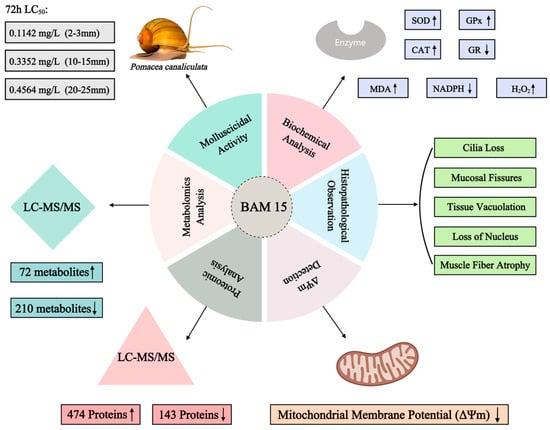
BAM 15 Exerts Molluscicidal Effects on Pomacea canaliculata Through the Induction of Oxidative Stress, Impaired Energy Metabolism, and Tissue Damage


Abstract
1. Introduction
2. Results
2.1. Molluscicidal Activity
2.2. Metabolomic Analyses
2.3. Proteomic Analyses
2.4. Mitochondrial Membrane Potential
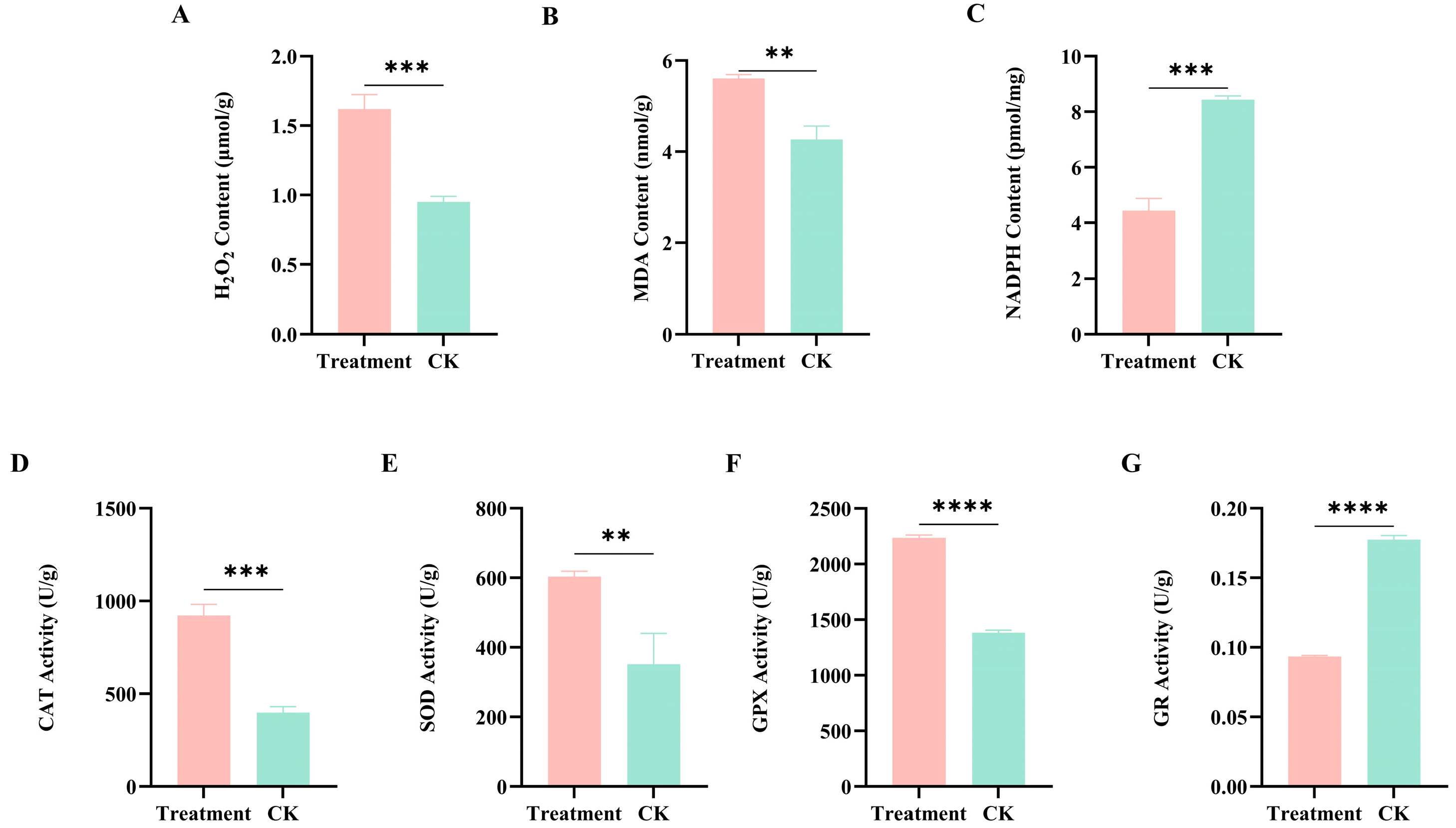
2.5. Effects of BAM 15 on Oxidative Stress Biomarkers in P. canaliculata
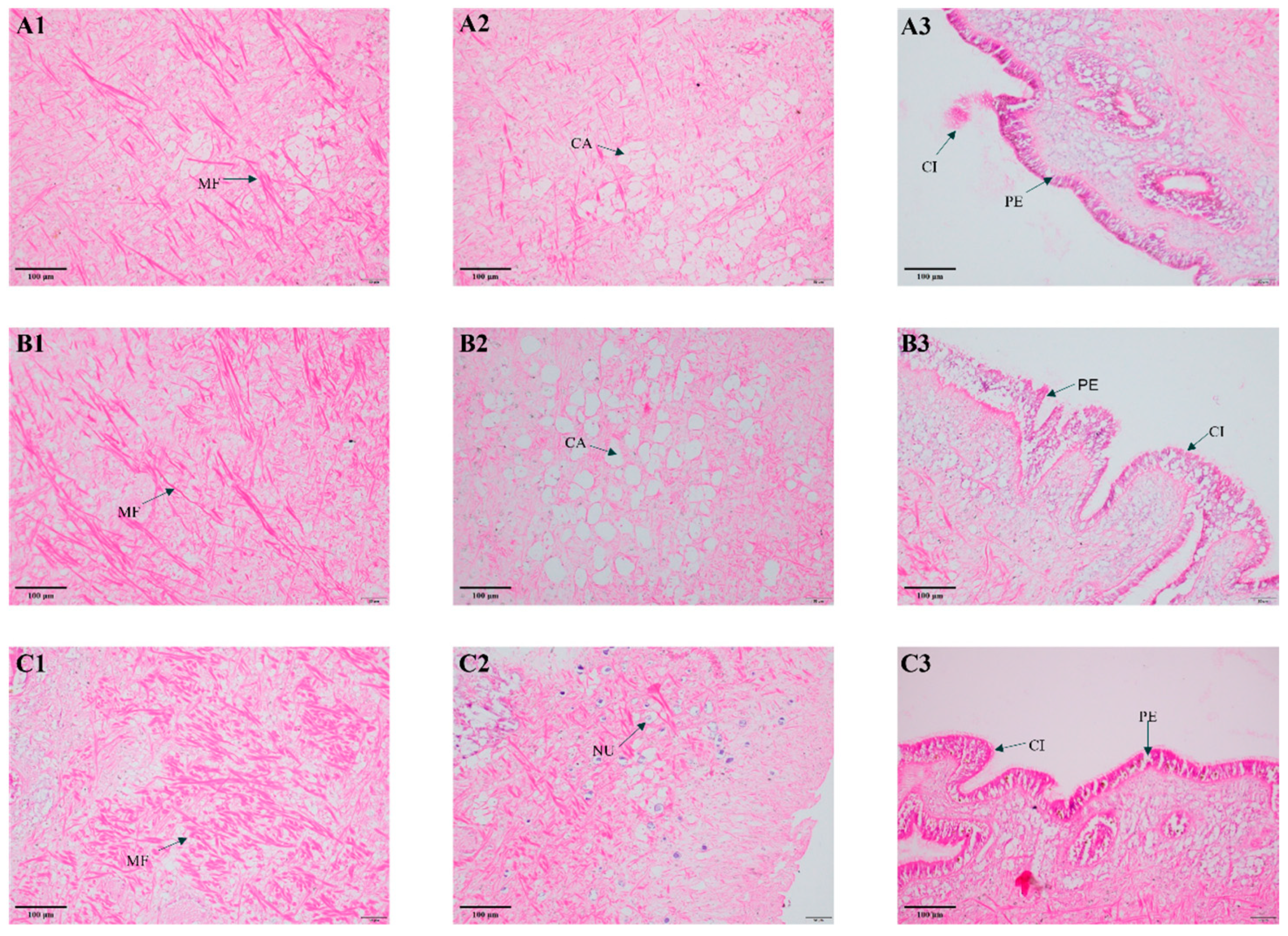
2.6. Histopathological Changes
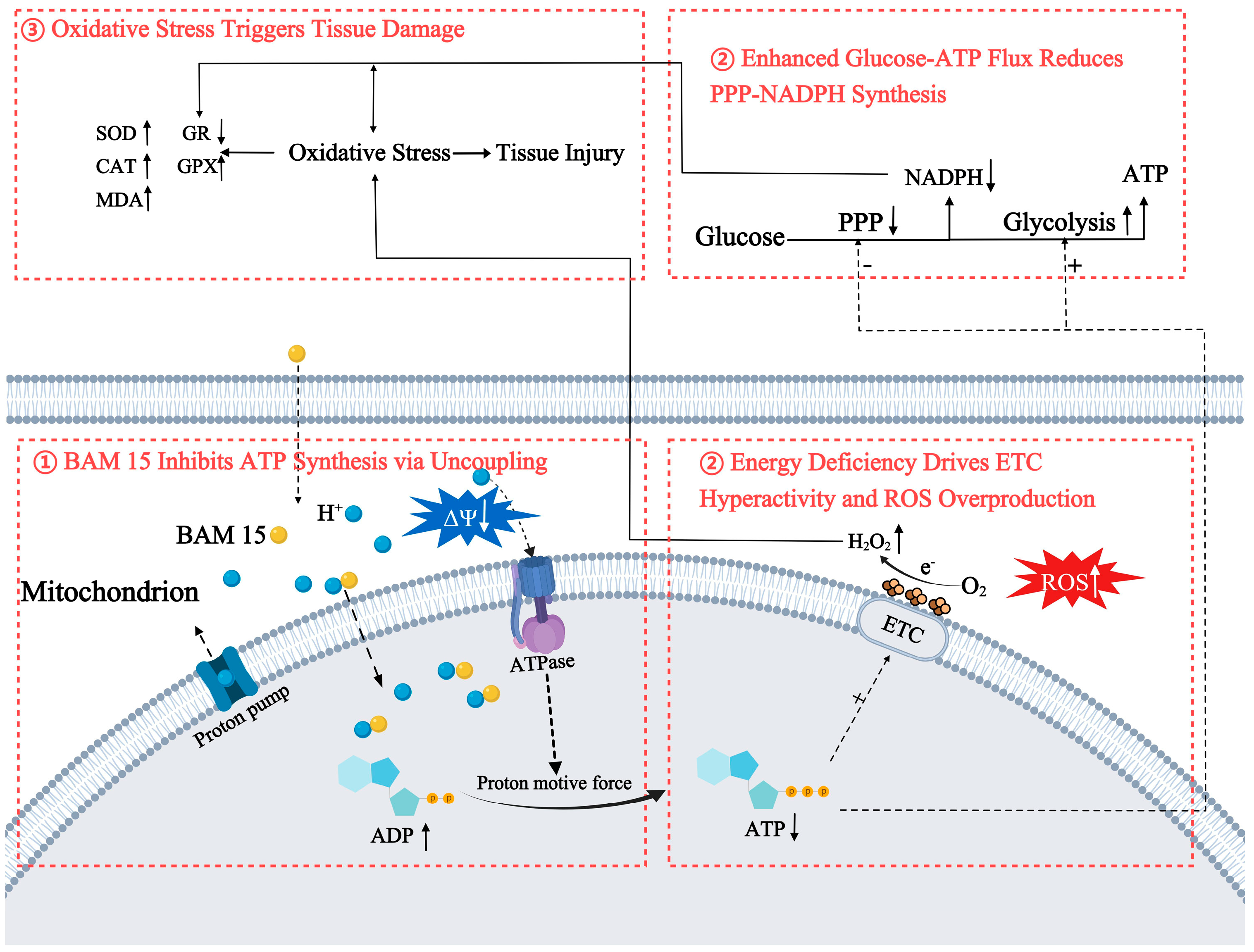
3. Discussion
4. Materials and Methods
4.1. Snails and BAM 15 Preparation
4.2. Evaluation of Molluscicidal Efficacy
4.3. Omics Analyses
4.4. Metabolomic Analysis
4.5. Roteomic Analysis
4.6. Mitochondrial Membrane Potential Analyses
4.7. Evaluation of Oxidative Stress-Associated Biomarkers
4.8. Histopathology
4.9. Data Analysis
5. Conclusions
Author Contributions
Funding
Institutional Review Board Statement
Informed Consent Statement
Data Availability Statement
Acknowledgments
Conflicts of Interest
References
- Lu, Y.; Luo, F.; Zhou, A.; Yi, C.; Chen, H.; Li, J.; Guo, Y.; Xie, Y.; Zhang, W.; Lin, D.; et al. Whole-genome sequencing of the invasive golden apple snail Pomacea canaliculata from Asia reveals rapid expansion and adaptive evolution. Gigascience 2024, 13, giae064. [Google Scholar] [CrossRef] [PubMed]
- Qin, Z.; Wu, R.S.; Zhang, J.; Deng, Z.X.; Zhang, C.X.; Guo, J. Survivorship of geographic Pomacea canaliculata populations in responses to cold acclimation. Ecol. Evol. 2020, 10, 3715–3726. [Google Scholar] [CrossRef]
- Yi, X.L.; Liu, J.; Cao, M.L.; Xiong, J.; Deng, Y.P.; Wang, H.M.; Ma, P.P.; Liu, G.H.; Yang, H. Population genetics and genetic variation of Pomacea canaliculata (Gastropoda: Ampullariidae) in China revealed by sequence analyses of three mitochondrial genes. Ecol. Evol. 2024, 14, e10836. [Google Scholar] [CrossRef]
- Bao, Y.; He, X.; Zhai, Y.; Shen, W.; Jing, M.; Liu, Y.; Yang, H.; Chen, L. Effects of glyphosate-based herbicide on gut microbes and hepatopancreatic metabolism in Pomacea canaliculata. Ecotoxicol. Environ. Saf. 2024, 280, 116549. [Google Scholar] [CrossRef]
- Chen, H.; Liu, J.; Wan, X.; Zhang, M.; Luo, L.; Qiu, X.; Yang, C. Research on the Mechanism of Metaldehyde on Pomacea canaliculata. J. Agric. Food Chem. 2024, 72, 14152–14164. [Google Scholar] [CrossRef]
- Yang, C.; Wang, Y.; Ma, Y.; Liu, J.; Zhou, Y.; Yan, X.; Zhang, M.; Qiu, X.; Luo, L.; Gong, G.; et al. Research on the molluscicidal activity and molecular mechanisms of arecoline against Pomacea canaliculata. Ecotoxicol. Environ. Saf. 2022, 246, 114198. [Google Scholar] [CrossRef]
- Fan, Y.Y.; Gao, H.J.; Tao, S.M.; Yin, C.L.; Yu, X.P. Potential distribution prediction of Pomacea canaliculata in China based on the Biomod2. Chin. J. Appl. Ecol. 2024, 35, 2237–2246. [Google Scholar]
- Yin, Y.; He, Q.; Pan, X.; Liu, Q.; Wu, Y.; Li, X. Predicting Current Potential Distribution and the Range Dynamics of Pomacea canaliculata in China under Global Climate Change. Biology 2022, 11, 110. [Google Scholar] [CrossRef] [PubMed]
- Brola, T.R.; Dreon, M.S.; Qiu, J.W.; Heras, H. A highly stable, non-digestible lectin from Pomacea diffusa unveils clade-related protection systems in apple snail eggs. J. Exp. Biol. 2020, 223, jeb231878. [Google Scholar] [CrossRef]
- Yang, C.; Huang, Y.; Lu, Z.; Ma, Y.; Ran, X.; Yan, X.; Zhang, M.; Qiu, X.; Luo, L.; Yue, G.; et al. Sublethal effects of niclosamide on the aquatic snail Pomacea canaliculata. Ecotoxicol. Environ. Saf. 2023, 259, 115064. [Google Scholar] [CrossRef]
- Wang, J.; Xing, Y.; Dai, Y.; Li, Y.; Xiang, W.; Dai, J.; Xu, F. A Novel Gelatin-Based Sustained-Release Molluscicide for Control of the Invasive Agricultural Pest and Disease Vector Pomacea canaliculata. Molecules 2022, 27, 4268. [Google Scholar] [CrossRef] [PubMed]
- Axelrod, C.L.; King, W.T.; Davuluri, G.; Noland, R.C.; Hall, J.; Hull, M.; Dantas, W.S.; Zunica, E.R.; Alexopoulos, S.J.; Hoehn, K.L.; et al. BAM15-mediated mitochondrial uncoupling protects against obesity and improves glycemic control. EMBO Mol. Med. 2020, 12, e12088. [Google Scholar] [CrossRef]
- Chen, S.Y.; Beretta, M.; Olzomer, E.M.; Shah, D.P.; Wong, D.Y.H.; Alexopoulos, S.J.; Aleksovska, I.; Salamoun, J.M.; Garcia, C.J.; Cochran, B.J.; et al. Targeting negative energy balance with calorie restriction and mitochondrial uncoupling in db/db mice. Mol. Metab. 2023, 69, 101684. [Google Scholar] [CrossRef] [PubMed]
- Dang, C.P.; Issara-Amphorn, J.; Charoensappakit, A.; Udompornpitak, K.; Bhunyakarnjanarat, T.; Saisorn, W.; Sae-Khow, K.; Leelahavanichkul, A. BAM15, a Mitochondrial Uncoupling Agent, Attenuates Inflammation in the LPS Injection Mouse Model: An Adjunctive Anti-Inflammation on Macrophages and Hepatocytes. J. Innate Immun. 2021, 13, 359–375. [Google Scholar] [CrossRef] [PubMed]
- Taylor, A.L.; Dubuisson, O.; Pandey, P.; Zunica, E.R.M.; Vandanmagsar, B.; Dantas, W.S.; Johnson, A.; Axelrod, C.L.; Kirwan, J.P. Restricting bioenergetic efficiency enhances longevity and mitochondrial redox capacity in Drosophila melanogaster. Aging Cell 2024, 23, e14107. [Google Scholar] [CrossRef]
- Xiong, G.; Zhang, K.; Ma, Y.; Song, Y.; Zhang, W.; Qi, T.; Qiu, H.; Shi, J.; Kan, C.; Zhang, J.; et al. BAM15 as a mitochondrial uncoupler: A promising therapeutic agent for diverse diseases. Front. Endocrinol. 2023, 14, 1252141. [Google Scholar] [CrossRef]
- Kenwood, B.M.; Weaver, J.L.; Bajwa, A.; Poon, I.K.; Byrne, F.L.; Murrow, B.A.; Calderone, J.A.; Huang, L.; Divakaruni, A.S.; Tomsig, J.L.; et al. Identification of a novel mitochondrial uncoupler that does not depolarize the plasma membrane. Mol. Metab. 2014, 3, 114–123. [Google Scholar] [CrossRef]
- Liu, M.; Sui, C.; Wang, B.; Ma, P.; Zhang, W.; Huang, R.; Wang, Y.; Qiu, Z.; Zhao, W.; Zhang, T.; et al. Effect of Pomacea canaliculata on Limnodrilus hoffmeisteri: Behavior, Oxidative Stress, and Microbiota Alterations. Ecol. Evol. 2024, 14, e70603. [Google Scholar] [CrossRef]
- Wang, W.; Huang, S.; Liu, F.; Sun, Y.; Wang, X.; Yao, J.; Li, S.; Liu, Y.; Luo, B.; Zhang, X.; et al. Control of the Invasive Agricultural Pest Pomacea canaliculata with a Novel Molluscicide: Efficacy and Safety to Nontarget Species. J. Agric. Food Chem. 2022, 70, 1079–1089. [Google Scholar] [CrossRef]
- Son, S.M.; Park, S.J.; Lee, H.; Siddiqi, F.; Lee, J.E.; Menzies, F.M.; Rubinsztein, D.C. Leucine Signals to mTORC1 via Its Metabolite Acetyl-Coenzyme A. Cell Metab. 2019, 29, 192–201.e197. [Google Scholar] [CrossRef]
- McLelland, G.L.; Lopez-Osias, M.; Verzijl, C.R.C.; Ellenbroek, B.D.; Oliveira, R.A.; Boon, N.J.; Dekker, M.; van den Hengel, L.G.; Ali, R.; Janssen, H.; et al. Identification of an alternative triglyceride biosynthesis pathway. Nature 2023, 621, 171–178. [Google Scholar] [CrossRef] [PubMed]
- Hetenyi, G., Jr.; Anderson, P.J.; Raman, M.; Ferrarotto, C. Gluconeogenesis from glycine and serine in fasted normal and diabetic rats. Biochem. J. 1988, 253, 27–32. [Google Scholar] [CrossRef]
- de Meneses, L.; Pereira, J.R.; Sevrin, C.; Grandfils, C.; Paiva, A.; Reis, M.A.M.; Freitas, F. Pseudomonas chlororaphis as a multiproduct platform: Conversion of glycerol into high-value biopolymers and phenazines. New Biotechnol. 2020, 55, 84–90. [Google Scholar] [CrossRef]
- Dal Pont, G.C.; Goes, E.C.; da Silva, K.F.; de Oliveira, S.G.; da Rocha, C.; Miorka, A. Glycerol in ovo feeding as an energy substrate improves performance of broilers from young breeders. J. Anim. Physiol. Anim. Nutr. 2019, 103, 1453–1461. [Google Scholar] [CrossRef]
- Kapor, S.; Čokić, V.; Santibanez, J.F. Mechanisms of Hydroxyurea-Induced Cellular Senescence: An Oxidative Stress Connection? Oxidative Med. Cell. Longev. 2021, 2021, 7753857. [Google Scholar] [CrossRef]
- Erukainure, O.L.; Atolani, O.; Banerjee, P.; Abel, R.; Pooe, O.J.; Adeyemi, O.S.; Preissner, R.; Chukwuma, C.I.; Koorbanally, N.A.; Islam, M.S. Oxidative testicular injury: Effect of L-leucine on redox, cholinergic and purinergic dysfunctions, and dysregulated metabolic pathways. Amino Acids 2021, 53, 359–380. [Google Scholar] [CrossRef]
- Sun, B.; Sun, Y.; Han, X.; Ma, Q.; Meng, Q. Leucine Supplementation Alleviates Immune and Antioxidant Function Damage in Adult Rats Induced by Early Weaning. J. Nutr. 2023, 153, 1607–1617. [Google Scholar] [CrossRef] [PubMed]
- Liu, Y.; Sun, B.; Zhang, S.; Li, J.; Qi, J.; Bai, C.; Zhang, J.; Liang, S. Glycine alleviates fluoride-induced oxidative stress, apoptosis and senescence in a porcine testicular Sertoli cell line. Reprod. Domest. Anim. 2021, 56, 884–896. [Google Scholar] [CrossRef] [PubMed]
- Diez, V.; Traikov, S.; Schmeisser, K.; Adhikari, A.K.D.; Kurzchalia, T.V. Glycolate combats massive oxidative stress by restoring redox potential in Caenorhabditis elegans. Commun. Biol. 2021, 4, 151. [Google Scholar] [CrossRef]
- Jia, Y.; Burbidge, C.A.; Sweetman, C.; Schutz, E.; Soole, K.; Jenkins, C.; Hancock, R.D.; Bruning, J.B.; Ford, C.M. An aldo-keto reductase with 2-keto-l-gulonate reductase activity functions in l-tartaric acid biosynthesis from vitamin C in Vitis vinifera. J. Biol. Chem. 2019, 294, 15932–15946. [Google Scholar] [CrossRef]
- Pei, Y.; He, Y.; Wang, X.; Xie, C.; Li, L.; Sun, Q.; Liu, L.; Shan, S.; Wang, P.; Liu, T.; et al. Tartaric acid ameliorates experimental non-alcoholic fatty liver disease by activating the AMP-activated protein kinase signaling pathway. Eur. J. Pharmacol. 2024, 975, 176668. [Google Scholar] [CrossRef] [PubMed]
- Blanton, C.; Ghimire, B.; Khajeh Pour, S.; Aghazadeh-Habashi, A. Circadian Modulation of the Antioxidant Effect of Grape Consumption: A Randomized Controlled Trial. Int. J. Environ. Res. Public Health 2023, 20, 6502. [Google Scholar] [CrossRef] [PubMed]
- Duan, Y.; Li, F.; Li, Y.; Tang, Y.; Kong, X.; Feng, Z.; Anthony, T.G.; Watford, M.; Hou, Y.; Wu, G.; et al. The role of leucine and its metabolites in protein and energy metabolism. Amino Acids 2016, 48, 41–51. [Google Scholar] [CrossRef]
- Martínez-Arnau, F.M.; Fonfría-Vivas, R.; Buigues, C.; Castillo, Y.; Molina, P.; Hoogland, A.J.; van Doesburg, F.; Pruimboom, L.; Fernández-Garrido, J.; Cauli, O. Effects of Leucine Administration in Sarcopenia: A Randomized and Placebo-controlled Clinical Trial. Nutrients 2020, 12, 932. [Google Scholar] [CrossRef]
- Orädd, F.; Ravishankar, H.; Goodman, J.; Rogne, P.; Backman, L.; Duelli, A.; Nors Pedersen, M.; Levantino, M.; Wulff, M.; Wolf-Watz, M.; et al. Tracking the ATP-binding response in adenylate kinase in real time. Sci. Adv. 2021, 7, eabi5514. [Google Scholar] [CrossRef] [PubMed]
- Pastel, E.; Pointud, J.C.; Martinez, A.; Lefrançois-Martinez, A.M. Aldo-Keto Reductases 1B in Adrenal Cortex Physiology. Front. Endocrinol. 2016, 7, 97. [Google Scholar] [CrossRef]
- Kim, Y.N.; Kim, D.W.; Jo, H.S.; Shin, M.J.; Ahn, E.H.; Ryu, E.J.; Yong, J.I.; Cha, H.J.; Kim, S.J.; Yeo, H.J.; et al. Tat-CBR1 inhibits inflammatory responses through the suppressions of NF-κB and MAPK activation in macrophages and TPA-induced ear edema in mice. Toxicol. Appl. Pharmacol. 2015, 286, 124–134. [Google Scholar] [CrossRef]
- Cashman, J.R. Structural and catalytic properties of the mammalian flavin-containing monooxygenase. Chem. Res. Toxicol. 1995, 8, 166–181. [Google Scholar] [CrossRef]
- Arakawa, S. Utilization of glutathione S-transferase Mu 1- and Theta 1-null mice as animal models for absorption, distribution, metabolism, excretion and toxicity studies. Expert Opin. Drug Metab. Toxicol. 2013, 9, 725–736. [Google Scholar] [CrossRef]
- Aloke, C.; Onisuru, O.O.; Achilonu, I. Glutathione S-transferase: A versatile and dynamic enzyme. Biochem. Biophys. Res. Commun. 2024, 734, 150774. [Google Scholar] [CrossRef]
- Ramsay, R.R.; Albreht, A. Kinetics, mechanism, and inhibition of monoamine oxidase. J. Neural Transm. 2018, 125, 1659–1683. [Google Scholar] [CrossRef]
- Kruatrachue, M.; Sumritdee, C.; Pokethitiyook, P.; Singhakaew, S. Histopathological effects of contaminated sediments on golden apple snail (Pomacea canaliculata, Lamarck 1822). Bull. Environ. Contam. Toxicol. 2011, 86, 610–614. [Google Scholar] [CrossRef] [PubMed]
- Phrompanya, P.; Suriyaruean, N.; Nantarat, N.; Saenphet, S.; Tragoolpua, Y.; Saenphet, K. Biological properties of mucus from land snails (Lissachatina fulica) and freshwater snails (Pomacea canaliculata) and histochemical study of mucous cells in their foot. PeerJ 2023, 11, e15827. [Google Scholar] [CrossRef]
- Deng, F.; Yan, M.; Liu, Y.; Wang, R.; He, H.; Chen, A.; Wang, J.; Xu, L.; Yang, B.; Cheng, H.; et al. Self-delivery of metal-coordinated mitochondria protonophore uncoupler for O(2)-exhausting enhanced bioreductive therapy. Biomaterials 2022, 286, 121576. [Google Scholar] [CrossRef] [PubMed]
- Ahmad, M.; Wolberg, A.; Kahwaji, C.I. Biochemistry, Electron Transport Chain. In StatPearls; StatPearls Publishing LLC.: Treasure Island, FL, USA, 2025. [Google Scholar]
- Cieślar-Pobuda, A.; Yue, J.; Lee, H.C.; Skonieczna, M.; Wei, Y.H. ROS and Oxidative Stress in Stem Cells. Oxidative Med. Cell. Longev. 2017, 2017, 5047168. [Google Scholar] [CrossRef]
- Wigner, P.; Grębowski, R.; Bijak, M.; Saluk-Bijak, J.; Szemraj, J. The Interplay between Oxidative Stress, Inflammation and Angiogenesis in Bladder Cancer Development. Int. J. Mol. Sci. 2021, 22, 4483. [Google Scholar] [CrossRef] [PubMed]
- Tsuji, N.; Tsuji, T.; Yamashita, T.; Hayase, N.; Hu, X.; Yuen, P.S.; Star, R.A. BAM15 treats mouse sepsis and kidney injury, linking mortality, mitochondrial DNA, tubule damage, and neutrophils. J. Clin. Investig. 2023, 133, e152401. [Google Scholar] [CrossRef]
- Gao, Z.X.; Cui, Z.L.; Zhou, M.R.; Fu, Y.; Liu, F.; Zhang, L.; Ma, S.; Chen, C.Y. The new mitochondrial uncoupler BAM15 induces ROS production for treatment of acute myeloid leukemia. Biochem. Pharmacol. 2022, 198, 114948. [Google Scholar] [CrossRef]
- Mazat, J.P.; Devin, A.; Ransac, S. Modelling mitochondrial ROS production by the respiratory chain. Cell Mol. Life Sci. 2020, 77, 455–465. [Google Scholar] [CrossRef]
- Gaweł, S.; Wardas, M.; Niedworok, E.; Wardas, P. Malondialdehyde (MDA) as a lipid peroxidation marker. Wiad. Lek. 2004, 57, 453–455. [Google Scholar]
- Rather, G.M.; Pramono, A.A.; Szekely, Z.; Bertino, J.R.; Tedeschi, P.M. In cancer, all roads lead to NADPH. Pharmacol. Ther. 2021, 226, 107864. [Google Scholar] [CrossRef]
- Cecerska-Heryć, E.; Surowska, O.; Heryć, R.; Serwin, N.; Napiontek-Balińska, S.; Dołęgowska, B. Are antioxidant enzymes essential markers in the diagnosis and monitoring of cancer patients—A review. Clin. Biochem. 2021, 93, 1–8. [Google Scholar] [CrossRef]
- Hao, H.; Zhang, Y.; Wang, Q.; Xiao, T.; Yue, Y.; Zhang, J.; Chen, H. Glutathione Reductase Affects Hyphal Growth and Fruiting Body Development by Regulating Intracellular ROS Levels in Hypsizygus marmoreus. Horticulturae 2025, 11, 1441. [Google Scholar] [CrossRef]
- Hajam, Y.A.; Rani, R.; Ganie, S.Y.; Sheikh, T.A.; Javaid, D.; Qadri, S.S.; Pramodh, S.; Alsulimani, A.; Alkhanani, M.F.; Harakeh, S.; et al. Oxidative Stress in Human Pathology and Aging: Molecular Mechanisms and Perspectives. Cells 2022, 11, 552. [Google Scholar] [CrossRef] [PubMed]
- Fernández San Juan, M.R.; Cortelezzi, A.; Albornoz, C.B.; Landro, S.M.; Arrighetti, F.; Najle, R.; Lavarías, S.M.L. Ecotoxicology and environmental safety toxicity of pyrethroid cypermethrin on the freshwater snail Chilina parchappii: Lethal and sublethal effects. Ecotoxicol. Environ. Saf. 2020, 196, 110565. [Google Scholar] [CrossRef]
- Qu, G.; Yao, J.; Wang, J.; Zhang, X.; Dai, J.; Yu, H.; Dai, Y.; Xing, Y. Molluscicide screening and identification of novel targets against Pomacea canaliculata. Pest Manag. Sci. 2024, 80, 4264–4272. [Google Scholar] [CrossRef]
- Huang, F.; Peng, L.; Zhang, J.; Lin, W.; Chen, S. Cadmium bioaccumulation and antioxidant enzyme activity in hepatopancreas, kidney, and stomach of invasive apple snail Pomacea canaliculata. Environ. Sci. Pollut. Res. Int. 2018, 25, 18682–18692. [Google Scholar] [CrossRef] [PubMed]
- Dummee, V.; Tanhan, P.; Kruatrachue, M.; Damrongphol, P.; Pokethitiyook, P. Histopathological changes in snail, Pomacea canaliculata, exposed to sub-lethal copper sulfate concentrations. Ecotoxicol. Environ. Saf. 2015, 122, 290–295. [Google Scholar] [CrossRef] [PubMed]
- Arrighetti, F.; Ambrosio, E.; Astiz, M.; Capítulo, A.R.; Lavarías, S. Differential response between histological and biochemical biomarkers in the apple snail Pomacea canaliculata (Gasteropoda: Amullariidae) exposed to cypermethrin. Aquat. Toxicol. 2018, 194, 140–151. [Google Scholar] [CrossRef]



| Treatment Time (h) | Diameter of Snails (mm) | LC50 (mg/L) | Toxicity Equation | R Squared | LC50 (mg/L, 95%CI) |
|---|---|---|---|---|---|
| 24 | 2–3 | 0.1336 | Y = 100/(1 + 10(−0.8743 − x) × 5.779) | 0.9952 | 0.1230–0.1479 |
| 10–15 | 0.5860 | Y = 100/(1 + 10(−0.2321 − x) × 2.321) | 0.9797 | 0.4636–0.7629 | |
| 20–25 | 0.7365 | Y = 100/(1 + 10(−0.1329 − x) × 1.842) | 0.9637 | 0.5438–1.147 | |
| 48 | 2–3 | 0.1142 | Y = 100/(1 + 10(−0.9424 − x) × 4.703) | 0.9989 | 0.1086–0.1195 |
| 10–15 | 0.3352 | Y = 100/(1 + 10(−0.4746 − x) × 3.617) | 0.9985 | 0.3114–0.3612 | |
| 20–25 | 0.4625 | Y = 100/(1 + 10(−0.3349 − x) × 3.441) | 0.9884 | 0.3893–0.5572 | |
| 72 | 2–3 | 0.1142 | Y = 100/(1 + 10(−0.9424 − x) × 4.703) | 0.9989 | 0.1086–0.1195 |
| 10–15 | 0.3352 | Y = 100/(1 + 10(−0.4746 − x) × 3.617) | 0.9985 | 0.3114–0.3612 | |
| 20–25 | 0.4564 | Y = 100/(1 + 10(−0.3407 − x) × 4.060) | 0.9986 | 0.4306–0.4824 |
| Compound ID | Formula | Name | CAS Number | Type |
|---|---|---|---|---|
| M428T489_POS | C10H15N5O10P2 | ADP | 58-64-0 | up |
| M662T173_POS | C39H74O6 | Trilaurin | 538-24-9 | down |
| M91T35_NEG | C3H8O3 | Glycerol | 56-81-5 | down |
| M75T42_NEG | C2H4O3 | Glycolate | 79-14-1 | down |
| M76T327_POS | C2H5NO2 | Glycine | 56-40-6 | down |
| M130T184_NEG | C6H13NO2 | L-Leucine | 61-90-5 | down |
| M77T272_POS | CH4N2O2 | Hydroxyurea | 127-07-1 | up |
| M149T37_NEG | C4H6O6 | Tartaric acid | 87-69-4 | down |
| ID | Name | Symbol | Type |
|---|---|---|---|
| K00939 | Adenylate kinase | AK | Up |
| K00011 | Aldose reductase | AKR1B | Up |
| K00079 | Carbonyl reductase 1 | CBR1 | Up |
| K00485 | Hypotaurine monooxygenase | FMO | Up |
| K00274 | Monoamine oxidase | MAO | Up |
| K00799 | Glutathione S-transferase | GST | Up |
| K00710 | Polypeptide N-acetylgalactosaminyltransferase | GALNT | Up |
| K00727 | β-1,3-galactosyl-O-glycosyl-glycoprotein β-1,6-N-acetylglucosaminyltransferase | GCNT1 | Up |
Disclaimer/Publisher’s Note: The statements, opinions and data contained in all publications are solely those of the individual author(s) and contributor(s) and not of MDPI and/or the editor(s). MDPI and/or the editor(s) disclaim responsibility for any injury to people or property resulting from any ideas, methods, instructions or products referred to in the content. |
© 2026 by the authors. Licensee MDPI, Basel, Switzerland. This article is an open access article distributed under the terms and conditions of the Creative Commons Attribution (CC BY) license.
Share and Cite
Wang, L.; Yu, H.; Qu, G.; Jin, J.; Wang, J.; Xing, Y. BAM 15 Exerts Molluscicidal Effects on Pomacea canaliculata Through the Induction of Oxidative Stress, Impaired Energy Metabolism, and Tissue Damage. Molecules 2026, 31, 361. https://doi.org/10.3390/molecules31020361
Wang L, Yu H, Qu G, Jin J, Wang J, Xing Y. BAM 15 Exerts Molluscicidal Effects on Pomacea canaliculata Through the Induction of Oxidative Stress, Impaired Energy Metabolism, and Tissue Damage. Molecules. 2026; 31(2):361. https://doi.org/10.3390/molecules31020361
Chicago/Turabian StyleWang, Liping, Haonan Yu, Guoli Qu, Jiankun Jin, Jie Wang, and Yuntian Xing. 2026. "BAM 15 Exerts Molluscicidal Effects on Pomacea canaliculata Through the Induction of Oxidative Stress, Impaired Energy Metabolism, and Tissue Damage" Molecules 31, no. 2: 361. https://doi.org/10.3390/molecules31020361
APA StyleWang, L., Yu, H., Qu, G., Jin, J., Wang, J., & Xing, Y. (2026). BAM 15 Exerts Molluscicidal Effects on Pomacea canaliculata Through the Induction of Oxidative Stress, Impaired Energy Metabolism, and Tissue Damage. Molecules, 31(2), 361. https://doi.org/10.3390/molecules31020361