Article

Cycloruthenated Imines: A Step into the Nanomolar Region

by
Arsenii A. Vasil’ev
1,2,
Ivan I. Troshin
1,3,
Pavel G. Shangin
1,
Ksenia M. Voroshilkina
2,
Ilya A. Shutkov
2,
Alexey A. Nazarov
2 and
Aleksei V. Medved’ko
1,*
1
N.D. Zelinsky Institute of Organic Chemistry RAS, 47 Leninsky Prospect, 119991 Moscow, Russia
2
Chemistry Department, M.V. Lomonosov Moscow State University, Leninskie Gory 1-3, 119234 Moscow, Russia
3
Department of Chemistry and Technology of Biologically Active Compounds, Medicinal and Organic Chemistry, Institute of Fine Chemical Technologies, MIREA-Russian Technological University, 86 Vernadsky Avenue, 119571 Moscow, Russia
*
Author to whom correspondence should be addressed.
Molecules 2026, 31(2), 315; https://doi.org/10.3390/molecules31020315
Submission received: 17 November 2025 / Revised: 11 January 2026 / Accepted: 12 January 2026 / Published: 16 January 2026
(This article belongs to the Section Organometallic Chemistry)

Abstract

A new series of promising and easily accessible antiproliferative agents based on cycloruthenated imines of benzene and thiophene carbaldehydes has been developed and fully characterized using UV-Vis spectroscopy, X-ray diffraction, NMR, HRMS, and cyclic voltammetry. The biological activity of these compounds was tested against A2780, cisplatin-resistant A2780, and HEK293 cell lines, and they exhibited nanomolar IC50 values. They also showed a selectivity index of up to 2.5, indicating their potential as promising antiproliferative compounds.

1. Introduction

Despite global efforts to treat cancer, global mortality rates and the number of new cases of cancer continue to rise steadily. Malignant tumors remain a key factor limiting life expectancy. Chemotherapy is a traditional and widely used method of cancer treatment. Among the most popular anticancer drugs are platinum compounds: cisplatin, carboplatin and others. They have proven their effectiveness; however, despite their advantages, they can cause serious side effects, including hepatotoxicity, neurotoxicity, ototoxicity and others [1,2]. Therefore, the scientific community is faced with the task of creating analogs of platinum compounds devoid of the above-mentioned disadvantages. Other transition metals, such as copper, iridium, osmium, gold and ruthenium compounds, are actively studied as anticancer agents [3,4]. Ruthenium is the most promising in this series, since it has broad coordination capabilities, unique mechanisms of anticancer activity in living cells, and its compounds are more accessible for commercial use than iridium or platinum precursors. Several families of anticancer drugs have already been developed based on ruthenium, including multilayer complexes such as NAMI [5] and RAPTA [6] type complexes. Photosensitizers based on ruthenium complexes can also be used for photodynamic cancer therapy [7,8]. Many ruthenium cyclometallated compounds containing a metal–carbon bond have been described in the literature. They are often used as dyes for DSSC [9], as well as oxidation [10] and cross-coupling [11] catalysts. At the same time, examples of the use of cycloruthenated complexes as anticancer drugs are also found in the literature [12,13,14,15,16,17,18,19,20,21]. In most cases, such compounds consist of an aryl moiety directly linked to the ruthenium atom via a Ru-C bond and one or more heteroaryl rings that are linked to the aryl moiety. The donor nitrogen atom is usually located inside the heteroaryl ring [22]. Several years ago, we published a paper in which we synthesized ruthenium cyclometallated compounds containing a thiophene moiety [23] to study them as dyes for DSSCs. One of these compounds was an imine based on thiophene-2-carbaldehyde. Compared to the typical complexes described above, imines are much easier to synthesize, and the variability of their structure, due to the availability of a wide range of aldehydes and anilines, is much higher than for traditional cyclometallated compounds. A preliminary study of their anticancer properties showed that they are an order of magnitude more cytotoxic than the model drug cisplatin [24]. Interestingly, the IC50 values for typical ruthenium complexes are in the region of a few μmol/L [12], whereas the resulting imine complexes showed activities at the level of tenths of μmol/L. To our surprise, there were extremely few examples of cycloruthenated imines in the literature, even for the simplest imine obtained from benzaldehyde and aniline. Not to mention the fact that the biological activity of these derivatives has not been studied at all. The goal of this work was to expand the scaffold of cycloruthenated imines not only to the thiophene series, but also to the previously unstudied benzaldehyde series. Furthermore, to demonstrate the potential influence of imine structure on the biological properties of the complexes, complexes with various substituents on the aniline ring were prepared.

2. Results and Discussion

2.1. Synthesis

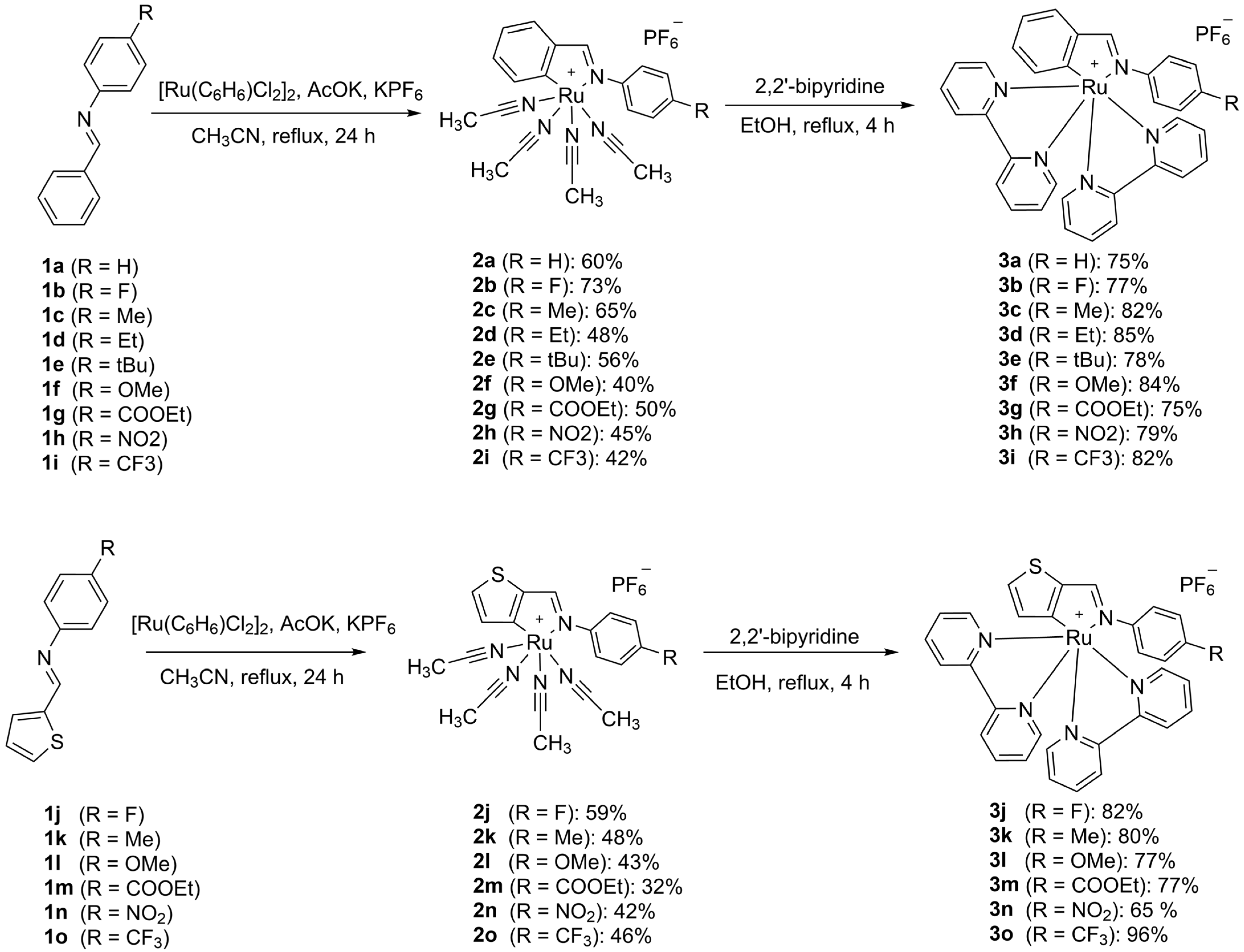
All intermediate compounds and target complexes were obtained using methods similar to those described previously [24] (Scheme 1). Cycloruthenated complexes 3ao were synthesized with moderate to good yields by a two-step procedure by cyclometallation of imines and chelation of the resulting acetonitrile complexes 2ao. The remaining coordination sites were occupied by 2,2′-bipyridines to stabilize ruthenium in the (II) oxidation state, while aromatic ligands increase lipophilicity, facilitating transport across biological membranes. It is believed that ruthenium anticancer agents can bind to nuclear DNA via intercalation interactions; therefore, the presence of aromatic ligands enables stacking interactions between the ruthenium ring and nitrogenous base pairs.

2.2. Crystallography

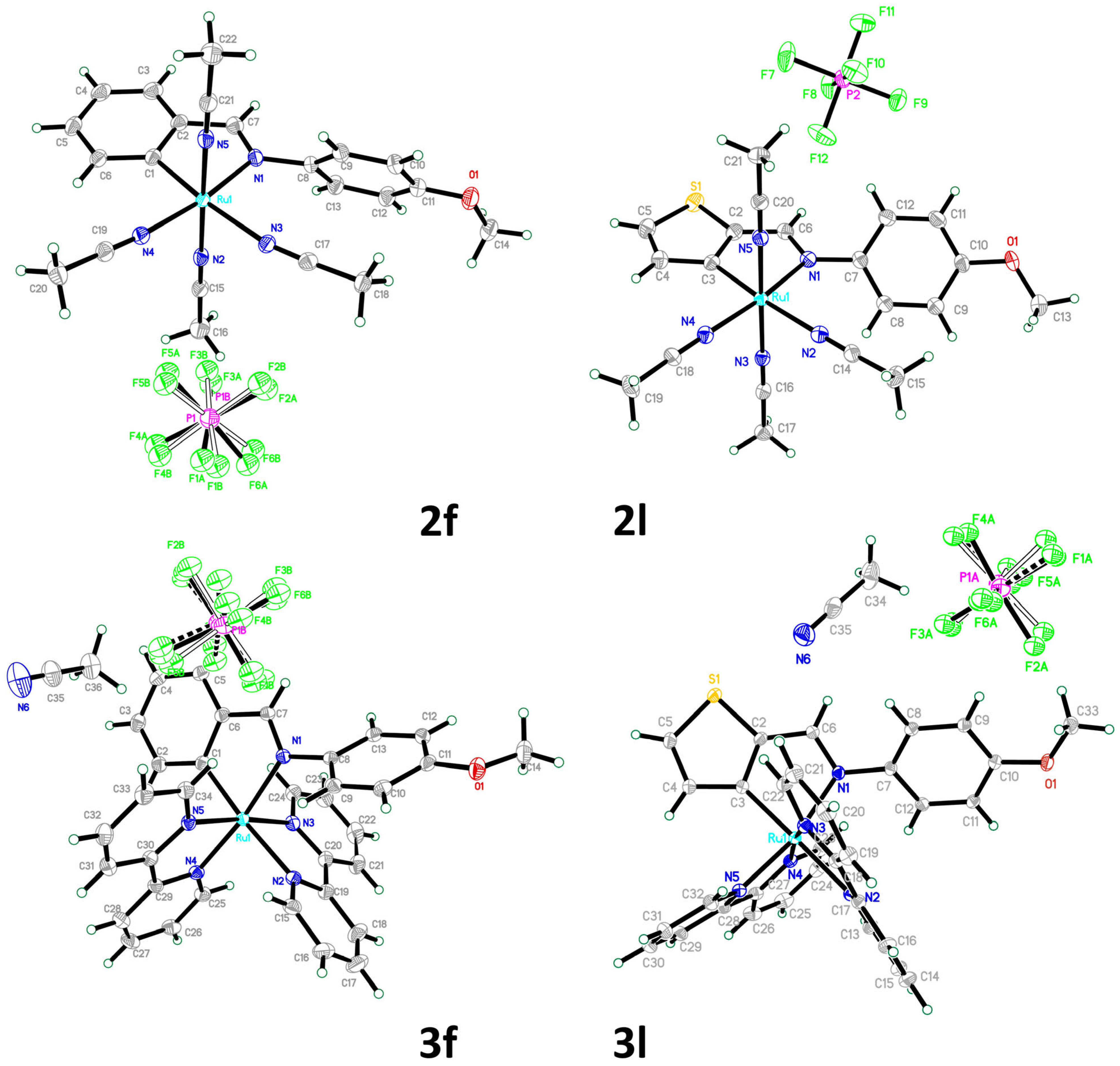
From a crystallographic point of view, the obtained complexes have a similar structure (Table S1, Figure 1 and Figures S31–S53). Thus, the lengths of the Ru–C bonds are in the range of 2.008–2.032 Å, Ru–N(aniline)—2.062–2.123 Å, Ru-N, located opposite the Ru–C bond—2.132–2.172 Å (Table 1). The plane of the aniline ring is inclined relative to the plane of the five-membered ring with the ruthenium atom with the dihedral angle 40.65–65.66°. The sign of this angle is not characteristic, either for acetonitrile, or for bipyridine complexes. It is worth noting that the formation of the bipyridine complex decreases the modulus of the dihedral angle by an average of 10° (cf. 2a and 3a, 2b and 3b, 2e and 3e, 2f and 3f). In bipyridine complexes, one fragment is more distorted than the other. The dihedral angle between the two pyridine rings ranges from 1.85° to 10.77°. The dihedral angle of the second fragment is approximately 1°.

2.3. UV-Vis Examination

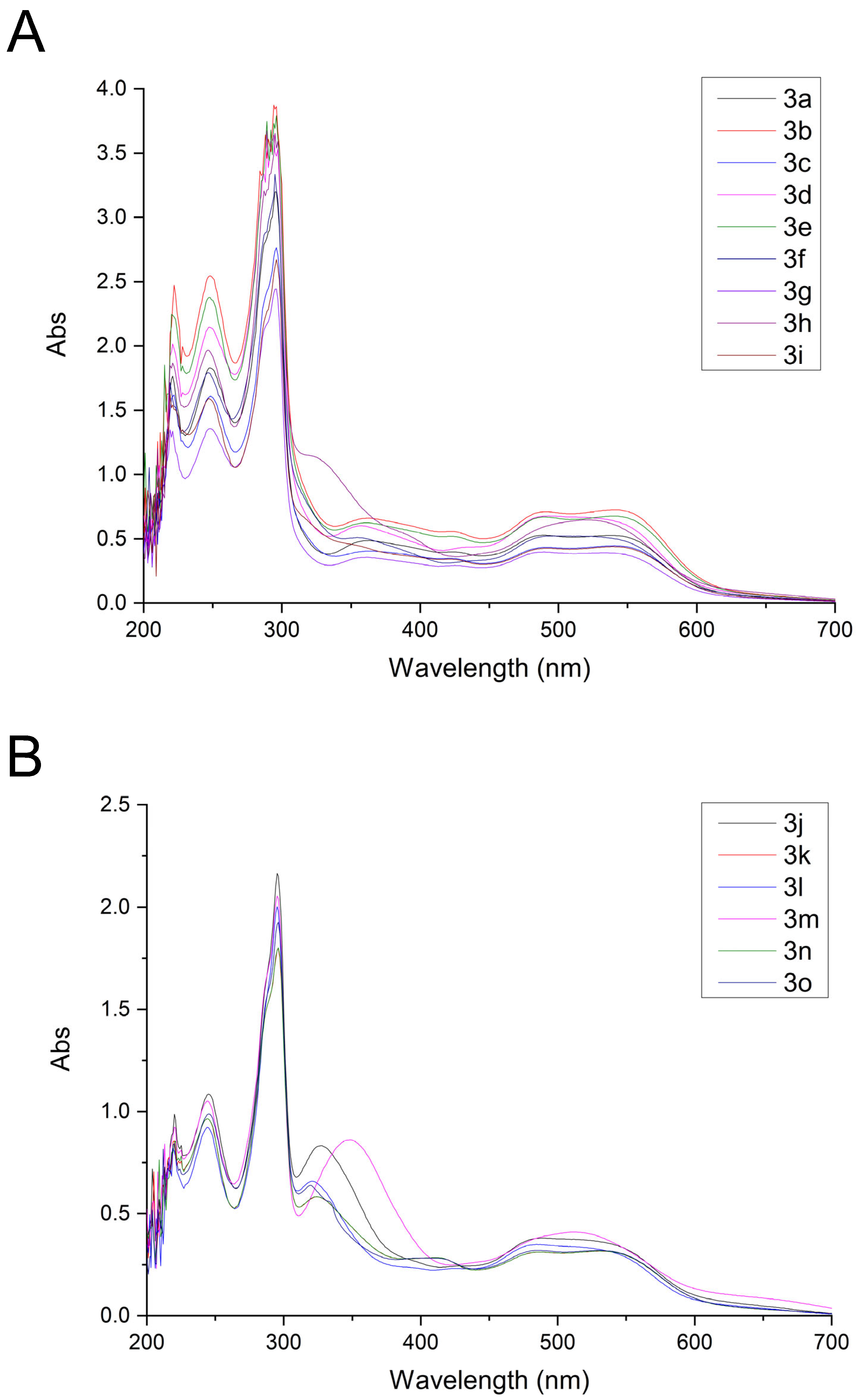
UV spectra were recorded for complexes 3a3o in acetonitrile (Figure 2) to determine their optical properties. All absorption spectra in acetonitrile exhibit two intensity bands: 250–300 nm (corresponding to the absorption bands of aromatic systems) and 450–600 nm (arising after metal coordination with 2,2′-bipyridine) which are typical for cycloruthenated compounds [23]. This can be visually observed: during the reaction, acetonitriles are replaced by bipyridines, and the compounds change from orange to dark purple.
Stability of 3ao was also assessed in 0.5% DMSO solution in aqueous phosphate buffer (pH 7.4, 37 °C, 100 μM NaCl, 77.4 μM Na2HPO4, 22.6 μM NaH2PO4) or saline by comparing the UV spectrum of solutions of complexes 3ao, recorded immediately after solution preparation, and the UV spectrum of the same solution after 18 h of incubation at room temperature (Figures S69 and S70). The spectra were compatible for all the complexes, indicating that they were sufficiently stable. A slight change in the intensity of signals is due to the slow degradation of ruthenium complexes with the formation of aqua- and oxo-complexes, as well as partial precipitation, which is typical for ruthenium compounds [25].

2.4. Electrochemistry

The E1/2ox1 potentials of benzaldehyde-based complexes are 8–22 mV higher than those of thiophenecarbaldehyde-based complexes. At the same time, compared to the previously described imine complex [23] but with carboxyl groups, the E1/2ox1 potentials of 3i3m, 3o are somewhat lower (77–127 mV versus 150 mV [23]), with the exception of the complex with the nitro group 3n, which has a potential of 161 mV. However, the most common values for cycloruthenated phenylpyridines [26] and phenylimidazoles [27] are in the range of 50–250 mV, so the resulting complexes fit well within this range. The introduction of electron-withdrawing substituents increases the E1/2ox1 value of the Ru2+/Ru3+ transition by an average of 40–60 mV (Table 2, Figures S52–S66). The electron-donating methoxy group (3f and 3l) weakly reduces this potential. When comparing the nitro group in the thiophene ring [24] with the nitro group in the aniline ring, the latter shifts the oxidation potential less strongly (257 mV vs. 215 mV). Overall, the oxidation potentials for the phenyl and thiophene derivatives are close to each other, except for the ethoxycarbonyl derivatives 3g and 3m, for which the potential differs by almost a factor of two.

2.5. Biological Study

The in vitro antiproliferative activity of the synthesized Ru-organometallic compounds and several starting ligands was evaluated against three human cell lines using the MTT assay. We selected a small panel of cell lines that provided insights into the efficacy and potential therapeutic utility of the compounds. The panel includes the A2780 human ovarian carcinoma cell line, which is sensitive to cisplatin, its cisplatin-resistant counterpart, A2780cis, also a non-malignant human embryonic kidney cell line, HEK293. The use of A2780 and A2780cis paired cell lines allowed us to directly assess the ability of the compounds to overcome resistance mechanisms. The inclusion of the HEK293 cell line can give us preliminary indication of selectivity against non-cancerous cells. Cisplatin, a clinically used drug, was used as a positive control in all experiments. All studies were performed in triplicate and repeated in three independent experiments. The results, expressed as the half-maximal inhibitory concentration after 72 h incubation (IC50), are summarized in Table 3.
Based on the initial analysis of the data, we can conclude that the IC50 values for all Ru compounds fall within the medium to high nanomolar range, suggesting a high level of cytotoxicity against both malignant and non-malignant cells. Moreover, the organometallic compounds appear to be several times more cytotoxic than cisplatin, approximately 10 times or more, although their selectivity for cancer cells is only moderate. The selectivity index for these compounds does not exceed 2.5, compared to 8.3 for cisplatin. The data on the Ru2+/Ru3+ transition potential correlate rather weakly with the cytotoxicity data. It can only be noted that the higher the oxidation potential E1/2ox1, the higher the IC50 value.
The presence of a ruthenium atom in a complex determines its biological activity. The data show that ligands such as 1b, 1f, and 1g do not exhibit any cytotoxicity, but the cytotoxicity of N-benzylideneaniline complexes (3bi) and thiophenylimine compounds (3jo) against A2780 is virtually identical. On the other hand, thiophenylidenimine ruthenacycles (against A2780cis) are several times more cytotoxic than N-benzylideneaniline complexes.
The cytotoxicity of the obtained complexes toward A2780 cells is several times greater than that of the cycloruthenated complexes described in the literature. For example, for cycloruthenated benzimidazoles, pyrazoles, and phenylpyridines, IC50 values range from 130–210 nmol/L [28] and can reach tens and hundreds of μmol/L [29,30]. Interestingly, the selectivity index of the compounds already described is not possible due to the lack of data on their toxicity toward non-cancerous cells.
If we look at the structure of the ligands, we can draw the following conclusions about their activity: the electron-donating OMe group slightly increases cytotoxicity, while the acceptors NO2 and CF3 reduce cytotoxicity. At the same time, alkyl substituents (except for tBu) increase the cytotoxicity of both the benzylideneaniline and thiophenylidenimine families of complexes. This can be attributed to their increased lipophilicity. So, this makes cycloruthenated imines a promising treatment for cisplatin-resistant tumors.

3. Experimental Section

All starting materials were purchased from ABCR (Karlsruhe, Germany) and SigmaAldrich (St. Louis, MO, USA) and used without additional purification. Silica gel for column chromatography (fraction 0.040-0.063 mm) was purchased from Carl Roth (Karlsruhe, Germany). NMR spectra were recorded on Bruker AVANCE 300 and Bruker II 600 spectrometers (Billerica, MA, USA). Residual signals of the solvents served as internal standards. HRMS-ESI spectra were recorded on Bruker MicroTOF II mass spectrometer (Billerica, MA, USA).
Single crystal X-ray crystallographic data and refinement details.
X-ray diffraction data for 2a, 3e, 3m and 3o were collected at 100 K on a Bruker Quest D8 diffractometer (Billerica, MA, USA) equipped with a Photon-III area-detector (graphite monochromator, shutterless φ- and ω-scan technique), using Mo Kα-radiation. The intensity data were integrated by the SAINT program [31] and were corrected for absorption and decay using SADABS [32]. The structure was solved by direct methods using SHELXT [33] and refined on F2 using SHELXL-2018 [34] in the OLEX2 program [35]. All non-hydrogen atoms were refined with individual anisotropic displacement parameters. All hydrogen atoms were placed in ideal calculated positions and refined as riding atoms with relative isotropic displacement parameters. The SHELXTL program suite [31] was used for molecular graphics.
X-ray diffraction data were collected at 100K on a four-circle Rigaku Synergy S diffractometer (Wroclaw, Poland) equipped with a HyPix600HE area-detector (kappa geometry, shutterless ω-scan technique), using monochromatized Cu Kα-radiation (for compounds 1n, 2b, 2d, 2f2l, 2n, 3a, 3b, 3f, 3h, 3j) and using monochromatized Mo Kα-radiation (for compounds 2e, 3c). The intensity data were integrated and corrected for absorption and decay by the CrysAlisPro program [36]. The structure was solved by direct methods using SHELXT [33] and refined on F2 using SHELXL-2018 [34] in the OLEX2 program [35]. All non-hydrogen atoms were refined with individual anisotropic displacement parameters. All hydrogen atoms were placed in ideal calculated positions and refined as riding atoms with relative isotropic displacement parameters. The SHELXTL program suite [31] was used for molecular graphics.
The structures of 2a, 2b, 3c and 3m contained unresolved/highly disordered acetonitrile and ether molecules in the crystal channels, which were removed by the SQUEEZE method [37] implemented in the OLEX2 program [35].
Cyclic voltammetry.
The electrochemical oxidation and reduction behavior of the compounds under discussion was investigated by cyclic voltammetry using an IPC-Pro-MF potentiostat from Econix (Sheffield, UK). The preparation of solutions and all measurements were performed in an argon-filled glovebox at a water and oxygen level of no more than 0.1 ppm. Before use, acetonitrile (HPLC grade, Acros, Waltham, MA, USA) with an initial water content of no more than 100 ppm was stored over molecular sieves (4 Å) pre-dried under oil pump vacuum at 200–250 °C for 4 h. Bu4NPF6 (Sigma Aldrich, St. Louis, MO, USA) was dried under oil pump vacuum at 80 °C for 4 h. The water content in the 0.1 M Bu4NPF6/acetonitrile system used did not exceed 20 ppm after that, which was monitored by Karl Fischer titration using a Mettler-Toledo C10SD titrator (Zurich, Switzerland). The compounds dissolved in 5 mL of the background electrolyte were electrochemically analyzed in a standard conical three-electrode glass cell. The working electrode was a 1.7 mm diameter glassy carbon disk electrode placed in PTFE. Before use, it was polished with sandpaper and GOI paste until a mirror shine was achieved. The auxiliary electrode was a platinum wire pre-calcined in a gas burner flame. The potentials of the processes under study were measured relative to a silver wire coated with AgCl (achieved by galvanostatic anodizing in a 5% hydrochloric acid solution) separated from the main solution by an electrochemical bridge filled with an auxiliary electrolyte. Separately, under similar conditions, the oxidation curves of ferrocene were recorded, and the given values were corrected according to the oxidation potential of the latter.
Cells and MTT assay.
The human A2780 ovarian adenocarcinoma, A2780cis cisplatin resistant ovarian adenocarcinoma, HEK293 human embryonic kidney cell lines were obtained from the European collection of authenticated cell cultures (ECACC; Salisbury, UK). Cells were grown in a RPMI 1640 (Gibco™, Cork, Ireland) cell medium (A2780, A2780cis), or DMEM (Gibco™, Ireland) cell medium (HEK293) supplemented with 10% fetal bovine serum (Gibco™, São Paulo, Brazil). The cells were cultured in an incubator at 37 °C in a humidified 5% CO2 atmosphere and were subcultured two times a week. The antiproliferative activity was studied by MTT assays as published previously [38].

3.1. General Procedure for Compounds 2a2o

Imine 1 (0.40 mmol, 2 eq) dissolved in acetonitrile (15 mL) was added to a three-necked flask equipped with a reflux condenser with [Ru(C6H6)Cl2]2 (0.20 mmol, 1 eq), potassium hexafluorophosphate (0.80 mmol, 4 eq), potassium acetate (0.60 mmol, 3 eq) and refluxed in an argon atmosphere for 24 h. The reaction mixture was evaporated, residue was dissolved in DCM (15 mL) and of water (10 mL), organic layer was separated, aqueous layer was washed with DCM (5 mL), organic phases were combined, dried over sodium sulfate and evaporated to dryness. Crude product was purified with column chromatography on silica gel (CHCl3:CH3CN 10:1). Crystals suitable for X-ray analysis were grown by diethyl ether vapor diffusion on acetonitrile solution of complexes.
Tetrakis(acetonitrile)[N-((phenyl-κC2)methyliden]aniline-κN]ruthenium(II) hexafluorophosphate (2a).
Orange powder. Yield 60%.
1H NMR (300 MHz, Acetonitrile-d3) δ 8.46 (s, 1H), 8.03 (d, J = 7.5 Hz, 1H), 7.64 (dd, J = 7.5, 1.1 Hz, 1H), 7.49–7.42 (m, 2H), 7.39–7.34 (m, 1H), 7.34–7.28 (m, 2H), 7.13 (td, J = 7.4, 1.5 Hz, 1H), 6.96 (td, J = 7.3, 1.2 Hz, 1H), 2.51 (s, 3H), 2.12 (s, 6H), 1.96 (s, 3H).
13C NМR (76 MHz, Acetonitrile-d3): 192.60, 177.60, 153.08, 150.51, 139.14, 130.67, 129.74, 127.62, 125.01, 123.68, 122.79, 121.55, 66.29, 15.65, 4.40, 3.91, 1.77.
HRMS-ESI: calc for [C19H19N4Ru-CH3CN]+ 405.0647, found 405.0643.
Tetrakis(acetonitrile)[N-((phenyl-κC2)methyliden]-4-fluoroaniline-κN]ruthenium(II) hexafluorophosphate (2b).
Orange powder. Yield 73%.
1H NMR (300 MHz, Acetonitrile-d3) δ 8.45 (s, 1H), 8.02 (d, J = 7.5 Hz, 1H), 7.63 (d, J = 7.4 Hz, 1H), 7.35–7.28 (m, 2H), 7.22–7.10 (m, 3H), 6.96 (t, J = 7.3 Hz, 1H), 2.51 (s, 3H), 2.12 (s, 6H), 1.96 (s, 3H).
13C NМR (151 MHz, Acetonitrile-d3): 192.79, 177.94, 163.01, 161.40, 150.41, 149.52, 139.17, 130.80, 129.70, 125.52, 125.05, 122.87, 121.59, 116.34, 116.19, 4.38, 3.91, 1.76.
HRMS-ESI: calc for [C19H18FN14Ru-CH3CN]+ 423.0534, found 423.0568.
Tetrakis(acetonitrile)[N-((phenyl-κC2)methyliden]-4-methylaniline-κN]ruthenium(II) hexafluorophosphate (2c).
Orange powder. Yield 65%.
1H NMR (300 MHz, Acetonitrile-d3) δ 8.43 (s, 1H), 8.01 (d, J = 7.5 Hz, 1H), 7.61 (dd, J = 7.5, 1.1 Hz, 1H), 7.26 (d, J = 8.3 Hz, 2H), 7.19 (d, J = 8.4 Hz, 2H), 7.12 (td, J = 7.4, 1.5 Hz, 1H), 6.96 (td, J = 7.3, 1.1 Hz, 1H), 2.51 (s, 3H), 2.39 (s, 3H), 2.11 (s, 6H), 1.96 (s, 3H).
13C NМR (151 MHz, Acetonitrile-d3): 192.35, 177.15, 150.76, 150.54, 139.10, 137.55, 130.48, 130.16, 129.49, 124.92, 123.50, 122.72, 121.53, 21.07, 4.40, 3.92, 1.77.
HRMS-ESI: calc for [C20H21N4Ru-CH3CN]+ 419.0822, found 419.0814.
Tetrakis(acetonitrile)[N-((phenyl-κC2)methyliden]-4-ethylaniline-κN]ruthenium(II) hexafluorophosphate (2d)
Orange powder. Yield 48%.
1H NMR (300 MHz, Acetonitrile-d3) δ 8.44 (s, 1H), 8.01 (d, J = 7.5 Hz, 1H), 7.63–7.58 (m, 1H), 7.29 (d, J = 8.2 Hz, 2H), 7.21 (d, J = 8.3 Hz, 2H), 7.12 (t, J = 7.3 Hz, 1H), 6.96 (t, J = 7.3 Hz, 1H), 2.70 (q, J = 7.6 Hz, 2H), 2.51 (s, 3H), 2.12 (s, 6H), 1.96 (s, 3H), 1.26 (t, J = 7.6 Hz, 3H).
13C NМR (151 MHz, Acetonitrile-d3): 192.35, 177.18, 150.93, 150.54, 143.98, 139.10, 130.50, 129.51, 129.04, 124.94, 123.59, 122.73, 121.53, 29.06, 16.21, 4.40, 3.93.
HRMS-ESI: calc for [C21H23N4Ru-CH3CN]+ 433.1210, found 433.1215.
Tetrakis(acetonitrile)[N-((phenyl-κC2)methyliden]-4-(tert-butyl)aniline-κN]ruthenium(II) hexafluorophosphate (2e).
Orange powder. Yield 56%.
1H NMR (300 MHz, Acetonitrile-d3) δ 8.45 (s, 1H), 8.01 (d, J = 7.4 Hz, 1H), 7.62 (d, J = 7.4 Hz, 1H), 7.48 (d, J = 8.5 Hz, 2H), 7.24 (d, J = 8.4 Hz, 2H), 7.12 (t, J = 7.3 Hz, 1H), 6.96 (t, J = 7.3 Hz, 1H), 2.51 (s, 3H), 2.12 (s, 6H), 1.96 (s, 3H), 1.37 (s, 9H).
13C NМR (151 MHz, Acetonitrile-d3): 192.39, 177.21, 150.69, 139.11, 130.53, 129.53, 126.54, 124.95, 123.27, 122.75, 121.55, 35.25, 31.63, 4.38, 3.91.
HRMS-ESI: calc for [C23H27N4Ru-CH3CN]+ 315.6547, found 315.6548.
Tetrakis(acetonitrile)[N-((phenyl-κC2)methyliden]-4-methoxyaniline-κN]ruthenium(II) hexafluorophosphate (2f).
Orange powder. Yield 40%.
1H NMR (300 MHz, Acetonitrile-d3) δ 8.42 (s, 1H), 8.01 (d, J = 7.5 Hz, 1H), 7.61 (d, J = 7.4 Hz, 1H), 7.26 (d, J = 8.8 Hz, 2H), 7.11 (t, J = 7.3 Hz, 1H), 7.00–6.92 (m, 3H), 3.84 (s, 3H), 2.51 (s, 3H), 2.11 (s, 6H), 1.96 (s, 3H).
13C NМR (151 MHz, Acetonitrile-d3): 192.15, 176.81, 159.47, 150.56, 146.51, 139.06, 130.36, 129.41, 124.74, 122.70, 121.52, 114.70, 56.24, 3.94.
HRMS-ESI: calc for [C19H18N4ORu]+ 419.0812, found 419.0814.
Tetrakis(acetonitrile)[N-((phenyl-κC2)methyliden]-4-ethoxycarbonylaniline-κN]ruthenium(II) hexafluorophosphate (2g).
Orange powder. Yield 50%.
1H NMR (300 MHz, Acetonitrile-d3) δ 8.50 (s, 1H), 8.10–8.02 (m, 3H), 7.67 (d, J = 7.3 Hz, 1H), 7.38 (d, J = 8.4 Hz, 2H), 7.14 (t, J = 7.4 Hz, 1H), 6.98 (t, J = 7.3 Hz, 1H), 4.37 (q, J = 7.1 Hz, 2H), 2.52 (s, 3H), 2.12 (s, 6H), 1.96 (s, 3H), 1.38 (t, J = 7.1 Hz, 3H).
13C NМR (151 MHz, Acetonitrile-d3): 193.68, 178.55, 166.80, 156.85, 150.40, 139.24, 131.27, 130.99, 129.94, 125.19, 124.02, 122.98, 121.67, 61.96, 14.64, 4.40, 3.92, 1.77.
HRMS-ESI: calc for [C22H23N4O2Ru-CH3CN]+ 477.0853, found 477.0859.
Tetrakis(acetonitrile)[N-((phenyl-κC2)methyliden]-4-nitroaniline-κN]ruthenium(II) hexafluorophosphate (2h).
Orange powder. Yield 45%.
1H NMR (300 MHz, Acetonitrile-d3) δ 8.54 (s, 1H), 8.33–8.27 (m, 2H),
8.06 (d, J = 7.5 Hz, 1H), 7.71 (dd, J = 7.5, 1.1 Hz, 1H), 7.51–7.46 (m, 2H), 7.16 (td, J = 7.3, 1.4 Hz, 1H), 6.99 (td, J = 7.4, 1.1 Hz, 1H), 2.52 (s, 3H), 2.13 (s, 6H), 1.96 (s, 3H).13C NМR (151 MHz, Acetonitrile-d3): 194.61, 179.53, 158.41, 150.29, 147.18, 139.31, 131.79, 130.23, 125.41, 124.96, 123.15, 121.79, 4.42, 3.96, 1.77.
HRMS-ESI: calc for [C19H18N5O2Ru-CH3CN]+ 435.0765, found 435.0766.
Tetrakis(acetonitrile)[N-((phenyl-κC2)methyliden]-4-(trifluoromethyl)aniline-κN]ruthenium(II) hexafluorophosphate (2i).
Orange powder. Yield 42%.
1H NMR (300 MHz, Acetonitrile-d3) δ 8.51 (s, 1H), 8.04 (d, J = 7.5 Hz, 1H), 7.77 (d, J = 8.4 Hz, 2H), 7.68 (d, J = 7.5 Hz, 1H), 7.46 (d, J = 8.3 Hz, 2H), 7.15 (t, J = 7.4 Hz, 1H), 6.98 (t, J = 7.4 Hz, 1H), 2.52 (s, 3H), 2.12 (s, 6H), 1.96 (s, 3H).
13C NМR (151 MHz, Acetonitrile-d3): 193.69, 178.95, 156.18, 150.34, 139.25, 131.35, 130.02, 126.97, 125.23, 124.60, 123.02, 121.70, 4.42, 3.95, 1.77.
HRMS-ESI: calc for [C20H18F3N4Ru-CH3CN]+ 473.0528, 473.0524.
Tetrakis(acetonitrile)[N-((thiophene-2-yl-κC2)methyliden]-4-fluoroaniline-κN]ruthenium(II) hexafluorophosphate (2j).
Orange powder. Yield 59%.
1H NMR (300 MHz, Acetonitrile-d3) δ 8.38 (s, 1H), 7.82 (d, J = 4.6 Hz, 1H), 7.63 (d, J = 4.1 Hz, 1H), 7.34–7.27 (m, 2H), 7.20–7.13 (m, 2H), 2.51 (s, 3H), 2.12 (s, 6H), 1.96 (s, 3H).
13C NMR (76 MHz, Acetonitrile-d3) δ 202.67, 168.15, 163.47, 160.26, 149.81, 149.78, 138.48, 137.04, 134.08, 125.66, 125.55, 125.23, 123.44, 116.33, 116.04, 31.61, 30.35, 4.32, 3.89, 1.77.
HRMS-ESI: calc for [C19H19BrN5RuS-CH3CN]+ 470.0387, found 470.0397.
Tetrakis(acetonitrile)[N-((thiophene-2-yl-κC2)methyliden]-4-methylaniline-κN]ruthenium(II) hexafluorophosphate (2k).
Orange powder. Yield 48%.
1H NMR (300 MHz, Acetonitrile-d3) δ 8.38 (s, 1H), 7.80 (d, J = 4.6 Hz, 1H), 7.62 (d, J = 4.6 Hz, 1H), 7.25–7.16 (m, 4H), 2.51 (s, 3H), 2.38 (s, 3H), 2.12 (s, 6H), 1.96 (s, 3H).
13C NMR (75 MHz, Acetonitrile-d3) δ 201.70, 167.47, 151.03, 138.48, 136.98, 136.91, 133.58, 130.16, 125.11, 123.73, 123.29, 21.05, 4.34, 3.91, 1.77.
HRMS-ESI: calc for [C19H19BrN5RuS-CH3CN]+ 425.0372, found 425.0362.
Tetrakis(acetonitrile)[N-((thiophene-2-yl-κC2)methyliden]-4-methoxyaniline-κN]ruthenium(II) hexafluorophosphate (2l).
Orange powder. Yield 43%.
1H NMR (300 MHz, Acetonitrile-d3) δ 8.39 (s, 1H), 7.82 (d, J = 4.6 Hz, 1H), 7.64 (d, J = 4.6 Hz, 1H), 7.30–7.23 (m, 2H), 7.02–6.96 (m, 2H), 3.86 (s, 3H), 2.54 (s, 3H), 2.14 (s, 6H), 1.99 (s, 3H).
13C NMR (76 MHz, Acetonitrile-d3) δ 201.18, 167.17, 159.05, 146.78, 138.41, 136.93, 133.36, 132.27, 129.73, 125.06, 124.87, 123.27, 114.69, 56.19, 4.34, 3.92.
HRMS-ESI: calc for [C19H19BrN5RuS-CH3CN]+ 482.0587, found 482.0595.
Tetrakis(acetonitrile)[N-((thiophene-2-yl-κC2)methyliden]-4-ethoxycarbonylaniline-κN]ruthenium(II) hexafluorophosphate (2m).
Orange powder. Yield 32%.
1H NMR (300 MHz, Acetonitrile-d3) δ 8.45 (s, 1H), 8.05 (d, J = 8.5 Hz, 2H), 7.88 (d, J = 4.7 Hz, 1H), 7.66 (d, J = 4.7 Hz, 1H), 7.39 (d, J = 8.4 Hz, 2H), 4.36 (q, J = 7.1 Hz, 2H), 2.52 (s, 3H), 2.12 (s, 6H), 1.96 (s, 3H), 1.38 (t, J = 7.1 Hz, 3H).
13C NMR (76 MHz, Acetonitrile-d3) δ 204.97, 168.66, 166.87, 157.31, 138.94, 137.13, 135.02, 130.96, 129.02, 125.33, 124.17, 123.56, 61.85, 14.63, 4.37, 3.92.
HRMS-ESI: calc for [C19H19BrN5RuS-CH3CN]+ 524.0694, found 524.0695.
Tetrakis(acetonitrile)[N-((thiophene-2-yl-κC2)methyliden]-4-nitroaniline-κN]ruthenium(II) hexafluorophosphate (2n).
Orange powder. Yield 42%.
1H NMR (300 MHz, Acetonitrile-d3) δ 8.50 (s, 1H), 8.27 (d, J = 9.0 Hz, 2H), 7.92 (d, J = 4.7 Hz, 1H), 7.68 (d, J = 4.7 Hz, 1H), 7.49 (d, J = 9.0 Hz, 2H), 2.52 (s, 3H), 2.12 (s, 6H), 1.96 (s, 3H).
13C NMR (76 MHz, Acetonitrile-d3) δ 207.50, 169.44, 159.04, 146.53, 139.30, 137.28, 136.07, 125.48, 125.39, 124.97, 123.77, 31.59, 30.34, 4.37, 3.94, 1.77.
HRMS-ESI: calc for [C19H19BrN5RuS-CH3CN]+ 497.0332, found 497.0344.
Tetrakis(acetonitrile)[N-((thiophene-2-yl-κC2)methyliden]-4-(trifluoromethyl)aniline-κN]ruthenium(II) hexafluorophosphate (2o).
Orange powder. Yield 46%.
1H NMR (300 MHz, Acetonitrile-d3) δ 8.46 (s, 1H), 7.88 (d, J = 4.6 Hz, 1H), 7.74 (d, J = 8.3 Hz, 2H), 7.66 (d, J = 4.6 Hz, 1H), 7.46 (d, J = 8.2 Hz, 2H), 2.52 (s, 3H), 2.12 (s, 6H), 1.96 (s, 3H).
13C NMR (76 MHz, Acetonitrile-d3) δ 205.10, 169.01, 156.59, 138.89, 137.13, 135.13, 128.29, 127.86, 126.88 (q, J = 3.8 Hz), 125.36, 124.75, 123.60, 4.38, 3.94.
HRMS-ESI: calc for [C19H19BrN5RuS-CH3CN]+ 520.0356, found 520.0367.

3.2. General Procedure for Compounds 3a3o

Complex 2 (0.30 mmol, 1 eq) and 2,2′-bipyridine (0.60 mmol, 2 eq) were introduced into a flask equipped with a reflux condenser, ethanol (18 mL) was added, and the mixture was refluxed in an argon atmosphere for 4 h. The reaction mixture was evaporated and purified with column chromatography on silica gel (CHCl3:CH3CN 10:1). The product was dissolved in minimal volume of CH3CN and added dropwise to large excess of diethyl ether under vigorous stirring. The precipitate was filtered, washed with diethyl ether and dried in vacuo for 3 h. Crystals suitable for X-ray analysis were grown by diethyl ether vapor diffusion on acetonitrile solution of complexes.
Bis(2,2′-bipiridine)[N-((phenyl-κC2)methyliden]aniline-κN]ruthenium(II) hexafluorophosphate (3a).
Dark purple powder. Yield 75%.
1H NMR (300 MHz, Acetonitrile-d3) δ 8.73 (s, 1H), 8.63 (d, J = 5.7 Hz, 1H), 8.33 (d, J = 8.2 Hz, 2H), 8.13 (d, J = 8.2 Hz, 1H), 8.00 (dd, J = 12.8, 6.9 Hz, 2H), 7.84 (p, J = 7.7 Hz, 3H), 7.78–7.64 (m, 4H), 7.40 (t, J = 6.6 Hz, 1H), 7.31 (t, J = 6.6 Hz, 1H), 7.19 (t, J = 6.5 Hz, 2H), 7.02–6.81 (m, 5H), 6.53 (dd, J = 12.5, 7.3 Hz, 3H).
13C NМR (151 MHz, Acetonitrile-d3): 201.76, 176.18, 158.77, 158.01, 157.64, 155.56, 155.43, 153.29, 151.82, 151.24, 150.07, 149.36, 136.77, 136.36, 136.09, 135.10, 134.81, 131.82, 130.09, 129.47, 127.43, 127.39, 127.35, 127.16, 127.04, 124.01, 123.67, 123.21, 122.64, 121.63.
CHN calc. for С33H26N5RuPF6·0.2C4H10O: C: 53.29; H: 3.53; N: 9.31. Obs. C: 53.29; H: 3.52; N: 9.39.
HRMS-ESI: calc for [C33H26N5Ru]+ 594.1235, found 594.1228.
Bis(2,2′-bipiridine)[N-((phenyl-κC2)methyliden]-4-fluoroaniline-κN]ruthenium(II) hexafluorophosphate (3b).
Dark purple powder. Yield 77%.
1H NMR (300 MHz, Acetonitrile-d3) δ 8.72 (s, 1H), 8.59 (d, J = 5.7 Hz, 1H), 8.34 (d, J = 8.1 Hz, 2H), 8.15 (d, J = 8.1 Hz, 1H), 8.05 (d, J = 8.2 Hz, 1H), 7.96 (d, J = 5.6 Hz, 1H), 7.84 (p, J = 7.2 Hz, 3H), 7.78–7.70 (m, 3H), 7.66 (d, J = 5.3 Hz, 1H), 7.39 (t, J = 6.6 Hz, 1H), 7.31 (t, J = 6.7 Hz, 1H), 7.20 (q, J = 6.2 Hz, 2H), 6.87 (p, J = 7.4 Hz, 2H), 6.66 (t, J = 8.7 Hz, 2H), 6.58–6.47 (m, 3H).
13C NМR (151 MHz, Acetonitrile-d3): 201.80, 176.52, 162.38, 160.77, 158.72, 157.99, 157.62, 155.57, 155.44, 153.27, 151.29, 150.10, 149.28, 148.17, 136.88, 136.38, 136.16, 135.16, 134.87, 131.91, 130.17, 127.53, 127.51, 127.35, 127.19, 124.44, 124.38, 124.05, 123.74, 123.32, 121.68, 116.05, 115.90.
CHN calc. for C33H25N5RuPF7: C: 52.39; H: 3.33; N: 9.26. Obs. C: 52.23; H: 3.21; N: 9.09.
HRMS-ESI: calc for [C33H25FN5Ru]+ 612.1141, found 612.1142.
Bis(2,2′-bipiridine)[N-((phenyl-κC2)methyliden]-4-methylaniline-κN]ruthenium(II) hexafluorophosphate (3c).
Dark purple powder. Yield 82%.
1H NMR (300 MHz, Acetonitrile-d3) δ 8.70 (s, 1H), 8.61 (d, J = 5.7 Hz, 1H), 8.33 (d, J = 8.2 Hz, 2H), 8.14 (d, J = 8.1 Hz, 1H), 8.04 (d, J = 8.1 Hz, 1H), 7.96 (d, J = 5.6 Hz, 1H), 7.88–7.78 (m, 3H), 7.76–7.68 (m, 3H), 7.66 (d, J = 5.3 Hz, 1H), 7.39 (t, J = 6.7 Hz, 1H), 7.30 (t, J = 6.7 Hz, 1H), 7.22–7.16 (m, 2H), 6.91–6.80 (m, 2H), 6.73 (d, J = 8.0 Hz, 2H), 6.52 (d, J = 7.1 Hz, 1H), 6.41 (d, J = 8.0 Hz, 2H), 2.12 (s, 3H).
13C NМR (76 MHz, Acetonitrile-d3): 201.38, 175.74, 158.79, 158.00, 157.64, 155.57, 155.41, 153.28, 151.20, 150.05, 149.59, 149.41, 137.03, 136.76, 136.35, 136.02, 135.05, 134.76, 131.59, 129.93, 129.88, 127.38, 127.34, 127.14, 123.99, 123.67, 123.26, 122.44, 121.65, 20.77.
CHN calc. for C34H28N5RuPF6: C: 54.26; H: 3.75; N: 9.30. Obs. C: 54.07; H: 3.70; N: 9.34.
HRMS-ESI: calc for [C34H28N5Ru]+ 608.1384, found 608.1385.
Bis(2,2′-bipiridine)[N-((phenyl-κC2)methyliden]-4-ethylaniline-κN]ruthenium(II) hexafluorophosphate (3d).
Dark purple powder. Yield 85%.
1H NMR (300 MHz, Acetonitrile-d3) δ 8.71 (s, 1H), 8.62 (d, J = 5.5 Hz, 1H), 8.33 (d, J = 8.3 Hz, 2H), 8.12 (d, J = 8.1 Hz, 1H), 8.02–7.95 (m, 2H), 7.89–7.78 (m, 3H), 7.76–7.63 (m, 4H), 7.39 (ddd, J = 7.3, 5.7, 1.4 Hz, 1H), 7.30 (ddd, J = 7.3, 5.7, 1.4 Hz, 1H), 7.19 (ddd, J = 7.5, 6.0, 1.1 Hz, 2H), 6.89 (td, J = 7.3, 1.5 Hz, 1H), 6.83 (td, J = 7.2, 1.7 Hz, 1H), 6.76–6.71 (m, 2H), 6.56–6.51 (m, 1H), 6.41–6.36 (m, 2H), 2.42 (q, J = 7.6 Hz, 2H), 1.05 (t, J = 7.6 Hz, 3H).
13C NМR (76 MHz, Acetonitrile-d3): 201.40, 175.63, 158.82, 158.01, 157.63, 155.59, 155.37, 153.30, 151.26, 150.04, 149.46, 143.50, 136.74, 136.30, 136.03, 135.02, 134.73, 131.59, 129.98, 128.73, 127.37, 127.33, 127.12, 124.00, 123.60, 123.19, 122.49, 121.61, 28.77, 16.25.
CHN calc. for C35H30N5RuPF6: C: 54.66; H: 3.94; N: 9.31. Obs. C: 54.87; H: 3.93; N: 9.13.
HRMS-ESI: calc for [C35H30N5Ru]+ 622.1548, found 622.1563.
Bis(2,2′-bipiridine)[N-((phenyl-κC2)methyliden]-4-(tert-butyl)aniline-κN]ruthenium(II) hexafluorophosphate (3e).
Dark purple powder. Yield 78%.
1H NMR (300 MHz, Acetonitrile-d3) δ 8.71 (s, 1H), 8.64 (d, J = 5.8 Hz, 1H), 8.34 (d, J = 8.1 Hz, 2H), 8.09 (d, J = 8.1 Hz, 1H), 7.98 (d, J = 5.7 Hz, 1H), 7.94 (d, J = 8.1 Hz, 1H), 7.89–7.77 (m, 4H), 7.73 (d, J = 7.3 Hz, 1H), 7.67 (t, J = 7.8 Hz, 1H), 7.62 (d, J = 5.3 Hz, 1H), 7.39 (t, J = 6.6 Hz, 1H), 7.30 (t, J = 6.6 Hz, 1H), 7.19 (q, J = 6.0 Hz, 2H), 6.92–6.81 (m, 4H), 6.55 (d, J = 7.2 Hz, 1H), 6.33 (d, J = 8.0 Hz, 2H), 1.15 (s, 9H).
13C NМR (76 MHz, Acetonitrile-d3): 201.27, 175.45, 158.88, 158.02, 157.63, 155.62, 155.34, 153.32, 151.33, 150.10, 150.05, 149.47, 148.76, 136.71, 136.28, 136.04, 134.97, 134.69, 131.53, 130.00, 127.37, 127.29, 127.25, 127.08, 126.15, 124.02, 123.52, 123.14, 122.09, 121.60, 34.87, 31.43.
CHN calc. for C37H34N5RuPF6: C: 55.92; H: 3.84; N: 8.73. Obs. C: 55.90; H: 4.24; N: 9.10.
HRMS-ESI: calc for [C37H34N5Ru]+ 650.1862, found 650.1855.
Bis(2,2′-bipiridine)[N-((phenyl-κC2)methyliden]-4-methoxyaniline-κN]ruthenium(II) hexafluorophosphate (3f).
Dark purple powder. Yield 84%.
1H NMR (300 MHz, Acetonitrile-d3) δ 8.69 (s, 1H), 8.60 (d, J = 5.0 Hz, 1H), 8.33 (d, J = 8.2 Hz, 2H), 8.14 (d, J = 8.1 Hz, 1H), 8.05 (d, J = 8.2 Hz, 1H), 7.98–7.94 (m, 1H), 7.88–7.78 (m, 3H), 7.76–7.70 (m, 3H), 7.68–7.65 (m, 1H), 7.39 (ddd, J = 7.3, 5.7, 1.4 Hz, 1H), 7.30 (ddd, J = 7.4, 5.7, 1.4 Hz, 1H), 7.23–7.16 (m, 2H), 6.88 (td, J = 7.2, 1.5 Hz, 1H), 6.82 (td, J = 7.2, 1.7 Hz, 1H), 6.55–6.50 (m, 1H), 6.45 (s, 4H), 3.62 (s, 3H).
13C NМR (151 MHz, Acetonitrile-d3): 201.23, 175.37, 158.88, 158.78, 158.02, 157.66, 155.63, 155.37, 153.29, 151.26, 150.04, 149.42, 145.19, 136.78, 136.28, 135.99, 135.03, 134.73, 131.49, 129.90, 127.40, 127.32, 127.15, 124.01, 123.67, 123.26, 121.61, 114.47, 56.07.
CHN calc. for C34H28N5ORuPF6: C: 53.13; H: 3.67; N: 9.11. Obs. C: 52.87; H: 3.76; N: 9.17.
HRMS-ESI: calc for [C34H28N5ORu]+ 624.1341, found 624.1327.
Bis(2,2′-bipiridine)[N-((phenyl-κC2)methyliden]-4-ethoxycarbonylaniline-κN]ruthenium(II) hexafluorophosphate (3g).
Dark purple powder. Yield 75%.
1H NMR (300 MHz, Acetonitrile-d3) δ 8.78 (s, 1H), 8.60 (dd, J = 5.7, 0.7 Hz, 1H), 8.34 (dq, J = 8.2, 1.2 Hz, 2H), 8.14 (d, J = 8.0 Hz, 1H), 8.02 (d, J = 8.2 Hz, 1H), 7.97–7.94 (m, 1H), 7.90–7.78 (m, 4H), 7.73–7.65 (m, 3H), 7.57–7.52 (m, 2H), 7.40 (ddd, J = 7.3, 5.7, 1.4 Hz, 1H), 7.32 (ddd, J = 7.3, 5.7, 1.4 Hz, 1H), 7.24–7.17 (m, 2H), 6.91 (td, J = 7.3, 1.5 Hz, 1H), 6.86 (td, J = 7.3, 1.7 Hz, 1H), 6.63–6.56 (m, 3H), 4.25 (q, J = 7.1 Hz, 2H), 1.30 (t, J = 7.1 Hz, 3H).
13C NМR (76 MHz, Acetonitrile-d3): 202.81, 177.17, 166.39, 158.66, 157.97, 157.62, 155.65, 155.49, 155.45, 153.33, 151.27, 150.09, 149.26, 136.91, 136.47, 136.26, 135.29, 134.99, 132.41, 130.66, 130.39, 129.05, 127.59, 127.55, 127.41, 127.22, 124.07, 123.79, 123.35, 122.99, 121.74, 61.90, 14.51.
CHN calc. for C36H30N5O2RuPF6·0.16CHCl3: C: 52.13; H:3.88; N: 8.71. Obs. C: 52.40; H:3.84; N: 8.73.
HRMS-ESI: calc for [C36H30N5O2Ru]+ 666.1447, found 666.1447.
Bis(2,2′-bipiridine)[N-((phenyl-κC2)methyliden]-4-nitroaniline-κN]ruthenium(II) hexafluorophosphate (3h).
Dark purple powder. Yield 79%.
1H NMR (300 MHz, Acetonitrile-d3) δ 8.85–8.78 (m, 1H), 8.60–8.53 (m, 1H), 8.38–8.31 (m, 2H), 8.15–8.09 (m, 1H), 8.04–7.98 (m, 1H), 7.93 (t, J = 5.6 Hz, 1H), 7.90–7.79 (m, 4H), 7.77–7.64 (m, 5H), 7.43–7.36 (m, 1H), 7.33 (t, J = 6.6 Hz, 1H), 7.27–7.17 (m, 2H), 6.96–6.83 (m, 2H), 6.72–6.64 (m, 2H), 6.63–6.57 (m, 1H).
13C NМR (151 MHz, Acetonitrile-d3): 203.76, 178.13, 158.61, 157.98, 157.63, 157.14, 155.56, 155.38, 153.38, 151.36, 150.08, 149.21, 146.42, 137.11, 136.56, 136.42, 135.47, 135.15, 132.94, 130.69, 127.83, 127.68, 127.46, 127.27, 125.01, 124.16, 124.13, 123.92, 123.57, 121.84.
CHN calc. for C33H25N6O2PF6Ru·0.44CHCl3·0.34C4H10O: C: 48.51; H: 3.38; N: 9.75. Obs. C: 48.51; H: 3.21; N: 9.75.
HRMS-ESI: calc for [C33H25N6O2Ru]+ 639.1086, found 639.1070.
Bis(2,2′-bipiridine)[N-((phenyl-κC2)methyliden]-4-(trifluoromethyl)aniline-κN]ruthenium(II) hexafluorophosphate (3i).
Dark purple powder. Yield 82%.
1H NMR (300 MHz, Acetonitrile-d3) δ 8.78 (s, 1H), 8.59 (d, J = 5.7 Hz, 1H), 8.34 (d, J = 8.1 Hz, 2H), 8.13 (d, J = 8.1 Hz, 1H), 8.02–7.95 (m, 2H), 7.91–7.78 (m, 4H), 7.74–7.63 (m, 3H), 7.40 (t, J = 6.7 Hz, 1H), 7.33 (t, J = 6.7 Hz, 1H), 7.25–7.17 (m, 4H), 6.89 (q, J = 6.6 Hz, 2H), 6.64 (d, J = 8.0 Hz, 2H), 6.59 (d, J = 6.9 Hz, 1H).
13C NМR (76 MHz, Acetonitrile-d3): 202.68, 177.44, 158.67, 157.98, 157.62, 155.55, 155.49, 153.33, 151.32, 150.15, 149.26, 136.90, 136.51, 136.32, 135.32, 135.03, 132.44, 130.46, 127.63, 127.40, 127.22, 126.69, 126.64, 126.59, 126.54, 124.09, 123.80, 123.52, 123.31, 121.79.
CHN calc. for C34H25N5RuPF9·0.16CH3CN: C: 50.47; H: 3.15; N: 8.85. Obs. C: 50.47; H: 3.15; N: 8.84.
HRMS-ESI: calc for [C34H25F3N5Ru]+ 662.1109, found 662.1100.
Bis(2,2′-bipiridine)[N-((thiophene-2-yl-κC2)methyliden]-4-fluoroaniline-κN]ruthenium(II) hexafluorophosphate (3j).
Dark purple powder. Yield 82%.
1H NMR (300 MHz, Acetonitrile-d3) δ 8.64 (s, 1H), 8.51 (d, J = 4.9 Hz, 1H), 8.32 (d, J = 8.1 Hz, 2H), 8.14 (d, J = 8.0 Hz, 1H), 8.07 (d, J = 8.2 Hz, 1H), 7.91–7.71 (m, 6H), 7.68 (d, J = 4.7 Hz, 1H), 7.61 (d, J = 4.7 Hz, 1H), 7.41 (ddd, 1H), 7.31 (ddd, 1H), 7.26–7.16 (m, 2H), 6.68–6.58 (m, 2H), 6.51–6.43 (m, 3H).
13C NMR (76 MHz, Acetonitrile-d3) δ 212.13, 166.43, 162.82, 159.60, 158.52, 158.39, 157.85, 155.74, 155.42, 153.95, 151.77, 150.03, 148.60, 148.56, 138.59, 136.93, 136.22, 135.82, 135.46, 135.18, 134.74, 127.58, 127.50, 127.31, 127.16, 124.61, 124.50, 124.03, 123.85, 123.69, 123.38, 116.06, 115.76.
CHN calc. for C31H23F7N5OPRuS: C: 48.82; H: 3.04; N: 9.18 Obs. C: 48.83; H: 3.04; N: 9.18.
HRMS-ESI: calc for [C31H23FN5ORuS]+ 618.0704, found 618.0706.
Bis(2,2′-bipiridine)[N-((thiophene-2-yl-κC2)methyliden]-4-methylaniline-κN]ruthenium(II) hexafluorophosphate (3k).
Dark purple powder. Yield 80%.
1H NMR (300 MHz, Acetonitrile-d3) δ 8.63 (s, 1H), 8.53 (d, J = 5.7 Hz, 1H), 8.31 (d, J = 8.1 Hz, 2H), 8.14 (d, J = 8.0 Hz, 1H), 8.06 (d, J = 8.1 Hz, 1H), 7.90–7.69 (m, 6H), 7.67–7.63 (m, 1H), 7.61 (d, J = 5.4 Hz, 1H), 7.44–7.36 (m, 1H), 7.33–7.26 (m, 1H), 7.19 (q, 2H), 6.71 (d, J = 8.1 Hz, 2H), 6.45 (d, J = 4.6 Hz, 1H), 6.39 (d, J = 8.3 Hz, 2H), 2.11 (s, 3H).
13C NMR (76 MHz, Acetonitrile-d3) δ 211.31, 165.81, 158.60, 158.40, 157.88, 155.77, 155.43, 153.94, 151.67, 149.99, 138.53, 136.81, 136.32, 136.08, 135.36, 135.33, 135.08, 134.70, 129.90, 127.44, 127.37, 127.28, 127.16, 123.99, 123.80, 123.65, 123.34, 122.66, 20.75.
CHN calc. for C32H26F6N5PRuS: C: 50.66; H: 3.45; N: 9.23 Obs. C: 50.48; H: 3.48; N: 9.20.
HRMS-ESI: calc for [C32H26N5RuS]+ 614.0955, found 614.0964.
Bis(2,2′-bipiridine)[N-((thiophene-2-yl-κC2)methyliden]-4-methoxyaniline-κN]ruthenium(II) hexafluorophosphate (3l).
Dark purple powder. Yield 77%.
1H NMR (300 MHz, Acetonitrile-d3) δ 8.61 (s, 1H), 8.53 (d, J = 4.9 Hz, 1H), 8.31 (d, J = 8.1 Hz, 2H), 8.14 (d, J = 8.1 Hz, 1H), 8.06 (d, J = 8.2 Hz, 1H), 7.90–7.70 (m, 6H), 7.64 (d, J = 4.6 Hz, 1H), 7.61 (d, J = 4.6 Hz, 1H), 7.40 (ddd, J = 7.3, 5.7, 1.4 Hz, 1H), 7.30 (ddd, J = 7.3, 5.7, 1.4 Hz, 1H), 7.25–7.15 (m, 2H), 6.45 (d, J = 4.6 Hz, 1H), 6.42 (br.s, 3H), 3.61 (s, 3H).
13C NMR (76 MHz, Acetonitrile-d3) δ 210.71, 165.46, 158.59, 158.44, 158.41, 157.88, 155.82, 155.39, 153.93, 151.72, 149.99, 145.56, 138.48, 136.82, 136.06, 135.32, 135.10, 135.04, 134.66, 127.45, 127.37, 127.27, 127.13, 123.99, 123.81, 123.61, 123.32, 114.48, 56.03, 15.64.
CHN calc. for C32H26F6N5OPRuS: C: 49.61; H: 3.38; N: 9.04 Obs. C: 49.60; H: 3.39; N: 9.08.
HRMS-ESI: calc for [C32H26N5ORuS]+ 630.0904, found 630.0912.
Bis(2,2′-bipiridine)[N-((thiophene-2-yl-κC2)methyliden]-4-ethoxycarbonylaniline-κN]ruthenium(II) hexafluorophosphate (3m).
Dark purple powder. Yield 77%.
1H NMR (300 MHz, Acetonitrile-d3) δ 8.72 (s, 1H), 8.50 (d, J = 4.9 Hz, 1H), 8.33 (d, J = 8.4 Hz, 2H), 8.13 (d, J = 8.1 Hz, 1H), 8.05 (d, J = 8.2 Hz, 1H), 7.92–7.70 (m, 7H), 7.63 (d, J = 4.7 Hz, 1H), 7.55–7.49 (m, 2H), 7.42 (ddd, J = 7.3, 5.7, 1.4 Hz, 1H), 7.32 (ddd, J = 7.3, 5.7, 1.4 Hz, 1H), 7.25 (ddd, J = 7.5, 5.4, 1.2 Hz, 1H), 7.19 (ddd, J = 7.3, 5.7, 1.4 Hz, 1H), 6.63–6.56 (m, 2H), 6.49 (d, J = 4.6 Hz, 1H), 4.24 (q, J = 7.1 Hz, 2H), 1.29 (t, J = 7.1 Hz, 3H).
13C NMR (76 MHz, Acetonitrile-d3) δ 166.89, 166.51, 158.46, 158.41, 157.89, 156.34, 155.61, 155.45, 154.08, 151.80, 150.05, 137.02, 136.80, 136.35, 135.63, 135.37, 134.88, 130.66, 128.29, 127.70, 127.53, 127.36, 127.25, 124.07, 123.90, 123.76, 123.46, 123.19, 61.80, 14.52.
CHN calc. for C34H28F6N5O2PRuS: C: 50.00; H: 3.46; N: 8.57 Obs. C: 50.03; H: 3.48; N: 8.56.
HRMS-ESI: calc for [C34H28N5O2RuS]+ 672.1010, found 672.1011.
Bis(2,2′-bipiridine)[N-((thiophene-2-yl-κC2)methyliden]-4-nitroaniline-κN]ruthenium(II) hexafluorophosphate (3n).
Dark purple powder. Yield 65%.
1H NMR (300 MHz, Acetonitrile-d3) δ 8.78 (s, 1H), 8.48 (d, J = 5.6 Hz, 1H), 8.34 (d, J = 7.6 Hz, 2H), 8.12 (d, J = 8.0 Hz, 1H), 8.05 (d, J = 8.2 Hz, 1H), 7.95–7.71 (m, 9H), 7.64 (d, J = 5.3 Hz, 1H), 7.43 (t, J = 6.6 Hz, 1H), 7.35–7.26 (m, 2H), 7.20 (t, J = 6.7 Hz, 1H), 6.68 (d, J = 9.0 Hz, 2H), 6.52 (d, J = 4.7 Hz, 1H).
13C NMR (76 MHz, Acetonitrile-d3) δ 217.12, 167.65, 158.41, 158.36, 158.11, 157.88, 155.48, 155.42, 154.14, 151.90, 149.98, 145.73, 139.52, 137.86, 137.24, 136.52, 135.82, 135.56, 135.02, 127.96, 127.64, 127.43, 127.30, 125.02, 124.13, 124.00, 123.95, 123.86, 123.67.
CHN calc. for C31H23F6N6O2PRuS: C: 47.15; H: 2.94; N: 10.64 Obs. C: 46.99; H: 2.96; N: 10.61.
HRMS-ESI: calc for [C31H23N6O2RuS]+ 645.0649, found 645.0666.
Bis(2,2′-bipiridine)[N-((thiophene-2-yl-κC2)methyliden]-4-(trifluoromethyl)aniline-κN]ruthenium(II) hexafluorophosphate (3o).
Dark purple powder. Yield 96%.
1H NMR (300 MHz, Acetonitrile-d3) δ 8.73 (s, 1H), 8.51 (d, J = 4.9 Hz, 1H), 8.33 (d, J = 7.2 Hz, 2H), 8.13 (d, J = 8.1 Hz, 1H), 8.04 (d, J = 8.2 Hz, 1H), 7.93–7.70 (m, 7H), 7.62 (d, J = 4.8 Hz, 1H), 7.42 (ddd, J = 7.4, 5.7, 1.4 Hz, 1H), 7.32 (ddd, J = 7.3, 5.7, 1.4 Hz, 1H), 7.27–7.17 (m, 4H), 6.63 (d, J = 8.0 Hz, 2H), 6.51 (d, J = 4.7 Hz, 1H).
13C NMR (76 MHz, Acetonitrile-d3) δ 214.53, 167.20, 158.45, 158.41, 157.87, 155.63, 155.49, 155.38, 154.06, 151.82, 150.06, 139.05, 137.01, 136.87, 136.40, 135.65, 135.38, 134.87, 127.73, 127.59, 127.37, 127.23, 126.64, 126.59, 126.54, 126.48, 124.09, 123.92, 123.76, 123.71, 123.41.
CHN calc. for C32H23F9N5PRuS: C: 47.30; H: 2.85; N: 8.62 Obs. C: 47.28; H: 2.79; N: 8.63.
HRMS-ESI: calc for [C32H23F3N5RuS]+ 668.0672, found 668.0656.

4. Conclusions

Two series of bisheteroleptic ruthenium(II) compounds containing different types of the simplest cyclometallated imines of benzaldehyde and 2-thiophenecarboxaldehyde were synthesized and characterized by NMR, MS, elemental analysis and UV-vis spectroscopy and cyclic voltammetry. The structure of 22 complexes described was proved by means of single-crystal X-ray data. Cytotoxic activity was measured on two cancer and one non-cancerous cell line, and the proportion of cell death was measured using the MTT assay. The cytotoxicity of all ruthenium complexes is significantly higher than that of cisplatin, but they have less selectivity.

Supplementary Materials

The following supporting information can be downloaded at: https://www.mdpi.com/article/10.3390/molecules31020315/s1, Vasiliev_SI_Rev3, Experimental details: pp. S2–S4; NMR spectra: pp. S5–S34; Crystallography: pp. S35–S52; Stability in PBS: pp. S53–S54.

Author Contributions

Conceptualization A.A.V. and A.V.M.; investigation, A.A.V., I.I.T., P.G.S., K.M.V., I.A.S. and A.V.M.; writing—original draft preparation, A.A.V. and I.I.T.; writing—A.A.N. and A.V.M.; funding acquisition, A.V.M. All authors have read and agreed to the published version of the manuscript.

Funding

This research was funded by Russian Science Foundation, grant number 24-23-00066.

Institutional Review Board Statement

Not applicable.

Informed Consent Statement

Not applicable.

Data Availability Statement

Data is contained within the article and Supplementary Materials.

Acknowledgments

Crystal structure determination was performed in the Department of Structural Studies of Zelinsky Institute of Organic Chemistry, Moscow. The authors acknowledge support from the M.V. Lomonosov Moscow State University Program of Development (“Feyond-A400” microplate reader (Allsheng, China)) and automated pipetting system “EzMate” (Blue-Ray Biotech, Taiwan).

Conflicts of Interest

The authors declare no conflicts of interest.

References

  1. Oun, R.; Moussa, Y.E.; Wheate, N.J. The Side Effects of Platinum-Based Chemotherapy Drugs: A Review for Chemists. Dalt. Trans. 2018, 47, 6645–6653. [Google Scholar] [CrossRef] [PubMed]
  2. Barabas, K.; Milner, R.; Lurie, D.; Adin, C. Cisplatin: A Review of Toxicities and Therapeutic Applications. Vet. Comp. Oncol. 2008, 6, 1–18. [Google Scholar] [CrossRef] [PubMed]
  3. Deo, K.; Pages, B.; Ang, D.; Gordon, C.; Aldrich-Wright, J. Transition Metal Intercalators as Anticancer Agents—Recent Advances. Int. J. Mol. Sci. 2016, 17, 1818. [Google Scholar] [CrossRef] [PubMed]
  4. Adhikari, S.; Nath, P.; Das, A.; Datta, A.; Baildya, N.; Duttaroy, A.K.; Pathak, S. A Review on Metal Complexes and Its Anti-Cancer Activities: Recent Updates from in Vivo Studies. Biomed. Pharmacother. 2024, 171, 116211. [Google Scholar] [CrossRef]
  5. Alessio, E.; Messori, L. NAMI-A and KP1019/1339, Two Iconic Ruthenium Anticancer Drug Candidates Face-to-Face: A Case Story in Medicinal Inorganic Chemistry. Molecules 2019, 24, 1995. [Google Scholar] [CrossRef]
  6. Weiss, A.; Berndsen, R.H.; Dubois, M.; Müller, C.; Schibli, R.; Griffioen, A.W.; Dyson, P.J.; Nowak-Sliwinska, P. In Vivo Anti-Tumor Activity of the Organometallic Ruthenium(Ii)-Arene Complex [Ru(η6–p-Cymene)Cl2(Pta)] (RAPTA-C) in Human Ovarian and Colorectal Carcinomas. Chem. Sci. 2014, 5, 4742–4748. [Google Scholar] [CrossRef]
  7. McKenzie, L.K.; Bryant, H.E.; Weinstein, J.A. Transition Metal Complexes as Photosensitisers in One- and Two-Photon Photodynamic Therapy. Coord. Chem. Rev. 2019, 379, 2–29. [Google Scholar] [CrossRef]
  8. Shi, G.; Monro, S.; Hennigar, R.; Colpitts, J.; Fong, J.; Kasimova, K.; Yin, H.; DeCoste, R.; Spencer, C.; Chamberlain, L.; et al. Ru(II) Dyads Derived from α-Oligothiophenes: A New Class of Potent and Versatile Photosensitizers for PDT. Coord. Chem. Rev. 2015, 282–283, 127–138. [Google Scholar] [CrossRef]
  9. Green, M.A.; Emery, K.; Hishikawa, Y.; Warta, W.; Dunlop, E.D. Solar Cell Efficiency Tables (Version 46). Prog. Photovolt. Res. Appl. 2015, 23, 805–812. [Google Scholar] [CrossRef]
  10. Chang, X.; Chuan, L.W.; Yongxin, L.; Pullarkat, S.A. One-Pot β-Alkylation of Secondary Alcohols with Primary Alcohols Catalyzed by Ruthenacycles. Tetrahedron Lett. 2012, 53, 1450–1455. [Google Scholar] [CrossRef]
  11. Findlay, M.T.; Domingo-Legarda, P.; McArthur, G.; Yen, A.; Larrosa, I. Catalysis with Cycloruthenated Complexes. Chem. Sci. 2022, 13, 3335–3362. [Google Scholar] [CrossRef]
  12. Lin, K.; Zhao, Z.Z.; Bo, H.-B.; Hao, X.J.; Wang, J.Q. Applications of Ruthenium Complex in Tumor Diagnosis and Therapy. Front. Pharmacol. 2018, 9, 1323. [Google Scholar] [CrossRef] [PubMed]
  13. Parveen, S. Recent Advances in Anticancer Ruthenium Schiff Base Complexes. Appl. Organomet. Chem. 2020, 34, e5687. [Google Scholar] [CrossRef]
  14. Gaiddon, C.; Pfeffer, M. The Fate of Cycloruthenated Compounds: From C–H Activation to Innovative Anticancer Therapy. Eur. J. Inorg. Chem. 2017, 2017, 1639–1654. [Google Scholar] [CrossRef]
  15. Li, J.; Zeng, L.; Wang, Z.; Chen, H.; Fang, S.; Wang, J.; Cai, C.Y.; Xing, E.; Liao, X.; Li, Z.W.; et al. Cycloruthenated Self-Assembly with Metabolic Inhibition to Efficiently Overcome Multidrug Resistance in Cancers. Adv. Mater. 2022, 34, 2100245. [Google Scholar] [CrossRef]
  16. Sui, L.Z.; Yang, W.W.; Yao, C.J.; Xie, H.Y.; Zhong, Y.W. Charge Delocalization of 1,4-Benzenedicyclometalated Ruthenium: A Comparison between Tris-Bidentate and Bis-Tridentate Complexes. Inorg. Chem. 2012, 51, 1590–1598. [Google Scholar] [CrossRef]
  17. Cuesta, L.; Maluenda, I.; Soler, T.; Navarro, R.; Urriolabeitia, E.P. Novel Thiophene-Based Cycloruthenated Compounds: Synthesis, Characterization, and Reactivity. Inorg. Chem. 2011, 50, 37–45. [Google Scholar] [CrossRef]
  18. Gaiddon, C.; Jeannequin, P.; Bischoff, P.; Pfeffer, M.; Sirlin, C.; Loeffler, J.P. Ruthenium (II)-Derived Organometallic Compounds Induce Cytostatic and Cytotoxic Effects on Mammalian Cancer Cell Lines through P53-Dependent and P53-Independent Mechanisms. J. Pharmacol. Exp. Ther. 2005, 315, 1403–1411. [Google Scholar] [CrossRef]
  19. Matsui, T.; Sugiyama, H.; Nakai, M.; Nakabayashi, Y. DNA Interaction and Cytotoxicity of Cyclometalated Ruthenium(II) Complexes as Potential Anticancer Drugs. Chem. Pharm. Bull. 2016, 64, 282–286. [Google Scholar] [CrossRef]
  20. Peña, B.; David, A.; Pavani, C.; Baptista, M.S.; Pellois, J.P.; Turro, C.; Dunbar, K.R. Cytotoxicity Studies of Cyclometallated Ruthenium(II) Compounds: New Applications for Ruthenium Dyes. Organometallics 2014, 33, 1100–1103. [Google Scholar] [CrossRef]
  21. Riegel, G.; Orvain, C.; Recberlik, S.; Spaety, M.-E.; Poschet, G.; Venkatasamy, A.; Yamamoto, M.; Nomura, S.; Tsukamoto, T.; Masson, M.; et al. The Unfolded Protein Response-Glutathione Metabolism Axis: A Novel Target of a Cycloruthenated Complexes Bypassing Tumor Resistance Mechanisms. Cancer Lett. 2024, 585, 216671. [Google Scholar] [CrossRef]
  22. Djukic, J.P.; Sortais, J.B.; Barloy, L.; Pfeffer, M. Cycloruthenated Compounds–Synthesis and Applications. Eur. J. Inorg. Chem. 2009, 2009, 817–853. [Google Scholar] [CrossRef]
  23. Medved’ko, A.V.; Ivanov, V.K.; Kiskin, M.A.; Sadovnikov, A.A.; Apostolova, E.S.; Grinberg, V.A.; Emets, V.V.; Chizhov, A.O.; Nikitin, O.M.; Magdesieva, T.V.; et al. The Design and Synthesis of Thiophene-Based Ruthenium(II) Complexes as Promising Sensitizers for Dye-Sensitized Solar Cells. Dye. Pigment. 2017, 140, 169–178. [Google Scholar] [CrossRef]
  24. Medved’ko, A.V.; Vasil’ev, A.A.; Kiskin, M.A.; Syroeshkin, M.A.; Balycheva, V.A.; Melnichuk, N.A.; Nazarov, A.A.; Vatsadze, S.Z. Cycloruthenated Thiophene-Imines: Novel Anticancer Agents. J. Organomet. Chem. 2025, 1038, 123726. [Google Scholar] [CrossRef]
  25. Su, X.; Zeng, R.; Li, X.; Dang, W.; Yao, K.; Tang, D. Cycloruthenated Complexes: PH-Dependent Reversible Cyclometallation and Reactions with Nitrite at Octahedral Ruthenium Centers. Dalt. Trans. 2016, 45, 7450–7459. [Google Scholar] [CrossRef]
  26. Brunner, F.; Marinakis, N.; Wobill, C.; Willgert, M.; Ertl, C.D.; Kosmalski, T.; Neuburger, M.; Bozic-Weber, B.; Glatzel, T.; Constable, E.C.; et al. Modular Synthesis of Simple Cycloruthenated Complexes with State-of-the-Art Performance in p-Type DSCs. J. Mater. Chem. C 2016, 4, 9823–9833. [Google Scholar] [CrossRef]
  27. Soukharev, V.S.; Ryabov, A.D.; Csöregi, E. Synthesis, Properties, and Biosensor Applications of Cycloruthenated 2-Phenylimidazoles. J. Organomet. Chem. 2003, 668, 75–81. [Google Scholar] [CrossRef]
  28. Novohradsky, V.; Yellol, J.; Stuchlikova, O.; Santana, M.D.; Kostrhunova, H.; Yellol, G.; Kasparkova, J.; Bautista, D.; Ruiz, J.; Brabec, V. Organoruthenium Complexes with C^N Ligands Are Highly Potent Cytotoxic Agents That Act by a New Mechanism of Action. Chem.–A Eur. J. 2017, 23, 15294–15299. [Google Scholar] [CrossRef]
  29. Wang, Y.; Jin, J.; Shu, L.; Li, T.; Lu, S.; Subarkhan, M.K.M.; Chen, C.; Wang, H. New Organometallic Ruthenium(II) Compounds Synergistically Show Cytotoxic, Antimetastatic and Antiangiogenic Activities for the Treatment of Metastatic Cancer. Chem.–A Eur. J. 2020, 26, 15170–15182. [Google Scholar] [CrossRef]
  30. Ortega-Forte, E.; Rovira, A.; López-Corrales, M.; Hernández-García, A.; Ballester, F.J.; Izquierdo-García, E.; Jordà-Redondo, M.; Bosch, M.; Nonell, S.; Santana, M.D.; et al. A Near-Infrared Light-Activatable Ru(Ii)-Coumarin Photosensitizer Active under Hypoxic Conditions. Chem. Sci. 2023, 14, 7170–7184. [Google Scholar] [CrossRef]
  31. Bruker. APEX-III; Bruker AXS Inc.: Madison, WI, USA, 2019. [Google Scholar]
  32. Krause, L.; Herbst-Irmer, R.; Sheldrick, G.M.; Stalke, D. Comparison of silver and molybdenum microfocus X-ray sources for single-crystal structure determination. J. Appl. Cryst. 2015, 48, 3–10. [Google Scholar] [CrossRef]
  33. Sheldrick, G.M. SHELXT—Integrated space-group and crystal-structure determination. Acta Cryst. 2015, A71, 3–8. [Google Scholar] [CrossRef]
  34. Sheldrick, G.M. Crystal structure refinement with SHELXL. Acta Cryst. 2015, C71, 3–8. [Google Scholar] [CrossRef]
  35. Dolomanov, O.V.; Bourhis, L.J.; Gildea, R.J.; Howard, J.A.K.; Puschmann, H. OLEX2: A complete structure solution, refinement and analysis program. J. Appl. Cryst. 2009, 42, 229–341. [Google Scholar] [CrossRef]
  36. CrysAlisPro, Version 1.171.41; Rigaku Oxford Diffraction: Tokyo, Japan, 2021.
  37. Spek, A.L. PLATON SQUEEZE: A tool for the calculation of the disordered solvent contribution to the calculated structure factors. Acta Cryst. 2015, C71, 9–18. [Google Scholar] [CrossRef]
  38. Nosova, Y.N.; Foteeva, L.S.; Zenin, I.V.; Fetisov, T.I.; Kirsanov, K.I.; Yakubovskaya, M.G.; Antonenko, T.A.; Tafeenko, V.A.; Aslanov, L.A.; Lobas, A.A.; et al. Enhancing the Cytotoxic Activity of Anticancer Pt IV Complexes by Introduction of Lonidamine as an Axial Ligand. Eur. J. Inorg. Chem. 2017, 2017, 1785–1791. [Google Scholar] [CrossRef]
Scheme 1. Preparation of ruthenium complexes.
Molecules 31 00315 sch001
Figure 1. Crystal structures of 2f, 2l, 3f·CH3CN, 3l·CH3CN.
Molecules 31 00315 g001
Figure 2. UV-vis spectra of 3a3i (A) and 3j3o (B) in acetonitrile, concentration 3.4 × 10⁻⁵ M.
Molecules 31 00315 g002
Table 1. Selected bond lengths and angles of ruthenium complexes.
Aniline-(Ru–N) Dihedral Angle, °Py-Py Dihedral Angle, °Ru–N(Aniline), ÅRu–N, Å aRu–C, Å
2a (H)+65.66 2.0712.1512.026
2b (F)+58.36 2.0652.1552.035
2d (Et)−52.43 2.0692.1422.027
2e (tBu)−57.51 2.0692.1552.025
2f (OMe)−61.74 2.0662.1522.019
2g (CO2Et) b−51.97 2.0622.1582.023
+40.652.0792.1592.017
2h (NO2b+42.47 2.0962.1572.019
+41.622.0712.1722.008
2i (CF3)−51.20 2.0632.1532.022
2j (F)−47.59 2.1022.1392.019
2k (Me)−49.30 2.0962.1362.022
2l (OMe) b+52.94 2.0932.1322.018
+41.762.1142.1392.015
2n (NO2)−47.17 2.1052.1402.020
3a (H)+45.614.222.1112.1462.031
3b (F)+49.651.852.1042.1362.030
3c (Me)+39.775.012.1172.1522.031
3e (tBu)+48.297.072.0852.1462.029
3f (OMe)−55.213.522.0632.1552.036
3h (NO2)−52.223.962.0912.1562.031
3j (F)+43.788.912.1232.1372.025
3l (OMe)+48.9410.772.1172.1482.010
3m (CO2Et)−58.585.472.1102.1372.018
3o (CF3)+55.993.792.1062.1272.019
a located opposite the Ru–C bond. b two independent molecules.
Table 2. The E1/2 values (mV vs. Fc/Fc+) of reduction and oxidation of the studied compounds in 0.1 M Bu4NPF6/MeCN were determined as the half-sum of the potentials of the forward and reverse peaks of the CV curves recorded for solutions with a concentration of 2.5 × 10⁻³ M at a potential scan rate of 100 mV s−1 on a glassy carbon working electrode at 298 K (for irreversible processes marked with an asterisk, the peak potentials are given).
E p ( E r e d 2 1 / 2 ) ,   m V E p ( E r e d 1 1 / 2 ) ,   m V E p ( E o x 1 1 / 2 ) ,   m V E p ( E o x 2 1 / 2 ) ,   m V Additional Peaks
3a (H)−2277 (−2234)−2022 (−1981)139 (95)1565
3b (F)−2264 (−2219)−2010 (−1969)155 (111)1607−2828
3c (Me)−2015 (−1973)−2268 (−2226)144 (99)1570
3d (Et)−2278 (−2233)−2020 (−1981)136 (92)1551−2905
3e (tBu)−2280 (−2236)−2026 (−1984)128 (88)1556−2864
3f (OMe)−2277 (−2235)−2022 (−1984)117 (78)1352
3g a (CO2Et)−2242−2009 (−1961)189 (135)1635−2551 (C=O reduction)
3h b (NO2)--200 (161)1679−1507 (−1467) –NO2 reduction
−1970
3i (CF3)−2245 (−2198)−1996 (−1959)181 (139)1611−2640 (C–F cleavage)
3j (F)−2245 (−2202)−1997 (−1956)145 (102)1422
3k (Me)−2253 (−2213)−2002 (−1962)117 (77)1364−2909
3l (OMe)−2256 (−2216)−2003 (−1962)107 (70)1183 (1129)−2874 (shoulder)
3m c (CO2Et)−2226 (−2167)−1989 (−1931)78 (127)1517−2582 (C=O reduction)
3n d (NO2)--215 (165)1545−1534 (−1488) (–NO2 reduction)
3o (CF3)−2213 (−2175)−1976 (−1936)181 (143)1460−2582 (C–F cleavage)
a C=O reduction is reversible, but too distorted, also affects E r e d 1 1 / 2 peak reversibility. b After first reduction of –NO2 further curve is uninterpretable. c C=O reduction is reversible, but too distorted. d Very distorted E r e d 2 1 / 2 and E r e d 1 1 / 2 .
Table 3. Antiproliferative activity of ruthenium complexes 3a3o, ligands 1b, 1f, 1g and cisplatin against various human cancer cells Rf showed resistance coefficient (calculated as IC50 on A2780cis divided on IC50 on A2780 cell line). The results are the mean values ± SD of three independent experiments, each of which was done in triplicate. The Selectivity Index is calculated as IC50 on HEK293 divided on IC50 on A2780 cell line.
IC50 (72 h)/nМ
CompoundА2780A2780CisRfHEK293Selectivity Index, SI
Cisplatin2640 ± 3501560 ± 2105.922,000 ± 40008.3
3a (H)33 ± 730 ± 100.953 ± 41.6
3b (F)90 ± 30250 ± 602.8100 ± 301.1
3c (Me)70 ± 6120 ± 101.770 ± 101.0
3d (Et)45 ± 5150 ± 103.380 ± 101.8
3e (tBu)70 ± 30170 ± 302.468 ± 61.0
3f (OMe)65 ± 4120 ± 401.864 ± 71.0
3g (CO2Et)100 ± 20230 ± 202.3140 ± 201.4
3h (NO2)250 ± 30760 ± 803.0370 ± 801.5
3i (CF3)80 ± 10240 ± 203.0107 ± 81.3
3j (F)43 ± 391 ± 92.160 ± 101.4
3k (Me)30 ± 210 ± 0.40.370 ± 302.3
3l (OMe)39 ± 339 ± 101.040 ± 101.0
3m (CO2Et)57 ± 2084 ± 121.5140 ± 102.5
3n (NO2)270 ± 4960 ± 1003.6530 ± 302.0
3o (CF3)96 ± 3150 ± 56.4160 ± 301.7
1b (F)>200,000>100,000-21,610-
1f (OMe)>200,000>100,000->200,000-
1g (CO2Et)42,090>100,000-25,430-
Disclaimer/Publisher’s Note: The statements, opinions and data contained in all publications are solely those of the individual author(s) and contributor(s) and not of MDPI and/or the editor(s). MDPI and/or the editor(s) disclaim responsibility for any injury to people or property resulting from any ideas, methods, instructions or products referred to in the content.