Comparative Effects of High-Molecular-Weight Chitosan and Chitosan Oligosaccharide Lactate on Metabolic Adjustment and Salinity Tolerance in Cucumis sativus L.

 ,
,  , ,
, , 
Abstract
1. Introduction
2. Results
2.1. Mineral Nutrient Status and Ionic Homeostasis
2.2. Photosynthetic Performance and Pigment Composition
2.3. Metabolic Adjustment: Free Proline and Organic Acid Accumulation
2.4. Plant Growth Response to Chitosan in Non-Stress and Salt Stress Conditions
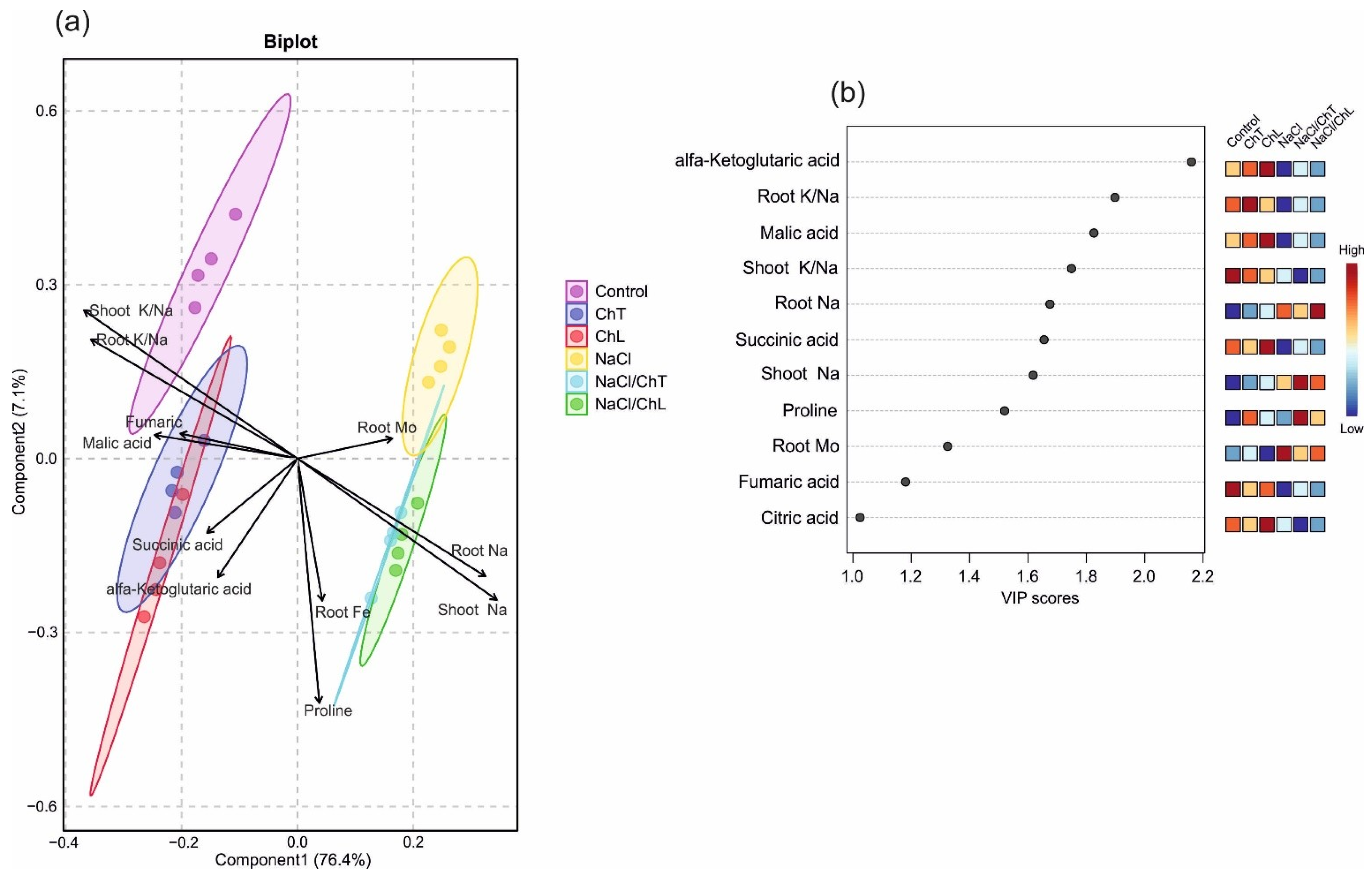
2.5. Partial Least Squares Discriminant Analysis (PLS-DA)
3. Discussion
4. Materials and Methods
4.1. Plant Materials, Growth Conditions, and Experimental Design
4.2. Determination of Plant Growth and Physiological Parameters
4.3. Identification and Quantitative Analysis of Organic Acids
4.4. Determinations of Mineral Elements
4.5. Statistical Analysis
5. Conclusions
Supplementary Materials
Author Contributions
Funding
Institutional Review Board Statement
Data Availability Statement
Acknowledgments
Conflicts of Interest
References
- Munns, R.; Tester, M. Mechanisms of salinity tolerance. Annu. Rev. Plant Biol. 2008, 59, 651–681. [Google Scholar] [CrossRef] [Scilit]
- Rengasamy, P. Soil processes affecting crop production in salt-affected soils. Funct. Plant Biol. 2010, 37, 613–620. [Google Scholar] [CrossRef] [Scilit]
- Tang, X.; Mu, X.; Shao, H.; Wang, H.; Brestic, M. Global plant-responding mechanisms to salt stress: Physiological and molecular levels and implications in biotechnology. Crit. Rev. Biotechnol. 2015, 35, 425–437. [Google Scholar] [CrossRef] [Scilit]
- Zhao, C.; Zhang, H.; Song, C.; Zhu, J.K.; Shabala, S. Mechanisms of plant responses and adaptation to soil salinity. Innovation 2020, 1, 100017. [Google Scholar] [CrossRef] [Scilit]
- Ali, A.; Yun, D.J. Salt stress tolerance; what do we learn from halophytes? J. Plant Biol. 2017, 60, 431–439. [Google Scholar] [CrossRef] [Scilit]
- Arif, Y.; Singh, P.; Siddiqui, H.; Bajguz, A.; Hayat, S. Salinity induced physiological and biochemical changes in plants: An omic approach towards salt stress tolerance. Plant Physiol. Biochem. 2020, 156, 64–77. [Google Scholar] [CrossRef] [Scilit]
- Chen, X.; Yang, J.; She, D.; Chen, W.; Wu, J.; Wang, Y.; Chen, M.; Li, Y.; Qureshi, A.S.; Singh, A.; et al. Monitoring, reclamation and management of salt-affected lands. Water 2025, 17, 813. [Google Scholar] [CrossRef] [Scilit]
- Bandehagh, A.; Taylor, N.L. Can alternative metabolic pathways and shunts overcome salinity induced inhibition of central carbon metabolism in crops? Front. Plant Sci. 2020, 11, 1072. [Google Scholar] [CrossRef] [Scilit]
- Bulut, M.; Karakas, E.; Fernie, A.R. Adjustments of plant primary metabolism in the face of climate change. J. Exp. Bot. 2025, 76, 4804–4816. [Google Scholar] [CrossRef] [Scilit]
- Balusamy, S.R.; Rahimi, S.; Sukweenadhi, J.; Sunderraj, S.; Shanmugam, R.; Thangavelu, L.; Mijakovic, I.; Perumalsamy, H. Chitosan, chitosan nanoparticles and modified chitosan biomaterials, a potential tool to combat salinity stress in plants. Carbohydr. Polym. 2022, 284, 119189. [Google Scholar] [CrossRef] [Scilit]
- Stasińska-Jakubas, M.; Hawrylak-Nowak, B. Protective, biostimulating, and eliciting effects of chitosan and its derivatives on crop plants. Molecules 2022, 27, 2801. [Google Scholar] [CrossRef] [Scilit]
- El Hadrami, A.; Adam, L.R.; El Hadrami, I.; Daayf, F. Chitosan in plant protection. Mar. Drugs 2010, 8, 968–987. [Google Scholar] [CrossRef] [Scilit]
- Saad Ullah, M.; Mahmood, A.B.; Javaid, M.M.; Naqve, M.; Bibi, S.; Abidin, Z.U.; Haq, I.U.; Khan, S.R. Chitosan for plant growth and stress tolerance. In Climate-Resilient Agriculture, Vol. 2; Hasanuzzaman, M., Ed.; Springer: Cham, Switzerland, 2023; pp. 259–280. [Google Scholar] [CrossRef] [Scilit]
- Huang, C.; Tian, Y.; Zhang, B.; Hassan, M.J.; Li, Z.; Zhu, Y. Chitosan (CTS) alleviates heat-induced leaf senescence in creeping bentgrass by regulating chlorophyll metabolism, antioxidant defense, and the heat shock pathway. Molecules 2021, 26, 5337. [Google Scholar] [CrossRef] [Scilit]
- Bautista-Baños, S.; Hernández-Lauzardo, A.N.; Velázquez-del Valle, M.G.; Hernández-López, M.; Ait Barka, E.; Bosquez-Molina, E.; Wilson, C.L. Chitosan as a potential natural compound to control pre and postharvest diseases of horticultural commodities. Crop Prot. 2006, 25, 108–118. [Google Scholar] [CrossRef] [Scilit]
- Xing, K.; Zhu, X.; Peng, X.; Qin, S. Chitosan antimicrobial and eliciting properties for pest control in agriculture: A review. Agron. Sustain. Dev. 2015, 35, 569–588. [Google Scholar] [CrossRef] [Scilit]
- Hadwiger, L.A. Multiple effects of chitosan on plant systems: Solid science or hype. Plant Sci. 2013, 208, 42–49. [Google Scholar] [CrossRef] [Scilit]
- Román-Doval, R.; Torres-Arellanes, S.P.; Tenorio-Barajas, A.Y.; Gomez-Sanchez, A.; Valencia-Lazcano, A.A. Chitosan: Properties and its application in agriculture in context of molecular weight. Polymers 2023, 15, 2867. [Google Scholar] [CrossRef] [Scilit]
- Abdallah, M.M.S.; Ramadan, A.A.E.M.; El-Bassiouny, H.M.S.; Bakry, B.A. Regulation of antioxidant system in wheat cultivars by using chitosan or salicylic acid to improve growth and yield under salinity stress. Asian J. Plant Sci. 2020, 19, 114–126. [Google Scholar] [CrossRef] [Scilit]
- Özkurt, N.; Bektaş, Y. Alleviation of salt stress with chitosan foliar application and its effects on growth and development in tomato (Solanum lycopersicum L.). Turk. J. Agric. Res. 2022, 9, 342–351. [Google Scholar] [CrossRef] [Scilit]
- Roy Chowdhury, M.; Mehmet, M.; Mukherjee, J.; Debnath, A.J.; Ražná, K. Chitosan as an elicitor in plant tissue cultures: Methodological challenges. Molecules 2025, 30, 3476. [Google Scholar] [CrossRef] [Scilit]
- Li, L.; Du, L.; Cao, Q.; Yang, Z.; Liu, Y.; Yang, H.; Duan, X.; Meng, Z. Salt tolerance evaluation of cucumber germplasm under sodium chloride stress. Plants 2023, 12, 2927. [Google Scholar] [CrossRef] [Scilit]
- Chen, C.; Yu, W.; Xu, X.; Wang, Y.; Wang, B.; Xu, S.; Lan, Q.; Wang, Y. Research advancements in salt tolerance of Cucurbitaceae: From salt response to molecular mechanisms. Int. J. Mol. Sci. 2024, 25, 9051. [Google Scholar] [CrossRef] [Scilit]
- Shehata, S.A.; Fawzy, Z.F.; El-Ramady, H.R. Response of cucumber plants to foliar application of chitosan and yeast under greenhouse conditions. Aust. J. Basic Appl. Sci. 2012, 6, 63–71. [Google Scholar]
- Tan, C.; Li, N.; Wang, Y.; Yu, X.; Yang, L.; Cao, R.; Ye, X. Integrated physiological and transcriptomic analyses revealed improved cold tolerance in cucumber (Cucumis sativus L.) by exogenous chitosan oligosaccharide. Int. J. Mol. Sci. 2023, 24, 6202. [Google Scholar] [CrossRef] [Scilit]
- Jiao, Q.; Shen, F.; Fan, L.; Song, Z.; Zhang, J.; Song, J.; Fahad, S.; Liu, F.; Zhao, Y.; Tian, Z.; et al. Chitosan regulates the root architecture system, photosynthetic characteristics and antioxidant system contributing to salt tolerance in maize seedling. Agriculture 2024, 14, 304. [Google Scholar] [CrossRef] [Scilit]
- Hidangmayum, A.; Dwivedi, P.; Katiyar, D.; Hemantaranjan, A. Application of chitosan on plant responses with special reference to abiotic stress. Physiol. Mol. Biol. Plants 2019, 25, 313–326. [Google Scholar] [CrossRef] [Scilit]
- Huang, Y.; Huang, G. Properties of chitosan and its applications as a functional material throughout the plant growth cycle and in sustainable agricultural development. Chem. Biol. Technol. Agric. 2026, 13, 62. [Google Scholar] [CrossRef] [Scilit]
- Marin, L.; Andreica, B.I.; Ailincai, D.; Anisiei, A.; Lungu, R. Chitosan: A critical review of structural characteristics–properties relationship. Cellul. Chem. Technol. 2025, 59, 747–759. [Google Scholar] [CrossRef] [Scilit]
- Bigham Soostani, S.; Ranjbar, M.; Memarian, A.; Mohammadi, M.; Yaghini, Z. Regulation of APX, SOD, and PAL genes by chitosan under salt stress in rapeseed (Brassica napus L.). BMC Plant Biol. 2025, 25, 824. [Google Scholar] [CrossRef] [Scilit]
- Alenazi, M.M.; El-Ebidy, A.M.; El-Shehaby, O.A.; Seleiman, M.F.; Aldhuwaib, K.J.; Abdel-Aziz, H.M.M. Chitosan and chitosan nanoparticles differentially alleviate salinity stress in Phaseolus vulgaris L. Plants 2024, 13, 398. [Google Scholar] [CrossRef] [Scilit]
- Elkarmout, A.F.; Yang, M.; Hassan, F.A.S. Chitosan treatment effectively alleviates the adverse effects of salinity in Moringa oleifera Lam. via enhancing antioxidant system and nutrient homeostasis. Agronomy 2022, 12, 2513. [Google Scholar] [CrossRef] [Scilit]
- Cao, Y.; Yan, R.; Sun, M.; Guo, J.; Zhang, S. Effects of exogenous chitosan concentrations on photosynthesis and functional physiological traits of hibiscus under salt stress. BMC Plant Biol. 2025, 25, 419. [Google Scholar] [CrossRef] [Scilit]
- Shen, F.; Jiao, Q.; Zhang, J.; Fan, J.; Yu, P.; Liu, D.; Liu, F.; Zhao, Y.; Fahad, S.; Liu, H. Effect of exogenous chitosan on physiological characteristics, photosynthetic parameters, and antioxidant systems of maize seedlings under salt stress. J. Soil Sci. Plant Nutr. 2024, 24, 7024–7041. [Google Scholar] [CrossRef] [Scilit]
- Bigham Soostani, S.; Ranjbar, M.; Memarian, A.; Afshari, M. Chitosan pre-and post-treatment modulates molecular and physiological responses to salinity in Brassica napus L. Sci. Rep. 2025, 15, 28219. [Google Scholar] [CrossRef] [Scilit]
- Zhang, G.; Wang, Y.; Wu, K.; Zhang, Q.; Feng, Y.; Miao, Y.; Yan, Z. Exogenous application of chitosan alleviates salinity stress in lettuce (Lactuca sativa L.). Horticulturae 2021, 7, 342. [Google Scholar] [CrossRef] [Scilit]
- Geng, W.; Li, Z.; Hassan, M.J.; Peng, J. Chitosan regulates metabolic balance, polyamine accumulation, and Na+ transport contributing to salt tolerance in creeping bentgrass. BMC Plant Biol. 2020, 20, 506. [Google Scholar] [CrossRef] [Scilit]
- Kabera, J.N.; Semana, E.; Mussa, A.R.; He, X. Plant secondary metabolites: Biosynthesis, classification, function and pharmacological properties. J. Pharm. Pharmacol. 2014, 2, 377–392. [Google Scholar]
- Panchal, P.; Miller, A.J.; Giri, J. Organic acids: Versatile stress-response roles in plants. J. Exp. Bot. 2021, 72, 4038–4052. [Google Scholar] [CrossRef] [Scilit]
- Igamberdiev, A.U.; Eprintsev, A.T. Organic acids: The pools of fixed carbon involved in redox regulation and energy balance in higher plants. Front. Plant Sci. 2016, 7, 1042. [Google Scholar] [CrossRef] [Scilit]
- Khan, N.; Ali, S.; Zandi, P.; Mehmood, A.; Ullah, S.; Ismail, M.; Shahid, A.; Babar, M.A. Role of sugars, amino acids and organic acids in improving plant abiotic stress tolerance. Pak. J. Bot. 2020, 52, 355–363. [Google Scholar] [CrossRef] [Scilit]
- Sun, Y.L.; Hong, S.K. Effects of citric acid as an important component of the responses to saline and alkaline stress in the halophyte Leymus chinensis (Trin.). Plant Growth Regul. 2011, 64, 129–139. [Google Scholar] [CrossRef] [Scilit]
- Tahjib-Ul-Arif, M.; Zahan, M.I.; Karim, M.M.; Imran, S.; Hunter, C.T.; Islam, M.S.; Mia, M.A.; Hannan, M.A.; Rhaman, M.S.; Hossain, M.A.; et al. Citric acid-mediated abiotic stress tolerance in plants. Int. J. Mol. Sci. 2021, 22, 7235. [Google Scholar] [CrossRef] [Scilit]
- Shi, D.; Sheng, Y. Effect of various salt–alkaline mixed stress conditions on sunflower seedlings and analysis of their stress factors. Environ. Exp. Bot. 2005, 54, 8–21. [Google Scholar] [CrossRef] [Scilit]
- Ingrisano, R.; Tosato, E.; Trost, P.; Gurrieri, L.; Sparla, F. Proline, cysteine and branched-chain amino acids in abiotic stress response of land plants and microalgae. Plants 2023, 12, 3410. [Google Scholar] [CrossRef] [Scilit]
- Mushtaq, N.U.; Saleem, S.; Rasool, A.; Shah, W.H.; Tahir, I.; Seth, C.S.; Rehman, R.U. Proline tagging for stress tolerance in plants. Int. J. Genom. 2025, 1, 9348557. [Google Scholar] [CrossRef] [Scilit]
- Chele, K.H.; Steenkamp, P.; Piater, L.A.; Dubery, I.A.; Huyser, J.; Tugizimana, F. A Global metabolic map defines the effects of a Si-based biostimulant on tomato plants under normal and saline conditions. Metabolites 2021, 11, 820. [Google Scholar] [CrossRef] [Scilit]
- Quitadamo, F.; De Simone, V.; Beleggia, R.; Trono, D. Chitosan-induced activation of the antioxidant defense system counteracts the adverse effects of salinity in durum wheat. Plants 2021, 10, 1365. [Google Scholar] [CrossRef] [Scilit]
- Murchie, E.H.; Lawson, T. Chlorophyll fluorescence analysis: A guide to good practice and understanding some new applications. J. Exp. Bot. 2013, 64, 3983–3998. [Google Scholar] [CrossRef] [Scilit]
- Lichtenthaler, H.K.; Wellburn, A.R. Determination of total carotenoids and chlorophyll a and b of leaf extracts in different solvents. Biochem. Soc. Trans. 1983, 11, 591–592. [Google Scholar] [CrossRef] [Scilit]
- Bates, L.; Waldren, R.; Teare, J. Rapid determination of free proline for water stress studies. Plant Soil 1973, 39, 205–207. [Google Scholar] [CrossRef] [Scilit]



| Treatment | Macronutrient Contents (mg g−1 DW) | Micronutrient Contents (µg g−1 DW) | Na (mg g−1 DW) | K/Na Ratio | ||||||||
|---|---|---|---|---|---|---|---|---|---|---|---|---|
| K | Ca | P | Mg | S | Fe | Zn | Cu | Mn | Mo | |||
| Control | 104.04 ±2.03 a | 7.55 ±1.28 a | 7.80 ±0.29 b | 2.20 ±0.21 a | 6.68 ±0.52 b | 1531 ±179 b | 571.4 ±98.6 b | 28.59 ±0.59 b | 63.53 ±2.38 b | 0.70 ±0.03 a | 0.75 ±0.03 c | 138.7 ±2.9 a |
| ChT | 111.23 ±5.20 a | 9.20 ±1.80 a | 10.13 ±1.17 a | 2.00 ±0.28 a | 7.99 ±1.37 b | 2711 ±1136 ab | 742.1 ±158 ab | 36.62 ±11.16 b | 73.97 ±19.10 b | 0.88 ±0.01 a | 0.79 ±0.03 c | 141.2 ±5.0 a |
| ChL | 107.98 ±2.70 a | 8.79 ±1.13 a | 8.77 ±0.31 b | 1.91 ±0.16 a | 6.68 ±0.60 b | 2754 ±1053 ab | 662.7 ±54 b | 32.77 ±1.36 b | 79.83 ±4.10 b | 0.72 ±0.04 a | 0.89 ±0.11 c | 122.7 ±15.3 a |
| NaCl | 46.97 ±1.49 b | 7.45 ±0.52 a | 10.91 ±0.35 a | 1.62 ±0.07 b | 10.89 ±0.26 a | 2436 ±430 ab | 850.8 ±162 a | 76.69 ±6.75 a | 116.91 ±3.13 a | 0.46 ±0.08 b | 42.95 ±0.67 a | 1.09 ±0.02 b |
| NaCl + ChT | 51.28 ±3.35 b | 6.94 ±0.09 a | 11.05 ±0.35 a | 1.61 ±0.05 b | 10.14 ±0.55 a | 3014 ±283 ab | 954.1 ±42 a | 71.90 ±5.60 a | 117.56 ±5.85 a | 0.77 ±0.07 a | 42.63 ±2.11 a | 1.18 ±0.07 b |
| NaCl + ChL | 49.70 ±2.77 b | 7.69 ±0.63 a | 10.66 ±1.00 a | 1.76 ±0.08 ab | 9.83 ±0.29 a | 3188 ±563 a | 1039.7 ±178 a | 82.12 ±7.16 a | 114.75 ±12.29 a | 0.68 ±0.07 a | 43.81 ±1.68 a | 1.13 ±0.04 b |
| Two-way ANOVA | ||||||||||||
| Salinity | *** | * | ** | *** | *** | * | ns | *** | * | * | *** | *** |
| Chitosan | ns | ns | ns | ns | * | * | ns | ns | ns | ns | ns | ns |
| Salinity × Chitosan | ns | ns | ns | ns | ns | ns | ns | ns | ns | * | ns | ns |
| Treatment | Macronutrient Contents (mg g−1 DW) | Micronutrient Contents (µg g−1 DW) | Na (mg g−1 DW) | K/Na Ratio | ||||||||
|---|---|---|---|---|---|---|---|---|---|---|---|---|
| K | Ca | P | Mg | S | Fe | Zn | Cu | Mn | Mo | |||
| Control | 52.24 ±2.14 a | 43.14 ±0.78 a | 11.89 ±0.35 a | 9.82 ±0.41 a | 10.35 ±0.39 a | 99.45 ±0.8 ab | 238.65 ±5.5 a | 11.86 ±1.42 a | 44.93 ±0.28 a | 0.28 ±0.01 a | 0.31 ±0.03 b | 170.5 ±11.6 a |
| ChT | 52.65 ±2.58 a | 44.37 ±2.77 a | 12.19 ±0.25 a | 10.46 ±0.88 a | 10.54 ±0.29 a | 107.78 ±14.3 a | 242.66 ±24.1 a | 11.10 ±1.02 a | 50.45 ±3.19 a | 0.20 ±0.03 a | 0.31 ±0.03 b | 173.2 ±16.75 a |
| ChL | 51.46 ±0.32 a | 43.24 ±0.96 a | 11.95 ±0.17 a | 9.82 ±0.65 a | 10.63 ±0.07 a | 104.52 ±21.6 a | 229.06 ±6.1 a | 10.97 ±0.63 a | 44.90 ±1.26 a | 0.18 ±0.00 a | 0.31 ±0.00 b | 168.8 ±1.3 a |
| NaCl | 27.54 ±1.22 b | 20.99 ±0.72 c | 10.40 ±0.29 b | 7.76 ±0.13 b | 10.06 ±0.24 a | 100.11 ±14.7 ab | 225.39 ±11.4 a | 11.39 ±0.42 a | 42.92 ±5.19 a | 0.12 ±0.02 b | 38.86 ±2.17 a | 0.71 ±0.02 b |
| NaCl + ChT | 27.69 ±1.74 b | 25.60 ±0.85 b | 10.95 ±0.21 ab | 7.72 ±0.10 b | 10.10 ±0.55 a | 79.61 ±3.3 b | 242.50 ±19.5 a | 13.58 ±0.38 a | 50.09 ±2.49 a | 0.08 ±0.01 b | 38.66 ±3.70 a | 0.70 ±0.02 b |
| NaCl + ChL | 26.76 ±1.79 b | 26.80 ±2.11 b | 10.56 ±0.26 b | 8.15 ±0.13 b | 9.99 ±0.17 a | 109.68 ±4.6 a | 233.66 ±12.7 a | 12.11 ±1.38 a | 46.82 ±1.94 a | 0.09 ±0.01 b | 39.97 ±0.65 a | 0.67 ±0.05 b |
| Two-way ANOVA | ||||||||||||
| Salinity | *** | *** | ** | *** | ns | ns | ns | * | ns | *** | *** | *** |
| Chitosan | ns | ns | ns | ns | * | ns | ns | ns | ns | ns | ns | ns |
| Salinity × Chitosan | ns | * | ns | ns | ns | ns | ns | ns | ns | ns | ns | ns |
Disclaimer/Publisher’s Note: The statements, opinions and data contained in all publications are solely those of the individual author(s) and contributor(s) and not of MDPI and/or the editor(s). MDPI and/or the editor(s) disclaim responsibility for any injury to people or property resulting from any ideas, methods, instructions or products referred to in the content. |
© 2026 by the authors. Licensee MDPI, Basel, Switzerland. This article is an open access article distributed under the terms and conditions of the Creative Commons Attribution (CC BY) license.
Share and Cite
Hawrylak-Nowak, B.; Stasińska-Jakubas, M.; Sawicki, J.; Matraszek-Gawron, R.; Jarmulska, W.; Czelej-Wrzesień, M.; Dresler, S. Comparative Effects of High-Molecular-Weight Chitosan and Chitosan Oligosaccharide Lactate on Metabolic Adjustment and Salinity Tolerance in Cucumis sativus L. Molecules 2026, 31, 3306. https://doi.org/10.3390/molecules31183306
Hawrylak-Nowak B, Stasińska-Jakubas M, Sawicki J, Matraszek-Gawron R, Jarmulska W, Czelej-Wrzesień M, Dresler S. Comparative Effects of High-Molecular-Weight Chitosan and Chitosan Oligosaccharide Lactate on Metabolic Adjustment and Salinity Tolerance in Cucumis sativus L. Molecules. 2026; 31(18):3306. https://doi.org/10.3390/molecules31183306
Chicago/Turabian StyleHawrylak-Nowak, Barbara, Maria Stasińska-Jakubas, Jan Sawicki, Renata Matraszek-Gawron, Weronika Jarmulska, Magdalena Czelej-Wrzesień, and Sławomir Dresler. 2026. "Comparative Effects of High-Molecular-Weight Chitosan and Chitosan Oligosaccharide Lactate on Metabolic Adjustment and Salinity Tolerance in Cucumis sativus L." Molecules 31, no. 18: 3306. https://doi.org/10.3390/molecules31183306
APA StyleHawrylak-Nowak, B., Stasińska-Jakubas, M., Sawicki, J., Matraszek-Gawron, R., Jarmulska, W., Czelej-Wrzesień, M., & Dresler, S. (2026). Comparative Effects of High-Molecular-Weight Chitosan and Chitosan Oligosaccharide Lactate on Metabolic Adjustment and Salinity Tolerance in Cucumis sativus L. Molecules, 31(18), 3306. https://doi.org/10.3390/molecules31183306