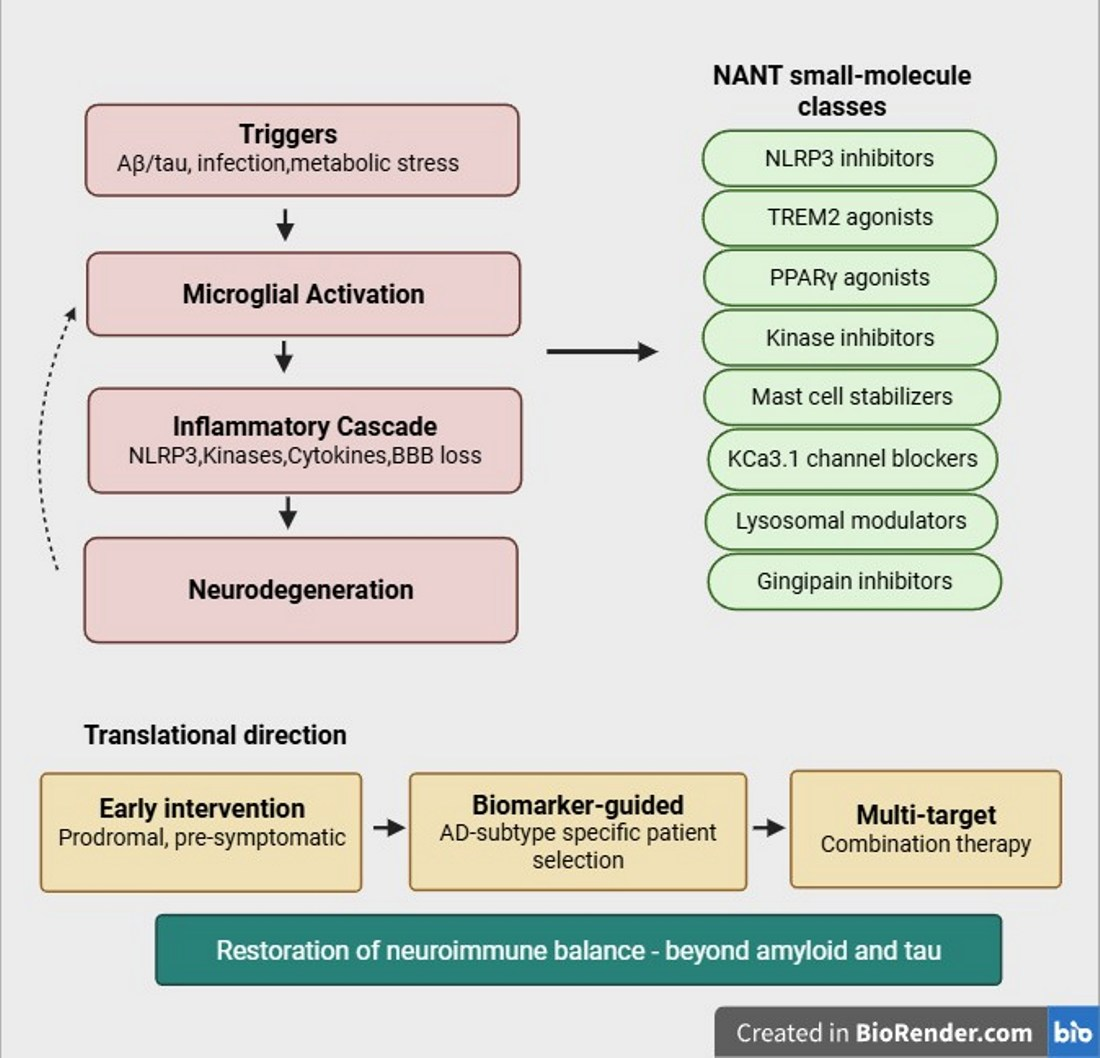
Small-Molecule NANT Therapeutics Targeting the Brain–Immune Axis in Alzheimer’s Disease: Mechanisms, Clinical Progress, and Translational Challenges



Abstract
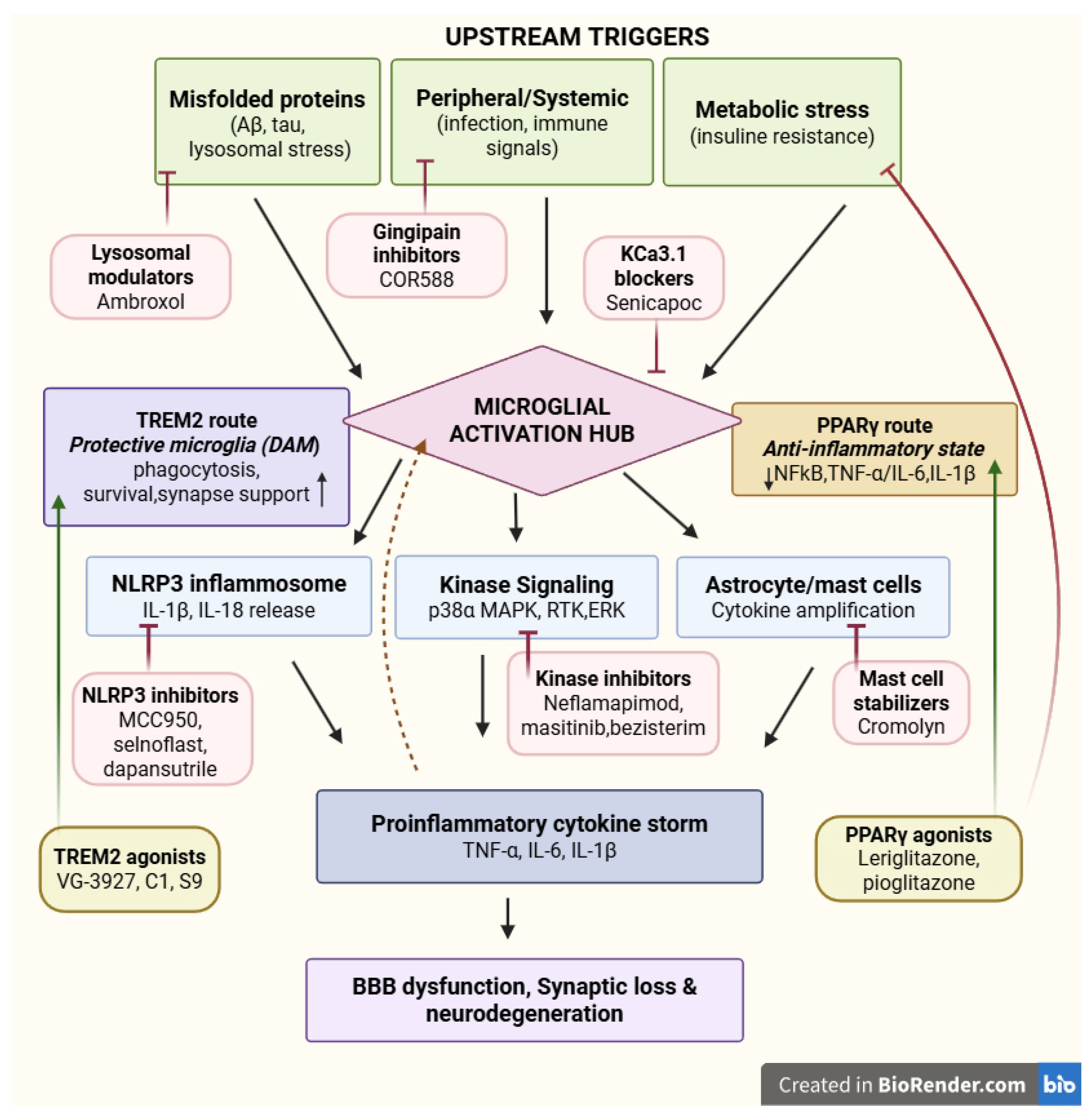
1. Introduction
2. Methods
3. The Brain–Immune Axis in AD
3.1. Complement-Mediated Immune Dysregulation in AD
3.2. Gut–Brain Axis and Neuroinflammation
3.3. Adaptive Immunity and CD8+ T-Cell Infiltration
4. Neuroinflammation-Targeting Small Molecules
4.1. Kinase Inhibitors
4.2. NLRP3 Inflammasome Inhibitors
4.3. TREM2 Agonists
4.4. Gingipain Inhibitors
4.5. PPARγ Agonists
4.6. KCa3.1 Channel Inhibitors
4.7. Emerging and Repurposed Neuroimmune Modulators
4.7.1. MAPK/ERK Signaling Modulators
4.7.2. Lysosomal Dysfunction/GCase Enhancement
4.7.3. Microglial Modulation and Aβ Clearance
4.7.4. p38α MAPK Inhibition
5. Translational Challenges and Future Directions
5.1. Timing of Therapeutic Intervention
5.2. Translational Limitations of Preclinical Models
5.3. Patient Heterogeneity and the Need for Multi-Pathway Targeting
5.4. Sex Differences in Neuroinflammation and Treatment Response
5.5. APOE ε4 Genotype and Innate Immune Dysfunction
5.6. Biomarker Strategies for Patient Selection and Trial Design
5.7. Rationale for Combination Therapy
5.8. Shift Toward Precision Neuroimmunology in Clinical Translation
6. Conclusions
Author Contributions
Funding
Institutional Review Board Statement
Informed Consent Statement
Data Availability Statement
Acknowledgments
Conflicts of Interest
References
- Alzheimer’s Association. 2026 Alzheimer’s disease facts and figures. Alzheimer’s Dement. 2026, 22, e71345. [Google Scholar] [CrossRef] [Scilit]
- Hardy, J.A.; Higgins, G.A. Alzheimer’s disease: The amyloid cascade hypothesis. Science 1992, 256, 184–185. [Google Scholar] [CrossRef] [Scilit] [PubMed]
- Heneka, M.T.; Carson, M.J.; El Khoury, J.; Landreth, G.E.; Brosseron, F.; Feinstein, D.L.; Jacobs, A.H.; Wyss-Coray, T.; Vitorica, J.; Ransohoff, R.M.; et al. Neuroinflammation in Alzheimer’s disease. Lancet Neurol. 2015, 14, 388–405. [Google Scholar] [CrossRef] [Scilit] [PubMed]
- Kamila, P.; Kar, K.; Chowdhury, S.; Chakraborty, P.; Dutta, R.; Sowmiya, S.; Singh, S.A.; Prajapati, B.G. Effect of neuroinflammation on the progression of Alzheimer’s disease and its significant ramifications for novel anti-inflammatory treatments. IBRO Neurosci. Rep. 2025, 18, 771–782. [Google Scholar] [CrossRef] [Scilit] [PubMed]
- Wong, J.H.; Lai, K.O.; Barron, A.M. Unlocking therapies for neurodegeneration: Targeting mitochondrial dysfunction and oxidative stress in Alzheimer’s disease. Curr. Opin. Physiol. 2026, 47, 100874. [Google Scholar] [CrossRef] [Scilit]
- Raza, A.; Saleem, S.; Imran, S.; Rahman, S.; Haroon, M.; Razzaq, A.; Hussain, A.; Iqbal, J.; Sathian, B. From metabolic dysregulation to neurodegenerative pathology: The role of hyperglycemia, oxidative stress, and blood-brain barrier breakdown in T2D-driven Alzheimer’s disease. Metab. Brain Dis. 2025, 40, 276. [Google Scholar] [CrossRef] [Scilit] [PubMed]
- Tijms, B.M.; Vromen, E.M.; Mjaavatten, O.; Holstege, H.; Reus, L.M.; van der Lee, S.; Wesenhagen, K.E.J.; Lorenzini, L.; Vermunt, L.; Venkatraghavan, V.; et al. Cerebrospinal fluid proteomics in patients with Alzheimer’s disease reveals five molecular subtypes with distinct genetic risk profiles. Nat. Aging 2024, 4, 33–47. [Google Scholar] [CrossRef] [Scilit] [PubMed]
- Lo Vecchio, F.; la Torre, A.; Gravina, C.; D’Onofrio, G.; Greco, A. Molecular Mechanisms Underlying Alzheimer’s Disease Pathogenesis: Comprehensive Overview. Int. J. Mol. Sci. 2026, 27, 4651. [Google Scholar] [CrossRef] [Scilit] [PubMed]
- Miculas, D.C.; Negru, P.A.; Bungau, S.G.; Behl, T.; Hassan, S.S.U.; Tit, D.M. Pharmacotherapy Evolution in Alzheimer’s Disease: Current Framework and Relevant Directions. Cells 2022, 12, 131. [Google Scholar] [CrossRef] [Scilit] [PubMed]
- Smith, E.E.; Phillips, N.A.; Feldman, H.H.; Borrie, M.; Ganesh, A.; Henri-Bhargava, A.; Desmarais, P.; Frank, A.; Badhwar, A.; Barlow, L.; et al. Use of lecanemab and donanemab in the Canadian healthcare system: Evidence, challenges, and areas for future research. J. Prev. Alzheimer’s Dis. 2025, 12, 100068. [Google Scholar] [CrossRef] [Scilit] [PubMed]
- Hampel, H.; Elhage, A.; Cho, M.; Apostolova, L.G.; Nicoll, J.A.R.; Atri, A. Amyloid-related imaging abnormalities (ARIA): Radiological, biological and clinical characteristics. Brain 2023, 146, 4414–4424. [Google Scholar] [CrossRef] [Scilit] [PubMed]
- ClinicTrials. A Study of Donanemab (LY3002813) in Participants with Early Alzheimer’s Disease (TRAILBLAZER-ALZ 2). 2025. Available online: https://clinicaltrials.gov/study/NCT04437511 (accessed on 5 July 2026).
- Van Dyck, C.H.; Swanson, C.J.; Aisen, P.; Bateman, R.J.; Chen, C.; Gee, M.; Iwatsubo, T. Lecanemab in early Alzheimer’s disease. N. Engl. J. Med. 2023, 388, 9–21. [Google Scholar] [CrossRef] [Scilit] [PubMed]
- Laura Joszt, M. Biogen abandons aducanumab, pivots focus to Lecanemab for alzheimer disease. Am. J. Manag. Care 2024, 31. [Google Scholar]
- Alkhalifa, A.E.; Al Mokhlf, A.; Ali, H.; Al-Ghraiybah, N.F.; Syropoulou, V. Anti-Amyloid Monoclonal Antibodies for Alzheimer’s Disease: Evidence, ARIA Risk, and Precision Patient Selection. J. Pers. Med. 2025, 15, 437. [Google Scholar] [CrossRef] [Scilit] [PubMed]
- Behl, C. In 2024, the amyloid-cascade-hypothesis still remains a working hypothesis, no less but certainly no more. Front. Aging Neurosci. 2024, 16, 1459224. [Google Scholar] [CrossRef] [Scilit] [PubMed]
- Coskun, E.P.; Barber, J.M.; Abner, E.L.; Schmitt, F.A.; Goldstein, L.B.; Van Eldik, L.J.; Nelson, P.T.; Jicha, G.A. Drug Development. Alzheimer’s Dement. J. Alzheimer’s Assoc. 2024, 20, e090032. [Google Scholar] [CrossRef] [Scilit]
- Stakos, D.A.; Stamatelopoulos, K.; Bampatsias, D.; Sachse, M.; Zormpas, E.; Vlachogiannis, N.I.; Tual-Chalot, S.; Stellos, K. The Alzheimer’s Disease Amyloid-Beta Hypothesis in Cardiovascular Aging and Disease. J. Am. Coll. Cardiol. 2020, 75, 952–967. [Google Scholar] [CrossRef] [Scilit] [PubMed]
- Ge, W.Y.; Deng, X.; Shi, W.P.; Lin, W.J.; Chen, L.L.; Liang, H.; Wang, X.T.; Zhang, T.D.; Zhao, F.Z.; Guo, W.H.; et al. Amyloid Protein Cross-Seeding Provides a New Perspective on Multiple Diseases In Vivo. Biomacromolecules 2023, 24, 1–18. [Google Scholar] [CrossRef] [Scilit] [PubMed]
- Abyadeh, M.; Gupta, V.; Paulo, J.A.; Mahmoudabad, A.G.; Shadfar, S.; Mirshahvaladi, S.; Gupta, V.; Nguyen, C.T.O.; Finkelstein, D.I.; You, Y.; et al. Amyloid-beta and tau protein beyond Alzheimer’s disease. Neural Regen. Res. 2024, 19, 1262–1276. [Google Scholar] [CrossRef] [Scilit] [PubMed]
- Luo, L.; Qiao, S. Neuroinflammation and blood-brain barrier dysfunction in cerebral small vessel disease: Mechanisms, biomarkers, and therapeutic implications. Eur. J. Med. Res. 2026, 31, 307. [Google Scholar] [CrossRef] [Scilit] [PubMed]
- Zafar, S. Chief Role of Neuroinflammation and Oxidative Stress in Brain Disorders. In The Role of Natural Antioxidants in Brain Disorders; Imran, A., Hussain, G., Eds.; Springer International Publishing: Cham, Switzerland, 2023; pp. 89–109. [Google Scholar]
- Fakorede, S.; Lateef, O.M.; Garuba, W.A.; Akosile, P.O.; Okon, D.A.; Aborode, A.T. Dual impact of neuroinflammation on cognitive and motor impairments in Alzheimer’s disease. J. Alzheimer’s Dis. Rep. 2025, 9, 25424823251341870. [Google Scholar] [CrossRef] [Scilit] [PubMed]
- Malik, M.; Parikh, I.; Vasquez, J.B.; Smith, C.; Tai, L.; Bu, G.; LaDu, M.J.; Fardo, D.W.; Rebeck, G.W.; Estus, S. Genetics ignite focus on microglial inflammation in Alzheimer’s disease. Mol. Neurodegener. 2015, 10, 52. [Google Scholar] [CrossRef] [Scilit] [PubMed]
- Liang, X.; Wu, H.; Colt, M.; Guo, X.; Pluimer, B.; Zeng, J.; Dong, S.; Zhao, Z. Microglia and its Genetics in Alzheimer’s Disease. Curr. Alzheimer Res. 2021, 18, 676–688. [Google Scholar] [CrossRef] [Scilit] [PubMed]
- Siebner, A.S.; Uversky, V.N. Amyloid-β, Tau Protein, α-Synuclein, TDP-43, and FUS in Mixed Pathology: And Intrinsic Disorder to Rule Them All. Int. J. Mol. Sci. 2026, 27, 3669. [Google Scholar] [CrossRef] [Scilit] [PubMed]
- Sharma, N.; Kim, D.; Sharma, H.; Kim, M.I.; Lee, H.; Kim, M.; Ryoo, N.; Kang, M.J.; Pyun, J.M.; Park, Y.H.; et al. Bridging the barrier: Insights into blood biomarkers and therapeutic strategies targeting choroid plexus and BBB dysfunction in alzheimer’s disease. Biomark. Res. 2025, 13, 116. [Google Scholar] [CrossRef] [Scilit] [PubMed]
- Meneses, A.; Koga, S.; O’Leary, J.; Dickson, D.W.; Bu, G.; Zhao, N. TDP-43 Pathology in Alzheimer’s Disease. Mol. Neurodegener. 2021, 16, 84. [Google Scholar] [CrossRef] [Scilit] [PubMed]
- Kobeissy, F.; Salzet, M. Beyond immune privilege: The brain as a dynamic immunological interface. Cell Death Dis. 2026, 17, 408. [Google Scholar] [CrossRef] [Scilit] [PubMed]
- Wu, D.; Chen, Q.; Chen, X.; Han, F.; Chen, Z.; Wang, Y. The blood-brain barrier: Structure, regulation, and drug delivery. Signal Transduct. Target. Ther. 2023, 8, 217. [Google Scholar] [CrossRef] [Scilit] [PubMed]
- Heyner, M.; Schreier, S.; Kröger, A. The brain-immune cells axis controls tissue specific immunopathology. Cell. Mol. Immunol. 2019, 16, 101–103. [Google Scholar] [CrossRef] [Scilit] [PubMed]
- Vainchtein, I.D.; Molofsky, A.V. Astrocytes and Microglia: In Sickness and in Health. Trends Neurosci. 2020, 43, 144–154. [Google Scholar] [CrossRef] [Scilit] [PubMed]
- Di Pietro, A.A.; Powley, S.; Perciballi, E.; Stewart, M.; Therrien, M.; Scott-Hewitt, N. Microglia in systemic neuroimmune communication: Functions beyond phagocytosis. Trends Immunol. 2026, 47, P495–P510. [Google Scholar] [CrossRef] [Scilit] [PubMed]
- Han, J.; Zhang, Z.; Zhang, P.; Yu, Q.; Cheng, Q.; Lu, Z.; Zong, S. The roles of microglia and astrocytes in neuroinflammation of Alzheimer’s disease. Front. Neurosci. 2025, 19, 1575453. [Google Scholar] [CrossRef] [Scilit] [PubMed]
- Wang, T.; Liu, X.; Wang, X.; Hua, F.; Yan, L. TREM2 and microglial immunity in Alzheimer’s disease: Mechanisms, genetics, and therapeutic opportunities. Front. Immunol. 2026, 17, 1739875. [Google Scholar] [CrossRef] [Scilit] [PubMed]
- Zhang, S.; Gao, Y.; Zhao, Y.; Huang, T.Y.; Zheng, Q.; Wang, X. Peripheral and central neuroimmune mechanisms in Alzheimer’s disease pathogenesis. Mol. Neurodegener. 2025, 20, 22. [Google Scholar] [CrossRef] [Scilit] [PubMed]
- Guo, X.; Zhang, G.; Peng, Q.; Huang, L.; Zhang, Z.; Zhang, Z. Emerging Roles of Meningeal Lymphatic Vessels in Alzheimer’s Disease. J. Alzheimer’s Dis. 2023, 94, S355–S366. [Google Scholar] [CrossRef] [Scilit] [PubMed]
- Bayraktaroglu, I.; Ortí-Casañ, N.; Van Dam, D.; De Deyn, P.P.; Eisel, U.L.M. Systemic inflammation as a central player in the initiation and development of Alzheimer’s disease. Immun. Ageing 2025, 22, 33. [Google Scholar] [CrossRef] [Scilit] [PubMed]
- Zang, X.; Chen, S.; Zhu, J.; Ma, J.; Zhai, Y. The Emerging Role of Central and Peripheral Immune Systems in Neurodegenerative Diseases. Front. Aging Neurosci. 2022, 14, 872134. [Google Scholar] [CrossRef] [Scilit] [PubMed]
- Cao, Y.; Tang, K.; Ma, P.; Zhang, R.; Yang, Y.; Li, T.; Zhang, Y.; Peng, X. The role of peripheral innate immune cells in Alzheimer’s disease progression. Front. Immunol. 2025, 16, 1616939. [Google Scholar] [CrossRef] [Scilit] [PubMed]
- Johnson, A.M.; Lukens, J.R. Emerging roles for innate and adaptive immunity in tauopathies. Cell Rep. 2025, 44, 116232. [Google Scholar] [CrossRef] [Scilit] [PubMed]
- Crehan, H.; Hardy, J.; Pocock, J. Microglia, Alzheimer’s disease, and complement. Int. J. Alzheimer’s Dis. 2012, 2012, 983640. [Google Scholar] [CrossRef] [Scilit] [PubMed]
- Müller, L.; Di Benedetto, S. Bridging the brain and gut: Neuroimmune mechanisms of neuroinflammation and therapeutic insights. Front. Cell. Neurosci. 2025, 19, 1590002. [Google Scholar] [CrossRef] [Scilit] [PubMed]
- Richards, T.; Perron, J.C.; Patel, K.; Wurpel, J.; Reznik, S.E.; Schanne, F. Therapeutic Intervention of Neuroinflammatory Alzheimer Disease Model by Inhibition of Classical Complement Pathway with the Use of Anti-C1r Loaded Exosomes. Res. Sq. 2023. [Google Scholar] [CrossRef] [Scilit] [PubMed]
- Papavergi, M.-T.; Bathini, P.; Singh, B.; Lemere, C.A. The complement cascade in Alzheimer’s disease: Modern implications of an ancient immune protagonist. Mol. Neurodegener. 2025, 21, 5. [Google Scholar] [CrossRef] [Scilit] [PubMed]
- Daskoulidou, N.; Shaw, B.; Zelek, W.M.; Morgan, B.P. The Alzheimer’s disease-associated complement receptor 1 variant confers risk by impacting glial phagocytosis. Alzheimer’s Dement. 2025, 21, e70458. [Google Scholar] [CrossRef] [Scilit] [PubMed]
- Milinkeviciute, G.; Green, K.N. Clusterin/apolipoprotein J, its isoforms and Alzheimer’s disease. Front. Aging Neurosci. 2023, 15, 1167886. [Google Scholar] [CrossRef] [Scilit] [PubMed]
- Yu, Y.; Wang, C.; Wang, B.; Wang, X.; Zhao, Q.; Yan, Y.; Liu, X. Clusterin Regulates the Mechanisms of Neuroinflammation and Neuronal Circuit Impairment in Alzheimer’s Disease. Int. J. Mol. Sci. 2025, 26, 7271. [Google Scholar] [CrossRef] [Scilit] [PubMed]
- Tillmon, H.; Soteros, B.M.; Shen, L.; Cong, Q.; Wollet, M.; General, J.; Chin, H.; Lee, J.B.; Carreno, F.R.; Morilak, D.A.; et al. Complement and microglia activation mediate stress-induced synapse loss in layer 2/3 of the medial prefrontal cortex in male mice. Nat. Commun. 2024, 15, 9803. [Google Scholar] [CrossRef] [Scilit] [PubMed]
- Giau, V.V.; Wu, S.Y.; Jamerlan, A.; An, S.S.A.; Kim, S.Y.; Hulme, J. Gut Microbiota and Their Neuroinflammatory Implications in Alzheimer’s Disease. Nutrients 2018, 10, 1765. [Google Scholar] [CrossRef] [Scilit] [PubMed]
- Chakrabarti, S.K.; Chattopadhyay, D. The Gut–brain–immune Triad in Neurodegeneration: An Integrated Perspective. J. Transl. Gastroenterol. 2025, 3, 136–154. [Google Scholar] [CrossRef] [Scilit]
- Jamerlan, A.M.; An, S.S.A.; Hulme, J.P. Microbial diversity and fitness in the gut–brain axis: Influences on developmental risk for Alzheimer’s disease. Gut Microbes 2025, 17, 2486518. [Google Scholar] [CrossRef] [Scilit] [PubMed]
- Kumari, S.; Desai, V.; Sivakumar, S.; Sikri, K.; Kumar, M. Association between gut microbial dysbiosis and Alzheimer’s disease: An umbrella review. npj Dement. 2025, 1, 41. [Google Scholar] [CrossRef] [Scilit]
- Libriani, S.; Facchinetti, G.; Marti, F.; Tolentino Diaz, M.Y.; Sandri, E. The association between gut microbiota and cognitive decline: A systematic review of the literature. Nutr. Res. 2026, 147, 16–31. [Google Scholar] [CrossRef] [Scilit] [PubMed]
- Kim, E.J.; Kim, J.S.; Park, S.E.; Seo, S.H.; Cho, K.M.; Kwon, S.J.; Lee, M.H.; Kim, J.H.; Son, H.S. Association between Mild Cognitive Impairment and Gut Microbiota in Elderly Korean Patients. J. Microbiol. Biotechnol. 2023, 33, 1376–1383. [Google Scholar] [CrossRef] [Scilit] [PubMed]
- Jimenez-García, A.M.; Villarino, M.; Arias, N. A systematic review and meta-analysis of basal microbiota and cognitive function in Alzheimer’s disease: A potential target for treatment or a contributor to disease progression? Alzheimer’s Dement. Diagn. Assess. Dis. Monit. 2024, 16, e70057. [Google Scholar] [CrossRef] [Scilit]
- Cipriano, G.L.; Grimaldi, A.; Marra, A.; Quartarone, A.; Maresca, G. Gut microbiota and cognitive decline: A scoping review of microbial mechanisms and adaptive responses in dementia. Front. Aging Neurosci. 2026, 18, 1782720. [Google Scholar] [CrossRef] [Scilit] [PubMed]
- Xu, J.; Lu, Y. The microbiota-gut-brain axis and central nervous system diseases: From mechanisms of pathogenesis to therapeutic strategies. Front. Microbiol. 2025, 16, 1583562. [Google Scholar] [CrossRef] [Scilit] [PubMed]
- Liu, H.; Chen, Y.; Zhang, J.; Chen, X. Adaptive immunity in the neuroinflammation of Alzheimer’s disease. Chin. Med. J. 2025, 138, 2116–2129. [Google Scholar] [CrossRef] [Scilit] [PubMed]
- Wang, R.; Lan, C.; Benlagha, K.; Camara, N.O.S.; Miller, H.; Kubo, M.; Heegaard, S.; Lee, P.; Yang, L.; Forsman, H.; et al. The interaction of innate immune and adaptive immune system. MedComm 2024, 5, e714. [Google Scholar] [CrossRef] [Scilit] [PubMed]
- Ohyagi, M.; Ito, M.; Iizuka-Koga, M.; Mise-Omata, S.; Yoshimura, A. Stage-specific roles of clonally expanded CD8+ T cells in regulating amyloid pathology in Alzheimer’s disease models. Nat. Commun. 2025, 16, 9458. [Google Scholar] [CrossRef] [Scilit] [PubMed]
- Jorfi, M.; Park, J.; Hall, C.K.; Lin, C.-C.J.; Chen, M.; von Maydell, D.; Kruskop, J.M.; Kang, B.; Choi, Y.; Prokopenko, D. Infiltrating CD8+ T cells exacerbate Alzheimer’s disease pathology in a 3D human neuroimmune axis model. Nat. Neurosci. 2023, 26, 1489–1504. [Google Scholar] [CrossRef] [Scilit] [PubMed]
- Zhang, Z.; Duan, Z.; Cui, Y. CD8+ T cells in brain injury and neurodegeneration. Front. Cell. Neurosci. 2023, 17, 1281763. [Google Scholar] [CrossRef] [Scilit] [PubMed]
- Asamu, M.O.; Oladipo, O.O.; Abayomi, O.A.; Adebayo, A.A. Alzheimer’s disease: The role of T lymphocytes in neuroinflammation and neurodegeneration. Brain Res. 2023, 1821, 148589. [Google Scholar] [CrossRef] [Scilit] [PubMed]
- Berchtold, D.; Priller, J.; Meisel, C.; Meisel, A. Interaction of microglia with infiltrating immune cells in the different phases of stroke. Brain Pathol. 2020, 30, 1208–1218. [Google Scholar] [CrossRef] [Scilit] [PubMed]
- Huang, Y.; Zhang, G.; Li, S.; Feng, J.; Zhang, Z. Innate and adaptive immunity in neurodegenerative disease. Cell. Mol. Life Sci. 2025, 82, 68. [Google Scholar] [CrossRef] [Scilit] [PubMed]
- Vlad, S.C.; Miller, D.R.; Kowall, N.W.; Felson, D.T. Protective effects of NSAIDs on the development of Alzheimer disease. Neurology 2008, 70, 1672–1677. [Google Scholar] [CrossRef] [Scilit] [PubMed]
- Moussa, N.; Dayoub, N. Exploring the role of COX-2 in Alzheimer’s disease: Potential therapeutic implications of COX-2 inhibitors. Saudi Pharm. J. 2023, 31, 101729. [Google Scholar] [CrossRef] [Scilit] [PubMed]
- Kulesza, A.; Paczek, L.; Burdzinska, A. The Role of COX-2 and PGE2 in the Regulation of Immunomodulation and Other Functions of Mesenchymal Stromal Cells. Biomedicines 2023, 11, 445. [Google Scholar] [CrossRef] [Scilit] [PubMed]
- Guan, P.-P.; Liang, Y.-Y.; Cao, L.-L.; Yu, X.; Wang, P. Cyclooxygenase-2 Induced the β-Amyloid Protein Deposition and Neuronal Apoptosis Via Upregulating the Synthesis of Prostaglandin E2 and 15-Deoxy-Δ12,14-prostaglandin J2. Neurotherapeutics 2019, 16, 1255–1268. [Google Scholar] [CrossRef] [Scilit] [PubMed]
- Shamsudin, Y.; Gutiérrez-de-Terán, H.; Åqvist, J. Molecular Mechanisms in the Selectivity of Nonsteroidal Anti-Inflammatory Drugs. Biochemistry 2018, 57, 1236–1248. [Google Scholar] [CrossRef] [Scilit] [PubMed]
- The Alzheimer’s Disease Anti-inflammatory Prevention Trial Research Group. Results of a follow-up study to the randomized Alzheimer’s Disease Anti-inflammatory Prevention Trial (ADAPT). Alzheimer’s Dement. 2013, 9, 714–723. [Google Scholar] [CrossRef] [Scilit] [PubMed]
- Thal, L.J.; Ferris, S.H.; Kirby, L.; Block, G.A.; Lines, C.R.; Yuen, E.; Assaid, C.; Nessly, M.L.; Norman, B.A.; Baranak, C.C.; et al. A Randomized, Double-Blind, Study of Rofecoxib in Patients with Mild Cognitive Impairment. Neuropsychopharmacology 2005, 30, 1204–1215. [Google Scholar] [CrossRef] [Scilit] [PubMed]
- Germann, U.A.; Alam, J.J. P38α MAPK signaling—A robust therapeutic target for Rab5-mediated neurodegenerative disease. Int. J. Mol. Sci. 2020, 21, 5485. [Google Scholar] [CrossRef] [Scilit] [PubMed]
- Alam, J.J.; Nixon, R.A. Drug development targeting degeneration of the basal forebrain cholinergic system: Its time has come. Mol. Neurodegener. 2023, 18, 74. [Google Scholar] [CrossRef] [Scilit] [PubMed]
- Falcicchia, C.; Tozzi, F.; Arancio, O.; Watterson, D.M.; Origlia, N. Involvement of p38 MAPK in Synaptic Function and Dysfunction. Int. J. Mol. Sci. 2020, 21, 5624. [Google Scholar] [CrossRef] [Scilit] [PubMed]
- Jiang, Y.; Alam, J.J.; Gomperts, S.N.; Maruff, P.; Lemstra, A.W.; Germann, U.A.; Stavrides, P.H.; Darji, S.; Malampati, S.; Peddy, J.; et al. Preclinical and randomized clinical evaluation of the p38α kinase inhibitor neflamapimod for basal forebrain cholinergic degeneration. Nat. Commun. 2022, 13, 5308. [Google Scholar] [CrossRef] [Scilit] [PubMed]
- ClinicalTrials. A Clinical Study of Neflamapimod in Patients with Dementia with Lewy Bodies. Available online: https://clinicaltrials.gov/study/NCT06815965 (accessed on 11 June 2026).
- Dubreuil, P.; Letard, S.; Ciufolini, M.; Gros, L.; Humbert, M.; Castéran, N.; Borge, L.; Hajem, B.; Lermet, A.; Sippl, W.; et al. Masitinib (AB1010), a potent and selective tyrosine kinase inhibitor targeting KIT. PLoS ONE 2009, 4, e7258. [Google Scholar] [CrossRef] [Scilit] [PubMed]
- Klose, K.; Packeiser, E.M.; Granados-Soler, J.L.; Hewicker-Trautwein, M.; Murua Escobar, H.; Nolte, I. Evaluation of the therapeutic potential of masitinib and expression of its specific targets c-Kit, PDGFR-α, PDGFR-β, and Lyn in canine prostate cancer cell lines. Vet. Comp. Oncol. 2022, 20, 641–652. [Google Scholar] [CrossRef] [Scilit] [PubMed]
- Conti, P.; Lauritano, D.; Caraffa, A.; Gallenga, C.E.; Kritas, S.K.; Ronconi, G.; Martinotti, S. Microglia and mast cells generate proinflammatory cytokines in the brain and worsen inflammatory state: Suppressor effect of IL-37. Eur. J. Pharmacol. 2020, 875, 173035. [Google Scholar] [CrossRef] [Scilit] [PubMed]
- Vermersch, P.; Brieva-Ruiz, L.; Fox, R.J.; Paul, F.; Ramio-Torrenta, L.; Schwab, M.; Moussy, A.; Mansfield, C.; Hermine, O.; Maciejowski, M. Efficacy and Safety of Masitinib in Progressive Forms of Multiple Sclerosis: A Randomized, Phase 3, Clinical Trial. Neurol. Neuroimmunol. Neuroinflamm. 2022, 9, e1148. [Google Scholar] [CrossRef] [Scilit] [PubMed]
- ClinicalTrials. Efficacy and Safety of Masitinib in Combination with SoC Versus Placebo in the Treatment of ALS Patients. Available online: https://clinicaltrials.gov/study/NCT07174492 (accessed on 25 May 2026).
- Piette, F.; Belmin, J.; Vincent, H.; Schmidt, N.; Pariel, S.; Verny, M.; Marquis, C.; Mely, J.; Hugonot-Diener, L.; Kinet, J.P.; et al. Masitinib as an adjunct therapy for mild-to-moderate Alzheimer’s disease: A randomised, placebo-controlled phase 2 trial. Alzheimer’s Res. Ther. 2011, 3, 16. [Google Scholar] [CrossRef] [Scilit] [PubMed]
- Dubois, B.; López-Arrieta, J.; Lipschitz, S.; Doskas, T.; Spiru, L.; Moroz, S.; Venger, O.; Vermersch, P.; Moussy, A.; Mansfield, C.D.; et al. Masitinib for mild-to-moderate Alzheimer’s disease: Results from a randomized, placebo-controlled, phase 3, clinical trial. Alzheimer’s Res. Ther. 2023, 15, 39. [Google Scholar] [CrossRef] [Scilit] [PubMed]
- ClinicalTrials. Masitinib in Patients with Mild Alzheimer’s Disease. Available online: https://clinicaltrials.gov/study/NCT05564169 (accessed on 24 May 2026).
- McManus, R.M.; Latz, E. NLRP3 inflammasome signalling in Alzheimer’s disease. Neuropharmacology 2024, 252, 109941. [Google Scholar] [CrossRef] [Scilit] [PubMed]
- Xu, W.; Huang, Y.; Zhou, R. NLRP3 inflammasome in neuroinflammation and central nervous system diseases. Cell. Mol. Immunol. 2025, 22, 341–355. [Google Scholar] [CrossRef] [Scilit] [PubMed]
- Naeem, A.; Prakash, R.; Kumari, N.; Ali Khan, M.; Quaiyoom Khan, A.; Uddin, S.; Verma, S.; Ab Robertson, A.; Boltze, J.; Shadab Raza, S. MCC950 reduces autophagy and improves cognitive function by inhibiting NLRP3-dependent neuroinflammation in a rat model of Alzheimer’s disease. Brain Behav. Immun. 2024, 116, 70–84. [Google Scholar] [CrossRef] [Scilit] [PubMed]
- Coll, R.C.; Hill, J.R.; Day, C.J.; Zamoshnikova, A.; Boucher, D.; Massey, N.L.; Chitty, J.L.; Fraser, J.A.; Jennings, M.P.; Robertson, A.A.B.; et al. MCC950 directly targets the NLRP3 ATP-hydrolysis motif for inflammasome inhibition. Nat. Chem. Biol. 2019, 15, 556–559. [Google Scholar] [CrossRef] [Scilit] [PubMed]
- Dempsey, C.; Rubio Araiz, A.; Bryson, K.J.; Finucane, O.; Larkin, C.; Mills, E.L.; Robertson, A.A.B.; Cooper, M.A.; O’Neill, L.A.J.; Lynch, M.A. Inhibiting the NLRP3 inflammasome with MCC950 promotes non-phlogistic clearance of amyloid-β and cognitive function in APP/PS1 mice. Brain Behav. Immun. 2017, 61, 306–316. [Google Scholar] [CrossRef] [Scilit] [PubMed]
- Naeem, A.; Waseem, A.; Khan, M.A.; Robertson, A.A.B.; Raza, S.S. Therapeutic Potential of MCC950 in Restoring Autophagy and Cognitive Function in STZ-Induced Rat Model of Alzheimer’s Disease. Mol. Neurobiol. 2025, 62, 6041–6058. [Google Scholar] [CrossRef] [Scilit] [PubMed]
- Singh, S.; Shaikh, I.A.; More, S.S.; Mahnashi, M.H.; Almohaimeed, H.M.; El-Sherbiny, M.; Ghoneim, M.M.; Umar, A.; Soni, H.K.; Agrawal, H.; et al. Blockage of KHSRP-NLRP3 by MCC950 Can Reverse the Effect of Manganese-Induced Neuroinflammation in N2a Cells and Rat Brain. Int. J. Mol. Sci. 2022, 23, 13224. [Google Scholar] [CrossRef] [Scilit] [PubMed]
- Li, H.; Guan, Y.; Liang, B.; Ding, P.; Hou, X.; Wei, W.; Ma, Y. Therapeutic potential of MCC950, a specific inhibitor of NLRP3 inflammasome. Eur. J. Pharmacol. 2022, 928, 175091. [Google Scholar] [CrossRef] [Scilit] [PubMed]
- Han, S.; He, Z.; Hu, X.; Li, X.; Zheng, K.; Huang, Y.; Xiao, P.; Xie, Q.; Ni, J.; Liu, Q. Inhibiting NLRP3 Inflammasome Activation by CY-09 Helps to Restore Cerebral Glucose Metabolism in 3×Tg-AD Mice. Antioxidants 2023, 12, 722. [Google Scholar] [CrossRef] [Scilit] [PubMed]
- Jiang, H.; He, H.; Chen, Y.; Huang, W.; Cheng, J.; Ye, J.; Wang, A.; Tao, J.; Wang, C.; Liu, Q.; et al. Identification of a selective and direct NLRP3 inhibitor to treat inflammatory disorders. J. Exp. Med. 2017, 214, 3219–3238. [Google Scholar] [CrossRef] [Scilit] [PubMed]
- Wang, Y.; Liu, Y.-J.; Zhang, M.-M.; Zhou, H.; Gao, Y.-H.; Cheng, W.-J.; Ye, Z.-W.; Yuan, Z.-Y.; Xu, G.-H.; Li, C.-F.; et al. CY-09 Alleviates the Depression-like Behaviors via Inhibiting NLRP3 Inflammasome-Mediated Neuroinflammation in Lipopolysaccharide-Induced Mice. ACS Chem. Neurosci. 2022, 13, 3291–3302. [Google Scholar] [CrossRef] [Scilit] [PubMed]
- ClinicalTrials. Safety and Tolerability, Pharmacokinetic and Pharmacodynamic Study with Inzomelid. Available online: https://clinicaltrials.gov/study/NCT04015076 (accessed on 5 May 2006).
- ClinicalTrials. A Study to Investigate The Safety, Tolerability, Pharmacokinetics and Pharmacodynamics of RO7486967 in Participants with Early Idiopathic Parkinson’s Disease. Available online: https://clinicaltrials.gov/study/NCT05924243 (accessed on 21 May 2026).
- ClinicalTrials. A Study to Evaluate the Efficacy, Safety, Pharmacodynamics (PD), and Pharmacokinetics (PK) of Selnoflast in Reducing Vascular Inflammation in Participants with Atherosclerosis at Risk for Major Adverse Cardiac Events (RIVULET). Available online: https://clinicaltrials.gov/study/NCT07448038?intr=selnoflast&viewType=Card&rank=1 (accessed on 21 May 2026).
- El-Sharkawy, L.Y.; Brough, D.; Freeman, S. Inhibiting the NLRP3 Inflammasome. Molecules 2020, 25, 5533. [Google Scholar] [CrossRef] [Scilit] [PubMed]
- Lonnemann, N.; Hosseini, S.; Marchetti, C.; Skouras, D.B.; Stefanoni, D.; D’Alessandro, A.; Dinarello, C.A.; Korte, M. The NLRP3 inflammasome inhibitor OLT1177 rescues cognitive impairment in a mouse model of Alzheimer’s disease. Proc. Natl. Acad. Sci. USA 2020, 117, 32145–32154. [Google Scholar] [CrossRef] [Scilit] [PubMed]
- Luque, M.; Matic, M.; Heras-Garvin, A.; Amo-Aparicio, J.; Luk, K.C.; Haindl, M.T.; Khalil, M.; Skouras, D.B.; Dinarello, C.A.; Stefanova, N. Clinically advanced NLRP3 inhibitor modulates microglial transcriptome and alleviates α-synuclein-induced progression of parkinsonism. J. Neuroinflammation 2026, 23, 76. [Google Scholar] [CrossRef] [Scilit] [PubMed]
- Jansen, T.; Klück, V.; Janssen, M.; Comarniceanu, A.; Efdé, M.; Scribner, C.; Barrow, R.; Skouras, D.; Dinarello, C.; Joosten, L. P160 The first phase 2A proof-of-concept study of a selective NLRP3 inflammasome inhibitor, dapansutrile™ (OLT1177™), in acute gout. Ann. Rheum. Dis. 2019, 78, A70–A71. [Google Scholar] [CrossRef] [Scilit]
- ClinicalTrials. A Trial to Test the Use of Dapansutrile, an Anti-Inflammatory Medication, in People with Parkinson’s Disease (DAPA-PD). Available online: https://clinicaltrials.gov/study/NCT07157735 (accessed on 20 May 2026).
- Huang, Y.; Jiang, H.; Chen, Y.; Wang, X.; Yang, Y.; Tao, J.; Deng, X.; Liang, G.; Zhang, H.; Jiang, W.; et al. Tranilast directly targets NLRP3 to treat inflammasome-driven diseases. EMBO Mol. Med. 2018, 10, EMMM201708689. [Google Scholar] [CrossRef] [Scilit] [PubMed]
- Darakhshan, S.; Pour, A.B. Tranilast: A review of its therapeutic applications. Pharmacol. Res. 2015, 91, 15–28. [Google Scholar] [CrossRef] [Scilit] [PubMed]
- Platten, M.; Ho, P.P.; Youssef, S.; Fontoura, P.; Garren, H.; Hur, E.M.; Gupta, R.; Lee, L.Y.; Kidd, B.A.; Robinson, W.H. Treatment of autoimmune neuroinflammation with a synthetic tryptophan metabolite. Science 2005, 310, 850–855. [Google Scholar] [CrossRef] [Scilit] [PubMed]
- Chen, S.; Wang, Y.; Pan, Y.; Liu, Y.; Zheng, S.; Ding, K.; Mu, K.; Yuan, Y.; Li, Z.; Song, H.; et al. Novel Role for Tranilast in Regulating NLRP3 Ubiquitination, Vascular Inflammation, and Atherosclerosis. J. Am. Heart Assoc. 2020, 9, e015513. [Google Scholar] [CrossRef] [Scilit] [PubMed]
- Liu, H.; Tian, K.; Fu, W.; Qin, L.; Tian, R.; Wei, P.; Zou, J.; Alam, N.; Malik, F.; Li, K.; et al. Tranilast ameliorates experimental abdominal aortic aneurysm by inhibiting the NLRP3 inflammasome pathway. J. Pharm. Anal. 2026, 16, 101453. [Google Scholar] [CrossRef] [Scilit] [PubMed]
- Kuan, W.P.; Tam, L.-S.; Wong, C.-K.; Ko, F.W.S.; Li, T.; Zhu, T.; Li, E.K. CXCL 9 and CXCL 10 as Sensitive Markers of Disease Activity in Patients with Rheumatoid Arthritis. J. Rheumatol. 2010, 37, 257–264. [Google Scholar] [CrossRef] [Scilit] [PubMed]
- Hertenstein, A.; Schumacher, T.; Litzenburger, U.; Opitz, C.A.; Falk, C.S.; Serafini, T.; Wick, W.; Platten, M. Suppression of human CD4+ T cell activation by 3, 4-dimethoxycinnamonyl-anthranilic acid (tranilast) is mediated by CXCL9 and CXCL10. Biochem. Pharmacol. 2011, 82, 632–641. [Google Scholar] [CrossRef] [Scilit] [PubMed][Green Version]
- Inglis, J.; Criado, G.; Andrews, M.; Feldmann, M.; Williams, R.; Selley, M. The anti-allergic drug, N-(3′, 4′-dimethoxycinnamonyl) anthranilic acid, exhibits potent anti-inflammatory and analgesic properties in arthritis. Rheumatology 2007, 46, 1428–1432. [Google Scholar] [CrossRef] [Scilit] [PubMed]
- He, H.; Jiang, H.; Chen, Y.; Ye, J.; Wang, A.; Wang, C.; Liu, Q.; Liang, G.; Deng, X.; Jiang, W.; et al. Oridonin is a covalent NLRP3 inhibitor with strong anti-inflammasome activity. Nat. Commun. 2018, 9, 2550. [Google Scholar] [CrossRef] [Scilit] [PubMed]
- Wang, S.; Yu, L.; Yang, H.; Li, C.; Hui, Z.; Xu, Y.; Zhu, X. Oridonin Attenuates Synaptic Loss and Cognitive Deficits in an Aβ1–42-Induced Mouse Model of Alzheimer’s Disease. PLoS ONE 2016, 11, e0151397. [Google Scholar] [CrossRef] [Scilit] [PubMed]
- Li, Y.; Cheng, Q.; Tian, S.; Li, X.; Chen, Y.; Guo, Y.; Jiang, Y.; Tao, Y.; Niu, X.; Hu, H.; et al. Oridonin Ameliorates Alzheimer’s Disease-Like Pathology in Male Mice Through Inhibition of Receptor-Interacting Protein Kinase 1. Phytother. Res. 2026, 40, 2270–2287. [Google Scholar] [CrossRef] [Scilit] [PubMed]
- Li, L.; Song, J.J.; Zhang, M.X.; Zhang, H.W.; Zhu, H.Y.; Guo, W.; Pan, C.L.; Liu, X.; Xu, L.; Zhang, Z.Y. Oridonin ameliorates caspase-9-mediated brain neuronal apoptosis in mouse with ischemic stroke by inhibiting RIPK3-mediated mitophagy. Acta Pharmacol. Sin. 2023, 44, 726–740. [Google Scholar] [CrossRef] [Scilit] [PubMed]
- Guo, C.; Fulp, J.W.; Jiang, Y.; Li, X.; Chojnacki, J.E.; Wu, J.; Wang, X.-Y.; Zhang, S. Development and Characterization of a Hydroxyl-Sulfonamide Analogue, 5-Chloro-N-[2-(4-hydroxysulfamoyl-phenyl)-ethyl]-2-methoxy-benzamide, as a Novel NLRP3 Inflammasome Inhibitor for Potential Treatment of Multiple Sclerosis. ACS Chem. Neurosci. 2017, 8, 2194–2201. [Google Scholar] [CrossRef] [Scilit] [PubMed]
- Baldwin, A.G.; Rivers-Auty, J.; Daniels, M.J.D.; White, C.S.; Schwalbe, C.H.; Schilling, T.; Hammadi, H.; Jaiyong, P.; Spencer, N.G.; England, H.; et al. Boron-Based Inhibitors of the NLRP3 Inflammasome. Cell Chem. Biol. 2017, 24, 1321–1335.E5. [Google Scholar] [CrossRef] [Scilit] [PubMed]
- Haque, I.; Thapa, P.; Burns, D.M.; Zhou, J.; Sharma, M.; Sharma, R.; Singh, V. NLRP3 Inflammasome Inhibitors for Antiepileptogenic Drug Discovery and Development. Int. J. Mol. Sci. 2024, 25, 6078. [Google Scholar] [CrossRef] [Scilit] [PubMed]
- Jain, N.; Holtzman, D.M. Insights from new in vivo models of TREM2 variants. Mol. Neurodegener. 2023, 18, 21. [Google Scholar] [CrossRef] [Scilit] [PubMed]
- Tsui, J.S.M.; Au, D.M.; Uhm, H.; Wong, W.-w.; Lo, R.M.N.; Jiang, Y.; Ip, F.C.F.; Mok, K.Y.; Wong, H.Y.; Kwok, T.C.Y.; et al. The TREM2 H157Y variant is associated with more severe neurodegeneration in Alzheimer’s disease and altered immune-related processes. Alzheimer’s Dement. 2025, 21, e70586. [Google Scholar] [CrossRef] [Scilit] [PubMed]
- Guerreiro, R.; Wojtas, A.; Bras, J.; Carrasquillo, M.; Rogaeva, E.; Majounie, E.; Cruchaga, C.; Sassi, C.; Kauwe, J.S.; Younkin, S.; et al. TREM2 variants in Alzheimer’s disease. N. Engl. J. Med. 2013, 368, 117–127. [Google Scholar] [CrossRef] [Scilit] [PubMed]
- Ulland, T.K.; Colonna, M. TREM2—A key player in microglial biology and Alzheimer disease. Nat. Rev. Neurol. 2018, 14, 667–675. [Google Scholar] [CrossRef] [Scilit] [PubMed]
- Yang, H.; Kim, D.; Yang, Y.; Bagyinszky, E.; An, S.S.A. TREM2 in Neurodegenerative Disorders: Mutation Spectrum, Pathophysiology, and Therapeutic Targeting. Int. J. Mol. Sci. 2025, 26, 7057. [Google Scholar] [CrossRef] [Scilit] [PubMed]
- Nada, H.; Yuan, S.; Gaamouch, F.E.; Cho, S.; Gabr, M.T. Small Molecule Agonists of TREM2 Reprogram Microglia and Protect Synapses in Human Alzheimer’s Models. bioRxiv 2026. [Google Scholar] [CrossRef] [Scilit] [PubMed]
- Lin, M.; Yu, J.X.; Zhang, W.X.; Lao, F.X.; Huang, H.-C. Roles of TREM2 in the Pathological Mechanism and the Therapeutic Strategies of Alzheimer’s Disease. J. Prev. Alzheimer’s Dis. 2024, 11, 1682–1695. [Google Scholar] [CrossRef] [Scilit] [PubMed]
- Yuan, S.; El Gaamouch, F.; Cho, S.; Kuncewicz, K.; Nada, H.; Gabr, M.T. Discovery of a Small Molecule TREM2 Agonist with Improved In Vitro Pharmacokinetic Profile and Validated Target Engagement. ACS Med. Chem. Lett. 2025, 16, 1634–1640. [Google Scholar] [CrossRef] [Scilit] [PubMed]
- ClinicalTrials. A Phase 1 Study of VG-3927 in Healthy Adults and Patients with Alzheimer’s Disease. Available online: https://clinicaltrials.gov/study/NCT06343636?intr=VG-3927&viewType=Card&rank=1 (accessed on 23 May 2026).
- Mirescu, C.; Kaufmann, P. Vigil Neuroscience Presents Data on its Small Molecule TREM2 Agonist VG-3927 in Two Oral Presentations. In Proceedings of the AD/PD™ 2025 International Conference on Alzheimer’s and Parkinson’s Diseases, Vienna, Austria, 1–5 April 2025. [Google Scholar]
- Zhang, J.; St. Pierre Schneider, B.; Muguerza, E.; Chung, E.; Hsu, C.G. Synergistic potential of TREM2 agonists and exercise training in Alzheimer’s disease. Am. J. Physiol.-Endocrinol. Metab. 2026, 330, E298–E308. [Google Scholar] [CrossRef] [Scilit] [PubMed]
- Ma, Y.N.; Hu, X.; Karako, K.; Song, P.; Tang, W.; Xia, Y. The potential and challenges of TREM2-targeted therapy in Alzheimer’s disease: Insights from the INVOKE-2 study. Front. Aging Neurosci. 2025, 17, 1576020. [Google Scholar] [CrossRef] [Scilit] [PubMed]
- Jin, S.; Wu, X.; Zhang, Y.; Xu, F.; Zhen, W.; Sun, Y.; Pan, Y.; Lu, Y.; Yang, Y.; Sun, W.; et al. Porphyromonas gingivalis links Alzheimer’s disease and periodontal disease: Neuroinflammatory mechanisms and therapeutic implications. hLife 2026, 4, 267–288. [Google Scholar] [CrossRef] [Scilit]
- Shawkatova, I.; Durmanova, V.; Javor, J. Alzheimer’s Disease and Porphyromonas gingivalis: Exploring the Links. Life 2025, 15, 96. [Google Scholar] [CrossRef] [Scilit] [PubMed]
- Dominy, S.S.; Lynch, C.; Ermini, F.; Benedyk, M.; Marczyk, A.; Konradi, A.; Nguyen, M.; Haditsch, U.; Raha, D.; Griffin, C.; et al. Porphyromonas gingivalis in Alzheimer’s disease brains: Evidence for disease causation and treatment with small-molecule inhibitors. Sci. Adv. 2019, 5, eaau3333. [Google Scholar] [CrossRef] [Scilit] [PubMed]
- Sabbagh, M.N.; Decourt, B. COR388 (atuzaginstat): An investigational gingipain inhibitor for the treatment of Alzheimer disease. Expert Opin. Investig. Drugs 2022, 31, 987–993. [Google Scholar] [CrossRef] [Scilit] [PubMed]
- ClinicalTrials. GAIN Trial: Phase 2/3 Study of COR388 in Subjects with Alzheimer’s Disease. Available online: https://clinicaltrials.gov/study/NCT03823404?intr=cor388&viewType=Card&rank=3&tab=results (accessed on 12 May 2026).
- ClinicalTrials. Study of LHP588 in Subjects with P. Gingivalis-Positive Alzheimer’s Disease. Available online: https://clinicaltrials.gov/study/NCT06847321 (accessed on 22 May 2026).
- Li, Y.; Zhang, H.; Pandya, H.; Miao, L.; Reid, F.; Jimenez, E.; Sadiq, M.W.; Moate, R.; Lei, A.; Zhou, X.H.; et al. A Phase 1, Randomized, Double-Blind, Placebo-Controlled, Single Ascending Dose Study to Evaluate the Pharmacokinetics, Immunogenicity, Safety, and Tolerability After Subcutaneous Administration of Tozorakimab in Healthy Chinese Participants. Clin. Pharmacol. Drug Dev. 2024, 13, 665–671. [Google Scholar] [CrossRef] [Scilit] [PubMed]
- Nicolakakis, N.; Hamel, E. The Nuclear Receptor PPARγ as a Therapeutic Target for Cerebrovascular and Brain Dysfunction in Alzheimer’s Disease. Front. Aging Neurosci. 2010, 2, 21. [Google Scholar] [CrossRef] [Scilit] [PubMed]
- Govindarajulu, M.; Pinky, P.D.; Bloemer, J.; Ghanei, N.; Suppiramaniam, V.; Amin, R. Signaling Mechanisms of Selective PPARγ Modulators in Alzheimer’s Disease. PPAR Res. 2018, 2018, 2010675. [Google Scholar] [CrossRef] [Scilit] [PubMed]
- Galanou, O.N.; Konstandi, M. Unraveling the Function of PPARα in Neurodegenerative Disorders: A Potential Pathway to Novel Therapies. Biomedicines 2025, 13, 2813. [Google Scholar] [CrossRef] [Scilit] [PubMed]
- Mohamed, R.A.; Abdelaziz, R.H.; Mohamed, M.S.; Ahmed, N.H.; Ahmed, R.M. Brain insulin resistance as an early target to attenuate neuroinflammation, oxidative stress and proteinopathies in Alzheimer’s disease: A systematic review of five natural products. Next Res. 2025, 2, 100979. [Google Scholar] [CrossRef] [Scilit]
- Chang, K.L.; Pee, H.N.; Yang, S.; Ho, P.C. Influence of drug transporters and stereoselectivity on the brain penetration of pioglitazone as a potential medicine against Alzheimer’s disease. Sci. Rep. 2015, 5, 9000. [Google Scholar] [CrossRef] [Scilit] [PubMed]
- Miller, B.W.; Willett, K.C.; Desilets, A.R. Rosiglitazone and pioglitazone for the treatment of Alzheimer’s disease. Ann. Pharmacother. 2011, 45, 1416–1424. [Google Scholar] [CrossRef] [Scilit] [PubMed]
- Gold, M.; Alderton, C.; Zvartau-Hind, M.; Egginton, S.; Saunders, A.M.; Irizarry, M.; Craft, S.; Landreth, G.; Linnamägi, U.; Sawchak, S. Rosiglitazone monotherapy in mild-to-moderate Alzheimer’s disease: Results from a randomized, double-blind, placebo-controlled phase III study. Dement. Geriatr. Cogn. Disord. 2010, 30, 131–146. [Google Scholar] [CrossRef] [Scilit] [PubMed]
- Burns, D.K.; Alexander, R.C.; Welsh-Bohmer, K.A.; Culp, M.; Chiang, C.; O’Neil, J.; Evans, R.M.; Harrigan, P.; Plassman, B.L.; Burke, J.R.; et al. Safety and efficacy of pioglitazone for the delay of cognitive impairment in people at risk of Alzheimer’s disease (TOMMORROW): A prognostic biomarker study and a phase 3, randomised, double-blind, placebo-controlled trial. Lancet Neurol. 2021, 20, 537–547. [Google Scholar] [CrossRef] [Scilit] [PubMed]
- Alhowail, A.; Alsikhan, R.; Alsaud, M.; Aldubayan, M.; Rabbani, S.I. Protective effects of pioglitazone on cognitive impairment and the underlying mechanisms: A review of literature. Drug Des. Dev. Ther. 2022, 16, 2919–2931. [Google Scholar] [CrossRef] [Scilit]
- Rodríguez-Pascau, L.; Vilalta, A.; Cerrada, M.; Traver, E.; Forss-Petter, S.; Weinhofer, I.; Bauer, J.; Kemp, S.; Pina, G.; Pascual, S.; et al. The brain penetrant PPARγ agonist leriglitazone restores multiple altered pathways in models of X-linked adrenoleukodystrophy. Sci. Transl. Med. 2021, 13, eabc0555. [Google Scholar] [CrossRef] [Scilit] [PubMed]
- Pandolfo, M.; Reetz, K.; Darling, A.; Rodriguez de Rivera, F.J.; Henry, P.G.; Joers, J.; Lenglet, C.; Adanyeguh, I.; Deelchand, D.; Mochel, F.; et al. Efficacy and Safety of Leriglitazone in Patients with Friedreich Ataxia: A Phase 2 Double-Blind, Randomized Controlled Trial (FRAMES). Neurol. Genet. 2022, 8, e200034. [Google Scholar] [CrossRef] [Scilit] [PubMed]
- Köhler, W.; Engelen, M.; Eichler, F.; Lachmann, R.; Fatemi, A.; Sampson, J.; Salsano, E.; Gamez, J.; Molnar, M.J.; Pascual, S.; et al. Safety and efficacy of leriglitazone for preventing disease progression in men with adrenomyeloneuropathy (ADVANCE): A randomised, double-blind, multi-centre, placebo-controlled phase 2-3 trial. Lancet Neurol. 2023, 22, 127–136. [Google Scholar] [CrossRef] [Scilit] [PubMed]
- Pizcueta, P.; Vergara, C.; Emanuele, M.; Vilalta, A.; Rodríguez-Pascau, L.; Martinell, M. Development of PPARγ Agonists for the Treatment of Neuroinflammatory and Neurodegenerative Diseases: Leriglitazone as a Promising Candidate. Int. J. Mol. Sci. 2023, 24, 3201. [Google Scholar] [CrossRef] [Scilit] [PubMed]
- Rodríguez-Pascau, L.; Britti, E.; Calap-Quintana, P.; Dong, Y.N.; Vergara, C.; Delaspre, F.; Medina-Carbonero, M.; Tamarit, J.; Pallardó, F.V.; Gonzalez-Cabo, P. PPAR gamma agonist leriglitazone improves frataxin-loss impairments in cellular and animal models of Friedreich Ataxia. Neurobiol. Dis. 2021, 148, 105162. [Google Scholar] [CrossRef] [Scilit] [PubMed]
- Golse, M.; Weinhofer, I.; Blanco, B.; Barbier, M.; Yazbeck, E.; Huiban, C.; Chaumette, B.; Pichon, B.; Fatemi, A.; Pascual, S.; et al. Leriglitazone halts disease progression in adult patients with early cerebral adrenoleukodystrophy. Brain 2024, 147, 3344–3351. [Google Scholar] [CrossRef] [Scilit] [PubMed]
- Cavestro, C.; Cascone, F.; Legati, A.; Izzo, R.; Catania, M.; Vergara, C.; Rodríguez-Pascau, L.; Pizcueta, P.; Tiranti, V.; Di Meo, I. PPARγ activation by leriglitazone counteracts neurodegeneration and neuroinflammation in a disease-relevant mouse model of COASY dysfunction. Pharmacol. Res. 2026, 227, 108193. [Google Scholar] [CrossRef] [Scilit] [PubMed]
- Bae, J.; Park, T.; Kim, H.; Lee, M.; Cha, B.S. Lobeglitazone: A Novel Thiazolidinedione for the Management of Type 2 Diabetes Mellitus. Diabetes Metab. J. 2021, 45, 326–336. [Google Scholar] [CrossRef] [Scilit] [PubMed]
- Yoo, J.; Jeon, J.; Baik, M.; Kim, J. Lobeglitazone, a novel thiazolidinedione, for secondary prevention in patients with ischemic stroke: A nationwide nested case-control study. Cardiovasc. Diabetol. 2023, 22, 106. [Google Scholar] [CrossRef] [Scilit] [PubMed]
- Kim, B.Y.; Kwon, H.S.; Kim, S.K.; Noh, J.H.; Park, C.Y.; Park, H.K.; Song, K.H.; Won, J.C.; Yu, J.M.; Lee, M.Y.; et al. A Real-World Study of Long-Term Safety and Efficacy of Lobeglitazone in Korean Patients with Type 2 Diabetes Mellitus. Diabetes Metab. J. 2022, 46, 855–865. [Google Scholar] [CrossRef] [Scilit] [PubMed]
- Hong, E.G.; Min, K.W.; Chun, S.; Chung, C.H.; Oh, S.; Lee, C.B.; Kim, D.J.; Kim, H.S.; Mok, J.O.; Sohn, T.S.; et al. Efficacy and safety of lobeglitazone added to metformin and sitagliptin combination therapy in patients with type 2 diabetes: A 52-week, multicentre, randomized, placebo-controlled, phase III clinical trial. Diabetes Obes. Metab. 2025, 27, 5727–5736. [Google Scholar] [CrossRef] [Scilit] [PubMed]
- Kim, T.J.; Kim, Y.-J.; Park, S.-H.; Kim, Y.; Ko, S.-B. Neuroprotective effect of the peroxisome proliferator-activated receptor γ agonist lobeglitazone following intracerebral hemorrhage in rats. Mol. Cell. Neurosci. 2025, 134, 104030. [Google Scholar] [CrossRef] [Scilit] [PubMed]
- Hassanzadeh, K.; Rahimmi, A.; Moloudi, M.R.; Maccarone, R.; Corbo, M.; Izadpanah, E.; Feligioni, M. Effect of lobeglitazone on motor function in rat model of Parkinson’s disease with diabetes co-morbidity. Brain Res. Bull. 2021, 173, 184–192. [Google Scholar] [CrossRef] [Scilit] [PubMed]
- McNaughton-Smith, G.A.; Burns, J.F.; Stocker, J.W.; Rigdon, G.C.; Creech, C.; Arrington, S.; Shelton, T.; De Franceschi, L. Novel inhibitors of the Gardos channel for the treatment of sickle cell disease. J. Med. Chem. 2008, 51, 976–982. [Google Scholar] [CrossRef] [Scilit] [PubMed]
- Maezawa, I.; Jenkins, D.P.; Jin, B.E.; Wulff, H. Microglial KCa3.1 Channels as a Potential Therapeutic Target for Alzheimer’s Disease. Int. J. Alzheimer’s Dis. 2012, 2012, 868972. [Google Scholar] [CrossRef] [Scilit] [PubMed]
- Lin, Y.; Zhao, Y.J.; Zhang, H.L.; Hao, W.J.; Zhu, R.D.; Wang, Y.; Hu, W.; Zhou, R.P. Regulatory role of KCa3.1 in immune cell function and its emerging association with rheumatoid arthritis. Front. Immunol. 2022, 13, 997621. [Google Scholar] [CrossRef] [Scilit] [PubMed]
- Kaushal, V.; Koeberle, P.D.; Wang, Y.; Schlichter, L.C. The Ca2+-activated K+ channel KCNN4/KCa3.1 contributes to microglia activation and nitric oxide-dependent neurodegeneration. J. Neurosci. 2007, 27, 234–244. [Google Scholar] [CrossRef] [Scilit] [PubMed]
- Staal, R.G.W.; Weinstein, J.R.; Nattini, M.; Cajina, M.; Chandresana, G.; Möller, T. Senicapoc: Repurposing a Drug to Target Microglia KCa3.1 in Stroke. Neurochem. Res. 2017, 42, 2639–2645. [Google Scholar] [CrossRef] [Scilit] [PubMed]
- Lee, R.D.; Chen, Y.J.; Nguyen, H.M.; Singh, L.; Dietrich, C.J.; Pyles, B.R.; Cui, Y.; Weinstein, J.R.; Wulff, H. Repurposing the KCa3.1 Blocker Senicapoc for Ischemic Stroke. Transl. Stroke Res. 2024, 15, 518–532. [Google Scholar] [CrossRef] [Scilit] [PubMed]
- Jin, L.W.; Lucente, J.D.; Nguyen, H.M.; Singh, V.; Singh, L.; Chavez, M.; Bushong, T.; Wulff, H.; Maezawa, I. Repurposing the KCa3.1 inhibitor senicapoc for Alzheimer’s disease. Ann. Clin. Transl. Neurol. 2019, 6, 723–738. [Google Scholar] [CrossRef] [Scilit] [PubMed]
- ClinicalTrials. Senicapoc in Alzheimer’s Disease. Available online: https://clinicaltrials.gov/study/NCT04804241 (accessed on 21 May 2026).
- Reading, C.L.; Yan, J.; Testa, M.A.; Simonson, D.C.; Javaid, H.; Schmunk, L.; Martin-Herranz, D.E.; Brooke, R.; Gordevicius, J.; Zhang, J.; et al. An exploratory analysis of bezisterim treatment associated with decreased biological age acceleration, and improved clinical measure and biomarker changes in mild-to-moderate probable Alzheimer’s disease. Front. Neurosci. 2025, 19, 1516746. [Google Scholar] [CrossRef] [Scilit] [PubMed]
- Tanti, J.-F.; Jager, J. Cellular mechanisms of insulin resistance: Role of stress-regulated serine kinases and insulin receptor substrates (IRS) serine phosphorylation. Curr. Opin. Pharmacol. 2009, 9, 753–762. [Google Scholar] [CrossRef] [Scilit] [PubMed]
- Reading, C.L.; Ahlem, C.N.; Murphy, M.F. NM101 Phase III study of NE3107 in Alzheimer’s disease: Rationale, design and therapeutic modulation of neuroinflammation and insulin resistance. Neurodegener. Dis. Manag. 2021, 11, 289–298. [Google Scholar] [CrossRef] [Scilit] [PubMed]
- Haroon, J.; Jordan, K.; Mahdavi, K.; Rindner, E.; Becerra, S.; Surya, J.R.; Zielinski, M.; Venkatraman, V.; Goodenowe, D.; Hofmeister, K.; et al. A phase 2, open-label study of anti-inflammatory NE3107 in patients with dementias. Medicine 2024, 103, e39027. [Google Scholar] [CrossRef] [Scilit] [PubMed]
- BioVie. SUNRISE-PD to Evaluate the Effect of Bezisterim (NE3107) on Motor and Non-Motor Symptoms in ~60 Patients with Parkinson’s Disease Who Are Naïve to Carbidopa/Levodopa. 2024. Available online: https://feeds.issuerdirect.com/news-release.html?newsid=7665684946168728 (accessed on 20 June 2026).
- Bendikov-Bar, I.; Maor, G.; Filocamo, M.; Horowitz, M. Ambroxol as a pharmacological chaperone for mutant glucocerebrosidase. Blood Cells Mol. Dis. 2013, 50, 141–145. [Google Scholar] [CrossRef] [Scilit] [PubMed]
- Nizami, S.; Hall-Roberts, H.; Warrier, S.; Cowley, S.A.; Di Daniel, E. Microglial inflammation and phagocytosis in Alzheimer’s disease: Potential therapeutic targets. Br. J. Pharmacol. 2019, 176, 3515–3532. [Google Scholar] [CrossRef] [Scilit] [PubMed]
- Lu, R.; Zhang, L.; Yang, X. Interaction between autophagy and the NLRP3 inflammasome in Alzheimer’s and Parkinson’s disease. Front. Aging Neurosci. 2022, 14, 1018848. [Google Scholar] [CrossRef] [Scilit] [PubMed]
- Zhou, W.; Xiao, D.; Zhao, Y.; Tan, B.; Long, Z.; Yu, L.; He, G. Enhanced Autolysosomal Function Ameliorates the Inflammatory Response Mediated by the NLRP3 Inflammasome in Alzheimer’s Disease. Front. Aging Neurosci. 2021, 13, 629891. [Google Scholar] [CrossRef] [Scilit] [PubMed]
- Patzwaldt, K.; Castaneda-Vega, S. Ambroxol, the cough expectorant with neuroprotective effects. Neural Regen. Res. 2024, 19, 2345–2346. [Google Scholar] [CrossRef] [Scilit] [PubMed]
- Migdalska-Richards, A.; Ko, W.K.D.; Li, Q.; Bezard, E.; Schapira, A.H.V. Oral ambroxol increases brain glucocerebrosidase activity in a nonhuman primate. Synapse 2017, 71, e21967. [Google Scholar] [CrossRef] [Scilit] [PubMed]
- Dhanve, P.; Aggarwal, P.; Choure, S.; Dhaked, D.K.; Banerjee, S. Ambroxol: A potential therapeutics against neurodegeneration. Health Sci. Rev. 2023, 7, 100096. [Google Scholar] [CrossRef] [Scilit]
- Mazzulli, J.R.; Zunke, F.; Tsunemi, T.; Toker, N.J.; Jeon, S.; Burbulla, L.F.; Patnaik, S.; Sidransky, E.; Marugan, J.J.; Sue, C.M. Activation of β-glucocerebrosidase reduces pathological α-synuclein and restores lysosomal function in Parkinson’s patient midbrain neurons. J. Neurosci. 2016, 36, 7693–7706. [Google Scholar] [CrossRef] [Scilit] [PubMed]
- Chwiszczuk, L.J.; Breitve, M.H.; Kirsebom, B.B.; Selnes, P.; Fløvig, J.C.; Knapskog, A.B.; Skogseth, R.E.; Hubbers, J.; Holst-Larsen, E.; Rongve, A. The ANeED study—Ambroxol in new and early dementia with Lewy bodies (DLB): Protocol for a phase IIa multicentre, randomised, double-blinded and placebo-controlled trial. Front. Aging Neurosci. 2023, 15, 1163184. [Google Scholar] [CrossRef] [Scilit] [PubMed]
- Mullin, S.; Smith, L.; Lee, K.; D’Souza, G.; Woodgate, P.; Elflein, J.; Hällqvist, J.; Toffoli, M.; Streeter, A.; Hosking, J.; et al. Ambroxol for the Treatment of Patients with Parkinson Disease With and Without Glucocerebrosidase Gene Mutations: A Nonrandomized, Noncontrolled Trial. JAMA Neurol. 2020, 77, 427–434. [Google Scholar] [CrossRef] [Scilit] [PubMed]
- Silveira, C.R.; MacKinley, J.; Coleman, K.; Li, Z.; Finger, E.; Bartha, R.; Morrow, S.; Wells, J.; Borrie, M.; Tirona, R. Ambroxol as a novel disease-modifying treatment for Parkinson’s disease dementia: Protocol for a single-centre, randomized, double-blind, placebo-controlled trial. BMC Neurol. 2019, 19, 20. [Google Scholar] [CrossRef] [Scilit] [PubMed]
- Toffoli, M.; Menozzi, E.; Cullen, M.; Chowdhury, K.; Ahmed, S.; Freemantle, N.; Duffen, J.; Wyse, R.K.; Stott, S.R.W.; Matthews, H.; et al. Protocol of ASPro-PD: A phase 3 trial of ambroxol to slow progression in genetically stratified Parkinson’s disease. J. Neurol. 2026, 273, 151. [Google Scholar] [CrossRef] [Scilit] [PubMed]
- Wang, Y.J.; Monteagudo, A.; Downey, M.A.; Ashton-Rickardt, P.G.; Elmaleh, D.R. Cromolyn inhibits the secretion of inflammatory cytokines by human microglia (HMC3). Sci. Rep. 2021, 11, 8054. [Google Scholar] [CrossRef] [Scilit] [PubMed]
- Sinniah, A.; Yazid, S.; Flower, R.J. The anti-allergic cromones: Past, present, and future. Front. Pharmacol. 2017, 8, 827. [Google Scholar] [CrossRef] [Scilit] [PubMed]
- Kondo, T.; Imamura, K.; Funayama, M.; Tsukita, K.; Miyake, M.; Ohta, A.; Woltjen, K.; Nakagawa, M.; Asada, T.; Arai, T. iPSC-based compound screening and in vitro trials identify a synergistic anti-amyloid β combination for Alzheimer’s disease. Cell Rep. 2017, 21, 2304–2312. [Google Scholar] [CrossRef] [Scilit] [PubMed]
- Zhang, C.; Griciuc, A.; Hudry, E.; Wan, Y.; Quinti, L.; Ward, J.; Forte, A.M.; Shen, X.; Ran, C.; Elmaleh, D.R. Cromolyn reduces levels of the Alzheimer’s disease-associated amyloid β-protein by promoting microglial phagocytosis. Sci. Rep. 2018, 8, 1144. [Google Scholar] [CrossRef] [Scilit] [PubMed]
- Hori, Y.; Takeda, S.; Cho, H.; Wegmann, S.; Shoup, T.M.; Takahashi, K.; Irimia, D.; Elmaleh, D.R.; Hyman, B.T.; Hudry, E. A Food and Drug Administration-approved asthma therapeutic agent impacts amyloid β in the brain in a transgenic model of Alzheimer disease. J. Biol. Chem. 2015, 290, 1966–1978. [Google Scholar] [CrossRef] [Scilit] [PubMed]
- Shoup, T.M.; Griciuc, A.; Normandin, M.D.; Quinti, L.; Walsh, L.V.; Dhaynaut, M.; Moon, S.-H.; Guehl, N.J.; Brugarolas, P.; Elmaleh, D.R. Evaluation of fluorinated cromolyn derivatives as potential therapeutics for Alzheimer’s disease. J. Alzheimer’s Dis. 2021, 80, 775–786. [Google Scholar] [CrossRef] [Scilit]
- ClinicalTrials. Randomized I/II Phase Study of ALZT-OP1 Combination Therapy in Alzheimer’s Disease and Normal Healthy Volunteers. Available online: https://clinicaltrials.gov/study/NCT04570644?intr=cromolyn%20&viewType=Card&page=2&rank=18 (accessed on 21 May 2026).
- Tormählen, N.M.; Martorelli, M.; Kuhn, A.; Maier, F.; Guezguez, J.; Burnet, M.; Albrecht, W.; Laufer, S.A.; Koch, P. Design and synthesis of highly selective brain penetrant p38α mitogen-activated protein kinase inhibitors. J. Med. Chem. 2021, 65, 1225–1242. [Google Scholar] [CrossRef] [Scilit] [PubMed]
- Munoz, L.; Ralay Ranaivo, H.; Roy, S.M.; Hu, W.; Craft, J.M.; McNamara, L.K.; Chico, L.W.; Van Eldik, L.J.; Watterson, D.M. A novel p38 α MAPK inhibitor suppresses brain proinflammatory cytokine up-regulation and attenuates synaptic dysfunction and behavioral deficits in an Alzheimer’s disease mouse model. J. Neuroinflammation 2007, 4, 21. [Google Scholar] [CrossRef] [Scilit] [PubMed]
- Frazier, H.N.; Braun, D.J.; Bailey, C.S.; Coleman, M.J.; Davis, V.A.; Dundon, S.R.; McLouth, C.J.; Muzyk, H.C.; Powell, D.K.; Rogers, C.B.; et al. A small molecule p38α MAPK inhibitor, MW150, attenuates behavioral deficits and neuronal dysfunction in a mouse model of mixed amyloid and vascular pathologies. Brain Behav. Immun. Health 2024, 40, 100826. [Google Scholar] [CrossRef] [Scilit] [PubMed]
- ClinicalTrials. MW150 Stress Kinase Inhibitor in Mild to Moderate Alzheimer’s Disease (SKI-AD). Available online: https://clinicaltrials.gov/study/NCT05194163 (accessed on 25 June 2026).
- Minorux Therapeutics. Minoryx’s Preclinical Data for Leriglitazone in Friedreich’s Ataxia Published in Neurobiology of Disease Journal. 2020. Available online: http://minoryx.com/media/minoryx%E2%80%99s_preclinical_data_for_leriglitazone_in_friedreich%E2%80%99s_ataxia_published_in_neurobiology_of_disease_journal/ (accessed on 22 June 2026).
- ClinicalTrials. A Study of NE3107 in Early Parkinson’s (SUNRISE-PD). Available online: https://clinicaltrials.gov/study/NCT06757010?intr=HE3286%20OR%20NE3107&viewType=Card&rank=2 (accessed on 13 May 2026).
- ClinicalTrials. A Phase 3 Study of NE3107 in Probable Alzheimer’s Disease. Available online: https://clinicaltrials.gov/study/NCT04669028?intr=HE3286%20OR%20NE3107&viewType=Card&rank=4 (accessed on 12 May 2026).
- ClinicalTrials. A Single and Multiple Ascending Dose Study of COR588. Available online: https://clinicaltrials.gov/study/NCT04920903?intr=COR588&viewType=Card&rank=1 (accessed on 22 May 2026).
- Quince Therapeutics. Cortexyme Expands Proprietary Development Pipeline with Initiation of Phase 1 Clinical Trial of COR588. 2021. Available online: https://ir.quincetx.com/news-releases/news-release-details/cortexyme-expands-proprietary-development-pipeline-initiation (accessed on 22 June 2026).
- Trias, E.; Ibarburu, S.; Barreto-Núñez, R.; Babdor, J.; Maciel, T.T.; Guillo, M.; Gros, L.; Dubreuil, P.; Díaz-Amarilla, P.; Cassina, P.; et al. Post-paralysis tyrosine kinase inhibition with masitinib abrogates neuroinflammation and slows disease progression in inherited amyotrophic lateral sclerosis. J. Neuroinflamm. 2016, 13, 177. [Google Scholar] [CrossRef] [Scilit]
- O’Bryant, S.; Rissman, R.A.; Lyketsos, C. O4-11-03: A Proinflammatory Endophenotype Predicts Treatment Response in a Multicenter Trial of NSAIDS in AD. Alzheimer’s Dement. 2014, 10, P273–P274. [Google Scholar] [CrossRef] [Scilit]
- Vom Hofe, I.; Stricker, B.H.; Ikram, M.K.; Wolters, F.J.; Ikram, M.A. Long-term exposure to non-steroidal anti-inflammatory medication in relation to dementia risk. J. Am. Geriatr. Soc. 2025, 73, 1484–1490. [Google Scholar] [CrossRef] [Scilit] [PubMed]
- Imbimbo, B.P.; Solfrizzi, V.; Panza, F. Are NSAIDs useful to treat Alzheimer’s disease or mild cognitive impairment? Front. Aging Neurosci. 2010, 2, 19. [Google Scholar] [CrossRef] [Scilit] [PubMed]
- Hoozemans, J.; Rozemuller, J.; Van Haastert, E.; Veerhuis, R.; Eikelenboom, P. Cyclooxygenase-1 and-2 in the different stages of Alzheimer’s disease pathology. Curr. Pharm. Des. 2008, 14, 1419–1427. [Google Scholar] [CrossRef] [Scilit] [PubMed]
- Bacskai, B.J.; Kajdasz, S.T.; Christie, R.H.; Carter, C.; Games, D.; Seubert, P.; Schenk, D.; Hyman, B.T. Imaging of amyloid-β deposits in brains of living mice permits direct observation of clearance of plaques with immunotherapy. Nat. Med. 2001, 7, 369–372. [Google Scholar] [CrossRef] [Scilit] [PubMed]
- De Craen, A.J.; Gussekloo, J.; Vrijsen, B.; Westendorp, R.G. Meta-analysis of nonsteroidal antiinflammatory drug use and risk of dementia. Am. J. Epidemiol. 2005, 161, 114–120. [Google Scholar] [CrossRef] [Scilit] [PubMed]
- Granzotto, A.; Vissel, B.; Sensi, S.L. Lost in translation: Inconvenient truths on the utility of mouse models in Alzheimer’s disease research. eLife 2024, 13, e90633. [Google Scholar] [CrossRef] [Scilit] [PubMed]
- Lange, S.; Ebeling, M.; Loye, A.; Wanke, F.; Siebourg-Polster, J.; Sudharshan, T.J.J.; Völlmy, F.; Kralik, J.; Vidal, B.; Hahn, K.; et al. Human myelinated brain organoids with integrated microglia as a model for myelin repair and remyelinating therapies. Sci. Transl. Med. 2025, 17, eadp7047. [Google Scholar] [CrossRef] [Scilit] [PubMed]
- Baidya, D. Patient-Derived Brain Organoids as Translational Platforms for Regenerating the Degenerating Brain: Bridging Bench Models to Clinical Therapies. In Advancements in Stem Cell Treatments; Valarmathi, M.T., Ed.; IntechOpen: London, UK, 2026. [Google Scholar]
- Mervosh, N.; Devi, G. Estrogen, menopause, and Alzheimer’s disease: Understanding the link to cognitive decline in women. Front. Mol. Biosci. 2025, 12, 1634302. [Google Scholar] [CrossRef] [Scilit] [PubMed]
- Price, B.R.; Walker, K.A.; Eissman, J.M.; Suryadevara, V.; Sime, L.N.; Hohman, T.J.; Gordon, M.N. Sex differences and the role of estrogens in the immunological underpinnings of Alzheimer’s disease. Alzheimer’s Dement. 2025, 11, e70139. [Google Scholar] [CrossRef] [Scilit] [PubMed]
- Mosconi, L. Women’s midlife: The front line of Alzheimer prevention. J. Clin. Investig. 2026, 136, e199832. [Google Scholar] [CrossRef] [Scilit] [PubMed]
- Conde, D.M.; Verdade, R.C.; Valadares, A.L.R.; Mella, L.F.B.; Pedro, A.O.; Costa-Paiva, L. Menopause and cognitive impairment: A narrative review of current knowledge. World J. Psychiatry 2021, 11, 412–428. [Google Scholar] [CrossRef] [Scilit] [PubMed]
- Parhizkar, S.; Holtzman, D.M. APOE mediated neuroinflammation and neurodegeneration in Alzheimer’s disease. Semin. Immunol. 2022, 59, 101594. [Google Scholar] [CrossRef] [Scilit] [PubMed]
- Dias, D.; Portugal, C.C.; Relvas, J.; Socodato, R. From Genetics to Neuroinflammation: The Impact of ApoE4 on Microglial Function in Alzheimer’s Disease. Cells 2025, 14, 243. [Google Scholar] [CrossRef] [Scilit] [PubMed]
- Bassal, R.; Rivkin-Natan, M.; Rabinovich, A.; Michaelson, D.M.; Frenkel, D.; Pinkas-Kramarski, R. APOE4 impairs autophagy and Aβ clearance by microglial cells. Inflamm. Res. 2025, 74, 61. [Google Scholar] [CrossRef] [Scilit] [PubMed]
- Roveta, F.; Bonino, L.; Piella, E.M.; Rainero, I.; Rubino, E. Neuroinflammatory Biomarkers in Alzheimer’s Disease: From Pathophysiology to Clinical Implications. Int. J. Mol. Sci. 2024, 25, 11941. [Google Scholar] [CrossRef] [Scilit] [PubMed]
- Gopalakrishna, P.K.; Che Mohd Nassir, C.M.N.; Anandan, S.; Hussan, F.; Dandala, K.C.R.; Sura, S.; Jagadeesan, S.; Mohd Moklas, M.A.; Vishnumukkala, T.; Hein, Z.M. The Immuno-Glial Connectome in Alzheimer’s Disease: Integrating Central and Peripheral Inflammatory Networks. Cell. Mol. Neurobiol. 2026, 46, 31. [Google Scholar] [CrossRef] [Scilit] [PubMed]
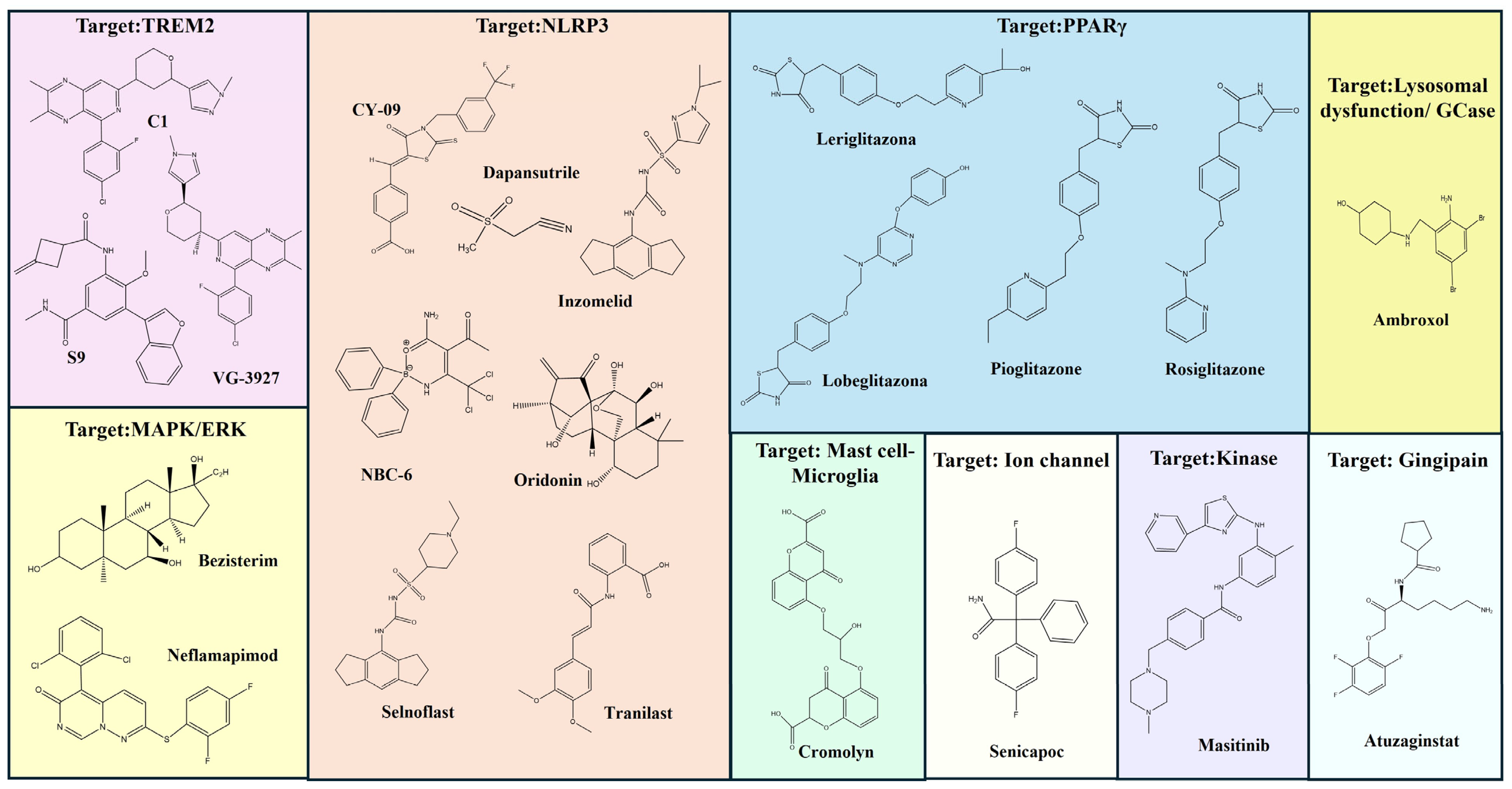


| Target | Compound /Drug | Molecular Formula and Weight (g/mol) | Development Stage | Key Relevance in AD | Ref |
|---|---|---|---|---|---|
| NLRP3 Inflammosome | CY-09 | C19H12F3NO3S2 423.4 | Preclinical | Restored cerebral glucose metabolism and reduced inflammasome activation in AD | [95,96,97] |
| Dapansutrile (OLT1177) | C4H7NO 2S 133.1 | Phase 2 trial (DAPA-PD) in PD (NCT07157735) Recruiting | Reduced IL-1β production and neuroinflammation in AD mouse models | [102,103,105] | |
| Inzomelid (Emlenoflast; IZD174) | C19H24N4O3S 388.5 | Phase 1 (NCT04015076) completed in healthy adults, demonstrating favorable tolerability and linear pharmacokinetics | Block caspase 1, stop production of pro-inflammatory cytokines | [98] | |
| JC-171 | C16H17ClN2O5S 384.8 | Preclinical | Reduced neuroinflammation and cognitive deficits in AD mouse models | [118] | |
| NBC6 * | C18H16BCl3N2O2 409.5 | Preclinical | Inhibited ASC speck formation and IL-1β maturation | [119,120] | |
| Oridonin | C20H28O6 364.4 | Preclinical | Suppressed the secretion of pro-inflammatory cytokines, blocked the activation of the RIPK1-RIPK3-MLKL signaling, improved spatial learning and memory performance, decreased Aβ plaque deposition, and attenuated inflammatory and necroptotic markers in both cortical and hippocampal regions | [114,115,116,117] | |
| Selnoflast (RO7486967) | C20H29N3O3S 391.5 | Clinical trial: To evaluate the efficacy, safety, pharmacodynamics and pharmacokinetics in reducing vascular inflammation in participants with atherosclerosis at risk for major adverse cardiac events (RIVULET; NCT07448038) Recruiting | Reduced peripheral IL-1β and CSF IL-18; one of the most advanced purpose-designed NLRP3 inhibitors | [100] | |
| Tranilast | C18H17NO5 327.3 | Preclinical | Suppresses inflammasome activation and modulates T-cell inflammatory responses | [106,107,109,110,112] | |
| TREM2 Signaling | C1 | C24H23ClFN5O 451.9 | Preclinical | Enhanced microglial phagocytosis and synaptic protection | [4,128] |
| S9 * | C23H23N2O4 391.1 | Preclinical | Increased phagocytic gene expression and microglial activation | [126] | |
| VG-3927 ((2R,4S) stereoisomer of C1) | C24H23ClFN5O 451.9 | Phase 1 (NCT06343636) completed Showed favorable safety, CNS penetration, and dose-dependent target engagement Based on these findings, a once-daily 25 mg dose is planned for Phase 2 evaluation in AD | Improved microglial activation, and showed preliminary target engagement | [128,129,130,131] | |
| PPARγ Agonist | Leriglitazone (MIN-102) | C19H20N2O4S 372.4 | Phase 2/3 (NCT05819866) To evaluate efficacy and safety in adult male subjects with cerebral adrenoleukodystrophy Recruiting | Reduced microglial activation and improved mitochondrial function | [149,150,151,153,154,198] |
| Lobeglitazone | C24H24N4O5S 480.5 | Preclinical in neurodegeneration Safety evaluation in T2D clinical trials (NCT02480465) | Reduced IL-1β/ERK/COX-2 signaling and neuroinflammation | [156,157,158,159,160,161] | |
| Pioglitazone | C19H20N2O3S 356.4 | Repurposed/Phase 3 (TOMMORROW; NCT01931566) failed Ineffective in delaying AD symptoms | Anti-inflammatory, preserves synapses, reduced tau phosphorylation | [147] | |
| Rosiglitazone | C18H19N3O3S 357.4 | Repurposed/Phase 3 (NCT00550420 and NCT00490568) failed No significant improvement in cognition or overall global function | Anti-inflammatory, preserves synapses, reduced tau phosphorylation | [146] | |
| MAPK/ERK Signaling | Bezisterim (NE3107) | C21H30O3 330.5 | Phase 2 (NCT05227820) completed in AD Positive trends in improving cognitive and functional performance Phase 2 (SUNRISE-PD trial; NCT06757010) Result expected in mid-2026 | Reduced inflammatory biomarkers and improved metabolic signaling | [199,200] |
| Neflamapimod (VX-745) | C19H9Cl2F2N3OS 436.3 | Phase 2b (RewinD-LB trial; NCT05869669) completed Significant improvements in cognitive and neurodegenerative biomarkers in DLB patients | Improved synaptic function and reduced inflammatory signaling | [78] | |
| Lysosomal Dysfunction/GCase Enhancement | Ambroxol | C13H18Br2N2O 378.1 | Phase 2 (NCT02914366) completed and advancing to Phase 3 for PD (ASPro-PD trial; NCT05778617) | Improved lysosomal function and reduced neuroinflammatory signaling | [175,179,180,181,183,184,185,186] |
| Gingipain Inhibitors | Atuzaginstat (COR388) | C19H25F3N2O3 386.4 | Phase 2/3 (GAIN trial; NCT03823404) completed Failed to show significant overall cognitive benefits and faced an FDA clinical hold due to liver toxicity concerns | Targeted P. gingivalis-associated neuroinflammation | [137] |
| COR588;LHP588 * | NA | Phase 1 (NCT04920903) completed single- and multiple-ascending dose study evaluating the safety, tolerability, and pharmacokinetics Phase 2 (SPRING trial; NCT06847321) AD Recruiting | Designed to improve safety and pharmacokinetics over COR388 | [138,201,202] | |
| Mast Cell–Microglia Modulation | Cromolyn | C23H16O11 468.4 | Phase 3 combination ALZT-OP1 trial (COGNITE; NCT02547818) completed ALZT-OP1 showed acceptable safety and adequate CSF drug penetration in Phase 1/2 (NCT04570644), while the Phase 3 trial enrolled 620 early AD patients to evaluate the efficacy and safety of cromolyn–ibuprofen combination therapy using CDR-Sum of Boxes as the primary endpoint | Reduced inflammatory cytokines and promoted non-inflammatory Aβ clearance | [187,190,192,193] |
| Multi-target Kinase Inhibition | Masitinib | C28H30N6OS 498.6 | Phase 2b/3 study (NCT01872598) and Phase 3 (NCT05564169) completed for AD Significant improvements in both cognition (ADAS-cog) and daily functioning Phase 2b/3 (NCT02588677); Phase 3 (NCT03127267) for ALS Recruiting | Reduced mast cell and microglial inflammatory signaling | [83,203] |
| Ion Channel Modulation | Senicapoc | C20H15F2NO 323.3 | Phase 2 (NCT04804241) proof-of-mechanism study Recruiting | Reduced microglial activation and inflammasome-associated signaling | [166] |
| p38α MAP Kinase Inhibitor | MW150 | C24H23N5 381.4 | Phase 2a, mild-to-moderate AD (NCT05194163) | Inhibits p38 MAPK, and modulates BDNF/TrkB | [197] |
Disclaimer/Publisher’s Note: The statements, opinions and data contained in all publications are solely those of the individual author(s) and contributor(s) and not of MDPI and/or the editor(s). MDPI and/or the editor(s) disclaim responsibility for any injury to people or property resulting from any ideas, methods, instructions or products referred to in the content. |
© 2026 by the authors. Licensee MDPI, Basel, Switzerland. This article is an open access article distributed under the terms and conditions of the Creative Commons Attribution (CC BY) license.
Share and Cite
Sharma, N.; An, S.S.A. Small-Molecule NANT Therapeutics Targeting the Brain–Immune Axis in Alzheimer’s Disease: Mechanisms, Clinical Progress, and Translational Challenges. Molecules 2026, 31, 3274. https://doi.org/10.3390/molecules31183274
Sharma N, An SSA. Small-Molecule NANT Therapeutics Targeting the Brain–Immune Axis in Alzheimer’s Disease: Mechanisms, Clinical Progress, and Translational Challenges. Molecules. 2026; 31(18):3274. https://doi.org/10.3390/molecules31183274
Chicago/Turabian StyleSharma, Niti, and Seong Soo A. An. 2026. "Small-Molecule NANT Therapeutics Targeting the Brain–Immune Axis in Alzheimer’s Disease: Mechanisms, Clinical Progress, and Translational Challenges" Molecules 31, no. 18: 3274. https://doi.org/10.3390/molecules31183274
APA StyleSharma, N., & An, S. S. A. (2026). Small-Molecule NANT Therapeutics Targeting the Brain–Immune Axis in Alzheimer’s Disease: Mechanisms, Clinical Progress, and Translational Challenges. Molecules, 31(18), 3274. https://doi.org/10.3390/molecules31183274