Biobased Compounds and the Circular Economy: A Bibliometric Review of Waste Valorization and Environmental Sustainability




Abstract
1. Introduction
2. Results and Discussion

| Title | Total Citations | Citations per Year | Publication Year | Journal | First Author | Document Type | |
|---|---|---|---|---|---|---|---|
| 1 | Sustainable polymers from renewable resources [29]. | 2502 | 250.2 | 2016 | Nature | Zhu Y. | Review |
| 2 | Bioplastics for a circular economy [30]. | 1847 | 461.75 | 2022 | Nature Reviews Materials | Rosenboom J.-G. | Review |
| 3 | Developing fibrillated cellulose as a sustainable technological material [31]. | 1513 | 302.6 | 2021 | Nature | Li T. | Review |
| 4 | Poly(lactic acid)—Mass production, processing, industrial applications, and end of life [32]. | 1222 | 122.2 | 2016 | Advanced Drug Delivery Reviews | Castro-Aguirre E. | Review |
| 5 | Toward sustainable and systematic recycling of spent rechargeable batteries [33]. | 977 | 122.12 | 2018 | Chemical Society Reviews | Zhang X. | Review |
| 6 | Composites from renewable and sustainable resources: Challenges and innovations [34]. | 961 | 120.12 | 2018 | Science | Mohanty A.K. | Review |
| 7 | How circular is the global economy?: An assessment of material flows, waste production, and recycling in the European union and the world in 2005 [35]. | 897 | 81.55 | 2015 | Journal of Industrial Ecology | Haas W. | Article |
| 8 | Sustainability of biodegradable plastics: New problem or solution to solve the global plastic pollution? [36]. | 723 | 180.75 | 2022 | Current Research in Green and Sustainable Chemistry | Moshood T.D. | Review |
| 9 | Environmental performance of bio-based and biodegradable plastics: The road ahead [37]. | 722 | 80.22 | 2017 | Chemical Society Reviews | Lambert S. | Review |
| 10 | The ten principles of green sample preparation [38]. | 640 | 160 | 2022 | TrAC—Trends in Analytical Chemistry | Lopez-Lorente A.I. | Review |
| Journal | Publications | Total Citations | Average Citations per Publication | Most Cited Paper | Most Cited Paper Citations | Type | |
|---|---|---|---|---|---|---|---|
| 1 | Journal of Cleaner Production | 31 | 2040 | 65.81 | A life-cycle approach to environmental, mechanical, and durability properties of “green” concrete mixes with rice husk ash [39]. | 226 | Article |
| 2 | Sustainability (Switzerland) | 27 | 810 | 30 | Biomass waste as sustainable raw material for energy and fuels [40]. | 285 | Review |
| 3 | Polymers | 23 | 967 | 42.04 | A review of bioplastics and their adoption in the circular economy [41]. | 104 | Article |
| 4 | Resources, Conservation and Recycling | 23 | 493 | 21.43 | A systematic review of factors affecting properties of thermal-activated recycled cement [42]. | 134 | Review |
| 5 | Science of the Total Environment | 22 | 1103 | 50.14 | A comprehensive framework for the production of mycelium-based lignocellulosic composites [43]. | 243 | Article |
| 6 | International journal of biological macromolecules | 17 | 985 | 57.94 | A comprehensive review on starch-based sustainable edible films loaded with bioactive components for food packaging [44]. | 344 | Review |
| 7 | Green Chemistry | 17 | 1572 | 92.47 | Green chemistry and the plastic pollution challenge: Towards a circular economy [46]. | 106 | Review |
| 8 | Biomass and Bioenergy | 16 | 216 | 13.5 | Sustainable production of polyhydroxyalkanoates from renewable oil-palm biomass [47]. | 306 | Review |
| 9 | Industrial Crops and Products | 15 | 482 | 32.13 | Valorization of sugarcane bagasse by developing completely biodegradable composites for industrial applications [48]. | 215 | Review |
| 10 | Bioresource Technology | 15 | 1433 | 95.53 | Algal biopolymers as sustainable resources for a net-zero carbon bioeconomy [45]. | 140 | Review |
3. Future Research Trends Based on Identified Gaps: Opportunities to Close Knowledge Gaps in Biobased Compounds
3.1. Gap Analysis
3.2. Priority and Severity Indices
3.3. Common and Specific Technical Barriers
3.4. Analysis of Key Applications and Current Status
3.5. Implications for Future Research
3.5.1. Priority Topics for Immediate Research Attention
3.5.2. Interdisciplinary Approaches to Complex Challenges
3.5.3. Strengthening Theoretical Frameworks
3.5.4. Methodological and Regulatory Recommendations
3.5.5. Green Extraction Technologies as Enabling Tools for Biomass Valorization
4. Materials and Methods
4.1. Study Design and Research Questions
4.2. Search Strategy and Data Sources
4.2.1. Database Selection and Justification
4.2.2. Search Equation Development
4.2.3. Search Execution and Document Retrieval
4.3. Screening and Eligibility Criteria
4.3.1. Inclusion and Exclusion Criteria
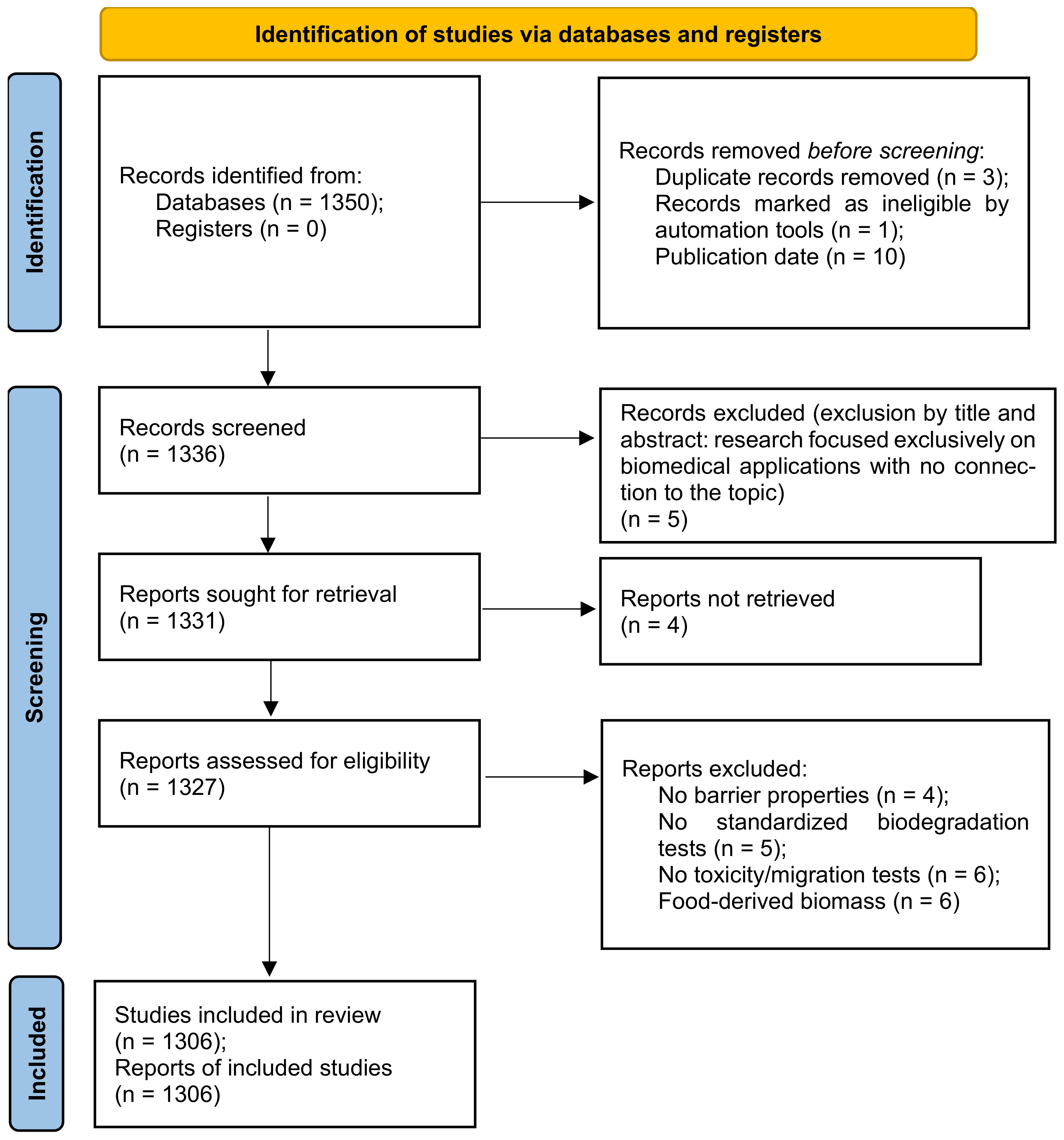
4.3.2. Screening Process
4.4. Data Extraction and Curation
4.4.1. Bibliometric Data Extraction
4.4.2. Data Cleaning and Normalization
4.5. Bibliometric Analysis and Indicators
Processing and Visualization Tools
4.6. Thematic Analysis and Keyword Mapping
4.6.1. Keyword Frequency Analysis
- Absolute frequency: Number of occurrences of each keyword;
- Frequency percentage: Relative occurrence within the total keyword set;
- Annual growth rate: Percentage increase in keyword usage from first to last year;
- Total and average citations: Citation impact of documents associated with each keyword.
4.6.2. Keyword Normalization
- “circular economy,” “circular bioeconomy,” and “closed-loop economy” → merged as “circular economy” (the most frequent and conceptually comprehensive term).
- “biodegradable,” “biodegradable plastics,” and “compostable” → merged as “biodegradable” (the broadest term encompassing the others).
- “recycling,” “upcycling,” and “reuse” → merged as “recycling” (the most widely used term in the dataset).
- “sustainability” and “sustainable development” → kept as separate terms because they represent distinct conceptual levels: “sustainable development” refers to the overarching global framework (SDGs), while “sustainability” is a broader concept applicable at multiple scales. This decision was validated by examining their co-occurrence patterns and citation impact profiles.
- “life cycle,” “lifecycle,” and “LCA” → merged as “life cycle” (the most common formal term).
- “renewable resources,” “renewable feedstocks,” and “renewable materials” → merged as “renewable resources” (the most frequently used term).
- “biomass valorization” and “waste valorization” → kept as separate terms because “biomass valorization” specifically refers to biogenic feedstocks, while “waste valorization” encompasses a broader range of waste streams (including non-biogenic wastes).
4.7. Gap Identification and Priority Analysis
4.7.1. Gap Identification Methodology
- Literature synthesis: Review of key challenges and barriers reported in the most cited documents (Table 1) and review articles.
- Keyword frequency analysis: Identification of underrepresented topics compared to established concepts (Table 4).
- Journal analysis: Examination of research themes in high-impact journals (Table 3).
- Expert triangulation: Cross-validation of findings with recent review articles and position papers.
4.7.2. Priority Indices and Scoring
- (a)
- Gap Severity Score (0–100)
- (b)
- Research Readiness Score (0–100)
- (c)
- Thematic Interest Index
- Gap Severity Score (0–100): Based on the magnitude of the research deficit, considering the number of publications, citation impact, and documented barriers.
- Research Readiness Score (0–100): Indicating the availability of appropriate methodologies, funding, and expertise to address the gap.
4.7.3. Validation of the Scoring System
4.8. Methodological Limitations
- Single database usage: While Scopus was selected for its comprehensive coverage and superior metadata quality, exclusive reliance on a single database may exclude relevant research indexed only in other databases such as Web of Science, Google Scholar, or regional repositories [17,18]. However, as justified in Section 4.2.1, Scopus provides extensive coverage of the relevant literature and has been successfully employed as a sole data source in numerous bibliometric studies in related fields [23,24].
- Keyword normalization challenges: While we implemented a systematic normalization protocol (described in Section 4.6.2) to address case variations, singular/plural forms, and synonymy, some challenges remain. First, the distinction between synonyms and conceptually distinct but related terms is inherently subjective; our decision to keep “sustainability” and “sustainable development” as separate terms, for example, was based on conceptual reasoning but could be debated. Second, some terms may have multiple meanings depending on context (e.g., “recycling” can refer to material recycling, chemical recycling, or policy frameworks), and our normalization cannot fully resolve this polysemy. Third, despite our systematic approach, some less frequent variants may have been overlooked. We mitigated these limitations by: (1) documenting all merging decisions transparently (Supplementary Table S1; (2) conducting independent review by two authors; and (3) applying a frequency threshold (≥2 occurrences) to minimize the impact of idiosyncratic terms. Readers should interpret keyword frequencies and co-occurrence patterns with these residual uncertainties in mind. Citation metric limitations: Citation-based indicators are influenced by factors such as publication age, journal prestige, field-specific citation norms, and self-citation practices. These indicators should be interpreted as measures of academic visibility rather than direct measures of research quality or technological relevance [23,24].
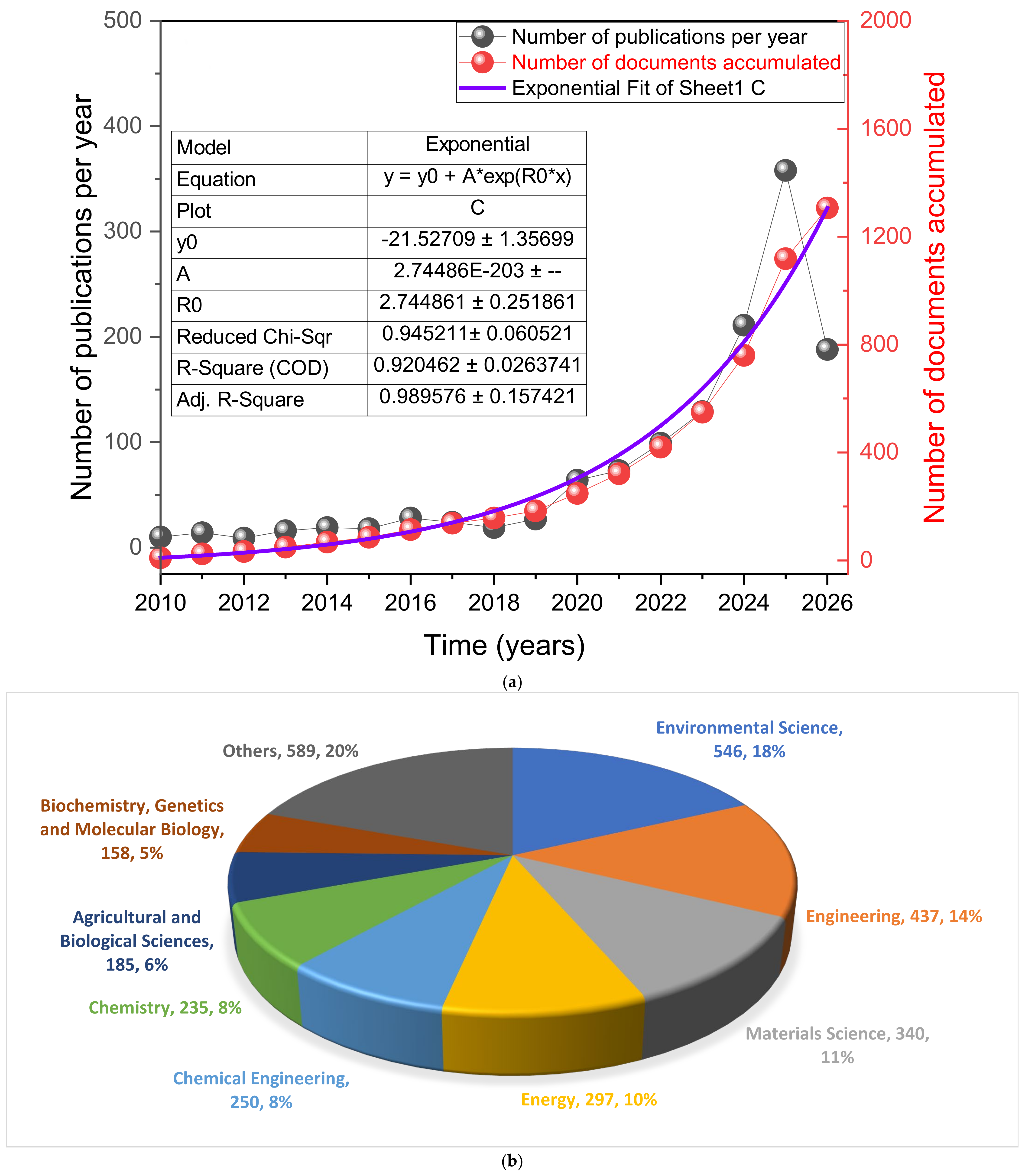
- Partial-year data bias: As the literature search was conducted in June 2026, the 2026 data represent only the first six months of the year. This introduces a systematic bias in temporal analyses, as publication counts, citation metrics, and keyword frequencies for 2026 are artificially lower than full-year values. Conversely, calculated annual growth rates may be inflated if the first half of 2026 shows higher publication activity than previous years. While this limitation is unavoidable in studies with mid-year search dates, we have addressed it by: (1) explicitly identifying 2026 as a partial year in all relevant sections; (2) conducting sensitivity analyses excluding 2026 to confirm trend robustness (R2 2010–2025 = 0.9187 vs. R2 2010–2026 = 0.92046); and (3) interpreting all 2026-based metrics as provisional estimates requiring future validation.
- Broad search strategy and thematic heterogeneity: The search equation was designed to be comprehensive rather than narrow, capturing the interdisciplinary nature of biobased compounds research. As a consequence, the dataset includes publications that are not exclusively focused on biobased compounds but address broader circular economy and sustainability topics (e.g., battery recycling, green analytical chemistry, sustainable concrete). This thematic heterogeneity may introduce some degree of noise in the bibliometric indicators, particularly in keyword frequency and co-citation analyses. However, as justified in Section 4.2.2, this breadth is intentional: these publications provide foundational methodological frameworks (life cycle assessment, circular economy indicators, green chemistry principles) that are directly transferable to biobased materials research. Furthermore, the screening process (Section 4.3) excluded documents with no connection to biobased materials or environmental sustainability, ensuring that all included publications were at least tangentially relevant to the research questions. However, readers should interpret the findings with this thematic breadth in mind, recognizing that the bibliometric landscape reflects the broader sustainability science ecosystem rather than a narrowly defined biobased compounds subfield.
- Subjectivity and precision of composite scoring: The Gap Severity Score, Research Readiness Score, and Thematic Interest Index are derived from a composite formula that includes author-defined weighting factors and qualitative barrier assessments. While these weights were justified based on bibliometric best practices and validated through sensitivity analysis, alternative weighting schemes could produce slightly different absolute values. Furthermore, the narrow range of scores observed (Δ = 0.05) indicates that the numerical precision of the ranking is limited. To address this limitation, we have interpreted the scores qualitatively—grouping gaps into thematic clusters rather than imposing strict hierarchical rankings—and have supplemented the numerical analysis with detailed qualitative descriptions of the technical barriers and key applications for each gap. Readers are encouraged to focus on the qualitative characterization of the gaps rather than the precise numerical scores.
- Inability to infer causality, research strategies, or technological capacity: Bibliometric indicators—publication counts, citation impact, co-authorship networks, and keyword frequencies—are descriptive measures of research activity and academic visibility. They cannot directly measure:
- Scientific infrastructure (laboratory equipment, funding levels, institutional support);
- National research strategies (policy priorities, funding allocation, strategic planning);
- Technological capacity (industrial innovation, technology transfer, commercialization);
- Research preparedness (availability of trained personnel, methodological expertise, institutional readiness).
4.9. Reproducibility and Transparency
5. Conclusions
Supplementary Materials
Author Contributions
Funding
Institutional Review Board Statement
Informed Consent Statement
Data Availability Statement
Conflicts of Interest
References
- Das, J.; De, D.; Mittal, A.; Jamwal, V.; Dhaundiyal, A.; Jeevitha, G.C.; Garg, S.; Junior, M.G.; Manian, R.; Tomer, V.; et al. Exploring agro-industrial waste for sustainable biopolymer-based food packaging: Opportunities, challenges, and future directions. Bulg. Chem. Commun. 2025, 57, 45–73. [Google Scholar] [CrossRef] [Scilit]
- Libretti, C.; Santos Correa, L.; Meier, M.A.R. From waste to resource: Advancements in sustainable lignin modification. Green Chem. 2024, 26, 4358–4389. [Google Scholar] [CrossRef] [Scilit]
- Mogany, T.; Bhola, V.; Bux, F. Algal-based bioplastics: Global trends in applied research, technologies, and commercialization. Environ. Sci. Pollut. Res. 2024, 31, 38022–38044. [Google Scholar] [CrossRef] [Scilit] [PubMed]
- Patel, N.; Blumberga, D. Insights of Bioeconomy: Biopolymer Evaluation Based on Sustainability Criteria. Environ. Clim. Technol. 2023, 27, 323–338. [Google Scholar] [CrossRef] [Scilit]
- Sandei, B.; Vroman, I.; Belomo, R. Alternative building blocks sources for poly(ethylene terephthalate): A short review with socioeconomical points of view. Front. Mater. 2022, 9, 1005770. [Google Scholar] [CrossRef] [Scilit]
- Subramani, R.; Ali Rusho, M.; Sekhar, K.C.; Mohammed, S.A.; Abdulah, S.A.; Hashim, R.D.; Jawad ZNMustafa, M.A.; Kumar, A.P. Utilizing bioenergy and waste reduction techniques in FDM: Toward sustainable production practices. Appl. Chem. Eng. 2024, 7, ACE-5540. [Google Scholar] [CrossRef] [Scilit]
- Yadav, P.; Nikalje, A. Comprehensive analysis of bioplastics: Life cycle assessment, waste management, biodiversity impact, and sustainable mitigation strategies. PeerJ 2024, 12, e18013. [Google Scholar] [CrossRef] [Scilit] [PubMed]
- Zhou, X.; Wang, Q.; Feng, S.; Deng, J.; Zhu, K.; Xing, Y.; Meng, X.; Wang, X.; Li, L. Recycling Carbon Resources from Waste PET to Reduce Carbon Dioxide Emission: Carbonization Technology Review and Perspective. J. Renew. Mater. 2023, 11, 2085–2107. [Google Scholar] [CrossRef] [Scilit]
- Jadaun, S.; Sharma, U.; Khapudang, R.; Siddiqui, S. Biodegradable nanocellulose reinforced biocomposites for food packaging—A narrative review and future perspective. J. Water Environ. Nanotechnol. 2023, 8, 293–319. [Google Scholar] [CrossRef]
- Lombardi, F.; Bartolucci, L.; Cordiner, S.; Costa, G.; Falsetti, A.; Mele, P.; Mercurio, M.; Mulone, V.; Sorino, L. Chemical-Physical Characterization of Bio-Based Biodegradable Plastics in View of Identifying Suitable Recycling/Recovery Strategies and Numerical Modeling of PLA Pyrolysis. Waste Biomass Valorization 2024, 15, 1653–1670. [Google Scholar] [CrossRef]
- Reshmy, R.; Thomas, D.; Philip, E.; Paul, S.A.; Madhavan, A.; Sindhu, R.; Sirohi, R.; Varjani, S.; Pugazhendhi, A.; Pandey, A.; et al. Bioplastic production from renewable lignocellulosic feedstocks: A review. Rev. Environ. Sci. Bio/Technol. 2021, 20, 167–187. [Google Scholar] [CrossRef] [Scilit]
- Abu-Zurayk, R.; Khalaf, A.; Alnairat, N.; Waleed, H.; Bozeya, A.; Abu-Dalo, D.; Rabba’a, M. Green polymer nanocomposites: Bridging material innovation with sustainable industrial practices. Front. Mater. 2025, 12, 1701086. [Google Scholar] [CrossRef] [Scilit]
- Weerarathna, I.N.; Kumar, P.; Luharia, A.; Mishra, G. Sustainable biomaterials for pharmaceutical and medical applications. Multidiscip. Rev. 2025, 8, e2025141. [Google Scholar] [CrossRef] [Scilit]
- Müller, A.; Bács, Z.; Fenyves, V.; Kovács, S.; Lengyel, A.; Bácsné, E.B. Demographic influences on environmental attitudes and actions: An analysis of the attitude-behavior gap. Environ. Res. Lett. 2025, 15, 104044. [Google Scholar] [CrossRef] [Scilit]
- Mocerino, C.; Lahmar, A.; Azrour, M.; Lahmar, A. Towards resilient architecture in technological innovation and AI. Mater. Res. Proc. 2025, 47, 327–342. [Google Scholar] [CrossRef] [Scilit]
- Abrha, H.; Cabrera, J.; Dai, Y.; Irfan, M.; Toma, A.; Jiao, S.; Liu, X. Bio-based plastics production, impact and end of life: A literature review and content analysis. Sustainability 2022, 14, 4855. [Google Scholar] [CrossRef] [Scilit]
- Begum, Y.A.; Kumari, S.; Jain, S.K.; Garg, M.C. A review on waste biomass-to-energy: Integrated thermochemical and biochemical conversion for resource recovery. Environ. Sci. Adv. 2024, 3, 1197–1216. [Google Scholar] [CrossRef] [Scilit]
- Helal, M.A.; Anderson, N.; Wei, Y.; Thompson, M. A Review of Biomass-to-Bioenergy Supply Chain Research Using Bibliometric Analysis and Visualization. Energies 2023, 16, 1187. [Google Scholar] [CrossRef] [Scilit]
- Jacob, J.; Linson, N.; Maria, H.J.; Pothan, L.A.; Thomas, S.; Kabdrakhmanova, S.; Laroze, D. Polylactic acid/nanocellulose biocomposites for sustainable food packaging. Cellulose 2024, 31, 5997–6042. [Google Scholar] [CrossRef] [Scilit]
- Janković, T.; Straathof, A.J.; Kiss, A.A. Process systems engineering perspectives on eco-efficient downstream processing of volatile biochemicals from fermentation. Front. Energy Res. 2024, 11, 1340612. [Google Scholar] [CrossRef] [Scilit]
- Ramadhani, A.; Nassary, E.; Rwehumbiza, F.; Massawe, B.; Nchimbi-Msolla, S. Potentials of synthetic biodegradable mulch for improved livelihoods on smallholder farmers: A systematic review. Front. Agron. 2024, 6, 1454060. [Google Scholar] [CrossRef] [Scilit]
- Tarazona, N.A.; Machatschek, R.; Balcucho, J.; Lendlein, A.; Castro-Mayorga, J.L.; Saldarriaga, J.F. Opportunities and challenges for integrating the development of sustainable polymer materials within an international circular (bio) economy concept. MRS Energy Sustain. 2022, 9, 28–34. [Google Scholar] [CrossRef] [Scilit] [PubMed]
- Alhodaib, A.; Yahya, Z.; Khan, O.; Equbal, A.; Parvez, M.; Yadav, A.K.; Idrisi, M.J. Sustainable coatings for green solar photovoltaic cells: Performance and environmental impact of recyclable biomass digestate polymers. Sci. Rep. 2024, 14, 11221. [Google Scholar] [CrossRef] [Scilit] [PubMed]
- Amuthasekaran, K.; Hussain, N. Polyhydroxyalkanoates production from food waste using Lactobacillus casei. Environ. Health Eng. Manag. J. 2025, 12, 1349. [Google Scholar] [CrossRef] [Scilit]
- Brunklaus, B.; Riise, E. Bio-based Materials Within the Circular Economy: Opportunities and Challenges. In Designing Sustainable Technologies, Products and Policies; Benetto, E., Gericke, K., Guiton, M., Eds.; Springer: Cham, Switzerland, 2018; pp. 43–47. [Google Scholar]
- Casella, P.; Loffredo, R.; Rao, M.A.; Balducchi, R.; Molino, A. A Review on the Valorization of Lignocellulosic Biomass for Succinic Acid Production: Strengths and Weaknesses. Chem. Eng. Trans. 2024, 109, 43–48. [Google Scholar]
- Coppola, G.; Gaudio, M.T.; Lopresto, C.G.; Calabro, V.; Curcio, S.; Chakraborty, S. Bioplastic from Renewable Biomass: A facile solution for a greener environment. Earth Syst. Environ. 2021, 5, 231–251. [Google Scholar] [CrossRef] [Scilit]
- Czarnecka-Komorowska, D.; Wiszumirska, K. Sustainability design of plastic packaging for the Circular Economy. Polimery 2020, 65, 8–17. [Google Scholar] [CrossRef] [Scilit]
- Zhu, Y.; Romain, C.; Williams, C.K. Sustainable polymers from renewable resources. Nature 2016, 540, 354–362. [Google Scholar] [CrossRef] [Scilit] [PubMed]
- Rosenboom, J.G.; Langer, R.; Traverso, G. Bioplastics for a circular economy. Nat. Rev. Mater. 2022, 7, 117–137. [Google Scholar] [CrossRef] [Scilit] [PubMed]
- Li, T.; Chen, C.; Brozena, A.H.; Zhu, J.Y.; Xu, L.; Driemeier, C.; Dai, J.; Rojas, O.J.; Isogai, A.; Wågberg, L.; et al. Developing fibrillated cellulose as a sustainable technological material. Nature 2021, 590, 47–56. [Google Scholar] [CrossRef] [Scilit] [PubMed]
- Castro-Aguirre, E.; Iniguez-Franco, F.; Samsudin, H.E.A.; Fang, X.; Auras, R. Poly (lactic acid)—Mass production, processing, industrial applications, and end of life. Adv. Drug Deliv. Rev. 2016, 107, 333–366. [Google Scholar] [CrossRef] [Scilit] [PubMed]
- Zhang, X.; Li, L.; Fan, E.; Xue, Q.; Bian, Y.; Wu, F.; Chen, R. Toward sustainable and systematic recycling of spent rechargeable batteries. Chem. Soc. Rev. 2018, 47, 7239–7302. [Google Scholar] [CrossRef] [Scilit] [PubMed]
- Mohanty, A.K.; Vivekanandhan, S.; Pin, J.M.; Misra, M. Composites from renewable and sustainable resources: Challenges and innovations. Science 2018, 362, 536–542. [Google Scholar] [CrossRef] [Scilit] [PubMed]
- Haas, W.; Krausmann, F.; Wiedenhofer, D.; Heinz, M. How circular is the global economy?: An assessment of material flows, waste production, and recycling in the European Union and the world in 2005. J. Ind. Ecol. 2015, 19, 765–777. [Google Scholar] [CrossRef] [Scilit]
- Moshood, T.D.; Nawanir, G.; Mahmud, F.; Mohamad, F.; Ahmad, M.H.; AbdulGhani, A. Sustainability of biodegradable plastics: New problem or solution to solve the global plastic pollution? Curr. Res. Green Sustain. Chem. 2022, 5, 100273. [Google Scholar] [CrossRef] [Scilit]
- Lambert, S.; Wagner, M. Environmental performance of bio-based and biodegradable plastics: The road ahead. Chem. Soc. Rev. 2017, 46, 6855–6871. [Google Scholar] [CrossRef] [Scilit] [PubMed]
- López-Lorente, Á.I.; Pena-Pereira, F.; Pedersen-Bjergaard, S.; Zuin, V.G.; Ozkan, S.A.; Psillakis, E. The ten principles of green sample preparation. TrAC Trends Anal. Chem. 2022, 148, 116530. [Google Scholar] [CrossRef] [Scilit]
- Gursel, A.P.; Maryman, H.; Ostertag, C. A life-cycle approach to environmental, mechanical, and durability properties of “green” concrete mixes with rice husk ash. J. Clean. Prod. 2016, 112, 823–836. [Google Scholar] [CrossRef] [Scilit]
- Clauser, N.M.; González, G.; Mendieta, C.M.; Kruyeniski, J.; Area, M.C.; Vallejos, M.E. Biomass waste as sustainable raw material for energy and fuels. Sustainability 2021, 13, 794. [Google Scholar] [CrossRef] [Scilit]
- Di Bartolo, A.; Infurna, G.; Dintcheva, N.T. A review of bioplastics and their adoption in the circular economy. Polymers 2021, 13, 1229. [Google Scholar] [CrossRef] [Scilit] [PubMed]
- Pei, J.; Palanisamy, C.P.; Srinivasan, G.P.; Panagal, M.; Kumar, S.S.D.; Mironescu, M. A comprehensive review on starch-based sustainable edible films loaded with bioactive components for food packaging. Int. J. Biol. Macromol. 2024, 274, 133332. [Google Scholar] [CrossRef] [Scilit] [PubMed]
- Xu, L.; Wang, J.; Li, K.; Lin, S.; Li, M.; Hao, T.; Ling, Z.; Xiang, D.; Wang, T. A systematic review of factors affecting properties of thermal-activated recycled cement. Resour. Conserv. Recycl. 2022, 185, 106432. [Google Scholar] [CrossRef] [Scilit]
- Elsacker, E.; Vandelook, S.; Van Wylick, A.; Ruytinx, J.; De Laet, L.; Peeters, E. A comprehensive framework for the production of mycelium-based lignocellulosic composites. Sci. Total Environ. 2020, 725, 138431. [Google Scholar] [CrossRef] [Scilit] [PubMed]
- Mohan, A.A.; Antony, A.R.; Greeshma, K.; Yun, J.H.; Ramanan, R.; Kim, H.S. Algal biopolymers as sustainable resources for a net-zero carbon bioeconomy. Bioresour. Technol. 2022, 344, 126397. [Google Scholar] [CrossRef] [Scilit]
- Sheldon, R.A.; Norton, M. Green chemistry and the plastic pollution challenge: Towards a circular economy. Green Chem. 2020, 22, 6310–6322. [Google Scholar] [CrossRef] [Scilit]
- Hassan, M.A.; Yee, L.N.; Yee, P.L.; Ariffin, H.; Raha, A.R.; Shirai, Y.; Sudesh, K. Sustainable production of polyhydroxyalkanoates from renewable oil-palm biomass. Biomass Bioenergy 2013, 50, 1–9. [Google Scholar] [CrossRef] [Scilit]
- Guna, V.; Ilangovan, M.; Hu, C.; Venkatesh, K.; Reddy, N. Valorization of sugarcane bagasse by developing completely biodegradable composites for industrial applications. Ind. Crops Prod. 2019, 131, 25–31. [Google Scholar] [CrossRef] [Scilit]
- Hamada, H.M.; Thomas, B.S.; Tayeh, B.; Yahaya, F.M.; Muthusamy, K.; Yang, J. Use of oil palm shell as an aggregate in cement concrete: A review. Constr. Build. Mater. 2020, 265, 120357. [Google Scholar] [CrossRef] [Scilit]
- Dzwigol, H.; Trushkina, N.; Kwilinski, A. The Organizational and Economic Mechanism of Implementing the Concept of Green Logistics. Virtual Econ. 2021, 4, 41–75. [Google Scholar] [CrossRef] [Scilit]
- García-González, J.; Lemos, P.C.; Pereira, A.S.; Morán-del Pozo, J.M.; Guerra-Romero, M.I.; Juan-Valdés, A.; Faria, P. Biodegradable Polymers on Cementitious Materials. In Current Topics and Trends on Durability of Building Materials and Components—Proceedings of the 15th International Conference on Durability of Building Materials and Components, DBMC 2020; International Center for Numerical Methods in Engineering (CIMNE): Barcelona, Spain, 2020; pp. 99–104. [Google Scholar]
- Ivanova, N.A. Environmental and innovation problems of Russia in the context of the transition to an energy efficient economy. In IOP Conference Series: Earth and Environmental Science; IOP Publishing: Bristol, UK, 2021; Volume 937, p. 042013. [Google Scholar]
- Joseph, B.; Kaetzl, K.; Hensgen, F.; Schäfer, B.; Wachendorf, M. Sustainability assessment of activated carbon from residual biomass used for micropollutant removal at a full-scale wastewater treatment plant. Environ. Res. Lett. 2020, 15, 064023. [Google Scholar] [CrossRef] [Scilit]
- Kapsdorferová, Z. Environmental Management and Its Impact on CSR Activities in the Field of Sustainable Development. TalTech J. Eur. Stud. 2023, 13, 84–86. [Google Scholar] [CrossRef] [Scilit]
- Kavitha, S.A.; Priya, R.K.; Arunachalam, K.P.; Avudaiappan, S.; Flores, E.S.; Blanco, D. Experimental investigation on strengthening of Zea mays root fibres for biodegradable composite materials using potassium permanganate treatment. Sci. Rep. 2024, 14, 12754. [Google Scholar] [CrossRef] [Scilit]
- Kooduvalli, K.S.; Varma, U.; Owusu, S. Life Cycle Assessment of Compostable Coffee Pods: A US University-Based Case Study. Sci. Rep. 2020, 10, 9158. [Google Scholar] [CrossRef] [Scilit]
- Kraus, M.; Senitkova, I.J. Life-Cycle Assessment of Sustainable Foundation Systems of Buildings. In IOP Conference Series: Materials Science and Engineering; IOP Publishing: Bristol, UK, 2019; Volume 603, p. 052078. [Google Scholar]
- Merino, D.; Quilez-Molina, A.I.; Perotto, G.; Bassani, A.; Spigno, G.; Athanassiou, A. A second life for fruit and vegetable waste: A review on bioplastic films and coatings for potential food protection applications. Green Chem. 2022, 24, 4703–4727. [Google Scholar] [CrossRef] [Scilit]
- Mombeshora, E.T.; Stark, A. Dynamics of reduced graphene oxide synthesis and structural models. Biomass Convers. Biorefinery 2023, 13, 4619–4638. [Google Scholar] [CrossRef] [Scilit]
- Mostert, C.; Bringezu, S.; Knappe, F. Urban Mining for Sustainable Cities: Environmental Assessment of Recycled Concrete. In IOP Conference Series: Earth and Environmental Science; IOP Publishing: Bristol, UK, 2020; Volume 588, p. 052021. [Google Scholar]
- Ong, M.Y.; Jassinnee, M.; Chia, S.R.; Nomanbhay, S. Sustainable Graphene and Hydrogen Production via Microwave Plasma of Biogas: A Concept paper. In IOP Conference Series: Earth and Environmental Science; IOP Publishing: Bristol, UK, 2025; Volume 1560, p. 012019. [Google Scholar]
- Ottelin, J.; Cetinay, H.; Behrens, P. Rebound effects may jeopardize the resource savings of circular consumption: Evidence from household material footprints. Environ. Res. Lett. 2020, 15, 104044. [Google Scholar] [CrossRef] [Scilit]
- Pasanec Preprotić, S.; Vukoje, M.; Petković, G.; Rožić, M. Sustainable Approach to Book Designing Concepts in Bindery Sector: An Overview. In Proceedings na 11th International Symposium on Graphic Engineering and Design GRID; University of Novi Sad: Novi Sad, Serbia, 2022; pp. 629–633. [Google Scholar]
- Pathak, N.; Singh, S.; Singh, P.; Singh, P.K.; Singh, R.; Bala, S. Valorization of jackfruit waste into value added products and their potential applications. Front. Biosci. 2022, 9, 1061098. [Google Scholar] [CrossRef] [Scilit]
- Patti, A.; Acierno, S.; Cicala, G.; Acierno, D. Recycling Waste from Film Packaging to 3D Printing Applications: A Prospective Study to Identify the Processing Temperature. Chem. Eng. Trans. 2022, 96, 55–60. [Google Scholar]
- Román-Ramírez, L.A.; McKeown, P.; Jones, M.D.; Wood, J. Ethyl Lactate Production from the Catalytic Depolymerisation of Postconsumer Polylactic acid. ACS Omega 2020, 5, 5556. [Google Scholar] [CrossRef] [Scilit] [PubMed]
- Sakina, B. Material conservation as part of environmental sustainability in architecture – case study: Mesvara House, Yogyakarta, Indonesia. In IOP Conference Series: Earth and Environmental Science; IOP Publishing: Bristol, UK, 2020; Volume 426, p. 012069. [Google Scholar]
- Sastre, R.M.; Zeni, C.F.; De Paula, I.C.; Hauser, G.; Da Conceição, S. The Use of Organic Residues to Develop Packaging: Tests in Molded Pulp. Proc. Des. Soc. 2023, 3, 3543–3550. [Google Scholar] [CrossRef] [Scilit]
- Shahar, F.S.; Balakrishnan, T.S.; Sultan, M.T.H. The Evolution and Environmental Prospects of Renewable Bioplastics: Types, Production Methods, and Sustainability. J. Renew. Mater. 2025, 13, 1095. [Google Scholar] [CrossRef] [Scilit]
- Sidiras, D. Modified Biomass for Pollution Cleaning Under the Frames of Biorefinery and Sustainable Circular Bioeconomy. In Proceedings of the World Congress on Mechanical, Chemical, and Material Engineering, Art; Avestia Publishing: Ottawa, ON, Canada, 2018; p. Paper ICCPE 107. [Google Scholar]
- Solis, C.A.; Mayol, A.P.; San Juan, J.G.; Ubando, A.T.; Culaba, A.B. Multi-objective optimal synthesis of algal biorefineries toward a sustainable circular bioeconomy. In IOP Conference Series: Earth and Environmental Science; IOP Publishing: Bristol, UK, 2020; Volume 463, p. 012051. [Google Scholar]
- Sousa, A.F.; Patrício, R.; Terzopoulou, Z.; Bikiaris, D.N.; Stern, T.; Wenger, J.; Loos, K.; Lotti, N.; Siracusa, V.; Szymczyk, A.; et al. Recommendations for replacing PET on packaging, fiber, and film materials with biobased counterparts. Green Chem. 2021, 23, 8795–8820. [Google Scholar] [CrossRef] [Scilit]
- Thakur, A.; Sharma, S.; Ganjoo, R.; Assad, H.; Kumar, A. Anti-Corrosive Potential of the Sustainable Corrosion Inhibitors Based on Biomass Waste: A Review on Preceding and Perspective Research. J. Phys. Conf. Ser. 2022, 2267, 012079. [Google Scholar] [CrossRef] [Scilit]
- Tsouko, E.; Pilafidis, S.; Kourmentza, K.; Gomes, H.I.; Sarris, G.; Koralli, P.; Papagiannopoulos, A.; Pispas, S.; Sarris, D. A sustainable bioprocess to produce bacterial cellulose (BC) using waste streams from wine distilleries and the biodiesel industry: Evaluation of BC for adsorption of phenolic compounds, dyes and metals. Biotechnol. Biofuels Bioprod. 2024, 17, 40. [Google Scholar] [CrossRef] [Scilit] [PubMed]
- Van Stijn, A.; Eberhardt, L.C.M.; Wouterszoon Jansen, B.; Meijer, A. Design guidelines for circular building components based on LCA and MFA: The case of the Circular Kitchen. In IOP Conference Series: Earth and Environmental Science; IOP Publishing: Bristol, UK, 2020; Volume 588, p. 042045. [Google Scholar]
- Verstraeten, S.B.C.; van Muyden, A.; Bobbink, F.D. Towards a Plastic Circular Economy: Bio-derived Plastics and their End-of-life Strategies. Chimia 2021, 75, 744–751. [Google Scholar] [CrossRef] [Scilit] [PubMed]
- Widyaningrum, D.; Paramita, R.D.; Firmasyah, A. Exploring food waste as raw material for plant-based leather to promote sustainable material development. In IOP Conference Series: Earth and Environmental Science; IOP Publishing: Bristol, UK, 2025; Volume 1488, p. 012019. [Google Scholar]
- Zrira, I.; Lamptey, E.N.L. Fungal Mycelium as an Innovative Solution for Sustainable and Biodegradable Pharmaceutical Packaging. In IOP Conference Series: Earth and Environmental Science; IOP Publishing: Bristol, UK, 2025; Volume 1568, p. 012036. [Google Scholar]
- Page, M.J.; McKenzie, J.E.; Bossuyt, P.M.; Boutron, I.; Hoffmann, T.C.; Mulrow, C.D.; Shamseer, L.; Tetzlaff, J.M.; Akl, E.A.; Brennan, S.E.; et al. The PRISMA 2020 statement: An updated guideline for reporting systematic reviews. BMJ 2021, 372, n71. [Google Scholar] [CrossRef] [Scilit]

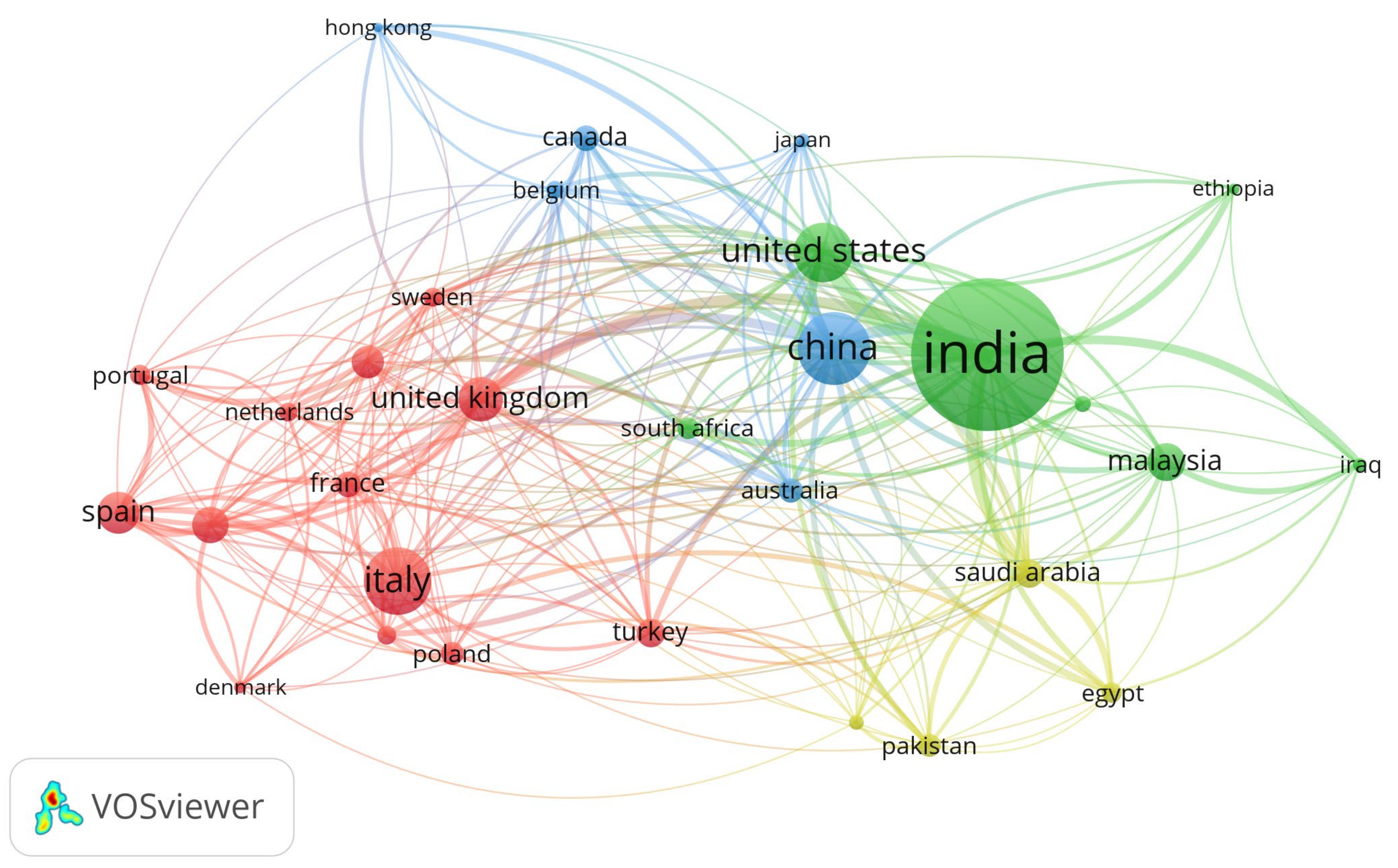
| Country | Publications | Total Citations | Average Citations per Publication | H-Index (Country) | Institution | Institution Publications | Average Citations | H-Index (Institution) | |
|---|---|---|---|---|---|---|---|---|---|
| 1 | India | 293 | 4211 | 14.37 | 33 | Division of Food Processing Technology, School of Engineering and Technology, Karunya Institute of Technology and Sciences, Coimbatore | 2 | 0 | 0 |
| 2 | Italy | 103 | 3675 | 35.68 | 30 | Smart Materials, Italian Institute of Technology, Via Morego 30, Genoa, 16163 | 3 | 14 | 2 |
| 3 | China | 102 | 3845 | 37.7 | 25 | Institute of Education, Changchun Normal University, Changchun, 130032 | 2 | 0.5 | 1 |
| 4 | United States | 58 | 6655 | 114.74 | 24 | Department of Engineering Data Science, University of Houston, 77004, TX | 1 | 3 | 1 |
| 5 | Spain | 48 | 1885 | 39.27 | 22 | CRETUS, Department of Chemical Engineering, School of Engineering, University of Santiago de Compostela | 3 | 27.67 | 3 |
| 6 | Malaysia | 45 | 1682 | 37.38 | 14 | Advanced Facilities Engineering Technology Research Cluster (AFET), Plant Engineering Technology (PETech) Section, Universiti Kuala Lumpur Malaysian Institute of Industrial Technology, Masai, Johor, 81750 | 2 | 0 | 0 |
| 7 | Brazil | 38 | 791 | 20.82 | 14 | Federal University of Technology—Paraná (UTFPR), Campo Mourão | 1 | 0 | 0 |
| 8 | Germany | 34 | 2113 | 62.15 | 15 | Materials Science, Leibniz Institute for Composite Materials, Kaiserslautern | 1 | 0 | 0 |
| 9 | United Kingdom | 34 | 3501 | 102.97 | 18 | Institute for Materials Research and Innovation, University of Bolton, Bolton | 2 | 3 | 2 |
| 10 | Poland | 24 | 360 | 15 | 9 | Department of Advanced Material Technologies, Faculty of Chemistry, Wrocław University of Science and Technology, Smoluchowskiego 25, Wrocław, 50-372 | 2 | 52 | 2 |
| Keyword | Absolute Frequency | Frequency (%) | First Year | Last Year | Total Citations | Avg Citations |
|---|---|---|---|---|---|---|
| Sustainable development | 489 | 1.45 | 2011 | 2026 | 16,454 | 33.65 |
| Circular economy | 419 | 1.25 | 2015 | 2026 | 11,583 | 27.64 |
| Sustainability | 370 | 1.1 | 2011 | 2026 | 18,341 | 49.57 |
| Environmental impact | 339 | 1.01 | 2012 | 2026 | 12,855 | 37.92 |
| Life cycle | 215 | 0.64 | 2011 | 2026 | 10,197 | 47.43 |
| Recycling | 188 | 0.56 | 2012 | 2026 | 9215 | 49.02 |
| Biomass | 177 | 0.53 | 2012 | 2026 | 7388 | 41.74 |
| Renewable resource | 125 | 0.37 | 2011 | 2026 | 3368 | 26.94 |
| Knowledge Gap | Gap Category | Current Status | Gap Severity Score | Research Readiness Score | Thematic Interest Index (Relative Indicator) | Main Technical Barriers | Key Applications | Description | Main Barriers | |
|---|---|---|---|---|---|---|---|---|---|---|
| 1 | Synthetic biology | Transitional | Rapidly Growing | 61.08 | 37.05 | 122.16 | Low Citation Impact; Weak Theoretical Foundation; Limited Research Duration | Practical Applications | Transitional in rapidly growing phase. Published in three papers with three total citations. Growth rate of 100.0% from first to last publication. Low citation impact suggests emerging or niche research area. | Limited Visibility |
| 2 | Bioaccumulation | Transitional | Recently Active | 61.08 | 37.08 | 122.16 | Weak Theoretical Foundation; Limited Research Duration | Interdisciplinary Applications | Transitional in recently active phase. Published in three papers with three total citations. Growth rate of 100.0% from first to last publication. Low citation impact suggests emerging or niche research area. | Limited Visibility |
| 3 | Mulch films | Transitional | Rapidly Growing | 61.07 | 37.01 | 122.14 | Low Citation Impact; Weak Theoretical Foundation; Limited Research Duration | Interdisciplinary Applications | Transitional in recently active phase. Published in three papers with three total citations. Growth rate of 100.0% from first to last publication. Low citation impact suggests emerging or niche research area. | Limited Citation Impact |
| 4 | Crosslinker | Transitional | Rapidly Growing | 61.07 | 37.01 | 122.14 | Low Citation Impact; Weak Theoretical Foundation; Limited Research Duration | Interdisciplinary Applications | Transitional in recently active phase. Published in four papers with 10 total citations. Growth rate of 100.0% from first to last publication. Moderate citation impact with steady research interest. | Limited Visibility |
| 5 | Cellulose nanofibers | Transitional | Recently Active | 61.07 | 37.02 | 122.14 | Weak Theoretical Foundation; Limited Research Duration | Interdisciplinary Applications | Transitional in recently active phase. Published in four papers with 12 total citations. Growth rate of 100.0% from first to last publication. Moderate citation impact with steady research interest. | Limited Visibility |
| 6 | Mechanical properties | Transitional | Recently Active | 61.07 | 37.02 | 122.14 | Weak Theoretical Foundation; Limited Research Duration; Interdisciplinary Complexity | Interdisciplinary Applications | Transitional in recently active phase. Published in four papers with 12 total citations. Growth rate of 100.0% from first to last publication. Moderate citation impact with steady research interest. | Limited Visibility |
| 7 | Manures | Transitional | Recently Active | 61.06 | 36.98 | 122.12 | Weak Theoretical Foundation; Limited Research Duration | Practical Applications | Transitional in recently active phase. Published in four papers with four total citations. Growth rate of 100.0% from first to last publication. Low citation impact suggests emerging or niche research area. | Limited Visibility |
| 8 | Fresh water | Transitional | Recently Active | 61.06 | 36.98 | 122.12 | Weak Theoretical Foundation; Limited Research Duration | Practical Applications | Transitional in recently active phase. Published in three papers with 10 total citations. Growth rate of 100.0% from first to last publication. Moderate citation impact with steady research interest. | Insufficient Theoretical Foundation |
| 9 | Cylose | Transitional | Recently Active | 61.06 | 36.96 | 122.12 | Weak Theoretical Foundation; Limited Research Duration | Interdisciplinary Applications | Transitional in rapidly growing phase. Published in five papers with nine total citations. Growth rate of 100.0% from first to last publication. Low citation impact suggests emerging or niche research area. | Insufficient Theoretical Foundation |
| 10 | Reprocessability | Transitional | Recently Active | 61.06 | 36.96 | 122.12 | Weak Theoretical Foundation; Limited Research Duration; Interdisciplinary Complexity | Practical Applications | Transitional in rapidly growing phase. Published in six papers with four total citations. Growth rate of 400.0% from first to last publication. Low citation impact suggests emerging or niche research area. | Insufficient Theoretical Foundation |
Disclaimer/Publisher’s Note: The statements, opinions and data contained in all publications are solely those of the individual author(s) and contributor(s) and not of MDPI and/or the editor(s). MDPI and/or the editor(s) disclaim responsibility for any injury to people or property resulting from any ideas, methods, instructions or products referred to in the content. |
© 2026 by the authors. Licensee MDPI, Basel, Switzerland. This article is an open access article distributed under the terms and conditions of the Creative Commons Attribution (CC BY) license.
Share and Cite
Rojas-Flores, S.; Alviz-Meza, A.; Gonzalez-Delgado, A.D. Biobased Compounds and the Circular Economy: A Bibliometric Review of Waste Valorization and Environmental Sustainability. Molecules 2026, 31, 3262. https://doi.org/10.3390/molecules31183262
Rojas-Flores S, Alviz-Meza A, Gonzalez-Delgado AD. Biobased Compounds and the Circular Economy: A Bibliometric Review of Waste Valorization and Environmental Sustainability. Molecules. 2026; 31(18):3262. https://doi.org/10.3390/molecules31183262
Chicago/Turabian StyleRojas-Flores, Segundo, Anibal Alviz-Meza, and Angel Dario Gonzalez-Delgado. 2026. "Biobased Compounds and the Circular Economy: A Bibliometric Review of Waste Valorization and Environmental Sustainability" Molecules 31, no. 18: 3262. https://doi.org/10.3390/molecules31183262
APA StyleRojas-Flores, S., Alviz-Meza, A., & Gonzalez-Delgado, A. D. (2026). Biobased Compounds and the Circular Economy: A Bibliometric Review of Waste Valorization and Environmental Sustainability. Molecules, 31(18), 3262. https://doi.org/10.3390/molecules31183262