Kombucha-Derived Bacterial Cellulose for Active and Biodegradable Food Packaging: Production, Modification, Performance, and Current Challenges



Abstract
1. Introduction
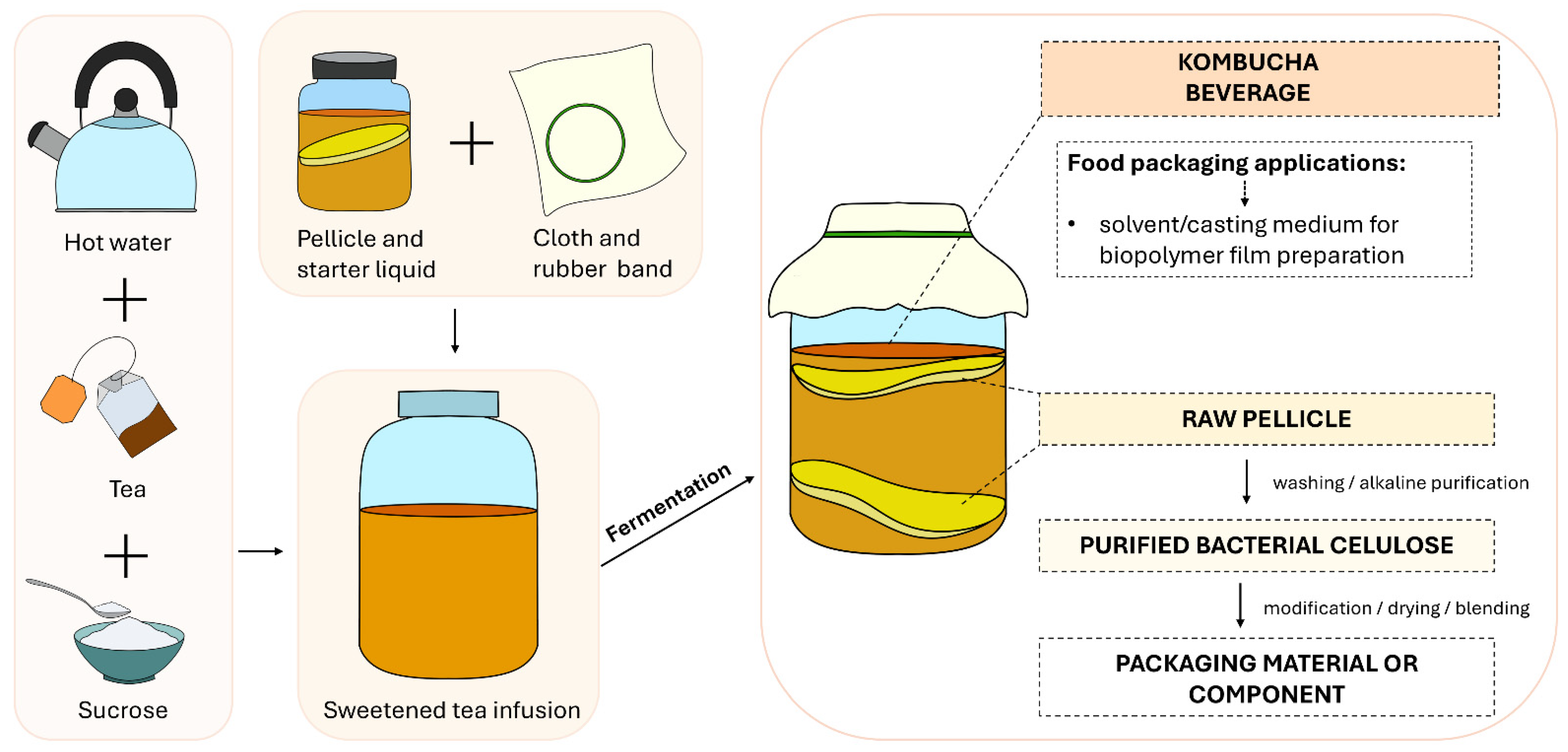
2. Fermentation and Formation of Bacterial Cellulose
2.1. Metabolic Interactions During Fermentation
2.2. Formation of the Bacterial Cellulose Pellicle
2.3. Effect of Process Parameters
2.4. Primary and Secondary Fermentation
2.5. From Raw Pellicle to Packaging Material
3. Chemical Composition and Properties of Kombucha
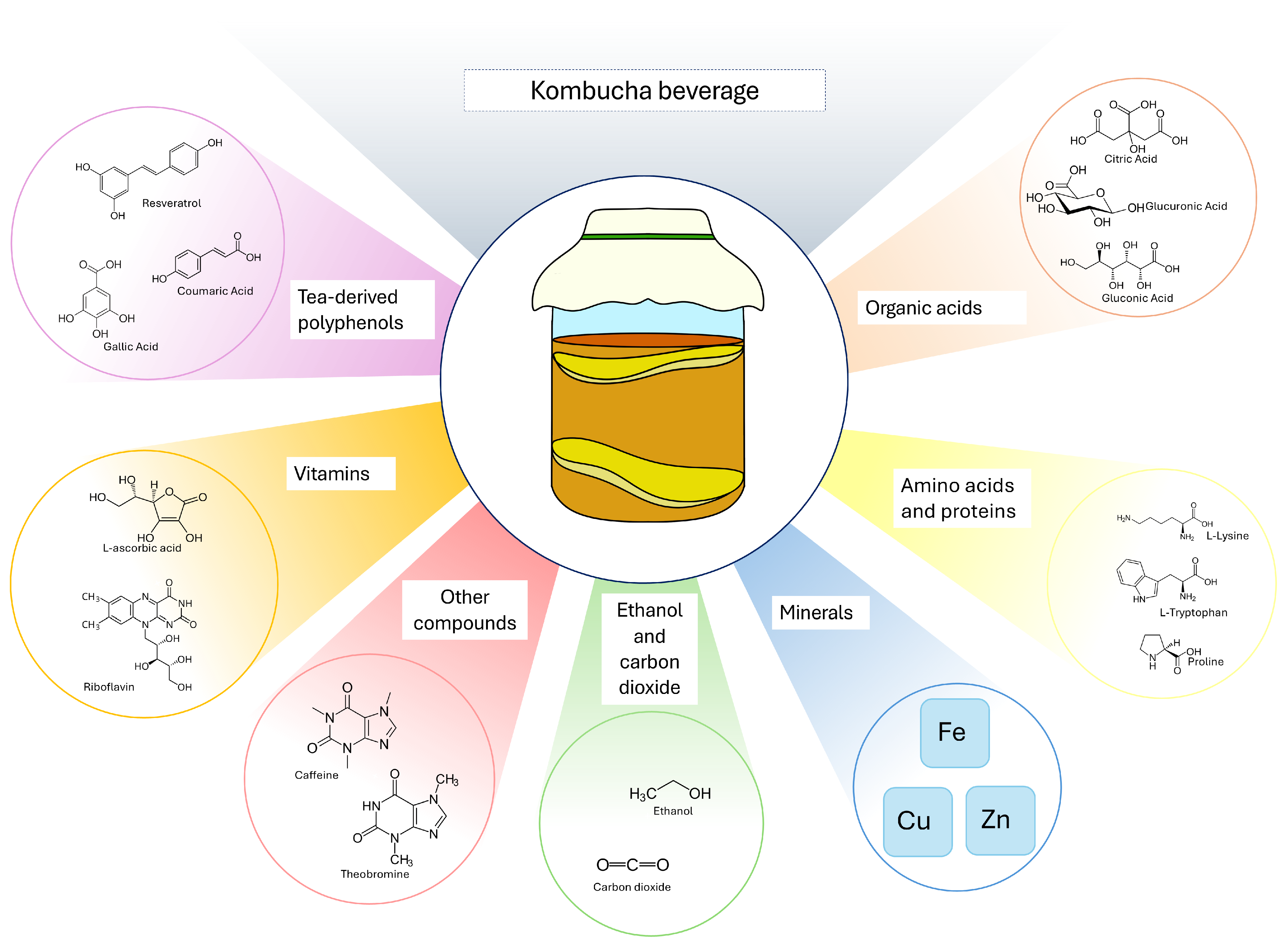
3.1. Chemical Composition and Bioactive Compounds of Kombucha and BC Pellicle for Biomaterial Applications
3.2. Antimicrobial and Antioxidant Properties Relevant to Packaging
3.3. Packaging-Relevant Water, Thermal and Migration Properties
4. Food Packaging Applications
5. Comparative Assessment of Production and Modification Strategies for Kombucha-Derived Bacterial Cellulose
6. Comparison with Conventional Packaging Polymers
7. Research Gaps, Limitations and Future Directions of Kombucha-Based Packaging
7.1. Scalability and Standardisation
7.2. Techno-Economic Feasibility
7.3. Food-Contact Safety and Regulatory Requirements
7.4. Performance Under Realistic Storage and Distribution Conditions
7.5. Consumer Acceptance and Market Launch
8. Biodegradability and End-of-Life Considerations of KBC
9. Conclusions
Author Contributions
Funding
Data Availability Statement
Conflicts of Interest
References
- Sreeramulu, G.; Zhu, Y.; Knol, W. Kombucha fermentation and its antimicrobial activity. J. Agric. Food Chem. 2000, 48, 2589–2594. [Google Scholar] [CrossRef] [Scilit] [PubMed]
- Bishop, P.; Pitts, E.R.; Budner, D.; Thompson-Witrick, K.A. Kombucha: Biochemical and microbiological impacts on the chemical and flavor profile. Food Chem. Adv. 2022, 1, 100025. [Google Scholar] [CrossRef] [Scilit]
- Jayabalan, R.; Malbaša, R.V.; Lončar, E.S.; Vitas, J.S.; Sathishkumar, M. A review on kombucha tea—Microbiology, composition, fermentation, beneficial effects, toxicity, and tea fungus. Compr. Rev. Food Sci. Food Saf. 2014, 13, 538–550. [Google Scholar] [CrossRef] [Scilit] [PubMed]
- Ramírez Tapias, Y.A.; Peltzer, M.A.; Delgado, J.F.; Salvay, A.G. Kombucha tea by-product as source of novel materials: Formulation and characterization of films. Food Bioprocess Technol. 2020, 13, 1166–1180. [Google Scholar] [CrossRef] [Scilit]
- Jarrell, J.; Cal, T.; Bennett, J. The kombucha consortia of yeasts and bacteria. Mycologist 2000, 14, 166–170. [Google Scholar] [CrossRef] [Scilit]
- Alves, R.O.; Monteiro, A.L.B.; da Silva, C.M.; da Silva, T.M.S.; de Oliveira, R.L.; Porto, C.S.; Porto, T.S. Investigation of the Influence of Different Camellia sinensis Teas on Kombucha Fermentation and Development of Flavored Kombucha with Brazilian Fruits. Beverages 2025, 11, 13. [Google Scholar] [CrossRef] [Scilit]
- Tran, T.; Grandvalet, C.; Winckler, P.; Verdier, F.; Martin, A.; Alexandre, H.; Tourdot-Maréchal, R. Shedding light on the formation and structure of kombucha biofilm using two-photon fluorescence microscopy. Front. Microbiol. 2021, 12, 725379. [Google Scholar] [CrossRef] [Scilit] [PubMed]
- Chakravorty, S.; Bhattacharya, S.; Chatzinotas, A.; Chakraborty, W.; Bhattacharya, D.; Gachhui, R. Kombucha tea fermentation: Microbial and biochemical dynamics. Int. J. Food Microbiol. 2016, 220, 63–72. [Google Scholar] [CrossRef] [Scilit] [PubMed]
- Tran, T.; Grandvalet, C.; Verdier, F.; Martin, A.; Alexandre, H.; Tourdot-Maréchal, R. Microbiological and technological parameters impacting the chemical composition and sensory quality of kombucha. Compr. Rev. Food Sci. Food Saf. 2020, 19, 2050–2070. [Google Scholar] [CrossRef] [Scilit] [PubMed]
- Amarasekara, A.S.; Shrestha, A.B.; Wang, D. Chemical modifications of kombucha SCOBY bacterial cellulose films by citrate and carbamate cross-linking. Carbohydr. Polym. Technol. Appl. 2024, 8, 100595. [Google Scholar] [CrossRef] [Scilit]
- Dima, S.-O.; Panaitescu, D.-M.; Orban, C.; Ghiurea, M.; Doncea, S.-M.; Fierascu, R.C.; Nistor, C.L.; Alexandrescu, E.; Nicolae, C.-A.; Trică, B. Bacterial nanocellulose from side-streams of kombucha beverages production: Preparation and physical-chemical properties. Polymers 2017, 9, 374. [Google Scholar] [CrossRef] [Scilit] [PubMed]
- Cazón, P.; Velázquez, G.; Vázquez, M. Characterization of bacterial cellulose films combined with chitosan and polyvinyl alcohol: Evaluation of mechanical and barrier properties. Carbohydr. Polym. 2019, 216, 72–85. [Google Scholar] [CrossRef] [Scilit] [PubMed]
- Cazón, P.; Vazquez, M.; Velazquez, G. Environmentally friendly films combining bacterial cellulose, chitosan, and polyvinyl alcohol: Effect of water activity on barrier, mechanical, and optical properties. Biomacromolecules 2019, 21, 753–760. [Google Scholar] [CrossRef] [Scilit] [PubMed]
- Jiang, Z.; Cheung, K.M.; Ngai, T. Development of strong and high-barrier food packaging films from cyclic-anhydride modified bacterial cellulose. RSC Sustain. 2024, 2, 139–152. [Google Scholar] [CrossRef] [Scilit]
- Bortolomedi, B.M.; Paglarini, C.S.; Brod, F.C.A. Bioactive compounds in kombucha: A review of substrate effect and fermentation conditions. Food Chem. 2022, 385, 132719. [Google Scholar] [CrossRef] [Scilit] [PubMed]
- Jakubczyk, K.; Kupnicka, P.; Melkis, K.; Mielczarek, O.; Walczyńska, J.; Chlubek, D.; Janda-Milczarek, K. Effects of fermentation time and type of tea on the content of micronutrients in kombucha fermented tea. Nutrients 2022, 14, 4828. [Google Scholar] [CrossRef] [Scilit] [PubMed]
- Dartora, B.; Hickert, L.R.; Fabricio, M.F.; Ayub, M.A.Z.; Furlan, J.M.; Wagner, R.; Perez, K.J.; Sant’Anna, V. Understanding the effect of fermentation time on physicochemical characteristics, sensory attributes, and volatile compounds in green tea kombucha. Food Res. Int. 2023, 174, 113569. [Google Scholar] [CrossRef] [Scilit] [PubMed]
- Phung, L.T.; Kitwetcharoen, H.; Chamnipa, N.; Boonchot, N.; Thanonkeo, S.; Tippayawat, P.; Klanrit, P.; Yamada, M.; Thanonkeo, P. Changes in the chemical compositions and biological properties of kombucha beverages made from black teas and pineapple peels and cores. Sci. Rep. 2023, 13, 7859. [Google Scholar] [CrossRef] [Scilit] [PubMed]
- Amarasekara, A.S.; Wang, D.; Grady, T.L. A comparison of kombucha SCOBY bacterial cellulose purification methods. SN Appl. Sci. 2020, 2, 240. [Google Scholar] [CrossRef] [Scilit]
- Doğan, N. Native bacterial cellulose films based on kombucha pellicle as a potential active food packaging. J. Food Sci. Technol. 2023, 60, 2893–2904. [Google Scholar] [CrossRef] [Scilit] [PubMed]
- Martínez Leal, J.; Valenzuela Suárez, L.; Jayabalan, R.; Huerta Oros, J.; Escalante-Aburto, A. A review on health benefits of kombucha nutritional compounds and metabolites. CyTA-J. Food 2018, 16, 390–399. [Google Scholar] [CrossRef] [Scilit]
- Villarreal-Soto, S.A.; Beaufort, S.; Bouajila, J.; Souchard, J.P.; Taillandier, P. Understanding kombucha tea fermentation: A review. J. Food Sci. 2018, 83, 580–588. [Google Scholar] [CrossRef] [Scilit] [PubMed]
- Cazón, P.; Vázquez, M. Bacterial cellulose as a biodegradable food packaging material: A review. Food Hydrocoll. 2021, 113, 106530. [Google Scholar] [CrossRef] [Scilit]
- Azeredo, H.M.; Barud, H.; Farinas, C.S.; Vasconcellos, V.M.; Claro, A.M. Bacterial cellulose as a raw material for food and food packaging applications. Front. Sustain. Food Syst. 2019, 3, 7. [Google Scholar] [CrossRef] [Scilit]
- De Roos, J.; De Vuyst, L. Acetic acid bacteria in fermented foods and beverages. Curr. Opin. Biotechnol. 2018, 49, 115–119. [Google Scholar] [CrossRef] [Scilit] [PubMed]
- Marsh, A.J.; Hill, C.; Ross, R.P.; Cotter, P.D. Fermented beverages with health-promoting potential: Past and future perspectives. Trends Food Sci. Technol. 2014, 38, 113–124. [Google Scholar] [CrossRef] [Scilit]
- Coton, M.; Pawtowski, A.; Taminiau, B.; Burgaud, G.; Deniel, F.; Coulloumme-Labarthe, L.; Fall, A.; Daube, G.; Coton, E. Unraveling microbial ecology of industrial-scale Kombucha fermentations by metabarcoding and culture-based methods. FEMS Microbiol. Ecol. 2017, 93, fix048. [Google Scholar] [CrossRef] [Scilit] [PubMed]
- de Miranda, J.F.; Belo, G.M.P.; de Lima, L.S.; Silva, K.A.; Uekane, T.M.; Gonzalez, A.G.M.; Branco, V.N.C.; Pitangui, N.S.; Fernandes, F.F.; Lima, A.R. Arabic coffee infusion based kombucha: Characterization and biological activity during fermentation, and in vivo toxicity. Food Chem. 2023, 412, 135556. [Google Scholar] [CrossRef] [Scilit] [PubMed]
- Gaggìa, F.; Baffoni, L.; Galiano, M.; Nielsen, D.S.; Jakobsen, R.R.; Castro-Mejía, J.L.; Bosi, S.; Truzzi, F.; Musumeci, F.; Dinelli, G. Kombucha beverage from green, black and rooibos teas: A comparative study looking at microbiology, chemistry and antioxidant activity. Nutrients 2018, 11, 1. [Google Scholar] [CrossRef] [Scilit] [PubMed]
- Lončar, E.S.; Malbaša, R.V.; Kolarov, L.A. Kombucha fermentation on raw extracts of different cultivars of Jerusalem artichoke. Acta Period. Technol. 2007, 38, 37–44. [Google Scholar] [CrossRef] [Scilit]
- Yavari, N.; Assadi, M.M.; Larijani, K.; Moghadam, M.B. Response surface methodology for optimization of glucuronic acid production using kombucha layer on sour cherry juice. Aust. J. Basic Appl. Sci. 2010, 4, 3250–3256. [Google Scholar]
- Yavari, N.; Mazaheri-Assadi, M.; Mazhari, Z.H.; Moghadam, M.B.; Larijani, K. Glucuronic acid rich kombucha-fermented pomegranate juice. J. Food Res. 2018, 7, 61. [Google Scholar] [CrossRef] [Scilit]
- Jones, M.; Chambers, C.; Krost, P. Seaweed kombucha: Exploring innovation in marine resources in Iceland. Int. J. Gastron. Food Sci. 2025, 40, 101145. [Google Scholar] [CrossRef] [Scilit]
- Sievers, M.; Lanini, C.; Weber, A.; Schuler-Schmid, U.; Teuber, M. Microbiology and fermentation balance in a kombucha beverage obtained from a tea fungus fermentation. Syst. Appl. Microbiol. 1995, 18, 590–594. [Google Scholar] [CrossRef] [Scilit]
- Laureys, D.; Britton, S.J.; De Clippeleer, J. Kombucha tea fermentation: A review. J. Am. Soc. Brew. Chem. 2020, 78, 165–174. [Google Scholar] [CrossRef] [Scilit]
- Wang, B.; Rutherfurd-Markwick, K.; Zhang, X.-X.; Mutukumira, A.N. Kombucha: Production and microbiological research. Foods 2022, 11, 3456. [Google Scholar] [CrossRef] [Scilit] [PubMed]
- Dartora, B.; Voltaire, S.A.; Hickert, L.R.; Fensterseifer, M.; Ayub, M.A.Z.; Flôres, S.H.; Perez, K.J. Factors influencing kombucha production: Effects of tea composition, sugar, and SCOBY. Food Sci. Technol. 2023, 43. [Google Scholar] [CrossRef] [Scilit]
- Bimmer, M.; Mientus, M.; Klingl, A.; Ehrenreich, A.; Liebl, W. The roles of the various cellulose biosynthesis operons in Komagataeibacter hansenii ATCC 23769. Appl. Environ. Microbiol. 2022, 88, e02460-21. [Google Scholar] [CrossRef] [Scilit] [PubMed]
- Gullo, M.; La China, S.; Falcone, P.M.; Giudici, P. Biotechnological production of cellulose by acetic acid bacteria: Current state and perspectives. Appl. Microbiol. Biotechnol. 2018, 102, 6885–6898. [Google Scholar] [CrossRef] [Scilit] [PubMed]
- Lee, C.M.; Gu, J.; Kafle, K.; Catchmark, J.; Kim, S.H. Cellulose produced by Gluconacetobacter xylinus strains ATCC 53524 and ATCC 23768: Pellicle formation, post-synthesis aggregation and fiber density. Carbohydr. Polym. 2015, 133, 270–276. [Google Scholar] [CrossRef] [Scilit] [PubMed]
- Schramm, M.; Hestrin, S. Factors affecting production of cellulose at the air/liquid interface of a culture of Acetobacter xylinum. Microbiology 1954, 11, 123–129. [Google Scholar] [CrossRef] [Scilit] [PubMed]
- Ryngajłło, M.; Jacek, P.; Cielecka, I.; Kalinowska, H.; Bielecki, S. Effect of ethanol supplementation on the transcriptional landscape of bionanocellulose producer Komagataeibacter xylinus E25. Appl. Microbiol. Biotechnol. 2019, 103, 6673–6688. [Google Scholar] [CrossRef] [Scilit] [PubMed]
- Verschuren, P.G.; Cardona, T.D.; Nout, M.R.; De Gooijer, K.D.; Van den Heuvel, J.C. Location and limitation of cellulose production by Acetobacter xylinum established from oxygen profiles. J. Biosci. Bioeng. 2000, 89, 414–419. [Google Scholar] [CrossRef] [Scilit] [PubMed]
- Vitas, J.S.; Malbaša, R.V.; Grahovac, J.A.; Lončar, E.S. The antioxidant activity of kombucha fermented milk products with stinging nettle and winter savory. Chem. Ind. Chem. Eng. Q. 2013, 19, 129–139. [Google Scholar] [CrossRef] [Scilit]
- Watawana, M.I.; Jayawardena, N.; Gunawardhana, C.B.; Waisundara, V.Y. Health, Wellness, and Safety Aspects of the Consumption of Kombucha. J. Chem. 2015, 2015, 591869. [Google Scholar] [CrossRef] [Scilit]
- Neffe-Skocińska, K.; Sionek, B.; Ścibisz, I.; Kołożyn-Krajewska, D. Acid contents and the effect of fermentation condition of Kombucha tea beverages on physicochemical, microbiological and sensory properties. Cyta-J. Food 2017, 15, 601–607. [Google Scholar] [CrossRef] [Scilit]
- Lončar, E.; Djurić, M.; Malbaša, R.; Kolarov, L.; Klašnja, M. Influence of working conditions upon kombucha conducted fermentation of black tea. Food Bioprod. Process. 2006, 84, 186–192. [Google Scholar] [CrossRef] [Scilit]
- Crum, H.; LaGory, A. The Big Book of Kombucha: Brewing, Flavoring, and Enjoying the Health Benefits of Fermented Tea; Storey Publishing: North Adams, MA, USA, 2016. [Google Scholar]
- Coelho, R.M.D.; de Almeida, A.L.; do Amaral, R.Q.G.; da Mota, R.N.; de Sousa, P.H.M. Kombucha. Int. J. Gastron. Food Sci. 2020, 22, 100272. [Google Scholar]
- Nummer, B.A. SPECIAL REPORT: Kombucha brewing under the Food and Drug Administration Model Food Code: Risk analysis and processing guidance. J. Environ. Health 2013, 76, 8–11. [Google Scholar] [PubMed]
- de Miranda, J.F.; Ruiz, L.F.; Silva, C.B.; Uekane, T.M.; Silva, K.A.; Gonzalez, A.G.M.; Fernandes, F.F.; Lima, A.R. Kombucha: A review of substrates, regulations, composition, and biological properties. J. Food Sci. 2022, 87, 503–527. [Google Scholar] [CrossRef] [Scilit] [PubMed]
- Sharifudin, S.A.; Ho, W.Y.; Yeap, S.K.; Abdullah, R.; Koh, S.P. Fermentation and characterisation of potential kombucha cultures on papaya-based substrates. LWT 2021, 151, 112060. [Google Scholar] [CrossRef] [Scilit]
- Chong, A.Q.; Chin, N.L.; Talib, R.A.; Basha, R.K. Modelling pH Dynamics, SCOBY Biomass Formation, and Acetic Acid Production of Kombucha Fermentation Using Black, Green, and Oolong Teas. Processes 2024, 12, 1301. [Google Scholar] [CrossRef] [Scilit]
- Muhialdin, B.; Osman, F.; Muhamad, R.; Che Wan Sapawi, C.; Anzian, A.; Voon, W.; Hussin, A. Effects of sugar sources and fermentation time on the properties of tea fungus (kombucha) beverage. Int. Food Res. J. 2019, 26, 481. [Google Scholar]
- Hammel, R.; Karakilic, V.; Shaw, F. The affect of temperature and pH on the food safety of kombucha tea. BCIT Environ. Public Health J. 2016. [Google Scholar] [CrossRef] [Scilit]
- Batista, P.; Penas, M.R.; Pintado, M.; Oliveira-Silva, P. Kombucha: Perceptions and future prospects. Foods 2022, 11, 1977. [Google Scholar] [CrossRef] [Scilit] [PubMed]
- Laavanya, D.; Shirkole, S.; Balasubramanian, P. Current challenges, applications and future perspectives of SCOBY cellulose of Kombucha fermentation. J. Clean. Prod. 2021, 295, 126454. [Google Scholar] [CrossRef] [Scilit]
- Watanabe, K.; Tabuchi, M.; Morinaga, Y.; Yoshinaga, F. Structural features and properties of bacterial cellulose produced in agitated culture. Cellulose 1998, 5, 187–200. [Google Scholar] [CrossRef] [Scilit]
- Krystynowicz, A.; Czaja, W.; Wiktorowska-Jezierska, A.; Gonçalves-Miśkiewicz, M.; Turkiewicz, M.; Bielecki, S. Factors affecting the yield and properties of bacterial cellulose. J. Ind. Microbiol. Biotechnol. 2002, 29, 189–195. [Google Scholar] [CrossRef] [Scilit] [PubMed]
- Mikkelsen, D.; Flanagan, B.M.; Dykes, G.; Gidley, M. Influence of different carbon sources on bacterial cellulose production by Gluconacetobacter xylinus strain ATCC 53524. J. Appl. Microbiol. 2009, 107, 576–583. [Google Scholar] [CrossRef] [Scilit] [PubMed]
- Ramana, K.; Tomar, A.; Singh, L. Effect of various carbon and nitrogen sources on cellulose synthesis by Acetobacter xylinum. World J. Microbiol. Biotechnol. 2000, 16, 245–248. [Google Scholar] [CrossRef] [Scilit]
- Suffys, S.; Richard, G.; Burgeon, C.; Werrie, P.-Y.; Haubruge, E.; Fauconnier, M.-L.; Goffin, D. Characterization of aroma active compound production during kombucha fermentation: Towards the control of sensory profiles. Foods 2023, 12, 1657. [Google Scholar] [CrossRef] [Scilit] [PubMed]
- Leite, P.M.S.C.M.; Vieira, A.A.; Faria, A.C.; Vieira, L. Effect of water and alkali on purification bacterial cellulose membrane from Kombucha. Res. Soc. Dev. 2021, 10, e526101523267. [Google Scholar] [CrossRef] [Scilit]
- Alkan, G.; Konar Erol, N.M.; Yıkmış, S.; Er, H.; Öğüt, S.; Yinanç, A. Kombucha’s functional features and fermentation dynamics: A bibliometric assessment in sustainable food production. Front. Sustain. Food Syst. 2025, 9, 1593348. [Google Scholar] [CrossRef] [Scilit]
- Jakubczyk, K.; Kałduńska, J.; Kochman, J.; Janda, K. Chemical Profile and Antioxidant Activity of the Kombucha Beverage Derived from White, Green, Black and Red Tea. Antioxidants 2020, 9, 447. [Google Scholar] [CrossRef] [Scilit] [PubMed]
- Aung, T.; Eun, J.-B. Impact of time and temperature on the physicochemical, microbiological, and nutraceutical properties of laver kombucha (Porphyra dentata) during fermentation. LWT 2022, 154, 112643. [Google Scholar] [CrossRef] [Scilit]
- Sittisart, P.; Mahidsanan, T.; Yuvanatemiya, V.; Srinamngoen, P. Technological quality and fungal community of Kombucha fermented with hemp leaves and milky mushroom flour (Calocybe indica). PeerJ 2024, 12, e18116. [Google Scholar] [CrossRef] [Scilit] [PubMed]
- Bishop, P.; Pitts, E.R.; Budner, D.; Thompson-Witrick, K.A. Chemical Composition of Kombucha. Beverages 2022, 8, 45. [Google Scholar] [CrossRef] [Scilit]
- Mitra, S.; Paul, S.; Roy, S.; Sutradhar, H.; Bin Emran, T.; Nainu, F.; Khandaker, M.U.; Almalki, M.; Wilairatana, P.; Mubarak, M.S. Exploring the immune-boosting functions of vitamins and minerals as nutritional food bioactive compounds: A comprehensive review. Molecules 2022, 27, 555. [Google Scholar] [CrossRef] [Scilit] [PubMed]
- Ofoedu, C.E.; Iwouno, J.O.; Ofoedu, E.O.; Ogueke, C.C.; Igwe, V.S.; Agunwah, I.M.; Ofoedum, A.F.; Chacha, J.S.; Muobike, O.P.; Agunbiade, A.O. Revisiting food-sourced vitamins for consumer diet and health needs: A perspective review, from vitamin classification, metabolic functions, absorption, utilization, to balancing nutritional requirements. PeerJ 2021, 9, e11940. [Google Scholar] [CrossRef] [Scilit] [PubMed]
- Kelly, B.; Pearce, E.L. Amino assets: How amino acids support immunity. Cell Metab. 2020, 32, 154–175. [Google Scholar] [CrossRef] [Scilit] [PubMed]
- Patel, R.H.; Mohiuddin, S.S. Biochemistry, Histamine; StatPearls Publishing: Treasure Island, FL, USA, 2020. [Google Scholar]
- Cruzat, V.; Macedo Rogero, M.; Noel Keane, K.; Curi, R.; Newsholme, P. Glutamine: Metabolism and immune function, supplementation and clinical translation. Nutrients 2018, 10, 1564. [Google Scholar] [CrossRef] [Scilit] [PubMed]
- Massoud, R.; Jafari-Dastjerdeh, R.; Naghavi, N.; Khosravi-Darani, K. All aspects of antioxidant properties of kombucha drink. Biointerface Res. Appl. Chem. 2022, 12, 4018–4027. [Google Scholar] [CrossRef] [Scilit]
- Yan, Z.; Zhong, Y.; Duan, Y.; Chen, Q.; Li, F. Antioxidant mechanism of tea polyphenols and its impact on health benefits. Anim. Nutr. 2020, 6, 115–123. [Google Scholar] [CrossRef] [Scilit] [PubMed]
- Ivanišová, E.; Meňhartová, K.; Terentjeva, M.; Harangozo, Ľ.; Kántor, A.; Kačániová, M. The evaluation of chemical, antioxidant, antimicrobial and sensory properties of kombucha tea beverage. J. Food Sci. Technol. 2020, 57, 1840–1846. [Google Scholar] [CrossRef] [Scilit] [PubMed]
- Goławska, S.; Łukasik, I.; Chojnacki, A.A.; Chrzanowski, G. Flavonoids and phenolic acids content in cultivation and wild collection of European cranberry bush Viburnum opulus L. Molecules 2023, 28, 2285. [Google Scholar] [CrossRef] [Scilit] [PubMed]
- Ghasemzadeh, A.; Ghasemzadeh, N. Flavonoids and phenolic acids: Role and biochemical activity in plants and human. J. Med. Plants Res. 2011, 5, 6697–6703. [Google Scholar] [CrossRef] [Scilit]
- Lin, D.; Xiao, M.; Zhao, J.; Li, Z.; Xing, B.; Li, X.; Kong, M.; Li, L.; Zhang, Q.; Liu, Y. An overview of plant phenolic compounds and their importance in human nutrition and management of type 2 diabetes. Molecules 2016, 21, 1374. [Google Scholar] [CrossRef] [Scilit] [PubMed]
- Oluwole, O.; Fernando, W.B.; Lumanlan, J.; Ademuyiwa, O.; Jayasena, V. Role of phenolic acid, tannins, stilbenes, lignans and flavonoids in human health–a review. Int. J. Food Sci. Technol. 2022, 57, 6326–6335. [Google Scholar] [CrossRef] [Scilit]
- Ciupei, D.; Colişar, A.; Leopold, L.; Stănilă, A.; Diaconeasa, Z.M. Polyphenols: From classification to therapeutic potential and bioavailability. Foods 2024, 13, 4131. [Google Scholar] [CrossRef] [Scilit] [PubMed]
- Zhou, D.-D.; Saimaiti, A.; Luo, M.; Huang, S.-Y.; Xiong, R.-G.; Shang, A.; Gan, R.-Y.; Li, H.-B. Fermentation with tea residues enhances antioxidant activities and polyphenol contents in kombucha beverages. Antioxidants 2022, 11, 155. [Google Scholar] [CrossRef] [Scilit] [PubMed]
- Sen, G.; Sarkar, N.; Nath, M.; Maity, S. Bioactive components of tea. Arch. Food Nutr. Sci. 2020, 4, 001–009. [Google Scholar] [CrossRef] [Scilit]
- Valdés, A.; Mellinas, A.; Ramos, M.; Burgos, N.; Jiménez, A.; Garrigós, M.d.C. Use of herbs, spices and their bioactive compounds in active food packaging. RSC Adv. 2015, 5, 40324–40335. [Google Scholar] [CrossRef] [Scilit]
- Tapias, Y.A.R.; Di Monte, M.V.; Peltzer, M.A.; Salvay, A.G. Bacterial cellulose films production by Kombucha symbiotic community cultured on different herbal infusions. Food Chem. 2022, 372, 131346. [Google Scholar] [CrossRef] [Scilit] [PubMed]
- Chandran, A.; Wyka, J.; Klein, G.-R.; Stefanska, B.; Kolniak-Ostek, J. Shaping the Bioactive Properties of Kombucha Drinks by Using Raw Materials Alternative to Tea. Molecules 2026, 31, 1170. [Google Scholar] [CrossRef] [Scilit] [PubMed]
- Jayabalan, R.; Marimuthu, S.; Swaminathan, K. Changes in content of organic acids and tea polyphenols during kombucha tea fermentation. Food Chem. 2007, 102, 392–398. [Google Scholar] [CrossRef] [Scilit]
- Wang, D. Purification and Pyrolysis of Bacterial Cellulose from Kombucha Pellicle. Master’s Thesis, Prairie View A&M University, Prairie View, TX, USA, 2020. [Google Scholar]
- El-Gendi, H.; Taha, T.H.; Ray, J.B.; Saleh, A.K. Recent advances in bacterial cellulose: A low-cost effective production media, optimization strategies and applications. Cellulose 2022, 29, 7495–7533. [Google Scholar] [CrossRef] [Scilit]
- Stefanowska, K.; Woźniak, M.; Majka, J.; Sip, A.; Mrówczyńska, L.; Waśkiewicz, A.; Kozak, W.; Dobrucka, R.; Ratajczak, I. A new approach to obtain chitosan films–Characteristics of films prepared with tea and coffee kombucha as natural chitosan solvents. Ind. Crops Prod. 2023, 197, 116634. [Google Scholar] [CrossRef] [Scilit]
- Savary, O.; Mounier, J.; Thierry, A.; Poirier, E.; Jourdren, J.; Maillard, M.-B.; Penland, M.; Decamps, C.; Coton, E.; Coton, M. Tailor-made microbial consortium for Kombucha fermentation: Microbiota-induced biochemical changes and biofilm formation. Food Res. Int. 2021, 147, 110549. [Google Scholar] [CrossRef] [Scilit] [PubMed]
- Zhang, W.; Jiang, Q.; Shen, J.; Gao, P.; Yu, D.; Xu, Y.; Xia, W. The role of organic acid structures in changes of physicochemical and antioxidant properties of crosslinked chitosan films. Food Packag. Shelf Life 2022, 31, 100792. [Google Scholar] [CrossRef] [Scilit]
- Kaewkod, T.; Bovonsombut, S.; Tragoolpua, Y. Efficacy of kombucha obtained from green, oolong, and black teas on inhibition of pathogenic bacteria, antioxidation, and toxicity on colorectal cancer cell line. Microorganisms 2019, 7, 700. [Google Scholar] [CrossRef] [Scilit] [PubMed]
- Hernández, M.S.; Ludueña, L.N.; Flores, S.K. Citric acid, chitosan and oregano essential oil impact on physical and antimicrobial properties of cassava starch films. Carbohydr. Polym. Technol. Appl. 2023, 5, 100307. [Google Scholar] [CrossRef] [Scilit]
- Malbaša, R.; Lončar, E.; Djurić, M. Comparison of the products of Kombucha fermentation on sucrose and molasses. Food Chem. 2008, 106, 1039–1045. [Google Scholar] [CrossRef] [Scilit]
- Ouattara, B.; Simard, R.; Piette, G.; Begin, A.; Holley, R. Diffusion of acetic and propionic acids from chitosan-based antimicrobial packaging films. J. Food Sci. 2000, 65, 768–773. [Google Scholar] [CrossRef] [Scilit]
- Novitasari, H.; Suryani, T. Antioxidant Activity, Vitamin C, and Organoleptic Quality of Flower Kecombrang (Etlinger elatior) Kombucha on Variations of Sugar Types and Fermentation Duration. Biosci. J. Ilm. Biol. 2025, 13, 694–702. [Google Scholar] [CrossRef] [Scilit]
- Sanwal, N.; Gupta, A.; Bareen, M.A.; Sharma, N.; Sahu, J.K. Kombucha fermentation: Recent trends in process dynamics, functional bioactivities, toxicity management, and potential applications. Food Chem. Adv. 2023, 3, 100421. [Google Scholar] [CrossRef] [Scilit]
- Tandhanskul, A.; Krungkaew, S.; Li, L.; Kham, S.A.; Yonekura, L. Kombucha as a Sustainable Source of Metabiotics: Potential, Applications, and Future Perspectives. Beverages 2025, 11, 173. [Google Scholar] [CrossRef] [Scilit]
- Čakić Semenčić, M.; Biedrzycka, A.; Kiczor, A.; Beluhan, S.; Šupljika, F. Spectrofluorimetric Analysis of Riboflavin Content during Kombucha Fermentation. BioTech 2024, 13, 20. [Google Scholar] [CrossRef] [Scilit] [PubMed]
- Yessy, H.Y.; Titik, T.S. Antioxidant Activity and Organoleptic Quality of Yellow Marigold Flower Kombucha (Tagetes erecta L.) on the Variations of Sugar Type and Fermentation Duration. AL-Hayat J. Biol. Appl. Biol. 2025, 8, 39–48. [Google Scholar] [CrossRef] [Scilit]
- Jayabalan, R.; Malini, K.; Sathishkumar, M.; Swaminathan, K.; Yun, S.-E. Biochemical characteristics of tea fungus produced during kombucha fermentation. Food Sci. Biotechnol. 2010, 19, 843–847. [Google Scholar] [CrossRef] [Scilit]
- La Torre, C.; Plastina, P.; Cione, E.; Bekatorou, A.; Petsi, T.; Fazio, A. Improved Antioxidant Properties and Vitamin C and B12 Content from Enrichment of Kombucha with Jujube (Ziziphus jujuba Mill.) Powder. Fermentation 2024, 10, 295. [Google Scholar] [CrossRef] [Scilit]
- Treesuppharat, W.; Rojanapanthu, P.; Siangsanoh, C.; Manuspiya, H.; Ummartyotin, S. Synthesis and characterization of bacterial cellulose and gelatin-based hydrogel composites for drug-delivery systems. Biotechnol. Rep. 2017, 15, 84–91. [Google Scholar] [CrossRef] [Scilit] [PubMed]
- Wang, X.; Ullah, N.; Sun, X.; Guo, Y.; Chen, L.; Li, Z.; Feng, X. Development and characterization of bacterial cellulose reinforced biocomposite films based on protein from buckwheat distiller’s dried grains. Int. J. Biol. Macromol. 2017, 96, 353–360. [Google Scholar] [CrossRef] [Scilit] [PubMed]
- Hartono, A.; Palupi, K.S.; Putranto, R.-A.; Santini, A.; Nurkolis, F. Kombucha SCOBY as a Fermentation-Derived Biofilm Matrix: Species-Resolved Microbial Communities and Multidimensional In Vitro Bioactivities. Polymers 2026, 18, 764. [Google Scholar] [CrossRef] [Scilit] [PubMed]
- Ivanišová, E.; Meňhartová, K.; Terentjeva, M.; Godočíková, L.; Árvay, J.; Kačániová, M. Kombucha tea beverage: Microbiological characteristic, antioxidant activity, and phytochemical composition. Acta Aliment. 2019, 48, 324–331. [Google Scholar] [CrossRef] [Scilit]
- Agha, T.; Kati, A. Development of functional bacterial cellulose composites from Kombucha waste for biodegradable food packaging. Discov. Appl. Sci. 2025, 7, 840. [Google Scholar] [CrossRef] [Scilit]
- Oliver-Ortega, H.; Geng, S.; Espinach, F.X.; Oksman, K.; Vilaseca, F. Bacterial cellulose network from kombucha fermentation impregnated with emulsion-polymerized poly (methyl methacrylate) to form nanocomposite. Polymers 2021, 13, 664. [Google Scholar] [CrossRef] [Scilit] [PubMed]
- Santiago-Santiago, R.M.; Michel, M.R.; Rodríguez-Herrera, R.; Aguilar-Zárate, P.; Ascacio-Valdés, J.A.; Flores-Gallegos, A.C. Symbiotic Culture of Bacteria and Yeast (SCOBY) in the Food Sector as a Source of Polysaccharides and Other Applications in the Food Sector. Polysaccharides 2025, 6, 97. [Google Scholar] [CrossRef] [Scilit]
- Pecar, D.; Gorsek, A. The Influence of Kombucha Starter Culture Storage Time and Temperature on its Activation Rate and Quality of Fermented Beverage. Chem. Eng. Trans. 2022, 93, 7–12. [Google Scholar]
- Liu, X.; Jiang, Y.; Wei, Y.; Wei, X. Strengthening and toughening mechanisms induced by metal ion cross-linking in wet-drawn bacterial cellulose films. Mater. Des. 2022, 224, 111431. [Google Scholar] [CrossRef] [Scilit]
- Wurm, F.; Rietzler, B.; Pham, T.; Bechtold, T. Multivalent ions as reactive crosslinkers for biopolymers—A review. Molecules 2020, 25, 1840. [Google Scholar] [CrossRef] [Scilit] [PubMed]
- Knöller, A.; Widenmeyer, M.; Bill, J.; Burghard, Z. Fast-Growing Bacterial Cellulose with Outstanding Mechanical Properties via Cross-Linking by Multivalent Ions. Materials 2020, 13, 2838. [Google Scholar] [CrossRef] [Scilit] [PubMed]
- Pichaiaukrit, W.; Chanamuangkon, T.; Chumprasert, S.; Sae-ear, P.; Boonkrong, P.; Panaksri, A.; Tanadchangsaeng, N. Preparation and Characterization of Bacterial Cellulose–Polyvinyl Alcohol Composite Hydrogels Using ZnCl2 Hydrates as Solvent. Gels 2026, 12, 203. [Google Scholar] [CrossRef] [Scilit] [PubMed]
- Greenwalt, C.; Ledford, R.; Steinkraus, K. Determination and characterization of the antimicrobial activity of the fermented teakombucha. LWT-Food Sci. Technol. 1998, 31, 291–296. [Google Scholar] [CrossRef] [Scilit]
- Kluz, M.I.; Pietrzyk, K.; Pastuszczak, M.; Kacaniova, M.; Kita, A.; Kapusta, I.; Zaguła, G.; Zagrobelna, E.; Struś, K.; Marciniak-Lukasiak, K. Microbiological and physicochemical composition of various types of homemade kombucha beverages using alternative kinds of sugars. Foods 2022, 11, 1523. [Google Scholar] [CrossRef] [Scilit] [PubMed]
- Chu, S.-C.; Chen, C. Effects of origins and fermentation time on the antioxidant activities of kombucha. Food Chem. 2006, 98, 502–507. [Google Scholar] [CrossRef] [Scilit]
- Malbaša, R.V.; Lončar, E.S.; Vitas, J.S.; Čanadanović-Brunet, J.M. Influence of starter cultures on the antioxidant activity of kombucha beverage. Food Chem. 2011, 127, 1727–1731. [Google Scholar] [CrossRef] [Scilit]
- Nizioł-Łukaszewska, Z.; Ziemlewska, A.; Bujak, T.; Zagórska-Dziok, M.; Zarębska, M.; Hordyjewicz-Baran, Z.; Wasilewski, T. Effect of fermentation time on antioxidant and anti-ageing properties of green coffee kombucha ferments. Molecules 2020, 25, 5394. [Google Scholar] [CrossRef] [Scilit] [PubMed]
- Chong, H.L.; Cheung, K.M.; Jiang, Z.; Ngai, T. Surface Modification of Kombucha Bacterial Cellulose for High Water and Water Vapor Barrier: Enhanced Properties through Enzyme Etching and Cardanol-Silane Coating. Adv. Energy Sustain. Res. 2024, 5, 2300117. [Google Scholar] [CrossRef] [Scilit]
- Koreshkov, M.; Takatsuna, Y.; Bismarck, A.; Fritz, I.; Reimhult, E.; Zirbs, R. Sustainable food packaging using modified kombucha-derived bacterial cellulose nanofillers in biodegradable polymers. RSC Sustain. 2024, 2, 2367–2376. [Google Scholar] [CrossRef] [Scilit]
- Silva, F.A.S.; de Carvalho, T.B.; Dourado, F.; Gama, M.; Teixeira, P.; Poças, F. Performance of bacterial nanocellulose packaging film functionalised in situ with zinc oxide: Migration onto chicken skin and antimicrobial activity. Food Packag. Shelf Life 2023, 39, 101140. [Google Scholar] [CrossRef] [Scilit]
- Ashrafi, A.; Jokar, M.; Nafchi, A.M. Preparation and characterization of biocomposite film based on chitosan and kombucha tea as active food packaging. Int. J. Biol. Macromol. 2018, 108, 444–454. [Google Scholar] [CrossRef] [Scilit] [PubMed]
- Gagliardi, T.R.; de Farias Nascimento, A.; Valencia, G.A. Kombucha bacterial cellulose: A promising biopolymer for advanced food and nonfood applications. Foods 2025, 14, 738. [Google Scholar] [CrossRef] [Scilit] [PubMed]
- Li, F.; Zhang, F.; Chen, R.; Ma, Z.; Wu, H.; Zhang, Z.; Yin, S.; Zhou, M. Effects of High-Pressure Homogenization Treatment on the Development of Antioxidant Zanthoxylum bungeanum Leaf Powder Films for Preservation of Fresh-Cut Apple. Foods 2023, 13, 22. [Google Scholar] [CrossRef] [Scilit] [PubMed]
- Fatma, N.; Al-Shemy, M.T.; Dawwam, G.E. Multifunction smart nanocomposite film for food packaging based on carboxymethyl cellulose/Kombucha SCOBY/pomegranate anthocyanin pigment. Int. J. Biol. Macromol. 2023, 242, 125101. [Google Scholar] [CrossRef] [Scilit] [PubMed]
- Patil, S.V.; Dulait, K.; Shirkole, S.S.; Thorat, B.N.; Deshmukh, S.P. Dewatering and drying of Kombucha Bacterial Cellulose for preparation of biodegradable film for food packaging. Int. J. Biol. Macromol. 2024, 280, 136334. [Google Scholar] [CrossRef] [Scilit] [PubMed]
- Aduri, P.; Rao, K.A.; Fatima, A.; Kaul, P.; Shalini, A. Study of biodegradable packaging material produced from SCOBY. Res. J. Life Sci. Bioinform. Pharm. Chem. Sci. 2019, 5, 389. [Google Scholar]
- Sharma, C.; Bhardwaj, N.K.; Pathak, P. Static intermittent fed-batch production of bacterial nanocellulose from black tea and its modification using chitosan to develop antibacterial green packaging material. J. Clean. Prod. 2021, 279, 123608. [Google Scholar] [CrossRef] [Scilit]
- Stefanowska, K.; Woźniak, M.; Sip, A.; Biegańska-Marecik, R.; Dobrucka, R.; Ratajczak, I. Kombucha as a Solvent for Chitosan Coatings: A New Strategy to Extend Shelf Life of Red Peppers. Materials 2025, 18, 1605. [Google Scholar] [CrossRef] [Scilit] [PubMed]
- He, S.; Wu, Y.; Zhang, Y.; Luo, X.; Gibson, C.T.; Gao, J.; Jellicoe, M.; Wang, H.; Young, D.J.; Raston, C.L. Enhanced mechanical strength of vortex fluidic mediated biomass-based biodegradable films composed from agar, alginate and kombucha cellulose hydrolysates. Int. J. Biol. Macromol. 2023, 253, 127076. [Google Scholar] [CrossRef] [Scilit] [PubMed]
- Agüero, A.; Lascano, D.; Ivorra-Martinez, J.; Gómez-Caturla, J.; Arrieta, M.P.; Balart, R. Use of bacterial cellulose obtained from kombucha fermentation in spent coffee grounds for active composites based on PLA and maleinized linseed oil. Ind. Crops Prod. 2023, 202, 116971. [Google Scholar] [CrossRef] [Scilit]
- Moghadam, F.A.M. Kombucha fungus bio-coating for improving mechanical and antibacterial properties of cellulose composites. Mater. Today Commun. 2024, 40, 109609. [Google Scholar] [CrossRef] [Scilit]
- Márquez-Reyes, J.M.; Rodríguez-Quiroz, R.E.; Hernández-Rodríguez, J.P.; Rodríguez-Romero, B.A.; Flores-Breceda, H.; Napoles-Armenta, J.; Romero-Soto, I.C.; Galindo-Rodríguez, S.A.; Báez-González, J.G.; Treviño-Garza, M.Z. Production and Characterization of Biocomposite Films of Bacterial Cellulose from Kombucha and Coated with Chitosan. Polymers 2022, 14, 3632. [Google Scholar] [CrossRef] [Scilit] [PubMed]
- Agüero, Á.; Corral Perianes, E.; Abarca de las Muelas, S.S.; Lascano, D.; de la Fuente García-Soto, M.d.M.; Peltzer, M.A.; Balart, R.; Arrieta, M.P. Plasticized Mechanical Recycled PLA Films Reinforced with Microbial Cellulose Particles Obtained from Kombucha Fermented in Yerba Mate Waste. Polymers 2023, 15, 285. [Google Scholar] [CrossRef] [Scilit] [PubMed]
- Shiri, Z.; Pirsa, S.; Farzi, J. Eco-friendly biodegradable film based on kombucha mushroom/corn starch/parsley extract: Physicochemical and antioxidant/antibacterial properties. Food Sci. Nutr. 2024, 12, 7924–7937. [Google Scholar] [CrossRef] [Scilit] [PubMed]
- Arteaga-Ballesteros, B.E.; Guevara-Morales, A.; Martín-Martínez, E.S.; Figueroa-López, U.; Vieyra, H. Composite of polylactic acid and microcellulose from kombucha membranes. e-Polymers 2020, 21, 015–026. [Google Scholar] [CrossRef] [Scilit]
- Li, S.; Wang, X.; Luo, Y.; Chen, Z.; Yue, T.; Cai, R.; Muratkhan, M.; Zhao, Z.; Wang, Z. A green versatile packaging based on alginate and anthocyanin via incorporating bacterial cellulose nanocrystal-stabilized camellia oil Pickering emulsions. Int. J. Biol. Macromol. 2023, 249, 126134. [Google Scholar] [CrossRef] [Scilit] [PubMed]
- Kruk, M.; Trząskowska, M.; Ścibisz, I.; Pokorski, P. Application of the “SCOBY” and Kombucha Tea for the Production of Fermented Milk Drinks. Microorganisms 2021, 9, 123. [Google Scholar] [CrossRef] [Scilit] [PubMed]
- Susilowati, A.; Aspiyanto, A.; Lotulung, P.D.; Maryati, Y. Formulation of emulsion of soybean (Glycinia soyae L.) tempeh and fermented spinach (Amaranthus sp.) using combination of gelatin and CMC as thickener. Indones. J. Pharm. Sci. Technol. 2019, 6, 95–103. [Google Scholar] [CrossRef] [Scilit]
- Mohd Roby, B.H.; Muhialdin, B.J.; Abadl, M.M.T.; Mat Nor, N.A.; Marzlan, A.A.; Lim, S.A.H.; Mustapha, N.A.; Meor Hussin, A.S. Physical properties, storage stability, and consumer acceptability for sourdough bread produced using encapsulated kombucha sourdough starter culture. J. Food Sci. 2020, 85, 2286–2295. [Google Scholar] [CrossRef] [Scilit] [PubMed]
- Utoiu, E.; Oancea, A.; Stanciuc, A.-M.; Ştefan, L.M.; Toma, A.; Moraru, A.; Diguţa, C.F.; Matei, F.; Cornea, C.P.; Oancea, F. Prebiotic content and probiotic effect of kombucha fermented pollen. AgroLife Sci. J. 2018, 7. [Google Scholar] [CrossRef] [Scilit]
- Cazón, P.; Vázquez, M. Improving bacterial cellulose films by ex-situ and in-situ modifications: A review. Food Hydrocoll. 2021, 113, 106514. [Google Scholar] [CrossRef] [Scilit]
- Jiang, Z.; Shi, Z.; Cheung, K.M.; Ngai, T. Robust, flexible, and high-barrier films from bacterial cellulose modified by long-chain alkenyl succinic anhydrides. ACS Sustain. Chem. Eng. 2023, 11, 2486–2498. [Google Scholar] [CrossRef] [Scilit]
- Cheung, K.M.; Jiang, Z.; Ngai, T. Edible, strong, and low-hygroscopic bacterial cellulose derived from biosynthesis and physical modification for food packaging. J. Sci. Food Agric. 2023, 103, 6625–6639. [Google Scholar] [CrossRef] [Scilit] [PubMed]
- Jiang, A.; Patel, R.; Padhan, B.; Palimkar, S.; Galgali, P.; Adhikari, A.; Varga, I.; Patel, M. Chitosan based biodegradable composite for antibacterial food packaging application. Polymers 2023, 15, 2235. [Google Scholar] [CrossRef] [Scilit] [PubMed]
- Râpă;, M.; Miteluţ, A.C.; Tănase, E.E.; Grosu, E.; Popescu, P.; Popa, M.E.; Rosnes, J.T.; Sivertsvik, M.; Darie-Niţă, R.N.; Vasile, C. Influence of chitosan on mechanical, thermal, barrier and antimicrobial properties of PLA-biocomposites for food packaging. Compos. Part B Eng. 2016, 102, 112–121. [Google Scholar] [CrossRef] [Scilit]
- Absharina, D.; Putra, F.J.N.; Ogino, C.; Kocsubé, S.; Veres, C.; Vágvölgyi, C. Bacterial cellulose production in co-culture systems: Opportunities, challenges, and future directions. Appl. Microbiol. 2025, 5, 92. [Google Scholar] [CrossRef] [Scilit]
- Catarino, R.P.F.; Mascareli, V.A.B.; Leite da Costa, V.L.; Pavanello, A.C.L.; Spinosa, W.A. Sustainability and influencing factors in bacterial cellulose production: A review of the impact of microorganisms, culture media and cultivation methods. Food Technol. Biotechnol. 2025, 63, 332–350. [Google Scholar] [CrossRef] [Scilit] [PubMed]
- Belkozhayev, A.M.; Abaildayev, A.; Kossalbayev, B.D.; Tastambek, K.T.; Kadirshe, D.K.; Toleutay, G. Microbial Valorization of Agricultural and Agro-Industrial Waste into Bacterial Cellulose: Innovations for Circular Bioeconomy Integration. Microorganisms 2025, 13, 2686. [Google Scholar] [CrossRef] [Scilit] [PubMed]
- Infante-Neta, A.A.; D’Almeida, A.P.; Albuquerque, T.L.d. Bacterial Cellulose in Food Packaging: A Bibliometric Analysis and Review of Sustainable Innovations and Prospects. Processes 2024, 12, 1975. [Google Scholar] [CrossRef] [Scilit]
- Alizadeh-Sani, M.; Tavassoli, M.; McClements, D.J.; Hamishehkar, H. Multifunctional halochromic packaging materials: Saffron petal anthocyanin loaded-chitosan nanofiber/methyl cellulose matrices. Food Hydrocoll. 2021, 111, 106237. [Google Scholar] [CrossRef] [Scilit]
- Budtova, T.; Aguilera, D.A.; Beluns, S.; Berglund, L.; Chartier, C.; Espinosa, E.; Gaidukovs, S.; Klimek-Kopyra, A.; Kmita, A.; Lachowicz, D. Biorefinery approach for aerogels. Polymers 2020, 12, 2779. [Google Scholar] [CrossRef] [Scilit] [PubMed]
- Sozcu, S.; Venkataraman, M.; Wiener, J.; Tomkova, B.; Militky, J.; Mahmood, A. Incorporation of Cellulose-Based Aerogels into Textile Structures. Materials 2023, 17, 27. [Google Scholar] [CrossRef] [Scilit] [PubMed]
- Yu, Y.; Zhuang, Z.; Zhang, W.; Xue, T.; Wang, C.; Yin, Y. Cellulose-based aerogel fibers with enhanced mechanical properties for thermal insulation and humidity response. Int. J. Biol. Macromol. 2025, 323, 147053. [Google Scholar] [CrossRef] [Scilit] [PubMed]
- He, M.; Zheng, Y.; Shen, J.; Shi, J.; Zhang, Y.; Xiao, Y.; Che, J. Chitosan/sodium alginate multilayer pH-sensitive films based on layer-by-layer self-assembly for intelligent packaging. J. Renew. Mater. 2024, 12, 215. [Google Scholar] [CrossRef] [Scilit]
- Cheung, K.M.; Chong, H.L.; Jiang, Z.; Ngai, T. Water-resistance chitosan film through enzymatic treatment and layer-by-layer assembly with bacterial cellulose for food packaging materials. Soft Matter 2023, 19, 7696–7707. [Google Scholar] [CrossRef] [Scilit] [PubMed]
- Yue, S.; Zhang, T.; Wang, S.; Han, D.; Huang, S.; Xiao, M.; Meng, Y. Recent progress of biodegradable polymer package materials: Nanotechnology improving both oxygen and water vapor barrier performance. Nanomaterials 2024, 14, 338. [Google Scholar] [CrossRef] [Scilit] [PubMed]
- Dong, Y.; Zhao, S.; Lu, W.; Chen, N.; Zhu, D.; Li, Y. Preparation and characterization of enzymatically cross-linked gelatin/cellulose nanocrystal composite hydrogels. RSC Adv. 2021, 11, 10794–10803. [Google Scholar] [CrossRef] [Scilit] [PubMed]
- Chang, T.; Du, A.; Bian, L.; Pan, L.; Zhang, C. Effects of bacterial cellulose on mechanical and barrier properties of gelatin-based film and its application to strawberry preservation: T. Chang et al. Food Sci. Biotechnol. 2025, 34, 2763–2773. [Google Scholar] [PubMed]
- Leppänen, I.; Vikman, M.; Harlin, A.; Orelma, H. Enzymatic degradation and pilot-scale composting of cellulose-based films with different chemical structures. J. Polym. Environ. 2020, 28, 458–470. [Google Scholar] [CrossRef] [Scilit]
- Sommer, A.; Dederko-Kantowicz, P.; Staroszczyk, H.; Sommer, S.; Michalec, M. Enzymatic and chemical cross-linking of bacterial cellulose/fish collagen composites—A comparative study. Int. J. Mol. Sci. 2021, 22, 3346. [Google Scholar] [CrossRef] [Scilit] [PubMed]
- Turganova, R.; Tuleyeva, R.; Belkozhayev, A.; Gizatullina, N.; Yelemessova, G.; Taubatyrova, A.; Mussalimova, M.; Shynykul, Z.; Toleutay, G. Bacterial Cellulose for Sustainable Food Packaging: Production Pathways, Structural Design, and Functional Modification Strategies. Polymers 2025, 17, 3165. [Google Scholar] [CrossRef] [Scilit] [PubMed]
- Samper-Madrigal, M.D.; Fenollar, O.; Dominici, F.; Balart, R.; Kenny, J. The effect of sepiolite on the compatibilization of polyethylene–thermoplastic starch blends for environmentally friendly films. J. Mater. Sci. 2015, 50, 863–872. [Google Scholar] [CrossRef] [Scilit]
- Tone, A.M.; Herranz Solana, N.; Khan, M.R.; Borriello, A.; Torrieri, E.; Sánchez Reig, C.; Monedero Prieto, F.M. Study on the properties of PLA-and PP-based films for food applications incorporating orange peel extract from agricultural by-products. Polymers 2024, 16, 1245. [Google Scholar] [CrossRef] [Scilit] [PubMed]
- Auras, R.; Harte, B.; Selke, S. An overview of polylactides as packaging materials. Macromol. Biosci. 2004, 4, 835–864. [Google Scholar] [CrossRef] [Scilit] [PubMed]
- Siracusa, V. Food packaging permeability behaviour: A report. Int. J. Polym. Sci. 2012, 2012, 302029. [Google Scholar] [CrossRef] [Scilit]
- Kale, G.; Auras, R.; Singh, S.P.; Narayan, R. Biodegradability of polylactide bottles in real and simulated composting conditions. Polym. Test. 2007, 26, 1049–1061. [Google Scholar] [CrossRef] [Scilit]
- Chamas, A.; Moon, H.; Zheng, J.; Qiu, Y.; Tabassum, T.; Jang, J.H.; Abu-Omar, M.; Scott, S.L.; Suh, S. Degradation rates of plastics in the environment. ACS Sustain. Chem. Eng. 2020, 8, 3494–3511. [Google Scholar] [CrossRef] [Scilit]
- Singhania, R.R.; Patel, A.K.; Tseng, Y.-S.; Kumar, V.; Chen, C.-W.; Haldar, D.; Saini, J.K.; Dong, C.-D. Developments in bioprocess for bacterial cellulose production. Bioresour. Technol. 2022, 344, 126343. [Google Scholar] [CrossRef] [Scilit] [PubMed]
- Avcioglu, N.H.; Birben, M.; Bilkay, I.S. Optimization and physicochemical characterization of enhanced microbial cellulose production with a new Kombucha consortium. Process Biochem. 2021, 108, 60–68. [Google Scholar] [CrossRef] [Scilit]
- Vianna, N.d.M.; Albagli, G.; Pereira, A.d.S.; Amaral, P.F. From Tea Fermentation to New Technologies: Multisectoral Applications of Kombucha SCOBY Through the Lens of Methodi ordinatio. Fermentation 2025, 11, 589. [Google Scholar] [CrossRef] [Scilit]
- Venturelli, G.; Villa, F.; Petraretti, M.; Guagliano, G.; Levi, M.; Petrini, P. Bacterial Cellulose for Scalable and Sustainable Bio-Gels in the Circular Economy. Gels 2025, 11, 262. [Google Scholar] [CrossRef] [Scilit] [PubMed]
- Behera, B.; Laavanya, D.; Balasubramanian, P. Techno-economic feasibility assessment of bacterial cellulose biofilm production during the Kombucha fermentation process. Bioresour. Technol. 2022, 346, 126659. [Google Scholar] [CrossRef] [Scilit] [PubMed]
- Dourado, F.; Fontão, A.; Leal, M.; Rodrigues, A.C.; Gama, M. Process modeling and techno-economic evaluation of an industrial bacterial nanocellulose fermentation process. In Bacterial nanocellulose; Elsevier: Amsterdam, The Netherlands, 2016; pp. 199–214. [Google Scholar]
- Silva, F.A.; Branco, S.; Dourado, F.; Neto, B.; Gama, M. Life cycle assessment of bacterial cellulose and comparison to other cellulosic sources. J. Clean. Prod. 2025, 493, 144876. [Google Scholar] [CrossRef] [Scilit]
- European Commission. Regulation (EC) No 2023/2006. Off. J. Eur. Union 2006, L384, 75–78. [Google Scholar]
- European Commission. Regulation (EU) No 10/2011. Off. J. Eur. Union 2011, L12, 1–89. [Google Scholar]
- European Commission. Regulation (EC) No 450/2009. Off. J. Eur. Union 2009, L135, 3–11. [Google Scholar]
- U.S. Food and Drug Administration (FDA). Understanding How the FDA Regulates Substances that Come into Contact with Food. Available online: https://www.fda.gov/food/food-packaging-other-substances-come-contact-food-information-consumers/understanding-how-fda-regulates-substances-come-contact-food (accessed on 5 August 2025).
- Bojanowska, A.; Sulimierska, A. Consumer awareness of biodegradability of food products packaging. Sustainability 2023, 15, 13980. [Google Scholar] [CrossRef] [Scilit]
- Herrmann, C.; Rhein, S.; Sträter, K.F. Consumers’ sustainability-related perception of and willingness-to-pay for food packaging alternatives. Resour. Conserv. Recycl. 2022, 181, 106219. [Google Scholar] [CrossRef] [Scilit]
- Ruf, J.; Emberger-Klein, A.; Menrad, K. Consumer response to bio-based products–A systematic review. Sustain. Prod. Consum. 2022, 34, 353–370. [Google Scholar] [CrossRef] [Scilit]
- ISO 14855–1:2005(E); Determination of the Ultimate Aerobic Biodegradability of Plastic Materials Under Controlled Composting Conditions–Method by Analysis of Evolved Carbon Dioxide–Part 1: General Method. ISO: Geneva, Switzerland, 2005.
- PN-EN 13432:2002; Packaging—Requirements for Packaging Recoverable Through Composting and Biodegradation—Test Scheme and Evaluation Criteria for the Final Acceptance of Packaging. PKN: Warsaw, Poland, 2002.
- Forte, A.; Dourado, F.; Mota, A.; Neto, B.; Gama, M.; Ferreira, E.C. Life cycle assessment of bacterial cellulose production. Int. J. Life Cycle Assess. 2021, 26, 864–878. [Google Scholar] [CrossRef] [Scilit]



| Fermentation-Derived Compound Group | Compounds Reported in Kombucha Beverage or Raw Pellicle | Analysed Sample | Representative Quantitative Data | Potential Relevance to Packaging Materials | Ref. |
|---|---|---|---|---|---|
| Organic Acids | Acetic, gluconic, glucuronic, citric, L-lactic, malic, tartaric, malonic, oxalic, succinic, pyruvic Quinate, propionate, chloride | Liquid kombucha beverages prepared from green or black tea | Acetic acid: up to 9.51 g/L by day 15 Lactic acid: ~0.54 g/L by day 3 Glucuronic acid: up to 2.33 g/L by day 12 | Selected short-chain organic acids may act as natural plasticisers that disrupt native hydrogen bonding, which increases film flexibility and elongation at break Residual acids establish a low-pH microenvironment within the hydrogel, which exerts direct antimicrobial activity against food spoilage pathogens | [3,7,57,76,87,90,91,92,93,94,95,96] |
| Vitamins | Vitamin C (ascorbic acid), thiamine (B1), riboflavin (B2), B6, cobalamin (B12) | Liquid yellow-marigold flower kombucha | Vitamin C: up to 754.8 mg/L | Ascorbic acid functions as a potent endogenous oxygen scavenger within the matrix, which helps to protect oxygen-sensitive packaged foods from oxidative degradation Specific vitamins, such as riboflavin, can contribute to the absorption of ultraviolet radiation—this shielding effect protects light-sensitive foods | [18,20,87,97,98,99,100,101] |
| Amino Acids & Proteins | L-theanine, leucine, lysine, valine, glutamine, histidine, proline, arginine | Dried raw pellicle (lysine); liquid kombucha beverage (soluble protein) | Lysine: up to 53.1 mg/g DW Proteins: ~1.7–5.0 mg/L | Proteins and amino acids associated with the raw pellicle may interact with cellulose through hydrogen bonding and influence mechanical properties. However, their retention after washing and their contribution to KBC film performance remain unverified | [102,103,104,105] |
| Tea-Derived Polyphenols | Phenolic acids (gallic, p-Coumaric), flavonoids (quercetin, vitexin), catechins (epigallocatechin) | Liquid black-tea kombucha beverage | Total Polyphenols (TPC): 0.42 mg/mL GAE Gallic acid: up to 30.23 μg/mL | When retained in the final material, tea-derived polyphenols may provide radical-scavenging activity and contribute to a reduction in UV transmission. Their retention and activity must be verified after washing, drying and film formation | [20,106,107] |
| Carbon Dioxide (CO2) | Carbon dioxide (CO2) | Liquid kombucha beverage | CO2: up to 152 mg/L | CO2 bubbles may contribute to the development of pores within the forming pellicle; however, their direct effect on the gas-barrier properties of the final material has not been sufficiently demonstrated | [7,57,108,109,110,111] |
| Minerals | Zinc, manganese, copper, iron, potassium, magnesium, cobalt, nickel, chromium, selenium | Liquid kombucha beverages prepared from different tea types | Zinc: up to 2.08 mg/L Manganese: up to 1.40 mg/L | Multivalent ions can alter cellulose-network interactions when intentionally introduced as crosslinkers. However, this effect has not been demonstrated for the trace concentrations measured in kombucha beverages, nor has their retention in purified KBC been established | [16,65,108,112,113,114,115] |
| Matrix/Format | Kombucha-Derived Fraction | Treatment and Loading | Mechanical Performance | Barrier/Thermal Performance | Active, Intelligent or Other Function | Reference |
|---|---|---|---|---|---|---|
| Chitosan film | Fermented black-tea kombucha liquid | No clarification of cell removal or pretreatment; solution casting; 50 °C, 24 h | NR | WVP: 256.7 → 132.1 g · mm · cm−2 · h−1 · kPa−1; improved UV protection | DPPH scavenging up to 59%; antimicrobial effect demonstrated in a food test | [124] |
| Alginate–anthocyanin film; Pickering emulsion | KBC nanocrystals from black-tea pellicle | Grinding; 50% H2SO4 hydrolysis; dialysis; freeze-drying. CBPE: 0.1–0.4% in the film formulation | TS: 12.41 → 32.76 MPa | Lower transmittance at 200–800 nm | DPPH and ABTS scavenging ≈ 33%; anthocyanin-based pH response | [126] |
| CMC–pomegranate anthocyanin film/coating | Nanofibrillated KBC from black-tea pellicle | 1 M NaOH, 90 °C, twice; homogenisation. KBC: 1–15 wt% relative to CMC | TS: 1.28 → 18.51 MPa | UV blocking: 28.2% → 100% | Antimicrobial activity; visible colour response from pH 2 to 12 | [127] |
| Standalone KBC film; glycerol- or chitosan-treated variants | KBC from black-tea waste | 2 M NaOH, 90 °C, 2 h; 2 M NaClO, 2 h; pressure dewatering and hot-air drying | Approx. thickness 0.14 mm; maximum load ≈ 140 N; TS ≈ 100 MPa | NR | Food-contact film | [128] |
| Standalone dried SCOBY film | Washed black-tea pellicle | Water washing and sun-drying; optional olive-oil/beeswax surface treatment | NR | Leakage resistance assessed qualitatively | Activity reported against Bacillus, Enterobacter, Staphylococcus and Pseudomonas | [129] |
| BNC film with or without chitosan | Purified black-tea BNC pellicle | 0.5 N NaOH; pressing; drying at 60 °C; immersion in 1% chitosan for 48 h | TS: 23.56 → 33.13 MPa; tear strength: 57 → 63 mN | NR | Antibacterial activity against E. coli and A. viridans | [130] |
| Chitosan film and edible coating | Cell-free lemon-balm kombucha liquid | Centrifugation and membrane filtration; 1% (w/v) chitosan; casting or dipping | TS 11.08 MPa; EAB 53.45% | WVTR 131.84 g·m−2·d−1 | TPC 381.67 µg GAE·mL−1 in solution; antimicrobial activity in vitro | [131] |
| Chitosan film | Cell-free kombucha liquids from black, green and white tea or coffee | Centrifugation and membrane filtration; 1% (w/v) chitosan; room-temperature casting | CWF: TS 4.89 MPa, EAB 24.46%; CBF: EAB 74.5% | OTR: 1.25–5.40 cm3·m−2·d−1; WVTR: 140.8–153.2 g·m−2·d−1 | Formulation-dependent antibacterial activity | [90] |
| Native standalone KBC film | Water-washed pellicles from black/green tea, rosehip, coffee and licorice infusions | Washed to pH 7.0 ± 0.2; dried at 105 °C for 2 h; no alkaline purification | EAB: 10.90–25.24% | WVTR generally > 50 and up to ≈85 g·m−2·d−1 | Green-tea film: DPPH 74.22 ± 2.05%, ABTS 81.59 ± 2.39%; rosehip film: ABTS 83.37 ± 0.63%; antimicrobial activity | [20] |
| Agar–alginate film | Intact, enzymatically hydrolysed or VFD-treated KBC; 2.5 wt% | 1 M NaOH, acetic-acid wash, cellulase hydrolysis; optional VFD at 6000 rpm; casting | Control 9.98 MPa; intact KBC 7.69 MPa; hydrolysate 11.11 MPa; VFD hydrolysate 18.18 MPa | NR | Biodegraded within 5 d; VFD improved strength without compromising biodegradability | [132] |
| PLA–maleinised linseed oil film | KBC from pristine (CK) or spent-coffee (SCK) infusion; 3 or 5 wt% | Autoclaving, homogenisation, ultrasonication, drying and milling; twin-screw extrusion | PLA–MLO: E 1308.4 MPa, TS 12.9 MPa; 5% SCK: E 1639.2 MPa, TS 31.2 MPa; 5% CK: E 916.7 MPa, TS 7.5 MPa | WVTR: 82.3 (PLA–MLO) → 110.6–118.1 g·m−2·d−1 in 5% KBC films | DPPH: 37.08 ± 4.77% (5% CK) and 12.85 ± 0.68% (5% SCK); clear strength–barrier trade-off | [133] |
| Chemically crosslinked standalone KBC film | Purified black-tea KBC pellicle | NaOH/NaOCl purification; citrate or diisocyanate-mediated carbamate crosslinking | Untreated TS 25.3 ± 1.8 MPa; citrate-treated 7.5 MPa; toluene-linked 51.3 ± 5.4 MPa | Carbamate treatment reduced water retention; exact values formulation-dependent | Decomposition onset increased by 38–100 °C after carbamate crosslinking | [10] |
| PLLA or PHBV nanocomposite film | OLLA-grafted KBC from SCOBY; 5 wt% | NaOH purification; freeze-drying; oligo(lactic acid) grafting; extrusion and hot pressing | Young’s modulus: PLLA +≈12%; PHBV −≈14%; TS changes were not significant | OP: PLLA 18.3 → 14.1; PHBV 5.0 → 2.8 cm3·mm·m−2·d−1·atm−1. WVP: PLLA 1.06 → 1.19; PHBV 0.13 → 0.17 g·mm·m−2·d−1·kPa−1 | Improved oxygen barrier but slightly higher water-vapour permeability | [122] |
| Cellulose substrate biocoated with growing kombucha biofilm | Liquid black-tea SCOBY culture | Cellulose pad incubated in kombucha culture for 14 d | TS reached a maximum on day 10; EAB decreased from ≈2% to ≈0.6% | NR | Antimicrobial activity against E. coli and S. aureus | [134] |
| Modified standalone KBC composite | Alkali-purified KBC pellicle | 0.5% BAC50, 1% glycine, 1% CaCl2 and 0.5% cinnamaldehyde; air-drying | TS: 125 ± 5 → 275 ± 5 MPa; tensile modulus: 4.2 ± 0.2 → 8.9 ± 0.3 MPa | OTR: 1789 ± 70 → 433 ± 25 cc·m−2·d−1 (≈75.8% decrease, calculated); WVTR 0.283 g·m−2·d−1 | Antimicrobial activity against E. coli and S. aureus; non-standard/manual test setups limit comparability | [108] |
| Native standalone KBC film | Pellicles from six herbal infusions | Heat inactivation, drying, rehydration and overnight casting | TS: 30.3 MPa (oregano) to 128.9 MPa (yerba mate) | NR | Yerba-mate film: ABTS radical inhibition 93 ± 4% | [4] |
| Chitosan-coated KBC film | Purified green-tea KBC | 1 N NaOH; chitosan coating at 0.5, 1.0 or 1.5%; drying at 55 °C | NR | Improved UV–Vis light absorption; opacity up to 75.24% | Maximum reported scavenging: DPPH 57.71%, ABTS 24.57%; inhibition zones: S. aureus 6.55 mm, E. coli 8.25 mm | [135] |
| Plasticised mechanically recycled PLA film | KBC from pristine yerba mate (KMN) or yerba-mate waste (KMW); 1 or 3 wt% | Autoclaving, homogenisation, drying and milling; 15 wt% ATBC; solvent casting | At 1 wt% KBC: E ≈ 750–850 MPa and TS ≈ 15–17 MPa; EAB up to 17% for KMN | KBC increased WVTR; KMW films had lower WVTR than KMN films | KMN films showed greater antioxidant release than KMW films; no activity in unloaded r3-PLA | [136] |
| Kombucha-powder/starch/glycerol film with parsley extract | Dried and milled black-tea SCOBY; 5 g per 100 mL casting liquid | Drying at 80 °C, milling, mixing at 60 °C and room-temperature casting | Starch increased TS to about 3 MPa; glycerol increased EAB up to about 70% | Parsley extract and starch improved the reported water-vapour barrier | Pure film: DPPH 40 ± 2%; parsley significantly enhanced antioxidant and antibacterial activity | [137] |
| PLA film | Purified and micronised black-tea KBC; 1, 3 or 5 wt% | NaOH/NaOCl purification, drying, milling and melt processing | Ultimate TS: 67 MPa (PLA) → 66, 62 and 57 MPa at 1, 3 and 5 wt% KBC | NR | KBC acted as a filler but did not reinforce tensile strength under the reported processing conditions | [138] |
| Material | Food Product | Storage | Main Results | Reference |
|---|---|---|---|---|
| Chitosan–kombucha liquid film | Fresh minced beef | Refrigerated storage; 6 d | Extended the reported acceptable storage period to 6 d and reduced S. aureus counts. | [124] |
| Alginate–anthocyanin–CBPE indicator film | Yoghurt | Freshness monitoring | Colour response tracked pH change. This supports intelligent-packaging use. | [139] |
| CMC–anthocyanin/KBC film or coating | Red Globe grapes; African Rose plums | Up to 25 d | Wrapping/coating delayed visible quality deterioration for up to 25 d. | [127] |
| Dried KBC films, including glycerol- and chitosan-treated variants | Tomatoes | Accelerated storage | Reported extension of tomato shelf life by 13–15 d. | [128] |
| Washed, sun-dried SCOBY films | Tomatoes, spinach and grapes | Incubation up to 8 d | No visible spoilage was reported through day 8. | [129] |
| BNC and BNC–1% chitosan films | Tomatoes | Up to 28 d | BNC-wrapped tomatoes remained fresh to day 20; BNC–chitosan samples remained fresh and firm through day 28 without visible microbial spoilage. Polythene and unwrapped controls deteriorated earlier. | [130] |
| Chitosan–lemon-balm kombucha coating | Red bell pepper | 18 °C; 15 d | Coated peppers had 32% higher initial skin strength and improved elasticity through day 10; ascorbic acid was 139.0 vs 131.7 mg·100 g−1 FW. | [131] |
| Approach/Method | Description | Advantages | Disadvantges/Challenges | Ref. |
|---|---|---|---|---|
| Native BC films | films produced directly from kombucha fermentation without additional compounds | high mechanical strength; high flexibility; biodegradable; sustainable | hydrophilic nature leads to high WVP; variability with thickness and porosity; variability of batch-to-batch production | [20] |
| Polymer composites/blends | KBC combined with polymers such as chitosan, PLA, starch | improved tensile strength, water and oxygen barrier; antimicrobial properties (dependent of used polymer) | possible reduced biodegradability; higher production cost regulatory concerns; processing complexity | [138,146,147,148] |
| Chemical/enzymatic modifications | surface modification of BC (e.g., esterification) | high-performance films; adjustable properties for specific applications | complex post-processing of BC; scaling challenges; potential cost increase; regulatory issues | [14,121] |
| Waste-derived/upcycled BC | usage of agro-industrial waste as source for BC production | reduced substrate cost; compliant with circular economy; sustainable | variability in microbial growth and BC quality; standardisation issues; need of process optimisation | [149,150,151] |
| Bioactive compounds/nanoparticles | implantation of antimicrobial agents (silver nanoparticles, essential oils, plant extracts) into BC | adds active packaging functionality (antimicrobial, antioxidant); reduced WVTR | higher production cost; regulatory concerns; may affect biodegradability | [24,152,153] |
| Freeze-dried/Aerogel BC films | producing porous, lightweight BC aerogels or foams through freeze-drying | low density; high surface area; potential for active packaging | expensive; energy-intensive; mechanical strength may decrease with time | [109,154,155,156] |
| Layer-by-layer (LbL) coatings | coating BC films with layers of polymers (e.g., chitosan, alginate) | possibility to modify water/oxygen barrier properties; improved mechanical stability | complex processing; scaling up may be challenging | [157,158,159] |
| Enzymatic crosslinking | usage of enzymes (e.g., transglutaminase) to crosslink BC or BC composites | enhanced mechanical and barrier properties; no chemical additives | cost of enzymes; optimisation required; potential impact on biodegradability | [160,161,162,163] |
| In Situ Hybridisation/Functional Growth | incorporation of additives during fermentation (bioactive agents, polymers, etc.) | possible KBC property improvement (antimicrobial, antioxidant); less post-processing requirement | chemical evaluation of used additives; possible effect on fermentation and yield | [164] |
Disclaimer/Publisher’s Note: The statements, opinions and data contained in all publications are solely those of the individual author(s) and contributor(s) and not of MDPI and/or the editor(s). MDPI and/or the editor(s) disclaim responsibility for any injury to people or property resulting from any ideas, methods, instructions or products referred to in the content. |
© 2026 by the authors. Licensee MDPI, Basel, Switzerland. This article is an open access article distributed under the terms and conditions of the Creative Commons Attribution (CC BY) license.
Share and Cite
Jasińska, J.M.; Jamróz, E. Kombucha-Derived Bacterial Cellulose for Active and Biodegradable Food Packaging: Production, Modification, Performance, and Current Challenges. Molecules 2026, 31, 3131. https://doi.org/10.3390/molecules31173131
Jasińska JM, Jamróz E. Kombucha-Derived Bacterial Cellulose for Active and Biodegradable Food Packaging: Production, Modification, Performance, and Current Challenges. Molecules. 2026; 31(17):3131. https://doi.org/10.3390/molecules31173131
Chicago/Turabian StyleJasińska, Joanna Maria, and Ewelina Jamróz. 2026. "Kombucha-Derived Bacterial Cellulose for Active and Biodegradable Food Packaging: Production, Modification, Performance, and Current Challenges" Molecules 31, no. 17: 3131. https://doi.org/10.3390/molecules31173131
APA StyleJasińska, J. M., & Jamróz, E. (2026). Kombucha-Derived Bacterial Cellulose for Active and Biodegradable Food Packaging: Production, Modification, Performance, and Current Challenges. Molecules, 31(17), 3131. https://doi.org/10.3390/molecules31173131