Article

Mn Doping-Induced Charge-Carrier Redistribution in Co3O4 for Enhanced CO2 Photoreduction Toward CH4 with H2O


1
Key Laboratory of Green and Precise Synthetic Chemistry and Applications, Ministry of Education, School of Chemistry and Chemical Engineering, Huaibei Normal University, Huaibei 235000, China
2
Anhui Provincial Key Laboratory of Synthetic Chemistry and Applications, School of Chemistry and Chemical Engineering, Huaibei Normal University, Huaibei 235000, China
3
School of Life Sciences, Huaibei Normal University, Huaibei 235000, China
*
Authors to whom correspondence should be addressed.
Molecules 2026, 31(17), 3120; https://doi.org/10.3390/molecules31173120
Submission received: 10 August 2026 / Revised: 1 September 2026 / Accepted: 3 September 2026 / Published: 6 September 2026
(This article belongs to the Special Issue Photocatalytic Materials and Photocatalytic Reactions, 2nd Edition)

Abstract

Photocatalytic CO2 reduction to CH4 with H2O is hindered by rapid charge recombination and sluggish multielectron/proton-coupled hydrogenation kinetics. Herein, we show that Mn doping induces charge-carrier redistribution within Co3O4, thereby enhancing CO2 photoreduction to CH4 under sacrificial-agent-free conditions. The optimized Mn5–Co3O4 achieves CH4 and CO production rates of 16.9 and 9.8 μmol g−1 h−1, respectively, with its CH4 production rate reaching 10.6 times that of pristine Co3O4. Mechanistic investigations indicate that Mn doping modulates carrier dynamics and surface-intermediate hydrogenation. Photoelectrochemical and photoluminescence measurements demonstrate that Mn incorporation promotes charge-carrier separation, with Mn5–Co3O4 exhibiting the most favorable separation efficiency, as reflected in an extended average photoluminescence lifetime of 23.17 ns compared with 9.95 ns for pristine Co3O4. In situ irradiated X-ray photoelectron spectroscopy shows shifts of the Mn and Co signals toward lower and higher binding energies, respectively, indicating electron enrichment at Mn sites and hole accumulation at Co sites. In situ Fourier-transform infrared spectroscopy further reveals enhanced bands tentatively assigned to *COOH, *CHO, and *CH3O intermediates, supporting their progressive hydrogenation toward CH4. These findings provide a mechanistic framework for coordinating charge redistribution with surface hydrogenation during multielectron/proton-coupled CO2 conversion with H2O.

1. Introduction

Solar-driven photocatalytic and photoelectrochemical CO2 reduction offers a promising route for carbon utilization and solar-to-chemical energy conversion [1,2,3,4,5,6,7,8]. Replacing organic sacrificial agents with H2O as the proton source simplifies the reaction system and more closely emulates the redox framework of artificial photosynthesis [9,10,11,12,13,14,15]. Pairing CO2 reduction with value-added organic oxidation can improve photogenerated-carrier utilization [16,17,18], but such systems rely on organic substrates and do not address the kinetic constraints of CO2/H2O artificial photosynthesis. Among accessible carbon products, CH4 is particularly attractive owing to its high energy density and compatibility with existing energy infrastructure. Recent photothermal methanation studies further underscore the importance of regulating hydrogenation-active interfaces to favor CH4 formation [19]. However, CH4 formation requires the sequential transfer of eight electrons and eight protons to a single carbon center, rendering the overall process kinetically demanding. Moreover, the competing CO evolution and hydrogen evolution reaction (HER) further constrain selectivity toward CH4 [20,21,22]. These limitations arise from two bottlenecks. Rapid electron–hole recombination reduces the number of photogenerated carriers reaching the catalyst surface, whereas sluggish protonation kinetics can arrest carbon reduction at less-reduced products such as CO [23,24]. Therefore, coordinating these two processes within a single photocatalyst remains a challenge in achieving efficient CO2 methanation.
Co3O4 has attracted considerable attention for photocatalytic CO2 reduction and methanation, owing to its broad optical absorption, multiple accessible Co oxidation states, and surface chemistry favorable for CO2 adsorption and activation [25,26,27]. To date, strategies such as oxygen-vacancy engineering, heterojunction construction, cocatalyst loading, and compositional modification have been developed to optimize individual steps within the photocatalytic process [25,28,29,30,31,32,33,34,35,36,37]. However, most of these strategies target CO2 capture, activation, or charge-carrier separation, whereas the conversion of CO2 to CH4 additionally demands sustained hydrogenation. Deep reduction requires the continuous generation and transformation of hydrogenated intermediates, including *CHO and *CH3O, through stepwise reactions on the same adsorbed carbon species. Studies of CO2 hydrogenation likewise show that the availability and transfer of surface hydrogen species can govern downstream conversion [38]. Critically, these reaction steps must be completed before the reductive carriers are dissipated through recombination or diverted to the competing hydrogen evolution reaction [23,25]. Consequently, improving CO2 adsorption or narrowing the band gap alone does not guarantee efficient CH4 production, and a strategy that simultaneously regulates bulk carrier dynamics and surface hydrogenation on Co3O4 is required.
Heteroatom doping offers a viable strategy to achieve this goal, as it modifies the lattice environment, local electron density, and carrier dynamics within a single oxide framework. Among candidate dopants, manganese (Mn) is particularly well suited to tuning the local charge environment of Co3O4, owing to its multivalent nature and strong electronic interaction with the Co–O framework. Building on this rationale, Mn has been introduced into Co3O4 to construct adjacent Mn–Co redox-active sites that promote H2O activation and CO2 methanation [23]. Atomic Mn incorporation has also been reported to regulate charge transfer and enhance CO evolution under dilute-CO2 and pure-water conditions [39]. These studies confirm that Mn doping modifies both the electronic properties and the surface reactivity of Co3O4 [40]. However, the relationships among the Mn doping level, carrier lifetime, and deep hydrogenation remain unclear. Therefore, how to simultaneously ensure a sufficiently long effective lifetime of photogenerated carriers and achieve efficient consecutive hydrogenation of adsorbed carbon intermediates through an appropriate Mn doping level, thereby converting carbon products into CH4, is a scientific issue that urgently needs to be addressed.
Inspired by these considerations, we demonstrate that incorporating an appropriate level of Mn into Co3O4 effectively couples charge-carrier regulation with the stepwise hydrogenation of CO2-derived intermediates, thereby enabling sacrificial-agent-free photocatalytic reduction of CO2 and H2O to CH4. The optimized Mn5–Co3O4 catalyst achieves CH4 and CO production rates of 16.9 and 9.8 μmol g−1 h−1, respectively, representing 10.6-fold and 4.1-fold enhancements over pristine Co3O4, and raises the CH4/CO molar ratio from 0.67 to 1.72. Mechanistic investigations reveal that photogenerated electrons preferentially accumulate at Mn sites, whereas holes remain localized within the Co3O4 framework; this spatial charge separation suppresses electron–hole recombination and extends the average photoluminescence lifetime from 9.95 ns to 23.17 ns. Time-resolved in situ Fourier-transform infrared spectroscopy further reveals that Mn5–Co3O4 sustains continuous accumulation of *COOH, *CHO, and *CH3O intermediates, thereby enabling efficient CH4 generation.

2. Results and Discussion

2.1. Synthesis and Structural Characterization

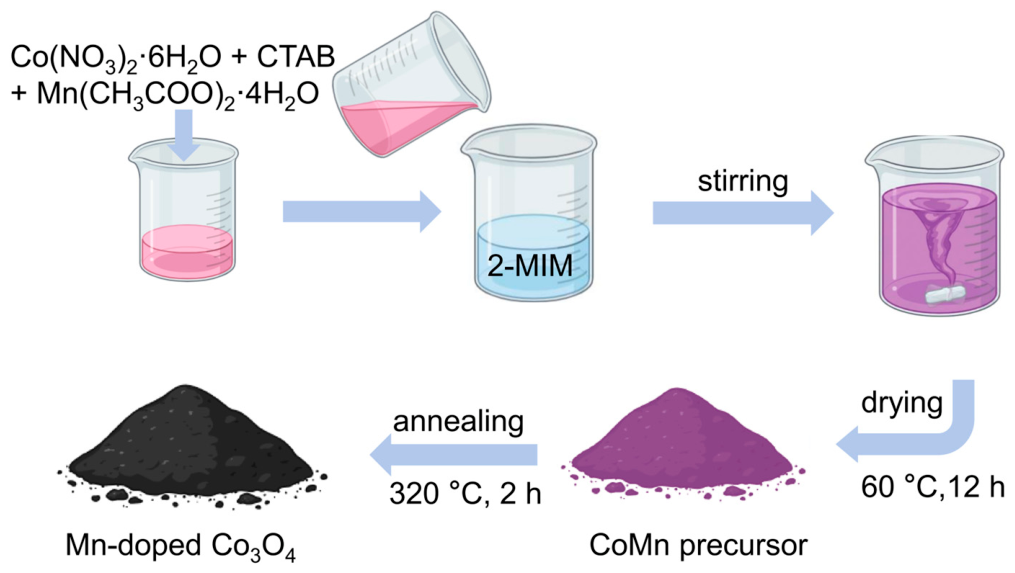
The Mn-doped Co3O4 series was prepared by precursor co-assembly followed by thermal conversion (Scheme 1). Co(NO3)2·6H2O and different amounts of Mn(CH3COO)2·4H2O were co-dissolved in a CTAB-containing aqueous solution, before the resulting mixture was rapidly introduced into an aqueous 2-methylimidazole (2-MIM) solution. The coordination of Co2+ and Mn2+ with 2-MIM afforded a Co–Mn-containing precursor in which both metal species were co-assembled before thermal conversion. Subsequent thermal conversion in air at 320 °C yielded Mn-modified Co3O4-type oxides. The obtained samples were labeled Mn5–Co3O4, Mn10–Co3O4, and Mn20–Co3O4, where 5, 10, and 20 denote the mass (in mg) of Mn(CH3COO)2·4H2O introduced during synthesis rather than the Mn content of the final solids.
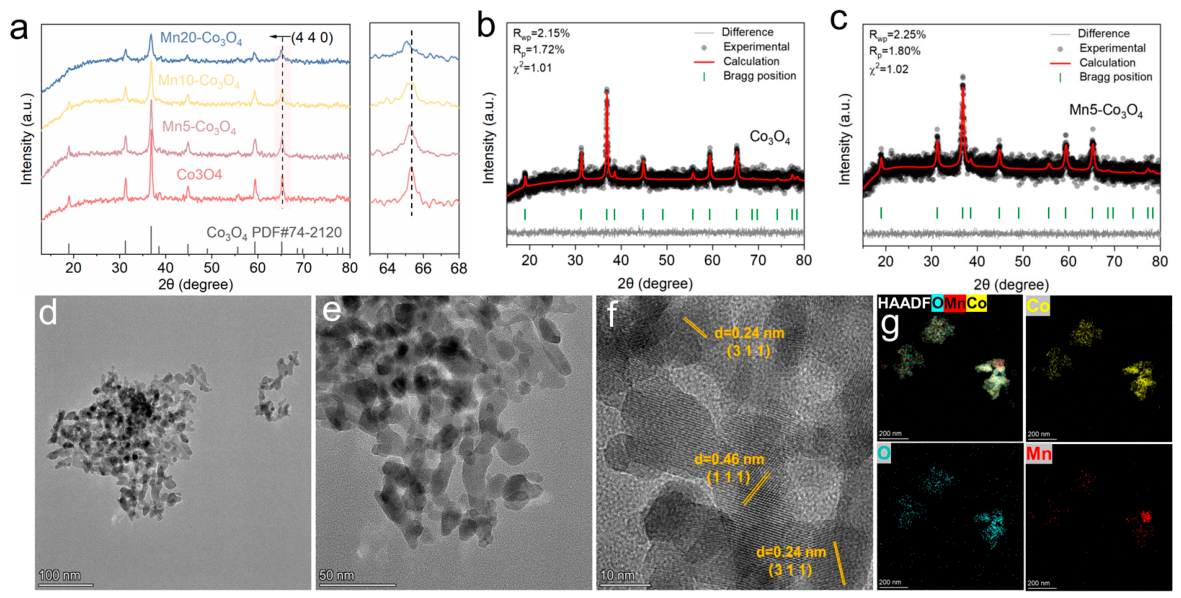
As shown in Figure 1a, all samples exhibited diffraction peaks at approximately 19.0°, 31.3°, 36.8°, 38.5°, 44.8°, 49.0°, 55.7°, 59.4°, and 65.2°, which were indexed to the (111), (220), (311), (222), (400), (331), (422), (511), and (440) planes of cubic Co3O4 (JCPDS #74-2120) [41]. No additional Bragg reflections attributable to crystalline MnOx phases were detected across the Mn dosage series. The (440) reflection shifted progressively toward lower angles from 65.23° for pristine Co3O4, corresponding to an increase in the (440) interplanar spacing and supporting structural modification of the Co3O4 lattice following Mn incorporation. To obtain further structural information, Rietveld refinements of the pristine Co3O4 and Mn5–Co3O4 diffraction patterns were performed using a cubic spinel structural model with the Fd−3m space group (Figure 1b,c). The calculated profiles closely reproduced the experimental diffraction patterns. The refined lattice parameter increased from 8.0799(7) Å for Co3O4 to 8.0847(12) Å for Mn5–Co3O4, while the corresponding unit-cell volume increased from 527.50(14) to 528.44(23) Å3. For Mn5–Co3O4, the diffraction pattern was satisfactorily described by a structural model in which Mn occupies the octahedral 16d site together with Co, whereas the tetrahedral 8a site remains occupied by Co. These results support an octahedral-site structural model for Mn incorporation into the Co3O4-type spinel framework. The refinements yielded Rp/Rwp2 values of 1.72%/2.15%/1.01 for Co3O4 and 1.80%/2.25%/1.02 for Mn5–Co3O4, supporting the reliability of the fitted structural models. The corresponding crystallographic parameters are summarized in Table 1 and Table 2.
ICP-OES measurements showed that the Mn contents of Mn5–Co3O4, Mn10–Co3O4, and Mn20–Co3O4 were 2.87, 6.22, and 13.01 wt.%, respectively, while the corresponding Co contents were 70.93, 67.87, and 60.86 wt.%. These values yielded Mn/Co molar ratios of 0.0435, 0.0983, and 0.2293, respectively. When normalized to three total metal cations under the Co3O4-type spinel convention, the corresponding cation compositions were Co2.875Mn0.125O4, Co2.731Mn0.269O4, and Co2.440Mn0.560O4. These formulas represent cation-normalized bulk compositions because the oxygen stoichiometry was not independently determined.
TEM images revealed that Mn5–Co3O4 consisted of interconnected nanoparticles (Figure 1d,e). The HRTEM image in Figure 1f displayed well-resolved lattice fringes with spacings of 0.24 and 0.46 nm, corresponding to the (311) and (111) planes of spinel Co3O4, respectively [40,42]. No additional lattice fringes attributable to crystalline MnOx or a continuous amorphous shell were observed within the examined region. HAADF-STEM imaging and the corresponding EDS maps showed the co-distribution of Co, O, and Mn within the same particle aggregate, with no obvious Mn enrichment at the particle boundaries (Figure 1g). Together, the diffraction and microscopy results support Mn incorporation into, or close association with, the Co3O4-type framework. Nevertheless, conventional PXRD and local electron-microscopy measurements cannot quantify or completely exclude a minor X-ray-amorphous, highly dispersed, or nanocrystalline Mn-containing component.
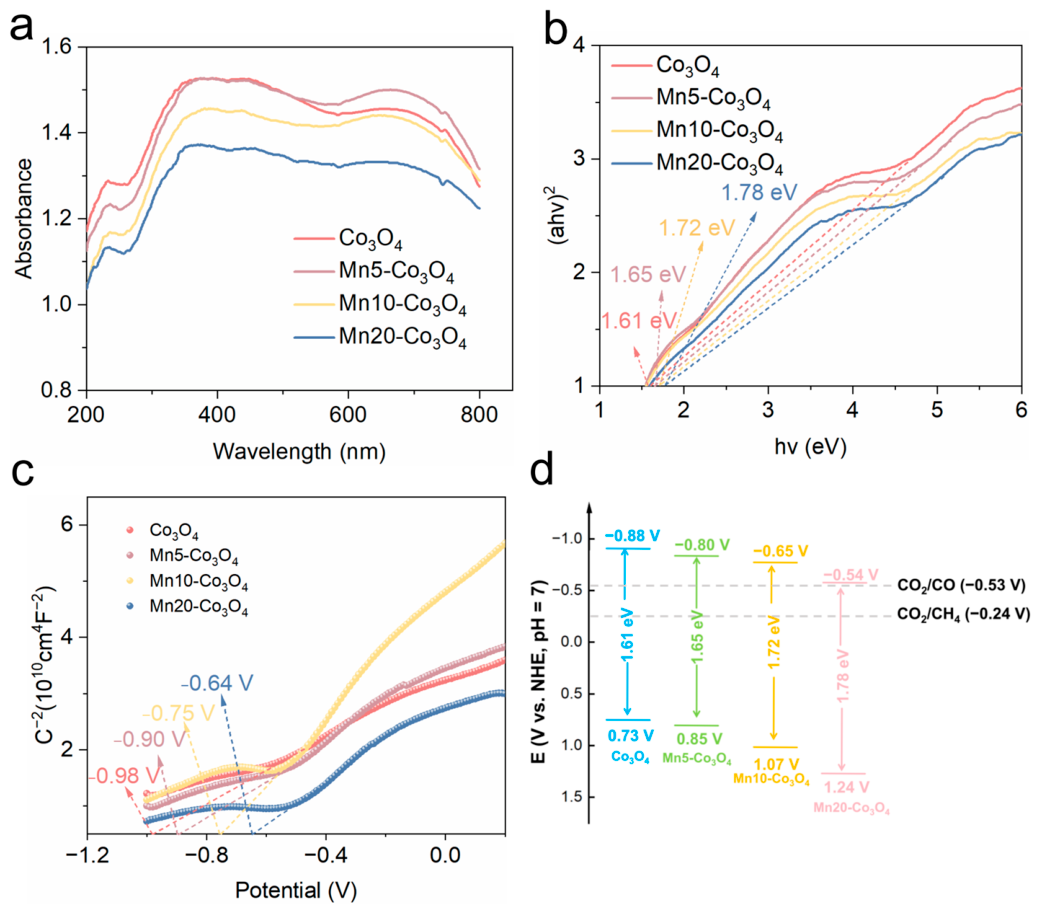
The optical response of the photocatalysts was first examined by UV–vis diffuse reflectance spectroscopy. As shown in Figure 2a, all samples exhibit broad absorption across the 200–800 nm range, encompassing the emission spectrum of the xenon lamp used in the photocatalytic tests [41]. Among the Mn-containing samples, Mn5–Co3O4 retained an absorption intensity comparable to that of pristine Co3O4 across most of the visible region, whereas the absorption intensity decreased progressively at higher Mn precursor dosages. Following the direct-allowed Tauc construction commonly applied to spinel Co3O4 and Mn-modified Co3O4 [39,41,43], the lower-energy apparent optical transition energies were estimated to be 1.61, 1.65, 1.72, and 1.78 eV for pristine Co3O4, Mn5–Co3O4, Mn10–Co3O4, and Mn20–Co3O4, respectively. Small variations in the lower-energy optical transition have also been reported for Mn-doped Co3O4 materials [44]. Because Co3O4 exhibits multiple optical transitions and the extrapolated intercept depends on the selected fitting interval, these values should be regarded as approximate apparent transition energies rather than statistically resolved differences in the intrinsic band gap [45]. Overall, the samples retain the broad visible-light absorption characteristics of the Co3O4 host, and the photocatalytic activity trend is discussed primarily in relation to charge-carrier dynamics rather than the small differences among the Tauc-derived values.
Mott–Schottky measurements were then performed to estimate the band-edge positions. All samples displayed positive slopes (Figure 2c), consistent with n-type semiconductor behavior [46]. The flat-band potentials extrapolated from the linear regions were −0.98, −0.90, −0.75, and −0.64 V versus Ag/AgCl for Co3O4, Mn5–Co3O4, Mn10–Co3O4, and Mn20–Co3O4, respectively. Converting these values to the NHE scale (ENHE = EAg/AgCl + 0.197 V) and taking the conduction band minimum of an n-type semiconductor to be 0.1 V more negative than the flat-band potential [46] gave conduction-band positions of −0.88, −0.80, −0.65, and −0.54 V. The progressive positive shift of the Mott–Schottky-derived flat-band potential with increasing Mn precursor dosage indicates a composition-dependent modification of the equilibrium electronic structure. Previous studies of MnxCo3−xO4 spinels have shown that the Mn/Co composition and cation-site occupation can regulate Mn/Co 3d–O 2p hybridization, Mn-associated electronic states near the Fermi level, and mixed-valence charge transport [39,47,48,49]. In the present series, the systematic shift of the (440) reflection and associated lattice expansion, together with the Co 2p and lattice O 1s shifts observed for Mn5–Co3O4 relative to pristine Co3O4, are consistent with structural and electronic perturbation of the Co–O framework. Accordingly, the progressively less-negative apparent conduction-band positions are interpreted as reflecting a positive shift in the apparent flat-band potential associated with Mn-induced modification of the Co–O–Mn electronic structure. Because Mott–Schottky analysis does not resolve individual orbital contributions, this explanation is presented as a plausible interpretation rather than a unique microscopic mechanism. Combining the apparent conduction-band positions with the corresponding lower-energy apparent optical transition energies gave estimated valence-band positions of 0.73, 0.85, 1.07, and 1.24 V, respectively. The estimated band-edge positions indicate that the Mn-containing samples retain potentials compatible with the relevant CO2-reduction and H2O-oxidation processes under the tested conditions (Figure 2d). However, because the optical-transition energies and Mott–Schottky-derived positions are operational estimates, the relatively small differences among adjacent compositions should not be used alone to explain the pronounced photocatalytic activity trend. The band analysis is therefore used to assess thermodynamic compatibility, whereas the composition-dependent activity is interpreted primarily in relation to the carrier-dynamics and interfacial-reaction evidence discussed below.

2.2. Photocatalytic CO2 Reduction Performance

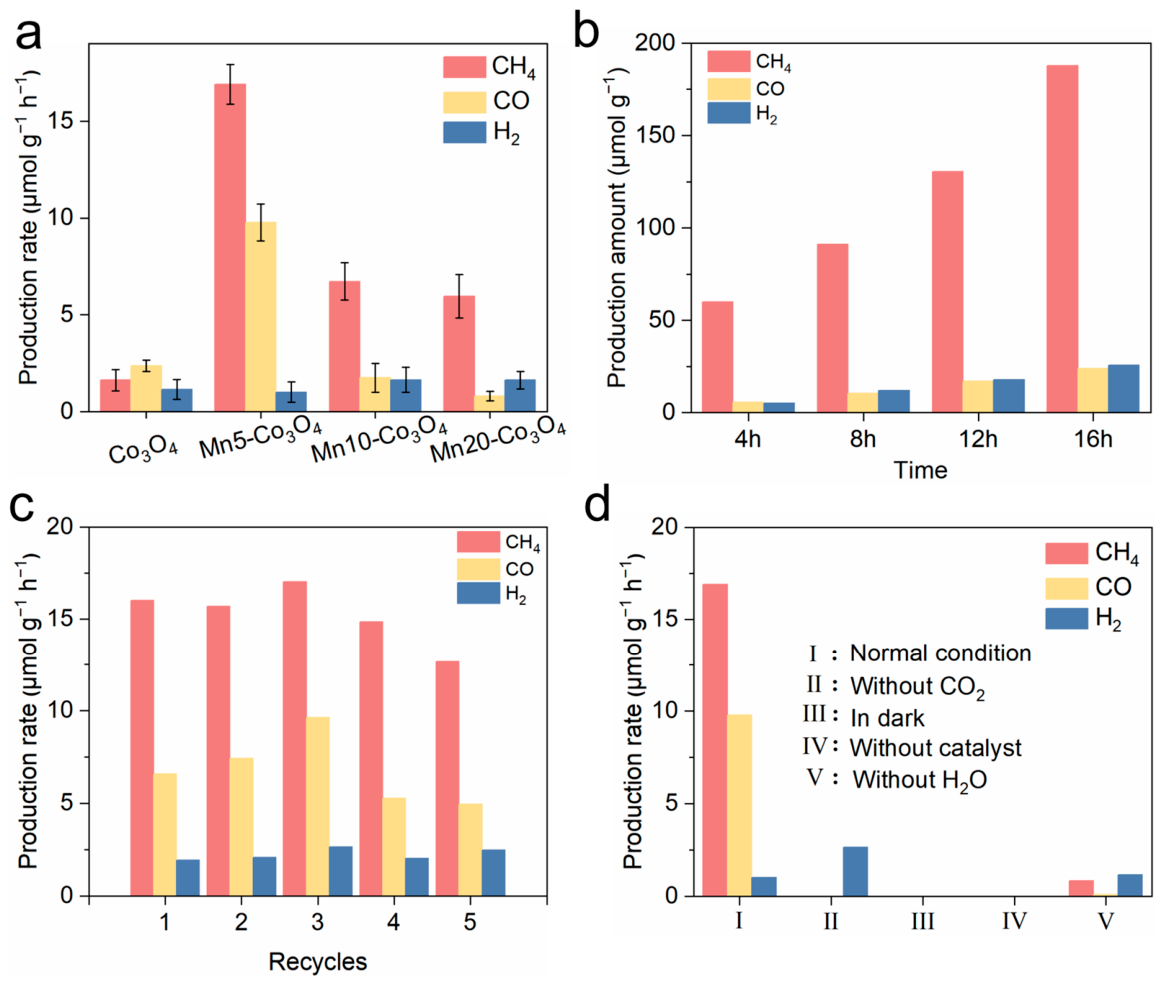
Photocatalytic CO2 reduction was carried out without any sacrificial agent, using 20 mg of photocatalyst and 2 mL of H2O under full-spectrum irradiation from a 300 W Xe lamp at 25 °C. As shown in Figure 3a, pristine Co3O4 delivered CH4 and CO production rates of only 1.6 and 2.4 µmol g−1 h−1, respectively. This limited activity is consistent with the band alignment established above, as the valence band of Co3O4 was less positive than the H2O/O2 potential and photogenerated holes could therefore not be consumed efficiently by water oxidation in a sacrificial-agent-free system. Mn doping substantially enhanced the activity, and the performance followed a volcano-shaped dependence on the Mn dosage. Mn5–Co3O4 exhibited the highest activity, with CH4 and CO production rates of 16.9 and 9.8 µmol g−1 h−1, corresponding to 10.6- and 4.1-fold increases relative to pristine Co3O4, respectively, whereas further increasing the Mn dosage lowered the CH4 rate to 6.7 µmol g−1 h−1 for Mn10–Co3O4 and 6.0 µmol g−1 h−1 for Mn20–Co3O4. H2 was simultaneously detected over all samples, reflecting the competition between proton reduction and CO2 reduction for photogenerated electrons. The CH4/CO molar ratio increased from 0.67 over Co3O4 to 1.72 over Mn5–Co3O4 and the electron-based CH4 fraction among the carbon-containing products increased from 73% to 87%. Thus, among the carbon products, Mn doping increased both the overall CO2 conversion and the relative contribution of the eight-electron methanation pathway.
The apparent flat-band potentials shifted progressively toward more positive values with increasing Mn precursor dosage. However, the energetic differences between adjacent compositions were modest, whereas the CH4 production rate of Mn5–Co3O4 was approximately 2.5 times that of Mn10–Co3O4. Thus, the estimated band positions establish that the relevant redox reactions remain thermodynamically accessible but do not by themselves account for the volcano-shaped activity trend. Additional composition-dependent factors, particularly charge-carrier separation and lifetime, therefore govern the observed activity differences, as discussed below.
The durability of Mn5–Co3O4 was subsequently assessed. As shown in Figure 3b, the accumulated amounts of CH4, CO, and H2 increased continuously during 16 h of uninterrupted irradiation, with CH4 reaching 188 µmol g−1, confirming that the photocatalyst remained active throughout the test. Mn5–Co3O4 also maintained product formation over five consecutive cycles (Figure 3c). The CH4 production rate decreased from approximately 16.0 µmol g−1 h−1 in the first cycle to approximately 12.6 µmol g−1 h−1 in the fifth cycle, corresponding to an activity retention of approximately 79%. These experimental results demonstrate that Mn5–Co3O4 exhibits both enhanced CH4 yield and long-term stability.
Control experiments were performed to identify the origin of the products (Figure 3d). No appreciable CH4 or CO was detected in the absence of CO2, whereas H2 was still observed because proton reduction proceeded as a competing reaction. Neither carbon product was detected in the dark or without the photocatalyst, confirming that CH4 and CO formation required the simultaneous presence of CO2, light, and the photocatalyst. Furthermore, omitting externally added H2O markedly suppressed all three products, and the small residual signals are ascribed to water weakly adsorbed on the photocatalyst surface [9]. These results collectively demonstrate that both gaseous CO2 and H2O participated in the photocatalytic reaction.

2.3. Mechanism of Photocatalytic Activity Enhancement

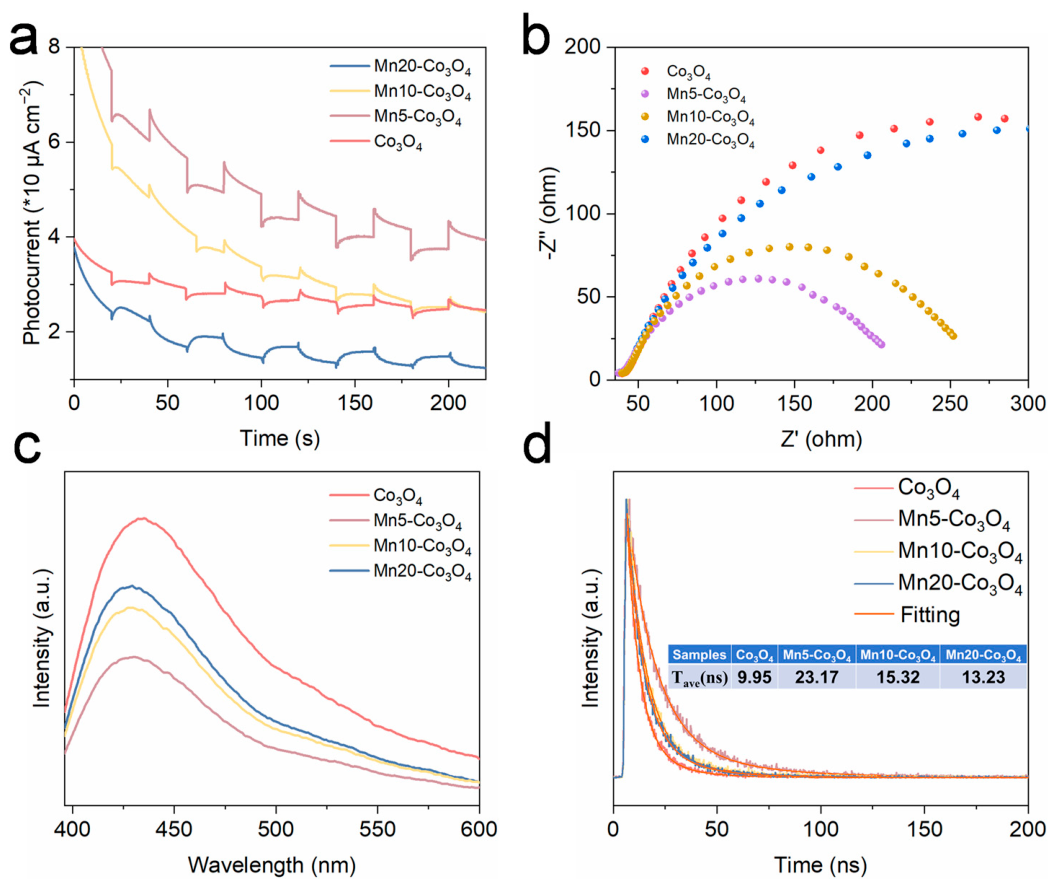
Photoelectrochemical measurements were performed to evaluate how Mn dosage affects the utilization of photogenerated charge carriers [33,50]. As shown in Figure 4a, all samples exhibited reproducible photocurrent responses under irradiation, and Mn5–Co3O4 showed the strongest response, indicating that a larger fraction of photogenerated carriers was separated and transported to the surface. Consistently, Mn5–Co3O4 displayed the smallest Nyquist arc in the EIS spectra (Figure 4b), reflecting the lowest interfacial charge transfer resistance among the series. Both measurements exhibited the same volcano-shaped dependence on Mn dosage as the photocatalytic activity, whereas samples prepared with higher Mn dosages showed weaker photocurrents and larger arc radii than Mn5–Co3O4. Subsequently, steady-state and time-resolved photoluminescence spectra were recorded to probe carrier recombination. As shown in Figure 4c, pristine Co3O4 exhibited the strongest PL signal, which decreased upon Mn doping, with Mn5–Co3O4 exhibiting the lowest emission intensity. This trend indicates that an appropriate level of Mn doping effectively suppresses radiative electron-hole recombination. The TRPL decay curves in Figure 4d further support this interpretation. Specifically, the average PL lifetimes of Co3O4, Mn5–Co3O4, Mn10–Co3O4, and Mn20–Co3O4 are 9.95, 23.17, 15.32, and 13.23 ns, respectively, with Mn5–Co3O4 exhibiting a lifetime 2.33 times that of pristine Co3O4. This extended lifetime suggests that photogenerated carriers have more time to reach the surface and participate in interfacial redox reactions [26,51].
Recent studies have shown that local coordination environments and spatially organized charge-transfer pathways can regulate photogenerated-carrier localization and transport during photocatalytic CO2 reduction [52,53]. More directly, atomic Mn incorporation into Co3O4 has been reported to accelerate charge-separation dynamics [39]. Together, these studies provide a broader framework for interpreting the composition-dependent photocurrent, EIS, and PL trends observed in the present Mn–Co3O4 series.
Notably, the trend in average PL lifetime aligns with that of the CH4 production rate, both peaking at Mn5–Co3O4 and declining with further Mn incorporation. This correlation is particularly pronounced for CH4 production. The extension in carrier lifetime confers a substantially greater benefit on the CH4 pathway than on the CO pathway. As the lifetime increases from 9.95 to 23.17 ns, the CH4 production rate rises by 10.6-fold, whereas the CO production rate increases by only 4.1-fold. This disparity reflects the distinct electron demands of the two pathways. Reduction of CO2 to CH4 proceeds through an eight-electron process that requires multiple sequential electron and proton transfer steps on the same adsorbed carbon intermediate, all of which must be completed before the carrier is lost to recombination. In contrast, reduction to CO requires only two electrons and is far less sensitive to carrier lifetime. Consequently, extending the carrier lifetime confers a disproportionate benefit on the deep hydrogenation pathway, accounting for the observed shift in product selectivity toward CH4. Combined with the band-edge analysis discussed above, these results indicate that the superior performance of Mn5–Co3O4 arises from the combination of sufficient reduction driving force and substantially extended carrier lifetime.
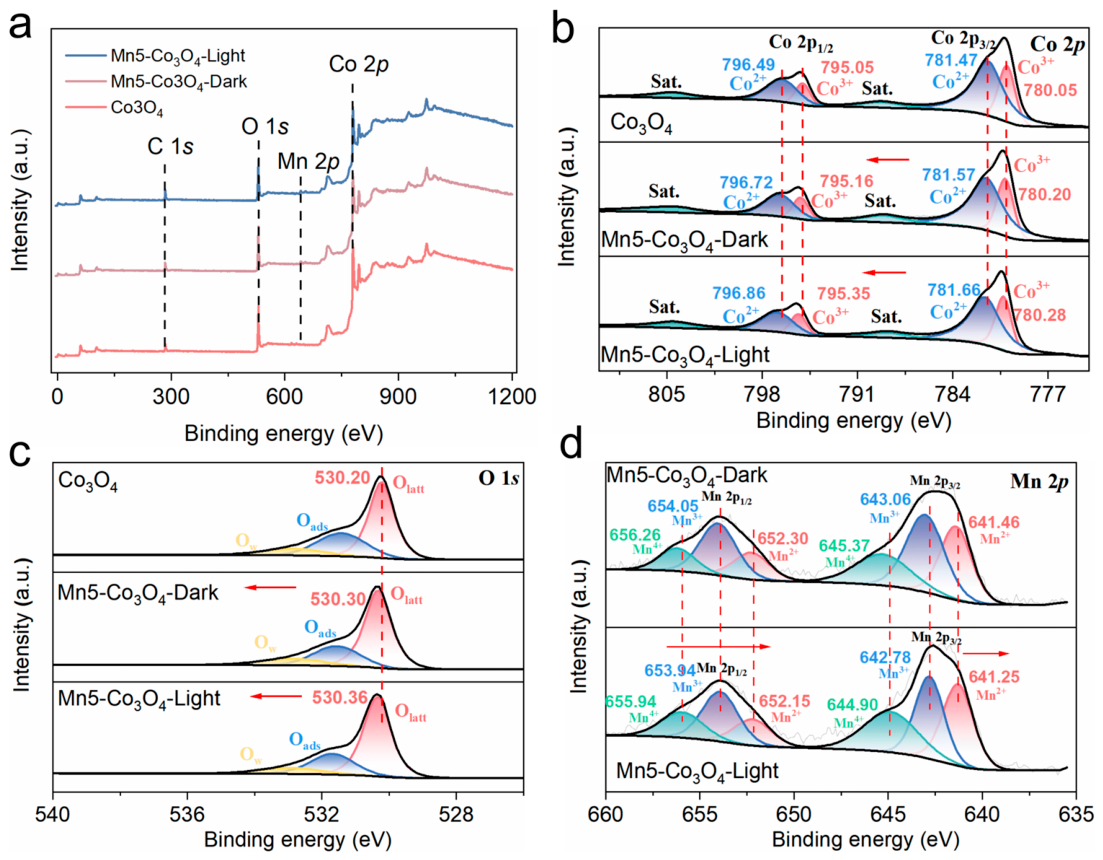
To compare the surface chemical states and examine the light-induced electronic response, XPS measurements were performed on pristine Co3O4 and the optimized Mn5–Co3O4 sample. As shown in Figure 5a, the dark-state survey spectra of both samples exhibited C 1s, O 1s, and Co 2p signals. The Mn 2p signal was detected in Mn5–Co3O4 but was absent, as expected, from pristine Co3O4, confirming the presence of Mn in the near-surface region of Mn5–Co3O4. Semi-quantitative analysis of the dark-state XPS survey spectrum gave near-surface atomic concentrations of approximately 41.8, 2.3, and 55.9 at.% for Co, Mn, and O, respectively, after adventitious carbon was excluded from the normalization. The corresponding surface Mn/Co atomic ratio was approximately 0.055, with Mn accounting for approximately 5.2% of the total surface metal cations. When normalized to three metal cations according to the Co3O4-type spinel convention, this ratio corresponds to an approximate surface cation composition of Co2.84Mn0.16O4. This surface Mn/Co ratio was slightly higher than the bulk value of 0.0435 determined by ICP-OES for Mn5–Co3O4. Because XPS probes the near-surface region and the O 1s envelope contains contributions from both lattice and surface oxygen species, the XPS-derived value represents a surface cation-normalized composition rather than an exact bulk stoichiometric formula.
The dark-state high-resolution spectra of pristine Co3O4 and Mn5–Co3O4 were first compared. Pristine Co3O4 exhibited Co 2p3/2 components at 780.05 eV (Co3+) and 781.47 eV (Co2+), together with the corresponding Co 2p1/2 components at 795.05 eV (Co3+) and 796.49 eV (Co2+) and two shake-up satellites (Figure 5b) [54]. After Mn incorporation, all Co 2p components shifted to higher binding energies. The lattice-oxygen peak in the O 1s spectrum shifted from 530.20 eV for Co3O4 to 530.30 eV for Mn5–Co3O4, whereas the surface-adsorbed oxygen and adsorbed-water components remained at higher binding energies (Figure 5c). The Mn 2p3/2 region of Mn5–Co3O4 was deconvoluted into Mn2+, Mn3+, and Mn4+ components at 641.46, 643.06, and 645.37 eV, respectively (Figure 5d) [39,40], indicating the mixed-valence character of Mn. Because Mn was introduced from an Mn(II) precursor, the XPS components assigned to Mn(III) and Mn(IV) after calcination are attributed primarily to oxidation by molecular oxygen during thermal conversion in air, consistent with the reported formation of mixed-valence manganese oxides from Mn(CH3COO)2·4H2O under oxidative heating conditions [55].
Under irradiation, the Co- and Mn-related signals shifted in opposite directions. The Co 2p3/2 components assigned to Co3+ and Co2+ shifted to higher binding energies of 780.28 and 781.66 eV, respectively, and the Olatt peak shifted to 530.36 eV, whereas the Mn2+, Mn3+, and Mn4+ components shifted to lower binding energies of 641.25, 642.78, and 644.90 eV, respectively. These irradiation-dependent shifts indicate relative electron enrichment in Mn-related chemical environments and relative electron depletion in the Co–O framework. Together with the photocurrent, EIS, and PL results, these changes support light-induced charge redistribution in Mn5–Co3O4 and provide a spectroscopic basis for its prolonged carrier availability. Because binding-energy shifts alone do not directly resolve a complete microscopic transfer pathway or formal-valence conversion, they are interpreted as evidence of relative electronic redistribution rather than as proof of specific redox-state changes.
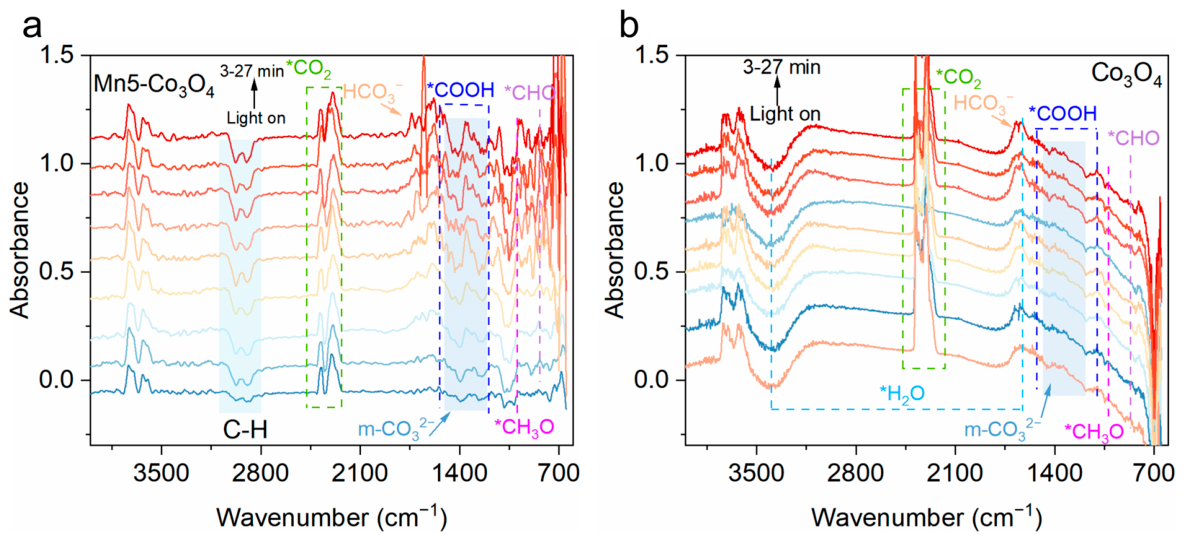
Time-resolved in situ Fourier-transform infrared (FTIR) spectra were collected for Co3O4 and Mn5–Co3O4 under a CO2/H2O atmosphere to probe the effect of Mn doping on deep hydrogenation. As shown in Figure 6, both Co3O4 and Mn5–Co3O4 exhibited a characteristic feature at 2300–2400 cm−1 assigned to adsorbed CO2 molecules, together with an absorption band at 1670 cm−1 and a band in the 1330–1472 cm−1 region assigned to bicarbonate (HCO3) and monodentate carbonate (m-CO32−) species, respectively [56,57,58]. The coexistence of these configurations indicates co-adsorption of CO2 and H2O on both surfaces. During irradiation, additional bands emerged at 1524 and 1100 cm−1 on Mn5–Co3O4, assigned to the *COOH intermediate (where * denotes an adsorption site) formed from proton-coupled activation of adsorbed CO2 [59]. As the irradiation time increased from 3 to 27 min, two additional bands appeared at 1020 and 870 cm−1 and progressively intensified. These bands were tentatively assigned to *CH3O and *CHO species, respectively [23,60]. The sustained growth of these bands supports the continued hydrogenation of adsorbed carbon species from *COOH through *CHO and *CH3O toward CH4.
By contrast, pristine Co3O4 exhibited a distinct spectral evolution under identical conditions. Bands associated with *COOH were also detected, indicating that the initial protonation of adsorbed CO2 can occur on the undoped surface. However, the bands tentatively assigned to *CHO and *CH3O remained weak and increased only marginally over the same irradiation period. This limited accumulation of deeply hydrogenated intermediates is consistent with the lower CH4 production rate of pristine Co3O4 and its CH4/CO production-rate ratio of 0.67. The two catalysts showed comparable spectral signatures for CO2 adsorption and *COOH formation but markedly different evolution of *CHO and *CH3O. This comparison localizes the principal influence of Mn doping to the hydrogenation steps downstream of *COOH formation rather than to CO2 capture or initial activation. This interpretation is further supported by the carrier-dynamics results. Mn5–Co3O4 exhibited a longer average photoluminescence lifetime than pristine Co3O4, consistent with the prolonged availability of reductive charge carriers for successive proton-coupled electron-transfer events. Taken together, these results support a mechanistic sequence initiated by Mn incorporation and light-induced charge redistribution between Mn-related sites and the Co–O framework. The associated suppression of charge recombination and extension of carrier lifetime sustain the stepwise hydrogenation of *COOH through *CHO and *CH3O, thereby enhancing CH4 formation and increasing the CH4/CO ratio. Appropriate Mn doping therefore provides an effective strategy for coupling charge-carrier availability with the multistep hydrogenation required for photocatalytic CO2 methanation.

3. Materials and Methods

3.1. Materials

Cobalt nitrate hexahydrate (Co(NO3)2·6H2O, ≥99.9%, Adamas, Shanghai, China), manganese acetate tetrahydrate (Mn(CH3COO)2·4H2O, ≥99%, Adamas, Shanghai, China), cetyltrimethylammonium bromide (CTAB, ≥99%, Shanghai Aladdin Biochemical Technology Co., Ltd., Shanghai, China), 2-methylimidazole (2-MIM, ≥99%, Adamas, Shanghai, China), sodium sulfate (Na2SO4, ≥99%, Sinopharm Chemical Reagent Co., Ltd., Shanghai, China), potassium ferricyanide (K3[Fe(CN)6], ≥99%, Sinopharm Chemical Reagent Co., Ltd., Shanghai, China), potassium ferrocyanide (K4[Fe(CN)6], ≥99%, Sinopharm Chemical Reagent Co., Ltd., Shanghai, China) and ethanol (≥99.7%, Adamas, Shanghai, China) were used as received without further purification. High-purity CO2 (99.999%) was used as the reactant gas, and Ar (99.999%) was used as the carrier gas for gas-chromatographic analysis. Deionized water with a resistivity of 18.2 MΩ·cm was used throughout the experiments.

3.2. Preparation of Photocatalysts

The Mn-doped Co3O4 samples were prepared by precursor co-assembly followed by thermal conversion. Typically, 100 mg of Co(NO3)2·6H2O and 5 mg of Mn(CH3COO)2·4H2O were dissolved in 2 mL of deionized water containing 2 mg of CTAB. The resulting solution was rapidly added to 14 mL of deionized water containing 1.816 g of 2-MIM and vigorously stirred at room temperature for 20 min. The resulting CoMn precursor was collected by centrifugation, washed three times with ethanol, and dried under vacuum at 60 °C for 12 h. The dried precursor was heated in a muffle furnace to 320 °C at 5 °C min−1 and held at 320 °C in air for 2 h to obtain Mn5–Co3O4.
Three Mn precursor dosages were selected to establish an exploratory low-to-high series with a 1:2:4 progression while keeping the amount of the Co precursor and all other synthesis parameters constant. Specifically, 5, 10, or 20 mg of Mn(CH3COO)2·4H2O was combined with 100 mg of Co(NO3)2·6H2O, corresponding to nominal Mn/Co feed molar ratios of approximately 0.059, 0.119, and 0.237, respectively. This dosage range enabled systematic evaluation of the influence of the Mn precursor dosage on the catalyst structure, charge-carrier dynamics, and photocatalytic product distribution. The resulting samples were denoted Mn5–Co3O4, Mn10–Co3O4, and Mn20–Co3O4, where 5, 10, and 20 refer exclusively to the mass of Mn(CH3COO)2·4H2O used during synthesis, expressed in milligrams, rather than to the elemental Mn mass or the final Mn content of the catalysts. Pristine Co3O4 was prepared without the Mn precursor under otherwise identical conditions.

3.3. Characterization

Crystalline phases were analyzed by X-ray diffraction (XRD, D8 Advance, Bruker AXS GmbH, Karlsruhe, Germany) using Cu Kα radiation. Rietveld refinements of the pristine Co3O4 and Mn5–Co3O4 diffraction patterns were performed using GSAS-IIversion 5782 with a cubic spinel structural model in the Fd−3m space group. The corresponding crystallographic and atomic-site parameters are summarized in Table 1 and Table 2. The bulk Co and Mn contents were determined using an iCAP PRO X Duo ICP-OES instrument (Thermo Fisher Scientific, Waltham, MA, USA). Morphology, lattice fringes, and elemental distributions were examined by transmission electron microscopy (TEM), high-resolution TEM (HRTEM), and high-angle annular dark-field scanning TEM (HAADF-STEM) coupled with energy-dispersive X-ray spectroscopy (EDS) on a Talos F200i microscope (Thermo Scientific, Waltham, MA, USA) operated at 200 kV. Ultraviolet–visible diffuse reflectance spectra were recorded over 200–800 nm on a Lambda 950 spectrophotometer (PerkinElmer, Waltham, MA, USA) using BaSO4 as the reflectance standard, and the lower-energy apparent optical transition energies were estimated from the transformed Kubelka–Munk function versus photon energy using a direct-allowed Tauc construction. Steady-state photoluminescence (PL) and time-resolved photoluminescence (TRPL) spectra were recorded at room temperature on an FLS1000 spectrometer (Edinburgh Instruments Ltd., Livingston, UK) with an excitation wavelength of 375 nm, and identical excitation and acquisition conditions were applied to all samples. The TRPL decay curves were fitted with a biexponential function, and the average PL lifetime was calculated as τave = (A1τ12 + A2τ22)/(A1τ1 + A2τ2), where Ai and τi denote the amplitude and lifetime of each decay component. In situ irradiated X-ray photoelectron spectroscopy (XPS) measurements were performed on an ESCALAB Xi+ spectrometer (Thermo Fisher Scientific, Waltham, MA, USA) using Al Kα radiation, with a 300 W Xe lamp used for irradiation. The near-surface atomic composition was estimated from the dark-state XPS survey spectrum using background-subtracted Co 2p, Mn 2p, and O 1s peak areas corrected with the relative sensitivity factors applied during XPS quantification. Adventitious carbon was excluded from the normalization.

3.4. Photoelectrochemical Measurements

Transient photocurrent responses, electrochemical impedance spectroscopy (EIS), and Mott–Schottky measurements were carried out on a CHI-660E (CH Instruments, Shanghai, China) electrochemical workstation in a standard three-electrode configuration. To prepare the working electrode, 5 mg of photocatalyst was ultrasonically dispersed in 400 μL of deionized water for 20 min, and 20 μL of the resulting suspension was drop-cast onto a 0.5 × 0.5 cm2 area of fluorine-doped tin oxide (FTO) glass and dried naturally. A platinum wire and an Ag/AgCl electrode in saturated KCl were used as the counter and reference electrodes, respectively, and the electrolyte contained 0.1 M Na2SO4 and 0.05 M K3[Fe(CN)6]/K4[Fe(CN)6]. A 300 W Xe lamp (MC-PF300B, Beijing CEAULIGHT Technology Co., Ltd., Beijing, China) was used as the light source. Transient photocurrent responses were recorded at an applied potential of 0 V versus Ag/AgCl under chopped illumination. EIS measurements were conducted in the dark at applied potentials of 0, 0.1, and 0.2 V versus Ag/AgCl over a frequency range of 10 Hz to 100 kHz, using an AC perturbation amplitude of 5 mV. The Nyquist plots presented in Figure 4b correspond to measurements performed at 0.1 V versus Ag/AgCl. The Mott–Schottky plots presented in Figure 2c were recorded at 1500 Hz. The flat-band potentials (Efb) obtained from the intercepts of the Mott–Schottky plots were converted to the normal hydrogen electrode (NHE) scale according to ENHE = EAg/AgCl + 0.197 V, and the conduction band minimum of an n-type semiconductor was taken to be 0.1 V more negative than the flat-band potential. The valence-band maximum was then estimated by combining the conduction-band position with the corresponding lower-energy apparent optical transition energy.

3.5. Photocatalytic CO2 Reduction

Photocatalytic CO2 reduction was performed in a sealed 100 mL jacketed quartz reactor without any sacrificial agent. In each experiment, 20 mg of photocatalyst was uniformly dispersed at the bottom of the reactor and 2 mL of deionized water was introduced. The reactor was evacuated and refilled with high-purity CO2 (99.999%) three times to remove air and was then filled with CO2. The system was irradiated with the full spectrum of a 300 W Xe lamp, while a circulating cooling system maintained the reactor at 25 °C. The lamp intensity and lamp-to-reactor distance were kept constant in all comparative experiments. Gaseous products were analyzed on a GC9790 Plus gas chromatograph (Zhejiang Fuli Analytical Instruments Co., Ltd., Wenling, China) equipped with thermal-conductivity and flame-ionization detectors, using Ar as the carrier gas. The electron-based CH4 fraction among the measured carbon-containing products was calculated as 8rCH4/(8rCH4 + 2rCO) × 100%, where rCH4 and rCO denote the CH4 and CO production rates, respectively. The coefficients 8 and 2 correspond to the numbers of electrons required for CO2 reduction to CH4 and CO, respectively.

3.6. In Situ Fourier-Transform Infrared Spectroscopy

Time-resolved in situ Fourier-transform infrared (FTIR) spectra were acquired using an iS50 spectrometer (Thermo Fisher Scientific, Waltham, MA, USA) equipped with a mercury cadmium telluride detector and a diffuse-reflectance reaction cell. Spectra were collected at a resolution of 4 cm−1 using 32 accumulated scans. The photocatalyst was loaded into the in situ cell. A CO2 stream carrying H2O vapor was generated by bubbling high-purity CO2 through deionized water at room temperature and introduced for 30 min to establish adsorption equilibrium. A background spectrum was collected in the dark immediately before illumination. The reaction was then initiated under irradiation from a 300 W Xe lamp and spectra were collected at 3 min intervals. Identical gas-introduction, illumination and acquisition procedures were applied to Co3O4 and Mn5–Co3O4.

4. Conclusions

In summary, this work demonstrates that an appropriate Mn doping level in Co3O4 couples charge regulation with the sequential hydrogenation of CO2-derived intermediates, enabling sacrificial-agent-free CO2 photoreduction toward CH4 with H2O. The optimized Mn5–Co3O4 delivered a CH4 production rate 10.6-fold higher than that of pristine Co3O4, raised the CH4/CO molar ratio from 0.67 to 1.72, while showing more effective charge separation and an increase in the average PL lifetime from 9.95 to 23.17 ns. In situ irradiated XPS revealed that the Mn 2p signals shifted negatively under illumination, whereas the Co 2p and lattice O 1s signals shifted positively, indicating that photogenerated electrons accumulate at Mn sites while holes remain on the Co–O framework. Together with the enhanced *COOH, *CHO and *CH3O bands resolved by in situ FTIR, these results support a mechanism in which the light-induced charge redistribution prolongs carrier availability and thereby sustains the progressive hydrogenation of adsorbed carbon species. Previous studies of Mn-modified Co3O4 attributed enhanced CO2 methanation to adjacent Mn–Co redox sites and spin polarization, whereas atomic Mn incorporation under dilute CO2 and pure-water conditions preferentially promoted CO formation [23,39]. Relative to these reports, the systematic variation in Mn precursor dosage in the present study identified a shift from CO-dominant to CH4-dominant carbon-product formation and linked this shift to the measured carrier lifetime and the downstream hydrogenation of *COOH-derived intermediates. Beyond demonstrating the activity enhancement achieved by compositional modification, this work highlights the coordination between charge localization and surface hydrogenation as a design consideration for deep CO2 reduction.

Author Contributions

Conceptualization, G.Z. and W.S.; methodology, G.Z. and W.S.; validation, X.W. and S.W.; formal analysis, K.L., S.L., Y.M. and S.M.; investigation, X.W. and S.W.; data curation, G.Z. and W.S.; writing—original draft preparation, W.S.; writing—review and editing, K.L., S.L., Y.M. and S.M.; supervision, S.M. and S.C.; funding acquisition, W.S. and S.C. All authors have read and agreed to the published version of the manuscript.

Funding

This research was funded by the Natural Science Foundation of Anhui Province, grant number 2508085QB066; the Funding Program for Leading Scholar of Anhui Province, grant number DTR2025015; the Independent Research Project of the Key Laboratory of Green and Precise Synthetic Chemistry and Applications, Ministry of Education, Huaibei Normal University, grant numbers KLGPSCA202502 and KLGPSCA202504; the Key Project of Provincial Natural Science Research Foundation of Anhui Universities, grant numbers 2024AH051677, 2023AH050351, 2024AH051698, and 2025AHGXZK31505; the Industry–University–Research Horizontal Project, grant number 2024340603000301; the Open Project Program of the State Key Laboratory of Photocatalysis on Energy and Environment, Fuzhou University, grant number SKLPEE-KF202503; and the Open Research Fund of the Shanghai Key Laboratory of Green Chemistry and Chemical Processes, East China Normal University, grant number 202602.

Institutional Review Board Statement

Not applicable.

Informed Consent Statement

Not applicable.

Data Availability Statement

The data presented in this study are available within the article. The raw data are available from the corresponding author upon reasonable request.

Conflicts of Interest

The authors declare no conflicts of interest.

References

  1. Ma, S.; Chen, D.; Yuan, K.; Du, G.; Li, F.; Zhu, Y. Asymmetric charge sites for the photoreduction of CO2 into high-value C2+ products. Coord. Chem. Rev. 2026, 564, 218086. [Google Scholar] [CrossRef] [Scilit]
  2. Ma, W.; Gui, S.; Zhu, J.; Yao, H.; Sun, J.; Pei, J.; Li, Y. Superbasic CO2-concentrating layer-protected nickel catalyst for solar CH4 synthesis via direct air capture. Energy Environ. Sci. 2026, 19, 836–848. [Google Scholar] [CrossRef] [Scilit]
  3. Song, J.; Zhu, P.; Ma, W.; Sun, N.; Li, Y. Boosting photocatalytic CO2 reduction with H2O by oxygen vacancy- and hydroxyl-tailored SrBi2Ta2O9 surface-frustrated Lewis pairs. ACS Catal. 2023, 13, 12700–12710. [Google Scholar] [CrossRef] [Scilit]
  4. Meng, S. Photocatalytic materials and photocatalytic reactions. Molecules 2025, 30, 269. [Google Scholar] [CrossRef] [Scilit] [PubMed]
  5. Li, X.; Xiong, J.; Tang, Z.; He, W.; Wang, Y.; Wang, X.; Zhao, Z.; Wei, Y. Recent progress in metal oxide-based photocatalysts for CO2 reduction to solar fuels: A review. Molecules 2023, 28, 1653. [Google Scholar] [CrossRef] [Scilit] [PubMed]
  6. Huo, H.; Wu, F.; Kan, E.; Li, A. Overall photocatalytic CO2 reduction over heterogeneous semiconductor photocatalysts. Chem. Eur. J. 2023, 29, e202300658. [Google Scholar] [CrossRef] [Scilit] [PubMed]
  7. Bergamini, L.; Sangiorgi, N.; Gondolini, A.; Rancan, M.; Bottaro, G.; Armelao, L.; Sanson, A. CsPbBr3/platinum and CsPbBr3/graphite hybrid photoelectrodes for carbon dioxide conversion to oxalic acid. Sol. Energy 2023, 254, 213–222. [Google Scholar] [CrossRef] [Scilit]
  8. Casadio, S.; Gondolini, A.; Sangiorgi, N.; Brandi, E.T.; Basile, F.; Sanson, A. Z-scheme Bi4Ti3O12/Cu2O heterostructured photoelectrodes for selective photoelectrochemical CO2 reduction into ethanol. J. CO2 Util. 2026, 110, 103497. [Google Scholar] [CrossRef] [Scilit]
  9. Shangguan, W.; Liu, Q.; Wang, Y.; Sun, N.; Liu, Y.; Zhao, R.; Li, Y.; Wang, C.; Zhao, J. Molecular-level insight into photocatalytic CO2 reduction with H2O over Au nanoparticles by interband transitions. Nat. Commun. 2022, 13, 3894. [Google Scholar] [CrossRef] [Scilit] [PubMed]
  10. Xie, Z.; Luo, H.; Gong, S.; Xu, M.; Xu, S.; Zhou, T.; Bai, Y.; Mao, B.; Li, L.; Shi, W. Solar-driven co-production of C2H4 and H2O2 from CO2 and H2O. Nat. Commun. 2026, 17, 3057. [Google Scholar] [CrossRef] [Scilit] [PubMed]
  11. Do, K.H.; Kumar, D.P.; Rangappa, A.P.; Ho, T.H.; Doan, U.T.T.; Kim, H.; Chen, H.-S.; Ahn, H.S.; Pham, N.N.T.; Wang, J.M.; et al. Oxygen-bridged copper dual-metal sites dispersed on carbon nitride for highly efficient and selective photoreduction of CO2 to acetic acid in pure water. J. Am. Chem. Soc. 2026, 148, 20798–20812. [Google Scholar] [CrossRef] [Scilit] [PubMed]
  12. Tong, Q.; Tang, Y.; Zou, W.; Ye, Y.-X.; Dong, L.; Ouyang, G. Simultaneous photocatalytic CO2 reduction and H2O oxidation under non-sacrificial ambient conditions. Chem. Eur. J. 2024, 30, e202402629. [Google Scholar] [CrossRef] [Scilit] [PubMed]
  13. Xu, X.; Su, B.; Wang, S.; Xing, W.; Hung, S.-F.; Pan, Z.; Fang, Y.; Zhang, G.; Zhang, H.; Wang, X. CO2 photoreduction by H2O: Cooperative catalysis of palladium species on poly(triazine imide) crystals. Angew. Chem. Int. Ed. 2025, 64, e202512386. [Google Scholar] [CrossRef] [Scilit] [PubMed]
  14. Li, B.; Sun, Z.; Su, B.; Lin, X.; Xing, W.; Ren, Y.; Liu, K.; Hou, Y.; Lu, X.F.; Lin, L.; et al. Surface oxide species on metal cocatalysts mediate pathways in water-oxidation-coupled CO2 photoreduction: Insights from Pd. Angew. Chem. Int. Ed. 2026, 65, e1584513. [Google Scholar] [CrossRef] [Scilit] [PubMed]
  15. Shangguan, W.; Li, G.; Gui, S.; Zhang, X.; Meng, S.; Chen, S.; Li, Y. Restructuring at Au/AlOOH interface enables enhanced CO2 photoreduction by synergistically optimizing charge separation and H2O activation. Adv. Funct. Mater. 2025, 35, 2501285. [Google Scholar] [CrossRef] [Scilit]
  16. Xu, X.; Zhou, J.; Guo, M.; Yang, W.; Su, B.; Zheng, M.; Lin, X.; Lu, X.F.; Hou, Y.; Zhang, G.; et al. Redox-pathway steering enables photocatalytic valorization of CO2 and 1-phenylethanol with record quantum efficiency. Sci. Bull. 2026, 71, 1695–1702. [Google Scholar] [CrossRef] [Scilit] [PubMed]
  17. Du, Z.; Gong, K.; Yu, Z.; Yang, Y.; Wang, P.; Zheng, X.; Wang, Z.; Zhang, S.; Chen, S.; Meng, S. Photoredox coupling of CO2 reduction with benzyl alcohol oxidation over ternary metal chalcogenides (ZnmIn2S3+m, m = 1–5) with regulable products selectivity. Molecules 2023, 28, 6553. [Google Scholar] [CrossRef] [Scilit] [PubMed]
  18. Lei, J.; Zhou, N.; Sang, S.; Meng, S.; Low, J.; Li, Y. Unraveling the roles of atomically dispersed Au in boosting photocatalytic CO2 reduction and aryl alcohol oxidation. Chin. J. Catal. 2024, 65, 163–173. [Google Scholar] [CrossRef] [Scilit]
  19. Zhang, X.; Xu, X.; Su, B.; Lin, X.; Liu, K.; Lu, X.F.; Lan, Z.-A.; Wang, X.; Song, S.; Wang, S. Efficient photothermal CO2 methanation over Ni nanoparticles on oxygen-deficient V2O3 via strong metal-support interaction. Sci. China Chem. 2026, 69, 2024–2029. [Google Scholar] [CrossRef] [Scilit]
  20. Wang, H.; Wang, X.; Hu, P.; Liu, T.; Weng, B.; Ye, K.-H.; Luo, Y.; Ji, H. Vacancy pair induced surface chemistry reconstruction of Cs2AgBiBr6/Bi2WO6 heterojunction to enhance photocatalytic CO2 reduction. Appl. Catal. B Environ. Energy 2024, 351, 123956. [Google Scholar] [CrossRef] [Scilit]
  21. Wang, W.; Yang, Z.; Yuan, Q.; Shangguan, W.; Li, S.; Ma, Y.; Wang, Z.; Zhang, S.; Meng, S.; Li, Y.; et al. Molecular-scale modulation of surface hydrogen dynamics for enhanced photocatalytic syngas production with adjustable H2/CO ratios over CdS nanoparticles. ACS Catal. 2026, in press. [Google Scholar] [CrossRef] [Scilit]
  22. Lu, K.-Q.; Hao, J.-G.; Wei, Y.; Weng, B.; Ge, S.; Yang, K.; Lu, S.; Yang, M.-Q.; Liao, Y. Photocatalytic conversion of diluted CO2 into tunable syngas via modulating transition metal hydroxides. Inorg. Chem. 2024, 63, 795–802. [Google Scholar] [CrossRef] [Scilit] [PubMed]
  23. Li, M.; Wu, S.; Liu, D.; Ye, Z.; Wang, L.; Kan, M.; Ye, Z.; Khan, M.; Zhang, J. Engineering spatially adjacent redox sites with synergistic spin polarization effect to boost photocatalytic CO2 methanation. J. Am. Chem. Soc. 2024, 146, 15538–15548. [Google Scholar] [CrossRef] [Scilit] [PubMed]
  24. Guo, Y.; Guan, Q.; Li, X.; Zhao, M.; Li, N.; Zhang, Z.; Fei, G.; Yan, T. Internal and external cultivation: Unleashing the potential of photogenerated carrier dynamics behaviors to boost photocatalytic CO2 hydrogenation. Energy Environ. Sci. 2025, 18, 5539–5551. [Google Scholar] [CrossRef] [Scilit]
  25. Ni, M.; Zhu, Y.; Guo, C.; Chen, D.-L.; Ning, J.; Zhong, Y.; Hu, Y. Efficient visible-light-driven CO2 methanation with self-regenerated oxygen vacancies in Co3O4/NiCo2O4 hetero-nanocages: Vacancy-mediated selective photocatalysis. ACS Catal. 2023, 13, 2502–2512. [Google Scholar] [CrossRef] [Scilit]
  26. Lyu, W.; Liu, Y.; Zhou, J.; Chen, D.; Zhao, X.; Fang, R.; Wang, F.; Li, Y. Modulating the reaction configuration by breaking the structural symmetry of active sites for efficient photocatalytic reduction of low-concentration CO2. Angew. Chem. Int. Ed. 2023, 62, e202310733. [Google Scholar] [CrossRef] [Scilit] [PubMed]
  27. Fan, J.; Shi, L.; Ge, H.; Liu, J.; Deng, X.; Li, Z.; Liang, Q. Regulating the oxygen vacancy on Bi2MoO6/Co3O4 core-shell nanocage enables highly selective CO2 photoreduction to CH4. Adv. Funct. Mater. 2025, 35, 2412078. [Google Scholar] [CrossRef] [Scilit]
  28. Zhang, Q.; Yang, P.; Zhang, H.; Zhao, J.; Shi, H.; Huang, Y.; Yang, H. Oxygen vacancies in Co3O4 promote CO2 photoreduction. Appl. Catal. B Environ. 2022, 300, 120729. [Google Scholar] [CrossRef] [Scilit]
  29. Fang, F.; Zhang, J.; Xiang, L.; Chen, C.; Feng, N.; Lv, Y.; Chang, K.; Huang, J. Ordering bimetallic Cu–Pd catalysts onto orderly mesoporous SrTiO3-crystal nanotubular networks for efficient carbon dioxide photoreduction. Angew. Chem. Int. Ed. 2024, 63, e202405807. [Google Scholar] [CrossRef] [Scilit] [PubMed]
  30. Liu, S.; Fan, F.; Li, P.; Sun, R.; Wan, Y.; Chang, K.; Zhou, Y. Designing surface-defect engineering to enhance the solar-driven conversion of CO2 to C2 products over Zn3In2S6/ZnS. J. Phys. Chem. Lett. 2023, 14, 9978–9985. [Google Scholar] [CrossRef] [Scilit] [PubMed]
  31. Song, Y.; Li, X.; Li, H.; Wang, L.; Xiao, S.; Fei, H.; Li, G.; Song, X. Boosted photocatalytic CO2 conversion of a Cs2AgBiBr6@Co3O4 composite with high activity and selectivity under low-concentration CO2 and natural sunlight. Appl. Catal. B Environ. Energy 2025, 363, 124816. [Google Scholar] [CrossRef] [Scilit]
  32. Dong, Z.; Meng, C.; Li, Z.; Zeng, D.; Wang, Y.; Cheng, Z.; Cao, X.; Ren, Q.; Wang, Y.; Li, X.; et al. Novel Co3O4@TiO2@CdS@Au double-shelled nanocage for high-efficient photocatalysis removal of U(VI): Roles of spatial charges separation and photothermal effect. J. Hazard. Mater. 2023, 452, 131248. [Google Scholar] [CrossRef] [Scilit] [PubMed]
  33. Bai, S.; Jing, W.; He, G.; Liao, C.; Wang, F.; Liu, Y.; Guo, L. Near-infrared-responsive photocatalytic CO2 conversion via in situ generated Co3O4/Cu2O. ACS Nano 2023, 17, 10976–10986. [Google Scholar] [CrossRef] [Scilit] [PubMed]
  34. Ma, X.; Chen, Q.; Han, C.; Zhou, S.; Li, Z.; Liu, J.; Hu, F.; Wang, J.; Wang, N.; Zhu, Y.; et al. Synergistic optimization of morphology and vacancies on diatomic rhodium catalysts dispersed on carbon nitride for efficient photocatalytic reduction of CO2. Adv. Funct. Mater. 2024, 34, 2307733. [Google Scholar] [CrossRef] [Scilit]
  35. Hou, W.; Guo, H.; Wang, K.; Han, T.; Zhang, J.; Wu, M.; Wang, L. Radiation-synthesis of covalent bonding heterojunctions for selective solar-driven CO2 reduction. Mater. Today 2025, 84, 1–9. [Google Scholar] [CrossRef] [Scilit]
  36. Yuan, Z.; Zhu, X.; Gao, Q.; Jiang, Z. Light control-induced oxygen vacancy generation and in situ surface heterojunction reconstruction for boosting CO2 reduction. Molecules 2023, 28, 4057. [Google Scholar] [CrossRef] [Scilit] [PubMed]
  37. Huang, N.-Y.; Li, B.; Wu, D.; Chen, D.; Zheng, Y.-T.; Shao, B.; Wang, W.; Gu, M.; Li, L.; Xu, Q. Electronic regulation of single-atomic Ti sites on metal hydroxide for boosting photocatalytic CO2 reduction. Chem. Sci. 2025, 16, 1265–1270. [Google Scholar] [CrossRef] [Scilit] [PubMed]
  38. Guo, Y.; Hu, J.; Qin, J.; Guan, Q.; Li, J.; Pan, B.; Li, N.; Yan, T. Construction of frustrated Lewis pairs in low-cost silicate minerals via H2-mediated oxygen vacancy engineering for efficient photocatalytic CO2 hydrogenation. Adv. Funct. Mater. 2026, 36, e74420. [Google Scholar] [CrossRef] [Scilit]
  39. Zhou, G.; Liu, J.; Zhang, L.; Bi, C.; Xu, H.; Jiang, W.; Zhu, X.; Ning, X.; Xu, H.; Wang, X. Atomic-level Mn incorporation into Co3O4 for selective CO2 photoreduction in pure water under dilute CO2 atmosphere. Chin. J. Catal. 2026, 81, 216–226. [Google Scholar] [CrossRef] [Scilit]
  40. Bae, J.; Shin, D.; Jeong, H.; Choe, C.; Choi, Y.; Han, J.W.; Lee, H. Facet-dependent Mn doping on shaped Co3O4 crystals for catalytic oxidation. ACS Catal. 2021, 11, 11066–11074. [Google Scholar] [CrossRef] [Scilit]
  41. Xu, F.; Zheng, L.; Zhang, J.; He, Y.; Cao, H.; Zheng, X.; García, H.; Yu, J. Co3O4 as full-solar-spectrum photocatalyst for selective methane conversion through reactive oxygen species control. Nat. Catal. 2026, 9, 73–86. [Google Scholar] [CrossRef] [Scilit]
  42. Wang, D.; Zhao, H.-M.; Guo, L.; Zhang, L.; Zhao, H.-B.; Fang, X.; Li, S.; Wang, G. Facile synthesis of CuO–Co3O4 prickly-sphere-like composite for non-enzymatic glucose sensors. Rare Met. 2022, 41, 1911–1920. [Google Scholar] [CrossRef] [Scilit]
  43. Qiao, L.; Xiao, H.Y.; Meyer, H.M.; Sun, J.N.; Rouleau, C.M.; Puretzky, A.A.; Geohegan, D.B.; Ivanov, I.N.; Yoon, M.; Weber, W.J.; et al. Nature of the band gap and origin of the electro-/photo-activity of Co3O4. J. Mater. Chem. C 2013, 1, 4628–4633. [Google Scholar] [CrossRef] [Scilit]
  44. Bencharef, Z.; Chala, A.; Messemeche, R.; Benkhetta, Y. The physical properties of spinel cubic Co3O4 thin films prepared by a PSM. Main. Group Chem. 2022, 21, 329–340. [Google Scholar] [CrossRef] [Scilit]
  45. Makuła, P.; Pacia, M.; Macyk, W. How to correctly determine the band gap energy of modified semiconductor photocatalysts based on UV–Vis spectra. J. Phys. Chem. Lett. 2018, 9, 6814–6817. [Google Scholar] [CrossRef] [Scilit] [PubMed]
  46. Deng, H.; Xu, F.; Cheng, B.; Yu, J.; Ho, W. Photocatalytic CO2 reduction of C/ZnO nanofibers enhanced by an Ni–NiS cocatalyst. Nanoscale 2020, 12, 7206–7213. [Google Scholar] [CrossRef] [Scilit] [PubMed]
  47. Arras, R.; Le, T.L.; Guillemet-Fritsch, S.; Dufour, P.; Tenailleau, C. First-principles electronic structure calculations for the whole spinel oxide solid solution range MnxCo3−xO4 (0 ≤ x ≤ 3) and their comparison with experimental data. Phys. Chem. Chem. Phys. 2016, 18, 26166–26176. [Google Scholar] [CrossRef] [Scilit] [PubMed][Green Version]
  48. Bhargava, A.; Chen, C.Y.; Dhaka, K.; Yao, Y.; Nelson, A.; Finkelstein, K.D.; Pollock, C.J.; Caspary Toroker, M.; Robinson, R.D. Mn cations control electronic transport in spinel CoxMn3−xO4 nanoparticles. Chem. Mater. 2019, 31, 4228–4233. [Google Scholar] [CrossRef] [Scilit]
  49. Long, X.; Yu, P.; Zhang, N.; Li, C.; Feng, X.; Ren, G.; Zheng, S.; Fu, J.; Cheng, F.; Liu, X. Direct spectroscopy for probing the critical role of partial covalency in oxygen reduction reaction for cobalt-manganese spinel oxides. Nanomaterials 2019, 9, 577. [Google Scholar] [CrossRef] [Scilit] [PubMed]
  50. Zhangsun, H.; Hu, R.; Xu, L.; Xu, C.; Kuang, H.; Hao, C. Spin-controlled enantioselective near-infrared photocatalysis with chiral MgO/Co3O4 nanoparticles. Nat. Commun. 2026, 17, 6080. [Google Scholar] [CrossRef] [Scilit] [PubMed]
  51. Li, Y.; Qu, K.; Jiang, R.; Wang, H.; Zhao, X.; Yang, Z.; Tian, B.; Tao, J.; Chu, J.; Duan, C. Atomic-scale defect reconfiguration via thermally induced structural ordering for high-efficiency Sb2Se3 solar cells. ACS Nano 2025, 19, 33460–33472. [Google Scholar] [CrossRef] [Scilit] [PubMed]
  52. Wang, P.; Luo, J.; Liu, B.; Ren, H.; Zhao, J.; Guo, H.; Wang, C. Engineering Sm single atoms in g-C3N4 nanosheets with interlayer asymmetric coordination environment for enhanced photocatalytic CO2 reduction. Chem. Eng. J. 2025, 510, 161834. [Google Scholar] [CrossRef] [Scilit]
  53. Guo, X.; Zhang, Y.; Liu, B.; Gong, W.; Ren, H.; Wang, X.; Li, Y.; Luo, J.; Wang, C. Lu single atoms create long-lived interlayer charge highways for efficient visible-light CO2 photoconversion. Appl. Catal. B Environ. Energy 2026, 398, 127024. [Google Scholar] [CrossRef] [Scilit]
  54. Liu, Y.; Zeng, T.; Zhang, C.; He, Z.; Zuo, M.; He, H.; Zhou, Z.; Han, L. CeO2/Co3O4 p–n heterojunction as a photo-responsive bifunctional electrocatalyst for efficient zinc-air batteries. Energy Environ. Mater. 2026, 9, e70244. [Google Scholar] [CrossRef] [Scilit]
  55. Kim, J.; Kang, I.; Kim, S.; Kang, J. Facile synthesis of partially oxidized Mn3O4-functionalized carbon cathodes for rechargeable Li–O2 batteries. RSC Adv. 2018, 8, 22226–22232. [Google Scholar] [CrossRef] [Scilit] [PubMed]
  56. Wang, H.; Tang, Q.; Wu, Z. Construction of few-layer Ti3C2 MXene and boron-doped g-C3N4 for enhanced photocatalytic CO2 reduction. ACS Sustain. Chem. Eng. 2021, 9, 8425–8434. [Google Scholar] [CrossRef] [Scilit]
  57. Sun, Z.; Fischer, J.M.T.A.; Li, Q.; Hu, J.; Tang, Q.; Wang, H.; Wu, Z.; Hankel, M.; Searles, D.J.; Wang, L. Enhanced CO2 photocatalytic reduction on alkali-decorated graphitic carbon nitride. Appl. Catal. B Environ. 2017, 216, 146–155. [Google Scholar] [CrossRef] [Scilit]
  58. Jin, X.; Lv, C.; Zhou, X.; Xie, H.; Sun, S.; Liu, Y.; Meng, Q.; Chen, G. A bismuth-rich hollow Bi4O5Br2 photocatalyst enables dramatic CO2 reduction activity. Nano Energy 2019, 64, 103955. [Google Scholar] [CrossRef] [Scilit]
  59. Wu, J.; Li, X.; Shi, W.; Ling, P.; Sun, Y.; Jiao, X.; Gao, S.; Liang, L.; Xu, J.; Yan, W.; et al. Efficient visible-light-driven CO2 reduction mediated by defect-engineered BiOBr atomic layers. Angew. Chem. Int. Ed. 2018, 57, 8719–8723. [Google Scholar] [CrossRef] [Scilit] [PubMed]
  60. Li, X.; Sun, Y.; Xu, J.; Shao, Y.; Wu, J.; Xu, X.; Pan, Y.; Ju, H.; Zhu, J.; Xie, Y. Selective visible-light-driven photocatalytic CO2 reduction to CH4 mediated by atomically thin CuIn5S8 layers. Nat. Energy 2019, 4, 690–699. [Google Scholar] [CrossRef] [Scilit]
Scheme 1. Preparation of the Mn-doped Co3O4 photocatalyst through precursor co-assembly and thermal conversion.
Molecules 31 03120 sch001
Figure 1. (a) XRD patterns of pristine Co3O4 and the Mn5–Co3O4, Mn10–Co3O4, and Mn20–Co3O4 samples; the inset shows the 63–68° region containing the (440) reflection. Rietveld refinement profiles of (b) Co3O4 and (c) Mn5–Co3O4. (d,e) Representative TEM and (f) HRTEM images of Mn5–Co3O4. (g) HAADF-STEM image and corresponding elemental maps of Co, O, and Mn acquired from the same region.
Molecules 31 03120 g001
Figure 2. (a) UV–visible absorption spectra, (b) direct-allowed Tauc plots of the lower-energy apparent optical transition, (c) Mott–Schottky plots, and (d) schematic band-edge diagram of pristine Co3O4 and the Mn-modified Co3O4 samples.
Molecules 31 03120 g002
Figure 3. (a) CH4, CO, and H2 production rates over Co3O4, Mn5–Co3O4, Mn10–Co3O4, and Mn20–Co3O4. The values are means from three independent photocatalytic experiments, and the error bars represent the corresponding standard deviations (n = 3). (b) Cumulative CH4, CO, and H2 amounts over Mn5–Co3O4 during a continuous 16 h irradiation experiment. (c) Cycling performance of Mn5–Co3O4 over five consecutive cycles. (d) Control experiments under the complete reaction conditions and in the absence of CO2, light, photocatalyst, or H2O.
Molecules 31 03120 g003
Figure 4. (a) Transient photocurrent responses, (b) EIS Nyquist plots, (c) steady-state PL spectra, and (d) TRPL decay curves of Co3O4, Mn5–Co3O4, Mn10–Co3O4, and Mn20–Co3O4.
Molecules 31 03120 g004
Figure 5. (a) XPS survey spectra of pristine Co3O4 recorded in the dark and Mn5–Co3O4 recorded in the dark and after 15 min of irradiation. High-resolution (b) Co 2p and (c) O 1s spectra of pristine Co3O4 in the dark and Mn5–Co3O4 in the dark and after 15 min of irradiation using a 300 W Xe lamp. (d) Mn 2p spectra of Mn5–Co3O4 in the dark and after irradiation under the same conditions. The red arrows indicate the direction of the binding energy shifts. All binding energies were calibrated against the C 1s peak at 284.8 eV.
Molecules 31 03120 g005
Figure 6. Time-resolved in situ FTIR spectra of (a) Mn5–Co3O4 and (b) Co3O4 collected under CO2/H2O and illumination.
Molecules 31 03120 g006
Table 1. ICP-OES-derived bulk cation composition of Mn5–Co3O4 and Rietveld-refinement parameters for Co3O4 and Mn5–Co3O4.
ParameterCo3O4Mn5–Co3O4
Crystal systemCubicCubic
Space groupFd−3m (No. 227)Fd−3m (No. 227)
Bulk cation-normalized composition aCo3O4Co2.875Mn0.125O4
Structural modelCo3O4-type spinelMn-incorporated Co3O4-type spinel
Mn site in the refinement model bOctahedral 16d (0.5, 0.5, 0.5)
a = b = c (Å)8.0799 (7)8.0847 (12)
α = β = γ (°)9090
Unit-cell volume (Å3)527.50 (14)528.44 (23)
Formula units per cell, Z88
Rp (%)1.721.80
Rwp (%)2.152.25
χ21.011.02
a For Mn5–Co3O4, the cation-normalized composition was derived from ICP-OES by normalizing the measured Co and Mn contents to three total metal cations under the Co3O4-type spinel convention. The oxygen stoichiometry was not independently determined. b In the Mn5–Co3O4 Rietveld model, Mn was placed together with Co at the octahedral 16d site, whereas the tetrahedral 8a site was occupied by Co. This structural model was used to assess the crystallographic Mn-site occupancy and not to determine the bulk Mn content.
Table 2. Atomic-site parameters of the Rietveld structural models.
SampleAtom/SiteWyckoff SiteCoordinationxyzSite Constituent(s)Uiso (Å2)
Co3O4Co18aTetrahedral0.125000.125000.12500Co0.0195
Co3O4Co216dOctahedral0.500000.500000.50000Co0.0103
Co3O4O132e0.260200.260200.26020O0.0282
Mn5–Co3O4Co18aTetrahedral0.125000.125000.12500Co0.0280
Mn5–Co3O4Co2/Mn16dOctahedral0.500000.500000.50000Co/Mn0.0167
Mn5–Co3O4O132e0.264740.264740.26474O0.0168
Disclaimer/Publisher’s Note: The statements, opinions and data contained in all publications are solely those of the individual author(s) and contributor(s) and not of MDPI and/or the editor(s). MDPI and/or the editor(s) disclaim responsibility for any injury to people or property resulting from any ideas, methods, instructions or products referred to in the content.