Article

Modification of Desulfurization Ash via Thermal CO2 Treatment: Oxidation Behavior, Carbonation Characteristics, and Mineral Transformation Mechanisms

1
College of Energy and Environment, North China University of Science and Technology, Tangshan 063210, China
2
School of Energy and Environment, Anhui University of Technology, Ma’anshan 243002, China
*
Author to whom correspondence should be addressed.
Molecules 2026, 31(17), 2973; https://doi.org/10.3390/molecules31172973
Submission received: 10 August 2026 / Revised: 21 August 2026 / Accepted: 24 August 2026 / Published: 25 August 2026

Abstract

Desulfurization ash (DA) is a kind of industrial solid waste generated during flue gas desulfurization. To overcome the limited utilization of reactive calcium-bearing constituents and the insufficient mineralogical stability of DA, this study proposes a thermal CO2 modification approach based on the synergistic coupling of oxidation and carbonation, and systematically investigates the associated evolution of mineral phases and microstructural features. The effects of reaction temperature, CO2 flow rate, and reaction time are evaluated using TG-DSC, XRD, FT-IR, SEM-EDS, particle size analysis, and carbon-sulfur analysis to elucidate the reaction behavior of DA under a CO2 atmosphere. The results demonstrate that reaction temperature is the dominant factor governing the modification process. During heating, CaSO3 is preferentially oxidized to CaSO4 under the CO2 atmosphere, thereby stabilizing the sulfur-bearing components. Subsequently, Ca(OH)2 undergoes carbonation to form CaCO3, simultaneously contributing to CO2 sequestration. Under the optimized conditions of 450 °C, a CO2 flow rate of 120 mL/min, and a reaction time of 60 min, the resulting CaCO3 exhibits a pronounced needle-like CaCO3 morphology, while the CO2 uptake reaches a maximum of 16.71%. These findings clarify the coupled oxidation–carbonation mechanism and mineral transformation behavior of DA during thermal CO2 modification, providing a theoretical basis and technical reference for the low-carbon utilization of industrial solid wastes.

1. Introduction

Rapid industrial development and the extensive consumption of coal-based energy have contributed substantially to atmospheric pollution in China. To mitigate these environmental impacts, considerable efforts have been devoted to developing advanced technologies and emission-control systems for reducing industrial air pollutants, particularly SO2 and NOX [1,2,3,4,5]. Among these pollutants, SO2 remains a major atmospheric emission in China, with annual emissions reaching approximately 5.29 million tons [6,7]. To effectively reduce the adverse environmental impacts associated with SO2 emissions, flue gas desulfurization (FGD) has become an important approach for controlling air pollution from industrial sources. Among these available technologies, semi-dry and dry processes have been widely adopted in industrial applications because of their relatively low capital investment, reduced operating costs, and high operational adaptability [8,9,10]. However, the desulfurization process continuously generates substantial quantities of DA as a by-product; its subsequent valorization and safe disposal have become increasingly important challenges to the sustainable implementation of FGD technology. Available surveys indicate that semi-dry DA in China is still predominantly managed through stockpiling, which requires substantial land resources and may also pose additional risks of environmental contamination [11]. DA is primarily generated from calcium-based flue gas desulfurization processes, as the solid residue formed through reactions between lime-based sorbents and SO2 in flue gas. Its mineralogical composition generally includes CaSO3, CaSO4, Ca(OH)2, and CaO, together with minor amounts of Si, Al, and iron-containing oxides [12]. The high abundance of calcium-bearing constituents gives DA considerable potential for resource recovery and value-added utilization. Accordingly, it has been explored as a supplementary component in construction materials [13,14], a functional filler for products such as rubber and plastics [13,15], and a material for environmental remediation [16]. Nevertheless, the practical utilization of DA is hindered by its complex mineralogical composition, limited phase stability, and pronounced compositional variability. In particular, residual CaO and Ca(OH)2 exhibit poor volumetric stability and are susceptible to expansion upon contact with water, while the presence of CaSO3 may compromise the long-term stability of derived materials. These limitations significantly restrict the large-scale and high-value utilization of DA. Therefore, developing effective mineral regulation strategies to transform unstable phases, enhance structural stability, and facilitate resource recovery from this solid waste remains a critical challenge in the management and valorization of industrial solid wastes.
In recent years, CO2 mineralization using industrial solid wastes has emerged as a promising strategy that combines carbon sequestration with the beneficial utilization of waste resources [3,17]. This approach relies primarily on reactions between CO2 and alkaline oxides or hydroxides present in solid wastes, converting CO2 into thermodynamically stable carbonate minerals such as CaCO3 or MgCO3. In this way, long-term CO2 sequestration can be achieved while simultaneously improving the physicochemical properties of the solid waste. Previous studies have demonstrated that Ca- and Mg-rich industrial by-products, including steel slag [18,19], cement kiln dust [20], and fly ash [21], can undergo carbonation-induced mineral transformation. During this process, reactive phases such as CaO and Ca(OH)2 react with CO2 to form stable CaCO3, thereby reducing material alkalinity and enhancing volumetric stability. Compared with conventional disposal or treatment routes, CO2 mineralization offers the dual benefits of consuming substantial quantities of industrial solid waste and converting CO2 into stable mineral products, which has attracted increasing research interest in recent years. Given its high content of reactive calcium-bearing phases, DA therefore represents a promising feedstock for CO2 sequestration.
Building on these advantages, recent studies have explored CO2 mineralization as a means of modifying DA. By tailoring the reaction environment and operating parameters, the crystal morphology of CaSO4 and CaCO3 can be regulated, enabling the production of modified DA with targeted functional properties. Currently, modification strategies for DA can generally be classified into two routes: thermal and wet processes. Zhou et al. [22] and Baras et al. [23] employed hydrothermal treatment to tailor the phase composition and morphology of DA, promoting the preferential growth of calcium sulfate into whisker-like structures. Wang et al. [24] reported that calcium sulfate hemihydrate in CDA could be regulated using an ammonium citrate solution, allowing the modified product to be further utilized as an environmentally friendly rubber filler. Although wet modification processes generally achieve high oxidation efficiencies for calcium sulfite in DA, typically exceeding 98%, they often require additional operations such as solid–liquid separation and subsequent drying. These processing steps increase operating costs and present significant barriers to large-scale industrial implementation. Compared with wet modification, thermal treatment avoids additional operations such as solid–liquid separation and drying. Li et al. [25] and Yao et al. [26] investigated the oxidation behavior of mineral phases in DA under O2-containing atmospheres, with particular emphasis on the effects of reaction temperature, oxygen concentration, and holding time. Nevertheless, the coupled oxidation–carbonation behavior of DA during thermal treatment in a CO2 atmosphere has received limited attention, and the role of CO2 in governing these concurrent phase transformations remains insufficiently understood.
In order to solve the above problems, this study proposes a coupled oxidation–carbonation strategy for the thermal modification of DA under a CO2 atmosphere and investigates the associated reaction behavior and phase evolution. TG-DSC analysis is first employed to identify the mass and thermal evolution of DA during heating in CO2 and to distinguish the dominant reactions occurring within different temperature ranges. The effects of reaction temperature, CO2 flow rate, and holding time are then evaluated, while X-ray diffraction (XRD), Fourier-transform infrared spectroscopy (FT-IR), scanning electron microscopy (SEM), and carbon–sulfur analysis are used to track the transformation of key mineral phases, including Ca(OH)2, CaSO3, CaSO4, and CaCO3. In addition, the relationship between CO2 uptake and mineral phase evolution is examined to elucidate the coupling between oxidation and carbonation during CO2 treatment. The findings are expected to provide a new route for the high-value utilization of DA and a theoretical basis for integrating industrial solid-waste valorization with CO2 mitigation.

2. Materials and Methods

2.1. Materials

In this study, the experimental DA was purchased from an Environmental Protection Technology Co. in China. The inert gases used in the experiment were carbon dioxide (CO2, 99.99%) and argon gas (Ar, 99.99%). The chemical composition of the DA was determined by X-ray fluorescence (XRF), and the corresponding results are listed in Table 1. It can be observed that CaO and SO3 are the predominant chemical constituents of the DA, with contents of 59.50wt.% and 16.80wt.%, respectively. Furthermore, minor amounts of K2O, MgO, Na2O, and other trace oxides are also detected, indicating that the DA contains various minor inorganic components in addition to the dominant calcium-containing phases.

2.2. Methods

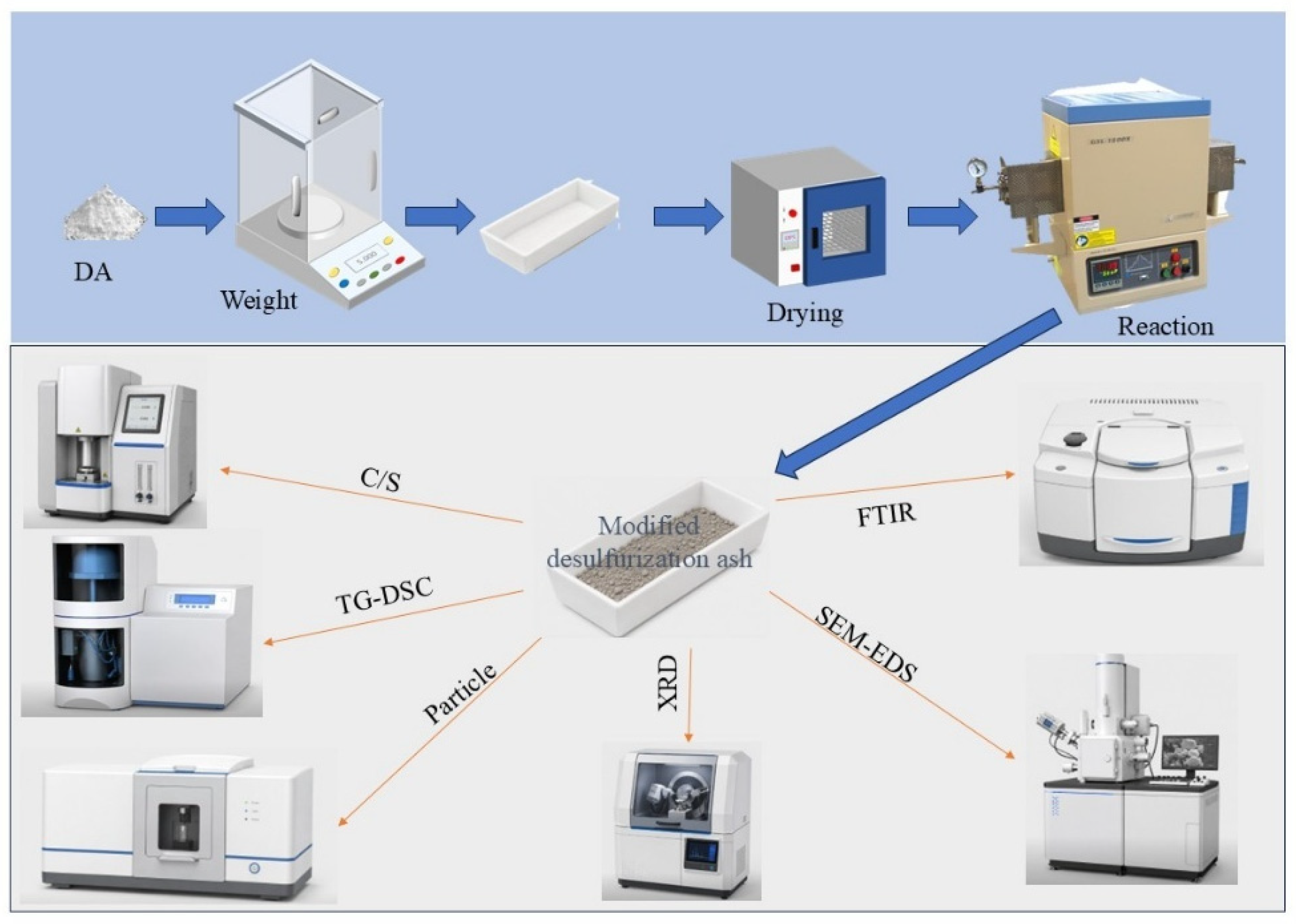
A total of 3 g of DA sample is evenly spread in a porcelain boat and pre-dried in an oven at 120 °C for 4 h to remove crystalline water. Subsequently, the dried sample is transferred into a tubular furnace, where Ar gas is introduced at a flow rate of 150 mL/min for 5 min to eliminate residual air from the reaction system. After establishing a stable inert atmosphere, CO2 was introduced as the reaction gas, and the furnace temperature was increased from room temperature to the desired reaction temperature at a heating rate of 5 °C/min. After maintaining the sample at the target temperature for a predetermined period, the furnace was cooled to room temperature at a rate of 5 °C/min. The obtained products were then collected, sealed, and stored for subsequent characterization. The schematic diagram of the experimental procedure is shown in Figure 1.
In this study, all samples were stored in vacuum-sealed bags prior to characterization, and the storage environment was maintained under dry conditions. Moreover, the phases in the modified DA exhibited relatively high stability and were unlikely to undergo reactions with atmospheric components. Therefore, the influence of potential phase transformation caused by improper storage conditions can be considered negligible. The experimental design employed in this work is summarized in Table 2, where the subscripts in the sample labels represent different levels of the corresponding experimental parameters.

2.3. Characterizations

The phase composition of the DA and the chemical states of surface elements are characterized by X-ray diffraction (XRD, D/MAX 2500PC, Rigaku, Tokyo, Japan) and X-ray fluorescence spectroscopy (XRF, MagixPW2403, PANalytical B.V., Almelo, The Netherlands). The microstructures of the samples before and after modification are characterized using scanning electron microscopy (SEM, JEOL JSM-7800F (JEOL, Tokyo, Japan)/FEI Nova NanoSEM 400 (FEI, Hillsboro, OR, USA)) equipped with an energy-dispersive X-ray spectroscopy system (EDS, Oxford INCA Energy 350, Abingdon, UK), which is also used to analyze the elemental distribution in the samples. The TG-DSC of the samples during the modification process is analyzed by SetaramSetsysEvo (SETARAM Instrumentation, Caluire, France, SETSYS Evolution). Fourier-transform infrared spectroscopy (FT-IR, Thermo Scientific Nicolet iS20, Waltham, MA, USA) is used to analyze the DA before and after modification by identifying characteristic functional groups and chemical bonds in the solid phases, thereby providing insight into changes in molecular interactions, carbonation products such as carbonates, and hydrated phases. The particle size distribution of DA before and after modification was measured using a laser particle size analyzer (Malvern Panalytical Ltd., Mastersizer 3000, Malvern, UK), and the corresponding mass-specific surface area was calculated based on the particle size data. The carbon contents of the samples before and after modification were measured using a carbon-sulfur analyzer (CS844, LECO, St. Joseph, MI, USA).

2.4. CO2 Uptake

To determine the CO2 uptake, the carbon contents of the samples before and after the reaction were measured using a carbon-sulfur analyzer. For each measurement, 0.20 ± 0.03 g of sample is placed in a crucible and covered with approximately 1 g of T-type tin granules as a flux. The carbon content is then determined after combustion at 1050 °C for 5 s.
The carbon uptake during the reaction is calculated using Equation (1):
Δ C = C 1 C 0
where C0 represents the carbon content of the raw desulfurization ash, with a value of 4.083%, and C1 represents the carbon content of the DA after reaction.
The CO2 uptake is calculated using Equation (2):
ϑ ( CO 2 ) = MW CO 2 MW C × Δ C
where MWC is the molar mass of carbon (12 g/mol) and MWCO2 is the molar mass of CO2 (44 g/mol).

3. Results and Discussion

3.1. Characterization of Raw Desulfurization Ash

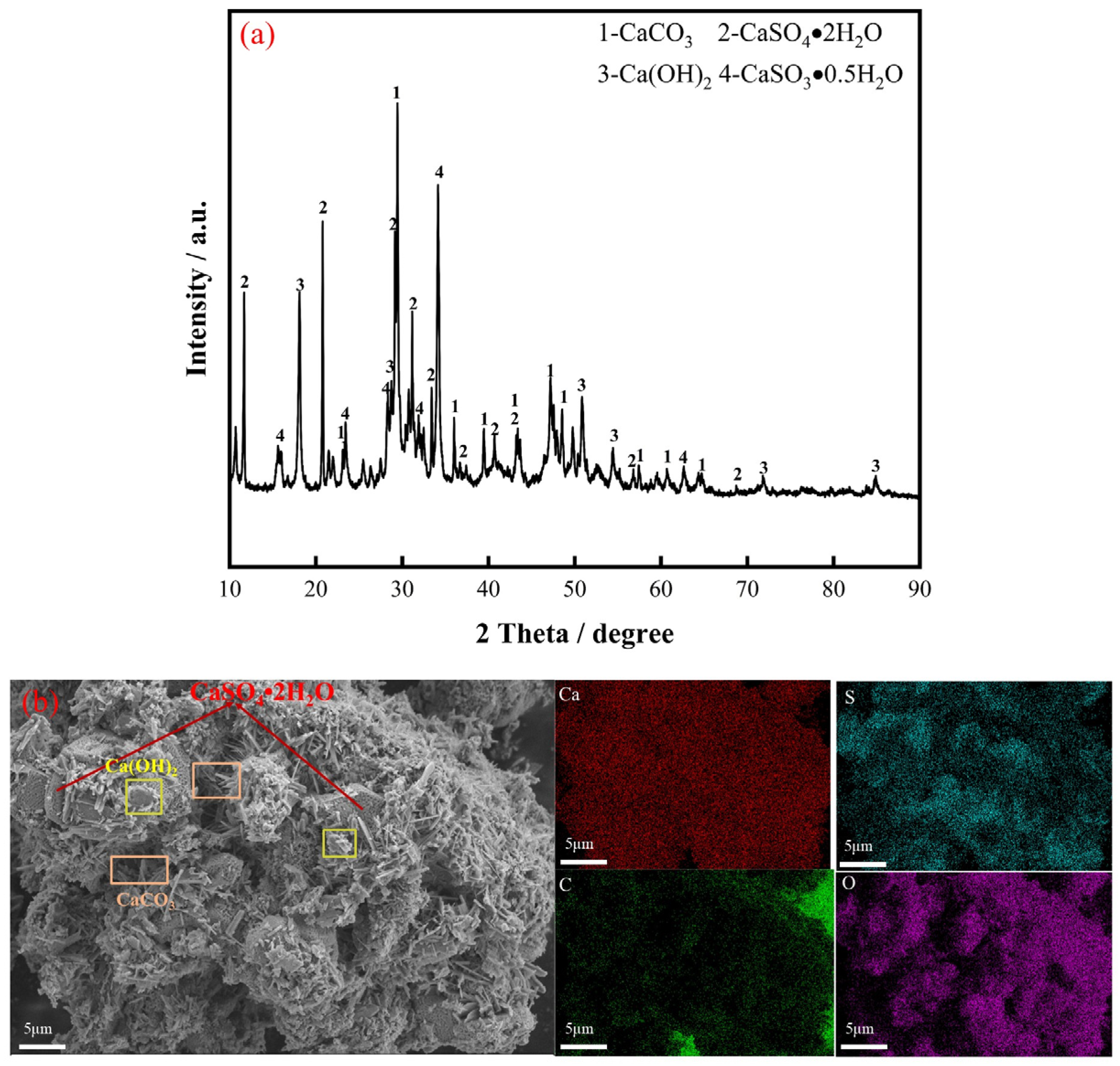
The phase composition of the DA was characterized by X-ray diffraction (XRD), and the corresponding diffraction patterns are presented in Figure 2a. As illustrated, the pristine DA is primarily composed of CaCO3, CaSO4·2H2O, Ca(OH)2, and CaSO3·0.5H2O. The morphology of the original DA was further investigated by scanning electron microscopy (SEM), as shown in Figure 2b. The raw DA exhibits a relatively dense microstructure, where plate-like Ca(OH)2 and needle-like CaCO3 particles are observed to be attached to the surface of calcium sulfate particles. The aggregation and distribution characteristics of these phases may significantly affect the microstructural evolution and physicochemical properties of the DA during subsequent carbonation treatment.

3.2. TG-DSC Analysis

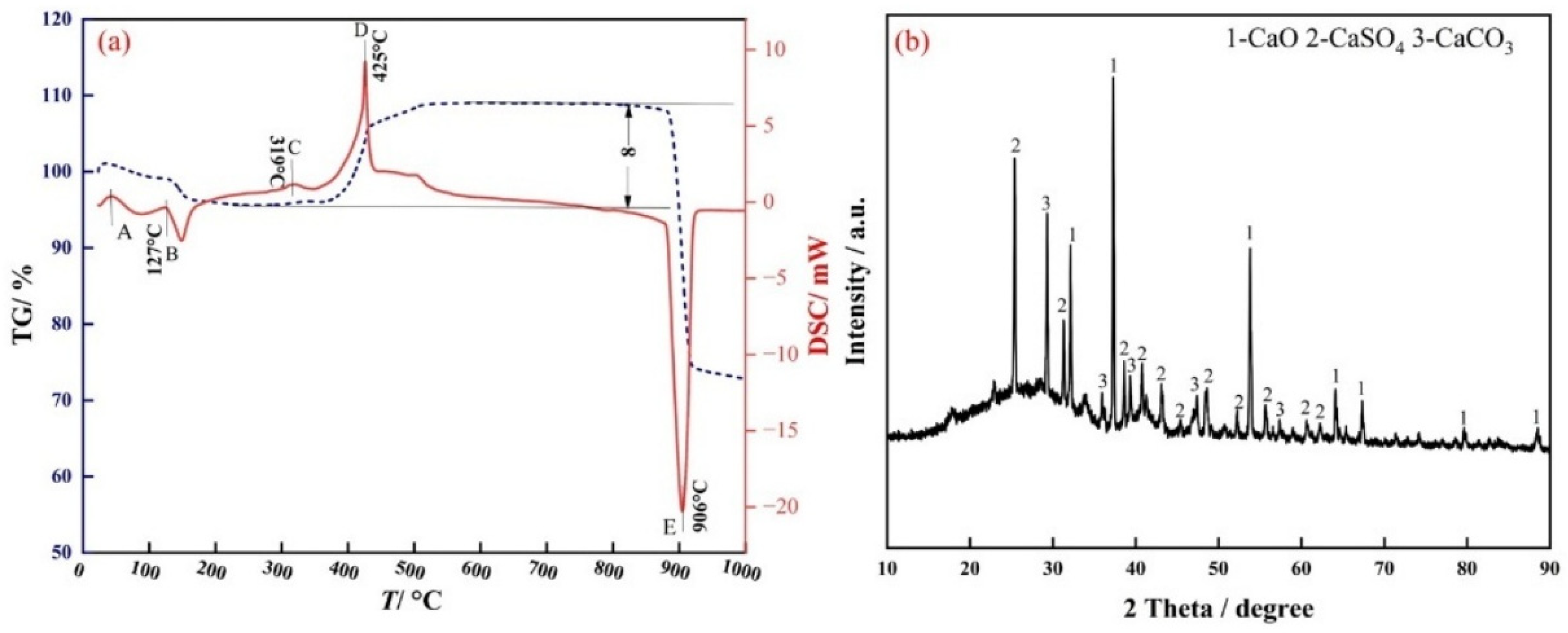
Figure 3a presents the TG-DSC curves of DA heated from room temperature to 1000 °C at a heating rate of 10 °C/min under a CO2 flow of 40 mL/min. At the lower-temperature stage, peaks A and B are mainly associated with the release of crystalline water from CaSO3·0.5H2O and CaSO4·2H2O, respectively. With increasing temperature, peak C at approximately 319 °C is attributed to the oxidation of CaSO3 to CaSO4 under the CO2 atmosphere. Peak D, located at approximately 425 °C, is associated with the carbonation of Ca(OH)2. Within this temperature range, Ca(OH)2 in the DA undergoes a gas–solid reaction with CO2 to form stable CaCO3. At higher temperatures, CaSO4 and CaCO3 remain relatively stable until a pronounced endothermic reaction appears at approximately 906 °C (peak E). This event is mainly attributed to the thermal decomposition of CaCO3 [27], accompanied by a distinct mass loss. The XRD results in Figure 3b further show that no diffraction peaks corresponding to CaSO3 are detected after thermal treatment, indicating that the CaSO3 originally present in the DA is completely converted to CaSO4 during heating. Meanwhile, the CaO phase identified in the final product is primarily derived from the decomposition of CaCO3 at elevated temperatures.

3.3. The Influence of Different Factors on the Modification Effect of DA

3.3.1. Temperature

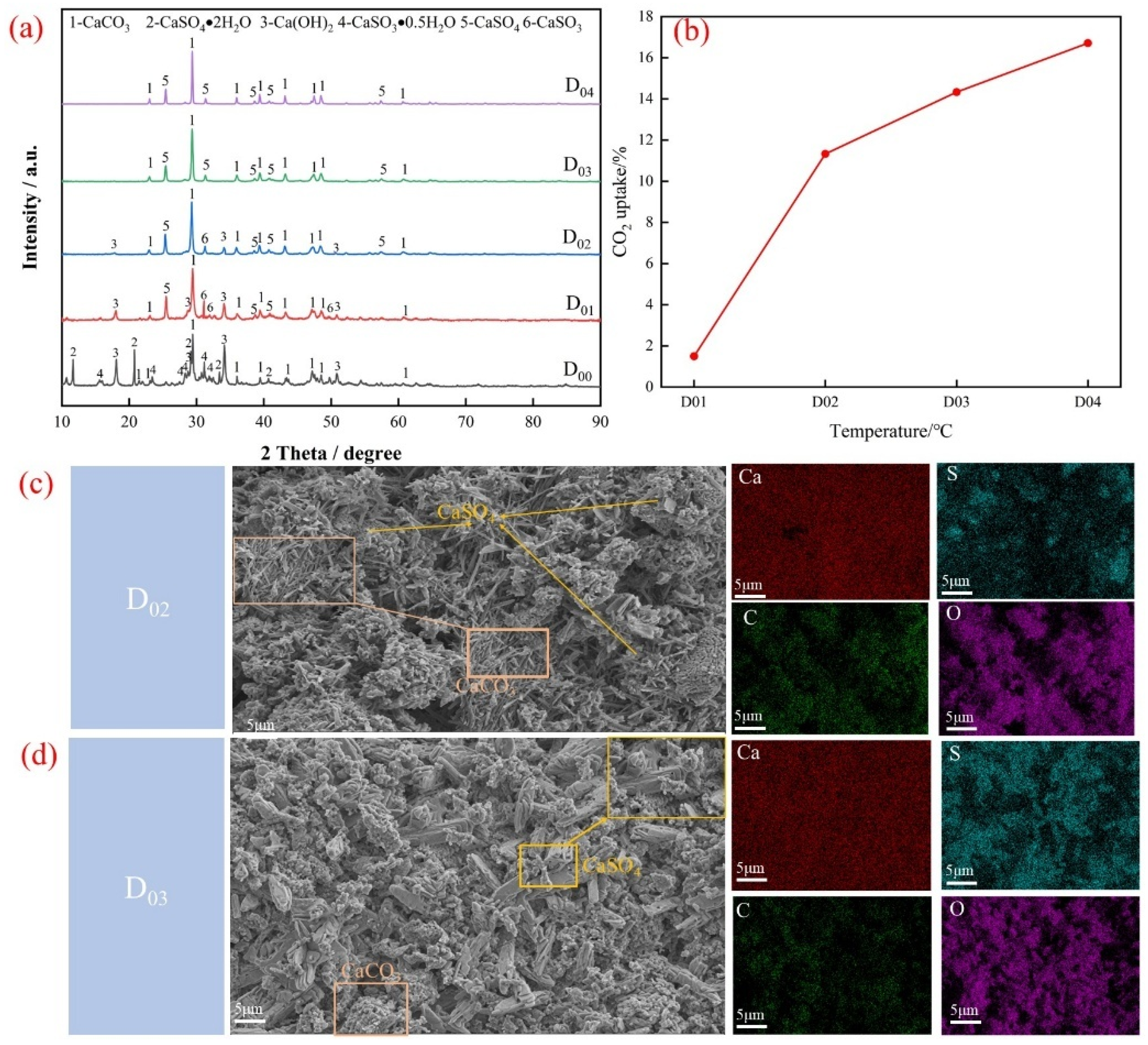
From the analysis of Section 3.2, it can be seen that before 310 °C, the DA system mainly undergoes the process of crystal water removal, and no obvious CO2 fixation reaction has occurred. Figure 4 further illustrates the effect of reaction temperature on the modification of DA at a fixed reaction time of 60 min and a CO2 flow rate of 120 mL/min. The XRD patterns show that, at temperatures below 350 °C, distinct diffraction peaks of Ca(OH)2 and CaSO3 remain in the products, indicating that both the oxidative conversion of CaSO3 and the carbonation of Ca(OH)2 are incomplete within this temperature range. At relatively low temperatures, the oxidation kinetics of CaSO3 under the CO2 atmosphere are limited, leaving part of the CaSO3 unconverted to CaSO4. Meanwhile, the carbonation of Ca(OH)2 to CaCO3 is constrained by both the reaction kinetics and CO2 diffusion, resulting in a considerable amount of unreacted calcium-bearing phases remaining in the system. As the reaction temperature increases above 350 °C, the diffraction peaks of CaSO3 and Ca(OH)2 gradually weaken, whereas the characteristic peaks of CaCO3 become progressively more intense. CaSO3 is further oxidized to CaSO4 under the CO2 atmosphere, consistent with the oxidation-related exothermic peak observed at approximately 319 °C in the TG-DSC analysis. This behavior indicates that the residual CaSO3 in DA retains high oxidative reactivity and can undergo further oxidation in a CO2-containing atmosphere. Meanwhile, the progressive increase in CaCO3 peak intensity indicates continuous carbonation of Ca(OH)2 by CO2, thereby contributing to CO2 sequestration. At 370 °C, the diffraction peaks of CaSO3 and Ca(OH)2 nearly disappear, and the products are predominantly composed of CaSO4 and CaCO3. Further increases in temperature produce only minor changes in the XRD patterns, suggesting that the phase transformation reactions are essentially complete. Figure 4b shows the variation in CO2 uptake with reaction temperature. At relatively low temperatures, CO2 uptake increases only slightly because of the sluggish carbonation kinetics. Upon increasing the temperature to 370 °C, CO2 uptake rises progressively as the reaction proceeds, indicating a marked enhancement in the CO2 sequestration capacity of the system.
Figure 4c,d further present the SEM-EDS results of the products obtained at 350 and 370 °C under a fixed reaction time of 60 min and a CO2 flow rate of 120 mL/min. At 350 °C, CaSO4 retains morphological features similar to those observed in the original DA, appearing predominantly as irregular block-like particles with porous surfaces. This observation suggests that no pronounced morphological reconstruction of the CaSO4 phase has occurred at this temperature. Meanwhile, abundant needle-like CaCO3 crystals are observed on the particle surfaces. When the reaction temperature is increased to 370 °C, the morphology of the CaSO4 particles changes markedly, with the original porous block-like structure gradually evolving into an irregular layered morphology.

3.3.2. CO2 Flow Rate

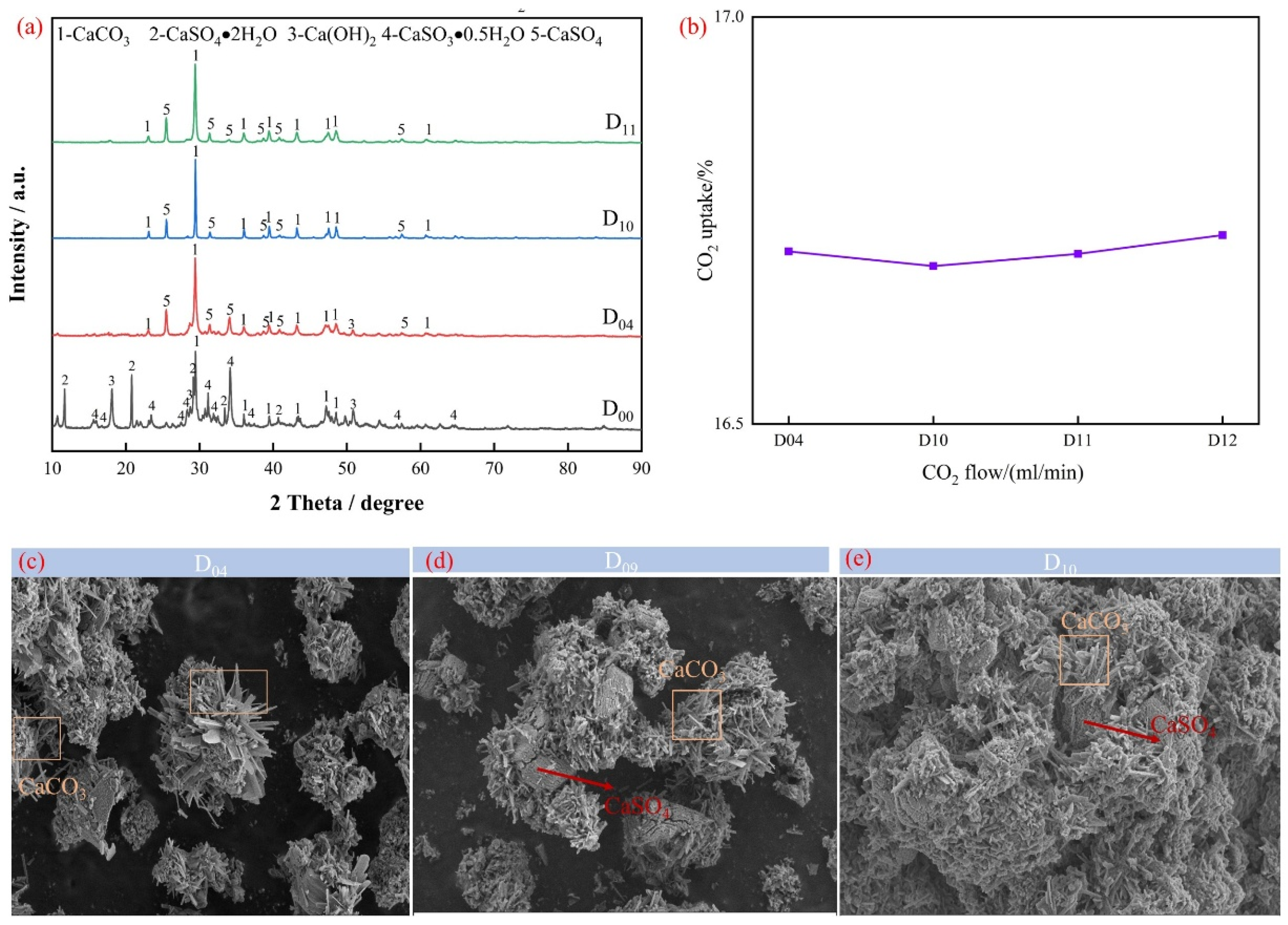
The change in CO2 flow rate will affect the supply of CO2 in the reaction system and the gas–solid contact process, which may affect the modification process of DA [28]. Figure 5 examines the influence of CO2 flow rate on the modification process at 450 °C with a fixed reaction time of 60 min. As shown by the XRD patterns in Figure 5a, increasing the CO2 flow rate produces no appreciable change in the phase composition of the products, which are predominantly composed of CaCO3 and CaSO4. This result suggests that, under these reaction conditions, increasing the CO2 supply does not further promote the transformation of the reactive calcium-bearing phases in DA. This trend is further supported by the CO2 uptake results presented in Figure 5b, where only minor changes in CO2 uptake are observed as the CO2 flow rate increases.
Figure 5c–e present the SEM images of the products obtained at different CO2 flow rates. The CO2 flow rate exerts a pronounced influence on the morphological evolution of CaCO3 crystals. As the CO2 flow rate increases, the size of the needle-like CaCO3 crystals gradually decreases. At a CO2 flow rate of 120 mL/min, the products mainly contain short clustered CaCO3 crystals together with needle-like CaCO3 exhibiting a relatively high aspect ratio, indicating that an adequate CO2 supply favors the rapid interaction between Ca2+ and CO32− and subsequent crystal growth. With a further increase in CO2 flow rate, the enhanced CO2 availability accelerates carbonate formation, while excessive nucleation restricts subsequent crystal growth [29,30]. Consequently, the short clustered CaCO3 crystals gradually decrease in abundance and evolve toward smaller needle-like CaCO3 crystals with lower aspect ratios. Meanwhile, the newly formed needle-like CaCO3 crystals progressively cover the surfaces of CaSO4 particles, producing a coating structure. Combined with the XRD results, these observations indicate that although increasing the CO2 flow rate affects CaCO3 crystallization and morphology, it does not cause an appreciable change in the overall phase composition. This suggests that, at 450 °C and a CO2 flow rate of 120 mL/min, the CO2 supply is already sufficient for the reaction. Further increases in flow rate therefore mainly influence the nucleation and morphological development of CaCO3 rather than substantially enhancing the overall CO2 uptake.

3.3.3. Reaction Time

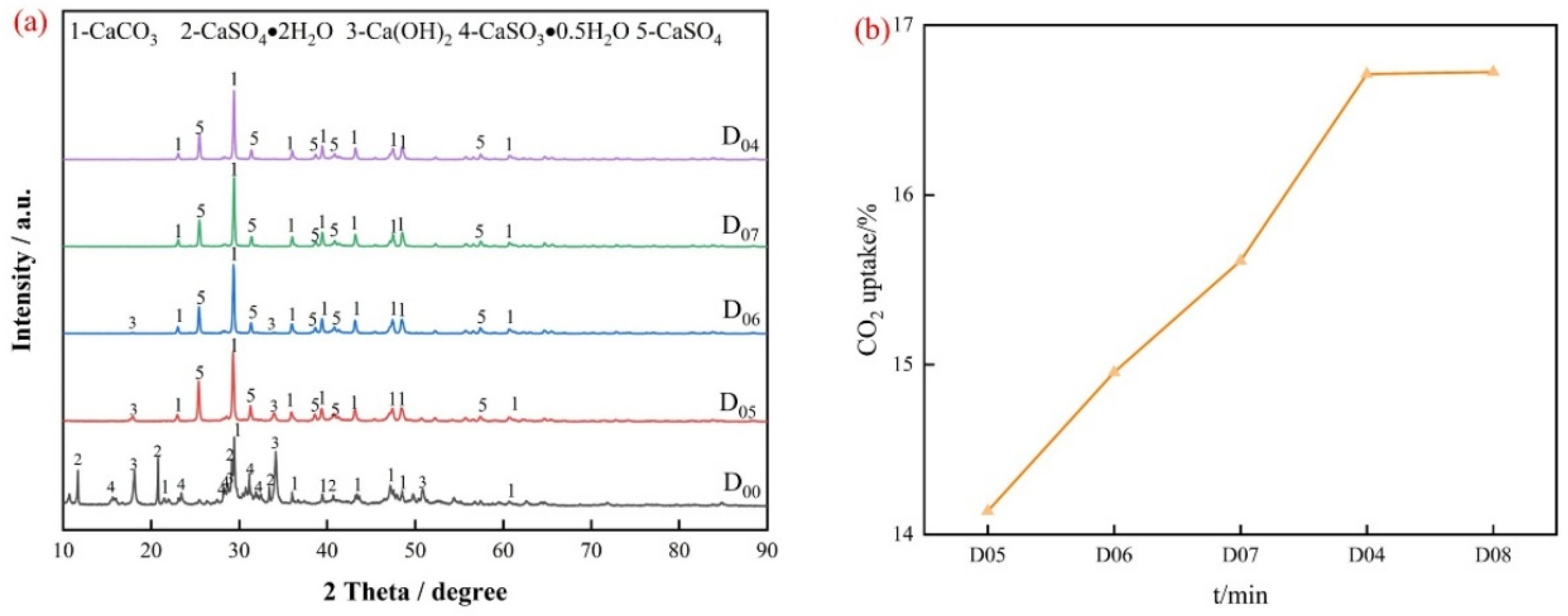
Figure 6 illustrates the effect of reaction time on the modification of DA at 450 °C under a constant CO2 flow rate. Figure 6a presents the XRD patterns of the products obtained after holding times of 5, 10, 20, and 60 min. After the reaction time of 5 min, the diffraction peaks corresponding to CaSO3 in the original DA have nearly disappeared, indicating that CaSO3 undergoes rapid oxidative conversion under the CO2 atmosphere. When the holding time is extended to 10 min, the characteristic diffraction peaks of CaCO3 become progressively more intense. After 20 min, the products are predominantly composed of CaCO3 and CaSO4, suggesting that the highly reactive calcium-bearing phases in the DA, including Ca(OH)2 and CaSO3, have been largely transformed. Further extending the holding time to 60 min produces no appreciable change in the XRD patterns, indicating that the major mineral phases have essentially stabilized. Figure 6b further shows the variation in CO2 uptake with holding time. As the holding time increases from 5 to 60 min, CO2 uptake increases continuously, accompanied by the progressive conversion of reactive calcium-bearing phases into stable CaCO3. Beyond 60 min, however, the CO2 uptake approaches a plateau, and prolonging the reaction time produces little additional increase in CO2 sequestration. This behavior indicates that the overall conversion rate gradually decreases at the later stage of the reaction. This trend may be associated with CO2 diffusion within the particles and mass transfer at the reaction interface.

3.3.4. Gas Type

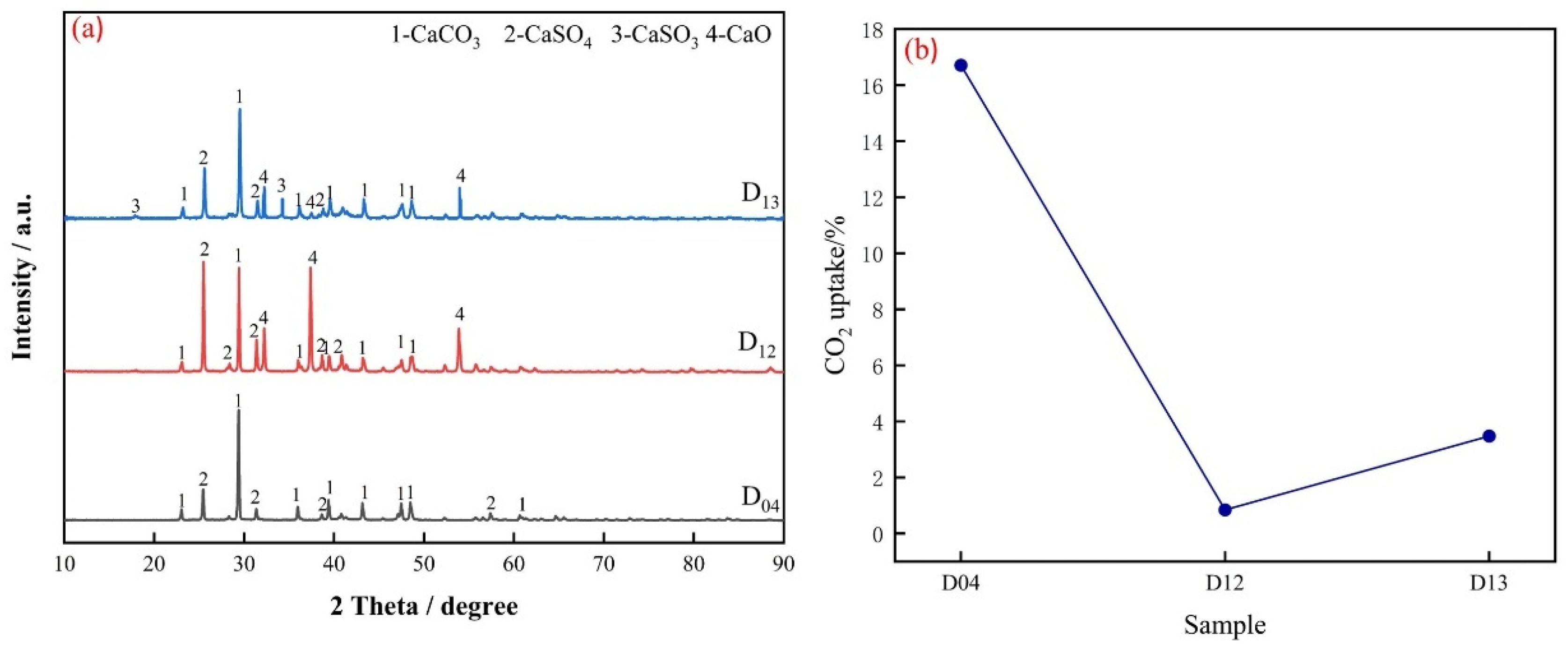
Figure 7 illustrates the effects of different gas atmospheres on the modification behavior of DA at 450 °C with a gas flow rate of 120 mL/min. As shown in Figure 7a, CaSO4 and CaCO3 are identified as the major crystalline phases after treatment under an air atmosphere. The presence of O2 in air promoted the oxidation of CaSO3 to CaSO4, resulting in CaSO4 becoming the predominant sulfate phase in the modified sample. Meanwhile, because no external CO2 is supplied under the air atmosphere, the formation of CaCO3 is mainly associated with the carbonate species originally present in DA and the limited carbonation reactions occurring during treatment. Consequently, the diffraction peak intensities of CaSO4 and CaCO3 are relatively comparable. In contrast, Ar is chemically inert under the experimental conditions and does not participate appreciably in reactions with the active components of DA. Therefore, the thermal decomposition of Ca(OH)2 is the primary reaction occurring under the Ar atmosphere, while no obvious oxidation conversion of CaSO3 is observed. These results indicate that Ar mainly serves as a protective atmosphere during the modification process and has a limited direct effect on the phase transformation of DA. This finding further confirms that the Ar component in the Ar and CO2 mixed atmosphere does not substantially interfere with the reaction between CO2 and DA.
Figure 7b compares the CO2 uptake of DA modified under different gas atmospheres. The sample treated under a CO2 atmosphere exhibited the highest CO2 uptake, which can be mainly attributed to the continuous supply of CO2 and its subsequent carbonation with the reactive calcium-containing components in DA. In particular, Ca(OH)2 possesses relatively high reactivity toward CO2, thereby facilitating CO2 absorption and fixation and consequently increasing the carbon content of the modified sample. In contrast, neither Ar nor air provides an external source of CO2, resulting in a substantially lower CO2 uptake than that obtained under the CO2 atmosphere. Furthermore, under the air atmosphere, O2 promoted the conversion of CaSO3 to CaSO4, which further reduced the amount of reactive calcium available for carbonation and thus contributed to the relatively low CO2 uptake.

3.4. Particle Analysis

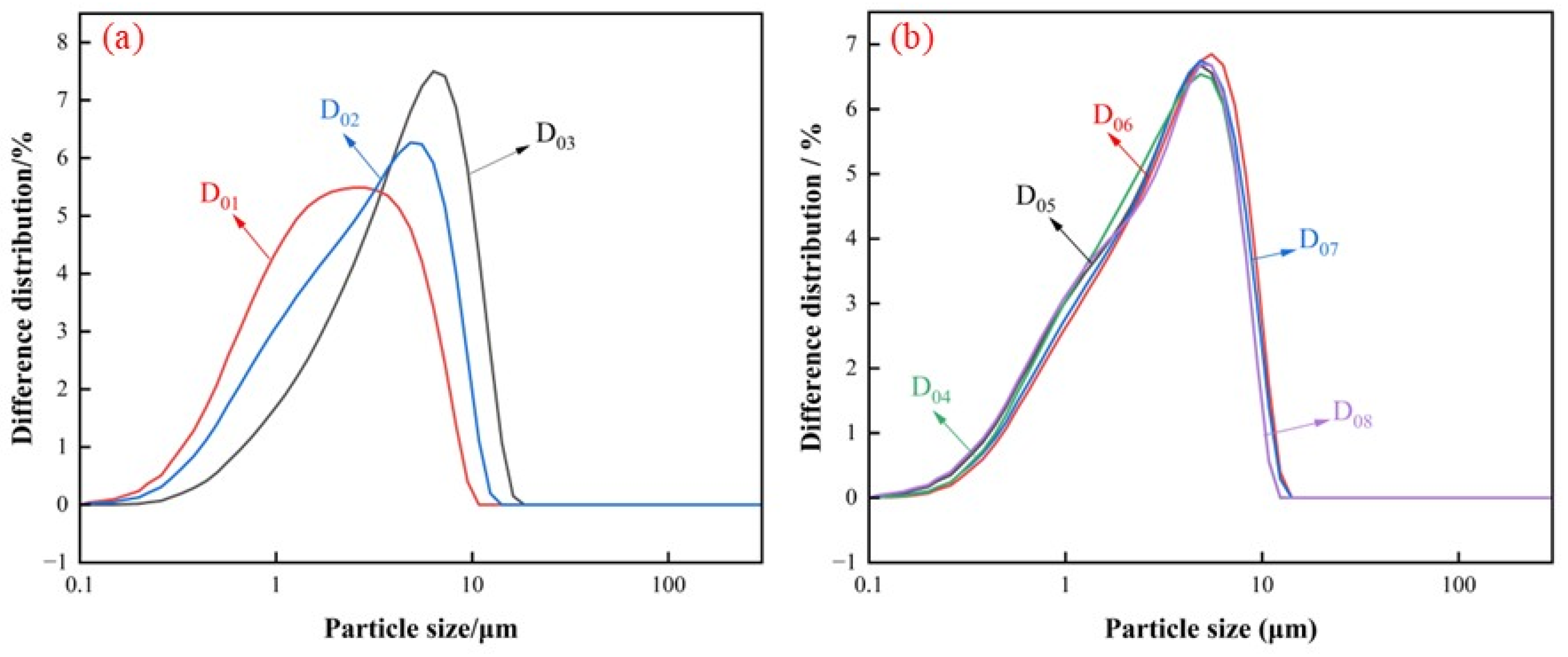
Figure 8 illustrates the evolution of particle size distribution during the modification of DA. All samples exhibit unimodal particle size distributions, with most particles falling within the range of 0.1–10 μm. As the modification conditions change, the particle size distribution progressively shifts toward larger sizes, with the peak position increasing from approximately 2 to 7 μm, indicating an overall increase in particle size during the modification process. This behavior may be associated with the formation of CaCO3 during CO2-induced carbonation.
To further characterize the changes in the particle characteristics of DA during CO2 modification, the weight-specific surface area and mean particle size of the samples obtained under different reaction conditions were analyzed, as summarized in Table 3. The raw DA exhibits a weight-specific surface area of 3.601 m2/kg and a mean particle size of 5.83 μm. Both parameters vary with reaction temperature. At 310 °C, the weight-specific surface area decreases to 2.408 m2/kg, while the mean particle size is 4.72 μm. When the temperature increases to 350 °C, the weight-specific surface area increases to 5.029 m2/kg, accompanied by a decrease in the mean particle size to 2.39 μm. At 370 °C, the weight-specific surface area decreases to 3.812 m2/kg, whereas the mean particle size increases to 3.31 μm. These results demonstrate that the particle size characteristics and weight-specific surface area of DA vary appreciably with reaction temperature, corresponding to the changes in mineral composition and microstructure observed during the modification process. At 450 °C, the weight-specific surface area of the samples obtained at different reaction times ranges from 2.973 to 3.896 m2/kg, while the mean particle size ranges from 3.24 to 4.43 μm, indicating relatively limited overall variation. Further analysis of the effect of reaction time shows that both the weight-specific surface area and mean particle size change with increasing reaction time. After 5 min, the sample exhibits a weight-specific surface area of 3.452 m2/kg and a mean particle size of 3.33 μm. When the reaction time is extended to 10 min, the weight-specific surface area decreases to 3.051 m2/kg, while the mean particle size increases to 4.38 μm. With a further increase in reaction time to 120 min, both parameters continue to fluctuate to some extent, although the magnitude of the changes gradually decreases. Overall, the particle size distribution, weight-specific surface area, and mean particle size results demonstrate that the CO2 modification conditions affect the particle characteristics of DA, while these parameters tend to become relatively stable at longer reaction times.

3.5. FT-IR Analysis

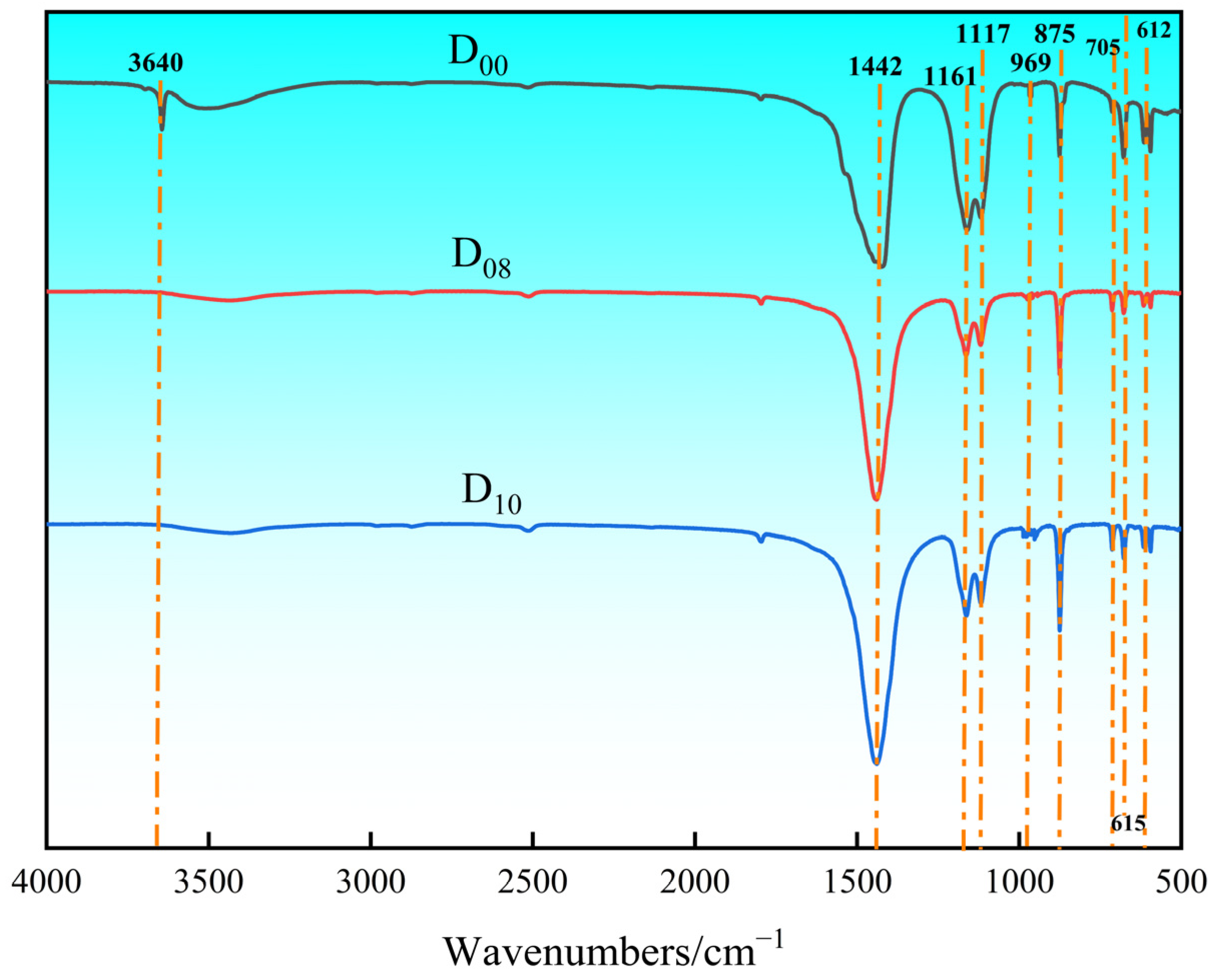
Figure 9 presents the Fourier-transform infrared (FT-IR) spectra of the raw DA and the samples modified under different CO2 conditions. For the untreated sample, the absorption band at approximately 3640 cm−1 is assigned to the O-H stretching vibration of hydroxyl groups in Ca(OH)2, indicating the presence of a considerable amount of residual Ca(OH)2 in the raw DA [31]. After treatment at 450 °C, the intensity of this band decreases markedly, suggesting progressive consumption of hydroxyl-bearing Ca(OH)2 through carbonation with CO2 to form CaCO3. This observation is consistent with the XRD results, which show a gradual weakening and eventual disappearance of the Ca(OH)2 diffraction peaks accompanied by an increase in the intensity of the CaCO3 peaks. The strong absorption band at approximately 1442 cm−1 is attributed to the asymmetric C-O stretching vibration of CO32−. Its progressive enhancement after CO2 treatment indicates the conversion of CO2 into stable carbonate phases. Additional carbonate-related bands are observed at approximately 875 and 705 cm−1. Together with the observed needle-like morphology in the SEM images, these spectral features support the formation of needle-like CaCO3. The absorption band near 969 cm−1 is assigned to vibrations of SO32− groups, and its gradual attenuation with reaction progress indicates the continuous consumption of CaSO3 [23]. In contrast, the band near 612 cm−1, associated with vibrational modes of SO42−, becomes progressively more intense, indicating the oxidative conversion of calcium sulfite into the more stable calcium sulfate phase. These FT-IR observations are consistent with the XRD, SEM-EDS, and TG-DSC results. Overall, the results demonstrate pronounced mineral-phase evolution during CO2 modification of DA. Reactive phases such as Ca(OH)2 and CaSO3 are progressively consumed, accompanied by the formation of needle-like CaCO3 and the oxidative transformation of CaSO3 into CaSO4. These coupled transformations contribute simultaneously to CO2 mineral sequestration and the stabilization of the DA.

3.6. Reaction Mechanism

3.6.1. Thermomechanical Analysis

To elucidate the effect of the CO2 atmosphere on the oxidative conversion of CaSO3 at 450 °C, the influence of gas partial pressure on the Gibbs free energy of the reaction was analyzed. For reaction (3), since both CaSO3 and CaSO4 are solid phases, their activities can be approximated as unity. Therefore, the actual Gibbs free energy of the reaction can be expressed by Equation (4). At 450 °C, the equilibrium condition of this reaction is determined by the PCO/PCO2 ratio. In this experiment, CO2 is continuously supplied to the reaction system, while the generated CO is continuously removed from the reaction zone by the flowing gas, thereby suppressing the local accumulation of CO on the solid surface and maintaining a relatively high PCO2/PCO ratio. Consequently, the continuous supply of CO2 can regulate the gas-phase chemical potential and the partial-pressure relationship between reactants and products, thereby enhancing the thermodynamic driving force for the conversion of CaSO3 to CaSO4. These results demonstrate, from a thermodynamic perspective, the feasibility of the experimental design adopted in this study.
CaSO 3 + CO 2 = CaSO 4 + CO
Δ G = Δ G θ + RT ln ( P CO P CO 2 )
where ΔG is the Gibbs free energy change under the actual reaction conditions, kJ/mol; ΔGθ is the standard Gibbs free energy change in the reaction, kJ/mol; R is the universal gas constant, 8.314 J/(mol·K−1); T is the absolute temperature, K; and PCO and PCO2 are the partial pressures of CO and CO2 in the reaction system, respectively.

3.6.2. Reaction Procress

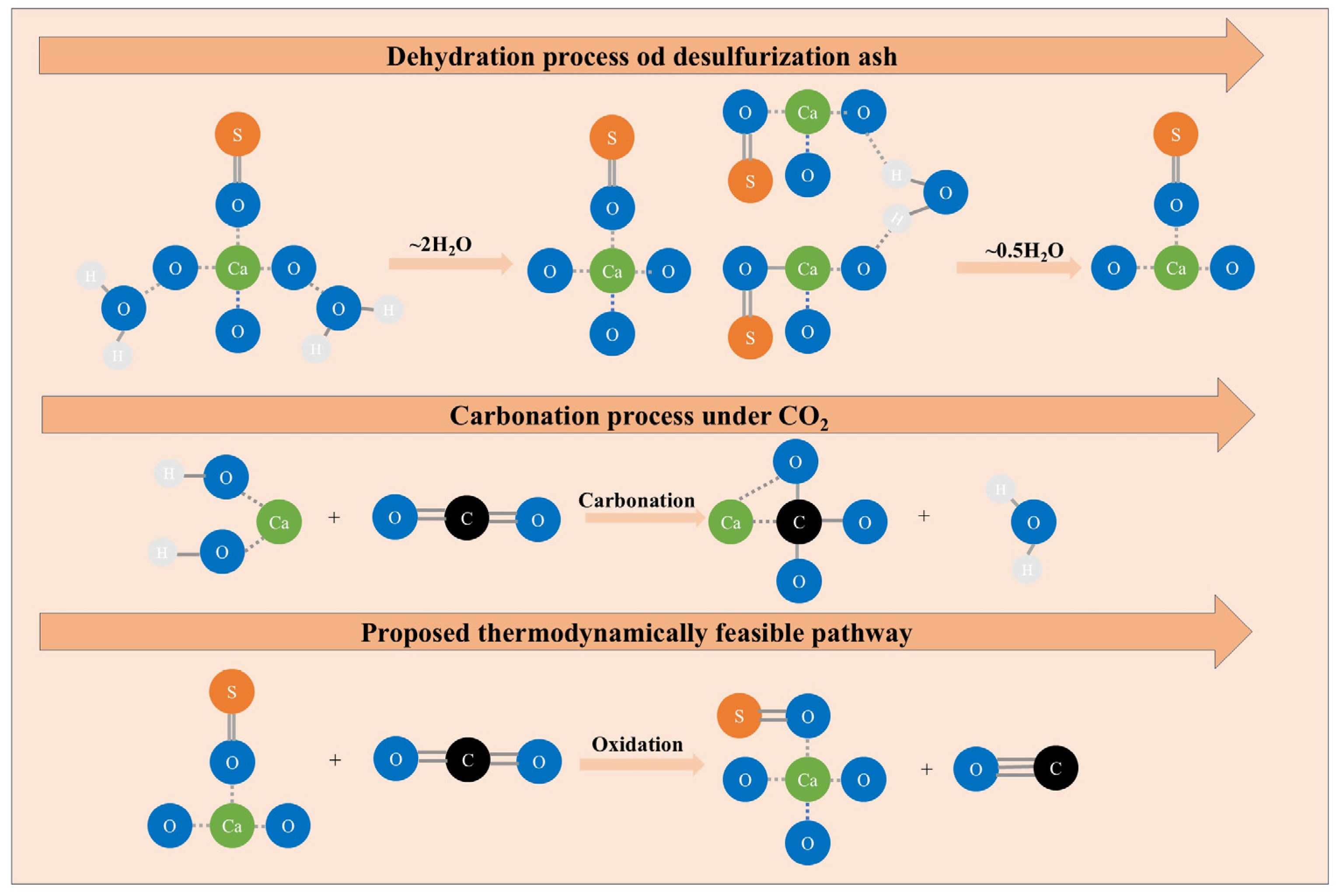
According to the TG-DSC results presented in Section 3.1, the thermal reaction of DA under a CO2 atmosphere proceeds through several distinct stages. Within the lower-temperature range of 100–200 °C, dehydration of the hydrated mineral phases predominates. The crystalline water in CaSO3·0.5H2O and CaSO4·2H2O is progressively released, yielding anhydrous CaSO3 and CaSO4, respectively. No appreciable CO2 sequestration occurs during this stage, and the corresponding reactions are described by reactions (5) and (6). As the temperature increases, pronounced mineral-phase transformations begin to occur. Two endothermic peaks appear on the DSC curve at approximately 319 and 425 °C, corresponding to the oxidative conversion of CaSO3 to CaSO4 and the carbonation of Ca(OH)2 by CO2, respectively, as represented by reactions (3) and (7). These results indicate that, during heating, the reaction pathway of DA evolves sequentially from dehydration to oxidation and subsequently to carbonation.
Further combined with the XRD results under different reaction times in Section 3.3.3, it can be found that after a reaction time of only 5 min, the characteristic diffraction peaks of CaSO3 in the raw material have nearly disappeared, while the relative abundance of CaSO4 increases markedly; in contrast, distinct Ca(OH)2 diffraction peaks remain detectable. These observations indicate that, under the conditions employed in this study, the oxidative conversion of calcium sulfite occurs preferentially, whereas the carbonation of Ca(OH)2 proceeds subsequently and continues with increasing reaction time. As the reaction progresses, Ca(OH)2 is gradually consumed and converted into CaCO3. Therefore, the thermal modification of DF under CO2 is not a simple carbonation process but instead follows a sequential pathway involving dehydration of hydrated phases, oxidation of CaSO3, and carbonation of Ca(OH)2. The corresponding reaction pathway and mineral-phase evolution are schematically illustrated in Figure 10.
CaSO 3 · 0.5 H 2 O = CaSO 3 + 0.5 H 2 O
CaSO 4 · 2 H 2 O = CaSO 4 + 2 H 2 O
Ca ( OH ) 2 + CO 2 = CaCO 3 + H 2 O

4. Conclusions

In this study, DA was thermally modified under a CO2 atmosphere, and the oxidative conversion of CaSO3 and the carbonation behavior of Ca(OH)2 during the modification process were investigated. The effects of reaction temperature, CO2 flow rate, and reaction time on mineral-phase evolution, CO2 uptake, and microstructural changes were also evaluated. The main conclusions are summarized as follows:
(1)
Reaction temperature is the dominant factor governing the modification process, while CO2 flow rate and reaction time also play important roles. Under a CO2 atmosphere, CaSO3 and Ca(OH)2 in the DA undergo oxidative conversion and carbonation, forming CaSO4 and CaCO3, respectively. At 450 °C, the modified product exhibits the highest CO2 uptake, reaching 16.71%.
(2)
The modification process alters the mineral-phase composition of DA and enables regulation of the crystalline characteristics of the resulting phases. Under the conditions of 450 °C, a CO2 flow rate of 120 mL/min, and a reaction time of 60 min, SEM observations reveal that CaCO3 exhibits a distinct needle-like CaCO3 morphology. In addition, the interconnection of newly formed CaCO3 particles during modification leads to a moderate increase in particle size, further demonstrating the influence of mineral transformation on the structural evolution of DA particles.
(3)
This study elucidates the coupled oxidation–carbonation mechanism of DA under a CO2 atmosphere, enabling the simultaneous transformation of unstable sulfur-bearing phases and reactive calcium-bearing components. Compared with conventional wet modification processes, this approach avoids complicated processing steps and provides a promising route for the high-value utilization of DA and the integration of industrial solid-waste valorization with CO2 sequestration.

Author Contributions

P.L.: Writing—Original Draft, Visualization. Y.C.: Formal analysis. D.L.: Conceptualization, Project administration. Q.W.: Visualization. H.Y.: Conceptualization, Project administration. All authors have read and agreed to the published version of the manuscript.

Funding

The research was funded by the National Natural Science Foundation Regional Joint Key Projects (U23A20605).

Institutional Review Board Statement

Not applicable.

Informed Consent Statement

Informed consent was obtained from all subjects involved in the study.

Data Availability Statement

The original contributions presented in this study are included in the article. Further inquiries can be directed to the corresponding author.

Conflicts of Interest

The authors declare no conflicts of interest.

References

  1. Ning, H.Y.; Tang, H.Y.; Li, R.J.; Gu, C.M.; Gong, X.L.; Zhu, Z.J.; Li, C.Q.; Wang, J.L.; Yu, K.J. Recent advances in process and materials for dry desulfurization of industrial flue gas: An overview. Sep. Purif. Technol. 2025, 353, 128425. [Google Scholar] [CrossRef] [Scilit]
  2. Lyu, J.L.; Zhao, J.L.; Xing, S.L.; Wang, C.; Chu, C.; Xi, G.R.; Zhou, X.F. The production of artificial aggregates with flue gas DA: Development of a novel carbonation route. J. Clean. Prod. 2024, 444, 141068. [Google Scholar] [CrossRef] [Scilit]
  3. Guo, X.; Zeng, M.; Yu, H.; Lin, F.; Li, J.; Wang, W.; Chen, G. Critical review for the potential analysis of material utilization from inorganic industrial solid waste. J. Clean. Prod. 2024, 459, 142457. [Google Scholar] [CrossRef] [Scilit]
  4. Meng, D.X.; Wei, R.F.; Zhang, R.F.; Long, F.H.; Zhou, H.M. Resource utilization of flue gas calcium-based DA: A comprehensive review. Iron Steel Res. Int. 2023, 30, 405–418. [Google Scholar] [CrossRef] [Scilit]
  5. Liu, L.; Fan, X.; Zhou, Z.; Gan, M.; Gao, Z.; Sun, Z.; Ji, Z.; Wang, X.; Li, J.; Wu, Y. Resource utilization of semi-dry flue gas DA by thermal treatment on sintering machine. Environ. Chem. Eng. 2024, 12, 112356. [Google Scholar] [CrossRef] [Scilit]
  6. Xu, B.J.; Shen, Y.F.; Qiao, H.; Gao, Z. Exploring the impact of economic growth and energy consumption on SO2 emissions in China based on the Environmental Kuznets Curve hypothesis. Pet. Sci. 2024, 21, 2892–2900. [Google Scholar] [CrossRef] [Scilit]
  7. Li, P.; Wu, J.J.; Xu, W.C. The impact of industrial sulfur dioxide emissions regulation on agricultural production in China. J. Environ. Econ. Manag. 2024, 124, 102939. [Google Scholar] [CrossRef] [Scilit]
  8. Qian, D.Y.; Wang, Y.; Xing, Y.; Jin, M.H. Oxidation characteristics of calcium sulfite in sintering desulphurized ash. Chin. J. Eng. 2023, 45, 1985–1996. [Google Scholar] [CrossRef]
  9. Xing, G.; Wang, W.; Zhao, S.; Qi, L.Q. Application of Ca-based adsorbents in fixed-bed dry flue gas desulfurization (FGD): A critical review. Environ. Sci. Pollut. Res. 2023, 30, 76471–76490. [Google Scholar] [CrossRef] [Scilit]
  10. Liu, S.; Liu, W.; Jiao, F.; Qin, W.Q.; Yang, C.R. Production and resource utilization of flue gas desulfurized gypsum in China—A review. Environ. Pollut. 2021, 288, 117799. [Google Scholar] [CrossRef] [Scilit]
  11. Shi, T.; Li, Z.X.; Guo, J. Research progress on CNTs/CNFs-modified cement-based composites—A review. Constr. Build. Mater. 2019, 202, 290. [Google Scholar] [CrossRef] [Scilit]
  12. Lu, G.; Li, H.; Ma, H.Z.; Leng, T.S. Oxidation Study and Mechanism Analysis of DA. Procecsses 2024, 12, 1008. [Google Scholar] [CrossRef] [Scilit]
  13. Ma, W.B.; Feng, S.L.; Deng, P.; Yuan, Z.Z.; Zhong, Q.; Guo, S.C. Utilization of ultra-fine DAes in supersulfated cementitious materials and its influence on the mechanical and durability performance. Constr. Build. Mater. 2025, 459, 139780. [Google Scholar] [CrossRef] [Scilit]
  14. Yang, Y.P.; Chen, L.L.; Liu, G.X.; Yan, S.J.; Wu, Y.Y.; Bian, S. Impact of admixtures on the performance of high-content DA-incorporated cementitious composites: Work performance and durability. J. Alloys Compd. 2025, 1030, 180861. [Google Scholar] [CrossRef] [Scilit]
  15. Wei, J.W.; Zhuang, W.; Lin, T.F.; Gao, M.; Zhao, C.L.; Wu, X.; Lin, C.; Chen, H.; Su, Q.F. Mechanical enhancement of epoxidized natural rubber by flue gas DA as the sole reinforcing filler. Polym. Eng. Sci. 2024, 64, 5–16. [Google Scholar] [CrossRef] [Scilit]
  16. Jiang, Y.; Deng, Y.F.; Ying, Z.; Chen, J.F. Desulphurisation ash recycling in soil modification for roadbed materials: A case study. Road Mater. Pavement Des. 2025, 26, 3284–3295. [Google Scholar] [CrossRef] [Scilit]
  17. Xu, R.; Zhu, F.X.; Zou, L.; Wang, S.Q.; Wang, G.; Liu, Y.F.; Hou, J.L.; Li, C.H.; Song, K.T.; Kong, L.Z.; et al. CO2 mineralization by typical industrial solid wastes for preparing ultrafine CaCO3: A review. Green Energy Environ. 2024, 9, 1679–1697. [Google Scholar] [CrossRef] [Scilit]
  18. He, Q.Y.; Yan, S.P.; Ji, L. Impurities in steel slag during the CO2 mineralization: Optimization and multicycle operation. Ind. Eng. Chem. Res. 2025, 64, 7156–7164. [Google Scholar] [CrossRef] [Scilit]
  19. DiGiovanni, C.; Hisseine, O.A.; Awolayo, A.N. Carbon dioxide sequestration through steel slag carbonation: Review of mechanisms, process parameters, and cleaner upcycling pathways. J. CO2 Util. 2024, 81, 102736. [Google Scholar] [CrossRef] [Scilit]
  20. Uliasz-Bocheńczyk, A.; Deja, J. Potential application of cement kiln dust in carbon capture, utilization, and storage technology. Energy 2024, 292, 130412. [Google Scholar] [CrossRef] [Scilit]
  21. Wang, C.L.; Jiang, H.Y.; Miao, E.D.; Wang, Y.J.; Zhang, T.T.; Xiao, Y.Q.; Liu, Z.Y.; Ma, J.; Xiong, Z.; Zhao, Y.C.; et al. Accelerated CO2 mineralization technology using fly ash as raw material: Recent research advances. Chem. Eng. J. 2024, 488, 150676. [Google Scholar] [CrossRef] [Scilit]
  22. Zhou, D.; Wei, R.F.; Zhu, Y.L.; Long, H.M.; Huang, B.F.; Wang, Y.F.; Wu, S.C. Calcium sulfate whisker one-step preparation using semi-dry flue gas DA and directional growth control. J. Clean. Prod. 2021, 290, 125754. [Google Scholar] [CrossRef] [Scilit]
  23. Baras, A.; Li, J.; Li, K.; Mu, X.; Onaizi, A.M.; Cao, Y.; Heraiz, H.; Elajjani, A.; Du, H.; Ni, W.; et al. Carbonation curing of semi-dry flue gas DA for CO2 sequestration: Microstructural evolution and strength development of alkali-rich industrial waste. Minerals 2026, 16, 145. [Google Scholar] [CrossRef] [Scilit]
  24. Wang, Y.-F.; Zhang, Y.-D.; Long, H.-M.; Qian, L.-X.; Luo, Y.-F. Low-temperature oxidation behavior and mechanism of semi-dry desulfurization ash from iron ore sintering flue gas. J. Iron Steel Res. Int. 2022, 28, 1075–1081. [Google Scholar] [CrossRef] [Scilit]
  25. Li, Y.; Zhang, X.; Wang, J.; Liu, H.; Chen, Z.; Zhang, Y. New technology for green co-production of CaSO4 and industrial salt using waste heat and oxygen-enriched flash roasting of DA. J. Taiwan Inst. Chem. Eng. 2025, 168, 105902. [Google Scholar] [CrossRef] [Scilit]
  26. Yao, L.; Liu, Q.; Fang, S.; Ren, S.; Liu, L.; Kong, M.; Zhu, B. Oxidation modification of semi-dry desulfurization ash from sintering flue gas. Chin. J. Environ. Eng. 2016, 10, 3147–3151. [Google Scholar] [CrossRef]
  27. Karunadasa, K.S.P.; Manoratne, C.H.; Pitawala, H.M.T.G.A.; Rajapakse, R.M.G. Thermal decomposition of calcium carbonate (calcite polymorph) as examined by in-situ high-temperature X-ray powder diffraction. J. Phys. Chem. Solids 2019, 134, 21–28. [Google Scholar] [CrossRef] [Scilit]
  28. Gao, Y.F.; Wang, J.J.; Wei, B.; Chen, L.J.; Liu, K.P.; Li, X. Understanding the mechanism of CO2 mineralization and carbon sequestration performance in carbide slag: Effects of liquid-solid ratio and gas flow rate. J. Environ. Manag. 2025, 373, 123456. [Google Scholar] [CrossRef] [Scilit]
  29. Monasterio, M.; Caneda-Martínez, L.; Vegas, I.; Frías, M. Progress in the influence of recycled construction and demolition mineral-based blends on the physical–mechanical behaviour of ternary cementitious matrices. Constr. Build. Mater. 2022, 344, 128169. [Google Scholar] [CrossRef] [Scilit]
  30. Jiang, Y.; Ling, J.; Xiao, P.; He, Y.; Zhao, Q.; Chu, Z.; Liu, Y.; Li, Z.; Webley, P.A. Simultaneous biogas purification and CO2 capture by vacuum swing adsorption using zeolite NaUSY. Chem. Eng. J. 2018, 334, 2593–2602. [Google Scholar] [CrossRef] [Scilit]
  31. Cui, X.; Zhang, X.; Wang, J.; Zhang, J.; Qi, H.; Li, J. X-ray CT based clogging analyses of pervious concrete pile by vibrating-sinking tube method. Constr. Build. Mater. 2020, 262, 120075. [Google Scholar] [CrossRef] [Scilit]
Figure 1. The schematic diagram of the experimental procedure.
Molecules 31 02973 g001
Figure 2. (a) XRD patterns of DA; (b) SEM-EDS analysis of DA.
Molecules 31 02973 g002
Figure 3. (a) TG-DSC curves of raw DA under a CO2 flow rate of 40 mL/min at a heating rate of 10 °C/min; (b) XRD patterns of the sample after the TG-DSC experiment.
Molecules 31 02973 g003
Figure 4. (a) XRD patterns of CO2-modified DA products obtained at different temperatures; (b) CO2 uptake of the DA block with different temperatures; (c) SEM-EDS analysis of 350 °C; (d) SEM-EDS analysis of 370 °C.
Molecules 31 02973 g004
Figure 5. (a) XRD patterns of CO2-modified DA products obtained at different CO2 flow rates; (b) CO2 uptake of the DA block with different CO2 flow rates; (c) SEM-EDS analysis of 120 mL/min CO2 flow rate; (d) SEM-EDS analysis of 150 mL/min CO2 flow rate; (e) SEM-EDS analysis of 180 mL/min CO2 flow rate.
Molecules 31 02973 g005
Figure 6. (a) XRD patterns of CO2-modified DA products obtained at different times; (b) CO2 uptake of the DA block with different reaction times.
Molecules 31 02973 g006
Figure 7. (a) XRD patterns of DA modified under different gas atmospheres; (b) CO2 uptake of DA modified under different gas atmospheres.
Molecules 31 02973 g007
Figure 8. (a) Particle size distribution curves of different temperatures; (b) particle size distribution curves of different times.
Molecules 31 02973 g008
Figure 9. Results of FT-IR analysis of DA compacts of different CO2 conditions.
Molecules 31 02973 g009
Figure 10. Reaction mechanism diagram.
Molecules 31 02973 g010
Table 1. Chemical composition of DA materials.
DAChemical Composition (%)
CaOSO3K2OMgONa2OFe2O3Others
59.5016.800.9130.7323.3730.26321.42
Data are from a single experiment.
Table 2. Experimental design for CO2 oxidation modification of DA.
GroupsSample NameTemperature (°C)Gas TypeGas Flow Rate (mL/min)Time (min)
1D000CO212060
2D01310CO212060
3D02350CO212060
4D03370CO212060
5D04450CO212060
6D05450CO21205
7D06450CO212010
8D07450CO212020
9D08450CO2120120
10D09450CO215060
11D10450CO218060
12D11450CO225060
13D12450Ar12060
14D13450Air12060
Table 3. Physicochemical properties of modified DA.
Sample NameSurface Area (m2/kg)Average Particle Size (μm)
D003.6015.83
D012.4084.72
D025.0292.39
D033.8123.31
D042.9734.43
D053.4523.33
D063.0514.38
D073.8963.24
D084.1803.04
D093.2813.68
D103.4893.51
D113.6643.26
Data are presented as the mean of three independent experiments.
Disclaimer/Publisher’s Note: The statements, opinions and data contained in all publications are solely those of the individual author(s) and contributor(s) and not of MDPI and/or the editor(s). MDPI and/or the editor(s) disclaim responsibility for any injury to people or property resulting from any ideas, methods, instructions or products referred to in the content.