Communication

Novel Functionalized Pyrrolopyridines to Target Brk

1
Institute of Pharmacy, Martin-Luther-University Halle-Wittenberg, Wolfgang-Langenbeck-Str. 4, 06120 Halle, Germany
2
Institute of Chemistry, Martin-Luther-University Halle-Wittenberg, Kurt-Mothes-Str. 3, 06120 Halle, Germany
3
Reaction Biology Europe GmbH, Engesserstr. 4, 79108 Freiburg, Germany
*
Author to whom correspondence should be addressed.
Molecules 2026, 31(15), 2730; https://doi.org/10.3390/molecules31152730
Submission received: 22 June 2026 / Revised: 30 July 2026 / Accepted: 31 July 2026 / Published: 6 August 2026

Abstract

Background: Increasing resistance against protein kinase inhibitors used in cancer therapies enforces the search for novel target structures to be addressed with favourable small-molecule inhibitors. One of these novel target structures is the tyrosine kinase Brk that is known to play a prominent role in breast cancer progression. Moreover, Brk overexpression in various kinds of cancer is associated with poor outcomes, making Brk an interesting target structure for potential treatment. So far, no class of promising Brk inhibitors has been identified. Methods: We synthesized novel functionalized pyrrolopyridines in one- and two-step reactions under substitution of the molecular scaffold and the 4-aniline residue, respectively. They were evaluated as inhibitors of Brk and HER2 in a radiolabelled enzyme assay. Results: The most favourable substituents for Brk inhibitory activity at the aniline residues were 3-hydroxy functions combined with either bromo or nitro substituents at the molecular scaffold. Those compounds, as well as bromo- and nitro-substituted compounds, also showed the best HER2 inhibitor activities. Conclusions: Novel pyrrolopyridines were discovered to be a promising class of nanomolar Brk inhibitor with additional HER2 activities to further strengthen Brk inhibitory activity in prospective anticancer therapies. Thus, the first class of Brk inhibitors could be identified.

Graphical Abstract

1. Introduction

With the understanding of cellular signalling pathways, protein kinases have been found to be attractive target structures for cancer therapy because they may be dysregulated in cancer cells [1,2]. Normally, they activate proteins through phosphorylation under ATP hydrolysis [3]. Activated proteins undergo different folding and following interactions to determine the activation of such cellular pathways [4]. In cancer cells, protein kinases are found to be overexpressed or overactive, causing aberrant functions such as cellular dysregulation that result in cancer cell proliferation [5,6].
Protein kinase inhibitors that bind to the active site of the kinases to prevent their activity have been developed [1,7]. However, their efficacy is limited by the sensitivity of the respective tumour cells [1,8]. In the case where resistance occurs towards such a kinase inhibitor, they sustain their proliferative signalling [8]. The reasons for such resistance may be mutations of the active site of the kinases that prevent inhibitor binding or alternative so-called bypass signalling pathways [9].
As resistance against these established protein kinase inhibitors in clinical use emerges, novel target structures have to be found that may be successfully addressed by developed inhibitors [1]. Preferably, such overexpressed or overactive target structures would be present in several kinds of cancer so that developed inhibitors may be widely used.
Brk, as a breast tumour kinase, is a nonreceptor tyrosine kinase and has been known since its origin, namely breast cancer cells, from which it was first cloned [10,11]. It functions via autophosphorylation and following activation at two different tyrosine residues, one being in the catalytic kinase domain [12].
Several transcription factors are phosphorylated by Brk, which activate the proliferation of cancer cells [13,14,15]. Brk is found to be overexpressed in all types of breast cancer, namely oestrogen receptor-positive, HER2-positive, and triple-negative breast cancer [16,17]. It contributes to cell migration, invasion, metastases and cell survival [18,19,20]. In addition to its prominent role in breast cancer, Brk is found to be overexpressed in prostate cancer associated with a poor prognosis [21,22]. In prostate cancer, Brk phosphorylates substrates involved in cancer cell proliferation, survival and migration [23]. In colon cancer, Brk activates STAT3, which is known to promote survival and proliferation of cancer cells [24]. Also, in non-small cell lung cancer, Brk overexpression is associated with decreased survival [25,26]. Moreover, Brk overexpression is found to be induced by used chemotherapeutics, as well as in pancreatic cancer and bladder cancer [27,28]. Thus, Brk is a promising target structure for various kinds of cancer.
Presently, no specific Brk inhibitors are used in cancer therapies because the few discovered inhibitors have different target structures, like vemurafenib as a BRAF inhibitor and dasatinib as a BCR-ABL inhibitor, and only address Brk as an off-target [29,30,31]. Other published inhibitors proved to be inactive in cancer cell proliferation studies.
We discovered functionalized pyrrolopyridines as a novel class of promising Brk inhibitors and evaluated protein kinase inhibitor potential depending on various substitution patterns, both at the molecular scaffold and at the 4-position of the pyridine core. Thus, we identified nanomolar Brk inhibitors within a novel class of promising protein kinase inhibitors with relevance to various kinds of cancer.

2. Results and Discussion

Protein kinase inhibitors that bind to the active site cavity of the ATP-binding pocket generally undergo hydrogen bonding to the amino acid hinge region via one NH and one nitrogen function separated by a carbon atom of a heterocyclic system, as in the BRAF inhibitor vemurafenib with a pyrrolopyridine core. Specific protein kinase binding results from functional residues at the respective core with a 3-(4-chlorphenyl) substituent and a substituted carbonylphenyl residue at the 5-position of the annelated pyrrolo ring in vemurafenib [32]. The pyrrolopyridine nucleus is also found in JAK inhibitors with a specific JAK binding of a 3-pyrazolo residue and a 4-amino residue [33].
We used the unsubstituted pyrrolopyridine core and derivatized it in the 4-position with variously substituted aniline residues. Thus, a known specific kinase binding of vemurafenib could be excluded. By using the established pyrrolopyridine core, we, thus, evaluated the off-target Brk properties by enhancing potential binding abilities with residues placed in the 4-position of the central heterocyclic compound.
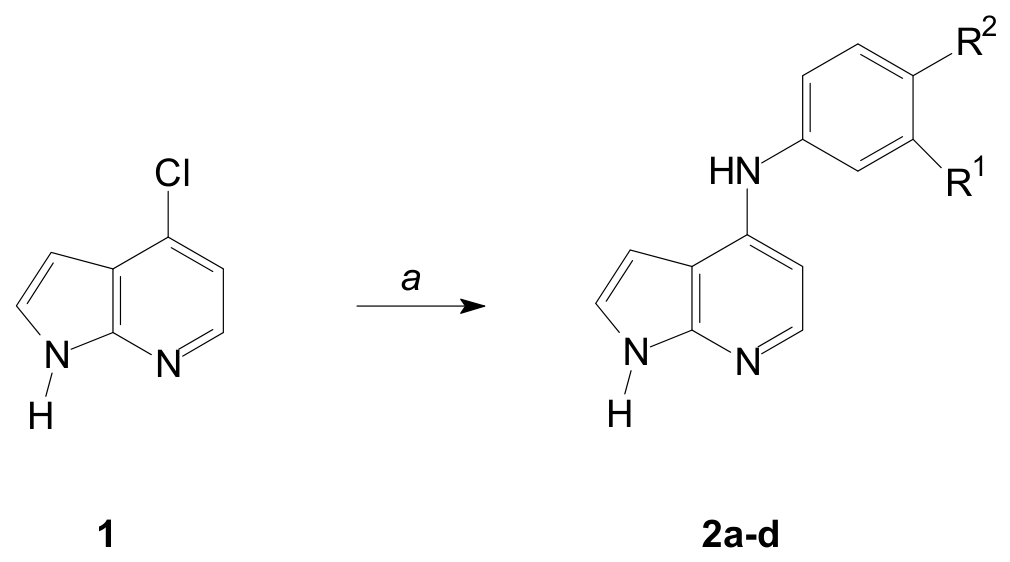
So, 4-chloropyrrolopyridine compound 1 was heated under reflux with various anilines in N-methylpyrrolidone (NMP) to give compounds 2ad after workup of the mixtures and final purification using column chromatography over silica gel (Scheme 1).
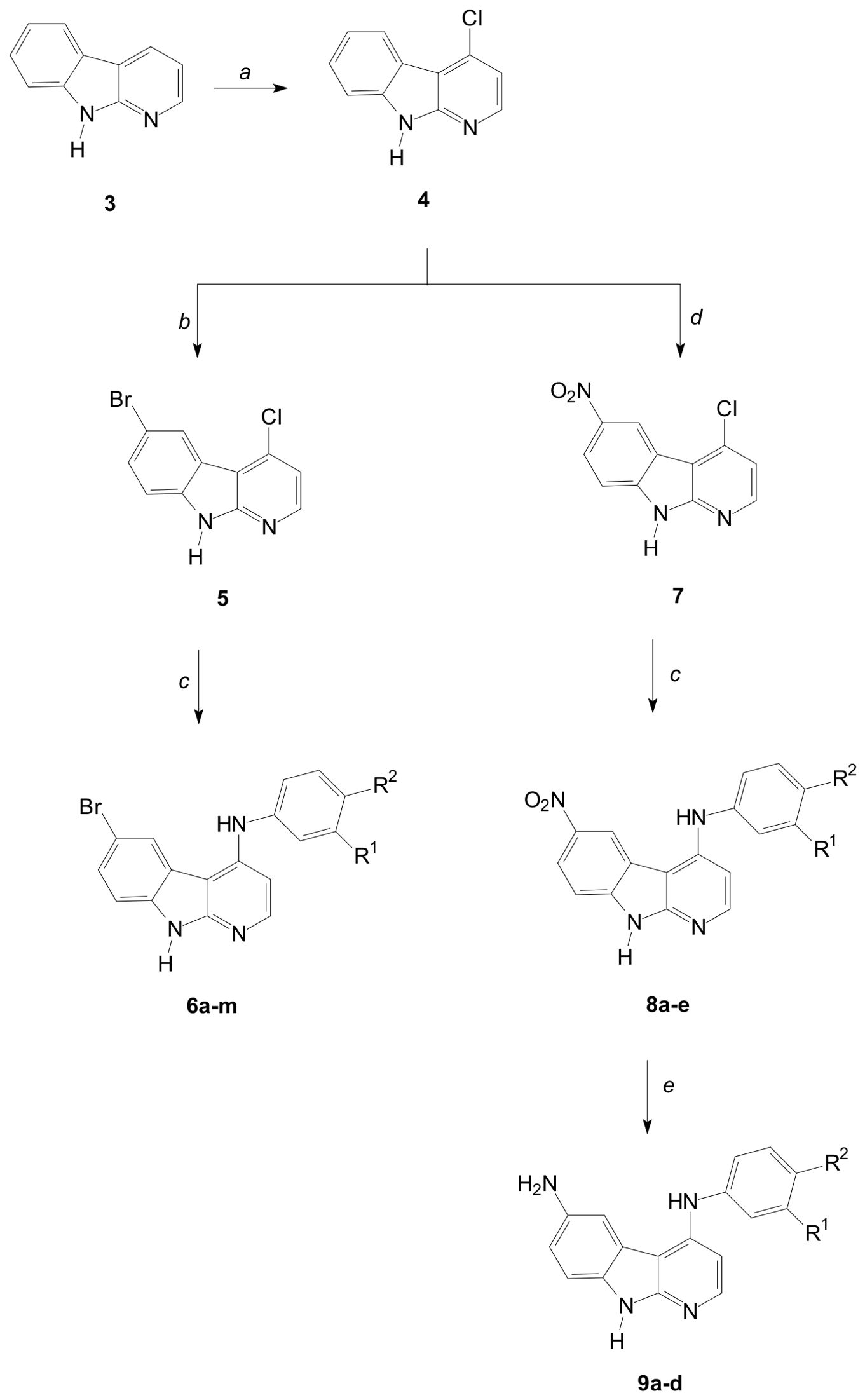
In order to increase the molecular scaffold for further functionalization, the benzo-annelated pyrrolopyridine 3 was first 4-chlorinated to compound 4 after formation of a pyridine N-oxide intermediate by the use of hydrogen peroxide following treatment with phosphorus oxychloride (Scheme 2).
Then, various substitutions of the anellated phenyl residue were performed via electrophilic substitution at the para position to the NH pyrrolo function.
Following this, bromination was achieved via the use of bromine in acetic acid to produce compound 5, which was consequently treated with various anilines in NMP to yield compound series 6am.
Then, compound 4 was treated with nitric acid to produce compound 7, which was treated with various anilines in NMP under reflux to yield compound series 8ae. Lastly, the nitro functions in compounds 8 were reduced to amine functions with tin(II) chloride in acetic acid to yield compound series 9ad.
The purity of the target compounds was checked via HPLC analysis, using a gradient eluent mixture of water and methanol with increasing methanol portions. Nearly all of the compounds had a purity > 95%, although the final yields of some target compounds were poor due to the need for repetition of the final purification procedure via column chromatography.
The inhibitory activity of the compounds was determined at increasing concentrations by measuring the degree of phosphorylation of a Brk substrate as kinase activity via the use of radiolabelled ATP and the scintillation counting technique. Each concentration-dependent kinase activity value was subtracted from 100 to yield the corresponding inhibition value. Lastly, the IC50 value of each compound was calculated from all the resulting concentration-dependent inhibition values. The values are shown in Table 1.
The 4-anilino pyrrolopyridine 2a with 3-chloro substitution was not active as a Brk inhibitor and had an IC50 value of 92.9 µM. When the 3-chloro function was replaced with a nitro function, the IC50 value in compound 2b mainly increased to 1.45 µM. We introduced an additional methyl function in the 4-position of the 4-anilino substituent of compound 2a. The disubstitution of derivative 2c also increased the inhibitory activity to a value of 9.97 µM. Then, we replaced the 3-chloro function of compound 2c with a hydroxy function that could undergo potential hydrogen acceptor or donator bonding. We achieved nanomolar activity for compound 2d with an IC50 value of 0.83 µM. Thus, compound 2d was more active than the staurosporine control used, with an IC50 value of 0.89 µM.
We then attached a substituted phenyl residue to the pyrrolo function to exclude side effects in the inhibition of protein kinases affected by known pyrrolopyridines. The 6-bromo-substituted compound 6a with the 3-chloro function in the 4-anilino residue resulted in largely improved Brk inhibition, with an IC50 value of 2.76 µM compared to that of compound 2a. In derivative 6b, with an additional 4-methyl function at the aniline substituent, we achieved further improved activity, with an IC50 value of 1.26, similar to the improvement observed for compound 2c. When the 4-methyl function was replaced with a chloro function in compound 6c, the activity decreased, with an IC50 value of 2.04. However, this activity was better than that of the only 3-chloroaniline-substituted derivative 6a.
When the 3-chloro function was replaced with a 3-nitro function in derivative 6d, inhibitory activity decreased. The addition of a 4-methyl substituent again increased the activity of compound 6e, similarly to compound 6b. When the 4-methyl group was replaced with a fluoro function in derivative 6f, activity further increased. We then investigated the influence that a 4-substituent with a potential hydrogen bond donator or acceptor function could have on inhibitory activity. Derivative 6g with a 4-amino function increased the activity to nanomolar ranges, with an IC50 value of 0.43 µM. A 4-hydroxy substituent in the 3-anilino residue of derivative 6h further improved that nanomolar activity.
When the 4-favourable fluoro substituent was placed in the 3-position of the aniline residue in compound 6i, nanomolar inhibitory activity resulted. A trifluoro methyl function, however, instead of the 3-fluoro function in derivative 6j, was not successful, with largely decreased inhibitory activity measuring 27.1 µM. When the trifluoro function with its large space demand was replaced with a smaller methoxy function in compound 6k, inhibitory activity mainly increased to an IC50 value of 0.04 µM. A 3-hydroxy function with both hydrogen bond acceptor and donator activity in the 3-aniline residue was most effective in compound 6l, with a picomolar activity of <0.003 µM, exhibiting the best inhibitory activity so far. When, in that compound, a methoxy function was added in position 4 of the aniline residue in derivative 6m, activity decreased to 0.02 µM. However, compound 6m exhibited the second-best inhibitory activity of all the compounds. Concerning the structure–activity relationships, it can be concluded that hydrogen bond acceptor functions in the 3-anilino residues mainly increase the inhibitory activity of benzo-annelated compounds 6, preferably if they are placed in the 3-position.
Next, we investigated the effect of a 6-nitro function in compound series 8ae with various 4-anilino substituents. Derivative 8a with 3-chloroaniline substitution exhibited slightly decreased Brk inhibitory activity compared to compound 6a. Compound 8b with the additional 4-methyl function, however, was more active, with an IC50 value of 1.01 µM compared to compound 6b. A 3-ethoxy function at the 4-aniline residue of compound 8c resulted in decreased Brk inhibitory activity. When that 3-ethoxy function was replaced with a hydroxy function, the activity of compound 8d largely increased, similar to that of derivative 6l, with an IC50 value in the picomolar range <0.003 µM. Derivative 8e without a 3-aniline but with 4-trifluoromethyl substitution was not promising, with an IC50 value of 7.85 µM. Generally, it can be stated that for the different 6-substitutions at the molecular scaffold, the resulting Brk inhibitory activities largely depend on favourable substitution at the 3-aniline substituent, with the 3-hydroxy function being the best so far.
We then reduced the 6-nitro function at the molecular scaffold to an amino function that could both serve as a hydrogen bond acceptor and fulfil a donator function similar to that of the 3-hydroxy group at the 3-aniline residue.
Compound 9a with the 3-chloroaniline substituent resulted in a nearly tenfold increase in activity, with an IC50 value of 0.365 µM, compared to compound 8a with the 6-nitro function. Derivative 9b with the additional 4-methyl substituent in the 3-aniline residue, however, was less active than compound 8b. Compound 9c with the 3-ethoxy function again resulted in increased Brk inhibitory activity, with an IC50 value of 3.41 µM compared to derivative 8c. Lastly, compound 9d with the 3-hydroxyaniline substitution again resulted in the best activity, similarly to that in compound series 6 and 8, with an IC50 value in the lower nanomolar range of 0.01 µM. Thus, it is possible to conclude that the 6-anilino function is more favourable for potential hydrogen bonding to the protein backbone, compared to bromo and nitro substitutions, when it is combined with exclusive 3-anilino substitution.
In breast cancer, Brk is activated by the HER2 receptor ligand [34]. In HER2-positive breast cancer, studies have described increasing resistance to the kinase inhibitors used in clinical settings, lapatinib and neratinib [7,35]. Given this, we aimed to investigate whether our novel Brk inhibitor series 2, 6, 8 and 9 possessed additional HER2-inhibiting properties. Such inhibition would increase the potential of Brk inhibition by reducing Brk activation via HER2 and would, additionally, be useful in the treatment of resistant HER2-positive breast cancer, as an alternative to the small-molecule inhibitors used with the resistances described. Moreover, compared to the monoclonal antibodies used in HER2-positive breast cancer treatment, such as trastuzumab, our small-molecule inhibitors would be an attractive alternative owing to their lower production costs [36].
Compound 2a was not active as a HER2 inhibitor, whereas derivative 2b exhibited residual activity that further increased with the introduction of a methyl group at the aniline residue in derivative 2c. However, compound 2d with a 3-hydroxy function at the aniline residue was not more active as a HER2 inhibitor.
Additionally, compound 6a with the 3-chloroaniline function did not exhibit HER2 activity. In derivative 6b, with an additional 4-methyl function at the aniline residue, activity increased. When that methyl function was replaced with a chloro substituent in derivative 6c, activity decreased.
The 3-nitro group at the aniline residue of compound 6d was more favourable than the 3-chloro function of compound 6a. Again, an additional 4-methyl group in compound 6e increased activity, and replacement of the 4-methyl function with a fluoro function in derivative 6f was more favourable. A hydrophilic amino function at the 4-position of the aniline residue in compound 6g was not favourable for HER2 inhibition; however, a hydroxy group at the 4-position of compound 6h demonstrated similar results to that of compound 6f.
The 3-fluoro group in derivative 6i was more favourable than the 3-nitro function of compound 6d. However, a trifluoromethyl function instead of the fluoro group in derivative 6j led to a loss of activity. The 3-methoxy group of compound 6k resulted in similar activity to the 3-fluoro function of compound 6i. When that group was replaced with the 3-hydroxy group, activity against HER2 increased in compound 6l, whereas an additional 4-methoxy group at the aniline residue in derivative 6m decreased the activity. Thus, compound 6l was considered to exhibit the best dual-activity action against Brk and HER2.
Derivative 8a demonstrated residual HER2 activity. Again, the additional 4-methyl function in compound 8b increased this activity. The more space-demanding 3-ethoxy function in derivative 8c was less favourable, whereas replacement with the hydroxy group in derivative 8d resulted in the best activity within that series, similarly to compound 6l. The trifluoromethyl function in the 4-position of the aniline residue of compound 8e led to a loss of activity. Comparing the 6-nitro with the 6-bromo substitution at the molecular scaffold, it can be stated that the nitro function was more favourable, with comparably increased activities in those derivatives with the same aniline substitutions.
A reduction of 6-nitro to the 6-amino function in series 9 led to largely increased activity against HER2 in compound 9a compared to derivative 8a. A similar result of increased activity was found for derivative 9b compared to 8b; however, the 3-ethoxy aniline derivative 9c was less active than derivative 8c with just residual activity. Moreover, compound 9d exhibited a slight decrease in activity compared to derivative 8d. However, the 6-amino function at the molecular scaffold tended to be more favourable than the 6-nitro function, as shown for compounds 9a and 9b. With compounds 8d and 9d, we identified two more dual inhibitors of both kinases Brk and HER2, respectively.
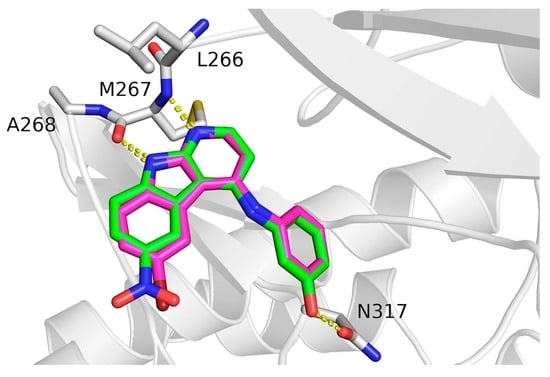
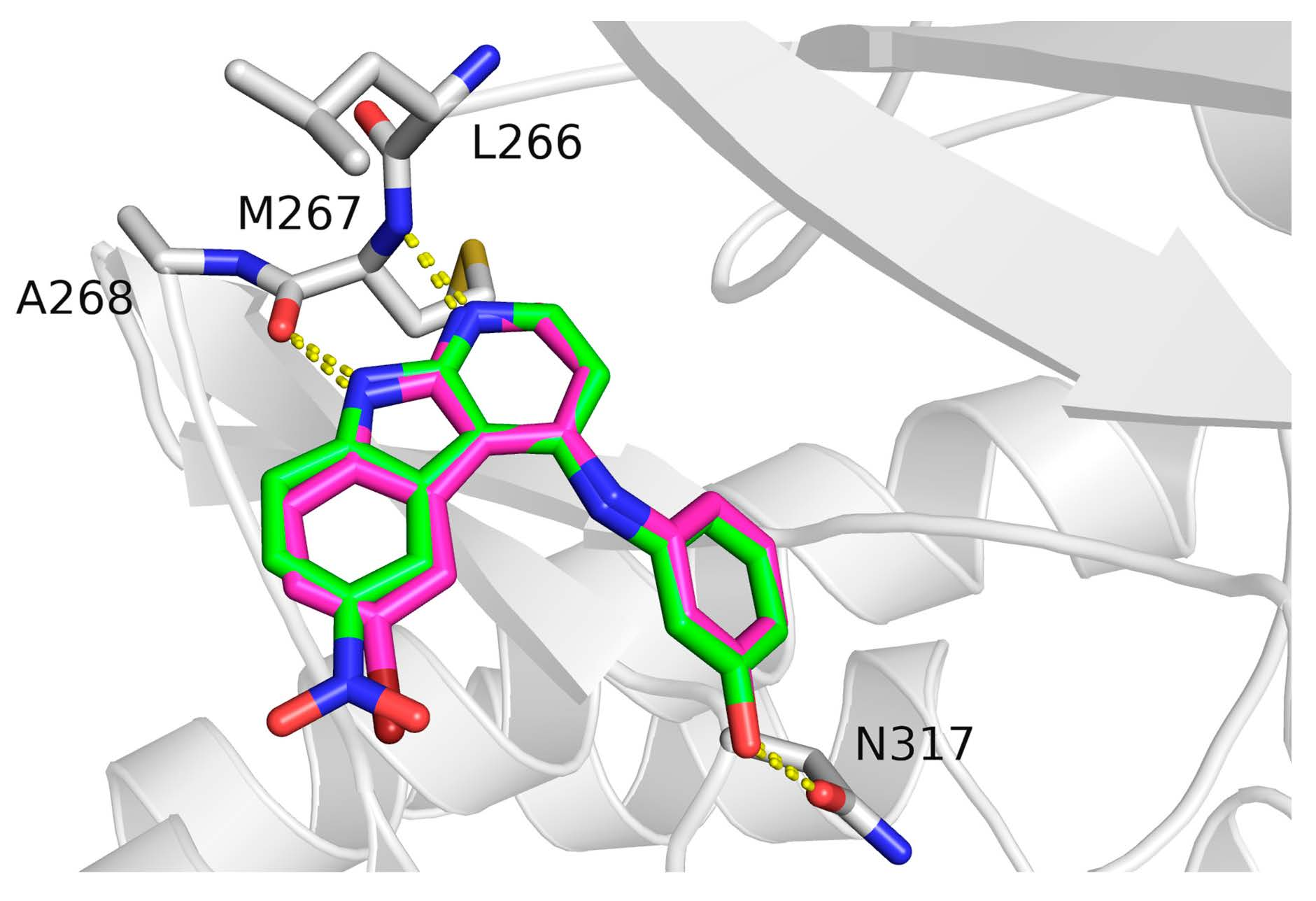
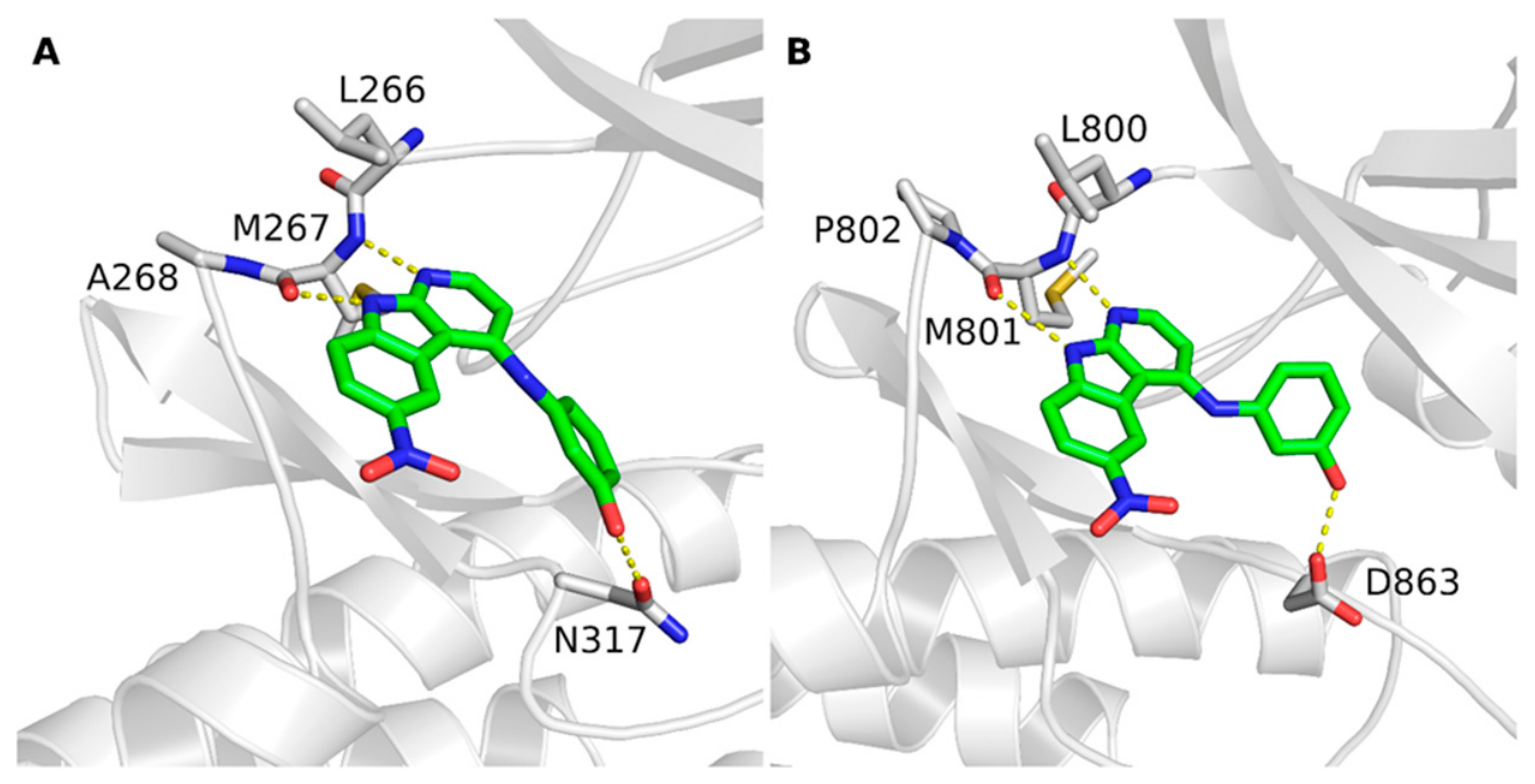
Docking studies were performed for the synthesized pyrrolopyridine derivatives 6j, 6l, 8d, and 8e in the ATP-binding pocket of Brk and HER2. The docking results obtained revealed a common binding mode for all four inhibitors in both kinases. The pyrrolopyridine core formed two hydrogen bonds with the kinase hinge region, involving the backbone atoms of Met267 in Brk and Met801 in HER2. Furthermore, the 3-hydroxy substituents of compounds 6l and 8d formed a hydrogen bond with Asn317 (Brk) and Asp863 (HER2) in the kinase back pocket. This observation supports the enhanced inhibitory activity of 6l and 8d against Brk and HER2. Docking poses for the highly active inhibitor 8d in Brk and HER2 are shown in Figure 1. Co-folding with Boltz-2 predicted the same binding mode for all the inhibitors investigated.
The predicted ADME properties obtained using QikProp in Schrödinger further highlighted the favourable drug-like characteristics of compounds 6l and 8d. Both compounds satisfied Lipinski’s Rule of Five without violations. Moreover, compound 6l exhibited high predicted intestinal permeability values (Caco-2 = 757 nm/s) and 100% predicted human oral absorption. Compound 8d exhibited the lowest molecular weight (320 Da), favourable lipophilicity (QPlogPo/w = 2.42), and the highest predicted aqueous solubility (QPlogS = −4.28).
Lastly, we evaluated the effect of the selected compounds on breast cancer cell growth as a proof of principle. We selected compound 6a, with moderate inhibition of Brk and no HER2 activity; compound 6k, with largely improved activity against Brk and residual HER2 activity; and derivative 6l, with the best Brk inhibitory activity and moderate HER2 inhibitory activity. The inhibition of breast cancer cell growth was determined by the NCI (National Cancer Institute) via a fluorescence assay determining the fluorescent sulforhodamine dye bound to cellular proteins in growing cells.
The various breast cancer cells lines are shown in Table 2, with values of the compound concentrations determined for reducing cellular growth inhibition by 50% (GI50).
Compound 6a resulted in GI50 values from 3.73 to 35.9 µM in the breast cancer cell lines, with a mean of 17 µM. Thus, compound 6a exhibits similar activity to the lapatinib control [37]. For compound 6k, with largely improved Brk inhibitory activity, GI50 values were reduced, with a range of 0.05 to 2.98 µM and a mean value of 1.66 µM, reflecting largely improved Brk inhibitory activity. Finally, the best compound, 6l, as a dual inhibitor with improved activity against Brk and moderate activity against HER2, resulted in GI50 values of 0.44 µM to 1.03 µM, with an improved mean value of 0.67 µM. With the correlation of increased enzyme inhibition activity and increased inhibition of cancer cell growth, evidence indicates that the reduced cancer cell growth resulted from reduced enzyme activity. Moreover, we determined the effect of compound 6l without the 6-bromo function at the molecular scaffold and an IC50 value of 0.003 µM for Brk inhibition on the phosphorylation of STAT3, which is involved in the proliferation of breast cancer cells [13,14]. At a concentration > 0.1 µM, we observed a block of STAT3 phosphorylation, revealing corresponding cellular effects in breast cancer cells in relation to the nanomolar inhibition of Brk in vitro. Additionally, the NCI determined the cellular toxicity for compounds 6a, 6k and 6l as LC50. Only compound 6l exhibited cytotoxic effects in the MDA-MB-231 cells, with an LC50 value of 7.67 µM. In the other breast cancer cell lines, compound 6l was not cytotoxic, with LC50 values > 100 µM. Additionally, compounds 6a and 6k resulted in LC50 values > 100 µM in all breast cancer cell lines and, thus, were not cytotoxic.

3. Materials and Methods

General: Commercial reagents were used without further purification. The 1H-NMR spectra (500 MHz resp. 400 MHz) were measured using tetramethylsilane as internal standard, using an Agilent Technologies VNMRS (Agilent Technologies, Santa Clara, CA, USA). 13C-NMR spectra of sufficiently soluble compounds were conducted at 151 MHz. Due to the low solubility of the compounds, only APT spectra could be measured. Thin-layer chromatography (TLC) was performed on E. Merck 5554 silica gel plates (Merck, Darmstadt, Germany). High-resolution mass spectra were recorded using a Bruker Apex III mass spectrometer (Bruker, Billerica, MA, USA).
Formation of the 4-aniline-substituted 1H-pyrrolo[2,3-b]pyridines (2ad)
One equivalent of 4-chloro-1H-pyrrolo[2,3-b]pyridine 1 and five equivalents of the respective aniline were dissolved in NMP (5 mL) under inert atmosphere and heated under reflux at 170 °C for 6 h. The reaction mixture was cooled to room temperature, diluted with ethyl acetate (20 mL) and subsequently extracted with water (20 mL, pH 10). The aqueous phase was then extracted with ethyl acetate (20 mL) twice. The unified organic layers were washed with water (20 mL) and dried over water-free sodium sulfate. The residue was filtered off and the solvent removed under reduced pressure. The remaining oil was purified via column chromatography using silica gel and a mixture of cyclohexane, acetonitrile and ethyl acetate (2:1:1) as eluent.
Data for N-(3-chlorophenyl)-1H-pyrrolo[2,3-b]pyridine-4-amine (2a)
Yield 31%; brownish solid; mp 55–60 °C; 1H NMR (DMSO-d6) δ 11.41 (s, 1H, NH-1), 8.77 (s, 1H, NH), 7.96 (d, 3J6/5 = 5.4 Hz, 1H, H-6), 7.35 (t, 3J5‘/6‘ = 7.9, 3J5‘/4‘ = 7.9 Hz, 1H, H-5‘), 7.27 (t, 4J2‘/6‘ = 2.1, 4J2‘/4‘ = 2.1 Hz, 1H, H-2‘), 7.25 (dd, 3J6‘/5‘ = 7.9, 4J6‘/2‘ = 2.0 Hz, 1H, H-6‘), 7.24 (dd, 3J2/3 = 3.5, 3J2/NH-1 = 2.4 Hz, 1H, H-2), 7.02 (dd, 3J4‘/5‘ = 7.9, 4J4‘/2‘ = 2.0 Hz, 1H, H-4‘), 6.75 (d, 3J5/6 = 5.4 Hz, 1H, H-5), 6.55 (dd, 3J3/2 = 3.5, 4J3/NH-1 = 1.9 Hz, 1H, H-3); 13C NMR (DMSO-d6) δ 152.78, 147.62, 137.61, 136.99, 129.88, 124.42, 120.72, 116.00, 113.68, 111.90, 111.68; HRMS (ESI) m/z (%) = calculated for C13H11ClN3 [M+H]+: 244.0636; found: 244.0635.
Data for N-(3-nitrophenyl)-1H-pyrrolo[2,3-b]pyridine-4-amine (2b)
Yield 23%; brown-redish solid; mp 232–234 °C; 1H NMR (DMSO-d6) δ 11.49 (s, 1H, NH-1), 9.10 (s, 1H, NH), 8.05 (t, 3J2‘/6‘ = 2.3 Hz, 3J2‘/4‘ = 2,3Hz, 1H, H-2‘), 8.02 (d, 3J6/5 = 5.4 Hz, 1H, H-6), 7.79 (ddd, 3J6‘/5‘ = 8.1, 4J6‘/2‘ = 2.3, 4J6‘/4‘ = 0.9 Hz, 1H, H-6‘), 7.71 (ddd, 3J4‘/5‘ = 8.1, 4J4‘/2‘ = 2.3, 4J4‘/6‘ = 0.9 Hz, 1H, H-4‘), 7.59 (t, 3J5‘/6‘ = 8.1 Hz, 3J5‘4‘ = 8.1 Hz, 1H, H-5‘), 7.28 (dd, 3J2/3 = 3.5, 3J2/NH-1 = 2.3 Hz, 1H, H-2), 6.85 (d, 3J5/6 = 5.4 Hz, 1H, H-5), 6.55 (dd, 3J3/2 = 3.5, 3J3/NH-1 = 1.8 Hz, 1H, H-3); 13C NMR (DMSO-d6) δ 150.38, 148.93, 144.26, 143.57, 142.09, 130.87, 125.15, 123.53, 115.92, 113.12, 110.12, 100.63, 98.56; HRMS (ESI) m/z (%) = calculated for C13H11N4O2 [M+H]+: 255.0877; found: 255.0874.
Data for N-(3-chloro-4-methylphenyl)-1H-pyrrolo[2,3-b]pyridine-4-amine (2c)
Yield 18%; red-brownish solid; mp 189–191 °C; 1H NMR (DMSO-d6) δ 11.36 (s, 1H, NH-1), 8.64 (s, 1H, NH), 7.92 (d, 3J6/5 = 5.5 Hz, 1H, H-6), 7.30 (d, 3J5‘/6‘ = 8.2 Hz, 1H, H-5‘), 7.29 (d, 4J2‘/6‘ = 2.3 Hz, 1H, H-2‘), 7.21 (dd, 3J2/3 = 3.5, 3J2/NH-1 = 2.1 Hz, 1H, H-2), 7.18 (dd, 3J6‘/5‘ = 8.2, 4J6‘/2‘ = 2.3 Hz, 1H, H-6‘), 6.67 (d, 3J5/6 = 5.5 Hz, 1H, H-5), 6.55 (dd, 3J3/2 = 3.5, 4J3/NH-1 = 1.7 Hz, 1H, H-3), 2.30 (s, 3H, CH3-4‘); 13C NMR (DMSO-d6) δ 149.76, 143.86, 142.93, 140.64, 133.35, 131.51, 128.47, 122.37, 120.20, 118.90, 108.95, 98.85, 98.11, 18.84; HRMS (ESI) m/z (%) = calculated for C14H13ClN3 [M+H]+: 258.0793; found: 258.0791.
Data for 5-((1H-pyrrolo[2,3-b]pyridine-4-yl)amino)-2-methylphenolate (2d)
Yield 15%; brownish solid; mp 214–216 °C; 1H NMR (DMSO-d6) δ 11.25 (s, 1H, NH-1), 9.28 (s, 1H, OH-1‘), 8.38 (s, 1H, NH), 7.85 (d, 3J6/5 = 5.3 Hz, 1H, H-6), 7.15 (dd, 3J2/3 = 3.6, 3J2/NH-1 = 1.6 Hz, 1H, H-2), 7.01 (d, 3J3‘/4‘ = 8.0 Hz, 1H, H-3‘), 6.78 (d, 4J6‘/4‘ = 2.2 Hz, 1H, H-6‘), 6.63 (dd, 3J4‘/3‘ = 8.0, 4J4‘/6‘ = 2.2 Hz, 1H, H-4‘), 6.62–6.58 (m, 1H, H-3), 6.60 (d, 3J5/6 = 5.3 Hz, 1H, H-5), 2.09 (s, 3H, CH3-2‘); 13C NMR (DMSO-d6) δ 155.69, 149.59, 144.10, 143.74, 139.60, 130.69, 121.73, 118.18, 111.97, 108.52, 107.79, 98.28, 98.18, 15.49; HRMS (ESI) m/z (%) = calculated for C14H14N3O [M+H]+: 240.1131; found: 240.1128.
Formation of the 4-chloro-9H-pyrido[2,3-b]indole (4)
One equivalent of 9H-pyrido[2,3-b]indole 3 was dissolved in acetic acid, followed by the dropwise addition of 1.2 equivalents of aqueous hydrogen peroxide solution (35%). The mixture was stirred at 115 °C under reflux. After 4 h, 0.3 equivalents of hydrogen peroxide (35%) were added and continuously heated under reflux for 2 h. The solution was then concentrated, followed by the addition of a saturated potassium carbonate solution, and stirred overnight at room temperature. The solid was filtered off, washed with water, dried and subsequently dissolved in water-free DMF (100 mL) under inert atmosphere. The solution was cooled down to 0 °C, before 2.4 equivalents of phosphorus oxychloride were added and stirred at room temperature for 24 h. The mixture was poured into 250 mL of water under cooling, alkalized with a potassium hydroxide solution (10%) to pH 9 and stirred at 0 °C for 15 min. The residual solid was filtered off, washed with water, dried, and then purified over silica gel with an eluent mixture of cyclohexane and ethyl acetate (80:20).
Data for 4-chloro-9H-pyrido[2,3-b]indole (4)
Yield 76%; colourless solid; mp 232–234 °C; 1H NMR (DMSO-d6) δ 12.18 (s, 1H, NH-9), 8.38 (d, 3J2/3 = 5.3 Hz, 1H, H-2), 8.34 (dt, 3J5/6 = 7.8, 4J5/7 = 1.1 Hz, 1H, H-5), 7.57 (dt, 3J8/7 = 8.2, 4J8/6 = 1.1 Hz, 1H, H-8), 7.53 (ddd, 3J6/5 = 7.8, 3J6/7 = 6.5, 4J6/8 = 1.1 Hz, 1H, H-6), 7.32 (d, 3J3/2 = 5.3 Hz, 1H, H-3), 7.31 (ddd, 3J7/8 = 8.2, 3J7/6 = 6.5, 4J7/5 = 1.1 Hz, 1H, H-7); MS (ESI) m/z (%) = found: 204,3 (100, [M+H]+).
Formation of the 6-bromo-4-chloro-9H-pyrido[2,3-b]indole (5)
One equivalent of compound 4 was dissolved in acetic acid and cooled down to −5 °C. Thus, 1.6 equivalents of bromine were added, and the resulting solution was stirred at room temperature for 24 h. A 1 M sodium thiosulfate solution (10 mL) was added and stirred continuously until the solution turned clear, followed by the addition of an aqueous ammonia solution to achieve pH 10. The mixture was extracted with a mixture of ethyl acetate and chloroform (1:1) (20 mL) four times. The unified organic layers were dried over sodium sulfate and filtered. The solvent was removed under reduced pressure, and the crude product of compound 5 was purified over silica gel using an eluent mixture of ethyl acetate and cyclohexane (1:1).
Data for 6-bromo-4-chloro-9H-pyrido[2,3-b]indole (5)
Yield 67%; colourless solid; mp 202–205 °C; 1H NMR (DMSO-d6) δ 12.39 (s, 1H, NH-9), 8.43 (d, 3J2/3 = 5.2 Hz, 1H, H-2), 8.43 (d, 4J5/7 = 2.0 Hz, 1H, H-5), 7.68 (dd, 3J7/8 = 8.6, 4J7/5 = 2.0 Hz, 1H, H-7), 7.54 (d, 3J8/7 = 8.6 Hz, 1H, H-8), 7.37 (d, 3J3/2 = 5.2 Hz, 1H, H-3); HRMS (ESI) m/z (%) = calculated for C11H7BrClN2 [M+H]+: 280.9476; found: 280.9478.
Formation of the 4-aniline-substituted 6-bromo-9H-pyrido[2,3-b]indoles (6am)
The procedure was similar to compounds 2ad, except the volumes of ethyl acetate used for dilution after the reactions and the final extraction volumes were 30 mL each. The unified organic layers were washed with 30 mL of water, dried over sodium sulfate and filtered. The solvent was removed under reduced pressure, and the crude product of compound 6 was purified over silica gel using ethyl acetate and cyclohexane as eluent mixture (1:1).
Data for 6-bromo-N-(3-chlorophenyl)-9H-pyrido[2,3-b]indol-4-amine (6a)
Yield 44%; colourless solid; mp 248–252 °C; 1H NMR (DMSO-d6) δ 11.87 (s, 1H, NH-9), 8.76 (s, 1H, NH), 8.31 (d, 4J5/7 = 1.9 Hz, 1H, H-5), 8.16 (d, 3J2/3 = 5.6 Hz, 1H, H-2), 7.51 (dd, 3J7/8 = 8.6, 4J7/5 = 1.9 Hz, 1H, H-7), 7.41 (d, 3J8/7 = 8.6 Hz, 1H, H-8), 7.38 (t, 3J5‘/6‘ = 8.0 Hz, 3J5‘/4‘ = 8.0 Hz, 1H, H-5‘), 7.34 (t, 4J2‘/6‘ = 2.1 Hz, 4J2‘/4‘ = 2.1 Hz, 1H, H-2‘), 7.27 (ddd, 3J6‘/5‘ = 8.0, 4J6‘/2‘ = 2.1, 4J6‘/4‘ = 1.0 Hz, 1H, H-6‘jh), 7.12 (ddd, 3J4‘/5‘ = 8.0, 4J4‘/2‘ = 2.1, 4J4‘/6‘ = 1.0 Hz, 1H, H-4‘), 6.86 (d, 3J3/2 = 5.6 Hz, 1H, H-3); 13C NMR (DMSO-d6) δ 153.95, 147.71, 145.72, 142.90, 136.47, 133.56, 130.77, 127.48, 124.77, 122.34, 121.62, 120.50, 119.29, 112.44, 111.14, 103.01, 102.38; HRMS (ESI) m/z (%) = calculated for C17H12BrClN3 [M+H]+: 371.9898; found: 371.9902.
Data for 6-bromo-N-(3-chloro-4-methylphenyl)-9H-pyrido[2,3-b]indol-4-amine (6b)
Yield 27%; brownish solid; mp 269–270 °C; 1H NMR (DMSO-d6) δ 11.85 (s, 1H, NH-9), 8.63 (s, 1H, NH), 8.39 (d, 4J5/7 = 1.9 Hz, 1H, H-5), 8.12 (d, 3J2/3 = 5.7 Hz, 1H, H-2), 7.51 (dd, 3J7/8 = 8.6, 4J7/5 = 1.9 Hz, 1H, H-7), 7.41 (d, 3J8/7 = 8.6 Hz, 1H, H-8), 7.37 (d, 4J2‘/6‘ = 2.3 Hz, 1H, H-2‘), 7.35 (d, 3J5‘/6‘ = 8.2 Hz, 1H, H-5‘), 7.22 (dd, 3J6‘/5‘ = 8.2, 4J6‘/2‘ = 2.3 Hz, 1H, H-6‘), 6.75 (d, 3J3/2 = 5.7 Hz, 1H, H-3), 2.33 (s, 3H, CH3-4‘); 13C NMR (DMSO-d6) δ 153.90, 147.65, 146.40, 140.17, 136.35, 133.47, 131.56, 129.86, 127.29, 124.57, 122.07, 121.73, 120.62, 112.35, 111.15, 102.29, 101.46, 18.95; HRMS (ESI) m/z (%) = calculated for C18H14BrClN3 [M+H]+: 386.0054; found: 386.0055.
Data for 6-bromo-N-(3,4-dichlorophenyl)-9H-pyrido[2,3-b]indol-4-amine(6c)
Yield 37%; greyish solid; mp 254–257 °C; 1H NMR (DMSO-d6) δ 11.84 (br, 1H, NH-9), 8.62 (br, 1H, NH), 8.15 (d, 4J5/7 = 1.9 Hz, 1H, H-5), 8.12 (d, 3J2/3 = 5.8 Hz, 1H, H-2h-2), 7.52 (dd, 3J7/8 = 8.6, 4J7/5 = 1.9 Hz, 1H, H-7), 7.50 (d, 3J5‘/6‘ = 8.7 Hz, 1H, H-5‘), 7.46 (d, 4J2‘/6‘ = 2.6 Hz, 1H, H-2‘), 7.43 (d, 3J8/7 = 8.6 Hz, 1H, H-8), 7.24 (dd, 3J6‘/5‘ = 8.7, 4J6‘/2‘ = 2.6 Hz, 1H, H-6‘), 6.89 (d, 3J3/2 = 5.8 Hz, 1H, H-3); 13C NMR (DMSO-d6) δ 153.95, 147.78, 145.28, 141.69, 136.53, 131.45, 130.93, 127.59, 124.75, 123.79, 122.01, 121.50, 120.61, 112.50, 111.16, 103.22, 102.60; HRMS (ESI) m/z (%) = calculated for C17H11BrCl2N3 [M+H]+: 405.9508; found: 405.9513.
Data for 6-bromo-N-(3-nitrophenyl)-9H-pyrido[2,3-b]indol-4-amine (6d)
Yield 73%; green-brownish solid; mp 289–293 °C; 1H NMR (DMSO-d6) δ 11.95 (s, 1H, NH-9), 9.09 (s, 1H, NH), 8.33 (d, 4J5/7 = 1.9 Hz, 1H, H-5), 8.22 (d, 3J2/3 = 5.6 Hz, 1H, H-2), 8.12 (dd, 4J2‘/6‘ = 2.2, 4J2‘/4‘ = 2.2 Hz, 1H, H-2‘), 7.88 (ddd, 3J6‘/5‘ = 8.2, 4J2‘/6‘ = 2.2, 4J6‘/4‘ = 1.0 Hz, 1H, H-6‘), 7.75 (ddd, 3J4‘/5‘ = 8.2, 4J4‘/2‘ = 2.2, 4J4‘/6‘ = 1.0 Hz, 1H, H-4‘), 7.63 (dd, 3J5‘/6‘ = 8.2, 3J5‘/4‘ = 8.2 Hz, 1H, H-5‘), 7.54 (dd, 3J7/8 = 8.6, 4J7/5 = 1.9 Hz, 1H, H-7), 7.43 (d, 3J8/7 = 8.6 Hz, 1H, H-8), 6.96 (d, 3J3/2 = 5.6 Hz, 1H, H-3); 13C NMR (DMSO-d6) δ 153.88, 148.44, 147.69, 144.89, 142.77, 136.47, 130.37, 127.56, 125.93, 124.71, 121.33, 116.41, 114.09, 112.42, 111.03, 103.41, 102.59; HRMS (ESI) m/z (%) = calculated for C17H12BrN4O2 [M+H]+: 383.0138; found: 383.0140.
Data for 6-bromo-N-(4-methyl-3-nitrophenyl)-9H-pyrido[2,3-b]indol-4-amine (6e)
Yield 67%; yellow-brownish solid; mp 288–293 °C; 1H NMR (DMSO-d6) δ 11.89 (s, 1H, NH-9), 8.89 (s, 1H, NH), 8.36 (d, 4J5/7 = 1.9 Hz, 1H, H-5), 8.16 (d, 3J2/3 = 5.7 Hz, 1H, H-2), 7.91 (d, 4J2‘/6‘ = 2.4 Hz, 1H, H-2‘), 7.58 (dd, J = 8.3, 2.4 Hz, 1H, H-6‘), 7.52 (dd, J = 8.6, 1.9 Hz, 1H, H-7), 7.48 (d, J = 8.3 Hz, 1H, H-5‘), 7.42 (d, J = 8.6 Hz, 1H, H-8), 6.84 (d, J = 5.7 Hz, 1H, H-3), 2.48 (s, 3H, CH3-4‘); 13C NMR (DMSO-d6) δ 153.88, 149.17, 147.69, 145.66, 140.27, 136.48, 133.45, 127.54, 126.49, 125.77, 124.67, 121.57, 116.37, 112.49, 111.19, 102.87, 101.86, 19.09; HRMS (ESI) m/z (%) = calculated for C18H14BrN4O2 [M+H]+: 397.0295; found: 397.0299.
Data for 6-bromo-N-(4-methyl-3-nitrophenyl)-9H-pyrido[2,3-b]indol-4-amine (6f)
Yield 15%; orange-red solid; mp 256–263 °C; 1H NMR (DMSO-d6) δ 11.93 (s, 1H, NH-9), 8.92 (s, 1H, NH), 8.40 (d, 4J5/7 = 1.9 Hz, 1H, H-5), 8.19 (d, 3J2/3 = 5.6 Hz, 1H, H-2), 8.04 (dd, J = 6.5, 2.8 Hz, 1H, H-2‘), 7.75 (dt, J = 8.9, 4.1 Hz, 1H, H-6‘), 7.59 (dd, J = 11.1, 9.0 Hz, 1H, H-5‘), 7.53 (dd, 3J7/8 = 8.6, 4J7/5 = 1.9 Hz, 1H, H-7), 7.44 (d, 3J8/7 = 8.6 Hz, 1H, H-8), 6.86 (d, 3J3/2 = 5.6 Hz, 1H, H-3); 13C NMR (DMSO-d6) δ 153.82, 151.02, 149.31, 147.71, 145.62, 138.15, 136.51, 127.63, 124.64, 121.50, 119.23, 119.09, 117.66, 112.56, 111.23, 102.90, 101.73; HRMS (ESI) m/z (%) = calculated for C17H11BrFN4O2 [M+H]+: 401.0044; found: 401.0049.
Data for N1-(6-bromo-9H-pyrido[2,3-b]indol-4-yl)-3-nitrobenzene-1,4-diamine (6g)
Yield 56%; dark red solid; mp 287–291 °C; 1H NMR (DMSO-d6) δ 11.77 (s, 1H, NH-9), 8.54 (d, 4J5/7 = 1.9 Hz, 1H, H-5), 8.42 (s, 1H, NH), 8.05 (d, 3J2/3 = 5.6 Hz, 1H, H-2), 7.91 (d, 4J2‘/6‘ = 2.8 Hz, 1H, H-2‘), 7.49 (dd, 3J7/8 = 8.5, 4J7/5 = 1.9 Hz, 1H, H-7), 7.49 (dd, 3J6‘/5‘ = 8.4, 4J6‘/2‘ = 2.8 Hz, 1H, H-6‘), 7.47 (s, 2H, NH2), 7.40 (d, 3J8/7 = 8.5 Hz, 1H, H-8), 7.11 (d, 3J5‘/6‘ = 8.4 Hz, 1H, H-5‘), 6.48 (d, 3J3/2 = 5.6 Hz, 1H, H-3); 13C NMR (DMSO-d6) δ 153.82, 147.69, 147.60, 143.84, 136.16, 133.66, 129.68, 128.57, 127.00, 124.23, 121.91, 120.07, 119.23, 112.23, 111.18, 101.12, 100.12; HRMS (ESI) m/z (%) = calculated for C17H13BrN5O2 [M+H]+: 398.0247; found: 398.0254.
Data for 4-((6-bromo-9H-pyrido[2,3-b]indol-4-yl)amino)-2-nitrophenol (6h)
Yield 34%; dark red solid; mp 268–271 °C; 1H NMR (DMSO-d6) δ 11.81 (s, 1H, NH-9), 8.54 (s, 1H, NH), 8.50 (d, 4J5/7 = 1.9 Hz, 1H, H-5), 8.08 (d, 3J2/3 = 5.6 Hz, 1H, H-2), 7.84 (d, 4J3‘/6‘ = 2.7 Hz, 1H, H-3‘), 7.57 (dd, 3J6‘/5‘ = 8.9, 4J6‘/3‘ = 2.7 Hz, 1H, H-6‘), 7.50 (dd, 3J7/8 = 8.6, 4J7/5 = 1.9 Hz, 1H, H-7), 7.40 (d, 3J8/7 = 8.6 Hz, 1H, H-8), 7.19 (d, 3J5‘/6‘ = 8.9 Hz, 1H, H-5‘), 6.58 (d, 3J3/2 = 5.6 Hz, 1H, H-3); 13C NMR (DMSO-d6) δ 153.84, 148.81, 147.74, 147.06, 136.45, 136.25, 132.25, 131.07, 127.18, 124.33, 121.79, 119.89, 119.16, 112.33, 111.19, 101.57, 100.37; HRMS (ESI) m/z (%) = calculated for C17H12BrN4O3 [M+H]+: 399.0087; found: 399.0090.
Data for 6-bromo-N-(3-fluorophenyl)-9H-pyrido[2,3-b]indol-4-amine (6i)
Yield 64%; dark greyish solid; mp 263–266 °C; 1H NMR (DMSO-d6) δ 11.88 (s, 1H, NH-9), 8.80 (s, 1H, NH), 8.29 (d, 4J5/7 = 1.9 Hz, 1H, H-5), 8.17 (d, 3J2/3 = 5.6 Hz, 1H, H-2), 7.51 (dd, 3J7/8 = 8.7, 4J7/5 = 1.9 Hz, 1H, H-7), 7.42 (d, 3J8/7 = 8.7 Hz, 1H, H-8), 7.39 (ddd, 3J5‘/4‘ = 8.2, 3J5‘/6‘ = 8.2, 4J5‘/3‘(F) = 6.9 Hz, 1H, H-5‘), 7.15 (ddd, 3J6‘/5‘ = 8.2, 4J6‘/2‘ = 2.3, 4J6‘/4‘ = 0.9 Hz, 1H, H-6‘), 7.09 (ddd, 3J2‘/3‘(F) = 11.2, 4J2‘4‘ = 2.3 Hz, 4J2‘6‘ = 2.3 Hz, 1H, H-2‘), 6.89 (dddd, 3J4‘/3‘(F) = 8.75, 3J4‘/5‘ = 8.2, 4J4‘/2‘ = 2.3, 4J4‘/6‘ = 0.9 Hz, 1H, H-4‘), 6.88 (d, 3J3/2 = 5.6 Hz, 1H, H-3); 13C NMR (DMSO-d6) δ 163.56, 161.95, 153.98, 147.73, 145.73, 143.30 (d, J = 10.6 Hz), 136.48, 130.75 (d, J = 9.9 Hz), 127.45, 124.79, 121.63, 116.57 (d, J = 2.7 Hz), 112.42, 111.09, 109.03 (d, J = 21.2 Hz), 107.44 (d, J = 24.1 Hz), 103.09, 102.61; HRMS (ESI) m/z (%) = calculated for C17H12BrFN3 [M+H]+: 356.0193; found: 356.0198.
Data for 6-bromo-N-(3-(trifluoromethyl)phenyl)-9H-pyrido[2,3-b]indol-4-amine (6j)
Yield 23%; grey brownish solid; mp 256–258 °C; 1H NMR (DMSO-d6) δ 11.90 (s, 1H, NH-9), 8.91 (s, 1H, NH), 8.30 (d, 4J5/7 = 2.0 Hz, 1H, H-5), 8.18 (d, 3J2/3 = 5.6 Hz, 1H, H-2), 7.63–7.56 (m, 3H, H-4‘, H-5‘, H-6‘), 7.52 (dd, 3J7/8 = 8.6, 4J7/5 = 2.0 Hz, 1H, H-7), 7.43 (d, 3J8/7 = 8.6 Hz, 1H, H-8), 7.40 (m, 1H, H-2‘), 6.86 (d, 3J3/2 = 5.6 Hz, 1H, H-3); HRMS (ESI) m/z (%) = calculated for C18H12BrF3N3 [M+H]+: 406.0161; found: 406.0161.
Data for 6-bromo-N-(3-methoxyphenyl)-9H-pyrido[2,3-b]indol-4-amine (6k)
Yield 35%; greyish solid; mp 246–247 °C; 1H NMR (DMSO-d6) δ 11.81 (s, 1H, NH-9), 8.60 (s, 1H, NH), 8.36 (d, 4J5/7 = 1.9 Hz, 1H, H-5), 8.11 (d, 3J2/3 = 5.6 Hz, 1H, H-2), 7.50 (dd, 3J7/8 = 8.6, 4J7/5 = 1.9 Hz, 1H, H-7), 7.40 (d, 3J8/7 = 8.6 Hz, 1H, H-8), 7.29 (t, 3J5‘/6‘ = 8.0, 3J5‘/4‘ = 8.0 Hz, 1H, H-5‘), 6.91 (ddd, 3J6‘/5‘ = 8.0, 4J6‘/2‘ = 2.4, 4J6‘/4‘ = 1.0 Hz, 1H, H-6‘), 6.89 (t, 4J2‘/6‘ = 2.2, 4J2‘/4‘ = 2.2 Hz, 1H, H-2‘), 6.81 (d, 3J3/2 = 5.6 Hz, 1H, H-3), 6.69 (ddd, 3J4‘/5‘ = 8.0, 4J4‘/2‘ = 2.4, 4J4‘/6‘ = 1.0 Hz, 1H, H-4‘), 3.76 (s, 3H, OCH3-3‘); HRMS (ESI) m/z (%) = calculated for C18H15BrN3O [M+H]+: 368.0393; found: 368.0395.
Data for 3-((6-bromo-9H-pyrido[2,3-b]indol-4-yl)amino)phenol (6l)
Yield 33%; greyish solid; mp 248–252 °C; 1H NMR (DMSO-d6) δ 12.02 (s, 1H, NH-9), 9.51 (s, 1H, OH-1‘), 8.78 (s, 1H, NH), 8.44 (d, 4J5/7 = 1.9 Hz, 1H, H-5), 8.10 (d, 3J2/3 = 5.9 Hz, 1H, H-2), 7.53 (dd, 3J7/8 = 8.6, 4J7/5 = 1.9 Hz, 1H, H-7), 7.45 (d, 3J8/7 = 8.6 Hz, 1H, H-8), 7.20 (t, 3J5‘/6‘ = 7.9 Hz, 3J5‘/4‘ = 7.9 Hz, 1H, H-5‘), 6.80–6.73 (m, 2H, H-2‘, H-4‘), 6.76 (d, 3J3/2 = 5.9 Hz, 1H, H-3), 6.59 (dd, 3J6‘/5‘ = 7.9, 4J6‘/2‘ = 2.1 Hz, 1H, H-6‘); HRMS (ESI) m/z (%) = calculated for C17H13BrN3O [M+H]+: 354.0237; found: 354.0237.
Data for 5-((6-bromo-9H-pyrido[2,3-b]indol-4-yl)amino)-2-methoxyphenol (6m)
Yield 42%; dark brownish solid; mp 269–273 °C; 1H NMR (DMSO-d6) δ 12.00 (br, 1H, NH-9), 9.65 (br, 1H, OH-1‘), 8.91 (br, 1H, NH), 8.23 (d, 4J5/7 = 1.8 Hz, 1H, H-5-5), 7.95 (d, 3J2/3 = 6.0 Hz, 1H, H-2), 7.47 (dd, 3J7/8 = 8.6, 4J7/5 = 1.8 Hz, 1H, H-7), 7.40 (d, 3J8/7 = 8.6 Hz, 1H, H-8), 6.97 (d, 3J3‘/4‘ = 8.5 Hz, 1H, H-3‘), 6.84 (d, 4J6‘/4‘ = 2.6 Hz, 1H, H-6‘), 6.80 (dd, 3J4‘/3‘ = 8.5, 4J4‘/6‘ = 2.6 Hz, 1H, H-4‘), 6.62 (d, 3J3/2 = 6.0 Hz, 1H, H-3), 3.89 (s, 3H, OCH3-2‘); 13C NMR (DMSO-d6) δ 153.86, 148.06, 147.47, 147.06, 144.84, 136.09, 133.64, 126.82, 122.07, 114.61, 112.90, 111.98, 111.11, 101.04, 100.49, 55.97, 30.68; HRMS (ESI) m/z (%) = calculated for C18H15BrN3O2 [M+H]+: 384.0342; found: 384.0345.
Formation of the 4-chloro-6-nitro-9H-pyrido[2,3-b]indole (7)
To water-free nitric acid (1.2 mL), one equivalent of compound 3 was added at −5 °C and stirred vigorously. The mixture was then stirred at room temperature for 20 min, poured on ice, diluted with water (20 mL) and then alkalized to pH 10 with a saturated potassium carbonate solution. The yellow solid was filtered off, washed with water, dried and purified over silica gel with an eluent mixture of dichloromethane and ethyl acetate (80:20).
Data for 4-chloro-6-nitro-9H-pyrido[2,3-b]indole (7)
Yield 49%; yellow solid; mp > 320 °C; 1H NMR (DMSO-d6) 12.87 (s, 1H, NH-9), 9.00 (d, J = 2.3 Hz, 1H, H-5), 8.46 (d, J = 5.3 Hz, 1H, H-2), 8.35 (dd, J = 9.0, 2.3 Hz, 1H, H-7), 7.65 (d, J = 9.0 Hz, 1H, H-8), 7.41 (d, J = 5.3 Hz, 1H, H-3); MS (ESI) m/z (%) = found: 248.02 (100, [M+H]+).
Formation of the 4-aniline-substituted 6-nitro-9H-pyrido[2,3-b]indoles (8a–e)
The procedure was similar to compounds 2ad except the volume of ethyl acetate used for dilution after the reactions was 50 mL. The remaining ethyl acetate was removed under reduced pressure, and the remaining crude product 8 was purified over silica gel using cyclohexane, acetonitril and ethyl acetate as eluent mixture (2:1:1).
Data for N-(3-chlorophenyl)-6-nitro-9H-pyrido[2,3-b]indol-4-amine (8a)
Yield 19%; yellow brownish solid; mp 308–312 °C; 1H NMR (CD3OD) δ 12.35 (br, 1H, NH-9), 9.15 (br, 1H, NH), 9.00 (d, 4J5/7 = 2.2 Hz, 1H, H-5), 8.37 (dd, 3J7/8 = 8.9, 4J7/5 = 2.2 Hz, 1H, H-7), 8.17 (d, 3J2/3 = 6.1 Hz, 1H, H-2), 7.65 (d, 3J8/7 = 8.9 Hz, 1H, H-8), 7.41 (t, 3J5‘/6‘ = 8.1, 3J5‘/4‘ = 8.1 Hz, 1H, H-5‘), 7.38 (t, 4J2‘/6‘ = 2.1, 4J2‘/4‘ = 2.1 Hz, 1H, H-2‘), 7.30 (ddd, 3J6‘/5‘ = 8.1, 4J6‘/2‘ = 2.1, 4J6‘/4‘ = 1.0 Hz, 1H, H-6‘), 7.21 (ddd, 3J4‘/5‘ = 8.1, 4J4‘/2‘ = 2.1, 4J4‘/6‘ = 1.0 Hz, 1H, H-4‘), 6.95 (d, 3J3/2 = 6.1 Hz, 1H, H-3); HRMS (ESI) m/z (%) = calculated for C17H12ClN4O2 [M+H]+: 339.0643; found: 339.0647.
Data for N-(3-chloro-4-methylphenyl)-6-nitro-9H-pyrido[2,3-b]indol-4-amine (8b)
Yield 42%; yellow brownish solid; mp 323–327 °C; 1H NMR (DMSO-d6) δ 12.46 (s, 1H, NH-9), 9.10 (d, 4J5/7 = 2.3 Hz, 1H, H-5), 8.99 (s, 1H, NH), 8.29 (dd, 3J7/8 = 9.0, 4J7/5 = 2.3 Hz, 1H, H-7), 8.20 (d, 3J2/3 = 5.7 Hz, 1H, H-2), 7.60 (d, 3J8/7 = 9.0 Hz, 1H, H-8), 7.39 (d, 4J2‘/6‘ = 2.3 Hz, 1H, H-2‘), 7.38 (d, 3J5‘/6‘ = 8.6 Hz, 1H, H-5‘), 7.23 (dd, 3J6‘/5‘ = 8.6, 4J6‘/2‘ = 2.3 Hz, 1H, H-6‘), 6.81 (d, 3J3/2 = 5.7 Hz, 1H, H-3), 2.34 (s, 3H, CH3-4‘); HRMS (ESI) m/z (%) = calculated for C18H14ClN4O2 [M+H]+: 353.0800; found: 353.0802.
Data for N-(3-ethoxyphenyl)-6-nitro-9H-pyrido[2,3-b]indol-4-amine (8c)
Yield 41%; yellow brownish solid; mp 263–264 °C; 1H NMR (DMSO-d6) δ 12.43 (s, 1H, NH-9), 9.07 (d, 4J5/7 = 2.3 Hz, 1H, H-5), 8.95 (s, 1H, NH), 8.29 (dd, 3J7/8 = 8.9, 4J7/5 = 2.3 Hz, 1H, H-7), 8.19 (d, 3J2/3 = 5.5 Hz, 1H, H-2), 7.59 (d, 3J8/7 = 8.9 Hz, 1H, H-8), 7.29 (t, 3J5‘/6‘ = 8.1, 3J5‘/4‘ = 8.1 Hz, 1H, H-5‘), 6.90 (dd, 3J6‘/5‘ = 8.1, 4J6‘/2‘ = 2.2 Hz, 1H, H-6‘), 6.88 (t, 4J2‘/6‘ = 2.2, 4J2‘/4‘ = 2.2 Hz, 1H, H-2‘), 6.87 (d, 3J3/2 = 5.5 Hz, 1H, H-3), 6.71 (dd, 3J4‘/5‘ = 8.1, 4J4‘/2‘ = 2.2 Hz, 1H, H-4‘), 4.03 (q, J = 7.0 Hz, 2H, CH2), 1.32 (t, J = 7.0 Hz, 3H, CH3); 13C NMR (DMSO-d6) δ 159.39, 154.98, 148.35, 147.15, 141.96, 141.69, 140.13, 130.04, 120.68, 119.71, 119.08, 114.07, 110.56, 109.75, 108.07, 103.25, 103.01, 63.01, 14.63; HRMS (ESI) m/z (%) = calculated for C19H17N4O3 [M+H]+: 349.1295; found: 349.1297.
Data for 3-((6-nitro-9H-pyrido[2,3-b]indol-4-yl)amino)phenol (8d)
Yield 35%; yellow solid; mp 322–328 °C; 1H NMR (DMSO-d6) δ 12.32 (br s, 1H, NH-9), 9.34 (br s, 1H, OH-1‘) 9.07 (d, 4J5/7 = 2.3 Hz, 1H, H-5), 8.97 (br s, 1H, NH), 8.94 (d, 4J5/7 = 2.2 Hz, 1H, H-5), 8.33 (dd, 3J7/8 = 9.0, 4J7/5 = 2.2 Hz, 1H, H-7), 8.11 (d, 3J2/3 = 5.9 Hz, 1H, H-2), 7.59 (d, 4J8/7 = 9.0 Hz, 1H, H-8), 7.22 (t, 3J5‘/4‘ = 8.0, 3J5‘/6‘ = 8.0 Hz, 1H, H-5‘), 6.91 (d, 3J3/2 = 5.9 Hz, 1H, H-3), 6.82 (ddd, 3J4‘/5‘ = 8.0, 4J4‘/2‘ = 2.2, 4J4‘/6‘ = 0.9 Hz, 1H, H-4‘), 6.79 (t, 4J2‘/4‘ = 2.2, 4J2‘/6‘ = 2.2 Hz, 1H, H-2‘), 6.64 (ddd, 3J6‘/5‘ = 8.0, 4J6‘/2‘ = 2.2, 4J6‘/4‘ = 0.9 Hz, 1H, H-6‘); 13C NMR (DMSO-d6) δ 158.21, 154.98, 148.30, 147.30, 141.81, 141.68, 140.14, 129.96, 120.63, 119.78, 119.14, 112.77, 110.81, 110.50, 108.97, 103.18, 103.07; HRMS (ESI) m/z (%) = calculated for C17H13N4O3 [M+H]+: 321.0982; found: 321.0985.
Data for 6-nitro-N-(3-(trifluoromethyl)phenyl)-9H-pyrido[2,3-b]indol-4-amine (8e)
Yield 29%; yellow solid; mp 310–314 °C; 1H NMR (DMSO-d6) δ 12.52 (s, 1H, NH-9), 9.26 (s, 1H, NH), 9.00 (d, 4J5/7 = 2.3 Hz, 1H, H-5), 8.31 (dd, 3J7/8 = 8.9, 4J7/5 = 2.3 Hz, 1H, H-7), 8.27 (d, 3J2/3 = 5.7 Hz, 1H, H-2), 7.69–7.59 (m, 3H, H-6‘, H-5‘, H-2‘), 7.61 (d, 3J8/7 = 8.9 Hz, 1H, H-8), 7.44 (dd, 3J4‘/5‘ = 7.0, 4J4‘/2‘ = 3.9 Hz, 1H, H-4‘), 6.93 (d, 3J3/2 = 5.7 Hz, 1H, H-3); HRMS (ESI) m/z (%) = calculated for C18H12F3N4O2 [M+H]+: 373.0907; found: 373.0900.
Formation of the 4-aniline-substituted 6-amino-9H-pyrido[2,3-b]indoles (9a–d)
One equivalent of compound 8 was suspended in hydrochloric acid (10%) under argon atmosphere. Six equivalents of tin(II) chloride bishydrate were added and subsequently stirred under reflux for 75 min. After cooling to room temperature, water (20 mL) was added and then alkalized to pH 12 with a 10 M sodium hydroxide solution. The solution was extracted with ethyl acetate (20 mL) twice, and the unified organic layers were washed with water (20 mL). The solution was dried over sodium sulfate and filtered, and the solvent was removed under reduced pressure. The remaining solid of compound 9 was purified via column chromatography using silica gel and either dichloromethane and methanol (19:1) or cyclohexane, acetonitrile and ethyl acetate (2:1:1).
Data for N4-(3-chlorophenyl)-9H-pyrido[2,3-b]indole-4,6-diamine (9a)
Yield 32%; greyish solid; mp 216–221 °C; 1H NMR (DMSO-d6) δ 11.20 (s, 1H, NH-9), 8.60 (s, 1H, NH), 8.07 (d, 3J2/3 = 5.5 Hz, 1H, H-2), 7.34 (d, 4J5/7 = 2.0 Hz, 1H, H-5), 7.32 (t, 3J5‘/6‘ = 8.0, 3J5‘/4‘ = 8.0 Hz, 1H, H-5‘), 7.31 (t, 4J2‘/6‘ = 2.2, 4J2‘/4‘ = 2.2 Hz, 1H, H-2‘), 7.23 (ddd, 3J6‘/5‘ = 8.0, 4J6‘/2‘ = 2.2, 4J6‘/4‘ = 1.0 Hz, 1H, H-6‘), 7.17 (d, 3J8/7 = 8.4 Hz, 1H, H-8), 7.01 (dd, 3J7/8 = 8.4, 4J7/5 = 2.0 Hz, 1H, H-7), 6.81 (d, 3J3/2 = 5.5 Hz, 1H, H-3), 6.77 (ddd, 3J4‘/5‘ = 8.0, 4J4‘/2‘ = 2.2, 4J4‘/6‘ = 1.0 Hz, 1H, H-4‘), 4.78 (s, 2H, NH2-6); 13C NMR (DMSO-d6) δ 153.95, 146.19, 144.80, 141.30, 133.53, 130.59, 120.93, 120.59, 118.56, 117.30, 114.53, 110.78, 107.27, 104.88, 102.24; HRMS (ESI) m/z (%) = calculated for C17H14ClN4 [M+H]+: 309.0902; found: 309.0904.
Data for N4-(3-chloro-4-methylphenyl)-9H-pyrido[2,3-b]indole-4,6-diamine (9b)
Yield 34%; beige solid; mp 236–238 °C; 1H NMR (DMSO-d6) δ 11.15 (s, 1H, NH-9), 8.40 (s, 1H, NH), 8.03 (d, 3J2/3 = 5.6 Hz, 1H, H-2), 7.38 (d, 4J5/7 = 2.1 Hz, 1H, H-5), 7.34 (d, 4J2‘/6‘ = 2.3 Hz, 1H, H-2‘), 7.29 (d, 3J8/7 = 8.5 Hz, 1H, H-8), 7.18 (dd, 3J6‘/5‘ = 8.4, 4J6‘/2‘ = 2.3 Hz, 1H, H-6‘), 7.16 (d, 3J5‘/6‘ = 8.4 Hz, 1H, H-5‘), 6.76 (dd, 3J7/8 = 8.5, 4J7/5 = 2.1 Hz, 1H, H-7), 6.72 (d, 3J3/2 = 5.6 Hz, 1H, H-3), 4.74 (s, 2H, NH2-6), 2.30 (s, 3H, CH3-4‘); 13C NMR (DMSO-d6) δ 153.88, 146.19, 145.52, 141.19, 133.43, 131.50, 130.46, 128.27, 120.68, 120.07, 118.61, 114.31, 110.70, 107.15, 104.12, 101.24, 18.86; HRMS (ESI) m/z (%) = calculated for C18H16ClN4 [M+H]+: 332.1058; found: 332.1059.
Data for N4-(3-ethoxyphenyl)-9H-pyrido[2,3-b]indole-4,6-diamine (9c)
Yield 8%; greyish solid; mp 139–144 °C; 1H NMR (DMSO-d6) δ 11.11 (s, 1H, NH-9), 8.28 (s, 1H, NH), 8.01 (d, 3J2/3 = 5.6 Hz, 1H, H-2), 7.39 (d, 4J5/7 = 2.1 Hz, 1H, H-5), 7.22 (dd, 3J5‘/6‘ = 8.4, 3J5‘/4‘ = 7.8 Hz, 1H, H-5‘), 7.16 (d, 3J8/7 = 8.5 Hz, 1H, H-8), 6.89 (ddd, 3J6‘/5‘ = 8.4, 4J6‘/2‘ = 2.0, 4J6‘/4‘ = 0.9 Hz, 1H, H-6‘), 6.90–6.84 (m, 1H, H-2‘), 6.79 (d, 3J3/2 = 5.6 Hz, 1H, H-3), 6.74 (dd, 3J7/8 = 8.5, 4J7/5 = 2.1 Hz, 1H, H-7), 6.58 (ddd, 3J4‘/5‘ = 7.8, 4J4‘/2‘ = 2.3, 4J4‘/6‘ = 0.9 Hz, 1H, H-4‘), 4.67 (s, 2H, NH2-6), 4.01 (q, J = 7.0 Hz, 2H, CH2), 1.32 (t, J = 6.9 Hz, 3H, CH3); 13C NMR (DMSO-d6) δ 159.33, 153.87, 145.87, 143.02, 130.44, 129.83, 120.79, 114.19, 112.25, 110.64, 108.13, 107.21, 106.18, 104.00, 101.39, 62.87, 14.68; HRMS (ESI) m/z (%) = calculated for C19H19N4O [M+H]+: 319.1553; found: 319.1556.
Data for 3-((6-amino-9H-pyrido[2,3-b]indol-4-yl)amino)phenol (9d)
Yield 12%; brownish solid; mp 164–169 °C; 1H NMR (DMSO-d6) δ 11.12 (s, 1H, NH-9), 9.35 (s, 1H, OH-1‘), 8.20 (s, 1H, NH), 8.00 (d, 3J2/3 = 5.6 Hz, 1H, H-2), 7.40 (d, 4J5/7 = 2.2 Hz, 1H, H-5), 7.16 (d, 3J8/7 = 8.6 Hz, 1H, H-8), 7.12 (t [dd], 3J5‘/4‘ = 8.4, 3J5‘/6‘ = 8.4 Hz, 1H, H-5‘), 6.76 (dd, 3J7/8 = 8.6, 4J7/5 = 2.2 Hz, 1H, H-7), 6.75 (d, 3J3/2 = 5.6 Hz, 1H, H-3), 6.76–6.67 (m, 2H, H-4‘, H-2‘), 6.44 (ddd, 3J6‘/5‘ = 8.4, 4J6‘/2‘ = 2.2, 4J6‘/4‘ = 1.0 Hz, 1H, H-6‘), 4.80 (s, 2H, NH2-6); 13C NMR (DMSO-d6) δ 158.09, 146.56, 146.24, 142.74, 139.11, 130.52, 129.78, 124.18, 122.05, 120.83, 114.26, 111.24, 110.65, 109.48, 107.25, 103.86, 101.41; HRMS (ESI) m/z (%) = calculated for C17H15N4O [M+H]+: 291.1240; found: 291.1240.
Protein Kinase Activity Determination
The protein kinases Brk as human Brk (NBCI/Protein entry NP_005966.1) and HER2 as human HER2 (GenBank entry X03363) were all expressed as human recombinant GST fusion proteins in Sf9 insect cells. Purification was performed using affinity chromatography over GSH-agarose. The achieved kinase purity was checked using SDS-PAGE/Coomassie staining techniques.
Assay Conditions for Affinity Determinations
The assay buffer consisted of 70 mM of HEPES-NAOH, 3 mM of magnesium chloride and 3 mM manganese(II) chloride, 3 µM of sodium orthovanadate, 1.2 mM of DTT, 50 µg/mL of PEG20000 and finally [γ-33P]-ATP that made about 4 × 10⁵ cpm in each well. Further, 17.1 nM for Brk and 14.9 nM for HER2 were the final kinase concentrations. Poly(Glu,Tyr) 4:1 was used as substrate for both Brk and HER2 in an amount of 125 ng/50 µL. Incubation of the mixtures was performed for 60 min at 30 °C and washed subsequently. Scintillation counting of the incorporated 33Pi was conducted using a microplate scintillation counter. The IC50 values were determined from the measured reduced enzyme activities at the given concentrations. Concentration-dependent activity (inhibition) curves of selected compounds from all the compound classes with dual activities and the staurosporine control are shown in the Supplementary Materials.
Cancer Cell Growth Inhibition and Cell Viability Assay
The human cancer cell lines were cultured in RPMI 1640 medium (Merck, Darmstadt, Germany) with 5% foetal bovine serum and 2 mM L-glutamine. Cell inoculation was performed in 96-well microtiter plates in 100 mL. The plate densities ranged from 5000 to 40,000 cells/well and depended on the cell line doubling time. The incubation of the microtiter plates was carried out for 24 h at 37 °C, 5% CO2, 95% air and 100% relative humidity before addition of the used inhibitors. Two plates of each cell line were fixed after 24 h in situ with TCA in order to represent a measurement of the cell population at the time of compound addition (Tz). The inhibitors were dissolved in dimethylsulfoxide at 400-fold the desired final maximum of the test concentration. The samples were stored and frozen before use. For drug addition, a part of the dissolved concentrate was diluted to twice the final maximum test concentration accompanied by a complete medium exchange that contained 50 µg/mL gentamicin. Additional 4-, 10-fold or ½ log serial dilutions were performed, providing a total of five compound concentrations. Further, 100 µL of the different compound dilutions was added to the appropriate microtiter wells containing 100 µL of medium, giving the required final compound concentrations. Incubation of the plates followed at 37 °C, 5% CO2, 95% air, and 100% relative humidity for 48 h. The assay of adherent cells was stopped by the addition of cold TCA. Fixing of the cells were carried out in situ by the addition of 50 µL of cold 50% (w/v) TCA making 10% as the final TCA concentration. Incubation followed at 4 °C for 60 min. After removal of the supernatant, the plates were washed five times with water and finally air dried. Sulforhodamine B (SRB) solution (100 µL) at 0.4% (w/v) in 1% acetic acid was then added to each well, followed by plate incubation at room temperature for 10 min. The unbound dye was removed after staining by washing five times with 1% acetic acid. Solubilization of the bound stain was done in 10 mM trizma base. The absorbance was read using an automated plate reader at a wavelength of 515 nm. For suspension cells, the assay followed the same method and was terminated by fixing the settled cells at the bottom of the wells by addition of 50 mL of 80% TCA making a final concentration of 16% TCA. Using seven absorbance measurements [time zero, (Tz), control growth, (C), and test growth in the presence of compound at the five concentration levels (Ti)], the percentage growth was calculated for each compound concentration. Percentage growth inhibition was calculated as follows:
[(Ti − Tz)/(C − Tz)] × 100 for concentrations for which Ti ≥ Tz
[(Ti − Tz)/Tz] × 100 for concentrations for which Ti < Tz
The calculation of the growth inhibition of 50% (GI50) was performed with [(Ti − Tz)/(C − Tz)] × 100 = 50, which is the drug concentration resulting in a 50% reduction in the net protein increase measured by SRB staining in control cells during the drug incubation. The dose-dependent growth inhibition curves of the NCI are shown in the Supplementary Materials.
The LC50 (concentration of drug resulting in a 50% reduction in the measured protein at the end of the drug treatment as compared to that at the beginning), indicating a net loss of cells following treatment, is calculated from:
[(Ti − Tz)/Tz] × 100 = −50.
Protein Preparation
The structures for the human Brk (PDB ID: 5DA3) and HER2 (PDB ID: 7JXH) were retrieved from the Protein Data Bank (PDB; https://www.rcsb.org/). Proteins were prepared using the Protein Preparation Wizard in Schrödinger (version 2025-2) [38,39]. This workflow included the assignment of bond orders, the addition of hydrogen atoms and the reconstruction of missing side chains. Protonation states were assigned using PROPKA at pH 7.0. Finally, restrained minimization was performed using the OPLS4 force field with an RMSD cutoff of 0.3 Å for heavy atoms [40,41,42,43].
Ligand Preparation
The co-crystalized ligands and synthesized inhibitors were prepared using the LigPrep tool in Schrödinger (version 2025-2) [44]. Protonation states were assigned at pH 7.0 ± 1.0 with Epik, followed by energy minimization using the OPLS4 force field [39,45]. Subsequently, a maximum of 64 conformers were generated and minimized for each ligand using ConfGen [46].
Docking
Molecular docking was performed with Glide in Standard Precision (SP) mode [47,48,49,50,51]. The synthesized inhibitors (6j, 6l, 8d and 8e) were docked in the ATP-binding site of Brk (PDB ID 5DA3) and HER2 (PDB 7JXH). Receptor grids with dimensions of 10 × 10 × 10 Å were generated around the co-crystalized ligands utilizing the Receptor Grid Generation panel. During docking, up to 100 poses per ligand were generated and refined by post-docking minimization. All other parameters were kept at their default settings. The resulting docking poses were ranked according to their docking scores.
The docking protocol was validated by redocking co-crystalized ligands into their respective protein structure. Glide successfully reproduced the experimental binding modes, yielding RMSD values of 0.9 Å for Brk (PDB ID: 5DA3) and 1.3 Å for HER2 (PDB ID: 7JXH) for the top-scored docking poses.
Co-folding
To provide independent support for the docking poses, co-folding was performed using Boltz-2 software following the official instructions on the GitHub platform [52]. Protein sequences for the human Brk and HER2 were retrieved from the UniProtKB (entry numbers Q13882 and P04626, respectively), while the co-crystalized ligands and inhibitors were provided as SMILES strings. Predictions were generated using multiple sequence alignment, 10 recycling steps, 200 sampling steps, and 5 diffusion samples. The co-folding protocol was validated by predicting complexes of the co-crystalized ligands with their respective proteins. Boltz-2 reproduced the experimental structures with Cα RMSD values of 0.9 Å for Brk and 1.4 Å for HER2. Subsequently, the same protocol was applied to the synthesized inhibitors.
ADMET Prediction
The pharmacokinetic and physiochemical properties of the synthesized inhibitors (6j, 6l, 8d and 8e) were predicted using QikProp in Schrödinger (version 2025-2) [53].

4. Conclusions

With increasing resistance to established protein kinase inhibitors used in HER2-positive cancer, such as lapatinib or neratinib, and the limited options to treat triple-negative breast cancer, there is an urgent need for novel inhibitors of prospective targets for cancer therapies. Brk overexpression in these types of breast cancer makes Brk an attractive target for drug development. Thus, we developed novel pyrrolopyridines with varying substituents both at the molecular scaffold and the 4-position of the pyridine core and observed partly nanomolar inhibitory activities against Brk, with a 3-hydroxyaniline substitution in the 4-position that was strengthened by additional bromo and nitro functions in the 6-position of the benzo-annelated pyrrolopyridines. The best of the compounds identified demonstrated additional activity against HER2, making them promising candidates for breast cancer treatment. Lastly, we proved that the different Brk and HER2 inhibitory activities resulted in different breast cancer cell growth inhibition activities, which reflects these properties as a proof of concept. Thus, our novel compound class exhibits strong potential as a prospective agent for anticancer drugs in the treatment of Brk-relevant cancers.

Supplementary Materials

The following supporting information can be downloaded at: https://www.mdpi.com/article/10.3390/molecules31152730/s1, Figure S1: Enzyme activity curves for compound 2c for BRK 1st (top) and BRK 2nd (bottom); Figure S2: Enzyme activity curves for compound 2c for HER2 1st (top) and HER2 2nd (bottom); Figure S3: Enzyme activity curves for compound 6k for Brk 1st (top) and Brk 2nd (bottom); Figure S4: Enzyme activity curves for compound 6k for HER2 1st (top) and HER2 2nd (bottom); Figure S5: Enzyme activity curves for compound 6m for Brk 1st (top) and Brk 2nd (bottom); Figure S6: Enzyme activity curves for compound 6m for HER2 1st (top) and HER2 2nd (bottom); Figure S7: Enzyme activity curves for compound 8d for Brk 1st (top) and Brk 2nd (bottom); Figure S8: Enzyme activity curves for compound 8d for HER2 st (top) and HER2 2nd (bottom); Figure S9: Enzyme activity curves for compound 9a for Brk 1st (top) and Brk 2nd (bottom); Figure S10: Enzyme activity curves for compound 9a for HER2 1st (top) and HER2 2nd (bottom); Figure S11: Enzyme activity curves for compound 9d for Brk 1st (top) and Brk 2nd (bottom); Figure S12: Enzyme activity curves for compound 9d for HER2 1st (top) and HER2 2nd (bottom) Figure S13: Enzyme activity curves for staurosporine for Brk 1st (top) and Brk 2nd (bottom); Figure S14: Enzyme activity curves for staurosporine for HER2 1st (top) and HER2 2nd (bottom); Figure S15: Dose–response curves in breast cancer cells for compound 6a; Figure S16: Dose–response curves in breast cancer cells for compound 6k; Figure S17: Dose–response curves in breast cancer cells for compound 6l.

Author Contributions

Conceptualization, A.H.; methodology, F.T. and A.H.; software, A.-C.S., W.S. and F.T.; validation, A.-C.S., W.S. and F.T.; formal analysis, A.H.; investigation, E.S., J.v.V., A.-C.S., N.H. and J.K.; resources, A.H.; data curation, A.H.; writing—original draft preparation, A.H.; writing—review and editing, A.H.; funding acquisition, A.H. All authors have read and agreed to the published version of the manuscript.

Funding

This research was funded by the BMBF, grant number 16GW0285.

Institutional Review Board Statement

Not applicable.

Informed Consent Statement

Not applicable.

Data Availability Statement

The original contributions presented in this study are included in the article and Supplementary Materials. Further inquiries can be directed to the corresponding author.

Conflicts of Interest

Frank Totzke is an employee of Reaction Biology Europe GmbH. The other authors declare no conflicts of interest. Reaction Biology Europe GmbH had no role in the design of the study; in the collection, analyses, or interpretation of data; in the writing of the manuscript; or in the decision to publish the results.

References

  1. Dell’Aversana, C.; Sarno, F.; Benedetti, R.; Megchelenbrink, W.L.; Capetta, D. Cancer Therapy Resistance: Choosing Kinase Inhibitors. Pharmaceutics 2024, 16, 373. [Google Scholar] [CrossRef] [PubMed]
  2. Rosenzweig, S.A. Acquired Resistance to Drug Targeting Tyrosine Kinases. Adv. Cancer Res. 2018, 138, 71–98. [Google Scholar] [CrossRef] [PubMed]
  3. Bhullar, K.S.; Lagaron, N.O.; McGowan, E.M.; Parmar, I.; Jha, A.; Hubbard, B.P.; Rupasinghe, H.P.V. Kinase-targetd cancer therapies: Progress, challenges and future directions. Mol. Cancer 2018, 17, 48. [Google Scholar] [CrossRef] [PubMed]
  4. Choen, P.; Cross, D.; Janne, P.A. Kinase drug discovery 20 years after imatinib: Progress and future directions. Nat. Rev. Drug Discov. 2021, 20, 551–569. [Google Scholar] [CrossRef] [PubMed]
  5. Wilson, L.J.; Linley, A.; Hammond, D.E.; Hood, F.E.; Coulson, J.M.; MacEwan, D.J.; Ross, S.J.; Slupsky, J.R.; Smith, P.D.; Eyers, P.A.; et al. New Perspectives, Opportunities, and Challenges in Exploring the Human Protein Kinome. Cancer Res. 2018, 78, 15–29. [Google Scholar] [CrossRef] [PubMed]
  6. Cicenas, J.; Zalyte, E.; Bairoch, A.; Gaudet, P. Kinases and Cancer. Cancers 2018, 10, 63. [Google Scholar] [CrossRef] [PubMed]
  7. Bansal, I.; Pandey, A.K.; Ruwali, M. Small-molecule inhibitors of kinases in breast cancer therapy: Recent advances, opportunities, and challenges. Front. Pharmacol. 2023, 14, 1244597. [Google Scholar] [CrossRef] [PubMed]
  8. Yang, Y.; Li, S.; Wang, Y.; Zhao, Y.; Li, Q. Protein tyrosine kinase inhibitor resistance in malignant tumors: Molecular mechanisms and future perspective. Signal Transduct. Target. Ther. 2022, 7, 329. [Google Scholar] [CrossRef] [PubMed]
  9. De Santis, S.; Monaldi, C.; Mancini, M.; Bruno, S.; Cavo, M.; Soverini, S. Overcoming Resistance to Kinase Inhibitors: The Paradigm of Chronic Myeloid Leukemia. Int. J. Mol. Sci. 2021, 22, 2608. [Google Scholar]
  10. Gilic, M.B.; Tyner, A.L. Targeting Protein Tyrosine Kinase 6 in Cancer. Biochim. Biophys. Acta Rev. Cancer 2020, 1874, 188432. [Google Scholar] [CrossRef] [PubMed]
  11. Mitchell, P.J.; Barker, K.T.; Martindale, J.E.; Kamalati, T.; Lowe, P.N.; Page, M.J.; Gusterson, B.A.; Crompton, M.R. Cloning and Characterization of cDNAs encoding a novel non-receptor tyrosine kinase, brk, expressed in human breast cancer tumours. Oncogene 1994, 9, 2383–2390. [Google Scholar] [PubMed]
  12. Qiu, H.; Miller, W.T. Regulation of the nonreceptor tyrosine kinase Brk by autophosphorylation and autoinhibition. J. Biol. Chem. 2002, 277, 34634–34641. [Google Scholar] [CrossRef] [PubMed]
  13. Liu, L.; Gao, Y.; Qiu, H.; Miller, W.T.; Poli, V.; Reich, N.C. Identification of STAT3 as a specific substrate of breast tumor kinase. Oncogene 2006, 25, 4904–4912. [Google Scholar] [CrossRef] [PubMed]
  14. Weaver, A.M.; Silva, C.M. Signal Transducer and activator of transcription 5b: A new target of breast tumor kinase/protein tyrosine kinase 6. Breast Cancer Res. 2007, 9, R79. [Google Scholar] [CrossRef] [PubMed]
  15. Palka-Hamblin, H.L.; Gierut, J.J.; Bie, W.; Brauer, P.M.; Zheng, Y.; Asara, J.M.; Tyner, A.L. Identification of beta-catenin as a target of the intracellular tyrosine kinase PTK6. J. Cell Sci. 2010, 123, 236–245. [Google Scholar] [CrossRef] [PubMed]
  16. Goel, R.K.; Lukong, K.E. Tracing the footprints of the breast cancer oncogene BRK—Past till present. Biochim. Biophys. Acta 2015, 1856, 39–54. [Google Scholar] [CrossRef] [PubMed]
  17. Ostrander, J.H.; Danie, A.R.; Lange, C.A. Brk/PTK6 signaling in normal and cancer cell models. Curr. Opin. Pharmakol. 2010, 10, 662–669. [Google Scholar] [CrossRef] [PubMed]
  18. Pires, I.M.; Blokland, N.J.; Broos, A.W.; Poujade, F.A.; Senra, J.M.; Eccles, S.A.; Span, P.N.; Harvey, A.J.; Hammond, E.M. HIF-1 alpha-independent Hypoxia-induced rapid PTK6 stabilization is associated with increased motility and invasion. Cancer Biol. Ther. 2014, 15, 1350–1357. [Google Scholar] [CrossRef] [PubMed]
  19. Castro, N.E.; Lange, C.A. Breast tumor kinase and extracellular signal-regulated kinase 5 mediate Met receptor signaling to cell migration in breast cancer cells. Breast Cancer Res. 2010, 12, R60. [Google Scholar] [CrossRef] [PubMed]
  20. Ito, K.; Park, S.H.; Nayak, A.; Byerly, J.H.; Irie, H.Y. PTK6 inhibition promotes apoptosis of Lapatinib-resistant Her2(+) breast cancer cells by inducing Bim. Breast Cancer Res. 2015, 17, 86. [Google Scholar] [CrossRef] [PubMed]
  21. Zheng, Y.; Wang, Z.; Bie, W.; Brauer, P.M.; Perez White, B.E.; Li, J.; Nogueira, V.; Raychaudhuri, P.; Hay, N.; Tonetti, D.A.; et al. PTK6 activation at the membrane regulates epithelial-mesenchymal transition in prostate cancer. Cancer Res. 2013, 73, 5426–5437. [Google Scholar] [CrossRef] [PubMed]
  22. Alwanian, W.M.; Tyner, A.L. Protein tyrosine kinase 6 signaling in prostate cancer. Am. J. Clin. Exp. Urol. 2020, 8, 1–8. [Google Scholar] [PubMed]
  23. Brauer, P.M.; Tyner, A.L. Building a better understanding of the intracellular tyrosine kinase PTK6—BRK by BRK. Biochim. Biophys. Acta 2010, 1806, 66–73. [Google Scholar] [CrossRef] [PubMed]
  24. Gierut, J.; Zheng, Y.; Bie, W.; Carroll, R.E.; Ball-Kell, S.; Haegbarth, A.; Tyner, A.L. Disruption of the mouse protein tyrosine kinase 6 gene prevents STAT3 activation and confers resistance to azoxymethane. Gastroenterology 2011, 141, 1371–1380. [Google Scholar] [CrossRef] [PubMed]
  25. Fan, C.; Zhao, Y.; Liu, D.; Zhang, X.; Wang, E. Detection of Brk expression in non-small cell lung cancer: Clinicopathological relevance. Tumor Biol. 2011, 32, 873–880. [Google Scholar] [CrossRef] [PubMed]
  26. Zhao, C.; Chen, Y.; Zhang, J.; Xu, Y.; Li, W.; Chen, S.; Deng, A. Expression of protein tyrosine kinase 6 (PTK6) in nonsmall cell lung cancer and their clinical and prognostic significance. Onco Targets Ther. 2013, 6, 181–188. [Google Scholar] [CrossRef] [PubMed]
  27. Ono, H.; Basson, M.D.; Ito, H. PTK6 Potentiates Gemcitabine-Induced Apoptosis by Prolonging S-phase and Enhancing DNA-damage in Pancreatic Cancer. Mol. Cancer Res. 2015, 13, 1174–1184. [Google Scholar] [CrossRef] [PubMed]
  28. Chandrashekar, D.S.; Chakravarthi, B.V.S.K.; Robinson, A.D.; Anderson, J.C.; Agarwal, S.; Balasubramanya, S.A.H.; Eich, M.-L.; Bajpai, A.K.; Davuluri, S.; Guru, M.S.; et al. Therapeutically actionable PAK4 is amplified, overexpressed, and involved in bladder cancer progression. Oncogene 2020, 39, 4077–4091. [Google Scholar] [CrossRef] [PubMed]
  29. Sala, E.; Mologni, L.; Truffa, S.; Gaetano, C.; Bollag, G.E.; Gambacorti-Passerini, C. BRAF silencing by short hairpin RNA or chemical blockade by PLX4032 leads to different responses in melanoma and thyroid carcinoma cells. Mol. Cancer Res. 2008, 6, 751–759. [Google Scholar] [CrossRef] [PubMed]
  30. Rix, U.; Hantschel, O.; Durnberger, G.; Remsiing Rix, L.L.; Planyavsky, M.; Fernbach, N.V.; Kaupe, I.; Bennett, K.L.; Valent, P.; Coling, J.; et al. Chemical proteomic Profiles of the BCR-ABL inhibitors imatinib, nilotinib, and dasatinib reveal novel kinase and nonkinase targets. Blood 2007, 110, 4055–4063. [Google Scholar] [CrossRef] [PubMed]
  31. Li, J.; Rix, U.; Fang, B.; Bai, Y.; Edwards, A.; Colinge, J.; Bennett, K.L.; Gao, J.; Song, L.; Eschrich, S.; et al. A chemical and phosphoproteomic characterization of dasatinib action in lung cancer. Nat. Chem. Biol. 2010, 6, 291–299. [Google Scholar] [CrossRef] [PubMed]
  32. Kim, A.; Cohen, M.S. The discovery of vemurafenib for the treatment of BRAF-mutated metastatic melanoma. Expert Opin. Drug Discov. 2016, 11, 907–916. [Google Scholar] [CrossRef] [PubMed]
  33. Chen, L.; Tang, Y.; Lang, J.-J.; Lin, Y.; Yu, Z.; Li, X.; Zheng, X.; Mi, P.; Lv, Y.; Lin, Y.-W. Design, synthesis and evaluation of C-5 substituted pyrrolopyridine derivatives as potent Janus Kinase 1 inhibitors with excellent selectivity. Eur. J. Med. Chem. 2024, 267, 116210. [Google Scholar] [CrossRef] [PubMed]
  34. Ostrander, J.H.; Danie, A.R.; Lofgren, K.; Kleer, C.G.; Lange, C.A. Breast tumor kinase (protein tyrosine kinase 6) regulates heregulin-induced activation of ERK5 and p38 MAP kinases in breast cancer cells. Cancer Res. 2007, 67, 4199–41209. [Google Scholar] [CrossRef] [PubMed]
  35. Rexer, B.N.; Arteaga, C.L. Intrinsic and acquired resistance to HER2-targeted therapies in HER2 gene-amplified breast cancer: Mechanisms and clinical implications. Crit. Rev. Oncog. 2012, 17, 1–16. [Google Scholar] [CrossRef] [PubMed]
  36. Qi, Y.; Deng, S.-M.; Wang, K.-S. Receptor tyrosine kinases in breast cancer treatment: Unraveling the potential. Am. J. Cancer Res. 2024, 14, 4172–4196. [Google Scholar] [CrossRef] [PubMed]
  37. Elwaie, T.A.; Abbas, S.E.; Aly, E.I.; George, R.F.; Ali, H.; Kraiouchkine, N.; Abdelwahed, K.S.; Fandy, T.E.; El Sayed, K.A.; Abd Elmageed, Z.Y. HER2 Kinase-Targeted Breast Cancer Therapy: Design, Synthesis and In Vitro and In Vivo Evaluation of Novel Lapatinib Congeners as Selective and Potent HER2 Inhibitors with Favorable Metabolic Stability. J. Med. Chem. 2020, 63, 15906–15945. [Google Scholar] [CrossRef] [PubMed]
  38. Sastry, G.M.; Adzhigirey, M.; Day, T.; Annabhimoju, R.; Sherman, W. Ligand preparation: Parameters, protocols, and influence on virtual screening enrichments. J. Comput. Aided Mol. Des. 2013, 25, 221–234. [Google Scholar] [CrossRef] [PubMed]
  39. Schrödinger Release 2025-2: Protein Preparation Workflow; Schrödinger, LLC: New York, NY, USA, 2024.
  40. Jorgensen, W.L.; Maxwell, D.S.; Tirado-Rives, J. Development and Testing of the OPLS All-Atom Force Field on Conformational Energetics and Properties of Organic Liquids. J. Am. Chem. Soc. 1996, 118, 11225–11236. [Google Scholar] [CrossRef]
  41. Jorgensen, W.L.; Tirado-Rives, J. The OPLS [optimized potentials for liquid simulations] potential functions for proteins, energy minimizations for crystals of cyclic peptides and crambin. J. Am. Chem. Soc. 1988, 110, 1657–1666. [Google Scholar] [CrossRef] [PubMed]
  42. Shivakumar, D.; Williams, J.; Wu, Y.; Damm, W.; Shelley, J.; Sherman, W. Prediction of Absolute Solvation Free Energies using Molecular Dynamics Free Energy Perturbation and the OPLS Force Field. J. Chem. Theory Comput. 2010, 6, 1509–1519. [Google Scholar] [CrossRef] [PubMed]
  43. Lu, C.; Wu, C.; Ghoreishi, D.; Chen, W.; Wang, L.; Damm, W.; Ross, G.A.; Dahlgren, M.K.; Russell, E.; Von Bargen, C.D.; et al. OPLS4: Improving Force Field Accuracy on Challenging Regimes of Chemical Space. J. Chem. Theory Comput. 2021, 17, 4291–4300. [Google Scholar] [CrossRef] [PubMed]
  44. Schrödinger Release 2025-2: LigPrep; Schrödinger, LLC: New York, NY, USA, 2025.
  45. Johnston, R.C.; Yao, K.; Kaplan, Z.; Chelliah, M.; Leswing, K.; Seekins, S.; Watts, S.; Calkins, D.; Chief Elk, J.; Jerome, S.V.; et al. Epik: pKa and Protonation State Prediction through Machine Learning. J. Chem. Theory Comput. 2023, 19, 2380–2388. [Google Scholar] [CrossRef] [PubMed]
  46. Schrödinger Release 2025-2: ConfGen; Schrödinger, LLC: New York, NY, USA, 2025.
  47. Schrödinger Release 2025-2: Glide; Schrödinger, LLC: New York, NY, USA, 2025.
  48. Friesner, R.A.; Banks, J.L.; Murphy, R.B.; Halgren, T.A.; Klicic, J.J.; Mainz, D.T.; Repasky, M.P.; Knoll, E.H.; Shelley, M.; Perry, J.K.; et al. Glide:  A New Approach for Rapid, Accurate Docking and Scoring. 1. Method and Assessment of Docking Accuracy. J. Med. Chem. 2004, 47, 1739–1749. [Google Scholar] [CrossRef] [PubMed]
  49. Friesner, R.A.; Murphy, R.B.; Repasky, M.P.; Frye, L.L.; Greenwood, J.R.; Halgren, T.A.; Sanschagrin, P.C.; Mainz, D.T. Extra Precision Glide:  Docking and Scoring Incorporating a Model of Hydrophobic Enclosure for Protein–Ligand Complexes. J. Med. Chem. 2006, 49, 6177–6196. [Google Scholar] [CrossRef] [PubMed]
  50. Halgren, T.A.; Murphy, R.B.; Friesner, R.A.; Beard, H.S.; Frye, L.L.; Pollard, W.T.; Banks, J.L. Glide:  A New Approach for Rapid, Accurate Docking and Scoring. 2. Enrichment Factors in Database Screening. J. Med. Chem. 2004, 47, 1750–1759. [Google Scholar] [CrossRef] [PubMed]
  51. Yang, Y.; Yao, K.; Repasky, M.P.; Leswing, K.; Abel, R.; Shoichet, B.K.; Jerome, S.V. Efficient Exploration of Chemical Space with Docking and Deep Learning. J. Chem. Theory Comput. 2021, 17, 7106–7119. [Google Scholar] [CrossRef] [PubMed]
  52. Passaro, S.; Corso, G.; Wohlwend, J.; Reveiz, M.; Thaler, S.; Somnath, V.R.; Getz, N.; Portnoi, T.; Roy, J.; Stark, H.; et al. Boltz-2: Towards Accurate and Efficient Binding Affinity Prediction. bioRxiv 2025. [Google Scholar] [CrossRef] [PubMed]
  53. Schrödinger Release 2025-2: QikProp; Schrödinger, LLC: New York, NY, USA, 2025.
Scheme 1. Reagents and conditions: (a) aniline derivative, reflux, NMP.
Molecules 31 02730 sch001
Scheme 2. Reagents and conditions: (a) hydrogen peroxide, reflux, acetic acid; phosphorus oxychloride, room temperature, DMF; (b) bromine, room temperature, acetic acid; (c) aniline derivative, reflux, NMP; (d) nitric acid, 5 °C to room temperature; (e) tin(II) chloride, reflux, hydrochloric acid.
Molecules 31 02730 sch002
Figure 1. Top-ranked docking pose of compound 8d in Brk (A) and HER2 (B). The protein backbone is represented as white ribbon, while important binding site residues are shown as white sticks. The ligand is presented as green sticks. Hydrogen bonds between Brk or HER2 and the ligand are displayed as yellow dashed lines.
Molecules 31 02730 g001
Table 1. Enzyme inhibition data as IC50 values for target compound series 2ad, 6am, 8ae and 9ad with varied substitution patterns against Brk and HER2, respectively, with standard deviations in brackets.
IC50 Value [µM] a
CompoundR1R2BrkHER2
2aClH92.9 (0.93)>100
2bNO2H1.45 (0.39) 66.5 (7.81)
2cClMe9.97 (1.81) 23.1 (2.69)
2dOHM0.83 (0.13)>100
6aClH2.76 (0.14)>100
6bClMe1.26 (0.50) 10.43 (0.65)
6cClCl2.04 (0.57) 22.15 (1.45)
6dNO2H8.42 (0.95) 47.3 (4.12)
6eNO2Me4.69 (0.12) 34.95 (0.88)
6fNO2F2.69 (0.11) 21.9 (1.3)
6gNO2NH20.43 (0.03)>100
6hNO2OH0.31(0.11) 17.8 (2.54)
6iFH0.11 (0.02) 17.6 (0.61)
6jCF3H27.1 (0.26)>100
6kOMeH0.04 (0.005) 17.3 (3.53)
6lOHH<0.0033.35 (1.00)
6mOHOMe0.02 (0.007) 6.11 (2.4)
8aClH2.96 (0.12) 81.1 (7.9)
8bClMe1.01 (0.17) 28.5 (2.83)
8cOEtH5.51 (0.85) 82.5 (9.5)
8dOHH<0.0032.47 (0.68)
8eHCF37.85 (0.65)>100
9aClH0.37 (0.065) 3.55 (0.22)
9bClMe1.61 (0.22) 6.67 (0.73)
9cOEtH3.41 (0.65)<100
9dOHH0.01 (0.001) 4.34 (0.79)
staurosporine 0.89 (0.13) 0.19 (0.01)
a mean of two determinations.
Table 2. Breast cancer cell growth inhibition data as GI50 values for selected compounds 6a, 6k and 6l in NCI cell lines MCF7, MDA-MB-231 and HS 578T, respectively.
GI50 Value [µM]
CompoundMCF7MDA-MB-231HS 578T
6a3.7311.535.9
6k0.051.942.98
6l0.441.030.54
lapatinib6.3010.3n.a. a
a not available.
Disclaimer/Publisher’s Note: The statements, opinions and data contained in all publications are solely those of the individual author(s) and contributor(s) and not of MDPI and/or the editor(s). MDPI and/or the editor(s) disclaim responsibility for any injury to people or property resulting from any ideas, methods, instructions or products referred to in the content.