Article

Synthesis and Characterization of New Functionalized Pyrimidine (Hetero)Cyclic Molecular Hybrids as Chiral Heterocyclic Amino Acid Derivatives


by
Paulina Voznikaitė
1,2,
Greta Račkauskienė
1,*,
Miglė Dagilienė
1,
Vilija Kederienė
2,
Frank A. Sløk
3 and
Algirdas Šačkus
1,2,*
1
Institute of Synthetic Chemistry, Kaunas University of Technology, K. Baršausko g. 59, LT-51423 Kaunas, Lithuania
2
Department of Organic Chemistry, Kaunas University of Technology, Radvilėnų pl. 19, LT-50254 Kaunas, Lithuania
3
Vipergen ApS, Gammel Kongevej 23A, DK-1610 Copenhagen V, Denmark
*
Authors to whom correspondence should be addressed.
Molecules 2026, 31(15), 2689; https://doi.org/10.3390/molecules31152689
Submission received: 3 July 2026 / Revised: 28 July 2026 / Accepted: 31 July 2026 / Published: 2 August 2026
(This article belongs to the Special Issue Advances in Heterocyclic Synthesis, 2nd Edition)

Abstract

Heterocyclic unnatural amino acids and their biheterocyclic derivatives represent invaluable structural scaffolds in modern medicinal chemistry and peptidomimetics due to their ability to induce conformational constraints and modulate pharmacokinetic profiles. While saturated nitrogen heterocycles and monocycle heteroaromatic systems are well-established pharmacophores, research on linear biheterocyclic amino acid frameworks remains significantly underrepresented in the literature. Addressing this structural gap, this study aims to synthesize and characterize a novel series of functionalized pyrimidine (hetero)cyclic molecular hybrids acting as chiral heterocyclic amino acid derivatives. The target pyrimidine-5-carboxylates and pyrimidine-4-carboxylic acid derivatives were prepared from β-dicarbonyl compounds and their corresponding enamine analogues via cyclocondensation approaches. Particular attention was paid to reaction optimization, substrate scope exploration, and stereochemical integrity preservation, utilizing chiral HPLC analysis to evaluate enantiomeric retention. Pyrimidine-5-carboxylates prepared from β-enamino keto esters retained high enantiomeric excess (90.2–100% ee), whereas cyclization of β-diketones under strongly basic conditions at elevated temperature resulted in complete racemization (ee < 1%). Modification of the synthetic route and application of milder cyclization conditions partially suppressed racemization, affording pyrimidine derivatives with 61.8–65.5% ee. These findings suggest that substrate structure influences stereochemical integrity during pyrimidine synthesis.

Graphical Abstract

1. Introduction

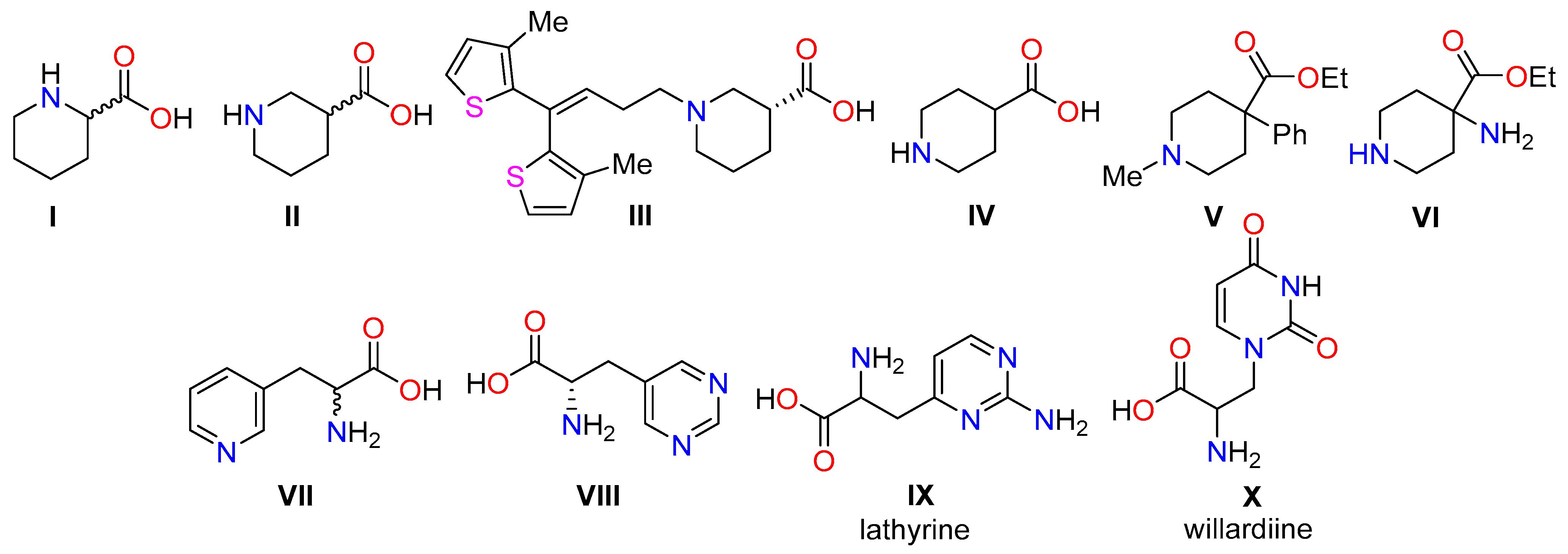
Amino acids are organic compounds that serve as the fundamental building blocks of proteins and are also precursors to numerous organic molecules. These derivatives are widely used to improve performance in fields such as pharmaceuticals, materials science, food processing, and biotechnology [1,2,3,4]. In recent years, increasing attention has been paid to heterocyclic unnatural amino acids containing one or more heteroatoms (e.g., nitrogen, oxygen, or sulfur) in their cyclic structures [5,6,7]. Their significance is related to the different combinations of amino acid-type functional groups with heterocyclic frameworks, which may influence molecular shape, electronic properties, hydrogen-bonding capacity, basicity, lipophilicity, and metabolic stability [8,9]. Heterocycles are frequently found in biologically active compounds and approved molecule drugs, where they often participate in key interactions with biological targets [10,11,12,13]. Furthermore, natural and unnatural amino acids are widely used to modify peptides, and peptidomimetics conformational constraints are required [14]. In this respect, nitrogen-containing saturated heterocyclic and heteroaromatic amino acids represent valuable building blocks for preparing various constrained biological heterocyclic compounds, molecular hybrids [15,16], and peptides [6,14,17]. For example, piperidine derivatives represent an important class of saturated nitrogen heterocycles in medicinal and synthetic chemistry [18]. Among them, (R,S)-2-piperidine carboxylic acid I, also known as D,L-pipecolic acid, is a chiral cyclic non-protein amino acid and a proline homologue (Figure 1). Amino acid I is found naturally in microorganisms and plants and is a cornerstone of medicinal chemistry as a precursor for alkaloid synthesis [19]. (R,S)-piperidine-3-carboxylic acid (D,L-nipecotic acid) II is one of the most potent inhibitors of neuronal and glial γ-amino butyric acid (GABA) uptake in vitro [20]. Amino acid II is a building block for (R)-1-[4,4-bis-(3-methyl-2-thienyl)-3-butenyl]-3-piperidine carboxylic acid, named (R)-tiagabine III, which amplifies GABA neurotransmission, the predominant inhibitory neurotransmitter in the brain [21,22]. New derivatives of nipecotic acid II are very potent and are selective analogues of GABA uptake inhibitors [23,24,25]. Piperidine-4-carboxylic acid IV, also known as isonipecotic acid, is a conformationally constrained derivative of γ-aminobutyric acid (GABA) and a moderately potent GABAA receptor partial agonist [26,27]; it is also a precursor to the drug pethidine V, also known as meperidine, which is an opioid as potent as morphine and can be administered intramuscularly [28,29].
From a synthetic perspective, piperidine carboxylic acid derivatives are attractive starting materials because their carboxyl group can be transformed into β-keto ester, enaminone, or related activated intermediates suitable for subsequent cyclocondensation reactions [30,31]. It is important to note that piperidine-4-carboxylic acid IV is often used as a substrate for modification to obtain various peptidomimetics [32]. In previous research, 4-aminopiperidine-4-carboxylic acid VI was used to create water-soluble highly helical peptides [33,34].
Meanwhile, aromatic heterocycles like benzene are ring-shaped organic molecules with a planar structure, an extended ring overlapping p-orbitals, and π-electrons that have at least one atom other than a hydrocarbon, such as nitrogen, oxygen, or sulfur, in the ring structure. Both synthetic and natural heteroaromatic amino acids, especially five- and six-membered rings containing nitrogen atoms which have unique stability and reactivity, are pharmacologically active compounds and have always attracted attention due to their pharmacological properties [35]. For example, 2-, 3-, and 4-pyridyl amino acids (commonly called regioisomeric pyridylalanines, where a pyridine ring replaces the phenyl ring of phenylalanine) are valuable non-canonical amino acids widely used in medicinal chemistry, pharmacology, and peptide engineering [36]. Heterocyclic alanines such as (L)-3-(2-pyridyl)alanine are useful precursors for preparing potential angiotensin II (AII) receptor antagonists [37,38]; 2-, 3-, and 4-pyridylalanines have attracted attention, as heteroaryl is substituted for phenylalanine, thus impacting VLA-4 inhibition. As such, these compounds may be considered for treating asthma and rheumatoid arthritis [39]. Moreover, these heterocyclic amino acids are used to form various biological complexes for transporting 1(LAT1) across the blood–brain barrier into cancer cells [40].
The pyrimidine ring is a structural unit of DNA and RNA and, therefore, chemical structures based on pyrimidine exhibit a variety of pharmacological activities, including antimalarial, antiviral, anticancer, anti-inflammatory, analgesic, anticonvulsant, and antioxidant effects [41,42]. Related synthetic pyrimidine amino acid derivatives, including β-pyrimidine alanine analogues, have also attracted interest as biologically important scaffolds and building blocks for modified peptides and biological heterocyclic compounds [43]. For example, Harrison et al. reported synthesizing functionalized urea compounds from heterocyclic alanines, including (2R)-2-amino-3-(pyrimidin-5-yl)propanoic acid VIII, as inflammasome inhibitors of NLRP3 [44]. Among this structurally diverse group are several natural pyrimidine-containing amino acids, including lathyrine IX and willardiine X [45]. Jane et al. demonstrated that willardiine analogues act as potent and selective agonists for either AMPA or kainate receptors, with receptor affinity and subtype selectivity strongly influenced by substitutions at the 5-position of the uracil ring. For example, 5-fluorowillardiine exhibited preferential affinity toward AMPA receptor subtypes, whereas 5-iodowillardiine showed high selectivity for the kainate receptor subtype hGluR5 [46].
Numerous methods for forming pyrimidine ring systems have been developed [47,48]. Classical condensation reactions to produce pyrimidines include condensation of the corresponding amidine derivative, which acts as a N-C-N nitrogen nucleophile, with three carbon units containing compounds such as β-dicarbonyl [49,50] or β-enaminone [51]. Furthermore, multicomponent reactions (MCRs) [52,53], including green chemistry approaches [54], have significantly expanded the set of synthetic tools available for synthesizing pyrimidines. The stereoselective synthesis of chiral pyrimidine derivatives continues to represent a notable synthetic challenge [55].
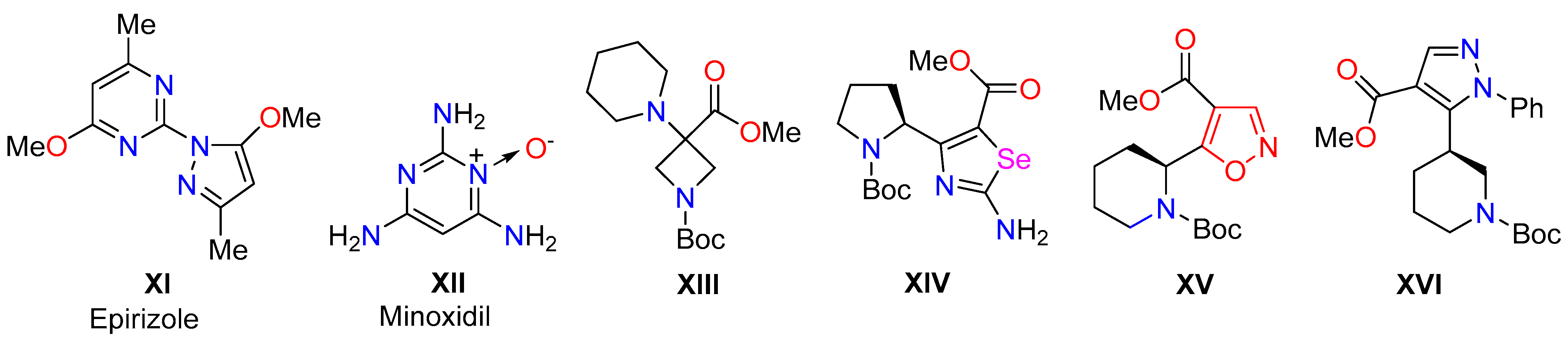
Biheterocycles are an essential class of heterocyclic compounds in medicinal chemistry. Their design involves combining two pharmacophoric scaffolds into a single molecule. This combination enhances pharmacological potency, often exceeding the effects of each component alone [56,57]. Biheterocycles exhibit a variety of complex frameworks, including linear, angular, spiro, fused, and bridged heterocyclic rings and frequently serve as scaffolds for developing new biologically active molecules [58,59]. Linear biheterocycles can connect two heterocyclic rings with a single bond, and such molecules are found in many commercially available drugs. For example, the 2-(1H-pyrazol-1-yl)pyrimidine derivative Epirizole XI (Figure 2) is a nonsteroidal anti-inflammatory drug [60], the 4-(piperidin-1-yl)pyrimidine derivative Minoxidil XII is an anti-inflammatory agent [61], and the 3-(pyrimidin-4-yl)-1H-indole derivative Osimertinib (Tagrisso) is used to treat non-small-cell lung cancer [62].
The most common bicyclic amino acids contain two fused, spirocyclic, or bridged skeletons [63,64]; however, linear biheterocycle amino acids are much less well documented in the literature. Chalyk and co-workers obtained isoxazole-(hetero)cyclic molecular hybrids as linear biheterocyclic amino acid derivatives [65]. Our research group has synthesized various linear biheterocycle amino acid derivatives, for example, compound hybrids XIII [66], XIV [67], XV [31], and XVI [30], including chiral building blocks for synthesizing DNA-encoded compound libraries [68,69].
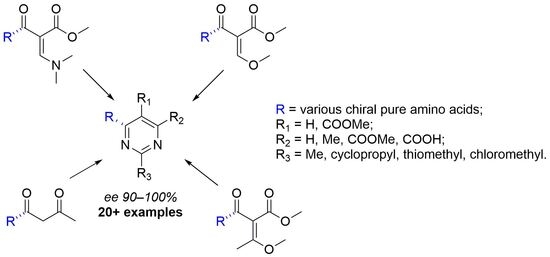
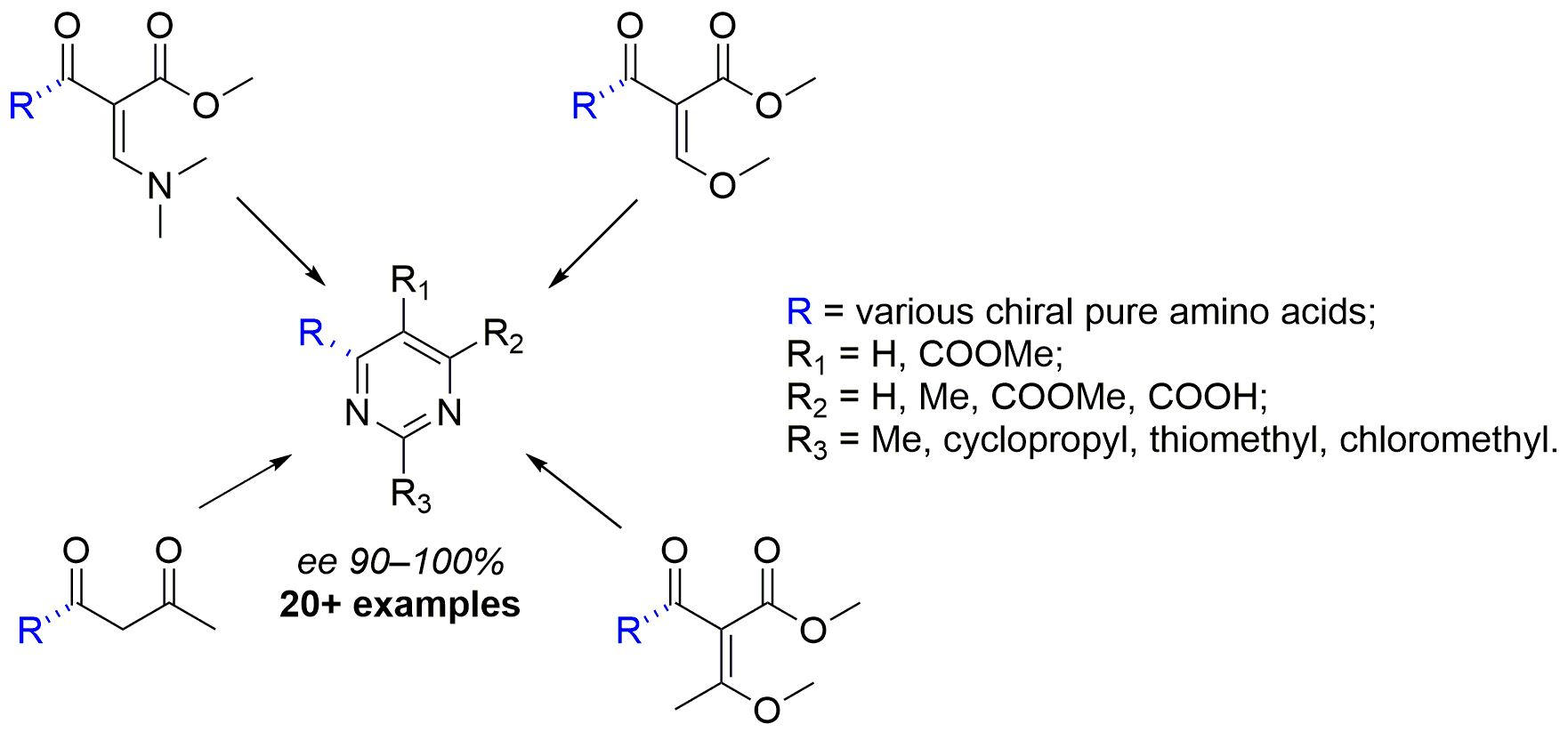
In this study, we synthesized and characterized new functionalized pyrimidine (hetero)cyclic molecular hybrids as chiral heterocyclic amino acid derivatives. The target pyrimidine-5-carboxylates and pyrimidine-4-carboxylic acid derivatives were prepared from β-dicarbonyl compounds and their enamine analogues via cyclocondensation approaches. An important objective of this study was to establish complementary synthetic routes toward new pyrimidine–heterocyclic amino acid derivatives while preserving the configuration of the inherited stereogenic center during pyrimidine formation. Particular attention was given to reaction optimization, substrate scope, and stereochemical integrity, with chiral HPLC analysis used to evaluate enantiomeric retention. The majority of the substrates showed excellent stereochemical retention, but select structurally distinct examples underwent enantiomeric purity erosion.

2. Results and Discussion

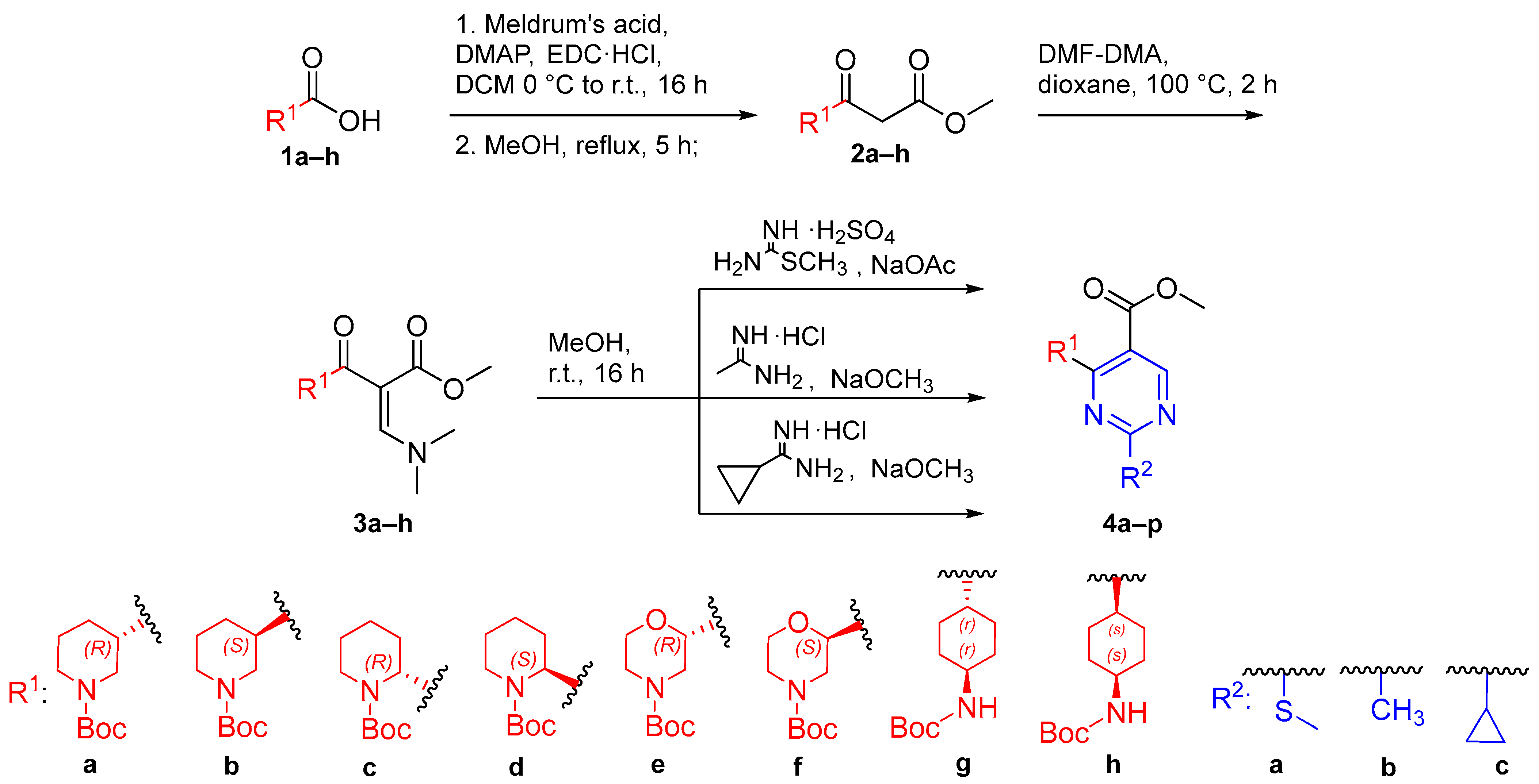
In our investigation, we started with synthesizing the novel (hetero)cyclic pyrimidine-5-carboxylates (Scheme 1 and Figure 3). The starting β-keto esters 2a–h were synthesized from corresponding N-Boc protected amino acids 1a–h, which were first treated with 2,2-dimethyl-1,3-dioxane-4,6-dione (Meldrum’s acid) under the action of 4-dimethylaminopyridine (DMAP) and N-ethyl-N′-(3-dimethylaminopropyl)carbodiimide hydrochloride (EDC⋅HCl), followed by further methanolysis of the Meldrum’s acid adduct [30,70,71].
The obtained compounds 2a–h were converted into β-enamino keto esters 3a–h by treatment with N,N-dimethylformamide dimethyl acetal (DMF−DMA) [30,71,72]. After successfully preparing 3a–h, we investigated the formation of 2,6-substituted pyrimidine-5-carboxylates 4a–p (Scheme 1 and Figure 3).
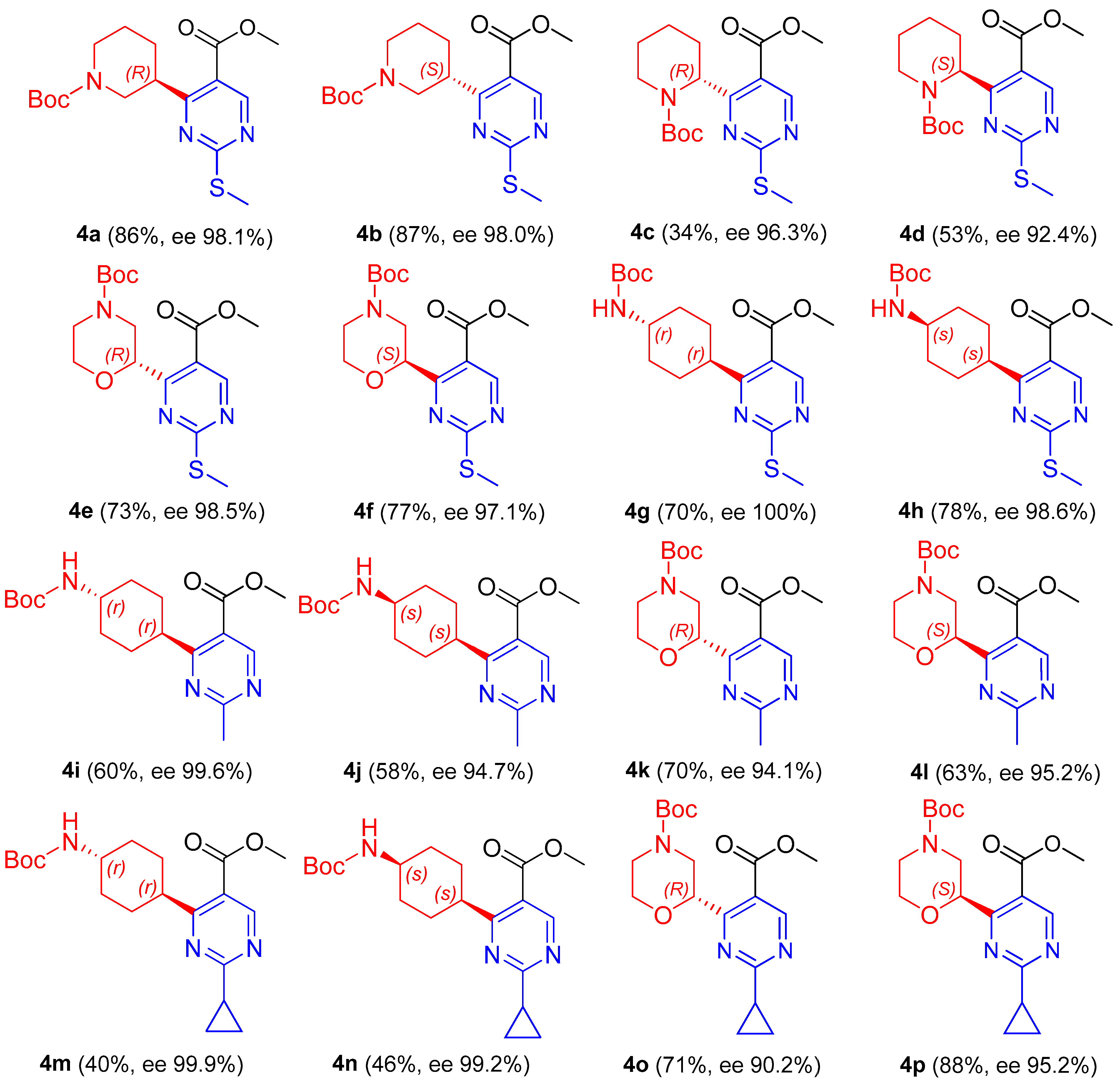
Initially, the synthetic approach involved synthesizing thiopyrimidine-5-carboxylates 4a–h. Various reaction conditions have been reported in the literature for synthesizing substituted thiopyrimidine derivatives [73,74,75,76]. For instance, Goldber et al. described the cyclocondensation of enamine with 2-methyl-2-thiopseudourea sulfate mediated by sodium acetate [77]. Following the aforementioned procedure, β-enamino keto esters 3a–h were treated with 2-methyl-2-thiopseudourea hemisulfate in dry methanol in the presence of anhydrous sodium acetate at room temperature for 16 h, affording the target 2-(methylsulfanyl)pyrimidine-5-carboxylates 4a–h with moderate-to-good yields (34–87%).
Then, the cyclocondensation strategy was employed to synthesize pyrimidine-5-carboxylates 4i–p using amidine reagents. Initially, the synthesis of compound 4i was optimized to assess the base and reaction time effects on the formation of the target product. The reaction was carried out in methanol at room temperature using a range of organic and inorganic bases, with reaction times of 4, 16, and 48 h (Table 1). After 4 h, moderate yields were afforded with most of the bases investigated, with NaOCH3 providing the highest yield (45%). The lowest yields of product 4i were observed in the presence of weaker bases such as TEA, K2CO3, and DIPEA. Extending the reaction time to 16 h improved the 4i yield with several bases (NaOCH3, K2CO3). No further improvement in yield was observed when the reaction time was extended beyond 16 h; in some cases, yield decreased. The best yield for 4i (60%) was obtained when the reaction was carried out in methanol at room temperature over 16 h, employing NaOCH3 (Table 1, Entry 4). The lower isolated yields obtained after prolonged reaction times are most likely attributable to competing side reactions during extended exposure to the basic reaction conditions. The optimized conditions were subsequently applied to the synthesis of a series of pyrimidine-5-carboxylates 4i–p (Figure 3).
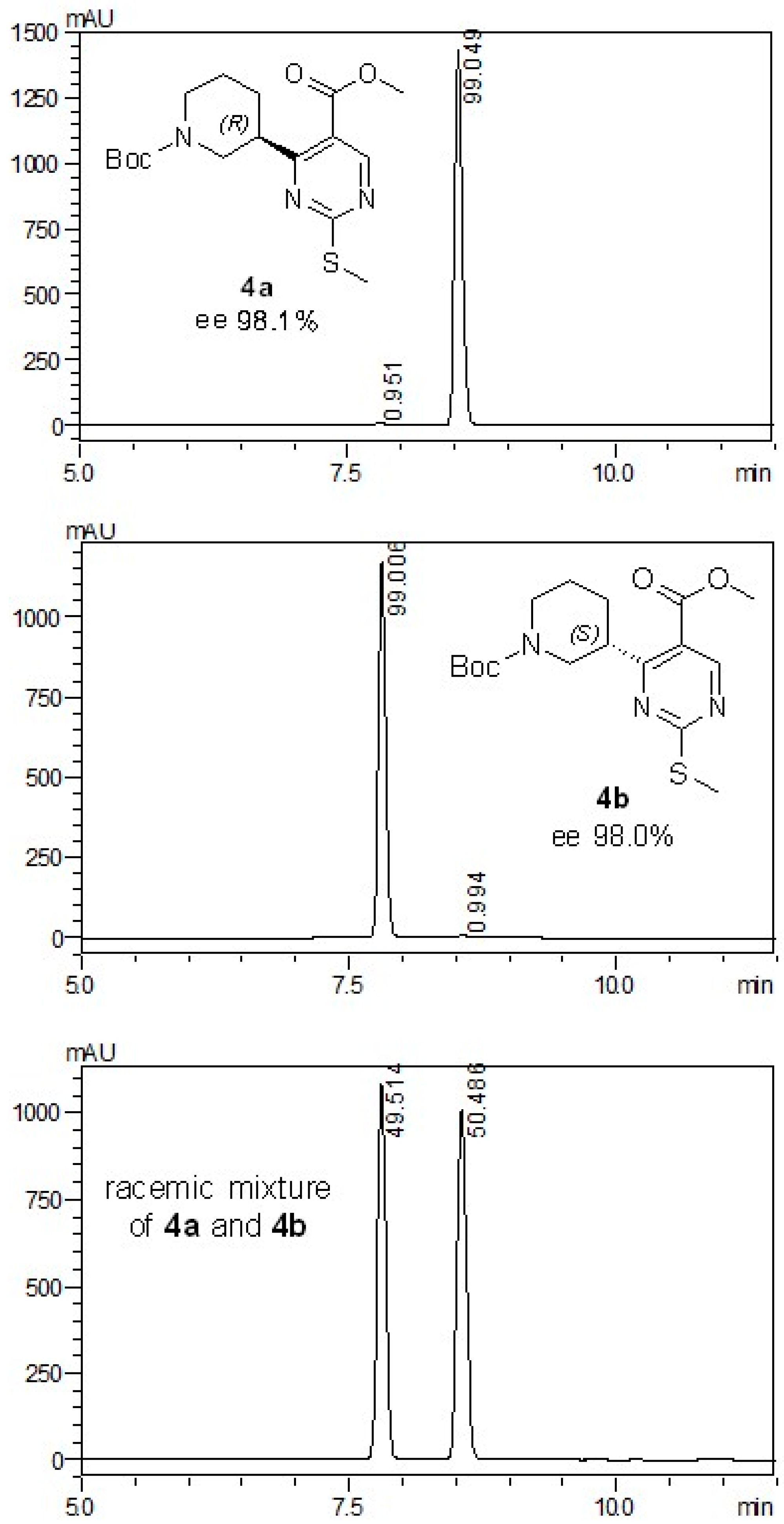
The enantiomeric purity of pyrimidine-5-carboxylates 4a–p was determined by chiral HPLC analysis. Representative chromatograms of compounds 4a and 4b are presented in Figure 4, while chromatograms of the remaining compounds 4c–p are provided in the Supplementary Materials. The chiral pyrimidine-5-carboxylate (R)-4a was obtained from the corresponding β-enamino keto ester (R)-3a with an enantiomeric excess of 98.1%, whereas the corresponding (S)-4b enantiomer was obtained from the β-enamino keto ester (S)-3b with an enantiomeric excess of 98.0%.
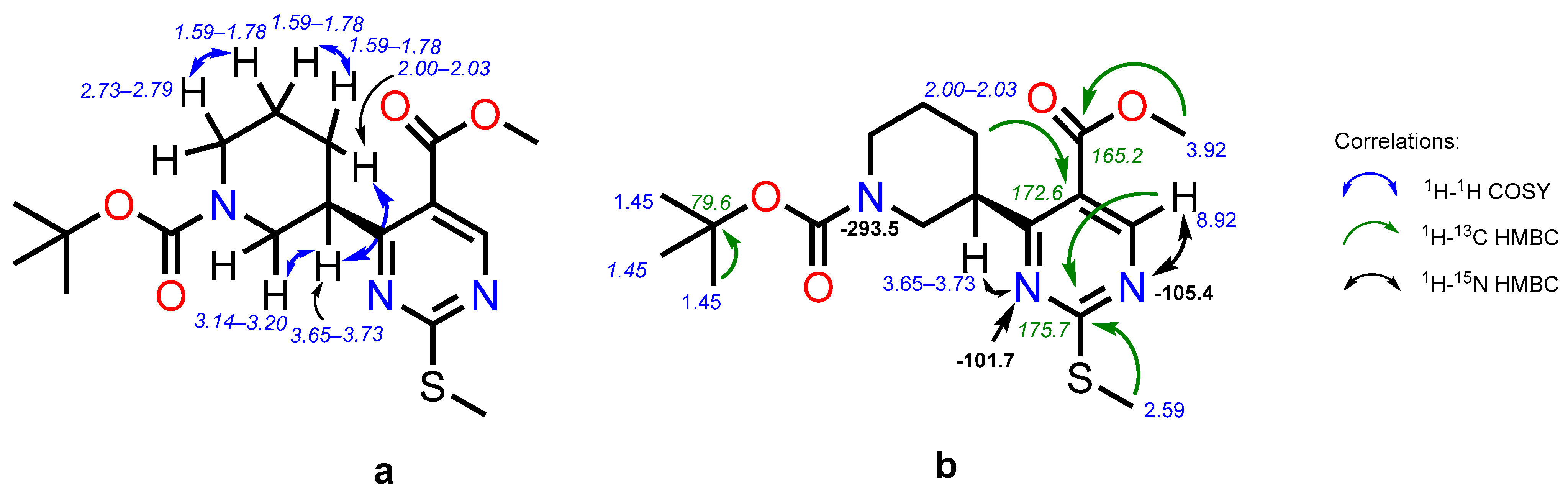
The structures of substituted pyrimidine-5-carboxylates 4a–p were elucidated through a combination of standard and advanced NMR spectroscopy techniques, including 1H, 13C, 13C DEPT-135, 1H-1H COSY, 1H-13C HSQC, 1H-13C HMBC, and 1H-15N HMBC. Compound 4a was subjected to detailed NMR analysis (Figure 5).
The 1H NMR spectrum showed a tert-butyl singlet at δH 1.45 ppm (9H), indicative of a Boc-protecting group. A methoxy signal at δH 3.92 ppm correlated with δC 52.5 ppm in the HSQC spectrum and displayed a long-range HMBC correlation to the carbonyl carbon at δC 165.2 ppm, confirming the methyl ester moiety.
The aliphatic fragment was unambiguously defined by 1H-1H COSY correlations, which established a continuous spin system from 2-H through 6-H. HSQC data enabled assigning all protonated carbons within this fragment, including signals at δC 47.7 ppm (C-2), 41.0 ppm (C-3), 30.8 ppm (C-4), 25.2 ppm (C-5), and 44.2 ppm (C-6). Key HMBC correlations from 4-H to the quaternary carbon (C-5′) and 3-H 3J correlation to C-4′ provided direct evidence for attaching the aliphatic chain to the heteroaromatic ring.
The heteroaromatic system was further elucidated using long-range 1H-13C HMBC correlations. The downfield proton 6′-H (δH 8.92 ppm) exhibited correlations with C-4′ (δC 172.6 ppm) and C-2′ (δC 175.7 ppm), consistent with its position within an electron-deficient heterocycle. Additional HMBC correlations of protons in the linker region with aromatic carbons reinforced the connectivity between the two fragments. The observed chemical shifts and correlation pattern are in agreement with a substituted N-containing heteroaromatic ring bearing electron-withdrawing substituents.
The position of heteroatoms within the ring system was confirmed by 1H-15N HMBC data. Correlations from H-6′ and neighbouring protons to distinct nitrogen resonances established the arrangement of nitrogen atoms within the heterocycle. Furthermore, the S-methyl group (δH 2.59 ppm; δC 14.5 ppm) showed clear HMBC correlations to C-2′, confirming its attachment to sulfur and its position relative to the ring system.
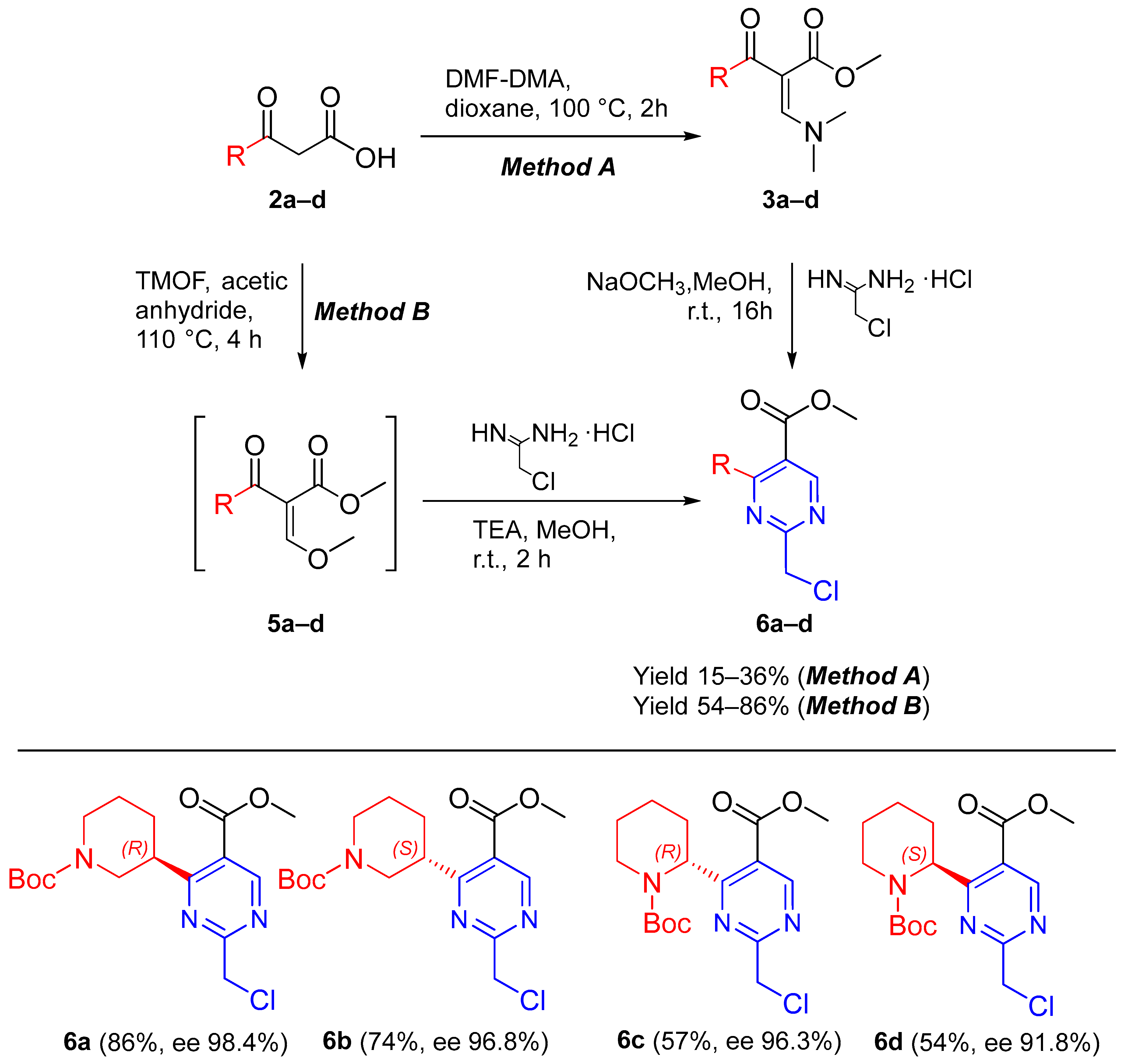
Next, we investigated the cyclization of β-enamino keto esters 3a–d with 2-chloroacetimidamide hydrochloride (Scheme 2); however, the previously optimized reaction conditions proved unsuitable. After 16 h, treating β-enamino keto esters 3a–d with 2-chloroacetimidamide hydrochloride, using NaOCH3 as the base, in methanol at room temperature afforded the desired 2-(chloromethyl)pyrimidine-5-carboxylates 6a–d only in low yields (15–36%). To address this limitation, a known synthetic procedure was adapted to prepare 2-(chloromethyl)pyrimidine-5-carboxylates 6a–d [78,79]. The appropriate β-keto esters 2a–d initially reacted with trimethyl orthoformate (TMOF) in the presence of acetic anhydride to afford intermediates 5a–d (Scheme 2). Without isolating intermediates, triethylamine and 2-chloroacetimidamide hydrochloride were added in the next step, forming targeted products 6a–d in good total yields of 54–86%.
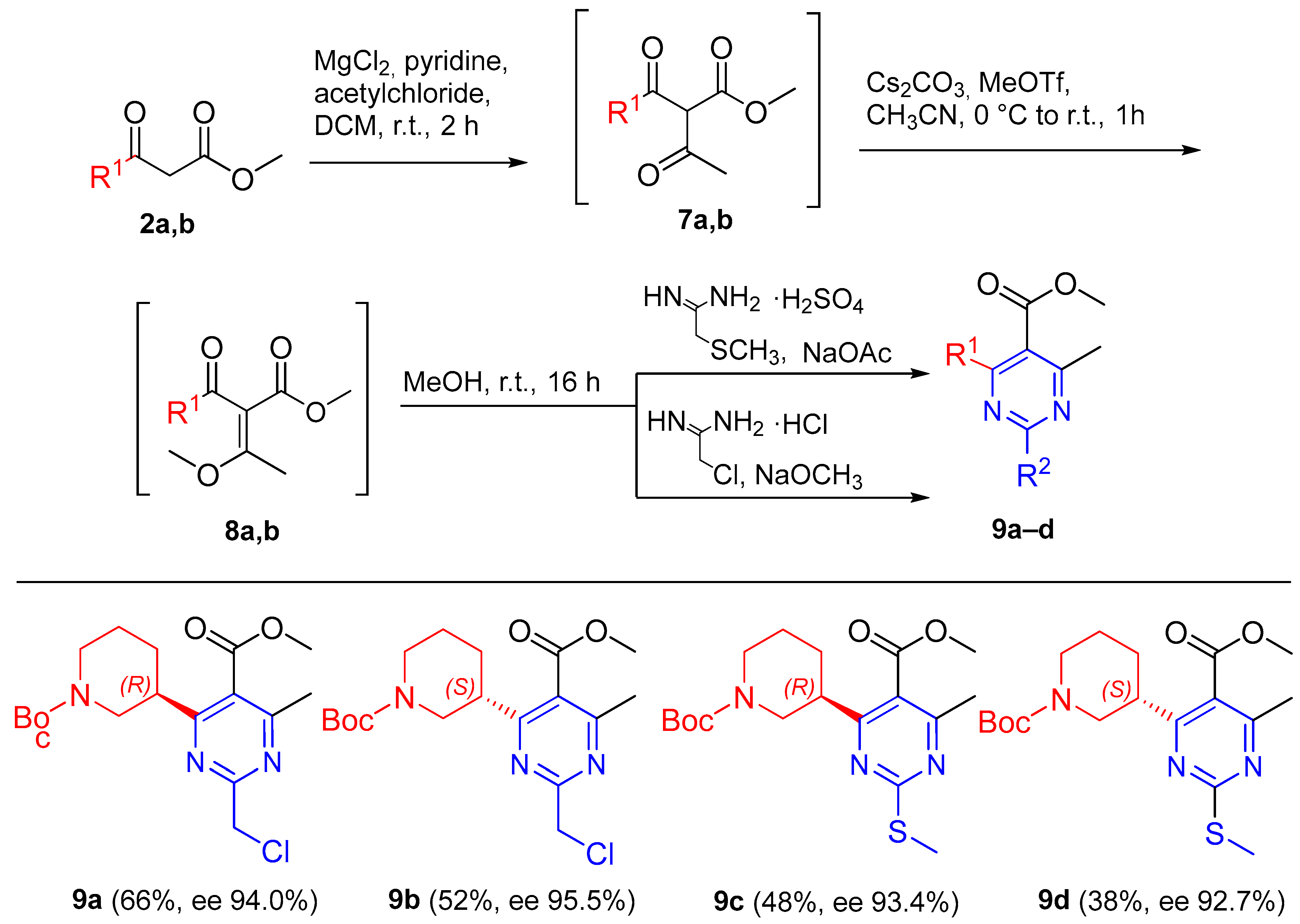
Following the successful cyclocondensation reactions of β-keto esters 2, pyrimidines 9a–d were synthesized using different synthetic approaches (Scheme 3). In this case, substituted pyrimidine-5-carboxylates 9a–d were obtained in three steps from the β-keto esters 2a,b, following modified procedures previously applied to other compounds in the literature [80,81]. Initially, β-keto esters 2a,b were converted into the corresponding acetoacetates 7a,b using acetyl chloride in the presence of MgCl2 (Scheme 3). Acetoacetates 7a,b were then treated with methyl trifluoromethanesulfonate under basic conditions at room temperature to give the intermediates 8a,b. Finally, cyclization of compounds 8a,b with methyl-2-thiopseudourea hemisulfate or 2-chloroacetimidamide hydrochloride under the conditions described above resulted in compounds 9a–d in good yields (38–66%).
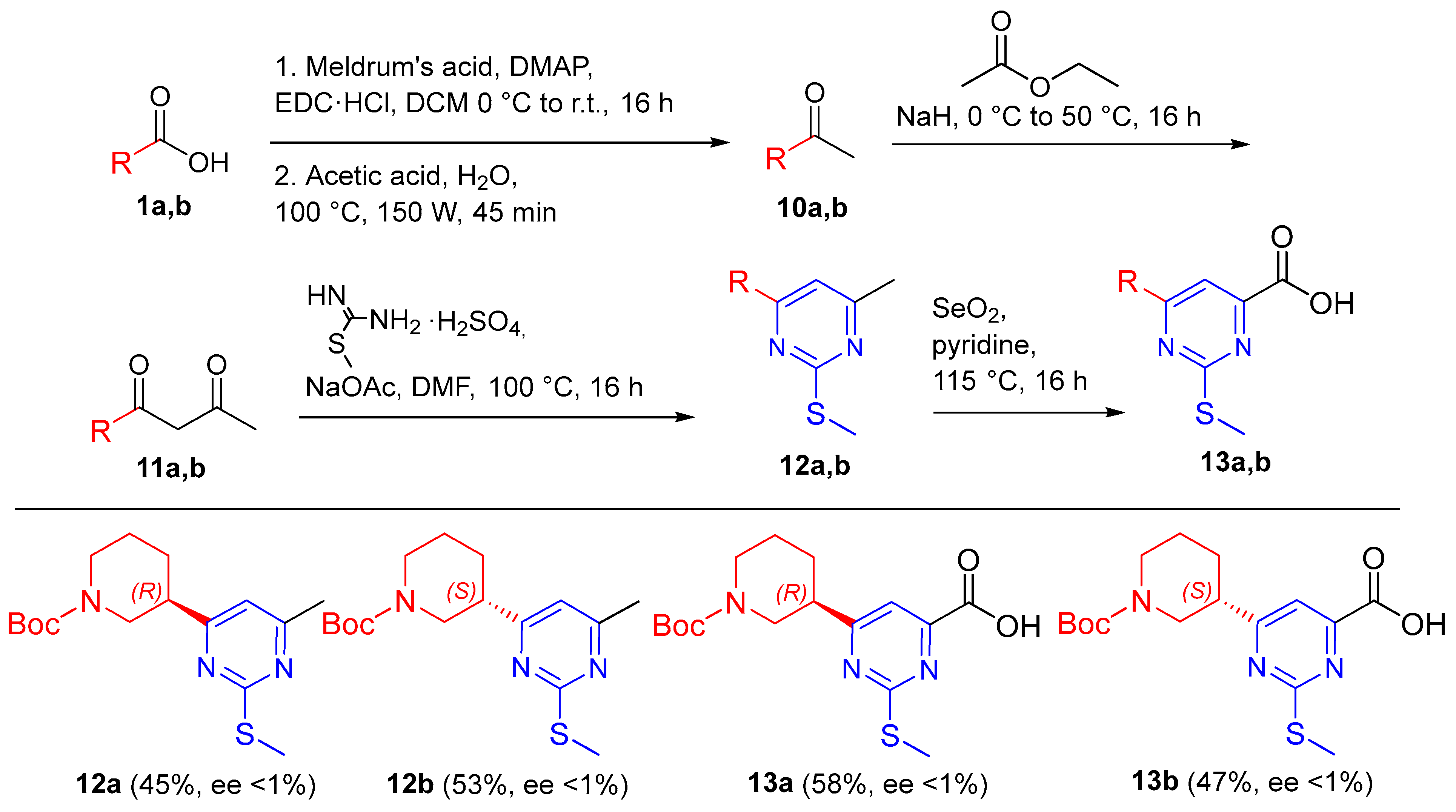
Pyrimidine derivatives play an important role in organic chemistry. In particular, 2-(methylsulfonyl)pyrimidines are broadly used in agrochemical and pharmaceutical applications [82,83]. Moreover, Mao et al. reported pyrimidine carboxylic acid derivatives exhibiting potent xanthine oxidase inhibitory activity [84,85]. Following the synthesis of pyrimidine-5-carboxylates, we further prepared several pyrimidine-4-carboxylic acids (Scheme 4). First, β-diketones 11a,b were synthesized from the corresponding ketones 10a,b via Claisen-type condensation [86]. Subsequent cyclization of β-diketones 11a,b with 2-methyl-2-thiopseudourea hemisulfate using weaker basic conditions afforded 2-(methylsulfonyl)pyrimidines 12a,b (45–53%).
Selenium dioxide-mediated oxidation of methylpyrimidines is a well-established method for synthesizing pyrimidine carboxylic acids [87]. Accordingly, oxidizing 4-methyl-2-(methylsulfonyl)pyrimidines 12a,b with excess selenium dioxide in boiling pyridine resulted in pyrimidine-4-carboxylic acids 13a,b in moderate yields (46–57%).
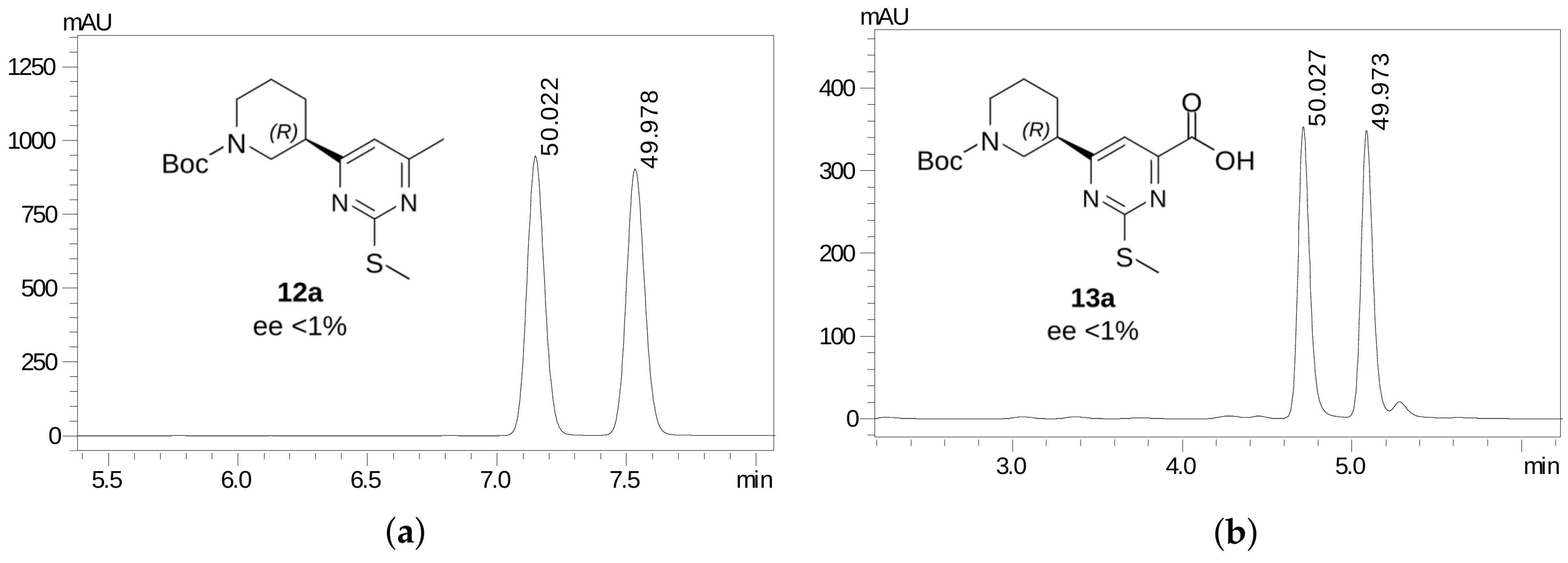
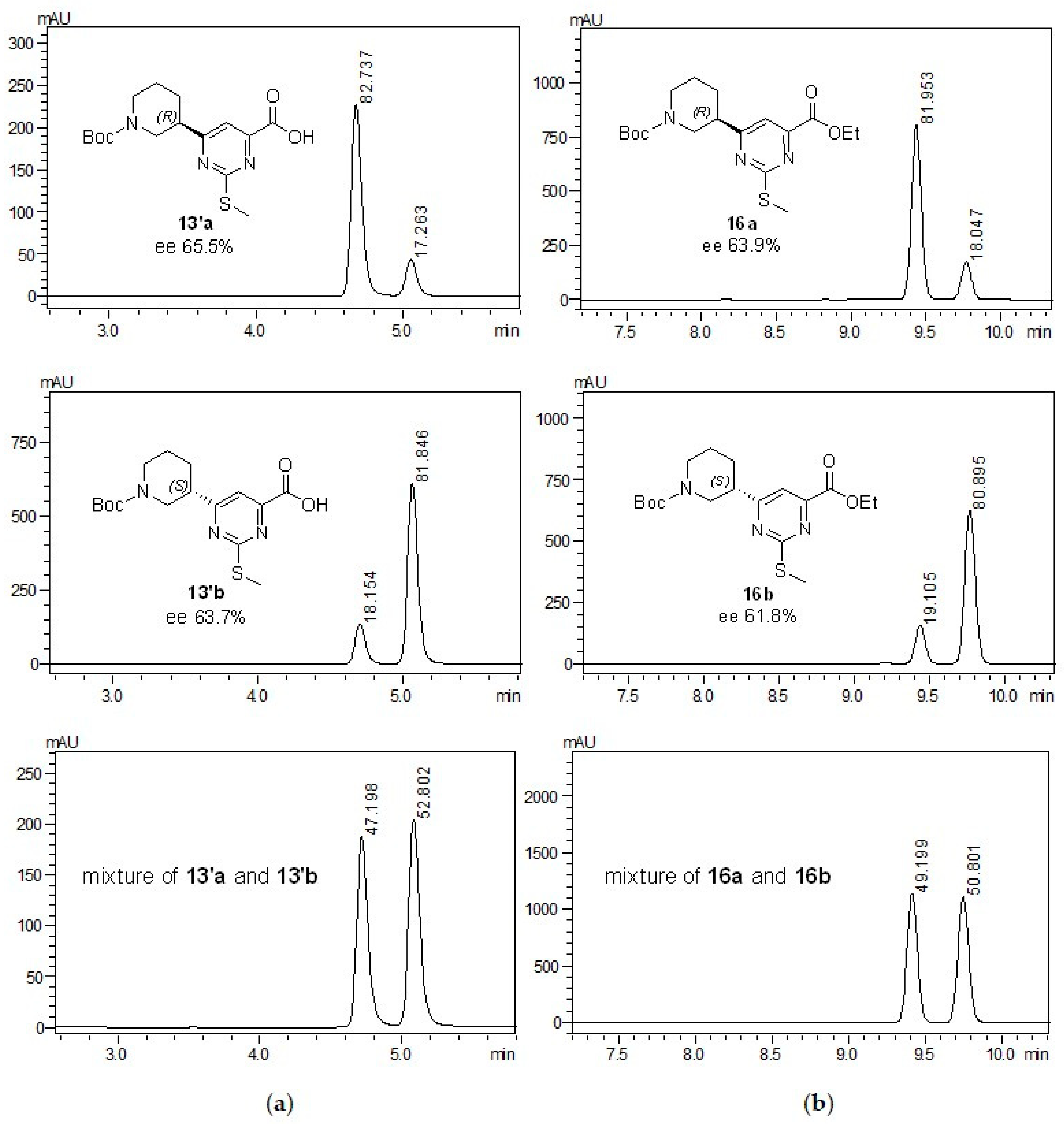
Nevertheless, this synthetic approach resulted in a complete loss of stereochemical integrity, affording racemic products. Treating compounds 11a,b with 2-methyl-2-thiopseudourea hemisulfate in DMF using anhydrous sodium acetate at an elevated temperature resulted in complete racemization, affording pyrimidines 12a,b as racemic mixtures (12a, ee < 1%; 12b, ee < 1%), which could not be separated into individual enantiomers (Figure 6). The subsequent oxidation of compounds 12a,b afforded pyrimidine-4-carboxylic acids 13a,b as inseparable racemic mixtures (13a, ee < 1%; 13b, ee < 1%).
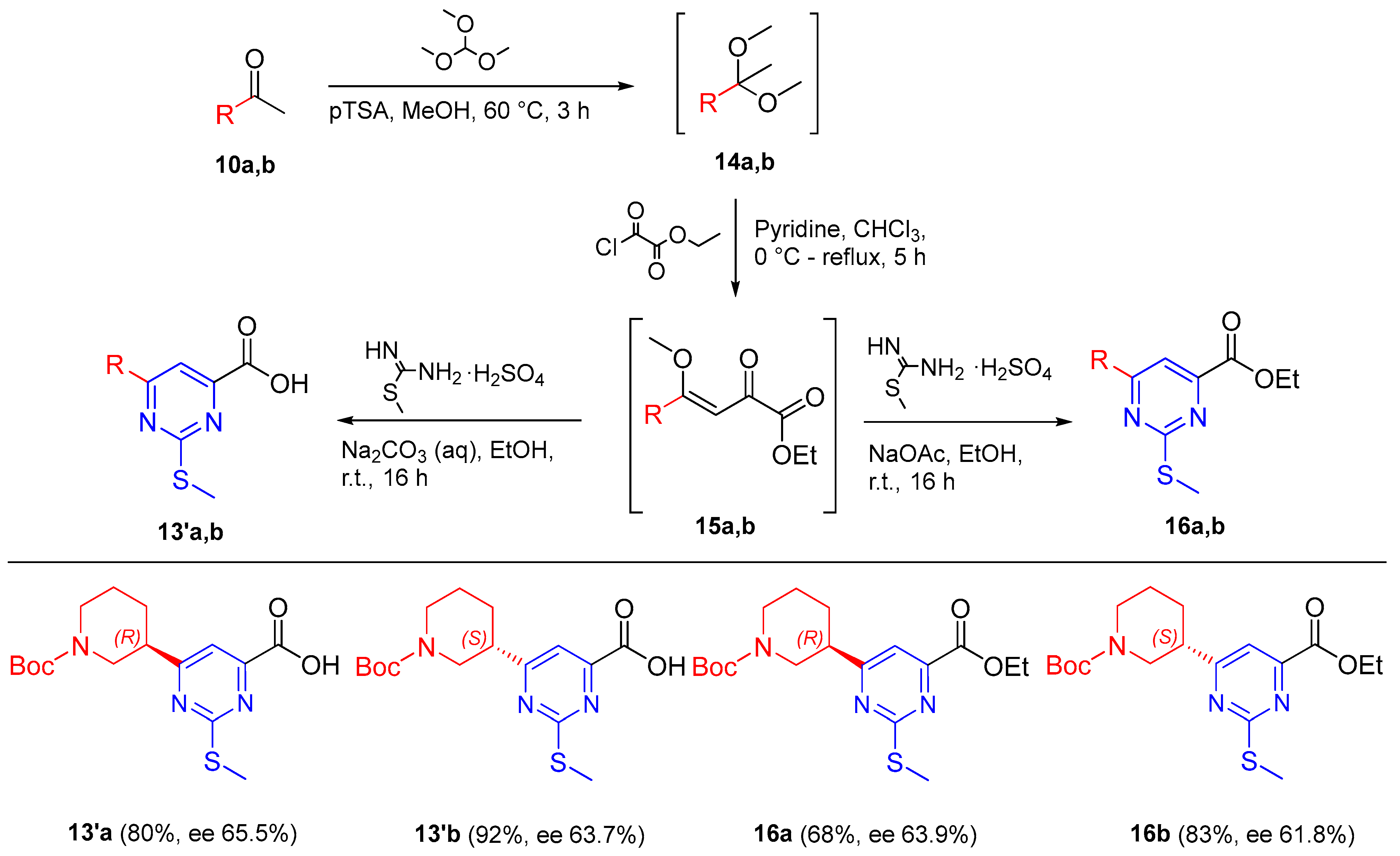
Due to the complete loss of stereochemical integrity under the applied reaction conditions, a different synthetic strategy was developed to access pyrimidine derivatives with improved enantiomeric purity, as outlined in Scheme 5.
Adjusting the approach, ketones 10a,b initially reacted with trimethyl orthoformate in methanol in the presence of pTSA to yield intermediate compounds 14a,b. The solvent was removed under reduced pressure, after which ethyl oxalyl chloride and pyridine were added at 0 °C using chloroform as a solvent. The reaction mixture was stirred for 1 h at 0 °C and subsequently refluxed for 5 h, resulting in intermediates 15a,b [88]. In this case, the cyclization reactions were carried out under mild conditions. In the first route, 15a,b reacted with 2-methyl-2-thiopseudourea hemisulfate in ethanol in the presence of sodium carbonate at room temperature, and pyrimidine carboxylic acids 13′a,b were obtained in good-to-excellent yields of 80–92%. In the second synthesis route, 15a,b reacted with 2-methyl-2-thiopseudourea hemisulfate in the presence of anhydrous sodium acetate at room temperature in absolute ethanol to afford the corresponding pyrimidine esters 16a,b in good yields (68–83%).
The enantiomeric purity of the obtained pyrimidines 13′a,b and 16a,b was evaluated using chiral HPLC analysis. Representative chiral HPLC chromatograms of pyrimidine carboxylic acids 13′a,b and pyrimidine esters 16a,b are shown in Figure 7. Under milder cyclization conditions, complete racemization was avoided, and the products were obtained with moderate enantiomeric purities (13a, 65.5% ee; 13b, 63.7% ee; 16a, 63.9% ee; 16b, 61.8% ee).
To identify the stage at which stereochemical erosion occurred, additional chiral HPLC analyses of key intermediates from the synthetic routes shown in Scheme 4 and Scheme 5 were performed (The corresponding chiral HPLC chromatograms of intermediates 10a,b and 11a,b are provided in the Supplementary Information as Figures S136 and S137). The ketone intermediates 10a,b were found to be enantiomerically pure. In contrast, the corresponding intermediates 11a,b exhibited identical chromatographic profiles irrespective of the configuration of the starting ketone, demonstrating that complete racemization had already occurred during the Claisen reaction.
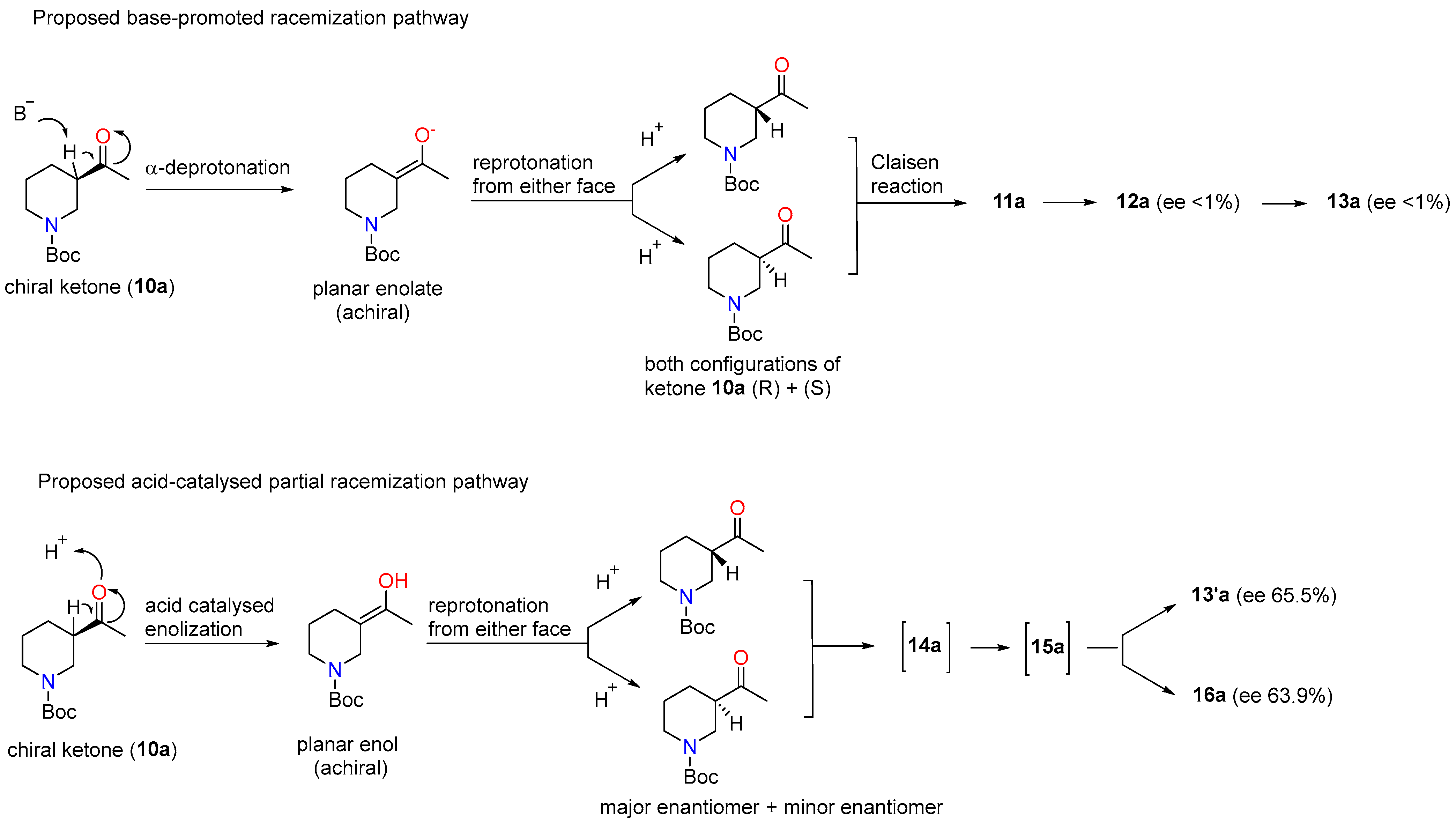
For the alternative synthetic route (Scheme 5), the starting ketones 10a,b were likewise enantiomerically pure, whereas the final products 13′a,b and 16a,b retained moderate enantiomeric excesses (61.8–65.5% ee). Since the corresponding intermediates 14a,b and 15a,b were not isolated, the exact stage of stereochemical erosion could not be established. A plausible explanation for the different extents of racemization observed under the two reaction pathways is presented in Scheme 6.
The proposed racemization pathways shown in Scheme 6 provide a plausible explanation for the different stereochemical outcomes observed under the two synthetic routes. Under the strongly basic Claisen reaction conditions, where a stoichiometric amount of base is employed, deprotonation at the stereogenic α-carbon generates a planar enolate. Subsequent non-stereoselective reprotonation from either face results in complete loss of stereochemical integrity. In contrast, the alternative synthetic route employs catalytic amounts of p-toluenesulfonic acid. Under these milder acid-catalysed conditions, partial racemization is most plausibly associated with reversible keto–enol tautomerization, which proceeds to a significantly lesser extent than under the strongly basic conditions. Consequently, only partial erosion of enantiomeric excess is observed, consistent with the experimentally determined chiral HPLC data.
The different stereochemical outcomes observed for the two synthetic approaches can also be rationalized by the nature of the reaction intermediates. In the synthetic routes shown in Scheme 1, Scheme 2 and Scheme 3, pyrimidine derivatives are formed from conjugated β-enamino carbonyl or related intermediates, in which the carbonyl functionality is incorporated into a conjugated system. Consequently, the transformation proceeds under mild conditions without requiring deprotonation at the stereogenic centre, thereby preserving the inherited stereochemical information, as reflected by the high enantiomeric excesses (90.2–100% ee) observed for the corresponding products.

3. Materials and Methods

3.1. General Information

All starting materials were purchased from commercial suppliers and were used as received. Flash column chromatography was performed on Silica Gel 60 Å (Merck KGaA, Darmstadt, Germany). Vacuum distillation was performed in a Büchi Model B580 GKR oven (Büchi Labortechnik AG, Flawil, Switzerland). Thin-layer chromatography was carried out on Silica Gel plates (Merck Kieselgel 60 F254) and visualised by UV light (254 nm) (Merck KGaA, Darmstadt, Germany). The IR spectra were recorded on a Bruker Vertex 70v FT-IR spectrometer (Bruker Optik GmbH, Ettlingen, Germany) using neat samples and are reported in the frequency of absorption (cm–1). Mass spectra were obtained using a Shimadzu LCMS-2020 (ESI+) spectrometer (Shimadzu Corporation, Kyoto, Japan). High-resolution mass spectra were measured using a Bruker MicrOTOF-Q III (ESI+) apparatus (Bruker Daltonik GmbH, Bremen, Germany). Accurate measurements were achieved using the internal mass calibration of each sample using sodium formate calibration solution as a standard procedure, with a standard deviation always less than 1 ppm. In addition, all data files were recalibrated with an internal standard of sodium formate injected prior to initial sample elution for each sample. Optical rotation data were recorded on a UniPol L SCHMIDT+HAENSCH polarimeter (concentration of compound (g/100 mL) and were included in calculations automatically (Windaus-Labortechnik GmbH & Co. KG, Clausthal-Zellerfeld, Germany). 1H-NMR and 13C-NMR spectra were recorded from CDCl3 solutions at 25 °C on a Bruker Avance III 400 instrument (400 MHz for 1H, 100 MHz for 13C) using a directly detecting BBO probe (Bruker Bio Spin International AG, Faellanden, Switzerland). 15N-NMR spectra were recorded from CDCl3 solutions at 25 °C on a Bruker Avance III 400 instrument (40 MHz for 15N) using a directly detecting BBO probe. The chemical shifts (δ), expressed in ppm, were relative to tetramethylsilane (TMS). 15N-NMR spectra were referenced against neat external nitromethane (coaxial capillary). The following abbreviations were used in reporting the NMR data: Pyr, pyrimidine, Pip, piperidine; Cpr, cyclopropane; Morph, morpholine; Cy, cyclohexane.

3.2. Synthetic Procedures

3.2.1. General Procedure for Compounds 2a–h

Corresponding amino acid (1 equiv.), Meldrum‘s acid (1.1 equiv.) and DMAP (2 equiv.) were dissolved in methylene chloride and cooled to 0 °C. Maintaining the temperature at 0 °C, 1-ethyl-3-(3-dimethylaminopropyl)carbodiimide hydrochloride (1.1 equiv.) was added in portions and the solution was stirred at r.t. for 16 h. The reaction mixture was diluted with DCM (10 mL) and washed with 1M KHSO4 (2 × 15 mL) and brine (15 mL). The organic layer was dried with anhydrous sodium sulfate, filtered, and then concentrated under reduced pressure. The crude product was dissolved in methanol and stirred at 60 °C for 5 h. After removal of the solvent in vacuo, the residue was directly used in the next step without further purification.

3.2.2. General Procedure for Compounds 3a–h

An appropriate amount of compound 2a–h (1 equiv.) was dissolved in 1,4-dioxane, and DMF-DMA (2 equiv.) was added dropwise. The reaction was stirred at 100 °C for 2 h. After removal of the solvent in vacuo, the obtained residue was directly used in the next step without further purification.

3.2.3. General Procedure for Compounds 4a–h

To a solution of corresponding β-enamino keto ester 3a–h (1 equiv.) in dry methanol, sodium acetate anhydrous (4.2 equiv.) and 2-methyl-2-thiopseudourea hemisulfate (1.4 equiv.) were added and stirred at r.t. for 16 h. The resulting mixture was concentrated under reduced pressure and purified by flash chromatography to provide products 4a–h.
Methyl 4-[(3R)-1-(tert-butoxycarbonyl)piperidin-3-yl]-2-(methylsulfanyl)pyrimidine-5-carboxylate (4a)
The sample was prepared from 3a (0.340 g, 1 mmol), sodium acetate anhydrous (0.345 g, 4.2 mmol) and 2-methyl-2-thiopseudourea hemisulfate (0.390 g, 1.4 mmol) dissolved in dry methanol. The reaction was stirred at r.t. for 16 h. The obtained residue was purified by column chromatography (SiO2, eluent:ethylacetate/n-hexane, 1:6, v/v) to provide compound 4a as a colorless liquid. Yield 0.316 g (86%), [α]D20 = 84.1 (c 0.927, MeOH). 1H NMR (400 MHz, CDCl3): δH ppm 1.45 (s, 9H, C(CH3)3), 1.59–1.77 (m, 3H, Pip 4-H, Pip 5-CH2), 2.00–2.03 (m, 1H, Pip 4-H), 2.58 (s, 3H, S-CH3), 2.76 (t, J = 12.5 Hz, 1H, Pip 6-H), 3.13–3.19 (m, 1H, Pip 2-H), 3.67–3.73 (m, 1H, Pip 3-H), 3.91 (s, 3H, COOCH3), 4.13–4.19 (m, 2H, Pip 2,6-H), 8.91 (s, 1H, Pyr). 13C NMR (101 MHz, CDCl3): δC ppm 14.5 (S-CH3), 25.2 (Pip C-5), 28.6 (COOC(CH3)3), 30.8 (Pip C-4), 41.0 (Pip C-3), 44.2 (Pip C-6), 47.6 (Pip C-2), 52.6 (COOCH3), 79.6 (COOC(CH3)3), 117.9 (Pyr C-5), 154.9 (COOC(CH3)3), 159.3 (Pyr C-6), 165.2 (COOCH3), 172.6 (Pyr C-4), 175.7 (Pyr C-2). 15N-NMR (71 MHz, CDCl3): δN ppm −293.5 (N-Boc), −105.4 (Pyr 1-N), −101.7 (Pyr 3-N). IR (FT-IR, νmax, cm−1): 2930 (CHaliph), 1725 (C=O), 1688 (C=O), 1560, 1402, 1163 (C=C, C–N, C–O–C). HRMS (ESI+) C17H26N3O4S ([M+H]+) calcd. 368.1639, found 368.1640.
Methyl 4-[(3S)-1-(tert-butoxycarbonyl)piperidin-3-yl]-2-(methylsulfanyl)pyrimidine-5-carboxylate (4b)
The sample was prepared from 3b (0.340 g, 1 mmol), sodium acetate anhydrous (0.345 g, 4.2 mmol) and 2-methyl-2-thiopseudourea hemisulfate (0.390 g, 1.4 mmol) dissolved in dry methanol. The reaction was stirred at r.t. for 16 h. The obtained residue was purified by column chromatography (SiO2, eluent:ethylacetate/n-hexane, 1:6, v/v) to provide compound 4b as a colorless liquid. Yield 0.320 g (87%), [α]D20 = −84.2 (c 0.907, MeOH). 1H NMR (400 MHz, CDCl3): δH ppm 1.45 (s, 9H, C(CH3)3), 1.59–1.78 (m, 3H, Pip 4-H, Pip 5-CH2), 2.00–2.03 (m, 1H, 4-H), 2.59 (s, 3H, S-CH3), 2.73–2.79 (m, 1H, Pip 6-H), 3.14–3.20 (m, 1H, Pip 2-H), 3.65–3.73 (m, 1H, Pip 3-H), 3.92 (s, 3H, COOCH3), 4.08–4.24 (m, 2H, Pip 2,6-H), 8.92 (s, 1H, Pyr). 13C NMR (101 MHz, CDCl3): δC ppm 14.5 (S-CH3), 25.2 (Pip C-5), 28.6 (COOC(CH3)3), 30.8 (Pip C-4), 41.0 (Pip C-3), 44.3 (Pip C-6), 47.7 (Pip C-2), 52.5 (COOCH3), 79.6 (COOC(CH3)3), 117.9 (Pyr C-5), 154.9 (COOC(CH3)3), 159.4 (Pyr C-6), 165.2 (COOCH3), 172.6 (Pyr C-4), 175.7 (Pyr C-2). 15N-NMR (71 MHz, CDCl3): δN ppm −104.9 (Pyr 1-N), −101.8 (Pyr 3-N), N-Boc was not found. IR (FT-IR, νmax, cm−1): 2930 (CHaliph), 1724 (C=O), 1688 (C=O), 1560, 1402, 1162 (C=C, C–N, C–O–C). HRMS (ESI+) C17H26N3O4S ([M+H]+) calcd. 368.1639, found 368.1640.
Methyl 4-[(2R)-1-(tert-butoxycarbonyl)piperidin-2-yl]-2-(methylsulfanyl)pyrimidine-5-carboxylate (4c)
The sample was prepared from 3c (0.340 g, 1 mmol), sodium acetate anhydrous (0.345 g, 4.2 mmol) and 2-methyl-2-thiopseudourea hemisulfate (0.390 g, 1.4 mmol) dissolved in dry methanol. The reaction was stirred at r.t. for 16 h. The obtained residue was purified by column chromatography (SiO2, eluent:ethylacetate/n-hexane, 1:6, v/v) to provide compound 4c as a colorless liquid. Yield 0.125 g (34%), [α]D20 = 85.8 (c 0.391, MeOH). 1H NMR (400 MHz, CDCl3): δH ppm 1.15–1.40 (m, 10H, C(CH3)3, Pip 4-H), 1.48–1.58 (m, 2H, Pip 4,5-H), 1.72–1.80 (m, 1H, Pip 5-H), 1.87–1.90 (m, 1H, Pip 3-H), 1.98–2.06 (m, 1H, SH), 2.57 (s, 3H, S-CH3), 3.53–3.61 (m, 1H, Pip 6-H), 3.90 (s, 3H, COOCH3), 3.98–4.09 (m, 1H, Pip 6-H), 5.94 (s, 1H, Pip 2-H), 8.93 (s, 1H, Pyr). 13C NMR (101 MHz, CDCl3): δC ppm 14.8 (S-CH3), 19.0 (Pip C-4), 24.7 (Pip C-5), 28.3 (COOC(CH3)3), 29.1 (Pip C-3), 42.3 Pip C-6), 52.6 (COOCH3), 53.3 (Pip C-2), 79.6 (COOC(CH3)3), 116.8 (Pyr 5-C), 156.2 (COOC(CH3)3), 159.3 (Pyr 6-C), 165.1 (COOCH3), 174.0 (Pyr 2-C), 175.8 (Pyr 4-C). 15N-NMR (71 MHz, CDCl3): δN ppm −136.8 (Pyr 3-N), −105.1 (Pyr 1-N), N-Boc was not found. IR (FT-IR, νmax, cm−1): 2932 (CHaliph), 1724 (C=O), 1693 (C=O), 1562, 1402, 1159 (C=C, C–N, C–O–C). HRMS (ESI+) C17H25N3NaO4S ([M+Na]+) calcd. 390.1458, found 390.1459.
Methyl 4-[(2S)-1-(tert-butoxycarbonyl)piperidin-2-yl]-2-(methylsulfanyl)pyrimidine-5-carboxylate (4d)
The sample was prepared from 3d (0.340 g, 1 mmol), sodium acetate anhydrous (0.345 g, 4.2 mmol) and 2-methyl-2-thiopseudourea hemisulfate (0.390 g, 1.4 mmol) dissolved in dry methanol. The reaction was stirred at r.t. for 16 h. The obtained residue was purified by column chromatography (SiO2, eluent:ethylacetate/n-hexane, 1:6, v/v) to provide compound 4d as a colorless liquid. Yield 0.195 g (53%), [α]D20 = −85.7 (c 0.350, MeOH). 1H NMR (400 MHz, CDCl3): δH ppm 1.17–1.26 (m, 10H, C(CH3)3, Pip 4-H), 1.43–1.57 (m, 2H, Pip 4,5-H), 1.77 (s, 1H, Pip 5-H), 1.88–1.90 (m, 1H, Pip 3-H), 1.99–2.07 (m, 1H, SH), 2.57 (s, 3H, S-CH3), 3.54–3.61 (m, 1H, Pip 6-H), 3.91 (s, 3H, COOCH3), 3.98–4.09 (m, 1H, Pip 6-H), 5.94 (s, 1H, Pip 2-H), 8.93 (s, 1H, Pyr). 13C NMR (101 MHz, CDCl3): δC ppm 14.8 (S-CH3), 19.0 (Pip C-4), 24.7 (Pip C-5), 28.3 (COOC(CH3)3), 29.1 (Pip C-3), 42.9 (Pip C-6), 52.6 (COOCH3), 53.3 (Pip C-2), 79.7 (COOC(CH3)3), 116.9 (Pyr C-5), 156.2 (COOC(CH3)3), 159.3 (Pyr C-6), 165.0 (COOCH3), 174.1 (Pyr C-2), 175.6 (Pyr C-4). 15N-NMR (71 MHz, CDCl3): δN ppm −105.5 (Pyr 1-N), Pyr 3-N and N-Boc were not found. IR (FT-IR, νmax, cm−1): 2942 (CHaliph), 1719 (C=O), 1698 (C=O), 1559, 1402, 1155 (C=C, C–N, C–O–C). HRMS (ESI+) C17H26N3O4S ([M+H]+) calcd. 368.1639, found 368.1639.
Tert-butyl (2R)-2-[5-(methoxycarbonyl)-2-(methylsulfanyl)pyrimidin-4-yl]morpholine-4-carboxylate (4e)
The sample was prepared from 3e (0.342 g, 1 mmol), sodium acetate anhydrous (0.345 g, 4.2 mmol) and 2-methyl-2-thiopseudourea hemisulfate (0.390 g, 1.4 mmol) dissolved in dry methanol. The reaction was stirred at r.t. for 16 h. The obtained residue was purified by column chromatography (SiO2, eluent:ethylacetate/n-hexane, 1:6, v/v) to provide compound 4e as a colorless liquid. Yield 0.270 g (73%), [α]D20 = −80.8 (c 1.050, MeOH). 1H NMR (400 MHz, CDCl3): δH ppm 1.47 (s, 9H, C(CH3)3), 2.59 (s, 3H, S-CH3), 3.01–3.16 (m, 1H, Pip 5-H), 3.25–3.30 (m, 1H, Pip 5-H), 3.65–3.71 (m, 1H, Pip 6-H), 3.87–4.05 (m, 5H, COOCH3, Pip 5,6-H), 4.14–4.34 (m, 1H, Pip 3-H), 5.14–5.17 (m, 1H, Pip 2-H), 8.91 (s, 1H, Pyr). 13C NMR (101 MHz, CDCl3): δC ppm 14.5 (S-CH3), 28.5 (COOC(CH3)3), 43.5 (Pip C-5), 46.3 (Pip C-3), 52.7 (COOCH3), 67.2 (Pip C-6), 74.7 (Pip C-2), 80.3 (COOC(CH3)3), 118.6 (Pyr C-5), 154.7 (COOC(CH3)3), 159.1 (Pyr C-6), 165.1 (COOCH3), 165.7 (Pyr C-4), 176.1 (Pyr C-2). 15N-NMR (71 MHz, CDCl3): δN ppm −104.1 (Pyr 3-N), −101.3 (Pyr 1-N), N-Boc was not found. IR (FT-IR, νmax, cm−1): 2929 (CHaliph), 1728 (C=O), 1694 (C=O), 1564, 1411, 1168 (C=C, C–N, C–O–C). HRMS (ESI+) C16H24N3O5S ([M+H]+) calcd. 370.1431, found 370.1431.
Tert-butyl (2S)-2-[5-(methoxycarbonyl)-2-(methylsulfanyl)pyrimidin-4-yl]morpholine-4-carboxylate (4f)
The sample was prepared from 3f (0.342 g, 1 mmol), sodium acetate anhydrous (0.345 g, 4.2 mmol) and 2-methyl-2-thiopseudourea hemisulfate (0.390 g, 1.4 mmol) dissolved in dry methanol. The reaction was stirred at r.t. for 16 h. The obtained residue was purified by column chromatography (SiO2, eluent:ethylacetate/n-hexane, 1:6, v/v) to provide compound 4f as a colorless liquid. Yield 0.284 g (77%), [α]D20 = 80.8 (c 1.150, MeOH). 1H NMR (400 MHz, CDCl3): δH ppm 1.48 (s, 9H, C(CH3)3), 2.60 (s, 3H, S-CH3), 3.02–3.13 (m, 1H, Pip 5-H), 3.25–3.31 (m, 1H, Pip 5-H), 3.66–3.72 (m, 1H, Pip 6-H), 3.92–3.99 (m, 5H, COOCH3, Pip 5,6-H), 4.15–4.36 (m, 1H, Pip 3-H), 5.15–5.18 (m, 1H, Pip 2-H), 8.91 (s, 1H, Pyr). 13C NMR (101 MHz, CDCl3): δC ppm 14.5 (S-CH3), 28.5 (COOC(CH3)3), 43.5 (Pip C-5), 46.3 (Pip C-3), 52.7 (COOCH3), 67.2 (Pip C-6), 74.7 (Pip C-2), 80.3 (COOC(CH3)3), 118.6 (Pyr C-5), 154.8 (COOC(CH3)3), 159.1 (Pyr C-6), 165.2 (COOCH3), 165.7 (Pyr C-4), 176.1 (Pyr C-2). 15N-NMR (71 MHz, CDCl3): δN ppm −300.4 (N-Boc), −103.2 (Pyr 3-N), −100.7 (Pyr 1-N). IR (FT-IR, νmax, cm−1): 2928 (CHaliph), 1727 (C=O), 1692 (C=O), 1564, 1409, 1165 (C=C, C–N, C–O–C). HRMS (ESI+) C16H23N3NaO5S ([M+Na]+) calcd. 392.1251, found 392.1250.
Methyl 4-{trans-4-[(tert-butoxycarbonyl)amino]cyclohexyl}-2-(methylsulfanyl)pyrimidine-5-carboxylate (4g)
The sample was prepared from 3g (0.354 g, 1 mmol), sodium acetate anhydrous (0.345 g, 4.2 mmol) and 2-methyl-2-thiopseudourea hemisulfate (0.390 g, 1.4 mmol) dissolved in dry methanol. The reaction was stirred at r.t. for 16 h. The obtained residue was purified by column chromatography (SiO2, eluent:ethylacetate/n-hexane, 1:6, v/v) to provide compound 4g as a white amorphous compound. Yield 0.267 g (70%), [α]D20 = −3.0 (c 0.455, MeOH). 1H NMR (400 MHz, CDCl3): δH ppm 1.22–1.31 (m, 2H, Cy), 1.45 (s, 9H, C(CH3)3), 1.77–1.85 (m, 4H, Cy), 2.10–2.13 (m, 2H, Cy), 2.57 (s, 3H, S-CH3), 3.46–3.61 (m, 2H, Cy 1,4-H), 3.90 (s, 3H, COOCH3), 4.42 (s, 1H, NH), 8.88 (s, 1H, Pyr). 13C NMR (101 MHz, CDCl3): δC ppm 14.4 (S-CH3), 28.6 (COOC(CH3)3), 30.5 (Cy 2 × CH2), 33.4 (Cy 2 × CH2), 41.5 (Cy C-1), 49.5 (Cy C-4), 52.5 (COOCH3), 79.3 (COOC(CH3)3), 117.5 (Pyr C-5), 155.4 (COOC(CH3)3), 159.1 (Pyr C-6), 165.5 (COOCH3), 175.1 (Pyr C-4), 175.7 (Pyr C-2). 15N-NMR (71 MHz, CDCl3): δN ppm −282.9 (N-Boc), −106.1 (Pyr 1-N), −101.7 (Pyr 3-N). IR (FT-IR, νmax, cm−1): 3350 (N–H), 2969, 2935 (CHaliph), 1720 (C=O), 1674 (C=O), 1560, 1515, 1161 (C=C, C–N, C–O–C). HRMS (ESI+) C18H27N3NaO4S ([M+Na]+) calcd. 404.1614, found 404.1614.
Methyl 4-{cis-4-[(tert-butoxycarbonyl)amino]cyclohexyl}-2-(methylsulfanyl)pyrimidine-5-carboxylate (4h)
The sample was prepared from 3h (0.354 g, 1 mmol), sodium acetate anhydrous (0.345 g, 4.2 mmol) and 2-methyl-2-thiopseudourea hemisulfate (0.390 g, 1.4 mmol) dissolved in dry methanol. The reaction was stirred at r.t. for 16 h. The obtained residue was purified by column chromatography (SiO2, eluent:ethylacetate/n-hexane, 1:6, v/v) to provide compound 4h as a white amorphous compound. Yield 0.298 g (78%), [α]D20 = 3.1 (c 0.405, MeOH). 1H NMR (400 MHz, CDCl3): δH ppm 1.46 (s, 9H, C(CH3)3), 1.70–1.82 (m, 6H, Cy), 1.88–1.91 (m, 2H, Cy), 2.62 (s, 3H, S-CH3), 3.63–3.68 (m, 1H, Cy 1-H), 3.87–3.94 (m, 4H, COOCH3, Cy 4-H), 4.85 (s, 1H, NH), 8.91 (s, 1H, Pyr). 13C NMR (101 MHz, CDCl3): δC ppm 14.5 (S-CH3), 26.2 (Cy 2 × CH2), 28.6 (COOC(CH3)3), 30.2 (Cy 2 × CH2), 41.4 (Cy C-1), 45.1 (Cy C-4), 52.5 (COOCH3), 79.3 (COOC(CH3)3), 117.6 (Pyr C-5), 155.4 (COOC(CH3)3), 159.1 (Pyr C-6), 165.4 (COOCH3), 175.1 (Pyr C-4), 175.5 (Pyr C-2). 15N-NMR (71 MHz, CDCl3): δN ppm −290.6 (N-Boc), −106.8 (Pyr 1-N), −101.1 (Pyr 3-N). IR (FT-IR, νmax, cm−1): 3333 (N–H), 2932 (CHaliph), 1720 (C=O), 1675 (C=O), 1559, 1505, 1162 (C=C, C–N, C–O–C). HRMS (ESI+) C18H27N3NaO4S ([M+Na]+) calcd. 404.1614, found 404.1614.

3.2.4. General Procedure for Compounds 4i–p

The corresponding β-enamino keto ester 3a–h (1 equiv.), sodium methoxide (2 equiv.) and amidine (1.5 equiv.) were dissolved in dry methanol, and the reaction mixture was stirred at room temperature for 16 h. The resulting solution was concentrated under reduced pressure and purified by flash chromatography to provide products 4i–p.
Methyl 4-{trans-4-[(tert-butoxycarbonyl)amino]cyclohexyl}-2-methylpyrimidine-5-carboxylate (4i)
The sample was prepared from 3g (0.354 g, 1 mmol), sodium methoxide (0.108 g, 2 mmol) and acetamidine hydrochloride (0.142 g, 1.5 mmol) dissolved in dry methanol. The reaction was stirred at r.t. for 16 h. The obtained residue was purified by column chromatography (SiO2, eluent:ethylacetate/n-hexane, 1:8, v/v) to provide compound 4i as a white amorphous compound. Yield 0.209 g (60%), [α]D20 = −1.1 (c 0.736, MeOH). 1H NMR (400 MHz, CDCl3): δH ppm 1.20–1.31 (m, 2H, Cy), 1.45 (s, 9H, C(CH3)3), 1.82–1.84 (m, 4H, Cy), 2.11–2.14 (m, 2H, Cy), 2.73 (s, 3H, CH3), 3.48–3.56 (m, 2H, Cy 1,4-H), 3.92 (s, 3H, COOCH3), 4.41 (s, 1H, NH), 8.98 (s, 1H, Pyr). 13C NMR (101 MHz, CDCl3): δC ppm 26.4 (CH3), 28.6 (COOC(CH3)3), 30.5 (Cy 2 × CH2), 33.4 (Cy 2 × CH2), 41.5 (Cy C-1), 49.4 (Cy C-4), 52.6 (COOCH3), 79.2 (COOC(CH3)3), 119.9 (Pyr C-5), 155.3 (COOC(CH3)3), 158.7 (Pyr C-6), 165.7 (COOCH3), 170.4 (Pyr C-4), 175.0 (Pyr C-2). 15N-NMR (71 MHz, CDCl3): δN ppm −100.2 (Pyr 1-N), −90.8 (Pyr 3-N), N-Boc was not found. IR (FT-IR, νmax, cm−1): 3348 (N–H), 2930 (CHaliph), 1726 (C=O), 1674 (C=O), 1518, 1433, 1272, 1163 (C=C, C–N, C–O–C). HRMS (ESI+) C18H27N3NaO4 ([M+Na]+) calcd. 372.1894, found 372.1892.
Methyl 4-{cis-4-[(tert-butoxycarbonyl)amino]cyclohexyl}-2-methylpyrimidine-5-carboxylate (4j)
The sample was prepared from 3h (0.354 g, 1 mmol), sodium methoxide (0.108 g, 2 mmol) and acetamidine hydrochloride (0.142 g, 1.5 mmol) dissolved in dry methanol. The reaction was stirred at r.t. for 16 h. The obtained residue was purified by column chromatography (SiO2, eluent:ethylacetate/n-hexane, 1:8, v/v) to provide compound 4j as a white amorphous compound. Yield 0.202 g (58%), [α]D20 = 1.2 (c 0.750, MeOH). 1H NMR (400 MHz, CDCl3): δH ppm 1.45 (s, 9H, C(CH3)3), 1.66–1.91 (m, 8H, Cy 4 × CH2), 2.75 (s, 3H, CH3), 3.57–3.62 (m, 1H, Cy 1-H), 3.91–3.94 (m, 4H, COOCH3, Cy 4-H), 4.96 (s, 1H, NH), 8.98 (s, 1H, Pyr). 13C NMR (101 MHz, CDCl3): δC ppm 26.2 (Cy CH2), 26.4 (CH3), 28.6 (COOC(CH3)3), 30.3 (Cy 3 × CH2), 41.4 (Cy C-1), 45.1 (Cy C-4), 52.6 (COOCH3), 79.2 (COOC(CH3)3), 119.9 (Pyr C-5), 155.4 (COOC(CH3)3), 158.7 (Pyr C-6), 165.6 (COOCH3), 170.2 (Pyr C-2), 175.0 (Pyr C-4). 15N-NMR (71 MHz, CDCl3): δN ppm −99.2 (Pyr 1-N), −91.4 (Pyr 3-N), N-Boc was not found. IR (FT-IR, νmax, cm−1): 3338 (N–H), 2933 (CHaliph), 1727 (C=O), 1673 (C=O), 1520, 1260, 1165, 1093 (C=C, C–N, C–O–C). HRMS (ESI+) C18H27N3NaO4 ([M+Na]+) calcd. 372.1894, found 372.1894.
Tert-butyl (2R)-2-[5-(methoxycarbonyl)-2-methylpyrimidin-4-yl]morpholine-4-carboxylate (4k)
The sample was prepared from 3e (0.342 g, 1 mmol), sodium methoxide (0.108 g, 2 mmol) and acetamidine hydrochloride (0.142 g, 1.5 mmol) dissolved in dry methanol. The reaction was stirred at r.t. for 16 h. The obtained residue was purified by column chromatography (SiO2, eluent:ethylacetate/n-hexane, 1:8, v/v) to provide compound 4k as a colorless liquid. Yield 0.236 g (70%), [α]D20 = −53.1 (c 0.250, MeOH). 1H NMR (400 MHz, CDCl3): δH ppm 1.47 (s, 9H, C(CH3)3), 2.80 (s, 3H, CH3), 3.02–3.23 (m, 2H, Morph 3,5-H), 3.69 (t, J = 11.7 Hz, 1H, Morph 6-H), 3.88–4.05 (m, 5H, COOCH3, Morph 5,6-H), 4.16–4.34 (m, 1H, Morph 3-H), 5.17–5.19 (m, 1H, Morph 2-H), 9.03 (s, 1H, Pyr). 13C NMR (101 MHz, CDCl3): δC ppm 26.6 (CH3), 28.5 (COOC(CH3)3), 43.3 (Morph C-5), 47.0 (Morph C-3), 52.8 (COOCH3), 67.3 (Morph C-6), 75.2 (Morph C-2), 80.3 (COOC(CH3)3), 120.6 (Pyr C-5), 154.7 (COOC(CH3)3), 158.9 (Pyr C-6), 165.1 (COOCH3), 165.8 (Pyr C-4), 170.9 (Pyr C-2). 15N-NMR (71 MHz, CDCl3): δN ppm −298.6 (N-Boc), −93.5 (Pyr 1-N), Pyr 3-N was not found. IR (FT-IR, νmax, cm−1): 2972, 2929, 2861 (CHaliph), 1731 (C=O), 1694 (C=O), 1574, 1415, 1250, 1165, 1100 (C=C, C–N, C–O–C). HRMS (ESI+) C16H24N3O5 ([M+H]+) calcd. 338.1710, found 338.1710.
Tert-butyl (2S)-2-[5-(methoxycarbonyl)-2-methylpyrimidin-4-yl]morpholine-4-carboxylate (4l)
The sample was prepared from 3f (0.342 g, 1 mmol), sodium methoxide (0.108 g, 2 mmol) and acetamidine hydrochloride (0.142 g, 1.5 mmol) dissolved in dry methanol. The reaction was stirred at r.t. for 16 h. The obtained residue was purified by column chromatography (SiO2, eluent:ethylacetate/n-hexane, 1:8, v/v) to provide compound 4l as a white amorphous compound. Yield 0.212 g (63%), [α]D20 = 53,2 (c 0.245, MeOH). 1H NMR (400 MHz, CDCl3): δH ppm 1.48 (s, 9H, C(CH3)3), 2.81 (s, 3H, CH3), 3.05–3.22 (m, 2H, Morph 3,5-H), 3.70 (t, J = 11.7 Hz, 1H, Morph 6-H), 3.84–4.06 (m, 5H, COOCH3, Morph 5,6-H), 4.18–4.36 (m, 1H, Morp 3-H), 5.18–5.20 (m, 1H, Morph 2-H), 9.04 (s, 1H, Pyr). 13C NMR (101 MHz, CDCl3): δC ppm 26.5 (CH3), 28.5 (COOC(CH3)3), 43.3 (Morph C-5), 47.1 (Morph C-3), 52.9 (COOCH3), 67.3 (Morph C-6), 75.2 (Morph C-2), 80.3 (COOC(CH3)3), 120.7 (Pyr C-5), 154.7 (COOC(CH3)3), 158.7 (Pyr C-6), 165.1 (COOCH3), 166.0 (Pyr C-4), 170.8 (Pyr C-2). 15N-NMR (71 MHz, CDCl3): δN ppm −299.5 (N-Boc), −93.5 (Pyr 1-N), Pyr 3-N was not found. IR (FT-IR, νmax, cm−1): 2966, 2920, 2865 (CHaliph), 1724 (C=O), 1684 (C=O), 1572, 1423, 1274, 1166, 1104 (C=C, C–N, C–O–C). HRMS (ESI+) C16H24N3O5 ([M+H]+) calcd. 338.1710, found 338.1710.
Methyl 4-{trans-4-[(tert-butoxycarbonyl)amino]cyclohexyl}-2-cyclopropylpyrimidine-5-carboxylate (4m)
The sample was prepared from 3g (0.354 g, 1 mmol), sodium methoxide (0.108 g, 2 mmol) and cyclopropanecarboximidamide hydrochloride (0.181 g, 1.5 mmol) dissolved in dry methanol. The reaction was stirred at r.t. for 16 h. The obtained residue was purified by column chromatography (SiO2, eluent:ethylacetate/n-hexane, 1:8, v/v) to provide compound 4m as a white amorphous compound. Yield 0.150 g (40%), [α]D20 = −15.5 (c 0.536, MeOH). 1H NMR (400 MHz, CDCl3): δH ppm 1.13–1.30 (m, 6H, Cpr 2 × CH2, Cy H), 1.45 (s, 9H, C(CH3)3), 1.75–1.84 (m, 4H, Cy H), 2.08–2.12 (m, 2H, Cy H), 2.25–2.31 (m, 1H, Cpr CH), 3.49–3.57 (m, 2H, Cy 1,4-H), 3.90 (s, 3H, COOCH3), 4.43 (s, 1H, NH), 8.92 (s, 1H, Pyr). 13C NMR (101 MHz, CDCl3): δC ppm 12.3 (Cpr 2 × CH2), 18.6 (Cpr CH), 28.6 (COOC(CH3)3), 30.4 (Cy 2 × CH2), 33.4 (Cy 2 × CH2), 41.4 (Cy C-1), 49.5 (Cy C-4), 52.5 (COOCH3), 79.3 (COOC(CH3)3), 119.3 (Pyr C-5), 155.4 (COOC(CH3)3), 158.3 (Pyr C-6), 165.6 (COOCH3), 174.2 (Pyr C-4), 175.1 (Pyr C-2). 15N-NMR (71 MHz, CDCl3): δN ppm −282.7 (N-Boc), −111.1 (Pyr 1-N), −102.0 (Pyr 3-N). IR (FT-IR, νmax, cm−1): 3356 (N–H), 2934 (CHaliph), 1724 (C=O), 1674 (C=O), 1512, 1453, 1265, 1163 (C=C, C–N, C–O–C). HRMS (ESI+) C20H29N3NaO4 ([M+Na]+) calcd. 398.2050, found 398.2051.
Methyl 4-{cis-4-[(tert-butoxycarbonyl)amino]cyclohexyl}-2-cyclopropylpyrimidine-5-carboxylate (4n)
The sample was prepared from 3h (0.354 g, 1 mmol), sodium methoxide (0.108 g, 2 mmol) and cyclopropanecarboximidamide hydrochloride (0.181 g, 1.5 mmol) dissolved in dry methanol. The reaction was stirred at r.t. for 16 h. The obtained residue was purified by column chromatography (SiO2, eluent:ethylacetate/n-hexane, 1:8, v/v) to provide compound 4n as a white amorphous compound. Yield 0.173 g (46%), [α]D20 = 15.4 (c 0.525, MeOH). 1H NMR (400 MHz, CDCl3): δH ppm 1.14–1.25 (m, 5H, Cpr 2 × CH2, Cy CH), 1.47 (s, 9H, C(CH3)3), 1.67–1.90 (m, 8H, Cy 4 × CH2), 2.29–2.34 (m, 1H, Cpr CH), 3.59–3.64 (m, 1H, Cy 1-H), 3.91 (s, 3H, COOCH3), 4.89 (s, 1H, NH), 8.93 (s, 1H, Pyr). 13C NMR (101 MHz, CDCl3): δC ppm 12.2 (Cpr 2 × CH2), 18.8 (Cpr CH), 26.3 (Cy 2 × CH2), 28.6 (COOC(CH3)3), 30.3 (Cy 2 × CH2), 41.1 (Cy C-1), 45.3 (Cy C-4), 52.5 (COOCH3), 79.3 (COOC(CH3)3), 119.3 (Pyr C-5), 155.4 (COOC(CH3)3), 158.7 (Pyr C-6), 165.7 (COOCH3), 174.2 (Pyr C-4), 174.7 (Pyr C-2). 15N-NMR (71 MHz, CDCl3): δN ppm −109.9 (Pyr 1-N), Pyr 3-N and N-Boc were not found. IR (FT-IR, νmax, cm−1): 3266 (N–H), 2938 (CHaliph), 1722 (C=O), 1699 (C=O), 1532, 1282, 1165 (C=C, C–N, C–O–C). HRMS (ESI+) C20H30N3O4 ([M+H]+) calcd. 376.2231, found 376.2231.
Tert-butyl (2R)-2-[2-cyclopropyl-5-(methoxycarbonyl)pyrimidin-4-yl]morpholine-4-carboxylate (4o)
The sample was prepared from 3e (0.342 g, 1 mmol), sodium methoxide (0.108 g, 2 mmol) and cyclopropanecarboximidamide hydrochloride (0.181 g, 1.5 mmol) dissolved in dry methanol. The reaction was stirred at r.t. for 16 h. The obtained residue was purified by column chromatography (SiO2, eluent:ethylacetate/n-hexane, 1:8, v/v) to provide compound 4o as a white amorphous compound. Yield 0.258 g (71%), [α]D20 = −45.3 (c 0.450, MeOH). 1H NMR (400 MHz, CDCl3): δH ppm 1.13–1.24 (m, 4H, Cpr 2 × CH2), 1.47 (s, 9H, C(CH3)3), 2.32–2.38 (m, 1H, Cpr CH), 3.02–3.10 (m, 1H, Morph 5-H), 3.20–3.26 (m, 1H, Morph 3-H), 3.65–3.70 (m, 1H, Morph 6-H), 3.86–4.04 (m, 5H, COOCH3, Morph 5,6-H), 4.14–4.34 (m, 1H, Morp 3-H), 5.12–5.15 (m, 1H, Morph 2-H), 8.93 (s, 1H, Pyr). 13C NMR (101 MHz, CDCl3): δC ppm 12.5 (Cpr 2 × CH2), 18.9 (Cpr CH), 28.5 (COOC(CH3)3), 43.4 (Morph C-5), 46.5 (Morph C-3), 52.7 (COOCH3), 67.2 (Morph C-6), 74.8 (Morph C-2), 80.3 (COOC(CH3)3), 120.3 (Pyr C-5), 154.7 (COOC(CH3)3), 158.7 (Pyr C-6), 165.3 (COOCH3), 165.5 (Pyr C-4), 174.7 (Pyr C-2). 15N-NMR (71 MHz, CDCl3): δN ppm −299.5 (N-Boc), −104.1 (Pyr 1-N), −102.4 (Pyr 3-N). IR (FT-IR, νmax, cm−1): 2978, 2859 (CHaliph), 1727 (C=O), 1685 (C=O), 1576, 1431, 1266, 1166, 1101 (C=C, C–N, C–O–C). HRMS (ESI+) C18H26N3O5 ([M+H]+) calcd. 364.1867, found 364.1866.
Tert-butyl (2S)-2-[2-cyclopropyl-5-(methoxycarbonyl)pyrimidin-4-yl]morpholine-4-carboxylate (4p)
The sample was prepared from 3f (0.342 g, 1 mmol), sodium methoxide (0.108 g, 2 mmol) and cyclopropanecarboximidamide hydrochloride (0.181 g, 1.5 mmol) dissolved in dry methanol. The reaction was stirred at r.t. for 16 h. The obtained residue was purified by column chromatography (SiO2, eluent:ethylacetate/n-hexane, 1:8, v/v) to provide compound 4p as a white amorphous compound. Yield 0.320 g (88%), [α]D20 = 45.4 (c 0.445, MeOH). 1H NMR (400 MHz, CDCl3): δH ppm 1.13–1.24 (m, 4H, Cpr 2 × CH2), 1.48 (s, 9H, C(CH3)3), 2.31–2.36 (m, 1H, Cpr CH), 3.05–3.11 (m, 1H, Morph 5-H), 3.20–3.28 (m, 1H, Morph 3-H), 3.69 (t, J = 11.7 Hz, 1H, Morph 6-H), 3.87–4.05 (m, 5H, COOCH3, Morph 5,6-H), 4.13–4.33 (m, 1H, Morph 3-H), 5.13–5.15 (m, 1H, Morph 2-H), 8.94 (s, 1H, Pyr). 13C NMR (101 MHz, CDCl3): δC ppm 12.4 (Cpr CH2), 12.5 (Cpr CH2), 19.0 (Cpr CH), 28.5 (COOC(CH3)3), 43.5 (Morph C-5), 46.5 (Morph C-3), 52.7 (COOCH3), 67.2 (Morph C-6), 74.9 (Morph C-2), 80.3 (COOC(CH3)3), 120.3 (Pyr C-5), 154.8 (COOC(CH3)3), 158.9 (Pyr C-6), 165.3 (COOCH3), 165.4 (Pyr C-4), 174.8 (Pyr C-2). 15N-NMR (71 MHz, CDCl3): δN ppm −299.5 (N-Boc), −103.0 (Pyr 1-N), −102.4 (Pyr 3-N). IR (FT-IR, νmax, cm−1): 2978, 2919, 2859 (CHaliph), 1728 (C=O), 1686 (C=O), 1575, 1430, 1265, 1165, 1100 (C=C, C–N, C–O–C). HRMS (ESI+) C18H25N3NaO5 ([M+Na]+) calcd. 386.1686, found 386.1686.

3.2.5. General Procedure for the Preparation of Compounds 6a–d

Method A. The corresponding β-enamino keto ester 3a–d (1 equiv.), sodium methoxide (2 equiv.) and 2-chloroacetimidamide hydrochloride (1.5 equiv.) were dissolved in dry methanol, and the reaction mixture was stirred at room temperature for 16 h. The resulting solution was concentrated under reduced pressure and purified by flash chromatography to provide products 6a–d.
Method B. The corresponding β-keto ester 2a–d (1 equiv.) was dissolved in ethanoic anhydride (7.2 equiv.) and trimethyl orthoformate (7.2 equiv.) were added. The reaction mixture was stirred at 110 °C for 4 h. After removal of the solvent in vacuo, the obtained residue 5a–d (1 equiv.) and 2-chloroacetimidamide hydrochloride (1.5 equiv.) were dissolved in dry methanol, then triethylamine (2 equiv.) was added dropwise. The reaction mixture was stirred at r.t. for 2 h. The resulting solution was concentrated under reduced pressure and purified by flash chromatography to provide products 6a–d.
Methyl 4-[(3R)-1-(tert-butoxycarbonyl)piperidin-3-yl]-2-(chloromethyl)pyrimidine-5-carboxylate (6a)
The sample was prepared from 5a (0.327 g, 1 mmol) and 2-chloroacetimidamide hydrochloride (0.194 g, 1.5 mmol) dissolved in dry methanol. Then triethylamine (0.28 mL, 2 mmol) was added dropwise and the reaction mixture was stirred at r.t. for 2 h. The obtained residue was purified by column chromatography (SiO2, eluent:ethylacetate/n-hexane, 1:6, v/v) to provide compound 6a as a colorless liquid. Yield 0.317 g (86%), [α]D20 = −49.4 (c 0.664, MeOH). 1H NMR (400 MHz, CDCl3): δH ppm 1.44 (s, 9H, C(CH3)3), 1.59–1.65 (m, 1H, Pip 5-H), 1.71–1.77 (m, 2H, Pip 4,5-H), 1.96–2.02 (m, 1H, Pip 4-H), 2.78 (t, J = 11.5 Hz, 1H, Pip 6-H), 3.15–3.21 (m, 1H, Pip 2-H), 3.64–3.70 (m, 1H, Pip 3-H), 3.95 (s, 3H, COOCH3), 4.07–4.22 (m, 2H, Pip 2,6-H), 4.71 (s, 2H, CH2-Cl), 9.11 (s, 1H, Pyr). 13C NMR (101 MHz, CDCl3): δC ppm 25.1 (Pip C-5), 28.6 (COOC(CH3)3), 30.7 (Pip C-4), 41.0 (Pip C-3), 44.3 (Pip C-6), 46.7 (CH2-Cl), 47.6 (Pip C-2), 52.9 (COOCH3), 79.6 (COOC(CH3)3), 121.9 (Pyr C-5), 154.8 (COOC(CH3)3), 159.7 (Pyr C-6), 164.9 (COOCH3), 167.4 (Pyr C-2), 173.1 (Pyr C-4). 15N NMR (71 MHz, CDCl3): δN ppm −96.6 (Pyr 1-N), −90.7 (Pyr 3-N), N-Boc was not found. IR (FT-IR, νmax, cm−1): 2936 (CHaliph), 1730 (C=O), 1688 (C=O), 1570, 1419, 1167 (C=C, C–N, C–O–C). HRMS (ESI+) C17H25ClN3O4 ([M+H]+) calcd. 370.1528, found 370.1528.
Methyl 4-[(3S)-1-(tert-butoxycarbonyl)piperidin-3-yl]-2-(chloromethyl)pyrimidine-5-carboxylate (6b)
The sample was prepared from 5b (0.327 g, 1 mmol) and 2-chloroacetimidamide hydrochloride (0.194 g, 1.5 mmol) dissolved in dry methanol. Then triethylamine (0.28 mL, 2 mmol) was added dropwise and the reaction mixture was stirred at r.t. for 2 h. The obtained residue was purified by column chromatography (SiO2, eluent:ethylacetate/n-hexane, 1:6, v/v) to provide compound 6b as a colorless liquid. Yield 0.273 g (74%), [α]D20 = 49.5 (c 0.650, MeOH). 1H NMR (400 MHz, CDCl3): δH ppm 1.45 (s, 9H, C(CH3)3), 1.60–1.66 (m, 1H, Pip 5-H), 1.72–1.80 (m, 2H, Pip 4,5-H), 2.01–2.03 (m, 1H, Pip 4-H), 2.79 (t, J = 12.7 Hz, 1H, Pip 6-H), 3.16–3.22 (m, 1H, Pip 2-H), 3.66–3.70 (m, 1H, Pip 3-H), 3.96 (s, 3H, COOCH3), 4.15–4.18 (m, 2H, Pip 2,6-H), 4.73 (s, 2H, CH2-Cl), 9.12 (s, 1H, Pyr). 13C NMR (101 MHz, CDCl3): δC ppm 25.1 (Pip C-5), 28.6 (COOC(CH3)3), 30.7 (Pip C-4), 41.0 (Pip C-3), 44.2 (Pip C-6), 46.7 (CH2-Cl), 47.7 (Pip C-2), 52.9 (COOCH3), 79.7 (COOC(CH3)3), 122.0 (Pyr C-5), 154.9 (COOC(CH3)3), 159.7 (Pyr C-6), 164.9 (COOCH3), 167.4 (Pyr C-2), 173.2 (Pyr C-4). 15N-NMR (71 MHz, CDCl3): δN ppm −97.2 (Pyr 1-N), −90.8 (Pyr 3-N), N-Boc was not found. IR (FT-IR, νmax, cm−1): 2935 (CHaliph), 1730 (C=O), 1688 (C=O), 1570, 1419, 1167 (C=C, C–N, C–O–C). HRMS (ESI+) C17H24ClN3NaO4 ([M+Na]+) calcd. 392.1348, found 392.1349.
Methyl 4-[(2R)-1-(tert-butoxycarbonyl)piperidin-2-yl]-2-(chloromethyl)pyrimidine-5-carboxylate (6c)
The sample was prepared from 5c (0.327 g, 1 mmol) and 2-chloroacetimidamide hydrochloride (0.194 g, 1.5 mmol) dissolved in dry methanol. Then triethylamine (0.28 mL, 2 mmol) was added dropwise and the reaction mixture was stirred at r.t. for 2 h. The obtained residue was purified by column chromatography (SiO2, eluent:ethylacetate/n-hexane, 1:6, v/v) to provide compound 6c as a yellowish oil. Yield 0.210 g (57%), [α]D20 = 26.6 (c 0.491, MeOH). 1H NMR (400 MHz, CDCl3): δH ppm 1.22–1.41 (m, 10H, C(CH3)3, Pip 4-H), 1.52–1.54 (m, 2H, Pip 4,5-H), 1.77 (s, 1H, Pip 5-H), 1.89–1.91 (m, 1H, Pip 3-H), 1.98–2.05 (m, 1H, Pip 3-H), 3.64–3.71 (m, 1H, Pip 6-H), 3.94 (s, 3H, COOCH3), 3.99–4.02 (m, 1H, Pip 6-H), 4.70 (s, 2H, CH2-Cl), 5.94 (s, 1H, Pip 2-H), 9.12 (s, 1H, Pyr). 13C NMR (101 MHz, CDCl3): δC ppm 18.7 (Pip C-4), 24.7 (Pip C-5), 28.3 (COOC(CH3)3), 29.0 (Pip C-3), 42.7 (Pip C-6), 46.8 (CH2-Cl), 52.9 (COOCH3), 53.1 (Pip C-2), 79.7 (COOC(CH3)3), 120.9 (Pyr C-5), 156.1 (COOC(CH3)3), 159.8 (Pyr C-6), 164.7 (COOCH3), 166.9 (Pyr C-2), 174.5 (Pyr C-4). 15N-NMR (71 MHz, CDCl3): δN ppm −96.9 (Pyr 1-N), −92.0 (Pyr 3-N), N-Boc was not found. IR (FT-IR, νmax, cm−1): 2940 (CHaliph), 1729 (C=O), 1689 (C=O), 1572, 1363, 1273, 1159 (C=C, C–N, C–O–C). HRMS (ESI+) C17H25ClN3O4 ([M+H]+) calcd. 370.1528, found 370.1528.
Methyl 4-[(2S)-1-(tert-butoxycarbonyl)piperidin-2-yl]-2-(chloromethyl)pyrimidine-5-carboxylate (6d)
The sample was prepared from 5d (0.327 g, 1 mmol) and 2-chloroacetimidamide hydrochloride (0.194 g, 1.5 mmol) dissolved in dry methanol. Then triethylamine (0.28 mL, 2 mmol) was added dropwise and the reaction mixture was stirred at r.t. for 2 h. The obtained residue was purified by column chromatography (SiO2, eluent:ethylacetate/n-hexane, 1:6, v/v) to provide compound 6d as a yellowish oil. Yield 0.199 g (54%), [α]D20 = −26.6 (c 0.515, MeOH). 1H NMR (400 MHz, CDCl3): δH ppm 1.24–1.27 (m, 10H, C(CH3)3, Pip 4-H), 1.52–1.54 (m, 2H, Pip 4,5-H), 1.77 (s, 1H, Pip 5-H), 1.89–1.91 (m, 1H, Pip 3-H), 1.97–2.05 (m, 1H, Pip 3-H), 3.64–3.71 (m, 1H, Pip 6-H), 3.94 (s, 3H, COOCH3), 3.98–4.01 (m, 1H, Pip 6-H), 4.70 (s, 2H, CH2-Cl), 5.94 (s, 1H, Pip 2-H), 9.12 (s, 1H, Pyr). 13C NMR (101 MHz, CDCl3): δC ppm 18.8 (Pip C-4), 24.7 (Pip C-5), 28.3 (COOC(CH3)3), 29.0 (Pip C-3), 42.7 (Pip C-6), 46.8 (CH2-Cl), 52.9 (COOCH3), 53.1 (Pip C-2), 79.7 (COOC(CH3)3), 120.9 (Pyr C-5), 156.0 (COOC(CH3)3), 159.8 (Pyr C-6), 164.7 (COOCH3), 166.9 (Pyr C-2), 174.5 (Pyr C-4). 15N-NMR (71 MHz, CDCl3): δN ppm −96.8 (Pyr 1-N), −91.9 (Pyr 3-N), N-Boc was not found. IR (FT-IR, νmax, cm−1): 2938 (CHaliph), 1729 (C=O), 1690 (C=O), 1571, 1363, 1273, 1159 (C=C, C–N, C–O–C). HRMS (ESI+) C17H24ClN3NaO4 ([M+Na]+) calcd. 392.1348, found 392.1355.

3.2.6. General Procedure for Compounds 7a,b

An appropriate amount of β-keto ester 2a,b (1 equiv.) was dissolved in methylene chloride and cooled to 0 °C, then pyridine (2 equiv.) was added. Maintaining the temperature at 0 °C, MgCl2 (1 equiv.) was added in portions and stirred for 20 min. After 20 min. acetyl chloride (1.2 equiv.) was dissolved in methylene chloride, added in portion and the reaction was stirred at r.t. for 1 h. The resulting solution was quenched with saturated aq. NH4Cl solution (15 mL) and extracted with diethyl ether (2 × 10 mL). The organic layer was dried with anhydrous sodium sulfate, filtered, and then concentrated under reduced pressure. The obtained residue was directly used in the next step without further purification.

3.2.7. General Procedure for Compounds 8a,b

The obtained acetoacetate 7a,b (1 equiv.) and cesium carbonate (1.1 equiv.) were dissolved in acetonitrile and cooled to 0 °C. Methyl trifluoromethanesulfonate was added dropwise, and the reaction was stirred at r.t. for 1 h. The resulting solution was quenched with water (10 mL) and extracted with ethylacetate (2 × 15 mL) and brine. The organic layer was dried with anhydrous sodium sulfate, filtered, and then concentrated under reduced pressure. The obtained residue was directly used in the next step without further purification.

3.2.8. General Procedure for Compounds 9a,b

Diketoester 8a,b (1 equiv.), sodium methoxide (2 equiv.) and 2-chloroacetimidamide hydrochloride (1.5 equiv.) were dissolved in dry methanol, and the reaction was stirred at r.t. for 16 h. The resulting solution was concentrated under reduced pressure and purified by flash chromatography to provide products 9a,b.
Methyl 4-[(3R)-1-(tert-butoxycarbonyl)piperidin-3-yl]-2-(chloromethyl)-6-methylpyrimidine-5-carboxylate (9a)
The obtained diketoester 8a (0.341 g, 1 mmol), sodium methoxide (0.108 g, 2 equiv.) and 2-chloroacetimidamide hydrochloride (0.194 g, 1.5 mmol) were dissolved in dry methanol, and the reaction was stirred at r.t. for 16 h. The obtained residue was purified by column chromatography (SiO2, eluent:ethylacetate/n-hexane, 1:6, v/v) to provide compound 9a as a colorless liquid. Yield 0.253 g (66%), [α]D20 = −21.5 (c 0.718, MeOH). 1H NMR (400 MHz, CDCl3): δH ppm 1.45–1.61 (m, 10H, C(CH3)3, Pip 5-H), 1.73–1.92 (m, 3H, Pip 4,5-H), 2.53 (s, 3H, Pyr 6-CH3), 2.69–2.82 (m, 2H, Pip 3,6-H), 3.04–3.10 (m, 1H, Pip 2-H), 3.98 (s, 3H, COOCH3), 4.16 (s, 2H, Pip 2,6-H), 4.65 (s, 2H, CH2-Cl). 13C NMR (101 MHz, CDCl3): δC ppm 22.9 (Pyr C6-CH3), 25.0 (Pip C-5), 28.6 (COOC(CH3)3), 30.1 (Pip C-4), 42.1 (Pip C-3), 44.0 (Pip C-6), 46.9 (CH2-Cl), 48.1 (Pip C-2), 53.0 (COOCH3), 79.7 (COOC(CH3)3), 125.2 (Pyr C-6), 154.8 (COOC(CH3)3), 165.2 (Pyr C-5), 165.4 (Pyr C-2), 167.7 (COOCH3), 168.6 (Pyr C-4). 15N-NMR (71 MHz, CDCl3): δN ppm −98.6 (Pyr 3-N), −94.8 (Pyr 1-N), N-Boc was not found. IR (FT-IR, νmax, cm−1): 2940 (CHaliph), 1731 (C=O), 1690 (C=O), 1551, 1419, 1243, 1146, 1088 (C=C, C–N, C–O–C). HRMS (ESI+) C18H26ClN3NaO4 ([M+Na]+) calcd. 406.1504, found 406.1506.
Methyl 4-[(3S)-1-(tert-butoxycarbonyl)piperidin-3-yl]-2-(chloromethyl)-6-methylpyrimidine-5-carboxylate (9b)
The obtained diketoester 8b (0.341 g, 1 mmol), sodium methoxide (0.108 g, 2 equiv.) and 2-chloroacetimidamide hydrochloride (0.194 g, 1.5 mmol) were dissolved in dry methanol, and the reaction was stirred at r.t. for 16 h. The obtained residue was purified by column chromatography (SiO2, eluent:ethylacetate/n-hexane, 1:6, v/v) to provide compound 9b as a colorless liquid. Yield 0.199 g (52%), [α]D20 = 21.4 (c 0.650, MeOH). 1H NMR (400 MHz, CDCl3): δH ppm 1.44–1.54 (m, 10H, C(CH3)3, Pip 5-H), 1.73–1.91 (m, 3H, Pip 4,5-H), 2.53 (s, 3H, Pyr 6-CH3), 2.69–2.82 (m, 2H, Pip 3,6-H), 3.04–3.10 (m, 1H, Pip 2-H), 3.97 (s, 3H, COOCH3), 4.15 (s, 2H, Pip 2,6-H), 4.65 (s, 2H, CH2-Cl). 13C NMR (101 MHz, CDCl3): δC ppm 22.9 (Pyr C6-CH3), 25.0 (Pip C-5), 28.6 (COOC(CH3)3), 30.1 (Pip C-4), 42.1 (Pip C-3), 44.1 (Pip C-6), 46.9 (CH2-Cl), 48.1 (Pip C-2), 53.0 (COOCH3), 79.7 (COOC(CH3)3), 125.2 (Pyr C-6), 154.8 (COOC(CH3)3), 165.2 (Pyr C-5), 165.3 (Pyr C-2), 167.7 (COOCH3), 168.6 (Pyr C-4). 15N-NMR (71 MHz, CDCl3): δN ppm −98.8 (Pyr 3-N), −94.8 (Pyr 1-N), N-Boc was not found. IR (FT-IR, νmax, cm−1): 2932 (CHaliph), 1731 (C=O), 1690 (C=O), 1552, 1420, 1243, 1146, 1088 (C=C, C–N, C–O–C). HRMS (ESI+) C18H27ClN3O4 ([M+H]+) calcd. 384.1685, found 384.1685.

3.2.9. General Procedure for Compounds 9c,d

An appropriate compound 8a,b (1 equiv.), sodium acetate anhydrous (4.2 equiv.) and 2-methyl-2-thiopseudourea hemisulfate (1.4 equiv.) were dissolved in dry methanol and stirred at r.t. for 16 h. The resulting solution was concentrated under reduced pressure and purified by flash chromatography to provide products 9c,d.
Methyl 4-[(3R)-1-(tert-butoxycarbonyl)piperidin-3-yl]-6-methyl-2-(methylsulfanyl)pyrimidine-5-carboxylate (9c)
The sample was prepared from 8a (0.341 g, 1 mmol), sodium acetate anhydrous (0.345 g, 4.2 mmol) and 2-methyl-2-thiopseudourea hemisulfate (0.390 g, 1.4 mmol) dissolved in dry methanol and the reaction was stirred at r.t. for 16 h. The obtained residue was purified by column chromatography (SiO2, eluent:ethylacetate/n-hexane, 1:6, v/v) to provide compound 9c as a colorless liquid. Yield 0.183 g (48%), [α]D20 = −41.9 (c 0.610, MeOH). 1H NMR (400 MHz, CDCl3): δH ppm 1.45 (s, 9H, C(CH3)3), 1.50–1.61 (m, 1H, Pip 5-H), 1.73–1.82 (m, 2H, Pip 4,5-H), 1.94–1.97 (m, 1H, Pip 4-H), 2.49 (s, 3H, Pyr 6-CH3), 2.57 (s, 3H, S-CH3), 2.70–2.77 (m, 1H, Pip 6-H), 2.80–2.85 (m, 1H, Pip 3-H), 3.03–3.09 (m, 1H, Pip 2-H), 3.94 (s, 3H, COOCH3), 4.12–4.19 (m, 2H, Pip 2,6-H). 13C NMR (101 MHz, CDCl3): δC ppm 14.3 (S-CH3), 22.8 (Pyr C6-CH3), 25.0 (Pip C-5), 28.6 (COOC(CH3)3), 30.3 (Pip C-4), 42.2 (Pip C-3), 44.1 (Pip C-6), 48.1 (Pip C-2), 52.8 (COOCH3), 79.7 (COOC(CH3)3), 121.5 (Pyr C-5), 154.8 (COOC(CH3)3), 164.9 (Pyr C-6), 167.7 (COOCH3), 168.8 (Pyr C-4), 172.4 (Pyr C-2). 15N-NMR (71 MHz, CDCl3): δN ppm −108.9 (Pyr 1-N), Pyr 3-N and N-Boc were not found. IR (FT-IR, νmax, cm−1): 2930 (CHaliph), 1727 (C=O), 1689 (C=O), 1533, 1418, 1220 (C=C, C–N, C–O–C). HRMS (ESI+) C18H28N3O4S ([M+H]+) calcd. 382.1795, found 382.1795.
Methyl 4-[(3S)-1-(tert-butoxycarbonyl)piperidin-3-yl]-6-methyl-2-(methylsulfanyl)pyrimidine-5-carboxylate (9d)
The sample was prepared from 8b (0.341 g, 1 mmol), sodium acetate anhydrous (0.345 g, 4.2 mmol) and 2-methyl-2-thiopseudourea hemisulfate (0.390 g, 1.4 mmol) dissolved in dry methanol and the reaction was stirred at r.t. for 16 h. The obtained residue was purified by column chromatography (SiO2, eluent:ethylacetate/n-hexane, 1:6, v/v) to provide compound 9d as a colorless liquid. Yield 0.145 g (38%), [α]D20 = 41.8 (c 0.650, MeOH). 1H NMR (400 MHz, CDCl3): δH ppm 1.45 (s, 9H, C(CH3)3), 1.50–1.61 (m, 1H, Pip 5-H), 1.73–1.86 (m, 2H, Pip 4,5-H), 1.94–1.97 (m, 1H, Pip 4-H), 2.49 (s, 3H, Pyr 6-CH3), 2.57 (s, 3H, S-CH3), 2.70–2.77 (m, 1H, Pip 6-H), 2.79–2.85 (m, 1H, Pip 3-H), 3.03–3.09 (m, 1H, Pip 2-H), 3.94 (s, 3H, COOCH3), 4.12–4.19 (m, 2H, Pip 2,6-H). 13C NMR (101 MHz, CDCl3): δC ppm 14.3 (S-CH3), 22.7 (Pyr C6-CH3), 25.0 (Pip C-5), 28.6 (COOC(CH3)3), 30.3 (Pip C-4), 42.2 (Pip C-3), 44.1 (Pip C-6), 48.1 (Pip C-2), 52.8 (COOCH3), 79.7 (COOC(CH3)3), 121.5 (Pyr C-5), 154.8 (COOC(CH3)3), 164.9 (Pyr C-6), 167.7 (COOCH3), 168.8 (Pyr C-4), 172.3 (Pyr C-2). 15N-NMR (71 MHz, CDCl3): δN ppm −109.2 (Pyr 1-N), Pyr 3-N and N-Boc were not found. IR (FT-IR, νmax, cm−1): 2929 (CHaliph), 1727 (C=O), 1689 (C=O), 1533, 1418, 1221 (C=C, C–N, C–O–C). HRMS (ESI+) C18H28N3O4S ([M+H]+) calcd. 382.1795, found 382.1796.

3.2.10. General Procedure for Compounds 10a,b

Corresponding amino acid (1 equiv.), Meldrum‘s acid (1.1 equiv.) and DMAP (2 equiv.) were dissolved in methylene chloride and cooled to 0 °C. Maintaining the temperature at 0 °C, 1-ethyl-3-(3-dimethylaminopropyl)carbodiimide hydrochloride (1.1 equiv.) was added in portions and the solution was stirred at r.t. for 16 h. The reaction mixture was diluted with DCM (10 mL) and washed with 1M KHSO4 (2 × 15 mL) and brine (15 mL). The organic layer was dried with anhydrous sodium sulfate, filtered, and then concentrated under reduced pressure. The crude product was dissolved in 1,4-dioxane, then acetic acid and distilled water (2:1) were added. The reaction was stirred for 45 min at 100 °C (150 W) under microwave conditions. The resulting mixture was evaporated, neutralised with sat. NaHCO3 solution (10 mL) and extracted with ethylacetate (2 × 15 mL). The organic layer was dried with anhydrous sodium sulfate, filtered, concentrated under reduced pressure and used for further reactions.

3.2.11. General Procedure for Compounds 11a,b

NaH (60% dispersion in mineral oil, 5 equiv.) was added to a cooled (0 °C) suspension of ketone 10a,b (1 equiv.) in dry ethyl acetate under an argon atmosphere. The reaction was stirred at 50 °C for 16 h. The resulting solution was quenched with 10% NH4Cl aq. solution (10 mL) and extracted with ethylacetate (2 × 15 mL). The organic layer was dried with anhydrous sodium sulfate, filtered, concentrated under reduced pressure and purified by flash chromatography to provide products 11a,b.
Tert-butyl (3R)-3-[(1Z)-1-hydroxy-3-oxobut-1-en-1-yl]piperidine-1-carboxylate (11a)
NaH (60% dispersion in mineral oil, 0.2 g, 5 mmol) was added to a cooled (0 °C) suspension of ketone 10a (0.227 g, 1 mmol) in dry ethyl acetate (3 mL) under an argon atmosphere. The reaction was stirred at 50 °C for 16 h. The resulting solution was quenched with 10% NH4Cl aq. solution (10 mL) and extracted with ethylacetate (2 × 15 mL). The organic layer was dried with anhydrous sodium sulfate, filtered, concentrated under reduced pressure and purified by column chromatography (SiO2, eluent:ethylacetate/n-hexane, 1:4, v/v) to provide compound 11a as a yellowish oil. Yield 0.199 g (74%), [α]D20 = −0.8 (c 0.750, MeOH). 1H NMR (400 MHz, CDCl3): δH ppm 1.45–1.49 (m, 11H, C(CH3)3, Pip 5-H), 1.60–1.63 (m, 1H, Pip 4-H), 1.67–1.72 (m, 1H, Pip 5-H), 1.91–1.95 (m, 1H, Pip 4-H), 2.06 (s, 3H, COOCH3), 2.28–2.36 (m, 1H, Pip 3-H), 2.73–2.80 (m, 1H, Pip 6-H), 2.86–2.92 (m, 1H, Pip 2-H), 3.95–3.98 (m, 1H, Pip 6-H), 4.08–4.11 (m, 1H, Pip 2-H), 5.53 (s, 1H, Pip CH), 15.48 (OH). 13C NMR (101 MHz, CDCl3): δC ppm 24.5 (Pip C-5), 25.2 (COCH3), 27.8 (Pip C-4), 28.6 (COOC(CH3)3), 44.2 (Pip C-6), 44.5 (Pip C-3), 46.2 (Pip C-2), 79.8 (COOC(CH3)3), 99.1 (Pip C-3), 154.8 (COOC(CH3)3), 192.3 (COCH3), 194.1 (C-OH). 15N-NMR (71 MHz, CDCl3): δN ppm −295.0 (N-Boc). IR (FT-IR, νmax, cm−1): 2936 (CHaliph), 1688 (C=O), 1417, 1147 (C=C, C–N, C–O–C). HRMS (ESI+) C14H23NNaO4 ([M+Na]+) calcd. 292.1519, found 292.1519.
Tert-butyl (3S)-3-[(1Z)-1-hydroxy-3-oxobut-1-en-1-yl]piperidine-1-carboxylate (11b)
NaH (60% dispersion in mineral oil, 0.2 g, 5 mmol) was added to a cooled (0 °C) suspension of ketone 10b (0.227 g, 1 mmol) in dry ethyl acetate (3 mL) under an argon atmosphere. The reaction was stirred at 50 °C for 16 h. The resulting solution was quenched with 10% NH4Cl aq. solution (10 mL) and extracted with ethylacetate (2 × 15 mL). The organic layer was dried with anhydrous sodium sulfate, filtered, concentrated under reduced pressure and purified by column chromatography (SiO2, eluent:ethylacetate/n-hexane, 1:4, v/v) to provide compound 11b as a yellowish oil. Yield 0.188 g (70%), [α]D20 = 0.9 (c 0.735, MeOH). 1H NMR (400 MHz, CDCl3): δH ppm 1.45–1.49 (m, 11H, C(CH3)3, Pip 5-H), 1.57–1.64 (m, 1H, Pip 4-H), 1.67–1.72 (m, 1H, Pip 5-H), 1.91–1.96 (m, 1H, Pip 4-H), 2.06 (s, 3H, COOCH3), 2.29–2.36 (m, 1H, Pip 3-H), 2.73–2.80 (m, 1H, Pip 6-H), 2.86–2.92 (m, 1H, Pip 2-H), 3.95–3.98 (m, 1H, Pip 6-H), 4.08–4.12 (m, 1H, Pip 2-H), 5.54 (s, 1H, Pip CH), 15.49 (OH). 13C NMR (101 MHz, CDCl3): δC ppm 24.5 (Pip C-5), 25.2 (COCH3), 27.8 (Pip C-4), 28.6 (COOC(CH3)3), 43.9 (Pip C-6), 44.5 (Pip C-3), 46.1 (Pip C-2), 79.8 (COOC(CH3)3), 99.1 (Pip C-3), 154.8 (COOC(CH3)3), 192.3 (COCH3), 194.1 (C-OH). 15N-NMR (71 MHz, CDCl3): δN ppm −295.7 (N-Boc). IR (FT-IR, νmax, cm−1): 2935 (CHaliph), 1688 (C=O), 1417, 1146 (C=C, C–N, C–O–C). HRMS (ESI+) C14H23NNaO4 ([M+Na]+) calcd. 292.1519, found 292.1519.

3.2.12. General Procedure for Compounds 12a,b

Corresponding β-diketone 11a,b (1 equiv.), sodium acetate anhydrous (4.2 equiv.) and 2-methyl-2-thiopseudourea hemisulfate (1.4 equiv.) were dissolved in DMF-DMA and stirred at 100 °C for 16 h. After completion of the reaction, solution was concentrated under reduced pressure and purified by flash chromatography to provide products 12a,b.
Tert-butyl (3R)-3-[6-methyl-2-(methylsulfanyl)pyrimidin-4-yl]piperidine-1-carboxylate (12a)
The sample was prepared from 11a (0.269 g, 1 mmol), sodium acetate anhydrous (0.345 g, 4.2 mmol) and 2-methyl-2-thiopseudourea hemisulfate (0.390 g, 1.4 mmol) dissolved in N,N-dimethylmethanamide and stirred at 100 °C for 16 h. The obtained residue was purified by column chromatography (SiO2, eluent:ethylacetate/n-hexane, 1:6, v/v) to provide compound 12a as a yellowish oil. Yield 0.145 g (45%), [α]D20 = −2.3 (c 0.435, MeOH). 1H NMR (400 MHz, CDCl3): δH ppm 1.46 (s, 9H, C(CH3)3), 1.53–1.61 (m, 1H, Pip 5-H), 1.71–1.81 (m, 2H, Pip 4,5-H), 1.99–2.02 (m, 1H, Pip 4-H), 2.43 (s, 3H, Pyr 6-CH3), 2.56 (s, 3H, S-CH3), 2.68–2.73 (m, 1H, Pip 3-H), 2.78–2.84 (m, 1H, Pip 6-H), 2.97–3.07 (m, 1H, Pip 2-H), 3.97–4.10 (m, 1H, Pip 6-H), 4.14–4.24 (m, 1H, Pip 2-H), 6.71 (s, 1H, Pyr). 13C NMR (101 MHz, CDCl3): δC ppm 14.2 (S-CH3), 23.9 (Pyr C6-CH3), 24.9 (Pip C-5), 28.6 (COOC(CH3)3), 30.0 (Pip C-4), 43.6 (Pip C-3), 44.5 (Pip C-6), 47.9 (Pip C-2), 79.8 (COOC(CH3)3), 114.2 (Pyr C-5), 154.9 (COOC(CH3)3), 167.3 (COOCH3), 171.1 (Pyr C-4), 171.6 (Pyr C-2). 15N-NMR (71 MHz, CDCl3): δN ppm −294.6 (N-Boc), −106.6 (Pyr 1-N), −99.7 (Pyr 3-N). IR (FT-IR, νmax, cm−1): 2928 (CHaliph), 1688 (C=O), 1574, 1418, 1260, 1145 (C=C, C–N, C–O–C). HRMS (ESI+) C16H26N3O2S ([M+H]+) calcd. 324.1740, found 324.1740.
Tert-butyl (3S)-3-[6-methyl-2-(methylsulfanyl)pyrimidin-4-yl]piperidine-1-carboxylate (12b)
The sample was prepared from 11b (0.269 g, 1 mmol), sodium acetate anhydrous (0.345 g, 4.2 mmol) and 2-methyl-2-thiopseudourea hemisulfate (0.390 g, 1.4 mmol) dissolved in N,N-dimethylmethanamide and stirred at 100 °C for 16 h. The obtained residue was purified by column chromatography (SiO2, eluent:ethylacetate/n-hexane, 1:6, v/v) to provide compound 12b as a yellowish oil. Yield 0.171 g (53%), [α]D20 = 2.2 (c 0.450, MeOH). 1H NMR (400 MHz, CDCl3): δH ppm 1.46 (s, 9H, C(CH3)3), 1.53–1.62 (m, 1H, Pip 5-H), 1.72–1.81 (m, 2H, Pip 4,5-H), 1.99–2.03 (m, 1H, Pip 4-H), 2.44 (s, 3H, Pyr 6-CH3), 2.56 (s, 3H, S-CH3), 2.69–2.73 (m, 1H, Pip 3-H), 2.79–2.85 (m, 1H, Pip 6-H), 3.01–3.06 (m, 1H, Pip 2-H), 3.99–4.10 (m, 1H, Pip 6-H), 4.14–4.23 (m, 1H, Pip 2-H), 6.72 (s, 1H, Pyr). 13C NMR (101 MHz, CDCl3): δC ppm 14.2 (S-CH3), 23.9 (Pyr C6-CH3), 24.9 (Pip C-5), 28.6 (COOC(CH3)3), 30.0 (Pip C-4), 43.6 (Pip C-3), 44.3 (Pip C-6), 48.0 (Pip C-2), 79.8 (COOC(CH3)3), 114.2 (Pyr C-5), 154.9 (COOC(CH3)3), 167.2 (COOCH3), 171.2 (Pyr C-4), 171.6 (Pyr C-2). 15N-NMR (71 MHz, CDCl3): δN ppm −293.5 (N-Boc), −107.4 (Pyr 1-N), −99.2 (Pyr 3-N). IR (FT-IR, νmax, cm−1): 2928 (CHaliph), 1682 (C=O), 1573, 1406, 1262, 1136 (C=C, C–N, C–O–C). HRMS (ESI+) C16H25N3NaO2S ([M+Na]+) calcd. 346.1560, found 346.1560.

3.2.13. General Procedure for Compounds 13a,b

Intermediate pyrimidine 12a,b (1 equiv.) was dissolved in pyridine (5 mL), and selenium dioxide (5eq.) was added. The reaction was heated at 115 °C for 16 h until completion of the reaction. Pyridine was evaporated and the product purified by flash chromatography to provide products 13a,b.
6-[(3R)-1-(Tert-butoxycarbonyl)piperidin-3-yl]-2-(methylsulfanyl)pyrimidine-4-carboxylic acid (13a)
The sample was prepared from 12a (0.323 g, 1 mmol) dissolved in pyridine (5 mL), and selenium dioxide (0.55 g, 5 mmol) was added. The reaction was heated at 115 °C for 16 h until completion of the reaction. The obtained residue was purified by column chromatography (SiO2, eluent:methanol/methylene chloride, 5:100, v/v) to provide compound 13a as a white amorphous compound. Yield 0.205 g (58%), [α]D20 = −39.7 (c 0.850, MeOH). 1H NMR (400 MHz, CDCl3): δH ppm 1.46 (s, 9H, C(CH3)3), 1.55–1.63 (m, 1H, Pip 5-H), 1.76–1.79 (m, 2H, Pip 4,5-H), 2.06–2.09 (m, 1H, Pip 4-H), 2.61 (s, 3H, S-CH3), 2.81–2.93 (m, 2H, Pip 3,6-H), 3.07 (s, 1H, Pip 2-H), 4.05–4.09 (m, 1H, Pip 6-H), 4.26 (s, 1H, Pip 2-H), 7.64 (s, 1H, Pyr). 13C NMR (101 MHz, CDCl3): δC ppm 14.4 (S-CH3), 24.8 (Pip C-5), 28.5 (COOC(CH3)3), 30.0 (Pip C-4), 44.0 (Pip C-3), 44.4 (Pip C-6), 47.8 (Pip C-2), 80.2 (COOC(CH3)3), 113.0 (Pyr C-5), 153.5 (Pyr C-4), 154.9 (COOC(CH3)3), 163.4 (COOH), 172.9 (Pyr C-2), 174.9 (Pyr C-6). 15N-NMR (71 MHz, CDCl3): δN ppm −293.9 (N-Boc), −117.4 (Pyr 3-N), −89.7 (Pyr 1-N). IR (FT-IR, νmax, cm−1): 3078, 2975 (CHaliph), 1718 (C=O), 1649 (C=O), 1536, 1429, 1267, 1150 (C=C, C–N, C–O–C). HRMS (ESI+) C16H24N3O4S ([M+H]+) calcd. 354.1482, found 354.1482.
6-[(3S)-1-(Tert-butoxycarbonyl)piperidin-3-yl]-2-(methylsulfanyl)pyrimidine-4-carboxylic acid (13b)
The sample was prepared from 12b (0.323 g, 1 mmol) dissolved in pyridine (5 mL), and selenium dioxide (0.55 g, 5 mmol) was added. The reaction was heated at 115 °C for 16 h until completion of the reaction. The obtained residue was purified by column chromatography (SiO2, eluent:methanol/methylene chloride, 5:100, v/v) to provide compound 13b as a white amorphous compound. Yield 0.166 g (47%), [α]D20 = 39.8 (c 0.845, MeOH). 1H NMR (400 MHz, CDCl3): δH ppm 1.47 (s, 9H, C(CH3)3), 1.57–1.64 (m, 1H, Pip 5-H), 1.76–1.79 (m, 2H, Pip 4,5-H), 2.06–2.09 (m, 1H, Pip 4-H), 2.61 (s, 3H, S-CH3), 2.81–2.93 (m, 2H, Pip 3,6-H), 3.01–3.15 (m, 1H, Pip 2-H), 4.05–4.09 (m, 1H, Pip 6-H), 4.18–4.34 (s, 1H, Pip 2-H), 7.65 (s, 1H, Pyr). 13C NMR (101 MHz, CDCl3): δC ppm 14.4 (S-CH3), 24.8 (Pip C-5), 28.6 (COOC(CH3)3), 30.1 (Pip C-4), 44.0 (Pip C-3), 44.7 (Pip C-6), 47.7 (Pip C-2), 80.2 (COOC(CH3)3), 112.8 (Pyr C-5), 153.3 (Pyr C-4), 154.9 (COOC(CH3)3), 163.1 (COOH), 172.9 (Pyr C-2), 175.1 (Pyr C-6). 15N-NMR (71 MHz, CDCl3): δN ppm −294.1 (N-Boc), −118.5 (Pyr 3-N), −89.6 (Pyr 1-N). IR (FT-IR, νmax, cm−1): 3078, 2975 (CHaliph), 1718 (C=O), 1649 (C=O), 1537, 1430, 1267, 1151 (C=C, C–N, C–O–C). HRMS (ESI+) C16H24N3O4S ([M+H]+) calcd. 354.1482, found 354.1482.

3.2.14. General Procedure for Compounds 14a,b

To a solution of corresponding ketone 10a,b (1 equiv.) in methanol, pTSA (0.1 equiv.) and trimethyl orthoformate were added. The solution was stirred at 60 °C for 3 h. The resulting solution was cooled on ice water, then triethylamine (5 equiv.) was added. The volatiles were removed under reduced pressure and the mixture was quenched with water (10 mL) and extracted with ethylacetate (2 × 15 mL). The organic layer was dried with anhydrous sodium sulfate, filtered, concentrated under reduced pressure and directly used in the next step without further purification.

3.2.15. General Procedure for Compounds 15a,b

To a stirred solution of ethyloxalyl chloride (2 equiv.) in dry chloroform at 0 °C, corresponding carboxylate 14a,b (1 equiv.) and pyridine (2 equiv.) dissolved in dry chloroform were added dropwise, maintaining the temperature at 0 °C for 1 h. Then, the reaction was refluxed for 5 h. The resulting solution was quenched with a solution H2O:HCl (10:1) and extracted with chloroform (2 × 15 mL) and water (10 mL). The organic layer was dried with anhydrous sodium sulfate, filtered, and then concentrated under reduced pressure. After removal of the solvent in vacuo, the residue was directly used in the next step without further purification.

3.2.16. General Procedure for Compounds 16a,b

To a solution of the corresponding diketoester 15a,b (1 equiv.) in absolute ethanol, sodium acetate anhydrous (4.2 equiv.) and 2-methyl-2-thiopseudourea hemisulfate (1.4 equiv.) were added and stirred at r.t. for 16 h. The resulting mixture was concentrated under reduced pressure and purified by flash chromatography to provide products 16a,b.
Ethyl 6-[(3R)-1-(tert-butoxycarbonyl)piperidin-3-yl]-2-(methylsulfanyl)pyrimidine-4-carboxylate (16a)
The sample was prepared from 15a (0.327 g, 1 mmol), sodium acetate anhydrous (0.345 g, 4.2 mmol) and 2-methyl-2-thiopseudourea hemisulfate (0.39 g, 1.4 mmol) dissolved in absolute ethanol. The reaction was stirred at r.t. for 16 h. The obtained residue was purified by column chromatography (SiO2, eluent:ethylacetate/n-hexane, 1:6, v/v) to provide compound 16a as a white amorphous compound. Yield 0.26 g (68%), [α]D20 = −45.2 (c 1.490, MeOH). 1H NMR (400 MHz, CDCl3): δH ppm 1.39–1.46 (m, 12H, C(CH3)3, CH2-CH3), 1.55–1.61 (m, 1H, Pip 5-H), 1.73–1.82 (m, 2H, Pip 4,5-H), 2.04–2.07 (m, 1H, Pip 4-H), 2.60 (s, 3H, S-CH3), 2.78–2.84 (m, 2H, Pip 3,6-H), 2.94–3.17 (m, 1H, Pip 2-H), 4.05–4.08 (m, 1H, Pip 6-H), 4.18–4.33 (m, 1H, Pip 2-H), 4.42–4.47 (m, 2H, CH2-CH3), 7.48 (Pyr CH). 13C NMR (101 MHz, CDCl3): δC ppm 14.3 (CH2-CH3), 14.4 (S-CH3), 24.8 (Pip C-5), 28.6 (COOC(CH3)3), 30.0 (Pip C-4), 43.9 (Pip C-3), 44.6 (Pip C-6), 47.9 (Pip C-2), 62.6 (CH2-CH3), 79.9 (COOC(CH3)3), 114.1 (Pyr C-5), 154.9 (Pyr C-4), 155.6 (COOC(CH3)3), 164.3 (COOCH2CH3), 173.5 (Pyr C-2), 173.6 (Pyr C-6). 15N-NMR (71 MHz, CDCl3): δN ppm −107.2 (Pyr 1-N), −91.3 (Pyr 3-N), N-Boc was not found. IR (FT-IR, νmax, cm−1): 2925 (CHaliph), 1722 (C=O), 1689 (C=O), 1537, 1420, 1251, 1151 (C=C, C–N, C–O–C). HRMS (ESI+) C18H28N3O4S ([M+H]+) calcd. 382.1795, found 382.1795.
Ethyl 6-[(3S)-1-(tert-butoxycarbonyl)piperidin-3-yl]-2-(methylsulfanyl)pyrimidine-4-carboxylate (16b)
The sample was prepared from 15b (0.327 g, 1 mmol), sodium acetate anhydrous (0.345 g, 4.2 mmol) and 2-methyl-2-thiopseudourea hemisulfate (0.39 g, 1.4 mmol) dissolved in absolute ethanol. The reaction was stirred at r.t. for 16 h. The obtained residue was purified by column chromatography (SiO2, eluent:ethylacetate/n-hexane, 1:6, v/v) to provide compound 16b as a white amorphous compound. Yield 0.316 g (83%), [α]D20 = 45.1 (c 1.5, MeOH). 1H NMR (400 MHz, CDCl3): δH ppm 1.39–1.46 (m, 12H, C(CH3)3, CH2-CH3), 1.55–1.61 (m, 1H, Pip 5-H), 1.73–1.82 (m, 2H, Pip 4,5-H), 2.04–2.07 (m, 1H, Pip 4-H), 2.60 (s, 3H, S-CH3), 2.78–2.86 (m, 2H, Pip 3,6-H), 2.95–3.14 (m, 1H, Pip 2-H), 4.05–4.08 (m, 1H, Pip 6-H), 4.15–4.34 (m, 1H, Pip 2-H), 4.41–4.47 (m, 2H, CH2-CH3), 7.48 (Pyr CH). 13C NMR (101 MHz, CDCl3): δC ppm 14.3 (CH2-CH3), 14.4 (S-CH3), 24.8 (Pip C-5), 28.6 (COOC(CH3)3), 30.0 (Pip C-4), 43.9 (Pip C-3), 44.4 (Pip C-6), 47.9 (Pip C-2), 62.6 (CH2-CH3), 79.9 (COOC(CH3)3), 114.1 (Pyr C-5), 154.9 (Pyr C-4), 155.6 (COOC(CH3)3), 164.3 (COOCH2CH3), 173.5 (Pyr C-2), 173.6 (Pyr C-6). 15N-NMR (71 MHz, CDCl3): δN ppm −107.1 (Pyr 1-N), −91.7 (Pyr 3-N), N-Boc was not found. IR (FT-IR, νmax, cm−1): 2925 (CHaliph), 1722 (C=O), 1688 (C=O), 1537, 1420, 1250, 1150 (C=C, C–N, C–O–C). HRMS (ESI+) C18H27N3NaO4S ([M+Na]+) calcd. 404.1614, found 404.1614.

3.2.17. General Procedure for Compounds 13’a,b

To a solution of the corresponding compound15a,b (1 mmol.) in ethanol, 1M Na2CO3 (aq) (1 mL) and 2-methyl-2-thiopseudourea hemisulfate (1.4 equiv.) were added and stirred at r.t. for 16 h. The resulting mixture was concentrated under reduced pressure and purified by flash chromatography to provide products in good to excellent yields 13’a (80%) and 13’b (92%).

4. Conclusions

In conclusion, new synthetic approaches to obtain substituted pyrimidine-5-carboxylates and pyrimidine-4-carboxylic acids were developed. Cyclocondensation reactions provided the target pyrimidines in moderate-to-good yields, while sodium methoxide proved to be the most effective base under optimized conditions. The developed methodologies provide access to structurally diverse chiral pyrimidine derivatives, which are useful as heterocyclic building blocks. The structures of all synthesized compounds were confirmed by detailed NMR, IR, and HRMS data, and their enantiomeric purity was determined via chiral HPLC analysis.
Chiral HPLC analysis demonstrated that the stereochemical outcome depended strongly on the applied synthetic route. Pyrimidine-5-carboxylates prepared from β-enamino keto esters retained high enantiomeric excess (90.2–100% ee), whereas cyclization of β-diketones under strongly basic conditions at elevated temperature resulted in complete racemization (ee < 1%). Modification of the synthetic route and application of milder conditions partially suppressed racemization, affording pyrimidine derivatives with 61.8–65.5% ee. These results suggest that substrate structure influences stereochemical integrity during pyrimidine synthesis.

Supplementary Materials

The following supporting information can be downloaded at: https://www.mdpi.com/article/10.3390/molecules31152689/s1, Figure S1: 1H NMR (400 MHz, CDCl3) spectrum of compound 4a, Figure S2: 13C NMR (101 MHz, CDCl3) spectrum of compound 4a, Figure S3: 1H–1H COSY NMR (400 MHz, CDCl3) spectrum of compound 4a, Figure S4: 1H–13C HSQC NMR (400/101 MHz, CDCl3) spectrum of compound 4a, Figure S5: 1H–13C HMBC NMR (400/101 MHz, CDCl3) spectrum of compound 4a, Figure S6: 1H–15N HMBC NMR (71 MHz, CDCl3) spectrum of compound 4a, Figure S7: HRMS (ESI-TOF) spectrum of compound 4a, Figure S8: Chiral HPLC analysis of compound 4a, Figure S9: 1H NMR (400 MHz, CDCl3) spectrum of compound 4b, Figure S10: 13C NMR (101 MHz, CDCl3) spectrum of compound 4b, Figure S11: HRMS (ESI-TOF) spectrum of compound 4b, Figure S12: Chiral HPLC analysis of compound 4b, Figure S13: 1H NMR (400 MHz, CDCl3) spectrum of compound 4c, Figure S14: 13C NMR (101 MHz, CDCl3) spectrum of compound 4c, Figure S15: HRMS (ESI-TOF) spectrum of compound 4c, Figure S16: Chiral HPLC analysis of compound 4c, Figure S17: 1H NMR (400 MHz, CDCl3) spectrum of compound 4d, Figure S18: 13C NMR (101 MHz, CDCl3) spectrum of compound 4d, Figure S19: HRMS (ESI-TOF) spectrum of compound 4d, Figure S20: Chiral HPLC analysis of compound 4d, Figure S21: 1H NMR (400 MHz, CDCl3) spectrum of compound 4e, Figure S22: 13C NMR (101 MHz, CDCl3) spectrum of compound 4e, Figure S23: HRMS (ESI-TOF) spectrum of compound 4e, Figure S24: Chiral HPLC analysis of compound 4e, Figure S25: 1H NMR (400 MHz, CDCl3) spectrum of compound 4f, Figure S26: 13C NMR (101 MHz, CDCl3) spectrum of compound 4f, Figure S27: HRMS (ESI-TOF) spectrum of compound 4f, Figure S28: Chiral HPLC analysis of compound 4f, Figure S29: 1H NMR (400 MHz, CDCl3) spectrum of compound 4g, Figure S30: 13C NMR (101 MHz, CDCl3) spectrum of compound 4g, Figure S31: HRMS (ESI-TOF) spectrum of compound 4g, Figure S32: Chiral HPLC analysis of compound 4g, Figure S33: 1H NMR (400 MHz, CDCl3) spectrum of compound 4h, Figure S34: 13C NMR (101 MHz, CDCl3) spectrum of compound 4h, Figure S35: HRMS (ESI-TOF) spectrum of compound 4h, Figure S36: Chiral HPLC analysis of compound 4h, Figure S37: 1H NMR (400 MHz, CDCl3) spectrum of compound 4i, Figure S38: 13C NMR (101 MHz, CDCl3) spectrum of compound 4i, Figure S39: HRMS (ESI-TOF) spectrum of compound 4i, Figure S40: Chiral HPLC analysis of compound 4i, Figure S41: 1H NMR (400 MHz, CDCl3) spectrum of compound 4j, Figure S42: 13C NMR (101 MHz, CDCl3) spectrum of compound 4j, Figure S43: HRMS (ESI-TOF) spectrum of compound 4j, Figure S44: Chiral HPLC analysis of compound 4j, Figure S45: 1H NMR (400 MHz, CDCl3) spectrum of compound 4k, Figure S46: 13C NMR (101 MHz, CDCl3) spectrum of compound 4k, Figure S47: HRMS (ESI-TOF) spectrum of compound 4k, Figure S48: Chiral HPLC analysis of compound 4k, Figure S49: 1H NMR (400 MHz, CDCl3) spectrum of compound 4l, Figure S50: 13C NMR (101 MHz, CDCl3) spectrum of compound 4l, Figure S51: HRMS (ESI-TOF) spectrum of compound 4l, Figure S52: Chiral HPLC analysis of compound 4l, Figure S53: 1H NMR (400 MHz, CDCl3) spectrum of compound 4m, Figure S54: 13C NMR (101 MHz, CDCl3) spectrum of compound 4m, Figure S55: HRMS (ESI-TOF) spectrum of compound 4m, Figure S56: Chiral HPLC analysis of compound 4m, Figure S57: 1H NMR (400 MHz, CDCl3) spectrum of compound 4n, Figure S58: 13C NMR (101 MHz, CDCl3) spectrum of compound 4n, Figure S59: HRMS (ESI-TOF) spectrum of compound 4n, Figure S60: Chiral HPLC analysis of compound 4n, Figure S61: 1H NMR (400 MHz, CDCl3) spectrum of compound 4o, Figure S62: 13C NMR (101 MHz, CDCl3) spectrum of compound 4o, Figure S63: HRMS (ESI-TOF) spectrum of compound 4o, Figure S64: Chiral HPLC analysis of compound 4o, Figure S65: 1H NMR (400 MHz, CDCl3) spectrum of compound 4p, Figure S66: 13C NMR (101 MHz, CDCl3) spectrum of compound 4p, Figure S67: HRMS (ESI-TOF) spectrum of compound 4p, Figure S68: Chiral HPLC analysis of compound 4p, Figure S69: 1H NMR (400 MHz, CDCl3) spectrum of compound 6a, Figure S70: 13C NMR (101 MHz, CDCl3) spectrum of compound 6a, Figure S71: HRMS (ESI-TOF) spectrum of compound 6a, Figure S72: Chiral HPLC analysis of compound 6a, Figure S73: 1H NMR (400 MHz, CDCl3) spectrum of compound 6b, Figure S74: 13C NMR (101 MHz, CDCl3) spectrum of compound 6b, Figure S75: HRMS (ESI-TOF) spectrum of compound 6b, Figure S76: Chiral HPLC analysis of compound 6b, Figure S77: 1H NMR (400 MHz, CDCl3) spectrum of compound 6c, Figure S78: 13C NMR (101 MHz, CDCl3) spectrum of compound 6c, Figure S79: HRMS (ESI-TOF) spectrum of compound 6c, Figure S80: Chiral HPLC analysis of compound 6c, Figure S81: 1H NMR (400 MHz, CDCl3) spectrum of compound 6d, Figure S82: 13C NMR (101 MHz, CDCl3) spectrum of compound 6d, Figure S83: HRMS (ESI-TOF) spectrum of compound 6d, Figure S84: Chiral HPLC analysis of compound 6d, Figure S85: 1H NMR (400 MHz, CDCl3) spectrum of compound 9a, Figure S86: 13C NMR (101 MHz, CDCl3) spectrum of compound 9a, Figure S87: HRMS (ESI-TOF) spectrum of compound 9a, Figure S88: Chiral HPLC analysis of compound 9a, Figure S89: 1H NMR (400 MHz, CDCl3) spectrum of compound 9b, Figure S90: 13C NMR (101 MHz, CDCl3) spectrum of compound 9b, Figure S91: HRMS (ESI-TOF) spectrum of compound 9b, Figure S92: Chiral HPLC analysis of compound 9b, Figure S93: 1H NMR (400 MHz, CDCl3) spectrum of compound 9c, Figure S94: 13C NMR (101 MHz, CDCl3) spectrum of compound 9c, Figure S95: HRMS (ESI-TOF) spectrum of compound 9c, Figure S96: Chiral HPLC analysis of compound 9c, Figure S97: 1H NMR (400 MHz, CDCl3) spectrum of compound 9d, Figure S98: 13C NMR (101 MHz, CDCl3) spectrum of compound 9d, Figure S99: HRMS (ESI-TOF) spectrum of compound 9d, Figure S100: Chiral HPLC analysis of compound 9d, Figure S101: 1H NMR (400 MHz, CDCl3) spectrum of compound 11a, Figure S102: 13C NMR (101 MHz, CDCl3) spectrum of compound 11a, Figure S103: HRMS (ESI-TOF) spectrum of compound 11a, Figure S104: 1H NMR (400 MHz, CDCl3) spectrum of compound 11b, Figure S105: 13C NMR (101 MHz, CDCl3) spectrum of compound 11b, Figure S106: HRMS (ESI-TOF) spectrum of compound 11b, Figure S107: 1H NMR (400 MHz, CDCl3) spectrum of compound 12a, Figure S108: 13C NMR (101 MHz, CDCl3) spectrum of compound 12a, Figure S109: HRMS (ESI-TOF) spectrum of compound 12a, Figure S110: Chiral HPLC analysis of compound 12a, Figure S111: 1H NMR (400 MHz, CDCl3) spectrum of compound 12b, Figure S112: 13C NMR (101 MHz, CDCl3) spectrum of compound 12b, Figure S113: HRMS (ESI-TOF) spectrum of compound 12b, Figure S114: Chiral HPLC analysis of compound 12b, Figure S115: 1H NMR (400 MHz, CDCl3) spectrum of compound 13a, Figure S116: 13C NMR (101 MHz, CDCl3) spectrum of compound 13a, Figure S117: HRMS (ESI-TOF) spectrum of compound 13a, Figure S118: Chiral HPLC analysis of compound 13a, Figure S119: Chiral HPLC analysis of compound 13′a, Figure S120: 1H NMR (400 MHz, CDCl3) spectrum of compound 13b, Figure S121: 13C NMR (101 MHz, CDCl3) spectrum compound 13b, Figure S122: HRMS (ESI-TOF) spectrum of compound 13b, Figure S123: Chiral HPLC analysis of compound 13b, Figure S124: Chiral HPLC analysis of compound 13′b, Figure S125: 1H NMR (400 MHz, CDCl3) spectrum of compound 16a, Figure S126: 13C NMR (101 MHz, CDCl3) spectrum of compound 16a, Figure S127: HRMS (ESI-TOF) spectrum of compound 16a, Figure S128: Chiral HPLC analysis of compound 16a, Figure S129: 1H NMR (400 MHz, CDCl3) spectrum of compound 16b, Figure S130: 13C NMR (101 MHz, CDCl3) spectrum of compound 16b, Figure S131: HRMS (ESI-TOF) spectrum of compound 16b, Figure S132: Chiral HPLC analysis of compound 16b, Figure S133: Chiral HPLC analysis of racemic mixture 4a and 4b, Figure S134: Chiral HPLC analysis of racemic mixture 13′a and 13′b, Figure S135: Chiral HPLC analysis of racemic mixture 16a and 16b. Figure S136: Chiral HPLC analysis of compounds 10a, 10b and their racemic mixture, Figure S137: Chiral HPLC analysis of compounds 11a and 11b, Table S1: Summary of Enantiomeric Excess Values and Chiral HPLC Conditions.

Author Contributions

Conceptualization, F.A.S., G.R. and A.Š.; methodology, P.V., G.R. and F.A.S.; validation, P.V. and G.R.; formal analysis, P.V., G.R. and M.D.; investigation, P.V., G.R. and M.D.; data curation, P.V. and G.R.; writing—original draft preparation, P.V., V.K. and G.R.; writing—review and editing, P.V., V.K. and A.Š.; visualization, G.R. and M.D., resources, F.A.S. and A.Š.; supervision, G.R. and F.A.S. All authors have read and agreed to the published version of the manuscript.

Funding

This research was funded by Vipergen ApS (Copenhagen, Denmark).

Institutional Review Board Statement

Not applicable.

Informed Consent Statement

Not applicable.

Data Availability Statement

The data presented in this study are available on request from the corresponding authors.

Conflicts of Interest

Frank A. Sløk is an employee of the company Vipergen ApS. The remaining authors declare that the research was conducted in the absence of any commercial or financial relationships that could be construed as a potential conflict of interest.

References

  1. Bongioanni, A.; Bueno, M.S.; Mezzano, B.A.; Longhi, M.R.; Garnero, C. Amino acids and their pharmaceutical applications: A mini review. Int. J. Pharm. 2022, 613, 121375. [Google Scholar] [CrossRef] [Scilit] [PubMed]
  2. Dai, Z.; Zheng, W.; Locasale, J.W. Amino acid variability, tradeoffs and optimality in human diet. Nat. Commun. 2022, 13, 6683. [Google Scholar] [CrossRef] [Scilit] [PubMed]
  3. Wang, Z. Amino acids as multifunctional molecules in plants: From fundamental metabolism to precision agriculture. Plants 2026, 15, 1583. [Google Scholar] [CrossRef] [Scilit] [PubMed]
  4. Petkova, D.; Stoyanova, S.; Dinkov, G.; Bogdanov, M. Beyond protein building blocks: A review of biological roles and therapeutic potential of free amino acids. Int. J. Mol. Sci. 2025, 26, 11264. [Google Scholar] [CrossRef] [Scilit] [PubMed]
  5. Jin, Y.; Jiang, M.; Wang, H.; Fu, H. Installing amino acids and peptides on N-heterocycles under visible-light assistance. Sci. Rep. 2016, 6, 20068. [Google Scholar] [CrossRef] [Scilit] [PubMed]
  6. Sylvianingsih, F.; Supratman, U.; Maharani, R. Amino acid- and peptide-conjugated heterocyclic compounds: A comprehensive review of synthesis strategies and biological activities. Eur. J. Med. Chem. 2025, 290, 117534. [Google Scholar] [CrossRef] [Scilit] [PubMed]
  7. Sharma, K.K.; Sharma, K.; Rao, K.; Sharma, A.; Rathod, G.K.; Aaghaz, S.; Sehra, N.; Parmar, R.; VanVeller, B.; Jain, R. Unnatural amino acids: Strategies, designs, and applications in medicinal chemistry and drug discovery. J. Med. Chem. 2024, 67, 19932–19965. [Google Scholar] [CrossRef] [Scilit] [PubMed]
  8. Kerru, N.; Gummidi, L.; Maddila, S.; Gangu, K.K.; Jonnalagadda, S.B. A review on recent advances in nitrogen-containing molecules and their biological applications. Molecules 2020, 25, 1909. [Google Scholar] [CrossRef] [Scilit] [PubMed]
  9. Kumar, S.; Kumar, A.; Misra, S.K.; Tiwari, A.; Verma, S.S.; Singh, A. Indazole, a privileged scaffold: Synthetic strategies, biological potential, and future prospects. Lett. Drug Des. Discov. 2025, 22, 100249. [Google Scholar] [CrossRef] [Scilit]
  10. Marshall, C.M.; Federice, J.G.; Bell, C.N.; Cox, P.B.; Njardarson, J.T. An update on the nitrogen heterocycle compositions and properties of U.S. FDA-approved pharmaceuticals. J. Med. Chem. 2024, 67, 11622–11655. [Google Scholar] [CrossRef] [Scilit] [PubMed]
  11. Luo, W.; Liu, Y.; Qin, H.; Zhao, Z.; Wang, S.; He, W.; Tang, S.; Peng, J. Nitrogen-containing heterocyclic drug products approved by the U.S. Food and Drug Administration in 2023: Synthesis and biological activity. Eur. J. Med. Chem. 2024, 279, 116838. [Google Scholar] [CrossRef] [Scilit] [PubMed]
  12. Blaskovich, M.A.T. Unusual amino acids in medicinal chemistry. J. Med. Chem. 2016, 59, 10807–10836. [Google Scholar] [CrossRef] [Scilit] [PubMed]
  13. Sardina, F.J.; Rapoport, H. Enantiospecific synthesis of heterocycles from α-amino acids. Chem. Rev. 1996, 96, 1825–1872. [Google Scholar] [CrossRef] [Scilit] [PubMed]
  14. Castro, T.G.; Melle-Franco, M.; Sousa, C.E.A.; Cavaco-Paulo, A.; Marcos, J.C. Non-canonical amino acids as building blocks for peptidomimetics: Structure, function, and applications. Biomolecules 2023, 13, 981. [Google Scholar] [CrossRef] [Scilit] [PubMed]
  15. Singh, P.; Samanta, K.; Das, S.K.; Panda, G. Amino acid chirons: A tool for asymmetric synthesis of heterocycles. Org. Biomol. Chem. 2014, 12, 6297–6339. [Google Scholar] [CrossRef] [Scilit] [PubMed]
  16. Vale, N.; Ferreira, A.; Matos, J.; Fresco, P.; Gouveia, M.J. Amino acids in the development of prodrugs. Molecules 2018, 23, 2318. [Google Scholar] [CrossRef] [Scilit] [PubMed]
  17. Žukauskaitė, A.; Moretto, A.; Peggion, C.; De Zotti, M.; Šačkus, A.; Formaggio, F.; De Kimpe, N.; Mangelinckx, S. Synthesis and conformational study of model peptides containing N-substituted 3-aminoazetidine-3-carboxylic acids. Eur. J. Org. Chem. 2014, 2014, 2312–2321. [Google Scholar] [CrossRef] [Scilit]
  18. Frolov, N.A.; Vereshchagin, A.N.; Vereshchagina, Y.A.; Makarov, V.V.; Safronova, T.S.; Slepukhin, P.A.; Benassi, E.; Elinson, M.N. Piperidine derivatives: Recent advances in synthesis and pharmacological applications. Int. J. Mol. Sci. 2023, 24, 2937. [Google Scholar] [CrossRef] [Scilit] [PubMed]
  19. Al-Rooqi, M.M.; Mughal, E.U.; Raja, Q.A.; Obaid, R.J.; Sadiq, A.; Naeem, N.; Qurban, J.; Asghar, B.H.; Moussa, Z.; Ahmed, S.A. Recent advancements on the synthesis and biological significance of pipecolic acid and its derivatives. J. Mol. Struct. 2022, 1268, 133719. [Google Scholar] [CrossRef] [Scilit]
  20. Bonina, F.B.; Arenare, L.; Palagiano, F.; Nava, F.; Trombetta, D.; De Caprariis, P. Synthesis, stability, and pharmacological evaluation of nipecotic acid prodrugs. J. Pharm. Sci. 1999, 88, 561–567. [Google Scholar] [CrossRef] [Scilit] [PubMed]
  21. Luer, M.S.; Rhoney, D.H. Tiagabine: A novel antiepileptic drug. Ann. Pharmacother. 1998, 32, 1173–1180. [Google Scholar] [CrossRef] [Scilit] [PubMed]
  22. Leach, J.P.; Brodie, M.J. Tiagabine. Lancet 1998, 351, 203–207. [Google Scholar] [CrossRef] [Scilit] [PubMed]
  23. Andersen, K.E.; Sørensen, J.L.; Lau, J.; Lundt, B.F.; Petersen, H.; Huusfeldt, P.O.; Suzdak, P.D.; Swedberg, M.D.B. Synthesis of novel γ-aminobutyric acid (GABA) uptake inhibitors. 5. Preparation and structure–activity studies of tricyclic analogues of known GABA uptake inhibitors. J. Med. Chem. 2001, 44, 2152–2163. [Google Scholar] [CrossRef] [Scilit] [PubMed]
  24. Seth, A.; Sharma, A.P.; Tripathi, A.; Choubey, P.K.; Srivastava, P.; Tripathi, P.N.; Shrivastava, S.K. Design, synthesis, evaluation and molecular modeling studies of some novel N-substituted piperidine-3-carboxylic acid derivatives as potential anticonvulsants. Med. Chem. Res. 2018, 27, 1206–1225. [Google Scholar] [CrossRef] [Scilit]
  25. Schaarschmidt, M.; Höfner, G.; Wanner, K.T. Synthesis and biological evaluation of nipecotic acid and guvacine derived 1,3-disubstituted allenes as inhibitors of murine GABA transporter mGAT1. ChemMedChem 2019, 14, 1135–1151. [Google Scholar] [CrossRef] [Scilit] [PubMed]
  26. Kerr, D.I.; Ong, J. GABA agonists and antagonists. Med. Res. Rev. 1992, 12, 593–636. [Google Scholar] [CrossRef] [Scilit] [PubMed]
  27. Frølund, B.; Ebert, B.; Kristiansen, U.; Liljefors, T.; Krogsgaard-Larsen, P. GABA(A) receptor ligands and their therapeutic potentials. Curr. Top. Med. Chem. 2002, 2, 817–832. [Google Scholar] [CrossRef] [Scilit] [PubMed]
  28. Kee, W.D.N. Epidural pethidine: Pharmacology and clinical experience. Anaesth. Intensive Care 1998, 26, 247–255. [Google Scholar] [CrossRef] [Scilit] [PubMed]
  29. Latta, K.; Ginsberg, B.; Barkin, R.L. Meperidine: A critical review. Am. J. Ther. 2002, 9, 53–68. [Google Scholar] [CrossRef] [Scilit] [PubMed]
  30. Matulevičiūtė, G.; Arbačiauskienė, E.; Kleizienė, N.; Kederienė, V.; Ragaitė, G.; Dagilienė, M.; Bieliauskas, A.; Milišiūnaitė, V.; Sløk, F.A.; Šačkus, A. Synthesis and characterization of novel methyl (3)5-(N-Boc-piperidinyl)-1H-pyrazole-4-carboxylates. Molecules 2021, 26, 3808. [Google Scholar] [CrossRef] [Scilit] [PubMed]
  31. Bruzgulienė, J.; Račkauskienė, G.; Bieliauskas, A.; Milišiūnaitė, V.; Dagilienė, M.; Matulevičiūtė, G.; Martynaitis, V.; Krikštolaitytė, S.; Sløk, F.A.; Šačkus, A. Regioselective synthesis of methyl 5-(N-Boc-cycloaminyl)-1,2-oxazole-4-carboxylates as new amino acid-like building blocks. Beilstein J. Org. Chem. 2022, 18, 102–109. [Google Scholar] [CrossRef] [Scilit] [PubMed]
  32. Turk, S.; Blanot, D.; Gobec, S.; Živec, M. Design and synthesis of new peptidomimetics as potential inhibitors of MurE. Acta Chim. Slov. 2011, 58, 95–109. [Google Scholar] [PubMed]
  33. Cho, J.-i.; Tanaka, M.; Sato, S.; Kinbara, K.; Aida, T. Oligo(4-aminopiperidine-4-carboxylic acid): An unusual basic oligopeptide with an acid-induced helical conformation. J. Am. Chem. Soc. 2010, 132, 13176–13178. [Google Scholar] [CrossRef] [Scilit] [PubMed]
  34. Wysong, C.L.; Yokum, T.S.; Morales, G.A.; Gundry, R.L.; McLaughlin, M.L.; Hammer, R.P. 4-Aminopiperidine-4-carboxylic acid: A cyclic α,α-disubstituted amino acid for preparation of water-soluble highly helical peptides. J. Org. Chem. 1996, 61, 7650–7651. [Google Scholar] [CrossRef] [Scilit] [PubMed]
  35. Bąchor, U.; Mączyński, M. Selected β2-, β3- and β2,3-amino acid heterocyclic derivatives and their biological perspective. Molecules 2021, 26, 438. [Google Scholar] [CrossRef] [Scilit] [PubMed]
  36. Saitton, S.; Kihlberg, J.; Luthman, K. A synthetic approach to 2,3,4-substituted pyridines useful as scaffolds for tripeptidomimetics. Tetrahedron 2004, 60, 6113–6120. [Google Scholar] [CrossRef] [Scilit]
  37. Croce, P.D.; Rosa, C.L.; Pizzatti, E. Stereoselective synthesis of 3-heteroaromatic-substituted alanines. Tetrahedron Asymmetry 2000, 11, 2635–2642. [Google Scholar] [CrossRef] [Scilit]
  38. Ueyama, N.; Yanagisawa, T.; Kawai, T.; Sonegawa, M.; Baba, H.; Mochizuki, S.; Kosakai, K.; Tomiyama, T. Nonpeptide angiotensin II receptor antagonists. I. Synthesis and biological activity of pyridine derivatives. Chem. Pharm. Bull. 1994, 42, 1841–1849. [Google Scholar] [CrossRef] [Scilit] [PubMed]
  39. Kopka, I.E.; Young, D.N.; Lin, L.S.; Mumford, R.A.; Magriotis, P.A.; MacCoss, M.; Mills, S.G.; Van Riper, G.; McCauley, E.; Egger, L.E.; et al. Substituted N-(3,5-dichlorobenzenesulfonyl)-L-prolyl-phenylalanine analogues as potent VLA-4 antagonists. Bioorg. Med. Chem. Lett. 2002, 12, 637–640. [Google Scholar] [CrossRef] [Scilit] [PubMed]
  40. Hall, C.; Wolfe, H.; Wells, A.; Chien, H.-C.; Colas, C.; Schlessinger, A.; Giacomini, K.M.; Thomas, A.A. L-Type amino acid transporter 1 activity of 1,2,3-triazolyl analogs of L-histidine and L-tryptophan. Bioorg. Med. Chem. Lett. 2019, 29, 2254–2258. [Google Scholar] [CrossRef] [Scilit] [PubMed]
  41. Nammalwar, B.; Bunce, R.A. Recent advances in pyrimidine-based drugs. Pharmaceuticals 2024, 17, 104. [Google Scholar] [CrossRef] [Scilit] [PubMed]
  42. Venugopala, K.N.; Kamat, V. Pyrimidines: A new versatile molecule in the drug development field, scope, and future aspects. Pharmaceuticals 2024, 17, 1258. [Google Scholar] [CrossRef] [Scilit] [PubMed]
  43. Ignatowska, J.; Mironiuk-Puchalska, E.; Grześkowiak, P.; Wińska, P.; Wielechowska, M.; Bretner, M.; Karatsai, O.; Rędowicz, M.J.; Koszytkowska-Stawińska, M. New insight into nucleo α-amino acids—Synthesis and SAR studies on cytotoxic activity of β-pyrimidine alanines. Bioorg. Chem. 2020, 100, 103864. [Google Scholar] [CrossRef] [Scilit] [PubMed]
  44. Harrison, D.; Boutard, N.; Brzozka, K.; Bugaj, M.; Chmielewski, S.; Cierpich, A.; Doedens, J.R.; Fabritius, C.-H.R.Y.; Gabel, C.A.; Galezowski, M.; et al. Discovery of a series of ester-substituted NLRP3 inflammasome inhibitors. Bioorg. Med. Chem. Lett. 2020, 30, 127560. [Google Scholar] [CrossRef] [Scilit] [PubMed]
  45. Palumbo, R.; Omodei, D.; Vicidomini, C.; Roviello, G.N. Willardiine and its synthetic analogues: Biological aspects and implications in peptide chemistry of this nucleobase amino acid. Pharmaceuticals 2022, 15, 1243. [Google Scholar] [CrossRef] [Scilit] [PubMed]
  46. Jane, D.E.; Hoo, K.; Kamboj, R.; Deverill, M.; Bleakman, D.; Mandelzys, A. Synthesis of willardiine and 6-azawillardiine analogs: Pharmacological characterization on cloned homomeric human AMPA and kainate receptor subtypes. J. Med. Chem. 1997, 40, 3645–3650. [Google Scholar] [CrossRef] [Scilit] [PubMed]
  47. Martis, G.J.; Mugali, P.S.; Gaonkar, S.L. Recent progress in the synthesis, functionalization, and biological outlook of pyrimidines. ACS Omega 2025, 10, 46248–46271. [Google Scholar] [CrossRef] [Scilit] [PubMed]
  48. Mahfoudh, M.; Abderrahim, R.; Leclerc, E.; Campagne, J.-M. Recent approaches to the synthesis of pyrimidine derivatives. Eur. J. Org. Chem. 2017, 2017, 2856–2865. [Google Scholar] [CrossRef] [Scilit]
  49. Basato, M.; Corain, B.; Marcomini, A.; Valle, G.; Zanotti, G. Synthesis of pyrimidines from β-dicarbonyl compounds and cyanogen: A metal-catalysed one-pot process. J. Chem. Soc. Perkin Trans. 2 1984, 13, 965–973. [Google Scholar] [CrossRef] [Scilit]
  50. Vidal, M.; García-Arriagada, M.; Rezende, M.C.; Domínguez, M. Ultrasound-promoted synthesis of 4-pyrimidinols and their tosyl derivatives. Synthesis 2016, 48, 4246–4252. [Google Scholar] [CrossRef] [Scilit]
  51. Mittersteiner, M.; Andrade, V.P.; Bonacorso, H.G.; Martins, M.A.P.; Zanatta, N. The wonderful world of β-enamino diketones chemistry. Eur. J. Org. Chem. 2020, 2020, 6405–6417. [Google Scholar] [CrossRef] [Scilit]
  52. Díaz-Fernández, M.; Calvo-Losada, S.; Quirante, J.-J.; Sarabia, F.; Algarra, M.; Pino-González, M.-S. Catalyzed methods to synthesize pyrimidine and related heterocyclic compounds. Catalysts 2023, 13, 180. [Google Scholar] [CrossRef] [Scilit]
  53. Martins, M.A.P.; Frizzo, C.P.; Moreira, D.N.; Buriol, L.; Machado, P. Solvent-free heterocyclic synthesis. Molecules 2015, 20, 10205–10243. [Google Scholar] [CrossRef] [Scilit] [PubMed]
  54. Kajal, K.; Shakya, R.; Rashid, M.; Nigam, V.; Kurmi, B.D.; Gupta, G.D.; Patel, P. Recent green chemistry approaches for pyrimidine derivatives as a potential anti-cancer agent: An overview (2013–2023). Sustain. Chem. Pharm. 2024, 37, 101374. [Google Scholar] [CrossRef] [Scilit]
  55. Xie, M.-S.; Zhou, P.; Niu, H.-Y.; Qu, G.-R.; Guo, H.-M. Enantioselective intermolecular cyclopropanations for the synthesis of chiral pyrimidine carbocyclic nucleosides. Org. Lett. 2016, 18, 4344–4347. [Google Scholar] [CrossRef] [Scilit] [PubMed]
  56. Singh, A.K.; Kumar, A.; Singh, H.; Sonawane, P.; Paliwal, H.; Thareja, S.; Pathak, P.; Grishina, M.; Jaremko, M.; Emwas, A.-H.; et al. Concept of hybrid drugs and recent advancements in anticancer hybrids. Pharmaceuticals 2022, 15, 1071. [Google Scholar] [CrossRef] [Scilit] [PubMed]
  57. Morais, T.S. Recent advances in the development of hybrid drugs. Pharmaceutics 2024, 16, 889. [Google Scholar] [CrossRef] [Scilit] [PubMed]
  58. Das, S.; Choudhury, S.B.; Chauhan, S.; Balamurali, M.M.; Chanda, K. An overview of the synthesis of biheterocyclic compounds featuring four-membered rings containing nitrogen, oxygen, or sulfur. Tetrahedron 2025, 181, 134679. [Google Scholar] [CrossRef] [Scilit]
  59. Yildi, M.; Erşatır, M.; Giray, S.; Yalın, S. Synthesis and antiproliferative evaluation of novel biheterocycles based on coumarin and 2-aminoselenophene-3-carbonitrile unit. Monatsh. Chem. 2020, 151, 625–636. [Google Scholar] [CrossRef] [Scilit]
  60. Talukdar, V.; Mondal, K.; Halder, P.; Das, P. Ullmann-type N-, S-, and O-arylation using a well-defined 7-azaindole-N-oxide (7-AINO)-based copper(II) catalyst: Scope and application to drug synthesis. J. Org. Chem. 2024, 89, 7455–7471. [Google Scholar] [CrossRef] [Scilit] [PubMed]
  61. Gupta, A.K.; Talukder, M.; Venkataraman, M.; Bamimore, M.A. Minoxidil: A comprehensive review. J. Dermatol. Treat. 2022, 33, 1896–1906. [Google Scholar] [CrossRef] [Scilit] [PubMed]
  62. Gen, S.; Tanaka, I.; Morise, M.; Koyama, J.; Kodama, Y.; Matsui, A.; Miyazawa, A.; Hase, T.; Hibino, Y.; Yokoyama, T.; et al. Clinical efficacy of osimertinib in EGFR-mutant non-small cell lung cancer with distant metastasis. BMC Cancer 2022, 22, 654. [Google Scholar] [CrossRef] [Scilit] [PubMed]
  63. Trabocchi, A.; Scarpi, D.; Guarna, A. Structural diversity of bicyclic amino acids. Amino Acids 2008, 34, 1–24. [Google Scholar] [CrossRef] [Scilit] [PubMed]
  64. Otani, Y.; Park, S.; Ohwada, T. Conformational preference of bicyclic β-amino acid dipeptides. Chirality 2020, 32, 790–807. [Google Scholar] [CrossRef] [Scilit] [PubMed]
  65. Chalyk, B.A.; Kandaurova, I.Y.; Hrebeniuk, K.V.; Manoilenko, O.V.; Kulik, I.B.; Iminov, R.T.; Kubyshkin, V.; Tverdokhlebov, A.V.; Ablialimov, O.K.; Mykhailiuk, P.K. A base-promoted multigram synthesis of aminoisoxazoles: Valuable building blocks for drug discovery and peptidomimetics. RSC Adv. 2016, 6, 25713–25723. [Google Scholar] [CrossRef] [Scilit]
  66. Gudelis, E.; Krikštolaitytė, S.; Stančiauskaitė, M.; Šachlevičiūtė, U.; Bieliauskas, A.; Milišiūnaitė, V.; Jankauskas, R.; Kleizienė, N.; Sløk, F.A.; Šačkus, A. Synthesis of new azetidine and oxetane amino acid derivatives through aza-Michael addition of NH-heterocycles with methyl 2-(azetidin- or oxetan-3-ylidene)acetates. Molecules 2023, 28, 1091. [Google Scholar] [CrossRef] [Scilit] [PubMed]
  67. Malinauskienė, V.; Kveselytė, A.; Dzedulionytė, K.; Bieliauskas, A.; Burinskas, S.; Sløk, F.A.; Šačkus, A. L-Proline and related chiral heterocyclic amino acids as scaffolds for the synthesis of functionalized 2-amino-1,3-selenazole-5-carboxylates. Chem. Heterocycl. Compd. 2018, 54, 469–473. [Google Scholar] [CrossRef] [Scilit]
  68. Blakskjær, P.; Hansen, T.N.; Petersen, L.K.; Sløk, F.A.; Hansen, N.J.V. Efficient 96-well plate conjugation of unnatural amino acid building blocks for DNA-encoded library synthesis. Bioconjugate Chem. 2026, 37, 1115–1120. [Google Scholar] [CrossRef] [Scilit] [PubMed]
  69. Petersen, L.K.; Christensen, A.B.; Andersen, J.; Folkesson, C.G.; Kristensen, O.; Andersen, C.; Alzu, A.; Sløk, F.A.; Blakskjær, P.; Madsen, D.; et al. Screening of DNA-encoded small molecule libraries inside a living cell. J. Am. Chem. Soc. 2021, 143, 2751–2756. [Google Scholar] [CrossRef] [Scilit] [PubMed]
  70. Brooks, D.W.; Lu, L.D.-L.; Masamune, S. C-Acylation under virtually neutral conditions. Angew. Chem. Int. Ed. Engl. 1979, 18, 72–74. [Google Scholar] [CrossRef] [Scilit]
  71. Greck, C.; Thomassigny, C.; Le Bouc, G. Asymmetric syntheses of functionalized pyrrolizidin-3-ones. ARKIVOC 2012, 2012, 231–249. [Google Scholar] [CrossRef] [Scilit]
  72. Gao, W.; Lau, T.; Pan, S.; Phillips, D.P.; Wang, X. Compounds and Compositions as TGR5 Agonists. WO Patent WO2012082947A1, 21 June 2012. [Google Scholar]
  73. Xu, W.; Wang, Y.; Ma, S.; Koltun, E.S.; Kim, B.G.; Jeong, J.W.; Dhar, T.G.M.; Bannen, L.C. RORY Modulators. WO Patent WO2014062938, 24 April 2014. [Google Scholar]
  74. Vashchenko, B.V.; Grygorenko, O.O.; Stepaniuk, O.O. Heterocyclizations of β-alkoxy, β-diaminoalkyl, and related β-functionalized enones (enals) with NCN-binucleophiles. Ukr. Bioorganica Acta 2022, 17, 56–71. [Google Scholar] [CrossRef] [Scilit]
  75. Nishimura, Y. Synthetic studies on novel 1,4-dihydro-2-methylthio-4,4,6-trisubstituted pyrimidine-5-carboxylic acid esters and their tautomers. Chem. Pharm. Bull. 2011, 59, 1458–1466. [Google Scholar] [CrossRef] [Scilit] [PubMed]
  76. Bennett, S.N.L. Adamantyl Iminocarbonyl-Substituted Pyrimidines as Inhibitors of 11-beta-HSD1. US Patent US20110092526A1, 21 April 2011. [Google Scholar] [PubMed]
  77. Goldberg, F.W.; Leach, A.G.; Scott, J.S.; Snelson, W.L.; Groombridge, S.D.; Donald, C.S.; Bennett, S.N.L.; Bodin, C.; Gutierrez, P.M.; Gyte, A.C. Free-Wilson and structural approaches to co-optimizing human and rodent isoform potency for 11β-hydroxysteroid dehydrogenase type 1 (11β-HSD1) inhibitors. J. Med. Chem. 2012, 55, 10652–10661. [Google Scholar] [CrossRef] [Scilit] [PubMed]
  78. Shkoor, M.; Riahi, A.; Fatunsin, O.; Hussain, I.; Yawer, M.A.; Lubbe, M.; Reim, S.; Reinke, H.; Fischer, C.; Langer, P. Diversity-oriented synthesis of 1-hydroxy-2,4-benzodioates by regioselective [3+3] cyclocondensations of 1,3-bis(silyloxy)-1,3-butadienes with 3-alkoxy- and 3-silyloxy-2-alkoxycarbonyl-2-en-1-ones. Org. Biomol. Chem. 2009, 7, 2182–2186. [Google Scholar] [CrossRef] [Scilit] [PubMed]
  79. Bauer, W.; Ossiander, T.; Weber, B. A promising new Schiff base-like ligand for the synthesis of octahedral iron(II) spin crossover complexes. Z. Naturforsch. B 2010, 65, 323–328. [Google Scholar] [CrossRef] [Scilit]
  80. Bingham, S.J.; Tyman, J.H.P. Improved synthesis of alkyl diacetylacetates. Org. Prep. Proced. Int. 2001, 33, 357–409. [Google Scholar] [CrossRef] [Scilit]
  81. Lemoine, R.C.; Petersen, A.C.; Setti, L.; Wanner, J.; Jekle, A.; Heilek, G.; deRosier, A.; Ji, C.; Berry, P.; Rotstein, D. Evaluation of secondary amide replacements in a series of CCR5 antagonists as a means to increase intrinsic membrane permeability. Part 1: Optimization of gem-disubstituted azacycles. Bioorg. Med. Chem. Lett. 2010, 20, 704–708. [Google Scholar] [CrossRef] [Scilit] [PubMed]
  82. Xu, D.; Zhu, Z.; Wang, Z. A convenient synthesis of 4,6-dimethyl-2-(methylsulfonyl)pyrimidine. J. Chem. Res. 2013, 37, 720–721. [Google Scholar] [CrossRef] [Scilit]
  83. Awadallah, F.M.; Piazza, G.A.; Gary, B.D.; Keeton, A.B.; Canzoneri, J.C. Synthesis of some dihydropyrimidine-based compounds bearing pyrazoline moiety and evaluation of their antiproliferative activity. Eur. J. Med. Chem. 2013, 70, 273–279. [Google Scholar] [CrossRef] [Scilit] [PubMed]
  84. Mao, Q.; Xu, G.; Wang, Y.; Wen, X.; Wang, J.; Zhang, X.; Liu, X.; Lu, X.; Xu, Y.; Zhang, H.; et al. Design, synthesis and biological evaluation of 2-(4-alkoxy-3-cyano)phenyl-6-oxo-1,6-dihydropyrimidine-5-carboxylic acid derivatives as novel xanthine oxidase inhibitors. Eur. J. Med. Chem. 2019, 181, 111558. [Google Scholar] [CrossRef] [Scilit] [PubMed]
  85. Zhao, J.; Mao, Q.; Lin, F.; Zhang, B.; Sun, M.; Zhang, T.; Wang, S. Intramolecular hydrogen bond interruption and scaffold hopping of TMC-5 led to 2-(4-alkoxy-3-cyanophenyl)pyrimidine-4/5-carboxylic acids and 6-(4-alkoxy-3-cyanophenyl)-1,2-dihydro-3H-pyrazolo[3,4-d]pyrimidin-3-ones as potent pyrimidine-based xanthine oxidase inhibitors. Eur. J. Med. Chem. 2022, 229, 114086. [Google Scholar] [CrossRef] [Scilit] [PubMed]
  86. Lee, Y.S.; Kim, H.Y.; Kim, Y.; Seo, J.H.; Roh, E.J.; Han, H.; Shin, K.J. Small molecules that protect against β-amyloid-induced cytotoxicity by inhibiting aggregation of β-amyloid. Bioorg. Med. Chem. 2012, 20, 4921–4935. [Google Scholar] [CrossRef] [Scilit] [PubMed]
  87. Młochowski, J.; Wójtowicz-Młochowska, H. Developments in synthetic application of selenium(IV) oxide and organoselenium compounds as oxygen donors and oxygen-transfer agents. Molecules 2015, 20, 10205–10243. [Google Scholar] [CrossRef] [Scilit] [PubMed]
  88. Machado, P.; Rosa, F.A.; Rossatto, M.; Sant’Anna, G.S.; Sauzem, P.D.; Silva, R.M.S.; Rubin, M.A.; Ferreira, J.; Bonacorso, H.G.; Zanatta, N.; et al. Synthesis and structure of novel 4,5-dihydro-1H-pyrazoles: Salicylic acid based analgesic agents. ARKIVOC 2008, 2007, 281–297. [Google Scholar] [CrossRef] [Scilit]
Figure 1. Examples of saturated heterocyclic and heteroaromatic amino acids.
Molecules 31 02689 g001
Figure 2. Examples of biheterocyclic drugs and amino acids.
Molecules 31 02689 g002
Scheme 1. Synthesis of compounds 4ap.
Molecules 31 02689 sch001
Figure 3. Synthesized compounds 4ap.
Molecules 31 02689 g003
Figure 4. Chiral HPLC analysis of pyrimidine-5-carboxylates 4a, 4b and the corresponding racemic mixture. Conditions: CHIRAL ART Cellulose-SJ (100 × 4.6 mm I.D.); mobile phase: ACN/(H2O + 0.1% HCOOH) (gradient from 30:70 to 70:30 in 10 min); T = 36 °C; flow rate 1.0 mL/min, UV 254 nm.
Molecules 31 02689 g004
Figure 5. (a) Relevant 1H-1H COSY correlations along with 1H NMR (blue) chemical shifts for compound 4a. (b) Relevant 1H-13C HMBC and 1H-15N correlations along with 1H NMR (blue), 13C NMR (green), and 15N NMR (black, bold) chemical shifts for compound 4a.
Molecules 31 02689 g005
Scheme 2. Synthesis pathways of compounds 6a–d.
Molecules 31 02689 sch002
Scheme 3. Conversion of diketones to pyrimidine-5-carboxylate derivatives 9a–d.
Molecules 31 02689 sch003
Scheme 4. Synthesis of compounds 12a,b and 13a,b.
Molecules 31 02689 sch004
Figure 6. Chiral HPLC analysis of pyrimidine derivatives (a) 12a and (b) 13a. Conditions: CHIRAL ART Cellulose-SJ (100 × 4.6 mm I.D.); mobile phase: ACN/(H2O + 0.1% HCOOH) (gradient from 30:70 to 70:30 in 10 min); T = 36 °C; flow rate 1.0 mL/min, UV 254 nm.
Molecules 31 02689 g006
Scheme 5. Synthesis of pyrimidine analogues 13′a,b and 16a,b.
Molecules 31 02689 sch005
Figure 7. Chiral HPLC analysis of pyrimidine derivatives (a) 13′a, 13′b, and the corresponding racemic mixture; (b) 16a and 16b, and the corresponding racemic mixture. Conditions: CHIRAL ART Cellulose-SJ (100 × 4.6 mm I.D.); mobile phase: ACN/(H2O + 0.1% HCOOH) (gradient from 30:70 to 70:30 in 10 min); T = 36 °C; flow rate 1.0 mL/min, UV 254 nm.
Molecules 31 02689 g007
Scheme 6. Plausible explanation for the observed complete and partial racemization under basic and acid-catalysed reaction conditions.
Molecules 31 02689 sch006
Table 1. Optimizing reaction conditions of compound 4i: base and reaction time effects.
EntryBase *Yield (%), 4 h **Yield (%), 16 h **Yield (%), 48 h **
1NaH37155
2tBuOK413221
3Cs2CO3394035
4NaOCH3456049
5TEA112019
6DIPEA172423
7K3PO4324338
8Na2CO3323739
9K2CO3164829
* All reaction mixtures were stirred at room temperature, solvent MeOH. ** After purification by column chromatography. Bold indicates the optimized reaction conditions giving the highest isolated yield.
Disclaimer/Publisher’s Note: The statements, opinions and data contained in all publications are solely those of the individual author(s) and contributor(s) and not of MDPI and/or the editor(s). MDPI and/or the editor(s) disclaim responsibility for any injury to people or property resulting from any ideas, methods, instructions or products referred to in the content.