Review

Functionalized Nitrile Oxides and Their Synthetic Equivalents: Recent Advances in Generation Methods and Synthetic Applications


by
Nagatoshi Nishiwaki
School of Engineering Science, Kochi University of Technology, Tosayamada, Kami, Kochi 782-8502, Japan
Molecules 2026, 31(14), 2525; https://doi.org/10.3390/molecules31142525
Submission received: 29 June 2026 / Revised: 16 July 2026 / Accepted: 18 July 2026 / Published: 20 July 2026

Abstract

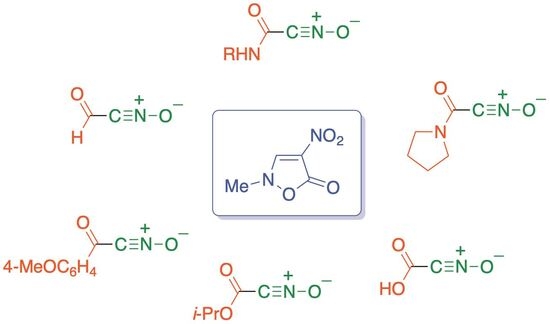
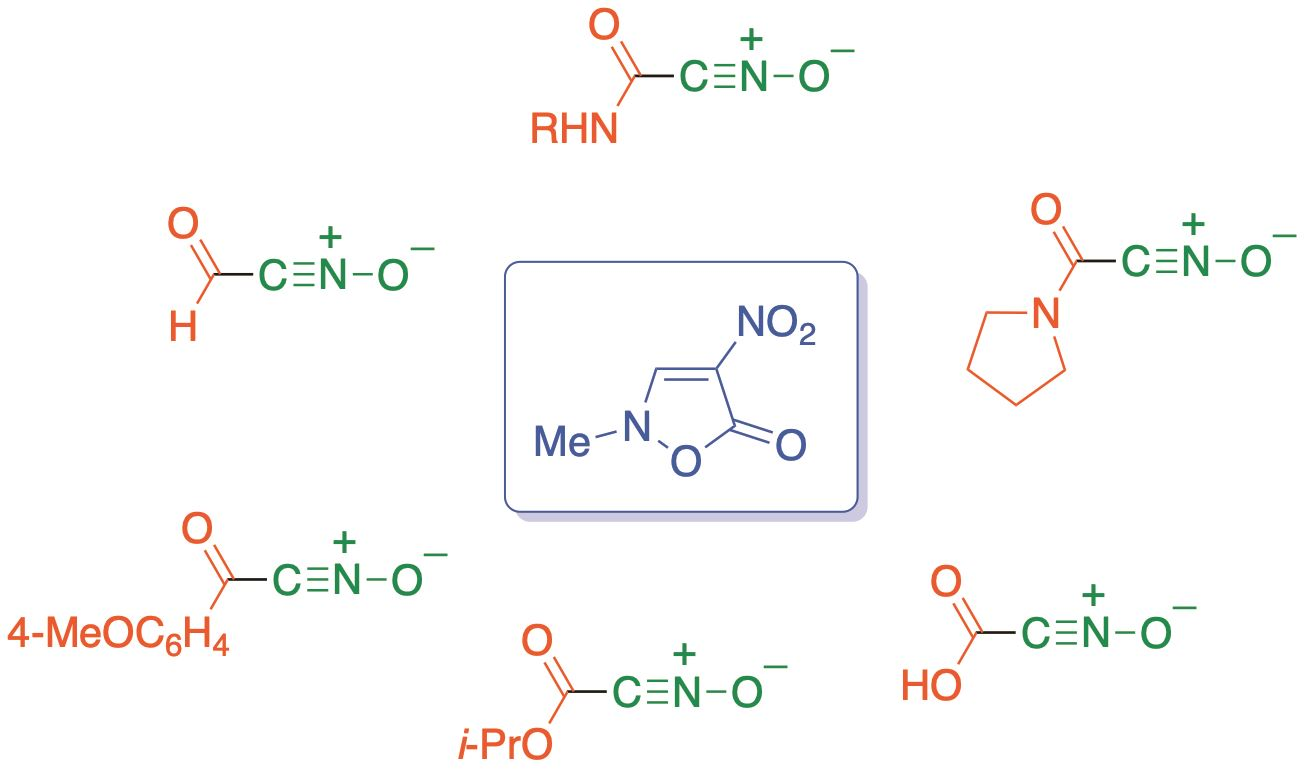
Functionalized nitrile oxides have attracted increasing attention because the incorporated functional groups not only influence cycloaddition reactivity but also provide valuable handles for subsequent molecular diversification. Despite their considerable synthetic potential, however, the development of practical methods for generating functionalized nitrile oxides has remained challenging because suitable precursors are often difficult to access and many functional groups are incompatible with conventional generation conditions. Consequently, only a limited number of reliable precursor systems have been established. This review summarizes recent advances in the generation of nitrile oxides bearing synthetically valuable acyl, ester, amide, and cyano functionalities, together with the development of synthetic equivalents that circumvent the intrinsic instability of these reactive intermediates. Particular emphasis is placed on 2-methyl-4-nitroisoxazoline-5(2H)-one (MeIOx), which serves as a practical precursor to (N-methylcarbamoyl)nitrile oxide. Remarkably, this nitrile oxide is generated simply by treatment with water under neutral conditions and undergoes efficient 1,3-dipolar cycloaddition with alkenes, alkynes, nitriles, and 1,3-dicarbonyl compounds to afford structurally diverse isoxazol(in)e and 1,2,4-oxadiazole derivatives. Furthermore, post-cycloaddition transformation of the N-methylcarbamoyl group into carboxyl, ester, amide, acyl, and formyl functionalities enables MeIOx to function as a practical synthetic equivalent of a broad range of functionalized nitrile oxides. The review also highlights the unique chemistry of the pyridinium salt PyIOx, whose ring-opening reaction provides cyano-aci-nitroacetate as a synthetic equivalent of the highly unstable (cyano)nitrile oxide. These complementary strategies significantly expand the scope of nitrile oxide chemistry and establish practical platforms for the synthesis of highly functionalized heterocycles.

Graphical Abstract

1. Introduction

The 1,3-dipolar cycloaddition reaction is one of the most powerful and versatile strategies for constructing five-membered heterocyclic frameworks through the simultaneous formation of two covalent bonds in a single synthetic operation. Since the pioneering work of Huisgen [1], this class of reactions has become a cornerstone of modern synthetic organic chemistry because of its excellent atom economy, high regioselectivity, and broad substrate compatibility.
Among the various 1,3-dipoles, nitrile oxides have attracted particular attention owing to their exceptionally high reactivity toward a wide range of dipolarophiles. They readily undergo cycloaddition reactions with alkynes, alkenes, nitriles, and imines to afford isoxazol(in)e and oxadiazol(in)e derivatives, structural motifs that are frequently encountered in pharmaceuticals, agrochemicals, natural products, and functional materials [2,3,4,5,6,7,8,9,10,11,12,13,14,15]. Owing to the synthetic utility of these heterocyclic frameworks, nitrile oxide cycloaddition has become an indispensable transformation in heterocyclic and medicinal chemistry.
A characteristic feature of nitrile oxides is their intrinsic instability. Because they readily undergo spontaneous dimerization to form furoxans or rearrangement forming isocyanate [16], they are generally generated in situ from suitable precursors immediately before, or in the presence of, the desired dipolarophile. Although stable nitrile oxide was developed, it has not been widely used [17]. In addition, limited availability of the precursors and severe reaction conditions prevented the use of nitrile oxide in organic synthesis. Consequently, considerable effort has been devoted to the development of reliable and efficient methods for their generation, greatly expanding the scope of nitrile oxide chemistry.
Among the available approaches, the most widely employed method involves the base-promoted dehydrochlorination of chloroaldoximes, which are readily prepared by chlorination of aldoximes using reagents such as N-chlorosuccinimide (NCS), Cl2, SOCl2, or PCl5 (Scheme 1, route a). Alternatively, nitrile oxides can be generated by the direct oxidation of aldoximes using oxidants including NaOCl, tert-BuOCl, NCS, MnO2, Pb(OAc)4, and hypervalent iodine reagents (Scheme 1, route b). Nitroalkanes also serve as useful precursors and can be converted into nitrile oxides through dehydration with reagents such as Ph-N=C=O, (Ac2O), (CF3CO)2O, and POCl3 (Scheme 1, route c).
In addition, transition-metal-mediated methods have further expanded the repertoire of nitrile oxide generation strategies, including those employing Cu(NO3)2 [18], copper carbenes in combination with tert-BuONO [19], and manganese nanoparticles [20]. Transition metals have also been widely utilized to promote nitrile oxide cycloaddition reactions [21,22]. Beyond these approaches, electrochemical oxidation of aldoximes has emerged as an efficient method for nitrile oxide generation [23,24,25], while photocatalytic oxidation has likewise proven to be effective [26]. Furthermore, visible-light-mediated generation of nitrile oxides from hydroxy(imino) acids has recently been reported as a mild and sustainable alternative [27].
The availability of these complementary methodologies has greatly stimulated research on nitrile oxide chemistry, leading to numerous studies on cycloaddition reactions and subsequent transformations of the resulting heterocyclic products [2,3,4,5,6,7,8,9,10,11,12,13,14,15]. Despite these significant advances, however, the overwhelming of majority of reported nitrile oxides bear only simple aryl or alkyl substituents, whereas examples incorporating synthetically versatile functional groups remain relatively scarce.
Although a wide variety of methods for generating nitrile oxides have been developed, examples of nitrile oxides bearing synthetically valuable functional groups remain surprisingly limited. In many cases, the corresponding precursors are not readily accessible, and the desired functional groups are often incompatible with the reaction conditions required for nitrile oxide generation. Consequently, the development of practical, versatile precursors capable of producing functionalized nitrile oxides under mild and operationally simple conditions remains an important challenge in synthetic organic chemistry.
Recent advances have demonstrated that appropriately designed nitrile oxide precursors can not only facilitate the efficient generation of functionalized nitrile oxides but also significantly broaden the synthetic utility of the resulting cycloadducts. In particular, precursors that allow subsequent transformation of the incorporated functional group provide a practical strategy for accessing a diverse range of highly functionalized heterocyclic compounds from a common intermediate.
This review provides an overview of the methodologies developed for the generation of functionalized nitrile oxides, with particular emphasis on their synthetic applications and the limitations associated with existing approaches. Special attention is devoted to 2-methyl-4-nitroisoxazoline-5(2H)-one (MeIOx), which has recently emerged as a versatile and practical precursor to (N-methylcarbamoyl)nitrile oxide. In addition, the unique reactivity of its pyridinium salt precursor, PyIOx, is discussed as a basis for the development of synthetic equivalents of (cyano)nitrile oxide. Together, these complementary strategies provide efficient access to a broad range of functionalized nitrile oxides and significantly expand the scope of nitrile oxide chemistry in heterocyclic synthesis.

2. Functionalized Nitrile Oxides

Functionalized nitrile oxides provide efficient access to highly substituted heterocyclic compounds, whose synthetic utility can be further expanded through subsequent transformation of the incorporated functional groups. Although nitrile oxides have been extensively investigated, relatively few examples of nitrile oxides bearing synthetically useful functional groups have been reported. This limited availability is largely attributed to the difficulty in preparing the corresponding precursors and to poor compatibility of many functional groups with the reaction conditions commonly employed for nitrile oxide generation. This section summarizes the reported methods for generating nitrile oxides bearing synthetically valuable functionalities, including acyl, formyl, carboxy, ester, amide and cyano groups.

2.1. Acyl-Substituted Nitrile Oxides

Among functionalized nitrile oxides, (aroyl)nitrile oxides are the most extensively investigated because the aromatic ring effectively stabilizes the nitrile oxide moiety. Consequently, a variety of methods for their generation have been reported. The most common approach is the base-promoted dehydrochlorination of the corresponding chloroaldoxime [28,29,30,31].
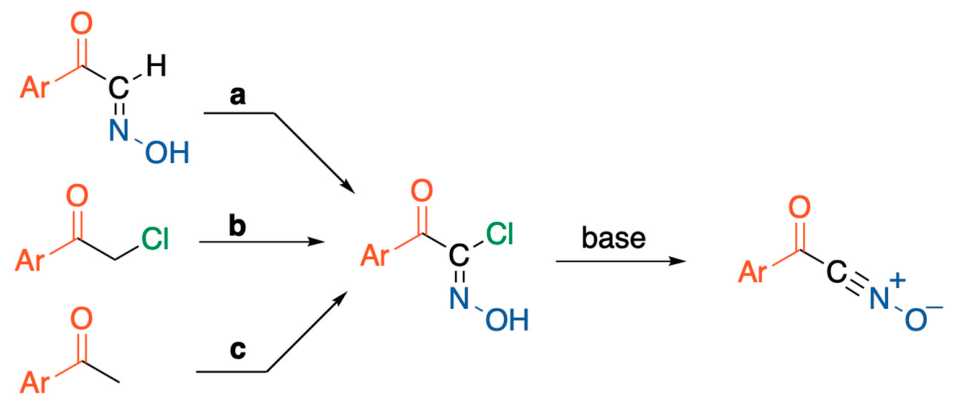
Several synthetic routes to aroyl-substituted chloroaldoximes have been developed. These include: (a) chlrorination of the corresponding aldoxime using NCS [32] or HCl/potassium peroxymonosulfate (Oxone) system [33] (Scheme 2, route a); (b) conversion of α-chloroacetophenones into the corresponding chloroaldoximes using HCl and BuONO [34] (Scheme 2, route b); and (c) direct transformation of acetophenone derivatives into chloroaldoximes using NOCl [35], the HCl/HNO3/NaNO2 system [36], or HCl–i-PrONO [37] (Scheme 2, route c). Although these methods provide convenient access to (aroyl)nitrile oxides, their applicability is often limited by the availability of appropriately substituted precursor molecules, particularly when structurally complex or highly functionalized aroyl groups are required.
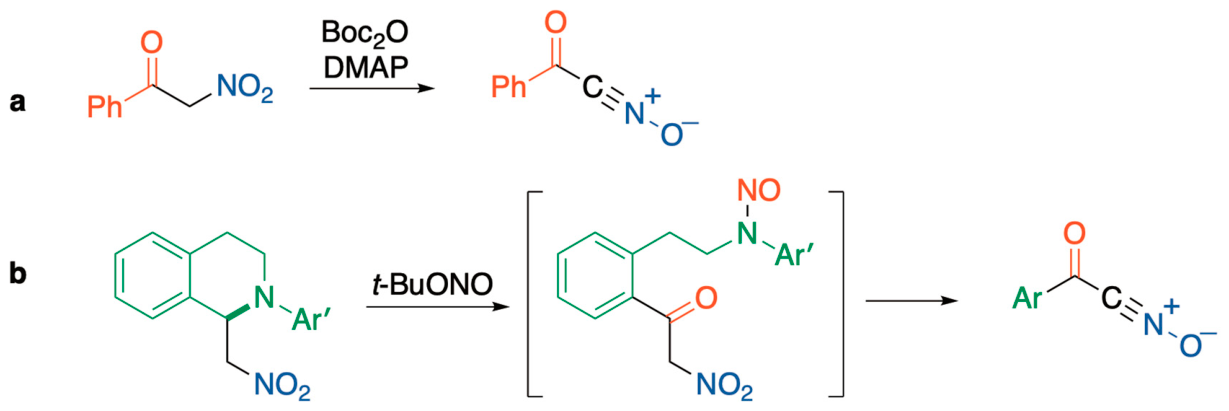
Alternative strategies that avoid the use of chloroaldoximes have also been developed. Tam et al. reported that (benzoyl)nitrile oxide can be generated from benzoyl(nitro)methane by treatment with di-tert-butyl dicarbonate (Boc2O) in the presence of 4-(dimethylamino)pyridine (DMAP) (Scheme 3a) [38]. Subsequently, Jia et al. expanded this methodology by generating aroyl-substituted nitrile oxides through tert-BuONO-induced C–N bond cleavage of 1-nitromethyl-N-aryltetrahydroisoquinolines. In this transformation, aroyl(nitro)methanes are formed in situ as key intermediates before conversion into the corresponding nitrile oxides (Scheme 3b) [39,40].
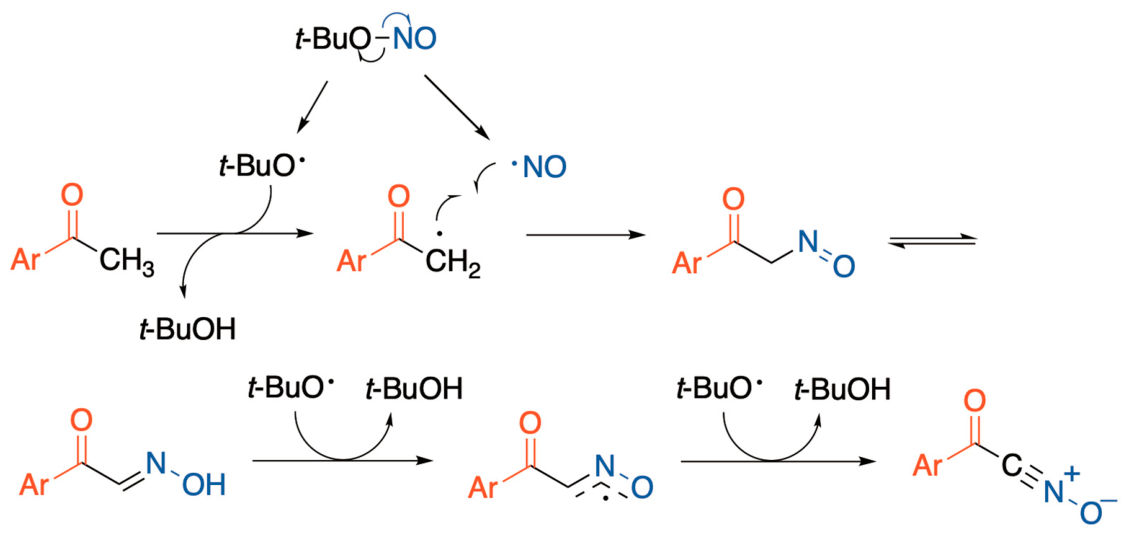
Recently, Zhang et al. and Sun et al. reported a direct approach starting from acetophenone derivatives [41,42]. In this method, treatment with tert-BuONO promotes α-nitrosation followed by oxidative conversion to the corresponding (benzoyl)nitrile oxides (Scheme 4). This strategy eliminates the need for preformed chloroaldoximes and represents a concise alternative for the preparation of and aroyl-substituted nitrile oxides.
In contrast to aroyl-substituted nitrile oxides, considerably fewer examples of (alkanoyl)nitrile oxides have been reported. This limited availability is generally attributed to their own stability and susceptibility of alkanoyl-substituted precursors to the reaction conditions required for nitrile oxide generation.
Among the known examples, (acetyl)nitrile oxide can be generated from the corresponding chloroaldoxime by conventional base-promoted dehydrochlorination [43,44,45]. However, when oxidation of the corresponding oxime with Pb(OAc)4 is employed, the acetyl group must first be protected as a thioacetal to prevent undesired side reactions (Scheme 5) [46]. This additional sequence inevitably reduces the overall synthetic efficiency.
An alternative strategy was reported by Roy et al., who achieved the direct generation of (acetyl)nitrile oxide from acetone using ceric ammonium nitrate (CAN) as the oxidant [47]. Although this method eliminates the need for preformed chloroaldoxime intermediates, its substrate scope has thus far remained limited.
On the other hand, a method reported by Zhang et al. for the generation of nitrile oxides from methyl ketones enables the introduction of alkanoyl groups, rather than being limited to an acetyl group, into the isoxazole ring [42]. More recently, Giri et al. reported an I2-catalyzed photoredox strategy for generating aroyl- and alkanoyl-substituted nitrile oxides from α-nitro carbonyl compounds. One of the proposed reaction mechanisms is shown in Scheme 6 [48].
To date, the generation of nitrile oxides bearing the even more reactive formyl group has not been experimentally realized. Such species have been investigated only in computational studies [49,50], reflecting the substantial challenge associated with generating and handling highly unstable formyl-substituted nitrile oxides under practical reaction conditions.
Overall, although several reliable methods are available for the preparation of aroyl-substituted nitrile oxides, corresponding methodologies for alkanoyl derivatives remain far less developed. Most reported approaches rely on prefunctionalized substrates and often require multistep precursor synthesis or additional protection. Furthermore, their applicability to structurally diverse and highly functionalized substrates remains limited. The development of practical, broadly applicable methods for generating acyl-functionalized nitrile oxides therefore continues to represent an important objective in this field.

2.2. Ester-Substituted Nitrile Oxides

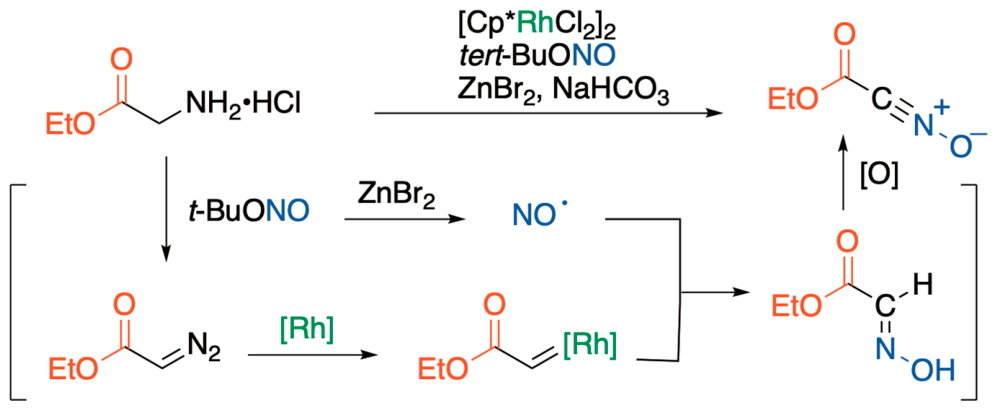
Whereas carboxy-substituted nitrile oxides have thus far been limited to theoretical investigations [51,52], ester-substituted nitrile oxides are among the most extensively studied functionalized nitrile oxides because of their synthetic utility and the ready availability of suitable precursors. As with most nitrile oxides, they are most commonly generated by the base-promoted dehydrochlorination of the corresponding chloroaldoximes [53,54,55,56,57]. This approach is particularly practical because the requisite chloroaldoximes can be readily prepared from commercially available glycine esters (Scheme 7) [58]. Recently, Hu et al. developed a rhodium-catalyzed oxidation of glycine esters with tert-BuONO, in which a rhodium carbene complex is generated in situ (Scheme 8) [59].
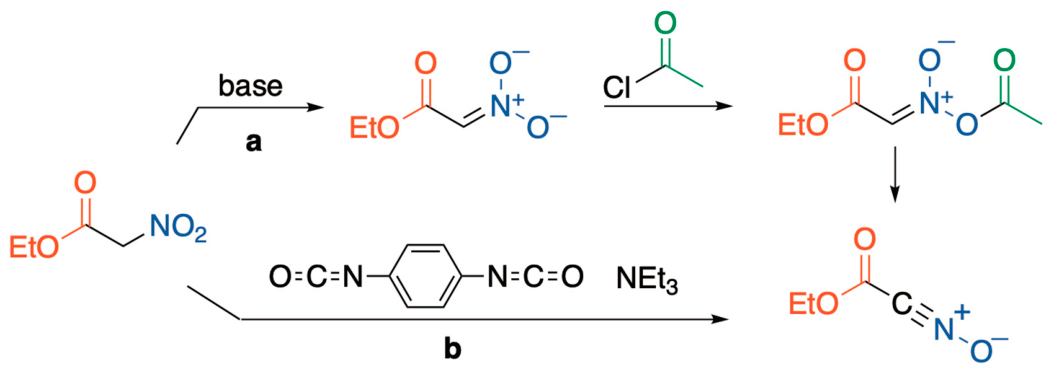
Nitro compounds also serve as versatile precursors for ester-substituted nitrile oxides. In particular, ethyl nitroacetate, a commercially available reagent, provides a convenient entry to these reactive intermediates. Zen et al. [60] and Shimizu et al. [61] independently reported that treatment of ethyl nitroacetate with an acyl chloride generates a mixed nitronic–carboxylic anhydride in situ, which subsequently undergoes dehydration to furnish the corresponding nitrile oxide (Scheme 9, route a). An alternative and widely employed approach is the Mukaiyama method, in which ethyl nitroacetate reacts with an isocyanate to generate the nitrile oxide under mild conditions (Scheme 9, route b) [62]. Owing to the commercial availability of ethyl nitroacetate and the operational simplicity of these procedures, these methods have become standard routes to ester-functionalized nitrile oxides.
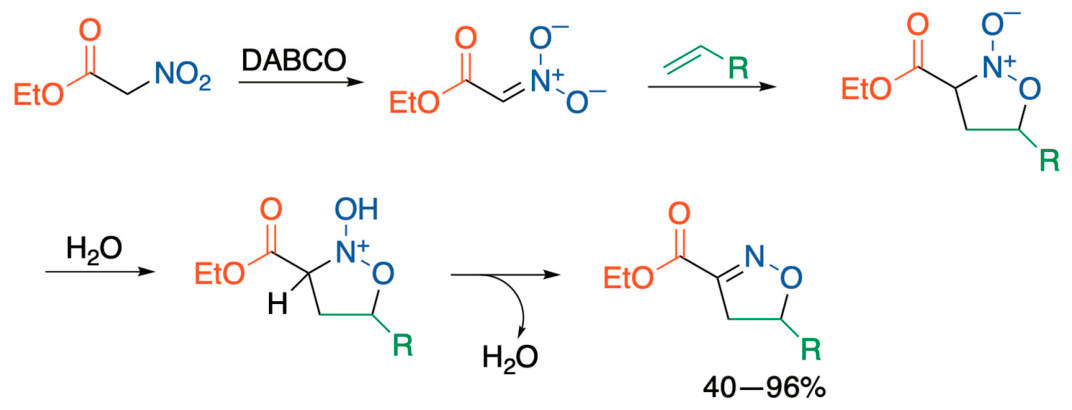
In contrast to the generation methods described above, Machetti et al. demonstrated that ethyl nitroacetate itself can function as a synthetic equivalent of an ethoxycarbonyl-substituted nitrile oxide [63,64]. When reactions with suitable dipolarophiles are carried out in the presence of catalytic amounts of 1,4-diazabicyclo [2.2.2]octane (DABCO), cycloadducts are obtained without the intermediacy of a free nitrile oxide. Instead, the nitronate anion directly participates as the 1,3-dipole, providing an efficient alternative strategy for accessing ester-substituted isoxazoline and isoxazole derivatives (Scheme 10).
Nitrated 1,3-dicarbonyl compounds also serve as useful precursors to ester-functionalized nitrile oxides. Representative examples include derivatives of ethyl acetoacetate (Scheme 11, route a) [65] and diethyl malonate (Scheme 11, route b) [66]. Their high reactivity is generally attributed to the enhanced acidity of the α-proton, which facilitates carbonyl-group elimination through a pseudo-intramolecular process [67].
Overall, ester-substituted nitrile oxides are among the most accessible functionalized nitrile oxides, largely because their key precursor, ethyl nitroacetate, is commercially available and can be converted into nitrile oxides by several reliable methods. Nevertheless, the structural diversity of readily available precursors remains limited, making the direct preparation of nitrile oxides bearing modified ester substituents challenging. Consequently, structural diversification is often achieved through post-cycloaddition functional-group transformations rather than by precursor modification. The development of broadly applicable synthetic methods capable of directly introducing structurally diverse ester functionalities therefore remains an important objective in this area.

2.3. Amide-Substituted Nitrile Oxides

Compared with ester-substituted nitrile oxides, amide-substituted nitrile oxides are expected to possess greater synthetic versatility because the nitrogen atom of the amide functionality provides an additional site for structural modification. Nevertheless, only a limited number of examples have been reported to date. This scarcity is primarily attributable to the limited availability of suitable precursors and the difficulty associated with their preparation.
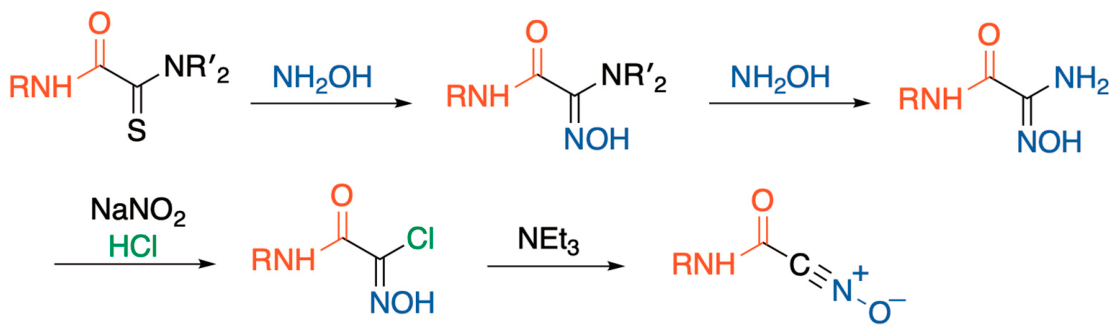
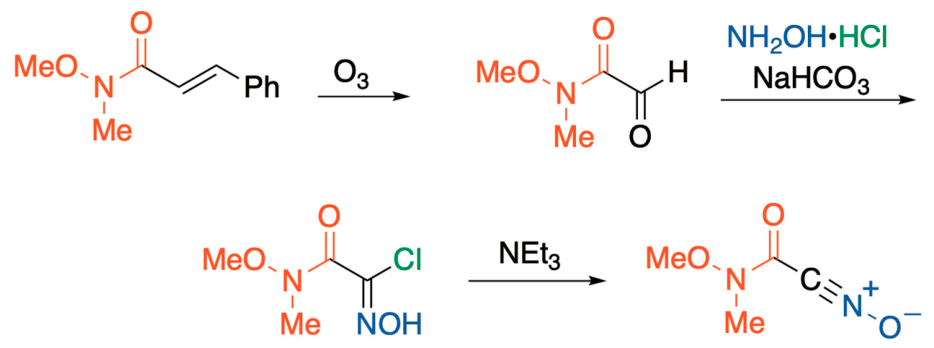
The earliest examples of (carbamoyl)nitrile oxides were generated from the corresponding chloroaldoximes. Yarovenko et al. prepared (carbamoyl)chloroaldoximes by treating monothiooxamides with hydroxylamine, followed by chlorination, and subsequently generated the corresponding nitrile oxides by base-promoted dehydrochlorination (Scheme 12) [68,69]. Franck et al. later reported the preparation of a Weinreb amide-substituted nitrile oxide, starting from cinnamamide via ozonolysis, conversion to the corresponding chloroaldoxime, and subsequent dehydrochlorination (Scheme 13) [70]. In addition, direct oxidation of the corresponding glyoxamide oxime with MnO2 enabled the generation of optically active carbamoyl-substituted nitrile oxides, demonstrating that chiral information can be incorporated into the amide substituent [71].
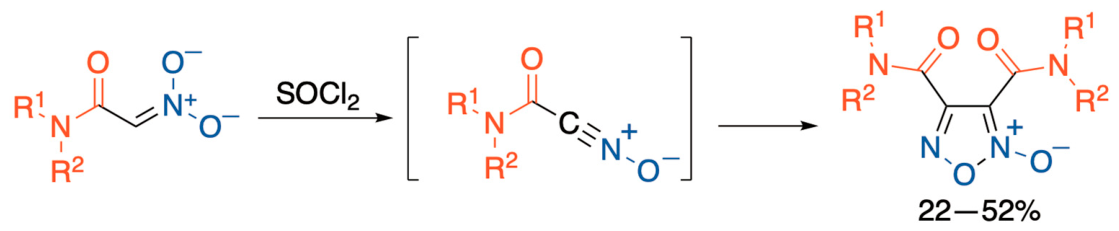
Alternative methods based on nitroamide precursors have also been developed. Paul et al. first isolated a cycloadduct derived from (N-phenylcarbamoyl)nitrile oxide as a minor by-product in the reaction of nitromethane with Ph-N=C=O [72]. Subsequently, Huisgen et al. demonstrated that N-phenyl(nitro)acetamide, formed in situ, serves as the actual precursor of the corresponding nitrile oxide [73]. Building on these findings, Joule et al. developed a more practical approach in which nitroacetamides are converted into carbamoyl-substituted nitrile oxides by treatment with SOCl2 (Scheme 14) [74]. Blackmond et al. showed Machetti–De Sarlo cycloaddition can be applied to this conversion [75].
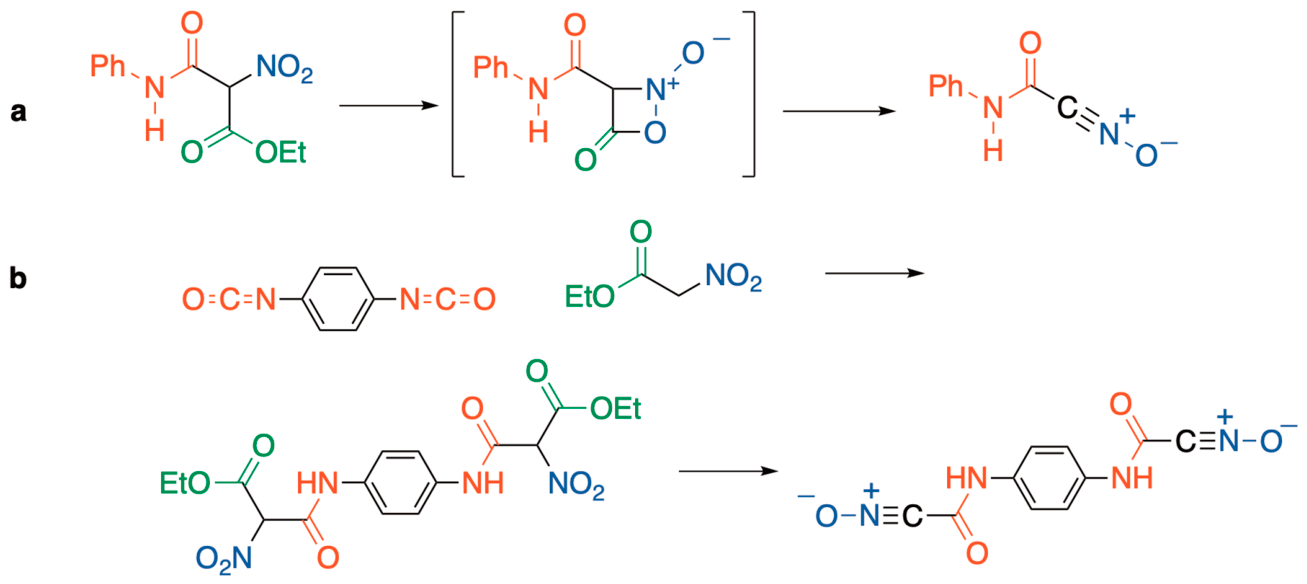
As discussed in Section 2.2, nitrated 1,3-dicarbonyl compounds also provide useful precursors to functionalized nitrile oxides. Shimizu et al. demonstrated that heating a malonic acid amide ester in refluxing mesitylene (165 °C) generates a carbamoyl-substituted nitrile oxide via a transient oxazetidine intermediate (Scheme 15, route a) [61]. Furthermore, when bis(malonic acid derivatives) are employed, the corresponding bis(nitrile oxides) are generated in situ and have been successfully utilized as cross-linking agents for polymer synthesis (Scheme 15, route b) [76,77].
Overall, the chemistry of carbamoyl-substituted nitrile oxides remains considerably less developed than that of their acyl- and ester-substituted counterparts. The principal limitation is the lack of readily accessible and versatile precursor molecules. Because the amide nitrogen can accommodate a wide variety of substituents, carbamoyl-substituted nitrile oxides offer exceptional opportunities for structural diversification and downstream functionalization. The development of practical and broadly applicable precursor systems capable of generating structurally diverse carbamoyl-substituted nitrile oxides therefore represents an important challenge and a promising direction for future research.

2.4. Cyano-Substituted Nitrile Oxides

Among functionalized nitrile oxides, (cyano)nitrile oxide (cyanogen N-oxide) is one of the most challenging species to generate and utilize because of its extreme instability. To date, only a limited number of preparation methods have been reported. Conventional approaches include the base-promoted dehydrochlorination of chloro(cyano)aldoxime (Scheme 16, route a) [78,79] and flash vacuum pyrolysis of furazan derivatives (Scheme 16, route b) [80].
Despite the successful generation of (cyano)nitrile oxide by these methods, its practical application in synthetic organic chemistry remains extremely limited. The nitrile oxide undergoes rapid decomposition under the reaction conditions, and suitable precursor molecules are not readily accessible. Consequently, although (cyano)nitrile oxide has occasionally been employed as a model substrate in theoretical studies [49], its use as a general synthetic reagent has not been realized.
These limitations have prompted the search for alternative strategies that circumvent the direct generation of this highly unstable nitrile oxide. In particular, the development of synthetic equivalents of (cyano)nitrile oxide, capable of reproducing its characteristic cycloaddition reactivity under mild and practical conditions, has emerged as an important objective. Such approaches are expected to substantially broaden the synthetic utility of cyano-substituted heterocyclic compounds.

3. Nitroisoxazolones

3.1. Synthesis of Nitroisoxazolones

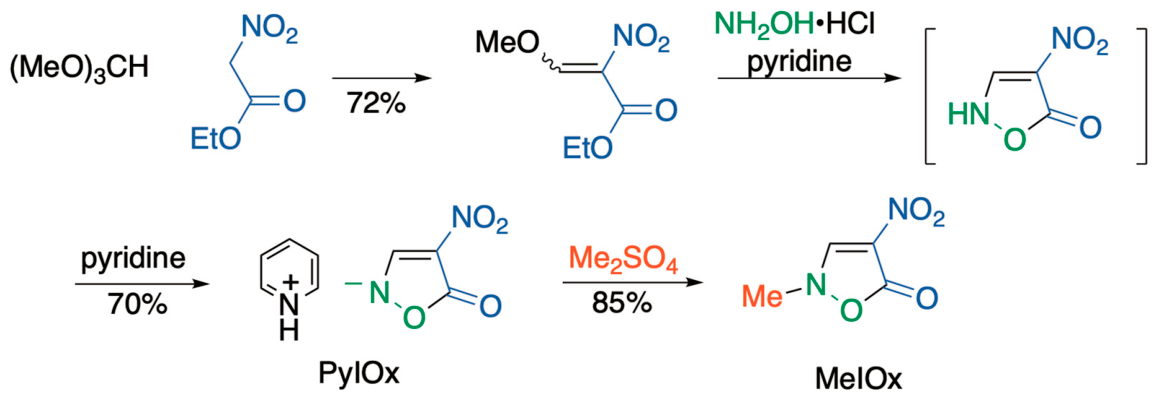
2-Methyl-4-nitroisoxazoline-5(2H)-one (MeIOx) is readily prepared in three steps from commercially available ethyl nitroacetate (Scheme 17) [81]. Condensation of ethyl nitroacetate and trimethyl orthoformate affords α-nitro-β-(methoxy)acrylate, which undergoes cyclization upon treatment with hydroxylamine hydrochloride to furnish the nitroisoxazolone framework. Because the initially formed nitroisoxazolone possesses a highly acidic N–H proton, it is readily isolated as the corresponding pyridinium salt (PyIOx), which precipitates directly from the reaction mixture as pale-yellow needles. Subsequent methylation of PyIOx with dimethyl sulfate provides MeIOx in good yield. Although this synthetic sequence efficiently affords the methyl derivative, attempts to introduce alkyl substituents other than methyl have thus far been unsuccessful.
Both PyIOx and MeIOx possess several synthetically valuable structural features, including a nitroenamine moiety, an α,β-unsaturated lactone, and an N–O bond, each of which can participate in characteristic transformations. Owing to this unique combination of reactive functionalities, nitroisoxazolones exhibit remarkably versatile reactivity and serve as valuable building blocks for the synthesis of a broad range of highly functionalized organic molecules. As described in the following sections, these compounds also function as practical precursors to functionalized nitrile oxides and their synthetic equivalents, thereby providing access to transformations that are difficult to achieve using conventional nitrile oxide chemistry.

3.2. Generation of Carbamoylnitrile Oxide

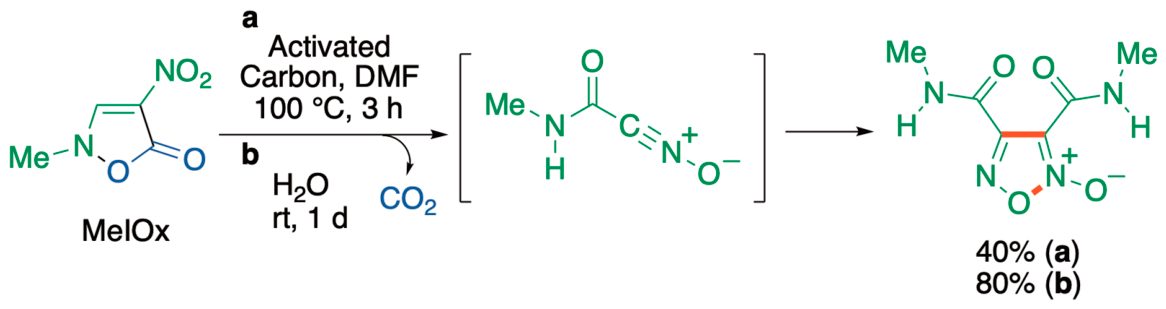
The first indication that MeIOx could serve as a precursor to (carbamoyl)nitrile oxide was reported by Ariga et al. [82]. They found that the addition of activated carbon to a hot N,N-dimethylformamide (DMF) solution of MeIOx induced vigorous gas evolution, which was attributed to decarboxylation. Under these conditions, the corresponding furoxan was isolated in 40% yield (Scheme 18, route a), providing clear evidence that (carbamoyl)nitrile oxide had been generated in situ and subsequently underwent dimerization.
Subsequently, Nishiwaki et al. demonstrated that water plays a crucial role in the generation of (carbamoyl)nitrile oxide [83]. Remarkably, simply stirring MeIOx in water at room temperature for 24 h afforded the corresponding furoxan in 80% yield (Scheme 18, route b), indicating that the nitrile oxide can be generated efficiently under exceptionally mild and operationally simple conditions without the need for catalysts, bases, or other activating reagents. This finding represents a significant advantage over conventional methods for nitrile oxide generation, which generally require specially designed precursors and relatively harsh reaction conditions.
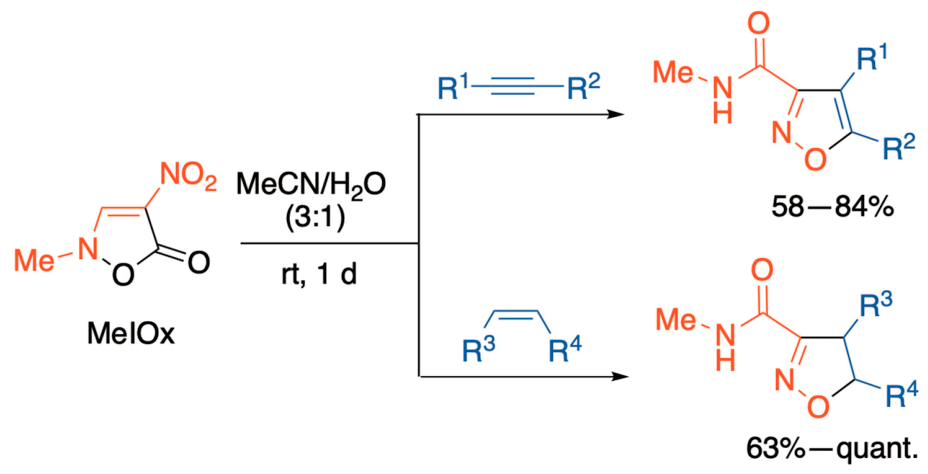
When the nitrile oxide is generated in the presence of suitable dipolarophiles, it is efficiently trapped by 1,3-dipolar cycloaddition to afford the corresponding heterocyclic products (Scheme 19) [83]. Alkynes furnish isoxazoles, whereas alkenes afford the corresponding isoxazolines. A mixed solvent system of MeCN/H2O (3:1, v/v) was found to provide optimal results because it effectively dissolves both MeIOx and a wide range of dipolarophiles, while no additional catalyst or additive is required.
For terminal alkynes, cycloaddition proceeds with excellent regioselectivity to afford 5-substituted isoxazoles (R1 = H; R2 = Ph, CH2OH, or CH2Br). Electron-deficient alkynes, such as diethyl acetylenedicarboxylate (R1 = R2 = COOEt), also participate smoothly in the reaction to give highly functionalized tricarbonyl-substituted isoxazoles. Likewise, cycloaddition with alkenes exhibits broad substrate compatibility. Both electron-rich alkenes (R3 = H; R4 = Ph, n-Pr, CH2OH, CH2OEt, or OEt) and electron-poor alkenes (R3 = H; R4 = COOEt or COMe) undergo regioselective cycloaddition to furnish the corresponding isoxazolines in good yields.
These results clearly demonstrate that MeIOx functions as a practical and versatile precursor to (carbamoyl)nitrile oxide. Unlike conventional precursor systems, which often require multistep synthesis and harsh activation conditions, MeIOx generates the nitrile oxide under remarkably mild aqueous conditions while exhibiting broad compatibility with a variety of dipolarophiles. This unique reactivity forms the basis for the synthetic applications described in the following sections.

3.3. Mechanism of (Carbamoyl)nitrile Oxide Formation

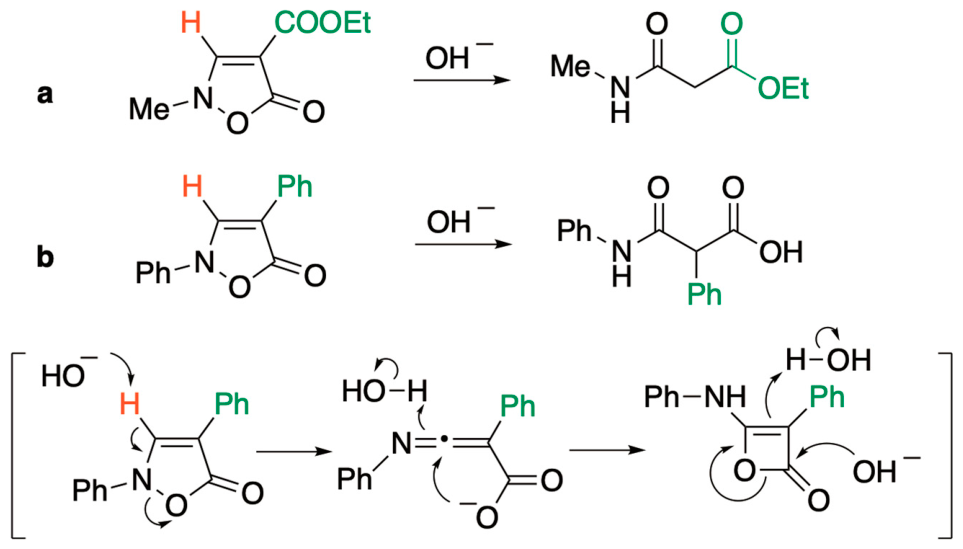
The generation of (carbamoyl)nitrile oxide from MeIOx is considered to be initiated by ring opening of the isoxazolone framework. Insight into this process can be obtained from earlier studies on structurally related isoxazolones. Ulrich et al. reported that a 4-ester-substituted isoxazolone undergoes base-promoted ring opening to afford a malonic acid amide ester (Scheme 20, route a) [84]. Subsequently, Woodman et al. demonstrated that analogous ring opening also occurs for 4-phenylisoxazolones (Scheme 20, route b) and proposed a mechanism involving a transient oxetane intermediate [85,86].
These observations suggest that MeIOx should undergo ring opening even more readily, because the strongly electron-withdrawing nitro group stabilizes the developing negative charge more effectively than an ester substituent. Furthermore, the combined resonance-withdrawing effects of the nitro and carbonyl groups, together with the inductive effects of the nitrogen and oxygen atoms within the isoxazolone, substantially enhance the acidity of the proton at the C3 position, facilitating deprotonation under remarkably mild conditions.
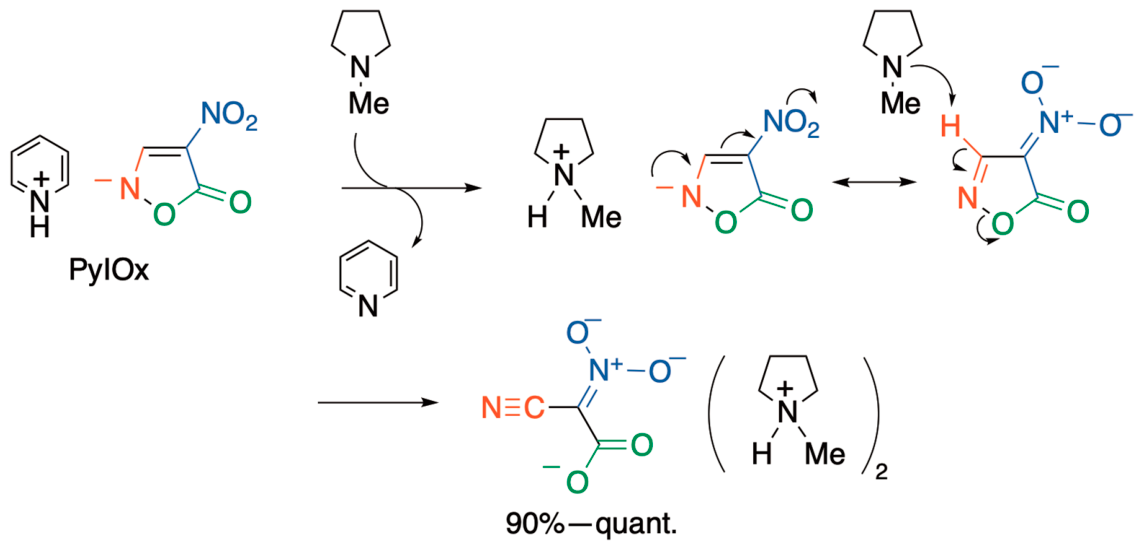
Experimental evidence supporting this proposal was obtained from studies on PyIOx. Despite its anionic nature, PyIOx readily undergoes ring opening upon treatment with bases such as hydroxide, carbonate, or N-methylpyrrolidine [87]. The reaction requires two equivalents of base. Following cation exchange with the first equivalent, deprotonation at the C3 position by the second base triggers cleavage of the N–O bond, affording dianionic cyano-aci-nitroacetate (Scheme 21). This highly reactive intermediate subsequently serves as a versatile synthon for the construction of a variety of polyfunctionalized molecular architectures [88].
Considering the pronounced susceptibility of anionic PyIOx toward ring opening, the electronically neutral MeIOx is expected to undergo the same transformation in the presence of even weaker bases. Consistent with this expectation, stirring MeIOx in methanol at room temperature affords nitroenamine together with (nitro)malonic acid amide ester (Scheme 22) [85]. The formation of these products closely parallels the reactivity observed for the phenylisoxazolone shown in Scheme 20, route b and strongly suggests that methanol itself acts as a Brønsted base, abstracting the proton at the C3 position. By analogy, water is considered to play the same role during the generation of (carbamoyl)nitrile oxide under aqueous conditions.
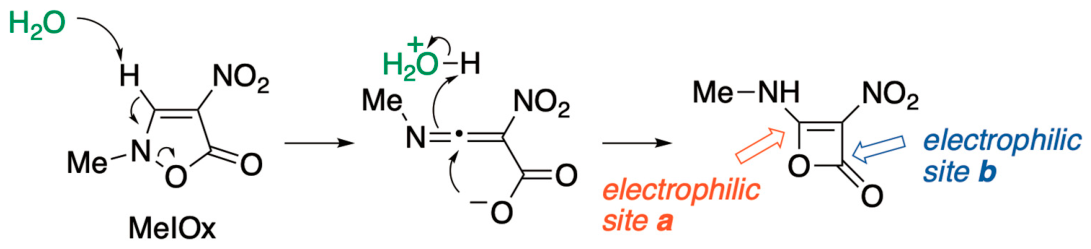
A plausible mechanism for the generation of (carbamoyl)nitrile oxide from MeIOx is proposed in Scheme 23, Scheme 24 and Scheme 25 [83]. The reaction is initiated by deprotonation at the C3 position by water, which acts as a Brønsted base. Subsequent cleavage of the N–O bond affords [(nitroketene)imine]carboxylate, a highly reactive intermediate. In accordance with the mechanism proposed by Woodman et al. [86], the nucleophilic carboxylate then intramolecularly attacks the electrophilic central carbon atom of the cumulene moiety, leading to the formation of a strained oxetane intermediate (Scheme 23).
The resulting oxetane possesses two electrophilic carbon atoms that are susceptible to nucleophilic attack. Insight into their relative reactivity can be obtained from the methanolysis experiment shown in Scheme 22. Methanol attacks either site a or site b, affording nitroenamine and (nitro)malonic acid amide ester, respectively. Because nitroenamine is formed preferentially, site a is considered to be the more electrophilic center. A similar preference is expected for the corresponding reaction with water.
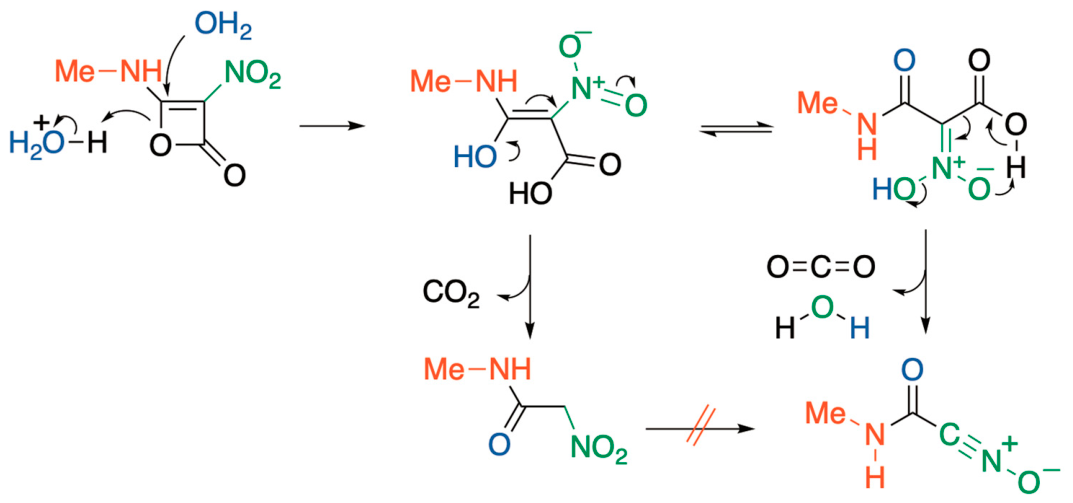
When water attacks site a, ring opening of the oxetane affords an enol intermediate, which undergoes tautomerization to produce a nitronic acid via the corresponding (nitro)malonic acid amide (Scheme 24). The nitronic acid is then converted into (carbamoyl)nitrile oxide through a concerted decarboxylation–dehydration process. An alternative stepwise pathway involving sequential decarboxylation followed by dehydration appears much less likely. As discussed in Section 2.2 (Scheme 7 and Scheme 8), dehydration of nitro compounds generally requires specific activating conditions for nitrile oxide formation. Consistent with this observation, N-methyl(nitro)acetamide is sufficiently stable to be isolated and does not spontaneously generate the corresponding nitrile oxide. In contrast, the nitronic acid intermediate proposed in Scheme 24 is expected to undergo rapid decarboxylation and dehydration, most likely facilitated by intramolecular hydrogen bonding, thereby enabling direct formation of (carbamoyl)nitrile oxide.
Attack of water at site b initially follows a different bond-cleavage pathway but ultimately converges on the same (nitro)malonic acid-derived intermediates. Consequently, both reaction pathways lead to the identical nitronic acid intermediate and ultimately furnish (carbamoyl)nitrile oxide (Scheme 25).
Overall, the proposed mechanism rationally explains the exceptionally mild generation of (carbamoyl)nitrile oxide from MeIOx under neutral aqueous conditions. The cooperative effects of facile ring opening, intramolecular cyclization through an oxetane intermediate, and concerted decarboxylation–dehydration distinguish this process from conventional nitrile oxide generation methods and account for the unique reactivity of MeIOx as a practical nitrile oxide precursor.

3.4. Cycloaddition with Nitriles

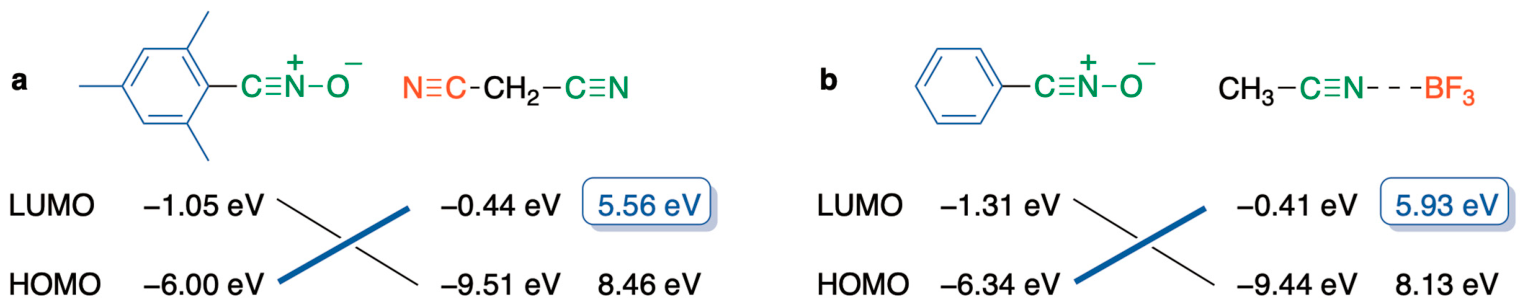
The 1,3-dipolar cycloaddition of nitrile oxides with nitriles provides one of the most straightforward approaches to the synthesis of 1,2,4-oxadiazoles, and numerous synthetic methods have been reported [2,89]. In most cases, however, the nitrile oxide component is limited to relatively stable benzonitrile oxides or their derivatives bearing electron-donating substituents, such as alkyl, alkoxy, and hydroxy groups. Consequently, the substituent at the 3-position of the oxadiazole is generally restricted to an aryl group [90,91]. Conversely, nitriles bearing electron-withdrawing substituents are frequently employed as dipolarophiles because of their enhanced electrophilicity [92,93]. Even when aliphatic nitriles are used, activation with a Lewis acid is generally required to reduce the electron density of the nitrile carbon and promote cycloaddition [94,95]. These substrate requirements are consistent with the conventional normal electron-demand pathway, in which the reaction proceeds through interaction between the HOMO of the nitrile oxide and the LUMO of the nitrile (Figure 1a,b) [96].
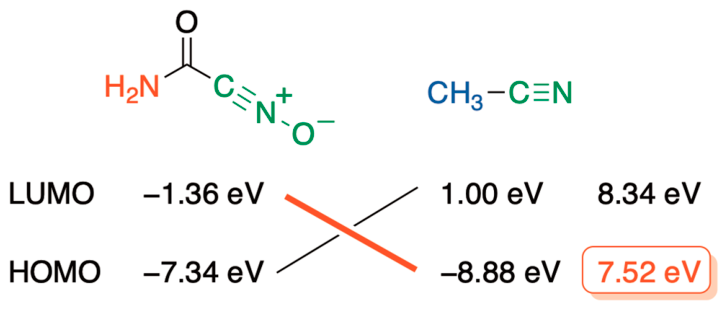
In contrast to these conventional systems, MeIOx exhibits a markedly different reactivity profile [97]. When MeIOx is allowed to react with nitriles in the presence of tetrahydrofuran (THF) as a base, the in situ-generated (carbamoyl)nitrile oxide undergoes smooth cycloaddition with both aromatic and aliphatic nitriles to afford the corresponding 1,2,4-oxadiazoles (Scheme 26). Notably, aliphatic nitriles participate efficiently without Lewis acid activation, representing a significant departure from previously reported methodologies. Computational analysis revealed that this unusual reactivity arises because the cycloaddition preferentially proceeds through an inverse electron-demand pathway involving interaction between the LUMO of the nitrile oxide and the HOMO of the nitrile (Figure 2), rather than the conventional orbital interaction observed for most nitrile oxide cycloadditions [96].
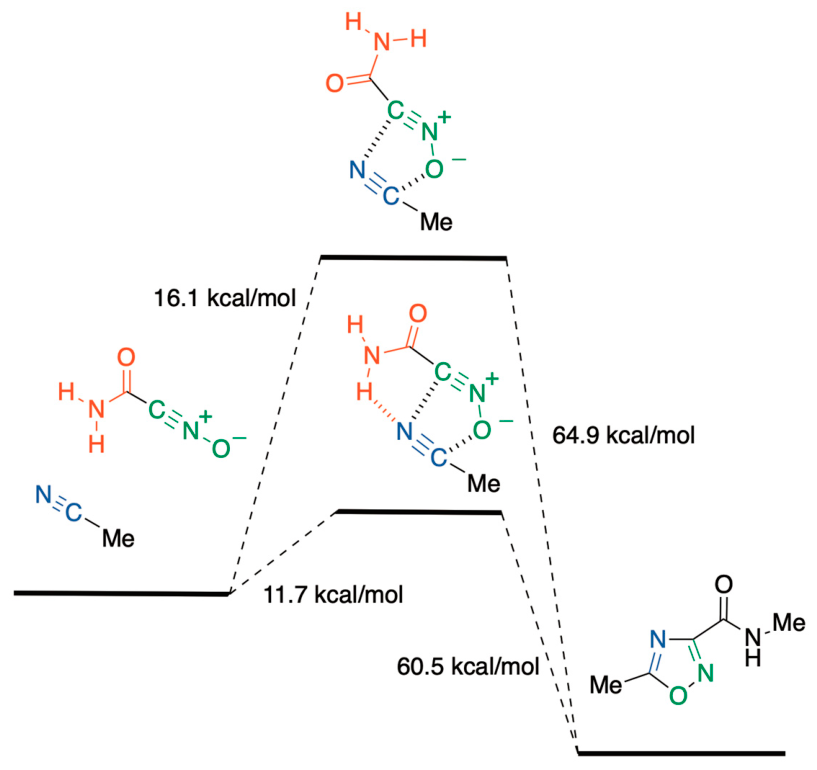
An additional factor contributing to this unique reactivity appears to be the carbamoyl functionality of the nitrile oxide. To the best of our knowledge, cycloaddition reactions of ester-substituted nitrile oxides with nitriles have not been reported. The principal structural difference between carbamoyl and ester substituents is the ability of the former to act as a hydrogen-bond donor. Corsaro et al. demonstrated that hydrogen-bonding interactions can effectively activate nitriles toward cycloaddition [97,98]. By analogy, the carbamoyl group of (carbamoyl)nitrile oxide is considered to activate the nitrile substrate through intermolecular hydrogen bonding. This proposal is supported by computational studies, which show that formation of the hydrogen-bonded complex lowers the activation barrier for cycloaddition (Figure 3). These findings indicate that the carbamoyl group not only serves as a synthetically versatile functional handle but also plays a direct mechanistic role in promoting cycloaddition reactivity.

3.5. Cycloaddition with 1,3-Dicarbonyl Compounds

Although 1,3-dicarbonyl compounds represent attractive dipolarophiles because of their versatile synthetic utility, relatively few examples of their cycloaddition with nitrile oxides have been reported. Umesha et al. described the synthesis of 4-acetyl-3-arylisoxazoles through the cycloaddition of isolable aromatic nitrile oxides with acetylacetone [99]. Suzuki et al. subsequently developed a cyclocondensation of sterically hindered aromatic nitrile oxides with cyclic β-diketones [100] and successfully applied this methodology to the synthesis of natural products and biologically active molecules [101]. Other approaches employ preformed sodium enolates of β-keto esters or β-keto amides as dipolarophiles, allowing efficient cycloaddition with nitrile oxides [102,103]. Machetti et al. also reported a base- and copper-catalyzed condensation of primary nitro compounds with various active methylene compounds, including acetylacetone, benzoylacetone, and ethyl acetoacetate [104]. As these reactions are conducted under basic conditions, the scope of substrates is limited. The formation of the corresponding furoxans confirmed the in situ generation of benzoyl- and ester-substituted nitrile oxides. Nevertheless, these reactions generally require strongly basic conditions to generate both the nitrile oxide and the enolate, thereby restricting the substrate scope and increasing the likelihood of competing side reactions.
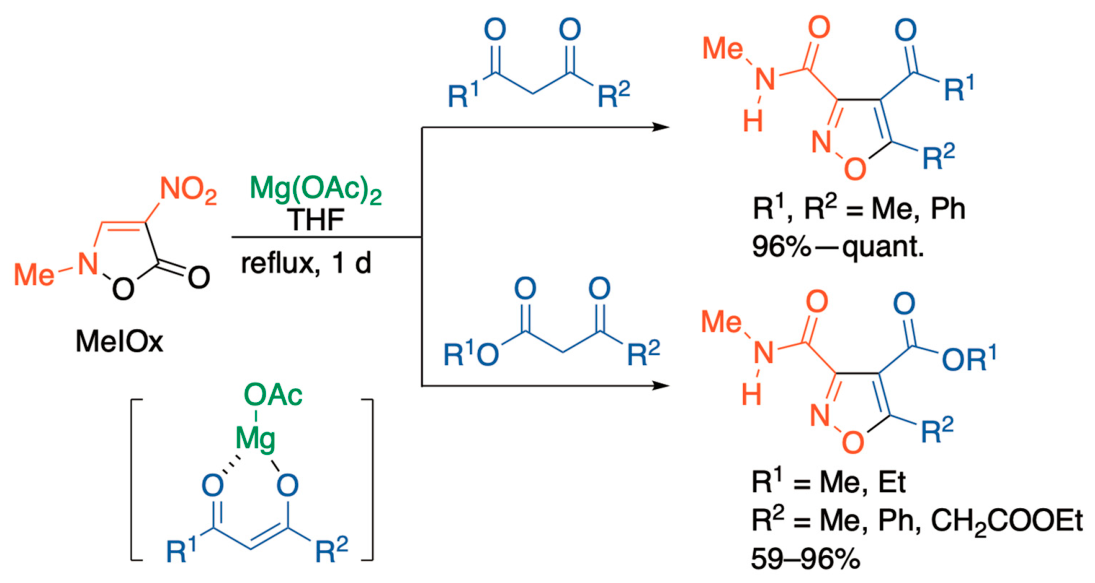
In contrast, MeIOx generates (carbamoyl)nitrile oxide under exceptionally mild conditions using only weak bases such as water or THF [105]. Consequently, the cycloaddition can be performed under nearly neutral conditions, minimizing undesired side reactions and, importantly, permitting the use of Lewis acids that would be incompatible with conventional nitrile oxide generation methods. Among the metal salts examined, Mg(OAc)2 proved to be the most effective, presumably because it activates the 1,3-dicarbonyl compound through bidentate chelation while simultaneously stabilizing its enol form. Under these conditions, a broad range of 1,3-dicarbonyl compounds undergoes smooth cycloaddition with the in situ-generated (carbamoyl)nitrile oxide to afford the corresponding heterocyclic products in good yields (Scheme 27) [105].
Electron-deficient substrates generally exhibit lower enol content and therefore reduced reactivity under the neutral conditions. For example, ethyl trifluoroacetoacetate did not readily undergo cycloaddition unless it was first converted into the corresponding sodium enolate, highlighting the importance of sufficient enolization for efficient cycloaddition.
These results demonstrate another distinctive advantage of MeIOx as a nitrile oxide precursor. Because the nitrile oxide can be generated under nearly neutral conditions, catalytic activation of the dipolarophile by Lewis acids becomes feasible, greatly expanding the range of compatible substrates. This strategy provides access to transformations that are difficult to achieve using conventional nitrile oxide generation methods and further illustrates the unique synthetic potential of carbamoyl-substituted nitrile oxides.

3.6. Conversion to Other Functional Groups

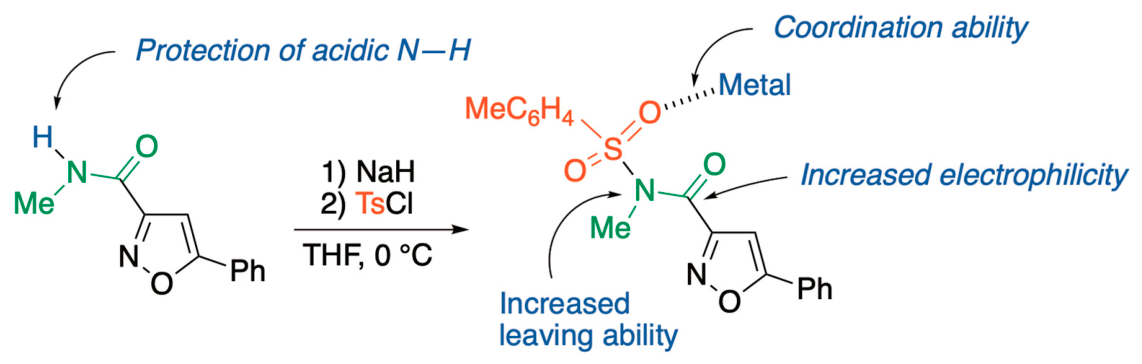
Although MeIOx serves as an efficient precursor to (N-methylcarbamoyl)nitrile oxide, its synthetic utility is inherently limited by the fixed N-methyl substituent on the carbamoyl group. This limitation can be effectively overcome by tosylation of the amide nitrogen, which transforms the carbamoyl group into a versatile platform for subsequent functional-group interconversion (Scheme 28) [106].
Introduction of the tosyl group provides several important advantages. First, it protects the acidic N–H proton of the carbamoyl functionality. Second, its strong electron-withdrawing character enhances the electrophilicity of the amide carbonyl carbon. Third, the resulting tosylamide functions as an excellent leaving group, facilitating nucleophilic substitution. Finally, the tosyl and carbonyl groups cooperate to form a bidentate coordination site for metal ions. Collectively, these features greatly expand the synthetic versatility of the original N-methylcarbamoyl functionality.
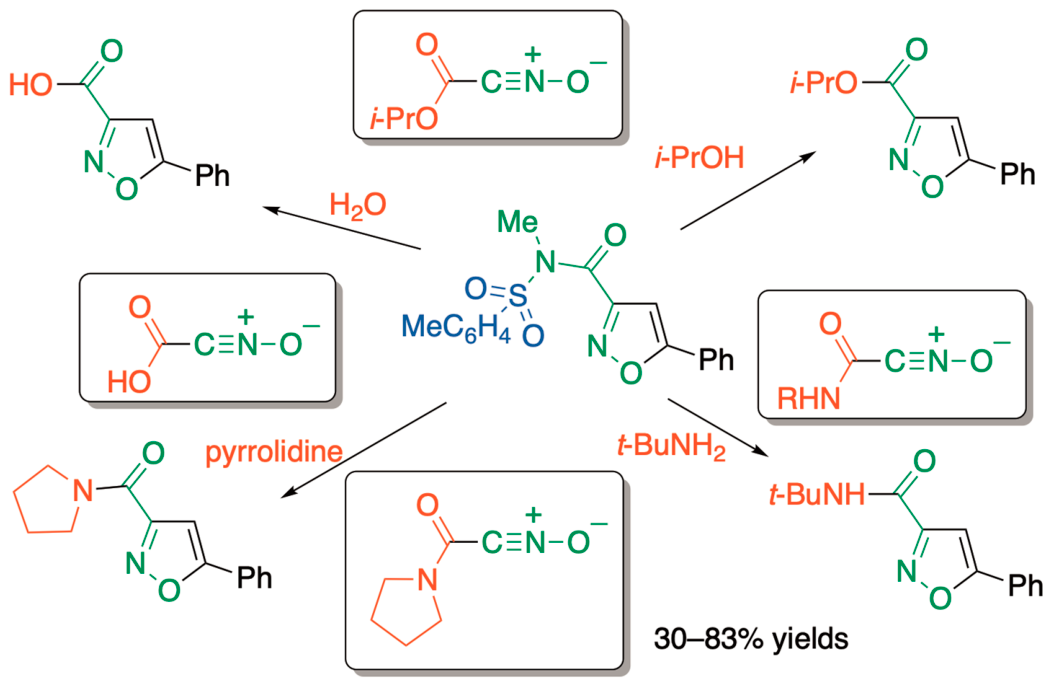
As a consequence, a variety of functional-group interconversions become possible. Treatment of the tosylated cycloadduct with oxygen nucleophiles, such as water or alcohols, affords the corresponding carboxylic acids and esters, respectively. These products can be regarded as the cycloadducts that would be obtained from carboxy- and ester-substituted nitrile oxides. Likewise, reactions with primary amines, including n-propylamine, sec-butylamine, and tert-butylamine, provide the corresponding N-alkylamides, whereas reaction with the secondary amine pyrrolidine furnishes the corresponding tertiary amide (Scheme 29) [106]. Thus, the carbamoyl substituent can be diversified without modifying the nitrile oxide precursor itself.
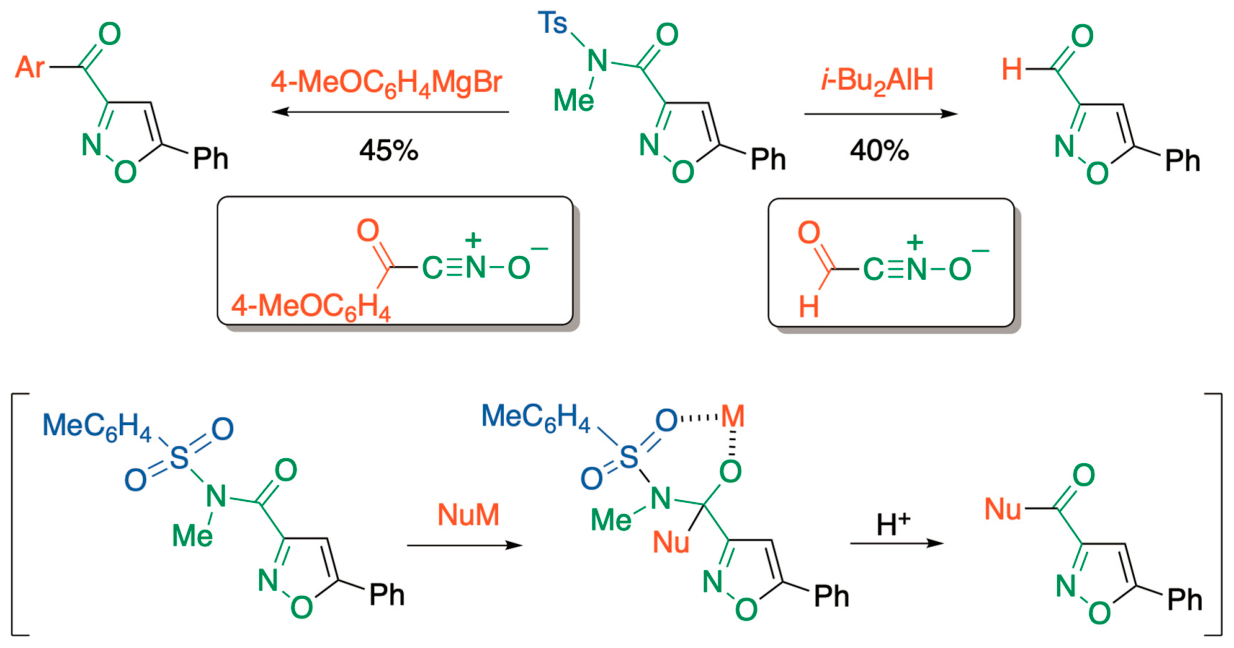
The tosylated amide can also be converted into a ketone and aldehyde by treatment with a Grignard reagent and diisobutylaluminum hydride (DIBAL-H), respectively (Scheme 30) [106]. This unique reactivity is attributed to chelation of the metal center by the tosyl and carbonyl oxygen atoms, which stabilizes the tetrahedral intermediate in a manner analogous to that observed for Weinreb amides. Accordingly, these products may be viewed as the cycloadducts derived from acyl- and formyl-substituted nitrile oxides [106].
Overall, tosylation transforms the initially formed N-methylcarbamoyl group into a versatile synthetic handle that can be converted into carboxylic acid, esters, amides, ketone, and aldehyde. Consequently, although MeIOx formally generates only (N-methylcarbamoyl)nitrile oxide, it effectively functions as a universal synthetic equivalent of a wide range of functionalized nitrile oxides. This strategy significantly expands the scope of functionalized nitrile oxide chemistry while avoiding the need to prepare numerous structurally diverse and often inaccessible nitrile oxide precursors.

3.7. Synthetic Equivalent of (Cyano)nitrile Oxide

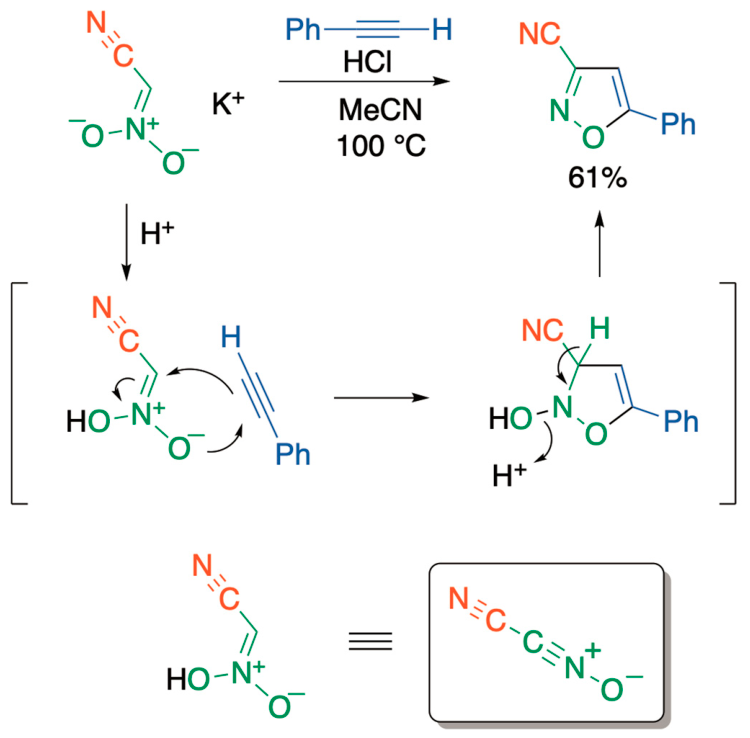
As discussed in Section 2.4, the practical application of (cyano)nitrile oxide has been severely limited by its extreme instability and the lack of suitable precursor systems. A practical solution to this problem has been realized through the use of cyano-aci-nitroacetate, which is readily obtained by ring opening of PyIOx. Because this intermediate is the dianion of α-nitro(cyano)acetic acid, protonation is expected to trigger decarboxylation and dehydration, thereby generating (cyano)nitrile oxide in situ (Scheme 31). This strategy provides an attractive alternative to the direct generation of this highly unstable nitrile oxide.
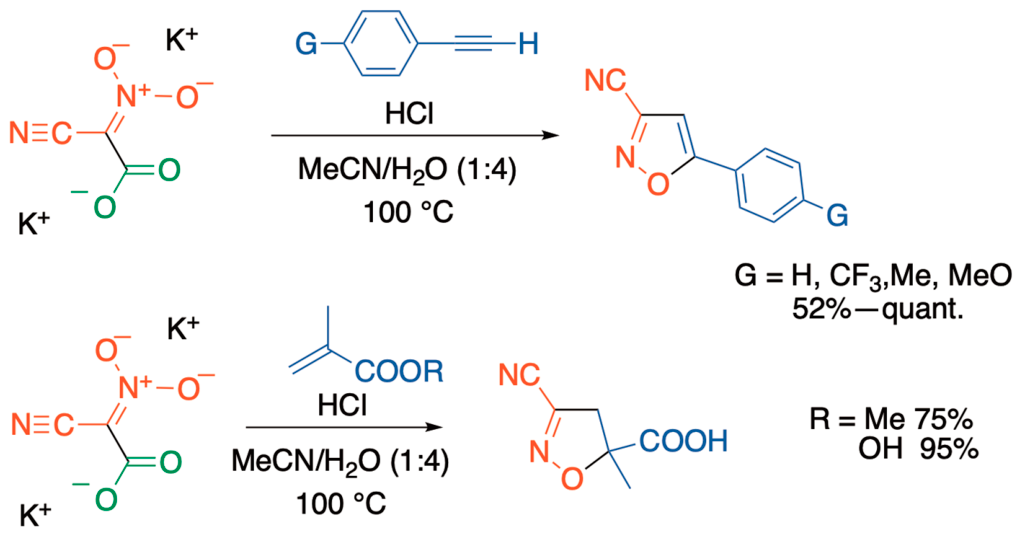
When cyano-aci-nitroacetate is heated with alkynes or alkenes under acidic conditions, efficient cycloaddition occurs to afford the corresponding cyano-substituted isoxazoles and isoxazolines, respectively (Scheme 32) [107]. Under the reaction conditions, ester functionalities are not sufficiently stable and are hydrolyzed to afford [(cyano)isoxazoline]carboxylic acids. Nevertheless, this observation demonstrates that α,β-unsaturated carboxylic acids, which are generally unsuitable dipolarophiles for conventional nitrile oxide chemistry, can participate directly in the cycloaddition. Consistent with this interpretation, methacrylic acid undergoes smooth cycloaddition to furnish the identical product (Scheme 32), further expanding the scope of compatible dipolarophiles [107].
Although the above results are consistent with the intermediacy of (cyano)nitrile oxide, its exceptionally high instability makes it unlikely that the free nitrile oxide persists for any significant time under the acidic aqueous reaction conditions. Mechanistic insight was obtained from experiments using the decarboxylated potassium salt of nitroacetonitrile. Treatment of this independently prepared intermediate with dipolarophiles afforded the same cycloadducts as those obtained from cyano-aci-nitroacetate (Scheme 33), indicating that the actual 1,3-dipole is (cyano)nitronate, rather than the free nitrile oxide itself. Accordingly, (cyano)nitronate should be regarded as a synthetic equivalent of (cyano)nitrile oxide, reproducing its characteristic cycloaddition reactivity without requiring direct generation of the highly unstable nitrile oxide.
This concept represents a significant advance in the chemistry of functionalized nitrile oxides. Rather than relying on the transient existence of (cyano)nitrile oxide, the desired cycloaddition chemistry can be achieved through a stable and readily accessible nitronate intermediate. Consequently, this strategy overcomes one of the principal limitations discussed in Section 2.4 and establishes a practical synthetic platform for the preparation of cyano-substituted isoxazole and isoxazoline derivatives.

4. Conclusions

This review has summarized recent advances in the generation of functionalized nitrile oxides and the development of their synthetic equivalents. Although numerous methods for generating nitrile oxides have been reported, the direct preparation of functionalized nitrile oxides remains challenging because suitable precursor molecules are often difficult to access and many functional groups are incompatible with the reaction conditions required for nitrile oxide generation. Recent developments have demonstrated that these longstanding limitations can be overcome through the design of practical precursor systems and synthetic equivalents.
Among these advances, MeIOx has emerged as a particularly versatile precursor to (N-methylcarbamoyl)nitrile oxide, which can be generated under exceptionally mild aqueous conditions. The resulting nitrile oxide undergoes efficient 1,3-dipolar cycloaddition with a broad range of dipolarophiles, including alkenes, alkynes, nitriles, and 1,3-dicarbonyl compounds, providing straightforward access to structurally diverse isoxazoles, isoxazolines, and 1,2,4-oxadiazoles. Moreover, post-cycloaddition transformation of the N-methylcarbamoyl group into carboxy, ester, amide, acyl, and formyl functionalities greatly expands the synthetic utility of this methodology, effectively enabling MeIOx to function as a synthetic equivalent of a wide variety of functionalized nitrile oxides. Likewise, cyano-aci-nitroacetate, generated by ring opening of PyIOx, serves as a practical synthetic equivalent of (cyano)nitrile oxide, providing access to cyano-substituted isoxazole(in)es without requiring direct generation of this highly unstable nitrile oxide.
An additional advantage of the products obtained by these methods is the presence of the isoxazole N–O bond, which can be readily cleaved to afford a diverse range of highly functionalized molecular frameworks. Consequently, the strategies described in this review provide efficient access to multifunctional compounds that are difficult or impossible to prepare by conventional synthetic methods.
The development of practical precursors and synthetic equivalents has transformed functionalized nitrile oxide chemistry from a field largely limited by precursor availability into a versatile platform for heterocycle synthesis and molecular functionalization. Continued advances in this area are expected to further broaden the scope of functionalized nitrile oxides and accelerate the discovery of new bioactive molecules, functional materials, and advanced molecular architectures.

Funding

This research received no external funding.

Institutional Review Board Statement

Not applicable.

Informed Consent Statement

Not applicable.

Data Availability Statement

Dataset available on request from the authors.

Conflicts of Interest

The author declares no conflicts of interest.

References

  1. Huisgen, R.; Mack, W. 1,3-Dipolar additions of nitrile oxides to carbonyl compounds. Tetrahedron Lett. 1961, 2, 583–586. [Google Scholar] [CrossRef] [Scilit]
  2. Petrova, J.V.; Kukushkin, M.E.; Beloglazkina, E.K. 1,3-Dipolar cycloaddition of nitrile imines and nitrile oxides to exocyclic C=N bonds—An approach to spiro-N-heterocycles. Int. J. Mol. Sci. 2025, 26, 8673. [Google Scholar] [CrossRef] [Scilit] [PubMed]
  3. Kumari, M.; Dey, A.; Khatravath, M. A review on synthesis of polyketide natural products and polyketide building blocks based on hydroxy-directed nitrile oxide cycloaddition reaction. Asian J. Org. Chem. 2025, 14, e202400766. [Google Scholar] [CrossRef] [Scilit]
  4. Cherkasova, A.; Astolfi, R.; Nawrozkijc, M.; Gladkikh, B.; Proia, E.; Giuliani, L.; Rotili, D.; Ragno, R.; Ivanov, R. 1,2,4-Oxadiazoles in medicinal chemistry: Trends of the last years. Eur. J. Med. Chem. 2025, 297, 117935. [Google Scholar] [CrossRef] [Scilit] [PubMed]
  5. Krompiec, S.; Lodowski, P.; Kurpanik-Wójcik, A.; Gołek, B.; Mieszczanin, A.; Fijołek, A.; Matussek, M.; Kaszuba, K. Nitrile oxide, alkenes, dipolar cycloaddition, isomerization and metathesis involved in the syntheses of 2-isoxazolines. Molecules 2023, 28, 2547. [Google Scholar] [CrossRef] [Scilit] [PubMed]
  6. Faita, G.; Mella, M.; Quadrelli, P. Synthesis and biological activity of potential antiviral compounds through 1,3-dipolar cycloadditions. Part 2: Nitrones, nitrile oxides and imines, and other 1,3-dipoles. Arkivoc 2022, 8, 257–294. [Google Scholar] [CrossRef] [Scilit]
  7. Plumet, J. The 1,3-dipolar cycloaddition reactions of nitrile oxides in water media. Curr. Org. Chem. 2021, 25, 2683–2707. [Google Scholar] [CrossRef] [Scilit]
  8. Duc, D.X.; Dung, V.C. Recent progress in the synthesis of isoxazoles. Curr. Org. Chem. 2021, 25, 2938–2989. [Google Scholar] [CrossRef] [Scilit]
  9. Livingstone, K.; Little, G.; Jamieson, C. Recent advances in the generation of nitrilium betaine 1,3-dipoles. Synthesis 2021, 53, 2395–2407. [Google Scholar] [CrossRef] [Scilit]
  10. Plumet, J. 1,3-Dipolar cycloaddition reactions of nitrile oxides under “non-conventional” conditions: Green solvents, irradiation, and continuous flow. ChemPlusChem 2020, 85, 2252–2271. [Google Scholar] [CrossRef] [Scilit] [PubMed]
  11. Bondarenko, O.B.; Zyk, N.V. The main directions and recent trends in the synthesis and use of isoxazoles. Chem. Heterocycl. Compd. 2020, 56, 694–707. [Google Scholar] [CrossRef] [Scilit]
  12. Chen, W.-C.; Kavala, V.; Shih, Y.-H.; Wang, Y.-H.; Kuo, C.-W.; Yang, T.-H.; Huang, C.-Y.; Chiu, H.-H.; Yao, C.-F. Synthesis of bicyclic isoxazoles and isoxazolines via intramolecular nitrile oxide cycloaddition. Molecules 2015, 20, 10910–10927. [Google Scholar] [CrossRef] [Scilit] [PubMed]
  13. Rane, D.; Sibi, M. Recent advances in nitrile oxide cycloadditions. Synthesis of isoxazolines. Curr. Org. Synth. 2011, 8, 616–627. [Google Scholar] [CrossRef] [Scilit]
  14. Pinho e Melo, T.M.V.D. Recent advances on the synthesis and reactivity of isoxazoles. Curr. Org. Chem. 2005, 9, 925–958. [Google Scholar] [CrossRef] [Scilit]
  15. Gothelf, K.V.; Jørgensen, K.A. Asymmetric 1,3-dipolar cycloaddition reactions. Chem. Rev. 1998, 98, 863–909. [Google Scholar] [CrossRef] [Scilit] [PubMed]
  16. Taylor, G.A. The nitrile oxide–isocyanate rearrangement. J. Chem. Soc. Perkin Trans. 1 1985, 14, 1181–1184. [Google Scholar] [CrossRef] [Scilit]
  17. Faita, G.; Mella, M.; Mortoni, A.; Paio, A.; Quadrelli, P.; Seneci, P. Solid-supported nitrile oxides as stable and valuable reactive intermediates. Eur. J. Org. Chem. 2002, 2002, 1175–1183. [Google Scholar] [CrossRef]
  18. Zhu, Y.; Liu, T.; Liu, B.; Shi, H.; Tan, Q.; Xu, B. From α-keto acids to nitrile oxides enabled by copper nitrate: A facile access to fused isoxazolines. Org. Chem. Front. 2022, 9, 676–681. [Google Scholar] [CrossRef] [Scilit]
  19. Chen, R.; Ogunlana, A.A.; Fang, S.; Long, W.; Sun, H.; Bao, X.; Wan, X. In situ generation of nitrile oxides from copper carbene and tert-butyl nitrite: Synthesis of fully substituted isoxazoles. Org. Biomol. Chem. 2018, 16, 4683–4687. [Google Scholar] [CrossRef] [Scilit] [PubMed]
  20. Saima, Y.; Khamarui, S. MnVI-NP–catalyzed generation of nitrile oxides: Easy access to isoxazolines and isoxazoles via stereoselective 1,3-dipolar cycloaddition reactions. SynOpen 2022, 6, 173–178. [Google Scholar] [CrossRef] [Scilit]
  21. Sathish, E.; Ansari, A.J.; Joshi, G.; Pandit, A.; Shukla, M.; Kumari, N.; Sharon, A.; Verma, V.P.; Sawant, D.M. Pd-Catalysed [3 + 2]-cycloaddition towards the generation of bioactive bis-heterocycles/identification of COX-2 inhibitors via in silico analysis. Org. Biomol. Chem. 2022, 20, 4746–4752. [Google Scholar] [CrossRef] [Scilit] [PubMed]
  22. Feng, Q.; Huang, H.; Sun, J. Ru-Catalyzed [3 + 2] cycloaddition of nitrile oxides and electron-rich alkynes with reversed regioselectivity. Org. Lett. 2021, 23, 2431–2436. [Google Scholar] [CrossRef] [Scilit] [PubMed]
  23. Hofmann, S.; Winter, J.; Prenzel, T.; Gálvez-Vázquez, M.J.; Waldvogel, S.R. Electrochemical synthesis of isoxazoles and isoxazolines via anodic oxidation of oximes. ChemElectroChem 2023, 10, e202300434. [Google Scholar] [CrossRef] [Scilit]
  24. Holman, S.D.L.; Wills, A.G.; Fazakerley, N.J.; Poole, D.L.; Coe, D.M.; Berlois, L.A.; Reid, M. Electrochemical synthesis of isoxazolines: Method and mechanism. Chem. Eur. J. 2022, 28, e202103728. [Google Scholar] [CrossRef] [Scilit] [PubMed]
  25. Luginina, J.; Linden, M.; Bazulis, M.; Kumpiņš, V.; Mishnev, A.; Popov, S.A.; Golubeva, T.S.; Waldvogel, S.R.; Shults, E.E.; Turks, M. Electrosynthesis of stable betulin-derived nitrile oxides and their application in synthesis of cytostatic lupane-type triterpenoid-isoxazole conjugates. Eur. J. Org. Chem. 2021, 2021, 2557–2577. [Google Scholar] [CrossRef] [Scilit]
  26. Massad, Y.; Zych, A.; Duttine, M.; Bassani, D.M.; Robert, F.; Landais, Y. H-bond mediated photocatalyzed oxidation of oximes under visible light and air. A general route toward dioxazoles, oxadiazoles and isoxazoles. Green Chem. 2026, 28, 5482–5492. [Google Scholar] [CrossRef] [Scilit]
  27. Svejstrup, T.D.; Zawodny, W.; Douglas, J.J.; Bidgeli, D.; Sheikh, N.S.; Leonori, D. Visible-light-mediated generation of nitrile oxides for the photoredox synthesis of isoxazolines and isoxazoles. Chem. Commun. 2016, 52, 12302–12305. [Google Scholar] [CrossRef] [Scilit] [PubMed]
  28. Cinquini, E.; Freecero, M.; Gandolfi, R.; Amadé, M.S.; Rastelli, A. Facial selectivity in the reactions of 1,3-dipoles with cis- and trans-3,4-dimethyl-l-methoxycarbonyl cyclobutenes. Tetrahedron 1997, 53, 9279–9292. [Google Scholar] [CrossRef] [Scilit]
  29. Jarošková, L.; Fišera, L. Reaction of 2,4-dichlorophenylglyoxylhydroximoyl chloride with amines as a convenient method for the synthesis of amide oximes and amides. Chem. Pap. 1994, 48, 31–34. [Google Scholar]
  30. Cararella, P.; Bamdiera, T.; Albini, F.M.; Gamba, A.; Corsaro, A.; Perrini, G. Addition of pyridine and isoquinoline to benzoylcarbonitrile oxide. Tetrahedron 1988, 44, 4917–4925. [Google Scholar] [CrossRef] [Scilit]
  31. Martin, S.F.; Dupre, B. Regiochemistry of the dipolar cycloadditions of nitrile oxides to unactivated olefins. Application to the stereoselective elaboration of β-hydroxycarbonyl compounds. Tetrahedron Lett. 1983, 24, 1337–1340. [Google Scholar] [CrossRef] [Scilit]
  32. Kim, J.N.; Ryu, E.K. A convenient synthesis of benzohydroximoyl chlorides as nitrile oxide precursors by HCl/N,N-dimethylformamide/oxone system. J. Org. Chem. 1992, 57, 6649–6650. [Google Scholar] [CrossRef] [Scilit]
  33. Mandadapu, R.; Hapse, V.M.; Wagh, P.S.; Pal, S.; Phadte, M.; Ghorai, S.K. Synthesis of 3-substituted 5,5-dimethyl isoxazolines via unusual reactivity of chlorooximes and di-tert-butyl dicarbonate (Boc2O) or tert-butyl Acetate (t-BuOAc). J. Org. Chem. 2025, 90, 11115–11123. [Google Scholar] [CrossRef] [Scilit] [PubMed]
  34. Pizarro, S.; Angel, C.; Becerra, J.; Cañas-Sarazua, R.; Delgadillo, A. Electrochemical dichlorination of lindane by cobaloximes: Kinetics, adsorption, and environmental applications. Chem. Sel. 2025, 10, e01113. [Google Scholar] [CrossRef] [Scilit]
  35. Su, Z.-F.; Ballinger, J.R.; Rauth, A.M.; Abrams, D.N.; Billinghurst, M.W. A novel amine-dioxime chelator for technetium-99m: Synthesis and evaluation of 2-nitroimidazole-containing analogues as markers for hypoxic cells. Bioconjugate Chem. 2000, 11, 652–663. [Google Scholar] [CrossRef] [Scilit] [PubMed]
  36. Hameršak, Z.; Peric, B.; Kojic-Prodic, B.; Cotarca, L.; Delogu, P.; Sunjic, V. Preparation and mechanism of solvolysis of N-hydroxy-α-oxobenzeneethanimidoyl chloride, a 2-(hydroxyimino)-1-phenylethan-1-one derivative: Molecular structure of α-oxo-oximes (α-(hydroxyimino) ketones). Helv. Chim. Acta 1999, 82, 1289–1301. [Google Scholar] [CrossRef]
  37. Bedford, C.D.; Miura, M.; Bottaro, J.C.; Howd, R.A.; Nolen, H.W., III. Nonquaternary cholinesterase reactivators. 4. Dialkylaminoalkyl thioesters of α-keto thiohydroximic acids as reactivators of ethyl methylphosphonyl- and 1,2,2-trimethylpropyl methylphosphonyl-acetylcholinesterase in vitro. J. Med. Chem. 1986, 29, 1689–1696. [Google Scholar] [CrossRef] [Scilit] [PubMed]
  38. Mayo, P.; Hecnar, T.; Tam, W. 1,3-Dipolar cycloaddition of nitrile oxides with unsymmetrically substituted norbornenes. Tetrahedron 2001, 57, 5931–5941. [Google Scholar] [CrossRef] [Scilit]
  39. Zhu, Y.; Mao, J.; Ma, Q.; Zhang, S.; Yuan, Y.; Jia, X. tert-Butyl nitrite (TBN)-enabled tandem C–H bond Oxidation/C–N bond cleavage/[3+2] cycloaddition of 1-nitromethyltetrahydroisoquinoline derivatives: Construction of multifunctionalized isoxazole and isoxazoline skeletons. J. Org. Chem. 2025, 90, 2459–2471. [Google Scholar] [CrossRef] [Scilit] [PubMed]
  40. Sun, Z.; Zhang, S.; Ma, Q.; Li, Y.; Ding, H.; Yuan, Y.; Jia, X. tert-Butyl nitrite-initiated C–N bond cleavage of 1-nitromethyl-N- aryltetrahydroisoquinolines: Synthesis of furoxans with N–NO Skeleton. Chem. Asian J. 2023, 18, e202201265. [Google Scholar] [CrossRef] [Scilit] [PubMed]
  41. Cao, J.-K.; Cao, T.-Z.; Yue, Q.-W.; Ma, Y.; Yang, C.-M.; Zhang, H.-X.; Li, Y.-C.; Dong, Q.-K.; Zhu, Y.-P.; Sun, Y.-Y. tert-Butyl nitrite-induced radical nitrile oxidation cycloaddition: Synthesis of isoxazole/isoxazoline-fused benzo 6/7/8-membered oxacyclic ketones. Molecules 2024, 29, 1202. [Google Scholar] [CrossRef] [Scilit] [PubMed]
  42. Dai, P.; Tan, X.; Luo, Q.; Yu, X.; Zhang, S.; Liu, F.; Zhang, W.-H. Synthesis of 3-acyl-isoxazoles and Δ2-isoxazolines from methyl ketones, alkynes or alkenes, and tert-butyl nitrite via a Csp3–H radical functionalization/cycloaddition cascade. Org. Lett. 2019, 21, 5096–5100. [Google Scholar] [CrossRef] [Scilit] [PubMed]
  43. Jazouli, M.; Baba, S.; Carboni, B.; Carrié, R.; Soufiaoui, M., II. 1,3-Dipolar cycloadditions to unsaturated boronic esters 4. Synthesis of borylated 2-isoxazolines. Conversion of some cycloadducts to 5-hydroxy-2-isoxazolines, 5-hydroxymethyl-2-isoxazolines and isoxazoles. J. Organomet. Chem. 1995, 498, 229–235. [Google Scholar] [CrossRef] [Scilit]
  44. Gandolfi, R.; Tonoletti, G.; Rastelli, A.; Bagatti, M. 2,3-Dioxabicyclo[2.2.2]oct-5-ene: A pyramidalized olefin whose facial selectivity does not parallel its pyramidalization. J. Org. Chem. 1993, 58, 6038–6048. [Google Scholar] [CrossRef] [Scilit]
  45. Martin, S.F.; Dappen, M.S.; Dupre, B.; Murphy, C.J.; Colapret, J.A. Application of nitrile oxide cycloadditions to a convergent, asymmetric synthesis of (+)-phyllanthocin. J. Org. Chem. 1989, 54, 2209–2216. [Google Scholar] [CrossRef] [Scilit]
  46. Barrow, S.J.; Easton, C.J.; Savage, G.P.; Simpson, G.W. Exploiting the 1,3-dithiane of 2-oxopropanenitrile oxide to limit competing dimerization in 1,3-dipolar cycloaddition reactions. Tetrahedron Lett. 1997, 38, 2175–2178. [Google Scholar] [CrossRef] [Scilit]
  47. Giguère, D.; Patnam, R.; Bellefleur, M.-A.; St-Pierre, C.; Sato, S.; Roy, R. Carbohydrate triazoles and isoxazoles as inhibitors of galectins-1 and -3. Chem. Commun. 2006, 22, 2379–2381. [Google Scholar] [CrossRef] [Scilit] [PubMed]
  48. Giri, S.; Poudel, D.P.; Giri, R. An I2-catalyzed, visible-light photoredox-mediated radical conversion of α-nitrocarbonyls to nitrile oxides: Catalytic access to isoxazolines and isoxazoles from alkenes and alkynes. Org. Lett. 2025, 27, 12408–12413. [Google Scholar] [CrossRef] [Scilit] [PubMed]
  49. Pipim, G.B.; Tia, R.; Adei, E. Computational exploration of the 1,3-dipolar cycloadditionreaction of 7-isopropylidenebenzonorbornadiene with nitrile oxide and cyclic nitrone derivatives. J. Phys. Org. Chem. 2021, 34, e4174. [Google Scholar] [CrossRef] [Scilit]
  50. Wang, D.Q.; Liu, H.L.; Huanga, X.R.; Li, Y.; Geng, C.Y.; Zhan, J.H.; Sun, C.C. Diatomic radical-molecule reactions HCCN (3A”)+ O2 (3Σg): Mechanistic study. Eur. Phys. J. D 2008, 48, 187–196. [Google Scholar] [CrossRef] [Scilit]
  51. Samba, W.K.; Amoah, A.; Tia, R.; Adei, E. Theoretical investigation of the regio-, enantio-, and stereo-selectivities of the (3 + 2) cycloaddition reactions of N-vinylindoles with nitrones and nitrile oxides. Theor. Chem. Acc. 2021, 140, 145. [Google Scholar] [CrossRef] [Scilit]
  52. Zhang, J.-x.; Li, Z.-s.; Liu, J.-y.; Sun, C.-C. Theoretical mechanistic study on the radical-radical reaction of ketenyl with nitrogen dioxide. J. Phys. Chem. A 2006, 110, 2527–2534. [Google Scholar] [CrossRef] [Scilit] [PubMed]
  53. Singh, A.; Roth, G.P. A [3 + 2] dipolar cycloaddition route to 3-hydroxy-3-alkyl oxindoles: An approach to pyrrolidinoindoline alkaloids. Org. Lett. 2011, 13, 2118–2121. [Google Scholar] [CrossRef] [Scilit] [PubMed]
  54. Rousseau, A.L.; Buddoo, S.R.; Gordon, G.E.R.; Beemadu, S.; Kupi, B.G.; Lepuru, M.J.; Maumela, M.C.; Parsoo, A.; Sibiya, D.M.; Brady, D. Scale-up of a chemo-biocatalytic route to (2R,4R)- and (2S,4S)-monatin. Org. Proc. Res. Dev. 2011, 15, 249–257. [Google Scholar] [CrossRef] [Scilit]
  55. Darvatkar, N.B.; Wankhede, K.S.; Bhilare, S.V.; Deorukhkar, A.R.; Raut, D.G.; Vaidya, V.V.; Trivedi, G.K.; Salunkhe, M.M. 1,3-Dipolar cycloaddition of nitrile oxides with symmetrical tri- and polycyclic strained olefins. J. Heterocycl. Chem. 2010, 47, 1004–1010. [Google Scholar] [CrossRef] [Scilit]
  56. Conti, D.; Rodriquez, M.; Sega, A.; Taddei, M. 1,3-Cycloaddition of nitrile oxides in ionic liquids. An easier route to 3-carboxy isoxazolines, potential constrained glutamic acid analogues. Tetrahedron Lett. 2003, 44, 5327–5330. [Google Scholar] [CrossRef] [Scilit]
  57. Moloney, G.P.; Martin, G.R.; Mathews, N.; Hobbs, H.; Dodsworth, S.; Sang, P.Y.; Knight, C.; Maxwell, M.; Glen, R.C. Synthesis and pharmacological profile of a series of 2,5- substituted-N,N-dimethyltryptamine derivatives as novel antagonists for the vascular 5-HT1B-like receptor. J. Chem. Soc. Perkin Trans. 1 1999, 19, 2713–2723. [Google Scholar] [CrossRef] [Scilit]
  58. Petrova, J.V.; Tkachenko, V.T.; Tafeenko, V.A.; Pestretsova, A.S.; Pokrovsky, V.S.; Kukushkin, M.E.; Beloglazkina, E.K. Facile synthesis of hydantoin/1,2,4-oxadiazoline spiro-compounds via 1,3-dipolar cycloaddition of nitrile oxides to 5-iminohydantoins. Beilstein J. Org. Chem. 2025, 21, 1552–1560. [Google Scholar] [CrossRef] [Scilit] [PubMed]
  59. Zhang, X.-W.; He, X.-L.; Yan, N.; Zheng, H.-X.; Hu, X.-G. Oxidize amines to nitrile oxides: One type of amine oxidation and its application to directly construct isoxazoles and isoxazolines. J. Org. Chem. 2020, 85, 15726–15735. [Google Scholar] [CrossRef] [Scilit] [PubMed]
  60. Kaji, E.; Harada, K.; Zen, S. Synthesis of isoxazole derivatives by means of O-acylation of aliphatic nitro compounds in the presence of acetylenic compounds. Chem. Pharm. Bull. 1978, 26, 3254–3256. [Google Scholar] [CrossRef] [Scilit]
  61. Shimizu, T.; Hayashi, Y.; Shibafuchi, H.; Teramura, K. A convenient preparative method of nitrile oxides by the dehydration of primary nitro compounds with ethyl chloroformate or benzenesulfonyl chloride in the presence of triethylamine. Bull. Chem. Soc. Jpn. 1986, 59, 2827–2831. [Google Scholar] [CrossRef] [Scilit]
  62. Sammelson, R.E.; Miller, R.B.; Kurth, M.J. Linear tetraheterocycles composed of both bidentate diisoxazole and bidentate isoxazole-furyl/thienyl/pyridyl motifs. J. Org. Chem. 2000, 65, 2225–2228. [Google Scholar] [CrossRef] [Scilit] [PubMed]
  63. Trogu, E.; Vinattieri, C.; De Sarlo, F.; Machetti, F. Acid–base-catalysed condensation reaction in water: Isoxazolines and isoxazoles from nitroacetates and dipolarophiles. Chem. Eur. J. 2012, 18, 2081–2093. [Google Scholar] [CrossRef] [Scilit] [PubMed]
  64. Trogu, E.; De Sarlo, F.; Machetti, F. Michael additions versus cycloaddition condensations with ethyl nitroacetate and electron-deficient olefins. Chem. Eur. J. 2009, 15, 7940–7948. [Google Scholar] [CrossRef] [Scilit] [PubMed]
  65. Kislyyi, V.P.; Laikhter, A.L.; Ugrak, B.I.; Semenov, V.V. Ethyl 2-nitroacetoacetate as a new synthetic equivalent of ethoxycarbonylnitrile oxide. Russ. Chem. Bull. 1994, 43, 98–100. [Google Scholar] [CrossRef] [Scilit]
  66. Shimizu, T.; Hayashi, Y.; Teramura, K. A new synthetic method of alkyl carbonocyanidate N-oxides. Bull. Chem. Soc. Jpn. 1985, 58, 2519–2522. [Google Scholar] [CrossRef] [Scilit]
  67. Nakaike, Y.; Taba, N.; Itoh, S.; Tobe, Y.; Nishiwaki, N.; Ariga, M. Nucleophilic substitution accompanying carbon-carbon bond cleavage assisted by a nitro group. Bull. Chem. Soc. Jpn. 2007, 80, 2413–2417. [Google Scholar] [CrossRef] [Scilit]
  68. Yarovenko, V.N.; Kosarev, S.A.; Zavarzin, I.V.; Krayushkin, M.M. Synthesis of carbamoylamidoximes. Russ. Chem. Bull. 1998, 47, 1947–1951. [Google Scholar] [CrossRef] [Scilit]
  69. Yarovenko, V.N.; Kosarev, S.A.; Zavarzin, I.V.; Krayushkin, M.M. Synthesis of carbamoylformhydroxymoyl chlorides and study of their reactivities. Russ. Chem. Bull. Int. Ed. 2002, 51, 1504–1509. [Google Scholar] [CrossRef] [Scilit]
  70. Parhi, A.K.; Franck, R.C. A Weinreb nitrile oxide and nitrone for cycloaddition. Org. Lett. 2004, 6, 3063–3065. [Google Scholar] [CrossRef] [Scilit] [PubMed]
  71. Romanski, J.; Chpuis, C.; Jurczak, J. Diastereoselective 1,3-dipolar cycloadditions of chiral derivatives of 2-oxoethanenitrile oxide to noncyclic conjugated symmetrical alkenes. Helv. Chim. Acta 2009, 92, 1056–1069. [Google Scholar] [CrossRef] [Scilit]
  72. Paul, R.; Tchelitcheff, S. Nitrile oxides. II. Synthesis of isoxazolines from nitromethane. Bull. Soc. Chim. Fr. 1963, 140–142. [Google Scholar]
  73. Huisgen, R.; Christl, M. 1,3-Dipolar cycloadditions. 72. Reactions of fulminic acid with unsaturated compounds. Chem. Ber. 1973, 106, 3291–3311. [Google Scholar] [CrossRef] [Scilit]
  74. Harris, P.A.; Jackson, A.; Joule, J.A. The formation of furoxan-3,4-dicarboxamides from nitroacetamides. Tetrahedron Lett. 1989, 30, 3193–3196. [Google Scholar] [CrossRef] [Scilit]
  75. Mower, M.P.; Blackmond, D.G. Mechanistic rationalization of unusual sigmoidal kinetic profiles in the Machetti–De Sarlo cycloaddition reaction. J. Am. Chem. Soc. 2015, 137, 2386–2391. [Google Scholar] [CrossRef] [Scilit] [PubMed]
  76. Huffman, B.S.; Schults, R.A.; Schlom, P.J. Novel reagents for heat-activated polymer crosslinking. Polym. Bull. 2001, 47, 159–166. [Google Scholar] [CrossRef] [Scilit]
  77. Leslie-Smith, M.G.; Paton, R.M.; Webb, N. Divergent behaviour in the isocyanate-induced and thermal generation of nitrile oxides from ethyl nitroacetate. Tetrahedron Lett. 1994, 35, 9251–9254. [Google Scholar] [CrossRef] [Scilit]
  78. Maier, G.; Teles, J.H. Isolation and photoisomerization of simple substituted nitrile oxides. Angew. Chem. Int. Ed. 1987, 26, 155–156. [Google Scholar] [CrossRef] [Scilit]
  79. Grundmann, C.; Frommeld, H.D. Nitrile oxides. VIII. Cyanogen N-oxide. J. Org. Chem. 1966, 31, 4235–4237. [Google Scholar] [CrossRef] [Scilit]
  80. Williams, G.K.; Brill, T.B. Thermal decomposition of energetic materials 72: Unusual behavior of substituted furazan compounds upon flash pyrolysis. Combust. Flame 1998, 114, 569–576. [Google Scholar] [CrossRef] [Scilit]
  81. Nishiwaki, N.; Nakanishi, M.; Hida, T.; Miwa, Y.; Tamura, M.; Hori, K.; Tohda, Y.; Ariga, M. Synthesis of 2,3-difunctionalized 4-nitropyrroles. J. Org. Chem. 2001, 66, 7535–7538. [Google Scholar] [CrossRef] [Scilit] [PubMed]
  82. Higashida, S.; Nakashima, H.; Tohda, Y.; Tani, K.; Nishiwaki, N.; Ariga, M. A novel nitrile oxide precursor; 2-methyl-4-nitro-5(2H)-isoxazolone. Heterocycles 1992, 34, 1511–1514. [Google Scholar] [CrossRef] [Scilit]
  83. Nishiwaki, N.; Kobiro, K.; Kiyoto, H.; Hirao, S.; Sawayama, J.; Saigo, K.; Okajima, Y.; Uehara, T.; Maki, A.; Ariga, M. An anomalous hydration/dehydration sequence for the mild generation of a nitrile oxide. Org. Biomol. Chem. 2011, 9, 2832–2839. [Google Scholar] [CrossRef] [Scilit] [PubMed]
  84. Ulrich, H.; Tilley, J.N.; Sayigh, A.A. Base-catalyzed ring opening of N-substituted 5-isoxazolones. J. Org. Chem. 1962, 27, 2160–2162. [Google Scholar] [CrossRef] [Scilit]
  85. Woodman, D.J.; Borman, C.H.; Tontapanish, N.; Stonebraker, P.M. Novel reactions of 3-unsubstituted 3-isoxazolin-5-ones. J. Org. Chem. 1969, 34, 2981–2983. [Google Scholar] [CrossRef] [Scilit]
  86. Woodman, D.J.; Stonebraker, P.M.; Weiler, L. Observation of ketenimine carboxylates and their conversion to four-membered heterocycles. J. Am. Chem. Soc. 1976, 98, 6036–6037. [Google Scholar] [CrossRef] [Scilit]
  87. Nishiwaki, N.; Takada, Y.; Inoue, Y.; Tohda, Y.; Ariga, M. Ring opening reaction of the pyridinium salt of 4-nitro-3-isoxazolin-5-one; a preparation of trifunctionalized methane derivatives. J. Heterocycl. Chem. 1995, 32, 473–475. [Google Scholar] [CrossRef] [Scilit]
  88. Iwai, K.; Nishiwaki, N. Nitroacetonitrile and its synthetic equivalent. J. Org. Chem. 2021, 86, 13177–13185. [Google Scholar] [CrossRef] [Scilit] [PubMed]
  89. Hemming, K. Product class 6: 1,2,4-oxadiazoles. Sci. Synth. 2004, 13, 127–184. [Google Scholar] [CrossRef] [Scilit]
  90. Oku, Y.; Nakajima, N.; Hamada, M.; Koyama, Y. Dansylated nitrile N-oxide as the fluorescent dye clickable to unsaturated bonds without catalyst. Chem. Eur. J. 2024, 30, e202400092. [Google Scholar] [CrossRef] [Scilit] [PubMed]
  91. Cheawchan, S.; Sogawa, H.; Takata, T. Phototriggered crosslinking and surface modification via catalyst-free functionalization of a new orthogonal agent containing nitrile N-oxide and o-nitrobenzyl ether moieties. Macromol. Chem. Phys. 2021, 222, 2000459. [Google Scholar] [CrossRef] [Scilit]
  92. Tyrkov, A.G.; Yurtaeva, E.A.; Utyaganova, E.V. Reaction of fluorodinitroacetonitrile with nitrile oxides. Russ. J. Org. Chem. 2025, 61, 760–763. [Google Scholar] [CrossRef] [Scilit]
  93. Nikodemiak, P.; Koert, U. Metal-catalyzed synthesis of functionalized 1,2,4-oxadiazoles from silyl nitronates and nitriles. Adv. Synth. Catal. 2017, 359, 1708–1716. [Google Scholar] [CrossRef] [Scilit]
  94. Bokach, N.A.; Khripoun, A.V.; Kukushkin, V.Y.; Haukka, M.; Pombeiro, A.J.L. A route to 1,2,4-oxadiazoles and their complexes via platinum-mediated 1,3-dipolar cycloaddition of nitrile oxides to organonitriles. Inorg. Chem. 2003, 42, 896–903. [Google Scholar] [CrossRef] [Scilit] [PubMed]
  95. Morrocchi, S.; Ricca, A.; Velo, L. The catalytic action of BF3 in the cycloaddition of benzonitrile oxide with nitriles and carbonyl compounds. Tetrahedron Lett. 1967, 8, 331–334. [Google Scholar] [CrossRef] [Scilit]
  96. Nishiwaki, N.; Kobiro, K.; Hirao, S.; Sawayama, J.; Saigo, K.; Ise, Y.; Okajima, Y.; Ariga, M. Inverse electron-demand 1,3-dipolar cycloaddition of nitrile oxide with common nitriles leading to 3-functionalized 1,2,4-oxadiazoles. Org. Biomol. Chem. 2011, 9, 6750–6754. [Google Scholar] [CrossRef] [Scilit] [PubMed]
  97. Corsaro, A.; Chiacchio, U.; Caramella, P.; Purrello, G. Activation of nitriles by hydrogen bonding in cycloadditions with nitrile oxides. J. Heterocycl. Chem. 1984, 21, 949–952. [Google Scholar] [CrossRef] [Scilit]
  98. Corsaro, A.; Buemi, G.; Chiacchio, U.; Perrini, G.; Pistarà, V.; Romeo, R. The role of hydrogen bonding in cycloadditions of benzonitrile oxide with cyanophenol. Tetrahedron 1996, 52, 7885–7892. [Google Scholar] [CrossRef] [Scilit]
  99. Umesha, K.B.; Kumar, K.A.; Rai, K.M.L. A novel synthesis of isoxazoles via 1,3-dipolar cycloaddition of nitrile oxides to acetyl acetone. Synth. Commun. 2002, 32, 1841–1846. [Google Scholar] [CrossRef] [Scilit]
  100. Bode, J.W.; Hachisu, Y.; Matsuura, T.; Suzuki, K. Amine-promoted cyclocondensation of highly substituted aromatic nitrile oxides with diketones. Tetrahedron Lett. 2003, 44, 3555–3558. [Google Scholar] [CrossRef] [Scilit]
  101. Yamashita, Y.; Hirano, Y.; Takada, A.; Takizawa, H.; Suzuki, K. Total synthesis of the antibiotic BE-43472B. Angew. Chem. Int. Ed. 2013, 52, 6658–6661. [Google Scholar] [CrossRef] [Scilit] [PubMed]
  102. Mirzaei, Y.R.; Weaver, M.J.; Steiger, S.A.; Kearns, A.K.; Gajewski, M.P.; Rider, K.C.; Beall, H.D.; Natale, N.R. Improved synthesis of 3-aryl isoxazoles containing fused aromatic rings. Tetrahedron 2012, 68, 10360–10364. [Google Scholar] [CrossRef] [Scilit] [PubMed]
  103. Chiarino, D.; Grancini, G.; Frigeni, V.; Biasini, I.; Carenzi, A. N-(4-Isoxazolylthiazol-2-yl)oxamic acid derivatives as potent orally active antianaphylactic agents. J. Med. Chem. 1991, 34, 600–605. [Google Scholar] [CrossRef] [Scilit] [PubMed]
  104. Trogu, E.; Cecchi, L.; De Sarlo, F.; Guideri, L.; Ponticelli, F.; Machetti, F. Base- and copper-catalysed condensation of primary activated nitro compounds with enolisable compounds. Eur. J. Org. Chem. 2009, 2009, 5971–5978. [Google Scholar] [CrossRef] [Scilit]
  105. Nishiwaki, N.; Kobiro, K.; Hirao, S.; Sawayama, J.; Saigo, K.; Ise, Y.; Nishizawa, M.; Ariga, M. One-step synthesis of differently bis-functionalized isoxazoles by cycloaddition of carbamoylnitrile oxide with β-keto esters. Org. Biomol. Chem. 2012, 10, 1987–1991. [Google Scholar] [CrossRef] [Scilit] [PubMed]
  106. Asahara, H.; Arikiyo, K.; Nishiwaki, N. Development of variously functionalized nitrile oxides. Beilstein J. Org. Chem. 2015, 11, 1241–1245. [Google Scholar] [CrossRef] [Scilit] [PubMed]
  107. Nishiwaki, N.; Kumegawa, Y.; Iwai, K.; Yokoyama, S. Development of a safely handleable synthetic equivalent of cyanonitrile oxide by 1,3-dipolar cycloaddition of nitroacetonitrile. Chem. Commun. 2019, 55, 7903–7905. [Google Scholar] [CrossRef] [Scilit] [PubMed]
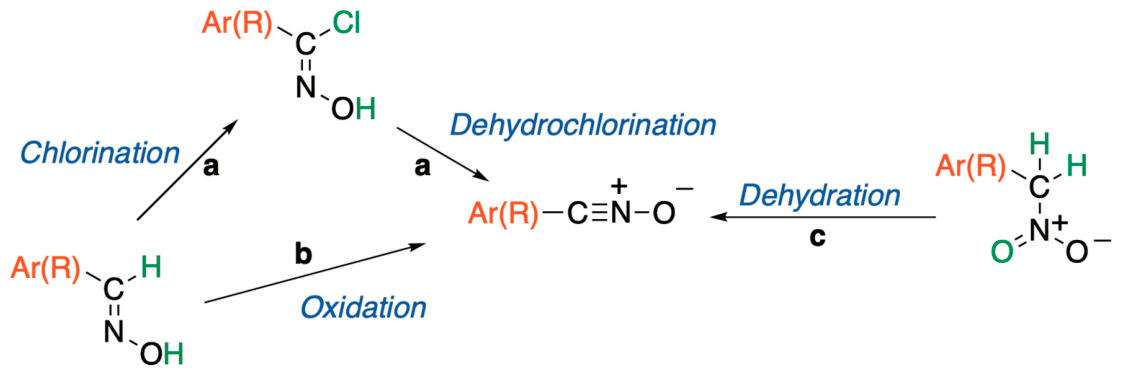
Scheme 1. Widely used generation methods of nitrile oxides (a) chlorination of aldoximes followed by dehydrochlorination; (b) oxidation of aldoximes; (c) dehydration of nitro compounds.
Molecules 31 02525 sch001

Scheme 2. Synthetic routes for chloroaldoxime, precursors to (aroyl)nitrile oxides (a) chlorination of aldoximes; (b) conversion of α-chloroketones to chloroaldoximes; (c) direct transformation of ketones to chloroaldoximes.
Molecules 31 02525 sch002
Scheme 3. Generation of (aroyl)nitrile oxides from aroyl(nitro)methane (a) from benzoyl(nitro)methane; (b) from 1-nitromethyl-N-aryltetrahydroisoquinolines.
Molecules 31 02525 sch003
Scheme 4. A plausible mechanism for the formation of (aroyl)nitrile oxide from acetophenone derivatives including nitrosoation followed by oxidation.
Molecules 31 02525 sch004
Scheme 5. Generation of thioacetal-protected (acetyl)nitrile oxide from dithiane including alkylation, formylation, conversion to oxime, and oxidation.
Molecules 31 02525 sch005
Scheme 6. Generation of (acyl)nitrile oxides by photo redox reaction using visible light (440 nm) including α-iodization followed by elimination of HOI.
Molecules 31 02525 sch006
Scheme 7. Generation of (ethoxycarbonyl)nitrile oxide from glycine ester via chloroaldoxime followed by dehydrochlorination.
Molecules 31 02525 sch007
Scheme 8. Generation of (ethoxycarbonyl)nitrile oxide from glycine ester including formation of rhodium carbene complex and oxime followed by oxidation (Cp*: cyclopentadienyl ligand).
Molecules 31 02525 sch008
Scheme 9. Generation of ester-functionalized nitrile oxide from ethyl nitroacetate using two methods (a) via O-acetylated nitronate; (b) Mukaiyama method.
Molecules 31 02525 sch009
Scheme 10. DABCO-induced cycloaddition of ethyl nitroacetate with dipolarophiles including cycloaddition of nitronate followed by dehydration.
Molecules 31 02525 sch010
Scheme 11. Generation of ester-functionalized nitrile oxide from nitrated 1,3-dicarbonyl compounds (a) acetylation followed by deacetylation; (b) thermolysis of nitrated diethyl malonate.
Molecules 31 02525 sch011
Scheme 12. Synthesis of chloroaldoxime and generation of amide-functionalized nitrile oxide by dehydrochlorination.
Molecules 31 02525 sch012
Scheme 13. Synthesis of chloroaldoxime possessing Weinreb amide and generation of the corresponding nitrile oxide.
Molecules 31 02525 sch013
Scheme 14. Generation of amide-functionalized nitrile oxide from (nitro)acetamide and its dimerization leading to furoxan.
Molecules 31 02525 sch014
Scheme 15. Generation of amide-functionalized nitrile oxides (a) by thermolysis of nitrated malonic acid amide ester; (b) by Mukaiyama method using nitroacetate.
Molecules 31 02525 sch015
Scheme 16. Generation of nitrile oxide possessing a cyano group (a) dehydrochlorination of cyano-substituted chloroaldoxime; (b) by thermolysis of furazan derivatives.
Molecules 31 02525 sch016
Scheme 17. Synthesis of PyIOx from ethyl nitroacetate by successive condensation with trimethyl orthoformate and hudroxylamine. Subsequent methylation leading to MeIOx.
Molecules 31 02525 sch017
Scheme 18. Generation of (carbamoyl)nitrile oxide from MeIOx (a) by addition of activated carbon in DMF; (b) by stirring in water. The red solid lines mean the newly formed bonds between two molecules of nitrile oxides.
Molecules 31 02525 sch018
Scheme 19. Synthesis of functionalized isoxazol(in)es.
Molecules 31 02525 sch019
Scheme 20. Base-induced ring opening of isoxazolones (a) of 4-ethoxycarbonyl derivative; (b) of 4-phenyl derivative.
Molecules 31 02525 sch020
Scheme 21. Ring opening reaction of PyIOx leading to cyano-aci-nitroacetate.
Molecules 31 02525 sch021
Scheme 22. Reaction of MeIOx with methanol.
Molecules 31 02525 sch022
Scheme 23. A plausible mechanism for generation of oxetane intermediate.
Molecules 31 02525 sch023
Scheme 24. A plausible mechanism for generation of (carbamoyl)nitrile oxide including attack of water at site a.
Molecules 31 02525 sch024
Scheme 25. A plausible mechanism for generation of (carbamoyl)nitrile oxide including attack of water at site b.
Molecules 31 02525 sch025
Figure 1. Calculated energy correlations between nitrile oxides and nitriles using B3LYP 6-31G* (a) cycloaddition of (aryl)nitrile oxide and electron-deficient nitrile; (b) cycloaddition of (aryl)nitrile oxide with aliphatic nitrile in the presence of Lewis acid. Solid lines mean energetically advantageous combinations.
Molecules 31 02525 g001
Scheme 26. Synthesis of functionalized oxadiazoles.
Molecules 31 02525 sch026
Figure 2. Calculation results indicating inverse electron-demand 1,3-dipolar cycloaddition. Solid line means energetically advantageous combination.
Molecules 31 02525 g002
Figure 3. Activation energies for two kinds of transition states.
Molecules 31 02525 g003
Scheme 27. Synthesis of isoxazoles possessing different carbonyl functionalities.
Molecules 31 02525 sch027
Scheme 28. Tosylation of the N-methylcarbamoyl group.
Molecules 31 02525 sch028
Scheme 29. Reactions of N-tosylated cycloadduct with hetero nucleophiles.
Molecules 31 02525 sch029
Scheme 30. Conversion of amide to aldehyde and ketone using Weinreb amide-like behavior.
Molecules 31 02525 sch030
Scheme 31. A speculation to generate cyano-functionalized nitrile oxide.
Molecules 31 02525 sch031
Scheme 32. Synthesis of cyano-substituted isoxazol(in)es.
Molecules 31 02525 sch032
Scheme 33. Synthetic equivalent of (cyano)nitrile oxide.
Molecules 31 02525 sch033
Disclaimer/Publisher’s Note: The statements, opinions and data contained in all publications are solely those of the individual author(s) and contributor(s) and not of MDPI and/or the editor(s). MDPI and/or the editor(s) disclaim responsibility for any injury to people or property resulting from any ideas, methods, instructions or products referred to in the content.