Herbal Medicine Processing By-Products as Bioactive Resources: In Vivo Evidence for Antioxidant, Anti-Inflammatory, and Immunomodulatory Effects


Abstract
1. Introduction
2. Scope and Literature Basis
2.1. Scope of the Review
2.2. Literature Basis
2.3. Selection of Representative Evidence
2.4. Evidence Organization
2.5. Methodological Features of the Available Evidence
2.6. Thematic Organization
3. Results
3.1. Overview of Reviewed Evidence
3.2. Biological Activities
3.2.1. Anti-Inflammatory and Antioxidant Activity in Local Inflammation, Atopic Dermatitis, and Wound Healing
3.2.2. In Vivo Evidence of Neuroprotective Effects
3.2.3. In Vivo Evidence of Metabolic Regulatory Effects
3.2.4. In Vivo Evidence of Organ-Protective and Intestinal Effects
3.2.5. In Vivo Evidence of Immunomodulatory, Antioxidant, and Bone-Protective Effects
3.3. Methodological Considerations
3.4. Evidence Map
4. Discussion
4.1. Summary of Main Findings
4.2. Interpretation of Findings by Activity Category
4.2.1. Anti-Inflammatory and Antioxidant Activity
4.2.2. Neuroprotective Activity
4.2.3. Metabolic Regulatory Activity
4.2.4. Organ Protection and Intestinal Health
4.2.5. Immunomodulatory, Antioxidant, and Bone-Protective Activity
4.3. Role of Processing Method in Bioactivity Expression
4.4. Strengths and Limitations
4.5. Implications for Future Research
5. Conclusions
Supplementary Materials
Author Contributions
Funding
Institutional Review Board Statement
Informed Consent Statement
Data Availability Statement
Acknowledgments
Conflicts of Interest
Abbreviations
| TCM | Traditional Chinese medicine |
| KM | Korean medicine |
| SOD | superoxide dismutase |
| GSH | glutathione |
| MDA | malondialdehyde |
| ROS | reactive oxygen species |
| TBARS | thiobarbituric acid reactive substances |
| TNF | tumor necrosis factor |
| IL | interleukin |
| iNOS | inducible nitric oxide synthase |
| COX-2 | cyclooxygenase-2 |
| MCP-1 | monocyte chemoattractant protein-1 |
| PGE2 | prostaglandin E2 |
| CNKI | China National Knowledge Infrastructure |
| fRGM | fermented red ginseng marc |
| DNCB | 2,4-dinitrochlorobenzene |
| T-AOC | total antioxidant capacity |
| KRGM-G | Korean Red Ginseng Marc-derived Gintonin |
| LPAR1 | lysophosphatidic acid receptor 1 |
| NF-κB | nuclear factor kappa B |
| TLR4 | toll-like receptor 4 |
| ESG | environmental, social, and governance |
| MAPK | mitogen-activated protein kinase |
| IKK | IkappaB kinase |
| HPLC | high-performance liquid chromatography |
| BAT | brown adipose tissue |
| UCP1 | uncoupling protein 1 |
| HSL | hormone-sensitive lipase |
| AST | serum aspartate aminotransferase |
| ALT | alanine aminotransferase |
| CCl4 | carbon tetrachloride |
| BV | bone volume |
| BS | bone surface |
| Tb.N | trabecular number |
| Tb.Th | trabecular thickness |
| SD | Sprague-Dawley |
| PI3K | phosphoinositide 3-kinase |
| Akt | protein kinase B |
| eNOS | endothelial NO synthase |
| HTHP | high-temperature/high-pressure |
| ICR | Institute of Cancer Research |
References
- Yuan, H.; Ma, Q.; Ye, L.; Piao, G. The traditional medicine and modern medicine from natural products. Molecules 2016, 21, 559. [Google Scholar] [CrossRef] [Scilit] [PubMed]
- Ekor, M. The growing use of herbal medicines: Issues relating to adverse reactions and challenges in monitoring safety. Front. Pharmacol. 2014, 4, 177. [Google Scholar] [CrossRef] [Scilit] [PubMed]
- Zhou, Y.; Selvam, A.; Wong, J.W.C. Chinese medicinal herbal residues as a bulking agent for food waste composting. Bioresour. Technol. 2018, 249, 182–188. [Google Scholar] [CrossRef] [Scilit] [PubMed]
- Luo, J.; Yang, R.; Ma, F.; Jiang, W.; Han, C. Recycling utilization of Chinese medicine herbal residues resources: Systematic evaluation on industrializable treatment modes. Environ. Sci. Pollut. Res. 2023, 30, 32153–32167. [Google Scholar] [CrossRef] [Scilit] [PubMed]
- Tao, W.; Jin, J.; Zheng, Y.; Li, S. Current advances of resource utilization of herbal extraction residues in China. Waste Biomass Valorization 2021, 12, 5853–5868. [Google Scholar] [CrossRef] [Scilit]
- Wu, X.; Dai, D.; Li, N.; Zheng, H.; Wang, C.; Lin, W.; Liu, L.; Zhang, Z.; Rinklebe, J.; Lin, C.S.K.; et al. Recycling traditional Chinese medicine residues: A review. Environ. Chem. Lett. 2025, 23, 977–997. [Google Scholar] [CrossRef] [Scilit]
- Lee, R.; Kim, J.H.; Hwang, H.; Rhim, H.; Hwang, S.H.; Cho, I.H.; Kim, D.G.; Kim, H.C.; Nah, S.Y. Preparation of red ginseng marc-derived gintonin and its application as a skin nutrient. Nutrients 2023, 15, 2574. [Google Scholar] [CrossRef] [Scilit] [PubMed]
- Lim, H.S.; Park, G. Biorecycling and valorization strategies of herbal medicine waste: Convergent approaches for the functional food, pharmaceutical, and cosmetic industries. J. Environ. Sci. Int. 2025, 34, 333–347. [Google Scholar] [CrossRef] [Scilit]
- Chemat, F.; Abert Vian, M.; Fabiano-Tixier, A.-S.; Nutrizio, M.; Režek Jambrak, A.; Munekata, P.E.S.; Lorenzo, J.M.; Barba, F.J.; Binello, A.; Cravotto, G. A review of sustainable and intensified techniques for extraction of food and natural products. Green Chem. 2020, 22, 2325–2353. [Google Scholar] [CrossRef] [Scilit]
- Xu, Y.; Zhang, X.; Guan, X.; Diene, G.; Yin, X.; Zhang, Y.; Li, Y.; Dou, X. Solid-state fermentation of milk thistle meal with complex probiotics and cellulase as a sustainable cattle feed from Chinese herb residues. Ind. Crops Prod. 2025, 236, 122000. [Google Scholar] [CrossRef] [Scilit]
- Kim, H.-K.; Choe, Y.-H.; Kim, G.-S.; Kim, H.-Y.; Kim, B.-S. Effect of Korean red ginseng marc fermented by Bacillus subtilis on swine immunity. Korean J. Vet. Serv. 2018, 41, 141–147. [Google Scholar]
- Ma, H.; Huang, Q.; Qu, W.; Li, L.; Wang, M.; Li, S.; Chu, F. In vivo and in vitro anti-inflammatory effects of Sophora flavescens residues. J. Ethnopharmacol. 2018, 224, 497–503. [Google Scholar] [CrossRef] [Scilit] [PubMed]
- Xiao, S.; Yu, H.; Xie, Y.; Guo, Y.; Fan, J.; Yao, W. The anti-inflammatory potential of Cinnamomum camphora (L.) J.Presl essential oil in vitro and in vivo. J. Ethnopharmacol. 2021, 267, 113516. [Google Scholar] [CrossRef] [Scilit] [PubMed]
- Ao, Y.; Gao, H.J.; Liu, W.T.; Sang, X.M.; Wang, S.; Han, S.Y.; Lu, Z.W. Effects of fermented Trollius chinensis residue on growth performance, antioxidant indices and immune function of broilers. Feed Res. 2014, 11, 38–43. [Google Scholar] [CrossRef] [Scilit]
- Jung, Y.S.; Choi, J.Y.; Kwon, Y.S.; Park, G.R.; Dachuri, V.; Kim, Y.W.; Ku, S.K.; Song, C.H. Anti-allergic effects of fermented red ginseng marc on 2,4-dinitrochlorobenzene-induced atopic dermatitis-like mice model. Appl. Sci. 2022, 12, 3278. [Google Scholar] [CrossRef] [Scilit]
- Wei, A.L.; Zeng, B.; Zhou, Q.; Li, J.G.; Zeng, D.F.; Guo, L.; Ye, Q. Study on chemical constituents, antioxidant and wound healing promoting activities of pilose antler waste. Sci. Technol. Food Ind. 2022, 43, 372–381. [Google Scholar]
- Ji, J.X.; Jiang, Y.; Han, S.Y. Effects of globeflower residue fermentation extraction on anti-Candida albicans in vivo and in vitro. World Sci. Technol. Mod. Tradit. Chin. Med. Mater. Med. 2015, 17, 1953–1958. [Google Scholar]
- Wang, J.M.; Feng, W.S.; Cui, Y.; Zhang, Y.Y.; Wang, G.F.; Zhou, G.; Wang, X.X. Antidepressant-like effect of extracts from dried root of Rehmannia glutinosa (Dihuang). Chin. Pharm. J. 2014, 49, 2073–2076. [Google Scholar]
- Xie, Z.L.; Zhou, X.; Li, A.X.; Sun, X.Y.; Yang, Y.S.; Wang, S.M. Study on preventing mice hyperlipemia by the disposal of high temperature and pressure on the polysaccharide of ginseng dregs. Jilin J. Chin. Med. 2014, 34, 66–68. [Google Scholar]
- Chu, Z.S.; Yu, Z.L.; Pan, S.Y.; Jia, Z.H.; Wang, X.Y.; Zhang, Y.; Zhu, P.L.; Wang, X.J.; Ko, K.M. A comparative study between Wuweizi seed and its post-ethanol extraction residue in normal and hypercholesterolemic mice. Lipids Health Dis. 2015, 14, 93. [Google Scholar] [CrossRef] [Scilit] [PubMed]
- Ha, Y.; Lee, R.; Jeon, S.H.; Kim, J.H.; Jo, H.S.; Kwon, T.W.; Hwang, S.H.; Lee, J.K.; Nah, S.Y.; Cho, I.H. Korean red ginseng marc-derived gintonin improves Alzheimer’s cognitive dysfunction by upregulating LPAR1. Am. J. Chin. Med. 2025, 53, 17–41. [Google Scholar] [CrossRef] [Scilit] [PubMed]
- Yasmin, T.; Lee, Y.; Kim, W.S.; Lee, B.; Lee, R.; Hwang, H.; Nam, M.H.; Nah, S.Y.; Kim, M.S.; Rhim, H. Lipid-enriched gintonin from Korean red ginseng marc alleviates obesity via oral and central administration in diet-induced obese mice. Nutrients 2025, 17, 3794. [Google Scholar] [CrossRef] [Scilit] [PubMed]
- Xu, Z.; Li, J.; Liu, X.; Liu, L.; Lin, W.; Sun, D.; Zeng, Y. Curcuma longa L. extract and residue prevent Alzheimer’s disease in mice by regulating microglia and TLR4/NF-κB signaling pathway. J. Pharm. Pharmacol. 2025, 77, 1192–1202. [Google Scholar] [CrossRef] [Scilit] [PubMed]
- Zhang, T.; Yang, S.Q.; Zou, J.B.; Que, C.T.; Sang, W.T.; Zeng, N. Study on the effects of Periplaneta americana L. extract on liver injury. Pharmacol. Clin. Chin. Mater. Med. 2016, 7, 31–34. [Google Scholar] [CrossRef] [Scilit]
- Gao, J.S.; Huang, Z.J.; Pan, B.Y.; He, G.X.; Dou, Y.X.; Wang, T.T.; Xie, Y.L.; Chen, J.N.; Su, Z.R. Therapeutic effect of extraction from dregs of Brucea fructus against rats with ulcerative colitis induced by dextran sulphate sodium. Mod. Tradit. Chin. Med. Mater. Med. World Sci. Technol. 2019, 21, 2128–2134. [Google Scholar]
- An, Q.; Cao, Y.B.; Niu, Y.B.; Wu, H.Q.; Yuan, T. Effects of fermented Scutellaria baicalensis residues on growth performance, oxidative stress and immune function of weaned piglets. Feed Ind. 2021, 42, 17–21. [Google Scholar]
- Chen, Z.; Yan, Z.; Xia, S.; Wang, K.; Han, Q.; Zhou, M.; Wang, D.; Yin, J.; Yin, Y. Dietary Isatidis root residue improves diarrhea and intestinal function in weaned piglets. Animals 2024, 14, 2776. [Google Scholar] [CrossRef] [Scilit] [PubMed]
- Kim, Y.J.; Lee, G.D.; Choi, I.H. Effects of dietary supplementation of red ginseng marc and α-tocopherol on the growth performance and meat quality of broiler chicken. J. Sci. Food Agric. 2014, 94, 1816–1821. [Google Scholar] [CrossRef] [Scilit] [PubMed]
- Liu, B.W.; Xu, K.X.; Guo, Y.; Wang, Y.J.; Li, M.; Xie, D. Effect of selenium yeast (Astragalus membranaceus fermentation product) on diabetes rat with immune-suppression. Chin. J. Exp. Tradit. Med. Formulae 2014, 20, 136–139. [Google Scholar]
- Zhou, Y.T.; Liu, Y.; Bi, Y.N.; Yuan, X.M.; Song, L.; Zhou, K. Comparative study on anti-osteoporosis efficacy of Epimedium water extract and its residue. J. Tianjin Univ. Tradit. Chin. Med. 2020, 39, 90–95. [Google Scholar]
- Gong, R.C.; Shan, B.X.; Chen, Y.L.; Zhou, R.Y.; Gao, J.N.; Zhang, S.Q.; Yan, H.; Wang, H.T.; Zhu, J.Y. Effect of Astragalus dregs on growth performance, serum biochemical indexes and antioxidant capacity of African young ostriches. Heilongjiang Anim. Sci. Vet. Med. 2022, 5, 126–130. [Google Scholar]
- Yu, S.; Zhang, Y.; Xi, J.; Feng, J.; Xie, T.; Pan, D.; Zhao, D.; Ren, J.; Dong, Z.; Liu, M.; et al. A bioactive protein from Dioscorea polystachya residue alleviates hydrocortisone-induced erectile dysfunction in rats via TXNIP/NLRP3 pathway inhibition. Int. J. Biol. Macromol. 2026, 335, 149351. [Google Scholar] [CrossRef] [Scilit] [PubMed]
- Sherwood, J. The significance of biomass in a circular economy. Bioresour. Technol. 2020, 300, 122755. [Google Scholar] [CrossRef] [Scilit] [PubMed]
- Lu, Y.-L.; Long, X.; Liu, J.-L.; Guo, H.; Tang, Y.-P. Resource analysis and classification utilization in traditional Chinese medicine solid residues. ChemistrySelect 2025, 10, e03079. [Google Scholar] [CrossRef] [Scilit]
- Percie du Sert, N.; Hurst, V.; Ahluwalia, A.; Alam, S.; Avey, M.T.; Baker, M.; Browne, W.J.; Clark, A.; Cuthill, I.C.; Dirnagl, U.; et al. The ARRIVE guidelines 2.0: Updated guidelines for reporting animal research. PLoS Biol. 2020, 18, e3000410. [Google Scholar] [CrossRef] [Scilit] [PubMed]
- Li, B.; Xu, M.; Wang, Y.; Feng, L.; Xing, H.; Zhang, K. Gut microbiota: A new target for traditional Chinese medicine in the treatment of depression. J. Ethnopharmacol. 2023, 303, 116038. [Google Scholar] [CrossRef] [Scilit] [PubMed]
- Zhang, B.; Liu, K.; Yang, H.; Jin, Z.; Ding, Q.; Zhao, L. Gut microbiota: The potential key target of TCM’s therapeutic effect of treating different diseases using the same method—UC and T2DM as examples. Front. Cell. Infect. Microbiol. 2022, 12, 855075. [Google Scholar] [CrossRef] [Scilit] [PubMed]
- Harris, E.S.J.; Cao, S.; Littlefield, B.A.; Craycroft, J.A.; Scholten, R.; Kaptchuk, T.; Fu, Y.; Wang, W.; Liu, Y.; Chen, H.; et al. Heavy metal and pesticide content in commonly prescribed individual raw Chinese Herbal Medicines. Sci. Total Environ. 2011, 409, 4297–4305. [Google Scholar] [CrossRef] [Scilit] [PubMed]
- Qin, L.; Jiang, J.Y.; Zhang, L.; Dou, X.W.; Ouyang, Z.; Wan, L.; Yang, M.H. Occurrence and analysis of mycotoxins in domestic Chinese herbal medicines. Mycology 2020, 11, 126–146. [Google Scholar] [CrossRef] [Scilit] [PubMed]
- Song, X.-Y.; Li, Y.-D.; Shi, Y.-P.; Jin, L.; Chen, J. Quality control of traditional Chinese medicines: A review. Chin. J. Nat. Med. 2013, 11, 596–607. [Google Scholar] [CrossRef] [Scilit] [PubMed]
- Anastas, P.T.; Zimmerman, J.B. The periodic table of the elements of green and sustainable chemistry. Green Chem. 2019, 21, 6545–6566. [Google Scholar] [CrossRef] [Scilit]



| Author/Year | Herb (Latin Name) | By-Product Type | Animal Model/Disease | Route/Dose/Duration | Key Outcomes | Histopathology | Mechanism |
|---|---|---|---|---|---|---|---|
| Ma et al. [12] | Sophora flavescens | EtOAc residue extract (RSF) | KM mice/Xylene oedema; acetic acid peritoneal; carrageenan paw models | Oral 200 mg/kg, 5 days | Auricular edema ↓ 41.2%; peritoneal permeability ↓ 50.2%; paw edema ↓ 72.0% (all p < 0.01) | — | PGE2 & NO/TNF-α/IL-6/MCP-1 suppression |
| Xiao et al. [13] | Cinnamomum camphora | Steam distillation by-product EO (BEO) | ICR mice/Xylene-induced auricular oedema | Topical 70% BEO, 6 days | Edema inhibition 72%; IL-1 beta, IL-6, TNF-alpha ↓ (protein & mRNA, p < 0.0001) | HE (ear tissue) | Suppression of inflammatory mediators at protein and mRNA levels |
| Ao et al. [14] | Trollius chinensis | Yeast-fermented residue | Broiler chickens (yellow-feathered)/Growth & antioxidant model | Dietary 2%, 4%, 6%, 42 days | T-SOD ↑, GSH-Px ↑, T-AOC ↑ (4% & 6%, p < 0.05–0.01); MDA ↓ (6%, p < 0.05); thymus index ↑, bursa index ↑, lymphocyte SI ↑ (4% & 6%, p < 0.01); survival rate ↑ (90–92%, p < 0.01) | — | Residual flavonoid-mediated antioxidant enzyme activation; immune organ development |
| Jung et al. [15] | Panax ginseng | Fermented red ginseng marc (fRGM) | SKH-1 mice/DNCB-induced atopic dermatitis | Topical 100–400 mg/mL, 6 weeks | GSH ↑, MDA ↓; IgE ↓ 65.8–81.1%; TNF-alpha, IL-4, IL-5, IL-13 mRNA ↓ | HE, IHC (skin) | Antioxidant; Th2 cytokine & IgE suppression |
| Wei et al. [16] | Cervus nippon | Oral liquid production residue (ZX fraction) | KM mice/Skin wound model | Topical 0.010 g/mL, 9 days | Wound closure ↑ (p < 0.05); fibroblast proliferation & neovascularization; DPPH IC50 = 0.82 mg/mL | HE (skin) | Protein & polysaccharide-mediated tissue repair; antioxidant |
| Ji, Jiang & Han [17] | Trollius chinensis | Fermented residue extract (EGRF) | KM mice/C. albicans vaginitis | Intravaginal 160 mg/kg, 7 days | Vaginal fungal burden ↓ (CFU score: 9.67→6.84, p < 0.01); negative conversion 80% | HE (vaginal mucosa) | Direct antifungal; local anti-inflammatory |
| Wang et al. [18] | Rehmannia glutinosa | Residue water extract (RWE) | KM mice/Reserpine-induced depression | Oral, 2 & 4 g/kg, 7 days | TST & FST immobility time ↓ (p < 0.05, 4 g/kg); hypothermia reversed (p < 0.05) | — | Monoaminergic system modulation (putative) |
| Xie et al. [19] | Panax ginseng | HTHP residue polysaccharide | ICR mice/High-fat diet hyperlipidemia | Oral, 4.8 g/kg, 45 days | TG ↓↓, CHO ↓↓, LDL-C ↓ (p < 0.01); HDL-C ↑ (p < 0.05) | — | Polysaccharide depolymerization; lipid metabolism regulation |
| Chu et al. [20] | Schisandra chinensis | EtOH-extracted seed residue (FSC-SpEt) | ICR mice/HCBD diet hyperlipidemia | Dietary 9%, 10 days | Serum TG ↓ 15%, HDL ↑ 22% (p < 0.05); hepatic TC & TG ↓ | — | Regulation of lipid metabolism & cholesterol absorption |
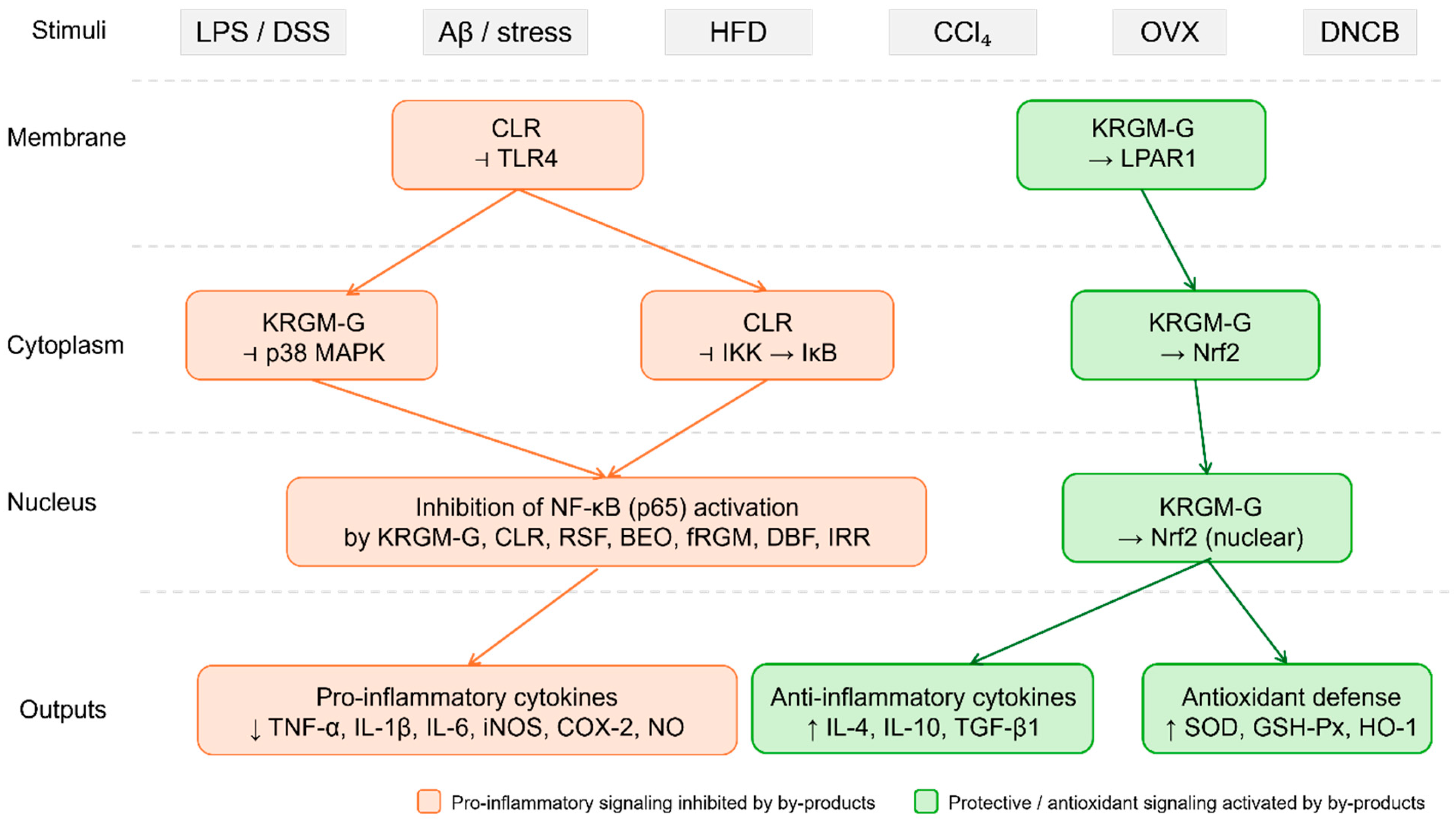
| Ha et al. [21] | Panax ginseng | KRGM-derived gintonin (KRGM-G) | 5xFAD transgenic mice/Alzheimer’s disease | Oral 50 & 100 mg/kg, 4 months | Cognitive function restored; Abeta ↓; IL-1 beta, IL-6, TNF-alpha, COX-2, iNOS ↓; Nrf2 ↑, HO-1 ↑; LPAR1 ↑ | HE, IHC, IF (brain) | LPAR1 upregulation → Nrf2/HO-1 activation & p38/NF-κB/STAT3 suppression |
| Yasmin et al. [22] | Panax ginseng | KRGM-derived gintonin | C57BL/6N mice/HFD-induced obesity | Oral 3x/week, 25 weeks | Body weight ↓; plasma TG & TC ↓; BAT UCP1 & HSL ↑; adipose TNF-alpha mRNA ↓ (p < 0.05) | HE, Oil Red O (liver, adipose) | Promotion of BAT thermogenesis; suppression of metabolic inflammation |
| Xu et al. [23] | Curcuma longa | Post-aqueous extraction residue (CLR) | C57BL/6 male mice/Abeta1–42-induced Alzheimer’s disease | Oral 1.2 g/kg, once daily, 3 weeks (CLR group only) | MWM escape latency ↓ (p < 0.01, day 4 onwards); Iba-1 (microglia) ↓ (p < 0.01); TLR4 mRNA & protein ↓; p-IKK, p-IkB, p-p65 ↓ (p < 0.01); IL-6, TNF-alpha, iNOS, COX-2 ↓; IL-4, IL-10, TGF-beta1 ↑; curcuminoids 16.5–19.94 mg/g confirmed in CLR | HE, Nissl, IHC, IF (brain) | Curcuminoid retention in CLR → TLR4/NF-κB pathway suppression → inhibition of microglial overactivation |
| Zhang et al. [24] | Periplaneta americana | Cold-maceration residue water extract (WEoPa) | KM mice & SD rats/CCl4, alcohol, APAP-induced hepatic injury | Oral 32.75–75.78 mg/kg, 10 days (acute); 7 weeks (chronic) | AST & ALT ↓ (p < 0.05–0.01); hepatic MDA ↓ (p < 0.05); thymus index ↑ | — | Antioxidant hepatoprotection; immunomodulation |
| Gao et al. [25] | Brucea javanica | Oil-extraction residue EtOH extract (DBF) | BALB/c mice/3% DSS-induced ulcerative colitis | Oral 100 mg/kg, 7 days | DAI ↓; colon length preserved; TNF-alpha, IL-1 beta, IFN-gamma ↓ (p < 0.01) | HE (colon) | Pro-inflammatory cytokine suppression |
| An et al. [26] | Scutellaria baicalensis | Lactobacillus plantarum-fermented residue | Weaned piglets/Growth & immune model | Dietary 2 kg/t, 28 days | T-SOD ↑ 40.52% (p < 0.05); MDA ↓ 62.97% (p < 0.05); IgG ↑ 42.08%, IL-4 ↑ 38.28% (p < 0.05); E. coli ↓, Lactobacillus ↑; diarrhea ↓; safety confirmed (acute & chronic toxicity) | — | Biotransformation of L. plantarum fermentation; antioxidant enzyme activation; immune enhancement |
| Chen et al. [27] | Isatis indigotica | Water decoction residue (IRR) | Weaned piglets/Normal growth & intestinal health | Dietary 1.0%, 28 days | Diarrhea ↓ (p < 0.001); villus height ↑; IL-6 & TNF-alpha ↓ (p < 0.05); Claudin-1 ↑; Campylobacter ↓ | HE, AB-PAS (intestine) | Intestinal barrier reinforcement; pro-inflammatory cytokine suppression |
| Kim, Lee & Choi [28] | Panax ginseng | Dried red ginseng marc (RGM) | Broiler chickens/Growth model | Dietary 1–3%, 35 days | TBARS ↓ (0.051→0.033 mg MA/kg, p < 0.001); TC, LDL, TG ↓ (p < 0.05) | — | Radical scavenging by Ginsenoside; inhibition of cholesterol absorption |
| Liu et al. [29] | Astragalus membranaceus | Se-enriched yeast fermentation product | SD rats/STZ+CP-induced diabetes & immunosuppression | Oral, 0.5 g/kg, 4 weeks | FBG ↓, INS ↑, WBC ↑, IgG ↑, IL-2 ↑ (p < 0.05); islet recovery | HE (pancreas) | Se-mediated antioxidant; immune restoration |
| Zhou et al. [30] | Epimedium spp. | Water-extraction residue (marc) | SD rats/OVX-induced osteoporosis | Oral 0.5 g/kg, 8 weeks | BV, BS, Tb.N ↑; 0.5 g/kg residue > water extract for BS, Tb.N, Tb.Th, Tb.Sp (p < 0.05) | Micro-CT (bone) | Residual flavonoid-mediated regulation of bone metabolism |
| Gong et al. [31] | Astragalus membranaceus | Dried residue marc (air-dried, 40-mesh powder) | African young ostriches/Growth & antioxidant model | Dietary 0.5–2%, 80 days | Serum & liver SOD ↑, GSH-Px ↑, CAT ↑, MDA ↓ (p < 0.05); TG ↓, LDL ↓, HDL ↑ (p < 0.05) | — | Residual polysaccharide & flavonoid; antioxidant enzyme activation; lipid metabolism |
| Yu et al. [32] | Dioscorea polystachya | Purified residue protein (DP1, ~12 kDa) | SD rats/Hydrocortisone-induced erectile dysfunction | Oral gavage, 0.3/0.6/0.9 mg/kg, 10 days | SOD ↑, MDA ↓, ROS ↓, 8-OHdG ↓; IL-6 & IL-1 beta ↓; NLRP3, ASC, Caspase-1 ↓; NO & cGMP ↑ (p < 0.01) | IF (penile tissue) | TXNIP/NLRP3 inflammasome inhibition; PI3K/Akt/eNOS pathway restoration |
| Domain | Categories Identified | Examples | Implication for Interpretation |
|---|---|---|---|
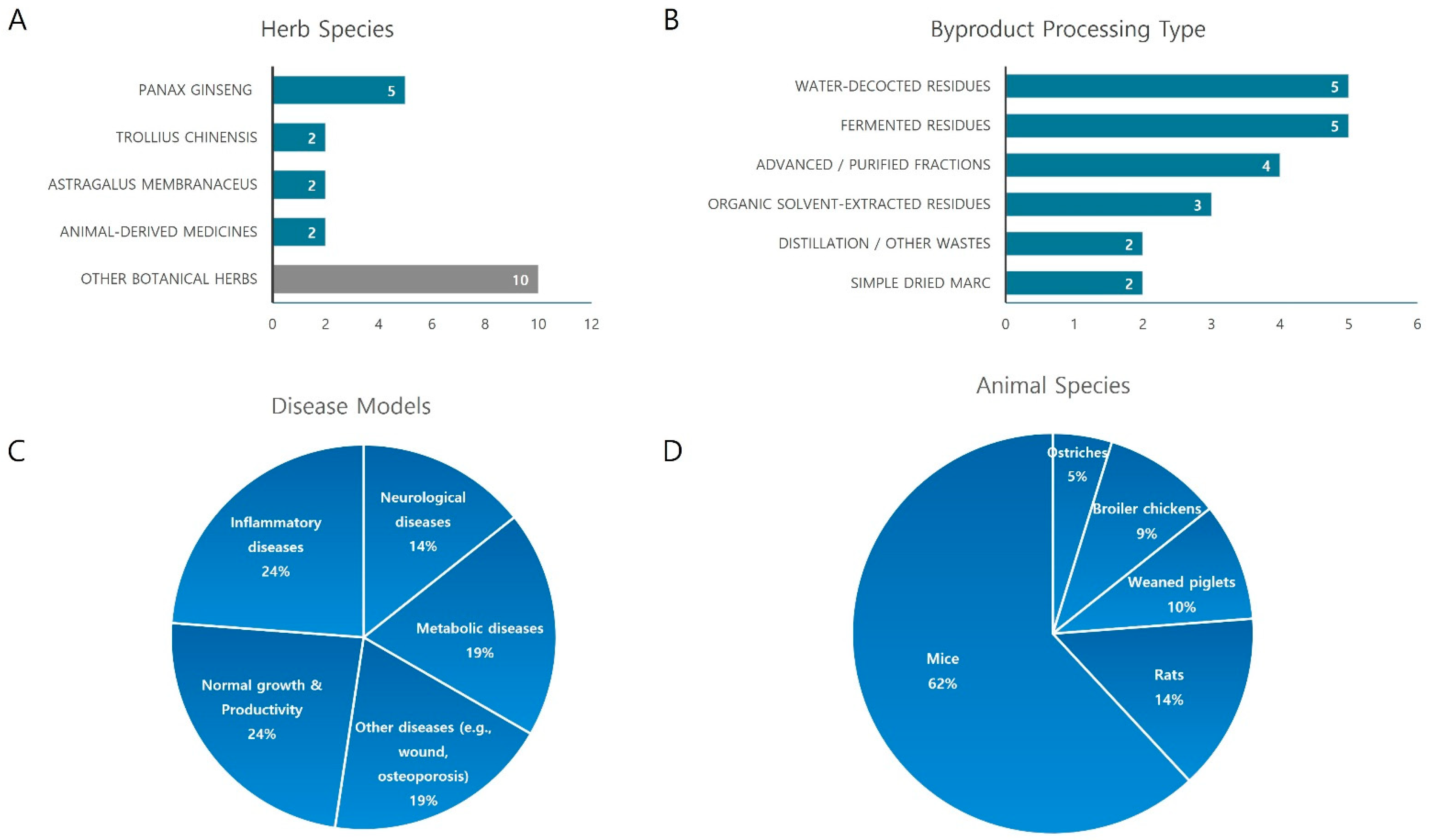
| Herbal species | 15 distinct herbal medicines | Sophora flavescens, Panax ginseng, Curcuma longa, Epimedium, Scutellaria baicalensis, Trollius chinensis, and others | Different phytochemical profiles limit direct comparison across studies and restrict mechanistic attribution to individual herbal materials. |
| By-product type | Multiple processing-derived by-product categories | Water-decocted marc, fermented residue, ethanol-extracted marc, high-temperature/high-pressure (HTHP)-processed residue, and distillation by-product | Processing conditions may substantially alter residual constituent profiles and biological activity. |
| Experimental model | Multiple disease or functional models | Acute inflammation, atopic dermatitis, Alzheimer’s disease, obesity, hyperlipidaemia, hepatic injury, intestinal inflammation, wound healing, and bone loss | Outcomes are not directly comparable across disease contexts, limiting cross-study synthesis. |
| Animal species and strains | 5 animal species, with multiple rodent strains | ICR, C57BL/6, and KM mice; Sprague-Dawley rats; broiler chickens; weaned piglets; and ostriches | Species- and strain-specific physiology and pharmacokinetics may limit cross-study generalisation. |
| Dose and administration route | Wide variation in dose and route | Oral administration, topical application, intravaginal administration, and dietary admixture; doses ranged from 0.3 mg/kg to 9% dietary supplementation | Dose–response relationships cannot be compared across studies. |
| Intervention duration | 5 days to 25 weeks | Short-term acute models (e.g., 5 days for RSF) and longer-term chronic models (e.g., 4 months for KRGM-G in Alzheimer’s disease) | Short-term and long-term models reflect different biological contexts and are not directly comparable. |
| Outcome measures | Diverse molecular, histological, behavioural, and functional endpoints | Cytokine levels, antioxidant enzymes, histopathology, behavioural tests, bone morphometry, lipid profiles, and intestinal barrier-related markers | No common primary outcome was available, making quantitative synthesis inappropriate. |
| Chemical characterisation | Inconsistent depth of constituent analysis | Some studies reported HPLC profiling or relatively defined fractions/compounds (e.g., Curcuma longa residue curcuminoids, gintonin, DP1 protein, polysaccharide fractions); many studies used crude extracts without quantitative standardisation | Active constituents and quality-control standards remain insufficiently defined in many studies. |
Disclaimer/Publisher’s Note: The statements, opinions and data contained in all publications are solely those of the individual author(s) and contributor(s) and not of MDPI and/or the editor(s). MDPI and/or the editor(s) disclaim responsibility for any injury to people or property resulting from any ideas, methods, instructions or products referred to in the content. |
© 2026 by the authors. Licensee MDPI, Basel, Switzerland. This article is an open access article distributed under the terms and conditions of the Creative Commons Attribution (CC BY) license.
Share and Cite
Hwang, J.H.; Jung, J.-H. Herbal Medicine Processing By-Products as Bioactive Resources: In Vivo Evidence for Antioxidant, Anti-Inflammatory, and Immunomodulatory Effects. Molecules 2026, 31, 2516. https://doi.org/10.3390/molecules31142516
Hwang JH, Jung J-H. Herbal Medicine Processing By-Products as Bioactive Resources: In Vivo Evidence for Antioxidant, Anti-Inflammatory, and Immunomodulatory Effects. Molecules. 2026; 31(14):2516. https://doi.org/10.3390/molecules31142516
Chicago/Turabian StyleHwang, Ji Hye, and Jin-Ho Jung. 2026. "Herbal Medicine Processing By-Products as Bioactive Resources: In Vivo Evidence for Antioxidant, Anti-Inflammatory, and Immunomodulatory Effects" Molecules 31, no. 14: 2516. https://doi.org/10.3390/molecules31142516
APA StyleHwang, J. H., & Jung, J.-H. (2026). Herbal Medicine Processing By-Products as Bioactive Resources: In Vivo Evidence for Antioxidant, Anti-Inflammatory, and Immunomodulatory Effects. Molecules, 31(14), 2516. https://doi.org/10.3390/molecules31142516