This is an early access version, the complete PDF, HTML, and XML versions will be available soon.
Review

Edible and Medicinal Mushrooms as Sources of Bioactive Molecules in Pregnancy: Potential Impact on Preeclampsia and Gestational Diabetes Outcomes


1
Department of Obstetrics and Gynecology, Faculty of Medicine, University of Novi Sad, 21000 Novi Sad, Serbia
2
Department of Obstetrics and Gynecology, University Clinical Centre of Vojvodina, 21000 Novi Sad, Serbia
3
ProFungi Laboratory, Department of Biology and Ecology, Faculty of Sciences, University of Novi Sad, Trg Dositeja Obradovića 2, 21000 Novi Sad, Serbia
4
Department of Chemistry, Biochemistry and Environmental Protection, Faculty of Sciences, University of Novi Sad, Trg Dositeja Obradovića 3, 21000 Novi Sad, Serbia
*
Author to whom correspondence should be addressed.
Molecules 2026, 31(13), 2355; https://doi.org/10.3390/molecules31132355 (registering DOI)

Submission received: 1 June 2026 / Revised: 29 June 2026 / Accepted: 1 July 2026 / Published: 3 July 2026

Abstract

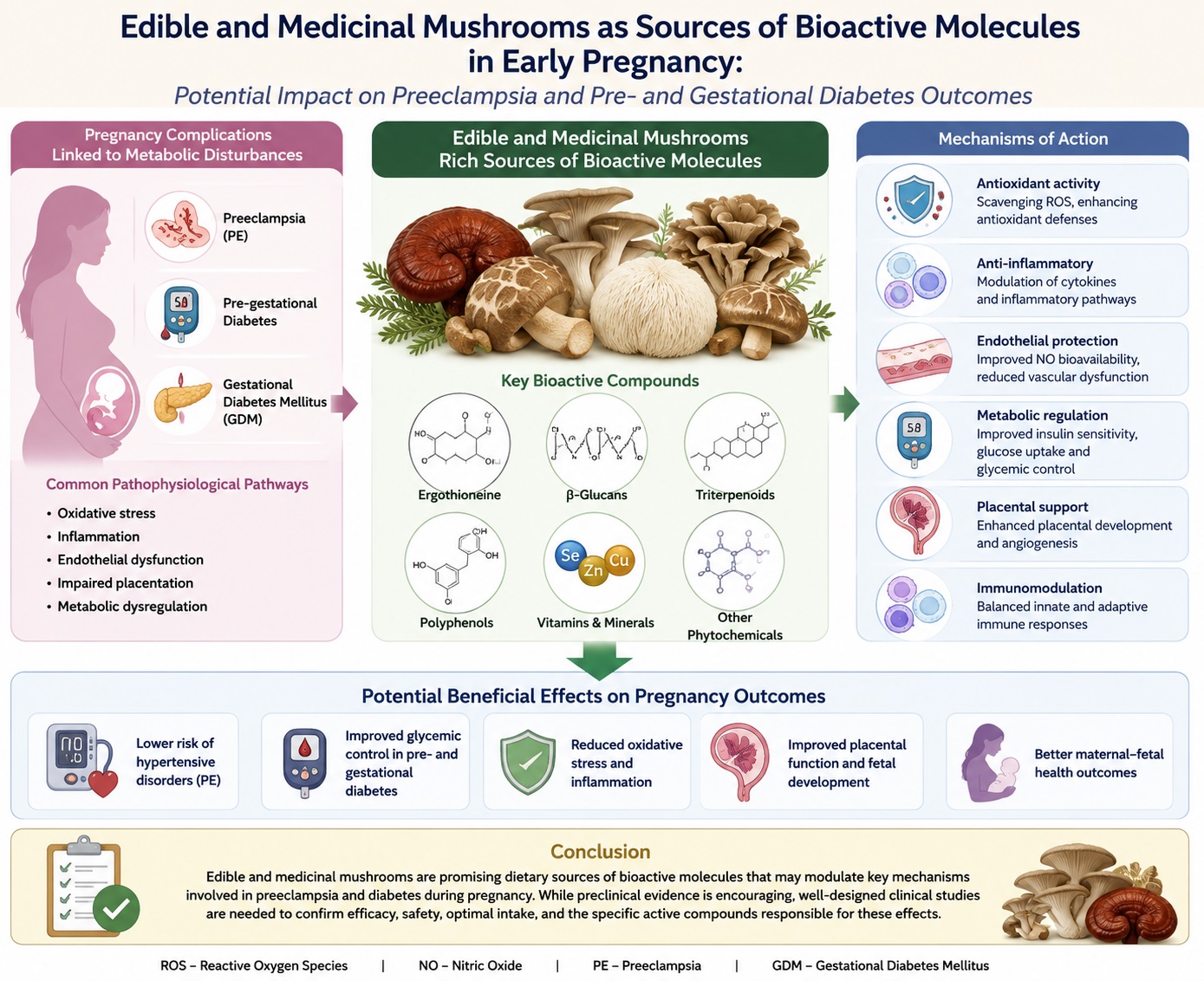
Pregnancy involves profound metabolic, hormonal, and immunological adaptations essential for fetal development; however, disturbances may lead to complications such as preeclampsia (PE), pre-gestational diabetes, and gestational diabetes mellitus (GDM). These conditions are closely linked to oxidative stress, inflammation, endothelial dysfunction, impaired placentation, and metabolic dysregulation. Consequently, dietary strategies capable of modulating these pathways are of increasing interest. Edible and medicinal mushrooms are widely studied as functional food due to the content of bioactive compounds with antioxidant, anti-inflammatory, immunomodulatory, and metabolic regulatory effects. This review summarizes the nutritional composition of mushrooms and highlights key bioactive constituents with antioxidant and metabolic regulatory properties. Among them, ergothioneine has emerged as a key molecule due to its potent redox-buffering capacity and its potential involvement in the activation of the Nrf2 signaling pathway, a master regulator of cellular antioxidant defense. Through modulation of Nrf2-dependent gene expression, mushroom-derived compounds may contribute to improved cellular resilience against oxidative damage relevant to PE and GDM pathophysiology. Mushroom consumption has additionally been associated with improved glycemic control and enhanced antioxidant defenses in experimental and limited clinical studies, although evidence regarding the prevention or management of hypertensive and metabolic pregnancy complications remains insufficient. Although preclinical findings are promising, clinical evidence remains limited. Further well-designed prospective studies and randomized controlled trials are required to determine efficacy, safety, optimal intake, and active compounds responsible for these effects. Nevertheless, current evidence supports the biological plausibility that edible and medicinal mushrooms are promising dietary modulators of the ergothioneine–Nrf2 axis with potential relevance for maternal–fetal health.
Keywords: edible mushrooms; medicinal mushrooms; ergothioneine; antioxidants; oxidative stress; pregnancy; preeclampsia; gestational diabetes mellitus; maternal health; functional foods edible mushrooms; medicinal mushrooms; ergothioneine; antioxidants; oxidative stress; pregnancy; preeclampsia; gestational diabetes mellitus; maternal health; functional foods
Graphical Abstract