


Abstract
Novel steroidal heterocyclic derivatives were prepared from cholesterol, stigmasterol, and diosgenin scaffolds via concise, reagent-efficient synthetic routes. Two 1,3-oxathiolan-5-one derivatives bearing cholest-5-ene (7) and stigmasta-5,22-diene (8) cores were obtained from the corresponding steroidal ketones through hydrazone formation, phenyl isothiocyanate addition, and S-selective cyclization with chloroacetic acid in refluxing toluene. An aminothiazole–diosgenin hybrid (12) was independently prepared via regioselective α-bromination of an oxidized diosgenin intermediate followed by condensation with thiourea in ethanolic sodium ethoxide. The newly synthesized target compounds were characterized by FT-IR, 1H- and 13C-NMR spectroscopy, ESI mass spectrometry, and elemental (CHNS) analysis. The disc-diffusion assay against S. aureus and E. coli was retained only as a preliminary qualitative screen because no positive antibiotic control or MIC determination was included. Within this limited screen, compound 12 produced measurable 8.5–9.0 mm inhibition zones against both strains, supporting their prioritization for future standardized antimicrobial testing rather than establishing comparative potency.
1. Introduction
Steroids are structurally privileged scaffolds in medicinal chemistry, owing to their rigid polycyclic framework, metabolic stability, and inherent affinity for biological membranes and receptors [1,2]. The incorporation of heterocyclic motifs into steroidal frameworks has emerged as a productive strategy in drug design, since roughly two-thirds of approved small-molecule drugs contain heterocyclic rings [3,4,5]. Fusing nitrogen-, oxygen-, or sulfur-containing heterocycles to the A-ring of the steroid core has been shown to substantially modulate biological activity, yielding derivatives with antimicrobial, anti-inflammatory, antitumor, and enzyme-inhibitory profiles [6,7,8].
Among the steroidal scaffolds of synthetic interest, cholesterol, stigmasterol, and diosgenin are particularly attractive starting materials: they are inexpensive, commercially available in bulk, and carry well-defined stereochemistry that can be exploited in asymmetric synthesis. Stigmasterol, a plant phytosterol with documented cholesterol-lowering effects, and diosgenin, a spirostan-type sapogenin serving as the industrial precursor to numerous steroidal drugs, have been extensively derivatized [9,10,11,12,13,14]. Spirostan-type scaffolds have attracted particular attention as precursors to potent anticancer molecules, including the saponin OSW-1, and bis-steroidal natural products such as cephalostatins and ritterazines exhibit exceptional cytotoxicity toward human tumor cell lines [15].
Sulfur-containing heterocycles, in particular thiazoles, oxathiolanes, and related S/O-fused rings, represent a pharmacologically important class of compounds with well-documented antimicrobial activity [13,14]. The thiazole ring is present in several clinically used antibiotics, and its incorporation into steroidal frameworks has been reported to confer enhanced activity against both Gram-positive and Gram-negative bacteria [13,14]. Similarly, 1,3-oxathiolan-5-one (oxathiolanone) lactones are relatively underexplored in the steroidal context, and their synthesis from readily available steroid precursors has not been systematically reported.
In continuation of our interest in steroidal and related heterocyclic chemistry, we report here the synthesis of two novel 1,3-oxathiolan-5-one lactone derivatives bearing cholestane (7) and stigmastane (8) cores, prepared via an S-selective cyclization of steroidal carbothioamide intermediates with chloroacetic acid. In addition, we report the synthesis of an aminothiazole–diosgenin hybrid (12) via condensation of an α-bromoketone derived from diosgenin with thiourea. The key synthetic novelty lies in the S-alkylation/lactonization pathway leading to compounds 7 and 8, which represents a previously unreported route to oxathiolanone-appended steroidal frameworks. All new compounds were characterized spectroscopically and evaluated in a preliminary disc-diffusion antimicrobial screen against S. aureus and E. coli; the biological data are interpreted only as exploratory because no positive antibiotic control or MIC values were obtained.
2. Results and Discussion
2.1. Synthesis of Hydrazone Derivatives 3 and 4
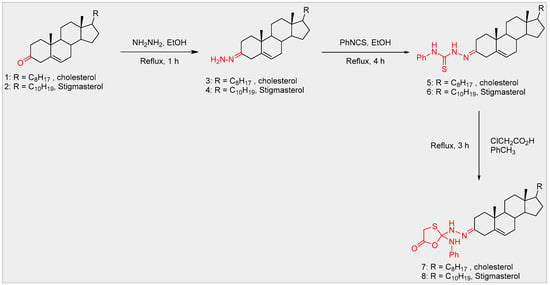
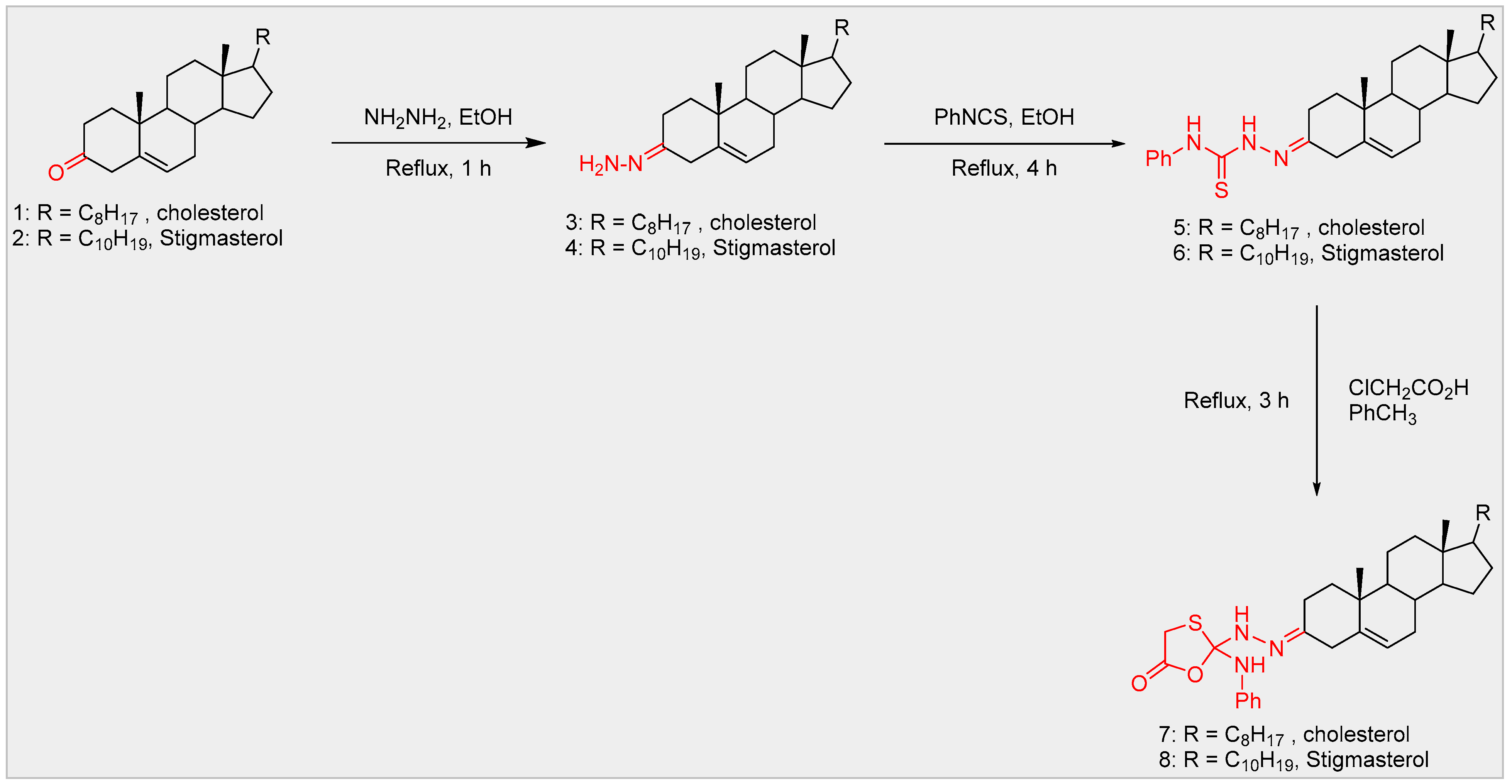
Cholest-5-en-3-one (1) and stigmast-5,22-dien-3-one (2) were prepared by PCC oxidation of cholesterol and stigmasterol, respectively, following literature procedures [16]. Treatment of 1 and 2 with hydrazine hydrate in ethanol in the presence of triethylamine afforded the corresponding hydrazone derivatives 3 and 4, in line with related steroidal hydrazone chemistry [17]. Good yields were obtained (75% and 70%, respectively) after column chromatography (Scheme 1). Reaction progress was monitored by TLC (EtOAc/hexane, 10:90, v/v).
Scheme 1.
Synthetic route to hydrazone derivatives 3,4, thiocarbamoyl adducts 5,6, and cyclized 1,3-oxathiolan-5-one (lactone) products 7,8.
Compound 3 was characterized by a D2O-exchangeable NH2 singlet at δ 5.95 ppm and a broad singlet at δ 5.33 ppm for the olefinic C-6 proton; the 13C-NMR spectrum confirmed hydrazone formation through the imine carbon signal at δ 155.1 ppm. Compound 4 showed the same key features, with the NH2 signal shifted to δ 5.84 ppm and an additional multiplet at δ 5.16–4.99 ppm from the C-22 and C-23 olefinic protons of the stigmastane side chain. Elemental analysis for both compounds agreed with the calculated values.
2.2. Synthesis of Carbothioamide Intermediates 5 and 6
Hydrazones 3 and 4 were reacted with phenyl isothiocyanate (1.0 equiv.) in refluxing ethanol to afford the acyclic carbothioamide adducts 5 and 6 in 32% and 61% yield, respectively. The 1H-NMR spectrum of 5 showed two D2O-exchangeable N–H signals at δ 9.33 (d, 1H, N–H adjacent to the C=N group) and δ 8.87–8.92 (m, 1H, N–H adjacent to the phenyl group), with 13C-NMR signals at δ 175.0 (C=S), 157.4 (C=N), and 124.1–129.1 ppm (aromatic carbons). The spectrum of 6 showed the same N–H pattern, together with the expected C-22/C-23 olefinic proton multiplet at δ 5.16−4.99 ppm and additional 13C signals at δ 138.0 (C-22) and 129.7 (C-23) ppm, confirming retention of the stigmastane Δ22,23 double bond. Elemental analysis for both compounds agreed within 0.4% nitrogen of the calculated values.
2.3. Synthesis of 1,3-Oxathiolan-5-one Lactones 7 and 8
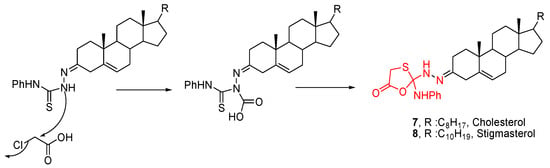
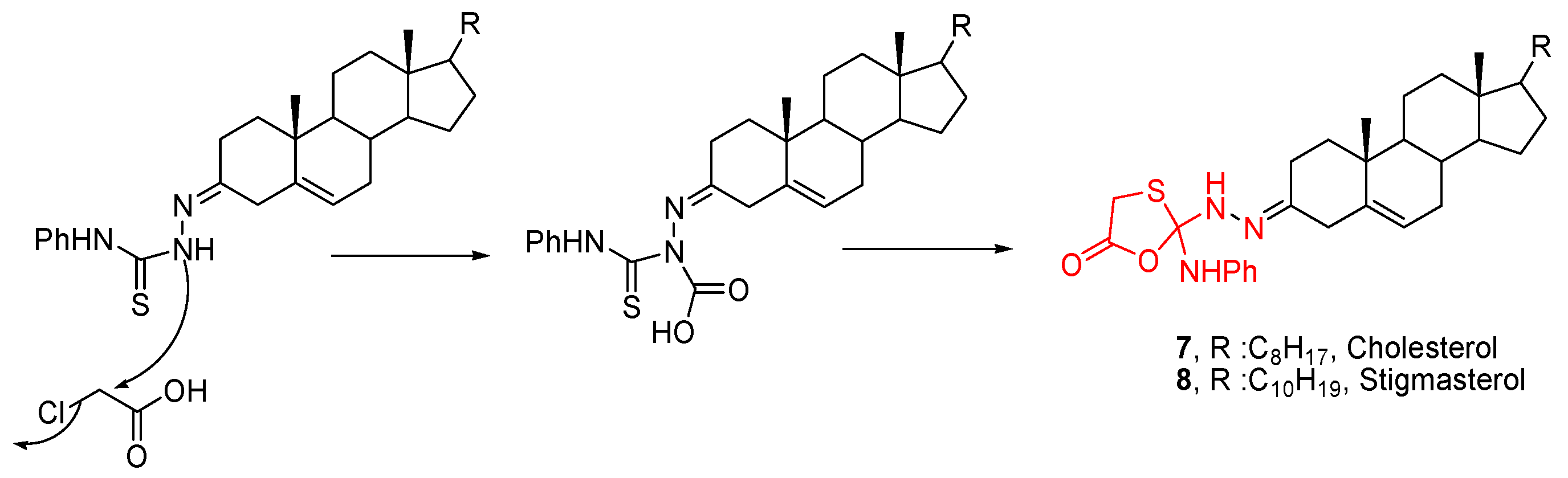
Intermediates 5 and 6 were cyclized with chloroacetic acid in refluxing toluene to investigate fused heterocycle formation on the steroid A-ring. Two pathways were possible: N-alkylation of the terminal N–H to give a thiazolidin-4-one ring, or S-alkylation of the thioamide sulfur followed by intramolecular lactonization to give a 1,3-oxathiolan-5-one (Scheme 2). The latter pathway is chemically reasonable because the softer thioamide sulfur is expected to react preferentially with the electrophilic methylene carbon of chloroacetic acid, followed by intramolecular O-acylation to give lactones 7 and 8 in 50% and 54% yield, respectively. Close steroidal precedents for this lactone-forming transformation appear limited, and compounds 7 and 8 were sufficiently stable for isolation, purification, and acquisition of FT-IR, NMR, ESI-MS, and elemental-analysis data under the reported laboratory conditions.
Scheme 2.
Proposed mechanism for the S-carboxymethylation/cyclization step of intermediates 5 and 6 with chloroacetic acid to give 1,3-oxathiolan-5-one (lactone) products 7 and 8.
The 1,3-oxathiolan-5-one assignment, rather than the thiazolidin-4-one regioisomer, is supported by the available orthogonal spectral and analytical data. First, the FT-IR C=O stretching absorptions at 1728 cm−1 (7) and 1722 cm−1 (8) are consistent with lactone carbonyl absorption. Second, the 13C-NMR lactone carbonyl resonances at δ 177.9 (7) and 172.9 ppm (8) support the formation of an ester-type carbonyl environment. Third, both compounds retain two D2O-exchangeable N–H protons (7: δ 8.24 and 4.24 ppm; 8: δ 7.34 and 4.10 ppm), which is consistent with S- rather than N-participation in ring closure. Fourth, the –SCH2CO– methylene singlet at δ 4.12–4.14 ppm (2H), together with ESI-MS molecular-ion peaks (7: m/z 592 [M + H]+; 8: m/z 618 [M + H]+) and satisfactory CHNS analyses, supports the proposed structures. Unfortunately, 2D NMR experiments could not be performed because the appropriate probe was unavailable.
2.4. Synthesis of Aminothiazole–Diosgenin Hybrid 12
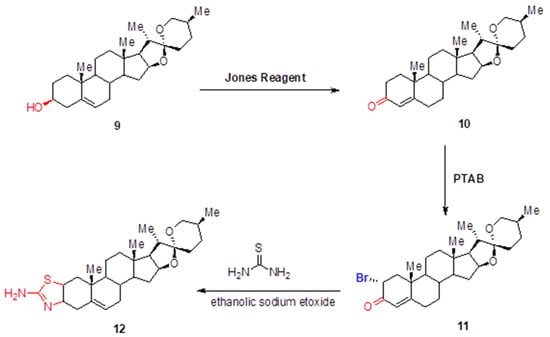
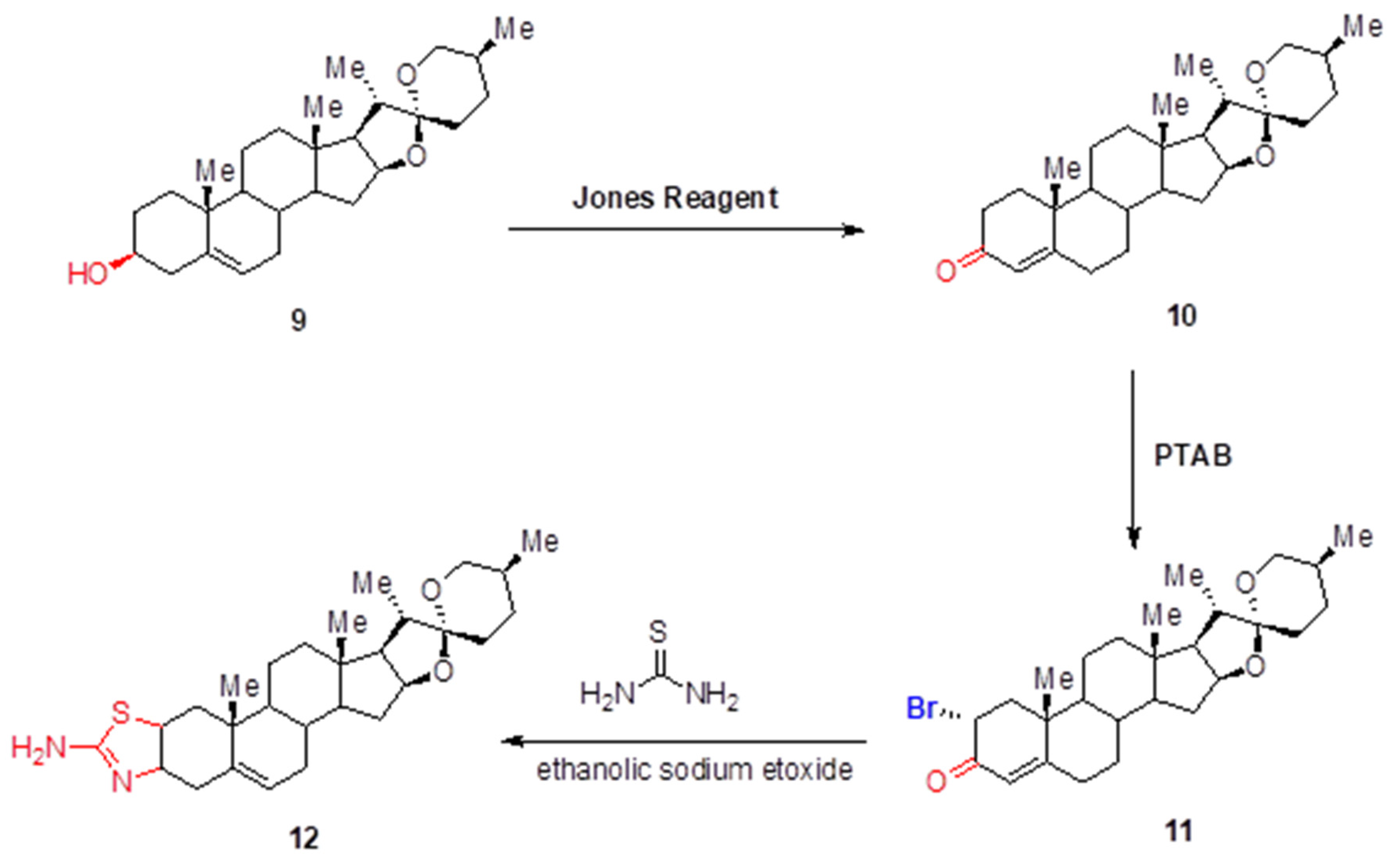
Thiazole-containing heterocycles have attracted steady interest in medicinal chemistry for their antimicrobial and antitumor activities. To complement the oxathiolanone series, an aminothiazole–diosgenin hybrid was prepared by an independent route. Therefore, treatment of ketone 10 with phenyltrimethylammonium tribromide (PTAB) resulted in selective bromination, yielding α-bromo ketone 11 as the thermodynamic product. The spectral data obtained for 11 were consistent with those reported previously in the literature [12,18]. Condensation of 11 with thiourea in ethanolic sodium ethoxide under reflux then gave the target aminothiazole–diosgenin hybrid 12 (Scheme 3) [13,14].
Scheme 3.
Synthesis of aminothiazole-diosgenin 12.
The 1H-NMR spectrum of 12 (DMSO-d6) showed a D2O-exchangeable NH2 singlet at δ 5.92 ppm and a doublet at δ 5.37 ppm (J = 5.42 Hz) for the C-6 olefinic proton. The 13C-NMR spectrum displayed the aminothiazole C-2 carbon (S–C=N) at δ 163.3 ppm along with characteristic diosgenin spiroketal signals at δ 107.0 (C-22) and 68.9 ppm (C-26). ESI-MS (m/z 471 [M + H]+) and elemental analysis confirmed the structure.
2.5. Preliminary Antimicrobial Activity
Compounds 7, 8, and 12 were evaluated in a preliminary qualitative disc-diffusion assay against S. aureus ATCC 25923 and E. coli ATCC 25922 to obtain an initial indication of their biological relevance (Table 1). DMSO was used as the negative control at 6.3 μL/disc. After incubation, inhibition zones were measured in millimeters. No positive antibiotic control was included, and MIC values were not determined; therefore, the assay was used only as an exploratory screen and cannot validate assay sensitivity, establish potency, or support direct comparison with standard antimicrobial agents. The modest difference between compounds 7 and 8 may reflect the influence of the steroidal core, including the C-22/C-23 side-chain unsaturation in 8, although systematic dose–response studies are required before any structure–activity relationship can be established. Within this limited qualitative screen, compounds 7 and 12 gave the largest inhibition zones and may therefore be prioritized for MIC determination, positive-control benchmarking, and broader antimicrobial evaluation.
Table 1.
Zone of inhibition (mm) for selected compounds against E. coli and S. aureus by disc-diffusion screening; values are reported as mean ± SD from three independent measurements.
3. Materials and Methods
3.1. Materials and Physical Measurements
All reagents and chemicals were purchased from commercial suppliers and used without further purification unless noted otherwise. Solvents were dried and distilled using standard drying agents and procedures. Melting points (mp) were measured using an electrothermal digital (IA9000) apparatus (Rochford, Essex, UK). FT-IR spectra were conducted on a JASCO FT-IR (Tokyo, Japan) spectrophotometer using KBr discs or CHCl3 solutions as indicated. 1H- and 13C-NMR analyses were conducted on a 400 MHz Bruker AVANCE spectrometer (Rheinstetten, Germany). Chemical shifts (δ) were given in ppm with tetramethylsilane (TMS) used as the internal reference. Mass spectrometric measurements (MS) were conducted using an LC-MSD spectrometer (Trap-00125) equipped with an ion source (ESI type) (Agilent Technologies, Santa Clara, CA, USA). Monitoring the reaction progress was achieved by thin-layer chromatography (TLC) prepared on silica gel plates of 60 F254. Elemental analyses (C, H, N, S) were conducted using a EuroEA Elemental Analyzer (Milan, Italy). S. aureus (ATCC 25923) and E. coli (ATCC 25922) were obtained from the American Type Culture Collection (ATCC, Manassas, VA, USA).
3.2. General Procedure for the Preparation of Hydrazone Derivatives 3 and 4
Hydrazine hydrate (3.0 mL) and triethylamine (NEt3, 1.0 mL) were added to a solution of 1.0 mmol ketone 1 or 2 in EtOH (96%, 5 mL). The mixture was stirred under reflux for 1 h. After cooling to ambient temperature, the solvent was evaporated under vacuum, giving a yellow precipitate. The crude product was taken up in absolute EtOH and filtered. The filtrate was concentrated under reduced pressure to give a yellow solid, which was washed with water and purified by column chromatography to afford products 3 or 4.
3.3. General Procedure for the Reaction of Hydrazones with Phenyl Isothiocyanate (5 and 6)
In 30 mL of ethanol, a mixture of compounds 3 or 4 (0.005 mol) and phenyl isothiocyanate (0.67 g, 0.005 mol) was refluxed for 4 h. After completion, the solvent was removed under reduced pressure. The resulting semisolid residue was recrystallized from EtOH and then refined by flash chromatography to give compounds 5 and 6 as pale-yellow powders.
3.4. General Procedure for the Cyclization of 5 and 6 with Chloroacetic Acid to Afford 7 and 8 (1,3-Oxathiolan-5-one Lactones)
A toluene solution of compound 5 or 6 (0.375 mmol, 10 mL) was combined with a solution of chloroacetic acid (0.749 mmol) in dry toluene (10 mL). The mixture was refluxed for 3 h, then concentrated under vacuum. The resulting solid was isolated and recrystallized from ethanol to give compounds 7 and 8.
3.5. Synthesis of Intermediates 10 and 11 and Target Aminothiazolyl Derivative 12
At 10 °C, compound 10 was obtained from compound 9 (1.0 g, 2.41 mmol) via Jones oxidation in acetone (50 mL). The reaction was maintained below 20 °C and stirred for 30 min, then washed with brine and extracted with CHCl3 (3 × 25 mL). The combined organic extracts were dried over anhydrous Na2SO4 and concentrated under reduced pressure. Purification of the crude product by column chromatography (20% EtOAc/hexane) provided compound 10 as a white solid (Yield: 0.95 g, 95%); mp 193–194 °C (lit. mp 194–196 °C [10]).
Compound 11 was prepared by adding a solution of phenyltrimethylammonium tribromide (PTAB, 0.23 g, 0.63 mmol, 1.3 equiv.) in THF (7 mL) rapidly to a THF solution (20 mL) of compound 10 (0.20 g, 0.48 mmol) at 20 °C. An orange mixture was obtained, which quickly produced a heavy precipitate and changed to a beige-colored suspension within approximately 6 min. The reaction was then quenched with 10 mL of brine and extracted with CHCl3 (2 × 20 mL). The combined organic phases were dried over anhydrous Na2SO4, concentrated under reduced pressure, and purified by column chromatography (15% EtOAc/hexane) to afford compound 11 as a white solid; mp 159–161 °C (lit. mp 160–163 °C [12,18]).
To prepare compound 12, compound 11 (0.34 g, 0.69 mmol) was added to a freshly prepared sodium ethoxide solution (0.25 mol L−1, prepared by dissolving sodium metal (0.23 g, 10 mmol) in absolute ethanol (40 mL)) [13], followed by thiourea (0.7 g, 9.0 mmol). The reaction mixture was refluxed for approximately 24 h and then concentrated under reduced pressure. The crude material was purified by recrystallization from ethanol followed by column chromatography using 20% EtOAc/hexane, yielding compound 12 as a pale-yellow solid (0.27 g, 57%).
3.6. Characterization Data
Compound 3: 0.31 g (75%), mp 245–247 °C. FT-IR (KBr, cm−1): 3297, 3057, 2943, 2908, 2868, 2852, 1655, 1606, 1542, 1497, 1256. 1H-NMR (400 MHz, CDCl3) δ (ppm): 5.95 (s, 2H, NH2, D2O exchangeable), 5.33 (br s, 1H, C-6), 2.84 (dd, 2H, C-4, JHH = 16.4, 2.4 Hz), 2.53 (m, 1H, C-2β-H), 2.26 (m, 1H, C-2α-H), 1.98 (s, 3H, C-21), 1.20 (s, 3H, C-19), 0.71 (s, 3H, C-18). 13C-NMR (CDCl3) δ (ppm): 155.1 (C-3, C=N), 144.1 (C-5), 125.2 (C-6), 58.5 (C-17), 56.0 (C-14), 48.8 (C-9), 40.9 (C-13), 36.8 (C-20), 36.4 (C-10), 36.1 (C-1), 36.1 (C-12), 35.4 (C-24), 35.2 (C-4), 34.1 (C-23), 33.8 (C-7), 33.1 (C-22), 31.1 (C-25), 30.9 (C-8), 27.9 (C-16), 25.4 (C-2), 25.1 (C-15), 21.0 (C-21), 21.0 (C-11), 20.7 (C-19), 20.0 (C-26), 16.9 (C-27), 12.1 (C-18). Anal. Calc. for C27H46N2 (398.67): C, 81.34%; H, 11.63%; N, 7.03%. Found: C, 81.14%; H, 11.58%; N, 7.34%.
Compound 4: 0.30 g (70%), mp 248−249 °C. FT-IR (KBr, cm−1): 3277, 3067, 2953, 2928, 2892, 2808, 1625, 1616, 1552, 1477, 1266. 1H-NMR (400 MHz, CDCl3) δ (ppm): 5.84 (s, 2H, NH2, D2O exchangeable), 5.37 (br s, 1H, C-6), 5.16−4.99 (m, 2H, C-22, 23), 2.79 (dd, 2H, C-4, JHH = 16.4, 2.4 Hz), 2.43 (m, 1H, C-2β-H), 2.21 (m, 1H, C-2α-H), 2.02 (s, 3H, C-21), 1.33 (s, 3H, C-19), 0.73 (s, 3H, C-18). 13C-NMR (CDCl3) δ (ppm): 157.4 (C-3, C=N), 147.1 (C-5), 137.1 (C-22), 129.1 (C-23), 125.2 (C-6), 56.0 (C-14), 55.5 (C-17), 54.4 (C-24), 46.8 (C-9), 42.8 (C-20), 40.9 (C-13), 36.4 (C-10), 36.1 (C-1), 36.1 (C-12), 35.2 (C-4), 33.8 (C-7), 31.1 (C-25), 30.9 (C-8), 27.9 (C-16), 27.1 (C-28), 25.4 (C-2), 25.1 (C-15), 21.3 (C-21), 21.0 (C-11), 21.0 (C-26), 20.7 (C-19), 18.9 (C-27), 12.5 (C-29), 12.1 (C-18). Anal. Calc. for C29H48N2 (424.7): C, 82.01%; H, 11.39%; N, 6.60%. Found: C, 81.84%; H, 11.38%; N, 6.80%.
Compound 5: 0.42 g (32%). mp 148–149 °C. FT-IR (CHCl3, cm−1): 2987, 2870, 1720. 1H-NMR (400 MHz, CDCl3) δ (ppm): 9.33 (d, 1H, NH, D2O exchangeable), 8.87−8.92 (m, 1H, NH, D2O exchangeable), 7.21–7.64 (m, 5H, aromatic protons), 5.84 (br s, 1H, C-6), 2.63 (br s, 2H, C-4), 2.33 (m, 1H, C-2β-H), 2.27 (m, 1H, C-2α-H), 1.82 (s, 3H, C-21), 1.25 (s, 3H, C-19), 0.85 (s, 3H, C-18). 13C-NMR (CDCl3) δ (ppm): 175.0 (C=S), 157.4 (C-3, C=N), 147.7 (C-5), 124.1–129.1 (aromatic carbons), 123.1 (C-6), 57.8 (C-17), 56.2 (C-14), 49.4 (C-9), 40.4 (C-13), 39.1 (C-1), 37.5 (C-12), 36.3 (C-20), 35.9 (C-10), 35.1 (C-24), 34.4 (C-4), 34.7 (C-23), 33.1 (C-7), 33.0 (C-22), 31.8 (C-25), 31.8 (C-8), 28.8 (C-16), 25.3 (C-15), 25.2 (C-2), 21.1 (C-11), 21.0 (C-21), 21.0 (C-26), 19.9 (C-19), 16.7 (C-27), 12.1 (C-18). Anal. Calc. for C34H51N3S (533.86): C, 76.49%; H, 9.63%; N, 7.87%; S, 6.01%. Found: C, 76.19%; H, 9.68%; N, 7.94%; S, 6.14%.
Compound 6: 0.40 g (61%). mp 150–152 °C. FT-IR (CHCl3, cm−1): 3192, 2957, 2870, 1597, 1514. 1H-NMR (400 MHz, CDCl3) δ (ppm): 9.33 (d, 1H, NH, D2O exchangeable), 8.87–8.92 (m, 1H, NH, D2O exchangeable), 7.21–7.64 (m, 5H, aromatic protons), 5.84 (br s, 1H, C-6), 5.16–4.99 (m, 2H, C-22 and C-23), 2.63 (br s, 2H, C-4), 2.33 (m, 1H, C-2β-H), 2.27 (m, 1H, C-2α-H), 1.82 (s, 3H, C-21), 1.25 (s, 3H, C-19), 0.85 (s, 3H, C-18). 13C-NMR (CDCl3) δ (ppm): 175.0 (C=S), 157.4 (C-3, C=N), 147.7 (C-5), 138.0 (C-22), 129.7 (C-23), 124.1 (C-6, overlapping with aromatic carbons), 124.1–129.1 (aromatic carbons), 56.2 (C-14), 55.8 (C-17), 54.1 (C-24), 46.4 (C-9), 42.3 (C-20), 40.4 (C-13), 35.9 (C-10), 37.5 (C-12), 36.3 (C-1), 32.4 (C-4), 33.1 (C-7), 31.8 (C-25), 31.8 (C-8), 28.8 (C-16), 27.0 (C-28), 24.2 (C-2), 25.3 (C-15), 21.0 (C-21), 21.1 (C-11), 21.0 (C-26), 19.9 (C-19), 18.9 (C-27), 12.2 (C-29), 12.1 (C-18). Anal. Calc. for C36H53N3S (559.90): C, 77.23%; H, 9.54%; N, 7.51%; S, 5.73%. Found: C, 76.99%; H, 9.60%; N, 7.71%; S, 5.74%.
Compound 7: 0.11 g (50%). Amorphous solid. FT-IR (KBr, cm−1): 3469, 3269, 3053, 2929, 2867, 1728, 1560. 1H-NMR (400 MHz, CDCl3) δ (ppm): 8.24 (br s, 1H, NH, D2O exchangeable), 7.15–7.55 (m, 5H, aromatic protons), 5.86 (m, 1H, C-6), 4.24 (br s, 1H, NH-Ph, D2O exchangeable), 4.12 (s, 2H, CH2-CO), 2.12 (m, 2H, C-4), 2.10 (m, 1H, C-2β-H), 2.06 (m, 1H, C-2α-H), 1.30 (s, 3H, C-21), 1.15 (s, 3H, C-19), 0.89 (s, 3H, C-18). 13C-NMR (CDCl3) δ (ppm): 177.9 (C=O, lactone), 165.3 (C-3), 148.3 (C-5), 135.0 (quaternary C), 126.0 (C-6, overlapping with aromatic carbons), 120.2–129.2 (aromatic carbons), 58.2 (C-14), 56.3 (C-17), 49.7 (C-9), 41.1 (C-13), 37.7 (C-1), 36.9 (C-20), 35.9 (C-10), 37.0 (C-12), 35.0 (C-24), 34.1 (C-23), 33.1 (C-4), 33.1 (C-7), 32.4 (C-22), 31.0 (C-25), 30.9 (C-8), 28.7 (C-16), 28.2 (CH2–S), 26.1 (C-2), 25.3 (C-15), 21.0 (C-21), 21.1 (C-11), 21.2 (C-26), 22.5 (C-19), 16.7 (C-27), 12.1 (C-18). ESI-MS (m/z): 592 [M + H]+. Anal. Calc. for C36H53N3O2S (591.89): C, 73.05%; H, 9.03%; N, 7.10%; S, 5.42%. Found: C, 73.14%; H, 8.98%; N, 7.54%; S, 5.44%.
Compound 8: 0.12 g (54%). Amorphous solid. FT-IR (KBr, cm−1): 3426, 3269, 3016, 2922, 2867, 1722, 1560. 1H-NMR (400 MHz, CDCl3) δ (ppm): 7.34 (br s, 1H, NH, D2O exchangeable), 7.15–7.26 (m, 5H, aromatic protons), 5.91 (m, 1H, C-6), 4.10 (br s, 1H, NH-Ph, D2O exchangeable), 4.14 (s, 2H, CH2-CO), 2.12 (m, 2H, C-4), 2.10 (m, 1H, C-2β-H), 2.06 (m, 1H, C-2α-H), 1.81 (s, 3H, C-21), 1.25 (s, 3H, C-19), 0.85 (s, 3H, C-18). 13C-NMR (CDCl3) δ (ppm): 172.9 (C=O), 159.3 (C-3), 148.3 (C-5), 137.4 (C-22), 135.0 (quaternary C), 129.2 (C-23, overlapping with aromatic carbons), 126.0 (C-6, overlapping with aromatic carbons), 120.2–129.2 (aromatic carbons), 58.4 (C-14), 56.3 (C-17), 53.6 (C-24), 45.7 (C-9), 41.9 (C-20), 41.4 (C-13), 35.0 (C-10), 37.4 (C-12), 35.7 (C-1), 33.1 (C-4), 33.4 (C-7), 31.0 (C-25), 31.8 (C-8), 29.1 (C-16), 27.0 (C-28), 27.1 (C-2), 25.1 (C-15), 21.0 (C-21), 21.1 (C-11), 21.2 (C-26), 22.5 (C-19), 18.9 (C-27), 12.5 (C-29), 12.1 (C-18). ESI-MS (m/z): 618 [M + H]+. Anal. Calc. for C38H55N3O2S (617.94): C, 73.86%; H, 8.97%; N, 6.80%; S, 5.19%. Found: C, 73.74%; H, 8.98%; N, 7.14%; S, 5.14%.
Compound 12: 0.27 g (57%). Pale-yellow solid, mp 259–262 °C. FT-IR (KBr, cm−1): 3442, 3280−3340, 3053, 2929, 2867, 1632, 1598, 1564, 1524, 1505. 1H-NMR (400 MHz, DMSO-d6) δ: 5.92 (D2O exchangeable, s, 2H, –NH2), 5.37 (d, 1H, J = 5.42 Hz, 6-H), 2.76 (m, 1H, 2α-H), 2.21 (dd, 1H, J = 5.42 Hz, 3α-H), 1.12 (s, 3H, 18-Me), 0.79 (s, 3H, 19-Me). 13C-NMR (DMSO-d6) δ (ppm): 163.3 (S–C=N, C-2 of thiazole), 140.7 (C-5), 121.9 (C-4), 107.0 (spiroketal C-22), 81.1 (C-16), 68.9 (C-26), 63.0 (C-17), 61.1 (C-3), 54.0 (C-14), 52.9 (C-9), 44.1 (C-1), 41.9 (C-20), 39.7 (C-13), 39.8 (C-6), 38.8 (C-12), 33.9 (C-10), 33.0 (C-8), 32.0 (C-15), 31.5 (C-23), 31.2 (C-7), 31.0 (C-25), 28.8 (C-24), 28.4 (C-2), 22.0 (C-11), 17.0 (C-27), 16.5 (C-18), 15.1 (C-21), 12.3 (C-19). ESI-MS (m/z): 471 [M + H]+. Anal. Calc. for C28H42N2O2S (470.71): C, 71.45%; H, 8.99%; N, 5.95%; S, 6.81%. Found: C, 71.92%; H, 8.98%; N, 6.14%; S, 6.44%.
4. Conclusions
Novel steroidal heterocyclic derivatives were synthesized from cholesterol, stigmasterol, and diosgenin via concise, reagent-efficient routes. Two 1,3-oxathiolan-5-one lactone derivatives bearing cholestane (7) and stigmastane (8) cores were obtained through S-selective cyclization of carbothioamide intermediates with chloroacetic acid in refluxing toluene. An aminothiazole–diosgenin hybrid (12) was independently prepared via regioselective α-bromination of an oxidized diosgenin intermediate followed by condensation with thiourea. The newly synthesized target compounds were characterized by FT-IR, 1H- and 13C-NMR spectroscopy, ESI mass spectrometry, and elemental analysis. The preliminary disc-diffusion screen identified compounds 7 and 12 as producing the largest zones in the limited dataset; however, because the assay was conducted without a positive antibiotic control and without MIC determination, these results should be regarded as exploratory only. Future work will require standardized positive-control benchmarking, MIC determination, expanded bacterial panels, and additional 2D/heteronuclear NMR support for key structural assignments.
Author Contributions
Conceptualization, K.Q.S. and A.S.B.; methodology, K.Q.S. and A.S.B.; synthesis and compound characterization, K.Q.S. and A.S.B.; antimicrobial investigation and biological data interpretation, S.Y.J.; resources, K.Q.S., A.S.B., A.E. and S.Y.J.; data curation, A.S.B., A.E. and S.Y.J.; formal analysis, A.S.B., A.E. and S.Y.J.; validation, K.Q.S., A.S.B., A.E. and S.Y.J.; visualization, A.E. and A.S.B.; writing, original draft preparation, K.Q.S.; writing, review and editing, A.S.B., K.Q.S., A.E. and S.Y.J.; supervision, K.Q.S. and A.S.B.; project administration, K.Q.S. and A.S.B. All authors have read and agreed to the published version of the manuscript.
Funding
This research was funded by Jordan University of Science and Technology, grant number 20140291.
Institutional Review Board Statement
Not applicable.
Informed Consent Statement
Not applicable.
Data Availability Statement
The data supporting the findings of this study are available from the corresponding authors upon reasonable request.
Conflicts of Interest
The authors declare no conflicts of interest. The funders had no role in the design of the study; in the collection, analyses, or interpretation of data; in the writing of the manuscript; or in the decision to publish the results.
References
- Ackerman, J.H.; Potts, G.O.; Beyler, A.L.; Clinton, R.O. Steroidal Heterocycles. X. Steroidal[3,2-d]Pyrimidines and Related Compounds. J. Med. Chem. 1964, 7, 238–240. [Google Scholar] [CrossRef] [Scilit] [PubMed]
- Green, B.; Sheu, K. Synthesis of Steroidal D-Ring Fused Pyrazolines: Study of Regiochemistry of Addition. Steroids 1994, 59, 479–484. [Google Scholar] [CrossRef] [Scilit] [PubMed]
- Ward, M.; O’Boyle, N.M. Analysis of the Structural Diversity of Heterocycles amongst European Medicines Agency Approved Pharmaceuticals (2014–2023). RSC Med. Chem. 2025, 16, 4540–4570. [Google Scholar] [CrossRef] [Scilit] [PubMed]
- Marshall, C.M.; Federice, J.G.; Bell, C.N.; Cox, P.B.; Njardarson, J.T. An Update on the Nitrogen Heterocycle Compositions and Properties of U.S. FDA-Approved Pharmaceuticals (2013–2023). J. Med. Chem. 2024, 67, 11622–11655. [Google Scholar] [CrossRef] [Scilit] [PubMed]
- Shearer, J.; Castro, J.L.; Lawson, A.D.G.; MacCoss, M.; Taylor, R.D. Rings in Clinical Trials and Drugs: Present and Future. J. Med. Chem. 2022, 65, 8699–8712. [Google Scholar] [CrossRef] [Scilit] [PubMed]
- Manson, A.J.; Stonner, F.W.; Neumann, H.C.; Christiansen, R.G.; Clarke, R.L.; Ackerman, J.H.; Page, D.F.; Dean, J.W.; Phillips, D.K.; Potts, G.O.; et al. Steroidal Heterocycles. VII. Androstano[2,3-d]Isoxazoles and Related Compounds. J. Med. Chem. 1963, 6, 1–9. [Google Scholar] [CrossRef] [Scilit] [PubMed]
- Camoutsis, C. Steroidal Oxazoles, Oxazolines, and Oxazolidines. J. Heterocycl. Chem. 1996, 33, 539–557. [Google Scholar] [CrossRef] [Scilit]
- Hammouda, M.M.; Elattar, K.M.; Rashed, M.M.; Osman, A.M.A. Synthesis and Biological Activities of Bicyclic Pyridines Integrated Steroid Hybrid. Steroids 2023, 199, 109287. [Google Scholar] [CrossRef] [Scilit] [PubMed]
- Shahabuddin; Kumar, A.; Parveen, M.; Alam, M. Reaction of 7α-Bromo-6-Nitrocholest-5-Enes with Hydrazine: Formation of Steroidal Pyrazolines and Molecular Docking against SARS-CoV-2 Omicron Protease. Steroids 2022, 188, 109120. [Google Scholar] [CrossRef] [Scilit] [PubMed]
- Rapole, K.R.; Siddiqui, A.H.; Dayal, B.; Batta, A.K.; Rao, S.J.; Kumar, P.; Salen, G. Synthesis of Steroidal Pyrimidines. Synth. Commun. 1996, 26, 3511–3515. [Google Scholar] [CrossRef] [Scilit]
- Shi, Y.-K.; Wang, B.; Shi, X.-L.; Zhao, Y.-D.; Yu, B.; Liu, H.-M. Synthesis and Biological Evaluation of New Steroidal Pyridines as Potential Anti-Prostate Cancer Agents. Eur. J. Med. Chem. 2018, 145, 11–22. [Google Scholar] [CrossRef] [Scilit] [PubMed]
- Shawakfeh, K.Q.; Al-Said, N.H. Synthesis of New Symmetrical Bis-Steroidal Pyrazine Analogues from Diosgenin. Steroids 2011, 76, 232–237. [Google Scholar] [CrossRef] [Scilit] [PubMed]
- Abdelhalim, M.M.; El-Saidi, M.M.T.; Rabie, S.T.; Elmegeed, G.A. Synthesis of Novel Steroidal Heterocyclic Derivatives as Antibacterial Agents. Steroids 2007, 72, 459–465. [Google Scholar] [CrossRef] [Scilit] [PubMed]
- Abdelhalim, M.M.; Kamel, E.M.; Rabie, S.T.; Mohamed, N.R. Synthesis and Biological Evaluation of Some Nitrogen Containing Steroidal Heterocycles. Steroids 2011, 76, 78–84. [Google Scholar] [CrossRef] [Scilit] [PubMed]
- Mendoza Lara, D.F.; Hernández-Caballero, M.E.; Terán, J.L.; Ramírez, J.S.; Carrasco-Carballo, A. Anticancer Activities of Natural and Synthetic Steroids: A Review. ACS Omega 2025, 10, 7493–7509. [Google Scholar] [CrossRef] [Scilit] [PubMed]
- Fieser, L.F.; Fieser, M. Steroids; Reinhold Publishing Corporation: New York, NY, USA, 1959. [Google Scholar]
- Loncle, C.; Brunel, J.M.; Vidal, N.; Dherbomez, M.; Letourneux, Y. Synthesis and Antifungal Activity of Cholesterol-Hydrazone Derivatives. Eur. J. Med. Chem. 2004, 39, 1067–1071. [Google Scholar] [CrossRef] [Scilit] [PubMed]
- Shawakfeh, K.Q.; Al-Said, N.H.; Al-Zoubi, R.M. Synthesis of Bis-Diosgenin Pyrazine Dimers: New Cephalostatin Analogs. Steroids 2008, 73, 579–584. [Google Scholar] [CrossRef] [Scilit] [PubMed]

Disclaimer/Publisher’s Note: The statements, opinions and data contained in all publications are solely those of the individual author(s) and contributor(s) and not of MDPI and/or the editor(s). MDPI and/or the editor(s) disclaim responsibility for any injury to people or property resulting from any ideas, methods, instructions or products referred to in the content. |
© 2026 by the authors. Licensee MDPI, Basel, Switzerland. This article is an open access article distributed under the terms and conditions of the Creative Commons Attribution (CC BY) license.