


Abstract
Trimethylsilyl ethers of monoprotected isosorbide derivatives have been subjected to multicomponent Hosomi–Sakurai reactions with allyl trimethylsilane and various aldehydes (aromatic or aliphatic) under the catalysis of trimethylsilyl triflate. This study has allowed for establishing that: (a) the best results are obtained in reactions involving TMS ethers of the endo-OH group; (b) the most suited protecting group is the tert-butyldiphenylsilyl ether. With this ideal substrate, a scope was studied using both aromatic and aliphatic aldehydes. Good yields and excellent diastereoselectivities were typically achieved with aromatic aldehydes, unless they were very encumbered at the ortho position or strongly electron-poor. With simple aliphatic enolizable aldehydes, it may be useful to use an excess of aldehydes because of self-condensation processes. These results open the way to conjugates of bio-based isosorbide with aldehyde-derived fragments, joined through a very stable ether group.
1. Introduction
The production of most organic compounds still heavily relies on oil. However, it is now clear that: (a) oil reserves are destined to end sooner or later; (b) it is very difficult to convert oil-based chemistry to a circular economy; and (c) the end of life of oil-derived products inexorably releases CO2 in the atmosphere, contributing to CO2 imbalance, which, in turn, is the main cause of global warming. A convenient alternative, as a carbon source, is represented by biomass, which is produced by plants using CO2 from the atmosphere as the carbon source [1].
In order to exploit biomass for the synthesis of fine chemicals, a completely new chemistry has to be developed, moving from the functionalization of unfunctionalized starting material (oil) to the selective handling of complex molecules. Biomass-derived building blocks are indeed often highly functionalized, rich in oxygen and stereogenic centers, and poor in nitrogen.
Multicomponent reactions (MCRs) are processes where three or more substrates are joined in a single step to give a product containing the essential parts of all substrates [2]. They are very well suited for diversity-oriented [3] or target-oriented [4] synthesis in the pharmaceutical realm, but they are also a valuable tool in green chemistry [5]. We think that application of MCRs to bio-based substrates can be a very useful contribution in the transition from oil-based to biomass-based chemistry.
For this reason, during the previous years, our group has explored the use of MCRs, mainly the Ugi or Passerini reactions, involving bio-based components [6,7].
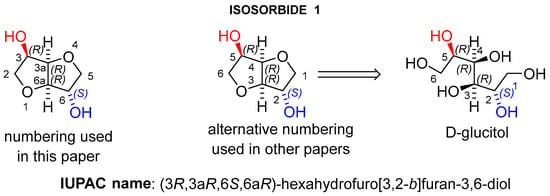
Recently, we have been attracted by isosorbide 1 (Scheme 1). This dianhydrohexytol is industrially produced from sorbitol (D-glucitol), which is in turn easily obtained from D-glucose by reduction [8,9,10]. Therefore, it is a bio-based, renewable building block accessible at low cost from starch or cellulose. Its large-scale production is mainly justified by the fact that its mononitrate and dinitrate are commercial drugs. Isosorbide is also used for the fabrication of polymers, plasticizers and solvents [9,11,12].
Scheme 1.
Structure, stereochemistry, and numbering of isosorbide.
Isosorbide is a chiral compound with four stereogenic centers that are completely retained during dehydration of sorbitol. The two hydroxy groups are diastereotopic. In the literature, there is some confusion about isosorbide numbering. We prefer to use the one, depicted in Scheme 1, that is based on IUPAC rules for the nomenclature of fused heterocycles, giving the lower series of locants to the (R) stereogenic centers. An alternative numbering, shown in Scheme 1, is based on the correspondence of the carbons of isosorbide to the ones of D-glucose, from which it is derived [8]. Therefore, the two diastereotopic hydroxy groups are numbered 5 and 2, instead of 3 and 6. Finally, in some papers, numbers 3 and 6 are inexplicably inverted, assigning number 3 to the (S) carbon [9].
Isosorbide has a rigid V-type structure that poses the 6-OH in an exo position and the 3-OH in an endo position [13]. The latter is more acidic and more reactive as a nucleophile, despite being more sterically shielded [14]. This curious fact has been attributed to a strong hydrogen bond with O-4 [15].
Fragments derived from isosorbide or other isohexides have been used in drug conjugates [16] or for drug delivery [17], taking advantage of their biodegradability and safety [18].
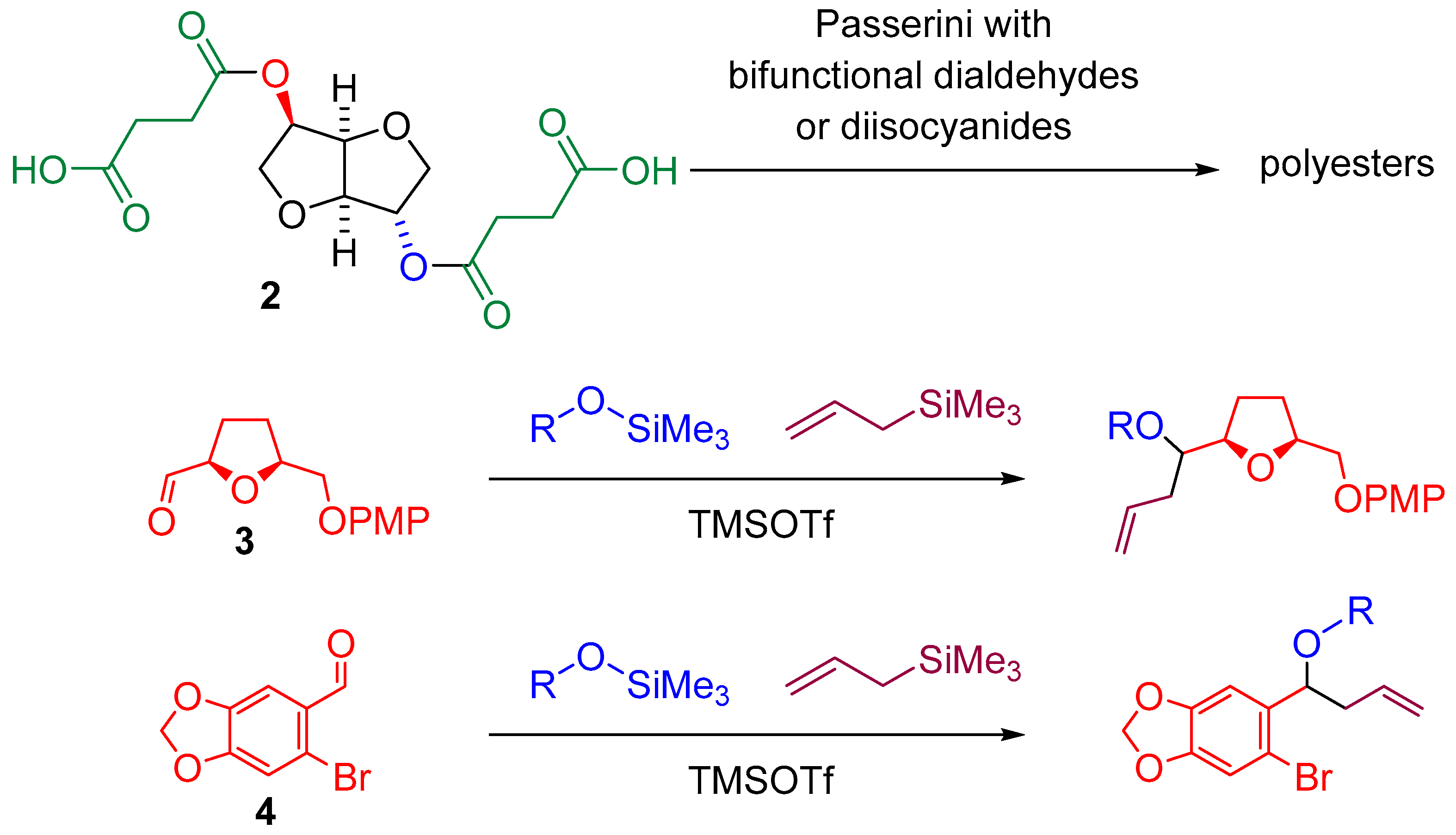
We reasoned that using isosorbide as input in multicomponent reactions would be very useful for producing small libraries of conjugates that join a carbohydrate-like substructure to other aglycon moieties. To our knowledge, the only application of isosorbide-derived building blocks in an MCR (Scheme 2) employs dicarboxylic acids derived from double acylation of isosorbide. They were employed in a Passerini reaction in order to synthesize polyesters decorated with α-acyloxyamides [19].
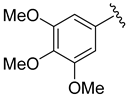
The use of isosorbide itself in MCRs is more difficult, because the most renowned MCRs employ various functional groups (e.g., carbonyl compounds, carboxylic acids, amines, phenols, and so on), but very seldom alcohols. A notable exception is represented by the multicomponent Hosomi–Sakurai reaction (MHS), first described in 1984 [20], but then only occasionally used [21,22,23,24]. Recently, we have explored the scope of this MCR on various alcohols (mainly bio-based ones) using two aldehydes 3 and 4 (Scheme 2). The latter is an electron-rich aromatic one, whereas the former is an aliphatic, chiral, and bio-based aldehyde [25]. This study has revealed that MHS works best with TMS ethers of secondary alcohols, even encumbered ones, and that TMS ethers of chiral secondary alcohols are able, in some cases, to afford remarkable diastereoselectivity for the new generated stereogenic center.
Scheme 2.
Previous published work related to this research [19,25].
Thus, we reasoned that monoprotected isosorbide derivatives could be good substrates for this MCR. Here, we report our results on this matter.
2. Results and Discussion
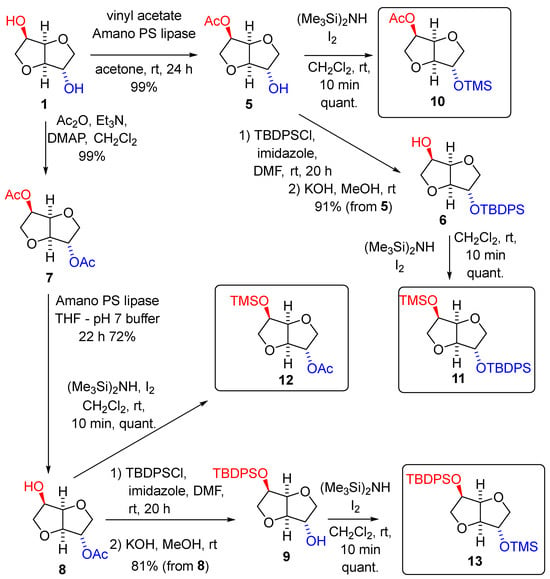
In order to differentiate the two diastereotopic hydroxy groups in isosorbide 1, we chose to use enzymatic processes (Scheme 3) [26,27]. Although selective acetylation of the endo hydroxy group at position 3 is possible also by using Ac2O and catalytic PbO [28], the enzymatic monoacetylation is more sustainable and, using Amano PS lipase, proceeds in higher yields with complete diastereoselectivity [26]. A simple filtration of the catalyst affords pure known monoacetate 5 [26,28] with no need for further purification. In order to obtain the free alcohol at position 3, we introduced a suitable protecting group at position 6. Some protecting groups were found to be troublesome to be introduced (benzyl, p-metoxybenzyl) or too labile under the multicomponent reaction conditions (Me2tBuSi). The best suited one turned out to be the diphenyl-tert-butylsilyl group (TBDPS). Its introduction, followed by deacetylation, gave the known alcohol 6 [29] in high yields.
Scheme 3.
Preparation of isosorbide derivatives 10–13 as substrates for the multicomponent Hosomi–Sakurai reaction with aldehydes.
In order to obtain the diastereomers of 5 and 6, that is 8 and 9, we first converted 1 into diacetate 7 [27,30] and then performed a monohydrolysis with the same enzyme to give monoacetate 8. Again, a very good diastereoselection was observed (98.5:1.5), but the yield (unoptimized) was slightly lower, probably caused by double hydrolysis giving water-soluble isosorbide 1, which is then lost during extractive work-up. A large-scale production of 8 using Novozym 435 was described in the literature [27].
Monoacetate 8 was converted into mono TBDPS-protected alcohol 9 in good yields by the same procedure used for its diastereomer 5.
Having in hand four isosorbide-derived monoalcohols, we investigated the outcome of the MHS reaction on them. However, based on our previous experience [25], we first derivatized them into the corresponding trimethylsilyl ethers 10–13. Their preparation can be easily performed from the corresponding alcohols using stoichiometric (TMS)2NH in the presence of catalytic iodine [31]. At the end of the reaction, after destroying I2 with thiosulfate, TMS ethers are obtained by a quick filtration through a silica plug and evaporation to dryness. They are pure enough to be used for the MCR without further purification. In particular, TMS ether 11 (the one that we used more often in this work) was found to be very stable and can be stored at –20 °C for months.
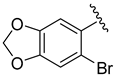
The four TMS ethers were first tested on 5-bromopiperonal as a model aldehyde, and the results are listed in Table 1 (see also Scheme 4). In our previous work, we used 1.5 equivalents of TMS ethers, with the aldehyde as the limiting agent, in order to suppress bicomponent reactions [25]. In this case we decided to use a slightly lower excess (1.4 equivalents) of TMS ethers 10–13.
Table 1.
Results of the multicomponent Hosomi–Sakurai reaction of bromopiperonal with TMS ethers 10–13 (see Scheme 4) 1.
As it is clear from Table 1, the two derivatives having the free OH group at position 3 (endo position) gave better results, both in terms of yields and of diastereoselectivity (entries 2 and 3). This is in line with the known higher reactivity of the endo hydroxy group. Moreover, the endo group is also considered more sterically shielded [14], and this can account for the higher diastereoselectivity. A possible rationalization of stereoselectivity in the case of endo TMS ethers 11 and 12 can be found in the Supplementary Materials.
On the basis of these preliminary results, we selected TMS ether 11 as the best candidate for investigating the scope of the reaction. We preferred 11 compared to 13 because of the higher yields, probably due to a partial lability of the acetoxy group under reaction conditions. In our previous work on the multicomponent Hosomi–Sakurai reaction, we have indeed observed some lability of a butyrate ester [25]. It should be noted that the related tert-butyldimethylsilyl protecting group was found to be non-compatible with the conditions of this MCR, undergoing extensive deprotection.
First we used a series of aromatic or heteroaromatic aldehydes (Scheme 4 and Table 2, entries 1–10).
Table 2.
Scope of multicomponent Hosomi–Sakurai reaction with TMS ether 11 (see Scheme 4) 1.
Scheme 4.
Multicomponent Hosomi–Sakurai reaction on isosorbide derivatives 10–13.
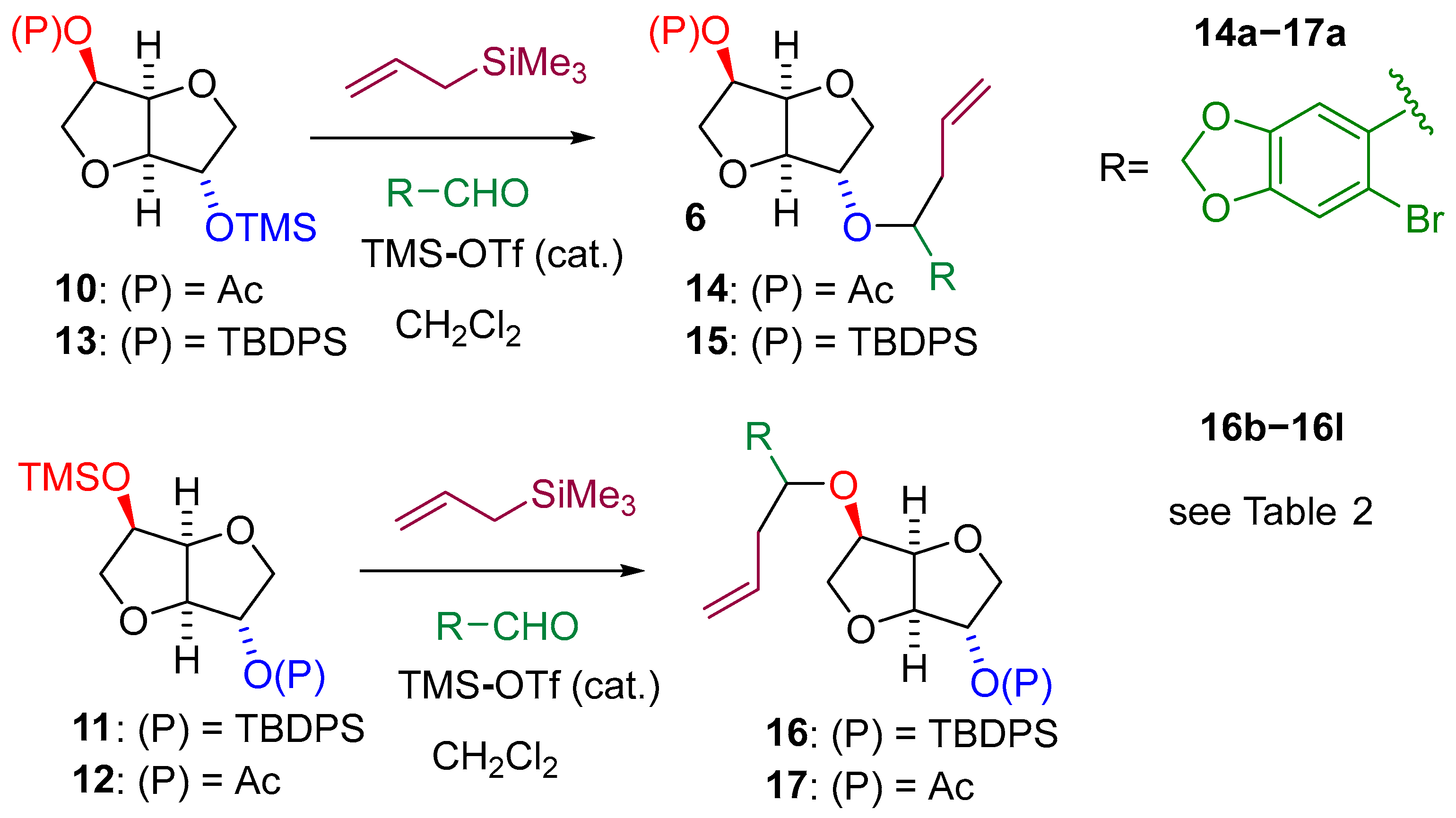
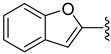
In most cases, the diastereoselectivity was excellent (5:1 ≤ d.r ≤ 12:1) (entries 1, 3–8), while only for trimethoxybenzaldehyde it was moderate (≈3:1) (entry 2). The yield was from good to excellent for products 16a, 16b, 16c, 16g, and 16h. With the very bulky aldehydes 2-chloro-6-fluorobenzaldehyde (entry 5) and 2-benzyloxybenzaldehyde (entry 9), significant amounts of the bicomponent product, the homoallylic alcohol derived from nucleophilic addition of the allyl group to the aldehyde, were detected. This is reasonable, because the tricomponent reaction has higher steric requirements than the bicomponent one. Also, the very electron-poor 4-nitrobenzaldehyde (entry 6) was less efficient. This was expected since the mechanism involves the intermediate formation of an oxycarbenium ion. For a detailed explanation of the mechanism, we suggest looking at our previous paper [25]. Nevertheless, the desired tricomponent product was obtained in reasonable yield also in these critical cases and could be isolated in pure form. Finally, in the case of benzofuran-2-carboxyaldehyde, the reaction was rather dirty, probably because of instability of the furan ring under these conditions, and we were not able to isolate the desired product in acceptable purity.
We also investigated two aliphatic aldehydes. With cyclohexanecarboxaldehyde, we obtained a moderate yield and, surprisingly, a decrease in the diastereoselection (entry 11). With isovaleraldehyde, the d.r. returned very good, but the yield was only fair (entry 12). However, we noticed that the reaction was indeed very clean and that the unreacted isosorbide-derived substrate (11) was nearly completely recovered (as the alcohol 6, since the TMS ether does not survive chromatography).
By examination of the crude product, we reasoned that the aldehyde (which is the limiting agent under conditions A) is consumed by a side reaction. However, the bicomponent product was in this case only negligible, whereas we noticed the presence of self-condensation products. It is worth noting that self-condensation is not possible for aromatic, non-enolizable aldehydes, whereas enolization is expected to be more difficult for cyclohexanecarboxyaldehyde compared to isovaleraldehyde.
Thus, we decided to use TMS ether 11 as the limiting agent (entry 13), with a slight excess of aldehyde. The yield was not improved, but again, the overall recovery was good, as the yield was calculated based on not recovered 6/11. Reasoning that also the catalyst could be consumed by conversion of the aldehyde into the corresponding silyl enol ether, we increased the equivalents of both aldehyde and TMS-OTf (adding both in two aliquots). This change brought about a significant increase in the yield (entry 14). These outcomes proved that this multicomponent Hosomi–Sakurai reaction on aliphatic aldehydes is still efficient but is in some cases in competition with self-condensation processes, requiring a different stoichiometry.
Summarizing the scope and limitations of the reaction with TMS ether 11, easily prepared from alcohol 6, we may conclude that
- (a)
- The MHS reaction of TMS ether 11, easily prepared from alcohol 6, with aromatic, not enolizable aldehydes proceeds typically well with good to excellent diastereoselectivities. Lower, but still acceptable, yields are achieved only with electron-poor aldehydes and/or aldehydes with bulky ortho substituents.
- (b)
- With aliphatic enolizable aldehydes, self-condensation processes may consume the aldehyde component, especially when the α-carbon is a methylene group. Thus, even if the reaction is quite clean and the overall recovery high, using equimolar amounts of TMS ether and of the aldehyde (or a slight excess of TMS ether) can lead to insufficient conversions. This problem may be solved, with simple aldehydes such as isovaleraldehyde, simply by using TMS ether 11 as the limiting agent and a slight excess of the aldehyde. Moreover, also an increase of the catalyst, adding it in two aliquots, may be useful.
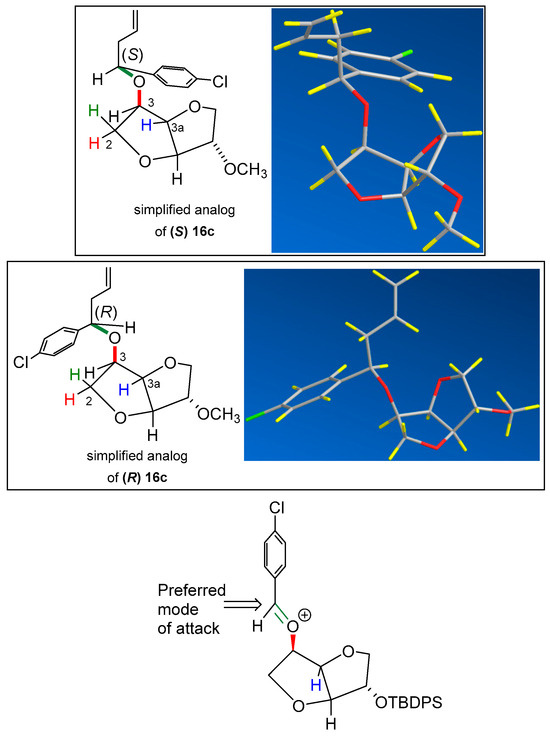
As far as it concerns the relative configuration of the major diastereomer, we noticed, for products 16a–16i, derived from aromatic aldehydes, a significant difference in the δ values (1H NMR) for H-3a and H-2 (especially one of them). In the major diastereomer, H-3a always resonates upfield, by 0.22–0.36 ppm, whereas the H-2 protons always resonate downfield, with a difference of 0.28–0.37 for one of them or 0.07–0.10 ppm for the other one. These differences completely disappear on passing to the products 16k and 16l derived from aliphatic aldehydes. Therefore, these trends are likely due to the anisotropic effect of the aromatic ring. A conformational study, which is detailed in the Supplementary Materials, allowed us to tentatively propose the preferred conformations shown in Scheme 5.
Scheme 5.
Presumed preferred conformations for (S) and (R) isomers for a simplified analog of 1 (the TBDPS group was substituted with a methyl for the sake of clarity) and rationalization of diastereoselectivity.
Thanks to the high rigidity of the bicyclic system, different conformations may arise only from rotation around the bonds colored in red and green. Rotation around the bond colored in red with no doubt gives, as the best conformations, those placing the bulky substituent away from the bicyclic isosorbide system (outside). As regards the three possible staggered conformations resulting from rotation around the bond colored in green, the one placing the allyl group anti to the O–C3 bond resulted in the most stable one from our minimization, which is also in good agreement with nOe experiments. If this is true, in the (S) isomer the aromatic ring will shield H-3a, whereas in the (R) isomer, it will shield H-2.
Therefore, we suppose that the main diastereomer has an (S) configuration. However, we must stress the fact that we cannot be 100% sure of this assignment, although it appears in line with a logical rationalization of the observed outcomes. The key intermediate is an oxocarbenium ion, depicted in Scheme 5, which likely would put the aryl group as far away as possible from the bicyclic system. Then the allyl nucleophile will preferably attack from the left (Re face), since the V-shaped bicyclic system is expected to encumber the right one (Si face).
In conclusion, application of the multicomponent Hosomi–Sakurai reaction on monoprotected isosorbide derivative 6 proved to be a good method to join to the glycomimetic, bio-based bicyclic system of isosorbide to aldehyde-derived aromatic or aliphatic fragments. This method can therefore find application in fragment-based drug discovery, also thanks to the expected high metabolic stability of the ether bond that connects the two fragments.
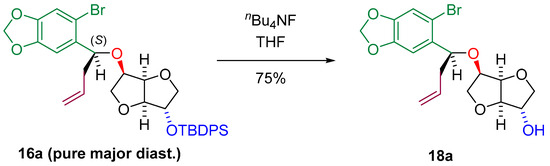
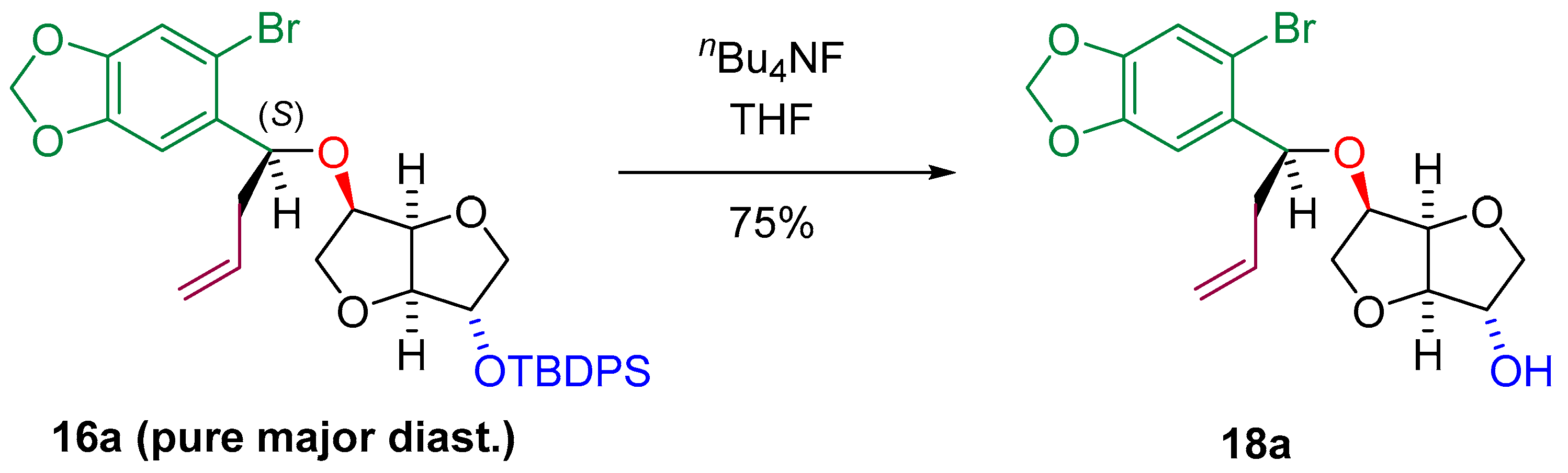
Obviously the exo OH can be easily deprotected, as shown in Scheme 6 for compound 16a. The free hydroxy group at carbon 6 can thus be further manipulated (e.g., by acylation or ether formation), allowing the addition of a second fragment. Finally, the allyl group represents an additional handle that can be functionalized and/or used to attach further fragments.
Scheme 6.
Deprotection of 16a (pure major diastereomer) to give alcohol 18a.
3. Experimental Section
NMR spectra were taken at the indicated temperature in CDCl3 at 400 MHz (1H) and 100 MHz (13C), using, as an internal standard, TMS (1H NMR: 0.000 ppm) or the central peak of CDCl3 (13C: 77.02 ppm). Chemical shifts are reported in ppm (δ scale). Peak assignments were made with the aid of COSY and HSQC experiments. In the ABX system, proton A is the one upfield. GC-MS analyses were carried out using a Shimadzu (Kyoto, Japan) GC−MS-QP2010 SE spectrometer with an HI-5 MS column (0.25 mm, 0.25 mm, 30 m) and with these conditions: METHOD A: Flow: 1.03 mL/min, split ratio: 10.0. Initial temp.: 70 °C, hold time: 4 min, rate: 25 °C/min. METHOD B: Flow: 0.96 mL/min, split ratio: 10.0. Initial temp.: 150 °C, hold time: 3 min, rate: 25 °C/min. HRMS: samples were analyzed with a Waters (Milford, MA, USA) Synapt G2 QToF mass spectrometer. MS signals were acquired from 50 to 1200 m/z in ESI positive ionization mode. TLC analyses were carried out on silica gel plates and viewed at UV (254 nm) and/or developed with Hanessian stain (dipping into a solution of (NH4)4MoO4·4 H2O (21 g) and Ce(SO4)2·4 H2O (1 g) in H2SO4 (31 mL) and H2O (469 mL) and warming). Rf were measured after an elution of 7–9 cm. Column chromatographies were done with the “flash” methodology using 220–400 mesh silica. Petroleum ether (40–60 °C) is abbreviated as PE. In extractive work-up, aqueous solutions were always reextracted three times with the appropriate organic solvent. Organic extracts were always dried over Na2SO4 and filtered before evaporation of the solvent under reduced pressure. All reactions using dry solvents were carried out under a nitrogen or argon atmosphere.
For the sake of clarity, for all isosorbide derivatives, we have maintained the same numbering of the parent compound shown in Scheme 1.
(3R,3aR,6S,6aR)-6-hydroxyhexahydrofuro [3,2-b]furan-3-yl acetate 5. A solution of isosorbide 1 (3.00 g, 20.5 mmol) in acetone (22.7 mL) is treated with vinyl acetate (5.7 mL, 61.5 mmol) and with Amano PS lipase SD (563 mg). The suspension is stirred at rt for 28 h. The enzyme is filtered off, washing it with EtOAc. Evaporation to dryness affords a colorless oil, pure enough (by 1H NMR) to be used for the next step (3.82 g, 99%). The peaks of the diastereomer 8 cannot be detected at 1H NMR. An analytical sample can be obtained by chromatography using PE/EtOAc 8:2 as the eluent.
This compound is already known [26,28].
Rf: 0.60 (EtOAc). [α]D +106.8 (c 2, CHCl3) [28]. GC-MS: Rt 9.67 min. m/z: 146 (M+−42, 0.8), 145 (M+−43, 0.9), 128 (9.1), 98 (4.9), 86 (4.4), 85 (15.7), 70 (4.3), 69 (27.5), 68 (18.6), 58 (5.4), 57 (10.9), 55 (5.9), 45 (6.5), 44 (11.8), 43 (100.0), 42 (6.0), 41 (10.5), 39 (7.0). 1H NMR (400 MHz, CDCl3): δ 5.15 (q, 1H, J = 5.5 Hz, H-3), 4.85 (t, 1H, J = 4.9 Hz, H-3a), 4.41 (d, 1H, J = 4.5, H-6a), 4.35 (s, 1H, H-6), 3.97–3.86 (m, 3H, H-5 + one H-2), 3.77 (dd, 1H, J= 9.8, 5.4, one H-2), 2.13 (s, 3H, CH3CO). 13C NMR (101 MHz, CDCl3) δ 170.6 (C=O), 88.0 (C-6a), 80.2 (C-3a), 75.8 (C-6), 75.4 (C-5), 74.0 (C-3), 70.0 (C-2), 20.6 (CH3CO).
(3R,3aR,6S,6aS)-6-((tert-Butyldiphenylsilyl)oxy)hexahydrofuro [3,2-b]furan-3-ol 6. A solution of crude monoacetate 5 (3.82 g, 20.3 mmol) in dry DMF (21.0 mL) is treated with imidazole (2.07 g, 30.5 mmol) and tert-butyldiphenylsilyl chloride (6.07 mL, 23.3 mmol). The solution is stirred at rt for 20 h. Then it is diluted with water (60 mL) and extracted thrice with PE/Et2O 1:1. The united organic phases are washed with water and then with brine. After drying and evaporation to dryness, a colorless oil is obtained, which contains pure product 6 plus some tert-butyldiphenylsiloxane (9.27 g). This oil is taken up in methanol (150 mL), cooled to 0 °C and treated with a 1 M solution of KOH in methanol (41 mL, 41 mmol). After 10 min, the cooling bath is removed, and the solution is stirred until the reaction is complete by TLC (2h and 30 min). Acetic acid (2.35 mL, 41 mmol) is added. The solvent is evaporated, and the crude mixture (an oil containing some solid AcOK) is directly chromatographed, using 80 g of silica and PE/EtOAc from 8:2 to 7:3, to give pure 6 as an oil (7.10 g, 91%).
This compound is already known [29].
Rf: 0.44 (PE/EtOAc 70:30). [α]D +22.2 (c 1, CHCl3). 1H NMR (400 MHz, CDCl3): δ 7.68–7.60 (m, 4H, meta aromatic CH), 7.48–7.36 (m, 6 H, ortho and para aromatic CH), 4.70 (t, 1H, J = 4.8 Hz, H-3a), 4.38 (d, 1H, J = 4.0, H-6a), 4.35 (d, 1H, J = 3.2, H-6), 4.27 (dq, 1H, J = 8.0, 6.0, H-3), 3.88 (d, 1H, J = 10.0, H-5), 3.80 (dd, 1H, J = 9.4, 6.2, H-2), 3.66 (dd, 1H, J = 10.0, 3.2, H-5), 3.41 (dd, 1H, J = 9.2, 6.0, H-2), 2.62 (d, 1H, J = 8.4, OH), 1.07 (s, 9H, C(CH3)3). 13C NMR (101 MHz, CDCl3) δ 135.6 (×2) (CH ortho to Si), 133.3, 133.1 (quat.), 130.00, 129.96 (CH para to Si), 127.9, 127.8 (CH meta to Si), 88.2 (C-6a), 81.7 (C-3a), 78.1 (C-6), 75.8 (C-5), 73.4 (C-2), 72.4 (C-3), 26.8 (C(CH3)3), 19.1 (C(CH3)3).
(3R,3aR,6S,6aR)-hexahydrofuro[3,2-b]furan-3,6-diyl diacetate 7. A suspension of isosorbide 1 (1.00 g, 6.84 mmol) in dry CH2Cl2 (13.7 mL) is treated with 4-(N,N-dimethylamino)pyridine (84 mg, 0.684 mmol) and triethylamine (3.8 mL, 27.4 mmol). The suspension becomes a solution. Finally, after cooling to 0 °C, acetic anhydride (1.90 mL, 20.5 mmol) is added dropwise. After 5 min, the cooling bath is removed, and the solution is stirred at rt for 1 h and 45 min. The reaction is quenched with saturated aqueous NH4Cl. Extraction with CH2Cl2, washing of the organic phases with brine, drying and evaporation give a crude product (yellow cloudy oil) nearly pure by 1H NMR. Anyway, it is chromatographed with PE/EtOAc 1:1 to give pure 7 as an oil (1.54 g, 98%).
This compound is already known [27,30].
Rf: 0.47 (PE/EtOAc 50:50). 1H NMR (400 MHz, CDCl3): δ 5.20–5.18 (m, 1H, H-6), 5.15 (q, 1H, J = 5.6, H-3), 4.83 (t, 1H, J = 5.0, H-3a), 4.49 (d, 1H, J = 4.6, H-6a), 4.03–3.96 (m, 2H, H-5), 3.95 (dd, 1H, J = 9.8, 6.0, H-2), 3.80 (dd, 1H, J = 9.7, 5.5, H-2), 2.13, 2.08 (2 s, 2×3H, CH3). 13C NMR (101 MHz, CDCl3) δ 170.4, 170.1 (C=O), 85.9 (C-6a), 80.7 (C-3a), 78.1 (C-6), 73.9 (C-3), 73.5 (C-5), 70.2 (C-2), 20.9, 20.7 (CH3).
(3R,3aR,6S,6aR)-3-hydroxyhexahydrofuro[3,2-b]furan-6-yl acetate 8. A solution of diacetate 7 (3.088 g, 13.4 mmol) in THF (6.7 mL) is treated with 79.6 mL (39.8 mmol) of a 0.5 M pH 7 phosphate buffer solution (freshly prepared by mixing 63.4 mL of a 0.5 M solution of NaH2PO4 in distilled water and 98.1 mL of a 0.5 M solution of Na2HPO4 in distilled water). This suspension is treated with Amano PS lipase SD (618 mg) and stirred at rt overnight. After 22 h, the reaction is complete by TLC. Solid NaCl is added up to saturation, and the aqueous phase is extracted several times with EtOAc (emulsions were observed anyway). Drying and evaporation furnish the crude product as a solid (1.892), which seems nearly pure at 1H NMR. Anyway, it is chromatographed (EtOAc) to give pure 8 as a white solid (1.823 mg, 72%). A slightly lower yield is obtained when extractions are carried out with CH2Cl2 as described in a previous work [27]. This reaction is not thoroughly optimized. We think that it should be better monitored in order to avoid full hydrolysis to isosorbide, which is then lost in the water phase upon extraction. D.r. was determined by 1H NMR on the crude product and was = 98.5:1.5. This product is already known [27,32,33,34].
Rf: 0.51 (EtOAc). M.p.:74–75 °C. 1H NMR (400 MHz, CDCl3): δ 5.22 (d, 1H, J = 3.1, H-6), 4.64 (t, 1H, J = 4.9, H-3a), 4.48 (d, 1H, J = 4.3, H-6a), 4.31 (dq, 1H, J = 7.2, 5.6, H-3), 4.04, 4.01 (AB part of an ABX syst., 2H, JAB = 10.5, JAX = 4.0, JBX = 0, H-5), 3.90 (dd, 1H, J = 9.5, 5.9, H-2), 3.58 (dd, 1H, J = 9.5, 5.9, H-2), 2.60 (dd, 1H, J = 7.3, 2.0, OH), 2.09 (s, 3H, CH3). 13C NMR (101 MHz, CDCl3) δ 170.0 (C=O), 85.6 (C-6a), 81.9 (C-3a), 78.4 (C-6), 73.6, 73.5 (C-5, C-2), 72.3 (C-3), 20.9 (CH3).
(3R,3aS,6S,6aR)-3-((tert-Butyldiphenylsilyl)oxy)hexahydrofuro[3,2-b]furan-6-ol 9. It is prepared in 81% overall yield from monoacetate 8 following the same procedure described for the synthesis of 6.
Colorless oil. Rf: 0.41 (PE/EtOAc 70:30). [α]D: + 56.7 (c 1.6, CHCl3). GC-MS (method A): Rt: 14.84 min. m/z: 327 (M+-57, 62.1), 281 (5.6), 253 (11.3), 241 (6.7), 225 (6.7), 223 (13.5), 207 (17.2), 205 (8.2), 199 (51.4), 197 (10.7), 191 (7.2), 183 (15.7), 182 (5.4), 181 (24.4), 177 (7.7), 171 (6.1), 165 (6.1), 164 (5.6), 163 (33.7), 147 (7.8), 145 (10.2), 139 (19.3), 135 (15.3), 129 (7.4), 123 (7.7), 121 (9.8), 115 (11.9), 105 (19.4), 103 (10.9), 91 (14.7), 85 (5.3), 79 (7.6), 78 (26.8), 77 (26.9), 73 (10.4), 69 (100), 68 (5.1), 57 (22.2), 56 (8.6), 55 (7.1), 52 (5.7), 51 (9), 50 (5.8), 45 (17.6), 44 (58.1), 43 (27.4), 42 (8.3), 41 (44), 40 (6.5), 39 (27.2), 38 (5). 1H NMR (400 MHz, CDCl3): δ 7.77–7.72 (m, 2 H), 7.69–7.63 (m, 2H), 7.47–7.35 (m, 6H), 4.40 (t, 1H, J = 4.6 Hz, H-3a), 4.32–4.26 (m, 2H, H-6, H-6a), 4.21 (q, 1H, J = 6.6 Hz, H-3), 4.02 (dd, 1H, J = 10.2, 3.4, H-5), 3.95 (d, 1H, J = 10.2, H-5), 3.61 (dd, 1H, J = 8.6, 6.3, H-2), 3.53 (t, 1H, J = 7.8, H-2), 1.90–1.75 (m, 1H, OH), 1.08 (s, 9H, C(CH3)3). 13C NMR (101 MHz, CDCl3) δ 135.8, 135.6 (CH ortho to Si), 133.6, 133.3 (quat.), 129.9 (×2) (CH para to Si), 127.8 (×2) (CH meta to Si), 87.9 (C-6a), 81.3 (C-3a), 76.9 (C-6), 75.7 (C-5), 74.2 (C-3), 71.9 (C-2), 26.8 (C(CH3)3), 19.2 (C(CH3)3). HRMS (ESI+): calcd. for C22H29O4Si+ [M + H]+ 385.18296, found 385.18311.
General procedure for the preparation of TMS ethers 10–13. To a solution of alcohol 5–6 or 8–9 (3.00 mmol) in dry CH2Cl2 (10 mL), iodine (60.0 µmol, 2 mol%) and hexamethyldisilazane (2.40 mmol) are added at rt. The initially colorless solution turns brown, and the color fades over 10 min. Then, solid Na2S2O3·5H2O (968 mg, 3.90 mmol) is added, and the reaction mixture turns colorless. The mixture is stirred for 30 min and then filtered quickly through a silica plug (1 cm), washing with CH2Cl2 (30 mL). The solvent is removed, and the silyl ether is used as such without further purification. It is recommended not to strip the solvent at high vacuum (10−2 mbar), because these TMS ethers tend to be slightly volatile at this pressure. In the case of TMS ether 11, we checked its stability upon storage, and we found out that it was quite stable for months in the freezer.
(3R,3aR,6S,6aR)-6-[(1-(R,S)-(5-bromobenzo[d][1,3]dioxole-5-yl)but-3-en-1-yl)oxy]-hexahydrofuro[3,2-b]furan-3-yl acetate 14a. A solution of TMS ether 10 (164 mg, 670 µmol) in dry CH2Cl2 (2.9 mL) is added with 5-bromopiperonal (3-bromobenzo[d][1,3]dioxole-5-carboxyaldehyde) (133 mg, 581 µmol, 0.2 M). The solution is cooled to −78 °C and treated with allyltrimethylsilane (139 µL, 0.87 mmol) and then with a freshly prepared 0.3 M solution of TMS-OTf (trimethylsilyl trifluoromethanesulfonate) in dry CH2Cl2 (580 µL, 174 µmol). Note: if these two additions take more than 5 min, some precipitation of 5-bromopiperonal may be observed, but this does not invalidate the positive outcome of the reaction. The solution is stirred at −78 °C for 2 h and then quenched by the addition of a saturated aqueous solution of NaHCO3. After warming, the mixture is extracted with EtOAc, dried, and evaporated to dryness. The crude product is chromatographed (PE/EtOAc 6:4) to give product 14a as a mixture of two inseparable diastereomers X (major) and Y (minor) (128 mg, 50%). The diastereomeric ratio was determined by 1H NMR on the crude product by integrating the doublets at 4.53 (X) and 4.37 (Y) and resulted = 57:43.
Colorless oil. Rf: 0.26 (CH2Cl2/PE 5:1). [α]D: + 45.7 (c 1, CHCl3). GC-MS (method B): Rt: 11.02 (Y), 11.09 (X). m/z (Y): 401 (M+-41) (11.1), 399 (M+-41) (11.3), 231 (3.3), 229 (5.1), 174 (10.1), 173 (4.8), 171 (22.9), 144 (7.8), 116 (13.1), 115 (19.6), 111 (43.1), 85 (5.4), 83 (27.3), 69 (54.3), 55 (9.0), 44 (6.3), 43 (100), 41 (12.0), 39 (5.1). m/z (X): 401 (M+-41) (9.8), 399 (9.9), 229 (5.0), 174 (10.0), 173 (4.8), 171 (23.3), 144 (8.1), 116 (13.6), 115 (21.4), 111 (43.3), 85 (5.5), 83 (27.5), 69 (53.9), 55 (9.1), 44 (5.1), 43 (100,0), 41 (11.9), 39 (5.0). 1H NMR (400 MHz, CDCl3): δ 6.96, 6.90 (X) (2 s, 2H, H-3′, H-6′), 6.95, 6.94 (Y) (2 s, 2H, H-3′, H-6′), 6.02–5.93 (X + Y) (m, 2H, OCH2O), 5.89–5.74 (X + Y) (m, 1H, CH=CH2), 5.18–5.00 (m, 3H, CH=CH2 + H-3), 4.82–4.75 (m, 1.57 H, H-3a (X + Y) + CH-CH2CH= (X)), 4.72 (Y) (dd, 0.43 H, J = 7.0, 5.8, CH-CH2CH = (Y), 4.53 (X) (d, 0.57H, J = 4.5, H-6a), 4.37 (Y) (d, 0.43H, J = 4.3, H-6a), 4.10 (Y) (d, 0.43H, J = 10.1, H-5), 4.00–3.73 (m, 2.57H, H-2, H-5), 3.73–3.63 (X + Y) (m, 1H, H-2), 2.43–2.28 (X + Y) (m, 2H, CH2CH=), 2.12 (Y), 2.10 (X) (2s, 3H, CH3C=O). 13C NMR (101 MHz, CDCl3) δ 170.41, 170.39 (C=O, X + Y), 147.91, 147.84, 147.83, 147.77 (C-2a′, C-6a′, X + Y), 134.1 (CH=CH2), 133.9 (X), 133.8 (Y) (C-4′), 117.7 (X), 117.5 (Y) (CH=CH2), 113.1 (X), 113.0 (Y) (C-5′), 112.3 (X), 112.2 (Y) (C-3′), 107.4 (Y), 107.3 (X) (C-6′), 101.8 (Y), 101.7 (X) (OCH2O), 86.5 (Y) 85.8 (X) (C-6a), 81.9 (X) 81.6 (Y) (C-3a), 80.5 (X) 80.4 (Y) (CH-CH2CH=), 79.3 (X), 78.5 (Y) (C-6), 74.2 (Y), 74.04 (X) (C-3), 73.97 (X), 72.7 (Y) (C-5), 69.63, 69.61 (X + Y) (C-2), 41.1 (X + Y) (CH2-CH=), 20.7 (X + Y) (CH3C=O). HRMS (ESI+): calcd. for C19H22BrO7+ [M + H]+ 441.0543, found 441.0541.
(3R,3aS,6S,6aR)-6-[(1-(R,S)-(5-bromobenzo[d][1,3]dioxole-5-yl)but-3-en-1-yl)oxy]-3-((tert-butyldiphenylsilyl)oxy)hexahydrofuro[3,2-b]furan 15a. It is prepared, starting from 137.9 mg of TMS ether 13 (302 µmol), following the same procedure described above for the synthesis of 14a. The reaction time was, however, 3.5 h. Analysis of the crude mixture at 1H NMR indicated a diastereomeric ratio = 53: 47. Chromatography (CH2Cl2/PE 2:1) gives a diastereomeric mixture of 15a (91.5 mg, 53%). Through a second careful chromatography, it is possible to obtain pure or enriched samples of the two diastereomers. Rf: 0.46 (major) and 0.43 (minor) (CH2Cl2/PE 2:1).
Major diastereomer (faster running):
1H NMR (400 MHz, CDCl3): δ 7.77–7.70 (m, 2 H, ortho CH of TBDPS), 7.68–7.62 (m, 2H, ortho CH of TBDPS), 7.47–7.35 (m, 6H, para and meta CH of TBDPS), 6.93, 6.91 (2 s, 2H, H-3′, H-6′), 6.00–5.90 (m, 2H, H-1′), 5.87–5.71 (m, 1H, CH=CH2), 5.10–4.96 (m, 2H, CH=CH2), 4.74 (t, 1H, J = 6.1, CH-CH2C=), 4.36 (t, 1H, J = 4.3, H-6), 4.23 (d, 1H, J = 4.1, H-6a), 4.20–4.14 (m, 1H, H-3), 4.12 (d, 1H, J = 10.3, H-5), 3.98–3.82 (m, 2H, H-3a, H-5), 3.56–3.40 (m, 2H, H-2), 2.46–2.29 (m, 2H, CH2CH=C), 1.07 (s, 9H, C(CH3)3). 13C NMR (101 MHz, CDCl3) δ 147.9, 147.8 (C-2a′, C-6a′), 135.8, 135.6 (CH ortho to Si), 134.0 (CH=CH2 + C-4′), 133.6, 133.3 (quat. TBDPS), 129.8 (CH para to Si), 127.7 (CH meta to Si), 117.5 (CH=CH2), 113.1 (C-5′), 112.2 (C-3′), 107.6 (C-6′), 101.8 (C-1′), 86.4 (C-6a), 82.4 (C-3a), 81.6 (C-6), 78.5 (CH-CH2CH=), 74.3 (C-3), 72.9 (C-5), 71.4 (C-2), 41.2 (CH2-CH=), 26.8 (C(CH3)3), 19.2 (C(CH3)3). HRMS (ESI+): calcd. for C33H38BrO6Si+ [M + H]+ 637.16155, found 637.1621.
Minor diastereomer (slower running) (only enriched; ratio: 3:1):
[α]D: + 14.4 (c 1, CHCl3). 1H NMR (400 MHz, CDCl3): δ 7.77–7.70 (m, 2 H, ortho CH of TBDPS), 7.68–7.62 (m, 2H, ortho CH of TBDPS), 7.47–7.35 (m, 6H, para and meta CH of TBDPS), 6.95, 6.91 (2 s, 2H, H-3′, H-6′), 6.02–5.92 (m, 2H, H-1′), 5.87–5.69 (m, 1H, CH=CH2), 5.11–4.95 (m, 2H, CH=CH2), 4.75 (mc) (m, 1H, CH-CH2C=), 4.42–4.32 (m, 2H, H-6, H-6a), 4.22–4.15 (m, 1H, H-3), 3.98–3.83 (m, 2H, H-5), 3.80 (s, 1H, H-3a), 3.64–3.41 (m, 2H, H-2), 2.37–2.29 (m, 2H, CH2CH=C), 1.06 (s, 9H, C(CH3)3). 13C NMR (101 MHz, CDCl3) δ 147.9, 147.8 (C-2a′, C-6a′), 135.8, 135.6 (CH ortho to Si), 134.3 (C-4′), 134.2 (CH=CH2), 133.6, 133.3 (quat. TBDPS), 129.8 (CH para to Si), 127.7 (CH meta to Si), 117.5 (CH=CH2), 113.2 (C-5′), 112.4 (C-3′), 107.4 (C-6′), 101.8 (C-1′), 85.6 (C-6a), 82.4 (C-3a), 81.7 (C-6), 79.2 (CH-CH2CH=), 74.2 (C-3), 74.1 (C-5), 71.6 (C-2), 41.2 (CH2-CH=), 26.8 (C(CH3)3), 19.2 (C(CH3)3). HRMS (ESI+): calcd. for C33H38BrO6Si+ [M + H]+ 637.16155, found 637.1629.
(3R,3aR,6S,6aS)-3-[(1-(R,S)-(5-bromobenzo[d][1,3]dioxole-5-yl)but-3-en-1-yl)oxy]-6-((tert-butyldiphenylsilyl)oxy)hexahydrofuro[3,2-b]furan 16a. A solution of TMS ether 11 (312.6 mg, 684 µmol) in dry CH2Cl2 (2.45 mL) is added with 5-bromopiperonal (3-bromobenzo[d][1,3]dioxole-5-carboxyaldehyde) (112.2 mg, 490 µmol, 0.2 M). The solution is cooled to −78 °C and treated with allyltrimethylsilane (117 µL, 735 µmol) and then with a freshly prepared 0.3 M solution of TMS-OTf (trimethylsilyl trifluoromethanesulfonate) in dry CH2Cl2 (490 µL, 147 µmol). Note: if these two additions take more than 5 min, some precipitation of 5-bromopiperonal may be observed, but this does not invalidate the positive outcome of the reaction. The solution is stirred at −78 °C for 2 h and then quenched by the addition of a saturated aqueous solution of NaHCO3. After warming, the mixture is extracted with EtOAc, dried, and evaporated to dryness. The crude product is chromatographed (PE/EtOAc 92:8) to give the diastereomerically pure major diastereomer of 16a (faster running) (202 mg) plus some mixed fractions containing both (76 mg). Overall yield: 89%. The diastereomeric ratio was determined by 1H NMR of the crude product and resulted = 86:14. Rf: 0.44 (major) and 0.38 (minor) (PE/EtOAc 9:1). Only the major diastereomer was fully characterized.
Major diastereomer (faster running).
[α]D: −7.4 (c 0.78, CHCl3) 1H NMR (400 MHz, CDCl3): δ 7.65–7.58 (m, 4H, CH meta of TDBDPS), 7.46–7.33 (m, 6H, CH ortho and para of TBDPS), 7.11 (s, 1H, H-6′), 6.96 (s, 1H, H-3′), 6.00 (d, 1H, J = 1.2, O-CHH-O), 5.99 (d, 1H, J = 1.2, O-CHH-O), 5.78 (ddt, 1H, J = 16.8, 10.4, 7.0, CH=CH2), 5.08–4.93 (m, 2H, CH=CH2), 4.68 (dd, 1H, J = 7.7, 5.4, CH-CH2C=), 4.45 (t, 1H, J = 4.0, H-3a), 4.31 (d, 1H, J = 3.8, H-6a), 4.26 (mc) (m, 1H, H-6), 3.92–3.79 (m, 3H, H-3 + 1 H-2 + 1 H-5), 3.76 (dd, 1H, J = 9.8, 3.6, H-5), 3.49 (t, 1H, J= 8.0, H-2), 2.48 (dt, 1H, J = 14.2, 7.1, CHHC=), 2.36 (dt, 1H, J = 14.1, 6.4, CHHC=), 1.04 (s, 9H, C(CH3)3). 13C NMR (101 MHz, CDCl3) δ 147.95, 147.87 (C-2a′, C-6a′), 135.6 (CH ortho to Si), 134.1, 134.0 (C-4′, CH=CH2), 133.5, 133.2 (quat. of TBDPS), 129.88, 129.85 (CH para to Si), 127.8, 127.7 (CH meta to Si), 117.4 (CH=CH2), 113.3 (C-5′), 112.2 (C-3′), 107.8 (C-6′), 101.8 (O-CH2O), 88.1 (C-6a), 80.9 (C-3a), 80.6 (CH-CH2C=), 78.4 (C-3), 78.2 (C-6), 76.1 (C-5), 69.0 (C-2), 41.4 (CH2-CH=), 26.8 (C(CH3)3), 19.1 (C(CH3)3). HRMS (ESI+): calcd. for C33H38BrO6Si+ [M + H]+ 637.16155, found 637.1607.
Minor diastereomer (slower running).
Only NMR data, taken from a mixed fraction, are reported. 1H NMR (400 MHz, CDCl3): δ 7.66–7.59 (m, 4H, CH meta of TDBDPS), 7.46–7.33 (m, 6H, CH ortho and para of TBDPS), 6.96 (s, 1H, H-6′), 6.86 (s, 1H, H-3′), 5.99–5.95 (m, 2H, O CH2-O), 5.82 (ddt, 1H, J = 16.8, 10.4, 7.0, CH=CH2), 5.08–4.96 (m, 3H, CH=CH2, CH-CH2C=), 4.73 (t, 1H, J = 4.1, H-3a), 4.32 (d, 1H, J = 4.0, H-6a), 4.26 (mc) (m, 1H, H-6), 3.89 (d, 1H, J = 9.7, H-5), 3.84–3.74 (m, 2H, H-3 + 1 H-2), 3.58 (dd, 1H, J = 8.5, 7.0, H-5), 3.39 (t, 1H, J = 8.4, H-2), 2.57 (dtt, 1H, J = 14.4, 7.1, CHH-C=), 2.40 (dt, 1H, J = 14.1, 6.4, CHH-C=), 1.06 (s, 9H, C(CH3)3). 13C NMR (101 MHz, CDCl3) δ 147.9 (C-2a′, C-6a′), 135.6 (CH ortho to Si), 134.2 (C-4′), 133.8 (CH=CH2), 133.4, 133.3 (quat. of TBDPS), 129.9 (CH para to Si), 127.8 (CH meta to Si), 117.3 (CH=CH2), 113.7 (C-5′), 112.3 (C-3′), 107.4 (C-6′), 101.8 (O-CH2-O), 88.5 (C-6a), 80.0 (C-3a), 79.4 (CH-CH2C=), 78.2 (C-3, C-6), 76.2 (C-5), 69.6 (C-2), 41.4 (CH2C=), 26.8 (C(CH3)3), 19.1 (C(CH3)3).
(3R,3aR,6S,6aR)-3-[(1-(R,S)-(5-bromobenzo[d][1,3]dioxole-5-yl)but-3-en-1-yl)oxy]-hexahydrofuro[3,2-b]furan-6-yl acetate 17a. It is prepared, starting from 103 mg of bromopiperonal (450 µmol) and TMS ether 12 (164 mg, 630 µmol), following the same procedure described above for the synthesis of 16a. The reaction time is 2 h. Analysis of the crude mixture at 1H NMR indicated a diastereomeric ratio = 89:11. Chromatography (PE/EtOAc 3:6) gives the diastereomeric mixture of 17a (140.1 mg, 71%). A small analytical sample of the major diastereomer (slower running) and minor diastereomer (faster running) can be obtained by a second chromatography. Rf: 0.51 (major) and 0.59 (minor) (PE/EtOAc 3:6). Only the major isomer was fully characterized.
Major diastereomer (slower running).
[α]D: + 6.1 (c= 0.4, CHCl3)1H NMR (400 MHz, CDCl3): δ 7.11 (s, 1H, H-6′), 6.96 (s, 1H, H-3′), 6.03–6.56 (m, 2H, O-CH2-O), 5.81 (ddt, 1H, J = 17.2, 10.2, 7.0, CH=CH2), 5.14 (d, 1H, J = 3.8, C-6), 5.11–4.99 (m, 2H, CH=CH2), 4.73 (dd, 1H, J = 7.8, 5.1, CH-CH2C=), 4.45–4.39 (m, 2H, H-3a, H-6a), 4.12 (dd, 1H, J = 10.7, 4.0, H-5), 3.95 (d, 1H, J = 10.0, H-5), 3.93–3.83 (m, 2H, H-2, H-3), 3.68 (dd, 1H, J = 8.0, 7.2, H-2), 2.54–2.33 (m, 2H, CH2C=), 2.05 (s, 3H, CH3). 13C NMR (101 MHz, CDCl3) δ 170.1 (C=O), 147.93, 147.87 (C-2a′, C-6a′), 134.05, 134.02 (C-4′, CH=CH2), 117.5 (CH=CH2), 113.1 (C-5′), 112.2 (C-3′), 107.7 (C-6′), 101.8 (O-CH2O), 85.6 (C-6a), 81.1 (C-3a), 80.7 (CH-CH2C=), 78.6 (C-6), 78.3 (C-3), 73.8 (C-5), 69.7 (C-2), 41.3 (CH2-CH=), 21.0 (CH3). HRMS (ESI+): calcd. for C19H22BrO7+ [M + H]+ 441.0543, found 441.0541.
Minor diastereomer (faster running).
1H NMR (400 MHz, CDCl3): δ 6.97 (s, 1H, H-6′), 6.88 (s, 1H, H-3′), 6.01–6.56 (m, 2H, O-CH2-O), 5.84 (ddt, 1H, J = 17.2, 10.2, 6.9, CH=CH2), 5.15 (d, 1H, J = 3.8, C-6), 5.09–4.97 (m, 3H, CH=CH2, CH-CH2C=), 4.69 (t, 1H, J = 4.5, H-3a), 4.45 (d, 1H, J = 4.3, H-6a), 4.10 (dd, 1H, J = 10.8, 3.7, H-5), 4.01 (d, 1H, J = 10.8, H-5), 3.84 (td, 1H, J = 7.1, 4.7, H-3), 3.71 (dd, 1H, J = 8.9, 6.7, H-2), 3.57 (dd, 1H, J = 8.8, 7.6, H-2), 2.54 (dt, 1H, J = 14.1, 7.1, CHH-C=), 2.41 (dddt, 1H, J = 13.2, 6.8, 6.0, 2.8, CHH-C=), 2.07 (s, 3H, CH3). 13C NMR (101 MHz, CDCl3) δ 170.1 (C=O), 148.0 (C-2a′, C-6a′), 133.9 (C-4′, CH=CH2), 117.3 (CH=CH2), 113.8 (C-5′), 112.3 (C-3′), 107.3 (C-6′), 101.8 (O-CH2O), 85.9 (C-6a), 80.4 (C-3a), 79.5 (CH-CH2C=), 78.5 (C-6), 77.6 (C-3), 73.8 (C-5), 70.5 (C-2), 41.5 (CH2-CH=), 21.0 (CH3).
(3R,3aR,6S,6aS)-3-[(1-(R,S)-(3,4,5-trimethoxyphenyl)but-3-en-1-yl)oxy]-6-((tert-butyldiphenylsilyl)oxy)hexahydrofuro[3,2-b]furan 16b. It is prepared in 96% yield from 3,4,5-trimethoxybenzaldehyde following the same procedure used for 16a (reaction time: 1 h). The two diastereomers are not separable. The d.r. (determined on the crude product or on the chromatographed product) was = 76:24 (A = major diast.; B = minor diast.).
Colorless oil. Rf: 0.26 (PE/EtOAc 5:1). [α]D: + 15.7 (c 1, CHCl3). 1H NMR (400 MHz, CDCl3): δ 7.66–7.54 (A + B) (m, 4H, CH meta of TDBDPS), 7.46–7.31 (A + B) (m, 6H, CH ortho and para of TBDPS), 6.62 (A + B) (s, 2H, H-2′, H-6′), 5.72 (A + B) (ddt, 1H, J = 17.2, 10.2, 6.9, CH=CH2), 5.08–4.94 (m, 2H, CH=CH2), 4.68 (t, 0.24H, J = 4.7, H-3a (B)), 4.48–4.15 (m, 3.76H, H-3a (A), H-6a (A + B), H-6 (A + B), CH-CH2C = (A + B)), 3.88 (s, 6H, OCH3), 3.85 (s, 3H, OCH3), 3.92–3.71 (m, 2.52 H, 1 H-2 (A), H-3 (A + B), 1 H-5 (A)), 3.65 (dd, 0.24H, J = 9.7, 3.1, 1 H-5 (B)), 3.53 (dd, 0.24H, J = 8.4, 6.8, H-2 (B)), 3.50–3.42 (m, 0.76H, H-2 (A)), 3.40 (dd, 0.24H, J = 9.1, 6.3, H-2 (B)), 2.67–2.57 (A + B) (m, 1H, CHH-CH=), 2.43–2.30 (A + B) (m, 1H, CHH-CH=), 1.06 (B), 1.01 (A) (s, 9H, C(CH3)3). 13C NMR (101 MHz, CDCl3) δ 153.2 (C-3′, C-4′, C-5′) (A + B), 137.5 (A), 137.3 (B) (C-1′), 135.6 (CH ortho to Si), 134.7 (A + B) (CH=CH2) 133.5 (A), 133.3 (B), 133.2 (A), 133.1 (B) (quat. of TBDPS), 130.00 (B), 129.96 (B), 129.90 (A), 129.88 (A) (CH para to Si), 127.9 (B), 127.8 (B), 127.8 (A), 127.7 (A) (CH meta to Si), 117.1 (A + B) (CH=CH2), 103.5 (A + B) (C-2′, C-6′), 88.2 (B), 88.1 (A) (C-6a), 83.5 (A + B) (C-3a), 81.7 (B), 80.7 (A) (CH-CH2C=), 78.9 (C-3), 78.3 (A), 78.1 (B) (C-6), 76.0 (A), 75.8 (B) (C-5), 73.4 (B), 68.6 (A) (C-2), 60.9 (A + B) (OCH3 at C-4′), 56.1 (A + B) (OCH3 at C-3′, C-5′), 42.6 (A + B) (CH2-CH=), 26.8 (A + B) (C(CH3)3), 19.1 (A + B) (C(CH3)3). HRMS (ESI+): calcd. for C35H45O7Si+ [M + H]+ 606.29291, found 606.2940.
(3R,3aR,6S,6aS)-3-[(1-(R,S)-(4-chlorophenyl)but-3-en-1-yl)oxy]-6-((tert-butyldiphenylsilyl)oxy)hexahydrofuro[3,2-b]furan 16c. It is prepared in 76% overall yield from 4-chlorobenzaldehyde following the same procedure used for 16a (reaction time: 1.5 h). The two diastereomers are separable by chromatography (PE/EtOAc 10:1). The d.r. (determined on the crude product) was = 88:12. Colorless oil. Rf: 0.27 (major), 0.36 (minor) (PE/EtOAc 10:1). Only the major diastereomer was fully characterized.
Major diastereomer (slower running).
[α]D: + 9.3 (c 1, CHCl3).1H NMR (400 MHz, CDCl3): δ 7.62–7.57 (m, 4H, CH meta of TDBDPS), 7.46–7.27 (m, 10H, CH ortho and para of TBDPS, H-2′, H-3′), 5.66 (ddt, 1H, J = 17.2, 10.3, 7.1, CH=CH2), 5.03–4.95 (m, 2H, CH=CH2), 4.35 (t, 1H, J = 3.8, H-3a), 4.29–4.23 (m, 3H, CH-CH2C=, H-6a, H-6), 3.89–3.79 (m, 3H, H-5 (1), H-2 (1), H-3), 3.74 (dd, 1H, J = 9.7, 3.5, H-5), 3.51–3.44 (m, 1H, H-2), 2.62 (dt, 1H, J = 13.8, 6.8, CHHC=), 2.37 (dt, 1H, J = 14.0, 6.9, CHHC=), 1.03 (s, 9H, C(CH3)3).13C NMR (101 MHz, CDCl3) δ 140.1 (C-1′), 135.6 (CH ortho to Si), 134.0 (CH=CH2), 133.6, 133.4, 133.2 (quat. of TBDPS, C-4′), 129.9 (CH para to Si), 128.6, 128.3 (C-2′, C-3′), 127.8 (CH meta to Si), 117.5 (CH=CH2), 88.1 (C-6a), 82.1 (CH-CH2C=), 80.8 (C-3a), 78.5 (C-3), 78.2 (C-6), 76.1 (C-5), 68.7 (C-2), 42.2 (CH2-CH=), 26.8 (C(CH3)3), 19.1 (C(CH3)3). HRMS (ESI+): calcd. for C32H38ClO4Si+ [M + H]+ 549.22224, found 549.2223.
Minor diastereomer (faster running).
1H NMR (400 MHz, CDCl3): δ 7.65–7.59 (m, 4H, CH meta of TDBDPS), 7.47–7.34 (m, 6H, CH ortho and para of TBDPS), 7.31 (d, 2H, J = 8.4, H-3′, H-5′), 7.11 (d, 2H, J = 8.4, H-2′, H-6′), 5.69 (ddt, 1H, J = 17.3, 10.3, 7.0, CH=CH2), 5.05–4.93 (m, 2H, CH=CH2), 4.67 (t, 1H, J = 4.2, H-3a), 4.52 (t, 1H, J = 6.8, CH-CH2CH=), 4.29 (d, 1H, J = 4.0, H-6a), 4.27–4.25 (m, 1H, H-6), 3.88 (d, 1H, J = 9.8, H-5), 3.84–3.75 (m, 2H, H-5, H-3), 3.52 (dd, 1H, J = 8.6, 6.9, H-2), 3.39 (t, 1H, J = 8.4, H-2), 2.64 (dtt, 1H, J = 13.6, 6.8, 1.2, CHH-CH=), 2.64 (dtt, 1H, J = 13.6, 6.8, 1.2, CHH-CH=), 2.64 (dtt, 1H, J = 14.4, 7.2, 1.2, CHH-CH=), 1.06 (s, 9H, C(CH3)3). 13C NMR (101 MHz, CDCl3) δ 140.1 (C-1′), 135.7, 135.6 (CH ortho to Si), 134.0 (CH=CH2), 133.6, 133.4, 133.2 (quat. of TBDPS, C-4′), 129.91, 129.90 (CH para to Si), 128.7, 128.3 (C-2′, C-3′), 127.80, 127.78 (CH meta to Si), 117.4 (CH=CH2), 88.4 (C-6a), 80.9 (CH-CH2C=), 80.0 (C-3a), 78.1 (C-6), 78.0 (C-3), 76.2 (C-5), 69.9 (C-2), 42.4 (CH2-CH=), 26.8 (C(CH3)3), 19.1 (C(CH3)3).
(3R,3aR,6S,6aS)-3-[(1-(R,S)-(3-Methoxyphenyl)but-3-en-1-yl)oxy]-6-((tert-butyldiphenylsilyl)oxy)hexahydrofuro[3,2-b]furan 16d. It is prepared in 80% overall yield from 3-methoxybenzaldehyde following the same procedure used for 16a (reaction time: 2 h). The d.r. (determined on the chromatographed product as the mixture of unseparated diastereomers) was = 90:10. Colorless oil. Rf: 0.38 (major), 0.41 (minor) (PE/EtOAc 10:1). A careful second chromatography allows for obtaining diastereomerically pure samples of both diastereomers. Only the major diastereomer was fully characterized.
Major diastereomer (slower running).
[α]D: + 4.6 (c 1, CHCl3). 1H NMR (400 MHz, CDCl3): δ 7.64–7.56 (m, 4H, CH meta of TDBDPS), 7.46–7.31 (m, 6H, CH ortho and para of TBDPS), 7.27 (t, 1H, J = 7.8, H-5′), 6.97 (dd, 1H, J = 2.4, 1.6, H-2′), 6.92 (dt, 1H, J = 7.5, 1.2, H-6′), 6.85 (ddd, 1H, J = 8.2, 2.6, 0.9, H-4′), 5.71 (ddt, 1H, J = 17.2, 10.2, 7.0, CH=CH2), 5.05–4.94 (m, 2H, CH=CH2), 4.36 (t, 1H, J = 3.8, H-3a), 4.29–4.20 (m, 3H, CH-CH2C=, H-6a, H-6), 3.93–3.79 (m, 3H, H-5 (1), H-2 (1), H-3), 3.83 (s, 3H, OCH3), 3.76 (dd, 1H, J = 9.7, 3.5, H-5), 3.52–3.42 (m, 1H, H-2), 2.64 (dtt, 1H, J = 14.2, 7.0, 1.2, CHHC=), 2.37 (dtt, 1H, J = 14.0, 7.0, 1.2, CHHC=), 1.02 (s, 9H, C(CH3)3). 13C NMR (101 MHz, CDCl3) δ 159.8 (C-3′), 143.2 (C-1′), 135.62, 135.61 (CH ortho to Si), 134.5 (CH=CH2), 133.5, 133.2 (quat. of TBDPS), 129.87, 129.84 (CH para to Si), 129.4 (C-5′), 127.8, 127.7 (CH meta to Si), 119.3 (C-6′), 117.1 (CH=CH2), 113.7 (C-4′), 111.9 (C-2′), 88.0 (C-6a), 82.9 (CH-CH2C=), 80.9 (C-3a), 78.4 (C-3), 78.2 (C-6), 76.0 (C-5), 68.6 (C-2), 55.3 (OCH3), 42.3 (CH2-CH=), 26.8 (C(CH3)3), 19.1 (C(CH3)3). HRMS (ESI+): calcd. for C33H41O5Si+ [M + H]+ 545.27178, found 545.2716.
Minor diastereomer (faster running).
1H NMR (400 MHz, CDCl3): δ 7.66–7.59 (m, 4H, CH meta of TDBDPS), 7.48–7.33 (m, 6H, CH ortho and para of TBDPS), 7.25 (t, 1H, J = 7.8, H-5′), 6.90–6.79 (m, 3H, H-2′, H-4′, H-6′), 5.74 (ddt, 1H, J = 17.2, 10.2, 6.9, CH=CH2), 5.08–4.93 (m, 2H, CH=CH2), 4.68 (t, 1H, J = 4.2, H-3a), 4.51 (t, 1H, J = 6.9, CH-CH2C=), 4.29 (d, 1H, J = 4.0, H-6a), 4.28–4.23 (m, 1H, H-6), 3.92–3.75 (m, 3H, H-5 (2), H-3), 3.80 (s, 3H, OCH3), 3.52 (dd, 1H, J = 8.6, 7.0, H-2), 3.40 (t, 1H, J = 8.4, H-2), 2.65 (dtt, 1H, J = 14.0, 6.9, 1.2, CHHC=), 2.41 (dtt, 1H, J= 14.0, 6.9, 1.2, CHHC=), 1.06 (s, 9H, C(CH3)3). 13C NMR (101 MHz, CDCl3) δ 159.7 (C-3′), 143.3 (C-1′), 135.7 (CH ortho to Si), 134.5 (CH=CH2), 133.4, 133.3 (quat. of TBDPS), 129.9 (CH para to Si), 129.5 (C-5′), 127.8 (CH meta to Si), 119.4 (C-6′), 117.0 (CH=CH2), 113.2 (C-4′), 112.4 (C-2′), 88.4 (C-6a), 81.6 (CH-CH2C=), 80.0 (C-3a), 78.2 (C-6), 77.9 (C-3), 76.2 (C-5), 69.8 (C-2), 55.2 (OCH3), 42.4 (CH2-CH=), 26.8 (C(CH3)3), 19.1 (C(CH3)3).
(3R,3aR,6S,6aS)-3-[(1-(R,S)-(2-Chloro-6-fluorophenyl)but-3-en-1-yl)oxy]-6-((tert-butyldiphenylsilyl)oxy)hexahydrofuro[3,2-b]furan 16e. It is prepared in 37% overall yield from 2-chloro-6-fluorobenzaldehyde following the same procedure used for 16a (reaction time: 4 h). The diastereomers are not separable by chromatography. The d.r. (determined on the chromatographed product as the mixture of unseparated diastereomers) was = 88:12. Colorless oil. Rf: 0.40 (PE/EtOAc 10:1). In this case, also, the product of bicomponent addition of allyl trimethylsilane to the starting aldehyde is obtained in 48% yield.
[α]D: + 19.6 (c 0.83, CHCl3) (measured on the diastereomeric mixture). 1H NMR (400 MHz, CDCl3) (only the signals of major diastereomer are reported): δ 7.67–7.55 (m, 4H, CH meta of TDBDPS), 7.46–7.31 (m, 6H, CH ortho and para of TBDPS), 7.31–7.14 (m, 2H, H-3′, H-4′), 7.02 (ddd, 1H, J= 9.5, 8.0, 1.3, H-5′), 5.70 (ddt, 1H, J = 17.2, 10.2, 7.3, CH=CH2), 5.08–4.93 (m, 3H, CH=CH2, CH-CH2CH=), 4.34 (t, 1H, J = 3.7, H-3a), 4.29 (d, 1H, J = 3.4, H-6a), 4.22 (mc) (m, 1H, H-6), 3.97–3.85 (m, 2H, H-2, H-3), 3.79 (d, 1H, J = 10.0, H-5), 3.73 (dd, 1H, J = 9.8, 3.6, H-5), 3.50 (t, 1H, J = 7.6, H-2), 2.89 (dt, 1H, J = 13.5, 6.6, CHHC=), 2.69 (dt, 1H, J = 14.9, 8.1, CHHC=), 1.02 (s, 9H, C(CH3)3). 13C NMR (101 MHz, CDCl3) (only the signals of major diastereomer are reported): δ 162.3 (d, J = 253 Hz, C-6′), 135.6 (CH ortho to Si), 134.8 (d, J = 6.8, C-2′), 133.7 (CH=CH2), 133.5, 133.3 (quat. of TBDPS), 129.86, 129.84 (CH para to Si), 129.8 (d, partially covered by the signals of CH para to Si) (C-3′), 127.76, 127.73 (CH meta to Si), 125.6 (C-4′), 117.7 (CH=CH2), 115.2 (d, J = 20.2, C-5′), 88.2 (C-6a), 80.8 (C-3a), 79.0 (C-3), 78.2 (C-6), 77.0 (covered by central CDCl3 signal, CH-CH2C=), 76.1 (C-5), 68.6 (C-2), 38.6 (CH2-CH=), 26.8 (C(CH3)3), 19.1 (C(CH3)3). HRMS (ESI+): calcd. for C32H37ClFO4Si+ [M + H]+ 567.21282, found 567.2129.
Selected 1H NMR signals of minor diastereomer: 5.27 (t, 1H, J = 7.6, CH-CH2CH=), 4.76 (t, 1H, J = 4.2, H-3a), 3.57 (dd, 1H, J = 8.4, 7.2, H-2), 3.42 (t, 1H, J = 8.4, H-2), 1.06 (s, 9H, C(CH3)3).
1H NMR data of side product (R,S)-1-(2-Chloro-6-fluorophenyl)-but-3-en-1-ol: 1H NMR (400 MHz, CDCl3): δ 7.23–7.14 (m, 2H, aromatic CH), 7.04–6.95 (m, 1 H, aromatic CH), 5.82 (ddtd, 1 H, J = 17.3, 10.2, 7.2, 1.0, CH=CH2), 5.28 (td, 1H, J = 8.4, 6.8, CH-OH), 5.19–5.07 (m, 2H, CH=CH2), 2.82–2.72 (m, 1H, CHH-CH=), 2.68–2.58 (m, 1H, CHH-CH=), 2.50 (dd, 1H, J = 9.1, 4.6, OH).
(3R,3aR,6S,6aS)-3-[(1-(R,S)-(4-nitrophenyl)but-3-en-1-yl)oxy]-6-((tert-butyldiphenylsilyl)oxy)hexahydrofuro[3,2-b]furan 16f. It is prepared in 30% overall yield from 4-nitrobenzaldehyde following the same procedure used for 16a (reaction time: 2 h). Only the pure major diastereomer was isolated in pure form. Colorless oil. Rf: 0.23 (PE/EtOAc 5:1). Colorless oil. Examination of the crude product showed some unreacted starting aldehyde (25%), as well as some product of a bicomponent reaction ((R,S)-1-(4-nitrophenyl)-but-3-en-1-ol). Anyway, this side product was not isolated. Also, some peaks of the minor diastereomer were detected. The d.r. (from the crude) is approximately = 92:8. [α]D: + 11.8 (c 1.07, CHCl3) (measured on the diastereomeric mixture). 1H NMR (400 MHz, CDCl3): δ 8.23 (d, 2H, J = 8.8, H-3′), 7.63–7.57 (m, 4H, CH meta of TDBDPS), 7.55 (d, 1H, J = 8.6, H-2′), 7.46–7.33 (m, 6H, CH ortho and para of TBDPS), 5.67 (ddt, 1H, J = 17.2, 10.5, 7.1, CH=CH2), 5.05–4.94 (m, 2H, CH=CH2), 4.46 (t, 1H, J = 6.5, CH-CH2CH=), 4.42 (t, 1H, J = 4.1, H-3a), 4.30 (d, 1H, J = 4.0, H-6a), 4.26 (mc) (m, 1H, H-6), 3.94–3.82 (m, 2H, H-2, H-3), 3.81 (d, 1H, J = 9.7, H-5), 3.73 (dd, 1H, J = 9.8, 3.5, H-5), 3.53 (t, 1H, J = 8.1, H-2), 2.62 (dtt, 1H, J = 13.8, 6.9, 0.9, CHHC=), 2.42 (mc, 1H, CHHC=), 1.03 (s, 9H, C(CH3)3). 13C NMR (101 MHz, CDCl3) (only the signals of the major diastereomer are reported): δ 149.2, 147.6 (C-1′, C-4′), 135.6 (CH ortho to Si), 133.3, 133.2 (quat. of TBDPS), 133.1 (CH=CH2), 129.9 (CH para to Si), 127.79, 127.76 (CH meta to Si), 127.6 (C-2′), 123.7 (C-3′) 118.2 (CH=CH2), 88.3 (C-6a), 81.6 (C-3a), 80.6 (CH-CH2C=), 79.2 (C-3), 78.1 (C-6), 76.1 (C-5), 69.1 (C-2), 42.0 (CH2-CH=), 26.8 (C(CH3)3), 19.1 (C(CH3)3). HRMS (ESI+): calcd. for C32H38NO6Si+ [M + H]+ 560,24629, found 560.2459.
(3R,3aR,6S,6aS)-3-[(1-(R,S)-(thien-3-yl)but-3-en-1-yl)oxy]-6-((tert-butyldiphenylsilyl)oxy)hexahydrofuro[3,2-b]furan 16g. It is prepared in 95% overall yield from 3-thiophenecarboxyaldehyde following the same procedure used for 16a (reaction time: 1 h). The d.r. (determined on the crude product) was = 82:17. Colorless oil. Rf: 0.28 (major), 0.35 (minor) (PE/EtOAc 10:1). Only the major diastereomer was isolated in pure form and fully characterized, whereas the minor diastereomer was isolated only as an enriched mixture. Yield: 78% (on the pure diastereomer).
Major diastereomer (slower running).
[α]D: + 12.1 (c 1, CHCl3). 1H NMR (400 MHz, CDCl3): δ 7.64–7.56 (m, 4H, CH meta of TDBDPS), 7.46–7.34 (m, 6H, CH ortho and para of TBDPS), 7.33 (dd, 1H, J = 5.0, 3.0, H-5′), 7.23 (dd, 1H, J = 2.9, 1.2, H-2′), 7.14 (dd, 1H, J = 5.0, 1.2, H-4′), 5.71 (ddt, 1H, J = 17.2, 10.2, 7.0, CH=CH2), 5.06–4.96 (m, 2H, CH=CH2), 4.42 (t, 1H, J = 6.8, CH-CH2CH=), 4.34 (t, 1H, J = 3.9, H-3a), 4.29 (d, 1H, J = 3.7, H-6a), 4.24 (mc, 1H, H-6), 3.93 (ddd, 1H, J = 8.9, 6.9, 4.2, H-3), 3.87–3.79 (m, 2H, 1 H-2, 1 H-5), 3.75 (dd, 1H, J = 9.7, 3.7, H-5), 3.44 (t, 1H, H = 8.6, H-2), 2.67 (dtt, 1H, J = 14.0, 7.0, 0.9, CHHC=), 2.47 (dtt, 1H, J = 14.0, 7.0, 0.9, CHHC=), 1.03 (s, 9H, C(CH3)3). 13C NMR (101 MHz, CDCl3) δ 143.0 (C-1′), 135.6 (CH ortho to Si), 134.4 (CH=CH2), 133.5, 133.3 (quat. of TBDPS), 129.87, 129.85 (CH para to Si), 127.8, 127.7 (CH meta to Si), 126.22, 126.17 (C-4′, C-5′), 122.4 (C-2′), 117.2 (CH=CH2), 88.1 (C-6a), 80.8 (C-3a), 78.5 (CH-CH2C=), 78.4 (C-3), 78.2 (C-6), 76.1 (C-5), 68.7 (C-2), 41.3 (CH2-CH=), 26.8 (C(CH3)3), 19.1 (C(CH3)3). HRMS (ESI+): calcd. for C30H37O4SSi+ [M + H]+ 521.21763, found 521.2177.
Selected 1H NMR signals of minor diastereomer: 4.68 (t, 1H, J = 4.4, H-3a), 4.64 (t, 1H, J = 6.8, CH-CH2CH=), 3.50 (t, 1H, J = 7.6, H-2), 3.35 (t, 1H, J = 8.4, H-2), 1.06 (s, 9H, C(CH3)3).
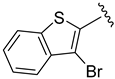
(3R,3aR,6S,6aS)-3-[(1-(R,S)-(3-bromobenzothiophen-2-yl)but-3-en-1-yl)oxy]-6-((tert-butyldiphenylsilyl)oxy)hexahydrofuro[3,2-b]furan 16h. It is prepared in 71% overall yield from 3-bromobenzothiophene-2-carboxyaldehyde following the same procedure used for 16a. However, after 1 h at −78 °C, the temperature is allowed to reach −40 °C in 1 h. The d.r. (determined on the crude product) was = 91:9. Rf: 0.27 (major), 0.35 (minor) (PE/EtOAc 10:1). Also, a small amount (5%) of the bicomponent product ((R,S)-1-(3-bromobenzothiophen-2-yl)-but-3-en-1-ol) is obtained. Only the major diastereomer was isolated in pure form and fully characterized, whereas the minor diastereomer was isolated only as an enriched mixture. Yield: 65% (on the pure diastereomer).
[α]D: −0.38 (c 1, CHCl3). 1H NMR (400 MHz, CDCl3): δ 7.84 (ddd, 1H, J = 8.0, 1.2, 0.8, H-4′ or H-7′), 7.80 (ddd, 1H, J = 8.0, 1.2, 0.8, H-4′ or H-7′), 7.61–7.56 (m, 4H, CH meta of TDBDPS), 7.49–7.33 (m, 8H, CH ortho and para of TBDPS, H-5′, H-6′), 5.76 (dddd, 1H, J = 17.2, 10.4, 7.6, 6.8, CH=CH2), 5.09 (dq, 1H, J = 17.2, 1.7, CH=CHH), 5.02 (dtd, 1H, J = 10.4, 2.0, 1.2, CH=CHH), 4.94 (t, 1H, J = 6.9, CH-CH2CH=), 4.51 (t, 1H, J = 3.9, H-3a), 4.29 (d, 1H, J = 3.8, H-6a), 4.25 (mc) (m, 1H, H-6), 4.02 (ddd, 1H, J = 8.2, 6.7, 4.1, H-3), 3.97 (dd, 1H, J = 8.0, 6.8, H-2), 3.85 (d, 1H, J = 9.9, H-5), 3.76 (dd, 1H, J = 9.8, 3.6, H-5), 3.52 (t, 1H, J = 8.0, H-2), 2.79 (dtt, 1H, J = 13.8, 6.8, 1.2, CHH-CH=), 2.60 (dtt, 1H, J = 13.8, 7.2, 1.2, CHH-CH=), 1.01 (s, 9H, C(CH3)3). 13C NMR (101 MHz, CDCl3) δ 141.4 (C-7a′), 137.8, 137.7 (C-3a′, C-2′), 135.6 (CH ortho to Si), 133.5, 133.2 (quat. of TBDPS), 133.0 (CH=CH2), 129.9, 129.8 (CH para to Si), 127.8, 127.7 (CH meta to Si), 125.7 (C-5′), 125.1 (C-6′), 123.1 (C-4′), 122.9 (C-7′), 118.2 (CH=CH2), 107.1 (C-3′), 88.1 (C-6a), 81.0 (C-3a), 78.4 (C-3), 78.1 (C-6), 77.4 (CH-CH2CH=, covered by CDCl3, detected at HSQC), 76.2 (C-5), 68.7 (C-2), 41.6 (CH2CH=), 26.8 (C(CH3)3), 19.1 (C(CH3)3). HRMS (ESI+): calcd. for C34H38BrO4SSi+ [M + H]+ 649.14380, found 649.1440.
Selected 1H NMR signals of minor diastereomer. 1H NMR (400 MHz, CDCl3): δ 5.81 (ddt, 1H, J = 17.2, 10.4, 7.2, CH=CH2), 5.26 (t, 1H, J = 6.9, CH-CH2C=), 5.09 (dq, 1H, J = 17.2, 1.6, CH=CHH), 5.01 (dtd, 1H, J = 10.4, 2.0, 1.2, CH=CHH), 4.81 (t, 1H, J = 4.2, H-3a), 4.33 (d, 1H, J = 4.1, H-6a), 4.28 (mc) (m, 1H, H-6), 3.98 (td, 1H, J = 7.1, 4.5, H-3), 3.90 (d, 1H, J = 9.8, H-5), 3.79 (dd, 1H, J = 9.8, 7.4, H- 5), 3.62 (dd, 1H, J = 8.8, 3.7, H-2), 3.48 (dd, 1H, J = 8.8, 7.7, H-2), 2.86 (dtt, 1H, J = 14.0, 6.8, 1.2, H-2′), 2.60 (dtt, 1H, J = 13.8, 7.0, 1.2, H-2′), 1.07 (s, 9H, C(CH3)3).
(3R,3aR,6S,6aS)-3-[(1-(R,S)-(2-Benzyloxyphenyl)but-3-en-1-yl)oxy]-6-((tert-butyldiphenylsilyl)oxy)hexahydrofuro[3,2-b]furan 16i. It is prepared in 45% overall yield from 2-benzyloxybenzaldehyde following the same procedure used for 16a. However, after 1 h at −78 °C, the temperature is allowed to reach −40 °C in 1 h. The d.r. (determined on the crude product) was = 79:21. The two diastereomers cannot be separated. Rf: 0.56 (PE/EtOAc 10:1). HRMS (ESI+): calcd. for C39H45O5Si+ [M + H]+ 621.30308, found 621.3028.
Major diastereomer.
1H NMR (400 MHz, CDCl3): δ 7.65–7.55 (m, 5H, CH meta of TDBDPS, H-6′), 7.45–7.28 (m, 11H, CH ortho and para of TBDPS, CH of benzyl), 7.25 (td, 1H, J = 7.8, 2.0, H-4′), 7.05 td, 1H, J = 7.5, 0.9, H-5′), 6.93 (d, 1H, J = 8.2, H-3′), 5.80 (dddd, 1H, J = 17.2, 10.4, 7.6, 6.8, CH=CH2), 5.09, 5.07 (AB system, 2H, J = 11.8, CH2Ph), 5.01–4.92 (m, 2H, CH=CH2), 4.86 (dd, 1H, J = 7.7, 5.3, CH-CH2CH=), 4.44 (t, 1H, J = 3.8, H-3a), 4.30–4.22 (m, 2H, H-6a, H-6), 3.87–3.79 (m, 3H, H-5, H-2, H-3), 3.77 (dd, 1H, J = 9.7, 3.5, H-5), 3.47 (mc) (m, 1H, H-2), 2.59–2.39 (m, 2H, H-2′), 1.03 (s, 9H, C(CH3)3). 13C NMR (101 MHz, CDCl3) δ 155.9 (C-2′), 137.1 (quat. benzyl), 135.6 (CH ortho to Si), 135.2 (CH=CH2), 133.5, 133.3 (quat. of TBDPS), 130.5 (C-1′), 129.9 (CH para to Si), 128.6 (CH meta of Bn), 128.4 (C-4′), 127.8, 127.7 (CH meta to Si), 127.2 (CH ortho of Bn + C-6′), 121.2 (C-5′), 116.6 (CH=CH2), 111.6 (C-3′), 88.1 (C-6a), 81.0 (C-3a), 78.7 (C-3), 78.3 (C-6), 76.1 (C-5 + CH-CH2C=C), 70.0 (PhCH2), 68.9 (C-2), 41.3 (CH2-CH=), 26.8 (C(CH3)3), 19.1 (C(CH3)3).
Selected signals of minor diastereomer. 1H NMR (400 MHz, CDCl3): δ 6.96 (td, 1H, J = 7.5, 0.9, H-5′), 5.10 (s, 2H, CH2Ph), 4.66 (t, 1H, J = 4.0, H-3a), 3.54 (dd, 1H, J = 8.3, 7.1, H-2), 3.39 (t, 1H, J = 8.5, H-2), 1.05 (s, 9H, C(CH3)3). 13C NMR (101 MHz, CDCl3) δ 88.3 (C-6a), 80.0 (C-3a), 74.8 (CH-CH2C=C), 69.4 (C-2).
(3R,3aR,6S,6aS)-3-[(1-(R,S)-cyclohexylbut-3-en-1-yl)oxy]-6-((tert-butyldiphenylsilyl)oxy)hexahydrofuro[3,2-b]furan 16k. It is prepared in 60% overall yield from cyclohexanecarboxaldehyde. following the same procedure used for 16a. However, after 2 h at −78 °C, the temperature is allowed to reach −40 °C in 1 h. The d.r. (determined on the crude product or on the chromatographed product) was = 66:34 (integration of the signals of CH=CH2 at 5.79 (major) or 5.96 (minor) ppm). The two diastereomers cannot be separated. Rf: 0.42 (PE/EtOAc 9:1). HRMS (ESI+): calcd. for C32H45O4Si+ [M + H]+ 521.30816, found 521.3089.
Major diastereomer.
1H NMR (400 MHz, CDCl3): δ 7.67–7.60 (m, 4 H), 7.46–7.34 (m, 6H), 5.79 (ddt, 1H, J = 17.2, 10.2, 7.0 Hz, CH=CH2), 5.08–4.98 (m, 2H, CH=CH2), 4.62 (t, 1H, J = 4.0 Hz, H-3a), 4.37 (d, 1H, J = 4.0, H-6a), 4.26 (mc) (m, 1H, H-6), 4.03–3.96 (m, 1H, H-3), 3.90–3.77 (m, 2H, H-2 + H-5), 3.75 (dd, 1H, J = 9.7, 3.6, H-5), 3.37 (dd, 1H, J = 9.6, 8.2, H-2), 3.18 (q, 1H, J = 6.0 Hz, CH-CH2CH=), 2.30–2.15 (m, 2H, CH2CH=CH2), 1.98–1.85 (m, 1 H, CH cyHex), 1.82–1.58 (m, 4 H, CH2 cyHex), 1.55–1.09 (m, 6H, CH2 cyHex), 1.06 (s, 9H, (CH3)3C).13C NMR (101 MHz, CDCl3) δ 135.7 (CH ortho to Si), 134.6 (CH=CH2), 133.3 (quat.), 129.88, 129.85 (CH para to Si), 127.8, 127.7 (CH meta to Si), 116.8 (CH=CH2), 88.1 (C-6a), 85.1 (C-1′), 80.6 (C-3), 80.3 (C-3a), 78.3 (C-6), 76.2 (C-5), 69.0 (C-2), 41.5 (CH of cyHex), 35.7 (CH2CH=CH2), 28.9, 28.7, 26.6, 26.3, 26.2 (CH2 cyHex), 26.8 (C(CH3)3), 19.1 (C(CH3)3).
Selected signals of the minor diastereomer.1H NMR (400 MHz, CDCl3): δ 5.96 (ddt, 1H, J = 17.2, 10.2, 7.1 Hz, CH=CH2), 4.63 (t, 1H, J = 4.0 Hz, H-3a), 4.37 (d, 1H, J = 4.0, H-6a), 4.26 (mc) (m, 1H, H-6), 4.03–3.96 (m, 1H, H-3), 3.90–3.77 (m, 3H, H-2 + H-5), 3.40 (t, 1H, J = 8.8, H-2), 3.14 (q, 1H, J = 6.0 Hz, CH-CH2CH=C), 2.40–2.27 (m, 2H, CH2CH=CH2), 1.06 (s, 9H, (CH3)3C).
(3R,3aR,6S,6aS)-3-[(1-(R,S)-(2-methylprop-1yl)but-3-en-1-yl)oxy]-6-((tert-butyldiphenylsilyl)oxy)hexahydrofuro [3,2-b]furan 16l. A solution of TMS ether 11 (245.2 mg, 537 µmol) in dry CH2Cl2 (2.5 mL) is treated with freshly distilled isovaleraldehyde (57 µL, 531 µmol) and with allyl trimethylsilane (127 µL, 800 µmol). The solution is cooled to −78 °C, and a freshly prepared 0.3 M solution of TMS-OTf in CH2Cl2 (716 µL, 215 µmol) is added. After 1 h, more isovaleraldehyde (28 µL, 261 µmol) and TMS-OTf solution (716 µL, 215 µmol) are added, and the solution is allowed to warm to −30 °C during 1 h. The reaction is quenched by the addition of Et3N (226 µL, 1.62 mmol). After warming, the mixture is diluted with a saturated aqueous solution of NaHCO3, extracted with AcOEt, dried, and evaporated to dryness. The crude product is chromatographed (PE/EtOAc 95:5) to give the diastereomeric mixture of 16l (157 mg, 59%). The ratio (determined on the chromatographed product or on the crude product by 1H NMR) was = 88:12. Further elution with CH2Cl2/EtOAc 1:1 furnishes recovered alcohol 6 (63 mg, 30.5%). The yield based on non-recovered starting material (calculated as (µmol 16l/(µmol starting 11 − µmol recovered 6))) is = 85%. Rf: 0.30 (PE/EtOAc 9:1). [α]D: + 44.3 (c 1, CHCl3). HRMS (ESI+): calcd. for C30H43O4Si+ [M + H]+ 495.29251, found 495.2928.
Major diastereomer.
1H NMR (400 MHz, CDCl3): δ 7.67–7.60 (m, 4 H), 7.46–7.34 (m, 6H), 5.78 (ddt, 1H, J = 17.4, 10.3, 7.1, CH=CH2), 5.08–5.00 (m, 2H, CH=CH2), 4.63 (t, 1H, J = 3.8, H-3a), 4.39 (d, 1H, J = 3.7, H-6a), 4.27 (mc) (m, 1H, H-6), 4.03 (ddd, 1H, J = 9.3, 7.2, 4.1, H-3), 3.86 (d, 1H, J = 9.3, H-5), 3.82 (dd, 1H, J = 8.0, 7.6, H-2), 3.75 (dd, 1H, J = 9.8, 3.6, H-5), 3.55 (dq, 1H, J = 8.2, 5.5 Hz, CH-CH2CH=), 3.39 (t, 1H, J = 8.6, H-2), 2.27–2.20 (m, 2H, CH2CH=CH2), 1.82 (t of oct, 1H, J = 8.0, 6.5), 1.52 (ddd, 1H, J = 14.1, 8.2, 5.8, CHH-iPr), 1.29–1.21 (m, 1H, CHH-iPr), 1.06 (s, 9H, (CH3)3C), 0.93 (d, 3H, J = 6.4, CH3CH), 0.91 (d, 3H, J = 6.4, CH3CH). 13C NMR (101 MHz, CDCl3) δ 135.67, 135.65 (CH ortho to Si), 134.6 (CH=CH2), 133.5, 133.3 (quat.), 129.90, 129.87 (CH para to Si), 127.80, 127.75 (CH meta to Si), 117.2 (CH=CH2), 88.2 (C-6a), 80.4 (C-3a), 79.5 (C-3), 78.4 (C-6), 76.1 (C-5), 69.3 (C-2), 43.8 (CH2iPr), 39.1 (CH2CH=CH2), 26.9 (C(CH3)3), 24.3 (CH(CH3)2), 23.2, 22.2 (CH3CH), 19.1 (C(CH3)3).
Selected peaks of minor diastereomer.
1H NMR (400 MHz, CDCl3): δ 5.87 (ddt, 1H, J = 16.8, 10.4, 7.2, CH=CH2), 4.40 (d, 1H, J = 3.7, H-6a), 3.82 (dd, 1H, J= 8.0, 7.6, H-2), 3.50–3.43 (m, 1H, CH-CH2CH=), 3.39 (t, 1H, J= 8.6, H-2), 2.42–2.25 (m, 2H, CH2CH=CH2), 0.88 (d, 3H, J= 6.8, CH3CH), 0.85 (d, 3H, J= 6.4, CH3CH). 13C NMR (101 MHz, CDCl3) δ 135.67, 135.65 (CH ortho to Si), 134.8 (CH=CH2), 133.5, 133.3 (quat.), 129.90, 129.87 (CH para to Si), 127.80, 127.75 (CH meta to Si), 117.1 (CH=CH2), 88.3 (C-6a), 80.8 (C-3a), 79.9 (C-3), 78.4 (C-6), 76.1 (C-5), 69.0 (C-2), 43.4 (CH2iPr), 39.6 (CH2CH=CH2), 26.9 (C(CH3)3), 24.3 (CH(CH3)2), 23.2, 22.4 (CH3CH), 19.1 (C(CH3)3).
(3R,3aR,6S,6aR)-3-[(1-(S)-(5-bromobenzo[d][1,3]dioxole-5-yl)but-3-en-1-yl)oxy]-hexahydrofuro [3,2-b]furan-6-ol 18a. A solution of 16a (pure major diastereomer) (125.2 mg, 196 µmol) in dry THF (1 mL) is treated dropwise with tetrabutylammonum fluoride (TBAF) (1.0 M solution in THF) (392 µL, 392 µmol). The resulting brownish solution is stirred until the reaction is complete by TLC (50 min.). The solution is treated with saturated aqueous NH4Cl and extracted thrice with EtOAc. The organic extracts are washed with brine, dried and evaporated to give a crude product. Chromatography (PE/EtOAc 2:3) affords pure 18a as an oil (58.9 mg, 75%). Rf: 0.40 (PE/EtOAc 2:3). [α]D: −14.2 (c= 0.67, CHCl3) 1H NMR (400 MHz, CDCl3): δ 7.12 (s, 1H, H-6′), 6.96 (s, 1H, H-3′), 6.00 (d, 1H, J = 1.0, O-CHH-O), 5.98 (d, 1H, J = 1.0, O-CHH-O), 5.81 (ddt, 1H, J = 17.2, 10.2, 7.0, CH=CH2), 5.11–4.99 (m, 2H, CH=CH2), 4.73 (dd, 1H, J = 7.8, 5.3, CH-CH2C=), 4.42 (t, 1H, J = 4.3, H-3a), 4.33 (d, 1H, J = 4.1, H-6a), 4.29 (d, 1H, J = 3.2, H-6), 4.00 (dd, 1H, J = 10.2, 3.5, H-5), 3.96–3.82 (m, 3H, H-3 + 1 H-2 + 1 H-5), 3.63 (t, 1H, J = 7.6, H-2), 2.49 (dt, 1H, J = 14.3, 7.1, CHHC=), 2.38 (dt, 1H, J = 14.1, 6.3, CHHC=). 13C NMR (101 MHz, CDCl3) δ 147.92, 147.87 (C-2a′, C-6a′), 134.1 (C-4′, CH=CH2), 117.4 (CH=CH2), 113.1 (C-5′), 112.2 (C-3′), 107.8 (C-6′), 101.8 (O-CH2O), 88.0 (C-6a), 80.8 (CH-CH2C=), 80.6 (C-3a), 78.5 (C-3), 76.8 (C-6), 75.9 (C-5), 69.5 (C-2), 41.3 (CH2-CH=). HRMS (ESI+): calcd. for C17H20BrO6Si+ [M + H]+ 399.04378, found 399.0437.
Supplementary Materials
The following supporting information can be downloaded at: https://www.mdpi.com/article/10.3390/molecules31122155/s1, Discussion on the relative configuration of the main diastereomers; Table S1: Characteristic Chemical shifts (1H NMR) of the two diastereomers; Figure S1: Figure S2: Preferred conformation for the (S) simplified product 16a; Figure S3: Preferred conformation for the (R) simplified product 16a. Copy of all 1H and 13C NMR spectra.
Author Contributions
Conceptualization: L.B., R.R. Funding acquisition: L.B., R.R. Resources: C.L., L.B. Data analysis: C.L., L.B., R.R., L.M. Investigation: L.G.d.l.P., D.R.P. Supervision: C.L., L.B., R.R. Writing—original draft preparation: L.B. Writing—review and editing: C.L., R.R., L.M. All authors have read and agreed to the published version of the manuscript.
Funding
This research was funded under the National Recovery and Resilience Plan (NRRP), Mission 4, Component 2, Investment 1.1, Call for Tender No. 104 published on 2 February 2022 by the Italian Ministry of University and Research (MUR), funded by the European Union—NextGenerationEU—Project Title SUSTCARB—CUP D53D23010360006—Grant Assignment Decree No. 1064 adopted on 18 July 2023, by the Italian Ministry of University and Research (MUR). We thank the Erasmus Programme for scholarships to D.R. and L.G.
Institutional Review Board Statement
Not applicable.
Informed Consent Statement
Not applicable.
Data Availability Statement
The original contributions presented in this study are included in the article/Supplementary Materials. Further inquiries can be directed to the corresponding author.
Acknowledgments
We thank Andrea Cannizzaro and Zoe Ghezzi for their precious collaboration during their third-year bachelor stage. We thank Amano for the kind gift of enzymes.
Conflicts of Interest
The authors declare no conflicts of interest.
Abbreviations
The following abbreviations are used in this manuscript:
| Bn | Benzyl |
| DMAP | 4-Dimethylaminopyridine |
| DMF | N,N-dimethylformamide |
| MCR | Multicomponent Reaction |
| MHS | Multicomponent Hosomi–Sakurai |
| PE | Petroleum ether 40–60 |
| TBAF | Tetrabutylammonium fluoride |
| TBDPS | tert-Butildiphenylsilyl |
| Tf | Trifluoromethanesulfonyl |
| THF | Tetrahydrofuran |
| TMS | Trimethylsilyl |
References
- Ning, P.; Yang, G.; Hu, L.; Sun, J.; Shi, L.; Zhou, Y.; Wang, Z.; Yang, J. Recent advances in the valorization of plant biomass. Biotechnol. Biofuels 2021, 14, 102. [Google Scholar] [CrossRef] [Scilit] [PubMed]
- Zarganes-Tzitzikas, T.; Chandgude, A.L.; Dömling, A. Multicomponent Reactions, Union of MCRs and beyond. Chem. Rec. 2015, 15, 981–996. [Google Scholar] [CrossRef] [Scilit] [PubMed]
- Tandi, M.; Sharma, V.; Gopal, B.; Sundriyal, S. Multicomponent reactions (MCRs) yielding medicinally relevant rings: A recent update and chemical space analysis of the scaffolds. RSC Adv. 2025, 15, 1447–1489. [Google Scholar] [CrossRef] [Scilit] [PubMed]
- Moni, L.; Banfi, L.; Basso, A.; Carcone, L.; Rasparini, M.; Riva, R. Ugi and Passerini Reactions of Biocatalytically Derived Chiral Aldehydes: Application to the Synthesis of Bicyclic Pyrrolidines and of Antiviral Agent Telaprevir. J. Org. Chem. 2015, 80, 3411–3428. [Google Scholar] [CrossRef] [Scilit] [PubMed]
- Cioc, R.C.; Ruijter, E.; Orru, R.V.A. Multicomponent reactions: Advanced tools for sustainable organic synthesis. Green Chem. 2014, 16, 2958–2975. [Google Scholar] [CrossRef] [Scilit]
- Vitali Forconesi, G.; Basso, A.; Banfi, L.; Gugliotta, D.; Lambruschini, C.; Nola, M.; Riva, R.; Rocca, V.; Moni, L. Total Synthesis of 4-epi-Bengamide E. Molecules 2024, 29, 1715. [Google Scholar] [CrossRef] [Scilit] [PubMed]
- Rizzo, M.; Calandri, M.-J.; Kurnosov, D.; Lambruschini, C.; Raboni, F.; Riva, R.; Banfi, L. Selective Functionalization of the 1,6-Anhydro Moiety and of the Double Bond of Levoglucosenone. Org. Biomol. Chem. 2026, 24, 2294–2300. [Google Scholar] [CrossRef] [Scilit] [PubMed]
- Dussenne, C.; Delaunay, T.; Wiatz, V.; Wyart, H.; Suisse, I.; Sauthier, M. Synthesis of isosorbide: An overview of challenging reactions. Green Chem. 2017, 19, 5332–5344. [Google Scholar] [CrossRef] [Scilit]
- Armani, D. Synthetic routes and fields of application of isohexides: Comprehensive perspective of relevant industrial compounds. RSC Sustain. 2025, 3, 2134–2148. [Google Scholar] [CrossRef] [Scilit]
- Zhang, C.; Wang, Y.; Liu, L.; Feng, X.; Qiu, J.; Li, S.; Liu, G. Recent Advances in the Biobased Synthesis and Expanding Applications of Isosorbide: A Review. ChemistrySelect 2026, 11, e06204. [Google Scholar] [CrossRef] [Scilit]
- Rose, M.; Palkovits, R. Isosorbide as a Renewable Platform chemical for Versatile Applications—Quo Vadis? ChemSusChem 2012, 5, 167–176. [Google Scholar] [PubMed]
- Jašek, V.; Fučík, J.; Krhut, J.; Mravcova, L.; Figalla, S.; Přikryl, R. A Study of Isosorbide Synthesis from Sorbitol for Material Applications Using Isosorbide Dimethacrylate for Enhancement of Bio-Based Resins. Polymers 2023, 15, 3640. [Google Scholar] [CrossRef] [Scilit] [PubMed]
- Hammami, N.; Patry, S.; Soldera, A.; Ameduri, B.; Habas, J.-P. Isosorbide as a Molecular Glass: New Insights into the Physicochemical Behavior of a Biobased Diol. Molecules 2025, 30, 4364. [Google Scholar] [CrossRef] [Scilit] [PubMed]
- Ragno, D.; Leonardi, C.; Di Carmine, G.; Bortolini, O.; Brandolese, A.; De Risi, C.; Massi, A. Regiodivergent Isosorbide Acylation by Oxidative N-Heterocyclic Carbene Catalysis in Batch and Continuous Flow. ACS Sustain. Chem. Eng. 2021, 9, 8295–8305. [Google Scholar] [CrossRef] [Scilit]
- Zhang, M.; Tu, Y.; Zhou, Z.; Wu, G. Balancing the transesterification reactivity of isosorbide with diphenyl carbonate: Preferential activation of exo-OH. Polym. Chem. 2020, 11, 5512–5525. [Google Scholar] [CrossRef] [Scilit]
- Sidduri, A.; Dresel, M.J.; Knapp, S. Incorporation of an Isohexide Subunit Improves the Drug-like Properties of Bioactive Compounds. ACS Med. Chem. Lett. 2023, 14, 176–182. [Google Scholar] [CrossRef] [Scilit] [PubMed]
- Bonardd, S.; Maiti, B.; Grijalvo, S.; Rodríguez, J.; Enshaei, H.; Kortaberria, G.; Alemán, C.; Díaz Díaz, D. Biomass-derived isosorbide-based thermoresponsive hydrogel for drug delivery. Soft Matter 2022, 18, 4963–4972. [Google Scholar] [PubMed]
- Kim, G.B.; Seo, J.I.; Gye, M.C.; Yoo, H.H. Isosorbide, a versatile green chemical: Elucidating its ADME properties for safe use. Ecotoxicol. Environ. Saf. 2024, 272, 116051. [Google Scholar] [CrossRef] [Scilit] [PubMed]
- Döpping, D.; Kern, J.; Rotter, N.; Llevot, A.; Theato, P.; Mutlu, H. Synthesis and Characterization of Novel Isosorbide-Based Polyester Derivatives Decorated with α-Acyloxy Amides. Macromol. Chem. Phys. 2022, 223, 2100497. [Google Scholar]
- Sakurai, H.; Sasaki, K.; Hayashi, J.; Hosomi, A. Chemistry of organosilicon compounds. 191. Acetalization of carbonyl compounds with alkoxysilanes catalyzed by iodotrimethylsilane. One-pot allylation reactions of carbonyl compounds to homoallyl ethers using an allylsilane. J. Org. Chem. 1984, 49, 2808–2809. [Google Scholar] [CrossRef] [Scilit]
- Jacques, T.; Markó, I.E.; Pospíšil, J. The Modified Sakurai and Related Reactions. In Multicomponent Reactions; Zhu, J., Bienaymé, H., Eds.; Wiley-VCH Verlag GmbH & Co. KGaA: Weinheim, Germany, 2005; pp. 398–452. [Google Scholar]
- Kampen, D.; Ladépêche, A.; Claßen, G.; List, B. Brønsted Acid-Catalyzed Three-Component Hosomi–Sakurai Reactions. Adv. Synth. Cat. 2008, 350, 962–966. [Google Scholar]
- Pospisil, J.; Kumamoto, T.; Marko, I.E. Highly diastereoselective silyl-modified sakurai multicomponent reaction. Angew. Chem. Int. Ed. 2006, 45, 3357–3360. [Google Scholar]
- Pospíšil, J.; Markó, I.E. Total Synthesis of Jerangolid D. J. Am. Chem. Soc. 2007, 129, 3516–3517. [Google Scholar] [CrossRef] [Scilit] [PubMed]
- Lambruschini, C.; Barbero, A.; Cherubin, A.; Moni, L.; Palio, L.; Riva, R.; Banfi, L. Multicomponent Hosomi-Sakurai reaction on chiral, bio-based, alcohols. RSC Adv. 2025, 15, 17897–17905. [Google Scholar] [PubMed]
- Saxon, D.J.; Nasiri, M.; Mandal, M.; Maduskar, S.; Dauenhauer, P.J.; Cramer, C.J.; LaPointe, A.M.; Reineke, T.M. Architectural Control of Isosorbide-Based Polyethers via Ring-Opening Polymerization. J. Am. Chem. Soc. 2019, 141, 5107–5111. [Google Scholar] [PubMed]
- Zhu, S.-G.; Huang, J.-X.; Zhang, G.-M.; Chen, S.-X.; Zhang, F.-L. Development of a Practical Enzymatic Synthesis of Isosorbide-2-acetate. Org. Process Res. Dev. 2018, 22, 1548–1552. [Google Scholar] [CrossRef] [Scilit]
- Berini, C.; Lavergne, A.; Molinier, V.; Capet, F.; Deniau, E.; Aubry, J.-M. Iodoetherification of Isosorbide-Derived Glycals: Access to a Variety of O-Alkyl or O-Aryl Isosorbide Derivatives. Eur. J. Org. Chem. 2013, 2013, 1937–1949. [Google Scholar]
- François, J.; Rio, J.; Jeanneau, E.; Perrin, M.-È.L.; Jacolot, M.; Payard, P.-A.; Popowycz, F. Ir–Na cooperativity controls the diastereoselectivity of borrowing hydrogen C–C alkylation on isosorbide: Synthesis methodology and mechanistic investigation. Org. Chem. Front. 2023, 10, 4732–4739. [Google Scholar]
- Montgomery, R.; Wiggins, L.F. 60. Anhydrides of polyhydric alcohols. Part IX. Derivatives of 1: 4-anhydrosorbitol from 1: 4-3: 6-dianhydrosorbitol. J. Chem. Soc. 1948, 237–241.
- Karimi, B.; Golshani, B. Mild and Highly Efficient Method for the Silylation of Alcohols Using Hexamethyldisilazane Catalyzed by Iodine under Nearly Neutral Reaction Conditions. J. Org. Chem. 2000, 65, 7228–7230. [Google Scholar] [CrossRef] [Scilit] [PubMed]
- Stoss, P.; Merrath, P.; Schlüter, G. Regioselective Acylation of 1,4:3,6-Dianhydro-D-glucitol. Synthesis 1987, 1987, 174–176. [Google Scholar] [CrossRef] [Scilit]
- Goodwin, J.C.; Hodge, J.E.; Weisleder, D. Preparation of bicyclic hexitol anhydrides by using acidic cation-exchange resin in a binary solvent. p13C-N.m.r. spectroscopy confirms configurational inversion in chloride displacement of methanesulfonate in isomannide and isosorbide derivatives. Carbohydr. Res. 1980, 79, 133–141. [Google Scholar]
- Kielty, P.; Smith, D.A.; Cannon, P.; Carty, M.P.; Kennedy, M.; McArdle, P.; Singer, R.J.; Aldabbagh, F. Selective Methylmagnesium Chloride Mediated Acetylations of Isosorbide: A Route to Powerful Nitric Oxide Donor Furoxans. Org. Lett. 2018, 20, 3025–3029. [Google Scholar] [CrossRef] [Scilit] [PubMed]




Disclaimer/Publisher’s Note: The statements, opinions and data contained in all publications are solely those of the individual author(s) and contributor(s) and not of MDPI and/or the editor(s). MDPI and/or the editor(s) disclaim responsibility for any injury to people or property resulting from any ideas, methods, instructions or products referred to in the content. |
© 2026 by the authors. Licensee MDPI, Basel, Switzerland. This article is an open access article distributed under the terms and conditions of the Creative Commons Attribution (CC BY) license.