Article

Mn(III)-Catalyzed Synthesis of Selenophosphates and Tellurophosphates

Organoselenium Synthesis and Function Laboratory, School of Pharmacy, Nantong University, Nantong 226019, China
*
Author to whom correspondence should be addressed.
Molecules 2026, 31(12), 2103; https://doi.org/10.3390/molecules31122103
Submission received: 6 May 2026 / Revised: 11 June 2026 / Accepted: 12 June 2026 / Published: 15 June 2026
(This article belongs to the Section Organic Chemistry)

Abstract

Selenophosphates and tellurophosphates are important classes of organophosphorus compounds that exhibit unique reactivity, tunable redox properties, and significant biological activity. Herein, we report a mild and efficient Mn(III)-catalyzed method for synthesizing selenophosphates and tellurophosphates. Using Mn(OAc)3 as the catalyst and tetrahydrofuran (THF) as the solvent, various H-phosphonates and H-phosphine oxides undergo radical coupling with diselenides or ditellurides at room temperature in the presence of air, affording good-to-excellent yields of the corresponding chalcogenophosphates. The protocol features a broad substrate scope, favorable functional group tolerance, and low catalyst loading while avoiding the use of toxic reagents or strong oxidants. Mechanistic studies suggest that the reaction proceeds via the phosphinyl radicals generated through single-electron oxidation mediated by Mn(III).

1. Introduction

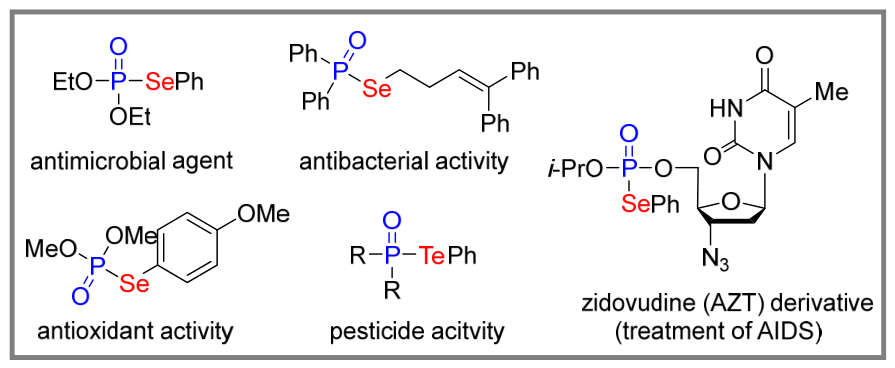
Organophosphates are fundamental to both chemistry and life, serving as indispensable structural motifs in pharmaceuticals, agrochemicals, materials science, and organic synthesis. Their significance is most clearly exemplified by their role as the backbone of DNA and RNA [1,2,3]. In this context, selenophosphates and tellurophosphates have attracted considerable attention. Compared with their oxygen analogs, these heavier chalcogenophosphates often exhibit unique reactivity, tunable redox behavior, and distinctive spectroscopic features (e.g., 77Se NMR), making them valuable in medicinal chemistry, agrochemistry, and biopharmaceutical research [4,5,6,7]. As illustrated in Figure 1, representative selenophosphates and tellurophosphates display a range of biological activities, including antimicrobial, antioxidant, and pesticidal effects, as well as potential applications in AIDS treatment.
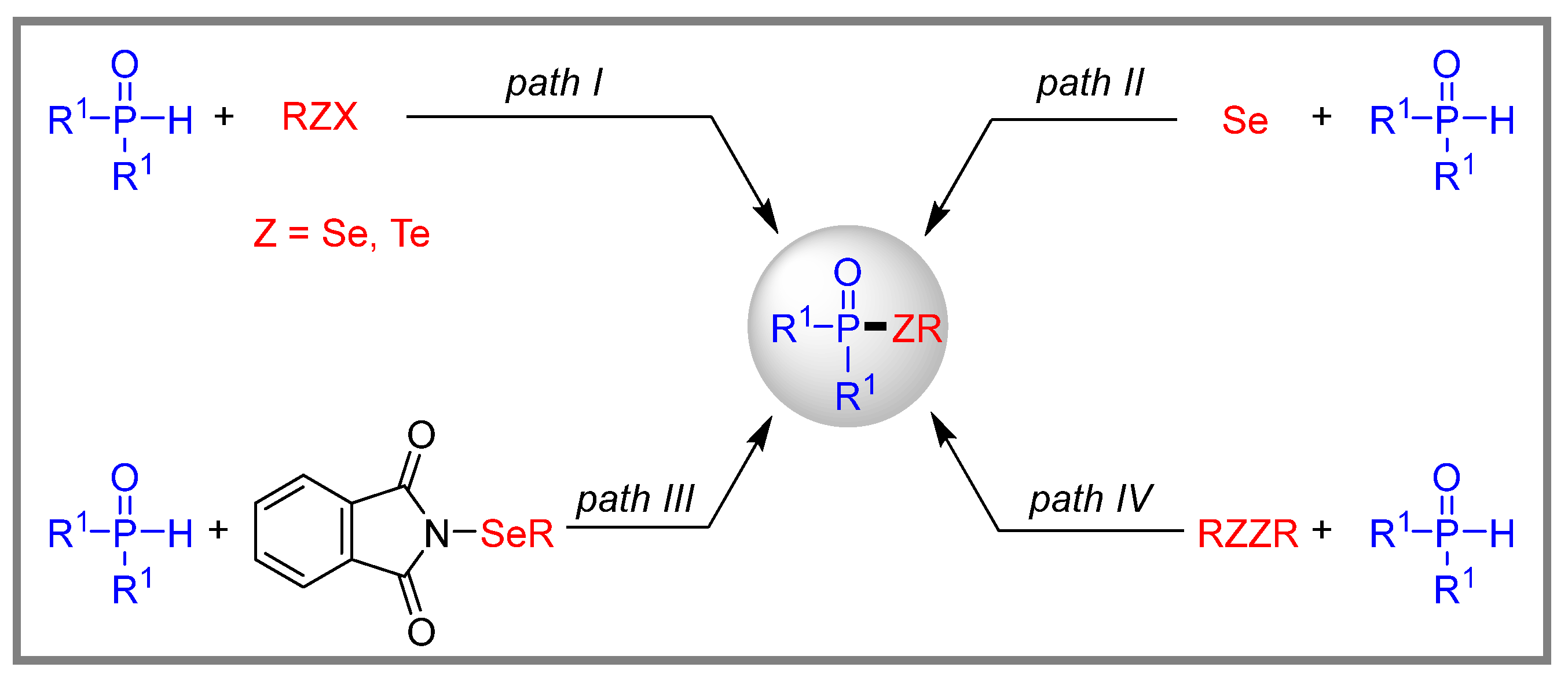
Consequently, substantial efforts have been devoted to developing efficient synthetic strategies for these compounds. Traditional methods for preparing chalcogenophosphates typically rely on activated chalcogenation reagents such as RZX (X = H, Br, Cl, etc.) (Scheme 1, path I) [8,9]. However, their practical use is substantially limited by issues such as unpleasant odor and sensitivity to oxygen and moisture. Elemental selenium and tellurium are considered ideal candidates for synthesizing chalcogenophosphates because of their nontoxic nature and high chemical stability (Scheme 1, path II) [10,11,12]. However, to date, direct activation of elemental tellurium with phosphorus sources for tellurophosphate synthesis has not been reported. Additionally, N-selenophthalimide has also been used as an excellent selenium source for the catalyst-free synthesis of selenophosphates (Scheme 1, path III), [13,14], but its high cost and limited structural diversity restrict broader application. By contrast, dichalcogenides are highly stable and easy-to-handle chalcogenation reagents and have therefore become preferred substrates. Various strategies for synthesizing chalcogenophosphates from dichalcogenides and phosphites including transition metal catalysis, [15,16,17]; base-promoted reactions, [18,19]; oxidant-mediated processes, [20,21,22]; radical initiation, [23,24]; photoredox catalysis, [25,26]; and electrochemical methods [27,28] (Scheme 1, path IV) have been developed.
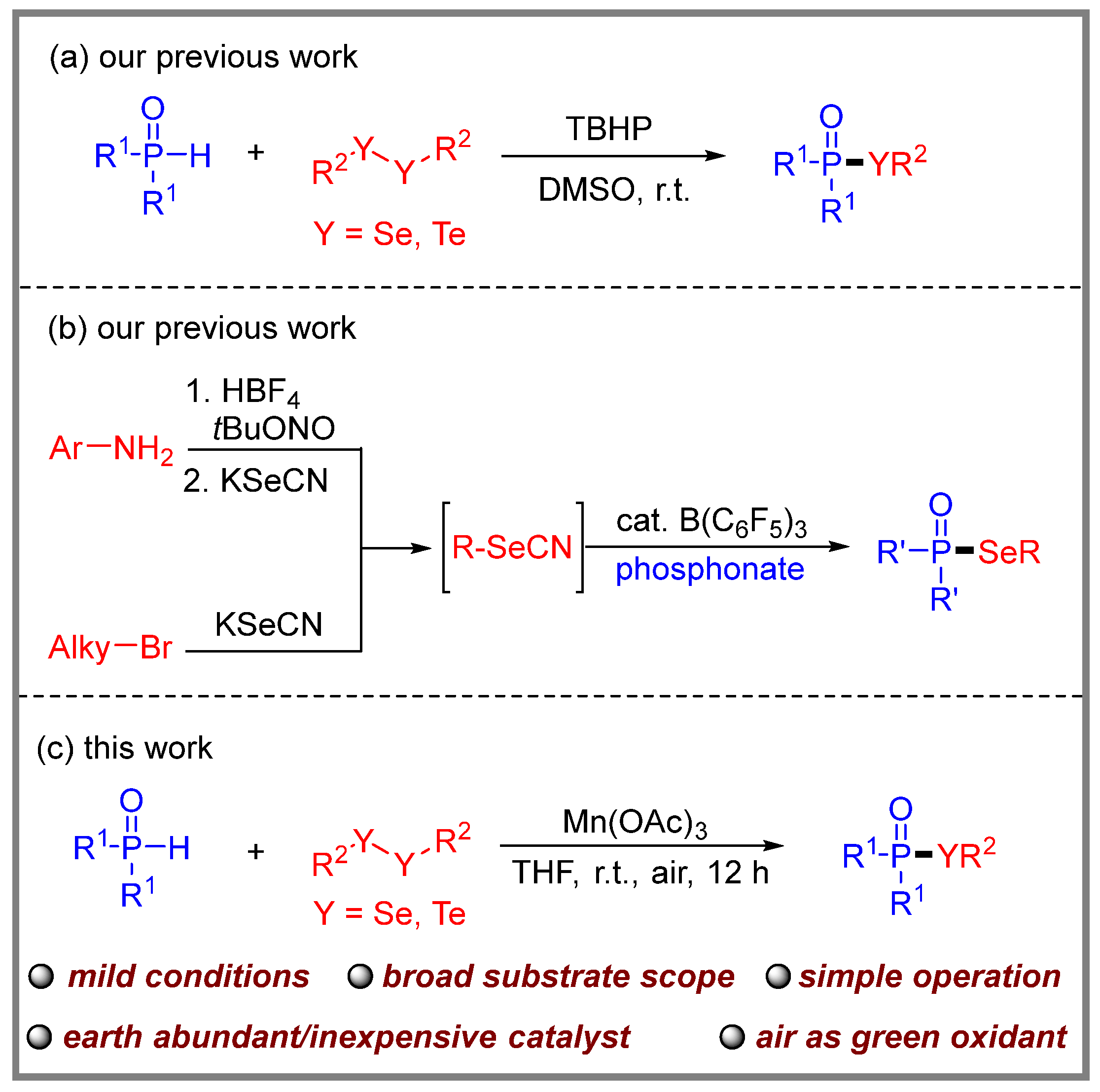
Recently, we developed several general and mild methods for synthesizing chalcogen-containing compounds using hypervalent iodine, [29] N–F reagents, [30] photochemical strategies [31,32], and borane catalysts [33]. As part of this effort, we reported a tert-butyl hydroperoxide (TBHP)-mediated oxidative coupling of phosphites with diselenides or ditellurides to synthesize phosphoroselenoates and phosphorotelluroates (Scheme 2a) [34]. However, this method requires 2.5 equivalents of TBHP, raising concerns regarding scalability and safety; moreover, the use of the high-boiling-point solvent dimethyl sulfoxide (DMSO) complicates product isolation on a larger scale. More recently, we developed a protocol for synthesizing selenophosphates, wherein selenocyanates generated in situ from anilines or alkyl bromides are coupled with phosphites under B(C6F5)3 catalysis to form the P–Se bond (Scheme 2b) [33]. Nevertheless, this approach generates hydrogen cyanide (HCN), a highly toxic and volatile inorganic compound that poses significant risks to both human health and the environment, even at low concentrations.
Manganese has attracted increasing attention in catalysis because of its natural abundance, low cost, and low toxicity [35,36]. In addition, manganese exhibits multiple stable oxidation states, endowing it with versatile redox reactivity and the ability to participate in electron transfer-mediated redox transformations. In particular, Mn(III) catalysis facilitates the formation of diverse chemical bonds through single-electron oxidation pathways [37,38,39]. For example, Wang et al. reported a Mn(OAc)3-promoted cross-coupling reaction of benzothiazole/thiazole derivatives with organophosphorus compounds [40]. In 2020, Li, Song and co-workers developed manganese(III)-promoted tandem phosphinoylation/cyclization of 2-arylindoles/2-arylbenzimidazoles with disubstituted phosphine oxides [41]. Very recently, Sun et al. reported a Mn(OAc)3-mediated radical cascade cyclization of N-propargyl enamides with various H-phosphine oxides, H-phosphinates and H-phosphonates, enabling the synthesis of multi-substituted 3-phosphorylpyridines [42]. In these cases, the single-electron oxidation of phosphonates by Mn(OAc)3 generates a phosphinyl radical, which subsequently triggers further transformation.
Although Mn(III)-catalyzed reactions have been widely applied in C–P bond formation, [43], the formation of Se–P and Te–P bonds via Mn(III) catalysis remains underexplored. Given the high electron density at the phosphorus center, phosphorus-centered radicals can be readily generated through Mn(III)-mediated single-electron oxidation. We hypothesized that these phosphinyl radicals could be intercepted by diselenides and ditellurides to form Se–P and Te–P bonds efficiently, thereby enabling selenophosphate and tellurophosphate synthesis.
Herein, we report a Mn(III)-catalyzed method for synthesizing selenophosphates and tellurophosphates from H-phosphonates or H-phosphine oxides with dichalcogenides (diselenides and ditellurides) (Scheme 2c) as part of our ongoing studies on chalcogen chemistry [29,30,31,32,33,34]. This catalytic system possesses prominent merits over previously developed methodologies. First, Mn(III) is commercially accessible and low-cost, which circumvents the use of toxic catalysts or noble metals. Second, the transformation proceeds smoothly at room temperature under an ambient air atmosphere, without requiring inert gas protection or strong oxidants like TBHP. Third, THF, adopted herein, is a low-boiling-point solvent, which simplifies product isolation and favors large-scale synthesis. Fourth, the method can be further applied to the synthesis of rarely explored tellurophosphates. Collectively, this approach serves as a practical and eco-friendly complement to existing synthetic strategies for such compounds.

2. Results and Discussion

With these considerations in mind, we initiated our study by optimizing the reaction conditions for the coupling of dimethyl phosphonate (1a) with Ph2Se2 (2a). The results are summarized in Table 1. Initially, a series of manganese catalysts were screened using ethanol as the solvent at room temperature for 6 h (Table 1, entries 1–8). Among the catalysts examined, Mn(III) species exhibited markedly superior performance compared to Mn(II) salts, with Mn(OAc)3 displaying the highest catalytic activity and affording the product an isolated yield of 73% (entry 8).
With Mn(OAc)3 identified as the optimal catalyst, a range of solvents were subsequently evaluated (entries 9–16). The reaction proceeded with moderate-to-good yields across polar protic, polar aprotic, and nonpolar solvents. Among these, tetrahydrofuran (THF) proved to be the most effective solvent, delivering an isolated yield of 89% of the product (entry 16). Reducing the catalyst loading to 5 mol% or 2 mol% decreased yields (entries 17–18). Notably, extending the reaction time to 12 h at a catalyst loading value of 5 mol% Mn(OAc)3 afforded a comparable yield of 87% (entry 19). By contrast, a control experiment conducted in the absence of a manganese catalyst only produced a 26% yield (entry 20), confirming the essential role of Mn(OAc)3 in this transformation. Although a longer reaction time was required at lower catalyst loading, 5 mol% Mn(OAc)3 was selected as the standard condition for subsequent studies due to its increased cost-effectiveness and reduced environmental impact.
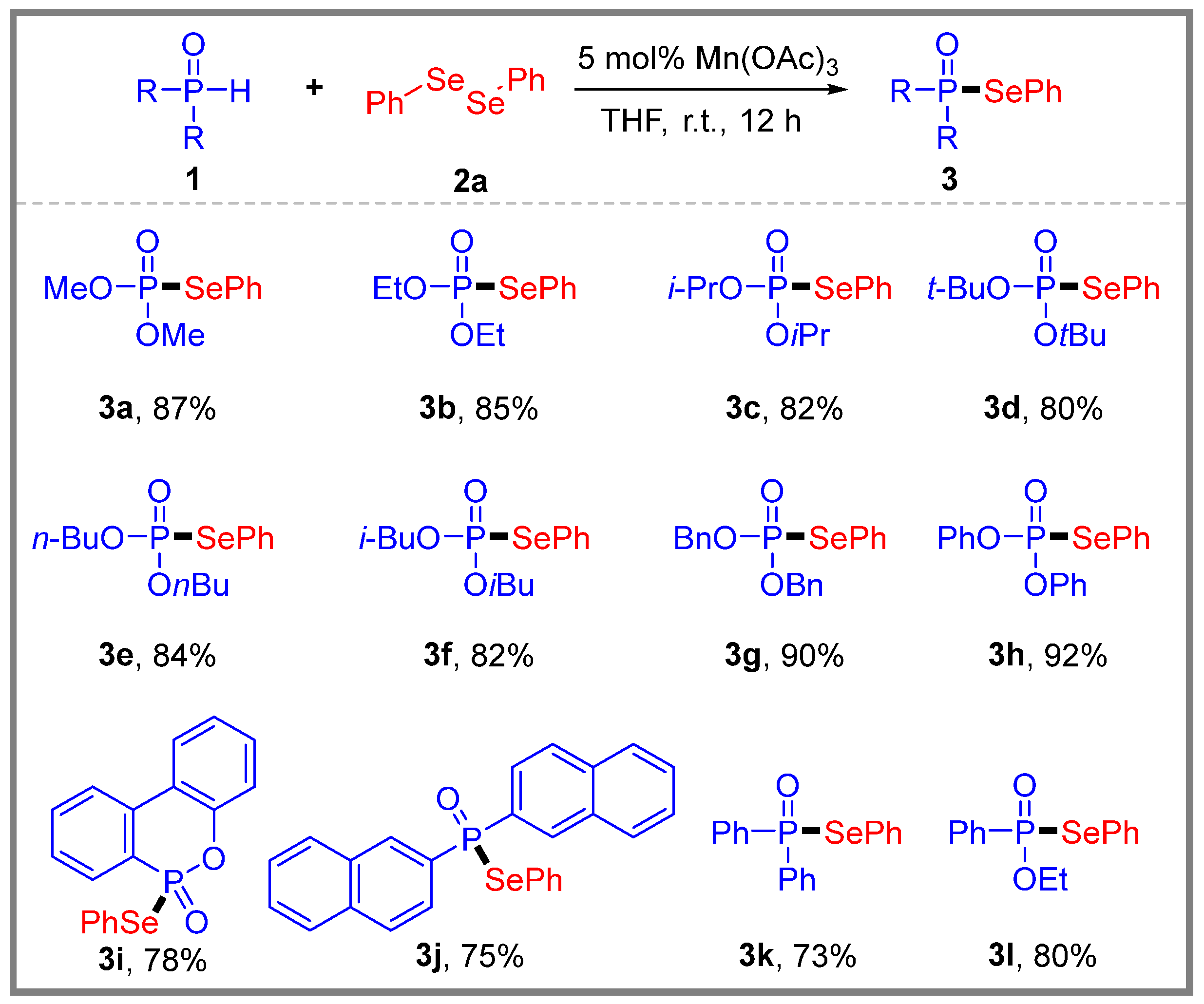
With the optimized conditions established, we next explored the substrate scope of phosphonates. As shown in Scheme 3, several dialkyl phosphonates bearing diverse alkyl substituents—including methyl (3a), ethyl (3b), isopropyl (3c), tert-butyl (3d), n-butyl (3e), isobutyl (3f), and benzyl (3g)—were well tolerated, affording good yields of the desired products. Notably, the sterically hindered tert-butyl-substituted phosphonate produced the product in 80% yield, highlighting the remarkable steric tolerance of this method. Diphenyl phosphonate also proved to be a suitable substrate, delivering the corresponding product in 92% yield (3h).
To further expand the scope, cyclic and structurally diverse P(III)-H compounds were examined. The cyclic H-phosphonate 9,10-dihydro-9-oxa-10-phosphaphenanthrene 10-oxide (DOPO) smoothly underwent the reaction to afford the selenylated product (3i) with a 78% yield. Additionally, both bis(2-naphthyl) phosphine oxide and diphenylphosphine oxide were converted efficiently to the corresponding products 3j (75%) and 3k (73%), respectively. Ethyl phenylphosphinate, an unsymmetrical compound bearing both ethoxy and phenyl groups, was also compatible with the reaction conditions (3l).
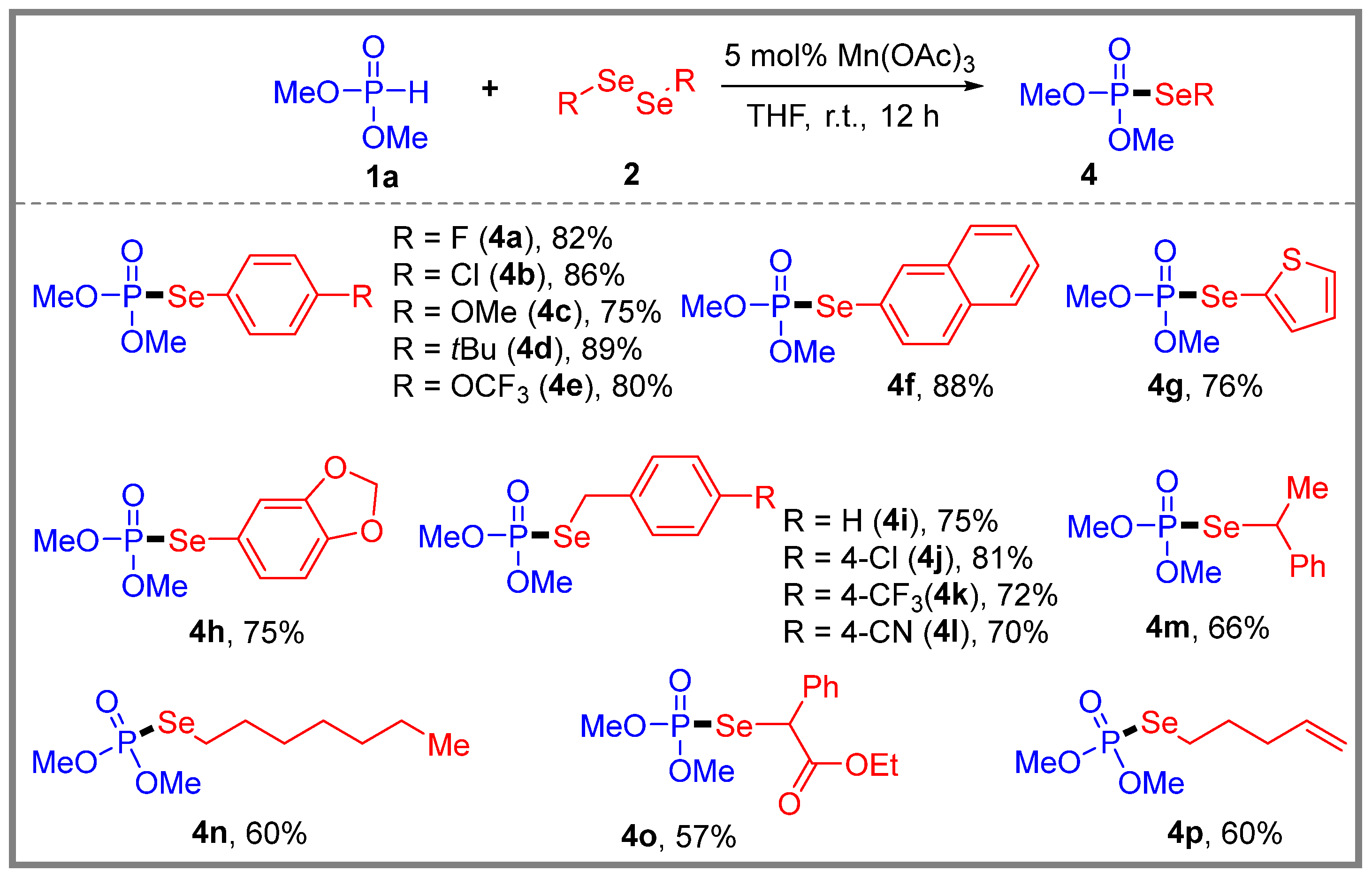
Next, the scope of diselenides was investigated (Scheme 4). Aryl diselenides bearing either electron-withdrawing (4a4b) or electron-donating groups (4c4e) reacted well to afford good-to-excellent yields of the corresponding P–Se products, demonstrating excellent functional group tolerance. Heteroaryl diselenides, such as 2-naphthyl and 2-thiophene derivatives, also furnished the desired products (4f and 4g) efficiently. Furthermore, a benzodioxole-derived diselenide afforded the selenylated product 4h in 75% yield, expanding the structural diversity of the products.
Notably, although aliphatic diselenides are generally less reactive and less commonly employed in selenylation reactions, this protocol proved highly effective for various aliphatic diselenide substrates. As shown in Scheme 4, a series of aliphatic diselenides, including benzyl (4i4l), secondary alkyl (4m), linear alkyl (4n), α-ester-substituted alkyl (4o), and terminal alkene-containing alkyl (4p) derivatives, participated in the reaction, affording the desired products in moderate-to-good yields.
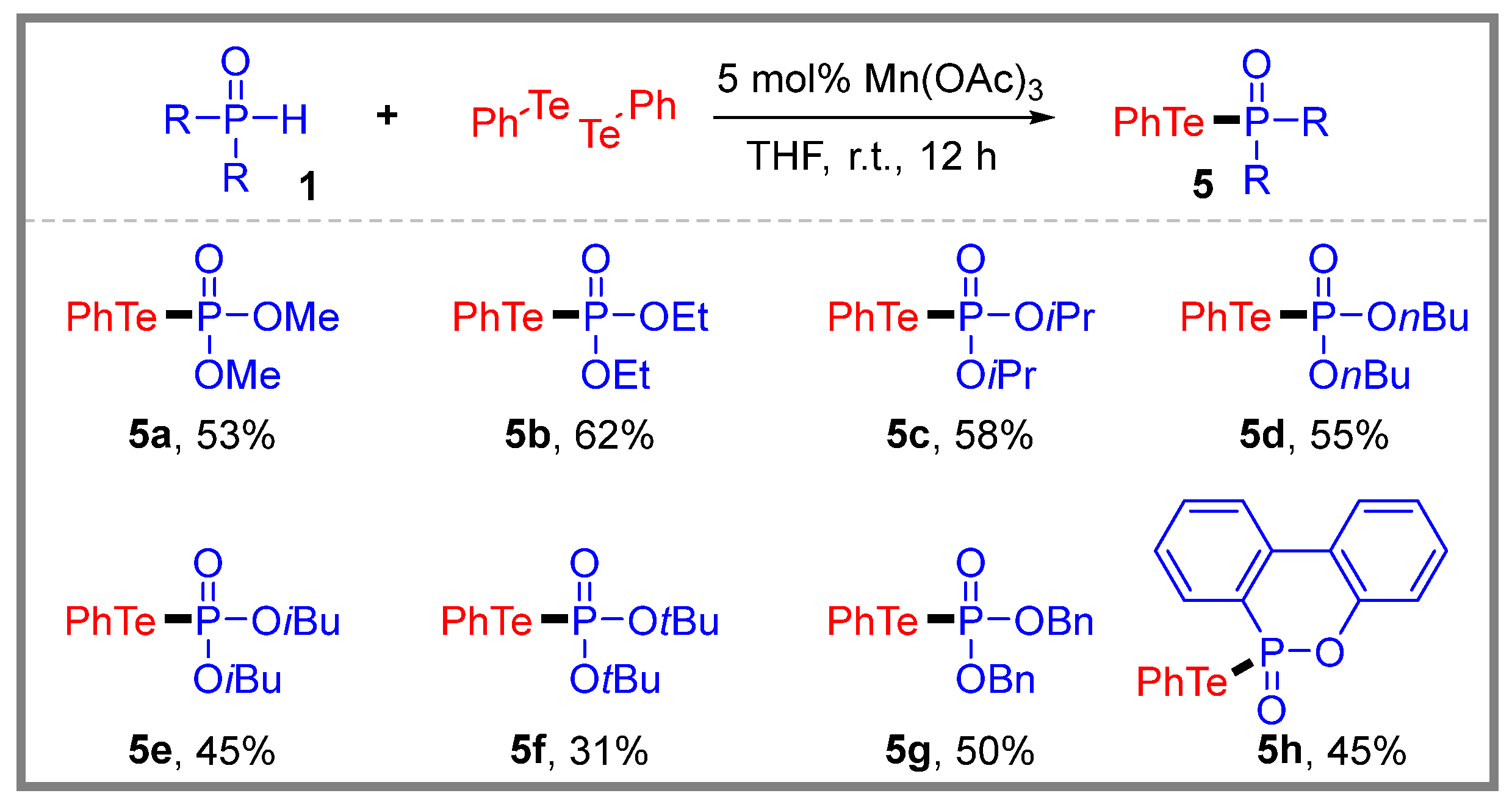
As a congener of selenium, Te-aryl tellurophosphates have been far less frequently reported due to their inherent instability. Nevertheless, tellurophosphates are valuable chalcogen-substituted phosphorus compounds with potential biological and synthetic applications [44,45]. Following the successful synthesis of selenophosphates, we extended this methodology to the preparation of Te-aryl tellurophosphates. As shown in Scheme 5, the desired products were obtained in moderate yields. This reduced efficiency is primarily attributed to the instability of tellurium-containing compounds, which are prone to decomposition during column chromatography. Despite these limitations, this method provides a rare and practical route to tellurophosphates and a foundational step toward exploring their potential biological and synthetic applications.
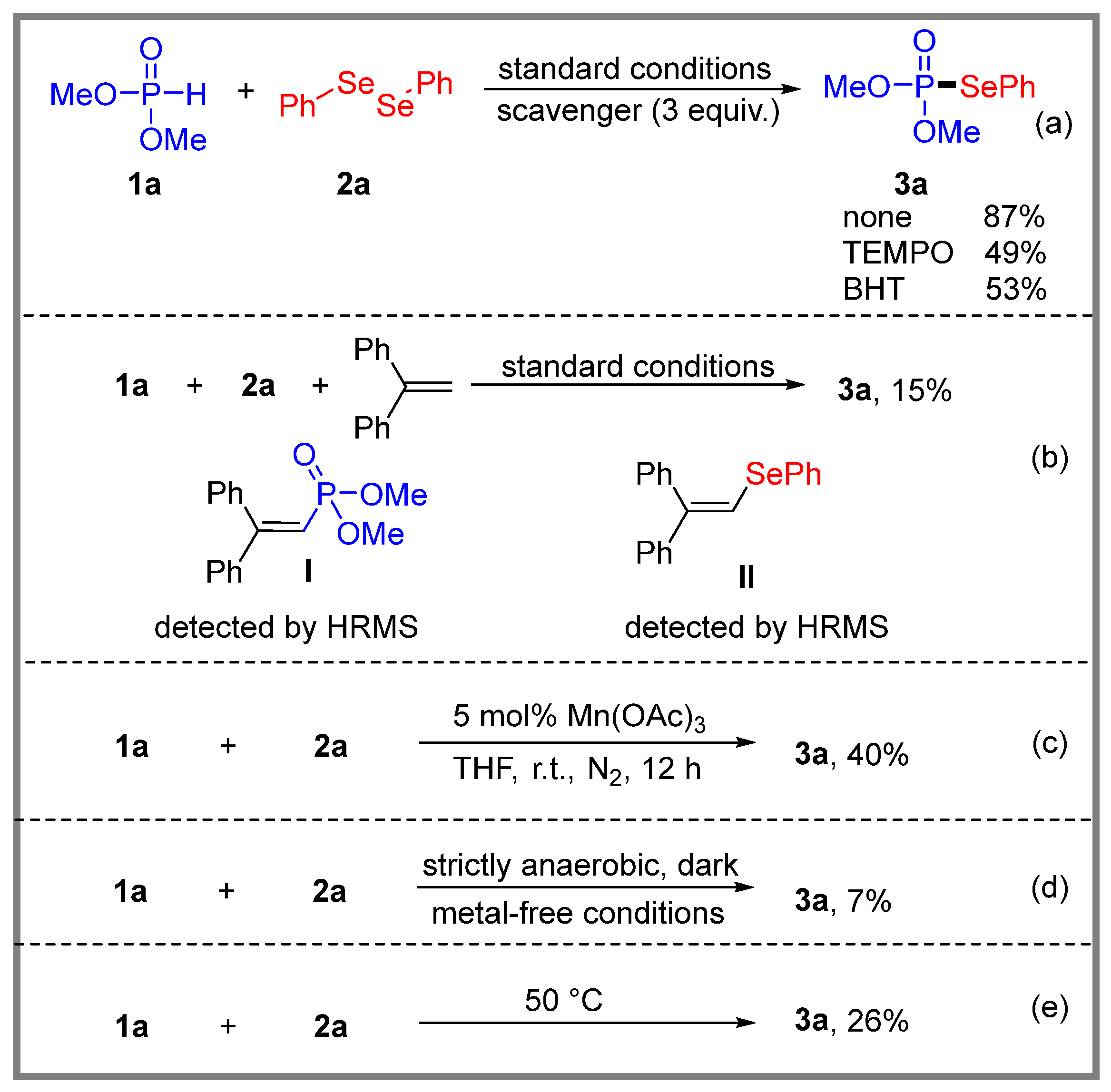
To gain mechanistic insight, several control experiments were conducted (Scheme 6). Radical trapping experiments using TEMPO (2,2,6,6-tetramethyl-1-piperidinyloxy) and BHT (butylated hydroxytoluene) significantly suppressed product formation, indicating the involvement of a radical pathway (Scheme 6a). Furthermore, 1,1-diphenylethylene addition inhibited the reaction (Scheme 6b), and two adducts (I and II) were detected by ESI-MS, suggesting the generation of both phosphonyl and selenyl radicals during coupling. When the reaction of 1a with 2a was carried out under a nitrogen atmosphere, the yield of 3a decreased to 40% (Scheme 6c), highlighting the crucial promoting role of molecular oxygen. Nevertheless, the relatively moderate yield (40%) under anaerobic conditions may result from incomplete removal of trace oxygen. More plausibly, however, a catalyst-free background reaction also contributes significantly.
Given that a 26% yield of 3a was obtained in the absence of Mn(OAc)3 (Table 1, entry 20), a control experiment was conducted under strictly anaerobic, dark, and metal-free conditions, wherein all glassware was pre-cleaned with freshly prepared aqua regia and reaction vessels were fully wrapped with aluminum foil to exclude ambient light. Remarkably, trace quantities of product 3a were still detected despite these rigorous experimental precautions (Scheme 6d). Furthermore, the target product could also be successfully afforded when the reaction was conducted at 50 °C under the aforementioned rigorous control conditions (Scheme 6e). These results unambiguously verify the existence of an intrinsic background radical pathway independent of exogenous radical initiators.
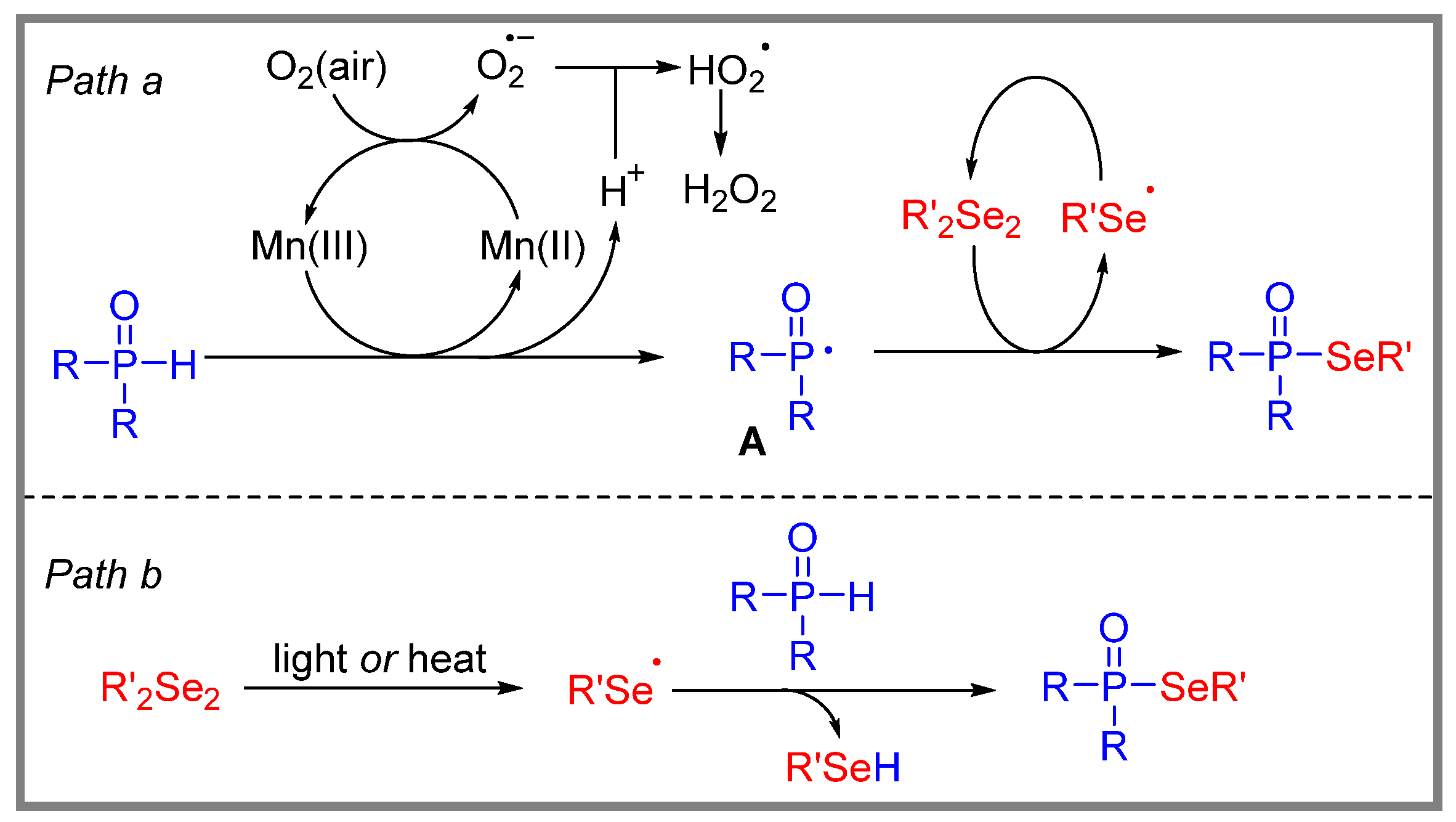
Based on these results and previous reports, a plausible mechanism for the reaction of phosphonate with diselenide is proposed (Scheme 7). The reaction is initiated by Mn(III)-mediated single-electron oxidation of the phosphonate, generating phosphinyl radical A [40,41,42]. This radical is then trapped by the diselenide to form the desired selenophosphate and a selenyl radical. The selenyl radical can combine and undergo dimerization to regenerate diselenide, thereby sustaining the catalytic cycle. Meanwhile, reduced Mn(II) is reoxidized by atmospheric oxygen to regenerate the active Mn(III) species (Path a). An alternative mechanism for the synthesis of selenophosphates proceeding through a selenium radical pathway (path b), though not the major one, is also plausible.

3. Materials and Methods

3.1. General Information

All chemicals were of reagent grade and used without further purification unless otherwise noted. Solvents were dried and distilled prior to use, and petroleum ether (boiling point range: 60–90 °C) was used for chromatography. Reaction progress was monitored through thin-layer chromatography (TLC) on 60 precoated silica gel plates (Qingdao, China, 0.25 mm thickness), and the products were purified through flash column chromatography on silica gel (200−300 mesh). NMR spectra were recorded on a Bruker Avance-III HD spectrometer (Billerica, MA, USA, 1H NMR: 400 MHz, 13C NMR: 100 MHz), with chemical shifts reported in parts per million (ppm) relative to residual solvent peaks (CDCl3: 7.26 ppm and 77.16 ppm for 1H NMR and 13C NMR, respectively) and reported in parts per million (ppm) relative to tetramethylsilane (TMS) (see Supplymentary Meterials). Spin−spin coupling constants (J) were reported in Hz, and melting points were determined using glass slides and a WRX-4 digital (Shanghai, China) display microscopic melting point apparatus and left uncorrected. H-phosphonates were purchased from Bide (Shanghai, China) and Leyan (Shanghai, China)., whereas diselenides and ditellurides were prepared from the corresponding iodides with elemental selenium/tellurium according to a procedure from the listerature [46].

3.2. General Procedure for the Synthesis of Chalcogenophosphates

A 20 mL test tube equipped with a magnetic stir bar was charged with phosphite (0.2 mmol), dichalcogenide (0.12 mmol), Mn(OAc)3 (0.010 mmol), and THF (2 mL). The reaction mixture was stirred at room temperature under air for 12 h. Then, the solvent was removed with a rotary evaporator under reduced pressure. The crude product was purified through flash column chromatography on silica gel using petroleum ether/ethyl acetate as the eluent to afford the desired product.
O,O-Dimethyl Se-phenyl phosphoroselenoate (3a). Compound 3a was prepared according to the general procedure and isolated as an oil (46 mg, 87% yield) after flash chromatography (petroleum ether/ethyl acetate = 5/1). 1H NMR (400 MHz, CDCl3) δ 7.56 (d, J = 6.7 Hz, 2H), 7.44–6.97 (m, 3H), 3.73 (s, 3H), 3.69 (s, 3H). 13C NMR (100 MHz, CDCl3) δ 134.6 (d, JC-P = 4.7 Hz), 128.6 (d, JC-P = 2.2 Hz), 127.9 (d, JC-P = 2.7 Hz), 122.2 (d, JC-P = 8.5 Hz), 53.0 (d, JC-P = 5.7 Hz). 31P NMR (162 MHz, CDCl3) δ 21.8. Spectral data are in good agreement with literature values [9].
O,O-Diethyl Se-phenyl phosphoroselenoate (3b). Compound 3b was prepared according to the general procedure and isolated as an oil (50 mg, 85% yield) after flash chromatography (petroleum ether/ethyl acetate = 5/1). 1H NMR (400 MHz, CDCl3) δ 7.66–7.63 (m, 2H), 7.47–7.17 (m, 3H), 4.40–3.75 (m, 4H), 1.31 (t, J = 7.1 Hz, 6H). 13C NMR (100 MHz, CDCl3) δ 134.5 (d, JC-P = 4.6 Hz), 128.5 (d, JC-P = 2.1 Hz), 127.8 (d, JC-P = 2.6 Hz), 122.7 (d, JC-P = 8.5 Hz), 62.8 (d, JC-P = 5.9 Hz), 14.9 (d, JC-P = 7.4 Hz). 31P NMR (162 MHz, CDCl3) δ 18.0. Spectral data are in good agreement with literature values [27].
O,O-Diisopropyl Se-phenyl phosphoroselenoate (3c). Compound 3c was prepared according to the general procedure and isolated as an oil (53 mg, 82% yield) after flash chromatography (petroleum ether/ethyl acetate = 5/1). 1H NMR (400 MHz, CDCl3) δ 7.59 (d, J = 8.1 Hz, 2H), 7.33–7.17 (m, 3H), 4.89–4.57 (m, 2H), 1.26 (d, J = 6.2 Hz, 6H), 1.18 (d, J = 6.2 Hz, 6H). 13C NMR (100 MHz, CDCl3) δ 134.1 (d, JC-P = 5.0 Hz), 128.3 (d, JC-P = 1.9 Hz), 127.5 (d, JC-P = 2.5 Hz), 123.5 (d, JC-P = 8.3 Hz), 72.1 (d, JC-P = 6.6 Hz), 22.9 (d, JC-P = 3.8 Hz), 22.5 (d, JC-P = 5.9 Hz). 31P NMR (162 MHz, CDCl3) δ 14.7. Spectral data are in good agreement with literature values [9].
O,O-Di-tert-butyl Se-phenyl phosphoroselenoate (3d). Compound 3d was prepared according to the general procedure and isolated as an oil (56 mg, 80% yield) after flash chromatography (petroleum ether/ethyl acetate = 4/1). 1H NMR (400 MHz, CDCl3) δ 7.62 (d, J = 8.0 Hz, 2H), 7.46–7.02 (m, 3H), 1.39 (s, 18H). 13C NMR (100 MHz, CDCl3) δ 134.7 (d, JC-P = 4.7 Hz), 128.0 (d, JC-P = 2.2 Hz), 127.2 (d, JC-P = 2.7 Hz), 124.9 (d, JC-P = 8.9 Hz), 84.4 (d, JC-P = 10.4 Hz), 29.2 (d, JC-P = 4.4 Hz). 31P NMR (162 MHz, CDCl3) δ 5.0. Spectral data are in good agreement with literature values [34].
O,O-Dibutyl Se-phenyl phosphoroselenoate (3e). Compound 3e was prepared according to the general procedure and isolated as an oil (59 mg, 84% yield) after flash chromatography (petroleum ether/ethyl acetate = 5/1). 1H NMR (400 MHz, CDCl3) δ 7.57 (d, J = 8.4 Hz, 2H), 7.40–7.07 (m, 3H), 4.31–3.78 (m, 4H), 1.55 (dq, J = 8.2, 6.6 Hz, 4H), 1.38–1.21 (m, 4H), 0.82 (t, J = 7.4 Hz, 6H). 13C NMR (100 MHz, CDCl3) δ 134.5 (d, JC-P = 4.7 Hz), 128.4 (d, JC-P = 2.1 Hz), 127.7 (d, JC-P = 2.5 Hz), 122.8 (d, JC-P = 8.3 Hz), 66.5 (d, JC-P = 6.5 Hz), 31.0 (d, JC-P = 7.3 Hz), 17.7, 12.5. 31P NMR (162 MHz, CDCl3) δ 18.0. Spectral data are in good agreement with literature values [9].
O,O-Diisobutyl Se-phenyl phosphoroselenoate (3f). Compound 3f was prepared according to the general procedure and isolated as an oil (57 mg, 82% yield) after flash chromatography (petroleum ether/ethyl acetate = 5/1). 1H NMR (400 MHz, CDCl3) δ 7.58 (d, J = 6.6 Hz, 2H), 7.38–7.11 (m, 3H), 3.96–3.64 (m, 4H), 1.85 (dp, J = 13.3, 6.7 Hz, 2H), 0.83 (d, J = 1.6 Hz, 6H), 0.82 (d, J = 1.6 Hz, 6H). 13C NMR (100 MHz, CDCl3) δ 134.5 (d, JC-P = 4.7 Hz), 128.4 (d, JC-P = 1.9 Hz), 127.7 (d, JC-P = 2.5 Hz), 122.7 (d, JC-P = 8.5 Hz), 72.6 (d, JC-P = 7.0 Hz), 27.9 (d, JC-P = 7.6 Hz), 17.66, 17.65. 31P NMR (162 MHz, CDCl3) δ 17.8. Spectral data are in good agreement with literature values [27].
O,O-Dibenzyl Se-phenyl phosphoroselenoate (3g). Compound 3g was prepared according to the general procedure and isolated as an oil (75 mg, 90% yield) after flash chromatography (petroleum ether/ethyl acetate = 4/1). 1H NMR (400 MHz, CDCl3) δ 7.48 (d, J = 8.1 Hz, 2H), 7.30–7.21 (m, 7H), 7.21–7.11 (m, 6H), 5.07–4.98 (m, 4H). 13C NMR (100 MHz, CDCl3) δ 134.8 (d, JC-P = 4.7 Hz), 134.2 (d, JC-P = 7.8 Hz), 128.5 (d, JC-P = 2.2 Hz), 127.9 (d, JC-P = 2.7 Hz), 127.52, 127.50, 127.0, 122.2 (d, JC-P = 8.6 Hz), 68.1 (d, JC-P = 6.1 Hz). 31P NMR (162 MHz, CDCl3) δ 18.5. Spectral data are in good agreement with literature values [9].
O,O,Se-Triphenyl phosphoroselenoate (3h). Compound 3h was prepared according to the general procedure and isolated as an oil (72 mg, 92% yield) after flash chromatography (petroleum ether/ethyl acetate = 6/1). 1H NMR (400 MHz, CDCl3) δ 7.55–7.37 (m, 2H), 7.33–7.14 (m, 7H), 7.15–7.07 (m, 6H). 13C NMR (100 MHz, CDCl3) δ 149.2 (d, JC-P = 8.6 Hz), 135.2 (d, JC-P = 4.8 Hz), 128.7 (d, JC-P = 1.3 Hz), 128.5 (d, JC-P = 2.5 Hz), 128.3 (d, JC-P = 2.9 Hz), 124.6 (d, JC-P = 1.6 Hz), 121.6 (d, JC-P = 9.1 Hz), 119.6 (d, JC-P = 5.1 Hz). 31P NMR (162 MHz, CDCl3) δ 9.5. Spectral data are in good agreement with literature values [9].
6-(Phenylselanyl)dibenzo[c,e][1,2]oxaphosphinine 6-oxide (3i). Compound 3i was prepared according to the general procedure and isolated as an oil (59 mg, 78% yield) after flash chromatography (petroleum ether/ethyl acetate = 5/1). 1H NMR (400 MHz, CDCl3) δ 7.80 (dd, J = 14.9, 7.7 Hz, 1H), 7.69 (dd, J = 8.1, 6.5 Hz, 1H), 7.60–7.49 (m, 2H), 7.39 (tdd, J = 7.5, 3.6, 1.0 Hz, 1H), 7.31–7.20 (m, 1H), 7.17 (dq, J = 8.2, 2.1 Hz, 2H), 7.12–7.02 (m, 3H), 6.92 (t, J = 7.6 Hz, 2H). 13C NMR (100 MHz, CDCl3) δ 149.3 (d, JC-P = 9.8 Hz), 135.9 (d, JC-P = 3.7 Hz), 134.9 (d, JC-P = 7.5 Hz), 132.7 (d, JC-P = 2.7 Hz), 129.5 (t, JC-P = 5.5 Hz), 128.0 (dd, JC-P = 5.2, 2.7 Hz), 127.4 (d, JC-P = 15.0 Hz), 125.6, 124.4, 123.9, 123.9, 123.7, 122.2 (d, J = 11.2 Hz), 120.9 (d, JC-P = 7.1 Hz), 120.8 (d, JC-P = 11.7 Hz), 119.0 (d, JC-P = 7.0 Hz). 31P NMR (162 MHz, CDCl3) δ 31.4. Spectral data are in good agreement with literature values [27].
Se-Phenyl di(naphthalen-2-yl)phosphinoselenoate (3j). Compound 3j was prepared according to the general procedure and isolated as a solid (69 mg, 75% yield) after flash chromatography (petroleum ether/ethyl acetate = 2/1). Mp= 230–231 °C. 1H NMR (400 MHz, CDCl3) δ 8.39–8.31 (m, 2H), 7.90–7.73 (m, 6H), 7.53–7.43 (m, 7H), 7.20–7.01 (m, 4H). 13C NMR (100 MHz, CDCl3) δ 136.4 (d, J = 3.3 Hz), 134.8 (d, J = 2.7 Hz), 133.6 (d, J = 9.6 Hz), 132.4 (d, J = 14.4 Hz), 131.5, 130.9 (d, J = 5.8 Hz), 129.3 (d, J = 1.7 Hz), 129.2, 128.5, 128.4, 127.8, 127.7, 127.1, 126.1 (d, J = 12.0 Hz). 31P NMR (162 MHz, CDCl3) δ 40.0. Spectral data are in good agreement with literature values [47].
Se-Phenyl diphenylphosphinoselenoate (3k). Compound 3k was prepared according to the general procedure and isolated as an oil (52 mg, 73% yield) after flash chromatography (petroleum ether/ethyl acetate = 5/1). 1H NMR (400 MHz, CDCl3) δ 7.87–7.64 (m, 4H), 7.51–7.26 (m, 8H), 7.16 (t, J = 8.0 Hz, 1H), 7.07 (t, J = 7.5 Hz, 2H). 13C NMR (100 MHz, CDCl3) δ 136.3 (d, JC-P = 3.3 Hz), 133.9, 133.0, 132.3 (d, JC-P = 3.3 Hz), 131.4 (d, JC-P = 10.6 Hz), 129.3 (d, JC-P = 1.7 Hz), 128.5 (d, JC-P = 13.2 Hz), 123.7 (d, JC-P = 15.7 Hz). 31P NMR (162 MHz, CDCl3) δ 40.0. Spectral data are in good agreement with literature values [9].
O-Ethyl Se-phenyl phenylphosphonoselenoate (3l). Compound 3l was prepared according to the general procedure and isolated as an oil (52 mg, 80% yield) after flash chromatography (petroleum ether/ethyl acetate = 5/1). 1H NMR (400 MHz, CDCl3) δ 7.58–7.47 (m, 2H), 7.44–7.40 (m, 1H), 7.32–7.25 (m, 4H), 7.23–7.18 (m, 2H), 7.11 (t, J = 7.6 Hz, 1H), 4.39–4.18 (m, 2H), 1.34 (t, J = 7.1 Hz, 3H). 13C NMR (100 MHz, CDCl3) δ 136.5 (d, JC-P = 3.6 Hz), 132.8 (d, JC-P = 138.0 Hz), 132.5 (d, JC-P = 3.3 Hz), 131.1 (d, JC-P = 11.0 Hz), 129.4 (d, JC-P = 2.2 Hz), 128.8 (d, JC-P = 2.5 Hz), 128.2 (d, JC-P = 14.9 Hz), 124.2 (d, JC-P = 6.7 Hz), 62.6 (d, JC-P = 7.1 Hz), 16.2 (d, JC-P = 7.1 Hz). 31P NMR (162 MHz, CDCl3) δ 36.7. Spectral data are in good agreement with literature values [47].
Se-(4-Fluorophenyl) O,O-dimethyl phosphoroselenoate (4a). Compound 4a was prepared according to the general procedure and isolated as an oil (46 mg, 82% yield) after flash chromatography (petroleum ether/ethyl acetate = 3/1). 1H NMR (400 MHz, CDCl3) δ 7.54 (dd, J = 8.8, 5.2 Hz, 2H), 6.98–6.93 (m, 2H), 3.74 (s, 3H), 3.71 (s, 3H). 13C NMR (100 MHz, CDCl3) δ 162.3 (dd, JC-F = 249.7, JC-P = 3.0 Hz), 136.7 (dd, JC-P = 8.3, JC-P =4.4 Hz), 116.8 (dd, JC-F = 8.7, JC-P = 3.5 Hz), 115.9 (dd, JC-F = 21.9, JC-P = 2.3 Hz), 53.1 (d, JC-P = 5.9 Hz). 19F NMR (376 MHz, CDCl3) δ −111.7 (d, JP-F = 4.8 Hz). 31P NMR (162 MHz, CDCl3) δ 21.5 (d, JP-F = 4.8 Hz). Spectral data are in good agreement with literature values [44].
Se-(4-Chlorophenyl) O,O-dimethyl phosphoroselenoate (4b). Compound 4b was prepared according to the general procedure and isolated as an oil (51 mg, 86% yield) after flash chromatography (petroleum ether/ethyl acetate = 5/1). 1H NMR (400 MHz, CDCl3) δ 7.50 (d, J = 8.5 Hz, 2H), 7.22 (d, J = 8.5 Hz, 2H), 3.74 (s, 3H), 3.71 (s, 3H). 13C NMR (100 MHz, CDCl3) δ 135.9 (d, JC-P = 4.6 Hz), 134.5 (d, JC-P = 3.1 Hz), 128.8 (d, JC-P = 2.2 Hz), 120.3 (d, JC-P = 8.8 Hz), 53.1 (d, JC-P = 5.9 Hz). 31P NMR (162 MHz, CDCl3) δ 21.2. Spectral data are in good agreement with literature values [44].
Se-(4-Methoxyphenyl) O,O-dimethyl phosphoroselenoate (4c). Compound 4c was prepared according to the general procedure and isolated as an oil (44 mg, 75% yield) after flash chromatography (petroleum ether/ethyl acetate = 2/1). 1H NMR (400 MHz, CDCl3) δ 7.46 (d, J = 8.8 Hz, 2H), 6.78 (d, J = 8.8 Hz, 2H), 3.72 (s, 3H), 3.71 (s, 3H), 3.70 (s, 3H). 13C NMR (100 MHz, CDCl3) δ 159.4 (d, JC-P = 2.8 Hz), 136.3 (d, JC-P = 4.2 Hz), 114.3 (d, JC-P = 2.4 Hz), 112.0 (d, JC-P = 8.7 Hz), 54.3, 52.9 (d, JC-P = 5.7 Hz). 31P NMR (162 MHz, CDCl3) δ 22.2. Spectral data are in good agreement with literature values [44].
Se-(4-(tert-Butyl)phenyl) O,O-dimethyl phosphoroselenoate (4d). Compound 4d was prepared according to the general procedure and isolated as an oil (57 mg, 89% yield) after flash chromatography (petroleum ether/ethyl acetate = 3/1). 1H NMR (400 MHz, CDCl3) δ 7.47 (dd, J = 8.5 Hz, 2H), 7.26 (d, J = 8.5 Hz, 2H), 3.75 (s, 3H), 3.71 (s, 3H), 1.23 (s, 9H). 13C NMR (100 MHz, CDCl3) δ 151.2 (d, JC-P = 2.9 Hz), 134.3 (d, JC-P = 4.4 Hz), 125.8 (d, JC-P = 2.3 Hz), 118.5 (d, JC-P = 8.6 Hz), 52.9 (d, JC-P = 5.6 Hz), 30.2. 31P NMR (162 MHz, CDCl3) δ 22.3. Spectral data are in good agreement with literature values [34].
O,O-Dimethyl Se-(4-(trifluoromethoxy)phenyl) phosphoroselenoate (4e). Compound 4e was prepared according to the general procedure and isolated as an oil (56 mg, 80% yield) after flash chromatography (petroleum ether/ethyl acetate = 3/1). 1H NMR (400 MHz, CDCl3) δ 7.60 (dd, J = 8.8 Hz, 2H), 7.10 (d, J = 8.8 Hz, 2H), 3.75 (s, 3H), 3.72 (s, 3H). 13C NMR (100 MHz, CDCl3) δ 151.32–145.90 (m), 136.1 (d, JC-P = 4.6 Hz), 120.9 (d, JC-P = 2.1 Hz), 120.4 (d, JC-P = 8.6 Hz), 119.3 (q, JC-F = 256.0 Hz), 53.1 (d, JC-P = 5.9 Hz). 19F NMR (376 MHz, CDCl3) δ −57.9. 31P NMR (162 MHz, CDCl3) δ 21.0. Spectral data are in good agreement with literature values [33].
O,O-Dimethyl Se-(naphthalen-2-yl) phosphoroselenoate (4f). Compound 4f was prepared according to the general procedure and isolated as an oil (55 mg, 88% yield) after flash chromatography (petroleum ether/ethyl acetate = 3/1). 1H NMR (400 MHz, CDCl3) δ 8.38 (d, J = 8.4 Hz, 1H), 8.04–7.84 (m, 1H), 7.86–7.80 (m, 1H), 7.79–7.74 (m, 1H), 7.53 (ddd, J = 8.4, 6.8, 1.4 Hz, 1H), 7.45 (ddd, J = 8.1, 6.9, 1.2 Hz, 1H), 7.34 (t, J = 7.7 Hz, 1H), 3.66 (s, 3H), 3.63 (s, 3H). 13C NMR (100 MHz, CDCl3) δ 135.5 (d, JC-P = 4.9 Hz), 133.9 (d, JC-P = 3.3 Hz), 133.2 (d, JC-P = 2.2 Hz), 129.4 (d, JC-P = 3.2 Hz), 127.7, 126.9, 126.2, 125.5, 124.9 (d, JC-P = 3.2 Hz), 121.6 (d, JC-P = 9.4 Hz), 53.1 (d, JC-P = 6.0 Hz). 31P NMR (162 MHz, CDCl3) δ 21.2. Spectral data are in good agreement with literature values [9].
O,O-Dimethyl Se-(thiophen-2-yl) phosphoroselenoate (4g). Compound 4g was prepared according to the general procedure and isolated as an oil (41 mg, 76% yield) after flash chromatography (petroleum ether/ethyl acetate = 3/1). 1H NMR (400 MHz, CDCl3) δ 7.39 (ddd, J = 5.4, 2.6, 1.2 Hz, 1H), 7.20 (td, J = 3.3, 1.2 Hz, 1H), 6.95 (dd, J = 5.3, 3.6 Hz, 1H), 3.77 (s, 3H), 3.74 (s, 3H). 13C NMR (100 MHz, CDCl3) δ 136.3 (d, JC-P = 5.8 Hz), 131.1 (d, JC-P = 3.8 Hz), 127.3 (d, JC-P = 3.3 Hz), 114.7 (d, JC-P = 10.5 Hz), 53.2 (d, JC-P = 5.5 Hz). 31P NMR (162 MHz, CDCl3) δ 20.2. Spectral data are in good agreement with literature values [34].
Se-(Benzo[d][1,3]dioxol-5-yl) O,O-dimethyl phosphoroselenoate (4h). Compound 4h was prepared according to the general procedure and isolated as an oil (46 mg, 75% yield) after flash chromatography (petroleum ether/ethyl acetate = 2/1). 1H NMR (400 MHz, CDCl3) δ 7.21–7.02 (m, 2H), 6.77 (d, J = 8.0 Hz, 1H), 5.99 (s, 2H), 3.82 (s, 3H), 3.79 (s, 3H). 13C NMR (100 MHz, CDCl3) δ 148.8 (d, JC-P = 3.0 Hz), 148.4 (d, JC-P = 2.5 Hz), 130.1 (d, JC-P = 5.3 Hz), 113.9 (d, JC-P = 9.0 Hz), 109.4 (d, JC-P = 2.7 Hz), 101.9, 54.0 (d, JC-P = 5.7 Hz). 31P NMR (162 MHz, CDCl3) δ 22.2. Spectral data are in good agreement with literature values [34].
Se-Benzyl O,O-dimethyl phosphoroselenoate (4i). Compound 4i was prepared according to the general procedure and isolated as an oil (42 mg, 75% yield) after flash chromatography (petroleum ether/ethyl acetate = 5/1). 1H NMR (400 MHz, CDCl3) δ 7.30–7.15 (m, 5H), 4.00 (d, J = 12.9 Hz, 2H), 3.61 (d, J = 13.3 Hz, 6H). 13C NMR (100 MHz, CDCl3) δ 138.3 (d, JC-P = 4.5 Hz), 129.0, 128.7, 127.5, 53.55 (d, JC-P = 5.3 Hz), 29.4 (d, JC-P = 4.6 Hz). 31P NMR (162 MHz, CDCl3) δ 24.6. Spectral data are in good agreement with literature values [16].
Se-(4-Chlorobenzyl) O,O-dimethyl phosphoroselenoate (4j). Compound 4j was prepared according to the general procedure and isolated as an oil (51 mg, 81% yield) after flash chromatography (petroleum ether/ethyl acetate = 4/1). 1H NMR (400 MHz, CDCl3) δ 7.23 (d, J = 8.8 Hz, 2H), 7.20 (d, J = 8.8 Hz, 2H), 3.97 (d, J = 13.4 Hz, 2H), 3.62 (d, J = 13.3 Hz, 6H). 13C NMR (100 MHz, CDCl3) δ 137.0 (d, JC-P = 4.2 Hz), 133.3, 130.3, 128.8, 53.6 (d, JC-P = 5.5 Hz), 28.6 (d, JC-P = 4.6 Hz). 31P NMR (162 MHz, CDCl3) δ 24.1. Spectral data are in good agreement with literature values [33].
O,O-Dimethyl Se-(4-(trifluoromethyl)benzyl) phosphoroselenoate (4k). Compound 4k was prepared according to the general procedure and isolated as an oil (50 mg, 72% yield) after flash chromatography (petroleum ether/ethyl acetate = 5/1). 1H NMR (400 MHz, CDCl3) δ 7.49 (d, J = 8.2 Hz, 2H), 7.41 (d, J = 8.1 Hz, 2H), 4.02 (d, J = 13.8 Hz, 2H), 3.61 (d, J = 13.3 Hz, 6H). 13C NMR (100 MHz, CDCl3) δ 144.14–141.47 (m), 129.4 (q, JC-P = 44.0 Hz), 129.3, 125.6 (q, J = 3.8 Hz), 121.3 (q, JC-F = 274.0 Hz), 53.6 (d, J = 5.6 Hz), 28.4 (d, J = 4.7 Hz). 19F NMR (376 MHz, CDCl3) δ −62.6. 31P NMR (162 MHz, CDCl3) δ 23.7. Spectral data are in good agreement with literature values [33].
Se-(4-Cyanobenzyl) O,O-dimethyl phosphoroselenoate (4l). Compound 4l was prepared according to the general procedure and isolated as a solid (43 mg, 70% yield) after flash chromatography (petroleum ether/ethyl acetate = 3/1). Mp= 62–63 °C. 1H NMR (400 MHz, CDCl3) δ 7.54 (d, J = 8.0 Hz, 2H), 7.42 (d, J = 8.0 Hz, 2H), 4.01 (d, J = 14.2 Hz, 2H), 3.61 (d, J = 13.3 Hz, 6H). 13C NMR (100 MHz, CDCl3) δ 144.3 (d, JC-P = 3.7 Hz), 132.4, 129.7, 118.6, 111.1, 53.7 (d, JC-P = 5.6 Hz), 28.5 (d, JC-P = 4.7 Hz). 31P NMR (162 MHz, CDCl3) δ 23.3. Spectral data are in good agreement with literature values [33].
O,O-Dimethyl Se-(1-phenylethyl) phosphoroselenoate (4m). Compound 4m was prepared according to the general procedure and isolated as an oil (39 mg, 66% yield) after flash chromatography (petroleum ether/ethyl acetate = 4/1). 1H NMR (400 MHz, CDCl3) δ 7.35–7.30 (m, 2H), 7.25 (t, J = 7.6 Hz, 2H), 7.22–7.14 (m, 1H), 4.83–4.45 (m, 1H), 3.57 (dd, J = 13.3, 3.2 Hz, 6H), 1.84 (d, J = 7.2 Hz, 3H). 13C NMR (100 MHz, CDCl3) δ 143.6 (d, JC-P = 5.4 Hz), 128.6, 127.6, 127.1, 53.5 (dd, JC-P = 5.4, 3.4 Hz), 42.9 (d, JC-P = 4.3 Hz), 24.3 (d, JC-P = 5.9 Hz). 31P NMR (162 MHz, CDCl3) δ 24.6. Spectral data are in good agreement with literature values [33].
Se-Heptyl O,O-dimethyl phosphoroselenoate (4n). Compound 4n was prepared according to the general procedure and isolated as an oil (34 mg, 60% yield) after flash chromatography (petroleum ether/ethyl acetate = 3/1). 1H NMR (400 MHz, CDCl3) δ 3.73 (s, 3H), 3.70 (s, 3H), 2.80 (dt, J = 14.1, 7.4 Hz, 2H), 1.75–1.58 (m, 2H), 1.40–1.12 (m, 8H), 0.81 (t, J = 6.5 Hz, 3H). 13C NMR (100 MHz, CDCl3) δ 52.5 (d, JC-P = 5.6 Hz), 30.6, 30.2 (d, JC-P = 4.5 Hz), 28.5, 27.6, 25.6 (d, JC-P = 4.6 Hz), 21.5, 13.0. 31P NMR (162 MHz, CDCl3) δ 25.4. Spectral data are in good agreement with literature values [33].
Ethyl 2-((Dimethoxyphosphoryl)selanyl)-2-phenylacetate (4o). Compound 4o was prepared according to the general procedure and isolated as an oil (40 mg, 57% yield) after flash chromatography (petroleum ether/ethyl acetate = 3/1). 1H NMR (400 MHz, CDCl3) δ 7.47–7.39 (m, 2H), 7.31–7.19 (m, 3H), 4.96 (d, J = 10.0 Hz, 1H), 4.28–4.00 (m, 2H), 3.56 (dd, J = 13.4, 5.2 Hz, 6H), 1.19 (t, J = 7.2 Hz, 3H). 13C NMR (100 MHz, CDCl3) δ 170.2 (d, JC-P = 6.2 Hz), 136.6 (d, JC-P = 3.9 Hz), 128.8, 128.6, 128.5, 62.4, 53.7 (t, JC-P = 4.7 Hz), 46.9 (d, JC-P = 3.8 Hz), 14.0. 31P NMR (162 MHz, CDCl3) δ 23.1. Spectral data are in good agreement with literature values [33].
O,O-Dimethyl Se-(pent-4-en-1-yl) phosphoroselenoate (4p). Compound 4p was prepared according to the general procedure and isolated as an oil (31 mg, 60% yield) after flash chromatography (petroleum ether/ethyl acetate = 1/1). 1H NMR (400 MHz, CDCl3) δ 5.70 (ddt, J = 16.9, 10.2, 6.7 Hz, 1H), 5.05–4.64 (m, 2H), 3.72 (d, J = 13.2 Hz, 6H), 2.93–2.71 (m, 2H), 2.18–2.01 (m, 2H), 1.86–1.76 (m, 2H). 13C NMR (100 MHz, CDCl3) δ 137.0, 115.8, 53.6 (d, JC-P = 5.6 Hz), 33.5, 30.3 (d, JC-P = 4.3 Hz), 25.8 (d, JC-P = 4.7 Hz). 31P NMR (162 MHz, CDCl3) δ 25.1. Spectral data are in good agreement with literature values [33].
O,O-Dimethyl Te-phenyl phosphorotelluroate (5a). Compound 5a was prepared according to the general procedure and isolated as an oil (33 mg, 53% yield) after flash chromatography (petroleum ether/ethyl acetate = 2/1). 1H NMR (400 MHz, CDCl3) δ 7.76 (dt, J = 8.1, 1.5 Hz, 2H), 7.33–7.23 (m, 1H), 7.18 (t, J = 7.6 Hz, 2H), 3.67 (s, 3H), 3.63 (s, 3H). 13C NMR (100 MHz, CDCl3) δ 139.0 (d, JC-P = 3.9 Hz), 128.9 (d, JC-P = 2.0 Hz), 128.0 (d, JC-P = 2.3 Hz), 107.3 (d, JC-P = 8.1 Hz), 52.7 (d, JC-P = 5.4 Hz). 31P NMR (162 MHz, CDCl3) δ 3.6. Spectral data are in good agreement with literature values [34].
O,O-Diethyl Te-phenyl phosphorotelluroate (5b). Compound 5b was prepared according to the general procedure and isolated as an oil (42 mg, 62% yield) after flash chromatography (petroleum ether/ethyl acetate = 2/1). 1H NMR (400 MHz, CDCl3) δ 7.84 (dt, J = 8.1, 1.5 Hz, 2H), 7.36 (td, J = 7.3, 1.4 Hz, 1H), 7.25 (t, J = 7.6 Hz, 2H), 4.21–4.09 (m, 4H), 1.31 (t, J = 7.1 Hz, 6H). 13C NMR (100 MHz, CDCl3) δ 139.9 (d, JC-P = 3.9 Hz), 129.7 (d, JC-P = 1.9 Hz), 128.9 (d, JC-P = 2.3 Hz), 108.9 (d, JC-P = 8.0 Hz), 63.5 (d, JC-P = 5.5 Hz), 15.8 (d, JC-P = 7.5 Hz). 31P NMR (162 MHz, CDCl3) δ 0.9. Spectral data are in good agreement with literature values [22].
O,O-Diisopropyl Te-phenyl phosphorotelluroate (5c) Compound 5c was prepared according to the general procedure and isolated as an oil (43 mg, 58% yield) after flash chromatography (petroleum ether/ethyl acetate = 2/1). 1H NMR (400 MHz, CDCl3) δ 7.84 (dt, J = 8.1, 1.5 Hz, 2H), 7.34 (td, J = 7.4, 1.5 Hz, 1H), 7.26 (d, J = 8.0 Hz, 2H), 4.86–4.76 (m, 2H), 1.35 (d, J = 6.2 Hz, 6H), 1.26 (d, J = 6.1 Hz, 6H). 13C NMR (100 MHz, CDCl3) δ 139.5 (d, JC-P = 4.2 Hz), 129.6 (d, JC-P = 1.8 Hz), 128.7 (d, JC-P = 2.2 Hz), 109.7 (d, JC-P = 8.0 Hz), 72.7 (d, JC-P = 6.1 Hz), 23.9 (d, JC-P = 3.1 Hz), 23.5 (d, JC-P = 6.2 Hz). 31P NMR (162 MHz, CDCl3) δ −5.2. Spectral data are in good agreement with literature values [20].
O,O-Dibutyl Te-phenyl phosphorotelluroate (5d). Compound 5d was prepared according to the general procedure and isolated as an oil (44 mg, 55% yield) after flash chromatography (petroleum ether/ethyl acetate = 3/1). 1H NMR (400 MHz, CDCl3) δ 7.76 (d, J = 8.1, 1.5 Hz, 2H), 7.29 (td, J = 7.4, 1.5 Hz, 1H), 7.23–7.03 (m, 2H), 4.17–3.80 (m, 4H), 1.73–1.42 (m, 4H), 1.33–1.07 (m, 4H), 0.82 (t, J = 7.4 Hz, 6H). 13C NMR (100 MHz, CDCl3) δ 139.9 (d, JC-P = 4.0 Hz), 129.6 (d, JC-P = 1.9 Hz), 128.9 (d, JC-P = 2.2 Hz), 108.9 (d, JC-P = 8.0 Hz), 67.2 (d, JC-P = 6.1 Hz), 31.9 (d, JC-P = 7.3 Hz), 18.8, 13.6. 31P NMR (162 MHz, CDCl3) δ −0.9. Spectral data are in good agreement with literature values [34].
O,O-Diisobutyl Te-phenyl phosphorotelluroate (5e). Compound 5e was prepared according to the general procedure and isolated as an oil (36 mg, 45% yield) after flash chromatography (petroleum ether/ethyl acetate = 5/1). 1H NMR (400 MHz, CDCl3) δ 7.89–7.71 (m, 2H), 7.42–7.31 (m, 1H), 7.24 (t, J = 7.5 Hz, 2H), 3.90–3.84 (m, 2H), 3.82–3.75 (m, 2H), 1.93 (dt, J = 13.3, 6.7 Hz, 2H), 0.90 (d, J = 2.1 Hz, 6H), 0.88 (d, J = 2.1 Hz, 6H). 13C NMR (100 MHz, CDCl3) δ 140.0 (d, JC-P = 4.0 Hz), 129.6 (d, JC-P = 1.9 Hz), 128.9 (d, JC-P = 2.2 Hz), 108.7 (d, JC-P = 8.0 Hz), 73.3 (d, JC-P = 6.8 Hz), 28.8 (d, JC-P = 7.5 Hz), 18.8 (d, JC-P = 3.2 Hz). 31P NMR (162 MHz, CDCl3) δ −1.1. Spectral data are in good agreement with literature values [26].
O,O-Di-tert-butyl Te-phenyl phosphorotelluroate (5f). Compound 5f was prepared according to the general procedure and isolated as an oil (25 mg, 31% yield) after flash chromatography (petroleum ether/ethyl acetate = 5/1). 1H NMR (400 MHz, CDCl3) δ 7.94–7.86 (m, 2H), 7.34 (td, J = 7.3, 1.8 Hz, 1H), 7.28–7.17 (m, 2H), 1.47 (s, 18H). 13C NMR (100 MHz, CDCl3) δ 140.0 (d, JC-P = 4.1 Hz), 129.3 (d, JC-P = 2.0 Hz), 128.4 (d, JC-P = 2.3 Hz), 111.3 (d, JC-P = 8.5 Hz), 85.5 (d, JC-P = 11.4 Hz), 30.5 (d, JC-P = 4.3 Hz). 31P NMR (162 MHz, CDCl3) δ −21.2. HRMS: m/z [M + H]+ calcd for C14H24O3PTe, 401.0520; found, 401.0526.
O,O-Dibenzyl Te-phenyl phosphorotelluroate (5g). Compound 5g was prepared according to the general procedure and isolated as an oil (47 mg, 50% yield) after flash chromatography (petroleum ether/ethyl acetate = 5/1). 1H NMR (400 MHz, CDCl3) δ 7.68 (d, J = 8.0 Hz, 2H), 7.34–7.22 (m, 7H), 7.21–7.16 (m, 4H), 7.10 (t, J = 7.6 Hz, 2H), 5.01 (d, J = 3.0 Hz, 2H), 4.99 (d, J = 3.4 Hz, 2H). 13C NMR (100 MHz, CDCl3) δ 139.1 (d, JC-P = 4.0 Hz), 134.2 (d, JC-P = 7.9 Hz), 128.6 (d, JC-P = 2.1 Hz), 128.0 (d, JC-P = 2.5 Hz), 127.5 (d, JC-P = 2.5 Hz), 127.0, 107.5 (d, JC-P = 8.1 Hz), 67.7 (d, JC-P = 5.9 Hz). 31P NMR (162 MHz, CDCl3) δ −1.8. Spectral data are in good agreement with literature values [34].
6-(Phenyltellanyl)dibenzo[c,e][1,2]oxaphosphinine 6-oxide (5h). Compound 5h was prepared according to the general procedure and isolated as an oil (38 mg, 45% yield) after flash chromatography (petroleum ether/ethyl acetate = 5/1). 1H NMR (400 MHz, CDCl3) δ 7.84 (dd, J = 14.8, 7.6 Hz, 1H), 7.69 (t, J = 7.1 Hz, 1H), 7.65–7.54 (m, 2H), 7.48 (td, J = 7.4, 3.5 Hz, 1H), 7.39 (dt, J = 8.0, 1.4 Hz, 2H), 7.35–7.31 (m, 1H), 7.16 (dd, J = 8.8, 5.9 Hz, 3H), 6.91 (t, J = 7.5 Hz, 2H). 13C NMR (100 MHz, CDCl3) δ 149.9 (d, JC-P = 9.9 Hz), 141.3 (d, JC-P = 2.9 Hz), 135.3 (d, JC-P = 7.7 Hz), 133.6 (d, JC-P = 2.9 Hz), 130.5, 130.0 (d, JC-P = 11.7 Hz), 129.2 (d, JC-P = 2.4 Hz), 128.9 (d, JC-P = 2.6 Hz), 128.4 (d, JC-P = 14.7 Hz), 124.9 (d, JC-P = 13.7 Hz), 123.1 (d, JC-P = 10.5 Hz), 122.2 (d, JC-P = 12.0 Hz), 120.3 (d, JC-P = 6.7 Hz), 108.4. 31P NMR (162 MHz, CDCl3) δ 14.8. HRMS: m/z [M + H]+ calcd for C18H14O2PTe, 422.9788; found, 422.9786.

4. Conclusions

In summary, we developed a mild, efficient, and environmentally friendly Mn(III)-catalyzed radical coupling method for the synthesis of selenophosphates and tellurophosphates. Using commercially available Mn(OAc)3 as the catalyst and THF as the solvent, a wide range of H-phosphonates and H-phosphine oxides reacted smoothly with diselenides or ditellurides at room temperature under air, affording the corresponding chalcogenophosphates in high yields. This protocol features a broad substrate scope, excellent functional group tolerance, and low catalyst loading. Mechanistic studies indicate that the reaction proceeds via a radical pathway involving phosphinyl radicals generated through Mn(III)-mediated single-electron oxidation. We anticipate that this method will expand the synthetic toolbox for chalcogenophosphates, with ongoing work in our laboratory focused on manganese-catalyzed construction of C–Se bonds.

Supplementary Materials

The following supporting information can be downloaded at: https://www.mdpi.com/article/10.3390/molecules31122103/s1, Figures S1–S111, including NMR spectra of the obtained compounds.

Author Contributions

Synthetic experiments, investigation, and methodology, J.W., J.L., Y.X., C.W. and X.W.; conceptualization, supervision, and manuscript draft, G.-Q.L. All authors have read and agreed to the published version of the manuscript.

Funding

This study was supported by the Science and Technology Plan Projects of Nantong (JC2023035) and the Large Instruments Open Foundation of Nantong University (KFJN 2621).

Institutional Review Board Statement

Not applicable.

Informed Consent Statement

Not applicable.

Data Availability Statement

All the data and material described in this work are available in this article or in the Supplementary Materials.

Acknowledgments

We thank Long Yao and the Analysis & Testing Center (Nantong University) for NMR spectroscopy.

Conflicts of Interest

The authors declare that they have no conflicts of interest.

References

  1. Becker, S.; Schneider, C.; Crisp, A.; Carell, T. Non-canonical nucleosides and chemistry of the emergence of life. Nat. Commun. 2018, 9, 5174. [Google Scholar] [CrossRef] [Scilit]
  2. Westheimer, F.H. Why nature chose phosphates. Science 1987, 235, 1173. [Google Scholar] [CrossRef] [Scilit] [PubMed]
  3. Yang, Y.C.; Baker, J.A.; Ward, J.R. Decontamination of chemical warfare agents. Chem. Rev. 1992, 92, 1729. [Google Scholar] [CrossRef] [Scilit]
  4. Carrasco, N.; Caton-Williams, J.; Brandt, G.; Wang, S.; Huang, Z. Efficient enzymatic synthesis of phosphoroselenoate RNA by using adenosine 5′-(α-P-seleno)triphosphate. Angew. Chem. Int. Ed. 2006, 45, 94–97. [Google Scholar] [CrossRef] [Scilit]
  5. Glass, R.S.; Singh, W.P.; Jung, W.; Veres, Z.; Scholz, T.D.; Stadtman, T. Monoselenophosphate: Synthesis, characterization, and identity with the prokaryotic biological selenium donor, compound SePX. Biochemistry 1993, 32, 12555. [Google Scholar] [CrossRef] [Scilit]
  6. Lopin, C.; Gautier, A.; Gouhier, G.; Piettre, S.R. First and Efficient Synthesis of Phosphonodifluoromethylene Analogues of Nucleoside 3′-Phosphates: Crucial Role Played by Sulfur in Construction of the Target Molecules. J. Am. Chem. Soc. 2002, 124, 14668–14675. [Google Scholar] [CrossRef] [Scilit]
  7. Liu, X.; Cui, Y.; Li, J.; Guan, C.; Cai, S.; Ding, J.; Shen, J.; Guan, Y. Phosphatase and tensin homology deleted on chromosome 10 inhibitors promote neural stem cell proliferation and differentiation. Front. Pharmacol. 2022, 13, 907695. [Google Scholar] [CrossRef] [Scilit]
  8. Petragnani, N.; Toscano, V.G.; De Moura Campos, M. Organic selenophosphorus compounds. II. Chem. Ber. 1968, 101, 3070–3078. [Google Scholar] [CrossRef] [Scilit]
  9. Bhunia, S.K.; Das, P.; Jana, R. Atom-economical selenation of electron-rich arenes and phosphonates with molecular oxygen at room temperature. Org. Biomol. Chem. 2018, 16, 9243–9250. [Google Scholar] [CrossRef] [Scilit]
  10. Zhang, X.; Shi, Z.; Shao, C.; Zhao, J.; Wang, D.; Zhang, G.; Li, L. Three-Component Coupling Reaction in Water: A One-Pot Protocol for the Construction of P-S-C(sp3) and P-Se-C(sp3) Bonds. Eur. J. Org. Chem. 2017, 2017, 1884–1888. [Google Scholar] [CrossRef] [Scilit]
  11. Zhang, C.; Zhou, Y.; Zhao, Z.; Xue, W.; Gu, L. An electrocatalytic three-component reaction for the synthesis of phosphoroselenoates. Chem. Commun. 2022, 58, 13951–13954. [Google Scholar] [CrossRef] [Scilit]
  12. Zhu, L.; Luo, W.; Guo, F.; Chen, L.; Tang, Y.; Xiong, B.; Liu, Y.; Tang, K.-W.; Qiu, R. Halide-free and metal-free allylic thiolation/selenation of P(O)H compounds with sulfur/selenium and allylic alcohols. Green Chem. 2024, 26, 10886–10892. [Google Scholar] [CrossRef] [Scilit]
  13. Tram, K.; Wang, X.; Yan, H. Facile Synthesis of Oligonucleotide Phosphoroselenoates. Org. Lett. 2007, 9, 5103–5106. [Google Scholar] [CrossRef] [Scilit]
  14. Mondal, M.; Saha, A. Benign synthesis of thiophosphates, thiophosphinates and selenophosphates in neat condition using N-chalcogenoimides as the source of electrophilic sulfur/selenium. Tetrahedron Lett. 2019, 60, 150965. [Google Scholar] [CrossRef] [Scilit]
  15. Shi, M.; Jiang, M.; Liu, L.-P. Lewis acid catalyzed ring-opening reactions of methylenecyclopropanes with diphenylphosphine oxide in the presence of sulfur or selenium. Org. Biomol. Chem. 2007, 5, 438–440. [Google Scholar] [CrossRef] [Scilit]
  16. Mitra, S.; Mukherjee, S.; Sen, S.K.; Hajra, A. Environmentally benign synthesis and antimicrobial study of novel chalcogenophosphates. Bioorg. Med. Chem. Lett. 2014, 24, 2198–2201. [Google Scholar] [CrossRef] [Scilit]
  17. Arisawa, M.; Fukumoto, K.; Yamaguchi, M. Rhodium-catalyzed phosphorylation reaction of water-soluble disulfides using hypodiphosphoric acid tetraalkyl esters in water. RSC Adv. 2020, 10, 13820–13823. [Google Scholar] [CrossRef] [Scilit] [PubMed]
  18. Peng, S.; Xu, X.Q.; Tang, L.; Meng, N.-D.; Yang, L.-H.; Xie, L.-Y. Sulfonium Salt-Mediated Difunctionalization of Alkynes for Access to Z-Alkenyl Phosphorothioates and Selenophosphates. Org. Lett. 2025, 27, 8263–8268. [Google Scholar] [CrossRef] [Scilit]
  19. Chen, S.; Chen, J.; Xu, X.; He, Y.; Yi, R.; Qiu, R. Calix [4]arene-assisted KOH-catalyzed synthesis of O,O-dialkyl-Se-aryl phosphoroselenoates. J. Organomet. Chem. 2016, 818, 123–127. [Google Scholar] [CrossRef] [Scilit]
  20. Wang, J.; Wang, X.; Li, H.; Yan, J. Fast and transition metal-free general method for the preparation of chalcogenophosphates. J. Organomet. Chem. 2018, 859, 75–79. [Google Scholar] [CrossRef] [Scilit]
  21. Chen, D.-J.; Chen, Z.-C. Hypervalent iodine in synthesis. 49. A new effective synthesis of Se-phenyl O,O-dialkyl phosphoroselenoates with polymer-supported phenyliodine diacetate. Synth. Commun. 2001, 31, 421–424. [Google Scholar] [CrossRef] [Scilit]
  22. Choudhary, R.; Singh, P.; Bai, R.; Sharma, M.C.; Badsara, S.S. Highly atom-economical, catalyst-free, and solvent-free phosphorylation of chalcogenides. Org. Biomol. Chem. 2019, 17, 9757–9765. [Google Scholar] [CrossRef] [Scilit]
  23. Xu, Q.; Liang, C.-G.; Huang, X. Free Radical Reaction of Dialkyl Phosphites and Organic Dichalcogenides: A New Facile and Convenient Preparation of Arylselenophosphates. Synth. Commun. 2003, 33, 2777–2785. [Google Scholar] [CrossRef] [Scilit]
  24. Chen, D.-J.; Chen, Z.-C. Hypervalent iodine in synthesis. 51. A facile novel synthetic access to Se-phenyl O,O-dialkyl phosphoroselenoates. J. Chem. Res. Synop. 2000, 2000, 370–371. [Google Scholar] [CrossRef] [Scilit]
  25. Sato, Y.; Kawaguchi, S.-i.; Nomoto, A.; Ogawa, A. Photoinduced Coupling Reaction of Diphenyl(2,4,6-trimethylbenzoyl)phosphine Oxide with Interelement Compounds: Application to the Synthesis of Thio- or Selenophosphinates. Synthesis 2017, 49, 3558–3567. [Google Scholar]
  26. Shen, B.-R.; Annamalai, P.; Wang, S.-F.; Bai, R.; Lee, C.-F. Blue LED-Promoted Syntheses of Phosphorothioates and Phosphorodithioates. J. Org. Chem. 2022, 87, 8858–8870. [Google Scholar] [CrossRef] [Scilit] [PubMed]
  27. Guo, S.; Li, S.; Zhang, Z.; Yan, W.; Cai, H. Electrochemical selenation of phosphonates and phosphine oxides. Tetrahedron Lett. 2020, 61, 151566. [Google Scholar] [CrossRef] [Scilit]
  28. Amri, N.; Wirth, T. Accelerating Electrochemical Synthesis through Automated Flow: Efficient Synthesis of Chalcogenophosphites. Synlett 2020, 31, 1894–1898. [Google Scholar] [CrossRef] [Scilit]
  29. Wang, P.-F.; Yi, W.; Ling, Y.; Ming, L.; Liu, G.-Q.; Zhao, Y. Preparation of selenofunctionalized heterocycles via iodosobenzene-mediated intramolecular selenocyclizations of olefins with diselenides. Chin. Chem. Lett. 2021, 32, 2587–2591. [Google Scholar] [CrossRef] [Scilit]
  30. Zhang, Y.-Q.; Jiang, Y.-Q.; Wang, Y.-H.; Qi, C.; Ling, Y.; Zhang, Y.; Liu, G.-Q. Oxidative Three-Component Selenofunctionalization of Alkenes: Convenient Access to Vicinally Functionalized Selenides. J. Org. Chem. 2023, 88, 7431–7447. [Google Scholar] [CrossRef] [Scilit]
  31. Liu, G.-Q.; Yi, W.; Wang, P.-F.; Liu, J.; Ma, M.; Hao, D.-Y.; Ming, L.; Ling, Y. Visible-light-induced oxidative coupling of vinylarenes with diselenides leading to α-aryl and α-alkyl selenomethyl ketones. Green Chem. 2021, 23, 1840–1846. [Google Scholar] [CrossRef] [Scilit]
  32. Liu, G.-Q.; Zhou, C.-F.; Zhang, Y.-Q.; Yi, W.; Wang, P.-F.; Liu, J.; Ling, Y. Visible-light-induced intermolecular aminoselenation of alkenes. Green Chem. 2021, 23, 9968–9973. [Google Scholar] [CrossRef] [Scilit]
  33. Chen, Y.; Li, X.; Wu, D.; Tao, R.; Ling, Y.; Liu, G.-Q. B(C6F5)3-catalyzed one-pot selenation of phosphonates and indoles. New J. Chem. 2025, 49, 20534–20538. [Google Scholar] [CrossRef] [Scilit]
  34. Zhang, Y.-Q.; Zhou, C.-F.; Liu, G.-Q. tert-Butyl Hydroperoxide-Mediated Synthesis of Phosphoroselenoates. Chin. J. Org. Chem. 2022, 42, 218–225. [Google Scholar] [CrossRef] [Scilit]
  35. Sharma, R.; Pandey, S.; Mohit, M.; Rawat, D.S. Emerging Trends in Manganese Catalyst for C-H Activation. Tetrahedron 2025, 171, 134416. [Google Scholar] [CrossRef] [Scilit]
  36. Liu, G.; Tang, S.; Tang, G.; Gong, L.; Zhao, Q.; Lin, Y.-M. Visible Light-Driven Manganese Photocatalysis for Sustainable Organic Synthesis. Chem. Asian J. 2026, 21, e00944. [Google Scholar] [CrossRef] [Scilit]
  37. Bicer, E.; Yilmaz, M. Recent Advances in Manganese(III)-Assisted Radical Cyclization for the Synthesis of Natural Products: A Comprehensive Review. Molecules 2024, 29, 2264. [Google Scholar] [CrossRef] [Scilit]
  38. Wang, J.; Zhang, Y.; Zhou, Y.; Gu, X.; Han, B.; Ding, X.; Liang, S. Manganese(III) acetate in organic synthesis: A review of the past decade. Org. Chem. Front. 2024, 11, 6850–6917. [Google Scholar] [CrossRef] [Scilit]
  39. Snider, B.B. Manganese(III)-Based Oxidative Free-Radical Cyclizations. Chem. Rev. 1996, 96, 339–364. [Google Scholar] [CrossRef] [Scilit] [PubMed]
  40. Li, L.; Wang, J.-J.; Wang, G.-W. Manganese(III) Acetate-Promoted Cross-Coupling Reaction of Benzothiazole/Thiazole Derivatives with Organophosphorus Compounds under Ball-Milling Conditions. J. Org. Chem. 2016, 81, 5433–5439. [Google Scholar] [CrossRef] [Scilit]
  41. Jiang, S.-S.; Xiao, Y.-T.; Wu, Y.-C.; Luo, S.-Z.; Song, R.-J.; Li, J.-H. Manganese(III)-promoted tandem phosphinoylation/cyclization of 2-arylindoles/2-arylbenzimidazoles with disubstituted phosphine oxides. Org. Biomol. Chem. 2020, 18, 4843–4847. [Google Scholar] [CrossRef] [Scilit]
  42. Xu, X.-M.; Chen, S.; Liu, Q.; Cao, X.; Zhao, Z.; Chen, J.; Yao, Y.; Yang, C.; Sun, K. Manganese(III)-Mediated Selective Cascade Phosphorylation-Cyclization of Tertiary Enamides for the Synthesis of Multi-Substituted 3-Phosphorylpyridines. J. Org. Chem. 2025, 90, 1434–1446. [Google Scholar] [CrossRef] [Scilit] [PubMed]
  43. Bicer, E. A review on C-P bonding reactions assisted by manganese(III) acetate. Phosphorus Sulfur Silicon Relat. Elem. 2021, 196, 791–808. [Google Scholar] [CrossRef] [Scilit]
  44. Mailahn, D.H.; Iarocz, L.E.B.; Nobre, P.C.; Perin, G.; Sinott, A.; Pesarico, A.P.; Birmann, P.T.; Savegnago, L.; Silva, M.S. A greener protocol for the synthesis of phosphorochalcogenoates: Antioxidant and free radical scavenging activities. Eur. J. Med. Chem. 2021, 213, 113052. [Google Scholar] [CrossRef] [Scilit] [PubMed]
  45. Chen, C.; Huang, Z. Tellurium-Modified Nucleosides, Nucleotides, and Nucleic Acids with Potential Applications. Molecules 2022, 27, 8379. [Google Scholar] [CrossRef] [Scilit]
  46. Singh, D.; Deobald, A.M.; Camargo, L.R.S.; Tabarelli, G.; Rodrigues, O.E.D.; Braga, A.L. An Efficient One-Pot Synthesis of Symmetrical Diselenides or Ditellurides from Halides with CuO Nanopowder/Se0 or Te0/Base. Org. Lett. 2010, 12, 3288–3291. [Google Scholar] [CrossRef] [Scilit]
  47. Yang, B.; Zhang, X.-Y.; Yue, H.-Q.; Li, W.-Z.; Li, M.; Lu, L.; Wu, Z.-Q.; Li, J.; Sun, K.; Yang, S.-D. A Promoter-free Protocol for the Synthesis of Selenophosphates and Thiophosphates via a Spontaneous Process at Room Temperature. Adv. Synth. Catal. 2022, 364, 3528–3538. [Google Scholar] [CrossRef] [Scilit]
Figure 1. Representative biologically active selenophosphates and tellurophosphates.
Molecules 31 02103 g001
Scheme 1. Synthetic strategies for chalcogenophosphates.
Molecules 31 02103 sch001
Scheme 2. Previous and present work on the synthesis of selenophosphates and tellurophosphates.
Molecules 31 02103 sch002
Scheme 3. Substrate scope of phosphonates. Reaction conditions: 1 (0.20 mmol), 2a (0.12 mmol), Mn(OAc)3 (0.010 mmol), and THF (2 mL), air, r.t., 12 h.
Molecules 31 02103 sch003
Scheme 4. Substrate scope of diselenides. Reaction conditions: 1a (0.20 mmol), 2 (0.12 mmol), Mn(OAc)3 (0.010 mmol), and THF (2 mL), air, r.t., 12 h.
Molecules 31 02103 sch004
Scheme 5. Synthesis of aryltellurophosphates. Reaction conditions: 1 (0.20 mmol), Ph2Te2 (0.12 mmol), Mn(OAc)3 (0.010 mmol), and THF (2 mL), air, r.t., 12 h.
Molecules 31 02103 sch005
Scheme 6. Control experiments for mechanistic studies.
Molecules 31 02103 sch006
Scheme 7. Proposed reaction mechanism.
Molecules 31 02103 sch007
Table 1. Optimization of reaction conditions a.
Molecules 31 02103 i001
EntryCat.SolventIsolated Yield (%)
1MnCl2EtOH35
2MnBr2EtOH29
3Mn(OTf)2EtOH23
4MnO2EtOH13
5Mn(OAc)2EtOH34
6Mn(acac)2EtOH30
7Mn(acac)3EtOH61
8Mn(OAc)3EtOH73
9Mn(OAc)3MeOH65
10Mn(OAc)3DMSO37
11Mn(OAc)3CHCl320
12Mn(OAc)3CH3CN52
13Mn(OAc)3CH3NO235
14Mn(OAc)3EtOAc46
15Mn(OAc)3acetone41
16Mn(OAc)3THF89
17 bMn(OAc)3THF65
18 cMn(OAc)3THF40
19 dMn(OAc)3THF87
20-THF26
a Reaction conditions: 1a (0.20 mmol, 1.00 equiv), 2a (0.12 mmol, 0.60 equiv), cat. (0.020 mmol, 0.10 equiv), solvent (2 mL), r.t., 6 h. b 5 mol% Mn(OAc)3. c 2 mol% Mn(OAc)3. d 5 mol% Mn(OAc)3, 12 h.
Disclaimer/Publisher’s Note: The statements, opinions and data contained in all publications are solely those of the individual author(s) and contributor(s) and not of MDPI and/or the editor(s). MDPI and/or the editor(s) disclaim responsibility for any injury to people or property resulting from any ideas, methods, instructions or products referred to in the content.