Review

Advances in Scalp Microbiome Research: Molecular Insights into the Metabolism-Inflammation-Barrier Axis and Dandruff Pathogenesis


1
Beijing Key Laboratory of Plant Resources Research and Development, College of Light Industry Science and Engineering, Beijing Technology and Business University, Beijing 102488, China
2
Beijing Lan Divine Technology Co, Ltd., Beijing 102200, China
3
College of Biomass Science and Engineering, Sichuan University, Chengdu 610065, China
*
Author to whom correspondence should be addressed.
Molecules 2026, 31(12), 2093; https://doi.org/10.3390/molecules31122093 (registering DOI)
Submission received: 20 April 2026 / Revised: 31 May 2026 / Accepted: 8 June 2026 / Published: 14 June 2026

Abstract

Dandruff (DF) is a prevalent, recurrent inflammatory scalp disorder increasingly recognized as a complex state of functional dysbiosis rather than a simple Malassezia overcolonization. The scalp microbiome is predominantly shaped by Malassezia species (M. restricta and M. globosa), Cutibacterium, and Staphylococcus species. Recent multi-omics evidence indicates that DF pathogenesis is driven by the destabilization of microbial interaction networks and strain-level functional heterogeneity, characterized by the disruption of the C. acnes/S. epidermidis balance and the opportunistic expansion of Staphylococcus aureus. Mechanistically, Malassezia utilizes its lipolytic repertoire to hydrolyze host sebum into irritant free fatty acids and peroxides. Concurrently, oxidative metabolites like squalene peroxide (SQOOH) penetrate the stratum corneum to activate the NF-κB and aryl hydrocarbon receptor (AhR) pathways, triggering a pro-inflammatory cascade that overexpresses keratins (K6/16/17) and downregulates filaggrin. This molecular cascade drives abnormal keratinocyte turnover and lipidomic remodeling, establishing a self-perpetuating “metabolism–inflammation–barrier disruption” pathological cycle. This review systematically elucidates the molecular etiology of DF as an ecological disorder driven by a tripartite imbalance among the microbiome, host physiology, and the environmental niche. We propose that next-generation therapeutic paradigms must transcend traditional antifungal eradication, focusing instead on targeted molecular intervention and microecological restoration to recalibrate overall scalp homeostasis.

1. Introduction

Dandruff (DF) is a common scalp condition characterized by excessive flaking of the stratum corneum, often accompanied by pruritus of varying severity. Clinically, DF presents as loosely adherent oily or dry scales on the scalp surface [1]. These manifestations reflect abnormal desquamation of corneocytes and are frequently associated with alterations in epidermal turnover compared with healthy scalp skin [2]. DF is generally considered part of the clinical spectrum of seborrheic dermatitis (SD). While both conditions share similar pathological features, DF is typically confined to the scalp with minimal visible inflammation, whereas SD may involve additional sebaceous areas and presents with more pronounced erythema and inflammatory responses [3].
Epidemiological studies indicate that dandruff affects a substantial proportion of the global population, with lifetime prevalence approaching 50% in adults [4]. Although DF is often regarded as a mild dermatological condition, it can cause persistent discomfort and cosmetic concerns, thereby negatively affecting quality of life and psychosocial well-being.
Accumulating evidence suggests that DF is closely associated with alterations in the scalp microbiome. Lipophilic yeasts of the genus Malassezia, particularly Malassezia resrricta and Malassezia globosa (M. restricta and M. globosa), are consistently identified as dominant fungal taxa and have long been implicated in dandruff pathophysiology [5]. However, recent microbiome-based studies indicate that dandruff is not solely driven by a single microorganism, but rather involves broader shifts in microbial community structure. In particular, changes in bacterial composition—especially in the relative abundance of Staphylococcus and Cutibacterium—have been reported to correlate with disease development [6].
Despite extensive research, the precise pathogenic mechanisms underlying DF remain incompletely understood. Current evidence suggests that multiple interacting factors contribute to disease development, including microbial lipid metabolism, the generation of irritant metabolites such as oleic acid, disruption of epidermal barrier integrity, and activation of local immune responses [7,8,9,10,11]. Notably, many of these mechanisms have been primarily characterized in experimental systems or SD cohorts, and their specific roles in dandruff require further clarification.
Current studies consistently identify three dominant microbial genera—Malassezia, Staphylococcus, and Cutibacterium—as key components of the scalp ecosystem [1,7,12,13]. However, most existing studies remain largely descriptive, focusing on differences in microbial abundance rather than functional interactions. The mechanistic links among microbial dysbiosis, host barrier function, and immune responses remain insufficiently defined [7,14,15].
Therefore, this review aims to systematically summarize recent advances in the understanding of dandruff from a microbiome-centered perspective, with a particular focus on the interactions among microbial communities, host factors, and the scalp microenvironment. In addition, emerging microbiome-based therapeutic strategies are discussed to provide insights into future directions for dandruff management.
Therefore, based on a comprehensive search of literature focused primarily on the past decade (2016–2026) indexed in PubMed and Web of Science, this paper systematically summarizes recent advances in dandruff research from a microbiome-centered perspective. We focus on the tripartite interactions among microbial communities, host factors, and the scalp microenvironment, while discussing emerging microbiome-targeted therapies to guide future precision dandruff management.

2. DF and Scalp Microbiota

2.1. Scalp Microecology

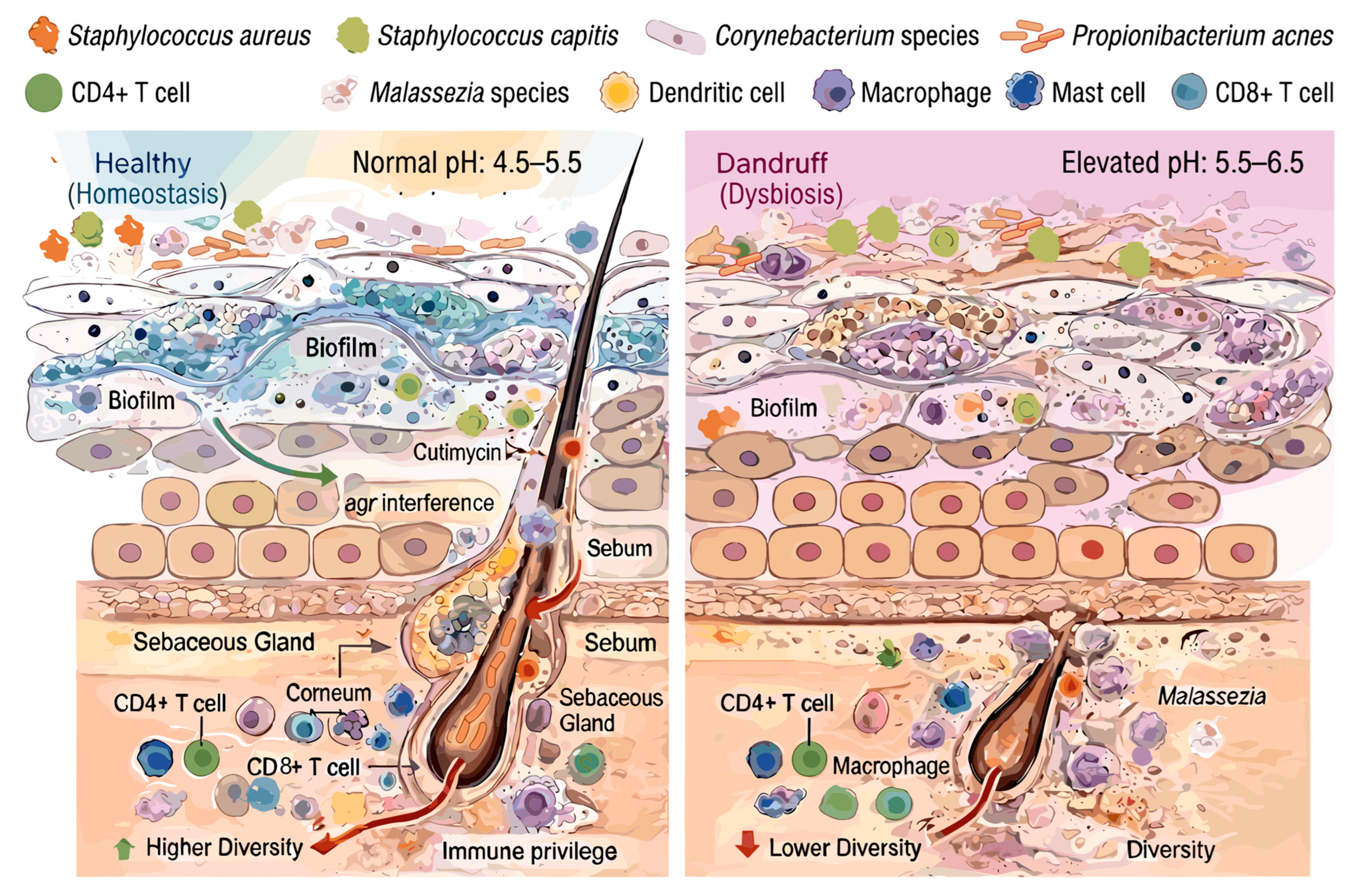
The scalp microbiome constitutes an integral component of the human cutaneous ecosystem, comprising diverse microorganisms—including bacteria, fungi, viruses, and mites—collectively referred to as the skin microbiota [7,16,17]. Compared with other skin sites, the scalp exhibits distinctive physiologic features, including abundant sebum secretion, relatively high humidity, mildly acidic pH, and a complex follicular architecture. These characteristics together create a specialized ecological niche that supports microbial colonization and shapes a characteristic scalp microbial community [17,18,19] (Figure 1).
Among these factors, sebum and the acidic microenvironment play central roles by providing metabolic substrates and favorable growth conditions for lipophilic microorganisms [17,18]. Species such as Cutibacterium acnes and Malassezia produce lipases that hydrolyze sebum triglycerides into free fatty acids, which not only support microbial growth but also contribute to maintaining the acidic skin surface environment [20,21]. This environment may further limit colonization by non-adapted microbial taxa.
The lipid-rich conditions of the scalp, together with its follicular structure, favor the proliferation of lipophilic microorganisms such as Malassezia, Cutibacterium, and Corynebacterium, which utilize sebum-derived lipids as energy sources [18]. The follicular infundibulum serves as a key interface for interactions between microorganisms and host keratinocytes [22].
Within this niche, microbial interactions contribute to community regulation; for example, certain C. acnes strains produce cutimycin, which inhibits Staphylococcus aureus and influences microbial competition [23].
Commensal microorganisms also contribute to maintaining microbial balance and host defense. Certain coagulase-negative staphylococci produce antimicrobial compounds that inhibit opportunistic pathogens such as S. aureus [24]. Within the scalp microenvironment, interactions among microorganisms play an important role in maintaining community stability. For example, certain commensal species such as Staphylococcus capitis can antagonize Staphylococcus aureus by interfering with the accessory gene regulator (agr) quorum-sensing system, thereby limiting pathogen colonization [25,26]. These findings highlight the role of commensal microbes in ecological defense.
In addition, biofilm formation by microorganisms such as Staphylococcus epidermidis and Cutibacterium acnes may enhance microbial adhesion and persistence within the scalp environment, contributing to their long-term colonization [27]. Microbial metabolites further mediate host–microbe interactions. Lipid-derived products and short-chain fatty acids produced by species such as C. acnes can influence keratinocyte function and modulate local immune responses [28,29,30,31,32,33]. These metabolites may also regulate microbial competition and contribute to maintaining the balance of the scalp microbiome [34,35].
Collectively, these microbial interactions—including competition, metabolic activity, and niche adaptation—are essential for maintaining scalp homeostasis, whereas disruption of these processes may contribute to microbial dysbiosis associated with dandruff.

2.2. Characteristics of Scalp Fungi and Their Associations with DF

Compared with other cutaneous sites, the scalp microbiota exhibits relatively low diversity, with the fungal community showing a highly skewed distribution dominated by yeasts of the genus Malassezia [15]. These fungi are present in both healthy individuals and patients with dandruff (DF) or seborrheic dermatitis (SD), although their relative abundance and overall fungal load are generally higher in affected individuals [36,37,38]. In healthy scalps, Malassezia may account for a substantial proportion of the microbial community, and this proportion often increases further under disease conditions.
Among Malassezia species, M. restricta and M. globosa are consistently identified as the predominant taxa on the human scalp, representing the majority of fungal sequences detected in molecular studies [39]. Other species, including M. sympodialis, M. slooffiae, and M. dermatis, are also detectable but typically occur at lower abundance [39].
The composition of the scalp mycobiome shows considerable inter-individual variability, influenced by host-related factors such as age, sex, ethnicity, and disease status [15,16,17,40,41,42], as well as environmental factors including climate and pollution [42].
Accumulating evidence suggests that Malassezia abundance is positively associated with dandruff. Clinical observations indicate that antifungal treatments targeting Malassezia can effectively alleviate symptoms, supporting its role in disease-associated dysbiosis [6]. Several studies have reported increased fungal burden in DF patients compared with healthy controls, although the relative proportions of individual species may vary [43]. Notably, M. restricta appears to be consistently dominant in both healthy and dandruff-affected scalps, but is often relatively enriched in DF-associated communities compared with other species such as M. globosa and M. furfur [43,44,45].
Some studies further suggest that fungal load may correlate with dandruff severity, although this relationship remains influenced by methodological differences and clinical heterogeneity [39,46,47]. Overall, current evidence indicates that dandruff is not simply associated with the presence of Malassezia, but rather with quantitative and compositional shifts within the fungal community, particularly involving M. restricta. However, the precise relationship between fungal abundance and disease severity remains to be fully clarified. Recent paradigms in skin microecology suggest that these host chronological and pathological transitions fundamentally reconstruct the local biophysical niche, driving sharp functional variations across different microbial configurations [18,48].

2.3. Characteristics of Scalp Bacteria and Their Associations with DF

Bacterial diversity on the scalp is relatively low compared with other skin sites, with microbial populations typically present at moderate densities of approximately 104–105 cells/cm2 [6,16]. The scalp bacterial community is predominantly composed of Cutibacterium (formerly Propionibacterium), particularly Cutibacterium acnes, followed by Staphylococcus species such as Staphylococcus epidermidis [7,17]. In addition, lower-abundance genera—including Corynebacterium, Streptococcus, Acinetobacter, Prevotella, Pseudomonas, and Lawsonella—also contribute to the overall microbial composition [17,18].
Although dandruff (DF) has traditionally been linked to Malassezia, increasing evidence suggests that bacterial communities also play an important role in scalp dysbiosis. Studies across different populations consistently report that Cutibacterium and Staphylococcus remain dominant regardless of disease status [7,17]. However, alterations in bacterial community structure—rather than absolute abundance—appear to be associated with DF, and in some cases show stronger correlations with disease severity than fungal changes [7,14]. In particular, increased abundance of Staphylococcus epidermidis has been reported in DF patients, indicating a potential role in disease-associated microbial shifts [7,14,17]. Crucially, recent multi-omics insights indicate that these resident taxa must be evaluated at the strain level rather than the species level, as distinct strains within the same species harbor high genomic and phenotypic heterogeneity [48]. For instance, while commensal strains of C. acnes and S. epidermidis generally maintain barrier homeostasis, specific pro-inflammatory strains can shift toward opportunistic pathogenicity under altered host physiological conditions (such as immunosenescence or lipid dysregulation), actively secreting tissue-destructive enzymes like proteases and elastases that degrade the host’s extracellular matrix (ECM) and lower the threshold for clinical inflammation [48,49,50].
Interactions between bacterial species contribute to maintaining microbial equilibrium. For example, Cutibacterium can inhibit Staphylococcus through bacteriocin production, whereas Staphylococcus may suppress Cutibacterium via metabolic activities such as glycerol fermentation [51,52]. These reciprocal interactions are important for maintaining ecological balance on the scalp.
In dandruff conditions, this balance appears to be disrupted. Several studies have reported shifts in bacterial community structure in affected regions, including altered Staphylococcus composition, with decreases in S. epidermidis and increases in Staphylococcus aureus in some cases [53,54]. This breakdown often mirrors a host-microbiome mismatch where host barrier failure and altered sebum chemistry accelerate the decline of beneficial symbionts while promoting the overgrowth of opportunistic, keratolytic taxa like Corynebacterium species, converting a mutualistic niche into a dense, inflammatory entanglement [48,55]. Such alterations may extend beyond visibly affected areas, suggesting broader ecosystem-level changes.
Overall, current evidence indicates that dandruff is associated with bacterial dysbiosis characterized by shifts in community structure and interspecies interactions, rather than simple changes in bacterial abundance. However, the precise role of bacteria in DF pathogenesis remains to be fully elucidated.

2.4. Association Between Scalp Microbiota and DF

Dandruff (DF) is increasingly recognized as a disorder involving complex interactions within the scalp microbial ecosystem rather than the overgrowth of a single microorganism. Disruptions in microbial co-occurrence and mutual exclusion networks have been associated with scalp dysbiosis in DF and seborrheic dermatitis (SD) [17]. The relationships between representative scalp microorganisms and DF reported in previous studies are summarized in Table 1.
For example, synergistic interactions between certain bacterial and fungal species, such as Bacillus sp. and non-pathogenic Malassezia, may contribute to maintaining microbial homeostasis [58].
Network-based analyses further support the importance of microbial interactions. Co-occurrence network studies have revealed dense and highly interconnected relationships among scalp microorganisms, with reduced network stability observed in DF patients compared with healthy individuals [45]. In particular, M. restricta shows antagonistic associations with other Malassezia species and several bacterial genera, while beneficial taxa such as Lactobacillus display weakened inhibitory interactions with dominant microbes in DF. These findings suggest that disruption of microbial interaction networks, rather than simple compositional changes, may underlie DF-associated dysbiosis.
Within the follicular microenvironment, Cutibacterium acnes appears to play a key role in maintaining microbial balance. Its metabolite, propionic acid, can inhibit the growth of M. restricta and Staphylococcus epidermidis, potentially through iron-limiting effects [59]. However, under DF conditions, factors such as barrier disruption and oxidative stress may impair C. acnes homeostasis, thereby facilitating Malassezia overgrowth. These observations highlight the importance of considering the scalp and hair follicle as an integrated ecological unit.
Core microbiome analyses indicate that healthy scalps are typically dominated by C. acnes and S. epidermidis, with fungal communities mainly composed of M. restricta and M. globosa. In contrast, DF is often associated with increased abundance of Malassezia (particularly M. restricta) and Staphylococcus, along with reduced levels of Cutibacterium [14,47]. Some studies further suggest that M. globosa may show negative associations with disease severity, indicating potential functional divergence among Malassezia species.
Functional metagenomic analyses reveal additional differences between healthy and DF-associated microbiomes. DF-related fungal communities show enrichment in host interaction pathways such as N-glycan biosynthesis, largely attributed to M. restricta, whereas healthy microbiota are enriched in amino acid and fatty acid metabolism. At the bacterial level, pathways related to vitamin metabolism, including biotin and vitamin B6 biosynthesis, are more prominent in healthy communities, potentially linked to Cutibacterium species [14,47]. To put this into perspective, the functional differences between healthy and dandruff-associated microbiomes are stark: in healthy communities, microbial functional pathways are heavily enriched in biosynthetic and maintenance housekeeping operations, including amino acid metabolism, fatty acid elongation, and essential vitamin synthesis pathways, which support host keratinocyte homeostasis. Conversely, in dandruff-associated communities, metabolic pathways shift aggressively toward host colonization and survival, characterized by a distinct enrichment in host interaction pathways such as N-glycan biosynthesis (primarily driven by M. restricta), glycerolipid metabolism, and virulent extracellular enzyme export pathways, facilitating nutrient harvesting at the cost of the host tissue. This biochemical divergence underscores the profound role of microbial-derived metabolites and postbiotic signaling in regulating host pathology [48,60]. Specifically, this regulatory network operates via a dual paradigm: under healthy homeostasis, commensal-derived metabolites (such as propionic acid and short-chain fatty acids [SCFAs] secreted by Cutibacterium acnes, and lipoteichoic acids) act as "biological shields" that neutralize reactive oxygen species (ROS), suppress host tissue-destructive matrix metalloproteinases (MMPs), and actively reinforce lamellar lipid synthesis to lock in barrier macromolecular integrity [48,61]. In sharp contrast, during dandruff-associated dysbiosis, the depletion of these protective postbiotic signals, combined with Malassezia-mediated hydrolysis of host sebum, leads to an influx of irritating fungal free fatty acids (FFAs). This pathological influx induces severe intracellular oxidative stress and mitochondrial distress in keratinocytes, triggering inflammatory downstream cascades and causing advanced macromolecular barrier collapse [48,61].
Several studies have also reported that bacterial α-diversity on the scalp may be higher in patients with DF or SD compared with healthy individuals, with phyla such as Actinobacteria and Firmicutes commonly dominating these communities. In many cohorts, increased relative abundance of Staphylococcus and Streptococcus and reduced abundance of Cutibacterium have been observed in affected skin regions, suggesting the presence of bacterial dysbiosis associated with barrier dysfunction [38].
Microbial interactions also influence scalp barrier function. Increased abundance of Staphylococcus has been associated with barrier impairment and elevated transepidermal water loss (TEWL) [24]. Meanwhile Malassezia species may modulate S. aureus colonization through changes in local pH and enzyme secretion [62,63,64,65]. Specifically, M. globosa has been reported to secrete aspartic proteases capable of disrupting S. aureus biofilm formation [66].
In contrast, antagonistic interactions between Cutibacterium and Staphylococcus—mediated by bacteriocins and metabolic competition—may contribute to microbial balance [17,51,52]. Notably, co-colonization by M. restricta and C. acnes has been reported to cause less barrier disruption than M. restricta alone, and C. acnes abundance has been positively associated with scalp hydration [17,63].
Overall, current evidence suggests that DF arises from disruptions in microbial interaction networks and host–microbe relationships rather than the activity of a single pathogen. From this ecological perspective, strategies aimed at restoring microbial balance and reinforcing host–microbiota interactions may represent promising therapeutic approaches.

3. Molecular Etiology and Pathogenesis of Dandruff

3.1. Theoretical Framework: From Clinical Manifestation to Molecular Dyshomeostasis

Dandruff (DF) is a chronic, recurrent inflammatory scalp disorder characterized by abnormal desquamation of the stratum corneum and pruritus. Beyond physical discomfort, it frequently causes significant psycho-social distress. Clinically, DF presents as white or yellowish scales adhering to the scalp, occasionally extending to the nasolabial folds and retroauricular regions [67]. While DF shares pathological features with Seborrheic Dermatitis (SD) and responds to similar treatments, they differ in severity and distribution: DF is primarily non-inflammatory scaling confined to the scalp, whereas SD involves broader anatomical regions—such as the face and upper chest—accompanied by visible erythema and pronounced inflammation [68].
Current research suggests DF arises from the interplay of three primary factors:
  • Microbial Dysbiosis: While Malassezia colonization is a hallmark, recent evidence highlights the role of bacterial community restructuring (e.g., shifts in Staphylococcus and Cutibacterium abundance) [1].
  • Sebum Dysregulation: Alterations in sebum quantity and composition, particularly free fatty acid (FFA) profiles, fuel microbial metabolic activity.
  • Host susceptibility: Genetic variations affecting immune responses and epidermal barrier integrity determine individual sensitivity to microbial stimuli [69].
However, defining the precise causal architecture within this triad—particularly whether microbial components like Malassezia act as primary causal agents or secondary associative bystanders—requires critical evaluation. Historically, a strict causal role was inferred from the therapeutic success of topical antifungals [1]. Yet, from a pharmacological standpoint, therapeutic resolution does not automatically equate to etiological initiation. Successfully suppressing fungal load merely proves that Malassezia acts as an obligatory amplifier of the ongoing desquamative process; it fails to demonstrate that the yeast is the upstream initiator that originally disrupted host homeostasis.
Similarly, experimental models demonstrating that the exogenous application of Malassezia metabolites (e.g., oleic acid) replicates DF-like flaking in vivo confirm a potent pathogenic potential [67,70]. However, these high-concentration, acute chemical provocations reflect artificial induction rather than the gradual, endogenous shift in a resident commensal community, leaving a chronological gap in our understanding of spontaneous pathogenesis.
Recent advances in scalp microbiome research have further expanded the understanding of DF pathogenesis, shifting the focus from isolated pathogens to collective network shifts. Increasing evidence indicates that bacterial community restructuring, such as alterations in the relative abundance of Cutibacterium and Staphylococcus, is closely associated with clinical manifestations [17]. This multi-microbial involvement suggests that assigning exclusive, deterministic causality to a single fungal genus may be a historical over-simplification heavily indexed on culture-dependent observations.
Consequently, rather than being attributed solely to Malassezia overgrowth—which paradoxically occurs in healthy individuals without inducing clinical symptoms—DF is now understood as a systemic failure of the scalp microenvironment involving an integrated, non-linear framework of microbes, host immunity, and barrier function. Within this framework, Malassezia cannot be neatly categorized either as a singular upstream cause or a redundant downstream associate; instead, it operates as a context-dependent pathogen whose active virulence is strictly gated by host susceptibility and concurrent bacterial dysbiosis. Crucially, dandruff severity is driven by a non-linear positive feedback loop encompassing three interconnected dimensions (Microbiome-ROS-Barrier): (1) Microbiome Alteration to Barrier Damage: Driven by altered host physiological or lipid states, the overgrowth of specific pro-inflammatory bacterial strains and Malassezia leads to the hyper-secretion of tissue-destructive enzymes (proteases, lipases, and elastases) that actively degrade the extracellular matrix (ECM) and structural proteins, compromising physical barrier integrity. (2) Barrier Failure to Oxidative Stress: The compromised barrier increases transepidermal water loss (TEWL) and permits xenobiotics/irritating FFAs to penetrate deeper epidermal layers, generating massive intracellular ROS accumulations and mitochondrial distress. (3) Oxidative Stress back to Dysbiosis: The resulting microenvironmental oxidative stress and localized cell death destroy the niche for beneficial symbionts, further promoting the colonization of opportunistic, keratolytic taxa (e.g., Corynebacterium), which self-perpetuates the disease and increases clinical flaking and inflammation severity".

3.2. Role of Malassezia in DF Formation

Colonization of the scalp by Malassezia species has long been considered an important factor associated with the development of dandruff (DF), a view supported by the clinical efficacy of antifungal treatments in alleviating DF symptoms [1]. As a dominant member of the cutaneous microbiota, Malassezia transitions from a commensal to a pathogen when the scalp microenvironment is compromised [16,39].
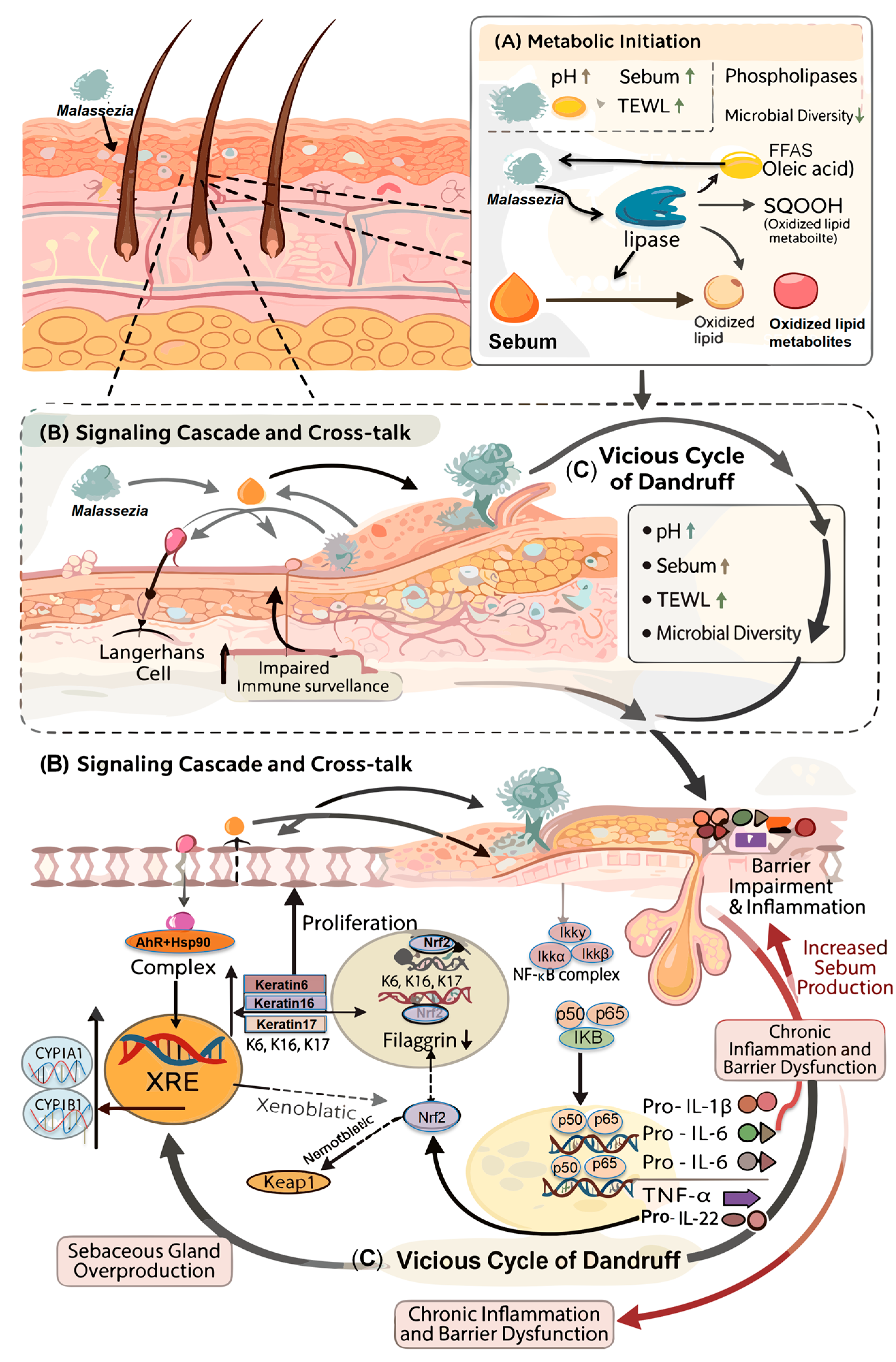
The interaction between Malassezia and host keratinocytes involves a complex network of lipid metabolism and signaling activation (Figure 2).

3.2.1. Lipid Metabolism-Driven Microenvironment Disruption

The lipid-dependent nature of Malassezia (with the exception of M. furfur) is a primary driver of scalp dyshomeostasis. Lacking genes for de novo fatty-acid synthesis, Malassezia species rely on a vast repertoire of lipolytic enzymes—including a multi-gene family of at least 12 secreted lipases and 9 phospholipases across dominant individual species—to hydrolyze host sebum into essential nutrients [4,71].
The resulting free fatty acids (FFAs), particularly oleic acid, penetrate the stratum corneum and perturb keratinocyte biology. These lipids induce hyperproliferation and alter programmed cell death, directly contributing to abnormal desquamation and barrier dysfunction [67,70].
Beyond FFA production, Malassezia’s metabolic activity under hypoxic or microaerophilic conditions generates reactive intermediates such as NADH, FADH2, and hydrogen peroxide [72]. These oxidative processes lead to the formation of squalene peroxide (SQOOH), a potent oxidative lipid derivative found at significantly higher levels in dandruff-affected scalps. SQOOH further exacerbates oxidative damage to the epidermal barrier [73,74].
Notably, lipid metabolic profiles vary by species: M. globosa is characterized by high lipase activity, while M. restricta more efficiently catalyzes squalene peroxidation [75,76].
These species-specific differences dictate the varying degrees of microenvironmental alteration and individual susceptibility to scalp disorders. Collectively, this lipase-mediated lipid degradation and the associated metabolic byproducts alter scalp lipid composition and barrier homeostasis. These processes can stimulate sebaceous gland activity and alter sebum composition, thereby forming a pathogenic feedback loop that drives microbial persistence and contributes to the development of Malassezia-associated scalp disorders [74]. The major lipid metabolic characteristics of representative Malassezia species are summarized in Table 2.
Abbreviations (full terms):
  • TAG: Triacylglycerols
  • DG: Diacylglycerols
  • PC: Phosphatidylcholine
  • DGTS: Diacylglyceryltrimethylhomoserine
  • FAHFA: Fatty acid esters of hydroxy fatty acids
  • FA: Fatty acids
  • Cer: Ceramides

3.2.2. Roles of Malassezia: From Metabolic Disruption to Immune Activation

Malassezia metabolites function as potent signaling ligands that bridge microbial metabolism and host inflammatory responses. This interaction operates through two primary pathways:
Pattern Recognition and Pro-inflammatory Cascade: The cell wall of Malassezia is rich in mannan, glucan, and chitin, which serve as primary Pathogen-Associated Molecular Patterns (PAMPs). These are recognized by host receptors such as Dectin-1/2 and Toll-like receptors (TLR2/4). Furthermore, enzymatic activity involving secreted lipases and phospholipases generates free fatty acids (FFAs) and oxidative metabolites (e.g., SQOOH) that activate the NF-κB signaling pathway in keratinocytes. This leads to the robust production of pro-inflammatory cytokines (such as IL-6, IL-8, and TNF-α) and the upregulation of pro-IL-1β transcription, providing the necessary priming signal for subsequent inflammasome activation [8,73,81].
AhR-Mediated Immune Modulation and MalaExs: Indole derivatives from Malassezia tryptophan metabolism (e.g., malassezin) serve as ligands for the aryl hydrocarbon receptor (AhR) [81]. Recent evidence also highlights the role of Malassezia-derived extracellular vesicles (MalaExs), which carry functional mRNAs and microRNAs (miRNAs). These MalaExs can interfere with host RNA mechanisms, potentially silencing immune-related genes and inducing inflammatory responses [82,83].
Impact on Epidermal Homeostasis: AhR activation dysregulates the expression of differentiation markers, specifically keratins K6, K16, and K17, while down-regulating filaggrin. This molecular shift, often accompanied by the secretion of fungal proteases that degrade extracellular matrix proteins like collagen and elastin, directly contributes to the impaired stratum corneum cohesion and barrier dysfunction characteristic of the dandruff scalp [69,81,84]. Mechanistically, microbial-driven barrier dysfunction acts as the primary gatekeeper and obligate amplifier that translates transient microbial shifts into chronic low-grade (subclinical) inflammation. Quantitatively, microbial-derived lipases and proteases degrade the tight junctions and lamellar lipid integrity of the stratum corneum [4,67]. This physical disruption compromises the scalp’s immunological privilege, permitting an uncontrolled influx of environmental xenobiotics, pollutants, and pathogen-associated molecular patterns (PAMPs) into deeper epidermal layers [41,85,86]. Simultaneously, the physical shearing of keratinocytes triggers the release of endogenous alarmins (such as il-1α or IL-36). This continuous influx locks the host into a self-sustaining loop of sustained immune cell recruitment, meaning that barrier failure directly mediates and sustains the chronicity of the inflammation [86,87]".
Oxidative Stress and Mitochondrial Dysfunction Trigger: Beyond direct receptor binding, Malassezia metabolites and associated lipid peroxidation products (such as SQOOH) act as potent instigators of host intracellular oxidative stress [73,88]. The internalization of these irritating ligands by keratinocytes disrupts cellular redox homeostasis, triggering an excessive accumulation of reactive oxygen species (ROS) [73,88]. This sustained oxidative burst directly targets host mitochondria, leading to mitochondrial membrane potential depolarization and structural damage—a state of pronounced mitochondrial dysfunction [88,89]. Consequently, compromised mitochondria leak endogenous danger-associated molecular patterns (DAMPs), specifically mitochondrial DNA (mtDNA) and ROS, into the cytoplasm [89,90]. This intracellular leakage acts as a secondary, synergistic amplification signal that potentiates NF-κB nuclear translocation and lowers the threshold for NLRP3 inflammasome assembly, creating a molecular priming state, thereby laying the groundwork for full-scale host inflammatory escalation under high fungal loads or host susceptibility [89,90,91].

3.2.3. Malassezia-Triggered Vicious Cycle

The pathogenesis of dandruff is a self-reinforcing vicious cycle involving lipid metabolism, immune evasion, and barrier failure:
Metabolic Initiation and Adhesion: Surface adhesins (e.g., mannan-binding proteins) facilitate initial attachment, followed by the enzymatic degradation of sebum. This generates irritating FFAs, which directly compromise corneocyte lipid envelopes and accelerate transepidermal water loss (TEWL) [8,70,74].
Barrier-Immune Feedback and Evasion: Structural defects allow deeper metabolite penetration. Simultaneously, Malassezia employs immune evasion mechanisms: thick mannan layers can mask β-glucans from detection, while secreted phospholipases interfere with host signal transduction. Persistent AhR activation may further impair immune surveillance by modulating Langerhans cells [69,81,92].
Pathological Reinforcement: The resulting inflammatory milieu and barrier breach stimulate sebaceous glands to increase sebum secretion, providing a continuous nutrient supply for Malassezia persistence [5,88,93].

3.2.4. Pathogenic Plasticity and Niche Adaptation: The Dual Nature of Malassezia

The pathogenic role of Malassezia extends far beyond dandruff, manifesting as a central player in a spectrum of dermatological conditions, including seborrheic dermatitis (SD), atopic dermatitis (AD), Malassezia folliculitis, and psoriasis [85,94,95]. The transition of Malassezia from a commensal “gatekeeper” to a pathological driver is characterized by its remarkable niche adaptation and pathogenic plasticity.
When the skin barrier is compromised, Malassezia does not merely persist; it actively remodels the cutaneous microenvironment to favor its survival. Evidence suggests that in barrier-disrupted skin (such as in AD models), Malassezia gains enhanced fitness by up-regulating key metabolic genes involved in nutrient assimilation [86]. This lipid-dependent yeast adapts its metabolic profile to more efficiently utilize the altered lipid landscape of damaged skin, creating a self-sustaining cycle of colonization. By down-regulating essential barrier molecules and ceramides, it further weakens the host defense while simultaneously promoting sebum secretion to ensure a continuous nutrient supply [89,96].
Crucially, the pathogenicity of Malassezia is not a uniform trait across the genus but is highly dependent on strain-level diversity. Recent comparative studies reveal that different species, and even different strains within the same species (e.g., M. restricta vs. M. globosa), exhibit markedly different virulence profiles and evoke distinct molecular responses from the host [86].
Differential Immune Activation: While both M. restricta and M. globosa can activate the NLRP3 inflammasome, the magnitude of cytokine production (such as IL-1β) in myeloid cells can vary significantly between species [85]. Crucially, while these species possess the inherent capacity for high-magnitude inflammatory activation, this signaling exhibits only a basal, localized priming during dandruff (DF). This low-grade priming is successfully managed by host homeostatic tolerance, and becomes fully unleashed into a destructive cascade only within the hyper-activated, disrupted microenvironments characteristic of overt clinical diseases like SD or AD [5,85].
Genomic Plasticity: Such variations are often attributed to differences in their genomic architecture, specifically in the repertoire of secreted enzymes like lipases and proteases, which dictates their ability to breach the stratum corneum and interact with deeper immune sentinels.
The interaction between Malassezia and the host immune system is a double-edged sword:
Pro-inflammatory Provocation: In diseased states, Malassezia triggers robust inflammatory responses. It activates the NLRP3 inflammasome via Dectin-2/CARD9 signaling, a process requiring SYK signaling and potassium efflux [85]. Additionally, it drives IL-17-dependent inflammation through the IL-36 receptor/MyD88 axis, which can exacerbate Th2-mediated diseases and potentially reduce the efficacy of targeted therapies like dupilumab [94,96]. Transcriptomic analysis confirms that even in intact skin, Malassezia colonization up-regulates genes associated with C-type lectin receptors and neutrophil extracellular trap (NET) formation, although these responses are significantly amplified upon barrier injury [89].
Commensal Protection and Competition: Paradoxically, in a healthy homeostatic state, Malassezia serves as a biological shield. It can physically interfere with the invasion of Staphylococcus aureus by competing for binding sites like fibronectin on keratinocytes, potentially limiting bacterial virulence through physical contact and heat-labile surface proteins [95].
In conclusion, Malassezia functions as a sentinel at the skin barrier. As long as the skin-immune-microbiome axis remains intact, it exists in quiet commensalism. However, once the barrier is breached or immune surveillance shifts, Malassezia—exhibiting highly strain-dependent virulence—transitions into an aggressive colonizer. It employs a “scorched earth” strategy: attacking the remaining barrier integrity and down-regulating host defense molecules, while up-regulating its own metabolic machinery to thrive in the dysbiotic niche it helped create.

3.3. Divergent Pathological Trajectories: Comparative Spectrum of Dandruff and Seborrheic Dermatitis

Although dandruff (DF) and seborrheic dermatitis (SD) exist on opposite ends of a continuous clinical and pathological spectrum [2,37,97], their differences can be distinctly demarcated by specific thresholds in molecular signaling, microbial community architecture, epidermal barrier status, and host immunological susceptibility [46,87,88]. The transition from the mild, non-inflammatory scaling of dandruff to the severe, erythematous lesions characteristic of SD represents a fundamental, multi-layered breakdown of host-microbe homeostasis [36]. Rather than isolated phenomena, these pathological deviations are driven by an interconnected cascade spanning upstream substrate alterations to downstream genetic and immunological hyper-activation.

3.3.1. Sebum Homeostasis and pH Microenvironment Neutralization

The initiation of both conditions is rooted in the lipid-rich microenvironment of the scalp, yet the quantitative and qualitative kinetics of sebaceous activity dictate divergent clinical paths. Sebaceous glands maintain baseline scalp homeostasis by secreting a complex mixture of triglycerides, wax esters, and squalene [5], forming a hydrophobic film that limits transepidermal water loss (TEWL). Under pathological conditions, however, sebaceous hypersecretion provides an expansive substrate for Malassezia’s extensive lipolytic repertoire [8,72]. which in turn releases metabolites that potentially sustain or exacerbate glandular hyperactivity, reinforcing the loop.
In both states, Malassezia-derived lipases hydrolyze sebaceous triglycerides, releasing irritating free fatty acids (FFAs), primarily oleic acid [5,98]. In typical dandruff, this process remains localized, driving lower-grade epidermal irritation restricted to superficial desquamation [99]. In the SD microenvironment, however, excess sebum undergoes significant biochemical transformation and oxidative processing, leading to a substantial accumulation of unsaturated FFAs and the formation of squalene peroxide (SQOOH). These lipid derivatives function as potent, aggressive molecular ligands that penetrate the stratum corneum, serving as primary triggers that bridge microbial metabolism with host tissue inflammation [73,74,88].
This lipid dyshomeostasis is further accelerated by a critical “molecular switch”: the regulation of scalp microenvironment pH. The acidic mantle of a healthy scalp (typically pH 4.5–6.0) serves as a fundamental chemical barrier against pathogenic colonization. In DF-affected scalps, this pH balance experiences a moderate shift toward alkalinity [53,100]. Experimental evidence indicates that the lipase and protease activity of Malassezia species is highly pH-dependent, with elevated pH levels significantly upregulating the production of irritating metabolites and fungal allergens [101,102]. In SD, this alkaline shift is more pronounced, fundamentally disrupting the structural organization of the host’s lamellar lipid matrix and activating endogenous serine proteases (e.g., Kallikreins). These enzymes accelerate the degradation of corneodesmosomes, facilitating deeper fungal invasion and lowering the threshold for downstream hypersensitivity responses [102].

3.3.2. Epidermal Barrier Macromolecular Integrity and Genetic Susceptibility

The integrity of the stratum corneum barrier largely depends on a well-ordered lamellar lipid matrix (comprising 50% ceramides, 25% cholesterol, and 10–20% FFAs) and robust macromolecular structural frameworks. The divergence between DF and SD can be precisely mapped to the severity of barrier failure and underlying genetic predispositions.
In dandruff, barrier dysfunction remains moderate and structurally confined, presenting clinically as dry, fine white-to-grayish flakes (scales) without macroscopic tissue edema [103,104]. At the biomolecular level, this functional impairment is characterized by loose corneocyte cohesion and a compensatory upregulation of aryl hydrocarbon receptor (AhR)-mediated and hyperproliferation-associated keratins, specifically K16 and K17 [2,105,106]. In susceptible individuals, minor genetic polymorphisms in genes encoding essential envelope proteins—such as filaggrin (FLG)—or innate sensors predispose the scalp to higher Malassezia colonization and altered antimicrobial peptide (AMP) expression (e.g., reduced β-defensins) [69,107,108], yet the core epidermal architecture remains intact.
Conversely, the microenvironment of SD experiences a systemic, structural collapse of the epidermal architecture [109]. The baseline expression of critical structural differentiation biomarkers—specifically keratins 1, 10, and 11—is drastically interrupted and downregulated [19,97]. This differentiation arrest is accompanied by a profound depletion of essential intercellular lipids, including ceramides and sphingoid bases [109]. Clinically, this structural failure manifests as the characteristic development of thick, greasy yellow scales overlying well-defined erythematous patches, frequently accompanied by intense pruritus, high TEWL, and transient hair loss [103,109,110].

3.3.3. Microbial Community Architecture: Discrete Imbalance vs. Multi-Kingdom Collapse

The transition from DF to SD corresponds with an ecological escalation from a localized numerical imbalance to a severe, multi-kingdom dysbiosis driven by tissue inflammation and altered lipid substrates [13,54,111].
In dandruff, microbial alterations tend to remain relatively restricted and localized. The scalp generally maintains its core communal architecture, characterized primarily by a localized numerical shift among indigenous symbionts: a discrete elevation of the Malassezia restricta/Malassezia globosa ratio and a compensatory expansion of Staphylococcus species, which closely mirrors a corresponding, moderate decline in resident Cutibacterium acnes [53]. This modest taxonomic shift remains confined to the community level and lacks the aggressive virulence factors or polymicrobial complexity required to ignite clinical tissue inflammation [2,53].
In sharp contrast, the microenvironment of SD undergoes a definitive structural collapse of microbial homeostasis [13,54,111]. While dandruff involves a relatively contained fungal shift, SD frequently exhibits a severe, unchecked expansion of M. restricta and M. globosa [53,111]. Crucially, as a notable point of divergence, severe or immunocompromised SD contexts can lose their historical fungal filtration capacity, allowing the opportunistic invasion and widespread proliferation of non-commensal, external fungi—such as Candida and Aspergillus species—which are entirely absent in typical dandruff [112,113].
Simultaneously, the bacterial symbiotic balance fundamentally disintegrates in SD. The healthy resident C. acnes population undergoes a precipitous, near-total drop compared to the more moderate decrease seen in dandruff [53]. Concurrently, the highly inflammatory tissue exudate and oxidized lipid landscape of SD creates a highly permissive, pathogenic niche. This frequently results in a substantial enrichment and pathological predominance of aggressive invaders—specifically Staphylococcus aureus, Streptococcus species, and Acinetobacter—on lesional skin, converting a stable scalp ecosystem into a dense, polymicrobial entanglement [13,54]. Ultimately, while dandruff represents a largely manageable, localized microbial variation, SD marks an unconstrained, multi-species pathogenic takeover that actively drives chronic cutaneous inflammation and undermines the efficacy of standard mono-targeted antifungal interventions [112,114].

3.3.4. Host Immunological Engagement: Homeostatic Tolerance vs. Cascade Amplification

The definitive boundary distinguishing dandruff from SD lies in the mode of host immunological engagement and underlying endogenous vulnerability, determining whether the host maintains a quiet commensal relationship or succumbs to chronic tissue inflammation.
Dandruff represents a subclinical, homeostatic state where the host immune system maintains a balanced recognition of Malassezia, utilizing IgG and IgM for complement-mediated clearance without triggering overt inflammation [9,92,103]. It remains restricted to flake shedding without broad cytokine upregulation, visible erythema, or systemic T-cell infiltration [2,103,109].
In DF-susceptible individuals, minor immune dysregulations can shift this balance toward IgE-mediated hypersensitivity and Th2-polarized responses (elevated IL-4 and IL-13) under an excessive fungal load [1,115], manifesting as itching or transient redness, but the downstream inflammatory cascades typically remain unamplified [99,116].
In SD, this homeostatic tolerance completely breaks down, launching a full-scale cascade amplification. The deep penetration of unsaturated FFAs (oleic acid) and oxidized lipids strongly activates the host’s innate immune system via multiple pattern recognition receptors (PRRs), including Toll-like receptor 2 (TLR-2), NOD-like receptors (NLRs), and C-type lectin receptors [5,87,117]. This initiates the intracellular assembly of the NLRP3 inflammasome, which utilizes the protease caspase-1 to cleave pro-IL-1β into its active, highly potent form [90,100,118]. Concurrently, TLR-2 stimulation drives robust NF-κB activation and subsequent IL-8 production by keratinocytes, amplifying neutrophil and lymphocyte migration into an intense inflammatory amplification loop. In contrast to the basal, low-grade NF-κB activation observed in typical dandruff, the microenvironment of SD exhibits a profound cascade amplification of these downstream inflammatory pathways [116].
Consequently, SD triggers a vast profile of inflammatory markers, including IL-1α, IL-1β, IL-2, IL-4, IL-6, IL-8, IL-10, IL-12, TNF-α, β-defensins, IFN-γ and histamine [109]. Crucially, elevated levels of IL-17-producing -γδT cells are observed, implicating the Th17 axis alongside Th2-driven IL-4 upregulation in its active pathogenesis [119,120].
This intense, full-fledged inflammatory dermatosis is heavily contingent upon endogenous host susceptibilities [5]. In genetically predisposed individuals, specific mutations in genes such as ACT1, C5, IKBKG, STK4, and ZNF750 impair the host’s capacity to restrict Malassezia or regulate epithelial differentiation [97,121,122,123]. This genetic vulnerability, coupled with systemic immune dysregulation (e.g., CD4 lymphopenia in HIV contexts [124]) or neurological autonomic dysfunction (e.g., parasympathetic hyperactivity and increased sebum production in Parkinson’s disease [125]), drives the aggressive progression from subclinical scaling into chronic, clinically overt cutaneous tissue inflammation.The comprehensive pathophysiological and molecular differentiations between seborrheic dermatitis and dandruff are summarized in Table 3.

4. Integrative Omics and Emerging Molecular Therapeutics

Recent advances in dandruff (DF) research have moved beyond taxonomic surveys toward high-resolution functional mapping. By integrating metagenomics, lipidomics, and transcriptomics, a systemic understanding of the molecular flux at the host–microbe interface has emerged, redefining DF as a state of complex functional dysbiosis.The core research areas, key findings, and methodologies representing these recent advances are systematically summarized in Table 4.

4.1. Molecular Insights from Multi-Omics and Lipidomic Profiling

This multi-omics integration has elucidated the biochemical underpinnings of scalp barrier failure and microbial pathogenicity.

4.1.1. Lipidomic Remodeling and Barrier Dysfunction

High-resolution lipidomic profiling has identified specific molecular signatures associated with the compromised DF barrier. Research indicates a significant depletion of long-chain ceramides (classes NP, NH, and AP), which are essential for maintaining the lamellar structure of the stratum corneum [73,74,77]. Conversely, there is a pathological accumulation of unsaturated free fatty acids (FFAs) and oxidative metabolites, notably squalene peroxide (SQOOH). These molecules function as endogenous irritants, increasing transepidermal water loss (TEWL) and activating pro-inflammatory signaling via the NF-κB and MAPK pathways [88,126].

4.1.2. Strain-Level Functional Diversity

Metagenomic evidence highlights that pathogenicity is fundamentally strain-specific. Comparative genomics of M. restricta and M. globosa has revealed significant intra-species variations in the copy numbers of genes encoding secreted lipases (LIP) and aspartyl proteases (PEP) [67,75]. These enzymes drive the hydrolysis of host triglycerides into irritating FFAs. This functional heterogeneity explains why individuals with similar fungal loads can exhibit divergent clinical phenotypes, as specific virulent strains drive the molecular cascade of inflammation more aggressively [75,102]. Through high-resolution cross-omics correlation, distinct diagnostic and prognostic biomarkers have been identified. At the metabolic level, a down-regulation of functional pathways for biotin and vitamin B6 biosynthesis serves as an early metabolic signature of a failing ecosystem [14], while high ratios of unsaturated free fatty acids and active microbial protease/elastase genes mark active disease progression [127]. Concurrently, host transcriptomic readouts indicate that these strain-level disruptions strongly correlate with the up-regulation of the MAPK/AP-1 and NF-κB pathways, translating to macroscopic elevations in clinical dandruff scores and TEWL [69,73,116,128,129].
Table 4. Recent advances in dandruff and scalp microecology research.
Research AreaKey FindingsMethodsImplicationsKey References
Microbial DysbiosisBeyond Malassezia, bacterial community restructuring (e.g., Staphylococci/Propionibacteria ratio) drives pathogenesis.16S rRNA and Shotgun MetagenomicsValidates the “Microbiome Equilibrium” theory.[7,14,102]
Strain-Level DiversityIntra-species functional heterogeneity in lipase and protease expression profiles.Comparative GenomicsExplains individual variation in dandruff severity.[67,75,102]
Lipid RemodelingSignificant depletion of long-chain ceramides and elevation of pro-inflammatory oxylipins (e.g., SQOOH).High-Resolution LipidomicsIdentifies specific lipid biomarkers for barrier failure.[73,74,126]
Biofilm ArchitectureMalassezia forms resilient, multi-species biofilms, enhancing recalcitrance to treatment.SEM/Confocal Imaging and TranscriptomicsExplains the chronic, recurrent nature of dandruff/seborrheic dermatitis.[82,130,131]
Targeted ModulationProbiotics and postbiotics successfully recalibrate the microbial ecological niche.Randomized Clinical Trials (RCTs)Opens avenues for “ecotherapy” beyond antifungals.[127,132,133]

4.2. Emerging Therapeutic Paradigms: From Eradication to Homeostasis

The therapeutic focus is shifting from broad-spectrum microbial eradication to the precision restoration of the scalp ecosystem. To understand this transition, it is essential to first delineate the molecular basis of current anti-dandruff agents, which serve as the pharmacological baseline for modern formulations.

4.2.1. Molecular Pharmacology of Current Commercial Actives

Existing anti-dandruff interventions primarily utilize molecules that disrupt fungal metabolic viability or normalize epidermal desquamation. Their specific molecular targets and modes of action are synthesized in Table 5.
The anti-dandruff molecules summarized in Table 5 have been widely validated in clinical settings; however, their therapeutic paradigm is currently facing certain potential risks and regulatory scrutiny. For a long time, zinc pyrithione (ZPT) has been regarded as the “gold standard” in the anti-dandruff field due to its excellent inhibitory effect against Malassezia. Nevertheless, following its reclassification as a Category 1B reproductive toxicant, ZPT was officially banned in the European Union in 2022. This landmark regulatory shift has not only created a technological vacuum but has also exposed the inherent drawbacks of traditional fungicides.
Beyond safety concerns, conventional intervention strategies suffer from three core mechanistic issues. First, existing antifungal agents primarily target microbial viability but fail to alleviate host scalp inflammation. Evidence indicates that even after fungal clearance, the AhR (aryl hydrocarbon receptor)-mediated signaling axis and pro-inflammatory cytokines (e.g., IL-8) often persist. This leaves the scalp in a “primed” state of subclinical inflammation, making it highly susceptible to rapid recurrence.
Second, broad-spectrum antifungals lack taxonomic specificity. By indiscriminately suppressing beneficial commensals such as Cutibacterium acnes (C. acnes), these agents further disrupt the scalp microbial balance.
Third, most existing active ingredients are optimized solely against planktonic cells and struggle to effectively penetrate the multispecies biofilm matrix where Malassezia resides, leading to persistent refractory symptoms and potentially fostering antifungal resistance.
Consequently, the anti-dandruff field is shifting from “indiscriminate sterilization” toward physiology-based and scalp microecology homeostatic regulation. This underscores an urgent need for next-generation active ingredients—such as naturally derived compounds or targeted bacteriostatic and detoxifying agents—that can break the inflammatory cycle while preserving the integrity of the scalp ecosystem.

4.2.2. Biofilm Interference and Ecological Recalibration

Traditional active ingredients have primarily targeted planktonic cells. However, with advancing research, the recalcitrance of Malassezia in dandruff has been linked to multispecies biofilms. Within this matrix constructed by extracellular polymeric substances (EPS), Cutibacterium acnes (C. acnes) coexists with Malassezia. This matrix acts as a physical diffusion barrier, enhancing microbial resistance by 10- to 1000-fold [130,131]. Emerging strategies focus on biofilm disruptors—such as glycoside hydrolases or quorum sensing inhibitors. These agents target the enzymatic pathways of EPS synthesis, thereby improving the penetration and efficacy of conventional actives.
Furthermore, modern microbiome-friendly interventions seek to recalibrate this disrupted microbial niche through targeted ecological modulation. Rather than relying on non-specific antimicrobials, current approaches utilize precise prebiotic and postbiotic matrices to foster the recovery of dominant commensals, thereby re-establishing competitive exclusion dynamics and stimulating host tight junction protein expression [132,133].
Concurrently, topical supplementation with physiological lipid biomimetics—such as pseudo-ceramides—directly addresses downstream barrier vulnerability by neutralizing the localized cascade triggered by oxidative metabolites like squalene peroxide (SQOOH) [127].

4.2.3. Critical Demarcation of Microbiome-Targeted Interventions: Probiotics, Postbiotics, and Transplantation

While ecological recalibration via biotics offers a promising alternative to traditional broad-spectrum antimicrobials, transitioning these concepts into clinical scalp therapeutics requires a rigorous evaluation of their mechanistic boundaries, technological bottlenecks, and safety profiles [137].
The application of live biotherapeutic products (probiotics) to the scalp faces profound formulation and biological constraints [138]. Structurally, traditional hair care formulations rely on broad-spectrum preservation systems (e.g., phenoxyethanol, parabens) to ensure shelf-life, creating an inherent chemical conflict with maintaining live microbial viability. Biologically, the human scalp exhibits immense microenvironmental heterogeneity across different topographical regions [18,28]. Introducing exogenous live strains—often derived from gut niches (e.g., Lactobacillus species)—frequently results in poor ecological integration. These transient strains struggle to compete against well-adapted, resident commensals like Cutibacterium acnes and Staphylococcus epidermidis [139,140]. Furthermore, in severely compromised scalp barriers (e.g., erosive seborrheic dermatitis flares), introducing high-density live biomass poses non-negligible risks of opportunistic localized infection or erratic immunogenicity [141,142].
To circumvent the viability and safety constraints of live cultures, postbiotics—preparations of inanimate microorganisms and/or their components—have emerged as an industrialized alternative [137]. However, their translation into standardized scalp care is hindered by a lack of biochemical uniformity. The preparation of bacterial lysates utilizes diverse inactivation modalities (e.g., thermal processing, ultrasonication, ultra-high-pressure homogenization), which yield completely disparate molecular profiles [138]. For instance, thermal inactivation can denature vital enzymatic fragments, whereas ultrasonication tends to preserve highly immunogenic intracellular proteins and lipoteichoic acids (LTA). Without universally accepted Quality Markers (Q-Markers) to standardize these complex matrices, different batches experience significant “component drift.” Mechanistically, the current literature frequently oversimplifies postbiotic action by attributing clinical outcomes to single pathways (e.g., individual cytokine suppression). In reality, a postbiotic is a highly complex matrix of short-chain fatty acids, peptidoglycans, and bacterial DNA [138], operating within a mechanistic “black box” that presents substantial hurdles for defining pharmacological targets at the scalp-host interface.
Scalp Microbiome Transplantation (SMT), though theoretically capable of resetting a dysbiotic ecosystem by grafting whole healthy donor consortia, introduces severe ecological and safety challenges. The skin microbiome operates as a personalized ecological fingerprint, strictly governed by host genetics and tissue-resident immune cells [18,143]. Forcing a foreign donor microbiome onto a recipient frequently triggers aggressive host-versus-graft immunological rejection or acute competitive friction, causing the transplanted niche to rapidly collapse [28,144]. Moreover, whole-consortia inherent vector risks, including the inadvertent transmission of cryptic pathogens, antibiotic-resistance plasmids, or highly virulent Malassezia strains characterized by hyper-expressed lipase profiles. Such blind transplantation could shift the recipient’s scalp into a state of hyper-inflammation, underscoring the need for synthetic, precisely defined consortia over raw donor transfers.

4.3. Future Molecular Perspectives: Rationale for Next-Generation Actives

The future of scalp care lies in addressing pathogenic endotypes through targeted molecular intervention. Next-generation therapies are moving toward:
Antagonizing the AhR/STAT3 axis: Developing selective aryl hydrocarbon receptor (AhR) antagonists to block pro-inflammatory signaling triggered by microbial indole derivatives and squalene peroxide (SQOOH), thereby inhibiting K17-mediated keratinocyte hyperproliferation [81,84].
Specific lipase inhibition: Designing inhibitors that specifically target high-virulence lipases (e.g., Malassezia restricta LIP1), while preserving the normal metabolic activity of commensal microorganisms [75,102].
Supplemental repair lipidomics: Utilizing longitudinal study data to design “lipidomic biomimetics” that precisely replenish the deficient long-chain ceramide species (including NP, NH, and AP classes) identified in the scalps of dandruff (DF) patients [69,74,88].

5. Summary and Future Prospects

5.1. The Transition to Precision Scalp Care

While our understanding of dandruff (DF) has evolved from a superficial fungal infection into a sophisticated tripartite pathogenic cascade [17,47]. substantial gaps remain in establishing definitive causality.
Current multi-omics data primarily reflect cross-sectional associations. It remains to be elucidated whether microbial dysbiosis is the primary initiator of the disease or a secondary consequence of a pre-existing host barrier defect.
Future research must transition from descriptive “abundance mapping” to functional validation. Integrating metagenomics, lipidomics, and host transcriptomics is not merely a technical necessity but a conceptual requirement to define individual “pathogenic endotypes,” allowing for a transition from reactive symptom relief to preemptive, personalized intervention [47,84].

5.2. Strategic Frontiers: Beyond Antimicrobial Eradication

The future of scalp health lies in promoting a resilient ecosystem rather than indiscriminate antimicrobial eradication. Key areas for molecular-driven investigation include:
Subclinical Monitoring and the “Early Warning” Paradigm: Longitudinal studies suggest that biochemical markers (e.g., histamine and IL-8) may elevate before visible flaking occurs. However, the specificity of these markers for DF versus other subclinical inflammatory states requires further validation. Establishing a reliable “molecular early-warning system” could theoretically enable preemptive care, yet the threshold for clinical intervention remains a subject of debate [84].
Strain-Level Virulence and Functional Metagenomics: Evidence highlights significant functional variations within M. restricta and M. globosa strains [75,102]. Future research should prioritize clarifying whether specific virulent “strains” or broader community “functional profiles” drive lipase activity and biofilm formation. This distinction is critical for developing truly isoform-specific enzyme inhibitors without disrupting commensal stability.
Precision Microbiome Reconstruction and Host Modulation: Developing next-generation, targeted interventions—such as standardized postbiotic matrices (e.g., inanimate Lacticaseibacillus paracasei blends) or precision botanical actives—to selectively suppress opportunistic phenotypes while actively supplementing the metabolic requirements of beneficial commensals like Cutibacterium [133,145].
Lipidomic-Driven Barrier Repair: Integrating host lipidomic profiles with microbial ecology is essential for developing biomimetic formulations. However, simply replacing missing lipids may be insufficient if the underlying metabolic “sink”—driven by microbial lipase activity—is not simultaneously addressed [69,126].

5.3. Concluding Remarks

In summary, the recurrent issue of dandruff should not be simplistically attributed solely to fungal overgrowth, but rather understood as a complex ecological disorder defined by functional dysbiosis of the scalp microbiome. The synergistic interplay among Malassezia metabolic activity, bacterial community restructuring, and host immune signaling—particularly the AhR pathway—collectively establishes a self-reinforcing cycle of “inflammation–barrier impairment” [81,88,131]. Although the potential to elevate dandruff management toward sustained scalp health is substantial, it requires a strategic shift in therapeutic focus: from mere fungal suppression to molecular and ecological rebalancing. By targeting the “residual inflammation” often overlooked by conventional therapies and restoring microecological homeostasis, next-generation treatments hold the promise of definitively breaking the chronic, recurrent cycle that characterizes the course of dandruff.

Author Contributions

Conceptualization: L.D. and M.G.; Supervision: L.L., Y.H. and M.G.; Visualization: X.L.; Writing—Original Draft Preparation: L.D. and X.L.; Writing—Review and Editing: L.D. and M.G. All authors have read and agreed to the published version of the manuscript.

Funding

This research received no external funding.

Data Availability Statement

No new data were created or analyzed in this study. Data sharing is not applicable to this article.

Acknowledgments

We would like to extend our sincere gratitude to the School of Light Industry Science and Engineering at Beijing Technology and Business University for providing an outstanding academic platform. Our heartfelt thanks go to the senior and junior members of our research group for their thoughtful guidance, invaluable assistance, and daily support throughout the experiments. Additionally, we are deeply grateful to our families for their unwavering support, encouragement, and understanding. During the preparation of the scientific illustrations (Figure 1 and Figure 2) in this manuscript, the authors used AI-assisted technologies (specifically Gemini 2.0) solely for post-hoc color grading and aesthetic visual refinement of the original layouts. No new scientific elements or content were generated, altered, or augmented by the AI tool. The authors reviewed all modified visuals and take full responsibility for the structural integrity, scientific accuracy, and interpretation of the data presented in these figures.

Conflicts of Interest

Author Xiao Ling is an employee of Beijing Lan Divine Technology Co., Ltd. This research was supported by Beijing Lan Divine Technology Co., Ltd., which provided the APC. The other authors declare no conflicts of interest. The company had no role in the design of the study; in the collection, analyses, or interpretation of data; in the writing of the manuscript; or in the decision to publish the results.

Abbreviations

The following abbreviations are used in this manuscript:
DFDandruff
SDSeborrheic dermatitis
FFAFree fatty acid
TEWLTransepidermal water loss
TAGTriacylglycerols
DGDiacylglycerols
PCPhosphatidylcholine
DGTSDiacylglyceryltrimethylhomoserine
CECholesteryl esters
FAHFAFatty acid esters of hydroxy fatty acids
FAFatty acids
PEPhosphatidylethanolamine
CerCeramides
PIPhosphatidylinositol

References

  1. Gupta, A.K.; Batra, R.; Bluhm, R.; Boekhout, T.; Dawson, T.L., Jr. Skin diseases associated with Malassezia species. J. Am. Acad. Dermatol. 2004, 51, 785–798. [Google Scholar] [CrossRef]
  2. Manuel, F.; Ranganathan, S. A new postulate on two stages of dandruff: A clinical perspective. Int. J. Trichology 2011, 3, 3–6. [Google Scholar] [CrossRef]
  3. White, T.C.; Findley, K.; Dawson, T.L.; Scheynius, A.; Boekhout, T.; Cuomo, C.A.; Xu, J.; Saunders, C.W. Fungi on the skin: Dermatophytes and Malassezia. Cold Spring Harb. Perspect. Med. 2014, 4, a019802. [Google Scholar] [CrossRef]
  4. Sommer, B.; Overy, D.P.; Kerr, R.G. Identification and characterization of lipases from Malassezia restricta, a causative agent of dandruff. FEMS Yeast Res. 2015, 15, fov078. [Google Scholar] [CrossRef]
  5. Ro, B.I.; Dawson, T.L. The role of sebaceous gland activity and scalp microfloral metabolism in the etiology of seborrheic dermatitis and dandruff. In Journal of Investigative Dermatology Symposium Proceedings; Elsevier: Amsterdam, The Netherlands, 2005; pp. 194–197. [Google Scholar]
  6. McGinley, K.J.; Leyden, J.J.; Marples, R.R.; Path, M.; Kligman, A.M. Quantitative microbiology of the scalp in non-dandruff, dandruff, and seborrheic dermatitis. J. Investig. Dermatol. 1975, 64, 401–405. [Google Scholar] [CrossRef] [PubMed]
  7. Clavaud, C.; Jourdain, R.; Bar-Hen, A.; Tichit, M.; Bouchier, C.; Pouradier, F.; El Rawadi, C.; Guillot, J.; Ménard-Szczebara, F.; Breton, L. Dandruff is associated with disequilibrium in the proportion of the major bacterial and fungal populations colonizing the scalp. PLoS ONE 2013, 8, e58203. [Google Scholar] [CrossRef]
  8. DeAngelis, Y.M.; Saunders, C.W.; Johnstone, K.R.; Reeder, N.L.; Coleman, C.G.; Kaczvinsky, J.R., Jr.; Gale, C.; Walter, R.; Mekel, M.; Lacey, M.P. Isolation and expression of a Malassezia globosa lipase gene, LIP1. J. Investig. Dermatol. 2007, 127, 2138–2146. [Google Scholar] [CrossRef] [PubMed]
  9. Gaitanis, G.; Magiatis, P.; Hantschke, M.; Bassukas, I.D.; Velegraki, A. The Malassezia genus in skin and systemic diseases. Clin. Microbiol. Rev. 2012, 25, 106–141. [Google Scholar] [CrossRef]
  10. Grice, E.A.; Dawson, T.L. Host–microbe interactions: Malassezia and human skin. Curr. Opin. Microbiol. 2017, 40, 81–87. [Google Scholar] [CrossRef] [PubMed]
  11. Zhu, Y.; Engström, P.G.; Tellgren-Roth, C.; Baudo, C.D.; Kennell, J.C.; Sun, S.; Billmyre, R.B.; Schröder, M.S.; Andersson, A.; Holm, T. Proteogenomics produces comprehensive and highly accurate protein-coding gene annotation in a complete genome assembly of Malassezia sympodialis. Nucleic Acids Res. 2017, 45, 2629–2643. [Google Scholar] [CrossRef]
  12. Chng, K.R.; Tay, A.S.L.; Li, C.; Ng, A.H.Q.; Wang, J.; Suri, B.K.; Matta, S.A.; McGovern, N.; Janela, B.; Wong, X.F.C.C. Whole metagenome profiling reveals skin microbiome-dependent susceptibility to atopic dermatitis flare. Nat. Microbiol. 2016, 1, 16106. [Google Scholar] [CrossRef]
  13. Tanaka, A.; Cho, O.; Saito, C.; Saito, M.; Tsuboi, R.; Sugita, T. Comprehensive pyrosequencing analysis of the bacterial microbiota of the skin of patients with seborrheic dermatitis. Microbiol. Immunol. 2016, 60, 521–526. [Google Scholar] [CrossRef]
  14. Saxena, R.; Mittal, P.; Clavaud, C.; Dhakan, D.B.; Hegde, P.; Veeranagaiah, M.M.; Saha, S.; Souverain, L.; Roy, N.; Breton, L. Comparison of healthy and dandruff scalp microbiome reveals the role of commensals in scalp health. Front. Cell. Infect. Microbiol. 2018, 8, 406709. [Google Scholar] [CrossRef] [PubMed]
  15. Soares, R.C.; Camargo-Penna, P.H.; De Moraes, V.C.; De Vecchi, R.; Clavaud, C.; Breton, L.; Braz, A.S.; Paulino, L.C. Dysbiotic bacterial and fungal communities not restricted to clinically affected skin sites in dandruff. Front. Cell. Infect. Microbiol. 2016, 6, 157. [Google Scholar] [CrossRef]
  16. Shibagaki, N.; Suda, W.; Clavaud, C.; Bastien, P.; Takayasu, L.; Iioka, E.; Kurokawa, R.; Yamashita, N.; Hattori, Y.; Shindo, C. Aging-related changes in the diversity of women’s skin microbiomes associated with oral bacteria. Sci. Rep. 2017, 7, 10567. [Google Scholar] [CrossRef]
  17. Xu, Z.; Wang, Z.; Yuan, C.; Liu, X.; Yang, F.; Wang, T.; Wang, J.; Manabe, K.; Qin, O.; Wang, X. Dandruff is associated with the conjoined interactions between host and microorganisms. Sci. Rep. 2016, 6, 24877. [Google Scholar] [CrossRef] [PubMed]
  18. Grice, E.A.; Segre, J.A. The skin microbiome. Nat. Rev. Microbiol. 2011, 9, 244–253. [Google Scholar] [CrossRef]
  19. Park, H.K.; Ha, M.-H.; Park, S.-G.; Kim, M.N.; Kim, B.J.; Kim, W. Characterization of the fungal microbiota (mycobiome) in healthy and dandruff-afflicted human scalps. PLoS ONE 2012, 7, e32847. [Google Scholar] [CrossRef]
  20. Bomar, L.; Brugger, S.D.; Yost, B.H.; Davies, S.S.; Lemon, K.P. Corynebacterium accolens releases antipneumococcal free fatty acids from human nostril and skin surface triacylglycerols. MBio 2016, 7. [Google Scholar] [CrossRef]
  21. Ridaura, V.K.; Bouladoux, N.; Claesen, J.; Chen, Y.E.; Byrd, A.L.; Constantinides, M.G.; Merrill, E.D.; Tamoutounour, S.; Fischbach, M.A.; Belkaid, Y. Contextual control of skin immunity and inflammation by Corynebacterium. J. Exp. Med. 2018, 215, 785–799. [Google Scholar] [CrossRef] [PubMed]
  22. Vogt, A.; Mandt, N.; Lademann, J.; Schaefer, H.; Blume-Peytavi, U. Follicular targeting–a promising tool in selective dermatotherapy. In Journal of Investigative Dermatology Symposium Proceedings; Elsevier: Amsterdam, The Netherlands, 2005; pp. 252–255. [Google Scholar]
  23. Claesen, J.; Spagnolo, J.B.; Ramos, S.F.; Kurita, K.L.; Byrd, A.L.; Aksenov, A.A.; Melnik, A.V.; Wong, W.R.; Wang, S.; Hernandez, R.D. A Cutibacterium acnes antibiotic modulates human skin microbiota composition in hair follicles. Sci. Transl. Med. 2020, 12, eaay5445. [Google Scholar] [CrossRef] [PubMed]
  24. Nakatsuji, T.; Chen, T.H.; Narala, S.; Chun, K.A.; Two, A.M.; Yun, T.; Shafiq, F.; Kotol, P.F.; Bouslimani, A.; Melnik, A.V. Antimicrobials from human skin commensal bacteria protect against Staphylococcus aureus and are deficient in atopic dermatitis. Sci. Transl. Med. 2017, 9, eaah4680. [Google Scholar] [CrossRef] [PubMed]
  25. Paharik, A.E.; Parlet, C.P.; Chung, N.; Todd, D.A.; Rodriguez, E.I.; Van Dyke, M.J.; Cech, N.B.; Horswill, A.R. Coagulase-negative staphylococcal strain prevents Staphylococcus aureus colonization and skin infection by blocking quorum sensing. Cell Host Microbe 2017, 22, 746–756.e745. [Google Scholar] [CrossRef]
  26. Williams, M.R.; Costa, S.K.; Zaramela, L.S.; Khalil, S.; Todd, D.A.; Winter, H.L.; Sanford, J.A.; O’Neill, A.M.; Liggins, M.C.; Nakatsuji, T. Quorum sensing between bacterial species on the skin protects against epidermal injury in atopic dermatitis. Sci. Transl. Med. 2019, 11, eaat8329. [Google Scholar] [CrossRef]
  27. Costerton, W.; Veeh, R.; Shirtliff, M.; Pasmore, M.; Post, C.; Ehrlich, G. The application of biofilm science to the study and control of chronic bacterial infections. J. Clin. Investig. 2003, 112, 1466–1477. [Google Scholar] [CrossRef]
  28. Byrd, A.L.; Belkaid, Y.; Segre, J.A. The human skin microbiome. Nat. Rev. Microbiol. 2018, 16, 143–155. [Google Scholar] [CrossRef]
  29. Hay, R. Tinea capitis: Current status. Mycopathologia 2017, 182, 87–93. [Google Scholar] [CrossRef] [PubMed]
  30. Gallo, R.L.; Hooper, L.V. Epithelial antimicrobial defence of the skin and intestine. Nat. Rev. Immunol. 2012, 12, 503–516. [Google Scholar] [CrossRef]
  31. Nagy, I.; Pivarcsi, A.; Kis, K.; Koreck, A.; Bodai, L.; McDowell, A.; Seltmann, H.; Patrick, S.; Zouboulis, C.C.; Kemény, L. Propionibacterium acnes and lipopolysaccharide induce the expression of antimicrobial peptides and proinflammatory cytokines/chemokines in human sebocytes. Microbes Infect. 2006, 8, 2195–2205. [Google Scholar] [CrossRef]
  32. Reithmayer, K.; Meyer, K.; Kleditzsch, P.; Tiede, S.; Uppalapati, S.; Gläser, R.; Harder, J.; Schröder, J.M.; Paus, R. Human hair follicle epithelium has an antimicrobial defence system that includes the inducible antimicrobial peptide psoriasin (S100A7) and RNase 7. Br. J. Dermatol. 2009, 161, 78–89. [Google Scholar] [CrossRef] [PubMed]
  33. Chang, P.V.; Hao, L.; Offermanns, S.; Medzhitov, R. The microbial metabolite butyrate regulates intestinal macrophage function via histone deacetylase inhibition. Proc. Natl. Acad. Sci. USA 2014, 111, 2247–2252. [Google Scholar] [CrossRef] [PubMed]
  34. Lai, Y.; Cogen, A.L.; Radek, K.A.; Park, H.J.; MacLeod, D.T.; Leichtle, A.; Ryan, A.F.; Di Nardo, A.; Gallo, R.L. Activation of TLR2 by a small molecule produced by Staphylococcus epidermidis increases antimicrobial defense against bacterial skin infections. J. Investig. Dermatol. 2010, 130, 2211–2221. [Google Scholar] [CrossRef]
  35. Nakatsuji, T.; Kao, M.C.; Zhang, L.; Zouboulis, C.C.; Gallo, R.L.; Huang, C.-M. Sebum free fatty acids enhance the innate immune defense of human sebocytes by upregulating β-defensin-2 expression. J. Investig. Dermatol. 2010, 130, 985–994. [Google Scholar] [CrossRef]
  36. Wikramanayake, T.C.; Borda, L.J.; Miteva, M.; Paus, R. Seborrheic dermatitis—Looking beyond Malassezia. Exp. Dermatol. 2019, 28, 991–1001. [Google Scholar] [CrossRef] [PubMed]
  37. Paulino, L.C. New perspectives on dandruff and seborrheic dermatitis: Lessons we learned from bacterial and fungal skin microbiota. Eur. J. Dermatol. 2017, 27, 4–7. [Google Scholar] [CrossRef]
  38. Tao, R.; Li, R.; Wang, R. Skin microbiome alterations in seborrheic dermatitis and dandruff: A systematic review. Exp. Dermatol. 2021, 30, 1546–1553. [Google Scholar] [CrossRef] [PubMed]
  39. Grimshaw, S.G.; Smith, A.M.; Arnold, D.S.; Xu, E.; Hoptroff, M.; Murphy, B. The diversity and abundance of fungi and bacteria on the healthy and dandruff affected human scalp. PLoS ONE 2019, 14, e0225796. [Google Scholar] [CrossRef]
  40. Jo, J.-H.; Deming, C.; Kennedy, E.A.; Conlan, S.; Polley, E.C.; Ng, W.-I.; Segre, J.A.; Kong, H.H.; Program, N.C.S. Diverse human skin fungal communities in children converge in adulthood. J. Investig. Dermatol. 2016, 136, 2356–2363. [Google Scholar] [CrossRef]
  41. Leung, M.H.; Tong, X.; Bastien, P.; Guinot, F.; Tenenhaus, A.; Appenzeller, B.M.; Betts, R.J.; Mezzache, S.; Li, J.; Bourokba, N. Changes of the human skin microbiota upon chronic exposure to polycyclic aromatic hydrocarbon pollutants. Microbiome 2020, 8, 100. [Google Scholar] [CrossRef]
  42. Won, E.J.; Jang, H.H.; Park, H.; Kim, S.J. A potential predictive role of the scalp microbiome profiling in patients with alopecia areata: Staphylococcus caprae, Corynebacterium, and Cutibacterium species. Microorganisms 2022, 10, 864. [Google Scholar] [CrossRef]
  43. Hiruma, M.; Cho, O.; Hiruma, M.; Kurakado, S.; Sugita, T.; Ikeda, S. Genotype analyses of human commensal scalp fungi, Malassezia globosa, and Malassezia restricta on the scalps of patients with dandruff and healthy subjects. Mycopathologia 2014, 177, 263–269. [Google Scholar] [CrossRef] [PubMed]
  44. Schmidt-Rose, T.; Braren, S.; Fölster, H.; Hillemann, T.; Oltrogge, B.; Philipp, P.; Weets, G.; Fey, S. Efficacy of a piroctone olamine/climbazol shampoo in comparison with a zinc pyrithione shampoo in subjects with moderate to severe dandruff. Int. J. Cosmet. Sci. 2011, 33, 276–282. [Google Scholar] [CrossRef]
  45. Wang, L.; Yu, T.; Zhu, Y.; Luo, Y.; Dong, F.; Lin, X.; Zhao, W.; He, Z.; Hu, S.; Dong, Z. Amplicon-based sequencing and co-occurence network analysis reveals notable differences of microbial community structure in healthy and dandruff scalps. BMC Genom. 2022, 23, 312. [Google Scholar] [CrossRef] [PubMed]
  46. Rudramurthy, S.M.; Honnavar, P.; Dogra, S.; Yegneswaran, P.P.; Handa, S.; Chakrabarti, A. Association of Malassezia species with dandruff. Indian J. Med. Res. 2014, 139, 431–437. [Google Scholar]
  47. Yu, H.; Li, J.; Wang, Y.; Zhang, T.; Mehmood, T.; Habimana, O. Dysbiosis and genomic plasticity in the oily scalp microbiome: A multi-omics analysis of dandruff pathogenesis. Front. Microbiol. 2025, 16, 1595030. [Google Scholar] [CrossRef]
  48. Challa, V.; Prajapati, S.K.; Gangani, S.; Yadav, D.; Lekkala, L.; Jain, S.; Yadav, H. Microbiome–Aging–Wrinkles Axis of Skin: Molecular Insights and Microbial Interventions. Int. J. Mol. Sci. 2025, 26, 10022. [Google Scholar] [CrossRef]
  49. Li, Z.; Bai, X.; Peng, T.; Yi, X.; Luo, L.; Yang, J.; Liu, J.; Wang, Y.; He, T.; Wang, X. New insights into the skin microbial communities and skin aging. Front. Microbiol. 2020, 11, 565549. [Google Scholar] [CrossRef]
  50. Myers, T.; Bouslimani, A.; Huang, S.; Hansen, S.T.; Clavaud, C.; Azouaoui, A.; Ott, A.; Gueniche, A.; Bouez, C.; Zheng, Q. A multi-study analysis enables identification of potential microbial features associated with skin aging signs. Front. Aging 2024, 4, 1304705. [Google Scholar] [CrossRef] [PubMed]
  51. Christensen, G.J.; Scholz, C.F.; Enghild, J.; Rohde, H.; Kilian, M.; Thürmer, A.; Brzuszkiewicz, E.; Lomholt, H.B.; Brüggemann, H. Antagonism between Staphylococcus epidermidis and Propionibacterium acnes and its genomic basis. BMC Genom. 2016, 17, 152. [Google Scholar] [CrossRef]
  52. Wang, Y.; Kuo, S.; Shu, M.; Yu, J.; Huang, S.; Dai, A.; Two, A.; Gallo, R.L.; Huang, C.-M. Staphylococcus epidermidis in the human skin microbiome mediates fermentation to inhibit the growth of Propionibacterium acnes: Implications of probiotics in acne vulgaris. Appl. Microbiol. Biotechnol. 2014, 98, 411–424. [Google Scholar] [CrossRef]
  53. Park, T.; Kim, H.J.; Myeong, N.R.; Lee, H.G.; Kwack, I.; Lee, J.; Kim, B.J.; Sul, W.J.; An, S. Collapse of human scalp microbiome network in dandruff and seborrhoeic dermatitis. Exp. Dermatol. 2017, 26, 835–838. [Google Scholar] [CrossRef]
  54. Tamer, F.; Yuksel, M.E.; Sarifakioglu, E.; Karabag, Y. Staphylococcus aureus is the most common bacterial agent of the skin flora of patients with seborrheic dermatitis. Dermatol. Pract. Concept. 2018, 8, 80. [Google Scholar] [CrossRef]
  55. Blaise, G.; Nikkels, A.F.; Hermanns-Lê, T.; Nikkels-Tassoudji, N.; Piérard, G.E. Corynebacterium-associated skin infections. Int. J. Dermatol. 2008, 47, 884–890. [Google Scholar] [CrossRef]
  56. Lin, Q.; Panchamukhi, A.; Li, P.; Shan, W.; Zhou, H.; Hou, L.; Chen, W. Malassezia and Staphylococcus dominate scalp microbiome for seborrheic dermatitis. Bioprocess Biosyst. Eng. 2021, 44, 965–975. [Google Scholar] [CrossRef]
  57. Tajima, M.; Sugita, T.; Nishikawa, A.; Tsuboi, R. Molecular analysis of Malassezia microflora in seborrheic dermatitis patients: Comparison with other diseases and healthy subjects. J. Investig. Dermatol. 2008, 128, 345–351. [Google Scholar] [CrossRef] [PubMed]
  58. Patel, C.D.; Markande, A.R. Mycelial form of dimorphic fungus Malassezia species dictates the microbial interaction. Indian J. Microbiol. 2019, 59, 266–272. [Google Scholar] [CrossRef]
  59. Rasheedkhan Regina, V.; Chopra, T.; Weihao, K.; Cheruvalli, S.; Sabrina, A.; Fatimah Binte Jamal Mohamed, H.; Ramasamy, K.P.; Sarah, K.; Yan, C.Y.; Kaliyamoorthi, E. Decoding scalp health and microbiome dysbiosis in dandruff. bioRxiv 2024. [Google Scholar] [CrossRef]
  60. Kim, H.-J.; Kim, J.J.; Myeong, N.R.; Kim, T.; Kim, D.; An, S.; Kim, H.; Park, T.; Jang, S.I.; Yeon, J.H. Segregation of age-related skin microbiome characteristics by functionality. Sci. Rep. 2019, 9, 16748. [Google Scholar] [CrossRef] [PubMed]
  61. Hong, Y.-F.; young Lee, H.; Jung, B.J.; Jang, S.; Chung, D.K.; Kim, H. Lipoteichoic acid isolated from Lactobacillus plantarum down-regulates UV-induced MMP-1 expression and up-regulates type I procollagen through the inhibition of reactive oxygen species generation. Mol. Immunol. 2015, 67, 248–255. [Google Scholar] [CrossRef]
  62. Meray, Y.; Gençalp, D.; Güran, M. Putting it all together to understand the role of Malassezia spp. in dandruff etiology. Mycopathologia 2018, 183, 893–903. [Google Scholar] [CrossRef] [PubMed]
  63. Meloni, M.; Balzaretti, S.; Collard, N.; Desaint, S.; Laperdrix, C. Reproducing the scalp microbiota community: Co-colonization of a 3D reconstructed human epidermis with C. acnes and M. restricta. Int. J. Cosmet. Sci. 2021, 43, 235–245. [Google Scholar] [CrossRef]
  64. Rippke, F.; Schreiner, V.; Doering, T.; Maibach, H.I. Stratum corneum pH in atopic dermatitis: Impact on skin barrier function and colonization with Staphylococcus aureus. Am. J. Clin. Dermatol. 2004, 5, 217–223. [Google Scholar] [CrossRef]
  65. Scharschmidt, T.C.; Fischbach, M.A. What lives on our skin: Ecology, genomics and therapeutic opportunities of the skin microbiome. Drug Discov. Today Dis. Mech. 2013, 10, e83–e89. [Google Scholar] [CrossRef] [PubMed]
  66. Li, H.; Goh, B.N.; Teh, W.K.; Jiang, Z.; Goh, J.P.Z.; Goh, A.; Wu, G.; Hoon, S.S.; Raida, M.; Camattari, A. Skin commensal Malassezia globosa secreted protease attenuates Staphylococcus aureus biofilm formation. J. Investig. Dermatol. 2018, 138, 1137–1145. [Google Scholar] [CrossRef]
  67. Xu, J.; Saunders, C.W.; Hu, P.; Grant, R.A.; Boekhout, T.; Kuramae, E.E.; Kronstad, J.W.; DeAngelis, Y.M.; Reeder, N.L.; Johnstone, K.R. Dandruff-associated Malassezia genomes reveal convergent and divergent virulence traits shared with plant and human fungal pathogens. Proc. Natl. Acad. Sci. USA 2007, 104, 18730–18735. [Google Scholar] [CrossRef] [PubMed]
  68. Borda, L.J.; Wikramanayake, T.C. Seborrheic dermatitis and dandruff: A comprehensive review. J. Clin. Investig. Dermatol. 2015, 3. [Google Scholar] [CrossRef] [PubMed]
  69. Turner, G.; Hoptroff, M.; Harding, C. Stratum corneum dysfunction in dandruff. Int. J. Cosmet. Sci. 2012, 34, 298–306. [Google Scholar] [CrossRef]
  70. Gordon James, A.; Abraham, K.H.; Cox, D.S.; Moore, A.E.; Pople, J.E. Metabolic analysis of the cutaneous fungi Malassezia globosa and M. restricta for insights on scalp condition and dandruff. Int. J. Cosmet. Sci. 2013, 35, 169–175. [Google Scholar] [CrossRef]
  71. Gupta, A.; Kohli, Y.; Summerbell, R.; Faergemann, J. Quantitative culture of Malassezia species from different body sites of individuals with or without dermatoses. Med. Mycol. 2001, 39, 243–251. [Google Scholar] [CrossRef]
  72. Choi, K.; Jin, M.; Zouboulis, C.C.; Lee, Y. Increased lipid accumulation under hypoxia in SZ95 human sebocytes. Dermatology 2021, 237, 131–141. [Google Scholar] [CrossRef]
  73. Jourdain, R.; Moga, A.; Vingler, P.; El Rawadi, C.; Pouradier, F.; Souverain, L.; Bastien, P.; Amalric, N.; Breton, L. Exploration of scalp surface lipids reveals squalene peroxide as a potential actor in dandruff condition. Arch. Dermatol. Res. 2016, 308, 153–163. [Google Scholar] [CrossRef]
  74. Jourdain, R.; Alain, M.; Magiatis, P.; Fontanié, M.; Velegraki, A.; Papadimou, C.; Rahoul, V.; Guéniche, A.; Chopra, T.; Gaitanis, G. Malassezia restricta-mediated Lipoperoxidation: A novel trigger in dandruff. Acta Derm.-Venereol. 2023, 103, 4808. [Google Scholar] [CrossRef] [PubMed]
  75. Wu, G.; Zhao, H.; Li, C.; Rajapakse, M.P.; Wong, W.C.; Xu, J.; Saunders, C.W.; Reeder, N.L.; Reilman, R.A.; Scheynius, A. Genus-wide comparative genomics of Malassezia delineates its phylogeny, physiology, and niche adaptation on human skin. PLoS Genet. 2015, 11, e1005614. [Google Scholar] [CrossRef]
  76. Juntachai, W.; Oura, T.; Kajiwara, S. Purification and characterization of a secretory lipolytic enzyme, Mg LIP2, from Malassezia globosa. Microbiology 2011, 157, 3492–3499. [Google Scholar] [CrossRef]
  77. Celis Ramírez, A.M.; Amézquita, A.; Cardona Jaramillo, J.E.C.; Matiz-Cerón, L.F.; Andrade-Martínez, J.S.; Triana, S.; Mantilla, M.J.; Restrepo, S.; Barrios, A.F.G.; de Cock, H. Analysis of Malassezia lipidome disclosed differences among the species and reveals presence of unusual yeast lipids. Front. Cell. Infect. Microbiol. 2020, 10, 338. [Google Scholar] [CrossRef]
  78. Park, M.; Park, S.; Jung, W.H. Skin commensal fungus Malassezia and its lipases. J. Microbiol. Biotechnol. 2021, 31, 637. [Google Scholar] [CrossRef] [PubMed]
  79. Park, M.; Jung, W.H.; Han, S.H.; Lee, Y.H.; Lee, Y.W. Characterisation and expression analysis of MrLip1, a class 3 family lipase of Malassezia restricta. Mycoses 2015, 58, 671–678. [Google Scholar] [CrossRef]
  80. Goh, J.P.; Ruchti, F.; Poh, S.E.; Koh, W.L.; Tan, K.Y.; Lim, Y.T.; Thng, S.T.; Sobota, R.M.; Hoon, S.S.; Liu, C. The human pathobiont Malassezia furfur secreted protease Mfsap1 regulates cell dispersal and exacerbates skin inflammation. Proc. Natl. Acad. Sci. USA 2022, 119, e2212533119. [Google Scholar] [CrossRef]
  81. Magiatis, P.; Pappas, P.; Gaitanis, G.; Mexia, N.; Melliou, E.; Galanou, M.; Vlachos, C.; Stathopoulou, K.; Skaltsounis, A.L.; Marselos, M. Malassezia yeasts produce a collection of exceptionally potent activators of the Ah (dioxin) receptor detected in diseased human skin. J. Investig. Dermatol. 2013, 133, 2023–2030. [Google Scholar] [CrossRef] [PubMed]
  82. Liu, X.; Guo, X.; Su, X.; Ji, B.; Chang, Y.; Huang, Q.; Zhang, Y.; Wang, X.; Wang, P. Extracellular vehicles from commensal skin malassezia restricta inhibit Staphylococcus aureus proliferation and biofilm formation. ACS Infect. Dis. 2024, 10, 624–637. [Google Scholar] [CrossRef]
  83. Velegraki, A.; Cafarchia, C.; Gaitanis, G.; Iatta, R.; Boekhout, T. Malassezia infections in humans and animals: Pathophysiology, detection, and treatment. PLoS Pathog. 2015, 11, e1004523. [Google Scholar] [CrossRef]
  84. Locker, K.C.; Bacon, R.A.; Caterino, T.L.; Breyfogle, L.; Alperet, D.J.; Sarkar, P.; Piliang, M.; Davis, M.G. Understanding the dandruff flare-up: A cascade of measurable and perceptible changes to scalp health. Int. J. Cosmet. Sci. 2025, 47, 703–717. [Google Scholar] [CrossRef] [PubMed]
  85. Hu, J.; Jia, Q.; Zhong, L.; Zhang, J.; Li, H. Murine host response to Malassezia globosa colonization with and without skin barrier impairment based on whole transcriptome analysis. Infect. Genet. Evol. 2026, 139, 105909. [Google Scholar] [CrossRef]
  86. Ruchti, F.; Zwicky, P.; Becher, B.; Dubrac, S.; LeibundGut-Landmann, S. Epidermal barrier impairment predisposes for excessive growth of the allergy-associated yeast Malassezia on murine skin. Allergy 2024, 79, 1531–1547. [Google Scholar] [CrossRef]
  87. Fenini, G.; Contassot, E.; French, L.E. Potential of IL-1, IL-18 and inflammasome inhibition for the treatment of inflammatory skin diseases. Front. Pharmacol. 2017, 8, 278. [Google Scholar] [CrossRef] [PubMed]
  88. Cheng, Y.; Cong, J.; Xu, J.; Tang, L.; Zhou, Z.; Yang, X.; Hu, Y.; Li, Y.; He, R.; Xiang, Q. Research progress on the exacerbation of lipid metabolism by Malassezia and its impact on the skin barrier function. Cosmetics 2025, 12, 67. [Google Scholar] [CrossRef]
  89. Wolf, A.J.; Limon, J.J.; Nguyen, C.; Prince, A.; Castro, A.; Underhill, D.M. Malassezia spp. induce inflammatory cytokines and activate NLRP3 inflammasomes in phagocytes. J. Leucoc. Biol. 2021, 109, 161–172. [Google Scholar] [CrossRef]
  90. Bauernfeind, F.G.; Horvath, G.; Stutz, A.; Alnemri, E.S.; MacDonald, K.; Speert, D.; Fernandes-Alnemri, T.; Wu, J.; Monks, B.G.; Fitzgerald, K.A. Cutting edge: NF-κB activating pattern recognition and cytokine receptors license NLRP3 inflammasome activation by regulating NLRP3 expression. J. Immunol. 2009, 183, 787–791. [Google Scholar] [CrossRef] [PubMed]
  91. Martinon, F.; Burns, K.; Tschopp, J. The inflammasome: A molecular platform triggering activation of inflammatory caspases and processing of proIL-β. Mol. Cell 2002, 10, 417–426. [Google Scholar] [CrossRef]
  92. Chen, T.A.; Hill, P.B. The biology of Malassezia organisms and their ability to induce immune responses and skin disease. Vet. Dermatol. 2005, 16, 4–26. [Google Scholar] [CrossRef]
  93. Dawson, T.L., Jr. Malassezia globosa and restricta: Breakthrough understanding of the etiology and treatment of dandruff and seborrheic dermatitis through whole-genome analysis. In Journal of Investigative Dermatology Symposium Proceedings; Elsevier: Amsterdam, The Netherlands, 2007; pp. 15–19. [Google Scholar]
  94. Miyachi, H.; Wakabayashi, S.; Sugihira, T.; Aoyama, R.; Saijo, S.; Koguchi-Yoshioka, H.; Fujimoto, M.; Núñez, G.; Matsue, H.; Nakamura, Y. Keratinocyte IL-36 receptor/MyD88 signaling mediates Malassezia-induced IL-17–dependent skin inflammation. J. Infect. Dis. 2021, 223, 1753–1765. [Google Scholar] [CrossRef]
  95. Yang, J.; Brilian, A.I.; Shin, K.; Lee, Y.; Jang, S.; Jung, S.-M.; Son, Y.M.; Park, K.Y.; LeibundGut-Landmann, S.; Jung, W.H. Interference of Malassezia restricta in the invasion of Staphylococcus aureus into human keratinocytes. Med. Mycol. 2025, 63, myaf079. [Google Scholar] [CrossRef] [PubMed]
  96. Lee, Y.-J.; Yassa, C.; Park, S.-H.; Song, S.W.; Jung, W.H.; Lee, Y.W.; Kang, H.; Kim, J.-E. Interactions between Malassezia and new therapeutic agents in atopic dermatitis affecting skin barrier and inflammation in recombinant human epidermis model. Int. J. Mol. Sci. 2023, 24, 6171. [Google Scholar] [CrossRef]
  97. Karakadze, M.A.; Hirt, P.A.; Wikramanayake, T.C. The genetic basis of seborrhoeic dermatitis: A review. J. Eur. Acad. Dermatol. Venereol. 2018, 32, 529–536. [Google Scholar] [CrossRef] [PubMed]
  98. DeAngelis, Y.M.; Gemmer, C.M.; Kaczvinsky, J.R.; Kenneally, D.C.; Schwartz, J.R.; Dawson, T.L., Jr. Three etiologic facets of dandruff and seborrheic dermatitis: Malassezia fungi, sebaceous lipids, and individual sensitivity. In Journal of Investigative Dermatology Symposium Proceedings; Elsevier: Amsterdam, The Netherlands, 2005; pp. 295–297. [Google Scholar]
  99. Shi, V.Y.; Leo, M.; Hassoun, L.; Chahal, D.S.; Maibach, H.I.; Sivamani, R.K. Role of sebaceous glands in inflammatory dermatoses. J. Am. Acad. Dermatol. 2015, 73, 856–863. [Google Scholar] [CrossRef]
  100. Tschopp, J.; Martinon, F.; Burns, K. NALPs: A novel protein family involved in inflammation. Nat. Rev. Mol. Cell Biol. 2003, 4, 95–104. [Google Scholar] [CrossRef]
  101. Schmid, M.-H.; Korting, H. The concept of the acid mantle of the skin: Its relevance for the choice of skin cleansers. Dermatology 1995, 191, 276–280. [Google Scholar] [CrossRef]
  102. Park, Y.; Yu, B.S.; Heo, Y.M.; Kyung, S.; Lee, K.-E.; Kim, S.; Kang, S.; Han, K.; Kim, D.H. Characteristics of Malassezia furfur at various pH and effects of Malassezia lipids on skin cells. Appl. Microbiol. Biotechnol. 2024, 108, 455. [Google Scholar] [CrossRef] [PubMed]
  103. Clark, G.W.; Pope, S.M.; Jaboori, K.A. Diagnosis and treatment of seborrheic dermatitis. Am. Fam. Physician 2015, 91, 185–190. [Google Scholar]
  104. Naldi, L.; Rebora, A. Seborrheic dermatitis. N. Engl. J. Med. 2009, 360, 387–396. [Google Scholar] [CrossRef]
  105. Sanders, M.; Pardo, L.; Franco, O.; Ginger, R.; Nijsten, T. Prevalence and determinants of seborrhoeic dermatitis in a middle-aged and elderly population: The Rotterdam Study. Br. J. Dermatol. 2018, 178, 148–153. [Google Scholar] [CrossRef] [PubMed]
  106. Harding, C.; Moore, A.; Rogers, S.; Meldrum, H.; Scott, A.; McGlone, F. Dandruff: A condition characterized by decreased levels of intercellular lipids in scalp stratum corneum and impaired barrier function. Arch. Dermatol. Res. 2002, 294, 221–230. [Google Scholar] [CrossRef]
  107. Madison, K.C. Barrier function of the skin:“la raison d’etre” of the epidermis. J. Investig. Dermatol. 2003, 121, 231–241. [Google Scholar] [CrossRef] [PubMed]
  108. Sugarman, J.L. The epidermal barrier in atopic dermatitis. Semin. Cutan. Med. Surg. 2008, 27, 108–114. [Google Scholar] [CrossRef]
  109. Schwartz, J.R.; Messenger, A.G.; Tosti, A.; Todd, G.; Hordinsky, M.; Hay, R.J.; Wang, X.; Zachariae, C.; Kerr, K.M.; Henry, J.P. A comprehensive pathophysiology of dandruff and seborrheic dermatitis–towards a more precise definition of scalp health. Acta Derm.-Venereol. 2013, 93, 131–137. [Google Scholar] [CrossRef]
  110. Schwartz, R.A.; Janusz, C.A.; Janniger, C.K. Seborrheic dermatitis: An overview. Am. Fam. Physician 2006, 74, 125–132. [Google Scholar]
  111. Sugita, T.; Suzuki, M.; Goto, S.; Nishikawa, A.; Hiruma, M.; Yamazaki, T.; Makimura, K. Quantitative analysis of the cutaneous Malassezia microbiota in 770 healthy Japanese by age and gender using a real-time PCR assay. Med. Mycol. 2010, 48, 229–233. [Google Scholar] [CrossRef]
  112. Pedrosa, A.F.; Lisboa, C.; Rodrigues, A.G. Malassezia infections: A medical conundrum. J. Am. Acad. Dermatol. 2014, 71, 170–176. [Google Scholar] [CrossRef]
  113. Gross, O.; Poeck, H.; Bscheider, M.; Dostert, C.; Hannesschläger, N.; Endres, S.; Hartmann, G.; Tardivel, A.; Schweighoffer, E.; Tybulewicz, V. Syk kinase signalling couples to the Nlrp3 inflammasome for anti-fungal host defence. Nature 2009, 459, 433–436. [Google Scholar] [CrossRef]
  114. An, Q.; Sun, M.; Qi, R.-Q.; Zhang, L.; Zhai, J.-L.; Hong, Y.-X.; Song, B.; Chen, H.-D.; Gao, X.-H. High Staphylococcus epidermidis colonization and impaired permeability barrier in facial seborrheic dermatitis. Chin. Med. J. 2017, 130, 1662–1669. [Google Scholar] [CrossRef] [PubMed]
  115. Ashbee, H.R. Pathogenic Yeasts; Springer: Berlin/Heidelberg, Germany, 2010. [Google Scholar]
  116. Baroni, A.; Orlando, M.; Donnarumma, G.; Farro, P.; Iovene, M.R.; Tufano, M.A.; Buommino, E. Toll-like receptor 2 (TLR2) mediates intracellular signalling in human keratinocytes in response to Malassezia furfur. Arch. Dermatol. Res. 2006, 297, 280–288. [Google Scholar] [CrossRef]
  117. Takeuchi, O.; Akira, S. Pattern recognition receptors and inflammation. Cell 2010, 140, 805–820. [Google Scholar] [CrossRef] [PubMed]
  118. Dinarello, C.A. Immunological and inflammatory functions of the interleukin-1 family. Annu. Rev. Immunol. 2009, 27, 519–550. [Google Scholar] [CrossRef]
  119. Wikramanayake, T.C.; Hirt, P.; Almastadi, M.; Mitchell, H.; Tomic-Canic, M.; Romero, L.; Garcia, D.; Strbo, N. Increased IL-17-expressing γδ T cells in seborrhoeic dermatitis-like lesions of the Mpzl3 knockout mice. Exp. Dermatol. 2018, 27, 1408–1411. [Google Scholar] [CrossRef]
  120. Faergemann, J.; Bergbrant, I.M.; Dohse, M.; Scott, A.; Westgate, G. Seborrhoeic dermatitis and Pityrosporum (Malassezia) folliculitis: Characterization of inflammatory cells and mediators in the skin by immunohistochemistry. Br. J. Dermatol. 2001, 144, 549–556. [Google Scholar] [CrossRef] [PubMed]
  121. Abdollahpour, H.; Appaswamy, G.; Kotlarz, D.; Diestelhorst, J.; Beier, R.; Schäffer, A.A.; Gertz, E.M.; Schambach, A.; Kreipe, H.H.; Pfeifer, D. The phenotype of human STK4 deficiency. Blood J. Am. Soc. Hematol. 2012, 119, 3450–3457. [Google Scholar] [CrossRef]
  122. Halacli, S.O.; Ayvaz, D.C.; Sun-Tan, C.; Erman, B.; Uz, E.; Yilmaz, D.Y.; Ozgul, K.; Tezcan, I.; Sanal, O. STK4 (MST1) deficiency in two siblings with autoimmune cytopenias: A novel mutation. Clin. Immunol. 2015, 161, 316–323. [Google Scholar] [CrossRef]
  123. Boisson, B.; Wang, C.; Pedergnana, V.; Wu, L.; Cypowyj, S.; Rybojad, M.; Belkadi, A.; Picard, C.; Abel, L.; Fieschi, C. An ACT1 mutation selectively abolishes interleukin-17 responses in humans with chronic mucocutaneous candidiasis. Immunity 2013, 39, 676–686. [Google Scholar] [CrossRef] [PubMed]
  124. Kaushik, S.B.; Cerci, F.B.; Miracle, J.; Pokharel, A.; Chen, S.C.; Chan, Y.H.; Wilkin, A.; Yosipovitch, G. Chronic pruritus in HIV-positive patients in the southeastern United States: Its prevalence and effect on quality of life. J. Am. Acad. Dermatol. 2014, 70, 659–664. [Google Scholar] [CrossRef]
  125. Arsic Arsenijevic, V.S.; Milobratovic, D.; Barac, A.M.; Vekic, B.; Marinkovic, J.; Kostic, V.S. A laboratory-based study on patients with Parkinson’s disease and seborrheic dermatitis: The presence and density of Malassezia yeasts, their different species and enzymes production. BMC Dermatol. 2014, 14, 5. [Google Scholar] [CrossRef]
  126. Cabrera Díaz, C.E.; Cala, M.P.; Jiménez-Díaz, E.; Celis Ramírez, A.M. Malassezia globosa lipidome: The dynamics of uptake and secreted lipids. Virulence 2026, 17, 2613494. [Google Scholar] [CrossRef]
  127. Hu, P.; Henry, J.; Tiesman, J.P.; Parlov, M.; Bacon, R.; Charbonneau, D.; Venkataraman, A.; Locker, K.C.; Krigbaum, H.; Schwartz, J. Scalp microbiome composition changes and pathway evaluations due to effective treatment with Piroctone Olamine shampoo. Int. J. Cosmet. Sci. 2024, 46, 333–347. [Google Scholar] [CrossRef]
  128. Ugochukwu, I.C.I.; Rhimi, W.; Chebil, W.; Rizzo, A.; Tempesta, M.; Giusiano, G.; Tábora, R.F.M.; Otranto, D.; Cafarchia, C. Part 2: Understanding the role of Malassezia spp. in skin disorders: Pathogenesis of Malassezia associated skin infections. Expert Rev. Anti-Infect. Ther. 2023, 21, 1245–1257. [Google Scholar] [CrossRef]
  129. Harada, K.; Saito, M.; Sugita, T.; Tsuboi, R. Malassezia species and their associated skin diseases. J. Dermatol. 2015, 42, 250–257. [Google Scholar] [CrossRef]
  130. Angiolella, L.; Rojas, F.; Mussin, J.; Greco, R.; Sosa, M.d.l.A.; Zalazar, L.; Giusiano, G. Biofilm formation, adherence, and hydrophobicity of M. sympodialis, M. globosa, and M. slooffiae from clinical isolates and normal skinVirulence factors of M. sympodialis, M. globosa and M. slooffiae. Med. Mycol. 2020, 58, 1162–1168. [Google Scholar] [CrossRef]
  131. Scott, E.; Bullerjahn, G.S.; Burkhart, C.G. The Role of Cutibacterium acnes Biofilm as a Biological Glue in Acne and Dandruff: Current Insights and Future Directions. Int. J. Dermatol. 2025, 64, 678–680. [Google Scholar] [CrossRef] [PubMed]
  132. Barry, P.; Teo, J.N.; Guo, J.J.; Engels, P.; Droste, K.; Michaelis, A.K.; Voss, W. In-vivo pilot study to assess a new plant-based cosmetic formulation containing Ziziphus joazeiro bark extract and Apium graveolens seed extract for the improvement of dandruff while enhancing scalp microbiome balance and barrier function in subjects with oily to dry sensitive scalps. Int. J. Cosmet. Sci. 2026, 48, 51–69. [Google Scholar]
  133. Tsai, W.-H.; Fang, Y.-T.; Huang, T.-Y.; Chiang, Y.-J.; Lin, C.-G.; Chang, W.-W. Heat-killed Lacticaseibacillus paracasei GMNL-653 ameliorates human scalp health by regulating scalp microbiome. BMC Microbiol. 2023, 23, 121. [Google Scholar] [CrossRef] [PubMed]
  134. Leong, C.; Schmid, B.; Buttafuoco, A.; Glatz, M.; Bosshard, P.P. In vitro efficacy of antifungal agents alone and in shampoo formulation against dandruff-associated Malassezia spp. and Staphylococcus spp. Int. J. Cosmet. Sci. 2019, 41, 221–227. [Google Scholar] [CrossRef]
  135. Gupta, A.K.; Bluhm, R.; Cooper, E.A.; Summerbell, R.C.; Batra, R. Seborrheic dermatitis. Dermatol. Clin. 2003, 21, 401–412. [Google Scholar] [CrossRef] [PubMed]
  136. Thomas, L.M.; Khasraghi, A.H. Topical treatment of seborrhoeic dermatitis and dandruff: An overview. Ann. Trop. Med. Public Health 2020, 23, 231–823. [Google Scholar] [CrossRef]
  137. Prajapati, S.K.; Lekkala, L.; Yadav, D.; Jain, S.; Yadav, H. Microbiome and postbiotics in skin health. Biomedicines 2025, 13, 791. [Google Scholar] [CrossRef] [PubMed]
  138. Alves, A.C.; da Silva Braga Martins, S.M., Jr.; Belo, J.V.T.; Lemos, M.V.C.; de Matos Chaves Lima, C.E.; de Silva, C.D.; Zagmignan, A.; da Silva, L.C.N. Global trends and scientific impact of topical probiotics in dermatological treatment and skincare. Microorganisms 2024, 12, 2010. [Google Scholar] [CrossRef] [PubMed]
  139. Prescott, S.L.; Larcombe, D.-L.; Logan, A.C.; West, C.; Burks, W.; Caraballo, L.; Levin, M.; Etten, E.V.; Horwitz, P.; Kozyrskyj, A. The skin microbiome: Impact of modern environments on skin ecology, barrier integrity, and systemic immune programming. World Allergy Organ. J. 2017, 10, 29. [Google Scholar] [CrossRef]
  140. Harris-Tryon, T.A.; Grice, E.A. Microbiota and maintenance of skin barrier function. Science 2022, 376, 940–945. [Google Scholar] [CrossRef] [PubMed]
  141. Sanford, J.A.; Gallo, R.L. Functions of the skin microbiota in health and disease. In Proceedings of the Seminars in Immunology; Academic Press: Cambridge, MA, USA, 2013; pp. 370–377. [Google Scholar]
  142. Lee, J.H.; Son, S.W.; Cho, S.H. A comprehensive review of the treatment of atopic eczema. Allergy Asthma Immunol. Res. 2016, 8, 181–190. [Google Scholar] [CrossRef] [PubMed]
  143. Nakatsuji, T.; Cheng, J.Y.; Gallo, R.L. Mechanisms for control of skin immune function by the microbiome. Curr. Opin. Immunol. 2021, 72, 324–330. [Google Scholar] [CrossRef]
  144. Kong, H.H.; Oh, J.; Deming, C.; Conlan, S.; Grice, E.A.; Beatson, M.A.; Nomicos, E.; Polley, E.C.; Komarow, H.D.; Program, N.C.S. Temporal shifts in the skin microbiome associated with disease flares and treatment in children with atopic dermatitis. Genome Res. 2012, 22, 850. [Google Scholar] [CrossRef]
  145. Maître, M.; Baradat, S.; Froliger, M.; Turlier, V.; Simcic-Mori, A.; Gravier, E.; Géniès, C.; Lauze, C.; Huyghe, C.; Noustens, A. Scalp Microbiome Dynamics Can Contribute to the Clinical Effect of a Novel Antiseborrheic Dermatitis Shampoo Containing Patented Antifungal Actives: A Randomized Controlled Study. Dermatol. Ther. 2025, 15, 2077–2097. [Google Scholar] [CrossRef]
Figure 1. The Scalp Microecology and the Complex Interaction Niche. The schematic illustrates the specialized ecological niche of the scalp, characterized by an acidic pH mantle and abundant sebum secretion. (Top) Commensal bacteria (Cutibacterium acnes, Staphylococcus spp.) and fungi (Malassezia spp.) colonize the stratum corneum and the follicular infundibulum. (Interactions) Key ecological defenses are highlighted, including C. acnes-derived cutimycin and S. capitis interference with S. aureus quorum sensing. (Biofilm) Microbial persistence is enhanced by biofilm structures within the follicular interface. (Metabolism) Microbial lipases hydrolyze sebum into free fatty acids (FFAs), modulating the local immune response and maintaining the acidic microenvironment. Dandruff-associated dysbiosis is marked by a quantitative shift toward Malassezia restricta and a reduction in overall microbial diversity.
Molecules 31 02093 g001
Figure 2. Molecular Mechanisms of Malassezia-Host Interaction. This schematic integrates the three-stage pathogenesis: (A) Metabolic Initiation: Malassezia lipases hydrolyze sebum into FFAs (e.g., oleic acid), while concurrent fungal metabolic oxidation drives squalene peroxidation into SQOOH, and tryptophan metabolism generates indole ligands. (B) Signaling Cascade: FFAs and SQOOH trigger NF-κB, leading to transcription of pro-IL-1β and release of pro-inflammatory cytokines (IL-6, TNF-α). Simultaneously, indoles activate AhR, which cross-talks with the Keap1-Nrf2 axis to dysregulate keratin (K6, K16, K17) and filaggrin expression. (C) Vicious Cycle: Barrier impairment and inflammation stimulate sebaceous glands to secrete more sebum, providing a continuous nutrient supply for Malassezia and sustaining the chronic disease state.Solid black arrows denote metabolic pathways, enzymatic hydrolysis, or molecular translocations; grey intersecting arrows indicate reciprocal biological cross-talk and host-microbe interactions; dashed arrows represent indirect or multi-step regulatory signaling; and bold red curved arrows signify the self-perpetuating vicious cycle.
Molecules 31 02093 g002
Table 1. The Relationship Between Scalp Microorganisms and Dandruff [13,14,15,17,39,47,53,56,57].
MicroorganismDF/SD AssociationAbundanceDirection
Notes
References
M. restricta (Malassezia restricta)Pathogenic/Promoting↑ in DF/SDCorrelates with sebum, dandruff score, itch; ↓ scalp hydration[13,14,15,17,53,56]
M. globosa (Malassezia globosa)Pathogenic/Promoting↑ in DF/SDNegatively correlated with severity[14,15,17,53,56]
Unidentified Malassezia subgroupsPathogenic↑ in DFAssociated with symptom severity[14,15,17,56]
Penicillium spp.Pathogenic↑ in DF [14,15,47,53,56]
Staphylococcus spp. (e.g., S. epidermidis)Pathogenic/Promoting↑ in severe SDCorrelates with TEWL, itch[13,14,47]
S. aureus (Staphylococcus aureus)Pathogenic/Barrier-destructive↑ in DF/SD [13,14,15,20,56]
Streptococcus spp.Pathogenic↑ in DF/SD [13,14,20]
C. acnes (Cutibacterium acnes)Protective↓ in DFDominant in healthy follicles[14,15,20,47,53,56]
Pseudomonas spp.Protective↑ in healthy scalpPathogenic[15,47]
Lactobacillus spp.Protective↓ in DF [15,17,39]
Actinobacteria/FirmicutesDysbiosis marker↑ α-diversity in DF/SDAssociated with barrier dysfunction[13,17,53,56]
M. restricta/C. acnes ratioDysbiosis marker↑ in DFIndicates fungal-bacterial imbalance[14,17,53,56]
Staphylococcus/Cutibacterium ratioDysbiosis marker↑ in DFIndicates bacterial imbalance[14,17,53,56]
Note: ↑ indicates a statistically significant up-regulation or increase; ↓ indicates a statistically significant down-regulation or decrease.
Table 2. Lipase Secretion and Lipid Metabolism by the Predominant Malassezia Species on the Scalp.
SpeciesMajor Secreted LipasesSubstrate PreferenceOptimal Activity ConditionsDominant Lipid ClassesKey References
Malassezia restrictaMrLIP1, MrLIP2, MrLIP3, MrLIP5; additional class 3 and GDSL-like lipases (e.g., MRET_0019, 4032, 1179)Mainly mono- and diacylglycerols (MrLIP1/2); triglycerides (MrLIP3)MrLIP1/2 optimal at pH 5, ~34 °C; MrLIP5 active at pH 7–8Sterols, diacylglycerols (DG), phosphatidylcholine (PC), DGTS[4,77,78,79]
Malassezia globosaMgLIP1–7; MgMDL2–6Mono-, di-, and triacylglycerolspH 5–6; 15–30 °C depending on enzymeSterols, DG, PC, DGTS[77,78,80]
Malassezia furfurMfLIP1 and multiple extracellular lipases/phospholipasesMono-/di-glycerides; triglycerides; fatty acidsMfLIP1 optimal at pH ~5.8 and ~40 °CTAG, fatty acids (FA), FAHFA, PE, ceramides[77,78,80]
Malassezia sympodialisMultiple class 3 lipases and GDSL-like lipases (e.g., MSYG_1326, 2462, 2467)Predicted mono-, di-, and triacylglyceridesNot well characterizedPC-rich lipid profile with DGTS[77]
Table 3. Pathophysiological and Molecular Differentiations Between Seborrheic Dermatitis and Dandruff.
Comparative DimensionSeborrheic Dermatitis (SD)Dandruff (DF)References
Spectrum PositionSevere, clinical inflammatory pole:
Characterized by macroscopically visible erythematous scaly rashes and pronounced tissue inflammation.
Mild, subclinical non-inflammatory pole:
Characterized by mild superficial desquamation without prominent visible inflammation.
[2,37,68]
Molecular SignalingFull-scale cascade amplification:
Oleic acid strongly activates PRRs (TLR-2/NLRs) →NLRP3 inflammasome assembly and Caspase-1 activation → robust synthesis of active IL-1β and NF-κB-driven IL-8.
Triglyceride hydrolysis generates free fatty acids, but downstream PRR, NLRP3 inflammasome, and NF-κB cascades remain restricted to baseline, low-grade activation without undergoing full cascade amplification.[5,91,99,116,117]
Microbial AlterationPolymicrobial ecosystem dysbiosis:
Marked by a notable enrichment and pathological predominance of Acinetobacter, Staphylococcus, and Streptococcus species on lesional skin.
Structural imbalance of resident taxa:
Shifts within core indigenous groups; presents as an elevated M. restricta/M. globosa ratio and an increased Staphylococcus/C. acnes proportion.
[13,53]
Scalp Barrier StatusSystemic structural failure:
Severe downregulation of keratins 1, 10, 11, and profound depletion of ceramides; characterized by high TEWL and epidermal tissue inflammation
Moderate functional impairment:
Superficial desquamation with loose corneocyte cohesion; AhR/hyperproliferation-associated keratins (K16, K17) tend to be upregulated.
[2,103,105,106,109]
Immunological ModeInnate and adaptive hyper-activation:
Substantial upregulation of IL-1α/β, IL-6, TNF-α, IL-8, and histamines; can recruit IL-17-expressing γδ T cells; co-dependent on host systemic immune/neural status.
Homeostatic immune tolerance:
Maintains subclinical immunological tolerance; restricted to flake shedding without broad cytokine upregulation or systemic T-cell infiltration.
[2,103,109,119]
Clinical PresentationGreasy yellow scales overlying well-defined erythematous patches; commonly accompanied by intense pruritus, distributing across sebaceous areas.Dry, fine white-to-grayish scales without visible inflammation; usually restricted exclusively to the scalp.[103,104,110]
Table 5. Molecular targets and mechanisms of action of current anti-dandruff actives.
Active MoleculeChemical ClassMolecular TargetMechanism of ActionRef.
KetoconazoleImidazoleLanosterol 14α-demethylase (CYP51A1)Inhibits ergosterol biosynthesis; disrupts fungal membrane integrity.[1,134]
Zinc PyrithioneZinc complexFe-S cluster proteins/Copper homeostasisInhibits mitochondrial respiration via copper-mediated toxicity.[44,135]
Piroctone OlaminePyridone saltPolyvalent metal ions (Fe3+/Al3+)Chelates essential enzymatic cofactors; disrupts energy metabolism.[44,127]
Selenium SulfideInorganic sulfurDNA polymerase/KeratinocytesCytostatic effect on epidermis; direct fungal cell wall inhibition.[1,136]
Salicylic Acidβ-Hydroxy acidCorneodesmosomesKeratolytic action; facilitates the shedding of hyperkeratotic scales.[68,136]
Disclaimer/Publisher’s Note: The statements, opinions and data contained in all publications are solely those of the individual author(s) and contributor(s) and not of MDPI and/or the editor(s). MDPI and/or the editor(s) disclaim responsibility for any injury to people or property resulting from any ideas, methods, instructions or products referred to in the content.