


Abstract
The synthetic strategy relies on the highly diastereoselective alkylation at the C4 position of L-pyroglutamic acid derivatives, followed by a decarboxylation-allylation process that enables the incorporation of diverse substituents, including aromatic substituents, affording trans-3,5-disubstituted γ-lactams with excellent diastereiosmeric ratio (dr > 98:2). The resulting γ-lactams were efficiently transformed into a series of α,γ-disubstituted γ-amino acids through hydrogenation and acidic hydrolysis. Furthermore, cross-metathesis reactions with styrene and 1-decene enabled the introduction of structurally diverse lipophilic side chains, furnishing the corresponding γ-amino acids in good overall yields (71–77%) and high diastereoisomeric ratio from >98:2 to 92:8. In addition, N-allylation followed by ring-closing metathesis and hydrogenation provided access to a previously unexplored conformationally constrained γ-amino acid. Overall, seven α,γ-disubstituted γ-amino acids, including fluorinated and conformationally restricted derivatives, were synthesized from common intermediates with high stereocontrol. The developed methodology offers a versatile platform for the preparation of structurally diverse and underexplored γ-amino acid building blocks of potential interest in peptide synthesis, medicinal chemistry, and antimicrobial agent development.
1. Introduction
γ-Amino acid derivatives constitute important structural motifs in organic chemistry and have drawn much attention in drug discovery [1,2]. Among them, γ-aminobutyric acid (GABA), the simplest representative of this class, is a non-proteinogenic amino acid that functions as the principal inhibitory neurotransmitter in the mammalian central nervous system (CNS). Over the past decades, numerous chiral substituted γ-amino acids have been synthesized [3,4] and commercialized, such as (S)-pregabalin [5,6] (Lyrica®), (S)-vigabatrin [7,8] (Sabril®), (R)-baclofen [9,10] (Lioresal®) and gabapentin [11,12] (Neurotin®). Additionally, γ-amino acid derivatives represent attractive building blocks in the synthesis of peptides [13,14,15] and foldamers [16,17,18,19,20,21]. In this context, α,γ-disubstituted γ-amino acids represent a relatively underexplored class of amino acid derivatives [22,23,24,25,26].
These structural motifs are present in a variety of biologically active compounds, including inhibitors of neuronal GABA uptake [27,28] and of the human peptide transporter hPepT1 [29], as well as derivatives of natural peptide tubulysin [30,31,32,33,34,35,36] which act as inhibitors of cancer cell proliferation. They are also incorporated into peptides exhibiting submicromolar affinities for human somatostatin receptors [37] and in short hybrid peptides displaying significant antimicrobial activity [38]. Furthermore, the conformationally constrained α,γ-disubstituted γ-amino acids have proven valuable in conformational studies, owing to their ability to modulate backbone geometry and secondary structure [39].
On the other hand, the introduction of a fluorine atom offers numerous advantages in medicinal chemistry. In many cases, fluorination improves physicochemical properties [40], enhances drug–receptor interactions [41], and restricts biotransformation, thereby reducing the formation of potentially toxic metabolites [42]. Therefore, the development of efficient synthetic methods for accessing fluorinated α,γ-disubstituted γ-amino acids remains highly desirable.
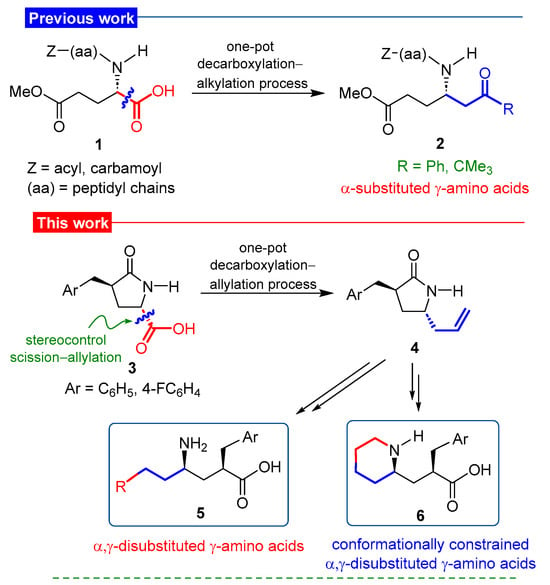
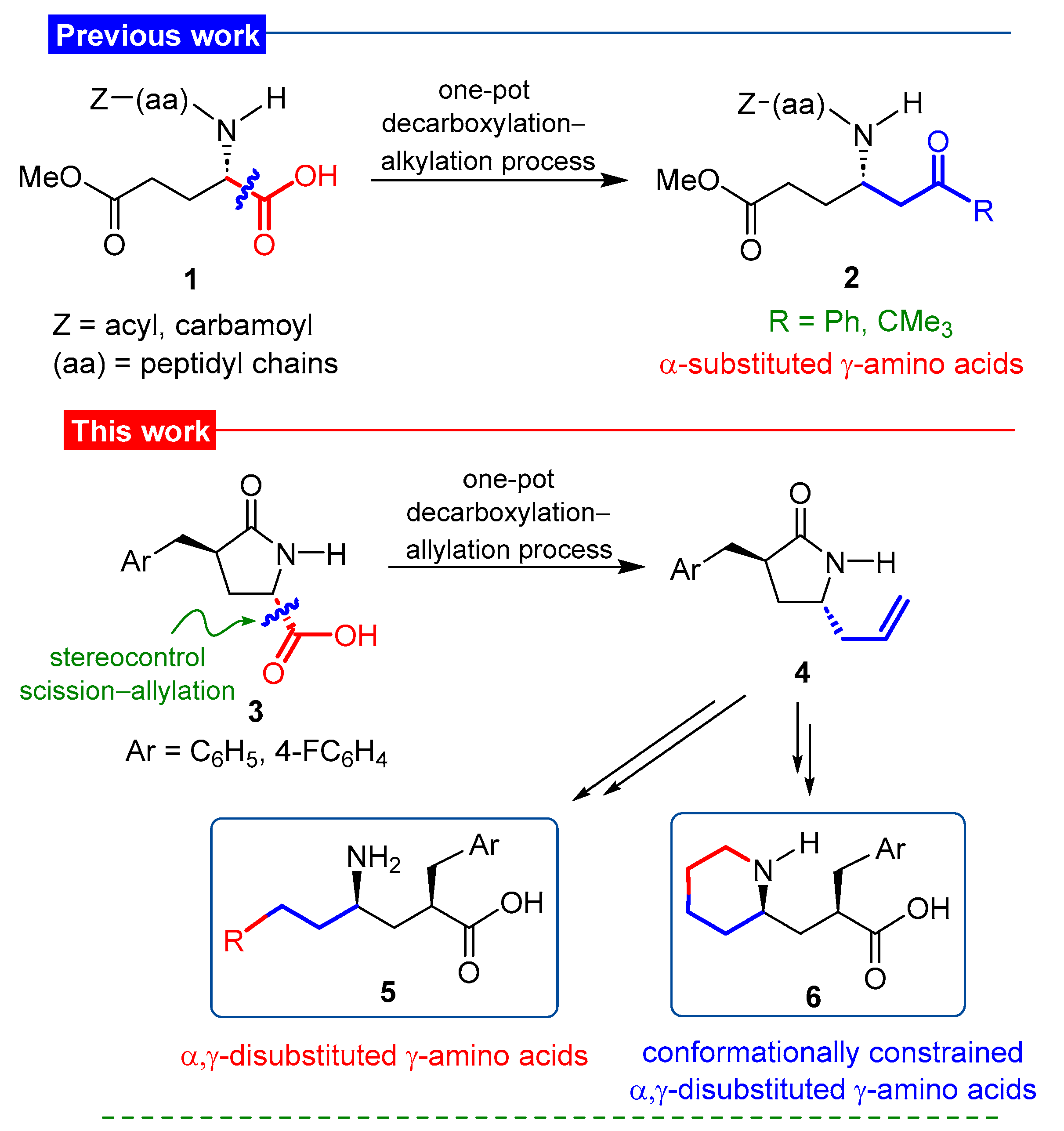
In our previous work, we demonstrated that glutamic acid residues 1 are versatile intermediate “customizable units” for the synthesis of structurally diverse γ-amino acids embedded within peptide backbone 2. This strategy relies on a one-pot decarboxylation-alkylation process [43,44,45,46] of orthogonally protected glutamic derivatives 1, which affords the formation of hybrid α,γ-peptides 2 in good overall yields (Scheme 1) [47]. Despite these advances, many of the reported approaches for the synthesis of α,γ-disubstituted γ-amino acids remain limited by lengthy synthetic sequences, poor stereochemical control, and the requirement for expensive or scarcely available catalysts [22,23,24,25,26].
Scheme 1.
Previous work and current approach toward the synthesis of γ-amino acids.
Herein, we report a novel and stereoselective approach for the synthesis of acyclic and conformationally restricted α,γ-disubstituted γ-amino acids 5 and 6 from α,γ-disubstituted γ-lactam 4, easily obtained through a stereocontrolled decarboxylation-allylation process (Scheme 1). Unlike previous methodologies, this strategy enables the preparation of both acyclic and conformationally constrained γ-amino acids from a common intermediate derived from pyroglutamic acid 3, a readily available chiral starting material. Additionally, the approach allows the introduction of side chains with diverse steric and electronic properties, including fluorinated substituents, while maintaining high levels of stereocontrol. These features make the methodology particularly attractive for the preparation of underexplored γ-amino acid building blocks with potential applications in peptide design and medicinal chemistry.
2. Results and Discussion
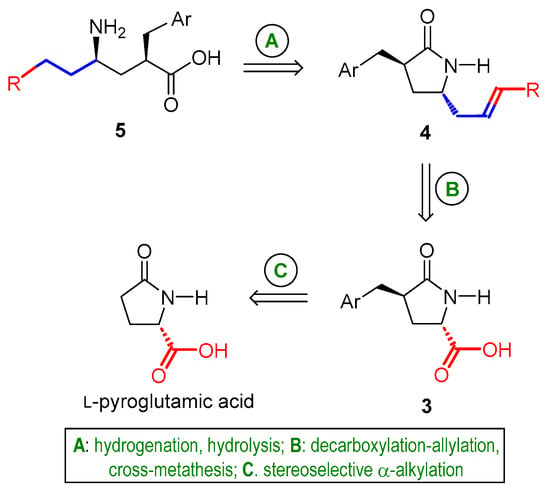
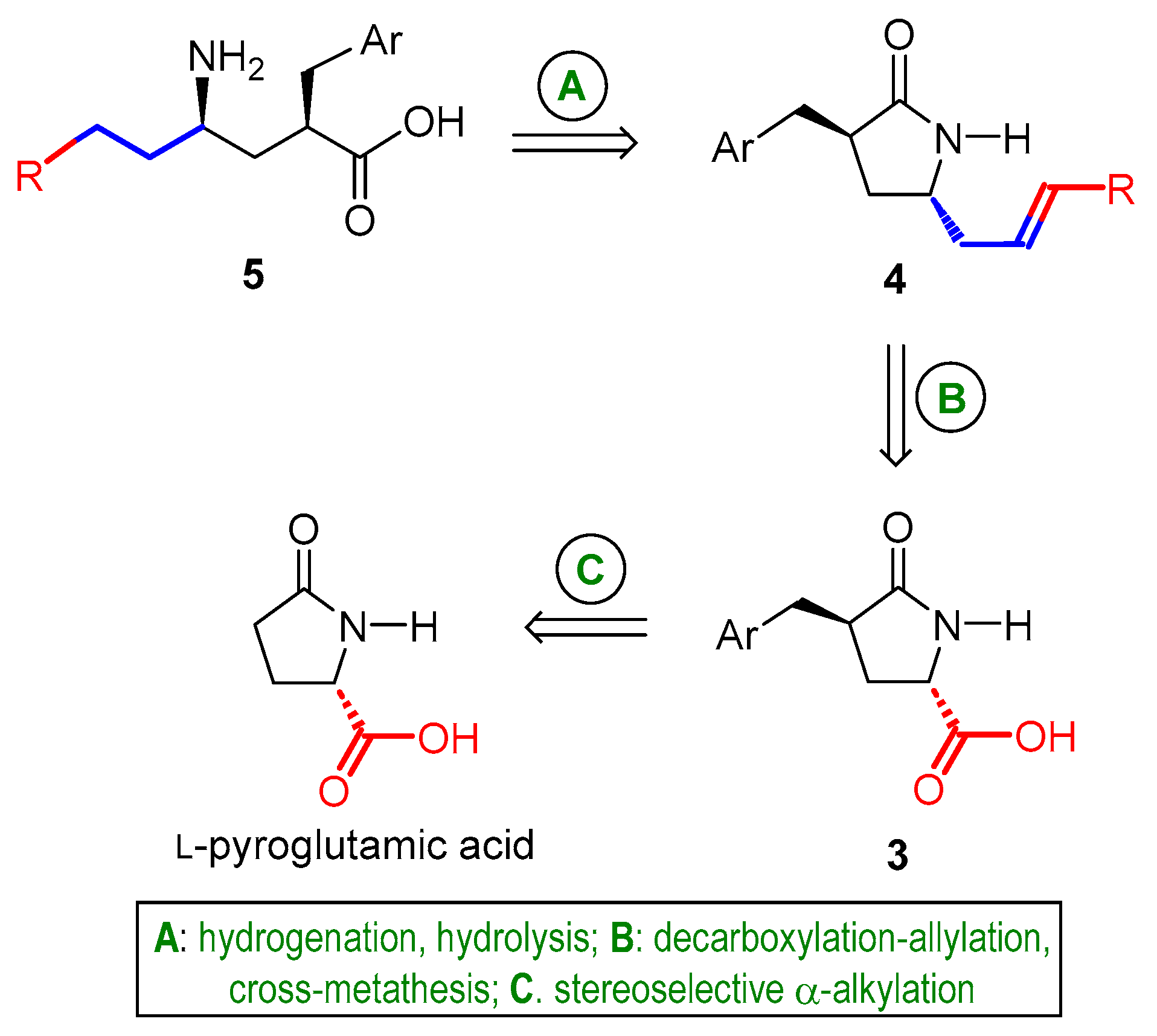
For the synthesis of our target α,γ-disubstituted γ-amino acid 5, the α,γ-disubstituted γ-lactam 4 was proposed as a key intermediate, which can be obtained from 4-substituted pyroglutamic acid 3 through a stereocontrolled decarboxylation-allylation process followed by a cross-metathesis coupling. Additionally, 4-substituted pyroglutamic acid 3 can be prepared by stereoselective alkylation of appropriately protected L-pyroglutamic acid (Scheme 2).
Scheme 2.
Retrosynthetic strategy for the synthesis of α,γ-disubstituted γ-amino acids 5.
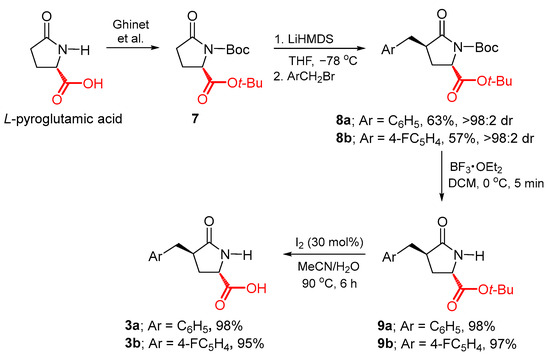
Based on the proposed retrosynthetic analysis, we initiated the synthesis of our target molecules by focusing on the preparation of the chiral α,γ-disubstituted γ-lactam 4. Following the procedure reported by Ghinet et al. [48], L-pyroglutamic acid was first converted into tert-butyl ester 16 and subsequently transformed into N-Boc tert-butyl pyroglutamate 7, which reacted with lithium hexamethyldisilaside (LiHMDS) in THF at −78 °C, followed by the treatment with benzyl bromide, obtaining the (2S,4R)-tert-butyl N-Boc 4-benzylpyroglutamate 8a in 63% yield and excellent diastereoselectivity (dr > 98:2) [49,50]. (Scheme 3).
Scheme 3.
Synthesis of pyroglutamic acid derivatives 3a and b [48].
Similarly, the alkylation reaction of 7 with 4-fluorobenzyl bromide produced the 4-substituted pyroglutamate 8b in 57% yield and excellent diastereoselectivity (dr > 98:2) [51]. In the next step, N-Boc 4-substituted pyroglutamates 8a and b were reacted with boron trifluoride ethyl etherate in dry dichloromethane at room temperature for 5 min [52], obtaining the corresponding (2S,4R)-tert-butyl 4-substituted pyroglutamates 9a and b in 98 and 97% yield, respectively. Finally, treatment of 9a and b with 30 mol% iodine in a MeCN/H2O mixture at 90 °C [53], provided the corresponding 4-substituted pyroglutamic acid derivatives 3a and b in 98% and 95% yield, respectively (Scheme 3).
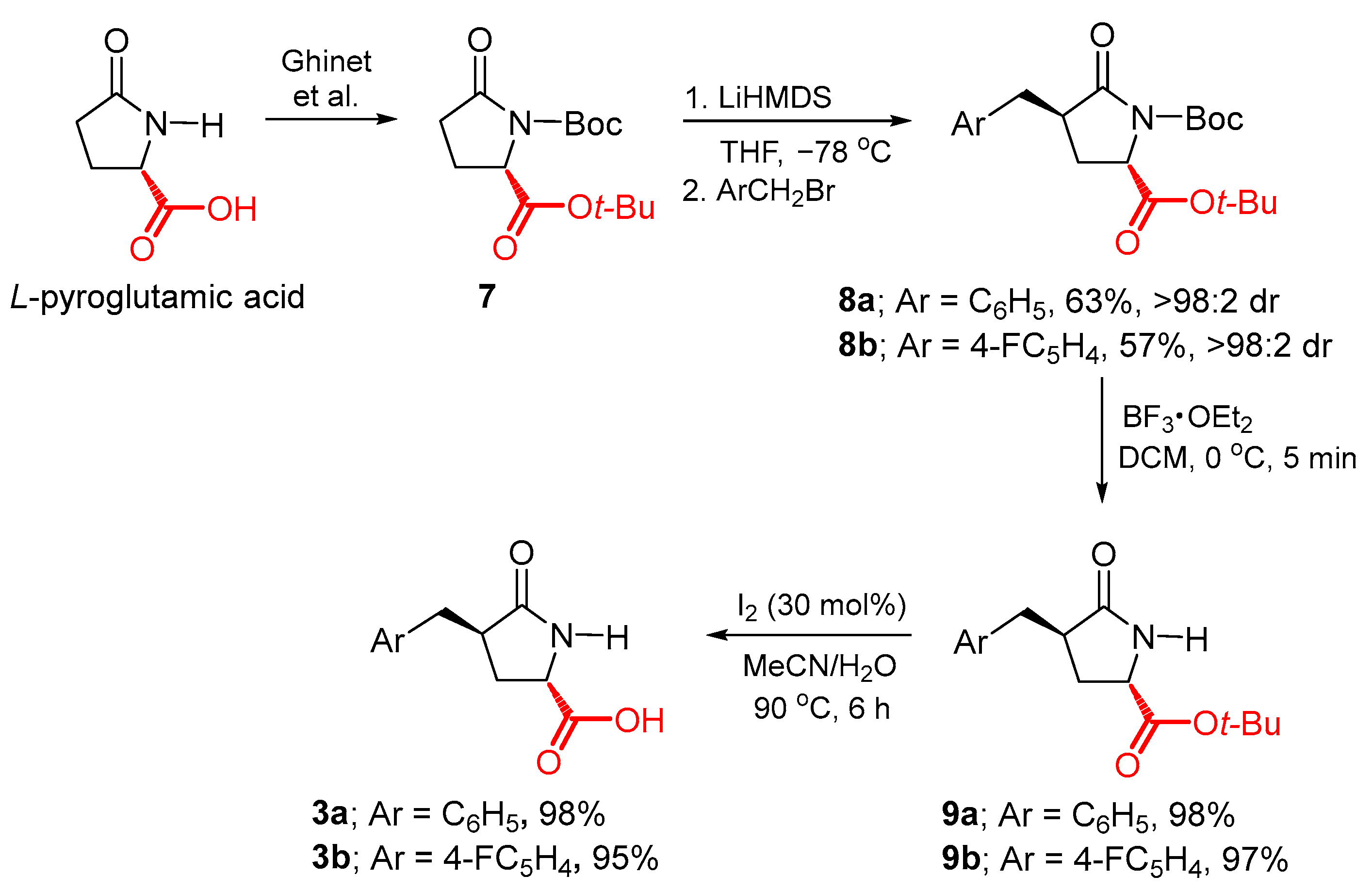
Once 3-substituted pyroglutamic acid derivatives 3a and b had been obtained, the decarboxylation-allylation process was investigated based on our previous work [54]. Initially, 4-substituted pyroglutamic acid derivatives 3a and b were treated with (diacetoxyiodo)benzene (DIB) and iodine under white LED light irradiation (30 W) in dichloromethane, affording the corresponding acyliminium ion intermediates 10a and b. Without further purification, these intermediates were subsequently reacted with allyltrimethylsilane and BF3·OEt2 at 0 to 26 °C, to furnish the corresponding 3,5-disubstituted γ-lactams 11a and b in 60% and 58% yield, respectively, with a 98:2 diastereomeric ratio as determined by 1H NMR analysis of the crude reaction mixtures. The (R,R) configuration of 11a and b was assigned based on NOE correlations between the protons at C2 and C4 (see the Supplementary Materials). Subsequently, catalytic hydrogenation of the double bond in 3,5-disubstituted γ-lactams 11a and b under a hydrogen atmosphere in the presence of Pd/C (20 mol%) afforded the corresponding 3,5-disubstituted γ-lactams 12a and b in 95% and 94% yield, respectively. Finally, acidic hydrolysis of 12a and b with 6 N HCl at 105 °C furnished the desired α,γ-disubstituted γ-amino acids 5a and b as their hydrochloride salts in 75% and 77%, respectively, with excellent diastereiosmeric ratios (dr = 98:2 and >98:2) (Scheme 4).
Scheme 4.
Synthesis of acyclic α,γ-disubstituted γ-amino acids 5a and b.
It is well known that short γ-peptides bearing an appropriate balance of lipophilic side chains and cationic residues display significant antimicrobial and antibiofilm properties [38,55,56]. In this context, the synthesis of γ-amino acids with lipophilic side chains represents an attractive strategy for the development of new antimicrobial agents.
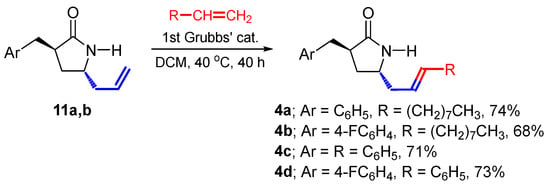
With this in mind, we sought to evaluate the versatility of the allyl group in the 3,5-disubstituted γ-lactams 11a and b for elongation of the lipophilic chain through a cross-coupling metathesis reaction. Thus, 3,5-disubstituted γ-lactam 11a was subjected to cross-metathesis with 1-decene in the presence of first-generation Grubbs’ catalyst in dichloromethane at 40 °C, affording the corresponding 3,5-disubstituted γ-lactam 4a in 74% yield. Under identical reaction conditions, precursor 11b reacted with 1-decene to furnish the lactam 4b in 68% yield. Additionally, the reaction of 3,5-disubstituted γ-lactams 11a and b with styrene under the same cross-metathesis conditions afforded the corresponding 3,5-disubstituted γ-lactam 4c and d in 71% and 73% yield, respectively (Scheme 5).
Scheme 5.
Cross-metathesis functionalization of 3,5-disubstituted γ-lactams 11a and b.
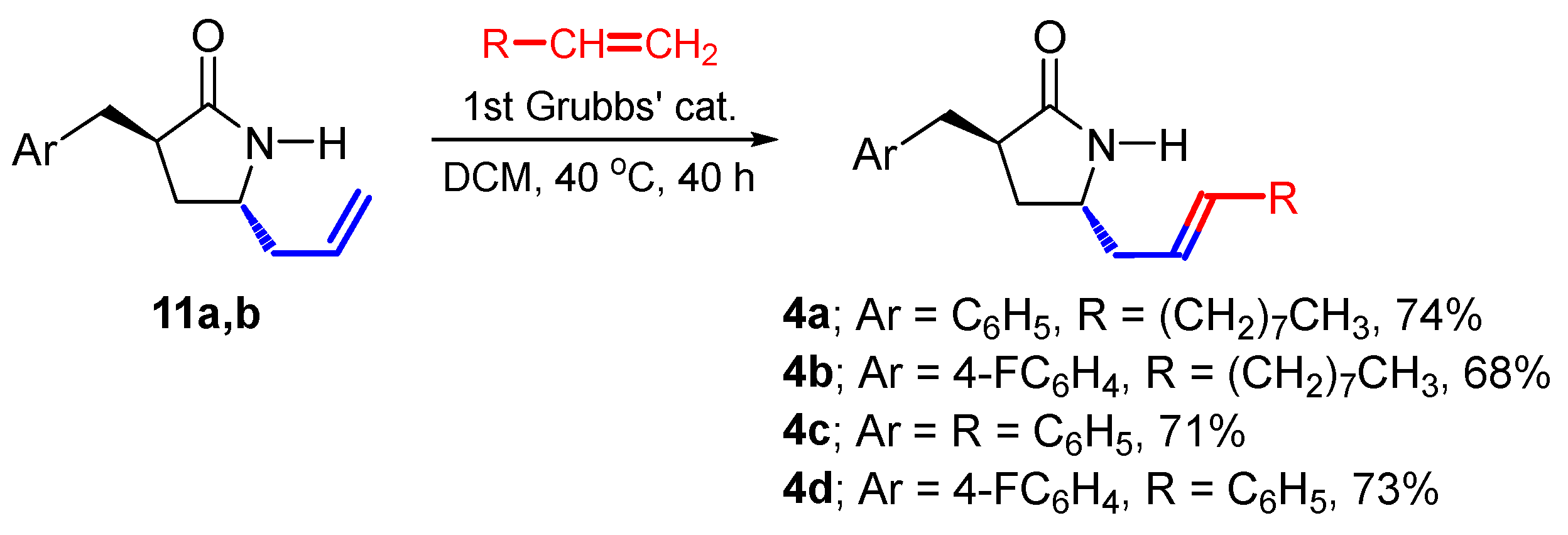
Once lactams 4a–d had been obtained, the next step involved the catalytic hydrogenation of the C=C bond under hydrogen atmosphere using Pd/C (20 mol%) in methanol at 26 °C, giving the corresponding 3,5-disubstituted γ-lactams 13a–d in 91–95% yield. Finally, acidic hydrolysis of lactams 13a–d with 6 N HCl at 105 °C furnished the target α,γ-disubstituted γ-amino acids 5c–f as their hydrochloride salts in good yields 71–73% yield and with high diastereomeric ratios ranging from >98:2 to 92:8 (Scheme 6).
Scheme 6.
Synthesis of acyclic α,γ-disubstituted γ-amino acids 5c–f.
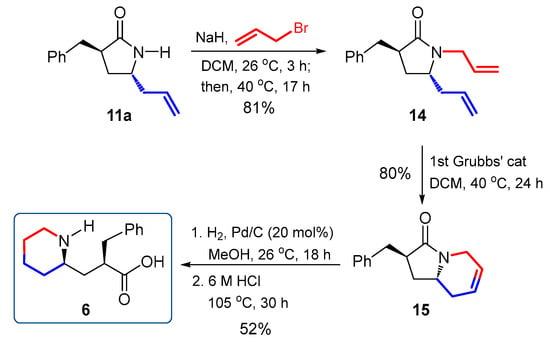
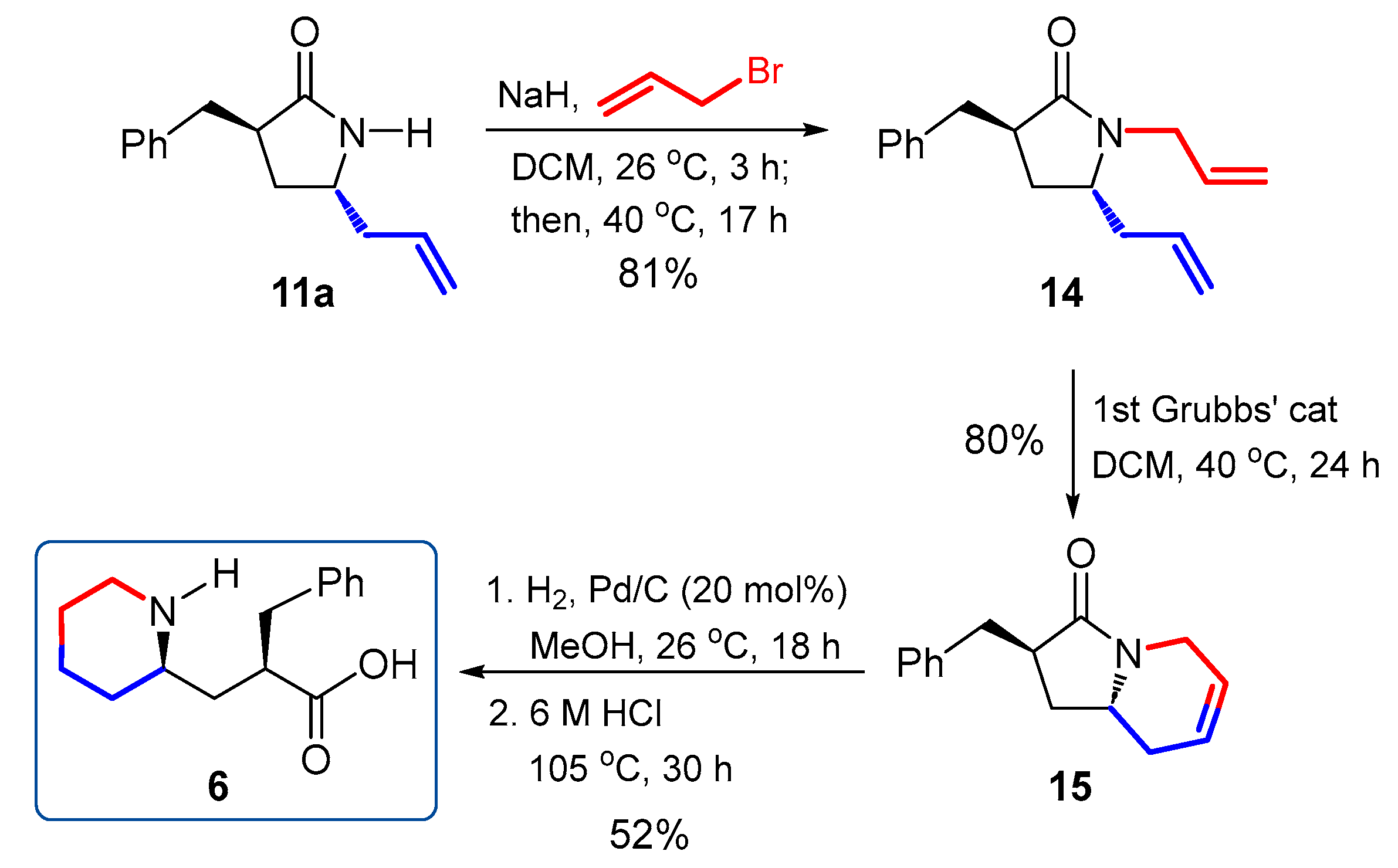
In view of the significant role that conformationally restricted scaffolds play in drug discovery [57,58,59], this methodology could provide a versatile and strategically useful approach for the synthesis of structurally constrained γ-amino acids with potential pharmaceutical relevance. In this context, 3,5-disubstituted γ-lactam 11a was treated with sodium hydride (NaH), followed by allyl bromide addition, to afford N-allyl 3,5-disubstituted γ-lactam 14 in 81% yield. Subsequent ring-closing metathesis (RCM) reaction [54] using first-generation Grubbs’ catalyst in dichloromethane at 40 °C, followed by the catalytic hydrogenation of the C=C bond under a hydrogen atmosphere using Pd/C (20 mol%) in methanol at 26 °C, furnished the bicyclic compound 15 in 80% yield. Finally, hydrolysis of the amide functionality in 15 with 6 N HCl afforded the conformationally constrained α,γ-disubstituted γ-amino acid 6 in 52% yield (Scheme 7).
Scheme 7.
Synthesis of conformationally restricted α,γ-disubstituted γ-amino acid 6.
Altogether, this methodology enables the generation of structurally diverse α,γ-disubstituted γ-amino acids from common precursors. Given the relevance of these scaffolds in peptide and medicinal chemistry, the present approach provides a valuable and modular platform for the preparation of acyclic and conformationally restricted α,γ-disubstituted γ-amino acids as building blocks with tunable structural and physicochemical properties.
3. Materials and Methods
All reagents and solvents were purchased from commercial suppliers and employed without additional purification. First-generation Grubbs’ catalyst was purchased from Sigma-Aldrich (Saint Louis, MO, USA) and handled under an argon atmosphere. Column chromatography was carried out using silica gel (Silica Flash 60®, 230–400 mesh, Quebec City, QC, Canada). Analytical thin-layer chromatography (TLC) was performed on silica gel 60 F254 plates (Merck, Boston, MA, USA), and spots were detected under UV irradiation or by staining with ninhydrin or potassium permanganate solutions. Melting points were measured on a Fisher-Johns melting point apparatus (Thermo Fisher Scientific, Waltham, MA, USA) and are reported without correction. Elemental compositions (C, H, and N) were determined using Thermo Scientific FLASH 2000 (Waltham, MA, USA), with experimental values differing by no more than ±0.4% from the theoretical values. NMR spectra (1H and 13C) were acquired in CDCl3 or CD3OD on Bruker (Billerica, MA, USA) AVANCE III HD (500.13 MHz) and JEOL (Peabody, MA, USA, 600 MHz) spectrometers. Tetramethylsilane (TMS) was used as the internal standard. Chemical shifts (δ) are reported in ppm, while coupling constants (J) are given in Hz.
tert-Butyl (S)-5-oxopyrrolidine-2-carboxylate (16) [48].
A solution of L-pyroglutamic acid (1.03 g, 8.0 mmol) in DCM (25 mL) was placed in a 100 mL round-bottom flask equipped with a magnetic stirring bar and cooled to 0 °C in an ice bath. Triethylamine (4.0 mL, 28.8 mmol) was added dropwise under stirring. Subsequently, ZnBr2 (4.50 g, 20.0 mmol) was added portionwise, followed by the slow addition of tert-butyl bromide (2.7 mL, 24.0 mmol). The resulting reaction mixture was allowed to warm to 40 °C and stirred for 15 h. After this period, the solvent was removed under reduced pressure. The resulting crude solid was washed with EtOAc (3 × 15 mL). The combined organic layers were washed with H2O (9 × 25 mL), dried over anhydrous Na2SO4, filtered, and concentrated under reduced pressure. The residue was dried under high vacuum without further purification to afford compound 16 (1.00 g, 67%) as a white crystalline solid; m.p. 102–103 °C; [α]D20 = +7.0° (c 1.0, MeOH).
Di-tert-butyl (S)-5-oxopyrrolidine-1,2-dicarboxylate (7) [50].
A solution of tert-butyl ester 16 (0.69 g, 3.7 mmol) in MeCN (5 mL) was placed in a 50 mL round-bottom flask equipped with a magnetic stirring bar. Di-tert-butyl dicarbonate (1.07 g, 4.9 mmol) and DMAP (0.37 g, 3.0 mmol) were added. The reaction mixture was stirred at 26 °C for 48 h. After this period, the solvent was removed under reduced pressure. The resulting crude product was purified by flash column chromatography using DCM:MeOH (95:05) as the eluent to afford compound 17 (0.76 g, 72%) as a white crystalline solid; m.p. 51–53 °C; [α]D20 = −36.9° (c 1.0, CHCl3).
Di-tert-butyl (2S)-4-benzyl-5-oxopyrrolidine-1,2-dicarboxylate (8a) [49,50].
A solution of di-tert-butyl (S)-5-oxopyrrolidine-1,2-dicarboxylate 17 (1.00 g, 3.5 mmol) in dry THF (50 mL) was placed in a 100 mL round-bottom flask equipped with a magnetic stirring bar and cooled to −70 °C. Lithium bis(trimethylsilyl)amide (LiHMDS) (3.7 mL, 3.7 mmol) was added dropwise and stirred for 1 h. After this period, benzyl bromide (0.4 mL, 3.7 mmol) was then added slowly, and the reaction mixture was stirred at the same temperature for 2 h. After completion, the solvent was removed under reduced pressure. The crude product was treated with 10% solution of NH4Cl (3 mL) and brine (10 mL). The resulting mixture was extracted with DCM (3 × 15 mL). The combined organic layers were dried over anhydrous Na2SO4, filtered, and concentrated under reduced pressure. The resulting crude product was purified by flash column chromatography using Hexane:EtOAc (80:20) as eluent to afford compound 8a (0.83 g, 63%) as a white crystalline solid; m.p. 124–125 °C; [α]D20 = −49.1° (c 0.9, CHCl3).
Di-tert-butyl (2S)-4-(4-fluorobenzyl)-5-oxopyrrolidine-1,2-dicarboxylate (8b) [51].
A solution of di-tert-butyl (S)-5-oxopyrrolidine-1,2-dicarboxylate 17 (1.00 g, 3.5 mmol) in dry THF (50 mL) was placed in a 100 mL round-bottom flask equipped with a magnetic stirring bar and cooled to −70 °C. LiHMDS (3.7 mL, 3.7 mmol) was added dropwise and stirred for 1 h. After this time, 4-fluorobenzyl bromide (0.5 mL, 3.7 mmol) was then added slowly, and the reaction mixture was stirred at the same temperature for 2 h. After this period, the solvent was removed under reduced pressure. The crude product was treated with 10% solution of NH4Cl (3 mL) and brine (10 mL). The resulting mixture was extracted with DCM (3 × 15 mL). The combined organic layers were dried over anhydrous Na2SO4, filtered, and concentrated under reduced pressure. The resulting crude product was purified by flash column chromatography using Hexane:EtOAc (80:20) as the eluent to afford compound 8b (0.78 g, 57%) as a white crystalline solid; m.p. 101–102 °C; [α]D20 = −48.0° (c 0.9, CHCl3).
tert-Butyl (2S,4R)-4-benzyl-5-oxopyrrolidine-2-carboxylate (9a).
A solution of di-tert-butyl (2S)-4-benzyl-5-oxopyrrolidine-1,2-dicarboxylate 8a (1.17 g, 3.1 mmol) in dry DCM (1.5 mL) was placed in a 25 mL round-bottom flask equipped with a magnetic stirring bar and cooled to 0 °C in an ice bath. BF3·OEt2 (0.4 mL, 3.1 mmol) was added dropwise and stirred for 5 min. After this period, the reaction mixture was treated with a saturated solution of NaHCO3 (1.5 mL) and stirred for 15 min. The resulting mixture was extracted with DCM (3 × 15 mL). The combined organic layers were dried over anhydrous Na2SO4, filtered, and concentrated under reduced pressure. The resulting crude product was purified by flash column chromatography using Hexane:EtOAc (50:50) as eluent to afford compound 9a (0.84 g, 98%) as a white crystalline solid; m.p. 67–69 °C; [α]D20 = −9.6° (c 1.0, CHCl3). Anal. Calcd for C16H21NO3: C, 69.79; H, 7.69; N, 5.09. Found: C, 69.86; H, 7.71; N, 5.07. 1H NMR (500 MHz, CDCl3) δ 1.43 (s, 9H, CCH3), 2.13 (ddd, J = 13.4, 8.9, 8.0 Hz, 1H, 3-Ha), 2.22 (ddd, J = 13.4, 8.8, 3.8 Hz, 1H, 3-Hb), 2.70 (dd J = 13.6, 9.3 Hz, 1H, CHaPh), 2.78 (tdd, J = 8.7, 8.7, 8.0, 4.0 Hz, 1H, 4-H), 3.18 (dd, J = 13.7, 3.9 Hz, 1H, CHbPh), 3.88 (ddd, J = 9.0, 3.8, 0.9 Hz, 1H, CHN), 6.10 (br s, 1H, NH), 7.19–7.25 (m, 3H, o-Ar + p-Ar), 7.30 (dd, J = 7.5, 6.9 Hz, 2H, m-Ar). 13C NMR (125.7 MHz, CDCl3) δ 28.1 (3 × CH3, CCH3), 30.5 (CH2, 3-C), 36.7 (CH2, CH2Ph), 41.6 (CH, 4-C), 54.4 (CH, 2-C), 82.5 (C, CCH3), 126.7 (CH, CHp-arom), 128.7 (2 × CH, o-Ar), 129.2 (2 × CH, m-Ar), 138.9 (C, Ar), 171.3 (C=O), 179.0 (C=O).
tert-Butyl (2S,4R)-4-(4-fluorobenzyl)-5-oxopyrrolidine-2-carboxylate (9b).
A solution of di-tert-butyl (2S)-4-(4-fluorobenzyl)-5-oxopyrrolidine-1,2-dicarboxylate 8b (1.03 g, 2.6 mmol) in dry DCM (1.5 mL) was placed in a 25 mL round-bottom flask equipped with a magnetic stirring bar and cooled to 0 °C in an ice bath. BF3·OEt2 (0.3 mL, 2.6 mmol) was added dropwise and stirred for 5 min. After this period, the reaction mixture was treated with a saturated solution of NaHCO3 (1.5 mL) and stirred for 15 min. The resulting mixture was extracted with DCM (3 × 15 mL). The combined organic layers were dried over anhydrous Na2SO4, filtered, and concentrated under reduced pressure. The resulting crude product was purified by flash column chromatography using Hexane:EtOAc (50:50) as eluent to afford compound 9b (0.75 g, 97%) as a white solid; m.p. 79–81 °C; [α]D20 = −7.1° (c 1.0, CHCl3). Anal. Calcd for C16H20FNO3: C, 65.51; H, 6.87; N, 4.78. Found: C, 65.66; H, 6.89; N, 4.76.). 1H NMR (500 MHz, CDCl3) δ 1.44 (s, 9H, CCH3), 2.06–2.14 (m, 1H, 3-Ha), 2.18–2.26 (m, 1H, 3-Ha), 2.68–2.77 (m, 2H, CHaPh + 4-H), 3.08–3.13 (m, 1H, CHbPh), 3.86 (ddd, J = 9.0, 3.7, 0.8 Hz, 1H, CHN), 6.06 (br s, 1H, NH), 6.98 (ddd, J = 8.9, 8.8, 2.2 Hz, 2H, m-Ar), 7.17 (ddd, J = 8.8, 5.5, 2.9 Hz, 2H, o-Ar). 13C NMR (125.7 MHz, CDCl3) δ 28.1 (3 × CH3, CCH3), 30.3 (CH2, 3-C), 35.8 (CH2, CH2Ph), 41.5 (CH, 4-C), 54.3 (CH, 2-C), 82.6 (C, CCH3), 115.5 (2 × CH, d, J = 21.7 Hz, m-Ar), 130.7 (2 × CH, o-Ar), 134.4 (C, Ar), 161.8 (C, d, J = 245 Hz, CF), 171.2 (C=O), 178.7 (C=O).
(2S,4R)-4-Benzyl-5-oxopyrrolidine-2-carboxylic acid (3a).
A solution of tert-butyl (2S,4R)-4-benzyl-5-oxopyrrolidine-2-carboxylate 9a (0.83 g, 3.0 mmol) in MeCN (8.0 mL) was placed in a 25 mL round-bottom flask equipped with a magnetic stirring bar. The resulting mixture was treated with H2O (40 μL) and iodine (0.23 g, 0.9 mmol). The resulting reaction mixture was allowed to warm to 90 °C and stirred for 6 h. After this period, DCM (5 mL) was added and washed with 10% solution of Na2S2O3 (3 × 10 mL). The combined organic layers were dried over anhydrous Na2SO4, filtered, and concentrated under reduced pressure. The resulting crude product was purified by flash column chromatography using DCM:MeOH (90:10) as the eluent to afford compound 3a (0.65 g, 98%) as a white solid; m.p. 146–148 °C; [α]D20 = −5.4° (c 1.0, MeOH). Anal. Calcd for C12H13NO3: C, 65.74; H, 5.98; N, 6.39. Found: C, 65.57; H, 6.00; N, 6.41. 1H NMR (500 MHz, CD3OD) δ 2.10–2.22 (m, 2H, 3-H2), 2.67 (dd, J = 13.6, 9.2 Hz, 1H, CHaPh), 2.77 (tdd, J = 8.9, 8.7, 8.7, 4.1 Hz, 1H, 4-H), 3.09 (dd, J = 13.6, 4.1 Hz, 1H, CHbPh), 3.96 (dd, J = 8.7, 4.0 Hz, 1H, 2-H), 7.18–7.24 (m, 3H, o-Ar + p-Ar), 7.28 (dd, J = 7.5, 6.9 Hz, 2H, m-Ar). 13C NMR (125.7 MHz, CD3OD) δ 31.9 (CH2, 3-C), 37.3 (CH2, CH2Ph), 43.3 (CH, 4-C), 55.4 (CH, 2-C), 127.5 (CH, p-Ar), 129.6 (2 × CH, o-Ar), 130.1 (2 × CH, m-Ar), 140.2 (C, Ar), 176.5 (C=O), 181.7 (C=O).
(2S,4R)-4-(4-Fluorobenzyl)-5-oxopyrrolidine-2-carboxylic acid (3b).
A solution of tert-butyl (2S,4R)-4-(4-fluorobenzyl)-5-oxopyrrolidine-2-carboxylate 9b (0.76 g, 2.6 mmol) in MeCN (8.0 mL) was placed in a 25 mL round-bottom flask equipped with a magnetic stirring bar. The resulting mixture was treated with H2O (40 μL) and iodine (0.20 g, 0.8 mmol). The resulting reaction mixture was allowed to warm to 90 °C and stirred for 6 h. After this period, DCM (5 mL) was added and washed with 10% solution of Na2S2O3 (3 × 10 mL). The combined organic layers were dried over anhydrous Na2SO4, filtered, and concentrated under reduced pressure. The resulting crude product was purified by flash column chromatography using DCM:MeOH (90:10) as the eluent to afford compound 3b (0.58 g, 95%) as a white solid; m.p. 129–131 °C; [α]D20 = −5.0° (c 1.0, MeOH). Anal. Calcd for C12H12FNO3; C, 60.76; H, 5.10; N, 5.90. Found: C, 60.74; H, 5.11; N, 5.88. 1H NMR (500 MHz, CD3OD) δ 2.15–2.19 (m, 2H, 3-H2), 2.69 (dd, J = 13.6, 9.0 Hz, 1H, CHaPh), 2.76 (tdd, J = 8.7, 8.6, 8.6, 4.1 Hz, 1H, 4-H), 3.07 (dd, J = 13.6, 4.1 Hz, 1H, CHbPh), 4.00 (dd, J = 6.8, 5.7 Hz, 1H, 2-H), 7.01 (ddd, J = 8.9, 8.8, 3.1 Hz, 2H, m-Ar), 7.23 (ddd, J = 8.8, 5.4, 3.1 Hz, 2H, o-Ar). 13C NMR (125.7 MHz, CD3OD) δ 31.6 (CH2, 3-C), 36.4 (CH2, CH2Ph), 43.1 (CH, 4-C), 55.0 (CH, 2-C), 116.1 (2 × CH, d, J = 22.6 Hz, m-Ar), 131.8 (2 × CH, d, J = 7.5 Hz, o-Ar), 136.1 (C, Ar), 163.1 (C, d, J = 242.6 Hz, CF), 175.8 (C=O), 181.5 (C=O).
General procedure A: Decarboxylation-allylation.
A solution of the corresponding carboxylic acid 3a or 3b (1.0 equiv) in dry DCM was placed in a 25 mL round-bottom flask equipped with a magnetic stirring bar. The reaction mixture was treated with (diacetoxyiodo)benzene (DIB) (0.7 equiv) and iodine (0.2 equiv). The reaction mixture was stirred at 26 °C for 3 h under irradiation with white LED light (30 W). After this period, the reaction mixture was cooled to 0 °C in an ice bath. Allyltrimethylsilane (2.5 equiv) was added dropwise, followed by the treatment of BF3·OEt2 (1 equiv). The reaction mixture was allowed to warm to room temperature and stirred for 3 h. The resulting mixture was then washed with 10% aqueous Na2S2O3 (3 × 10 mL). The combined organic layers were dried over anhydrous Na2SO4, filtered, and concentrated under reduced pressure. The crude product was purified by flash column chromatography to afford the corresponding product.
(3R,5R)-5-Allyl-3-benzylpyrrolidin-2-one (11a).
According to General procedure A: A solution of the acid 3a (0.11 g, 0.5 mmol) in DCM (10.0 mL) was treated with DIB (0.11 g, 0.35 mmol), iodine (0.025 g, 0.1 mmol), allyltrimethylsilane (0.2 mL, 1.25 mmol) and BF3·OEt2 (0.1 mL, 0.5 mmol). The crude product was purified by flash column chromatography using EtOAc:Hexane (70:30) as eluent to afford lactam 11a (0.065 g, 60%) as a white solid; m.p. 92–93 °C; [α]D20 = −28.4° (c 1.0, CHCl3). Anal. Calcd for C14H17NO; C, 78.10; H, 7.96; N, 6.51. Found: C, 77.97; H, 7.93; N, 6.52. 1H NMR (500 MHz, CDCl3) δ 1.83 (ddd, J = 13.2, 8.9, 4.2 Hz, 1H, 4-Ha), 1.95 (ddd, J = 13.2, 7.9, 7.0 Hz, 1H, 4-Hb), 2.10–2.25 (m, 2H, 1′-H2), 2.66 (dd, J = 13.6, 9.8 Hz, 1H, CHaPh), 2.72–2.79 (m, 1H, 3-H), 3.17 (dd, J = 13.6, 4.0 Hz, 1H, CHbPh), 3.45–3.51 (m, 1H, 5-H), 5.05–5.11 (m, 2H, 3′-H2), 5.66–5.70 (m, 1H, 2′-H), 6.13 (br s, 1H, NH), 7.20–7.23 (m, 1H, p-Ar),7.21 (d, J = 6.6 Hz, 2H, o-Ar), 7.29 (ddd, J = 7.3, 7.0, 1.6 Hz, 2H, m-Ar). 13C NMR (125.7 MHz, CDCl3) δ 32.0 (CH2, 4-C), 37.0 (CH2, CH2Ph), 41.0 (CH2, 1′-C), 42.3 (CH, 3-C), 51.7 (CH, 5-C), 118.6 (CH2, 3′-C), 126.5 (CH, p-Ar), 128.6 (2 × CH, o-Ar), 129.2 (2 × CH, m-Ar), 133.7 (CH, 2′-C), 139.4 (C, Ar), 179.1 (C=O).
(3R,5R)-5-Allyl-3-(4-fluorobenzyl)pyrrolidin-2-one (11b).
According to General procedure A: A solution of the acid 3b (0.047 g, 0.2 mmol) in DCM (4.0 mL) was treated with DIB (0.045 g, 0.14 mmol), iodine (0.010 g, 0.04 mmol), allyltrimethylsilane (0.08 mL, 0.5 mmol) and BF3·OEt2 (0.02 mL, 0.2 mmol). The crude product was purified by flash column chromatography using EtOAc:Hexane (70:30) as eluent to afford lactam 11b (0.027 g, 58%) as a colorless oil; [α]D20 = −23.2° (c 1.0, CHCl3). Anal. Calcd for C14H16FNO; C, 72.08; H, 6.91; N, 6.00. Found: C, 72.15; H, 6.89; N, 5.99. 1H NMR (500 MHz, CDCl3) δ 1.83 (ddd, J = 13.0, 8.7, 4.0 Hz, 1H, 4-Ha), 1.97 (ddd, J = 13.1, 8.0, 7.0 Hz, 1H, 4-Hb), 2.10–2.25 (m, 2H, CH2CH), 2.68–2.73 (m, 2H, CHaPh + 3-H), 3.10 (dd, J = 13.1, 3.5 Hz, 1H, CHbPh), 3.46 (m, 1H, 5-H), 5.08–5.14 (m, 2H, 3′-H2), 5.64–5.74 (m, 1H, 2′-H), 5.98 (br, 1H, NH), 6.97 (ddd J = 8.7, 8.7, 3.1 Hz, 2H, m-Ar), 7.16 (ddd, J = 8.8, 5.4, 3.1 Hz, 2H, o-Ar), 13C NMR (125.7 MHz, CDCl3) δ 31.8 (CH2, 4-C), 36.1 (CH2, CH2Ph), 41.1 (CH2, 1′-C), 42.2 (CH, 3-C), 51.6 (CH, 5-C), 115.4 (2 × CH, d, J = 20.1 Hz, m-Ar), 118.7 (CH2, 3′-C), 130.6 (2 × CH, d, J = 8.8 Hz, o-Ar), 133.7 (CH, 2′-C), 134.9 (C, Ar), 161.8 (C, d, J = 243.9 Hz, CF), 178.7 (C=O).
General procedure B: Olefin metathesis.
A solution of allyl derivatives 11a or 11b (1 equiv) in dry DCM was placed in a 25 mL round-bottom flask equipped with a magnetic stirring bar. The corresponding alkene (3 equiv) was added, followed by the addition of 1st generation Grubbs’ catalyst (0.1 equiv). The reaction mixture was heated to 40 °C and stirred for 40 h. After this period, the solvent was removed under reduced pressure, and the residue was purified by flash column chromatography using EtOAc:Hexane (70:30) to afford the corresponding product.
(3R,5R)-3-Benzyl-5-((E)-undec-2-en-1-yl)pyrrolidin-2-one (4a).
According to General Procedure B: A solution of 11a (0.35 g, 0.16 mmol) in CH2Cl2 (2.0 mL) was treated with 1-decene (0.10 mL, 0.48 mmol) and Grubbs catalyst (0.013 g, 0.016 mmol). The crude product was purified by flash column chromatography using EtOAc:Hexane (70:30) as eluent to afford compound 4a (0.039 g, 74%) as a dark yellow oil; [α]D20 = −6.4° (c 0.5, CHCl3). Anal. Calcd for C22H33NO; C, 80.68; H, 10.16; N, 4.28. Found: C, 80.55; H, 10.19; N, 4.27. 1H NMR (500 MHz, CDCl3) δ 0.88 (t, J = 7.0 Hz, 3H, CH3), 1.25 (m, 12H, (CH2)6), 1.81 (ddd, J = 13.1, 8.9, 4.0 Hz, 1H, 1′-Ha), 1.90–2.10 (m, 3H, 1′-Hb +, 4′-H2), 2.05 (m, 1H, 4-Ha), 2.12 (m, 1H, 4-Hb), 2.65 (dd, J = 13.6, 9.9 Hz, 1H, CHaPh), 2.70–2.79 (m, 1H, 3-H), 3.19 (dd, J = 13.6, 3.7 Hz, 1H, CHbPh), 3.39–3.46 (m, 1H, 5-H), 5.27 (ddd, J = 15.4, 7.9, 6.3 Hz, 1H, 2′-H or 3′-H), 5.45–5.53 (m, 1H, 2′-H or 3′-H), 5.86 (d, J = 11.4 Hz, 1H, NH), 7.19–7.23 (m, 1H, p-Ar), 7.21 (dd, J = 6.5, 1.8 Hz, 2H, o-Ar), 7.29 (ddd, J = 7.7, 7.2, 1.1 Hz, 2H, m-Ar), 13C NMR (125.7 MHz, CDCl3) δ 14.2 (CH3), 22.8 (CH2), 29.3 (CH2), 29.4 (CH2), 29.5 (CH2), 29.6 (CH2), 29.7 (CH2), 32.0 (CH2), 32.7 (CH2), 37.0 (CH2, CH2Ph), 39.9 (CH2, 4-C), 42.3 (CH, 3-C), 52.1 (CH, 5-C), 124.1 (CH, 2′-C or 3′-C), 124.8 (CH, 2′-C or 3′-C), 126.5 (CH, p-Ar), 128.6 (2 × CH, o-Ar), 129.2 (2 × CH, m-Ar), 139.5 (C, Ar), 178.9 (C=O).
(3R,5R)-3-Benzyl-5-cinnamylpyrrolidin-2-one (4b).
According to General Procedure B: A solution of 11b (0.040 g, 0.19 mmol) in CH2Cl2 (2.0 mL) was treated with styrene (0.06 mL, 0.56 mmol) and Grubbs catalyst (0.015 g, 0.019 mmol). The crude product was purified by flash column chromatography using EtOAc:Hexane (70:30) as eluent to afford compound 4b (0.037 g, 68%) as a brown solid; m.p. 91–93 °C; [α]D20 = −28.1° (c 0.2, CHCl3). Anal. Calcd for C22H32FNO; C, 76.48; H, 9.34; N, 4.05. Found: C, 76.45; H, 9.35; N, 4.06. 1H NMR (500 MHz, CDCl3) δ 1.88 (ddd, J = 13.1, 8.9, 4.0 Hz, 1H, 1′-Ha), 2.03 (dt, J = 13.1, 7.9 Hz, 1H, 1′-Hb), 2.27–2.39 (m, 2H, 4′-H2), 2.67 (dd, J = 13.6, 9.8 Hz, 1H, CHaPh), 2.74–2.81 (m, 1H, 3-H), 3.18 (dd, J = 13.6, 4.0 Hz, 1H, CHbPh), 3.56 (m, 1H, 5-H), 6.08 (ddd, J = 15.8, 7.9, 6.7 Hz, 1H, 2′-H), 6.31 (br s, 1H, NH), 6.44 (d, J = 15.8 Hz, 1H, 3′-H), 7.16–7.24 (m, 4H, Ar), 7.27–7.35 (m, 6H, Ar). 13C NMR (125.7 MHz, CDCl3) δ 32.0 (CH2, 1′-C), 37.0 (CH2, CH2Ph), 40.3 (CH2, 4-C), 42.2 (CH, 3-C), 52.1 (CH, 5-C), 125.1 (CH, 2′-C), 126.3 (2 × CH, m-Ar), 126.5 (CH, p-Ar), 127.6 (2 × CH, o-Ar), 128.6 (CH, p-Ar), 128.7 (2 × CH, o-Ar), 129.2 (2 × CH, m-Ar), 133.6 (CH, 3′-C), 137.0 (C, Ar), 139.4 (C, Ar), 179.1 (C=O).
(3R,5R)-3-(4-Fluorobenzyl)-5-((E)-undec-2-en-1-yl)pyrrolidin-2-one (4c).
According to General Procedure B: A solution of 11a (0.036 g, 0.16 mmol) in CH2Cl2 (2.0 mL) was treated with 1-decene (0.09 mL, 0.48 mmol) and Grubbs catalyst (0.013 g, 0.015 mmol). The crude product was purified by flash column chromatography using EtOAc:Hexane (70:30) as eluent to afford compound 4c (0.037 g, 71%) as a light brown oil; [α]D20 = −10.4° (c 1.0, CHCl3). Anal. Calcd for C20H21NO; C, 82.44; H, 7.26; N, 4.81. Found: C, 82.66; H, 7.28; N, 4.80. 1H NMR (500 MHz, CDCl3) A mixture of Z/E isomers was observed δ 0.87 (t, J = 6.9 Hz, 3H, CH3), 1.20–1.35 (m, 12H, (CH2)6), 1.78–1.84 (m, 1H, 4′-Ha), 1.87–2.24 (m, 5H, 1′-H2 + 4′-Hb + 4-H2), 2.60–2.75 (m, 2H, CHaPh + 3-H), 3.08–3.14 (m, 1H, CHbPh), 3.37–3.44 (m, 1H, 5-H), 5.22–5.30 (m, 1H, 3′-H), 5.44–5.53 (m, 1H, 2′-H), 5.89 (d, J = 15.6 Hz, 1H, NH), 6.97 (ddd, J = 8.7, 8.7, 3.3 Hz, 2H, m-Ar), 7.15 (ddd, J = 8.6, 5.5, 3.1 Hz, 2H, o-Ar). 13C NMR (125.7 MHz, CDCl3) A mixture of Z/E isomers was observed δ 14.2 (CH3), 22.8 (CH2), 27.6 (CH2), 29.3/29.4 (CH2), 29.5/29.6 (CH2), 29.7/29.8 (CH2), 31.8/32.0 (CH2), 32.7 (CH2, 2′-C), 34.4 (CH2, 1′-C), 36.1 (CH2, CH2Ph), 39.9 (CH2, 4-C), 42.2 (CH, 3-C), 52.1 (CH, 5-C), 115.4 (2 × CH, d, J = 21.4 Hz, m-Ar), 124.0 (CH, 2′-C), 124.7 (CH, 3′-C), 130.6 (2 × CH, d, J = 7.5 Hz, o-Ar), 134.1 (C, Ar), 161.8 (C, d, J = 245.1 Hz, CF), 178.7 (C=O).
(3R,5R)-5-Cinnamyl-3-(4-fluorobenzyl)pyrrolidin-2-one (4d).
According to General Procedure B: A solution of 11b (0.38 g, 0.16 mmol) in CH2Cl2 (2.0 mL) was treated with styrene (0.06 mL, 0.48 mmol) and Grubbs catalyst (0.013 g, 0.016 mmol). The crude product was purified by flash column chromatography using EtOAc:Hexane (70:30) as eluent to afford compound 4d (0.36 g, 73%) as a light brown oil; [α]D20 = −15.9° (c 0.2, CHCl3). Anal. Calcd for C20H20FNO; C, 77.64; H, 6.52; N, 4.53. Found: C, 77.82; H, 6.50; N, 4.53. 1H NMR (500 MHz, CDCl3) δ 1.89 (ddd, J = 12.9, 8.6, 3.9 Hz, 1H, 1′-Ha), 1.99 (dt, J = 13.2, 7.5 Hz, 1H, 1′-Hb), 2.27–2.40 (m, 2H, 4-H2), 2.69 (dd, J = 13.5, 9.4 Hz, 1H, CHaPh), 2.70–2.76 (m, 1H, 3-H), 3.11 (dd, J = 13.1, 3.5 Hz, 1H, CHbPh), 3.50–3.56 (m, 1H, 5-H), 6.08 (ddd, J = 15.9, 8.0, 6.6 Hz, 1H, 2′-H), 6.12 (br s, 1H, NH), 6.42 (d, J = 15.9 Hz, 1H, 3′-H), 6.97 (ddd J = 8.7, 8.7, 3.3 Hz, 2H, m-Ar), 7.16 (ddd, J = 8.6, 5.5, 3.1 Hz, 2H, o-Ar), 7.23 (ddd, J = 6.9, 6.8, 1.8 Hz, 1H, p-Ar), 7.31 (m, 4H, o,m-Ar). 13C NMR (125.7 MHz, CDCl3) δ 31.9 (CH2, 1′-C), 36.1 (CH2, CH2Ph), 40.4 (CH2, 4-C), 42.1 (CH, 3-C), 52.0 (CH, 5-C), 115.4 (2 × CH, d, J = 21.4 Hz, m-Ar), 125.0 (CH, 2′-C), 126.3 (2 × CH, m-Ar), 127.7 (CH, p-Ar), 128.7 (2 × CH, o-Ar), 130.6 (2 × CH, d, J = 8.8 Hz, o-Ar), 133.8 (CH, 3′-C), 134.9 (C, Ar), 136.9 (C, Ar), 161.8 (C, d, J = 243.9 Hz, C-F), 178.7 (C=O).
General Procedure C: Catalytic reduction.
A solution of allyl derivatives 11a and b, 4a–d or 15 (1.0 equiv) in MeOH was placed in a 25 mL round-bottom flask equipped with a magnetic stirring bar. Pd/C (20% w/w) was added, and the reaction mixture was stirred at room temperature for 18 h under an atmosphere of hydrogen. After this period, the mixture was filtered through a pad of Celite®, and the filtrate was concentrated under reduced pressure to afford the corresponding product. The resulting products 12a and b, 13a–d, and 18 were used directly in the next step without further purification.
(3R,5R)-3-Benzyl-5-propylpyrrolidin-2-one (12a).
According to General Procedure C: A solution of (3R,5R)-5-allyl-3-benzylpyrrolidin-2-one 11a (0.025 g, 0.12 mmol) in MeOH (2.0 mL) was treated with Pd/C (5 mg). The reaction mixture was stirred under the conditions described above to afford compound 12a (0.024 g, 95%) as a colorless oil; [α]D20 = −15.5° (c 0.5, CHCl3). Anal. Calcd for C14H19NO; C, 77.38; H, 8.81; N, 6.45. Found: C, 77.33; H, 8.83; N, 6.46. 1H NMR (500 MHz) CDCl3) δ 0.89 (t, J = 7.3 Hz, 3H, CH3), 1.23–1.32 (m, 2H, 2′-H2), 1.34–1.40 (m, 1H, 1′-Ha), 1.42–1.46 (m, 1H, 1′-Hb), 1.77 (ddd, J = 13.0, 8.9, 4.2 Hz, 1H, 4-Ha), 1.98 (ddd, J = 13.0, 7.8, 7.1 Hz, 1H, 4-Hb), 2.64 (dd, J = 13.6, 10.0 Hz, 1H, CHaPh), 2.74 (dddd, J = 10.0, 8.8, 7.9, 4.0 Hz, 1H, 3-H), 3.18 (dd, J = 13.7, 3.9 Hz, 1H, CHbPh), 3.38–3.45 (m, 1H, 5-H), 6.30 (br s, 1H, NH), 7.22 (d, J = 7.9 Hz, 2H, o-Ar), 7.20–7.24 (m, 1H, p-Ar), 7.26–7.32 (m, 2H, m-Ar). 13C NMR (125.7 MHz, CDCl3) δ 14.0 (CH3), 19.3 (CH2, 2′-C), 32.6 (CH2, 1′-C), 37.0 (CH2, CH2Ph), 38.9 (CH2, 4-C), 42.2 (CH, 3-C), 52.3 (CH, 5-C), 126.5 (CH, p-Ar), 128.6 (2 × CH, o-Ar), 129.2 (2 × CH, m-Ar), 139.6 (C, Ar), 179.2 (C=O).
(3R,5R)-3-(4-Fluorobenzyl)-5-propylpyrrolidin-2-one (12b).
According to General Procedure C: A solution of (3R,5R)-5-allyl-3-(4-fluorobenzyl)pyrrolidin-2-one 11b (0.020 g, 0.09 mmol) in MeOH (2.0 mL) was treated with Pd/C (4 mg). The reaction mixture was stirred under the conditions described above to afford compound 12b (0.019 g, 94%) as a colorless oil; [α]D20 = −23.1° (c 1.0, CHCl3). Anal. Calcd for C14H18FNO C, 71.46; H, 7.71; N, 5.95. Found: C, 71.41; H, 7.74; N, 5.95. 1H NMR (500 MHz, CDCl3) δ 0.89 (t, J = 7.2 Hz, 3H, CH3), 1.24–1.34 (m, 2H, 2′-H2), 1.35–1.50 (m, 2H, 1′-H2), 1.77 (ddd, J = 13.0, 8.7, 4.1 Hz, 1H, 4-Ha), 1.95 (ddd, J = 13.1, 7.9, 6.9 Hz, 1H, 4-Hb), 2.65 (dd, J = 13.3, 9.5 Hz, 1H, CHaPh), 2.70 (tdd, J = 8.2, 8.2, 6.9, 3.6 Hz, 1H, 3-H), 3.10 (dd, J = 13.3, 3.7 Hz, 1H, CHbPh), 3.39 (m, 1H, 5-H), 6.53 (br s, 1H, NH), 6.97 (ddd, J = 8.9, 8.8, 2.0 Hz, 2H, m-Ar), 7.15 (ddd, J = 8.7, 5.3, 3.2 Hz, 2H, o-Ar). 13C NMR (125.7 MHz, CDCl3) δ 14.0 (CH3), 19.3 (CH2, 2′-C), 32.4 (CH2, 1′-C), 36.1 (CH2, CH2Ph), 38.9 (CH2, 4-C), 42.3 (CH, 3-C), 52.3 (CH, 5-C), 115.4 (2 × CH, d, J = 21.4 Hz, m-Ar), 130.5 (2 × CH, d, J = 8.8 Hz, o-Ar), 135.1 (C, Ar), 161.7 (C, d, J = 245.1 Hz, CF), 179.1 (C=O).
(3R,5R)-3-Benzyl-5-undecylpyrrolidin-2-one (13a).
According to General Procedure C: A solution of (3R,5R)-3-benzyl-5-((E)-undec-2-en-1-yl)pyrrolidin-2-one 4a (0.023 g, 0.07 mmol) in MeOH (2.0 mL) was treated with Pd/C (4 mg). The reaction mixture was stirred under the conditions described above to afford compound 13a (0.021 g, 91%) as a colorless oil; [α]D20 = −7.2° (c 0.5, CHCl3). Anal. Calcd for C22H35NO; C, 80.19; H, 10.71; N, 4.25. Found: C, 80.28; H, 10.68; N, 4.24. 1H NMR (500 MHz, CDCl3) δ 0.87 (t, J = 6.9 Hz, 3H, CH3), 1.20–1.32 (m, 18H, (CH2)9), 1.33–1.49 (m, 2H, 1′-H2), 1.77 (ddd, J = 13.0, 8.8, 4.1 Hz, 1H, 4-Ha), 1.98 (dt, J = 13.1, 7.5 Hz, 1H, 4-Hb), 2.65 (dd, J = 13.6, 9.9 Hz, 1H, CHaPh), 2.73 (ddt, J = 12.8, 8.9, 4.0 Hz, 1H, 3-H), 3.18 (dd, J = 13.6, 4.0 Hz, 1H, CHbPh), 3.36–3.43 (m, 1H, 5-H), 6.19 (br s, 1H, NH), 7.22 (dd, J = 8.1, 2.0 Hz, 2H, o-Ar), 7.20–7.25 (m, 1H, p-Ar), 7.29 (ddd, J = 7.6, 7.5, 2.6 Hz, 2H, m-Ar). 13C NMR (125.7 MHz, CDCl3) δ 14.3 (CH3), 22.8 (CH2), 26.1 (CH2), 29.5 (CH2), 29.57 (CH2), 29.62 (CH2), 29.66 (CH2), 29.73 (CH2), 32.0 (CH2), 32.6 (CH2), 36.8 (CH2, CH2Ph), 37.1 (CH2, 1′-C), 42.2 (CH, 3-C), 52.5 (CH, 5-C), 126.5 (CH, p-Ar), 128.6 (2 × CH, o-Ar), 129.2 (2 × CH, m-Ar), 139.6 (C, Ar), 179.1 (C=O).
(3R,5R)-3-(4-Fluorobenzyl)-5-undecylpyrrolidin-2-one (13b).
According to General Procedure C: A solution of (3R,5R)-3-(4-fluorobenzyl)-5-((E)-undec-2-en-1-yl)pyrrolidin-2-one 4b (0.027 g, 0.08 mmol) in MeOH (2.0 mL) was treated with Pd/C (5 mg). The reaction mixture was stirred under the conditions described above to afford compound 13b (0.025 g, 92%) as a yellow oil; [α]D20 = −7.0° (c 1.0, CHCl3). Anal. Calcd for C22H34FNO; C, 76.04; H, 9.86; N, 4.03; Found: C, 76.17; H, 9.84; N, 4.04. 1H NMR (500 MHz, CDCl3) δ 0.87 (t, J = 6.9 Hz, 3H, CH3), 1.20–1.29 (m, 18H, (CH2)9), 1.34–1.48 (m, 2H, 1′-H2), 1.78 (ddd, J = 12.8, 8.5, 4.0 Hz, 1H, 4-Ha), 1.96 (dt, J = 13.0, 7.5 Hz, 1H, 4-Ha), 2.66 (dd, J = 12.9, 9.3 Hz, 1H, CHaPh), 2.68–2.74 (m, 1H, 3-H), 3.12 (dd, J = 13.0, 3.2 Hz, 1H, CHbPh), 3.37 (ddd, J = 7.1, 7.0, 4.0 Hz, 1H, 5-H), 6.05 (br s, 1H, NH), 6.97 (ddd, J = 8.7, 8.7, 3.1 Hz, 2H, m-Ar), 7.16 (ddd, J = 8.6, 5.5, 3.1 Hz, o-Ar). 13C NMR (125.7 MHz, CDCl3) δ 14.3 (CH3), 22.8 (CH2), 26.1 (CH2), 29.5 (CH2), 29.57 (CH2), 29.63 (CH2), 29.66 (CH2), 29.7 (CH2), 29.9 (CH2), 32.0 (CH2), 32.5 (CH2), 36.2 (CH2, CH2Ph), 36.8 (CH2, 4-C), 42.1 (CH, 3-C), 52.4 (CH, 5-C), 115.4 (2 × CH, d. J = 20.1 Hz, m-Ar), 130.5 (2 × CH, d. J = 8.8 Hz, o-Ar), 135.1 (C, Ar), 161.8 (C, d. J = 238.8 Hz, CF), 178.8 (C=O).
(3R,5R)-3-Benzyl-5-(3-phenylpropyl)pyrrolidin-2-one (13c).
According to General Procedure C: A solution of (3R,5R)-3-benzyl-5-cinnamylpyrrolidin-2-one 4c (0.022 g, 0.08 mmol) in MeOH (2.0 mL) was treated with Pd/C (4 mg). The reaction mixture was stirred under the conditions described above to afford compound 13c (0.021 g, 95%) as a colorless oil; [α]D20 = −11.6° (c 0.5, CHCl3). Anal. Calcd for C20H23NO; C, 81.87; H, 7.90; N, 4.77. Found: C, 81.95; H, 7.93; N, 4.76. 1H NMR (500 MHz, CDCl3) δ 1.40–1.55 (m, 2H, 2′-H2), 1.55–1.63 (m, 2H, 1′-H2), 1.77 (ddd, J = 13.0, 8.8, 4.1 Hz, 1H, 4-Ha), 1.99 (dt, J = 13.1, 7.8 Hz, 1H, 4-Hb), 2.59 (t, J = 7.6 Hz, 2H, 3′-H2), 2.65 (dd, J = 13.5, 9.8 Hz, 1H, CHaPh), 2.72 (ddt, J = 8.8, 7.1, 3.9 Hz, 1H, 3-H), 3.18 (dd, J = 13.5, 3.9 Hz, 1H, CHbPh), 3.39 (m, 1H, 5-H), 6.15 (br s, 1H, NH), 7.12 (dd, J = 8.2, 1.5 Hz, 2H, o-Ar), 7.15–7.23 (m, 4H, 2 × p-Ar + m-Ar), 7.23–7.33 (m, 4H, o,m-Ar). 13C NMR (125.7 MHz, CDCl3) δ 27.9 (CH2, 2′-C), 32.6 (CH2, 1′C), 35.8 (CH2, 3′-C), 36.3 (CH2, 4-C), 37.0 (CH2, CH2Ph), 42.2 (CH, 3-C), 52.3 (CH, 5-C), 126.1 (CH, p-Ar), 126.5 (CH, p-Ar), 128.47 (2 × CH, o-Ar), 128.54 (2 × CH, o-Ar), 128.6 (2 × CH, m-Ar), 129.2 (2 × CH, m-Ar), 139.5 (C, Ar), 141.8 (C, Ar), 179.1 (C=O).
(3R,5R)-3-(4-Fluorobenzyl)-5-(3-phenylpropyl)pyrrolidin-2-one (13d).
According to General Procedure C: A solution of (3R,5R)-5-cinnamyl-3-(4-fluorobenzyl)pyrrolidin-2-one 4d (0.026 g, 0.08 mmol) in MeOH (2.0 mL) was treated with Pd/C (5 mg). The reaction mixture was stirred under the conditions described above to afford compound 13d (0.024 g, 92%) as a white solid; m.p. 82–83 °C; [α]D20 = −7.4° (c 1.0, CHCl3). Anal. Calcd for C20H22FNO; C, 77.14; H, 7.12; N, 4.50. Found: C, 77.22; H, 7.11; N, 4.51. 1H NMR (500 MHz CDCl3) δ 1.43–1.68 (m, 4H, 1′-H2 + 2′-H2), 1.77 (ddd, J = 12.8, 8.5, 4.0 Hz, 1H, 4-Ha), 1.94 (ddd, J = 13.0, 7.9, 6.9 Hz, 1H, 4-Hb), 2.60 (t, J = 7.5 Hz, 2H, 3′-H2), 2.62–2.76 (m, 2H, CHaPh + 3-H), 3.10 (dd, J = 12.6, 3.2 Hz, 1H, CHbPh), 3.34–3.40 (m, 1H, 5-H), 6.06 (br s, 1H, NH), 6.97 (ddd, J = 8.9, 8.8, 3.2 Hz, 2H, m-Ar), 7.11–7.20 (m, 5H, p.o-Ar), 7.27 (dd, J = 8.7, 7.3 Hz, 2H, m-Ar). 13C NMR (125.7 MHz, CDCl3) δ 27.8 (CH2, 2′-C), 32.4 (CH2, 1′-C), 35.8 (CH2, 3′-C), 36.1 (CH2, 4-C), 36.3 (CH2Ph), 42.1 (CH, 3-C), 52.3 (CH, 5-C), 115.4 (2 × CH, d. J = 20.1 Hz, m-Ar), 126.1 (2 × CH, m-Ar), 128.5 (CH, p-Ar), 128.6 (2 × CH, o-Ar), 130.5 ((2 × CH, d. J = 8.8 Hz, o-Ar), 135.0 (C, Ar), 141.8 (C, Ar), 161.8 (C, d. J = 243.9 Hz, CF), 178.8 (C=O).
(3R,5R)-1,5-Diallyl-3-benzylpyrrolidin-2-one (14).
A solution of (3R,5R)-5-allyl-3-benzylpyrrolidin-2-one 11a (0.030 g, 0.1 mmol) in dry DCM (2.0 mL) was placed in a 25 mL round-bottom flask equipped with a magnetic stirring bar and cooled to 0 °C in an ice bath. NaH (60% dispersion in mineral oil) (0.012 g, 0.3 mmol) was added and stirred for 0.5 h. Allyl bromide (0.02 mL, 0.2 mmol) was added dropwise. The resulting reaction mixture was allowed to warm to 40 °C and stirred for 20 h. After this period, a saturated solution of NaHCO3 (5 mL) was added and extracted with EtOAc (3 × 10 mL). The combined organic layers were dried over anhydrous Na2SO4, filtered, and concentrated under reduced pressure. The resulting crude product was purified by flash column chromatography using Hexane:EtOAc (80:20) as the eluent to afford compound 14 (0.029 g, 81%) as a colorless oil; [α]D20 = −5.4° (c 0.2, MeOH). Anal. Calcd for C17H21NO; C, 79.96; H, 8.29; N, 5.49. Found: C, 80.04; H, 8.31; N, 5.50. 1H NMR (500 MHz, CDCl3) δ 1.88 (m, 2H, 1′-H2), 2.16 (dddt, J = 14.0, 8.2, 7.0, 1.2 Hz, 1H, 4-Ha), 2.33–2.40 (m, 1H, 4-Hb), 2.71 (dd, J = 13.8, 9.3 Hz, 1H, CHaPh), 2.82–2.86 (m, 1H, 3-H), 3.24 (dd, J = 13.7, 4.1 Hz, 1H, CHbPh), 3.46–3.52 (m, 1H, NCHa), 3.55 (dddd, J = 8.4, 6.9, 4.9, 3.6 Hz, 1H, NCHb), 4.41 (ddt, J = 15.5, 4.8, 1.7 Hz, 1H, 5-H), 5.10–5.25 (m, 4H, 2 × CH2=), 5.62–5.75 (m, 2H, 2 × CH), 7.20–7.30 (m, 3H, o,p-Ar), 7.33 (ddd, J = 7.7, 7.3, 1.1 Hz, 2H, m-Ar). 13C NMR (125.7 MHz, CDCl3) δ 29.4 (CH2, 1′-C), 37.2 (CH2, CH2Ph), 37.4 (CH2, 4-C), 42.4 (CH, 3-C), 43.4 (CH2, NCH2), 55.0 (CH, 5-C), 117.8 (CH2, CH2=), 118.8 (CH2, CH2=), 126.4 (CH, p-Ar), 128.6 (2 × CH, o-Ar), 129.3 (2 × CH, m-Ar), 132.8 (CH, CH=), 133.1 (CH, CH=), 139.5 (C, Ar), 175.8 (C=O).
(2R,8aR)-2-Benzyl-1,5,8,8a-tetrahydroindolizin-3(2H)-one (15).
A solution of (3R,5R)-1,5-diallyl-3-benzylpyrrolidin-2-one 14 (0.028 g, 0.1 mmol) in dry DCM (2.0 mL) was placed in a 25 mL round-bottom flask equipped with a magnetic stirring bar. 1st generation Grubbs’catalyst (0.009 g, 0.01 mmol) was added. The reaction mixture was heated to 40 °C and stirred for 18 h. After this period, the solvent was removed under reduced pressure, and the residue was purified by flash column chromatography using Hexane:EtOAc (70:30) to afford 15 (0.020 g, 80%) as a yellow oil; [α]D20 = −3.3° (c 0.3, CHCl3). Anal. Calcd for C15H17NO; C, 79.26; H, 7.54; N, 6.16. Found: C, 79.28; H, 7.56; N, 6.16. 1H NMR (500 MHz, CDCl3) δ 1.75 (ddd, J = 13.3, 9.2, 4.4 Hz, 1H, 8-Ha), 1.84–1.97 (m, 1H, 1-Ha), 2.03 (ddd, J = 13.1, 8.0, 6.2 Hz, 1H, 8-Hb), 2.12–2.18 (m, 1H, 1-Hb), 2.73–2.82 (m, 2H, CHaPh + 2-H), 3.16 (dd, J = 12.6, 2.7 Hz, 1H, CHbPh), 3.29 (ddt, J = 10.6, 8.4, 4.4 Hz, 1H, 5-Ha), 3.45–3.51 (m, 1H, 5-Hb), 4.32 (ddd, J = 18.6, 3.3, 2.9 Hz, 1H, 8a-H), 5.64–5.69 (m, 1H, 6-H or 7-H), 5.71–5.76 (m, 1H, 6-H or 7-H), 7.15–7.25 (m, 3H, o,p-Ar), 7.28 (dd, J = 7.8, 7.7 Hz, 2H, m-Ar). 13C NMR (125.7 MHz, CDCl3) δ 30.9 (CH2, 1-C), 32.0 (CH2, 8-C), 37.4 (CH2, CH2Ph), 40.5 (CH2, 5-C), 42.6 (CH, 2-C), 51.5 (CH, 8a-C), 123.8 (CH, 6-C or 7-C), 124.4 (CH, 6-C or 7-C), 126.5 (CH, p-Ar), 128.6 (2 × CH, o-Ar), 129.2 (2 × CH, m-Ar), 139.4 (C, Ar), 175.2 (C=O).
(2R,8aR)-2-Benzylhexahydroindolizin-3(2H)-one (18).
According to General Procedure C: A solution of (2R,8aR)-2-benzyl-1,5,8,8a-tetrahydroindolizin-3(2H)-one 15 (0.017 g, 0.08 mmol) in MeOH (2.0 mL) was treated with Pd/C (3 mg). The reaction mixture was stirred under the conditions described above to afford compound 18 (0.016 g, 93%) as a yellow oil; [α]D20 = −48.9° (c 0.7, CHCl3). Anal. Calcd for C15H19NO; C, 78.56; H, 8.35; N, 6.11. Found: C, 78.53; H, 8.33; N, 6.11. 1H NMR (500 MHz, CDCl3) δ 1.08 (qd, J = 12.7, 3.5 Hz, 1H, 8-Ha), 1.25–1.38 (m, 2H, 7-Ha + 8-Hb), 1.60–1.69 (m, 2H, 6-H2), 1.72 (tdd, J = 14.1, 3.3, 1.5 Hz, 1H, 7-Hb), 1.78–1.84 (m, 1H, 1-Ha), 1.94 (ddd, J = 13.1, 7.7, 4.5 Hz, 1H, 1-Hb), 2.54 (td, J = 12.6, 3.7 Hz, 1H, 5-Ha), 2.71 (dd, J = 13.0, 9.0 Hz, 1H, CHaPh), 2.73–2.81 (m, 1H, 2-H), 2.97–3.04 (m, 1H, 5-Hb), 3.09 (dd, J = 12.9, 3.4 Hz, 1H, CHbPh), 4.10–4.14 (m, 1H, 8a-H), 7.17–7.23 (m, 3H, o,p-Ar), 7.28 (dd, J = 6.9, 6.7 Hz, 2H, m-Ar). 13C NMR (125.7 MHz, CDCl3) δ 23.9 (CH2, 6-C), 24.6 (CH2, 7-C), 30.6 (CH2, 1-C), 33.4 (CH2, 8-C), 37.5 (CH2, CH2Ph), 40.5 (CH2, 5-C), 43.0 (CH, 2-C), 55.9 (CH, 8a-C), 126.5 (CH, p-Ar), 128.5 (2 × CH, o-Ar), 129.3 (2 × CH, m-Ar), 139.4 (C, Ar), 174.8 (C=O).
General Procedure D: Hydrolysis of lactams.
A solution of derivatives 12a and b, 13a–d or 16 (1 equiv) in 6 N HCl (2.0 mL) was heated to 105 °C and stirred for 3–30 h. After completion of the reaction, as monitored by TLC CH2Cl2:MeOH (80:20), the solvent was removed under reduced pressure. The resulting solid residue was purified by flash column chromatography using DCM:MeOH (85:15) to afford the corresponding hydrochloride salt.
(2R,4R)-4-Amino-2-benzylheptanoic acid hydrochloride (5a).
According to General Procedure D: A solution of (3R,5R)-3-benzyl-5-propylpyrrolidin-2-one 12a (0.014 g, 0.06 mmol) in 6 N HCl was stirred for 3 h under the conditions described above. The crude product was purified by flash column chromatography using DCM:MeOH (85:15) as eluent to afford compound 5a (0.013 g, 75%) as a yellow oil; [α]D20 = −9.0° (c 0.9, MeOH). Anal. Calcd for (C14H22ClNO2·H2O) C, 58.02; H, 8.35; N, 4.83. Found: C, 58.11; H, 8.37; N, 4.82. 1H NMR (500 MHz, CD3OD) δ 0.94 (t, J = 7.3 Hz, 3H, CH3), 1.30–1.42 (m, 2H, 6-H2), 1.54 (td, J = 7.3, 6.6 Hz, 2H, 5-H2), 1.65 (ddd, J = 14.8, 8.7, 3.9 Hz, 1H, 3-Ha), 1.97 (ddd, J = 14.6, 10.4, 4.1 Hz, 1H, 3-Hb), 2.78 (dd, J = 13.5, 7.4 Hz, 1H, CHaPh), 2.84–2.91 (m, 1H, 2-H), 3.06 (dd, J = 13.4, 6.8 Hz, 1H, CHbPh), 3.15–3.21 (m, 1H, 4-H), 7.15–7.26 (m, 3H, p,o-Ar), 7.29 (ddd, J = 7.3, 7.3, 1.1 Hz, 2H, m-Ar). 13C NMR (125.7 MHz, CD3OD) δ 14.0 (CH3, 6-Me), 19.4 (CH2, 6-C), 35.4 (CH2, 3-C), 36.5 (CH2, CH2Ph), 39.7 (CH2, 5-C), 45.2 (CH, 2-C), 51.3 (CH, 4-C), 127.6 (CH, p-Ar), 129.7 (2 × CH, o-Ar), 130.1 (2 × CH, m-Ar), 140.1 (C, Ar), 178.5 (C=O).
(2R,4R)-4-Amino-2-(4-fluorobenzyl)heptanoic acid hydrochloride (5b).
According to General Procedure D: A solution of (3R,5R)-3-(4-fluorobenzyl)-5-propylpyrrolidin-2-one 12b (0.017 g, 0.07 mmol) in 6 N HCl was stirred for 3 h under the conditions described above. The crude product was purified by flash column chromatography using DCM:MeOH (85:15) as eluent to afford compound 5b (0.016 g, 77%) as a colorless oil; [α]D20 = −4.8° (c 0.5, MeOH). Anal. Calcd for (C14H21ClFNO2·H2O) C; 54.63; H, 7.53; N, 4.55. Found: C, 54.52; H, 7.56; N, 4.53. 1H NMR (500 MHz, CD3OD) δ 0.95 (t, J = 7.3 Hz, 3H, 6-Me), 1.34–1.42 (m, 2H, 6-H2), 1.56 (q, J = 7.0 Hz, 2H, 5-H2), 1.66 (ddd, J = 14.8, 8.6, 3.8 Hz, 1H, 3-Ha), 1.98 (ddd, J = 14.7, 10.5, 4.2 Hz, 1H, 3-Hb), 2.79 (dd, J = 13.3, 6.9 Hz, 1H, CHaAr), 2.86 (ddd, J = 10.4, 7.0, 3.7 Hz, 1H, 2-H), 3.00 (dd, J = 13.3, 7.1 Hz, 1H, CHbAr), 3.16–3.22 (m, 1H, 4-H), 7.02 (td, J = 8.9, 3.1 Hz, 2H, m-Ar), 7.24 (ddd, J = 8.7, 5.3, 3.1 Hz, 2H, o-Ar). 13C NMR (125.7 MHz, CD3OD) δ 14.0 (CH3, 6-Me), 19.3 (CH2, 6-C), 35.5 (CH2, 3-C), 36.4 (CH2, CH2Ar), 38.8 (CH2, 5-C), 45.2 (CH, 2-C), 51.4 (CH, 4-C), 116.1 (2 × CH, d, J = 22.6 Hz, m-Ar), 131.8 (2 × CH, d, J = 8.8 Hz, o-Ar), 135.9 (C, Ar), 163.2 (C, d, J = 242.6 Hz, CF), 178.1 (C=O).
(2R,4R)-4-Amino-2-benzylpentadecanoic acid hydrochloride (5c).
According to General Procedure D: A solution of (3R,5R)-3-benzyl-5-undecylpyrrolidin-2-one 13a (0.015 g, 0.04 mmol) in 6 N HCl was stirred for 6 h under the conditions described above. The crude product was purified by flash column chromatography using DCM:MeOH (85:15) as eluent to afford compound 5c (0.013 g, 73%) as a colorless oil; [α]D20 = −8.9° (c 1.0, MeOH). Anal. Calcd for (C22H38ClNO2·2H2O); C, 62.91; H, 10.08; N, 3.33. Found: C, 62.79; H, 10.03 N, 3.34. 1H NMR (500 MHz, CD3OD) δ 0.90 (t, J = 6.5 Hz, 3H, CH3), 1.20–1.45 (m, 18H, 9 × CH2), 1.50–1.67 (m, 2H, 5-H2), 1.68–1.74 (m, 1H, 3-Ha), 1.87 (ddd, J = 14.2, 11.2, 3.3 Hz, 1H, 3-Hb), 2.69 (dd, J = 13.8, 7.8 Hz, 1H, CHaPh), 2.78 (m, 1H, 2-H), 3.11 (dd, J = 13.3, 6.3 Hz, 1H, CHbPh), 3.23–3.29 (m, 1H, 4-H), 7.18–7.30 (m, 5H, Ar). 13C NMR (125.7 MHz, CD3OD) δ 14.4 (CH3, Me), 23.2 (CH2), 23.7 (CH2), 26.2 (CH2), 27.4 (CH2), 30.2 (CH2), 30.5 (CH2), 30.6 (CH2), 30.7 (CH2), 32.9 (CH2, 5-C), 33.1 (CH2), 35.1 (CH2, CH2Ph), 39.8 (CH2, 3-C), 43.5 (CH, 2-C), 51.2 (CH. 4-C), 127.4 (CH, p-Ar), 129.5 (2 × CH, o-Ar), 130.1 (2 × CH, m-Ar), 140.9 (C, Ar), 176.0 (C=O).
(2R,4R)-4-Amino-2-benzyl-7-phenylheptanoic acid hydrochloride (5d).
According to General Procedure D: A solution of (3R,5R)-3-benzyl-5-(3-phenylpropyl)pyrrolidin-2-one 13b (0.013 g, 0.04 mmol) in 6 N HCl was stirred for 3 h under the conditions described above. The crude product was purified by flash column chromatography using DCM:MeOH (85:15) as eluent to afford compound 5d (0.011 g, 72%) as a colorless oil; [α]D20 = −4.2° (c 0.5, MeOH). Anal. Calcd for (C20H26ClNO2·H2O); C, 65.65; H, 7.71; N, 3.83. Found: C, 65.55; H, 7.68; N, 3.81. 1H NMR (500 MHz, CD3OD) δ 1.51–1.65 (m, 5H, 3-Ha + 5-H2 + 6-H2), 1.86 (ddd, J = 13.4, 10.0, 3.5 Hz, 1H, 3-Hb), 2.60 (t, J = 7.2 Hz, 2H, 7-H2), 2.67 (dd, J = 13.5, 8.2 Hz, 1H, 2-CHaPh), 2.71–2.79 (m, 1H, 2-H), 3.08 (dd, J = 13.4, 6.4 Hz, 1H, 2-CHbPh), 3.17–3.24 (m, 1H, 4-H), 7.16 (dd, J = 6.9, 1.4 Hz, 2H, o-Ar), 7.19–7.28 (m, 8H, Ar). 13C NMR (125.7 MHz, CD3OD) δ 28.1 (CH2), 30.7 (CH2, CH2Ph), 34.0 (CH2, CH2Ph), 35.1 (CH2), 36.3 (CH2), 39.8 (CH, 2-C), 51.1 (CH, 4-C), 127.0 (CH, p-Ar), 127.4 (CH, p-Ar), 129.4 (2 × CH, o-Ar), 129.5 (2 × CH, o-Ar), 129.5 (2 × CH, m-Ar), 130.1 (2 × CH, o-Ar), 140.8 (C, Ar), 142.8 (C, Ar), 181.1 (C=O).
(2R,4R)-4-Amino-2-(4-fluorobenzyl)pentadecanoic acid hydrochloride (5e).
According to General Procedure D: A solution of (3R,5R)-3-(4-fluorobenzyl)-5-undecylpyrrolidin-2-one 13c (0.019 g, 0.05 mmol) in 6 N HCl was stirred for 6 h under the conditions described above. The crude product was purified by flash column chromatography using DCM:MeOH (85:15) as eluent to afford compound 5e (0.016 g, 73%) as a yellow oil; [α]D20 = −6.1° (c 0.9, MeOH). Anal. Calcd for (C22H37ClFNO2·2H2O); 60.33; H, 9.44; N, 3.20. Found: C, 60.38; H, 9.41; N, 3.19. 1H NMR (500 MHz, CD3OD) δ 0.90 (t, J = 7.0 Hz, 3H, CH3), 1.20–1.39 (m, 18H, (CH2)9), 1.50–1.90 (m, 4H, 3-H2 + 5-H2), 2.65–2.76 (m, 2H, 2-CHaAr + 2-H), 3.07 (dd, J = 12.7, 5.8 Hz, 1H, 2-CHbAr), 3.18 (m, 1H, 4-H), 6.99 (td, J = 8.9, 4.6 Hz, 2H, m-Ar), 7.25 (ddd, J = 8.6, 5.3, 2.5 Hz, 2H, o-Ar). 13C NMR (125.7 MHz, CD3OD) δ 14.4 (CH3), 23.7 (CH2), 26.3 (CH2), 30.4 (CH2), 30.47 (CH2), 30.50 (CH2) 30.73 (CH2), 30.76 (CH2), 33.1 (CH2), 34.6 (CH2, 3-C or 5-C), 35.2 (CH2, CH2Ar), 38.9 (CH2, 5-C or 3-C), 43.9 (CH, 2-C), 51.2 (CH, 4-C), 116.0 (2 × CH, d, J = 21.4 Hz, m-Ar), 131.7 (2 × CH, d, J = 7.5 Hz, o-Ar), 137.0 (C, Ar), 163.0 (C, d, J = 242.6 Hz, CF), 175.4 (C=O).
(2R,4R)-4-Amino-2-(4-fluorobenzyl)-7-phenylheptanoic acid hydrochloride (5f).
According to General Procedure D: A solution of (3R,5R)-3-(4-fluorobenzyl)-5-(3-phenylpropyl)pyrrolidin-2-one 13d (0.018 g, 0.06 mmol) in 6 N HCl was stirred for 3 h under the conditions described above. The crude product was purified by flash column chromatography using DCM:MeOH (85:15) as eluent to afford compound 5f (0.015 g, 71%) as a colorless oil; [α]D20 = −2.4° (c 0.7, MeOH). Anal. Calcd for C20H25ClFNO2·H2O); C, 62.58; H, 7.09; N, 3.65 Found: C, 62.67; H, 7.11; N, 3.63. 1H NMR (500 MHz, CD3OD) δ 1.52–1.70 (m, 5H, 5-H2 + 6-H2 + 3-Ha), 1.91 (ddd, J = 13.9, 10.1, 3.7 Hz, 1H, 3-Hb), 2.62 (t, J = 7.1 Hz, 2H, 7-H2), 2.70 (dd, J = 13.3, 7.3 Hz, 1H, CHaAr), 2.72–2.78 (m, 1H, 2-H), 3.02 (dd, J = 13.1, 6.4 Hz, 1H, CHbAr), 3.17–3.23 (m, 1H, 4-H), 6.99 (ddd, J = 8.9, 8.9, 3.1 Hz, 2H, m-Ar), 7.17 (d, J = 7.0 Hz, 2H, o-Ar), 7.22 (dd, J = 8.8, 5.3 Hz, 2H, o-Ar), 7.26 (m, 3H, m,p-Ar). 13C NMR (125.7 MHz, CD3OD) δ 28.0 (CH2, 6-C), 30.8 (CH2, 7-C), 33.9 (CH2, CH2Ar), 35.3 (CH2, 5-C), 36.2 (CH2, 3-C), 38.9 (CH, 2-C), 51.2 (CH, 4-C), 116.1 (2 × CH, d, J = 21.4 Hz, m-Ar), 127.1 (2 × CH, m-Ar), 129.4 (CH, p-Ar), 129.5 (2 × CH, o-Ar), 131.7 (2 × CH, d, J = 8.8 Hz, o-Ar), 136.5 (C, Ar), 142.7 (C, Ar), 163.1 (C, d, J = 242.6 Hz, CF). The (C) signal corresponding to the C=O was not observed.
(R)-2-Benzyl-3-((R)-piperidin-2-yl)propanoic acid hydrochloride (6).
According to General Procedure D: A solution of (2R,8aR)-2-benzylhexahydroindolizin-3(2H)-one 18 (0.012 g, 0.05 mmol) in 6 N HCl was stirred for 30 h under the conditions described above. The crude product was purified by flash column chromatography using DCM:MeOH (85:15) as eluent to afford compound 6 (0.008 g, 52%) as a yellow oil; [α]D20 = −2.1° (c 1.0, MeOH). Anal. Calcd for (C15H22ClNO2·H2O) C, 59.69; H, 8.02; N, 4.64. Found: C, 59.61; H, 8.05; N, 4.65. 1H NMR (500 MHz, CD3OD) δ 0.78–0.97 (m, 2H, 6-H2), 1.30–2.00 (m, 6H, 3-H2 + 5-H2 + 7-H2), 2.75–3.20 (m, 6H, CH2Ph + CH2N + 2-H + 4-H), 7.15–7.40 (m, 5H, Ph). 13C NMR (125.7 MHz, CD3OD) δ 23.1 (CH2, 7-C), 23.3 (CH2, 6-C), 23.7 (CH2, 5-C), 30.7 (CH2, CH2Ph), 33.0 (CH2, 3-C), 41.5 (CH, 2-C), 46.2 (CH2, 8-C), 57.5 (CH, 4-C), 127.7 (CH, p-Ar), 129.6 (2 × CH, o-Ar), 130.2 (2 × CH, m-Ar), 139.8 (C, Ar), 177.7 (C=O).
4. Conclusions
In summary, we have developed an efficient and stereoselective synthetic route to both acyclic and conformationally constrained α,γ-disubstituted γ-amino acids starting from L-pyroglutamic acid. The strategy relies on a highly diastereoselective C4 alkylation followed by a decarboxylative allylation sequence, providing trans-3,5-disubstituted γ-lactams with excellent diastereiosmeric ratio (dr > 98:2). The synthetic utility of these intermediates was demonstrated through cross-metathesis, hydrogenation, and hydrolysis reactions, affording acyclic α,γ-disubstituted γ-amino acids in good overall yields (71–77%) and with high diastereiosmeric ratio (dr = 92:8 and >98:2). Furthermore, a C-allylation/N-allylation sequence followed by ring-closing metathesis enabled access to previously unexplored conformationally constrained α,γ-disubstituted γ-amino acids.
Compared with previously reported approaches, this methodology employs readily available chiral starting materials and provides efficient access to structurally diverse and underexplored γ-amino acid derivatives with high levels of stereocontrol. The incorporation of fluorinated substituents and conformational constraints further expands the chemical space of γ-amino acids, features of considerable interest in medicinal chemistry. Although the present study focused on aromatic and fluorinated substrates, further investigations are underway to broaden the substrate scope and evaluate the antimicrobial potential of these compounds, as well as their incorporation into peptide frameworks.
Supplementary Materials
The following supporting information can be downloaded at: https://www.mdpi.com/article/10.3390/molecules31122087/s1.
Author Contributions
Conceptualization, A.B. and I.R.-E.; formal analysis A.B., M.O. and I.R.-E.; investigation, H.C.-M. and D.H.; writing—original draft preparation, I.R.-E.; writing—review and editing, A.B., D.H., M.O.; supervision, A.B. and I.R.-E.; project administration, A.B. and I.R.-E.; funding acquisition, A.B. and I.R.-E. All authors have read and agreed to the published version of the manuscript.
Funding
This research was funded by Secretaría de Ciencia, Humanidades, Tecnología e Innovación (SECIHTI), project number CBF-2025-I-4061. H.C.-M. thanks project COOPA20252, financed by CSIC in the iCOOP2021-A Call, for supporting his research stay in IPNA-CSIC (2022). We also acknowledge contribution of project RETOS-SELECTFIGHT (PID2020-116688RBC21/AEI/10.13039/501100011033/ERDF A way of making Europe of the Plan Estatal I + D, Ministry of Science, Spain, with European Regional Development Fund, ERDF), which covered research costs during his stay.
Institutional Review Board Statement
Not applicable.
Informed Consent Statement
Not applicable.
Data Availability Statement
Data contained within the article or Supplementary Materials.
Acknowledgments
The authors thank the Laboratorio Nacional de Estructura de Macromoléculas (LANEM) (CIQ-UAEM 315896) for spectroscopic analyses. H.C.-M. also thank SECIHTI for the scholarships 806120.
Conflicts of Interest
The authors declare no conflicts of interest.
References
- Calandre, E.P.; Rico-Villademoros, F.; Slim, M. Alpha2delta ligands, gabapentin, pregabalin and mirogabalin: A review of their clinical pharmacology and therapeutic use. Expert Rev. Neurother. 2016, 16, 1263–1277. [Google Scholar] [CrossRef] [Scilit]
- Bryans, J.S.; Wustrow, D. 3-Substituted GABA analogs with central nervous system activity: A review. J. Med. Res. Rev. 1999, 19, 149–177. [Google Scholar] [CrossRef] [Scilit]
- Ordoñez, M.; Cativela, C.; Romero-Estudillo, I. An update on the stereoselective synthesis of γ-amino acids. Tetrahedron Asymmetry 2016, 27, 999–1055. [Google Scholar] [CrossRef] [Scilit]
- Ordoñez, M.; Cativela, C. Stereoselective synthesis of γ-amino acids. Tetrahedron Asymmetry 2007, 18, 3–99. [Google Scholar] [CrossRef] [Scilit]
- Silverman, R.B. From basic science to blockbuster drug: The discovery of lyrica. Angew. Chem. Int. Ed. 2008, 47, 3500–3504. [Google Scholar] [CrossRef] [Scilit] [PubMed]
- Yuen, P.-W.; Kanter, G.D.; Taylor, C.P.; Vartanian, M.G. Enantioselective synthesis of PD144723: A potent stereospecific anticonvulsant. Bioorg. Med. Chem. Lett. 1994, 4, 823–826. [Google Scholar] [CrossRef] [Scilit]
- Willmore, L.J.; Abelson, M.B.; Ben-Menachem, E.; Pellock, J.M.; Shields, W.D. Vigabatrin: 2008 Update. Epilepsia 2009, 50, 163–173. [Google Scholar] [CrossRef] [Scilit] [PubMed]
- Lippert, B.; Metcalf, B.W.; Jung, M.J.; Casara, P. 4-Amino-hex-5-enoic acid, a selective catalytic inhibitor of 4-aminobutyric-acid aminotransferase in mammalian brain. Eur. J. Biochem. 1977, 74, 441–445. [Google Scholar] [CrossRef] [Scilit] [PubMed]
- Bowery, N.G.; Hill, D.R.; Hudson, A.L.; Doble, A.; Middlemiss, D.N.; Shaw, J.; Turnbull, M. (–)Baclofen decreases neurotransmitter release in the mammalian CNS by an action at a novel GABA receptor. Nature 1980, 283, 92–94. [Google Scholar] [CrossRef] [Scilit] [PubMed]
- Sachais, B.A.; Logue, J.N.; Carey, M.S. Baclofen, a new antispastic drug. Arch. Neurol. 1977, 34, 422–428. [Google Scholar] [CrossRef] [Scilit] [PubMed]
- Lebedyeva, I.O.; Ostrov, D.A.; Neubert, J.; Steel, P.J.; Patel, K.; Sileno, S.M.; Goncalves, K.; Ibrahim, M.A.; Alamry, K.A.; Katritzky, A.R. Gabapentin hybrid peptides and bioconjugates. Bioorg. Med. Chem. 2014, 22, 1479–1486. [Google Scholar] [PubMed]
- McLean, M.J. Gabapentin. Epilepsia 1995, 36, S73–S86. [Google Scholar] [CrossRef] [Scilit]
- Swenson, C.S.; Mandava, G.; Thomas, D.M.; Moellering, R.E. Tackling undruggable targets with designer peptidomimetics and synthetic biologics. Chem. Rev. 2024, 124, 13020–13093. [Google Scholar] [CrossRef] [Scilit]
- Seebach, D.; Beck, A.K.; Bierbaum, D.J. The world of β- and γ-peptides comprised of homologated proteinogenic amino acids and other components. Chem. Biodivers. 2004, 1, 1111–1239. [Google Scholar] [CrossRef] [Scilit] [PubMed]
- Woll, M.G.; Lai, J.R.; Guzei, I.A.; Taylor, S.J.C.; Smith, M.E.; Gellman, S.H. Parallel sheet secondary structure in γ-peptides. J. Am. Chem. Soc. 2001, 123, 11077–11078. [Google Scholar] [CrossRef] [Scilit] [PubMed]
- Park, H.S.; Lee, J.Y.; Kang, Y.K. Exploring helix structures of γ-peptides based on 2-(aminomethyl)cyclopentanecarboxylic acid. Biopolymers 2024, 115, e23575. [Google Scholar] [CrossRef] [Scilit]
- Shah, S.K.H.; Modi, U.; Patel, K.; James, A.; Sreerag, N.; De, S.; Vasita, R.; Prabhakaran, P. Site-selective post-modification of short α/γ hybrid foldamers: A powerful approach for molecular diversification towards biomedical applications. Biomater. Sci. 2023, 11, 6210–6222. [Google Scholar] [PubMed]
- Sang, P.; Cai, J. Unnatural helical peptidic foldamers as protein segment mimics. Chem. Soc. Rev. 2023, 52, 4843. [Google Scholar] [CrossRef] [Scilit] [PubMed]
- Legrand, B.; Maillard, L.T. α,β-Unsaturated γ-peptide foldamers. ChemPlusChem 2021, 86, 629–645. [Google Scholar] [PubMed]
- Bouillére, F.; Thétiot-Laurent, S.; Kouklovsky, C.; Alezra, V. Foldamers containing γ-amino acid residues or their analogues: Structural features and applications. Amino Acids 2011, 41, 687–707. [Google Scholar] [CrossRef] [Scilit] [PubMed]
- Seebach, D.; Hook, D.F.; Glättli, A. Helices and other secondary structures of β- and γ-peptides. Biopolymers 2006, 84, 23–37. [Google Scholar] [PubMed]
- Parker, J.S.; McCormick, M.; Anderson, D.W.; Maltman, B.A.; Gingipalli, L.; Toader, D. The development and scale-up of an antibody drug conjugate tubulysin payload. Org. Process Res. Dev. 2017, 21, 1602–1609. [Google Scholar] [CrossRef] [Scilit]
- Becker, D.; Kazmaier, U. Synthesis of tubuphenylalanines via Ireland–Claisen rearrangement. J. Org. Chem. 2013, 78, 59–65. [Google Scholar] [PubMed]
- Zhu, Y.; Khumsubdee, S.; Schaefer, A.; Burgess, K. Asymmetric syntheses of α-methyl γ-amino acid derivatives. J. Org. Chem. 2011, 76, 7449–7457. [Google Scholar] [CrossRef] [Scilit] [PubMed]
- Pando, O.; Dörner, S.; Preusentanz, R.; Denkert, A.; Porzel, A.; Richter, W.; Wessjohann, L. First total synthesis of tubulysin B. Org. Lett. 2009, 11, 5567–5569. [Google Scholar] [CrossRef] [Scilit] [PubMed]
- Moss, T.A.; Fenwick, D.R.; Dixon, D.J. Enantio-and diastereoselective catalytic alkylation reactions with aziridines. J. Am. Chem. Soc. 2008, 130, 10076–10077. [Google Scholar] [CrossRef] [Scilit] [PubMed]
- Breckenridge, R.J.; Nicholson, S.H.; Nicol, A.J.; Suckling, C. Inhibition of neuronal GABA uptake and glial β-alanine uptake by synthetic GABA analogues. J. Biochem. Pharmacol. 1981, 30, 3045–3049. [Google Scholar] [CrossRef] [Scilit] [PubMed]
- Nicholson, S.H.; Suckling, C.J.; Iversen, L.L. GABA analogues: Conformational analysis of effects on [3H]GABA binding to postsynaptic receptors in human cerebellum. J. Neurochem. 1979, 32, 249–252. [Google Scholar] [CrossRef] [Scilit] [PubMed]
- Hubatsch, I.; Arvidsson, P.I.; Seebach, D.; Luthman, K.; Artursson, P. β- and γ-Di- and tripeptides as potential substrates for the oligopeptide transporter hPepT1. J. Med. Chem. 2007, 50, 5238–5242. [Google Scholar] [CrossRef] [Scilit] [PubMed]
- Nicolaou, K.C.; Pan, S.; Pulukuri, K.K.; Ye, Q.; Rigol, S.; Erande, R.D.; Vourloumis, D.; Nocek, B.P.; Munneke, S.; Lyssikatos, J.; et al. Design, synthesis, and biological evaluation of tubulysin analogues, linker-drugs, and antibody–drug conjugates, insights into structure–activity relationships, and tubulysin–tubulin binding derived from X-ray crystallographic analysis. J. Org. Chem. 2021, 86, 3377–3421. [Google Scholar]
- Vishwanatha, T.M.; Giepmans, B.; Goda, S.K.; Dömling, A. Tubulysin synthesis featuring stereoselective catalysis and highly convergent multicomponent assembly. Org. Lett. 2020, 22, 5396–5400. [Google Scholar] [CrossRef] [Scilit] [PubMed]
- Nicolaou, K.C.; Erande, R.H.; Yin, J.; Vourloumis, D.; Aujay, M.; Sandoval, J.; Munneke, S.; Gavrilyuk, J. Improved total synthesis of tubulysins and design, synthesis, and biological evaluation of new tubulysins with highly potent cytotoxicities against cancer cells as potential payloads for antibody–drug conjugates. J. Am. Chem. Soc. 2018, 140, 3690–3711. [Google Scholar] [CrossRef] [Scilit] [PubMed]
- Colombo, R.; Wang, Z.; Han, J.; Balachandran, R.; Daghestani, H.N.; Camarco, D.P.; Vogt, A.; Day, B.W.; Mendel, D.; Wipf, P. Total synthesis and biological evaluation of tubulysin analogues. J. Org. Chem. 2016, 81, 10302–10320. [Google Scholar] [CrossRef] [Scilit]
- Raghavan, B.; Balasubramanian, R.; Steele, J.C.; Sackett, D.L.; Fecik, R.A. Cytotoxic simplified tubulysin analogues. J. Med. Chem. 2008, 51, 1530–1533. [Google Scholar] [CrossRef] [Scilit] [PubMed]
- Kaur, G.; Hollingshead, M.; Holbeck, S.; Schauer-Vukasinovic, V.; Camalier, R.F.; Domling, A.; Agarwal, S. Biological evaluation of tubulysin A: A potential anticancer and antiangiogenic natural product. Biochem. J. 2006, 396, 235–242. [Google Scholar] [CrossRef] [Scilit]
- Steinmetz, H.; Glaser, N.; Herdtweck, E.; Sasse, F.; Reichenbach, H.; Höfle, G. Isolation, crystal and solution structure determination, and biosynthesis of tubulysins—Powerful inhibitors of tubulin polymerization from myxobacteria. Angew. Chem. Int. Ed. 2004, 20, 4996–5000. [Google Scholar] [CrossRef] [Scilit]
- Seebach, D.; Schaeffer, L.; Brenner, M.; Hoyer, D. Design and synthesis of γ-dipeptide derivatives with submicromolar affinities for human somatostatin receptors. Angew. Chem. Int. Ed. 2003, 42, 776–778. [Google Scholar] [CrossRef] [Scilit] [PubMed]
- Wani, N.A.; Singh, G.; Shankar, S.; Sharma, A.; Katoch, M.; Rai, R. Short hybrid peptides incorporating β-and γ-amino acids as antimicrobial agents. Peptides 2017, 97, 46–53. [Google Scholar] [CrossRef] [Scilit] [PubMed]
- Hoffmann, R.W.; Caturla, F.; Lazaro, M.A.; Framery, E.; Bernabeu, M.C.; Valancogne, I.; Montalbetti, C.A.G.N. Conformational analysis of 4-amido-2, 4-dimethylbutyric acid derivatives. New J. Chem. 2000, 24, 187–194. [Google Scholar] [CrossRef] [Scilit]
- Van Niel, M.B.; Collins, I.; Beer, M.S.; Broughton, H.B.; Cheng, S.K.F.; Goodacre, S.C.; Heald, A.; Locker, K.L.; MacLeod, A.M.; Morrison, D.; et al. Fluorination of 3-(3-(piperidin-1-yl)propyl)indoles and 3-(3-(piperazin-1-yl)propyl)indoles gives selective human 5-HT1D receptor ligands with improved pharmacokinetic profile. J. Med. Chem. 1999, 42, 2087–2104. [Google Scholar]
- Abeles, R.H.; Alston, T.A. Enzyme inhibition by fluoro compounds. J. Biol. Chem. 1990, 265, 16705–16708. [Google Scholar] [CrossRef] [Scilit]
- Koerts, J.; Soffers, A.E.M.F.; Vervoort, J.; De Jager, A.; Rietjens, I.M.C.M. Occurrence of the NIH shift upon the cytochrome P450-catalyzed in vivo and in vitro aromatic ring hydroxylation of fluorobenzenes. Chem. Res. Toxicol. 1998, 11, 503–512. [Google Scholar] [CrossRef] [Scilit] [PubMed]
- Hernández, D.; Porras, M.; Boto, A. Conversion of hydroxyproline “doubly customizable units” to hexahydropyrimidines: Access to conformationally constrained peptides. J. Org. Chem. 2023, 88, 9910–9919. [Google Scholar] [CrossRef] [Scilit] [PubMed]
- Hernández, D.; Porras, M.; Boto, A. Structural diversity using amino acid “Customizable Units”: Conversion of hydroxyproline (Hyp) into nitrogen heterocycles. Amino Acids 2022, 54, 955–966. [Google Scholar] [CrossRef] [Scilit] [PubMed]
- Porras, M.; Hernández, D.; González, C.C.; Boto, A. “Cut and paste” processes in the search of bioactive products: One-pot, metal-free O-radical scission-oxidation-addition of C, N or P-nucleophiles. Front. Chem. 2022, 10, 884124. [Google Scholar] [CrossRef] [Scilit] [PubMed]
- Boto, A.; González, C.C.; Hernández, D.; Romero-Estudillo, I.; Saavedra, C.J. Site-selective modification of peptide backbones. Org. Chem. Front. 2021, 8, 6720–6759. [Google Scholar] [CrossRef] [Scilit]
- Saavedra, C.J.; Boto, A.; Hernández, R. Synthesis of α, γ-peptide hybrids by selective conversion of glutamic acid units. Org. Lett. 2012, 14, 3542–3545. [Google Scholar] [CrossRef] [Scilit] [PubMed]
- Claverie, C.; Ghinet, A.; Gautret, P.; Vuong, C.-T.; Rigo, T. The revisited synthesis of tert-butyl pyroglutamate derivatives. Tetrahedron 2013, 69, 6821–6825. [Google Scholar] [CrossRef] [Scilit]
- Chiha, S.; Soicke, A.; Barone, M.; Müller, M.; Bruns, J.; Opitz, R.; Neudörfl, J.-M.; Kühne, R.; Schmalz, H.G. Design and synthesis of building blocks for PPII-helix secondary-structure mimetics: A stereoselective entry to 4-substituted 5-vinylprolines. Eur. J. Org. Chem. 2018, 2018, 455–460. [Google Scholar] [CrossRef] [Scilit]
- Baldwin, J.E.; Miranda, T.; Moloney, M. Amino acid synthesis using (L)-pyroglutamic acid as a chiral starting material. Tetrahedron 1989, 45, 7459–7468. [Google Scholar] [CrossRef] [Scilit]
- Ibrahim, M.A.; Johnson, H.W.B.; Jeong, J.W.; Lewis, G.L.; Shi, X.; Noguchi, R.T.; Williams, M.; Leahy, J.W.; Nuss, J.M.; Woolfrey, J.; et al. Discovery of a novel class of potent and orally bioavailable sphingosine 1-phosphate receptor 1 antagonists. J. Med. Chem. 2012, 55, 1368–1381. [Google Scholar] [CrossRef] [Scilit] [PubMed]
- Chiha, S.; Spilles, M.; Neudörfl, J.-M.; Schmalz, H.-G. A stereoselective synthesis of the ACE inhibitor trandolapril. Synlett 2019, 30, 813–816. [Google Scholar] [CrossRef] [Scilit]
- Yadav, J.S.; Balanarsaiah, E.; Raghavendra, S.; Satyanarayana, M. Chemoselective hydrolysis of tert-butyl esters in acetonitrile using molecular iodine as a mild and efficient catalyst. Tetrahedron Lett. 2006, 47, 4921–4924. [Google Scholar] [CrossRef] [Scilit]
- Boto, A.; Romero-Estudillo, I. One-Pot stereoselective synthesis of 1,2-amino alcohol derivatives. Org. Lett. 2011, 13, 3426–3429. [Google Scholar] [CrossRef] [Scilit] [PubMed]
- Shankar, S.; Singh, G.; Rahim, J.U.; Qayum, A.; Sharma, P.R.; Katoch, M.; Rai, R. Investigation of α/γ hybrid peptide self-assembled structures with antimicrobial and antibiofilm properties. J. Pep Sci. 2020, 26, e3243. [Google Scholar]
- Shankar, S.S.; Benke, S.N.; Nagendra, N.; Srivastava, P.L.; Thulasiram, H.V.; Gopi, H.N. Self-assembly to function: Design, synthesis, and broad spectrum antimicrobial properties of short hybrid E-vinylogous lipopeptides. J. Med. Chem. 2013, 56, 8468–8474. [Google Scholar] [CrossRef] [Scilit] [PubMed]
- Bozovičar, K.; Bratkovič, T. Small and simple, yet sturdy: Conformationally constrained peptides with remarkable properties. Int. J. Mol. Sci. 2021, 22, 1611. [Google Scholar] [CrossRef] [Scilit] [PubMed]
- Fang, Z.; Song, Y.; Zhan, P.; Zhang, Q.; Liu, X. Conformational restriction: An effective tactic in ‘follow-on’-based drug discovery. Future Med. Chem. 2014, 6, 885–901. [Google Scholar] [CrossRef] [Scilit] [PubMed]
- Yashin, N.V.; Chmovzh, T.N.; Averina, E.B.; Kuznetsova, T.S.; Zefirov, N.S. Synthesis of conformationally restricted Analogs of γ-aminobutyric acid. Rev. J. Chem. 2014, 4, 253–275. [Google Scholar] [CrossRef] [Scilit]
Disclaimer/Publisher’s Note: The statements, opinions and data contained in all publications are solely those of the individual author(s) and contributor(s) and not of MDPI and/or the editor(s). MDPI and/or the editor(s) disclaim responsibility for any injury to people or property resulting from any ideas, methods, instructions or products referred to in the content. |
© 2026 by the authors. Licensee MDPI, Basel, Switzerland. This article is an open access article distributed under the terms and conditions of the Creative Commons Attribution (CC BY) license.