Article

Computational Insights into the Effect of Noncovalent S···S Interaction on the Excited-State Characteristics of Multiresonant Fluorophore

1
Department of Chemistry, Dankook University, Cheonan-si, 31116, Republic of Korea
2
Department of Chemical Engineering, Kyung Hee University, Yongin-si 17104, Republic of Korea
*
Authors to whom correspondence should be addressed.
Molecules 2026, 31(12), 2076; https://doi.org/10.3390/molecules31122076 (registering DOI)
Submission received: 20 May 2026 / Revised: 2 June 2026 / Accepted: 11 June 2026 / Published: 13 June 2026
(This article belongs to the Special Issue Advances in Density Functional Theory (DFT) Calculation, 2nd Edition)

Abstract

The photophysical properties of the designed molecules were investigated by theoretical calculations. The introduction of thiophene units into the DABNA-1 core reduces both S1 and T1 energies, whereas the derived ∆EST values become larger. As revealed by normal mode analysis for all designed molecules, the designed molecule, including the S···S interaction, exhibits the lowest reorganization energy during the excitation and de-excitation. Vibrationally resolved emission spectra further show that S···S interaction plays a pivotal role in reducing the spectrum width. Comprehensively, it is evident that the S···S interaction is a useful chemical design strategy to suppress the knr and enhance the color purity for OLED emitter.

1. Introduction

Since the first reported by Hatakeyama et al. [1], the fluorescent chromophore including B and N atoms, which is nominated as the multiresonance (MR) fluorophore, has been paid great attentions since the attractive photophysical features such as the narrow full-width half maximum (FWHM) and the small Stokes shift play a critical role in enhancing the efficiency and color purity of the organic light emitting-diode (OLED) device [2,3,4]. Thanks to these fascinating features, the blue MR fluorophore has been successfully applied in the commercial blue-fluorescent OLED device. Moreover, recent endeavors are tremendously underway to use it as the final emitter of the hyperfluorescent OLED (HF-OLED) devices in the application of the commercial display panel [5,6,7,8,9,10]. This can be explained by the following reasons. (1) Small Stokes shift enables efficient energy transfer through the FRET mechanism from the triplet-harvesting sensitizer to the MR fluorophore. (2) Narrow FWHM significantly contributes to minimizing efficiency loss by means of the micro-cavity effect. Therefore, a superbly efficient and durable HF-OLED device can be implemented, compared to phosphorescent and TADF devices.
Due to the popularity and importance of the MR fluorophore in OLED devices, most studies have focused on expanding the chemical space and understanding the nature of photophysical properties [11,12,13,14,15]. In principle, the root cause of the narrow FWHM and the small Stokes shift is the small displacement of the potential energy surfaces between the singlet ground and excited states (S0 and S1 states), thereby the displacement of the vibronic states for both states can be minimized. In other words, the effect of the structural changes on the electron-phonon coupling is crucial in determining the FWHM and Stokes shift during the excitation and de-excitation processes.
In chemical and biological systems, sulfur-based attractive interactions play a pivotal role in determining stability, geometry, bioactivity, and folding structure in the protein system [16]. Moreover, thiophene-based organic molecules are widely used in organic field-effect transistor (OFET). In particular, it is noteworthy that closely neighboring thiophene units form a herringbone bulk structure through intermolecular S···S interactions, which has a positive effect on improving the performance in the organic field-effect transistor [17,18,19,20]. In detail, S···S interaction assists in forming a well-packed bulk structure and reduces the structural relaxation via redox reaction due to the interlocking effect. Therefore, S···S interaction not only enhances the orbital overlap but also reduces the reorganization energy, resulting in the fast hole and electron hopping rates [21]. From this perspective, we noted that S···S interaction can be utilized as a chemical tool to suppress structural changes during excitation and de-excitation processes. In addition, the positive effect of the S atom on the TADF property is known as the enhancement of the spin-orbit coupling (SOC) between S1 and T1 states due to the large effective nuclear charge (SOC ≈ αZ4). As a result, the spin conversion yields from T1 to S1 states can be remarkably enhanced by a fast reverse intersystem crossing rate (krISC), enabling the high utilization efficiency of triplet excitons into photons.
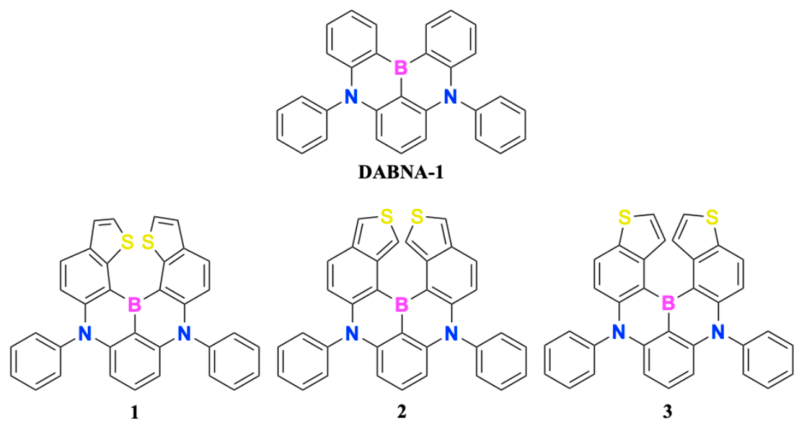
Considering the advantages of the S atom and S···S interaction on molecular properties, we rationally designed three chromophores containing DABNA-1 core and thiophene moieties to compare and understand the role of the S···S interaction on the essential photophysical properties of the MR fluorophore, as shown Figure 1. Density functional theory (DFT) has become the most powerful tool to understand the nature of molecular properties. In addition, the use of DFT calculations has been expanded as a virtual design tool to find new candidate molecules prior to synthesizing a material [22,23,24]. In the present work, we theoretically investigated the essential photophysical properties to better understand the designed MR fluorophores. We believe that our study will importantly contribute to gaining a new insight into manipulating the excited state parameters and expand the design horizons of MR fluorophores.

2. Theory and Computation

Density functional theory (DFT) calculations for the ground state were performed by employing a non-local density functional of Becke’s three-parameterized Lee-Yang-Parr exchange functional (B3LYP) [25,26,27] with Pople’s triple zeta potential with double polarization function (6-311G**), as implemented in the suite of Gaussian 16 program [28]. To understand the excited state properties, time-dependent DFT (TDDFT) calculations in conjunction with Tamm-Dancoff approximation (TDA) [29] were conducted at the same level of theory. All molecular structures in ground and excited states were fully optimized without symmetry constraints, and their thermodynamic stabilities were verified by frequency calculations. In addition, Grimme’s dispersion correction with Bekes–Johnson damping (GD3BJ) was considered to describe the noncovalent S···S interaction in both ground and excited states [30]. According to the previous reports, wave-function methods such as equation-of-motion coupled-cluster single and double (EOM-CCSD) [31], second-order algebraic diagrammatic construction (ADC(2)) [32], spin-component scaling second-order algebraic diagrammatic construction (SCS-ADC(2)) [33], and similarity transformed EOM domain-based local pair natural orbital CCSD (STEOM-DLPNO-CCSD) [34,35,36] should be utilized to accurately describe the nature of the lowest singlet and triplet excited states (S1 and T1) since the correlation effect must be considered in MR fluorophores. Among them, we recently reported that the single-point STEOM-DLPNO-CCSD calculation at the optimally tuned LC-ωHPBE (LC-ω*HPBE) level of theory provides the quantitative prediction of S1 and T1 energies [35]. However, the lack of GD3BJ parameters in the LC-ωHPBE functional is a hurdle to computing both excited states. Therefore, the B3LYP functional was utilized as an alternative functional to optimize the molecular structures in the S1 and T1 states. At the optimized structures of the S1 and T1 states, STEOM-DLPNO-CCSD calculations with Def2-SVP and their corresponding auxiliary basis sets were further conducted to gain the quantitative S1 and T1 energies. In addition, the RIJCOSX approximation was utilized to consider the acceleration of the SCF. The scalar-relativistic zero-order regular approximation (ZORA) Hamiltonian was utilized to gain the spin-orbit coupling matrix element (SOCME) between the S1 and T1 states, as implemented in the suite of ORCA 5.0 program [37]. All SOCME calculations were performed at the B3LYP/TZVP level of theory for the optimized T1 state. The reverse intersystem crossing rate (krISC) can be obtained by the semi-empirical Marcus theory equation as follows [38].
k r I S C = 4 π 2 S 1 H S O C T 1 2 h 1 4 π k b T λ e x p ( Δ E S T + λ 2 4 λ k b T )
where <S1|HSOC|T1>, λ, kB, h, and T are defined as the spin-orbit coupling constant between S1 and T1 states, reorganization energy (S1 and T1 states), Boltzmann constant, Planck constant, and temperature, respectively. Moreover, the radiative decay rate (kr) during de-excitation can be computed based on Einstein’s spontaneous emission equation [39].
k r = f ( E e m i s s i o n ) 2 1.449
where Eemission and f are defined as the S1 energy and oscillator strength. The Huang-Rhys factor (S) can be calculated by the following equation,
H u a n g R h y s   f a c t o r   ( S ) = 1 2 ω i K i 2
where K i is the shift vector, and ωi is the vibrational frequency of the i-th normal vibrational mode. The K i can be defined as a dimensionless displacement vector corresponding to changes in geometries between the initial and final states of the i-th normal vibrational mode [40].
The vibrationally resolved emission spectra calculations were performed to gain insight into the S···S interaction effect on the spectra shapes. The combined Franck-Condon/Herzberg-Teller (FCHT) method within the adiabatic Hessian model was adopted to compute the vibrationally-resolved emission spectrum using a half-width at half-maximum (HWHM) value of 680 cm−1. In all simulated spectra, the Duschinsky rotation effect was taken into account, and the spectra were generated at 298.15 K.

3. Results and Discussion

3.1. Structural and Electronic Properties

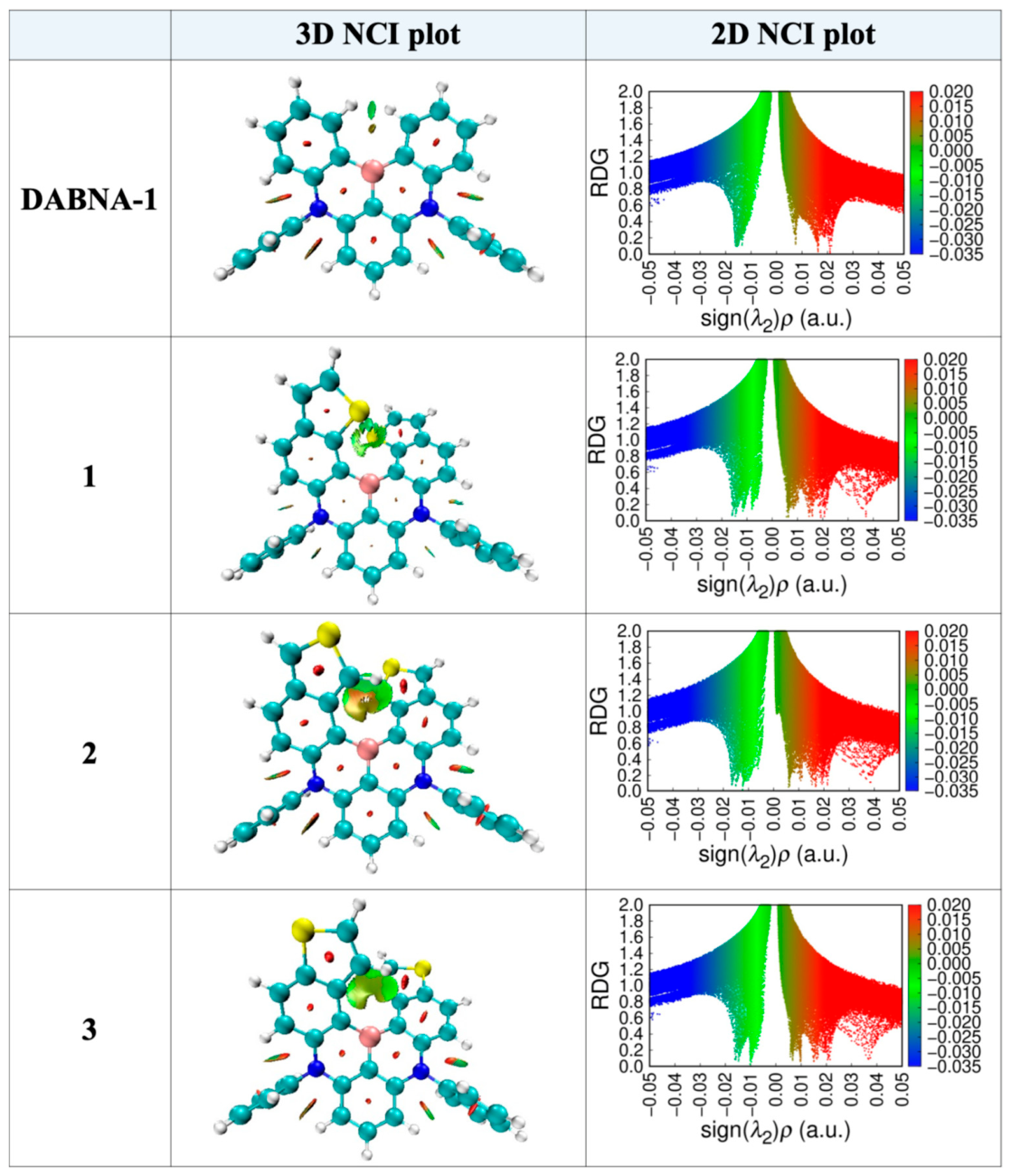
To clarify the presence of the intramolecular interaction as a function of different positions of S atoms, the analysis and visualization of the noncovalent interaction (NCI) were performed using Multiwfn and VMD programs [41,42]. The 3D NCI plots and 2D NCI plots of reduced density gradient (RDG) vs. sign(λ2)ρ are shown in Figure 2.
The 3D NCI plot of DABNA-1 reveals that the intramolecular interaction can be negligible. By introducing the thiophene unit, in the cases of 2 and 3, the attractive and repulsive intramolecular interactions assigned as π···H attractive and H···H repulsive interactions are remarkably enhanced between the two thiophene moieties. Interestingly, the intramolecular interaction, which can be assigned as an S···S interaction, solely appears in 1. To support the NCI analysis for 1, the distance between two S atoms (dS···S) should be compared to the sum of the van der Waals (vdW) radius of two S atoms (3.630 Å). The dS···S of 1 is calculated to be 3.365 Å, which is remarkably shorter than 3.630 Å. This result is additional evidence for the existence of the attractive S···S interaction in 1. Furthermore, QTAIM topological analysis for 1 was conducted to clearly explain. A bond critical point (BCP) was identified between the two sulfur atoms with an electron density (ρ(r)) and a positive Laplacian of electron density (∇2ρ). Furthermore, the negative sign(λ2)ρ value indicates an attractive noncovalent interaction. (See Table S1) Consequently, both NCI and QTAIM analyses consistently demonstrate the existence of an attractive intramolecular S···S interaction. The electronic properties at the optimized S0 state are listed in Table 1. Compared to DABNA-1, the role of introducing the thiophene unit into the DABNA-1 core on the electronic properties of 13 is that the highest occupied molecular orbital (HOMO) energy is destabilized, while the lowest unoccupied molecular orbital (LUMO) energy is stabilized. Correspondingly, the calculated HOMO-LUMO energy gaps of 13 are smaller than that of DABNA-1, expecting the bathochromic shift of both excited state energies.

3.2. Excited States Properties

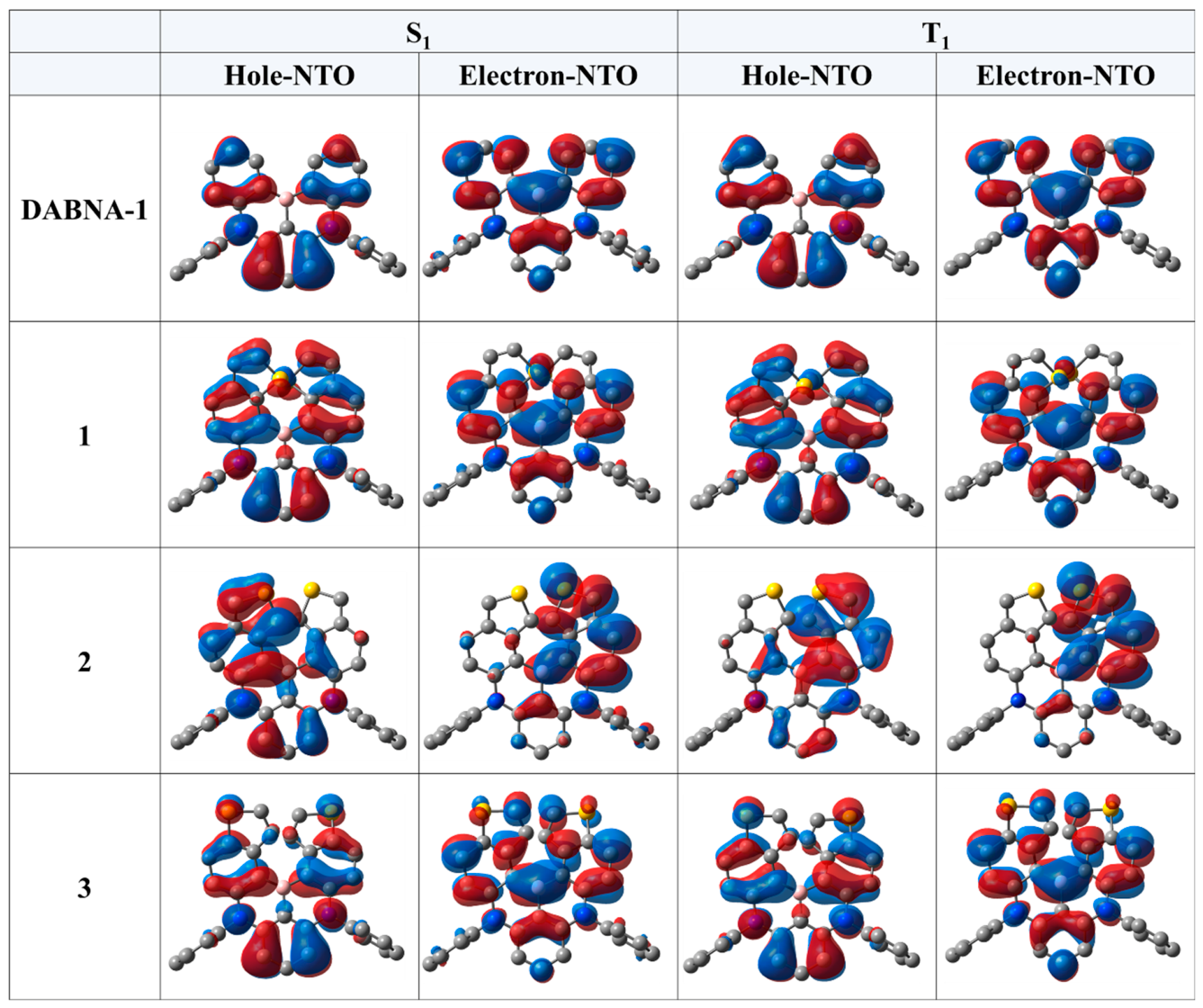
The optimized structures and their corresponding natural transition orbitals (NTOs) for the S1 and T1 states are denoted in Figure 3. Due to the increase in the conjugation length, both NTOs of 1 and 3 spread over the entire molecular structures. In addition, the transition characteristics of these molecules can be assigned as short-range charge transfer, which is similar to those of DABNA-1. In contrast, 2 displays distinctly separated spatial distributions of hole and electron NTOs in both S1 and T1 states. For both S1 and T1 states, hole-NTOs spread on the main skeleton except one thiophene moiety, while electron-NTOs predominantly lie on the thiophene linked with the phenyl moiety. This result suggests a more pronounced charge-transfer character for the S1 state of 2, while the T1 state retains a localized exciton. The dominant NTO pair contribution of all chromophores is larger than 96% in both excited states (See Table S2). This result indicates that the excited-state characteristic can be interpreted by using the corresponding NTO distributions.
The calculated S1 and T1 energies of DABNA-1 and 13 are listed in Table 2. The calculated S1 and T1 energies of 13 at the B3LYP level of theory exhibit the bathochromic shift. Moreover, ∆EST values of these molecules are increased compared to DABNA-1. As mentioned in the theory and computation, predicting the S1 and T1 energies of the MR-type chromophore is essentially considered the electron-electron correlation effect. In other words, the TDDFT result is inadequate to obtain the quantitative S1 and T1 energies in the MR-type chromophore. Therefore, STEOM-DLPNO-CCSD results should be considered quantitatively. In the experiment, the observed S1 and T1 energies of DABNA-1 are 2.781 eV and 2.620 eV, while the theoretically calculated S1 and T1 energies are 2.781 eV and 2.721 eV. This result indicates that the choice of our theoretical methodologies guarantees the quantitative prediction of the photophysical properties of the MR chromophore. By introducing the thiophene unit into DABNA-1, the calculated S1 and T1 energies of 13 are smaller than those of DABNA-1, which is qualitatively consistent with TDDFT calculations. Although the emission energies of 13 slightly shifted to lower energies, the emission colors of 13 belong to the blue color region. This result indicates that the designed molecules can be potentially utilized as a blue emitter. Based on the obtained S1 and T1 energies, the derived ∆EST values of 13 are relatively increased. Among them, it is noteworthy that the derived ∆EST of 2 is 1.211 eV, which is too large to activate the spin-flip transition from T1 to S1 states, indicating the pure fluorophore without delayed fluorescence emission. On the other hand, ∆EST values of 1 and 3 are not yet sufficient to precisely judge the emission mechanism. Therefore, further analyses for 1 and 3 are needed to accurately confirm whether they show delayed emission. By comparing 1 and 3, the effect of S···S interaction on the S1 energy is negligible. In contrast, S···S interaction significantly affects the T1 energy, resulting in a relatively high T1 energy for 1.
To address the emission mechanism of designed molecules, several parameters related to exciton kinetics were computed and listed in Table 3. The oscillator strength (f) can be used to judge the transition characteristic as well as predict the radiative decay rate. Compared to DABNA-1, the calculated f of 1 is slightly increased, while that of 3 is similar. On the other hand, the calculated f of 2 is significantly decreased. According to the definition of f, the overlap of molecular orbitals contributing to the transition is one of the key determinants and proportional to f. The spatial distributions of both NTOs suggest a more pronounced charge-transfer character in 2 compared with the other chromophores. The theoretically predicted radiative decay rate (kr) of DABNA-1 is 5.02 × 10⁷ s−1, which is decreased to 4.94 × 10⁷ s−1, 1.18 × 10⁷ s−1, and 4.50 × 10⁷ s−1 in 13. Specifically, the theoretically predicted kr of 2 is remarkably reduced due to the small f. As listed in Table 3, the calculated HSOC values of DABNA-1, 1, 2, and 3 are 0.017 cm−1, 0.081 cm−1, 0.458 cm−1, and 0.098 cm−1, respectively. By introducing the thiophene units into the DABNA-1 core, HSOC values are generally increased due to the heavy atom effect of the S atom. However, the magnitude of HSOC is not directly correlated with the presence of the intramolecular S···S interaction. In particular, 2 exhibits the remarkably enhanced HSOC value despite the absence of the intramolecular S···S interaction. This can be understood by means of the EI-Sayed rule because the S1 and T1 states reveal the different transition characters, which can be assigned to the 1CT and 3LE states [43]. Therefore, the large HSOC value of 2 mainly originates from the nature of the electronic structures of both excited states rather than intramolecular S···S interaction. To calculate the reverse intersystem crossing rate (krISC), the reorganization energy between S1 and T1 states (λ) is assumed to be 0.16 eV, which is a representative value that concerns the medium-induced relaxation, as established in previous studies [34,44,45]. Therefore, the calculated krISC value should be considered as a qualitative indicator rather than a quantitative rate constant. Given the HSOC and λ, the theoretically predicted krISC values of DABNA-1, 1, 2, and 3 are 1.02 × 10⁴ s−1, 2.63 × 10² s−1, 0 s−1, and 1.75 × 100 s−1, respectively. Compared to DABNA-1, the theoretically predicted krISC values of 13 are extremely reduced, despite the strong HSOC. Therefore, these results suggest that ∆EST may play a more important role than HSOC in determining the theoretically predicted krISC values in newly designed molecules. Furthermore, it is noteworthy that the designed 13 molecules are not expected to appear the TADF characteristic due to the unfavorable spin-flip transition.

3.3. Normal Mode Analysis and Vibrationally Resolved Spectra

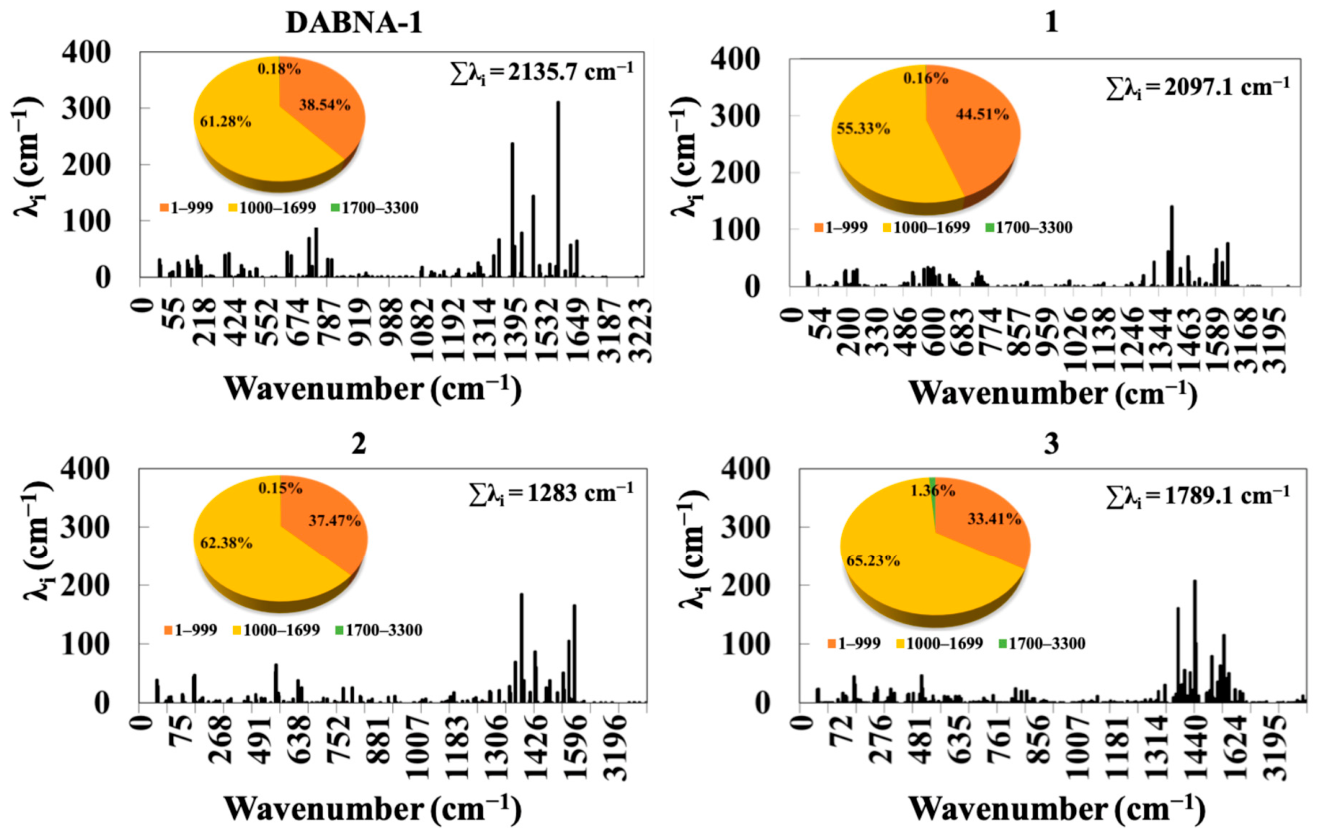
The normal-mode (NM) analyses based on the S were plotted in Figure 4. Moreover, the inset 3D pie charts show the vibrational mode contributions to ∑λi in the ranges of 1–999 cm−1, 1000–1699 cm−1, and 1700–3300 cm−1, which represent the C-H out-of-plane bending, C-H in-plane bending/stretching, and C-H stretching vibration modes. It can be seen that the effect of introducing the thiophene unit into the DABNA-1 unit on the ∑λi is to suppress the structural relaxation, thereby mitigating the non-radiative decay process during the S1 ⟶ S0 transition. In detail, the most contributive vibration modes to ∑λi between S0 and S1 states are 1351.11 cm−1, 1498.35 cm−1, and 1626.27 cm−1, which corresponds to the C-H in-plane bending mode and mixing of C-C stretching and C-H in-plane bending modes in DABNA-1. (See Figure S1) These vibration modes are less activated in 13 due to the presence of intramolecular S···S and π···H interactions. Moreover, (∑λi)s of 13 show the larger value in the order of 1 < 2 < 3, suggesting that S···S interaction is the most significant chemical design strategy to hinder structural changes during the excitation and de-excitation. By considering the interrelationship between structural relaxation and non-radiative decay rate (knr), it is also expected that S···S interaction plays an important role in achieving the good quantum efficiency by mitigating the activation of knr. To more clearly understand the knr behaviors of designed molecules, we have computed knr based on the k n r   i S i ω i e S i equation. The theoretically predicted knr values of DABNA-1, 1, 2, and 3 are 0.1109, 0.0737, 0.2975, and 0.0954, respectively. In the experiment, knr(s) of DABNA-1 is derived as 1.76 × 10⁷ s1. To match the exponent of the knr in the experiment, the coefficient derived from DABNA-1 (1.587 × 10⁸) was equally multiplied by 13. As a result, the theoretically predicted knr values of 13 are rewritten as 1.17 × 10⁷ s1, 4.72 × 10⁷ s1, and 1.51 × 10⁷ s1, respectively. It is evident that the positive role of S···S interaction on the mitigation of knr.
To clearly identify the effect of the S···S interaction on the vibrational modes, Huang-Rhys factor analyses were further performed for 13. As shown in Figure S3, the presence of the S···S interaction clearly suppressed the thiophene-related out-of-plane bending and in-plane bending in the low-frequency region. Particularly, 2 exhibits strong activation of the 21.11 cm−1 and 71.41 cm−1 vibration modes with contributions of 18.4% and 22.8%. Likewise, 3 displays a large contribution (49.6%) of 21.39 cm−1 vibration mode, which is strongly activated relative to 1. These results demonstrate that the intramolecular S···S interaction imposes conformational restrictions, thereby contributing to the reduction of the reorganization energy and electron-phonon coupling.
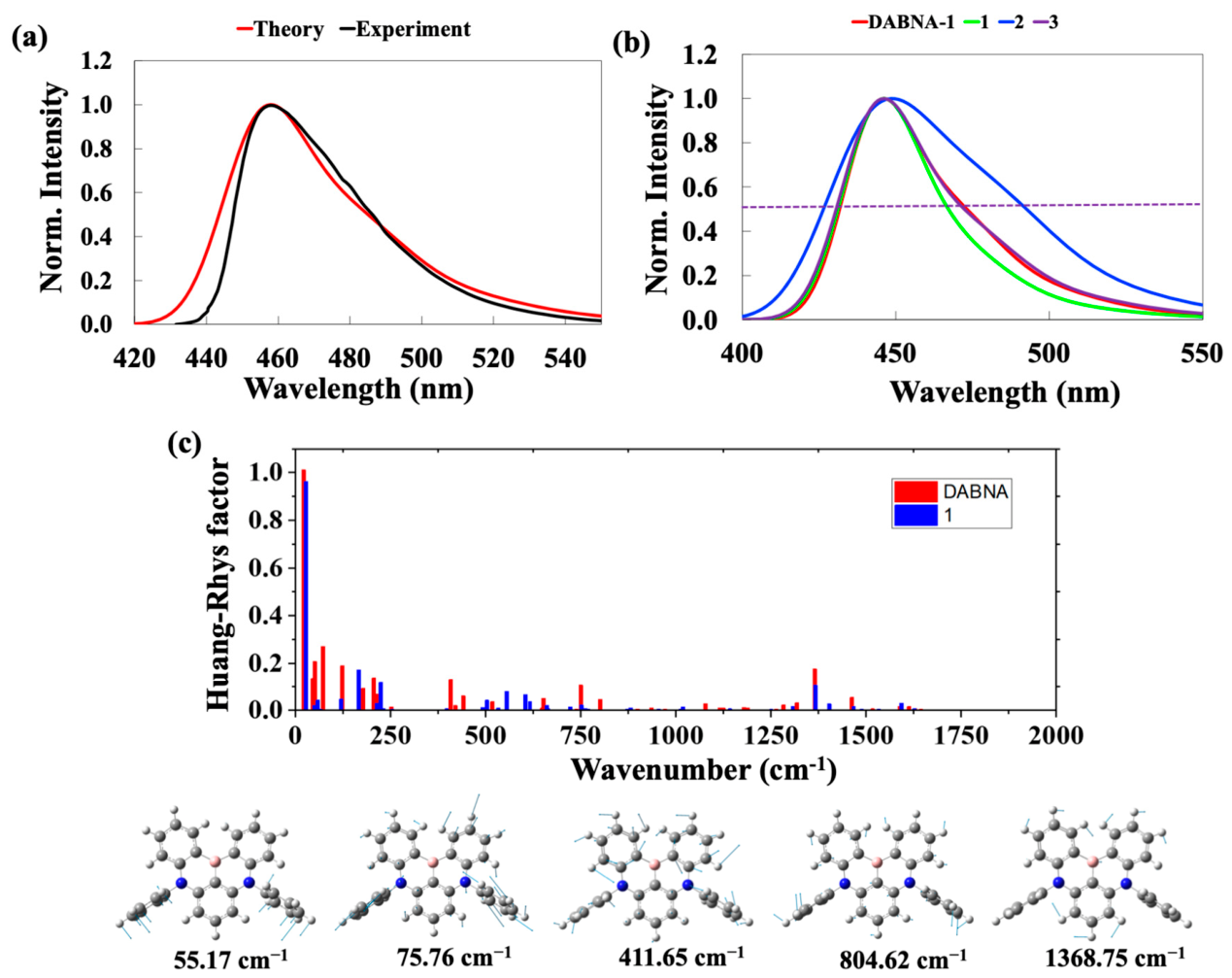
Lastly, we conducted vibrationally resolved spectrum calculations to understand the effect of the S···S interaction on the spectrum shape. Prior to analyzing the emission spectra, the spectral similarity of DABNA-1 in theory and experiment should be confirmed. Therefore, we compared the theoretical and experimental emission spectra of DABNA-1. The maximum peak (λmax) of the theory was blue-shifted to match with the experiment. As shown in Figure 5a, the theoretically predicted spectrum shape seems to be well-consistent with experiment. Based on the theoretical spectrum of DABNA-1, we further compared the emission spectra of 13, which are simulated under the same theoretical conditions. Similarly, λmax values in 13 were shifted to match the λmax of DABNA-1 in order to clearly compare spectral shape and width. The unique emission spectra for each complex are depicted in Figure S2. As shown in Figure 5b, the spectrum shape of 3 is quite similar to that of DABNA-1; however, the spectral shapes of 1 and 2 exhibit significant changes. In detail, the spectrum width of 2 is wider than that of DABNA-1. On the contrary, it is noteworthy that 1 exhibits a narrower spectrum shape than DABNA-1. The calculated FWHMs of DABNA-1, 1, 2, and 3 are 41.3 nm (2039 cm−1), 35.8 nm (1768 cm−1), 65.96 nm (3257 cm−1), and 41.5 nm (2049 cm−1), respectively. Based on the simulated emission spectra of these complexes, a wider FWHM is expected in the order of 2 > 3DABNA-1 > 1. The spectra with their own emission wavelengths are depicted in Figure S2. To understand the root cause of the change in the spectrum width, the Huang-Rhys factors (S) between the S0 and S1 states were analyzed. Due to the similarity in spectrum shape with DABNA-1, we will not discuss the result of S for 3. As shown in Figure S3, it is estimated that the broader spectrum of 2 is mainly attributed to the strong activations of C-H/S out-of-plane bending modes at 21.11 cm−1 and 71.41 cm−1. On the other hand, for DABNA-1 and 1, Figure 5c clearly shows that the in-plane C-H bending modes and out-of-plane C-H bending modes are significantly suppressed due to the presence of S···S interaction. Specifically, the representative vibrational modes contributing to the spectrum width are analyzed 55.17 cm−1, 75.76 cm−1, 411.65 cm−1, 804.62 cm−1, and 1368.75 cm−1, respectively, which correspond to the in-plane C-H bending and out-of-plane C-H bending modes. Therefore, S values associated with the vibrational modes are significantly reduced in 1 due to the presence of S···S interaction. Upon the de-excitation process from S1 to S0 states, the suppression of these specific vibrational modes associated with structural changes reduces the reorganization energy and weakens the electron-phonon coupling in the presence of S···S interaction. Consequently, the activation of vibrational modes contributing to the relatively broad-spectrum width can be effectively suppressed, resulting in a narrower spectrum width. From this result, we propose that the S···S interaction might be utilized as a chemical design strategy to improve the color purity of emissive materials in OLED devices.

4. Conclusions

In this study, we designed MR chromophores including thiophene units that are theoretically investigated to understand the photophysical properties. From analyses of NCI and dS···S, we confirm the presence of S···S interaction in 1. The calculated S1 and T1 energies are decremented by introducing the thiophene units into DABNA-1, but the derived ∆EST values are relatively increased. The calculated kr values of 13 are computed to be 107 s−1 order, which is similar to DABNA-1. Although Hsoc values are relatively enhanced due to the heavy atom effect, the computed krISC values are remarkably slowed by means of the large ∆EST. Hence, the non-TADF characteristics are expected in 13. Interestingly, it was found that the S···S interaction simultaneously reduces the reorganization energy and spectrum width due to the suppression of vibration-coupled structural relaxation. From our results, we propose that the utilization of S···S interaction is a promising computational design strategy to simultaneously improve the quantum efficiency and color purity of the emitter in achieving a highly efficient OLED device.

Supplementary Materials

The following supporting information can be downloaded at: https://www.mdpi.com/article/10.3390/molecules31122076/s1. Figure S1. The representative vibration modes of DABNA-1 contributing to ∑ λi. Figure S2. The vibrationally resolved spectra of DABNA-1, 1, 2, and 3 without spectral shift. Figure S3. The comparison of Huang-Rhys factor plots for 1/2 and 1/3. Table S1. QTAIM parameters for the S···S interaction in 1. Table S2. The calculated pair contribution of dominant NTOs to the S1 state and the T1 state. Table S3. The computed spin-orbit coupling element matrix values of DABNA-1, 1, 2, and 3. Table S4. The screen shots of STEOM-DLPNO-CCSD calculations for the S1 and the T1 state. Table S5. The raw data of reorganization energy for DABNA-1, 1, 2, and 3. Table S6. Mode-specific reorganization-energy contributions. Table S7. The cartesian coordinates of 1, 2, and 3 in the S1 state and T1 state.

Author Contributions

Conceptualization, S.K. and T.K.; Validation, S.K. and T.K.; Formal analysis, S.K.; Investigation, S.K.; Data curation, S.K.; Writing—original draft, S.K. and T.K.; Writing—review & editing, S.K. and T.K.; Supervision, S.K.; Funding acquisition, S.K. All authors have read and agreed to the published version of the manuscript.

Funding

This work was supported by the Ministry of Trade, Industry, and Energy of the Republic of Korea (RS-2024-00419747 and RS-2024-00418716).

Institutional Review Board Statement

Not applicable.

Informed Consent Statement

Not applicable.

Data Availability Statement

The original contributions presented in this study are included in the article/Supplementary Material. Further inquiries can be directed to the corresponding authors.

Conflicts of Interest

The authors declare that they have no conflicts of interest.

References

  1. Hatakeyama, T.; Shiren, K.; Nakajima, K.; Nomura, S.; Nakatsuka, S.; Kinoshita, K.; Ni, J.; Ono, Y.; Ikuta, T. Ultrapure Blue Thermally Activated Delayed Fluorescence Molecules: Efficient HOMO-LUMO Separation by the Multiple Resonance Effect. Adv. Mater. 2016, 28, 2777–2781. [Google Scholar] [CrossRef] [PubMed]
  2. Liu, F.; Cheng, Z.; Wan, L.; Feng, Z.; Liu, H.; Jin, H.; Gao, L.; Lu, P.; Yang, W. Highly Efficient Multi-Resonance Thermally Activated Delayed Fluorescence Material with a Narrow Full Width at Half-Maximum of 0.14 eV. Small 2022, 18, 2106462. [Google Scholar] [CrossRef]
  3. Jiang, P.; Miao, J.; Cao, X.; Xia, H.; Pan, K.; Hua, T.; Lv, X.; Huang, Z.; Zou, Y.; Yang, C. Quenching-resistant multiresonance TADF emitter realizes 40% external quantum efficiency in narrowband electroluminescence at high doping level. Adv. Mater. 2022, 34, 2106954. [Google Scholar] [CrossRef]
  4. Oda, S.; Kawakami, B.; Horiuchi, M.; Yamasaki, Y.; Kawasumi, R.; Hatakeyama, T. Ultra-Narrowband blue multi-resonance thermally activated delayed fluorescence materials. Adv. Sci. 2023, 10, 2205070. [Google Scholar] [CrossRef]
  5. Wang, J.; Zou, P.; Chen, L.; Bai, Z.; Liu, H.; Chen, W.-C.; Huo, Y.; Tang, B.Z.; Zhao, Z. Promising interlayer sensitization strategy for the construction of high-performance blue hyperfluorescence OLEDs. Light Sci. Appl. 2024, 13, 139. [Google Scholar] [CrossRef]
  6. Stavrou, K.; Madayanad Suresh, S.; Hall, D.; Danos, A.; Kukhta, N.A.; Slawin, A.M.; Warriner, S.; Beljonne, D.; Olivier, Y.; Monkman, A. Emission and Absorption Tuning in TADF B, N-Doped Heptacenes: Toward Ideal-Blue Hyperfluorescent OLEDs. Adv. Opt. Mater. 2022, 10, 2200688. [Google Scholar] [CrossRef]
  7. Deori, U.; Nanda, G.P.; Murawski, C.; Rajamalli, P. A perspective on next-generation hyperfluorescent organic light-emitting diodes. Chem. Sci. 2024, 15, 17739–17759. [Google Scholar] [CrossRef]
  8. Nam, S.; Kim, J.W.; Bae, H.J.; Maruyama, Y.M.; Jeong, D.; Kim, J.; Kim, J.S.; Son, W.J.; Jeong, H.; Lee, J. Improved efficiency and lifetime of deep-blue hyperfluorescent organic light-emitting diode using Pt (II) complex as phosphorescent sensitizer. Adv. Sci. 2021, 8, 2100586. [Google Scholar] [CrossRef] [PubMed]
  9. Chan, C.-Y.; Tanaka, M.; Lee, Y.-T.; Wong, Y.-W.; Nakanotani, H.; Hatakeyama, T.; Adachi, C. Stable pure-blue hyperfluorescence organic light-emitting diodes with high-efficiency and narrow emission. Nat. Photon. 2021, 15, 203–207. [Google Scholar] [CrossRef]
  10. Liu, H.; Fu, Y.; Chen, J.; Tang, B.Z.; Zhao, Z. Energy-Efficient Stable Hyperfluorescence Organic Light-Emitting Diodes with Improved Color Purities and Ultrahigh Power Efficiencies Based on Low-Polar Sensitizing Systems. Adv. Mater. 2023, 35, 2212237. [Google Scholar] [CrossRef] [PubMed]
  11. Zhong, X.S.; Xi, J.Q.; Yan, Z.P.; Hu, J.J.; Wang, Y.; Yuan, L.; Song, S.Q.; Zuo, J.L.; Zheng, Y.X. Efficient Circularly Polarized Electroluminescence Based on Chiral MR-TADF Materials with Innovative Planar Structure Design Strategy. Adv. Funct. Mater. 2025, 35, 2504525. [Google Scholar] [CrossRef]
  12. Cheng, Z.-L.; Li, J.; Wang, H.; Huang, F.; Cheng, Y.-C.; Wu, H.; Xiong, X.; Zhang, T.-Y.; Yu, J.; Ye, J. Asymmetric structural strategy enables efficient MR-TADF emitters with low efficiency roll-off and doping-concentration insensitivity. Chem. Eng. J. 2024, 499, 155864. [Google Scholar] [CrossRef]
  13. Yu, J.R.; Tan, H.J.; Gao, X.Q.; Wang, B.; Long, Z.Q.; Liu, J.L.; Lin, Z.Z.; Li, X.Y.; Zhu, Z.L.; Jian, J.X. Stepwise Toward Pure Blue Organic Light-Emitting Diodes by Synergetically Locking and Shielding Carbonyl/Nitrogen-Based MR-TADF Emitters. Adv. Sci. 2024, 11, 2401664. [Google Scholar] [CrossRef] [PubMed]
  14. Di, K.; Guo, R.; Wang, Y.; Lv, Y.; Su, H.; Zhang, Q.; Yang, B.; Wang, L. Achieving high-performance narrowband blue MR-TADF emitters by suppressing isomer formation and extending π-conjugate skeletons. J. Mater. Chem. C 2023, 11, 6429–6437. [Google Scholar] [CrossRef]
  15. Song, Y.N.; Park, B.B.; Lee, H.; Kang, S.; Hong, W.P.; Oh, H.Y.; Kim, T. Non-conventional exciplex system by leveraging zero-radius of intramolecular energy transfer mechanism: Seamless integration of p-host and fluorescent dopant for highly efficient OLEDs. Chem. Eng. J. 2024, 492, 152371. [Google Scholar] [CrossRef]
  16. Kojasoy, V.; Tantillo, D.J. Impacts of noncovalent interactions involving sulfur atoms on protein stability, structure, folding, and bioactivity. Org. Biomol. Chem. 2023, 21, 11–23. [Google Scholar] [CrossRef]
  17. Yi, W.; Zhao, S.; Sun, H.; Kan, Y.; Shi, J.; Wan, S.; Li, C.; Wang, H. Isomers of organic semiconductors based on dithienothiophenes: The effect of sulphur atoms positions on the intermolecular interactions and field-effect performances. J. Mater. Chem. C 2015, 3, 10856–10861. [Google Scholar] [CrossRef]
  18. Vegiraju, S.; Luo, X.-L.; Li, L.-H.; Afraj, S.N.; Lee, C.; Zheng, D.; Hsieh, H.-C.; Lin, C.-C.; Hong, S.-H.; Tsai, H.-C. Solution processable pseudo n-thienoacenes via intramolecular S··· S lock for high performance organic field effect transistors. Chem. Mater. 2020, 32, 1422–1429. [Google Scholar] [CrossRef]
  19. Huang, H.; Yang, L.; Facchetti, A.; Marks, T.J. Organic and polymeric semiconductors enhanced by noncovalent conformational locks. Chem. Rev. 2017, 117, 10291–10318. [Google Scholar] [CrossRef]
  20. Vegiraju, S.; Amelenan Torimtubun, A.A.; Lin, P.-S.; Tsai, H.-C.; Lien, W.-C.; Chen, C.-S.; He, G.-Y.; Lin, C.-Y.; Zheng, D.; Huang, Y.-F. Solution-Processable Quinoidal Dithioalkylterthiophene-Based Small Molecules Pseudo-Pentathienoacenes via an Intramolecular S··· S Lock for High-Performance n-Type Organic Field-Effect Transistors. ACS Appl. Mater. Interfaces 2020, 12, 25081–25091. [Google Scholar] [CrossRef]
  21. Liu, H.; Kang, S.; Lee, J.Y. Electronic structures and charge transport of stacked annelated β-trithiophenes. J. Phys. Chem. B 2011, 115, 5113–5120. [Google Scholar] [CrossRef] [PubMed]
  22. Szeleszczuk, Ł.; Mądra-Gackowska, K.; Hacholli, V.B.; Gackowski, M. Designing Efficient Energy Materials: Optoelectronic and Thermoelectric Perspectives of X2YBiCl6 (X = Cs, Na; Y = Ag, Au) Double Perovskites. J. Phys. Chem. Solids 2025, 209, 113293. [Google Scholar] [CrossRef]
  23. Gómez-Bombarelli, R.; Aguilera-Iparraguirre, J.; Hirzel, T.D.; Duvenaud, D.; Maclaurin, D.; Blood-Forsythe, M.A.; Chae, H.S.; Einzinger, M.; Ha, D.-G.; Wu, T. Design of efficient molecular organic light-emitting diodes by a high-throughput virtual screening and experimental approach. Nat. Mater. 2016, 15, 1120–1127. [Google Scholar] [CrossRef]
  24. Thakur, D.; Ram Nagar, M.; Kumar, S.; Shahnawaz; Tomar, A.; Karmakar, A.; Banik, S.; Jou, J.H.; Ghosh, S. In search of hosts for blue OLEDs: Computational design and experimental validation. Chem. Eur. J. 2023, 29, e202203282. [Google Scholar] [CrossRef]
  25. Becke, A.D. Density-functional exchange-energy approximation with correct asymptotic behavior. Phys. Rev. A 1988, 38, 3098. [Google Scholar] [CrossRef]
  26. Lee, C.; Yang, W.; Parr, R.G. Development of the Colle-Salvetti correlation-energy formula into a functional of the electron density. Phys. Rev. B 1988, 37, 785. [Google Scholar] [CrossRef]
  27. Becke, A.D. A new inhomogeneity parameter in density-functional theory. J. Chem. Phys. 1998, 109, 2092–2098. [Google Scholar] [CrossRef]
  28. Frisch, M.; Trucks, G.; Schlegel, H.; Scuseria, G.; Robb, M.; Cheeseman, J.; Scalmani, G.; Barone, V.; Petersson, G.; Nakatsuji, H. Gaussian 16; Revision A.03; Gaussian, Inc.: Wallingford, CT, USA, 2016. [Google Scholar]
  29. Fetter, A.L.; Walecka, J.D. Quantum Theory of Many-Particle Systems; Courier Corporation: Mineola, NY, USA, 2012. [Google Scholar]
  30. Grimme, S.; Ehrlich, S.; Goerigk, L. Effect of the damping function in dispersion corrected density functional theory. J. Comput. Chem. 2011, 32, 1456–1465. [Google Scholar] [CrossRef]
  31. Shizu, K.; Kaji, H. Comprehensive understanding of multiple resonance thermally activated delayed fluorescence through quantum chemistry calculations. Commun. Chem. 2022, 5, 53. [Google Scholar] [CrossRef]
  32. Pershin, A.; Hall, D.; Lemaur, V.; Sancho-Garcia, J.-C.; Muccioli, L.; Zysman-Colman, E.; Beljonne, D.; Olivier, Y. Highly emissive excitons with reduced exchange energy in thermally activated delayed fluorescent molecules. Nat. Commun. 2019, 10, 597. [Google Scholar] [CrossRef] [PubMed]
  33. Tajti, A.; Kozma, B.; Szalay, P.G. Improved description of charge-transfer potential energy surfaces via spin-component-scaled CC2 and ADC (2) methods. J. Chem. Theory Comput. 2020, 17, 439–449. [Google Scholar] [CrossRef] [PubMed]
  34. Pratik, S.M.; Coropceanu, V.; Bredas, J.-L. Purely organic emitters for multiresonant thermally activated delay fluorescence: Design of highly efficient sulfur and selenium derivatives. ACS Mater. Lett. 2022, 4, 440–447. [Google Scholar] [CrossRef]
  35. Kang, S.; Kim, T. Comparative study of TDDFT and TDDFT-based STEOM-DLPNO-CCSD calculations for predicting the excited-state properties of MR-TADF. Heliyon 2024, 10, e30926. [Google Scholar] [CrossRef]
  36. Berraud-Pache, R.; Neese, F.; Bistoni, G.; Izsák, R. Unveiling the photophysical properties of boron-dipyrromethene dyes using a new accurate excited state coupled cluster method. J. Chem. Theory Comput. 2019, 16, 564–575. [Google Scholar] [CrossRef]
  37. Neese, F. Software update: The ORCA program system—Version 5.0. Wiley Interdiscip. Rev. Comput. Mol. Sci. 2022, 12, e1606. [Google Scholar] [CrossRef]
  38. Marcus, R.A. Electron transfer reactions in chemistry. Theory and experiment. In Protein Electron Transfer; Garland Science: New York, NY, USA, 2020; pp. 249–272. [Google Scholar]
  39. McCumber, D. Einstein relations connecting broadband emission and absorption spectra. Phys. Rev. 1964, 136, A954. [Google Scholar] [CrossRef]
  40. Rausch, A.F.; Murphy, L.; Williams, J.G.; Yersin, H. Improving the performance of Pt (II) complexes for blue light emission by enhancing the molecular rigidity. Inorg. Chem. 2012, 51, 312–319. [Google Scholar] [CrossRef]
  41. Lu, T.; Chen, F. Multiwfn: A multifunctional wavefunction analyzer. J. Comput. Chem. 2012, 33, 580–592. [Google Scholar] [CrossRef]
  42. Humphrey, W.; Dalke, A.; Schulten, K. VMD: Visual molecular dynamics. J. Mol. Graph. Model. 1996, 14, 33–38. [Google Scholar] [CrossRef]
  43. El-Sayed, M.A. Triplet state. Its radiative and nonradiative properties. Acc. Chem. Res. 1968, 1, 8–16. [Google Scholar] [CrossRef]
  44. Pratik, S.M.; Coropceanu, V.; Brédas, J.-L. Enhancement of thermally activated delayed fluorescence (TADF) in multi-resonant emitters via control of chalcogen atom embedding. Chem. Mater. 2022, 34, 8022–8030. [Google Scholar] [CrossRef]
  45. Pratik, S.M.; McBride, E.P.; Brédas, J.L.; Coropceanu, V. The Role of Chalcogen Substitution and Helical Frameworks in Designing Efficient Chiral Multi-Resonant TADF Emitters. Adv. Opt. Mater. 2025, 13, 2403421. [Google Scholar] [CrossRef]
Figure 1. The chemical structures of DABNA-1 and newly designed molecules (13).
Molecules 31 02076 g001
Figure 2. The 3D and 2D NCI plots of DABNA-1, 1, 2, and 3 molecules. The blue, green, and red colors indicate the strong attractive interaction, weak attractive interaction, and repulsive interaction, respectively.
Molecules 31 02076 g002
Figure 3. The hole-NTO and electron-NTO of DABNA-1, 1, 2, and 3 molecules.
Molecules 31 02076 g003
Figure 4. The plotted NM analyses of DABNA-1, 1, 2, and 3 between S0 and S1 states.
Molecules 31 02076 g004
Figure 5. (a) The spectral shapes of DABNA-1 in theory and experiment. (b) The simulated spectral shapes of DABNA-1, 1, 2, and 3 with HWHM = 680cm−1. (c) The S plot for DABNA-1 and 1. The representative vibrational modes with large S values are illustrated.
Molecules 31 02076 g005
Table 1. The structural parameter and electronic properties of DABNA-1 and newly designed molecules.
dS···S (Å)HOMO (eV)LUMO (eV)H-L Gap (eV)
DABNA-1-−4.996−1.3643.632
13.365−4.900−1.4663.434
24.636−4.802−1.5463.255
36.627−4.971−1.5473.425
Table 2. The computed S1, T1, and ∆EST at the B3LYP/6-311G** level of theory and their corrected energies at the STEOM-DLPNO-CCSD/SVP level of theory.
B3LYPSTEOM-DLPNO-CCSD
S1 (eV)T1 (eV)EST (eV) S1 (eV)T1 (eV)EST (eV)
DABNA-12.9152.5090.4062.7812.7210.060
12.7942.3270.4672.6332.3940.239
22.2371.6130.6242.6181.4071.211
32.7432.3240.4192.6342.2960.338
Table 3. The oscillator strength (f), spin-orbit coupling constants, and derived exciton dynamics parameters. All theoretically predicted knr values are empirically manipulated based on the experimental value of DABNA-1.
fHSOC (cm−1)kr (s−1)krISC (s−1) knr (s−1)
DABNA-10.14950.0175.02 × 1071.02 × 1041.76 × 107
10.16430.0814.94 × 1072.63 × 1021.17 × 107
20.03950.4581.18 × 107≈04.72 × 10⁷
30.14960.0984.50 × 1071.75 × 1001.51 × 107
Disclaimer/Publisher’s Note: The statements, opinions and data contained in all publications are solely those of the individual author(s) and contributor(s) and not of MDPI and/or the editor(s). MDPI and/or the editor(s) disclaim responsibility for any injury to people or property resulting from any ideas, methods, instructions or products referred to in the content.