Article

Supercritical Fluid Extraction of Ergosterol from Lentinula edodes and Pleurotus ostreatus: Optimization and Synergistic Effects of Biomass Pre-Treatments

by
Rita Faustino
1,
António Ferreira
1,
Maria Rosário Bronze
1,2,3 and
Naiara Fernández
1,*
1
Instituto de Biologia Experimental e Tecnológica, Apartado 12, 2881-901 Oeiras, Portugal
2
Instituto de Tecnologia Química e Biológica António Xavier, Universidade Nova de Lisboa, Av. República, 2780-157 Oeiras, Portugal
3
FFULisboa, Faculdade de Farmácia da Universidade de Lisboa, Av. Professor Gama Pinto, 1649-003 Lisboa, Portugal
*
Author to whom correspondence should be addressed.
Molecules 2026, 31(12), 2067; https://doi.org/10.3390/molecules31122067
Submission received: 6 May 2026 / Revised: 5 June 2026 / Accepted: 8 June 2026 / Published: 12 June 2026
(This article belongs to the Special Issue Supercritical Fluid Extraction of Natural Products)

Abstract

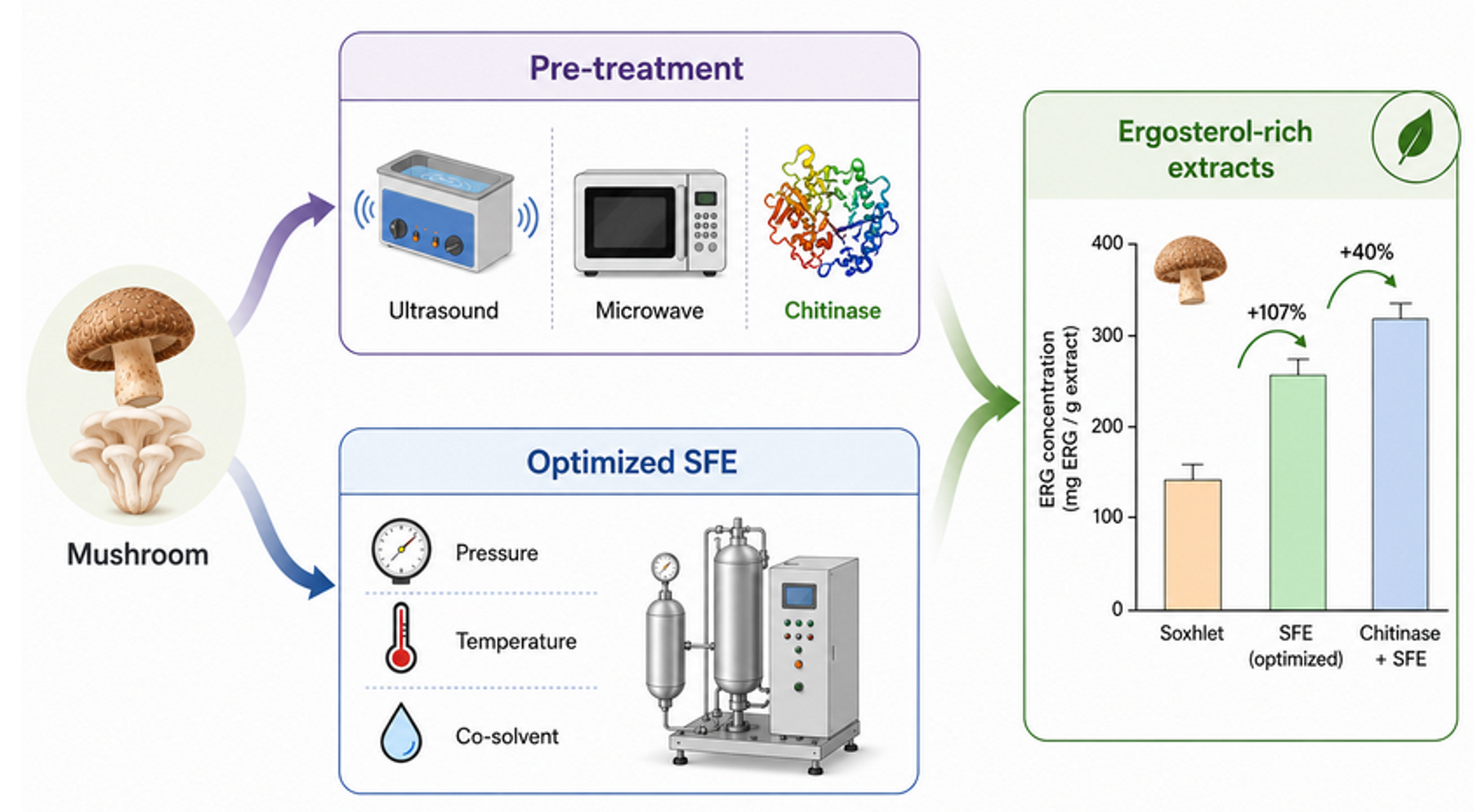
Ergosterol (ERG) is a bioactive sterol found in fungal cell membranes with reported cholesterol-lowering, antioxidant, and antitumor properties. Supercritical Fluid Extraction (SFE) conditions were optimized for Lentinula edodes (shiitake) using Response Surface Methodology and subsequently applied to Pleurotus ostreatus (oyster). Optimized SFE (690 bar, 69.8 °C, no co-solvent) produced significantly more concentrated ERG extracts than Soxhlet extraction for both species—280.57 ± 10.80 mgERG/gextract for shiitake and 95.87 ± 7.18 mgERG/gextract for oyster—corresponding to a 107% and 65% increase, respectively. Three biomass pre-treatments—ultrasound, microwave, and enzymatic—were evaluated in combination with SFE. Enzymatic pre-treatment with chitinase significantly improved ERG concentration: 337.53 ± 23.12 mgERG/gextract for shiitake. These results obtained after analysis of samples by GC-MS demonstrate that high-pressure SFE combined with chitinase pre-treatment is an effective strategy for producing ERG-rich extracts from fungal matrices.

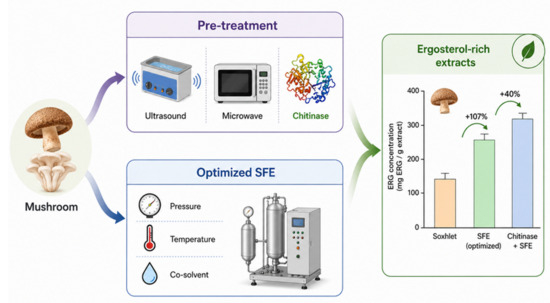
Graphical Abstract

1. Introduction

Cardiovascular diseases are the leading cause of death worldwide, strongly associated with risk factors such as hypercholesterolemia, smoking, inadequate diets and sedentary lifestyles [1].
Numerous studies have demonstrated the bioactive properties of ergosterol (ERG), a predominant sterol found in fungal plasma membranes inside the cell wall [2], including cholesterol-lowering, antioxidant and antitumor activities [3,4,5,6].
Mushrooms are among the fungal species richest in ERG. Although roughly two thousand edible species exist, only a few are cultivated and industrially processed, including Lentinula edodes (shiitake) and Pleurotus ostreatus (oyster) [7,8]. Mushroom cultivation generates significant amounts of waste, mainly spent mushroom substrate, stalks and misshapen mushrooms [9,10], translating to over 3 billion kilograms of waste annually across the EU [11]. These by-products may still contain substantial amounts of ERG that remain unutilized [12], and its recovery prevents the loss of a valuable compound, while contributing to circular economy principles, promoting more sustainable and resource-efficient mushroom production systems.
Being a lipophilic compound, ERG extraction depends on solvent non-polarity, capacity to penetrate the chitin-based fungal cell walls, temperature and mass transfer [13]. Soxhlet (SOX) extraction is a well-established conventional technique used for the ERG extraction from mushrooms [14,15,16], but presents drawbacks, including high organic solvent consumption, high temperatures and long extraction times. Consequently, greener emerging extraction technologies have been investigated as alternative methods.
Supercritical Fluid Extraction (SFE) has been studied extensively in the last decade, due to its operational advantages over conventional extraction methods. Using solvents in a supercritical state, combining liquid-like density with gas-like viscosity and intermediate diffusivity, SFE enables efficient extraction of intracellular compounds [17,18]. Furthermore, by adjusting pressure and temperature, the selectivity of the process can be finely tuned toward the target compound. Carbon dioxide (CO2) is the most used supercritical fluid, owing to its low toxicity, environmental safety, affordability, and moderate critical temperature (31.2 °C) [19,20].
SFE has been investigated for ERG extraction from mushrooms using different operating conditions. Gil-Ramírez et al. [19] evaluated pressures of 90, 180 and 300 bar with ethanol (EtOH) as a co-solvent for sterol-enriched fractions. In a subsequent study, the same author [3] successfully produced ERG-rich extracts using SFE at 300 bar, 40 °C for 3 h. Morales et al. [21] reported high ERG percentage in the extracts at operating conditions of 350 bar, 70 °C for 3 h, and, in another study [22], applied a sequential extraction approach, reporting that the SFE fraction (350 bar, 40 °C for 3 h) yielded the greatest ERG recovery. Morales et al. [23] also tested the influence of extraction time on the bioactive compound’s extraction from mushrooms, including ERG, performing SFE at 225 bar and 40 °C. Almeida et al. [24] achieved a maximum ERG purity operating at 100 bar and 50 °C. Despite this substantial amount of work, studies have employed a relatively narrow pressure range. Research exploring very high pressures, which substantially increases CO2 density and therefore has potential to markedly enhance extraction efficiency, remains limited.
Beyond optimizing extraction techniques, effective disruption of the rigid fungal cell wall is equally important to potentiate the release of intracellular compounds [25]. Optimized extraction and biomass pre-treatments act synergistically, delivering greater efficiency and compound enrichment than either strategy alone. Cell wall disruption methods investigated include ultrasound (US), microwaves (MWs) and enzymes (EZs) [25,26,27].
US pre-treatment offers an easy, inexpensive and scalable approach, widely used in mushrooms for drying improvement [28], water distribution and microstructure studies [29]. To our knowledge, no published data demonstrates its synergy with other extraction techniques for ERG recovery. MW pre-treatment also offers a rapid, automated, and cost-efficient approach, successfully applied in other biomasses [25,30,31], yet, to the best of our knowledge, no studies have reported its use as a pre-treatment in mushrooms for enhancing ERG extraction. EZ is a promising pre-treatment due to its simple equipment requirements [25] and aqueous process conditions, and is widely used to enhance bioactive compounds extraction [25,32,33]. However, its application to mushrooms [34], for improving ERG extraction, remains limited.
Liu et al. [35] proposed the use of steam explosion as a pre-treatment to improve ERG accessibility in Flammulina velutipes, followed by ultrasound-assisted saponification extraction. The results demonstrated that the combination of cell wall disruption prior to extraction significantly improved ERG extraction yield and diffusion kinetics, further supporting the rationale that pre-treatment of fungal biomass can act synergistically with the subsequent extraction step to enhance ERG recovery. The present work aimed to obtain ERG-rich extracts from shiitake and oyster mushrooms by combining biomass pre-treatments with SFE. The SFE process was optimized through Response Surface Methodology to identify the conditions that maximize ERG concentration in the obtained extracts. The synergistic effects between SFE and the US, MW and EZ pre-treatments, to potentially improve extract ERG-richness, were evaluated.

2. Results and Discussion

2.1. Conventional Extraction—Soxhlet

Two types of mushrooms were submitted to a SOX extraction with n-hexane for their characterization. In this section, Lentinula edodes is hereafter designated as shiitake and Pleurotus ostreatus as oyster, for simplicity and brevity. Table 1 demonstrates the results obtained for the mass extraction yield, concentration of ERG in the extract and the overall ERG yield.
The mass extraction yields of both mushrooms were similar. Shiitake produced extracts with higher ERG concentration, which may be attributed to its intrinsically higher ERG content relative to oyster mushroom [36,37]. Despite these differences, the overall ERG yield was comparable between the two species, with some slight differences.
The shiitake and oyster mushrooms yielded higher ERG values than those reported by Barreira et al. [38], 217 ± 2 mgERG/100 gDM for shiitake and 104 ± 1 mgERG/100 gDM for oyster, extracted with SOX with the same solvent. Wang et al. [39] reported lower values when using shiitake and SOX with the same solvent, 185.21 ± 10.64 mgERG/100 gDM. In addition, the ERG yield obtained for oyster mushroom in this study is comparable to the value reported by Silva et al. [40], 290.90 mgERG/100 gDM, when using a different extraction technique, and Taofiq et al. [41] reported a less concentrated ERG extract from oyster mushroom using SOX with EtOH, 78.20 ± 0.54 mgERG/gextract.
The differences between the literature and our work and the variability of ERG yield may be attributed to the fact that ERG content is dependent on several factors, including cultivation practices, which can significantly enhance or reduce its concentration, and exposure to UV light can convert ERG into ergocalciferol (vitamin D2) [42]. Particle size may also have influenced ERG extraction, as the particles used in this study (63–250 µm) were smaller than those reported in the literature (420–850 µm), enhancing the surface area, and the range was optimized based on preliminary SOX extraction results. These factors likely contributed to the effective preservation and higher recovery of ERG during SOX extraction.

2.2. Supercritical Fluid Extraction with CO2

SFE was optimized using the shiitake mushroom as a model, due to its larger quantity available for our research compared with the oyster mushroom, and its frequent use in similar extraction studies reported in the literature. The optimized SFE process was compared with SOX extraction to assess whether it produces extracts with higher ERG concentrations.

2.2.1. SFE Optimization

To optimize the extraction procedure, a Design of Experiments (Table 2) was planned, and the experiments were performed in a random order, defined by the software. For modeling and optimizing the responses, a Response Surface Methodology (RSM) was performed. The process variables were temperature (40–70 °C), pressure (350–800 bar) and the use of EtOH (0–10 mL/min) as co-solvent. The responses that were evaluated were mass extraction yield (gextract/100 gDM) and ERG concentration in the extracts (mgERG/gextract) and are presented in Table 2.
After the experiments, RSM was applied. The significance of model terms (pressure, temperature, co-solvent, quadratic terms, and interactions) was included to provide a clearer interpretation of factor contributions and model adequacy (Table S1, Supplementary Information). The predictive performance and robustness of the developed models were evaluated through model fitting and validation parameters, including R2, adjusted R2, Q2, model validity reproducibility and ANOVA analysis for each response (Table S2, Supplementary Information). Overall, the models showed satisfactory goodness-of-fit and predictive ability, supporting their suitability for response optimization within the experimental domain studied. Figure 1 shows the response contour plots for each response.
For mass extraction yield (Figure 1a), co-solvent was the dominant factor, with temperature showing a borderline contribution, while pressure had a negligible effect. The highest mass extraction yield (6.48 gextract/100 gDM) was obtained under the conditions of Experiment 11 (575 bar, 55 °C, EtOH 10 mL/min), which combines a high supercritical CO2 density with high co-solvent quantity, enhancing both solvating power and diffusion. When no co-solvent was used, temperature had a slight positive impact on mass extraction yield, with higher temperatures favoring extractability through enhanced molecular diffusion [19,21,43]. The lowest yield (0.78 gextract/100 gDM) occurred in Experiment 13 (800 bar, 40 °C, EtOH 0 mL/min). At these conditions, supercritical CO2 density is very high, and its non-polar nature limits its ability to solubilize polar compounds, resulting in a lower mass yield.
The contour plot for ERG concentration (Figure 1b) shows a clear decrease in the target compound content as co-solvent flow increases. This factor was the only statistically significant factor for this response, as it was also observed for mass extraction yield. When no co-solvent is added, the response surface suggested a slight trend to higher pressures combined with lower temperatures to favor ERG concentration, although neither effect reached statistical significance (Table S1). The highest ERG content occurred in Experiment 13 (800 bar, 40 °C, EtOH 0 mL/min), 243.57 mgERG/gextract. At these conditions, the very high-density SC-CO2 enhanced the extraction and solubility of ERG, while maintaining selectivity by limiting the extraction of polar compounds, as observed in the contour plots. These results are in accordance with what is reported in the literature [19,21]. Conversely, the lowest ERG concentration, 83.92 mgERG/gextract, was observed in Experiment 14 (800 bar, 40 °C, EtOH 10 mL/min), where the addition of EtOH reduced the extract’s selectivity by promoting the co-extraction of other compounds alongside ERG.
Overall, co-solvent addition was the dominant factor governing mass extraction yield and ERG concentration in the extracts. The p-values associated with each factor and their impact for each response are presented in the Supplementary Information (Table S1).
Based on the analysis of the DoE results, an inverse trend was observed between mass extraction yield and ERG concentration in the extracts, and the maximization of each response was not deemed feasible. Since the main objective of this work is to produce highly concentrated ERG extracts, it is expected that the mass yield would be low. However, a balance must be achieved: the extract should remain sufficiently enriched in ERG while still providing enough total mass to allow practical handling and downstream processing.
To identify the optimal conditions for maximizing ERG concentration in shiitake mushroom extracts, the “Optimizer” tool within the MODDE software was employed. ERG concentration was selected as the response to be maximized, and the mass extraction yield was left as “predicted”, but with the constraint that it should not be lower than 1 gextract/100 gDM to ensure sufficient extract quantity for practical handling.
The optimal conditions suggested by the model were 69.8 °C, 690 bar, and 0.023 mL/min of co-solvent. The higher temperature reflects its borderline positive contributions to mass extraction yield, helping to maintain extractability above the defined minimum, at very low co-solvent flow. Although pressure was not statistically significant, 690 bar was retained among the optimal conditions based on the optimization output, as this result is consistent with the mechanistic advantage of supercritical CO2 density for extract selectivity at elevated pressure, and with the slight trend observed in the response contour plot.
These optimized conditions were then experimentally tested, and the observed results were compared with the model’s predictions. As the co-solvent pump cannot produce that low flow, it was decided that no co-solvent would be added, further enhancing the ERG concentration. Table 3 summarizes the outcomes.
The observed mass extraction yield was lower than the predicted value, probably due to the fact that no co-solvent was added, but remained within the model 95% prediction interval. This indicates that the deviation is acceptable and the model reliably describes the extraction behavior for mass yield, showing limited sensitivity to small variation in operating conditions. However, the combination of high temperatures and high pressure might have contributed to maintaining mass extract yield above the defined minimum, consistent with previously reported effects of these parameters on SFE mass extractability [19,21,43].
The observed ERG concentration was higher than the predicted value, lying just above the upper limit of the 95% prediction interval. This is consistent with the high sensitivity of ERG solubility to very small changes in co-solvent at low ethanol levels and, because experimentally no EtOH was used and the model suggested the use of a very low but impactful co-solvent flow, the prediction of ERG concentration was underestimated.
The ERG yield was calculated from the model-predicted mass extraction yield and ERG concentration (product of responses), rather than modeled separately. The experimental ERG yields closely matched the calculated values, indicating that the model captured total ERG recovery well.
Morales et al. reported a higher mass extraction yield than the values obtained in this work, indicating 3.28 gextract/100 gDM at 350 bar and 70 °C for 3 h and without co-solvent [21]. However, the ERG concentration in their extract was lower, 180 mgERG/gextract. In a later study, the same author applied a sequential extraction method and observed that the lowest mass extraction yield corresponded to the SFE fraction extracted at 350 bar and 40 °C for 3 h, with only 1.1 gextract/100 gDM [22]. Despite this low mass yield, this fraction contained the highest ERG concentration, at 88.7 mg ERG/g extract. In another study, Morales et al. performed a large-scale SFE at 225 bar and 40 °C for 3 h. In this case, a more concentrated extract was obtained, with 530 mgERG/gextract [23]. However, the authors highlighted that the scale of the extraction plant influenced the selectivity toward sterols, and that could explain the difference between our work when using a lab-scale extractor.
With our study, it was possible to obtain highly concentrated ERG extracts using SFE without co-solvent, supported by a model with good predictive capacity for the selected responses. The results demonstrate that high pressure enhances ERG concentration in the extracts, while temperature plays a secondary role by improving mass extraction yield, thereby facilitating extract recovery.

2.2.2. Supercritical Fluid Extraction vs. Soxhlet Extraction for Shiitake and Oyster Mushroom

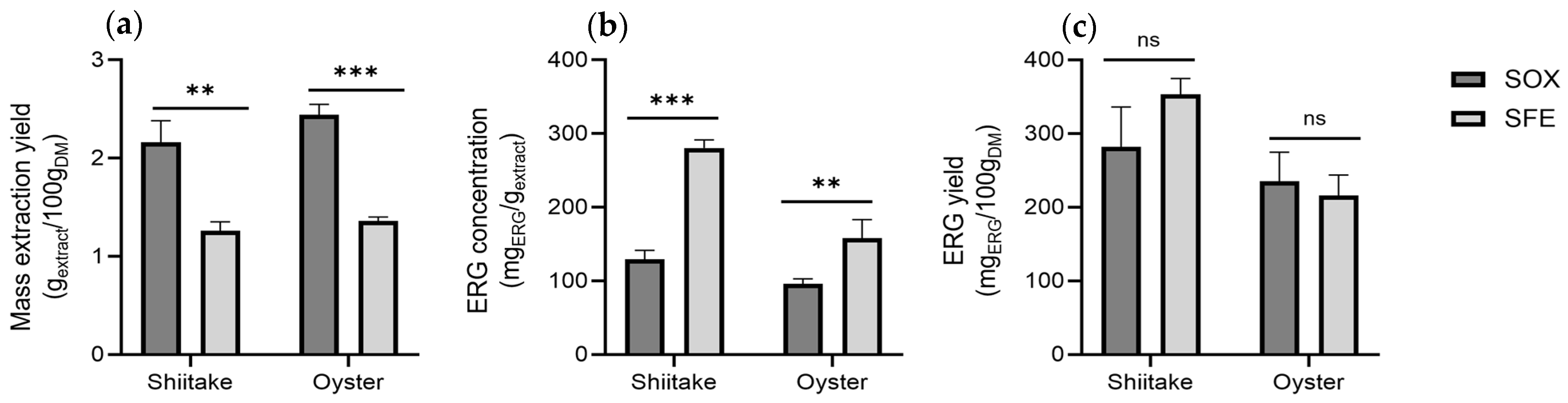
After reaching the optimal conditions for maximizing the ERG concentration in the extract, the same conditions were applied to the oyster mushroom, and a comparison between the SFE and SOX extraction was assessed. Figure 2 summarizes the results obtained.
Regarding mass extraction yield (Figure 2a), SOX extraction produced higher extract mass than SFE. For shiitake, SOX produced 2.16 ± 0.22 gextract/100 gDM and SFE produced 1.26 ± 0.09 gextract/100 gDM. SOX produced 2.44 ± 0.11 gextract/100 gDM and SFE produced 1.36 ± 0.04 gextract/100 gDM for oyster mushroom. This was expected, as n-hexane can solubilize a broader range of lipophilic compounds than CO2, resulting in a less selective extraction and, consequently, higher total extract mass. Although the difference was small, the mass extraction yield was slightly higher for oyster mushroom than for shiitake, regardless of the extraction technique. This observation may be related to differences in cell wall composition. Shiitake mushrooms are reported to contain higher levels of chitin, resulting in a more rigid cell wall structure, which could hinder solvent penetration and reduce mass extractability compared to oyster mushrooms [44,45,46,47].
Regarding ERG concentration in the extracts (Figure 2b), SFE produced significantly more concentrated extracts than SOX extraction for both mushroom species. Notably, the extract concentrations increased by 107% for the shiitake mushroom (129.56 ± 11.89 mgERG/gextract with SOX and 280.57 ± 10.80 mgERG/gextract with SFE) and 65% in oyster mushroom (95.87 ± 7.18 mgERG/gextract with SOX and 158.21 ± 24.85 mgERG/gextract with SFE), when using SFE compared to SOX. This can be attributed to the higher selectivity of supercritical CO2, particularly in the absence of a co-solvent, which solubilizes non-polar compounds such as ERG, while limiting the co-extraction of other matrix components. A species-dependent effect was also observed, with shiitake producing more ERG-rich extracts than oyster mushroom. This is consistent with its higher intrinsic ERG content, which appears to outweigh potential limitations associated with its more rigid cell wall structure. It should also be noted that the SFE conditions were optimized specifically for shiitake and therefore may not represent optimal conditions for oyster mushroom.
ERG yields (Figure 2c) of 282.31 ± 54.00 mgERG/100 gDM and 235.04 ± 28.06 mgERG/100 gDM were recovered by SOX for shiitake and oyster mushroom, respectively, while SFE yielded 353.53 ± 21.36 mgERG/100 gDM and 215.69 ± 39.89 mgERG/100 gDM. No significant differences were observed between techniques for either species, indicating comparable total ERG recovery. This equivalence arises from opposing behaviors: SOX produces higher total extract mass at lower ERG concentration, while SFE yields more concentrated extracts at lower overall mass. To the best of our knowledge, published data on SFE for oyster mushroom ERG extraction remains scarce. However, the extracts obtained here were considerably more concentrated than those reported by Milovanovic et al. [48] for a mushroom of the same genus, demonstrating SFE’s potential for this species.
This finding highlights the advantage of high-pressure SFE as a more selective and environmentally friendly technique, capable of achieving similar ERG recovery while producing extracts of higher purity. However, the impact of the high pressures on energy costs needs to be further evaluated.
Given the potential limitations imposed by the rigid fungal cell wall, the application of sample pre-treatments to enhance ERG extraction was explored in the following section.

2.3. Sample Pre-Treatments to Enhance Ergosterol Extraction

The influence of sample pre-treatments—ultrasound (US), microwave (MW), and enzymatic (EZ)—on the ERG concentration in the extracts was evaluated. Shiitake mushroom samples were subjected to the respective pre-treatments and subsequently extracted using conventional methods. The results obtained from pre-treated samples were compared with untreated controls.
Based on these results, the most effective pre-treatments were selected and applied in combination with SFE for shiitake mushroom. The pre-treatment that provided the best performance under SFE conditions for shiitake was then also applied to the SFE of oyster mushroom.

2.3.1. Sample Pre-Treatments and Conventional Extraction

For the US and MW, after the pre-treatment, the treated biomass was submitted to SOX and compared to SOX without pre-treatment. In the case of EZ, after the pre-treatment, a solid–liquid (SL) extraction was performed instead of SOX and compared to a SL without pre-treatment. The EZ pre-treatment was performed on a small scale (due to availability and cost associated with chitinase) and due to technical limitations, SOX was undoable. Nevertheless, the solvent, extraction time, and solid-to-solvent ratio were kept identical to those used for SOX. This methodological difference should be considered when interpreting the performance of the EZ pre-treatment relative to US and MW. Since EZ-treated samples were benchmarked against untreated SL control rather than SOX, direct quantitative comparisons across pre-treatment strategies should be interpreted with caution. Statistical analysis indicates that the two baselines are reasonably aligned in relative terms, although not strictly equivalent (see Supplementary Information, Table S3). Nonetheless, these findings do not compromise the validity of the reported results within each experimental framework, as all comparisons were performed against their respective untreated controls under consistent conditions.
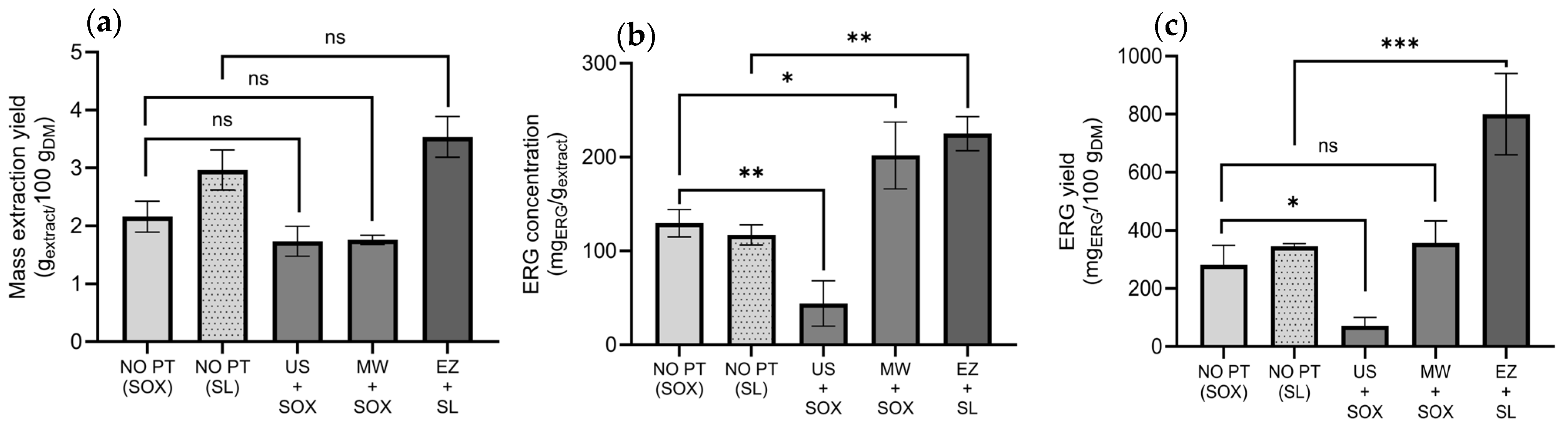
Results for the mass extraction yield, the ERG concentration in the extracts and the ERG yield for each pre-treatment and their respective untreated controls (NO PT) are summed up in Figure 3.
Regarding mass extraction yield (Figure 3a), 1.74 ± 0.21 gextract/100 gDM for US, 1.76 ± 0.06 gextract/100 gDM for MW and 3.54 ± 0.29 gextract/100 gDM, no statistically significant differences were observed between pre-treated samples and their respective untreated controls (SOX—2.16 ± 0.22 gextract/100 gDM and SL—2.97 ± 0.25 gextract/100 gDM), indicating that none of the applied pre-treatments significantly influenced overall extractability under the conditions studied.
Regarding ERG concentration (Figure 3b), the three pre-treatments produced distinct outcomes. US pre-treatment (53.36 ± 17.75 mgERG/gextract) resulted in a significant decrease relative to the untreated (129.56 ± 11.89 mgERG/gextract), suggesting that the applied conditions negatively affected ERG extraction. This may be attributed to the lower cavitation intensity generated by the ultrasonic bath, which delivers less energy to the matrix and results in insufficient cell wall disruption. Furthermore, the shear forces and free radicals produced during acoustic cavitation may have contributed to the degradation of ERG, reducing its concentration in the final extract [49,50].
In contrast, MW pre-treatment significantly increased ERG concentration (201.79 ± 29.05 mgERG/gextract), 56% more than the untreated SOX. This suggests that partial disruption of the fungal cell wall improved ERG accessibility while limiting the co-extraction of non-target compounds [31].
Within the extraction conditions evaluated for EZ, enzymatic pre-treatment produced the largest increase in ERG concentration relative to its untreated SL control (225.06 ± 14.85 mgERG/gextract vs. 117.17 ± 7.58 mgERG/gextract), 92% more than the untreated SL, consistent with chitinase-mediated disruption of the chitin-rich cell wall and enhanced release of intracellular ERG [51,52]. Chitinase-mediated hydrolysis of chitin generates water-soluble degradation products, including chitooligosaccharides and N-acetylglucosamine monomers, which may accumulate in the aqueous phase surrounding the biomass [52]. The sequential washing and centrifugation steps applied after EZ, mainly to exclude the enzyme, likely contributed to the removal of these water-soluble compounds alongside other polar matrix components [35], potentially improving the relative enrichment of ERG in the pellet prior to subsequent n-hexane extraction. However, based on the present data, the specific contribution of this selective depletion to the overall improvement in ERG concentration cannot be fully isolated from the effect of enzymatic cell wall disruption.
Regarding ERG yield (Figure 3c), US pre-treatment (72.28 ± 22.99 mgERG/gextract) resulted in a significant decrease compared with the untreated SOX (282.31 ± 54.00 mgERG/gextract), consistent with its negative effect on ERG concentration. MW pre-treatment (356.87 ± 62.09 mgERG/gextract) did not produce a statistically significant change in ERG yield, due to the balance achieved with less mass extraction yield and higher ERG concentration in the extracts. EZ pre-treatment (800.22 ± 114.20 mgERG/100 gDM) resulted in a significant increase of 131% in ERG yield compared with the untreated SL (345.54 ± 6.25 mgERG/100 gDM), reflecting the simultaneous increases observed in both mass extraction yield and ERG concentration.
Based on these results, MW and EZ pre-treatments were selected for further combination with SFE. Despite the absence of a significant effect on ERG yield, MW was retained due to its significant enhancement of ERG concentration, which is the primary objective of this work.

2.3.2. Sample Pre-Treatments Synergy with Supercritical Fluid Extraction

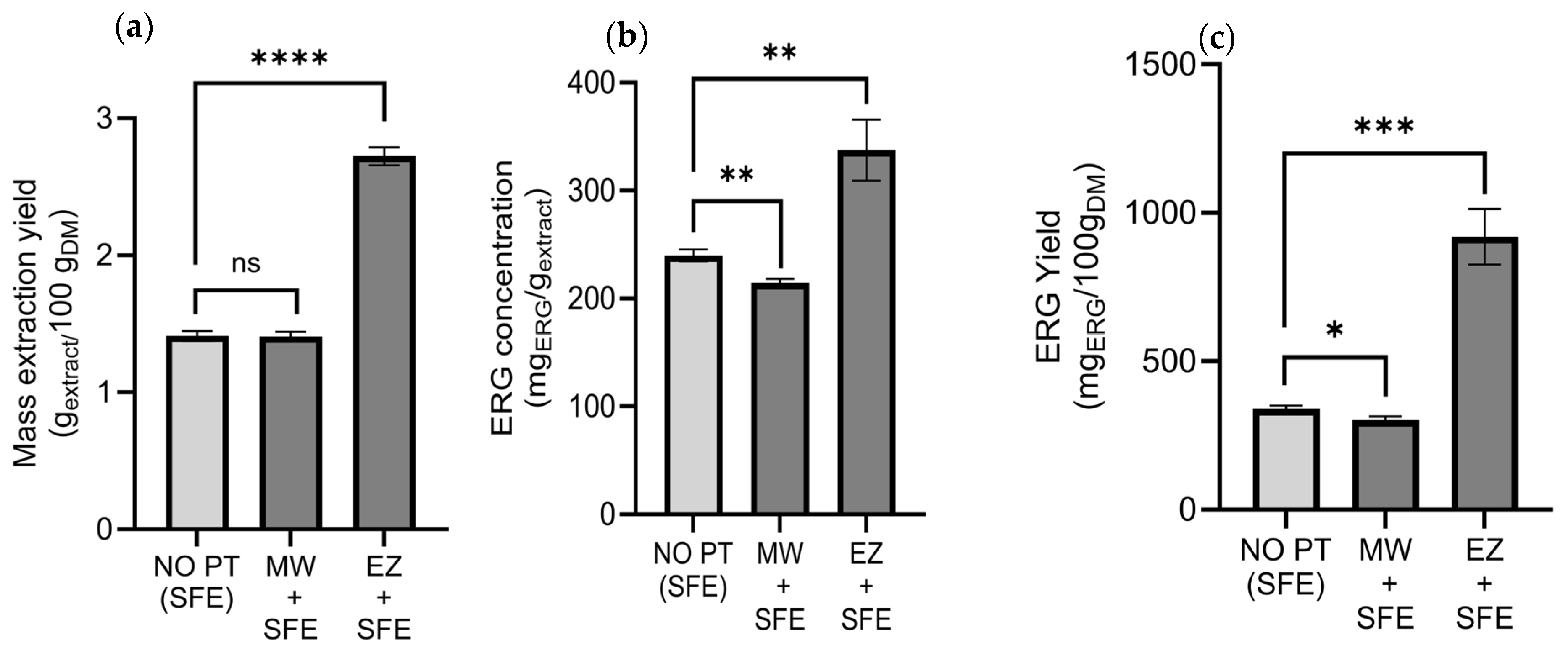
MW and EZ pre-treatments were applied to shiitake mushrooms, followed by SFE under the optimized conditions. Figure 4 summarizes the results obtained.
MW pre-treatment (1.41 ± 0.03 gextract/100 gDM) did not significantly impact mass extraction yield relative to SFE without pre-treatment (1.41 ± 0.03 gextract/100 gDM), as it was observed before when comparing to SOX. In contrast, EZ pre-treatment resulted in a highly significant increase in mass extraction yield (2.72 ± 0.05 gextract/100 gDM), consistent with chitinase-mediated modification of the chitin-rich cell wall, which increases matrix porosity and facilitates supercritical CO2 penetration and solute accessibility (Figure 4a).
Regarding ERG concentration (Figure 4b), MW pre-treatment (214.36 ± 3.21 mgERG/gextract) resulted in a significant decrease relative to the untreated control (239.96 ± 4.55 mgERG/gextract). This contrasts with the positive effect of MW pre-treatment observed when combined with SOX extraction, and the difference between these outcomes is informative. When combined with SOX, MW pre-treatment improved ERG concentration relative to a baseline that is inherently limited by the ability of n-hexane to penetrate the intact rigid cell wall through repeated passive contact cycles. In that context, even partial cell wall disruption by MW was sufficient to meaningfully improve ERG accessibility beyond what SOX alone could achieve. Under SFE conditions, however, this effect was not maintained. This may indicate that the structural modifications induced by MW were not sufficient to further improve extraction under conditions already optimized for selective ERG recovery.
In contrast, EZ pre-treatment resulted in a significant increase of 40% in ERG concentration (337.53 ± 23.12 mgERG/gextract), suggesting that chitinase-mediated cell wall modification enhances extraction performance when combined with SFE. The enzymatic modification of the fungal cell wall likely increases matrix porosity, enabling supercritical CO2 to more effectively access and solubilize intracellular ERG. Furthermore, the washing steps applied after enzymatic treatment may contribute to the removal of polar compounds, potentially improving extract enrichment during subsequent SFE.
Regarding ERG yield (Figure 4c), MW pre-treatment (301.46 ± 10.15 mgERG/100 gDM) resulted in a significant decrease compared to SFE without pre-treatment (338.80 ± 9.54 mgERG/100 gDM), reflecting its negative effect on ERG concentration without improving mass extraction yield. In contrast, EZ pre-treatment led to a highly significant increase of 171% in ERG yield (919.34 ± 76.1 mgERG/100 gDM), consistent with the simultaneous enhancement of both mass extraction yield and ERG concentration. These results indicate that EZ pre-treatment effectively improves overall ERG recovery under SFE conditions.
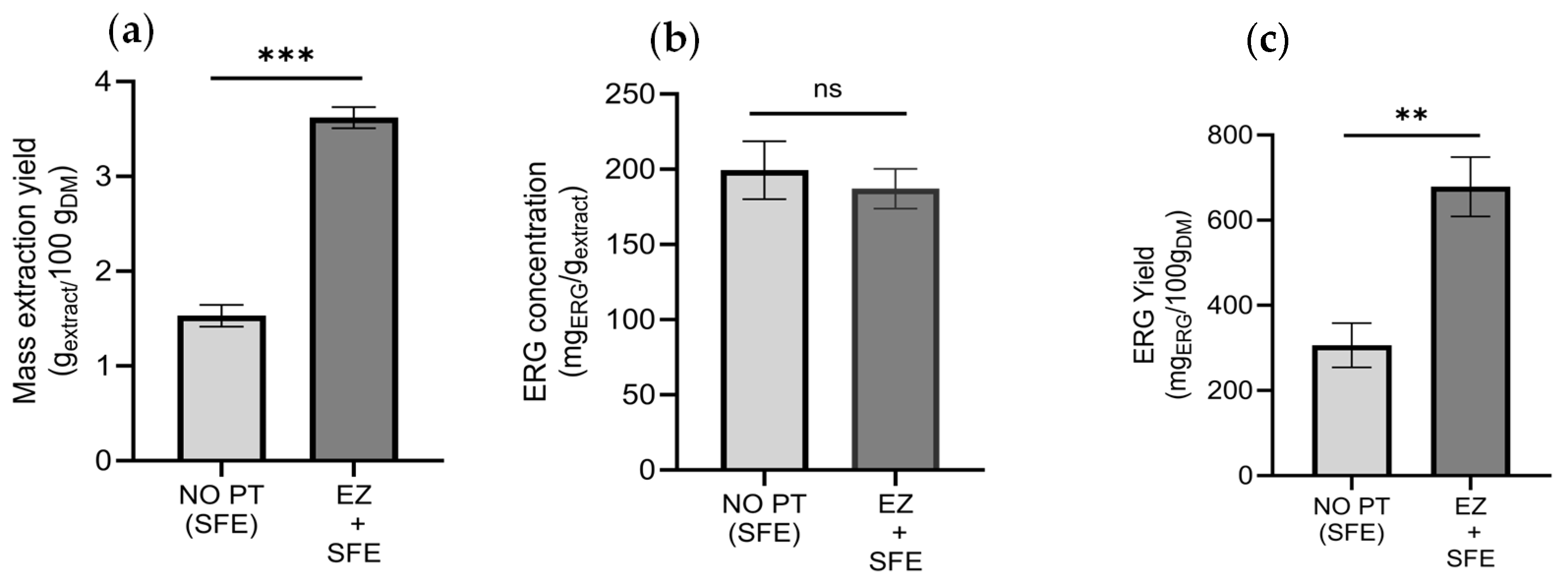
The use of EZ pre-treatment and SFE created a synergistic effect that further enhanced mass extraction yield, ERG concentration in the extracts and ERG yield. Based on these results, EZ was applied to the oyster mushroom and extracted with SFE.
Regarding mass extraction yield (Figure 5a), EZ pre-treatment (3.62 ± 0.08 gextract/100 gDM) produced a highly significant increase relative to SFE without pre-treatment (1.53 ± 0.09 gextract/100 gDM), consistent with the results observed for shiitake. This observation is consistent with the hypothesis that chitinase-mediated modification of the cell wall, combined with the selective removal of water-soluble compounds during washing, effectively increases the extractable lipophilic material available for supercritical CO2 recovery, regardless of mushroom species.
However, EZ pre-treatment did not produce a significant improvement in ERG concentration (Figure 5b) for the oyster mushroom (187.14 ± 9.36 mgERG/gextract for EX + SFE vs. 199.39 ± 15.80 mgERG/gextract for SFE NO PT), in contrast to the significant increase observed for shiitake. This divergent response is likely attributable to the substantially lower chitin content of oyster mushroom compared to shiitake, as consistently reported in the literature [45,47]. In shiitake, chitin represents the dominant structural barrier of the cell wall, and its enzymatic degradation by chitinase substantially improves ERG accessibility. In oyster mushroom, however, the cell wall contains considerably less chitin and is relatively richer in β-glucans [53], which are not substrates for chitinase. The enzymatic pre-treatment therefore targets only a minor structural component of the oyster cell wall, limiting its effectiveness in selectively improving ERG accessibility. Under the optimized SFE conditions applied here, supercritical CO2 appears already capable of efficiently accessing intracellular ERG in oyster mushroom without enzymatic assistance, leaving little room for further enrichment. The increase in mass extraction yield without a corresponding gain in ERG concentration further suggests that pre-treatment enhanced the non-selective release of extractable material rather than specifically improving ERG accessibility in this species.
Regarding ERG yield (Figure 5c), EZ pre-treatment resulted in a significant increase of 121% for oyster mushroom, driven primarily by the substantial gain in mass extraction yield rather than by improved ERG concentration (678.69 ± 49.1 mgERG/gextract for EX + SFE vs. 306.11 ± 42.051 mgERG/gextract for SFE NO PT). This indicates that for oyster mushroom, EZ pre-treatment enhances total ERG recovery through increased extractability rather than through selective enrichment, a fundamentally different mechanism from that observed in shiitake.
Taken together, the results across both species demonstrate that the benefit of EZ pre-treatment is matrix-dependent and governed primarily by cell wall chitin content. For chitin-rich matrices such as shiitake, enzymatic pre-treatment acts synergistically with SFE by selectively improving both ERG accessibility and extract enrichment. For matrices with lower chitin content such as oyster mushroom, the optimized SFE conditions alone are sufficient to achieve effective ERG extraction, and EZ pre-treatment offers limited advantage in terms of concentration enrichment, though it does improve total ERG recovery.

3. Materials and Methods

3.1. Mushroom Samples

Two species of edible mushrooms—Lentinula edodes (shiitake mushroom) and Pleurotus ostreatus (oyster mushroom)—were provided by Centro de Investigação de Montanha (CIMO), Instituto Politécnico de Bragança (IPB). The samples were already dried and coarsely ground. To ensure particle size uniformity, the samples were further milled with a ball mill (Powteq, 13 BM6pro, Beijing,, China) and refined using a vibratory sieve shaker (Retsch, AS200 basic, Haan, Germany), establishing a target particle size range between 63 µm and 250 µm for the subsequent experiments.

3.2. Chemicals

Solvent used for conventional extractions and chromatographic analysis was n-hexane for analysis (99%, Carlo Erba, Milano, Italy) and ethanol (98.8%, Honeywell Riedel-de Haën, Seelze, Germany). Solvents used for SFE were CO2 pure grade (99.95%, Air Liquide, Lisbon, Portugal) and ethanol (98.8%, Honeywell Riedel-de Haën, Germany). For drying, nitrogen gas (99.95%, Air Liquide, Lisbon, Portugal) was used. For GC-MS analysis, the carrier gas used was helium (99.999%, Air Liquide, Lisbon, Portugal) and the standards used were ergosterol for R&D (96%, Thermo Scientific, Waltham, MA, USA) and cholecalciferol (98%, TCI, Tokyo, Japan). For enzymatic pre-treatment, chitinase from Streptomyces griseus (SAE0158-10UN, Sigma-Aldrich, Darmstadt, Germany). Sodium acetate buffer 50 mM pH 5.8 [54] was chosen and prepared using Type II purified water (>5 MΩ·cm), obtained by reverse osmosis using an Elix® Essential Water Purification System (Merck, Darmstadt, Germany), sodium acetate anhydrous (Sigma-Aldrich, St. Louis, MO, USA) and glacial acetic acid (Panreac, Barcelona, Spain).

3.3. Conventional Extraction—Soxhlet

For the conventional extraction, 6 g of mushroom powder from each species was subjected to Soxhlet (SOX) extraction, in triplicate. Extraction was conducted using 200 mL of n-hexane as the solvent (30 g/L) for 3 h. Following the extraction, the solvent was removed under reduced pressure (Büchi, Rotavapor R-114, Flawil, Switzerland) to obtain dried extracts, which were stored in the dark at −20 °C until further analysis. The mass extraction yield was calculated as grams of extract per 100 g of dry mushroom (gextract/100 gDM).

3.4. Supercritical Fluid Extraction with Carbon Dioxide

Supercritical Fluid Extraction (SFE) was employed to obtain ergosterol (ERG) rich extracts from mushroom biomass using a high-pressure SFE system (SFE Process Extraction, Model SFE Lab, Tomblaine, France). The extraction was carried out in a 100 mL vessel, capable of reaching pressures up to 1000 bar. Liquid CO2 was delivered through a high-performance pump, chilled, and subsequently pressurized with a back pressure regulator. The CO2 flow rate was maintained at 20 g/min, and the total extraction time was 3 h. The co-solvent was pumped using a high-performance pump. After the extraction, EtOH was passed through the extractor to recover any extract remaining inside. The collected material was then dried under reduced pressure, and the resulting extracts were stored in the dark at −20 °C until further analysis. The mass extraction yield was calculated as grams of extract per 100 g of dry mushroom (gextract/100 gDM).

Experimental Design Analysis for the Supercritical Fluid Extractions

Response Surface Methodology (RSM) was used to optimize SFE. This statistical tool was used to model the effect of temperature, pressure and the use of co-solvent (EtOH) on the mass extraction yield and ERG concentration. A Design of Experiments (DoE) for the extraction was carried out following a Central Composition Face (CCF) design composed of fractional or full factorial design and star points placed on the faces of the sides, as a function of pressure (350–800 bar), temperature (40–70 °C) and co-solvent (0–10 mL/min). After the selection of independent variables and their ranges, experiments were established based on a CCF design, and each one was coded at three levels, i.e., −1 (the lowest of each variable), 0 (middle level), and +1 (the highest of each variable). The DoE and RSM were performed using the software MODDE, version 13.1 32-bit (Umetrics, Malmö, Sweden). A total of 17 experimental runs were performed in a randomized order to minimize the influence of systematic errors, and a center point was included in triplicate to enable the estimation of pure experimental error, independent of model fitting.

3.5. Sample Pre-Treatments to Enhance Ergosterol Extraction

3.5.1. Ultrasound Pre-Treatment

Ultrasound (US) pre-treatment was performed using an ultrasonic bath system (Argo LAB, DU-32, Carpi, Italy) and applied to 6 g of shiitake mushroom, the mass necessary for subsequent SOX extraction. A volume of 40 mL of EtOH (the necessary amount to wet the biomass) was used and the pre-treatment duration was 15 min, based on the conditions previously reported by Heleno et al. [15]. The temperature was set to 70 °C to match the SOX conditions temperature to avoid additional thermal stress that could degrade ERG. The US power was set to 120 W, the highest permitted by the device, to ensure adequate energy distribution and to allow the target temperature to be reached within a reasonable timeframe. The treatment was conducted in triplicate. Following the pre-treatment, the biomass was dried with nitrogen, and the pre-treated biomass was stored in the dark at −20 °C until further analysis.

3.5.2. Microwave Pre-Treatment

Microwave (MW), Discover SP-D Microwave System, (CEM, Mattews, NC, USA) pre-treatment was applied to 6 g of shiitake mushroom, the mass necessary for subsequent SOX extraction. A volume of 40 mL of EtOH (the necessary amount to wet the biomass) was selected and the pre-treatment duration was 15 min, closely matching Heleno et al. [7] previously reported conditions and US pre-treatment. The temperature was set to 70 °C to match SOX conditions, and to avoid additional thermal stress that could degrade ERG. MW maximum power was set to 300 W [7]. The treatment was conducted in triplicate. Following the pre-treatment, the samples were dried with nitrogen, and the pre-treated biomass was stored in the dark at −20 °C until further analysis.

3.5.3. Enzymatic Pre-Treatment

Enzymatic pre-treatment was performed on 0.5 g of mushroom biomass, using chitinase from Streptomyces griseus (SAE0158-10UN, Sigma-Aldrich, Germany). Enzymatic activity for the batch (0000104386) used was 634 U/gsolid, where one unit (U) liberates 1 mg of N-acetyl-D-glucosamine from chitin per hour.
An enzyme loading of 0.25 U/gDM was selected based on preliminary experiments in which a range of concentrations (0.25–1.5 U/gDM) was explored. As the aim of this pre-treatment was to partially disrupt the fungal cell wall rather than achieve complete hydrolysis, low enzyme loadings were deliberately investigated. A loading of 0.25 U/gDM biomass was selected as it provided the best ERG recovery while minimizing enzyme consumption. Each treatment was carried out in 10 mL of 50 mM sodium acetate buffer (pH 5.8), widely reported for chitinase activity as typical exhibits optimal performance under mildly acidic conditions close to this pH [54,55,56]. Incubation was performed in a water bath at 37 °C for 2 h, optimal conditions expressed on the product data information of the supplier, under magnetic stirring (200 rpm).
Following incubation, samples were mixed with 20 mL of cold distilled water and centrifuged at 4 °C, 10,000 rpm for 10 min. The pellet was washed three times with cold distilled water and centrifuged after each wash. Supernatants were discarded while the wet pellet was dried under reduced pressure using a vacuum concentrator (Centrivap, Labconco, Kansas, MO, USA). The pre-treated biomass was subjected to a solid–liquid extraction with n-hexane under the same conditions as SOX extraction applied to the other pre-treatments. The mass-to-solvent ratio was maintained at 30 g/L, extraction was performed at ~70 °C for 3 h, and biomass was separated from the n-hexane phase by vacuum filtration using a qualitative filter. The n-hexane fraction was evaporated at reduced pressure, and the resulting extracts were stored at −20 °C in the dark until further analysis.

3.6. Ergosterol Quantification

All the extracts were analyzed to quantify ERG by GC-MS. Direct GC-MS analysis of non-derivatized ergosterol was performed, as reliable chromatographic separation and identification were achieved under the selected analytical conditions, consistent with a previous report [57]. The extracts were dissolved in n-hexane or ethanol, with concentrations ranging from 0.20 to 1 mgextract/mL, and cholecalciferol (0.06 mg/mL) was added as an internal standard. GC-MS analysis was performed using a GCMS-QP2010 Plus chromatograph (Shimadzu, Kyoto, Japan) coupled with an autosampler AOC-5000 (Shimadzu). A 5-MS capillary column (30 m length × 0.25 mm i.d. × 0.25 μm film thickness, Teknokroma, Barcelona, Spain) was used to separate the compounds using He (≥99.999% purity) as the carrier gas at a flow rate of 2 mL/min. GC program was set as follows: column temperature was initially maintained at 120 °C for 3 min, then increased at a rate of 20 °C per minute to 290 °C and held for 5 min, and, finally, to 320 °C at a rate of 30 °C per minute (held for 5 min). Splitless injection of 1 µL of sample was done at 290 °C (injector temperature). The ion source and interface temperatures were kept at 280 °C. Mass spectra were recorded in electron ionization (EI) mode at 70 eV with a scan range of 40–400 m/z and a speed of 769 scans/s and selection monitoring (SIM) at 363 m/z (quantification) and 337 m/z (qualification) for ERG and 351 m/z (quantification) and 325 m/z (qualification) for cholecalciferol (internal standard).
Quantification was made through two different calibration curves of ERG from 0.005 to 0.180 mg/mL using two different types of solvents: ethanol for quantifying the SFE extracts and n-hexane for all the other extracts. For both calibration curves, the internal standard concentration was constant (0.06 mg/mL). Data acquisition and processing were performed using LabSolutions, GCMSsolution software (version 4.50 SP1, Shimadzu Corporation, Kyoto, Japan). The ERG content of the extracts analyzed was expressed in milligrams of ERG per gram of extract (mgERG/gextract).
Calibration curves for ERG quantification in both n-hexane and ethanol, including the linear regression equations, coefficients of determination (r2), and representative chromatograms, are presented in the Supplementary Information (Figures S2–S4).

3.7. Statistical Analysis

Statistical analysis regarding the Design of Experiments was performed using MODDE software.
Statistical analysis was performed using GraphPad Prism software, version 10.4.1 (GraphPad Software, San Diego, CA, USA). Differences between the two extraction techniques and pre-treated samples and their respective untreated controls were evaluated using unpaired two-tailed Student’s t-tests. Results are expressed as mean ± standard deviation (SD) of triplicate experiments (n = 3), and statistical significance was considered at p < 0.05.

4. Conclusions

This work demonstrated that supercritical CO2 extraction is a more selective and environmentally friendly alternative to conventional Soxhlet (SOX) extraction to produce ERG-rich extracts from shiitake and oyster, achieving significantly higher ERG concentrations while maintaining comparable overall ERG recovery. RSM-based optimization highlighted the value of exploring extended high-pressure ranges beyond those reported in the literature. Among the cell wall pre-treatments evaluated, enzymatic pre-treatment with chitinase was the only strategy to act synergistically with SFE, improving both ERG concentration and yield in shiitake through a combination of chitin-specific cell wall modification. The species-dependent nature of this effect underlines the importance of matching pre-treatment strategies to the cell wall composition of the target matrix. Collectively, these findings establish high-pressure SFE combined with chitinase pre-treatment as an effective and selective combination for obtaining ERG-rich extracts from chitin-rich fungal matrices. These findings represent a step forward towards the implementation of green techniques that could be applied to misshapen and unmarketable mushrooms and contribute to valorizing underutilized biomass. Despite the promising results obtained, some limitations regarding industrial implementation should be considered. The use of very high operating pressures may increase capital and energy costs, since many industrial SFE systems commonly operate at lower pressure ranges. Therefore, the improvement in extract selectivity achieved at high pressure should be balanced against process economics. Likewise, the enzymatic pre-treatment may present additional challenges related to enzyme cost, process integration, and scale-up logistics, although strategies such as enzyme recycling or continuous processing may improve feasibility. Future work should therefore address techno-economic aspects and scalability of both the high-pressure SFE process and enzymatic pre-treatment protocol.

Supplementary Materials

The following supporting information can be downloaded at: https://www.mdpi.com/article/10.3390/molecules31122067/s1; Table S1: factors significance of the Design of Experiments, Table S2: model statistical analysis of RSM, Table S3: comparision of the results of SOX and SL, Figure S1: representative GC-MS chromatograms of the mixtures of ERG standard and internal standard, Figure S2: calibration curves of mixture (ERG standard and internal standard), Figure S3: GC-MS chromatogram of an SFE extract (TIC), and Figure S4: GC-MS chromatogram of an SFE extract (SIM).

Author Contributions

Conceptualization, R.F., M.R.B. and N.F.; methodology, R.F., A.F., M.R.B. and N.F.; formal analysis, R.F.; writing—original draft preparation, R.F.; writing—review and editing, A.F., M.R.B. and N.F.; supervision, N.F. All authors have read and agreed to the published version of the manuscript.

Funding

This work was supported by the Research Unit iNOVA4Health (UID/4462/2025, UID/PRR/4462/2025, UID/PRR2/4462/2025), financially supported by Fundação para a Ciência e Tecnologia—Ministério da Educação, Ciência e Inovação, and by União Europeia—NextGenerationEU); and by Fundação para a Ciência e Tecnologia/Ministério da Educação, Ciência e Inovação through the Associate Laboratory LS4FUTURE (LA/P/0087/2020); and by by Mush4Chol project—2022.08844.PTDC.

Data Availability Statement

The original contributions presented in this study are included in the article/Supplementary Materials. Further inquiries can be directed to the corresponding author.

Acknowledgments

During the preparation of this manuscript, the authors used AI (Microsoft 365 Copilot, based on the GPT-5 chat model developed by OpenAI) for text and image generation and editing, and BioRender for the creation of graphical elements. The authors have reviewed and edited all generated content and take full responsibility for the accuracy and integrity of this publication.

Conflicts of Interest

The authors declare no conflicts of interest.

Abbreviations

ERGErgosterol
SFESupercritical Fluid Extraction
EtOHEthanol
USUltrasound
MWMicrowave
EZEnzymatic
SOXSoxhlet
DMDry Mushroom
DoEDesign of Experiments
RSMResponse Surface Methodology
SLSolid–Liquid
NO PTNo Pre-Treatment

References

  1. Araújo, F.; Gouvinhas, C.; Fontes, F.; La Vecchia, C.; Azevedo, A.; Lunet, N. Trends in Cardiovascular Diseases and Cancer Mortality in 45 Countries from Five Continents (1980–2010). Eur. J. Prev. Cardiol. 2014, 21, 1004–1017. [Google Scholar] [CrossRef] [PubMed]
  2. Eliaš, D.; Tóth Hervay, N.; Gbelská, Y. Ergosterol Biosynthesis and Regulation Impact the Antifungal Resistance and Virulence of Candida spp. Stresses 2024, 4, 641–662. [Google Scholar] [CrossRef]
  3. Gil-Ramírez, A.; Ruiz-Rodríguez, A.; Marín, F.R.; Reglero, G.; Soler-Rivas, C. Effect of Ergosterol-Enriched Extracts Obtained from Agaricus bisporus on Cholesterol Absorption Using an in Vitro Digestion Model. J. Funct. Foods 2014, 11, 589–597. [Google Scholar] [CrossRef]
  4. He, W.S.; Cui, D.; Li, L.; Tong, L.T.; Rui, J.; Li, H.; Zhang, H.; Liu, X. Cholesterol-Reducing Effect of Ergosterol Is Modulated via Inhibition of Cholesterol Absorption and Promotion of Cholesterol Excretion. J. Funct. Foods 2019, 57, 488–496. [Google Scholar] [CrossRef]
  5. Ray, R.; Saha, S.; Paul, S. Two Novel Compounds, Ergosterol and Ergosta-5,8-Dien-3-Ol, from Termitomyces Heimii Natarajan Demonstrate Promising Anti-Hepatocarcinoma Activity. J. Tradit. Chin. Med. Sci. 2022, 9, 443–453. [Google Scholar] [CrossRef]
  6. Yeh, M.Y.; Ko, W.C.; Lin, L.Y. Hypolipidemic and Antioxidant Activity of Enoki Mushrooms (Flammulina velutipes). BioMed Res. Int. 2014, 2014, 352385. [Google Scholar] [CrossRef]
  7. Heleno, S.A.; Prieto, M.A.; Barros, L.; Rodrigues, A.; Barreiro, M.F.; Ferreira, I.C.F.R. Optimization of Microwave-Assisted Extraction of Ergosterol from Agaricus bisporus L. by-Products Using Response Surface Methodology. Food Bioprod. Process. 2016, 100, 25–35. [Google Scholar] [CrossRef]
  8. Royse, D.J. A global perspective on the high five: Agaricus, pleurotus, lentinula, auricularia & flammulina. In Proceedings of the 8th International Conference on Mushroom Biology and Mushroom Products (ICMBMP8), New Delhi, India, 19–22 November 2014; pp. 1–5. [Google Scholar]
  9. Baptista, F.; Campos, J.; Costa-Silva, V.; Pinto, A.R.; Saavedra, M.J.; Ferreira, L.M.; Rodrigues, M.; Barros, A.N. Nutraceutical Potential of Lentinula edodes’ Spent Mushroom Substrate: A Comprehensive Study on Phenolic Composition, Antioxidant Activity, and Antibacterial Effects. J. Fungi 2023, 9, 1200. [Google Scholar] [CrossRef] [PubMed]
  10. Wu, T.; Zivanovic, S.; Draughon, F.A.; Sams, C.E. Chitin and Chitosan—Value-Added Products from Mushroom Waste. J. Agric. Food Chem. 2004, 52, 7905–7910. [Google Scholar] [CrossRef] [PubMed]
  11. Ceurstemont, S. Mushroom cultivation produces three times its weight in waste. It’s now being turned into burgers and fertilizer. Horiz. EU Res. Inov. Mag. 2020. Available online: https://projects.research-and-innovation.ec.europa.eu/en/horizon-magazine/mushroom-cultivation-produces-three-times-its-weight-waste-its-now-being-turned-burgers-and (accessed on 14 March 2025).
  12. Navarro-Simarro, P.; Gómez-Gómez, L.; Rubio-Moraga, Á.; Moreno-Gimenez, E.; López-Jimenez, A.; Prieto, A.; Ahrazem, O. Valorization of Mushroom By-Products for Sustainability: Exploring Antioxidant and Prebiotic Properties. J. Food Biochem. 2025, 2025, 3527311. [Google Scholar] [CrossRef]
  13. Papoutsis, K.; Grasso, S.; Menon, A.; Brunton, N.P.; Lyng, J.G.; Jacquier, J.C.; Bhuyan, D.J. Recovery of Ergosterol and Vitamin D2 from Mushroom Waste—Potential Valorization by Food and Pharmaceutical Industries. Trends Food Sci. Technol. 2020, 99, 351–366. [Google Scholar] [CrossRef]
  14. Corrêa, R.C.G.; Barros, L.; Fernandes, Â.; Sokovic, M.; Bracht, A.; Peralta, R.M.; Ferreira, I.C.F.R. A Natural Food Ingredient Based on Ergosterol: Optimization of the Extraction from Agaricus Blazei, Evaluation of Bioactive Properties and Incorporation in Yogurts. Food Funct. 2018, 9, 1465–1474. [Google Scholar] [CrossRef]
  15. Heleno, S.A.; Diz, P.; Prieto, M.A.; Barros, L.; Rodrigues, A.; Barreiro, M.F.; Ferreira, I.C.F.R. Optimization of Ultrasound-Assisted Extraction to Obtain Mycosterols from Agaricus bisporus L. by Response Surface Methodology and Comparison with Conventional Soxhlet Extraction. Food Chem. 2016, 197, 1054–1063. [Google Scholar] [CrossRef]
  16. Taofiq, O.; Corrêa, R.C.G.; Barros, L.; Prieto, M.A.; Bracht, A.; Peralta, R.M.; González-Paramás, A.M.; Barreiro, M.F.; Ferreira, I.C.F.R. A Comparative Study between Conventional and Non-Conventional Extraction Techniques for the Recovery of Ergosterol from Agaricus Blazei Murrill. Food Res. Int. 2019, 125, 108541. [Google Scholar] [CrossRef] [PubMed]
  17. da Silva, R.P.F.F.; Rocha-Santos, T.A.P.; Duarte, A.C. Supercritical Fluid Extraction of Bioactive Compounds. TrAC Trends Anal. Chem. 2016, 76, 40–51. [Google Scholar] [CrossRef]
  18. Roselló-Soto, E.; Parniakov, O.; Deng, Q.; Patras, A.; Koubaa, M.; Grimi, N.; Boussetta, N.; Tiwari, B.K.; Vorobiev, E.; Lebovka, N.; et al. Application of Non-Conventional Extraction Methods: Toward a Sustainable and Green Production of Valuable Compounds from Mushrooms. Food Eng. Rev. 2016, 8, 214–234. [Google Scholar] [CrossRef]
  19. Gil-Ramírez, A.; Aldars-García, L.; Palanisamy, M.; Jiverdeanu, R.M.; Ruiz-Rodríguez, A.; Marín, F.R.; Reglero, G.; Soler-Rivas, C. Sterol Enriched Fractions Obtained from Agaricus bisporus Fruiting Bodies and By-Products by Compressed Fluid Technologies (PLE and SFE). Innov. Food Sci. Emerg. Technol. 2013, 18, 101–107. [Google Scholar] [CrossRef]
  20. Hedrick, J.L.; Mulcahey, L.J.; Taylor, L.T. Supercritical Fluid Extraction. Mikrochim. Acta 1992, 108, 115–132. [Google Scholar] [CrossRef]
  21. Morales, D.; Gil-Ramirez, A.; Smiderle, F.R.; Piris, A.J.; Ruiz-Rodriguez, A.; Soler-Rivas, C. Vitamin D-Enriched Extracts Obtained from Shiitake Mushrooms (Lentinula edodes) by Supercritical Fluid Extraction and UV-Irradiation. Innov. Food Sci. Emerg. Technol. 2017, 41, 330–336. [Google Scholar] [CrossRef]
  22. Morales, D.; Piris, A.J.; Ruiz-Rodriguez, A.; Prodanov, M.; Soler-Rivas, C. Extraction of Bioactive Compounds against Cardiovascular Diseases from Lentinula edodes Using a Sequential Extraction Method. Biotechnol. Prog. 2018, 34, 746–755. [Google Scholar] [CrossRef]
  23. Morales, D.; Tejedor-Calvo, E.; Jurado-Chivato, N.; Polo, G.; Tabernero, M.; Ruiz-Rodríguez, A.; Largo, C.; Soler-Rivas, C. In Vitro and in Vivo Testing of the Hypocholesterolemic Activity of Ergosterol- and β-Glucan-Enriched Extracts Obtained from Shiitake Mushrooms (Lentinula edodes). Food Funct. 2019, 10, 7325–7332. [Google Scholar] [CrossRef]
  24. Almeida, C.F.; Manrique, Y.A.; Lopes, J.C.B.; Martins, F.G.; Dias, M.M. Recovery of Ergosterol from Agaricus bisporus Mushrooms via Supercritical Fluid Extraction: A Response Surface Methodology Optimisation. Heliyon 2024, 10, e21943. [Google Scholar] [CrossRef]
  25. Vladić, J.; Duarte, A.R.C.; Radman, S.; Simić, S.; Jerković, I. Enzymatic and Microwave Pretreatments and Supercritical CO2 Extraction for Improving Extraction Efficiency and Quality of Origanum vulgare L. spp. hirtum Extracts. Plants 2022, 11, 54. [Google Scholar] [CrossRef]
  26. López-Salazar, H.; Camacho-Díaz, B.H.; Arenas Ocampo, M.L.; Jiménez-Aparicio, A.R. Microwave-Assisted Extraction of Functional Compounds from Plants: A Review. Bioresources 2023, 18, 6614–6638. [Google Scholar] [CrossRef]
  27. Prawira-Atmaja, M.I.; Puangpraphant, S. Effects of Ultrasound-Assisted Bath, Probe, and Extraction Time on Bioactive Compounds and Antioxidant Activity in White Tea (Camellia sinensis) Extracts from Purple- and Green-Leaf Cultivars. J. Saudi Soc. Agric. Sci. 2025, 24, 10. [Google Scholar] [CrossRef]
  28. Zhang, Z.; Liu, Z.; Liu, C.; Li, D.; Jiang, N.; Liu, C. Effects of Ultrasound Pretreatment on Drying Kinetics and Quality Parameters of Button Mushroom Slices. Dry. Technol. 2016, 34, 1791–1800. [Google Scholar] [CrossRef]
  29. Sun, M.; Xu, Y.; Ding, Y.; Gu, Y.; Zhuang, Y.; Fan, X. Effect of Ultrasound Pretreatment on the Moisture Migration and Quality of Cantharellus Cibarius Following Hot Air Drying. Foods 2023, 12, 2705. [Google Scholar] [CrossRef] [PubMed]
  30. Krakowska-Sieprawska, A.; Kiełbasa, A.; Rafińska, K.; Ligor, M.; Buszewski, B. Modern Methods of Pre-Treatment of Plant Material for the Extraction of Bioactive Compounds. Molecules 2022, 27, 730. [Google Scholar] [CrossRef]
  31. Lozano Pérez, A.S.; Lozada Castro, J.J.; Guerrero Fajardo, C.A. Application of Microwave Energy to Biomass: A Comprehensive Review of Microwave-Assisted Technologies, Optimization Parameters, and the Strengths and Weaknesses. J. Manuf. Mater. Process. 2024, 8, 121. [Google Scholar] [CrossRef]
  32. Al-Zuhair, S.; Ashraf, S.; Hisaindee, S.; Al Darmaki, N.; Battah, S.; Svistunenko, D.; Reeder, B.; Stanway, G.; Chaudhary, A. Enzymatic Pre-Treatment of Microalgae Cells for Enhanced Extraction of Proteins. Eng. Life Sci. 2017, 17, 175–185. [Google Scholar] [CrossRef]
  33. Li, F.; Yang, L.; Zhao, T.; Zhao, J.; Zou, Y.; Zou, Y.; Wu, X. Optimization of Enzymatic Pretreatment for N-Hexane Extraction of Oil from Silybum Marianum Seeds Using Response Surface Methodology. Food Bioprod. Process 2012, 90, 87–94. [Google Scholar] [CrossRef]
  34. Hwang, I.W.; Kim, B.M.; Kim, Y.C.; Lee, S.H.; Chung, S.K. Improvement in β-Glucan Extraction from Ganoderma Lucidum with High-Pressure Steaming and Enzymatic Pre-Treatment. Appl. Biol. Chem. 2018, 61, 235–242. [Google Scholar] [CrossRef]
  35. Liu, W.; Niu, J.; Han, F.; Zhong, K.; Li, R.; Sui, W.; Ma, C.; Wu, M. Steam Explosion-Assisted Extraction of Ergosterol and Polysaccharides from Flammulina velutipes (Golden Needle Mushroom) Root Waste. Foods 2024, 13, 1860. [Google Scholar] [CrossRef]
  36. Sun, Y.; Nzekoue, F.K.; Vittori, S.; Sagratini, G.; Caprioli, G. Conversion of Ergosterol into Vitamin D2 and Other Photoisomers in Agaricus bisporus Mushrooms under UV-C Irradiation. Food Biosci. 2022, 50, 102143. [Google Scholar] [CrossRef]
  37. Jasinghe, V.J.; Perera, C.O. Distribution of Ergosterol in Different Tissues of Mushrooms and Its Effect on the Conversion of Ergosterol to Vitamin D2 by UV Irradiation. Food Chem. 2005, 92, 541–546. [Google Scholar] [CrossRef]
  38. Barreira, J.C.M.; Oliveira, M.B.P.P.; Ferreira, I.C.F.R. Development of a Novel Methodology for the Analysis of Ergosterol in Mushrooms. Food Anal. Methods 2014, 7, 217–223. [Google Scholar] [CrossRef]
  39. Wang, Q.; Cheng, J.; Wang, L.; Yan, S.; Wang, R.; Zhang, H.; Shao, H.; Yang, X. Valorization of Spent Shiitake Substrate for Recovery of Antitumor Fungal Sterols by Ultrasound-Assisted Extraction. J. Food Biochem. 2018, 42, 12602. [Google Scholar] [CrossRef]
  40. Silva, A.R.; Oludemi, T.; Costa, C.; Barros, J.; Ferreira, I.; Nunes, J.; Prieto, M.A.; Simal-Gandara, J.; Barros, L.; Ferreira, I.C.F.R. Mushrooms Bio-Residues Valorisation: Optimisation of Ergosterol Extraction Using Response Surface Methodology. Food Bioprod. Process. 2020, 122, 183–192. [Google Scholar] [CrossRef]
  41. Taofiq, O.; Heleno, S.A.; Calhelha, R.C.; Alves, M.J.; Barros, L.; Barreiro, M.F.; González-Paramás, A.M.; Ferreira, I.C.F.R. Development of Mushroom-Based Cosmeceutical Formulations with Anti-Inflammatory, Anti-Tyrosinase, Antioxidant, and Antibacterial Properties. Molecules 2016, 21, 1372. [Google Scholar] [CrossRef]
  42. National Center for Biotechnology Information PubChem Compound Summary for CID 444679, Ergosterol. Available online: https://pubchem.ncbi.nlm.nih.gov/compound/Ergosterol (accessed on 20 December 2025).
  43. Kitzberger, C.S.G.; Lomonaco, R.H.; Michielin, E.M.Z.; Danielski, L.; Correia, J.; Ferreira, S.R.S. Supercritical Fluid Extraction of Shiitake Oil: Curve Modeling and Extract Composition. J. Food Eng. 2009, 90, 35–43. [Google Scholar] [CrossRef]
  44. Alimi, B.A.; Pathania, S.; Wilson, J.; Duffy, B.; Frias, J.M.C. Extraction, Quantification, Characterization, and Application in Food Packaging of Chitin and Chitosan from Mushrooms: A Review. Int. J. Biol. Macromol. 2023, 237, 124195. [Google Scholar] [CrossRef]
  45. Rahman, M.A.; Bhuiyan, S.; Shakil, S.; Hossain, S. Comparative Study on Chitin Content of Bangladeshi Edible and Medicinal Mushrooms. J. Biomed. Res. 2023, 4, 25–28. [Google Scholar] [CrossRef]
  46. Vetter, J. The Mushroom Glucans: Molecules of High Biological and Medicinal Importance. Foods 2023, 12, 1009. [Google Scholar] [CrossRef] [PubMed]
  47. Vetter, J. Chitin Content of Cultivated Mushrooms Agaricus bisporus, Pleurotus ostreatus and Lentinula edodes. Food Chem. 2007, 102, 6–9. [Google Scholar] [CrossRef]
  48. Milovanovic, I.; Zengin, G.; Maksimovic, S.; Tadic, V. Supercritical and Ultrasound-Assisted Extracts from Pleurotus Pulmonarius Mushroom: Chemical Profiles, Antioxidative, and Enzyme-Inhibitory Properties. J. Sci. Food Agric. 2021, 101, 2284–2293. [Google Scholar] [CrossRef]
  49. Shen, L.; Pang, S.; Zhong, M.; Sun, Y.; Qayum, A.; Liu, Y.; Rashid, A.; Xu, B.; Liang, Q.; Ma, H.; et al. A Comprehensive Review of Ultrasonic Assisted Extraction (UAE) for Bioactive Components: Principles, Advantages, Equipment, and Combined Technologies. Ultrason. Sonochem. 2023, 101, 106646. [Google Scholar] [CrossRef] [PubMed]
  50. Kumar, K.; Srivastav, S.; Sharanagat, V.S. Ultrasound Assisted Extraction (UAE) of Bioactive Compounds from Fruit and Vegetable Processing by-Products: A Review. Ultrason. Sonochem. 2021, 70, 105325. [Google Scholar] [CrossRef]
  51. Łubek-Nguyen, A.; Ziemichód, W.; Olech, M. Application of Enzyme-Assisted Extraction for the Recovery of Natural Bioactive Compounds for Nutraceutical and Pharmaceutical Applications. Appl. Sci. 2022, 12, 3232. [Google Scholar] [CrossRef]
  52. Unuofin, J.O.; Odeniyi, O.A.; Majengbasan, O.S.; Igwaran, A.; Moloantoa, K.M.M.; Khetsha, Z.P.; Iwarere, S.A.; Daramola, M.O. Chitinases: Expanding the Boundaries of Knowledge beyond Routinized Chitin Degradation. Environ. Sci. Pollut. Res. Int. 2024, 31, 38045–38060. [Google Scholar] [CrossRef]
  53. Belobrajdic, D.P.; Brook, H.; James-Martin, G.; Stonehouse, W. β-Glucan Content and in Vitro Bile-Acid Binding Capacity of Agaricus bisporus and Pleurotus spp. Food Funct. 2024, 15, 9880–9887. [Google Scholar] [CrossRef]
  54. Jankiewicz, U.; Brzezinska, M.S. The Role of Exochitinase Type A1 in the Fungistatic Activity of the Rhizosphere Bacterium Paenibacillus sp. M4. Arch. Biol. Sci. 2016, 68, 451–459. [Google Scholar] [CrossRef]
  55. Kim, K.-J.; Yang, Y.-J.; Kim, J.-G. Purification and Characterization of Chitinase from Streptomyces sp. M-20. J. Biochem. Mol. Biol. 2003, 2, 185–189. [Google Scholar] [CrossRef]
  56. Li, R.; Jiang, C.; Li, X.; Zhou, Y.; You, L.; Wang, Q.; Tang, W.; Yu, Z.; Yang, F.; Li, X. Pretreatment of Chitin Depolymerization by Expansin-like Protein to Improve Hydrolysis Efficiency. Heliyon 2024, 10, e29643. [Google Scholar] [CrossRef] [PubMed]
  57. Hossain, M.Z.; Goto, T. A Rapid Determination of Ergosterol in Grains Using Gas Chromatography–Mass Spectrometry Method Without Derivatization. Food Anal. Methods 2015, 8, 1021–1026. [Google Scholar] [CrossRef]
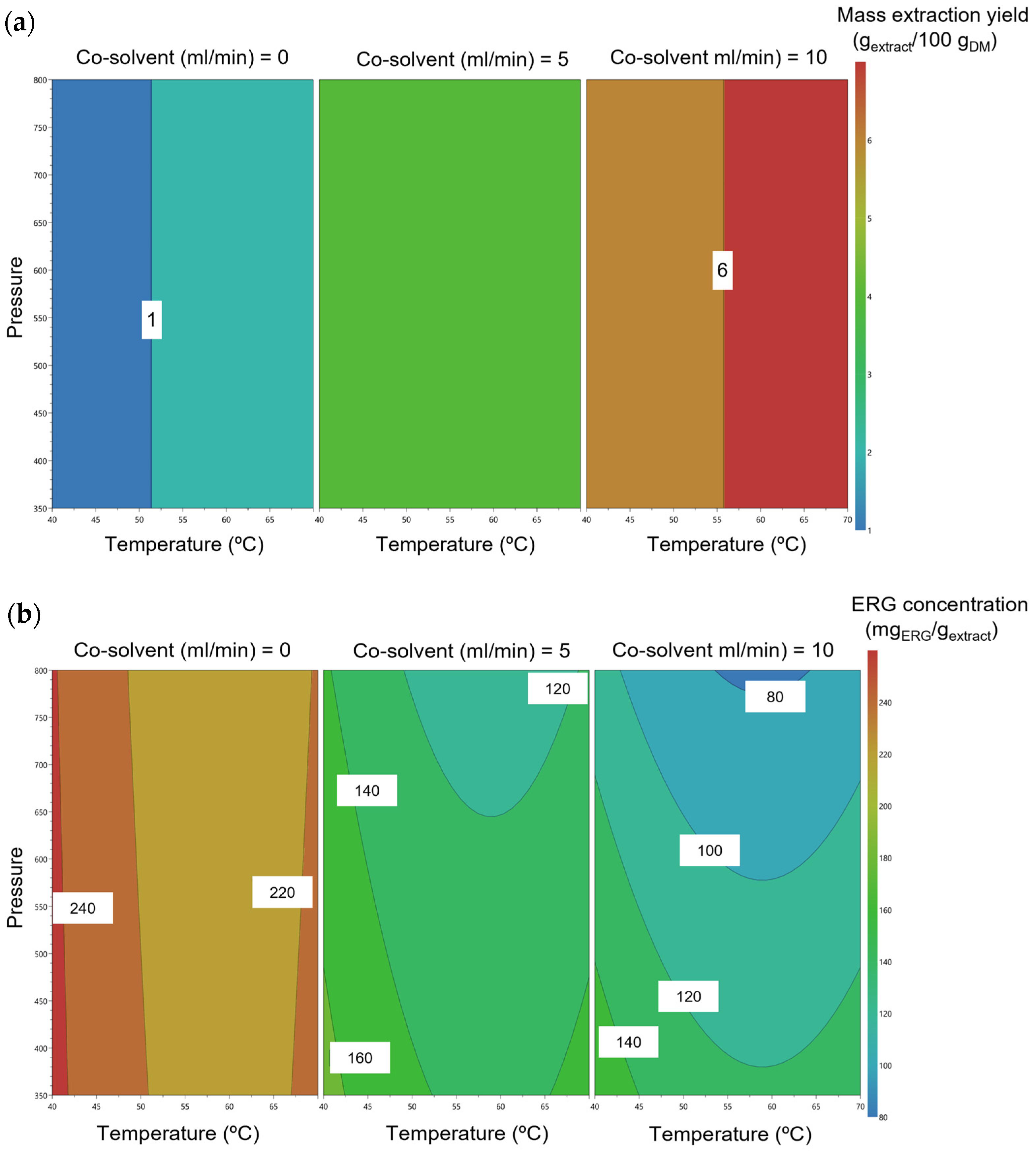
Figure 1. Response surface contour plot fitted to the mass extraction yield (upper panels, (a)) and to ERG concentration in the extract (lower panels, (b)) as a function of pressure (350–800 bar), temperature (40–70 °C) and co-solvent flow (EtOH 0–10 mL/min). Numerical contour labels (white boxes) indicate predicted response values. The numbered annotations above the panels correspond to the co-solvent levels used in the visualization (0, 5, and 10 mL/min).
Molecules 31 02067 g001
Figure 2. Comparison of the mass extraction, yields (a), ERG concentration in the extracts (b) and overall ERG yield (c) when using SFE and SOX for the shiitake and oyster mushroom (n = 3). Significance levels are indicated as follows: ** p < 0.01, *** p < 0.001; ns = not significant. All experiments were performed in triplicate (n = 3).
Molecules 31 02067 g002
Figure 3. Comparison of mass extraction yield (a), ERG concentration in the extracts (b), and ERG yield (c) for US, MW, and EZ pre-treatments relative to their respective untreated controls (NO PT). US and MW pre-treated samples were compared with SOX without pre-treatment, while EZ pre-treated samples were compared with SL without pre-treatment. Statistical comparisons were performed using unpaired two-tailed t-tests between each pre-treated sample and its respective control. Significance levels are indicated as follows: * p < 0.05, ** p < 0.01, *** p < 0.001; ns = not significant. All experiments were performed in triplicate (n = 3).
Molecules 31 02067 g003
Figure 4. Comparison of mass extraction yield (a), ERG concentration in the extracts (b), and ERG yield (c) obtained by SFE of shiitake mushroom, with and without pre-treatments. MW and EZ pre-treated samples were compared with SFE performed without pre-treatment (NO PT). Statistical comparisons were performed using unpaired two-tailed t-tests between each pre-treated sample and the untreated SFE control. Significance levels are indicated as follows: * p < 0.05, ** p < 0.01, *** p < 0.001, **** p < 0.0001; ns = not significant. All experiments were performed in triplicate (n = 3).
Molecules 31 02067 g004
Figure 5. Comparison of mass extraction yield (a), ERG concentration in the extracts (b), and ERG yield (c) obtained by SFE of oyster mushroom, with and without EZ pre-treatments. Statistical comparisons were performed using unpaired two-tailed t-tests between each pre-treated sample and the untreated SFE control. Significance levels are indicated as follows: ** p < 0.01, *** p < 0.001; ns = not significant. All experiments were performed in triplicate (n = 3).
Molecules 31 02067 g005
Table 1. Mass extraction yield, ERG concentration and ERG yield of the extracts obtained by SOX extraction for the two types of mushrooms. Results are expressed as mean ± SD, n = 3. DM—dry mushroom.
MushroomMass Extraction Yield
(gextract/100 gDM)
ERG Concentration
(mgERG/gextract)
ERG Yield
(mgERG/100 gDM)
Shiitake2.16 ± 0.22129.56 ± 11.89282.31 ± 54.00
Oyster2.44 ± 0.1195.87 ± 7.18235.04 ± 28.06
Table 2. Design of Experiments varying pressure, temperature and co-solvent. Mass extraction yield and ERG concentration were the responses evaluated.
VariablesResponses
No.Pressure
(bar)
Temperature
(°C)
Co-Solvent
(mL/min)
Mass Extraction Yield
(gextract/100 gDM)
ERG Concentration
(mgERG/gextract)
13504000.9237.53
235040105.04163.74
33505552.27117.63
43507001.06234.86
535070106.41130.51
65754052.82176.76
75755500.85224.44
85755553.96105.44
95755552.96163.14
105755554.3105.81
1157555106.48103.3
125757055.05125.21
138004000.78243.57
1480040105.4983.92
158005554.9121.39
168007001.22207.12
1780070105.74105.05
Table 3. Predicted values of the model for the mass extraction yield and the ERG concentration and the corresponding observed value. The results are presented as mean ± SD, n = 3.
Mass Extraction Yield
(gextract/100 gDM)
ERG Concentration
(mgERG/gextract)
ERG Yield
(mgERG/100 gDM)
Predicted1.56221.27345.18
Observed1.29 ± 0.09280.57 ± 10.80353.53 ± 21.36
Disclaimer/Publisher’s Note: The statements, opinions and data contained in all publications are solely those of the individual author(s) and contributor(s) and not of MDPI and/or the editor(s). MDPI and/or the editor(s) disclaim responsibility for any injury to people or property resulting from any ideas, methods, instructions or products referred to in the content.