Dual-Mode Native Mass Spectrometry Screening Identifies Ginsenoside Ligands of 6-Hydroxymethyl-7,8-Dihydropterin Pyrophosphokinase (HPPK)



Abstract
1. Introduction
2. Results
2.1. A Dual-Mode Native Mass Spectrometry (MS) Workflow
2.2. Automated Data Analysis
2.3. Screening Results
2.4. Hit Validation
3. Discussion
4. Materials and Methods
4.1. Ligand Preparation
4.2. Protein Expression and Purification
4.3. Sample Preparation for Native MS
4.4. Mass Spectrometry Instrument Control and Data Acquisition
4.5. Data Analysis
4.6. Titration of 8-MG Against HPPK by Native MS
Supplementary Materials
Author Contributions
Funding
Institutional Review Board Statement
Data Availability Statement
Acknowledgments
Conflicts of Interest
Abbreviations
| HPPK | 6-hydroxymethyl-7,8-dihydropterin pyrophosphokinase |
| TB | Tuberculosis |
| Mtb | Mycobacterium tuberculosis |
| MDR-TB | multidrug-resistant TB |
| MS | mass spectrometry |
| CID | collision-induced dissociation |
| PPT | protopanaxatriol |
| PPD | protopanaxadiol |
| SSGCID | Seattle Structural Genomics Center for Infectious Diseases |
| TOF | time-of-flight |
References
- Crombie, I.K. Where They Come from, Why They Spread, and When They End. In Major Pandemics; Palgrave Macmillan Singapore: Singapore, 2025. [Google Scholar]
- WHO. WHO Global Tuberculosis Report 2025; WHO: Geneva, Switzerland, 2025. [Google Scholar]
- Omoteso, O.A.; Fadaka, A.O.; Walker, R.B.; Khamanga, S.M. Innovative Strategies for Combating Multidrug-Resistant Tuberculosis: Advances in Drug Delivery Systems and Treatment. Microorganisms 2025, 13, 722. [Google Scholar] [CrossRef] [PubMed]
- Zhang, S.; Cheng, J.; Tang, Y. Drug resistance mechanisms in Mycobacterium tuberculosis infection and challenges in vaccine development. Front. Pharmacol. 2026, 17, 1762214. [Google Scholar] [CrossRef]
- Xu, M.; Kastner, D.W.; Luo, W.; Li, F.S.; Muller, P.; Sun, Y.; Huang, W.; Glinkerman, C.M.; Guempel, M.; Kulik, H.J.; et al. Mammalian-like steroidogenesis in plants gives rise to endocrine-mimetic cardenolides. Sci. Adv. 2026, 12, eaeb5460. [Google Scholar] [CrossRef] [PubMed]
- Grosjean, H.; Biggin, P.C. Developments and challenges in hit progression within fragment-based drug discovery. Nat. Commun. 2026, 17, 2226. [Google Scholar] [CrossRef]
- Vassiliades, S.V.; Borges, L.G.; Giarolla, J.; Parise-Filho, R. Folate Pathway Inhibitors, An Underestimated and Underexplored Molecular Target for New Anti-tuberculosis Agents. Mini Rev. Med. Chem. 2023, 23, 1711–1732. [Google Scholar] [CrossRef] [PubMed]
- Hajian, B.; Scocchera, E.; Shoen, C.; Krucinska, J.; Viswanathan, K.; G-Dayanandan, N.; Erlandsen, H.; Estrada, A.; Mikusova, K.; Kordulakova, J.; et al. Drugging the Folate Pathway in Mycobacterium tuberculosis: The Role of Multi-targeting Agents. Cell Chem. Biol. 2019, 26, 781–791.e6. [Google Scholar] [CrossRef] [PubMed]
- Wrobel, A.; Arciszewska, K.; Maliszewski, D.; Drozdowska, D. Trimethoprim and other nonclassical antifolates an excellent template for searching modifications of dihydrofolate reductase enzyme inhibitors. J. Antibiot. 2020, 73, 5–27. [Google Scholar] [CrossRef]
- Jacobowski, A.C.; Boleti, A.P.A.; Cruz, M.V.; Santos, K.; de Andrade, L.R.M.; Frihling, B.E.F.; Migliolo, L.; Paiva, P.M.G.; Teodoro, P.E.; Teodoro, L.P.R.; et al. Combating Antimicrobial Resistance: Innovative Strategies Using Peptides, Nanotechnology, Phages, Quorum Sensing Interference, and CRISPR-Cas Systems. Pharmaceuticals 2025, 18, 1119. [Google Scholar] [CrossRef]
- Shi, G.; Shaw, G.X.; Zhu, F.; Tarasov, S.G.; Ji, X. Bisubstrate inhibitors of 6-hydroxymethyl-7,8-dihydropterin pyrophosphokinase: Transition state analogs for high affinity binding. Bioorg. Med. Chem. 2021, 29, 115847. [Google Scholar] [CrossRef]
- Dennis, M.L.; Pitcher, N.P.; Lee, M.D.; DeBono, A.J.; Wang, Z.C.; Harjani, J.R.; Rahmani, R.; Cleary, B.; Peat, T.S.; Baell, J.B.; et al. Structural Basis for the Selective Binding of Inhibitors to 6-Hydroxymethyl-7,8-dihydropterin Pyrophosphokinase from Staphylococcus aureus and Escherichia coli. J. Med. Chem. 2016, 59, 5248–5263. [Google Scholar] [CrossRef]
- Jongkon, N.; Gleeson, D.; Gleeson, M.P. Elucidation of the Catalytic Mechanism of 6-Hydroxymethyl-7,8-dihydropterin Pyrophosphokinase using QM/MM Calculations. Org. Biomol. Chem. 2018, 16, 6239–6249. [Google Scholar] [CrossRef]
- Minato, Y.; Thiede, J.M.; Kordus, S.L.; McKlveen, E.J.; Turman, B.J.; Baughn, A.D. Mycobacterium tuberculosis folate metabolism and the mechanistic basis for para-aminosalicylic acid susceptibility and resistance. Antimicrob. Agents Chemother. 2015, 59, 5097–5106. [Google Scholar] [CrossRef]
- Yogavel, M.; Nettleship, J.E.; Sharma, A.; Harlos, K.; Jamwal, A.; Chaturvedi, R.; Sharma, M.; Jain, V.; Chhibber-Goel, J.; Sharma, A. Structure of 6-hydroxymethyl-7,8-Dihydropterin Pyrophosphokinase-Dihydropteroate Synthase from Sheds Light on Drug Resistance. J. Biol. Chem. 2018, 293, 14962–14972. [Google Scholar] [CrossRef] [PubMed]
- Shaw, G.X.; Li, Y.; Shi, G.; Wu, Y.; Cherry, S.; Needle, D.; Zhang, D.; Tropea, J.E.; Waugh, D.S.; Yan, H.; et al. Structural enzymology and inhibition of the bi-functional folate pathway enzyme HPPK-DHPS from the biowarfare agent Francisella tularensis. FEBS J. 2014, 281, 4123–4137. [Google Scholar] [CrossRef] [PubMed]
- Hoarau, M.; Suwanakitti, N.; Varatthan, T.; Thiabma, R.; Rattanajak, R.; Charoensetakul, N.; Redman, E.K.; Khotavivattana, T.; Vilaivan, T.; Yuthavong, Y.; et al. Assay Development and Identification of the First Plasmodium falciparum 7,8-dihydro-6-hydroxymethylpterin-pyrophosphokinase Inhibitors. Molecules 2022, 27, 3515. [Google Scholar] [CrossRef] [PubMed]
- Falcão, V.C.d.A.; Czeczot, A.d.M.; Alam, M.M.; Park, K.-H.P.; Heo, J.; Woo, M.; Camini, A.M.; Timmers, L.F.S.M.; Shum, D.; Perelló, M.A.; et al. Identification and characterization of new structural scaffolds modulating the activity of Mycobacterium tuberculosis dihydroneopterin aldolase (FolB) in vitro. Front. Trop. Dis. 2024, 5, 1402321. [Google Scholar] [CrossRef]
- Han, J.; Liu, X.; Zhang, L.; Quinn, R.J.; Feng, Y. Anti-mycobacterial natural products and mechanisms of action. Nat. Prod. Rep. 2022, 39, 77–89. [Google Scholar] [CrossRef]
- Pye, C.R.; Bertin, M.J.; Lokey, R.S.; Gerwick, W.H.; Linington, R.G. Retrospective analysis of natural products provides insights for future discovery trends. Proc. Natl. Acad. Sci. USA 2017, 114, 5601–5606. [Google Scholar] [CrossRef]
- Gagare, S.; Patil, P.; Jain, A. Natural product-inspired strategies towards the discovery of novel bioactive molecules. Future J. Pharm. Sci. 2024, 10, 55. [Google Scholar] [CrossRef]
- Doyle, S.K.; Pop, M.S.; Evans, H.L.; Koehler, A.N. Advances in Discovering Small Molecules to Probe Protein Function in a Systems Context. Curr. Opin. Chem. Biol. 2016, 30, 28–36. [Google Scholar] [CrossRef]
- Auld, D.S.; Inglese, J.; Dahlin, J.L. Assay Interference by Aggregation. In Assay Guidance Manual; Markossian, S., Grossman, A., Baskir, H., Arkin, M., Auld, D., Austin, C., Baell, J., Brimacombe, K., Chung, T.D.Y., Coussens, N.P., et al., Eds.; Bethesda: Rockville, MD, USA, 2004. [Google Scholar]
- Prudent, R.; Lemoine, H.; Walsh, J.; Roche, D. Affinity selection mass spectrometry speeding drug discovery. Drug Discov. Today 2023, 28, 103760. [Google Scholar] [CrossRef]
- Tamara, S.; den Boer, M.A.; Heck, A.J.R. High-Resolution Native Mass Spectrometry. Chem. Rev. 2022, 122, 7269–7326. [Google Scholar] [CrossRef]
- Gavriilidou, A.F.M.; Sokratous, K.; Yen, H.-Y.; De Colibus, L. High-Throughput Native Mass Spectrometry Screening in Drug Discovery. Front. Mol. Biosci. 2022, 9, 837901. [Google Scholar] [CrossRef] [PubMed]
- Nguyen, G.T.H.; Bennett, J.L.; Liu, S.; Hancock, S.E.; Winter, D.L.; Glover, D.J.; Donald, W.A. Multiplexed Screening of Thousands of Natural Products for Protein-Ligand Binding in Native Mass Spectrometry. J. Am. Chem. Soc. 2021, 143, 21379–21387. [Google Scholar] [CrossRef] [PubMed]
- Elnaas, A.R.; Grice, D.; Han, J.Y.; Feng, Y.J.; Capua, A.D.; Mak, T.; Laureanti, J.A.; Buchko, G.W.; Myler, P.J.; Cook, G.; et al. Discovery of a Natural Product That Binds to the Protein Rv1466 Using Native Mass Spectrometry. Molecules 2020, 25, 2384. [Google Scholar] [CrossRef]
- Quinn, R.J.; Mak, T.; Littler, D.R.; Rossjohn, J.; Liu, M. Discovery of Anti-SARS-CoV-2 Nsp9 Binders from Natural Products by a Native Mass Spectrometry Approach. J. Nat. Prod. 2023, 86, 2630–2637. [Google Scholar] [CrossRef] [PubMed]
- Vu, H.; Pedro, L.; Mak, T.; McCormick, B.; Rowley, J.; Liu, M.M.; Di Capua, A.; Williams-Noonan, B.; Pham, N.B.; Pouwer, R.; et al. Fragment-Based Screening of a Natural Product Library against 62 Potential Malaria Drug Targets Employing Native Mass Spectrometry. ACS Infect. Dis. 2018, 4, 431–444. [Google Scholar] [CrossRef]
- Gu, Y.S.; Liu, M.M.; Quinn, R.J. Metabolite-protein interactions: Native mass spectrometry and collision induced affinity selection mass spectrometry in natural product screening. Front. Anal. Sci. 2022, 2, 1014017. [Google Scholar] [CrossRef]
- Kitova, E.N.; El-Hawiet, A.; Schnier, P.D.; Klassen, J.S. Reliable determinations of protein-ligand interactions by direct ESI-MS measurements. Are we there yet? J. Am. Soc. Mass Spectrom. 2012, 23, 431–441. [Google Scholar] [CrossRef]
- Karch, K.R.; Snyder, D.T.; Harvey, S.R.; Wysocki, V.H. Native Mass Spectrometry: Recent Progress and Remaining Challenges. Annu. Rev. Biophys. 2022, 51, 157–179. [Google Scholar] [CrossRef]
- Grgic, A.; Nagornov, K.O.; Kozhinov, A.N.; Michael, J.A.; Anthony, I.G.M.; Tsybin, Y.O.; Heeren, R.M.A.; Ellis, S.R. Ultrahigh-Mass Resolution Mass Spectrometry Imaging with an Orbitrap Externally Coupled to a High-Performance Data Acquisition System. Anal. Chem. 2023, 96, 794–801. [Google Scholar] [CrossRef] [PubMed]
- Christofi, E.; Barran, P. Ion Mobility Mass Spectrometry (IM-MS) for Structural Biology: Insights Gained by Measuring Mass, Charge, and Collision Cross Section. Chem. Rev. 2023, 123, 2902–2949. [Google Scholar] [CrossRef] [PubMed]
- Snyder, D.T.; Harvey, S.R.; Wysocki, V.H. Surface-induced Dissociation Mass Spectrometry as a Structural Biology Tool. Chem. Rev. 2022, 122, 7442–7487. [Google Scholar] [CrossRef] [PubMed]
- Keener, J.E.; Zhang, G.Z.; Marty, M.T. Native Mass Spectrometry of Membrane Proteins. Anal. Chem. 2021, 93, 583–597. [Google Scholar] [CrossRef]
- Oluwole, A.; Shutin, D.; Bolla, J.R. Mass spectrometry of intact membrane proteins: Shifting towards a more native-like context. Essays Biochem. 2023, 67, 201–213. [Google Scholar] [CrossRef]
- Kumar, S.; Stover, L.; Wang, L.; Bahramimoghaddam, H.; Zhou, M.; Russell, D.H.; Laganowsky, A. Native Mass Spectrometry of Membrane Protein-Lipid Interactions in Different Detergent Environments. Anal. Chem. 2024, 96, 16768–16776. [Google Scholar] [CrossRef]
- Le, J.; Loo, J.A. Native Top-Down Mass Spectrometry Characterization of Model Integral Membrane Protein Bacteriorhodopsin. J. Am. Soc. Mass Spectr. 2025, 36, 961–968. [Google Scholar] [CrossRef]
- Deedwania, A.; Wang, Y.; Robinson, C.V.; Bolla, J.R. Native mass spectrometry of membrane proteins reconstituted in peptidiscs. RSC Chem. Biol. 2026, 7, 120–128. [Google Scholar] [CrossRef]
- Kim, D.; Liu, W.J.; Viner, R.; Cherezov, V. Native mass spectrometry prescreening of G protein-coupled receptor complexes for cryo-EM structure determination. Structure 2024, 32, 2206–2219. [Google Scholar] [CrossRef]
- Tajiri, M.; Imai, S.; Konuma, T.; Shimamoto, K.; Shimada, I.; Akashi, S. Evaluation of Drug Responses to Human βAR Using Native Mass Spectrometry. ACS Omega 2023, 8, 24544–24551. [Google Scholar] [CrossRef]
- Gu, Y.S.; Liu, M.M.; Ma, L.L.; Quinn, R.J. Identification of Ligands for Ion Channels: TRPM2. Chembiochem 2024, 25, e202300790. [Google Scholar] [CrossRef]
- Gu, Y.S.; Liu, M.M.; Ma, L.L.; Quinn, R.J. Advancing Kir4.2 Channel Ligand Identification through Collision-Induced Affinity Selection Mass Spectrometry. ACS Chem. Biol. 2024, 19, 763–773. [Google Scholar] [CrossRef] [PubMed]
- Liu, R.J.; Xia, S.J.; Li, H.L. Native top-down mass spectrometry for higher-order structural characterization of proteins and complexes. Mass Spectrom. Rev. 2023, 42, 1876–1926. [Google Scholar] [CrossRef] [PubMed]
- Sternicki, L.M.; Nonomiya, J.; Liu, M.M.; Mulvihill, M.M.; Quinn, R.J. Native Mass Spectrometry for the Study of PROTAC GNE-987-Containing Ternary Complexes. Chemmedchem 2021, 16, 2206–2210. [Google Scholar] [CrossRef] [PubMed]
- Beveridge, R.; Kessler, D.; Rumpel, K.; Ettmayer, P.; Meinhart, A.; Clausen, T. Native Mass Spectrometry Can Effectively Predict PROTAC Efficacy. ACS Central Sci. 2020, 6, 1223–1230. [Google Scholar] [CrossRef]
- He, X.M.; Chen, X.Y.; Wang, Y.S. Mass Spectrometry for Assessing Protein-Nucleic Acid Interactions. Anal. Chem. 2023, 95, 115–127. [Google Scholar] [CrossRef]
- Cotham, V.C.; Wang, S.H.; Li, N. An Online Native Mass Spectrometry Approach for Fast, Sensitive, and Quantitative Assessment of Adeno-Associated Virus Capsid Content Ratios. J. Am. Soc. Mass Spectr. 2024, 35, 1567–1575. [Google Scholar] [CrossRef]
- Rogawski, R.; Sharon, M. Characterizing Endogenous Protein Complexes with Biological Mass Spectrometry. Chem. Rev. 2022, 122, 7386–7414. [Google Scholar] [CrossRef]
- Gan, J.R.; Ben-Nissan, G.; Arkind, G.; Tarnavsky, M.; Trudeau, D.; Garcia, L.N.; Tawfik, D.S.; Sharon, M. Native Mass Spectrometry of Recombinant Proteins from Crude Cell Lysates. Anal. Chem. 2017, 89, 4398–4404. [Google Scholar] [CrossRef]
- Shi, G.; Shaw, G.; Li, Y.; Wu, Y.; Yan, H.; Ji, X. Bisubstrate analog inhibitors of 6-hydroxymethyl-7,8-dihydropterin pyrophosphokinase: New lead exhibits a distinct binding mode. Bioorg. Med. Chem. 2012, 20, 4303–4309. [Google Scholar] [CrossRef]
- Han, J.Y.; Liu, X.T.; Zhang, L.X.; Van Voorhis, W.C.; Quinn, R.J.; Liu, M.M. Rapid Discovery of Antimicrobial and Antimalarial Agents from Natural Product Fragments. Separations 2024, 11, 194. [Google Scholar] [CrossRef]
- Han, J.Y.; Liu, X.T.; Zhang, L.X.; Quinn, R.J.; Liu, M.M. Nuclear Magnetic Resonance Fingerprinting and Principal Component Analysis Strategies Lead to Anti-Tuberculosis Natural Product Discovery from Actinomycetes. Antibiotics 2025, 14, 108. [Google Scholar] [CrossRef]
- Liu, M.M.; Han, J.Y.; Feng, Y.J.; Guymer, G.; Forster, P.; Quinn, R.J. Antimicrobial Benzyltetrahydroisoquinoline-Derived Alkaloids from the Leaves of Doryphora aromatica. J. Nat. Prod. 2021, 84, 676–682. [Google Scholar] [CrossRef]
- McInnes, L.; Healy, J. UMAP: Uniform Manifold Approximation and Projection for Dimension Reduction. arXiv 2018, arXiv:1802.03426. [Google Scholar]
- Sharma, R.; Saghapour, E.; Chen, J.Y. An NLP-based technique to extract meaningful features from drug SMILES. iScience 2024, 27, 109127. [Google Scholar] [CrossRef]
- Zhou, H.Y.; Skolnick, J. Utility of the Morgan Fingerprint in Structure-Based Virtual Ligand Screening. J. Phys. Chem. B 2024, 128, 5363–5370. [Google Scholar] [CrossRef]
- Chhabra, S.; Barlow, N.; Dolezal, O.; Hattarki, M.K.; Newman, J.; Peat, T.S.; Graham, B.; Swarbrick, J.D. Exploring the Chemical Space around 8-Mercaptoguanine as a Route to New Inhibitors of the Folate Biosynthesis Enzyme HPPK. PLoS ONE 2013, 8, e59535. [Google Scholar] [CrossRef]
- Xue, X.; Quinn, R.J.; Rehm, B.H.A.; Day, C.J.; Jennings, M.P.; McBroom, J.; Littler, D.R.; Liu, M. Advancing Collision-Induced Affinity Selection Mass Spectrometry for Quantitative Ligand Analysis in Complex Mixtures. Anal. Chem. 2026, 98, 7247–7261. [Google Scholar] [CrossRef]
- Bruggink, V.; Gutjahr, C.; Decker, A.; Engelbrecht, H.; Beekmann, U.; Kralisch, D.; Werner, M.; Schädel, P.; Jordan, P.M.; Werz, O.; et al. Ginsenosides from Panax ginseng modulate lipid mediator profiles in human leukocytes by interference with cellular 5-lipoxygenase activity. Biochem. Pharmacol. 2025, 236, 116882. [Google Scholar] [CrossRef]
- Lee, S.Y.; Kim, G.T.; Roh, S.H.; Song, J.S.; Kim, H.J.; Hong, S.S.; Kwon, S.W.; Park, J.H. Proteomic analysis of the anti-cancer effect of 20S-ginsenoside Rg3 in human colon cancer cell lines. Biosci. Biotechnol. Biochem. 2009, 73, 811–816. [Google Scholar] [CrossRef]
- Wang, C.; Liu, J.; Deng, J.; Wang, J.; Weng, W.; Chu, H.; Meng, Q. Advances in the chemistry, pharmacological diversity, and metabolism of 20(R)-ginseng saponins. J. Ginseng Res. 2020, 44, 14–23. [Google Scholar] [CrossRef]
- Liu, J.; Shiono, J.; Shimizu, K.; Yu, H.; Zhang, C.; Jin, F.; Kondo, R. 20(R)-ginsenoside Rh2, not 20(S), is a selective osteoclastgenesis inhibitor without any cytotoxicity. Bioorg. Med. Chem. Lett. 2009, 19, 3320–3323. [Google Scholar] [CrossRef]
- Bennett, J.L.; Nguyen, G.T.H.; Donald, W.A. Protein-Small Molecule Interactions in Native Mass Spectrometry. Chem. Rev. 2022, 122, 7327–7385. [Google Scholar] [CrossRef]
- Leslie, K.G.; Berry, S.S.; Miller, G.J.; Mahon, C.S. Sugar-Coated: Can Multivalent Glycoconjugates Improve upon Nature’s Design? J. Am. Chem. Soc. 2024, 146, 27215–27232. [Google Scholar] [CrossRef]
- Czeczot, A.M.; Roth, C.D.; Ducati, R.G.; Pissinate, K.; Rambo, R.S.; Timmers, L.; Abbadi, B.L.; Macchi, F.S.; Pestana, V.Z.; Basso, L.A.; et al. 8-Mercaptoguanine-based inhibitors of Mycobacterium tuberculosis dihydroneopterin aldolase: Synthesis, in vitro inhibition and docking studies. J. Enzym. Inhib. Med. Chem. 2021, 36, 847–855. [Google Scholar] [CrossRef]
- Wolfe, L.M.; Veeraraghavan, U.; Idicula-Thomas, S.; Schurer, S.; Wennerberg, K.; Reynolds, R.; Besra, G.S.; Dobos, K.M. A chemical proteomics approach to profiling the ATP-binding proteome of Mycobacterium tuberculosis. Mol. Cell Proteom. 2013, 12, 1644–1660. [Google Scholar] [CrossRef]
- Zhang, X.; Zhao, R.; Qi, Y.; Yan, X.; Qi, G.; Peng, Q. The progress of Mycobacterium tuberculosis drug targets. Front. Med. 2024, 11, 1455715. [Google Scholar] [CrossRef]


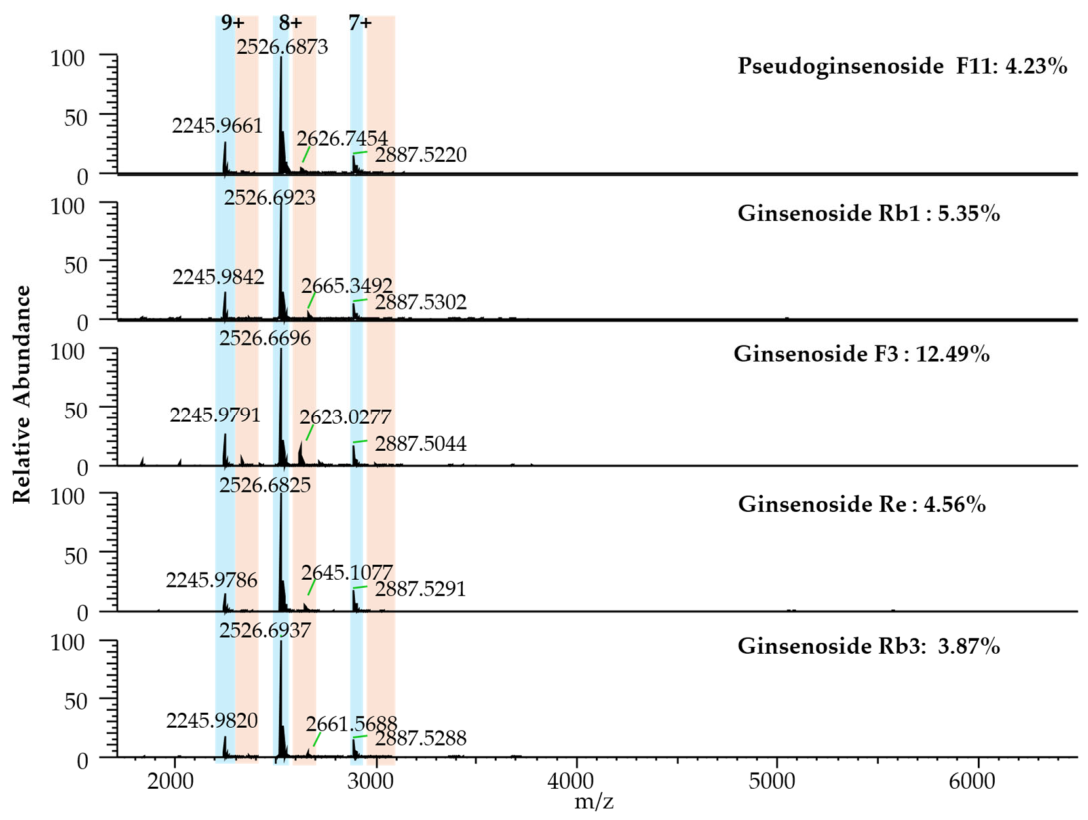


| Initial Hits | Expected MW (Da) | Calculated MW (Da) Under Low-CID Conditions | Detected Adduct Ions Under High-CID Conditions | Binding Ratios (%) | ||
|---|---|---|---|---|---|---|
| [M + H]+ | [M + Na]+ | [M + K]+ | ||||
| Pseudoginsenoside F11 | 801.01 | 801.43 | 802.5024 | 824.4843 * | 840.4576 | 1.89 |
| Ginsenoside Rb1 | 1109.29 | 1108.55 | 1109.6089 | 1131.5910 * | 1147.5865 | 1.36 |
| Ginsenoside F3 | 770.99 | 770.39 | 771.4890 * | 793.4710 | 809.4448 | 1.12 |
| Ginsenoside Re | 947.15 | 947.09 | - | 970.5422 * | 986.5373 | 1.09 |
| Ginsenoside Rb3 | 1079.27 | 1079.93 | 1079.5979 | 1101.5804 * | 1117.5546 | 1.02 |
| Hits | Name | Class | C-3 | C-6 | C-20 | Number of Sugars | cLogP | Binding Ratios (%) |
|---|---|---|---|---|---|---|---|---|
| 1 | S-ginsenoside Rh1 | PPT | OH | Glc | OH | 1 | 4.0 | 14.40 ± 0.11 |
| 2 | Ginsenoside Rg2 | PPT | OH | Glc–Rha | OH | 2 | 3.0 | 13.66 ± 0.69 |
| 3 | Ginsenoside F3 | PPT | OH | OH | Glc–Ara(p) | 2 | 2.7 | 12.49 ± 0.17 |
| 4 | Ginsenoside Rf | PPT | OH | Glc–Glc | OH | 2 | 2.1 | 11.35 ± 0.54 |
| 5 | Ginsenoside F1 | PPT | OH | OH | Glc | 1 | 4.0 | 10.08 ± 1.41 |
| 6 | Pseudoginsenoside RT5 | PPT | OH | Glc | 20,24-epoxy | 1 | 2.3 | 8.32 ± 0.49 |
| 7 | Ginsenoside Rb1 | PPD | Glc-Glc | H | Glc–Glc | 4 | −0.7 | 5.35 ± 0.03 |
| 8 | Ginsenoside Ro | * | GlcA-Glc | H | H | 3 | 0.2 | 5.09 ± 0.06 |
| 9 | Ginsenoside Re | PPT | OH | Glc–Rha | Glc | 3 | 1.2 | 4.56 ± 0.33 |
| 10 | R-ginsenoside Rh1 | PPT | OH | Glc | OH | 1 | 4.0 | 4.44 ± 0.18 |
| 11 | Pseudoginsenoside F11 | PPT | OH | Glc–Rha | 20,24-epoxy | 2 | 1.4 | 4.23 ± 0.19 |
| 12 | Ginsenoside Rg1 | PPT | OH | Glc | Glc | 2 | 2.1 | 3.98 ± 0.25 |
| 13 | Ginsenoside Rb3 | PPD | Glc-Glc | H | Glc–Xyl | 4 | 0.4 | 3.87 ± 0.22 |
| 14 | R-ginsenoside Rg2 | PPT | OH | Glc–Rha | OH | 2 | 3.0 | 3.62 ± 0.08 |
| 15 | Ginsenoside F2 | PPD | Glc | H | Glc | 2 | 3.0 | 3.60 ± 0.08 |
| 16 | Ginsenoside Rc | PPD | Glc-Glc | H | Glc–Ara(f) | 4 | −0.2 | 3.46 ± 0.09 |
| 17 | Ginsenoside Rd | PPD | Glc-Glc | H | Glc | 3 | 1.1 | 2.65 ± 0.18 |
| 18 | Ginsenoside Rb2 | PPD | Glc-Glc | H | Glc–Ara(p) | 4 | −0.1 | 2.29 ± 0.04 |
| 19 | Ginsenoside CK | PPD | OH | H | Glc | 1 | 4.8 | 0 |
| 20 | Ginsenoside Rg6 | PPT | OH | Glc–Rha | # | 2 | 4.1 | 0 |
| 21 | Ginsenoside Rk1 | PPD | Glc-Glc | H | # | 2 | 4.0 | 0 |
| 22 | S-ginsenoside Rg3 | PPD | Glc-Glc | H | OH | 2 | 3.0 | 0 |
| 23 | R-ginsenoside Rg3 | PPD | Glc-Glc | H | OH | 2 | 3.0 | 0 |
| 24 | S-ginsenoside Rh2 | PPD | Glc | H | OH | 1 | 4.8 | 0 |
| 25 | R-ginsenoside Rh2 | PPD | Glc | H | OH | 1 | 4.8 | 0 |
Disclaimer/Publisher’s Note: The statements, opinions and data contained in all publications are solely those of the individual author(s) and contributor(s) and not of MDPI and/or the editor(s). MDPI and/or the editor(s) disclaim responsibility for any injury to people or property resulting from any ideas, methods, instructions or products referred to in the content. |
© 2026 by the authors. Licensee MDPI, Basel, Switzerland. This article is an open access article distributed under the terms and conditions of the Creative Commons Attribution (CC BY) license.
Share and Cite
Xue, X.; Quinn, R.J.; Rehm, B.H.A.; Myler, P.J.; Liu, M. Dual-Mode Native Mass Spectrometry Screening Identifies Ginsenoside Ligands of 6-Hydroxymethyl-7,8-Dihydropterin Pyrophosphokinase (HPPK). Molecules 2026, 31, 2065. https://doi.org/10.3390/molecules31122065
Xue X, Quinn RJ, Rehm BHA, Myler PJ, Liu M. Dual-Mode Native Mass Spectrometry Screening Identifies Ginsenoside Ligands of 6-Hydroxymethyl-7,8-Dihydropterin Pyrophosphokinase (HPPK). Molecules. 2026; 31(12):2065. https://doi.org/10.3390/molecules31122065
Chicago/Turabian StyleXue, Xinru, Ronald J. Quinn, Bernd H. A. Rehm, Peter J. Myler, and Miaomiao Liu. 2026. "Dual-Mode Native Mass Spectrometry Screening Identifies Ginsenoside Ligands of 6-Hydroxymethyl-7,8-Dihydropterin Pyrophosphokinase (HPPK)" Molecules 31, no. 12: 2065. https://doi.org/10.3390/molecules31122065
APA StyleXue, X., Quinn, R. J., Rehm, B. H. A., Myler, P. J., & Liu, M. (2026). Dual-Mode Native Mass Spectrometry Screening Identifies Ginsenoside Ligands of 6-Hydroxymethyl-7,8-Dihydropterin Pyrophosphokinase (HPPK). Molecules, 31(12), 2065. https://doi.org/10.3390/molecules31122065