Donor-Acceptor Derivatives of Indolo[3,2-b]indole and Benzothieno[3,2-b]benzothiophene: Similar Annulated Structures but Divergent Properties

 , , , , , , , and
Abstract
1. Introduction
2. Results and Discussion
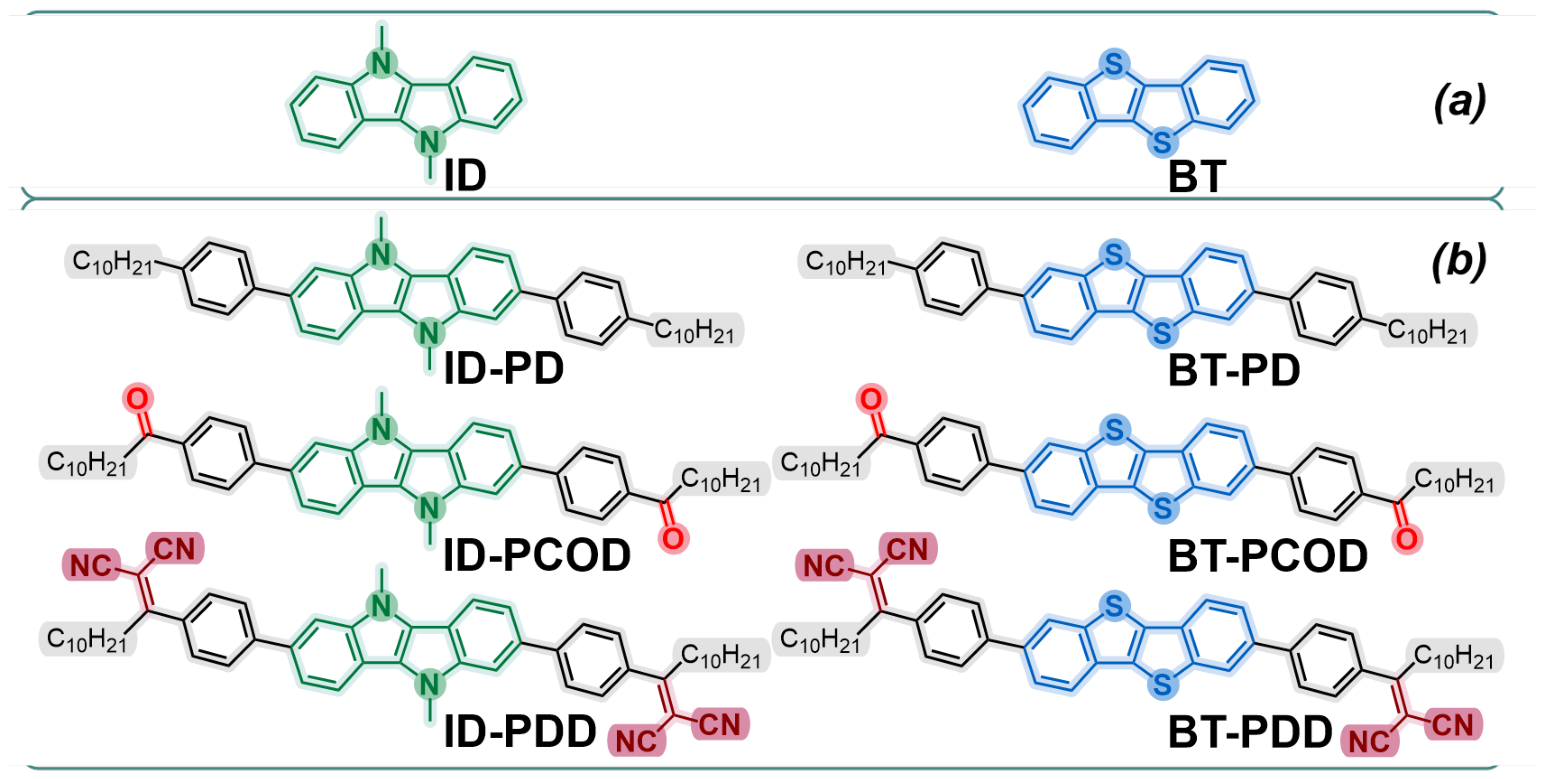
2.1. Synthesis
2.2. Optical Properties
2.2.1. Photophysical Properties in THF Solution

2.2.2. Quantum-Chemical Calculations
2.2.3. Photophysical Properties in Solid State
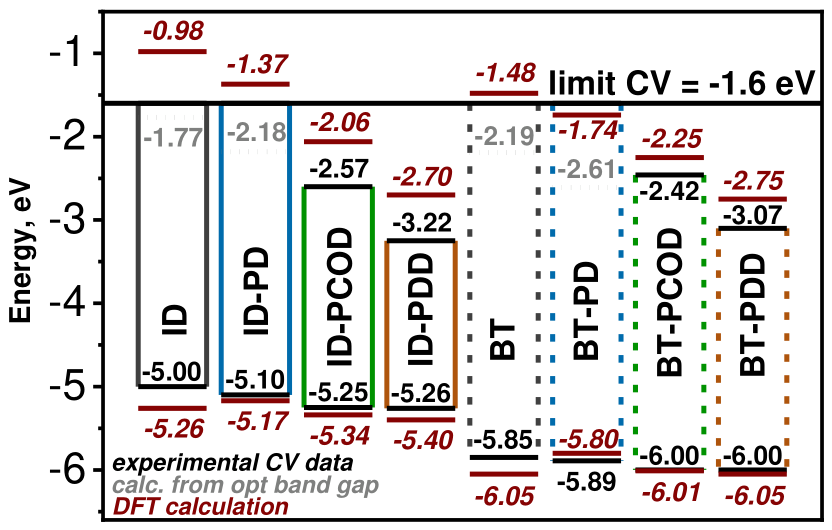
2.3. Electrochemical Properties
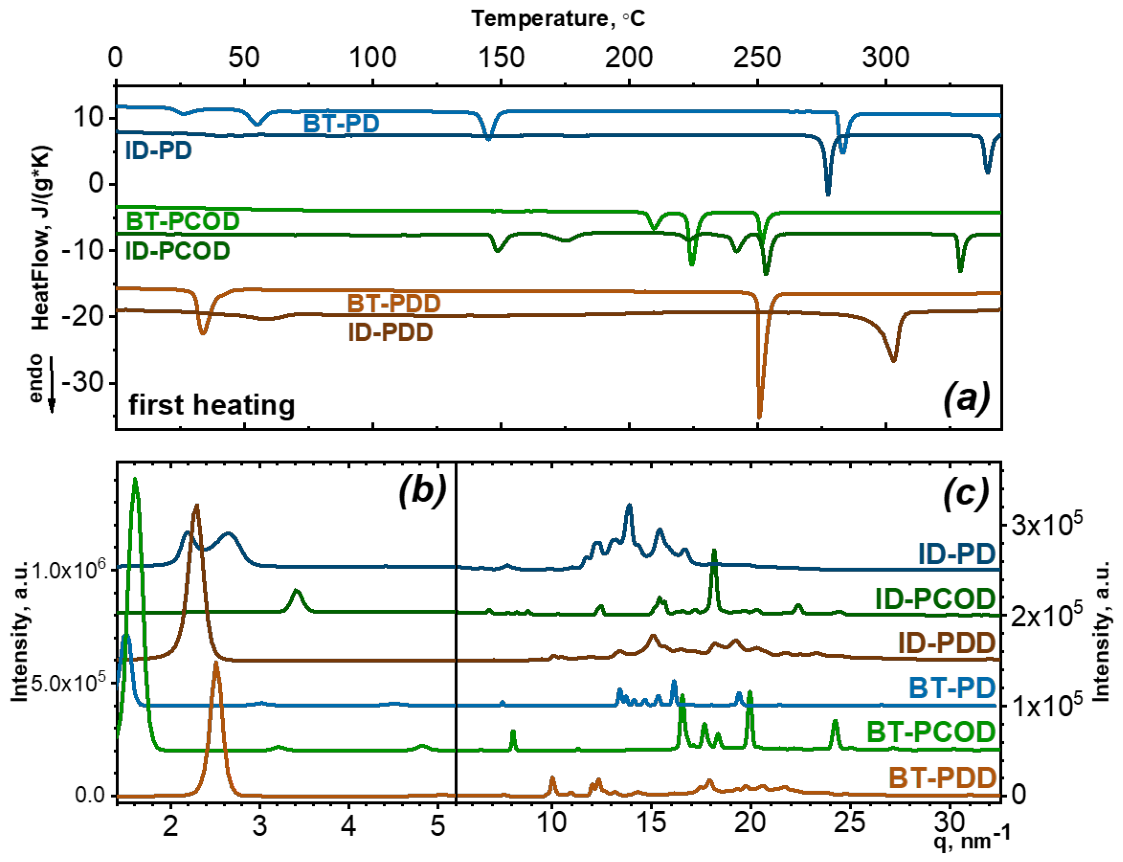
2.4. Solubility and Thermal Properties
2.5. X-Ray Diffraction and Phase Behavior
3. Materials and Methods
3.1. Materials
3.2. Synthetic Procedures
3.3. Methods
3.3.1. NMR Spectra
3.3.2. Elemental Analysis
3.3.3. Mass Spectra
3.3.4. Thermogravimetric Analysis
3.3.5. Differential Scanning Calorimetry
3.3.6. Polarized Optical Microscopy
3.3.7. UV–Vis Spectroscopy
3.3.8. Fluorescence Spectroscopy
3.3.9. Chromatography
3.3.10. Cyclic Voltammetry
3.3.11. Theoretical Calculations
3.3.12. Solubility
3.3.13. X-Ray Diffraction
4. Conclusions
Supplementary Materials
Author Contributions
Funding
Institutional Review Board Statement
Informed Consent Statement
Data Availability Statement
Acknowledgments
Conflicts of Interest
Abbreviations
| A | Acceptor |
| BT | Benzothieno[3,2-b]benzothiophene |
| BT-PCOD | 1,1′-([1]benzothieno[3,2-b][1]benzothiene-2,7-diylbis(4,1-phenylene))bis(undecan-1-one) |
| BT-PD | 2,7-bis(4-decylphenyl)[1]benzothieno[3,2-b][1]benzothiophene |
| BT-PDD | 2,2′-([1]benzothieno[3,2-b][1]benzothiene-2,7-diylbis(4,1-phenyleneundec-1-yl-1-ylidene))dimalononitrile |
| CV | Cyclic voltammetry |
| D | Donor |
| DFT | Density functional theory |
| DSC | Differential scanning calorimetry |
| EWG | Electron-withdrawing group |
| GPC | Gel permeation chromatography |
| HOMO | Highest occupied molecular orbital |
| ID | Indolo[3,2-b]indole |
| ID-PCOD | 1,1′-[(5,10-dimethyl-5,10-dihydroindolo[3,2-b]indole-2,7-diyl)bis(4,1-phenylene)]diundecan-1-one |
| ID-PD | 2,7-bis(4-decylphenyl)-5,10-dimethyl-5,10-dihydroindolo[3,2-b]indole |
| ID-PDD | 2,2′-[(5,10-dimethyl-5,10-dihydroindolo[3,2-b]indole-2,7-diyl)bis(4,1-phenyleneundec-1-yl-1-ylidene)]dimalononitrile |
| IPTMDOB | 2-isopropoxy-4,4,5,5-tetramethyl-1,3,2-dioxaborolane |
| LUMO | Lowest unoccupied molecular orbital |
| MALDI-TOF | Matrix-assisted laser desorption/ionization time-of-flight mass spectrometry |
| OFET | Organic field-effect transistor |
| OLED | Organic light-emitting diode |
| PLQY | Photoluminescence quantum yield |
| POM | Polarized optical microscopy |
| SCE | Saturated calomel electrode |
| SWAXS | Small- and wide-angle X-ray scattering |
| TDDFT | Time-dependent density functional theory |
| TGA | Thermogravimetric analysis |
| THF | Tetrahydrofuran |
| XRD | X-ray diffraction |
References
- Chen, J.; Zhang, W.; Wang, L.; Yu, G. Recent Research Progress of Organic Small-Molecule Semiconductors with High Electron Mobilities. Adv. Mater. 2022, 11, 2210772. [Google Scholar] [CrossRef]
- Bronstein, H.; Nielsen, C.B.; Schroeder, B.C.; McCulloch, I. The role of chemical design in the performance of organic semiconductors. Nat. Rev. Chem. 2020, 4, 66–77. [Google Scholar] [CrossRef]
- Zhao, L.; Li, J.; Li, L.; Hu, W. Recent advances in small-molecule organic fluorescent semiconductors. J. Mater. Chem. C 2024, 12, 13745–13761. [Google Scholar] [CrossRef]
- Kunkel, C.; Margraf, J.T.; Chen, K.; Oberhofer, H.; Reuter, K. Active discovery of organic semiconductors. Nat. Commun. 2021, 12, 2422. [Google Scholar] [CrossRef]
- Ostroverkhova, O. Organic Optoelectronic Materials: Mechanisms and Applications. Chem. Rev. 2016, 116, 13279–13412. [Google Scholar] [CrossRef]
- Sawatzki-Park, M.; Wang, S.-J.; Kleemann, H.; Leo, K. Highly Ordered Small Molecule Organic Semiconductor Thin-Films Enabling Complex, High-Performance Multi-Junction Devices. Chem. Rev. 2023, 123, 8232–8250. [Google Scholar] [CrossRef]
- Klauk, H. Organic thin-film transistors. Chem. Soc. Rev. 2010, 39, 2643–2666. [Google Scholar] [CrossRef] [PubMed]
- Paterson, A.F.; Singh, S.; Fallon, K.J.; Hodsden, T.; Han, Y.; Schroeder, B.C.; Bronstein, H.; Heeney, M.; McCulloch, I.; Anthopoulos, T.D. Recent Progress in High-Mobility Organic Transistors: A Reality Check. Adv. Mater. 2018, 30, 1801079. [Google Scholar] [CrossRef]
- Takimiya, K.; Bulgarevich, K.; Abbas, M.; Horiuchi, S.; Ogaki, T.; Kawabata, K.; Ablat, A. Manipulation” of Crystal Structure by Methylthiolation Enabling Ultrahigh Mobility in a Pyrene-Based Molecular Semiconductor. Adv. Mater. 2021, 33, 2102914. [Google Scholar] [CrossRef] [PubMed]
- Zhang, X.; Dong, H.; Hu, W. Organic Semiconductor Single Crystals for Electronics and Photonics. Adv. Mater. 2018, 30, 1801048. [Google Scholar] [CrossRef] [PubMed]
- Costa, J.C.S.; Taveira, R.J.S.; Lima, C.F.R.A.C.; Mendes, A.; Santos, L.M.N.B.F. Optical band gaps of organic semiconductor materials. Opt. Mater. 2016, 58, 51–60. [Google Scholar] [CrossRef]
- Wang, C.; Dong, H.; Jiang, L.; Hu, W. Organic semiconductor crystals. Chem. Soc. Rev. 2018, 47, 422–500. [Google Scholar] [CrossRef] [PubMed]
- Wang, C.; Hashizume, D.; Nakano, M.; Ogaki, T.; Takenaka, H.; Kawabata, K.; Takimiya, K. “Disrupt and induce” intermolecular interactions to rationally design organic semiconductor crystals: From herringbone to rubrene-like pitched π-stacking. Chem. Sci. 2020, 11, 1573–1580. [Google Scholar] [CrossRef]
- Henson, Z.B.; Müllen, K.; Bazan, G.C. Design strategies for organic semiconductors beyond the molecular formula. Nat. Chem. 2012, 4, 699–704. [Google Scholar] [CrossRef]
- Katz, H.E.; Bao, Z.; Gilat, S.L. Synthetic Chemistry for Ultrapure, Processable, and High-Mobility Organic Transistor Semiconductors. Acc. Chem. Res. 2001, 34, 359–369. [Google Scholar] [CrossRef]
- Coughlin, J.E.; Henson, Z.B.; Welch, G.C.; Bazan, G.C. Design and Synthesis of Molecular Donors for Solution-Processed High-Efficiency Organic Solar Cells. Acc. Chem. Res. 2014, 47, 257–270. [Google Scholar] [CrossRef]
- Wang, L.; Zhu, W. Organic Donor-Acceptor Systems for Photocatalysis. Adv. Sci. 2023, 11, 2307227. [Google Scholar] [CrossRef] [PubMed]
- Sanzone, A.; Mattiello, S.; Garavaglia, G.M.; Calascibetta, A.M.; Ceriani, C.; Sassi, M.; Beverina, L. Efficient synthesis of organic semiconductors by Suzuki-Miyaura coupling in an aromatic micellar medium. Green Chem. 2019, 21, 4400–4405. [Google Scholar] [CrossRef]
- Sun, Y.; Guo, Y.; Liu, Y. Design and synthesis of high performance π-conjugated materials through antiaromaticity and quinoid strategy for organic field-effect transistors. Mater. Sci. Eng. R Rep. 2019, 136, 13–26. [Google Scholar] [CrossRef]
- Takimiya, K.; Shinamura, S.; Osaka, I.; Miyazaki, E. Thienoacene-Based Organic Semiconductors. Adv. Mater. 2011, 23, 347–4370. [Google Scholar] [CrossRef] [PubMed]
- Xie, P.; Liu, T.; Sun, J.; Yang, J. Structures, Properties, and Device Applications for [1]Benzothieno[3,2-b]Benzothiophene Derivatives. Adv. Funct. Mater. 2022, 32, 2200843. [Google Scholar] [CrossRef]
- Yao, C.; Chen, X.; He, Y.; Guo, Y.; Murtazabc, I.; Meng, H. Design and characterization of methoxy modified organic semiconductors based on phenyl[1]benzothieno[3,2-b][1]benzothiophene. RSC Adv. 2017, 7, 5514–5518. [Google Scholar] [CrossRef]
- Bodlos, W.R.; Mattiello, S.; Perinot, A.; Gigli, L.; Demitri, N.; Beverina, L.; Caironi, M.; Resel, R. Cold Crystallization of the Organic n-Type Small Molecule Semiconductor 2-Decyl-7-phenyl-[1]benzothieno[3,2-b][1]benzothiophene S,S,S′,S′-Tetraoxide. Cryst. Growth Des. 2021, 21, 325–332. [Google Scholar] [CrossRef]
- Cho, I.; Jeon, N.J.; Kwon, O.K.; Kim, D.W.; Jung, E.H.; Noh, J.H.; Seo, J.; Seok, S.I.; Park, S.Y. Indolo[3,2-b]indole-based crystalline hole-transporting material for highly efficient perovskite solar cells. Chem. Sci. 2017, 8, 734–741. [Google Scholar] [CrossRef]
- Albano, G.; Sorelli, L.; Biver, T.; Picchi, A.; Aronica, L.A.; Pucci, A. 9H-carbazole and indolo[3,2-b]indole-based fluorophores for potential application in luminescent solar concentrators. Dye. Pigment. 2025, 232, 112458. [Google Scholar] [CrossRef]
- Tang, Q.; Zhang, D.; Wang, S.; Ke, N.; Xu, J.; Yu, J.C.; Miao, Q. A Meaningful Analogue of Pentacene: Charge Transport, Polymorphs, and Electronic Structures of Dihydrodiazapentacene. Chem. Mater. 2009, 21, 1400–1405. [Google Scholar] [CrossRef]
- Paul, D.; John, J. Recent Advances towards the Synthesis and Material Applications of Indoloindoles. Chem. Asian J. 2022, 17, e202200460. [Google Scholar] [CrossRef]
- Trukhanov, V.A.; Poletavkina, L.A.; Dyadishchev, I.V.; Dominskiy, D.I.; Fedorenko, R.S.; Chuyko, I.A.; Peregudova, S.M.; Bakirov, A.V.; Sosorev, A.Y.; Paraschuk, D.Y.; et al. Modulating Charge Transport and Optoelectronic Properties through N-Substitution in Annulated Thiophene–Phenylene Oligomers. J. Mater. Chem. C 2026, 14, 7299–7311. [Google Scholar] [CrossRef]
- Fedorenko, R.S.; Kuevda, A.V.; Trukhanov, V.A.; Konstantinov, V.G.; Sosorev, A.Y.; Sonina, A.A.; Kazantsev, M.S.; Surin, N.M.; Grigorian, S.; Borshchev, O.V.; et al. Luminescent High-Mobility 2D Organic Semiconductor Single Crystals. Adv. Electron. Mater. 2022, 8, 2101281. [Google Scholar] [CrossRef]
- Fedorenko, R.S.; Poletavkina, L.A.; Trukhanov, V.A.; Kuklin, K.N.; Balakirev, D.O.; Dyadishchev, I.V.; Saratovsky, N.S.; Bakirov, A.V.; Ponomarenko, S.A.; Luponosov, Y.N.; et al. Decyloxy-substituted BTBT derivatives for highly efficient and stable thin-film organic (opto)electronic devices. Phys. Chem. Chem. Phys. 2025, 27, 12119–12128. [Google Scholar] [CrossRef] [PubMed]
- Cho, I.; Park, S.K.; Kang, B.; Chung, J.W.; Kim, J.H.; Cho, K.; Park, S.Y. Design, Synthesis, and Versatile Processing of Indolo[3,2-b]indole-Based π-Conjugated Molecules for High-Performance Organic Field-Effect Transistors. Adv. Funct. Mater. 2016, 26, 2966–2973. [Google Scholar] [CrossRef]
- Vyas, V.S.; Gutzler, R.; Nuss, J.; Kernab, K.; Lotsch, B.V. Optical gap in herringbone and π-stacked crystals of [1]benzothieno[3,2-b]benzothiophene and its brominated derivative. CrystEngComm 2014, 16, 7389–7392. [Google Scholar] [CrossRef]
- Kasha, M. Paths of molecular excitation. Radiat. Res. Suppl. 1960, 2, 243–275. [Google Scholar] [CrossRef]
- Nurmukhametov, R.N. The electronic absorption and luminescence spectra of n -hetero-aromatic compounds and their derivatives. Russ. Chem. Rev. 1967, 36, 693–709. [Google Scholar] [CrossRef]
- Gribov, L.A.; Baranov, V.A.; Elyashberg, M.E. Standardless Molecular Spectral Analysis. In Theoretical Foundations; URSS Moscow: Moscow, Russia, 2002. [Google Scholar]
- Svidchenko, E.A.; Tarasenkov, A.N.; Surin, N.M.; Aisin, R.R.; Demchenko, N.V.; Cherkaev, G.V.; Muzafarov, A.M. Kinetics of Direct Photoinduced Addition of Carbosilane Thiols with Bulky Groups to Polyallylcarbosilane. Polym. Sci. Ser. B 2019, 61, 275–285. [Google Scholar] [CrossRef]
- Balakirev, D.O.; Kleymyuk, E.A.; Svidchenko, E.A.; Surin, N.M.; Pisarev, S.A.; Bakirov, A.V.; Isaeva, Y.A.; Khitrov, M.D.; Mannanov, A.L.; Peregudova, S.M.; et al. Star-shaped donor-acceptor arylsilanes as 3D ambipolar materials for optoelectronic and bioelectronic applications. Mater. Chem. Phys. 2026, 354, 132152. [Google Scholar] [CrossRef]
- Demas, J.N.; Crosby, G.A. The Measurement of Photolumineseence Quantum Yields, A Review. J. Phys. Chem. 1971, 75, 991–1024. [Google Scholar] [CrossRef]
- Berlman, I.B. Handbook of Florescence Spectra of Aromatic Molecules, 2nd ed.; eBook; Academic Press: New York, NY, USA; London, UK, 1971; ISBN 9780323161671. [Google Scholar]
- Ponomarenko, S.A.; Rasulova, N.N.; Luponosov, Y.N.; Surin, N.M.; Buzin, M.I.; Leshchiner, I.; Peregudova, S.M.; Muzafarov, A.M. Bithiophenesilane-based Dendronized Polymers: Facile Synthesis and Properties of Novel Highly Branched Organosilicon Macromolecular Structures. Macromolecules 2012, 45, 2014–2024. [Google Scholar] [CrossRef]
- Cardona, C.M.; Li, W.; Kaifer, A.E.; Stockdale, D.; Bazan, G.C. Electrochemical Considerations for Determining Absolute Frontier Orbital Energy Levels of Conjugated Polymers for Solar Cell Applications. Adv. Mater. 2011, 23, 2367–2371. [Google Scholar] [CrossRef]
- Adamo, C.; Barone, V. Toward reliable density functional methods without adjustable parameters: The PBE0 model. J. Chem. Phys. 1999, 10, 6158–6170. [Google Scholar] [CrossRef]
- Schäfer, A.; Horn, H.; Ahlrichs, R. Fully optimized contracted Gaussian basis sets for atoms Li to Kr. J. Chem. Phys. 1992, 97, 2571–2577. [Google Scholar] [CrossRef]
- Grimme, S.; Ehrlich, S.; Goerigk, L. Effect of the damping function in dispersion corrected density functional theory. J. Comput. Chem. 2011, 32, 1456–1465. [Google Scholar] [CrossRef]
- Weigenda, F.; Ahlrichsb, R. Balanced basis sets of split valence, triple zeta valence and quadruple zeta valence quality for H to Rn: Design and assessment of accuracy. Phys. Chem. Chem. Phys. 2005, 7, 3297–3305. [Google Scholar] [CrossRef] [PubMed]
- Neese, F. Software update: The ORCA program system—Version 5.0. WIREs Comput. Mol. Sci. 2022, 12, e1606. [Google Scholar] [CrossRef]
- Neumann, M.A. X-Cell—A Novel Indexing Algorithm for Routine Tasks and Difficult Cases. J. Appl. Cryst. 2003, 36, 356–365. [Google Scholar] [CrossRef]



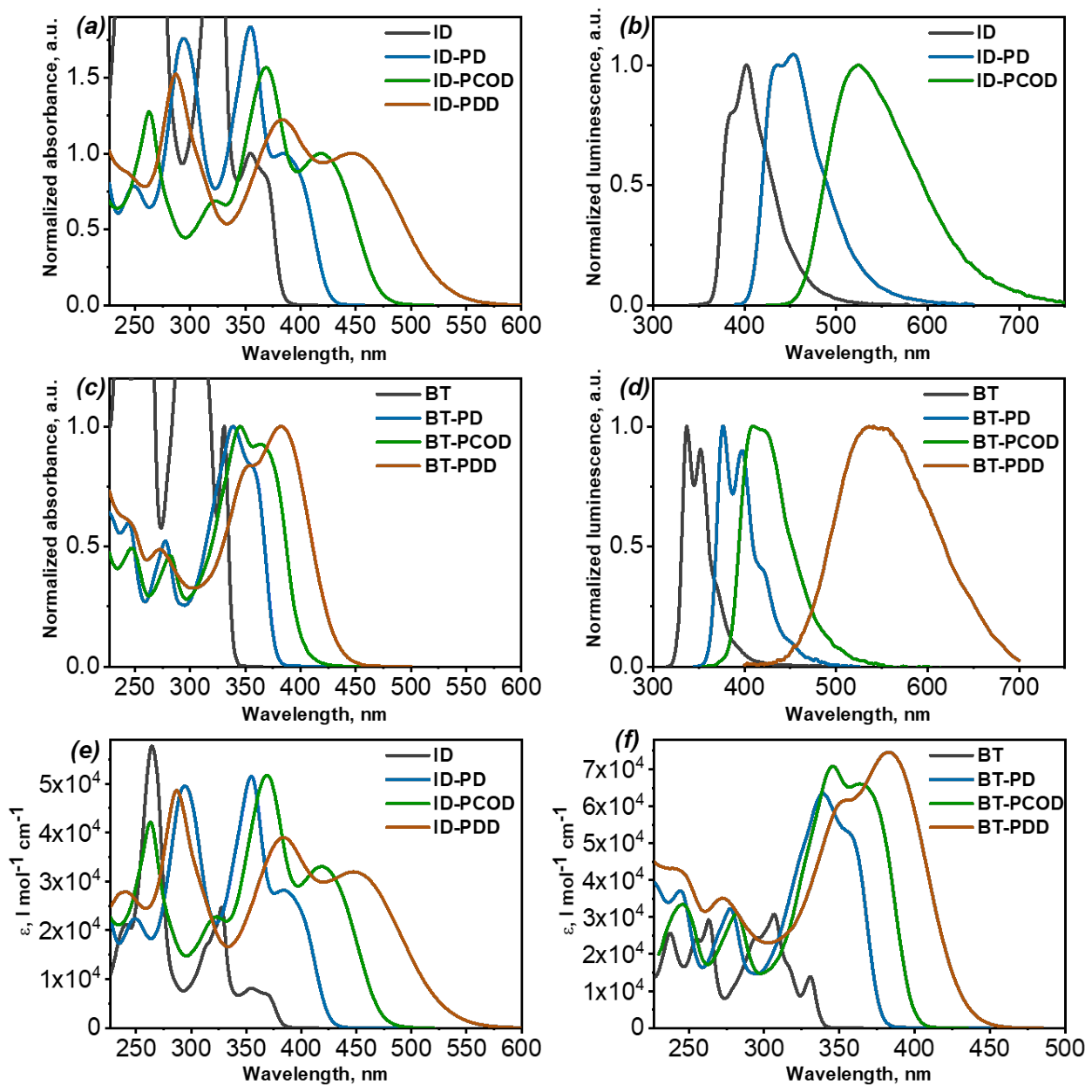
| Compound | THF Solution | Solid State | ||||||
|---|---|---|---|---|---|---|---|---|
| , nm | , nm | υA–υF, cm−1 | ∆v = 0–0, cm−1 | PLQY, % | , nm | , nm | PLQY, % | |
| ID | 370sh, 354, 328, 314sh, 264, 240 | 385sh, 402, 423sh | 1050 | 26,600 | 58 | 385, 367, 334, 321sh, 267 | 444, 456 | 38 |
| ID-PD | 384, 355, 294, 249 | 436, 453, 484sh | 3050 | 24,000 | 76 | 428, 409, 362sh, 351 | 474, 497 | 18 |
| ID-PCOD | 418, 369, 322, 264 | 524 | 4840 | 21,400 | 92 | 483sh, 459, 372, 343sh | 551, 585sh | 56 |
| ID-PDD | 447, 383, 287 | no fluor. | – | – | 0 | 480, 382 | no fluor. | 0 |
| BT | 331, 316sh, 307, 295sh, 263, 255, 238 | 337, 352, 368sh | 540 | 30,000 | 3 | 348, 333, 319sh | 372, 388sh, 419, 444sh | 1 |
| BT-PD | 356sh, 339, 278, 245 | 377, 397, 420sh | 1570 | 27,100 | 38 | 399, 380, 362 | 448, 473, 504, 546sh | 21 |
| BT-PCOD | 363, 345, 282, 247 | 409, 425sh | 3100 | 25,600 | 19 | 422, 405, 382 | 467, 493sh | 4 |
| BT-PDD | 382, 356sh, 274, 242sh | 537 | 7560 | 22,500 | 10 | 402, 368 | 525 | 22 |
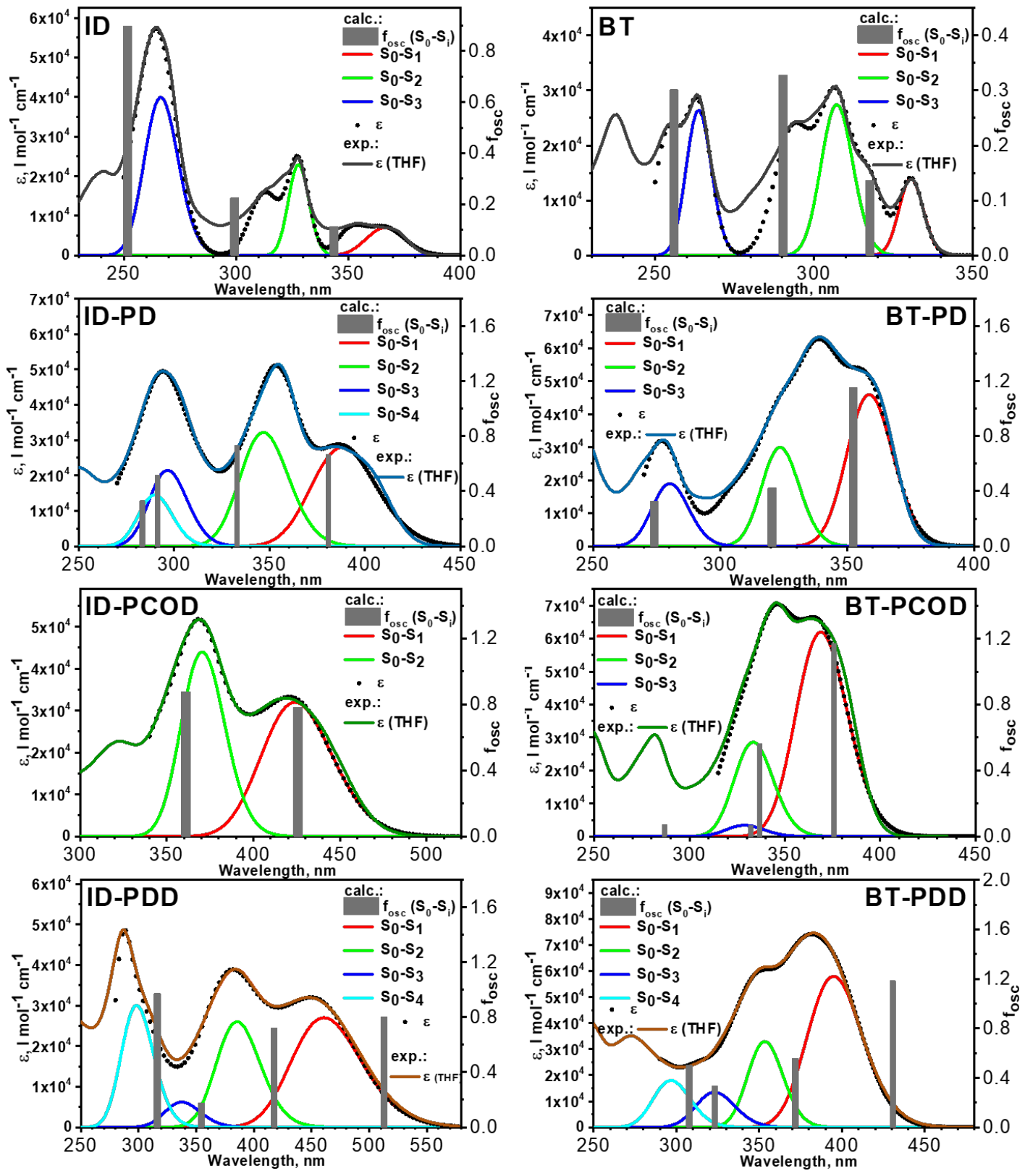
| Compound | Experiment (THF) | Calculated (PBE0) | Calculated | ||||||
|---|---|---|---|---|---|---|---|---|---|
| S0→S1, nm | fosc (e) | fosc (v) | S0→S1, nm | fosc (e) | S1→S0, nm | fosc (Fluor) | kr, ns−1 | knr, ns−1 | |
| ID | 366 | 0.10 | 0.07 | 343.8 | 0.11 | 398.3 | 0.126 | 0.05 | 0.04 |
| 328 | 0.21 | 0.24 | 299.4 | 0.23 | |||||
| 266 | 0.91 | 0.72 | 251.7 | 0.90 | |||||
| ID-PD | 388 | 0.68 | 0.32 | 380.8 | 0.67 | 446.9 | 0.724 | 0.24 | 0.08 |
| 347 | 0.73 | 0.68 | 332.9 | 0.73 | |||||
| 296 | 0.52 | 0.33 | 291.3 | 0.52 | |||||
| 290 | 0.33 | 0.24 | 283.2 | 0.33 | |||||
| ID-PCOD | 424 | 0.77 | 0.18 | 425.8 | 0.78 | 493.2 | 0.818 | 0.22 | 0.02 |
| 370 | 0.86 | 0.60 | 361.1 | 0.88 | |||||
| ID-PDD | 461 | 0.82 | 0.40 | 512.7 | 0.80 | 630.5 | 0.384 | 0.06 | – |
| 385 | 0.71 | 0.46 | 417.7 | 0.72 | |||||
| 337 | 0.18 | 0.15 | 354.2 | 0.18 | |||||
| 298 | 1.00 | 0.51 | 316.2 | 0.97 | |||||
| BT | 331 | 0.10 | 0.10 | 317.6 | 0.14 | 347.7 | 0.169 | 0.09 | 3.01 |
| 307 | 0.31 | 0.36 | 290.3 | 0.34 | |||||
| 264 | 0.32 | 0.31 | 255.9 | 0.30 | |||||
| BT-PD | 359 | 0.70 | 0.87 | 352.3 | 1.16 | 404.9 | 1.515 | 0.62 | 1.01 |
| 324 | 0.45 | 0.43 | 320.4 | 0.42 | |||||
| 280 | 0.37 | 0.33 | 274 | 0.33 | |||||
| BT-PCOD | 369 | 1.31 | 0.71 | 375.8 | 1.17 | 428.1 | 1.501 | 0.55 | 2.33 |
| 333 | 0.56 | 0.29 | 336.7 | 0.56 | |||||
| 329 | 0.07 | – | 332.1 | 0.07 | |||||
| 284 | 0.07 | – | 286.8 | 0.07 | |||||
| BT-PDD | 395 | 1.32 | 0.91 | 430.6 | 1.18 | 487.5 | 1.533 | 0.43 | 3.87 |
| 353 | 0.60 | 0.66 | 371.7 | 0.56 | |||||
| 323 | 0.33 | 0.16 | 323 | 0.33 | |||||
| 297 | 0.49 | 0.29 | 307.6 | 0.50 | |||||
| Compound | Solubility, g/L | Td, °C | |
|---|---|---|---|
| in Air | in Inert | ||
| ID-PD | 12 | 355 | 376 |
| ID-PCOD | 1.2 | 315 | 394 |
| ID-PDD | 28 | 372 | 397 |
| BT-PD | 0.5 | 271 | 385 |
| BT-PCOD | 0.2 | 319 | 421 |
| BT-PDD | 58 | 335 | 391 |
| Compound | T, °C | System | a, Å | b, Å | c, Å | α, deg | β, deg | γ, deg | Volume, Å3 | Rwp | MM | Nmol | ρ, g/cm−3 |
|---|---|---|---|---|---|---|---|---|---|---|---|---|---|
| ID-PD | 25 | Triclinic | 10.5 | 17.7 | 22.3 | 71.0 | 82.3 | 80.6 | 3815 | - | 667 | 4 | 1.162 |
| ID-PCOD | 25 | Triclinic | 29.0 | 11.4 | 11.6 | 87.7 | 116.8 | 96.3 | 3380 | 7.2 | 723 | 3 | 1.066 |
| 170 | Monoclinic | 51.1 | 5.28 | 41.3 | 90 | 113.3 | 90 | 10495 | 12.7 | 723 | 10 | 1.144 | |
| 180 | Triclinic | 39.3 | 17.1 | 5.36 | 92.0 | 100.8 | 92.2 | 3538 | 8.7 | 723 | 3 | 1.018 | |
| 210 | Monoclinic | 49.8 | 5.13 | 33.3 | 90 | 113.0 | 90 | 7831 | 16.8 | 723 | 7 | 1.074 | |
| ID-PDD | 25 | Hexagonal | 38.3 | 10.5 | 10.5 | 120 | 90 | 90 | 3665 | 4.5 | 819 | 3 | 1.113 |
| 250 | Triclinic | 38.0 | 15.5 | 6.9 | 88.9 | 98.6 | 114 | 3634 | 10.1 | 819 | 3 | 1.123 | |
| BT-PD | 25 | Monoclinic | 41.8 | 9.4 | 11.4 | 90 | 85.2 | 90 | 4447 | 9.5 | 673 | 4 | 1.006 |
| 70 | Monoclinic | 41.7 | 9.5 | 6.6 | 98.6 | 90 | 90 | 2584 | 9.8 | 673 | 2 | 0.865 | |
| 250 | Monoclinic | 40.2 | 5.0 | 10.4 | 90 | 98.5 | 90 | 2078 | 8.7 | 673 | 2 | 1.076 | |
| BT-PCOD | 25 | Monoclinic | 55.0 | 9.4 | 9.1 | 108.5 | 90 | 90 | 4426 | 8.0 | 729 | 4 | 1.094 |
| 220 | Monoclinic | 44.8 | 11.7 | 9.0 | 105.9 | 90 | 90 | 4557 | 4.2 | 729 | 4 | 1.063 | |
| 230 | Monoclinic | 41.4 | 5.94 | 21.1 | 90 | 99.8 | 90 | 5109 | 7.5 | 729 | 4 | 0.948 | |
| BT-PDD | 25 | Triclinic | 37.8 | 9.1 | 8.3 | 111.3 | 88.2 | 110.8 | 2497 | 10.0 | 825 | 2 | 1.098 |
| 220 | Monoclinic | 32.8 | 6.0 | 27.1 | 90 | 102.3 | 90 | 5248 | 6.7 | 825 | 4 | 1.045 |
Disclaimer/Publisher’s Note: The statements, opinions and data contained in all publications are solely those of the individual author(s) and contributor(s) and not of MDPI and/or the editor(s). MDPI and/or the editor(s) disclaim responsibility for any injury to people or property resulting from any ideas, methods, instructions or products referred to in the content. |
© 2026 by the authors. Licensee MDPI, Basel, Switzerland. This article is an open access article distributed under the terms and conditions of the Creative Commons Attribution (CC BY) license.
Share and Cite
Poletavkina, L.A.; Dyadishchev, I.V.; Bakirov, A.V.; Svidchenko, E.A.; Surin, N.M.; Dubinets, N.O.; Balakirev, D.O.; Peregudova, S.M.; Cherkaev, G.V.; Chuyko, I.A.; et al. Donor-Acceptor Derivatives of Indolo[3,2-b]indole and Benzothieno[3,2-b]benzothiophene: Similar Annulated Structures but Divergent Properties. Molecules 2026, 31, 2046. https://doi.org/10.3390/molecules31122046
Poletavkina LA, Dyadishchev IV, Bakirov AV, Svidchenko EA, Surin NM, Dubinets NO, Balakirev DO, Peregudova SM, Cherkaev GV, Chuyko IA, et al. Donor-Acceptor Derivatives of Indolo[3,2-b]indole and Benzothieno[3,2-b]benzothiophene: Similar Annulated Structures but Divergent Properties. Molecules. 2026; 31(12):2046. https://doi.org/10.3390/molecules31122046
Chicago/Turabian StylePoletavkina, Liya A., Ivan V. Dyadishchev, Artem V. Bakirov, Evgenia A. Svidchenko, Nikolay M. Surin, Nikita O. Dubinets, Dmitry O. Balakirev, Svetlana M. Peregudova, George V. Cherkaev, Irina A. Chuyko, and et al. 2026. "Donor-Acceptor Derivatives of Indolo[3,2-b]indole and Benzothieno[3,2-b]benzothiophene: Similar Annulated Structures but Divergent Properties" Molecules 31, no. 12: 2046. https://doi.org/10.3390/molecules31122046
APA StylePoletavkina, L. A., Dyadishchev, I. V., Bakirov, A. V., Svidchenko, E. A., Surin, N. M., Dubinets, N. O., Balakirev, D. O., Peregudova, S. M., Cherkaev, G. V., Chuyko, I. A., Chvalun, S. N., & Luponosov, Y. N. (2026). Donor-Acceptor Derivatives of Indolo[3,2-b]indole and Benzothieno[3,2-b]benzothiophene: Similar Annulated Structures but Divergent Properties. Molecules, 31(12), 2046. https://doi.org/10.3390/molecules31122046