Purification-Driven Modulation of Polyphenol Profile and Protein Glycation-Inhibitory Potential of Actinidia arguta and Actinidia kolomikta Fruit Extracts

 ,
,  ,
,  and
and
Abstract
1. Introduction
2. Result and Discussion
2.1. Polyphenol Profiling
2.2. Anti-AGEs Potential
2.3. Antioxidant Potential
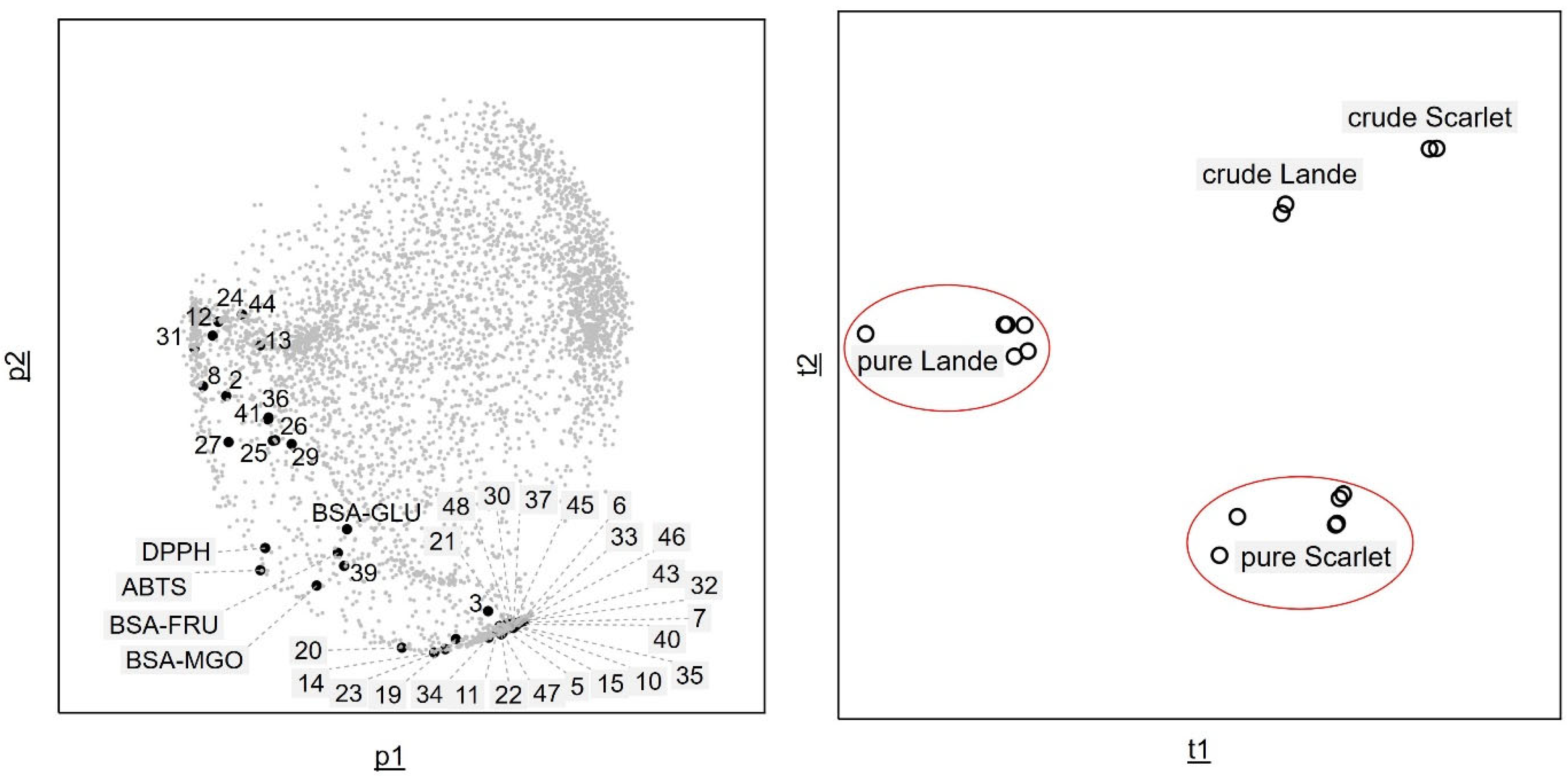
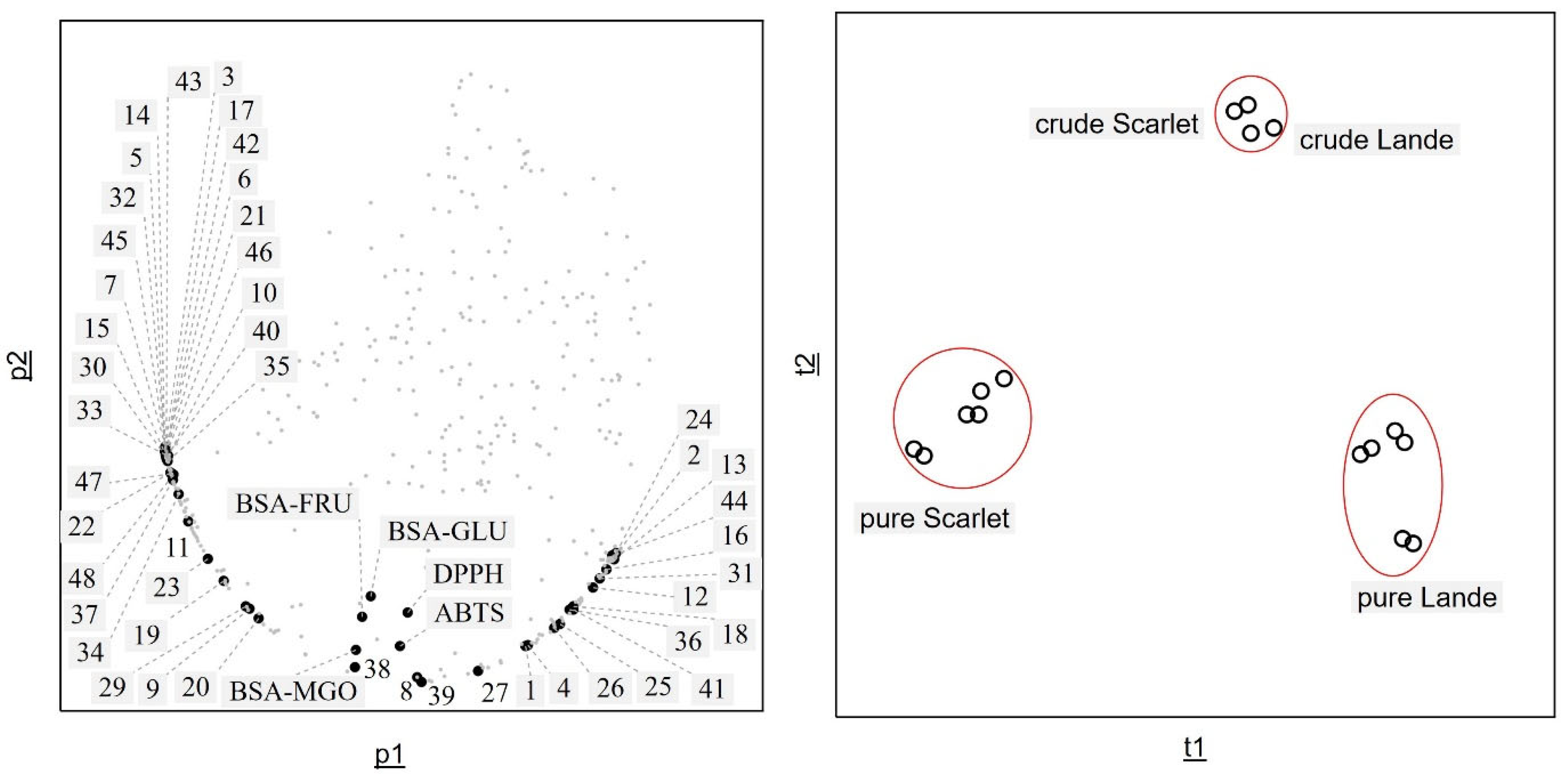
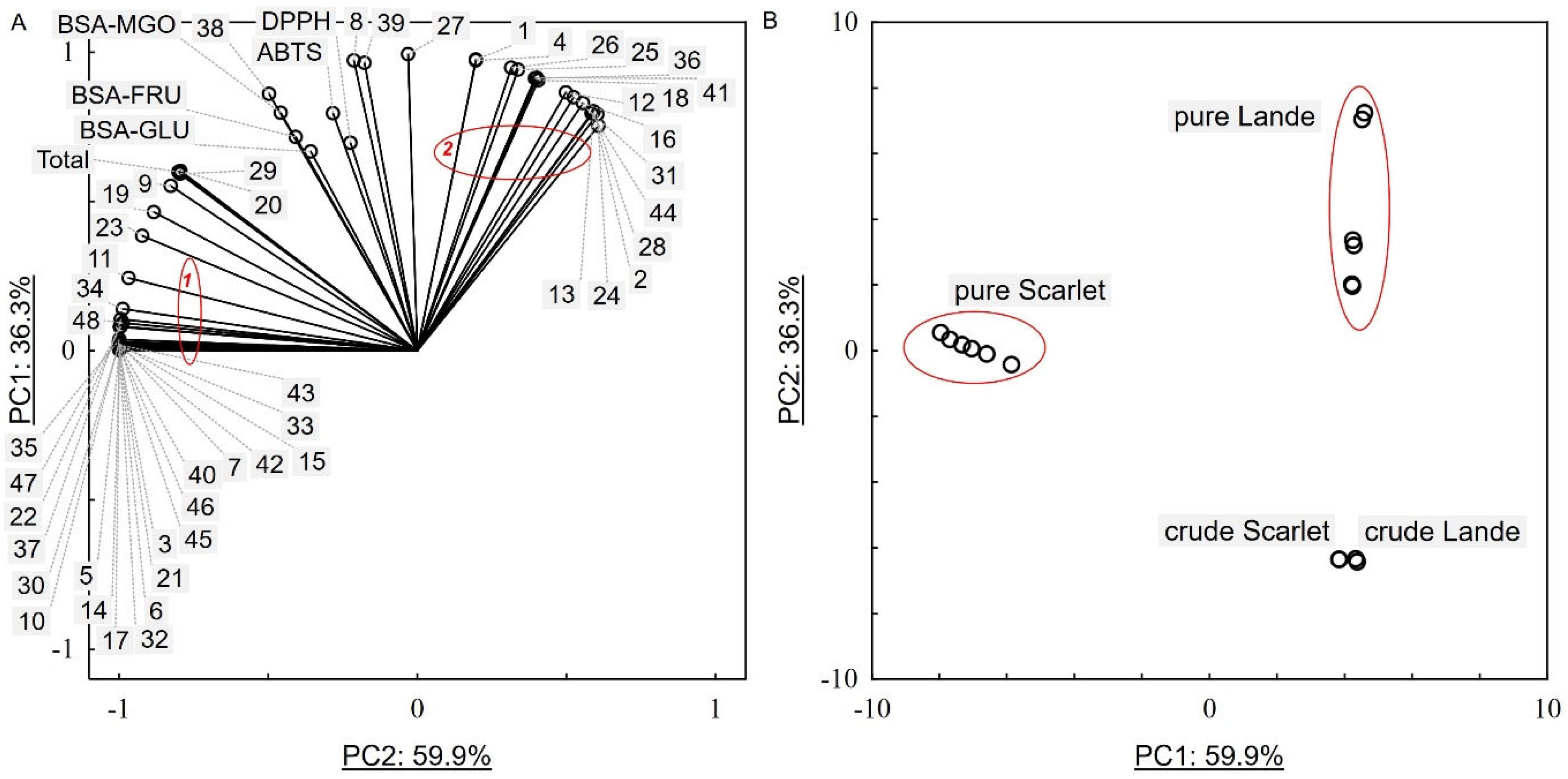
2.4. Statistical Analysis of Experimental Results
3. Materials and Methods
3.1. Chemicals and Reagents
3.2. Actinidia Fruit
Fruit Sample Preparation
3.3. Polyphenol Extraction
3.3.1. Crude Extract
3.3.2. Crude Extract Purification
3.4. LC-MS Analysis
3.4.1. Sample Preparation
3.4.2. RP-UHPLC-ESI-QTOFMS Analysis
3.4.3. Identification of Phenolic Compounds
3.5. Anti-AGEs Assay In Vitro
3.5.1. BSA-GLU Assay
3.5.2. BSA-MGO Assay
3.5.3. BSA-FRU Assay
3.6. Antioxidant Capacity
3.6.1. ABTS Assay
3.6.2. DPPH Assay
3.7. Statistical Analysis
4. Conclusions
Supplementary Materials
Author Contributions
Funding
Institutional Review Board Statement
Informed Consent Statement
Data Availability Statement
Conflicts of Interest
References
- Macedo, C.; Silva, A.M.; Ferreira, A.S.; de la Luz Cádiz-Gurrea, M.; Fernández-Ochoa, Á.; Segura-Carretero, A.; Delerue-Matos, C.; Costa, P.; Rodrigues, F. Insights into the polyphenols extraction from Actinidia arguta fruit (kiwiberry): A source of pro-healthy compounds. Sci. Hortic. 2023, 313, 111910. [Google Scholar] [CrossRef]
- Sawicki, T.; Błaszczak, W.; Latocha, P. In vitro anticholinergic and antiglycaemic properties of frost-hardy Actinidia fruit extracts and their polyphenol profile, L-ascorbic acid content and antioxidant capacity. Food Res. Int. 2023, 173, 113324. [Google Scholar] [CrossRef]
- Česonienė, L.; Štreimikytė, P.; Liaudanskas, M.; Žvikas, V.; Viškelis, P.; Viškelis, J.; Daubaras, R. Berries and leaves of Actinidia kolomikta (Rupr. & Maxim.) Maxim.: A source of phenolic compounds. Plants 2022, 11, 147. [Google Scholar] [CrossRef] [PubMed]
- Wojdyło, A.; Nowicka, P. Anticholinergic effects of Actinidia arguta fruits and their polyphenol content determined by liquid chromatography-photodiode array detector-quadrupole/time of flight-mass spectrometry (LC-MS-PDA-Q/TOF). Food Chem. 2019, 271, 216–223. [Google Scholar] [CrossRef] [PubMed]
- Česonienė, L.; Januškevičė, V.; Saunoriūtė, S.; Liaudanskas, M.; Žvikas, V.; Krikštolaitis, R.; Viškelis, P.; Urbonavičienė, D.; Martusevičė, P.; Zych, M.; et al. Phenolic compounds in berries of winter-resistant Actinidia arguta Miq. and Actinidia kolomikta Maxim: Evidence of antioxidative activity. Antioxidants 2024, 13, 372. [Google Scholar] [CrossRef] [PubMed]
- Macedo, C.; Costa, C.P.; Rodrigues, F. Bioactive compounds from Actinidia arguta fruit as a new strategy to fight glioblastoma. Food Res. Int. 2024, 175, 113770. [Google Scholar] [CrossRef] [PubMed]
- D’Cunha, N.M.; Sergi, D.; Lane, M.M.; Naumovski, N.; Gamage, E.; Rajendran, A.; Kouvari, M.; Gauci, S.; Dissanayka, T.; Marx, W.; et al. Review: The effects of dietary advanced glycation end-products on neurocognitive and mental disorders. Nutrients 2022, 14, 2421. [Google Scholar] [CrossRef]
- Semchyshyn, H. Fructose-mediated AGE-RAGE axis: Approaches for mild modulation. Front. Nutr. 2024, 11, 1500375. [Google Scholar] [CrossRef]
- Rungratanawanich, W.; Qu, Y.; Wang, X.; Essa, M.M.; Song, B.-J. Review: Advanced glycation end products (AGEs) and other adducts in aging-related diseases and alcohol-mediated tissue injury. Exp. Mol. Med. 2021, 53, 168–188. [Google Scholar] [CrossRef]
- Chinchansure, A.A.; Korwar, A.M.; Kulkarni, M.J.; Joshi, S.P. Recent development of plant products with anti-glycation activity: A review. RSC Adv. 2015, 5, 31113–31138. [Google Scholar] [CrossRef]
- de Bari, L.; Scirè, A.; Minnelli, C.; Cianfruglia, L.; Kalapos, M.P.; Armeni, T. Interplay among oxidative stress, methylglyoxal pathway and S-glutathionylation. Antioxidants 2021, 10, 19. [Google Scholar] [CrossRef]
- Zhou, Q.; Cheng, K.W.; Gong, J.; Li, E.T.S.; Wang, M. Apigenin and its methylglyoxal-adduct inhibit advanced glycation end products-induced oxidative stress and inflammation in endothelial cells. Biochem. Pharmacol. 2019, 166, 231–241. [Google Scholar] [CrossRef]
- Cortés-Ferré, H.E.; Arredondo-Ochoa, T.; Gaytán-Martínez, M. Polysaccharides-polyphenolic interactions: Formation, functionality and applications. Trends Food Sci. Technol. 2025, 163, 105117. [Google Scholar] [CrossRef]
- Zou, Z.; Chen, X.; Gao, Y.; Theppawong, A.; Liu, Y.; Sangsawad, P.; Bunyameen, N.; Deng, S.; Kraithong, S.; Gao, J. Recent insights into functional, structural, and digestibility modifications of starch through complexation with polyphenols: A review. Food Chem. 2025, 425, 144162. [Google Scholar] [CrossRef]
- Szawara-Nowak, D.; Koutsidis, G.; Wiczkowski, W.; Zieliński, H. Evaluation of the in vitro inhibitory effects of buckwheat enhanced wheat bread extracts on the formation of advanced glycation end-products (AGEs). LWT Food Sci. Technol. 2014, 58, 327–334. [Google Scholar] [CrossRef]
- Shen, Y.; Xu, Z.; Sheng, Z. Ability of resveratrol to inhibit advanced glycation end product formation and carbohydrate-hydrolysing enzyme activity, and to conjugate methylglyoxal. Food Chem. 2017, 216, 153–160. [Google Scholar] [CrossRef] [PubMed]
- Qiao, J.; Guo, L.; Yang, J.; Gao, R.; Ni, Y.; Huo, J.; Huang, D.; Sui, X.; Zhang, Y. Unveiling the polyphenol profile and bioactive potential of kiwi berry (Actinidia arguta): Antioxidant capacity and enzyme inhibition activities. Food Chem. 2025, 471, 142839. [Google Scholar] [CrossRef]
- Błaszczak, W.; Jeż, M.; Szwengiel, A. Polyphenols and inhibitory effects of crude and purified extracts from tomato varieties on the formation of advanced glycation end products and the activity of angiotensin-converting and acetylcholinesterase enzymes. Food Chem. 2020, 314, 126181. [Google Scholar] [CrossRef]
- Zhao, W.; Cai, P.; Zhang, N.; Wu, T.; Sun, A.; Jia, G. Inhibitory effects of polyphenols from black chokeberry on advanced glycation end-products (AGEs) formation. Food Chem. 2022, 392, 133295. [Google Scholar] [CrossRef]
- Justino, A.B.; Franco, R.R.; Silva, H.C.G.; Saraiva, A.L.; Sousa, R.M.F.; Espindola, F.S. B procyanidins of Annona crassiflora fruit peel inhibited glycation, lipid peroxidation and protein-bound carbonyls, with protective effects on glycated catalase. Sci. Rep. 2019, 9, 19183. [Google Scholar] [CrossRef] [PubMed]
- Dołowacka-Jóźwiak, A.; Matkowski, A.; Nawrot-Hadzik, I. Antiglycoxidative properties of extracts and fractions from Reynoutria rhizomes. Nutrients 2021, 13, 4066. [Google Scholar] [CrossRef]
- Deo, P.; Hewawasam, E.; Karakoulakis, A.; Claudie, D.J.; Nelson, R.; Simpson, B.S.; Smith, N.M.; Semple, S.J. In vitro inhibitory activities of selected Australian medicinal plant extracts against protein glycation, angiotensin converting enzyme (ACE) and digestive enzymes linked to type II diabetes. BMC Complement. Altern. Med. 2016, 16, 435. [Google Scholar] [CrossRef] [PubMed]
- Błaszczak, W.; Latocha, P.; Jeż, M.; Wiczkowski, W. The impact of high-pressure processing on the polyphenol profile and antiglycaemic, anti-hypertensive and anti-cholinergic activities of extracts obtained from kiwiberry (Actinidia arguta) fruits. Food Chem. 2021, 343, 128421. [Google Scholar] [CrossRef] [PubMed]
- Zeng, Y.; Song, J.; Zhang, M.; Wang, H.; Zhang, Y.; Suo, H. Comparison of in vitro and in vivo antioxidant activities of six flavonoids with similar structures. Antioxidants 2020, 9, 732. [Google Scholar] [CrossRef]
- ISO 750:1981; Fruit and Vegetable Products—Determination of Titratable Acidity. International Organization for Standardization (ISO): Geneva, Switzerland, 1981.
- ISO 2173:2003; Fruit and Vegetable Products—Determination of Soluble Solids—Refractometric Method. International Organization for Standardization (ISO): Geneva, Switzerland, 2003.
- Sanchez-Gonzalez, N.; Jaime-Fonseca, M.R.; San Martin-Martinez, E.; Zepeda, L.G. Extraction, stability, and separation of betalains from Opuntia joconostle cv. using response surface methodology. J. Agric. Food Chem. 2013, 61, 11995–12004. [Google Scholar] [CrossRef] [PubMed]
- Anouar, E.H.; Gierschner, J.; Duroux, J.L.; Trouillas, P. UV/Visible spectra of natural polyphenols: A time-dependent density functional theory study. Food Chem. 2012, 131, 79–89. [Google Scholar] [CrossRef]
- Mildner-Szkudlarz, S.; Siger, A.; Szwengiel, A.; Bajerska, J. Natural compounds from grape by-products enhance nutritive value and reduce formation of CML in model muffins. Food Chem. 2015, 172, 78–85. [Google Scholar] [CrossRef]
- Shen, H.; Dührkop, K.; Böcker, S.; Rousu, J. Metabolite identification through multiple kernel learning on fragmentation trees. Bioinformatics 2014, 30, i157–i164. [Google Scholar] [CrossRef]
- Dührkop, K.; Shen, H.; Meusel, M.; Rousu, J.; Böcker, S. Searching molecular structure databases with tandem mass spectra using CSI:FingerID. Proc. Natl. Acad. Sci. USA 2015, 112, 12580–12585. [Google Scholar] [CrossRef]
- Dührkop, K.; Fleischauer, M.; Ludwig, M.; Aksenov, A.A.; Melnik, A.V.; Meusel, M.; Dorrestein, P.C.; Rousu, J.; Böcker, S. SIRIUS 4: Turning tandem mass spectra into metabolite structure information. Nat. Methods 2019, 16, 299–302. [Google Scholar] [CrossRef]
- Dührkop, K.; Nothias, L.-F.; Fleischauer, M.; Reher, R.; Ludwig, M.; Hoffmann, M.A.; Petras, D.; Gerwick, W.H.; Rousu, J.; Dorrestein, P.C.; et al. Systematic classification of unknown metabolites using high-resolution fragmentation mass spectra. Nat. Biotechnol. 2020, 39, 462–471. [Google Scholar] [CrossRef]
- Djoumbou, F.Y.; Eisner, R.; Knox, C.; Chepelev, L.; Hastings, J.; Owen, G.; Fahy, E.; Steinbeck, C.; Subramanian, S.; Bolton, E.; et al. ClassyFire: Automated chemical classification with a comprehensive, computable taxonomy. J. Cheminform. 2016, 8, 61. [Google Scholar] [CrossRef]
- Horszwald, A.; Andlauer, W. Characterisation of bioactive compounds in berry juices by traditional photometric and modern microplate methods. J. Berry Res. 2011, 1, 189–199. [Google Scholar] [CrossRef]
- R Core Team. R: A Language and Environment for Statistical Computing; R Foundation for Statistical Computing: Vienna, Austria, 2025; Available online: https://www.R-project.org/ (accessed on 6 May 2026).
- Kolde, R. Pretty Heatmaps, R package version 1.0.12; R Foundation for Statistical Computing: Vienna, Austria, 2019. Available online: https://CRAN.R-project.org/package=pheatmap (accessed on 6 May 2026).



| Classes of Chemical Compounds (ClassyFire, Level 5) | Skarlet | Lande | ||
|---|---|---|---|---|
| Crude | Purified | Crude | Purified | |
| Flavonoid-O-glycosides | 12 | 16 | 6 | 8 |
| Phenolic glycosides | 4 | 5 | 6 | 6 |
| Biflavonoids and polyflavonoids | 3 | 8 | 3 | 6 |
| Coumaric acids and derivatives | 1 | 4 | 1 | 4 |
| Cyclic alcohols and derivatives | 2 | 2 | 1 | 2 |
| Catechins | 2 | 2 | 1 | 1 |
| Flavan-3-ols | 2 | 2 | 1 | 1 |
| Hydroxycinnamic acid glycosides | 1 | 2 | 1 | 1 |
| Flavonols | 1 | 1 | 1 | 1 |
| Hydroxybenzoic acid derivatives | 0 | 1 | 0 | 2 |
| Hydroxyflavonoids | 0 | 1 | 0 | 1 |
| No. | Compounds | Scarlet | Lande | * Lande1 | Lande2 | Lande3 | Scarlet1 | Scarlet2 | Scarlet3 |
|---|---|---|---|---|---|---|---|---|---|
| Crude Extract | Purified Extract | ||||||||
| 1. | Salicylic acid glucoside | 0.91 ± 0.03 | 2.98 ± 0.23 | 8.72 ± 0.05 | 4.55 ± 0.05 | 6.13 ± 0.26 | 2.59 ± 0.12 | 2.73 ± 0.08 | 2.83 ± 0.24 |
| 2. | Caffeic acid glucoside | <LOD | 27.16 ± 0.93 | 123.96 ± 2.06 | 68.14 ± 0.02 | 74.38 ± 1.28 | <LOD | <LOD | <LOD |
| 3. | Quercetin vicianoside | 5.96 ± 0.09 | <LOD | <LOD | <LOD | <LOD | 11.31 ± 0.10 | 10.71 ± 0.24 | 12.65 ± 0.23 |
| 4. | Dihydroxybenzoate glucoside | 1.27 ± 0.03 | 3.55 ± 0.07 | 11.44 ± 0.65 | 6.18 ± 0.07 | 7.22 ± 0.27 | 3.52 ± 0.01 | 3.61 ± 0.18 | 3.34 ± 0.04 |
| 5. | Gallocatechin | 2.33 ± 0.15 | <LOD | <LOD | <LOD | <LOD | 5.90 ± 0.19 | 5.84 ± 0.02 | 6.46 ± 0.08 |
| 6. | Proanthocyanidin | 2.81 ± 0.06 | <LOD | <LOD | <LOD | <LOD | 7.69 ± 0.6 | 9.14 ± 0.12 | 8.99 ± 0.41 |
| 7. | Flavonoid glycoside (Coumaric acid glycoside) | <LOD | <LOD | <LOD | <LOD | <LOD | 3.41 ± 0.01 | 3.82 ± 0.06 | 3.34 ± 0.24 |
| 8. | Coumaric acid glucoside | 2.36 ± 0.06 | 3.71 ± 0.33 | 13.39 ± 0.08 | 7.48 ± 0.21 | 9.22 ± 0.41 | 6.62 ± 0.60 | 7.44 ± 0.25 | 8.13 ± 0.23 |
| 9. | 3.4-dihydroxybenzoic acid | <LOD | <LOD | 1.04 ± 0.04 | 0.66 ± 0.03 | 0.80 ± 0.01 | 1.48 ± 0.09 | 1.40 ± 0.02 | 1.46 ± 0.02 |
| 10. | Neochlorogenic acid/Cryptochlorogenic acid | 41.90 ± 2.09 | <LOD | 6.09 ± 0.22 | 3.51 ± 0.21 | 4.01 ± 0.10 | 253.68 ± 13.11 | 282.84 ± 12.17 | 303.68 ± 0.05 |
| 11. | Flavonoid (Taxifolin glucoside) | <LOD | <LOD | 1.67 ± 0.08 | 1.01 ± 0.07 | 1.23 ± 0.03 | 4.57 ± 0.22 | 5.23 ± 0.48 | 5.57 ± 0.15 |
| 12. | Fraxin/Isofraxoside | <LOD | 2.06 ± 0.17 | 7.60 ± 0.41 | 4.29 ± 0.12 | 5.08 ± 0.11 | 0.69 ± 0.00 | 0.76 ± 0.01 | 0.77 ± 0.01 |
| 13. | Caffeic acid glucoside | 4.02 ± 0.33 | 294.52 ± 4.78 | 685.30 ± 10.68 | 509.16 ± 7.53 | 544.55 ± 30.13 | 22.40 ± 0.88 | 25.42 ± 0.61 | 28.36 ± 0.34 |
| 14. | Epigallocatechin | 3.75 ± 0.36 | <LOD | <LOD | <LOD | <LOD | 8.58 ± 0.06 | 8.39 ± 0.52 | 9.20 ± 0.01 |
| 15. | Proanthocyanidin | <LOD | <LOD | <LOD | <LOD | <LOD | 8.67 ± 0.60 | 8.97 ± 0.17 | 10.53 ± 0.02 |
| 16. | Sinapoulhexoside | <LOD | 8.19 ± 0.00 | 37.00 ± 0.28 | 21.01 ± 0.51 | 24.73 ± 0.22 | 1.34 ± 0.09 | 1.42 ± 0.02 | 2.06 ± 0.01 |
| 17. | Feruloyl hexoside | 6.47 ± 0.36 | <LOD | <LOD | <LOD | <LOD | 20.69 ± 1.82 | 24.43 ± 0.16 | 25.64 ± 0.84 |
| 18. | Coumaric acid glucoside | <LOD | 2.55 ± 0.13 | 13.42 ± 0.04 | 6.68 ± 0.00 | 8.27 ± 0.21 | 1.93 ± 0.15 | 1.92 ± 0.02 | 2.27 ± 0.03 |
| 19. | Procyanidin | 24.19 ± 2.30 | 15.92 ± 0.60 | 116.77 ± 1.73 | 58.26 ± 0.38 | 72.40 ± 1.60 | 162.85 ± 2.89 | 176.34 ± 3.28 | 187.23 ± 6.93 |
| 20. | Flavonoid | <LOD | <LOD | 1.80 ± 0.00 | 1.14 ± 0.01 | 1.29 ± 0.07 | 2.02 ± 0.12 | 2.41 ± 0.02 | 2.33 ± 0.21 |
| 21. | Feruloylquinic acid | 4.63 ± 0.36 | <LOD | <LOD | <LOD | <LOD | 13.31 ± 0.22 | 13.95 ± 0.03 | 15.84 ± 0.01 |
| 22. | Coumaroyl quinic acid | 3.45 ± 0.06 | <LOD | 1.37 ± 0.00 | 0.84 ± 0.08 | 0.81 ± 0.08 | 10.78 ± 0.76 | 12.43 ± 0.47 | 13.16 ± 0.21 |
| 23. | Catechin | 22.07 ± 1.36 | 12.27 ± 0.96 | 61.45 ± 0.39 | 33.99 ± 1.08 | 40.82 ± 0.19 | 100.87 ± 8.73 | 115.96 ± 1.80 | 121.90 ± 3.82 |
| 24. | Chlorogenic acid | <LOD | 25.60 ± 0.10 | 51.94 ± 0.02 | 28.27 ± 0.74 | 31.99 ± 0.48 | <LOD | <LOD | <LOD |
| 25. | Epicatechin | 24.03 ± 0.24 | 127.41 ± 1.39 | 614.42 ± 12.69 | 384.16 ± 6.07 | 443.64 ± 8.68 | 125.74 ± 10.09 | 145.29 ± 2.10 | 155.97 ± 1.22 |
| 26. | Procyanidin B2 | 29.87 ± 0.82 | 97.93 ± 7.23 | 731.23 ± 14.76 | 413.33 ± 3.46 | 483.17 ± 0.48 | 150.92 ± 10.41 | 169.74 ± 3.86 | 183.45 ± 4.08 |
| 27. | Proanthocyanidin | <LOD | <LOD | 2.15 ± 0.12 | 1.48 ± 0.11 | 1.57 ± 0.14 | 1.00 ± 0.05 | 1.04 ± 0.01 | 1.00 ± 0.06 |
| 28. | 4-hydroxybenzoic acid | <LOD | <LOD | 1.02 ± 0.00 | 0.88 ± 0.01 | 1.14 ± 0.01 | <LOD | <LOD | <LOD |
| 29. | Caffeic acid | <LOD | <LOD | 0.46 ± 0.00 | 0.22 ± 0.00 | 0.28 ± 0.02 | 0.48 ± 0.01 | 0.54 ± 0.01 | 0.61 ± 0.03 |
| 30. | Quercetin-diglucoside | <LOD | <LOD | <LOD | <LOD | <LOD | 7.62 ± 0.71 | 8.10 ± 0.21 | 8.68 ± 0.18 |
| 31. | Flavonoid | <LOD | 2.69 ± 0.13 | 8.45 ± 0.18 | 5.34 ± 0.09 | 5.81 ± 0.34 | 0.81 ± 0.01 | 0.74 ± 0.06 | 0.64 ± 0.01 |
| 32. | Flavonoid glycoside (Myricetin glucopyranoside) | 8.40 ± 0.09 | <LOD | <LOD | <LOD | <LOD | 27.75 ± 2.58 | 32.61 ± 1.13 | 33.04 ± 1.10 |
| 33. | Quercetin glycoside (Quercetin rhamninoside) | 3.96 ± 0.03 | <LOD | <LOD | <LOD | <LOD | 17.75 ± 1.71 | 20.04 ± 0.25 | 21.58 ± 0.76 |
| 34. | Naringenin | <LOD | <LOD | 0.29 ± 0.02 | 0.16 ± 0.00 | 0.22 ± 0.00 | 1.46 ± 0.09 | 1.63 ± 0.11 | 1.60 ± 0.13 |
| 35. | Rutin | 50.82 ± 1.33 | 2.79 ± 0.27 | 11.88 ± 0.23 | 6.40 ± 0.11 | 7.66 ± 0.60 | 317.02 ± 30.15 | 379.00 ± 5.66 | 387.86 ± 21.60 |
| 36. | Proanthocyanidin | <LOD | <LOD | 34.91 ± 0.85 | 17.48 ± 0.01 | 22.92 ± 1.11 | 4.97 ± 0.04 | 5.07 ± 0.25 | 6.51 ± 0.22 |
| 37. | Quercetin glucoside | 764.76 ± 33.59 | 52.66 ± 0.56 | 373.14 ± 7.88 | 209.84 ± 0.73 | 243.09 ± 1.57 | 2198.17 ± 181.46 | 2411.49 ± 1.67 | 2386.78 ± 89.64 |
| 38. | p-Coumaric acid | <LOD | <LOD | 1.06 ± 0.02 | 0.55 ± 0.00 | 0.78 ± 0.02 | 0.72 ± 0.01 | 0.87 ± 0.03 | 0.85 ± 0.00 |
| 39. | Flavonoid (Kaempferol glucoside) | 9.46 ± 0.45 | 16.98 ± 0.07 | 89.95 ± 3.94 | 45.32 ± 0.15 | 55.24 ± 1.52 | 43.08 ± 2.53 | 37.75 ± 0.04 | 55.01 ± 2.20 |
| 40. | Quercetin xyloside | <LOD | <LOD | <LOD | <LOD | <LOD | 5.35 ± 0.11 | 5.79 ± 0.07 | 5.95 ± 0.16 |
| 41. | Kaempferol glucoside | 10.82 ± 0.63 | 43.68 ± 2.52 | 261.74 ± 6.19 | 142.67 ± 4.26 | 177.26 ± 0.21 | 39.87 ± 3.82 | 45.34 ± 1.19 | 47.91 ± 2.82 |
| 42. | Quercetin-3-O-glucosyl-6′-acetate | 12.82 ± 0.67 | <LOD | <LOD | <LOD | <LOD | 54.62 ± 4.20 | 59.98 ± 2.72 | 62.66 ± 2.94 |
| 43. | Quercetin malonylglucoside | 19.23 ± 0.91 | 0.30 ± 0.00 | 0.85 ± 0.01 | 0.44 ± 0.01 | 0.56 ± 0.05 | 90.34 ± 7.53 | 98.31 ± 0.51 | 104.67 ± 4.74 |
| 44. | Flavonoid glycoside | <LOD | 16.48 ± 0.76 | 53.88 ± 0.90 | 28.76 ± 1.17 | 27.93 ± 0.95 | <LOD | <LOD | <LOD |
| 45. | Flavonoid ferulylglucoside | 1.00 ± 0.00 | <LOD | <LOD | <LOD | <LOD | 4.09 ± 0.08 | 4.58 ± 0.37 | 4.88 ± 0.00 |
| 46. | Flavonoid ferulylglucoside | 5.47 ± 0.06 | <LOD | <LOD | <LOD | <LOD | 16.52 ± 1.09 | 19.25 ± 0.57 | 20.92 ± 1.28 |
| 47. | Flavonoid coumaroyl glycoside | 0.60 ± 0.00 | <LOD | 0.21 ± 0.02 | 0.11 ± 0.00 | 0.14 ± 0.01 | 1.49 ± 0.06 | 1.81 ± 0.02 | 1.93 ± 0.02 |
| 48. | Quercetin | 12.15 ± 0.18 | 1.69 ± 0.13 | 2.70 ± 0.16 | 1.65 ± 0.05 | 1.91 ± 0.08 | 12.97 ± 0.34 | 11.70 ± 0.27 | 14.71 ± 0.81 |
| ** TPI | 1079.51 ± 46.65 | 761.13 ± 21.36 | 3331.33 ± 64.70 | 2013.98 ± 27.31 | 2306.21 ± 51.25 | 3777.62 ± 288.46 | 4185.83 ± 41.83 | 4282.94 ± 148.10 | |
| Sample | Inhibition (IC50) * | ||||
|---|---|---|---|---|---|
| AGEs | Antioxidant Capacity | ||||
| BSA-GLU | BSA-MGO | BSA-FRU | ABTS | DPPH | |
| Crude (mg/mL) | |||||
| Scarlet | 1.81 ± 0.13 Ba | 14.33 ± 0.28 Bb | 2.73 ± 0.16 Ba | 2.24 ± 0.03 D | 5.88 ± 0.20 C |
| Lande | 7.55 ± 0.30 Ba | 24.26 ± 0.78 Cb | 7.71 ± 0.22 Ca | 0.96 ± 0.01 C | 1.36 ± 0.04 B |
| Purified (mg/mL) | |||||
| Scarlet | 0.51 ± 0.03 Aa | 0.92 ± 0.00 Ab | 0.47 ± 0.00 Aa | 0.25 ± 0.01 B | 0.67 ± 0.05 A |
| Lande | 0.55 ± 0.01 Aa | 1.78 ± 0.00 Ac | 0.65 ± 0.00 Ab | 0.10 ± 0.00 A | 0.26 ± 0.02 A |
| Positive control (µg/mL) | |||||
| Aminoguanidine | 0.11 ± 0.00 | 0.11 ± 0.01 | 0.16 ± 0.02 | - | - |
| Trolox | - | - | - | 106.42 ± 0.46 | 120.29 ± 1.93 |
Disclaimer/Publisher’s Note: The statements, opinions and data contained in all publications are solely those of the individual author(s) and contributor(s) and not of MDPI and/or the editor(s). MDPI and/or the editor(s) disclaim responsibility for any injury to people or property resulting from any ideas, methods, instructions or products referred to in the content. |
© 2026 by the authors. Licensee MDPI, Basel, Switzerland. This article is an open access article distributed under the terms and conditions of the Creative Commons Attribution (CC BY) license.
Share and Cite
Szwengiel, A.; Sawicki, T.; Jabłońska, M.; Latocha, P.; Błaszczak, W. Purification-Driven Modulation of Polyphenol Profile and Protein Glycation-Inhibitory Potential of Actinidia arguta and Actinidia kolomikta Fruit Extracts. Molecules 2026, 31, 1935. https://doi.org/10.3390/molecules31111935
Szwengiel A, Sawicki T, Jabłońska M, Latocha P, Błaszczak W. Purification-Driven Modulation of Polyphenol Profile and Protein Glycation-Inhibitory Potential of Actinidia arguta and Actinidia kolomikta Fruit Extracts. Molecules. 2026; 31(11):1935. https://doi.org/10.3390/molecules31111935
Chicago/Turabian StyleSzwengiel, Artur, Tomasz Sawicki, Monika Jabłońska, Piotr Latocha, and Wioletta Błaszczak. 2026. "Purification-Driven Modulation of Polyphenol Profile and Protein Glycation-Inhibitory Potential of Actinidia arguta and Actinidia kolomikta Fruit Extracts" Molecules 31, no. 11: 1935. https://doi.org/10.3390/molecules31111935
APA StyleSzwengiel, A., Sawicki, T., Jabłońska, M., Latocha, P., & Błaszczak, W. (2026). Purification-Driven Modulation of Polyphenol Profile and Protein Glycation-Inhibitory Potential of Actinidia arguta and Actinidia kolomikta Fruit Extracts. Molecules, 31(11), 1935. https://doi.org/10.3390/molecules31111935