Rambutan (Nephelium lappaceum L.) Shell as a Source of Polyphenols: Chemical Characterization and Biological Activities

 , ,
, ,  , ,
, ,  ,
,  ,
,  , and
, and 
Abstract
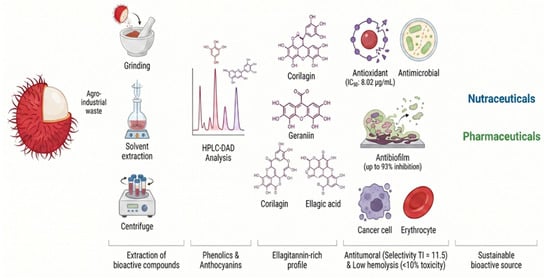
1. Introduction
2. Materials and Methods
2.1. Plant Material
2.2. Bioactive Compounds Processing
2.3. Characterization by HPLC-DAD-MS/MS
2.4. Antioxidant Capacity
2.5. Antibacterial Evaluation
2.6. Biofilm Inhibition Evaluation
2.7. Antitumoral Evaluation
2.8. Hemolytic Assay
2.9. Statistical Analysis
3. Results and Discussion
3.1. Bioactive Compounds
3.2. HPLC-DAD-MS/MS

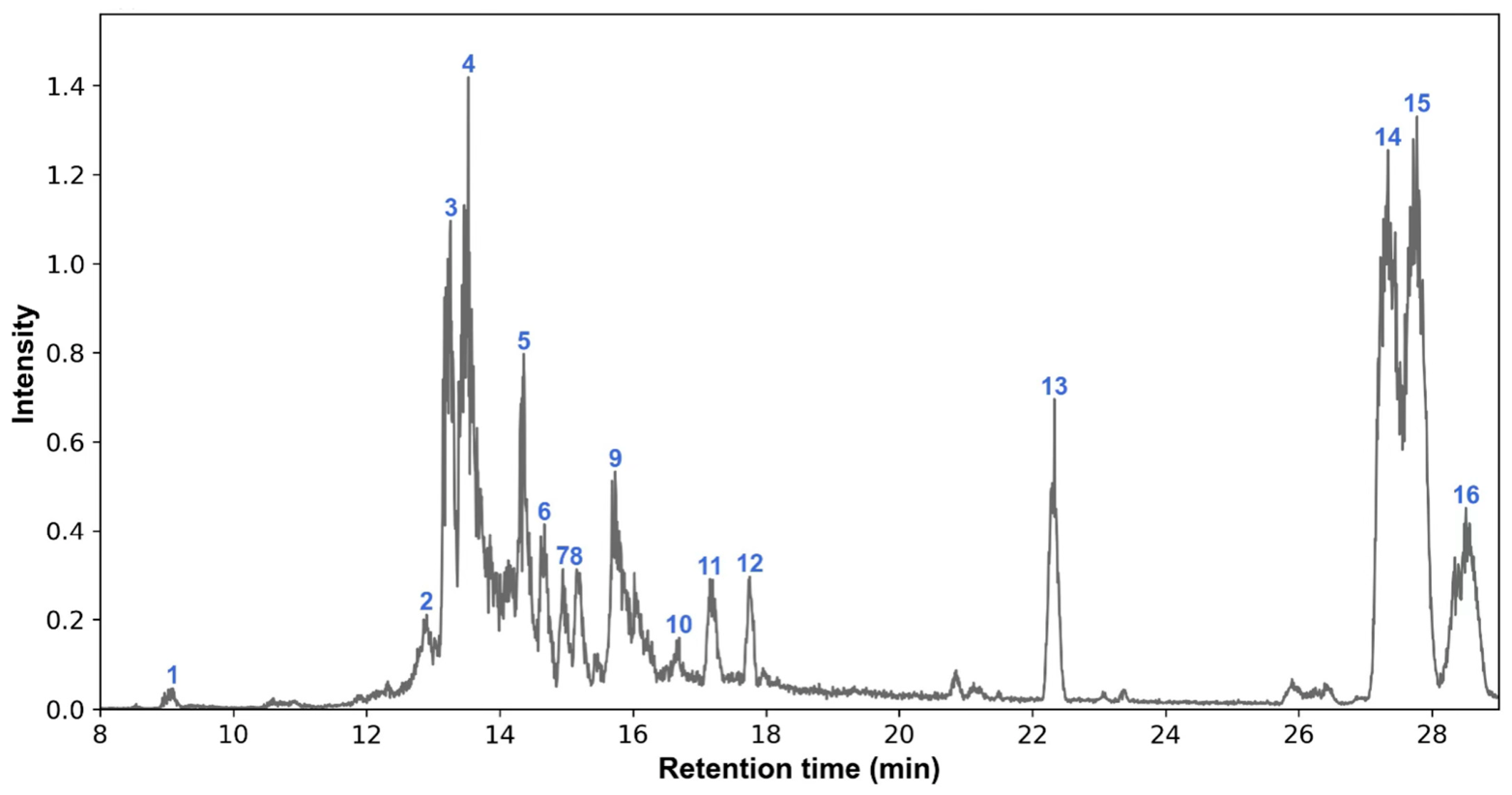
| ID | RT | m/z [M-H]− | MS/MS | Tentative Identification | Resource |
|---|---|---|---|---|---|
| 1 | 9.09 | 311 | 125(10) 169(80) 271(100) 313(15) | Galloyglucose | [27,35] |
| 2 | 12.90 | 631 | 445(19) 461(19) 613(100) | Ellagitannin related to castalagin/vescalagina | [41] |
| 3 | 13.26 | 633 | 275(15) 301(100) 463(27) 615(24) | Corilagin | [27,28] |
| 4 | 13.52 | 951 | 301(5) 613(5) 914(10) 933(100) | Geraniin | [27] |
| 5 | 14.37 | 953 | 301(30) 425(10) 633(10) 934(100) | Chebulagic acid | [29] |
| 6 | 14.67 | 965 | 301(10) 443(20) 903(40) 915(35) 933(100) 947(15) | Castalagin derivative | [33,34,35] |
| 7 | 14.94 | 433 | 300(70) 301(100) 301 → 185(10) 229(50) 257(100) 273(5) | Ellagic acid pentoside | [42] |
| 8 | 15.15 | 497 | 451(100) | UI | |
| 9 | 15.73 | 997 | 301(80) 319(30) 435(25) 481(40) 827(15) 907(65) 952(100) 980(50) 923(45) 301 → 185(10) 229(50) 257(100) 273(5) | A type of Ellagitannin | a |
| 10 | 16.68 | 979 | 301(80) 463(25) 631(10) 765(10) 809(100) 934(50) 960(30) 301 → 185(10) 229(50) 257(100) 273(5) | A type of Ellagitannin | a |
| 11 | 17.15 | 923 | 301(100) 603(50) 621(40) 707(25) 906(35) 301 → 185(10) 229(50) 257(100) 273(5) | A type of Ellagitannin | a |
| 12 | 17.75 | 1000 | 319(10) 525(15) 853(100) 953(30) 853 → 367(100) 707(40) 545(10) | UI | |
| 13 | 22.33 | 984 | 367(30) 465(20) 513(10) 619(50) 837(100) 837 → 367(100) 691(50) 513(5) 367 → 221(100) 161(30) 205(20) 131(15) | UI | |
| 14 | 27.72 | 882 | 472(35) 604(100) 733(25) 750(45) 472 → 394(100) 405(30) 440(25) 427(10) | 10-[3-[3,5-dihydroxy-6-methyl-4-(3,4,5-trihydroxyoxan-2-yl)oxyoxan-2-yl]oxy-4,5-dihydroxyoxan-2-yl]oxy-9-(hydroxymethyl)-2,2,6a,6b,9,12a-hexamethyl-1,3,4,5,6,6a,7,8,8a,10,11,12,13,14b-tetradecahydropicene-4a-carboxylic acid (Isomer 1) | GNPS 0.886 |
| 15 | 27.77 | 882 | 472(35) 604(100) 733(25) 750(45) | 10-[3-[3,5-dihydroxy-6-methyl-4-(3,4,5-trihydroxyoxan-2-yl)oxyoxan-2-yl]oxy-4,5-dihydroxyoxan-2-yl]oxy-9-(hydroxymethyl)-2,2,6a,6b,9,12a-hexamethyl-1,3,4,5,6,6a,7,8,8a,10,11,12,13,14b-tetradecahydropicene-4a-carboxylic acid (Isomer 2) | GNPS 0.857 |
| 16 | 28.51 | 750 | 472(100) 424(10) 586(95) 604(95) | α-hederin | [27] |
3.3. Antioxidant Activity
3.4. Antibacterial Activity
3.5. Biofilm Inhibition Activity
3.6. Antitumoral Activity
3.7. Hemolytic Activity
4. Conclusions
Author Contributions
Funding
Informed Consent Statement
Data Availability Statement
Conflicts of Interest
References
- Mihaylova, R.; Elincheva, V.; Gevrenova, R.; Zheleva-Dimitrova, D.; Momekov, G.; Simeonova, R. Targeting Inflammation with Natural Products: A Mechanistic Review of Iridoids from Bulgarian Medicinal Plants. Molecules 2025, 30, 3456. [Google Scholar] [CrossRef] [PubMed]
- Chahrour, J.A.; Abdel Baki, Z.; El Badan, D.; Nasser, G.; Maresca, M.; Hijazi, A. Herbal medicines in the management of diabetes mellitus: Plants, bioactive compounds, and mechanisms of action. Biomolecules 2025, 15, 1674. [Google Scholar] [CrossRef] [PubMed]
- Barba-Ostria, C.; Carrera-Pacheco, S.E.; Gonzalez-Pastor, R.; Zuñiga, J.; Mayorga-Ramos, A.; Tejera, E.; Guamán, L.P. Exploring the Multifaceted Biological Activities of Anthocyanins Isolated from Two Andean Berries. Foods 2024, 13, 2625. [Google Scholar] [CrossRef] [PubMed]
- Cruceriu, D.; Dobos, D.; Miron, S.; Baldasici, O.; Balacescu, L.; Balacescu, O.; Diaconeasa, Z. Gastrointestinal Digestion Enhances the In vitro Antitumor Activity of Red Grape Anthocyanins Against Colorectal Cancer Cells. Plant Foods Hum. Nutr. 2026, 81, 46. [Google Scholar] [CrossRef]
- Patel, A.; Temgire, S.; Borah, A. Agro-industrial waste as source of bioactive compounds and their utilization: A review. Pharma Innov. 2021, 10, 192–196. [Google Scholar] [CrossRef]
- Rawdkuen, S.; Ketnawa, S. Extraction, Characterization, and Application of Agricultural and Food Processing By-Products. In Food Preservation and Waste Exploitation; IntechOpen: London, UK, 2020. [Google Scholar][Green Version]
- Isla, M.I.; Orqueda, M.E.; Moreno, M.A.; Torres, S.; Zampini, I.C. Solanum betaceum Fruits Waste: A Valuable Source of Bioactive Compounds to Be Used in Foods and Non-Foods Applications. Foods 2022, 11, 3363. [Google Scholar] [CrossRef]
- Tsong, J.L.; Goh, L.P.W.; Gansau, J.A.; How, S.-E. Review of Nephelium lappaceum and Nephelium ramboutan-ake: A High Potential Supplement. Molecules 2021, 26, 7005. [Google Scholar] [CrossRef]
- Perumal, A.; AlSalhi, M.S.; Kanakarajan, S.; Devanesan, S.; Selvaraj, R.; Tamizhazhagan, V. Phytochemical evaluation and anticancer activity of rambutan (Nephelium lappaceum) fruit endocarp extracts against human hepatocellular carcinoma (HepG-2) cells. Saudi J. Biol. Sci. 2021, 28, 1816–1825. [Google Scholar] [CrossRef]
- Thitilertdecha, N.; Teerawutgulrag, A.; Kilburn, J.D.; Rakariyatham, N. Identification of major phenolic compounds from Nephelium lappaceum L. and their antioxidant activities. Molecules 2010, 15, 1453–1465. [Google Scholar] [CrossRef]
- Albuquerque, B.R.; Pinela, J.; Dias, M.I.; Pereira, C.; Petrović, J.; Soković, M.; Calhelha, R.C.; Oliveira, M.B.P.; Ferreira, I.C.; Barros, L. Valorization of rambutan (Nephelium lappaceum L.) peel: Chemical composition, biological activity, and optimized recovery of anthocyanins. Food Res. Int. 2023, 165, 112574. [Google Scholar] [CrossRef]
- Cai, J.; Wang, L.; Xu, M.; Zhu, S.; Chen, Y.; Zhong, J.; Li, J.; Zhang, P.; Zhang, T.; Ye, Q.; et al. Multi-target therapeutics of geraniin from Geranium wilfordii Maxim. and related species: Mechanisms and applications. J. Ethnopharmacol. 2026, 356, 120765. [Google Scholar] [CrossRef] [PubMed]
- Wrolstad, R.E.; Durst, R.W.; Lee, J. Tracking color and pigment changes in anthocyanin products. Trends Food Sci. Technol. 2005, 16, 423–428. [Google Scholar] [CrossRef]
- Coyago-Cruz, E.; Méndez, G.; Escobar-Quiñonez, R.; Cerna, M.; Heredia-Moya, J. Lacmellea oblongata and Other Undervalued Amazonian Fruits as Functional, Antioxidant, and Antimicrobial Matrices. Antioxidants 2025, 14, 924. [Google Scholar] [CrossRef]
- Pérez, B.P.; Endara, A.B.; Garrido, J.A.; Ramírez Cárdenas, L.d.l.Á. Extraction of anthocyanins from Mortiño (Vaccinium floribundum) and determination of their antioxidant capacity. Rev. Fac. Nac. Agron. Medellín 2021, 74, 9453–9460. [Google Scholar] [CrossRef]
- Teran, R.; Guevara, R.; Mora, J.; Dobronski, L.; Barreiro-Costa, O.; Beske, T.; Pérez-Barrera, J.; Araya-Maturana, R.; Rojas-Silva, P.; Poveda, A.; et al. Characterization of Antimicrobial, Antioxidant, and Leishmanicidal Activities of Schiff Base Derivatives of 4-Aminoantipyrine. Molecules 2019, 24, 2696. [Google Scholar] [CrossRef]
- M07|Methods for Dilution Antimicrobial Susceptibility Tests for Bacteria That Grow Aerobically. Available online: https://clsi.org/shop/standards/m07/ (accessed on 23 April 2026).
- Barba-Ostria, C.; López, O.; Debut, A.; Mayorga-Ramos, A.; Zúñiga-Miranda, J.; Coyago-Cruz, E.; Gonzalez-Pastor, R.; Cartuchi, K.; Viteri, A.; Peñaherrera-Pazmiño, A.B.; et al. Bioactive Phenolic Compounds from Rambutan (Nephelium lappaceum L.) Shell: Encapsulation, Structural Stability, and Multifunctional Activities. Int. J. Mol. Sci. 2025, 26, 10859. [Google Scholar] [CrossRef] [PubMed]
- Sæbø, I.P.; Bjørås, M.; Franzyk, H.; Helgesen, E.; Booth, J.A. Optimization of the hemolysis assay for the assessment of cytotoxicity. Int. J. Mol. Sci. 2023, 24, 2914. [Google Scholar] [CrossRef] [PubMed]
- ASTMAI E2524-22; Standard Test Method for Analysis of Hemolytic Properties of Nanoparticles. ASTM International: Conshohocken, PA, USA, 2022. [CrossRef]
- Liu, S.; Jiang, J.; Ma, Z.; Xiao, M.; Yang, L.; Tian, B.; Yu, Y.; Bi, C.; Fang, A.; Yang, Y. The role of hydroxycinnamic acid amide pathway in plant immunity. Front. Plant Sci. 2022, 13, 922119. [Google Scholar] [CrossRef]
- Coyago-Cruz, E.; Guachamin, A.; Méndez, G.; Moya, M.; Martínez, A.; Viera, W.; Heredia-Moya, J.; Beltrán, E.; Vera, E.; Villacís, M. Functional and Antioxidant Evaluation of Two Ecotypes of Control and Grafted Tree Tomato (Solanum betaceum) at Different Altitudes. Foods 2023, 12, 3494. [Google Scholar] [CrossRef]
- Mechanisms of Action of Flavonoids: Antioxidant, Antibacterial and Antifungal Properties. Available online: https://revistas.intec.edu.do/index.php/cienacli/article/download/3021/3470?inline=1 (accessed on 23 April 2026).
- Katarina, N.M. Mechanistic studies of phenolic antioxidants in reaction with nitrogen- and oxygen-centered radicals. J. Mol. Struct. THEOCHEM 2007, 818, 141–150. [Google Scholar] [CrossRef]
- Dai, J.; Mumper, R.J. Plant phenolics: Extraction, analysis and their antioxidant and anticancer properties. Molecules 2010, 15, 7313–7352. [Google Scholar] [CrossRef]
- Huang, X.Y.; Wang, C.K.; Zhao, Y.W.; Sun, C.H.; Hu, D.G. Mechanisms and regulation of organic acid accumulation in plant vacuoles. Hortic. Res. 2021, 8, 227. [Google Scholar] [CrossRef] [PubMed]
- Li, Y.-J.; He, F.-Q.; Zhao, H.-H.; Li, Y.; Chen, J. Screening and identification of acetylcholinesterase inhibitors from Terminalia chebula fruits by immobilized enzyme on cellulose filter paper coupled with ultra-performance liquid chromatography-quadrupole time-of-flight mass spectrometry and molecular docking. J. Chromatogr. A 2022, 1663, 462784. [Google Scholar]
- Zhu, M.; Dong, X.; Guo, M. Phenolic Profiling of Duchesnea indica Combining Macroporous Resin Chromatography (MRC) with HPLC-ESI-MS/MS and ESI-IT-MS. Molecules 2015, 20, 22463–22475. [Google Scholar] [CrossRef] [PubMed]
- Yu, J.; Zhao, X.; He, Y.; Zhang, Y.; Tang, C. An Innovative Strategy for Untargeted Mass Spectrometry Data Analysis: Rapid Chemical Profiling of the Medicinal Plant Terminalia chebula Using Ultra-High-Performance Liquid Chromatography Coupled with Q/TOF Mass Spectrometry-Key Ion Diagnostics-Neutral Loss Filtering. Molecules 2025, 30, 2451. [Google Scholar]
- Zhang, H.; Yu, M.; Jia, H.; Zhang, T.; Shang, H.; Zhang, M.; Zhu, Z.; Zou, Z. Comprehensive identification of potential antioxidant components in the aerial parts of Polygonum chinense L. var. hispidum using ultra high performance liquid chromatography coupled with quadrupole time-of-flight mass spectrometry. J. Sep. Sci. 2020, 43, 2380–2392. [Google Scholar] [CrossRef]
- Hernández-Hernández, C.; Aguilar, C.N.; Flores-Gallegos, A.C.; Sepúlveda, L.; Rodríguez-Herrera, R.; Morlett-Chávez, J.; Govea-Salas, M.; Ascacio-Valdés, J. Preliminary Testing of Ultrasound/Microwave-Assisted Extraction (U/M-AE) for the Isolation of Geraniin from Nephelium lappaceum L. (Mexican Variety) Peel. Processes 2020, 8, 572. [Google Scholar] [CrossRef]
- Perera, A.; Appleton, D.; Ying, L.H.; Elendran, S.; Palanisamy, U.D. Large scale purification of geraniin from Nephelium lappaceum rind waste using reverse-phase chromatography. Sep. Purif. Technol. 2012, 98, 145–149. [Google Scholar] [CrossRef]
- Abid, M.; Yaich, H.; Cheikhrouhou, S.; Khemakhem, I.; Bouaziz, M.; Attia, H.; Ayadi, M.A. Antioxidant properties and phenolic profile characterization by LC-MS/MS of selected Tunisian pomegranate peels. J. Food Sci. Technol. 2017, 54, 2890–2901. [Google Scholar] [CrossRef]
- Mahomoodally, M.F.; Yerlikaya, S.; Llorent-Martínez, E.J.; Uğurlu, A.; Baloglu, M.C.; Altunoglu, Y.C.; Mollica, A.; Dardenne, K.K.; Aumeeruddy, M.Z.; Puchooa, D.; et al. Pharmacological and polyphenolic profiles of Phyllanthus phillyreifolius var. commersonii Müll. Arg: An unexplored endemic species from Mauritius. Food Res. Int. 2019, 115, 425–438. [Google Scholar] [CrossRef] [PubMed]
- Wyrepkowski, C.C.; da Costa, D.L.M.G.; Sinhorin, A.P.; Vilegas, W.; De Grandis, R.A.; Resende, F.A.; Varanda, E.A.; Dos Santos, L.C. Characterization and quantification of the compounds of the ethanolic extract from Caesalpinia ferrea stem bark and evaluation of their mutagenic activity. Molecules 2014, 19, 16039–16057. [Google Scholar] [CrossRef]
- Lee, J.-H.; Johnson, J.V.; Talcott, S.T. Identification of ellagic acid conjugates and other polyphenolics in muscadine grapes by HPLC-ESI-MS. J. Agric. Food Chem. 2005, 53, 6003–6010. [Google Scholar] [CrossRef]
- Shahzad, M.N.; Ahmad, S.; Tousif, M.I.; Ahmad, I.; Rao, H.; Ahmad, B.; Basit, A. Profiling of phytochemicals from aerial parts of Terminalia neotaliala using LC-ESI-MS2 and determination of antioxidant and enzyme inhibition activities. PLoS ONE 2022, 17, e0266094. [Google Scholar] [CrossRef] [PubMed]
- Sorokina, M.; Merseburger, P.; Rajan, K.; Yirik, M.A.; Steinbeck, C. COCONUT online: Collection of Open Natural Products database. J. Cheminform. 2021, 13, 2. [Google Scholar] [CrossRef]
- Rutz, A.; Sorokina, M.; Galgonek, J.; Mietchen, D.; Willighagen, E.; Gaudry, A.; Graham, J.G.; Stephan, R.; Page, R.; Vondrášek, J.; et al. The LOTUS initiative for open knowledge management in natural products research. eLife 2022, 11, e70780. [Google Scholar] [CrossRef] [PubMed]
- de Santana Santos, A.; de Souza Oliveira, A.K.; Pereira, R.O.; Junior, E.V.B.; de Lima Sayão, A.; de Oliveira e Silva, A.M. Composition and Biological Properties of Rambutan (Nephelium lappaceum). In Phytopharmaceuticals: Potential Therapeutic Applications; Chauhan, D.N., Shah, K., Eds.; Wiley: Hoboken, NJ, USA, 2021; pp. 403–436. [Google Scholar]
- Alcalde-Eon, C.; García-Estévez, I.; Rivas-Gonzalo, J.C.; Rodríguez de la Cruz, D.; Escribano-Bailón, M.T. Anthocyanins of the anthers as chemotaxonomic markers in the genus Populus L. Differentiation between Populus nigra, Populus alba and Populus tremula. Phytochemistry 2016, 128, 35–49. [Google Scholar] [CrossRef]
- Seeram, N.P. Berry fruits for cancer prevention: Current status and future prospects. J. Agric. Food Chem. 2008, 56, 630–635. [Google Scholar] [CrossRef]
- Lorent, J.; Lins, L.; Domenech, Ò.; Quetin-Leclercq, J.; Brasseur, R.; Mingeot-Leclercq, M.-P. Domain formation and permeabilization induced by the saponin α-hederin and its aglycone hederagenin in a cholesterol-containing bilayer. Langmuir 2014, 30, 4556–4569. [Google Scholar] [CrossRef]
- Rao, A.V.; Gurfinkel, D.M. The bioactivity of saponins: Triterpenoid and steroidal glycosides. Drug Metab. Drug Interact. 2000, 17, 211–235. [Google Scholar] [CrossRef]
- Mustarichie, R. The antioxidant activity and phytochemical screening of ethanol extract, fractions of water, ethyl acetate and n-hexane from mistletoe tea (Scurrula atropurpureabl. Dans). Asian J. Pharm. Clin. Res. 2017, 10, 343. [Google Scholar] [CrossRef]
- Itam, A.; Wati, M.S.; Agustin, V.; Sabri, N.; Jumanah, R.A.; Efdi, M. Comparative Study of Phytochemical, Antioxidant, and Cytotoxic Activities and Phenolic Content of Syzygium aqueum (Burm. f. Alston f.) Extracts Growing in West Sumatera Indonesia. Sci. World J. 2021, 2021, 5537597. [Google Scholar] [CrossRef] [PubMed]
- Thitilertdecha, N.; Teerawutgulrag, A.; Rakariyatham, N. Antioxidant and antibacterial activities of Nephelium lappaceum L. extracts. LWT-Food Sci. Technol. 2008, 41, 2029–2035. [Google Scholar] [CrossRef]
- Riyanto, S.; Windarsih, A.; Rohman, A. Antioxidant Activities and Identification of an Active Compound from Rambutan (Nephelium lappaceum L.) Peel. Indones. J. Chem. 2020, 21, 259–267. [Google Scholar] [CrossRef]
- Re, R.; Pellegrini, N.; Proteggente, A.; Pannala, A.; Yang, M.; Rice-Evans, C. Antioxidant activity applying an improved ABTS radical cation decolorization assay. Free Radic. Biol. Med. 1999, 26, 1231–1237. [Google Scholar] [CrossRef]
- Malanovic, N.; Lohner, K. Gram-positive bacterial cell envelopes: The impact on the activity of antimicrobial peptides. Biochim. Biophys. Acta 2016, 1858, 936–946. [Google Scholar] [CrossRef]
- Wu, Y.; Bai, J.; Zhong, K.; Huang, Y.; Qi, H.; Jiang, Y.; Gao, H. Antibacterial Activity and Membrane-Disruptive Mechanism of 3-p-trans-Coumaroyl-2-hydroxyquinic Acid, a Novel Phenolic Compound from Pine Needles of Cedrus deodara, against Staphylococcus aureus. Molecules 2016, 21, 1084. [Google Scholar] [CrossRef]
- Alvarado-Martinez, Z.; Tabashsum, Z.; Aditya, A.; Hshieh, K.; Suh, G.; Wall, M.; Scriba, A.; Sellers, G.; Canagarajah, C.; Kapadia, S.; et al. Plant-Derived Phenolic Acids Limit the Pathogenesis of Salmonella Typhimurium and Protect Intestinal Epithelial Cells during Their Interactions. Molecules 2024, 29, 1364. [Google Scholar] [CrossRef]
- Álvarez-Martínez, F.J.; Barrajón-Catalán, E.; Encinar, J.A.; Rodríguez-Díaz, J.C.; Micol, V. Antimicrobial Capacity of Plant Polyphenols against Gram-positive Bacteria: A Comprehensive Review. Curr. Med. Chem. 2020, 27, 2576–2606. [Google Scholar] [CrossRef]
- Lemoni, Z.; Evangeliou, K.; Lymperopoulou, T.; Mamma, D. Incorporation of edible plant extracts as natural food preservatives: Green extraction methods, antibacterial mechanisms and applications. Foods 2025, 14, 4000. [Google Scholar] [CrossRef] [PubMed]
- Liu, X.; Yao, H.; Zhao, X.; Ge, C. Biofilm formation and control of foodborne pathogenic bacteria. Molecules 2023, 28, 2432. [Google Scholar] [CrossRef]
- Gutierrez-Montiel, D.; Guerrero-Barrera, A.L.; Moreno-Flores, A.C.; Ramírez-Castillo, F.Y.; Chávez-Vela, N.A.; Martínez-Ávila, G.C.G.; Rico-Martínez, R.; Costa, M.d.O.; Galindo-Guerrero, F.; Avelar-Gonzalez, F.J.; et al. Antimicrobial and antibiofilm effects of crude and microencapsulated guava leaf extracts against Enterococcus faecalis and Staphylococcus epidermidis. Front. Antibiot. 2025, 4, 1615787. [Google Scholar] [CrossRef]
- Fernández-Billón, M.; Llambías-Cabot, A.E.; Jordana-Lluch, E.; Oliver, A.; Macià, M.D. Mechanisms of antibiotic resistance in Pseudomonas aeruginosa biofilms. Biofilm 2023, 5, 100129. [Google Scholar] [CrossRef]
- Emylia, K.; Snz, N.A.; Dasuki, M. Preliminary Study on Antiproliferative Activity of Methanolic Extract of Nephelium lappaceum Peels towards Breast (MDA-MB-231), Cervical (HeLa) and Osteosarcoma (MG-63) Cancer Cell Lines. Health 2013, 4, 66–79. [Google Scholar]
- Li, L.-W.; Na, C.; Tian, S.-Y.; Chen, J.; Ma, R.; Gao, Y.; Lou, G. Ellagic acid induces HeLa cell apoptosis via regulating signal transducer and activator of transcription 3 signaling. Exp. Ther. Med. 2018, 16, 29–36. [Google Scholar] [CrossRef]
- Huang, X.; Huang, Y.; Peng, B.; Wang, J.; Tang, H.; Chen, Y. CLG promotes mTOR/ULK1 pathway-mediated autophagy to inhibit OS development by inhibiting TRAF6-mediated FLT3 ubiquitination. Cancer Sci. 2024, 115, 3466–3480. [Google Scholar] [CrossRef]
- Liu, J.; Qin, X.; Ma, W.; Jia, S.; Zhang, X.; Yang, X.; Pan, D.; Jin, F. Corilagin induces apoptosis and autophagy in NRF2-addicted U251 glioma cell line. Mol. Med. Rep. 2021, 23, 320. [Google Scholar] [CrossRef] [PubMed]
- Qin, X.; Liu, J.; Pan, D.; Ma, W.; Cheng, P.; Jin, F. Corilagin induces human glioblastoma U251 cell apoptosis by impeding activity of (immuno)proteasome. Oncol. Rep. 2021, 45, 34. [Google Scholar] [CrossRef] [PubMed]
- Wang, L.-M.; Jiang, Y.-H.; Li, X.-Y.; Wu, M.-R.; Xu, Z.-Y.; Li, L.-J.; Yi, Y.; Wang, H.-X. In vivo and in vitro study on the mechanism of anticervical cancer effects of corilagin in mice. J. Food Biochem. 2024, 2024, 4822900. [Google Scholar] [CrossRef]
- Yu, Y.; Ye, X.; Hou, T.; Zhou, H.; Liu, L.; Yuan, W.; Wang, J.; Liang, X. A Natural LDHA Allosteric Inhibitor Geraniin Suppresses Triple-Negative Breast Cancer Cell Growth. Phytother. Res. 2026, 40, 21–34. [Google Scholar] [CrossRef] [PubMed]
- Wang, M.; Li, Y.; Hu, X. Chebulinic acid derived from triphala is a promising antitumour agent in human colorectal carcinoma cell lines. BMC Complement. Altern. Med. 2018, 18, 342. [Google Scholar] [CrossRef]
- Zhao, J.; Shi, Y.; Ma, Y.; Pan, L.; Wang, Y.; Yuan, L.; Dong, J.; Ying, J. Chebulagic acid suppresses gastric cancer by inhibiting the AURKA/β-catenin/Wnt pathway. Front. Pharmacol. 2023, 14, 1143427. [Google Scholar] [CrossRef] [PubMed]
- Aashima Rathi, M.; Shilpi Akash Kaur, K.; Kriplani, P.; Guarve, K. Chebulinic acid: An incipient anticancer agent. Recent Pat. Anti-Cancer Drug Discov. 2024, 19, 298–307. [Google Scholar] [CrossRef] [PubMed]
- Olchowik-Grabarek, E.; Sekowski, S.; Mierzwinska, I.; Zukowska, I.; Abdulladjanova, N.; Shlyonsky, V.; Zamaraeva, M. Cell Type-Specific Anti- and Pro-Oxidative Effects of Punica granatum L. Ellagitannins. Membranes 2024, 14, 218. [Google Scholar] [CrossRef]
- Cyboran-Mikołajczyk, S.; Męczarska, K.; Solarska-Ściuk, K.; Ratajczak-Wielgomas, K.; Oszmiański, J.; Jencova, V.; Bonarska-Kujawa, D. Protection of Erythrocytes and Microvascular Endothelial Cells against Oxidative Damage by Fragaria vesca L. and Rubus idaeus L. Leaves Extracts-The Mechanism of Action. Molecules 2022, 27, 5865. [Google Scholar] [CrossRef]
- Lorent, J.H.; Quetin-Leclercq, J.; Mingeot-Leclercq, M.-P. The amphiphilic nature of saponins and their effects on artificial and biological membranes and potential consequences for red blood and cancer cells. Org. Biomol. Chem. 2014, 12, 8803–8822. [Google Scholar] [CrossRef] [PubMed]


| Bacterial Strain | Antibiotic |
|---|---|
| E. faecium * | Nourseothricin (100 µg/mL) |
| P. aeruginosa * | |
| K. pneumoniae * | |
| S. enterica serovar Kentucky * | |
| S. epidermidis * | |
| S. enterica typhi ATCC 14028 | Ampicillin (100 µg/mL) |
| S. aureus ATCC 25923 | |
| E. coli ATCC 25922 | |
| L. monocytogenes ATCC 13932 | |
| P. aeruginosa ATCC 27853 | Tetracycline (10 µg/mL) |
| E. faecalis ATCC 29212 |
| Parameter | Shell Extract | ||
|---|---|---|---|
| Total anthocyanin (mg D-ch/100 g DW) | 17.63 | ± | 4.60 |
| Vitamin C (mg/100 g DW) | 1.15 | ± | 0.1 |
| Phenolics (mg/100 g DW) | |||
| Gallic acid | 250.6 | ± | 3.3 |
| Vanillic acid | 67.6 | ± | 1.4 |
| Protocatechic acid | 2414.4 | ± | 71.0 |
| m-Coumaric acid | 21,471.3 | ± | 239.4 |
| Syringic acid | 1331.7 | ± | 7.5 |
| Kaempferol | 446.7 | ± | 58.2 |
| Total phenolics | 25,982.2 | ± | 380.8 |
| Organic acid (mg/g DW) | |||
| Tartaric acid | 37.9 | ± | 3.6 |
| Malic acid | 488.1 | ± | 7.5 |
| Citric acid | 230.7 | ± | 23.7 |
| Total organic acid | 756.8 | ± | 10.3 |
| Compound | DPPH IC50 (μg/mL) | ABTS IC50 (μg/mL) | TEAC * (μmol TE/g) |
|---|---|---|---|
| N.lappaceum extract | 8.02 ± 0.94 | 89.78 ± 11.82 | 5703.92 ± 304.92 |
| Ascorbic acid | 1.38 ± 0.19 | 57.58 ± 16.33 | 10,327.59 ± 3461.55 |
| Bacterial Strain | MIC (mg/mL) |
|---|---|
| Salmonella enterica typhi ATCC 14028 | 10 |
| Escherichia coli ATCC 25922 | 10 |
| Staphylococcus aureus ATCC 25923 | 2.5 |
| Listeria monocytogenes ATCC 13932 | 5 |
| Enterococcus faecalis ATCC 29212 | 10 |
| Pseudomonas aeruginosa ATCC 27853 | 10 |
| Klebsiella pneumoniae * | 20 |
| Escherichia coli * | 20 |
| Enterococcus faecalis * | 10 |
| Staphylococcus epidermidis * | 10 |
| Enterococcus faecium * | 10 |
| Salmonella enterica serovariedad Kentucky * | 10 |
| Pseudomonas aeruginosa * | 20 |
| THJ29T | HepG2 | HCT116 | HeLa | NIH3T3 | |||||
|---|---|---|---|---|---|---|---|---|---|
| IC50 | TI b | IC50 | TI b | IC50 | TI b | IC50 | TI b | IC50 | |
| Extract | 3086 ± 0.4 | 0.9 | 836 ± 0.1 | 3.4 | 1059 ± 0.2 | 2.7 | 260 ± 0.0 | 11.5 | 2678 ± 0.6 |
| Cisplatin | 4.6 ± 0.5 | 0.6 | 3.7± 0.4 | 0.7 | 2.3 ± 0.4 | 1.2 | 1.2 ± 0.1 | 2.3 | 2.7± 0.5 |
Disclaimer/Publisher’s Note: The statements, opinions and data contained in all publications are solely those of the individual author(s) and contributor(s) and not of MDPI and/or the editor(s). MDPI and/or the editor(s) disclaim responsibility for any injury to people or property resulting from any ideas, methods, instructions or products referred to in the content. |
© 2026 by the authors. Licensee MDPI, Basel, Switzerland. This article is an open access article distributed under the terms and conditions of the Creative Commons Attribution (CC BY) license.
Share and Cite
Barba-Ostria, C.; Mayorga-Ramos, A.; Zúñiga-Miranda, J.; Gonzalez-Pastor, R.; Coyago-Cruz, E.; Viteri, A.; Peñaherrera-Pazmiño, A.B.; López, O.; Celi, D.; Tejera, E.; et al. Rambutan (Nephelium lappaceum L.) Shell as a Source of Polyphenols: Chemical Characterization and Biological Activities. Molecules 2026, 31, 1925. https://doi.org/10.3390/molecules31111925
Barba-Ostria C, Mayorga-Ramos A, Zúñiga-Miranda J, Gonzalez-Pastor R, Coyago-Cruz E, Viteri A, Peñaherrera-Pazmiño AB, López O, Celi D, Tejera E, et al. Rambutan (Nephelium lappaceum L.) Shell as a Source of Polyphenols: Chemical Characterization and Biological Activities. Molecules. 2026; 31(11):1925. https://doi.org/10.3390/molecules31111925
Chicago/Turabian StyleBarba-Ostria, Carlos, Arianna Mayorga-Ramos, Johana Zúñiga-Miranda, Rebeca Gonzalez-Pastor, Elena Coyago-Cruz, Antonella Viteri, Ana Belén Peñaherrera-Pazmiño, Orestes López, Diana Celi, Eduardo Tejera, and et al. 2026. "Rambutan (Nephelium lappaceum L.) Shell as a Source of Polyphenols: Chemical Characterization and Biological Activities" Molecules 31, no. 11: 1925. https://doi.org/10.3390/molecules31111925
APA StyleBarba-Ostria, C., Mayorga-Ramos, A., Zúñiga-Miranda, J., Gonzalez-Pastor, R., Coyago-Cruz, E., Viteri, A., Peñaherrera-Pazmiño, A. B., López, O., Celi, D., Tejera, E., & Guamán, L. P. (2026). Rambutan (Nephelium lappaceum L.) Shell as a Source of Polyphenols: Chemical Characterization and Biological Activities. Molecules, 31(11), 1925. https://doi.org/10.3390/molecules31111925