Article

Antiviral Activity of Polyene Macrolides Against Newcastle Disease Virus: Computational and Experimental Insights


by
Aidar Mukhametkaliyev
1,
Andrey Bogoyavlenskiy
2,*,
Pavel Alexyuk
2,
Madina Alexyuk
2,
Nadezhda Sokolova
2,
Yergali Moldakhanov
2,
Kuralay Akanova
2,
Aziza Temirbayeva
2,
Assilbek Mussoyev
1,
Krzysztof Śmietanka
3 and
Vladimir Berezin
2
1
Faculty of Veterinary and Zooengineering, Kazakh National Agrarian Research University, Almaty 050010, Kazakhstan
2
Laboratory of Antiviral Protection, Research and Production Center for Microbiology and Virology, Almaty 050010, Kazakhstan
3
Department of Virology and Viral Animal Diseases, National Veterinary Research Institute, Al. Partyzantów 57, 24-100 Puławy, Poland
*
Author to whom correspondence should be addressed.
Molecules 2026, 31(11), 1915; https://doi.org/10.3390/molecules31111915
Submission received: 6 April 2026 / Revised: 28 May 2026 / Accepted: 29 May 2026 / Published: 2 June 2026

Abstract

The search for novel antiviral agents against Newcastle disease virus (NDV) remains a priority in industrial poultry farming due to the virus’s high contagiousness and associated economic losses, prompting evaluation of polyene macrolides as potential therapeutic candidates. We employed a comprehensive approach combining computational modeling (molecular docking and dynamics simulation) and laboratory experiments to investigate the antiviral potential of natamycin, nystatin, and filipin complex against three NDV strains. Molecular docking analysis indicated binding sites for macrolides within the hydrophobic regions of surface glycoproteins HN and F, with binding energies ranging from −6.5 to −10.5 kcal/mol, while 50 ns molecular dynamics simulation confirmed complex stability. Laboratory testing using fluorescence-based neuraminidase assays demonstrated dose-dependent inhibitory activity with IC50 values of 0.0043 ± 0.0015 mg/mL for filipin complex, 0.0117 ± 0.0029 mg/mL for nystatin, and 0.0220 ± 0.0138 mg/mL for natamycin, with similar ranking observed for fusion inhibition (EC50 values of 0.00053 ± 0.00039, 0.00545 ± 0.00560, and 0.01196 ± 0.00965 mg/mL, respectively). While filipin complex exhibited the highest antiviral activity, its significant cytotoxicity limits therapeutic application, whereas natamycin demonstrated a favorable safety profile consistent with its GRAS status. These findings indicate that natamycin exhibits a favorable safety-to-efficacy profile in vitro, warranting further in vivo investigation to clarify its mechanism of action and establish practical application protocols for NDV control in poultry.

1. Introduction

Actinomycetes constitute a diverse bacterial group that forms branching mycelia under favorable conditions and can exist in both aerobic and anaerobic environments [1,2]. They are widely distributed in soil, comprising over 30% of the bacterial microflora (depending on soil type and condition), and are readily isolated through plating diluted soil suspensions on standard culture media [3,4]. Members of the genus Streptomyces are ubiquitously distributed across diverse ecological niches, including terrestrial and aquatic ecosystems, marine sediments, and mangrove biotopes, where their metabolic activity generates the characteristic “earthy” soil aroma through geosmin production [5,6].
As one of the largest and most diverse bacterial taxa, actinomycetes synthesize a broad spectrum of bioactive metabolites, including antibiotics, antiviral compounds [7], antiparasitic agents [8], antifungal substances [9], and molecules with antitumor effects and cholesterol-lowering properties [10]. Some metabolites demonstrate neuroprotective effects in cell culture and animal model experiments [11]. Additionally, the potential role of specific actinomycete metabolites in modulating neutrophil functions is currently under active investigation [12].
Approximately two-thirds of known antibiotics and a substantial portion of antifungal medications are synthesized by actinomycete representatives, particularly Streptomyces, including streptomycin, tetracycline, erythromycin, chloramphenicol, neomycin, kanamycin, fosfomycin, daptomycin, clindamycin, vancomycin, nikkomycins, rapamycin, nystatin, and amphotericin B [1,11,13]. They serve as sources of numerous industrial enzymes, including proteases, amylases, peroxidases, phytases, laccases, cellulases, lipases, pectinases, glucose oxidases, lipoxygenases, and xylanases [14,15,16,17,18,19].
The endophytic actinomycete Streptomyces sp. LRE541 produces metabolites with antitumor activity, including neoechinulin A and two anthraquinones that induce apoptosis and cell cycle arrest in cancer cells [20].
Beyond antibacterial, antifungal, and anticancer properties, Actinomycetota strains also possess antiviral capabilities. These microorganisms produce compounds capable of inhibiting viral replication, opening promising avenues for developing novel antiviral treatments [21]. Since the 20th century, researchers have discovered antiviral compounds from various genera of this phylum, such as bleomycin, an antibiotic isolated by Maeda and colleagues from Streptomyces verticillus [22], and rifampicin, a semi-synthetic derivative of rifamycins originally isolated from Amycolatopsis rifamycinica [23].
One important group of antiviral compounds comprises polyene macrolides, which are cyclic amphiphilic organic molecules [24]. The polyene macrolide molecular framework consists of a large macrocyclic lactone ring (typically 20–40 carbon atoms). The amphiphilic nature of these compounds is determined by two segments: a hydrophobic segment containing a conjugated polyene chain (three to eight double bonds), and a hydrophilic segment enriched with hydroxyl groups [25,26,27]. These structural features, including macrocycle size, polyene chain length, and glycosylation presence, determine overall conformation and solubility while forming the basis of their mechanism of action.
Studies demonstrate the inhibitory effect of polyene macrolides (e.g., amphotericin B, nystatin) on the reproduction of various enveloped viruses [28,29], including vesicular stomatitis virus (VSV) [30], Japanese encephalomyelitis virus [31,32], enteroviruses [33], and SARS-CoV-2 [34,35]. Moreover, nystatin A, a tetraene-diene polyene, can inhibit HIV-1 replication in H9 cells [36]. Modern analogs like BSG005, designed for systemic application, show high activity against Aspergillus and Candida [37], opening prospects for new polyene drugs with anti-infectious and potentially antiviral activity.
Developing antiviral agents for avian pathogens remains challenging due to the high variability of avian influenza virus, where antigenic drift represents a fundamental evolutionary process [38,39]. The genetic and antigenic dynamics of the H5, H3, and H9 subtypes, including regular emergence of new lineages and variants, leads to reduced effectiveness of existing vaccines and necessitates their constant updating [40,41]. Against this background, Newcastle disease virus continues to maintain stable epizootic significance: despite widespread use of live and inactivated vaccines, disease outbreaks are regularly recorded in various regions of the world, including cases in vaccinated populations [42,43]. The genetic diversity of circulating NDV genotypes and their antigenic divergence from vaccine strains represent key reasons for periodic outbreak recurrence, highlighting the need for more reliable approaches to infection prevention and control [44,45].

2. Results

2.1. In Silico Analysis

2.1.1. Molecular Docking and Initial Binding Assessment

Molecular docking calculations were performed against five Newcastle disease virus protein structures: 3T1E, 1E8V, and 3MAW (hemagglutinin HN proteins), 1G5G (F protein), and 4G1G (matrix protein).
The results of molecular docking showed that polyene macrolides possess binding energies ranging from −6.5 to −10.5 kcal/mol (Table 1). Natamycin demonstrated binding energies from −6.8 to −10.5 kcal/mol across all protein targets. Nystatin showed binding energies between −6.6 and −9.7 kcal/mol. Filipin exhibited binding affinities from −6.5 to −9.2 kcal/mol. Ribavirin demonstrated binding energies from −5.2 to −8.1 kcal/mol. Ribavirin was included in the molecular docking protocol solely as a computational reference compound. Direct energetic comparison between polyene macrolides and ribavirin is conceptually limited due to their distinct mechanisms of action and target proteins; therefore, molecular docking scores were used exclusively for internal ranking of polyene macrolides across the tested viral structures. Based on the highest binding affinity values, protein 1G5G was selected for detailed structural analysis.

2.1.2. Three-Dimensional Structural Analysis (PyMOL)

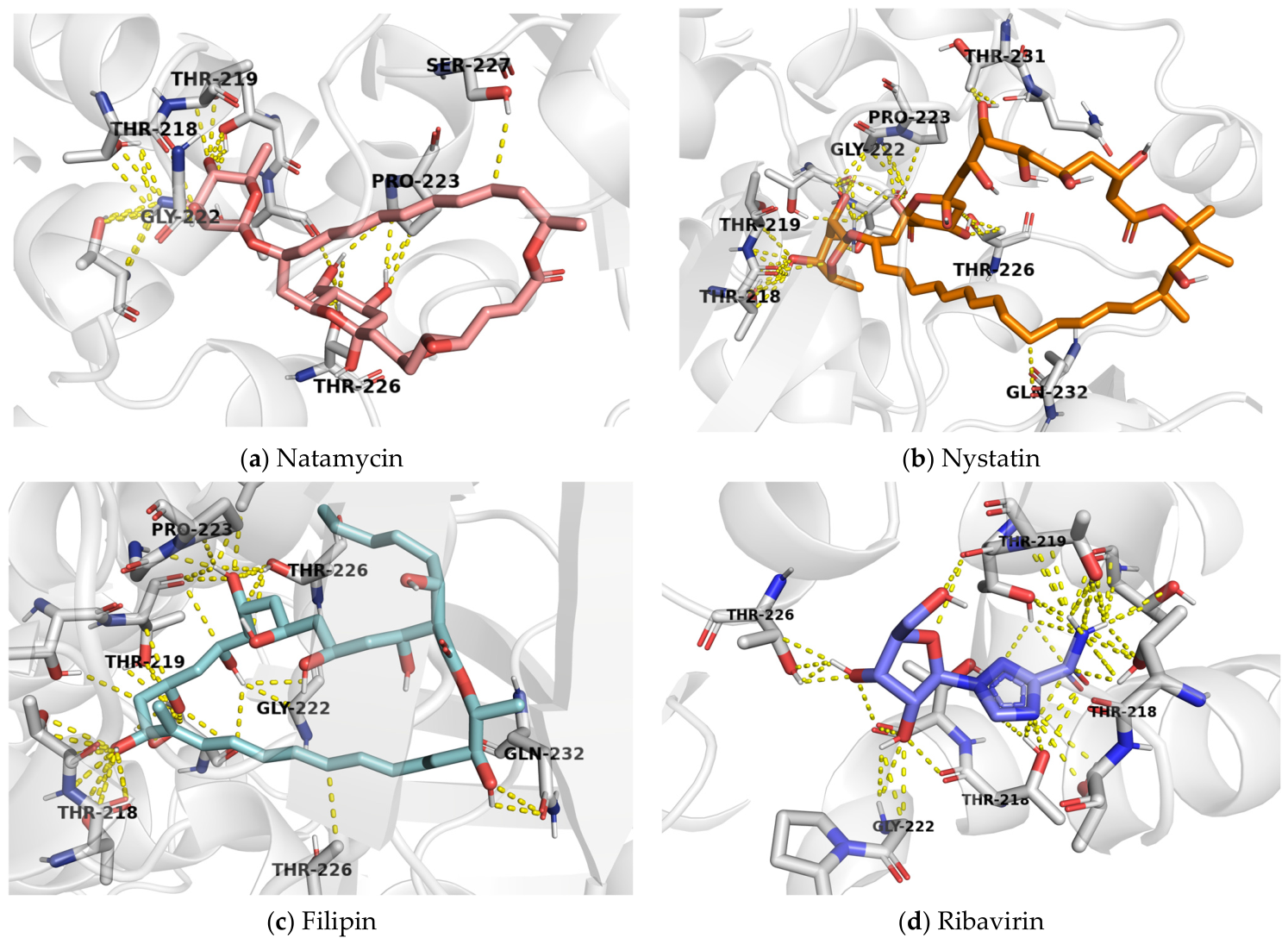
Three-dimensional visualization of polyene macrolide and ribavirin complexes with protein 1G5G, performed using PyMOL software, version 3.1.4 (Figure 1), provided detailed characterization of the spatial arrangement of ligands and features of their interaction with the protein.
Natamycin (Figure 1a) was positioned along the protein surface with its macrocyclic structure forming hydrogen bonds (shown as yellow dashed lines) with the residues THR-218, THR-219, SER-224, PRO-223, and THR-226. The compound’s extended conformation enabled simultaneous contact with multiple surface residues without penetrating internal protein cavities.
Nystatin (Figure 1b) demonstrated a similar surface-binding pattern, establishing hydrogen bond interactions with THR-218, THR-219, PRO-223, GLY-222, THR-226, and GLN-232. The polyene chain (shown in orange) was oriented along the protein surface, creating an extensive interaction network with polar and hydrophobic residues.
Filipin (Figure 1c) exhibited binding to the same general region, forming contacts with THR-218, THR-219, THR-226, GLY-222, PRO-223, and GLN-232. The compound’s structure (shown in cyan) maintained surface positioning with multiple hydrogen bond formations indicated by yellow dashed lines.
Ribavirin (Figure 1d) occupied a more localized binding area compared to the polyene macrolides. The compound (shown in blue) formed a compact interaction pattern primarily with residues THR-218, THR-219, and GLY-222, with fewer total contacts than the larger macrolide structures.
All polyene compounds demonstrated extended surface binding with multiple hydrogen bond formations, while ribavirin showed a more confined interaction pattern. The binding region represents a surface site on protein 1G5G rather than a defined active site, as functional characterization of this region has not been experimentally determined.
The identified binding region cannot be unambiguously interpreted as the protein’s active site, as experimental data on the functional role of this region are absent. In the present study, the term “binding site” is used to describe ligand localization.

2.1.3. ADMET Properties and Drug-likeness Prediction

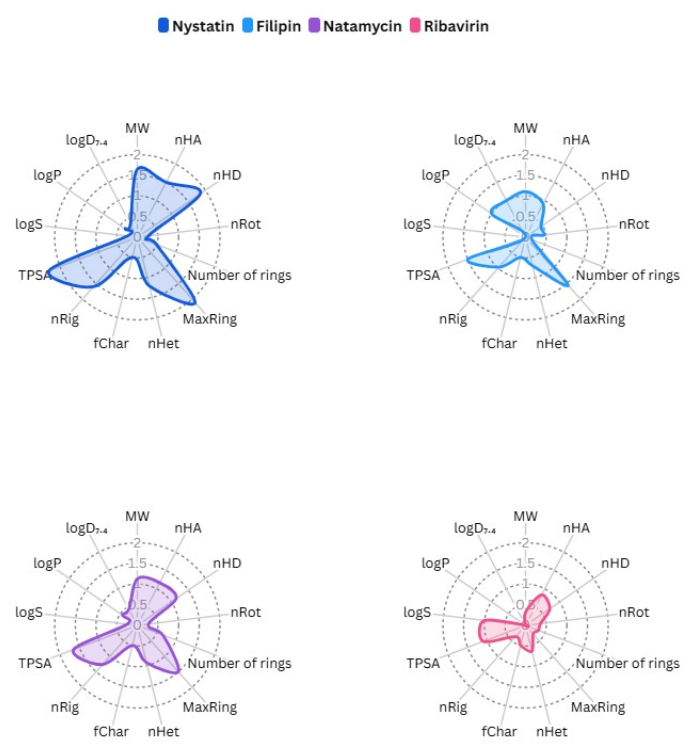
Nystatin and natamycin demonstrate elevated molecular-weight values, reflecting their large macrolide structures. The maximum ring size (MaxRing) for nystatin exceeds the values of other compounds, corresponding to the presence of complex macrocycles.
Regarding hydrogen bonding interactions, nystatin is characterized by a high number of hydrogen bond donors and acceptors (nHD, nHA), while ribavirin has relatively low values for these parameters.
Flexibility and structural rigidity (nRot, nRig) differ between the compounds: ribavirin possesses moderate flexibility and a minimal number of rigid bonds, while macrolides demonstrate more pronounced structural rigidity.
The topological polar surface area (TPSA) for nystatin is higher than for other compounds, while ribavirin is distinguished by the highest value of logarithm of solubility (logS).
The lipophilicity and distribution parameters (logP, logD7.4) show that filipin has the highest values, while ribavirin is characterized by minimal values for these parameters.
Overall, the radar chart (Figure 2) clearly demonstrates differences between polyene macrolides (nystatin, filipin, natamycin) and the low-molecular-weight compound ribavirin across a combination of structural and physicochemical properties. Polyenes are distinguished by greater molecular weight, ring size, structural rigidity, and polarity (TPSA, number of hydrogen bond donors and acceptors), as well as low aqueous solubility compared to ribavirin.

2.1.4. Molecular Dynamics Simulation and System Stability Analysis

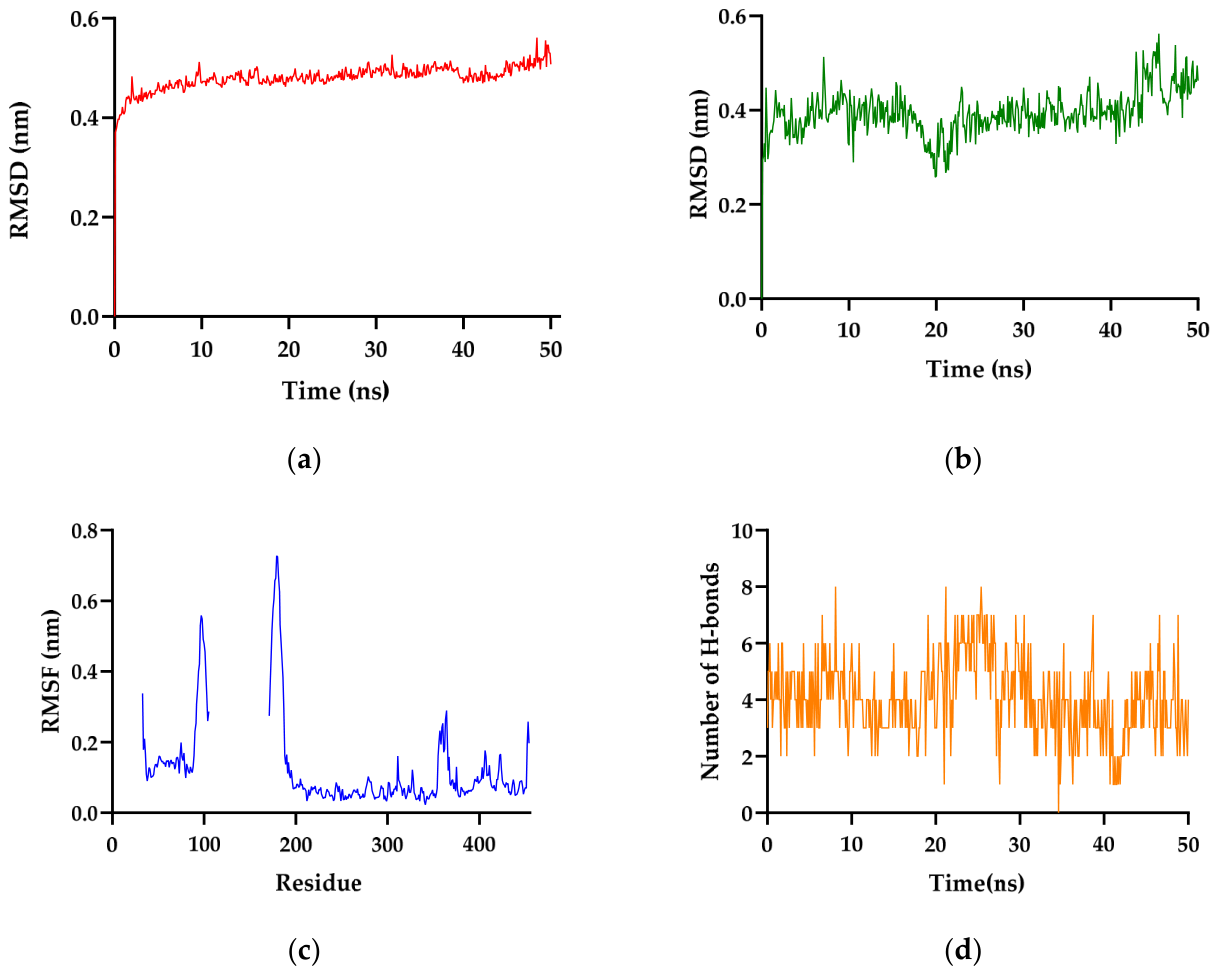
For detailed investigation of the dynamic characteristics of the 1G5G-natamycin complex and confirmation of docking data, a 50 ns molecular dynamics simulation was performed. The simulation was performed under physiological conditions (310 K, 1 atm) using explicit water solvation. Analysis of the obtained trajectory allowed evaluation of conformational stability of the system, polypeptide chain flexibility, and hydrogen bond formation patterns in the active site (Figure 3).
Root-mean-square deviation (RMSD) assessment demonstrates that the protein structure reaches equilibrium within the first 5 ns of calculation. The average deviation stabilized at 0.48 nm, which is typical for this monomeric form. Such a RMSD level is due to the presence of an extended unstructured region (residues 105–171) and high mobility of external loops. The absence of significant jumps in the curve during the final simulation segment confirms the preservation of native protein topology integrity (Figure 3a).
Natamycin’s dynamics in the binding pocket are characterized by moderate RMSD variability within 0.35–0.45 nm (Figure 3b). The stable trajectory profile demonstrates reliable ligand retention within the binding site throughout the entire observation time. A slight decrease in values observed at 20 ns reflects the mutual adaptation process between the ligand and amino acid environment. Fluctuations in the final simulation phase (40–50 ns) are local in nature and do not indicate risk of complex dissociation.
Root-mean-square fluctuation (RMSF) analysis confirmed heterogeneous flexibility of the 1G5G monomer (Figure 3c). The most labile regions correspond to structural break boundaries (residues 105 and 171), with a maximum displacement of 0.727 nm recorded for residue 179. In contrast, the central protein domain (residues 200–350) exhibits high rigidity with fluctuations less than 0.1 nm. Fragment 106–170 was excluded from analysis since it belongs to the disordered loop not resolved in the original crystallographic structure PDB ID 1G5G.
The complex stabilization mechanism was additionally studied through analysis of the intermolecular hydrogen bond networks (Figure 3d). During simulation, stable formation of three to six contacts was observed. A brief increase in bond number to eight at 8.1 ns indicates phases of highly complementary binding. Despite a single episode of contact disappearance at 34.6 ns, the system rapidly restored its initial geometry, maintaining an average of four bonds by the completion of 50 ns of simulation. Collectively, these data indicate formation of an energetically favorable and temporally stable complex suitable for sustained antiviral activity.
However, given the membrane-active nature of polyenes, the absence of an explicit membrane model in these simulations limits mechanistic inferences, as discussed in the Limitations Section.

2.2. In Vitro Experimental Validation

2.2.1. Neuraminidase Activity Inhibition

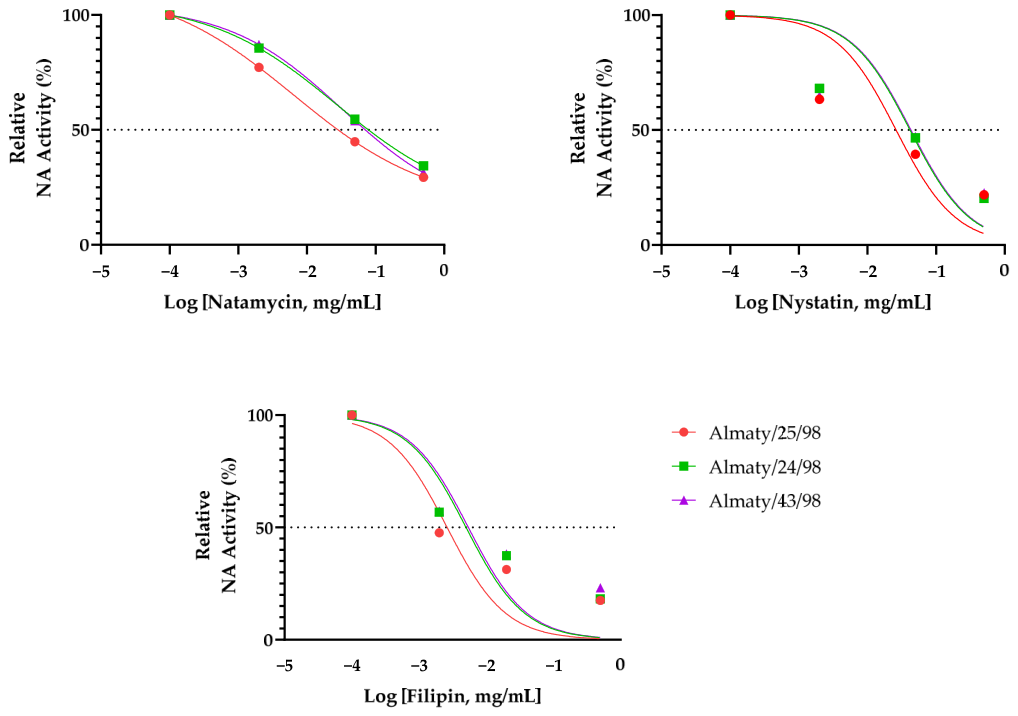
Analysis of the inhibitory potential of selected polyene macrolides against neuraminidase (NA) activity of Newcastle disease virus (NDV) strains revealed a concentration-dependent efficacy and structure-dependent effects of the compounds (Figure 4). The constructed nonlinear regression models indicate a dose-dependent character of enzymatic activity reduction in all investigated groups.
Natamycin demonstrated the most gradual inhibition curve slopes across the entire concentration range, corresponding to the highest IC50 values among tested compounds. Nystatin exhibited intermediate inhibition dynamics with moderate IC50 values. The filipin complex showed the most pronounced shift in the curves towards low concentrations, corresponding to the lowest IC50 values observed.
Quantitative analysis (Table 2) revealed the following activity ranking: filipin > nystatin > natamycin. Filipin demonstrated the highest inhibitory activity (mean IC50 = 0.0043 ± 0.0015 mg/mL), followed by nystatin (mean IC50 = 0.0117 ± 0.0029 mg/mL) and natamycin (mean IC50 = 0.0220 ± 0.0138 mg/mL).
Strain-specific sensitivity differences were observed, with strain Almaty/25/98 showing the highest susceptibility to all tested compounds, while strains Almaty/24/98 and Almaty/43/98 demonstrated higher resistance. High determination coefficients (R2 ≈ 1.0) indicate mathematical adequacy of the selected nonlinear regression models.
It should be noted that IC50 values represent functional potency under fixed assay conditions and do not permit the determination of kinetic parameters (Km, Vmax) or inhibition mechanisms; detailed kinetic characterization will be required to distinguish specific enzymatic inhibition from indirect effects.

2.2.2. Fusion Activity Inhibition Analysis

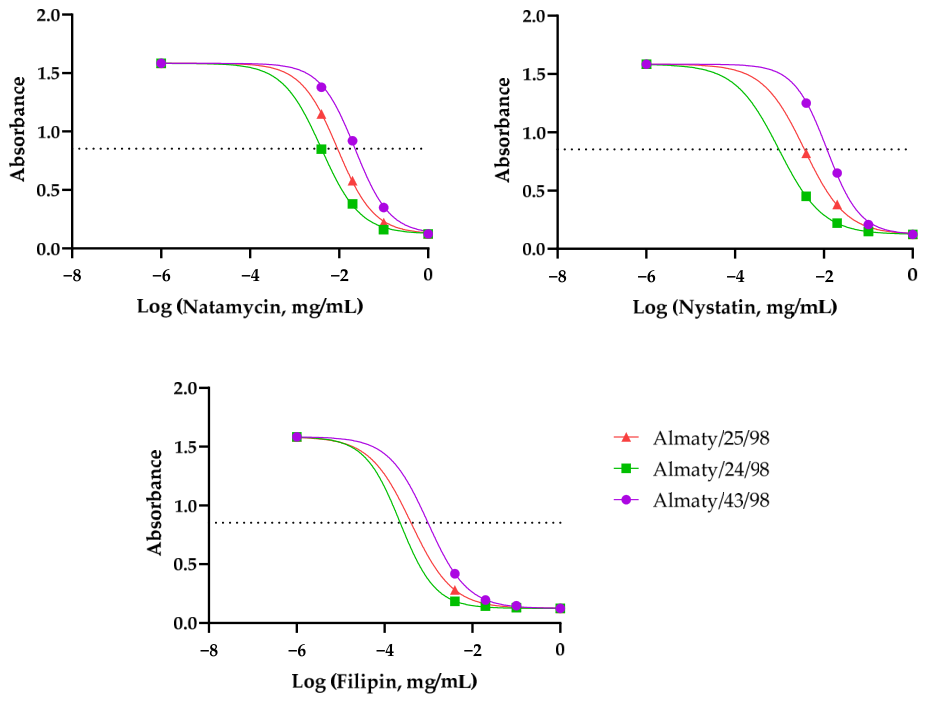
Experimental evaluation of polyene macrolide effects on viral and cellular membrane fusion revealed a distinct dependence of inhibitory effect on the structure of the investigated molecule. Despite their common chemical nature, the compounds demonstrated different efficacies in suppressing fusion activity of Newcastle disease virus strains, clearly reflected in the dose–effect curves (Figure 5) and calculated EC50 parameters (Table 3).
Natamycin showed the lowest activity in this experimental series. Its mean EC50 value was 0.01196 ± 0.00965 mg/mL. Analysis of the raw data reveals that natamycin requires significantly higher concentrations to achieve meaningful effects, with activity varying strongly between strains, confirmed by the high standard deviation.
Nystatin demonstrated more stable and potent fusion inhibition. The mean EC50 value was recorded at 0.00545 ± 0.00560 mg/mL, representing twice the efficacy of natamycin. Against the most sensitive isolate Almaty/24/98, nystatin showed practically nanogram-level activity values. The curve characteristics indicate that nystatin more effectively inactivates viral F-protein function at moderate therapeutic doses.
Filipin showed the most impressive results, emerging as the undisputed leader in viral fusion suppression. Its mean effective dose EC50 was only 0.00053 ± 0.00039 mg/mL, representing concentrations 10-fold lower than nystatin and more than 20-fold lower than natamycin for fusion blockade. Hill coefficients close to unity for all compounds additionally confirm specific blockade mechanisms rather than protein denaturation.

3. Discussion

This study presents a systematic evaluation of the antiviral potential of polyene macrolides against Newcastle disease virus (NDV), demonstrating dose-dependent suppression of both neuraminidase-associated activity and viral membrane fusion. However, given the well-documented membrane-active properties of polyenes [46,47], the observed effects cannot be definitively attributed to specific protein inhibition alone. While the concurrent reduction in these two functional readouts suggests a broad antiviral profile, our data do not distinguish between direct inhibition of viral glycoproteins (HN and F) and indirect effects mediated by membrane perturbation, and the contribution of membrane disruption to the observed activity remains a critical limitation of this study.
The observed experimental potency ranking (filipin > nystatin > natamycin) aligns with established structure–activity relationships for polyene macrolides, yet it presents a notable inverse relationship with molecular docking predictions. Computational analysis ranked the compounds by maximum predicted binding affinity as natamycin (−10.5 kcal/mol) > nystatin (−9.7 kcal/mol) > filipin (−9.2 kcal/mol). This discrepancy is mechanistically informative: it indicates that static protein–ligand binding energies, while useful for identifying feasible interaction sites, do not directly predict functional antiviral efficacy for membrane-active macrolides. Instead, the experimental potency gradient closely mirrors the established sterol-binding and membrane-perturbation profiles of these compounds. Filipin is known to strongly interact with membrane sterols, particularly cholesterol, resulting in pronounced membrane permeabilization [47,48], whereas natamycin exhibits more superficial sterol interactions without pore formation [49]. Consequently, the functional suppression of NDV likely arises from membrane-associated mechanisms rather than high-affinity, site-specific enzymatic inhibition. While this membrane-mediated mode of action contrasts with classical neuraminidase inhibitors such as oseltamivir, which exhibit high target specificity and minimal membrane effects, it also explains why the therapeutic applicability of highly potent polyenes may be constrained by cytotoxicity, a well-documented limitation for this compound class [50].
The high standard deviations observed in some assays (e.g., Table 2 and Table 3) reflect biological variability in viral samples and technical limitations of fluorescent-based methods. However, the dose-dependent trends (e.g., sigmoidal inhibition curves with R2 ≈ 1.0) remain robust, supporting the overall conclusions.
Comparison with previous antiviral studies further contextualizes the present findings. Polyene antifungals have been reported to exhibit antiviral activity against enveloped viruses, including influenza virus and herpes simplex virus. However, these studies also emphasize variability in efficacy depending on viral envelope composition and host cell context. For instance, natamycin has been reported to exhibit minimal antiviral activity in mammalian cell models despite favorable safety profiles [46], which is consistent with its lower activity ranking in the present study. Furthermore, the present study distinguishes itself by integrating computational docking and dynamics with multi-strain experimental validation within a single workflow, enabling direct evaluation of the relationship between predicted binding and observed biological activity—a linkage rarely addressed in parallel for polyene macrolides. By prioritizing natamycin, which carries GRAS status and established regulatory approval, this work also bridges mechanistic exploration with practical repurposing potential, offering a more translatable framework than prior studies focused primarily on highly cytotoxic analogs.
Molecular docking predicted stable interactions between polyene macrolides and surface glycoproteins HN and F. Ribavirin was included in the molecular docking workflow strictly as a methodological reference; however, direct comparison of binding energies is conceptually inappropriate given that ribavirin targets the viral RNA-dependent RNA polymerase rather than surface proteins [51]. Consequently, molecular docking scores should be interpreted as hypothesis-generating indicators of ligand localization rather than direct predictors of antiviral potency. This limitation aligns with broader recommendations in computational virology to avoid cross-mechanistic energetic comparisons [52].
While favorable predicted binding energies suggest polyene–protein interactions, the identified binding regions do not correspond to established sialidase active sites or characterized fusion peptide regions. This indicates that if binding contributes to antiviral activity, it likely operates through mechanisms other than direct obstruction of catalytic centers. This aligns with the known membrane-active properties of polyenes, where functional effects may arise from lipid bilayer perturbation rather than specific protein inhibition.
Molecular dynamics (MD) simulations further supported the stability of polyene–protein complexes, with sustained hydrogen bonding and limited structural deviations observed over 50 ns trajectories. The choice of a 50 ns simulation timescale is consistent with common practice in early-stage drug discovery studies, where simulations in the range of 20–100 ns are widely used to assess the initial stability of protein–ligand complexes [53,54]. For relatively rigid binding sites and ligands that do not induce large conformational rearrangements, 50 ns is generally sufficient to evaluate convergence of key parameters such as root-mean-square deviation (RMSD), root-mean-square fluctuation (RMSF), and hydrogen bonding patterns. Indeed, several studies have demonstrated that stable RMSD plateaus and persistent interaction networks within this timescale are indicative of energetically favorable binding modes [55].
The 50 ns simulations in aqueous solution were specifically designed to assess the stability of protein–ligand complexes and confirm initial binding geometry, which was successfully achieved (Figure 3). However, it is important to recognize that longer simulations (e.g., >100–500 ns or microsecond-scale) may be required to capture rare events, large conformational transitions, or ligand dissociation processes. This is particularly relevant for membrane-active compounds such as polyenes, whose primary interactions may involve lipid bilayers rather than isolated protein targets. As emphasized by recent reviews [56], simulation length should be matched to the biological question: short-to-moderate simulations are appropriate for stability assessment, whereas mechanistic elucidation often requires extended timescales and more complex system setups, including explicit membrane environments.
From a translational perspective, the repurposing of polyene macrolides represents a pragmatic strategy that aligns with recent trends in antiviral development. Natamycin, in particular, benefits from its GRAS status and established use in food preservation and veterinary medicine, which may significantly accelerate regulatory approval. However, previous attempts to repurpose polyene antifungals have been hindered by toxicity, poor solubility, and pharmacokinetic limitations [57]. Nevertheless, while natamycin’s GRAS status suggests a favorable safety profile, our study did not include direct cytotoxicity assays or selectivity index (SI) calculations, which are essential for translational applications. Therefore, while the current findings are promising, substantial optimization will be required before practical application.
Concerning the reported redox-modulating properties of polyene macrolides, nystatin has been shown to quench DPPH free radicals in EPR and UV-Vis spectroscopic assays, with UV-irradiation reducing this radical-scavenging capacity [58]. In vivo, dietary natamycin (10 mg/kg) increased serum total antioxidant capacity and glutathione peroxidase activity while reducing malondialdehyde levels in broiler chickens [59]. Additionally, polyene macrolides dose-dependently inhibited NADPH oxidase-dependent superoxide production in a cell-free enzymatic system comprising membrane and cytosolic fractions from bovine polymorphonuclear leukocytes [60]. These effects were not evaluated in the present study; given the membrane-active nature of polyenes, any contribution to anti-NDV activity is likely secondary to sterol-mediated mechanisms.
Several limitations of this study should be acknowledged. The use of purified enzymatic systems does not capture the complexity of viral infection in vivo, including host cell responses and membrane composition effects. Additionally, the study lacked critical controls: direct measurement of polyene interference with the fluorometric system (Ex/Em 320/450 nm), assessment of viral particle integrity via electron microscopy or dynamic light scattering, and positive controls with specific neuraminidase inhibitors (e.g., oseltamivir). These omissions constrain mechanistic interpretations but do not undermine the observed dose-dependent antiviral suppression. The absence of cytotoxicity and selectivity index data further limits translational applications, particularly given the membrane-disrupting properties of polyenes. Moreover, the lack of direct comparison with established NDV inhibitors restricts contextualization of these compounds in the antiviral landscape. Finally, resistance development remains to be experimentally evaluated.
While the dose-dependent inhibition of neuraminidase activity by polyene macrolides suggests functional suppression, the absence of kinetic characterization (e.g., determination of inhibition type or Kᵢ values) limits mechanistic interpretations. The observed effects may reflect direct enzyme inhibition, membrane-mediated disruption, or other indirect interactions, and further studies are required to distinguish between these possibilities.
Future work should focus on validating these findings in primary avian cell cultures and in vivo poultry models, as well as incorporating membrane-based simulation systems to better capture the mechanism of action of polyenes. Combination strategies with more specific antivirals may also enhance efficacy while reducing toxicity.

4. Materials and Methods

4.1. Viruses, Animals and Compounds

4.1.1. Viruses

Paramyxoviruses: Newcastle disease virus (NDV) strains APMV-1/chicken/Almaty/24/98, APMV-1/chicken/Almaty/25/98, and APMV-1/chicken/Almaty/43/98 were provided by the virus collection of the Research and Production Center for Microbiology and Virology (Almaty, Kazakhstan). These strains are referred to as Almaty/24/98, Almaty/25/98, and Almaty/43/98, respectively, throughout this study.
Virus stocks were titrated either by cytopathic effect (CPE) on susceptible cells or by hemagglutination assays of allantois fluid.

4.1.2. Animals

Ten-day-old fertilized chicken embryos (FCEs) were purchased from a licensed supplier and incubated at 37 °C under humidified conditions. All procedures involving animals were conducted in accordance with the regulations of the Ministry of Education and Science of the Republic of Kazakhstan and approved by the Committee on Ethics of Animal Experiments at the Research and Production Center for Microbiology and Virology, Almaty (protocol 02-09-184, 30 October 2023).

4.1.3. Compounds

The natamycin (pimaricin, CAS: 7681-93-8), nystatin (CAS: 1400-61-9), and filipin complexes (CAS: 480-49-9) were purchased from Sigma-Aldrich (St. Louis, MO, USA) and had a purity ≥95% certified by HPLC analysis. The chemical structures were confirmed by 1H NMR and mass spectrometry. Stock solutions (10 mg/mL) were prepared in anhydrous dimethyl sulfoxide (DMSO, ≥99.9%, Sigma-Aldrich) under nitrogen atmosphere and stored in amber vials at −80 °C for up to 6 months.

4.1.4. Buffers and Reagents

Phosphate-buffered saline (PBS, pH 7.4 ± 0.1) contained 137 mM NaCl, 2.7 mM KCl, 10 mM Na2HPO4·7H2O, and 1.8 mM KH2PO4 in ultrapure water (18.2 MΩ·cm, Milli-Q, Millipore, Burlington, MA, USA). All buffers were filter-sterilized (0.22 μm) and stored at 4 °C. Fresh chicken erythrocytes were harvested from 6-to-8-week-old SPF White Leghorn chickens in EDTA-containing tubes, washed three times with sterile PBS, and prepared as 5% (v/v) suspension in PBS immediately before use.

4.2. Experimental Methods

4.2.1. In Silico Methods

Molecular Docking
Docking simulations were performed to model the interaction between the polyene macrolides and viral proteins. The ligand preparation was conducted in the program PyMOL 3.1.4 (https://pymol.org accessed on 8 January 2026). Docking was carried out using the AutoDock Vina version 1.2. [61,62], as well as some external tools, such as AutoDock Tools version 1.5.6. [63] The following protein structures were retrieved from the Protein Data Bank [64] and selected based on their established functional roles in the NDV life cycle: hemagglutinin-neuraminidase (HN) proteins (PDB: 3T1E, 1E8V), representing primary mediators of host–cell attachment and viral release; fusion (F) glycoproteins (PDB: 1G5G, 3MAW), essential for viral envelope–host membrane fusion; and the matrix (M) protein (PDB: 4G1G), included to assess potential interactions with structural components underlying the viral envelope. Multiple crystallographic structures for HN and F proteins were specifically analyzed to account for conformational variability and ensure the robustness of binding predictions across distinct structural states.
Natamycin (CID 5284447), filipin (CID 6433194), nystatin (CID 6420032) and ribavirin (CID 37542) were retrieved from PubChem in SDF format. Ligands were subsequently converted to PDB format for visualization in PyMOL and prepared as PDBQT files for molecular docking in AutoDock.
ADMET Prediction
The pharmacokinetic parameters of all ligands were predicted using the ADMETlab 3.0 platform (https://admetlab3.scbdd.com accessed on 10 December 2025). Thirteen key descriptors were evaluated, including molecular weight (MW), sum of all OH and NH groups (nHD), sum of all O and N atoms (nHA), number of rotatable bonds (nRot), ring count (nRing), largest ring size (MaxRing), heteroatom count (nHet), formal charge (fChar), number of rigid bonds (nRig), topological polar surface area (TPSA), and lipophilicity indices (logS, logP, logD7.4). Drug-likeness criteria were applied according to the Drug-Like Soft and Veber rules [65,66].
To compare ADMET parameters with different scales, linear min–max normalization was applied to scale all values to a 0–2 range. For each parameter, the minimum and maximum values observed across the tested compounds (nystatin, filipin, natamycin, ribavirin) were set as the lower (0) and upper (2) bounds, respectively. Individual values were then linearly transformed to fit within this range, preserving relative differences between compounds.
For further investigation of complex dynamic behavior and confirmation of protein–ligand interaction stability, the configuration with the best scoring obtained from molecular docking was selected. The selection of a specific complex for subsequent molecular dynamics analysis was based on the minimal binding free energy value and correct positioning of the molecule within the protein active site. This step enabled the transition from a static interaction model to the investigation of temporal stability of key contacts under near-physiological conditions.
Molecular Dynamics Simulation
Natamycin was selected for molecular dynamics analysis based on it having the highest predicted binding affinity (Table 1) and a favorable safety profile (GRAS status), prioritizing translational relevance over raw in vitro potency.
Molecular dynamics simulation of the complex based on PDB structure 1G5G was performed using GROMACS 2024.4 with the CHARMM36m force field. System preparation and ligand parameterization via SwissParam were carried out using the CHARMM-GUI interface. The monomeric protein was placed in a cubic box with TIP3P water and 0.15 M NaCl ions, maintaining a minimum clearance of 1.0 nm from box boundaries. Following energy minimization, equilibration was performed in NVT and NPT ensembles for 100 ps each at 315 K and 1 bar using the V-rescale thermostat and Parrinello–Rahman barostat.
The production phase of 50 ns duration was executed with a 2-fs time step under periodic boundary conditions (PBCs). Hydrogen bond constraints were maintained using the LINCS algorithm. Electrostatic interactions were calculated using the PME method with a cutoff radius of 1.2 nm. Trajectory preparation, including removal of periodicity effects and system centering, was performed using the gmx trjconv utility.
System stability was assessed through RMSD analysis and residue fluctuation (RMSF) analysis. Hydrogen bond analysis was conducted based on geometric criteria with a donor–acceptor distance threshold of less than 0.35 nm. All calculations were performed using the GROMACS package with subsequent data visualization in GraphPad Prism version 10.04.0.

4.2.2. In Vitro Methods

Assessment of Viral Neuraminidase Activity Inhibition
The inhibitory potential of the nystatin, natamycin, and filipin complexes (0.5 mg/mL and 0.02 mg/mL) against neuraminidase (NA) of NDV viruses was determined using the ab138888 Neuraminidase Assay Kit (Fluorometric-Blue, Abcam, Cambridge, UK). The method is based on enzymatic hydrolysis of the NeuroBlue substrate with formation of a fluorescent product.
The reaction was performed in black 96-well microplates. To 50 μL of viral suspension, pre-incubated with the tested compounds, 50 μL of working mixture (25 μL indicator in 5 mL assay buffer) was added. After incubation (60–120 min, 37 °C) in a light-protected environment, fluorescence intensity was measured at Ex/Em = 320/450 nm. The excitation wavelength (320 nm) corresponds to the absorption maximum of the NeuroBlue chromophore, while the emission wavelength (450 nm) captures the fluorescent product peak. This wavelength combination was selected to minimize background interference and optimize the signal-to-noise ratio for neuraminidase activity detection.
Assessment of Fusion Activity Inhibition
The inhibitory activity of polyene macrolides (natamycin, nystatin, filipin complex) against the fusion activity of NDV strains was evaluated using hemagglutination assay with chicken erythrocytes.
Serial dilutions of the compounds were prepared in PBS using dimethyl sulfoxide (DMSO): 0.1 mg/mL, 0.02 mg/mL, and 0.004 mg/mL. Equal volumes of compounds (25 μL) and viral suspension (25 μL) were mixed and incubated for 30 min at 37 °C. Following the addition of 50 μL of 5% chicken erythrocyte suspension, samples were incubated for 30 min at 8 °C, then 1 h at 37 °C. After adding 200 μL PBS, centrifugation was performed (3000 rpm, 5 min) and the optical density of the supernatant was measured at 380 nm using a spectrophotometer.

4.2.3. Data Processing and Statistical Analysis

Dose–response curves for neuraminidase and fusion inhibition assays were constructed using nonlinear regression analysis in GraphPad Prism software (version 10.04.0, San Diego, CA, USA). The raw fluorescence or absorbance data were normalized to untreated controls (defined as 100% activity) and blank wells (0% activity). IC50 and EC50 values were determined by fitting the normalized data to a sigmoidal dose–response model with variable slope. Each experiment was performed in three independent biological replicates, and results are expressed as mean ± standard deviation (SD). The coefficient of determination (R2) was used to assess the goodness of fit for each regression model.

5. Conclusions

In this study, polyene macrolides (natamycin, nystatin, and filipin complex) demonstrated dose-dependent suppression of Newcastle disease virus (NDV) neuraminidase activity and viral membrane fusion in vitro. Although computational modeling indicated stable interactions with surface glycoproteins HN and F, the identified binding regions were not experimentally confirmed as functional active sites. The absence of kinetic characterization precludes definitive claims of specific protein inhibition. Observed effects may partially reflect nonspecific membrane interactions. Given the well-established membrane-active properties of this compound class, these effects likely arise from a combination of glycoprotein association and indirect membrane-mediated mechanisms. Among the tested compounds, natamycin exhibited the most favorable balance between antiviral activity and membrane compatibility, aligning with its established safety profile and regulatory status. While these findings support the potential repurposing of natamycin for NDV management in poultry, further validation in cell-based and in vivo systems is essential to elucidate the precise mechanism of action and confirm translational relevance. The current findings demonstrate functional suppression of NDV neuraminidase and fusion, but detailed kinetic and mechanistic studies are needed to confirm the specificity of this effect.

Author Contributions

Conceptualization, A.B., A.M. (Aidar Mukhametkaliyev) and V.B.; methodology, A.B., software, P.A., M.A. and A.M. (Aidar Mukhametkaliyev); validation A.B. and V.B.; formal analysis, A.B.; investigation, P.A., M.A., N.S., A.M. (Aidar Mukhametkaliyev), Y.M., A.T. and A.M. (Assilbek Mussoyev); resources, A.B., M.A. and K.Ś.; data curation, A.B.; writing—original draft preparation, A.M. (Aidar Mukhametkaliyev) and A.B.; writing—review and editing, A.B. and A.M. (Aidar Mukhametkaliyev); visualization, N.S., A.M. (Aidar Mukhametkaliyev), A.T. and K.A.; supervision, A.B. and K.Ś.; project administration, A.B. and V.B.; funding acquisition, A.B. and Y.M. All authors have read and agreed to the published version of the manuscript.

Funding

This research was funded by the Ministry of Science and Higher Education of the Republic of Kazakhstan, Grant No, AP23488108 “Comparative study of antiviral activity of various classes of polyketides”.

Institutional Review Board Statement

The animal study protocol was approved by the Committee on Ethics of Animal Experiments at the Research and Production Center for Microbiology and Virology, Almaty (protocol code 02-09-184, 30 October 2023).

Informed Consent Statement

Not applicable.

Data Availability Statement

The original contributions presented in this study are included in the article. Further inquiries can be directed to the corresponding author.

Acknowledgments

We thank the staff of the Research and Production Center for Microbiology and Virology and Kazakh National Agrarian Research University who were involved in the research (technical and administrative staff) but were not included as co-authors of the publication.

Conflicts of Interest

The authors declare no conflicts of interest.

References

  1. Ding, T.; Yang, L.-J.; Zhang, W.-D.; Shen, Y.-H. The Secondary Metabolites of Rare Actinomycetes: Chemistry and Bioactivity. RSC Adv. 2019, 9, 21964–21988. [Google Scholar] [CrossRef]
  2. Mochon, A.B.; Sussland, D.; Saubolle, M.A. Aerobic Actinomycetes of Clinical Significance. Microbiol. Spectr. 2016, 4, DMIH2-0021-2015. [Google Scholar] [CrossRef]
  3. Silva, G.D.C.; Kitano, I.T.; Ribeiro, I.A.D.F.; Lacava, P.T. The Potential Use of Actinomycetes as Microbial Inoculants and Biopesticides in Agriculture. Front. Soil. Sci. 2022, 2, 833181. [Google Scholar] [CrossRef]
  4. Olanrewaju, O.S.; Babalola, O.O. Streptomyces: Implications and Interactions in Plant Growth Promotion. Appl. Microbiol. Biotechnol. 2019, 103, 1179–1188. [Google Scholar] [CrossRef] [PubMed]
  5. Seipke, R.F.; Kaltenpoth, M.; Hutchings, M.I. Streptomyces as Symbionts: An Emerging and Widespread Theme? FEMS Microbiol. Rev. 2012, 36, 862–876. [Google Scholar] [CrossRef]
  6. Law, J.W.-F.; Pusparajah, P.; Ab Mutalib, N.-S.; Wong, S.H.; Goh, B.-H.; Lee, L.-H. A Review on Mangrove Actinobacterial Diversity: The Roles of Streptomyces and Novel Species Discovery. Prog. Micobes Mol. Biol. 2019, 2, a0000024. [Google Scholar] [CrossRef]
  7. Raveh, A.; Delekta, P.C.; Dobry, C.J.; Peng, W.; Schultz, P.J.; Blakely, P.K.; Tai, A.W.; Matainaho, T.; Irani, D.N.; Sherman, D.H.; et al. Discovery of Potent Broad Spectrum Antivirals Derived from Marine Actinobacteria. PLoS ONE 2013, 8, e82318. [Google Scholar] [CrossRef]
  8. Prudhomme, J.; McDaniel, E.; Ponts, N.; Bertani, S.; Fenical, W.; Jensen, P.; Le Roch, K. Marine Actinomycetes: A New Source of Compounds against the Human Malaria Parasite. PLoS ONE 2008, 3, e2335. [Google Scholar] [CrossRef] [PubMed]
  9. Wang, M.-Y.; Ye, K.-Q.; Li, D.-T.; Guo, C.-L.; Ge, J.-C.; Yu, X.-P.; Shentu, X.-P. A New Antifungal Compound from Streptomyces Diastatochromogenes. BMC Biotechnol. 2025, 25, 82. [Google Scholar] [CrossRef]
  10. Dzhavakhiya, V.V.; Voinova, T.M.; Glagoleva, E.V.; Petukhov, D.V.; Ovchinnikov, A.I.; Kartashov, M.I.; Kuznetsov, B.B.; Skryabin, K.G. Strain Improvement of Streptomyces Xanthochromogenes RIA 1098 for Enhanced Pravastatin Production at High Compactin Concentrations. Indian J. Microbiol. 2015, 55, 440–446. [Google Scholar] [CrossRef][Green Version]
  11. Azman, A.-S.; Othman, I.; Fang, C.-M.; Chan, K.-G.; Goh, B.-H.; Lee, L.-H. Antibacterial, Anticancer and Neuroprotective Activities of Rare Actinobacteria from Mangrove Forest Soils. Indian J. Microbiol. 2017, 57, 177–187. [Google Scholar] [CrossRef] [PubMed]
  12. Zhang, D.; Frenette, P.S. Cross Talk between Neutrophils and the Microbiota. Blood 2019, 133, 2168–2177. [Google Scholar] [CrossRef] [PubMed]
  13. Selim, M.S.M.; Abdelhamid, S.A.; Mohamed, S.S. Secondary Metabolites and Biodiversity of Actinomycetes. J. Genet. Eng. Biotechnol. 2021, 19, 72. [Google Scholar] [CrossRef]
  14. Prakash, D.; Nawani, N.; Prakash, M.; Bodas, M.; Mandal, A.; Khetmalas, M.; Kapadnis, B. Actinomycetes: A Repertory of Green Catalysts with a Potential Revenue Resource. BioMed Res. Int. 2013, 2013, 264020. [Google Scholar] [CrossRef]
  15. Junior, A.A.T.; Dos Anjos, T.N.; Gutarra, M.L.E.; Nascimento, R.P.D.; Itabaiana, I., Jr. Production of Lipase from Streptomyces spp. AM9-01 by Solid-State Fermentation of Residual Babassu Mesocarp and Immobilization in Accurel® MP1000. Reactions 2025, 6, 11. [Google Scholar] [CrossRef]
  16. Brühlmann, F.; Kim, K.S.; Zimmerman, W.; Fiechter, A. Pectinolytic Enzymes from Actinomycetes for the Degumming of Ramie Bast Fibers. Appl. Environ. Microbiol. 1994, 60, 2107–2112. [Google Scholar] [CrossRef]
  17. Amore, A.; Pepe, O.; Ventorino, V.; Birolo, L.; Giangrande, C.; Faraco, V. Cloning and Recombinant Expression of a Cellulase from the Cellulolytic Strain Streptomyces sp. G12 Isolated from Compost. Microb. Cell Fact. 2012, 11, 164. [Google Scholar] [CrossRef]
  18. Meryandini, A. Characterization of Xylanase from Streptomyces spp. Strain C1-3. HAYATI J. Biosci. 2007, 14, 115–118. [Google Scholar] [CrossRef]
  19. Porsuk, İ.; Özakin, S.; Bali, B.; Yilmaz, E.I. A Cellulase-Free, Thermoactive and Alkali Xylanase Production by Terrestrial Streptomyces sp. CA24. Turk. J. Biol. 2013, 37, 370–375. [Google Scholar] [CrossRef]
  20. Ma, A.; Jiang, K.; Chen, B.; Chen, S.; Qi, X.; Lu, H.; Liu, J.; Zhou, X.; Gao, T.; Li, J.; et al. Evaluation of the Anticarcinogenic Potential of the Endophyte, Streptomyces sp. LRE541 Isolated from Lilium Davidii Var. Unicolor (Hoog) Cotton. Microb. Cell Fact. 2021, 20, 217. [Google Scholar] [CrossRef]
  21. Berezin, V.; Abdukhakimova, D.; Trenozhnikova, L.; Bogoyavlenskiy, A.; Turmagambetova, A.; Issanov, A.; Azizan, A. Antiviral Activities of Extremophilic Actinomycetes Extracts from Kazakhstan’s Unique Ecosystems against Influenza Viruses and Paramyxoviruses. Virol. J. 2019, 16, 150. [Google Scholar] [CrossRef]
  22. Georgiou, N.A.; Van Der Bruggen, T.; Healy, D.M.C.; Van Tienen, C.; De Bie, P.; Oudshoorn, M.; Marx, J.J.M.; Van Asbeck, B.S. Bleomycin Has Antiviral Properties against Drug-Resistant HIV Strains and Sensitises Virus to Currently Used Antiviral Agents. Int. J. Antimicrob. Agents 2006, 27, 63–68. [Google Scholar] [CrossRef]
  23. And, M.H.; Ledinko, N. Inhibition of Influenza a Virus Replication by Rifampicin and Selenocystamine. J. Med. Virol. 1980, 6, 169–174. [Google Scholar] [CrossRef] [PubMed]
  24. Amangeldi, A.A.; Baimakhanova, B.B.; Trenozhnikova, L.P.; Balgimbaeva, A.S.; Sadanov, A.K.; Berezin, V.E.; Lakhk, O.N.; Orazymbet, S.E.; Kulmagambetov, I.R.; Miralimova, S.M. Polyene antibiotics used in antifungal therapy. Microbiol. Virol. 2024, 2, 52–66. [Google Scholar] [CrossRef]
  25. Hertweck, C. The Biosynthetic Logic of Polyketide Diversity. Angew. Chem. Int. Ed. 2009, 48, 4688–4716. [Google Scholar] [CrossRef]
  26. Luo, X.; Yang, J.; Chen, F.; Lin, X.; Chen, C.; Zhou, X.; Liu, S.; Liu, Y. Structurally Diverse Polyketides From the Mangrove-Derived Fungus Diaporthe sp. SCSIO 41011 With Their Anti-Influenza A Virus Activities. Front. Chem. 2018, 6, 282. [Google Scholar] [CrossRef]
  27. Zheng, K.; Xie, C.; Hong, R. Bioinspired Iterative Synthesis of Polyketides. Front. Chem. 2015, 3, 32. [Google Scholar] [CrossRef]
  28. Poddighe, D.; Aljofan, M. Clinical Evidences on the Antiviral Properties of Macrolide Antibiotics in the COVID-19 Era and Beyond. Antivir. Chem. Chemother. 2020, 28, 204020662096171. [Google Scholar] [CrossRef]
  29. Baghirova, A.A.; Kasumov, K.M. Antifungal Macrocycle Antibiotic Amphotericin B—Its Present and Future. Multidisciplinary Perspective for the Use in the Medical Practice. Biochem. Mosc. Suppl. Ser. B 2022, 16, 1–12. [Google Scholar] [CrossRef]
  30. Bittman, R.; Majuk, Z.; Honig, D.S.; Compans, R.W.; Lenard, J. Permeability Properties of the Membrane of Vesicular Stomatitis Virions. Biochim. Biophys. Acta Biomembr. 1976, 433, 63–74. [Google Scholar] [CrossRef] [PubMed]
  31. Srivastava, K.S.; Jeswani, V.; Pal, N.; Bohra, B.; Vishwakarma, V.; Bapat, A.A.; Patnaik, Y.P.; Khanna, N.; Shukla, R. Japanese Encephalitis Virus: An Update on the Potential Antivirals and Vaccines. Vaccines 2023, 11, 742. [Google Scholar] [CrossRef] [PubMed]
  32. Erlanger, T.E.; Weiss, S.; Keiser, J.; Utzinger, J.; Wiedenmayer, K. Past, Present, and Future of Japanese Encephalitis. Emerg. Infect. Dis. 2009, 15, 1–7. [Google Scholar] [CrossRef]
  33. Xu, F.; Zhao, X.; Hu, S.; Li, J.; Yin, L.; Mei, S.; Liu, T.; Wang, Y.; Ren, L.; Cen, S.; et al. Amphotericin B Inhibits Enterovirus 71 Replication by Impeding Viral Entry. Sci. Rep. 2016, 6, 33150. [Google Scholar] [CrossRef]
  34. Virág, E.; Seffer, D.; Pénzes-Hűvös, Á.; Varajti, K.; Hegedűs, G.; Jankovics, I.; Pallos, J.P. Repurposed Nystatin to Inhibit SARS-CoV-2 and Mutants in the GI Tract. Biomed. J. Sci. Tech. Res. 2021, 40, 006392. [Google Scholar] [CrossRef]
  35. Wasan, K.M.; Galliano, C. Determining the Antiviral Activity of Two Polyene Macrolide Antibiotics Following Treatment in Kidney Cells Infected with SARS-CoV-2. bioRxiv 2022. [Google Scholar] [CrossRef]
  36. Selvam, M.P.; Blay, R.A.; Geyer, S.; Buck, S.M.; Pollock, L.; Mayner, R.E.; Epstein, J.S. Inhibition of HIV-1 Replication in H9 Cells by Nystatin-A Compared with Other Antiviral Agents. AIDS Res. Hum. Retroviruses 1993, 9, 475–481. [Google Scholar] [CrossRef] [PubMed]
  37. Lepak, A.J.; Massey, J.; Zarnowski, R.; Olesen, T.K.; Jones, R.; Andes, D.R. In Vivo Pharmacodynamic Evaluation of the Novel Nystatin Derivative BSG005 in the Invasive Candidiasis and Invasive Pulmonary Aspergillosis Mouse Models. Antimicrob. Agents Chemother. 2024, 68, e01234-24. [Google Scholar] [CrossRef]
  38. Webster, R.G.; Bean, W.J.; Gorman, O.T.; Chambers, T.M.; Kawaoka, Y. Evolution and Ecology of Influenza A Viruses. Microbiol. Rev. 1992, 56, 152–179. [Google Scholar] [CrossRef]
  39. Krammer, F. The Human Antibody Response to Influenza A Virus Infection and Vaccination. Nat. Rev. Immunol. 2019, 19, 383–397. [Google Scholar] [CrossRef]
  40. Peacock, T.P.; Harvey, W.T.; Sadeyen, J.-R.; Reeve, R.; Iqbal, M. The Molecular Basis of Antigenic Variation among A(H9N2) Avian Influenza Viruses. Emerg. Microbes Infect. 2018, 7, 1–12. [Google Scholar] [CrossRef]
  41. Luczo, J.M.; Spackman, E. Epitopes in the HA and NA of H5 and H7 Avian Influenza Viruses That Are Important for Antigenic Drift. FEMS Microbiol. Rev. 2024, 48, fuae014. [Google Scholar] [CrossRef]
  42. Kondakova, O.A.; Agranovsky, A.A.; Ryabchevskaya, E.M.; Umarova, E.P.; Granovskiy, D.L.; Toropov, S.E.; Evtushenko, E.A.; Nikitin, N.A.; Karpova, O.V. Genetic Diversity of Newcastle Disease Virus and Its Implications for Vaccine Development. Vet. Sci. 2025, 12, 858. [Google Scholar] [CrossRef]
  43. Śmietanka, K.; Tyborowska, J.; Olszewska-Tomczyk, M.; Domańska-Blicharz, K.; Minta, Z.; Rabalski, L.; Czarnota, A.; Kucharczyk, K.; Szewczyk, B. A Recombinant Turkey Herpesvirus Expressing F and HN Genes of Avian Avulavirus-1 (AAvV-1) Genotype VI Confers Cross-Protection against Challenge with Virulent AAvV-1 Genotypes IV and VII in Chickens. Viruses 2019, 11, 784. [Google Scholar] [CrossRef]
  44. Kannan, T.A.; Palani, S.; Ramasamy, S.; Karuppusamy, S.; Peters, S.O.; Muthusamy, M. Genetic Resistance to Newcastle Disease in Poultry: A Narrative Review. Poultry 2025, 4, 40. [Google Scholar] [CrossRef]
  45. Sajo, M.U.; Hyeladzira, S.M.; Shettima, Y.M.; Lawal, J.R.; Gambo, H.I.; Ndahi, J.J.; Razzak, A.; Saha, O.; Hakizimana, J.N.; Chengula, A.; et al. Field Outbreak Investigation and Immunoinformatic Analysis Suggest Potential Immune Evasion by Newcastle Disease Virus Sub-Genotype XIV.2 in Nigeria. Sci. Rep. 2025, 15, 34060. [Google Scholar] [CrossRef]
  46. Eastman, R.T.; Rusinova, R.; Herold, K.F.; Huang, X.P.; Voss, T.; White, A.D.; Hemmings, H.C., Jr.; Andersen, O.S.; Dahlin, J.L. Membrane Perturbations and Assay Interferences by Ivermectin Explain Its In Vitro SARS-CoV-2 Antiviral Activities and Lack of Translatability. J. Med. Chem. 2025, 68, 20979–21002. [Google Scholar] [CrossRef]
  47. Bolard, J. How do the polyene macrolide antibiotics affect the cellular membrane properties? Biochim. Biophys. Acta 1986, 864, 257–304. [Google Scholar] [CrossRef] [PubMed]
  48. Baginski, M.; Czub, J. Amphotericin B and its new derivatives—Mode of action. Curr. Drug Metab. 2009, 10, 459–469. [Google Scholar] [CrossRef]
  49. Welscher, Y.M.; Jones, L.; van Leeuwen, M.R.; Dijksterhuis, J.; de Kruijff, B.; Eitzen, G.; Breukink, E. Natamycin inhibits vacuole fusion at the priming phase via a specific interaction with ergosterol. Antimicrob. Agents Chemother. 2010, 54, 2618–2625. [Google Scholar] [CrossRef]
  50. Laniado-Laborín, R.; Cabrales-Vargas, M.N. Amphotericin B: Side effects and toxicity. Rev. Iberoam. Micol. 2009, 26, 223–227. [Google Scholar] [CrossRef] [PubMed]
  51. Graci, J.D.; Cameron, C.E. Mechanisms of action of ribavirin against distinct viruses. Rev. Med. Virol. 2006, 16, 37–48. [Google Scholar] [CrossRef]
  52. Warren, G.L.; Andrews, C.W.; Capelli, A.M.; Clarke, B.; LaLonde, J.; Lambert, M.H.; Lindvall, M.; Nevins, N.; Semus, S.F.; Senger, S.; et al. A critical assessment of docking programs and scoring functions. J. Med. Chem. 2006, 49, 5912–5931. [Google Scholar] [CrossRef]
  53. Hollingsworth, S.A.; Dror, R.O. Molecular dynamics simulation for all. Neuron 2018, 99, 1129–1143. [Google Scholar] [CrossRef]
  54. Hospital, A.; Goñi, J.R.; Orozco, M.; Gelpí, J.L. Molecular dynamics simulations: Advances and applications. Adv. Appl. Bioinform. Chem. 2015, 8, 37–47. [Google Scholar] [CrossRef]
  55. Abel, R.; Wang, L.; Harder, E.; Berne, B.J.; Friesner, R.A. Advancing drug discovery through enhanced free energy calculations. Acc. Chem. Res. 2017, 50, 1625–1632. [Google Scholar] [CrossRef] [PubMed]
  56. Dror, R.O.; Dirks, R.M.; Grossman, J.P.; Xu, H.; Shaw, D.E. Biomolecular simulation: A computational microscope for molecular biology. Annu Rev. Biophys. 2012, 41, 429–452. [Google Scholar] [CrossRef] [PubMed]
  57. Anderson, T.M.; Clay, M.C.; Cioffi, A.G.; Diaz, K.A.; Hisao, G.S.; Tuttle, M.D.; Nieuwkoop, A.J.; Comellas, G.; Maryum, N.; Wang, S.; et al. Amphotericin forms an extramembranous and fungicidal sterol sponge. Nat. Chem. Biol. 2014, 10, 400–406. [Google Scholar] [CrossRef]
  58. Ramos, P.; Pilawa, B.; Pepliński, P. EPR and UV-Vis Spectroscopic Studies of the Influence of Ultraviolet Irradiation on Antioxidant Interactions of Nystatin. Indian J. Pharm. Educ. Res. 2019, 53, s186–s192. [Google Scholar] [CrossRef]
  59. Hu, Z.; Ahmad, H.; Zhang, J.; Zhang, L.; Wang, T. Effects of Natamycin on Growth Performance, Serum Biochemical Parameters and Antioxidant Capacity in Broiler Chickens. Animals 2020, 10, 1234. [Google Scholar] [CrossRef]
  60. Koshkin, V.I.; Nishimura, M.; Suzuki, N. Polyene antibiotics inhibit superoxide-producing NADPH oxidase in a polymorphonuclear cell-free system. Biochem. Pharmacol. 1993, 46, 1341–1348. [Google Scholar] [CrossRef]
  61. Trott, O.; Olson, A.J. AutoDock Vina: Improving the speed and accuracy of docking with a new scoring function, efficient optimization, and multithreading. J. Comput. Chem. 2010, 31, 455–461. [Google Scholar] [CrossRef] [PubMed]
  62. Eberhardt, J.; Santos-Martins, D.; Tillack, A.F.; Forli, S. AutoDock Vina 1.2.0: New docking methods, expanded force field, and Python bindings. J. Chem. Inf. Model. 2021, 61, 3891–3898. [Google Scholar] [CrossRef] [PubMed]
  63. Morris, G.M.; Huey, R.; Lindstrom, W.; Sanner, M.F.; Belew, R.K.; Goodsell, D.S.; Olson, A.J. AutoDock4 and AutoDockTools4: Automated docking with selective receptor flexibility. J. Comput. Chem. 2009, 30, 2785–2791. [Google Scholar] [CrossRef]
  64. Berman, H.M. The Protein Data Bank. Nucleic Acids Res. 2000, 28, 235–242. [Google Scholar] [CrossRef]
  65. Niu, Z.; Xiao, X.; Wu, W.; Cai, Q.; Jiang, Y.; Jin, W.; Wang, M.; Yang, G.; Kong, L.; Jin, X.; et al. PharmaBench: Enhancing ADMET Benchmarks with Large Language Models. Sci. Data 2024, 11, 985. [Google Scholar] [CrossRef] [PubMed]
  66. Swanson, K.; Walther, P.; Leitz, J.; Mukherjee, S.; Wu, J.C.; Shivnaraine, R.V.; Zou, J. ADMET-AI: A Machine Learning ADMET Platform for Evaluation of Large-Scale Chemical Libraries. Bioinformatics 2024, 40, btae416. [Google Scholar] [CrossRef]
Figure 1. Interactions between molecules and viral protein 1G5G. (a) Natamycin, (b) nystatin, (c) filipin, (d) ribavirin. Hydrogen bonds are shown as yellow dashed lines. Protein is represented as gray ribbons with key residues labeled.
Molecules 31 01915 g001
Figure 2. ADMET comparison of polyene macrolides (nystatin, filipin, natamycin) and ribavirin. Radar plots display 13 physicochemical properties: molecular weight (MW), hydrogen bond donors (nHD) and acceptors (nHA), rotatable bonds (nRot), rigid bonds (nRig), number of rings, maximum ring size (MaxRing), heteroatoms (nHet), formal charge (fChar), topological polar surface area (TPSA), aqueous solubility (logS), lipophilicity (logP), and distribution coefficient at physiological pH (logD7.4). Polyene macrolides demonstrate larger molecular size, higher rigidity, and increased polarity compared to ribavirin.
Molecules 31 01915 g002
Figure 3. Molecular dynamics simulation analysis of the natamycin-1G5G complex during 50 ns. (a) The root-mean-square deviation (RMSD) of the protein backbone atoms. (b) The root-mean-square deviation (RMSD) of the ligand heavy atoms within the active site. (c) The root-mean-square fluctuations (RMSFs) of the protein amino acid residues. (d) Time evolution of the number of intermolecular hydrogen bonds between the ligand and the protein.
Molecules 31 01915 g003
Figure 4. Dose–response curves for relative neuraminidase activity inhibition of NDV strains by polyene macrolides. Neuraminidase activity was measured using an ab138888 Neuraminidase Assay Kit (Fluorometric-Blue) based on enzymatic hydrolysis of NeuroBlue substrate with fluorescence detection at Ex/Em = 320/450 nm.
Molecules 31 01915 g004
Figure 5. Dose–response curves for 50% effective dose inhibition (EC50) of fusion activity of NDV strains by polyene macrolides.
Molecules 31 01915 g005
Table 1. Binding affinity of polyenes with viral proteins.
AntibioticMolecular FormulaBinding Affinity (kcal/mol) Max with Proteins
3T1E1E8V3MAW1G5G4G1G
NatamycinC33H47NO13−8.0−6.8−8.0−10.5−8.7
FilipinC35H58O11−7.6−6.7−6.5−9.2−7.5
NystatinC47H75NO17−7.4−6.6−7.1−9.7−8.0
RibaverinC8H12N4O6−6.5−6.2−5.2−8.1−6.7
3T1E, Newcastle disease virus hemagglutinin-neuraminidase protein; 1E8V, Newcastle disease virus hemagglutinin-neuraminidase protein; 3MAW, Newcastle disease virus F protein; 1G5G, Newcastle disease virus F protein; 4G1G, Newcastle disease virus matrix protein.
Table 2. Half-maximal inhibition (IC50) parameters of neuraminidase activity of NDV (mg/mL).
CompoundAlmaty/25/98Almaty/24/98Almaty/43/98Mean IC50 ± SD
Natamycin0.00650.02680.03280.0220 ± 0.0138
Filipin0.00260.0050.00540.0043 ± 0.0015
Nystatin0.00850.01240.01420.0117 ± 0.0029
Table 3. Half-maximal effective dose inhibition (EC50) parameters of NDV (mg/mL).
CompoundAlmaty/25/98Almaty/24/98Almaty/43/98Mean EC50 ± SD
Natamycin0.009180.003990.022690.01196 ± 0.00965
Filipin0.000390.000220.000970.00053 ± 0.00039
Nystatin0.003630.000960.011740.00545 ± 0.00561
Disclaimer/Publisher’s Note: The statements, opinions and data contained in all publications are solely those of the individual author(s) and contributor(s) and not of MDPI and/or the editor(s). MDPI and/or the editor(s) disclaim responsibility for any injury to people or property resulting from any ideas, methods, instructions or products referred to in the content.