Review

N-Confused Metalloporphyrin-Based Electrocatalysts for Oxygen Reduction

Key Laboratory of Cluster Science of Ministry of Education, School of Chemistry and Chemical Engineering, Beijing Institute of Technology, Beijing 100081, China
*
Author to whom correspondence should be addressed.
Molecules 2026, 31(11), 1809; https://doi.org/10.3390/molecules31111809
Submission received: 27 April 2026 / Revised: 20 May 2026 / Accepted: 21 May 2026 / Published: 25 May 2026
(This article belongs to the Special Issue Feature Review Papers in Electrochemistry, 2nd Edition)

Abstract

Inspired by natural porphyrin-containing enzymatic active sites, metalloporphyrins have become important platforms for oxygen reduction reaction (ORR) catalysis because of their well-defined structures and tunable coordination environments. Recently, breaking the N4-coordination environment of cobalt porphyrins by inverting one pyrrolic unit to generate N3C1-site, i.e., N-confused porphyrin, has emerged as an effective strategy to promote their electro-catalyzing ORR capability. Herein, we reviewed recent progress in N-confused cobalt porphyrin in catalyzing ORR, with special emphasis on the influence of the catalyst’s architecture. We first summarized the general ORR mechanism on metalloporphyrins and the computational methods commonly used for mechanistic studies. Then, for comparison, the more common modification strategies like meso- and β-position substitution, axial coordination, and dinuclear design were reviewed for cobalt porphyrin-based catalysts. The main part reviewed the N-confused cobalt porphyrins with three different architectures, i.e., molecular, framework, and supported heterogeneous molecular form, highlighting their synthesis, characterization, electrocatalytic ORR behavior, and mechanistic interpretation from both experimental and theoretical perspectives. It summarizes the current understanding of why CoN3C1 systems outperform the original CoN4 porphyrin systems. The architecture of catalysts was found to affect the selectivity and mechanisms of ORR, along with the discussion of pH. The effects of N-confused strategy were compared to other modification strategies. Finally, we proposed possible directions for integrated catalyst design and mechanism studies.

1. Introduction

The reduction in dioxygen (O2) plays a vital role in both biological energy conversion and the development of artificial clean energy technologies. In nature, the oxygen reduction reaction (ORR) is essential to biological respiration. For example, cytochrome c oxidase (CcO) efficiently catalyzes the reduction of oxygen to water. This reduction process is coupled with transmembrane proton transfer, thereby driving the synthesis of adenosine triphosphate (ATP), which is the primary energy currency of living organisms. At the same time, ORR is an important half-cell reaction in advanced energy devices, including fuel cells and metal–air batteries. In these systems, oxygen functions as an electron or cation acceptor, and its reduction is coupled with the oxidation of fuels (H2, methanol, etc.), thereby enabling the efficient conversion of chemical energy into electrical energy. This mechanism underpins the generation of clean electricity for a broad range of applications, from portable electronic devices and electric vehicles to stationary residential power systems. To effectively convert chemical energy to electrical energy, an ideal ORR catalyst is expected to exhibit high rates, selectivity, and energy efficiency, as well as be cost-effective and environment friendly.
The ORR is a complex electrochemical process that involves the transfer of multiple electrons and protons. In protic solution, ORR occurs via two primary pathways, as represented below.
O2 + 2H+ + 2e → H2O2
O2 + 4H+ + 4e → 2H2O
One pathway is the two proton/two electron (2H+/2e) pathway that generates hydrogen peroxide (H2O2) as the product. H2O2 is an important chemical widely used in various industrial processes, such as chemical synthesis, wastewater treatment, and pulp bleaching. Hence, the production of H2O2 through the selective control of the ORR holds significant industrial application potential and substantial economic value. The other pathway is four proton/four electron (4H+/4e) pathway that generates water as the product. This 4H+/4e pathway can maximize the energy output, so it is highly desirable in most energy applications such as fuel cell and metal–air batteries. However, H2O2 generated via competing pathways can be corrosive to the electric devices. From the perspective of both energy efficiency and operational safety, the formation of H2O2 is undesirable and should be avoided. In the 4H+/4e pathway, breaking the strong O–O bond, whose bond energy is ca. 498 kJ/mol, is an essential step and, concurrently, the most difficult step. Hence, reducing the barrier of O–O bond cleavage is one key factor of designing ORR catalyst towards H2O.
Considerable efforts have been dedicated to exploring new catalysts for the ORR [1,2,3,4]. Up to now, the most efficient materials for catalyzing the ORR are pure platinum and its alloys [5,6,7]. However, the high cost and limited geographic abundance of platinum group metals impede its commercial application and have driven intensive research toward economically viable alternatives, such as non-precious metal catalysts [8,9]. Among the potential ORR catalysts, metalloporphyrin-based materials have attracted considerable attention [10,11,12]. Such attention stems from their biomimetic structure, as well as their alignment with the widely embraced concept of single-atom catalysis in materials science [13,14,15,16]. In nature, cytochrome c oxidase (CcO) is the terminal enzyme in the mitochondrial respiratory chain, and it utilizes an iron porphyrin core structure at the heme a3-CuB site to reduce O2 to water [17,18,19,20]. Other metalloporphyrin examples include iron porphyrins (e.g., heme and cytochrome P450) [21], magnesium porphyrins (e.g., chlorophyl II) [22], and cobalt porphyrins (e.g., vitamin B12) [23].
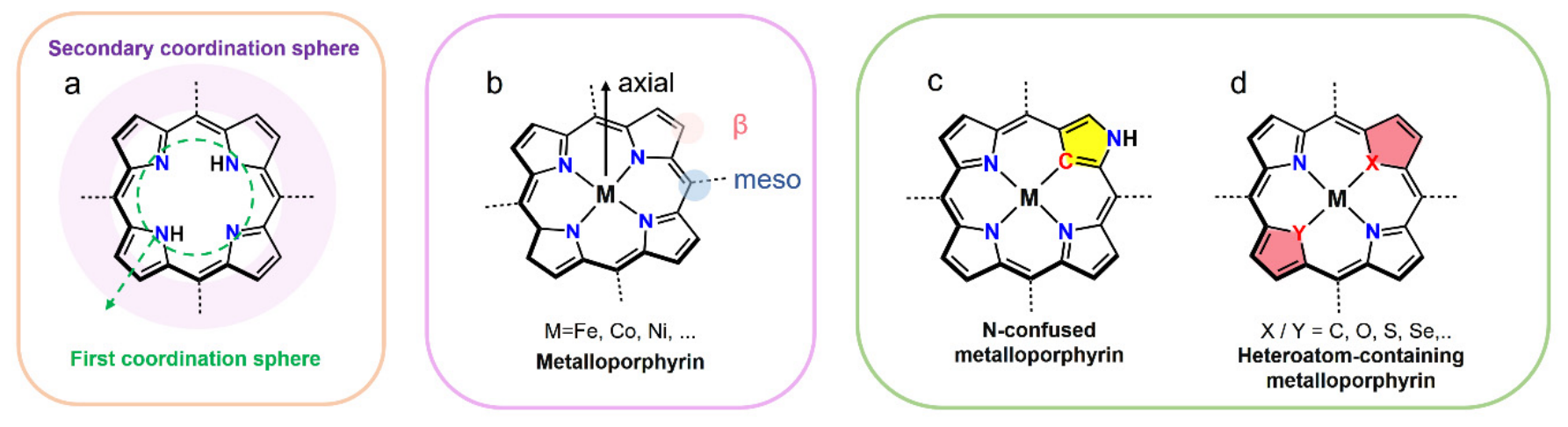
As shown in Figure 1, porphyrin macrocycles consist of four pyrrole units connected by four methine bridges, forming a conjugated ring with 18 delocalized π electrons within an aromatic framework. This structural feature endows porphyrins with strong absorption in the visible light region. Upon deprotonation of the two N-H groups, dianionic porphyrin ligands are formed, which provide a rigid square-planar N4 coordination pocket that sterically accommodates most transition metal ions M. The resulting metalloporphyrin complexes have a planar M-N4 environment. In recent decades, the catalytic applications of metalloporphyrins have extended to a broad range of targets, encompassing the ORR, carbon dioxide reduction, as well as hydrogen and oxygen evolution reactions [17,24,25,26].
Metalloporphyrins possess a range of features that make them an ideal platform for designing novel ORR catalysts. The stable, well-defined, and planar structure of the molecular macrocycle allows for modifying functional groups at its meso- [27,28,29,30,31], β positions [32,33,34] or the adding of axial ligands [35,36,37], so as to regulate their physical and chemical properties and to carry out mechanistic investigations. In addition, the redox-active nature of porphyrin ligands allows them to participate in electron-transfer processes, making metalloporphyrins valuable for multi-electron catalytic reactions, such as ORR. Although metalloporphyrin-based molecular catalysts exhibit high ORR activity in homogeneous catalysis, their intrinsic semiconducting nature limits their utilization as heterogeneous electrocatalysis in the practical application of energy conversion processes in fuel cells and Zn-air batteries. Therefore, to transform homogeneous molecular catalysts into heterogeneous electrocatalysts, researchers tend to either immobilize the catalysts on a stable and conductive support or incorporate them into hierarchical frameworks [38,39,40].
A number of recent review articles have provided comprehensive coverage of utilizing metal porphyrin-based catalysts for ORR [24,40,41]. These reviews focused on traditional metalloporphyrin systems where the central metal is coordinated to four nitrogen atoms, displaying symmetric MN4 coordination. Such a highly symmetric, planar coordination structure, however, is not always beneficial for catalysis, because the uniform environment may limit differential control over substrate approach and intermediate stabilization [42]. Nonplanarity was found to endow porphyrins with functions not accessible to conventional planar analogs [43,44]. The electrostatic or steric asymmetries introduced by axial ligand, second-sphere substitution, or a second metalloporphyrin site can alter ORR selectivity and improve catalytic behavior [45,46,47]. Intriguingly, breaking the N4 symmetry can significantly boost catalytic performance [48,49,50,51,52,53]. Of note, this is a strategy widely used in graphene-based M-N-C-type single-atom catalyst design [54,55,56]. As for metalloporphyrin, the approaches to breaking the MN4 symmetry include creating N-confused porphyrins (NCPs) [57,58,59], where the inversion of one or two pyrrolic units gives unique N3C or N2C2 coordination (Figure 1c), or substituting N atoms by O/S atoms to create N3O, N2O2, N3S, N2S2 coordination (Figure 1d) [60,61]. Up to now, multiple N-confused and O/S-substituted metalloporphyrins have been synthesized with different metal centers, mainly 3d and 4d transition metals [26]. For N3C-coordination N-confused metalloporphyrin, a series of transition metals were reported to be synthesized, including Mn, Fe, Co, Ni, Cu, Mo, Rh, Pd, Ag, Re, Pt, Au, and Hg [62,63,64,65,66,67,68,69,70,71,72]. For N2C2 coordination, Cu and Ag have been reported [73,74]. For N3O, M can be Mn, Fe, Co, Ni, Cu, Zn, and Re [75,76,77,78]. For N2O2, only Ni has been reported [77]. For N3S, M can be Fe, Ni, Cu, Ru, Rh, Pd, Re, and Hg [75,79,80,81,82,83]. For N2S2, M can be Ru and Re [84,85].
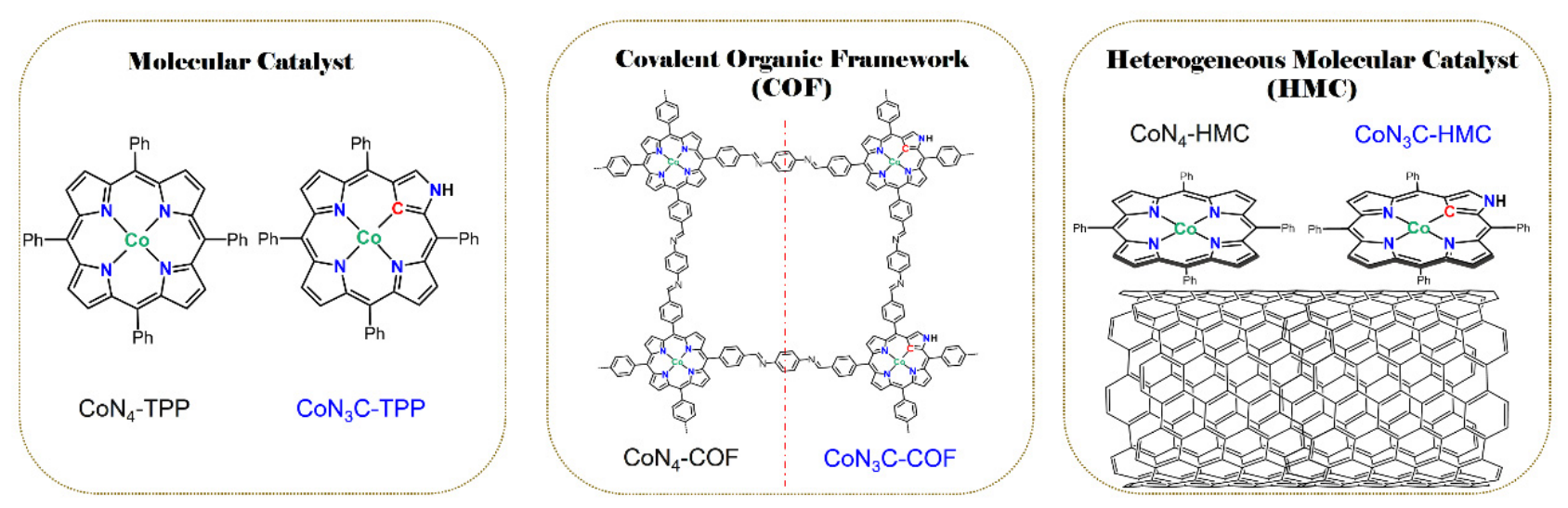
The most studied NCPs have a central metal of cobalt. This is largely attributed to the good performance of Co-porphyrins towards ORR as well as the feasibility of synthesizing Co-NCPs [49,50,86,87,88]. Intriguing, in the study of Co-NCP-based electrocatalysts, three distinct strategies have been employed to make molecular complexes heterogenized for electrocatalysis (Figure 2). Huang et al. synthesized metalloporphyrin molecular catalysts and used carbon black as a support in electrochemistry [49]. Shao et al. incorporated the porphyrinic units into highly ordered crystalline covalent organic frameworks (COFs) [50], and Liu et al. developed heterogeneous molecular catalysts by anchoring the macrocycles onto carbon nanotubes (CNTs) [52].
A comprehensive review of N-confused metalloporphyrins for ORR performance is lacking, especially regarding how the architecture or state of the catalysts influences the catalytic capability, and how the strategy of N-confusion compares to other modification strategies. To address this gap, this review focuses on the recent advances in N-confused cobalt porphyrin catalysts for ORR. This review is organized as follows. Section 2 introduces the general mechanisms of the oxygen reduction mechanism and the commonly used computational methods for mechanism studies. Section 3 briefly reviews the study on cobalt porphyrins in ORR catalysis and summarizes the influence of multiple modification strategies. Section 4 reviews the advances of N-confused cobalt porphyrins for ORR, with a focus on the difference in the architecture of the catalysts. A comparison between N-confused and other strategies mentioned in Section 3 will be presented. The review is closed up with a summary and outlook. By reviewing recent progress in first-coordination-sphere modification of metalloporphyrins, we aim to provide insights into the structure–activity relationships governing ORR catalysis and to offer guidance for the rational design of next-generation catalysts for sustainable energy conversion.

2. Mechanism of ORR on Metalloporphyrins

2.1. General Mechanism of ORR on Metalloporphyrins

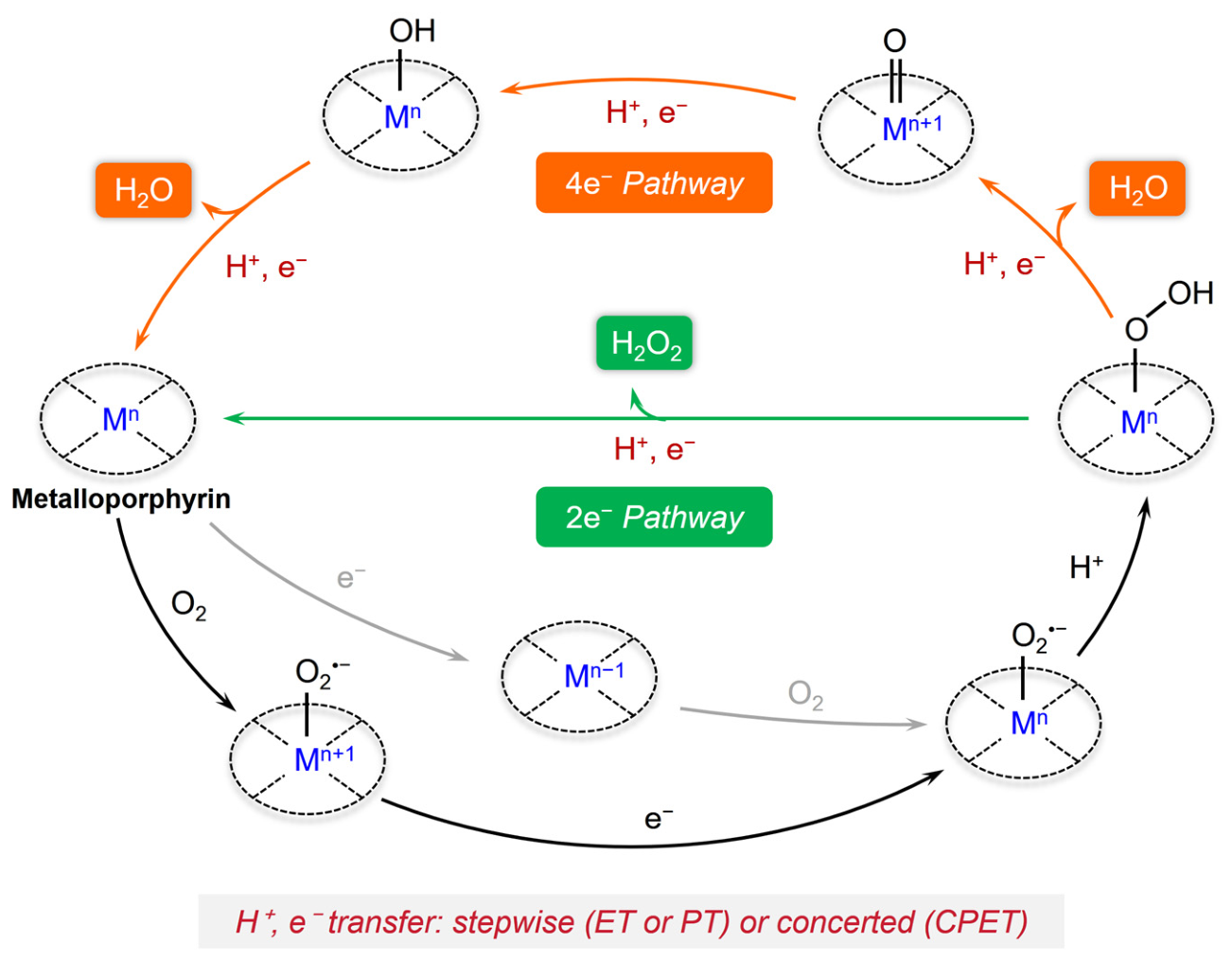
The performance of metalloporphyrin catalysts is fundamentally rooted in the molecular-level reaction pathway of ORR, making mechanistic understanding indispensable for interpreting and guiding catalyst design. In electrocatalysis experiments, electrons are transferred from the electrode to the catalytic system—sometimes via a conductor—which in turn reduces the target molecules. As shown in Figure 3, in homogeneous metalloporphyrin systems, the initial step of ORR is system-dependent, being either reduction in the catalyst or the coordination of O2 [89]. For example, in iron porphyrin systems, the catalyst is typically reduced to a low-valent state prior to O2 binding, after which O2 coordinates to form a metal–superoxo intermediate [90]. In contrast, in certain cobalt porphyrin systems, O2 can directly coordinate to the metal center before reduction, followed by electron transfer to generate a M-O2•− species [91]. Both pathways ultimately converge to the formation of metal–superoxo intermediates as key species in the catalytic cycle. This is followed by the transfer of one proton and one electron, yielding a metal–hydroperoxo intermediate M-OOH. At this stage, the reaction bifurcates: if the O-O bond is cleaved upon further proton and electron transfer, the four-electron pathway proceeds to produce H2O via high-valent metal–oxo and metal–hydroxo intermediates; if the O-O bond remains intact, protonation releases H2O2 as the product, corresponding to the two-electron pathway. Therefore, the competition between O-O bond cleavage and hydroperoxo release fundamentally determines the selectivity of ORR in molecular metalloporphyrin systems. Notably, these proton- and electron-transfer steps can occur either in a stepwise manner (PT then ET, or ET then PT) or via a concerted proton-coupled electron transfer (CPET), depending on the electronic structure of the catalyst, the electrolyte, and the applied potential, which collectively influence the coupling [85] of electron and proton transfer [92].
Beyond the general mechanistic framework, many factors can influence the exact ORR mechanism and selectivity. Some factors include the following: the type of central metal, the reaction environment like pH, the nature of support materials, and the structural modification of metalloporphyrins on the first/second coordination sphere. They affect the electronic structure of catalysts, the adsorption of O2, electron and/or proton-transfer behavior, intermediate stability, etc. [93]. The ORR mechanism on metalloporphyrins is governed by the interplay between metal-centered redox chemistry, ligand electronic effects, proton-coupled electron-transfer processes and electrochemical reaction conditions. Catalytic performance is largely determined by the ability to balance the stabilization and transformation of oxygenated intermediates, particularly hydroperoxo species. A key challenge lies in elucidating the intrinsic relationship between these influencing factors and the regulation of the reaction mechanism. A complete mechanistic understanding of ORR relies on the combined use of theoretical and experimental approaches.

2.2. Computational Studies on ORR Mechanisms

Density functional theory (DFT) calculations are widely employed to model intermediates, evaluate reaction free energies, and identify potential-determining steps within the catalytic cycle. Electronic structure analyses, such as charge distribution and orbital interactions, further provide insight into how ligand modifications influence catalytic behavior [94]. In theoretical studies, the mechanistic analysis of ORR catalyzed by metalloporphyrins is almost entirely based on density functional theory (DFT). Existing work mainly follows two modeling strategies, namely cluster-based DFT calculations and periodic DFT calculations.
For molecular metalloporphyrin complexes that act as homogeneous catalysts, mechanistic studies usually employ cluster models and are commonly carried out with quantum chemistry packages such as Gaussian under implicit or explicit solvation conditions. In such systems, electron transfer and proton transfer can often be treated as separate steps. As a result, in addition to common oxygen-containing intermediates such as the *O2, *OOH, *O, and *OH, species with different reduction states and different protonation states also need to be considered. For these candidate intermediates, geometry optimizations and vibrational frequency calculations are typically performed to determine whether they correspond to stable minima or transition states, while the relative energies of different spin states are compared to identify the ground-state structure. On this basis, Gibbs free energy comparisons are then used to identify the true active species and the preferred reaction pathway. In addition, reduction potentials and pKa values of key species are often calculated to clarify the sequence of electron-transfer and proton-transfer steps and to determine whether the reaction is more likely to proceed through a stepwise ET/PT pathway or may involve a concerted proton-coupled electron-transfer process.
For heterogeneous metalloporphyrin catalysts, mechanistic studies are usually carried out using periodic DFT calculations, most commonly with plane-wave packages such as VASP. Typical computational settings include the PBE functional, PAW pseudopotentials, and D3 dispersion correction. Unlike homogeneous molecular systems, heterogeneous ORR studies usually treat concerted proton–electron transfer as a unified process. Accordingly, electron transfer and proton transfer are generally not discussed separately. Instead, reaction free energy diagrams are constructed directly around O2 adsorption and the key oxygen-containing intermediates *OOH, *O, and *OH. In other words, the central task in such calculations is to determine the adsorption configuration of O2 at the active site, calculate the adsorption free energies of *OOH, *O, and *OH, and then compare the free energy changes in the elementary steps. This allows identification of the true active site, the preferred reaction pathway, the potential-determining step, and the theoretical overpotential. Beyond free energy diagrams, these studies are also often combined with adsorption-energy analysis, overpotential analysis, comparisons between two-electron and four-electron selectivity, and stability analyses based on metal binding energies, aggregation tendencies, and dissolution potentials, in order to explain the activity, selectivity, and stability of the catalyst under electrochemical conditions. For the two-electron ORR pathway, it is usually sufficient to further compare whether *OOH continues to be reduced to *O or desorbs directly to form a peroxide species. Therefore, the stability of *OOH is often the key factor that distinguishes the two-electron pathway from the four-electron pathway.
From a thermodynamic perspective, mechanistic calculations for heterogeneous ORR usually employ the computational hydrogen electrode (CHE) model to describe the energy change associated with the addition of one proton and one electron, which is the effective addition of one hydrogen atom. Within this framework, the chemical potential of a proton–electron pair is usually represented by 1/2 G(H2), and the reaction free energy of each elementary step is generally written as ΔG = ΔE + ΔZPE − TΔS + ΔGU + ΔGpH. Here, ΔE is the DFT total-energy difference, ΔZPE and TΔS correspond to the zero-point energy and entropy corrections, respectively, ΔGU = −neU is used to account for the effect of the applied potential, and ΔGpH describes the correction arising from the solution pH. In practical calculations, the adsorption free energies of *OOH, *O, and *OH are usually obtained first, and the reaction free energies of the elementary steps are then derived from the relative free energy differences among these intermediates, which further allows evaluation of the theoretical overpotential. Under acidic conditions, the overall reaction is usually written as O2 + 4H+ + 4e → 2H2O, and the elementary steps can be described as the sequential uptake of H+ and e by the adsorbed intermediates. Under alkaline conditions, the reaction is usually rewritten as O2 + 2H2O + 4e → 4OH, where the proton is no longer treated as free H+; instead, H2O is taken as the proton source and OH is written as the product in the corresponding elementary steps. Thus, although both acidic and alkaline systems can be analyzed within the CHE framework, the reaction expressions, proton source, and the treatment of the pH correction term still need to be considered separately.

3. Cobalt Porphyrins for ORR

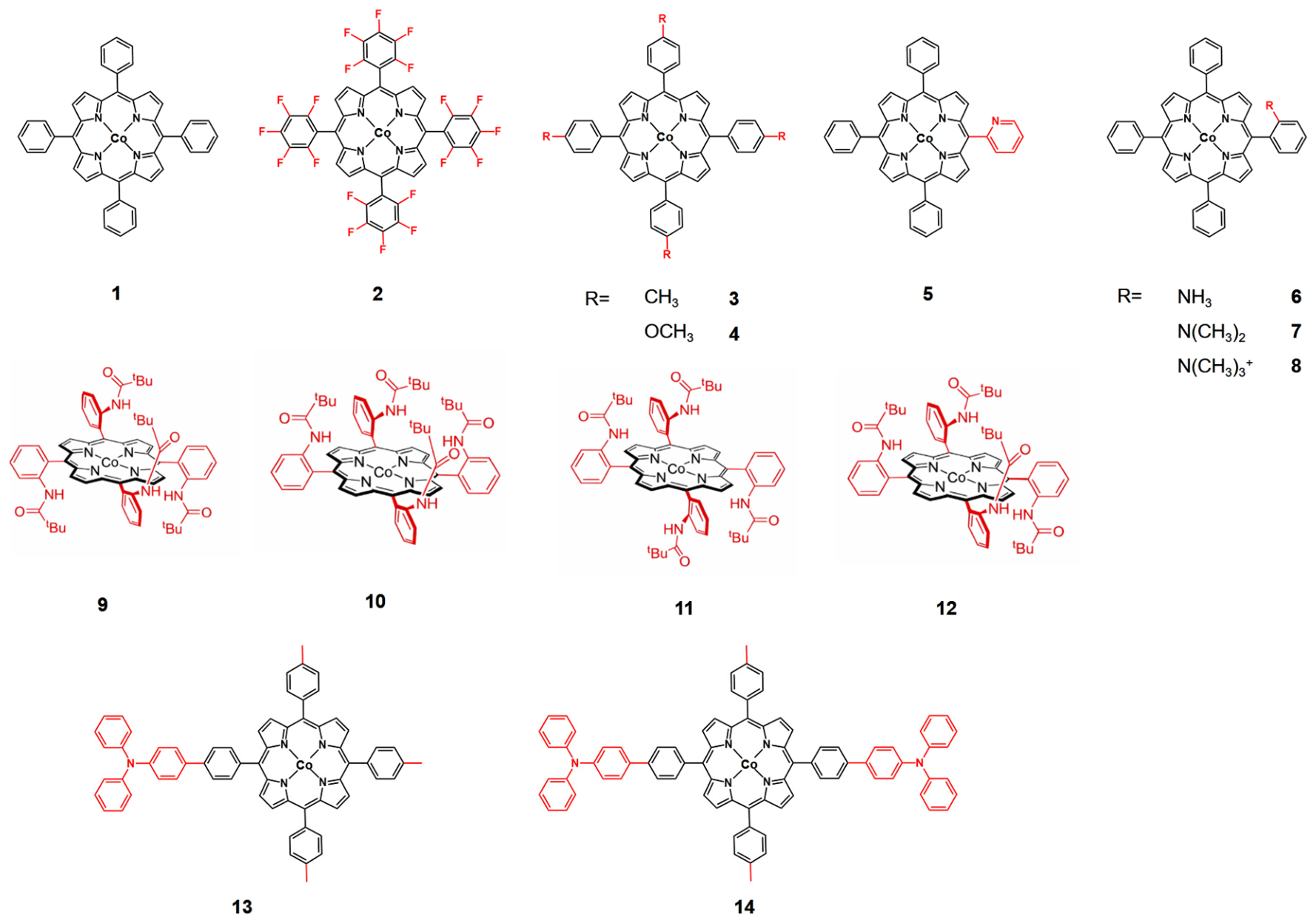
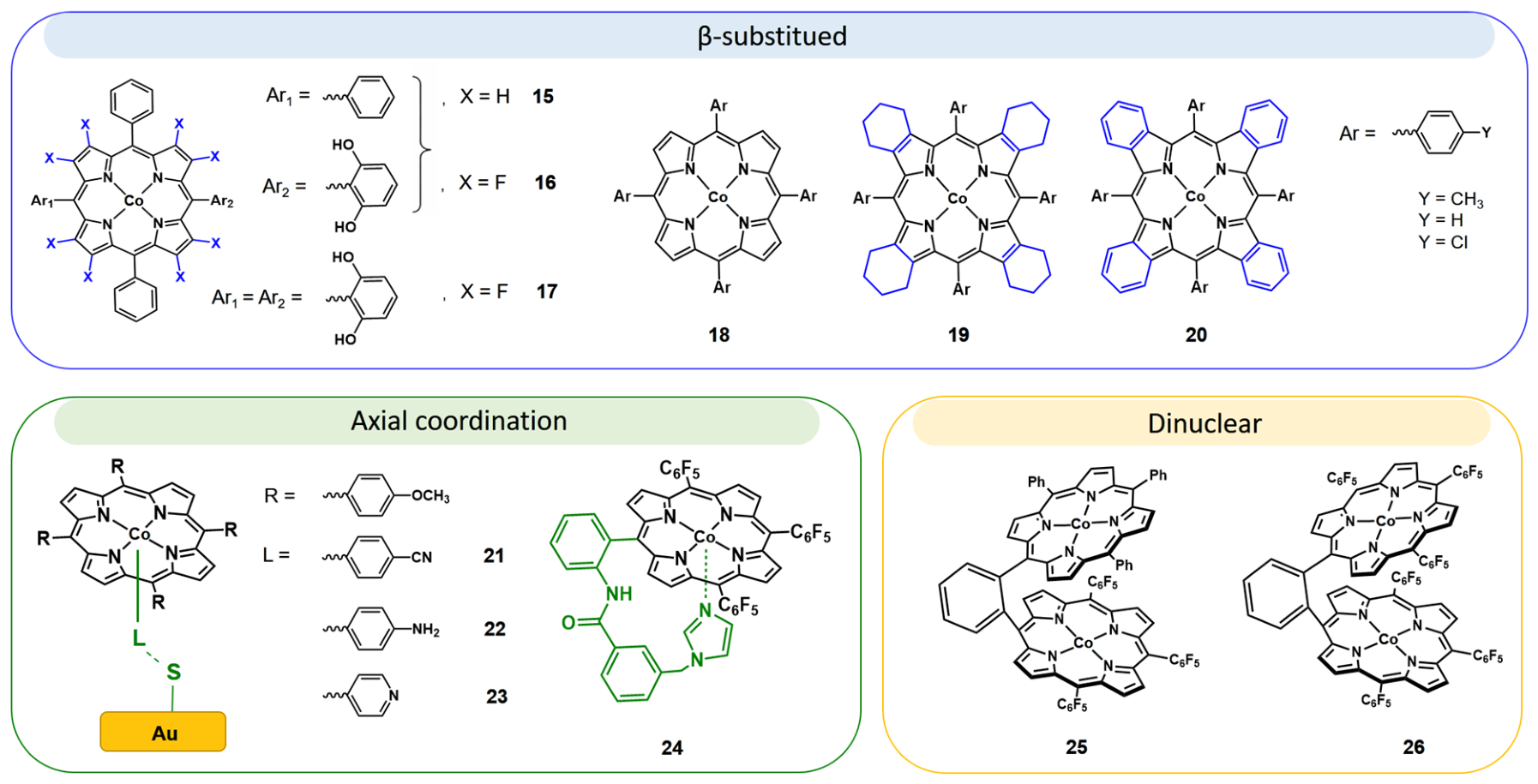
Cobalt tetraphenylporphyrins (CoTPP, 1) is the pristine model for the study and optimization of ORR performance. Regulation strategies include meso- or β-position modification, axial coordination tuning, and the construction of two neighboring Co sites. According to the oxo-wall rule [95], late transition metals (including Co) in monometallic porphyrins tend to reduce O2 to H2O2, because the metal–oxo intermediate, a necessary intermediate for the reduction to H2O, is unstable [96,97]. In fact, the ORR products of mononuclear cobalt porphyrins include both H2O and H2O2 [17,89]. Hence, the selective reduction is a key goal and a major challenge. In this section, we will briefly review examples of cobalt porphyrin compounds that apply the above four modification strategies, focusing on the changes in ORR activity and selectivity, as well as the underlying mechanisms. These examples are summarized in Table 1.

3.1. Effects of Meso-Position Substitution

Depending on the type of functional groups introduced at the meso-positions, the mechanism to influence ORR activity and/or selectivity varies (Figure 4). In comparison to CoTPP (1), introducing strong electron-withdrawing group (like F) to the meso-phenyl ring to form tetra-pentafluorophenyl cobalt porphyrin (CoTFPP, 2) lowers the electron density on Co and reduces the ORR activity under basic condition, i.e., the half-wave potential decreases from 0.81 V (1) to 0.76 V (2) and the Tafel slope increases from 36.9 to 43.5 mV dec−1 [98]. In contrast, introducing electron-donating methyl (3) and methoxy (4) groups to the meso-phenyl ring [99] helped stabilize partially reduced intermediates near the Co center, allowing them to accept additional electrons and undergo further reduction to H2O, hence improving both selectivity and activity. CoTPPy (5) has a 2-pyridyl group at one meso-position; under acidic condition and an applied potential of 0.4 V, the electron-transfer number was reported to be 3.51, in comparison that of 2.6 for CoTPP [100]. This 4H+/4e pathway selectivity was attributed to a proton-relay effect, for the microenvironment around the Co center was altered to promote proton transfer. This view is further supported by the work of Co hangman porphyrins [105]. Substituting one H on one of the meso-phenyl rings by NH2, NMe2, and NMe3+, and forming CoTPPNH2 (6), CoTPPNMe2 (7), and CoTPPNMe3+ (8) [45], changes the selectivity under different pH (0, 4, and 7). Among them, complex 8 has a greater preference towards the 4e reduction pathway as the electron-transfer number is the largest (3.2–3.8). Here, the electrostatic effect of cationic functional group was proposed to play a role during proton transfer, thus influencing the selectivity. When the functional group is bulk, the spatial arrangement and steric effects play a role. Complexes 9, 10, 11, 12 are cobalt porphyrin atropisomers bearing four ortho-amido groups at meso-position. Although they have similar intrinsic onset activity, i.e., half-wave potentials are 0.72–0.73 V, the αααα isomer (with n of 3.75) favors the 4e pathway. This is because the highly symmetric αααα isomer forms a more favorable pocket on one side for O2 access and binding, resulting in subsequent O2 activation and O-O cleavage at the Co center. The effect of spatial arrangement was also reflected on the comparison between the asymmetric aBz-TCoP (13) and the symmetric catalyst Bz-2TCoP (14) [101], where complex 14 has higher n values (3.6/3.5) under acidic/alkaline conditions in relative to 13. Overall, meso-position modification can regulate ORR activity and selectivity by tuning the electronic structure, proton-transfer environment, and steric pocket around the Co center.

3.2. Effects of β-Position Substitution

In terms of β-position modification (Figure 5), introducing electron-withdrawing F groups to all the eight β-positions of the CoTPP shifts the reduction potential to be more positive—from −1.36 V for CoTP(OH)2 (15) to −0.97 V for CoTPF8(OH)2 (16), and −1.01 V for CoTPF8(OH)4 (17) [102]. Because β-F substitution lowers the energy level of the porphyrin ligand π* orbitals, the system becomes more likely to accept electrons, i.e., to be reduced. In addition, the β-fluorinated systems showed higher selectivity toward H2O, and DFT calculations revealed that β-F substitution strengthened the binding of H2O2-related intermediates, making their premature release less favorable and thus promoting their further reduction to H2O. The other work extended the conjugation of Co-TPP by substituting benzyl rings at β-positions [33]. The resulting benzo fusion complexes 20 displayed increased favor for 4e reduction (i.e., greater n values), attributed to the strengthened intermolecular π–π interactions. Overall, β-position modification mainly affects ORR by tuning the electronic structure and π-conjugation of the porphyrin ligand, and it can promote the 4e pathway by strengthening intermediate binding or intermolecular interactions.

3.3. Effects of Axial Coordination

Tuning axial coordination directly affects the electronic structure of the Co center, hence impacting O2 binding, activation, and the O-O bond cleavage process. For example, [tetrakis(4-methoxyphenyl) porphyrin]cobalt, denoted TMPPCo, was assembled on thiol-modified Au electrodes and three electron-donating ligands were introduced as axial ligands, including 4-mercaptopyridine (MPy, 21), 4-aminothiolphenol (APT, 22) and 4-mercaptobenzonitrile (MBN, 23) [36]. All three systems proceed with the 2e pathway. The ORR onset potential shifted to be more positive: 0.53 V (21), 0.48 V (22), and 0.45 V (23) vs. RHE. The catalytic activity order follows the coordination ability order of the ligands: MPy > APT > MBN. DFT calculations suggested that axial ligands increase electron donation to the Co center through a push effect, decreases its positive charge, and enhances back-donation to O2, thus facilitating O2 adsorption and O-O bond activation. In another example [89], a Co porphyrin 24 with an appended imidazole group for Co axial binding was synthesized. Similarly, O2 binding and activation at the Co site was significantly improved through an electron-pushing effect. Complex 24 is more effective than its structural analog parent compound 2, which lacks the appended imidazole group, in terms of mediating ORR. Moreover, since the axial imidazole group compactly incorporated into the molecular framework, it affects the conversion of the O2 adduct and subsequent oxygen-containing intermediates, hence affecting the 2e/4e selectivity. After loading both molecules onto CNTs and testing them for ORR in 1.0 M KOH, 24 exhibited a half-wave potential of 0.83 V and an electron-transfer number of 3.29, in comparison to 0.70 V and the n value of 2.78 for complex 2. The formation of H2O was found to through a direct 4e reduction pathway. As a practical demonstration, the Zn–air battery assembled with 24 as the air electrode catalyst displayed comparable performance to the battery using Pt/C + Ir/C. Specifically, 24-based Zn–air battery delivered a smaller charge–discharge voltage gap (0.88 V vs. 0.91 V), a higher specific capacity (785 vs. 735 mA h g−1), and a higher peak power density (120 vs. 75 mW cm−2) than the battery based on Pt/C + Ir/C, while also showing high cycling durability for over 60 h. In brief, axial coordination regulates ORR mainly through an electron-pushing effect on the Co center, which enhances O2 adsorption and activation, promotes O-O bond activation, and further influences the 2e/4e pathway depending on the axial ligand structure.

3.4. Effects of Dinuclear

The idea of constructing binuclear porphyrin catalysts also originates from biological enzyme systems. In multi-electron redox enzymes, multiple metal centers often work together in substrate binding and the subsequent redox process [37]. Therefore, researchers have constructed binuclear cobalt porphyrin structures in which two Co sites are placed in close proximity. Binuclear Co porphyrin molecules can selectively catalyze the 4e ORR by forming a Co-O2-Co intermediate.
Cao group synthesized asymmetric Pacman dinuclear cobalt porphyrin complex 25, featuring triphenylporphyrin (TPP) and tri(pentafluorophenyl)-porphyrin (TPFP) ligands, outperforming its symmetric analog 26, (Co-TPFP)2. Both binuclear cobalt porphyrins catalyze the 4e ORR more efficiently and with higher selectivity than the corresponding mononuclear CoII porphyrins, CoTPP (1) and CoTPFP (2). 25 exhibits a higher catalytic current and a lower overpotential compared to 26 in 0.5 M H2SO4. According to the DFT studies by Liao group, the enhanced efficiency of complex 25 stems from its asymmetric structure: the Co-TPP unit serves as the primary site for O2 binding and reduction, while the positively charged Co-TPFP moiety acts as a Lewis acid, promoting O2 activation. Moreover, Bronsted acid H2SO4 facilitates O-O cleavage via proton donation and hydrogen bonding, lowering the barrier for this critical step and stabilizing intermediates. It can be seen that asymmetric binuclear metal catalysts play a crucial role in the electrocatalytic 4e ORR process. Nocera et al. found that installing trans aryl groups on binuclear Co-porphyrins reduces the selectivity for the direct reduction of O2 to H2O [106]. Cook et al. synthesized three types of face-to-face binuclear cobalt porphyrin systems with different distances via self-assembly. They found a shorter bridging ligand, which involves two Ru centers and improves 4e selectivity and the overall reaction rate constants, suggesting that the spatial arrangement of the two Co sites affects the cooperative effect between them during ORR [46]. To sum up, binuclear cobalt porphyrins promote 4e ORR by creating cooperative dual-Co sites, where the relative distance, orientation, and electronic asymmetry between the two Co centers determine O2 binding, O-O bond cleavage, and the efficiency of the reduction to H2O.
From the above analysis, it can be seen that meso-substituents and β-substituents (i.e., electron-withdrawing and electron-donating effects), axial ligands (i.e., electron push effects), the secondary coordination sphere structure (i.e., proton relay), and the number of metal centers all have a significant impact on the ORR of cobalt porphyrins. When these effects are present individually or simultaneously in the porphyrin, their influences on ORR activity, selectivity, and stability differ. It is worth mentioning that carbonaceous support/conductive additive also affects ORR performance. As shown in Table 1, multiple types of supports including CNT, GCE, EPG, and CB were used. Such carbon materials can substantially affect the local interfacial microenvironment surrounding the active sites, including conductivity, oxygen mass transport capability, hydrophobicity/hydrophilicity, and electronic coupling with the catalytic centers. The effects of supports on the ORR performance and selectivity of CoN4-TPP and CoN3C-TPP will be discussed in the next section.

4. N-Confused Cobalt Porphyrins for ORR

The above studies on cobalt porphyrin-catalyzed ORR retained the coordination environment of CoN4. In this section, we will discuss how modifying the primary coordination sphere affects the performance of cobalt porphyrins in ORR. This discussion is primarily based on three recent works from different groups. All these works used CoTPP as the pristine model and the reference system, and synthesized N-confused Co porphyrin derivatives with an N3C1 coordination environment. All three studies demonstrated that breaking the symmetric N4 structure and introducing a carbon atom to form an asymmetric N3C1 coordination environment leads to a catalyst with a higher ORR activity (i.e., lower ORR overpotential) and changes ORR selectivity (Table 2).
Interestingly, the architectures of these catalysts differ: Huang et al. synthesized a CoN3C1-TPP molecular catalyst (denoted as CoN3C1-TPP molecular system), Shao et al. group-embedded the CoN3C1 porphyrin unit into a covalent organic framework (denoted as CoN3C1-COF system), and Liu et al. non-covalently anchored CoN3C1-TPP onto the surface of multi-walled carbon nanotubes (MWCNTs) to construct a heterogeneous molecular catalyst (denoted as CoN3C1-HMC). Since the three works show good consistency in content and logic, we will make one-to-one comparisons in the following aspects: DFT-based screening and prediction, synthesis and characterization of N-confused porphyrin catalysts, electrocatalytic ORR performance, and mechanism analysis. Finally, a discussion between N-confused strategy and other modification methods in Section 3 will be presented.

4.1. DFT-Based Screening and Prediction

The first part of the three papers is screening by DFT calculations to predict the proper central metal for the N-confused metalloporphyrin-based catalysts. Although the computational models and methods are different, the calculations reached the same conclusion that N-confused porphyrin systems with Co as the central metal show improved ORR catalytic performance compared to MN4 systems, making them the most promising electrocatalysts.
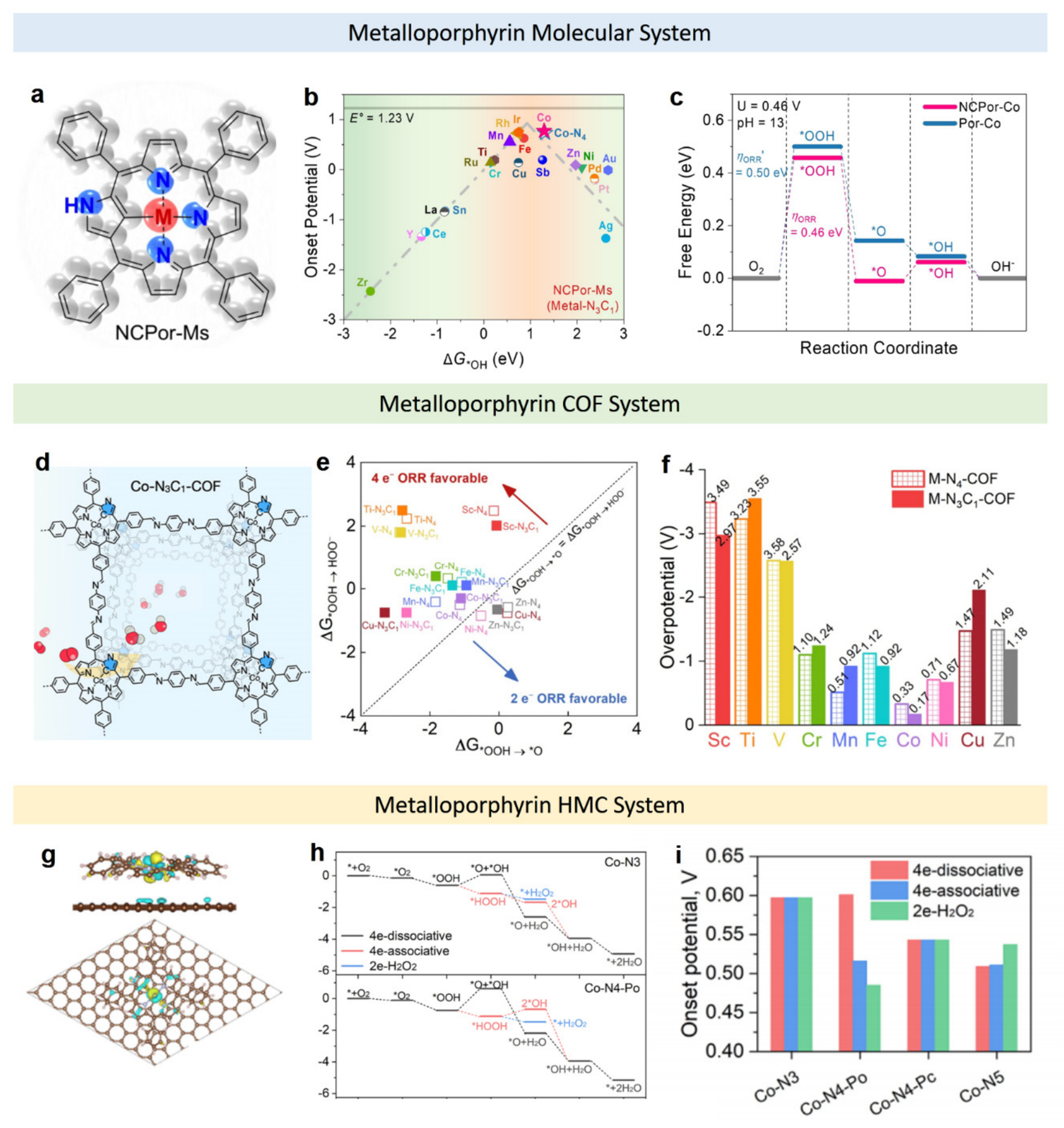
In terms of the simulation model, Huang et al. constructed the molecular cluster model (Figure 6a), Shao et al. constructed the single-layer periodic model of the COFs (Figure 6d), and Liu et al. constructed a periodic model with metalloporphyrin molecules on top of single-layer graphene (Figure 6g). The employed functional is PBE and the software is VASP. All the calculations assumed PCET and no transition states were considered.
Huang et al. designed 21 types of M-N3C1 molecular systems with group 3d, 4d, and 5d transition metals (Figure 6b). To evaluate the activity of the M-N3C1-TPP and CoN4-TPP, their calculated onset potentials were plotted against their adsorption free energies of *OH (∆G*OH) and *OOH (∆G*OOH), and displayed volcano curves (Figure 6b). According to the Sabatier principle, the best catalysts are located at the vertex of the volcano plots, so the M-N3C1-TPP active sites with M equals Co, Mn, Fe, Ir, and Rh are predicted to be promising ORR catalysts. The CoN3C1 site exhibits the highest ORR activity with Eonset of 0.77 V, and this is more positive than the corresponding CoN4 sites, where Eonset equals 0.73 V. The authors also computed a free energy profile encompassing the energetics of key intermediates *OOH, *O, and *OH, and the resulting overpotential ηORR is 0.46 V for CoN3C1-COFs and 0.50 V for CoN4-COFs, which also suggests the N3C1 system has higher activity (Figure 6c). Of note, although the catalysts are molecular clusters in this work, the authors used VASP for calculation, which is usually used for the periodic system. We think the reason for this choice is to obtain Eonset.
Shao et al. designed 10 types of M-N3C1-COFs and M-N4-COFs by varying the central metal from Sc to Zn, and computed the energetics of key intermediates *OOH, *O, and *OH. Among the 20 COFs, Co-based catalysts were predicted to have the lowest theoretical overpotential ηORR, 0.17 V for CoN3C1-TPP and 0.33 V for CoN4-COFs (Figure 6f). By comparing the Gibbs free energy changes (ΔG*OOH→*O) of *O formation against Gibbs free energy changes (ΔG*OOH→HOO−) of HOO formation, CoN3C1-COF was predicted to have a stronger preference for 4-electron reduction to H2O than the parent CoN4-COF (Figure 6e).
Liu et al. designed four types of organic molecules with cobalt center that are placed on a single layer of graphene sheet, where the parent organic molecules are N-confused porphyrin (CoN3C1-HMC), porphyrin (CoN4-HMC), phthalocyanine (CoN4), and texaphyrin (CoN5). To limit the scope of this review, we focus on the first two porphyrin systems. The binding energy difference between the *O2 and *HOOH intermediates (ΔE = E*O2E*HOOH) was used to qualitatively predict the H2O2 selectivity, and a close-to-zero value indicates high selectivity. The ΔE values for CoN3C1-HMC and CoN4-HMC are −0.22 eV and −0.41 eV, respectively, so the authors concluded that CoN3C1-HMC has a higher H2O2 selectivity. Then, ORR free energy profiles were computed for three pathways, i.e., 2e-H2O2, 4e-associative, and 4e-dissociative (Figure 6h). The resulting onset potentials ηORR for the three pathways are all 0.597 CoN3C1, and are 0.485, 0.516, and 0.601 for CoN4, respectively (Figure 6i). Overall, ηORR are more positive (meaning higher ORR activity) for CoN3C1-HMC, consistent with the other two works. We point out that the dissociative pathway, which involves *HOOH → 2*OH and the *OOH → *O + *OH step, are not common in the mononuclear metalloporphyrin homogeneous system; they are more common in bimetallic [94] and multimetallic systems, or heterogeneous catalysts.

4.2. Synthesis and Characterization of N-Confused Porphyrin Catalysts

Since all DFT calculations predicted that the N-confused cobalt porphyrin systems outperform the corresponding cobalt porphyrin-based catalysts, three experimental groups synthesized them with different architectures. Huang et al. directly synthesized the discrete M-N3C1-TPP molecules, where M = Mn, Co, Ni, Cu, Pd, and Ag, by the reaction between pyrrole and benzaldehyde, followed by metalation. Then, the molecules were physically mixed with conductive carbon black in an ethanol solution containing Nafion. The resulting homogeneous ink was uniformly drop-casted onto the electrode surface for electrocatalytic testing. Shao et al. constructed the COFs via imine condensation, where the formyl-functionalized cobalt N3C1-porphyrin monomer was reacted with p-phenylenediamine, affording the highly crystalline and porous 2D COF material. Liu et al. synthesized the CoN3C1-TPP molecules; then the molecules were firmly anchored onto the deep purified commercial multi-walled carbon nanotubes (MWCNTs) which were surface-driven by strong van der Waals interactions (specifically, π-π stacking). This strategy successfully forms heterogeneous molecular catalysts (HMCs) that combine the excellent conductivity of the carbon support with the well-defined asymmetric active sites of the molecular catalysts. DFT calculations further confirmed that the van der Waals interactions ensure the stability of the coupling, as the calculated binding energies between CoN4/CoN3C1-TPP and the graphene (that models the CNTs) are about −2.0 eV.
The three studies primarily utilized X-ray Absorption Spectroscopy (XAS), especially Extended X-ray Absorption Fine Structure (EXAFS) quantitative fitting and X-ray Absorption Near-Edge Structure (XANES), alongside other spectroscopic techniques to explicitly verify the asymmetric CoN3C1 coordination environment.
In the molecular catalyst work by Huang et al., the EXAFS spectra exhibited prominent first-shell peaks corresponding to Co-N and Co-C bonds. Through quantitative fitting, the coordination number (CN) was determined to be approximately 3.0 for the Co-N shell and 1.0 for the Co-C shell, providing direct structural evidence for the CoN3C1-TPP coordination. In addition, near-edge X-ray absorption fine structure (NEXAFS) at both the C K-edge and N K-edge displayed specific dipole transitions (such as transitions to π (Co-N/C) orbitals), which further confirmed the presence of Co-N and Co-C bonds within the molecule.
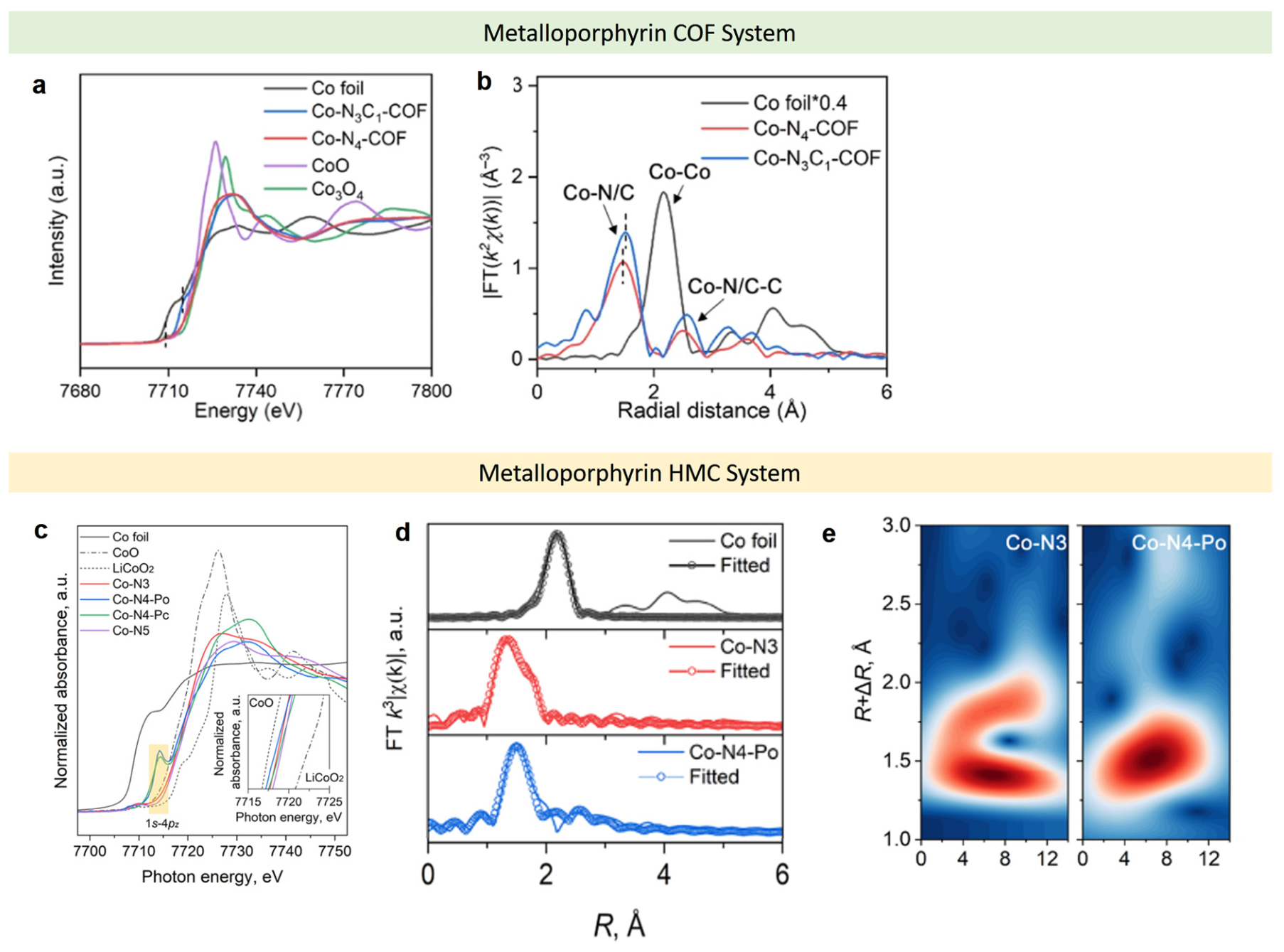
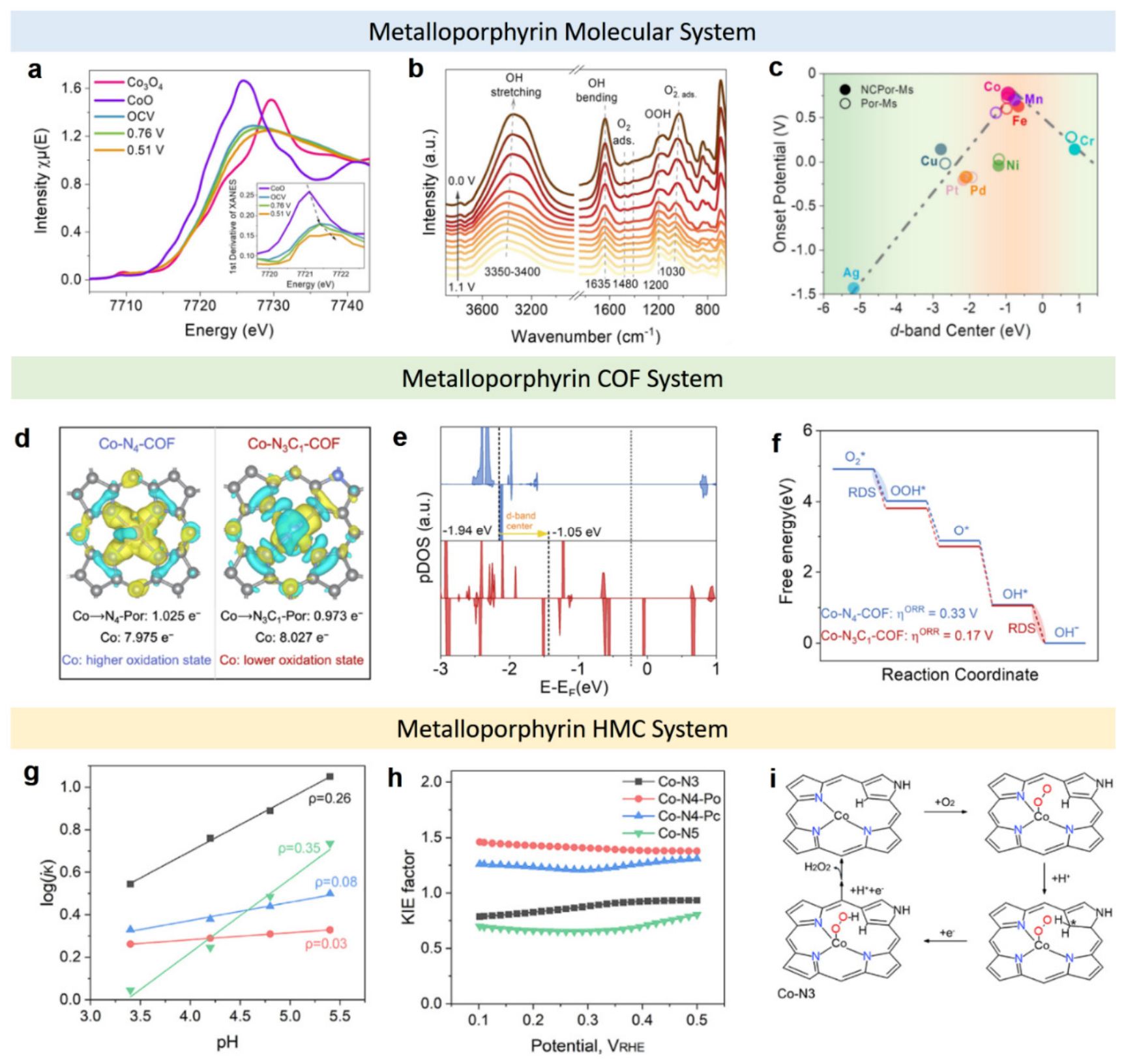
In the CoN3C1-COF work by Shao et al., the XANES spectra showed the disappearance of the characteristic 7709 eV fingerprint peak, which typically represents a symmetrical square-planar CoN4-TPP coordination. Instead, a new pre-edge peak emerged at 7716 eV (corresponding to a dipole-allowed 1s → 4p transition), confirming the highly distorted, asymmetrical coordination environment (Figure 7a). In addition, in the Fourier-transformed EXAFS spectra, the main peak for CoN3C1-COF shifted to 1.52 Å, noticeably different from the 1.46 Å peak of the symmetric CoN4-COF. This shift was attributed to the simultaneous formation of Co-N and Co-C bonds (Figure 7b). The quantitative fitting results confirmed a Co-N coordination number of 2.6 ± 0.3 and a Co-C coordination number of 0.9 ± 0.1.
In the CoN3C1-HMC work by Liu et al., the first-shell EXAFS fitting revealed a combination of paths: a three-fold Co-N path with a compressed bond length of ~1.916 Å, and a one-fold Co-C path with a bond length of ~2.106 Å (Figure 7d). Wavelet-transformed EXAFS (WT-EXAFS) contour plots also provided visual support for these distinct backscattering paths (Figure 7e). In addition, in the XANES Pre-edge Analysis, the asymmetrical CoN3C1-HMC catalyst exhibited a distinct pre-edge peak at ~7708.8 eV, which is ascribed to a parity-forbidden quadrupole 1s → 3d transition indicative of a highly distorted coordination geometry. This starkly contrasts with the strong pre-edge peak at ~7717 eV observed for planar D4h symmetric CoN4-HMC catalysts (Figure 7c). Moreover, N K-edge electron energy loss spectroscopy (EELS) and N 1s XPS were used. Both techniques detected specific signals (a shoulder peak at ~399.2 eV in EELS and a peak at 400.4 eV in XPS) assigned to the unbounded pyrrolic “-NH” group, which is a unique structural signature of the N-confused porphyrin ring. We note that the assignment of the XANES peaks is not consistent in the COF and HMC systems. We believe that it is necessary to unify this phenomenon experimentally in the future, probably in combination with theoretical calculations.
It is worth mentioning that the stability of these asymmetric coordination structures in the harsh environment of electrocatalysis is critical. All these three articles directly address this issue and, through different ex situ or operando characterization techniques, consistently demonstrate that the configuration remains stable during the electrocatalytic ORR process, without undergoing irreversible structural collapse or reconstruction.

4.3. Electrochemical ORR Performance

The electrocatalysis ORR performance of these three N-confused cobalt porphyrin systems was evaluated using conventional three-electrode methods, including RRDE-LSV and RDE-LSV. A detail comparison is present in Table 2. Huang et al. and Shao et al. both carried out their measurements in O2-saturated 0.1 M KOH solution, and Liu et al. used an RRDE setup in acidic, neutral, and alkaline (0.1 M KOH) electrolytes to examine the pH-dependent behavior of the heterogeneous molecular catalysts (HMCs). Since 0.1 M KOH solution was used in these three works, a direct comparison between their ORR performances is possible. Of note, different conductive carbon materials were employed, including carbon black in Huang’s work, Ketjen Black in Shao’s work, and MWCNTs in Liu’s work. Nevertheless, all three studies found that changing CoN4 to asymmetric CoN3C1 coordination environment enhances the intrinsic ORR activity of the cobalt site, as reflected by more positive Eonset or E1/2 potentials and lower theoretical overpotentials ηORR.
As shown in Table 2, under 0.1 M KOH condition, the Eonset of CoN4/CoN3C1 systems are 0.77/0.83 V for molecular catalysts, 0.675/0.794 V for COFs, and 0.60/0.78 V for HMCs. The corresponding E1/2 of CoN4/CoN3C1 systems are 0.84/0.95 V, 0.82/0.89 V, 0.85/0.93 V, respectively. In comparison, changing the coordination from CoN4 to CoN3C1 shifts the Eonset towards the positive by 0.06–0.18 V, and the E1/2 by 0.07–0.11 V. In addition, the kinetic current density of CoN3C1-COF reached 72.1 mA cm−2, approximately 1.8 times that of CoN4-COF (0.32 V). When considering solely the absolute value of Eonset or E1/2 potentials, the CoN3C1 molecular catalysts appear to be the most effective ORR catalysts, exhibiting the most positive Eonset (0.95 V) and E1/2 (0.83 V). This is comparable to and even better than the Pt/C benchmark, with Eonset ≈ 0.92 V and E1/2 ≈ 0.81 V, as estimated from Figure 2b in the original article by Huang et al. [49].
The CoN3C1-Por molecular catalyst was further used as the air cathode of the rechargeable Zn–air battery, in which 6 M KOH with 0.1 M ZnCl2 was used as the electrolyte, and a polished Zn plate was used as the anode. Huang et al. reported that the maximum power density of the CoN3C1 molecular catalyst-based battery reaches 120.4 mWcm−2 at a current density of 207.1 mAcm−2. This is higher than those of the CoN4-Por molecular catalyst (66.5 mWcm−2 at 136.9 mAcm−2) and commercial 20% Pt/C (111.1 mWcm−2 at 169.7 mAcm−2). This battery shows no obvious voltage change after 70 h of charge–discharge cycles, revealing the high stability of CoN3C1-Por molecular catalyst in Zn–air batteries. We have the opinion that the HMC architecture would be more suitable for practical high current density Zn–air battery and fuel cell applications, albeit the existing literature did not perform such testing. This is because they tend to provide a more balanced integration of catalytic activity, electron transport, mass transport, and structural robustness.
In terms of selectivity under the 0.1 M KOH condition, all systems prefer the 4e pathway to 2e pathway; their H2O2 yields are smaller than 30%. The molecular catalysts and COFs, proceeding from a near-four-electron pathway, have better H2O selectivity than the HMCs. Changing the coordination from CoN4 to CoN3C1 affects the selectivity, but the trend is different among the three systems. The H2O selectivity was enhanced in molecular catalysts (slightly, n increases by 0.05–0.1) and COFs (greatly, n increases by 0.6); however, it was inhibited in HMCs (n decreases by 0.16). This illustrates that the support has a significant role in affecting the selectivity or ORR.
It would be interesting to understand why N-confusion increases 4e selectivity in molecular and COF systems but decreases it in CNT-supported HMCs. We speculate that different carbon supports exhibit distinct interfacial interactions and charge transfer behaviors with the catalytic sites; they may modulate the electronic structure of the active centers and consequently alter the adsorption strength of ORR intermediates, ultimately affecting both catalytic activity and reaction pathways. In particular, the intrinsic curvature and extended π-conjugated structure of MWCNTs may further influence the local electronic environment and interfacial electron delocalization of the supported molecular catalysts, thereby contributing to variations in ORR selectivity and performance [107,108,109]. Further studies are required to elucidate the exact role of the different supports.
The effect of pH on selectivity can be obtained from the tests on HMCs. In general, for the HMCs, acidic condition prefers the 2e pathway to generate H2O2 and alkaline condition prefers the 4e pathway to generate H2O. As shown in Table 2, as pH increases from 3.6 to 7.2 and 12.6, the value of n increases from 2.86 to 3.04 and 3.50 for the CoN4-HMC system, and n increases from 2.58 to 2.78 and 3.36 for CoN3C1-HMC system. Be it an acidic or alkaline condition, changing the coordination from CoN4-HMC to CoN3C1-HMC inhibits the selectivity to H2O; in another word, it enhances the selectivity to H2O2.

4.4. Mechanism Analysis

In these three studies, the researchers employed a variety of advanced experimental characterization techniques (particularly in situ/operando spectroscopic methods) and computational studies to investigate the mechanism of the ORR catalyzed by asymmetric CoN3C1 sites. Although all three studies agree that breaking the symmetry by introducing a carbon atom enhances the catalytic performance, they differ in their emphasis regarding the mechanistic details observed experimentally and the interpretation of the performance improvement.
Huang et al. focused on the oxidation evolution of Co and intermediates during the ORR process of the molecular catalysts. The in situ XAS analysis indicates the oxidation of partial Co(II) within the CoN3C1-TPP sites to Co(III) as the catalytic center in the ORR process. The Co K-edge XANES spectra of CoN3C1-TPP showed a gradual shift in both the edge position and the shoulder to higher energy as the potential decreased from OCV to 0.51 V, which is close to that of Co3O4 (Figure 8a). And the in situ ATR-SEIRAS shows that vibrational signals associated with *O2 (~1480 cm−1 for O-O stretching) and *OOH (~1200 cm−1 for O-O stretching) can be observed on CoN3C1 sites, whereas *HOOH-related features (~1430 cm−1) are more readily detected on CoN4-Por (Figure 8b). The latter indicates the low selectivity for the 4e pathway on CoN4-Por.
The enhanced ORR reactivity and selectivity in CoN3C1-Por molecule were attributed to the following reasons. First, CoN3C1-TPP molecule has stronger electron donation capability than the CoN4-Por molecule, for the former has a higher HOMO level and a lower HOMO-LUMO gap, supported by both DFT calculations, synchrotron UPS measurements, and UV absorption. Secondly, the CoN3C1-TPP molecule has a higher redox capability, as the experimental CV curves indicate it has a lower initial oxidation potential and higher initial reduction potential than CoN4-Por. Third, the Co site in CoN3C1-TPP is more electron-rich than that in the CoN4-Por molecule, supported by electrostatic potential (ESP) and differential charge density calculations by the DFT method. Fourth, the d-band center of CoN3C1-TPP (−0.94 eV) is closer to the Fermi level (Ef) than that of the CoN4-TPP molecule (−0.97 eV), so that CoN3C1-TPP can exhibit stronger absorption for the reaction intermediates. Note that the plots of theoretical Eonset of various metal centers against the d-band center display a volcano shape and the Co-systems are on the peak (Figure 8c). Analysis of each Co d-orbital supports that CoN3C1-TPP has stronger adsorption for O2 and *OOH, while its adsorption for *O is weaker. Fifth, the DFT-calculated free energy profiles (Figure 6b) showed that the formation of *OOH is the potential limiting step and the CoN3C1-TPP molecule has a lower limiting potential than the CoN4-Por molecule. Hence, there is a lower calculated ηORR of 0.46 eV (CoN3C1-TPP) than 0.50 eV (CoN4-TPP). Sixth, the free energy for the formation of *OH, i.e., ∆GO*→*OH, is more negative for CoN3C1-TPP (−0.93 eV) than CoN4-TPP (−0.82 eV), so the asymmetric system exhibits higher selectivity in the 4e pathway.
In the COF work, using electron paramagnetic resonance (EPR) spectroscopy combined with the DMPO trapping agent, a typical DMPO-OH radical adduct was detected in the Co N3C1-COF system, whereas the DMPO-OOH adduct was detected in the metal-free COF. This confirms that the Co site is key to driving the 4e reduction to produce water. The XPS (the low-field shift in the Co 2p binding energy) and XANES (the red shift in the pre-edge and the position of the absorption edge) demonstrate that Co in CoN3C1-COF is in a lower oxidation state (i.e., higher electron density) than that in Co(II)N4-COF. This is consistent with the periodic DFT calculations in this work where Co transfers less electrons to the framework (Figure 8d), as well as the cluster DFT calculations [50]. Similarly to the work by Huang et al., the more electron-rich Co and the raised d-band center in CoN3C1-system lead to a larger overlap between the d-orbitals of Co and the empty p orbitals of the O atoms of both *O2 and *OOH moieties, thus stabilizing the *O2 and *OOH (Figure 8e). Shao et al. further argue that this leads to more balanced adsorption strengths, thus helping lower the overpotential, namely 0.17 V for CoN3C1-COF and 0.33 V for CoN4-Por-COF, as calculated without applied potential (Figure 8f).
The HMC work primarily focused on the 2e ORR pathway in acidic condition to produce H2O2 and proposed a new mechanism that differs from the previous two studies. The thiocyanate poisoning tests indicated that CoN3C1-HMC has a stronger binding to O2 than does CoN4-HMC. The ORR reaction order to H+ in acidic condition (pH from 3.6 to 5.4) was found to be zero for CoN4-HMC, in contrast to ρ = 0.236 for CoN3C1-HMC, indicating different pathways for the participation of H+ (Figure 8g). The ORR kinetic test conducted in H2O and D2O electrolytes revealed an isotope effect for CoN4-HMC (KIEH/D = 1.2–1.4) and an inversed isotope effect for CoN3C1-HMC (KIEH/D = 0.79–0.93), implying proton incorporation in the rate determining step of the latter (Figure 8h). Hence, this work proposed a novel mechanism. In the asymmetric configuration, the first coordination shell can be temporarily protonated (forms C-H or N-H) before the proton is transferred to *O2 intermediates, and these protonated sites act as a “proton-relay” station to accelerate the reaction kinetics (Figure 8i).
Huang et al. used the following observations to support this novel mechanism. First, the operando Co K-edge XANES spectra exhibit blue-shifted edge energies after biasing to 0.4 VRHE, suggesting that the Co valence increases after oxygenous intermediates’ adsorption. We note that the work by Huang et al. observed the same shift in the CoN3C1 molecular catalyst and they also ascribed it to the valence increase in Co(II) to Co(III). Second, operando WT-EXAFS showed that, at 0.4 VRHE, the first-shell Co-N path underwent a further contraction, with the R value decreasing from 1.412 to 1.376 Å, whereas the Co-C path became weaker, indicating a local structural response of the asymmetric CoN3 site under working conditions. Third, the FTIR spectra of CoN3C1-HMCs in the HClO4/H2O electrolyte shows that a new peak at about 2985 cm−1 was observed under 0.2 VRHE, and it was absent under dry state. This new peak was assigned to a sp3 C-H stretching mode and was attributed to C-atom protonation. This mode assignment was further confirmed by conducting tests in deuterated electrolytes (DClO4/D2O), where the presumed sp3 C-H stretching shifted to 2104 cm−1, reflecting the effect of isotope substitution. We have the opinion that the formation of the C-H bond on the confused C-atom during the ORR process is critically important. Those intermediates have not been considered in all the theoretical computations on the reaction mechanisms of the CoN3C1 system, including the work by Liu et al. This mechanism merits detailed computational investigation.
Taken together, these three studies support a common mechanistic picture in which first-coordination-sphere asymmetry enhances ORR activity by redistributing the electronic structure around the Co center, which means the N→C substitution increases the electron density at the Co site, thereby improving the adsorption and conversion of key oxygenated intermediates, especially *O2 and *OOH. In the molecular and COF systems, this electronic effect is further translated into more favorable 4e reduction, as reflected by easier *OOH formation and subsequent conversion, lower overpotentials, and higher H2O selectivity. In contrast, in the CNT-supported HMC system, the asymmetric CoN3C1 site still exhibits higher ORR activity and stronger O2 binding, but its mechanistic role is more strongly coupled to proton participation and operando structural response, leading to a proton-relay-assisted 2e pathway toward H2O2 under acidic conditions. Therefore, the three studies are consistent in identifying first-coordination-sphere inversion as the electronic origin of activity enhancement, while the final 2e/4e selectivity remains dependent on the catalyst construction mode and local reaction environment.
We need to acknowledge that there are limitations in the current mechanistic understanding. In terms of experiment, the identification of key intermediates, such as *OOH, *O, and *OH in these metalloporphyrin systems, remains largely indirect. These species are inferred from electrochemical behavior, vibrational spectra, or X-ray absorption responses. It would be ideal to isolate stable intermediates and resolve their structures crystallographically [110]. The in situ and operando techniques still face important limitations like overlapping signals, insufficient temporal resolution, and limited structural specificity [111,112]. For example, the assignment of the CoN3C1 structure and the protonation site under the acidic condition remain to be resolved. In terms of computational studies, above results are mainly based on the thermodynamics data as computed from the periodic DFT method and the CHE model. Of note, under this framework, several important effects are neglected. For example, it lacks explicit treatment of solvent and interfacial effects, where the dynamics of solvent molecules, protons, and alkali ions at the microenvironment of the interface can be important. In addition, the reaction process may be kinetically controlled, and the protonation and electron-transfer steps may be sequential. The PCET treatment without computing the transition states may not be sufficient. For studies that capture the kinetics and the solvent, dynamical and interfacial effects are anticipated.

4.5. Comparison Between Modification Methods

Herein, we compare the effect and mechanism of the N-confused strategy to other four strategies discussed in Section 3. Table 1 and Table 2 list the exact values.
In terms of the effect on catalytic activity, N-confused strategy makes the E1/2 shift to positive by 0.06–0.12 V. This is comparable to the effect of meso-position modification, where the shift in E1/2 is 0.01–0.11 V, and where simple electron-donating substitution usually gives only 0.01–0.02 V, while the optimization of spatial arrangement can reach 0.11 V. Axial coordination can increase the E1/2 by about 0.13 V. The dinuclear strategy gives the largest improvement—a shift in E1/2 by 0.31 V. We note that the effect of β-position modification is reflected in selectivity.
In terms of selectivity, the N-confused strategy improves the 4e ORR preference in both the molecular and COF systems. The H2O2 yield decreases to <10% for CoN3C1-TPP, and in the COF system, n increases from 3.2 to about 3.8 while the H2O2 yield decreases from 22% to <10%. This effect is comparable to several other modification strategies. For meso-position modification, CoTPPy increases n from 2.6 to 3.51 through a proton-relay effect, and CoTPPNMe3+ gives n values of 3.2–3.8. For β-position modification, β-fluorinated cobalt porphyrins show high H2O selectivity, with n values of 3.84–3.94. Axial coordination increases n from 2.78 to 3.29 in the CoTPFPP/CoTPFPP-Im pair, while the dinuclear strategy gives a larger improvement, increasing n from 2.90 to 3.90 in the CoTPP/CoTPP-CoTPFPP comparison. From a mechanistic perspective, the N-confused strategy increases the electron density of the Co center, thereby the followed by O2 activation and the conversion of key intermediates. This is similar to the effect of meso-position modification (by electron-donating substitution) [99] and axial coordination (by electro-pushing effect) [36,103]. On the other hand, the possible involvement of local proton relay at the asymmetric site proposed by Liu et al. under acidic conditions is conceptually similar to the proton-transfer-promoting microenvironment introduced by hangman porphyrins and cationic meso-substituents [52]. As seen, the asymmetric first coordination by the N-confused strategy has multiple functions in shaping the reaction mechanism towards ORR.
From a material design perspective, the creation of asymmetric first coordination by C, N conversion may be combined with other strategies. For example, introducing hangman, pyridyl, or cationic groups at meso-position, or introducing axial electron-pushing ligands to the N-confused system may further increase the Co electron density as well as optimize local proton transfer. Designing the N-confused system in the dinuclear porphyrin system adds another dimension of asymmetric; this may facilitate the O2 activation during the O-O bond cleavage step. Although these combinations may yield new cobalt porphyrin catalysts with improved performance, they also increase synthetic complexity, as catalyst stability is critically important. Anchoring the synthesized molecular catalysts on carbon nanotube via van der Walls interaction could be a good strategy to maintain its stability.

5. Summary and Outlook

We reviewed recent progress of N-confused cobalt porphyrin catalysts for electro-catalyzing the oxygen reduction reaction, focusing on how breaking the N4 symmetry affects catalytic reactivity, the selectivity of ORR, and the underlying mechanisms. Experimentally, CoN3C1 porphyrin-based catalysts were synthesized in three architectures, i.e., molecular catalysts, covalent organic frameworks (COFs), and CNT-supported heterogeneous molecular catalysts (HMCs). All reported that the CoN3C1 systems are more active than the corresponding CoN4 systems. Based on the reported experimental measured E1/2 and Eonset potentials, the CoN3C1-Por molecular catalysts display the best ORR performance.
Mechanistically, the common origin of this enhancement lies in the redistribution of the electronic structure around the Co site: the Co center generally becomes more electron-rich, the d-band center shifts closer to the Fermi level, and the interaction with O2 and key oxygenated intermediates is consequently altered. At the same time, these studies show that selectivity depends on the form of the catalysts. Under basic condition, all systems prefer the 4e pathway over 2e pathway. Changing the coordination from CoN4 to CoN3C1 improves 4e ORR selectivity in both molecular and COF systems, but decreases 4e selectivity in the CNT-supported HMC system. The underlying mechanisms have not been elucidated yet; hence, it merits further studies. In addition, we note that in all the computational studies, proton transfer and electron transfer were treated simultaneously, and the kinetics were not considered, i.e., no transition states were computed. A recent paper by Liao group provides a good reference for the model and method [94]. We anticipate these aspects to be addressed in future works. This could be an important step to bridge the gap between heterogeneous molecular mechanisms and homogeneous materials.
The effects of N-confused strategies on ORR are comparable to other more commonly used modification strategies, including meso- and β-position substitution, axial coordination, and dinuclear design. They affected one or several key issues: how to tune the electronic structure of the Co center, how to optimize the local proton-transfer environment, and how to modify the stability of key oxygen-containing intermediates and the process of O-O bond cleavage.
In brief, breaking the N4 symmetry by inverting the C, N atoms proved to be an effective strategy to improve ORR electrocatalytic activity and selectivity. We propose the following aspects for future studies: First, combine the N-confused strategy with other modification strategies to expand the types of catalysts so that to explore possible synergistic effects. Second, investigate the effect of architecture of catalysts for a better design of heterogeneous materials that can be used in fuel cell batteries. Third, for computational studies, it is urgent to explore beyond the PCET assumptions and gain a complete understanding of the mechanisms. The development of N-confused metalloporphyrin catalysts could be significantly improved with continued advances in multi-strategy catalyst design and synthesis, as well as in-depth mechanistic studies.

Author Contributions

Conceptualization, J.X.; investigation, Y.L. and Z.L.; writing—original draft preparation, Y.L. and Z.L.; writing—review and editing, J.X.; supervision, J.X.; funding acquisition, J.X. All authors have read and agreed to the published version of the manuscript.

Funding

This work was supported by the Foundation for Innovative Research Groups of the National Natural Science Foundation of China (Grant No. 22521101), the National Natural Science Foundation of China (Grant No. T2522006).

Institutional Review Board Statement

Not applicable.

Informed Consent Statement

Not applicable.

Data Availability Statement

No new data were created or analyzed in this study. Data sharing is not applicable to this article.

Acknowledgments

We acknowledge Pengpeng Shao for helpful discussion.

Conflicts of Interest

The authors declare no conflicts of interest.

References

  1. Debe, M.K. Electrocatalyst Approaches and Challenges for Automotive Fuel Cells. Nature 2012, 486, 43–51. [Google Scholar] [CrossRef] [PubMed]
  2. Shao, M.; Chang, Q.; Dodelet, J.-P.; Chenitz, R. Recent Advances in Electrocatalysts for Oxygen Reduction Reaction. Chem. Rev. 2016, 116, 3594–3657. [Google Scholar] [CrossRef]

  3. Kulkarni, A.; Siahrostami, S.; Patel, A.; Nørskov, J.K. Understanding Catalytic Activity Trends in the Oxygen Reduction Reaction. Chem. Rev. 2018, 118, 2302–2312. [Google Scholar] [CrossRef]
  4. Poudel, M.B.; Anand, R.; Ojha, G.P.; Kim, A.R.; Kumar, R.S.; Bhandari, T.; Sakthivel, V.; Yun, G.J.; Yoo, D.J. Nitrogen Coordinated Atomically Dispersed Manganese Catalyzes Oxygen Reduction in Practical Zinc-Air Batteries and Alkaline Fuel Cells. J. Power Sources 2026, 678, 239959. [Google Scholar] [CrossRef]
  5. Nørskov, J.K.; Rossmeisl, J.; Logadottir, A.; Lindqvist, L.; Kitchin, J.R.; Bligaard, T.; Jónsson, H. Origin of the Overpotential for Oxygen Reduction at a Fuel-Cell Cathode. J. Phys. Chem. B 2004, 108, 17886–17892. [Google Scholar] [CrossRef]
  6. Zhang, J.; Yuan, Y.; Gao, L.; Zeng, G.; Li, M.; Huang, H. Stabilizing Pt-Based Electrocatalysts for Oxygen Reduction Reaction: Fundamental Understanding and Design Strategies. Adv. Mater. 2021, 33, 2006494. [Google Scholar] [CrossRef]
  7. Niu, W.; Pakhira, S.; Cheng, G.; Zhao, F.; Yao, N.; Mendoza-Cortes, J.L.; Koel, B.E. Reaction-Driven Restructuring of Defective PtSe2 into Ultrastable Catalyst for the Oxygen Reduction Reaction. Nat. Mater. 2024, 23, 1704–1711. [Google Scholar] [CrossRef]
  8. Bashyam, R.; Zelenay, P. A Class of Non-Precious Metal Composite Catalysts for Fuel Cells. Nature 2006, 443, 63–66. [Google Scholar] [CrossRef] [PubMed]
  9. Lefèvre, M.; Proietti, E.; Jaouen, F.; Dodelet, J.-P. Iron-Based Catalysts with Improved Oxygen Reduction Activity in Polymer Electrolyte Fuel Cells. Science 2009, 324, 71–74. [Google Scholar] [CrossRef] [PubMed]
  10. Liu, K.; Fu, J.; Lin, Y.; Luo, T.; Ni, G.; Li, H.; Lin, Z.; Liu, M. Insights into the Activity of Single-Atom Fe-N-C Catalysts for Oxygen Reduction Reaction. Nat. Commun. 2022, 13, 2075. [Google Scholar] [CrossRef]
  11. Ao, X.; Wang, H.; Zhang, X.; Wang, C. Atomically Dispersed Metal–Nitrogen–Carbon Catalysts for Acidic Oxygen Reduction Reaction. ACS Appl. Mater. Interfaces 2025, 17, 2844–2862. [Google Scholar] [CrossRef] [PubMed]
  12. Xu, H.; Wang, D.; Yang, P.; Liu, A.; Li, R.; Li, Y.; Xiao, L.; Ren, X.; Zhang, J.; An, M. Atomically Dispersed M–N–C Catalysts for the Oxygen Reduction Reaction. J. Mater. Chem. A 2020, 8, 23187–23201. [Google Scholar] [CrossRef]
  13. Collman, J.P.; Devaraj, N.K.; Decréau, R.A.; Yang, Y.; Yan, Y.-L.; Ebina, W.; Eberspacher, T.A.; Chidsey, C.E.D. A Cytochrome c Oxidase Model Catalyzes Oxygen to Water Reduction Under Rate-Limiting Electron Flux. Science 2007, 315, 1565–1568. [Google Scholar] [CrossRef] [PubMed]
  14. Shyu, T.C.; Damasceno, P.F.; Dodd, P.M.; Lamoureux, A.; Xu, L.; Shlian, M.; Shtein, M.; Glotzer, S.C.; Kotov, N.A. A Kirigami Approach to Engineering Elasticity in Nanocomposites through Patterned Defects. Nat. Mater. 2015, 14, 785–789. [Google Scholar] [CrossRef]
  15. Wang, A.; Li, J.; Zhang, T. Heterogeneous Single-Atom Catalysis. Nat. Rev. Chem. 2018, 2, 65–81. [Google Scholar] [CrossRef]
  16. Collman, J.P.; Boulatov, R.; Sunderland, C.J.; Fu, L. Functional Analogues of Cytochrome c Oxidase, Myoglobin, and Hemoglobin. Chem. Rev. 2004, 104, 561–588. [Google Scholar] [CrossRef]
  17. Zhang, W.; Lai, W.; Cao, R. Energy-Related Small Molecule Activation Reactions: Oxygen Reduction and Hydrogen and Oxygen Evolution Reactions Catalyzed by Porphyrin- and Corrole-Based Systems. Chem. Rev. 2017, 117, 3717–3797. [Google Scholar] [CrossRef]
  18. Wikström, M.; Krab, K.; Sharma, V. Oxygen Activation and Energy Conservation by Cytochrome c Oxidase. Chem. Rev. 2018, 118, 2469–2490. [Google Scholar] [CrossRef]
  19. Nolfi-Donegan, D.; Braganza, A.; Shiva, S. Mitochondrial Electron Transport Chain: Oxidative Phosphorylation, Oxidant Production, and Methods of Measurement. Redox Biol. 2020, 37, 101674. [Google Scholar] [CrossRef]
  20. Zhao, J.; Wu, Y.; Liu, C.; Zhang, B.; Gao, Y. Enzyme-Inspired Molecular Electrocatalysts for the Oxygen Reduction Reaction. Electrochim. Acta 2024, 479, 143891. [Google Scholar] [CrossRef]
  21. Ortiz De Montellano, P.R. (Ed.) Cytochrome P450: Structure, Mechanism, and Biochemistry; Springer International Publishing: Cham, Switzerland, 2015; ISBN 978-3-319-12107-9. [Google Scholar]
  22. Grimm, B.; Porra, R.J.; Rüdiger, W.; Scheer, H. (Eds.) Chlorophylls and Bacteriochlorophylls; Advances in Photosynthesis and Respiration; Springer: Dordrecht, The Netherlands, 2006; Volume 25, ISBN 978-1-4020-4515-8. [Google Scholar]
  23. Warren, M.J.; Raux, E.; Schubert, H.L.; Escalante-Semerena, J.C. The Biosynthesis of Adenosylcobalamin (Vitamin B12). Nat. Prod. Rep. 2002, 19, 391–412. [Google Scholar] [CrossRef] [PubMed]
  24. Li, X.; Lei, H.; Xie, L.; Wang, N.; Zhang, W.; Cao, R. Metalloporphyrins as Catalytic Models for Studying Hydrogen and Oxygen Evolution and Oxygen Reduction Reactions. Acc. Chem. Res. 2022, 55, 878–892. [Google Scholar] [CrossRef]
  25. Liang, Z.; Wang, H.-Y.; Zheng, H.; Zhang, W.; Cao, R. Porphyrin-Based Frameworks for Oxygen Electrocatalysis and Catalytic Reduction of Carbon Dioxide. Chem. Soc. Rev. 2021, 50, 2541–2581. [Google Scholar] [CrossRef]
  26. Li, Z.; Wei, Q.; Ren, Z.; Xie, J. Recent Progress in Heteroatom-Containing Metalloporphyrin-Based Catalysts for CO2 Reduction. Molecules 2025, 30, 2287. [Google Scholar] [CrossRef]
  27. Dong, Y.; Lv, X.; Sun, Y.; Zhao, Q.; Lei, H.; Wu, F.; Zhang, T.; Xue, Z.; Cao, R.; Qiu, F.; et al. Electrocatalytic Oxygen Reduction Reaction of Peripheral Functionalized Cobalt Porphyrins(2.1.2.1). Inorg. Chem. 2024, 63, 4797–4801. [Google Scholar] [CrossRef]
  28. Xu, Q.; Zhao, L.; Ma, Y.; Yuan, R.; Liu, M.; Xue, Z.; Li, H.; Zhang, J.; Qiu, X. Substituents and the Induced Partial Charge Effects on Cobalt Porphyrins Catalytic Oxygen Reduction Reactions in Acidic Medium. J. Colloid Interface Sci. 2021, 597, 269–277. [Google Scholar] [CrossRef]
  29. Yuan, R.; George, S.L.; Chen, J.; Wu, Q.; Qiu, X.; Zhao, L. Meso-Substituted Metalloporphyrin-Based Composites for Electrocatalytic Oxygen Reduction Reactions. ChemNanoMat 2023, 9, e202300027. [Google Scholar] [CrossRef]
  30. Brezny, A.C.; Johnson, S.I.; Raugei, S.; Mayer, J.M. Selectivity-Determining Steps in O2 Reduction Catalyzed by Iron(Tetramesitylporphyrin). J. Am. Chem. Soc. 2020, 142, 4108–4113. [Google Scholar] [CrossRef] [PubMed]
  31. Rigsby, M.L.; Wasylenko, D.J.; Pegis, M.L.; Mayer, J.M. Medium Effects Are as Important as Catalyst Design for Selectivity in Electrocatalytic Oxygen Reduction by Iron–Porphyrin Complexes. J. Am. Chem. Soc. 2015, 137, 4296–4299. [Google Scholar] [CrossRef] [PubMed]
  32. Lei, H.; Li, X.; Meng, J.; Zheng, H.; Zhang, W.; Cao, R. Structure Effects of Metal Corroles on Energy-Related Small Molecule Activation Reactions. ACS Catal. 2019, 9, 4321–4344. [Google Scholar] [CrossRef]
  33. Ye, L.; Fang, Y.; Ou, Z.; Xue, S.; Kadish, K.M. Cobalt Tetrabutano- and Tetrabenzotetraarylporphyrin Complexes: Effect of Substituents on the Electrochemical Properties and Catalytic Activity of Oxygen Reduction Reactions. Inorg. Chem. 2017, 56, 13613–13626. [Google Scholar] [CrossRef]
  34. D’Souza, F.; Hsieh, Y.-Y.; Deviprasad, G.R. Electrocatalytic Reduction of Molecular Oxygen Using Non-Planar Cobalt Tetrakis-(4-Sulfonatophenyl)-β-Octabromoporphyrin. J. Electroanal. Chem. 1997, 426, 17–21. [Google Scholar] [CrossRef]
  35. Samanta, S.; Das, P.K.; Chatterjee, S.; Sengupta, K.; Mondal, B.; Dey, A. O2 Reduction Reaction by Biologically Relevant Anionic Ligand Bound Iron Porphyrin Complexes. Inorg. Chem. 2013, 52, 12963–12971. [Google Scholar] [CrossRef] [PubMed]
  36. Zhou, Y.; Xing, Y.-F.; Wen, J.; Ma, H.-B.; Wang, F.-B.; Xia, X.-H. Axial Ligands Tailoring the ORR Activity of Cobalt Porphyrin. Sci. Bull. 2019, 64, 1158–1166. [Google Scholar] [CrossRef] [PubMed]
  37. Xie, L.; Zhang, X.-P.; Zhao, B.; Li, P.; Qi, J.; Guo, X.; Wang, B.; Lei, H.; Zhang, W.; Apfel, U.-P.; et al. Enzyme-Inspired Iron Porphyrins for Improved Electrocatalytic Oxygen Reduction and Evolution Reactions. Angew. Chem. Int. Ed. 2021, 60, 7576–7581. [Google Scholar] [CrossRef]
  38. Cichocka, M.O.; Liang, Z.; Feng, D.; Back, S.; Siahrostami, S.; Wang, X.; Samperisi, L.; Sun, Y.; Xu, H.; Hedin, N.; et al. A Porphyrinic Zirconium Metal–Organic Framework for Oxygen Reduction Reaction: Tailoring the Spacing between Active-Sites through Chain-Based Inorganic Building Units. J. Am. Chem. Soc. 2020, 142, 15386–15395. [Google Scholar] [CrossRef]
  39. Cao, Y.; Mou, Y.; Zhang, J.; Zhang, R.; Liang, Z. Porphyrin-Based Frameworks and Derivatives for the Oxygen Reduction Reaction. Mater. Today Catal. 2024, 4, 100044. [Google Scholar] [CrossRef]
  40. Lei, H.; Han, J.; Zhao, Q.; Liu, J.; Yan, L.; Zhang, W.; Cao, R. Metalloporphyrin- and Metallocorrole-Based Catalysts for the Oxygen Reduction Reaction: From Molecules to Materials. Chem. Soc. Rev. 2025, 54, 11488–11544. [Google Scholar] [CrossRef]
  41. Cheng, N.; Kemna, C.; Goubert-Renaudin, S.; Wieckowski, A. Reduction Reaction by Porphyrin-Based Catalysts for Fuel Cells. Electrocatalysis 2012, 3, 238–251. [Google Scholar] [CrossRef]
  42. Kingsbury, C.J.; Senge, M.O. The Shape of Porphyrins. Coord. Chem. Rev. 2021, 431, 213760. [Google Scholar] [CrossRef]
  43. Roucan, M.; Kielmann, M.; Connon, S.J.; Bernhard, S.S.R.; Senge, M.O. Conformational Control of Nonplanar Free Base Porphyrins: Towards Bifunctional Catalysts of Tunable Basicity. Chem. Commun. 2017, 54, 26–29. [Google Scholar] [CrossRef] [PubMed]
  44. Ishizuka, T.; Grover, N.; Kingsbury, C.J.; Kotani, H.; Senge, M.O.; Kojima, T. Nonplanar Porphyrins: Synthesis, Properties, and Unique Functionalities. Chem. Soc. Rev. 2022, 51, 7561–7630. [Google Scholar] [CrossRef] [PubMed]
  45. Zhang, R.; Warren, J.J. Controlling the Oxygen Reduction Selectivity of Asymmetric Cobalt Porphyrins by Using Local Electrostatic Interactions. J. Am. Chem. Soc. 2020, 142, 13426–13434. [Google Scholar] [CrossRef]
  46. Liu, Y.; Zhou, G.; Zhang, Z.; Lei, H.; Yao, Z.; Li, J.; Lin, J.; Cao, R. Significantly Improved Electrocatalytic Oxygen Reduction by an Asymmetrical Pacman Dinuclear Cobalt(II) Porphyrin–Porphyrin Dyad. Chem. Sci. 2019, 11, 87–96. [Google Scholar] [CrossRef] [PubMed]
  47. Lv, B.; Li, X.; Guo, K.; Ma, J.; Wang, Y.; Lei, H.; Wang, F.; Jin, X.; Zhang, Q.; Zhang, W.; et al. Controlling Oxygen Reduction Selectivity through Steric Effects: Electrocatalytic Two-Electron and Four-Electron Oxygen Reduction with Cobalt Porphyrin Atropisomers. Angew. Chem. Int. Ed. 2021, 60, 12742–12746. [Google Scholar] [CrossRef]
  48. Ren, Z.; Gong, K.; Zhao, B.; Chen, S.-L.; Xie, J. Boosting the Catalytic Performance of Metalloporphyrin-Based Covalent Organic Frameworks via Coordination Engineering for CO2 and O2 Reduction. Mater. Chem. Front. 2024, 8, 1958–1970. [Google Scholar] [CrossRef]
  49. Huang, S.; Tranca, D.; Rodríguez-Hernández, F.; Zhang, J.; Lu, C.; Zhu, J.; Liang, H.-W.; Zhuang, X. Well-Defined N3 C1 -Anchored Single-Metal-Sites for Oxygen Reduction Reaction. Angew. Chem. Int. Ed. 2024, 63, e202314833. [Google Scholar] [CrossRef]
  50. Shao, P.; Ren, Z.; Zhao, B.; Wang, X.; Li, J.; Xie, J.; Wang, B.; Feng, X. Theory-Guided Design of N-Confused Porphyrinic Covalent Organic Frameworks for Oxygen Reduction Reaction. J. Am. Chem. Soc. 2025, 147, 8769–8777. [Google Scholar] [CrossRef]
  51. Liu, T.; Zhang, Q.; Guo, H.; Liang, Z.; Cao, R. Electrocatalytic Oxygen Reduction Reaction with Metalloporphyrins. Sci. Sin.-Chim. 2022, 52, 1306–1320. [Google Scholar] [CrossRef]
  52. Liu, C.; Zhang, D.; Chen, J.; She, F.; Liu, F.; Yu, Z.; Zheng, Z.; Levine, M.S.; Sessler, J.L.; Chen, Y.; et al. Coordination-Dependent Oxygen Reduction Reaction Activity of Single Atom Co–N x–C Electrocatalysts. J. Am. Chem. Soc. 2026, 148, 6569–6582. [Google Scholar] [CrossRef]
  53. Yan, W.; Cao, S.; Xiao, Z.; Dai, F.; Xing, T.; Li, Z.; Chen, Y.; Lu, X.; Li, X. Novel Heteroatom Sulfur Porphyrin Organic Polymer as a Metal-Free Electrocatalyst for Acidic Oxygen Reduction Reaction. Electrochim. Acta 2021, 377, 138107. [Google Scholar] [CrossRef]
  54. Yan, W.; Chen, W.; Chen, Y. Recent Design Strategies for M-N-C Single-Atom Catalysts in Oxygen Reduction: An Entropy Increase Perspective. Adv. Funct. Mater. 2024, 34, 2401027. [Google Scholar] [CrossRef]
  55. Qiu, H.; Wen, S.; Fu, Q.; Zhao, X. Oxygen Reduction Reactions of Catalysts with Asymmetric Atomic Structures: Mechanisms, Applications, and Challenges. Catalysts 2025, 15, 615. [Google Scholar] [CrossRef]
  56. Cao, P.; Mu, X.; Chen, F.; Wang, S.; Liao, Y.; Liu, H.; Du, Y.; Li, Y.; Peng, Y.; Gao, M.; et al. Breaking Symmetry for Better Catalysis: Insights into Single-Atom Catalyst Design. Chem. Soc. Rev. 2025, 54, 3848–3905. [Google Scholar] [CrossRef]
  57. Toganoh, M.; Furuta, H. Creation from Confusion and Fusion in the Porphyrin World─the Last Three Decades of N-Confused Porphyrinoid Chemistry. Chem. Rev. 2022, 122, 8313–8437. [Google Scholar] [CrossRef] [PubMed]
  58. Harvey, J.D.; Ziegler, C.J. Developments in the Metal Chemistry of N-Confused Porphyrin. Coord. Chem. Rev. 2003, 247, 1–19. [Google Scholar] [CrossRef]
  59. Harvey, J.D.; Ziegler, C.J. The Metal Complexes of N-Confused Porphyrin as Heme Model Compounds. J. Inorg. Biochem. 2006, 100, 869–880. [Google Scholar] [CrossRef]
  60. Chatterjee, T.; Shetti, V.S.; Sharma, R.; Ravikanth, M. Heteroatom-Containing Porphyrin Analogues. Chem. Rev. 2017, 117, 3254–3328. [Google Scholar] [CrossRef] [PubMed]
  61. Thuita, D.W.; Brückner, C. Metal Complexes of Porphyrinoids Containing Nonpyrrolic Heterocycles. Chem. Rev. 2022, 122, 7991–8052. [Google Scholar] [CrossRef]
  62. Peng, C.C.; Yang, F.-A.; Chen, J.-H.; Wang, S.-S.; Tung, J.-Y. Mercury(II) Complex of Inverted N-Methylated Porphyrin: HgPh(2-NCH3NCTPP). Polyhedron 2008, 27, 2309–2314. [Google Scholar] [CrossRef]
  63. Chmielewski, P.J.; Latos-Grażyński, L. N-Methyltetraphenylporphyrin with an Inverted N-Methylpyrrole Ring: The First Isomer of N-Methyltetraphenylporphyrin. J. Chem. Soc. Perkin Trans. 2 1995, 503–509. [Google Scholar] [CrossRef]
  64. Chmielewski, P.J.; Latos-Grażyński, L.; Schmidt, I. Copper(II) Complexes of Inverted Porphyrin and Its Methylated Derivatives. Inorg. Chem. 2000, 39, 5475–5482. [Google Scholar] [CrossRef]
  65. Maeda, H.; Osuka, A.; Ishikawa, Y.; Aritome, I.; Hisaeda, Y.; Furuta, H. N-Confused Porphyrin-Bearing Meso-Perfluorophenyl Groups:  A Potential Agent That Forms Stable Square-Planar Complexes with Cu(II) and Ag(III). Org. Lett. 2003, 5, 1293–1296. [Google Scholar] [CrossRef] [PubMed]
  66. Chen, W.C.; Hung, C.H. Synthesis and Characterization of Iron N-Confused Porphyrins: Structural Evidences of Agostic Interaction. Inorg. Chem. 2001, 40, 5070–5071. [Google Scholar] [CrossRef] [PubMed]
  67. Bohle, D.S.; Chen, W.-C.; Hung, C.-H. Metal Oxidation Promoted C-H Activation in Manganese Complexes of N-Confused Porphyrin. Inorg. Chem. 2002, 41, 3334–3336. [Google Scholar] [CrossRef]
  68. Harvey, J.D.; Shaw, J.L.; Herrick, R.S.; Ziegler, C.J. The Synthesis of Isostructural Mo2+ Porphyrin and N-Confused Porphyrin Complexes. Chem. Commun. 2005, 4663–4665. [Google Scholar] [CrossRef]
  69. Srinivasan, A.; Toganoh, M.; Niino, T.; Osuka, A.; Furuta, H. Synthesis of N-Confused Tetraphenylporphyrin Rhodium Complexes Having Versatile Metal Oxidation States. Inorg. Chem. 2008, 47, 11305–11313. [Google Scholar] [CrossRef]
  70. Toganoh, M.; Ikeda, S.; Furuta, H. Synthesis, Reactivity, and Properties of N-Fused Porphyrin Rhenium(I) Tricarbonyl Complexes. Inorg. Chem. 2007, 46, 10003–10015. [Google Scholar] [CrossRef]
  71. Furuta, H.; Kubo, N.; Maeda, H.; Ishizuka, T.; Osuka, A.; Nanami, H.; Ogawa, T. N-Confused Double-Decker Porphyrins. Inorg. Chem. 2000, 39, 5424–5425. [Google Scholar] [CrossRef]
  72. Toganoh, M.; Niino, T.; Furuta, H. Luminescent Au(III) Organometallic Complex of N-Confused Tetraphenylporphyrin. Chem. Commun. 2008, 4071–4072. [Google Scholar] [CrossRef]
  73. Furuta, H.; Maeda, H.; Osuka, A. Doubly N-Confused Porphyrin:  A New Complexing Agent Capable of Stabilizing Higher Oxidation States. J. Am. Chem. Soc. 2000, 122, 803–807. [Google Scholar] [CrossRef]
  74. Maeda, H.; Osuka, A.; Furuta, H. Trans Doubly N-Confused Porphyrins:  Cu(III) Complexation and Formation of Rodlike Hydrogen-Bonding Networks. J. Am. Chem. Soc. 2003, 125, 15691. [Google Scholar] [CrossRef]
  75. Latos-Grazynski, L.; Lisowski, J.; Olmstead, M.M.; Balch, A.L. Five-Coordinate Complexes of 21-Thiaporphyrin. Preparations, Spectra, and Structures of Iron(II), Nickel(II), and Copper(II) Complexes. Inorg. Chem. 1989, 28, 1183–1188. [Google Scholar] [CrossRef]
  76. Pawlicki, M.; Latos-Grażyński, L. Iron Complexes of 5,10,15,20-Tetraphenyl-21-Oxaporphyrin. Inorg. Chem. 2002, 41, 5866–5873. [Google Scholar] [CrossRef] [PubMed]
  77. Chmielewski, P.J.; Latos-Grażyński, L.; Olmstead, M.M.; Balch, A.L. Nickel Complexes of 21-Oxaporphyrin and 21, 23-Dioxaporphyrin. Chem.–Eur. J. 1997, 3, 268–278. [Google Scholar] [CrossRef] [PubMed]
  78. Ghosh, A.; Ravikanth, M. Rhenium(I) Tricarbonyl Complexes of 5,10,15,20-Tetraphenyl-21-Thia and 21-Oxaporphyrins. Inorg. Chem. 2012, 51, 6701–6709. [Google Scholar] [CrossRef]
  79. Stute, S.; Götzke, L.; Meyer, D.; Merroun, M.L.; Rapta, P.; Kataeva, O.; Seichter, W.; Gloe, K.; Dunsch, L.; Gloe, K. Molecular Structure, UV/Vis Spectra, and Cyclic Voltammograms of Mn(II), Co(II), and Zn(II) 5,10,15,20-Tetraphenyl-21-Oxaporphyrins. Inorg. Chem. 2013, 52, 1515–1524. [Google Scholar] [CrossRef] [PubMed]
  80. Latos-Grazynski, L.; Lisowski, J.; Olmstead, M.M.; Balch, A.L. Preparation and Structural Characterization of a Six-Coordinate 21-Thiaporphyrin Complex: RhIII(STPP)Cl2 (STPP = Tetraphenyl-21-Thiaporphyrin Anion). Inorg. Chem. 1989, 28, 3328–3331. [Google Scholar] [CrossRef]
  81. Latos-Grazynski, L.; Lisowski, J.; Chmielewski, P.; Grzeszczuk, M.; Olmstead, M.M.; Balch, A.L. Palladium Complexes of 21-Thiaporphyrin: Syntheses and Characterization. Inorg. Chem. 1994, 33, 192–197. [Google Scholar] [CrossRef]
  82. Gebauer, A.; Schmidt, J.A.R.; Arnold, J. Synthesis, Characterization, and Properties of a Lithium 21-Thiaporphyrin Complex. Inorg. Chem. 2000, 39, 3424–3427. [Google Scholar] [CrossRef]
  83. Chuang, C.-H.; Ou, C.-K.; Liu, S.-T.; Kumar, A.; Ching, W.-M.; Chiang, P.-C.; Dela Rosa, M.A.C.; Hung, C.-H. Ruthenium Complexes of Thiaporphyrin and Dithiaporphyrin. Inorg. Chem. 2011, 50, 11947–11957. [Google Scholar] [CrossRef]
  84. Hung, C.-H.; Ou, C.-K.; Lee, G.-H.; Peng, S.-M. Structure and Characterization of the First Metal Complex of Dithiaporphyrin:  Ru(S2TTP)Cl2. Inorg. Chem. 2001, 40, 6845–6847. [Google Scholar] [CrossRef]
  85. Kaur, T.; Ghosh, A.; Rajakannu, P.; Ravikanth, M. Synthesis and Crystal Structure of the Rhenium(I) Tricarbonyl Complex of 5,10,15,20-Tetra-p-Tolyl-21,23-Dithiaporphyrin. Inorg. Chem. 2014, 53, 2355–2357. [Google Scholar] [CrossRef]
  86. Hung, C.-H.; Peng, C.-H.; Shen, Y.-L.; Wang, S.-L.; Chuang, C.-H.; Lee, H.M. Preparation and Oxygenation of Cobalt N-Confused Porphyrin Nitrosyl Complexes. Eur. J. Inorg. Chem. 2008, 2008, 1196–1199. [Google Scholar] [CrossRef]
  87. Harvey, J.D.; Ziegler, C.J. Dianionic and Trianionic Macrocycles in Cobalt N-Confused Porphyrin Complexes. Chem. Commun. 2004, 1666–1667. [Google Scholar] [CrossRef] [PubMed]
  88. Tian, Z.; Wang, Y.; Li, Y.; Yao, G.; Zhang, Q.; Chen, L. Theoretical Study of the Effect of Coordination Environment on the Activity of Metal Macrocyclic Complexes as Electrocatalysts for Oxygen Reduction. iScience 2022, 25, 104557. [Google Scholar] [CrossRef]
  89. Pegis, M.L.; Wise, C.F.; Martin, D.J.; Mayer, J.M. Oxygen Reduction by Homogeneous Molecular Catalysts and Electrocatalysts. Chem. Rev. 2018, 118, 2340–2391. [Google Scholar] [CrossRef]
  90. Pegis, M.L.; McKeown, B.A.; Kumar, N.; Lang, K.; Wasylenko, D.J.; Zhang, X.P.; Raugei, S.; Mayer, J.M. Homogenous Electrocatalytic Oxygen Reduction Rates Correlate with Reaction Overpotential in Acidic Organic Solutions. ACS Cent. Sci. 2016, 2, 851–856. [Google Scholar] [CrossRef]
  91. Fukuzumi, S.; Mochizuki, S.; Tanaka, T. Efficient Reduction of Dioxygen with Ferrocene Derivatives, Catalyzed by Metalloporphyrins in the Presence of Perchloric Acid. Inorg. Chem. 1989, 28, 2459–2465. [Google Scholar] [CrossRef]
  92. Siewert, I. Proton-Coupled Electron Transfer Reactions Catalysed by 3 d Metal Complexes. Chem.–Eur. J. 2015, 21, 15078–15091. [Google Scholar] [CrossRef] [PubMed]
  93. Dung, T.P.; Chihaia, V.; Son, D.N. Effects of Functional Groups in Iron Porphyrin on the Mechanism and Activity of Oxygen Reduction Reaction. RSC Adv. 2023, 13, 8523–8534. [Google Scholar] [CrossRef]
  94. Chen, J.-Y.; Cao, Y.-C.; Liao, R.-Z. Computational Mechanistic Study of Oxygen Reduction by an Asymmetric Pacman Dicobalt Porphyrin Catalyst. ACS Catal. 2025, 19238–19252. [Google Scholar] [CrossRef]
  95. Limberg, C. What Does It Really Take to Stabilize Complexes of Late Transition Metals with Terminal Oxo Ligands? Angew. Chem. Int. Ed. 2009, 48, 2271–2273. [Google Scholar] [CrossRef]
  96. Zhang, X.-P.; Chandra, A.; Lee, Y.-M.; Cao, R.; Ray, K.; Nam, W. Transition Metal-Mediated O–O Bond Formation and Activation in Chemistry and Biology. Chem. Soc. Rev. 2021, 50, 4804–4811. [Google Scholar] [CrossRef]
  97. Li, Y.; Wang, N.; Lei, H.; Li, X.; Zheng, H.; Wang, H.; Zhang, W.; Cao, R. Bioinspired N4-Metallomacrocycles for Electrocatalytic Oxygen Reduction Reaction. Coord. Chem. Rev. 2021, 442, 213996. [Google Scholar] [CrossRef]
  98. Qin, H.; Wang, Y.; Wang, B.; Duan, X.; Lei, H.; Zhang, X.; Zheng, H.; Zhang, W.; Cao, R. Cobalt Porphyrins Supported on Carbon Nanotubes as Model Catalysts of Metal-N4/C Sites for Oxygen Electrocatalysis. J. Energy Chem. 2021, 53, 77–81. [Google Scholar] [CrossRef]
  99. Ardakani, M.M.; Rahimi, P.; Dehghani, H.; Karami, P.E.; Zare, H.R.; Karami, S. Electrocatalytic Reduction of Dioxygen on the Surface of Glassy Carbon Electrodes Modified with Cobalt Porphyrin Complexes. Electroanalysis 2007, 19, 2258–2263. [Google Scholar] [CrossRef]
  100. Sinha, S.; Ghosh, M.; Warren, J.J. Changing the Selectivity of O2 Reduction Catalysis with One Ligand Heteroatom. ACS Catal. 2019, 9, 2685–2691. [Google Scholar] [CrossRef]
  101. Wei, Y.; Liang, Y.; Wu, Q.; Xue, Z.; Feng, L.; Zhang, J.; Zhao, L. Effects of Tuning the Structural Symmetry of Cobalt Porphyrin on Electrocatalytic Oxygen Reduction Reactions. Dalton Trans. 2023, 52, 14573–14582. [Google Scholar] [CrossRef] [PubMed]
  102. Chaturvedi, A.; Dash, S.; Sinha, S.; Panetier, J.A.; Jiang, J. Effect of β-Fluorinated Porphyrin in Changing Selectivity for Electrochemical O2 Reduction. Mater. Today Catal. 2024, 5, 100053. [Google Scholar] [CrossRef]
  103. Li, X.; Li, P.; Yang, J.; Xie, L.; Wang, N.; Lei, H.; Zhang, C.; Zhang, W.; Lee, Y.-M.; Zhang, W.; et al. A Cobalt(II) Porphyrin with a Tethered Imidazole for Efficient Oxygen Reduction and Evolution Electrocatalysis. J. Energy Chem. 2023, 76, 617–621. [Google Scholar] [CrossRef]
  104. Crawley, M.R.; Zhang, D.; Oldacre, A.N.; Beavers, C.M.; Friedman, A.E.; Cook, T.R. Tuning the Reactivity of Cofacial Porphyrin Prisms for Oxygen Reduction Using Modular Building Blocks. J. Am. Chem. Soc. 2021, 143, 1098–1106. [Google Scholar] [CrossRef]
  105. McGuire, R., Jr.; Dogutan, D.K.; Teets, T.S.; Suntivich, J.; Shao-Horn, Y.; Nocera, D.G. Oxygen Reduction Reactivity of Cobalt(II) Hangman Porphyrins. Chem. Sci. 2010, 1, 411–414. [Google Scholar] [CrossRef]
  106. Chang, C.J.; Loh, Z.-H.; Shi, C.; Anson, F.C.; Nocera, D.G. Targeted Proton Delivery in the Catalyzed Reduction of Oxygen to Water by Bimetallic Pacman Porphyrins. J. Am. Chem. Soc. 2004, 126, 10013–10020. [Google Scholar] [CrossRef] [PubMed]
  107. Su, J.; Musgrave, C.B.; Song, Y.; Huang, L.; Liu, Y.; Li, G.; Xin, Y.; Xiong, P.; Li, M.M.-J.; Wu, H.; et al. Strain Enhances the Activity of Molecular Electrocatalysts via Carbon Nanotube Supports. Nat. Catal. 2023, 6, 818–828. [Google Scholar] [CrossRef]
  108. She, F.; Guo, Z.; Liu, F.; Yu, Z.; Chen, J.; Fan, Y.; Lei, Y.; Chen, Y.; Li, H.; Wei, L. Curvature-Dependent Electrochemical Hydrogen Peroxide Synthesis Performance of Oxidized Carbon Nanotubes. ACS Catal. 2024, 14, 10928–10938. [Google Scholar] [CrossRef]
  109. Xia, H.; Sun, H.; Yang, D.; Zhao, J.; Gao, G.; Wu, L.; Huang, L.; Jiang, X. Curvature-Engineered Steering of Oxygen Electroreduction Pathways on Single-Atom Catalysts. Angew. Chem. Int. Ed. 2026, 65, e3924995. [Google Scholar] [CrossRef]
  110. Zhao, J.; Lian, J.; Zhao, Z.; Wang, X.; Zhang, J. A Review of In-Situ Techniques for Probing Active Sites and Mechanisms of Electrocatalytic Oxygen Reduction Reactions. Nano-Micro Lett. 2022, 15, 19. [Google Scholar] [CrossRef] [PubMed]
  111. Wang, J.; Hsu, C.-S.; Wu, T.-S.; Chan, T.-S.; Suen, N.-T.; Lee, J.-F.; Chen, H.M. In Situ X-Ray Spectroscopies beyond Conventional X-Ray Absorption Spectroscopy on Deciphering Dynamic Configuration of Electrocatalysts. Nat. Commun. 2023, 14, 6576. [Google Scholar] [CrossRef]
  112. Timoshenko, J.; Roldan Cuenya, B. In Situ/Operando Electrocatalyst Characterization by X-Ray Absorption Spectroscopy. Chem. Rev. 2021, 121, 882–961. [Google Scholar] [CrossRef]
Figure 1. Structures of (a) porphyrin, (b) metalloporphyrin complexes, (c) N-confused metalloporphyrin complexes and (d) heteroatom-containing metalloporphyrin complexes.
Molecules 31 01809 g001
Figure 2. Metalloporphyrin and N-confused metalloporphyrin as molecular catalyst, incorporated in covalent organic framework and supported by nanotubes.
Molecules 31 01809 g002
Figure 3. Possible reaction pathways for electrocatalytic O2 reduction by metalloporphyrins.
Molecules 31 01809 g003
Figure 4. Molecular structures of cobalt porphyrins 114.
Molecules 31 01809 g004
Figure 5. Molecular structures of cobalt porphyrins 1526.
Molecules 31 01809 g005
Figure 6. DFT-based screening and mechanistic analysis of N-confused metalloporphyrin ORR catalysts in molecular (ac), COF (df), and HMC systems (gi). (a) Molecular structure of M-N3C1-TPP. (b) Volcano plot of calculated onset potential versus ΔG*OH for M-N3C1-TPP with different metal centers. (c) ORR free energy profiles of CoN3C1-TPP and CoN4-TPP. (d) Structural model of CoN3C1-COF. (e) Selectivity descriptor based on the competition between *OOH further reduction and HOO release in M-N4-COF and M-N3C1-COF systems. (f) Calculated overpotentials of M-N4-COFs and M-N3C1-COFs with different metal centers. (g) Structural model of CoN3C1-HMC supported on graphene. (h) Free energy profiles of 2e-H2O2, 4e-associative, and 4e-dissociative ORR pathways on CoN3C1-HMC and CoN4-HMC. (i) Calculated onset potentials of different CoNx-HMCs for 2e-H2O2, 4e-associative, and 4e-dissociative pathways. Adapted from reference [49,50,52].
Molecules 31 01809 g006
Figure 7. CoN4-COF and CoN3C1-COF system: (a) Co K-edge XANES spectra and (b) FT-EXAFS spectra. CoN4-HMC and CoN3C1-HMC system, the * in “Co foil*0.4” indicates that the intensity of the Co foil curve was multiplied by 0.4 for comparison, (c) Co K-edge XANES spectra, (d) EXAFS fitting results, (e) WT-EXAFS contour plots. Adapted from reference [50,52].
Molecules 31 01809 g007
Figure 8. Mechanism studies of N-confused metalloporphyrin ORR catalysts in molecular (ac), COF (df), and HMC systems (gi). (a) Co K-edge XANES spectra of CoN3C1-TPP under different applied potentials. (b) In situ FTIR spectra of CoN3C1-TPP during the ORR process. (c) Relationship between onset potential and d-band center for M-N3C1-TPP and M-N4-TPP molecular systems. Experiment condition in O2-satuated 0.1 M KOH (pH ≈ 13). (d) Charge density difference and oxidation-state comparison between CoN4-COF and CoN3C1-COF. (e) Projected density of states of CoN4-COF and CoN3C1-COF. (f) Free energy diagrams of ORR elementary steps on CoN4-COF and CoN3C1-COF. (g) pH-dependent ORR kinetic behavior of CoN3C1-HMC and related Co coordination structures. (h) KIE factors of CoN3C1-HMC and related Co coordination structures at different potentials. (i) Proposed ORR mechanism on CoN3C1-HMC. Adapted from reference [49,50,52].
Molecules 31 01809 g008
Table 1. Cobalt porphyrin-based catalyst systems and their electro-catalyzing performance towards ORR.
No.Catalystsa Modifyb SupportSolventc E1/2 (V vs. RHE)d nRef.
1CoTPP-CNT0.1M KOH0.81 V/[98]
2CoTPFPPmeso0.76 V/
1CoTPP-GCE1M HClO40.55 V2.0[99]
3CoTMePPmeso0.56 V2.5
4CoTMeOPPmeso0.57 V3.3
1CoTPP-EPG1M H2SO40.5–0.6 VNHE (Eonset)2.6[100]
5CoTPPymeso0.6–0.7 VNHE (Eonset)3.51
6CoTPPNH2mesoEPGH2SO4/NaOH (pH = 0/4/7)/3.1/2.7/3.0[45]
7CoTPPNMe2/3.4/3.0/3.1
8CoTPPNMe3+/3.8/3.5/3.2
9amido-CoTPP(αβαβ)mesoCNT0.1M KOH0.73 V2.10[47]
10amido-CoTPP(αααα)0.72–0.73 V3.75
11amido-CoTPP(ααββ)0.72–0.73 V2.89–3.10
12amido-CoTPP(αααβ)0.72–0.73 V2.89–3.10
13aBz-TCoPmesoCB0.5M H2SO4/
0.1M KOH
0.41 V/
0.70 V
3.2
3.0
[101]
14Bz-2TCoP0.52 V/
0.77 V
3.6
3.5
15CoTP(OH)2β-0.13M AcOH−1.36 VFc/Fc+-[102]
16CoTPF8(OH)2−0.97 VFc/Fc+3.84
17CoTPF8(OH)4−1.01 VFc/Fc+3.94
18(TpYPP)CoβEPG1M HClO4/2.4[33]
19Butano-(TpYPP)Co/2.0
20Benzo-(TpYPP) Co/2.6–3.1
21MPy-TMPPCoaxialAu0.5M H2SO40.53 V (Eonset)~2[36]
22APT-TMPPCo0.48 V (Eonset)~2
23MBN-TMPPCo0.45 V (Eonset)~2
2CoTPFPPaxialCNT1.0 M KOH0.70 V2.78[103]
24CoTPFPP-Im0.83 V3.29
1CoTPP-CNT0.5 M H2SO40.41 V2.90[46]
2CoTPFPP-0.46 V2.90
25CoTPP/CoTPFPPdinuclear0.72 V3.90
26(CoTPFPP)2dinuclear0.55 V3.80
27(CoTPyP)2dinuclearGCE0.5 M H2SO40.16 V Ag/AgCl~3.00[104]
28(Co-Tolyl)20.38 V Ag/AgCl~3.97
29(Co-Phenyl)20.35 V Ag/AgCl~3.93
30(Co-Chloro)20.37 V Ag/AgCl~3.79
31(Co-CF3)20.37 V Ag/AgCl~3.85
CoN4-TPP-GCE0.1 M KOH0.77 V3.85–3.95[49]
CoN3C1-TPPfirst coord0.83 V3.75–3.90
CoN4-COF-COF0.1 M KOH0.675 V3.8[50]
CoN3C1-COFfirst coord0.794 V3.2
CoN4-HMC-CNT0.1 M ABS
0.1 M PBS
0.1 M KOH
0.682 V
0.68 V
0.85 V
2.58
2.78
3.36
[53]
CoN3C1-HMCfirst coordCNT 0.747 V
0.73 V
0.93 V
2.86
3.04
3.50
a Modify refers to the modification strategies. b Support refers to the support material during electrochemistry tests. CNT means carbon nanotube, EPG means edge-plane graphite, GCE means glassy carbon electrode, and CB means carbon black. c Unless otherwise specified, all reported potentials are half-wave potentials (E1/2) referenced to RHE. d n refers to the number of electrons transferred during ORR.
Table 2. Comparison of experimental and theoretical ORR performance of CoN4- and CoN3C-active sites in N-confused cobalt porphyrin-based catalysts under different electrolyte environments and support platforms.
CatalystsElectrolytespHElectrochem. Methoda E1/2
(V vs. RHE)
b Eonset
(V vs. RHE)
c nd H2O2%e ηORR
(V, DFT)
b Eonset
(V, DFT)
f d-Band Centerg PDSRef.
CoN4-TPP0.1 M KOH13h RDE-LSV/RRDE0.77 V0.84 V3.75–3.906–12%0.500.73−0.97 eV*OOH[49]
CoN3C1-TPP0.1 M KOH130.83 V0.95 V3.85–3.95<10%0.460.77−0.94 eV*OOH
CoN4-COF0.1 M KOH/RDE-LSV/RRDE0.675 V0.82 V3.222%0.330.90-*OOH[50]
CoN3C1-COF0.1 M KOH/0.794 V0.89 V3.8<10%0.171.06-*OOH
CoN4-HMC0.1 M h ABS3.6RRDE-LSV0.45 V0.682 V2.8672.5%0.485 (2e)0.745−0.78 eV-[52]
0.1 M h PBS7.20.45 V0.68 V3.0448%0.561 (4e-associative)0.669
0.1 M KOH12.60.60 V0.85 V3.5025%0.601 (dissociative)0.629
CoN3C1-HMC0.1 M ABS3.6RRDE-LSV0.62 V0.747 V2.5883.0%0.597 (all pathway)0.633−0.68 eV-
0.1 M PBS7.20.65 V0.73 V2.7861%
0.1 M KOH12.60.78 V0.93 V3.3632%
Pt/C0.1 M KOH13RDE-LSV/RRDEi 0.81 Vi 0.92 V------[49]
a E1/2 refers to the half-wave potential referenced to the reversible hydrogen electrode (RHE). b Eonset refers to the onset potential referenced to the reversible hydrogen electrode (RHE); unlabeled values are experimental, whereas values labeled “DFT” are theoretically calculated. c n refers to the number of electrons transferred during ORR. d H2O2% refers to the percentage yield or selectivity of hydrogen peroxide during ORR. e ηORR refers to the theoretical ORR overpotential calculated by density functional theory (DFT). f d-band center refers to the center position of the metal d-band relative to the Fermi level (Ef). g PDS refers to the potential-determining step. h ABS, acetate-buffered saline; PBS, phosphate-buffered saline; RRDE-LSV, linear sweep voltammetry using a rotating ring-disk electrode; RDE-LSV, linear sweep voltammetry using a rotating disk electrode. i estimated from Figure 2b in the original article by Huang et al. [49].
Disclaimer/Publisher’s Note: The statements, opinions and data contained in all publications are solely those of the individual author(s) and contributor(s) and not of MDPI and/or the editor(s). MDPI and/or the editor(s) disclaim responsibility for any injury to people or property resulting from any ideas, methods, instructions or products referred to in the content.