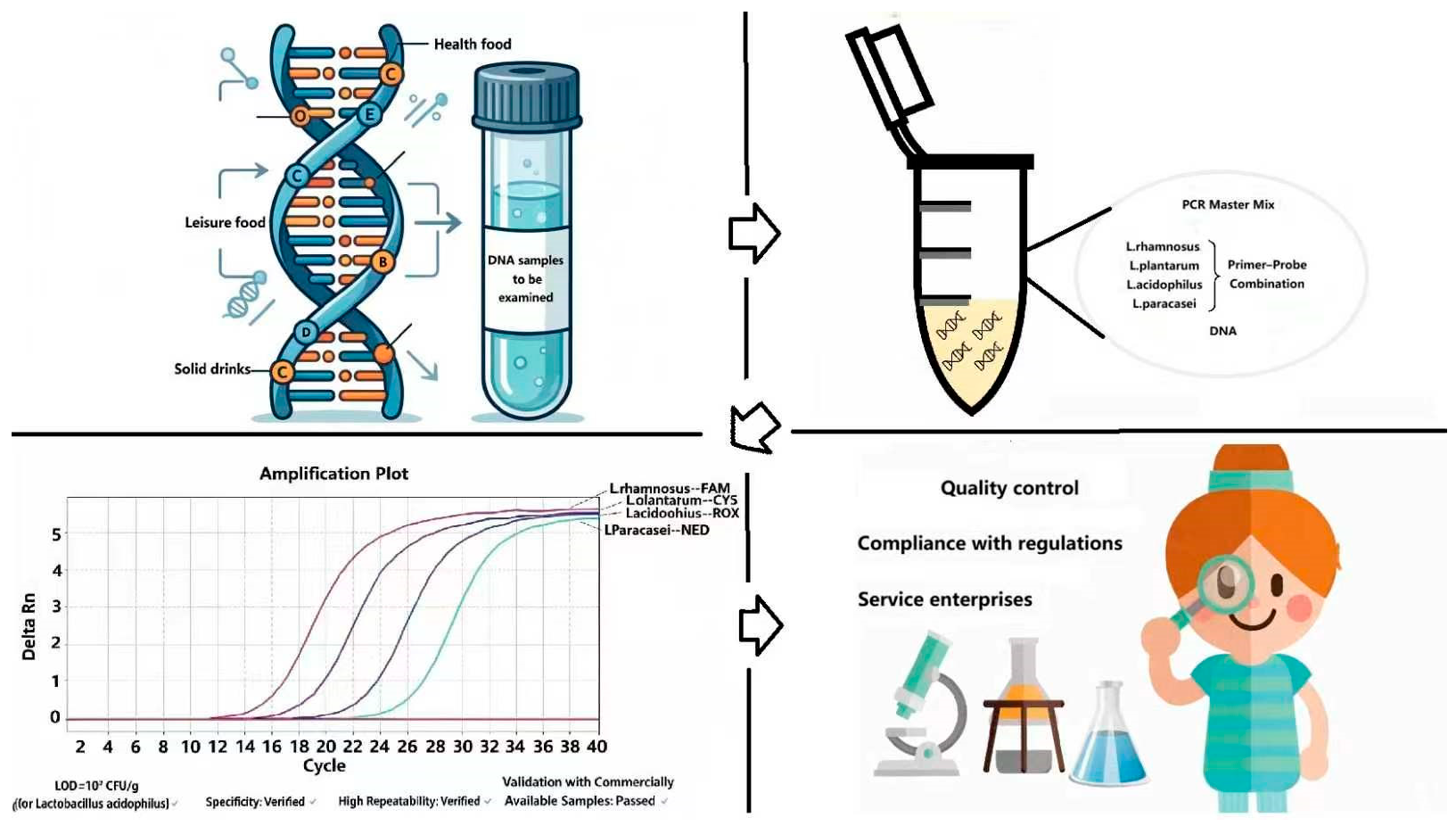
Development and Application of a Multiplex Real-Time Fluorescent PCR Assay for the Detection of Common Lactobacillus Species in Food


Abstract
1. Introduction
Research Background and Significance
2. Results
2.1. Screening Primer–Probe Combinations for Multiplex Real-Time Fluorescence PCR System [29]
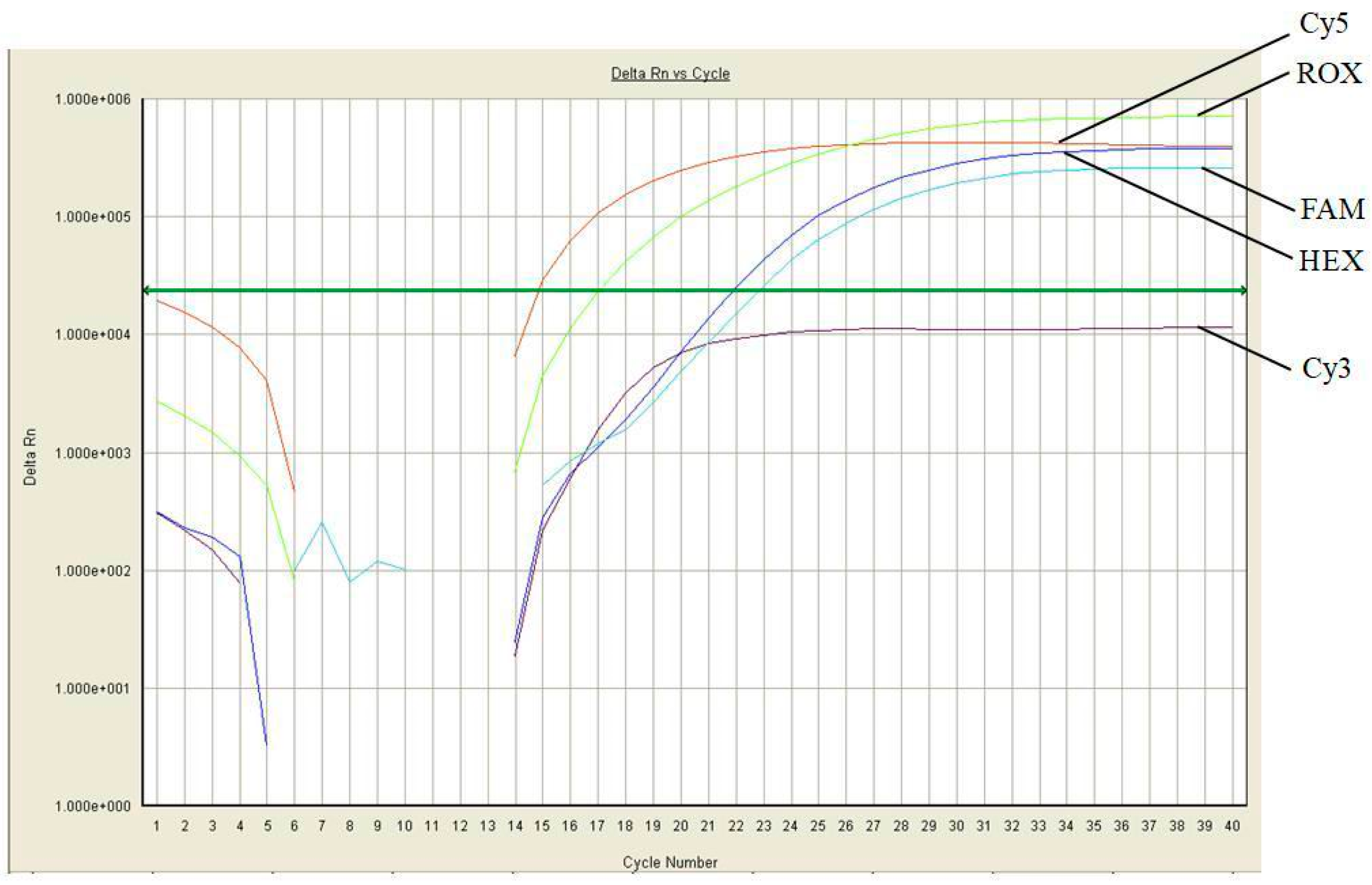
2.1.1. Screening of Modification Groups for Multiplex Real-Time Fluorescence PCR
2.1.2. Specificity Verification of Multiplex Real-Time Fluorescence PCR Primer–Probe Combination
- L. rhamnosus + L. plantarum + L. acidophilus + L. delbrueckii subsp. bulgaricus;
- L. rhamnosus + L. plantarum + L. acidophilus + L. reuteri;
- L. rhamnosus + L. plantarum + L. acidophilus + L. casei;
- L. rhamnosus + L. plantarum + L. acidophilus + L. paracasei.
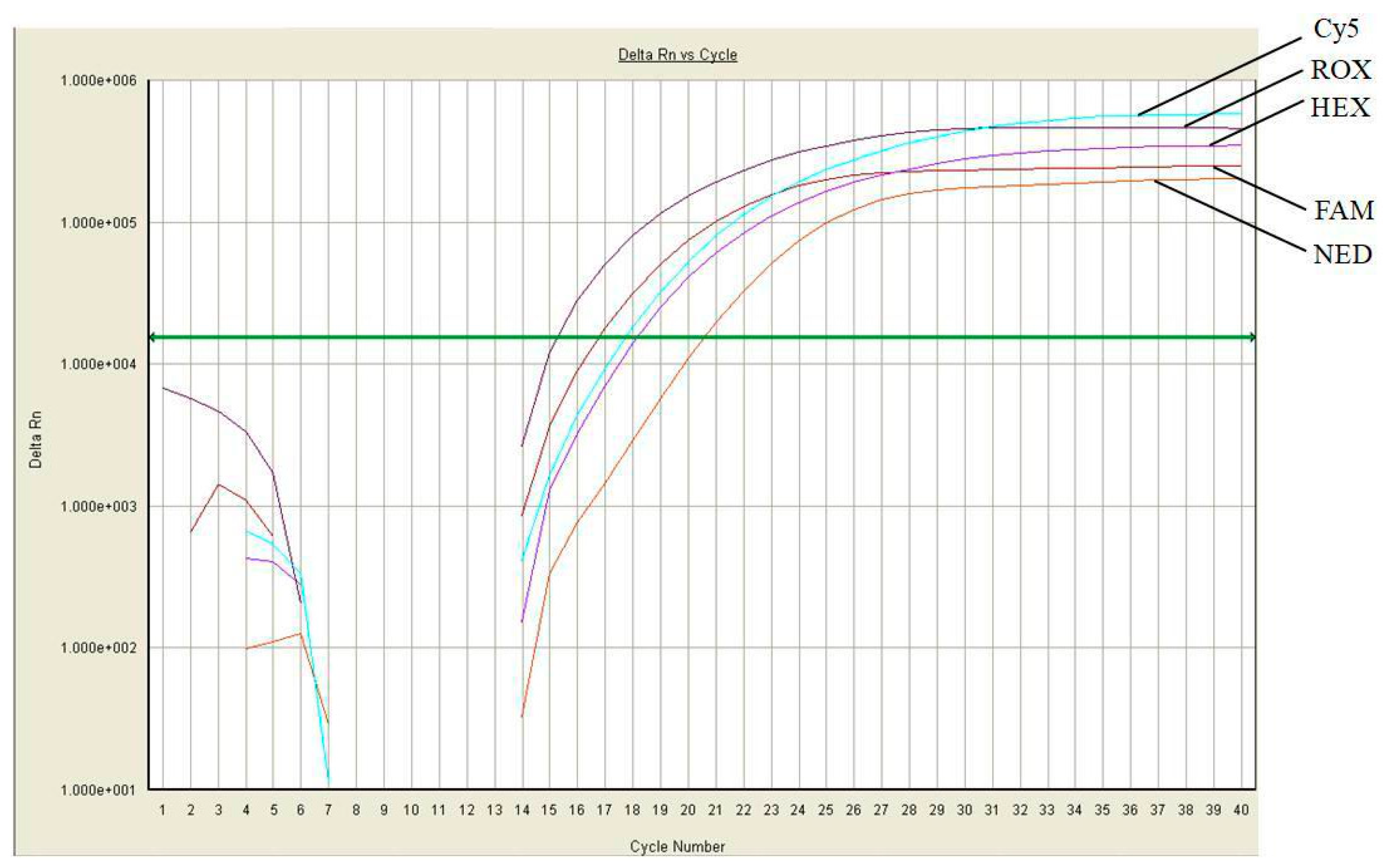
2.2. Specificity Verification of Multiplex Fluorescence PCR Primer–Probe
2.3. Limit of Detection (LOD)
2.4. Repeatability Validation of the Multiplex PCR Assay
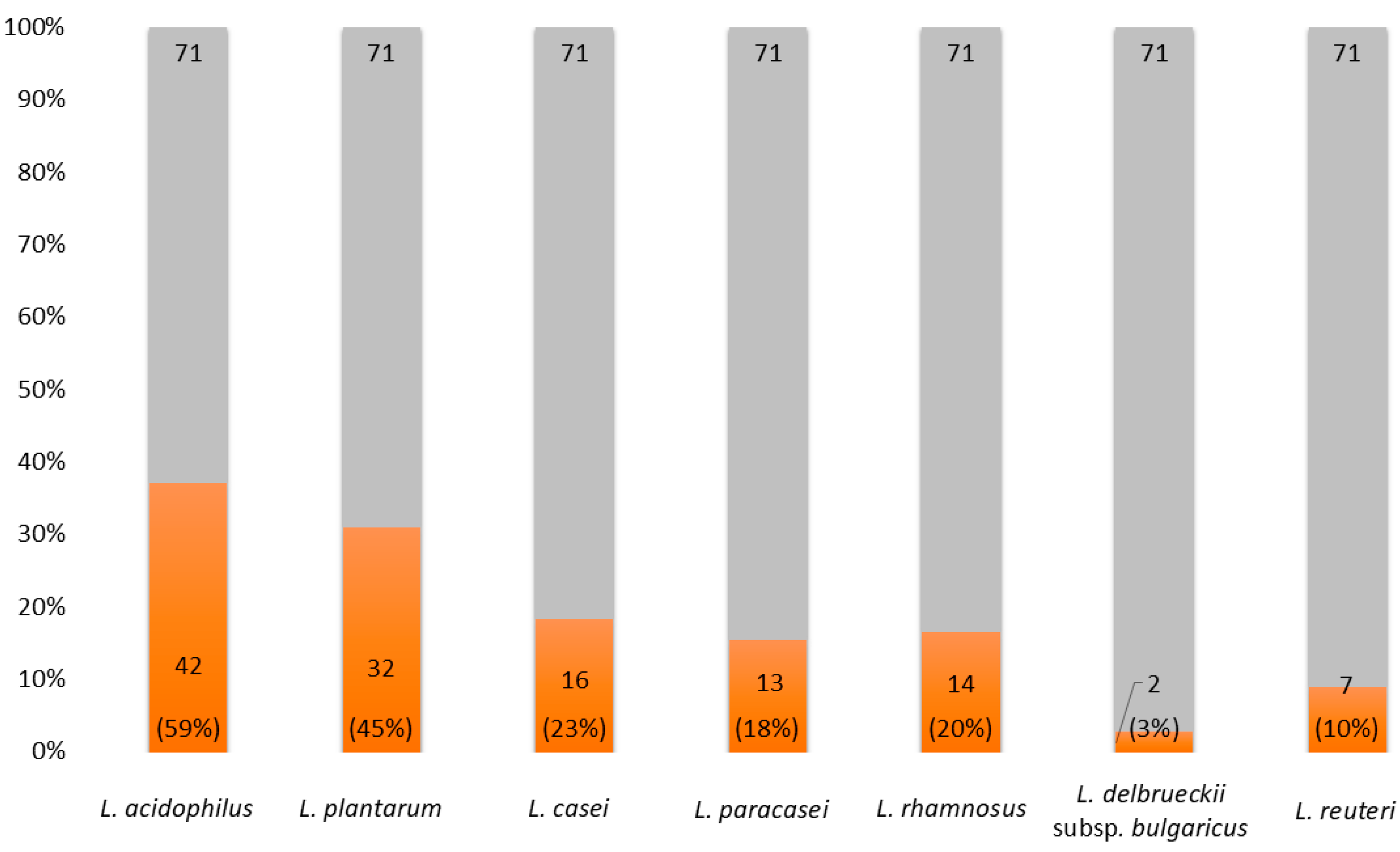
2.5. Validation Using Commercial Food Samples
3. Discussion
4. Materials and Methods
4.1. Strains and Samples
4.1.1. Stains
4.1.2. Commercial Samples
4.2. Instruments, Equipment, and Reagents
4.2.1. Instruments and Equipment
4.2.2. Reagents
4.2.3. Primers and Probes
4.3. Experimental Methods
4.3.1. DNA Extraction [30]
4.3.2. Determination of DNA Content and Quality
4.3.3. Real-Time Fluorescence PCR Amplification System
Experimental Process Control
Real-Time Fluorescence PCR System
Real-Time Fluorescence PCR Parameters
Quality Control
- (a)
- Blank control: No fluorescence signal is detected in the fluorescence channel, and the Ct value should be >35.0.
- (b)
- Negative control: No fluorescence signal is detected in the fluorescence channel, and the Ct value should be >35.0.
- (c)
- Positive control: A fluorescence signal is detected in the fluorescence channel, and a typical amplification curve appears, with the Ct value ≤ 30.0.
Result Determination
- (a)
- If the Ct value ≤ 30.0, the sample is determined to be positive.
- (b)
- If the Ct value > 35.0, the sample is determined to be negative.
- (c)
- If 30.0 < Ct value ≤ 35.0, repeat the amplification once. If the Ct value is still ≤35.0 after the second amplification, the sample is determined to be positive; if the Ct value > 35.0 after the second amplification, the sample is determined to be negative.
4.3.4. Screening Primer–Probe Combinations for Multiplex Real-Time Fluorescence PCR System
Screening of Modified Groups for Multiplex Real-Time Fluorescence PCR
Specificity Verification of Multiplex Real-Time Fluorescent PCR Primer–Probe Combination
4.3.5. Specificity Verification of Multiplex Fluorescence PCR Primer–Probe
4.3.6. Detection Limit (Limit of Detection, LOD)
4.3.7. Repeatability Validation of the Multiplex PCR Assay
4.3.8. Validation Using Commercial Food Samples
5. Conclusions
6. Patents
Author Contributions
Funding
Institutional Review Board Statement
Informed Consent Statement
Data Availability Statement
Conflicts of Interest
References
- Ferro, L.E.; Crowley, L.N.; Bittinger, K.; Friedman, E.S.; Decker, J.E.; Russel, K.; Katz, S.; Kim, J.K.; Trabulsi, J.C. Effects of prebiotics, probiotics, and synbiotics on the infant gut microbiota and other health outcomes: A systematic review. Crit. Rev. Food Sci. Nutr. 2022, 63, 5620–5642. [Google Scholar] [CrossRef] [Scilit]
- Li, X.; Wang, Q.; Hu, X.; Liu, W. Current Status of Probiotics as Supplements in the Prevention and Treatment of Infectious Diseases. Front. Cell. Infect. Microbiol. 2022, 12, 789063. [Google Scholar] [CrossRef] [Scilit]
- Hashemi, A.; Villa, C.R.; Comelli, E.M. Probiotics in early life: A preventative and treatment approach. Food Funct. 2016, 7, 1752–1768. [Google Scholar] [CrossRef] [Scilit]
- Zapaśnik, A.; Sokołowska, B.; Bryła, M. Role of Lactic Acid Bacteria in Food Preservation and Safety. Foods 2022, 11, 1283. [Google Scholar] [CrossRef] [Scilit] [PubMed]
- Li, L.; Hu, Y.; Sun, Z.; Ren, Q. Isolation and identification of lactic acid bacteria from Inner Mongolia cheese and process optimization of stirred oat yoghurt. China Dairy Ind. 2024, 52, 75–80. Available online: https://link.cnki.net/doi/10.19827/j.issn1001-2230.2024.11.011 (accessed on 29 August 2022).
- Gao, P.; Han, J.; Lu, Z.; Lu, Z.; Lü, F.; Zhao, H.; Zhang, Y.; Bie, X. Isolation and Identification of Lactic Acid Bacterial Strain with Broad-Spectrum Antibacterial Activity and Extraction and Purification of Bacteriocin Produced by It. Food Sci. 2016, 37, 160–166. [Google Scholar] [CrossRef]
- Hu, P. Study on Probiotics and its application in the functional food. Food Res. Dev. 2007, 173–175. Available online: https://kns.cnki.net/kcms2/article/abstract?v=ZO6hV6rGk-YL2TsBR9qmm5tLcoC1T_Nhk_n-kucM-EY1bxIr1MHGNt5ebMviS01KFrMZ_Jk7-A1UkcjbbsOnOZcDgbxqqBaSv_C3GBRIBl8zQ0zmQE9MOlsB7oeKp83C1ClXYJgkw3DBaNfxklGtMy5Ge6V-_guOtDxCa7vx47rcp8W31xzzLg==&uniplatform=NZKPT&language=CHS (accessed on 29 August 2022).
- Adesulu-Dahunsi, A.T.; Dahunsi, S.O.; Ajayeoba, T.A. Co-occurrence of Lactobacillus Species During Fermentation of African Indigenous Foods: Impact on Food Safety and Shelf-Life Extension. Front. Microbiol. 2022, 13, 684730. [Google Scholar] [CrossRef] [Scilit]
- Zhang, K.; Liu, S.; Liang, S.; Xiang, F.; Wang, X.; Lian, H.; Li, B.; Liu, F. Exopolysaccharides of lactic acid bacteria: Structure, biological activity, structure-activity relationship, and application in the food industry: A review. Int. J. Biol. Macromol. 2024, 257, 128733. [Google Scholar] [CrossRef] [Scilit]
- Wang, Y.; Wu, J.; Lv, M.; Shao, Z.; Hungwe, M.; Wang, J.; Bai, X.; Xie, J.; Wang, Y.; Geng, W. Metabolism Characteristics of Lactic Acid Bacteria and the Expanding Applications in Food Industry. Front. Bioeng. Biotechnol. 2021, 9, 612285. [Google Scholar] [CrossRef] [Scilit]
- Nicolescu, C.M.; Bumbac, M.; Buruleanu, C.L.; Popescu, E.C.; Stanescu, S.G.; Georgescu, A.A.; Toma, S.M. Biopolymers Produced by Lactic Acid Bacteria: Characterization and Food Application. Polymers 2023, 15, 1539. [Google Scholar] [CrossRef] [Scilit] [PubMed]
- Liu, C.; Cai, X.; Zhang, X.; Liu, H. Progress in Genomics of Lactobacillus plantarum. Food Sci. Technol. 2020, 45, 1–7. [Google Scholar] [CrossRef]
- Wang, J.; Liu, C.; Guo, A.; Li, Y.; Han, D. Application of molecular biotechnology in the identification of lactic acid bacteria. China Brew. 2012, 31, 1–4. Available online: https://kns.cnki.net/kcms2/article/abstract?v=ZO6hV6rGk-bpxscShsnObd3ByFacbapIFoqcUAHAD0Y2f88JGo1wEnGAiu6UbDh8r_z91AGs7LSCM6yxgODl5Z7qNargRh-4f8ntkVdrSpF5dL3ZT2X5MXFastTpxPSzoR9Mdirje7f9a5SRF-VtFjqaQsl3xkL2yxAzD0jZCQdrXcpcPdaRbA==&uniplatform=NZKPT&language=CHS (accessed on 29 August 2022).
- Yang, L.; Yang, J.; Chen, H.; Cao, M.; Pan, L. Application of 16S rDNA fingerprint on the strain identification and traceability isolated from yogurts. Sci. Technol. Food Ind. 2013, 34, 182–186. [Google Scholar] [CrossRef]
- Zhao, Y.; Cheng, H.; Fan, W.; Li, Y. Research Progress on Lactobacillus and Its Detection Methods. Modern Food 2018, 1–3+17. [Google Scholar] [CrossRef]
- Zhao, J. Study on Population Genetics and Functional Genomics of Streptococcus thermophilus in Naturally Fermented Milk. Doctoral Dissertation, Inner Mongolia Agricultural University, Hohhot, China, 2018. Available online: https://kns.cnki.net/kcms2/article/abstract?v=ZO6hV6rGk-a-hIeM23bH20NDnpthzcsY3PtMnYfS-GnD-3AFJLUzhC7YIxa3qIFvfspIfn8JulvzKeJ1c6N4Xe0HOYPnWuq3cHdugVnL7Vs7Oaggx_IDw85Q5YYVWAQBWGchaGlJOG4frinZHKOW1whWUj0PcPUETZjtq1rZ1dvuJczlVPw2M2P9bnmX4ml0&uniplatform=NZKPT&language=CHS (accessed on 29 August 2022).
- Zhang, S.; Liu, Y.; Zhang, H.; James, C.; Wu, X. Development of a genus-specific T-RFLP technique for differentiating Lactobacillus community. Microbiol. China 2012, 39, 1179–1189. Available online: https://kns.cnki.net/kcms2/article/abstract?v=ZO6hV6rGk-YELiLz8DwQI9_tQ70hfDx2qBLZGMwTNYhbwGbYLP5qjOL0uBN0r3HokqaND1LvYZI1GnPSvIO_kwMvVfgCn8CZg2uzGN1FMsdLus9QRiPYVbOfDjlZRm-vvkz74gWmQz4PHh7TQ2lleaBg173l4Q0xQAriQf9Ecbu9jiArh3tefg==&uniplatform=NZKPT&language=CHS (accessed on 29 August 2022).
- Chen, C.; Ren, Q.; Zhou, F.; Liu, Z.; Guo, B. A rapid quantitative detection method of Lactobacillus plantarum in the probiotics products. Chin. J. Microecol. 2013, 25, 1439–1443+1450. [Google Scholar] [CrossRef]
- Galanis, A.; Kourkoutas, Y.; Tassou, C.; Chorianopoulos, N. Detection and Identification of Probiotic Lactobacillus plantarum Strains by Multiplex PCR Using RAPD-Derived Primers. Int. J. Mol. Sci. 2015, 16, 25141–25153. [Google Scholar] [CrossRef] [Scilit]
- Teanpaisan, R.; Dahlén, G. Use of polymerase chain reaction techniques and sodium dodecyl sulfate-polyacrylamide gel electrophoresis for differentiation of oral Lactobacillus species. Oral Microbiol. Immunol. 2006, 21, 79–83. [Google Scholar] [CrossRef] [Scilit]
- Song, D.; Liang, M.; Chen, Q.; Zhou, M.; Zhang, J.; Cheng, S.; Fang, R.; Jiang, Y.; Man, C. Analysis and Comparison of The Identification of Lactic Acid Bacteria by MALDI-TOF MS and 16S rDNA Method. China Dairy Ind. 2021, 49, 4–7+53. [Google Scholar] [CrossRef]
- Soro-Yao, A.A.; Schumann, P.; Thonart, P.; Djè, K.M.; Pukall, R. The Use of MALDI-TOF Mass Spectrometry, Ribotyping and Phenotypic Tests to Identify Lactic Acid Bacteria from Fermented Cereal Foods in Abidjan (Côte d’Ivoire). Open Microbiol. J. 2014, 8, 78–86. [Google Scholar] [CrossRef] [Scilit]
- GB 4789.34-2016; National Food Safety Standard: Microbiological Examination of Food—Enumeration of Bifidobacteria. China Standard Press: Beijing, China, 2016.
- GB 4789.35-2023; National Food Safety Standard: Microbiological Examination of Food—Detection of Lactic Acid Bacteria. China Standard Press: Beijing, China, 2023.
- National Health Commission of the People’s Republic of China. Announcement on Updating the List of Strains Permitted for Use in Products (Announcement No. 4, 2022). 2022. Available online: https://zwfw.nhc.gov.cn/kzx/tzgg/sptjjxpzsp_224/202208/t20220829_2363.html (accessed on 29 August 2022). (In Chinese)
- Wang, D. Study on the Application of PCR Technique in Food Microbiological Detection. China Food Saf. Mag. 2024, 13, 187–189. [Google Scholar] [CrossRef]
- Sun, C.; An, B.; Yang, L.; Wang, G.; Feng, S.; Yu, H.; Wang, Y.; Ren, D. Establishment of Real-time Fluorescent Quantitative PCR Method for the Detection of Lactic Acid Bacteria in Fermented Soybean Milk. Soybean Sci. 2020, 39, 464–471. Available online: https://kns.cnki.net/kcms2/article/abstract?v=ZO6hV6rGk-bWFU66UU9xbxgzu53wRTVIceLri4ykUEHrOFe0_Ylf2RIPhQ7HSugc2zbvR4ByqfJMddqom6veL2EWg-BUPW9whArs3HXudj8Dh_44b6CtUnkvVONLnjVanC7JxCcGllxPSyTSFJzh4St9HDPcOkxUTKdohQ625WCjAhGkmHjA_A==&uniplatform=NZKPT&language=CHS (accessed on 29 August 2022).
- Qin, L.; Liang, X.; Pan, H.; Mo, M.; Rao, C.; Nie, M.; Mei, L.; Li, Q. Simultaneously qualitative and quantitative detections of probiotics in fermented milk using qPCR. Food Ferment. Ind. 2020, 46, 238–244. [Google Scholar] [CrossRef]
- Zhang, M.; Yu, Q.; Wang, J.; Li, G.; Xiao, Z.; Zhou, Z. Rapid screening of plant-based components in edible starch and its products by five fold real-time fluorescence polymerase chain reaction. J. Food Saf. Qual. 2024, 15, 207–214. [Google Scholar] [CrossRef]
- Yu, Y.; Zhuang, X.; Qu, Q. Rapid identification of 7 kinds of Lactobacillus commonly used in deep processing probiotic products. J. Food Saf. Qual. 2024, 15, 267–274. [Google Scholar] [CrossRef]
- SN/T 5642.7-2023; Detection of Lactic Acid Bacteria in Dairy Products for Export—Enumeration Method of Digital PCR—Part 7: Lactobacillus paracasei. General Administration of Customs of the People’s Republic of China: Beijing, China, 2023.
- Liang, Q.; Zhou, W.; Peng, S.; Liang, Z.; Liu, Z.; Zhu, C.; Mou, H. Current status and potential of bacteriocin-producing lactic acid bacteria applied in the food industry. Cur. Res. Food Sci. 2025, 10, 100997. [Google Scholar] [CrossRef] [Scilit]
- Food and Agriculture Organization of the United Nations (FAO); World Health Organization (WHO). Guidelines for the Evaluation of Probiotics in Food. In Proceedings of the Joint FAO/WHO Working Group Report on Drafting Guidelines for the Evaluation of Probiotics in Food, London, ON, Canada, 30 April–1 May 2002. [Google Scholar]
- National Health and Family Planning Commission of the People’s Republic of China, Office of Health Supervision. Reply on Issues Concerning the Labeling of Bacterial Strains Used in Food; Document No. Wei ban Jian du Han [2013] No. 367; China Standard Press: Beijing, China, 2013. [Google Scholar]
- GB 7718-2011; National Food Safety Standard: General Rules for the Labeling of Prepackaged Foods. China Standard Press: Beijing, China, 2011; Revised Edition.



| Primer–Probe Combination | Strain | |||||||
|---|---|---|---|---|---|---|---|---|
| L. rhamnosus | L. plantarum | L. delbrueckii subsp. bulgaricus | L. acidophilus | L. casei | L. paracasei | L. reuteri | Blank | |
| L. rhamnosus (FAM) | 21.92 | >40 | >40 | >40 | 39.92 | >40 | >40 | >40 |
| L. plantarum (CY5) | >40 | 23.62 | 36.23 | >40 | 38.97 | >40 | >40 | >40 |
| L. delbrueckii subsp. Bulgaricus (HEX) | >40 | >40 | 21.95 | >40 | >40 | >40 | >40 | >40 |
| L. casei 1 (NED) | >40 | >40 | 23.36 | >40 | 20.20 | >40 | >40 | >40 |
| Primer–Probe Combination | Strain | |||||||
|---|---|---|---|---|---|---|---|---|
| L. rhamnosus | L. plantarum | L. debrueckii subsp. bulgaricus | L. acidophilus | L. casei | L. paracasei | L. reuteri | Blank | |
| L. plantarum (CY5) | >40 | 23.09 | 36.23 | >40 | 38.97 | >40 | >40 | >40 |
| L. acidophilus (ROX) | >40 | >40 | 39.32 | 23.02 | >40 | >40 | >40 | >40 |
| L. delbrueckii subsp. Bulgaricus (HEX) | >40 | >40 | 21.95 | >40 | >40 | >40 | >40 | >40 |
| L. casei 1 (NED) | >40 | >40 | 25.67 | >40 | 19.98 | 38.65 | >40 | >40 |
| Primer–Probe Combination | Strain | |||||||
|---|---|---|---|---|---|---|---|---|
| L. rhamnosus | L. plantarum | L. debrueckii subsp. bulgaricus | L. acidophilus | L. casei | L. paracasei | L. reuteri | Blank | |
| L. rhamnosus (FAM) | 21.11 | >40 | >40 | >40 | 38.34 | >40 | >40 | >40 |
| L. plantarum (CY5) | >40 | 22.46 | 36.75 | >40 | 36.74 | >40 | >40 | >40 |
| L. delbrueckii subsp. Bulgaricus (HEX) | >40 | >40 | 20.91 | >40 | >40 | >40 | >40 | >40 |
| L. paracasei 1 (NED) | >40 | >40 | 21.96 | >40 | 19.35 | >40 | >40 | >40 |
| Primer–Probe Combination | Strain | |||||||
|---|---|---|---|---|---|---|---|---|
| L. rhamnosus | L. plantarum | L. delbrueckii subsp. bulgaricus | L. acidophilus | L. casei | L. paracasei | L. reuteri | Blank | |
| L. reuteri (HEX) | >40 | >40 | >40 | >40 | >40 | >40 | 20.98 | >40 |
| L. casei 1 (NED) | >40 | >40 | >40 | >40 | 16.02 | >40 | 21.21 | >40 |
| Primer–Probe Combination | Strain | |||||||
|---|---|---|---|---|---|---|---|---|
| L. rhamnosus | L. plantarum | L. debrueckii subsp. bulgaricus | L. acidophilus | L. casei | L. paracasei | L. reuteri | Blank | |
| L. reuteri (HEX) | >40 | >40 | >40 | >40 | >40 | >40 | 21.35 | >40 |
| L. paracasei 1 (NED) | >40 | >40 | >40 | >40 | 39.25 | 17.01 | 21.91 | >40 |
| Primer–Probe Combination | Strain | |||||||
|---|---|---|---|---|---|---|---|---|
| L. rhamnosus | L. plantarum | L. delbrueckii subsp. bulgaricus | L. acidophilus | L. casei | L. paracasei | L. reuteri | Blank | |
| L. rhamnosus (FAM) | 18.58 | 37.13 | 38.1 | 39.99 | 38.27 | 37.98 | 36.83 | >40 |
| L. plantarum (CY5) | 36.16 | 16.88 | 36.4 | 37.33 | 36.89 | 36.28 | 37.29 | >40 |
| L. acidophilus (ROX) | 38.34 | 38.14 | 38.35 | 17.69 | 38.40 | 36.95 | 36.86 | >40 |
| L. paracasei (NED) | >40 | 36.70 | >40 | 38.46 | >40 | 20.55 | 38.07 | >40 |
| Primer–Probe Combination | Strain | |||||||
|---|---|---|---|---|---|---|---|---|
| L. rhamnosus | L. plantarum | L. delbrueckii subsp. bulgaricus | L. acidophilus | L. casei | L. paracasei | L. reuteri | Blank | |
| L. rhamnosus (FAM) | 21.24 | >40 | >40 | >40 | 36.97 | >40 | 35.38 | >40 |
| L. plantarum (CY5) | 39.61 | 17.11 | >40 | 35.06 | >40 | 39.34 | 37.03 | >40 |
| L. acidophilus (ROX) | >40 | 36.11 | >40 | 20.72 | 39.41 | 38.88 | 39.91 | >40 |
| L. casei (NED) | >40 | >40 | >40 | >40 | 20.09 | >40 | >40 | >40 |
| Primer–Probe Combination | Strain | |||||||
|---|---|---|---|---|---|---|---|---|
| L. rhamnosus | L. plantarum | L. delbrueckii subsp. bulgaricus | L. acidophilus | L. casei | L. paracasei | L. reuteri | Blank | |
| L. rhamnosus (FAM) | 19.66 | >40 | >40 | >40 | >40 | 37.48 | 36.23 | >40 |
| L. plantarum (CY5) | >40 | 15.25 | >40 | >40 | 38.52 | 37.69 | >40 | >40 |
| L. delbrueckii subsp. Bulgaricus (HEX) | >40 | >40 | 24.26 | >40 | 39.09 | >40 | >40 | >40 |
| L. acidophilus (ROX) | >40 | >40 | >40 | 16.51 | 38.24 | 37.18 | >40 | >40 |
| Primer–Probe Combination | Strain | |||||||
|---|---|---|---|---|---|---|---|---|
| L. rhamnosus | L. plantarum | L. delbrueckii subsp. bulgaricus | L. acidophilus | L. casei | L. paracasei | L. reuteri | Blank | |
| L. rhamnosus (FAM) | 16.47 | 38.78 | >40 | 37.23 | >40 | 37.12 | 37.53 | >40 |
| L. plantarum (CY5) | 38.61 | 16.39 | 39.16 | 38.38 | 37.31 | 38.49 | 37.69 | >40 |
| L. acidophilus (ROX) | 37.22 | 37.37 | 38.11 | 17.05 | 38.24 | 36.20 | 36.18 | >40 |
| L. reuteri (NED) | >40 | >40 | >40 | >40 | >40 | 39.18 | 22.88 | >40 |
| Strain | Ct1 | Ct2 | Ct3 | Ct4 |
|---|---|---|---|---|
| L. acidophilus | 18.66 | 15.15 | 18.51 | 18.38 |
| L. plantarum | 17.02 | 16.78 | 17.29 | 17.36 |
| L. rhamnosus | 19.55 | 19.47 | 16.63 | 16.54 |
| L. paracasei | 23.68 | 22.90 | 18.77 | 18.84 |
| L. delbrueckii subsp. bulgaricus | >40 | >40 | >40 | >40 |
| L. casei | >40 | >40 | >40 | >40 |
| L. reuteri | >40 | >40 | >40 | >40 |
| B. animalis | >40 | >40 | >40 | >40 |
| S. thermophilus | >40 | >40 | >40 | >40 |
| L. lactis | >40 | >40 | >40 | >40 |
| ddH2O | >40 | >40 | >40 | >40 |
| Target | L. plantarum | L. rhamnosus | L. paracasei | L. acidophilus | ||||||||
|---|---|---|---|---|---|---|---|---|---|---|---|---|
| Concentration of standard strain bacterial suspension | Plate Count | Ct Value | Results | Plate Count | Ct Value | Results | Plate Count | Ct Result | Results | Plate Count | Ct Value | Results |
| CFU/g | CFU/g | CFU/g | CFU/g | |||||||||
| 1.3 × 10⁸ | 16.85 | Pos. | 3.6 × 10⁷ | 14.24 | Pos. | 1.1 × 10⁸ | 19.81 | Pos. | 1.4 × 10⁶ | 17.49 | Pos. | |
| 1.3 × 10⁷ | 21.92 | Pos. | 3.6 × 10⁶ | 18.54 | Pos. | 1.1 × 10⁷ | 23.47 | Pos. | 1.4 × 10⁵ | 20.82 | Pos. | |
| 1.3 × 10⁶ | 29.01 | Pos. | 3.6 × 10⁵ | 24.91 | Pos. | 1.1 × 10⁶ | 28.05 | Pos. | 1.4 × 10⁴ | 25.54 | Pos. | |
| 1.3 × 10⁵ | 31.48 | Pos. | 3.6 × 10⁴ | 28.39 | Pos. | 1.1 × 10⁵ | 32.04 | Pos. | 1.4 × 10³ | 28.67 | Pos. | |
| 1.3 × 10⁴ | 34.22 | Pos. | 3.6 × 10³ | 31.23 | Pos. | 1.1 × 10⁴ | 39.48 | Neg. | 1.4 × 10² | 32.06 | Pos. | |
| 1.3 × 10³ | 38.16 | Neg. | 3.6 × 10² | 35.36 | Neg. | 1.1 × 10³ | 39.37 | Neg. | 1.4 × 101 | 35.41 | Neg. | |
| 1.3 × 10² | 39.06 | Neg. | 3.6 × 101 | >40 | Neg. | 1.1 × 10² | 39.47 | Neg. | 36.35 | Neg. | ||
| Positive target strain | / | 23.33 | Pos. | / | 19.22 | Pos. | / | 26.89 | Pos. | / | 22.75 | Pos. |
| Sample | No. | Primer–Probe Combination | Ct Value | Result | RSD% |
|---|---|---|---|---|---|
| Mixed bacterial suspensions of L. acidophilus, L. plantarum, L. rhamnosus, and L. paracasei | 1 | L. acidophilus | 16.60 | 17.02 ± 0.35 | 2.07% |
| L. plantarum | 16.63 | 17.02 ± 0.77 | 4.36% | ||
| L. rhamnosus | 19.23 | 20.08 ± 1.10 | 5.48% | ||
| L. paracasei | 20.78 | 21.14 ± 0.47 | 2.21% | ||
| 2 | L. acidophilus | 17.19 | |||
| L. plantarum | 17.24 | ||||
| L. rhamnosus | 19.08 | ||||
| L. paracasei | 20.54 | ||||
| 3 | L. acidophilus | 16.75 | |||
| L. plantarum | 17.21 | ||||
| L. rhamnosus | 19.21 | ||||
| L. paracasei | 20.98 | ||||
| 4 | L. acidophilus | 17.25 | |||
| L. plantarum | 18.52 | ||||
| L. rhamnosus | 20.12 | ||||
| L. paracasei | 21.79 | ||||
| 5 | L. acidophilus | 17.52 | |||
| L. plantarum | 17.56 | ||||
| L. rhamnosus | 21.23 | ||||
| L. paracasei | 21.25 | ||||
| 6 | L. acidophilus | 16.82 | |||
| L. plantarum | 18.54 | ||||
| L. rhamnosus | 21.58 | ||||
| L. paracasei | 21.52 |
| No. | Sample | Components | Primer–Probe Combination | Ct Value | Result |
|---|---|---|---|---|---|
| 1 | Health food product 1 | L. plantarum Wk86, L. acidophilus LA16, L. plantarum Lp99, L. casei LC89, L. plantarum N13, B. longum BL44, B. bifidum BBi77, B. breve BBr02, L. paracasei LC28, L. rhamnosus BA12, L. delbrueckii subsp. bulgaricus LB50, B. adolecentis BAC30, Bacilus coagulans BC99 | L. acidophilus | 18.55, 18.91, 22.99 | Detected |
| L. plantarum | 16.34, 16.19, 16.51 | Detected | |||
| L. rhamnosus | 19.63, 20.51, 20.13 | Detected | |||
| L. paracasei | 22.58, 24.30, 22.99 | Detected | |||
| 2 | Health food product 2 | L. acidophilus; B. longum; L. plantarum | L. acidophilus | 21.56, 22.71, 21.56 | Detected |
| L. plantarum | 21.54, 20.51, 19.61 | Detected | |||
| L. rhamnosus | >40, >40, >40 | Not Detected | |||
| L. paracasei | >40, >40, >40 | Not Detected | |||
| 3 | Health food product 3 | L. acidophilus, Bifidobacterium, L. paracasei | L. acidophilus | 22.21, 19.92, 20.35 | Detected |
| L. plantarum | >40, >40, >40 | Not Detected | |||
| L. rhamnosus | >40, >40, >40 | Not Detected | |||
| L. paracasei | 30.61, 30.23, 30.21 | Detected | |||
| 4 | Health food product 4 | L. fermentum, L. acidophilus, L. paracasei | L. acidophilus | 20.73, 22.05, 22.25 | Detected |
| L. plantarum | >40, >40, >40 | Not Detected | |||
| L. rhamnosus | >40, >40, >40 | Not Detected | |||
| L. paracasei | 22.82, 28.98, 28.58 | Detected | |||
| 5 | Health food product 5 | L. plantarum, L. acidophilus, B. longum | L. acidophilus | 24.25, 26.07, 24.04 | Detected |
| L. plantarum | 26.44, 29.14, 27.35 | Detected | |||
| L. rhamnosus | >40, >40, >40 | Not Detected | |||
| L. paracasei | >40, >40, >40 | Not Detected | |||
| 6 | Solid beverage 1 | L. acidophilus NCFM, B. lactis Bi-07, B. animalis Bb-12, L. rhamnosus LGG, L. rhamnosus HN001, B. lactis HN019 | L. acidophilus | 24.95, 24.11, 23.63 | Detected |
| L. plantarum | >40, >40, >40 | Not Detected | |||
| L. rhamnosus | 24.98, 24.36, 23.99 | Detected | |||
| L. paracasei | >40, >40, >40 | Not Detected | |||
| 7 | Solid beverage 2 | L. plantarum, L. rhamnosus, P. acidilactici, B. lactis; lactic acid bacteria compound powder (L. helveticus R0052, L. plantarum R1012, B. longum R0175, L. paracasei Lpc-37) | L. acidophilus | >40, >40, >40 | Not Detected |
| L. plantarum | 18.91, 18.81, 19.43 | Detected | |||
| L. rhamnosus | 24.15, 24.29, 25.22 | Detected | |||
| L. paracasei | 32.17, 31.88, 32.62 | Detected | |||
| 8 | Solid beverage 3 | L. plantarum, L. rhamnosus, B. lactis; probiotic powder (L. plantarum TSP05, L. reuteri TSR332, L. fermentum TSR331, B. lactis CP-9, B. infantis, L. rhamnosus bv-77); lactic acid bacteria compound powder (L. plantarum HA119, L. casei R0215, L. helveticus R0052); L. acidophilus NCFM, B. lactis CECT8154, L. rhamnosus CNCMI-4036, B. breve B-3, B. lactis HN019, L. rhamnosus HN001, B. lactis Bi-07, B. breve M-16V, B. longum BB536 | L. acidophilus | 30.58, 28.35, 30.25 | Detected |
| L. plantarum | 21.62, 20.11, 21.25 | Detected | |||
| L. rhamnosus | 23.89, 22.15, 23.63 | Detected | |||
| L. paracasei | >40, >40, >40 | Not Detected | |||
| 9 | Solid beverage 4 | B. lactis HN019, B. lactis Bi-04, L. paracasei Lpc-37, L. acidophilus NCFM | L. acidophilus | 20.10, 22.51, 22.25 | Detected |
| L. plantarum | 38.86, 38.33, 38.86 | Not Detected | |||
| L. rhamnosus | >40, >40, >40 | Not Detected | |||
| L. paracasei | 29.32, 28.76, 28.52 | Detected | |||
| 10 | Solid beverage 5 | L. plantarum, B. lactis, L. casei, L. rhamnosus, B. breve, L. acidophilus, L. paracasei | L. acidophilus | 23.09, 22.26, 23.15 | Detected |
| L. plantarum | 14.46, 14.17, 14.25 | Detected | |||
| L. rhamnosus | 27.78, 27.58, 27.31 | Detected | |||
| L. paracasei | 32.17, 25.34, 26.32 | Detected |
| Target | Primer and Probe Sequences |
|---|---|
| L. rhamnosus [24] | F :5′-GGTTGATTCAGTGGCAGCTC-3′ R :5′-GTGTGCATCACCCATGTCC-3′ P :5′-TCAATTTCTGCGCGCGGTACCA-3′ |
| L. plantarum [24] | F :5′-AGCTTGAAAGATGGCTTCGG-3′ R :5′-GGTCGGCTACGTATCATTGC-3′ P :5′-ACGCCGCGGGACCATCCAAA-3′ |
| L. reuteri [24] | F :5′-CTTTCGCAGCCTGATAGTGG-3′ R :5′-TCCGAAGAGCCTGAGACATC-3′ P :5′-CGGTTGCAGCATTAGTTCCTGC-3′ |
| L. acidophilus [24] | F :5′-GAGCTGAACCAACAGATTCAC-3′ R :5′-GCAGGTTCCCCACGTGTTAC-3′ P :5′ -CCCATCCGCCGCTAGCGTT-3′ |
| L. delbrueckii subsp. bulgaricus [24] | F :5′-ACTTTAGCCCATACCTGCGT-3′ R :5′-GTAAATTCCAAGCCGCCCTT-3′ P :5′-CCGGTTGCCCGTTTCCTGCGG-3′ |
| L. casei [24] | F :5′-GCCGGGATCTTCAACTCAAC-3′ R :5′-GGACGGCGCAGAAATCTATC-3′ P :5′-TCGCCCAATGCAGCCTGCGC-3′ |
| L. paracasei [31] | F :5′-CCG(T)GGTGCATTGGTGATT-3′ R :5′-CACATCCCCGCCTTTGATC-3′ P :5′-CGCCCCCGTCAGCAATGTTGTC-3′ |
| Reagent | Concentration | Volume/μL |
|---|---|---|
| PCR Master Mix (2×) | 1× | 12.5 μL |
| Forward primer (5 μmol/L) | 200 nmol/L | 0.6 μL |
| Reverse primer (5 μmol/L) | 200 nmol/L | 0.6 μL |
| Probe (5 μmol/L) | 200 nmol/L | 0.6 μL |
| DNA template (5–50 ng/μL) | / | 2 μL |
| ddH2O | / | Make up to 25 μL |
Disclaimer/Publisher’s Note: The statements, opinions and data contained in all publications are solely those of the individual author(s) and contributor(s) and not of MDPI and/or the editor(s). MDPI and/or the editor(s) disclaim responsibility for any injury to people or property resulting from any ideas, methods, instructions or products referred to in the content. |
© 2026 by the authors. Licensee MDPI, Basel, Switzerland. This article is an open access article distributed under the terms and conditions of the Creative Commons Attribution (CC BY) license.
Share and Cite
Qu, Q.-F.; Zhang, Q.-P.; Yu, Y. Development and Application of a Multiplex Real-Time Fluorescent PCR Assay for the Detection of Common Lactobacillus Species in Food. Molecules 2026, 31, 1790. https://doi.org/10.3390/molecules31111790
Qu Q-F, Zhang Q-P, Yu Y. Development and Application of a Multiplex Real-Time Fluorescent PCR Assay for the Detection of Common Lactobacillus Species in Food. Molecules. 2026; 31(11):1790. https://doi.org/10.3390/molecules31111790
Chicago/Turabian StyleQu, Qin-Feng, Qing-Ping Zhang, and Yi Yu. 2026. "Development and Application of a Multiplex Real-Time Fluorescent PCR Assay for the Detection of Common Lactobacillus Species in Food" Molecules 31, no. 11: 1790. https://doi.org/10.3390/molecules31111790
APA StyleQu, Q.-F., Zhang, Q.-P., & Yu, Y. (2026). Development and Application of a Multiplex Real-Time Fluorescent PCR Assay for the Detection of Common Lactobacillus Species in Food. Molecules, 31(11), 1790. https://doi.org/10.3390/molecules31111790