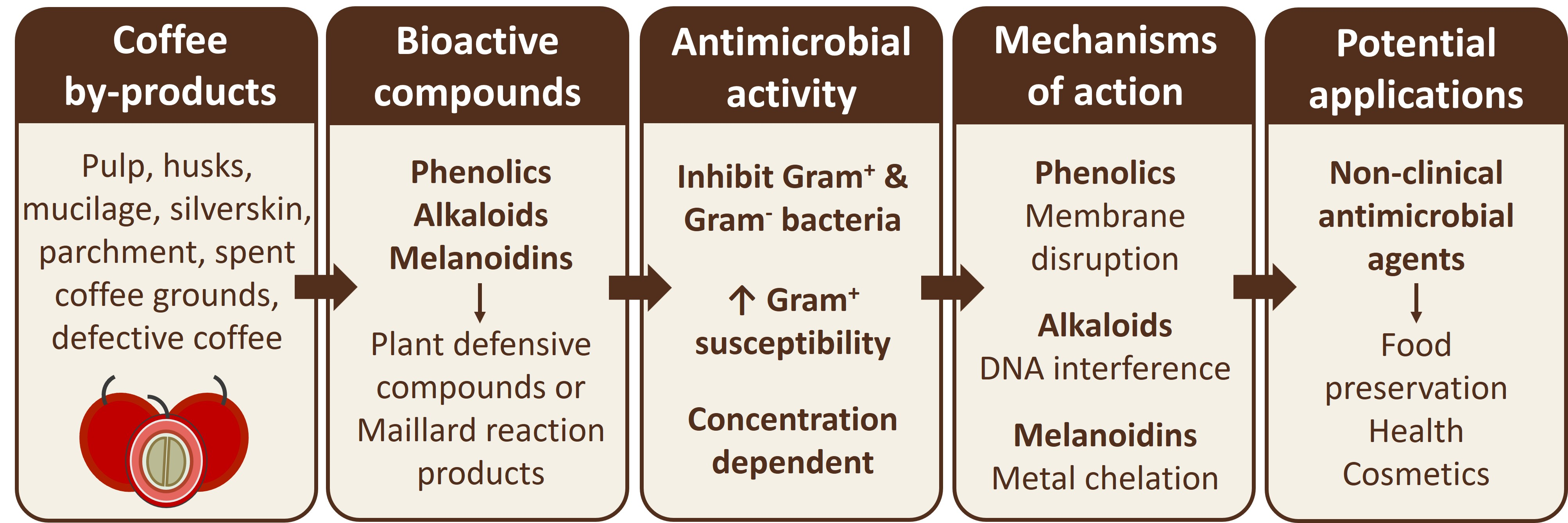
Coffee By-Products: An Overview of Their Antimicrobial Properties




Abstract
1. Introduction
2. Materials and Methods
3. Chemical Composition of Coffee By-Products
3.1. Coffee By-Products as a Source of Antimicrobial Compounds
3.1.1. Phenolic Compounds
3.1.2. Alkaloids
3.1.3. Melanoidins
4. Antimicrobial Activity of Coffee By-Products

| Reference | By-Product | Extract | Microorganism | Concentration (mg/mL) | Method | Inhibition Zone/MIC | Main Findings |
|---|---|---|---|---|---|---|---|
| Jiménez-Zamora et al. [29] | CS and SCG | Aqueous/isolated melanoidins | E. coli, S. aureus | 1–10 | Microtiter plate | NR | Strong antimicrobial activity associated with melanoidins; Higher effect against Gram-positive bacteria. |
| Monente et al. [112] | SGC | Aqueous | S. aureus, L. monocytogenes, B. subtilis, E. coli, Salmonella choleraesuis, P. aeruginosa, A. niger, C. albicans | 5–160 * | Agar-well diffusion | Moderate (higher for Gram+) MIC: 5 mg/mL * | Demonstrated activity mainly against Gram-positive bacteria and yeast (C. albicans); No effect against A. niger. |
| Duangjai et al. [19] | Pulp | Aqueous | S. aureus, S. epidermidis, P. aeruginosa, E. coli | 4.69–75 * | Agar-well diffusion | Reported (higher for Gram+) MIC: 4.69 mg/mL * | Inhibitory action against all tested bacteria; Gram-positive bacteria demonstrated more susceptibility; S. epidermidis was the most sensitive. |
| Khochapong et al. [70] | Pulp | Aqueous | E. coli, S. aureus, L. acidophilus | 150, 200, 250 and 300 * | Disk diffusion | Qualitative (opaque zone) | Inhibition observed at 150 mg FDE/mL (E. coli) and 200 mg FDE/mL (S. aureus); no effect on probiotics; Reduced activity after digestion. |
| Chaves-Ulate et al. [68] | Mucilage | Ethanolic | Alcaligenes spp., Serratia spp., M. luteus, E. coli, S. aureus, B. cereus, Salmonella enterica, L. monocytogenes, P. aeruginosa, L. acidophilus, L. casei, L. rhamnosus, Lactiplantibacillus plantarum | 6.7–50.4 * | Agar microdilution | NR | Activity against Gram-positives, especially B. cereus; Gram-negatives were resistant; The effect of the extract is concentration dependent. |
| Prasetya et al. [115] | Husks | Aqueous | Enterococcus faecalis and P. gingivalis | 250, 500, 750 and 1000 * | Disk diffusion | Medium–High | Activity against both E. faecalis and P. gingivalis; The effect of the extract is concentration dependent. |
5. Conclusions
Author Contributions
Funding
Institutional Review Board Statement
Informed Consent Statement
Data Availability Statement
Acknowledgments
Conflicts of Interest
Abbreviations
| CGA | Chlorogenic acids |
| CQAs | Caffeoylquinic acids |
| 3-CQA | 3-caffeoylquinic acid |
| 4-CQA | 4-caffeoylquinic acid |
| di-CQA | Dicaffeoylquinic acids |
| FQA | Feruloylquinic acids |
| 3-FQA | 3-Feruloylquinic acids |
| 5-FQA | 5-Feruloylquinic acids |
| p-CoQA | p-coumaric acid |
| SCG | Spent coffee grounds |
| CM | Coffee melanoidins |
| CS | Coffee silverskin |
| HMF | Hydroxymethylfurfural |
| MIC | Minimum Inhibitory Concentration |
| MBC | Minimum Bactericidal Concentration |
| NR | Not Reported |
| ICO | International Coffee Organization |
References
- ICO. ICO I Annual Review 2022/2023. International Coffee Organization. 2023. Available online: https://www.icocoffee.org/documents/cy2023-24/annual-review-2022-2023-e.pdf (accessed on 26 January 2026).
- Díaz-Hernández, G.C.; Alvarez-Fitz, P.; Maldonado-Astudillo, Y.I.; Jiménez-Hernández, J.; Parra-Rojas, I.; Flores-Alfaro, E.; Salazar, R.; Ramírez, M. Antibacterial, Antiradical and Antiproliferative Potential of Green, Roasted, and Spent Coffee Extracts. Appl. Sci. 2022, 12, 1938. [Google Scholar] [CrossRef] [Scilit]
- Panusa, A.; Petrucci, R.; Lavecchia, R.; Zuorro, A. UHPLC-PDA-ESI-TOF/MS metabolic profiling and antioxidant capacity of arabica and robusta coffee silverskin: Antioxidants vs phytotoxins. Food Res. Int. 2017, 99, 155–165. [Google Scholar] [CrossRef] [Scilit]
- Campuzano-Duque, L.; Herrera, J.; Ged, C.; Blair, M. Bases for the Establishment of Robusta Coffee (Coffea canephora) as a New Crop for Colombia. Agronomy 2021, 11, 2550. [Google Scholar] [CrossRef] [Scilit]
- Alves, R.; Casal, S.; Oliveira, B. Benefícios do café na saúde: Mito ou realidade? Química Nova 2009, 32, 2169–2180. [Google Scholar] [CrossRef] [Scilit]
- dos Santos, É.M.; de Macedo, L.M.; Tundisi, L.L.; Ataide, J.A.; Camargo, G.A.; Alves, R.C.; Oliveira, M.B.P.; Mazzola, P.G. Coffee by-products in topical formulations: A review. Trends Food Sci. Technol. 2021, 111, 280–291. [Google Scholar] [CrossRef] [Scilit]
- Hoseini, M.; Cocco, S.; Casucci, C.; Cardelli, V.; Corti, G. Coffee by-products derived resources. A review. Biomass Bioenergy 2021, 148, 106009. [Google Scholar] [CrossRef] [Scilit]
- Costa, A.S.G.; Alves, R.C.; Vinha, A.F.; Costa, E.; Costa, C.S.G.; Nunes, M.A.; Almeida, A.A.; Santos-Silva, A.; Oliveira, M.B.P. Nutritional, chemical and antioxidant/pro-oxidant profiles of silverskin, a coffee roasting by-product. Food Chem. 2018, 267, 28–35. [Google Scholar] [CrossRef] [Scilit] [PubMed]
- Costa, A.S.G.; Alves, R.C.; Vinha, A.F.; Barreira, S.V.P.; Nunes, M.A.; Cunha, L.M.; Oliveira, M.B.P. Optimization of antioxidants extraction from coffee silverskin, a roasting by-product, having in view a sustainable process. Ind. Crops Prod. 2014, 53, 350–357. [Google Scholar] [CrossRef] [Scilit]
- Jiménez-Zamora, A.; Pastoriza, S.; Rufián-Henares, J.A. Revalorization of coffee by-products. Prebiotic, antimicrobial and antioxidant properties. LWT 2015, 61, 12–18. [Google Scholar] [CrossRef] [Scilit]
- Murthy, P.S.; Naidu, M.M. Recovery of Phenolic Antioxidants and Functional Compounds from Coffee Industry By-Products. Food Bioprocess Technol. 2012, 5, 897–903. [Google Scholar] [CrossRef] [Scilit]
- Almeida, A.A.P.; Naghetini, C.C.; Santos, V.R.; Antonio, A.G.; Farah, A.; Glória, M.B.A. Influence of natural coffee compounds, coffee extracts and increased levels of caffeine on the inhibition of Streptococcus mutans. Food Res. Int. 2012, 49, 459–461. [Google Scholar] [CrossRef] [Scilit]
- Iriondo-DeHond, A.; Iriondo-DeHond, M.; del Castillo, M.D. Applications of Compounds from Coffee Processing By-Products. Biomolecules 2020, 10, 1219. [Google Scholar] [CrossRef] [Scilit]
- Arango-Agudelo, E.; Rendón-Muñóz, Y.; Cadena-Chamorro, E.; Santa, J.F.; Buitrago-Sierra, R. Evaluation of Colombian Coffee Waste to Produce Antioxidant Extracts. BioResources 2023, 18, 5703–5723. [Google Scholar] [CrossRef] [Scilit]
- Cavanagh, Q.; Brooks, M.S.-L.; Rupasinghe, H.P.V. Innovative technologies used to convert spent coffee grounds into new food ingredients: Opportunities, challenges, and prospects. Future Foods 2023, 8, 100255. [Google Scholar] [CrossRef] [Scilit]
- Rawangkan, A.; Siriphap, A.; Yosboonruang, A.; Kiddee, A.; Pook-In, G.; Saokaew, S.; Sutheinkul, O.; Duangjai, A. Potential Antimicrobial Properties of Coffee Beans and Coffee By-Products Against Drug-Resistant Vibrio cholerae. Front. Nutr. 2022, 9, 865684. [Google Scholar] [CrossRef] [Scilit]
- Daglia, M. Polyphenols as antimicrobial agents. Curr. Opin. Biotechnol. 2012, 23, 174–181. [Google Scholar] [CrossRef] [Scilit]
- Rurián-Henares, J.A.; Morales, F.J. Antimicrobial Activity of Melanoidins against Escherichia coli Is Mediated by a Membrane-Damage Mechanism. J. Agric. Food Chem. 2008, 56, 2357–2362. [Google Scholar] [CrossRef] [Scilit]
- Vegro, C.L.R.; de Almeida, L.F. Chapter 1–Global coffee market: Socio-economic and cultural dynamics. In Coffee Consumption and Industry Strategies in Brazil; de Almeida, L.F., Spers, E.E., Eds.; Woodhead Publishing: Cambridge, UK, 2020; pp. 3–19. [Google Scholar] [CrossRef] [Scilit]
- Pieczonka, S.A.; Dzemajili, A.; Heinzmann, S.S.; Rychlik, M.; Schmitt-Kopplin, P. The high-resolution molecular portrait of coffee: A gateway to insights into its roasting chemistry and comprehensive authenticity profiles. Food Chem. 2025, 463, 141432. [Google Scholar] [CrossRef] [Scilit] [PubMed]
- Puerta Quintero, G. Calidad en taza de las variedades de Coffea arabica cultivadas en Colombia. Cenicafé 1998, 49, 265–278. [Google Scholar]
- Franca, A.S.; Oliveira, L.S. Chapter 17–Coffee. In Integrated Processing Technologies for Food and Agricultural By-Products; Pan, Z., Zhang, R., Zicari, S., Eds.; Academic Press: Cambridge, MA, USA, 2019; pp. 413–438. [Google Scholar] [CrossRef] [Scilit]
- Klingel, T.; Kremer, J.I.; Gottstein, V.; Rajcic de Rezende, T.; Schwarz, S.; Lachenmeier, D.W. A Review of Coffee By-Products Including Leaf, Flower, Cherry, Husk, Silver Skin, and Spent Grounds as Novel Foods within the European Union. Foods 2020, 9, 665. [Google Scholar] [CrossRef] [Scilit]
- Ballesteros, L.F.; Teixeira, J.A.; Mussatto, S.I. Chemical, Functional, and Structural Properties of Spent Coffee Grounds and Coffee Silverskin. Food Bioprocess Technol. 2014, 7, 3493–3503. [Google Scholar] [CrossRef] [Scilit]
- Peixoto, J.A.B.; Andrade, N.; Machado, S.; Costa, A.S.G.; Oliveira, M.; Martel, F.; Alves, R.C. Green/Roasted Coffee and Silverskin Extracts Inhibit Sugar Absorption by Human Intestinal Epithelial (Caco-2) Cells by Decreasing GLUT2 Gene Expression. Foods 2022, 11, 3902. [Google Scholar] [CrossRef] [Scilit] [PubMed]
- Siridevi, G.; Havare, D.; Basavaraj, K.; Murthy, P.S. Coffee starter microbiome and in-silico approach to improve Arabica coffee. LWT 2019, 114, 108382. [Google Scholar] [CrossRef] [Scilit]
- Andrade, N.; Peixoto, J.A.B.; Oliveira, M.B.P.P.; Martel, F.; Alves, R.C. Can coffee silverskin be a useful tool to fight metabolic syndrome? Front. Nutr. 2022, 9, 966734. [Google Scholar] [CrossRef] [Scilit]
- Alves, R.C.; Costa, A.S.; Jerez, M.; Casal, S.; Sineiro, J.; Núñez, M.J.; Oliveira, B. Antiradical activity, phenolics profile, and hydroxymethylfurfural in espresso coffee: Influence of technological factors. J. Agric. Food Chem. 2010, 58, 12221–12229. [Google Scholar] [CrossRef] [Scilit]
- Mesías, M.; Navarro, M.; Martínez-Saez, N.; Ullate, M.; del Castillo, M.D.; Morales, F.J. Antiglycative and carbonyl trapping properties of the water soluble fraction of coffee silverskin. Food Res. Int. 2014, 62, 1120–1126. [Google Scholar] [CrossRef] [Scilit]
- Habtamu, D.; Belay, A. First order derivative spectra to determine caffeine and chlorogenic acids in defective and non-defective coffee beans. Food Sci. Nutr. 2020, 8, 4757–4762. [Google Scholar] [CrossRef] [Scilit]
- Franca, A.S.; Oliveira, L.S.; Mendonça, J.C.F.; Silva, X.A. Physical and chemical attributes of defective crude and roasted coffee beans. Food Chem. 2005, 90, 89–94. [Google Scholar] [CrossRef] [Scilit]
- Mazzafera, P. Chemical composition of defective coffee beans. Food Chem. 1999, 64, 547–554. [Google Scholar] [CrossRef] [Scilit]
- Prandi, B.; Ferri, M.; Monari, S.; Zurlini, C.; Cigognini, I.; Verstringe, S.; Schaller, D.; Walter, M.; Navarini, L.; Tassoni, A.; et al. Extraction and Chemical Characterization of Functional Phenols and Proteins from Coffee (Coffea arabica) By-Products. Biomolecules 2021, 11, 1571. [Google Scholar] [CrossRef] [Scilit]
- Balzano, M.; Loizzo, M.R.; Tundis, R.; Lucci, P.; Nunez, O.; Fiorini, D.; Giardinieri, A.; Frega, N.G.; Pacetti, D. Spent espresso coffee grounds as a source of anti-proliferative and antioxidant compounds. Innov. Food Sci. Emerg. Technol. 2020, 59, 102254. [Google Scholar] [CrossRef] [Scilit]
- Bomfim, A.S.C.; Oliveira, D.M.; Voorwald, H.J.C.; Benini, K.; Dumont, M.J.; Rodrigue, D. Valorization of Spent Coffee Grounds as Precursors for Biopolymers and Composite Production. Polymers 2022, 14, 437. [Google Scholar] [CrossRef] [Scilit]
- Cosío-Barrón, A.C.G.; Hernández-Arriaga, A.M.; Campos-Vega, R. Spent coffee (Coffea arabica L.) grounds positively modulate indicators of colonic microbial activity. Innov. Food Sci. Emerg. Technol. 2020, 60, 102286. [Google Scholar] [CrossRef] [Scilit]
- Martinez-Saez, N.; García, A.T.; Pérez, I.D.; Rebollo-Hernanz, M.; Mesías, M.; Morales, F.J.; Martín-Cabrejas, M.A.; Dolores del Castillo, M. Use of spent coffee grounds as food ingredient in bakery products. Food Chem. 2017, 216, 114–122. [Google Scholar] [CrossRef] [Scilit] [PubMed]
- Mussatto, S.I.; Machado, E.M.S.; Martins, S.; Teixeira, J.A. Production, Composition, and Application of Coffee and Its Industrial Residues. Food Bioprocess Technol. 2011, 4, 661–672. [Google Scholar] [CrossRef] [Scilit]
- Chacón-Figueroa, I.H.; Medrano-Ruiz, L.G.; Moreno-Vásquez, M.D.J.; Ovando-Martínez, M.; Gámez-Meza, N.; Del-Toro-Sánchez, C.L.; Castro-Enríquez, D.D.; López-Ahumada, G.A.; Dórame-Miranda, R.F. Use of Coffee Bean Bagasse Extracts in the Brewing of Craft Beers: Optimization and Antioxidant Capacity. Molecules 2022, 27, 7755. [Google Scholar] [CrossRef] [Scilit] [PubMed]
- Bevilacqua, E.; Cruzat, V.; Singh, I.; Rose’Meyer, R.B.; Panchal, S.K.; Brown, L. The Potential of Spent Coffee Grounds in Functional Food Development. Nutrients 2023, 15, 994. [Google Scholar] [CrossRef] [Scilit]
- Benitez, V.; Rebollo-Hernanz, M.; Hernanz, S.; Chantres, S.; Aguilera, Y.; Martin-Cabrejas, M.A. Coffee parchment as a new dietary fiber ingredient: Functional and physiological characterization. Food Res. Int. 2019, 122, 105–113. [Google Scholar] [CrossRef] [Scilit]
- Grassino, A.N.; Jerković, I.; Pedisić, S.; Dent, M. Hydrodistillation fractions of coffee (green and roasted) and coffee by-product (silverskin and spent grounds) as a source of bioactive compounds. Sustain. Chem. Pharm. 2024, 39, 101592. [Google Scholar] [CrossRef] [Scilit]
- Sierra-López, L.D.; Hernandez-Tenorio, F.; Marín-Palacio, L.D.; Giraldo-Estrada, C. Coffee mucilage clarification: A promising raw material for the food industry. Food Humanit. 2023, 1, 689–695. [Google Scholar] [CrossRef] [Scilit]
- Avallone, S.; Guiraud, J.-P.; Guyot, B.; Olguin, E.; Brillouet, J.-M. Polysaccharide Constituents of Coffee-Bean Mucilage. J. Food Sci. 2000, 65, 1308–1311. [Google Scholar] [CrossRef] [Scilit]
- Okur, I.; Soyler, B.; Sezer, P.; Oztop, M.H.; Alpas, H. Improving the Recovery of Phenolic Compounds from Spent Coffee Grounds (SCG) by Environmentally Friendly Extraction Techniques. Molecules 2021, 26, 613. [Google Scholar] [CrossRef] [Scilit]
- Ramón-Gonçalves, M.; Gómez-Mejía, E.; Rosales-Conrado, N.; León-González, M.E.; Madrid, Y. Extraction, identification and quantification of polyphenols from spent coffee grounds by chromatographic methods and chemometric analyses. Waste Manag. 2019, 96, 15–24. [Google Scholar] [CrossRef] [Scilit]
- Castillo, M.D.; Fernandez-Gomez, B.; Martinez-Saez, N.; Iriondo-DeHond, A.; Mesa, M.D. Coffee By-products. In Coffee: Production, Quality and Chemistry; Farah, A., Farah, A., Eds.; The Royal Society of Chemistry: London, UK, 2019; pp. 309–334. [Google Scholar] [CrossRef] [Scilit]
- Dias, M.; Melo, M.M.; Schwan, R.F.; Silva, C.F. A new alternative use for coffee pulp from semi-dry process to β-glucosidase production by Bacillus subtilis. Lett. Appl. Microbiol. 2015, 61, 588–595. [Google Scholar] [CrossRef] [Scilit] [PubMed]
- Ramirez-Coronel, M.A.; Marnet, N.; Kolli, V.S.K.; Roussos, S.; Guyot, S.; Augur, C. Characterization and Estimation of Proanthocyanidins and Other Phenolics in Coffee Pulp (Coffea arabica) by Thiolysis−High-Performance Liquid Chromatography. J. Agric. Food Chem. 2004, 52, 1344–1349. [Google Scholar] [CrossRef] [Scilit] [PubMed]
- da Silva, M.R.; Bragagnolo, F.S.; Carneiro, R.L.; Pereira, I.D.O.C.; Ribeiro, J.A.A.; Rodrigues, C.M.; Jelley, R.E.; Fedrizzi, B.; Funari, C.S. Metabolite characterization of fifteen by-products of the coffee production chain: From farm to factory. Food Chem. 2022, 369, 130753. [Google Scholar] [CrossRef] [Scilit]
- Baêta, B.E.L.; Cordeiro, P.H.D.M.; Passos, F.; Gurgel, L.V.A.; de Aquino, S.F.; Fdz-Polanco, F. Steam explosion pre-treatment improved the biomethanization of coffee husks. Bioresour. Technol. 2017, 245, 66–72. [Google Scholar] [CrossRef] [Scilit]
- Oliveira, G.; Passos, C.P.; Ferreira, P.; Coimbra, M.A.; Gonçalves, I. Coffee By-Products and Their Suitability for Developing Active Food Packaging Materials. Foods 2021, 10, 683. [Google Scholar] [CrossRef] [Scilit]
- Bekalo, S.A.; Reinhardt, H.-W. Fibers of coffee husk and hulls for the production of particleboard. Mater. Struct. 2010, 43, 1049–1060. [Google Scholar] [CrossRef] [Scilit]
- Silva, M.D.O.; Honfoga, J.N.B.; Medeiros, L.L.D.; Madruga, M.S.; Bezerra, T.K.A. Obtaining Bioactive Compounds from the Coffee Husk (Coffea arabica L.) Using Different Extraction Methods. Molecules 2021, 26, 46. [Google Scholar] [CrossRef] [Scilit]
- Janissen, B.; Huynh, T. Chemical composition and value-adding applications of coffee industry by-products: A review. Resour. Conserv. Recycl. 2018, 128, 110–117. [Google Scholar] [CrossRef] [Scilit]
- Torres Valenzuela, L.S.; Serna Jimenez, J.A.; Martínez Cortínez, K. Coffee By-Products: Nowadays and Perspectives. In Coffee–Production and Research; Toledo Castanheira, D., Ed.; IntechOpen: Rijeka, Croatia, 2019. [Google Scholar] [CrossRef] [Scilit]
- Brand, D.; Pandey, A.; Rodriguez-Leon, J.A.; Roussos, S.; Brand, I.; Soccol, C.R. Packed bed column fermenter and kinetic modeling for upgrading the nutritional quality of coffee husk in solid-state fermentation. Biotechnol. Program 2001, 17, 1065–1070. Available online: https://pubmed.ncbi.nlm.nih.gov/11735442/ (accessed on 8 February 2026). [CrossRef] [Scilit]
- Collazo-Bigliardi, S.; Ortega-Toro, R.; Chiralt Boix, A. Isolation and characterisation of microcrystalline cellulose and cellulose nanocrystals from coffee husk and comparative study with rice husk. Carbohydr. Polym. 2018, 191, 205–215. [Google Scholar] [CrossRef] [Scilit]
- Ateş, G.; Elmacı, Y. Physical, chemical and sensory characteristics of fiber-enriched cakes prepared with coffee silverskin as wheat flour substitution. J. Food Meas. Charact. 2019, 13, 755–763. [Google Scholar] [CrossRef] [Scilit]
- Bresciani, L.; Calani, L.; Bruni, R.; Brighenti, F.; Del Rio, D. Phenolic composition, caffeine content and antioxidant capacity of coffee silverskin. Food Res. Int. 2014, 61, 196–201. [Google Scholar] [CrossRef] [Scilit]
- Hijosa-Valsero, M.; Garita-Cambronero, J.; Paniagua-García, A.I.; Díez-Antolínez, R. Biobutanol production from coffee silverskin. Microb. Cell Factories 2018, 17, 154. [Google Scholar] [CrossRef] [Scilit]
- Littardi, P.; Rinaldi, M.; Grimaldi, M.; Cavazza, A.; Chiavaro, E. Effect of Addition of Green Coffee Parchment on Structural, Qualitative and Chemical Properties of Gluten-Free Bread. Foods 2021, 10, 5. [Google Scholar] [CrossRef] [Scilit] [PubMed]
- Iriondo-DeHond, A.; Rios, M.B.; Herrera, T.; Rodriguez-Bertos, A.; Nuñez, F.; San Andres, M.I.; Sanchez-Fortun, S.; Del Castillo, M.D. Coffee Silverskin Extract: Nutritional Value, Safety and Effect on Key Biological Functions. Nutrients 2019, 11, 2693. [Google Scholar] [CrossRef] [Scilit]
- Niglio, S.; Procentese, A.; Russo, M.E.; Sannia, G.; Marzocchella, A. Investigation of Enzymatic Hydrolysis of Coffee Silverskin Aimed at the Production of Butanol and Succinic Acid by Fermentative Processes. BioEnergy Res. 2019, 12, 312–324. [Google Scholar] [CrossRef] [Scilit]
- Machado, M.; Espírito Santo, L.; Machado, S.; Lobo, J.C.; Costa, A.S.G.; Oliveira, M.B.P.P.; Ferreira, H.; Alves, R.C. Bioactive Potential and Chemical Composition of Coffee By-Products: From Pulp to Silverskin. Foods 2023, 12, 2354. [Google Scholar] [CrossRef] [Scilit]
- Wen, L.; Álvarez, C.; Zhang, Z.; Poojary, M.M.; Lund, M.N.; Sun, D.-W.; Tiwari, B.K. Optimisation and characterisation of protein extraction from coffee silverskin assisted by ultrasound or microwave techniques. Biomass Convers. Biorefin. 2021, 11, 1575–1585. [Google Scholar] [CrossRef] [Scilit]
- Benítez, V.; Rebollo-Hernanz, M.; Aguilera, Y.; Bejerano, S.; Cañas, S.; Martín-Cabrejas, M.A. Extruded coffee parchment shows enhanced antioxidant, hypoglycaemic, and hypolipidemic properties by releasing phenolic compounds from the fibre matrix. Food Funct. 2021, 12, 1097–1110. [Google Scholar] [CrossRef] [Scilit]
- Fonseca-García, L.; Calderón-Jaimes, L.S.; Rivera, M.E. Capacidad antioxidante y contenido de fenoles totales en café y subproductos del café producido y comercializado en norte de Santander (Colombia). Vitae 2014, 21, 228–236. [Google Scholar] [CrossRef] [Scilit]
- Bondam, A.F.; Diolinda da Silveira, D.; Pozzada dos Santos, J.; Hoffmann, J.F. Phenolic compounds from coffee by-products: Extraction and application in the food and pharmaceutical industries. Trends Food Sci. Technol. 2022, 123, 172–186. [Google Scholar] [CrossRef] [Scilit]
- Oliveira, L.S.; Franca, A.S.; Mendonça, J.C.F.; Barros-Júnior, M.C. Proximate composition and fatty acids profile of green and roasted defective coffee beans. LWT–Food Sci. Technol. 2006, 39, 235–239. [Google Scholar] [CrossRef] [Scilit]
- Vasconcelos, A.L.S.; Franca, A.S.; Glória, M.B.A.; Mendonça, J.C.F. A comparative study of chemical attributes and levels of amines in defective green and roasted coffee beans. Food Chem. 2007, 101, 26–32. [Google Scholar] [CrossRef] [Scilit]
- Castaldo, L.; Lombardi, S.; Gaspari, A.; Rubino, M.; Izzo, L.; Narváez, A.; Ritieni, A.; Grosso, M. In Vitro Bioaccessibility and Antioxidant Activity of Polyphenolic Compounds from Spent Coffee Grounds-Enriched Cookies. Foods 2021, 10, 1837. [Google Scholar] [CrossRef] [Scilit]
- Coelho, G.O.; Batista, M.J.A.; Ávila, A.F.; Franca, A.S.; Oliveira, L.S. Development and characterization of biopolymeric films of galactomannans recovered from spent coffee grounds. J. Food Eng. 2021, 289, 110083. [Google Scholar] [CrossRef] [Scilit]
- Cruz, R.; Cardoso, M.M.; Fernandes, L.; Oliveira, M.; Mendes, E.; Baptista, P.; Morais, S.; Casal, S. Espresso Coffee Residues: A Valuable Source of Unextracted Compounds. J. Agric. Food Chem. 2012, 60, 7777–7784. [Google Scholar] [CrossRef] [Scilit] [PubMed]
- Vázquez-Sánchez, K.; Martinez-Saez, N.; Rebollo-Hernanz, M.; del Castillo, M.D.; Gaytán-Martínez, M.; Campos-Vega, R. In vitro health promoting properties of antioxidant dietary fiber extracted from spent coffee (Coffea arabica L.) grounds. Food Chem. 2018, 261, 253–259. [Google Scholar] [CrossRef] [Scilit]
- Martinez-Steele, E.; Khandpur, N.; Batis, C.; Bes-Rastrollo, M.; Bonaccio, M.; Cediel, G.; Huybrechts, I.; Juul, F.; Levy, R.B.; Louzada, M.L.d.C.; et al. Best practices for applying the Nova food classification system. Nat. Food 2023, 4, 445–448. [Google Scholar] [CrossRef] [Scilit]
- El-Haggar, S.; Samaha, A. Roadmap for Global Sustainability—Rise of the Green Communities; Springer International Publishing: Cham, Switzerland, 2019. [Google Scholar] [CrossRef] [Scilit]
- EFSA Panel on Nutrition, Novel Foods and Food Allergens (NDA); Turck, D.; Bohn, T.; Castenmiller, J.; De Henauw, S.; Hirsch-Ernst, K.I.; Maciuk, A.; Mangelsdorf, I.; McArdle, H.J.; Naska, A.; et al. Safety of dried coffee husk (cascara) from Coffea arabica L. as a Novel food pursuant to Regulation (EU) 2015/2283. EFSA J. 2022, 20, e07085. [Google Scholar] [CrossRef] [Scilit]
- Duangjai, A.; Suphrom, N.; Wungrath, J.; Ontawong, A.; Nuengchamnong, N.; Yosboonruang, A. Comparison of antioxidant, antimicrobial activities and chemical profiles of three coffee (Coffea arabica L.) pulp aqueous extracts. Integr. Med. Res. 2016, 5, 324–331. [Google Scholar] [CrossRef] [Scilit] [PubMed]
- Iriondo-DeHond, A.; Martorell, P.; Genovés, S.; Ramón, D.; Stamatakis, K.; Fresno, M.; Molina, A.; Del Castillo, M.D. Coffee Silverskin Extract Protects against Accelerated Aging Caused by Oxidative Agents. Molecules 2016, 21, 721. [Google Scholar] [CrossRef] [Scilit]
- Kumar, N.S.; Hewavitharanage, P.; Adikaram, N.K.B. Attack on tea by Xyleborus fornicatus: Inhibition of the symbiote, Monacrosporium ambrosium, by caffeine. Phytochemistry 1995, 40, 1113–1116. [Google Scholar] [CrossRef] [Scilit]
- Mirón-Mérida, V.A.; Yáñez-Fernández, J.; Montañez-Barragán, B.; Barragán Huerta, B.E. Valorization of coffee parchment waste (Coffea arabica) as a source of caffeine and phenolic compounds in antifungal gellan gum films. LWT 2019, 101, 167–174. [Google Scholar] [CrossRef] [Scilit]
- Castro-Díaz, R.; Silva-Beltrán, N.P.; Gámez-Meza, N.; Calderón, K. The Antimicrobial Effects of Coffee and By-Products and Their Potential Applications in Healthcare and Agricultural Sectors: A State-of-Art Review. Microorganisms 2025, 13, 215. [Google Scholar] [CrossRef] [Scilit] [PubMed]
- Rebollo-Hernanz, M.; Cañas, S.; Taladrid, D.; Benítez, V.; Bartolomé, B.; Aguilera, Y.; Martín-Cabrejas, M.A. Revalorization of Coffee Husk: Modeling and Optimizing the Green Sustainable Extraction of Phenolic Compounds. Foods 2021, 10, 653. [Google Scholar] [CrossRef] [Scilit]
- Král, E.; Rukov, J.; Mendes, A. Coffee Cherry on the Top: Disserting Valorization of Coffee Pulp and Husk. Food Eng. Rev. 2023, 16, 146–162. [Google Scholar] [CrossRef] [Scilit]
- Martínez, J.R.R.; Clifford, M.N. Coffee Pulp Polyphenols: An Overview. In Coffee Biotechnology and Quality: Proceedings of the 3rd International Seminar on Biotechnology in the Coffee Agro-Industry, Londrina, Brazil; Sera, T., Soccol, C.R., Pandey, A., Roussos, S., Eds.; Springer: Dordrecht, The Netherlands, 2000; pp. 507–515. [Google Scholar] [CrossRef] [Scilit]
- Chaves-Ulate, C.; Rodríguez-Sánchez, C.; Arias-Echandi, M.L.; Esquivel, P. Antimicrobial activities of phenolic extracts of coffee mucilage. NFS J. 2023, 31, 50–56. [Google Scholar] [CrossRef] [Scilit]
- Farah, A.; Donangelo, C.M. Phenolic compounds in coffee. Braz. J. Plant Physiol. 2006, 18, 23–26. [Google Scholar] [CrossRef] [Scilit]
- Khochapong, W.; Ketnawa, S.; Ogawa, Y.; Punbusayakul, N. Effect of in vitro digestion on bioactive compounds, antioxidant and antimicrobial activities of coffee (Coffea arabica L.) pulp aqueous extract. Food Chem. 2021, 348, 129094. [Google Scholar] [CrossRef] [Scilit]
- Esquivel, P.; Jiménez, V.M. Functional properties of coffee and coffee by-products. Food Res. Int. 2012, 46, 488–495. [Google Scholar] [CrossRef] [Scilit]
- Reis, R.S.; Tienne, L.G.P.; Souza, D.D.H.S.; Marques, M.D.F.V.; Monteiro, S.N. Characterization of coffee parchment and innovative steam explosion treatment to obtain microfibrillated cellulose as potential composite reinforcement. J. Mater. Res. Technol. 2020, 9, 9412–9421. [Google Scholar] [CrossRef] [Scilit]
- Aguilera, Y.; Rebollo-Hernanz, M.; Cañas, S.; Taladrid, D.; Martín-Cabrejas, M.A. Response surface methodology to optimise the heat-assisted aqueous extraction of phenolic compounds from coffee parchment and their comprehensive analysis. Food Funct. 2019, 10, 4739–4750. [Google Scholar] [CrossRef] [Scilit]
- Maimulyanti, A.; Nurhidayati, I.; Mellisani, B.; Amelia Rachmawati Putri, F.; Puspita, F.; Restu Prihadi, A. Development of natural deep eutectic solvent (NADES) based on choline chloride as a green solvent to extract phenolic compound from coffee husk waste. Arab. J. Chem. 2023, 16, 104634. [Google Scholar] [CrossRef] [Scilit]
- Oliveira, A.; Moreira, T.F.M.; Paes Silva, B.; Oliveira, G.; Teixeira, V.M.C.; Watanabe, L.S.; Nixdorf, S.L.; Leal, L.E.; Pessoa, L.G.A.; Seixas, F.A.V.; et al. Characterization and bioactivities of coffee husks extract encapsulated with polyvinylpyrrolidone. Food Res. Int. 2024, 178, 113878. [Google Scholar] [CrossRef] [Scilit] [PubMed]
- Yang, J.; Li, Y.; Liu, B.; Wang, K.; Li, H.; Peng, L. Carboxymethyl cellulose-based multifunctional film integrated with polyphenol-rich extract and carbon dots from coffee husk waste for active food packaging applications. Food Chem. 2024, 448, 139143. [Google Scholar] [CrossRef] [Scilit]
- Bessada, S.M.F.; Alves, R.C.; Costa, A.S.G.; Nunes, M.A.; Oliveira, M.B.P.P. Coffea canephora silverskin from different geographical origins: A comparative study. Sci. Total Environ. 2018, 645, 1021–1028. [Google Scholar] [CrossRef] [Scilit]
- Munyendo, L.M.; Njoroge, D.M.; Owaga, E.E.; Mugendi, B. Coffee phytochemicals and post-harvest handling—A complex and delicate balance. J. Food Compos. Anal. 2021, 102, 103995. [Google Scholar] [CrossRef] [Scilit]
- Campa, C.; Doulbeau, S.; Dussert, S.; Hamon, S.; Noirot, M. Qualitative relationship between caffeine and chlorogenic acid contents among wild Coffea species. Food Chem. 2005, 93, 135–139. [Google Scholar] [CrossRef] [Scilit]
- Puerta Quintero, G. Composición Química de Una Taza de Café; Centro Nacional de Investigaciones de Café (Cenicafé): Chinchiná, Colombia, 2011; Volume 12, Available online: https://biblioteca.cenicafe.org/bitstream/10778/340/1/avt0414.pdf (accessed on 6 January 2025).
- Farah, A.; de Paula Lima, J. Consumption of Chlorogenic Acids through Coffee and Health Implications. Beverages 2019, 5, 11. [Google Scholar] [CrossRef] [Scilit]
- Ali, A.; Zahid, H.F.; Cottrell, J.J.; Dunshea, F.R. A Comparative Study for Nutritional and Phytochemical Profiling of Coffea arabica (C. arabica) from Different Origins and Their Antioxidant Potential and Molecular Docking. Molecules 2022, 27, 5126. [Google Scholar] [CrossRef] [Scilit] [PubMed]
- Santos, É.M.; de Macedo, L.M.; Ataide, J.A.; Delafiori, J.; de Oliveira Guarnieri, J.P.; Rosa, P.C.P.; Ruiz, A.L.T.G.; Lancellotti, M.; Jozala, A.F.; Catharino, R.R.; et al. Antioxidant, antimicrobial and healing properties of an extract from coffee pulp for the development of a phytocosmetic. Sci. Rep. 2024, 14, 4453. [Google Scholar] [CrossRef] [Scilit] [PubMed]
- Zhou, H.; Gao, S.-J.; Zhang, M.-T.; Jia, J.; Chen, F.-X.; Chen, C.-L.; Yang, P.-F.; Mao, J.-L. Synthesis, configurational analysis and antiviral activities of novel diphenylacrylic acids with caffeic acid as the lead compound. J. Mol. Struct. 2023, 1291, 136016. [Google Scholar] [CrossRef] [Scilit]
- Zhang, G.; Tan, Y.; Yu, T.; Wang, S.; Liu, L.; Li, C. Synergistic antibacterial effects of reuterin and catechin against Streptococcus mutans. LWT 2021, 139, 110527. [Google Scholar] [CrossRef] [Scilit]
- Majumdar, G.; Mandal, S. Evaluation of broad-spectrum antibacterial efficacy of quercetin by molecular docking, molecular dynamics simulation and in vitro studies. Chem. Phys. Impact 2024, 8, 100501. [Google Scholar] [CrossRef] [Scilit]
- Freitas, V.V.; Borges, L.L.R.; Vidigal, M.C.T.R.; dos Santos, M.H.; Stringheta, P.C. Coffee: A comprehensive overview of origin, market, and the quality process. Trends Food Sci. Technol. 2024, 146, 104411. [Google Scholar] [CrossRef] [Scilit]
- Kar, A.; Mukherjee, S.K.; Barik, S.; Hossain, S.T. Antimicrobial Activity of Trigonelline Hydrochloride Against Pseudomonas aeruginosa and Its Quorum-Sensing Regulated Molecular Mechanisms on Biofilm Formation and Virulence. ACS Infect. Dis. 2024, 10, 746–762. [Google Scholar] [CrossRef] [Scilit]
- Woziwodzka, A.; Krychowiak-Maśnicka, M.; Gołuński, G.; Łosiewska, A.; Borowik, A.; Wyrzykowski, D.; Piosik, J. New Life of an Old Drug: Caffeine as a Modulator of Antibacterial Activity of Commonly Used Antibiotics. Pharmaceuticals 2022, 15, 872. [Google Scholar] [CrossRef] [Scilit]
- Borrelli, R.C.; Visconti, A.; Mennella, C.; Anese, M.; Fogliano, V. Chemical Characterization and Antioxidant Properties of Coffee Melanoidins. J. Agric. Food Chem. 2002, 50, 6527–6533. [Google Scholar] [CrossRef] [Scilit]
- Nunes, F.M.; Coimbra, M.A. Melanoidins from coffee infusions. Fractionation, chemical characterization, and effect of the degree of roast. J. Agric. Food Chem. 2007, 55, 3967–3977. [Google Scholar] [CrossRef] [Scilit] [PubMed]
- Rufián-Henares, J.A.; de la Cueva, S.P. Antimicrobial Activity of Coffee Melanoidins—A Study of Their Metal-Chelating Properties. J. Agric. Food Chem. 2009, 57, 432–438. [Google Scholar] [CrossRef] [Scilit]
- Monente, C.; Bravo, J.; Vitas, A.I.; Arbillaga, L.; De Peña, M.P.; Cid, C. Coffee and spent coffee extracts protect against cell mutagens and inhibit growth of food-borne pathogen microorganisms. J. Funct. Foods 2015, 12, 365–374. [Google Scholar] [CrossRef] [Scilit]
- Murthy, P.S.; Manonmani, H.K. Physico-chemical, antioxidant and antimicrobial properties of Indian monsooned coffee. Eur. Food Res. Technol. 2009, 229, 645–650. [Google Scholar] [CrossRef] [Scilit]
- Russell, A.D. Mechanisms of bacterial resistance to non-antibiotics: Food additives and food and pharmaceutical preservatives. J. Appl. Bacteriol. 1991, 71, 191–201. [Google Scholar] [CrossRef] [Scilit] [PubMed]
- Prasetya, R.C.; Fatimatuzzahro, N.; Ermawati, T.; Kristina, S.; Prabaningrum, R.R.H. Antibacterial Activity of Robusta Coffee (Coffea canephora) Husk Extract Against Enterococcus faecalis and Phorphyromonas gingivalis: In Vitro Study. Trends Sci. 2024, 21, 7303. [Google Scholar] [CrossRef] [Scilit]
- Almeida, A.A.; Farah, A.; Silva, D.A.; Nunan, E.A.; Glória, M.B. Antibacterial activity of coffee extracts and selected coffee chemical compounds against enterobacteria. J. Agric. Food Chem. 2006, 54, 8738–8743. [Google Scholar] [CrossRef] [Scilit]
- Runti, G.; Pacor, S.; Colomban, S.; Gennaro, R.; Navarini, L.; Scocchi, M. Arabica coffee extract shows antibacterial activity against Staphylococcus epidermidis and Enterococcus faecalis and low toxicity towards a human cell line. LWT-Food Sci. Technol. 2015, 62, 108–114. [Google Scholar] [CrossRef] [Scilit]
- Castaldo, L.; Narváez, A.; Izzo, L.; Graziani, G.; Ritieni, A. In Vitro Bioaccessibility and Antioxidant Activity of Coffee Silverskin Polyphenolic Extract and Characterization of Bioactive Compounds Using UHPLC-Q-Orbitrap HRMS. Molecules 2020, 25, 2132. [Google Scholar] [CrossRef] [Scilit]


| Chemical Compounds | Pulp | Husk | Silverskin | Parchment | Mucilage | Defective Beans | Spent Coffee Grounds | |
|---|---|---|---|---|---|---|---|---|
| Macronutrients (%) | Protein | 8.74–17.37 | 6.80 | 10.90–20.60 | 3.10–17.40 | 17.00 | 14.50–17.00 | 11.20–18.80 |
| Lipids | 0.61 | 1.50 | 1.19–6.30 | 0.30–4.10 | - | 8.10–13.60 | 2.29–24.30 | |
| Carbohydrates | 15.68–63.57 | 35.00–85.00 | 5.80–7.97 | - | 4.10–7.80 | 58.60 | 62.20–69.40 | |
| Total sugars | 9.70 | 26.50 | 0.40 | - | - | - | - | |
| Ash | 9.55 | 1.40–6.20 | 3.47–10.50 | 6.30 | - | 4.80–6.00 | 0.50–2.20 | |
| Total fiber | 28.00 | 31.86–43.00 | 52.00–69.80 | 64.30–92.60 | - | 56.40 | 47.30–60.46 | |
| Soluble fiber | 18.00 | 17.00 | 3.40–11.20 | 0.50 | - | - | 0.80–9.68 | |
| Insoluble fiber | 10.00 | 26.00 | 44.20–66.00 | 92.10 | - | - | 41.63–56.80 | |
| Bioactive compounds (mg/g) | Total phenolics | 10.20 | 12.20 | 3.60–20.30 | 2.30 | - | - | 12.00 |
| Caffeine | 2.04–10.12 | 6.85–12.00 | 0.68–9.50 | 1.34 | - | 13.40–45.16 | 1.94–7.88 | |
| Flavonoids | 0.60 | - | - | - | - | - | - | |
| Tannins | - | 93.00 | 2.48 | - | - | 2.46 | - | |
| Chlorogenic acids | 1.80–3.37 | 2.50 | 2.46 | 0.05 | - | 42.60–44-31 | 2.12–7.66 | |
| 5-CQA | 1.72 | 0.84 | 0.01–3.16 | - | - | - | 0.40–2.64 | |
| 4-CQA | - | - | 0.08–0.10 | - | - | - | 0.097–0.25 | |
| 3-CQA | - | - | 0.15 | - | - | - | 0.003–0.14 | |
| Melanoidins | - | - | - | - | - | - | 8.77–11.47 | |
| References | [9,20,21,22,23] | [9,20,24,25,26,27] | [20,23,28,29,30,31,32,33,34,35,36,37,38] | [36,39,40,41,42] | [20,43] | [23,32,44,45,46] | [20,29,31,47,48,49,50,51,52] | |
| By-Product | Chemical Composition | Key Bioactive Compounds |
|---|---|---|
| Pulp | Carbohydrates Proteins Soluble Fibers Minerals | CGA Caffeine Epicatechin Catechin |
| Mucilage | Carbohydrates Water Proteins Pectin | CGA Caffeine |
| Parchment | Ash Cellulose Hemicellulose Lignin | CGA Caffeine Gallic acid p-coumaric acid |
| Husk | Carbohydrates Proteins Dietary Fiber | CGA Gallic acid Tannic acid Epicatechin Caffeine |
| Silverskin | Polysaccharides Dietary Fiber Proteins Fats Ash | CGA 3-FQA 5-CQA 3-CQA p-coumaric acid Caffeine Trigonelline Melanoidins |
| Spent Coffee Grounds | Polysaccharides Dietary Fiber Vitamin E Lignin Proteins Minerals Fats | CGA Caffeic acid Gallic acid Ferulic acid Ellagic acid p-coumaric acid Tannic acid Quercetin Rutin Catechin Epicatechin Caffeine Trigonelline Melanoidins |
| Defective coffee beans | Carbohydrates Protein Fiber Lipids Ash | CGA p-coumaric acid Quercetin Rutin Ferulic acid Gallic acid Caffeine Trigonelline Melanoidins |
| By-Product | Key Bioactive Compounds | Most Susceptible Microorganisms |
|---|---|---|
| SCG | Phenolic compounds, caffeine, and melanoidins | Gram + bacteria (S. aureus, L. monocytogenes) |
| CS | Phenolic compounds and melanoidins | Gram + bacteria |
| Coffee pulp | Chlorogenic acids, caffeine, quinic acid, malic acid, tannins and hydroxycinnamic acids | Gram + bacteria (S. aureus, S. epidermidis) |
| Mucilage | Phenolic compounds and caffeine | Gram + bacteria (S. aureus, B. cereus) |
| Coffee husk | Polyphenols, flavonoids, tannins, saponins and alkaloids | E. faecalis, P. gingivalis |
Disclaimer/Publisher’s Note: The statements, opinions and data contained in all publications are solely those of the individual author(s) and contributor(s) and not of MDPI and/or the editor(s). MDPI and/or the editor(s) disclaim responsibility for any injury to people or property resulting from any ideas, methods, instructions or products referred to in the content. |
© 2026 by the authors. Licensee MDPI, Basel, Switzerland. This article is an open access article distributed under the terms and conditions of the Creative Commons Attribution (CC BY) license.
Share and Cite
Maia, S.; Ferreira, H.; Oliveira, M.B.P.P.; Alves, R.C. Coffee By-Products: An Overview of Their Antimicrobial Properties. Molecules 2026, 31, 1768. https://doi.org/10.3390/molecules31101768
Maia S, Ferreira H, Oliveira MBPP, Alves RC. Coffee By-Products: An Overview of Their Antimicrobial Properties. Molecules. 2026; 31(10):1768. https://doi.org/10.3390/molecules31101768
Chicago/Turabian StyleMaia, Sara, Helena Ferreira, Maria Beatriz P. P. Oliveira, and Rita C. Alves. 2026. "Coffee By-Products: An Overview of Their Antimicrobial Properties" Molecules 31, no. 10: 1768. https://doi.org/10.3390/molecules31101768
APA StyleMaia, S., Ferreira, H., Oliveira, M. B. P. P., & Alves, R. C. (2026). Coffee By-Products: An Overview of Their Antimicrobial Properties. Molecules, 31(10), 1768. https://doi.org/10.3390/molecules31101768