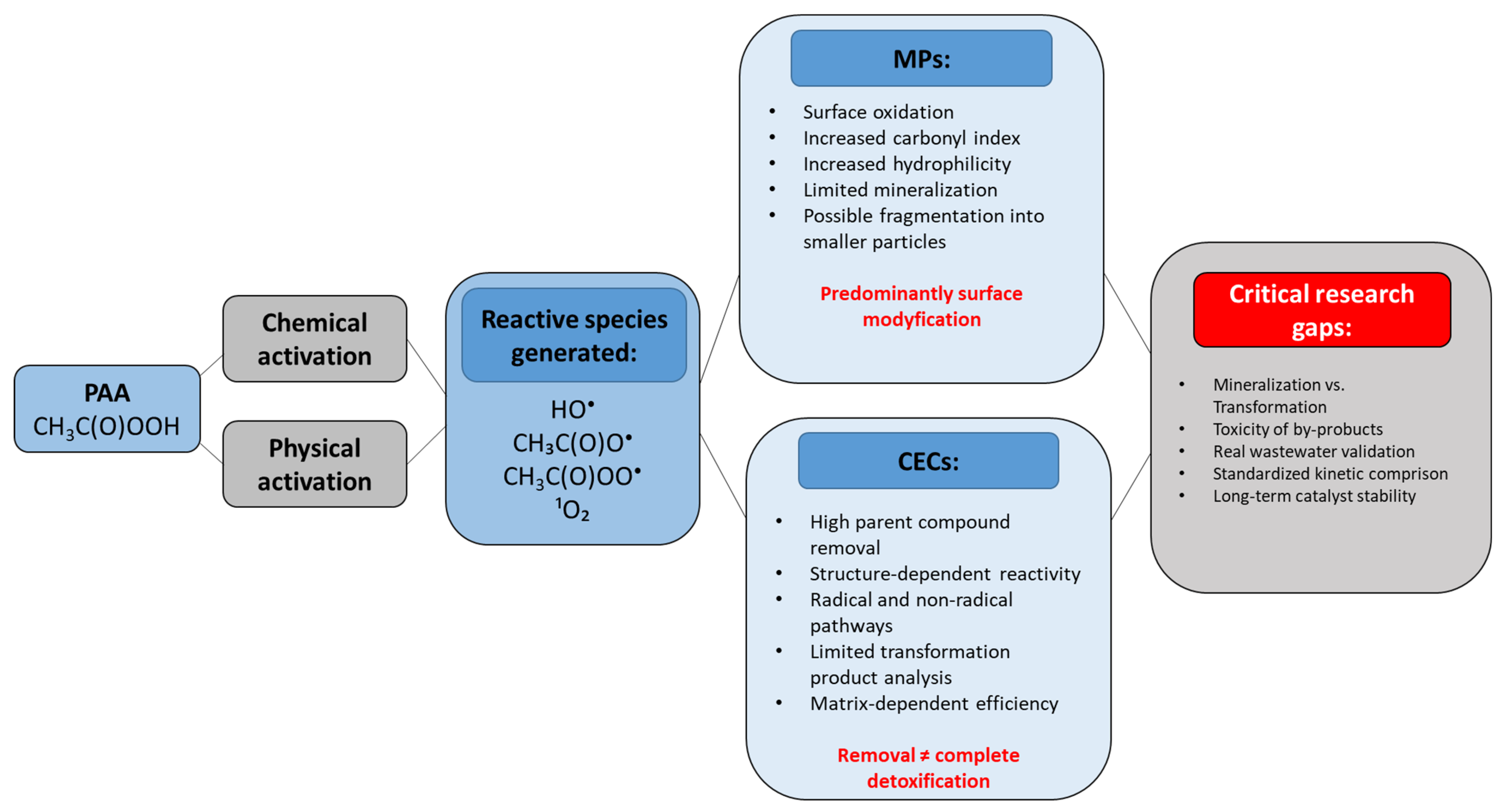
The Emerging Role of Peroxyacetic Acid in Water and Wastewater Treatment: Degradation of Pharmaceuticals, Microplastics, and Other Micropollutants

 , , ,
, , ,  and
and 
Abstract
1. Introduction
2. Characteristics of PAA
3. PAA Oxidation Potential
- (1)
- Photochemical, sonochemical, and thermochemical systems dominated by hydroxyl radical formation,
- (2)
- Metal-mediated systems governed by organic radicals and high-valent metal species,
- (3)
- Carbon-based systems enabling electron-transfer-driven non-radical pathways.
3.1. Physical Activations of PAA
3.1.1. UV Irradiation
3.1.2. Ultrasound Irradiation (Sonochemistry)
3.1.3. Thermal Activation
3.2. Chemical Activations of PAA
3.2.1. Transition Metal Ions
Homogeneous Metal Catalysis
Heterogeneous Metal Catalysis
3.2.2. Carbon-Based Catalysts
3.3. Comparative Assessment of PAA Activation Strategies
4. PAA Oxidation of CECs
4.1. PAA Oxidation of Microplastic
4.2. PAA Oxidation of Other CECs
4.2.1. Pharmaceuticals
4.2.2. Personal Care Products (PCPs)
4.2.3. Pesticides
4.2.4. Industrial Chemicals and By-Products (ICBs)
4.3. Implications for Process Design and Interpretation of PAA Performance
5. Effect of Matrix on the Oxidation of CECs in the PAA System
6. Study of the Degradation Mechanism of CECs and MPs
7. Conclusions
Author Contributions
Funding
Institutional Review Board Statement
Informed Consent Statement
Data Availability Statement
Acknowledgments
Conflicts of Interest
References
- Margot, J.; Rossi, L.; Barry, D.A.; Holliger, C. A Review of the Fate of Micropollutants in Wastewater Treatment Plants. WIREs Water 2015, 2, 457–487. [Google Scholar] [CrossRef]
- Liu, W.; Zhang, J.; Liu, H.; Guo, X.; Zhang, X.; Yao, X.; Cao, Z.; Zhang, T. A Review of the Removal of Microplastics in Global Wastewater Treatment Plants: Characteristics and Mechanisms. Environ. Int. 2021, 146, 106277. [Google Scholar] [CrossRef] [PubMed]
- Sauvé, S.; Desrosiers, M. A Review of What Is an Emerging Contaminant. Chem. Cent. J. 2014, 8, 15. [Google Scholar] [CrossRef]
- Luo, Y.; Guo, W.; Ngo, H.H.; Nghiem, L.D.; Hai, F.I.; Zhang, J.; Liang, S.; Wang, X.C. A Review on the Occurrence of Micropollutants in the Aquatic Environment and Their Fate and Removal during Wastewater Treatment. Sci. Total Environ. 2014, 473–474, 619–641. [Google Scholar] [CrossRef]
- Salimi, M.; Esrafili, A.; Gholami, M.; Jonidi Jafari, A.; Rezaei Kalantary, R.; Farzadkia, M.; Kermani, M.; Sobhi, H.R. Contaminants of Emerging Concern: A Review of New Approach in AOP Technologies. Environ. Monit. Assess. 2017, 189, 414. [Google Scholar] [CrossRef]
- Bavumiragira, J.P.; Ge, J.; Yin, H. Fate and Transport of Pharmaceuticals in Water Systems: A Processes Review. Sci. Total Environ. 2022, 823, 153635. [Google Scholar] [CrossRef]
- Rizzo, L.; Malato, S.; Antakyali, D.; Beretsou, V.G.; Đolić, M.B.; Gernjak, W.; Heath, E.; Ivancev-Tumbas, I.; Karaolia, P.; Lado Ribeiro, A.R.; et al. Consolidated vs New Advanced Treatment Methods for the Removal of Contaminants of Emerging Concern from Urban Wastewater. Sci. Total Environ. 2019, 655, 986–1008. [Google Scholar] [CrossRef] [PubMed]
- Golovko, O.; Örn, S.; Sörengård, M.; Frieberg, K.; Nassazzi, W.; Lai, F.Y.; Ahrens, L. Occurrence and Removal of Chemicals of Emerging Concern in Wastewater Treatment Plants and Their Impact on Receiving Water Systems. Sci. Total Environ. 2021, 754, 142122. [Google Scholar] [CrossRef]
- Jambeck, J.R.; Geyer, R.; Wilcox, C.; Siegler, T.R.; Perryman, M.; Andrady, A.; Narayan, R.; Law, K.L. Plastic Waste Inputs from Land into the Ocean. Science 2015, 347, 768–771. [Google Scholar] [CrossRef]
- MacLeod, M.; Arp, H.P.H.; Tekman, M.B.; Jahnke, A. The Global Threat from Plastic Pollution. Science 2021, 373, 61–65. [Google Scholar] [CrossRef]
- Geng, Y.; Liu, Z.; Hu, R.; Huang, Y.; Li, F.; Ma, W.; Wu, X.; Dong, H.; Song, K.; Xu, X.; et al. Toxicity of Microplastics and Nanoplastics: Invisible Killers of Female Fertility and Offspring Health. Front. Physiol. 2023, 14, 1254886. [Google Scholar] [CrossRef]
- Chand, R.; Iordachescu, L.; Bäckbom, F.; Andreasson, A.; Bertholds, C.; Pollack, E.; Molazadeh, M.; Lorenz, C.; Nielsen, A.H.; Vollertsen, J. Treating Wastewater for Microplastics to a Level on Par with Nearby Marine Waters. Water Res. 2024, 256, 121647. [Google Scholar] [CrossRef]
- Lamichhane, G.; Acharya, A.; Marahatha, R.; Modi, B.; Paudel, R.; Adhikari, A.; Raut, B.K.; Aryal, S.; Parajuli, N. Microplastics in Environment: Global Concern, Challenges, and Controlling Measures. Int. J. Environ. Sci. Technol. 2023, 20, 4673–4694. [Google Scholar] [CrossRef]
- Ahmed, A.S.S.; Billah, M.M.; Ali, M.M.; Bhuiyan, M.K.A.; Guo, L.; Mohinuzzaman, M.; Hossain, M.B.; Rahman, M.S.; Islam, M.S.; Yan, M.; et al. Microplastics in Aquatic Environments: A Comprehensive Review of Toxicity, Removal, and Remediation Strategies. Sci. Total Environ. 2023, 876, 162414. [Google Scholar] [CrossRef]
- Urbina-Suarez, N.A.; Machuca-Martínez, F.; Barajas-Solano, A.F. Advanced Oxidation Processes and Biotechnological Alternatives for the Treatment of Tannery Wastewater. Molecules 2021, 26, 3222. [Google Scholar] [CrossRef]
- Wang, X.; Dai, Y.; Li, Y.; Yin, L. Application of Advanced Oxidation Processes for the Removal of Micro/Nanoplastics from Water: A Review. Chemosphere 2024, 346, 140636. [Google Scholar] [CrossRef] [PubMed]
- Guo, S.; Feng, D.; Li, Y.; Liu, L.; Tang, J. Innovations in Chemical Degradation Technologies for the Removal of Micro/Nano-Plastics in Water: A Comprehensive Review. Ecotoxicol. Environ. Saf. 2024, 271, 115979. [Google Scholar] [CrossRef] [PubMed]
- Bule Možar, K.; Miloloža, M.; Martinjak, V.; Cvetnić, M.; Kušić, H.; Bolanča, T.; Kučić Grgić, D.; Ukić, Š. Potential of Advanced Oxidation as Pretreatment for Microplastics Biodegradation. Separations 2023, 10, 132. [Google Scholar] [CrossRef]
- Shi, C.; Li, C.; Wang, Y.; Guo, J.; Barry, S.; Zhang, Y.; Marmier, N. Review of Advanced Oxidation Processes Based on Peracetic Acid for Organic Pollutants. Water 2022, 14, 2309. [Google Scholar] [CrossRef]
- Correa-Sanchez, S.; Peñuela, G.A. Peracetic Acid-Based Advanced Oxidation Processes for the Degradation of Emerging Pollutants: A Critical Review. J. Water Process Eng. 2022, 49, 102986. [Google Scholar] [CrossRef]
- Liu, D.; Straus, D.L.; Pedersen, L.; Good, C.; Lazado, C.C.; Meinelt, T. Towards Sustainable Water Disinfection with Peracetic Acid in Aquaculture: A Review. Rev. Aquac. 2024, 16, 1621–1646. [Google Scholar] [CrossRef]
- Bux, N.; Tumrani, S.H.; Soomro, R.A.; Ma, Q.; Zhou, J.; Wang, T. Catalytic Degradation of Organic Pollutants in Aqueous Systems: A Comprehensive Review of Peroxyacetic Acid-Based Advanced Oxidation Processes. J. Environ. Manag. 2025, 373, 123989. [Google Scholar] [CrossRef] [PubMed]
- Tong, Y.; Wang, X.; Zhang, Y.; Xu, J.; Sun, C. Reactive Species in Peracetic Acid-Based AOPs: A Critical Review of Their Formation Mechanisms, Identification Methods and Oxidation Performances. Water Res. 2025, 272, 122917. [Google Scholar] [CrossRef] [PubMed]
- Luukkonen, T.; Heyninck, T.; Rämö, J.; Lassi, U. Comparison of Organic Peracids in Wastewater Treatment: Disinfection, Oxidation and Corrosion. Water Res. 2015, 85, 275–285. [Google Scholar] [CrossRef]
- Newhart, K.B.; Goldman-Torres, J.E.; Freedman, D.E.; Wisdom, K.B.; Hering, A.S.; Cath, T.Y. Prediction of Peracetic Acid Disinfection Performance for Secondary Municipal Wastewater Treatment Using Artificial Neural Networks. ACS EST Water 2021, 1, 328–338. [Google Scholar] [CrossRef]
- Chhetri, R.K.; Baun, A.; Andersen, H.R. Acute Toxicity and Risk Evaluation of the CSO Disinfectants Performic Acid, Peracetic Acid, Chlorine Dioxide and Their by-Products Hydrogen Peroxide and Chlorite. Sci. Total Environ. 2019, 677, 1–8. [Google Scholar] [CrossRef]
- Kitis, M. Disinfection of Wastewater with Peracetic Acid: A Review. Environ. Int. 2004, 30, 47–55. [Google Scholar] [CrossRef]
- Luukkonen, T.; Teeriniemi, J.; Prokkola, H.; Rämö, J.; Lassi, U. Chemical Aspects of Peracetic Acid Based Wastewater Disinfection. Water SA 2014, 40, 73. [Google Scholar] [CrossRef]
- Pironti, C.; Dell’Annunziata, F.; Giugliano, R.; Folliero, V.; Galdiero, M.; Ricciardi, M.; Motta, O.; Proto, A.; Franci, G. Comparative Analysis of Peracetic Acid (PAA) and Permaleic Acid (PMA) in Disinfection Processes. Sci. Total Environ. 2021, 797, 149206. [Google Scholar] [CrossRef]
- Arias-Moliz, M.T.; Ordinola-Zapata, R.; Baca, P.; Ruiz-Linares, M.; García García, E.; Hungaro Duarte, M.A.; Monteiro Bramante, C.; Ferrer-Luque, C.M. Antimicrobial Activity of Chlorhexidine, Peracetic Acid and Sodium Hypochlorite/Etidronate Irrigant Solutions against Enterococcus faecalis Biofilms. Int. Endod. J. 2015, 48, 1188–1193. [Google Scholar] [CrossRef]
- Yuan, Q.-B.; Guo, M.-T.; Yang, J. Fate of Antibiotic Resistant Bacteria and Genes during Wastewater Chlorination: Implication for Antibiotic Resistance Control. PLoS ONE 2015, 10, e0119403. [Google Scholar] [CrossRef]
- Rossi, S.; Antonelli, M.; Mezzanotte, V.; Nurizzo, C. Peracetic Acid Disinfection: A Feasible Alternative to Wastewater Chlorination. Water Environ. Res. 2007, 79, 341–350. [Google Scholar] [CrossRef]
- Espigares, E.; Bueno, A.; Espigares, M.; Gálvez, R. Isolation of Salmonella Serotypes in Wastewater and Effluent: Effect of Treatment and Potential Risk. Int. J. Hyg. Environ. Health 2006, 209, 103–107. [Google Scholar] [CrossRef] [PubMed]
- Da Silva, W.P.; Carlos, T.D.; Cavallini, G.S.; Pereira, D.H. Peracetic Acid: Structural Elucidation for Applications in Wastewater Treatment. Water Res. 2020, 168, 115143. [Google Scholar] [CrossRef]
- Swern, D. Organic Peracids. Chem. Rev. 1949, 45, 1–68. [Google Scholar] [CrossRef]
- Kim, J.; Huang, C.-H. Reactivity of Peracetic Acid with Organic Compounds: A Critical Review. ACS EST Water 2021, 1, 15–33. [Google Scholar] [CrossRef]
- Zhang, C.; Brown, P.J.B.; Hu, Z. Thermodynamic Properties of an Emerging Chemical Disinfectant, Peracetic Acid. Sci. Total Environ. 2018, 621, 948–959. [Google Scholar] [CrossRef]
- Awad, M.I.; Denggerile, A.; Ohsaka, T. Electroreduction of Peroxyacetic Acid at Gold Electrode in Aqueous Media. J. Electrochem. Soc. 2004, 151, E358. [Google Scholar] [CrossRef]
- Zhang, K.; Zhou, X.; Du, P.; Zhang, T.; Cai, M.; Sun, P.; Huang, C.-H. Oxidation of β-Lactam Antibiotics by Peracetic Acid: Reaction Kinetics, Product and Pathway Evaluation. Water Res. 2017, 123, 153–161. [Google Scholar] [CrossRef]
- Keller, B.K.; Wojcik, M.D.; Fletcher, T.R. A Directly-Dissociative Stepwise Reaction Mechanism for Gas-Phase Peroxyacetic Acid. J. Photochem. Photobiol. Chem. 2008, 195, 10–22. [Google Scholar] [CrossRef]
- Ao, X.; Eloranta, J.; Huang, C.-H.; Santoro, D.; Sun, W.; Lu, Z.; Li, C. Peracetic Acid-Based Advanced Oxidation Processes for Decontamination and Disinfection of Water: A Review. Water Res. 2021, 188, 116479. [Google Scholar] [CrossRef] [PubMed]
- Kiejza, D.; Kotowska, U.; Polińska, W.; Karpińska, J. Peracids—New Oxidants in Advanced Oxidation Processes: The Use of Peracetic Acid, Peroxymonosulfate, and Persulfate Salts in the Removal of Organic Micropollutants of Emerging Concern—A Review. Sci. Total Environ. 2021, 790, 148195. [Google Scholar] [CrossRef]
- Cheng, C.; Li, H.; Wang, J.; Wang, H.; Yang, X. A Review of Measurement Methods for Peracetic Acid (PAA). Front. Environ. Sci. Eng. 2020, 14, 87. [Google Scholar] [CrossRef]
- Bach, R.D.; Ayala, P.Y.; Schlegel, H.B. A Reassessment of the Bond Dissociation Energies of Peroxides. An Ab Initio Study. J. Am. Chem. Soc. 1996, 118, 12758–12765. [Google Scholar] [CrossRef]
- Miao, F.; Ren, W.; Zhou, H.; Ma, T.; Zhang, H.; Wang, S.; Duan, X. Carbon-Based Peracetic Acid Activation towards Advanced Water Purification. Appl. Catal. B Environ. Energy 2025, 363, 124807. [Google Scholar] [CrossRef]
- Chen, S.; Cai, M.; Liu, Y.; Zhang, L.; Feng, L. Effects of Water Matrices on the Degradation of Naproxen by Reactive Radicals in the UV/Peracetic Acid Process. Water Res. 2019, 150, 153–161. [Google Scholar] [CrossRef]
- Cai, M.; Sun, P.; Zhang, L.; Huang, C.-H. UV/Peracetic Acid for Degradation of Pharmaceuticals and Reactive Species Evaluation. Environ. Sci. Technol. 2017, 51, 14217–14224. [Google Scholar] [CrossRef]
- González-García, J.; Sáez, V.; Tudela, I.; Díez-Garcia, M.I.; Deseada Esclapez, M.; Louisnard, O. Sonochemical Treatment of Water Polluted by Chlorinated Organocompounds. A Review. Water 2010, 2, 28–74. [Google Scholar] [CrossRef]
- García-López, E.I.; Aoun, N.; Marcì, G. An Overview of the Sustainable Depolymerization/Degradation of Polypropylene Microplastics by Advanced Oxidation Technologies. Molecules 2024, 29, 2816. [Google Scholar] [CrossRef]
- Chatel, G. How Sonochemistry Contributes to Green Chemistry? Ultrason. Sonochem. 2018, 40, 117–122. [Google Scholar] [CrossRef]
- Mahamuni, N.N.; Adewuyi, Y.G. Advanced Oxidation Processes (AOPs) Involving Ultrasound for Waste Water Treatment: A Review with Emphasis on Cost Estimation. Ultrason. Sonochem. 2010, 17, 990–1003. [Google Scholar] [CrossRef]
- Adewuyi, Y.G. Sonochemistry: Environmental Science and Engineering Applications. Ind. Eng. Chem. Res. 2001, 40, 4681–4715. [Google Scholar] [CrossRef]
- Wang, J.; Wan, Y.; Ding, J.; Wang, Z.; Ma, J.; Xie, P.; Wiesner, M.R. Thermal Activation of Peracetic Acid in Aquatic Solution: The Mechanism and Application to Degrade Sulfamethoxazole. Environ. Sci. Technol. 2020, 54, 14635–14645. [Google Scholar] [CrossRef] [PubMed]
- Liu, B.; Huang, B.; Ma, X.; Huang, H.; Zou, C.; Liu, J.; Luo, Q.; Wang, C.; Liang, J. Recent Advances in Peracetic Acid-Based Advanced Oxidation Processes for Emerging Pollutants Elimination: A Review. J. Environ. Chem. Eng. 2024, 12, 112927. [Google Scholar] [CrossRef]
- Wang, Z.; Wang, J.; Xiong, B.; Bai, F.; Wang, S.; Wan, Y.; Zhang, L.; Xie, P.; Wiesner, M.R. Application of Cobalt/Peracetic Acid to Degrade Sulfamethoxazole at Neutral Condition: Efficiency and Mechanisms. Environ. Sci. Technol. 2020, 54, 464–475. [Google Scholar] [CrossRef] [PubMed]
- Kim, J.; Du, P.; Liu, W.; Luo, C.; Zhao, H.; Huang, C.-H. Cobalt/Peracetic Acid: Advanced Oxidation of Aromatic Organic Compounds by Acetylperoxyl Radicals. Environ. Sci. Technol. 2020, 54, 5268–5278. [Google Scholar] [CrossRef]
- Rokhina, E.V.; Makarova, K.; Lahtinen, M.; Golovina, E.A.; Van As, H.; Virkutyte, J. Ultrasound-Assisted MnO2 Catalyzed Homolysis of Peracetic Acid for Phenol Degradation: The Assessment of Process Chemistry and Kinetics. Chem. Eng. J. 2013, 221, 476–486. [Google Scholar] [CrossRef]
- Mechanism of Decomposition of Peracetic Acid by Manganese Ions and Diethylenetriaminepentaacetic Acid (DTPA). Available online: https://www.degruyterbrill.com/document/doi/10.1515/HF.2005.084/html (accessed on 8 July 2025).
- Kim, J.; Zhang, T.; Liu, W.; Du, P.; Dobson, J.T.; Huang, C.-H. Advanced Oxidation Process with Peracetic Acid and Fe(II) for Contaminant Degradation. Environ. Sci. Technol. 2019, 53, 13312–13322. [Google Scholar] [CrossRef] [PubMed]
- Gasim, M.F.; Bao, Y.; Elgarahy, A.M.; Osman, A.I.; Al-Muhtaseb, A.H.; Rooney, D.W.; Yap, P.-S.; Oh, W.-D. Peracetic Acid Activation Using Heterogeneous Catalysts for Environmental Decontamination: A Review. Catal. Commun. 2023, 180, 106702. [Google Scholar] [CrossRef]
- Houtman, C.J. Emerging Contaminants in Surface Waters and Their Relevance for the Production of Drinking Water in Europe. J. Integr. Environ. Sci. 2010, 7, 271–295. [Google Scholar] [CrossRef]
- Feng, W.; Deng, Y.; Yang, F.; Miao, Q.; Ngien, S.K. Systematic Review of Contaminants of Emerging Concern (CECs): Distribution, Risks, and Implications for Water Quality and Health. Water 2023, 15, 3922. [Google Scholar] [CrossRef]
- Sarkar, S.; Diab, H.; Thompson, J. Microplastic Pollution: Chemical Characterization and Impact on Wildlife. Int. J. Environ. Res. Public Health 2023, 20, 1745. [Google Scholar] [CrossRef]
- O’Brien, S.; Rauert, C.; Ribeiro, F.; Okoffo, E.D.; Burrows, S.D.; O’Brien, J.W.; Wang, X.; Wright, S.L.; Thomas, K.V. There’s Something in the Air: A Review of Sources, Prevalence and Behaviour of Microplastics in the Atmosphere. Sci. Total Environ. 2023, 874, 162193. [Google Scholar] [CrossRef]
- Roslan, N.N.; Lau, H.L.H.; Suhaimi, N.A.A.; Shahri, N.N.M.; Verinda, S.B.; Nur, M.; Lim, J.-W.; Usman, A. Recent Advances in Advanced Oxidation Processes for Degrading Pharmaceuticals in Wastewater—A Review. Catalysts 2024, 14, 189. [Google Scholar] [CrossRef]
- Yang, Z.; Li, Y.; Zhang, G. Degradation of Microplastic in Water by Advanced Oxidation Processes. Chemosphere 2024, 357, 141939. [Google Scholar] [CrossRef]
- Kong, X.; Zhou, A.; Chen, X.; Cheng, X.; Lai, Y.; Li, C.; Ji, Q.; Ji, Q.; Kong, J.; Ding, Y.; et al. Insight into the Adsorption Behaviors and Bioaccessibility of Three Altered Microplastics through Three Types of Advanced Oxidation Processes. Sci. Total Environ. 2024, 917, 170420. [Google Scholar] [CrossRef]
- Zaritskii, V.I.D. Corrosion and Strength Behavior of Polyethylene, Polyvinyl Chloride Plastic and Fluoroplast-4 in Peracetic Acid-Hydrogen Peroxide-Water System. Sov. Mater. Sci. 1992, 27, 613–614. [Google Scholar] [CrossRef]
- Ge, J.; Wang, M.; Liu, P.; Zhang, Z.; Peng, J.; Guo, X. A Systematic Review on the Aging of Microplastics and the Effects of Typical Factors in Various Environmental Media. TrAC Trends Anal. Chem. 2023, 162, 117025. [Google Scholar] [CrossRef]
- Li, Y.; Feng, L.; Wang, S.; Song, C. Aging of Microplastics and Nanoplastics Induced by Advanced Oxidation Processes in Wastewater Treatment and Their Biological Toxicity: A Systematic Review. Microorganisms 2026, 14, 812. [Google Scholar] [CrossRef]
- Li, Q.; Bai, Q.; Yu, S.; Liu, R.; Liu, J. Advances and Challenges in the Determination of Micro- and Nano-Plastics by Pyrolysis-Gas Chromatography-Mass Spectrometry. TrAC Trends Anal. Chem. 2025, 189, 118270. [Google Scholar] [CrossRef]
- Harish, H.; Jegatheesan, V. A Review of Sources, Worldwide Legislative Measures and the Factors Influencing the Treatment Technologies for Contaminants of Emerging Concern (CECs). Curr. Pollut. Rep. 2025, 11, 44. [Google Scholar] [CrossRef]
- Li, X.; Shen, X.; Jiang, W.; Xi, Y.; Li, S. Comprehensive Review of Emerging Contaminants: Detection Technologies, Environmental Impact, and Management Strategies. Ecotoxicol. Environ. Saf. 2024, 278, 116420. [Google Scholar] [CrossRef]
- Santiago-Espiñeira, P.; García-Muñoz, P.; Campayo-Navarro, P.; Rodríguez-Chueca, J. Harnessing UV-C Photoassisted AOPs: Amoxicillin Degradation, Disinfection by-Products Formation, and Enterococcus Faecalis Inactivation in Aquaculture Water. J. Environ. Manag. 2025, 388, 125983. [Google Scholar] [CrossRef]
- Zhou, X.; Wu, H.; Zhang, L.; Liang, B.; Sun, X.; Chen, J. Activation of Peracetic Acid with Lanthanum Cobaltite Perovskite for Sulfamethoxazole Degradation under a Neutral pH: The Contribution of Organic Radicals. Molecules 2020, 25, 2725. [Google Scholar] [CrossRef]
- Wang, J.; Xiong, B.; Miao, L.; Wang, S.; Xie, P.; Wang, Z.; Ma, J. Applying a Novel Advanced Oxidation Process of Activated Peracetic Acid by CoFe2O4 to Efficiently Degrade Sulfamethoxazole. Appl. Catal. B Environ. 2021, 280, 119422. [Google Scholar] [CrossRef]
- Zhou, R.; Zhou, G.; Liu, Y.; Wang, S.; Fu, Y. Cobalt Doped Graphitic Carbon Nitride as an Effective Catalyst for Peracetic Acid to Degrade Sulfamethoxazole. RSC Adv. 2022, 12, 13810–13819. [Google Scholar] [CrossRef]
- Al Umairi, A.R.; EI-Din, M.G. Elimination of Pesticides and Pharmaceutical Model Compounds by Peracetic Acid and Peracetic Acid-Uv Photolysis Processes: Ph Impact and Hydroxyl Radical Contribution. Preprint 2025. [Google Scholar] [CrossRef]
- Du, P.; Liu, W.; Rao, Z.; Wang, J. Accelerated Oxidation of Organic Micropollutants during Peracetic Acid Treatment in the Presence of Bromide Ions. ACS EST Water 2022, 2, 320–328. [Google Scholar] [CrossRef]
- Fang, L.; Li, K.; Lv, Y.; Ye, M. Activation of Peracetic Acid by Bimetallic Metal-Organic Frameworks for Bezafibrate Degradation: Removal Efficiency, Mechanism and Influencing Factors. J. Water Process Eng. 2025, 69, 106862. [Google Scholar] [CrossRef]
- Hollman, J.; Dominic, J.A.; Achari, G. Degradation of Pharmaceutical Mixtures in Aqueous Solutions Using UV/Peracetic Acid Process: Kinetics, Degradation Pathways and Comparison with UV/H2O2. Chemosphere 2020, 248, 125911. [Google Scholar] [CrossRef]
- Wang, S.; Wang, H.; Liu, Y.; Fu, Y. Effective Degradation of Sulfamethoxazole with Fe2+-Zeolite/Peracetic Acid. Sep. Purif. Technol. 2020, 233, 115973. [Google Scholar] [CrossRef]
- Zhou, G.; Fu, Y.; Zhou, R.; Zhang, L.; Zhang, L.; Deng, J.; Liu, Y. Efficient Degradation of Organic Contaminants by Magnetic Cobalt Ferrite Combined with Peracetic Acid. Process Saf. Environ. Prot. 2022, 160, 376–384. [Google Scholar] [CrossRef]
- Zhou, G.; Zhou, R.; Liu, Y.; Zhang, L.; Zhang, L.; Fu, Y. Efficient Degradation of Sulfamethoxazole Using Peracetic Acid Activated by Zero-Valent Cobalt. J. Environ. Chem. Eng. 2022, 10, 107783. [Google Scholar] [CrossRef]
- Liu, B.; Guo, W.; Jia, W.; Wang, H.; Zheng, S.; Si, Q.; Zhao, Q.; Luo, H.; Jiang, J.; Ren, N. Insights into the Oxidation of Organic Contaminants by Co(II) Activated Peracetic Acid: The Overlooked Role of High-Valent Cobalt-Oxo Species. Water Res. 2021, 201, 117313. [Google Scholar] [CrossRef]
- Dai, C.; Li, S.; Duan, Y.; Leong, K.H.; Liu, S.; Zhang, Y.; Zhou, L.; Tu, Y. Mechanisms and Product Toxicity of Activated Carbon/Peracetic Acid for Degradation of Sulfamethoxazole: Implications for Groundwater Remediation. Water Res. 2022, 216, 118347. [Google Scholar] [CrossRef]
- Wang, J.; Wang, Z.; Cheng, Y.; Cao, L.; Xie, P.; Ma, J. Molybdenum Disulfide (MoS2) Promoted Sulfamethoxazole Degradation in the Fe(III)/Peracetic Acid Process. Sep. Purif. Technol. 2022, 281, 119854. [Google Scholar] [CrossRef]
- Kotowska, U.; Karpińska, J.; Kiejza, D.; Ratkiewicz, A.; Piekutin, J.; Makarova, K.; Olchowik-Grabarek, E. Oxidation of Contaminants of Emerging Concern by Combination of Peracetic Acid with Iron Ions and Various Types of Light Radiation—Optimization, Kinetics, Removal Efficiency and Mechanism Investigation. J. Mol. Liq. 2023, 369, 120859. [Google Scholar] [CrossRef]
- Xue, Y.; Kamali, M.; Kakavandi, B.; Costa, M.E.V.; Thompson, I.P.; Huang, W.; Appels, L.; Dewil, R. Activation of Peracetic Acid by a Magnetic Biochar-Ferrospinel AFe2O4 (A = Cu, Co, or Mn) Nanocomposite for the Degradation of Carbamazepine—A Comparative and Mechanistic Study. Chem. Eng. J. 2024, 490, 151932. [Google Scholar] [CrossRef]
- Xie, Y.; Wu, C.; Yang, F.; Liu, J.; Wei, M.; Ren, M. A New Sight into the Roles of NO3−/NO2− in the Degradation of Sulfadiazine in the UV Based Process. J. Environ. Chem. Eng. 2024, 12, 114037. [Google Scholar] [CrossRef]
- Ghanbari, F.; Giannakis, S.; Lin, K.-Y.A.; Wu, J.; Madihi-Bidgoli, S. Acetaminophen Degradation by a Synergistic Peracetic Acid/UVC-LED/Fe(II) Advanced Oxidation Process: Kinetic Assessment, Process Feasibility and Mechanistic Considerations. Chemosphere 2021, 263, 128119. [Google Scholar] [CrossRef]
- Zhang, P.; Zhang, X.; Zhao, X.; Jing, G.; Zhou, Z. Activation of Peracetic Acid with Zero-Valent Iron for Tetracycline Abatement: The Role of Fe(II) Complexation with Tetracycline. J. Hazard. Mater. 2022, 424, 127653. [Google Scholar] [CrossRef]
- Deng, J.; Wang, H.; Fu, Y.; Liu, Y. Phosphate-Induced Activation of Peracetic Acid for Diclofenac Degradation: Kinetics, Influence Factors and Mechanism. Chemosphere 2022, 287, 132396. [Google Scholar] [CrossRef]
- Zhang, L.; Fu, Y.; Wang, Z.; Zhou, G.; Zhou, R.; Liu, Y. Removal of Diclofenac in Water Using Peracetic Acid Activated by Zero Valent Copper. Sep. Purif. Technol. 2021, 276, 119319. [Google Scholar] [CrossRef]
- Zhang, Z.; Duan, Y.; Dai, C.; Li, S.; Chen, Y.; Tu, Y.; Leong, K.H.; Zhou, L. Oxidation of Sulfamethazine by Peracetic Acid Activated with Biochar: Reactive Oxygen Species Contribution and Toxicity Change. Environ. Pollut. 2022, 313, 120170. [Google Scholar] [CrossRef] [PubMed]
- Zhou, R.; Zhou, G.; Liu, Y.; Liu, S.; Wang, S.; Fu, Y. Activated Peracetic Acid by Mn3O4 for Sulfamethoxazole Degradation: A Novel Heterogeneous Advanced Oxidation Process. Chemosphere 2022, 306, 135506. [Google Scholar] [CrossRef] [PubMed]
- Wang, F.; Xiang, L.; Sze-Yin Leung, K.; Elsner, M.; Zhang, Y.; Guo, Y.; Pan, B.; Sun, H.; An, T.; Ying, G.; et al. Emerging Contaminants: A One Health Perspective. Innovation 2024, 5, 100612. [Google Scholar] [CrossRef]
- Piekutin, J.; Bolińska, M.I.; Kotowska, U.; Koszelnik, P.; Puchlik, M. Research of the Possibility of Removing Organic Pollutants from Water by Membrane Methods and Purification of the Obtained Concentrate by Chemical Methods. Econ. Environ. 2025, 92, 1105. [Google Scholar] [CrossRef]
- Köck-Schulmeyer, M.; Villagrasa, M.; López de Alda, M.; Céspedes-Sánchez, R.; Ventura, F.; Barceló, D. Occurrence and Behavior of Pesticides in Wastewater Treatment Plants and Their Environmental Impact. Sci. Total Environ. 2013, 458–460, 466–476. [Google Scholar] [CrossRef]
- Wu, W.; Tian, D.; Liu, T.; Chen, J.; Huang, T.; Zhou, X.; Zhang, Y. Degradation of Organic Compounds by Peracetic Acid Activated with Co3O4: A Novel Advanced Oxidation Process and Organic Radical Contribution. Chem. Eng. J. 2020, 394, 124938. [Google Scholar] [CrossRef]
- Zou, R.; Yang, W.; Rezaei, B.; Bendtsen, E.B.; Guo, K.; Tang, K.; Andersen, H.R.; Keller, S.S.; Zhang, Y. On the Mechanism and Selectivity of a Novel Iodine/Peracetic Acid Process for the Efficient and Rapid Elimination of Micropollutants. Chem. Eng. J. 2024, 479, 147815. [Google Scholar] [CrossRef]
- Miao, F.; Yue, X.; Cheng, C.; Chen, X.; Ren, W.; Zhang, H. Insights into the Mechanism of Carbocatalysis for Peracetic Acid Activation: Kinetic Discernment and Active Site Identification. Water Res. 2022, 227, 119346. [Google Scholar] [CrossRef]
- Shao, Y.; Li, S.; Wei, X.; Zhao, Y.; Liang, J.; Li, X. The Diverse Roles of Halide Ions in the Degradation of Bisphenol A via UV/Peracetic Acid Process at Different pH Values: Radical Chemistry, and Transformation Pathways. J. Hazard. Mater. 2024, 465, 133053. [Google Scholar] [CrossRef]
- Kiejza, D.; Karpińska, J.; Leszczyńska, A.; Olchowik-Grabarek, E.; Makarova, K.; Kotowska, U. Acceleration of the Bisphenols Oxidation in the Fe(III)/Peracetic Acid System with Salicylic Acid. J. Mol. Liq. 2024, 411, 125697. [Google Scholar] [CrossRef]
- Kiejza, D.; Piotrowska-Niczyporuk, A.; Regulska, E.; Kotowska, U. Peracetic Acid Activated by Nickel Cobaltite as Effective Oxidizing Agent for BPA and Its Analogues Degradation. Chemosphere 2024, 354, 141684. [Google Scholar] [CrossRef] [PubMed]
- Luukkonen, T.; Von Gunten, U. Oxidation of Organic Micropollutant Surrogate Functional Groups with Peracetic Acid Activated by Aqueous Co(II), Cu(II), or Ag(I) and Geopolymer-Supported Co(II). Water Res. 2022, 223, 118984. [Google Scholar] [CrossRef]
- Rabbil, M.; Bhuyan, M.; Alzeer, M.; Adesanya, E.; Luukkonen, T. Transition Metal-Modified Alkali-Activated Aluminosilicate Foams as Catalysts for Peracetic Acid in Phenol Abatement. Ceram. Int. 2025, 51, 28561–28571. [Google Scholar] [CrossRef]
- Xue, Y.; Sun, W.; Shi, W.; Huang, C.-H.; Santoro, D. Prehydrated Electrons Activated by Continuous Electron Transfer Stemmed from Peracetic Acid Homolysis Mediated by Diamond Surface Defects for Enhanced PFOA Destruction. Environ. Sci. Technol. 2024, 58, 11152–11161. [Google Scholar] [CrossRef] [PubMed]
- Chen, P.; Zhuang, Z.; Zhang, S.; Yang, X.; Wang, Z. Peracetic Acid Activation by CaCoO3 Perovskite for Efficient Bisphenol a Degradation: Mechanistic Insights and Practical Applications. Ind. Eng. Chem. Res. 2025, 64, 24584–24596. [Google Scholar] [CrossRef]
- Ao, X.; Zhang, X.; Li, S.; Yang, Y.; Sun, W.; Li, Z. Comprehensive Understanding of Fluoroquinolone Degradation via MPUV/PAA Process: Radical Chemistry, Matrix Effects, Degradation Pathways, and Toxicity. J. Hazard. Mater. 2023, 445, 130480. [Google Scholar] [CrossRef] [PubMed]
- Kiejza, D.; Karpińska, J.; Piotrowska-Niczyporuk, A.; Kotowska, U. Advanced Oxidation of Bisphenols by Peracetic Acid Activated by Light and Ultrasound. Environ. Pollut. 2023, 333, 122029. [Google Scholar] [CrossRef]
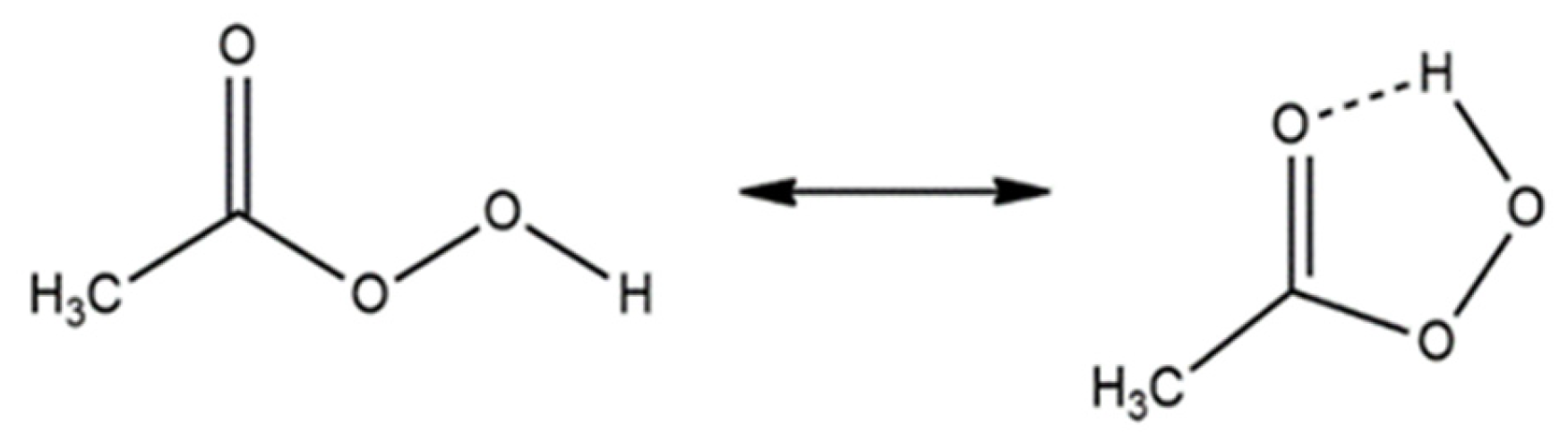


| Name | Peracetic Acid (PAA) |
|---|---|
| Chemical formula | C2H4O3 |
| Molar Mass (g/mol) | 76.05 |
| Density (g/mL) | 1.04 |
| Boiling point (°C) | 110 |
| Melting point (°C) | 0.2 |
| Acidity (pKa) | 8.2 |
| Oxidant | Oxidation Potential (V) |
|---|---|
| Hydroxyl radical | 2.8 |
| Sulfate radical | 2.5–3.1 |
| Ozone | 2.1 |
| Persulfate | 2.0 |
| PAA | 1.0–1.9 |
| Peroxymonosulfate | 1.8 |
| H2O2 | 1.8 |
| Potassium permanganate | 1.7 |
| Chlorine dioxide | 1.5 |
| Chlorine | 1.4 |
| Strategy | Main Strengths | Main Constraints | Best Suited for |
|---|---|---|---|
| Physical activation: UV, US, thermal | No catalyst addition; lower risk of secondary contamination; operationally simple concept | Continuous energy input; low selectivity; reduced efficiency in complex matrices due to radical scavenging, turbidity, NOM, and inorganic ions | Relatively clean or transparent waters; tertiary effluents; systems where catalyst addition is undesirable |
| Homogeneous metal activation | Fast reaction kinetics; efficient catalytic redox cycling; strong activation under controlled conditions | pH dependence; metal residuals; difficult catalyst recovery; possible secondary contamination | Controlled treatment systems where pH and residual metals can be managed |
| Heterogeneous metal activation | High catalytic efficiency; easier separation than homogeneous systems; potential reusability | Metal leaching; catalyst deactivation; recovery and stability requirements; synthesis cost | Systems requiring high efficiency and catalyst reuse, provided leaching is controlled |
| Carbon-based activation | Metal-free or low-metal option; better matrix tolerance; tunable surface chemistry; possible non-radical pathways | Often slower kinetics; performance depends on surface properties; catalyst recovery still required | Complex matrices where radical scavenging limits conventional radical-based oxidation |
| Property | MPs | Initial | After UV/PAA | Effect |
|---|---|---|---|---|
| Morphology & Surface | PE | Rough surface, cracks, pits | Rough surface, cracks, pits | Surface became rough with cracks and pits; particle size decreased |
| PP | Rough surface, cracks, pits | Rough surface, cracks, pits | Particle size slightly decreased | |
| PS | White color | Light yellow | Color change due to the UV sensitivity of aromatic rings | |
| Average Particle Size (μm) | PE | 104.3 | 35.0 | Significant size reduction |
| PP | 123.9 | 111.7 | Moderate size reduction | |
| PS | 121.9 | 119.8 | Slight size reduction | |
| BET Surface Area (m2 g−1)/Micropore Volume (cm3 g−1) | PE | 3.73/0.003 | 2.07/0.002 | Decrease in both, contrary to the general AOP trend |
| PP | 1.43/0.001 | 2.88/0.003 | Increase observed | |
| PS | 1.16/0.001 | 53.77/0.052 | Significant increase | |
| Hydrophobicity (Water Contact Angle, °) | PE | 122.2 | 131.4 | Increased hydrophobicity, contrary to the general AOP effect |
| PP | 122.4 | 113.4 | Decreased hydrophobicity | |
| PS | 124.8 | 110.6 | Decreased hydrophobicity | |
| Crystallinity (%) | PE | 23.7 | 41.7 | Increased crystallinity |
| PP | 51.5 | 61.0 | ||
| PS | 45.9 | 36.6 | Decreased crystallinity | |
| 2-Nitrofluorene adsorption (μg g−1) | PE | 597.9 | 607.2 | Adsorption increased; equilibrium reached in 24 h |
| PP | 599.6 | 604.9 | ||
| PS | 599.8 | 609.7 |
| Microplastic | Main Radicals (from PAA/H2O2 System) | Oxidation Products/Chemical Changes | Surface and Mechanical Effects |
|---|---|---|---|
| PE | HO•, CH3COO• | no specific products identified; partial surface oxidation | initial swelling (~0.09%), then slow dissolution; mass loss and decreased mechanical properties (K0 ≈ 0.03%/h, K6 ≈ 0.025%/h after 1000 h) |
| PVC | HO•, CH3COO• (stronger PAA activation than PE) | no specific products identified; surface degradation | initial swelling (~0.11%), followed by dissolution; mass loss; stronger activation of PAA dissociation than PE; K0 ≈ 0.04%/h, K6 ≈ 0.05%/h after 1000 h |
| PTFE | practically non-reactive toward PAA/H2O2 | no chemical changes | high resistance; no swelling, dissolution, or loss of mechanical properties (stable up to 1000 h) |
| Pharmaceuticals | PPCPs Conc. | Processes | PAA Conc. | Catalyst Dosage/ Activator | pH | Reaction Time | Removal Efficiency (%) | Ref. |
|---|---|---|---|---|---|---|---|---|
| Amoxicilin (AMX) | 25 mg/L | UV-C/PAA | 0.1 mM | 254 nm | not reported | 2 h | 78 | [74] |
| Sulfamethoxazole (SMX) | 50 µM | LaCoO3/PAA | 660 µM | 20 mg/L | 7.0 | 1 h | Effective degradation | [75] |
| 10 µM | CoFe2O4/PAA | 200 µM | 0.1 g/L | 7.0 | 30 min | 87.3 | [76] | |
| 5 µM | Co-CN/PAA | 0.1 mM | 50 mg/L | 6.5 | 350 s | 98.5 | [77] | |
| 15 µM | Co2+/PAA | 100 µM | 10 µM | 7.1 | 30 min | 87.2 | [56] | |
| 50 µg/L | UV/PAA | 3.2 mg/L | UV 2.3 mW/cm2 | 7.2 | not reported | not reported | [78] | |
| 10 µM | PAA/Br− | 0.2 mM | 0.2 mM | 7.1 | 1 h | 81.3 | [79] | |
| 1 mg/L | MOF-(Fe1,Co1)/PAA | 10 mg/L | 25mg/L | not reported | 60 min | 99.7 | [80] | |
| 5 mg/L | UVA/PAA | 50 mg/L | 360 nm | not reported | 30 min | 34 | [81] | |
| 5 µM | Fe2+-zeolite/PAA | 400 µM | 0.8 g/L | 7.0 | 50 min | 100 | [82] | |
| 5 µM | CoFe2O4/PAA | 0.8 mM | 0.5 g/L | 7.0 | 10 min | 97.1 | [83] | |
| 5 µM | ZVCo/PAA | 50 µM | 0.1 g/L | 7.0 | 5 min | 99 | [84] | |
| 10 µM | Co2+/PAA | 100 µM | 10 µM | 3.5 | 30 min | not reported | [85] | |
| 0.079 mM | AC600/PAA | 0.26 mM | 50 mg/L | 7.0 | 150 min | 99.4 | [86] | |
| 10 µM | Fe3+/MoS2/PAA | 0.3 mM | 0.1 mM Fe3+ 0.1 g/L MoS2 | 3.0 | 15 min | 97.8 | [87] | |
| 17α-ethinylestradiol (EE2) | 10 µM | PAA/Br− | 0.2 mM | 0.2 mM | 7.1 | 1 h | 48.7 | [79] |
| Estrone (E1) | 100 µg/L | PAA/Fe3+ | 10.5 mg/L | 1 mM | 6.0 | 90 min | 90 | [88] |
| Diethylstilbestrol (DSB) | 100 µg/L | PAA/Fe3+ | 10.5 mg/L | 1 mM | 6.0 | 90 min | 90 | |
| Naproxen (NPX) | 10 µM | PAA/Br− | 0.2 mM | 0.2 mM | 7.1 | 1h | 31.3 | [79] |
| 15 µM | Co2+/PAA | 100 µM | 10 µM | 7.1 | 30 min | 93.4 | [56] | |
| Carbamazepine (CBZ) | 15 µM | Co2+/PAA | 100 µM | 10 µM | 7.1 | 30 min | 61.8 | [56] |
| 1 mg/L | PAA/BC-CoFe2O4 | 0.8 mM | 0.3 g/L | 7.0 | not reported | 100 | [89] | |
| 1 mg/L | PAA/BC-MnFe2O4 | 0.8 mM | 0.3 g/L | 7.0 | not reported | 7 | [89] | |
| 1 mg/L | PAA/BC-CuFe2O4 | 0.8 mM | 0.3 g/L | 7.0 | not reported | 7 | [89] | |
| 50 µg/L | PAA | 9.6 mg/L | not reported | 7.2 | not reported | <25 | [78] | |
| 1 mg/L | MOF-(Fe1,Co1)/PAA | 10 mg/L | 25 mg/L | not reported | 60 min | 97.1 | [80] | |
| 10 µM | Co2+/PAA | 100 µM | 10 µM | 3.5 | 30 min | not reported | [85] | |
| Fluconazole (FCL) | 50 µg/L | PAA | 9.6 mg/L | not reported | 7.2 | not reported | <25 | [78] |
| Trimethoprim (TMP) | 50 µg/L | PAA | 9.6 mg/L | not reported | 7.2 | not reported | 25–50 | [78] |
| Sulfadiazine (SDZ) | 10 mg/L | UV/PAA/NO2− | 10 mg/L | 2.12 mW/cm2 | 7.0 | 10 min | not reported | [90] |
| Acetaminophen (ACT) | 20 mg/L | PAA/UVc-LED/Fe2+ | 4 mM | 0.5 mM | 5.0 | 30 min | 95 | [91] |
| Bezafibrate (BZF) | 1 mg/L | MOF-(Fe1,Co1)/PAA | 10 mg/L | 25mg/L | not reported | 60 min | 98.1 | [80] |
| Tetracycline (TC) | 10 µM | nZVI/PAA | 100 µM | 0.06 g/L | 6.0 | 30 min | >95 | [92] |
| Ibuprofen (IBU) | 1 mg/L | MOF-(Fe1,Co1)/PAA | 10 mg/L | 25mg/L | not reported | 60 min | 74.9 | [80] |
| Moxifloxacin (MOX) | 99.5 | |||||||
| Propranolol (PPL) | 99.8 | |||||||
| Diclofenac (DCF) | 97.1 | |||||||
| Diclofenac (DCF) | 5 µM | (CoFe2O4)/PAA | 0.8 mM | 0.5 g/L | 7.0 | 10 min | 100 | [83] |
| 5 µM | PBS/PAA | 0.55 mM | 0.1 M | 7.4 | 50 min | 95.7 | [93] | |
| 1 µM | ZVC/PAA | 100 µM | 0.5 g/L | 2.0 | 40 min | 100 | [94] | |
| Chlortetracycline (CTC) | 10 µM | Fe2+/PAA | 100 µM | 0.06 g/L | 6.0 | 5 min | >95 | [92] |
| Oxytetracycline (OTC) | 5 min | |||||||
| Cefalexin (CFX) | 30 min | |||||||
| Ampicillin (AMP) | 30 min | |||||||
| Sulfamethazine (SMZ) | 5 mg/L | ABC/PAA | 5 mg/L | 0.1 g/L | 7.0 | 100 min | 72.8 | [95] |
| Personal Care Products | PCPs Conc. | Processes | PAA Conc. | Catalyst Dosage/ Activator | pH | Reaction Time | Removal Efficiency (%) | Ref. |
|---|---|---|---|---|---|---|---|---|
| Triclosan (TCS) | 5 µM | (CoFe2O4)/PAA | 0.8 mM | 0.5 g/L | 7.0 | 10 min | 90.3 | [83] |
| Benzophenone (BPh) | 100 µg/L | PA/Fe3+ | 10.5 mg/L | 10−3 mol/L | 3.0 | 90 min | 95 | [88] |
| 3-(4-methylbenzylidene) camphor (4MBC) | 100 µg/L | PA/Fe3+ | 10.5 mg/L | 10−3 mol/L | 3.0 | 90 min | 95 | [88] |
| Oxybenzone (OXB) | 100 µg/L | PA/Fe3+ | 10.5 mg/L | 10−3 mol/L | 3.0 | 90 min | 95 | [88] |
| N,N-Diethyl-m-toluamid (DEET) | 43.73–182.76 µg/L | UV/PAA | 0.1425 mL PAA 16% | not reported | not reported | 5–10 min | 70–100 | [98] |
| Pesticides | Pesticides Conc. | Processes | PAA Conc. | Catalyst Dosage/ Activator | pH | Reaction Time | Removal Efficiency (%) | Ref. |
|---|---|---|---|---|---|---|---|---|
| Atrazine (AZT) | 50 µg/L | UV/PAA | 3.2 mg/L | UV 2.3 mW/cm2 | 7.2 | not reported | not reported | [78] |
| 5 µM | (CoFe2O4)/PAA | 0.8 mM | 0.5 g/L | 7.0 | 10 min | 9.2 | [83] | |
| Mecoprop (MCPP) | 50 µg/L | UV/PAA | 3.2 mg/L | UV 2.3 mW/cm2 | 7.2 | not reported | not reported | [78] |
| Diazinon (DZN) | 50 µg/L | UV/PAA | 3.2 mg/L | UV 2.3 mW/cm2 | 7.2 | not reported | not reported | [78] |
| Endosulfan I (ESI) | 100 µg/L | PA/Fe3+ | 10.5 mg/L | 1 mM | 3.0 | 90 min | 95 | [88] |
| Endosulfan II (ESII) | 100 µg/L | PA/Fe3+ | 10.5 mg/L | 1 mM | 3.0 | 90 min | 95 | [88] |
| Industrial Chemicals | ICBs Conc. | Processes | PAA Conc. | Catalyst Dosage/ Activator | pH | Reaction Time | Removal Efficiency (%) | Ref. |
|---|---|---|---|---|---|---|---|---|
| Orange G | 0.05 mM | Co3O4/PAA | 0.5 mM | 0.1 g/L | 7.0 | 90 min | 100 | [100] |
| Bisphenol A (BPA) | 15 µM | Co2+/PAA | 100 µM | 10 µM | 7.1 | 30 min | 87.7 | [56] |
| 43.8 µM | I−/PAA | 500 µM | 100 µM | 3 | 10 min | 100 | [101] | |
| 0.02 mM | CNT/PAA | 0.25 mM | 0.2 g/L | 7.0 | 20 min | 96.4 | [102] | |
| 10 µM | Co2+/PAA | 100 µM | 10 µM | 3.5 | 30 min | Effective removal | [85] | |
| 30 µM | UV/PAA | 0.2 mM | UV 3.8 mW·cm−2 | 3.5 | 60 min | 94 | [103] | |
| 1 µM | Fe3+/SAc/ PAA | 5 mM | 0.5 mM Fe3+ 1 mM SAc | 6.0 | 10 min | 90 | [104] | |
| Mix of 10 bisphenols | 1 µM | NiCo2O4/ PAA | 7 mM | 115 mg/L | 7.0 | 10 min | 99.9 | [105] |
| Phenol (Ph) | 10 µM | Co2+/PAA | 0.4 mM | 0.05 mM | 3–7 | 10 min | - | [106] |
| 10 µM | MK-AAFs-Co2+/PAA | 1.2 mM | 20 g, 5.6–10 mm | 7.4 | 15 min | 97 | [107] | |
| 0.02 mM | CNT/PAA | 0.25 mM | 0.2 g/L | 7.0 | 20 min | 57.6–100 | [102] | |
| Rhodamine B (RhB) | 5 µM | (CoFe2O4)/ PAA | 0.8 mM | 0.5 g/L | 7.0 | 10 min | 95 | [83] |
| Bisphenol AF (BPAF) | 5 µM | (CoFe2O4)/ PAA | 0.8 mM | 0.5 g/L | 7.0 | 10 min | 50.6 | |
| 2-Chlorophenol (2-CP) | 5 µM | (CoFe2O4)/ PAA | 0.8 mM | 0.5 g/L | 7.0 | 10 min | 79.1 | |
| Aniline | 5 µM | (CoFe2O4)/ PAA | 0.8 mM | 0.5 g/L | 7.0 | 10 min | 70.1 | |
| 4-chlorophenol (4-CP) | 0.02 mM | CNT/PAA | 0.25 mM | 0.2 g/L | 7.0 | 20 min | 57.6–100 | [102] |
| 4-nitrophenol (4-NP) | 0.02 mM | CNT/PAA | 0.25 mM | 0.2 g/L | 7.0 | 20 min | 57.6–100 | |
| 2-methoxyphenol (2-MOP) | 0.02 mM | CNT/PAA | 0.25 mM | 0.2 g/L | 7.0 | 20 min | 57.6–100 | |
| 2,4-dichlorophenol (2,4-DCP) | 0.02 mM | CNT/PAA | 0.25 mM | 0.2 g/L | 7.0 | 20 min | 57.6–100 | |
| Methyl phenyl sulfoxide (PMSO) | 100 µM | Co2+/PAA | 100 µM | 10 µM | 3.5 | 30 min | - | [85] |
| 4-nitrophenol (4-NP) | 100 µg/L | PA/Fe3+ | 10.5 mg/L | 1 mM | 3.0 | 90 min | 95 | [88] |
| 4-n-nonylphenol (4NP) | 100 µg/L | PA/Fe3+ | 10.5 mg/L | 1 mM | 3.0 | 90 min | 95 | [88] |
| Perfluorooctanoic acid (PFOA) | 10–50 µM | Co2+/PAA | 1–5 mM | 10–100 µM | 3–5 | 60–120 min | 40–70 | [108] |
| 10–100 µM | Fe2+/PAA | 1–10 mM | 0.1–1 mM | 3–6 | 60–180 | 30–60 | ||
| 10 mg/L | CaCoO3/ PAA | 1–5 mM | 0.1–0.3 g/L perovskite | 6–7 | 60–120 | 60–80 | [109] |
| Matrix Component | Main effect on Degradation Efficiency | Mechanistic Role | Dependence on Activation System |
|---|---|---|---|
| HCO3−/CO32− | In case of efficiency occurrence; selectivity shift possible | HO• scavengers → CO3•− formation (less reactive but selective) | Strong effect in radical-driven systems (e.g., metal/PAA, UV/PAA) |
| Cl− | Inhibiting or modifying the pathway | Reaction with HO• and CH3COOO• → Cl•, Cl2•−, ClOH•− | Strong in Fe2+/PAA, spinel catalysts (e.g., NiCo2O4-PAA) |
| SO42− | Negligible impact | Chemically inert towards ROS under typical conditions | Minimal across systems |
| NO3− | In UV systems, slight enhancement | Photolysis → HO• generation | Mainly relevant in UV/PAA |
| NOM | Strong inhibition | Radical scavenging, metal complexation, UV protection, site blocking | Universal inhibitory effect; strongest in photocatalysis and metalocatalysis |
| Radical Species | Symbol Formula | Role and Source of Formation |
|---|---|---|
| Acetyloperoxyl radical | CH3COOO• | Dominant radical in Co/PAA and CoFe2O4/PAA systems; major oxidant in cobalt activated PAA reactions |
| Hydroxyl radical | HO• | Formed during photolysis of PAA and H2O2 and in Fe2+/PAA systems; highly reactive and non-selective oxidant |
| Acetyloxyl radical | CH3C(O)O• | Generated during PAA photolysis and in reactions between Co2+ and PAA; transient organic radical undergoing rapid decomposition |
| Singlet oxygen | 1O2 | Produced in UV-C/PAA, UV-C/NaClO and UV-C/PMS processes; contributes to the oxidation of organic compounds |
| Superoxide radical | O2•−/HO2• | Formed mainly from the decomposition of CH3C(O)OO•, less reactive than HO• |
| Reactive chlorine species | Cl•, Cl2•−, ClOH•− | Generated in UV-C/NaClO systems; involved in chlorination and oxidation processes |
| Hypobromous acid | HOBr | Formed in PAA/Br− systems; responsible for bromination of organic micropollutants |
Disclaimer/Publisher’s Note: The statements, opinions and data contained in all publications are solely those of the individual author(s) and contributor(s) and not of MDPI and/or the editor(s). MDPI and/or the editor(s) disclaim responsibility for any injury to people or property resulting from any ideas, methods, instructions or products referred to in the content. |
© 2026 by the authors. Licensee MDPI, Basel, Switzerland. This article is an open access article distributed under the terms and conditions of the Creative Commons Attribution (CC BY) license.
Share and Cite
Zawiślak, P.; Kapelewska, J.; Ryza, I.; Karpińska, J.; Kotowska, U. The Emerging Role of Peroxyacetic Acid in Water and Wastewater Treatment: Degradation of Pharmaceuticals, Microplastics, and Other Micropollutants. Molecules 2026, 31, 1748. https://doi.org/10.3390/molecules31101748
Zawiślak P, Kapelewska J, Ryza I, Karpińska J, Kotowska U. The Emerging Role of Peroxyacetic Acid in Water and Wastewater Treatment: Degradation of Pharmaceuticals, Microplastics, and Other Micropollutants. Molecules. 2026; 31(10):1748. https://doi.org/10.3390/molecules31101748
Chicago/Turabian StyleZawiślak, Patrycja, Justyna Kapelewska, Izabela Ryza, Joanna Karpińska, and Urszula Kotowska. 2026. "The Emerging Role of Peroxyacetic Acid in Water and Wastewater Treatment: Degradation of Pharmaceuticals, Microplastics, and Other Micropollutants" Molecules 31, no. 10: 1748. https://doi.org/10.3390/molecules31101748
APA StyleZawiślak, P., Kapelewska, J., Ryza, I., Karpińska, J., & Kotowska, U. (2026). The Emerging Role of Peroxyacetic Acid in Water and Wastewater Treatment: Degradation of Pharmaceuticals, Microplastics, and Other Micropollutants. Molecules, 31(10), 1748. https://doi.org/10.3390/molecules31101748