Article

Performance and Synergistic Mechanism of FeSiBCuNb Amorphous Alloy Catalyst for Methylene Blue Degradation

1
Tashan Coal Mine, Jinneng Holding Coal Industry Group, Datong 037031, China
2
College of Resources and Safety, Chongqing University, Chongqing 400030, China
3
School of Emergency Management and Safety Engineering, China University of Mining and Technology-Beijing, Beijing 100083, China
*
Author to whom correspondence should be addressed.
Molecules 2026, 31(10), 1720; https://doi.org/10.3390/molecules31101720
Submission received: 16 April 2026 / Revised: 12 May 2026 / Accepted: 15 May 2026 / Published: 19 May 2026

Abstract

The massive discharge of methylene blue causes severe water pollution, and the development of efficient and stable heterogeneous Fenton catalysts is crucial for wastewater treatment. To address the shortcomings of traditional iron-based amorphous catalysts, such as low activity and poor stability, this study employed Fe80Si6B10Cu1Nb3 five-component amorphous alloy as the catalyst to investigate its catalytic degradation performance, cyclic stability, and catalytic mechanism for MB. Batch experiments, SEM, XRD characterization, and kinetic fitting were combined to carry out the research. The results showed that under the optimal conditions (25 °C, pH = 3, H2O2 concentration of 5 mM, catalyst dosage of 0.5 g/L), the catalyst could completely degrade methylene blue within 9 min with a reaction rate constant kobs of 0.44 min−1, and the degradation efficiency showed no obvious attenuation after 20 consecutive cyclic degradation runs. After degradation, slight selective corrosion occurred on the catalyst surface, while the amorphous structure of the matrix remained stable. This study confirms that the Cu/Nb dual synergy improves the catalytic performance and stability, clarifies the relevant catalytic mechanism, and provides theoretical and technical support for the design of high-performance iron-based amorphous catalysts and the treatment of dye-containing wastewater.

1. Introduction

With the rapid development of textile, printing and dyeing industries, the extensive use and discharge of synthetic dyes have become one of the main sources of water pollution [1,2]. Among them, methylene blue (MB) is characterized by bright color, strong light resistance, poor biodegradability, and certain toxicity. Long-term accumulation of MB will destroy the aquatic ecological balance, and it may also pose potential hazards to the human nervous and digestive systems through food chain enrichment [3,4]. Therefore, developing efficient, stable, and low-cost MB degradation technologies is of great practical significance for water pollution control and ecological and environmental protection. Advanced oxidation processes (AOPs) have become a research hotspot in the field of wastewater treatment due to their ability to generate highly oxidizing hydroxyl radicals (·OH), which can rapidly destroy the conjugate system of refractory organic pollutants and achieve their mineralization and degradation [5,6]. Among them, the Fenton reaction (Fe2+/H2O2) is widely used in the treatment of dye-containing wastewater due to its mild reaction conditions, simple operation, and low cost [7,8]. However, in the traditional homogeneous Fenton reaction, Fe2+ catalysts are prone to produce iron sludge, causing secondary pollution, and are difficult to recover and reuse, which greatly limits their practical engineering application [9,10]. Therefore, the development of efficient, recoverable, and anti-deactivation heterogeneous iron-based catalysts has become the core breakthrough to solve the above problems.
Iron-based amorphous alloys have been extensively studied as heterogeneous Fenton catalysts due to their disordered atomic arrangement, abundant active sites, and large specific surface area [11,12]. However, they still have obvious shortcomings: traditional FeSiB binary/ternary iron-based amorphous catalysts have limited catalytic activity and slow degradation rate, and are prone to excessive corrosion in acidic reaction environments, leading to the loss of active sites and poor cyclic stability [13,14,15,16]. Usually, the degradation efficiency will significantly decrease after 5–10 cycles of use, which makes it difficult to meet the practical application requirements. To address these pain points, researchers mostly modify iron-based amorphous alloys through element doping. Among them, Cu doping can accelerate the electron transfer of Fe2+/Fe3+ and improve catalytic activity [17], while Nb doping can enhance the stability of the amorphous structure and corrosion resistance, and inhibit excessive corrosion [18,19,20]. However, there are no systematic studies on the Cu and Nb dual synergistic modification of FeSiB-based amorphous alloys for MB catalytic degradation so far, and their dual synergistic catalytic mechanism, surface element evolution law, and structure–activity relationship are still unclear, leaving a gap in related research.
FeSiBCuNb is a typical Fe-based amorphous alloy with high structural stability, good corrosion resistance, and excellent catalytic activity [18,19]. The multi-component composition optimizes the amorphous forming ability and surface catalytic properties, making it a promising candidate for heterogeneous Fenton-like catalysis. As a new type of modified iron-based amorphous material, Fe80Si6B10Cu1Nb3 five-component amorphous alloy combines the catalytic activity of Fe, the corrosion resistance of Si, the amorphous forming ability of B, and the synergistic modification effect of Cu and Nb, which is expected to solve the problem that the activity and stability of traditional iron-based amorphous catalysts are difficult to balance. Based on this, this study took Fe80Si6B10Cu1Nb3 amorphous alloy as the catalyst to systematically investigate its catalytic degradation performance and kinetic characteristics for MB in the Fenton system, examine the effects of environmental factors such as temperature, pH, H2O2 concentration, and catalyst dosage on the degradation performance, determine the optimal reaction conditions, and evaluate its cyclic stability. The morphology, structure, and surface element evolution law of the catalyst before and after degradation were analyzed by SEM, XRD, and other characterization methods to clarify the Cu/Nb dual synergistic catalytic mechanism and the effect mechanism of surface element segregation on catalyst stability. The innovations of this study are as follows: breaking through the limitation of traditional single-element doping, constructing a Cu/Nb dual synergistic modified FeSiB-based five-component amorphous catalytic system to achieve the synchronous improvement of catalytic activity and cyclic stability; for the first time, clarifying the surface element segregation law of Fe80Si6B10Cu1Nb3 amorphous alloy during MB degradation; and establishing a new “corrosion-segregation-stability-synergistic catalysis” mechanism. The prepared catalyst can completely degrade MB within 9 min and maintain high efficiency after 20 cycles of use, which is significantly superior to the reported traditional iron-based amorphous catalysts. This study provides a new idea for the design and modification of high-performance heterogeneous Fenton catalysts, and also expands a new path for the practical application of iron-based amorphous alloys in the treatment of refractory dye-containing wastewater.

2. Results and Discussion

2.1. Degradation Properties of Fe80Si6B10Cu1Nb3

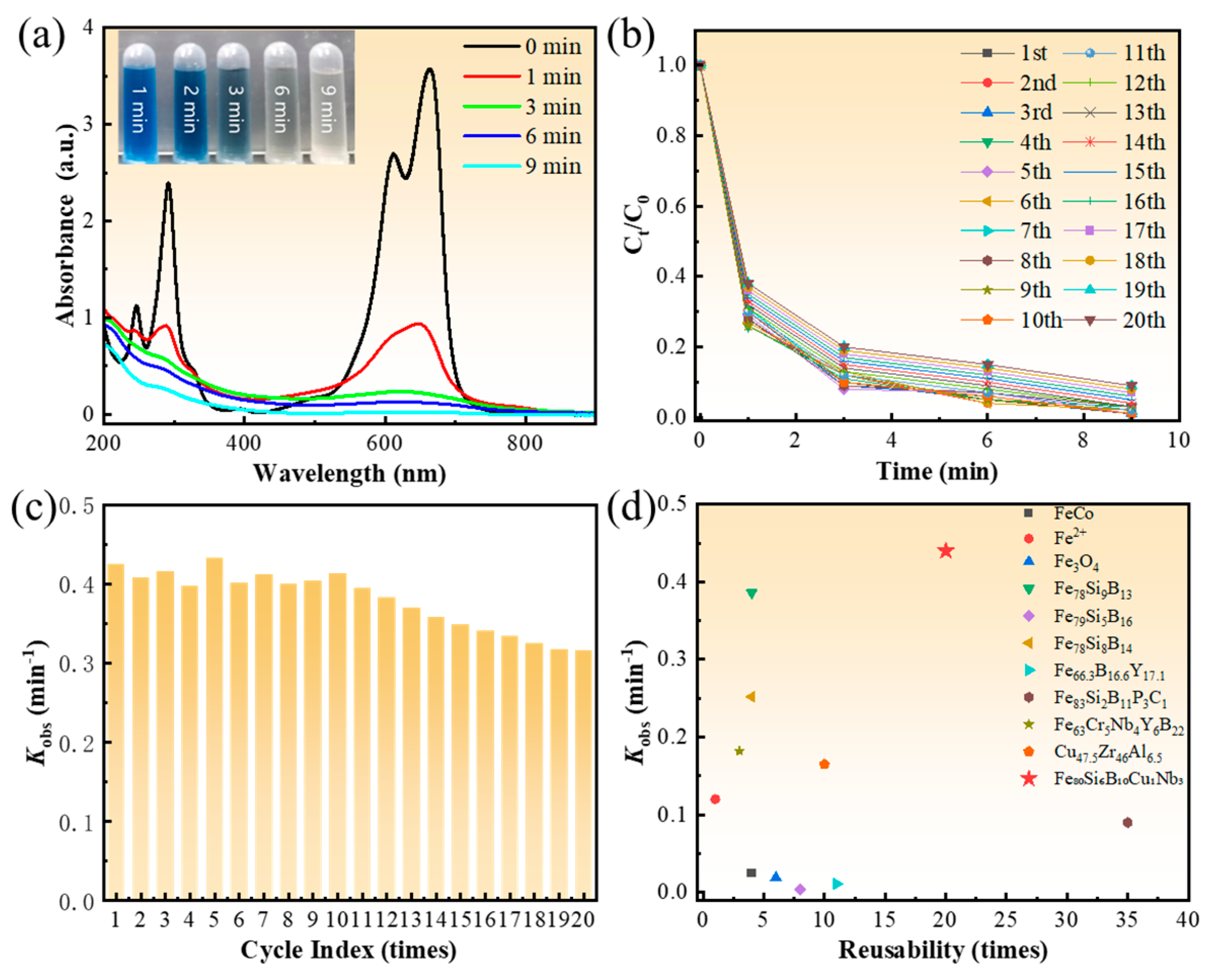
The catalytic performance of the Fe80Si6B10Cu1Nb3 amorphous alloy for MB degradation was comprehensively evaluated, as presented in Figure 1.
As shown in Figure 1a, the UV–Vis absorption spectra of the MB solution exhibit two characteristic peaks at 290 nm and 664 nm, corresponding to the aromatic ring and conjugated chromophore of MB molecules, respectively. The absorbance at 664 nm decreases rapidly with reaction time, dropping to nearly zero within 9 min, indicating complete destruction of the conjugated structure and full degradation of MB. The inset photographs visually confirm the decolorization process, where the deep-blue solution gradually fades to colorless, consistent with the spectral changes and reflecting the fast reaction kinetics. The methylene blue (MB) solutions before and after degradation were characterized via a total organic carbon (TOC) analyzer. The TOC removal efficiency of MB over the Fe80Si6B10Cu1Nb3 alloy reached 88.62%, demonstrating the excellent degradation performance toward MB. Figure 1b displays the time-dependent variation in relative MB concentration (Ct/C0) during 20 consecutive cycles. All curves follow a pseudo-first-order kinetic trend, with Ct/C0 decreasing sharply within the first 3 min and approaching zero at 9 min. Notably, the degradation profiles of the 11th to 20th cycles nearly overlap with the first run, demonstrating negligible loss of catalytic activity after repeated use and highlighting the excellent cyclic stability of the catalyst.
Figure 1c summarizes the kobs across 20 cycles. The kobs values remain stable at 0.40–0.45 min−1 for the first 10 cycles, reflecting a high and consistent initial catalytic activity. After 20 cycles, the kobs only slightly decreases to 0.32–0.35 min−1, with a retention rate of over 70%, indicating a gentle and controllable deactivation process rather than catastrophic failure. This mild activity loss is attributed to the selective surface corrosion and elemental segregation observed in SEM/EDS analysis, rather than bulk crystallization or structural collapse. Figure 1d and Table 1 present a performance comparison with other reported catalysts, where the x-axis represents reusability times and the y-axis represents kobs. The Fe80Si6B10Cu1Nb3 catalyst achieves the highest kobs (0.44 min−1) among all reference samples, while maintaining a reusability of 20 cycles, far exceeding most Fe-based amorphous alloys, metal oxides, and homogeneous Fenton catalysts [19,20,21,22,23,24,25,26]. Compared with other reported Fe-based amorphous catalysts [27,28,29,30,31,32,33,34,35], the FeSiBCuNb amorphous alloy prepared in this work exhibits superior catalytic performance for methylene blue degradation. It can achieve rapid and efficient removal of methylene blue under mild conditions, showing higher degradation efficiency and faster reaction rate within a shorter time. In addition, the catalyst maintains good structural stability and reusability during multiple cycles, which demonstrates its great potential in practical wastewater treatment.
This outstanding combination of high degradation rate and long cycle life underscores the significant advantages of the Cu-Nb synergistic modification and the great potential of the Fe80Si6B10Cu1Nb3 amorphous alloy for practical wastewater treatment applications.
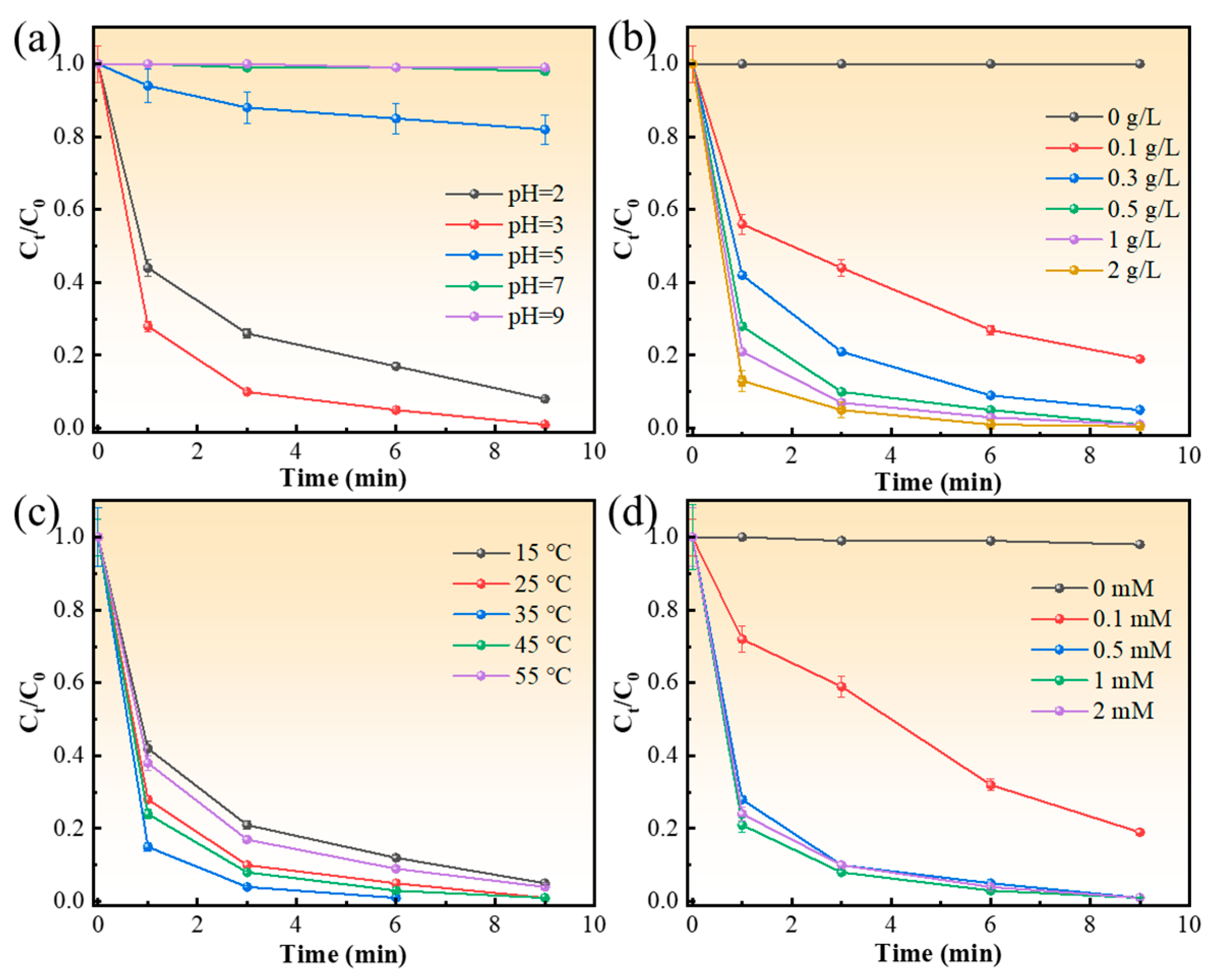
The effects of solution pH, catalyst dosage, reaction temperature, and H2O2 concentration on the catalytic degradation of MB over the Fe80Si6B10Cu1Nb3 amorphous alloy were systematically investigated, as presented in Figure 2.
As shown in Figure 2a, the degradation performance is strongly pH-dependent. The fastest degradation rate is achieved at pH 3, where the relative MB concentration (Ct/C0) drops to nearly zero within 9 min. A slightly slower degradation rate is observed at pH 2, which is caused by the excessive protonation of surface Fe and Cu bimetallic active sites. Under strongly acidic conditions, abundant hydrogen ions occupy and cover the catalyst’s active centers, hindering H2O2 activation and hydroxyl radical generation, thereby reducing catalytic activity. In contrast, weakly acidic (pH 5–6) and neutral-to-weakly alkaline conditions (pH 7–9) significantly inhibit the Fenton reaction. Nearly no methylene blue degradation is achieved at pH 9, because alkaline environments promote the formation of inactive iron and copper hydroxide precipitates on the catalyst surface, which passivate the catalytically active surface and ultimately terminate the pollutant degradation reaction. Figure 2b displays the influence of catalyst dosage. Negligible MB degradation is observed in the absence of catalyst (0 g/L), confirming that the reaction is catalyzed by the Fe80Si6B10Cu1Nb3 alloy. Dosages of 0.1 g/L and 0.3 g/L result in incomplete degradation, while 0.5 g/L, 1 g/L, and 2 g/L all achieve nearly complete removal within 9 min, with no significant differences among them. This indicates that 0.5 g/L is the economically optimal dosage, providing sufficient active sites without unnecessary material consumption. The effect of reaction temperature is illustrated in Figure 2c. The degradation rate accelerates with increasing temperature from 15 °C to 55 °C, as higher temperatures promote the activation of H2O2 and the diffusion of reactants. Complete degradation is achieved within 9 min at 25 °C and above, and 25 °C is selected as the optimal temperature to balance reaction efficiency and energy consumption. Figure 2d shows the impact of H2O2 concentration. No obvious degradation occurs without H2O2 (0 mM), verifying the essential role of the Fenton-like reaction. A concentration of 0.1 mM leads to incomplete degradation, while 0.5 mM, 1 mM, and 2 mM all achieve nearly complete removal within 9 min. This suggests that 0.5 mM is sufficient to generate enough ·OH for MB oxidation, and excess H2O2 does not further enhance the performance due to radical scavenging effects.

2.2. Characterization Analysis of Fe80Si6B10Cu1Nb3 Before and After Degradation

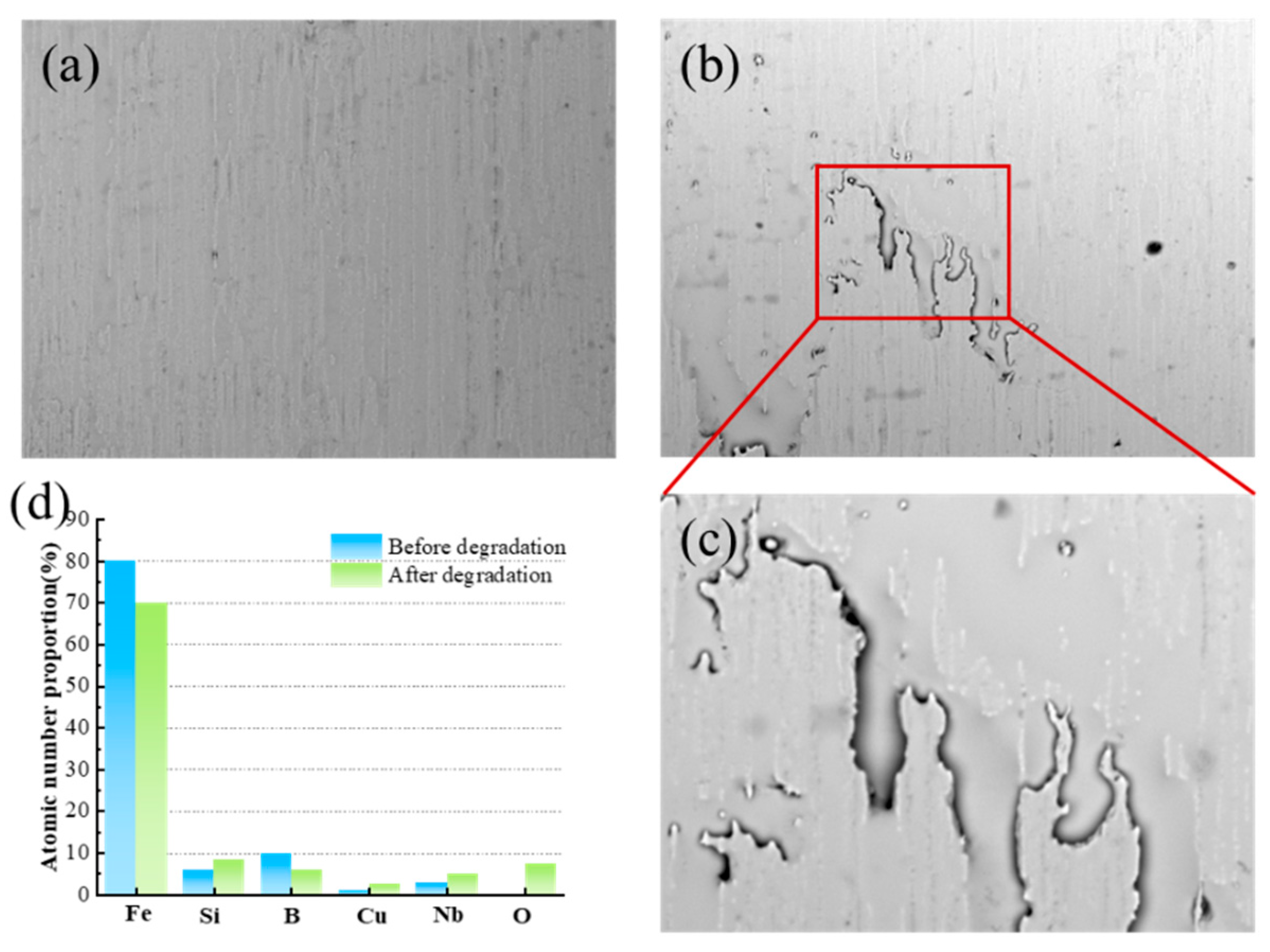
The morphology and surface elemental evolution of the Fe80Si6B10Cu1Nb3 amorphous alloy before and after 20 consecutive degradation cycles were systematically characterized by scanning SEM and EDS, as presented in Figure 3.
As shown in Figure 3a, the fresh catalyst exhibits a smooth, dense, and homogeneous surface with only faint rolling streaks, reflecting the inherent structural uniformity and excellent corrosion resistance of the as-prepared amorphous alloy. In sharp contrast, after prolonged cyclic degradation, the surface undergoes pronounced selective corrosion, as visualized in Figure 3b and the magnified view in Figure 3c. Irregular, worm-like corrosion grooves and shallow pits are formed along the original rolling direction, indicating preferential dissolution of certain elemental regions. Notably, despite the localized corrosion, the overall structural integrity of the catalyst remains intact, with no signs of large-scale peeling, cracking, or crystallization, which is critical for maintaining stable catalytic performance over repeated cycles. The Brunauer–Emmett–Teller (BET) surface area of the FeSiBCuNb amorphous alloy catalyst was determined to be 12.76 m2/g, with a total pore volume of 0.048 cm3/g and an average pore diameter of 14.12 nm, indicating the mesoporous structure of the material according to the IUPAC classification standard.
EDS analysis (Figure 3d) further reveals the selective surface elemental segregation and leaching behavior during the degradation process. Compared to the fresh sample, the atomic proportion of Fe decreases slightly from 80% to 70%, confirming the controlled leaching of Fe ions into the solution to participate in the Fenton-like reaction. Similarly, B shows a minor loss from 10% to 5%, likely due to acidic dissolution. In contrast, significant enrichment is observed for Cu, Nb, Si, and O: the atomic fraction of Cu rises from 1% to 3%, suggesting surface segregation of Cu species that act as additional active sites to accelerate electron transfer and ·OH generation. Nb increases from 2% to 5%, forming dense NbOₓ passivation layers that effectively suppress excessive corrosion and preserve the amorphous matrix. Si is enriched from 5% to 8%, contributing to the formation of a SiO2-rich protective film. Meanwhile, the O content increases from nearly 0% to 8%, indicating the formation of metal oxides on the surface. This selective elemental evolution constructs a robust, self-passivating active interface, where Cu enhances catalytic activity while Nb and Si stabilize the structure, perfectly explaining the outstanding cyclic stability observed in the degradation experiments [18,19].
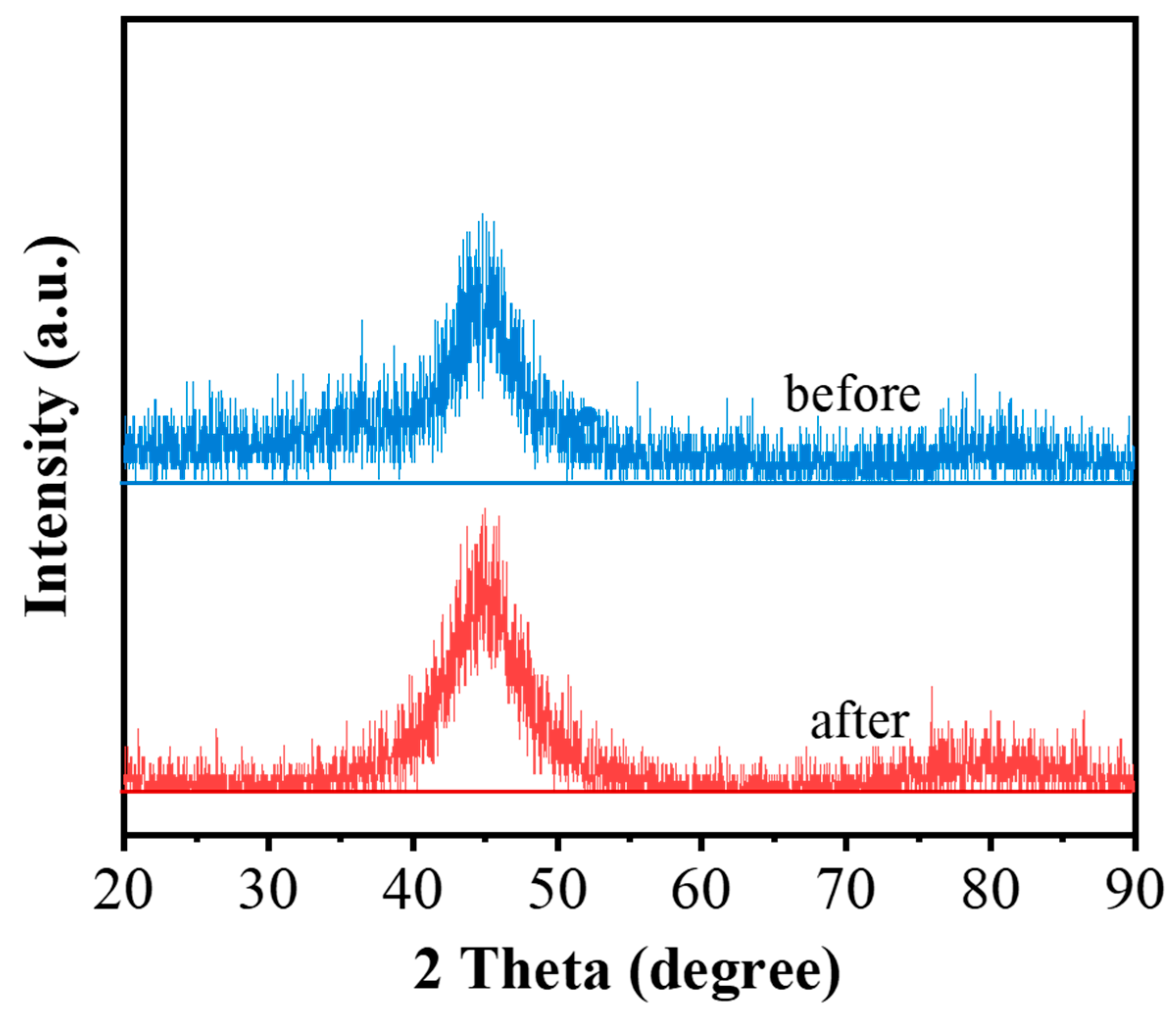
The XRD patterns of the Fe80Si6B10Cu1Nb3 amorphous alloy before and after 20 consecutive degradation cycles are presented in Figure 4. The XRD pattern of FeSiBCuNb amorphous alloy displays a broad and diffuse diffraction peak at 2θ = 40–50°, without any sharp crystalline peaks, which is the typical characteristic of Fe-based amorphous alloys reported in the previous literature [19,20]. This result confirms the successful preparation of a single amorphous structure without crystallization. After prolonged cyclic degradation, the position, width, and intensity of the diffuse peak remain nearly identical to the fresh sample, with no emergence of new diffraction peaks indicative of crystallization. This result confirms that the amorphous structure of the Fe80Si6B10Cu1Nb3 alloy is well preserved during the Fenton-like reaction, demonstrating exceptional structural stability. The retention of the amorphous state, combined with the surface self-passivation effect induced by Nb and Si enrichment, is responsible for the outstanding cyclic durability observed in the catalytic degradation experiments.
Combined with previously reported studies on Fe-based amorphous alloys, the loose and corroded surface microstructure can continuously expose fresh bimetallic (Fe-Cu) active sites during the Fenton-like reaction. Although further microscopic and valence characterization (TEM, XPS and elemental mapping) is not available in this work, the consistent SEM and XRD results sufficiently confirm the successful fabrication of amorphous FeSiBCuNb alloy and its structural stability during cyclic reactions. The surface corrosion behavior observed from SEM images reasonably explains the continuous activation of H2O2 and stable generation of hydroxyl radicals, verifying the reliable catalytic performance of the prepared amorphous alloy catalyst.

2.3. Mechanism Analysis of Fe80Si6B10Cu1Nb3 Catalytic Degradation of MB

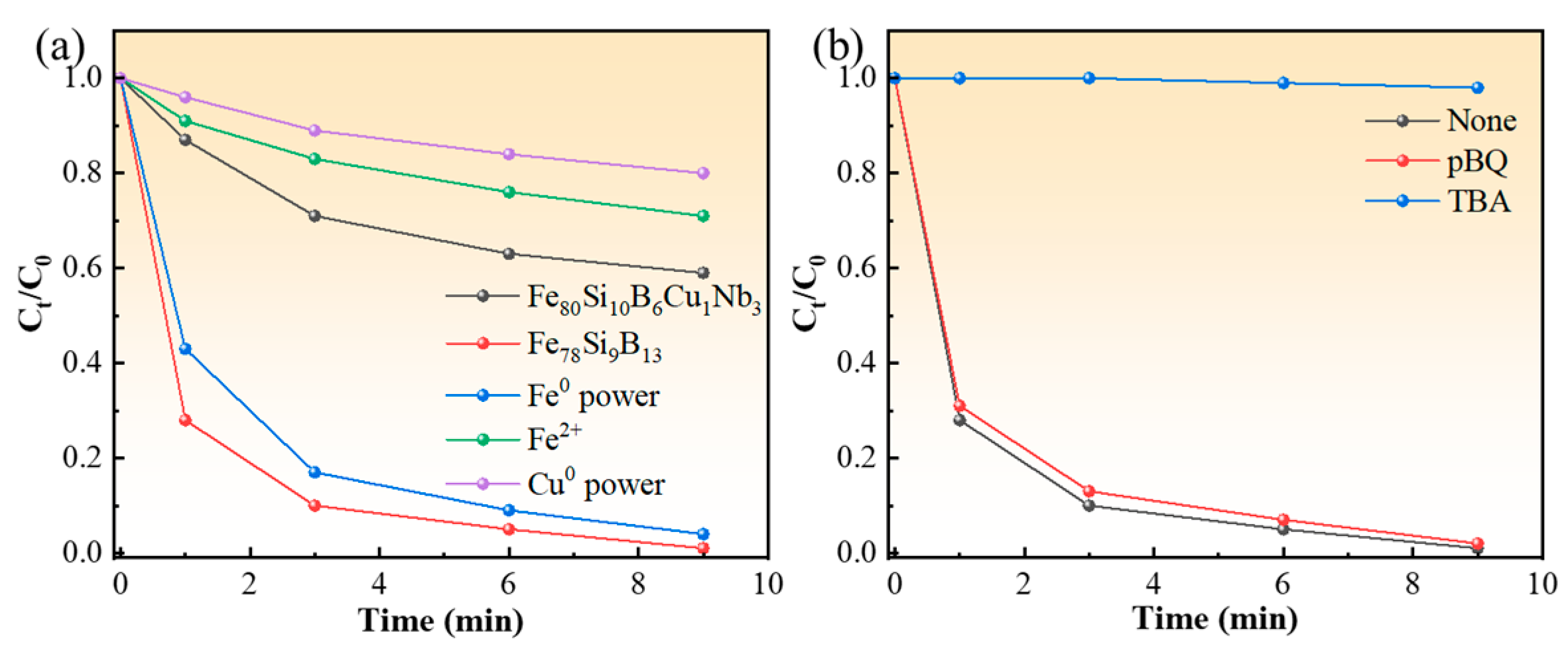
The catalytic performance of the Fe80Si10B6Cu1Nb3 amorphous alloy was systematically evaluated by comparative analysis with other Fe-based catalytic systems and radical quenching experiments, as depicted in Figure 5a. The degradation kinetics of MB over four different Fe-based catalysts were compared. The Fe80Si10B6Cu1Nb3 amorphous alloy exhibits the highest catalytic activity, with the relative MB concentration (Ct/C0) dropping rapidly to nearly zero within 9 min, clearly outperforming all other reference samples. The binary Fe78Si9B13 amorphous alloy shows slightly slower degradation kinetics, achieving complete MB removal only at the end of the 9 min test, which confirms that the incorporation of Cu and Nb plays a critical role in enhancing the catalytic efficiency. In sharp contrast, Fe0 powder and homogeneous Fe2+ ions display much lower activity: after 9 min, approximately 70% and 60% of MB still remain in the solution, respectively. The poor performance of Fe0 powder is attributed to its low specific surface area and sluggish electron transfer, while homogeneous Fe2+ suffers from rapid iron precipitation and limited reusability, highlighting the advantages of the heterogeneous Fe80Si10B6Cu1Nb3 amorphous alloy in terms of both activity and practical applicability. Single iron and copper components exhibit certain Fenton-like catalytic ability, but their degradation efficiency is relatively low. Zero-valent iron shows slightly higher activity than zero-valent copper. However, both of them are much less effective than FeSiBCuNb metallic glass. This demonstrates that the excellent catalytic performance originates from the Fe–Cu bimetallic synergistic effect, rather than the individual contribution of Fe or Cu alone.
Figure 5b presents the results of radical quenching experiments to identify the dominant reactive oxygen species (ROS) in the Fenton-like system. Three conditions were tested: a blank control, p-benzoquinone (pBQ, a specific scavenger for superoxide radicals ·O2), and tert-butanol (TBA, a selective scavenger for hydroxyl radicals ·OH). The degradation profile with pBQ is nearly identical to the blank control, with only a negligible slowdown in reaction rate, indicating that ·O2 contributes minimally to MB oxidation. Conversely, the addition of TBA almost completely suppresses the degradation reaction, with Ct/C0 remaining at 1.0 throughout the entire 9 min period. This stark difference confirms that ·OH is the primary reactive species responsible for the oxidative degradation of MB. Combined with the EDS results showing Cu enrichment on the catalyst surface, it can be inferred that the surface-segregated Cu species accelerate the Fe2+/Fe3+ redox cycle, promoting the efficient generation of ·OH from H2O2 and thus leading to the superior catalytic activity observed.
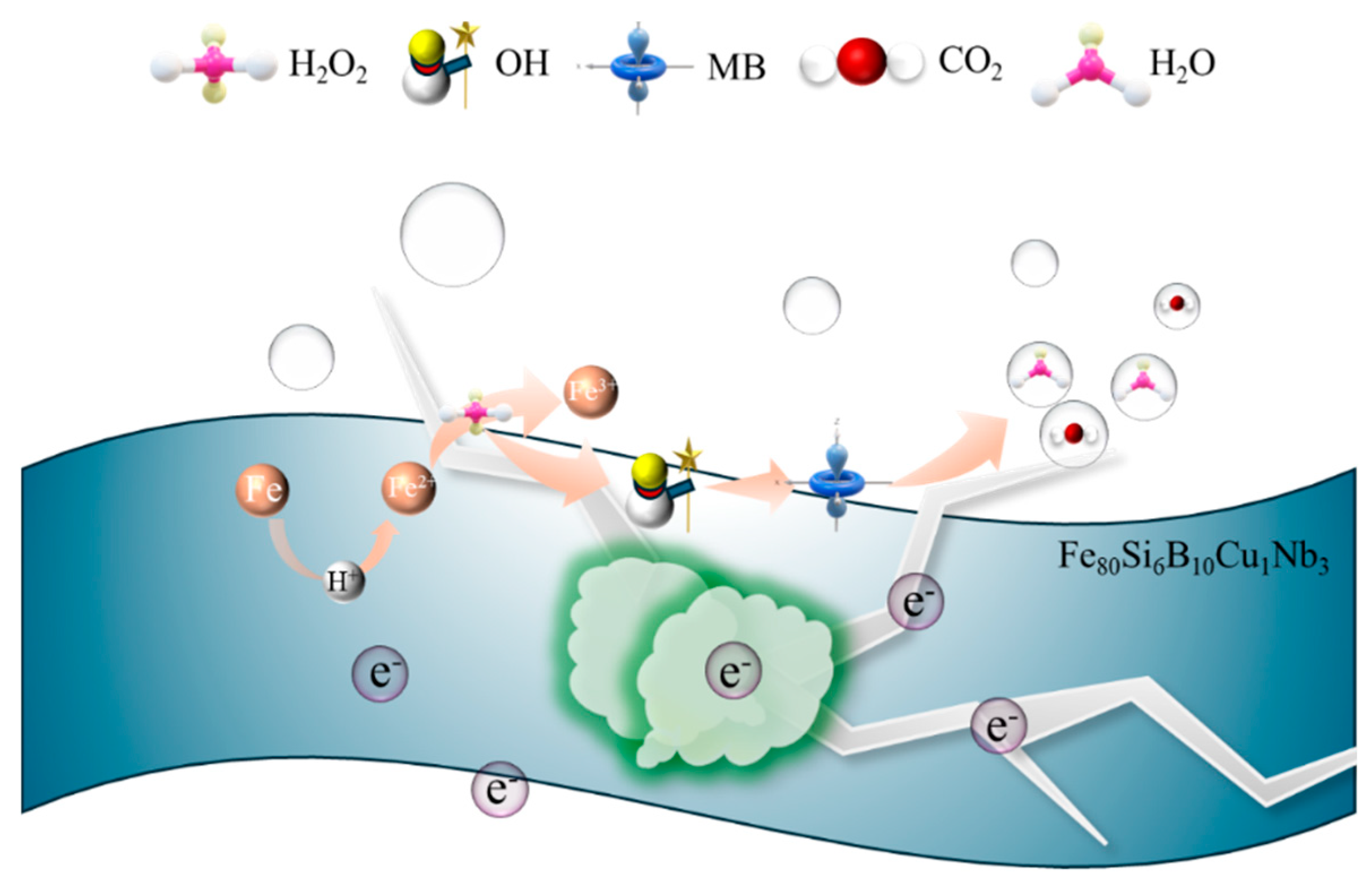
The detailed Fenton-like reaction mechanism for MB degradation over the Fe80Si6B10Cu1Nb3 amorphous alloy is illustrated in Figure 6, which integrates all experimental findings from catalytic performance, structural characterization, and radical identification.
The amorphous alloy matrix acts as a robust electron source, where Fe0 atoms donate electrons to generate Fe2+ ions in acidic solution, providing the initial active species for the Fenton reaction. The long-range disordered structure of the amorphous alloy ensures abundant undercoordinated Fe sites and efficient electron transfer, which is superior to crystalline Fe-based materials. The generated Fe2+ reacts with H2O2 to produce highly reactive ·OH radicals, which are responsible for the oxidative degradation of MB into CO2 and H2O. Notably, the surface-enriched Cu species serve as an efficient electron mediator, significantly accelerating the reduction of Fe3+ back to Fe2+, thereby sustaining the Fenton cycle and enhancing the generation of ·OH radicals. This Cu-mediated electron transfer explains the superior degradation kinetics observed in the experiments, outperforming binary Fe-based amorphous alloys and homogeneous Fe2+ systems [20]. The leaching concentration of Cu2+ from the FeSiBCuNb alloy is very low and meets the environmental discharge requirements, so the risk of secondary pollution is negligible.
Meanwhile, Nb and Si atoms segregate on the catalyst surface and form dense NbOₓ/SiO2 passivation layers during the reaction. These protective layers suppress excessive corrosion of the alloy matrix and control Fe leaching, preventing the formation of iron sludge and preserving the amorphous structure (as confirmed by XRD and SEM results). This self-passivation effect ensures the long-term cyclic stability of the catalyst, with negligible activity loss after 20 consecutive runs. The synergistic combination of Cu-enhanced catalytic activity and Nb/Si-mediated structural stability endows the Fe80Si6B10Cu1Nb3 amorphous alloy with both high degradation efficiency and excellent reusability, making it a promising candidate for practical wastewater treatment applications.
In summary, the reaction principle by which Fe80Si10B6Cu1Nb3 amorphous alloy catalyzes H2O2 to generate •OH and degrade phenol can be described as follows [18,19,20]:
Fe + 2H+ → Fe2+ + H2
Fe2+ + H2O2 → Fe3+ + •OH + OH
Fe3+ + Cu0 → Fe2+ + Cu2+
MB + •OH → CO2 + H2O

2.4. Future Perspectives

Although this study verifies the excellent performance of the Fe80Si6B10Cu1Nb3 amorphous alloy in simulated MB wastewater treatment, there are still some limitations: first, the experiment only focuses on a single dye pollutant, and the degradation effect in actual complex wastewater has not been investigated, so the substrate applicability needs to be expanded; second, the preparation cost of the catalyst is relatively high, and large-scale preparation has not been realized, which is difficult to meet the needs of industrial large-scale application; third, the dynamic characterization of interfacial electron transfer and active species generation during the reaction is not in-depth enough, and the mechanism research still needs to be improved; fourth, the catalyst activity decreases significantly under neutral and alkaline conditions, and its applicable pH range is narrow, which limits its practical application scenarios. Based on the above limitations, future work can be carried out in four directions: (1) expand substrate applicability, evaluate the degradation performance of the catalyst toward refractory organic pollutants such as phenols, antibiotics, and mixed dye systems, and explore the influence of coexisting ions on the catalytic effect; (2) optimize the preparation process, develop low-cost and large-scale preparation methods, and further improve the specific surface area, catalytic efficiency, and applicable pH range through nanocrystallization, porous structuring, or supporting modification; (3) conduct verification with real wastewater treatment and continuous-flow devices to evaluate the long-term operational stability, regeneration performance, and economic feasibility of the catalyst, promoting its engineering application; (4) employ in situ characterization techniques such as in situ Raman spectroscopy and in situ XPS to deeply reveal the dynamic mechanisms of interfacial structure evolution, electron transfer, and active species generation during the reaction, providing more solid theoretical support for the precise design and performance optimization of multi-component amorphous catalysts.

3. Experimental Materials and Methods

3.1. Experimental Apparatus

A UV-2600 UV–Vis spectrophotometer (Shimadzu, Kyoto, Japan) was used to measure the absorbance of methylene blue (MB) solution at 664 nm and calculate the corresponding dye degradation efficiency. An SU8010 scanning electron microscope (Hitachi, Tokyo, Japan) was utilized to characterize the surface morphology, corrosion characteristics, and microstructural evolution of the catalyst before and after the Fenton reaction. A D8 Advance X-ray diffractometer (Bruker, Karlsruhe, Germany) was employed to analyze the phase composition and structural stability of the amorphous alloy, as well as to monitor possible crystallization behavior during catalytic degradation. Auxiliary experimental instruments included a high-precision electronic balance (Sartorius, Göttingen, Germany), a pH meter (Mettler Toledo, Zurich, Switzerland), a constant-temperature water bath, a magnetic stirrer, an ultrasonic cleaner, a vacuum drying oven, a high-speed centrifuge, and 0.22 μm filter membranes. These devices were applied for sample weighing, pH adjustment, temperature control, sample pretreatment, drying, solid–liquid separation, and solution filtration, ensuring the accuracy, reproducibility and stability of all experimental data.

3.2. Degradation Experiment

The FeSiBCuNb amorphous alloy catalyst was prepared by a single-roller melt-spinning method. The pure metal elements (Fe, Si, B, Cu, Nb) were weighed according to the nominal atomic ratio and melted into an alloy ingot under an argon atmosphere. Then, the ingot was melted again and ejected onto a high-speed rotating copper roller to obtain continuous amorphous alloy ribbons. The as-spun ribbons were collected, crushed into small pieces, and used directly for catalytic experiments without further treatment. All chemicals were of analytical grade, and deionized water was used throughout the experiments. The alloy surface was polished to remove oxide layers, ultrasonically cleaned with deionized water and ethanol successively, and dried under vacuum at 60 °C before use. The MB solution was prepared as simulated wastewater, and H2SO4 and NaOH were used to adjust the initial pH to avoid interference of chloride ions with the iron-based catalytic system. The reaction temperature was controlled by a constant-temperature water bath. A certain amount of catalyst was added and stirred for 30 min to reach adsorption–desorption equilibrium, followed by the addition of H2O2 to initiate the Fenton reaction. Samples were collected at regular intervals, filtered through 0.22 μm membranes and measured by UV–Vis spectroscopy. The degradation rate was calculated according to the Lambert–Beer law, and pseudo-first-order kinetics were adopted to fit the reaction constants. The effects of temperature, pH, H2O2 concentration and catalyst dosage were systematically investigated to obtain optimal conditions. Twenty consecutive cyclic tests were performed, in which the catalyst was recovered by centrifugation, washed and dried after each run to evaluate reusability. Combined with SEM and XRD results, morphological evolution, elemental distribution and phase transformation were compared to reveal the Cu/Nb synergistic effect and amorphous stabilization mechanism.
To quantitatively evaluate the catalytic degradation performance of the Fe80Si6B10Cu1Nb3 amorphous alloy, the degradation curves were fitted with a pseudo-first-order kinetic model. The corresponding reaction rate constant was further calculated to assess the degradation rate toward MB. In the equation presented above, C0 and Cₜ denote the initial and instantaneous concentrations of the MB solution at time t, respectively; kobs represents the observed kinetic reaction constant [36,37].
C t / C 0 = exp k obs t
k o b s = I n C t C 0 / t

4. Conclusions

In this study, an Fe80Si6B10Cu1Nb3 quinary amorphous alloy was employed as a Fenton-like catalyst for the degradation of MB, and its catalytic performance, structural evolution, and reaction mechanism were systematically investigated. Under optimized conditions (pH = 3, catalyst dosage = 0.5 g/L, temperature = 25 °C, H2O2 concentration = 0.5 mM), the Fe80Si6B10Cu1Nb3 amorphous alloy achieves complete MB degradation within 9 min, with an apparent rate constant kobs of 0.40–0.45 min−1, significantly outperforming Fe78Si9B13 amorphous alloy, pure Fe0 powder, and homogeneous Fe2+ systems. After 20 consecutive degradation cycles, kobs only slightly decreases from 0.45 min−1 to 0.32 min−1 with negligible loss of degradation efficiency, demonstrating outstanding anti-deactivation ability and reusability. Structural characterization reveals that the bulk alloy remains amorphous after degradation, while selective elemental segregation occurs on the surface: slight leaching of Fe and B, accompanied by significant enrichment of Cu, Nb, Si, and O, forming a stable interface with Cu active sites and NbOₓ/SiO2 passivation layers. Mechanistic studies further confirm that surface-segregated Cu accelerates the Fe2+/Fe3+ redox cycle, promoting H2O2 activation to generate ·OH radicals (verified as the dominant reactive species by radical quenching experiments) and thus enhancing catalytic activity. Meanwhile, Nb and Si form dense passivation layers that suppress excessive corrosion and iron sludge formation while preserving the amorphous structure, achieving a synergistic balance between high activity and superior stability.

Author Contributions

K.Z.: Conceptualization, Methodology, Writing—original draft; F.G.: Supervision, Project administration, Funding acquisition, Writing—review and editing; L.M.: Software, Formal analysis, Visualization; B.Y.: Validation, Investigation, Writing—review and editing; T.K.: Validation, Writing—review and editing. All authors have read and agreed to the published version of the manuscript.

Funding

This work was supported by the National Natural Science Foundation of China under Grant No. 52174138.

Institutional Review Board Statement

Not applicable.

Informed Consent Statement

Not applicable.

Data Availability Statement

All data supporting the findings of this study are included in the published article.

Conflicts of Interest

Kun Zhang, Feilong Guo, Tiejun Kuang are employees of Jinneng Holding Coal Industry Group. The other authors declare no conflicts of interest. Jinneng Holding Coal Industry Group had no role in the design of the study; in the collection, analyses, or interpretation of data; in the writing of the manuscript; or in the decision to publish the results.

References

  1. Parida, S.; Mandal, A.K.; Behera, A.K.; Patra, S.; Nayak, R.; Behera, C.; Jena, M. A comprehensive review on phycoremediation of azo dye to combat industrial wastewater pollution. J. Water Process Eng. 2025, 70, 107088. [Google Scholar] [CrossRef]
  2. Goswami, D.; Mukherjee, J.; Mondal, C.; Bhunia, B. Bioremediation of azo dye: A review on strategies, toxicity assessment, mechanisms, bottlenecks and prospects. Sci. Total Environ. 2024, 954, 176426. [Google Scholar] [CrossRef]
  3. He, J.F.; Gong, W.Q.; Zhang, W.B.; Zhu, L.T.; Fu, L.X.; Yang, B. Synthesis of CuFe2O4/attapulgite composite for removal of methylene blue from aqueous solutions. Colloids Surf. A 2025, 715, 136606. [Google Scholar] [CrossRef]
  4. Oladoye, P.O.; Ajiboye, T.O.; Omotola, E.O.; Oyewola, O.J. Methylene blue dye: Toxicity and potential elimination technology from wastewater. Results Eng. 2022, 16, 100678. [Google Scholar] [CrossRef]
  5. Zhang, S.J.; Zheng, H.C.; Tratnyek, P.G. Advanced redox processes for sustainable water treatment. Nat. Water 2023, 1, 666–681. [Google Scholar] [CrossRef]
  6. Nidheesh, P.V.; Boczkaj, G.; Ganiyu, S.O.; Oladipo, A.A.; Fedorov, K.; Xiao, R.Y.; Dionysiou, D.D. Generation, properties, and applications of singlet oxygen for wastewater treatment: A review. Environ. Chem. Lett. 2025, 23, 195–240. [Google Scholar]
  7. Zhao, Z.Y.; Tan, H.B.; Zhang, P.; Liang, X.Y.; Li, T.; Gao, Y.W.; Hu, C. Turning the inert element zinc into an active single-atom catalyst for efficient Fenton-like chemistry. Angew. Chem. 2023, 135, e202219178. [Google Scholar] [CrossRef]
  8. Lei, X.Y.; Zhao, H.H.; Bai, C.; Geng, L.L.; Xu, X. Wood-derived catalysts for green and stable Fenton-like chemistry: From basic mechanisms to catalytic modules and future inspiration. Chin. Chem. Lett. 2025, 36, 111550. [Google Scholar] [CrossRef]
  9. Klinsukon, S.; Chantarak, S.; Limsuwanchote, S.; Chanadee, T. Nickel ferrite-ferrous oxide magnetic ceramic powder synthesized for Fenton-like treatment of industrial organic pollutants: A characterization study. J. Aust. Ceram. Soc. 2025, 62, 421–439. [Google Scholar] [CrossRef]
  10. Deng, L.M.; Ren, H.; Fu, L.; Liao, M.; Zhou, X.; Chen, S.H.; Wang, H.; Wang, L.X. Ferrous and manganese oxalate for efficient heterogenous-Fenton degradation of organic pollutants: Composite active site and mechanism perception. Int. J. Chem. React. Eng. 2023, 21, 1165–1176. [Google Scholar] [CrossRef]
  11. Gu, A.M.; Nan, Z.D. Selective adsorption and degradation of tetracycline-based pollutants via Fenton-like reaction catalyzed by outstanding stable nanoreactor Fe (OH)3@HNT. Appl. Catal. A 2025, 709, 120652. [Google Scholar] [CrossRef]
  12. Zhao, T.C.; Liu, H.S.; Zhang, X.; Yuan, W. Frequency-domain analysis of response surface methodology for chemical process optimization: A heterogeneous photo-Fenton case study with amorphous iron-based catalyst. Chem. Eng. Sci. 2025, 319, 122263. [Google Scholar] [CrossRef]
  13. Wang, X.F.; Pan, Y.; Zhu, Z.R.; Wu, J.L. Efficient degradation of rhodamine B using Fe-based metallic glass catalyst by Fenton-like process. Chemosphere 2014, 117, 638–643. [Google Scholar] [CrossRef]
  14. Jia, Z.; Duan, X.G.; Qin, P.; Zhang, W.C.; Wang, W.M.; Yang, C.; Sun, H.Q.; Wang, S.B.; Zhang, L.C. Disordered atomic packing structure of metallic glass: Toward ultrafast hydroxyl radicals production rate and strong electron transfer ability in catalytic performance. Adv. Funct. Mater. 2017, 27, 1702258. [Google Scholar] [CrossRef]
  15. Jia, Z.; Zhang, W.; Wang, W.; Habibi, D.; Zhang, L. Amorphous Fe78Si9B13 alloy: An efficient and reusable photo-enhanced Fenton-like catalyst in degradation of cibacron brilliant red 3B-a dye under UV–vis light. Appl. Catal. B 2016, 192, 46–56. [Google Scholar] [CrossRef]
  16. Qin, X.D.; Li, Z.K.; Zhu, Z.W.; Fu, H.M.; Li, H.; Wang, A.M.; Zhang, H.W.; Zhang, H.F. Mechanism and kinetics of treatment of acid orange II by aged Fe-Si-B metallic glass powders. J. Mater. Sci. Technol. 2017, 33, 1147–1152. [Google Scholar] [CrossRef]
  17. Wang, Q.Q.; Yun, L.; Chen, M.X.; Xu, D.D.; Cui, Z.Q.; Zeng, Q.S.; Lin, P.H.; Chu, C.L.; Shen, B.L. Competitive effects of structural heterogeneity and surface chemical states on catalytic efficiency of FeSiBPCu amorphous and nanocrystalline alloys. ACS Appl. Nano Mater. 2018, 2, 214–227. [Google Scholar]
  18. Jia, Z.; Kang, J.; Zhang, W.; Wang, W.; Yang, C.; Sun, H.; Habibi, D.; Zhang, L. Surface aging behaviour of Fe-based amorphous alloys as catalysts during heterogeneous photo Fenton-like process for water treatment. Appl. Catal. B 2017, 204, 537–547. [Google Scholar] [CrossRef]
  19. Liang, S.; Jia, Z.; Zhang, W.; Wang, W.; Zhang, L. Rapid malachite green degradation using Fe73.5Si13.5B9Cu1Nb3 metallic glass for activation of persulfate under UV–vis light. Mater. Des. 2017, 119, 244–253. [Google Scholar] [CrossRef]
  20. Yang, W.M.; Wang, Q.Q.; Li, W.Y.; Xue, L.; Liu, H.S.; Zhou, J.; Mo, J.Y.; Shen, B.L. A novel thermal-tuning Fe-based amorphous alloy for automatically recycled methylene blue degradation. Mater. Des. 2019, 161, 136–146. [Google Scholar] [CrossRef]
  21. Ganiyu, S.O.; Le, T.X.H.; Bechelany, M.; Esposito, G.; Van Hullebusch, E.D.; Oturan, M.A.; Cretin, M. A hierarchical CoFe-layered double hydroxide modified carbon-felt cathode for heterogeneous electro-Fenton process. J. Mater. Chem. A 2017, 5, 3655–3666. [Google Scholar] [CrossRef]
  22. Xing, M.Y.; Xu, W.J.; Dong, C.C.; Bai, Y.C.; Zeng, J.B.; Zhou, Y.; Zhang, J.L.; Yin, Y.D. Metal sulfides as excellent co-catalysts for H2O2 decomposition in advanced oxidation processes. Chem 2018, 4, 1359–1372. [Google Scholar] [CrossRef]
  23. Nidheesh, P.; Gandhimathi, R.; Velmathi, S.; Sanjini, N. Magnetite as a heterogeneous electro Fenton catalyst for the removal of rhodamine B from aqueous solution. RSC Adv. 2014, 4, 5698–5708. [Google Scholar] [CrossRef]
  24. Liu, P.; Zhang, J.L.; Zha, M.Q.; Shek, C.H. Synthesis of an Fe rich amorphous structure with a catalytic effect to rapidly decolorize azo dye at room temperature. ACS Appl. Mater. Interfaces 2014, 6, 5501–5505. [Google Scholar] [CrossRef]
  25. Jia, Z.; Wang, Q.; Sun, L.G.; Wang, Q.; Zhang, L.C.; Wu, G.; Luan, J.H.; Jiao, Z.B.; Wang, A.D.; Liang, S.X. Attractive in situ self-reconstructed hierarchical gradient structure of metallic glass for high efficiency and remarkable stability in catalytic performance. Adv. Funct. Mater. 2019, 29, 1807857. [Google Scholar] [CrossRef]
  26. Zhao, B.W.; Zhu, Z.W.; Qin, X.D.; Li, Z.K.; Zhang, H.F. Highly efficient and stable CuZr-based metallic glassy catalysts for azo dye degradation. J. Mater. Sci. Technol. 2020, 46, 88–97. [Google Scholar] [CrossRef]
  27. Wang, B.C.; Liu, J.; Shi, Y.; Sun, Z.Z. Effect of Cu content on the catalytic performance of Cu–Fe-based amorphous alloys fabricated via LPBF. J. Phys. Chem. Solids 2025, 207, 112975. [Google Scholar] [CrossRef]
  28. Sun, Z.Z.; Liu, J.; Shi, Y.; Chang, Z.W. Catalytic properties of Fe-based amorphous alloys based on LPBF. J. Phys. Chem. Solids 2024, 195, 112252. [Google Scholar] [CrossRef]
  29. Li, J.Z.; Yang, Z.L.; Wu, W.Z.; Li, G.W. Progress and prospects of Fe-based amorphous/nanocrystalline alloy in azo dye wastewater treatment. Langmuir 2025, 42, 2351–2380. [Google Scholar] [CrossRef]
  30. Zhang, J.; Liu, H.S.; Zhang, X.; Ma, L.; Yang, W.M. Simultaneously improved kinetic rate and reusability in phenol degradation by laser processing on Fe-based amorphous ribbon. J. Non-Cryst. Solids 2025, 669, 123812. [Google Scholar] [CrossRef]
  31. Lassoued, A.; Li, J. Influence of iron content in Fe-based amorphous alloy catalysts on degradation of azo dyes by Fenton-like process. J. Phys. Chem. Solids 2023, 180, 111475. [Google Scholar] [CrossRef]
  32. Ji, L.; Yu, R.; Qiu, W.P.; Liu, J. Excellent catalytic performance of FeSiBPY amorphous alloy ribbons in the degradation of different structure dyes. Catal. Lett. 2025, 155, 121. [Google Scholar] [CrossRef]
  33. Jiang, Y.S.; Liu, X.Y.; Li, T.; Zhang, H.K.; Zeng, L.T.; Geng, Y.D.; Wu, H.W.; Liu, C.J.; Li, H.C.; Wang, D. Fe-Si-B amorphous magnetic nanoparticles as high-efficiency Fenton-like catalysts for rapid degradation of rhodamine B. J. Magn. Magn. Mater. 2025, 634, 173561. [Google Scholar] [CrossRef]
  34. Zhou, M.J.; Zhang, W.T.; Li, Z.; Feng, T.; Lan, S.; Peng, Z.; Chen, S.Q. Fe-based metallic glass as heterogeneous Fenton-like catalyst for azo dyes degradation: Effect of inorganic anions. Rare Met. 2023, 42, 3443–3454. [Google Scholar] [CrossRef]
  35. Wei, J.; Zheng, Z.G.; Qiu, Z.G.; Zeng, D.C. Insight into efficient removal of tetracycline from water by Fe–Si–B amorphous alloys. J. Non-Cryst. Solids 2025, 650, 123377. [Google Scholar] [CrossRef]
  36. Ni, Y.Q.; Zhou, C.X.; Xing, M.Y.; Zhou, Y. Oxidation of emerging organic contaminants by in-situ H2O2 Fenton system. Green Energy Environ. 2024, 9, 417–434. [Google Scholar] [CrossRef]
  37. Liu, Z.; Su, R.D.; Xu, F.; Xu, X.; Gao, B.Y.; Li, Q. The unique Fe3Mo3N structure bestowed efficient Fenton-like performance of the iron-based catalysts: The double enhancement of radicals and nonradicals. Adv. Mater. 2024, 36, 2311869. [Google Scholar] [CrossRef] [PubMed]
Figure 1. Performance characterization and literature comparison of Fe80Si6B10Cu1Nb3 amorphous alloy for MB degradation. (a) UV–Vis absorption spectra of MB solution at different degradation times (inset: digital photos of the solution at 1, 2, 3, 6, and 9 min); (b) time-dependent curves of relative MB concentration (Ct/C0) during 20 consecutive cycles; (c) bar chart of kobs over 20 cycles; (d) performance comparison of the as-prepared catalyst with other reported Fe-based/metal oxide catalysts (plot of kobs vs. reusability times).
Molecules 31 01720 g001
Figure 2. Single-factor optimization of MB degradation over Fe80Si6B10Cu1Nb3 amorphous alloy catalyst. (a) Effect of solution pH on MB degradation; (b) effect of catalyst dosage on MB degradation; (c) effect of reaction temperature on MB degradation; (d) effect of H2O2 concentration on MB degradation.
Molecules 31 01720 g002
Figure 3. Morphology and surface elemental composition of Fe80Si6B10Cu1Nb3 amorphous alloy before and after degradation. (a) SEM image before degradation; (b) SEM image after degradation; (c) magnified SEM image of the red box in (b); (d) bar chart of atomic number proportions of surface elements before and after degradation.
Molecules 31 01720 g003
Figure 4. XRD patterns of Fe80Si6B10Cu1Nb3 amorphous alloy before and after degradation.
Molecules 31 01720 g004
Figure 5. Catalytic activity comparison and radical quenching experiments of Fe80Si10B6Cu1Nb3 amorphous alloy. (a) Comparison of MB degradation performance over different catalytic systems; (b) effect of different quenchers on degradation (pBQ for ·O2, TBA for ·OH).
Molecules 31 01720 g005
Figure 6. Schematic illustration of the Fenton-like reaction mechanism for MB degradation over Fe80Si6B10Cu1Nb3 amorphous alloy.
Molecules 31 01720 g006
Table 1. Comparison of reaction rate constants and number of cycles for different types of Fenton-like catalysts.
MaterialsOrganic PollutantsKobs (min−1)ReusabilityRef.
FeCoAcid Orange II0.0254[21]
Fe2+Rhodamin B0.121[22]
Fe3O4Rhodamin B0.0196[23]
Fe78Si9B13Methyl Orange0.3864[24]
Fe79Si5B16Orange G0.0048[19]
Fe78Si8B14Orange II0.2524[19]
Fe66.3B16.6Y17.1Orange G0.01111[19]
Fe83Si2B11P3C1RhB0.0935[25]
Fe63Cr5Nb4Y6B22Methyl Blue0.1823[20]
Cu47.5Zr46Al6.5Acid Orange II0.16510[26]
Fe80Si6B10Cu1Nb3Methylene Blue0.4420This work
Disclaimer/Publisher’s Note: The statements, opinions and data contained in all publications are solely those of the individual author(s) and contributor(s) and not of MDPI and/or the editor(s). MDPI and/or the editor(s) disclaim responsibility for any injury to people or property resulting from any ideas, methods, instructions or products referred to in the content.