Review

Mechanisms and Applications of Manganese-Based Materials in Tumor Immunotherapy

1
School of Pharmacy, Shandong Medical and Pharmaceutical University, Yantai 264003, China
2
College of Medical Imaging and Laboratory, Jining Medical University, Jining 272067, China
3
School of Pharmacy, Shandong University of Traditional Chinese Medicine, Jinan 250355, China
*
Authors to whom correspondence should be addressed.
Molecules 2026, 31(10), 1704; https://doi.org/10.3390/molecules31101704
Submission received: 25 April 2026 / Revised: 12 May 2026 / Accepted: 15 May 2026 / Published: 18 May 2026
(This article belongs to the Section Medicinal Chemistry)

Abstract

Manganese-based nanomaterials have been novel multifunctional platforms in tumor immunotherapy because of their tunable multivalent states, biocompatibility, and multi-stimulus responsiveness. Current cancer treatments are insufficient and cause severe side effects; therefore, manganese-based nanomaterials are proposed in combination with immunotherapy to mitigate adverse effects. This review outlines the antitumor effects mediated by four key mechanisms: (1) activation of the cGAS-STING immune signaling pathway, (2) direct activation of immune cells, (3) induction of immunogenic cell death (ICD), and (4) modulation of the tumor microenvironment. These approaches are broadly categorized into two types: monotherapy and multimodal combination therapy. Monotherapy encompasses three specific modalities: (1) direct use as a Stimulator of Interferon Genes (STING) agonist, (2) vector-mediated targeted drug delivery, and (3) mediation of chemodynamic therapy to generate reactive oxygen species, thereby inducing ICD. Multimodal combination therapy involves synergistic integration with traditional or emerging treatment modalities, including chemotherapy, radiotherapy, photodynamic therapy, sonodynamic therapy, and low-level light therapy, as well as multimodal combination treatment methods. It significantly enhances the antitumor efficacy of traditional therapies through immunostimulation, thus achieving synergistic breakthroughs in treatment efficiency and survival rate. Collectively, the multifunctional integration of manganese-based materials is a novel strategy for developing “self-adjuvant” immunotherapeutic platforms and investigating the clinical translation potential.

1. Introduction

Currently, malignant tumors (cancer) are a major threat to human health [1,2]. Cancer is characterized by high morbidity and mortality, and its treatment methods have not been completely overcome, which makes many people “turn pale at the mention of cancer.” Many methods are available for tumor treatment. However, traditional methods, such as surgery, chemotherapy, and radiotherapy (RT), have many limitations, including injury to normal tissues, tolerance, and a high relapse rate [3]. Additionally, tumors are complex and heterogeneous, making it difficult for traditional single-drug therapies to completely eradicate them [4,5]. Immunotherapy has the potential to effectively kill metastatic tumor cells by activating the body’s own immune system, which could become the optimal strategy for treating tumor metastasis. The multimodal synergistic therapies involved in immunotherapy hold promise for eradicating tumors [6]. Immunotherapy can be applied to various cancer types, especially in patients that experienced poor efficacy with some traditional treatment methods [7]. It uses the body’s own immune system to attack cancer cells, which has a long-lasting effect and may produce significant therapeutic effects on some patients with advanced cancer. Antitumor immunotherapies include immune checkpoint blockade, tumor vaccines, CAR-T therapy, and programmed death receptor 1 (PD-1) immunotherapy [8,9,10]. However, low antigen presentation, immunogenicity, T-cell infiltration, and tumor immune tolerance may occur [11]. The use of nanomaterials with immunotherapy has been proposed to regulate the tumor microenvironment (TME), increase antigen presentation, enhance T cell expansion, and optimize tumor immunotherapy.
The application of manganese (Mn)-based materials includes various treatment methods, such as single application and multimodal synergistic therapy. As an essential trace element in the human body, Mn is involved in physiological processes, such as the host immune system, hematopoiesis, endocrine function, and oxidative stress regulation [12]. Mn-based nanomaterials with unique physicochemical properties, such as good biocompatibility, controllable size, special surface properties, and diverse potential for functional modification, are widely used in nanomedicine and have broad application prospects in tumor immunotherapy [13,14]. First, Mn-based nanoparticles (NPs) with good biocompatibility are nanocarriers for the delivery of immunomodulators. The nanomaterials protect immunosuppressive agents from degradation, increase cellular uptake, and enhance tumor immunotherapy. Second, Mn-based materials can be used as adjuvants to regulate the TME and enhance immunity. In immunotherapy, Mn directly activates cyclic GMP-AMP synthase (cGAS) and induces the non-canonical catalytic synthesis of 2′3′-cGAMP, activates stimulator of interferon genes (STING), and stimulates the immune system. The safety of treatment methods is becoming increasingly important with advancements in tumor immunotherapy research. Mn-based materials have therapeutic effects and are therapeutically safe. MnO2 is a multifunctional therapeutic agent for improving tumor treatment [15]. Therefore, exploring Mn-based nanomaterials has important scientific significance and clinical value and is expected to provide more effective treatment options for cancer patients and promote further developments in tumor immunotherapy.

2. Characteristics and Functional Advantages of Mn-Based Materials

2.1. Biological Characteristics of Mn

Mn, a transition metal, exists primarily in living organisms as Mn2+ and Mn3+; Mn2+ is more stable; however, while Mn3+ is a strong oxidizing agent [12,16]. It is also an essential trace element for mammals and plays a broad role in physiological processes, such as development, neural function, and antioxidant defense [17]. Its blood concentration is maintained at 4.8–8.3 μg/L, where it functions as a component of metalloproteins and an enzyme activator [18,19,20]. Its physiological distribution is organ-specific, with higher concentrations in bones and the liver and lower concentrations, such as <20 nmol/g, in brain tissue [21,22]. Mn is absorbed through multiple routes, including the veins, skin, gastrointestinal tract, and respiratory tract. After entering cells via passive diffusion or active transport, it primarily accumulates in the mitochondria and cell nucleus and is distributed via the bloodstream to tissues, such as bones, the liver, and the pancreas. Mn metabolism operates in dynamic equilibrium; excess amounts are conjugated by the liver and gallbladder, excreted into the intestines, and ultimately excreted from the body via feces within 10 days [23]. Even though manganese-based materials have low toxicity, to avoid metal deposition, water-soluble chelating agents (such as CaEDTA) can be combined to promote urinary excretion, and brain-targeting shuttle agents can be supplemented to enhance metal mobilization. Studies have confirmed that CaEDTA can effectively remove Mn, and the combination of PAS and CaEDTA can specifically target manganese deposition in the central nervous system and significantly improve the removal efficiency [24]. Mn can be used to enhance vaccine immunogenicity in tumor treatments. The Sq@TA/Mn@OVA vaccine enabled the co-delivery of Mn2+, Sq, and antigens. It is safe, enhances reactive oxygen species (ROS) generation and dendritic cell uptake, and improves antigen retention at the injection site [25]. Zhou et al. pioneered the development of a pH-sensitive Mn3(PO4)2·3H2O NPs as a novel bivalent COVID-19 protein vaccine adjuvant. Through its unique pH-responsive properties and long-term stability, it significantly enhances the broad-spectrum immune response of vaccines, outperforming traditional adjuvants [26]. As a component and activator of various enzymes, Mn participates in and regulates many biochemical reactions within the body, and plays a crucial role in modulating immune responses that collectively contribute to anticancer therapy.

2.2. Physical Properties of Mn

The physical properties of Mn are primarily manifested in its paramagnetism, density, particle size controllability, enzyme activity, and signal transduction characteristics, driven by its multivalent nature. Owing to their unique physicochemical properties and biocompatibility, Mn-based nanomaterials have significant advantages in drug delivery systems and are commonly used as highly efficient carriers of anticancer drugs.
Due to its paramagnetic properties, Mn2+ can significantly shorten the longitudinal relaxation time (T1), thereby enhancing signal intensity and positive contrast in T1-weighted magnetic resonance imaging (MRI) [27,28]. This property makes Mn2+ an effective MRI contrast agent, particularly suitable for tumor-specific imaging and detection [29,30,31,32]. Furthermore, upon binding to proteins, the relaxation rate of Mn2+ further increases, amplifying the MRI contrast signal [33]. Hu et al. introduced a DNA-Mn hydrogel that specifically targets thyroglobulin. This nanogel was loaded with paramagnetic Mn2+ to facilitate MRI [34]. The MnO2/CS@5-ALA-MTX NP system has demonstrated significant potential for the accurate diagnosis of cancers with overexpressed folate receptors, such as glioblastoma [35]. Furthermore, novel multifunctional nanoplatforms, such as CSF1R-IN-3@Mn@MPDA-antiTREM2, reprogram tumor-associated macrophages (TAMs) and have MRI-guided immune monitoring capabilities [36]. Mn-based contrast agents significantly enhance MRI contrast through tumor-specific accumulation, enabling precise localization of tumor boundaries and the extent of infiltration, offering significant advantages over traditional imaging methods [37]. Some Mn-based nanomaterials (such as MnO2) have photothermal conversion ability and ultrasonic response ability, which can be used to assist sonodynamic therapy (SDT) and photothermal therapy (PTT). This characteristic makes Mn-based materials potentially valuable for tumor ablation and local hyperthermia.
Compared with gadolinium-based contrast agents (GBCAs), manganese-based MRI systems have significant advantages in terms of biosafety, signal enhancement, and metabolic pathways. However, they still face challenges in stability and ligand design. GBCAs pose a risk of nephrogenic systemic fibrosis (NSF) and the problem of gadolinium deposition in the brain, especially for patients with impaired renal function [38,39]. As an essential trace element, manganese can be rapidly cleared by the liver without the risk of NSF [40]. A research team introduced a pentadentate ligand composed of two picolinate units and a rigid 1,2,3,4-tetrahydroquinazoline unit, as well as its corresponding diaqua manganese (II) complex. This complex exhibits high thermodynamic stability and kinetic inertness, comparable to the clinically used gadolinium (III)-based contrast agent Magnevist [41]. In vivo experiments on healthy mice showed that after intravenous injection of 0.08 mmol/kg of this compound, the magnetic resonance imaging (MRI) signal intensity of liver blood vessels was significantly enhanced, and the visualization of the gallbladder, kidneys, and liver was also improved. Although the experimental results of the manganese-based MRI system are relatively promising at present, there are still limitations. For example, the coordination stability is poor and needs to be improved with the help of chelating agents or nanocarriers [42,43]. Moreover, the preferential uptake by hepatocytes may affect the imaging quality of other organs. Currently, GBCAs have been maturely applied, while manganese-based contrast agents are still in the early stage of clinical research, and their long-term safety still needs to be verified. In the future, further research and development are needed to fully exploit the potential of manganese-based materials.

2.3. Chemical Properties of Mn

The core chemical properties of Mn are its ability to switch between oxidation states and its diverse catalytic activity, which make it a key molecule for regulating the TME, enhancing immune responses, and directly killing tumor cells. Mn exists in living organisms in various oxidation states, including Mn2+, Mn3+, and Mn4+, among which Mn2+ is the most stable and biologically active. In the TME, Mn2+ can undergo a Fenton-like reaction with H2O2 overexpressed within tumor cells, generating highly reactive hydroxyl radicals that directly damage tumor cell DNA, proteins, and lipid membranes, thereby inducing apoptosis or necrosis [44]. In the acidic environment within the tumor, Mn(IV) MnO2 can undergo a reduction reaction to form Mn(II)-ions (Mn2+), which catalyze the decomposition of H2O2 to produce O2, thereby alleviating hypoxia in the TME and enhancing sensitivity to RT and chemotherapy. This catalytic action enhances oxidative stress and depletes glutathione (GSH) within tumor cells, reducing their ability to scavenge ·OH radicals and amplifying oxidative stress-induced damage [45]. In summary, through its chemical properties, including valence state conversion and catalytic activity, Mn plays multiple roles in tumor therapy, such as improving the tumor microenvironment, enhancing oxidative stress, disrupting energy metabolism, and improving the efficacy of chemotherapy, thereby providing strong support for the development of novel tumor treatment strategies.

2.4. Functional Merits and Limitations: Benchmarking Manganese-Based Versus Alternative Anticancer Materials

Manganese-based materials (such as MnO2 NPs) activate the cGAS-STING pathway by releasing Mn2+ in tumor treatment, significantly enhancing the innate immune response. Mn2+ can lower the detection threshold of tumor-derived DNA, promote the maturation of antigen-presenting cells, and activate CD8+ T cells and NK cells, thereby inhibiting tumor metastasis and creating an anti-tumor microenvironment. In various mouse models, manganese-based materials have shown the effect of blocking lung metastasis. In contrast, copper-based materials rely on photothermal conversion or Fenton-like reactions to generate ROS [46], but the premature release of copper ions (Cu2+) may lead to high cytotoxicity, and technologies such as liposome encapsulation are required to control the release [47,48]. The degradation products of magnesium-based materials inhibit tumor growth by disrupting the energy metabolism of cancer cells and inducing oxidative stress, but they are mainly used in bone tumors and breast cancer, and their mechanism focuses on local environment regulation rather than systemic immune activation [49]. Although the degradation products of magnesium-based materials have low toxicity, the rapid degradation of magnesium alloys may lead to an increase in local pH and trigger an inflammatory response [50,51]. Iron-based materials generate reactive oxygen species through the Fenton reaction, but they rely on H2O2 in the tumor microenvironment, and iron overload can exacerbate oxidative stress and damage normal cells [52,53,54].
In terms of safety, as an essential trace element in the human body, Mn2+ can be rapidly excreted through the kidneys, and its biocompatibility is better than that of copper-based materials, with high safety in short-term treatment. However, excessive manganese accumulation may lead to neurotoxicity (such as Parkinson’s disease-like symptoms), so it is necessary to strictly control the dosage and release kinetics to avoid long-term neurotoxicity. In addition, surface modification with polyethylene glycol (PEG) or glucose transporter ligands can regulate the particle size to be greater than 20 nm, reducing the risk of Mn2+ entering the brain tissue. The premature release of Cu2+ in copper-based materials may lead to mitochondrial oxidative stress, and technologies such as liposome encapsulation are required to control the release [55]. The rapid degradation of magnesium-based materials may lead to an increase in local pH and trigger an inflammatory response, and alloying is required to delay the degradation [56,57]. The Fenton reaction of iron-based materials relies on H2O2 in the tumor microenvironment, and iron overload can exacerbate oxidative stress and damage normal cells.
In terms of cost and scalable production, manganese is abundant in reserves and low in price. For example, the cost of MnO2 precursors is much lower than that of gold or platinum-based materials. There are various synthesis methods for manganese-based materials, including hydrothermal methods, solvothermal methods, chemical precipitation methods, etc., which are more conducive to large-scale production. Although copper salts are inexpensive, the nanonization process requires high-temperature and high-pressure conditions, resulting in high energy consumption [58]; the processing of magnesium alloys requires strict control of the corrosion rate, and surface modification increases their cost; iron oxides are low in cost, but functional modification is required, which may increase the cost [59]. Currently, the main problems faced by manganese-based materials include the improvement of catalytic efficiency and the optimization of dosage and release control.

3. Mechanism of Antitumor Immunotherapy of Mn-Based Nanomaterials

3.1. Activation of STING Pathway

Mn2+ is the second activator of the cGAS-STING pathway besides double-stranded DNA (dsDNA) [60]. Mn plays three key roles in the cGAS-STING pathway: first, it effectively activates cGAS; second, it increases the sensitivity of the cGAS-STING signaling pathway to dsDNA; and third, it enhances the affinity between cGAMP and STING on the endoplasmic reticulum surface.
Mn2+ can effectively activate cGAS and, by binding to the STING protein, trigger the downstream TBK1-IRF3 signaling axis, which can stimulate host cells to produce type I interferons (IFN) without any infection [61]. Type I IFNs have immunomodulatory functions, can induce antineoplastic responses through CD8+ T and natural killer (NK) cells, and are crucial for the activation, proliferation, and effector functions of tumor-specific T cells [62,63]. Mn protects against DNA viruses by increasing the sensitivity of the cGAS-STING pathway to dsDNA [64]. When a virus invades the human body, Mn2+ ions are released from organelles, accumulate in the cytoplasm, and bind to cGAS, thereby generating an antiviral immune response [11]. Notably, Mn2+ can enhance the ability of cGAS to catalyze the cGAMP generation at low dsDNA levels, enhance the affinity of cGAMP and STING on the endoplasmic reticulum surface, induce IRF3 phosphorylation, activate the NF-κB pathway, and promote the production of IFN-1 [65,66]. Additionally, Mn-based materials can promote the secretion of IFN-γ (IFN-γ) [67]. IFN-γ plays an important role in antiviral, anti-tumor and immunization regulation. It activates macrophages, enhances their phagocytic and bactericidal abilities, and regulates the functions of other immune cells. Mn-based materials also inhibit immunosuppressive cytokine production. Additionally, they create a microenvironment conducive to immune cell function by inhibiting immunosuppressive molecules. The effect of Mn2+ on the immune system through this pathway is directly mediated by Mn2+ itself.

3.2. Direct Activation of Immune Cells

Mn2+ significantly enhances the activation and function of immune cells through both direct and indirect mechanisms, thereby promoting antitumor immune responses. First, Mn2+ promotes the maturation of dendritic cells (DCs) and macrophages. By activating the NF-κB signaling pathway, it enhances the ability of DCs to express antigen-presenting molecules, enabling them to more effectively uptake, process, and present tumor-specific antigens to T lymphocytes, thereby initiating an immune response [68,69]. Chen et al. synthesized the Mn ferrite nanohybrid MnFe5O8@(M1M-DOX), which activates the cGAS-STING and NF-κB pathways in DCs and TAMs, thereby stimulating innate and adaptive immune responses and reversing the tumor-suppressive microenvironment [70]. For example, the SV@BMs complex developed by Zhang et al. releases Mn2+ in response to GSH, triggering a Fenton-like reaction in macrophages. In synergy with the TLR7 agonist 1V209, this activates the NF-κB pathway, induces tumor cell apoptosis, and significantly increases the proportion of pro-inflammatory macrophages and T-cell infiltration [71]. Furthermore, Mn2+ can enhance the differentiation and activation of cytotoxic T lymphocytes (CTLs) as well as the activation of NK cells, thereby increasing their cytotoxic activity by regulating the balance between activation and inhibitory receptors on the surface of NK cells [68]. Mn2+ also increases the number of memory CD8+ T cells. By activating CD8+ T and NK cells, it eliminates tumors that are both sensitive and resistant to CD8+ T cells, promotes antitumor immune responses, and enables the rapid response and efficient elimination of tumor cells upon subsequent tumor recurrence. Mn-based materials also enhance the ability of T cells to recognize and respond to antigens by directly regulating the T cell receptor (TCR) signaling pathway. Simultaneously, they create more favorable conditions for T-cell activation by promoting maturation and antigen presentation in DCs. This enhances T cell recognition of tumor antigens within the TME and activates CTLs to perform their tumor-killing function. This multi-level mechanism of direct immune cell activation makes Mn-based materials ideal modulators for enhancing antitumor immune responses.

3.3. Induction of Immunogenic Cell Death (ICD)

Immunogenic cell death (ICD) is a form of programmed cell death that releases damage-associated molecular patterns (DAMPs) by dying cells. These molecules promote the activation of the congenital and adaptive immune system, thereby breaking tumor immune tolerance and inducing systemic antitumor immune responses. Mn-based nanomaterials can generate ROS through Fenton-like reactions, trigger endoplasmic reticulum stress and DAMPs release, activate DCs, and promote antigen-presenting ICD. Zhao et al. innovatively designed a Mn-enhanced catalytic immunotherapy that could be activated by the TME. This therapy uses tumor cell membrane (CM)-encapsulated multienzyme-mimetic Mn oxide nanoenzymes (abbreviated as CM@Mn), which exhibit unique peroxidase and coproporphyrinogen activity in the acidic TME, enabling in situ generation of hydroxyl radicals (•OH) and superoxide radicals (•O2−) to achieve dual tumor killing and induce ICD [72]. ICD is the result of tumor cell death and immunization therapeutic strategy, which can transform a “cold tumor “ (immunosuppression) into a “hot tumor “ (immune system activation).

3.4. Modulation of TME

Tumors reshape their mesenchymal environment to support their growth, which establishes the TME [73]. Mn alters the TME and promotes the infiltration of immune cells into tumor tissues. By regulating the function of tumor vascular endothelial cells or the secretion of chemokines, it attracts immune cells (such as T cells, NK cells, and macrophages) into tumor tissues, which increases the number of immune cells in tumor tissues and enhances the contact between immune and tumor cells, thereby improving the killing effect of immune cells on tumor cells. NK cells are important immune cells that rapidly lyse certain tumor cells and play a key role in immune surveillance. In a neoplastic microenvironment, hypoxia affects the ability of natural killer cells to undergo metastasis. Taking advantage of this phenomenon, Murphy et al. embedded MnO2 NP in poly (lactic-co-glycolic acid) to catalyze the degradation of H2O2 in tumors and generate O2, thereby promoting the adoptive transfer of NK cells and influencing the phenotype of tumor-associated macrophages [74]. Mn2+ released by Mn-based materials can also activate pattern recognition receptors in macrophages, trigger the NF-κB signaling pathway, and induce the expression of M1-type markers (iNOS and TNF-α). iNOS catalyzes the generation of nitric oxide (NO), which can directly kill tumor cells [75], and IL-12 can promote the activation of T and NK cells. The increased concentration of GSH in the TME promotes the decomposition of MnO2 NP and the release of Mn2+, thereby increasing the expression of iNOS in the TME. A dual-cascade nano-booster based on MnO2 NP was prepared for deep tumor immunization therapy [76].
During the development of TAMs are crucial for the growth of various experimental tumors in vivo and they are usually polarized into an ME-type-dominated phenotype. However, M2-type macrophages have immunosuppressive and pro-tumor functions, promoting blood vessel formation, tumor invasion, and metastasis [77,78]. Compared with M1-type macrophages, M2-type macrophages exhibit significantly higher expression of tumor-related cytokines (such as TNF-α and IL-10), accompanied by the inhibition of the secretion of the antitumor effector factor, IL-12, and upregulation of the hypoxia-inducible factor, HIF-1α. This phenotypic difference shows a clear pro-tumor tendency in the tumor microenvironment [79,80,81]. Mn-based nanomaterials can reprogram M2 cells into M1 cells with pro-inflammatory and antitumor functions by regulating key signaling pathways [82,83]. Additionally, Mn2+ can promote STAT1 phosphorylation, enhance IFN-γ signal response, and further consolidate M1 polarization, thereby reversing the immunosuppressive microenvironment.
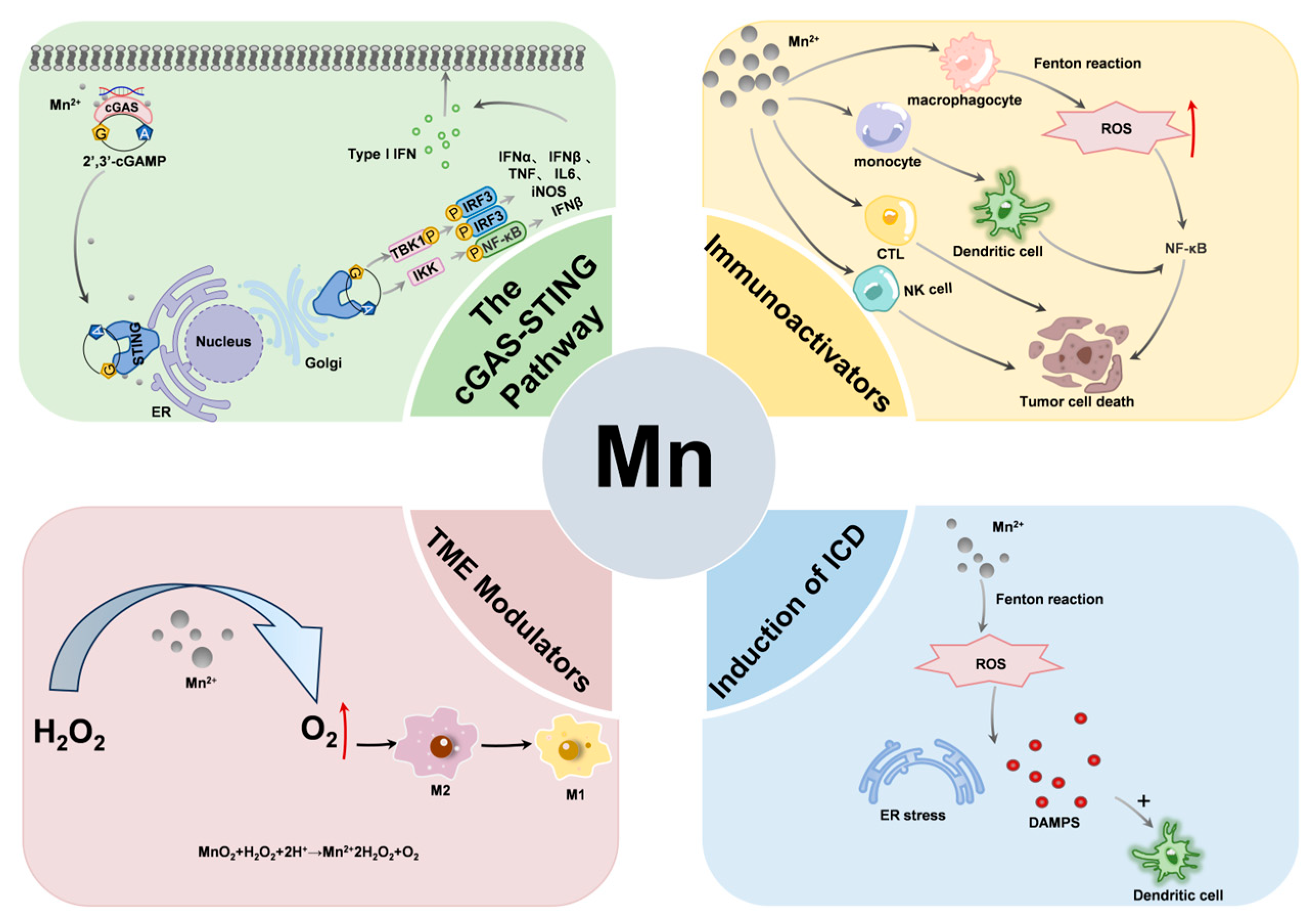
In general, manganese-based nanomaterials synergistically enhance anti-tumor immunity through ICD induction, STING activation, and TME regulation (Figure 1). Manganese-based nanomaterials release Mn2+ in an acid-responsive manner. Mn2+ competitively replaces Zn2+ at the Zn2 site (Cys416/Cys418) in the catalytic core of cGAS through its octahedral coordination advantage, driving cGAS-DNA phase separation to enhance cGAMP synthesis and promoting the palmitoylation of the STING dimer (Cys91), thereby activating the TBK1-IRF3 axis to produce IFN-β. At the same time, manganese-based nanomaterials (such as MnO2) catalyze H2O2 to generate O2, alleviating the hypoxic state in the TME, degrading HIF-1α, and inhibiting the functions of myeloid-derived suppressor cells (MDSC) and regulatory T cells. In addition, Mn2+ enhances the level of ROS by consuming GSH, further promoting ICD and STING signal amplification. The synergistic effect of these mechanisms not only enhances the maturation and antigen presentation ability of DCs, but also promotes the activation of CD8+ T cells and the formation of memory T cells, thus achieving a long-lasting anti-tumor immune response.

4. Applications of Mn-Based Nanomaterials in Tumor Immunotherapy

4.1. Single Treatment

4.1.1. Mn-Based Nanocarrier

Immunotherapeutic agents, such as antibodies and genes, are biologically active and easily degraded by enzymes when used alone. A common approach to address this issue is the use of nanostructured biomaterials as drug-delivery carriers [84]. Compared to other materials, Mn-based nanomaterials have a larger specific surface area, exceptional performance, and diverse functionalities, providing substantial potential for development, particularly in tumor diagnosis and treatment. Currently, various Mn-based nanomaterials (such as MnO2, Mn3O4, and metal–organic frameworks) have entered the preclinical research stage [85]. Mn-based nanocarriers enable precise drug delivery based on their properties. The MnO2@CeO2-Vin-Ser nanocatalyst is prepared by successfully incorporating cerium oxide (CeO2), vincristine (Vin), and sericin (Ser) into MnO2. The pH-responsive drug delivery enhanced by serine and the synergistic catalysis of CeO2-MnO2 significantly enhance the cytotoxic effect on cancer cells. Moreover, ROS measurement shows that MnO2@CeO2 can induce oxidative stress, while sericin can alleviate the excessive production of ROS [86]. Wu et al. synthesized Mn-ZIF-8 nanoparticles by combining zinc nitrate and 2-methylimidazole, loaded the drug molecule RRX-001, and performed surface modification with PEG-HA to obtain Mn-ZIF-8@RRX-001@PEGHA (MRPH) nanoparticles. The MRPH nanoplatform synergistically activates the cGAS-STING pathway through pH-responsive release of Mn2+ and NO. Mn2+ enhances the mtDNA detection, and NO induces mitochondrial damage. Concurrently, targeted delivery promotes ICD, DC maturation, and CD8+ T cell infiltration, and inhibits CD47-mediated immune evasion [87]. Chu et al. investigated a hybrid platform (MS@Yeast) constructed by “armoring” the surface of live yeast with Mn silicate compounds, in which Mn2+ reacts with CO2 and induces intense oxidative stress in tumor cells, thereby ablating primary tumors [88]. Wen et al. coated a chitosan-opalin core loaded with metformin with MnO2 to create CS-metformin@MnO2, which was used to inhibit the PD-1/PD-L1 signaling pathway and enhance tumor immunotherapy [89]. The primary function of Mn-based nanocarriers is to prevent drug release and degradation before reaching the tumor site, thereby improving the bioavailability of the immunotherapeutic agent. Wen et al. synthesized H2O2-responsive bio-mimetic NPs (MnO2-ICG@BSA) by loading indocyanine green (ICG) onto bovine serum albumin-MnO2 complexes [90], establishing promising candidates for PTT and photodynamic therapy (PDT) in the treatment of melanoma. Manganese-based nanomaterials are also used in combination with other materials to treat tumors. Liu et al. effectively combined molybdenum with Mn to develop polyethylene glycol-modified Mn molybdate NPs(MMP NDs) for cancer immunotherapy [91], demonstrating that this combination therapy can achieve synergistic therapeutic effects in vivo. As demonstrated by the above examples, Mn-based nanomaterials play a critical role in tumor immunotherapy. They are primarily used for the targeted delivery of drugs, significantly improving the bioavailability of immunotherapeutic agents and enhancing the efficacy of tumor treatments, making them well-suited for immunotherapy.

4.1.2. Mn2+-Mediated Chemodynamic Therapy (CDT)

Chemodynamic therapy (CDT) is a novel tumor treatment technology that relies on the characteristics of weak acidity and excessive H2O2 in the TME. It uses nano catalytic systems to trigger in-situ Fenton or Fenton-like reactions in tumors, converting H2O2 with originally low activity in tumor cells into highly •OH, and ultimately inducing cell apoptosis and necrosis [92]. CDT has low toxicity and few side effects in normal tissues, strong selectivity, suitability for the treatment of tumors deep in tissues, and unique advantages in tumor treatment.
Mn, as an essential metal in the human biological system, can be applied to the composition of CDT preparations. The •OH released from Mn-based nanomaterials by Mn2+ has Fenton-like activity and produces high toxicity, killing tumor cells through endogenous H2O2 [93]. Hydroxyl radicals have strong oxidizing properties and can oxidize biological molecules, such as tumor cell membranes, protein molecules, and DNA, leading to oxidative stress in neoplastic cells and triggering apoptosis. Among the Mn-based catalysts that mediate CDT, Mn oxide (MnOX) is the most common. For example, Li et al. developed a highly efficient, biocompatible PTX/MnO2/GOX-Lip-HAs nanodelivery system, in which paclitaxel (PTX), MnO2 NPs, and glucose oxidase self-assemble into nanospheres. This system exerts traditional chemotherapeutic effects and generates H2O2 and oxygen via MnO2, thereby depleting endogenous GSH and promoting starvation therapy, all of which enhance the efficacy of CDT [94]. In this system, in addition to exerting the traditional chemotherapy effect, MnO2 NPs also have the ability to generate H2O2, to produce oxygen, and consume endogenous GSH through redox reactions, thereby reducing the scavenging of •OH. Mn2+ can also participate in Fenton-like reactions, substantially enhancing the effect of the CDT. Additionally, the O2 generated during the CDT process promotes starvation therapy and provides more H2O2 to enhance CDT. Li et al. found that when this drug delivery method was applied to tumor-bearing mice, the final tumor inhibition effect was greater than 90% [94], providing important theoretical support for the translational application of Mn-based CDT in combined tumor immunization therapy. MIL-53(Fe)@MnO2 is stabilized with polyethylene glycol (FMP), capable of consuming GSH and continuously generating •OH, which is used to enhance the CDT for cancer [95]. The Gen@mSiO2@MnO2-PEG nanocomposites synthesized by Fan et al. consist of a mesoporous silica core and a MnO2 shell, and are loaded with the chemotherapeutic drug genistein (Gen), with its surface modified by PEG. It releases gold-enamide upon tumor delivery to perform CDT and degrade the MnO2 shell; GSH uptake triggers a Fenton-like reaction to generate •OH, which synergistically enhances the efficacy of CDT [96].
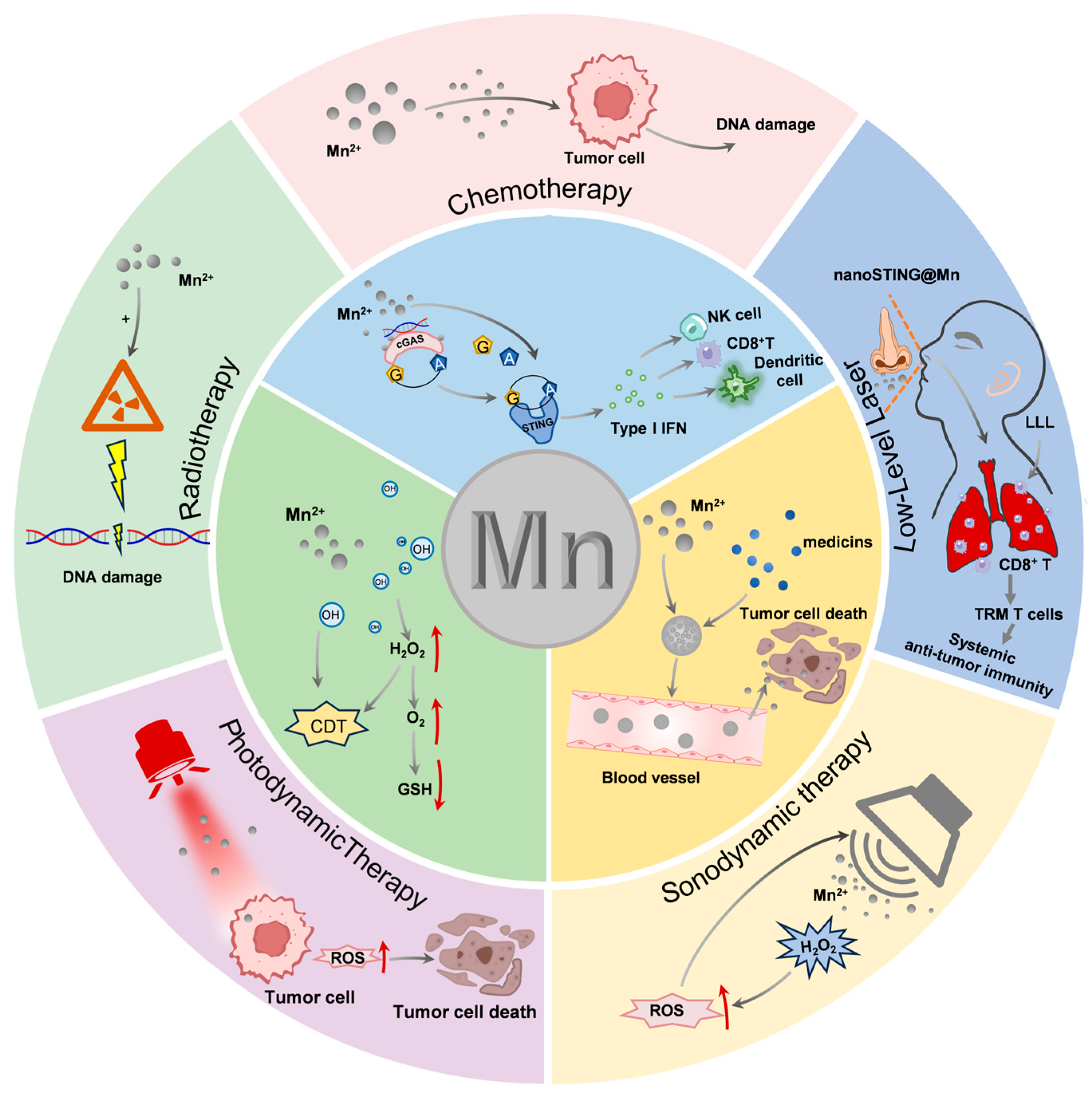
Therefore, Mn-based nanomaterials have broad application prospects in CDT and as multifunctional intelligent nanoplatforms, they have important value in achieving efficient tumor therapy (Figure 2).

4.1.3. STING Pathway-Dependent Immune Activation

When a virus invades the body, it disrupts the mitochondrial membrane potential of host cells and causes organelle acidification, leading to the release of Mn2+ from Mn-containing organelles, such as mitochondria and the Golgi apparatus, into the cytoplasm and extracellular space. Elevated Mn2+ concentrations in the cytoplasm exert a dual activating effect on the cGAS-STING pathway. At the molecular level, Mn2+ acts on cGAS, enabling the body to defend against dsDNA in the cytoplasm by enhancing the sensitivity of cGAS to dsDNA detection and promoting its enzymatic activity. Additionally, it acts on STING, enhancing its affinity for various cyclic dinucleotides (CDNs) [11,97]. This dual activation triggers the unique catalytic synthesis of 2′3′-cGAMP, which promotes the substantia type 1 IFN production [65]. Type 1 IFNs enhance cellular immunity, stimulate the activation of DCs, and facilitate the cross-presentation of tumor antigens, thereby inducing antitumor T-cell immunity [98]. The role of Mn2+ in activating the cGAS-STING pathway and its immunotherapeutic effects has been established. For example, Liu et al. used MnO2 NPs to degrade adenosine (an immunosuppressive molecule) in the TME, and simultaneously released Mn2+ to activate the STING pathway, significantly enhancing T-cell activity [99]. As-MnZnSX NRs induce TBK1/IRF3 phosphorylation via Mn2+ to activate the cGAS-STING pathway, promoting DC maturation and cross-presentation of tumor antigens; H2S synergistically enhances prodrug conversion and immune activation, achieving dual stimulation of the cGAS-STING pathway and significantly improving the antitumor efficacy of As2O3 [100]. CMP Mn-based NPs (Mn2+/c-di-AMP) enhance STING pathway activation via Mn2+ and synergize with anti-CTLA-4 blockade, significantly increasing CD8+ T-cell infiltration and prolonging survival in a disseminated AML model, confirming the key synergistic role of Mn-based materials in combination immunotherapy [101]. Sulfur-based hybrid organosilicon materials were loaded with Mn2+ to enhance Mn2+ release during RT, thereby activating the STING pathway, enhancing the tumor immune response, and inhibiting tumor growth [102]. The TPP-MMONs nanoplatform induces mitochondrial DNA release through the targeted release of Mn2+, thereby dual-activating the cGAS-STING pathway and enhancing the efficacy of αPD-L1 immunotherapy, offering a new strategy for the treatment of triple-negative breast cancer [103]. Chen et al. reported a tumor cell membrane-coated biomimetic nanozyme platform (CMNP), which contains manganese dioxide nanoparticles (MnO2@BSA), nano-realgar (NR) and doxorubicin (DOX). Within tumors, MnO2 alleviates hypoxia and enhances enzyme activity by catalyzing the decomposition of H2O2 to generate O2, and the released Mn2+ recruits tumor-killing immune cells by activating the cGAS-STING pathway [104]. MnCREKA-aCTLA-4-SS (MCCS) is prepared by covalently assembling Mn2+, silk sericin (SS), pentapeptide CREKA, and aCTLA-4. By activating the cGAS-STING pathway, MCCS stimulates effector CD8+ and CD80+ T cells, increasing IFN-γ and granzyme secretion, thereby inducing tumor cell autophagy and apoptosis both in vitro and in vivo [105]. Mn2+ ions released by Mn-LDH-Ce6 activate the cGAS-STING pathway, promoting STING phosphorylation and IFN-mediated immunity, thereby effectively reversing immunosuppression and inhibiting tumor growth [106].
In summary, Mn2+, as a novel STING agonist, enhances antitumor and antiviral immune responses by activating the cGAS-STING pathway, thereby providing an important theoretical foundation for the development of novel immunotherapy strategies (Table 1).

4.2. Dual-Modal and Multi-Modal Collaborative Therapy

4.2.1. Mn-Based Immunotherapy Combined with Chemotherapy

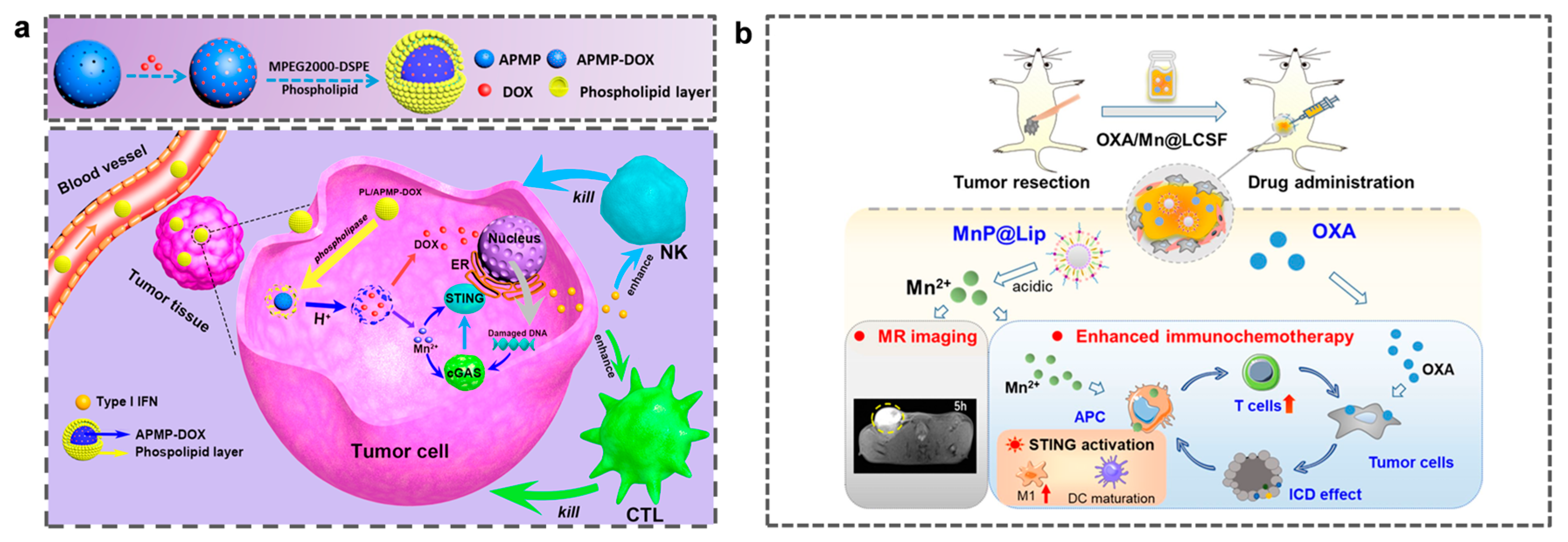
Chemotherapeutic drugs play a crucial role in cancer treatment. However, drug resistance limits their therapeutic efficacy. Mn-based nanomaterials activate the immune system and can effectively integrate chemotherapy with immunotherapy, thus offering a promising combination therapy strategy to overcome drug resistance. The combination of Mn-based nanomaterials and chemotherapy leverages the cytotoxic effects of chemotherapeutic agents to achieve a stronger direct killing effect. Hou et al. encapsulated doxorubicin (DOX) within amorphous porous Mn phosphate NPs and coated the outermost layer with phospholipids to form PL/APMP-DOX NPs. In an acidic TME, the exposed NPs degrade and rapidly release Mn2+ and DOX. The cytotoxic action of DOX causes DNA damage in tumors and activates the cGAS-STING pathway. Mn2+ further amplifies this activation, inducing type 1 IFN production, promoting DC maturation, and enhancing cytotoxic effects mediated by CD8+ T cells or NK cells (Figure 3a) [107].
Platinum-based compounds can also be combined with Mn-based nanomaterials. For example, Li et al. co-administered MR nanoprobes (MnP@LiP) with platinum-based chemotherapeutic agents, thereby inhibiting the growth of 4T1 and MC38 mouse tumor cells (Figure 3b) [108]. C-NAG-R8-PTXL/MnO2-lip enables MRI-guided synergistic chemotherapy (CDT/CT). The generated oxygen can also relieve the hypoxic environment within the tumor, thereby reducing the efflux of chemotherapeutic drugs [109]. Although the synergistic effect of Mn-based materials and chemotherapy has shown initial advantages by improving drug release efficiency and treatment persistence, with the increasing complexity of tumor heterogeneity and immunosuppressive microenvironment, the single synergistic mode has difficulty breaking through the efficacy bottleneck, prompting the research to shift towards multimodal synergistic strategies integrating treatments, such as RT and PDT.

4.2.2. Mn-Based Immunotherapy Combined with RT

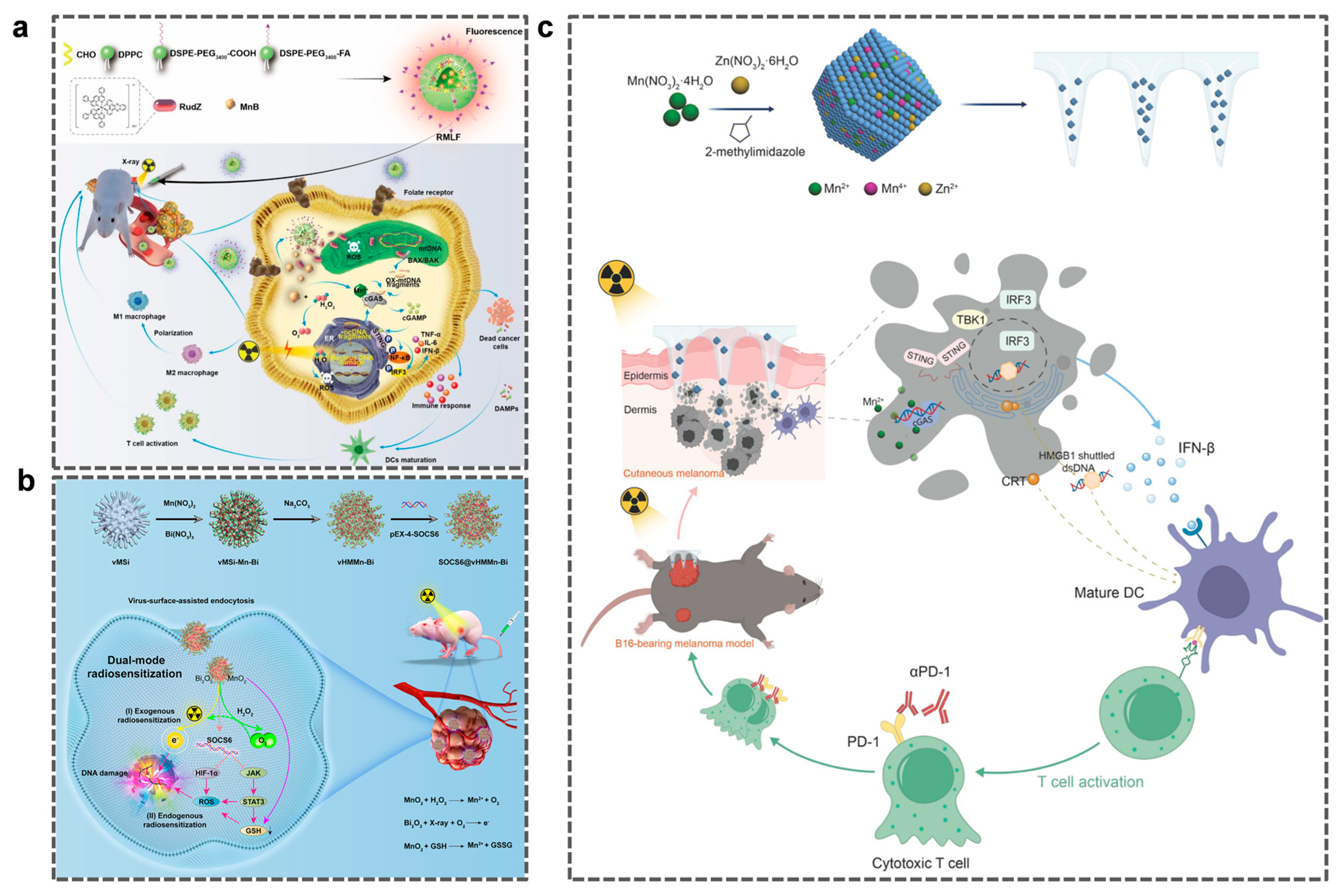
RT is the optimal method for local tumor control after surgical resection and one of the primary clinical treatments for various malignant tumors. The primary mechanism involves the induction of ICD in tumor cells to elicit a systemic immune response. However, monotherapy with RT struggles to suppress distant metastasis owing to insufficient DAMP release and a hypoxic microenvironment. Mn-based immunotherapy overcomes this limitation through synergistic mechanisms. The RMLF nanoplatform integrates Ru(II) complexes and BSA-MnO2 NPs to achieve dual enhancement of radiation-induced cell accumulation, ROS generation, and cGAS-STING pathway activation (Figure 4a). This effectively promotes CTL infiltration and the polarization of macrophages from M2 to M1, significantly enhancing immune memory responses and overcoming the issue of insufficient DAMP release during conventional RT (4 Gy) [110]. Some researchers have developed a SOCS6@vHMMn—Bi nanoparticle, which is composed of virus—inspired hollow mesoporous manganese—bismuth bimetallic oxide nanoparticles (vHMMn-Bi) and a radiosensitizing plasmid (suppressor of cytokine signaling 6, SOCS6). It can significantly improve the efficacy of radiotherapy for esophageal cancer through a dual—mode radiosensitization mechanism. Among them, MnO2 catalyzes oxygen production, thus significantly improving the radiotherapy effect without systemic toxicity (Figure 4b) [111]. Mn-ZIF-8, a transdermal drug delivery system, enhances radiosensitivity in cutaneous melanoma when combined with RT and strengthens ICD by enhancing STING pathway activation (Figure 4c) [112]. Moreover, under the condition of pH 5.5, Mn2+ is almost completely released within 3 h, achieving responsive activation in the acidic tumor microenvironment. While at pH 7.4, the cumulative release rate is only 23% within 24 h, reducing leakage to normal tissues and avoiding adverse side effects. Liu et al. proposed that the αPDL1@MnO2 nanoplatform promotes DC maturation by releasing Mn2+ to activate the cGAS-STING pathway and, in combination with αPDL1, enhances CTL infiltration. This significantly improves the cytotoxic effects of RT on tumor cells, overcomes hypoxia-induced radiation resistance, and reprograms the immunosuppressive TME, thereby effectively inducing ICD and generating distant effects that inhibit tumor metastasis. [113]. Liu et al. reported a bio-mineralized Mn oxide NP (Bio-MnO2NPs) capable of converting endogenous H2O2 into O2 and catalyzing ROS production, thereby increasing the radiosensitivity of non-small-cell lung cancer cells. Concurrently, the release of Mn2+ activates the STING pathway and the combined therapy significantly inhibits tumor growth in lung cancer-bearing mice [114]. Furthermore, unlike combinations with chemotherapeutic agents, combining Mn2+ and RT may require special attention. Wang et al. found that the intratumoral injection of Mn2+ immediately after RT did not enhance RT, whereas intratumoral injection 24 h after RT did [115]. This is because Mn2+ injected directly is metabolized out of the tumor within minutes, whereas RT-induced DNA damage requires up to 24 h of cellular mitosis to accumulate in the cytoplasm and exert a synergistic effect with Mn2+. Therefore, the release time of NPs should also be considered during the design to coordinate with RT and achieve optimal therapeutic outcomes.
In summary, Mn-based immunotherapy significantly enhances the efficacy of RT through three mechanisms: oxygen sensitization, hypersensitization of the STING pathway, and remodeling of the immune microenvironment. By optimizing the timing of drug administration to achieve synergistic effects, it provides a new strategy for systemic anti-metastatic treatment of tumors.

4.2.3. Mn-Based Immunotherapy and PDT

PDT is a non-invasive treatment method. When the photosensitizer is in an oxygenated state, light radiation can be precisely applied to the target tumor, generating toxic ROS, which chemically react with various biomolecules in the surrounding area, causing damage to subcellular structures, such as mitochondria, cell membranes, and lysosomes, and ultimately effectively induces cell apoptosis or necrosis [116,117,118]. During necrosis, tumor cells produce large amounts of antigens, thereby stimulating the body’s immune response. However, the limitations of conventional PDT are insufficient efficacy against metastatic and deep-seated tumors, and the fact that most photosensitizers are hydrophobic and non-selective, leading to non-specific damage [119,120,121]. To overcome these limitations, Mn-based nanomaterials are conjugated with traditional photosensitizers. By leveraging their hydrophilic properties and drug delivery capabilities, they achieve highly efficient targeted accumulation through the enhanced permeability and retention effect, significantly reducing damage to the surrounding healthy tissues [122,123,124,125,126].
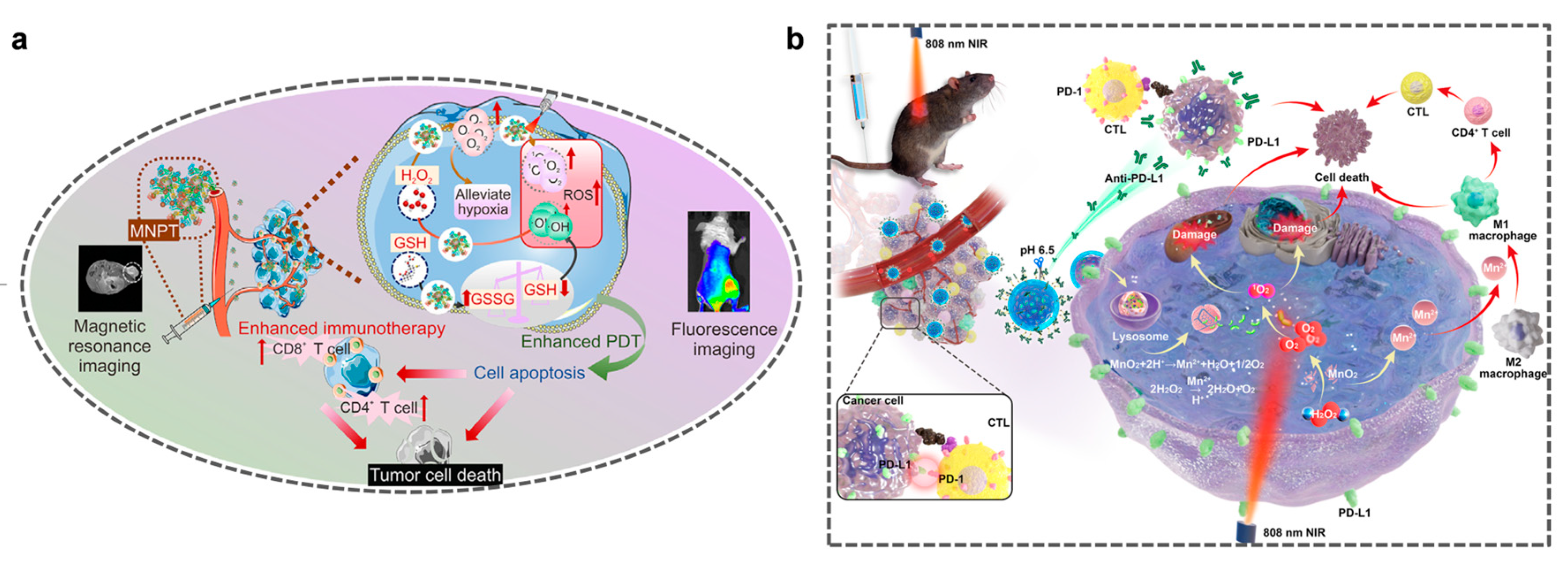
For example, the magnetic nanoplatform (MNPT), comprising the photosensitizer, Ce6, and Fe3O4/MnO2 composite nanoenzymes, generates ROS via PDT to induce cell apoptosis and trigger an immune response (Figure 5a) [127]. MnO-N/C NPs activate their enzymatic activity via an 808 nm near-infrared laser, enabling photothermal-enhanced catalytic-photothermal synergistic therapy under MRI guidance, thereby providing a new strategy for low-toxicity, high-efficiency tumor nanotherapy (Figure 5b) [128]. ICG@MnO2@Exo-anti-PD-L1 NPs effectively regulate the TME to combat non-small-cell lung cancer through the synergistic effect of photodynamic therapy and immunotherapy. These NPs are prepared by loading indocyanine green (ICG) into hollow manganese dioxide nanoparticles (ICG@MnO2), and then encapsulating them in exosomes derived from dendritic cells (DCs) treated with azidoethylcholine (AECho) [129]. The PDA@Mo2C-MnO2-Au/Apt-M cascade nanoreactor triggers MnO2-mediated Fenton-like reactions (•OH generation) in an acidic TME, which synergizes with near-infrared (NIR)-II photothermal effects to achieve targeted PTT/CDT combination therapy [130]. The FM@VP nanoplatform developed by Chung et al. is based on the co-assembly of nanocomposites formed by the polysaccharide fucoidan, the bioreducible polyamidoamine (PAMAM) dendrimer, the photosensitizer verteporfin (VP), and MnO2 nanoparticles into multifunctional nanoparticle clusters. By using MnO2 nanoparticles to relieve tumor hypoxia and synergistically inhibiting the Yes-associated protein (YAP) signaling pathway through VP—mediated photodynamic therapy, it significantly enhances the anti—tumor immune response and improves the efficacy of photodynamic therapy [131]. Gao et al. considered the problems such as the excessive release of reactive oxygen species (ROS) and the resulting damage to non-target tissues, and developed an innovative hybrid nanorobot (EcN+UCNPs@MSiO2-MnO2-ZnPc), which integrates engineered Escherichia coli Nissle 1917 (EcN) with orthogonally emitting upconversion nanoparticles (C@3S) [132]. The manganese-loaded upconversion nanoparticles (UCNPs@Mn) are triggered by 808 nm near-infrared light to generate ROS, which increases the ROS level in the illuminated area and leads to a significant decrease in cell viability. After the light is turned off, the ROS generation rate decreases significantly, thus achieving spatially precise killing.
By precisely regulating the spatiotemporal synergy between PDT and immunotherapy, these strategies address the issue of insufficient photosensitizer targeting and overcome the therapeutic bottlenecks of PDT for metastatic and deep-seated tumors, thereby providing a new paradigm for combined cancer therapy.

4.2.4. Mn-Based Immunotherapy and SDT

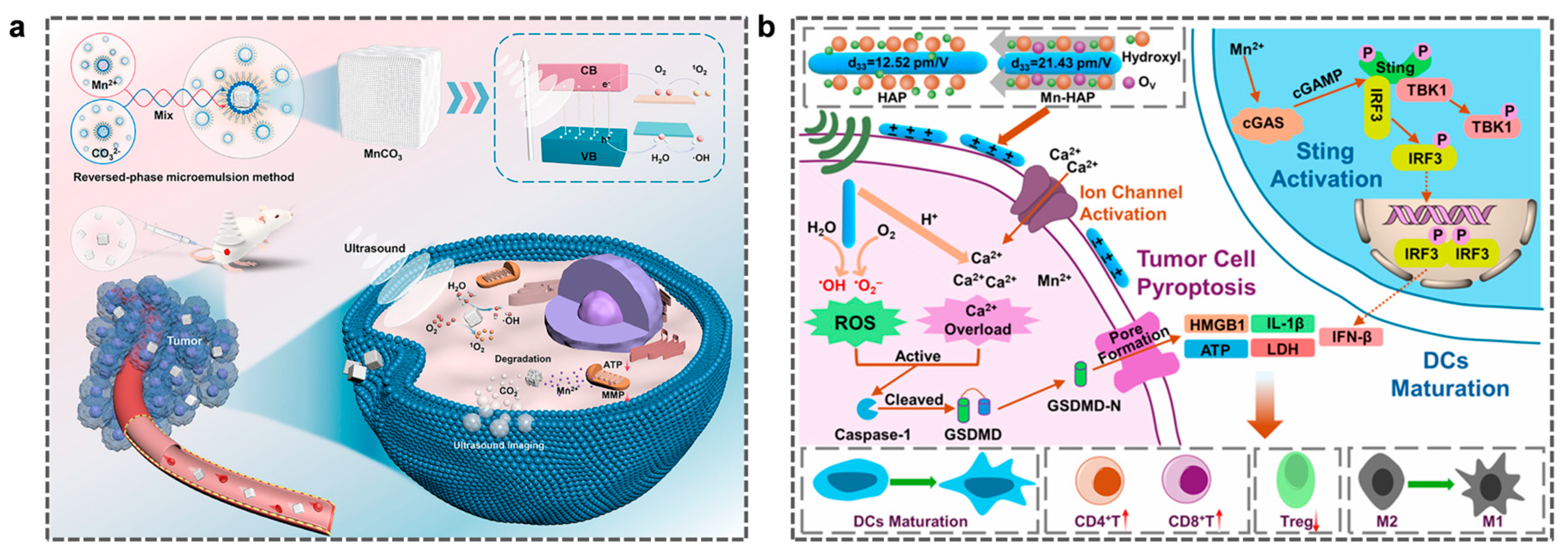
In cancer therapy, SDT is an emerging non-invasive treatment modality that induces tumor cell apoptosis using ultrasound to activate photosensitizers and generate cytotoxic ROS [133]. However, a hypoxic TME and excessive GSH levels lead to insufficient ROS production, thereby limiting the antitumor efficacy of SDT. Mn2+ can interact with H2O2 in the TME to generate ROS via the Fenton reaction, thereby enhancing the efficacy of SDT. This effectively addresses these limiting factors and establishes avenues for the clinical application of SDT. Recently, Zhang et al. developed highly efficient Mn carbonate NPs (MnCO3 NPs) as photosensitizers using a reverse microemulsion method to enhance SDT (Figure 6a) [134]. Under ultrasonic conditions, MnCO3 NPs can generate •OH and singlet oxygen. Furthermore, due to their pH responsiveness, MnCO3 NPs can degrade to release CO2 and Mn2+ in an acidic microenvironment. The resulting CO2 bubbles enhance the cavitation effect under ultrasound, thereby mediating the irreversible necrosis of cancer cells and conferring ultrasonic imaging capabilities. In vivo experimental data show that MnCO3 NPs inherently possess a tumor inhibition rate of approximately 50%; following ultrasonic stimulation, the tumor suppression efficiency significantly increases up to 90%. The SDT synergistic anticancer strategy proposed in this study broadens the scope of photosensitizers and provides new insights and perspectives for the development of nanomedicine.
Mn-HAP is a photosensitizer and an immunomodulator that triggers the continuous modulation of ROS via ultrasound and enhances the sonodynamic antitumor effect by using Mn-doped oxygen vacancies (Figure 6b). In this process, Mn2+ activates the cGAS-STING pathway, thereby stimulating innate immunity and inducing antitumor immune responses [135].
These innovative studies confirm that Mn-based materials, through a triple synergistic mechanism involving catalytic oxygenation, immune activation, and physical enhancement, not only overcome the therapeutic bottlenecks of traditional SDT, but also provide a crucial theoretical foundation and technical support for the development of novel SDT-immunotherapy combination strategies. With continuous advancements in nanotechnology, this synergistic treatment model is expected to advance clinical cancer therapy.

4.2.5. Mn-Based Immunotherapy and Low-Intensity Phototherapy

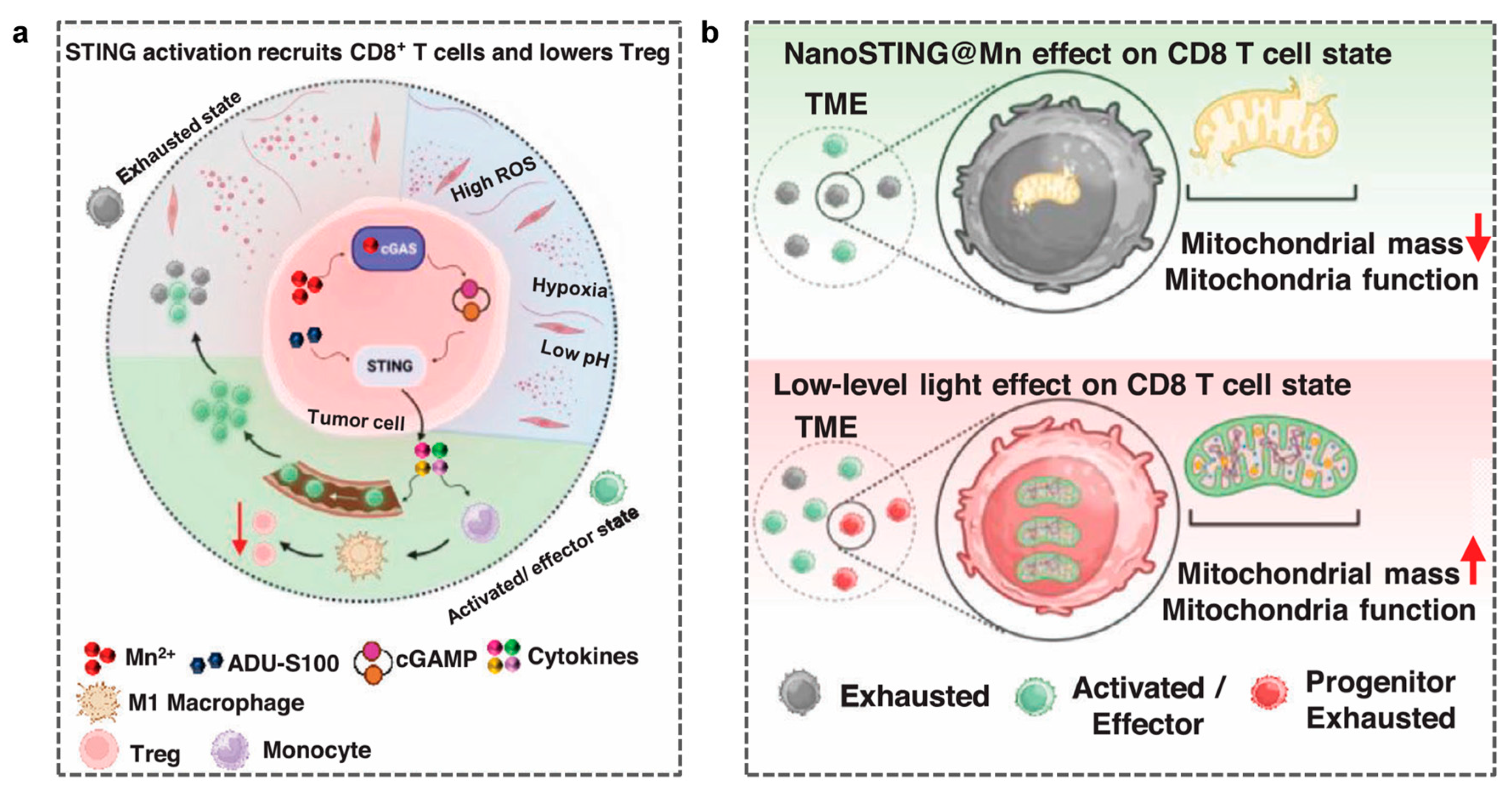
Low-level light (LLL) therapy, a form of photobiomodulation, is an innovative, clinically practical, non-invasive, and drug-free treatment method that directly restores mitochondrial function in tumor-infiltrating CD8+ T cells. Unlike traditional drug formulations that rely on systemic distribution (which is often impaired in tumors), LLL directly enhances the mitochondrial respiratory chain activity by activating complexes I, III, and IV of the electron transport chain, thereby converting light energy into bioenergy in the form of ATP within the inner mitochondrial membrane [136,137]. As ATP production is light-driven, it relies less on oxygen and remains effective in ischemic or near-hypoxic tissues, as confirmed by both in vivo [138,139] and in vitro [140,141] experiments (Figure 7a).
Banstola et al. proposed a dual-strategy combining LLL therapy with a nano-sized STING agonist formulation (nanoSTING@Mn) [142], which effectively activates the cGAS-STING pathway, induces a type 1 IFN response, and promotes lymphocyte infiltration (Figure 7b). These monocytes polarize into M1 macrophages, which suppress regulatory T cells. Concurrently, LLL photobiomodulation reprograms mitochondrial metabolism in tumor-infiltrating CD8+ T and NK cells, restoring their persistence and potentially leading to the complete eradication of local tumors.

4.2.6. Multimodal Collaborative Therapy

The therapeutic efficacy of Mn-based immunotherapy alone is limited by tumor heterogeneity and diversity as well as the complex immunosuppressive TME. To enhance the efficacy of tumor treatment while minimizing drug dosage and side effects, immunotherapies involving multimodal synergistic therapies have been developed that combine Mn-based nanomaterials with various therapeutic agents. Recently, multimodal synergistic therapies based on Mn-based nanomaterials have overcome the limitations of single-modality therapies in addressing tumor heterogeneity and the immunosuppressive TME by integrating multiple mechanisms, including PTT, PDT, CDT, starvation therapy, and immune activation, thereby achieving a synergistic effect.
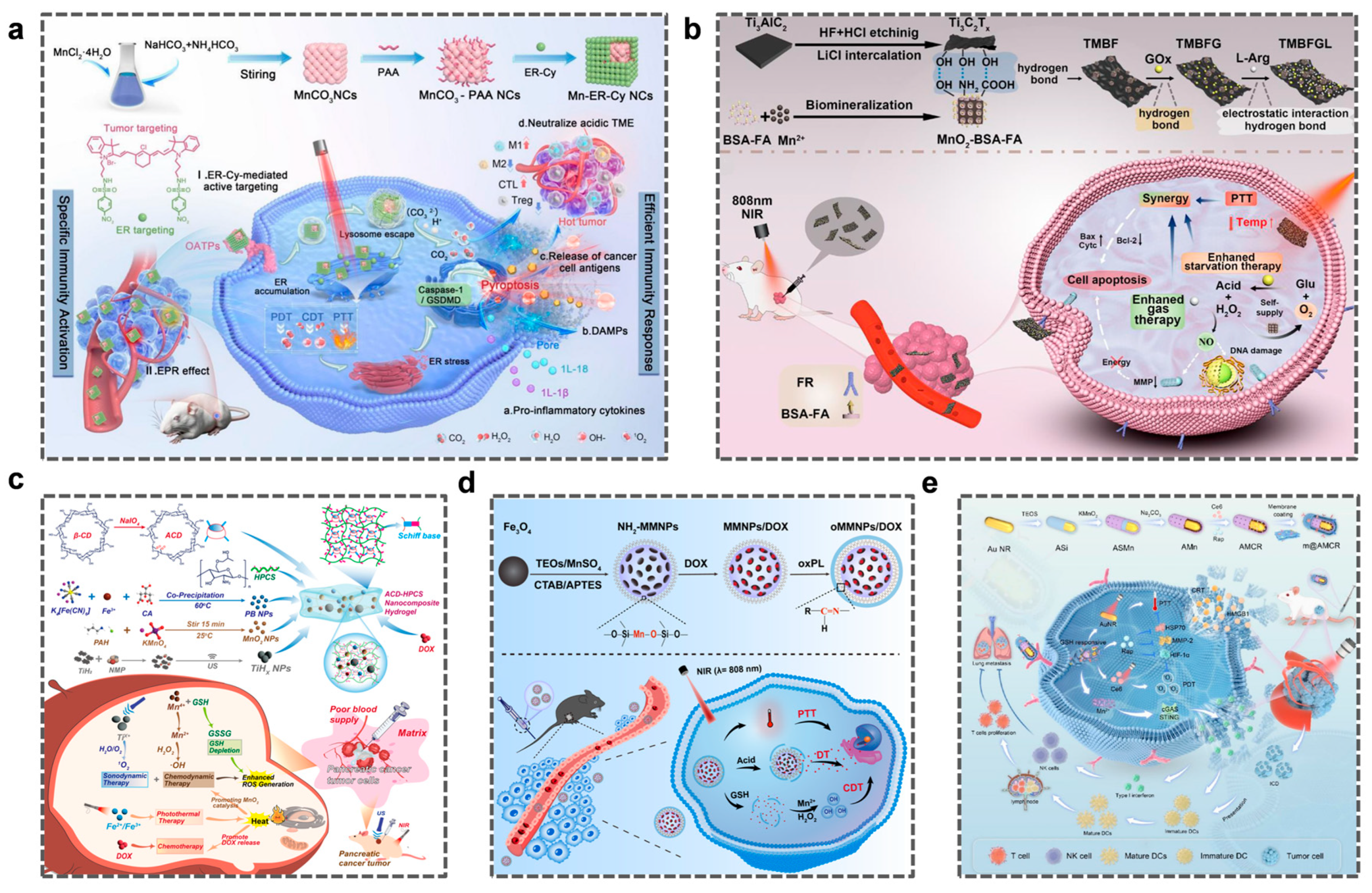
Mn-ER-Cy nanocubes integrate PTT/PDT/CDT tri-modal therapy via endoplasmic reticulum targeting (Figure 8a), inducing NLRP3 inflammasome activation and ICD and modulating the TME pH, thereby enabling imaging-guided precision therapy and significantly enhancing tumor immunotherapy efficacy [143]. The multifunctional manganese-based nanozyme developed by Yang et al. uses Ti3C2Tx MXene nanosheets as carriers and is surface-functionalized with MnO2 modified by FA and BSA. An efficient cascade catalytic system is designed: Ti3C2Tx MXene+MnO2-BSA-FA+GOx+LArg (TMBFGL), which has dual responsiveness to acidic pH values and H2O2. It achieves synergistic anti-tumor effects through photo-thermal, photodynamic and immune mechanisms, providing a safe and effective platform for reversing the immunosuppressive microenvironment and realizing synergistic anti-tumor immunotherapy (Figure 8b) [144]. Even the ACD-HPCS hydrogel integrates Prussian blue NPs as a photothermal agent, titanium hydride NPs (TiHx NP, x ≈ 2–4) as a sonosensitizer, MnO2 NP, and DOX (Figure 8c). It combines NIR-induced PTT, ultrasound SDT, and CDT to achieve a four-modal synergistic therapeutic effect combining PTT, SDT, CDT, and CT [145].Meanwhile, the oMMNPs/DOX nanoplatform developed by Li et al. uses magnetic targeting and a triple-responsive mechanism (pH/GSH/NIR) to synchronously release DOX and Mn2+ (Figure 8d). It has significant antitumor potential in PTT, CDT, and integrated diagnosis (MRI/fluorescence dual-mode imaging), with a tumor suppression rate 65% higher than that of single-modality therapies [146]. This platform possesses excellent drug release control capabilities, good biodegradability, precise targeted drug delivery, and high photothermal conversion efficiency, offering important research directions and application prospects for the field of cancer therapy. MGF@laN NPs release Ga3+ (inducing mitochondrial apoptosis) and Mn2+ (activating the cGAS-STING pathway) in a pH-responsive manner, synergistically disrupting the ionic homeostasis of tumor cells and enhancing ICD. Simultaneously, by leveraging the β1-integrin on neutrophil membranes to block the formation of metastatic niches, this study first proposed and achieved a triple synergistic therapy combining apoptosis, immunogenicity, and metastasis inhibition [147]. rGOQD/MnO2/GOx/CPP NPs integrate a triple-modality therapy combining chemodynamics (MnO2-catalyzed H2O2 generation of ·OH), starvation (GOx-mediated glucose oxidation depleting ATP), and photothermal effects (rGOQD near-infrared response) to synergistically disrupt tumor antioxidant defenses (GSH depletion) and heat shock protein expression, achieving highly effective treatment of U87 glioblastoma [148]. More notably, m@AMCR NPs, loaded with chlorin e6 and rapamycin (Rap), combine PDT/PTT with cGAS-STING pathway activation (Figure 8e) [149]. YangQi et al. designed a multifunctional manganese (Mn)-based nanozyme, Ti3C2-MnO2-PDA, which responds to the acidic pH and overexpresses H2O2 at the tumor site and has the ability to regulate the hypoxic and immunosuppressive tumor microenvironment (TME) for synergistic antitumor photothermal/photodynamic/immunotherapy [150]. Addressing the limitation of CDT caused by excessive GSH expression in the TME, Cai et al. developed a hollow MnO2 (HMnO2) multifunctional bioreactor loaded with cisplatin for synergistic CDT-chemotherapy [151].
The above text explains the specific structure, mechanism of action, and therapeutic effects of the synergy between manganese-based nanomaterials and other modalities. Below, the remarkable data results of the materials are described in detail. For example, Mn-ER-Cy can actively and precisely target the ER organelles of tumor cells, thereby enhancing the local therapeutic effect [143]. Moreover, compared with conventional systems (usually less than 40%), Mn-ER-Cy achieved a significantly higher photothermal conversion efficiency (51.6%) under 808 nm irradiation. Although the preliminary biosafety assessment indicates low acute toxicity, it is crucial to conduct a comprehensive assessment (including studies on chronic toxicity, immunogenicity, metabolism, and excretion) before clinical application. The data obtained during the development of Ti3C2Tx MXene show that the migration rate of the pure GOx group decreased but remained at 75.58% [144]. After loading GOx onto Ti3C2Tx MXene, the cell migration rate was 62.07%. Subsequently, loading L-Arg led to a further decrease in cell migration to 50.13%. After irradiation with an 808 nm laser, the cell migration rate further decreased to 28.49%. The experimental results of pancreatic cancer mice treated with TiHx NPs showed the strongest tumor inhibition [145]. The final tumor volume was only 130.22 ± 23.3 mm3 (approximately 18.3% of the final volume of the control group), and the tumor weight was 0.10 ± 0.02 g, which was significantly smaller than that of other groups (p < 0.001), and there was no difference in the body weight of the mice compared with the control group. The experimenters tested the anti-cancer efficacy of NH2-MMNPs and oMMNPs/DOX in a mouse model. The combination therapy group (oMMNPs/DOX + NIR) showed significant inhibition of tumor growth, with a tumor inhibition rate of 84.1% [146]. In addition, in the experiment, the m@AMCR + 638/808 nm light group showed the strongest tumor-inhibiting effect (tumor inhibition rate of 87.39%), which was 1.34 times that of the AMCR + 638/808 nm light group. This result can be attributed to the excellent tumor-accumulating ability of m@AMCR [149], leading to enhanced PDT and PTT efficacy. These specific and distinct data show that manganese-based nanomaterials are a promising new approach for cancer treatment.
These studies confirm that Mn-based multimodal synergistic therapy, through the integrated convergence of catalytic oxygenation, immune activation, metabolic reprogramming, and physical killing, not only overcomes the barrier of tumor heterogeneity, but also provides a tunable nanoscale platform for personalized therapy. Future research should further explore the temporal regulatory mechanisms and clinical translation pathways that are expected to lead to the development of more multimodal synergistic therapies involving immunotherapy to achieve personalized cancer treatment (Table 2).

5. Summary and Prospect

As an essential trace element for human survival, Mn exhibits valence state conversion responsiveness, paramagnetism, and biodegradability, demonstrating its significant potential in tumor immunotherapy. Based on the characteristics and functional advantages of Mn-based materials, this review thoroughly explored the four-fold mechanism of action in antitumor immunotherapy: activation of the STING pathway, activation of immune cells, induction of ICDs, and regulation of the TME. Regarding STING pathway activation, Mn2+ triggers a burst of IFN-α/β by enhancing the sensitivity of cGAS to dsDNA/mtDNA and increasing the affinity between STING and CDNs, thereby driving DC maturation and CD8+ T cell infiltration. In terms of immune cell regulation, Mn-based materials directly activate NK cell cytotoxicity and promote M1 polarization of macrophages, and simultaneously enhance T-cell responses via the TCR-ZAP70 signaling pathway. ICD induction relies on ROS generated by MnO2 catalysis to trigger endoplasmic reticulum stress, promoting calreticulin externalization and HMGB1 release. TME regulation focuses on reversing hypoxia and lifting immune suppression by degrading adenosine and inhibiting HIF-1α to reshape “cold tumors.” At the application level, Mn-based monotherapy focuses on nanocarriers, CDT, and STING pathway-dependent immune activation. Multimodal synergistic strategies achieve a synergistic effect by integrating chemotherapy, RT, PDT, SDT, low-level laser (LLL) therapy, and multimodal therapies. For example, Mn-based therapy combined with chemotherapy reverses chemotherapy resistance, RT synergy relies on timing control to match the DNA damage window, and PDT/SDT synergy enhances ROS generation through catalytic oxygen production and cavitation effects, simultaneously activating the STING pathway. Multimodal platforms such as HMnO2@TPyP@Bro integrate catalytic oxygenation, gas therapy, and MRI guidance, while MGF@LaN NPs achieve a three-tiered synergy of apoptosis, immunotherapy, and metastasis inhibition.
Although Mn-based materials demonstrate significant advantages in tumor immunotherapy, several challenges remain in their clinical translation, and further optimization of Mn-based nanoplatforms is crucial. First, biocompatibility and toxicity are the major limiting factors. Although many studies have indicated that Mn-based nanomaterials have good biocompatibility and low toxicity, these assessments are largely based on in vitro cellular experiments and lack long-term in vivo safety data. Existing research has primarily focused on in vitro cellular models, while the dynamic distribution of Mn2+ in vivo, such as blood–brain barrier permeability, long-term accumulation effects, and mechanisms of neurotoxicity, remains unclear. Although surface modification can reduce nonspecific uptake, there is still controversy regarding the metabolic pathways of Mn-based NPs in different tissues and their size-dependent behavior. The association between tumor STING pathway mutation rates and Mn responsiveness remains unclear, and multi-omics analysis is needed to screen for biomarkers to further guide the adaptation of Mn-based carriers. Manganese-based materials have shown significant commercialization potential in the field of tumor immunotherapy. Their core advantage lies in the efficient activation of the cGAS-STING pathway through the controlled release of Mn2+, which significantly enhances the anti-tumor immune response, especially suitable for patients resistant to PD-1/PD-L1 inhibitors. As an integrated diagnosis and treatment platform, manganese-based MRI contrast agents can replace gadolinium agents, reducing costs by 30%, and the raw material cost is less than 1% of that of gold-based materials. However, clinical translation faces three major challenges: the risk of neurotoxicity; the bottleneck of large-scale production; and regulatory complexity. Future development directions include combination regimens for reversing drug resistance, second-generation intelligent responsive materials, and innovative clinical endpoint designs to further improve efficacy and safety. Although breakthroughs are still needed in long-term neurotoxicity control and production process optimization, based on their unique immune activation efficacy and cost advantages, manganese-based materials are expected to become a key component in the combined treatment of solid tumors within 5–8 years. The following are three recommendations for the future development of Mn-based materials. First, the development of time-controlled release systems, such as radiation- or ultrasound-triggered smart drug delivery systems, will further improve the precision and safety of treatment. Second, strategies for mitigating neurotoxicity are key to the clinical translation of Mn-based materials. By optimizing material design and surface modification, and elucidating the balance between Mn2+ penetration of the blood–brain barrier and STING activation in microglia, potential neurological side effects can be reduced. Furthermore, in-depth research into the mechanisms of action of Mn-based materials across different tumor types and exploration of their potential for personalized therapy will provide a stronger evidence base for clinical practice. Multimodal synergistic therapy is a major direction for future development. By rationally combining different treatment modalities to fully leverage their respective strengths and achieve synergistic effects, Mn-based immunotherapy will transition from a “tool-based enhancement” approach to a “mechanism-driven paradigm.” This will ultimately drive a paradigm shift in cancer treatment from local control to systemic eradication with the potential to further improve treatment efficacy. Future research will further elucidate the potential of Mn-based materials in tumor immunotherapy, providing cancer patients with safer and more effective treatment options.

Author Contributions

X.K.: Writing—original draft; Creating drawings and integrating relevant data; C.Z. and H.H.: Writing—review and editing; Collecting and analyzing some examples; Y.C.: Writing—review and editing; Investigations and filling in the gaps; W.G. and R.C.: Conceptualization; Funding acquisition; Project administration; Resources; Supervision; Writing—review & editing. All authors have read and agreed to the published version of the manuscript.

Funding

This research was funded by National Natural Science Foundation of China (21807041), Lin He’s Academician Workstation of New Medicine and Clinical Translation in Jining Medical University (JYHL2022ZD04).

Institutional Review Board Statement

Not applicable.

Informed Consent Statement

Not applicable.

Data Availability Statement

No new data were created or analyzed in this study.

Conflicts of Interest

The authors declare no conflicts of interest.

Abbreviations

The following abbreviations are used in this manuscript:
CDTChemodynamic therapy
CMCell membrane
CTLCytotoxic T lymphocyte
DAMPDamage-associated molecular patterns
DCDendritic cell
DOXDoxorubicin
GSHGlutathione
ICDImmunogenic cell death
IFNInterferon
LLLLow-light therapy
MnManganese
MRIMagnetic resonance imaging
NKNatural Killer
NPNanoparticle
PDTPhotodynamic therapy
PTTPhotothermal therapy
PTXPaclitaxel
ROSReactive oxygen species
RTRadiotherapy
TAMTumor-associated macrophage
TCRT cell receptor
TMETumor microenvironment
SDTSonodynamic therapy

References

  1. Bray, F.; Ferlay, J.; Soerjomataram, I.; Siegel, R.L.; Torre, L.A.; Jemal, A. Global Cancer Statistics 2018: GLOBOCAN Estimates of Incidence and Mortality Worldwide for 36 Cancers in 185 Countries. CA Cancer J. Clin. 2018, 68, 394–424. [Google Scholar] [CrossRef] [PubMed]
  2. Siegel, R.L.; Miller, K.D.; Wagle, N.S.; Jemal, A. Cancer Statistics, 2023. CA Cancer J. Clin. 2023, 73, 17–48. [Google Scholar] [CrossRef] [PubMed]
  3. Iyengar, P.; All, S.; Berry, M.F.; Boike, T.P.; Bradfield, L.; Dingemans, A.-M.C.; Feldman, J.; Gomez, D.R.; Hesketh, P.J.; Jabbour, S.K.; et al. Treatment of Oligometastatic Non-Small Cell Lung Cancer: An ASTRO/ESTRO Clinical Practice Guideline. Pract. Radiat. Oncol. 2023, 13, 393–412. [Google Scholar] [CrossRef]
  4. Lu, S.; Tian, H.; Li, B.; Li, L.; Jiang, H.; Gao, Y.; Zheng, L.; Huang, C.; Zhou, Y.; Du, Z.; et al. An Ellagic Acid Coordinated Copper-based Nanoplatform for Efficiently Overcoming Cancer Chemoresistance by Cuproptosis and Synergistic Inhibition of Cancer Cell Stemness. Small 2024, 20, 2309215. [Google Scholar] [CrossRef]
  5. Velikova, G.; Morden, J.P.; Haviland, J.S.; Emery, C.; Barrett-Lee, P.; Earl, H.; Bloomfield, D.; Brunt, A.M.; Canney, P.; Coleman, R.; et al. Accelerated versus Standard Epirubicin Followed by Cyclophosphamide, Methotrexate, and Fluorouracil or Capecitabine as Adjuvant Therapy for Breast Cancer (UK TACT2; CRUK/05/19): Quality of Life Results from a Multicentre, Phase 3, Open-Label, Randomised, Controlled Trial. Lancet Oncol. 2023, 24, 1359–1374. [Google Scholar] [CrossRef]
  6. Zhou, M.; Liang, S.; Liu, D.; Ma, K.; Yun, K.; Yao, J.; Peng, Y.; Hai, L.; Zhang, Q.; Wang, Z. Manganese-Enriched Zinc Peroxide Functional Nanoparticles for Potentiating Cancer Immunotherapy. Nano Lett. 2023, 23, 10350–10359. [Google Scholar] [CrossRef]
  7. Song, W.; Musetti, S.N.; Huang, L. Nanomaterials for Cancer Immunotherapy. Biomaterials 2017, 148, 16–30. [Google Scholar] [CrossRef]
  8. Sahin, U.; Türeci, Ö. Personalized Vaccines for Cancer Immunotherapy. Science 2018, 359, 1355–1360. [Google Scholar] [CrossRef]
  9. Ribas, A.; Wolchok, J.D. Cancer Immunotherapy Using Checkpoint Blockade. Science 2018, 359, 1350–1355. [Google Scholar] [CrossRef] [PubMed]
  10. Gong, N.; Sheppard, N.C.; Billingsley, M.M.; June, C.H.; Mitchell, M.J. Nanomaterials for T-Cell Cancer Immunotherapy. Nat. Nanotechnol. 2021, 16, 25–36. [Google Scholar] [CrossRef]
  11. Zhang, K.; Qi, C.; Cai, K. Manganese-based Tumor Immunotherapy. Adv. Mater. 2023, 35, 2205409. [Google Scholar] [CrossRef] [PubMed]
  12. Chen, H.; Cui, Z.; Lu, W.; Wang, P.; Wang, J.; Zhou, Z.; Zhang, N.; Wang, Z.; Lin, T.; Song, Y.; et al. Geographical, Sex, Age, and Seasonal Differences in Serum Manganese Status among Chinese Adults with Hypertension. Biol. Trace Elem. Res. 2023, 201, 41–50. [Google Scholar] [CrossRef] [PubMed]
  13. Zhang, Z.; Ji, Y. Nanostructured Manganese Dioxide for Anticancer Applications: Preparation, Diagnosis, and Therapy. Nanoscale 2020, 12, 17982–18003. [Google Scholar] [CrossRef]
  14. Zhang, R.X.; Li, J.; Zhang, T.; Amini, M.A.; He, C.; Lu, B.; Ahmed, T.; Lip, H.; Rauth, A.M.; Wu, X.Y. Importance of Integrating Nanotechnology with Pharmacology and Physiology for Innovative Drug Delivery and Therapy–an Illustration with Firsthand Examples. Acta Pharmacol. Sin. 2018, 39, 825–844. [Google Scholar] [CrossRef]
  15. Yang, G.; Ji, J.; Liu, Z. Multifunctional MnO2 Nanoparticles for Tumor Microenvironment Modulation and Cancer Therapy. WIREs Nanomed. Nanobiotechnol. 2021, 13, e1720. [Google Scholar] [CrossRef]
  16. Aschner, M.; Erikson, K. Manganese. Adv. Nutr. 2017, 8, 520–521. [Google Scholar] [CrossRef]
  17. Lei, H.; Pei, Z.; Jiang, C.; Cheng, L. Recent Progress of Metal-based Nanomaterials with Anti-tumor Biological Effects for Enhanced Cancer Therapy. Exploration 2023, 3, 20220001. [Google Scholar] [CrossRef]
  18. Smerchek, D.T.; Rients, E.L.; McLaughlin, A.M.; Henderson, J.A.; Ortner, B.M.; Thornton, K.J.; Hansen, S.L. The Influence of Steroidal Implants and Manganese Sulfate Supplementation on Growth Performance, Trace Mineral Status, Hepatic Gene Expression, Hepatic Enzyme Activity, and Circulating Metabolites in Feedlot Steers. J. Anim. Sci. 2024, 102, skae062. [Google Scholar] [CrossRef]
  19. Chen, P. Manganese Metabolism in Humans. Front. Biosci. 2018, 23, 1655–1679. [Google Scholar] [CrossRef]
  20. Deng, M.; Yang, J.; Kong, Z.; Li, Y.; Wang, Q.; Liu, H.; Deng, S.-Z.; Li, N. Manganese/Enzyme Sequential Catalytic Pathway for the Production of Optically Active γ-Functionalized Alcohols. J. Org. Chem. 2024, 89, 9103–9109. [Google Scholar] [CrossRef] [PubMed]
  21. O’Neal, S.L.; Zheng, W. Manganese Toxicity upon Overexposure: A Decade in Review. Curr. Environ. Health Rep. 2015, 2, 315–328. [Google Scholar] [CrossRef]
  22. Chen, X.; Liao, Y.; Long, D.; Yu, T.; Shen, F.; Lin, X. The Cdc2/Cdk1 Inhibitor, Purvalanol a, Enhances the Cytotoxic Effects of Taxol through Op18/Stathmin in Non-Small Cell Lung Cancer Cells in Vitro. Int. J. Mol. Med. 2017, 40, 235–242. [Google Scholar] [CrossRef]
  23. Davis, C.D.; Zech, L.; Greger, J.L. Manganese Metabolism in Rats: An Improved Methodology for Assessing Gut Endogenous Losses. Exp. Biol. Med. 1993, 202, 103–108. [Google Scholar] [CrossRef]
  24. Aaseth, J.O.; Nurchi, V.M. Chelation Combination—A Strategy to Mitigate the Neurotoxicity of Manganese, Iron, and Copper? Biomolecules 2022, 12, 1713. [Google Scholar] [CrossRef]
  25. Chen, K.; Li, L.; Wang, N.; Deng, Y.; Xiang, C.; Zhang, X.; Zhou, Y.; Yang, H.; Xie, Y.; Chen, X.; et al. Nano-Emulsion Incorporating Squalene and Mn2+ Stabilized by TA/Mn2+ Networks Enhances Subunit Vaccine Immunogenicity. Int. J. Nanomed. 2025, 20, 11341–11360. [Google Scholar] [CrossRef] [PubMed]
  26. Zhou, S.-H.; Zhang, R.-Y.; You, Z.-W.; Zou, Y.-K.; Wen, Y.; Wang, J.; Ding, D.; Bian, M.-M.; Zhang, Z.-M.; Yuan, H.; et al. pH-Sensitive and Biodegradable Mn3 (PO4)2·3H2O Nanoparticles as an Adjuvant of Protein-Based Bivalent COVID-19 Vaccine to Induce Potent and Broad-Spectrum Immunity. ACS Appl. Mater. Interfaces 2023, 15, 8914–8926. [Google Scholar] [CrossRef]
  27. Aram, E.; Moeni, M.; Abedizadeh, R.; Sabour, D.; Sadeghi-Abandansari, H.; Gardy, J.; Hassanpour, A. Smart and Multi-Functional Magnetic Nanoparticles for Cancer Treatment Applications: Clinical Challenges and Future Prospects. Nanomaterials 2022, 12, 3567. [Google Scholar] [CrossRef] [PubMed]
  28. Dezhakam, E.; Dehghani, S.; Faraghi Vayghan, R.; Naseri, A.; Khalilzadeh, B.; Isildak, I. An Early Stage Electrochemical Evaluation of Ovarian Cancer: α-MnO2 Nanorod and AuNP Hybrid Nanoarchitectures. Langmuir 2025, 41, 17573–17583. [Google Scholar] [CrossRef]
  29. Fan, H.; Yan, G.; Zhao, Z.; Hu, X.; Zhang, W.; Liu, H.; Fu, X.; Fu, T.; Zhang, X.; Tan, W. A Smart Photosensitizer–Manganese Dioxide Nanosystem for Enhanced Photodynamic Therapy by Reducing Glutathione Levels in Cancer Cells. Angew. Chem. Int. Ed. 2016, 55, 5477–5482. [Google Scholar] [CrossRef] [PubMed]
  30. Zhao, Z.; Fan, H.; Zhou, G.; Bai, H.; Liang, H.; Wang, R.; Zhang, X.; Tan, W. Activatable Fluorescence/MRI Bimodal Platform for Tumor Cell Imaging via MnO2 Nanosheet–Aptamer Nanoprobe. J. Am. Chem. Soc. 2014, 136, 11220–11223. [Google Scholar] [CrossRef]
  31. Zhang, M.; Cao, Y.; Wang, L.; Ma, Y.; Tu, X.; Zhang, Z. Manganese Doped Iron Oxide Theranostic Nanoparticles for Combined T1 Magnetic Resonance Imaging and Photothermal Therapy. ACS Appl. Mater. Interfaces 2015, 7, 4650–4658. [Google Scholar] [CrossRef]
  32. Yang, G.; Xu, L.; Chao, Y.; Xu, J.; Sun, X.; Wu, Y.; Peng, R.; Liu, Z. Hollow MnO2 as a Tumor-Microenvironment-Responsive Biodegradable Nano-Platform for Combination Therapy Favoring Antitumor Immune Responses. Nat. Commun. 2017, 8, 902. [Google Scholar] [CrossRef]
  33. Mi, P.; Kokuryo, D.; Cabral, H.; Wu, H.; Terada, Y.; Saga, T.; Aoki, I.; Nishiyama, N.; Kataoka, K. A pH-Activatable Nanoparticle with Signal-Amplification Capabilities for Non-Invasive Imaging of Tumour Malignancy. Nat. Nanotechnol. 2016, 11, 724–730. [Google Scholar] [CrossRef]
  34. Hu, Q.; Ren, A.; Zhang, X.; Tang, Z.; Wang, R.; Wang, D.-Y.; Huang, T.; Liu, J.; Ming, J. Manganese-Loaded pH-Responsive DNA Hydrogels Enable Tg-Guided Thyroid Tumor Targeted Magnetic Resonance Imaging. ACS Appl. Mater. Interfaces 2025, 17, 13403–13414. [Google Scholar] [CrossRef]
  35. Ayyami, Y.; Ghorbani, M.; Dastgir, M.; Malekzadeh, R.; Mortezazadeh, T. Chitosan-Modified Manganese Oxide-Conjugated Methotrexate Nanoparticles Delivering 5-Aminolevulinic Acid as a Dual-Modal T1–T2* MRI Contrast Agent in U87MG Cell Detection. Magn. Reson. Mater. Phys. Biol. Med. 2024, 37, 909–924. [Google Scholar] [CrossRef] [PubMed]
  36. Zhao, J.; Li, M.; Wu, Q.; Qiao, G.; Jiang, H.; Zhao, S.; Zhang, L.; Wang, S.; Jiang, H. Targeted Reprogramming of TREM2-positive Macrophages and MRI-guided Immune Monitoring in Colorectal Cancer Using CSF1R@mn@MPDA-Antitrem2 Nanoplatform. Adv. Healthc. Mater. 2025, 14, 2501027. [Google Scholar] [CrossRef] [PubMed]
  37. Tei, L.; Botta, M.; Geraldes, C.F.G.C. Beyond Gadolinium: The Potential of Manganese Nanosystems in MRI and Multimodal Imaging Agents. Acta Biomater. 2025, 207, 468–494. [Google Scholar] [CrossRef]
  38. Coimbra, S.; Rocha, S.; Azevedo, R.; Viana, S.D.; Valente, M.J.; Rocha-Pereira, P.; Catarino, C.; Bronze-da-Rocha, E.; Belo, L.; Reis, F.; et al. Single Exposure to Gadolinium or Gadoteric Acid–Influence on Metal Elements Levels in Blood, Kidney and Brain. Sci. Lett. 2026, 1–2, 418. [Google Scholar]
  39. Starekova, J.; Pirasteh, A.; Reeder, S.B. Update on Gadolinium-Based Contrast Agent Safety, from the AJR Special Series on Contrast Media. Am. J. Roentgenol. 2024, 223, e2330036. [Google Scholar] [CrossRef]
  40. Brismar, T.B.; Geisel, D.; Kartalis, N.; Madrazo, B.L.; Persson Hedman, H.; Norlin, A. Oral Manganese Chloride Tetrahydrate: A Novel Magnetic Resonance Liver Imaging Agent for Patients with Renal Impairment: Efficacy, Safety, and Clinical Implication. Investig. Radiol. 2024, 59, 197–205. [Google Scholar] [CrossRef]
  41. Mallik, R.; Saha, M.; Sarmah, A.; Singh, V.; Mohan, H.; Bhat, P.; Kumaran, S.S.; Mukherjee, C. A Bis(Aquated) Mn(II)-Based MRI Contrast Agent with a Rigid Hydroquinazoline Unit: Synthesis, Characterization, and in Vivo MR Imaging Study. ACS Appl. Bio Mater. 2024, 7, 1831–1841. [Google Scholar] [CrossRef]
  42. Huang, P.; Tang, Q.; Li, M.; Yang, Q.; Zhang, Y.; Lei, L.; Li, S. Manganese-Derived Biomaterials for Tumor Diagnosis and Therapy. J. Nanobiotechnology 2024, 22, 335. [Google Scholar] [CrossRef]
  43. Benyettou, F.; Prakasam, T.; Khair, M.; Abdullah, O.; Lusi, M.; Paterson, H.; Alkaabi, M.; Thomas, S.; Straubinger, R.; Al Damook, N.; et al. Manganese-Templated Nontrivial Structures for MRI and Therapy. J. Am. Chem. Soc. 2026, 148, 15529–15549. [Google Scholar] [CrossRef]
  44. Jomova, K.; Alomar, S.Y.; Nepovimova, E.; Kuca, K.; Valko, M. Heavy Metals: Toxicity and Human Health Effects. Arch. Toxicol. 2025, 99, 153–209. [Google Scholar] [CrossRef]
  45. Song, Q.; Chi, B.; Gao, H.; Wang, J.; Wu, M.; Xu, Y.; Wang, Y.; Xu, Z.; Li, L.; Wang, J.; et al. Functionalized Nanozyme with Drug Loading for Enhanced Tumour Combination Treatment of Catalytic Therapy and Chemotherapy. J. Mater. Chem. B 2023, 11, 6889–6895. [Google Scholar] [CrossRef] [PubMed]
  46. Li, L.; Zhou, H.; Zhang, C. Cuproptosis in Cancer: Biological Implications and Therapeutic Opportunities. Cell. Mol. Biol. Lett. 2024, 29, 91–131. [Google Scholar] [CrossRef]
  47. Qian, Y.; Wang, C.; Xu, R.; Wang, J.; Chen, Q.; Zhu, Z.; Hu, Q.; Shen, Q.; Shen, J.-W. Copper-Based Metal–Organic Frameworks for Antitumor Application. J. Nanobiotechnol. 2025, 23, 135–160. [Google Scholar] [CrossRef]
  48. Sun, Y.; Jiang, X.; Liu, Y.; Liu, D.; Chen, C.; Lu, C.; Zhuang, S.; Kumar, A.; Liu, J. Recent Advances in Cu(II)/Cu(I)-MOFs Based Nano-Platforms for Developing New Nano-Medicines. J. Inorg. Biochem. 2021, 225, 111599. [Google Scholar] [CrossRef] [PubMed]
  49. Wu, J.; Xu, Y.; Zhang, Y.; Zhang, K.; Zhang, J.; Guo, Y.; She, P.; Rao, L.; Xu, X. Genetically Engineered Magnesium/Manganese Nanoparticles for Cancer Radioimmunotherapy. J. Nanobiotechnol. 2025, 23, 593–609. [Google Scholar] [CrossRef]
  50. Naguib, G.H.; Abd El-Aziz, G.S.; Kayal, R.A.; Mira, A.I.; Hajjaj, M.S.; Mously, H.A.; Hamed, M.T. Cytotoxic Effects of Dose Dependent Inorganic Magnesium Oxide Nanoparticles on the Reproductive Organs of Rats. Ann. Med. 2023, 55, 2258917. [Google Scholar] [CrossRef] [PubMed]
  51. Mahmoud, A.; Ezgi, Ö.; Merve, A.; Özhan, G. In Vitro Toxicological Assessment of Magnesium Oxide Nanoparticle Exposure in Several Mammalian Cell Types. Int. J. Toxicol. 2016, 35, 429–437. [Google Scholar] [CrossRef]
  52. Deng, C.; Ye, Z.; Zheng, C.J.; Cheng, H.; Ge, J. Iron-Based Nanozymes Induced Ferroptosis for Tumor Therapy. Nanoscale 2025, 17, 14103–14117. [Google Scholar] [CrossRef]
  53. Wang, W.; Huang, Z.; Huang, Y.; Pan, X.; Wu, C. Updates on the Applications of Iron-Based Nanoplatforms in Tumor Theranostics. Int. J. Pharm. 2020, 589, 119815. [Google Scholar] [CrossRef]
  54. Yang, Y.; Tian, Q.; Wu, S.; Li, Y.; Yang, K.; Yan, Y.; Shang, L.; Li, A.; Zhang, L. Blue Light-Triggered Fe2+-Release from Monodispersed Ferrihydrite Nanoparticles for Cancer Iron Therapy. Biomaterials 2021, 271, 120739. [Google Scholar] [CrossRef]
  55. Cheng, H.; Zhao, L.; Cai, J. Cuproptosis-Driven Nanostrategies: Synergistic Nanoplatforms for Tumor Microenvironment Reprogramming and Enhanced Anticancer Efficacy. Mater. Today Bio 2025, 32, 101894. [Google Scholar] [CrossRef]
  56. Al-Fahdawi, M.Q.; Al-Doghachi, F.A.J.; Abdullah, Q.K.; Hammad, R.T.; Rasedee, A.; Ibrahim, W.N.; Alshwyeh, H.A.; Alosaimi, A.A.; Aldosary, S.K.; Eid, E.E.M.; et al. Oxidative Stress Cytotoxicity Induced by Platinum-Doped Magnesia Nanoparticles in Cancer Cells. Biomed. Pharmacother. 2021, 138, 111483. [Google Scholar] [CrossRef]
  57. Echeverry-Rendón, M.; Stančič, B.; Muizer, K.; Duque, V.; Calderon, D.J.; Echeverria, F.; Harmsen, M.C. Cytotoxicity Assessment of Surface-Modified Magnesium Hydroxide Nanoparticles. ACS Omega 2022, 7, 17528–17537. [Google Scholar] [CrossRef]
  58. Aguila-Rosas, J.; Ramos, D.; Quirino-Barreda, C.T.; Flores-Aguilar, J.A.; Obeso, J.L.; Guzmán-Vargas, A.; Ibarra, I.A.; Lima, E. Copper(II)-MOFs for Bio-Applications. Chem. Commun. 2023, 59, 11753–11766. [Google Scholar] [CrossRef]
  59. Algarra, M.; Vinacua, S.; Gil-Korilis, A.; Gil, A. Recent Developments in the Use of Carbon-Based Nanomaterials in Cancer Therapy. J. Control. Release 2025, 386, 114100. [Google Scholar] [CrossRef]
  60. Zhang, X.; Liu, J.; Wang, H. The cGAS-STING-Autophagy Pathway: Novel Perspectives in Neurotoxicity Induced by Manganese Exposure. Environ. Pollut. 2022, 315, 120412. [Google Scholar] [CrossRef]
  61. Su, T.; Zhang, Y.; Valerie, K.; Wang, X.-Y.; Lin, S.; Zhu, G. STING Activation in Cancer Immunotherapy. Theranostics 2019, 9, 7759–7771. [Google Scholar] [CrossRef]
  62. Motwani, M.; Pesiridis, S.; Fitzgerald, K.A. DNA Sensing by the cGAS–STING Pathway in Health and Disease. Nat. Rev. Genet. 2019, 20, 657–674. [Google Scholar] [CrossRef]
  63. Mackenzie, K.J.; Carroll, P.; Martin, C.-A.; Murina, O.; Fluteau, A.; Simpson, D.J.; Olova, N.; Sutcliffe, H.; Rainger, J.K.; Leitch, A.; et al. cGAS Surveillance of Micronuclei Links Genome Instability to Innate Immunity. Nature 2017, 548, 461–465. [Google Scholar] [CrossRef]
  64. Hooy, R.M.; Massaccesi, G.; Rousseau, K.E.; Chattergoon, M.A.; Sohn, J. Allosteric Coupling between Mn2+ and dsDNA Controls the Catalytic Efficiency and Fidelity of cGAS. Nucleic Acids Res. 2020, 48, 4435–4447. [Google Scholar] [CrossRef]
  65. Wang, Y.; Luo, J.; Alu, A.; Han, X.; Wei, Y.; Wei, X. cGAS-STING Pathway in Cancer Biotherapy. Mol. Cancer 2020, 19, 136. [Google Scholar] [CrossRef] [PubMed]
  66. Taguchi, T. STING Operation at the ER/Golgi Interface. Front. Immunol. 2021, 12, 646304. [Google Scholar] [CrossRef]
  67. Wang, C.; Guan, Y.; Lv, M.; Zhang, R.; Guo, Z.; Wei, X.; Du, X.; Yang, J.; Li, T.; Wan, Y.; et al. Manganese Increases the Sensitivity of the cGAS-STING Pathway for Double-Stranded DNA and Is Required for the Host Defense against DNA Viruses. Immunity 2018, 48, 675–687.e7. [Google Scholar] [CrossRef] [PubMed]
  68. Lv, M.; Chen, M.; Zhang, R.; Zhang, W.; Wang, C.; Zhang, Y.; Wei, X.; Guan, Y.; Liu, J.; Feng, K.; et al. Manganese Is Critical for Antitumor Immune Responses via cGAS-STING and Improves the Efficacy of Clinical Immunotherapy. Cell Res. 2020, 30, 966–979. [Google Scholar] [CrossRef]
  69. Gandhi, D.; Bhandari, S.; Maity, S.; Mahapatra, S.K.; Rajasekaran, S. Activation of ERK/NF-kB Pathways Contributes to the Inflammatory Response in Epithelial Cells and Macrophages Following Manganese Exposure. Biol. Trace Elem. Res. 2025, 203, 127–138. [Google Scholar] [CrossRef] [PubMed]
  70. Chen, H.; Wang, D.; Liu, J.; Chen, J.; Hu, Y.; Ni, Y. Augmenting Antitumor Immune Effects through the Coactivation of cGAS-STING and NF-κB Crosstalk in Dendritic Cells and Macrophages by Engineered Manganese Ferrite Nanohybrids. ACS Appl. Mater. Interfaces 2025, 17, 13375–13390. [Google Scholar] [CrossRef]
  71. Liang, C.; Xiong, N.; Liu, M.; Chen, Y.; Li, W.; Xu, J.; Sun, Y.; Wang, Y.; Dong, Y.; Fan, W.; et al. Manganese Immunotherapy for Treating Osteosarcoma: Glycosylating 1V209 Anchored MnO2 Nanosheets Prompt pro-Inflammatory Macrophage Polarization. Nano Today 2023, 48, 101670. [Google Scholar] [CrossRef]
  72. Zhao, Z.; Dong, S.; Liu, Y.; Wang, J.; Ba, L.; Zhang, C.; Cao, X.; Wu, C.; Yang, P. Tumor Microenvironment-Activable Manganese-Boosted Catalytic Immunotherapy Combined with PD-1 Checkpoint Blockade. ACS Nano 2022, 16, 20400–20418. [Google Scholar] [CrossRef] [PubMed]
  73. Lambrechts, D.; Wauters, E.; Boeckx, B.; Aibar, S.; Nittner, D.; Burton, O.; Bassez, A.; Decaluwé, H.; Pircher, A.; Van Den Eynde, K.; et al. Phenotype Molding of Stromal Cells in the Lung Tumor Microenvironment. Nat. Med. 2018, 24, 1277–1289. [Google Scholar] [CrossRef]
  74. Murphy, D.A.; Cheng, H.; Yang, T.; Yan, X.; Adjei, I.M. Reversing Hypoxia with PLGA-Encapsulated Manganese Dioxide Nanoparticles Improves Natural Killer Cell Response to Tumor Spheroids. Mol. Pharm. 2021, 18, 2935–2946. [Google Scholar] [CrossRef]
  75. MacMicking, J.; Xie, Q.; Nathan, C. Nitric Oxide and Macrophage Function. Annu. Rev. Immunol. 1997, 15, 323–350. [Google Scholar] [CrossRef]
  76. Lim, J.-W.; Son, H.Y.; Huh, Y.-M.; Haam, S. Cationic Poly(Amino Acid) Surface Functionalized Manganese Nanoparticles for Nitric Oxide-Based Immunotherapy and Magnetic Resonance Imaging. J. Mater. Chem. B 2022, 10, 5402–5409. [Google Scholar] [CrossRef]
  77. Mittal, D.; Gubin, M.M.; Schreiber, R.D.; Smyth, M.J. New Insights into Cancer Immunoediting and Its Three Component Phases—Elimination, Equilibrium and Escape. Curr. Opin. Immunol. 2014, 27, 16–25. [Google Scholar] [CrossRef] [PubMed]
  78. Sitkovsky, M.V.; Kjaergaard, J.; Lukashev, D.; Ohta, A. Hypoxia-Adenosinergic Immunosuppression: Tumor Protection by T Regulatory Cells and Cancerous Tissue Hypoxia. Clin. Cancer Res. 2008, 14, 5947–5952. [Google Scholar] [CrossRef]
  79. Pal, R.; Chakraborty, B.; Nath, A.; Singh, L.M.; Ali, M.; Rahman, D.S.; Ghosh, S.K.; Basu, A.; Bhattacharya, S.; Baral, R.; et al. Noble Metal Nanoparticle-Induced Oxidative Stress Modulates Tumor Associated Macrophages (TAMs) from an M2 to M1 Phenotype: An in Vitro Approach. Int. Immunopharmacol. 2016, 38, 332–341. [Google Scholar] [CrossRef]
  80. Talks, K.L.; Turley, H.; Gatter, K.C.; Maxwell, P.H.; Pugh, C.W.; Ratcliffe, P.J.; Harris, A.L. The Expression and Distribution of the Hypoxia-Inducible Factors HIF-1α and HIF-2α in Normal Human Tissues, Cancers, and Tumor-Associated Macrophages. Am. J. Pathol. 2000, 157, 411–421. [Google Scholar] [CrossRef]
  81. Nath, A.; Pal, R.; Singh, L.M.; Saikia, H.; Rahaman, H.; Ghosh, S.K.; Mazumder, R.; Sengupta, M. Gold-manganese Oxide Nanocomposite Suppresses Hypoxia and Augments Pro-Inflammatory Cytokines in Tumor Associated Macrophages. Int. Immunopharmacol. 2018, 57, 157–164. [Google Scholar] [CrossRef]
  82. Mantovani, A.; Sica, A.; Sozzani, S.; Allavena, P.; Vecchi, A.; Locati, M. The Chemokine System in Diverse Forms of Macrophage Activation and Polarization. Trends Immunol. 2004, 25, 677–686. [Google Scholar] [CrossRef]
  83. Sica, A.; Mantovani, A. Macrophage Plasticity and Polarization: In Vivo Veritas. J. Clin. Investig. 2012, 122, 787–795. [Google Scholar] [CrossRef]
  84. Cai, A.; Zhu, Y.; Qi, C. Biodegradable Inorganic Nanostructured Biomaterials for Drug Delivery. Adv. Mater. Interfaces 2020, 7, 2000819. [Google Scholar] [CrossRef]
  85. Wang, Y.; Zhang, X.; Yue, H. Two-Dimensional Nanomaterials Induced Nano-Bio Interfacial Effects and Biomedical Applications in Cancer Treatment. J. Nanobiotechnol. 2024, 22, 67. [Google Scholar] [CrossRef]
  86. Bahrehmand, K.; Moradi, S.; Rahmani, S.; Arkan, E.; Aghaz, F. Sericin-Coated MnO2@CeO2 Nanocatalysts Enable pH-Responsive and Synergistic Vincristine Delivery for Lung Cancer Therapy. Sci. Rep. 2025, 15, 25048. [Google Scholar] [CrossRef]
  87. Wu, Z.; Jiang, G.; Jiang, Z.; Zhou, Y.; Ji, Y.; Wang, L.; Li, P.; Liu, S.; Zhang, X.; Liu, T. pH-Triggered Mn-ZIF8 Nanoreactor Enhances Tumor Immunotherapy by Amplifying the cGAS-STING Pathway through a Self-Reinforcing Gas-Metal Synergy Strategy. J. Nanobiotechnol. 2025, 24, 105. [Google Scholar] [CrossRef] [PubMed]
  88. Chu, Q.; Xie, C.; Cao, G.; Hu, Z.; Li, F.; Fu, Y.; Han, G.; Li, X. An Alternative Thinking in Tumor Therapeutics: Living Yeast Armored with Silicate. ACS Nano 2023, 17, 16264–16273. [Google Scholar] [CrossRef]
  89. Wen, Y.; Liu, Y.; Chen, C.; Chi, J.; Zhong, L.; Zhao, Y.; Zhao, Y. Metformin Loaded Porous Particles with Bio-Microenvironment Responsiveness for Promoting Tumor Immunotherapy. Biomater. Sci. 2021, 9, 2082–2089. [Google Scholar] [CrossRef]
  90. Wen, L.; Hyoju, R.; Wang, P.; Shi, L.; Li, C.; Li, M.; Wang, X. Hydrogen-peroxide-responsive Protein Biomimetic Nanoparticles for Photothermal-photodynamic Combination Therapy of Melanoma. Lasers Surg. Med. 2021, 53, 390–399. [Google Scholar] [CrossRef] [PubMed]
  91. Lei, H.; Li, Q.; Li, G.; Wang, T.; Lv, X.; Pei, Z.; Gao, X.; Yang, N.; Gong, F.; Yang, Y.; et al. Manganese Molybdate Nanodots with Dual Amplification of STING Activation for “Cycle” Treatment of Metalloimmunotherapy. Bioact. Mater. 2024, 31, 53–62. [Google Scholar] [CrossRef]
  92. Tang, Z.; Liu, Y.; He, M.; Bu, W. Chemodynamic Therapy: Tumour Microenvironment-mediated Fenton and Fenton-like Reactions. Angew. Chem. 2019, 131, 958–968. [Google Scholar] [CrossRef]
  93. Lin, L.; Song, J.; Song, L.; Ke, K.; Liu, Y.; Zhou, Z.; Shen, Z.; Li, J.; Yang, Z.; Tang, W.; et al. Simultaneous Fenton-like Ion Delivery and Glutathione Depletion by MnO2-based Nanoagent to Enhance Chemodynamic Therapy. Angew. Chem. Int. Ed. 2018, 57, 4902–4906. [Google Scholar] [CrossRef]
  94. Li, X.; Zhang, X.; Zhang, W.; Li, L.; Gao, W.; Zhang, X.; Gao, D. Biocatalysis of MnO2–Mediated Nanosystem for Enhanced Multimodal Therapy and Real-Time Tracking. ACS Sustain. Chem. Eng. 2020, 8, 13206–13214. [Google Scholar] [CrossRef]
  95. Jiang, Y.; Lu, H.; Lei, L.; Scherman, D.; Liu, Y. Tumor Microenvironment-Responsive MIL-53(Fe)@MnO2-Induced Glutathione Depletion and Sustained Hydroxyl Radical Generation for Enhanced Chemodynamic Cancer Therapy. J. Colloid Interface Sci. 2025, 700, 138342. [Google Scholar] [CrossRef]
  96. Fan, Y.; Yu, S.; Yang, Z.; Cai, D. Mesoporous SiO2 Based Nanocomplex Enzymes for Enhanced Chemodynamic Therapy of Pancreatic Tumors. Nanoscale 2025, 17, 6646–6659. [Google Scholar] [CrossRef] [PubMed]
  97. Huang, A.; Zhou, W. Mn-Based cGAS-STING Activation for Tumor Therapy. Chin. J. Cancer Res. 2023, 35, 19–43. [Google Scholar] [CrossRef] [PubMed]
  98. Chen, C.; Tong, Y.; Zheng, Y.; Shi, Y.; Chen, Z.; Li, J.; Liu, X.; Zhang, D.; Yang, H. Cytosolic Delivery of Thiolated mn-cGAMP Nanovaccine to Enhance the Antitumor Immune Responses. Small 2021, 17, 2006970. [Google Scholar] [CrossRef]
  99. Zhan, M.; Wang, F.; Liu, Y.; Zhou, J.; Zhao, W.; Lu, L.; Li, J.; He, X. Dual-cascade Activatable Nanopotentiators Reshaping Adenosine Metabolism for Sono-chemodynamic-immunotherapy of Deep Tumors. Adv. Sci. 2023, 10, 2207200. [Google Scholar] [CrossRef]
  100. Cheng, W.; Peng, X.; He, L.; Ren, W.; Chen, J.; Tang, X.; Bao, D.; Liu, G.; Jiang, L.; Piao, J. Bimetallic MnZnSX Nanotheranostics for Self-activatable Chemo-immunotherapy of Hepatocellular Carcinoma via H2S-triggered Arsenic Prodrug Activation and Binary cGAS-STING Pathway Modulation. Adv. Healthc. Mater. 2025, 14, 2404238. [Google Scholar] [CrossRef] [PubMed]
  101. Aikins, M.E.; Sun, X.; Dobson, H.; Zhou, X.; Xu, Y.; Lei, Y.L.; Moon, J.J. STING-Activating Cyclic Dinucleotide-Manganese Nanoparticles Evoke Robust Immunity against Acute Myeloid Leukemia. J. Control. Release 2024, 368, 768–779. [Google Scholar] [CrossRef] [PubMed]
  102. You, Y.; Chang, Y.; Pan, S.; Bu, Q.; Ling, J.; He, W.; Chen, T. Cleavage of Homonuclear Chalcogen-chalcogen Bonds in a Hybrid Platform in Response to X-ray Radiation Potentiates Tumor Radiochemotherapy. Angew. Chem. Int. Ed. 2025, 64, e202412922. [Google Scholar] [CrossRef]
  103. Zhong, N.; Zu, Z.; Lu, Y.; Sha, X.; Li, Y.; Liu, Y.; Lu, S.; Luo, X.; Zhou, Y.; Tao, J.; et al. Mitochondria-Targeted Manganese-Based Mesoporous Silica Nanoplatforms Trigger cGAS-STING Activation and Sensitize Anti PD-L1 Therapy in Triple-Negative Breast Cancer. Acta Biomater. 2025, 199, 374–386. [Google Scholar] [CrossRef]
  104. Bai, C.; Hu, P.; Ni, Z.; Xie, J.; Cai, F.; Wang, J.; Wang, X.; Guo, D. Biomimetic Nanoplatform with Multienzyme Cascade Activity Boosting ROS Generation and Immune Activation Feedback for Tumor Therapy. Mater. Today Bio 2026, 37, 103001. [Google Scholar] [CrossRef]
  105. Huang, Z.; Wang, Y.; Su, C.; Li, W.; Wu, M.; Li, W.; Wu, J.; Xia, Q.; He, H. Mn-anti-CTLA4-CREKA-sericin Nanotheragnostics for Enhanced Magnetic Resonance Imaging and Tumor Immunotherapy. Small 2024, 20, 2306912. [Google Scholar] [CrossRef]
  106. Chang, J.; Zhu, G.; Lv, G.; Li, C. Biodegradable Mn-LDH-Ce6 Potentiates cGas-STING Pathway Activation through Sonodynamic-Propelled Pyroptosis for Synergistic Tumor Immunotherapy. Ultrason. Sonochem. 2025, 122, 107641. [Google Scholar] [CrossRef]
  107. Hou, L.; Tian, C.; Yan, Y.; Zhang, L.; Zhang, H.; Zhang, Z. Manganese-Based Nanoactivator Optimizes Cancer Immunotherapy via Enhancing Innate Immunity. ACS Nano 2020, 14, 3927–3940. [Google Scholar] [CrossRef]
  108. Li, J.; Li, S.; Li, Y.; Yuan, G.; Shen, Y.; Peng, Y.; Kong, L.; Yang, C.; Zhang, Z.; Li, Z. A Magnetic Resonance Nanoprobe with STING Activation Character Collaborates with Platinum-Based Drug for Enhanced Tumor Immunochemotherapy. J. Nanobiotechnol. 2021, 19, 415. [Google Scholar] [CrossRef]
  109. Liang, Y.; Wang, P.-Y.; Li, Y.-J.; Liu, Z.-Y.; Wang, R.-R.; Sun, G.-B.; Sun, H.-F.; Xie, S.-Y. Multistage O2-Producing Liposome for MRI-Guided Synergistic Chemodynamic/Chemotherapy to Reverse Cancer Multidrug Resistance. Int. J. Pharm. 2023, 631, 122488. [Google Scholar] [CrossRef] [PubMed]
  110. Peng, J.; Quan, D.-L.; Yang, G.; Wei, L.-T.; Yang, Z.; Dong, Z.-Y.; Zou, Y.-M.; Hou, Y.-K.; Chen, J.-X.; Lv, L.; et al. Multifunctional Nanocomposites Utilizing Ruthenium (II) Complex/Manganese (IV) Dioxide Nanoparticle for Synergistic Reinforcing Radioimmunotherapy. J. Nanobiotechnol. 2024, 22, 735. [Google Scholar] [CrossRef] [PubMed]
  111. Ma, R.; Yang, Z.; Miao, X.; Hu, J.; Zhang, T.; Ma, L.; Lin, J.; Zhao, L. Dual-mode Radiosensitization of Esophageal Squamous Cell Carcinoma via SOCS6-loaded Virus-inspired Manganese-bismuth Bimetallic Oxide Nanoparticles. Adv. Healthc. Mater. 2025, 14, 2404737. [Google Scholar] [CrossRef]
  112. Hu, W.; Hong, X.; Zhang, X.; Chen, H.; Wen, X.; Lin, F.; Liu, J.; Yang, C.; Cheng, B.; Zhu, H.; et al. X-Ray-Responsive Dissolving Microneedles Mediate STING Pathway Activation to Potentiate Cutaneous Melanoma Radio-Immunotherapy. Theranostics 2025, 15, 6919–6937. [Google Scholar] [CrossRef]
  113. Deng, Z.; Xi, M.; Zhang, C.; Wu, X.; Li, Q.; Wang, C.; Fang, H.; Sun, G.; Zhang, Y.; Yang, G.; et al. Biomineralized MnO2 Nanoplatforms Mediated Delivery of Immune Checkpoint Inhibitors with STING Pathway Activation to Potentiate Cancer Radio-Immunotherapy. ACS Nano 2023, 17, 4495–4506. [Google Scholar] [CrossRef]
  114. Liu, X.; Kifle, M.T.; Xie, H.; Xu, L.; Luo, M.; Li, Y.; Huang, Z.; Gong, Y.; Wu, Y.; Xie, C. Biomineralized Manganese Oxide Nanoparticles Synergistically Relieve Tumor Hypoxia and Activate Immune Response with Radiotherapy in Non-Small Cell Lung Cancer. Nanomaterials 2022, 12, 3138. [Google Scholar] [CrossRef]
  115. Wang, C.; Sun, Z.; Zhao, C.; Zhang, Z.; Wang, H.; Liu, Y.; Guo, Y.; Zhang, B.; Gu, L.; Yu, Y.; et al. Maintaining Manganese in Tumor to Activate cGAS-STING Pathway Evokes a Robust Abscopal Anti-Tumor Effect. J. Control. Release 2021, 331, 480–490. [Google Scholar] [CrossRef]
  116. Montazerabadi, A.R.; Sazgarnia, A.; Bahreyni-Toosi, M.H.; Ahmadi, A.; Aledavood, A. The Effects of Combined Treatment with Ionizing Radiation and Indocyanine Green-Mediated Photodynamic Therapy on Breast Cancer Cells. J. Photochem. Photobiol. B 2012, 109, 42–49. [Google Scholar] [CrossRef]
  117. Juzenas, P.; Chen, W.; Sun, Y.-P.; Coelho, M.A.N.; Generalov, R.; Generalova, N.; Christensen, I.L. Quantum Dots and Nanoparticles for Photodynamic and Radiation Therapies of Cancer. Adv. Drug Deliv. Rev. 2008, 60, 1600–1614. [Google Scholar] [CrossRef]
  118. Fan, W.; Shen, B.; Bu, W.; Chen, F.; He, Q.; Zhao, K.; Zhang, S.; Zhou, L.; Peng, W.; Xiao, Q.; et al. A Smart Upconversion-Based Mesoporous Silica Nanotheranostic System for Synergetic Chemo-/Radio-/Photodynamic Therapy and Simultaneous MR/UCL Imaging. Biomaterials 2014, 35, 8992–9002. [Google Scholar] [CrossRef]
  119. Yan, X.; Niu, G.; Lin, J.; Jin, A.J.; Hu, H.; Tang, Y.; Zhang, Y.; Wu, A.; Lu, J.; Zhang, S.; et al. Enhanced Fluorescence Imaging Guided Photodynamic Therapy of Sinoporphyrin Sodium Loaded Graphene Oxide. Biomaterials 2015, 42, 94–102. [Google Scholar] [CrossRef]
  120. Liu, Z.; Xie, Z.; Li, W.; Wu, X.; Jiang, X.; Li, G.; Cao, L.; Zhang, D.; Wang, Q.; Xue, P.; et al. Photodynamic Immunotherapy of Cancers Based on Nanotechnology: Recent Advances and Future Challenges. J. Nanobiotechnol. 2021, 19, 160. [Google Scholar] [CrossRef]
  121. Stolik, S.; Delgado, J.A.; Pérez, A.; Anasagasti, L. Measurement of the Penetration Depths of Red and near Infrared Light in Human “Ex Vivo” Tissues. J. Photochem. Photobiol. B 2000, 57, 90–93. [Google Scholar] [CrossRef]
  122. Stylianopoulos, T. EPR-Effect: Utilizing Size-Dependent Nanoparticle Delivery to Solid Tumors. Ther. Deliv. 2013, 4, 421–423. [Google Scholar] [CrossRef]
  123. Maeda, H.; Nakamura, H.; Fang, J. The EPR Effect for Macromolecular Drug Delivery to Solid Tumors: Improvement of Tumor Uptake, Lowering of Systemic Toxicity, and Distinct Tumor Imaging in Vivo. Adv. Drug Deliv. Rev. 2013, 65, 71–79. [Google Scholar] [CrossRef] [PubMed]
  124. Sun, Y.; Zhao, D.; Wang, G.; Wang, Y.; Cao, L.; Sun, J.; Jiang, Q.; He, Z. Recent Progress of Hypoxia-Modulated Multifunctional Nanomedicines to Enhance Photodynamic Therapy: Opportunities, Challenges, and Future Development. Acta Pharm. Sin. B 2020, 10, 1382–1396. [Google Scholar] [CrossRef]
  125. Abdelhamid, M.S.; Wadan, A.-H.S.; Saad, H.A.; El-Dakroury, W.A.; Hageen, A.W.; Mohammed, D.H.; Mourad, S.; Mohammed, O.A.; Abdel-Reheim, M.A.; Doghish, A.S. Nanoparticle Innovations in Targeted Cancer Therapy: Advancements in Antibody–Drug Conjugates. Naunyn-Schmiedeberg’s Arch. Pharmacol. 2025, 398, 6369–6389. [Google Scholar] [CrossRef]
  126. Ammar, M.M.; Ali, R.; Abd Elaziz, N.A.; Habib, H.; Abbas, F.M.; Yassin, M.T.; Maniah, K.; Abdelaziz, R. Nanotechnology in Oncology: Advances in Biosynthesis, Drug Delivery, and Theranostics. Discov. Oncol. 2025, 16, 1172. [Google Scholar] [CrossRef]
  127. Bai, C.; Liu, J.; Bai, L.; Yao, D.; Li, X.; Zhang, H.; Guo, D. Design of a Nanozyme-Based Magnetic Nanoplatform to Enhance Photodynamic Therapy and Immunotherapy. J. Pharm. Anal. 2024, 14, 100928. [Google Scholar] [CrossRef] [PubMed]
  128. Hu, Z.; Zhou, X.; Zhang, W.; Zhang, L.; Li, L.; Gao, Y.; Wang, C. Photothermal Amplified Multizyme Activity for Synergistic Photothermal-Catalytic Tumor Therapy. J. Colloid Interface Sci. 2025, 679, 375–383. [Google Scholar] [CrossRef]
  129. Guo, J.; Zhao, W.; Xiao, X.; Liu, S.; Liu, L.; Zhang, L.; Li, L.; Li, Z.; Li, Z.; Xu, M.; et al. Reprogramming Exosomes for Immunity-Remodeled Photodynamic Therapy against Non-Small Cell Lung Cancer. Bioact. Mater. 2024, 39, 206–223. [Google Scholar] [CrossRef]
  130. Zhao, L.; Li, J.; Zhang, X.; Bai, Y.; Feng, F. Cascade Nanoreactor Based on Mo2 C MXene for NIR-II-Activated Multimodal Therapy of Cancer. Mol. Pharm. 2026, 23, 1955–1968. [Google Scholar] [CrossRef] [PubMed]
  131. Chung, C.-H.; Lu, K.-Y.; Lee, W.-C.; Hsu, W.-J.; Lee, W.-F.; Dai, J.-Z.; Shueng, P.-W.; Lin, C.-W.; Mi, F.-L. Fucoidan-Based, Tumor-Activated Nanoplatform for Overcoming Hypoxia and Enhancing Photodynamic Therapy and Antitumor Immunity. Biomaterials 2020, 257, 120227. [Google Scholar] [CrossRef] [PubMed]
  132. Gao, R.; Chen, F.; Li, Y.; Tang, Z.; Liu, J. Self-Amplifying ROS Nanorobot with Orthogonal NIR Activation for Enhanced Photodynamic–Chemodynamic Combination Therapy. Biomater. Sci. 2026, 14, 1652–1664. [Google Scholar] [CrossRef]
  133. Ma, A.; Chen, H.; Cui, Y.; Luo, Z.; Liang, R.; Wu, Z.; Chen, Z.; Yin, T.; Ni, J.; Zheng, M.; et al. Metalloporphyrin Complex-based Nanosonosensitizers for Deep-tissue Tumor Theranostics by Noninvasive Sonodynamic Therapy. Small 2019, 15, 1804028. [Google Scholar] [CrossRef]
  134. Zhang, H.; Pan, X.; Wu, Q.; Guo, J.; Wang, C.; Liu, H. Manganese Carbonate Nanoparticles-mediated Mitochondrial Dysfunction for Enhanced Sonodynamic Therapy. Exploration 2021, 1, 20210010. [Google Scholar] [CrossRef] [PubMed]
  135. Cai, L.; Han, F.; Ding, J.; Zhou, X.; Shi, T.; Cheng, F.; Peng, C.; Long, S.; Sun, W.; Fan, J.; et al. Biodegradable and Piezoelectric Mn-Doped Hydroxyapatite for Sonodynamic Immunotherapy. ACS Nano 2025, 19, 24067–24077. [Google Scholar] [CrossRef]
  136. Masha, R.T.; Houreld, N.N.; Abrahamse, H. Low-Intensity Laser Irradiation at 660 Nm Stimulates Transcription of Genes Involved in the Electron Transport Chain. Photomed. Laser Surg. 2013, 31, 47–53. [Google Scholar] [CrossRef]
  137. Hayworth, C.R.; Rojas, J.C.; Padilla, E.; Holmes, G.M.; Sheridan, E.C.; Gonzalez-Lima, F. In Vivo Low-level Light Therapy Increases Cytochrome Oxidase in Skeletal Muscle. Photochem. Photobiol. 2010, 86, 673–680. [Google Scholar] [CrossRef]
  138. Dong, T.; Zhang, Q.; Hamblin, M.R.; Wu, M.X. Low-Level Light in Combination with Metabolic Modulators for Effective Therapy of Injured Brain. J. Cereb. Blood Flow Metab. 2015, 35, 1435–1444. [Google Scholar] [CrossRef]
  139. Tucker, L.D.; Lu, Y.; Dong, Y.; Yang, L.; Li, Y.; Zhao, N.; Zhang, Q. Photobiomodulation Therapy Attenuates Hypoxic-Ischemic Injury in a Neonatal Rat Model. J. Mol. Neurosci. 2018, 65, 514–526. [Google Scholar] [CrossRef] [PubMed]
  140. Yan, M.; Wu, M.X. Low-Level Light Pre-Conditioning Promotes C2C12 Myoblast Differentiation under Hypoxic Conditions. J. Biophotonics 2022, 15, e202100246. [Google Scholar] [CrossRef]
  141. Chaudary, S.; Karner, L.; Weidinger, A.; Meixner, B.; Rieger, S.; Metzger, M.; Zipperle, J.; Dungel, P. In Vitro Effects of 635 nm Photobiomodulation under Hypoxia/Reoxygenation Culture Conditions. J. Photochem. Photobiol. B 2020, 209, 111935. [Google Scholar] [CrossRef] [PubMed]
  142. Banstola, A.; Gao, S.; Zhang, Z.; Dong, Y.; Upadhyay, P.; Zhang, Q.; Li, Y.; Lin, Z.; Wang, Z.; Wu, M.X. Light Metabolically Reprograms CD8+ T Cells to Potentiate STING-driven Tumor Eradication and Prevent Metastasis. Adv. Sci. 2026, 13, e15121. [Google Scholar] [CrossRef]
  143. Wu, C.; Gao, M.; Xiao, W.; Huang, X.; Yang, X.; Wu, Z.; Yu, X.; Mo, B.; Du, Z.; Shang, Z.; et al. Light-Activatable Manganese Carbonate Nanocubes Elicit Robust Immunotherapy by Amplifying Endoplasmic Reticulum Stress-Meditated Pyroptotic Cell Death. J. Exp. Clin. Cancer Res. 2025, 44, 147. [Google Scholar] [CrossRef]
  144. Yang, W.; Wang, J.; Liu, J.; Gong, P. MXene-based Nanosheets Reverse Tumor Hypoxia to Amplify Triple-mode Cancer Therapy. Adv. Healthc. Mater. 2026, 15, e04533. [Google Scholar] [CrossRef]
  145. Li, J.; Li, J.; Yuan, W.; Han, S. Injectable and Self-Healing Multifunctional Nanocomposite Hydrogel with an All-in-One Strategy for Efficient Synergistic Photothermal−sonodynamic−chemodynamic−chemotherapy of Pancreatic Cancer. ACS Appl. Bio Mater. 2026, 9, acsabm.6c00008. [Google Scholar] [CrossRef] [PubMed]
  146. Zhou, X.; He, X.; Dong, Z.; Wang, Y.; Hu, C.; Zhang, D.; Guo, R.; Qiao, J.; Li, N. Manganese-Doped Mesoporous Magnetic Nanocarriers for Cancer Treatment. ACS Appl. Nano Mater. 2024, 7, 6339–6350. [Google Scholar] [CrossRef]
  147. Ma, G.; Du, S.; Li, X.; Yu, D.; Chao, M.; Tang, R.; Jing, C.; Li, J.; Liu, Y.; Su, T.; et al. pH-Responsive Neutrophil Membrane Camouflage Ga–Mn Bimetallic Nanodecoy Triggers Apoptosis-Immunity-Metastasis Suppression for Tumor Therapy. Biomaterials 2026, 327, 123794. [Google Scholar] [CrossRef]
  148. Premji, T.P.; Dash, B.S.; Lu, Y.-J.; Govindaraju, D.T.; Chen, J.-P. Reduced Graphene Oxide Quantum Dots/Manganese Dioxide/Glucose Oxidase Nanoparticles for Cascade Catalytic Cancer Treatment in Multimodal Starvation Therapy-Augmented Chemodynamic/Photothermal Therapy. Colloids Surf. B 2025, 253, 114713. [Google Scholar] [CrossRef]
  149. Cheng, Y.; Qin, Y.; Zhu, W.; Yao, W.; Zou, H.; He, B.; Yan, L.; Zheng, L. Biomimetic Self-Augmenting Photoimmuno-Nanoagonist Synergizing with cGAS-STING Pathway Activation for Enhanced Tumor Immunotherapy. ACS Appl. Mater. Interfaces 2026, 18, 4760–4778. [Google Scholar] [CrossRef] [PubMed]
  150. Yang, Q.; Wu, Q.; Liu, H.; Wu, J.; Ma, F.; Tian, X. Tumor Microenvironment–Responsive and Modulatory Manganese-Based Nanoenzyme for Enhanced Tumor Immunotherapy. Front. Pharmacol. 2025, 15, 1518983. [Google Scholar] [CrossRef] [PubMed]
  151. Cai, X.; Cai, D.; Wang, X.; Zhang, D.; Qiu, L.; Diao, Z.; Liu, Y.; Sun, J.; Cui, D.; Liu, Y.; et al. Manganese Self-Boosting Hollow Nanoenzymes with Glutathione Depletion for Synergistic Cancer Chemo-Chemodynamic Therapy. Biomater. Sci. 2024, 12, 3622–3632. [Google Scholar] [CrossRef]
Figure 1. Immunotherapeutic Mechanism of Manganese (Mn)-Based Nanomaterials Against Tumors.
Molecules 31 01704 g001
Figure 2. Manganese (Mn)-Based Nanomaterials in Monotherapy and Multimodal Synergistic Applications for Tumor Immunotherapy.
Molecules 31 01704 g002
Figure 3. (a) Schematic illustration of the synthesis of PL/APMP-DOX and the multi-pathway mechanisms of synergy in tumor treatment achieved by combining chemotherapy with manganese-based immunotherapy. Reprinted (adapted) with permission from [107]. Copyright 2020, American Chemical Society (b) An injectable gel system co-loaded with MnP@Lip nanoparticles and oxaliplatin (OXA) can enhance immunochemotherapy and treatment pathways. The upward arrow in the figure indicates the increase of M1 and T cells. Reprinted (adapted) with permission from [108]. Copyright 2021, copyright Li J, Li S, Li Y, et al.
Molecules 31 01704 g003
Figure 4. (a) Synthesis process of RMLF and its application in radioimmunotherapy of breast cancer. Reprinted (adapted) with permission from [110]. Copyright 2024, copyright Peng J, Quan D L, Yang G, et al. (b) Vi-rus-inspired SOCS6@vHMMn-Bi nanoparticles have dual-mode sensitization for enhancing radiotherapy of esophageal cancer. Reprinted (adapted) with permission from [111]. Copyright 2025, Wiley-VCH GmbH. (c) Schematic diagram of the preparation process of Mn-ZIF-8 and the mechanism pathway of mediating radiosensitization and stimulating the STING pathway to improve radioimmunotherapy. Reprinted (adapted) with permission from [112] Copyright. 2025, copyright Hu W, Hong X, Zhang X, et al.
Molecules 31 01704 g004
Figure 5. (a) Schematic diagram of MNPT enhancing tumor treatment through manganese-based immunotherapy and photodynamic therapy (PDT). Reprinted (adapted) with permission from [127]. Copyright 2024, copyright Bai C, Liu J, Bai L, et al. (b) Schematic diagram of ICG@MnO2@Exo-anti-PD-L1 for immune-remodeling photodynamic therapy in the treatment of non-small-cell lung cancer (NSCLC). Reprinted (adapted) with permission from [128]. Copyright 2024, copyright Guo J, Zhao W, Xiao X, et al.
Molecules 31 01704 g005
Figure 6. (a) Schematic diagram of the synthesis of manganese carbonate nanoparticles and anti—tumor treatment through enhanced SDT. The upward arrow in the figure indicates an increase in CD4+ T and CD8+ T cells, while the downward arrow indicates a decrease in Tregs. Reprinted (adapted) with permission from [134]. Copyright 2021, copyright Zhang H, Pan X, Wu Q, et al. (b) Schematic diagram of the anti-tumor process and immune response of manganese-hydroxyapatite. Reprinted (adapted) with permission from [135]. Copyright 2025, American Chemical Society.
Molecules 31 01704 g006
Figure 7. (a) Antitumor mechanism of intratumoral injection of nano-STING@Mn [142]. (b) The combined use of NanoSTING@Mn and low-level laser (LLL) can eradicate tumors. Reprinted (adapted) with permission from [142]. In the upper part of the figure, the downward arrow indicates a decrease in Mitochondrial mass, and in the lower part, the upward arrow indicates an increase in Mitochondrial mass. Reprinted (adapted) with permission from Ref. [142]. Copyright 2026, copyright Banstola A, Gao S, Zhang Z, et al.
Molecules 31 01704 g007
Figure 8. (a) Schematic diagram of the preparation of Mn-ER-Cy and its anti-tumor mechanism of multi-modal synergistic therapy through photothermal therapy (PTT)/photodynamic therapy (PDT)/chemodynamic therapy (CDT). Reprinted (adapted) with permission from [143]. Copyright 2025, copyright Wu C, Gao M, Xiao W, et al. (b) Schematic design and anti-cancer mechanism of a robust Ti3C2Tx MXene cas-cade catalytic system for tumor therapy. Reprinted (adapted) with permission from [144]. Copyright 2026, Wiley. (c) ACD-HPCS injectable hydrogel loaded with PB, TiHx, MnO2 nanoparticles and doxorubicin (DOX) for synergistic photothermal therapy (PTT)—sonodynamic therapy (SDT)—chemodynamic therapy (CDT)—chemotherapy (CT) in the treatment of pancreatic cancer. Reprinted (adapted) with permission from [145]. Copyright 2026, American Chemical Society. (d) Synthesis and drug release of a pH/glutathione/near-infrared triple-triggered drug carrier. Copyright 2026, American Chemical Society. Reprinted (adapted) with permission from [146]. Copyright 2024, American Chemical Society. (e) The mechanism by which m@AMCR induces a strong immune response through photodynamic therapy (PDT)/photothermal therapy (PTT)-mediated immunogenic cell death (ICD) and activation of the stimulator of interferon genes (STING) pathway for tumor treatment. Reprinted (adapted) with permission from [149]. Copyright 2026, American Chemical Society.
Molecules 31 01704 g008
Table 1. Overview of manganese-based nanomaterials for standalone cancer treatment.
Manganese-Based NanosystemIngredientMechanismTumor TypesRemarks
MnO2@CeO2-Vin-Serceriumoxide; vincristine; sericin; MnO2Drug deliveryLung cancerIt can achieve controlled drug release, but it is also necessary to improve the stability of the carrier and evaluate the in vivo efficacy.
MRPHRRX-001; Mn-ZIF8; PEG-HADrug deliveryOsteosarcomaIt can control the release of drugs and activate the cGAS-STING pathway, but long-term safety assessment is still required to determine the safety threshold.
MS@Yeastmanganese silicate nanoparticles; living yeastsDrug deliveryBreast cancerIt can achieve drug delivery and trigger an anti-tumor immune response.
CS-metformin@MnO2 particlesa metformin-loaded chitosan (CS) inverse opal core; MnO2Drug deliveryBreast cancerDrug-controlled release and tumor immunotherapy with TME-responsive approach
MnO2-ICG@BSAindocyanine green; bovine serum albumin–manganese dioxide complexDrug delivery; PTT-PDTMelanomaIt has anti-cancer properties and low toxicity, but long-term safety testing is still required.
MMP NDsMn2+; MoO42−; PEG5k; 293-DualTM mSTING cellsmetalloimmunotherapyBreast cancerIt can inhibit tumors and initiate immunotherapy.
PTX/MnO2/GOx-Lip-HAs Nanoparticlessoya lecithin; paclitaxel; MnO2 nanoparticles; glucose oxidase; hyaluronic acidCDTCervical cancerIt enhances CDT by combining with tumor starvation to inhibit tumors, and the safety can be continuously monitored.
MIL-53(Fe)@MnO2MIL-53(Fe)-NH2; KMnO4CDTBreast cancerIt can enhance CDT to inhibit tumors. Subsequently, it is recommended to combine with other treatment strategies for synergistic treatment.
Gen@mSiO2@MnO2-PEG nanocomplexMnO2; mesoporous silica core; PEG; genisteinCDTPancreatic cancerIt enhances the efficacy of combination chemotherapy and CDT in pancreatic cancer.
NPMCACe6; MnO2CDTBreast cancerIt enhances the tumor immune response and enables the synergistic immunotherapy of CDT and SDT.
As-MnZnSX NRsArsenic; MnZnSXcGAS-STING pathwayLiver cancerIt activates the cGAS-STING pathway and induces tumor immune responses.
CMP Mn-based NPsa bacterial STING agonist; cyclic di-AMP (CDA); Mn2+cGAS-STING pathwayAcute myeloid leukemiaIt can stimulate the immune response and inhibit tumors.
DSMSNschalcogen-hybridized organosilica; Mn2+cGAS-STING pathwayBreast cancerIt activates the stimulator of interferon genes (STING) pathway and enhances the tumor immune response.
TPP-MMONstriphenyl-phosphine; MnO2; organosilica nanoparticlescGAS-STING pathwayBreast canceIt can effectively inhibit tumors and distant metastases.
CMNPMnO2@BSA; DOX; NRcGAS-STING pathwayBreast canceIt achieves tumor-targeted therapy and coordinates the immune response by activating the cGAS-STING signaling pathway.
MCCSMn2+; silk sericin (SS); pentapeptide CREKA; aCTLA-4cGAS-STING pathwayLung cancerIt can not only be used for precise tumor treatment but also has biocompatibility and safety.
Mn-LDH-Ce6Mn; Ce6cGAS-STING pathwayBreast canceIt effectively reverses immunosuppression and inhibits tumor growth.
Table 2. Overview of manganese-based nanomaterials for synergistic cancer therapy.
Manganese-Based NanosystemIngredientMechanismTumor TypesRemarks
PL/APMP-DOX NPsporous manganese phosphate (APMP) NPs; DOX; phospholipid (PL)cGAS-STING; innate immunityBreast cancerIt releases DOX and Mn2+ inside cancer cells to stimulate the cGAS-STING pathway, thereby inhibiting tumors and enhancing immunotherapy.
OXA/Mn@LCSFoxaliplatin (OXA); liquid crystal gel formation system (LCFS); MnP@Lip nanoparticlescGAS-STING; platinum-based chemotherapeutics; immunochemotherapyBreast cancerIt synergistically promotes anti-tumor and immunotherapy by combining manganese-based agents with platinum-based chemotherapy drugs.
C-NAG-R8-PTXL/MnO2-lipNAG/R8-dual-ligand; O2− producing liposome; MnO2Synergistic chemodynamic; chemotherapyLung cancerIt synergized with chemotherapeutic drugs to reverse both basal MDR and hypoxia-induced drug resistance.
RMLFBSA-MnO2 (MnB); Lipo; [Ru (DIP)2dppz]2+ (RudZ); folateRadioimmunotherapy; RTBreast cancerIt effectively inhibits tumors and stimulates immune responses through the synergy of manganese-based substances and RT.
SOCS6@vHMMn-Bi nanoparticlesvirus-inspired hollow mesoporous manganese-bismuth bimetallic oxide nanoparticles (vHMMn-Bi); suppressor of cytokine signaling 6 (SOCS6)hypoxia relief; RTEsophageal squamous cell carcinomaIt has considerable potential as a dual-mode radiosensitizer, without systemic toxicity and with low immunogenicity, and can enhance the efficacy of radiotherapy.
Mn-ZIF-8 MNsMn2+; soluble microneedles (MNs); zeolite imidazolate frame-8 (ZIF-8)RT; cGAS-STINGMelanomaIt is a microneedle patch with X-ray responsiveness, rapid dissolution and controlled release capabilities, and it can enhance the efficacy of radio immunotherapy for cutaneous melanoma.
αPDL1@MnO2high antiprogrammed death ligand 1 (αPDL1); MnO2RT; cGAS-STING; ICDColon cancerIt can effectively inhibit the growth of primary and metastatic tumors and enhance the systemic anti-tumor response.
Bio-MnO2 NPsMnxEFG complex; MnO2 nanoparticles (NPs)RT; cGAS-STINGLung cancerIt reversed the tumor microenvironment (TME) and synergized with RT to induce an anti-tumor immune response in non-small-cell lung cancer.
MNPTCe6; BSA@MnO2; dopamine (DPA)-modified Fe3O4 (DPA@Fe3O4)PDT; TME; ImmunotherapyBreast cancerMNPT improved the effect of PDT, enhanced the killing effect on tumors and immunotherapy.
MnO-N/C NPsZnO; polyacrylic acid; MnPDT; TMELiver cancerIt can minimize the damage to normal cells while killing cancer cells.
ICG@MnO2@Exo-anti-PD-L1 NPsICG; MnO2 NPs; azide-choline (AECho)PDT; Immunotherapy; TMELung cancerIt can be precisely delivered to the tumor site and reshape the tumor microenvironment.
PMMAAPDA@Mo2C-MnO2-Au/Apt-MPTT/CDT; TMEBreast cancer; Liver cancerIt can precisely target tumors, ensuring preferential accumulation at the tumor site and minimizing off—target effects.
FM@VPbioreducible polyamidoamine (PAMAM); verteporfin (VP); MnO2PDT; immunomodulatoryBreast cancerIt can be combined with photodynamic therapy/cancer-targeted therapy and also has immunomodulatory ability.
EcN + UCNPs@mSiO2-MnO2-ZnPcC@3S; zinc phthalocyanine (ZnPc); Escherichia coli Nissle 1917PDT; CDT; TMECervical cancerIt solves the two major bottlenecks in the traditional combination of PDT and CDT, namely limited tissue penetration and insufficient intratumoral H2O2 generation. However, the biosafety still needs continuous observation.
MnCO3 NPsMnCO3 NPsSDT; mitochondrial regulationBreast cancerIt is a sonosensitizer with mitochondrial regulatory ability and shows a high tumor inhibition rate during CDT tumor treatment.
Mn-HAPMn; HAP nanorodscGAS-STING; SDT; PDT; TMEBreast cancerIt releases Mn2+ in a slightly acidic environment, which activates the cGAS-STING pathway, induces tumor immunity, and improves the therapeutic effect of adaptive immunity.
NanoSTING@MnADU-S100; Mn2+low-level light (LLL); photo-biomodulation; cGAS-STINGlymphomaIt can inhibit tumors, prevent their metastasis, and also establish systemic anti-tumor immunity.
Mn-ER-CyMnCO3; photosensitizer (ER-Cy); endoplasmic reticulum (ER)CDT; PTT; PDT; TMEBreast cancerIt inhibits tumor progression and promotes systemic immunity through a three-mode synergy.
MnO2-MXeneTi3C2Tx MXene+MnO2-BSA-FA+GOx+LArg (TMBFGL)PTT; SDT; PDTCervical cancerIt showed significant tumor ablation and anti-migration effects in a series of experiments, with fewer side effects.
ACD-HPCS Hydrogelaldehyde-modified β-CD (ACD) titanium hydride nanoparticle; DOX; MnO2 NPPTT; SDT; CDT; CTPancreatic cancerIt can promote the accumulation of drugs in tumors and achieve the four—mode synergistic therapeutic effect combining PTT, SDT, CDT and CT.
oMMNPs/DOX nanoplatformDOX; a multifunctional manganese-doped mesoporous magnetic nanodrug carrier (NH2-MMNPs)PTT; CDT; DTBreast cancer; Cervical canceroMMNPs/DOX have the potential utility as magnetically targeted and pH/GSH/NIR triple-triggered drug carriers for synergistic PTT/CDT/DT therapy.
MGF@laN NPsgallium-based metal–organic framework that encapsulates Mn2+ (MGF); liposomes; activated neutrophil membranes (LipaNEM)Apoptosis; immunity; ICD; metastasis suppressionBreast cancerThis study first proposed an apoptosis-immunity-metastasis inhibition triple cascade for tumor treatment, providing a new option for cancer treatment with metal ion-based biomimetic nanomedicines.
rGOQD/MnO2/GOx/CPP nanoparticlesreduced graphene oxide quantum dots (rGOQD); MnO2; glucose oxidase (GOx); cell-penetrating peptide (CPP)ST; CDT; PTTGliomaIt can significantly inhibit the growth rate of tumors and improve the overall treatment effect.
m@AMCRMnO2; chlorin e6; rapamycin (Rap)PDT; PTT; cGAS-STING pathwayBreast cancerIt effectively inhibits the growth of primary tumors and lung metastasis in combination with innate immune activation.
Ti3C2-MnO2-PDATi3C2-Mxene; MnO2; KMnO4cGAS-STING; PTT; PDT; immunotherapyBreast cancerIt has the ability to regulate the hypoxic and immunosuppressive TME and can be used for synergistic photothermal/photodynamic/immunotherapy against tumors.
HMnO2@CDDPHMnO2; Na2CO3; SiO2; CDDPCDT; chemotherapy; TMELung cancerIt effectively amplifies the chemotherapy efficacy of CDDP and integrates Mn2+-mediated CDT with CDDP-induced chemotherapy.
Disclaimer/Publisher’s Note: The statements, opinions and data contained in all publications are solely those of the individual author(s) and contributor(s) and not of MDPI and/or the editor(s). MDPI and/or the editor(s) disclaim responsibility for any injury to people or property resulting from any ideas, methods, instructions or products referred to in the content.