s_mmpbsa: A Lite and Cross-Platform MM-PBSA Program



Abstract
1. Introduction
2. Results and Discussion
2.1. Development of s_mmpbsa
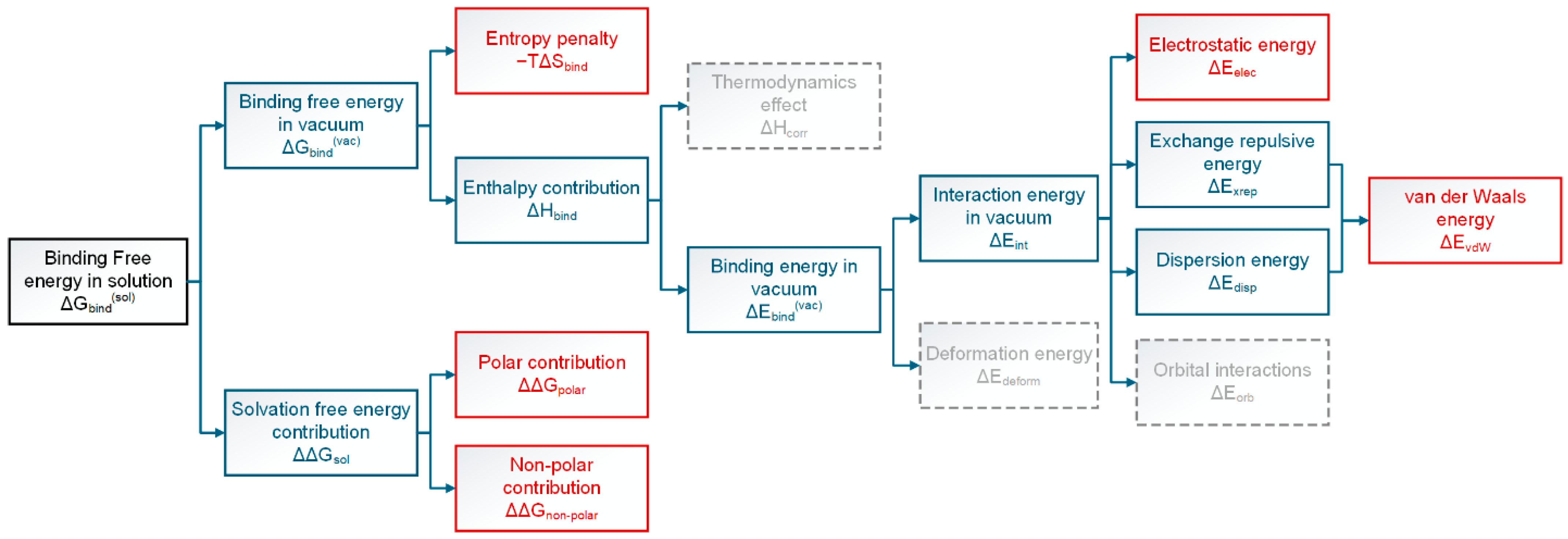
- Summary of MM-PBSA-related energy terms: ΔH, ΔEMM, ΔGpolar, ΔGnon-polar, ΔEelec, ΔEvdW, −TΔS, and ΔG (ΔH is the summation of ΔEMM, ΔGpolar, and ΔGnon-polar, according to Section 3.1). Standard deviations are provided for all terms except −TΔS and ΔG.
- Changes in the above energy terms (except −TΔS and ΔG) along the trajectory.
- Average of the above energy terms (except −TΔS and ΔG) decomposed to each residue along the trajectory.
- Binding energy decomposed to each atom and shown as B-factor putty mode with user’s PyMOL (optional).
2.2. User Interface
2.3. Accuracy and Performance Test
2.4. Binding Energy Calculation: Case Studies
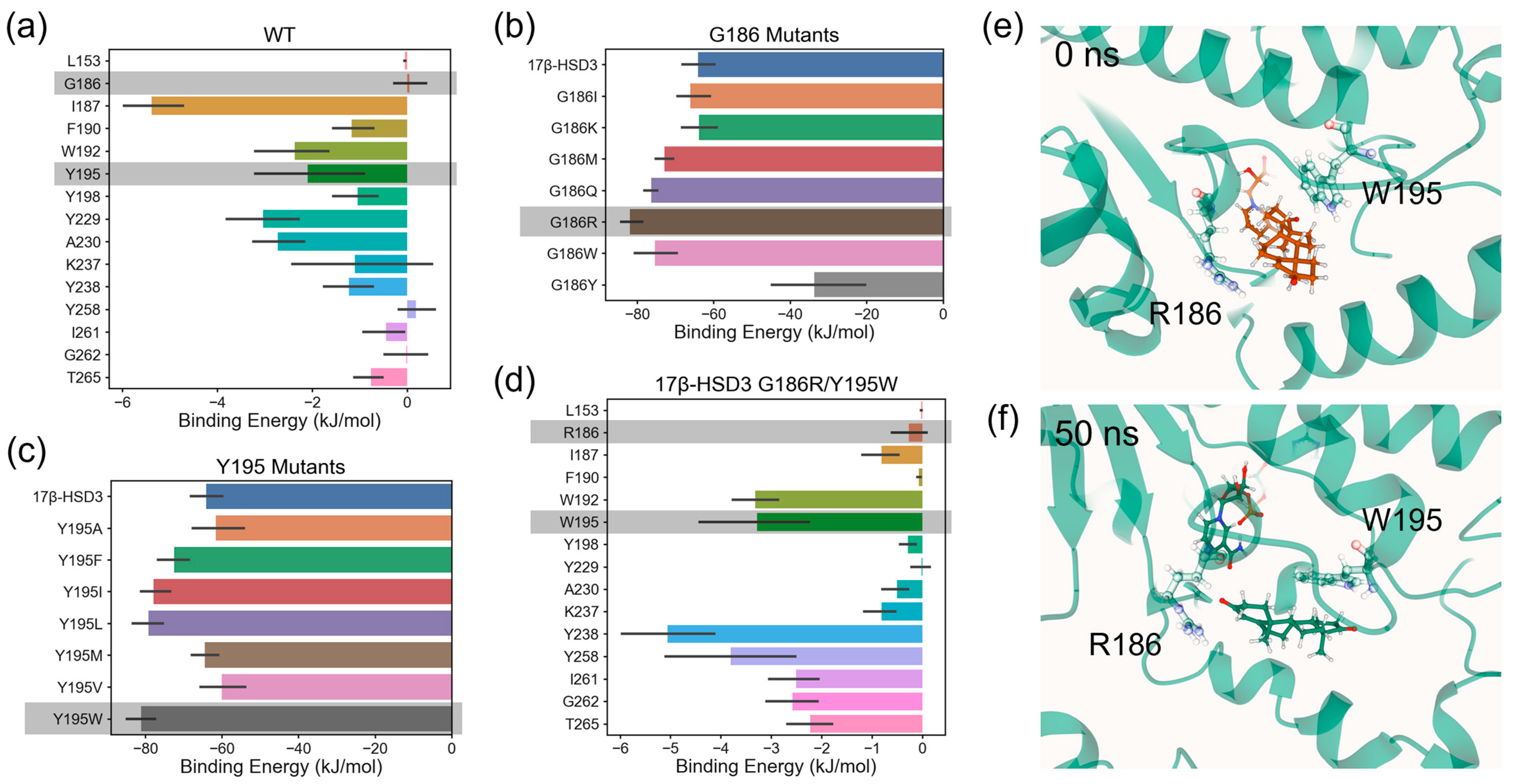
2.4.1. Case 1: Enzyme Computational Design
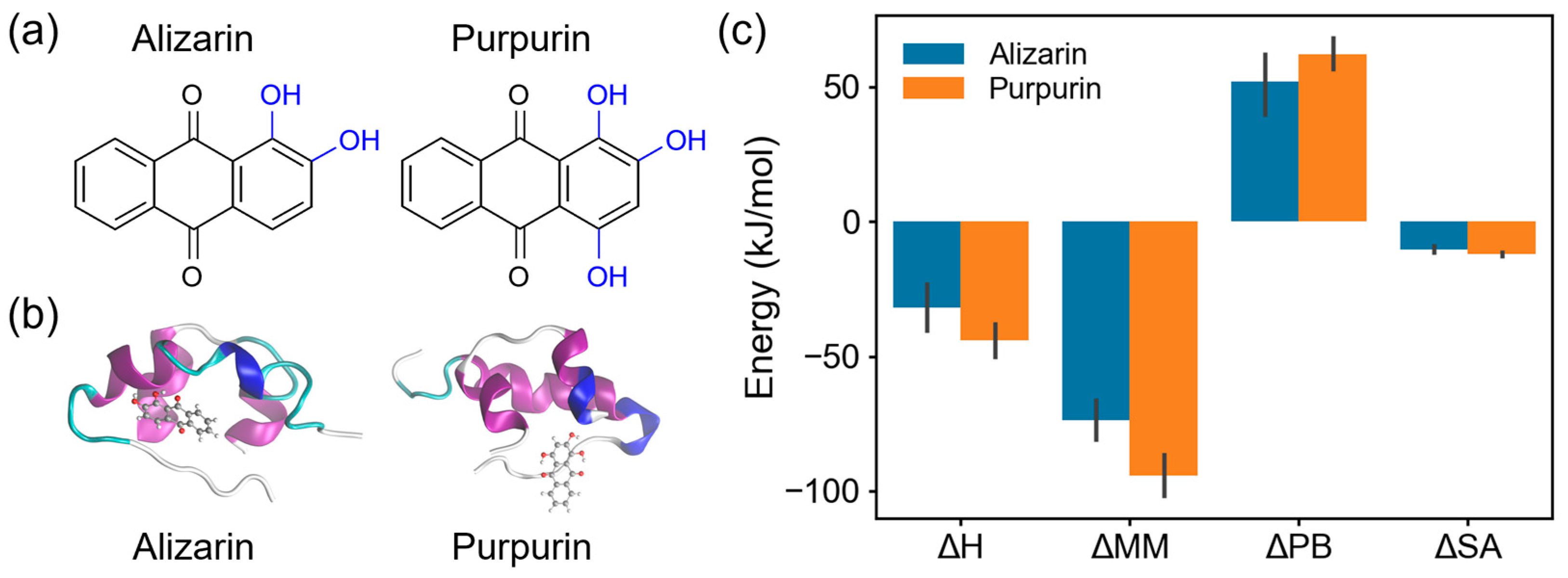
2.4.2. Case 2: Anti-Aggregation Inhibitor Analysis
3. Materials and Methods
3.1. Binding Energy Calculation
3.1.1. Molecular Mechanics Potential Energy
3.1.2. Solvation Energy
3.1.3. Entropy Penalty
3.1.4. Electric Screening Correction
3.1.5. Residue Decomposition
3.2. Alanine Scanning
3.3. Molecular Dynamics Simulation
3.4. Accuracy and Performance Comparation
4. Conclusions
Supplementary Materials
Author Contributions
Funding
Institutional Review Board Statement
Informed Consent Statement
Data Availability Statement
Acknowledgments
Conflicts of Interest
Appendix A. Theory of Molecular Interactions and Binding Energy Calculation

Appendix B. Program Architecture and Installation
Appendix C. Publications Utilizing s_mmpbsa

| Journal | Year | Volume(Issue) | Pages | JCR |
|---|---|---|---|---|
| Nat. Commun. | 2025 | 16(1) | 5060 | Q1 |
| Chem. Mater. | 2025 | 37(18) | 7326–7336 | Q1 |
| J. Hazard. Mater. | 2025 | 490(15) | 137837 | Q1 |
| Colloids. Surf. B | 2025 | 250 | 114538 | Q1 |
| J. Hazard. Mater. | 2026 | 503 | 141130 | Q1 |
| Biomacromolecules | 2026 | 27(1) | 964–977 | Q1 |
| ACS. Synth. Biol. | 2026 | 15(1) | 284–296 | Q1 |
| Molecules | 2026 | 31 | 1092 | Q2 |
| … | … | … | … |
References
- Baker, N.A.; Sept, D.; Joseph, S.; Holst, M.J.; McCammon, J.A. Electrostatics of nanosystems: Application to microtubules and the ribosome. Proc. Natl. Acad. Sci. USA 2001, 98, 10037. [Google Scholar] [CrossRef]
- Wang, B.; Li, L.; Hurley, T.D.; Meroueh, S.O. Molecular Recognition in a Diverse Set of Protein–Ligand Interactions Studied with Molecular Dynamics Simulations and End-Point Free Energy Calculations. J. Chem. Inf. Model. 2013, 53, 2659–2670. [Google Scholar] [CrossRef]
- Ding, J.; You, S.; Zhang, J.; Zhang, H.; Wang, H.; Zhang, W.; Qi, W.; Su, R.; He, Z. Rational design of 17β-hydroxysteroid dehydrogenase type3 for improving testosterone production with an engineered Pichia pastoris. Bioresour. Technol. 2021, 341, 125833. [Google Scholar] [CrossRef] [PubMed]
- Shi, W.; Zhang, J.; Wang, Z.; Wang, W.; Peng, X.; Wang, Y.; You, S.; Su, R.; Qi, W. Discovering Effective Chiral Dipeptides against Aβ(1–42) Aggregation by the Computational Screening Strategy. ACS Chem. Neurosci. 2024, 15, 3665–3678. [Google Scholar] [CrossRef]
- Chaturvedi, S.S.; Bím, D.; Christov, C.Z.; Alexandrova, A.N. From random to rational: Improving enzyme design through electric fields, second coordination sphere interactions, and conformational dynamics. Chem. Sci. 2023, 14, 10997–11011. [Google Scholar] [CrossRef] [PubMed]
- Broom, A.; Rakotoharisoa, R.V.; Thompson, M.C.; Zarifi, N.; Nguyen, E.; Mukhametzhanov, N.; Liu, L.; Fraser, J.S.; Chica, R.A. Ensemble-based enzyme design can recapitulate the effects of laboratory directed evolution in silico. Nat. Commun. 2020, 11, 4808. [Google Scholar] [CrossRef]
- Cao, Y.; Dai, W.; Miao, Z. Evaluation of Protein–Ligand Docking by Cyscore. In Computational Drug Discovery and Design; Gore, M., Jagtap, U.B., Eds.; Springer: New York, NY, USA, 2018; pp. 233–243. [Google Scholar]
- Khan, A.; Munir, M.; Aiman, S.; Wadood, A.; Khan, A.-u. The in silico identification of small molecules for protein-protein interaction inhibition in AKAP-Lbc–RhoA signaling complex. Comput. Biol. Chem. 2017, 67, 84–91. [Google Scholar] [CrossRef]
- Joubbi, S.; Micheli, A.; Milazzo, P.; Maccari, G.; Ciano, G.; Cardamone, D.; Medini, D. Antibody design using deep learning: From sequence and structure design to affinity maturation. Briefings. Bioinf. 2024, 25, bbae307. [Google Scholar] [CrossRef]
- Liu, C.; Zhang, L.; Zhang, J.; Wang, M.; You, S.; Su, R.; Qi, W. Rational design of antibodies and development of a novel method for (1–3)-β-D glucan detection as an alternative to Limulus amebocyte lysate assay. Front. Cell. Infect. Microbiol. 2024, 14, 1322264. [Google Scholar] [CrossRef]
- Neal, J.F.; Saha, A.; Zerkle, M.M.; Zhao, W.; Rogers, M.M.; Flood, A.H.; Allen, H.C. Molecular Recognition and Hydration Energy Mismatch Combine to Inform Ion Binding Selectivity at Aqueous Interfaces. J. Phys. Chem. A 2020, 124, 10171–10180. [Google Scholar] [CrossRef] [PubMed]
- Lu, B.-S.; Naji, A.; Podgornik, R. Molecular recognition by van der Waals interaction between polymers with sequence-specific polarizabilities. J. Chem. Phys. 2015, 142, 214904. [Google Scholar] [CrossRef]
- Purisima, E.O.; Corbeil, C.R.; Gaudreault, F.; Wei, W.; Deprez, C.; Sulea, T. Solvated interaction energy: From small-molecule to antibody drug design. Front. Mol. Biosci. 2023, 10, 1210576. [Google Scholar] [CrossRef]
- Duan, L.; Liu, X.; Zhang, J.Z.H. Interaction Entropy: A New Paradigm for Highly Efficient and Reliable Computation of Protein–Ligand Binding Free Energy. J. Am. Chem. Soc. 2016, 138, 5722–5728. [Google Scholar] [CrossRef] [PubMed]
- Zwanzig, R.W. High-Temperature Equation of State by a Perturbation Method. I. Nonpolar Gases. J. Chem. Phys. 1954, 22, 1420–1426. [Google Scholar] [CrossRef]
- Kirkwood, J.G. Statistical Mechanics of Fluid Mixtures. J. Chem. Phys. 1935, 3, 300–313. [Google Scholar] [CrossRef]
- Åqvist, J.; Medina, C.; Samuelsson, J.-E. A new method for predicting binding affinity in computer-aided drug design. Protein Eng. Des. Sel. 1994, 7, 385–391. [Google Scholar] [CrossRef]
- Srinivasan, J.; Cheatham, T.E.; Cieplak, P.; Kollman, P.A.; Case, D.A. Continuum Solvent Studies of the Stability of DNA, RNA, and Phosphoramidate−DNA Helices. J. Am. Chem. Soc. 1998, 120, 9401–9409. [Google Scholar] [CrossRef]
- Wang, E.; Sun, H.; Wang, J.; Wang, Z.; Liu, H.; Zhang, J.Z.H.; Hou, T. End-Point Binding Free Energy Calculation with MM/PBSA and MM/GBSA: Strategies and Applications in Drug Design. Chem. Rev. 2019, 119, 9478–9508. [Google Scholar] [CrossRef]
- Chen, Y.-Q.; Xu, Y.; Ma, Y.-Q.; Ding, H.-M. Improving performance of screening MM/PBSA in protein–ligand interactions via machine learning. Chin. Phys. B 2025, 34, 018701. [Google Scholar] [CrossRef]
- Abraham, M.J.; Murtola, T.; Schulz, R.; Páll, S.; Smith, J.C.; Hess, B.; Lindahl, E. GROMACS: High performance molecular simulations through multi-level parallelism from laptops to supercomputers. SoftwareX 2015, 1–2, 19–25. [Google Scholar] [CrossRef]
- Pearlman, D.A.; Case, D.A.; Caldwell, J.W.; Ross, W.S.; Cheatham, T.E.; DeBolt, S.; Ferguson, D.; Seibel, G.; Kollman, P. AMBER, a package of computer programs for applying molecular mechanics, normal mode analysis, molecular dynamics and free energy calculations to simulate the structural and energetic properties of molecules. Comput. Phys. Commun. 1995, 91, 1–41. [Google Scholar] [CrossRef]
- Nelson, M.T.; Humphrey, W.; Gursoy, A.; Dalke, A.; Kalé, L.V.; Skeel, R.D.; Schulten, K. NAMD: A Parallel, Object-Oriented Molecular Dynamics Program. Int. J. Supercomput. Appl. High Perform. Comput. 1996, 10, 251–268. [Google Scholar] [CrossRef]
- Brooks, B.R.; Bruccoleri, R.E.; Olafson, B.D.; States, D.J.; Swaminathan, S.; Karplus, M. CHARMM: A program for macromolecular energy, minimization, and dynamics calculations. J. Comput. Chem. 1983, 4, 187–217. [Google Scholar] [CrossRef]
- Thompson, A.P.; Aktulga, H.M.; Berger, R.; Bolintineanu, D.S.; Brown, W.M.; Crozier, P.S.; in ‘t Veld, P.J.; Kohlmeyer, A.; Moore, S.G.; Nguyen, T.D.; et al. LAMMPS—A flexible simulation tool for particle-based materials modeling at the atomic, meso, and continuum scales. Comput. Phys. Commun. 2022, 271, 108171. [Google Scholar] [CrossRef]
- Eastman, P.; Galvelis, R.; Peláez, R.P.; Abreu, C.R.A.; Farr, S.E.; Gallicchio, E.; Gorenko, A.; Henry, M.M.; Hu, F.; Huang, J.; et al. OpenMM 8: Molecular Dynamics Simulation with Machine Learning Potentials. J. Phys. Chem. B 2024, 128, 109–116. [Google Scholar] [CrossRef]
- Huang, Y.-P.; Xia, Y.; Yang, L.; Wei, J.; Yang, Y.I.; Gao, Y.Q. SPONGE: A GPU-Accelerated Molecular Dynamics Package with Enhanced Sampling and AI-Driven Algorithms. Chin. J. Chem. 2022, 40, 160–168. [Google Scholar] [CrossRef]
- Doerr, S.; Majewski, M.; Pérez, A.; Krämer, A.; Clementi, C.; Noe, F.; Giorgino, T.; De Fabritiis, G. TorchMD: A Deep Learning Framework for Molecular Simulations. J. Chem. Theory Comput. 2021, 17, 2355–2363. [Google Scholar] [CrossRef]
- Schoenholz, S.S.; Cubuk; E.D. JAX, M.D. A framework for differentiable physics. J. Stat. Mech. Theory Exp. 2021, 2021, 124016. [Google Scholar] [CrossRef]
- Fan, Z.; Wang, Y.; Ying, P.; Song, K.; Wang, J.; Wang, Y.; Zeng, Z.; Xu, K.; Lindgren, E.; Rahm, J.M.; et al. GPUMD: A package for constructing accurate machine-learned potentials and performing highly efficient atomistic simulations. J. Chem. Phys. 2022, 157, 114801. [Google Scholar] [CrossRef] [PubMed]
- Wang, T.; He, X.; Li, M.; Li, Y.; Bi, R.; Wang, Y.; Cheng, C.; Shen, X.; Meng, J.; Zhang, H.; et al. Ab initio characterization of protein molecular dynamics with AI2BMD. Nature 2024, 635, 1019–1027. [Google Scholar] [CrossRef] [PubMed]
- Zhang, J.; Chen, D.; Xia, Y.; Huang, Y.-P.; Lin, X.; Han, X.; Ni, N.; Wang, Z.; Yu, F.; Yang, L.; et al. Artificial Intelligence Enhanced Molecular Simulations. J. Chem. Theory Comput. 2023, 19, 4338–4350. [Google Scholar] [CrossRef] [PubMed]
- Talirz, L.; Aprà, E.; Corsetti, F.; Moussa, J.E.; Poncé, S. Ltalirz/Atomistic-Software, Version V2026.3.25; Zenodo: Geneva, Switzerland, 2026; Available online: https://zenodo.org/records/19225912 (accessed on 9 May 2026).
- Paissoni, C.; Spiliotopoulos, D.; Musco, G.; Spitaleri, A. GMXPBSA 2.1: A GROMACS tool to perform MM/PBSA and computational alanine scanning. Comput. Phys. Commun. 2015, 186, 105–107. [Google Scholar] [CrossRef]
- Kumari, R.; Kumar, R.; Lynn, A. g_mmpbsa—A GROMACS Tool for High-Throughput MM-PBSA Calculations. J. Chem. Inf. Model. 2014, 54, 1951–1962. [Google Scholar] [CrossRef]
- Valdés-Tresanco, M.S.; Valdés-Tresanco, M.E.; Valiente, P.A.; Moreno, E. gmx_MMPBSA: A New Tool to Perform End-State Free Energy Calculations with GROMACS. J. Chem. Theory Comput. 2021, 17, 6281–6291. [Google Scholar] [CrossRef]
- Lu, T. A comprehensive electron wavefunction analysis toolbox for chemists, Multiwfn. J. Chem. Phys. 2024, 161, 082503. [Google Scholar] [CrossRef]
- Lv, F.; Zhang, J.; You, S.; Qi, W. From traditional to AI-driven: The evolution of intelligent enzyme engineering for biocatalysis. Biotechnol. Adv. 2026, 87, 108788. [Google Scholar] [CrossRef]
- Wang, W.; Zhang, J.; Qi, W.; Su, R.; He, Z.; Peng, X. Alizarin and Purpurin from Rubia tinctorum L. Suppress Insulin Fibrillation and Reduce the Amyloid-Induced Cytotoxicity. ACS Chem. Neurosci. 2021, 12, 2182–2193. [Google Scholar] [CrossRef] [PubMed]
- Zhang, J.; Wang, W.; Yibula, Z.; Peng, X.; Su, R.; Qi, W. Anthraquinones Inhibit Insulin Amyloidosis in Crowded Environments. Molecules 2026, 31, 1092. [Google Scholar] [CrossRef]
- Zhu, Y.-X.; Sheng, Y.-J.; Ma, Y.-Q.; Ding, H.-M. Assessing the Performance of Screening MM/PBSA in Protein–Ligand Interactions. J. Phys. Chem. B 2022, 126, 1700–1708. [Google Scholar] [CrossRef] [PubMed]
- Debye, P.; Hückel, E. Zur Theorie der Elektrolyte. Phys. Z. 1923, 9, 185–206. [Google Scholar]
- Søndergaard, C.R.; Olsson, M.H.M.; Rostkowski, M.; Jensen, J.H. Improved Treatment of Ligands and Coupling Effects in Empirical Calculation and Rationalization of pKa Values. J. Chem. Theory Comput. 2011, 7, 2284–2295. [Google Scholar] [CrossRef]
- Sousa da Silva, A.W.; Vranken, W.F. ACPYPE—AnteChamber PYthon Parser interfacE. BMC Res. Notes 2012, 5, 367. [Google Scholar] [CrossRef]
- Wang, J.; Wolf, R.M.; Caldwell, J.W.; Kollman, P.A.; Case, D.A. Development and testing of a general amber force field. J. Comput. Chem. 2004, 25, 1157–1174. [Google Scholar] [CrossRef]
- Páll, S.; Zhmurov, A.; Bauer, P.; Abraham, M.; Lundborg, M.; Gray, A.; Hess, B.; Lindahl, E. Heterogeneous parallelization and acceleration of molecular dynamics simulations in GROMACS. J. Chem. Phys. 2020, 153, 134110. [Google Scholar] [CrossRef]
- Jorgensen, W.L.; Chandrasekhar, J.; Madura, J.D.; Impey, R.W.; Klein, M.L. Comparison of simple potential functions for simulating liquid water. J. Chem. Phys. 1983, 79, 926–935. [Google Scholar] [CrossRef]
- Bussi, G.; Donadio, D.; Parrinello, M. Canonical sampling through velocity rescaling. J. Chem. Phys. 2007, 126, 014101. [Google Scholar] [CrossRef] [PubMed]
- Parrinello, M.; Rahman, A. Polymorphic transitions in single crystals: A new molecular dynamics method. J. Appl. Phys. 1981, 52, 7182–7190. [Google Scholar] [CrossRef]
- Essmann, U.; Perera, L.; Berkowitz, M.L.; Darden, T.; Lee, H.; Pedersen, L.G. A smooth particle mesh Ewald method. J. Chem. Phys. 1995, 103, 8577–8593. [Google Scholar] [CrossRef]
- Hess, B.; Bekker, H.; Berendsen, H.J.C.; Fraaije, J.G.E.M. LINCS: A linear constraint solver for molecular simulations. J. Comput. Chem. 1997, 18, 1463–1472. [Google Scholar] [CrossRef]
- Ding, H.; Yin, Y.; Ni, S.; Sheng, Y.; Ma, Y. Accurate Evaluation on the Interactions of SARS-CoV-2 with Its Receptor ACE2 and Antibodies CR3022/CB6. Chin. Phys. Lett. 2021, 38, 018701. [Google Scholar] [CrossRef]
- Case, D.A.; Cheatham, T.E., III; Darden, T.; Gohlke, H.; Luo, R.; Merz, K.M., Jr.; Onufriev, A.; Simmerling, C.; Wang, B.; Woods, R.J. The Amber biomolecular simulation programs. J. Comput. Chem. 2005, 26, 1668–1688. [Google Scholar] [CrossRef] [PubMed]
- Bondi, A. van der Waals Volumes and Radii. J. Phys. Chem. 1964, 68, 441–451. [Google Scholar] [CrossRef]


| Startup Options | Input Parameter | Description |
|---|---|---|
| -f | md.xtc/pdb/gro | input trajectory file path |
| -s | md.tpr | input tpr file path |
| -n | index.ndx | input index file path |
| -a, --analyze | example.sm | enter analysis mode |
| -c, --config | [config.yaml] | assign config file path; if not provided, generate config.yaml at current directory |
| -v, --version | — | show version info |
| -h, --help | — | print help |
Disclaimer/Publisher’s Note: The statements, opinions and data contained in all publications are solely those of the individual author(s) and contributor(s) and not of MDPI and/or the editor(s). MDPI and/or the editor(s) disclaim responsibility for any injury to people or property resulting from any ideas, methods, instructions or products referred to in the content. |
© 2026 by the authors. Licensee MDPI, Basel, Switzerland. This article is an open access article distributed under the terms and conditions of the Creative Commons Attribution (CC BY) license.
Share and Cite
Zhang, J.; Gu, T.; Li, C.; Qi, W. s_mmpbsa: A Lite and Cross-Platform MM-PBSA Program. Molecules 2026, 31, 1683. https://doi.org/10.3390/molecules31101683
Zhang J, Gu T, Li C, Qi W. s_mmpbsa: A Lite and Cross-Platform MM-PBSA Program. Molecules. 2026; 31(10):1683. https://doi.org/10.3390/molecules31101683
Chicago/Turabian StyleZhang, Jiaxing, Tao Gu, Chuanxi Li, and Wei Qi. 2026. "s_mmpbsa: A Lite and Cross-Platform MM-PBSA Program" Molecules 31, no. 10: 1683. https://doi.org/10.3390/molecules31101683
APA StyleZhang, J., Gu, T., Li, C., & Qi, W. (2026). s_mmpbsa: A Lite and Cross-Platform MM-PBSA Program. Molecules, 31(10), 1683. https://doi.org/10.3390/molecules31101683