Article

Novel Aloe-Emodin Derivatives as Potential Anticancer Agents: Synthesis, Characterization and Cytotoxic Activity


1
SISSTEM Program, Faculty of Arts and Science, University of Aruba, J. Irausquinplein 4, Oranjestad, Aruba
2
Institut de Science et D’ingénierie Supramoléculaires, University of Strasbourg, 8 Allée Gaspard Monge, 67000 Strasbourg, France
3
School of Pharmacy, Chengdu University of Traditional Chinese Medicine, Chengdu 611137, China
4
Department of Chemical Engineering, KU Leuven, Celestijnenlaan 200F, B-3001 Leuven, Belgium
5
Department of Chemistry, KU Leuven, Celestijnenlaan 200F, B-3001 Leuven, Belgium
*
Author to whom correspondence should be addressed.
Molecules 2026, 31(10), 1676; https://doi.org/10.3390/molecules31101676
Submission received: 3 April 2026 / Revised: 29 April 2026 / Accepted: 5 May 2026 / Published: 15 May 2026
(This article belongs to the Section Organic Chemistry)

Abstract

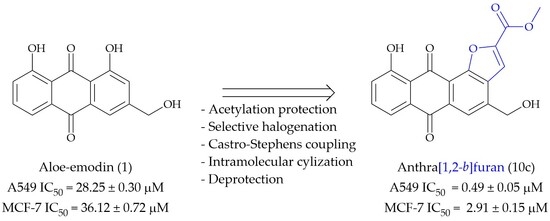
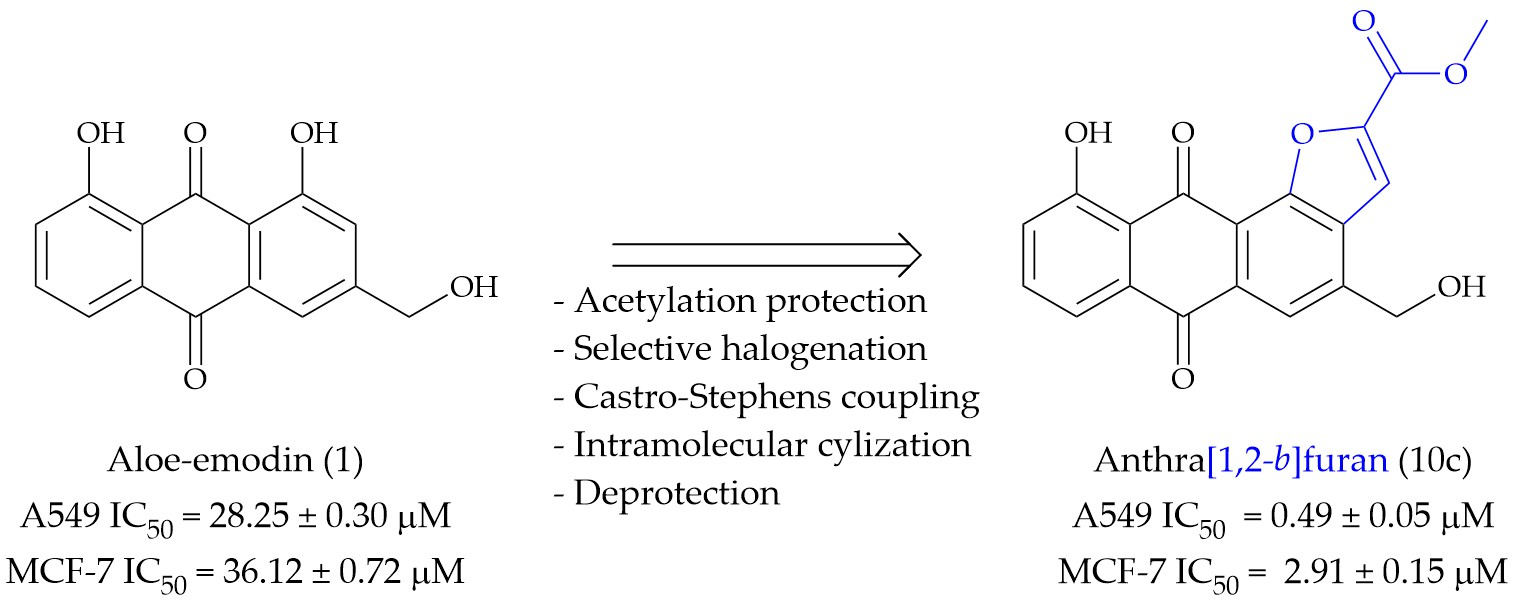
The fusion of heterocycles onto an anthraquinone scaffold represents a promising strategy to optimize anticancer activity. This study has the aim to synthesize and characterize novel anthra[1,2-b]furan compounds based on the natural product aloe-emodin. Six novel anthra[1,2-b]furans bearing phenyl, n-hexane, and methoxy carbonyl substituents were synthesized starting from aloe-emodin. The synthetic route employed involved acetyl protection of aloe-emodin, electrophilic aromatic halogenation, subsequent Castro–Stephens coupling, spontaneous intramolecular cyclization, and deprotection of hydroxyl groups. These newly synthesized compounds were evaluated for their cytotoxic activity against various cancer cell lines, including lung adenocarcinoma (A5492), colorectal carcinoma (HCT116), hepatocellular carcinoma (HepG2), ovarian cancer (Skov3), and breast cancer (MCF-7), using the CCK8 assay. The anthra[1,2-b]furan derivative 10c, which contains a methoxy carbonyl group, demonstrated excellent potency against lung (A549) and breast (MCF-7) cancer cell lines, with IC50 values of 0.49 and 2.91 µM, respectively. This preliminary cytotoxic finding shows compound 10c as a promising hit for further investigations towards a promising lead compound.

Graphical Abstract

1. Introduction

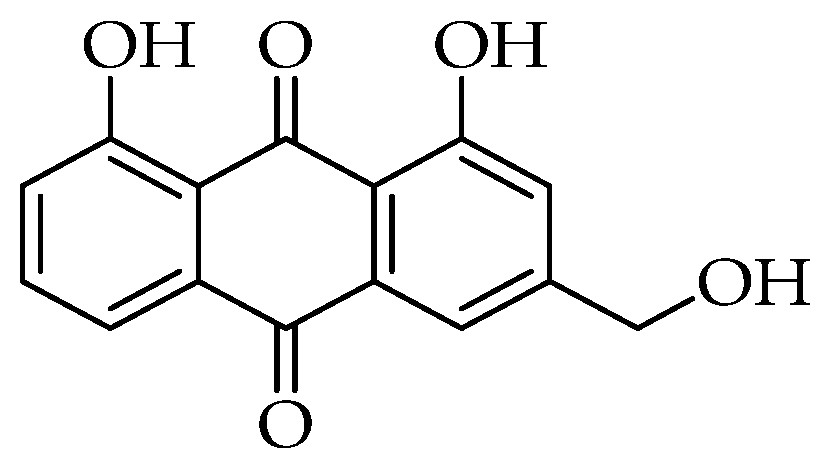
Aloe-emodin (Figure 1) is a naturally occurring anthraquinone that is widely found in plants such as Cassia occidentalis, Polygonum multiflorum Thunb, Rheum palmatum, and Aloe vera [1]. Aloe-emodin has been an attractive candidate for drug discovery over the years due to its broad range of biological applications as anticancer [2,3], anti-inflammation [4], antimicrobial [5], antioxidant [6], and photodynamic therapy [7,8] agents. In cancer research, aloe-emodin has shown excellent activity against a wide variety of cancer cell lines, e.g., bladder [9], breast [10], cervical [11], colon [12], gastric [13], leukemia [14], liver [15], lung [16,17], nasopharyngeal [18,19], neuroectodermal tumors [20], oral [21], ovarian [22], prostate [23], and tongue [24] cancer cells. The potent effects of aloe-emodin likely stem from its planar and rigid structure, which allows it to intercalate between the DNA base pairs within the double helix [25,26,27], thereby inducing irreversible cellular damage [28,29,30]. Although aloe-emodin shows promising activity with wide application in cancer research, it possesses challenges for drug development. Its application to a wide variety of cancer cell types has been reported to occur via five primary signaling pathways, e.g., induction of cell cycle arrest and apoptosis, inhibition of metastasis and angiogenesis, regulation of autophagy, overcoming drug resistance, and regulating tumor microenvironment [31]. Its ability to target multiple signaling pathways results in poor selectivity and specificity, which are needed for effective drug targeting. This also leads to challenges in understanding its specific biological effects in the human body and the emergence of side effects due to long-term exposure [31]. In toxicity studies, aloe-emodin has been shown to be phototoxic, hepatotoxic, nephrotoxic, and genotoxic, which are all of concern for future clinical applications [1,3]. Lastly, aloe-emodin has poor water solubility, low intestinal absorption, and poor bioavailability [32,33].
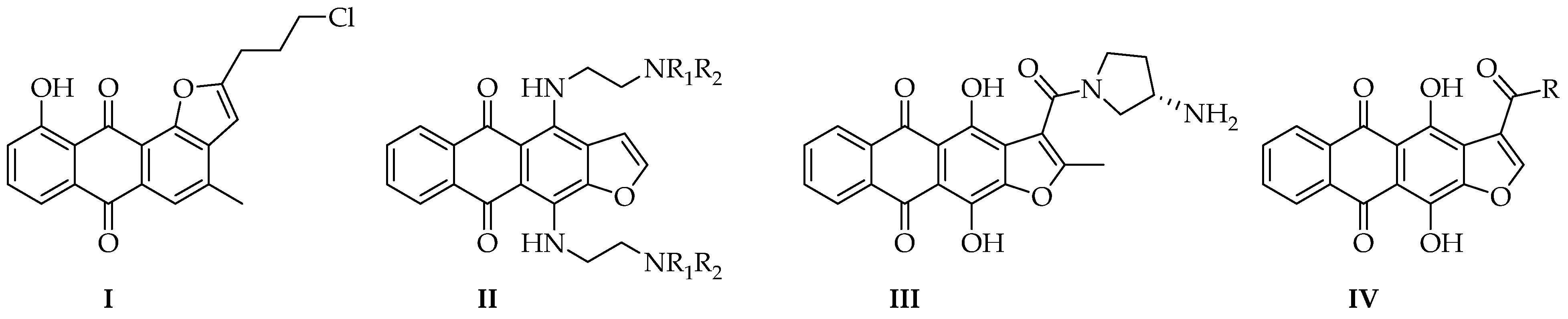
Significant work has been dedicated in the last few decades (2003–2025) to the study of the biological properties of aloe-emodin that has been modified via the phenolic and benzylic hydroxyl groups [34]. For example, Kumar et al. [35] synthesized aloe-emodin derivatives bearing pyrazole substituents that showed improved potency against breast, liver, and skin cancer cells. In another study, aloe-emodin was modified at the benzylic hydroxyl position to incorporate furan substituents that showed high cytotoxic activity against oral cancer cell through CLK kinase inhibition [36]. Aromatic carbon functionalization of aloe-emodin for improved biological potency remains an unexplored research area. Several anthraquinones bearing ring structures such as furan moieties have shown promising anticancer activity (Figure 2). For example, anthra[1,2-b]furan I showed the highest growth inhibition against multiple cancer cells lines with IC50 values ranging from 0.38 to 1.9 µM [37]. In another study, anthra[2,3-b]furan derivatives II showed good antiproliferative activity against lymphocytic leukemia (L1210), T lymphoblast (CEM), cervical cancer (HeLa), and colon cancer (HCT116) cell lines with IC50 value ranging from 0.10 to 0.55 µM [38]. On the other hand, anthra[2,3-b]furans III with carboxamides as a spacer group showed good inhibition of topoisomerases (1 & 2) and protein kinases, while exhibiting potent activity against drug-resistant tumor cells [39]. Further structural substitutions at the carboxamide spacer group led to the production of anthra[2,3-b]furans IV. The analog IV containing (S)-3-aminopyrrolidine and 3-aminopiperidine substituents showed the highest antiproliferative potency against leukemia (L210 & K562), T lymphoblast (CEM), cervical cancer (HeLa), and colon cancer (HCT116) with IC50 values in the range of 0.6–3.4 µM. These derivatives also showed inhibition of topoisomerase 1 and were able to bypass drug resistance in gastric cancer cells leading to apoptosis despite p53 deficiency [40]. Five-membered ring fusion on the anthraquinone core shows promising results for anticancer research. This type of fusion maintains the planarity and rigidity of the anthraquinone structure, while also providing opportunities for modifications of its physical properties.
In this study, we report a series of anthra[1,2-b]furan derivatives synthesized from aloe-emodin via a four-step route, including acetyl protection of aloe-emodin, selective halogenation, Castro–Stephens coupling, spontaneous intramolecular cyclization, and deprotection of the hydroxyl groups. A preliminary screening was performed to analyze the cytotoxic activity of the anthra[1,2-b]furan derivatives against five cancer cell lines: lung adenocarcinoma (A5492), colorectal carcinoma (HCT116), hepatocellular carcinoma (HepG2), ovarian cancer (Skov3), and breast cancer (MCF-7).

2. Results and Discussion

2.1. Chemistry

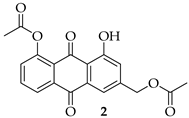
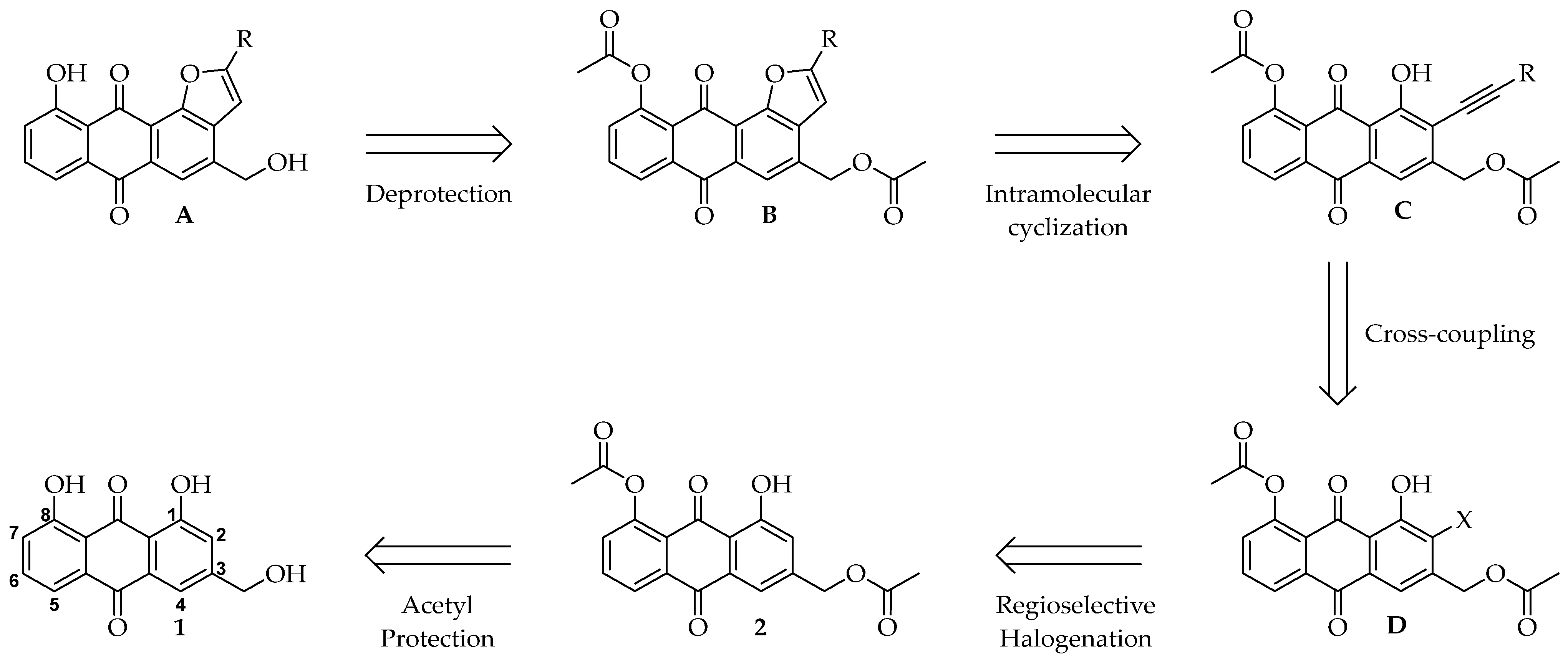
The strategy to incorporate a furan group at the C2 position of aloe-emodin 1 to produce anthra[1,2-b]furan A derivatives is shown in Scheme 1. This strategy includes acetyl protection of hydroxyl groups, halogenation, cross-coupling, intramolecular cyclization, and deprotection of the hydroxyl groups. Our preliminary results indicated that halogenation of aloe-emodin 1 yielded multiple substituted products that could not be separated. Horvat et al. reported similar findings for the halogenation of emodin, which also produced multiple substituted products [41]. Therefore, direct halogenation of aloe-emodin 1 to afford intermediate D was not considered an option. Bringmann et al. [42] reported that bromine could be introduced to the C2 position of aloe-emodin 1 by brominating the acetylated intermediate 2. Thus, selective protection of the 8-OH group with an acetyl group leaves the 1-OH group open to act as an ortho director for electrophilic aromatic substitution [43]. The strategy was adapted to produce intermediate C by applying Sonogashira cross-coupling to acetylated intermediate D (X = Br).
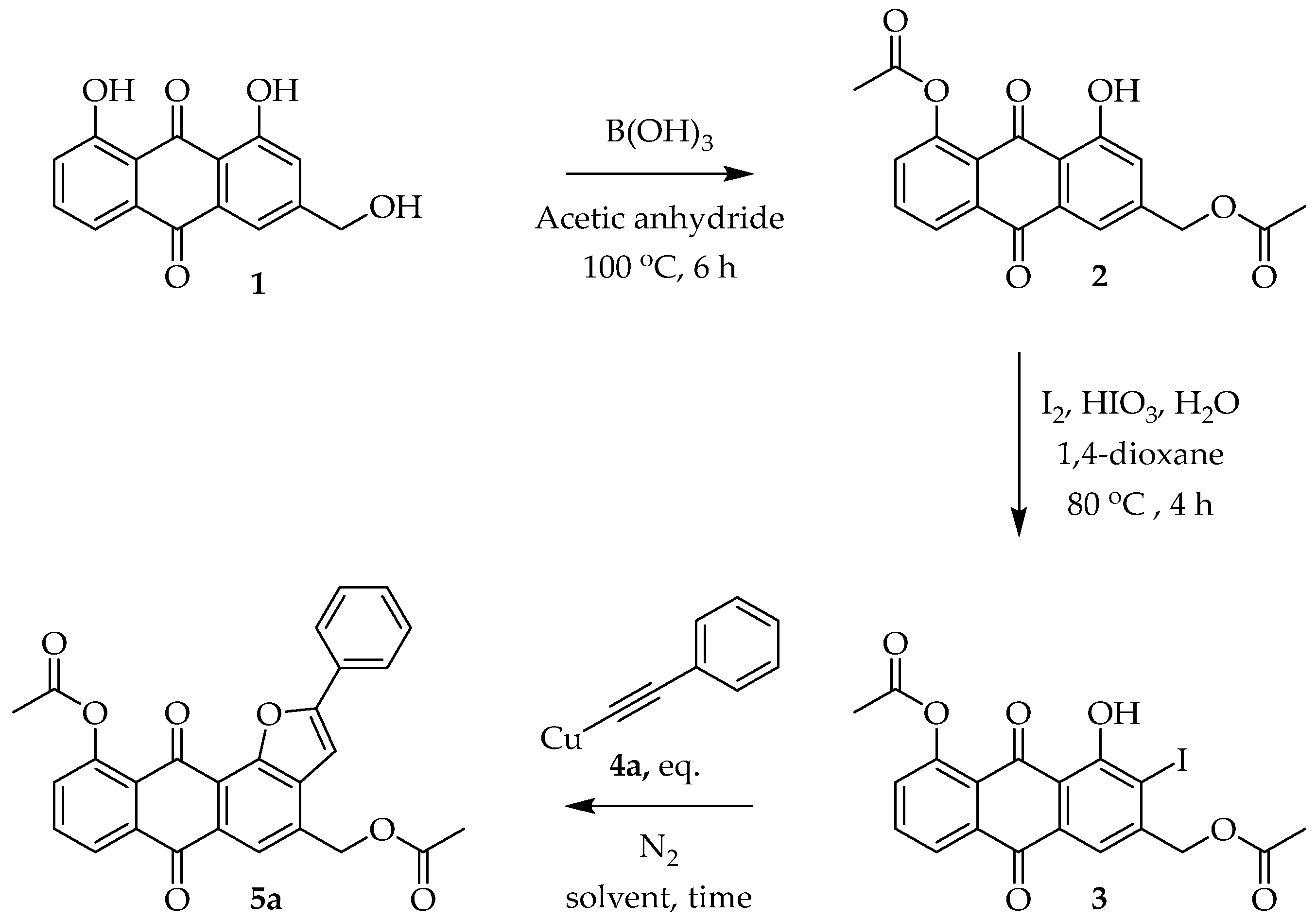
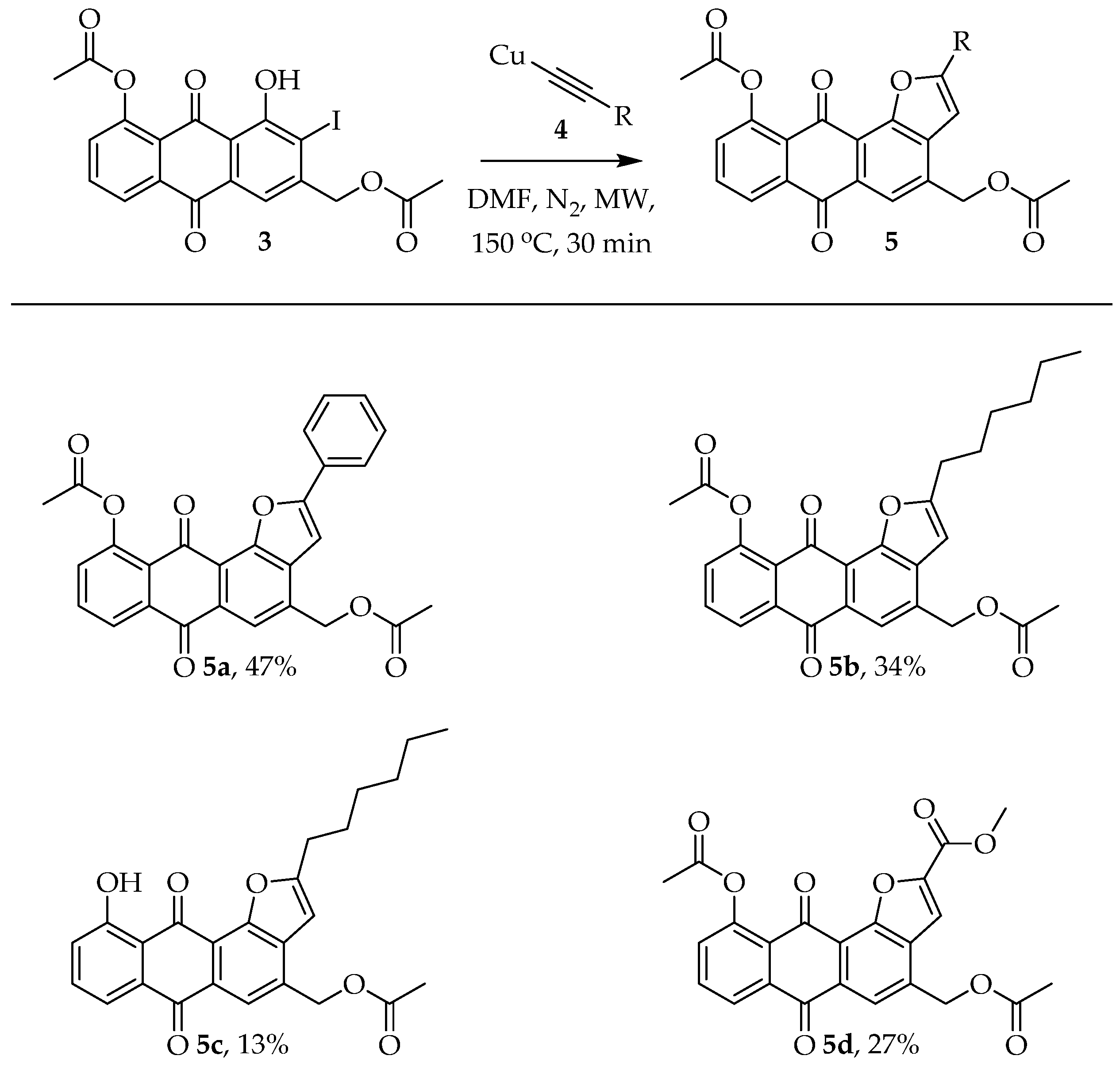
The introduction of an alkyne substituent could not be achieved using the acetylated intermediate D (X = Br), despite multiple attempts with different acetylenes, palladium sources, temperatures, and solvents. The size of the palladium source could have hindered the cross-coupling between the alkynyl moiety and the 2-position of the anthraquinone due to steric crowding at that position. Castro–Stephens cross-coupling was considered as a potential substitution for the Sonogashira reaction, due to the use of the less sterically hindered organometallic copper(I) reagent. The Castro–Stephens strategy also did not lead to the cross-coupling between the bromine and an alkyne substituent which was likely due to the strong bond between the aryl group and the bromine. To facilitate cross-coupling, replacement of the bromine on the acetylated intermediate D with a more reactive iodine atom was considered. Iodination of acetylated intermediate 2 with iodine (I2) and iodic acid (HIO3) afforded aloe-emodin iodide 3 in 78% yield (Scheme 2). For the synthesis of anthra[1,2-b]furan A, a Castro–Stephens cross-coupling reaction previously reported by Mzhelskaya and Rixson et al. [37,43] was considered. Both studies describe methods for synthesizing anthra[1,2-b]furan derivatives in good yield using iodoanthracenes and acetylenes. Therefore, similar methods were applied to synthesize anthra[1,2-b]furan 5a from the aloe-emodin iodide 3 (Table 1).
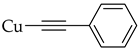
The Castro–Stephens coupling of aloe-emodin iodide 3 yielded 20% anthra[1,2-b]furan 5a, when (phenylethynyl)copper 4a in DMF was used under reflux for 1.5 h (Table 1, Entry 1). The yield of 5a was only slightly improved to 21% despite the increase in reaction time from 1.5 to 4 h (Table 1, Entry 2). This could have happened due to the decomposition of intermediate 3 at the high reaction temperature of 150 °C. However, reducing the reaction temperature to 110 °C and extending the reaction time to 48 h further decreased the yield to 10% (Table 1, Entry 3), likely due to the poor solubility of (phenylethynyl)copper 4a at low temperatures. Further optimization was accomplished by increasing the amount of (phenylethynyl)copper 4a from 1.5 to 3.0 eq. and reacting at 150 °C for 1.5 h, which improved the yield to 30% (Table 1, Entry 4). The yield was further improved to 47% by running the reaction under microwave-irradiation at 150 °C for 30 min (Table 1, Entry 5). Changes in the solvent type led to a decrease in the yield (Table 1, Entry 6–7). Another strategy employed was to improve the solubility of (phenylethynyl)copper 4a by adding dimethylethylenediamine (DMEDA). Rixson et al. [37] reported a yield of up to 64% for the synthesis of anthra[1,2-b]furan using (phenylethynyl)copper 4a in toluene with DMEDA as the base at 90 °C for 18 h. However, this method did not lead to production of the desired product 5a even with an extension of the reaction time to 72 h (Table 1, Entry 8).
The optimal reaction conditions chosen for the synthesis of 5a were 1.0 eq. aloe-emodin iodide 3, 3.0 eq. cuprous acetylide in DMF under nitrogen with microwave-assistance at 150 °C for 30 min. Anthra[1,2-b]furan derivatives with n-hexyl and methoxycarbonyl substituents starting from aloe-emodin iodide 3 were synthesized with the established optimal conditions (Scheme 3). Protected anthra[1,2-b]furan 5b and mono-protected anthra[1,2-b]furan 5c containing the n-hexyl moiety were produced in 34% and 13% yield, respectively. On the other hand, the protected anthra[1,2-b]furan 5d bearing the methoxy carbonyl substituent was synthesized in 27% yield.
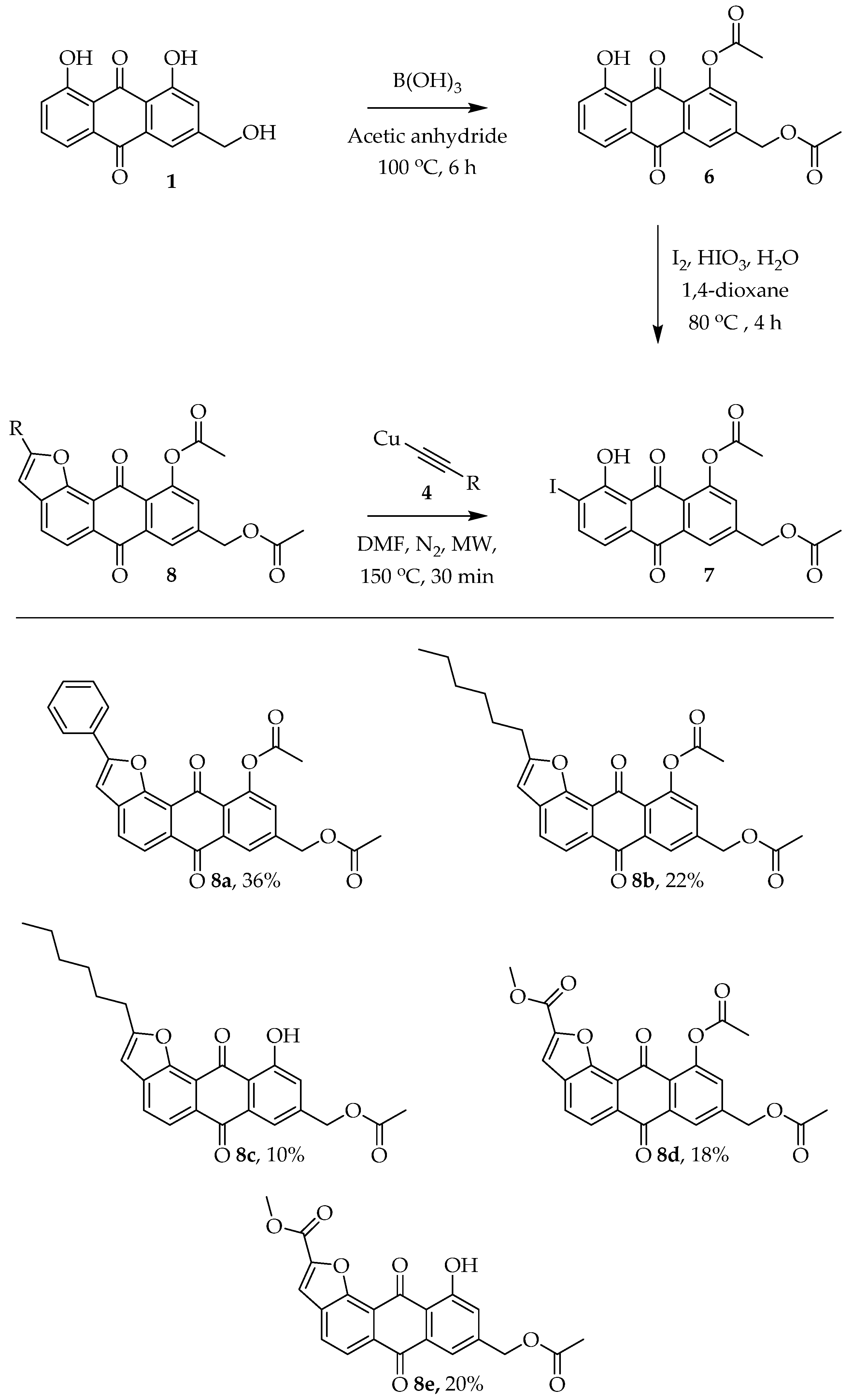
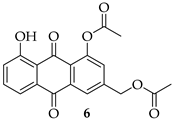
Many studies focus on synthesizing ring-fused anthraquinones through the C1 position, but there has not been any documentation on C7 modifications or their relevance for improved cytotoxic activity. Therefore, anthra[1,2-b]furans 8 were synthesized starting from the acetylated intermediate 6 (Scheme 4). The acetylated intermediate 6 is an isomer that is produced together with compound 2 during the acetylation reaction. Purification of acetylated intermediate 6 proved challenging despite the use of multiple solvent systems as chromatography eluent, including mixtures containing chloroform, petroleum ether, toluene, dichloromethane. Ultimately, partial purification of 6 was accomplished by repeated crystallization with chloroform–petroleum ether (1:1) followed by toluene. Iodination of acetylated intermediate 6 yielded aloe-emodin iodide 7 in 77% yield, undergoing similar ortho directing principle as compound 2. The established optimal conditions were further applied to synthesize anthra[1,2-b]furans 8ae in low to fair 10–36% yield.
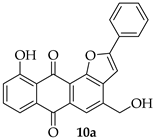
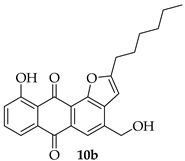
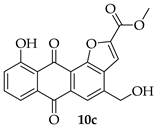
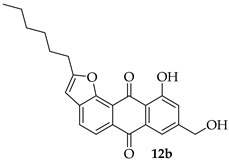
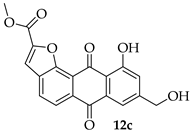
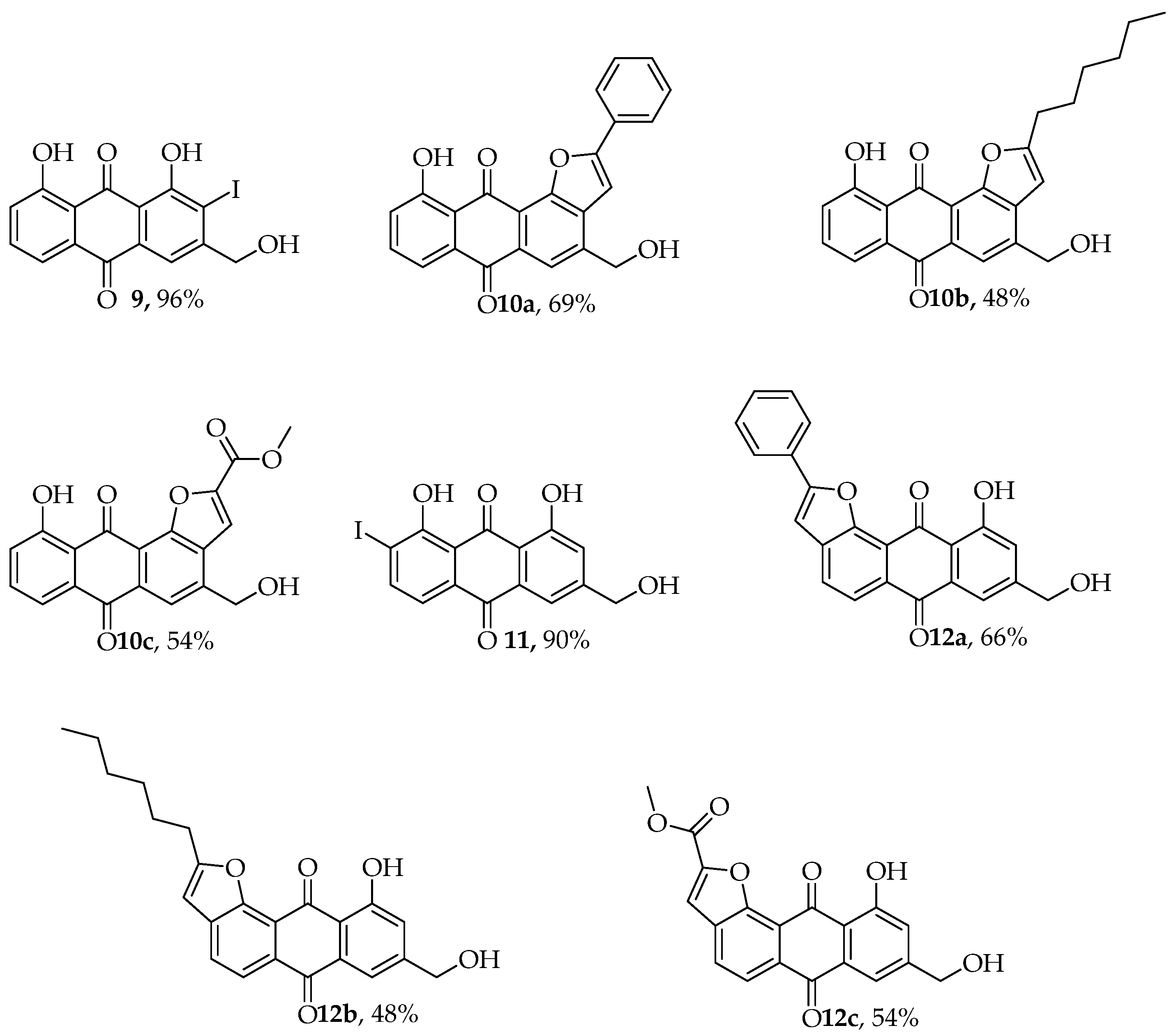
The main challenge encountered was the purification step. The Castro–Stephens cross-coupling reaction led to multiple side products including partial deprotection, which were not easily separated from the desired product due to close polarities and poor solubility in multiple organic solvents systems. Anthra[1,2-b]furans 8d and 8e proved to be the most challenging to characterize due to purification issues arising due to poor solubility, multiple side products and close polarity that afforded low yields. Therefore, an alternative strategy was employed, to confirm the synthesis of anthra[1,2-b]furans 8d and 8e. The alternative strategy was to immediately deprotect the hydroxyl groups after Castro–Stephens cross-coupling without prior purification to afford the anthra[1,2-b]furan 12c (Figure 3). The crude product obtained from the cross-coupling, containing 8d and 8e, was added to methanolic HCl under reflux overnight to produce the anthra[1,2-b]furan 12c in 54% yield. The same strategy was employed for derivatives 10ac and 12ab to investigate whether higher overall yields could be achieved. As a result, the purification efficiency via column chromatography was significantly improved, and an increase in overall yield of 48–69% was observed for both 10ac and 12ab derivatives (Figure 3).

2.2. Cytotoxic Evaluation

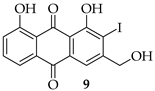
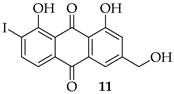
The cytotoxic activity of the anthra[1,2-b]furans against lung (A549), colon (HCT116), liver (HEPG2), ovarian (Skov3), and breast (MCF-7) cancer cell lines was compared to aloe-emodin 1 and its iodinated derivatives 9 and 11 (Table 2). Anthra[1,2-b]furan derivative 10c showed the highest cytotoxic activity against all cancer cell lines compared to aloe-emodin 1 and other derivatives. The highest cytotoxic activity of 10c was observed against A549 and MCF-7 with IC50 values of 0.49 and 2.91 µM, respectively. The preliminary analysis on the structure–activity relationship (SAR) shows that (1) the introduction of iodine at the C2 position improved potency, (2) there was no correlation between improved cytotoxicity and the positioning of the furan group to either the C2 or C7 position, and (3) C2-positioned anthra[1,2-b]furans with a methoxy carbonyl substituent were essential for improved cytotoxic activity against all cancer cell lines. Compound 9 containing an iodine at the C2 position showed improved cytotoxic activity, while iodination at C8 as for 11 led to a worsened potency compared to aloe-emodin 1. Noticeably, the cytotoxicity improved from acetylated intermediate 2 to acetylated iodide intermediate 3 to the non-acetylated iodide intermediate 9. However, the opposite was true for iodination at the C8 position, whereby the potency improved from non-acetylated iodide intermediate 11 to acetylated iodide intermediate 7 towards acetylated intermediate 6. Further comparison between the acetylated and non-acetylated anthra[1,2-b]furans in the future could elucidate whether the 1-hydroxyl and 8-hydroxyl groups are essential for cytotoxicity. Multiple reports on anthraquinones have highlighted the importance of hydroxyl groups for hydrogen bonding with DNA and/or amino acid residues [27,44,45,46]. The positioning of the iodine seems to be important for improved cytotoxicity. In contrast, the position of the furan group at either the C2 or C7 position did not lead to clear cytotoxicity improvements. For instance, derivatives containing the methoxy carbonyl (10c and 12c) group showed the highest cytotoxicity activity compared to the other anthra[1,2-b]furans. Compounds containing phenyl and n-hexyl groups showed less cytotoxicity compared to aloe-emodin 1. These results indicate the importance of the methoxycarbonyl group for the cytotoxicity of anthra[1,2-b]furans 10c. Anthra[1,2-b]furan 10a showed the least potency compared to all tested derivatives, which could be due to its poor solubility in most organic solvents, including DMSO which was the solvent used for the cytotoxic evaluation. Poor solubility can lead to underestimation of cytotoxic activity due to compound precipitation [47].

3. Materials and Methods

3.1. General Section

Chemicals and solvents were purchased from commercial sources (Acros Organics (Geel, Belgium), BLD Pharmatech (Reinbek, Germany), Carl Roth, Fisher Scientific (Loughborough, Belgium), Fluorochem EU Limited (Hadfield, UK), or Merck Life Science (Darmstadt, Germany)) and used without further purification. The microwave-assisted reactions were performed using the CEM-Discover Microwave Synthesizer, a flexible single instrument. The reactions were performed in a 10 mL glass tube sealed with a Teflon septum. Thin-layer chromatography (TLC) was performed on silica gel (60 Å pore size) with a fluorescent indicator (254 nm). TLC visualization was performed with UV irradiation at 254 nm or 365 nm. Column chromatography was performed using 70–230 mesh silica gel 60 (Acros Organics, Geel, Belgium) as the stationary phase. Melting points were analyzed on purified derivatives using a Reichert Thermovar (Carrollton, TX, USA) instrument. High-field nuclear magnetic resonance (NMR) spectra were recorded on a Bruker Avance III HD 400 spectrometer with a Bruker AscendTM 400 magnet system (1H basic frequency of 400.17 MHz) and a 5 mm PABBO BB/19F-1H/D probe with z-gradients or on a Bruker Avance II+ 600 spectrometer with a Bruker 600 UltraShieldTM magnet system (1H basic frequency of 600.13 MHz) and a 5 mm PABBO BB-1H/D probe with z-gradients. 13C-detected experiments were 1H-decoupled using power-gated and inverse-gated broadband decoupling, respectively. All samples were dissolved in chloroform-d (CDCl3) or DMSO-d6. Data were recorded at room temperature using Bruker TopSpin 3.x.x (Bruker Avance III HD 400 and Bruker Avance II+ 600 spectrometers) and processed and analyzed using Bruker TopSpin 4.2.x. 1H data were calibrated using tetramethylsilane (TMS) as an internal calibration reference, while 13C data were calibrated using the deuterated solvents as internal calibration reference (for CDCl3, a 1:1:1 triplet at 77.16 ppm; and for DMSO-d6, a 1:3:6:7:6:3:1 septet at 39.52 ppm). The chemical shifts (δ) were expressed in parts per million (ppm). The following acronyms were used for multiplicity: singlet (s), doublet (d), triplet (t), quartet (q), multiplet (m). The prefix app. denotes the apparent multiplicity of a signal, indicating the general shape and form of the multiplet in the spectrum, even though this is not theoretically expected based on the molecular structure of the compound and/or some higher-order fine structure could be observed. The coupling constant (J) is reported in Hertz (Hz). High-resolution mass spectra (HRMS) with exact masses were obtained using a quadrupole orthogonal acceleration time-of-flight mass spectrometer (Synapt G2 HDMS, Waters, Milford, MA, USA). Samples were infused at 3 mL/min and spectra were obtained in positive ionization mode with a resolution of 15,000 FWHM (full width at half maximum) using leucine enkephalin as a lock mass. The synthesized compounds 2-12c are provided in the Supplementary Material.

3.2. Experimental Section

3.2.1. General Protocol for Acetylation

The procedure by Alexander et al. [48] was used with minor modifications. Boric acid (1.0 g, 16 mmol) was added to acetic anhydride (20 mL, 0.36 mol) and stirred at 100 °C until complete dissolution. Thereafter, aloe-emodin (1.0 g, 3.8 mmol) was added to the mixture and reacted at 100 °C for 6 h. Conversion was monitored via TLC. The mixture was left to cool down to room temperature once full conversion was achieved. The mixture was poured into water (60 mL) and heated at 50 °C for 30 min for acetic anhydride hydrolysis to occur. The mixture was cooled after to room temperature, at which point a yellow solid precipitate developed. This precipitate was filtered via vacuum filtration, dried in a vacuum oven, and further purified via crystallization. The yellow solid was a mixture of compounds 2 and 6. Rf = 0.9 (DCM/MeOH 9:1).

3.2.2. General Protocol for Iodination

The procedure by Mzhelskaya et al. [43] was used with minor modifications. A mixture of iodine (375 mg, 3.0 mmol) and iodic acid (260 mg, 1.5 mmol) dissolved in water (3 mL) was added to a solution consisting of acetylated aloe-emodin dissolved in 1,4-dioxane (9 mL) and left to react at 80 °C for 4 h. Conversion was monitored via TLC. The mixture was left to cool down to room temperature once full conversion was achieved. The mixture was poured into water (50 mL), and the precipitate was filtered via vacuum filtration and recrystallized from toluene.

3.2.3. General Protocol for Cuprous Acetylide Synthesis

The procedure from Rixson et al. [37] was used and adapted with minor modifications. A mixture of CuCl (200 mg, 2.0 mmol, 1.2 eq) and NH4OH (28%, 1.25 mL) was added dropwise to a solution of alkyne (1.0 eq) in ethanol (5 mL) under a nitrogen atmosphere. The reaction mixture was stirred at room temperature for 15 min. Thereafter, the precipitate was collected via vacuum filtration and washed thoroughly with water. There were no NMR (1H or 13C) or mass spectra recorded for the cuprous acetylides due to their poor solubility in organic solvents.

3.2.4. General Protocol for Castro–Stephens Coupling via Microwave-Assistance (A)

A mixture of aloe-emodin iodide (1 eq.), cuprous acetylide (2.5–3.0 eq.) in DMF (5 mL) was added to a 10 mL glass vial, flushed with nitrogen, and sealed. The mixture was microwave-irradiated while stirring at 150 °C at a maximum power of 150 W for 30 min. Conversion was monitored via TLC. The solvent was removed under reduced pressure once the mixture was cooled to room temperature. The solid obtained was further purified via column chromatography on silica gel (petroleum ether:EtOAc 7:3) to give the desired anthra[1,2-b]furan.

3.2.5. General Protocol for Castro–Stephens Coupling via Microwave-Assistance (B)

A mixture of aloe-emodin iodide (1 eq.), cuprous acetylide (2.5–3.0 eq.) in DMF (5 mL) was added to a 10 mL glass vial, flushed with nitrogen, and sealed. The mixture was microwave-irradiated while stirring at 150 °C at a maximum power of 150 W for 30 min. Conversion was monitored via TLC. Once the mixture was cooled to room temperature, the solvent was removed under reduced pressure to obtain a solid residue, which was further used in Section 3.2.6.

3.2.6. General Protocol for Deprotection

A solution of methanol (10 mL) and HCl (37%, 0.5 mL) was added to the solid residue obtained from Section 3.2.5. The mixture was refluxed overnight. Full conversion was monitored by TLC. Thereafter, the mixture was cooled to room temperature, and the precipitate collected via vacuum filtration, washed with water, and dried in a vacuum oven.

3.3. Structural Characterization

3.3.1. (5-Acetoxy-4-hydroxy-9,10-dioxo-9,10-dihydroanthracen-2-yl)methyl Acetate (2)
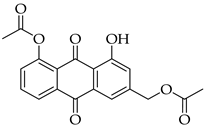
Acetylated aloe-emodin 2 was prepared according to Section 3.2.1. Crystallization of the yellow solid using chloroform–petroleum ether–toluene 1:1:1 mixture afforded a black solid that was 80% compound 2. Further crystallization with chloroform–toluene 1:1.5 led to pure compound 2 as a dark green solid (0.77 g, 2.2 mmol, 58%). Rf = 0.90 (DCM/MeOH 9:1). 1H NMR (400 MHz, CDCl3) δ (ppm): 12.55 (s, 1H), 8.26 (dd, J = 7.8, 1.3 Hz, 1H), 7.81 (t, J = 7.9 Hz, 1H), 7.73 (d, J = 1.8 Hz, 1H), 7.42 (dd, J = 8.0, 1.3 Hz, 1H, H7), 7.25 (dd, J = 1.7, 0.9 Hz, 1H), 5.17 (s, 2H), 2.47 (s, 3H), 2.18 (s, 3H). 13C NMR (101 MHz, CDCl3): δ (ppm): 187.54, 181.54, 170.48, 169.55, 162.88, 150.57, 145.73, 135.59, 135.27, 132.92, 130.35, 126.08, 124.62, 122.64, 117.83, 115.98, 64.70, 21.20, 20.85. HRMS ESI: m/z [M + H]+ calculated for C19H14O7: 355.0812; found: 355.0807.
Molecules 31 01676 i014

3.3.2. (5-Acetoxy-4-hydroxy-3-iodo-9,10-dioxo-9,10-dihydroanthracen-2-yl)methyl Acetate (3)
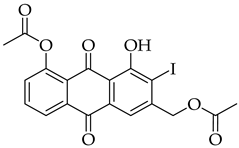
Aloe-emodin iodide 3 was prepared according to Section 3.2.2. using compound 2 (0.5 g, 1.4 mmol). Crystallization from toluene afforded pure compound 3 as a yellow solid (0.5 g, 1.1 mol, 78%). Rf = 0.40 (PE:EtOAc 7:3). Mp = 168–171 °C. 1H NMR (400 MHz, CDCl3) δ (ppm): 13.64 (s, 1H), 8.30 (dd, J = 7.8, 1.3 Hz, 1H), 7.87 (t, J = 7.9 Hz, 1H), 7.86–7.78 (m, 1H), 7.47 (dd, J = 8.1, 1.3 Hz, 1H), 5.24 (d, J = 0.7 Hz, 2H), 2.49 (s, 3H), 2.27 (s, 3H). 13C NMR (101 MHz, CDCl3) δ (ppm): 187.34, 181.29, 170.30, 169.46, 161.24, 150.74, 148.47, 136.00, 135.12, 132.11, 130.53, 126.07, 124.17, 117.97, 114.94, 98.02, 69.98, 21.17, 20.89. HRMS ESI: m/z [M + H]+ calculated for C19H13IO7: 480.9781; found: 480.9791.
Molecules 31 01676 i015

3.3.3. (Phenylethynyl) Copper (4a)

Cuprous acetylide 4a was prepared according to Section 3.2.3. using phenylacetylene (0.18 mL, 1.6 mmol, 1.0 eq). The yellow solid obtained was used without further purification.
Molecules 31 01676 i016

3.3.4. Oct-1-yn-1-yl Copper (4b)

Cuprous acetylide 4b was prepared according to Section 3.2.3. using n-octyne (0.25 mL, 1.7 mmol, 1.0 eq). The yellow solid obtained was used without further purification.
Molecules 31 01676 i017

3.3.5. (3-Methoxy-3-oxoprop-1-yn-1-yl)copper (4c)
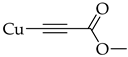
A solution of methyl propiolate (0.1 mL, 1.1 mmol, 1.0 eq) in ethanol (6 mL) was added to a mixture containing CuSO4.5H2O (300 mg, 1.2 mmol), NH2OH.HCl (200 mg, 2.9 mmol), NH4OH (28%, 1.20 mL), and water (5 mL) under nitrogen atmosphere. A yellow precipitate formed which was vacuum-filtered and washed thoroughly with water. The yellow solid was used without further purification.
Molecules 31 01676 i018

3.3.6. (10-Acetoxy-6,11-dioxo-2-phenyl-6,11-dihydroanthra[1,2-b]furan-4-yl)methyl Acetate (5a)
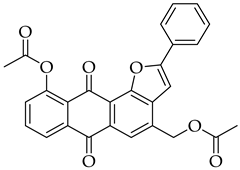
Compound 5a was prepared according to the Section 3.2.4. using aloe-emodin iodide 3 (50 mg, 0.10 mmol) and (phenylethynyl) copper 5a (51 mg, 0.31 mmol). Column purification followed by recrystallization from toluene produced a yellow solid (22 mg, 0.05 mmol, 47%). Rf = 0.36 (Petroleum Ether: EtOAc 7:3). Mp = 192–196 °C. 1H NMR (400 MHz, CDCl3) δ (ppm): 8.27 (dd, J = 7.8, 1.3 Hz, 1H), 8.16 (s, 1H), 8.04–7.97 (m, 2H), 7.78 (t, J = 7.9 Hz, 1H), 7.56–7.49 (m, 2H), 7.49–7.45 (m, 1H), 7.43 (dd, J = 8.0, 1.3 Hz, 1H), 7.16 (s, 1H), 5.44 (s, 2H), 2.60 (s, 3H), 2.19 (s, 3H). 13C NMR (101 MHz, CDCl3) δ (ppm): 182.12, 180.59, 170.67, 169.82, 161.93, 151.88, 150.10, 135.48, 135.07, 134.64, 134.09, 130.15, 129.99, 129.01, 128.97, 125.93, 125.74, 121.39, 118.96, 99.38, 63.40, 21.39, 20.92. HRMS ESI: m/z [M + Na]+ calculated for C27H18O7: 447.0945; found: 447.0953.
Molecules 31 01676 i019

3.3.7. (10-Acetoxy-2-hexyl-6,11-dioxo-6,11-dihydroanthra[1,2-b]furan-4-yl)methyl Acetate (5b)
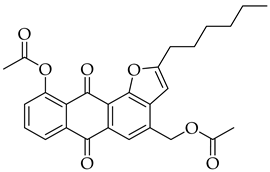
Compound 5b was prepared according to the Section 3.2.4. using aloe-emodin iodide 3 (152 mg, 0.32 mmol) and oct-1-yn-1-ylcopper 4b (138 mg, 0.84 mmol). Column purification followed by recrystallization from EtOAc produced a yellow solid (50 mg, 0.11 mmol, 34%). Rf = 0.66 (Petroleum Ether: EtOAc 7:3). Mp = 128–131 °C. 1H NMR (400 MHz, CDCl3) δ (ppm): 8.27 (dd, J = 7.8, 1.3 Hz, 1H), 8.16 (s, 1H), 7.77 (t, J = 7.9 Hz, 1H), 7.41 (dd, J = 8.1, 1.3 Hz, 1H), 6.59 (t, J = 1.0 Hz, 1H), 5.42–5.36 (m, 2H), 2.99–2.91 (m, 2H), 2.55 (s, 3H), 2.17 (s, 3H), 1.83 (p, J = 7.6 Hz, 2H), 1.51–1.42 (m, 2H), 1.36 (tq, J = 6.4, 2.8 Hz, 4H), 0.97–0.88 (m, 3H). 13C NMR (101 MHz, CDCl3) δ (ppm): 182.36, 180.93, 170.67, 169.78, 167.00, 150.07, 135.42, 135.09, 134.60, 133.59, 129.96, 128.43, 125.71, 125.18, 120.96, 118.65, 100.55, 63.43, 31.51, 28.94, 28.80, 27.32, 22.57, 21.35, 20.89, 14.08. HRMS ESI: m/z [M + H]+ calculated for C27H26O7: 463.1751; found: 463.1758.
Molecules 31 01676 i020

3.3.8. (2-Hexyl-10-hydroxy-6,11-dioxo-6,11-dihydroanthra[1,2-b]furan-4-yl)methyl Acetate (5c)

Compound 5c was prepared according to the Section 3.2.4. using aloe-emodin iodide 3 (152 mg, 0.32 mmol) and oct-1-yn-1-ylcopper 4b (138 mg, 0.84 mmol). Column purification followed by recrystallization from EtOAc produced a yellow solid (17 mg, 0.10 mmol, 13%). Rf = 0.75 (Petroleum Ether: EtOAc 7:3). Mp = 80–83 °C. 1H NMR (400 MHz, CDCl3) δ (ppm): 12.68 (s, 1H), 8.19 (s, 1H), 7.83 (dd, J = 7.5, 1.2 Hz, 1H), 7.66 (t, J = 7.9 Hz, 1H), 7.30 (dd, J = 8.4, 1.2 Hz, 1H), 6.62 (s, 1H), 5.40 (s, 2H), 3.00–2.92 (m, 2H), 2.18 (s, 3H), 1.85 (p, J = 7.6 Hz, 2H), 1.53–1.42 (m, 2H), 1.36 (tt, J = 6.0, 2.8 Hz, 4H), 0.91 (td, J = 6.0, 5.0, 3.7 Hz, 3H). 13C NMR (101 MHz, CDCl3) δ (ppm): 188.19, 182.27, 170.64, 166.90, 162.43, 151.83, 136.58, 135.22, 134.50, 133.29, 129.38, 124.44, 121.44, 119.49, 117.53, 116.40, 100.64, 63.40, 31.49, 28.93, 28.85, 27.46, 22.55, 20.88, 14.06. HRMS ESI: m/z [M-H] calculated for C25H24O6: 419.1500; found: 419.1484.
Molecules 31 01676 i021

3.3.9. Methyl 10-Acetoxy-4-(acetoxymethyl)-6,11-dioxo-6,11-dihydroanthra[1,2-b]furan-2-carboxylate (5d)
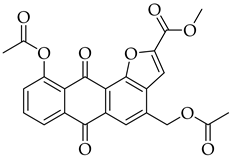
Compound 5d was prepared according to the Section 3.2.4. using aloe-emodin iodide 3 (153 mg, 0.32 mmol) and (3-methoxy-3-oxoprop-1-yn-1-yl)copper 4c (130 mg, 0.89 mmol). Column purification followed by recrystallization from EtOAc produced a yellow solid (37 mg, 0.08 mmol, 27%). Rf = 0.14 (Petroleum Ether: EtOAc 7:3). Mp = 215–218 °C. 1H NMR (400 MHz, CDCl3) δ (ppm): 8.27 (dd, J = 7.8, 1.3 Hz, 1H), 8.24 (d, J = 0.9 Hz, 1H), 7.81 (t, J = 7.9 Hz, 1H), 7.71 (s, 1H), 7.45 (dd, J = 8.0, 1.3 Hz, 1H), 5.45 (d, J = 0.8 Hz, 2H), 4.05 (s, 3H), 2.56 (s, 3H), 2.18 (s, 3H). 13C NMR (101 MHz, CDCl3): δ (ppm): 181.95, 179.86, 170.46, 169.73, 158.95, 152.54, 150.41, 150.28, 136.83, 134.94, 134.64, 132.59, 131.87, 130.54, 125.85, 124.91, 121.55, 120.02, 111.56, 63.15, 52.91, 21.33, 20.84. HRMS ESI: m/z [M + Na]+ calculated for C23H16O9: 459.0687; found: 459.0680.
Molecules 31 01676 i022

3.3.10. (4-Acetoxy-5-hydroxy-9,10-dioxo-9,10-dihydroanthracen-2-yl)methyl Acetate (6)

Acetylated aloe-emodin 6 was prepared according to Section 3.2.1. The chloroform–petroleum ether–toluene 1:1:1 mixture obtained from the crystallization of acetylated aloe-emodin 2 was evaporated to yield a brown solid. Repeated crystallization with chloroform–petroleum ether 1:1 followed by toluene recrystallization yielded pure compound 6 as a yellow solid. Rf = 0.90 (DCM/MeOH 9:1). 1H NMR (400 MHz, CDCl3) δ (ppm): 12.56 (s, 1H), 8.23 (dd, J = 1.7, 0.9 Hz, 1H), 7.82 (dd, J = 7.5, 1.2 Hz, 1H), 7.68 (dd, J = 8.4, 7.5 Hz, 1H), 7.41 (dd, J = 1.8, 0.9 Hz, 1H), 7.32 (dd, J = 8.4, 1.2 Hz, 1H), 5.26 (s, 1H), 2.50 (s, 3H), 2.21 (s, 3H). 13C NMR (101 MHz, CDCl3) δ (ppm): 187.53, 181.51, 170.43, 169.51, 162.69, 150.84, 144.65, 136.70, 135.51, 132.64, 128.57, 124.99, 124.43, 124.04, 116.52, 64.34, 21.19, 20.84. HRMS ESI: m/z [M + H] calculated for C19H14O7: 353.0667; found: 353.0637.
Molecules 31 01676 i023

3.3.11. (4-Acetoxy-5-hydroxy-6-iodo-9,10-dioxo-9,10-dihydroanthracen-2-yl)methyl Acetate (7)

Aloe-emodin iodide 7 was prepared using the Section 3.2.2. using compound 6 (0.5 g, 1.4 mmol). Crystallization from toluene afforded pure compound 7 as an orange solid (0.5 g, 1.1 mol, 77%). Rf = 0.40 (PE:EtOAc 7:3). Mp = 200–205 °C. 1H NMR (400 MHz, CDCl3) δ (ppm): 13.48 (s, 1H), 8.24–8.21 (m, 1H), 8.20 (s, 1H), 7.56 (d, J = 8.0 Hz, 1H), 7.44 (dd, J = 1.8, 0.9 Hz, 1H), 5.26 (t, J = 0.7 Hz, 2H), 2.49 (s, 3H), 2.21 (s, 3H). 13C NMR (101 MHz, CDCl3) δ (ppm): 187.26, 181.13, 170.40, 169.40, 161.28, 151.02, 146.35, 145.19, 135.32, 132.58, 128.76, 124.42, 123.48, 120.41, 115.80, 95.72, 64.29, 21.16, 20.84. HRMS ESI: m/z [M] calculated for C19H13IO7: 479.9708; found: 479.9725.
Molecules 31 01676 i024

3.3.12. (10-Acetoxy-6,11-dioxo-2-phenyl-6,11-dihydroanthra[1,2-b]furan-8-yl)methyl Acetate (8a)
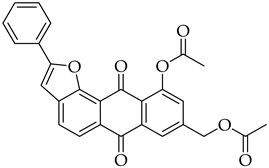
Compound 8a was prepared according to the Section 3.2.4. using aloe-emodin iodide 7 (158 mg, 0.33 mmol) and (phenylethynyl) copper 4a (159 mg, 0.97 mmol). Column purification followed by recrystallization from toluene produced a yellow solid (53 mg, 0.12 mmol, 36%). Rf = 0.29 (Petroleum Ether: EtOAc 7:3). Mp = 180–184 °C. 1H NMR (400 MHz, CDCl3) δ (ppm): 8.23 (dt, J = 1.7, 0.7 Hz, 1H), 8.19 (d, J = 8.1 Hz, 1H), 8.04–7.99 (m, 2H), 7.90 (d, J = 8.1 Hz, 1H), 7.52 (dd, J = 8.3, 6.8 Hz, 2H), 7.48–7.43 (m, 1H), 7.40 (dd, J = 1.7, 0.8 Hz, 1H), 7.11 (s, 1H), 5.24 (s, 2H), 2.60 (s, 3H), 2.19 (s, 3H). 13C NMR (101 MHz, CDCl3): δ (ppm): 182.13, 180.61, 170.52, 169.77, 161.78, 151.80, 150.40, 143.49, 137.15, 135.36, 129.99, 129.00, 128.38, 126.22, 125.85, 124.56, 124.28, 122.41, 119.27, 101.05, 64.54, 21.39, 20.88. HRMS ESI: m/z [M + Na]+ calculated for C27H18O7: 447.0945; found: 447.0949.
Molecules 31 01676 i025

3.3.13. (10-Acetoxy-2-hexyl-6,11-dioxo-6,11-dihydroanthra[1,2-b]furan-8-yl)methyl Acetate (8b)
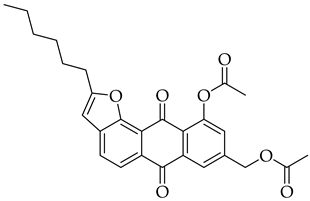
Compound 8b was prepared according to the Section 3.2.4. using aloe-emodin iodide 7 (152 mg, 0.32 mmol) and oct-1-yn-1-ylcopper 4b (138 mg, 0.84 mmol). Column purification followed by recrystallization from EtOAc produced a yellow solid (33 mg, 0.07 mmol, 22%). Rf = 0.68 (Petroleum Ether: EtOAc 7:3). Mp = 124–125 °C. 1H NMR (400 MHz, CDCl3) δ (ppm): 8.23 (d, J = 1.8 Hz, 1H), 8.16 (d, J = 8.1 Hz, 1H), 7.82 (d, J = 8.1 Hz, 1H), 7.38 (d, J = 1.9 Hz, 1H), 6.52 (d, J = 1.1 Hz, 1H), 5.23 (s, 2H), 3.00–2.89 (m, 2H), 2.56 (s, 3H), 2.18 (s, 3H), 1.83 (p, J = 7.6 Hz, 2H), 1.45 (q, J = 7.0 Hz, 2H), 1.36 (tt, J = 7.4, 3.5 Hz, 4H), 0.98–0.84 (m, 3H). 13C NMR (101 MHz, CDCl3): δ (ppm): 182.33, 169.74, 166.73, 151.57, 150.36, 143.41, 137.18, 135.38, 128.35, 125.74, 124.24, 121.99, 102.21, 64.53, 31.52, 28.92, 28.74, 27.31, 22.57, 21.34, 20.87, 14.08. HRMS ESI: m/z [M + H]+ calculated for C27H26O7: 463.1751; found: 463.1759.
Molecules 31 01676 i026

3.3.14. (2-Hexyl-10-hydroxy-6,11-dioxo-6,11-dihydroanthra[1,2-b]furan-8-yl)methyl Acetate (8c)
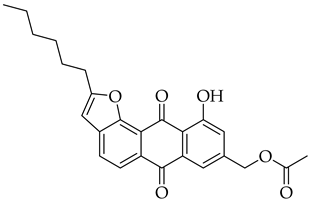
Compound 8c was prepared according to the Section 3.2.4. using aloe-emodin iodide 7 (152 mg, 0.32 mmol) and oct-1-yn-1-ylcopper 4b (138 mg, 0.84 mmol). Column purification followed by recrystallization from EtOAc produced a yellow solid (13 mg, 0.03 mmol, 10%). Rf = 0.79 (Petroleum Ether: EtOAc 7:3). Mp = 119–121 °C. 1H NMR (400 MHz, CDCl3) δ (ppm): 12.69 (s, 1H), 8.17 (d, J = 8.1 Hz, 1H), 7.84 (d, J = 8.1 Hz, 1H), 7.76 (d, J = 1.7 Hz, 1H), 7.24 (dd, J = 1.7, 0.9 Hz, 1H), 6.54 (s, 1H), 5.18 (s, 2H), 2.98–2.89 (m, 2H), 2.18 (s, 3H), 1.83 (p, J = 7.6 Hz, 2H), 1.52–1.41 (m, 2H), 1.35 (pd, J = 5.1, 4.0, 2.2 Hz, 4H), 0.90 (td, J = 5.9, 4.9, 2.7 Hz, 3H). 13C NMR (101 MHz, CDCl3): δ (ppm): 188.16, 182.22, 170.53, 166.64, 162.62, 151.69, 145.48, 136.99, 133.63, 129.22, 126.47, 122.50, 122.14, 117.89, 117.74, 115.85, 102.26, 64.88, 31.51, 28.92, 28.78, 27.44, 22.56, 20.87, 14.07. HRMS ESI: m/z [M + H]+ calculated for C25H24O6: 421.1646; found: 421.1650.
Molecules 31 01676 i027

3.3.15. 1,8-Dihydroxy-3-(hydroxymethyl)-2-iodoanthracene-9,10-dione (9)
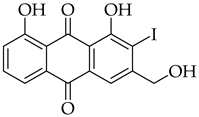
Compound 9 was prepared according to the Section 3.2.6. using aloe-emodin iodide 3 (107 mg, 0.22 mmol) to yield an orange solid (85 mg, 0.21 mmol, 96%). Rf = 0.4 (PE:EtOAc 7:3). Mp = 241–243 °C. 1H NMR (400 MHz, DMSO-d6) δ (ppm) 12.82 (s, 1H), 11.71 (s, 1H), 7.82–7.73 (m, 2H), 7.66 (dd, J = 7.5, 1.2 Hz, 1H), 7.35 (dd, J = 8.4, 1.2 Hz, 1H), 5.85 (t, J = 5.5 Hz, 1H), 4.47 (d, J = 5.0 Hz, 2H). 13C NMR (101 MHz, DMSO-d6) δ (ppm) 191.84, 181.70, 161.77, 160.08, 155.30, 138.07, 133.68, 132.64, 125.02, 119.88, 117.71, 116.08, 114.34, 97.27, 68.59. HRMS ESI: m/z [M + 1]+ calculated for C15H9IO5: 396.9569; found: 396.9583.
Molecules 31 01676 i028

3.3.16. 10-Hydroxy-4-(hydroxymethyl)-2-phenylanthra[1,2-b]furan-6,11-dione (10a)

Compound 10a was prepared according to the Section 3.2.5. using aloe-emodin iodide 3 (152 mg, 0.32 mmol) and (phenylethynyl) copper 4a (166 mg, 1.01 mmol). Recrystallization from toluene produced an orange solid (81 mg, 0.22 mmol, 69%). It had very poor solubility in acetone, acetonitrile, chloroform, DMSO, methanol, toluene, and water. Rf = 0.57 (DCM:MeOH 92:8). Mp = 291–292 °C. 1H NMR (600 MHz, DMSO-d6) δ (ppm) 12.61 (s, 1H), 8.15 (s, 1H), 8.06 (d, J = 7.4 Hz, 2H), 7.79 (d, J = 7.7 Hz, 1H), 7.77 (s, 1H), 7.72 (dd, J = 7.5, 1.3 Hz, 1H), 7.59 (t, J = 7.7 Hz, 2H), 7.51 (t, J = 7.4 Hz, 1H), 7.38 (dd, J = 8.2, 1.2 Hz, 1H), 5.75–5.70 (m, 1H), 4.92 (d, J = 5.9 Hz, 2H). HRMS ESI: m/z [M + 1]+ calculated for C23H14O5: 371.0914; found: 371.0911.
Molecules 31 01676 i029

3.3.17. 2-Hexyl-10-hydroxy-4-(hydroxymethyl)anthra[1,2-b]furan-6,11-dione (10b)
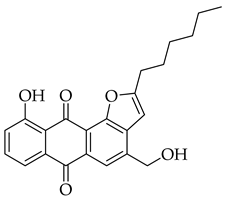
Compound 10b was prepared according to the Section 3.2.5. using aloe-emodin iodide 3 (152 mg, 0.32 mmol) and oct-1-yn-1-ylcopper 4b (138 mg, 0.84 mmol) to yield a yellow solid (57 mg, 0.15 mmol, 48%). Rf = 0.36 (PE:EtOAc 7:3). Mp = 143–145 °C. It had poor solubility in chloroform and water. 1H NMR (400 MHz, CDCl3) δ (ppm) 12.65 (s, 1H), 8.05 (s, 1H), 7.75 (dd, J = 7.5, 1.2 Hz, 1H), 7.63 (dd, J = 8.4, 7.5 Hz, 1H), 7.27 (dd, J = 8.4, 1.2 Hz, 1H), 6.61 (d, J = 1.0 Hz, 1H), 4.96 (d, J = 5.6 Hz, 2H), 2.94–2.86 (m, 2H), 2.33 (t, J = 6.1 Hz, 1H), 1.81 (p, J = 7.6 Hz, 2H), 1.52–1.42 (m, 2H), 1.35 (tt, J = 6.5, 3.0 Hz, 4H), 0.96–0.86 (m, 3H). 13C NMR (101 MHz, CDCl3) δ (ppm): 188.04, 182.39, 166.53, 162.31, 151.74, 139.59, 136.43, 134.72, 133.19, 129.19, 124.36, 120.00, 119.38, 116.96, 116.26, 100.77, 63.20, 31.52, 28.97, 28.78, 27.36, 22.56, 14.08. HRMS ESI: m/z [M + 1]+ calculated for C23H22O5: 379.1540; found: 379.1551.
Molecules 31 01676 i030

3.3.18. Methyl 10-hydroxy-4-(hydroxymethyl)-6,11-dioxo-6,11-dihydroanthra[1,2-b]furan-2-carboxylate (10c)
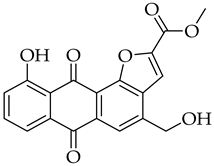
Compound 10c was prepared according to the Section 3.2.5. using aloe-emodin iodide 3 (151 mg, 0.31 mmol) and (3-methoxy-3-oxoprop-1-yn-1-yl)copper 4c (129 mg, 0.88 mmol). The solid obtained was purified by column chromatography on silica gel (DCM 100% → DCM:MeOH 98:2) to give a yellow solid (59 mg, 0.17 mmol, 54%). It had poor solubility in acetone and water. Rf = 0.12 (PE:EtOAc 7:3). Mp = 269–271 °C. 1H NMR (600 MHz, 60 °C, DMSO-d6) δ (ppm) 12.37 (s, 1H), 8.19 (d, J = 1.0 Hz, 1H), 8.02 (s, 1H), 7.80 (dd, J = 8.3, 7.5 Hz, 1H), 7.73 (dd, J = 7.5, 1.2 Hz, 1H), 7.38 (dd, J = 8.3, 1.2 Hz, 1H), 5.65 (t, J = 5.7 Hz, 1H), 4.98–4.94 (m, 2H), 3.99 (s, 3H). 13C NMR (151 MHz, 60 °C, DMSO-d6) δ (ppm) 187.07, 182.25, 161.80, 159.00, 152.37, 149.50, 146.11, 137.30, 133.31, 132.90, 131.65, 124.78, 119.59, 119.49, 118.05, 116.64, 112.83, 61.28, 53.07. HRMS ESI: m/z [M + 1]+ calculated for C19H12O7: 353.0656; found: 353.0660.
Molecules 31 01676 i031

3.3.19. 1,8-Dihydroxy-6-(hydroxymethyl)-2-iodoanthracene-9,10-dione (11)

Compound 11 was prepared according to the Section 3.2.6. using aloe-emodin iodide 7 (104 mg, 0.22 mmol) to yield an orange solid (77 mg, 0.20 mmol, 90%). Rf = 0.30 (PE:EtOAc 7:3). Mp = 261–263 °C. 1H NMR (400 MHz, DMSO-d6) δ (ppm) 12.84 (s, 1H), 11.69 (s, 1H), 8.29 (d, J = 8.0 Hz, 1H), 7.64 (d, J = 1.6 Hz, 1H), 7.40 (d, J = 8.0 Hz, 1H), 7.28 (d, J = 1.4 Hz, 1H), 4.62 (s, 2H). 13C NMR (101 MHz, DMSO-d6) δ (ppm) 191.60, 181.55, 162.08, 160.43, 154.50, 146.73, 133.52, 133.42, 121.26, 120.73, 117.62, 115.80, 114.55, 96.51, 62.51. HRMS ESI: m/z [M + 1]+ calculated for C15H9IO5: 396.9569; found: 396.9577.
Molecules 31 01676 i032

3.3.20. 10-Hydroxy-8-(hydroxymethyl)-2-phenylanthra[1,2-b]furan-6,11-dione (12a)

Compound 12a was prepared according to the Section 3.2.5. using aloe-emodin iodide 7 (150 mg, 0.31 mmol) and (phenylethynyl) copper 4a (160 mg, 0.97 mmol). Recrystallization from toluene yielded a red solid (76 mg, 0.21 mmol, 66%). Poor solubility in acetone, acetonitrile, chloroform, methanol and water. Rf = 0.31 (PE:EtOAc 7:3). Mp = 280–284 °C. 1H NMR (400 MHz, DMSO-d6) δ (ppm) 12.51 (s, 1H), 8.00 (t, J = 7.2 Hz, 4H), 7.62–7.53 (m, 4H), 7.50 (t, J = 7.3 Hz, 1H), 7.23–7.18 (m, 1H), 5.57 (t, J = 5.8 Hz, 1H), 4.59 (d, J = 5.7 Hz, 2H). 13C NMR (101 MHz, DMSO-d6) δ (ppm) 187.47, 181.99, 162.07, 160.88, 153.36, 151.40, 136.91, 133.11, 130.54, 129.84, 129.65, 129.04, 127.73, 125.80, 122.66, 120.78, 118.15, 117.06, 115.15, 102.38, 62.61. HRMS ESI: m/z [M + 1]+ calculated for C23H14O5: 371.0914; found: 371.0920.
Molecules 31 01676 i033

3.3.21. 2-Hexyl-10-hydroxy-8-(hydroxymethyl)anthra[1,2-b]furan-6,11-dione (12b)

Compound 12b was prepared according to the Section 3.2.5. using aloe-emodin iodide 7 (152 mg, 0.32 mmol) and oct-1-yn-1-ylcopper 4b (138 mg, 0.84 mmol). Recrystallization from toluene yielded a brown solid (57 mg, 0.15 mmol, 48%). Rf = 0.36 (PE:EtOAc 7:3). Mp = 187–190 °C. 1H NMR (600 MHz, 40 °C, CDCl3) δ (ppm) 12.69 (s, 1H), 8.19 (d, J = 8.1 Hz, 1H), 7.85 (d, J = 8.1 Hz, 1H), 7.79 (d, J = 1.7 Hz, 1H), 7.33 (dd, J = 1.7, 0.9 Hz, 1H), 6.56 (d, J = 1.1 Hz, 1H), 4.82 (d, J = 5.7 Hz, 2H), 3.00–2.94 (m, 2H), 2.00 (t, J = 6.0 Hz, 1H), 1.87 (p, J = 7.6 Hz, 2H), 1.53–1.46 (m, 1H), 1.44–1.33 (m, 4H), 0.97–0.91 (m, 3H). 13C NMR (151 MHz, 40 °C, CDCl3) δ (ppm) 188.10, 182.40, 166.56, 162.86, 151.72, 150.60, 136.92, 133.56, 129.36, 126.25, 122.43, 121.17, 117.91, 117.15, 115.56, 102.19, 64.29, 31.47, 28.88, 28.76, 27.44, 22.50, 13.97. HRMS ESI: m/z [M + 1]+ calculated for C23H22O5: 379.1540; found: 379.1546.
Molecules 31 01676 i034

3.3.22. Methyl 10-Hydroxy-8-(hydroxymethyl)-6,11-dioxo-6,11-dihydroanthra[1,2-b]furan-2-carboxylate (12c)

Compound 12c was prepared according to the Section 3.2.5. using aloe-emodin iodide 7 (303 mg, 0.63 mmol) and (3-methoxy-3-oxoprop-1-yn-1-yl)copper 4c (265 mg, 0.88 mmol). Recrystallization from toluene yielded a brown solid (120 mg, 0.34 mmol, 54%). It had poor solubility in acetone, acetonitrile, chloroform, methanol, and water. Rf = 0.92 (DCM:MeOH 92:8). Mp = 286–288 °C. 1H NMR (400 MHz, DMSO-d6) δ (ppm) 12.30 (s, 1H), 8.22 (d, J = 8.2 Hz, 1H), 8.09 (d, J = 8.2 Hz, 1H), 7.89 (s, 1H), 7.62 (d, J = 1.6 Hz, 1H), 7.24 (d, J = 1.5 Hz, 1H), 5.57 (t, J = 5.8 Hz, 1H), 4.60 (d, J = 5.6 Hz, 2H), 3.94 (s, 3H). 13C NMR (101 MHz, DMSO-d6) δ (ppm)186.72, 182.11, 161.98, 158.95, 153.55, 152.05, 149.75, 134.24, 132.89, 132.71, 130.29, 122.84, 121.09, 119.34, 117.21, 115.08, 114.18, 62.56, 53.20. HRMS ESI: m/z [M + 1]+ calculated for C19H12O7: 353.0656; found: 353.0657.
Molecules 31 01676 i035

3.4. Cytotoxic Activity by CCK8 Assay

The stock solutions of all the aloe-emodin derivatives with specific concentrations were prepared in DMSO and diluted to working concentrations with phosphate-buffered saline (PBS) when conducting the cytotoxicity experiment. The final ratio of DMSO was strictly controlled within a safe range, typically below 0.1%. All the measured IC50 values fall within the above concentration ranges, ensuring the reproducibility and reliability of the data. The concentration ranges used for the cytotoxicity determination were as follows:
A549, HepG2, Skov3, and MCF-7 cells:2.5, 5, 10, 20, 40, and 80 µM
HCT116 cells:100, 200, 300, 400, 500, and 600 µM
Cells were seeded into 96-well plates at a density of 5 × 10³ cells per well in complete culture medium. After cell adherence, different concentrations of the drug were added to each well. Following 3 h of incubation, the respective treatments were applied to each group. After an additional 24 h incubation, 10 μL of CCK8 (Cell Counting Kit-8,Biosharp Life Science, Hefei Anhui, China) solution was added to each well and the cells were further cultured for 2 h. The absorbance at 450 nm was measured using a microplate reader (Biotek, TEK, MQX200, BioTek Instruments, Inc., Winooski, VT, USA) to evaluate cell viability.

4. Conclusions

In this study, several anthra[1,2-b]furans were synthesized starting from the parent compound aloe-emodin. Preliminary analyses were performed on these derivatives by evaluating their cytotoxic activity against five cancer cell lines. Preliminary analysis showed that anthra[1,2-b]furan 10c exhibited improved cytotoxic activity against all cancer cell lines compared with all the other derivatives and the parent compound, aloe-emodin 1. Anthra[1,2-b]furan 10c could be a promising hit meriting future consideration for further biological studies. Future cytotoxic analysis against normal cells would give insight into the selectivity of 10c for cancer cells instead of healthy cells. Furthermore, mechanism studies against A549 and MCF-7 would elucidate the signaling pathways utilized to target cancer cells. Molecular docking studies of C2- and C7-functionalized derivatives with focus on methoxy carbonyl substituents could give insight into their interaction with DNA or protein structures expressed in cancer cells. We can also look out to expand the current library to gain more insight into the correlation between functional groups and cytotoxic activity. Expansion of the current library to include both acetylated and non-acetylated anthra[1,2-b]furans would give clarity on the importance of 1- and 8-hydroxyl groups. In addition, the scope of the library could be increased with a focus on the use of the methoxy carbonyl as a spacer group to synthesize derivatives with improved cytotoxic activity.

Supplementary Materials

The following supporting information can be downloaded at: https://www.mdpi.com/article/10.3390/molecules31101676/s1. Figure S1: 1H, 400 Hz, CDCl3, 2; Figure S2: 13C, 101 MHz, CDCl3, 2; Figure S3: 1H, 400 Hz, CDCl3, 3; Figure S4: 13C, 101 MHz, CDCl3, 3; Figure S5: 1H, 400 Hz, CDCl3, 5a; Figure S6: 13C, 101 MHz, CDCl3, 5a; Figure S7: 1H, 400 Hz, CDCl3, 5b; Figure S8: 13C, 101 MHz, CDCl3, 5b; Figure S9: 1H, 400 Hz, CDCl3, 5c; Figure S10: 13C, 101 MHz, CDCl3, 5c; Figure S11: 1H, 400 Hz, CDCl3, 5d; Figure S12: 13C, 101 MHz, CDCl3, 5d; Figure S13: 1H, 400 Hz, CDCl3, 6; Figure S14: 13C, 101 MHz, CDCl3, 6; Figure S15: 1H, 400 Hz, CDCl3, 7; Figure S16: 13C, 101 MHz, CDCl3, 7; Figure S17: 1H, 400 Hz, CDCl3, 8a; Figure S18: 13C, 101 MHz, CDCl3, 8a; Figure S19: 1H, 400 Hz, CDCl3, 8b; Figure S20: 13C, 101 MHz, CDCl3, 8b; Figure S21: 1H, 400 Hz, CDCl3, 8c; Figure S22: 13C, 101 MHz, CDCl3, 8c; Figure S23: 1H, 400 Hz, DMSO-d6, 9; Figure S24: 13C, 101 MHz, DMSO-d6, 9; Figure S25: 1H, 400 Hz, DMSO-d6, 10a; Figure S26: 1H, 400 Hz, CDCl3, 10b; Figure S27: 13C, 101 MHz, CDCl3, 10b; Figure S28: 1H, 600 Hz, 60 °C, DMSO-d6, 10c; Figure S29: 13C, 151 MHz, 60 °C, DMSO-d6, 10c; Figure S30: 1H, 400 Hz, DMSO-d6, 11; Figure S31: 13C, 101 MHz, DMSO-d6, 11; Figure S32: 1H, 400 Hz, DMSO-d63, 12a; Figure S33: 13C, 101 MHz, DMSO-d6, 12a; Figure S34: 1H, 600 Hz, 40 °C, CDCl3, 12b; Figure S35: 13C, 151 MHz, 40 °C, CDCl3, 12b; Figure S36: 1H, 400 Hz, DMSO-d6, 12c; Figure S37: 13C, 101 MHz, CDCl3, 12c.

Author Contributions

Conceptualization, J.S. and W.D.; methodology, J.S., S.Z., H.H., Y.F., and W.D.; validation, J.S., S.Z., H.H., Y.F., and W.D.; formal analysis, J.S., H.H., and Y.F.; investigation, J.S., S.Z., H.H., and Y.F.; resources, Y.F. and W.D.; writing—original draft preparation, J.S. and W.D.; writing—review and editing, J.S., S.Z., H.H., Y.F., N.J., P.F., and W.D.; supervision, W.D. All authors have read and agreed to the published version of the manuscript.

Funding

This research was funded by the European Union (FED/2019/406–549).

Data Availability Statement

The original contributions presented in this study are included in the article/Supplementary Materials. Further inquiries can be directed to the corresponding author.

Acknowledgments

The authors would like to thank the SISSTEM team at the University of Aruba, KU Leuven, Gert Steurs and Bart Van Huffel for technical assistance with the spectrometers, and Jef Rozenski for the HRMS measurements.

Conflicts of Interest

The authors declare that they have no conflicts of interest to report regarding the present study.

References

  1. Dong, X.; Zeng, Y.; Liu, Y.; You, L.; Yin, X.; Fu, J.; Ni, J. Aloe-Emodin: A Review of Its Pharmacology, Toxicity, and Pharmacokinetics. Phytother. Res. 2020, 34, 270–281. [Google Scholar] [CrossRef]
  2. Sanders, B.; Ray, A.M.; Goldberg, S.; Clark, T.; McDaniel, H.R.; Atlas, S.E.; Farooqi, A.; Konefal, J.; Lages, L.C.; Lopez, J.; et al. Anti-Cancer Effects of Aloe-Emodin: A Systematic Review. J. Clin. Transl. Res. 2017, 3, 283–296. [Google Scholar] [CrossRef]
  3. Şeker Karatoprak, G.; Küpeli Akkol, E.; Yücel, Ç.; Bahadir Acikara, Ö.; Sobarzo-Sánchez, E. Advances in Understanding the Role of Aloe Emodin and Targeted Drug Delivery Systems in Cancer. Oxid. Med. Cell. Longev. 2022, 2022, 7928200. [Google Scholar] [CrossRef]
  4. Park, M.Y.; Kwon, H.J.; Sung, M.K. Evaluation of Aloin and Aloe-Emodin as Anti-Inflammatory Agents in Aloe by Using Murine Macrophages. Biosci. Biotechnol. Biochem. 2009, 73, 828–832. [Google Scholar] [CrossRef]
  5. Qun, T.; Zhou, T.; Hao, J.; Wang, C.; Zhang, K.; Xu, J.; Wang, X.; Zhou, W. Antibacterial Activities of Anthraquinones: Structure-Activity Relationships and Action Mechanisms. RSC Med. Chem. 2023, 14, 1446–1471. [Google Scholar] [CrossRef]
  6. Li, Z.; Yao, R.; Guo, H.; Jing, W.; Guo, X.; Liu, X.; Pan, Y.; Cao, P.; Zhang, L.; Yang, J.; et al. Research Progress on Chemical Compositions, Pharmacological Activities, and Toxicities of Quinone Compounds in Traditional Chinese Medicines. Toxics 2025, 13, 559. [Google Scholar] [CrossRef]
  7. Nowak-Perlak, M.; Bromke, M.A.; Ziółkowski, P.; Woźniak, M. The Comparison of the Efficiency of Emodin and Aloe-Emodin in Photodynamic Therapy. Int. J. Mol. Sci. 2022, 23, 6276. [Google Scholar] [CrossRef] [PubMed]
  8. Spiegel, M. On the Photosensitizing Properties of Aloe-Emodin in Photodynamic Therapy: Insights from the Molecular Modeling. J. Phys. Chem. B 2025, 129, 5683–5697. [Google Scholar] [CrossRef] [PubMed]
  9. Lin, J.G.; Chen, G.W.; Li, T.M.; Chouh, S.T.; Tan, T.W.; Chung, J.G. Aloe-Emodin Induces Apoptosis in T24 Human Bladder Cancer Cells through the P53 Dependent Apoptotic Pathway. J. Urol. 2006, 175, 343–347. [Google Scholar] [CrossRef] [PubMed]
  10. Huang, P.H.; Huang, C.Y.; Chen, M.C.; Lee, Y.T.; Yue, C.H.; Wang, H.Y.; Lin, H. Emodin and Aloe-Emodin Suppress Breast Cancer Cell Proliferation through ER α Inhibition. Evid.-Based Complement. Altern. Med. 2013, 2013, 376123. [Google Scholar] [CrossRef]
  11. Guo, J.M.; Xiao, B.X.; Liu, Q.; Zhang, S.; Liu, D.H.; Gong, Z.H. Anticancer Effect of Aloe-Emodin on Cervical Cancer Cells Involves G 2/M Arrest and Induction of Differentiation. Acta Pharmacol. Sin. 2007, 28, 1991–1995. [Google Scholar] [CrossRef]
  12. Suboj, P.; Babykutty, S.; Srinivas, P.; Gopala, S. Aloe Emodin Induces G2/M Cell Cycle Arrest and Apoptosis via Activation of Caspase-6 in Human Colon Cancer Cells. Pharmacology 2012, 89, 91–98. [Google Scholar] [CrossRef]
  13. Chen, S.H.; Lin, K.Y.; Chang, C.C.; Fang, C.L.; Lin, C.P. Aloe-Emodin-Induced Apoptosis in Human Gastric Carcinoma Cells. Food Chem. Toxicol. 2007, 45, 2296–2303. [Google Scholar] [CrossRef]
  14. Tabolacci, C.; Oliverio, S.; Lentini, A.; Rossi, S.; Galbiati, A.; Montesano, C.; Mattioli, P.; Provenzano, B.; Facchiano, F.; Beninati, S. Aloe-Emodin as Antiproliferative and Differentiating Agent on Human U937 Monoblastic Leukemia Cells. Life Sci. 2011, 89, 812–820. [Google Scholar] [CrossRef]
  15. Kuo, P.-L.; Lin, T.-C.; Lin, C.-C. The Antiproliferative Activity of Aloe-Emodin Is through P53-Dependent and P21-Dependent Apoptotic Pathway in Human Hepatoma Cell Lines. Life Sci. 2002, 71, 1879–1892. [Google Scholar] [CrossRef]
  16. Lee, H.-Z. Protein Kinase C Involvement in Aloe-Emodin- and Emodin-Induced Apoptosis in Lung Carcinoma Cell. Br. J. Pharmacol. 2001, 134, 1093–1103. [Google Scholar] [CrossRef]
  17. Lee, H.-Z.; Hsu, S.-L.; Liu, M.-C.; Wu, C.-H. Effects and Mechanisms of Aloe-Emodin on Cell Death in Human Lung Squamous Cell Carcinoma. Eur. J. Pharmacol. 2001, 431, 287–295. [Google Scholar] [CrossRef]
  18. Lin, M.L.; Lu, Y.C.; Chung, J.G.; Li, Y.C.; Wang, S.G.; NG, S.H.; Wu, C.Y.; Su, H.L.; Chen, S.S. Aloe-Emodin Induces Apoptosis of Human Nasopharyngeal Carcinoma Cells via Caspase-8-Mediated Activation of the Mitochondrial Death Pathway. Cancer Lett. 2010, 291, 46–58. [Google Scholar] [CrossRef]
  19. Lin, M.L.; Lu, Y.C.; Chung, J.G.; Wang, S.G.; Lin, H.T.; Kang, S.E.; Tang, C.H.; Ko, J.L.; Chen, S.S. Down-Regulation of MMP-2 through the P38 MAPK-NF-ΚB-Dependent Pathway by Aloe-Emodin Leads to Inhibition of Nasopharyngeal Carcinoma Cell Invasion. Mol. Carcinog. 2010, 49, 783–797. [Google Scholar] [CrossRef]
  20. Pecere, T.; Gazzola, M.V.; Mucignat, C.; Parolin, C.; Dalla Vecchia, F.; Cavaggioni, A.; Basso, G.; Diaspro, A.; Salvato, B.; Carli, M.; et al. Aloe-Emodin Is a New Type of Anticancer Agent with Selective Activity Against Neuroectodermal Tumors. Cancer Res. 2000, 60, 2800–2804. [Google Scholar]
  21. Xiao, B.; Guo, J.; Liu, D.; Zhang, S. Aloe-Emodin Induces In Vitro G2/M Arrest and Alkaline Phosphatase Activation in Human Oral Cancer KB Cells. Oral. Oncol. 2007, 43, 905–910. [Google Scholar] [CrossRef]
  22. He, T.P.; Yan, W.H.; Mo, L.E.; Liang, N.C. Inhibitory Effect of Aloe-Emodin on Metastasis Potential in HO-8910PM Cell Line. J. Asian Nat. Prod. Res. 2008, 10, 383–390. [Google Scholar] [CrossRef]
  23. Liu, K.; Park, C.; Li, S.; Lee, K.W.; Liu, H.; He, L.; Soung, N.K.; Ahn, J.S.; Bode, A.M.; Dong, Z.; et al. Aloe-Emodin Suppresses Prostate Cancer by Targeting the MTOR Complex 2. Carcinogenesis 2012, 33, 1406–1411. [Google Scholar] [CrossRef]
  24. Chiu, T.H.; Lai, W.W.; Hsia, T.C.; Yang, J.S.; Lai, T.Y.; Wu, P.P.; Ma, C.Y.; Yeh, C.C.; Ho, C.C.; Lu, H.F.; et al. Aloe-Emodin Induces Cell Death Through S-Phase Arrest and Caspase-Dependent Pathways in Human Tongue Squamous Cancer SCC-4 Cells. Anticancer Res. 2009, 29, 4503–4511. [Google Scholar]
  25. Long, X.; Yang, P.; Chen, L.; Zhong, W.; Chen, S.; Li, Y.; Lin, S.; Tian, W. Novel Aloe Emodin–Hydroxyethyl Piperazine Hybrid Dihydrochloride Induces Oral Cancer CAL-27 Cells Apoptosis Through ROS Production, DNA Damage and Mitochondrial Pathways. Med. Chem. Res. 2023, 32, 2549–2561. [Google Scholar] [CrossRef]
  26. Zhang, Q.; Wang, J.; Lan, F.; Zhai, H.; Li, F.; Ma, T.; Li, D.; Hou, H. Synthesis and DNA Interaction of Aloe-Emodin α-Amino Phosphate Derivatives. J. Mol. Struct. 2023, 1279, 134950. [Google Scholar] [CrossRef]
  27. Shi, D.H.; Huang, W.; Li, C.; Wang, L.T.; Wang, S.F. Synthesis, Biological Evaluation and Molecular Modeling of Aloe-Emodin Derivatives as New Acetylcholinesterase Inhibitors. Bioorg. Med. Chem. 2013, 21, 1064–1073. [Google Scholar] [CrossRef]
  28. Minotti, G.; Menna, P.; Salvatorelli, E.; Cairo, G.; Gianni, L. Anthracyclines: Molecular Advances and Pharmacologie Developments in Antitumor Activity and Cardiotoxicity. Pharmacol. Rev. 2004, 56, 185–229. [Google Scholar] [CrossRef]
  29. Beckford, S.J.; Dixon, D.W. Molecular Dynamics of Anthraquinone DNA Intercalators with Polyethylene Glycol Side Chains. J. Biomol. Struct. Dyn. 2012, 29, 1065–1080. [Google Scholar] [CrossRef]
  30. Mikaelian, G.; Megariotis, G.; Theodorou, D.N. Interactions of a Novel Anthracycline with Oligonucleotide DNA and Cyclodextrins in an Aqueous Environment. J. Phys. Chem. B 2024, 128, 6291–6307. [Google Scholar] [CrossRef]
  31. Xie, J.; Zhang, J.; Chen, X. Aloe-Emodin: From Pharmacological Mechanisms to Clinical Applications and Future Perspectives. Front. Pharmacol. 2025, 16, 1741679. [Google Scholar] [CrossRef]
  32. Yu, C.P.; Shia, C.S.; Lin, H.J.; Hsieh, Y.W.; Lin, S.P.; Hou, Y.C. Analysis of the Pharmacokinetics and Metabolism of Aloe-Emodin Following Intravenous and Oral Administrations in Rats. Biomed. Chromatogr. 2016, 30, 1641–1647. [Google Scholar] [CrossRef]
  33. Duan, H.G.; Wei, Y.H.; Li, B.X.; Qin, H.Y.; Wu, X.A. Improving the Dissolution and Oral Bioavailability of the Poorly Water-Soluble Drug Aloe-Emodin by Solid Dispersion with Polyethylene Glycol 6000. Drug Dev. Res. 2009, 70, 363–369. [Google Scholar] [CrossRef]
  34. Semerel, J.; John, N.; Fardim, P.; Dehaen, W. Recent Developments in Chemical Synthesis and Biological Activities of Aloe-Emodin Derivatives. Organics 2026, 7, 16. [Google Scholar] [CrossRef]
  35. Kumar, G.D.; Siva, B.; Vadlamudi, S.; Bathula, S.R.; Dutta, H.; Suresh Babu, K. Design, Synthesis, and Biological Evaluation of Pyrazole-Linked Aloe Emodin Derivatives as Potential Anticancer Agents. RSC Med. Chem. 2021, 12, 791–796. [Google Scholar] [CrossRef]
  36. Dileep Kumar, G.; Siva, B.; Ashwini, K.; Vinod Kumar, J.; Ramalingam, V.; Sai Balaji, A.; Suresh Babu, K. Design, Synthesis, Cytotoxic, and Anti-Inflammatory Activities of Some Novel Analogues of Aloe-Emodin Isolated from the Rhizomes of Rheum Emodi. Nat. Prod. Res. 2023, 37, 1511–1517. [Google Scholar] [CrossRef]
  37. Rixson, J.E.; Abraham, J.R.; Egoshi, Y.; Skelton, B.W.; Young, K.; Gilbert, J.; Sakoff, J.A.; Gericke, K.M.; McCluskey, A.; Stewart, S.G. The Synthesis and Biological Activity of Novel Anthracenone-Pyranones and Anthracenone-Furans. Bioorg. Med. Chem. 2015, 23, 3552–3565. [Google Scholar] [CrossRef]
  38. Tikhomirov, A.S.; Shchekotikhin, A.E.; Lee, Y.H.; Chen, Y.A.; Yeh, C.A.; Tatarskiy, V.V.; Dezhenkova, L.G.; Glazunova, V.A.; Balzarini, J.; Shtil, A.A.; et al. Synthesis and Characterization of 4,11-Diaminoanthra[2,3-b]Furan-5,10-Diones: Tumor Cell Apoptosis through TNOX-Modulated NAD+/NADH Ratio and SIRT1. J. Med. Chem. 2015, 58, 9522–9534. [Google Scholar] [CrossRef]
  39. Shchekotikhin, A.E.; Dezhenkova, L.G.; Tsvetkov, V.B.; Luzikov, Y.N.; Volodina, Y.L.; Tatarskiy, V.V.; Kalinina, A.A.; Treshalin, M.I.; Treshalina, H.M.; Romanenko, V.I.; et al. Discovery of Antitumor Anthra[2,3-b]Furan-3-Carboxamides: Optimization of Synthesis and Evaluation of Antitumor Properties. Eur. J. Med. Chem. 2016, 112, 114–129. [Google Scholar] [CrossRef]
  40. Tikhomirov, A.S.; Lin, C.Y.; Volodina, Y.L.; Dezhenkova, L.G.; Tatarskiy, V.V.; Schols, D.; Shtil, A.A.; Kaur, P.; Chueh, P.J.; Shchekotikhin, A.E. New Antitumor Anthra[2,3-b]Furan-3-Carboxamides: Synthesis and Structure-Activity Relationship. Eur. J. Med. Chem. 2018, 148, 128–139. [Google Scholar] [CrossRef]
  41. Horvat, M.; Avbelj, M.; Durán-Alonso, M.B.; Banjanac, M.; Petković, H.; Iskra, J. Antiviral Activities of Halogenated Emodin Derivatives against Human Coronavirus NL63. Molecules 2021, 26, 6825. [Google Scholar] [CrossRef] [PubMed]
  42. Bringmann, G.; Menche, D.; Kraus, J.; Mühlbacher, J.; Peters, K.; Peters, E.M.; Brun, R.; Bezabih, M.; Abegaz, B.M. Atropo-Enantioselective Total Synthesis of Knipholone and Related Antiplasmodial Phenylanthraquinones. J. Org. Chem. 2002, 67, 5595–5610. [Google Scholar] [CrossRef]
  43. Mzhelskaya, M.A.; Ivanchikova, I.D.; Polyakov, N.E.; Moroz, A.A.; Shvartsberg, M.S. Cyclization of 1-Hydroxy-2-(Oxoalkynyl)Anthraquinones. Russ. Chem. Bull. 2004, 53, 2686–2692. [Google Scholar] [CrossRef]
  44. Liang, X.Y.; Battini, N.; Sui, Y.F.; Ansari, M.F.; Gan, L.L.; Zhou, C.H. Aloe-Emodin Derived Azoles as a New Structural Type of Potential Antibacterial Agents: Design, Synthesis, and Evaluation of the Action on Membrane, DNA, and MRSA DNA Isomerase. RSC Med. Chem. 2021, 12, 602–608. [Google Scholar] [CrossRef] [PubMed]
  45. Deng, Z.; Bheemanaboina, R.R.Y.; Luo, Y.; Zhou, C.H. Aloe Emodin-Conjugated Sulfonyl Hydrazones as Novel Type of Antibacterial Modulators against S. Aureus 25923 through Multifaceted Synergistic Effects. Bioorg. Chem. 2022, 127, 106035. [Google Scholar] [CrossRef] [PubMed]
  46. Wang, Y.X.; Deng, Z.; Bibi, A.; Fang, B.; Zhou, C.H. Unique Azolyl Acylhydrazonyl Hybridization of Aloe Emodins to Access Potential Antibacterial Agents. Chin. J. Chem. 2024, 42, 1741–1758. [Google Scholar] [CrossRef]
  47. Di, L.; Kerns, E.H. Biological Assay Challenges from Compound Solubility: Strategies for Bioassay Optimization. Drug Discov. Today 2006, 11, 446–451. [Google Scholar] [CrossRef]
  48. Alexander, J.; Bhatia, A.V.; Mitscher, L.A.; Omoto, S.; Suzuki, T. Methylation and Hydroxylation Studies on Aloe-Emodin. J. Org. Chem. 1980, 45, 20–24. [Google Scholar] [CrossRef]
Figure 1. Aloe-emodin.
Molecules 31 01676 g001
Figure 2. Promising anticancer agents of anthraquinone with five-membered ring fusions, (I) anthra[1,2-b]furan with chloropropyl substituent, (II) 4,11-diaminoanthra[2,3-b]furan-5,10-diones, (III) anthra[2,3-b]furan with (S)-3-aminopyrrolidine substituent and (IV) anthra[2,3-b]furan with carboxamide spacer group.
Molecules 31 01676 g002
Scheme 1. Retrosynthetic analysis for anthra[1,2-b]furan synthesis, (A) anthra[1,2-b]furan, (B) acetyl protected anthra[1,2-b]furan, (C) alkyne intermediate, (D) acetyl protected and halogenated anthraquinone, (2) acetyl protected aloe-emodin and (1) aloe-emodin.
Molecules 31 01676 sch001
Scheme 2. Synthesis of anthracenone furan 5a, (1) aloe-emodin, (2) acetyl protected aloe-emodin, (3) aloe-emodin iodide (4a) (phenylethynyl) copper and (5a) acetyl protected anthra[1,2-b]furan.
Molecules 31 01676 sch002
Scheme 3. Synthesis of anthra[1,2-b]furan derivatives starting from the C2 position.
Molecules 31 01676 sch003
Scheme 4. Synthesis of anthra[1,2-b]furan derivatives starting from the C7 position.
Molecules 31 01676 sch004
Figure 3. Novel anthra[1,2-b]furan derivatives.
Molecules 31 01676 g003
Table 1. Optimization reaction for anthra[1,2-b]furan 5a.
Entry4a (eq.)Solvent TypeBaseTime (h)Temperature (°C)Yield (%)
11.5DMF-1.5Reflux20
21.5DMF-4.015021
31.5DMF-4811010
43.0DMF-1.515030
53.0DMF-0.5MW, 15047
63.0Toluene-729026
73.01,4-dioxane-24Reflux20
83.0TolueneDMEDA1690-
Table 2. In vitro cytotoxic activity of aloe-emodin derivatives.
CompoundIC50 (μM) 1
A549 2HCT116 3HepG2 4Skov3 5MCF-7 6
Molecules 31 01676 i00128.25 ± 0.30217.10 ± 5.4646.14 ± 1.0247.71 ± 2.3636.12 ± 0.72
Molecules 31 01676 i00236.93 ± 0.46223.83 ± 2.0154.23 ± 1.3957.03 ± 3.2548.51 ± 1.27
Molecules 31 01676 i00315.45 ± 0.13209.60 ± 3.0329.98 ± 1.4638.05 ± 0.4321.92 ± 1.65
Molecules 31 01676 i00421.24 ± 0.06213.47 ± 2.5041.91 ± 0.9543.78 ± 2.4729.40 ± 0.67
Molecules 31 01676 i00544.30 ± 0.37221.07 ± 1.9661.60 ± 1.6469.56 ± 4.3249.40 ± 1.98
Molecules 31 01676 i00613.26 ± 0.29194.43 ± 3.6930.66 ± 0.1634.25 ± 1.1720.08 ± 0.30
Molecules 31 01676 i007108.37 ± 7.85286.87 ± 3.54141.37 ± 19.15126.63 ± 25.6299.43 ± 4.83
Molecules 31 01676 i00847.20 ± 1.26261.33 ± 1.4061.65 ± 2.3970.67 ± 7.9053.33 ± 1.07
Molecules 31 01676 i0090.49 ± 0.05175.87 ± 2.5020.63 ± 0.5510.85 ± 1.682.91 ± 0.15
Molecules 31 01676 i01053.26 ± 2.75279.03 ± 3.7870.17 ± 3.2375.22 ± 11.4156.74 ± 3.51
Molecules 31 01676 i01133.38 ± 0.62220.33 ± 1.5448.47 ± 3.4254.29 ± 1.9241.51 ± 1.13
Molecules 31 01676 i01227.94 ± 1.09216.03 ± 0.3540.67 ± 1.1447.65 ± 5.7532.51 ± 0.50
Molecules 31 01676 i01320.99 ± 0.60212.53 ± 3.6131.93 ± 2.2641.56 ± 2.4525.81 ± 1.82
1 IC50 is the compound concentration which inhibits 50% of the cancer cell growth, determined by CCK8 method; 2 lung adenocarcinoma; 3 colorectal carcinoma; 4 liver cancer cell; 5 ovarian cancer cells; and 6 breast cancer cell.
Disclaimer/Publisher’s Note: The statements, opinions and data contained in all publications are solely those of the individual author(s) and contributor(s) and not of MDPI and/or the editor(s). MDPI and/or the editor(s) disclaim responsibility for any injury to people or property resulting from any ideas, methods, instructions or products referred to in the content.