4,5-Dihydro-2H-pyridazin-3-ones as a Platform for the Construction of Chiral 4,4-Disubstituted-dihydropyridazin-3-ones †

 ,
,  and
and 
Abstract
1. Introduction
2. Results and Discussion
2.1. Syntheses of Pyridazinones
2.2. α-Functionalizations of Pyridazinones
3. Experimental Details
- General procedure for the synthesis of N-Boc 4,5-dihydropyridazinone derivatives 7.
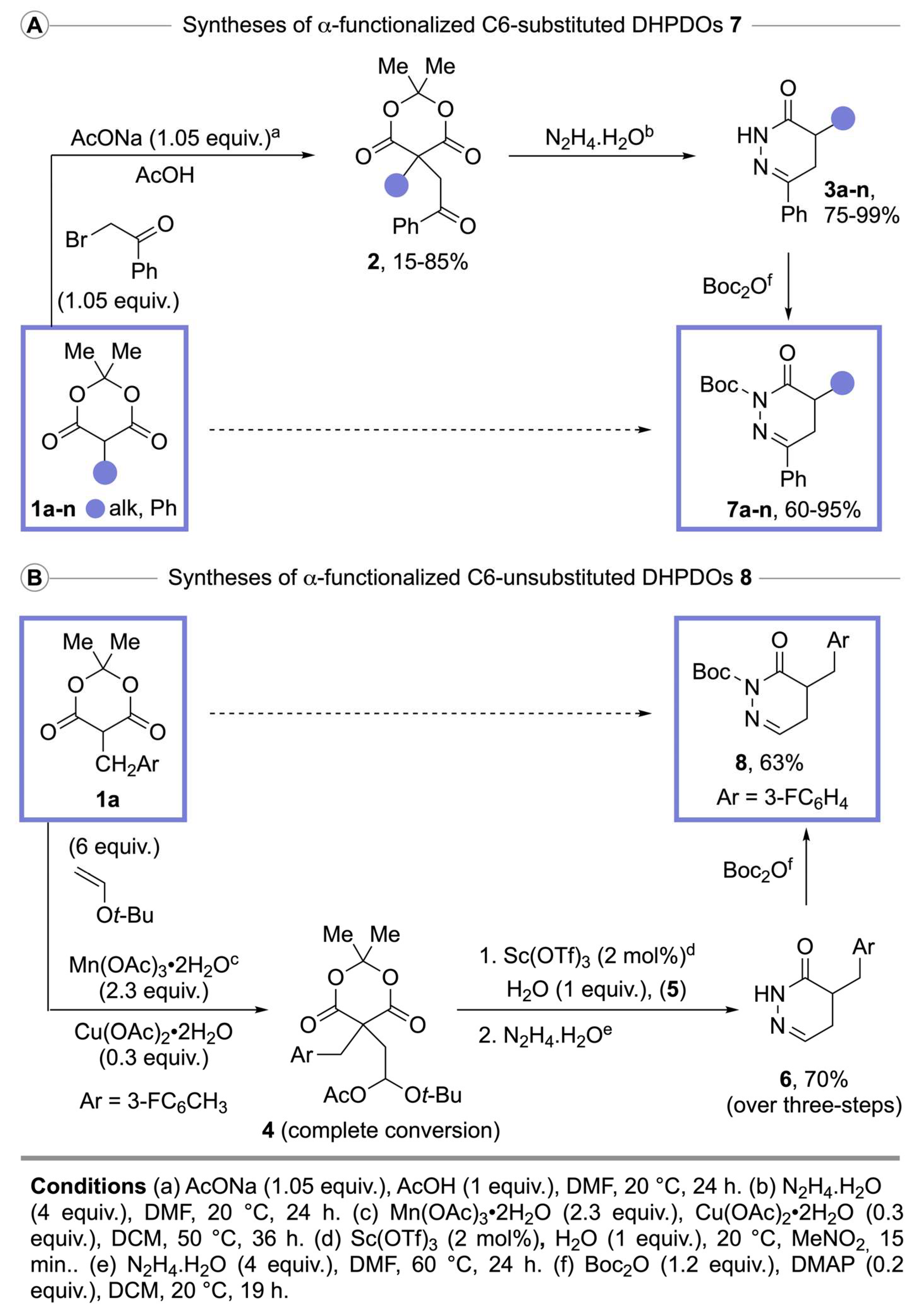
- Compounds 2: C5-monosubstituted Meldrum’s acid derivatives 1 (4.9 mmol), 2-bromo acetophenone (1.05 g, 5.3 mmol) and sodium acetate (435 mg, 5.3 mmol) were introduced into a round-bottom flask (N2 atmosphere). The mixture was dissolved in DMF (5 mL, 0.98 M), and acetic acid (0.29 mL, 4.9 mmol) was added dropwise at room temperature (vigorous stirring). After a night, the solvent was evaporated under reduced pressure. The crude product was dissolved in DCM and washed with a mixture of H2O/Na2CO3 (sat.) (9:1), and then with brine. The resulting organic phase was dried over anhydrous Na2SO4, filtrated, and finally the solvent was evaporated under reduced pressure. The crude reaction mixture was triturated with Et2O to give products 2a–o (exact experimental and analytical details can be found in the online supporting information).
- Compounds 3: C5-disubstituted Meldrum’s acid derivative 2 (3.3 mmol) was solubilized in DMF (11 mL, 0.3 M) first (N2 atmosphere). At 0 °C, under vigorous stirring, hydrazine monohydrate (0.65 mL, 13.3 mmol) was added dropwise. The reaction was stirred for 24 h at room temperature, then the solvent was evaporated under reduced pressure. The crude was dissolved in DCM and washed with an aqueous acidic solution (pH 3–4) and then with brine. The combined organic phases were dried over anhydrous Na2SO4 and finally, the solvent was evaporated under reduced pressure, producing products 3 (exact experimental and analytical details can be found in the online supporting information).
- Compounds 7: Boc2O (938.5 mg, 4.3 mmol) and DMAP (87.5 mg, 716 µmol) were introduced in a round-bottom flask (N2 atmosphere). The N-unsubstituted 4,5-dihydropyridazinone 3 (3.58 mmol) was dissolved in anhydrous DCM (24 mL, 0.15 M) and introduced slowly into the round-bottom flask at room temperature. The solution was vigorously stirred overnight. Then, the solvent was evaporated under reduced pressure and the crude mixture was purified by silica gel column chromatography producing 7 (exact experimental and analytical details can be found in the online supporting information).
- General procedure for the quaternary ammonium salt-catalyzed Michael addition of pyridazinones to Michael acceptors.
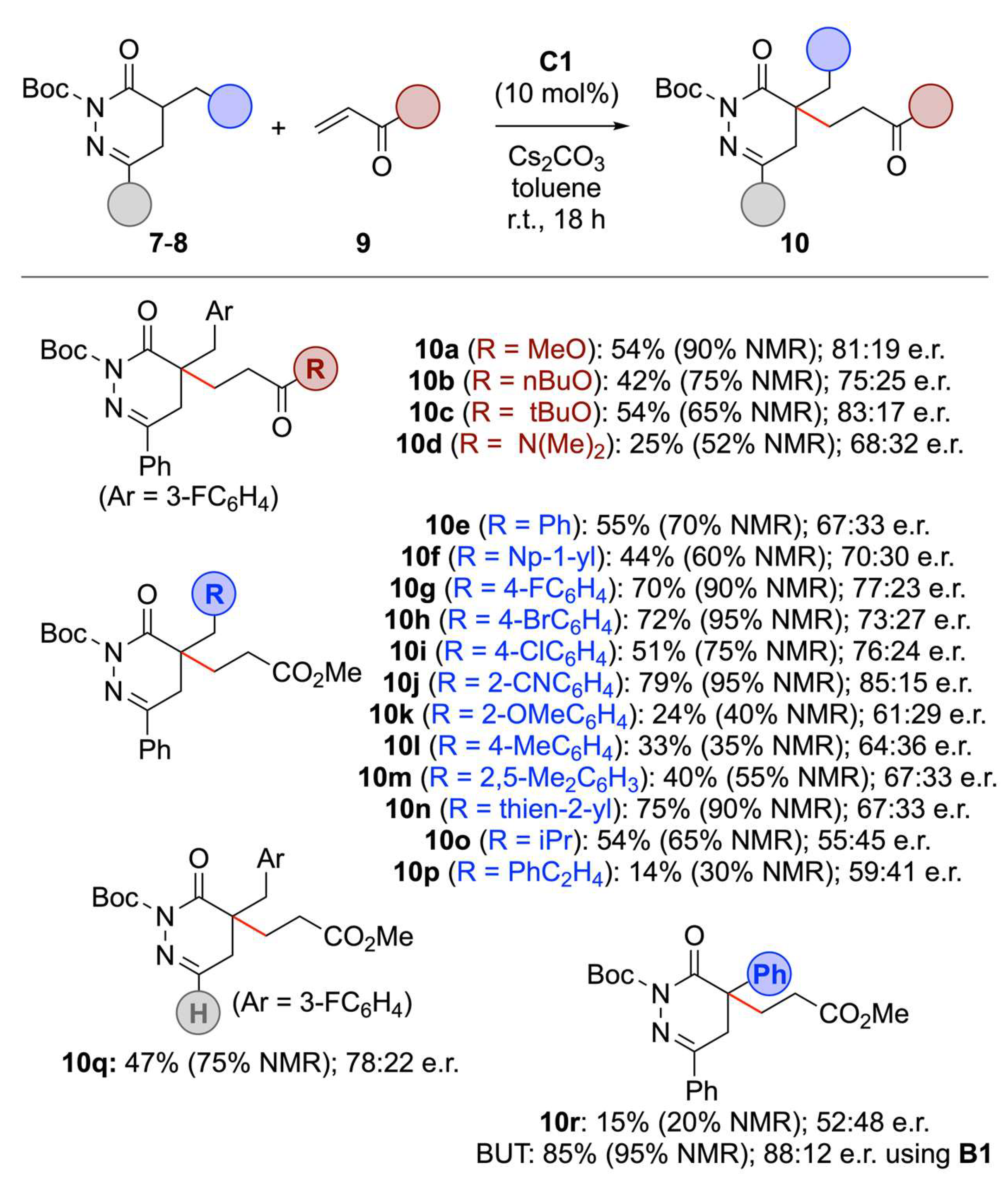
- Spirobiindane-based ammonium salt C1 (9.2 mg, 0.01 mmol) and Cs2CO3 (98 mg, 0.3 mmol) were introduced into a 2 mL vial at room temperature. The N-Boc dihydropyridazinone derivative 7 or 8 (0.1 mmol) was dissolved in toluene (1 mL, 0.1 M) and added to the vial followed by the Michael acceptor 9 (0.3 mmol). The mixture was stirred at room temperature for 18 h (1100 rpm). The crude mixture was filtered through a pad of silica gel using EtOAc as an eluent. Then, the crude mixture was purified by silica gel column chromatography producing the corresponding α,α-difunctionalized pyridazinone derivatives 10 (exact experimental and analytical details can be found in the online supporting information).
4. Conclusions
Supplementary Materials
Author Contributions
Funding
Institutional Review Board Statement
Informed Consent Statement
Data Availability Statement
Acknowledgments
Conflicts of Interest
References
- Ma, X.; Sun, P.; Wang, J.; Huang, X.; Wu, J. Pyridazine and pyridazinone compounds in crops protection: A review. Mol. Divers 2024, 29, 5085–5100. [Google Scholar] [CrossRef] [PubMed]
- Bansal, R.; Thota, S. Pyridazin-3(2H)-ones: The versatile pharmacophore of medicinal significance. Med. Chem. Res. 2013, 22, 2539–2552. [Google Scholar] [CrossRef]
- Dubey, S.; Bhosle, P.S. Pyridazinone: An important element of pharmacophore possessing broad spectrum of activity. Med. Chem. Res. 2015, 24, 3579–3598. [Google Scholar] [CrossRef]
- Shaik, B.B.; Chandrasekaran, B.; Obakachi, V.A.; Mokoena, S.; Mohite, S.B.; Kushwaha, B.; Kushwaha, N.S.; Karpoormath, R. Pyridazinone: A privileged scaffold for synthetic and biomedical applications. J. Mol. Struct. 2025, 1326, 140948. [Google Scholar]
- Singh, J.; Sharma, D.; Bansal, R. Pyridazinone: An Attractive Lead for Anti-Inflammatory and Analgesic Drug Discovery. Future Med. Chem. 2017, 9, 95–127. [Google Scholar] [CrossRef]
- Yu, S.; Yu, J.-T.; Pan, C. Advances in the synthesis of functionalized tetrahydropyridazines from hydrazones. Org. Biomol. Chem. 2024, 22, 7753–7766. [Google Scholar] [CrossRef]
- Nieminen, M.S.; Fruhwald, S.; Heunks, L.M.A.; Suominen, P.K.; Gordon, A.C.; Kivikko, M.; Pollesello, P. Levosimendan: Current data, clinical use and future development. Heart Lung Vessels 2013, 5, 227–245. [Google Scholar]
- Ünlüa, S.; Banoglua, E.; Küpelib, E.; Yeşilada, E.; Şahina, M.F.; Ökçelika, B. Investigations of New Pyridazinone Derivatives for the Synthesis of Potent Analgesic and Anti-Inflammatory Compounds with Cyclooxygenase Inhibitory Activity. Arch. Pharm. Pharm. Med. Chem. 2003, 336, 406–412. [Google Scholar]
- Friebe, W.-G.; Müller-Beckmann, B.; Kampe, W.; Kling, L.; von der Saal, W.; Mertens, A. Nonsteroidal Cardiotonics. 3. New 4,5-Dihydro-6-(lJ3r-indol-5-yl)pyridazin-3(2flT)-ones and Related Compounds with Positive Inotropic Activities. J. Med. Chem. 1990, 33, 2870–2875. [Google Scholar]
- Imran, M.; Asif, M. Biologically Active Pyridazines and Pyridazinone Derivatives: A Scaffold for the Highly Functionalized Compounds. Russ. J. Bioorg. Chem. 2020, 46, 726–744. [Google Scholar] [CrossRef]
- Kurose, A.; Ishida, Y.; Hirata, G.; Nishikata, T. Direct α-Tertiary Alkylations of Ketones in a Combined Copper–Organocatalyst System. Angew. Chem. Int. Ed. 2021, 60, 10620–10625. [Google Scholar] [CrossRef] [PubMed]
- Ng, T.M.H. Levosimendan, a new calcium-sensitizing inotrope for heart failure. Pharm. Pharmacotherapy 2004, 24, 1366–1384. [Google Scholar] [CrossRef] [PubMed]
- Matsuda, K.; Arima, K.; Akiyama, S.; Yamada, Y.; Abe, Y.; Suenaga, H.; Hashimoto, J.; Shin-ya, K.; Nishiyama, M.; Wakimoto, T. A Natural Dihydropyridazinone Scaffold Generated from a Unique Substrate for a Hydrazine-Forming Enzyme. J. Am. Chem. Soc. 2022, 144, 12954–12960. [Google Scholar] [CrossRef] [PubMed]
- Liu, R.-X.; Ma, S.-F.; Chen, Y.-L.; Ma, L.-F.; Wang, J.-D.; Zham, Z.-J. Tetrodecadazinone, a novel tetrodecamycin-pyridazinone hybrid with anti-liver fibrosis activity from Streptomyces sp. HU051. Bioorg. Chem. 2022, 119, 105573. [Google Scholar] [CrossRef]
- Provencher, B.A.; Bartelson, K.J.; Liu, Y.; Foxman, B.M.; Deng, L. Structural Study-Guided Development of Versatile Phase Transfer Catalysts for Asymmetric Conjugate Additions of Cyanide. Angew. Chem. Int. Ed. 2011, 50, 10565–10569. [Google Scholar] [CrossRef]
- Shen, L.-T.; Sun, L.-H.; Ye, S. Highly Enantioselective γ-Amination of α,β-Unsaturated Acyl Chlorides with Azodicarboxylates: Efficient Synthesis of Chiral γ-Amino Acid Derivatives. J. Am. Chem. Soc. 2011, 133, 15894–15897. [Google Scholar] [CrossRef]
- Mao, J.-H.; Wang, Z.-T.; Wang, Z.-Y.; Cheng, Y. N-Heterocyclic Carbene-Catalyzed Oxidative Annulations of α,β-Unsaturated Aldehydes with Hydrazones: Selective Synthesis of Optically Active 4,5-Dihydropyridazin-3-ones and Pyridazin-3-ones. J. Org. Chem. 2015, 80, 6350–6359. [Google Scholar] [CrossRef]
- Zhang, C.-L.; Wang, D.-L.; Chen, K.-Q.; Ye, S. N-Heterocyclic carbene-catalyzed [3+3] cyclocondensation of bromoenals with hydrazones: Highly enantioselective synthesis of dihydropyridazones. Org. Biomol. Chem. 2015, 13, 11255–11262. [Google Scholar] [CrossRef]
- Zhang, Z.-J.; Song, J. An isothiourea-catalyzed asymmetric formal [4 + 2] cycloaddition of in situ generated azoalkenes with C1 ammonium enolates. Org. Chem. Front. 2018, 5, 2578–2582. [Google Scholar] [CrossRef]
- Mondal, B.; Maiti, R.; Yang, X.; Xu, J.; Tian, W.; Yan, J.-L.; Li, X.; Chi, Y.R. Carbene-catalyzed enantioselective annulation of dinucleophilic hydrazones and bromoenals for access to aryl-dihydropyridazinones and related drugs. Chem. Sci. 2021, 12, 8778–8783. [Google Scholar] [CrossRef]
- Li, X.; Gai, K.; Yuan, Z.; Wu, J.; Lin, A.; Yao, H. Organocatalyzed Formal [4+2] Cycloaddition of in situ Generated Azoalkenes with Arylacetic Acids: An Efficient Approach to the Synthesis of 4,5-Dihydropyridazin-3(2H)-ones. Adv. Synth. Catal. 2015, 357, 3479–3484. [Google Scholar] [CrossRef]
- Zhou, Y.; Zhou, H.; Xu, J. N-Heterocyclic Carbene-Promoted [4+2] Annulation of α-Chloro Hydrazones with α-Chloro Aliphatic Aldehydes to Access Enantioenriched Dihydropyridazinones. J. Org. Chem. 2022, 87, 3677–3685. [Google Scholar]
- Ordóñez, M.; Cativiela, C. Stereoselective synthesis of γ-amino acids. Tetrahedron Asymmetry 2007, 18, 3–99. [Google Scholar] [CrossRef]
- Ordóñez, M.; Cativiela, C.; Romero-Estudillo, I. An update on the stereoselective synthesis of γ-amino acids. Tetrahedron Asymmetry 2016, 27, 999–1055. [Google Scholar] [CrossRef]
- Boatman, P.D.; Ogbu, C.O.; Eguchi, M.; Kim, H.-O.; Nakanishi, H.; Cao, B.; Shea, J.P.; Kahn, M. Secondary Structure Peptide Mimetics: Design, Synthesis, and Evaluation of β-Strand Mimetic Thrombin Inhibitors. J. Med. Chem. 1999, 42, 1367–1375. [Google Scholar] [CrossRef]
- Alvarez-Ibarra, C.; Csákÿ, A.G.; de la Oliva, C.G. Diastereoselective Synthesis of α-Methylpyroglutamates from α,β-Didehydro α-Amino Acids. Eur. J. Org. Chem. 2002, 2002, 4190–4194. [Google Scholar] [CrossRef]
- Alvarez-Ibarra, C.; Csákÿ, A.G.; de la Oliva, C.G. Diastereoselective Synthesis and Estimation of the Conformational Flexibility of 6-Oxoperhydropyridazine-3-carboxylic Acid Derivatives. J. Org. Chem. 2002, 67, 2789–2797. [Google Scholar] [CrossRef]
- Gardiner, J.; Abell, A.D. A diastereoselective synthesis of the tetrahydropyridazinone core of 2-oxo-1,6-diazobicyclo[4.3.0]nonane-9-carboxylate-based peptidomimetics starting from (S)-phenylalanine. Tetrahedron Lett. 2003, 44, 4227–4230. [Google Scholar] [CrossRef]
- Keck, G.E.; Heumann, S.A. Diastereoselective Synthesis of Cyclopentapyridazinones via Radical Cyclization: Synthetic Studies Toward Halichlorine. Org. Lett. 2008, 10, 4783–4786. [Google Scholar] [CrossRef][Green Version]
- Cadart, T.; Berthonneau, C.; Levacher, V.; Perrio, S.; Brière, J.-F. Enantioselective Phase-Transfer Catalyzed α-Sulfanylation of Isoxazolidin-5-ones: An Entry to β2,2-Amino Acid Derivatives. Chem. Eur. J. 2016, 22, 15261–15264. [Google Scholar] [CrossRef]
- Cadart, T.; Levacher, V.; Perrio, S.; Brière, J.-F. Construction of Isoxazolidin-5-ones with a Tetrasubstituted Carbon Center: Enantioselective Conjugate Addition Mediated by Phase-Transfer Catalysis. Adv. Synth. Catal. 2018, 360, 1499–1509. [Google Scholar] [CrossRef]
- Röser, K.; Prameshuber, L.; Jahangir, S.; Mallojjala, S.C.; Hirschi, J.S.; Waser, M. Chiral Quaternary Ammonium Salt-Catalyzed Enantioselective Addition Reactions of Hydantoins. Helv. Chim. Acta 2024, 107, e202300234. [Google Scholar] [CrossRef]
- Eitzinger, A.; Winter, M.; Schörgenhumer, J.; Waser, M. Quaternary β2,2-amino acid derivatives by asymmetric addition of isoxazolidin-5-ones to para-quinone methides. Chem. Commun 2020, 56, 579–582. [Google Scholar]
- Dumas, A.M.; Fillion, E. Meldrum’s Acids and 5-Alkylidene Meldrum’s Acids in Catalytic Carbon−Carbon Bond-Forming Processes. Acc. Chem. Res. 2010, 43, 440–454. [Google Scholar] [CrossRef] [PubMed]
- Pair, E.; Cadart, T.; Levacher, V.; Brière, J.-F. Meldrum’s Acid: A Useful Platform in Asymmetric Organocatalysis. ChemCatChem 2016, 8, 1882–1890. [Google Scholar]
- Brosge, F.; Singh, P.; Almqvist, F.; Bolm, C. Selected applications of Meldrum’s acid—a tutorial. Org. Biomol. Chem. 2021, 19, 5014–5027. [Google Scholar] [CrossRef]
- Beucher, H.; Levacher, V.; Oudeyer, S.; Brière, J.-F. Recent advances of asymmetric catalytic transformations of alkylidene Meldrum’s acid derivatives. Chem. Commun. 2025, 61, 6555–6566. [Google Scholar]
- Shirakawa, S.; Maruoka, K. Recent Developments in Asymmetric Phase-Transfer Reactions. Angew. Chem. Int. Ed. 2013, 52, 4312–4348. [Google Scholar]
- Qia, D.; Sun, J. Recent Progress in Asymmetric Ion-Pairing Catalysis with Ammonium Salts. Chem. Eur. J. 2019, 25, 3740–3751. [Google Scholar]
- Otevrel, J.; Waser, M. Asymmetric Phase-Transfer Catalysis—From Classical Applications to New Concepts. In Asymmetric Organocatalysis: New Strategies, Catalysts, and Opportunities; Albrecht, Ł., Albrecht, A., Dell’Amico, L., Eds.; Wiley-VCH: Weinheim, Germany, 2023; Volume 2, pp. 71–120. [Google Scholar]
- Albanese, D.C.M.; Penso, M. New Trends in Asymmetric Phase Transfer Catalysis. Eur. J. Org. Chem. 2023, 26, e202300224. [Google Scholar] [CrossRef]
- Lee, H.-J.; Maruoka, K. Asymmetric phase-transfer catalysis. Nat. Rev. Chem. 2024, 8, 851–869. [Google Scholar] [CrossRef] [PubMed]
- Tóth, G.; Molnár, S.; Tamás, T.; Borbély, I. An Efficient Synthesis of 4,5-Dihydro-3(2H)-pyridazinone Derivatives. Synth. Commun. 2006, 27, 3513–3523. [Google Scholar] [CrossRef]
- Ramachary, D.B.; Kishor, M.; Ramakumar, K. A novel and green protocol for two-carbon homologation: A direct amino acid/K2CO3-catalyzed four-component reaction of aldehydes, active methylenes, Hantzsch esters and alkyl halides. Tetrahedron Lett. 2006, 47, 651–656. [Google Scholar] [CrossRef]
- Ramachary, D.B.; Reddy, G.B. Towards organo-click reactions: Development of pharmaceutical ingredients by using direct organocatalytic bio-mimetic reductions. Org. Biomol. Chem. 2006, 4, 4463–4468. [Google Scholar] [CrossRef]
- Bar, G.; Parsons, A.F.; Thomas, C.B. Manganese(III) acetate-mediated alkylation of β-keto esters and β-keto amides: An enantio- and diastereo-selective approach to substituted pyrrolidinones. Org. Biomol. Chem. 2003, 1, 373–380. [Google Scholar] [CrossRef]
- Snider, B.B.; Smith, R.B. Mn(III)-based oxidative free-radical cyclizations of alkenyl Meldrum’s acids. Tetrahedron 2002, 58, 25–34. [Google Scholar] [CrossRef]
- Aggarwal, V.K.; Fonquerna, S.; Vennall, G.P. Sc(OTf)3, an Efficient Catalyst for Formation and Deprotection of Geminal Diacetates (Acylals); Chemoselective Protection of Aldehydes in Presence of Ketones. Synlett 1998, 1998, 849–850. [Google Scholar] [CrossRef]
- Lee, H.-J.; Maruoka, K. Recent Asymmetric Phase-Transfer Catalysis with Chiral Binaphthyl-Modified and Related Phase-Transfer Catalysts over the Last 10 Years. Chem. Rec. 2023, 23, e202200286. [Google Scholar]
- Xu, C.; Qi, Y.; Yang, X.; Li, X.; Li, Z.; Bai, L. Development of C2-Symmetric Chiral Spirocyclic Phase-Transfer Catalysts: Synthesis and Application to Asymmetric Alkylation of Glycinate Schiff Base. Org. Lett. 2021, 23, 2890–2894. [Google Scholar] [CrossRef]
- Xu, C.; Yang, X. Chiral Ammonium Salt Catalyzed Asymmetric Alkylation of Unactivated Amides. Synlett 2022, 33, 664–668. [Google Scholar] [CrossRef]
- Zebrowski, P.; Röser, K.; Chrenko, D.; Pospisil, J.; Waser, M. Enantioselective β-Selective Addition of Isoxazolidin-5-ones to Allenoates Catalyzed by Quaternary Ammonium Salts. Synthesis 2023, 55, 1706–1713. [Google Scholar] [PubMed]
- Caruana, L.; Fochi, M.; Bernardi, L. The Emergence of Quinone Methides in Asymmetric Organocatalysis. Molecules 2015, 20, 11733–11764. [Google Scholar] [CrossRef] [PubMed]
- Lima, C.G.S.; Pauli, F.P.; Costa, D.C.S.; de Souza, A.S.; Forezi, L.S.M.; Ferreira, V.F.; de Carvalho da Silva, F. para-Quinone Methides as Acceptors in 1,6-Nucleophilic Conjugate Addition Reactions for the Synthesis of Structurally Diverse Molecules. Eur. J. Org. Chem. 2020, 2020, 2650–2692. [Google Scholar]
- Wang, J.-Y.; Hao, W.-J.; Tu, S.-J.; Jiang, B. Recent developments in 1,6-addition reactions of para-quinone methides (p-QMs). Org. Chem. Front. 2020, 7, 1743–1778. [Google Scholar] [CrossRef]
- Li, X.; Li, Z.; Sun, J. Quinone methides and indole imine methides as intermediates in enantioselective catalysis. Nat. Synth. 2022, 1, 426–438. [Google Scholar] [CrossRef]
- Henry, P.J.; Burel, G.; Nzegge, W.; Waser, M.; Brière, J.-F. Catalytic Synthesis of Versatile Chiral Heterocycles: En Route to γ-Amino Acid Derivatives. Chem. Proc. 2025, 18, 70. [Google Scholar] [CrossRef]
- Chidipudi, S.R.; Khan, I.; Lam, H.W. Functionalization of Csp3-H and Csp2-H Bonds: Synthesis of Spiroindenes by Enolate-Directed Ruthenium-Catalyzed Oxidative Annulation of Alkynes with 2-Aryl-1,3-dicarbonyl Compounds. Angew. Chem. Int. Ed. 2012, 51, 12115–12119. [Google Scholar] [CrossRef]



 | |||||||
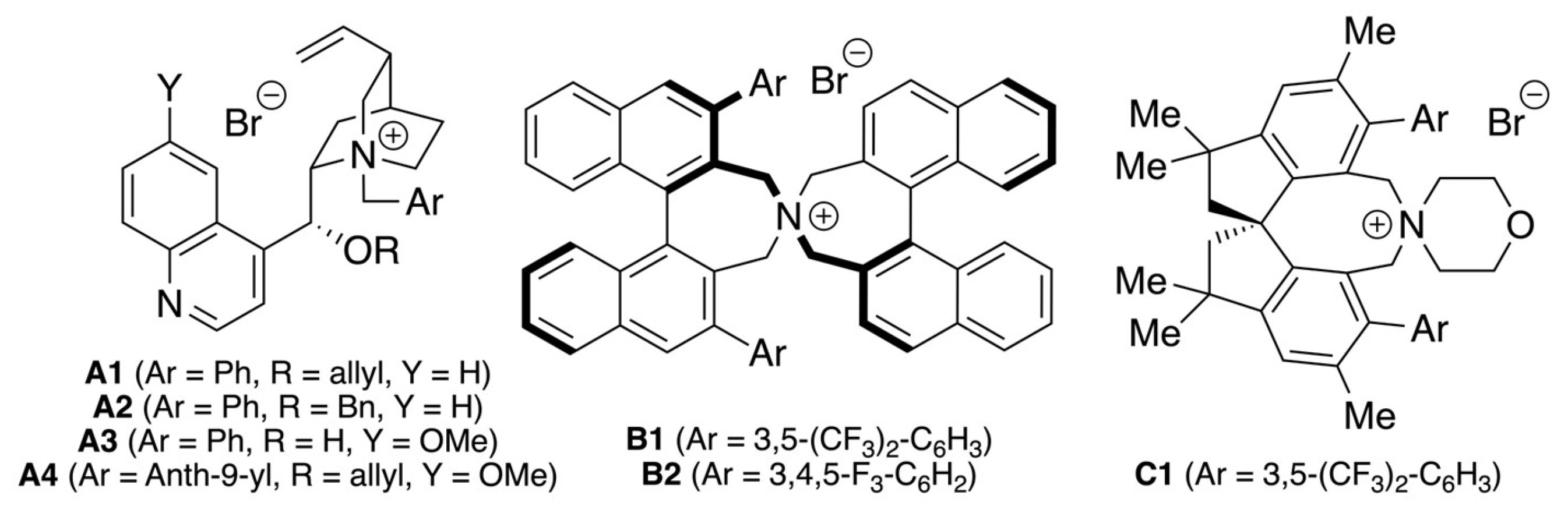
| Entry | R4NX | Solvent | Base (Eq.) | t (h) | Conv. (%) 2 | 10a (%) 3 | e.r. 4 |
| 1 | A1 | CH2Cl2 | Cs2CO3 (1.5) | 3 | 70 | 70 | 55:45 |
| 2 | A2 | CH2Cl2 | Cs2CO3 (1.5) | 3 | 55 | 55 | 54:46 |
| 3 | A3 | CH2Cl2 | Cs2CO3 (1.5) | 3 | 10 | 10 | n.d. |
| 4 | A4 | CH2Cl2 | Cs2CO3 (1.5) | 3 | 90 | 85 | 54:46 |
| 5 | A4 | THF | Cs2CO3 (1.5) | 3 | 100 | 95 | 52:48 |
| 6 | A4 | toluene | Cs2CO3 (1.5) | 3 | 80 | 80 | 52:48 |
| 7 | A4 | CH2Cl2 | K3PO4 (1.5) | 3 | 40 | 35 | 50:50 |
| 8 | B1 | CH2Cl2 | Cs2CO3 (1.5) | 3 | 40 | 30 | 40:60 |
| 9 | B2 | CH2Cl2 | Cs2CO3 (1.5) | 3 | 40 | 35 | 43:57 |
| 10 | C1 | CH2Cl2 | Cs2CO3 (1.5) | 3 | 90 | 85 | 36:64 |
| 11 | C1 | CH2Cl2 | K3PO4 (1.5) | 3 | 25 | 25 | 36:64 |
| 12 | C1 | THF | Cs2CO3 (1.5) | 3 | 95 | 50 | 42:58 |
| 13 | C1 | toluene | Cs2CO3 (1.5) | 3 | 30 | 25 | 10:90 |
| 14 | C1 | toluene | Cs2CO3 (1.5) | 18 | 80 | 75 | 15:85 |
| 15 | C1 | toluene | Cs2CO3 (1.5) | 40 | 100 | 90 | 19:81 |
| 16 | C1 | toluene | Cs2CO3 (3) | 18 | 100 | 90 (54) | 19:81 |
| 17 5 | C1 | toluene | Cs2CO3 (3) | 18 | 40 | 40 | 10:90 |
Disclaimer/Publisher’s Note: The statements, opinions and data contained in all publications are solely those of the individual author(s) and contributor(s) and not of MDPI and/or the editor(s). MDPI and/or the editor(s) disclaim responsibility for any injury to people or property resulting from any ideas, methods, instructions or products referred to in the content. |
© 2025 by the authors. Licensee MDPI, Basel, Switzerland. This article is an open access article distributed under the terms and conditions of the Creative Commons Attribution (CC BY) license.
Share and Cite
Henry, P.J.; Burel, G.; Nzegge, W.; Waser, M.; Brière, J.-F. 4,5-Dihydro-2H-pyridazin-3-ones as a Platform for the Construction of Chiral 4,4-Disubstituted-dihydropyridazin-3-ones. Molecules 2026, 31, 83. https://doi.org/10.3390/molecules31010083
Henry PJ, Burel G, Nzegge W, Waser M, Brière J-F. 4,5-Dihydro-2H-pyridazin-3-ones as a Platform for the Construction of Chiral 4,4-Disubstituted-dihydropyridazin-3-ones. Molecules. 2026; 31(1):83. https://doi.org/10.3390/molecules31010083
Chicago/Turabian StyleHenry, Paul Joël, Gabriel Burel, William Nzegge, Mario Waser, and Jean-François Brière. 2026. "4,5-Dihydro-2H-pyridazin-3-ones as a Platform for the Construction of Chiral 4,4-Disubstituted-dihydropyridazin-3-ones" Molecules 31, no. 1: 83. https://doi.org/10.3390/molecules31010083
APA StyleHenry, P. J., Burel, G., Nzegge, W., Waser, M., & Brière, J.-F. (2026). 4,5-Dihydro-2H-pyridazin-3-ones as a Platform for the Construction of Chiral 4,4-Disubstituted-dihydropyridazin-3-ones. Molecules, 31(1), 83. https://doi.org/10.3390/molecules31010083