Article

Electrochemical Synthesis of Methoxy-NNO-azoxy Compounds via N=N Bond Formation Between Ammonium N-(methoxy)nitramide and Nitroso Compounds


by
Alexander S. Budnikov
,
Andey A. Kulikov
,
Michael S. Klenov
*,
Nikita E. Leonov
,
Igor B. Krylov
*,
Alexander O. Terent’ev
and
Vladimir A. Tartakovsky
N. D. Zelinsky Institute of Organic Chemistry, Russian Academy of Sciences, 47 Leninsky Prosp., 119991 Moscow, Russia
*
Authors to whom correspondence should be addressed.
Molecules 2025, 30(24), 4723; https://doi.org/10.3390/molecules30244723 (registering DOI)
Submission received: 8 November 2025 / Revised: 4 December 2025 / Accepted: 5 December 2025 / Published: 10 December 2025
(This article belongs to the Special Issue Feature Papers in Organic Chemistry—Third Edition)

Abstract

In this study, atom- and step-efficient electrochemical coupling of nitroso compounds with ammonium N-(methoxy)nitramide, furnishing methoxy-NNO-azoxy compounds, is reported. The developed protocol employs a divided electrochemical cell, proceeds under constant-current electrolysis conditions, and is applicable to aromatic, heterocyclic, and aliphatic nitroso compounds. The versatility of the developed electrochemical coupling method was demonstrated by comparing it with chemical approaches on various substrates.

1. Introduction

Organic compounds containing N–N and N–O bonds are widely used as sources of free radicals for selective transformations [1,2,3,4,5,6,7] and polymerization initiators [8], energetic materials [9,10,11], and HNO donors [12,13]. Despite the practical importance of such compounds, synthetic approaches to the construction of N–N and N–O systems are limited in number and application scope. Selective N–N [1,14,15,16,17,18,19,20,21,22,23,24,25] and N–O [26,27,28,29,30,31] coupling is almost unexplored compared to C–C and C–Het coupling processes.
To date, electro-organic synthesis has become a powerful and reliable strategy for the functionalization of organic compounds under green and mild reaction conditions [32,33,34,35]. However, electrochemical N–N and N=N bond formation remains undeveloped. The vast majority of developed approaches focus mainly on intramolecular radical cyclizations [36,37,38,39,40,41,42,43,44,45,46], while intermolecular [14,47,48,49,50,51] N–N coupling remains a poorly studied area.
The O2-Methylated diazeniumdiolate functional group [–N(O)=N–OMe], also known as the methoxy-NNO-azoxy moiety, has been known for over a century since Traube’s pioneering work [52]. Since then, this functional group has attracted considerable attention, starting with the elucidation of its structure [53,54,55], and continuing with the development of novel synthetic routes [56,57,58,59,60,61,62,63], biological evaluation and NO-release profiling [64,65,66], and the design of the novel energetic materials [67,68,69].
The diversity of potential applications of compounds containing the methoxy-NNO-azoxy moiety necessitates the development of versatile synthetic methods for the construction of this group. However, to date, only three approaches to the synthesis of methoxy-NNO-azoxy compounds have been reported, all of which lack versatility (Scheme 1).
The first and the oldest approach is based on the methylation of the salts of nitrosohydroxylamines (Scheme 1, eq. 1). Though this method is widely used and allows one to synthesize diverse series of compounds, it has major drawbacks. First, the yield of the desired compound strongly depends on the substrate’s structure—aliphatic derivatives are typically obtained in good yields (>50%), whereas yields of heterocyclic compounds are below 20% [63]. Second, the reaction proceeds with the formation of two isomers, thereby reducing product yield and complicating the purification of the target compound.
The second approach involves the coupling of nitroso compounds with methoxyamine in the presence of an oxidant (Scheme 1, eq. 2). The typical oxidants used in this method include lead tetraacetate (Pb(OAc)4) [57,60], di(acetoxy)iodobenzene (PhI(OAc)2) [60,69], dibromoisocyanuric acid (DBI) [60,69], N-bromosuccinimide (NBS) [60], and bromine [60]. Although this method enables the synthesis of a wide range of methoxy-NNO-azoxy compounds, their yields typically do not exceed 50% and are accompanied by the formation of several byproducts.
The third approach recently discovered by our research team utilizes the nucleophilic addition–elimination reaction of ammonium N-(methoxy)nitramide with 3-amino-4-nitrosofurazan, which furnishes 3-amino-4-(methoxy-NNO-azoxy)furazan (Scheme 1, eq. 3) [69]. This method has proven to be a convenient route for the construction of the methoxy-NNO-azoxy group and produces a promising yield; however, its applicability has not been evaluated with other substrates.
Previously, we have developed an efficient method for the synthesis of (nitro-NNO-azoxy)arenes [Ar–N(O)=N–NO2] via the electrochemical coupling of nitrosobenzenes with ammonium dinitramide [70]. Consequently, the application of a similar electrochemical approach to the preparation of methoxy-NNO-azoxy compounds appeared promising.
Herein, we report a versatile electrochemical approach to synthesizing methoxy-NNO-azoxy compounds, employing ammonium N-(methoxy)nitramide as the reagent and nitroso compounds as coupling partners (see Scheme 1, bottom). The usefulness of this novel method is demonstrated by comparing it with previously described chemical approaches (Scheme 1, eqs. 2 and 3) on aliphatic, aromatic, and heterocyclic substrates.

2. Results and Discussion

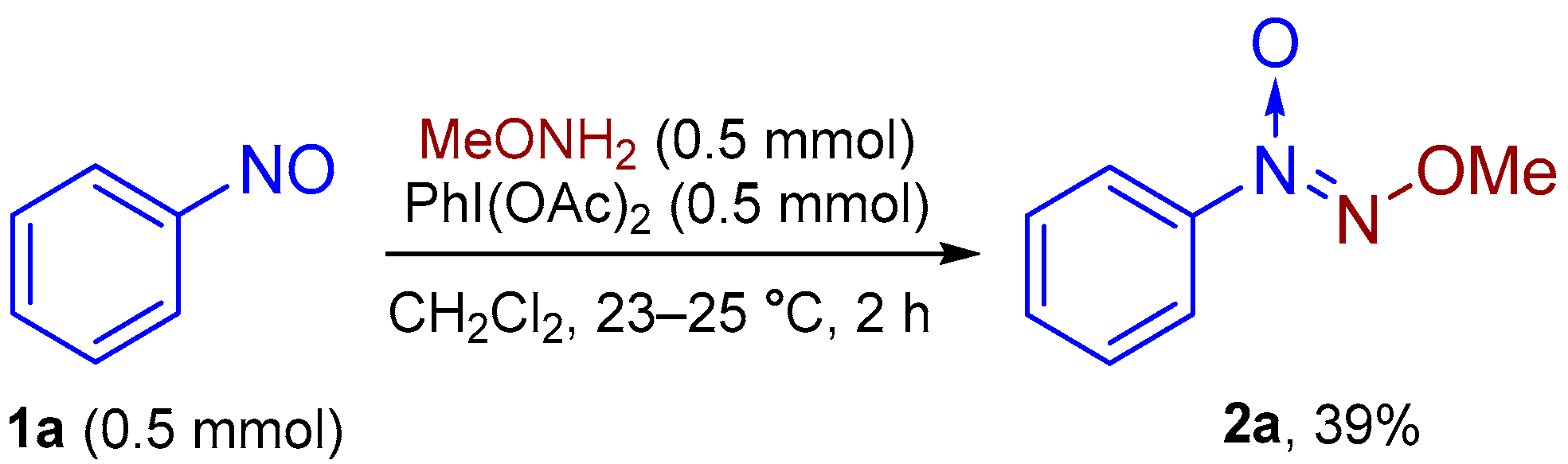
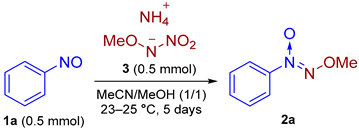
First, the traditional approach to the synthesis of methoxy-NNO-azoxy compounds via the oxidative coupling of nitroso compounds with methoxyamine was studied (Scheme 1, eq. 2). The reaction conditions were optimized for the model reaction of nitrosobenzene 1a with methoxyamine in the presence of a common oxidant for such transformations—PhI(OAc)2 (Scheme 2).
Carrying out the reaction in dichloromethane for 2 h at 23–25 °C with the equimolar amounts of methoxyamine and PhI(OAc)2 turned out to be the most optimal, and (methoxy-NNO-azoxy)benzene 2a was obtained in 39% yield. The variation in solvent (MeCN, Et2O), temperature (0 °C, 40 °C), oxidant (DBI), and stoichiometric ratio of oxidant/methoxyamine/1a (2:1:1, 2:2:1, 4:2:1) either had no effect on the product yield or led to its decrease. This reaction proceeds with the formation of several unidentified byproducts, which substantially complicate the isolation and purification of compound 2a.
Subsequently, an alternative approach to synthesizing methoxy-NNO-azoxy compounds was investigated, involving the reaction of nitroso compound 1a with ammonium N-(methoxy)nitramide 3 [69] (see Scheme 1, eq. 3). Optimization of the reaction conditions was carried out by employing nitrosobenzene 1a as a model substrate (Table 1). Reaction completion was monitored by TLC analysis until full consumption of starting compound 1a.
Initially, the optimal solvent was identified (Table 1, entries 1–11). The use of a MeCN/MeOH (1/1) mixture afforded compound 2a in the highest yield (30%, entry 11). Conducting the reaction in DMSO resulted in a slightly lower yield, although with a reduced overall reaction time (entry 4). Next, we tested the possibility of accelerating the reaction via heating (entries 12, 13). However, carrying out the reaction at 50 °C led to a lower yield of the desired product. Although optimization of this method achieved a yield comparable to that of the oxidative coupling method (see Scheme 2), the reaction time was significantly increased.
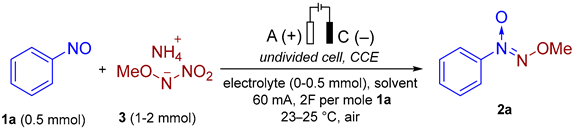
Presumably, the low efficiency of the reaction between 1a and methoxyamine or 3 is associated with insufficient electrophilicity of 1a. Thus, we decided to try a fundamentally different approach to intermolecular N=N coupling. Our idea is based on the generation of an electrophilic N-centered radical from 3 via anodic oxidation (Scheme 1, bottom). Previously, such a strategy was barely explored, except for N=N coupling between nitrosoarenes and ammonium dinitramide [70]. However, employing conditions suitable for ammonium dinitramide [70] for the case of ammonium N-(methoxy)nitramide 3 in the synthesis of 2a yielded the desired product in only 10% (Table 2, entry 1). Variation in solvent and electrode failed to significantly improve the yield of 2a (Table 2, entries 2–6). The low yield of the product can be attributed to competing cathodic processes.
Therefore, the reaction conditions for the reaction between 1a and 3 were optimized using a divided electrochemical cell. The influence of the electrode material, amount of electricity, current density, supporting electrolyte, and solvent was evaluated (Table 3).
The solvent was varied first (Table 3, entries 1–9). The best result was obtained using DMSO as a solvent despite its redox-active nature in electrochemistry [71] (entry 9). A comparable result was obtained with a THF/H2O system (Table 3, entry 6); however, nitrobenzene 4a was formed in a higher yield. Employing other solvents (Table 3, entries 1–5, 7, 8) was ineffective due to over-oxidation of nitrosobenzene 1a to nitrobenzene 4a. Next, we varied the quantity of 3 (Table 3, entries 10–11). An amount of 1 mmol of 3 per 0.5 mmol of 1a was found to be the optimal (Table 2, entry 10). The supporting electrolyte was also tested (Table 3, entries 12–16) and the best result was obtained with TBAB (n-Bu4NBr, Table 3, entry 15). A comparable yield of 2a was also achieved by employing LiClO4 as an electrolyte (Table 3, entry 12); however, lithium reduction on the cathode surface was observed. As expected for a divided cell, the cathode material was found to have a negligible effect on the reaction outcome (Table 3, entries 17–18), and a stainless steel (SS) cathode was chosen for its availability. In contrast, the anode material was crucial (Table 3, entries 20–23). Only 10% of 2a was obtained with a nickel anode (Table 3, entry 20), while 75%, 70%, and 78% of 2a was obtained with graphite (Table 3, entry 21), carbon felt (Table 3, entry 22), and glassy carbon (Table 3, entry 23) anodes. Therefore, GC was chosen as an optimal anode material. A decrease in current density (Table 3, entries 24–26) resulted in lower yields compared to entry 23, while an increase led to a high voltage. Investigation of the charge requirement revealed that 2 F mol−1 of 1a was optimal (Table 3, entry 23). Deviating from this optimum, either higher or lower, reduced the yield of 2a (Table 3, entries 27–29).
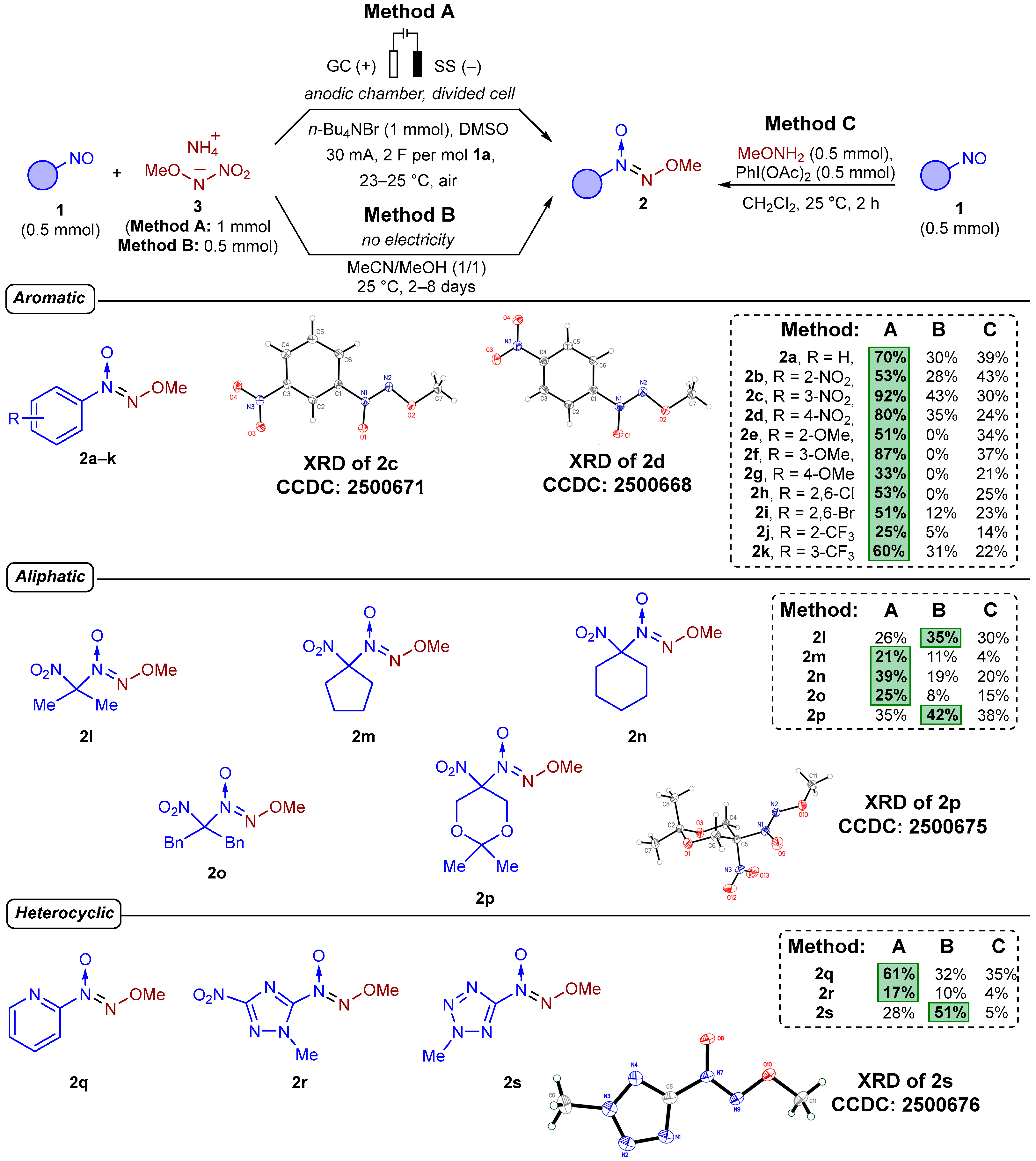
With the optimal reaction conditions identified (Table 3, entry 22), the scope for electrochemical synthesis of methoxy-NNO-azoxy compounds was tested (Scheme 3, Method A). In parallel, the same series of methoxy-NNO-azoxy compounds 2as were synthesized via oxidative coupling and nucleophilic addition–elimination methods (Scheme 3, Methods B and C), enabling a comprehensive comparison and the identification of any systematic patterns.
The developed electrochemical methoxy-NNO-azoxylation protocol (Method A) was found to be applicable to a range of electron-deficient (1bd,j,k), electron-rich (1eg), and halogen-substituted (2h,i) nitrosobenzenes, affording the corresponding products in moderate to good yields while maintaining short reaction times (~1 h on a 0.5 mmol scale). The highest yields (51–92%) were obtained for compounds 2bd,h,i,k prepared from nitrosobenzenes 1bd,h,i,k containing either an electron-withdrawing nitro or trifluoromethyl group, or a halogen substituent. The decrease in yield of ortho-substituted products (2b, 2h2j) could be attributed to the steric hindrance around the nitroso group caused by the –NO2, –CF3 groups or halogen atoms. In the case of the OMe group, the higher yield of the meta-substituted product 2f (87%) compared to the ortho- and para-substituted products 2e (51%) and 2g (33%) can be explained by the positive mesomeric effect of the electron-donating methoxy group, which leads to a decrease in the oxidation potential of the corresponding nitroso compounds 1e and 1g and consequently its side processes of anodic oxidation. At the meta-position, the methoxy group does not conjugate with the nitroso group and thus predominantly acts as an electron-withdrawing group via the inductive effect providing the high yield of 2f, which is in agreement with its slightly positive Hammett constant σm about +0.11. However, there is no strict correlation between the electronic effects of substituents in meta- or para-positions and the yields of the corresponding products 2. The yield is non-monotonously distributed in a series of substituents from the most electron-accepting to the least electron-accepting: p-NO2p = +0.78, 2d yield 80%), m-NO2m = +0.71, 2c yield 92%), m-CF3m = +0.43, 2k yield 60%), and m-OMe (σm = +0.11, 2f yield 87%). Apparently, there are several other factors determining the yield of target products 2 in electrochemical synthesis in addition to the major factor of nitrosoarenes’ stability in response to anodic oxidation, which may include the rate constants for the interception of the N-(methoxy)nitramide-derived radical, the tuning of a substituent electronic effect due to hydrogen bond formation, and side processes associated with excessive electrophilicity.
The reaction of electron-deficient nitrosobenzenes (1bd,j,k) with the salt 3 in acetonitrile-methanol solution in the absence of the electrical current (see Scheme 3, Method B) also afforded the corresponding methoxy-NNO-azoxy compounds 2bd,j,k; however, the reaction time was significantly longer (3–4 days) and the yields were lower (5–43%) compared to Method A. Unlike their electron-deficient counterparts, electron-rich nitrosobenzenes (1eg) showed no reaction with 3 in the absence of an electrical current.
It should be noted that oxidative coupling of nitrosobenzenes 1ak with methoxyamine in the presence of PhI(OAc)2 in dichloromethane (see Scheme 3, Method C) afforded the entire scope of substituted benzenes 2ak; however, the yields in each case were lower (14–43%) than those obtained using Method A.
The discovered electrochemical reaction (Method A) also demonstrated tolerance toward aliphatic nitroso compounds 1lp, which contain a nitro group in the geminal position, affording the corresponding products 2lp, albeit in low yields (21–39%). Notably, 2,2-dimethyl-5-nitro-5-nitroso-1,3-dioxane 1p was successfully used for the synthesis of 2p in 35% yield without cleavage of the acetonide-protecting group. Unlike for aromatic nitroso compounds, the reaction of aliphatic nitroso compounds without any current (Method B) resulted in higher yields for some products compared to Method A. Specifically, the yield of 2l and 2p increased from 26% to 35% and from 35% to 42%, respectively. However, the reaction time was also increased to two days. Application of Method C also offered an increase in the yields of 2l and 2p, although to a slightly lesser extent than Method B (30% and 38%, respectively).
Furthermore, the electrochemical methoxy-NNO-azoxylation protocol was successfully extended to heteroaromatic systems, namely 2-nitrosopyridine (1q), 2-methyl-3-nitroso-5-nitro-2H-triazole (1r), and 2-methyl-5-nitroso-2H-tetrazole (1s), yielding the corresponding products 2qs. The yield of the pyridine derivative 1q was 61%, which is comparable to that of benzene derivatives 2af, although (methoxy-NNO-azoxy)azoles 2r and 2s were obtained in low yields. In the case of the tetrazole derivative 1s, in addition to the target methoxy-NNO-azoxy product 2s, the known 5,5′-azoxy-bis-2,2′-methyltetrazole (5) [72] was also isolated in 40% yield. Application of Method B enabled an increase in the yield of 2s from 28% to 51%, probably due to the mitigation of the competing process of formation of azoxytetrazole 5. Method C exhibited the poorest results among the studied methods, as the yields of azoles 2r and 2s did not exceed 5%.
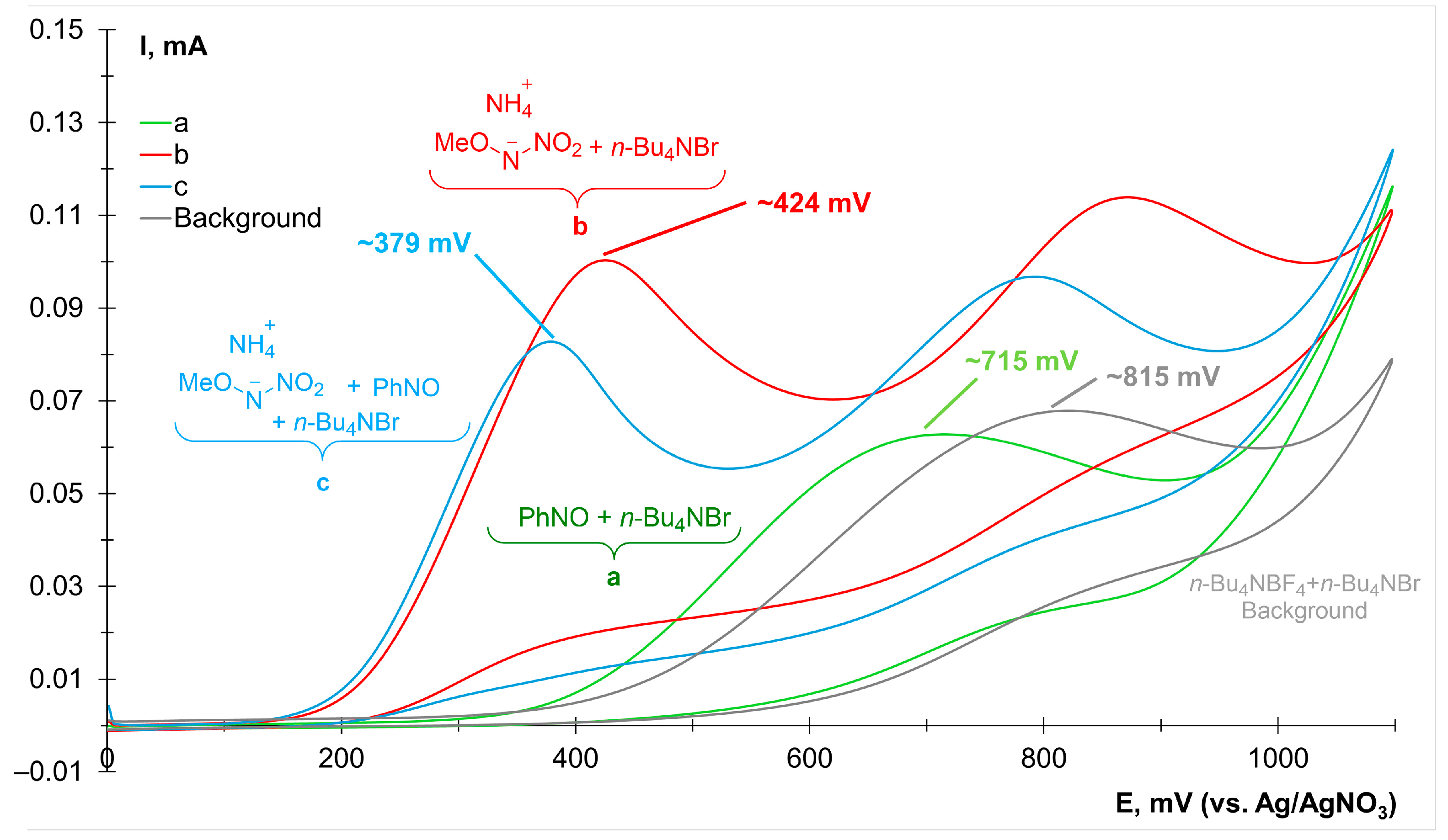
To clarify the mechanism of the electrochemical methoxy-NNO-azoxylation reaction, cyclic voltammetry (CV) studies were performed in DMSO solution using a glassy carbon working electrode, with tetrabutylammonium tetrafluoroborate as the supporting electrolyte (Figure 1).
Figure 1 demonstrates that ammonium N-(methoxy)nitramide 3 is the most readily oxidizable component in the reaction mixture, exhibiting a low oxidation potential of approximately 424 mV alone (Figure 1 (b)) and 379 mV in a reaction mixture with 1a and n-Bu4NBr (Figure 1 (c)). Oxidation of the bromide anion occurs at approximately 815 mV (Figure 1 (Background, grey)); however, upon addition of nitrosobenzene, it appears to be co-oxidized with 1a (715 mV, Figure 2 (a)).
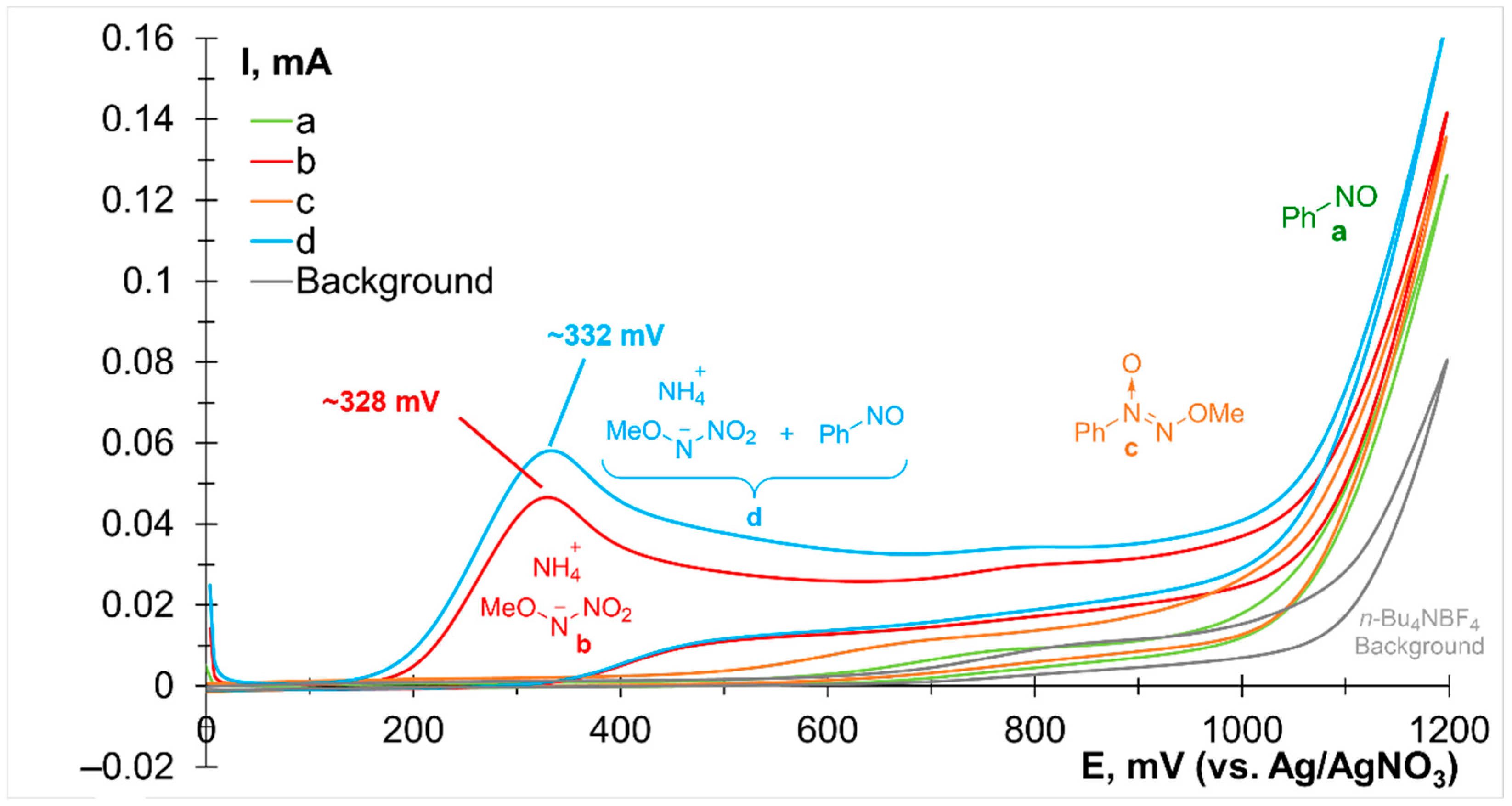
To elucidate the oxidation potentials of reagents and products in the absence of n-Bu4NBr, cyclic voltammetry (CV) measurements were additionally performed using only n-Bu4NBF4 as the supporting electrolyte (Figure 2).
Cyclic voltammetry (CV) data indicate that ammonium N-(methoxy)nitramide 3 remains the most readily oxidizable component in the reaction mixture, with a low oxidation potential of approximately 330 mV (Figure 2 (b) and (d)). The integration of curve b corresponding to the anodic oxidation of N-(methoxy)nitramide 3 gave almost the same value as that obtained for the integration of the oxidation curve of FeCp2 of the same concentration. This result indicates that the observed oxidation peak of 3 corresponds to a one-electron oxidation, leading to the formation of a free radical from the N-(methoxy)nitramide anion. In contrast, nitrosobenzene 1a (Figure 1 (a)) and the reaction product 2a (Figure 1 (c)) show no noticeable oxidation peaks.
To gain further insight into the reaction mechanism, additional control experiments were conducted (Scheme 4).
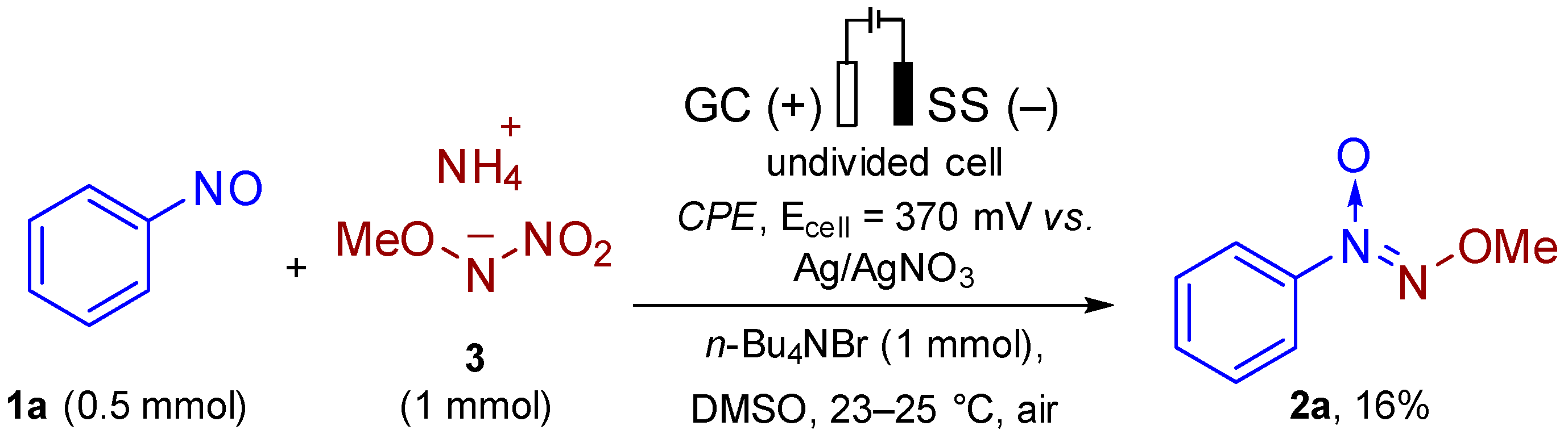
The obtained results (Table 1) indicate that in the case of an aromatic nitroso compounds without electron-withdrawing groups, the reaction proceeds very slowly, suggesting a distinct mechanism for the electrochemical transformation. To elucidate the requirement for a divided electrochemical cell, the model reaction was performed in an undivided cell under controlled-potential electrolysis (CPE) conditions (Scheme 4). The yield of 2a did not exceed 19%. This result demonstrates that the process occurs at the anode surface, confirming that a separated cathode compartment is essential for high reaction efficiency.
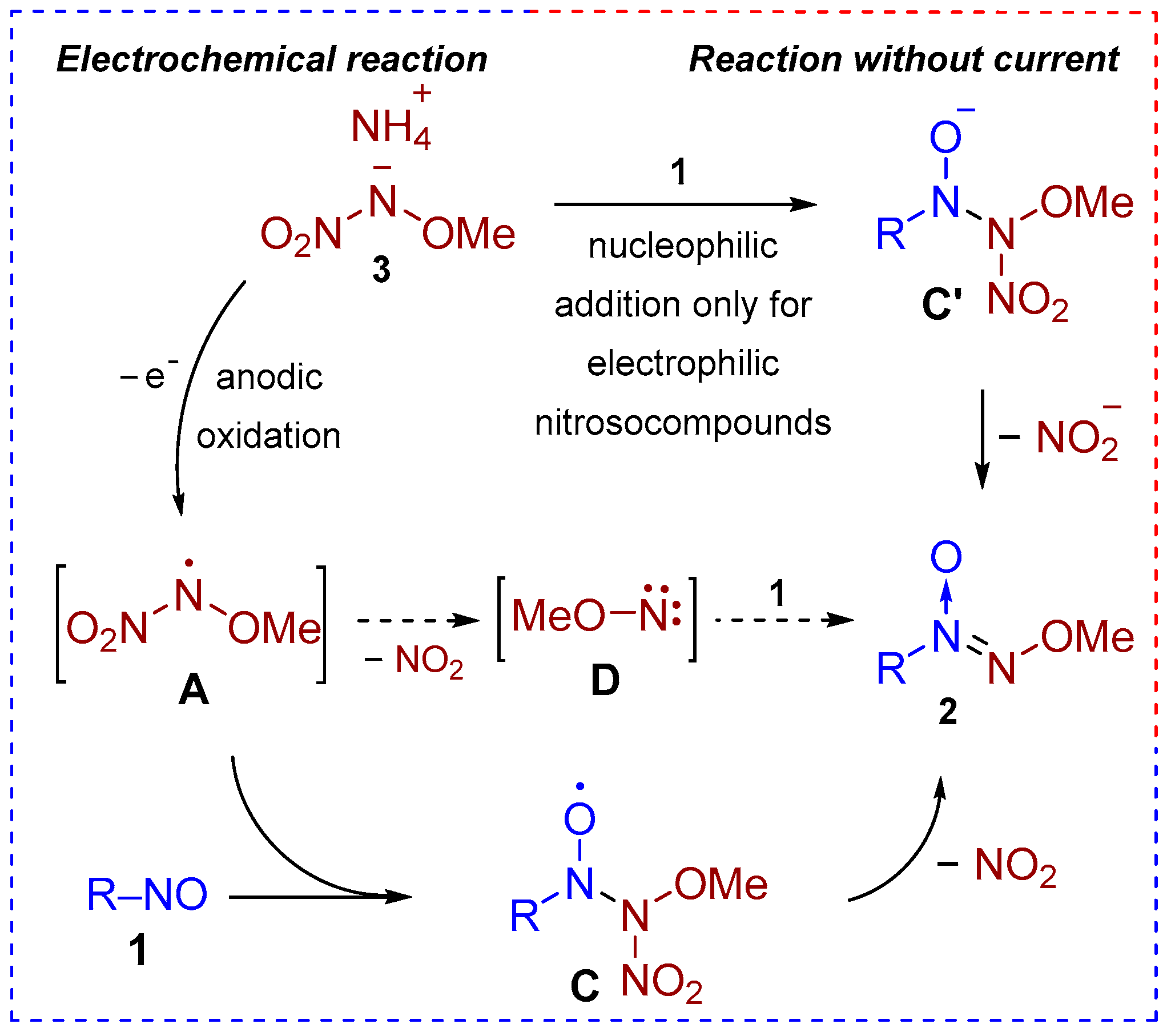
On the basis of CV studies, control experiments, and our previous work concerning the electrochemical behavior of nitrosobenzene and ammonium dinitramide [70], the following mechanism for the formation of methoxy-NNO-azoxy compounds 2 from nitroso compounds 1 was proposed (Scheme 5).
The reaction is initiated by the anodic oxidation of the N-(methoxy)nitramide anion to generate an N-centered radical A. This radical A then reacts with the nitroso compound 1 to form N-oxyl radical C, which subsequently eliminates a molecule of NO2 to yield the final product 2. Alternatively, compound 2 can be formed via a competing pathway involving α-elimination of NO2 from radical A to generate methoxy-nitrene D, which subsequently reacts with nitroso compound 1.
For the reaction conducted without electrical current, the proposed mechanism involves nucleophilic addition of the N-(methoxy)nitramide anion to the nitroso group, forming intermediate C′. Subsequent elimination of the nitrite anion yields the methoxy-NNO-azoxy group.

3. Materials and Methods

In all experiments, RT stands for 22–25 °C. 1H, 13C, 14N, and 15N NMR spectra were recorded with Bruker DRX-500 (500.1, 125.8, 36.1, 50.7 MHz, respectively) and Bruker AV600 (600.1, 150.9, 43.4, 60.8 MHz, respectively) spectrometers (Bruker BioSpin GmbH, Rheinstetten, Germany). Chemical shifts are reported in delta (δ) units, parts per million (ppm) downfield from internal TMS (1H, 13C) or external CH3NO2 (14N, 15N negative values of δN correspond to upfield shifts). The IR spectra were recorded with a Bruker ALPHA-T spectrometer (Bruker Corporation, Billerica, MA, USA) in the range 400–4000 cm−1 (resolution 2 cm−1) as pellets with KBr or as a thin layer. High-resolution ESI mass spectra (HRMS) were recorded with a Bruker micrOTOF II instrument (Bruker Corporation). Silica gel 60 Merck (Merck, Darmstadt, Germany) (15–40 μm) was used for preparative column and thin-layer chromatography. Silica gel “Silpearl UV 254” was used for preparative column and thin-layer chromatography. Analytical thin-layer chromatography (TLC) was carried out on Merck silica gel 60 F254 (Merck) and “Silufol” TLC silica gel UV-254 (Kavalier, Votice, Czech Republic) aluminum sheets. All reagents were purchased from Acros (Waltham, MA, USA) and Sigma-Aldrich (St. Louis, MO, USA). Solvents were purified before use, according to standard procedures. All other reagents were used without further purification. All electrodes, with the exception of the carbon felt (CF), were flat, polished plates for which the geometrical surface area was equal to the electrochemically active surface area. Commercial carbon felt (PANCF3200300, derived from polyacrylonitrile, ≥98% carbon content, 3 mm thickness) was used as is.

3.1. The General Procedure for the Optimization of the Reaction Conditions for the Synthesis of 1-(Methoxy-NNO-azoxy)benzene (2a) from 1-Nitrosobenzene (1a) via Oxidative Coupling (Experimental Details for Scheme 2)

To a stirred suspension of 1a (59 mg, 0.50 mmol) and PhI(OAc)2 (161–644 mg, 0.50–2.00 mmol) or dimbromoisocyanuric acid (DBI) (144–574 mg, 0.50–2.00 mmol) in dry solvent (2 mL, see Table S1) at 0 °C under an argon atmosphere, a solution of MeONH2 (24–47 mg, 0.50–1.00 mmol) in dry CH2Cl2 (1 mL) was added dropwise. Then, the reaction mixture was vigorously stirred at 0–40 °C (see Table S1) for 2 h. In the case of PhI(OAc)2, the reaction mixture was concentrated under reduced pressure. When DBI was used, the formed precipitate was filtered off, washed with CH2Cl2 (3 × 2 mL) and then combined filtrates were concentrated under reduced pressure. The yields of 2a were determined with the use of 1H NMR spectroscopy using 1,1,2,2-tetrachloroethane as an internal standard (see Table S1).

3.2. The General Procedure for the Optimization of the Reaction Conditions for the Synthesis of 1-(Methoxy-NNO-azoxy)benzene (2a) from 1-Nitrosobenzene (1a) and 3 Without Electricity (Experimental Details for Table 1)

To a stirred solution of 1a (59 mg, 0.50 mmol) in 2 mL DMSO, MeCN, or MeCN/MeOH at 25 °C, ammonium N-(methoxy)nitramide (3) (55 mg, 0.50 mmol) was added. Then, the reaction mixture was vigorously stirred at 25–50 °C for 3h–9 days. The precipitate was then filtered off and washed with MeCN (2 × 2 mL). The combined filtrates were concentrated under reduced pressure. The yields of 2a were determined with the use of 1H NMR spectroscopy using 1,1,2,2-tetrachloroethane as an internal standard.

3.3. The General Procedure for the Screening of the Reaction Conditions in an Undivided Electrochemical Cell for the Synthesis of (Methoxy-NNO-azoxy)benzene 2a from Nitrosobenzene 1a (Experimental Details for Table 2)

An undivided 10 mL electrochemical cell was equipped with a platinum plate, carbon felt, or glassy carbon anode (30 × 15 mm), and a platinum wire (d = 1 mm, l = 113 mm, ncoils = 9) or stainless steel (SS) cathode, connected to a DC-regulated power supply. The electrodes were fully immersed, providing a total working surface area (S) of 4.5 cm2. A solution of nitrosobenzene 1a (0.5 mmol, 54 mg), ammonium N-(methoxy)nitramide 3 (1–2 mmol, 109–218 mg), and a supporting electrolyte (0–0.5 mmol, 0–164 mg) in 10 mL of solvent (MeCN, MeCN/H2O, DMF, MeOH, CH2Cl2/H2O, or DMSO) was subjected to constant-current electrolysis at 60 mA and 23–25 °C with magnetic stirring. After passing a charge of 2 F·mol−1 (27 min), the electrodes were washed with CH2Cl2 (3 × 20 mL). The combined organic phase was washed with H2O (20 mL) and brine (20 mL), dried over Na2SO4, and the solvent was removed in vacuo. The yields of 2a were determined with the use of 1H NMR spectroscopy using 1,1,2,2-tetrachloroethane as an internal standard.

3.4. The General Procedure for the Optimization of the Reaction Conditions in a Divided Electrochemical Cell for the Synthesis of (Methoxy-NNO-azoxy)benzene 2a from Nitrosobenzene 1a and 3 (Experimental Details for Table 3)

A divided H-type electrochemical cell (volume of each compartment ~15 mL, divided with Celgard® 2400 membrane) was equipped with a platinum, nickel, graphite, carbon felt, and glassy carbon plate anode (30 × 15 mm2) and a platinum, stainless steel, nickel, and glassy carbon plate cathode (30 × 15 mm2), and connected to a DC-regulated power supply. A solution of nitrosobenzene 1a (0.5 mmol, 54 mg), ammonium N-(methoxy)nitramide 3 (0.5–1.5 mmol, 54–163 mg), and a supporting electrolyte (1 mmol, 104–369 mg) in solvent (12 mL) was placed in the anodic compartment of the divided electrochemical cell. The cathodic compartment was filled with a solution of the supporting electrolyte (1 mmol, 104–369 mg) in the same solvent (12 mL). Electrolysis was carried out under a constant current (I = 10–30 mA, 1–3 F per mole 1a) at 23–25 °C under magnetic stirring. After passing 1–3 F∙mol−1 of electricity (reaction time 27–160 min), the electrodes were washed with CH2Cl2 (3 × 20 mL). The combined organic phase was washed with H2O (2 × 20 mL), dried over Na2SO4, and the solvent was removed in vacuo. The yields of 2a were determined with the use of 1H NMR spectroscopy using 1,1,2,2-tetrachloroethane as an internal standard. In run 22, 2a was isolated using column chromatography on silica gel (Rf = 0.43, petroleum ether/EtOAc, 3:1) to afford the desired product (53 mg, 70%) as a pale-yellow crystals. mp: 40–41 °C. The synthesized compound 2a was identical (1H, 13C, and 14N NMR, TLC) to the compound prepared according to the reported procedure [64].

3.5. Typical Procedure for Synthesis of (Methoxy-NNO-azoxy)compounds 2a2s (Experimental Details for Scheme 3)

Method A. Electrolysis was conducted in a divided H-cell (15 mL per compartment) equipped with a Celgard® 2400 membrane, using a glassy carbon anode (30 × 15 mm2) and stainless steel cathode (30 × 15 mm2) connected to a DC power supply. A solution of nitroso compound 1 (0.5 mmol, 54–135 mg), 3 (1 mmol, 109 mg), and n-Bu4NBF4 (1 mmol, 329 mg) in DMSO (12 mL) was placed in the anodic compartment of the divided electrochemical cell. The cathodic compartment was filled with a solution of n-Bu4NBF4 (1 mmol, 329 mg) in DMSO (12 mL). Electrolysis was carried out under a constant current (I = 30 mA, 2 F per mole 1) at 23–25 °C under magnetic stirring. After passing 2 F∙mol−1 of electricity (reaction time 54 min), the electrodes were washed with CH2Cl2 (3 × 20 mL). The combined organic phase was washed with H2O (2 × 20 mL), dried over Na2SO4, and the solvent was evaporated under reduced pressure. The synthesized products 2a2s were purified using column chromatography on silica gel (petroleum ether/EtOAc, from 5:1 to 1:1). In the case of compound 1s, 5,5′-azoxy-bis-2,2′-methyltetrazole (5) (21 mg, 40%) was also isolated. This product was identical (TLC, 1H and 13C NMR, HRMS) to the compound prepared according to the reported procedure [72].
Method B. To a stirred solution of 1 (0.50 mmol) in 2 mL of a MeCN/MeOH (1/1) mixture at 25 °C, 3 (55 mg, 0.50 mmol) was added. Then, the reaction mixture was vigorously stirred at this temperature for the given time (see Table S2). The precipitate was then filtered off and washed with MeCN (2 × 2 mL). The combined filtrates were concentrated under reduced pressure. Products 2a2s were purified using column chromatography on silica gel.
Method C. To a stirred suspension of 1 (0.50 mmol) and PhI(OAc)2 (161 mg, 0.50 mmol) in dry CH2Cl2 (2 mL) at 0 °C under an argon atmosphere, a solution of MeONH2 (24 mg, 0.50 mmol) in dry CH2Cl2 (1 mL) was added dropwise. Then, the reaction mixture was vigorously stirred at 25 °C for 2 h. After reaction completion, the mixture was concentrated under reduced pressure. Products 2a2s were isolated using column chromatography on silica gel.

3.6. Reaction Under Controlled-Potential Electrolysis (Experimental Details for Scheme 4)

Controlled-potential electrolysis was performed in an undivided 20 mL electrochemical cell using a glassy carbon anode (30 × 15 mm2, S = 4.5 cm2), a stainless steel cathode (30 × 15 mm2), and a Ag/AgNO3 reference electrode. A solution of nitrosobenzene 1a (0.5 mmol, 54 mg) and 3 (1.0 mmol, 109 mg) in DMSO (12 mL) was electrolyzed at 370 mV (vs. Ag/AgNO3) at 23–25 °C. Upon the passing of 2.0 F·mol−1 of electricity, the electrodes were washed with CH2Cl2 (3 × 20 mL). The combined organic extract was washed with water (2 × 20 mL), dried (Na2SO4), and concentrated in vacuo. The yield of 2a was determined according to 1H NMR spectroscopy using 1,1,2,2-tetrachloroethane as an internal standard.

3.7. Cyclic Voltammetry Studies

Cyclic voltammetry (CV) was implemented on a PS-30 computer-assisted potentiostat-galvanostat manufactured by “SmartStat” (Chernogolovka, Russia) with a scan rate of 100 mV∙s−1. Cyclic voltammetry (CV) experiments were conducted in a 10 mL water-jacketed, five-necked conical glass cell using a standard three-electrode configuration. A typical measurement utilized a 5 mL solution under thermostatic control at 21.0 ± 0.5 °C. The working electrode was a glassy carbon disk (d = 3 mm), the counter electrode was a platinum wire, and the reference electrode was Ag/AgNO3 (0.1 M in 0.1 M n-Bu4NBF4/MeCN), connected to the solution via a porous glass diaphragm. All solutions were de-aerated through argon purging prior to measurement, and the experiments were performed under an argon atmosphere. The working electrode was polished before recording each CV curve.

4. Conclusions

In conclusion, we have developed a robust and efficient electrochemical method for the synthesis of methoxy-NNO-azoxy compounds via the coupling of nitroso compounds with ammonium N-(methoxy)nitramide. The disclosed transformation proceeds in a divided electrochemical cell under constant-current electrolysis conditions. The developed protocol is applicable to a broad range of nitroso compounds, including aromatic, heterocyclic, and aliphatic derivatives. Compared to chemical approaches that rely on the use of oxidants or an addition–elimination reaction between nitrosocompounds and N-(methoxy)nitramide anion, the developed electrochemical method proceeds rapidly and is applicable to both electron-deficient and electron-rich nitroso compounds.

Supplementary Materials

The following supporting information can be downloaded at https://www.mdpi.com/article/10.3390/molecules30244723/s1. 1H, 13C, 14N, 1H-13C HSQC, and 1H-13C HMBC NMR spectra of synthesized compounds, optimization details, CV studies, pictures of equipment used, and XRD of 2c, 2d, 2p, and 2s. Refs. [73,74,75,76,77,78,79,80,81,82,83,84,85,86,87,88,89,90,91,92,93,94] are cited in the Supplementary Materials.

Author Contributions

Conceptualization, M.S.K., A.S.B., and N.E.L.; investigation, A.S.B., N.E.L., and A.A.K.; writing—original draft preparation, A.S.B., I.B.K., and A.A.K.; writing—review and editing, M.S.K., V.A.T., and A.O.T.; supervision, M.S.K. and I.B.K.; project administration, I.B.K. All authors have read and agreed to the published version of the manuscript.

Funding

This work was supported by the Russian Science Foundation (grant no. 24-13-00439).

Institutional Review Board Statement

Not applicable.

Informed Consent Statement

Not applicable.

Data Availability Statement

The data are contained within the article or Supplementary Materials.

Acknowledgments

Crystal structure determination of 2c, 2d, 2p, and 2s was performed in the Department of Structural Studies of the Zelinsky Institute of Organic Chemistry, Moscow.

Conflicts of Interest

The authors declare no conflicts of interest.

References

  1. Cai, B.; Empel, C.; Yao, W.; Koenigs, R.M.; Xuan, J. Azoxy Compounds—From Synthesis to Reagents for Azoxy Group Transfer Reactions. Angew. Chem. Int. Ed. 2023, 62, e202312031. [Google Scholar] [CrossRef] [PubMed]
  2. Murarka, S. N-(Acyloxy)Phthalimides as Redox-Active Esters in Cross-Coupling Reactions. Adv. Synth. Catal. 2018, 360, 1735–1753. [Google Scholar] [CrossRef]
  3. Budnikov, A.S.; Krylov, I.B.; Lastovko, A.V.; Yu, B.; Terent’ev, A.O. N-Alkoxyphtalimides as Versatile Alkoxy Radical Precursors in Modern Organic Synthesis. Asian J. Org. Chem. 2022, 11, e202200262. [Google Scholar] [CrossRef]
  4. Krylov, I.B.; Segida, O.O.; Budnikov, A.S.; Terent’ev, A.O. Oxime-Derived Iminyl Radicals in Selective Processes of Hydrogen Atom Transfer and Addition to Carbon-Carbon π-Bonds. Adv. Synth. Catal. 2021, 363, 2502–2528. [Google Scholar] [CrossRef]
  5. Davies, J.; Morcillo, S.P.; Douglas, J.J.; Leonori, D. Hydroxylamine Derivatives as Nitrogen-Radical Precursors in Visible-Light Photochemistry. Chem. Eur. J. 2018, 24, 12154–12163. [Google Scholar] [CrossRef]
  6. Wang, H.-S.; Li, L.; Chen, X.; Wu, J.-L.; Sun, K.; Chen, X.-L.; Qu, L.-B.; Yu, B. Recent Advances in Amidyl Radical-Mediated Photocatalytic Direct Intermolecular Hydrogen Atom Transfer. Beilstein J. Org. Chem. 2025, 21, 1306–1323. [Google Scholar] [CrossRef]
  7. Yang, X.; Zhang, C.; Wang, C.-Q.; Feng, C. Expedient Access to Structural Complexity via Radical β-Fragmentation of N–O Bonds. Synlett 2025, 36, 1135–1141. [Google Scholar] [CrossRef]
  8. Hammoud, F.; Hijazi, A.; Schmitt, M.; Dumur, F.; Lalevée, J. A Review on Recently Proposed Oxime Ester Photoinitiators. Eur. Polym. J. 2023, 188, 111901. [Google Scholar] [CrossRef]
  9. Zlotin, S.G.; Churakov, A.M.; Dalinger, I.L.; Luk’yanov, O.A.; Makhova, N.N.; Sukhorukov, A.Y.; Tartakovsky, V.A. Recent Advances in Synthesis of Organic Nitrogen–Oxygen Systems for Medicine and Materials Science. Mendeleev Commun. 2017, 27, 535–546. [Google Scholar] [CrossRef]
  10. Zlotin, S.G.; Churakov, A.M.; Egorov, M.P.; Fershtat, L.L.; Klenov, M.S.; Kuchurov, I.V.; Makhova, N.N.; Smirnov, G.A.; Tomilov, Y.V.; Tartakovsky, V.A. Advanced Energetic Materials: Novel Strategies and Versatile Applications. Mendeleev Commun. 2021, 31, 731–749. [Google Scholar] [CrossRef]
  11. Yount, J.; Piercey, D.G. Electrochemical Synthesis of High-Nitrogen Materials and Energetic Materials. Chem. Rev. 2022, 122, 8809–8840. [Google Scholar] [CrossRef]
  12. Fershtat, L.L.; Zhilin, E.S. Recent Advances in the Synthesis and Biomedical Applications of Heterocyclic NO-Donors. Molecules 2021, 26, 5705. [Google Scholar] [CrossRef]
  13. Muniz Carvalho, E.; Silva Sousa, E.H.; Bernardes-Génisson, V.; Gonzaga De França Lopes, L. When NO. Is Not Enough: Chemical Systems, Advances and Challenges in the Development of NO. and HNO Donors for Old and Current Medical Issues. Eur. J. Inorg. Chem. 2021, 2021, 4316–4348. [Google Scholar] [CrossRef]
  14. Rosen, B.R.; Werner, E.W.; O’Brien, A.G.; Baran, P.S. Total Synthesis of Dixiamycin B by Electrochemical Oxidation. J. Am. Chem. Soc. 2014, 136, 5571–5574. [Google Scholar] [CrossRef]
  15. Wang, H.; Jung, H.; Song, F.; Zhu, S.; Bai, Z.; Chen, D.; He, G.; Chang, S.; Chen, G. Nitrene-Mediated Intermolecular N–N Coupling for Efficient Synthesis of Hydrazides. Nat. Chem. 2021, 13, 378–385. [Google Scholar] [CrossRef] [PubMed]
  16. Ryan, M.C.; Martinelli, J.R.; Stahl, S.S. Cu-Catalyzed Aerobic Oxidative N–N Coupling of Carbazoles and Diarylamines Including Selective Cross-Coupling. J. Am. Chem. Soc. 2018, 140, 9074–9077. [Google Scholar] [CrossRef]
  17. Fritsche, R.F.; Theumer, G.; Kataeva, O.; Knölker, H. Iron-Catalyzed Oxidative C−C and N−N Coupling of Diarylamines and Synthesis of Spiroacridines. Angew. Chem. Int. Ed. 2017, 56, 549–553. [Google Scholar] [CrossRef]
  18. Wang, F.; Gerken, J.B.; Bates, D.M.; Kim, Y.J.; Stahl, S.S. Electrochemical Strategy for Hydrazine Synthesis: Development and Overpotential Analysis of Methods for Oxidative N–N Coupling of an Ammonia Surrogate. J. Am. Chem. Soc. 2020, 142, 12349–12356. [Google Scholar] [CrossRef]
  19. Mankad, N.P.; Müller, P.; Peters, J.C. Catalytic N−N Coupling of Aryl Azides To Yield Azoarenes via Trigonal Bipyramid Iron−Nitrene Intermediates. J. Am. Chem. Soc. 2010, 132, 4083–4085. [Google Scholar] [CrossRef]
  20. Zhu, S.; Zhang, H.; Sun, B.; Bai, Z.; He, G.; Chen, G.; Wang, H. Nitrene-Mediated Aminative N–N–N Coupling: Facile Access to Triazene 1-Oxides. Chem. Sci. 2025, 16, 6458–6467. [Google Scholar] [CrossRef]
  21. Ou, Y.; Yang, T.; Tang, N.; Yin, S.-F.; Kambe, N.; Qiu, R. Photo-Induced N–N Coupling of o-Nitrobenzyl Alcohols and Indolines To Give N-Aryl-1-Amino Indoles. Org. Lett. 2021, 23, 6417–6422. [Google Scholar] [CrossRef]
  22. Vemuri, P.Y.; Patureau, F.W. Cross-Dehydrogenative N–N Coupling of Aromatic and Aliphatic Methoxyamides with Benzotriazoles. Org. Lett. 2021, 23, 3902–3907. [Google Scholar] [CrossRef]
  23. Barbor, J.P.; Nair, V.N.; Sharp, K.R.; Lohrey, T.D.; Dibrell, S.E.; Shah, T.K.; Walsh, M.J.; Reisman, S.E.; Stoltz, B.M. Development of a Nickel-Catalyzed N–N Coupling for the Synthesis of Hydrazides. J. Am. Chem. Soc. 2023, 145, 15071–15077. [Google Scholar] [CrossRef]
  24. Tabey, A.; Vemuri, P.Y.; Patureau, F.W. Cross-Dehydrogenative N–N Couplings. Chem. Sci. 2021, 12, 14343–14352. [Google Scholar] [CrossRef]
  25. Zhao, W.; Xu, J.; Yang, F.; Zeng, X. Advances on the Synthesis of N–N Bonds. Chin. J. Org. Chem. 2022, 42, 1336. [Google Scholar] [CrossRef]
  26. Sampaio-Dias, I.E.; Silva-Reis, S.C.; Pires-Lima, B.L.; Correia, X.C.; Costa-Almeida, H.F. A Convenient On-Site Oxidation Strategy for the N-Hydroxylation of Melanostatin Neuropeptide Using Cope Elimination. Synthesis 2022, 54, 2031–2036. [Google Scholar] [CrossRef]
  27. Barriault, D.; Ly, H.M.; Allen, M.A.; Gill, M.A.; Beauchemin, A.M. Oxidative Syntheses of N,N-Dialkylhydroxylamines. J. Org. Chem. 2024, 89, 8767–8772. [Google Scholar] [CrossRef]
  28. Hill, J.; Hettikankanamalage, A.A.; Crich, D. Diversity-Oriented Synthesis of N,N,O-Trisubstituted Hydroxylamines from Alcohols and Amines by N–O Bond Formation. J. Am. Chem. Soc. 2020, 142, 14820–14825. [Google Scholar] [CrossRef]
  29. Hill, J.; Crich, D. Synthesis of O-Tert-Butyl-N,N-Disubstituted Hydroxylamines by N–O Bond Formation. Org. Lett. 2021, 23, 6396–6400. [Google Scholar] [CrossRef]
  30. Lesnikov, V.K.; Golovanov, I.S.; Nelyubina, Y.V.; Aksenova, S.A.; Sukhorukov, A.Y. Crown-Hydroxylamines Are pH-Dependent Chelating N,O-Ligands with a Potential for Aerobic Oxidation Catalysis. Nat. Commun. 2023, 14, 7673. [Google Scholar] [CrossRef]
  31. Banerjee, A.; Yamamoto, H. Direct N–O Bond Formation via Oxidation of Amines with Benzoyl Peroxide. Chem. Sci. 2019, 10, 2124–2129. [Google Scholar] [CrossRef] [PubMed]
  32. Yan, M.; Kawamata, Y.; Baran, P.S. Synthetic Organic Electrochemical Methods Since 2000: On the Verge of a Renaissance. Chem. Rev. 2017, 117, 13230–13319. [Google Scholar] [CrossRef] [PubMed]
  33. Wiebe, A.; Gieshoff, T.; Möhle, S.; Rodrigo, E.; Zirbes, M.; Waldvogel, S.R. Electrifying Organic Synthesis. Angew. Chem. Int. Ed. 2018, 57, 5594–5619. [Google Scholar] [CrossRef]
  34. Waldvogel, S.R.; Janza, B. Renaissance of Electrosynthetic Methods for the Construction of Complex Molecules. Angew. Chem. Int. Ed. 2014, 53, 7122–7123. [Google Scholar] [CrossRef]
  35. Frontana-Uribe, B.A.; Little, R.D.; Ibanez, J.G.; Palma, A.; Vasquez-Medrano, R. Organic Electrosynthesis: A Promising Green Methodology in Organic Chemistry. Green Chem. 2010, 12, 2099. [Google Scholar] [CrossRef]
  36. Titenkova, K.; Chaplygin, D.A.; Fershtat, L.L. Electrochemical Generation of Nitrogen-centered Radicals and Its Application for the Green Synthesis of Heterocycles. ChemElectroChem 2024, 11, e202400395. [Google Scholar] [CrossRef]
  37. Titenkova, K.; Chaplygin, D.A.; Fershtat, L.L. Electrooxidative Synthesis of 1,2,3-Triazolone 1-Amines. Org. Biomol. Chem. 2025, 23, 4971–4976. [Google Scholar] [CrossRef]
  38. Titenkova, K.; Turpakov, E.A.; Chaplygin, D.A.; Fershtat, L.L. Synthesis of Rare 1,2,3-Triazolium-5-Olates by Electrooxidative Cyclization of α-Aminocarbonyl Hydrazones. Org. Lett. 2025, 27, 4434–4438. [Google Scholar] [CrossRef]
  39. Shuvaev, A.D.; Feoktistov, M.A.; Teslenko, F.E.; Fershtat, L.L. Electrochemical Approach Toward Mesoionic 1,2,3-Triazole 1-Imines. Adv. Synth. Catal. 2024, 366, 5050–5060. [Google Scholar] [CrossRef]
  40. Gieshoff, T.; Schollmeyer, D.; Waldvogel, S.R. Access to Pyrazolidin-3,5-diones through Anodic N–N Bond Formation. Angew. Chem. Int. Ed. 2016, 55, 9437–9440. [Google Scholar] [CrossRef]
  41. Gieshoff, T.; Kehl, A.; Schollmeyer, D.; Moeller, K.D.; Waldvogel, S.R. Insights into the Mechanism of Anodic N–N Bond Formation by Dehydrogenative Coupling. J. Am. Chem. Soc. 2017, 139, 12317–12324. [Google Scholar] [CrossRef] [PubMed]
  42. Titenkova, K.; Shuvaev, A.D.; Teslenko, F.E.; Zhilin, E.S.; Fershtat, L.L. Empowering Strategies of Electrochemical N–N Bond Forming Reactions: Direct Access to Previously Neglected 1,2,3-Triazole 1-Oxides. Green Chem. 2023, 25, 6686–6693. [Google Scholar] [CrossRef]
  43. Li, Y.; Ye, Z.; Chen, N.; Chen, Z.; Zhang, F. Intramolecular Electrochemical Dehydrogenative N–N Bond Formation for the Synthesis of 1,2,4-Triazolo[1,5-a]Pyridines. Green Chem. 2019, 21, 4035–4039. [Google Scholar] [CrossRef]
  44. Kehl, A.; Gieshoff, T.; Schollmeyer, D.; Waldvogel, S.R. Electrochemical Conversion of Phthaldianilides to Phthalazin-1,4-diones by Dehydrogenative N−N Bond Formation. Chem. Eur. J. 2018, 24, 590–593. [Google Scholar] [CrossRef]
  45. Xu, P.; Xu, H. Electrochemical Synthesis of [1,2,3]Triazolo[1,5-a]Pyridines through Dehydrogenative Cyclization. ChemElectroChem 2019, 6, 4177–4179. [Google Scholar] [CrossRef]
  46. Bieniek, J.C.; Grünewald, M.; Winter, J.; Schollmeyer, D.; Waldvogel, S.R. Electrochemical Synthesis of N,N′-Disubstituted Indazolin-3-Ones via an Intramolecular Anodic Dehydrogenative N–N Coupling Reaction. Chem. Sci. 2022, 13, 8180–8186. [Google Scholar] [CrossRef] [PubMed]
  47. Lv, S.; Han, X.; Wang, J.; Zhou, M.; Wu, Y.; Ma, L.; Niu, L.; Gao, W.; Zhou, J.; Hu, W.; et al. Tunable Electrochemical C−N versus N−N Bond Formation of Nitrogen-Centered Radicals Enabled by Dehydrogenative Dearomatization: Biological Applications. Angew. Chem. Int. Ed. 2020, 59, 11583–11590. [Google Scholar] [CrossRef]
  48. Sadatnabi, A.; Mohamadighader, N.; Nematollahi, D. Convergent Paired Electrochemical Synthesis of Azoxy and Azo Compounds: An Insight into the Reaction Mechanism. Org. Lett. 2021, 23, 6488–6493. [Google Scholar] [CrossRef]
  49. Chong, X.; Liu, C.; Huang, Y.; Huang, C.; Zhang, B. Potential-Tuned Selective Electrosynthesis of Azoxy-, Azo- and Amino-Aromatics over a CoP Nanosheet Cathode. Natl. Sci. Rev. 2020, 7, 285–295. [Google Scholar] [CrossRef]
  50. Breising, V.M.; Kayser, J.M.; Kehl, A.; Schollmeyer, D.; Liermann, J.C.; Waldvogel, S.R. Electrochemical Formation of N,N′-Diarylhydrazines by Dehydrogenative N–N Homocoupling Reaction. Chem. Commun. 2020, 56, 4348–4351. [Google Scholar] [CrossRef] [PubMed]
  51. Feng, E.; Hou, Z.; Xu, H. Electrochemical Synthesis of Tetrasubstituted Hydrazines by Dehydrogenative N–N Bond Formation. Chin. J. Org. Chem. 2019, 39, 1424. [Google Scholar] [CrossRef]
  52. Traube, W. Ueber Synthesen Stickstoffhaltiger Verbindungen Mit Hülfe Des Stickoxyds. Justus Liebigs Ann. Chem. 1898, 300, 81–128. [Google Scholar] [CrossRef]
  53. George, M.V.; Kierstead, R.W.; Wright, G.F. The Stable Alkylation Products of Organonitrosohydroxylamines. Can. J. Chem. 1959, 37, 679–699. [Google Scholar] [CrossRef]
  54. Woodward, R.B.; Wintner, C. The Methoxazonyl Group. Tetrahedron Lett. 1969, 10, 2689–2692. [Google Scholar] [CrossRef]
  55. Hickmann, E.; Hädicke, E.; Reuther, W. “Isonitramines”: Nitrosohydroxylamines or Hydroxydiazenium Oxides? Tetrahedron Lett. 1979, 20, 2457–2460. [Google Scholar] [CrossRef]
  56. Yandovskii, V.N.; Dobrodumova, E.Y.; Tselinskii, I.V. Azo and Azoxy Compounds. V. Alkylation of the Salts of Bis(Nitrosohydroxylamino)Methane. Synthesis of 1,7-Dialkyl-1,7-Dioxa-2,3,5,6-Tetraaza-2,5-Heptadiene 3,5-Dioxides. J. Org. Chem. USSR 1980, 16, 813–816. [Google Scholar] [CrossRef]
  57. Artsybasheva, Y.P.; Ioffe, B.V. Nitrosocompounds as Acceptors of the Alkoxynitrenes. Synthesis of 1-Tert-Alkyl-2-Alkoxydiazene 1-Oxides from C-Nitrosocompounds. J. Org. Chem. USSR 1982, 18, 1802–1807. [Google Scholar]
  58. Zyuzin, I.N.; Lempert, D.B. Synthesis and Properties of N-Alkyl-N’-Methoxydiazene N-Oxides. Bull. Acad. Sci. USSR Div. Chem. Sci. 1985, 34, 753–756. [Google Scholar] [CrossRef]
  59. Yandovskii, V.N.; Gidaspov, B.V.; Tselinskii, I.V. Azo and Azoxy Compounds. XI. New Versions of the Synthesis of Derivatives of 1-Alkoxydiazene 2-Oxides. J. Org. Chem. USSR 1987, 23, 10–18. [Google Scholar]
  60. Luk’yanov, O.A.; Smirnov, G.A.; Vasil’ev, A.M. Synthesis of N’-Methoxydiazene N-Oxides from Methoxyamine and Nitroso Compounds. Bull. Acad. Sci. USSR Div. Chem. Sci. 1990, 39, 1966–1968. [Google Scholar] [CrossRef]
  61. Bohle, D.S.; Imonigie, J.A. Cyclohexadienone Diazeniumdiolates from Nitric Oxide Addition to Phenolates. J. Org. Chem. 2000, 65, 5685–5692. [Google Scholar] [CrossRef]
  62. Brand, J.; Huhn, T.; Groth, U.; Jochims, J.C. Nitrosation of Sugar Oximes: Preparation of 2-Glycosyl-1-hydroxydiazene-2-oxides. Chem. Eur. J. 2006, 12, 499–509. [Google Scholar] [CrossRef]
  63. Smirnov, G.A.; Luk’yanov, O.A. Synthesis and Some Properties of the Salts of N-(Het)Aryl-N′-Hydroxydiazene N-Oxides. Russ. Chem. Bull. 2020, 69, 295–299. [Google Scholar] [CrossRef]
  64. Hou, Y.; Xie, W.; Janczuk, A.J.; Wang, P.G. O-Alkylation of Cupferron: Aiming at the Design and Synthesis of Controlled Nitric Oxide Releasing Agents. J. Org. Chem. 2000, 65, 4333–4337. [Google Scholar] [CrossRef]
  65. Hou, Y.; Xie, W.; Ramachandran, N.; Mutus, B.; Janczuk, A.J.; Wang, P.G. O-Alkylation Chemistry of Neocupferron. Tetrahedron Lett. 2000, 41, 451–456. [Google Scholar] [CrossRef]
  66. Abdellatif, K.R.A.; Chowdhury, M.A.; Velázquez, C.A.; Huang, Z.; Dong, Y.; Das, D.; Yu, G.; Suresh, M.R.; Knaus, E.E. Celecoxib Prodrugs Possessing a Diazen-1-Ium-1,2-Diolate Nitric Oxide Donor Moiety: Synthesis, Biological Evaluation and Nitric Oxide Release Studies. Bioorg. Med. Chem. Lett. 2010, 20, 4544–4549. [Google Scholar] [CrossRef]
  67. Zyuzin, I.N.; Golovina, N.I.; Lempert, D.B.; Nechiporenko, G.N.; Shilov, G.V. 1,1-Bis(Methoxy-NNO-Azoxy)Ethene. Synthesis and X-Ray Diffraction Analysis. Russ. Chem. Bull. 2008, 57, 632–637. [Google Scholar] [CrossRef]
  68. Grachev, V.P.; Zyuzin, I.N.; Kurmaz, S.V.; Vaganov, E.V.; Komendant, R.I.; Lempert, D.B. Poly(Methoxy-NNO-Azoxyethene), a New Polymer for Active Binders in Solid Composite Propellants. Russ. Chem. Bull. 2020, 69, 2312–2319. [Google Scholar] [CrossRef]
  69. Kulikov, A.A.; Leonov, N.E.; Klenov, M.S.; Smirnov, G.A.; Strelenko, Y.A.; Fedyanin, I.V.; Kon’kova, T.S.; Matyushin, Y.N.; Pivkina, A.N.; Tartakovsky, V.A. First Comprehensive Study of Energetic (Methoxy-NNO-Azoxy)Furazans: Novel Synthetic Route, Characterization, and Property Analysis. Energ. Mater. Front. 2025, 6, 370–382. [Google Scholar] [CrossRef]
  70. Budnikov, A.S.; Leonov, N.E.; Klenov, M.S.; Shevchenko, M.I.; Dvinyaninova, T.Y.; Krylov, I.B.; Churakov, A.M.; Fedyanin, I.V.; Tartakovsky, V.A.; Terent’ev, A.O. Ammonium Dinitramide as a Prospective N–NO2 Synthon: Electrochemical Synthesis of Nitro-NNO-Azoxy Compounds from Nitrosoarenes. Molecules 2024, 29, 5563. [Google Scholar] [CrossRef]
  71. Hammerich, O.; Lund, H. (Eds.) Organic Electrochemistry; CRC Press: Boca Raton, FL, USA, 2000; ISBN 978-0-429-13168-4. [Google Scholar]
  72. Scherschel, N.F.; Zeller, M.; Piercey, D.G. Energetic Azoxy-Coupled Tetrazoles. J. Heterocycl. Chem. 2024, 61, 1704–1709. [Google Scholar] [CrossRef]
  73. Coleman, G.H.; McCloskey, C.M.; Stuart, F.A. Nitrosobenzene. Organic Syntheses. 1945, 25, 80–83. [Google Scholar] [CrossRef]
  74. Roscales, S.; Csaky, A.G. Synthesis of Di(hetero)arylamines from Nitrosoarenes and Boronic Acids: A General, Mild, and Transition-Metal-Free Coupling. Org. Lett. 2018, 20, 1667–1671. [Google Scholar] [CrossRef]
  75. Dudek, M.; Pakladek, Z.; Deiana, M.; Matcztszyn, K. Molecular design and structural characterization of photoresponsive azobenzene-based polyamide units. Dyes Pigm. 2020, 180, 108501. [Google Scholar] [CrossRef]
  76. Halasz, I.; Biljan, I.; Novak, P.; Mestrovic, E.; Plavec, J.; Mali, G.; Smrecki, V.; Vancik, H. Cross-dimerization of nitrosobenzenes in solution and in solid state. J. Mol. Struct. 2009, 918, 19–25. [Google Scholar] [CrossRef]
  77. Teders, M.; Pogodaev, A.A.; Bojanov, G.; Huck, W.T.S. Reversible Photoswitchable Inhibitors Generate Ultrasensitivity in Out-of-Equilibrium Enzymatic Reactions. J. Am. Chem. Soc. 2021, 143, 5709–5716. [Google Scholar] [CrossRef]
  78. Yanagisawa, A.; Lin, Y.; Takeishi, A.; Yoshida, K. Enantioselective Nitroso Aldol Reaction Catalyzed by a Chiral Phosphine–Silver Complex. Eur. J. Org. Chem. 2016, 2016, 5355–5359. [Google Scholar] [CrossRef]
  79. Hu, W.; Zheng, Q.; Sun, S.; Cheng, J. Catalyzed bilateral cyclization of aldehydes with nitrosos toward unsymmetrical acridines proceeding with C–H functionalization enabled by a transient directing group. ChemComm 2017, 53, 6263–6266. [Google Scholar] [CrossRef]
  80. Holmes, R.R.; Bayer, R.P. A simple method for the direct oxidation of aromatic amines to nitroso compounds. J. Am. Chem. Soc. 1960, 82, 3454–3456. [Google Scholar] [CrossRef]
  81. Tibiletti, F.; Simonetti, M.; Nicholas, K.M.; Palmisano, G.; Parravicini, M.; Imbesi, F.; Tollari, S.; Penoni, A. One-pot synthesis of meridianins and meridianin analogues via indolization of nitrosoarenes. Tetrahedron 2010, 66, 1280–1288. [Google Scholar] [CrossRef]
  82. Fernández, I.F.; Hecquet, L.; Fessner, W. Transketolase Catalyzed Synthesis of N-Aryl Hydroxamic Acids. Adv. Synth. Catal. 2021, 364, 612–621. [Google Scholar] [CrossRef]
  83. Rehse, K.; Herpel, M. New NO donors with antithrombotic and vasodilating activities, part 19: Pseudonitroles and their dimeric azodioxides. Arch. Pharm. Pharm Med. Chem. 1998, 331, 79–84. [Google Scholar] [CrossRef]
  84. Nametkin, S.S. About cyclohexylpseudonitrol. Zhurnal Russkago Fiziko-Khimicheskago Obshchestva 1910, 42, 585–586. [Google Scholar]
  85. Charlton, W.; Earl, J.C.; Kenner, J.; Luciano, A.A. The nitration of oximes. J. Chem. Soc. 1932, 30–41. [Google Scholar] [CrossRef]
  86. Luk’yanov, O.A.; Salamonov, Y.B.; Bass, A.G.; Strelenko, Y.A. N′-(α-acetoximinoalkyl)diazene-N-oxides and some of their transformations. Russ. Chem. Bull. 1991, 40, 93–98. [Google Scholar] [CrossRef]
  87. Taylor, E.C.; Tseng, C.-P.; Rampal, J.B. Conversion of a Primary Amino Group into a Nitroso Group. Synthesis of Nitroso-Substituted Heterocycles. J. Org. Chem. 1982, 47, 552–555. [Google Scholar] [CrossRef]
  88. Bagal, L.I.; Pevzner, M.S.; Egorov, A.P.; Samarenko, V.Y. Heterocyclic Nitro Compounds VI. Reaction of 1-methyl-3,5-dinitro-1,2,4-triazole with hydrazines. Chem. Heterocycl. Compd. 1970, 6, 928–931. [Google Scholar] [CrossRef]
  89. Demko, Z.P.; Bartsch, M.; Sharpless, K.B. Primary amides. A general nitrogen source for catalytic asymmetric aminohydroxylation of olefins. Org. Lett. 2000, 2, 2221–2223. [Google Scholar] [CrossRef]
  90. Huang, Z.; Zhang, Y.; Fang, L.; Zhang, Z.; Lai, Y.; Ding, Y.; Cao, F.; Zhang, J.; Peng, S. Nanometre-sized titanium dioxide-catalyzed reactions of nitric oxide with aliphatic cyclic and aromatic amines. Chem. Commun. 2009, 13, 1763–1765. [Google Scholar] [CrossRef]
  91. CrysAlisPro, Version 1.171.41.106a; Rigaku Oxford Diffraction: Abingdon, UK, 2021.
  92. Sheldrick, G.M. SHELXT—Integrated space-group and crystal-structure determination. Acta Cryst. 2015, A71, 3–8. [Google Scholar] [CrossRef]
  93. Sheldrick, G.M. Crystal structure refinement with SHELXL. Acta Cryst. 2015, C71, 3–8. [Google Scholar] [CrossRef]
  94. Dolomanov, O.V.; Bourhis, L.J.; Gildea, R.J.; Howard, J.A.K.; Puschmann, H. OLEX2: A complete structure solution, refinement and analysis program. J. Appl. Cryst. 2009, 42, 229–341. [Google Scholar] [CrossRef]
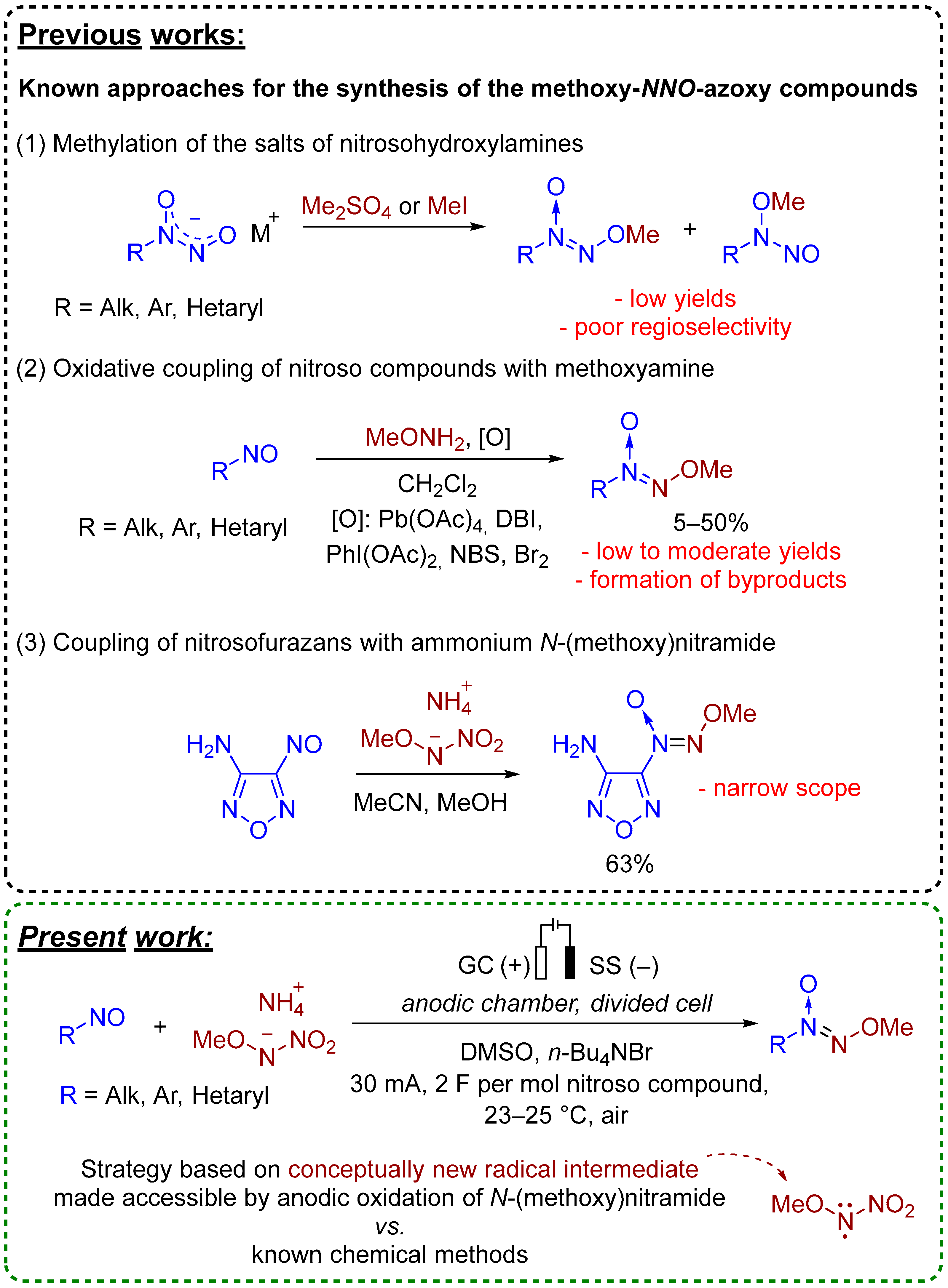
Scheme 1. Known synthetic approaches for methoxy-NNO-azoxy compounds [52,53,54,55,56,57,58,59,60,61,62,63,64,65,66,69], and the novel electrochemical method proposed in the present work.
Molecules 30 04723 sch001
Scheme 2. Model reaction of oxidative coupling of nitrosobenzene 1a with methoxyamine.
Molecules 30 04723 sch002
Scheme 3. A comparison of chemical and electrochemical methods for the synthesis of methoxy-NNO-azoxy compounds 2as. The best results for each substrate are highlighted by green frames.
Molecules 30 04723 sch003
Figure 1. The CV curves of 0.01 M solutions of (a) 1a with n-Bu4NBr (green), (b) 3 with n-Bu4NBr (red), (c) 1a and 3 with n-Bu4NBr (blue), and n-Bu4NBr in 0.1 M n-Bu4NBF4 solution (Background, grey) in DMSO on a working glassy carbon electrode (d = 3 mm) under a scan rate of 0.1 V·s−1 at 298 K.
Molecules 30 04723 g001
Figure 2. The CV curves of 0.01 M solutions of (a) 1a (green), (b) 3 (red), (c) 2a (yellow), and (d) 1a and 3 (blue) in 0.1 M n-Bu4NBF4 solution in DMSO on a working glassy carbon electrode (d = 3 mm) under a scan rate of 0.1 V·s−1 at 298 K.
Molecules 30 04723 g002
Scheme 4. Control experiment in undivided cell under CPE conditions.
Molecules 30 04723 sch004
Scheme 5. Proposed mechanisms for reactions of nitroso compounds 1 with ammonium salt 3 with and without current.
Molecules 30 04723 sch005
Table 1. Optimization of reaction conditions a.
Molecules 30 04723 i001
EntrySolventTemperature, °CTimeYield 2a, %
1DMSO253 h5
2DMSO2516 h9
3DMSO251 day12
4DMSO252 days22
5MeCN251 day4
6MeCN253 days8
7MeCN255 days14
8MeCN259 days20
9MeCN/MeOH (1/1)251 day9
10MeCN/MeOH (1/1)253 days19
11MeCN/MeOH (1/1)255 days30
12MeCN/MeOH (1/1)501 day16
13MeCN/MeOH (1/1)503 days15
a The bold text of entry 11 indicates conditions as optimal.
Table 2. Screening of the reaction parameters in an undivided electrochemical cell a.
Molecules 30 04723 i002
EntryConditionsYield 2a, % b
11a (0.5 mmol), 3 (2 mmol), NH4BF4 (0.5 mmol), CF(+)/Ptw(−), MeCN10
21a (0.5 mmol), 3 (2 mmol), n-Bu4NBF4 (0.5 mmol), Pt(+)/Ptw(−), MeCN/H2O = 4/116
31a (0.5 mmol), 3 (2 mmol), Pt(+)/Ptw(−), MeOH20
41a (0.5 mmol), 3 (2 mmol), Pt(+)/Ptw(−), DMF11
51a (0.5 mmol), 3 (2 mmol), n-Bu4NBF4 (0.5 mmol), Pt(+)/Ptw(−), CH2Cl2/H2O = 4/1<5
6 c1a (0.5 mmol), 3 (1 mmol), n-Bu4NBr (1 mmol), GC(+)/SS(−), DMSO19
a Standard reaction conditions: nitrosobenzene 1a (0.5 mmol, 54 mg), 3 (2 mmol, 218 mg), electrolyte (0–164 mg), solvent (10 mL), undivided chemical cell, CCE electrolysis with I = 60 mA, F = 2 F per mol 1a (reaction time 27 min), under air atmosphere. CF—carbon felt, Pt—platinum plate, Ptw—platinum wire. b The yield of 2a was determined by 1H NMR spectroscopy employing 1,1,2,2-tetrachloroethane as an internal NMR standard. c I = 30 mA.
Table 3. Optimization of the reaction conditions for the synthesis of 2a in a divided electrochemical cell a.
Molecules 30 04723 i003
EntrySolventElectrolyteMolar Ratio 1a:3Electrodes (+/−)F per Mole 1aI, mAYield, b 2a/4a
1MeCN/H2O (8/4)n-Bu4NBF41:1Pt/Pt23031/41
2MeCNn-Bu4NBF41:1Pt/Pt23010/36
3MeOHn-Bu4NBF41:1Pt/Pt23023/31
4DMFn-Bu4NBF41:1Pt/Pt230<5/<5
5Acetonen-Bu4NBF41:1Pt/Pt23023/41
6THF/H2O (8/4)n-Bu4NBF41:1Pt/Pt23041/29
7TFEn-Bu4NBF41:1Pt/Pt23020/48
8HFIPn-Bu4NBF41:1Pt/Pt23017/34
9DMSOn-Bu4NBF41:1Pt/Pt23047/11
10DMSOn-Bu4NBF41:2Pt/Pt23059/15
11DMSOn-Bu4NBF41:3Pt/Pt23048/17
12DMSOLiClO41:2Pt/Pt23063/19
13DMSONH4BF41:2Pt/Pt23058/18
14DMSOn-Bu4NClO41:2Pt/Pt23055/20
15DMSOn-Bu4NBr1:2Pt/Pt23067/15
16DMSOn-Bu4NI1:2Pt/Pt23017/n.d.
17DMSOn-Bu4NBr1:2Pt/SS23070/14
18DMSOn-Bu4NBr1:2Pt/Ni23070/14
19DMSOn-Bu4NBr1:2Pt/GC23070/15
20DMSOn-Bu4NBr1:2Ni/SS23010/n.d.
21DMSOn-Bu4NBr1:2C/SS23075/17
22DMSOn-Bu4NBr1:2CF/SS23070/15
23DMSOn-Bu4NBr1:2GC/SS23078 (70)/17 (14)
24DMSOn-Bu4NBr1:2GC/SS22071/19
25DMSOn-Bu4NBr1:2GC/SS21567/20
26DMSOn-Bu4NBr1:2GC/SS21060/21
27DMSOn-Bu4NBr1:2GC/SS13070/15
28DMSOn-Bu4NBr1:2GC/SS1.53069/16
29DMSOn-Bu4NBr1:2GC/SS33065/17
a Reaction conditions: a divided H-type electrochemical cell (volume of each compartment ~15 mL, divided with Celgard® 2400 membrane) was equipped with an anode and a cathode, and connected to a DC regulated power supply. A solution of nitrosobenzene 1a (0.5 mmol, 54 mg), 3 (0.5–1.5 mmol, 54–163 mg), and a supporting electrolyte (1 mmol) in solvent (12 mL) was placed in the anodic compartment of a divided electrochemical cell. The cathodic compartment was filled with a solution of the supporting electrolyte (1 mmol) in the same solvent (12 mL). Electrolysis was carried out under a constant current (10–30 mA, 1–3 F mol−1 of 1a) at 23–25 °C under magnetic stirring. GC—glassy carbon plate, Pt—platinum plate, SS—stainless steel plate, and Ni—nickel plate. b The yield of 2a was determined by 1H NMR spectroscopy employing 1,1,2,2-tetrachloroethane as an internal NMR standard; the isolated yields are given in parentheses. n.d.—not detected. The bold line of entry 23 indicates the conditions as optimal.
Disclaimer/Publisher’s Note: The statements, opinions and data contained in all publications are solely those of the individual author(s) and contributor(s) and not of MDPI and/or the editor(s). MDPI and/or the editor(s) disclaim responsibility for any injury to people or property resulting from any ideas, methods, instructions or products referred to in the content.