
Corn Stover for Food Applications: Approaches, Advances and Insights

 , ,
, ,
Abstract
1. Introduction
2. By-Products Across Corn Production Chain and Its Applications
Representative Applications of Corn Stover

| Area | Product | Corn Treatment/Production Method | Used/Potential Uses | Reference |
|---|---|---|---|---|
| Agroindustry | Soil conditioner | Corn stover from a previous crop is chopped, mixed, and incorporated into the field with the help of a rotavator. The corn stover return has been mixed with phosphate fertilizer | Use for improvement of soil properties | [40] |
| Agroindustry | Animal Feed | Corn cobs, stalks and leaves are dried and milled to obtain a fine powder which is added to the animal feed and subsequent silage. | Feed for mealworm; dairy feed; novel feed for cattle and sheep; fermented broiler feed; geese feed for meat production | [53,54,57,58,59] |
| Biotechnology | Solid support in solid state fermentation (SSF) | Corn cob is dried in oven for 48 h and ground to 40-mesh (400 µm) or less. Then, it is used as a carbon source in fermentation | Nutrient in solid state fermentation processes to produce antimicrobials and antioxidant agents | [60,61] |
| Biotechnology | Lignocellulosic fiber | Looking to expose the hydroxyl groups, dried corn cob is treated with alkali (2 mol NaOH) in a stirred suspension for 24 h. The pretreated support is activated with glyoxyl groups, glutaraldehyde and IDA-glyoxy. Then, the immobilization of trypsin is performed in the presence of 3 mmol/L of benzamidine (a competitive inhibitor of trypsin) to prevent autolysis. | Enzyme immobilization | [62] |
| Cosmetic | Facial cream | Polyphenols from corn silk are extracted in ethanol and ethyl acetate and incorporated into a facial cream product | Anti-Tyrosinase, and Anti-Skin Pathogenic Bacterial Activities | [49] |
| Energy | Anodes | Corn stalk is hydrolyzed under basic or acidic conditions, and then activated chemically or by further heating, under controlled atmosphere. | Anodes for energy storage in lithium-ion batteries. | [52,63,64,65] |
| Energy | Porous Electrodes | Corn cobs, leaves, stalks, husk or silk, are submitted to hydrothermal treatment with acids or bases and then activated using temperature or KOH | Electrodes for supercapacitors | [51,63,66] |
| Energy | Substrate for dark fermentation | Corn cobs are delignified and/or saccharified, to obtain fermentable compounds. | Fermentative hydrogen production | [67] |
| Energy | Ethanol | Ethanol production is achieved from corn cobs following a combined thermochemical and fermentative biorefinery approach, with yields comparable to results in conventional pretreatments and fermentation processes. | Biofuel production | [8,24] |
| Energy | Gasoline | Corn leaves and stalks are processed by grinding, adding auxiliary materials (leaven and water) and fermenting | Preparation of biological gasoline | [68] |
| Food | Xylooligosaccharides (XOS) extract | XOS are extracted from corn cob using autohydrolysis, acid hydrolysis and enzymatic hydrolysis. Then, its separation and purification are made using nanofiltration, ethanol elution, gel chromatography, or ion exchanging. | Xylooligosaccharides with capability to stimulate the growth of probiotic organisms | [37,39] |
| Food | Xylitol | Corn leaves, corn cob and corn husk are grounded and later mixed with acid and refluxed. The obtained sugars are reduced slowly using NaBH4 or other reducing agents. | Sugar substitute with specific health claims | [38] |
| Food | Bioactive packaging | The polyphenols from corn cob are extracted and incorporated into an alginate film solution which can be prepared by dissolving 1% (w/v) sodium alginate and 0.5% (w/v) CaCl2 into deionized water using glycerol as a plasticizer. | Use of polyphenols in edible films to impart antimicrobial activity | [69] |
| Food | Fiber | Corn husks are washed, dried, and milled into fine powder. The powder undergoes an alkaline treatment, bleaching and is centrifuged to obtain microcrystalline cellulose which is freeze-dried and stored. Microcrystalline cellulose is employed to balance the covalent cross-linking reaction between proteins in a soy protein film. | Packaging reinforcement | [70] |
| Food | Functional ingredient | Cellulose is isolated from corn stover through alkaline and acid treatments, and polyphenols are extracted using ultrasound-assisted extraction and exploring different solvents | Additive in food matrices to enhance its nutraceutical properties or use the fiber as stabilizer. | [35,36] |
| Food | Dietary Fiber | Corn silk is dried and grinded to obtain a fine powder for the development of biscuits | Development of biscuits that have good sensory quality, low-fat, sugar-free type, long satiety time and high nutritional value | [71] |
| Food | Straws | Corn husk is milled and mixed with xanthan gum, carnauba wax and stearic acid. A binder ingredient can be added resulting in a smooth and hard, durable and biodegradable material, which is extruded to form straws. | Production of biodegradable materials for their use in the food industry | [72] |
| Food/Health/Cosmetic | Polyphenols extract | Extraction from corn silk, corn husk or purple corn cob using different methods: maceration, heating, ultrasound-assisted extraction, microwave assisted extraction. | Antioxidant activities; cosmeceutical potential including tyrosinase inhibition and anti-aging activity; bioactive compounds to incorporate in food matrices. | [36,50,73,74] |
| Materials | Sound absorbing material | The corn husk is repeatedly washed with distilled water to remove dust, dirt and impurities, then it is air dried and cut to a specified size to build single and multi-layer corn husk systems with different back cavity. The acoustic absorption is analyzed based on the method of ASTM E 1050 [75]. | Corn husk for noise reduction applications | [41] |
| Materials | Fiber | Corn leaves and stalks are fractionated into cellulose fibers, sugars, and lignin by a treatment using aqueous formic acid. A paper sheet is prepared using the obtained cellulose fibers | Reinforcement in paper sheet for enhanced mechanical properties | [42] |
| Materials | Furfural | Corn cob is hydrolyzed and a synergistic catalytic mechanism for transforming xylose-rich corncob-hydrolysate into furfural were proposed using SO42−/SnO2-FFS as a chemocatalyst in DESMLA–water containing ZnCl2. | Precursors for the fabrication of chemical substances | [76] |
| Materials | Precursor chemicals | Levulinic acid, formic acid, and furfural, are synthesized from corn husk by hydrothermal conversion using an acidic catalyst and a statistical Box–Behnken method. | Precursors used in pharmaceutical and cosmetic industry | [77] |
| Materials | Fiber | Dried corn cobs are ground and burnt in open air, using a local blacksmith furnace that uses charcoal as fuel until corn cob turned to ashes. The corn cob ashes are used in cement milling, replacing different percentages by weight of Ordinary Portland Cement clinkers. | Corn cob ashes for use as a pozzolan in blended cement | [43,44] |
| Materials | Xylan extract | Corn cob is dried, and ground until it turns into flour. Xylan extraction is carried by adding NaOH (1.8 M) to corn flour combined with ultrasonic waves. The suspension is then centrifuged to separate the soluble portion, containing xylan. | Precursors for nanoparticle synthesis, such as, antifungal silver nanoparticles | [78] |
| Materials | Lactic acid | The corn cob was preprocessed with an acid treatment. The resulting fibrous residues and acidolysis liquid were subjected to enzymolysis. The treated mixture was then used as a fermentation substrate, where microbial fermentation was carried out to produce lactic acid. | Food ingredient | [79] |
| Water treatment | MgO-biochar | Dried corn cob is immersed into MgCl2 solution (3.3 M) which is mixed continuously by a magnetic stirrer for 2 h. The mixture is then dried at 80 °C. The dry mixture is used to prepare MgO-biochar nanocomposite using a 3-zones quartz tube furnace | Removal of NH4+ and PO43− from water | [56] |
| Effluents treatment | Corn cob powder | Corn cob is dried at 70 °C in an oven for 24 h. The dried corn cobs are crushed and then sieved by passing it through mesh sizes of 60–200. Finally, 0.075 mm size particles of corncob are selected as an adsorption media. | Treatment of textile wastewater generated from the dying, printing, and finishing processes | [80] |
3. Corn Chemical Composition
| Corn by-Product | Moisture | Volatile Matter | Fixed Carbon | Ash | Protein | Reference |
|---|---|---|---|---|---|---|
| (wt.%) 1 | ||||||
| Corn husk | ~7–9 | ~75 | ~14 | ~8–18 | ~12 | [19] |
| Corn leaves | ~6–7 | ~75 | ~11 | ~15–18 | ~12–15 | [18,83] |
| Corn stalk | ~4–10 | ~73–85 | ~8–21 | ~2–6 | ~2 | [19,84,90] |
| Corn cob | ~6–7 | ~74–88 | ~10–18 | ~2 | ~3 | [19,85] |
| Corn silk | ~84 | Not reported | ~28 (Carb.2) ~48 (F.D.3) | ~4–5 | ~9–18 | [86] |
3.1. Structural Biopolymers in Corn Stover
3.2. Non-Structural Biopolymers in Corn Stover
3.3. Polyphenols in Corn Stover
| Corn Type | Corn Stover Component | Reference | |
|---|---|---|---|
| White/Yellow 2 | Cob | ~2–3 | [100,142] |
| Husk | ~2–3 | [141,142] | |
| Silk | ~35–38 | [143] | |
| Purple corn | Cob | ~2–29 | [21,144] |
| Husk | ~23–27 | [144] | |
| Silk | ~52–55 | [143] |
3.4. Isolation of Proteins from Corn Stover
4. Food Applications of Biomolecules from Corn Stover
5. Challenges and New Perspectives
6. Market Perspectives
7. Conclusions
Author Contributions
Funding
Institutional Review Board Statement
Informed Consent Statement
Data Availability Statement
Acknowledgments
Conflicts of Interest
References
- Miranda, M.T.; García-Mateos, R.; Arranz, J.I.; Sepúlveda, F.J.; Romero, P.; Botet-Jiménez, A. Selective Use of Corn Crop Residues: Energy Viability. Appl. Sci. 2021, 11, 3284. [Google Scholar] [CrossRef]
- FAOSTAT. Crops and Livestock Products. Available online: https://www.fao.org/faostat/en/#data/QCL/visualize (accessed on 27 April 2025).
- Erenstein, O.; Jaleta, M.; Sonder, K.; Mottaleb, K.; Prasanna, B.M. Global Maize Production, Consumption and Trade: Trends and R&D Implications. Food Secur. 2022, 14, 1295–1319. [Google Scholar] [CrossRef]
- Santos, E.; Mari, L.; Reis, R.; Ferreira, G.; Brown, A.; Bernardes, T.; Ramos, E.; Santos, W.; Silva de, O.J.; Chavira, J.; et al. Advances in Silage Production and Utilization; IntechOpen: London, UK, 2016; ISBN 978-953-51-2778-9. [Google Scholar]
- Veljković, V.B.; Biberdžić, M.O.; Banković-Ilić, I.B.; Djalović, I.G.; Tasić, M.B.; Nježić, Z.B.; Stamenković, O.S. Biodiesel Production from Corn Oil: A Review. Renew. Sustain. Energy Rev. 2018, 91, 531–548. [Google Scholar] [CrossRef]
- Aghaei, S.; Karimi Alavijeh, M.; Shafiei, M.; Karimi, K. A Comprehensive Review on Bioethanol Production from Corn Stover: Worldwide Potential, Environmental Importance, and Perspectives. Biomass Bioenergy 2022, 161, 106447. [Google Scholar] [CrossRef]
- Ruan, Z.; Wang, X.; Liu, Y.; Liao, W. Corn. In Integrated Processing Technologies for Food and Agricultural By-Products; Elsevier: Amsterdam, The Netherlands, 2019; pp. 59–72. [Google Scholar]
- Akbas, M.; Stark, B. Recent Trends in Bioethanol Production from Food Processing Byproducts. J. Ind. Microbiol. Biotechnol. 2016, 43, 1593–1609. [Google Scholar] [CrossRef]
- Zhang, R.; Ma, S.; Li, L.; Zhang, M.; Tian, S.; Wang, D.; Liu, K.; Liu, H.; Zhu, W.; Wang, X. Comprehensive Utilization of Corn Starch Processing By-Products: A Review. Grain Oil Sci. Technol. 2021, 4, 89–107. [Google Scholar] [CrossRef]
- Gwirtz, J.A.; Garcia-Casal, M.N. Processing Maize Flour and Corn Meal Food Products. Ann. New York Acad. Sci. 2014, 1312, 66–75. [Google Scholar] [CrossRef]
- Mannheim, A.; Cheryan, M. Enzyme-modified Proteins from Corn Gluten Meal: Preparation and Functional Properties. J. Am. Oil Chem. Soc. 1992, 69, 1163–1169. [Google Scholar] [CrossRef]
- Jiao, Y.; Chen, H.D.; Han, H.; Chang, Y. Development and Utilization of Corn Processing By-Products: A Review. Foods 2022, 11, 3709. [Google Scholar] [CrossRef]
- Rao, M.; Bast, A.; de Boer, A. Valorized Food Processing By-Products in the EU: Finding the Balance between Safety, Nutrition, and Sustainability. Sustainability 2021, 13, 4428. [Google Scholar] [CrossRef]
- Koushki, R.; Sharma, S.; Warren, J.; Foltz, M.E. Life Cycle Greenhouse Gas Emissions for Irrigated Corn Production in the U.S. Great Plains. Environ. Chall. 2023, 13, 100750. [Google Scholar] [CrossRef]
- Hidayatullah, K.; Rahayu, S.; Wirawan, R.; Masruroh; Sudirman; Ali, M. Characterization of Biopolymer Nanocellulose Fiber from Corn Cob Waste (Zea mays L.) Using Chemical-Mechanical Treatments. RASAYAN J. Chem. 2024, 17, 897–904. [Google Scholar] [CrossRef]
- Ali, G.W.; Abd Ellatif, M.A.; Abdel-Fattah, W.I. Extraction of Natural Cellulose and Zein Protein from Corn Silk: Physico-Chemical and Biological Characterization. Biointerface Res. Appl. Chem. 2021, 11, 10614–10619. [Google Scholar] [CrossRef]
- Singh, J.; Inbaraj, B.S.; Kaur, S.; Rasane, P.; Nanda, V. Phytochemical Analysis and Characterization of Corn Silk (Zea mays, G5417). Agronomy 2022, 12, 777. [Google Scholar] [CrossRef]
- Ratna, A.S.; Ghosh, A.; Mukhopadhyay, S. Advances and Prospects of Corn Husk as a Sustainable Material in Composites and Other Technical Applications. J. Clean. Prod. 2022, 371, 133563. [Google Scholar] [CrossRef]
- Chen, B.; Xie, D.; Jiang, Y.; Wang, Y.; Su, C.; Yao, Z.; Cai, D.; Cao, H.; Watson, I. Co-Pyrolysis of Corn Stalk and High-Density Polyethylene with Emphasis on the Fibrous Tissue Difference on Thermal Behavior and Kinetics. Sci. Total Environ. 2024, 957, 177847. [Google Scholar] [CrossRef]
- Orellana-Palacios, J.C.; Garcia, S.R.; Rabanal-Ruiz, Y.; McClements, D.J.; Moreno, A.; Hadidi, M. Corn Silk as an Underutilized Sustainable Source of Plant Proteins: Extraction, Fractionation, Structure, and Techno-Functional Properties. Food Hydrocoll. 2025, 158, 110550. [Google Scholar] [CrossRef]
- Rodríguez-Miranda, J.; Carlos-Isidro, A.; Martínez-Sánchez, C.E.; Herman-Lara, E. Phytochemical Screening, Polyphenols Content and Antioxidant Activity of by-Products of Two Corn Variety. Emir. J. Food Agric. 2022, 34, 806–814. [Google Scholar] [CrossRef]
- Rashwan, A.K.; Bai, H.; Osman, A.I.; Eltohamy, K.M.; Chen, Z.; Younis, H.A.; Al-Fatesh, A.; Rooney, D.W.; Yap, P.S. Recycling Food and Agriculture By-Products to Mitigate Climate Change: A Review. Environ. Chem. Lett. 2023, 21, 3351–3375. [Google Scholar] [CrossRef]
- Torres-León, C.; Ramírez-Guzman, N.; Londoño-Hernandez, L.; Martinez-Medina, G.A.; Díaz-Herrera, R.; Navarro-Macias, V.; Alvarez-Pérez, O.B.; Picazo, B.; Villarreal-Vázquez, M.; Ascacio-Valdes, J.; et al. Food Waste and Byproducts: An Opportunity to Minimize Malnutrition and Hunger in Developing Countries. Front. Sustain. Food Syst. 2018, 2, 52. [Google Scholar] [CrossRef]
- Luque, L.; Oudenhoven, S.; Westerhof, R.; van Rossum, G.; Berruti, F.; Kersten, S.; Rehmann, L. Comparison of Ethanol Production from Corn Cobs and Switchgrass Following a Pyrolysis-Based Biorefinery Approach. Biotechnol. Biofuels 2016, 9, 242. [Google Scholar] [CrossRef]
- Anderson, B.; Almeida, H. Corn Dry Milling: Processes, Products, and Applications. In Corn: Chemistry and Technology, 3rd ed.; AACC International: St. Paul, MN, USA, 2019; pp. 405–433. [Google Scholar] [CrossRef]
- Serna-Saldivar, S.O. Corn: Chemistry and Technology; Elsevier: Amsterdam, The Netherlands, 2018; ISBN 0128118865. [Google Scholar]
- Morris, C.F. Grain Quality Attributes for Cereals Other than Wheat. In Encyclopedia of Food Grains; Elsevier: Amsterdam, The Netherlands, 2016. [Google Scholar] [CrossRef]
- Papillo, V.A.; Locatelli, M.; Travaglia, F.; Bordiga, M.; Garino, C.; Coïsson, J.D.; Arlorio, M. Cocoa Hulls Polyphenols Stabilized by Microencapsulation as Functional Ingredient for Bakery Applications. Food Res. Int. 2019, 115, 511–518. [Google Scholar] [CrossRef] [PubMed]
- de Barros, H.E.A.; Natarelli, C.V.L.; de Carvalho Tavares, I.M.; de Oliveira, A.L.M.; Araújo, A.B.S.; Pereira, J.; Carvalho, E.E.N.; de Barros Vilas Boas, E.V.; Franco, M. Nutritional Clustering of Cookies Developed with Cocoa Shell, Soy, and Green Banana Flours Using Exploratory Methods. Food Bioprocess Technol. 2020, 13, 1566–1578. [Google Scholar] [CrossRef]
- Öztürk, E.; Ova, G. Evaluation of Cocoa Bean Hulls as a Fat Replacer On Functional Cake Production. Turk. J. Agric. Food Sci. Technol. 2018, 6, 1043–1050. [Google Scholar] [CrossRef]
- Soares-Souza, F.; Rocha-Vieira, S.; Lamounier-Campidelli, M.L.; Reis-Rocha, A.R.; Avelar-Rodrigues, L.; Henrique-Santos, P.; Souza-Carneiro, J.; Carvalho-Tavares, I.; Oliveira, P.C. Impact of Using Cocoa Bean Shell Powder as a Substitute for Wheat Flour on Some of Chocolate Cake Properties. Food Chem. 2022, 381, 132215. [Google Scholar] [CrossRef]
- Cacao Tea Co. Available online: https://www.cacaoteaco.com/pages/contact-us (accessed on 5 October 2025).
- The Cacao Fruit Company. Cacao Shell Flour. Available online: https://thecacao.com/product/cacao-shell-flour/ (accessed on 5 October 2025).
- ITC. Trade Map: List of Exporters for the Selected Product in 2024 Product: 1802 Cocoa Shells, Husks, Skins and Other Cocoa Waste. Available online: https://www.trademap.org/Country_SelProduct.aspx?nvpm=1%7c%7c%7c%7c%7c1802%7c%7c%7c4%7c1%7c1%7c2%7c1%7c1%7c2%7c1%7c1%7c1 (accessed on 20 October 2025).
- Ludueña, L.N.; Vecchio, A.; Stefani, P.M.; Alvarez, V.A. Extraction of Cellulose Nanowhiskers from Natural Fibers and Agricultural Byproducts. Fibers Polym. 2013, 14, 1118–1127. [Google Scholar] [CrossRef]
- Vijayalaxmi, S.; Jayalakshmi, S.K.; Sreeramulu, K. Polyphenols from Different Agricultural Residues: Extraction, Identification and Their Antioxidant Properties. J. Food Sci. Technol. 2015, 52, 2761–2769. [Google Scholar] [CrossRef] [PubMed]
- Yan, F.; Tian, S.; Chen, H.; Gao, S.; Dong, X.; Du, K. Advances in Xylooligosaccharides from Grain Byproducts: Extraction and Prebiotic Effects. Grain Oil Sci. Technol. 2022, 5, 98–106. [Google Scholar] [CrossRef]
- Irmak, S.; Canisag, H.; Vokoun, C.; Meryemoglu, B. Xylitol Production from Lignocellulosics: Are Corn Biomass Residues Good Candidates? Biocatal. Agric. Biotechnol. 2017, 11, 220–223. [Google Scholar] [CrossRef]
- Samanta, A.K.; Senani, S.; Kolte, A.P.; Sridhar, M.; Sampath, K.T.; Jayapal, N.; Devi, A. Production and in Vitro Evaluation of Xylooligosaccharides Generated from Corn Cobs. Food Bioprod. Process. 2012, 90, 466–474. [Google Scholar] [CrossRef]
- Gao, F.; Khan, R.; Yang, L.; Chi, Y.X.; Wang, Y.; Zhou, X.B. Uncovering the Potentials of Long-Term Straw Return and Nitrogen Supply on Subtropical Maize (Zea mays L.) Photosynthesis and Grain Yield. Field Crops Res. 2023, 302, 109062. [Google Scholar] [CrossRef]
- Tang, X.; Zhang, X.; Zhang, H.; Zhuang, X.; Yan, X. Corn Husk for Noise Reduction: Robust Acoustic Absorption and Reduced Thickness. Appl. Acoust. 2018, 134, 60–68. [Google Scholar] [CrossRef]
- Zhong, X.; Yuan, R.; Zhang, B.; Wang, B.; Chu, Y.; Wang, Z. Full Fractionation of Cellulose, Hemicellulose, and Lignin in Pith-Leaf Containing Corn Stover by One-Step Treatment Using Aqueous Formic Acid. Ind. Crops Prod. 2021, 172, 113962. [Google Scholar] [CrossRef]
- Pandey, A.; Kumar, B. Utilization of Agricultural and Industrial Waste as Replacement of Cement in Pavement Quality Concrete: A Review. Environ. Sci. Pollut. Res. 2022, 29, 24504–24546. [Google Scholar] [CrossRef] [PubMed]
- Adesanya, D.A.; Raheem, A.A. Development of Corn Cob Ash Blended Cement. Constr. Build. Mater. 2009, 23, 347–352. [Google Scholar] [CrossRef]
- Almaraz-Sánchez, I.; Amaro-Reyes, A.; Acosta-Gallegos, J.A.; Mendoza-Sánchez, M. Processing Agroindustry By-Products for Obtaining Value-Added Products and Reducing Environmental Impact. J. Chem. 2022, 2022, 3656932. [Google Scholar] [CrossRef]
- Duangpapeng, P.; Ketthaisong, D.; Lomthaisong, K.; Lertrat, K.; Scott, M.P.; Suriharn, B. Corn Tassel: A New Source of Phytochemicals and Antioxidant Potential for Value-Added Product Development in the Agro-Industry. Agronomy 2018, 8, 242. [Google Scholar] [CrossRef]
- Ullah, J.; Chen, S.; Ruan, Y.; Ali, A.; Khan, N.M.; Rehman, M.N.U.; Fan, P. Combined Di-Ammonium Phosphate and Straw Return Increase Yield in Sweet Corn. Agronomy 2023, 13, 1885. [Google Scholar] [CrossRef]
- Yang, P.; Kong, C.; Liao, Y.; Yang, T.; Yi, X.; Shi, Z.; Shen, Y.; Mo, Y.; Liu, X. Microbial Composition for Preventing and Treating Fungal Diseases of Plant Leaves and Application of Microbial Composition 2023.
- Yucharoen, R.; Srisuksomwong, P.; Julsrigival, J.; Mungmai, L.; Kaewkod, T.; Tragoolpua, Y. Antioxidant, Anti-Tyrosinase, and Anti-Skin Pathogenic Bacterial Activities and Phytochemical Compositions of Corn Silk Extracts, and Stability of Corn Silk Facial Cream Product. Antibiotics 2023, 12, 1443. [Google Scholar] [CrossRef] [PubMed]
- Sawangwong, W.; Kiattisin, K.; Somwongin, S.; Wongrattanakamon, P.; Chaiyana, W.; Poomanee, W.; Sainakham, M. The Assessment of Composition, Biological Properties, Safety and Molecular Docking of Corn Silk (Zea mays L.) Extracts from the Valorization of Agricultural Waste Products in Thailand. Ind. Crops Prod. 2024, 212, 118352. [Google Scholar] [CrossRef]
- Usha Rani, M.; Nanaji, K.; Rao, T.N.; Deshpande, A.S. Corn Husk Derived Activated Carbon with Enhanced Electrochemical Performance for High-Voltage Supercapacitors. J. Power Sources 2020, 471, 228387. [Google Scholar] [CrossRef]
- Chen, M.; Yu, C.; Liu, S.; Fan, X.; Zhao, C.; Zhang, X.; Qiu, J. Micro-Sized Porous Carbon Spheres with Ultra-High Rate Capability for Lithium Storage. Nanoscale 2015, 7, 1791–1795. [Google Scholar] [CrossRef]
- Yang, S.S.; Chen, Y.D.; Zhang, Y.; Zhou, H.M.; Ji, X.Y.; He, L.; Xing, D.F.; Ren, N.Q.; Ho, S.H.; Wu, W.M. A Novel Clean Production Approach to Utilize Crop Waste Residues as Co-Diet for Mealworm (Tenebrio molitor) Biomass Production with Biochar as Byproduct for Heavy Metal Removal. Environ. Pollut. 2019, 252, 1142–1153. [Google Scholar] [CrossRef]
- Sruamsiri, S. Agricultural Wastes as Dairy Feed in Chiang Mai. Anim. Sci. J. 2007, 78, 335–341. [Google Scholar] [CrossRef]
- Liu, J. Zero-Emission Pig Breeding System and Zero-Emission Pig Stocking Method Applying Same 2019.
- Tran, D.-T.; Pham, T.-D.; Dang, V.-C.; Pham, T.-D.; Nguyen, M.-V.; Dang, N.-M.; Ha, M.-N.; Nguyen, V.-N.; Nghiem, L.D. A Facile Technique to Prepare MgO-Biochar Nanocomposites for Cationic and Anionic Nutrient Removal. J. Water Process Eng. 2022, 47, 102702. [Google Scholar] [CrossRef]
- Chunxia, L. Meat Goose Feed and Preparation Method Thereof 2015.
- Liu, Z.; Wang, N.; Li, F.; Li, P.; Yang, K. Novel Feed for Cattle and Sheep and Preparation Method of Novel Feed 2013.
- Zhang, H.; Lü, M.; Huang, H. Fermented Broiler Feed and Preparation Method Thereof. Chinese Patent CN102630852A, 20 March 2013. [Google Scholar]
- Fang, Y.; Ahmed, S.; Liu, S.; Wang, S.; Lu, M.; Jiao, Y. Optimization of Antioxidant Exopolysaccharidess Production by Bacillus Licheniformis in Solid State Fermentation. Carbohydr. Polym. 2013, 98, 1377–1382. [Google Scholar] [CrossRef] [PubMed]
- Zohair, M. Utilization of Agro-Industrial Wastes as Carbon Source in Solid-State Fermentation Processes for the Production of Value-Added Byproducts. Jordan J. Biol. Sci. 2022, 14. [Google Scholar]
- Bassan, J.C.; de Souza Bezerra, T.M.; Peixoto, G.; Da Cruz, C.Z.P.; Galán, J.P.M.; Vaz, A.B.D.S.; Garrido, S.S.; Filice, M.; Monti, R. Immobilization of Trypsin in Lignocellulosic Waste Material to Produce Peptides with Bioactive Potential from Whey Protein. Materials 2016, 9, 357. [Google Scholar] [CrossRef]
- Jin, C.; Hu, J.; Wu, J.; Liang, H.; Li, J. Innovative and Economically Beneficial Use of Corn and Corn Products in Electrochemical Energy Storage Applications. ACS Sustain. Chem. Eng. 2021, 9, 10678–10703. [Google Scholar] [CrossRef]
- Wang, S.; Xiao, C.; Xing, Y.; Xu, H.; Zhang, S. Carbon Nanofibers/Nanosheets Hybrid Derived from Cornstalks as a Sustainable Anode for Li-Ion Batteries. J. Mater. Chem. A 2015, 3, 6742–6746. [Google Scholar] [CrossRef]
- Yu, K.; Wang, J.; Wang, X.; Liang, J.; Liang, C. Sustainable Application of Biomass By-Products: Corn Straw-Derived Porous Carbon Nanospheres Using as Anode Materials for Lithium Ion Batteries. Mater. Chem. Phys. 2020, 243, 122644. [Google Scholar] [CrossRef]
- Cui, L.; Yupeng, Y.; Chen, C.; Lanshu, X.; Yue, L.; Mengying, J.; Xuji, D.; Jin, X. Corn Cob Lignin-Based Porous Carbon Modified Reduced Graphene Oxide Film For Flexible Supercapacitor Electrode. J. Wood Chem. Technol. 2019, 39, 343–359. [Google Scholar] [CrossRef]
- Ortigueira, J.; Silva, C.; Moura, P. Assessment of the Adequacy of Different Mediterranean Waste Biomass Types for Fermentative Hydrogen Production and the Particular Advantage of Carob (Ceratonia siliqua L.) Pulp. Int. J. Hydrogen Energy 2018, 43, 7773–7783. [Google Scholar] [CrossRef]
- Zhengyun, L.; Runsheng, L. Method for Producing Gasoline and By-Product from Plant Raw Material. Chinese Patent CN101481623A, 15 July 2009. [Google Scholar]
- Moreira, D.; Gullón, B.; Gullón, P.; Gomes, A.; Tavaria, F. Bioactive Packaging Using Antioxidant Extracts for the Prevention of Microbial Food-Spoilage. Food Funct. 2016, 7, 3273–3282. [Google Scholar] [CrossRef]
- Zhang, B.; Guo, B.; Wang, S.; Liu, C.; Cheng, L.; Wang, J. A Soy Protein-Based Film Based on Chemical Treatment and Microcrystalline Cellulose Reinforcement Obtained from Corn Husk Byproducts. ACS Omega 2024, 9, 15845–15853. [Google Scholar] [CrossRef] [PubMed]
- Shao, J. Byproduct Dietary Fiber Biscuits and Preparation Method Thereof 2020.
- Greenberg, A.R. Super Biodegradable Straws and Method for Making the Same 2025.
- Yang, Z.; Zhai, W. Optimization of Microwave-Assisted Extraction of Anthocyanins from Purple Corn (Zea mays L.) Cob and Identification with HPLC–MS. Innov. Food Sci. Emerg. Technol. 2010, 11, 470–476. [Google Scholar] [CrossRef]
- Carrera, E.J.; Cejudo-Bastante, M.J.; Hurtado, N.; Heredia, F.J.; González-Miret, M.L. Revalorization of Colombian Purple Corn Zea Mays L. by-Products Using Two-Step Column Chromatography. Food Res. Int. 2023, 169, 112931. [Google Scholar] [CrossRef] [PubMed]
- Yang, L.; Li, Y.; Wu, Y.; He, Y.; Ma, C. Efficient Synthesis of Furfural from Corncob by a Novel Biochar-Based Heterogeneous Chemocatalyst in Choline Chloride: Maleic Acid–Water. Catalysts 2023, 13, 1277. [Google Scholar] [CrossRef]
- Jeong, G.-T. Catalytic Valorization of Corn Husk as Agricultural Residues into Levulinic Acid. Biomass Convers. Biorefinery 2024, 14, 22589–22604. [Google Scholar] [CrossRef]
- Silva Viana, R.L.; Pereira Fidelis, G.; Jane Campos Medeiros, M.; Antonio Morgano, M.; Gabriela Chagas Faustino Alves, M.; Domingues Passero, L.F.; Lima Pontes, D.; Cordeiro Theodoro, R.; Domingos Arantes, T.; Araujo Sabry, D.; et al. Green Synthesis of Antileishmanial and Antifungal Silver Nanoparticles Using Corn Cob Xylan as a Reducing and Stabilizing Agent. Biomolecules 2020, 10, 1235. [Google Scholar] [CrossRef]
- Zhang, B. Method for Producing Lactic Acid by Utilizing Rhizopus Oryzae to Perform Simultaneous Saccharification and Fermentation. Chinese Patent CN102776248A, 2012. [Google Scholar]
- Salih, S.J.; Abdul Kareem, A.S.; Anwer, S.S. Adsorption of Anionic Dyes from Textile Wastewater Utilizing Raw Corncob. Heliyon 2022, 8, e10092. [Google Scholar] [CrossRef]
- Racero-Galaraga, D.; Rhenals-Julio, J.D.; Sofan-German, S.; Mendoza, J.M.; Bula-Silvera, A. Proximate Analysis in Biomass: Standards, Applications and Key Characteristics. Results Chem. 2024, 12, 101886. [Google Scholar] [CrossRef]
- Aukkanit, N.; Kemngoen, T.; Ponharn, N. Utilization of Corn Silk in Low Fat Meatballs and Its Characteristics. Procedia Soc. Behav. Sci. 2015, 197, 1403–1410. [Google Scholar] [CrossRef]
- Luka, J.S.; Okpanachi, U.; Ochai, A.O. Proximate Composition and Energy Values of Some Chaffs, Leaves and Peels as Feed Resources for Ruminants. Niger. J. Anim. Prod. 2023, 788–791. [Google Scholar]
- Ayaşan, T.; Cetinkaya, N.; Aykanat, S.; Celik, C. Nutrient Contents and in Vitro Digestibility of Different Parts of Corn Plant. S. Afr. J. Anim. Sci. 2020, 50, 302–309. [Google Scholar] [CrossRef]
- Zhang, G.; Liu, S.; Bi, D.; He, Z.; Liu, J.; Liu, Y. Effect of Pretreatment with Hydrogen Peroxide at Different PHs on Corn Stalk: Characterizations of Structure, Composition, and Pyrolysis Properties. J. Anal. Appl. Pyrolysis 2024, 177, 106274. [Google Scholar] [CrossRef]
- Samomssa, I.; Domga, R.; Pahimi, H.; Lemougna, P.N.; Samitna, A.A.; Chinje, U. The Effect of Corn Cob, Cotton Shell and Rice Straw Mixture during Carbonization on Charcoal Yield Using Mixture Design. J. Indian Chem. Soc. 2024, 101, 101498. [Google Scholar] [CrossRef]
- Rahman, N.A.; Wan Rosli, W.I. Nutritional Compositions and Antioxidative Capacity of the Silk Obtained from Immature and Mature Corn. J. King Saud Univ. Sci. 2014, 26, 119–127. [Google Scholar] [CrossRef]
- Tan, M.; Nawaz, M.A.; Buckow, R. Functional and Food Application of Plant Proteins—A Review. Food Rev. Int. 2023, 39, 2428–2456. [Google Scholar] [CrossRef]
- Adeniyi, O.; Sesan, O. Comparative Proximate Composition of Maize (Zea mays L.) Varieties Grown in South-Western Nigeria. Int. Ann. Sci. 2019, 7, 1–5. [Google Scholar] [CrossRef]
- Alam, M.K.; Rana, Z.H.; Islam, S.N. Comparison of the Proximate Composition, Total Carotenoids and Total Polyphenol Content of Nine Orange-Fleshed Sweet Potato Varieties Grown in Bangladesh. Foods 2016, 5, 64. [Google Scholar] [CrossRef]
- Liang, W.; Cui, Y.; Zhu, D.; Chen, Y.; Han, Y.; Yue, L.; Jiang, C.; Xu, R.; Ning, X.; Zhang, J.; et al. Co-Combustion Reaction of Corn Stalk Hydrochar and Anthracite: Kinetics, Mechanism and CO2 Emission Reduction. Fuel 2025, 388, 134470. [Google Scholar] [CrossRef]
- Samanta, A.K.; Kolte, A.P.; Elangovan, A.V.; Dhali, A.; Senani, S.; Sridhar, M.; Suresh, K.P.; Jayapal, N.; Jayaram, C.; Roy, S. Value Addition of Corn Husks through Enzymatic Production of Xylooligosaccharides. Braz. Arch. Biol. Technol. 2016, 59, e16160078. [Google Scholar] [CrossRef]
- Del Pozo-Insfran, D.; Brenes, C.H.; Serna Saldivar, S.O.; Talcott, S.T. Polyphenolic and Antioxidant Content of White and Blue Corn (Zea mays L.) Products. Food Res. Int. 2006, 39, 696–703. [Google Scholar] [CrossRef]
- Reddy, N.; Yang, Y.Q. Long Natural Cellulosic Fibers from Cornhusks: Structure and Properties. AATCC Rev. 2005, 5, 24–27. [Google Scholar]
- Khalf, A.; Madihally, S.V. Recent Advances in Multiaxial Electrospinning for Drug Delivery. Eur. J. Pharm. Biopharm. 2017, 112, 1–17. [Google Scholar] [CrossRef]
- Chong, T.Y.; Law, M.C.; Chan, Y.S. The Potentials of Corn Waste Lignocellulosic Fibre as an Improved Reinforced Bioplastic Composites. J. Polym. Environ. 2021, 29, 363–381. [Google Scholar] [CrossRef]
- Rojas, O. Cellulose Chemistry and Properties: Fibers, Nanocelluloses and Advanced Materials; Springer: Berlin/Heidelberg, Germany, 2016; ISBN 978-3-319-26013-6. [Google Scholar]
- Lavoine, N.; Desloges, I.; Bras, J. Microfibrillated Cellulose Coatings as New Release Systems for Active Packaging. Carbohydr. Polym. 2014, 103, 528–537. [Google Scholar] [CrossRef] [PubMed]
- Klemm, D.; Kramer, F.; Moritz, S.; Lindström, T.; Ankerfors, M.; Gray, D.; Dorris, A. Nanocelluloses: A New Family of Nature-Based Materials. Angew. Chem. Int. Ed. 2011, 50, 5438–5466. [Google Scholar] [CrossRef] [PubMed]
- Cardona, C.A.; Sánchez, O.; Gutiérrez, L.F. Process Synthesis for Fuel Ethanol Production; Springer: Berlin/Heidelberg, Germany, 2009; ISBN 9780429130564. [Google Scholar]
- Wang, H.; Wang, P.; Kasapis, S.; Truong, T. Optimising Corn (Zea mays) Cob Powder as an Effective Sorbent for Diverse Gel Matrices: Exploring Particle Size and Powder Concentration Effects. Int. J. Food Sci. Technol. 2024, 59, 6628–6641. [Google Scholar] [CrossRef]
- Ariyanti, D.; Rimantho, D.; Leonardus, M.; Ardyani, T.; Fiviyanti, S.; Sarwana, W.; Hanifah, Y.; Agustian, E.; Meliana, Y. Valorization of Corn Cob Waste for Furfural Production: A Circular Economy Approach. Biomass Bioenergy 2025, 194, 107665. [Google Scholar] [CrossRef]
- Dhingra, D.; Michael, M.; Rajput, H.; Patil, R.T. Dietary Fibre in Foods: A Review. J. Food Sci. Technol. 2012, 49, 255–266. [Google Scholar] [CrossRef]
- Aniola, J.; Gawęcki, J.; Czarnocińska, J.; Galiński, G. Corncobs as a Source of Dietary Fiber. Pol. J. Food Nutr. Sci. 2009, 59, 247–249. [Google Scholar]
- Lau, T.; Clayton, T.; Harbourne, N.; Rodriguez-Garcia, J.; Oruna-Concha, M.J. Sweet Corn Cob as a Functional Ingredient in Bakery Products. Food Chem. X 2022, 13, 100180. [Google Scholar] [CrossRef] [PubMed]
- Zou, Y.; Fu, J.; Chen, Z.; Ren, L. The Effect of Microstructure on Mechanical Properties of Corn Cob. Micron 2021, 146, 103070. [Google Scholar] [CrossRef] [PubMed]
- Bonifaz Delgado, L.V.; de la Rosa Millán, J.; Guajardo Flores, D. Comprehensive Physical and Chemical Characterization of Corncob and Nopal Fibers: Exploring Sustainable Alternatives for High-Value Applications. ACS Food Sci. Technol. 2023, 3, 2132–2143. [Google Scholar] [CrossRef]
- Jiang, C.; Zeng, X.; Wei, X.; Liu, X.; Wang, J.; Zheng, X. Improvement of the Functional Properties of Insoluble Dietary Fiber from Corn Bran by Ultrasonic-Microwave Synergistic Modification. Ultrason. Sonochemistry 2024, 104, 106817. [Google Scholar] [CrossRef]
- Yadav, M.P.; Kale, M.S.; Hicks, K.B.; Hanah, K. Isolation, Characterization and the Functional Properties of Cellulosic Arabinoxylan Fiber Isolated from Agricultural Processing by-Products, Agricultural Residues and Energy Crops. Food Hydrocoll. 2017, 63, 545–551. [Google Scholar] [CrossRef]
- Gómez Hoyos, C.; Botero, L.D.; Flórez-Caro, A.; Velásquez-Cock, J.A.; Zuluaga, R. Nanocellulose from Cocoa Shell in Pickering Emulsions of Cocoa Butter in Water: Effect of Isolation and Concentration on Its Stability and Rheological Properties. Polymers 2023, 15, 4157. [Google Scholar] [CrossRef]
- Zhang, H.; Chen, L.; Lu, M.; Li, J.; Han, L. A Novel Film–Pore–Surface Diffusion Model to Explain the Enhanced Enzyme Adsorption of Corn Stover Pretreated by Ultrafine Grinding. Biotechnol. Biofuels 2016, 9, 181. [Google Scholar] [CrossRef] [PubMed]
- Prabsangob, N. Plant-Based Cellulose Nanomaterials for Food Products with Lowered Energy Uptake and Improved Nutritional Value-a Review. NFS J. 2023, 31, 39–49. [Google Scholar] [CrossRef]
- Turbak, A.F.; Snyder, F.W.; Sandberg, K.R. Microfibrillated Cellulose. U.S. Patent US4483743A, 18 October 1982. [Google Scholar]
- Velásquez-Cock, J.; Serpa, A.; Vélez, L.; Gañán, P.; Gómez Hoyos, C.; Castro, C.; Duizer, L.; Goff, H.D.; Zuluaga, R. Influence of Cellulose Nanofibrils on the Structural Elements of Ice Cream. Food Hydrocoll. 2019, 87, 204–213. [Google Scholar] [CrossRef]
- Palanisamy, S.; Selvaraju, G.D.; Selvakesavan, R.K.; Venkatachalam, S.; Bharathi, D.; Lee, J. Unlocking Sustainable Solutions: Nanocellulose Innovations for Enhancing the Shelf Life of Fruits and Vegetables—A Comprehensive Review. Int. J. Biol. Macromol. 2024, 261, 129592. [Google Scholar] [CrossRef]
- Liang, J.; Li, Z.; Dai, S.; Tian, G.; Wang, Z. Production of Hemicelluloses Sugars, Cellulose Pulp, and Lignosulfonate Surfactant Using Corn Stalk by Prehydrolysis and Alkaline Sulfite Cooking. Ind. Crops Prod. 2023, 192, 115880. [Google Scholar] [CrossRef]
- Thach-Nguyen, R.; Lam, H.H.; Phan, H.P.; Dang-Bao, T. Cellulose Nanocrystals Isolated from Corn Leaf: Straightforward Immobilization of Silver Nanoparticles as a Reduction Catalyst. RSC Adv. 2022, 12, 35436–35444. [Google Scholar] [CrossRef]
- Zhang, C.; Mo, J.; Fu, Q.; Liu, Y.; Wang, S.; Nie, S. Wood-Cellulose-Fiber-Based Functional Materials for Triboelectric Nanogenerators. Nano Energy 2021, 81, 105637. [Google Scholar] [CrossRef]
- Makroo, H.A.; Naqash, S.; Saxena, J.; Sharma, S.; Majid, D.; Dar, B.N. Recovery and Characteristics of Starches from Unconventional Sources and Their Potential Applications: A Review. Appl. Food Res. 2021, 1, 100001. [Google Scholar] [CrossRef]
- Higuera-Coelho, R.A.; Lizarraga, L.; Ponce, N.M.A.; Stortz, C.A.; Rojas, A.M.; Bernhardt, D.C.; Fissore, E.N. Novel Gelling Pectins from Zea Mays Husks’ Agro-Industrial Residue and Their Interaction with Calcium and Iron (II). Bioact. Carbohydr. Diet. Fibre 2021, 26, 100273. [Google Scholar] [CrossRef]
- Tratnik, N.; Kuo, P.Y.; Tanguy, N.R.; Gnanasekar, P.; Yan, N. Biobased Epoxidized Starch Wood Adhesives: Effect of Amylopectin and Amylose Content on Adhesion Properties. ACS Sustain. Chem. Eng. 2020, 8, 17997–18005. [Google Scholar] [CrossRef]
- Sari, N.K.; Regita, A.H.; Putra, D.W.D.; Ernawati, D.; Wurjani, W. Optimizing Edible Film from Corn Cobs with Surface Response Method. In Proceedings of the E3S Web of Conferences, Online, 6 December 2021; EDP Sciences: Les Ulis, France, 2021; Volume 328. [Google Scholar]
- Garna, H.; Mabon, N.; Wathelet, B.; Paquot, M. Combined Enzymatic Hydrolysis and HPAEC Method for Simultaneous Analysis of Galacturonic Acid and Neutral Sugars of Pectin. Commun. Agric. Appl. Biol. Sci. 2003, 68, 297–300. [Google Scholar]
- Lara-Espinoza, C.; Carvajal-Millán, E.; Balandrán-Quintana, R.; López-Franco, Y.; Rascón-Chu, A. Pectin and Pectin-Based Composite Materials: Beyond Food Texture. Mol. A J. Synth. Chem. Nat. Prod. Chem. 2018, 23, 942. [Google Scholar] [CrossRef] [PubMed]
- Guo, X.; Zhang, X.; Ying, X.; Ma, A.; Li, Z.; Liu, H.; Guo, Q. Fermentation Properties and Prebiotic Potential of Different Pectins and Their Corresponding Enzymatic Hydrolysates. Food Hydrocoll. 2023, 143, 108878. [Google Scholar] [CrossRef]
- Dias, M.C.; Zidanes, U.L.; Martins, C.C.N.; de Oliveira, A.L.M.; Damásio, R.A.P.; de Resende, J.V.; Boas, E.V.D.B.V.; Belgacem, M.N.; Tonoli, G.H.D.; Ferreira, S.R. Influence of Hemicellulose Content and Cellulose Crystal Change on Cellulose Nanofibers Properties. Int. J. Biol. Macromol. 2022, 213, 780–790. [Google Scholar] [CrossRef]
- Sasmitaloka, K.S.; Arif, A.B.; Winarti, C.; Hayuningtyas, M.; Richana, N. Xylan Production from Corn Cobs for Isolation of Xylanase-Producing Bacteria. IOP Conf. Ser. Earth Environ. Sci. 2019, 309, 012066. [Google Scholar] [CrossRef]
- de Mello Capetti, C.C.; Pellegrini, V.O.A.; Espirito Santo, M.C.; Cortez, A.A.; Falvo, M.; Curvelo, A.A.d.S.; Campos, E.; Filgueiras, J.G.; Guimaraes, F.E.G.; de Azevedo, E.R.; et al. Enzymatic Production of Xylooligosaccharides from Corn Cobs: Assessment of Two Different Pretreatment Strategies. Carbohydr. Polym. 2023, 299, 120174. [Google Scholar] [CrossRef]
- Gasmi Benahmed, A.; Gasmi, A.; Arshad, M.; Shanaida, M.; Lysiuk, R.; Peana, M.; Pshyk-Titko, I.; Adamiv, S.; Shanaida, Y.; Bjørklund, G. Health Benefits of Xylitol. Appl. Microbiol. Biotechnol. 2020, 104, 7225–7237. [Google Scholar] [CrossRef]
- Egüés, I.; Sanchez, C.; Mondragon, I.; Labidi, J. Effect of Alkaline and Autohydrolysis Processes on the Purity of Obtained Hemicelluloses from Corn Stalks. Bioresour. Technol. 2012, 103, 239–248. [Google Scholar] [CrossRef] [PubMed]
- Qian, S.; Zhou, J.; Chen, X.; Ji, W.; Zhang, L.; Hu, W.; Lu, Z. Evaluation of an Efficient Fed-Batch Enzymatic Hydrolysis Strategy to Improve Production of Functional Xylooligosaccharides from Maize Straws. Ind. Crops Prod. 2020, 157, 112920. [Google Scholar] [CrossRef]
- Chapla, D.; Pandit, P.; Shah, A. Production of Xylooligosaccharides from Corncob Xylan by Fungal Xylanase and Their Utilization by Probiotics. Bioresour. Technol. 2012, 115, 215–221. [Google Scholar] [CrossRef]
- Kumari, K.; Nagar, S.; Goyal, S.; Maan, S.; Kumar, V.; Kharor, N.; Sindhu, M.; Kumar, V. A Fast, Reliable, Low-Cost, and Efficient Xylan Extraction for Xylooligosaccharides Production. Biofuels Bioprod. Biorefining 2024, 18, 1355–1368. [Google Scholar] [CrossRef]
- Bastola, K.P.; Guragain, Y.N.; Bhadriraju, V.; Vadlani, P.V.; Bastola, K.P.; Guragain, Y.N.; Bhadriraju, V.; Vadlani, P.V. Evaluation of Standards and Interfering Compounds in the Determination of Phenolics by Folin-Ciocalteu Assay Method for Effective Bioprocessing of Biomass. Am. J. Anal. Chem. 2017, 8, 416–431. [Google Scholar] [CrossRef]
- Bhattacharya, A.; Sood, P.; Citovsky, V. The Roles of Plant Phenolics in Defence and Communication during Agrobacterium and Rhizobium Infection. Mol. Plant Pathol. 2010, 11, 705–719. [Google Scholar] [CrossRef]
- Amarowicz, R.; Pegg, R.B. Chapter One—Natural Antioxidants of Plant Origin. In Advances in Food and Nutrition Research; Ferreira, I.C.F.R., Barros, L., Eds.; Academic Press: Cambridge, MA, USA, 2019; Volume 90, pp. 1–81. ISBN 1043-4526. [Google Scholar]
- Mandal, M.K.; Domb, A.J. Antimicrobial Activities of Natural Bioactive Polyphenols. Pharmaceutics 2024, 16, 718. [Google Scholar] [CrossRef]
- Zhang, X.; Li, X.; Fang, H.; Guo, F.; Li, F.; Chen, A.; Huang, S. Flavonoids as Inducers of White Adipose Tissue Browning and Thermogenesis: Signalling Pathways and Molecular Triggers. Nutr. Metab. 2019, 16, 47. [Google Scholar] [CrossRef]
- Wei, H.; Rui, J.; Yan, X.; Xu, R.; Chen, S.; Zhang, B.; Wang, L.; Zhang, Z.; Zhu, C.; Ma, M.; et al. Plant Polyphenols as Natural Bioactives for Alleviating Lipid Metabolism Disorder: Mechanisms and Application Challenges. Food Res. Int. 2025, 203, 115682. [Google Scholar] [CrossRef] [PubMed]
- Farghadani, R.; Naidu, R. The Anticancer Mechanism of Action of Selected Polyphenols in Triple-Negative Breast Cancer (TNBC). Biomed. Pharmacother. 2023, 165, 115170. [Google Scholar] [CrossRef] [PubMed]
- Ratha, J.; Yongram, C.; Panyatip, P.; Powijitkul, P.; Siriparu, P.; Datham, S.; Priprem, A.; Srisongkram, T.; Puthongking, P. Polyphenol and Tryptophan Contents of Purple Corn (Zea mays L.) Variety KND and Butterfly Pea (Clitoria Ternatea) Aqueous Extracts: Insights into Phytochemical Profiles with Antioxidant Activities and PCA Analysis. Plants 2023, 12, 603. [Google Scholar] [CrossRef] [PubMed]
- Cai, S.; Mao, Y.; Gu, Y.; Huang, B.; He, Z.; Zeng, M.; Wang, Z.; Chen, Q.; Tang, M.; Chen, J. Carotenoid and Phenolic Compositions and Antioxidant Activity of 23 Cultivars of Corn Grain and Corn Husk Extract. Foods 2024, 13, 3375. [Google Scholar] [CrossRef]
- Dong, J.; Cai, L.; Zhu, X.; Huang, X.; Yin, T.; Fang, H.; Ding, Z. Antioxidant Activities and Phenolic Compounds of Cornhusk, Corncob and Stigma Maydis. J. Braz. Chem. Soc. 2014, 25, 1956–1964. [Google Scholar] [CrossRef]
- Senphan, T.; Pui, L.P. View of Comparative Studies on Chemical Composition and Antioxidant Activity of Corn Silk from Two Varieties of Sweet Corn and Purple Waxy Corn as Influenced by Drying Methods. Food Appl. Biosci. J. 2020, 7, 64–80. [Google Scholar]
- Khamphasan, P.; Lomthaisong, K.; Harakotr, B.; Ketthaisong, D.; Scott, M.P.; Lertrat, K.; Suriharn, B. Genotypic Variation in Anthocyanins, Phenolic Compounds, and Antioxidant Activity in Cob and Husk of Purple Field Corn. Agronomy 2018, 8, 271. [Google Scholar] [CrossRef]
- Lau, T.; Harbourne, N.; Oruna-Concha, M. Valorisation of Sweet Corn (Zea mays) Cob by Extraction of Valuable Compounds. Int. J. Food Sci. Technol. 2019, 54, 1240–1246. [Google Scholar] [CrossRef]
- Assabgui, R.A.; Reid, L.M.; Hamilton, R.I.; Arnason, J.T. Correlation of Kernel (E)-Ferulic Acid Content of Maize with Resistance to Fusarium Graminearum. Am. Phytopathol. Soc. 1993, 83, 949. [Google Scholar] [CrossRef]
- Hu, Q.-P.; Xu, J.-G. Profiles of Carotenoids, Anthocyanins, Phenolics, and Antioxidant Activity of Selected Color Waxy Corn Grains during Maturation. J. Agric. Food Chem. 2011, 59, 2026–2033. [Google Scholar] [CrossRef]
- Lapčík, L.; Řepka, D.; Lapčíková, B.; Sumczynski, D.; Gautam, S.; Li, P.; Valenta, T. A Physicochemical Study of the Antioxidant Activity of Corn Silk Extracts. Foods 2023, 12, 2159. [Google Scholar] [CrossRef]
- Farah, A.; de Paulis, T.; Trugo, L.C.; Martin, P.R. Effect of Roasting on the Formation of Chlorogenic Acid Lactones in Coffee. J. Agric. Food Chem. 2005, 53, 1505–1513. [Google Scholar] [CrossRef]
- Šukalović, V.H.-T.; Veljović-Jovanović, S.; Maksimović, J.D.; Maksimović, V.; Pajić, Z. Characterisation of Phenol Oxidase and Peroxidase from Maize Silk. Plant Biol. 2010, 12, 406–413. [Google Scholar] [CrossRef]
- Iqbal, A.; Khalil, I.A.; Ateeq, N.; Sayyar Khan, M. Nutritional Quality of Important Food Legumes. Food Chem. 2006, 97, 331–335. [Google Scholar] [CrossRef]
- Vazquez, G.; Lopez-Martinez, L.; Contreras, L.; Heredia, J.B. Antioxidant Capacity of Lignin and Phenolic Compounds from Corn Stover. Waste Biomass Valorization 2019, 10, 95–102. [Google Scholar] [CrossRef]
- Kapcum, C.; Uriyapongson, S.; Uriyapongson, J. Phenolics, Anthocyanins and Antioxidant Activities in Waste Products from Different Parts of Purple Waxy Corn (Zea mays L.). Songklanakarin J. Sci. Technol. 2021, 43, 398–405. [Google Scholar]
- Husain, A.; Chanana, H.; Khan, S.A.; Dhanalekshmi, U.M.; Ali, M.; Alghamdi, A.A.; Ahmad, A. Chemistry and Pharmacological Actions of Delphinidin, a Dietary Purple Pigment in Anthocyanidin and Anthocyanin Forms. Front. Nutr. 2022, 9, 746881. [Google Scholar] [CrossRef]
- Chen, Z.; Zhang, R.; Shi, W.; Li, L.; Liu, H.; Liu, Z.; Wu, L. The Multifunctional Benefits of Naturally Occurring Delphinidin and Its Glycosides. J. Agric. Food Chem. 2019, 67, 11288–11306. [Google Scholar] [CrossRef]
- Cao, Y.; Chen, H.; Tan, Y.; Yu, X.-D.; Xiao, C.; Li, Y.; Reilly, J.; He, Z.; Shu, X. Protection of P-Coumaric Acid against Chronic Stress-Induced Neurobehavioral Deficits in Mice via Activating the PKA-CREB-BDNF Pathway. Physiol. Behav. 2024, 273, 114415. [Google Scholar] [CrossRef]
- Jiang, Y.; Pei, J.; Zheng, Y.; Miao, Y.; Duan, B.; Huang, L. Gallic Acid: A Potential Anti-Cancer Agent. Chin. J. Integr. Med. 2022, 28, 661–671. [Google Scholar] [CrossRef] [PubMed]
- Damodaran, S.; Paraf, A. Food Proteins and Their Applications, 1st ed.; CRC Press: Boca Raton, FL, USA, 2017; Volume 1, ISBN 9780203755617. [Google Scholar]
- Hansen, M.M.; Hartel, R.W.; Roos, Y.H. Encapsulant-Bioactives Interactions Impact on Physico-Chemical Properties of Concentrated Dispersions. J. Food Eng. 2021, 302, 110586. [Google Scholar] [CrossRef]
- Balandrán-Quintana, R.R. Recovery of Proteins from Cereal Processing By-Products. In Sustainable Recovery and Reutilization of Cereal Processing By-Products; Elsevier: Amsterdam, The Netherlands, 2018; pp. 125–157. [Google Scholar]
- Baiano, A. Recovery of Biomolecules from Food Wastes—A Review. Molecules 2014, 19, 14821–14842. [Google Scholar] [CrossRef] [PubMed]
- Buruiana, C.T.; Gómez, B.; Vizireanu, C.; Garrote, G. Manufacture and Evaluation of Xylooligosaccharides from Corn Stover as Emerging Prebiotic Candidates for Human Health. LWT 2017, 77, 449–459. [Google Scholar] [CrossRef]
- Álvarez, C.; González, A.; Alonso, J.L.; Sáez, F.; Negro, M.J.; Gullón, B. Xylooligosaccharides from Steam-Exploded Barley Straw: Structural Features and Assessment of Bifidogenic Properties. Food Bioprod. Process. 2020, 124, 131–142. [Google Scholar] [CrossRef]
- Yu, X.; Yin, J.; Li, L.; Luan, C.; Zhang, J.; Zhao, C.; Li, S. Prebiotic Potential of Xylooligosaccharides Derived from Corn Cobs and Their In Vitro Antioxidant Activity When Combined with Lactobacillus. J. Microbiol. Biotechnol. 2015, 25, 1084–1092. [Google Scholar] [CrossRef] [PubMed]
- Mäkinen, K.K. Authorised EU Health Claims for Xylitol and Sugar-Free Chewing Gum (SFCG). Foods Nutr. Food Ingred. Auth. EU Health Claims 2014, 1, 46–72. [Google Scholar] [CrossRef]
- Hasanudin, K.; Hashim, P.; Mustafa, S. Corn Silk (Stigma Maydis) in Healthcare: A Phytochemical and Pharmacological Review. Molecules 2012, 17, 9697–9715. [Google Scholar] [CrossRef]
- Paick, S.; Das, R.; Alam, M.; Sharma, A. Effect of Corn Silk Powder on the Baking and Quality Dynamics of Muffins. Food Sci. Technol. Int. 2024, 10820132241265947. [Google Scholar] [CrossRef]
- Enawgaw, H.; Tesfaye, T.; Yilma, K.T.; Limeneh, D.Y. Multiple Utilization Ways of Corn By-Products for Biomaterial Production with Bio-Refinery Concept; a Review. Mater. Circ. Econ. 2023, 5, 7. [Google Scholar] [CrossRef]
- Reguengo, L.M.; Salgaço, M.K.; Sivieri, K.; Maróstica Júnior, M.R. Agro-Industrial by-Products: Valuable Sources of Bioactive Compounds. Food Res. Int. 2022, 152, 110871. [Google Scholar] [CrossRef] [PubMed]
- Ministerio de Agricultura y Desarrollo Rural. Plan de Ordenamiento Productivo Para La Cadena de Maíz En Colombia; Ministerio de Agricultura y Desarrollo Rural: Bogotá, Colombia, 2022.
- Carranza Patiño, M.; Contreras-Mora, M.; Macias-Leon, M.; Pincay-Pin, P.; Rendón-Margallón, E.; Herrera-Feijoo, R.J. Uso de Los Pesticidas y Su Efecto En El Cultivo de Zea Mays: Una Revisión de La Literatura. Código Científico Rev. Investig. 2023, 4, 1258–1286. [Google Scholar] [CrossRef]
- Beyuo, J.; Sackey, L.N.A.; Yeboah, C.; Kayoung, P.Y.; Koudadje, D. The Implications of Pesticide Residue in Food Crops on Human Health: A Critical Review. Discov. Agric. 2024, 2, 123. [Google Scholar] [CrossRef]
- Shah, R.; Shah, R. Pesticides and Human Health. In Emerging Contaminants; IntechOpen: London, UK, 2020. [Google Scholar] [CrossRef]
- Cao, J.; Pei, T.; Wang, Y.; Qin, S.; Qi, Y.; Ren, P.; Li, J. Terminal Residue and Dietary Risk Assessment of Atrazine and Isoxaflutole in Corn Using High-Performance Liquid Chromatography–Tandem Mass Spectrometry. Molecules 2023, 28, 7225. [Google Scholar] [CrossRef]
- Granby, K.; Mortensen, A.; Broesboel-Jensen, B. Potential Contamination Issues Arising from the Use of Biofuel and Food Industry By-Products in Animal Feed. In Animal Feed Contamination; Elsevier: Amsterdam, The Netherlands, 2012; pp. 514–539. [Google Scholar]
- Georganas, A.; Giamouri, E.; Pappas, A.C.; Zoidis, E.; Goliomytis, M.; Simitzis, P. Utilization of Agro-Industrial By-Products for Sustainable Poultry Production. Sustainability 2023, 15, 3679. [Google Scholar] [CrossRef]
- Focker, M.; van Asselt, E.D.; Berendsen, B.J.A.; van de Schans, M.G.M.; van Leeuwen, S.P.J.; Visser, S.M.; van der Fels-Klerx, H.J. Review of Food Safety Hazards in Circular Food Systems in Europe. Food Res. Int. 2022, 158, 111505. [Google Scholar] [CrossRef]
- Salim, H.M.; Kruk, Z.A.; Lee, B.D. Nutritive Value of Corn Distillers Dried Grains with Solubles as an Ingredient of Poultry Diets: A Review. World’s Poult. Sci. J. 2010, 66, 411–432. [Google Scholar] [CrossRef]
- Gemechu, F.G. Embracing Nutritional Qualities, Biological Activities and Technological Properties of Coffee Byproducts in Functional Food Formulation. Trends Food Sci. Technol. 2020, 104, 235–261. [Google Scholar] [CrossRef]
- Khankhoe, P. NUEVAS VARIEDADES DE MAIZ. Rev. De Geogr. Agrícola 2015, 54, 55–69. [Google Scholar]
- Del Carmen-Bravo, G.; Gil-Muñoz, A.; Antonio-López, P.; Reyes-López, D.; Ocampo-Fletes, I. Variedades Compuestas, Una Opción de Aprovechamiento de La Diversidad de Las Poblaciones Nativas de Maíz. Rev. Fitotec. Mex. 2022, 45, 3. [Google Scholar] [CrossRef]
- Ramírez-Díaz, J.L.; Ledesma-Miramontes, A.; Vidal-Martínez, V.A.; Gómez-Montiel, N.O.; Ruiz-Corral, J.A.; Velázquez-Cardelas, G.A.; Nájera-Calvo, L.A. Selección de Maíces Nativos Como Donadores de Características Agronómicas Útiles En Híbridos Comerciales. Rev. Fitotec. Mex. 2015, 38, 119–131. [Google Scholar] [CrossRef]
- Forde, G.M.; Rainey, T.J.; Speight, R.; Batchelor, W.; Pattenden, L.K. Matching the Biomass to the Bioproduct: Summary of up- A Nd Downstream Bioprocesses. Phys. Sci. Rev. 2019, 1, 20160046. [Google Scholar] [CrossRef]
- Caruso, G.; Floris, R.; Serangeli, C.; Di Paola, L. Fishery Wastes as a Yet Undiscovered Treasure from the Sea: Biomolecules Sources, Extraction Methods and Valorization. Mar. Drugs 2020, 18, 622. [Google Scholar] [CrossRef]
- Philippini, R.R.; Martiniano, S.E.; Ingle, A.P.; Franco Marcelino, P.R.; Silva, G.M.; Barbosa, F.G.; dos Santos, J.C.; da Silva, S.S. Agroindustrial Byproducts for the Generation of Biobased Products: Alternatives for Sustainable Biorefineries. Front. Energy Res. 2020, 8, 152. [Google Scholar] [CrossRef]
- Prado-Acebo, I.; Cubero-Cardoso, J.; Lu-Chau, T.A.; Eibes, G. Integral Multi-Valorization of Agro-Industrial Wastes: A Review. Waste Manag. 2024, 183, 42–52. [Google Scholar] [CrossRef]
- Gullon, P.; Gullon, B.; Astray, G.; Carpena, M.; Fraga-Corral, M.; Prieto, M.A.; Simal-Gandara, J. Valorization of By-Products from Olive Oil Industry and Added-Value Applications for Innovative Functional Foods. Food Res. Int. 2020, 137, 109683. [Google Scholar] [CrossRef]
- Chen, Z.; Chen, L.; Khoo, K.S.; Gupta, V.K.; Sharma, M.; Show, P.L.; Yap, P.-S. Exploitation of Lignocellulosic-Based Biomass Biorefinery: A Critical Review of Renewable Bioresource, Sustainability and Economic Views. Biotechnol. Adv. 2023, 69, 108265. [Google Scholar] [CrossRef]
- Technavio. Functional Food Market Growth Analysis—Size and Forecast 2024–2028; Technavio: Elmhurst, IL, USA, 2024. [Google Scholar]
- United Nations Department of Economic and Social Affairs. UN Comtrade Database. Available online: https://comtradeplus.un.org/ (accessed on 8 December 2025).
- Okiyama, D.C.G.; Navarro, S.L.B.; Rodrigues, C.E.C. Cocoa Shell and Its Compounds: Applications in the Food Industry. Trends Food Sci. Technol. 2017, 63, 103–112. [Google Scholar] [CrossRef]


| Corn by-Product | Cellulose | Hemicellulose | Lignin | Reference |
|---|---|---|---|---|
| (wt.%) 1 | ||||
| Corn husk | ~29–38 | ~40–45 | ~7–12 | [12,18] |
| Corn leaves | ~19 | ~40 | ~13 | [19] |
| Corn stalk | ~26–28 | ~34–36 | ~16–20 | [19,84] |
| Corn cob | ~18–30 | ~33–45 | ~16–22 | [19,85,101] |
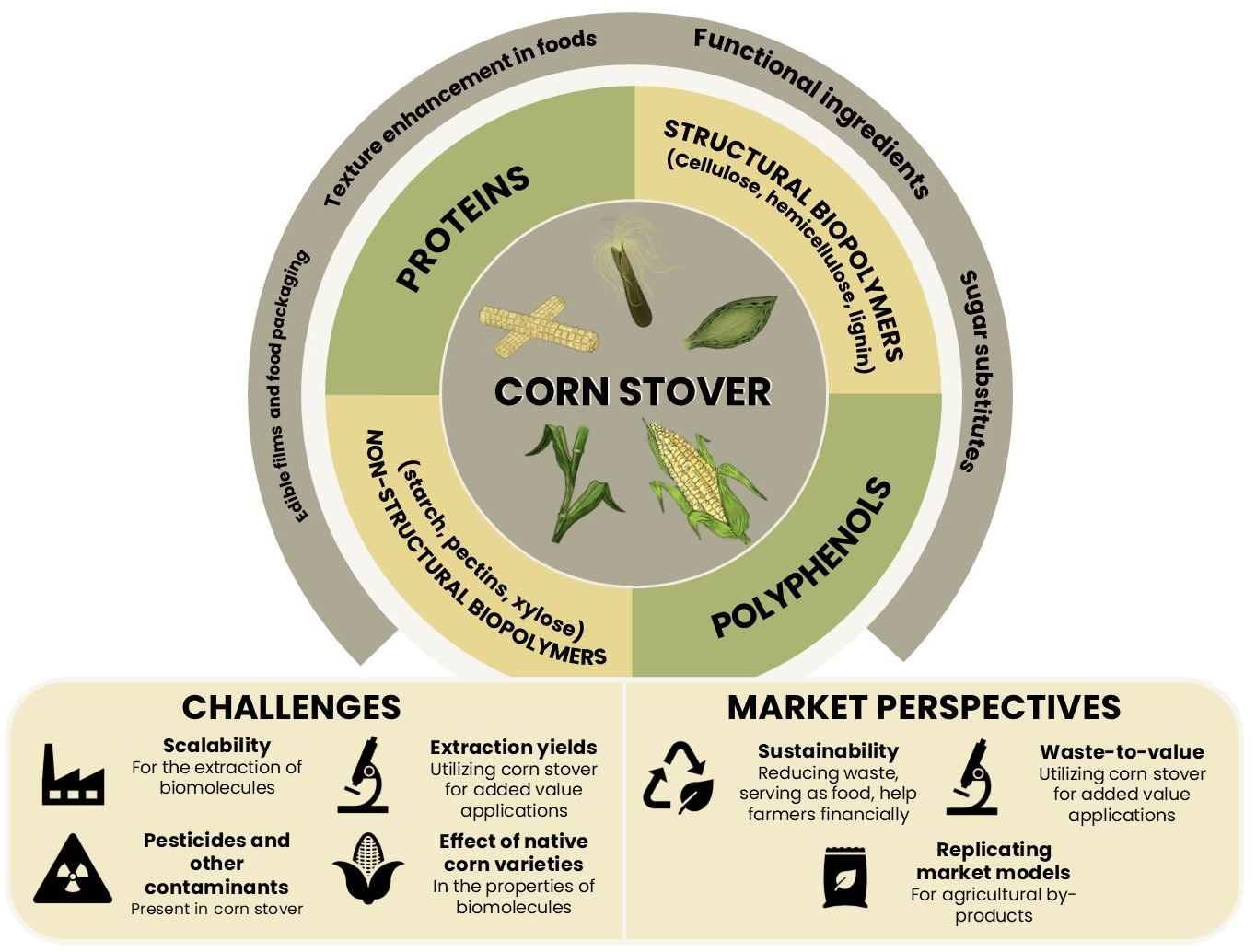
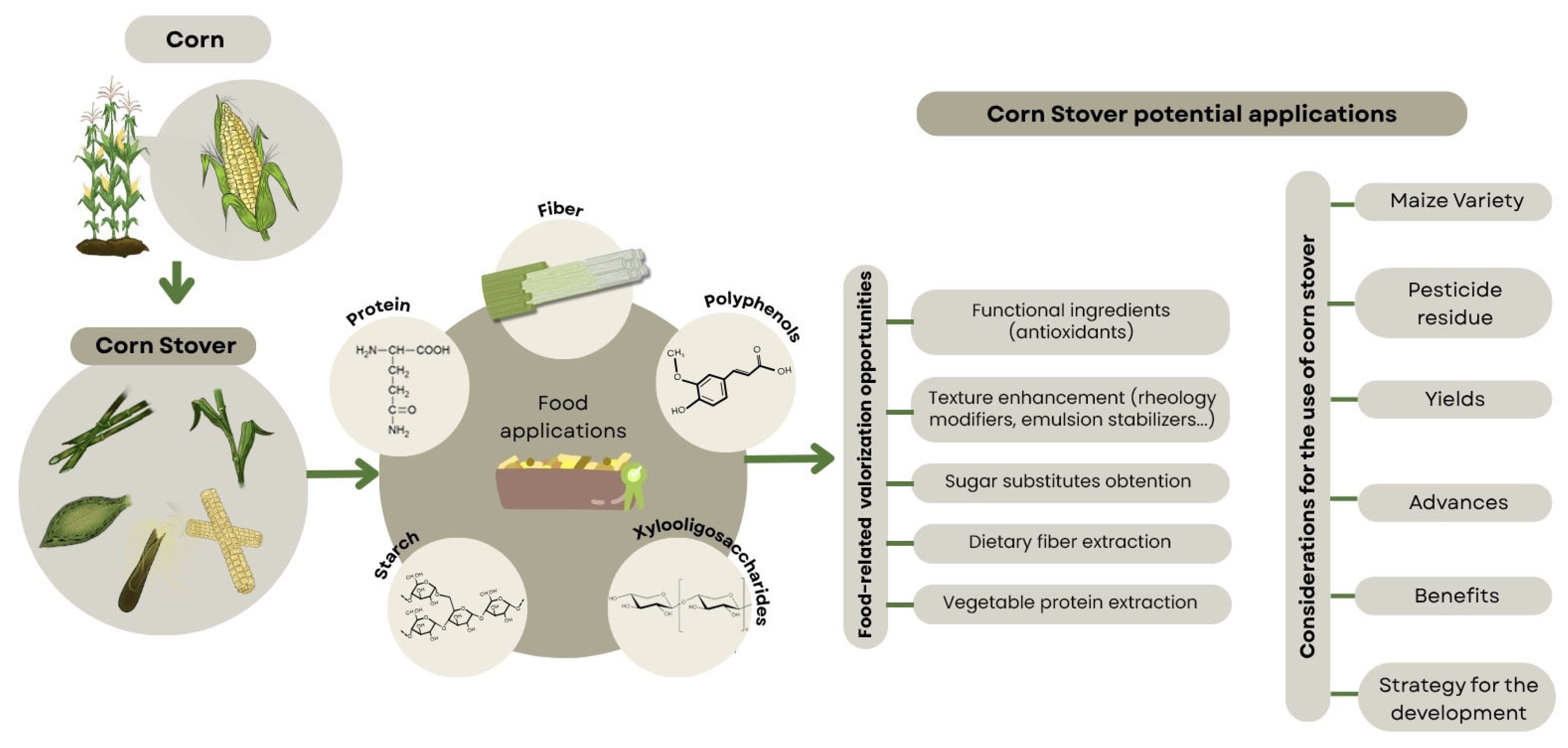
| Corn Stover Component | Promising Food Application | Responsible Biomolecule | Reference |
|---|---|---|---|
| Silk | Antioxidants | Polyphenols | [36,50,73,74] |
| Vegetable protein source | Protein | [17,20] | |
| Dietary fiber for bakery products | Structural and non-structural biopolymers | [71] | |
| Cob | Sugar substitutes | Xylooligosaccharides | [37] |
| Texture enhancement in food products | Starch | [118] | |
| Edible films production | [121] | ||
| Husk | Dietary fiber | Structural and non-structural biopolymers | [129] |
| Rheology modifier | Cellulose | [113] | |
| Emulsion stabilizer | [109] | ||
| Leaves and stalks | Sugar substitutes | Xylooligosaccharides | [37] |
| Biodegradable materials for food packaging | Lignocellulosic fiber | [72] |
Disclaimer/Publisher’s Note: The statements, opinions and data contained in all publications are solely those of the individual author(s) and contributor(s) and not of MDPI and/or the editor(s). MDPI and/or the editor(s) disclaim responsibility for any injury to people or property resulting from any ideas, methods, instructions or products referred to in the content. |
© 2025 by the authors. Licensee MDPI, Basel, Switzerland. This article is an open access article distributed under the terms and conditions of the Creative Commons Attribution (CC BY) license.
Share and Cite
Ochoa-Castaño, M.; Montoya-Escobar, N.; Velásquez-Cock, J.A.; Gómez-Hoyos, C. Corn Stover for Food Applications: Approaches, Advances and Insights. Molecules 2026, 31, 27. https://doi.org/10.3390/molecules31010027
Ochoa-Castaño M, Montoya-Escobar N, Velásquez-Cock JA, Gómez-Hoyos C. Corn Stover for Food Applications: Approaches, Advances and Insights. Molecules. 2026; 31(1):27. https://doi.org/10.3390/molecules31010027
Chicago/Turabian StyleOchoa-Castaño, Mariana, Nicolás Montoya-Escobar, Jorge Andrés Velásquez-Cock, and Catalina Gómez-Hoyos. 2026. "Corn Stover for Food Applications: Approaches, Advances and Insights" Molecules 31, no. 1: 27. https://doi.org/10.3390/molecules31010027
APA StyleOchoa-Castaño, M., Montoya-Escobar, N., Velásquez-Cock, J. A., & Gómez-Hoyos, C. (2026). Corn Stover for Food Applications: Approaches, Advances and Insights. Molecules, 31(1), 27. https://doi.org/10.3390/molecules31010027