Platinum-Based Cytostatics Used in Oncology with Respect to Environmental Fate and Innovative Removal Strategies of Their Metabolites




Abstract
1. Introduction
2. Platinum Pharmaceuticals in Oncology
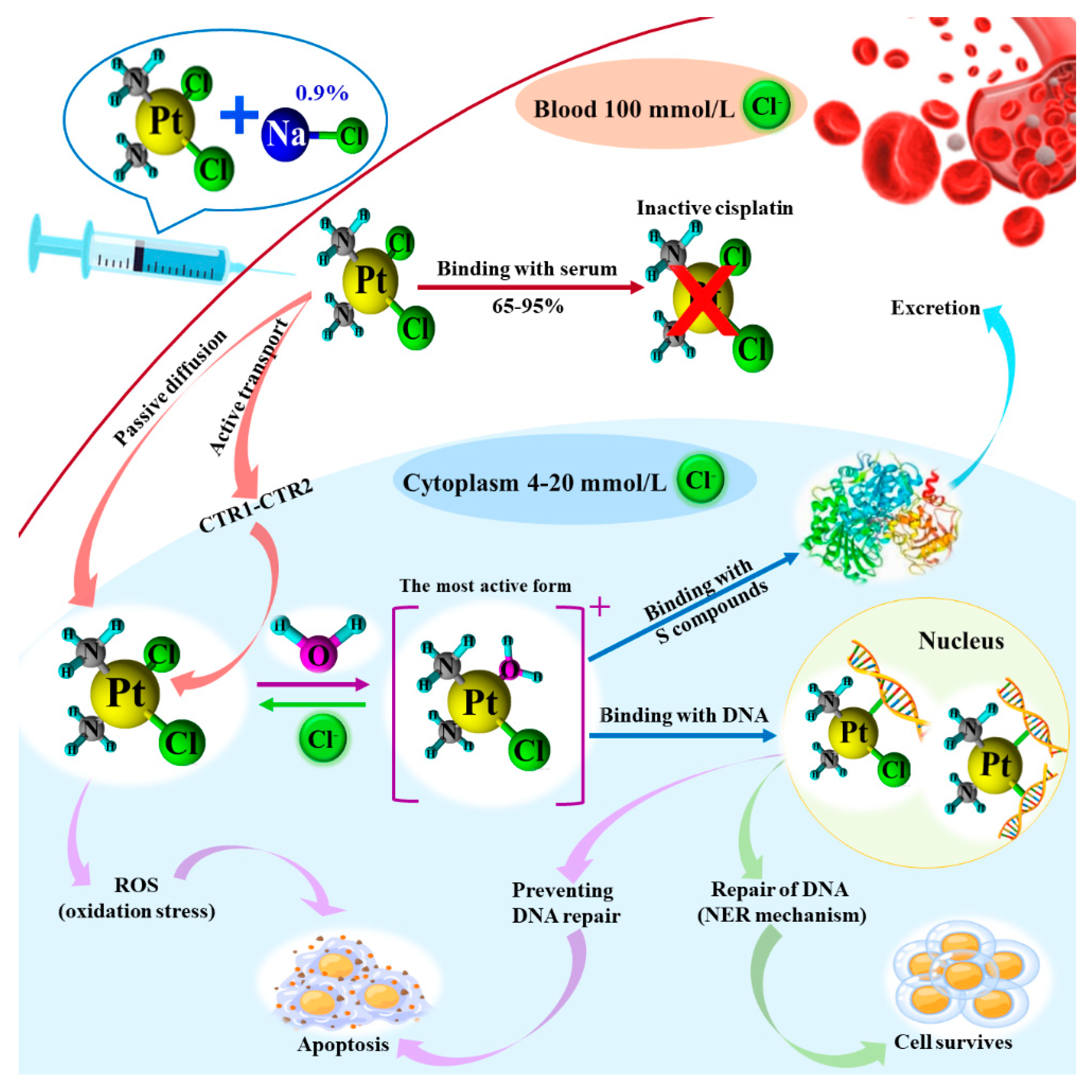
3. Possible Metabolic Pathways of Platinum Cytostatics
4. Environmental Impact of Platinum-Based Metabolites
5. Removal Methods of Platinum Metabolites
6. Future Perspectives
Author Contributions
Funding
Institutional Review Board Statement
Informed Consent Statement
Data Availability Statement
Conflicts of Interest
References
- Garcia-Costa, A.L.; Gouveia, T.I.A.; Alves, A.; Santos, M.S.F. Adsorption Technologies for the Removal of Cytostatics in Water: A Review. Water 2023, 15, 4005. [Google Scholar] [CrossRef]
- Jang, J.S.; Park, H.J.; Suh, C.H.; Won, S.E.; Lee, E.S.; Kim, N.; Lee, D.-W.; Kim, K.W. Imaging Findings of Complications of New Anticancer Drugs. Korean J. Radiol. 2025, 26, 156. [Google Scholar] [CrossRef]
- Roque-Diaz, Y.; Sanadar, M.; Han, D.; López-Mesas, M.; Valiente, M.; Tolazzi, M.; Melchior, A.; Veclani, D. The Dark Side of Platinum Based Cytostatic Drugs: From Detection to Removal. Processes 2021, 9, 1873. [Google Scholar] [CrossRef]
- Kümmerer, K.; Helmers, E.; Hubner, P.; Mascart, G.; Milandri, M.; Reinthaler, F.; Zwakenberg, M. European Hospitals as a Source for Platinum in the Environment in Comparison with Other Sources. Sci. Total Environ. 1999, 225, 155–165. [Google Scholar] [CrossRef]
- Kanakaraju, D.; Glass, B.D.; Oelgemöller, M. Advanced Oxidation Process-Mediated Removal of Pharmaceuticals from Water: A Review. J. Environ. Manag. 2018, 219, 189–207. [Google Scholar] [CrossRef]
- Dilruba, S.; Kalayda, G.V. Platinum-Based Drugs: Past, Present and Future. Cancer Chemother. Pharmacol. 2016, 77, 1103–1124. [Google Scholar] [CrossRef] [PubMed]
- Kopacz-Bednarska, A.; Król, T. Selected Platinum Complexes in Standard and Modern Anti-Cancer Therapies. Nowotwory. J. Oncol. 2022, 72, 96–105. [Google Scholar] [CrossRef]
- Wheate, N.J.; Walker, S.; Craig, G.E.; Oun, R. The Status of Platinum Anticancer Drugs in the Clinic and in Clinical Trials. Dalton Trans. 2010, 39, 8113. [Google Scholar] [CrossRef] [PubMed]
- Nath, S.; Datta, A.; Das, A.; Adhikari, S. Metal-Based Drugs in Cancer Therapy. Int. J. Exp. Res. Rev. 2024, 37, 159–173. [Google Scholar] [CrossRef]
- Ghosh, S. Cisplatin: The First Metal Based Anticancer Drug. Bioorg. Chem. 2019, 88, 102925. [Google Scholar] [CrossRef] [PubMed]
- Barabas, K.; Milner, R.; Lurie, D.; Adin, C. Cisplatin: A Review of Toxicities and Therapeutic Applications. Vet. Compar. Oncol. 2008, 6, 1–18. [Google Scholar] [CrossRef]
- Krämer, I.; Erdnuess, F.; Thiesen, J. Physicochemical Stability of Carboplatin Accord in Punctured Original Vials, Syringes and after Dilution with 0.9% Sodium Chloride or 5% Glucose Solution. Gen. Biosim. Init. J. 2024, 13, 93–95. [Google Scholar]
- Machado, M.C.; Yamamoto, P.A.; Pippa, L.F.; De Moraes, N.V.; Neves, F.M.F.; Portela, R.D.; Barrouin-Melo, S.M.; Hielm-Björkman, A.; Godoy, A.L.P.C.; Estrela-Lima, A. Pharmacokinetics of Carboplatin in Combination with Low-Dose Cyclophosphamide in Female Dogs with Mammary Carcinoma. Animals 2022, 12, 3109. [Google Scholar] [CrossRef] [PubMed]
- Fan, V.; Delport-Reynolds, T.; MacDonald-Dickinson, V.; Matsuyama, A. Retrospective Analysis of Carboplatin-Induced Cumulative Neutropenia in Cancer-Bearing Dogs. J. Am. Vet. Med. Assoc. 2024, 262, 1–7. [Google Scholar] [CrossRef] [PubMed]
- Janssens, T.; Brouwers, E.E.M.; De Vos, J.P.; De Vries, N.; Schellens, J.H.M.; Beijnen, J.H. Inductively Coupled Plasma Mass-spectrometric Determination of Platinum in Excretion Products of Client-owned Pet Dogs. Vet. Compar. Oncol. 2015, 13, 124–132. [Google Scholar] [CrossRef] [PubMed]
- Menard, K.; Flesner, B.K.; Glahn, A.; Boudreaux, B.; Bryan, J.N. Concurrent 5-fluorouracil and Carboplatin for the Treatment of Canine Carcinomas. Vet. Compar. Oncol. 2018, 16, 590–595. [Google Scholar] [CrossRef]
- Coffee, C.; Roush, J.K.; Higginbotham, M.L. Carboplatin-induced Myelosuppression as Related to Body Weight in Dogs. Vet. Compar. Oncol. 2020, 18, 804–810. [Google Scholar] [CrossRef] [PubMed]
- Pritchard, C.; Al-Nadaf, S.; Rebhun, R.B.; Willcox, J.L.; Skorupski, K.A.; Lejeune, A. Efficacy and Toxicity of Carboplatin in the Treatment of Macroscopic Mesenchymal Neoplasia in Dogs. Vet. Compar. Oncol. 2023, 21, 717–725. [Google Scholar] [CrossRef]
- Schlueter, A.; Hanot, C.; Sellon, R.; Fidel, J. Treatment of Feline Oral Squamous Cell Carcinoma with Accelerated Radiation and Carboplatin with and without Follow-up Toceranib Phosphate. J. Feline Med. Surg. 2025, 27, 1098612X251314343. [Google Scholar] [CrossRef]
- O’Dowd, P.D.; Sutcliffe, D.F.; Griffith, D.M. Oxaliplatin and Its Derivatives–An Overview. Coord. Chem. Rev. 2023, 497, 215439. [Google Scholar] [CrossRef]
- Klahn, S.; Dervisis, N.; Gustafson, D.L.; Abbott, J. Dose-Escalation and Pharmacokinetic Study Following a Single Dose of Oxaliplatin in Cancer-Bearing Dogs. J. Am. Anim. Hosp. Assoc. 2020, 56, 206–214. [Google Scholar] [CrossRef]
- Michalke, B. Platinum Speciation Used for Elucidating Activation or Inhibition of Pt-Containing Anti-Cancer Drugs. J. Tr. Elem. Med. Biol. 2010, 24, 69–77. [Google Scholar] [CrossRef]
- Obreshkova, D.; Ivanova, S.; Yordanova-Laleva, P. Influence of Chemical Structure and Mechanism of Hydrolysis on Pharmacological Activity and Toxicological Profile of Approved Platinum Drugs. Pharmacia 2022, 69, 645–653. [Google Scholar] [CrossRef]
- Koellensperger, G.; Hann, S. Ultra-Fast HPLC-ICP-MS Analysis of Oxaliplatin in Patient Urine. Anal. Bioanal. Chem. 2010, 397, 401–406. [Google Scholar] [CrossRef] [PubMed]
- Alberto, M.E.; Lucas, M.F.; Pavelka, M.; Russo, N. The Degradation Pathways in Chloride Medium of the Third Generation Anticancer Drug Oxaliplatin. J. Phys. Chem. B 2008, 112, 10765–10768. [Google Scholar] [CrossRef]
- Pyrzńska, K. Viewpoint Monitoring of Platinum in the Environment. J. Environ. Monitor. 2000, 2, 99N–103N. [Google Scholar] [CrossRef]
- Lenz, K.; Koellensperger, G.; Hann, S.; Weissenbacher, N.; Mahnik, S.N.; Fuerhacker, M. Fate of Cancerostatic Platinum Compounds in Biological Wastewater Treatment of Hospital Effluents. Chemosphere 2007, 69, 1765–1774. [Google Scholar] [CrossRef]
- Lenz, K.; Mahnik, S.N.; Weissenbacher, N.; Mader, R.M.; Krenn, P.; Hann, S.; Koellensperger, G.; Uhl, M.; Knasmüller, S.; Ferk, F.; et al. Monitoring, Removal and Risk Assessment of Cytostatic Drugs in Hospital Wastewater. Water Sci. Technol. 2007, 56, 141–149. [Google Scholar] [CrossRef] [PubMed]
- Vyas, N.; Turner, A.; Sewell, G. Platinum-Based Anticancer Drugs in Waste Waters of a Major UK Hospital and Predicted Concentrations in Recipient Surface Waters. Sci. Total Environ. 2014, 493, 324–329. [Google Scholar] [CrossRef] [PubMed]
- Daouk, S.; Chèvre, N.; Vernaz, N.; Widmer, C.; Daali, Y.; Fleury-Souverain, S. Dynamics of Active Pharmaceutical Ingredients Loads in a Swiss University Hospital Wastewaters and Prediction of the Related Environmental Risk for the Aquatic Ecosystems. Sci. Total Environ. 2016, 547, 244–253. [Google Scholar] [CrossRef]
- Mišík, M.; Filipic, M.; Nersesyan, A.; Kundi, M.; Isidori, M.; Knasmueller, S. Environmental Risk Assessment of Widely Used Anticancer Drugs (5-Fluorouracil, Cisplatin, Etoposide, Imatinib Mesylate). Water Res. 2019, 164, 114953. [Google Scholar] [CrossRef] [PubMed]
- Dobrzyńska, J.; Dąbrowska, M.; Olchowski, R.; Zięba, E.; Dobrowolski, R. Development of a Method for Removal of Platinum from Hospital Wastewater by Novel Ion-Imprinted Mesoporous Organosilica. J. Environ. Chem. Eng. 2021, 9, 105302. [Google Scholar] [CrossRef]
- Lau, J.K.-C.; Deubel, D.V. Hydrolysis of the Anticancer Drug Cisplatin: Pitfalls in the Interpretation of Quantum Chemical Calculations. J. Chem. Theory Comput. 2006, 2, 103–106. [Google Scholar] [CrossRef] [PubMed]
- Lucas, M.F.A.; Pavelka, M.; Alberto, M.E.; Russo, N. Neutral and Acidic Hydrolysis Reactions of the Third Generation Anticancer Drug Oxaliplatin. J. Phys. Chem. B 2009, 113, 831–838. [Google Scholar] [CrossRef]
- Vivekanandan, K.; Swamy, M.; Prasad, S.; Maikap, G.; Mukherjee, R.; Burman, A. Identification of Degradation Products from Aqueous Carboplatin Injection Samples by Electrospray Mass Spectrometry. Intern. J. Pharm. 2006, 313, 214–221. [Google Scholar] [CrossRef]
- Hernández, C.; Ramos, Y.; Fernández, L.A.; Ledea, O.; Bataller, M.; Véliz, E.; Besada, V.; Rosado, A. Ozonation of Cisplatin in Aqueous Solution at pH 9. Ozone Sci. Eng. 2008, 30, 189–196. [Google Scholar] [CrossRef]
- Dehghanpour, S.; Pourzamani, H.R.; Amin, M.M.; Ebrahimpour, K. Evaluation of Toxic Effects of Platinum-Based Antineoplastic Drugs (Cisplatin, Carboplatin and Oxaliplatin) on Green Alga Chlorella Vulgaris. Aquat. Toxicol. 2020, 7, 105495. [Google Scholar] [CrossRef]
- Folens, K.; Mortier, S.T.F.C.; Baeten, J.; Couvreur, K.; Michelet, R.; Gernaey, K.V.; De Beer, T.; Du Laing, G.; Nopens, I. Modelling and Sensitivity Analysis of Urinary Platinum Excretion in Anticancer Chemotherapy for the Recovery of Platinum. Sustain. Chem. Pharm. 2016, 4, 46–56. [Google Scholar] [CrossRef]
- Folens, K.; Baeten, J.; Couvreur, K.; Du Laing, G. Chemical Degradation of Platinum Oncolytics in Urine and Speciation of the Inorganic Contaminants Cisplatin and Carboplatin Relevant in Waste Water. Emerg. Contam. 2024, 10, 100262. [Google Scholar] [CrossRef]
- Fonseca, T.G.; Morais, M.B.; Rocha, T.; Abessa, D.M.S.; Aureliano, M.; Bebianno, M.J. Ecotoxicological Assessment of the Anticancer Drug Cisplatin in the Polychaete Nereis Diversicolor. Sci. Total Environ. 2017, 575, 162–172. [Google Scholar] [CrossRef]
- Ghafuria, Y.; Yunesian, M.; Nabizadeh, R.; Mesdaghinia, A.; Dehghani, M.H.; Alimohammadi, M. Environmental Risk Assessment of Platinum Cytotoxic Drugs: A Focus on Toxicity Characterization of Hospital Effluents. Int. J. Environ. Sci. Technol. 2018, 15, 1983–1990. [Google Scholar] [CrossRef]
- Yadav, A.; Rene, E.R.; Mandal, M.K.; Dubey, K.K. Threat and Sustainable Technological Solution for Antineoplastic Drugs Pollution: Review on a Persisting Global Issue. Chemosphere 2021, 263, 128285. [Google Scholar] [CrossRef]
- Falter, R.; Wilken, R.-D. Determination of Carboplatinum and Cisplatinum by Interfacing HPLC with ICP-MS Using Ultrasonic Nebulisation. Sci. Total Environ. 1999, 225, 167–176. [Google Scholar] [CrossRef]
- Turner, A.; Mascorda, L. Particle–Water Interactions of Platinum-Based Anticancer Drugs in River Water and Estuarine Water. Chemosphere 2015, 119, 415–422. [Google Scholar] [CrossRef] [PubMed]
- Bu, Y.; Zeng, K.; Yang, H.; Sun, A.; Guan, Q.; Zhou, S.; Peng, W.; Wang, W.; Ge, P.; Yang, Y. Experimental Research on Quarry Wastewater Purification Using Flocculation Process. Molecules 2025, 30, 2761. [Google Scholar] [CrossRef]
- Ghafuri, Y.; Yunesian, M.; Nabizadeh, R.; Mesdaghinia, A.; Dehghani, M.H.; Alimohammadi, M. Platinum Cytotoxic Drugs in the Municipal Wastewater and Drinking Water, a Validation Method and Health Risk Assessment. Hum. Ecol. Risk Assess. 2018, 24, 784–796. [Google Scholar] [CrossRef]
- Gedda, G.; Balakrishnan, K.; Devi, R.U.; Shah, K.J.; Gandhi, V.; Gandh, V.; Shah, K. Introduction to Conventional Wastewater Treatment Technologies: Limitations and Recent Advances. In Materials Research Foundations; Materials Research Forum LLC: Millersville PA, USA, 2021; Volume 1, pp. 1–36. ISBN 978-1-64490-115-1. [Google Scholar]
- Zhao, Y.; Liu, D.; Huang, W.; Yang, Y.; Ji, M.; Nghiem, L.D.; Trinh, Q.T.; Tran, N.H. Insights into Biofilm Carriers for Biological Wastewater Treatment Processes: Current State-of-the-Art, Challenges, and Opportunities. Bioresour. Technol. 2019, 288, 121619. [Google Scholar] [CrossRef] [PubMed]
- Verlicchi, P.; Al Aukidy, M.; Zambello, E. Occurrence of Pharmaceutical Compounds in Urban Wastewater: Removal, Mass Load and Environmental Risk after a Secondary Treatment—A Review. Sci. Total Environ. 2012, 429, 123–155. [Google Scholar] [CrossRef] [PubMed]
- Stott, R. Fate and Behaviour of Parasites in Wastewater Treatment Systems. In Handbook of Water and Wastewater Microbiology; Elsevier: Amsterdam, The Netherlands, 2003; pp. 491–521. ISBN 978-0-12-470100-7. [Google Scholar]
- Jijingi, H.E.; Yazdi, S.K.; Abakar, Y.A.; Etim, E. Evaluation of Membrane Bioreactor (MBR) Technology for Industrial Wastewater Treatment and Its Application in Developing Countries: A Review. Case Stud. Chem. Environ. Eng. 2024, 10, 100886. [Google Scholar] [CrossRef]
- Verlicchi, P.; Al Aukidy, M.; Zambello, E. What Have We Learned from Worldwide Experiences on the Management and Treatment of Hospital Effluent?—An Overview and a Discussion on Perspectives. Sci. Total Environ. 2015, 514, 467–491. [Google Scholar] [CrossRef]
- Garakouei, S.R.; Issazadeh, K.; Zamani, H.; Rakhshaee, R.; Shahriarinour, M. Characterization of Oxaliplatin Removal by Multispecies Bacterial Populations in Moving Bed Biofilm and Suspended-Biomass Reactors. J. Appl. Microbiol. 2022, 133, 630–645. [Google Scholar] [CrossRef]
- Johnstone, T.C.; Alexander, S.M.; Wilson, J.J.; Lippard, S.J. Oxidative Halogenation of Cisplatin and Carboplatin: Synthesis, Spectroscopy, and Crystal and Molecular Structures of Pt(IV) Prodrugs. Dalton Trans. 2015, 44, 119–129. [Google Scholar] [CrossRef]
- Dawam, M.; Gobara, M.; Oraby, H.; Zorainy, M.Y.; Nabil, I.M. Advances in Membrane Technologies for Heavy Metal Removal from Polluted Water: A Comprehensive Review. Water Air Soil. Pollut. 2025, 236, 461. [Google Scholar] [CrossRef]
- Hirose, J.; Kondo, F.; Nakano, T.; Kobayashi, T.; Hiro, N.; Ando, Y.; Takenaka, H.; Sano, K. Inactivation of Antineoplastics in Clinical Wastewater by Electrolysis. Chemosphere 2005, 60, 1018–1024. [Google Scholar] [CrossRef]
- Sauvageau, J.-F.; Milaniak, N.; Samard, L.; Fortin, M.-A. Transformation by Plasma Technology of Cisplatin Found in Hospital’s Wastewaters into Platinum-Containing Nanoparticles. Chem. Eng. J. Adv. 2023, 13, 100435. [Google Scholar] [CrossRef]
- Kitsiou, V.; Zachariadis, G.A.; Lambropoulou, D.A.; Tsiplakides, D.; Poulios, I. Mineralization of the Antineoplastic Drug Carboplatin by Heterogeneous Photocatalysis with Simultaneous Synthesis of Platinum-Modified TiO2 Catalysts. J. Environ. Chem. Eng. 2018, 6, 2409–2416. [Google Scholar] [CrossRef]
- Barbosa, L.V.; Castro, M.S.D.S.; Ciuffi, K.J.; Nassar, E.J.; Marçal, L.; Pereira, L.R.; Santos, M.F.C.; Ambrósio, S.R.; Gomes, P.S.D.S.; Nogueira, F.A.R.; et al. Kaolinite-Titanium Nanocomposite Applied to the Photodegradation of the Genotoxic Compound Cisplatin and the Terephthalic Acid Hydroxylation Reaction. Colloids Surf. A Physicochem. Eng. Asp. 2023, 676, 132144. [Google Scholar] [CrossRef]
- Wu, Z.; Ye, X.; Liu, H.; Zhang, H.; Liu, Z.; Guo, M.; Li, Q.; Li, J. Interactions between Adsorbents and Adsorbates in Aqueous Solutions. Pure Appl. Chem. 2020, 92, 1655–1662. [Google Scholar] [CrossRef]
- Dubinin, M.M. Porous Structure of Adsorbents and Catalysts. Adv. Colloid. Interface Sci. 1968, 2, 217–235. [Google Scholar] [CrossRef]
- Morlo, K.; Olchowski, R.; Dobrowolski, R. Optimization of Pt(II) and Pt(IV) Adsorption from a Water Solution on Biochar Originating from Honeycomb Biomass. Molecules 2024, 29, 547. [Google Scholar] [CrossRef] [PubMed]
- Tripathi, A.K.; David, A.; Govil, T.; Rauniyar, S.; Rathinam, N.K.; Goh, K.M.; Sani, R.K. Environmental Remediation of Antineoplastic Drugs: Present Status, Challenges, and Future Directions. Processes 2020, 8, 747. [Google Scholar] [CrossRef]
- Godlewska-Żyłkiewicz, B. Biosorption of Platinum and Palladium for Their Separation/Preconcentration Prior to Graphite Furnace Atomic Absorption Spectrometric Determination. Spectrochim. Acta Part. B At. Spectrosc. 2003, 58, 1531–1540. [Google Scholar] [CrossRef]
- Gurung, M.; Adhikari, B.B.; Alam, S.; Kawakita, H.; Ohto, K.; Inoue, K. Persimmon Tannin-Based New Sorption Material for Resource Recycling and Recovery of Precious Metals. Chem. Eng. J. 2013, 228, 405–414. [Google Scholar] [CrossRef]
- Tikhonova, L.P.; Lyubchik, S.B.; Tarasenko, Y.A.; Goncharik, V.P.; Galushko, O.L.; Fonseca, I. Modified Anthracites as Selective Sorbents for Platinum Metals. Russ. J. Appl. Chem. 2006, 79, 727–732. [Google Scholar] [CrossRef]
- Lin, T.-L.; Lien, H.-L. Effective and Selective Recovery of Precious Metals by Thiourea Modified Magnetic Nanoparticles. Int. J. Mol. Sci. 2013, 14, 9834–9847. [Google Scholar] [CrossRef]
- Sharififard, H.; Soleimani, M.; Ashtiani, F.Z. Evaluation of Activated Carbon and Bio-Polymer Modified Activated Carbon Performance for Palladium and Platinum Removal. J. Taiwan Inst. Chem. Eng. 2012, 43, 696–703. [Google Scholar] [CrossRef]
- Ma, H.; Liao, X.; Liu, X.; Shi, B. Recovery of Platinum(IV) and Palladium(II) by Bayberry Tannin Immobilized Collagen Fiber Membrane from Water Solution. J. Membr. Sci. 2006, 278, 373–380. [Google Scholar] [CrossRef]
- Parajuli, D.; Adhikari, C.R.; Kuriyama, M.; Kawakita, H.; Ohto, K.; Inoue, K.; Funaoka, M. Selective Recovery of Gold by Novel Lignin-Based Adsorption Gels. Ind. Eng. Chem. Res. 2006, 45, 8–14. [Google Scholar] [CrossRef]
- Won, S.W.; Mao, J.; Kwak, I.-S.; Sathishkumar, M.; Yun, Y.-S. Platinum Recovery from ICP Wastewater by a Combined Method of Biosorption and Incineration. Bioresour. Technol. 2010, 101, 1135–1140. [Google Scholar] [CrossRef]
- Zhou, L.; Liu, J.; Liu, Z. Adsorption of Platinum(IV) and Palladium(II) from Aqueous Solution by Thiourea-Modified Chitosan Microspheres. J. Hazard. Mater. 2009, 172, 439–446. [Google Scholar] [CrossRef]
- Zhou, L.; Xu, J.; Liang, X.; Liu, Z. Adsorption of Platinum(IV) and Palladium(II) from Aqueous Solution by Magnetic Cross-Linking Chitosan Nanoparticles Modified with Ethylenediamine. J. Hazard. Mater. 2010, 182, 518–524. [Google Scholar] [CrossRef]
- Ramesh, A.; Hasegawa, H.; Sugimoto, W.; Maki, T.; Ueda, K. Adsorption of Gold(III), Platinum(IV) and Palladium(II) onto Glycine Modified Crosslinked Chitosan Resin. Bioresour. Technol. 2008, 99, 3801–3809. [Google Scholar] [CrossRef] [PubMed]
- Fujiwara, K.; Ramesh, A.; Maki, T.; Hasegawa, H.; Ueda, K. Adsorption of Platinum (IV), Palladium (II) and Gold (III) from Aqueous Solutions onto l-Lysine Modified Crosslinked Chitosan Resin. J. Hazard. Mater. 2007, 146, 39–50. [Google Scholar] [CrossRef] [PubMed]
- Bratskaya, S.Y.; Ustinov, A.Y.; Azarova, Y.A.; Pestov, A.V. Thiocarbamoyl Chitosan: Synthesis, Characterization and Sorption of Au(III), Pt(IV), and Pd(II). Carbohydr. Polym. 2011, 85, 854–861. [Google Scholar] [CrossRef]
- Guibal, E.; Larkin, A.; Vincent, T.; Tobin, J.M. Chitosan Sorbents for Platinum Sorption from Dilute Solutions. Ind. Eng. Chem. Res. 1999, 38, 4011–4022. [Google Scholar] [CrossRef]
- Wang, Z.; Xu, X.; Ma, S.; Wang, H.; Zhao, H.; Wang, Y.; Tong, S.; Su, Z.; Wang, W.; Bai, J. The Superior Adsorption Capacity of Boron-Nitrogen Co-Doping Walnut Shell Biochar Powder for Au(III), Pt(IV), and Pd(II). J. Environ. Chem. Eng. 2021, 9, 106288. [Google Scholar] [CrossRef]
- Mosai, A.K.; Chimuka, L.; Cukrowska, E.M.; Kotzé, I.A.; Tutu, H. The Recovery of Platinum (IV) from Aqueous Solutions by Hydrazine-Functionalised Zeolite. Miner. Eng. 2019, 131, 304–312. [Google Scholar] [CrossRef]
- Liu, Y.; Lin, S.; Liu, Y.; Sarkar, A.K.; Bediako, J.K.; Kim, H.Y.; Yun, Y. Super-Stable, Highly Efficient, and Recyclable Fibrous Metal–Organic Framework Membranes for Precious Metal Recovery from Strong Acidic Solutions. Small 2019, 15, 1805242. [Google Scholar] [CrossRef]
- Park, H.N.; Choi, H.A.; Won, S.W. Fibrous Polyethylenimine/Polyvinyl Chloride Crosslinked Adsorbent for the Recovery of Pt(IV) from Acidic Solution: Adsorption, Desorption and Reuse Performances. J. Clean. Prod. 2018, 176, 360–369. [Google Scholar] [CrossRef]
- Kubrakova, I. Microwave-Assisted Sample Preparation and Preconcentration for ETAAS. Spectrochim. Acta Part. B At. Spectrosc. 1997, 52, 1469–1481. [Google Scholar] [CrossRef]
- Myasoedova, G.V.; Antokol’skaya, I.I.; Savvin, S.B. New Chelating Sorbents for Noble Metals. Talanta 1985, 32, 1105–1112. [Google Scholar] [CrossRef]
- Mladenova, E.; Karadjova, I.; Tsalev, D.L. Solid-phase Extraction in the Determination of Gold, Palladium, and Platinum. J. Sep. Sci. 2012, 35, 1249–1265. [Google Scholar] [CrossRef]
- Asere, T.G.; Mincke, S.; Folens, K.; Vanden Bussche, F.; Lapeire, L.; Verbeken, K.; Van Der Voort, P.; Tessema, D.A.; Du Laing, G.; Stevens, C.V. Dialdehyde Carboxymethyl Cellulose Cross-Linked Chitosan for the Recovery of Palladium and Platinum from Aqueous Solution. React. Funct. Polym. 2019, 141, 145–154. [Google Scholar] [CrossRef]
- Barczak, M.; Dobrzyńska, J.; Oszust, M.; Skwarek, E.; Ostrowski, J.; Zięba, E.; Borowski, P.; Dobrowolski, R. Synthesis and Application of Thiolated Mesoporous Silicas for Sorption, Preconcentration and Determination of Platinum. Mater. Chem. Phys. 2016, 181, 126–135. [Google Scholar] [CrossRef]
- Chen, M.; Li, S.; Jin, C.; Shao, M.; Huang, Z.; Xie, X. Removal of Metal-Cyanide Complexes and Recovery of Pt(II) and Pd(II) from Wastewater Using an Alkali–Tolerant Metal-Organic Resin. J. Hazard. Mater. 2021, 406, 124315. [Google Scholar] [CrossRef] [PubMed]
- Fayemi, O.E.; Ogunlaja, A.S.; Kempgens, P.F.M.; Antunes, E.; Torto, N.; Nyokong, T.; Tshentu, Z.R. Adsorption and Separation of Platinum and Palladium by Polyamine Functionalized Polystyrene-Based Beads and Nanofibers. Miner. Eng. 2013, 53, 256–265. [Google Scholar] [CrossRef]
- Lim, C.-R.; Lin, S.; Yun, Y.-S. Highly Efficient and Acid-Resistant Metal-Organic Frameworks of MIL-101(Cr)-NH2 for Pd(II) and Pt(IV) Recovery from Acidic Solutions: Adsorption Experiments, Spectroscopic Analyses, and Theoretical Computations. J. Hazard. Mater. 2020, 387, 121689. [Google Scholar] [CrossRef] [PubMed]
- Marinho, R.S.; Silva, C.N.D.; Afonso, J.C.; Cunha, J.W.S.D.D. Recovery of Platinum, Tin and Indium from Spent Catalysts in Chloride Medium Using Strong Basic Anion Exchange Resins. J. Hazard. Mater. 2011, 192, 1155–1160. [Google Scholar] [CrossRef] [PubMed]
- Morcali, M.H.; Zeytuncu, B. Investigation of Adsorption Parameters for Platinum and Palladium onto a Modified Polyacrylonitrile-Based Sorbent. Int. J. Miner. Process. 2015, 137, 52–58. [Google Scholar] [CrossRef]
- Ramakul, P.; Yanachawakul, Y.; Leepipatpiboon, N.; Sunsandee, N. Biosorption of Palladium(II) and Platinum(IV) from Aqueous Solution Using Tannin from Indian Almond (Terminalia Catappa L.) Leaf Biomass: Kinetic and Equilibrium Studies. Chem. Eng. J. 2012, 193–194, 102–111. [Google Scholar] [CrossRef]
- Garland, N.; Gordon, R.; Hopkins, I.; Ward, E.; McElroy, C.R.; MacQuarrie, D.; Parkin, A. Polysaccharide-Derived Sulfur-Containing Mesoporous Carbon Materials for Platinum Group Metal Recovery. Carbon 2025, 239, 120309. [Google Scholar] [CrossRef]
- Cyganowski, P.; Jermakowicz-Bartkowiak, D. Piperazine Functionalized Resins for Au(III), Pt(IV), and Pd(II) Sorption. Sep. Sci. Technol. 2014, 49, 1689–1699. [Google Scholar] [CrossRef]
- Jermakowicz-Bartkowiak, D.; Cyganowski, P.; Kawałko, J. Microwave-Assisted Synthesis of Anion-Exchange Resins for Sorption of Noble Metals: How to Boost Sorption Capacity Using a Proper Reaction Environment. Polym. Bull. 2017, 74, 229–244. [Google Scholar] [CrossRef]
- Bratskaya, S.; Privar, Y.; Ustinov, A.; Azarova, Y.; Pestov, A. Recovery of Au(III), Pt(IV), and Pd(II) Using Pyridylethyl-Containing Polymers: Chitosan Derivatives vs Synthetic Polymers. Ind. Eng. Chem. Res. 2016, 55, 10377–10385. [Google Scholar] [CrossRef]
- Goc, K.; Kluczka, J.; Benke, G.; Malarz, J.; Pianowska, K.; Leszczyńska-Sejda, K. Application of Ion Exchange for Recovery of Noble Metals. Minerals 2021, 11, 1188. [Google Scholar] [CrossRef]
- Nikoloski, A.N.; Ang, K.-L.; Li, D. Recovery of Platinum, Palladium and Rhodium from Acidic Chloride Leach Solution Using Ion Exchange Resins. Hydrometallurgy 2015, 152, 20–32. [Google Scholar] [CrossRef]
- Sun, P.-P.; Kim, T.-Y.; Min, B.-J.; Cho, S.-Y. Separation of Platinum(IV) and Rhodium(III) from Hydrochloric Acid Solutions Using Diaion Resins. Mater. Trans. 2015, 56, 1863–1867. [Google Scholar] [CrossRef][Green Version]
- Kononova, O.N.; Melnikov, A.M.; Demitrichenko, D.S. Simultaneous Ion Exchange Recovery and Subsequent Separation of Platinum(II, IV), Rhodium(III), and Nickel(II) from Chloride and Sulfate-Chloride Solutions. Solvent Extr. Ion Exch. 2013, 31, 306–319. [Google Scholar] [CrossRef]
- Mel’nikov, A.M.; Kononova, O.N.; Ozerova, T.A.; Luk’yanenko, A.S. Sorption Recovery of Platinum(II, IV) from Chloride and Sulfate-Chloride Solutions. Russ. J. Appl. Chem. 2012, 85, 1560–1566. [Google Scholar] [CrossRef]
- Firmansyah, M.L.; Kubota, F.; Goto, M. Selective Recovery of Platinum Group Metals from Spent Automotive Catalysts by Leaching and Solvent Extraction. J. Chem. Eng. Jpn./JCEJ 2019, 52, 835–842. [Google Scholar] [CrossRef]
- Gaita, R. An Ion-Exchange Method for Selective Separation of Palladium, Platinum and Rhodium from Solutions Obtained by Leaching Automotive Catalytic Converters. Talanta 1995, 42, 249–255. [Google Scholar] [CrossRef] [PubMed]
- Folens, K.; Abebe, A.; Tang, J.; Ronsse, F.; Laing, G.D. Biosorption of Residual Cisplatin, Carboplatin and Oxaliplatin Antineoplastic Drugs in Urine after Chemotherapy Treatment. Environ. Chem. 2018, 15, 506–512. [Google Scholar] [CrossRef]
- Lombana Fraguela, R.; Ricardo Garcia, J.A.; Villanueva Tagle, M.E.; Pomares Alfonso, M.S.; Cracchiolo, M.; Kovačević, A.; Tolazzi, M.; Melchior, A.; Sanadar, M. Evaluation of Dithiocarbamate-Modified Silica for Cisplatin Removal from Water. Processes 2023, 11, 472. [Google Scholar] [CrossRef]
- Farías, T.; Hajizadeh, S.; Ye, L. Cryogels with High Cisplatin Adsorption Capacity: Towards Removal of Cytotoxic Drugs from Wastewater. Sep. Purif. Technol. 2020, 235, 116203. [Google Scholar] [CrossRef]
- Han, D.; López-Mesas, M.; Luaces, M.; Enamorado, Y.; Sanadar, M.; Melchior, A.; Valiente, M. Comparative Study on Removal of Platinum Cytostatic Drugs at Trace Level by Cysteine, Diethylenetriamino Functionalized Si-Gels and Polyethyleneimine Functionalized Sponge: Adsorption Performance and Mechanisms. Sci. Total Environ. 2023, 891, 164385. [Google Scholar] [CrossRef] [PubMed]
- Ogata, F.; Inoue, K.; Tominaga, H.; Iwata, Y.; Ueda, A.; Tanaka, Y.; Kawasaki, N. Use of Calcined Gibbsite to Remove Cisplatin from Aqueous Solutions. J. Water Environ. Tech. 2014, 12, 13–23. [Google Scholar] [CrossRef]
- Han, D.; Villanueva-Tagle, M.E.; Peña-Icart, M.; López-Mesas, M.; Valiente, M. Trace Cisplatin Adsorption by Thiol-Functionalized Sponge (TFS) and Sn/SnO2-Coated TFS: Adsorption Study and Mechanism Investigation. J. Hazard. Mater. 2024, 471, 134442. [Google Scholar] [CrossRef]



| Name /Symbol | Chemical Structure | Synthesis (Approval) Year | Clinical Use | Market Status | Ref. |
|---|---|---|---|---|---|
| cisplatin |  | 1845 (1979) | testicular, ovarian, bladder, lung, cervical, head and neck, gastric cancers, etc. | worldwide | [7,8,9,10] |
| carboplatin |  | 1970s (1989) | ovarian, lung, head and neck cancers, etc. | worldwide | [7,8,9,10] |
| oxaliplatin |  | 1976 (2002) | adjuvant and metastatic colorectal cancer, gastric, ovarian, pancreatic cancers, etc. | worldwide | [7,8,9,10] |
| picoplatin |  | nd | ovarian, lung, hormone refractory prostate cancers, lymphoma, small intestine and colorectal cancers | clinical studies (since 1997) | [7,8,9,10] |
| nedaplatin |  | 1983 (1995) | lung, esophageal, head and neck cancers, ovarian and cervical cancers, malignant urological cancers | Japan | [7,8,9,10] |
| lobaplatin |  | 1995 (2010) | breast, lung, ovarian, cervical, intestine and stomach cancers, chronic myeloid leukemia | China | [7,8,9,10] |
| satraplatin |  | nd | prostate, lung, ovarian, cervical cancers | clinical studies | [7,8,9,10] |
| heptaplatin |  | 1990 (1999) | colorectal, stomach, head and neck cancers | Korea | [7,8,9,10] |
| pyriplatin |  | nd | nd | research studies | [7] |
| Glu-Pt |  | nd | nd | research studies | [7] |
| trans-[PtCl2(ipa)(dma)] |  | nd | nd | research studies | [7] |
| Adsorbent | Matrix | Removal Conditions | Pt Removal | Adsorption Capacity | Ref. |
|---|---|---|---|---|---|
| GAC (Merck, Darmstadt, Germany) | synthetic urine | C0Pt = 100 µg/L pH = 7 m/V = 10 g/L tads. = 24 h. | cisplatin: 45% carboplatin: 58% oxaliplatin: 95% | nd | [104] |
| Chitosan | synthetic urine | C0Pt = 100 µg/L pH = 7 m/V = 10 g/L tads. = 24 h. | cisplatin: 36% carboplatin: 48% oxaliplatin: 40% | nd | [104] |
| Si-DTC | aqueous solution | C0Pt = 0.5–150 mg/L pH = 6 m/V = 2 g/L teq = 90 min. | nd | 15.6 mg Pt/g | [105] |
| Cryogel | aqueous solution | C0cisplatin = 0.5 g/L m/V = 10 g/L teq = 24 h. | nd | 150 mg cisplatin/g | [106] |
| Si-Cys | diluted urine | C0Pt = 235 µg/L pH = 2 m/V = 5 g/L teq_cisplatin = 10 min. teq_carboplatin = 5 min | cisplatin: 95% carboplatin: 99% | cisplatin: 20 mg/g carboplatin: 20 mg/g | [107] |
| calcined gibbsite | aqueous solution | pH = 8 m/V = 0.4 g/L teq = 24 h. | nd | 10.6 mg cisplatin/g | [108] |
| Pt(II)-imprinted thiocyanato-functionalized SBA-15 | urine | C0Pt = 206 µg/L (cisplatin) C0Pt = 153 µg/L (carboplatin) C0Pt = 174 µg/L (oxaliplatin) pHcisplatin,carboplatin = 1.9 pHoxaliplatin = 4.3 t = 7 days m/V = 1 g/L | cisplatin: 98.4% carboplatin: 97.1% oxaliplatin: 94.1% | nd | [33] |
| Sn/SnO2—coated TFS | aqueous solution | C0Pt = 235 µg/L pH = 2–7 m/V = 5 g/L t = 40 min. | cisplatin: 99.5% | 46 mg Pt/g | [109] |
Disclaimer/Publisher’s Note: The statements, opinions and data contained in all publications are solely those of the individual author(s) and contributor(s) and not of MDPI and/or the editor(s). MDPI and/or the editor(s) disclaim responsibility for any injury to people or property resulting from any ideas, methods, instructions or products referred to in the content. |
© 2026 by the authors. Licensee MDPI, Basel, Switzerland. This article is an open access article distributed under the terms and conditions of the Creative Commons Attribution (CC BY) license.
Share and Cite
Olchowski, R.; Morlo, K.; Dobrowolski, R. Platinum-Based Cytostatics Used in Oncology with Respect to Environmental Fate and Innovative Removal Strategies of Their Metabolites. Molecules 2026, 31, 168. https://doi.org/10.3390/molecules31010168
Olchowski R, Morlo K, Dobrowolski R. Platinum-Based Cytostatics Used in Oncology with Respect to Environmental Fate and Innovative Removal Strategies of Their Metabolites. Molecules. 2026; 31(1):168. https://doi.org/10.3390/molecules31010168
Chicago/Turabian StyleOlchowski, Rafał, Kinga Morlo, and Ryszard Dobrowolski. 2026. "Platinum-Based Cytostatics Used in Oncology with Respect to Environmental Fate and Innovative Removal Strategies of Their Metabolites" Molecules 31, no. 1: 168. https://doi.org/10.3390/molecules31010168
APA StyleOlchowski, R., Morlo, K., & Dobrowolski, R. (2026). Platinum-Based Cytostatics Used in Oncology with Respect to Environmental Fate and Innovative Removal Strategies of Their Metabolites. Molecules, 31(1), 168. https://doi.org/10.3390/molecules31010168