Differences in Non-Anthocyanin Phenolics and Antioxidant Capacity of 27 Red Grapevine Varieties Grown in Northern Portugal
 ,
,  , ,
, ,  ,
,  and
and 
Abstract
1. Introduction
2. Results
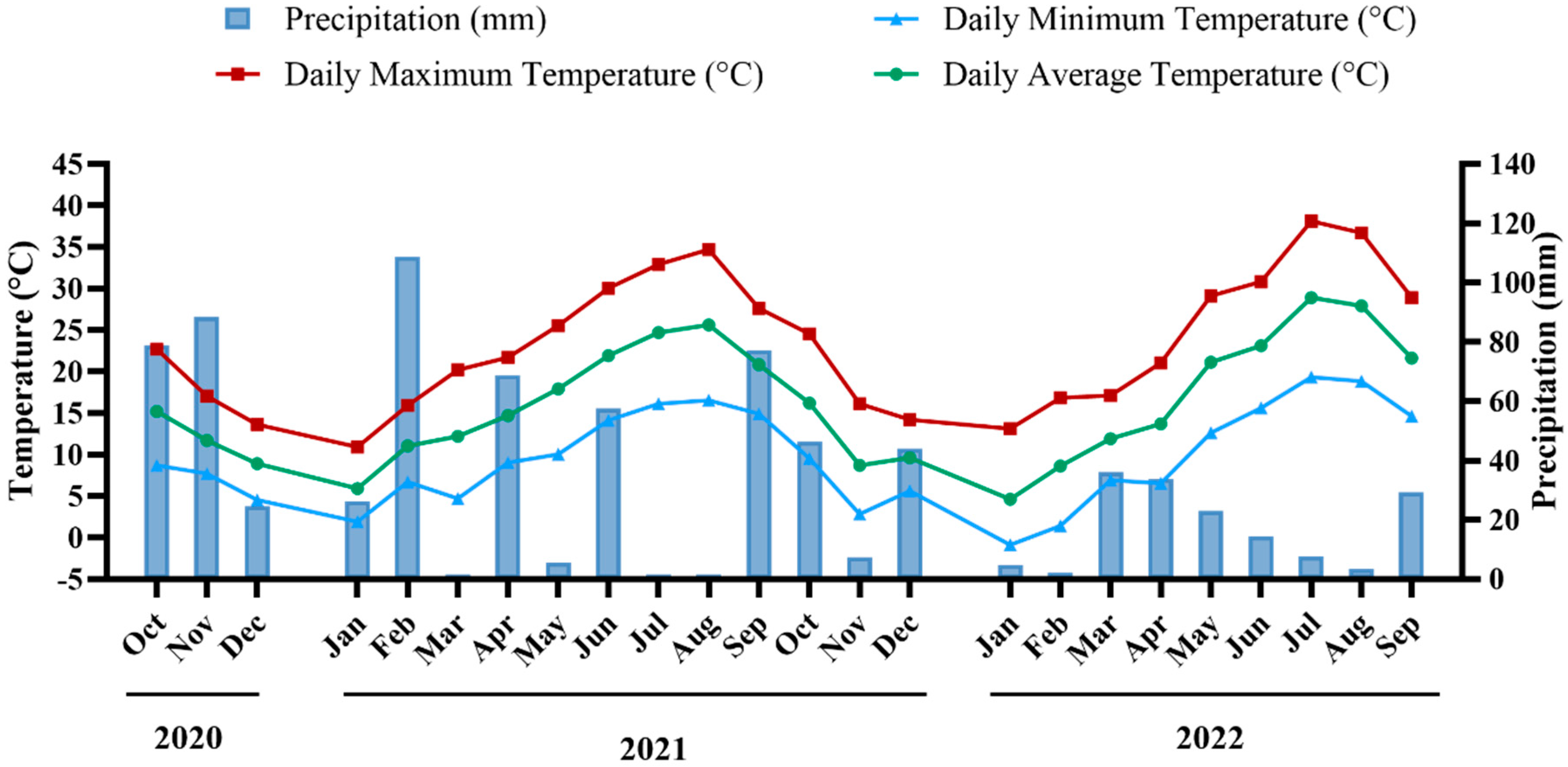
2.1. Climatic Conditions
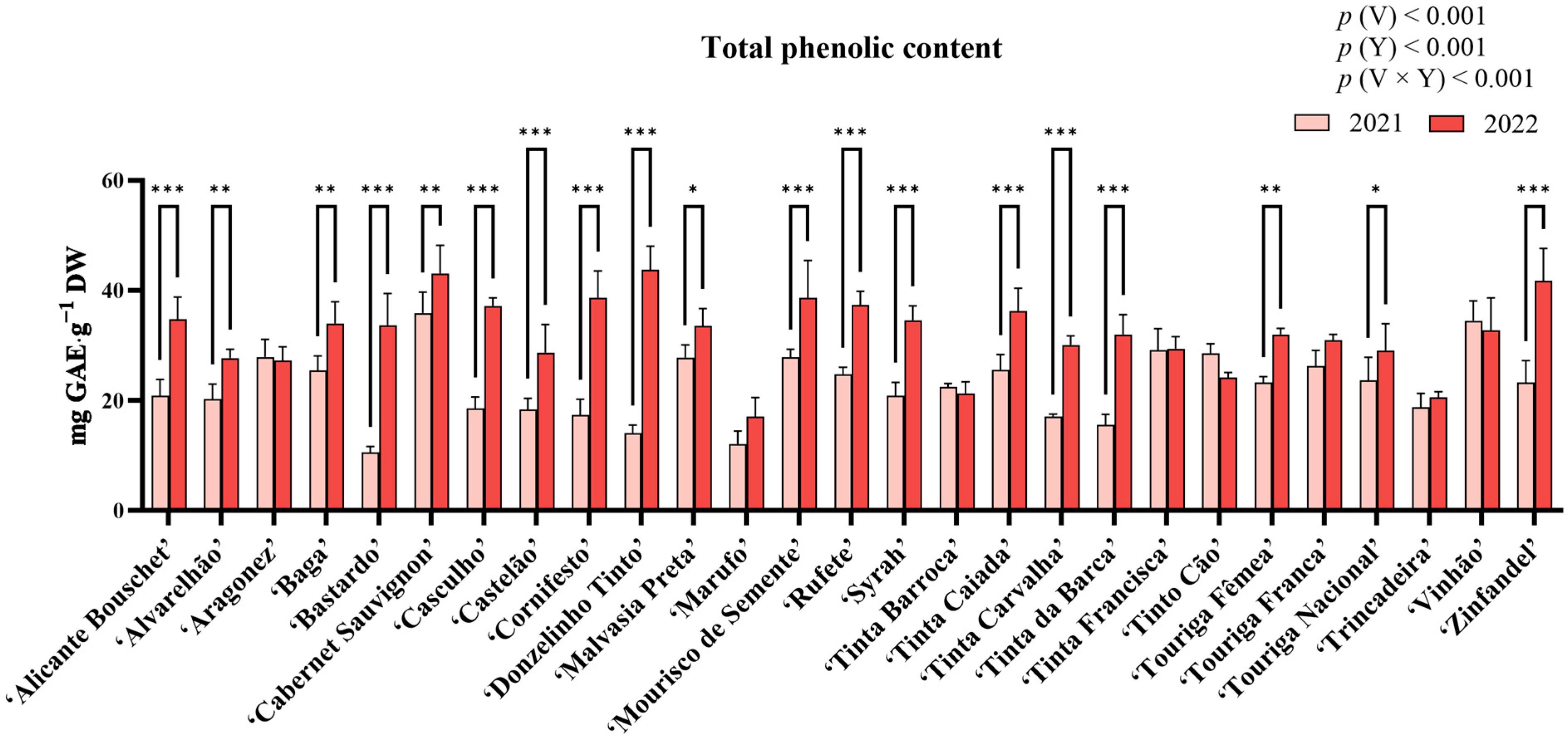
2.2. Determination of Total Phenolic Content
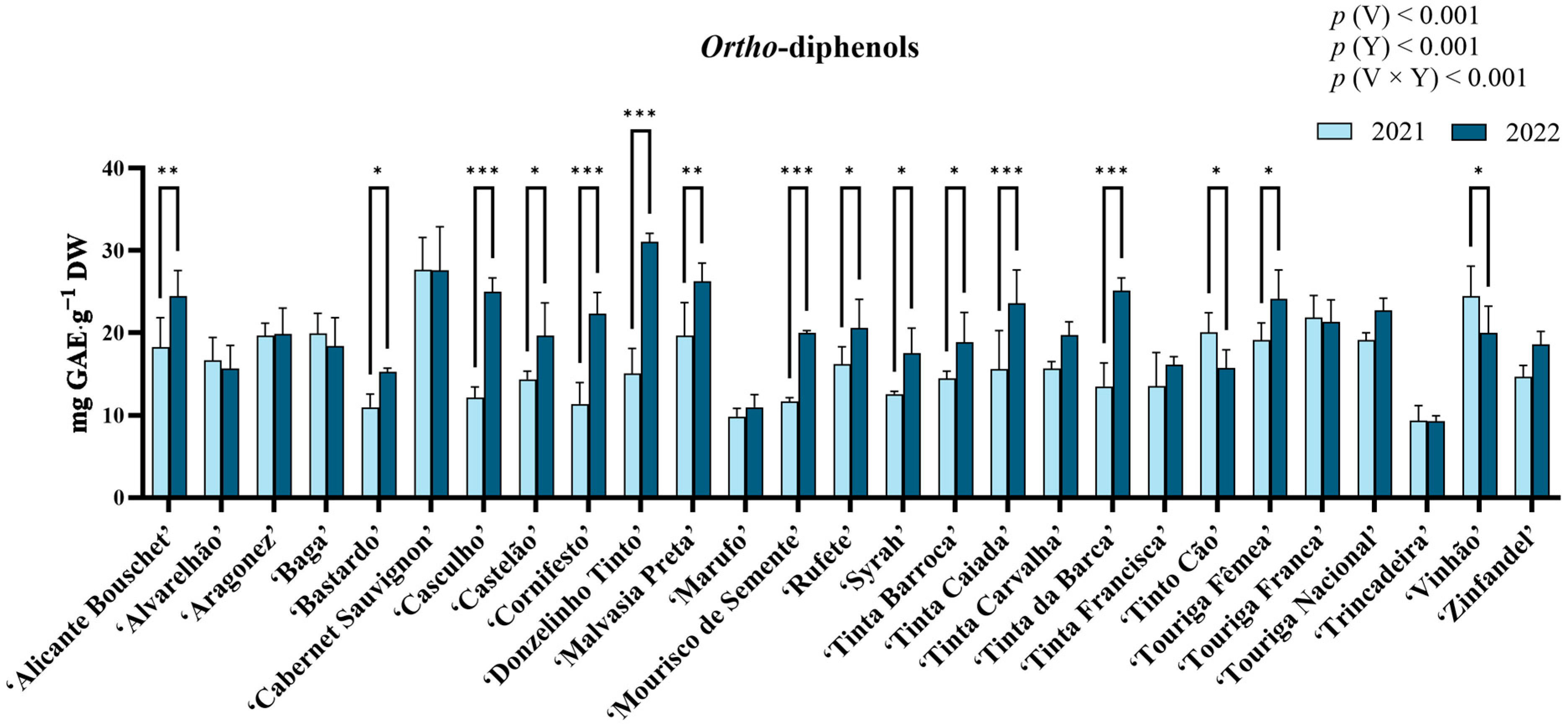
2.3. Quantification of Ortho-Diphenols
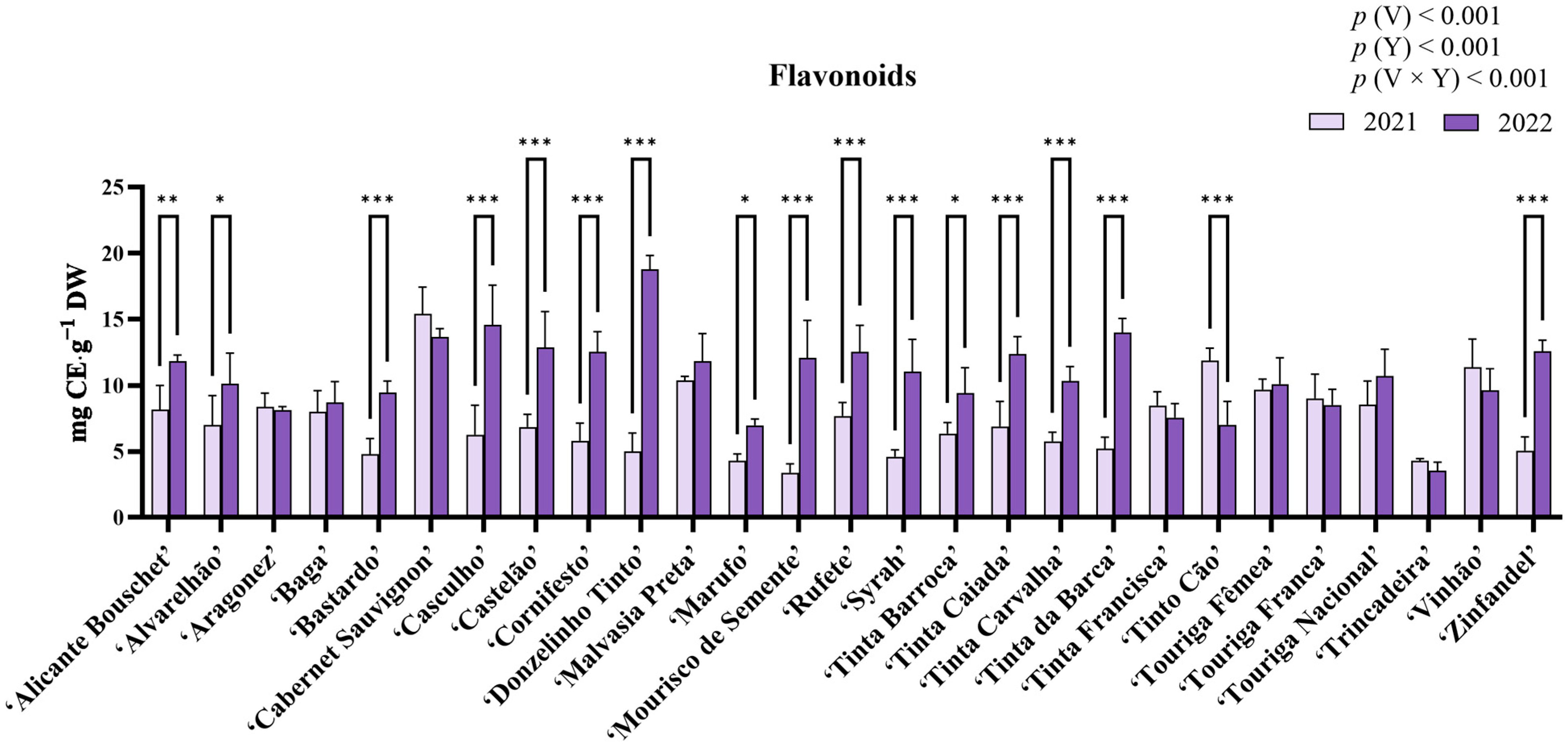
2.4. Quantification of Flavonoids
2.5. Quantification of Individual Non-Anthocyanin Phenolic Compounds
2.6. Analysis of Antioxidant Activity Through the ABTS•+ Assay
2.7. Analysis of Antioxidant Activity Through the DPPH Assay
2.8. Analysis of Antioxidant Activity Through the FRAP Assay
2.9. Pearson Correlation Analysis
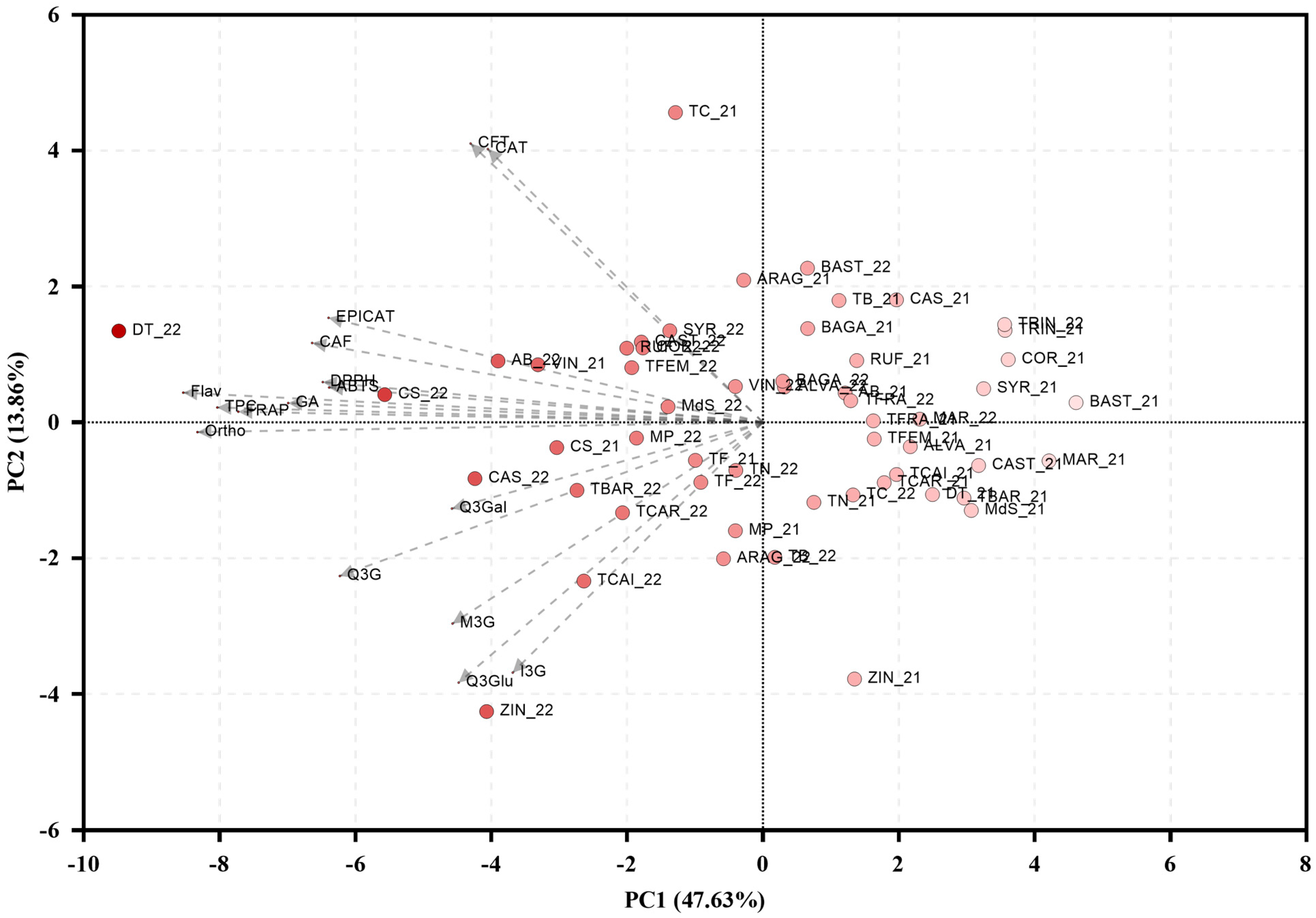
2.10. Principal Component Analysis
3. Discussion
4. Materials and Methods
4.1. Plant Material and Growth Conditions
4.2. Quantification of Different Phenolic Compounds
4.2.1. Extraction of Phenolic Compounds
4.2.2. Determination of Total Phenolic Content
4.2.3. Determination of Ortho-Diphenol Content
4.2.4. Determination of Flavonoid Content
4.3. Analysis of Antioxidant Activity
4.3.1. ABTS•+ Radical-Scavenging Activity
4.3.2. DPPH Radical-Scavenging Activity
4.3.3. FRAP Assay
4.4. Non-Anthocyanin Phenolic Profile by HPLC-DAD
4.4.1. Extraction Procedure
4.4.2. Chromatography Analysis Conditions
4.5. Statistical Analysis
5. Conclusions
Author Contributions
Funding
Institutional Review Board Statement
Informed Consent Statement
Data Availability Statement
Conflicts of Interest
Abbreviations
| ABTS•+ | 2,2′-azino-bis (3-ethylbenzothiazoline-6-sulphonic acid) |
| ANOVA | Analysis of variance |
| CE | Catechin equivalents |
| DPPH | 2,2-Diphenyl-1-picrylhydrazyl |
| DW | Dry weight |
| FRAP | Ferric Reducing Antioxidant Power |
| GAE | Gallic acid equivalents |
| HPLC-DAD | High-performance liquid chromatography with diode array detection |
| PCA | Principal components analysis |
| TE | Trolox equivalents |
| TPC | Total phenolic content |
References
- Alston, J.M.; Sambucci, O. Grapes in the World Economy. In The Grape Genome; Cantu, D., Walker, M.A., Eds.; Springer International Publishing: Cham, Switzerland, 2019; pp. 1–24. ISBN 978-3-030-18600-5. [Google Scholar]
- OIV State of the World Vine and Wine Sector in 2023. 2024. Available online: https://www.oiv.int/sites/default/files/2024-2004/OIV_STATE_OF_THE_WORLD_VINE_AND_WINE_SECTOR_IN_2023.pdf (accessed on 2 February 2025).
- Costa, J.M.; Vaz, M.; Escalona, J.; Egipto, R.; Lopes, C.; Medrano, H.; Chaves, M.M. Modern Viticulture in Southern Europe: Vulnerabilities and Strategies for Adaptation to Water Scarcity. Agric. Water Manag. 2016, 164, 5–18. [Google Scholar] [CrossRef]
- Santillán, D.; Garrote, L.; Iglesias, A.; Sotes, V. Climate Change Risks and Adaptation: New Indicators for Mediterranean Viticulture. Mitig. Adapt. Strateg. Glob. Change 2020, 25, 881–899. [Google Scholar] [CrossRef]
- Droulia, F.; Charalampopoulos, I. Future Climate Change Impacts on European Viticulture: A Review on Recent Scientific Advances. Atmosphere 2021, 12, 495. [Google Scholar] [CrossRef]
- Lemus-Canovas, M.; Insua-Costa, D.; Trigo, R.M.; Miralles, D.G. Record-Shattering 2023 Spring Heatwave in Western Mediterranean Amplified by Long-Term Drought. npj Clim. Atmos. Sci. 2024, 7, 25. [Google Scholar] [CrossRef]
- Prada, J.; Dinis, L.-T.; Soriato, E.; Vandelle, E.; Soletkin, O.; Uysal, Ş.; Dihazi, A.; Santos, C.; Santos, J.A. Climate Change Impact on Mediterranean Viticultural Regions and Site-Specific Climate Risk-Reduction Strategies. Mitig. Adapt. Strateg. Glob. Change 2024, 29, 52. [Google Scholar] [CrossRef]
- Naulleau, A.; Gary, C.; Prévot, L.; Hossard, L. Evaluating Strategies for Adaptation to Climate Change in Grapevine Production–A Systematic Review. Front. Plant Sci. 2021, 11, 607859. [Google Scholar] [CrossRef]
- Santos, J.A.; Yang, C.; Fraga, H.; Malheiro, A.C.; Moutinho-Pereira, J.; Dinis, L.-T.; Correia, C.; Moriondo, M.; Bindi, M.; Leolini, L.; et al. Long-Term Adaptation of European Viticulture to Climate Change: An Overview from the H2020 Clim4Vitis Action. IVES Tech. Rev. Vine Wine 2021, 4644, 1–2. [Google Scholar] [CrossRef]
- van Leeuwen, C.; Sgubin, G.; Bois, B.; Ollat, N.; Swingedouw, D.; Zito, S.; Gambetta, G.A. Climate Change Impacts and Adaptations of Wine Production. Nat. Rev. Earth Environ. 2024, 5, 258–275. [Google Scholar] [CrossRef]
- Carvalho, L.C.; Gonçalves, E.F.; Marques da Silva, J.; Costa, J.M. Potential Phenotyping Methodologies to Assess Inter- and Intravarietal Variability and to Select Grapevine Genotypes Tolerant to Abiotic Stress. Front. Plant Sci. 2021, 12, 718202. [Google Scholar] [CrossRef] [PubMed]
- Baltazar, M.; Castro, I.; Gonçalves, B. Adaptation to Climate Change in Viticulture: The Role of Varietal Selection—A Review. Plants 2025, 14, 104. [Google Scholar] [CrossRef]
- Díaz-Fernández, Á.; Díaz-Losada, E.; Moreno, D.; Esperanza Valdés Sánchez, M. Anthocyanin Profile of Galician Endangered Varieties. A Tool for Varietal Selection. Food Res. Int. 2022, 154, 110983. [Google Scholar] [CrossRef]
- Baltazar, M.; Monteiro, E.; Pereira, S.; Ferreira, H.; Silva, V.; Valente, J.; Alves, F.; Castro, I.; Gonçalves, B. Exploring the Differences in Phenolic Content of White Grape Varieties (Vitis vinifera L.): A Study on Varietal and Environmental Influence. Food Biosci. 2025, 74, 107971. [Google Scholar] [CrossRef]
- Morales-Castilla, I.; García de Cortázar-Atauri, I.; Cook, B.I.; Lacombe, T.; Parker, A.; van Leeuwen, C.; Nicholas, K.A.; Wolkovich, E.M. Diversity Buffers Winegrowing Regions from Climate Change Losses. Proc. Natl. Acad. Sci. USA 2020, 117, 2864–2869. [Google Scholar] [CrossRef]
- Costa, C.; Graça, A.; Fontes, N.; Teixeira, M.; Gerós, H.; Santos, J.A. The Interplay between Atmospheric Conditions and Grape Berry Quality Parameters in Portugal. Appl. Sci. 2020, 10, 4943. [Google Scholar] [CrossRef]
- Rienth, M.; Vigneron, N.; Darriet, P.; Sweetman, C.; Burbidge, C.; Bonghi, C.; Walker, R.P.; Famiani, F.; Castellarin, S.D. Grape Berry Secondary Metabolites and Their Modulation by Abiotic Factors in a Climate Change Scenario—A Review. Front. Plant Sci. 2021, 12, 643258. [Google Scholar] [CrossRef] [PubMed]
- van Leeuwen, C.; Darriet, P. The Impact of Climate Change on Viticulture and Wine Quality. J. Wine Econ. 2016, 11, 150–167. [Google Scholar] [CrossRef]
- Blancquaert, E.H.; Oberholster, A.; Ricardo-da-Silva, J.M.; Deloire, A.J. Effects of Abiotic Factors on Phenolic Compounds in the Grape Berry—A Review. S. Afr. J. Enol. Vitic. 2018, 40, 1–14. [Google Scholar] [CrossRef]
- Hornedo-Ortega, R.; Reyes González-Centeno, M.; Chira, K.; Jourdes, M.; Teissedre, P.-L. Phenolic Compounds of Grapes and Wines: Key Compounds and Implications in Sensory Perception. In Chemistry and Biochemistry of Winemaking, Wine Stabilization and Aging; Cosme, F., Nunes, F.M., Filipe-Ribeiro, L., Eds.; IntechOpen: London, UK, 2021; ISBN 978-1-83962-575-6. [Google Scholar]
- Šikuten, I.; Štambuk, P.; Andabaka, Ž.; Tomaz, I.; Marković, Z.; Stupić, D.; Maletić, E.; Kontić, J.K.; Preiner, D. Grapevine as a Rich Source of Polyphenolic Compounds. Molecules 2020, 25, 5604. [Google Scholar] [CrossRef] [PubMed]
- Ćorković, I.; Pichler, A.; Šimunović, J.; Kopjar, M. A Comprehensive Review on Polyphenols of White Wine: Impact on Wine Quality and Potential Health Benefits. Molecules 2024, 29, 5074. [Google Scholar] [CrossRef]
- Teixeira, A.; Eiras-Dias, J.; Castellarin, S.; Gerós, H. Berry Phenolics of Grapevine under Challenging Environments. Int. J. Mol. Sci. 2013, 14, 18711–18739. [Google Scholar] [CrossRef]
- Berli, F.J.; Fanzone, M.; Piccoli, P.; Bottini, R. Solar UV-B and ABA Are Involved in Phenol Metabolism of Vitis vinifera L. Increasing Biosynthesis of Berry Skin Polyphenols. J. Agric. Food Chem. 2011, 59, 4874–4884. [Google Scholar] [CrossRef]
- Sun, R.-Z.; Cheng, G.; Li, Q.; He, Y.-N.; Wang, Y.; Lan, Y.-B.; Li, S.-Y.; Zhu, Y.-R.; Song, W.-F.; Zhang, X.; et al. Light-Induced Variation in Phenolic Compounds in Cabernet Sauvignon Grapes (Vitis vinifera L.) Involves Extensive Transcriptome Reprogramming of Biosynthetic Enzymes, Transcription Factors, and Phytohormonal Regulators. Front. Plant Sci. 2017, 8, 547. [Google Scholar] [CrossRef]
- Blancquaert, E.H.; Oberholster, A.; Ricardo-da-Silva, J.M.; Deloire, A.J. Grape Flavonoid Evolution and Composition Under Altered Light and Temperature Conditions in Cabernet Sauvignon (Vitis vinifera L.). Front. Plant Sci. 2019, 10, 1062. [Google Scholar] [CrossRef] [PubMed]
- Cohen, S.D.; Tarara, J.M.; Kennedy, J.A. Assessing the Impact of Temperature on Grape Phenolic Metabolism. Anal. Chim. Acta 2008, 621, 57–67. [Google Scholar] [CrossRef]
- Degu, A.; Ayenew, B.; Cramer, G.R.; Fait, A. Polyphenolic Responses of Grapevine Berries to Light, Temperature, Oxidative Stress, Abscisic Acid and Jasmonic Acid Show Specific Developmental-Dependent Degrees of Metabolic Resilience to Perturbation. Food Chem. 2016, 212, 828–836. [Google Scholar] [CrossRef]
- Sharma, A.; Shahzad, B.; Rehman, A.; Bhardwaj, R.; Landi, M.; Zheng, B. Response of Phenylpropanoid Pathway and the Role of Polyphenols in Plants under Abiotic Stress. Molecules 2019, 24, 2452. [Google Scholar] [CrossRef]
- Rao, M.J.; Duan, M.; Ikram, M.; Zheng, B. ROS Regulation and Antioxidant Responses in Plants Under Air Pollution: Molecular Signaling, Metabolic Adaptation, and Biotechnological Solutions. Antioxidants 2025, 14, 907. [Google Scholar] [CrossRef] [PubMed]
- Díaz-Fernández, Á.; Díaz-Losada, E.; Vázquez-Arias, A.; Pujol, A.P.; Cardona, D.M.; Valdés-Sánchez, M.E. Non-Anthocyanin Compounds in Minority Red Grapevine Varieties Traditionally Cultivated in Galicia (Northwest Iberian Peninsula), Analysis of Flavanols, Flavonols, and Phenolic Acids. Plants 2022, 12, 4. [Google Scholar] [CrossRef] [PubMed]
- Kennedy, J.A.; Saucier, C.; Glories, Y. Grape and Wine Phenolics: History and Perspective. Am. J. Enol. Vitic. 2006, 57, 239–248. [Google Scholar] [CrossRef]
- Cramer, G.R. Abiotic Stress and Plant Responses from the Whole Vine to the Genes. Aust. J. Grape Wine Res. 2010, 16, 86–93. [Google Scholar] [CrossRef]
- Castillo-Muñoz, N.; Gómez-Alonso, S.; García-Romero, E.; Hermosín-Gutiérrez, I. Flavonol Profiles of Vitis vinifera Red Grapes and Their Single-Cultivar Wines. J. Agric. Food Chem. 2007, 55, 992–1002. [Google Scholar] [CrossRef]
- He, F.; Mu, L.; Yan, G.-L.; Liang, N.-N.; Pan, Q.-H.; Wang, J.; Reeves, M.J.; Duan, C.-Q. Biosynthesis of Anthocyanins and Their Regulation in Colored Grapes. Molecules 2010, 15, 9057–9091. [Google Scholar] [CrossRef]
- Baiano, A.; Terracone, C. Varietal Differences among the Phenolic Profiles and Antioxidant Activities of Seven Table Grape Cultivars Grown in the South of Italy Based on Chemometrics. J. Agric. Food Chem. 2011, 59, 9815–9826. [Google Scholar] [CrossRef] [PubMed]
- Rockenbach, I.I.; Rodrigues, E.; Gonzaga, L.V.; Caliari, V.; Genovese, M.I.; Gonçalves, A.E.D.S.S.; Fett, R. Phenolic Compounds Content and Antioxidant Activity in Pomace from Selected Red Grapes (Vitis vinifera L. and Vitis labrusca L.) Widely Produced in Brazil. Food Chem. 2011, 127, 174–179. [Google Scholar] [CrossRef]
- Liu, Q.; Tang, G.-Y.; Zhao, C.-N.; Feng, X.-L.; Xu, X.-Y.; Cao, S.-Y.; Meng, X.; Li, S.; Gan, R.-Y.; Li, H.-B. Comparison of Antioxidant Activities of Different Grape Varieties. Molecules 2018, 23, 2432. [Google Scholar] [CrossRef]
- Ren, R.; Shi, J.; Zeng, M.; Tang, Z.; Xie, S.; Zhang, Z. Inter- and Intra-Varietal Genetic Variations Co-Shape the Polyphenol Profiles of Vitis vinifera L. Grapes and Wines. Food Chem. X 2023, 20, 101030. [Google Scholar] [CrossRef]
- Monteiro, A.; Pereira, S.; Bernardo, S.; Gómez-Cadenas, A.; Moutinho-Pereira, J.; Dinis, L.-T. Biochemical Analysis of Three Red Grapevine Varieties during Three Phenological Periods Grown under Mediterranean Climate Conditions. Plant Biol. 2024, 26, 855–867. [Google Scholar] [CrossRef]
- Francini, A.; Giro, A.; Ferrante, A. Biochemical and Molecular Regulation of Phenylpropanoids Pathway Under Abiotic Stresses. In Plant Signaling Molecules; Khan, M.I.R., Reddy, P.S., Ferrante, A., Khan, N.A., Eds.; Woodhead Publishing: Cambridge, UK, 2019; pp. 183–192. ISBN 978-0-12-816451-8. [Google Scholar]
- Hewitt, S.; Hernández-Montes, E.; Dhingra, A.; Keller, M. Impact of Heat Stress, Water Stress, and Their Combined Effects on the Metabolism and Transcriptome of Grape Berries. Sci. Rep. 2023, 13, 9907. [Google Scholar] [CrossRef] [PubMed]
- Sun, Y.; Xi, B.; Dai, H. Effects of Water Stress on Resveratrol Accumulation and Synthesis in ‘Cabernet Sauvignon’ Grape Berries. Agronomy 2023, 13, 633. [Google Scholar] [CrossRef]
- Rustioni, L.; Rossoni, M.; Cola, G.; Mariani, L.; Failla, O. Bunch Exposure to Direct Solar Radiation Increases Ortho-Diphenol Anthocyanins in Northern Italy Climatic Condition. OENO One 2011, 45, 85. [Google Scholar] [CrossRef]
- Pisoschi, A.M.; Pop, A. The Role of Antioxidants in the Chemistry of Oxidative Stress: A Review. Eur. J. Med. Chem. 2015, 97, 55–74. [Google Scholar] [CrossRef] [PubMed]
- Ferrandino, A.; Pagliarani, C.; Pérez-Álvarez, E.P. Secondary Metabolites in Grapevine: Crosstalk of Transcriptional, Metabolic and Hormonal Signals Controlling Stress Defence Responses in Berries and Vegetative Organs. Front. Plant Sci. 2023, 14, 1124298. [Google Scholar] [CrossRef]
- Pascual, I.; Martínez-Lüscher, J.; Irigoyen, J.J.; Goicoechea, N.; Carmen Antolín, M. Grapevine Varieties Show Different Sensitivities to Flavonoid Alterations Caused by High Temperatures under Two Irrigation Conditions. Food Res. Int. 2024, 194, 114899. [Google Scholar] [CrossRef] [PubMed]
- Ninkuu, V.; Aluko, O.O.; Yan, J.; Zeng, H.; Liu, G.; Zhao, J.; Li, H.; Chen, S.; Dakora, F.D. Phenylpropanoids Metabolism: Recent Insight into Stress Tolerance and Plant Development Cues. Front. Plant Sci. 2025, 16, 1571825. [Google Scholar] [CrossRef]
- Gouot, J.C.; Smith, J.P.; Holzapfel, B.P.; Walker, A.R.; Barril, C. Grape Berry Flavonoids: A Review of Their Biochemical Responses to High and Extreme High Temperatures. J. Exp. Bot. 2019, 70, 397–423. [Google Scholar] [CrossRef]
- Savoi, S.; Wong, D.C.J.; Degu, A.; Herrera, J.C.; Bucchetti, B.; Peterlunger, E.; Fait, A.; Mattivi, F.; Castellarin, S.D. Multi-Omics and Integrated Network Analyses Reveal New Insights into the Systems Relationships between Metabolites, Structural Genes, and Transcriptional Regulators in Developing Grape Berries (Vitis vinifera L.) Exposed to Water Deficit. Front. Plant Sci. 2017, 8, 1124. [Google Scholar] [CrossRef]
- Farghaly, F.A.; Salam, H.K.; Hamada, A.M.; Radi, A.A. The Role of Benzoic Acid, Gallic Acid and Salicylic Acid in Protecting Tomato Callus Cells from Excessive Boron Stress. Sci. Hortic. 2021, 278, 109867. [Google Scholar] [CrossRef]
- Hura, T.; Hura, K.; Grzesiak, S. Contents of Total Phenolics and Ferulic Acid, and PAL Activity during Water Potential Changes in Leaves of Maize Single-Cross Hybrids of Different Drought Tolerance. J. Agron. Crop Sci. 2008, 194, 104–112. [Google Scholar] [CrossRef]
- Wang, J.; Yuan, B.; Huang, B. Differential Heat-Induced Changes in Phenolic Acids Associated with Genotypic Variations in Heat Tolerance for Hard Fescue. Crop Sci. 2019, 59, 667–674. [Google Scholar] [CrossRef]
- Cataldo, E.; Eichmeier, A.; Mattii, G.B. Effects of Global Warming on Grapevine Berries Phenolic Compounds—A Review. Agronomy 2023, 13, 2192. [Google Scholar] [CrossRef]
- Flamini, R.; Mattivi, F.; Rosso, M.; Arapitsas, P.; Bavaresco, L. Advanced Knowledge of Three Important Classes of Grape Phenolics: Anthocyanins, Stilbenes and Flavonols. Int. J. Mol. Sci. 2013, 14, 19651–19669. [Google Scholar] [CrossRef] [PubMed]
- Gürbüz, O.; Göçmen, D.; Dagˇdelen, F.; Gürsoy, M.; Aydin, S.; Şahin, İ.; Büyükuysal, L.; Usta, M. Determination of Flavan-3-Ols and Trans-Resveratrol in Grapes and Wine Using HPLC with Fluorescence Detection. Food Chem. 2007, 100, 518–525. [Google Scholar] [CrossRef]
- Iacopini, P.; Baldi, M.; Storchi, P.; Sebastiani, L. Catechin, Epicatechin, Quercetin, Rutin and Resveratrol in Red Grape: Content, in Vitro Antioxidant Activity and Interactions. J. Food Compos. Anal. 2008, 21, 589–598. [Google Scholar] [CrossRef]
- Pinasseau, L.; Vallverdú-Queralt, A.; Verbaere, A.; Roques, M.; Meudec, E.; Le Cunff, L.; Péros, J.-P.; Ageorges, A.; Sommerer, N.; Boulet, J.-C.; et al. Cultivar Diversity of Grape Skin Polyphenol Composition and Changes in Response to Drought Investigated by LC-MS Based Metabolomics. Front. Plant Sci. 2017, 8, 1826. [Google Scholar] [CrossRef] [PubMed]
- Mattivi, F.; Guzzon, R.; Vrhovsek, U.; Stefanini, M.; Velasco, R. Metabolite Profiling of Grape: Flavonols and Anthocyanins. J. Agric. Food Chem. 2006, 54, 7692–7702. [Google Scholar] [CrossRef]
- Martínez-Lüscher, J.; Sánchez-Díaz, M.; Delrot, S.; Aguirreolea, J.; Pascual, I.; Gomès, E. Ultraviolet-B Radiation and Water Deficit Interact to Alter Flavonol and Anthocyanin Profiles in Grapevine Berries through Transcriptomic Regulation. Plant Cell Physiol. 2014, 55, 1925–1936. [Google Scholar] [CrossRef]
- Martinez, V.; Mestre, T.C.; Rubio, F.; Girones-Vilaplana, A.; Moreno, D.A.; Mittler, R.; Rivero, R.M. Accumulation of Flavonols over Hydroxycinnamic Acids Favors Oxidative Damage Protection under Abiotic Stress. Front. Plant Sci. 2016, 7, 838. [Google Scholar] [CrossRef]
- Ferreira, V.; Fernandes, F.; Pinto-Carnide, O.; Valentão, P.; Falco, V.; Martín, J.P.; Ortiz, J.M.; Arroyo-García, R.; Andrade, P.B.; Castro, I. Identification of Vitis vinifera L. Grape Berry Skin Color Mutants and Polyphenolic Profile. Food Chem. 2016, 194, 117–127. [Google Scholar] [CrossRef]
- Figueiredo-González, M.; Martínez-Carballo, E.; Cancho-Grande, B.; Santiago, J.L.; Martínez, M.C.; Simal-Gándara, J. Pattern Recognition of Three Vitis vinifera L. Red Grapes Varieties Based on Anthocyanin and Flavonol Profiles, with Correlations between Their Biosynthesis Pathways. Food Chem. 2012, 130, 9–19. [Google Scholar] [CrossRef]
- Shi, T.; Su, Y.; Lan, Y.; Duan, C.; Yu, K. The Molecular Basis of Flavonoid Biosynthesis Response to Water, Light, and Temperature in Grape Berries. Front. Plant Sci. 2024, 15, 1441893. [Google Scholar] [CrossRef]
- Zarrouk, O.; Francisco, R.; Pinto-Marijuan, M.; Brossa, R.; Santos, R.R.; Pinheiro, C.; Costa, J.M.; Lopes, C.; Chaves, M.M. Impact of Irrigation Regime on Berry Development and Flavonoids Composition in Aragonez (Syn. Tempranillo) Grapevine. Agric. Water Manag. 2012, 114, 18–29. [Google Scholar] [CrossRef]
- Eder, R.; Pajović Šćepanović, R.; Raičević, D.; Popović, T.; Korntheuer, K.; Wendelin, S.; Forneck, A.; Philipp, C. Study of the Effects of Climatic Conditions on the Phenolic Content and Antioxidant Activity of Austrian and Montenegrin Red Wines. OENO One 2023, 57, 68–85. [Google Scholar] [CrossRef]
- Fonseca, D.; Sánchez-Gómez, R.; Salinas, M.R.; Cabrita, M.J.; Martins, N.; Garcia, R.; Cebrián-Tarancón, C. Irrigation Regime Effects on Phenolic Composition of Portuguese Grape Varieties. Molecules 2025, 30, 3408. [Google Scholar] [CrossRef]
- Burin, V.M.; Ferreira-Lima, N.E.; Panceri, C.P.; Bordignon-Luiz, M.T. Bioactive Compounds and Antioxidant Activity of Vitis vinifera and Vitis labrusca Grapes: Evaluation of Different Extraction Methods. Microchem. J. 2014, 114, 155–163. [Google Scholar] [CrossRef]
- Di Lorenzo, C.; Colombo, F.; Biella, S.; Orgiu, F.; Frigerio, G.; Regazzoni, L.; De Sousa, L.P.; Bavaresco, L.; Bosso, A.; Aldini, G.; et al. Phenolic Profile and Antioxidant Activity of Different Grape (Vitis vinifera L.) Varieties. BIO Web Conf. 2019, 12, 04005. [Google Scholar] [CrossRef]
- Su-Zhou, C.; Zhao, Y.; Zheng, M.; Zhao, J.; Prieto, J.A.; Duan, B.; Liu, X. Flavonol-Antioxidant Enzyme Interactions Mediate Grape Skin Acclimation to UV Radiation During Berry Development. Physiol. Plant. 2025, 177, e70609. [Google Scholar] [CrossRef]
- Shomali, A.; Das, S.; Arif, N.; Sarraf, M.; Zahra, N.; Yadav, V.; Aliniaeifard, S.; Chauhan, D.K.; Hasanuzzaman, M. Diverse Physiological Roles of Flavonoids in Plant Environmental Stress Responses and Tolerance. Plants 2022, 11, 3158. [Google Scholar] [CrossRef]
- Gouvinhas, I.; Santos, R.A.; Queiroz, M.; Leal, C.; Saavedra, M.J.; Domínguez-Perles, R.; Rodrigues, M.; Barros, A.I.R.N.A. Monitoring the Antioxidant and Antimicrobial Power of Grape (Vitis vinifera L.) Stems Phenolics over Long-Term Storage. Ind. Crops Prod. 2018, 126, 83–91. [Google Scholar] [CrossRef]
- Mendes Lemos, A.; Machado, N.; Egea-Cortines, M.; Barros, A.I. Assessment of Quality Parameters and Phytochemical Content of Thirty ‘Tempranillo’ Grape Clones for Varietal Improvement in Two Distinct Sub-Regions of Douro. Sci. Hortic. 2020, 262, 109096. [Google Scholar] [CrossRef]
- Singleton, V.L.; Rossi, J.A. Colorimetry of Total Phenolics with Phosphomolybdic-Phosphotungstic Acid Reagents. Am. J. Enol. Vitic. 1965, 16, 144–158. [Google Scholar] [CrossRef]
- Dewanto, V.; Wu, X.; Adom, K.K.; Liu, R.H. Thermal Processing Enhances the Nutritional Value of Tomatoes by Increasing Total Antioxidant Activity. J. Agric. Food Chem. 2002, 50, 3010–3014. [Google Scholar] [CrossRef] [PubMed]
- Re, R.; Pellegrini, N.; Proteggente, A.; Pannala, A.; Yang, M.; Rice-Evans, C. Antioxidant Activity Applying an Improved ABTS Radical Cation Decolorization Assay. Free Radic. Biol. Med. 1999, 26, 1231–1237. [Google Scholar] [CrossRef]
- Stratil, P.; Klejdus, B.; Kubáň, V. Determination of Total Content of Phenolic Compounds and Their Antioxidant Activity in Vegetables—Evaluation of Spectrophotometric Methods. J. Agric. Food Chem. 2006, 54, 607–616. [Google Scholar] [CrossRef]
- Siddhuraju, P.; Becker, K. Antioxidant Properties of Various Solvent Extracts of Total Phenolic Constituents from Three Different Agroclimatic Origins of Drumstick Tree (Moringa oleifera Lam.) Leaves. J. Agric. Food Chem. 2003, 51, 2144–2155. [Google Scholar] [CrossRef]
- Mena, P.; García-Viguera, C.; Navarro-Rico, J.; Moreno, D.A.; Bartual, J.; Saura, D.; Martí, N. Phytochemical Characterisation for Industrial Use of Pomegranate (Punica granatum L.) Cultivars Grown in Spain: Selection of Pomegranates for Juices. J. Sci. Food Agric. 2011, 91, 1893–1906. [Google Scholar] [CrossRef] [PubMed]



| Variety | Year | Hydroxybenzoic Acids | Hydroxycinnamic Acids | Flavan-3-ols | ||
|---|---|---|---|---|---|---|
| Gallic Acid | Caftaric Acid | Caffeic Acid | Catechin | Epicatechin | ||
| ‘Alicante Bouschet’ | 2021 | 24.69 ± 5.51 *** | 14.11 ± 6.64 ** | 13.26 ± 1.94 *** | 66.12 ± 29.94 | 69.68 ± 39.17 *** |
| 2022 | 48.20 ± 18.57 *** | 27.38 ± 4.67 ** | 73.85 ± 16.57 *** | 127.75 ± 28.83 | 414.52 ± 102.23 *** | |
| ‘Alvarelhão’ | 2021 | 13.01 ± 6.14 | 14.74 ± 1.69 | 20.22 ± 3.50 | 49.74 ± 10.45 | 37.99 ± 13.79 |
| 2022 | 16.17 ± 5.83 | 20.19 ± 1.38 | 23.75 ± 6.87 | 83.38 ± 8.53 | 105.32 ± 42.42 | |
| ‘Aragonez’ | 2021 | 6.88 ± 5.90 | 33.47 ± 9.02 ** | 22.18 ± 2.45 | 165.33 ± 55.68 ** | 45.86 ± 12.38 |
| 2022 | 12.38 ± 4.94 | 18.02 ± 6.47 ** | 21.32 ± 2.30 | 69.96 ± 39.94 ** | 41.75 ± 7.32 | |
| ‘Baga’ | 2021 | 10.55 ± 3.92 | 25.24 ± 8.53 | 13.16 ± 1.94 | 114.50 ± 52.65 | 64.92 ± 7.02 |
| 2022 | 15.91 ± 3.17 | 19.88 ± 3.87 | 23.32 ± 14.34 | 81.42 ± 23.87 | 69.34 ± 34.28 | |
| ‘Bastardo’ | 2021 | 9.19 ± 3.37 * | 9.02 ± 0.50 * | 8.83 ± 0.16 *** | 14.43 ± 3.09 * | 84.63 ± 19.47 *** |
| 2022 | 23.95 ± 5.08 * | 20.97 ± 9.63 * | 55.53 ± 44.77 *** | 88.14 ± 59.42 * | 368.11 ± 184.82 *** | |
| ‘Cabernet Sauvignon’ | 2021 | 21.75 ± 14.20 | 17.40 ± 6.89 | 11.53 ± 0.22 *** | 53.36 ± 21.17 *** | 404.29 ± 147.61 |
| 2022 | 29.30 ± 6.46 | 26.78 ± 3.54 | 81.98 ± 32.60 *** | 165.2 ± 90.35 *** | 464.70 ± 201.17 | |
| ‘Casculho’ | 2021 | 6.42 ± 4.07 *** | 30.47 ± 11.61 * | 21.87 ± 8.00 * | 146.78 ± 71.62 * | 94.12 ± 61.09 * |
| 2022 | 26.72 ± 4.67 *** | 19.91 ± 4.45 * | 45.85 ± 19.71 * | 81.64 ± 27.45 * | 241.71 ± 121.61 * | |
| ‘Castelão’ | 2021 | 5.95 ± 3.86 | 11.20 ± 1.60 * | 12.35 ± 1.09 * | 27.90 ± 9.86 * | 59.09 ± 26.46 * |
| 2022 | 17.60 ± 2.98 | 21.98 ± 7.67 * | 36.72 ± 13.55 * | 94.38 ± 47.35 * | 185.40 ± 83.61 * | |
| ‘Cornifesto’ | 2021 | 4.55 ± 3.07 ** | 14.56 ± 2.77 | 20.84 ± 6.11 | 48.62 ± 17.11 | 52.50 ± 25.24 |
| 2022 | 22.61 ± 5.79 ** | 22.99 ± 5.96 | 28.81 ± 13.52 | 100.62 ± 36.77 | 136.58 ± 83.43 | |
| ‘Donzelinho Tinto’ | 2021 | 12.18 ± 3.07 *** | 12.00 ± 2.52 *** | 12.09 ± 2.84 *** | 32.82 ± 15.53 * | 65.96 ± 15.18 *** |
| 2022 | 69.96 ± 9.78 *** | 30.20 ± 11.47 *** | 157.06 ± 36.56 *** | 111.81 ± 34.82 * | 928.04 ± 225.60 *** | |
| ‘Malvasia Preta’ | 2021 | 7.98 ± 7.65 ** | 14.24 ± 3.04 | 16.99 ± 1.38 | 46.66 ± 18.78 | 63.91 ± 24.17 |
| 2022 | 24.70 ± 8.83 ** | 17.10 ± 4.51 | 25.24 ± 4.83 | 64.27 ± 27.82 | 114.55 ± 29.79 | |
| ‘Marufo’ | 2021 | 8.51 ± 3.85 ** | 12.18 ± 0.90 | 14.78 ± 3.22 | 33.92 ± 5.58 | 37.31 ± 11.13 |
| 2022 | 24.88 ± 9.71 ** | 17.30 ± 8.47 | 24.43 ± 16.09 | 65.53 ± 52.29 | 109.51 ± 99.31 | |
| ‘Mourisco-de-Semente’ | 2021 | 3.82 ± 1.79 ** | 10.53 ± 1.84 * | 15.44 ± 6.58 | 35.52 ± 5.25 * | 69.79 ± 29.14 |
| 2022 | 21.55 ± 4.77 ** | 24.5 ± 5.02 * | 20.13 ± 1.16 | 109.95 ± 30.96 * | 83.00 ± 7.13 | |
| ‘Rufete’ | 2021 | 26.68 ± 12.95 | 12.45 ± 1.35 | 16.19 ± 2.60 *** | 35.58 ± 8.32 | 266.32 ± 132.83 |
| 2022 | 36.10 ± 8.33 | 17.34 ± 2.13 | 57.30 ± 10.72 *** | 65.79 ± 13.17 | 312.36 ± 66.18 | |
| ‘Syrah’ | 2021 | 5.74 ± 4.73 *** | 16.24 ± 2.12 | 14.27 ± 0.90 *** | 59.01 ± 13.09 | 126.19 ± 118.35 * |
| 2022 | 32.82 ± 16.16 *** | 20.44 ± 10.34 | 47.25 ± 15.90 *** | 84.91 ± 63.79 | 250.33 ± 98.11 * | |
| ‘Tinta Barroca’ | 2021 | 6.60 ± 3.51 | 32.66 ± 11.31 *** | 13.92 ± 1.83 | 160.33 ± 69.81 *** | 40.34 ± 10.17 |
| 2022 | 7.05 ± 4.01 | 14.42 ± 5.57 *** | 19.24 ± 0.63 | 47.75 ± 34.37 *** | 107.58 ± 18.32 | |
| ‘Tinta Caiada’ | 2021 | 9.90 ± 1.71 * | 11.72 ± 2.69 | 11.85 ± 2.00 | 31.07 ± 16.57 | 15.10 ± 5.76 |
| 2022 | 25.51 ± 2.74 * | 15.38 ± 0.96 | 13.26 ± 0.64 | 53.66 ± 5.95 | 40.61 ± 3.98 | |
| ‘Tinta Carvalha’ | 2021 | 15.44 ± 4.09 * | 13.81 ± 2.10 | 14.42 ± 1.72 * | 43.97 ± 12.96 | 142.29 ± 77.23 |
| 2022 | 30.21 ± 10.65 * | 19.70 ± 6.87 | 35.53 ± 7.03 * | 80.31 ± 42.41 | 178.03 ± 43.40 | |
| ‘Tinta da Barca’ | 2021 | 4.75 ± 5.21 *** | 12.61 ± 0.51 | 14.41 ± 0.48 | 36.57 ± 3.17 | 35.69 ± 19.55 * |
| 2022 | 28.39 ± 10.06 *** | 15.24 ± 1.47 | 35.11 ± 7.04 | 52.81 ± 9.07 | 175.42 ± 43.43 * | |
| ‘Tinta Francisca’ | 2021 | 4.62 ± 3.09 | 11.68 ± 4.45 | 16.90 ± 1.83 | 30.82 ± 27.46 | 74.25 ± 26.71 |
| 2022 | 5.43 ± 0.59 | 21.20 ± 10.14 | 11.11 ± 2.13 | 89.57 ± 62.58 | 19.98 ± 15.71 | |
| ‘Tinto Cão’ | 2021 | 11.59 ± 9.38 | 43.70 ± 9.85 *** | 17.71 ± 5.24 | 228.47 ± 60.77 *** | 232.53 ± 179.88 * |
| 2022 | 5.40 ± 0.42 | 14.84 ± 3.61 *** | 17.33 ± 1.16 | 50.36 ± 22.28 *** | 96.15 ± 61.00 * | |
| ‘Touriga Fêmea’ | 2021 | 5.79 ± 6.00 *** | 12.09 ± 3.44 * | 22.35 ± 3.12 | 33.39 ± 21.20 ** | 90.42 ± 11.67 |
| 2022 | 29.46 ± 5.58 *** | 23.63 ± 8.81 * | 27.58 ± 8.67 | 132.97 ± 68.76 ** | 118.50 ± 27.28 | |
| ‘Touriga Franca’ | 2021 | 4.96 ± 4.01 | 22.80 ± 10.20 | 15.77 ± 1.49 | 99.44 ± 62.92 | 56.34 ± 27.80 |
| 2022 | 5.32 ± 1.04 | 20.10 ± 7.64 | 17.45 ± 2.99 | 82.78 ± 47.13 | 47.41 ± 9.94 | |
| ‘Touriga Nacional’ | 2021 | 14.46 ± 16.41 | 13.08 ± 2.78 | 19.94 ± 0.47 | 49.35 ± 1.27 | 58.42 ± 24.05 |
| 2022 | 7.00 ± 3.88 | 14.64 ± 1.12 | 16.72 ± 1.37 | 49.10 ± 6.89 | 35.61 ± 26.22 | |
| ‘Trincadeira’ | 2021 | 13.01 ± 6.31 | 21.35 ± 2.78 | 9.32 ± 1.55 | 90.50 ± 17.16 | 33.31 ± 20.37 |
| 2022 | 4.41 ± 1.78 | 21.82 ± 8.28 | 19.46 ± 12.98 | 93.39 ± 51.11 | 82.01 ± 47.36 | |
| ‘Vinhão’ | 2021 | 14.06 ± 3.90 | 30.02 ± 1.77 | 18.5 ± 1.14 | 144.03 ± 10.89 | 57.54 ± 24.32 |
| 2022 | 12.50 ± 7.23 | 22.24 ± 8.08 | 16.38 ± 4.36 | 96.00 ± 49.84 | 59.86 ± 26.88 | |
| ‘Zinfandel’ | 2021 | 9.52 ± 6.36 *** | 12.32 ± 2.53 | 12.16 ± 0.78 ** | 34.80 ± 15.62 | 42.11 ± 5.88 ** |
| 2022 | 42.70 ± 9.24 *** | 17.04 ± 4.05 | 40.02 ± 6.02 ** | 63.95 ± 24.96 | 205.76 ± 37.16 ** | |
| p(V) | <0.001 | <0.001 | <0.001 | <0.001 | <0.001 | |
| p(Y) | <0.001 | <0.05 | <0.001 | <0.05 | <0.001 | |
| p(V × Y) | <0.001 | <0.001 | <0.001 | <0.01 | <0.001 | |
| Variety | Year | Flavonols | ||||
|---|---|---|---|---|---|---|
| Myricetin-3-O-Glucoside | Quercetin-3-O-Galactoside | Quercetin-3-O-Glucoronide | Quercetin-3-O-Glucoside | Isorhamnetin-3-O-Glucoside | ||
| ‘Alicante Bouschet’ | 2021 | 164.37 ± 71.95 * | 14.39 ± 4.30 | 164.18 ± 89.73 * | 97.22 ± 36.23 | 61.62 ± 19.19 |
| 2022 | 300.80 ± 48.44 * | 32.60 ± 6.46 | 388.00 ± 62.36 * | 204.61 ± 82.64 | 102.24 ± 12.83 | |
| ‘Alvarelhão’ | 2021 | 55.23 ± 9.02 | 32.80 ± 14.42 | 394.40 ± 178.49 | 172.19 ± 8.76 | 42.33 ± 9.89 |
| 2022 | 103.74 ± 61.15 | 25.16 ± 2.71 | 311.27 ± 30.04 | 296.89 ± 102.95 | 29.58 ± 4.66 | |
| ‘Aragonez’ | 2021 | 241.15 ± 64.43 | 24.66 ± 8.65 | 234.14 ± 100.47 * | 179.82 ± 36.94 | 48.44 ± 15.05 ** |
| 2022 | 360.80 ± 75.93 | 36.70 ± 3.97 | 503.92 ± 185.16 * | 292.87 ± 21.31 | 112.91 ± 49.28 ** | |
| ‘Baga’ | 2021 | 230.28 ± 48.94 | 28.85 ± 18.21 | 197.19 ± 51.68 | 142.39 ± 24.53 | 29.31 ± 5.71 |
| 2022 | 163.83 ± 1.57 | 24.54 ± 13.61 | 276.42 ± 192.16 | 199.53 ± 60.66 | 27.58 ± 17.44 | |
| ‘Bastardo’ | 2021 | 57.85 ± 22.39 | 12.48 ± 3.36 | 93.18 ± 42.51 | 64.76 ± 18.53 | 15.77 ± 2.24 |
| 2022 | 64.17 ± 21.70 | 14.56 ± 1.47 | 138.62 ± 30.71 | 68.95 ± 2.57 | 27.35 ± 10.38 | |
| ‘Cabernet Sauvignon’ | 2021 | 308.75 ± 15.39 | 48.71 ± 20.43 | 296.65 ± 22.73 * | 235.98 ± 64.59 | 68.65 ± 19.53 * |
| 2022 | 314.92 ± 119.67 | 67.85 ± 22.44 | 527.84 ± 204.83 * | 240.76 ± 78.26 | 125.01 ± 56.50 * | |
| ‘Casculho’ | 2021 | 200.69 ± 99.49 ** | 17.34 ± 7.88 | 224.85 ± 96.78 * | 182.13 ± 61.34 | 43.21 ± 21.11 * |
| 2022 | 412.30 ± 21.30 ** | 34.38 ± 9.85 | 482.69 ± 168.90 * | 271.66 ± 64.42 | 88.13 ± 25.49 * | |
| ‘Castelão’ | 2021 | 131.82 ± 44.35 | 34.39 ± 27.25 | 234.88 ± 84.72 | 182.60 ± 71.02 | 30.54 ± 15.23 |
| 2022 | 172.35 ± 8.21 | 33.33 ± 10.13 | 248.80 ± 65.74 | 245.41 ± 15.25 | 32.36 ± 0.78 | |
| ‘Cornifesto’ | 2021 | 105.59 ± 37.40 | 14.96 ± 3.57 | 116.56 ± 66.04 | 40.44 ± 13.38 ** | 21.08 ± 12.46 |
| 2022 | 162.84 ± 21.80 | 24.82 ± 7.90 | 259.86 ± 118.73 | 213.22 ± 77.30 ** | 46.50 ± 27.13 | |
| ‘Donzelinho Tinto’ | 2021 | 127.82 ± 64.27 | 26.19 ± 11.25 * | 535.50 ± 251.60 | 134.05 ± 38.31 *** | 32.98 ± 14.21 |
| 2022 | 197.88 ± 12.72 | 52.46 ± 10.68 * | 672.61 ± 91.08 | 492.65 ± 123.50 *** | 70.38 ± 66.05 | |
| ‘Malvasia Preta’ | 2021 | 469.53 ± 23.73 ** | 31.42 ± 7.08 | 416.99 ± 78.91 | 223.34 ± 78.43 | 48.86 ± 0.02 |
| 2022 | 282.33 ± 23.91 ** | 24.58 ± 0.12 | 262.38 ± 126.96 | 310.88 ± 126.89 | 37.63 ± 8.09 | |
| ‘Marufo’ | 2021 | 138.67 ± 44.64 | 29.72 ± 5.88 | 305.07 ± 130.92 | 97.42 ± 32.20 | 36.17 ± 16.82 |
| 2022 | 113.69 ± 50.04 | 28.64 ± 14.59 | 337.83 ± 224.31 | 128.28 ± 38.37 | 51.70 ± 35.03 | |
| ‘Mourisco-de-Semente’ | 2021 | 189.47 ± 66.70 | 50.96 ± 23.01 | 264.47 ± 149.66 | 177.38 ± 48.99 | 58.79 ± 17.99 |
| 2022 | 210.47 ± 45.03 | 27.98 ± 10.10 | 367.47 ± 57.32 | 268.52 ± 132.57 | 76.33 ± 23.42 | |
| ‘Rufete’ | 2021 | 154.47 ± 54.66 | 18.96 ± 5.12 | 110.45 ± 61.34 | 111.89 ± 58.28 | LOQ |
| 2022 | 219.04 ± 37.64 | 15.27 ± 3.32 | 147.10 ± 66.60 | 218.39 ± 106.71 | 33.46 ± 18.38 | |
| ‘Syrah’ | 2021 | 155.86 ± 26.26 | 26.95 ± 10.39 | 108.50 ± 27.36 | 159.33 ± 58.28 | 27.16 ± 13.67 |
| 2022 | 169.91 ± 21.94 | 37.42 ± 15.02 | 155.23 ± 38.57 | 203.49 ± 46.18 | 29.86 ± 2.63 | |
| ‘Tinta Barroca’ | 2021 | 195.32 ± 33.16 | 50.11 ± 10.00 | 238.45 ± 42.68 * | 68.11 ± 9.17 | 72.13 ± 11.10 ** |
| 2022 | 299.75 ± 140.44 | 42.06 ± 12.03 | 451.31 ± 284.31 * | 115.63 ± 68.33 | 145.86 ± 53.72 ** | |
| ‘Tinta Caiada’ | 2021 | 366.15 ± 172.69 | 30.79 ± 10.87 | 259.95 ± 137.02 | 138.58 ± 22.97 *** | LOQ * |
| 2022 | 485.34 ± 68.17 | 34.82 ± 4.28 | 462.41 ± 35.31 | 449.73 ± 143.29 *** | 56.27 ± 10.40 * | |
| ‘Tinta Carvalha’ | 2021 | 109.48 ± 21.16 | 38.34 ± 4.74 * | 530.59 ± 105.65 * | 89.65 ± 41.77 * | 60.84 ± 18.30 |
| 2022 | 179.46 ± 89.38 | 63.39 ± 22.96 * | 790.51 ± 110.72 * | 251.74 ± 94.42 * | 64.33 ± 36.92 | |
| ‘Tinta da Barca’ | 2021 | 204.60 ± 66.58 | 54.23 ± 19.79 | 231.06 ± 138.97 | 161.96 ± 64.42 | 58.86 ± 14.72 |
| 2022 | 263.98 ± 92.61 | 64.32 ± 31.98 | 360.71 ± 118.85 | 271.19 ± 138.19 | 69.09 ± 9.08 | |
| ‘Tinta Francisca’ | 2021 | 221.84 ± 33.78 | 15.88 ± 5.97 | 169.64 ± 97.85 | 58.90 ± 32.82 | 44.63 ± 13.03 |
| 2022 | 246.00 ± 81.35 | 21.65 ± 0.94 | 296.85 ± 30.50 | 155.68 ± 81.53 | 42.25 ± 27.82 | |
| ‘Tinto Cão’ | 2021 | 172.57 ± 22.72 | 48.98 ± 2.18 * | 57.05 ± 14.17 * | 102.95 ± 20.67 *** | 23.46 ± 3.79 |
| 2022 | 256.98 ± 88.66 | 22.51 ± 8.54 * | 296.89 ± 153.18 * | 319.20 ± 177.15 *** | 58.41 ± 29.91 | |
| ‘Touriga Fêmea’ | 2021 | 215.50 ± 67.66 | 16.55 ± 6.36 | 277.62 ± 84.38 | 117.23 ± 62.83 ** | 26.16 ± 12.86 |
| 2022 | 215.29 ± 38.60 | 30.08 ± 6.34 | 386.73 ± 123.68 | 287.75 ± 94.52 ** | 32.09 ± 13.72 | |
| ‘Touriga Franca’ | 2021 | 295.62 ± 34.08 | 71.90 ± 15.46 ** | 337.09 ± 62.78 | 244.07 ± 119.12 * | 82.69 ± 15.05 |
| 2022 | 326.05 ± 170.86 | 36.04 ± 15.76 ** | 352.38 ± 97.30 | 391.23 ± 156.06 * | 54.87 ± 20.88 | |
| ‘Touriga Nacional’ | 2021 | 353.46 ± 135.34 | 30.11 ± 5.18 | 343.11 ± 72.42 | 200.62 ± 47.18 | 50.44 ± 18.44 |
| 2022 | 289.53 ± 46.52 | 21.96 ± 5.73 | 265.72 ± 35.45 | 233.24 ± 57.80 | 60.6 ± 10.72 | |
| ‘Trincadeira’ | 2021 | 142.11 ± 40.81 | 15.13 ± 0.47 | 101.16 ± 59.41 | 95.51 ± 35.45 | 28.47 ± 2.95 |
| 2022 | 199.22 ± 55.56 | LOQ | 99.71 ± 27.76 | 204.93 ± 108.60 | LOQ | |
| ‘Vinhão’ | 2021 | 564.79 ± 71.32 *** | 88.51 ± 24.80 *** | 134.32 ± 59.32 | 207.14 ± 54.46 | 28.78 ± 5.59 |
| 2022 | 341.75 ± 89.91 *** | 24.30 ± 2.08 *** | 219.80 ± 66.61 | 226.70 ± 108.32 | 27.32 ± 1.06 | |
| ‘Zinfandel’ | 2021 | 358.32 ± 87.79 *** | 40.56 ± 14.63 | 590.90 ± 223.65 | 231.44 ± 97.59 * | 184.9 ± 35.14 |
| 2022 | 586.41 ± 238.93 *** | 44.30 ± 20.26 | 709.51 ± 330.16 | 390.57 ± 68.59 * | 219.54 ± 89.67 | |
| p(V) | <0.001 | <0.001 | <0.001 | <0.001 | <0.001 | |
| p(Y) | <0.001 | n.s. | <0.001 | <0.001 | <0.001 | |
| p(V × Y) | <0.001 | <0.001 | n.s. | n.s. | n.s. |
Disclaimer/Publisher’s Note: The statements, opinions and data contained in all publications are solely those of the individual author(s) and contributor(s) and not of MDPI and/or the editor(s). MDPI and/or the editor(s) disclaim responsibility for any injury to people or property resulting from any ideas, methods, instructions or products referred to in the content. |
© 2025 by the authors. Licensee MDPI, Basel, Switzerland. This article is an open access article distributed under the terms and conditions of the Creative Commons Attribution (CC BY) license.
Share and Cite
Baltazar, M.; Pereira, S.; Monteiro, E.; Silva, V.; Ferreira, H.; Valente, J.; Alves, F.; Castro, I.; Gonçalves, B. Differences in Non-Anthocyanin Phenolics and Antioxidant Capacity of 27 Red Grapevine Varieties Grown in Northern Portugal. Molecules 2026, 31, 11. https://doi.org/10.3390/molecules31010011
Baltazar M, Pereira S, Monteiro E, Silva V, Ferreira H, Valente J, Alves F, Castro I, Gonçalves B. Differences in Non-Anthocyanin Phenolics and Antioxidant Capacity of 27 Red Grapevine Varieties Grown in Northern Portugal. Molecules. 2026; 31(1):11. https://doi.org/10.3390/molecules31010011
Chicago/Turabian StyleBaltazar, Miguel, Sandra Pereira, Eliana Monteiro, Vânia Silva, Helena Ferreira, Joana Valente, Fernando Alves, Isaura Castro, and Berta Gonçalves. 2026. "Differences in Non-Anthocyanin Phenolics and Antioxidant Capacity of 27 Red Grapevine Varieties Grown in Northern Portugal" Molecules 31, no. 1: 11. https://doi.org/10.3390/molecules31010011
APA StyleBaltazar, M., Pereira, S., Monteiro, E., Silva, V., Ferreira, H., Valente, J., Alves, F., Castro, I., & Gonçalves, B. (2026). Differences in Non-Anthocyanin Phenolics and Antioxidant Capacity of 27 Red Grapevine Varieties Grown in Northern Portugal. Molecules, 31(1), 11. https://doi.org/10.3390/molecules31010011