Review

A Comprehensive Guide to Enzyme Immobilization: All You Need to Know

by
Marina Simona Robescu
* and
Teodora Bavaro
*
Department of Drug Sciences, University of Pavia, Viale Taramelli 12, I-27100 Pavia, Italy
*
Authors to whom correspondence should be addressed.
Molecules 2025, 30(4), 939; https://doi.org/10.3390/molecules30040939

Submission received: 23 January 2025 / Revised: 14 February 2025 / Accepted: 15 February 2025 / Published: 18 February 2025

Abstract

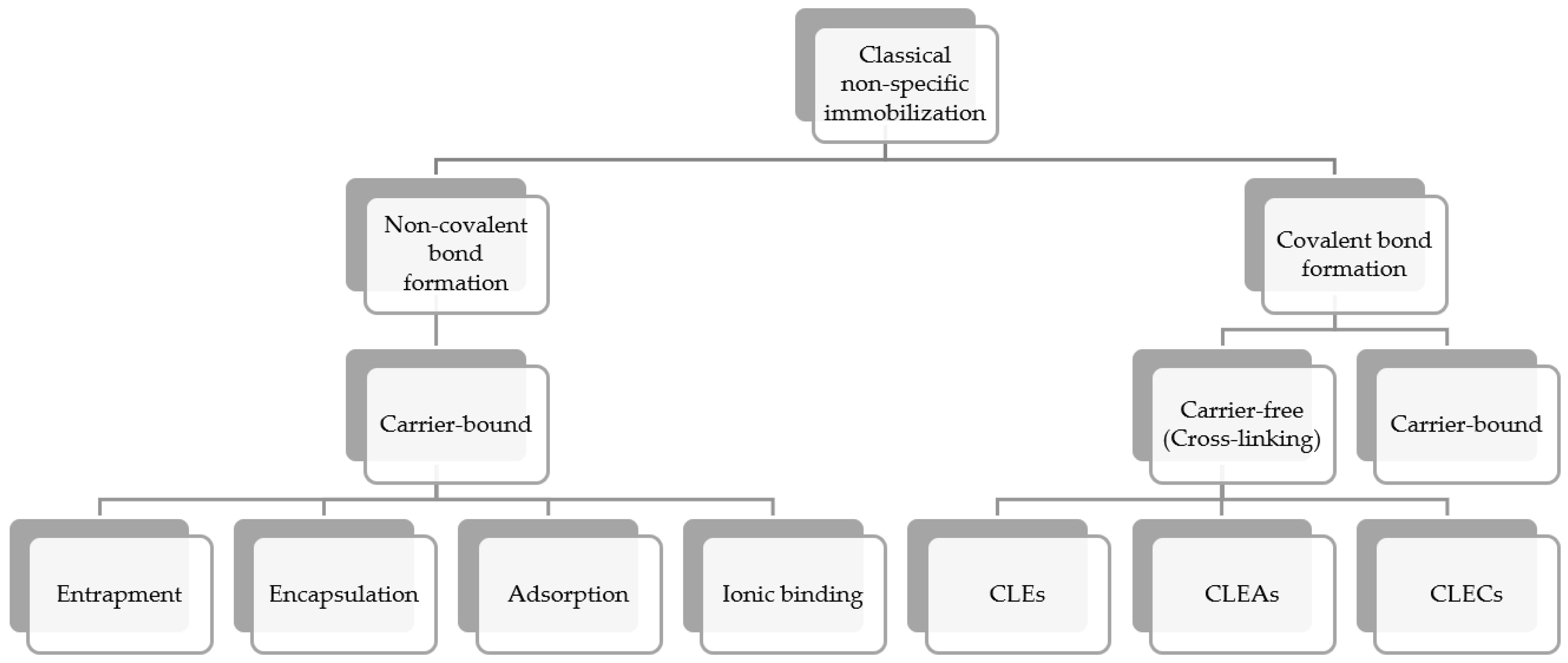
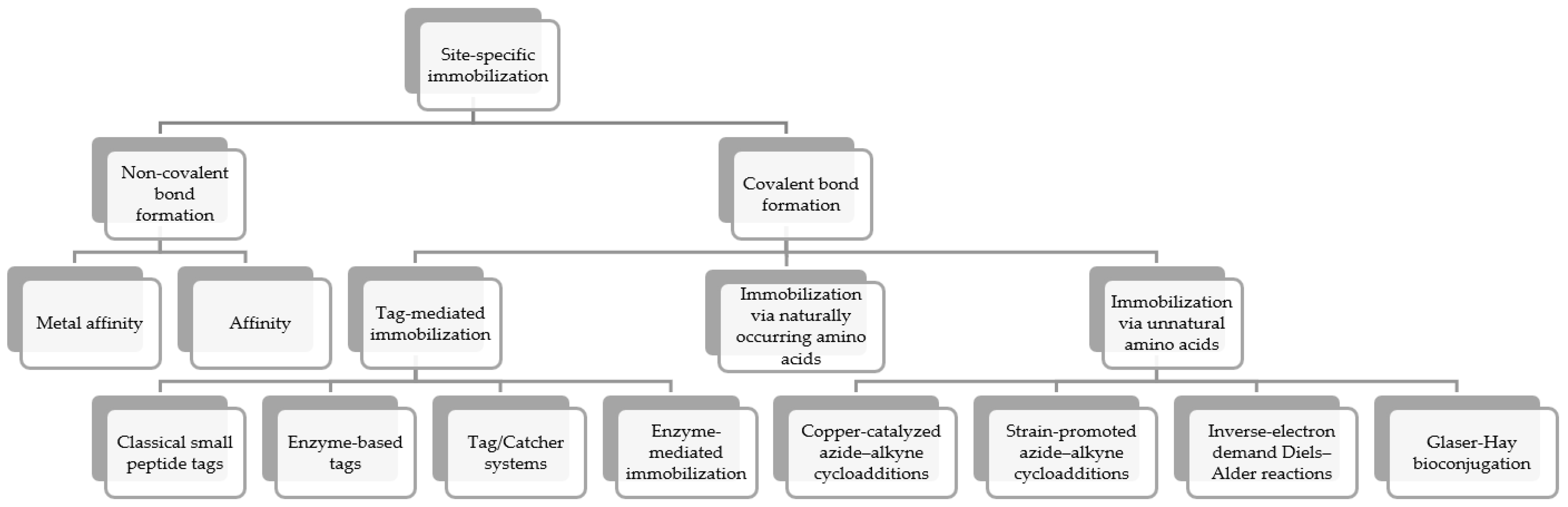
Enzyme immobilization plays a critical role in enhancing the efficiency and sustainability of biocatalysis, addressing key challenges such as limited enzyme stability, short shelf life, and difficulties in recovery and recycling, which are pivotal for green chemistry and industrial applications. Classical approaches, including adsorption, entrapment, encapsulation, and covalent bonding, as well as advanced site-specific methods that integrate enzyme engineering and bio-orthogonal chemistry, were discussed. These techniques enable precise control over enzyme orientation and interaction with carriers, optimizing catalytic activity and reusability. Key findings highlight the impact of immobilization on improving enzyme performance under various operational conditions and its role in reducing process costs through enhanced stability and recyclability. The review presents numerous practical applications of immobilized enzymes, including their use in the pharmaceutical industry for drug synthesis, in the food sector for dairy processing, and in environmental biotechnology for wastewater treatment and dye degradation. Despite the significant advantages, challenges such as activity loss due to conformational changes and mass transfer limitations remain, necessitating tailored immobilization protocols for specific applications. The integration of immobilization with modern biotechnological advancements, such as site-directed mutagenesis and recombinant DNA technology, offers a promising pathway for developing robust, efficient, and sustainable biocatalytic systems. This comprehensive guide aims to support researchers and industries in selecting and optimizing immobilization techniques for diverse applications in pharmaceuticals, food processing, and fine chemicals.
Keywords: enzyme immobilization; immobilization techniques; enzyme engineering; biocatalysis; sustainable processes enzyme immobilization; immobilization techniques; enzyme engineering; biocatalysis; sustainable processes