Article

Chemisorption vs. Physisorption in Perfluorinated Zn(II) Porphyrin–SnO2 Hybrids for Acetone Chemoresistive Detection


by
Manuel Minnucci
1,
Sara Oregioni
1,
Eleonora Pargoletti
1,2,
Gabriele Di Carlo
1,2,
Francesca Tessore
1,2,*,
Gian Luca Chiarello
1,
Rocco Martinazzo
1,
Mario Italo Trioni
3 and
Giuseppe Cappelletti
1,2
1
Dipartimento di Chimica, Università degli Studi di Milano, Via Golgi 19, 20133 Milano, Italy
2
Consorzio Interuniversitario Nazionale per la Scienza e Tecnologia dei Materiali (INSTM), Via Giusti 9, 50121 Firenze, Italy
3
Institute of Chemical Sciences and Technologies “Giulio Natta”, National Research Council of Italy, Via Golgi 19, 20133 Milano, Italy
*
Author to whom correspondence should be addressed.
Molecules 2025, 30(24), 4749; https://doi.org/10.3390/molecules30244749
Submission received: 22 October 2025 / Revised: 25 November 2025 / Accepted: 4 December 2025 / Published: 12 December 2025

Abstract

In this study, the integration of SnO2 with a perfluorinated Zn(II) porphyrin derivative, namely ZnTPPF20CN, was explored as a strategy to enhance the performance of chemoresistive sensors toward gaseous acetone detection. The ZnTPPF20CN molecule was specifically designed with an ethynylphenyl-cyanoacrylic anchoring group and a benzothiadiazole (BTD) spacer, enabling its chemisorption onto the SnO2 surface. Hybrid materials containing three different ZnTPPF20CN-to-SnO2 ratios (1:4, 1:32, 1:64) were fabricated and tested for acetone detection at 120 °C, both under dark conditions and LED illumination. The sensing behavior of these hybrids was compared with that of previously studied SnO2 composites, incorporating physisorbed, unsubstituted ZnTPPF20. Among the tested ratios, the 1:32 ZnTPPF20CN/SnO2 demonstrated superior acetone sensitivity compared to its unmodified counterpart, despite showing a lower intrinsic conductivity in air and a reduced electron transfer efficiency. Density functional theory (DFT) calculations provided insights into the possible anchoring modes and interfacial electronic interactions, helping to rationalize this counterintuitive observation. The enhanced sensing response was attributed to a more favorable balance between charge injection and the availability of SnO2 electronic states, facilitated by the chemisorbed anchoring of ZnTPPF20CN. Overall, our findings highlight the importance of molecular engineering, particularly in terms of molecular design, loading ratio, and anchoring mechanism, in modulating charge dynamics and optimizing the sensing efficiency of porphyrin/SnO2 nanocomposites.

1. Introduction

Chemoresistors are a class of chemical sensors whose operation relies on the direct chemical interaction between the sensing material and the target analyte, resulting in measurable changes in the material’s electrical resistance [1]. These devices are primarily employed for gas detection and are capable of sensing both oxidizing and reducing species, such as volatile organic compounds (VOCs) and NOx. Thanks to their high sensitivity and relatively simple design, chemoresistive sensors find applications in a wide range of fields, including medical diagnostics, environmental monitoring, and industrial process control [2,3,4,5]. Among the most widely used materials, semiconducting metal oxides (MOS) play a pivotal role, with tin dioxide (SnO2) serving as a prototypical example due to its excellent sensitivity [1,6]. However, MOS-based sensors exhibit several drawbacks, including cross-sensitivity, humidity interference, and the need for high operating temperatures [7,8,9]. Therefore, to address these challenges, significant efforts have been focused on tailoring the metal oxides, either as single-phase compounds or in combination with other functional materials, to improve their selectivity, sensitivity, and stability [10,11]. In particular, MOS have been explored in combination with graphene oxide (GO) [12], metal–organic frameworks (MOFs) [13,14], and metal nanoparticles [15,16]. A comparative summary of some recent literature data regarding MOS-based sensors is reported in Table S1.
In recent years, the emergence of conductive polymers [17] and molecularly engineered organic materials has opened new avenues for the development of chemoresistive sensors [18]. Compared to inorganic metal oxides, these materials offer two main advantages: they can operate efficiently at room temperature and, more importantly, their chemical sensitivity can be finely tuned by exploiting the vast diversity of synthetically accessible molecular structures. In this context, the integration of porphyrinoid compounds with MOS is an attractive strategy, owing to the catalytic properties of porphyrins that can enhance the sensing response [6]. Porphyrins are macrocyclic organic molecules characterized by a highly conjugated aromatic core containing 18 π-electrons, which provides them with excellent chemical and thermal stability, as well as good solubility [19]. Their structure is also remarkably versatile: the macrocycle features eight β-pyrrolic positions and four meso positions available for substitution, and the central cavity can host a wide range of metal ions, which may further coordinate one or two axial ligands [20,21]. Thanks to this adaptability, porphyrins have been developed for a variety of applications, ranging from catalysis [22,23] to optoelectronics [24,25,26], dye sensitized solar cells (DSSCs) [27,28,29], artificial photosynthesis (DSPECs) [30,31], and sensing [6,32]. Indeed, their structural tunability enables extensive chemical modification, offering the possibility to finely tailor the sensor’s selectivity toward specific analytes while simultaneously reducing the operating temperature [33].
Very recently, we investigated nanocomposites of SnO2 with 5,10,15,20-tetraphenylporphyrin Zn(II) (ZnTPP) and its perfluorinated analogue, 5,10,15,20-tetrakis-(pentafluorphenyl)porphyrin Zn(II) (ZnTPPF20), for the detection of gaseous acetone at 120 °C [34]. The ZnTPFF20/SnO2 1:32 nanocomposite showed an outstanding sensing performance compared to pristine SnO2. Experimental characterizations and density functional theory (DFT) calculations revealed that the porphyrin–SnO2 interaction was primarily physical in nature, and that perfluorination provided an optimal balance between porphyrin electron injection and available MOS states, which is crucial to increase the conductivity of the material. Notably, we also observed that upon LED illumination, the sensing of ZnTPFF20/SnO2 1:32 worsened due to the detrimental effect of the overfilling of SnO2 states coupled with enhanced electron scattering.
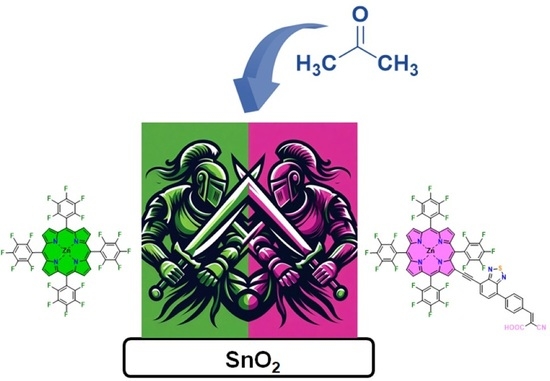
Building upon this rationale, the present work explores the integration of perfluorinated Zn(II) porphyrins with SnO2 for low-temperature acetone sensing, focusing on hybrids incorporating ZnTPPF20CN (Figure 1).
We modified ZnTPPF20 by introducing in the β-pyrrolic position of the core an ethynylphenyl-cyanoacrylic pendant as an acceptor and anchoring group. Then we added a benzothiadiazole (BTD) spacer, which is known for its strong electron-withdrawing properties and for its ability to increase light harvesting. Moreover, it enhances charge separation, thus improving the directionality of charge injection in n-type semiconductors from the excited state [27]. In contrast to the physisorption observed for pristine ZnTPPF20 on SnO2, the introduction of this anchoring group enables chemisorption [31], which is expected to influence the sensing behaviour of the resulting nanocomposites.
Here, we prepared hybrid materials with three different ZnTPPF20CN/SnO2 weight ratios (1:4, 1:32, and 1:64), deposited them onto glass interdigitated electrodes (IDEs), and measured their acetone sensing performance at 120 °C, both in the dark and under LED illumination, to enable a meaningful comparison with previously reported results for ZnTPPF20. Then, we carried out DFT calculations to investigate the interaction between the cyanoacrylic-functionalized porphyrins and the SnO2 surface, considering different possible anchoring modes and evaluating their influence on the electronic properties and sensing behavior of the hybrid materials.

2. Results

2.1. Acetone Sensing

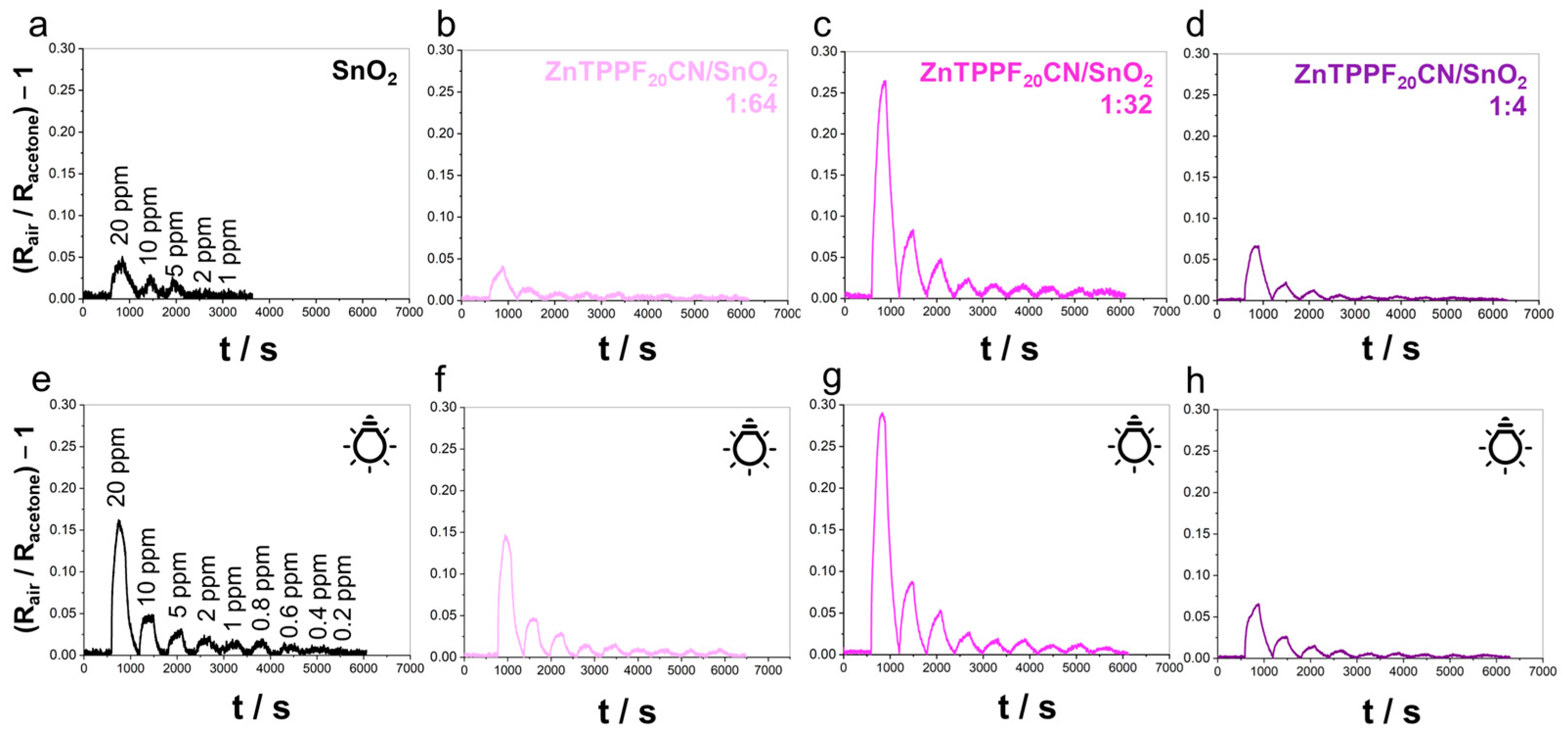
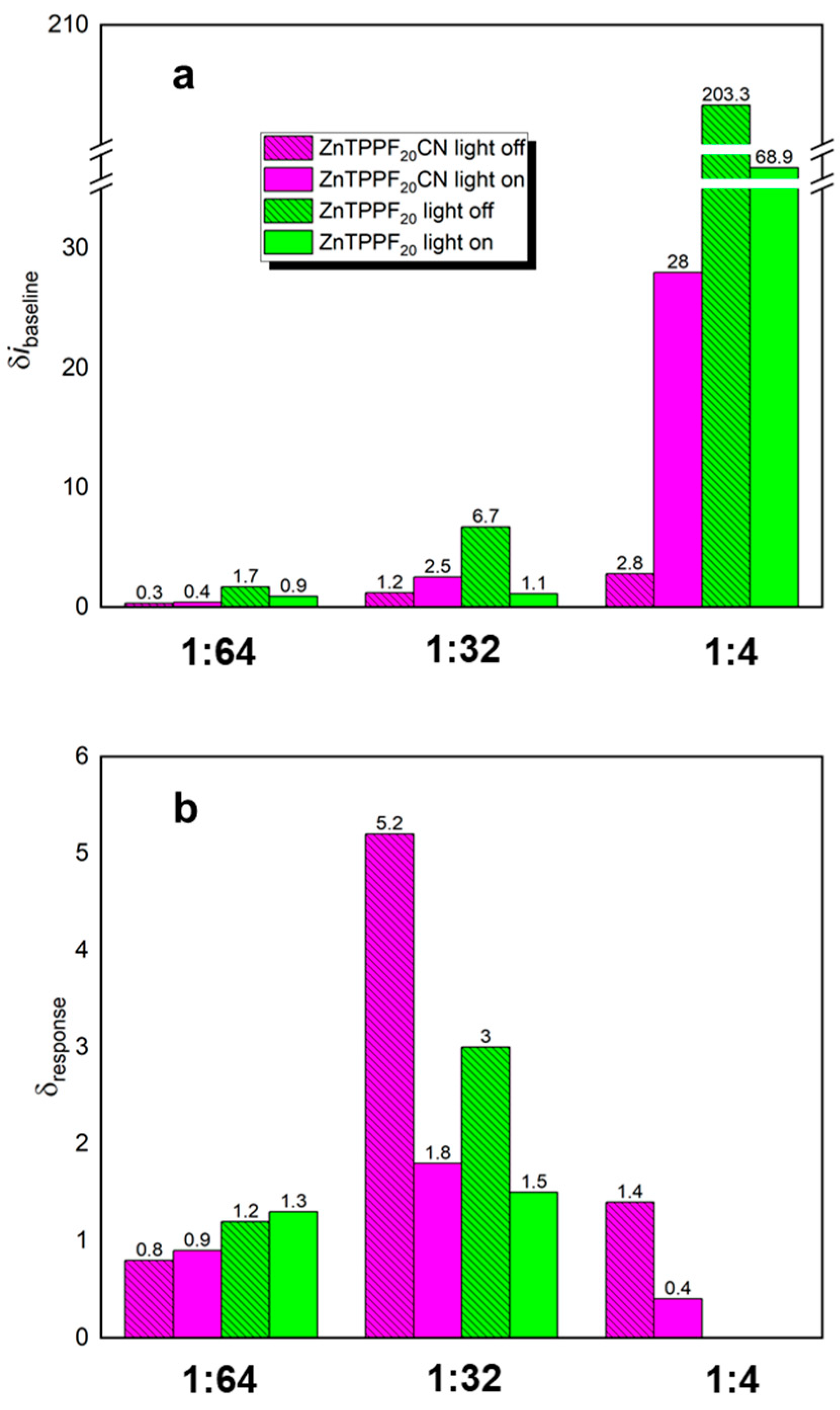
The sensing properties of the ZnTPPF20CN/SnO2 nanocomposites toward gaseous acetone were evaluated under both dark and LED illumination conditions in simulated air (80% N2–20% O2). Measurements were carried out by exposing the sensors to acetone concentrations ranging from 20 ppm to 200 ppb at an operating temperature (OT) of 120 °C and under a relative humidity (RH%) below 2%. Figure 2 shows the sensing performances of ZnTPPF20CN/SnO2 hybrids in the dark and under LED illumination, whereas Figure 3 and Table S2 compare the relative increment of baseline current (in the absence of acetone, ibaseline) and response intensity at 20 ppm acetone for both ZnTPPF20/SnO2 and ZnTPPF20CN/SnO2 hybrids with respect to the pristine SnO2 without the porphyrin addition. Moreover, the corresponding calibration curves are reported in Figure S1.
Before testing the electrode response to acetone, the baseline currents (ibaseline) were measured in simulated air. As previously observed for ZnTPPF20/SnO2 composites [34], the presence of ZnTPPF20CN porphyrin increases ibaseline relative to bare SnO2 under dark conditions, with the increment (dibaseline) becoming more pronounced as the porphyrin loading increases (0.3 at 1:64 → 1.2 at 1:32 → 2.8 at 1:4, magenta striped bars in Figure 3a). Under LED illumination, this enhancement is significantly amplified (0.4 at 1:64 → 2.5 at 1:32 → 28.0 at 1:4, solid magenta bars in Figure 3a). These experimental outcomes suggest that, in the absence of acetone, effective electron transfer occurs from the porphyrin to SnO2, leading to increased conductivity. Moreover, LED excitation boosts this process: the improved photoresponse is attributed to the BTD moiety in ZnTPPF20CN, which broadens the absorption spectrum and provides better overlap with the LED emission at 455 nm, as confirmed by the UV-Vis spectrum (Figure S2). Furthermore, for the ZnTPPF20/SnO2 composite (depicted by the green striped bars in Figure 3a and Table S2), a progressive increase in dibaseline values is evident, rising from 1.7 at 1:64 to 6.7 at 1:32 and becoming markedly pronounced at the 1:4 ratio (203.3). This enhancement is ascribed to the high electron-donating propensity of the perfluorinated porphyrin, which facilitates efficient electron transfer to the SnO2 matrix [34]. A comparable trend was also observed under LED light; however, the overall increment exhibited a diminished magnitude relative to that recorded under dark conditions due to limited spectral overlap (Figure S2) between the absorption profile of the ZnTPPF20/SnO2 system and the emission spectrum of the employed LED source, which consequently reduces the efficiency of photoexcitation.
Upon exposure to acetone, composites with lower porphyrin content (1:64) display negligible sensing responses under both conditions compared to bare SnO2 (Figure 2). Actually, an increment value of around 1 is observed (Figure 3b). Notably, the 1:32 ZnTPPF20CN/SnO2 composite shows a clear sensing response increment under both dark and LED illumination (Figure 2 and Figure 3b, striped and solid magenta bars, respectively), confirming this ratio as optimal, consistent with previous findings for graphene oxide/SnO2 [35] and ZnTPPF20/SnO2 composites [34]. Indeed, Figure 3b clearly demonstrates that 1:32 ZnTPPF20CN/SnO2 consistently outperforms ZnTPPF20/SnO2 in acetone sensing both in the dark and under LED light. Moreover, in the case of the highest porphyrin loading (1:4), ZnTPPF20CN exhibits a measurable sensing response, while the ZnTPPF20/SnO2 hybrids show no detectable activity, in agreement with their high baseline current values (Figure 3a and Table S2). Overall, elevated ibaseline values systematically lead to reduced sensing performance across all weight ratios [34].

2.2. Physicochemical Characterization of the 1:32 ZnTPPF20CN/SnO2 Composite

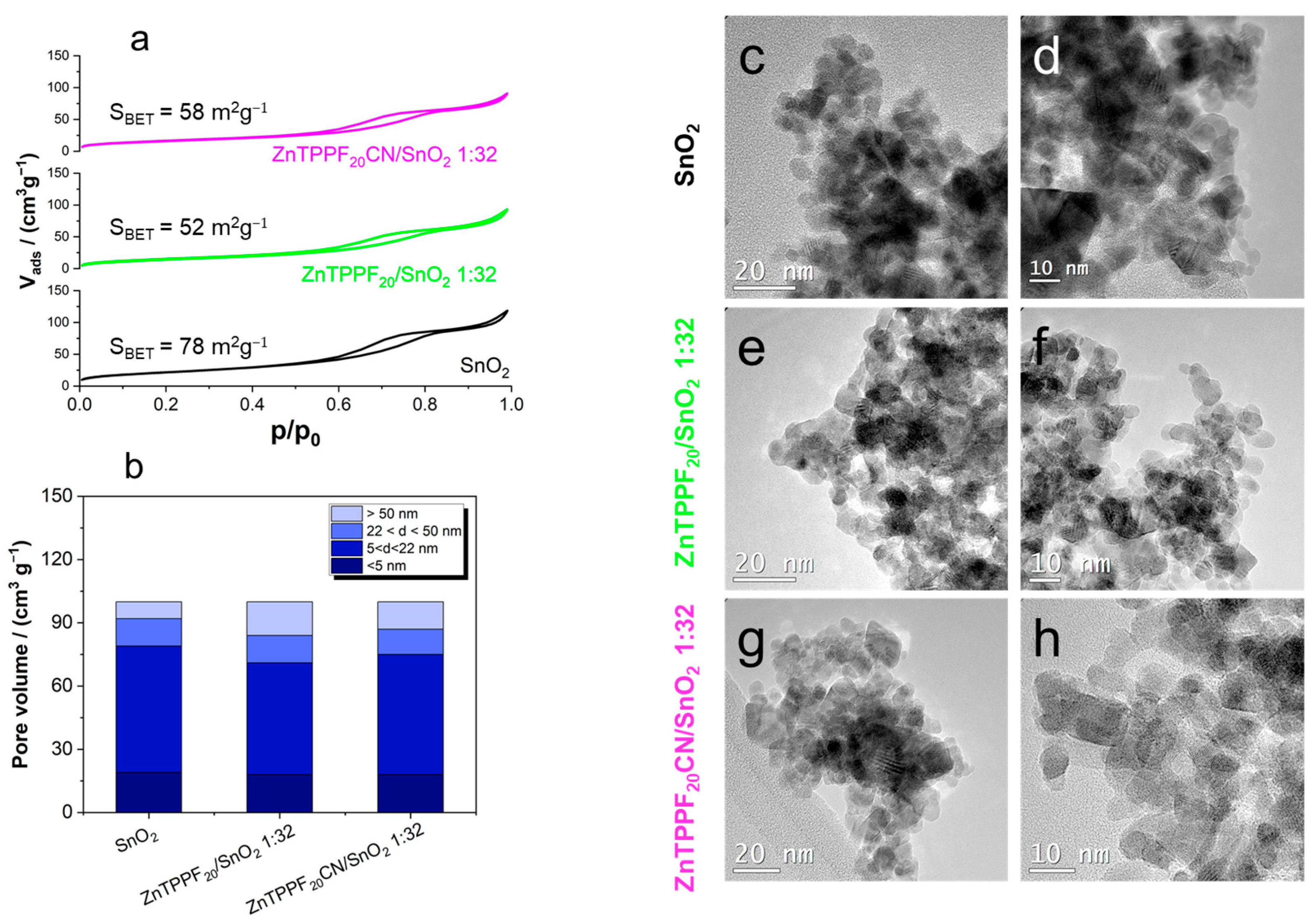
We conducted a comprehensive characterization of the best-performing ZnTPPF20CN/SnO2 composite to have a meaningful comparison with pristine SnO2 and the ZnTPPF20/SnO2 hybrid. Figure 4a displays the nitrogen adsorption–desorption isotherms of pristine SnO2, ZnTPPF20/SnO2 1:32, and ZnTPPF20-CN/SnO2 1:32 composites, respectively.
The curves reveal typical type IV isotherms with H3 hysteresis loops, indicating the presence of mesoporous structures. The specific surface areas (SBET) are 78 m2 g−1 for SnO2, 52 m2 g−1 for ZnTPPF20/SnO2, and 58 m2 g−1 for ZnTPPF20CN/SnO2, showing a slight decrease upon incorporation of the macrocyclic components, as expected.
Concerning the pore volume distribution (Figure 4b), both 1:32 ZnTPPF20CN/SnO2 and ZnTPPF20/SnO2 composites retain significant mesoporosity, with contributions from pores in the 2–50 nm range dominating the total porosity.
Moreover, HRTEM images (Figure 4c–f) confirm that both composites preserve the nanoparticle morphology of the pristine oxide, with no evident aggregation after functionalization. The perfluorinated Zn(II) porphyrins appear to be homogeneously distributed over the oxide nanoparticles, contributing to the maintenance of porous structures. This evidence is fully corroborated by EDS analyses (see Figure S3), showing a homogeneous distribution of both Zn and F species at all porphyrin loadings, consistent with the expected F/Sn and Zn/Sn ratios (Table S3).
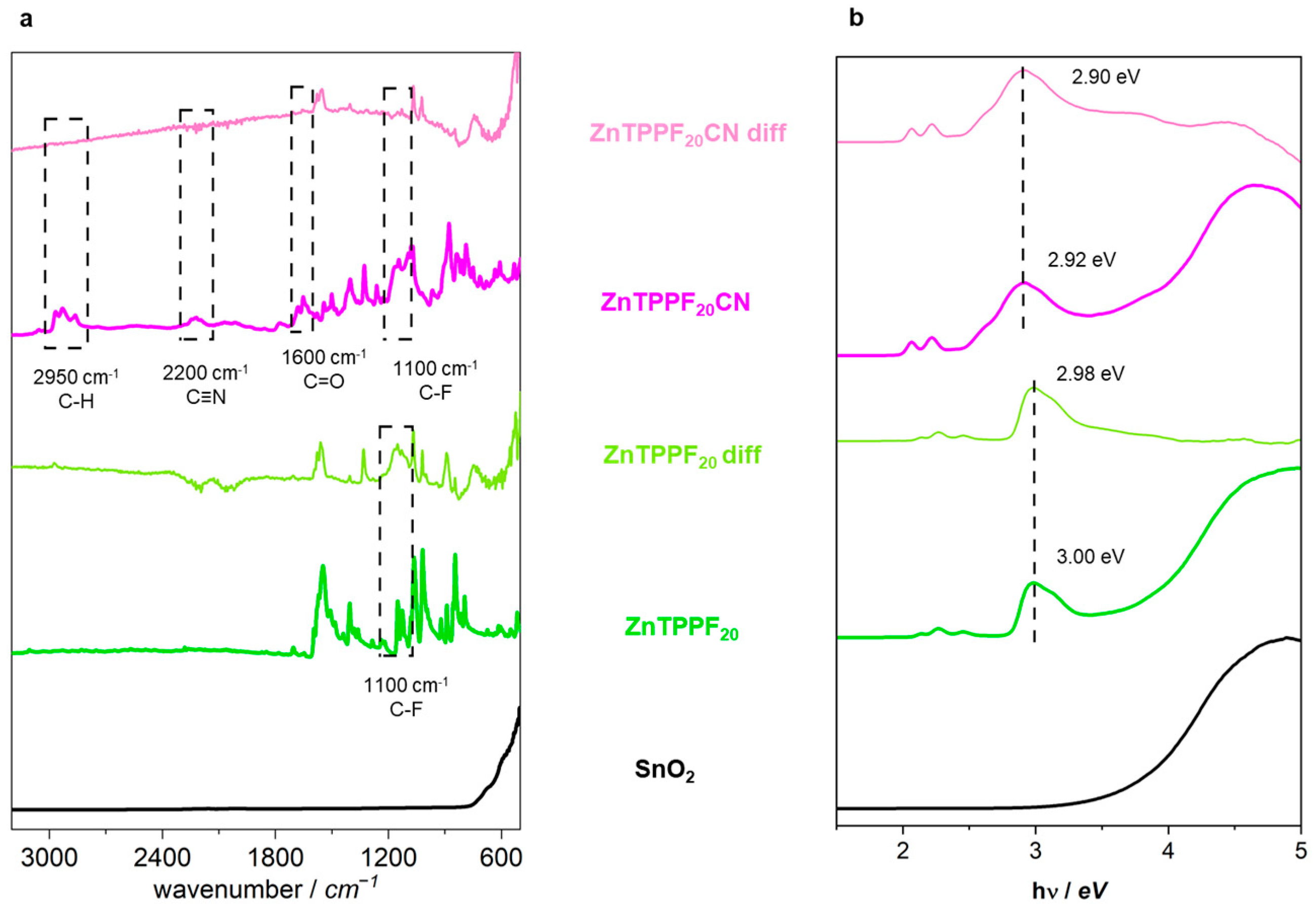
The optical characterizations were carried out by attenuated total reflectance–Fourier transform infrared (ATR-FTIR) spectroscopy and Diffuse reflectance spectroscopy (DRS). Subtraction of the spectrum of pure SnO2 from that of the hybrid allowed us to evidence the contribution of the porphyrins alone (“ZnTPPF20CN diff” and “ZnTPPF20 diff” patterns in Figure 5a). The comparison of the differential spectra with those of pristine porphyrins helped us to gain insight into porphyrin–SnO2 interaction.
The spectrum of ZnTPPF20CN exhibits three peculiar bands at about 2950, 2200, and 1600 cm−1, due to C-H, C≡N, and C=O stretching (dashed pink rectangles in Figure 5a) [36]. Moreover, as for ZnTPPF20, C-F stretching modes at 1000–1100 cm−1 are visible (dashed pink and green rectangles in Figure 5a). All these signals disappear in the difference spectrum, thus confirming the effective interaction between ZnTPPF20CN and SnO2.
As for the DRS spectra (Figure 5b), they retain the typical pattern observed in solution (Figure S2), with an intense Soret band at about 3.0 eV and two Q bands at lower energy. Moreover, the bands for pure ZnTPPF20CN are broader and red-shifted compared to those of ZnTPPF20 also in the solid state, in agreement with the extended π-conjugation provided by the presence of the BTD-equipped anchoring group [37]. Finally, the difference spectra show a slight broadening and a shift at higher energy of the Soret band, further supporting the formation of the hybrid [38].

2.3. Ab Initio Calculations

The ab initio investigation began with the study of bulk SnO2 and its (110) surface, which is reported in the literature as the most stable facet [39]. The spectral properties of the surface were calculated using a symmetric slab composed of 15 layers, in which only the four most external layers were allowed to relax. The results show the appearance of discrete states within the band gap, which, as revealed by the projected band structure analysis, belong to unsaturated Sn and O atoms on the surface (Figure S4).
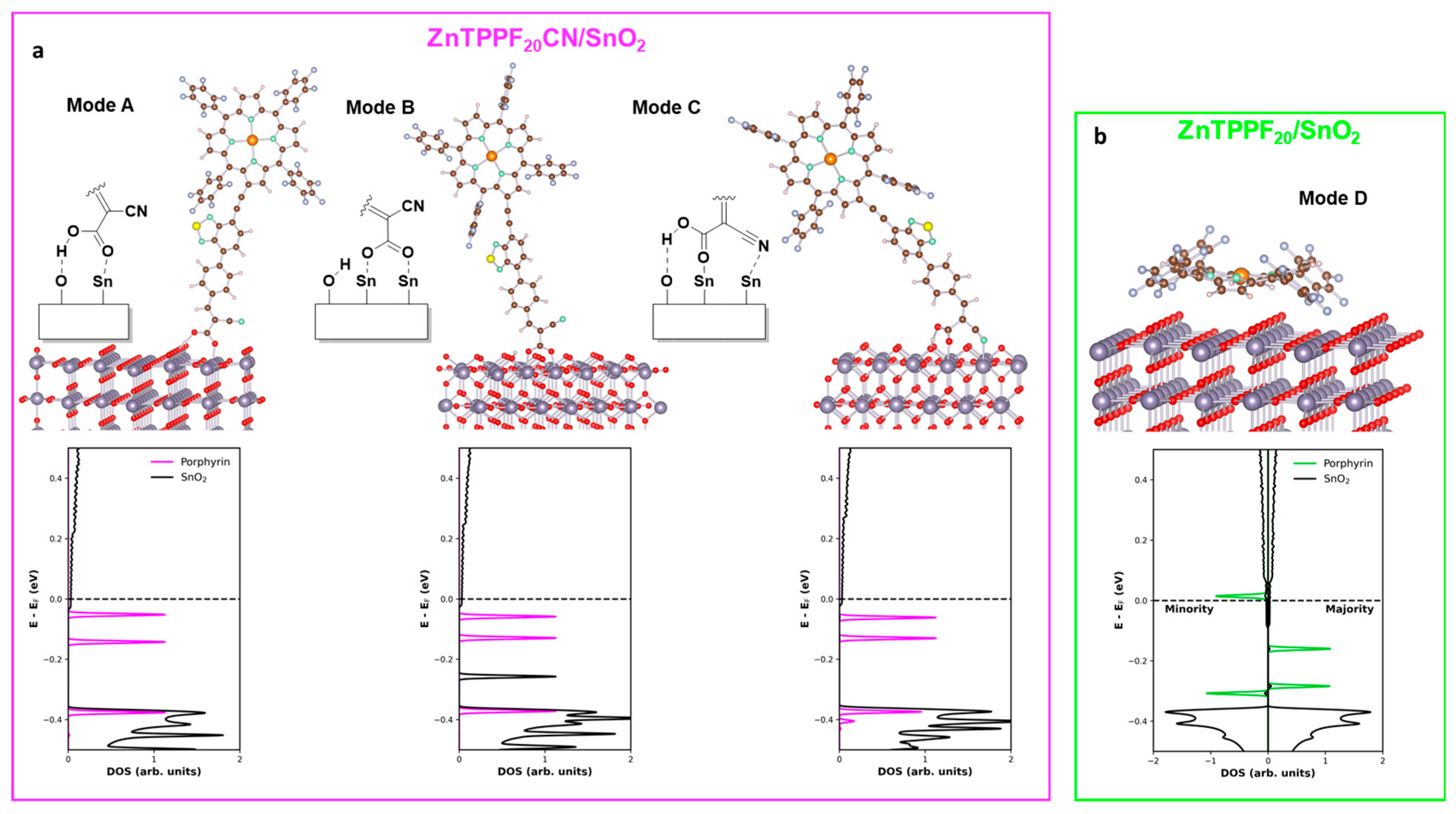
ZnTPPF20CN can exist in at least two configurational isomers, Z and E, arising from the rigid rotation around the C=C double bond of the side chain (Figure S5, Charts S1 and S2). Both isomers were optimized with the SIESTA code, revealing that the E-isomer is more stable with an energy difference of 0.26 eV. According to a Boltzmann distribution, the probability of the E-isomer being present under thermodynamic control at room temperature exceeds 99%. This result is further supported by literature findings, according to which the E-isomer is the predominant product in the Knoevenagel condensation [40]. However, to account for potential reconfiguration mechanisms that may occur upon interaction with the surface, the adsorption of both isomers on the SnO2 surface was examined. To assess how the presence of the pendant group may affect the adsorption pathway and, thus, potentially influence the overall performance of the system, three different adsorption modes of the ZnTPPF20CN were hypothesized (Figure 6a).
In order for the E-isomer to adsorb onto the surface without involving the porphyrinic moiety, it is reasonable to assume that the chemisorption takes place via the carboxylic group. Following a previous report on the adsorption of formic acid on the SnO2 (110) surface [41], we also considered for ZnTPPF20CN two main adsorption manners: the monodentate mode (A) and the bidentate mode (B). In the monodentate configuration, the carbonyl oxygen interacts with a positively charged surface Sn atom, while the acidic hydrogen forms a bridge with a surface oxygen atom bearing a partial negative charge. In the bidentate mode, instead, the carboxylic (COOH) group is deprotonated and binds to two surface Sn atoms, while the proton is adsorbed on a nearby surface oxygen. For these two adsorption configurations, the calculated adsorption energies are −1.61 eV for mode A and −2.01 eV for mode B, respectively (Table 1).
The Z-isomer can also approach the surface through the cyano group, whose anchoring ability in cyanoacrylic-type systems has already been established on anatase TiO2 (101) surface [38]. After structural optimization, we found that the pendant moiety chemisorbs in a bidentate fashion, involving both the carboxylic and the cyano groups. Additionally, the acidic hydrogen coming from the carboxyl is bridged with a surface Sn atom. For this configuration, referred to as Mode C, the calculated adsorption energy is −1.87 eV (Table 1).
The interaction between the ZnTPPF20 molecule and the SnO2 surface has already been analyzed in our earlier work [32]. In that study, a physisorption configuration was proposed in which the porphyrin macrocycle lies flat on the SnO2 surface (Figure 4b). In this orientation, the conjugated π-system of the porphyrin is expected to interact with the charged atoms on the substrate surface. However, for the sake of consistency, in the present work, the system was re-simulated, increasing the thickness of the substrate. The calculated adsorption energy for this system is −0.15 eV (Table 1), indicating a stable adsorption geometry, although markedly less stable than the upright configurations A–C. Compared with our previous work—where we examined the same flat-lying geometry for different molecules—we note that we now include a correction for the basis-set superposition error. This error affects any atomic-orbital basis calculation using moderately sized basis sets, such as that required here by the large size of the simulated system. It differs substantially between flat-lying and upright orientations but remains consistent within each class. After applying the correction according to the counterpoise scheme [39], we obtain a binding energy consistent with a physisorption regime (0.1–0.8 eV), as expected for a π–stacking interaction with limited charge transfer to the surface. The latter is found to be comparatively larger than in the upright configurations (~0.5 e) but distributed over a much broader contact area.
We employed projected-DOS to gain insights into the nature of the interaction between ZnTPPF20CN and the SnO2 substrate. In all investigated adsorption configurations, a charge transfer from the porphyrin to the substrate was observed, resulting in a partial filling of the SnO2 conduction band. We found that when the porphyrin is chemisorbed via the pendant group, the amount of transferred charge increases from 0.20 e in mode B, to 0.24 e in mode C, while mode A shows the highest value of 0.38 e (Table 1).
On the other hand, the projected-DOS analysis on ZnTPPF20/SnO2 revealed that the system is spin polarized. As shown in the spin-resolved DOS (Figure 4b), the originally highest occupied states of the porphyrin lose degeneracy. One spin channel shifts above the Fermi level, becoming partially depopulated. The majority spin component peak remains filled, being located below the Fermi level.
These findings support the higher charge injection capability of the ZnTPPF20, estimated to be 0.51 e, in comparison to the values obtained for the ZnTPPF20CN configurations.

3. Discussion

At the lowest porphyrin loading (1:64), ZnTPPF20/SnO2 hybrids show higher sensing performance due to efficient electron injection into SnO2, unlike the weaker response observed for ZnTPPF20CN. However, due to the small amount of porphyrin, the overall electron transfer to SnO2 remains minimal, resulting in a response comparable to that of bare SnO2 (dresponse = 0.8–1.3, Figure 3b).
The behavior of the 1:32 hybrid, however, is more intriguing. Based on the increase in baseline current under dark conditions, chemisorbed ZnTPPF20CN appears to transfer electrons to SnO2 less efficiently than physisorbed ZnTPPF20 (dibaseline 1.2 vs. 6.7, Figure 3a), as supported by Bader analysis, which shows higher transferred charge and baseline current for ZnTPPF20. Therefore, one might expect ZnTPPF20/SnO2 to display superior sensing performance, yet the opposite occurs: ZnTPPF20CN/SnO2 exhibits a stronger response (dresponse 5.2 vs. 3, Figure 3b). This outcome can be explained by the fact that, as demonstrated in our recent work [34], the sensing behavior depends on achieving an optimal balance between charge injection and the availability of SnO2 electronic states. Thus, the chemical anchoring mode of the ZnTPPF20CN enables sufficient electron transfer while maintaining this balance.
Finally, the 1:4 ratio for ZnTPPF20CN proves a moderate increment (dresponse = 1.4) to sensing with respect to pristine SnO2, as the excessive porphyrin content hampers acetone detection by SnO2 with respect to that of the 1:32 ratio. This result can be attributed to a “shielding” effect caused by the steric hindrance of ZnTPPF20CN, which makes the SnO2 surface less prone to react with the reducing agent. Specifically, the porphyrin molecules may adopt a tilted orientation rather than lying flat on the surface (as in the case of ZnTPPF20, see Figure 6), as their concentration increases, leading to higher surface coverage and p-p aggregation, also confirmed by the broad bands in DRS analysis [38]. This molecular arrangement creates a surface blocking effect [29], which limits electron accessibility to the SnO2 surface and, thereby, hinders the sensing process. In contrast, ZnTPPF20 exhibits no sensing response, consistent with the excessively high baseline current values.
Under LED light, only ZnTPPF20CN/SnO2 hybrids show an increased baseline (Table S2, 6th column), due to the matching between the light source emission at 455 nm and the UV-Vis absorption of the porphyrin (Figure S2). On the contrary, LED illumination is detrimental for ZnTPPF20/SnO2 nanocomposites (Figure 3a). However, in the presence of acetone (Figure 3b), both ZnTPPF20/SnO2 and ZnTPPF20CN/SnO2 hybrids show similar (for 1:64 ratio) or reduced (1:32 and 1:4 ratios) performances passing from dark to LED illumination. This experimental outcome corroborates the intimate relationship between baseline current and sensing response, notwithstanding the broader absorption of the cyanoacrylic-functionalized porphyrin.

4. Materials and Methods

4.1. Synthesis of ZnTPPF20CN, SnO2 and Hybrid Materials

ZnTPPF20CN was synthesized by modifying and optimizing a reported preparation [37]. The optimization focused on the final step of the synthesis, specifically the Knoevenagel condensation. In this step, the solvent was changed from a mixture of CH3CN/CHCl3 to toluene, leading to an increase in yield from 49% to 73%. The experimental details are in Supplementary Materials (Scheme S1).
SnO2 nanoparticles were prepared as reported elsewhere [12,35], and 1:64, 1:32, and 1:4 ZnTPPF20CN/SnO2 nanocomposites were assembled using the straightforward dissolution/deposition approach already used for ZnTPPF20/SnO2 hybrids [34].

4.2. Characterization of ZnTPPF20CN and of the 1:32 ZnTPPF20CN/SnO2 Composite

ZnTPPF20CN and its precursors were characterized by 1H- and 19F-NMR spectroscopy (Figures S6–S16). NMR spectra were recorded on a Bruker Avance DRX-400 spectrometer (Billerica, MA, US) using CDCl3 and THF-d8 as solvents (Sigma-Aldrich, St. Louis, MI, USA). The UV-Vis absorption spectrum of ZnTPPF20CN (Figure S2) was acquired at room temperature in THF with a Shimadzu UV-3600 spectrophotometer (Tokyo, Japan), employing quartz cuvettes with an optical path length of 1 cm. ESI-ITMS spectrum of ZnTPPF20CN (Figure S17) was acquired on a Bruker Daltonics ICR-FTMS APEXII with an electrospray ionization source.
The most efficient 1:32 ZnTPPF20CN/SnO2 nanocomposite was comprehensively characterized using a range of experimental techniques. High-resolution transmission electron microscopy (HRTEM) was carried out on an FEI TECNAI G2 F20 instrument (Thermo Fisher Scientific, Waltham, MA, USA) operating at 200 kV and equipped with an S-Twin lens, providing a point resolution of 0.24 nm. TEM grids were prepared by depositing a suspension of nanoparticles in ethanol onto holey carbon–supported copper grids, followed by drying at room temperature in air.
SEM-EDX analyses were performed with a Hitachi TM-4000 (Tokyo, Japan) scanning electron microscope equipped with a 4-quadrant BSE (backscattered electrons) detector, a low-vacuum SE (secondary electrons) detector, and an Oxford AztecOne EDX (Abingdon-on-Thames, UK). Map acquisitions were performed at an acceleration voltage of 15 kV and at 300× magnification.
The specific surface area and porosity were determined using the multipoint Brunauer–Emmett–Teller (BET) method with N2 adsorption–desorption isotherms at 77 K on a Tristar II 3020 (Micromeritics) apparatus (Norcross, GA, USA). Total pore volume was estimated from desorption isotherms using the Barrett–Joyner–Halenda (BJH) method. Prior to measurements, the samples were thermally treated at 80 °C overnight to prevent material degradation.
Attenuated total reflectance–Fourier transform infrared (ATR–FTIR) spectra were collected in the 4000–400 cm−1 range using a PerkinElmer Frontier spectrometer equipped with a diamond/ZnSe ATR crystal (Waltham, MA, USA). Diffuse reflectance spectra (DRS) were recorded over the 220–2600 nm range with a Shimadzu UV-3600 Plus double-beam UV-Vis–NIR spectrophotometer (Tokyo, Japan) fitted with an integrating sphere (BIS-603). Finely ground powders were pressed into uniform circular pellets (0.2 cm diameter), placed in a quartz cuvette, and positioned against the integrating sphere window for reflectance acquisition. Barium sulfate (BaSO4) served as the reflectance standard.

4.3. Preparation of the Electrodes

Nanocomposite films were deposited using a hot-spray technique onto glass interdigitated platinum electrodes (Pt-IDEs, purchased from Metrohm, Herisau, Switzerland, Figure S18). Gas sensing experiments were conducted in a previously described custom-made stainless-steel cell (Figure S18) [42,43]. The electrical resistance of the films was monitored under a simulated air atmosphere (80% N2–20% O2, total flow rate 0.5 L·min−1) containing different concentrations of acetone vapor. The acetone flow was adjusted by diluting a 500 ppm stock mixture in N2 using Bronkhorst mass flow controllers, while maintaining the overall flow rate constant.
The dynamic sensing response (Figure S18) was measured with an Autolab PGStat30 potentiostat/galvanostat (Eco Chemie, Utrecht, The Netherlands) operated by NOVA 2.0 software, under a constant bias of +1.0 V. Sensor output was expressed as (Rair/Racetone) − 1, where Rair and Racetone are the film resistances in synthetic air and acetone, respectively.
All measurements were carried out at (120 ± 2) °C and <2% relative humidity (verified using a hygrometer placed at the outlet of the sensing chamber). For selected experiments, additional irradiation was applied using either a blue LED (THORLABS, λ = 455 nm, 2 W) or a UV lamp (Jelosil HG500 iron halide mercury arc lamp, 500 W, emission range 350–450 nm, incident power density 30 mW·cm−2). All tests are conducted in triplicate, and the error bars are at most 5% of the sensor response.
Since the SnO2 batch used to prepare the ZnTPPF20CN/SnO2 hybrids in this study differs from the one previously employed for the ZnTPPF20/SnO2 hybrids [34], we normalized both the baseline currents and sensor responses by dividing them by the corresponding values of the respective SnO2 batch. The resulting normalized data are presented as the increment of baseline current relative to SnO2 (dibaseline) and as the increment of response intensity at 20 ppm relative to SnO2 (dresponse), as reported in Table S2 and Figure 6.

4.4. Computational Details

The theoretical study of the ZnTPPF20-CN and its adsorption onto the SnO2 surface was carried out using density functional theory (DFT) as implemented in the SIESTA code (v5.2.2) [44]. Calculations used the Perdew–Burke–Ernzerhof (PBE) exchange-correlation functional and a double-zeta polarized (DZP) basis set with default parameters. Norm-conserving pseudopotentials were generated using the Troullier–Martins formalism, and real-space integrations were performed with a grid equivalent to a plane-wave cutoff of 450 Ry. The SnO2 bulk structure was modeled using a tetragonal rutile-like unit cell (2 Sn and 4 O atoms) with optimized lattice constants (a = b = 4.86 Å, c = 3.29 Å), and the Brillouin zone was sampled with a 10 × 10 × 14 Monkhorst–Pack grid. Surface models focused on the (110) facet, represented by a 6-layer slab in which only the top four layers were relaxed. A 30 Å vacuum region was introduced to prevent spurious periodic interactions. The surface area was selected to accommodate the entire porphyrin molecule. For ZnTPPF20CN adsorption, the slab model included 576 atoms (192 SnO2 units), while the system with ZnTPPF20 contained 648 atoms (216 SnO2 units). The electron density distribution of the system was analyzed within the framework of the Quantum Theory of Atoms in Molecules (QTAIM) [45] using the Critic2 code [46], and the total energies used in computing the adsorption energies are corrected for the basis set superposition error (BSSE).

5. Conclusions

The combined experimental and theoretical investigation demonstrates that functionalization of SnO2 with perfluorinated Zn(II) porphyrins bearing different substituents can significantly enhance acetone sensing performances, particularly at an optimal loading ratio. The incorporation of the cyanoacrylic anchoring group promotes effective chemisorption on the SnO2 surface, ensuring balanced charge transfer while preserving a limited yet sufficient availability of both the semiconductor’s electronic states and its catalytic sites, which are essential for gas detection. Optical and structural characterizations confirm strong porphyrin–oxide coupling without compromising the mesoporous architecture, whereas DFT calculations reveal that the pendant group ensures stable adsorption and efficient electron injection at the interface. Furthermore, LED illumination markedly improves the photoresponse when its emission spectrum overlaps with the porphyrin absorption band. Overall, these findings demonstrate that rational molecular design of porphyrinic sensitizers represents an effective strategy to control charge transfer processes and optimize light-assisted gas sensing in metal oxide–porphyrin hybrid materials.

Supplementary Materials

The following supporting information can be downloaded at: https://www.mdpi.com/article/10.3390/molecules30244749/s1. Table S1: A comparative summary of some recent literature data regarding MOS-based sensors; Table S2: Baseline current values (ibaseline), ibaseline increment vs. pure SnO2 (dibaseline), response intensity at 20 ppm, and response intensity at 20 ppm increment vs. pure SnO2 (dresponse), for ZnTPPF20CN/SnO2 and ZnTPPF20/SnO2 nanocomposites in dark and under LED light irradiation. Data in green from ref. [34] of the main paper; Table S3: Theoretical vs. experimental (by EDS) Zn/Sn and F/Zn atomic ratios for ZnTPPF20CN/SnO2 hybrids at all porphyrin loadings; Figure S1: Calibration curves for ZnTPPF20CN/SnO2 hybrids; Figure S2: Normalized UV-Vis spectra of ZnTPPF20 and ZnTPPF20CN in THF; Figure S3: EDS analyses for ZnTPPF20CN/SnO2 hybrids; Figure S4: Fatband structure of a 15 layers symmetrical slab of SnO2, blue and green represents contribution coming from Sn and O surface atoms, respectively. On the right panel a comparison between the (110) surface DOS (blue) and the bulk DOS (black) of the rutile phase of SnO2; Figure S5: Optimized structures and energy of E and Z isomers of ZnTPPF20CN; Figure S6: 1H-NMR of ZnTPPF20 in CDCl3; Figure S7: 19F-NMR of ZnTPPF20 in CDCl3; Figure S8: 1H-NMR of ZnTPPF20Br in CDCl3; Figure S9: 19F-NMR of ZnTPPF20 in CDCl3; Figure S10: 1H-NMR of ZnTPPF20Si(hex)3 in CDCl3; Figure S11: 19F-NMR of ZnTPPF20Si(hex)3 in CDCl3; Figure S12: 1H-NMR of ZnTPPF20CH in CDCl3; Figure S13: 1H-NMR of ZnTPPF20CHO in CDCl3; Figure S14: 19F-NMR of ZnTPPF20CHO in CDCl3; Figure S15: 1H-NMR of ZnTPPF20CN in D2O; Figure S16: 19F-NMR of ZnTPPF20CN in D2O; Figure S17:ESI-ITMS spectrum of ZnTPPF20CN; Figure S18: Image of the gas sensor testing setup: (A) homemade stainless steel in situ sensor testing cell; (B) gas manifold; (C) cell temperature controller; (D) Autolab potentiostat. Inset: inside of the in situ sensor testing cell: (E) heating plate for temperature control; (F) needle-electrical connectors; (G) Pt-interdigitated electrode covered by the synthesized sensing materials. Chart S1: Structural coordinates of the E isomer of ZnTPPF20CN; Chart S2: Structural coordinates of the Z isomer of ZnTPPF20CN; Scheme S1: Synthetic protocol to ZnTPPF20CN [11,14,35,47,48,49,50,51].

Author Contributions

Conceptualization, F.T., G.C., and G.D.C.; formal analysis, M.M., S.O., R.M., and M.I.T.; investigation, M.M., S.O., E.P., G.D.C., and G.L.C.; visualization, M.M., S.O., E.P.; writing—original draft preparation, F.T. and G.C.; writing—review and editing, all authors; supervision, G.C. and F.T., M.M. and S.O. equally contributed to the work. All authors have read and agreed to the published version of the manuscript.

Funding

E.P. kindly acknowledges Università degli Studi di Milano, Research Support Plan—Line 8A, project number: PSR_LINEA8A_25LLAY_03. G.C. and F.T. wish to thank the University of Milan for its support via the Research Support Plan (Linea 2: PSR2023_DIP_005_PI_LLOPR, PSR2023_DIP_005_PI_FTESS, and PSR2025_DIP_005_GCAPP). FT kindly acknowledges Consorzio Interuniversitario Nazionale per la Scienze e la Tecnologia dei Materiali (INSTM) for the financial support through the PPONS project (TRI.25/194).

Data Availability Statement

The data that support the findings of this study are available from the corresponding author upon reasonable request.

Acknowledgments

The authors gratefully acknowledge Mariangela Longhi for performing the BET analyses, Nicola Rotiroti, who carried out part of this work at Unitech COSPECT and NOLIMITS, advanced imaging facility centers established by Università degli Studi di Milano, and Paola Fermo and her group for EDS analyses.

Conflicts of Interest

The authors declare no conflicts of interest.

References

  1. Banica, F.-G. Chemical Sensors and Biosensors: Fundamentals and Applications; John Wiley & Sons: Hoboken, NJ, USA, 2012. [Google Scholar]
  2. Barandun, G.; Gonzalez-Macia, L.; Lee, H.S.; Dincer, C.; Güder, F. Challenges and opportunities for printed electrical gas sensors. ACS Sens. 2022, 7, 2804–2822. [Google Scholar] [CrossRef]
  3. Milone, A.; Monteduro, A.G.; Rizzato, S.; Leo, A.; Di Natale, C.; Kim, S.S.; Maruccio, G. Advances in materials and technologies for gas sensing from environmental and food monitoring to breath analysis. Adv. Sustain. Syst. 2023, 7, 2200083. [Google Scholar] [CrossRef]
  4. Pargoletti, E.; Cappelletti, G. Breakthroughs in the design of novel carbon-based metal oxides nanocomposites for VOCs gas sensing. Nanomaterials 2020, 10, 1485. [Google Scholar] [CrossRef]
  5. Yuan, Z.; Li, R.; Meng, F.; Zhang, J.; Zuo, K.; Han, E. Approaches to enhancing gas sensing properties: A review. Sensors 2019, 19, 1495. [Google Scholar] [CrossRef]
  6. Paolesse, R.; Nardis, S.; Monti, D.; Stefanelli, M.; Di Natale, C. Porphyrinoids for chemical sensor applications. Chem. Rev. 2017, 117, 2517–2583. [Google Scholar] [CrossRef]
  7. Pineau, N.J.; Kompalla, J.F.; Güntner, A.T.; Pratsinis, S.E. Orthogonal gas sensor arrays by chemoresistive material design. Microchim. Acta 2018, 185, 563. [Google Scholar] [CrossRef]
  8. Tricoli, A.; Righettoni, M.; Teleki, A. Semiconductor gas sensors: Dry synthesis and application. Angew. Chem. Int. Ed. 2010, 49, 7632–7659. [Google Scholar] [CrossRef]
  9. van den Broek, J.; Abegg, S.; Pratsinis, S.E.; Güntner, A.T. Highly selective detection of methanol over ethanol by a handheld gas sensor. Nat. Commun. 2019, 10, 4220. [Google Scholar] [CrossRef] [PubMed]
  10. Zhu, L.; Zeng, W. Room-temperature gas sensing of ZnO-based gas sensor: A review. Sens. Actuators A Phys. 2017, 267, 242–261. [Google Scholar] [CrossRef]
  11. Li, C.; Choi, P.G.; Masuda, Y. Large-lateral-area SnO2 nanosheets with a loose structure for high-performance acetone sensor at the ppt level. J. Hazard. Mater. 2023, 455, 131592. [Google Scholar] [CrossRef] [PubMed]
  12. Pargoletti, E.; Tricoli, A.; Pifferi, V.; Orsini, S.; Longhi, M.; Guglielmi, V.; Cerrato, G.; Falciola, L.; Derudi, M.; Cappelletti, G. An electrochemical outlook upon the gaseous ethanol sensing by graphene oxide-SnO2 hybrid materials. Appl. Surf. Sci. 2019, 483, 1081–1089. [Google Scholar] [CrossRef]
  13. Zhang, L.; Khan, K.; Zou, J.; Zhang, H.; Li, Y. Recent advances in emerging 2D material-based gas sensors: Potential in disease diagnosis. Adv. Mater. Interfaces 2019, 6, 1901329. [Google Scholar] [CrossRef]
  14. Zhang, H.; Guo, S.; Zheng, W.; Wang, H.; Li, H.-Y.; Yu, M.-H.; Chang, Z.; Bu, X.-H.; Liu, H. Facile engineering of metal–organic framework derived SnO2-ZnO composite based gas sensor toward superior acetone sensing performance. Chem. Eng. J. 2023, 469, 143927. [Google Scholar] [CrossRef]
  15. Kim, S.-J.; Choi, S.-J.; Jang, J.-S.; Kim, N.-H.; Hakim, M.; Tuller, H.L.; Kim, I.-D. Mesoporous WO3 nanofibers with protein-templated nanoscale catalysts for detection of trace biomarkers in exhaled breath. ACS Nano 2016, 10, 5891–5899. [Google Scholar] [CrossRef]
  16. Wei, Q.; Sun, J.; Song, P.; Yang, Z.; Wang, Q. Synthesis of reduced graphene oxide/SnO2 nanosheets/Au nanoparticles ternary composites with enhanced formaldehyde sensing performance. Phys. E Low-Dimens. Syst. Nanostruct. 2020, 118, 113953. [Google Scholar] [CrossRef]
  17. Ammu, S.; Dua, V.; Agnihotra, S.R.; Surwade, S.P.; Phulgirkar, A.; Patel, S.; Manohar, S.K. Flexible, all-organic chemiresistor for detecting chemically aggressive vapors. J. Am. Chem. Soc. 2012, 134, 4553–4556. [Google Scholar] [CrossRef]
  18. Im, J.; Sengupta, S.K.; Baruch, M.F.; Granz, C.D.; Ammu, S.; Manohar, S.K.; Whitten, J.E. A hybrid chemiresistive sensor system for the detection of organic vapors. Sens. Actuators B Chem. 2011, 156, 715–722. [Google Scholar] [CrossRef]
  19. Smith, K.M. Porphyrins and Metalloporphyrins; Elsevier: Amsterdam, The Netherland, 1975; Volume 9. [Google Scholar]
  20. Gouterman, M. Spectra of porphyrins. J. Mol. Spectrosc. 1961, 6, 138–163. [Google Scholar] [CrossRef]
  21. Gouterman, M.; Wagnière, G.H.; Snyder, L.C. Spectra of porphyrins: Part II. Four orbital model. J. Mol. Spectrosc. 1963, 11, 108–127. [Google Scholar] [CrossRef]
  22. Bonin, J.; Maurin, A.; Robert, M. Molecular catalysis of the electrochemical and photochemical reduction of CO2 with Fe and Co metal based complexes. Recent advances. Coord. Chem. Rev. 2017, 334, 184–198. [Google Scholar] [CrossRef]
  23. Limosani, F.; Remita, H.; Tagliatesta, P.; Bauer, E.M.; Leoni, A.; Carbone, M. Functionalization of Gold Nanoparticles with Ru-Porphyrin and Their Selectivity in the Oligomerization of Alkynes. Materials 2022, 15, 1207. [Google Scholar] [CrossRef] [PubMed]
  24. Di Carlo, G.; Pizzotti, M.; Righetto, S.; Forni, A.; Tessore, F. Electric-Field-Induced Second Harmonic Generation Nonlinear Optic Response of A4 β-Pyrrolic-Substituted ZnII Porphyrins: When Cubic Contributions Cannot Be Neglected. Inorg. Chem. 2020, 59, 7561–7570. [Google Scholar] [CrossRef] [PubMed]
  25. Limosani, F.; Tessore, F.; Di Carlo, G.; Forni, A.; Tagliatesta, P. Nonlinear Optical Properties of Porphyrin, Fullerene and Ferrocene Hybrid Materials. Materials 2021, 14, 4404. [Google Scholar] [CrossRef] [PubMed]
  26. Limosani, F.; Tessore, F.; Forni, A.; Lembo, A.; Di Carlo, G.; Albanese, C.; Bellucci, S.; Tagliatesta, P. Nonlinear Optical Properties of Zn (II) Porphyrin, Graphene Nanoplates, and Ferrocene Hybrid Materials. Materials 2023, 16, 5427. [Google Scholar] [CrossRef]
  27. Covezzi, A.; Orbelli Biroli, A.; Tessore, F.; Forni, A.; Marinotto, D.; Biagini, P.; Di Carlo, G.; Pizzotti, M. 4D–π–1A type β-substituted Zn II-porphyrins: Ideal green sensitizers for building-integrated photovoltaics. Chem. Commun. 2016, 52, 12642–12645. [Google Scholar] [CrossRef] [PubMed]
  28. Mathew, S.; Yella, A.; Gao, P.; Humphry-Baker, R.; Curchod, B.F.E.; Ashari-Astani, N.; Tavernelli, I.; Rothlisberger, U.; Nazeeruddin, K.; Grätzel, M. Dye-sensitized solar cells with 13% efficiency achieved through the molecular engineering of porphyrin sensitizers. Nat. Chem. 2014, 6, 242–247. [Google Scholar] [CrossRef]
  29. Di Carlo, G.; Caramori, S.; Trifiletti, V.; Giannuzzi, R.; De Marco, L.; Pizzotti, M.; Orbelli Biroli, A.; Tessore, F.; Argazzi, R.; Bignozzi, C.A. Influence of Porphyrinic Structure on Electron Transfer Processes at the Electrolyte/Dye/TiO2 Interface in PSSCs: A Comparison between meso Push–Pull and β-Pyrrolic Architectures. ACS Appl. Mater. Interfaces 2014, 6, 15841–15852. [Google Scholar] [CrossRef]
  30. Di Carlo, G.; Albanese, C.; Molinari, A.; Carli, S.; Minguzzi, R.A.A.; Tessore, F.; Marchini, E.; Caramori, S. Perfluorinated Zinc Porphyrin Sensitized Photoelectrosynthetic Cells for Enhanced TEMPO-Mediated Benzyl Alcohol Oxidation. ACS Appl. Mater. Interfaces 2024, 16, 14864–14882. [Google Scholar] [CrossRef]
  31. Orbelli Biroli, A.; Tessore, F.; Di Carlo, G.; Pizzotti, M.; Benazzi, E.; Gentile, F.; Berardi, S.; Bignozzi, C.A.; Argazzi, R.; Natali, M.; et al. Fluorinated ZnII porphyrins for dye-sensitized aqueous photoelectrosynthetic cells. ACS Appl. Mater. Interfaces 2019, 11, 32895–32908. [Google Scholar] [CrossRef]
  32. Belkova, G.; Zav’yalov, S.A.; Glagolev, N.N.; Solov’eva, A.B. The influence of ZnO-sensor modification by porphyrins on to the character of sensor response to volatile Organic compounds. Russ. J. Phys. Chem. A 2010, 84, 129–133. [Google Scholar] [CrossRef]
  33. Nardis, S.; Monti, D.; Di Natale, C.; D’Amico, A.; Siciliano, P.; Forleo, A.; Epifani, M.; Taurino, A.; Rella, R.; Paolesse, R. Preparation and characterization of cobalt porphyrin modified tin dioxide films for sensor applications. Sens. Actuators B Chem. 2004, 103, 339–343. [Google Scholar] [CrossRef]
  34. Tessore, F.; Pargoletti, E.; Di Carlo, G.; Albanese, C.; Soave, R.; Trioni, M.I.; Marelli, F.; Cappelletti, G. How the Interplay between SnO2 and Zn(II) Porphyrins Impacts on the Electronic Features of Gaseous Acetone Chemiresistors. ACS Appl. Mater. Interfaces 2024, 16, 41086–41098. [Google Scholar] [CrossRef] [PubMed]
  35. Pargoletti, E.; Hossain, U.H.; Di Bernardo, I.; Chen, H.; Tran-Phu, T.; Chiarello, G.L.; Lipton-Duffin, J.; Pifferi, V.; Tricoli, A.; Cappelletti, G. Engineering of SnO2–Graphene Oxide Nanoheterojunctions for Selective Room-Temperature Chemical Sensing and Optoelectronic Devices. ACS Appl. Mater. Interfaces 2020, 12, 39549–39560. [Google Scholar] [CrossRef] [PubMed]
  36. Boucher, L.J.; Katz, J.J. The Infared Spectra of Metalloporphyrins (4000–160 cm−1). J. Am. Chem. Soc. 1967, 89, 1340–1345. [Google Scholar] [CrossRef]
  37. Berardi, S.; Caramori, S.; Benazzi, E.; Zabini, N.; Niorettini, A.; Orbelli Biroli, A.; Pizzotti, M.; Tessore, F.; Di Carlo, G. Electronic Properties of Electron-Deficient Zn(II) Porphyrins for HBr Splitting. Appl. Sci. 2019, 9, 2739. [Google Scholar] [CrossRef]
  38. Hamza, H.; Schifano, V.; Colciago, G.; Ortenzi, M.A.; Ferretti, A.M.; Di Carlo, G.; Dozzi, M.V.; Vago, R.; Tessore, F.; Maggioni, D. Halloysite nanotubes as a vector for hydrophobic perfluorinated porphyrin-based photosensitizers for singlet oxygen generation. Nanoscale 2025, 17, 18935–18947. [Google Scholar] [CrossRef]
  39. Mäki-Jaskari, M.A.; Rantala, T.T. Band structure and optical parameters of the SnO2 (110) surface. Phys. Rev. B 2001, 64, 075407. [Google Scholar] [CrossRef]
  40. Tietze, L.F.; Beifuss, U. The knoevenagel reaction. Compr. Org. Synth. 1992, 2, 341–394. [Google Scholar]
  41. Maleki, F.; Pacchioni, G. A DFT study of formic acid decomposition on the stoichiometric SnO2 surface as a function of iso-valent doping. Surf. Sci. 2022, 718, 122009. [Google Scholar] [CrossRef]
  42. Pargoletti, E.; Hossain, U.H.; Di Bernardo, I.; Chen, H.; Tran-Phu, T.; Lipton-Duffin, J.; Cappelletti, G.; Tricoli, A. Room-temperature photodetectors and VOC sensors based on graphene oxide–ZnO nano-heterojunctions. Nanoscale 2019, 11, 22932–22945. [Google Scholar] [CrossRef]
  43. Americo, S.; Pargoletti, E.; Soave, R.; Cargnoni, F.; Trioni, M.I.; Chiarello, G.L.; Cerrato, G.; Cappelletti, G. Unveiling the acetone sensing mechanism by WO3 chemiresistors through a joint theory-experiment approach. Electrochim. Acta 2021, 371, 137611. [Google Scholar] [CrossRef]
  44. Soler, J.M.; Artacho, E.; Gale, J.D.; García, A.; Junquera, J.; Ordejón, P.; Sánchez-Portal, D. The SIESTA method for ab initio order-Nmaterials simulation. J. Phys. Condens. Matter 2002, 14, 2745. [Google Scholar] [CrossRef]
  45. Bader, R.F.W.; Bader, R.F. Atoms in Molecules: A Quantum Theory; Clarendon Press: Oxford, UK, 1990. [Google Scholar]
  46. Otero-de-la-Roza, A.; Johnson, E.R.; Luaña, V. Critic2: A program for real-space analysis of quantum chemical interactions in solids. Comput. Phys. Commun. 2014, 185, 1007–1018. [Google Scholar] [CrossRef]
  47. Zito, C.A.; Perfecto, T.M.; Volanti, D.P. Impact of reduced graphene oxide on the ethanol sensing performance of hollow SnO2 nanoparticles under humid atmosphere. Sens. Actuators B Chem. 2017, 244, 466–474. [Google Scholar] [CrossRef]
  48. Righettoni, M.; Tricoli, A.; Pratsinis, S.E. Si:WO3 Sensors for Highly Selective Detection of Acetone for Easy Diagnosis of Diabetes by Breath Analysis. Anal. Chem. 2010, 82, 3581–3587. [Google Scholar] [CrossRef] [PubMed]
  49. Chen, Y.; Cao, Y. Ultrasensitive and low detection limit of acetone gas sensor based on ZnO/SnO2 thick films. RSC Adv. 2020, 10, 35958–35965. [Google Scholar] [CrossRef]
  50. Kou, X.; Xie, N.; Chen, F.; Wang, T.; Guo, L.; Wang, C.; Wang, Q.; Ma, J.; Sun, Y.; Zhang, H.; et al. Superior acetone gas sensor based on electrospun SnO2 nanofibers by Rh doping. Sens. Actuators B Chem. 2018, 256, 861–869. [Google Scholar] [CrossRef]
  51. Yang, X.; Shi, Y.; Xie, K.; Fang, S.; Zhang, Y.; Deng, Y. Cocrystallization Enabled Spatial Self-Confinement Approach to Synthesize Crystalline Porous Metal Oxide Nanosheets for Gas Sensing. Angew. Chem. Int. Ed. Engl. 2022, 61, e202207816. [Google Scholar] [CrossRef]
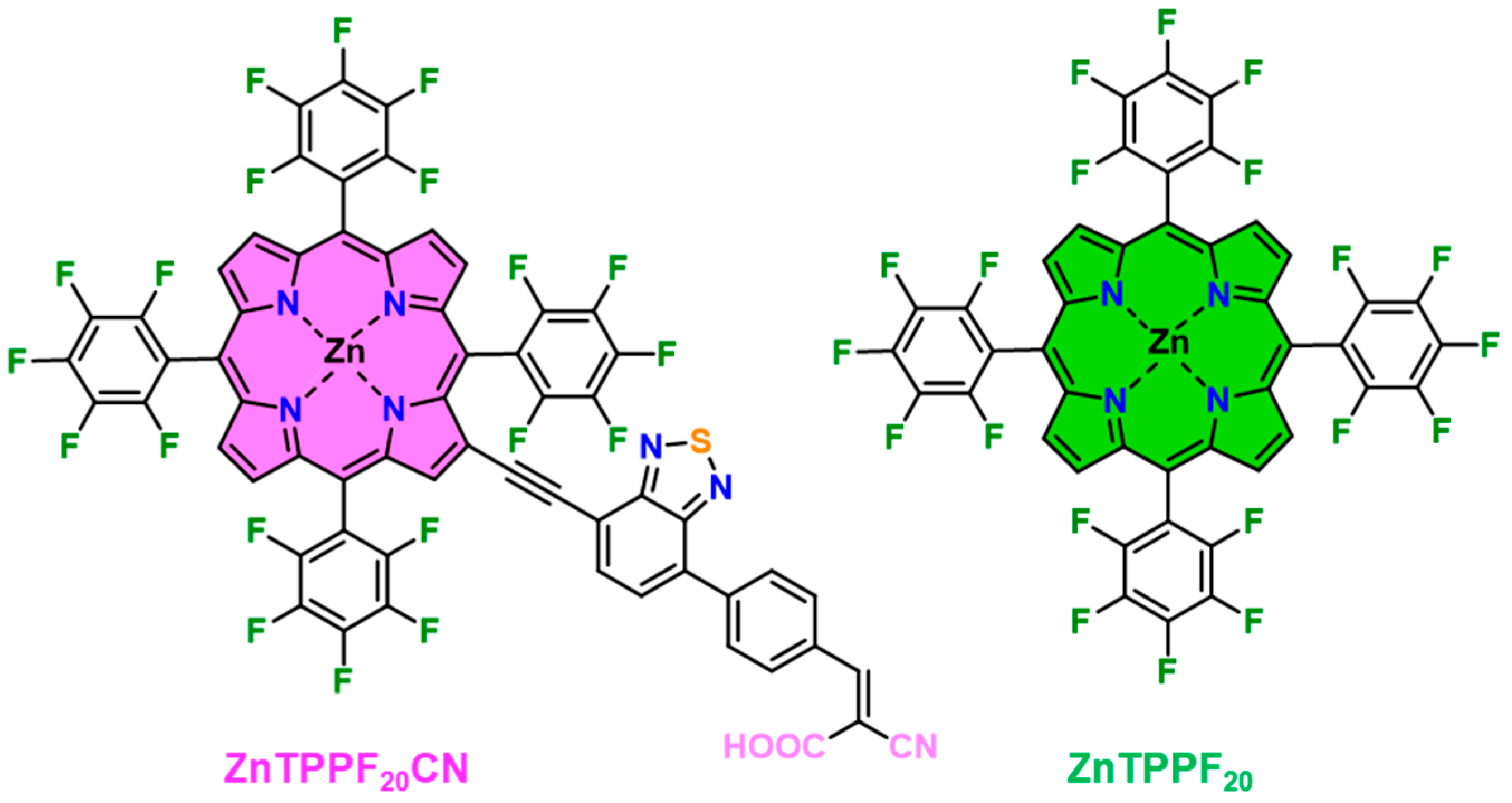
Figure 1. Investigated Zn(II) porphyrins.
Molecules 30 04749 g001
Figure 2. Comparison of sensing responses toward acetone of pristine (a,e) SnO2 and (bd,fh) ZnTPPF20CN/SnO2-based composites in simulated air (80% N2–20% O2), both in dark and upon LED light illumination. Operating temperature = 120 °C, RH% < 2%.
Molecules 30 04749 g002
Figure 3. Comparison in dark or under LED irradiation of the investigated ZnTPPF20CN/SnO2 and the corresponding ZnTPPF20/SnO2 ones: (a) ibaseline increment vs. pure SnO2 (δibaseline), and (b) response intensity at 20 ppm increment vs. pure SnO2response).
Molecules 30 04749 g003
Figure 4. (a) BET isotherms and (b) pore distribution by BJH analysis. HRTEM images of (c,d) SnO2, (e,f) ZnTPPF20/SnO2, and (g,h) ZnTPPF20CN/SnO2 composites.
Molecules 30 04749 g004
Figure 5. Comparison of (a) FTIR and (b) DRS spectra of pristine materials and the corresponding ones obtained as a difference between the composites and bare SnO2.
Molecules 30 04749 g005
Figure 6. Possible adsorption modes of (a) ZnTPPF20CN and (b) ZnTPPF20 on SnO2 surface, and corresponding projected DOS.
Molecules 30 04749 g006
Table 1. Adsorption energy and transferred charge for the different adsorption modes on the SnO2 surface of ZnTPPF20CN and ZnTPPF20.
MoleculeModeAdsorption Energy
eV
Integrated Charge
e
ZnTPPF20CNA−1.610.38
B−2.010.20
C−1.870.24
ZnTPPF20D−0.150.51
Disclaimer/Publisher’s Note: The statements, opinions and data contained in all publications are solely those of the individual author(s) and contributor(s) and not of MDPI and/or the editor(s). MDPI and/or the editor(s) disclaim responsibility for any injury to people or property resulting from any ideas, methods, instructions or products referred to in the content.